Protect Crypto, AI, and FinTech platforms w/ trusted
www.cxoinsightme.com
16 AI MOMENTUM
Confluent’s latest report spotlights why the next stage of enterprise AI will be defined by data infrastructure, not model capability
INTERVIEWS
24 RESILIENCE IN PRACTICE
Dell Technologies’ Walid Yehia on why operational readiness is becoming the true measure of enterprise resilience
28 THE ENTERPRISE BLIND SPOT
Lenovo and SentinelOne examine the rise of Shadow AI and why governance is struggling to keep pace
SPOTLIGHT
36 AI IN FINANCE: THE NEW BOTTOM LINE
Industry leaders explore how financial institutions are moving from AI pilots to realworld deployment, balancing governance, accountability and business value
26 BANKING ON SECURITY
F5 on the growing complexity of AI governance in financial services and the need for contextual, adaptive controls
34 THE NEXT INTERFACE
Zebra Technologies highlights the shift towards composable, AI-driven user experiences and the redefinition of human–machine interaction
50 The latest gears and gadgets to keep you ahead of the curve
THE TRUST IMPERATIVE
Informatica’s Yasser Shawky on why, as AI moves into enterprise operations, trusted data, governance and context are becoming the real differentiators
Published by
CONTEXT IS KING
For a long time, the conversation around AI was fairly straightforward. What can the model do? How fast can it get there? How much can we automate?
That is no longer the question.
What is starting to matter now is something less visible, but far more important: can you trust it? Not just the output, but everything behind it, including the data, the context, and the way decisions are made and understood.
That theme runs through our cover story with Yasser Shawky from Informatica. As he puts it, “If organisations are going to trust AI with business decisions, they first need confidence in the data informing those decisions.” As AI becomes embedded in day-to-day operations, success depends less on the model itself and more on the quality, governance and context of the data behind it.
The same message emerges in Confluent’s latest research. More than a third of organisations across the UAE and Saudi Arabia are already running agentic AI in production, yet nearly all IT leaders identify data streaming as critical to AI success. Read more on page 16.
It was also central to our recent webinar, AI in Finance: The New Bottom Line, where leaders from Reem Bank, Planview, Ittihad International Investment and BMC explored governance, accountability and the importance of trusted data in AI-driven decision-making.
Elsewhere in this issue, F5 examines AI governance in financial services, Zebra Technologies explores the shift towards composable AI-driven interfaces, and NetScout looks at how observability strengthens trust in digital banking.
As AI continues to evolve, the real differentiator will not be the models themselves, but the confidence organisations have in the data behind them. In the end, AI is only as trustworthy as the information it is built upon.
While the publisher has made all efforts to ensure the accuracy of information in this magazine, they will not be held responsible for any errors
DEWA becomes the first government entity in the UAE to adopt Microsoft 365 Copilot Cowork, introducing AI-powered digital coworkers to support employees with complex tasks, planning and collaboration. The initiative marks another step in DEWA’s broader strategy to embed agentic AI across its operations and enhance workforce productivity.
Oman accredits a new registry operator for its .om domain, expanding competition and strengthening the country’s digital infrastructure. The move is expected to improve domain registration services, enhance online accessibility for businesses and individuals, and support Oman’s broader ambitions to grow its digital economy.
Egypt launches a unified digital environmental registry for industrial facilities, creating a centralised platform to monitor emissions, energy and water use, waste and carbon reporting. The initiative streamlines compliance while supporting greener manufacturing, data-driven regulation and export competitiveness in line with global sustainability standards.
Google cuts Gemini pricing, signalling a new phase in the AI race where affordability is becoming as important as raw model performance. The move aims to broaden enterprise and developer adoption, intensifying competition as AI providers increasingly compete on value, accessibility and scale rather than capability alone.
Hewlett Packard
Enterprise appoints Michael Langeveld as UAE Country Director, reinforcing its leadership team as demand for AI, hybrid cloud and sovereign infrastructure accelerates. He will lead the company’s UAE business, strengthening customer and partner engagement while supporting the country’s digital transformation ambitions.
du Pay names Roberto Mancone as Chief Executive Officer to lead its next phase of growth, bringing more than 25 years of fintech and digital banking experience. He will focus on scaling the platform, expanding services and strengthening its position in the UAE’s evolving digital payments landscape.
UAE’s DEWA puts AI to work with Copilot Cowork deployment
Google slashes Gemini pricing to drive AI adoption
HPE taps Michael Langeveld to drive UAE growth
du Pay appoints Roberto Mancone as CEO
Egypt digitises environmental compliance
Oman expands domain registry to boost digital ecosystem
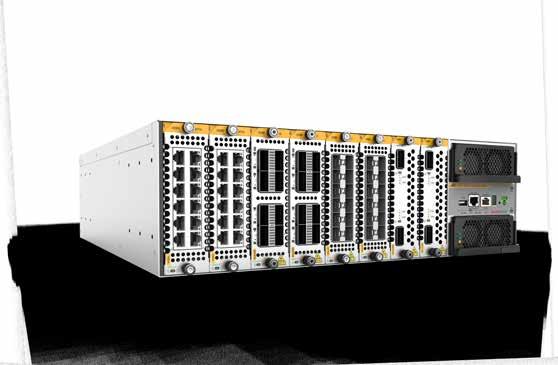
Switch to Speed. Scale Without Limits.
Meet the SwitchBlade x908 GEN3
The SwitchBlade x908 GEN3 is our most advanced modular switch, delivering blazing speed and scalable growth for future-ready enterprise and data center networks.
Blazing Bandwidth: Up to 400G connectivity for high-performance workloads.
Scale Without Limits: 12.8 Tbps of power in a compact 3U chassis.
Flexible & Modular: Compact chassis with versatile interface options.
Smart Management: Zero-touch provisioning and centralized control with AlliedWare Plus™.
Whether you’re scaling a data center or optimizing enterprise networks, the SwitchBlade x908 GEN3 keeps your network fast, flexible, and fail-proof.
Take control. Stay ahead. Transform your network today.
Anthropic secures $65 billion to accelerate AI expansion
Anthropic has raised US$65 billion in a Series H funding round, bringing its post-money valuation to US$965 billion as it expands computing capacity, advances frontier AI research and scales its Claude product portfolio.
The funding round was led by Altimeter Capital, Dragoneer, Greenoaks and Sequoia Capital, with participation from new and existing investors.
New funding valued the AI company at $965 billion, supporting compute expansion, Claude growth, and AI safety research
Anthropic said adoption of Claude has continued to grow across enterprise customers since its previous funding round, with run-rate revenue surpassing US$47 billion earlier this month.
“Since our Series G in February, adoption has continued to grow across global enterprise customers, and our run-rate revenue crossed $47 billion earlier this month,” the company said.
The company plans to use the new capital to expand its compute infrastructure, accelerate the development of frontier AI models, grow its products and continue research into AI safety and alignment.
Anthropic said global enterprises are deploying Claude across core business operations, while an increasing number of individuals are using the AI assistant in their everyday work. The investment is expected to support the infrastructure and research needed to meet growing demand while advancing the company’s long-term focus on building reliable and safe AI systems.
Saudi Arabia’s HUMAIN, NVIDIA advance autonomous mobility in the Middle East
HUMAIN has announced that it will lead the Middle East deployment of NVIDIA’s DRIVE Hyperion robotaxi-ready platform as part of the company’s global expansion of its autonomous vehicle ecosystem.
The initiative brings together automakers, manufacturing and autonomous vehicle software partners, and ride-hailing mobility providers to support the development and deployment of Level 4-ready robotaxi fleets across Asia, Europe and the Middle East. In the region, HUMAIN will combine its AI and mobility ecosystem with NVIDIA’s DRIVE Hyperion platform to advance Level 4-ready autonomous transportation solutions in Saudi Arabia and across the wider Middle East.
“Autonomous mobility will become one of the defining AI platforms of the next decade,” said Tareq Amin, CEO of HUMAIN. “By working with NVIDIA, HUMAIN is helping enable the infrastructure, intelligence, and operational scale needed to develop
and support the future of Level 4-ready transportation in Saudi Arabia. This collaboration reflects our broader vision to help build AI-native infrastructure platforms that connect the digital and physical worlds at scale.”
The partnership is backed by significant infrastructure investment. HUMAIN plans to build AI factories with a projected capacity of up to 500 megawatts and deploy several hundred thousand NVIDIA GPUs over the next five years. An initial phase featuring an 18,000-GPU NVIDIA GB300 Grace Blackwell supercomputer and InfiniBand networking is already underway.
This collaboration reflects our broader vision to help build AInative infrastructure platforms that connect the digital and physical worlds at scale
“Autonomous mobility is entering its industrial scaling moment,” said Jensen Huang, founder and CEO of NVIDIA. “Vehicles are becoming robots, and robotaxi fleets will require AI infrastructure that can perceive, reason, and operate safely in the real world. NVIDIA DRIVE Hyperion gives the world’s automakers, AV developers and mobility networks a common Level 4-ready foundation — uniting compute, sensors, safety software and a global ecosystem to bring robotaxis from pilots to everyday transportation at scale.”
TAREQ AMIN
HUMAIN
Space42 taps Skylo to expand satellite mobile connectivity
Space42 has appointed Skylo Technologies to deliver standards-based direct-to-device (D2D) connectivity through its geostationary satellite, Thuraya-4, expanding satellite-enabled mobile communications across its coverage footprint.
The partnership integrates Skylo’s 3GPP-compliant non-terrestrial network (NTN) platform with Thuraya-4, enabling compatible mobile devices to connect directly via satellite without requiring modified SIM cards or changes to existing operator core infrastructure. The companies have already completed a bi-directional, real-time voice call over Thuraya-4, with the technology integration complete and the service ready for commercial deployment.
For mobile operators, the service extends existing network architecture while preserving subscriber authentication through the same SIM and identity framework. It is designed to expand coverage across rural, maritime and remote areas while maintaining the operator relationship with customers.
“This partnership advances Space42’s strategy to become a global NTN leader,
extending Thuraya-4’s reach through an interoperable connectivity layer that enables satellite and terrestrial networks to function as one unified system. The impact is immediately meaningful for the people and communities who depend on reliable connectivity, delivering resilient, carrier-grade coverage to enterprises, governments, and mobile operators across remote
and underserved regions, on infrastructure built on 3GPP standards and designed for long-term scale,” said Ali Al Hashemi, CEO of Space Services, Space42.
Commercial deployment will begin across Thuraya-4’s coverage footprint as regulatory approvals and operator agreements are secured across target markets.
The companies have been in discussions for more than a year and formalised the agreement in recent months, though it remains unclear which Apple products will use chips manufactured by Intel. Apple ships more than 200 million iPhones annually, alongside millions of iPads and Macs.
The reported deal would mark a significant win for Intel Foundry, the company’s contract chip manufacturing business, which has sought to attract major external customers as it expands its semiconductor manufacturing capabilities.
According to the report, the US government played a role in facilitating discussions between the two companies after converting nearly US$9 billion in federal grants into equity, resulting in a 10 percent stake in Intel. The move forms part of broader efforts to strengthen domestic semiconductor manufacturing and expand advanced chip production in the United States.
Neither Apple nor Intel commented on the report. If finalised, the agreement would represent a notable shift in Apple’s chip manufacturing strategy while supporting Intel’s efforts to grow its foundry business.
Apple and Intel have reportedly reached a preliminary agreement for Intel to manufacture some of the chips used in Apple devices, according to people familiar with the
Aramco launches Saudi Arabia’s first quantum computer
Aramco has inaugurated Saudi Arabia’s first quantum computer in partnership with Pasqal, alongside the launch of the Middle East’s first commercial Quantum Computing as a Service (QCaaS) platform.
Located at Aramco’s data centre in Dhahran, the platform provides secure,
low-latency cloud access to quantum hardware for enterprises, universities and research institutions. Powered by Pasqal’s neutral-atom Quantum Processing Unit (QPU), the system controls 200 programmable qubits and has entered active operation across industrial applications.
“This quantum milestone belongs to our Saudi researchers, engineers and scientists. By investing in joint training and research, we are building worldclass quantum expertise right here in the Kingdom—an expertise that will power the next generation of energy solutions, accelerate lower-carbon fuel development, and enhance reservoir and supply-chain optimisation. Let this achievement be the catalyst for an innovation-driven economy, creating high-impact, future-ready jobs for our youth and advancing Saudi Vision
By investing in joint training and research, we are building world-class quantum expertise right here in the Kingdom
AHMAD O. AL KHOWAITER Aramco
2030,” said Ahmad O. Al Khowaiter, Executive Vice President of Technology & Innovation, Aramco.
Under the partnership, Aramco will advance quantum-hybrid solutions across its energy, materials and industrial operations. External organisations, including research institutions, universities and enterprises, will also be able to access the platform to develop quantum applications for real-world industrial challenges.
UAE to establish advanced chiplet design and assembly facility
The Tawazun Council for Defence Enablement and Lockheed Martin have signed an agreement to establish an advanced microelectronics chiplet design and assembly facility in the UAE, marking a step towards strengthening the country’s semiconductor and advanced manufacturing capabilities.
Announced during Make it in the Emirates 2026, the initiative will be delivered in collaboration with EDGE Group and Khalifa University. It aims to develop local expertise in chiplet design and assembly while supporting applications across defence, aerospace, telecommunications, artificial intelligence, autonomous systems and advanced manufacturing.
As part of the initiative, HALCON, an EDGE Group company, will integrate chiplet-based processors into advanced targeting and guidance systems to enhance onboard computing, target acquisition, tracking and precision engagement. A dedicated research and development centre will also be established at Khalifa University to support microelectronics research,
workforce development and industry collaboration.
“This partnership represents a strategic step in advancing the UAE’s sovereign capabilities in advanced technologies and microelectronics, reinforcing our commitment to localising critical industries and fostering innovation
through global collaboration,” said Dr Nasser Humaid Al Nuaimi, Secretary General of Tawazun Council.
The agreement also strengthens technology collaboration between the UAE and the US through a co-development model spanning design, research and advanced chip assembly.
The Intelligent Core of Your Cyber Defense
One Platform. Total Visibility. Absolute Security.
Turn fragmented data into decisive action
Our SIEM eliminates blind spots, providing the real-time insights you need to detect, investigate, and neutralize threats before they disrupt your operations.
Detect Early
Spot ransomware, phishing, and insider threats instantly.
Automate audit logs for GDPR, HIPAA, and PCI DSS. Stay compliant
Respond Faster
Automate incident response to slash recovery times.
One view for cloud, on-prem, and remote teams. Unify Everything
Oman advances digital resilience through 5G expansion
Oman has strengthened its digital resilience through continued investment in telecommunications infrastructure and emergency preparedness, supported by the expansion of its 5G network and coordinated crisis response measures.
During World Telecommunication and Information Society Day, held under the theme “Digital Lifeline: Strengthening Resilience in a Connected World,” the Ministry of Transport, Communications and Information Technology highlighted
Qatar reaches 93% digital government service delivery
Qatar’s Ministry of Municipality has reported that 93 percent of its services were completed electronically in 2025, reflecting continued progress in the country’s digital transformation efforts.
According to the ministry’s 2025 Annual Report, 172 electronic services were made available through its website, while a further 127 services were delivered via the Oun mobile application. The ministry processed more than 618,990 digital service requests during the year, with customer satisfaction for digital services reaching 86.4 percent.
The report also highlighted the
efforts to enhance the country’s emergency communications capabilities.
The telecom sector has introduced specialised emergency management regulations, updated business continuity plans and implemented technical measures including backup routes, geographically distributed facilities, local roaming, traffic rerouting and mobile warning broadcasts. Authorities said these measures helped maintain communications and restore services during emergencies, including Cyclone Shaheen.
618,990+
Digital service requests processed through the ministry’s online platforms during 2025
6.5 million+
Mobile subscriptions recorded in Oman by the end of 2025
The sector generated around US$2.39 billion (RO918 million) in revenues during 2023 and 2024, while investments exceeded US$650 million (RO250 million). Omanisation reached 94 percent, and mobile subscriptions surpassed 6.5 million by the end of 2025.
Oman has also expanded its 5G infrastructure, with 6,671 stations deployed during the first half of 2025, representing an increase of around 23 percent year on year. The initiatives support Oman Vision 2040 by strengthening digital infrastructure, improving business continuity and enhancing the resilience of critical communications networks.
launch of Qatar’s AI-powered building permit system, which it said made the country the first to implement a fully integrated electronic building permit platform capable of issuing permits within 120 minutes.
Beyond digital services, the ministry reported progress across sustainability, urban development and food security initiatives. These included the completion of the first phase of the Doha antidesertification project, an 85 percent waste separation rate under Doha’s source-separation programme, and continued expansion of organic farming.
The ministry also launched the Himmah electronic system to manage strategies, projects and institutional performance, while publishing Qatar’s first government sustainability report. The initiatives support Qatar National Vision 2030 and the country’s broader smart city and digital government ambitions.
“AI GOVERNANCE IS NO LONGER ONLY ABOUT PRODUCTIVITY OR COMPLIANCE; IT HAS BECOME A CYBERSECURITY AND OPERATIONAL RESILIENCE ISSUE”
“RESILIENCE CANNOT BE BUILT AROUND A SINGLE CAPABILITY. IT REQUIRES AN ECOSYSTEM OF TECHNOLOGY, PROCESSES AND PEOPLE”
Walid
Yehia, Managing Director – South Gulf, Dell Technologies
WHY REAL-TIME DATA IS DRIVING THE NEXT PHASE AI MOMENTUM:
The UAE and Saudi Arabia have emerged among the world’s leading markets for deploying agentic AI, with more than a third of organisations in both countries already running the technology in production.
The finding comes from Confluent’s 2026 Data Streaming Report, which surveyed 4,625 IT leaders worldwide and examines how organisations are preparing the data foundations needed to support AI at scale.
According to the report, 38 percent of organisations in both markets have already put agentic AI into production, placing the Gulf among the strongestperforming regions globally. The research also shows that IT leaders are placing increasing importance on the data infrastructure that supports AI deployment. In the UAE, 90 percent of respondents describe data streaming as a strategic business priority, while the figure stands at 88 percent in Saudi Arabia. In both
countries, it ranks ahead of artificial intelligence and machine learning technologies.
Running AI in production places different demands on enterprise infrastructure. Autonomous systems require continuous access to current, accurate and contextual data, making the underlying data architecture an increasingly important business consideration. Across both the UAE and Saudi Arabia, 95 percent of IT leaders believe data streaming platforms can accelerate AI adoption, while the same proportion expect them to increase the impact of AI investments. Another 95 percent say data streaming platforms improve the trustworthiness, context and discoverability of enterprise data, capabilities that become increasingly important as organisations introduce agentic AI into day-to-day operations.
The report also shows that organisations are encountering many of the same operational challenges as their global counterparts. Nearly three in four IT leaders in both markets report facing at least three significant barriers to AI adoption. The most frequently cited issues include insufficient infrastructure for real-time data processing, uncertainty around data lineage, timeliness and quality, and shortages in AI and data skills.
Agentic AI introduces another set of technical requirements. Just over 66 percent of respondents in both countries identify data infrastructure and data quality as specific challenges when deploying autonomous AI systems. The findings suggest organisations are no longer asking whether AI can deliver business value. Their attention has shifted to ensuring the underlying data is accurate, accessible and available in real time as AI systems become part of everyday operations.
The regional findings closely mirror the broader global picture. Confluent argues that many organisations have already committed to AI investment, but their ability to achieve consistent outcomes increasingly depends on whether existing data environments can provide fresh, accurate and contextual information continuously.
For organisations across the Gulf, competitive advantage is becoming less about adopting the latest models and increasingly about building the data infrastructure capable of supporting AI reliably, securely and at scale.
38%
The adoption rate of agentic AI across organisations in the UAE and Saudi Arabia
95%
The share of IT leaders who see data streaming as critical to AI success
90% UAE KSA
88%
The level of organisations placing data streaming ahead of AI and machine learning in their strategic prioritiespriorities
THE TRUST IMPERATIVE
As AI agents become embedded in enterprise operations, the conversation is shifting beyond models. Yasser Shawky, Vice President – EMEA South at Informatica from Salesforce, explains why trusted data, governance and context are becoming the true differentiators
Artificial intelligence has spent the past two years proving what it can do. It has generated code, summarised meetings, analysed contracts and accelerated countless individual tasks. Those capabilities transformed perceptions of AI, but for enterprises they represented only the beginning.
The real opportunity now lies in embedding AI into the day-to-day fabric of the business. Organisations are deploying autonomous AI agents capable of retrieving information from multiple enterprise systems, coordinating workflows, supporting decisions and executing tasks with minimal human intervention. As AI moves beyond assisting employees and begins participating directly in business processes, enterprises face a new question: can those systems be trusted to make decisions that affect customers, operations and the business itself?
“AI is finding its way into every industry, every business function and virtually every process,” says Yasser Shawky, Vice President – EMEA South, Informatica from Salesforce. “Businesses now understand the value it can create, and there is little debate that it will fundamentally reshape how organisations operate.”
With AI firmly established as a business priority, attention is turning from model capability to enterprise readiness. The recently held Informatica World 2026 reflected that evolution. Discussions focused less on increasingly powerful AI models and more on the data foundations organisations need if autonomous systems are to operate reliably in production.
“One of the central themes at the event was helping organisations understand how to create measurable value from AI,” Shawky says. “AI has matured from both a technology and concept perspective. What is changing now is the speed at which organisations are adopting it, operationalising it, and building new capabilities around it.”
As organisations give AI agents greater autonomy, that challenge becomes increasingly significant.
If organisations are going to trust AI with business decisions, they first need confidence in the data informing those decisions
Agents are expected to retrieve information, make recommendations and execute decisions across multiple business systems. Without confidence in the data supporting those actions, organisations struggle to move AI beyond isolated pilots.
“If organisations are going to trust AI with business decisions, they first need confidence in the data informing those decisions. AI agents may have access to more enterprise knowledge than any individual employee, but without trusted data, every decision they make carries unnecessary risk,” says Shawky.
That is why Informatica is placing growing emphasis on what it calls “trusted context” — a concept the company positions as distinct from, and broader than, data quality alone. Clean data tells an AI agent that a number is accurate. Trusted context tells it where that number came from, who is allowed to see it, how recently it was updated, and whether it means the same thing in the system the agent just pulled it from as it does in the process it’s about to inform.
“If organisations are going to trust AI with business decisions, they first need confidence in the data informing those decisions. AI agents may have access to more enterprise knowledge than any individual employee, but without trusted data, every decision they make carries unnecessary risk,” says Shawky.
Trusted context, in Informatica’s framing, is the layer that resolves
that ambiguity before an agent acts on it — combining data governance (who owns the data and what rules apply to it), metadata (what the data actually represents), lineage (where it originated and what has touched it along the way) and business relationships (how it connects to other data across the enterprise). Put together, it’s less a dataset than a map — one that tells an AI system not just what a piece of information says, but whether it’s safe to act on.
“You need to make sure that whatever data is passed to the agent is trusted,” Shawky says.
“Otherwise, the agent will be making
decisions based on flawed guidance. As organisations deploy AI more broadly, they’re bringing together data officers, IT and business leaders to ensure agents operate within a trusted context, where the data is accurate, governed and delivered with the right business meaning. This is where Informatica, as part of Salesforce, is adding significant value for organisations.”
A trusted foundation for enterprise AI
As trusted context becomes a prerequisite for operationalising AI, it’s also becoming a strategic
capability for enterprise AI platforms. Salesforce’s US$8 billion acquisition of Informatica, completed in November 2025, reflected a broader industry recognition: deploying autonomous AI requires far more than increasingly capable models.
By combining Informatica’s expertise in data integration, governance, metadata management, Master Data Management (MDM), data quality and privacy with Agentforce, Data Cloud, MuleSoft and Tableau, Salesforce strengthened what it describes as a unified data foundation for agentic AI.
“Salesforce’s strategy is now centred on agentic AI,” Shawky
says. “Historically, the quality and condition of enterprise data has been the customer’s responsibility. Yet around 70 percent of agentic AI pilots fail—or never progress beyond experimentation—because organisations don’t have enough confidence in the data behind them. Informatica addresses that challenge by helping customers build a trusted data layer, allowing AI agents to operate reliably, without unnecessary risk or disruption, and enabling more use cases to move into production.”
The strategy extends well beyond Salesforce’s own applications. Most enterprises continue to operate across
Data remains the unique value that any organisation produces. This gives clients confidence that Informatica will remain the ‘Switzerland of data’, as it always has been
multiple cloud providers, analytics platforms and business applications, making interoperability just as important as AI capability itself.
“The role of Informatica is to bring context from everywhere and help organisations manage their data regardless of which ecosystems they rely on,” says Shawky. “Data remains the unique value that any organisation produces. This gives clients confidence that Informatica will remain the ‘Switzerland of data’, as it always has been. Its reputation is built on bringing everyone into the same layer of trusted data and trusted context, which is now critical for the success of any AI and agentic effort.”
The next layer of trust Trust, however, extends beyond the data itself. As enterprises orchestrate multiple AI agents across increasingly
complex business processes, governance must also encompass the AI systems making decisions.
“Having trusted data is a prerequisite for the success of AI because it gives the business the confidence to operationalise AI and agents,” Shawky says. “If I know for a fact that the data is correct, then the algorithm and the agent will perform the job.”
Enterprises should approach governance on two levels, according to Shawky. The first establishes confidence in the data itself. The second governs the AI systems consuming that data. “Trusted context starts with governing the data AI agents use,” Shawky says. “You need confidence that every decision is based on accurate, wellgoverned information. Beyond that, organisations also need governance over the agents themselves— establishing clear policies around autonomy, decision-making, compliance and human oversight. Trusted AI depends on both layers working together.”
Those requirements are already influencing adoption across industries. Customer service remains one of the clearest examples. Telecommunications providers and retailers are using AI to shorten response times while improving service quality. Airlines are deploying AI to personalise offers, manage disruptions and improve passenger communications. Insurance providers have automated claims processes that previously relied on manual assessment, reducing turnaround times while improving consistency. Governments across the Gulf are entering a new phase of AI adoption, expanding the role of AI beyond individual use cases and embedding it more deeply into public services and government operations. For one, the UAE’s recently announced plan to introduce agentic AI will be across 50 percent of government services and operations, highlighting an ambition to make AI part of how government functions rather than simply another digital tool.
“Over the last five years, we have seen major investments in data governance, data quality and regulatory frameworks across the
UAE, Saudi Arabia, Qatar, Oman and Bahrain. These efforts created a strong foundation for AI adoption because they focused on improving data quality and enabling secure data sharing between government entities. AI then built on top of that foundation,” says Shawky.
That regional maturity is closely linked to another priority: data sovereignty. As data becomes an increasingly valuable strategic asset, organisations must balance access to global AI innovation with regulatory requirements around where data resides and how it is governed.
“Informatica provides the flexibility to govern data across different data centres, locations and ecosystems,” Shawky says. “Your data will never sit in one place. Our role is helping governments and organisations utilise their data securely, even in a multi-location setup, while respecting sovereignty requirements.”
Looking ahead, Informatica believes the next phase of enterprise AI will focus on making trusted data
management significantly easier to access. At Informatica World, the company introduced headless data management, allowing developers and AI platforms to interact directly with Informatica’s data management capabilities using natural language rather than specialised interfaces. Central to that announcement is CLAIRE, Informatica’s AI engine, which automates data integration, governance, quality and metadata management while exposing those capabilities as reusable services that external AI agents can invoke directly. Rather than requiring users to work inside Informatica’s own interface, organisations can access trusted data capabilities from the AI platforms and development environments they already use. The company positions this as a major step towards making trusted data management available wherever AI is deployed.
“Data has become one of the most valuable strategic assets organisations and nations possess,” Shawky says. “The priority is enabling data to create
value wherever the business needs it, while maintaining the governance, control and sovereignty that organisations expect.”
Enterprise AI is becoming less a question of what models can do and more a question of how confidently organisations can deploy them at scale. As AI becomes embedded across business operations, lasting value will depend on treating trusted data, governance and context as strategic capabilities rather than mere technical considerations.
“Technologies evolve and architectures change,” Shawky says.
“Enterprise data remains the constant because it represents the unique value every organisation creates. Becoming part of Salesforce has enabled Informatica to accelerate innovation and make trusted data management easier to access across enterprise AI environments. Whatever the next generation of AI looks like, organisations will continue to rely on trusted data as the foundation for turning innovation into business value.”
RESILIENCE IN PRACTICE
Walid Yehia, Managing Director – South Gulf, Dell Technologies, discusses the changing nature of enterprise resilience and why operational readiness is becoming a defining measure of digital maturity
Business continuity has long been a core enterprise discipline, but the current operating environment has given it renewed urgency. Across the Middle East, organisations are operating against growing uncertainty while relying more heavily than ever on digital systems to support customers, employees and day-to-day operations. As a result, resilience has become a broader business priority, extending well beyond the technology function.
Recent events across the region have tested the investments organisations have made in digital transformation over the past few years. Many businesses maintained operations with limited disruption, reflecting stronger digital foundations and more flexible operating models. At the same time, the experience highlighted a shift in priorities. Organisations are now looking beyond system availability to recovery, operational preparedness and the ability to respond quickly when conditions change.
That evolution is reflected in the conversations Dell Technologies is having with customers across the Gulf. “Organisations have certainly developed a much deeper appreciation for resilience,” says Walid Yehia, Managing Director, South Gulf, Dell Technologies. “Resilience cannot be built around a single capability. It requires an ecosystem of technology, processes and people, supported by proper planning and the ability to respond when circumstances change. The pandemic taught organisations how to keep digital transformation moving, maintain critical systems and support employees working from different locations. Those capabilities didn’t disappear when the pandemic
ended. They became part of the way organisations operate today.”
Those experiences have left many organisations better prepared than they might have been several years ago. According to Yehia, the region demonstrated a high degree of operational maturity during the recent period of uncertainty, with few major interruptions to essential digital services. “The recent period demonstrated that the investments organisations have made in digital transformation are delivering
tangible value,” says Yehia. “While no organisation would claim to be fully insulated from disruption, we saw businesses maintain continuity, reflecting the maturity many organisations have developed. Every situation also reinforces new lessons, particularly around data sovereignty and recognising data as one of an organisation’s most valuable assets.”
The next challenge, however, lies elsewhere.
For many organisations, backup strategies are now well established.
Attention is shifting to recovery, particularly how quickly critical systems can be restored and business operations resumed after an incident. As digital services become central to customer engagement, operational performance and decision-making, prolonged downtime carries consequences that extend far beyond the technology department.
“The industry now needs to place much greater emphasis on recovery,” Yehia says. “Protecting data remains essential, but resilience is about far more than maintaining a third copy of your information. If an organisation loses its systems because of physical damage or a cyberattack, the business still needs to operate. Organisations today rely on digital systems to deliver services, support customers and run their operations. Recovery has become just as important as protection because the objective is to restore business as quickly as possible.”
That shift is encouraging organisations to reassess how they approach resilience programmes. Technology alone cannot determine the outcome of a crisis. Recovery depends just as heavily on governance, decision-making and whether organisations have prepared their people for the situations they may eventually face.
“Business continuity and disaster recovery cannot be something you only think about during a crisis. Organisations need to know exactly how they will respond before disruption occurs. Those plans have to be tested during normal times because, under pressure, people don’t always think clearly. Even with the right technology in place, recovery becomes much more difficult if your teams and processes haven’t been prepared.”
The same focus on preparedness is also reshaping expectations of technology partners. Organisations increasingly value providers that can help maintain business continuity when operating conditions become more challenging, whether through supply chain resilience, technical expertise or responsive support.
For Dell Technologies, that meant adapting its own operations while ensuring customers experienced as
little disruption as possible. Logistics routes changed, but alternative arrangements enabled the company to maintain spare parts availability and keep deliveries close to normal timelines. The company also worked closely with its channel partners, communicating revised logistics arrangements and contingency measures to minimise delays and help partners continue serving customers.
“Our teams remained on the ground supporting customers, and our operations continued throughout,” says Yehia. “We had to adjust the way we operated, particularly from a logistics perspective, because some of the usual routes were no longer available. We found alternatives, maintained our spare parts inventory and continued shipping orders. It wasn’t business as usual in every respect, but, to a large extent, our customers did not feel the impact.”
Support extended beyond logistics. Dell Technologies continued deploying engineers where needed to help customers maintain critical systems, while sharing threat intelligence that enabled organisations to strengthen their security posture before incidents developed further.
“Customers expected two things from us,” Yehia says. “They needed the supply chain to keep moving, and they needed us to be ready to support them whenever required. We responded quickly, deployed engineers on site where necessary and shared threat intelligence so organisations could take proactive measures before their systems were compromised. That’s the relationship we want to build. We don’t simply see them as customers. We see them as partners.”
That growing emphasis on proactive operations is also influencing how organisations view artificial intelligence. While much of the conversation has centred on productivity and business applications, AI is increasingly finding a place within IT operations, helping organisations identify risks earlier and improve decision-making before issues affect business services.
“AI has an important role to play in operational resilience, particularly within IT operations,” Yehia says. “It can identify threats before anything
Resilience cannot be built around a single capability. It requires an ecosystem of technology, processes and people, supported by proper planning and the ability to respond when circumstances change
happens, predict potential failures and provide operations teams with the intelligence they need to take action before issues become incidents. It can also support IT teams by providing guidance on how to respond more effectively in different situations. That allows organisations to become far more proactive in the way they manage their environments.”
Looking ahead, resilience is steadily becoming a measure of organisational maturity rather than a standalone technology objective. As digital operations become increasingly central to business performance, the focus is shifting from preventing disruption to ensuring organisations can adapt, recover and continue moving forward when it occurs.
“Technology will always be a critical enabler, but resilience is built through the combination of technology, processes and people,” says Yehia.
“Our role is to help organisations strengthen all three by bringing the right technologies, sharing knowledge, helping customers build the right operational foundations and ensuring they can continue innovating with confidence. That’s how resilience becomes part of long-term business growth rather than simply a response to disruption.”
industry is rapidly emerging as a leader in AI adoption to personalise services, automate decisions, and streamline operations. These innovations introduce new risks, particularly as AI interacts with sensitive account and transactional data across complex hybrid environments. Due to the rapidly evolving nature of AI, the challenge is not just identifying risk, but about remediating it at speed.
Financial services environments are shaped by layered and highly specific policies governing data access, privacy, permissible outputs, and regional or role-based constraints. These policies are informed by regulation, internal risk frameworks, and business context, and they often vary across use cases, even when the same AI model or application is involved. When AI operates dynamically, responding to prompts and inputs as they occur, those policies must be enforced in context rather than assumed in advance.
Why custom controls matter for AI governance
Unlike traditional business applications, AI is inherently nondeterministic, meaning the same prompt or input can produce different outputs. So, when AI is used in production, risk is shaped by who is interacting with the system, what data is involved, and how outputs are ultimately used or acted upon. In financial services, the same AI capability may support very
different scenarios, each with its own governance expectations and tolerance for risk. In an industry that is highly regulated, that creates new levels of complexity.
This complexity is compounded by the pace of agentic AI adoption. According to a 2026 survey by NVIDIA, 42 percent of financial services organisations are currently using or assessing agents.
This is why customisable controls for AI systems—often referred to as guardrails—become important. Rather than applying a single, uniform set of restrictions, organisations need the ability to tailor how policy is enforced during live AI interactions. Customisation allows controls to reflect contextual factors such as role, jurisdiction, data sensitivity, or intended use, helping to ensure governance remains aligned with institutional policy without treating all AI interactions as equally risky.
This approach also helps avoid common trade-offs. Guardrails that are too rigid can limit the usefulness of AI, while overly permissive ones increase the likelihood of policy violations or unintended exposure. Customisation provides a more balanced way to manage this tension
An example from financial services practice
Consider an example from a large financial services organisation exploring how to expand AI usage across the enterprise. Early pilots demonstrated value, but leadership identified a core concern: the same
AI systems were being accessed by users with very different roles, permissions, and regulatory obligations.
Rather than treating AI as a single, uniform capability, the organisation focused on enforcing policy at the point of interaction. Guardrails were tailored to reflect internal governance rules, ensuring access to sensitive data and permissible outputs varied appropriately by role and jurisdiction. This approach allowed AI usage to expand without weakening existing access models or introducing new compliance blind spots.
The organisation also examined how these guardrails behaved under real-world conditions. By red teaming their AI systems,
For financial services organisations, AI governance must be an operational concern that scales alongside AI usage
they were able to surface edge cases where prompts could lead to unintended disclosures or policy misalignment, particularly in multi-step interactions. Those findings informed refinements to how guardrails were applied, strengthening oversight while preserving usability.
Applying guardrails as AI use evolves
As AI adoption expands, usage patterns rarely remain fixed. New workflows emerge, responsibilities shift, and AI systems are introduced into areas with different risk profiles. Controls designed around early assumptions can quickly become misaligned with how AI is actually being used.
Customisable guardrails support incremental adjustment as these realities change. Policies can be refined to reflect new use cases, new areas of business, or evolving interpretations of risk without requiring organisations to redesign their AI systems or disrupt existing workflows. This adaptability is particularly important in financial services, where governance frameworks are often revisited as regulations mature and supervisory expectations become clearer.
Learning from real-world behaviour
Even well-designed policies can behave differently once exposed to real-world usage. Ambiguous requests, edge cases, and multistep interactions often reveal gaps between how guardrails are intended to work and how AI systems actually respond. Structured evaluation and adversarial testing help surface these gaps by examining behaviour under pressure. Over time, insights from this process inform how controls are refined, allowing organisations to adjust enforcement based on observed behaviour rather than assumed risk alone. In regulated environments, this feedback loop supports a more defensible approach to governance by demonstrating that controls are actively maintained and informed by evidence.
Supporting responsible AI at scale
For financial services organisations, AI governance must be an operational concern that scales alongside AI usage. Having guardrails that can be customised and refined over time helps institutions maintain oversight without constraining innovation or usability. By focusing on contextual enforcement, continuous learning from real-world behaviour, and reducing time to respond to vulnerabilities, organisations can adopt AI in a way that is both flexible and defensible. In doing so, new use cases can be supported as they emerge, while maintaining trust, accountability, and control.
THE ENTERPRISE BLIND SPOT
Mohammed Hilili, General Manager – Gulf, Lenovo, and Ezzeldin Hussein, Senior Director, Solutions Engineering, SentinelOne, discuss why Shadow AI is emerging as one of the fastest-growing and least-governed enterprise risks across the region
Across the Gulf, generative AI is no longer confined to innovation labs or isolated pilots. Banks are embedding copilots into internal systems. Government entities are building sovereign AI environments. Energy companies are testing AI-driven operational models across industrial infrastructure. Enterprises are under pressure to automate reporting, customer operations, software development, and internal workflows quickly enough to justify rising AI investment.
At the same time, regulators across the region are placing greater scrutiny on data handling, visibility, and sovereignty. The UAE’s
Personal Data Protection Law (PDPL), Saudi Arabia’s localisation priorities, and frameworks such as NESA are forcing organisations to think more carefully about where sensitive information resides, how it moves, and who retains visibility over it once AI systems enter the equation.
What many enterprises are now discovering is that AI adoption is spreading much faster than governance.
Employees are feeding confidential financial information into public AI tools to accelerate reporting.
Developers are pasting proprietary code into external AI assistants. Legal teams are testing contracts through generative AI systems. Customer data, operational records, and internal presentations are increasingly moving through AI tools that security teams may not even know employees are using.
The issue has become widely referred to as Shadow AI, though the term understates how deeply embedded these tools already are inside enterprise workflows. Unlike earlier waves of shadow IT, AI capabilities now sit inside browsers, APIs, collaboration platforms, SaaS applications, embedded assistants, and personal devices.
“Shadow AI has forced a conversation that many organisations were not ready to have,” says Mohammed Hilili, General Manager –Gulf, Lenovo. “When employees use unsanctioned AI tools, data leaves the enterprise perimeter without any audit trail, any governance policy, or any visibility into where it resides.”
For organisations operating under increasingly strict sovereignty obligations, the implications extend beyond conventional compliance exposure.
“In markets like the UAE and Saudi Arabia, where data sovereignty is not just a preference but a regulatory and national security consideration, that is an acute challenge,” says Hilili. “As enterprises are faced with confronting the potential implications of Shadow AI, the conversation shifts from ‘how do we adopt AI’ to ‘how do we know what AI is already being used, by whom, and at what risk.’”
Security operations teams are encountering the same issue from a different direction.
“AI governance is no longer only about productivity or compliance; it has become a cybersecurity and operational resilience issue,” says Ezzeldin Hussein, Senior Director, Solutions Engineering, SentinelOne. “Employees are increasingly using public AI tools outside approved governance frameworks, often without understanding where enterprise data is being processed, stored, or reused.”
Most Shadow AI exposure is not being created through deliberate
attempts to bypass governance controls. Employees are using AI tools because the tools work.
Public AI platforms can summarise reports, automate coding tasks, draft presentations, analyse spreadsheets, and accelerate administrative work in seconds.
“The primary driver is speed and accessibility,” says Hussein. “Employees see immediate productivity value from AI tools, while governance frameworks and enterprise-approved alternatives often move much slower.”
Executive leadership is contributing to the acceleration as well. “The driver is productivity pressure, and it comes from the top as well as the bottom,” adds Hilili. “Leadership pushes teams to demonstrate AI value quickly, and employees reach for whatever tools deliver results fastest.”
Inside many organisations, governance visibility has not kept pace with actual usage patterns.
“Most organisations cannot produce an audit trail of what data was submitted to which AI platform and by whom,” explains Hilili. “Under PDPL, that is a data handling accountability failure. Under NESA, the inability to demonstrate visibility and control over data flows is a governance gap that auditors are beginning to probe.”
The sovereignty implications become especially serious once employees begin interacting with public AI platforms outside approved enterprise environments.
“Employees using public AI tools have no mechanism to verify where their inputs are processed or stored, which directly conflicts with sovereignty obligations that apply to certain categories of governmentadjacent and financial data in this region,” adds Hilili.
Many organisations technically prohibit unsanctioned AI usage through acceptable-use policies. Enforcement, however, remains inconsistent.
“A written policy without enforcement is not a defensible position when a regulator asks for evidence of control,” he says.
Security teams are increasingly shifting toward runtime governance models capable of monitoring AI
activity continuously rather than relying solely on static controls.
As enterprises are faced with confronting the potential implications of Shadow AI, the conversation shifts from ‘how do we adopt AI’ to ‘how do we know what AI is already being used, by whom, and at what risk
“The biggest governance gaps are emerging around Shadow AI discovery, data classification, identity governance, runtime visibility, and policy enforcement,” says Hussein. “Many enterprises simply do not know which AI platforms employees are using, what data is being shared, or whether those interactions align with sovereignty requirements and regulations such as UAE PDPL.”
That visibility challenge is pushing enterprises toward AIaware monitoring models designed specifically for generative AI interactions. “This is where platforms like SentinelOne Prompt Security become critical because they provide real-time observability, policy-based AI controls, sensitive data protection, and AI governance capabilities without forcing organisations to completely block innovation,” explains Hussein.
Why legacy security is struggling
Shadow AI is exposing blind spots inside enterprise security architectures that were designed long before conversational AI entered operational workflows.
Traditional shadow IT usually involved unmanaged applications or devices that could eventually be identified through asset discovery systems or infrastructure monitoring tools. AI interactions behave differently because they are woven directly into normal business activity.
“Shadow AI operates differently because employees can instantly access AI capabilities through browsers, plugins, APIs, SaaS platforms, collaboration tools, or even embedded enterprise applications with minimal visibility from security teams,” says Hussein.
The exposure itself is also harder to detect. “The challenge becomes even greater because AI interactions are conversational and behavioural,” says Hussein. “Sensitive information can be exposed through prompts, AI-generated outputs, automated workflows, or AI-to-AI interactions in ways traditional detection tools were never designed to inspect.”
The weakness becomes especially visible inside conventional DLP and perimeter-monitoring environments.
“DLP catches file transfers and email attachments. Network monitoring sees encrypted HTTPS traffic heading to a recognised AI endpoint and classifies it as clean,” explains Hilili. “Neither tool sees a paste event.”
Most employees interacting with generative AI systems are not uploading documents manually. They are copying and pasting information directly into prompts.
“No file moves. No alert fires. The data is simply gone,” says Hilili.
He adds: “The endpoint is where data originates and where control is often lost. Once an employee copies sensitive content into a browser tab and submits it to an external AI platform, that data has left the enterprise environment with no record and no retrieval mechanism.”
Security operations teams are increasingly shifting toward
observability and runtime monitoring frameworks built for AI-driven activity. Modern SOC operations require AI-aware observability platforms capable of detecting Shadow AI usage, monitoring prompt activity, enforcing runtime policies, identifying prompt injection
AI governance is no longer only about productivity or compliance; it has become a cybersecurity and operational resilience issue
EZZELDIN HUSSEIN SentinelOne
risks, and tracking AI-related data exposure across endpoints, browsers, APIs, and enterprise workflows.
“This is one of the core areas addressed by SentinelOne Prompt Security, which provides visibility into AI usage, real-time policy enforcement, prompt monitoring, protection against prompt injection attacks, and controls to prevent sensitive data leakage across employee AI usage, AI code assistants, homegrown AI applications, AI agents, and AI red teaming initiatives,” explains Hussein.
How sovereignty changes the architecture
In the region, sovereign AI initiatives are beginning to reshape procurement priorities across cloud, edge, and endpoint infrastructure.
Governments and enterprises increasingly want AI workloads,
models, and sensitive data to remain inside national jurisdictions.
“Sovereignty requirements make on-device and on-premises inference capabilities non-negotiable for a growing segment of enterprise and government workloads,” says Hilili. “When data cannot leave a jurisdiction, the inference must happen within it.”
That shift is steadily moving governance closer to the endpoint itself.
“PCs must function as governance nodes with the management and telemetry capabilities to surface what is leaving and from where, not just a compute surface,” says Hilili. “That is a design requirement, not an add-on.”
As enterprises move toward local inference and sovereign AI environments, endpoint visibility and integrity are becoming procurement priorities rather than secondary security considerations. “ThinkShield provides that foundation, from silicon-level security to firmware integrity and endpoint management,” Hilili adds. “For organisations in the Gulf operating under data residency obligations, this is not a future consideration. It is a current procurement requirement.”
Security teams are also recognising that outright bans on AI usage rarely survive contact with operational reality once employees begin depending on these tools for productivity.
“Blocking alone is rarely effective because AI adoption is being driven by genuine business demand, operational efficiency, and competitive pressure,” says Hussein. “When organisations simply ban AI tools, employees often move toward unmanaged alternatives outside governance visibility, increasing overall risk rather than reducing it.”
Across the region, enterprises are now trying to accelerate AI adoption while maintaining sovereignty, runtime visibility, and governance control across increasingly distributed AI environments.
“The focus should shift from ‘stopping AI’ toward creating trusted AI environments where innovation and security can coexist,” says Hussein.
THE NEXT INTERFACE
FBy James Morley-Smith, Senior Director, Global Head of Customer Experience Design, Zebra Technologies,
or the past forty years, the application has been one of the fundamental units of work. We would log onto a desktop computer, laptop or mobile computer, open apps, perform tasks, and close it. Our relationship with computing has been defined by the ‘canvas’ of the graphical user interface (GUI), and it has served us well. However, with the advent of agentic AI, we will witness a new and powerful and fluid paradigm: the composable user interface.
This isn’t a simple evolution. It’s a fundamental restructuring of human-computer interaction, driven by the convergence of four powerful forces:
• awareness of the user’s skills and knowledge
• contextual awareness of ambient surroundings
• reasoning power of multimodal AI
• connective tissue of the API economy
For the enterprise, and particularly for the frontline worker, this shift means technology will no longer be a destination, but a pervasive, intelligent layer that configures itself around the frontline worker and the task at hand. Our daily work is increasingly shaped by conversational, agentic AI and its fundamentally rewriting how we get things done – creating new ways of working.
Apps are not going away, but in the longer-term future, we will engage an AI-orchestrated
collection of capabilities that manifest as a dynamic interface, assembled in real time uniquely for the connected frontline and environment.
Ambient surroundings: The fabric of context
To deliver this connected frontline future, agentic AI requires a continuous stream of data. This is where a “fabric of sensing” comes into play, with sensors, cameras, RFID, GPS, temperature, motion, and barcode systems working together to create a real-time digital twin of the environment.
This “always-on” sensing provides contextual data that allows AI agents to understand the world with greater depth, capturing motion, location, device health, tasks, colleagues, and inventory. It can even reflect the user’s current state, enabling AI to anticipate needs and offer assistance.
This fabric transforms AI from a passive tool into an active collaborator, moving beyond what is happening to what comes next.
The Composable UI: An interface built for the moment
A key outcome of this shift is a spontaneous user interface. Instead of a one-size-fits-all design, AI generates a composable UI tailored to the immediate task.
A retail associate’s interface might show customer loyalty data on the shop floor, then shift to stock-check and location functions
in the stockroom. It transforms with activity, rather than remaining fixed.
The composable UI will not have a single interface. It adapts as workers move between tasks, guided by insights from similar roles, creating an evolving, efficient experience where the interface becomes a dynamic partner suited to the moment.
A new paradigm for work: Orchestration and augmentation
The future of work will be collaborative in new ways between humans and their digital assistants. We will see personal and enterprise agents working together to augment frontline workers.
A task that begins on a handheld mobile computer with AI agents on-device could transfer to an in-
The future of work will be collaborative in new ways between humans and their digital assistants
truck display when a worker steps onto a forklift, with AI orchestrating the experience across devices to support safety and efficiency.
In this model, the user carries their “digital brain,” while the environment provides the screens. AI switches to the most appropriate interface, whether a wearable,
desktop, kiosk, or audio cue. This frees workers from screens, allowing them to focus on the physical world while guided by a hands-free assistant.
This is about efficiency and augmenting human capability. In healthcare, nurses spend significant time on documentation. A nurse using a mobile device at the bedside could be supported by an AI-powered environment, simply stating observations while AI layers in vital signs, confirms medication schedules, and logs interactions for review. The clinician becomes a “human-on-the-loop,” focusing on patient care.
This vision requires strong governance, cybersecurity, and transparent policies to address data security and privacy.
The disruption of capabilities over applications
This shift demands a new mindset, especially in software development. For decades, vendors and IT teams built applications. In the new world, value comes from creating discrete “capabilities” that plug into AI agents.
The focus moves from full applications to modular, API-first functions such as inventory checks, patient data queries, or machine diagnostics that AI can combine. A developer’s customer is no longer just a human user, but the agentic AI serving that user.
This transition is inevitable. The question is no longer which apps to build, but what unique capabilities must be developed to remain relevant in an AI-first, composable world.
SECURING THE AGENTIC ENTERPRISE
Haider Pasha, Chief Security Officer, EMEA, Palo Alto Networks, examines the emerging risks of agentic AI and the security strategies organisations need to stay ahead
What makes a compromised AI agent fundamentally different from a traditional cyber breach?
AI agents have the ability and authority to act autonomously and often have privileged access to sensitive information and organisational contacts. This makes them highly effective, but also means they can become a critical weak point if compromised. Rather than simply stealing data, attackers may use compromised agents to manipulate operations, communications or transactions in real time, significantly increasing the business impact.
Although AI agents are machines by definition, they also display characteristics associated with human identity through their ability to reason, make decisions and act towards goals. They therefore inherit threats associated with both humans and machines, including compromised credentials, excessive privileges, session hijacking, stolen keys and secrets leakage.
A compromised AI agent may also be much harder to detect than a traditional attack, which often produces indicators such as unusual logins, malware, privilege escalation or suspicious network traffic. An agent may continue accessing only the data it normally
uses while quietly exfiltrating information or sending convincing internal messages that appear legitimate. Attackers can further evade detection by using prompt injection techniques, including malicious websites, poisoned documents or emails, and deceptive user instructions.
Are organisations overestimating the intelligence of AI agents while underestimating their exposure?
Overestimating the intelligence of AI agents is not really the issue. If anything, it would probably make organisations more cautious about their potential risks. The bigger challenge is that many organisations still lack awareness of the threats AI agents can pose, whether through compromised agents inside the organisation or agents used by malicious actors to stage attacks. Companies also need to recognise that agentic AI projects can fail. According to Gartner, more than 40 percent of agentic AI projects will be cancelled by the end of 2027 due to escalating costs, unclear business value or inadequate risk controls. At the same time, organisations are keen to deploy AI agents, particularly in cybersecurity. A Censuswide survey commissioned by Palo Alto Networks found that 98 percent of organisations in the UAE were deploying agentic AI in some part of their cybersecurity operations in 2025, while 99 percent believed cybercriminals are already using AI agents to automate or enhance attacks.
Despite this awareness, many organisations remain focused on
productivity gains and underestimate the security risks. AI agents often have broad permissions, weak governance and limited controls, making policies, guardrails and security solutions essential.
What does a “secure AI agent” actually look like in practice today?
To secure AI agents effectively, organisations need an approach that combines controls for both human and machine identities. Traditional authentication using OAuth tokens and consent flows is no longer sufficient as autonomous AI agents and multi-agent systems become more prevalent, relying instead on machine identities such as secrets, API keys and certificates. Agentic AI security and governance are therefore becoming essential. Organisations should secure AI agents throughout their lifecycle, starting with discovering agents and understanding their context, before securing them and managing their lifecycle and compliance.
How do cyber-attacks such as prompt injection work, and why are they proving so difficult to defend against?
A prompt injection attack is essentially a GenAI security threat where an attacker deliberately crafts and inputs deceptive text into a large language model to manipulate its outputs. These attacks exploit the model’s response generation process to achieve unauthorized actions, such as extracting confidential information, injecting false content, or disrupting the model’s intended function.
Normally, LLMs respond to inputs based on built-in prompts provided by developers. The model treats these built-in prompts and userentered inputs as a single combined instruction. This is important because the model can’t distinguish developer instructions from user input, which means an attacker can take advantage of this confusion to insert harmful instructions.
The AI is unable to clearly separate legitimate instructions from malicious, so it may respond to the
risk management, identity, incident response, and critical infrastructure protection.
To secure AI agents effectively, organisations need an approach that combines controls for both human and machine identities
attacker’s injected command, which can expose sensitive data or cause unintended behaviour.
Are today’s cybersecurity frameworks equipped to keep pace with the speed and autonomy of AI-driven systems?
Current cybersecurity frameworks are in a state of rapid transition. While traditional frameworks like the original NIST Cybersecurity Framework (CSF) were designed for static systems and human-led response times, newer iterations, specifically NIST CSF 2.0 and the AI Risk Management Framework (AI RMF), are explicitly being updated to address the machine speed and autonomy of AI
In the GCC, governments are taking a proactive stance and are leading in the integration of AI into policy. National frameworks such as the UAE National Cybersecurity Council controls, Saudi National Cybersecurity Authority ECC, and Qatar National Information Assurance policy provide strong foundations in governance,
If organisations had to prioritise, where should they focus first: securing AI applications or the infrastructure that supports them? It would not be secure to prioritise one over the other, as an unsecured application could compromise critical infrastructure. In general, however, critical infrastructure remains in place for many years while applications are continually added and updated. That makes it essential to secure the underlying systems from the outset and ensure all software additions and updates are compatible and secure. For new infrastructure and upgrades, organisations should establish strong core controls while deploying AI-specific safeguards such as prompt filtering, agent permissions, model monitoring and output validation. The strongest strategy is a platform approach that treats AI as an intrinsic component. This is why Precision AI is embedded across our portfolio. It detects novel attack patterns that signature-based tools miss, correlates signals across endpoint, network, cloud and identity to accelerate investigations, and secures the GenAI layer by providing visibility into AI application usage, blocking prompt injection attacks and preventing sensitive data from leaking into public models. The result is autonomous defence that adapts at the same speed as the adversary.
BUILDING TRUST BEYOND THE TECHNOLOGY AI IN FINANCE:
CXO Insight ME recently brought together technology leaders from across the financial services ecosystem to discuss how AI is reshaping banking, from compliance and decision-making to governance, trusted data and accountability
Financial institutions have always operated in an environment where every technology investment is weighed against risk, regulation and trust. As artificial intelligence becomes more deeply embedded across banking and financial services, those considerations are taking on even greater importance. Organisations are moving beyond isolated pilots and exploring how AI can improve compliance, strengthen operational efficiency and support better decision-making, while ensuring customer data remains protected and accountability remains firmly in place.
Those priorities have become more pressing as institutions continue investing in digital transformation while navigating economic uncertainty, evolving regulatory expectations and a changing operating environment across the region. AI is opening new opportunities to improve efficiency and automate complex processes, but it is also raising fundamental questions about governance, explainability and ownership.
Those themes shaped a recent CXO Insight Middle East webinar, where technology leaders from Reem Bank, Ittihad International Investment, Planview, and BMC Helix examined how financial institutions are approaching enterprise AI. For many organisations, the conversation has already moved beyond experimentation. The challenge is no longer whether AI can create value, but where it delivers measurable business
outcomes and where conventional approaches remain more effective. That requires technology leaders to be selective about where AI is deployed, particularly in an industry where operational resilience and customer confidence are inseparable from technology strategy.
Mohammed Roushdy, CTO, Reem Bank, believes financial services has entered a new stage of AI adoption, where organisations are beginning to distinguish between technical experimentation and business value.
“We used to see lots of pilots and trials over the last few years, but now we are moving into seeing AI in action. A few studies over the past year have shown that some organisations have been able to achieve excellent returns on their AI investments. However, it is important to choose the right AI use cases because not everything needs AI,” he said.
Success has also changed internal perceptions of AI. What was once viewed as another technology initiative is increasingly becoming part of how organisations operate and make decisions, particularly as employees become more familiar with AI through everyday use. “AI has become part of an organisation’s DNA,” explained Roushdy. “Previously, it was something additional or something nice to have. Today, everybody can see the value of AI, especially after the rise of large language models that people are already using in
their day-to-day lives. When you bring those capabilities into the organisation, AI becomes extremely important.”
Many organisations are finding that the quickest returns come from improving existing business processes rather than handing over decisions entirely to AI.
Automating repetitive work, accelerating compliance processes and supporting analysts with better information allows institutions to realise immediate efficiency gains without disrupting established governance models.
Shahab Uddin, Group – Infrastructure and Security Manager, Ittihad International Investment, said that is largely where AI is delivering value today. “Most of what I see today is productivity optimisation. I do not yet see AI driving major decision-making functions. However, even within this narrower scope, the value is significant,” he said.
Improving productivity, however, is only one stage of adoption. As organisations gain confidence in the technology, attention is beginning to shift towards how AI can strengthen decision-making without removing the people responsible for making critical business judgements.
“Compliance automation and credit decisioning have delivered substantial benefits,” said Uddin. “AI tools are helping organisations make credit decisions much faster than before. I think more people should focus on the decision-making element and how AI can help us make better decisions, and that brings us to the
concept of the human in the loop.”
That balance becomes increasingly important as AI moves into customerfacing services and business-critical operations. Financial institutions are expected to improve speed and efficiency, but they are equally expected to explain decisions, manage risk and remain accountable for outcomes. Human oversight therefore remains central to enterprise AI, not because the technology is incapable, but because responsibility ultimately sits with the organisation.
Roushdy believes there is often a misconception that involving people somehow limits AI’s value. “Sometimes people see the human in the loop as something negative. It is not negative at all. Even central banks require human oversight for certain important decisions. Having a human in the loop does not mean AI is being used incorrectly,” he said.
He argued that the greatest benefits are realised when AI supports human expertise rather than attempting to replace it, particularly in regulated environments where trust is built over time and decisions carry financial and regulatory consequences.
“AI can help us improve performance tenfold, but there are cases where human involvement is still necessary. Credit decisioning is a very important use case. Customer communications, fraud detection and risk management are also key areas where AI has delivered
meaningful results,” added Roushdy.
Stephen Fernandes, Chief Growth Officer, Planview, said accountability itself should not be viewed as an AI challenge.
“AI on its own cannot do anything about accountability. It is doing whatever it has been told to do and whatever data it has access to. The issue comes in how you govern these agents,” he said.
Creating those governance structures requires organisations to think beyond individual AI models. It means understanding how AI agents interact with business processes, who is responsible for supervising them and how activities remain aligned with wider organisational priorities.
“The only way to do it is by defining
the boundaries for each of these agents,” explained Fernandes. “The moment an agent deviates from those boundaries, humans in the loop have to come in and take corrective action. You need real-time visibility into the resources the agent is managing, the people responsible for those agents, the portfolios they are working on and whether those activities remain aligned with the organisation’s strategy.”
The conversation around governance naturally extends to cybersecurity.
Financial institutions have spent years strengthening controls around identities, applications and data, but AI introduces new attack surfaces that existing security frameworks were never designed to address. Prompt injection, model poisoning and increasingly sophisticated deepfake fraud are changing how organisations think about enterprise risk, making governance a continuous process rather than a one-time exercise.
Uddin believes organisations need governance capabilities that evolve at the same pace as AI itself. “When data reaches an AI agent, where is the governance? The data has now been combined and the agent has access to all of it. Governance is lost,” he said.
The challenge, he explained, is that AI changes how information moves through the organisation. “There should be governance systems that are fast enough to govern the AI. If we don’t have that speed, you cannot govern the AI. We cannot make AI accountable if we don’t put the governance system in place. Otherwise, we are in trouble,” added Uddin.
Governance, however, extends beyond technology controls. As AI becomes part of day-to-day operations, organisations also need to ensure autonomous systems
Having a human in the loop does not mean AI is being used incorrectly
MOHAMMED ROUSHDY Reem Bank
(LtoR) Mohamed Roushdy, CTO, Reem Bank; Shahab Uddin, Group – Infrastructure & Security Manager, Ittihad International Investment; Adelle Geronimo, Managing Editor, Insight Media & Publishing; Stephen Fernandes, Chief Growth Officer, Planview; and Miles Bowker, Country Manager- UAE, BMC Helix
remain aligned with business priorities rather than simply executing isolated tasks. That places governance alongside strategy, resource planning and enterprise execution.
“The board decides the strategy for one year, three years or five years. That strategy has programmes and initiatives, and each of those has execution plans. Those execution plans need clearly defined roles and responsibilities,” said Fernandes. “This then gets translated into work being done by an agent, work being done by a human, or work being done by both. Governance should never operate in silos. Everything needs to be orchestrated under one organisation.”
Addressing those issues requires sustained investment in governance and data quality before AI can consistently produce reliable business outcomes. “Originally, these systems were not designed with AI in mind. Today, all of that matters. Data cleansing, data quality and data governance are the foundations of AI. Without quality data, there is no AI. There is no machine learning. There is no deep learning,” explained Roushdy.
Preparing trusted data is only one part of enterprise readiness. Organisations also need to understand where AI is being used, how those systems are governed and whether decisions can be explained long after they have been made. For financial institutions, those capabilities are becoming increasingly important as AI moves closer to core business operations.
Miles Bowker, Country Manager – UAE, BMC Helix, believes AI governance should be approached as
Start governing your AI agents now. Don’t wait. Define responsibilities, define boundaries and define escalation paths. Start small, but start
“If you don’t trust your data, you’re not going to trust your AI. Businesses can’t afford to operate that way. They need confidence in the underlying data before they can have confidence in AI,” explained Bowker.
an operational lifecycle rather than a technology deployment.
“The first step is identifying what AI you’re using. What models? What vendors? What agents? What use cases?
Then you decide how you’re going to govern that. Once you’ve done that, you need to monitor it, not just from an audit and governance perspective, but from an infrastructure perspective because these systems are becoming core decision systems.
Finally, you need to be able to prove what happened. When an auditor asks why a decision was made, you can’t simply say AI told us to do it.”
Even after improving governance, confidence in AI still depends on confidence in enterprise data. Financial institutions often maintain multiple versions of the same information across different systems, making it essential to establish which records represent the authoritative source before AI-generated outputs can be trusted.
Bowker said that relationship between trusted data and trusted AI is becoming increasingly difficult to separate. “The biggest challenge is identifying the golden source of that information. A particular metric might exist in multiple places. It might be the same or it might be different. Each organisation has to determine which source they trust,” he said.
That confidence, he noted, extends directly to AI itself. Organisations cannot expect users to trust AIgenerated insights if they remain uncertain about the quality of the underlying information.
Infrastructure strategy is also becoming part of wider AI planning. As organisations build more sophisticated AI capabilities, decisions around compute, cloud adoption and data residency are increasingly being evaluated alongside governance and long-term operating costs. “The architecture of the AI stack itself is very important. We’re talking about the infrastructure, the models, orchestration layers, applications and algorithms. This is a different architecture from traditional computing,” said Roushdy. “Getting this right can give them a significant advantage. Getting it wrong could leave them locked into expensive long-term commitments.”
As AI programmes continue to mature, organisations are also becoming more disciplined in measuring success. The number of pilots or proof-of-concepts underway is becoming less important than understanding whether those investments contribute to broader business priorities and continue delivering value over time.
Fernandes believes that visibility will become increasingly important as AI moves further into enterprise operations. “It’s good to run 50 AI projects or 200 AI projects, but if you have no clue how those projects are performing, what impact they have or whether they support the organisation’s strategy, then you’re missing the bigger picture,” he said.
That visibility, he argued, should be established from the outset rather than introduced after AI has already become embedded across the organisation.
“Start governing your AI agents now. Don’t wait. Define responsibilities, define boundaries and define escalation paths. Start small, but start,” added Fernandes. For financial institutions, AI is steadily becoming another layer of enterprise infrastructure rather than a standalone innovation programme. The discussion made clear that longterm success will depend not only on adopting the technology, but on building the governance, trusted data and organisational discipline needed to support it as AI becomes woven into everyday business operations.
STEPHEN FERNANDES Planview
BUILDING RESILIENT BANKING
By Gaurav Mohan, SVP Sales, APAC, India & Middle East, NetScout
Across the Gulf Cooperation Council (GCC), the digital banking sector is expanding rapidly, with the total value of digital payments projected to grow at a compound annual rate of nearly 10 percent, exceeding $360 billion in 2030. As banks scale to meet always-on customer expectations, the pressure to deliver seamless, uninterrupted services has never been greater. At the same time, this digital growth is increasing exposure to cyber threats and operational risk, as more transactions, services and dependencies move online.
Banks in the GCC are automating fraud detection, personalising services in real time and expanding through third-party ecosystems. Branchless banking continues to accelerate as customers move money and resolve issues entirely through digital channels. Scale brings convenience, but it also increases systemic risk when service dependencies are not fully understood.
Transactions either work or they don’t. High-profile banking outages show how service failures can affect millions of customers and lead to regulatory fines and compensation. Banks and customers want frictionless
banking, but that depends on systems behaving predictably under real-world stress.
The deeper AI embeds into core systems, the more complex the dependency chains become and the harder they are to interpret
• Continuous validation of machine identities and access policies
• Evidence trails to support governance and resilience testing
Observability to manage complexity
In banking, observability shifts the focus from “is it available?” to how services behave under pressure. By uncovering traffic shifts and latency in real time, teams can resolve bottlenecks across interconnected services before customers feel negative impacts, for example, being locked out of funds.
This is where observability –the ability to understand why systems behave as they do by analysing their outputs and interdependencies and identifying root causes before issues escalate – becomes critical, offering visibility across transaction paths, so small issues do not escalate into customer-facing failures.
Uninterrupted service is built upon predictable performance, which requires visibility across service dependencies. The priority for GCC banks should not be simply adding digital capabilities but rather maintaining predictable core systems during peak demand
periods via deeper observability and understanding across distributed environments.
AI embedded in core systems
At the same time banks pursue increasingly interconnected, digitalfirst operations, AI is accelerating in the region, often faster than governance and operational foundations can mature. Automated decision layers are now found in live transaction paths across fraud scoring, intelligent routing, antimoney laundering (AML) workloads and customer servicing.
The deeper AI embeds into core systems, the more complex the dependency chains become and the harder they are to interpret. A simple latency spike can affect payment services and digital channels in seconds. To operate AI responsibly inside core banking workflows, banks in the region must implement robust observability practices that equip development, security and operations (DevSecOps), site reliability engineering (SRE) and other stakeholders with:
• Visibility into how AI-driven decisions interact with surrounding services
• Real-time insight into the data feeding models and inference endpoints
• Context around transaction behaviour changes that influence automated decisions
In regulated financial environments, particularly in the GCC where regulators are placing greater emphasis on cybersecurity, operational resilience and the ability to maintain and recover critical systems quickly, visibility also supports accountability and reinforces critical initiatives such as zero trust.
In the event of an incident, institutions must explain not only what happened, but why it happened and how access, identity and risk controls were validated. In a landscape of digital services, the difference between success and high-profile failure often comes down to managing complexity before the customer notices.
In a nutshell
Customers judge financial institutions by the level of trust they earn and the outcome of every transaction. In banking environments, where latency and dependency chains affect customer experience, reliability and accountability are inseparable. To meet expectations, banks should prioritise end-to-end observability across their digital ecosystems, enabling teams to detect performance issues early, understand service dependencies in real time and maintain consistent service delivery even under peak demand. This level of visibility is critical to understand and support resilient, secure and customer-centric banking in an increasingly complex digital landscape.
PILOTS TO POWERHOUSES
ABy Ahmed Rashad, Sr. AI Specialist, Middle East & Africa, Nutanix
cross the Middle East and Africa, Generative AI has rapidly moved from experimentation to enterprise priority. Banks are deploying AI-powered fraud analytics, governments are integrating AI into digital citizen services, telecom providers are automating customer engagement, and energy companies are exploring AI-driven operational optimisation across distributed assets.
But while many organisations have successfully launched AI pilots, far fewer are prepared for what comes next: scaling AI into a secure, resilient, and economically sustainable business capability. That is now the defining challenge for CIOs across the region.
The first wave of enterprise AI adoption was relatively straightforward. Organisations tested cloud-hosted large language models, experimented with productivity assistants, and explored customerfacing use cases. Yet moving from isolated pilots to enterprise-wide deployment is exposing significant operational realities.
AI at scale demands far more than access to powerful models. It requires infrastructure capable of handling GPU-intensive workloads, highspeed data processing, distributed operations, governance controls, and increasingly complex AI orchestration.
For many organisations across MEA, existing infrastructure simply was not designed for this level of demand.
The infrastructure gap behind AI ambitions
The Middle East has emerged as one of the world’s fastestgrowing AI investment markets. Governments in the UAE and Saudi Arabia continue to accelerate national AI strategies, while African markets including South Africa, Kenya, and Nigeria are driving AI adoption across fintech, telecommunications, healthcare, and agriculture.
However, AI ambitions are accelerating faster than enterprise infrastructure modernisation.
Many organisations still operate fragmented IT environments built primarily for traditional enterprise applications. These architectures often struggle to support the compute intensity and operational complexity associated with modern AI workloads.
The challenge becomes even greater in regulated industries. Financial institutions across the Gulf must balance AI innovation with strict data residency and compliance requirements. Government entities increasingly prioritise sovereign control over AI models and sensitive data. Energy and industrial organisations operating across remote sites require low-latency inferencing closer to operational environments.
As a result, enterprises are beginning to realise that AI strategy is no longer just a technology discussion. It has become an infrastructure, governance, and sovereignty discussion.
Why sovereign AI is becoming a regional priority
One of the biggest shifts emerging in enterprise AI is the growing importance of sovereign infrastructure models. As organisations train proprietary AI systems using internal intellectual property and operational data, the AI model itself becomes a strategic asset. This is pushing many enterprises away from relying solely on centralised public cloud environments and toward hybrid operating models that provide greater visibility and control.
This trend is particularly relevant in the Middle East. Governments and regulated sectors increasingly want assurance that critical data, AI models, and operational workflows remain under national or organisational oversight. Concerns around privacy, regulatory compliance, and geopolitical risk are accelerating investments in
As organisations
train proprietary AI systems
using internal
intellectual
property and operational data, the AI model itself becomes a strategic asset
unified operating models capable of supporting applications, data, AI services, and security consistently across core data centres, cloud platforms, and edge locations.
The rise of agentic AI
The next phase of AI evolution will make these infrastructure challenges even more significant. The industry is now moving toward agentic AIsystems capable of autonomously executing tasks, coordinating workflows, and interacting with enterprise systems with limited human intervention.
Unlike traditional AI interactions that typically involve a single query and response, agentic AI environments may involve multiple AI models operating simultaneously. One model may generate content, another may validate compliance, while others interact with enterprise applications or retrieve operational data in real time.
This dramatically increases the operational demands placed on enterprise infrastructure.
Organisations must now think about:
• Managing distributed AI workloads efficiently
• Securing autonomous AI agents
• Governing AI decision-making processes
• Controlling escalating GPU and infrastructure costs
• Maintaining operational consistency across hybrid environments
For enterprises across MEA, these are becoming immediate operational concerns rather than future considerations.
Why
edge AI will matter in MEA
data centres. Sending every AI workload back to a centralised cloud environment is often impractical due to latency, bandwidth limitations, cost, or sovereignty concerns.
This is accelerating demand for edge AI architectures capable of processing data closer to where it is created. In sectors such as energy, transportation, manufacturing, and public services, edge inferencing will become essential for enabling real-time decision-making while maintaining operational resilience.
For many MEA enterprises, the future of AI will not be entirely cloudbased or entirely on-premises. It will operate across hybrid and edge environments simultaneously.
AI success will depend on operational simplicity
As AI adoption matures, one reality is becoming increasingly clear: competitive advantage will not come from simply deploying AI tools faster than competitors. It will come from operationalising AI more effectively.
Organisations that succeed will be those capable of scaling AI securely, efficiently, and consistently across increasingly complex environments without creating unsustainable operational overhead.
That requires simplifying infrastructure operations, modernising governance models, and creating platforms that allow IT teams to manage applications, data, and AI services through unified operational frameworks.
sovereign cloud and hybrid AI environments across the region.
For enterprises, this creates a balancing act: maintaining cloud agility while ensuring governance, resilience, and control across distributed environments.
The organisations succeeding in this transition are moving toward
The importance of edge AI will also grow significantly across the region. MEA organisations often operate highly distributed environments spanning multiple cities, countries, and remote industrial locations. Oil and gas facilities, smart city infrastructure, banking networks, logistics hubs, and telecommunications operations all generate enormous volumes of real-time data outside centralised
In many ways, the AI transition resembles earlier shifts toward virtualisation and hybrid cloud adoption. The technology is transformative, but long-term success ultimately depends on operational execution.
Across MEA, enterprises are entering a phase where AI strategy and infrastructure strategy are becoming inseparable. The organisations that modernise now — building resilient, sovereign-ready, hybrid AI operating environments — will be best positioned to turn AI from an experimental technology into a long-term economic advantage.
THE AUTOMATION CONTINUUM
ESunil Paul, Co-Founder and Managing Director, Finesse, on why agentic AI is the next stage in the evolution of enterprise automation
very stage of enterprise automation has addressed a different business challenge.
Workflow platforms brought structure to fragmented processes. Business Process Management (BPM) introduced governance and end-toend process design. Robotic Process Automation (RPA) automated repetitive, rules-based work at scale. Each stage extended what organisations could automate, but none was designed for the level of complexity enterprises face today.
As enterprise complexity has grown, the industry has reached a point where deterministic automation alone is no longer sufficient. Agentic AI is emerging to bridge that gap.
Over the past decade, business processes have become increasingly interconnected, stretching across
ERP, CRM, finance, HR, supply chain and collaboration platforms. Data is no longer confined to structured databases. Decisions now depend on emails, contracts, reports, conversations and other unstructured information. At the same time, customer expectations, regulatory requirements and market conditions change constantly.
Agentic AI addresses that challenge by shifting automation from task execution to intelligent orchestration. Unlike previous automation technologies that execute predefined tasks, AI agents work towards business outcomes. They can interpret objectives, reason through multiple steps, retrieve information across enterprise systems, invoke existing automations and involve people when judgement or approval is required.
Rather than stopping when an exception occurs, they can evaluate alternative actions while remaining within governance policies defined by the organisation.
This introduces a new operating model for enterprise automation. Workflow platforms continue to define how work flows across the organisation. BPM governs the process and ensures compliance. RPA remains the execution engine for deterministic, repetitive activities. Agentic AI sits above these technologies, orchestrating how they work together. It connects systems, coordinates decisions and adapts processes as business conditions change.
This means enterprise automation is no longer centred on removing manual effort alone. Increasingly, organisations are looking to automate decision-making, exception handling and cross-functional coordination. Instead of automating individual tasks, they are orchestrating complete business outcomes.
The real promise of agentic AI is not that it can automate more work. It is that it can help enterprises operate differently. As AI agents become embedded across core business processes, the organisations that lead will be those that stop viewing automation as a collection of projects and start treating it as a strategic operating capability.
INTO NEW WORLDS YOU’RE
ONE LEAP AWAY
From 31 Aug - 3 Sept 2026 Riyadh Exhibition and Convention Center - Malham, Saudi Arabia