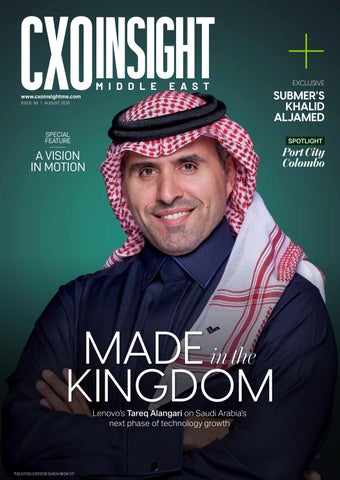
EXCLUSIVE
SUBMER’S KHALID ALJAMED
www.cxoinsightme.com ISSUE 89 \ AUGUST 2026
SPECIAL FEATURE
SPOTLIGHT
Port City Colombo
A VISION IN MOTION
MADE in the KINGDOM Lenovo’s Tareq Alangari on Saudi Arabia’s next phase of technology growth
Contents www.cxoinsightme.com
20 COVER FEATURE
FROM SAUDI TO THE WORLD
Lenovo’s Tareq Alangari on building deeper technology capability and strengthening the company’s long-term impact in the Kingdom
INTERVIEWS 31 THE NEW LEARNING CURVE AWS’s Kim Majerus on how AI is reshaping career readiness 50 BEYOND THE RACK Submer’s Khalid Aljamed on the infrastructure decisions shaping the scalability, of AI deployments
SPECIAL FEATURE 42 A VISION IN MOTION Inside the investments, infrastructure and capabilities shaping Saudi Arabia’s Year of AI
SPOTLIGHT 34 THE EXPANSION EQUATION CHEC Port City Colombo’s Thulci Aluwihare discusses how technology expansion strategies are reshaping the role of regional hubs
VIEWPOINTS
26
34
26 POWERING SAUDI ARABIA’S AI ERA Cisco on why resilient infrastructure will be critical to the Kingdom’s AI growth 39 THE HUMAN EDGE SAS explores why talent will be as important as the technology behind AI
54
WHAT’S NEW 58 The latest gears and gadgets to keep you ahead of the curve
PUBLISHED BY INSIGHT MEDIA & PUBLISHING LLC
AUGUST 2026 | CXO INSIGHT MIDDLE EAST
3
EDITORIAL
SOLID GROUND Scale attracts attention. Foundations determine what lasts. Across this issue, this comes through in various ways, from national technology ambitions and AI infrastructure to skills, resilience and ecosystem development. Saudi Arabia offers a useful lens through which to see that principle take concrete form. The Kingdom’s technology story has long been associated with the scale of investment, but the more important measure now is the capability that investment creates. This month’s cover story features a conversation with Lenovo’s Tareq Alangari, which brings that into focus. It explores what it means when a technology company sees the Kingdom not only as a growth market, but as a place from which to build for the region and beyond. The value lies in deeper expertise, stronger local participation in the technology value chain and a greater role for Saudi Arabia in how technology reaches the market. In many ways, this is where Vision 2030 becomes tangible. That matters even more as Saudi Arabia marks 2026 as the Year of AI. Much of the groundwork is already in place. What comes next is making those investments work together across the economy.
Published by
Publication licensed by Sharjah Media City @Copyright 2026 Insight Media and Publishing
The same principle surfaces elsewhere in the issue. Submer’s Khalid Aljamed looks at the physical demands AI is placing on data centre infrastructure. AWS’s Kim Majerus brings the human dimension into focus, exploring why judgement and continuous learning will matter more as AI changes the nature of work. Port City Colombo, meanwhile, looks at the conditions that allow a technology ecosystem to take root and grow. What ties these conversations together is that foundations rarely create value in isolation. Infrastructure needs skills, resilience needs trust, and ambition needs an ecosystem capable of carrying it forward. The real advantage comes when those pieces begin to reinforce one another. We also feature perspectives from Cisco, IBM, SAS, and more across cybersecurity, talent, enterprise technology and investment. Technology will keep moving. The greater advantage will come from being ready for where it goes next.
Adelle
Adelle Geronimo Managing Editor
Managing Editor Adelle Geronimo adelleg@insightmediame.com +97156 - 4847568
Commercial Director Merle Carrasco merlec@insightmediame.com +97155 - 1181730
Operations Director Rajeesh Nair rajeeshm@insightmediame.com +97156 - 4110215
Production Head James Tharian jamest@insightmediame.com +97156 - 4945966
Administration Manager Fahida Afaf Bangod fahidaa@insightmediame.com +97156 - 5741456
Designer Anup Sathyan
While the publisher has made all efforts to ensure the accuracy of information in this magazine, they will not be held responsible for any errors
AUGUST 2026 | CXO INSIGHT MIDDLE EAST
5
IN OUR RADAR
Saudi Arabia expands Tawakkalna’s digital services
Mannai Information Technology opens RHQ in Riyadh
Saudi Arabia’s Tawakkalna app added 40 new digital services in July through partnerships with 24 government entities. The expansion strengthens the platform as a unified gateway to public services, making it easier for users to access government services from a single app.
Mannai Information Technology Saudi Arabia has opened its new regional headquarters in Riyadh, strengthening its presence in the Kingdom. The move supports the company’s regional growth ambitions while expanding its role in Saudi Arabia’s digital transformation and broader Vision 2030 agenda.
DeepFest returns to power Saudi Arabia’s Year of AI
stc pay Bahrain extends services to Saudi visitors
DeepFest returns to Riyadh from 31 August to 3 September, bringing global AI leaders, innovators and investors together as Saudi Arabia marks 2026 the Year of AI. Colocated with LEAP 2026, the event will spotlight real-world AI applications, sovereign infrastructure, governance and autonomous systems.
stc pay Bahrain is expanding its services to Saudi nationals visiting the Kingdom, allowing them to register using a valid Saudi National ID. The move gives visitors access to digital payments across Bahrain and marks the company’s first step towards broader expansion across the GCC.
Qualcomm taps Wassim Chourbaji to lead EMEA
Epicor names Vaibhav Vohra as New CEO
Qualcomm has named Wassim Chourbaji Senior Vice President and President for EMEA, putting the 20-year company veteran in charge of regional strategy and growth. Previously President for the Middle East and Africa, Chourbaji will focus on advancing Qualcomm’s priorities and partnerships across the region. 6
CXO INSIGHT MIDDLE EAST | AUGUST 2026
Epicor has appointed Vaibhav Vohra as its next CEO, effective October 1, succeeding Steve Murphy as part of a planned leadership transition. Vohra, currently President and Chief Product and Technology Officer, has played a key role in shaping the company’s cloud, AI and data strategy.
Switch to Speed. Scale Without Limits.
Meet the SwitchBlade x908 GEN3 The SwitchBlade x908 GEN3 is our most advanced modular switch, delivering blazing speed and scalable growth for future-ready enterprise and data center networks.
Blazing Bandwidth: Up to 400G connectivity for high-performance workloads.
Scale Without Limits: 12.8 Tbps of power in a compact 3U chassis.
Flexible & Modular: Compact chassis with versatile interface options.
Smart Management: Zero-touch provisioning and centralized control with AlliedWare Plus™.
Whether you’re scaling a data center or optimizing enterprise networks, the SwitchBlade x908 GEN3 keeps your network fast, flexible, and fail-proof.
Take control. Stay ahead. Transform your network today. For more information, please contact one of our Allied Telesis Account Managers today.
© 2025 Allied Telesis, Inc. All rights reserved.
+971 +97144454 4548740 8740 | | AlliedTelesis.com AlliedTelesis.com
NEWS
6 million The number of students being reached through Saudi Arabia’s national AI curriculum, introduced in 2025
Saudi Arabia puts AI literacy at heart of Vision 2030 Workforce Strategy Saudi Arabia is placing AI literacy at the centre of its national strategy as it looks to strengthen workforce readiness, support responsible AI adoption, and advance its wider economic ambitions. A new Coursera report, Navigating GCC AI Regulation: A Playbook for Building an AI-Literate & Compliant Workforce, highlights the Kingdom’s
growing focus on AI skills alongside regulation and governance. The report points to Saudi Arabia’s National Strategy for Data and AI, which links AI adoption with national competitiveness and workforce development. It also highlights the introduction of a national AI curriculum in 2025, reaching around six million
students and covering the responsible use of generative AI. SDAIA’s SAMAI initiative is also targeting the training of one million Saudis in AI, with more than half a million people already registered. For businesses, the report recommends integrating AI literacy into governance frameworks, introducing role-based training, assessing existing skills gaps, and aligning AI upskilling with Saudisation and broader workforce planning. The findings underline how Saudi Arabia is treating AI capability not only as a technology priority, but as a core component of its long-term economic and human capital strategy.
SpaceX launches 24 Starlink satellites into orbit SpaceX has launched 24 Starlink internet satellites into low Earth orbit aboard a Falcon 9 rocket from Vandenberg Space Force Base in California. The mission lifted off on August 19 and marked SpaceX’s 100th mission of 2026, as the company continues to expand its Starlink satellite constellation. It was also the 97th Falcon 9 launch of the year. The Falcon 9’s first stage returned to Earth around eight and a half minutes after liftoff, landing on the “Of Course I Still Love You” droneship in the Pacific Ocean. The mission marked the 12th flight for the booster, designated B1097. The 24 satellites were carried to low Earth orbit by the rocket’s upper stage for deployment. Starlink now comprises nearly 11,000 operational satellites, with 74 of SpaceX’s launches this year dedicated to expanding the constellation. SpaceX first surpassed 100 launches in a single year in 2024, completing 138 missions, followed by 170 missions in 2025. 8
CXO INSIGHT MIDDLE EAST | AUGUST 2026
NEWS
World AI Organisation takes shape with 29 founding countries A new intergovernmental body focused on artificial intelligence cooperation and governance is taking shape after countries signed an agreement in Shanghai to establish the World Artificial Intelligence Cooperation Organisation (WAICO). The organisation will be headquartered in Shanghai and operate as an independent intergovernmental institution. Founding members include Kazakhstan, Laos, Pakistan, Russia, and Indonesia, alongside other participating countries. Under the agreement, WAICO will uphold the purposes of the United Nations Charter and adopt a people-centred approach to AI development. It will also promote consultation, joint contribution, and shared benefits among participating countries. The organisation aims to strengthen international cooperation on AI and support the development of global governance frameworks for the technology, with a focus on ensuring AI is developed and deployed in a safe, fair, and beneficial manner. In total, 29 countries signed the agreement establishing WAICO, WAICO will focus reflecting growing on international international efforts cooperation, AI to coordinate governance, safety, and approaches to AI shared development governance, safety, and development.
Gina Hsu / Shutterstock.com
NVIDIA launches open alliance to strengthen AI security
NVIDIA has launched the Open Secure AI Alliance (OSAA), bringing together more than 30 technology and cybersecurity organisations to develop open technologies aimed at improving the security and resilience of AI systems.
10
CXO INSIGHT MIDDLE EAST | AUGUST 2026
The alliance will focus on open-source tools, frameworks and best practices to help organisations build, evaluate and deploy AI more securely as the use of generative and agentic AI expands. Members include Adobe, Cisco, CrowdStrike, Dell Technologies,
Hugging Face, IBM, Microsoft, Palantir, Red Hat and the Linux Foundation. The group plans to collaborate on vulnerability management, benchmarking and interoperable security technologies. NVIDIA said the initiative builds on the role open-source software has played in securing critical digital infrastructure across cloud computing, financial services, telecommunications and government. The launch comes as enterprises increasingly deploy AI agents, large language models and other autonomous systems, raising fresh concerns around AI infrastructure, applications and software supply chains. OSAA will focus on practical security capabilities designed to strengthen AI deployments while supporting responsible innovation.
PROUD TO BE
UAE COMPANY SECURING NETWORKS | PROTECTING DATA SINCE 2011
CYBERSECURITY FOR
CRYPTO, AI
& FINTECH
Protect Crypto, AI, and FinTech platforms w/ trusted ITSEC cybersecurity assessments today.
BOOK ASSESSMENT WWW.ITSECNOW.COM
NEWS
Artificial intelligence adoption in Saudi Arabia more than doubled in 2025, with 45.2 percent of internet users using AI tools, according to the fifth Saudi Internet Report issued by the Communications, Space and Technology Commission (CST). The report showed that AI usage was highest among younger users. Adoption reached 55.7 percent among those aged 20 to 29, followed by 53.4 percent among users aged 10 to 19. Among people aged 60 to 74, AI usage stood at 14.8 percent. The findings also point to the continued expansion of Saudi Arabia’s digital economy. Internet penetration reached 99.6 percent in 2025, while 61.3 percent of users spent seven hours or more online each day. Average monthly mobile data consumption reached 53GB per person, around three times the global average. Saudi Arabia also recorded a median mobile download speed of 216Mbps, placing it among the top five G20 countries for mobile internet performance. AI adoption is also gaining ground among businesses. According to
Thaspol Sangsee / Shutterstock.com
AI adoption more than doubles in Saudi Arabia
45.2%
The proportion of internet users in Saudi Arabia used AI tools in 2025
the report, 33.1 percent of Saudi establishments used AI technologies in 2025, representing a 20 percent year-onyear increase. The figures underline the growing role of AI across both consumer and enterprise use cases as Saudi Arabia continues to expand digital infrastructure and accelerate technology adoption across the Kingdom.
Solutions by stc to build data centres across Dammam The agreement comes as Saudi Arabia continues to expand its digital infrastructure and data centre capacity to support growing demand for cloud, connectivity, and digital services. The Dammam project adds to this wider build-out, with solutions by stc taking responsibility for delivering the facility through to commissioning and final handover under the terms of the contract. Saudi Arabia’s Arabian Internet and Communications Services Company, known as solutions by stc, has signed a SAR364 million ($97.1 million) contract with Digital Data Centers for Data and Telecommunications Company, or Center3, to develop the DDC307 data centre in Dammam. The 18-month agreement covers a broad scope of work, including mobilisation, engineering, construction, mechanical, electrical and plumbing systems, testing, commissioning, and final handover. 12
CXO INSIGHT MIDDLE EAST | AUGUST 2026
Construction will be carried out across four main stages, starting with site preparation and foundations, followed by the superstructure and finishing works. The contract was signed on 3 August 2026, with the financial impact expected to begin appearing in solutions by stc’s financial statements from the first quarter of 2027. Center3 is a related party to solutions by stc. Saudi Telecom Company owns around 79 percent of solutions by stc and 100 percent of Center3.
$97.1 million The value of the DDC307 data centre development contract in Dammam
NEWS
HUMAIN and Cohere partner on AI compute and sovereign models Saudi Arabia’s Humain and Canada’s Cohere have announced a strategic partnership to build one of the region’s largest dedicated AI infrastructure deployments and develop enterprise and sovereign AI models. The collaboration, announced during Canadian Prime Minister Mark Carney’s visit to the Kingdom, will provide dedicated AI computing infrastructure for next-generation frontier models. The deployment is expected to go live by the fourth quarter of 2027. Under the agreement, Humain will allocate at least 50 megawatts
The future of artificial intelligence will be defined by access to compute TAREQ AMIN HUMAIN
of dedicated AI computing capacity to support Cohere’s next-generation foundation models, with the deployment expected to scale over the next five years. “The future of artificial intelligence will be defined by access to compute. Frontier AI models require infrastructure
at unprecedented scale,” said Tareq Amin, CEO of Humain. The companies will also collaborate on sovereign AI models, including Arabiclanguage and domain-adapted foundation models, as well as specialised models for enterprise and sector-specific use cases.
bluestork / Shutterstock.com
Microsoft opens largest India data centre hub in Hyderabad
Microsoft has launched its largest data centre in India in Hyderabad, strengthening its cloud and AI infrastructure as competition for the 14
CXO INSIGHT MIDDLE EAST | AUGUST 2026
country’s fast-growing AI market intensifies. The India South Central facility brings Microsoft’s total number of cloud regions
in the country to four, joining existing centres in Pune, Chennai, and Mumbai. Early customers include Adani Group and HDFC Bank. Microsoft has committed around $20.5 billion to expand its operations in India, betting on rising demand for AI and cloud services in a market with more than one billion internet users and a large pool of technology talent. The company is competing with other global technology firms, including Google and Amazon, as investment in AI infrastructure accelerates across India. The Hyderabad facility forms part of Microsoft’s broader push to expand data centre capacity and support growing demand for its Azure cloud platform and AI services. Earlier this year, Puneet Chandok, President of Microsoft India and South Asia, said there was “massive demand” for Azure cloud services and Microsoft’s Copilot AI offering in the country.
Intel and Fortinet team up on next-gen security processor Intel and Fortinet have expanded their long-standing relationship to develop Fortinet Security Processor 6 (SP6), combining their expertise to accelerate the development of the cybersecurity company’s next-generation security processor. “As organisations face a rapidly evolving threat landscape, security infrastructure must deliver both performance and innovation at scale,” said Lip-Bu Tan, CEO, Intel. “This collaboration demonstrates how Intel’s semiconductor leadership and advanced design, packaging, and manufacturing capabilities can help cybersecurity leaders like Fortinet accelerate the development of critical security technologies while building a more resilient and diversified global supply chain.” Fortinet said its purpose-built ASICs have been central to its cybersecurity portfolio for more than two decades, helping deliver security performance
As organisations face a rapidly evolving threat landscape, security infrastructure must deliver both performance and innovation at scale LIP-BU TAN INTEL
and efficiency across its product range. Ken Xie, Founder, Chairman, and CEO, Fortinet, said, “This expanded relationship with Intel will leverage its unique combination of advanced semiconductor technology, manufacturing expertise, and global supply chain capabilities, helping Fortinet accelerate and strengthen our ASIC strategy, while also better
supporting organisations all over the world.” Beyond SP6, the companies will explore further collaboration around semiconductor technology, manufacturing and infrastructure supporting future cybersecurity innovation, with the work expected to advance Fortinet’s long-term ASIC roadmap.
pcperle / Shutterstock.com
Samsung launches dedicated robotics division
Samsung Electronics has established a dedicated robotics division as it looks to make robotics one of its next major growth areas, with a focus on AI-powered automation and humanoid robots. Named RX, short for Robotics
eXperience, the division will report directly to Samsung DX CEO TM Roh. It will oversee the company’s longterm robotics strategy, core technology development, business execution, and expansion of robotics research in South Korea and overseas.
Executive Vice President Lee Dongkun has been appointed to lead Samsung’s Robotics Strategy Team. The company also plans to establish robotics research hubs in the US, China, and Japan to tap into local expertise and ecosystems. The move builds on Samsung’s growing investment in robotics. Earlier this year, the company said it was targeting “tangible” results from its humanoid robotics business and would consider investments and acquisitions to accelerate development and commercialisation. “We will develop and commercialise humanoid robots that improve productivity and user experience by leveraging our AI, software and hardware technologies,” Samsung said. The company plans to initially deploy humanoid robots in manufacturing before expanding into home and retail applications.
AUGUST 2026 | CXO INSIGHT MIDDLE EAST
15
QUOTEWORTHY
“SAUDI ARABIA IS ADVANCING TOWARD BUILDING ONE OF THE WORLD’S MOST ACCESSIBLE AND AIREADY DIGITAL INFRASTRUCTURES, REINFORCING ITS POSITION AS A TRUSTED PARTNER IN ENABLING THE DIGITAL ECONOMY AND CONNECTING THE EAST AND THE WEST” Abdullah Alswaha, Minister of Communications and Information Technology, Saudi Arabia
16
CXO INSIGHT MIDDLE EAST | AUGUST 2026
“ENTERPRISE AI ONLY DELIVERS VALUE WHEN ORGANISATIONS CAN DEPLOY IT SECURELY, RELIABLY, AND AT PRODUCTION SCALE” Tareq Amin, CEO, HUMAIN
AUGUST 2026 | CXO INSIGHT MIDDLE EAST
17
REPORT
CYBER PRICE TAG:
THE RISING COST OF A BREACH IN SAUDI ARABIA A s Saudi Arabia pushes deeper into AI, cloud and digital services, the economics of cybersecurity are becoming harder to separate from the economics of growth. The more critical digital systems become to business, government and infrastructure, the greater the financial consequences when security fails to keep pace.
18
CXO INSIGHT MIDDLE EAST | AUGUST 2026
IBM’s 2026 Cost of a Data Breach Report puts a price on that exposure, finding that the average cost of a data breach in Saudi Arabia has reached $7.2 million (SAR 27 million), while 25 percent of malicious breaches were AIenabled. The study, conducted by the Ponemon Institute and sponsored and analysed by IBM, examined breaches experienced by 602 organisations globally, including
organisations in Saudi Arabia, between March 2025 and February 2026. AI is also emerging as part of the defence. Saudi organisations making extensive use of AI and security automation recorded average breach costs of $6.2 million (SAR 23.15 million), compared with $8.5 million (SAR 32.08 million) among those using neither. Yet 25 percent reported no use of AI and security automation in their security operations, leaving a sizeable gap between the tools available and the way they are being deployed. The economics become even sharper when response times are considered. Breaches taking more than 200 days to identify and contain cost organisations an average $8.5 million (SAR 32 million), compared with $5.9 million (SAR 22 million) for those resolved within 200 days. In Saudi Arabia, organisations took an average of 226 days to identify a breach, followed by another 59 days to contain it. Some sectors carry considerably more risk. Financial services recorded the highest average breach cost at $10.1 million (SAR 38 million), followed by industrial organisations at $9.4 million (SAR 35.4 million) and technology companies at $8.8 million (SAR 33 million). Public-facing applications proved the most expensive attack vector, with breaches costing an average $9.2 million (SAR 34.7 million), ahead of abuse of valid accounts at $8.9 million (SAR 33.3 million) and phishing, including voice and SMS phishing, at $8.1 million (SAR 30.6 million). The report also exposes weaknesses in basic data protection. Only 37 percent of breached organisations had encrypted sensitive data both at rest and in transit, while 54 percent had not. Following a breach, 62 percent said they planned to increase investment in security tools and governance, with data loss prevention and incident response among the leading priorities. “As organisations across Saudi Arabia accelerate AI adoption and digital transformation, cybersecurity must evolve at the same pace,” said Ayman AlRashed, Regional VP, IBM Saudi Arabia. For Saudi enterprises, the numbers point to a widening divide between organisations that can detect and contain threats quickly and those that absorb the cost of slower response. AI may be changing how attacks are carried out, but the financial damage still comes down to familiar fundamentals: visibility, encryption, skilled teams and the ability to act before a breach has time to spread.
7.2
million
The average cost of a data breach in Saudi Arabia.
25%
The share of malicious breaches that were AI-enabled
226 days
The average time Saudi organisations took to identify a data breach
AUGUST 2026 | CXO INSIGHT MIDDLE EAST
19
COVER FEATURE
FROM SAUDI TO THE WORLD As Saudi Arabia builds more of the capability behind its technology ambitions at home, Tareq Alangari, Senior Vice President and President, Lenovo Middle East, Türkiye and Africa, discusses the company’s growing footprint in the Kingdom and what it means for the company’s wider regional business
20
CXO INSIGHT MIDDLE EAST | AUGUST 2026
AUGUST 2026 | CXO INSIGHT MIDDLE EAST
21
COVER FEATURE
S
audi Arabia’s technology story has been propelled in large part by the scale of its ambition, from enterprise modernisation and cloud adoption to new data centres and, increasingly, the computing infrastructure required for AI. The focus is also extending to the capabilities that sit behind that growth, with greater investment in advanced manufacturing, engineering expertise, research and regional decision-making within the Kingdom. Lenovo’s growing footprint in Saudi Arabia reflects how that ambition is beginning to translate into reality. The global technology company has steadily expanded its presence in Riyadh, anchored by a strategic partnership with Alat, the PIF company focused on advanced manufacturing. Announced in 2024, the partnership included a US$2 billion investment in Lenovo through convertible bonds, alongside plans to establish a stronger operational and manufacturing presence in the Kingdom. By April 2026, part of that plan had taken shape with the official opening of Lenovo’s Middle East, Türkiye and Africa regional headquarters at Majdoul Tower in Riyadh. But the RHQ represents only one part of a broader strategy and commitment to the region. “Saudi Arabia offers the scale, talent and proximity to key markets that make it an important base for Lenovo’s regional business. Our presence in the Kingdom goes well beyond a regional headquarters,” says Tareq Alangari, Senior Vice President and President of Lenovo Middle East, Türkiye and Africa. “Our focus spans four pillars: research and development, manufacturing, regional operations and talent development. What we are building here represents a much bigger and much deeper commitment to the Kingdom.” That vision is taking physical form as Lenovo builds its 200,000 sqm manufacturing facility within the Special Integrated Logistics Zone (SILZ) and close to the capital’s international airport. The facility will produce laptops, desktops, Motorola 22
CXO INSIGHT MIDDLE EAST | AUGUST 2026
smartphones and servers, adding a major manufacturing component to the company’s wider Saudi presence. “We saw an opportunity to build something in Saudi Arabia that could have significance well beyond the Kingdom itself,” says Alangari. “The Riyadh facility will be Lenovo’s largest manufacturing site outside China. It is also the only one in our global network to bring all four product lines together: laptops, PCs, mobile devices and servers. That scale makes it a major milestone, not only for Saudi Arabia, but for the wider region.”
The Kingdom and beyond The geography covered by Lenovo’s regional business gives more context to the decision to invest further in the Kingdom. The company’s regional remit covers more than 60 countries across the Middle East, Africa, Türkiye and Pakistan. These markets vary considerably in infrastructure maturity, enterprise demand and technology adoption, giving greater weight to proximity and local market understanding as the business grows. “Being closer to our customers is not only about being physically closer,” Alangari says. “It is also about relevance, being closer to the culture
Alexandre.ROSA / Shutterstock.com
We saw an opportunity to build something in Saudi Arabia that could have significance well beyond the Kingdom itself
“The strategic value of our manufacturing network is flexibility and proximity. We are not building production around a single market, but around our ability to serve demand efficiently across a much wider region,” says Alangari. “The capacity of the Riyadh facility goes well beyond what one market can absorb, which is why we have always viewed it as part of a broader regional model.”
and understanding very diverse markets that require focus. That falls directly in line with Lenovo’s strategy of being a global-local company.” Years of investment in universities and scholarship programmes have also expanded Saudi Arabia’s local talent pool, at a time when more technically intensive operations are being established in the Kingdom. The combination of population, skills and market scale is an important part of Lenovo’s rationale for concentrating more of its regional activity there. “You can have markets with significant capital, but without the
depth of a larger population, a younger population and the critical mass needed to build something at this scale,” he says. “Saudi Arabia brings those elements together. It gives us the market, the talent and the opportunity to build for the longer term.” The regional significance of the Riyadh operation becomes clearer within Lenovo’s wider manufacturing network. The company operates more than 30 production sites globally, giving it the ability to balance capacity and fulfilment across different locations rather than building individual factories around the requirements of a single market.
Made in Saudi The first Made in Saudi Lenovo laptop brings those investments down to a single, tangible product. Rather than positioning it as a technically distinct device, Lenovo sees the device as a marker of how manufacturing capability and expertise are beginning to take root locally. “What makes the device unique is not its technical specifications. We produce these products in other parts of the world,” says Alangari. “What makes it unique is the knowledge transfer to the region. It represents our belief in the human capital here and in the potential of these markets. The real story is the capability being built around the product.” Saudi engineers have spent time within Lenovo’s established manufacturing operations globally, gaining practical exposure to the systems and processes used across its global factory network before bringing that knowledge back to Riyadh. The first device AUGUST 2026 | CXO INSIGHT MIDDLE EAST
23
COVER FEATURE
brought the people behind that transfer together with the product they had helped create. “When we saw the first device, there was a Saudi engineer who had trained in China standing alongside a Lenovo expert, and they were holding the device together,” he says. “It was a very proud moment because you could see local talent contributing to global innovation from the Middle East. It is not only about the technical specifics of the device.
It is about where this can go and the capability we can build in the region.” Lenovo’s talent programmes extend beyond the production floor, while R&D adds another technical layer to its Saudi presence. The company already runs pre-sales and partner enablement programmes in the Kingdom, alongside training for its own teams. Alangari says Lenovo has around 21 R&D centres globally, with Saudi Arabia becoming its first such presence in the region.
Lenovo officially opens its Middle East, Türkiye and Africa (META) Regional Headquarters in Riyadh in April 2026
Senior government officials and public- and private-sector leaders visit Lenovo’s manufacturing site in Riyadh
24
CXO INSIGHT MIDDLE EAST | AUGUST 2026
We want to be seen as a trusted partner in the country’s digital transformation, helping to develop local capabilities and local talent, and creating the tools for AI adoption and innovation
“Developing local capability is part of how we operate in every market. We already have ongoing programmes for our teams and channel partners, and in Saudi Arabia we expect that to become even more structured as our presence grows,” he says. “The idea is to bring Lenovo’s global supply chain, leadership and best practices together with local talent, local market knowledge and closer engagement with customers.” The more consequential measure of localisation may ultimately be how much technical expertise develops around the production line rather than simply how many products are assembled locally. Manufacturing, R&D and skills development place different kinds of capability within the same market, while connecting local teams more closely with Lenovo’s wider technology organisation. Building for the AI era Lenovo’s Saudi expansion is also taking place as AI drives new investment in data centres, power and high-performance infrastructure across the region. With servers among the four product lines planned for Riyadh, the manufacturing programme reaches beyond PCs and smartphones into the infrastructure layer supporting that demand.
Saudi Arabia has placed AI at the centre of its technology agenda, with access to energy, available land and growing data-centre capacity forming part of the wider investment picture. Computing infrastructure remains another part of what is required to translate those resources into operating AI capacity. “To be a global AI hub, you need three things: land, energy and technology infrastructure,” says Alangari. “Saudi Arabia has the land and the energy. Technology infrastructure is where Lenovo can contribute. Having that capability here becomes an important part of supporting the wider AI ambitions of the country and the region.” The enterprise AI model is also becoming less concentrated in a single environment. Workloads can
US$2 billion The value of the investment by Alat, a PIF company, in Lenovo as part of their strategic partnership
move between personal devices, private infrastructure and cloud platforms, while data residency and sovereignty remain important considerations for governments and regulated industries. “You will have AI on your device, in your laptop and mobile, but also in your own sovereign data centre within a company or government environment,” he says. “That closes the loop for sovereign AI, and that is part of what we are focused on enabling in the region.” LEAP will provide the next public window into how that strategy is developing. Lenovo is preparing a number of announcements for the event, including updates around the Riyadh manufacturing programme and new partnerships with Saudi and regional organisations. “At LEAP, you will see Lenovo working alongside some of the biggest ecosystem players in the country, with new partnerships and further updates around the factory and the devices we have successfully produced,” says Alangari. “Sports technology will also be an important focus for us, particularly as the region prepares for major events such as the World Cup in 2030 and Saudi Arabia in 2034.” Full mass production in Riyadh will be the next major milestone. Beyond factory output, the more revealing measure will be how Lenovo’s Saudi presence develops as the RHQ, manufacturing operation, R&D and talent programmes mature, and how far the capabilities established in the Kingdom feed into its wider regional business. “Lenovo should not only be recognised as a technology leader. We want to be seen as a trusted partner in the country’s digital transformation, helping to develop local capabilities and local talent, and creating the tools for AI adoption and innovation,” says Alangari. “We are looking for a global impact from the region. We genuinely believe now is the time for this geography to contribute at a global level, and we want to be part of enabling the region to become a global launch pad from Saudi Arabia.” AUGUST 2026 | CXO INSIGHT MIDDLE EAST
25
VIEWPOINT
POWERING SAUDI ARABIA’S AI ERA By Bader Almadi, Vice President & Managing Director, Cisco Saudi Arabia
S
audi Arabia is entering a decisive phase of its digital transformation. As the Kingdom advances its Vision 2030 ambitions, the focus is shifting from accelerating digitisation to scaling artificial intelligence (AI), protecting critical services and building the resilient infrastructure required to support an increasingly connected economy. These priorities will be central at LEAP 2026, where the technologies shaping the Kingdom’s next chapter will take centre stage. Across government, finance, healthcare and industry, digital systems have become fundamental to service delivery. This creates significant opportunities but also raises the stakes. In today’s economy, growth depends not only on innovation, but also on trust, continuity and the ability to perform under pressure. Saudi Arabia’s next phase of growth will therefore rely on critical infrastructure that is secure, visible and ready to scale up.
AI demands more of infrastructure
AI will provide one of the clearest tests of whether these foundations are ready to support growth at scale. In Saudi Arabia, AI has the potential to contribute $135.2 billion to the economy by 2030, roughly 12.4 percent of GDP. 26
CXO INSIGHT MIDDLE EAST | AUGUST 2026
However, unlocking this potential requires more than ambition. As organisations advance from experimentation to deployment, AI creates increasingly demanding requirements across infrastructure, data and security. Cisco’s AI Readiness Index shows strong momentum, while also underlining the work that remains. While 29 percent of organisations in Saudi Arabia have robust GPU resources, 31 percent report that their infrastructure requires significant upgrades. At the same time, 45 percent expect AI workloads to increase by more than 30 percent within a year. Supporting this growth will depend on infrastructure that remains powerful, secure and observable. Business continuity is key
As digital adoption deepens, continuity is no longer a back-office concern; it has become a strategic business priority. In an always-on economy, disruptions, whether cyber incidents, cloud outages or application failures, can quickly affect customer experience and national trust. In a market where digital services underpin everything from citizen services to financial transactions, continuity must be built into the architecture from the start.
Cisco’s integrated capabilities across networking, security and observability support the “continuity by design” needed to help systems remain resilient when placed under pressure. Cybersecurity must be continuous
Cybersecurity is now a critical enabler of business continuity. As organisations expand their digital footprints, the threat landscape is becoming more complex and fastmoving. Cisco’s 2025 Cybersecurity Readiness Index found that only 25 percent of organisations in Saudi Arabia have the maturity required to effectively withstand
organisations require a clear, real-time view of how their systems are performing. True continuity depends on three integrated capabilities: trusted connectivity, real-time observability and coordinated security. When these are unified, organisations can detect issues before they become outages and reduce the complexity of restoring services. Talent: A key pillar of success
Technology alone will not define Saudi Arabia’s success; talent will. The Kingdom’s young, digitally engaged population is a major strategic advantage, yet the need for specialiaed skills remains urgent. With 93 percent of organisations in Saudi Arabia facing a shortage of skilled cybersecurity professionals, national capacity building must remain a priority. Since 1999, the Cisco Networking Academy has trained half a million learners in the Kingdom. Continued investment in these programs will help ensure the workforce is ready to design, secure and scale the complex environments of tomorrow. Building critical infrastructure for the AI era
In a market where digital services underpin everything from citizen services to financial transactions, continuity must be built into the architecture from the start
today’s threats. At the same time, 91 percent have already experienced AI-related security incidents. These figures underscore an urgent reality: as innovation accelerates, security readiness must keep pace. In an AI-driven economy, cybersecurity is the bedrock of trust. Organisations that can protect users, applications and data while detecting and responding to threats in real time will be better positioned to compete. Reliable connectivity on its own is no longer sufficient. As environments become more distributed across cloud, onpremises and remote users,
For nearly three decades, Cisco has partnered with organisations across Saudi Arabia to strengthen digital infrastructure. That experience has reinforced a simple lesson: resilience is not achieved through a single technology cycle but built over time through trusted partnerships and consistent operational discipline. As LEAP 2026 brings together the technologies and partnerships shaping Saudi Arabia’s digital future, the message is clear: ambition must be supported by infrastructure that is secure, AI-ready and highly visible. The Kingdom’s next phase of growth will be shaped not only by how boldly it innovates, but also by how confidently it can scale. Embedding “continuity by design” into critical infrastructure will be essential to turning the ambitions of Vision 2030 into lasting outcomes. AUGUST 2026 | CXO INSIGHT MIDDLE EAST
27
VIEWPOINT
THE QUANT SHIFT By Jeetu Kataria, Co-founder, Vista Axis Global
Q
uantitative investing spent most of its history as a specialist activity, limited to institutions that could afford the computing power and research teams involved. That has changed, and the reason has more to do with falling costs than with any breakthrough in mathematics. A model that would have needed a large bank’s budget twenty years ago can now be built by a small team. I would separate quant trading from the wider excitement about artificial intelligence, since many systematic strategies rely on statistical methods decades old. Usable information has grown beyond what any research team can read manually, as company filings, exchange data, payment activity and supply-chain records arrive in machine-readable form. An analyst brings context a model will miss, while a system covers far more ground. The strongest investment frameworks combine machine-scale analysis with human context, accountability and judgement. Artificial intelligence can expand the scope and speed of research, but it cannot assume responsibility for the decisions made from that research. Governance deserves as much attention as the technology. In many business settings, a person reviews a model’s output before
28
CXO INSIGHT MIDDLE EAST | AUGUST 2026
The strongest investment frameworks combine machinescale analysis with human context, accountability and judgement
acting on it, while systematic trading can reduce or remove that review step during execution, which means a flawed model may execute before the problem becomes clear. Markets have been working through many of these issues long before the current AI debate, which is why regulated algorithmic trading in many major markets already carries pre-trade limits, testing regimes, monitoring obligations and the ability to shut a strategy down mid-run. In November 2025, the Monetary Authority of Singapore consulted on proposed guidelines that would
set expectations for AI governance and oversight by the boards and senior management of financial institutions using AI. Controls have to begin before execution and remain in place while the strategy is running. A backtest is evidence, not proof. Its value depends on the integrity of the data, the assumptions used and whether the strategy has been tested beyond the conditions in which it was originally developed. A serious evaluation examines the model’s assumptions, the data quality, trading costs, liquidity and the conditions the strategy depends on. The authority to switch a model
off matters too, though intervention should begin well before losses become severe, since a strategy can keep producing positive returns while its assumptions weaken. Rising transaction costs or declining liquidity can show up before losses do. The 60/40 portfolio works best when equities and bonds respond differently to changing conditions, a relationship that can weaken when inflation runs high. In 2022, both fell together, and many balanced portfolios lost money on both sides of the allocation. This has encouraged allocators to examine strategies that seek
returns outside broad market direction. However, the label “market-neutral” should never be confused with “risk-free.” Interest in strategies seeking returns outside broad market direction has grown since then, so let me add a warning about my own industry. A portfolio can hold low net market exposure while carrying high gross exposure and leverage underneath it, and it stays open to short-selling losses, liquidity constraints, counterparty risk and sudden breaks in pricing relationships. Low net exposure should never be read as low overall risk.
At Vista Axis Global, we approach systematic investing as an institutional discipline rather than simply a technology story. The majority of the fund runs through systematic and arbitrage strategies designed to maintain low net market exposure, seeking returns from relative pricing differences between instruments rather than from market direction. The remaining portion of the fund goes into early-stage artificial intelligence and defence technology companies, where the holding period runs for years. The two allocations carry different controls and time horizons. One area likely to influence the next phase of portfolio infrastructure is tokenisation, as equities, bonds, funds and private credit move onto programmable infrastructure. Legal ownership and operating design remain major obstacles alongside the technology, since the digital record has to align with enforceable rights and custody has to protect the underlying asset. Cyber resilience and interoperability belong in the same list. I expect tokenised real-world assets to become a meaningful part of the market by 2030, though published forecasts vary too widely to trust. For allocators, the useful questions have changed. Nearly every manager now claims to use artificial intelligence, and the claim alone reveals very little. Ask instead how the firm detects model drift and data failure, and who holds the authority to intervene while a strategy is reviewed. The most dangerous period for a systematic strategy is not always when it begins losing money. It can be when it continues performing while the assumptions supporting that performance are quietly weakening. Technology improves the speed and consistency of decisions. Whether it deserves a place in a portfolio depends entirely on the judgement and accountability built around it. AUGUST 2026 | CXO INSIGHT MIDDLE EAST
29
Safe Adoption Starts with Visibility Building Data-Driven Policies for a Governed GenAI Strategy
AI SECURITY CORE Detect + Filter + Sanitize + Protect
UNTRUSTED INPUT
Risky Data
Malicious Prompts
TRUSTED OUTPUT
Sensitive Information
Secure Data Safe Interactions Productive AI Use
Unverified Content
CONSULTING
solutions@teksalah .com www.teksalah.com
SYSTEM INTEGRATION
MANAGED SERVICES
UAE | QATAR | INDIA #Teksalah
INTERVIEW
A THE NEW LEARNING CURVE
Kim Majerus, Vice President, Global Education, AWS, explains why AI is reshaping career readiness and how graduates can stand out in an AI-enabled workplace
sk any CIO or CTO what they want from a graduate today and technical skills still feature high on the list. Increasingly, though, they are no longer enough. Generative AI has compressed work that once occupied the first months of many entrylevel roles. Drafting reports, analysing data, preparing presentations and writing code can now be completed in a fraction of the time. As execution becomes faster, employers are placing greater emphasis on something far less tangible: judgement. The question is no longer whether graduates can produce work, but whether they can assess, refine and improve what AI produces. AUGUST 2026 | CXO INSIGHT MIDDLE EAST
31
INTERVIEW
We describe AI as a sparring tool. You should be using it to challenge what it’s telling you and challenge it on the responses that it gives
Kim Majerus, VP, Global Education at Amazon Web Services sees those changing expectations from both sides. “Graduates used to be hired to execute,” she said. “They were writing reports, building dashboards and running analysis. Now AI handles that first pass of execution literally within seconds. What employers need now is a person who can evaluate whether that output is right, relevant and worth expanding on.” She added: “The graduates who will thrive are the ones that treat AI as a force multiplier for their judgement, not a replacement for building it. We remind students it’s a tool. It doesn’t replace them. Critical thinking and judgement remain top of mind.” Employers still need graduates who can write, analyse and solve problems. AI simply raises the standard. Producing the first draft is no longer enough if everyone has access to the same tools. “We describe AI as a sparring tool. You should be using it to challenge what it’s telling you and challenge it on the responses that it gives. If you’re able to go back and forth and be interactive with the tool, it’ll allow you to challenge your own bias, challenge your thought process and, more importantly, get to a resolution 32
CXO INSIGHT MIDDLE EAST | AUGUST 2026
and a solution that might actually solve the problem quicker.” The rise of AI also changes how graduates should approach the start of their careers. “My advice is to become an idea builder, not just a task executor,” said Majerus. “For too many years, the limiting factor in technology was engineering talent. Today, the constraint is really the ideas. Graduates who can generate bold, creative visions and think critically about how to execute them with AI are going to define the next era of growth.” AWS has expanded its investment in AI skills across the Middle East. The company is training around 20,000 people in Saudi Arabia through its partnership with the Ministry of Communications and Information Technology, while the AI Nation programme is expected to train another 30,000 people in the UAE. AWS is also working with Manara, which has expanded AI certification pathways across more than 150,000 computer science students across the region. “The access is there. The question is whether graduates and the workforce are actually seizing the opportunity to use it. I’ve been out of school a long, long time, and every day I’m learning about new technology, new releases and
new models. We weren’t talking about this tool five years ago, or even three years ago, the way we’re talking about it now. These models will continue to evolve, so I really push the idea of lifelong learning. It’s not a sprint to get your degree. It’s really about continuing your education so you stay fresh and current,” said Majerus. Amazon has also committed to hiring 11,000 early-career software development engineers, a decision Jareth links directly to the value of new perspectives. “If we’re not able to help empower and train these students, then we lose the opportunity to have fresh talent within our organisation. These are fresh ideas. These are individuals who will challenge the status quo and ask whether we should be thinking about things differently. Today’s workforce have grown up in such a different era. That’s why organisations need to remain committed to hiring earlycareer talent. They’ll challenge us to think differently and lead differently,” said Majerus. Her advice to graduates is less about mastering another tool than developing habits that will outlast whichever model comes next. “Your degree is your starting point. It’s not your destination. Continue learning throughout your professional career because these models will continue to evolve. AI has changed not only my professional life but my personal life as well. Critical thinking, lifelong learning and treating AI as a tool that helps you think bigger are the things that will make the biggest difference.”
WORK WHEREVER
YOU FEEL INSPIRED. With the DWR-940M, create your own Wi-Fi hotspot and stay online
4G LTE
Up to 32 Devices
10,000mAh Battery
for all day connectivity
DWR-940M
4G/LTE Mobile Router Mobile Connect App
SPOTLIGHT
THE EXPANSION EQUATION Thulci Aluwihare, Deputy Managing Director, CHEC Port City Colombo, discusses how evolving technology expansion strategies are changing the calculus around regional hubs and where companies place their next phase of growth
W
here a company establishes its next regional operation has become a far more strategic decision than it once was. Enterprise technology leaders are reassessing not only where they can access talent or reduce operating costs, but how a location fits into a broader growth strategy. “We are seeing a shift from opportunistic expansion to strategic anchoring,” says Thulci Aluwihare, Deputy Managing Director, CHEC Port City Colombo. “Companies are no longer simply expanding into established hubs. Increasingly, they are evaluating jurisdictions based on long-term outcomes such
34
CXO INSIGHT MIDDLE EAST | AUGUST 2026
as regulatory predictability, capital mobility, digital infrastructure, talent depth, cost efficiency, and proximity to multiple markets.” Expansion is also now being judged across the whole operating model, with operational continuity carrying greater weight alongside growth. “There is a noticeable move toward regional platforms rather than singlecountry operations,” Aluwihare says. “Increasingly, expansion decisions are being shaped by risk diversification and operational continuity, alongside growth potential.” That recalibration is widening the field beyond established business and technology hubs. Global technology companies and digital-first enterprises
are looking across a broader set of markets for talent, delivery capacity and digital infrastructure, including along the Middle East-South Asia corridor. Sri Lanka is one market seeking to position itself within that equation. Its access to South Asian talent and an established services base gives it a potential role as a complementary operating location for companies extending their regional capabilities. The country’s ICT sector already generates approximately US$1.2 billion in exports, employs more than 140,000 professionals and is home to more than 500 ICT companies. Under its Digital Economy Strategy, Sri Lanka is targeting US$5 billion in ICT exports
by 2030, reflecting its ambition to strengthen its position as a regional technology and services hub. “Sri Lanka occupies a strategic position in the Indian Ocean, linking South Asia with the Middle East, Southeast Asia, and East Africa. For Middle Eastern enterprises in particular, this creates a compelling proximity advantage, enabling scalable delivery while maintaining alignment with Gulf markets,” says Aluwihare. Value beyond geography
Building on that foundation is Port City Colombo, Sri Lanka’s first multi-service Special Economic Zone (SEZ). “Port City Colombo was conceived as a next-generation SEZ and integrated masterplanned city for South Asia, drawing inspiration from the long-term urban and economic development models of Dubai and Singapore,” explains Aluwihare. He adds: “It operates under the Colombo Port City Economic Commission Act of 2021, which establishes a distinct progressive regulatory framework administered by a single-window authority. The Commission is empowered to licence, regulate and facilitate businesses within the zone, significantly reducing administrative friction.” The SEZ’s framework allows 100 percent foreign ownership, places no cap on foreign employment, permits transactions in 16 designated foreign currencies and enables enhanced capital mobility. Eligible businesses can also benefit from concessionary corporate income tax rates, alongside customs and border tariff waivers during the business setup phase. “It also incorporates investment protection mechanisms
embedded in law and contract, a dedicated International Commercial Dispute Resolution Centre, and provisions supportive of Shariacompliant finance and Islamic banking, features that resonate strongly with institutional and Middle Eastern investors,” says Aluwihare. “The aim is long-term credibility – a rulesbased environment aligned with international governance standards, offering predictability and commercial agility.” Port City Colombo also does not impose a minimum investment threshold for access to its fiscal and non-fiscal benefits, allowing companies to establish at a scale that suits their needs and expand over time. That model aligns well with technology and services firms, where growth is often tied
AUGUST 2026 | CXO INSIGHT MIDDLE EAST
35
SPOTLIGHT
more closely to teams and client demand than to heavy upfront investment in physical assets. The composition of Port City Colombo’s first wave of registrants offers a glimpse of how that is playing out. “Service-led sectors typically move first into emerging hubs because they require lower capital lock-in, but they demand strong digital connectivity, talent depth, and regulatory efficiency,” says Aluwihare. “IT and ITES companies account for nearly 50 percent of early registrants. This reflects confidence in both the SEZ framework and the country’s ability to support globally integrated, digitally driven operations.” The bigger picture
Technology companies entering a new market can serve as a strong indicator of whether an operating base can support growth. Many IT and ITES businesses are not tied to local demand, serving clients and functions across multiple markets. Their location choices can therefore offer a measure of how effectively a market can complement an organisation’s wider global network. At Port City Colombo, IT and ITES firms provide that first signal. The greater opportunity lies in what can follow, as services-led activity expands into a broader mix of technology operations and highervalue functions. “While servicesled activity establishes early momentum, we are equally focused on attracting technology segments that anchor long-term capital and ecosystem depth,” says Aluwihare. He adds: “There is strong potential in fast-to-deploy operations such as Business Process Management (BPM) / Business Process Outsourcing (BPO), which allow companies to establish regional presence relatively quickly, with the aim of evolving to Global Capability Centres (GCCs) over time.” Beyond BPM/BPO, Port City Colombo is also looking to attract companies seeking to establish regional headquarters, global delivery centres, innovation labs, 36
CXO INSIGHT MIDDLE EAST | AUGUST 2026
data infrastructure and business continuity facilities. Increasingly, this includes nano-GCCs – small, highly specialised teams in AI, R&D and product engineering that compete on capability rather than headcount, which makes them well suited to a market of Sri Lanka’s scale. “Recent shifts in global technology infrastructure planning are prompting firms to diversify where critical digital infrastructure is located. In that context, jurisdictions that offer regulatory clarity, reliable connectivity, and geographic neutrality are gaining attention as complementary locations to existing hubs,” says Aluwihare. Moving up the technology value chain raises the bar for infrastructure and skills. AI intensifies those demands, particularly around computing capacity, secure data environments, and specialised technical talent. “Supporting AI-driven enterprises requires infrastructure and talent,” says Aluwihare. “Sri Lanka has a well-educated, English-proficient workforce with experience serving global clients across software development, BPM and enterprise solutions. National investment continues in fibre-optic connectivity, telecommunications infrastructure, and digital resilience. Within Port City Colombo, the planning framework accommodates digital infrastructure, secure data environments, and computing capabilities, which are all prerequisites for AI-led operations.” The country’s emerging national AI strategy gives that build-out a wider national context. Research capacity will matter alongside infrastructure as the ecosystem matures. “AI ecosystems also depend on research collaboration and knowledge exchange. As Port City Colombo evolves, it will increasingly facilitate partnerships between enterprises, universities, and innovation platforms,” Aluwihare says. “Ultimately, our objective is to develop not just a
Our vision is to position Port City Colombo as a regional convergence point for globally mobile digital industries, bridging South Asia, the Middle East, and Southeast Asia services cluster, but a diversified, future-ready technology ecosystem that spans digital services, infrastructure, and innovation-led enterprises.” Building that ecosystem also comes back to the depth of the talent pipeline. Sri Lanka produces approximately 30,000 graduates
annually and maintains a strong tertiary and vocational education ecosystem. “We are engaging closely with universities to align with industry needs, while the development of international-standard educational institutions within the city will further broaden the talent pool,” Aluwihare says. “Ultimately, talent retention is as critical as talent generation.” At a national level, the opportunities emerging around the SEZ sit alongside a wider push to accelerate the country’s trajectory in the regional and global technology economy. “Sri Lanka’s Digital Economy Strategy for 2025–2030 is built on scaling service exports, strengthening digital infrastructure, and creating globally competitive technology capabilities,” says Hon. Eng. Eranga Weeraratne, Deputy Minister of Digital Economy, Sri Lanka.
He adds: “Port City Colombo complements this vision by providing a structured, internationally aligned platform that enables IT and BPM enterprises to establish regional operations with regulatory clarity and operational efficiency. As the sector accelerates, platforms such as Port City Colombo can play a pivotal role, not only in attracting new investment, but in anchoring higher-value digital services, fostering innovation, and positioning Sri Lanka as a trusted regional technology hub.” The broader technology ambition is not limited to companies establishing operations within the zone. Port City Colombo is also looking at how it can support a wider network of industry engagement, collaboration and investment. “Beyond hosting IT/ITES and BPM operations, planned
infrastructure for the city, including an international-grade convention centre, co-working environments, and innovation spaces will support other innovation-led sectors,” Aluwihare says. “The country already hosts technology events such as WSO2Con Asia, Disrupt Asia, and TiECon Sri Lanka. We aim to play an increasing role as a venue for regional engagement, cross-border dialogue, and investment collaboration.” Looking further ahead, a more connected technology corridor between the Gulf and South Asia could become an increasingly important part of the regional technology economy. As companies expand across markets, individual hubs are being assessed less in isolation and more by the role they play across the broader organisation. Sri Lanka has an opportunity to play a vital role in that equation, linking its technology base with the capital, enterprise demand and global reach of Gulf markets. “Our vision is to position Port City Colombo as a regional convergence point for globally mobile digital industries, bridging South Asia, the Middle East, and Southeast Asia,” Aluwihare says. As technology companies scale across regions, a location’s value will increasingly be defined by how well it connects markets, businesses and people. The places that emerge strongest will be those that can translate that into new opportunities for innovation, investment and growth. “As global IT and digital enterprises rethink where they build their next phase of growth, locations that combine regulatory clarity, deep talent pools, strategic connectivity, and long-term policy vision will outperform,” says Aluwihare. “The early footprint of technology firms at Port City Colombo reflects growing confidence in Sri Lanka’s trajectory. The goal is to build on that momentum and create a futureready technology ecosystem that can attract the next generation of globally mobile digital industries.” AUGUST 2026 | CXO INSIGHT MIDDLE EAST
37
The trusted source for channel intelligence
SMART INNOVATION. STRONG PARTNERSHIPS. STRATEGIC SUCCESS.
For enquiries Merle Carrasco Commercial Director, Insight Media & Publishing M: +971 55 118 1730 E: merlec@insightmediame.com
VIEWPOINT
THE HUMAN EDGE By Amir Sohrabi, Global Vice President for Business Transformation and Client Engagement, SAS
T
he organisations creating the greatest value from artificial intelligence are not necessarily those spending the most on AI. They are the ones investing most deliberately in the people expected to use it, which can be measured through specific ROI metrics to reassure leadership of tangible benefits. The established fact is that AI is a boardroom priority across the Middle East. Ambitious initiatives such as the UAE National Strategy for Artificial Intelligence 2031 and Saudi Vision 2030 have set the pace of adoption, which is constantly accelerating. But achieving those ambitions will depend as much on investing in technology as developing talent. Too often, AI investment and talent investment are viewed as separate priorities, or worse, competing ones. In reality, they are inseparable.
Technology is no longer the differentiator
What will separate organisations in the years ahead is not simply the technology, but whether their people have the skills, confidence, and judgment to turn that technology into meaningful business outcomes, inspiring leaders to prioritise workforce growth. Business leaders have already recognised this challenge. Discussions now revolve around the question: are organisations investing as much in the people behind AI as they are in the technology itself ? Technology alone rarely creates competitive advantage, and the value from AI is not guaranteed for those investing the most in new platforms. Value comes from understanding business use. It comes when employees ask the right questions, interpret outputs,
AUGUST 2026 | CXO INSIGHT MIDDLE EAST
39
VIEWPOINT
challenge assumptions and apply business context before making decisions. This is especially true in sectors such as financial services, healthcare, government and critical infrastructure, where trust, accountability and regulatory compliance remain essential. AI can support better decisions, but responsibility for those decisions continues to rest with people. Take DBS, one of Asia’s leading banks, for example. Three years ago, the Bank started the project to leverage genAI capabilities to ease the challenge of handling about 250,000 customer queries per month. The result was CSO Assistant, an AI-powered tool that transformed customer service. Last week, DBS announced the next generation of its AI virtual assistants, expected to serve more than 10 million customers across Singapore, Hong Kong and Taiwan, handling over 1 million chats every month. But technology is only part of the story. DBS’s success comes from investing just as heavily in its people through targeted AI literacy, reskilling, and digital transformation programs, which serve as practical models for workforce development. Today, DBS is frequently recognised as one of the world’s most digitally advanced banks by industry analysts and publications. 40
CXO INSIGHT MIDDLE EAST | AUGUST 2026
Too often, AI investment and talent investment are viewed as separate priorities, or worse, competing ones. In reality, they are inseparable The AI race is becoming a talent race
Emerging research also confirms that talent, not technology, is becoming the defining challenge for organisations. The World Bank has found that nearly one in three online job postings across the MENA region now requires digital skills, with almost a quarter of digital roles seeking AI skills. Meanwhile, the World Economic Forum estimates that nearly six in ten workers globally will require reskilling by 2030 as AI reshapes the workplace. These trends are pushing organisations to rethink workforce development, despite potential barriers like budget constraints or talent scarcity. Leaders need to understand AI’s opportunities,
manage these challenges, and foster skills across the business to stay competitive. Continuous learning has become an investment in business resilience, encouraging leaders to see workforce development as a vital ongoing effort. Human ingenuity becomes core differentiator
The strongest AI strategies combine advanced technology with skilled people, strong governance and a culture that encourages responsible innovation, building confidence in the organisation’s ethical approach. This balance is becoming crucial as AI moves into core business operations. Success can’t be measured by how many AI tools an organisation has adopted. The value lies in how effectively those tools improve decisions, increase productivity, and support better outcomes for customers and employees. The organisations that lead the next decade will be the ones that recognise a simple truth: AI is a tool to augment human ingenuity. With all this in mind, the next board discussion should perhaps ask a different question. Not ‘How much are we investing in AI?’ but ‘How much are we investing in the people who will determine whether AI succeeds?
THE WORLD'S LARGEST TECH, AI & STARTUP SHOW 200,000+
6,800+
400+
2,200+
1,300+
1,184
TECH EXECUTIVES FROM 180+ COUNTRIES
STARTUPS
EXHIBITING COMPANIES
INVESTORS WITH $1 TN AUM
GOVERNMENT ENTITIES
SPEAKERS
Scan the QR code to
#GITEXGLOBAL | gitex.com
GET INVOLVED
SPECIAL FEATURE
A VISION IN MOTION With 2026 designated the Year of AI, Saudi Arabia is accelerating investment across the technologies and capabilities that will determine how deeply artificial intelligence can be embedded across its economy
42
CXO INSIGHT MIDDLE EAST | AUGUST 2026
A
cross the Middle East, artificial intelligence is taking a larger place in the region’s economic and technology agenda, and in Saudi Arabia that momentum is gathering across several fronts. Investment in compute, cloud infrastructure, data centres and advanced digital capabilities is expanding alongside the Kingdom’s broader effort to build a more diversified, technology-led economy under Vision 2030. Earlier this year, Saudi Arabia designated 2026 as the Year of Artificial Intelligence, bringing greater focus to a direction that has been taking shape over several years. The Kingdom has already built substantial foundations through digital government, connectivity, cloud adoption and data infrastructure, while AI is placing heavier demands on those systems through the need for greater computing power, specialised infrastructure, trusted data environments and deeper technical expertise. That momentum is
Saudi Arabia’s Year of AI gives those developments a common point of reference. More importantly, it comes as the Kingdom moves from broad digital transformation towards a phase in which AI is expected to sit deeper inside businesses, industries and national infrastructure. Infrastructure moves up the agenda
also visible in the flow of capital, with the Kingdom’s AI sector securing $9.1 billion in funding across 70 investment deals in 2025. The technology market developing around that demand is broader than the software-led transformation programmes of the previous decade. Data centres, advanced processors, high-speed networking, storage, cooling and energy systems are moving closer to enterprise technology strategy, while investment at the application layer is becoming more closely tied to the operational needs of sectors such as energy, manufacturing, logistics, financial services and infrastructure.
Saudi Arabia’s expansion of computing capacity is giving its technology market a larger physical footprint. The Kingdom’s data centre capacity has grown rapidly, while investments such as the 480MW Hexagon government data centre and the Shaheen III supercomputer add high-performance computing resources for government, research and increasingly sophisticated workloads. More than 430 government systems have also been integrated into the National Data Lake, expanding the pool of information available across publicsector environments. For enterprises, that capacity matters as AI moves into systems carrying greater operational importance. Large-scale analytics, computer vision, predictive models and generative applications require more processing power and place greater pressure on networks, storage and data architectures. The location of that infrastructure also carries more weight as organisations balance performance with residency, security and regulatory requirements. Microsoft’s Saudi Arabia East cloud region, scheduled to become available in the fourth quarter of 2026, will add three availability zones with independent power, cooling and networking infrastructure. Public and private-sector organisations will be able to run cloud and AI workloads locally, while a separate memorandum involving PIF, SITE and Microsoft is exploring sovereign cloud services. Greater domestic capacity gives Saudi organisations more flexibility in how they structure sensitive and regulated workloads. That becomes increasingly valuable as AI moves from employee productivity tools into core systems where data location, availability and control have direct
500MW HUMAIN’s planned AI factory capacity, supported by several hundred thousand NVIDIA GPUs over five years
implications for business continuity and compliance. Data policy is developing alongside the infrastructure. Saudi Arabia’s Data Monetisation Policy, issued in June, sets principles for government entities developing data-driven products and services, reflecting the growing economic importance of the information on which enterprise AI depends. The quality, accessibility and governance of that data will play as important a role as raw computing capacity in determining how useful AI becomes inside organisations. AI enters the industrial economy
The establishment of HUMAIN has added another layer to the Kingdom’s technology buildout. Launched by PIF in 2025, the company operates across data centres, high-performance infrastructure, cloud platforms, advanced models and applications. Its portfolio includes ALLAM, a multimodal Arabic large language model co-developed with SDAIA. Its partnership with NVIDIA illustrates the infrastructure intensity involved. HUMAIN plans AI factories with projected capacity of up to 500MW, supported by several hundred thousand NVIDIA GPUs over five years. The first deployment includes an 18,000-GPU NVIDIA GB300 Grace Blackwell system connected through InfiniBand networking, while NVIDIA Omniverse forms part of the programme for simulation, digital twins, robotics and physical AI. AUGUST 2026 | CXO INSIGHT MIDDLE EAST
43
SPECIAL FEATURE
For Saudi industry, these technologies align closely with an economy built around complex physical assets. Energy, petrochemicals, manufacturing, logistics and major infrastructure projects generate large volumes of operational data and contain processes where better forecasting, automation and simulation can influence cost and performance. Digital twins, computer vision, predictive systems and robotics bring AI closer to asset utilisation, maintenance, safety and operational efficiency. Their commercial relevance therefore sits closer to industrial performance than to experimentation with generalpurpose applications. This expands the opportunity for the wider technology sector. Industrial AI requires expertise across operational technology, sensors, networks, cybersecurity, engineering and sector-specific software. Systems integrators and specialist technology providers will increasingly be required to connect new AI capabilities with the equipment and systems already operating factories, utilities and critical infrastructure. HUMAIN’s breadth also creates more room for domestic capability to develop across infrastructure, models and applications. ALLAM adds a local-language dimension,
$9.1 billion The value of funding secured by Saudi Arabia’s AI sector in 2025 particularly for enterprise and government environments where Arabic context carries practical value. A broader infrastructure economy
The capital required for AI computing is also reaching industries that previously sat outside the centre of enterprise technology spending. High-density data centres require server racks, power distribution, cooling equipment, electrical systems and specialist construction capabilities. PIF has identified local manufacturing opportunities around data centre cooling equipment, server racks and power systems, creating a potential link between AI infrastructure spending and
the Kingdom’s wider industrial development agenda. Energy is becoming a significant part of the economics of that infrastructure. Higher rack densities increase both power and cooling requirements, making operating efficiency an important consideration for investors and data centre operators. The 1.5GW AI factory campus planned by DataVolt at Oxagon places that relationship into an industrial context. An initial $5 billion investment will fund the first phase, expected to become operational by 2028, with the development designed around renewable energy, high-density computing and advanced cooling technologies. Saudi Arabia’s experience in large-scale energy and infrastructure development gives the market an established base from which to address those requirements. Expanding renewable generation adds another dimension as power availability, cooling efficiency and connectivity become increasingly influential in decisions around where AI infrastructure is built. The overlap between energy and technology also broadens the competitive field. Data centre growth creates opportunities not only for cloud providers and chipmakers, but for engineering companies, cooling specialists, energy management providers and manufacturers supporting the physical systems around compute. Skills become a commercial constraint
Infrastructure can be expanded relatively quickly through capital investment. Human capability develops on a different timeline. Saudi Arabia has been addressing that requirement through programmes such as SAMAI and SDAIA’s wider training initiatives. By June 2026, more than 1.56 million people had benefited from SDAIA training programmes, including 14,495 specialists and experts in data and AI. For employers, the next requirement will be depth. Enterprise adoption needs data engineers, 44
CXO INSIGHT MIDDLE EAST | AUGUST 2026
Arnold O. A. Pinto / Shutterstock.com
cloud architects, machinelearning specialists, cybersecurity professionals and developers, but it also needs people who understand the industries in which those technologies are being introduced. That combination of technical and sector knowledge becomes particularly important in industrial environments, where the value of AI often depends on understanding processes, assets and operational constraints rather than model performance alone. The strongest deployments are likely to come from organisations able to bring technology teams and business functions closer together. Talent consequently becomes part of the commercial equation. Compute can be purchased and cloud capacity can be added, but enterprises still need people capable of turning those resources into systems that improve productivity, reduce operational friction or create new revenue. From technology investment to industrial capability
Saudi Arabia’s AI investment is broadening the shape of
the addressable technology market. Cloud, cybersecurity and software remain important, but spending now extends deeper into high-performance networking, specialised storage, GPUs, data engineering, energy management, cooling, industrial automation and physical AI. The commercial impact will become clearer through adoption inside the Kingdom’s major industries. Improvements in asset utilisation, productivity, public services and operational efficiency would give the infrastructure being built a role beyond capacity alone. Locally developed models, applications and intellectual property could extend that value further by creating technology with relevance beyond the domestic market. The Year of AI is best understood within that longer industrial story. Saudi Arabia has already spent years building a more digital economy. The next phase is giving that economy greater computing power, deeper technical capability and infrastructure designed for a generation of applications that will
1.56 million+ People reached through SDAIA’s AI training programmes by June 2026
demand considerably more from the systems beneath them. AI investment in Saudi Arabia is no longer confined to models or software platforms. It is beginning to influence how infrastructure is financed, how data is governed, how energy is consumed, where skills are built and how industries approach productivity. The value of 2026 will ultimately be measured by how effectively those elements translate into capability across the wider economy. AUGUST 2026 | CXO INSIGHT MIDDLE EAST
45
VIEWPOINT
VOICE OF DECEPTION By Javvad Malik, Lead CISO Advisor, KnowBe4
F
or decades, the human voice was a cornerstone of trusted and reliable authentication, providing a layer of certainty that digital systems often lacked. While email filters, secure web gateways, and multi-factor authentication (MFA) protected digital perimeters, a quick phone call served as the final trusted check for organisational decisionmaking. Hearing a familiar voice or an authoritative executive on the line was usually enough to provide the green light to move forward.
46
CXO INSIGHT MIDDLE EAST | AUGUST 2026
But with the evolution of voice phishing, or ‘vishing’, that call can no longer be trusted. What was once a niche vector operated by low-grade phone scammers reading scripts from call centres, has transformed into a high-precision, scalable enterprise threat. Driven by breakthroughs in AI voice cloning and social engineering, vishing is now a primary method for breach, extortion, and ransomware deployment across major global organisations.
The AI catalyst
According to Mandiant’s M-Trends 2026 report, interactive vishing attacks have climbed to become the second most commonly observed initial infection vector, jumping ahead of email phishing. The catalyst behind this rise is the availability of AI voice cloning. Threat actors no longer need hours of pristine studio recordings to replicate a target’s voice. Modern AI models require as little as 30 seconds of clear audio — easily harvested from public webinars,
HOSTED BY
OFFICIAL GOVERNMENT CYBERSECURITY PARTNER
OFFICIALLY SUPPORTED BY
MIDDLE EAST AND AFRICA’S LARGEST CYBERSECURITY EVENT
SCAN HERE
GET FREE VISITOR PASS
SPONSORS & PARTNERS
#gisecglobal gisec@dwtc.com
VIEWPOINT
podcasts, earnings calls, or video keynotes — to create an ultrarealistic synthetic clone. When combined with real-time text-to-speech engines and natural language processing, attackers can easily execute dynamic, two-way telephone conversations. Unlike email, where employees have time to inspect headers or hover over links, live phone calls create a sense of urgency where decisionmaking error rates can increase under pressure. Furthermore, mobile network compression and occasional background noise naturally mask minor AI imperfections, making synthetic voices more likely to sound authentic over the phone. From helpdesks to the C-suite
Recent high-profile breaches demonstrate that vishing attacks target two distinct pressure points within the enterprise: frontline support desks and executives. Exploiting the helpdesk: Frontline IT support staff are hired to solve problems quickly, making them ideal targets for manipulative social engineering. In the high-profile MGM Resorts ransomware outbreak, attackers from the ALPHV/BlackCat ransomware group reportedly gathered information from LinkedIn, impersonated an MGM employee, and called the internal IT helpdesk. By tricking support personnel into issuing new credentials and resetting MFA devices, the attackers took down hotel management and casino systems for days, incurring millions in operational losses. Executive deepfakes: When attackers elevate their targets to senior leadership or highvalue organisations, the potential payouts increase exponentially. In early 2026, the ShinyHunters group used a targeted vishing campaign against Charter Communications, culminating in the unauthorised access of nearly 42 million customer records. In another instance, fraudsters generated a voice clone of Italian
1
2
Defence Minister Guido Crosetto to execute high-urgency calls to prominent business figures, including former Inter Milan owner Massimo Moratti. Claiming emergency funds were needed to release kidnapped journalists in the Middle East, the scam successfully coaxed over €1 million from victims before law enforcement intervened. Building a vishing-resilient organisation
Traditional endpoint security, antivirus software, and email security gateways are unable to protect organisations from vishing. Defending against modern voice attacks requires an evolution in processes, operational culture, and technical guardrails. • Enforce strict verification: Under no circumstances should credential resets, MFA
Defending against modern voice attacks requires an evolution in processes, operational culture, and technical guardrails re-enrollment, or financial transfers be authorised solely on an inbound phone call. Organisations must implement mandatory callbacks using pre-verified phone numbers listed in an official corporate directory. Additionally, twoperson authorisation controls should be enforced for highrisk operations, such as bank transfers or privileged account changes. • Harden the service desk: IT helpdesks must be treated as a critical security risk point. Teams need to transition away from information-based
authentication such as employee ID numbers or birthdates that can easily be scraped online. Mandating video verification with active employee managers or push-notification identity checks via secure enterprise portals prior to resetting access provides a crucial additional layer of protection. • Deploy zero-trust technical controls: By assuming a worstcase scenario is inevitable, technical controls can limit the blast radius of a successful vishing call. Application allowlisting and ringfencing ensure that even if a user is coerced into downloading remote access software, unapproved executables are blocked by default. Furthermore, organisations should replace voice- or SMS-based MFA codes with hardware security keys. • Modernise security awareness training: Most training programmes still focus largely on identifying phishy emails, leaving a major gap in phone-based defence. Organisations must update their training to conduct realistic, vishing simulations that build employee defensive awareness. Crucially, leadership must establish a corporate culture where questioning authority or delaying an urgent request to perform mandatory identity checks is praised rather than penalised. As generative voice tools become cheaper, faster, and more accessible, AI-driven vishing will continue to escalate in frequency and sophistication. To protect critical infrastructure, sensitive data, and financial assets, security leaders must accept that the human voice can no longer be trusted. Operational resilience requires pairing zero-trust technical measures with unyielding human verification processes, so your organisation is ready to pause and verify whenever a suspicious request arrives. AUGUST 2026 | CXO INSIGHT MIDDLE EAST
49
INTERVIEW
BEYOND THE RACK Khalid Aljamed, General Manager – META, Submer, explores the investment and strategic decisions that will shape the scalability, efficiency, and longevity of AI infrastructure
A
s AI workloads become more compute-intensive, how are the fundamentals of infrastructure planning evolving?
Infrastructure planning used to start with the building shell and IT racks, leaving power and cooling to be solved later. AI flipped that model completely. Today, thermal and power limits dictate the facility layout before a single server is installed. Compute, power, cooling, and networking can no longer be treated as separate items. If one piece fails, the entire cluster stalls. That is why customers increasingly look for integrated solutions rather than buying individual hardware components from multiple suppliers. At Submer, we have built our architecture and delivery models around this exact need, providing full-stack execution from initial design to cooling and IT integration. The planning conversation has shifted from simply deploying infrastructure to engineering an ecosystem where every layer works together from day one. Decisions made during the earliest design stages directly influence operational efficiency, scalability, resilience, and long-term costs. Power availability, cooling strategy, networking, and compute architecture all need to be considered simultaneously rather than sequentially. Organisations that continue treating cooling or power as secondary considerations risk creating bottlenecks that limit AI performance before the facility even reaches full
50
CXO INSIGHT MIDDLE EAST | AUGUST 2026
utilisation. AI infrastructure is no longer about assembling individual technologies—it is about designing an integrated platform that can scale efficiently as workloads continue to evolve. Why is facility obsolescence becoming a major risk in AI infrastructure investments?
AI chip architectures advance faster than traditional data centre construction cycles. Each new generation of accelerators pushes higher power draw and generates significantly more heat. Facilities built strictly around today’s rack densities become physical bottlenecks within two to three years. Because no one can accurately predict chip specifications five years out, adaptability is the only way to protect capital investment. Facilities must be designed with modular power paths and liquid cooling capabilities so operators can scale rack densities without tearing down physical walls or rebuilding mechanical loops. Futureproofing is no longer about trying to anticipate the exact specifications of the next generation of processors. It is about building infrastructure that can accommodate continuous change with minimal disruption. Flexible electrical, mechanical, and cooling architectures allow operators to introduce new compute platforms without redesigning the entire facility. This significantly extends infrastructure lifespan while protecting return on investment. In an AI-driven environment where technology cycles are accelerating, adaptability becomes one of the most valuable characteristics of any data centre, enabling organisations to evolve alongside innovation rather than constantly rebuilding to keep pace with it. As AI drives unprecedented power densities, how is this reshaping the way data centres are designed and engineered?
Standard enterprise data centres were built to handle 10kW to 15kW per rack. Modern AI clusters are
pushing well beyond 100kW per rack, with some deployments expected to increase even further. Air simply reaches a physical limit when trying to cool that density. This shifts cooling from an operational accessory to a core architectural requirement. Liquid cooling makes these high-density chips viable, but it must be integrated directly into the electrical and mechanical layout. Modern data centres are now designed as unified, liquid-first processing environments rather than rooms full of air-cooled server cabinets. This evolution changes how operators think about infrastructure planning. Instead of maximising the number of racks inside a facility, the objective becomes maximising usable compute within the available power envelope. Cooling, electrical distribution, networking, and server placement are no longer independent design decisions; they operate as one interconnected system. The ability to efficiently manage higher power densities directly influences performance, operating costs, and scalability. As AI workloads continue to grow, infrastructure must be designed to support increasingly demanding compute requirements without compromising reliability or energy efficiency. What should organisations evaluate before committing to AI infrastructure to ensure it remains viable as technology and workloads evolve?
Start with operational realities rather than theoretical hardware performance. Before buying compute, ask practical questions: Can the power grid supply the necessary megawatts? Can the mechanical cooling adapt when rack density doubles? How easily can you swap server architectures without reengineering the cooling system? Choosing the right implementation partner is just as critical. Building an AI environment requires expertise across civil, electrical, mechanical, and IT disciplines. Bringing those skill sets
Designing for adaptability upfront ensures that when nextgeneration chips arrive, the facility can support them immediately without extended operational downtime
together from day one prevents costly site modifications down the road. Organisations should also evaluate how quickly infrastructure can adapt as AI technologies continue to evolve. Procurement decisions made today will influence operational flexibility for many years. A successful AI deployment depends not only on selecting the right hardware but also on ensuring that the surrounding infrastructure can accommodate future generations of compute without requiring major redesigns. Investing in adaptable infrastructure from the outset reduces longterm operational risk, improves asset utilisation, and enables organisations to respond more quickly as business requirements and AI workloads continue to expand. Why is real-world operational performance becoming a more meaningful measure of infrastructure efficiency than projected metrics alone?
Simulations and PUE calculations on paper assume ideal operating conditions. Once real workloads run in production, heat loads fluctuate, ambient temperatures shift, and real-world efficiency looks very different from a spreadsheet forecast. AUGUST 2026 | CXO INSIGHT MIDDLE EAST
51
INTERVIEW
deployment, and creates facilities capable of supporting continuous technology refresh cycles. As AI infrastructure becomes increasingly strategic, success depends not only on deploying the latest hardware but also on building an operational foundation that remains resilient and adaptable for years to come. Where does Submer see the greatest opportunity to help organisations build AI infrastructure strategies that can adapt and scale over the long term?
Energy represents the single largest ongoing operating expense for AI facilities. Measuring live thermal performance and real-time power draw gives operators clear visibility into their actual cost per compute unit. It moves efficiency from a marketing metric to a hard operational control. Operational decisions should be driven by measurable performance rather than assumptions. Continuous monitoring allows operators to identify inefficiencies early, optimise cooling performance, and improve overall system reliability before small issues become larger operational challenges. As AI deployments scale, even incremental gains in energy efficiency can translate into substantial long-term savings. Real-world operational data also supports more informed capacity planning, helping organisations understand how infrastructure performs under actual production workloads instead of idealised conditions. Ultimately, measuring live performance provides the visibility needed to optimise both operational efficiency and business outcomes. 52
CXO INSIGHT MIDDLE EAST | AUGUST 2026
What role do infrastructure specialists play in ensuring data centres can accommodate successive generations of AI technology?
Governments and enterprises are building national-scale AI platforms meant to last decades, but the technology inside them changes constantly. Infrastructure specialists bridge that gap. Our role is to bring advisory, mechanical design, liquid cooling, and IT integration into one execution plan before ground is broken. Designing for adaptability upfront ensures that when next-generation chips arrive, the facility can support them immediately without extended operational downtime. That requires a holistic understanding of how power, cooling, networking, and compute interact throughout the entire lifecycle of the data centre. Infrastructure specialists help eliminate fragmented decision-making by aligning every technical discipline around a common architecture from the beginning of the project. This integrated approach reduces implementation risk, accelerates
The Middle East is moving faster than almost any other region in deploying AI infrastructure at scale. Because many of these projects are greenfield developments rather than legacy retrofits, there is a significant opportunity to build world-class, high-density facilities correctly from the outset. Submer’s opportunity lies in simplifying that journey. As a fullstack infrastructure partner, we remove complexity from the build process, covering everything from advisory and site design to direct liquid cooling and full IT integration. This integrated approach allows customers to accelerate deployment while reducing technical risk and avoiding fragmented project execution. Beyond delivering technology, we help organisations build infrastructure that remains relevant as AI continues to evolve. Our focus is on creating adaptable foundations that support higher compute densities, greater operational efficiency, and future hardware generations without requiring major redesigns. By bringing together engineering expertise, liquid cooling innovation, and IT integration under one delivery model, we enable customers to invest with confidence. The objective is not only to solve today’s infrastructure challenges but also to create AIready environments that continue delivering value as technologies, workloads, and business priorities evolve over the coming years.
FROM INDUSTRIAL TO AI IGNITING INTELLIGENT ECONOMIES 500+
70+
15,000+
150+
Tech & Startup Exhibitors
Trade Visitors
Countries Represented
Speakers
GET INVOLVED # GITEXAITURKIYE www.gitexturkiye.com sales@gitexturkiye.com
100+
Investors
VIEWPOINT
SCALING SMARTER By Tolga Özdil, Regional Commercial Director, Middle East, Turkey & Africa (META), ASUS
S
mall and medium businesses (SMBs) are a key element of local economies. As the UAE and the wider Middle East become a centre for digital transformation, SMBs should incorporate modern technologies for competence and growth. However, the current conditions bring challenges, making it difficult to achieve sustainable development. There are growing consumer demands, hiring difficulties, cybersecurity threats and economic instability. Fortunately, digital transformation brings along solutions to these. In the UAE, the government is actively developing AI technologies as one of its core elements for long-term strategy. An example is the UAE National AI Strategy 2031. Although certain SMBs may doubt the relevance of AI, it is high time they learn how to utilise it.
Using AI in daily operations
Many SMBs understand the benefits of AI but struggle to leverage it at scale. There are limitations in terms of budget, IT resources, and cybersecurity. Unlike larger enterprises, they do not usually allocate separate teams for evaluation, implementation and maintenance of new technologies. This is where AI PCs come in. In contrast to conventional computers, AI PCs feature NPUs that handle AI workloads and perform operations on-device without connecting online. This reduces latency and increases the 54
CXO INSIGHT MIDDLE EAST | AUGUST 2026
Entering new markets brings more difficulties for business operations, but AI PCs can help in simplifying them
security of sensitive information. Most importantly, AI PCs empower businesses to equip employees with daily AI tools. A survey revealed that approximately 88 percent of organisations use AI in at least one business function. Companies have embedded AI into their day-to-day tasks, which offer analytics and decision-support systems. These AI-powered tools enable employees to save time and focus more on strategic planning. The consequent boost in productivity is crucial for SMBs, as each employee often juggles multiple responsibilities. Creating a more resilient business
Improving productivity is just one side of the issue. Cyber threats continue to evolve, making SMBs more vulnerable than larger businesses as they lack the necessary security resources. Reports state that 43 percent of
cyber-attacks targeted SMBs, with 96 percent of them being victims of ransomware. With AI, it is now possible to recognise unusual behaviour, perform routine maintenance and troubleshoot problems that might escalate in the future. When combined with enterprise-grade hardware security, AI PCs create another layer of protection without complicating the operational processes. This way, SMBs can maintain their business continuity and avoid overloading small IT teams and other providers.
Supporting SMB growth
Entering new markets brings more difficulties for business operations, but AI PCs can help in simplifying them. Collaborative AI-powered tools help to communicate better, automate administrative processes and make decisions quicker and more rational. A new report put forward that 67 percent of executives from SMBs cite survival and expansion as their main challenge. This is likely because of economic uncertainty, high inflation and
pressure on supply chains. Many choose to invest in technologies that can help them become more efficient and competitive before expanding. Thus, using AI PCs is one way SMBs can create a solid foundation for future growth. Getting ready for the future
Technology alone does not make a business successful. However, the right choice helps in adapting to changes faster. The ASUS Future of SMB Report revealed that 68 percent of early AI adopters saw
improvement in productivity and operational efficiency. As AI capabilities develop, companies with AI-ready devices will be able to adopt new applications more quickly than their competitors. This is not because AI solves all issues but because it removes the bottlenecks that slow business down. SMBs that recognise this shift today will be better positioned to embrace growth and compete in the AI-driven world. AUGUST 2026 | CXO INSIGHT MIDDLE EAST
55
BLOG
BEYOND THE BILL
Sunil Paul, MD and Co-Founder, Finesse, examines what the UAE’s e-invoicing shift will demand from enterprises beyond compliance, and why readiness now comes down to systems, data and execution
A
s the UAE’s economy becomes more digital, the infrastructure supporting how businesses transact, report and manage financial information is evolving with it. E-invoicing is the next significant step in that progression, with the potential to reduce manual intervention, improve reconciliation and create greater visibility across financial operations. The pilot programme began on 1 July 2026, with voluntary adoption open to businesses of all sizes from the same date. Mandatory implementation starts on 1 January 2027 for organisations with annual revenues of AED 50 million or more, while smaller businesses and government entities follow later in 2027. Under the mandate, an e-invoice is not a PDF sent by email. It is structured, machine-readable invoice data that must be exchanged 56
CXO INSIGHT MIDDLE EAST | AUGUST 2026
electronically and reported to the Federal Tax Authority in line with the UAE’s technical requirements. The question for businesses is whether the systems and processes behind those invoices are ready. The UAE E-Invoicing Readiness Index 2026 by ClearTax, based on more than 500 CFOs, tax directors and financial controllers, puts overall readiness at 57.5 percent. Some 60.5 percent of organisations have yet to conduct an ERP gap analysis, while 38 percent report that their ERP systems have no native capability to generate compliant e-invoices in the required PINT-AE format. The bigger readiness issue is how much complexity still sits behind the invoice. In many enterprises, getting an invoice from creation to payment involves several systems, manual checks and long-established workarounds. E-invoicing puts greater pressure on those processes to work
consistently, with less scope for problems to be corrected further down the line. The voluntary window should therefore be used to test how the full process works in practice. Organisations need to understand how information moves between systems, where failures are likely to occur and what happens when a transaction is rejected or fails validation. Finance, tax, IT, procurement and operations all have a stake because disruption in the invoicing chain can affect collections, supplier payments and cash flow. Systems integrators such as Finesse can help turn the mandate into an operating capability. This includes assessing ERP readiness, supporting ASP onboarding, integrating existing systems, automating invoice flows and putting validation, exception handling and user training in place. For organisations with complex ERP estates or high transaction volumes, that support can help embed compliant invoicing into day-to-day finance operations rather than treat it as a separate technology layer. The deadline will drive compliance, but the larger opportunity is to address long-standing fragmentation in finance operations. Ultimately, the transition will test not how digital an organisation appears, but how well its systems, data and processes actually work together.
INTO NEW WORLDS YOU’RE ONE LEAP AWAY From 31 Aug - 3 Sept 2026 Riyadh Exhibition and Convention Center - Malham, Saudi Arabia
SECURE YOUR PASS NOW
WHAT’S NEW
SYNOLOGY: DiskStation neo+ Series
ASUS: ProArt PX13 ASUS has introduced the latest ProArt PX13, a 13-inch convertible Copilot+ PC aimed at creative workloads, with configurations featuring up to AMD’s Ryzen AI Max+ 395 processor and Radeon 8060S graphics. The system supports up to 128GB of LPDDR5X unified memory and a 1TB PCIe 4.0 SSD. Its processor delivers up to 50 TOPS of NPU performance, while the chassis supports up to 85W TDP. The ProArt PX13 uses a 13inch 3K ASUS Lumina OLED touchscreen with Delta E
below 1 colour accuracy, 100 percent DCI-P3 coverage and TrueBlack 500 certification. A 360-degree hinge enables laptop, tablet and stand modes, with optional ASUS Pen 3.0 support. Connectivity includes two 40Gbps USB4 Type-C ports, USB 3.2 Gen 2 Type-A, HDMI 2.1, a UHS-II microSD reader and Wi-Fi 7. The laptop weighs 1.39kg and measures 15.8mm thick, with MIL-STD 810H durability testing. Its cooling system includes dual fans, inward airflow and a built-in dust filter.
Synology has launched its DiskStation neo+ Series in the UAE, introducing four NAS models: the DS1825neo+, DS1525neo+, DS925neo+ and DS725neo+. Built on the same hardware platform as the company’s DS Plus Series, the new systems ship with 4GB of non-ECC DDR4 SODIMM memory as standard. The models support memory expansion up to 32GB, including existing ECC memory upgrade options. Each system includes M.2 slots for NVMe SSD caching and built-in 2.5GbE connectivity, while storage capacity can be expanded using Synology’s DX525 expansion unit. The DS1825neo+ and DS1525neo+ also include PCIe 3.0 slots, allowing users to add optional 10GbE or 25GbE network adapters for higherbandwidth workloads. The series runs Synology DiskStation Manager, supporting file sharing, synchronisation, endpoint and virtual machine backup, private cloud services and video surveillance through applications including Synology Drive, Active Backup Suite and Surveillance Station.
HUAWEI: PURA 90S SERIES Huawei has unveiled the HUAWEI Pura 90s Series, its latest flagship smartphone range, with upgraded imaging hardware and support for 5.5G connectivity. The Pura 90s Series is equipped with a 200MP Ultra Large Sensor Telephoto Camera designed for long-range and macro photography, alongside True-toColour Camera 2.0 for more consistent colour reproduction across different lighting conditions. Huawei has also added AI-assisted composition and image optimisation tools to support image capture and editing. The series introduces a Dual-Tone Gradient Mid-Frame and a layered colour finish under Huawei’s Rhythm of Colour design approach. The phones are designed to take advantage of advanced mobile networks, with 5.5G connectivity aimed at delivering higher data speeds and more stable connections where supported. The launch places imaging and connectivity at the centre of the Pura 90s Series, targeting photography, content creation and everyday mobile use.
58
CXO INSIGHT MIDDLE EAST | AUGUST 2026