www.cxoinsightme.com
ISSUE 16
INSIDE
CHAMPIONS OF THE CHANNEL AWARDS 2025 TECHNOLOGY TRENDS SHAPING THE CHANNEL IN 2026
REINVENTION AND RESILIENCE
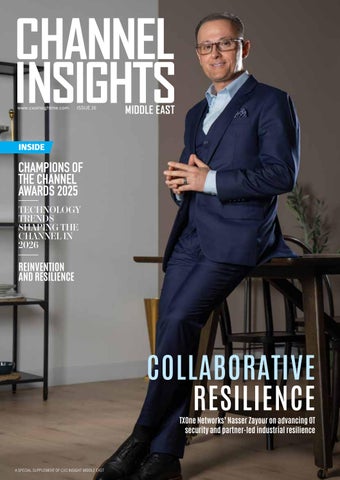
COLLABORATIVE RESILIENCE
TXOne Networks’ Nasser Zayour on advancing OT security and partner-led industrial resilience
www.cxoinsightme.com
CONTENTS 06 NEWS
REDINGTON AND AVEPOINT PARTNER TO STRENGTHEN DATA GOVERNANCE IN MEA
12
VEEAM COMPLETES ACQUISITION OF SECURITI AI
ABU DHABI’S TII AND HONEYWELL TO ADVANCE QUANTUM-SECURE SATELLITE TECHNOLOGY
20
44
LEAD STORY
COLLABORATIVE RESILIENCE 50
PUBLISHED BY INSIGHT MEDIA & PUBLISHING LLC
12
TECHNOLOGY TRENDS SHAPING THE CHANNEL IN 2026
44
VIRTUALISATION: 27 DATA THE NEW INFRASTRUCTURE
46
28 SPOTLIGHTING CHANNEL CHAMPIONS
50
GEN 5 STORAGE: THE BACKBONE OF TOMORROW’S WORKLOADS SCALING THE ECOSYSTEM
THE CLOUD BEHIND THE AI REVOLUTION IN THE MIDDLE EAST
ISSUE 16 / 2025 | CHANNEL INSIGHTS MIDDLE EAST
3
EDITORIAL
STEPPING INTO 2026 As we head towards 2026, it has become clear that the industry’s focus needs to shift to execution—translating big ideas around AI, cloud, and automation into consistent, measurable outcomes for customers and partners.
Ruchika Sharma contributing editor, Channel Insights Middle East
This edition of Channel Insights Middle East explores that shift from multiple angles. One of this month’s features, ‘Technology trends shaping the channel in 2026’, looks at how AI is moving into production, automation is cutting costs, and cloud, cybersecurity, and datadriven services are reshaping how partners build relevance and recurring value. It sets the context for a channel that must move faster, but also think smarter. In this reality, partners will continue to play a defining role. This rings true across the industry, especially in security — a theme explored in our lead story, Collaborative Resilience, featuring TXOne Networks’ Nasser Zayour, which examines the practical demands of OT security in industrial environments. Zayour makes the case for a partnerdriven model where protection and visibility go hand in hand, and resilience is built through co-innovation and shared purpose rather than isolated tools. Elsewhere in this issue, leaders from Denodo, Redington, Kingston Technology, and Huawei share how data virtualisation, disciplined reinvention, next-generation storage, and ecosystem-led cloud strategies are redefining what it means to be competitive in the region. Complementing these are perspectives from Qualys, Acronis, and Huawei Cloud, each encouraging the channel community to rethink value, automation, and the cloud foundations behind the AI boom. This year’s final edition also features the winners of Champions of the Channel Awards 2025. Set against a Bollywood-glam backdrop, the Awards celebrated the people and organisations driving the industry forward. As the new year approaches, the channel’s strength will be measured in what it sustains — customers, partnerships, and progress. Enjoy reading!
Published by
Managing Editor Adelle Geronimo adelleg@insightmediame.com +97156 - 4847568
Sales Director Merle Carrasco merlec@insightmediame.com +97155 - 1181730
Operations Director Rajeesh Nair rajeeshm@insightmediame.com +97155 - 9383094
Publication licensed by Sharjah Media City @Copyright 2025 Insight Media and Publishing
Production Head James Tharian jamest@insightmediame.com +97156 - 4945966
Administration Manager Fahida Afaf Bangod fahidaa@insightmediame.com +97156 - 5741456
Designer Anup Sathyan
While the publisher has made all efforts to ensure the accuracy of information in this magazine, they will not be held responsible for any errors
ISSUE 16 / 2025 | CHANNEL INSIGHTS MIDDLE EAST
5
NEWS
Redington and AvePoint partner to strengthen data governance in MEA
Representatives of Redington and AvePoint
Redington has announced a new distribution partnership with AvePoint, a global provider of data security, governance, and resilience
solutions. The agreement will make AvePoint’s data protection, governance, and migration tools more accessible to enterprises and
public-sector organisations across the Middle East and Africa. The shift toward cloud-based collaboration platforms such as Microsoft 365 and SharePoint continues to accelerate in the region, bringing increased attention to data security, privacy, and compliance requirements. The partnership aims to address these concerns by supporting channel partners and customers with technologies designed to secure and manage data across modern workplace environments. Redington will support the rollout through training programmes, certification workshops, and go-tomarket initiatives intended to help partners deploy AvePoint solutions and improve customers’ overall cybersecurity posture. The partnership reflects both companies’ broader focus on supporting secure collaboration and strengthening the region’s digital infrastructure.
ungoverned, or untrusted. Veeam completes fragmented, Veeam’s acquisition addresses this challenge by unifying visibility, acquisition of security, governance, and recovery across structured and unstructured Securiti AI Veeam Software has completed its $1.725 billion acquisition of Securiti AI, creating what the company describes as the industry’s first unified and trusted data platform designed to operate at AI speed. The combined offering brings together Veeam’s market-leading Data Resilience Platform, used by more than 550,000 customers including 82 percent of the Fortune 500, with Securiti AI’s strengths in data security, governance, privacy, and AI trust. As enterprises accelerate AI adoption, data has become both a powerful asset and a growing risk. While AI systems demand fast, broad access to data, many initiatives fail because the underlying data is 6
CHANNEL INSIGHTS MIDDLE EAST | ISSUE 16 / 2025
data, production systems, backups, and AI pipelines within a single platform. The integrated solution enables organisations to gain real-time insight into their entire data estate, enforce continuous governance and compliance, apply zero-trust security, and ensure clean, validated recovery of data, models, and AI agents. By combining data protection with data security posture management (DSPM), privacy controls, and AI governance, the platform allows enterprises to safely scale AI initiatives without compromising resilience or compliance. As part of the transaction, 600 Securiti AI employees join Veeam, significantly expanding its expertise
L-R: Anand Eswaran, CEO, Veeam and Rehan Jalil, President of Security and AI, Veeam
in AI security, privacy engineering, and governance. Rehan Jalil, founder and CEO of Securiti AI, joins Veeam as President of Security and AI, strengthening leadership focus on trusted AI and data protection.
NEWS
Abu Dhabi’s TII and Honeywell to advance quantum-secure satellite technology
Representatives of TII and Honeywell
The Technology Innovation Institute (TII), the applied research arm of Abu Dhabi’s Advanced Technology Research Council (ATRC), and Honeywell have launched a joint initiative to develop quantumsecure satellite communication systems designed to protect sensitive information across global networks. As quantum computing capabilities continue to evolve, traditional encryption methods are coming under increasing pressure. Quantum key distribution (QKD) offers a futureproof solution by using the quantum properties of light to generate encryption keys that are inherently immune to interception and secure against emerging computing threats. Under this collaboration,
Honeywell’s ‘QKDSat’ platform will be integrated with TII’s groundbased infrastructure – the Abu Dhabi Quantum Optical Ground Station (ADQOGS) – to establish and test end-to-end QKD links between satellites and terrestrial quantum networks. The initiative represents a key step toward building quantum-resilient communication infrastructure capable of safeguarding critical data for government, security, and commercial applications. Developed and operated by TII, ADQOGS is a versatile optical ground station designed to support a range of satellite-based quantum communication experiments – methods used to encode information onto particles of light so they can
transmit encryption keys securely between space and Earth. Its integration with Honeywell’s QKDSat platform will allow experts to test and validate quantum-backed encryption methods under realistic satellite operating conditions, demonstrating longdistance QKD links and overcoming the distance limitations of fiber-based quantum networks – opening the door to truly global quantum communication that is not constrained by terrestrial infrastructure. The collaboration underscores both organisations’ commitment to developing trusted, quantumsecure communication systems, and highlights Abu Dhabi’s growing role in shaping the future of global cybersecurity innovation. ISSUE 16 / 2025 | CHANNEL INSIGHTS MIDDLE EAST
7
NEWS
SentinelOne, Rilian Technologies to expand AI-powered cybersecurity services across the Middle East SentinelOne has announced a strategic partnership with Rilian Technologies to accelerate the delivery of advanced cybersecurity operations and AI-driven defence capabilities across the Middle East. This collaboration combines SentinelOne’s industry-leading autonomous cybersecurity platform with Rilian’s mission to accelerate secure technology adoption, enabling governments, enterprises, and critical industries to deploy, operate, and optimise next-generation security programmes at scale. Through this partnership, SentinelOne and Rilian Technologies plan to deliver full-stack cybersecurity services, including advanced deployment, integration, SOC enablement, and operational technology (OT) security programmes to help customers modernise and secure their platforms end-to-end. The partnership also expands support for air-gapped and mission-critical environments, enabling operators of critical services can deploy advanced security controls without compromising isolation or operational continuity. Together, they align global innovation with regional priorities to enhance data control, strengthen regulatory compliance and protect the critical infrastructure that underpins economic diversification and long-term national competitiveness. Beyond technology deployment, the partnership will also focus on building local expertise, expanding cybersecurity skills, and enabling regional teams with the tools and training needed to operate autonomous, AI-powered security environments. The goal is to elevate regional capabilities across cloud, identity, endpoint, and OT
Representatives of SentinelOne and Rilian Technologies
domains; and help organisations transition from reactive cybersecurity operations to proactive, intelligence-driven defence. By combining SentinelOne’s innovation with the Rilian platform’s ability to promote secure technology adoption, we believe this partnership is set to accelerate the implementation of modern cybersecurity across the Middle East, ensuring organisations have the capabilities, support, and expertise required to protect their most critical assets against today’s rapidly evolving threats.
Cisco simplifies security for managed service providers
Cisco has enhanced its Security Cloud Control platform with multi8
customer management capabilities, enabling MSPs to efficiently deliver
CHANNEL INSIGHTS MIDDLE EAST | ISSUE 16 / 2025
advanced security services. The update allows MSPs to centrally manage solutions like the Hybrid Mesh Firewall with AI Defence and Secure Access (SSE), streamlining operations, reducing costs, and accelerating growth. The Hybrid Mesh Firewall provides distributed, AI-driven security and zero-trust segmentation across data centres, clouds, and edge sites, with policies managed
centrally. Key platform features include centralised oversight, multi-org management, role-based access control, simplified licensing, and API automation, helping MSPs onboard clients faster, cut operational overhead, and expand services efficiently. Overall, the update empowers MSPs to deliver smarter, scalable, and profitable security solutions while improving efficiency and customer outcomes.
NEWS
EQUATE and Kyndryl extend partnership to strengthen global IT systems
EQUATE Group and Kyndryl team members
EQUATE Group announced the renewal and expansion of its five-year managed infrastructure services partnership with Kyndryl. The renewed agreement reinforces a long-standing collaboration focused on advancing operational reliability, cybersecurity and continuous digital improvement across EQUATE’s worldwide operations. Building on EQUATE’s established digital infrastructure and data-driven culture, the
partnership continues to enhance the company’s IT reliability and efficiency through integrated monitoring and automation tools that strengthen visibility and resilience across global sites. With the capabilities of Kyndryl Bridge, Kyndryl’s AIpowered open integration platform, EQUATE gains deeper insights to anticipate potential issues earlier, streamline responses and maintain the high availability that supports safe and efficient manufacturing
performance. As part of EQUATE’s continuous improvement initiatives, the collaboration also extends to modernising employee service channels. New cloud-based and AIassisted features will simplify internal support processes and enhance responsiveness, reflecting EQUATE’s commitment to empowering its people with effective and reliable digital experiences that enable them to focus on innovation and operational excellence. In addition, Kyndryl
Consult will continue to work alongside EQUATE’s technology and operations teams to identify optimisation opportunities and align digital initiatives with the company’s business, safety and performance objectives. This ongoing collaboration focuses on measurable improvements to reliability, efficiency and cost-effectiveness, so that EQUATE’s technology investments continue to support its long-term growth and sustainability goals. ISSUE 16 / 2025 | CHANNEL INSIGHTS MIDDLE EAST
9
NEWS
IFS and Boston Dynamics to revolutionise field operations with AI Robotics IFS and Boston Dynamics announced a ground-breaking collaboration to revolutionise how asset-intensive organisations manage and optimise their field operations. Uniting Boston Dynamics’ autonomous inspection robots with the power of IFS.ai creates a fully agentic AI system that seamlessly connects sensing, predictive decisionmaking and action in the field. With labour and skills shortages impacting industrial customers, leading to service gaps and prolonged outages, there exists an urgent need for technology that can supplement field workers. IFS and Boston Dynamics revealed the joint solution for the first time at Industrial X Unleashed in New York. The two companies showcased a powerful combination of physical AI and agentic AI that creates an end-to-end autonomous system to connect robots and enterprise data in high-potential applications. Boston Dynamics’ Spot robots inspect industrial assets and sites, capturing critical operational data in real-time. Spot uses thermal cameras to detect overheating, can listen to air or gas
leaks, read analogue gauges for pressure and flow, check indicator lights, identify hazards like spills, or detect voltage anomalies. This information feeds directly into IFS. ai, where agentic AI analyses the data, makes intelligent decisions, and triggers appropriate actions – creating a seamless loop from sensing to execution. The collaboration uniquely focuses on serving industries where field operations are critical, including manufacturing, energy, utilities, mining, and other assetintensive sectors. With field workers comprising part of the 70 percent of the world’s workforce that do not work behind a desk, IFS and Boston Dynamics are unlocking value in areas that have remained underserved by generic AI applications.
enterprises to scale Qualys selects Security Saudi cyber risk management in alignment with national Matterz as first mROC digital transformation and Saudi Vision partner for the Kingdom goals 2030. As an mROC partner, of Saudi Arabia Security Matterz will Qualys announced that Security Matterz has been selected to join its invite-only managed Risk Operations Centre (mROC) Partner Alliance, becoming the first mROC partner in the Kingdom of Saudi Arabia. This strategic partnership marks a major milestone in advancing the Qualys ROC ecosystem within the Kingdom, empowering 10
CHANNEL INSIGHTS MIDDLE EAST | ISSUE 16 / 2025
deliver Qualys-powered managed risk services that bring measurable improvements in visibility, risk prioritisation, and response across critical sectors. The collaboration will enable Saudi organisations to overcome cybersecurity challenges such as fragmented tools, reactive security postures, and limited visibility —
fostering a more proactive, business-aligned approach to risk management. Built on the Qualys Enterprise TruRisk Management Platform, the ROC framework consolidates risk signals across an organisation’s entire digital footprint into a single view. It enables Continuous Threat Exposure Management (CTEM), cyber risk quantification, and automated remediation — helping organisations translate cyber risk into business outcomes, strengthen compliance readiness, and enhance long-term resilience.
COMPLETE
NETWORK VISIBILITY Improve detection coverage and accuracy | Accelerate defense with AI | Disrupt future attacks
OPEN NETWORK DETECTION & RESPONSE PLATFORM
TRUSTED BY
FEATURE
ACRONIS
TECHNOLOGY TRENDS SHAPING THE CHANNEL IN 2026 As the channel ecosystem heads into 2026, rapid technology shifts are redefining priorities and business models. AI is expected to underpin the majority of enterprise applications, while automation is helping partners cut operational costs by double-digit margins. With cloud, cybersecurity, and data-driven services continuing to post strong year-on-year growth, channel leaders explore how emerging technologies, evolving partner strategies, and stronger ecosystem collaboration will shape relevance, resilience, and growth in the digital economy ahead
12
CHANNEL INSIGHTS MIDDLE EAST | ISSUE 16 / 2025
In 2026, the Middle East channel landscape will be shaped by AI-driven automation, cyber resilience platforms, and data-sovereign cloud. AI will become embedded across services, from threat detection and patch management to ticket triage and billing, while customers demand integrated cyber protection platforms combining backup, security, disaster recovery, and endpoint management. Regional priorities, such as data residency and regulatory alignment, are driving in-region solutions like the Acronis Cyber Cloud Data Centre in Abu Dhabi. MSPs can increase efficiency, reduce manual work, and deliver proactive service through AI-powered features like patch stability scoring and automated deployment. AI will also enable realtime risk scoring, automated incident communication, and personalised service bundles, shifting focus from product sales to outcome-driven services. Collaboration and ecosystem partnerships will drive the next growth phase. Integrations with technology alliances and local players allow MSPs to address compliance and data challenges effectively. Co-selling, co-managed services, and integrated platforms position partners as strategic advisors rather than mere resellers.
Three priorities are non-negotiable for partners in 2026: platform thinking, cyber resilience, and skills” Ziad Nasr, General Manager, Acronis Middle East
ASUS
AXIS COMMUNICATIONS
BEYONDTRUST
AI will be the dominant force shaping the channel in 2026, with Agentic AI and Generative AI being integrated into workflows and governance frameworks. Sustainable technology will also gain importance, as local governments push for sustainability goals and partners offering energyefficient solutions gain a competitive edge. Embedded AI solutions and analytics will guide clients on risks, while automation-as-a-service streamlines delivery. Partners can leverage AI-driven insights to upsell and create new revenue streams by bundling AI-specific solutions with cloud and security offerings. To stay relevant, channel partners must adopt an AI-first service model, prioritise sovereign cloud, and embed cybersecurity into all offerings. Guiding clients on building first-party data ecosystems, upskilling in AI, automation, cloud, and security, and shifting to outcome-based management focused on resilience and compliance will be critical for competitiveness.
Integration will be a key priority for channel partners in 2026, with AI and analytics at the core of delivering comprehensive, end-to-end solutions. Rapid advancements in AI will allow partners to optimise operations, improve security, and increase efficiency, while offering customers cutting-edge solutions that generate real business value. Analytics will enable partners to enhance their offerings and strengthen their value, particularly in areas like physical security and network surveillance, where AI-driven products improve safety, resilience, and intelligence. Responsible AI use and strong dataprivacy practices will be essential, helping partners enhance lead scoring, sales guidance, and solution optimisation. This shift allows partners to become trusted advisors, delivering more tailored and impactful customer experiences. To remain competitive, channel partners must ensure their solutions align with customer needs, leverage AI, analytics, and data insights, and develop expertise in areas like AI, cybersecurity, and IoT. Physical security and network technologies will continue to be crucial in strengthening customer security strategies.
In 2026, AI, cloud adoption, and identity security will be the key technologies shaping the channel landscape. AI enables smarter decision-making, helping partners predict risks, optimise offerings, and deliver outcomes rather than just products. Cloud adoption allows scalable, flexible services across hybrid environments, while identity security, including modern PAM, addresses the growing need for protecting privileged access as the new digital perimeter. Partners who integrate these technologies into holistic solutions can capture new revenue streams and position themselves as trusted strategic advisors. AI and automation are transforming partner strategies and customer engagement by enabling proactive, outcome-driven interactions. Tools like BeyondTrust’s AI-powered Identity Security Risk Assessment help partners uncover risks and implement proactive strategies with tangible results. Partners must adopt a consultative, outcome-focused approach, upskill in AI, automation, identity security, and cloud, and engage early in sales cycles to provide trusted advisory guidance and remain relevant.
AI and automation will likely take on a more consultative role, where AI-powered solutions are embedded into workflows, and AI-based analytics can guide clients on the risks”
Channel ecosystems thrive when partners offer deep expertise in specific solution areas and can meet customers’ unique requirements”
At BeyondTrust, our channel programme emphasises collaboration, giving partners access to our full suite of identity security and PAM solutions while complementing them with other technologies”
Tolga Özdil, Regional Commercial Director – META, ASUS
Rudie Opperman, Regional Manager – MEA, Axis Communications
Maya Zakhour, Director of Partner Ecosystem, BeyondTrust
ISSUE 16 / 2025 | CHANNEL INSIGHTS MIDDLE EAST
13
FEATURE
CLOUD BOX TECHNOLOGIES
DENODO
EPICOR
AI will lead technological transformation in 2026, driving autonomous decision-making, cloud platforms, and enhanced customer experiences. Industry-specific clouds and edge computing will enable low-latency processing for IoT, AI workloads, and real-time analytics. Secure, automated, and integrated ecosystems will become standard, while advanced skills will be critical for partners to stay competitive. Channel partners must prioritise upskilling in AI, cloud, cybersecurity, and networking. Acting as trusted advisors and focusing on customer experience—handling integration, orchestration, and optimisation—will differentiate partners in a rapidly evolving market. Collaboration and ecosystem partnerships will drive the next phase of growth. By co-innovating with vendors and specialists across AI, cloud, cybersecurity, and networking, partners can deliver integrated, high-value solutions. Breaking down silos through joint solution development and managed services will accelerate innovation and provide customers with a competitive edge in 2026.
Emerging technologies shaping the 2026 channel landscape will focus on autonomous AI and systems that enable companies to access and manage data instantly and securely. As businesses increasingly rely on real-time, well-governed information to power AI, partners delivering these capabilities will stand out. AI and automation will move partners beyond tool reselling. They will guide system integration, streamline processes, and unlock smarter data use, shifting focus from features to outcomes: faster decisions, fewer errors, and clearer insights. AI also enables personalised customer experiences by analysing patterns to anticipate needs and improve service delivery. Partners must prioritise digital transformation expertise, particularly in AI and cloud, while continuously building skills and exploring new opportunities. Sustainability should be embedded into operations, and data-driven, personalised solutions with strong ongoing support will strengthen client relationships and differentiate partners in a competitive market.
The channel landscape will shift from selling standalone solutions to creating integrated ecosystems. Partners will focus on using individual solutions as entry points to build complementary offerings that deliver sustained business value. AI and cloud will drive the next major technology shift. Regional cloud ecosystems, accelerated by hyperscalers like Microsoft, Amazon, and Google, have made enterprise transformation more accessible. SaaS models now give instant access to AI features, enabling partners to move beyond one-off deployments to continuous improvement cycles. Channel partners must prioritise specialisation and platform growth. Customers seek industry experts who can connect technology to tangible outcomes. Platform adoption across ecosystems, such as CPQ and CPC solutions, allows partners to increase crosssell and upsell opportunities. Cloud migration remains central, providing customers with agility and cost efficiency while strengthening partner relationships.
For channel partners, edge computing will take centre stage, enabling low-latency processing for IoT data, AI workloads, and real-time analytics”
As businesses rely on real-time, well-managed information to power AI tools, partners offering these capabilities will stand out”
Partners who invest in enablement, embrace industry specialisation, and keep their focus on delivering measurable customer value will lead the pack in 2026”
Ranjith Kaippada, Managing Director, Cloud Box Technologies
Gabriele Obino, Vice President Southern Europe & Middle East, Denodo
14
CHANNEL INSIGHTS MIDDLE EAST | ISSUE 16 / 2025
Paul Flannery, VP Channel Sales, Epicor
HID
INFOBLOX
KINGSTON TECHNOLOGY
Channel landscape in 2026 will be shaped by next-generation identity and security technologies. Mobile credentials, integrating biometrics and secure smartphone-based access, will become a priority, supporting both stronger security and sustainability by reducing physical cards. Unified, software-driven security platforms and open ecosystems will drive demand for interoperable, scalable solutions, giving partners the opportunity to guide customers through complex digital transformations. Sustainabilityfocused decision-making will also influence strategies, with 75 percent of leaders factoring environmental impact into technology choices. AI-powered solutions will provide real-time insights, proactive threat detection, and automated decision support, while AI-driven workflows like automated credential management and intelligent visitor verification enable faster deployments, fewer manual tasks, and scalable support. Automation will also enhance customer engagement through self-service identity experiences and unified provisioning, allowing partners to simplify complexity and guide AI adoption. Collaboration and ecosystem partnerships will be critical for growth, enabling unified, secure, and tailored solutions.
The rise of hybrid work and connected devices makes network visibility and security critical. Partners who adopt integrated approaches—especially in preemptive security and unified management across on-premises, cloud, and edge environments—will deliver the most value. Technical expertise combined with strategic collaboration will differentiate leaders, while technologies that simplify complexity will define success. Beyond reselling technology, partners are expected to advise, integrate, and automate. Agentic AI streamlines workflows and enables predictive, outcome-driven solutions. With cyber threats becoming increasingly sophisticated, partners must develop data science and automation skills, treating AI as a core business enabler to drive meaningful change. Customers seek trusted advisors who deliver measurable results in security, downtime reduction, and regulatory compliance. Expertise in security, cloud, and automation, combined with continuous upskilling and adaptability, is essential to respond to evolving market needs and seize emerging opportunities. Collaboration and ecosystem partnerships will define the next phase of growth.
The emerging technologies that will reshape the IT channel landscape in 2026 are AI platforms both local and in data centres in addition to AI ready PC and Laptops. These will redefine how distributors, and partners support these new systems with the added value components. AI and automation will push partners to evolve from transactional resellers into strategic advisors on products and services. Channel partners should prioritise offering high-quality, value-added products that benefit both resellers and end customers. In the age of AI, the ecosystem is composed of many interconnected elements that work together to create the optimal computing environment. Resellers and customers have access to a wide variety of products. The true value lies in narrowing down these options to identify the solutions that best fit the end customer’s needs. Also, collaboration across the channel is essential to deliver solutions that strengthen this environment and ultimately provide the greatest benefit to the customer.
Staying relevant in 2026 requires channel partners to rethink their value proposition and align with the realities of a rapidly digitalising security landscape”
The boundaries between managed service providers, software vendors, and integrators are increasingly blurred, with joint solutions and shared platforms becoming the norm”
In the age of AI, resellers and customers have access to a wide variety of products. The true value lies in narrowing down these options to identify the solutions that best fit the end customer’s needs”
Alexandre Nevraumont, Director Partner Sales, Infoblox
Laurent Sirgy, Regional Director for France, Southern Europe, MEA, Kingston Technology
Wladimir Alvarez, Head of Global Sales, HID
ISSUE 16 / 2025 | CHANNEL INSIGHTS MIDDLE EAST
15
FEATURE
MANAGEENGINE
NMK Electronics
NUTANIX
In 2026, the channel landscape will be defined by technologies that enhance intelligence, agility, and interoperability across businesses. Artificial intelligence, particularly generative and predictive AI, will play a central role, enabling smarter decision-making, automating processes, and elevating customer experiences. Partners will increasingly leverage AI-driven insights to improve operational efficiency, anticipate market trends, and deliver tailored solutions. These capabilities will also foster closer ecosystem collaboration, allowing seamless integration across platforms, tools, and services, and enabling the channel to provide highervalue outcomes. Moving beyond reactive support, partners will adopt proactive, predictive approaches powered by AI analytics. Automation will reduce repetitive tasks, freeing teams to focus on strategic advisory and solution optimisation. AI will drive personalised customer experiences, offering context-aware recommendations, quicker issue resolution, and consistent service quality. Partners embedding AI within their offerings will enhance efficiency, accuracy, and overall business impact, delivering measurable value for clients.
In 2026, the channel will be shaped by technologies that accelerate convergence across AV, IT, networking, and automation. We expect AI-powered collaboration platforms, intelligent audio and video processing, next-generation LED and projection technologies, and cloud-native control ecosystems to be the primary drivers. Spatial computing and immersive environments will also gain significant traction, as organisations seek more experiential customer journeys. At a foundational level, cybersecurity-embedded hardware and software will become nonnegotiable as channel partners support increasingly interconnected workflows. With the advancement of networking, more uncompressed video, audio and signals can be distributed. With technology becoming increasingly interconnected, no single vendor or partner can address every requirement alone. The strongest players will be those who build multi-brand, interoperable ecosystems that simplify customer decision-making. Collaboration between distributors, vendors, consultants, and integrators will lead to more scalable solutions, faster go-tomarket execution, and shared innovation. For customers, this ecosystem model translates into better reliability, broader expertise, and solutions that evolve with their environments.
Based on current trajectories, cloud, AI, security, and ecosystem collaboration will most likely reshape the channel landscape in 2026. Channel partners that embrace AI, specialise in vertical solutions, deliver managed services, and focus on unified platforms will be best positioned to differentiate and lead the market. 2026 will be defined by AI, simplification, multicloud freedom, vertical solutions, and security. Channel partners that embrace platform thinking, managed services, and AI-driven value will lead the market. As customers demand simplicity, efficiency, and measurable results, partners who adopt AI-driven services, co-create value, and embed automation across their offerings will differentiate and accelerate growth. Building strong services capabilities around managed, professional, and consultative selling will differentiate them as trusted advisors rather than transactional resellers. Those who embrace innovation and deliver integrated, outcome-focused solutions will maintain competitive advantage and long-term relevance with the focus on business outcome rather than point products.
Modernising integration and automation capabilities will be essential as the technology ecosystem grows more complex and interconnected”
In 2026, the channel will be shaped by technologies that accelerate convergence across AV, IT, networking, and automation”
At Nutanix our message to the channel community is to embrace simplicity by providing the platform of the future to run Apps, Data & AI Anywhere”
Praneeth Vanteru, Technical Evangelist, ManageEngine
Rayan Soumsom, Head of Business Development, NMK Electronics
16
CHANNEL INSIGHTS MIDDLE EAST | ISSUE 16 / 2025
Shaista Ahmed, Director – Channel & Ecosystem – MEA, Nutanix
OMNIX INTERNATIONAL
PURE STORAGE
SENTINELONE
By 2026, the channel ecosystem will be transformed by a convergence of advanced technologies. Agentic AI and autonomous workflows will extend beyond chat interfaces to multi-agent platforms capable of managing end-to-end business processes, reshaping managed services and digital transformation. Cloud-native and composable enterprise architectures will define scalable and adaptable solution delivery. Digital Twins and industrial metaverse platforms will drive demand for real-time operational visibility, advanced simulation, and sustainability-focused applications. AI-driven cybersecurity and zero-trust architectures, including intelligent security platforms and continuous monitoring, will become essential channel offerings, forming the foundation for next-generation growth and value creation. AI and automation will reposition partners as value integrators rather than resellers. They will help customers define AI use cases, build ROI models, and deliver measurable outcomes while offering AI-based managed services to optimise costs and enhance engagement. Internally, partners will use AI to anticipate customer needs, operate intelligent support desks, and deliver tailored, data-driven services that strengthen relationships and satisfaction.
In 2026, the Middle East’s channel ecosystem will play a central role as organisations move from planning AI to deploying it in production, navigating tighter compliance and rising energy demands. Partners with expertise in data sovereignty will lead, helping customers manage, govern, and deploy data within compliant jurisdictions while offering flexible cloud and hybrid solutions. Subscription services will need to demonstrate real value beyond recurring billing, with partners ensuring they remain integral to implementation and delivery through SLA-backed services that drive measurable results. Winning partners will deliver outcomes rather than products, designing integrated, end-to-end solutions that enhance resilience, sustainability, and operational efficiency, leveraging strong channel alliances. Virtualisation and cloud options present opportunities for partners to guide customers on microservices, Kubernetes, and hybrid architectures, embedding themselves strategically in IT environments. Partners must deploy energy-efficient systems, embrace circular design, and offer as-a-service models to reduce emissions while supporting AI innovation. Success in 2026 will be defined by focus, trust, and impact.
In 2026, the channel landscape will be transformed by converging technologies that enhance intelligence, automation, and security. AI will evolve from generative assistants to agentic, humansupervised systems, enabling partners to deliver predictive, autonomous solutions that boost productivity, decision-making, and response times. Cybersecurity will adapt to a hyperconnected world, with AI-powered threat detection, SOC automation, and AI itself emerging as a key category and attack surface. Intelligent assistants and generative AI tools will allow real-time co-creation with customers, accelerating decisions and business impact. Partners who embed AI deeply will strengthen relationships, improve retention, and act as trusted digital advisors. Collaboration and ecosystem partnerships will drive growth, enabling co-creation across vendors, integrators, and service providers. Unified solutions combining cybersecurity, cloud, and AI, supported by co-selling and marketplace integrations, will define success, with value measured by collective outcomes and customer impact rather than individual ownership.
AI and automation will fundamentally reshape partner strategies and customer engagement by enabling partners to position themselves as value integrators rather than simple resellers”
Partners must deploy energy-efficient systems, embrace circular design, and offer as-a-service models to reduce emissions while supporting AI innovation”
Ecosystem partnerships will also boost innovation velocity, helping partners enter new markets faster and deliver tailored vertical solutions”
Walid Gomaa, CEO, Omnix International
Geoff Greenlaw, VP EMEA/LatAm Channel, Pure Storage
Meriam ElOuazzani, Regional Senior Director, Middle East, Turkey, and Africa, SentinelOne
ISSUE 16 / 2025 | CHANNEL INSIGHTS MIDDLE EAST
17
FEATURE
VERTIV
WESTERN DIGITAL
WSO2
AI, cybersecurity, and high-density infrastructure technologies will drive the 2026 channel shift. These trends redefine how partners sell, pushing demand for consultative engagement. The partners who can translate these emerging technologies into business outcomes will lead the next wave of channel growth. AI and automation will elevate partners from transactional sellers to strategic advisors. Automation will reduce low-value tasks, allowing partners to focus on integration, lifecycle services, and outcome-based engagements. Supported by Vertiv’s end-to-end infrastructure solutions and partner enablement programmes, partners can deliver proactive, predictive, and customer-specific services at scale. Channel growth will increasingly depend on cross-ecosystem collaboration among MSPs, ISVs, distributors, and system integrators. Vertiv is enabling this through integrated modular solutions and partner programmes that support joint value delivery across AI, cloud, and edge projects. As customers demand integrated, next-generation IT solutions, partners who embrace ecosystem thinking— supported by Vertiv’s enablement, tools, and solution frameworks—will be best positioned to capture new opportunities and accelerate growth.
In 2026, the channel landscape will be driven by AI, machine learning, IoT, and smart infrastructure, requiring partners to rethink data management and IT architectures. The surge in data generation and AI workloads will demand high-capacity, AI-ready storage solutions that optimise performance, scalability, and total cost of ownership. Partners who can design and deliver these solutions will be best positioned to support enterprise growth. Partners must move beyond transactional sales to offer long-term, solution-driven guidance, helping customers optimise workloads and select the right storage mix. Automation enables more efficient operations, while AI-powered insights support predictive, proactive decision-making, strengthening partners’ advisory role. Multi-vendor ecosystems combining storage, compute, networking, and services allow partners to deliver validated, interoperable, and scalable solutions. By aligning closely with vendors and ecosystem players, partners can accelerate deployments, reduce complexity, and offer end-to-end support, positioning themselves as strategic enablers in the rapidly evolving Middle East market.
AI will be the biggest game-changer for the channel in 2026. Our partners will drive smarter automation, predictive insights, and personalised customer engagement, powered by enterprise AI. As enterprises connect cloud, on-prem, and edge systems, partners who can simplify that complexity will lead. The region’s pace of modernisation is incredible, from smart cities to national digital identity programmes. Partners must align quickly with these priorities and data will be the key differentiator. WSO2 partners also understand the importance of data sovereignty for the region which our fully featured enterprise open source platform uniquely supports. Those who can turn insights into real outcomes will gain customer trust and longevity. And because no single player can deliver end-to-end transformation and modernisation alone, the strongest partners will be those that build ecosystems, coinnovate, and create integrated value for their customers.
The Vertiv 360AI solutions and liquid-coolingready portfolios reflect this evolution, helping partners support AI-ready, scalable, and reliable data centre deployments”
We work in close collaboration with partners to ensure customers have a reliable and cost-efficient foundation for AI-driven operations across their IT landscapes”
At WSO2, we’re seeing this through our partner network, combining our open, API-driven technologies with the local expertise and agility of our partners delivers powerful results”
Nassif Yazbeck, Channel Sales Director – MEETCA, Vertiv
Owais Mohammed, Sales Director & Regional Lead - IMEA, Western Digital
Kristian Györkös - Senior Vice President and Global Head of Channel, WSO2
ISSUE 16 / 2025 | CHANNEL INSIGHTS MIDDLE EAST
19
LEAD STORY
COLLABORATIVE RESILIENCE Nasser Zayour, VP Global Channel & Alliances, TXOne Networks, outlines the company’s perspective on strengthening OT security and advancing a partner-driven vision for industrial resilience
20
CHANNEL INSIGHTS MIDDLE EAST | ISSUE 16 / 2025
ISSUE 16 / 2025 | CHANNEL INSIGHTS MIDDLE EAST
21
LEAD STORY
A
s industries across the world accelerate into deeper phases of digital transformation, operational technology (OT) security has entered a pivotal moment. Systems that once functioned as isolated, stable environments now operate as highly connected digital ecosystems, supporting production, automation, and real-time decisionmaking. Their increased reliance on connectivity has created unprecedented opportunities, but also unprecedented risks. In this defining era, organisations are re-evaluating their approach to security, driven by a growing recognition that modern industrial protection requires a blend of technological sophistication, operational understanding, and collaborative execution. This transformation lies at the heart of TXOne Networks’ mission, and few articulate this shift with the clarity and conviction of Nasser Zayour, the company’s Vice President of Global Channel & Alliances. From the outset, one recognises that Zayour approaches OT security differently. He doesn’t frame it around tools or dashboards alone but around the people and operational workflows that determine whether protection is truly effective. He speaks of production realities, uptime pressures, and the delicate balance between protection and
operational continuity. In his view, true OT resilience must be shaped not only by technology but by the interconnected ecosystem of partners who translate security strategy into measurable outcomes. Zayour has helped redefine how the company approaches industrial cybersecurity worldwide. His leadership centres on a simple idea: resilience comes from balance, Protection + Visibility, and from a global partner ecosystem built on purpose, trust, and execution. This conviction forms the foundation of TXOne Networks’ global philosophy, one that challenges outdated paradigms and champions a more realistic, action-oriented model of industrial protection. The visibility challenge: Overcoming a long-standing barrier The modern OT landscape is a far cry from the traditional, segregated industrial systems of the past. Today’s factories, utilities, and critical infrastructure operate with layers of PLCs, controllers, sensors, engineering workstations, and legacy devices, all connected in some form to IT networks or enterprise management systems. With this interconnectivity comes expanded complexity and a vastly enlarged attack surface. Yet despite years of investment in OT security tools, many organisations still struggle with the same foundational problem: visibility.
At the heart of TXOne’s momentum is a global channel transformation. Our model empowers collaboration and builds trust. Partners know exactly where they stand, what’s expected, and how we succeed together” 22
CHANNEL INSIGHTS MIDDLE EAST | ISSUE 16 / 2025
For more than a decade, the industry has been told that complete visibility, a 100 percent inventory of every asset, every vulnerability, every connection, is the first requirement for a secure environment. The underlying message was clear: visibility must come before protection. But as Zayour notes, this model has repeatedly failed in real operational environments. “For too long, OT security has been treated like a visibility exercise,” he explains. The conventional belief created a culture where endless mapping, scanning, and cataloguing took priority over actual protection. While dashboards and asset lists grew more sophisticated, the ability to reduce risk in real time remained limited. This approach, he argues, led to what he calls “visibility paralysis”, a state in which operators are overwhelmed with information but hesitant or unable to act. Factories, plants, and industrial sites rarely achieve complete visibility due to operational constraints, legacy systems, and unconnected devices. Waiting for perfect visibility before deploying protection leaves them vulnerable during transition periods that can last months or even years. Zayour offers an alternative: “You don’t need 100 percent visibility to start defending your environment. Even 60 percent visibility is enough to act, and protection itself will generate the rest.” This philosophy reverses the industry’s longstanding sequence. Instead of waiting for full visibility to implement protection, TXOne advocates for immediate, operationally aligned safeguarding that produces additional visibility as a by-product. This not only accelerates deployment but also ensures that security measures align with the realities of industrial operations. Protection and visibility working together In many OT environments, deploying traditional IT security
Collaboration is everything. OT security can’t be solved in silos”
tools is simply not feasible. Patch management is restricted, downtime is expensive, legacy systems cannot be updated, and critical controllers must remain operational 24/7. Security solutions must therefore respect operational continuity while providing meaningful insights and effective risk reduction. This is where TXOne’s key technologies, such as the Edge Series and its Asset Vulnerability Management (AVM) platform, set themselves apart. Rather than requiring full network redesigns or interruptive scanning processes, these solutions integrate directly into existing operations. They gather asset intelligence in real time, identify vulnerabilities where they matter most, and apply compensating controls without disrupting production. AVM has become particularly relevant for industrial environments. It focuses on Levels 0 to 2, the heart of OT systems, where the most critical assets reside. At these layers, patching is often unrealistic, and traditional IT vulnerability management tools fail to account for the unique constraints of industrial environments. “AVM merges visibility, vulnerability assessment, and protection for Levels 0 to 2, the layers where industrial risk is most concentrated. This is what enterprises actually need, risk reduction that doesn’t disrupt operations.”
This approach shifts security from a theoretical exercise to a practical one. Instead of overwhelming operators with lists of thousands of vulnerabilities they can’t act on, TXOne technology delivers visibility that leads directly to actionable protection, turning insight into resilience without operational friction. A structured global channel strategy No matter how advanced a technology is, its real-world
success depends on the ecosystem behind it. This is especially true in OT environments, where each industrial site operates with specific constraints, regulatory requirements, legacy architectures, and operational protocols. This is why Zayour’s role is pivotal. He firmly believes that industrial cybersecurity cannot be delivered alone. The diversity and sensitivity of OT environments demand a collective approach where technology vendors, system ISSUE 16 / 2025 | CHANNEL INSIGHTS MIDDLE EAST
23
LEAD STORY
integrators, service providers, and channel partners align around a common mission. “Industrial environments are too diverse, too sensitive, and too operationally constrained for any single vendor to secure alone. The only scalable model is one where partners translate strategy into repeatable, outcome-driven execution.” Under his leadership, TXOne has implemented a global channel transformation built around clarity, discipline, and measurable growth frameworks. The company has created uniform expectations for partners worldwide, ensuring that whether a partner engages from the Middle East, Japan, Europe, or North America, they experience the same consistency in process, expectations, and support. “At the heart of TXOne’s momentum is a global channel 24
CHANNEL INSIGHTS MIDDLE EAST | ISSUE 16 / 2025
transformation. Our model empowers collaboration and builds trust. Partners know exactly where they stand, what’s expected, and how we succeed together.” This disciplined approach benefits all parties involved. Partners experience improved transparency, predictable engagement models, and robust enablement pathways. Customers benefit from partners who are trained, prepared, and capable of delivering outcome-oriented industrial protection solutions. And TXOne benefits from a channel ecosystem that scales its mission globally without compromising quality. From sellers to strategic advisors OT security is no longer a product-driven discussion. It is an operational discipline that touches engineering, safety,
reliability, and compliance. As such, partners must evolve beyond transactional sales and become trusted advisors capable of guiding organisations through complex industrial transformations. Zayour underscores this shift clearly: “We align our partners to the industries where risk is most concentrated and where operational uptime is missioncritical. Partners who invest in capability become enablers of resilient operations, not just vendors of tools.” To support this evolution, TXOne has invested in certifications, technical enablement, and realworld playbooks designed to guide partners through contextual OT security design. These resources empower partners to understand operational requirements, engineering limitations, and
The future is about co-innovation and specialisation. Through shared purpose, coinnovation, and a protection-first mindset, TXOne and its partners are shaping the future of OT security, together” system dependencies, enabling them to position solutions effectively and responsibly. This elevation of partner capability not only strengthens ecosystem resilience but also enhances partner competitiveness. According to Zayour, partners who fully invest in these competencies are already seeing tangible increases in deal velocity, customer trust, and market influence. Why collaboration matters more than ever As industrial environments become increasingly interconnected, the seams between systems, and between teams, are becoming prime targets for attackers. The attack chain today spans vendors, integrators, remote access tools, engineering stations, and thirdparty IoT devices. In this context, collaboration becomes a necessity, not a preference. “Collaboration is everything. OT security can’t be solved in silos,” emphasises Zayour. This philosophy drives TXOne’s ecosystem strategy. Rather than positioning technology as a standalone solution, the company sees it as a force multiplier when
combined with partner-delivered services, engineering expertise, and on-ground operational insights. TXOne’s partnerships enable coordinated incident response, harmonised engineering and cybersecurity priorities, shared intelligence across stakeholders, and adapted protection strategies for unique plant conditions. The company continues to enhance these collaborations through analytics-driven dashboards, automated workflows, and specialised OT training, all intended to foster transparency and accelerate partner readiness. A future built on shared purpose Zayour envisions a future where OT security is shaped by co-innovation, specialisation, and shared purpose. Solutions will evolve not through isolated product launches but
through collective intelligence and practical experience gained across industries worldwide. “The future is about co-innovation and specialisation. Through shared purpose, co-innovation, and a protection-first mindset, TXOne and its partners are shaping the future of OT security, together.” In this vision, resilience is not owned by any single organisation, it is co-created by every participant in the ecosystem. As TXOne expands across diverse markets in the Middle East, Africa, Asia, Europe, and North America, its partner-first strategy ensures local expertise remains central to global progress. Industrial cybersecurity, in Zayour’s view, is not simply about preventing attacks; it is about sustaining operations, protecting livelihoods, and enabling the industries that power the world. ISSUE 16 / 2025 | CHANNEL INSIGHTS MIDDLE EAST
25
Identity
Network
Monitors user behavior & access patterns. Detects & prevents suspicious activity, unauthorized logins.
Analyzes content, sender reputation & user behavior. Identifies and blocks malicious emails.
Analyzes traffic across. Detects & prevents malware, data exfiltration, and network attacks.
Endpoint Detects malicious code and prevents data breaches across laptops, desktops & mobile devices.
Cloud
OT
Protects workloads, applications and data.
Provides specialized protection for OT environments
CONSULTING | SYSTEM INTEGRATION | MANAGED SERVICES
solutions@teksalah .com www.teksalah.com
UAE | QATAR | INDIA #Teksalah
INTERVIEW
DATA VIRTUALISATION:
THE NEW INFRASTRUCTURE Gabriele Obino, Vice President Southern Europe & Middle East, Denodo, explains how data virtualisation is transforming access, governance, and real-time intelligence across the UAE’s rapidly evolving digital landscape
T
he UAE’s data centre market is booming — what key factors are driving this surge, and how does Denodo fit into this landscape? The UAE’s data centre market is expanding rapidly due to widespread digital transformation, strong government support for cloud adoption, and the growing demand from AI technologies that require heavy computing power. As organisations store data across multiple platforms and regions, solutions like a virtual data layer - that let them use data directly without moving it - are considered essential. Denodo helps these organisations use all that data efficiently, securely and in real time, without the drag of heavy duplication or slow integration. That makes it a strategic fit for businesses operating in the UAE’s booming digital infrastructure landscape. Data is growing faster than organisations can manage it. How does data virtualisation address this complexity in real time? Data is growing faster than most companies can physically move, clean or integrate it. Data virtualisation helps by showing all the information across different systems while leaving the data in place, enabling queries in real-time. This lets teams access and analyse data instantly, cutting delays and avoiding duplication.
What are the biggest misconceptions about data virtualisation among regional businesses? Many people think data virtualisation just copies data, but that’s not true - it connects data to where it already exists. Others assume it’s only good for light or low-risk workloads, when it can actually handle large, complex ones. Some also believe it weakens security because you’re not moving data, while it can strengthen governance instead. How is eliminating physical data movement improving agility, security, and compliance for enterprises in the UAE? When you stop physically moving data, companies can access and share information faster and more securely. It reduces the risk of data leaks during transfers and helps meet strict local rules around privacy and storage, which is especially crucial for businesses operating in the UAE’s regulated sectors. With AI adoption accelerating, what role does data virtualisation play in delivering faster, more accurate insights? AI requires clean and up-to-date data. Data virtualisation helps by allowing real-time access to integrated data from different systems without waiting for new pipelines or copies. This means AI tools and machine-learning models
Gabriele Obino, Denodo
can use more recent and complete data, producing faster and more accurate results as they scale. How is Denodo supporting national initiatives like the Smart Data Framework and Dubai Data Strategy? By creating a logical data-access layer, organisations can share and use data across public and private sectors without duplicating it aligning with national initiatives focused on interoperability, data sovereignty and smarter governance. This approach enables more fluid and governed data flows across cities, states and different sectors. How can channel partners leverage Denodo’s platform to help clients modernise and monetise their data? Channel partners can help clients bring their data together in one place, making it easier to see and use. By using Denodo’s platform, they can connect existing systems without replacing them, reduce duplicate work, and quickly turn useful data into new business insights or revenue opportunities. Finally, what’s your vision for datadriven transformation in the Middle East over the next five years? In the next five years, the Middle East will evolve from “catching up” to being a leader in data-enabled services. Realtime access, governed sharing, AI-driven insights and cloud-native architectures will fuel new business models. Data will become a strategic asset not just for tech teams but for entire economies. The foundation will be a layer that lets people use data when and where it matters. ISSUE 16 / 2025 | CHANNEL INSIGHTS MIDDLE EAST
27
SPOTLIGHTING CHANNEL CHAMPIONS A vibrant celebration of Bollywood glamour and channel leadership, recognising the visionaries driving the industry’s future Insight Media and Publishing and Channel Insights Middle East hosted the fourth edition of the Champions of the Channel Awards as a celebration of excellence, innovation, and the collective spirit of the channel community. The awards marked the culmination of a year shaped by sustained momentum and effort across the industry, recognising the organisations and leaders whose work continues to strengthen partnerships, deliver measurable outcomes, and advance the channel’s role in regional technology growth. The evening brought together technology providers, partners, and industry leaders whose contributions are
28
CHANNEL INSIGHTS MIDDLE EAST | ISSUE 16 / 2025
influencing how the channel operates and evolves. From enabling digital transformation to supporting partnerled growth, the awards acknowledged those who have delivered consistently at scale, setting benchmarks for execution and collaboration across the ecosystem. The 2025 edition was presented under a Bollywood Glam theme, bringing colour and energy to the celebration. Against this backdrop, the Champions of the Channel Awards recognised the individuals and teams whose leadership, focus, and long-term commitment continue to drive progress, reward excellence, and shape the future of the channel ecosystem.
CHANNEL ELITE AWARDS
JIGNASU RATHOD
DILIP PARYANI iConnect
Elitser
CHANNEL GROWTH CHAMPION AWARD
NUTAN KHUTAGAVE eMudhra
ISSUE 16 / 2025 | CHANNEL INSIGHTS MIDDLE EAST
29
CHANNEL EXCELLENCE AWARDS
MAF CARREFOUR
D-LINK MIDDLE EAST
Retailer of the Year
Smart Connectivity Solutions Provider of the Year
EVERTECH
Managed Services Provider of the Year
MAB GROUP
Comprehensive Safety & Security Solutions of the Year
30
CHANNEL INSIGHTS MIDDLE EAST | ISSUE 16 / 2025
METRIC TECHNOLOGIES Smart Building Solutions Provider of the Year
CHANNEL EXCELLENCE AWARDS
TRIGON
AMIVIZ
Consumer Tech Distributor of the Year
Cybersecurity Distributor of the Year
TECH FIRST GULF
Value-Added Distributor of the Year
NEW TREND COMPUTER NETWORKS IT Solutions Reseller of the Year
ELITSER
MSP Innovation Leader of the Year
ISSUE 16 / 2025 | CHANNEL INSIGHTS MIDDLE EAST
31
CHANNEL EXCELLENCE AWARDS
TEKSALAH
NEWCOM
Advanced Security Services Provider of the Year
Partner Ecosystem Growth Leader of the Year
SYSCOM
Intelligent Infrastructure Distributor of the Year
CORELIGHT
Network Visibility Innovator of the Year
32
CHANNEL INSIGHTS MIDDLE EAST | ISSUE 16 / 2025
BEYONDTRUST
Identity Access Management Provider of the Year
CHANNEL EXCELLENCE AWARDS
SOLARWINDS
AI-driven Observability Provider of the Year
DIGITAG
HUAWEI EKIT
Intelligent SME Solution of the Year
ASBIS
Managed Services Innovator of the Year
Omnichannel Distributor of the Year
REDINGTON
NMK ELECTRONICS
Software Aggregator of the Year
Pro AV Solutions Distributor of the Year
ISSUE 16 / 2025 | CHANNEL INSIGHTS MIDDLE EAST
33
CHANNEL MARKETING CHAMPION AWARDS
34
SHOAIB FAROOQUI Recorded Future
FARAZ KHAN ASBIS
AMRITA NAG ASUS
MARIA TORRECILLA TXOne Networks
CHANNEL INSIGHTS MIDDLE EAST | ISSUE 16 / 2025
MEENAKSHI VASHISHT Visiontech
CLEANNE SERRAO Securonix
VALENIE DA COSTA Newcom
ISSUE 16 / 2025 | CHANNEL INSIGHTS MIDDLE EAST
35
PR INNOVATION CHAMPION AWARDS
WEBER SHANDWICK
EDELMAN
MAREVAK CONSULTING
WALLIS
36
CHANNEL INSIGHTS MIDDLE EAST | ISSUE 16 / 2025
10 COMMUNICATIONS
SMILES, STORIES, AND SPARKLE
ISSUE 16 / 2025 | CHANNEL INSIGHTS MIDDLE EAST
37
EMPOWERING YOUR BUSINESS WITH INTELLIGENT AUTOMATION
LEASE, SUBSCRIBE, OR OWN
Flexible Robots for Every Industry. Empowering Education, Healthcare, Manufacturing, and Hospitality management with smarter automation.
Robots on Lease Robots as a Service (RaaS) Robots for Purchase
GET YOUR ADVANCED ROBOT TODAY WITH FLEXIBLE OPTIONS AVAILABLE.
+971 4 560 9852
info@guardianone.com
3802, Liwa Heights Cluster W, DMCC Dubai
www.guardianone.com
IN FOCUS
PARTNER WATCH A look into some of the latest partner programme updates ANOMALI • Anomali has launched a new MSSP Programme built on a unified, multi-tenant, open security data lake designed to enhance speed, efficiency, and security for MSSPs managing multiple clients. • The programme solves major MSSP challenges around scalability, data isolation, retention, and reliance on manual or separate-instance environments. • True multi-tenancy with federated search enables MSSPs to analyse and manage security across all clients simultaneously without compromising control or compliance. • An open data lake foundation ensures platform independence, long-term data retention, and eliminates vendor lock-in. • The integration of ThreatStream and Security Analytics provides centralised access to threat feeds, observables, dashboards, and analytics. • Anomali Copilot enriches alerts, prioritises threats, and provides contextual insights across multi-tenant environments. • Agentic AI is embedded throughout, automating analysis and transforming intelligence into scalable, action-driven outcomes. • MSSPs gain greater scalability and compliance, including the ability to retain and query 7+ years of hot data for visibility and regulatory needs. • The programme accelerates SOC performance through crosstenant alert correlation, faster incident detection, reduced investigation times, and automated workflows. • By consolidating threat intelligence and analytics into a single, open data lake, the programme delivers transparent, efficient, and future-proof managed security services, setting a new industry benchmark.
Our MSSP Programme is built to remove the barriers that have slowed down managed security providers for years. By giving MSSPs an open data lake foundation, we’re enabling them to store, retain, and analyse telemetry from multiple customers in one place – without lock-in while maintaining strict data separation. It’s about faster insight, smarter operations, and complete trust. Alexandre Depret-Bixio, Senior Vice President - MENA, Anomali ISSUE 16 / 2025 | CHANNEL INSIGHTS MIDDLE EAST
39
INTERVIEW
REINVENTION AND RESILIENCE
VS Hariharan, Managing Director and Group CEO, Redington, discusses how purposeful strategy, financial discipline, and a people-centred culture have shaped the company’s evolution and kept it thriving through every wave of technological change
T
he technology distribution industry is in the midst of a profound shift. What was once a supply-chain business defined by the movement of hardware has evolved into a multi-layered ecosystem of software, services, and cloud solutions. As digital transformation accelerates, distributors are rethinking their role — evolving from logistics partners to enablers of innovation. Few companies have navigated this transition as effectively as Redington. At 32, it is one of the world’s largest and most resilient technology distribution companies — an $11.8-billion business that has stayed relevant through every shift in the industry’s evolution. Founded in an era when printers defined office technology, Redington has grown into a powerhouse spanning 40 countries, working with more than 400 brands and 70,000 channel partners. Remarkably, it ranks eighth among global distributors despite having no presence in the United States, Europe, or China. Its trajectory is remarkable for its consistency. Since going public in 2007, Redington has achieved uninterrupted growth for 18 years, delivering over 15 percent CAGR in both top- and bottomline performance. The company’s expansion has mirrored the industry’s own transformation — from hardware and peripherals to software, cloud, and services. What stands out is how deliberately it has managed that evolution, guided by a leadership philosophy rooted in financial discipline, operational focus, and a long-term view of innovation. “We’ve grown 15 percent top line and more than 15 percent bottom line every year,” says VS Hariharan, Managing
40
CHANNEL INSIGHTS MIDDLE EAST | ISSUE 16 / 2025
Director and Group CEO of Redington. “That’s been possible because we’ve stayed financially prudent, operationally focused, and alert to the next curve of innovation.” A foundation of discipline Redington’s success is rooted in purposeful strategy — one that combines financial discipline, operational focus, and long-term value creation. “Our approach has always been rooted in financial prudence,” says Hariharan. “We focus on profitability and on how those profits are deployed. If any business or geography doesn’t make sense financially, we won’t hesitate to exit.” That clarity has allowed Redington to scale responsibly, balancing ambition with accountability. However, Hariharan notes that growth isn’t confined to financial outcomes — it extends to people and culture. “We hire employees for the long term. It’s not a hire-and-fire kind of an approach,” he explains. “We have a very good management team, both mid and senior management, who are with us for more than 20 years.” Redington has focused on nurturing stability and performance at every level. “Our compensation system metrics are all tied to company performance, including things like return on capital employed,” he adds. That structure ensures employees share accountability for the company’s results and growth trajectory.
By linking financial discipline with talent development and operational resilience, Hariharan emphasises that Redington has fostered a culture of sustainable growth built on consistency, trust, and long-term thinking. This philosophy — disciplined, patient, and people-centred — has made the company agile through every cycle of change. Global scale, local strength Redington’s ability to stay ahead of disruption lies in how it operates — global in scale yet deeply local in execution. While many of its multinational counterparts tend to apply a one-size-fits-all model, Redington’s strength comes from blending global compliance with local insight. “We behave like a local company, yet remain compliant like a global company,” says Hariharan. Each subsidiary builds local teams, collaborates with governments and partners, and operates with full financial and regulatory accountability — a balance that has made Redington an indispensable conduit for international technology brands expanding into emerging markets. Together with India, regions such as the Middle East and Africa now account for more than 70 percent of the company’s revenues. “The UAE and Saudi markets are investing heavily in data centres, cloud, and AI,” Hariharan notes. “In Africa, we’re seeing countries leapfrogging older technologies entirely. Global brands rely on us because we can take technology to partners and customers across 40 to 50 countries, even in challenging environments.” That local grounding has done more than secure Redington’s position in fast-growing markets — it has given the company a clear view of where global technology consumption is heading. The same insight guiding its regional strategy is now driving a shift in its business model. The $480-billion distribution industry is undergoing a quiet revolution: a quarter of that value now comes from software, cloud, and services, up from 12 percent just two years ago. For Redington, these non-physical segments already represent 15 percent of its business and are expanding rapidly. “Software, cloud, security, infrastructure, professional services
— these are where we see the fastest growth,” says Hariharan. “We’re investing in capabilities and teams to grow faster than the market.” This evolution marks Redington’s transition from a traditional distributor to what Hariharan calls an “orchestrator of ecosystems” — connecting technology providers, partners, and customers across diverse markets. “The old oneto-many model is evolving into what we call many-to-many aggregation,” he explains. It’s a model built on the same principles that underpin Redington’s global-local balance: adaptability, partnership, and a clear understanding that growth happens by staying close to where technology is being created — and where it’s being adopted next. Leading through transformation Transformation at this scale is rarely a product of strategy alone — it’s shaped by leadership that can translate vision into discipline. Hariharan has done so by steering Redington through constant reinvention while keeping its fundamentals intact. His association with the company spans nearly 25 years — first as a vendor during his tenure at Hewlett Packard, then as a board member, and now as managing director and Group CEO — giving him a rare perspective that bridges the worlds of partner, operator, and leader. That mindset is shaping Redington’s AI journey. “Every brand we work with has an AI strategy — from PCs to smartphones to enterprise software,” he says. “Our first job is to understand that strategy and help partners and customers use it effectively. But that’s just the beginning.” To structure Redington’s engagement with AI, Hariharan has introduced what he calls the “five Cs”: Capability, Channel, Catalog, Community, and Centre of Excellence — with a sixth, Capacity, under development. The Capability Centre in Chennai develops and tests AI use cases — from back-office automation to pricing and forecasting — with 75 use cases, 25 POCs, and three already commercial. The company is also building an AI catalog, a community of independent software vendors, and demonstration centres to showcase real-world applications.
The sixth C, Capacity, reflects Redington’s social responsibility. “In India, we’re building training centres with hyperscalers to upskill underprivileged youth in AI technologies,” Hariharan explains. “We’re using our CSR budget to create AI-trained professionals who can contribute to the ecosystem.” Playing the long game As Redington scales to new heights, Hariharan keeps a long-term view. He references Simon Sinek’s The Infinite Game to describe his philosophy. “We’re building a company that’s built to last,” he says. “Life is an infinite game; business is an infinite game. It’s not about the next quarter or the next year — it’s about building the fundamentals that allow us to keep growing.” That long-term outlook is guiding the company’s exploration of emerging domains — from 3D printing and solar technology to drones and data-centre infrastructure. He sees opportunity in the enabling layers behind AI — power systems, cooling, and capacity management. “The technology industry hasn’t seen anything yet,” Hariharan says. “The next ten to thirty years are going to be overwhelmingly technology-enabled. It’s an exciting time, and we want to be a key player in that ecosystem.” Throughout the conversation, one thread runs through his reflections — trust. Redington’s partnerships endure because of reliability and intent. “Very few OEMs or channel partners have exited from us,” he says. “Do we make mistakes? Yes. But people understand our intent. Even with thousands of employees and partners, we maintain a can-do attitude, and people trust that.” That trust has translated into resilience — the kind that lets a 1990s distributor thrive in the AI era. For Hariharan, Redington’s future is built on the same principles that defined its past: consistency, credibility, and the confidence to evolve ahead of change. “We’re lucky to have strong partnerships and the opportunity to keep evolving,” he reflects. “We want to stay ahead — to keep watching the trends, building capabilities, and growing with our partners. That’s how Redington will continue to play the infinite game.” ISSUE 16 / 2025 | CHANNEL INSIGHTS MIDDLE EAST
41
OPINION
VALUE AT RISK:
NARRATIVE FOR THE CYBERSECURITY CHANNEL THAT QUANTIFIES THE COST OF INACTION Hadi Jaafarawi, Regional VP MEA, Qualys, outlines how ‘Value at Risk’ helps the cybersecurity channel measure potential losses and drive smarter security decisions
T
he United Arab Emirates’ cybersecurity sector is expected to be worth US$ 543.47 million in 2025 and shows no signs of deceleration in the coming year. Revenues are projected to keep growing at a CAGR of 6.88 percent to 2030, to reach US$757.98 million. But while threat actors continue to bolster their arsenals with the latest developments in generative and agentic AI, the country’s enterprise decision-makers are wondering if their cyber-investments will pay dividends. As 2026 dawns, UAE business leaders will be aware they are in the final furlong of Vision 2030. Anxious to avoid a stumble, many will ramp up protection of their digital assets. Subsequently, cybersecurity competition will continue to heat up as players from global vendors to local integrators jostle to provide the latest capabilities — zero-trust architecture, AI-powered analytics, and managed and cloud-native security services. Amid the white noise of sector growth, how should the cybersecurity channel approach the challenge of differentiation? 42
CHANNEL INSIGHTS MIDDLE EAST | ISSUE 16 / 2025
Hadi Jaafarawi, Qualys
What do end customers really care about and how can channel partners build a narrative to reach them? We believe the key to winning modern cybersecurity customers’ hearts and minds is Value at Risk (VAR). Why should a VAR care about VAR? Value-added resellers and other channel players have long focused on value propositions built around complementary services. By focusing on Value at Risk (which from here on I shall call “VAR”),
these partners can demonstrate to customers the value of a long-term security relationship. The VAR approach involves quantifying the real-world costs of their inaction. Through cyber-risk quantification (CRQ) the channel can guide customers to an understanding of the potential for lost revenue and the likelihood of that loss occurring. For a business leader, numbers talk, so if the channel can express threats and risks in financial terms, potential customers will begin to think in terms of the impact of inaction rather than the expense of action. The truth is many enterprises lack a formal mechanism to categorise risks or to amend those categorisations over time. In a surprising number of cases, C-level executives gain cyberawareness from the headlines. After a high-profile incident happens to somebody else, internal due diligence involves investigating whether the organisation has the same vulnerability as the headline victim. In early 2025, the UAE
Concentrating on Value at Risk starts to address the ageold challenge of meeting customers where they are”
Cyber Security Council warned that more than 223,800 domestically hosted digital assets were vulnerable, and reported that half of all critical vulnerabilities had lain unpatched for more than five years. This situation will go unaddressed if we wait for more headlines. The challenge faced by value-adding partners is how to inspire customers to action. Connecting money spent to risk averted is a strong starting point. Another bold step is to work with customers to quantify their risks and to use these quantifications to prioritise budget allocation. If you find they have two issues with potential business impacts but one has a 10 percent chance of impact and the other a 20 percent chance, you may be tempted to prioritise the issue with the higher probability of impact. But if the lower-probability issue is going to hit a business unit that generates, say, AED 20 million a year, while the higher-probability issue impacts a unit bringing in AED 2 million, then it is important to discuss context. It is reasonable to multiply probability and
value to get a deeper understanding of risk. We can think of a potential risk of AED 2 million compared to a potential risk of AED 400,000. This is CRQ, and hence VAR, at work. By quantifying risks like this we account for not just the likelihood of impact but the extent of the real-world harm. Bringing VAR to the ROC If we are to tackle the complexity of the modern threat landscape, risk management must become an operational process, just as cybersecurity did before it. An effective Risk Operations Centre (ROC) needs data from multiple sources. Channel partners have an important role to play in this ecosystem. They can guide customers to implement their own ROCs by demonstrating how customers will receive better insights and drastically mitigate potential future impact. Partners can also provide managed ROC services to their customers, where that data is delivered as a service based on customers’ deployments and potential security gaps.
Either scenario is a path to a longterm business relationship. Channel partners can be consultants on risk by individualising the advice they give. They can assess each customer’s environment for risks and deliver the threat intelligence that is relevant to that customer’s set-up. They can offer periodic updates to risk scoring that ensure customer businesses can shrewdly adjust their risk postures over time. And they can keep customers up to date on the real-world impact and potential consequences of each security issue, allowing for more prudent budget allocations. Route to safety The UAE cybersecurity channel faces the usual changing headwinds in 2026. IT is changing, architecture is changing. Cybersecurity and its providers must also change. Concentrating on Value at Risk starts to address the age-old challenge of meeting customers where they are. Business leaders who want to address the complexities of cyber through risk management will need support from the channel to deliver effective ROCs. If, through these new partnerships, the channel can also address the long-standing cybersecurity conundrum of prioritisation, they will be heroes. So, talk about money and link it to impact. Draw the map of peril and trace the route to safety. ISSUE 16 / 2025 | CHANNEL INSIGHTS MIDDLE EAST
43
INTERVIEW
GEN 5 STORAGE: THE BACKBONE OF TOMORROW’S WORKLOADS Antoine Harb, Team Leader Middle East, Kingston Technology, explains why next-generation SSD performance is becoming essential for AI, analytics, and the rapidly evolving demands of modern data centres
H
ow is Kingston leveraging PCIe Gen 5 SSD technology to meet the evolving performance demands of nextgeneration data centres? Kingston is strategically leveraging PCIe Gen 5 SSD technology with its DC3000ME series to meet the performance, latency, capacity, and reliability requirements of next generation data centres. This enables cloud providers, hyperscalers, and enterprise IT teams to better support modern workloads such as AI, realtime analytics, and edge computing while improving power efficiency and maintaining strong data integrity. In what ways are Gen 5 SSDs enhancing AI workloads, analytics
44
CHANNEL INSIGHTS MIDDLE EAST | ISSUE 16 / 2025
processing, and media production efficiency for enterprises? The Kingston Gen 5 SSD DC3000ME U.2 is a dedicated, high-performance enterprise drive designed for data centres and AI servers. It accelerates data intensive workloads and analytics by delivering high I/O performance, exceptional throughput and ultra-low-latency storage. Gen 5 SSDs are essential enablers of digital transformation, providing the performance, latency, and scalability required by modern data driven workloads such as AI, realtime analytics, and edge computing. They help unlock new use cases that were previously limited by storage bottlenecks. However, successful adoption requires thoughtful planning:
infrastructure must support Gen 5, thermal management needs to be addressed, and organisations should evaluate the business value relative to the performance gains. For enterprises committed to digital transformation, Gen 5 SSDs represent a strategic foundation not only a hardware upgrade. What distinguishes Kingston’s approach to storage innovation from competitors in the highperformance enterprise segment? Enterprises especially hyperscale and cloud data centres need storage they can rely on not only for speed, but also for data integrity, security, and certainty. Kingston’s approach helps minimise disruption and upgrade costs through strong backward compatibility, while
Antoine Harb, Kingston Technology
also future proofing infrastructure for next generation workloads. Kingston is not only innovating in hardware, its real strength also comes from pairing technology with exceptional service. Our comprehensive support, long warranties, and deep technical commitment position Kingston as a trusted partner, not just a component supplier. With extensive experience in both DRAM and storage, Kingston holds a significant advantage over competitors. Our focus on enterprise grade features and good after sales support reduces risk for critical mission deployments and ensures long-term reliability. How do you see the adoption of Gen 5 SSDs influencing channel partners and system integrators in the region? In regions where data centres are experiencing rapid growth particularly for AI, big data centres and edge computing. Gen 5 SSDs deliver a significant performance advantage. System integrators can capitalise on this trend to provide good performance drives to cloud platforms and enterprise data centres. As a trusted brand Kingston gives system integrators and channel partners the confidence to promote Gen 5 SSDs, enabling
them to differentiate their offerings with next generation storage infrastructure. This positions distributors and resellers to expand into enterprise and data centre segments with premium products, enabling them to have higher margin opportunities when serving data centre, enterprise and AI focused customers instead of small or medium business While adopting Gen 5 SSD’s requires technical sophistication through education and design support the investment might be costly but it is highly rewarding in later stage, creating a high value performance market opportunity. System integrators can leverage Gen 5 SSDs as a key differentiator in their server and storage solutions particularly for clients running AI workloads and highperformance analytics or real-time applications. Can you share key elements of Kingston’s innovation roadmap and how it aligns with customers’ digital transformation goals? Kingston’s roadmap is designed to accelerate the adoption of cloud, AI, and IoT solutions. With the expansion of DDR5 DRAM and PCIe Gen 5 SSDs and the increasing need for higher bandwidth, lower latency, and improved efficiency these technologies set new performance benchmarks essential for AI machine learning, and high computing workloads. The company is investing heavily in AI driven infrastructure, positioning its solutions as the backbone for data intensive applications. Products such as the Kingston FURY Renegade DDR5 RGB and the DC3000ME data centre SSD are engineered to support massive parallel processing and real time analytics enabling faster and more efficient digital workflows. Kingston also underscores the critical role of storage as the foundation of digital transformation, providing secure, reliable, and scalable data management. This ensures customers can expand their
operations without compromising performance or security. Furthermore, Kingston emphasises sustainable innovation viewing digital transformation not only through the lens of speed, but also resilience and long-term impact. This approach resonates with organisations aiming to balance technological growth with environmental and operational responsibility. With data demands rapidly growing, how is Kingston ensuring reliability, scalability, and longterm value for enterprise clients in the Middle East? Kingston is addressing the Middle East’s rapidly growing data demands by focusing on reliability, scalability, and long-term value through a combination of advanced technology, severe testing, and region-specific support. Kingston maintains high reliability by using enterprise grade components, comprehensive validation processes, and strict quality control across its SSDs and memory solutions. This ensures stable performance even in demanding 24/7 data centre and cloud environments. Kingston also offering a broad portfolio of high-capacity NVMe SSDs, server DRAM, and specialised storage options designed for virtualisation, AI workloads, edge computing, and hyperscale deployment. These solutions help enterprises expand seamlessly as data volumes grow without compromising speed or efficiency. We deliver long term value through strong warranties, long product life cycles, and committed regional support teams in the Middle East. This includes local channel partners and technical assistance that help enterprises optimise their infrastructure reduce downtime and achieve a lower total cost of ownership. Together, these factors make Kingston a trusted partner for Middle Eastern enterprises looking to meet accelerating data demands with dependable, scalable, and future-ready infrastructure. ISSUE 16 / 2025 | CHANNEL INSIGHTS MIDDLE EAST
45
INTERVIEW
SCALING THE ECOSYSTEM
Zhang Zheng (Alex), GM, Enterprise Business Group - UAE, Huawei shares insights on strengthening the channel ecosystem, accelerating cloud adoption, and enabling smart, secure, and sustainable digital infrastructure across the region How is Huawei eKit ensuring competitive pricing without compromising performance? Huawei already have it’s existing Set-up of enterprise business and eKit is just a plug-play in the same eco-system hence we can ensure the Best Grade products at the most competitive prices. What training or certification initiatives are you rolling out for partners in the UAE? Huawei always believes in educating their own partners in all aspects of its business to deliver seamless experience to End-Customers. In distribution business also, we have Pre-Sales / Sales / Post-Sales Certificate Programmes that’s offered free to our registered partners and their employees. Zhang Zheng (Alex), Huawei - UAE
H
ow is Huawei eKit tailoring solutions specifically for SMEs in the GCC? Huawei eKit is specifically designed to address the digital transformation needs of Small and Medium Businesses & Enterprises (SMBs & SMEs) in the GCC region by offering tailored, costeffective, and scalable solutions. Huawei eKit provides cloud-based tools such as eKit App & SNC that reduces upfront infrastructure cost, allowing SMEs to adopt digital solutions without heavy investments. What are the challenges you see in the regional channel ecosystem? The regional channel ecosystem is growing but faces fragmentation, skills gaps, and resistance to digital adoption. Some SMEs hesitate to adopt cloud solutions due to fears about data privacy. Distributors, resellers, and MSPs sometimes compete rather than collaborate, leading to pricing wars and eroded profits. 46
CHANNEL INSIGHTS MIDDLE EAST | ISSUE 16 / 2025
How are you enabling distributors and resellers to shorten deployment cycles? We have a very strong forecasting system and based on that we keep the stocks on ground with distributors to support quick deliveries and we also enable distributors Pre-Sales team about deployment / configuration & troubleshooting by regular Workshops so they can cater to any problem requests from partners. Where do you see the strongest regional demand — Wi-Fi, switching, security, or cloudmanaged solutions? Data being the new biggest driver of the world economies, due DATA PRIVACY; Security remains the most critical and urgent priority, CloudManaged Solutions are experiencing the strongest growth in demand, whereas Wi-Fi and Switching are already the part of the eco-system so it will grow automatically prorationally.
How is Huawei eKit integrating sustainability or energy-efficient design into its product roadmap for the region? Huawei is integrating sustainability and energy efficiency into its eKit solutions through a multi-layered strategy aligned with national visions like UAE Net Zero 2050. A GREEN BY DESIGN concept and also through AI Powered Chip we control the power consumption to have optimum usage of the electricity. What’s next on the roadmap for you and Huawei eKit? Very soon we will be capturing the highest market share in GCC though eKit Solutions under SMB & SME Segment as our portfolio is growing massively in Datacom (Networking), IdeaHub (AV) as well as Storage products. Currently, we are a small group running the distribution business under very big umbrella named HUAWEI, but very soon we will have our own independent department where there’ll be more personal growth and opportunities coming up.
HOSTED BY
OFFICIAL GOVERNMENT CYBERSECURITY PARTNER
OFFICIALLY SUPPORTED BY
MIDDLE EAST AND AFRICA’S LARGEST CYBERSECURITY EVENT
SCAN HERE
ENQUIRE FOR 2026!
#gisecglobal
SPONSORS & PARTNERS
gisec@dwtc.com
OPINION
THE PARADOX OF AUTOMATION:
WHY MSPS MISS THEIR MOST VALUABLE OPPORTUNITY Ziad Nasr, General Manager, Acronis Middle East, highlights how MSPs can unlock greater efficiency and profitability by automating critical internal processes
I
n today’s Middle East technology landscape, automation has become shorthand for progress. Managed Service Providers (MSPs) across the region proudly advertise the AI and automation they deploy to defend against cyberthreats, accelerate service delivery, and enhance client experiences. Automation is seen as the external badge of quality that demonstrates innovation and readiness for the future. But here lies the paradox. While MSPs are quick to automate outward-facing functions, many
48
CHANNEL INSIGHTS MIDDLE EAST | ISSUE 16 / 2025
still rely on outdated manual processes for their most businesscritical internal tasks. Of these, none carries higher stakes than billing and time tracking. In a sector built on service contracts, labour hours, and customer trust, failing to automate billing can quietly erode profitability, efficiency, and credibility. The hidden weak link Billing may not be as exciting as cyber-defence or AI-driven service chatbots, but it is the foundation of the MSP business model. Every
invoice reflects not only the value delivered to a client, but also the MSP’s ability to account for its own resources and sustainability. Yet too many providers still rely on spreadsheets, manual inputs, or loosely integrated tools that leave room for error. The risks are significant. Time that is not properly tracked translates directly into lost revenue. Invoices riddled with mistakes or inconsistencies can trigger disputes, undermining client confidence. And perhaps most damaging of all, the lack of
transparency in billing makes it harder for MSPs to demonstrate the true scope of value they provide. This is especially true for lucrative, long-term client relationships where trust is everything. Why manual billing persists If the costs are so obvious, why does manual billing persist? The answer lies partly in perception. Automation is seen as most valuable when it faces the client, protecting them or delivering service they can see. Internal processes like billing are often treated as administrative burdens – important, but not strategic. Yet this view is dangerously outdated. The truth is that billing is one of the most client-facing elements of an MSP’s business. An accurate, transparent, and timely invoice communicates professionalism. It also reduces friction, shortens payment cycles, and strengthens trust. In a region where competition is intensifying and service expectations are rising, billing should not be the blind spot of automation but rather its cornerstone. The case for automation in billing For MSPs, billing and time tracking sit at the heart of client relationships and profitability. Yet they are also the areas where mistakes cut the deepest. Inaccurate invoicing can erode client trust, while under-recorded hours quietly chip away at margins. What makes matters worse is that these processes are often bogged down by manual effort. Spreadsheets, cross-checking, and late nights reconciling accounts all leave plenty of room for human error. Automation offers a way out of this trap. Instead of spending hours on reconciliation, MSPs can leverage systems that automatically capture time spent on tasks, map it against service agreements, and generate invoices with precision. This not only reduces the risk of revenue leakage but also transforms
billing into a transparent, almost frictionless process. The benefit is twofold: clients gain confidence in the accuracy of charges, while MSPs safeguard margins and free up capacity to focus on higher-value services. How MSPs can automate effectively Automating time tracking and billing is not a matter of flipping a switch; it requires discipline, structure, and foresight. The most successful MSPs treat implementation as a phased journey rather than a one-off project. A gradual rollout allows teams to test functionality, identify blind spots, and resolve potential bottlenecks before expanding across the business. By breaking the process into manageable stages with clear goals, MSPs reduce disruption and build confidence that the system will enhance, rather than hinder, daily operations. During this rollout, it’s equally important to put alerts and oversight mechanisms in place. Configurable notifications can flag anomalies or highlight successes in real time, giving managers the visibility they need to intervene early or reinforce good practices. Oversight is not just about operational control; it also ensures the impact on employee well-being is monitored. A two-way communication loop where staff can raise issues, suggest improvements, and share experiences creates ownership and accelerates adoption. Even once the system is live, automation should never be treated as “set and forget.” Periodic reviews combining usage data, issue reports, staff input, and client feedback are essential to keep processes aligned with business needs. This continuous improvement mindset ensures the platform remains a growth enabler rather than slipping into rigid bureaucracy. Choosing the right technology partner is equally critical. Not all time-tracking tools are created equal; the most effective solutions
Ziad Nasr, Acronis Middle East
provide more than just digital timesheets. Industry-leading platforms offer customisable features, flexible billing engines, and seamless integration with service management and ticketing systems. They provide full traceability of billable hours, tie technician activity directly to SLAs and contracts, and generate invoices automatically with the flexibility to adapt to diverse billing models. The result is not only greater accuracy and efficiency but also the ability to uncover hidden profits, optimise staffing decisions, and scale operations with confidence. The untapped opportunity The Middle East is in the midst of a massive digital transformation, with governments and enterprises alike embracing technologies that improve efficiency, resilience, and competitiveness. For MSPs, the opportunity is immense. But only if they apply automation as rigorously to their own operations as they do to their client offerings. Billing and time tracking may not be glamorous, but they are where the financial and reputational stakes are highest. By recognising and resolving this paradox, MSPs can unlock stronger margins, happier clients, and the ability to scale with confidence. In the race to prove innovation, those who look inward as well as outward will be the ones who lead. ISSUE 16 / 2025 | CHANNEL INSIGHTS MIDDLE EAST
49
OPINION
THE CLOUD BEHIND THE AI REVOLUTION IN THE MIDDLE EAST Alan Qi, President, Huawei Cloud Middle East & Central Asia, underscores how hybrid cloud is becoming the backbone of the region’s AI-driven digital transformation, enabling innovation, sovereignty, and sustainable growth
F
rom Riyadh to Dubai, the region’s digital ambitions are transforming how economies operate, governments deliver services, and industries create value. At the centre of this shift is a key enabler: the hybrid cloud, which has become the defining architecture of the AI era by connecting public-scale computing power with local data governance. The Middle East has understood this dynamic of technology earlier than most regions. By investing in hybrid models and AI-ready infrastructure, it is defining what a truly intelligent and sovereign digital economy can look like. Recently, the Middle East and Pakistan Hybrid Cloud Market Survey (2025), released by Omdia, rated Huawei as the top provider of hybrid cloud services in the region, lauding its unique capabilities in the customer service and market categories. The recognition reflects a wider truth across the region: the Middle East is shaping cloud technology to fit its own priorities of sovereignty. A regional model for digital sovereignty With investments in hybrid cloud and local data centres, countries such as the UAE, Saudi Arabia and Qatar are creating an innovative model of digital sovereignty in the region that treats data as a national asset and a source of economic strength. 50
CHANNEL INSIGHTS MIDDLE EAST | ISSUE 16 / 2025
Ranked top for local compliance by Omdia, Huawei Cloud’s integration in Riyadh region now serves as a major hub for AI and cloud innovation in the Middle East and Central Asia, offering more than one hundred locally delivered services tailored to government and enterprise requirements. The company also invests in local capability through programmes such as the Huawei ICT Competition, run in partnership with UNESCO, which has already trained more than half a million ICT professionals and aims to reach one million within the decade. Ankabut, the largest ICT service provider in the UAE’s education sector, has also evolved into a powerful education cloud platform built on Huawei Cloud Stack. Serving more than 120 educational institutions, including universities, research centres, and vocational schools, Ankabut delivers a wide range of cloud-based services that are helping the UAE advance education and research. Among its many initiatives, the Ankabut education cloud also supports the UAE’s Research Support & Data Intelligence Centre (RSDIC) health research platform. Leveraging secure and reliable storage with 99.9999999 percent (nine nines) data durability, the platform enables complete genome analysis for 5,000 people through
high-performance computing. Its cloud-native security and access control ensure that researchers can securely access and share health data, fostering efficient and collaborative research. Innovation: From cloud-native to AI-native The next generation of cloud is designed to learn, to reason, and to adapt, and in the evolution toward AI-Native Cloud architecture, every layer, from storage and compute to applications, is being infused with intelligence. As AI capabilities advance, the demand for reliable, efficient environments to run AI applications continues to grow. Omdia’s recent report on onpremises inferencing AI workloads reflects this shift and notes Huawei’s strengths in providing infrastructure that supports running trained AI models at scale. In its latest technology, the Huawei Cloud Stack 8.6 has integrated AI
training and data management into one system that keeps intelligence close to the source of data. This allows financial simulations to run in real time, digital twins of cities to learn continuously, and hospitals to train diagnostic models on local data without compromising patient privacy. At the infrastructure level, the platform’s AI supernode architecture supports highperformance on-premises AI computing centres. Combined with ModelArts, Huawei’s endto-end AI development platform, and GaussDB, its enterprise-grade distributed database, the system provides a foundation that combines innovation with compliance. Reliable and available cloud foundation Nations across the region are focused on innovation while strictly maintaining control over their most valuable asset, data.
Performing strongly with one of the fastest customer support response times, Huawei Cloud Stack, the cloud technology adopted by most countries in the region, provides 24/7 services through five global O&M centres, serving over 5,500 enterprise customers across more than 170 countries and regions, accelerating digital transformation worldwide. According to Omdia, Huawei Cloud Stack is rated the top vendor for reliability and availability, with low customer ticket frequency and minimal recovery time, reflecting its robust architecture and exceptional operational stability. Pakistan HEC, the government body funding, overseeing, regulating, and accrediting higher education institutions across the country, leverages Huawei Cloud Stack to power the national education innovation in Pakistan. Through a dual-region disaster recovery architecture, it ensures the continuous stability of the National Education Cloud, supporting more than 450 higher education institutions and 4 million students. With cloud-native containers and big data platforms built directly into the system, universities can run realtime simulations, build digital twins, and accelerate research. This hybrid cloud foundation is also helping develop the country’s ICT talent, enabling institutions to access advanced technologies and drive new opportunities in education and research.
Alan Qi, Huawei Cloud Middle East & Central Asia
Financial regulators are keeping sensitive information within national borders while accessing large-scale computing for analytics and risk modelling. Energy companies are training AI systems on seismic data that must remain local. Governments are deploying generative AI to automate citizen services while meeting strict security and compliance standards.
Building the foundation for an intelligent economy As AI becomes embedded in every layer of business and government, the cloud combines intelligence with governance, delivering the scale needed for innovation, the control required for compliance, and the flexibility that allows transformation to happen safely and sustainably. Today’s intelligent age depends on innovative hybrid cloud, the invisible architecture that brings data, AI, and policy into an unified environment. ISSUE 16 / 2025 | CHANNEL INSIGHTS MIDDLE EAST
51
A DAY IN THE LIFE
A DAY IN THE LIFE OF
ALIASGAR DOHADWALA 5:00 AM – 7:00 AM The day begins with preparations for Fajr prayers, followed by spending time with the children as they head off to school, and then a visit to the gym to set a positive and energised tone for the day.
9:00 AM – 12:00 PM Align with leadership and core team through focused calls. Review meeting preparations to set priorities and break high-priority tasks into clear actions. Stay productive with a disciplined routine: morning workout for focus, key calls to align priorities, and short pauses to recalibrate and stay ahead.
1:00 PM – 5:00 PM Afternoons include team reviews, technical discussions, customer engagements, and vendor training. Also attend meetings or networking lunches to stay productive and focused.
7:00 PM ONWARDS Spend time reading, helping kids with studies, and engaging in family and social activities.
52
CHANNEL INSIGHTS MIDDLE EAST | ISSUE 16 / 2025
7:00 AM – 9:00 AM Review my day’s agenda, make notes on important tasks, calls, and meetings.
12:00 PM – 1:00 PM Use lunch to stay connected and energised: networking lunches, team lunches, lunch-and-learn sessions, and attending industry events to engage with vendor leadership and expand my network.
5:00 PM – 7:00 PM Close the day by checking emails and connecting with the team through final calls. Evenings may include dinner meetings or events, used to reflect, plan, and stay engaged while winding down.
Most rewarding part of your day
Aliasgar Dohadwala, CEO, Visiontech Systems International
Lunch meetings with partners and leaders, offering a relaxed space to connect, exchange ideas, and learn, while staying productive and focused.
Unique habits Focus on consistency rather than uniqueness. Regular fitness, reading or podcasts, discussing key issues, eating well, and effective time management create lasting impact.
Best career advice you’ve received Choose hard work over shortcuts; it makes every next goal easier to achieve.
Quote to keep you motivated My Father’s quote: “Focus on the journey, not the reward, because the rewards are many.” The journey offers vision, collaboration, learning, and lessons from failures, reminding me to stay grateful and give back while pursuing growth.
Can’t do without Morning workout and small, meaningful conversations throughout the day. They keep me energised, focused, and connected.
ISSUE 16 / 2025 | CHANNEL INSIGHTS MIDDLE EAST
53
PRODUCTS
HONOR launches Magic8 Pro The HONOR Magic8 Pro brings nextlevel mobile innovation, combining flagship performance with advanced AI imaging. Its 200MP AI Ultra Night Telephoto Camera and AI Ultra Night Portrait mode deliver stunning lowlight and long-distance photography, while AI Magic Color and AI Editor enable real-time creative adjustments.
54
CHANNEL INSIGHTS MIDDLE EAST | ISSUE 16 / 2025
Powered by the Snapdragon 8 Elite Gen 5 Mobile Platform, the device offers fast processing, improved thermal performance, and superior responsiveness. The 7100mAh HONOR Silicon-Carbon Battery ensures longlasting power, and AI tools like AI Button, AI Search, and AI Documents enhance productivity and convenience.
As a 5.5G-ready smartphone, the Magic8 Pro supports ultra-fast connectivity, empowering creators and professionals to capture, create, and share with ease. It’s designed to meet the needs of storytellers, tech enthusiasts, and anyone looking for cutting-edge innovation and performance.
LG introduces 6K monitor with Thunderbolt 5 connectivity LG Electronics has unveiled the UltraFine evo 6K (32U990A), the world’s first 6K monitor to feature Thunderbolt 5 connectivity, setting a new benchmark for professional-grade displays. Launched under LG’s new UltraFine evo brand, the 32-inch monitor is designed for video editors, graphic designers, and creative professionals handling data-intensive workflows. Featuring an ultra-high 6K resolution (6,144 x 3,456) and a pixel density of 224 PPI, the UltraFine evo 6K delivers exceptional image clarity and precise detail. Factory-calibrated for macOS, it covers 98 percent of the DCI-P3 color space and 99.5 percent of Adobe RGB, ensuring accurate color reproduction for video editing, design, and print production. The monitor is also VESA DisplayHDR 600 certified for consistent brightness and color performance. Thunderbolt 5 support enables data transfer speeds of up to 120Gbps, allowing real-time 4K rendering and fast handling of large 8K RAW video files. The monitor also functions as a productivity hub, offering built-in KVM
Seagate launches next-gen edge enterprise storage Seagate Technology has introduced its new Exos 4U100 and Exos 4U74 JBOD systems, expanding its enterprise storage portfolio to address the accelerating demands of AI-driven, dataintensive environments. Announced ahead of the SuperComputing (SC25) conference, the new platforms are designed for both data centre and edge deployments, delivering up to 3.2 petabytes of storage in a single high-density enclosure. Built to support generative AI workloads, disaggregated storage architectures, and evolving data sovereignty requirements, the Exos 4U100 and 4U74 systems feature advanced SAS-4 JBOD technology powered by Seagate’s Mozaic innovation. They are
switching and multi-port connectivity for seamless use across Mac and Windows systems. The UltraFine evo 6K combines cutting-edge performance with a minimalist, virtually borderless design, reinforcing LG’s leadership in premium display innovation.
engineered to simplify operations, improve energy efficiency, and enable scalable, future-ready storage. At the core of the launch is the Exos 4U100, which leverages Seagate’s Mozaic HAMR technology to deliver industry-leading density and performance. The system is optimised for petabyte-scale AI and machine learning workflows, supporting continuous data ingestion, frequent model checkpointing, and long-term data retention at the edge. The new JBOD platforms offer flexible SAS or SATA configurations, enterprise-grade security features, and improved operational efficiency, including significantly lower power consumption and enhanced cooling. With these systems, Seagate aims to help organisations store, manage, and extract greater value from growing data volumes while meeting performance, security, and compliance requirements. ISSUE 16 / 2025 | CHANNEL INSIGHTS MIDDLE EAST
55
APPOINTMENTS
Hussam Sidani, OPSWAT
56
Robi Gone, IFS
OPSWAT APPOINTS HUSSAM SIDANI AS VICE PRESIDENT MENA
ROBI GONE JOINS IFS AS CHIEF INFORMATION OFFICER
OPSWAT has announced the appointment of cybersecurity industry veteran, Hussam Sidani, as Vice President for the Middle East and North Africa. The move reinforces OPSWAT’s longterm commitment to a region where it sees significant opportunity to deliver meaningful value and play a sustained role in advancing national digital ambitions. Sidani is widely recognised for elevating major cybersecurity organisations to market leadership positions, a capability that comes at a pivotal moment for OPSWAT, as it expands its regional presence. In his new role, Sidani is responsible for shaping and executing a strategy that will enable the company to capitalise on its substantial regional investments and further its reputation as the go-to provider for critical infrastructure cybersecurity. This includes accelerating local threat intelligence and research capabilities focused on MENAspecific cyber risks, expanding Arabic-speaking technical support and customer success teams, strengthening regional professional services for deployment and optimisation, and advancing OPSWAT Academy programmes tailored to local regulatory and compliance requirements. The strategy will also bolster the company’s commitment to cultivating a thriving ecosystem of certified partners and integrated solution providers focused on delivering robust critical infrastructure protection across the region.
IFS announced the appointment of Robi Gone as its new Chief Information Officer (CIO). Robi will lead IFS’s global IT strategy and succeeds Helena Nimmo, who is retiring. Robi joins IFS from Shell, where he has held senior IT leadership roles for more than a decade. Most recently, he served as IT Global GM for Finance, where he led Shell’s digital transformation through next-generation ERP systems. In this role, he was responsible for global programmes spanning finance platforms, enterprise performance management, and SaaS implementations. Prior to Shell, Robi held consulting positions at Deloitte and Accenture, building his deep expertise in enterprise IT and transformation. Robi brings a proven track record in designing and delivering large-scale digital backbones, driving operational excellence, and leading high-performing global teams. Robi will report directly to Mark Moffat, CEO of IFS, and will join the IFS Executive Board.
CHANNEL INSIGHTS MIDDLE EAST | ISSUE 16 / 2025
Karim Azar, Confluent
Kristian Györkös, WSO2
CONFLUENT NAMES KARIM AZAR AS AVP AND GM FOR THE MIDDLE EAST
KRISTIAN GYÖRKÖS JOINS WSO2 AS SENIOR VP & GLOBAL HEAD OF CHANNEL
Confluent announced the appointment of Karim Azar as Area Vice President (AVP) for the Middle East. In this leadership role, Karim will drive Confluent’s strategy for the region, foster customer success, deepen partner relationships, and advance the adoption of data streaming technologies. Karim Azar joins Confluent with a wealth of experience in the technology industry, sales, business development, and executive leadership roles. Most recently, Karim served as Regional Vice President for the Middle East & Turkey at Cloudera. There, he was instrumental in overseeing strategic initiatives and managing key client relationships. Prior to his tenure at Cloudera, Karim held progressive roles at BMC Software, including Territory Manager for the Middle East & North Africa. In this capacity, he collaborated with organisations to deliver innovative IT enterprise solutions, focusing on IT service management, data centre automation, and workload optimisation.
WSO2 announced the appointment of Kristian Györkös as Senior Vice President & Global Head of Channel. In this strategic leadership role, Kristian will be responsible for shaping and accelerating the growth of WSO2’s global channel and partner ecosystem as the company continues to expand its reach across enterprises and markets worldwide. WSO2 is committed to making channel development a foundational pillar of its global sales strategy. Under Kristian’s leadership, the company will strengthen its relationships with value-added resellers, global systems integrators (GSIs), cloud service and managed service providers, and technology partners. Kristian’s appointment will continue to augment WSO2’s focus on long-term partner engagement and co-innovation. The company’s channel strategy is designed to complement its direct sales organisation and broaden customer access to its industry-leading solutions for API management, integration, and identity and access management.
ISSUE 13 / 2025 | CHANNEL INSIGHTS MIDDLE EAST
57
MARKETING
DRIVING SMARTER MARKETING Afifa Attar, Marketing Manager, SecureNet, shares how AI is reshaping marketing strategy, the realities of proving ROI in complex B2B journeys, and how focused storytelling and partner-led initiatives are boosting visibility and impact across the channel
C
hannel marketing is undergoing a fundamental shift, driven by AI, automation, and rising expectations around accountability. According to Afifa Attar, AI has become a strategic enabler rather than just a productivity tool. “It allows us to understand our audiences faster, predict which content will perform, and personalise outreach at scale,” she explains. By automating repetitive execution, AI frees marketing teams to focus on higher-value strategy, creativity, and alignment with business goals—an increasingly critical advantage in competitive B2B environments. However, proving marketing ROI remains a persistent industry 58
CHANNEL INSIGHTS MIDDLE EAST | ISSUE 16 / 2025
challenge. Long and complex B2B buyer journeys, shaped by multiple digital and partner touchpoints, make attribution difficult. Attar notes that meaningful ROI measurement now depends on deeper analytics, stronger data integration, and tighter alignment between marketing, sales, and vendors. This reflects a broader industry trend where marketing success is judged not by activity, but by contribution to pipeline and revenue. To strengthen partner impact, SecureNet is investing in storytelling, targeted digital campaigns, and highimpact events that encourage genuine engagement. “When partners are positioned as part of a compelling narrative, visibility improves and conversations become more
Afifa Attar, SecureNet
meaningful,” Attar adds. In today’s channel ecosystem, such integrated, data-driven approaches are key to building trust, relevance, and measurable growth.
We serve to bridge existing gaps between transformative consumer technologies and the Middle East & Africa community.
TECH ACCESSORIES
NETWORKING
NEWCOM is a distribution company offering Enterprise as well as Consumer solutions catering to Information Technology.
VIDEO CONFERENCING
GAMING ACCESSORIES
SMART HOME
IT SOLUTIONS
@newcommea
info@newcomme.com
www.newcomme.com
+971 4 351 0127
Streamline IT operations with robust incident, problem, and change management. Full stack ITSM
AI-driven ITSM
Implement best practice IT service management with ServiceDesk Plus' full-stack ITSM suite
Amp up productivity and supercharge your service delivery with an intelligent service desk
Self-service
Automation
Make your service desk easily accessible by being where your end users are.
Relieve your service desk team from repetitive service desk chores by setting up efficient automations.
Customizations
Asset management
Tailor fit your service desk attributes and processes to meet your business objectives.
Discover, track, and manage your IT and non-IT assets from a centralized location.
Native IT integrations
Business integrations
Extend the scope of your IT service management tool with contextual integrations.
Reduce the gap between your business and service management processes with business app integrations.
CONSULTING | SOLUTIONS | MANAGED SERVICES United Arab Emirates | India | Saudi Arabia | Bahrain | Singapore | Indonesia | Egypt | Oman | Bangladesh
+971 4 4542741 | reach@elitser-me.com | www.elitser-me.com