The OBSERVER 2015 ACP Best in Show Winner
By the students and for the students of CWU
Vol. 102 No. 3, Jan. 28 - Feb. 3, 2016
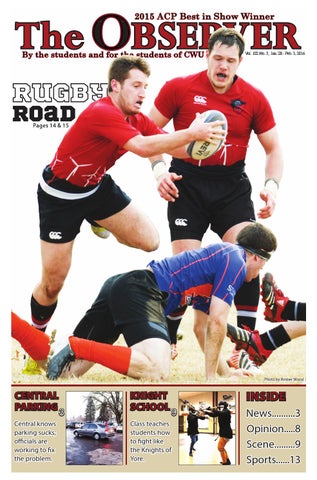
Rugby
Road Pages 14 & 15
Photo by Amber Wood
CENTRAL PARKING Central knows parking sucks; officials are working to fix the problem.
3
KNIGHT SCHOOL
INSIDE 9
Class teaches students how to fight like the Knights of Yore.
News..........3 Opinion.....8 Scene.........9 Sports......13
2 The Observer • Jan. 28 - Feb. 3, 2016
DOPE
Out of state investors may invest in Washington weed BY BRIAN COOK
Staff Reporter
The Washington State Liquor and Cannabis Control Board intends to lift the ban on out-of-state investors financing recreational marijuana producers, processors and retailers as early as March of this year. Lifting the ban on out-ofstate investing will make it easier for marijuana producers, processors and retailers to raise money to start or grow their company. This fall, the legalization of recreational marijuana is going on the ballot in California. However, California has no ban on out-of-state investors and, with the possibility of recreational cannabis being legalized, investors could be looking to spend big on America’s most populous and largest medical marijuana producing state. States that receive revenue from recreational marijuana sales may be making some changes to how they run their investments before California potentially enters the market
this fall. “It’s already expensive to come into the market as a business owner,” said Lena Davidson, sales and marketing manager of botanicaSEATTLE.
OBSERVER STAFF Editor-In-Chief Jonathan Glover Managing Editor Elliott Llera Social Media Coordinator Cody Nilsen
News
Julia Moreno (Editor) Kailan Manandic (Assistant Editor) Brian Cook McKenzie Lakey Ray Payne Lexi Popich Sabrina Stoutamyer Rebecca Wolf
Scene
“Producers are sinking sometimes their life savings into their crop.” According to Davidson, marijuana is a difficult business to break into.
DEADLINES
Weekend sports information: Copy Desk Sunday 5 p.m. Grace Lindsley (Copy Desk Chief ) Letters to the editor: Sunday 5 p.m. Hannah Adams Entertainment, meetings, Anna Kessner calendar events, display ads, Austin Luft classified ads: Liz Weddle Friday 5 p.m.
Photographers
Brittany Allen (Editor) Jordan Cameron Taylor Simental Chase Tibbles John Whittlesey
Graphic Designer Grace Lindsley
Faculty Adviser
Cynthia Mitchell mitchelc@cwu.edu
Victoria Shamrell (Editor) Mikaila Wilkerson (Assistant Editor) Nathan Brewster Holly Chester Britany Decker Kaitlyn Langdale Ana Laura Lopes Conti Ferreira
Business & Ad Manager
Sports
Jonathan Osborne
Zac Hereth (Editor) Austin Bennett (Assistant Editor) Samuel Beaumonte Zacery Gifford Mitchell Johnson Ryan Kinker
GRACE LINDSLEY/OBSERVER
“You invest heavily in an agricultural crop. It grows, you harvest it, the money’s already been spent. You make your money when you sell that crop,” Davidson said. “Marketing,
Tara Long 509-963-1026
Student Ad Manager Taylor Simental
Ad Sales
packaging, distribution: those are expensive things in a big state that is really competitive for bud right now.” Since recreational marijuana is a new industry, many businesses have had a hard time getting financed since banks refuse their requests for loans. Many retailers are restricted to relying on a cash only service because of this lack of financial backing. “The banks won’t knowingly take [money processed off a card,]” Rob Hendrix, owner of Cannabis Central, said. “We had a debit card machine in the beginning, but they shut it down.” The U.S. Department of Justice has warned states with legalized marijuana on multiple occasions that if drug money starts trading across state lines, the state’s marijuana industries might face a federal crack down. Marijuana is still against the law federally, meaning the U.S. government could come into the state and shut down all production and retail for the marijuana industry.
CONTACT US
The Observer Central Washington University 400 East University Way Bouillon Hall 222 Ellensburg, WA 98926 Sun.-Tues. 5 p.m. - 9 p.m. 509-963-1073
SECTION E-MAILS
Editor-in-Chief cwuobserver@gmail.com News cwuobservernews@gmail.com Scene cwuobserverscene@gmail.com Sports cwuobserversports@gmail.com Opinion cwuobserveropinion@gmail.com Photo cwuobserverphoto@gmail.com
ADVERTISING
Tara Long Central Washington University 400 East University Way Bouillon Hall 232B Ellensburg, WA 98926 509-963-1026 TaraL@cwu.edu
Editorial policy: The Observer is a public forum for student expression, in which
student editors make policy and content decisions. The mission of the Observer is twofold: to serve Central Washington University as a newspaper and to provide training for students who are seeking a career in journalism. The Observer seeks to provide complete, accurate, dependable information to the campus and community; to provide a public forum for the free debate of issues, ideas and problems facing the community at large, and to be the best source for information, education and entertainment news. As a training program, the Observer is the practical application of the theories and principles of journalism. It teaches students to analyze and communicate information that is vital to the decision making of the community at large. It provides a forum for students to learn the ethics, values, and skills needed to succeed in their chosen career. If you have questions call (509) 963-1073 or e-mail us at cwuobserver@gmail.com.
NEWS
The Observer • Jan. 28 - Feb. 3, 2016 3
Editor//Julia Moreno
cwuobservernews@gmail.com
Central dining is evolving
BRITTANY ALLEN/OBSERVER
Students can expect many changes in the upcoming year for Dining Services, Director Patrick Stanton said the student feedback is incredibly important for the future plans.
Dining services plans for another food truck, among other things BY MCKENZIE LAKEY
Staff Reporter
Change is constantly occurring for Central’s Dining Services, and the latest increase in numbers for Holmes Dining have shown that students approve. “This last fall quarter [sales] went up by 40 percent, and we don’t have 40 percent more students and we didn’t raise prices by 40 percent,” said Patrick Stanton, director of business planning and budget accounting. The number trends for Holmes Dining are generally on the rise and have been continually higher than last year’s numbers since the recent renovations. In the first two weeks of winter quarter, sales increased by 73
percent. Overlooking week one— which Stanton said you should “throw out” due to the special events for incoming students— the beginning of fall quarter this year left Holmes with $14,610 in sales during just the second week of the quarter. Sales peaked at $18,172 in week nine before dropping around the holidays. In fall of 2014, Holmes Dining’s sales peaked during the first week of the quarter. It broke just over $15,000 in sales before dropping to $12,000 where it remained for the majority of the quarter. According to Stanton, Central Marketplace’s numbers have stayed consistent throughout the process with no direct impact
Dining Services fast facts: • • •
•
806 students answered the survey Sales went up by 40% fall quarter Food prices aren’t expected to increase Dining options are expanding
shown to be affecting their sales. The survey A total of 806 student responses came in for the campus-
wide survey that was sent out last spring, the results of which prompted Central Dining to seek changes. In response to the survey, 1891 Bistro and the mobile food truck on campus were introduced. Questions in the survey hit on topics that covered food preferences, favorite dining locations on campus and the importance of ingredients and prices. One survey question asked students to compare Central’s dining experience to that of other universities and colleges. The majority fell to the 32 percent of students who felt that Central was “slightly worse” than others. “We kind of knew that something was going to have to change,” said Joel Klucking, as-
sociate vice president of Finance and Business Auxiliaries and interim chief financial officer. With 71 percent of students stating in the survey that they didn’t regularly eat in the Holmes Dining Room, the process to renovate the dining room and create more traffic flow became a priority. “The rationale for this was to move people from this really busy space [Central Marketplace] into an underutilized space. And we see that it’s working,” Klucking said. Creativity in the kitchen In response to the survey, Executive Chef Derek Smith began
See “Holmes” on P. 7
Parking Services feels your pain; changes coming to Central Staff Reporter
For years Central students have griped about the lack of parking spots and expensive parking passes. Though there is some argument whether the problem is an actual lack of parking or just laziness among students, in this case, it seems that lack of parking is the real issue. It’s no secret that every weekday, starting at around 8 a.m., finding a parking spot on campus becomes a tedious and almost impossible task.
Twitter user Kazia Starken- chances of finding a parking burg tweeted, “Few things I’m spot. over; Being cold, men wearing Another Central student took to twitter to women’s legcomplain gings at the the gym, being Parking is definitely about lack of parkcold, CWU an issue, and it’s an issue ing. Diego parking, and that is going to be ad- O ’ B r i e n being cold.” dressed. tweeted For those out, “Yeah who live off CWU we campus, find-Bill Yarwood didn’t need ing a parking Director of Planning and Projects more parkspot requires ing or a bigstudents to ger weight leave their houses 30 minutes or more be- room, we needed a new science fore class just to increase their building. Cause so many top sci-
“
“
BY LEXI POPICH
entists here.” Bill Yarwood, executive director for Capital Planning and Projects, said he recognizes that parking and transportation are concerns on campus and that they need to be addressed and updated. Yarwood said he and his colleagues at Facilities Management are in the process of updating Central’s master plan. They’re looking into areas around campus that have parking needs and are working together to make sure that the new parking will work in relation to the current planning and build-
ing around campus, according to Yarwood. Several meetings will take place next week with the administration to compose a revised draft of the master plan, he said. “Parking is definitely an issue, and it’s an issue that is going to be addressed,” Yarwood said. A key part of the success of the plan is feedback and constructive criticism from students. Complaining that “parking sucks” simply will not do, Yarwood said.
See “Parking” on P. 6
4
NEWS
The Observer • Jan. 28 - Feb. 3, 2016
Upgrading police accountability Ellensburg Police Department considering body cameras for its officers
Police Body Cams Legislation Facts: • •
•
There will be a task force to make sure the policy is effective A lot of the film would not be redacted out when given to the public Some info will be exempt like identity to make sure no one is in danger
BY RAY PAYNE
of body cameras. “Body cameras take it to the next level,” Hansberry said. The Ellensburg Police DeFollowing the recent wave partment (EPD) is looking to of passed legislation, the U.S. implement the use of body cam- House Judiciary Committee proeras, depending on whether the posed a new bill aimed to create privacy issues associated with guidelines for body camera use body camera by the police use are adin Washdressed by ington. The There’s great public bill, House the state. Accordconcern now about making Bill 2362, ing to Capgarpolice more accountable to has tain Dan nered both the public. Hansberry criticism and of the EPD, praise. -Doug Honig dash cams “T here’s Communication Director of ACLU have been in great public use for the concern now past 10 years about makin his department and their fu- ing police more accountable to ture goal is to implement the use the public and about reducing Staff Reporter
“
“
TSCELEB NEWS/FLICKR
The Ellensburg Police Department could sport body cams like this, Captain Hansberry calls them the next level
incidents of police force against people,” said Doug Honig, communications director for the Washington State ACLU. “Body cameras are being offered as a solution.” Drew Hansen, democrat representative of Bainbridge Island and one of the main sponsors of
House Bill 2362, made it clear the point of the bill was not to require or prohibit the use of body cameras, but to create guidelines for their use. The guidelines laid out in the bill require departments to develop policies on when a body camera must be worn and when an
officer can turn the camera off. In response to skepticism of the effectiveness of this potential policy, Hansen referenced another part of the bill stating that a task force will work over the next
See “Police” on P. 7
Veteran Memorial Statue concept coming soon BY REBECCA WOLF
Staff Reporter
A memorial statue is on its way to Central in honor of America’s veterans. Central students have been pushing administration to begin work a memorial statue and progress is being made. “I think it’s something that was overdue,” Rene Mahnke, vice president of student life and facilities said. According to Mahnke, the memorial is still in the conceptual phase. The next steps will be to figure out the location, come up with a design and begin fundraising. However, before more progress is made, Mahnke believes that it’s of the utmost importance to get input from Central students. During a debate at the Central Student Academic Senate, a student approached Mahnke with the idea of building a veteran’s memorial on Central’s campus. Mahnke thought about what the student said and agreed that a memorial was a great idea. The placement of the memorial is currently unknown, but two locations have become front runners. The first possible location is on University Way, in front of McConnell Hall. This is the preferred location of the task force
MY ARMY RESERVE/FLICKR
Spectators and veterans hold up signs thanking solders at the 2012 Fayetteville Veterans Day Parade in North Carolina on Nov. 10
because of its visibility. The other possible location is the empty park between the Science Building and the SURC. According to Mahnke, the benefit of this location is that no buildings can be built there, so nothing can take away from the memorial. Though data is still being collected about what design will be used, it’s been decided that the
memorial is going to be done in-house through the art department to allow for more input from students and save money. The time frame for this memorial is “aggressive,” Hauke said. The plan has been in place since last spring. “Five of the current ASCWU members are graduating, so next year’s board may have a completely different agenda,” Hauke
said. It’s Hauke’s hope that ground is broken for the statue by the end of the school year, but if that’s not possible, she wants to have the project far enough along that whoever ends up in office next year has to follow through. Mahnke said that it doesn’t matter if you have veterans in your family or not, veterans and ROTC students are on campus
everywhere. It’s important to the task force that regardless of a person’s connection to the military, they feel something when they see this memorial. “We could quickly throw up a statue of a rifle and a boot with a helmet on top and say, ‘thank you’ to our veterans quickly but it won’t mean anything,” Hauke said.
NEWS
The Observer • Jan. 28 - Feb. 3, 2016 5
GAGE SKIDMORE/FLICKR
Ammon Bundy is a leader of the anti-government group in Oregon
Anti-government group stopped in Oregon following shoot out
BY OBSERVER STAFF
CHASE TIBBLES/OBSERVER
Students from the BSU held the event to help students of color network with professors and faculty.
BSU, faculty meet and greet helps students network BY SABRINA STOUTAMEYER
Staff Reporter
The Black Student Union (BSU) held a reception last Tuesday, specifically inviting professors and faculty members to show what BSU as a club is doing and capable of accomplishing. “With this reception I really want to get that transparency with our faculty members and staff on campus,” said current BSU President Evelyn Briscoe, senior law and justice and psychology major. “I really wanted to show them all the things that we are doing and what BSU is capable of doing.” She went on further to explain that creating connections and a network with professors and faculty will help students of color progress academically, but will also work towards creating a unified, safe environment for students of color. Briscoe would like students of color to feel comfortable approaching their professors or Central faculty about issues they’re having on campus. “I hope that from now and forward that there is a connection with our faculty,” Briscoe said. “For them to be able to maybe want to join in on a meeting or know what we’re doing, for us to be able to go to them and talk with them about issues that we’re going through, and actual feel that they care.” The events program began with an “Eat and Mingle,” where attendees were encouraged to stand and talk to someone they didn’t know. Jala Harper, junior music theater major, preformed The Black National Anthem before the “Eat and Mingle” portion of the program. Harper sees the BSU as more
than just one thing. “BSU is just a safe place for students of color to go,” Harper said. “Not only that, but for people not of color to come and learn about our culture and what makes us who we are and what we go through and how to improve being better people and being more in unity.” According to Briscoe, unity is a major change she’d like to see on campus. “Unity, for me, and being in solidarity are really important for BSU and for that change to be made on campus,” Briscoe said. “For people to not throw what’s happening to the side, but to actually listen to what is going on. That’s the type of change I’m looking for.” The event continued with a photo shoot, where attendees were encouraged to take photos together. Members of BSU and some attendees grouped together in friendly semi-circles to pose for the camera. Testimonials were given shortly after by five members of the BSU, who stood before the podium and talked about their experiences with the BSU and Central as a whole. Autumn Robinson, junior psychology major, said the testimonials were to speak about joining the club, what the club is like and how the members have grown since joining. “I’ve gotten to know myself better, being in BSU, because I’ve gotten to meet people like me and I’ve gotten to meet people very different from me,” Robinson said. Briscoe also commented on the BSU members’ background in regards to when she first joined the club. “You see so many people who are different from you, but
who are also alike and they go through the same struggles and they have the same kind of story background,” she said. “A lot of people are from where we live and you just didn’t know and so you automatically feel welcomed in a place like that.” Briscoe said the BSU encourages a welcoming environment. “No matter if you are a student of color or not, we are just welcoming of people,” Briscoe said. “To those who want to come and learn and be an ally, or just want to learn about different cultures.” Jala Harper, a member of BSU, agrees with Briscoe. “You come to one of the meetings and they’re really dedicated to enlightening people and letting people know what’s going on and how we can help and better our whole world and love each other,” Harper said. The event ended with Wambui, the previous president of BSU, reading a poem which she had written in high school. She prefaced her poem by explaining the struggles she endured to have her poem be read at a school assembly and that her poem was initially rejected by school authorities due to the use of the word “negro” and the poem’s portrayal of African American struggles against society. The poem gave the example of what the reception meant for the BSU and Briscoe’s statement about opening a connection between students of color, professors and faculty. “I think this event is a great way for us to [enlighten others]. To be in unity. To meet the professors. To let them know, ‘hey, we’re people of color, but we just want to hold hands with everyone and just love everyone,’” Harper said.
The FBI and Oregon State Police arrested Militant leader Ammon Bundy and four of his followers during a traffic stop in Oregon on Tuesday. The arrests resulted in a shootout injuring Ryan Bundy and killing a supporter. It is unclear what prompted the gunfire. The Bundys and their armed militia have occupied an Oregon national wildlife preserve in a standoff with authorities for the past three weeks. According to the Oregonian, standoff spokesman Robert “LaVoy” Finicum was the suporter killed in the shootout during the arrests. Authorities didn’t release the name but Finicum’s daughter confirmed it was Finicum the Oregonian reported. “My dad was such a good good man, through and through,” said Arianna Finicum Brown, Finicum’s daughter, in an interview with the Oregonian, “he would never ever want to hurt somebody, but he does believe in defending freedom and he knew the risks involved.” The brothers and supporters were heading to a community meeting to speak with local residents about federal management
of public lands according to the Associated Press. Ryan Bundy was taken to the hospital and treated for his minor gunshot wound after the confrontation. He was later released to FBI custody according to authorities. Those arrested will face federal felony charges of conspiracy to impede officers of the United States from discharging their official duties through the use of force, intimidation or threats, AP reported. “I am pleased that the FBI has listened to the concerns of the local community and responded to the illegal activity occurring in Harney County by outside extremists,” said Oregon Sen. Jeff Merkley in a statement. “The leaders of this group are now in custody and I hope that the remaining individuals occupying the Malheur National Wildlife Refuge will peacefully surrender.” Outrage meanwhile surfaced on Facebook as the Bundy Facebook page posted an image in protest. “Tonight peaceful patriots were attacked on a remote road for supporting the Constitution,” it read, “one was killed. Who are the terrorists?”
Gaudino and Microsoft exec. to give state of the university address at McConnell Hall BY OBSERVER STAFF
On Feb. 1, Central President James Gaudino will be joined by Microsoft’s chairman and corporate vice president of emerging businesses, Orlando Ayala, for Gaudino’s annual State of the University address. According to Central’s website, the discussion will be about innovation and how it empowers people to make great changes, as well as increasing access to higher education through a new partnership. The event will be held on Central’s campus in McConnell Hall Auditorium. The address beginning at 10:30 a.m. with President Gaudino starting off and then Ayala taking over as the
other half of the keynote. This will be the first time someone other than the university’s president has been a part of the president’s keynote in his State of the University address. Ayala has been with Microsoft for 25 years. He is the head of Microsoft’s Sports Industry team, which has just announced a partnership with Real Madrid soccer club. He is also the executive director for Microsoft’s national competitiveness initiatives, a department designed to help governments with digital infrastructure development. The department also develops educational programs for use. The original press release can be found on Central’s website.
6
NEWS
The Observer • Jan. 28 - Feb. 3, 2016
What happened with the Flint water crisis? BY OBSERVER STAFF
The Flint Michigan water crisis has garnered attention by President Obama. On Thursday he announced he and the administration are giving $80 million to the city of Flint, according to Black Enterprise. According to Time, the water was found to have eight times the amount of chloride than Detroit’s water, which is a highly corrosive chemical to metals. The water often tasted and smelled off according to residents and was a brownish-yellow color. A lot of Flint residents had old lead-service lines that connected their homes to the water source. After time the chloride corroded the insides, which allowed lead to enter the water supply. Officials at the Michigan Department of Environmental Quality, who were in charge of making sure the water was safe made a few decisions that impacted the quality of water. According to fivethirtyeight. com, they didn’t require optimal corrosion control for the Flint water plant, despite telling the Environmental Protection Agency they did so in an email.
Additionally, they didn’t take a lot of samples and the ones they did take were from the wrong places that would not show high levels of lead. Two samples had high levels of lead but were thrown out. If they had kept the samples, the city would have had to alert residents of possible lead problems as early as summer of 2015, according to fivethirtyeight.com Prior to using the river as the water source Flint voted to join a new pipeline, which prompted Detroit to cancel the agreement, even though Flint could have signed a short-term lease with Detroit. The river was also a significantly cheaper alternative, according to fivethirtyeight.com. In addition to President Obama, the state of Michigan is giving $28 million for bottled waters and filters as well as health, educational and nutritional services for children with lead in their systems, according to Black Enterprise. Rapper, The Game, has also donated $500,000 of his own money to Flint, Michigan. He told the press that Avita Water will donate an additional $500,000, according to Vibe.
“Parking” from P. 3 Yarwood said they need to know specific concerns in order to make adequate changes to parking. Yarwood said he is not only looking into adding parking spots, but also updating the permits and usage of the existing lots. Many students who live off campus choose to trudge through the snow and slush just to avoid paying for a $300 parking pass. “I never buy passes anymore because, when I do, I can never find a spot,” said Kaitlin Pfeifer, senior double major in Spanish and supply chain management. Pfeifer said she believes Parking Services oversells parking passes for the amount of parking spaces provided on campus. However, not every student feels the parking pains. Maryellen Hammrich, freshman education major, thinks parking is fine and hasn’t come across any major issues with it. Hammrich said she doesn’t mind buying a parking pass because she can just charge it to her student account, rather than paying for it straight out of her own pocket. Hammrich said she “always seems to find a spot.” Hammrich’s outlook on parking may seem rare because many students aren’t satisfied.
TAYLOR SIMENTAL/OBSERVER
Students take to social media to complain about the campus parking
CWU’s student-run Online interactive lifestyle magazine.
Pulse is covering college life from top to bottom and everywhere in between. So, come check it out, share your thoughts, and show it to all your friends. If you want to contribute to Pulse or want to give us your comments send us an email at ; cwupulsemagazine@gmail.com.
509.201.1440 119. W 5th Ave. Ellensburg Mon-Sat. 11am-9pm, closed Sundays http://mykabobhouse.net
NEWS
The Observer • Jan.28 - Feb. 3, 2016 7 Holmes on a Friday in order to get more people involved in the ongoing conversation between setting his focus on bringing cre- students and Dining Services. ativity into the kitchen, empha“I just want this to resemble sizing a constant evolution of going home or going into downmenus. town Ellensburg,” Smith said. “I In order to keep the innova- want it to be a wealth of offerings tion flowing, Smith said he plans and to feel like this is their place.” to continually mix-up concepts Future food in the future. Beyond Holmes Dining He’s currently looking toRoom, other venue changes have wards trying out different plating options and possibly introducing been reconfigured or created in sliders, which have been growing response to what the students requested, though new additions in popularity. are still in the “I think works. it’s been The food overall very It’s going to be a con- truck was positive,” stant evolution. We will one part of Smith said. constantly be looking at the new over“We’re havhaul and, the venues... ing a good while the apconversation -Joel Klucking proval of its with the stuname is still a dent body Interim VP of Finance work in prognow and ress, the food we’re adjusttruck’s success is something Cening as we go.” tral hopes to replicate in the near Ongoing communication The prices of food are still not future. With menu items for the food expected to increase in response truck selling out, Klucking said to the changes, which Stanton referred to as “fairly modest in that Central is currently in the cost.” Instead, students could process of expanding Dining possibly walk away from Holmes Services with the addition of a spending less than they might second food truck on campus. According to Klucking and have with the former all-youStanton, plans are already being can-eat price. Creating strong communica- made to find the vehicle once the tion between students and staff weather improves and test drives has also been key to improving can be carried out. The arrival date of the new the students’ experiences with truck is planned for around the dining, Smith said. Last quarter, Dining Services same time as spring break. “It’s going to be a constant held a student tasting for the fall quarter menu and they plan to evolution,” Klucking said. “We carry out another tasting at the will constantly be looking at the venues and which ones are workend of this quarter. According to Smith, the fu- ing, which ones aren’t and make ture tasting is set to take place in whatever changes are necessary.”
“Holmes” from P. 3
Ricky Racer
A caller reported a black mustang running two stop signs; the caller followed them to the Safeway parking lot on Jan. 25. Multiple semis stopped for an apparent group meeting on West First Street in Cle Elum, blocking traffic until they were reported at 6:07 a.m. on Thursday, January 21.
A man near Super 1 Foods walked out with a cart full of groceries at 9:22 p.m. on Thursday, Jan. 21. The reporting party said that they have surveillance of the suspicious shopper.
Hurt feelings prompted a call from a woman near Alder Street on 9:29 a.m. on Thursday, Jan. 21. She’s still seeking answers as to “why they did that.”
An individual reported that they could smell marijuana throughout the hall of their building on Walnut Street at 9:41 p.m. on Thursday, Jan. 21.
A pitbull was reported to be “at large” near Hoffmanville Avenue in Roslyn at 11 a.m. on Thursday, Jan. 21. There has been no further report on what crime the dog is wanted for. A back alley transaction of a generator left a green Californian van on the run in Cle Elum at 11:54 a.m. on Thursday, Jan. 21. The driver and his passenger were spotted again less than one minute later. An individual’s vehicle became stuck in his neighbor’s driveway at 5:20 p.m. on Thursday, Jan. 21. The upset caller reported that the neighbor did “not have permission” to use the driveway. A woman was asked if she wanted to get high with the reported subject near Cherry Lane at 8:51 p.m. on Thursday, Jan. 21. The offer was made by an individual that the reporting party “didn’t see” but definitely “heard.”
A staggering snowball thrower reportedly wandered into the road near North Airport Avenue & East Helena Avenue at 11:43 p.m. on Thursday, Jan. 21, all while still managing to carry out his conversation on his cellphone. Two men were spotted smoking in a parking lot near 906 South East Snoqualmie at 7:29 a.m. on Monday, Jan. 25. They followed their first act by shining a flashlight in a customer’s vehicle window, possibly in search of the person who reported them. Drivers of a black SUV believed they could clear a snow pile and high-centered near University Way at 10:26 a.m. on Monday, Jan. 25. With horsepower failing, they reportedly resorted to manpower to move the vehicle out of the roadway. After two days passed without receiving their normal allotment of junk mail, a person on Greenfield Avenue in Ellensburg reported at 12:23 p.m. on Monday,
Jan. 25, that their mail was likely stolen. The saga of barking dogs has escalated as the concerned caller reports that the dogs are now barking at her. The call for the “ongoing problem” came in at 2:15 p.m. on Monday, Jan. 25 near Kearny Drive in Snoqualmie. A showdown between a dark grey semi and a maroon semi took place behind a local business in Ellensburg at 3:20 p.m. on Monday, Jan. 25. The winner has yet to be announced. An upset driver reported that a trio of vehicles, once again, double parked near Railroad Street at 3:47 p.m. on Monday, Jan. 25. After realizing it was a Monday, a male was reported as refusing to quit shouting profanity throughout a building on Dean Nicholson Boulevard at 6:12 p.m. on Monday, Jan. 25. Neighbors were reportedly yelling at each other in Cle Elum at 7:48 p.m. on Monday, Jan. 25. The number of occupants was unknown, their names were unknown and the type of assault was unknown. What later happened is still unknown. A caller reported that someone spit on his burgundy Ford Explorer sometime after 10:05 p.m. on Monday, Jan. 25.
“
“Police” from P. 4 two years to determine if the potential policy will be effective. Parties who testified in support of the bill came from several cities, including Olympia and Bellingham. Kelley Busey, police chief of the Gig Harbor Police Department, was among those testifying in support of the bill. However, there is a significant amount of criticism toward the law. Honig said the law “doesn’t provide adequate regulation for body camera use.” The ACLU is seeking the creation of a task force to address the privacy of the public when being recorded and when cameras can be turned on and off instead of reforming the bill. “In protecting personal privacy, it has to be done in way that also makes footage available when there are disputes,” Honig said. Hansberry echoed some of the ACLU’s criticism in terms of privacy, warning that the general public would have access to any information that may be considered private and “a lot of it we wouldn’t be allowed to redact out.” It would be a “public disclosure nightmare,” he said. Implementation of body cameras within the police de-
“
Kittitas County 9-1-1 calls Jan. 21 - 25
partment is partially dependent on issues of privacy. It was confirmed that when body cameras are implemented, they would be on all uniformed patrol officers. Hansberry said the EPD strives “to be as open and transparent as you possibly can.” While a large amount of criticism toward the bill revolves around privacy issues, the bill actually provides protection of the privacy of certain individuals. Certain information and footage will be exempt from public inspection. This includes private information that could reveal the person’s identity and put them in danger, or any information revealing the identify of child sexual assault victims. Despite the all criticism of the bill, Hansen has remained confident in his legislation. Several representatives from communities with a more diverse population were consulted on this issue. According to Hansen, the effect of body cameras is very different in different communities, but has generally been a positive experience. When reviewing this bill and when future issues arise, Honig wants the public to understand that, around the country, there are still incidents where officers had cameras that weren’t turned on when an incident occurred. “Body cameras aren’t some magic solution,” Honig said.
8
OPINION
The Observer • Jan. 28 - Feb. 3, 2016
Editor-in-Chief//Jonathan Glover
cwuobserver@gmail.com
BLM extremism is not the right answer
It’s happening again. We’re all losing our collective minds. I don’t know why, but the last time I wrote about our love affair with extremist viewpoints, I thought it would be my last. Boy was I wrong. Last December, a group of unnamed college students wrote a letter with a list of demands (demands, not requests) to Oberlin College’s administration. The letter was directed towards Oberlin’s Board of Trustees and President Marvin Krislov. The letter–while containing some remnants of sense–focused on things like increases in black student enrollment and black administrators, free housing for black international students during breaks when they cannot return home, and renaming departments to notable black alumni.
OBSERVER EDITORIAL
Trump: Making America racist BY OBSERVER EDITORIAL BOARD
There’s a new sheriff in town and his name is Donald Trump. Except he isn’t the sheriff, he’s the jealous village idiot who thinks spouting off whatever hate mongering things he can think of is going to win him votes to become sheriff. And, it’s actually working. But it shouldn’t be. He’s fostering a negative environment for different races, which ultimately will ruin him—and, in the long run, all of us. At a Trump Rally on Jan. 24 in Muscatine, Iowa, two protesters were carrying signs with “Stop Hate” written on them. One of the protestors was wearing a red turban. As the man was escorted out, Trump asked the crowd somewhat facetiously, “He wasn’t wearing one of those hats, was he?” according to Inquisitr online. Additionally, last summer Trump blamed America’s crime problems on undocumented Mexicans coming into the country. “When Mexico sends its people, they’re not sending their best,” he said in his presidential announcement speech in June. The part that is hard to understand is why is he still making headlines after these insanely racist remarks. He should be losing points in the political polls but instead he’s gaining support. It just goes to show that many people—at least among those being polled—are actually pretty racist. If someone like Trump is
seriously doing this well (much to the surprise of anyone with a few brain cells) then there is something wrong with America in general. It also means that many Americans haven’t moved beyond being inherently suspicious of anyone different from them. When students of color feel like they need safe spaces so they can talk about issues on campus that are happening to them, there’s an issue. This type of talk goes against any kind of enlightened thinking as America lumbers into the 21st century. America is a multi-cultural, multi-ethnic society and in the long run we’re really going to be in trouble if we don’t accept that reality. It’s clear that Trump is a reality-show character pretending to run for president. He has realized that more outrageous and outlandish he acts, the more attention he gets. It’s hard to tell whether he believes all of the poison that spews from his mouth—hell, he’s changed positions so many times on issues it’s hard to know what he really stands for—or if it’s just part of his “bad boy” act. But hate speech is hate speech and any of it is hurtful and damaging spiritedness. We are better than that. Don’t let his talk of “Making America Great Again” seduce you. We’re not great, we’re pretty good but we can always do better. In our hearts, we know what’s right—and Trump’s way is certainly not the American Way.
They’re picking areas on cam- these demands have been issued pus that only Africana identify- before and subsequently ignored ing students can go. What about by administration, faculty and Latinos? Filipinos? Whites from students. This was never acceptable, and will no longer be tolerSouthern Africa? I could go on and on about ated. “As you will see, these are not the list of demands. (One is a demand of a 4-percent increase polite requests, but concrete and in enrollment from the Americas, unmalleable demands. Failure to the Caribbean and the continent meet them will result in full and of Africa starting in 2016, with forceful response from the coma 40-percent increase by 2022. munity you fail to support.” To noThey don’t body’s surmention how Presito do this, These are demands prise, dent Krislov or the likeliand not suggestions. If said no to hood that these demands are not the demands. people from taken seriously, immedi- On Oberlin’s these countries – and an ate action from the Afri- website, Krisis quotentire conticana community will fol- lov ed writing, nent – might low. “Some of the not want to solutions it go to school -Letter from Oberlin students proposes are at Oberlin). deeply trouTo cap it bling. I will all off, they not respond throw in the surefire, “These are demands and not suggestions. If directly to any document that exthese demands are not taken seri- plicitly rejects the notion of colously, immediate action from the laborative engagement. “Many of its demands contraAfricana community will follow.” Earlier in the letter, there’s a vene principles of shared goverslightly varied threat. “Many of nance. And it contains personal
“
“
BY JONATHAN GLOVER/EDITOR-IN-CHIEF
All of this sounds good and well (even before you break it down and really think about it), but then the letter takes a sinister turn. It demands the firing of certain faculty (including President Krislov). It demands tenure for some professors, and that some get put onto a tenure track. “We DEMAND these professors be granted tenure IMMEDIATELY,” the letter reads. But perhaps the most disturbing demand is segregation, just put into different words. “We DEMAND that spaces throughout the Oberlin College campus be designated as a safe space for Africana identifying students. Afrikan Heritage House should not be the only space allotted for the promotion and acknowledgment of our community specific needs.” Now, I’m not an idiot. I understand the need for safe spaces. As a white male, I’m aware that the world is my safe space and that anywhere I go, I’m going to see people that are just like me. I fit in just about anywhere, and that’s my privilege. But what these students are demanding is more than that.
attacks on a number of faculty and staff members who are dedicated and valued members of this community.” Weird. When people make extremist threats, other people don’t react positively. This reminds me of the Black Lives Matter protest that shut down all lanes of the Bay Bridge for about an hour and a half on Jan. 18. I guarantee everyone on the bridge that day just lost respect for BLM. What if there had been an ambulance on the bridge that needed to make it to the hospital? What if a soon-to-be mother was in labor? What if someone was on their way to an important job interview? This bridge shut down happened just before 4 p.m., so all of these are likely. We can’t all shout at the top of our lungs, screaming the most nonsensical stuff we can think of. It takes tact and respect, which neither of these two incidents showed. We need to meet in the middle, or at least, we should. If we don’t, we might as well all buy toupees and get fake tans.
SCENE
The Observer • Jan. 28 - Feb. 3, 2016
Editor//Victoria Shamrell
cwuobserverscene@gmail.com
9
Back in time to the Renaissance Knight School in Ellensburg teaches students how to fight like a knight
BY BRITANY DECKER
Staff Reporter
The Renaissance period is making a serious comeback. Between Game of Thrones, Skyrim and Lord of the Rings, our generation seems to love everything involving this time. So it may come as no surprise that a Renaissance-style Knight School has started up in Ellensburg. The Knight School, held every Wednesday from 7 p.m. to 9 p.m. at Mt. Stuart Elementary, teaches small groups of students the ways of the knight. Led by the Knights of Veritas, this non-profit organization teaches both the lifestyle of the common knight and also about medieval arms, armor, combat and chivalry through comprehensive and interactive courses that physically and mentally engage students. Eric Slater, the director of the Veritas Swordplay Academy, said that Knights of Veritas was founded in 2004 to highlight the historically-rich style of swordsmanship that is key to being a knight. Through their classes that have been offered all throughout the Pacific Northwest, the Veritas Swordplay Academy has dispelled myths that are often associated with knighthood, according to Slater. Most of the students are male and in their 20s, but the ages range from teen years to around 50 years old. “We practice an historical martial art based closely on surviving period manuscripts of how personal combat was performed in the late middle ages with a variety of weapons,” Slater said. Through repetition and application, these students are given the opportunity to create a deep understanding of what it meant to be a knight in the day of the Renaissance. “The focus is on excellence and faithfulness to how the art was practiced historically, not merely a bunch of people trying to whack each other,” said Slater, who has had many years of expertise in this style of martial arts. William Gull, a 40-year-old instructor at his own school of medieval martial arts in Nashua, New Hampshire said, “It’s not for everyone, but it is a healthy, educational system that gives people a dose of history and fitness.” A key aspect in their regimen is something this community calls the Code of Chivalry. This code is essentially, a set of traits that a knight must maintain to hold their title. Mainly, they must have the courage to fight for what they believe in, show courtesy to all no matter their position in society,
Eric Slater (left) and Curtis Bender (right) cross traditional weapons during battle at Knight School class.
have faith in who they are and the strength to maintain that in times of hardship. Additionally, humility, generosity, justice, honor, loyalty and having a personalized prowess are taken very seriously in the Code of Chivalry. There are many misconceptions to what this period of battle was like. The Knights of Veritas’ goal is to expose these to a modern audience through teachings of this historical fighting culture. Gull confirms that there are many things that aren’t seen on TV in regards to accurate portrayals of the art that is sword defense. “There are very few shows or movies that show accurate combat because most of the time accurate combat is quick and dirty. Throw a thrust to the face, or the groin, or the armpit. Fight over,” Gull said. “Most of the time, you didn’t want to kill the other person
fighting. You wanted them to surrender. They were worth a lot of money in ransom.” In particular, he condemns Spike TV’s hit show, “Deadliest Warrior” in which they pull in experts that analyze the weapons and fighting styles of ancient kingdoms and communities. “Half the experts were not even experts, just folks that used the weapons in the movies or TV,” Gull said. The website for Knights of Veritas states that, “Television, movies, fantasy literature and games have perpetuated many fanciful and erroneous misrepresentations of the middle ages.” Knights of Veritas are sure to use authentic swords that have been weighted and detailed by experienced professionals, Gull said. This helps people to have fun and learn about the actual fighting style of knights during the renaissance period.
This enables the class to experience the art form in its entirety which is of utmost importance to this organization. Often times a duel between two knights would come about from a debacle over leadership or property and sometimes would result in death. Men were expected to learn to fight in case they were needed to defend either of these very important aspects of their lives. Aging all the way back in the 1350’s, this form of defense was initiated by Johannes Liechtenauer. Along with the opportunity to delve into the culture of this fighting style, participants get to actually put on the armor. They will also get the chance to handle the weapons that would ordinarily be used in the time of the renaissance. Sometimes these students will go to events and competitions that help them to test the skills
PHOTO BY REBEKKA VAN DER DOES
Knight School Where: Mt. Stuart Elementary When: Every Wednesday Time:7 p.m.- 9 p.m. Cost: $45 they have learned from Slater and the other instructors. “What I find to be the most satisfying is that there is a way to practice how weapons and combat in the middle ages actually worked, for those who are interested in the reality, rather than the fantasy,” Slater said.
SCENE
10 The Observer • Jan. 28 - Feb. 3, 2016
Finding the right club for you BY HOLLY CHESTER
It can be assumed that every person pursuing a higher education is doing so to better their future. With the millions of students that are working toward a degree to become a competitor in the work force, it can be a challenge to standout amongst the crowd. Many employers look for people who have relevant experience in their field, and one avenue students use to get that experience is through a club or organization. The ASCWU is holding their quarterly club fair next Tuesday, Feb. 2. The fair will be in the SURC ballroom from 12 p.m. to 3 p.m. and free pizza will be provided. Students will get the chance to connect with club members and learn about the clubs and organizations that Central has to offer. Vice President for Clubs and Organizations Brittany Kinsella, sophomore business marketing major, is involved in several clubs including the Women in Business club and the Adventure club. Kinsella is in charge of a majority of the planning for the club fair. “It’s a good networking tool because a lot of the clubs are related to majors, and [club members] can get a lot of help with classes or getting to know their faculty because of the advisors related to each club,” Kinsella said. “It also keeps them connected with the university to know what’s happening on campus, and it gives them something fun
Club Fair When: Feb. 2 Where:SURC ballroom Time: 12 p.m.- 3 p.m. Cost: None Free pizza! to do other than classes.” Club fairs are a quarterly event, but this upcoming fair is the second part to the club fair that took place on Jan. 19. “I did two parts because there are 115 clubs right now and if they all perform for five minutes it would be extremely long. So we cut it in half so that they can all JORDAN CAMERON/OBSERVER perform if they wanted to,” Kin- Students interested in joining a club have an opportunity to talk to several different ones at the club fair. sella said. “I think the first half went of club representatives at the fair about. small city in the United Kingwell. There Free pizza will also be offered dom located near Manchester. with their were a lot of at the club fair. own booths. Simms had her first quarter clubs there. “This quarter we’re doing a at Central this fall and is hopStudents It’s a good networking At the next can learn showcase,” Kinsella said. ing that the club fair can help tool because a lot of clubs more about one we’re go“They go on stage for five her discover more of the Central ing to invite clubs they minutes and do either a perfor- community. are related to majors. sports clubs might be in- mance, sing, or a slideshow of “I will certainly be attending to come and terested in, what they’ve done or a recruit- the fair. Since moving to Ellensall of the orKinsella said. ing video. I know one club did a -Brittany Kinsella ganizations Each club radio show for an hour. So more burg for the grad program, I’ve on campus has the op- fun stuff. Like this is us, this is been looking to meet people with VP for Clubs and Organizations similar interests,” Simms said. portunity to what we do.” too. So it “I’d like to be able to do some Amber Simms, first year grad take the stage should be a and give a five minute presenta- student studying athletic admin- volunteer work and get involved lot bigger than the first one.” There will be a large number tion that tells what their club is istration, is from Southport, a with the community.”
“
“
Staff Reporter
SCENE
The Observer • Jan. 28 - Feb. 3, 2016 11
Book club at Brooks Library
BY ANA LAURA LOPES CONTI FERREIRA
Staff Reporter
The Brooks Library is hosting its second quarterly book club. Every quarter the club reads a new book and then holds a discussion. The books that are chosen are not the type of books that are required in normal classes. The idea is to make something informal and fun. Students from all kinds of majors have the chance to come together during these discussions. The discussions encourage students to keep learning new things outside of the classroom by continuing to read for pleasure, said Molly Allen, head secretary at the library. Last quarter, the book was “Orange is the New Black.” The project was very successful, according to Allen, and lots of interesting discussions were held. An average of 15 students attended the club last quarter. The library is expecting between 15 and 20 students for this quarter’s book club. The book chosen for this quarter is “Eating Wildly: Foraging for Life, Love and the Perfect
Discussion Day When: Feb. 29 Where: Library 4th floor, Music Library Time: 7 p.m. to 8:30 p.m. Meal.” It is about eating in a healthier way regardless of where you live and the conditions you face. The story is about a girl named Ava Chin who goes on a journey after a very close relative dies. According to the synopsis of the book, recipes are also included, but the novel is not just about food. There is also an emotionality that can make the reader think about the value of family. Allen said the book was chosen because the community reading program “One book, One Region” chose the book.
PHOTO COURTESY OF SIMON & SCHUSTER
The Brooks Library second quarterly book club meeting is going to be happening during the month of Feb.
The club also includes community members. It is open to everyone that is interested in sharing their opinions on the book, Allen said. The first meeting of the book club will be at Feb. 1, when participants are able to pick up the
book. If this meeting is missed students can pick up the book from the Library. The discussion meeting will be on Feb. 29th. The meeting starts at 7p.m. and goes till 8:30p.m. The format of two meetings per month for the club was de-
cided so that the club members have the time to read the book on their own, Allen said. Letting each member read the book in the time of one month allows them to come to the discussion meeting with the book finished and ready to talk.
LEARN MORE:
SCENE
12 The Observer • Jan. 28 - Feb. 3, 2016
Throwback to the ‘90s with Aladdin BY MIKAILA WILKERSON
Monday Movie
Scene Assistant Editor
Disney lovers rejoice; Aladdin has been selected for Monday Movie Madness on Feb. 1. Campus Activities, which tries to put on at least one or two family-styled movies a quarter, chose the film because it is being specially re-released and they want to give students the chance to experience the film in a theater, according to Scott Drummond, the director of campus activities. Drummond said that most Central students would not have seen Aladdin in a movie theater, but at home on VHS. This showing gives students the chance to have a theater experience. “I love Aladdin,” Raegan Nelson, cell and molecular biology major, said. “I think it’s great that they’re showing what I think is a classic.” According to Nelson, Aladdin was released from the Disney vault this last October. “I’m excited. I love Aladdin; it’s one of my favorites,” Nelson said. “I’m really happy about it.” Drummond said that Aladdin was also picked partially due to the loss of Robin Williams. Aladdin is one of Williams’ most iconic films. “A lot of it was certainly scripted, but a lot of it was Robin
When: Feb. 1 Where:SURC theater Time: 7 p.m. & 9:30 p.m. Cost: Free with student ID $3 general admission
WALT DISNEY PICTURES/COURTESY EVERETT COLLECTION
Campus Activities will be showing Aladdin next Monday, Feb. 1 as part of Monday Movie Madness at cwu.
Williams ad libing. There’s not much better than that,” Drummond said. One memory about Monday Movie Madness that stuck out to Drummond was during the time that Frozen was being played. According to Drummond, there was a family of four waiting in line to see the film. A mother
brought along her children, one of whom had dressed up as Elsa. When the girl’s mother decided she didn’t want to wait in the long line anymore, the girl started crying. Fortunately for the family, four students, who had also been in line, decided that they didn’t want to go see the film.
So they gave the family their places in line, making the little girl’s day and making her mother happy. “I’ve never seen Aladdin. [I] didn’t watch Disney movies while growing up,” said Nolan Sager, junior information technology and administrative management major.
According to Sager, re-releases are getting more popular because of people’s nostalgia. “I hope that, if this truly is a re-release, there will be additional content that wouldn’t have been in the original release,” Sager said. The thought of showing Space Jam as sort of a fun, Throwback Thursday movie had even come up at one point. “We wanted to bring it up for kind of a Throwback Thursday thing or a late night movie,” Drummond said. “But then it turned out that we can’t get it because they [Disney] pulled it, and it’s probably a 20-year-old movie.”
Rust on the Rails comes to Central BY KAITLYN LANGDALE
Staff Reporter
Performance
On Thursday, Jan 28., the American-Aussie band, Rust on the Rails will be performing for When: Today Central students in the SURC. Jan. 28 The band is made up by Cody Beebe, a Washington native that some might recognize from his Where: SURC Pit previous band Cody Beebe and the Crooks. The guitarist and other half Time: 7 p.m. of the band, Blake Noble, is an Australian native whose unique talents help create the original Cost: Free and worldly sound that is Rust on the Rails. According to Beebe, Rust on Even though it just popped the Rails is not just another rock band trying to recreate the clas- into his head, Noble feels that band names are incredibly imsics. “This is not just guys with gui- portant. “You have to have something tars,” Beebe said. “We have a difin your name to tell people who ferent world element.” Rust on the Rails came to be you are but leave enough mystery after Noble and Beebe got to in it for people to want to check it out,” Noble said. know each other. Rust on the Rails is unique Noble said he and Beebe became good friends and enjoyed because they feature a blend of southern collaborating rock, alternatogether, so tive country, they decided Come out and enjoy blues, folk, to make Rust on the Rails and get a jump on your Aussie dance and “their full weekend. The energy is go- music the traditiontime focus ing to be great ... al wind inand main strument of project.” -Scott Drummond indigenous According Australians, to Noble, the Director of Campus Activities the didgeriband name doo. Rust on the The pride of this band is their Rails just popped into his head creation of a new worldly sound one day while he was traveling.
“
“
PHOTO COURTESY OF CWU PUBLICITY CENTER
The band Rust on the Rails prides itself on having a unique sound that blends many different music styles.
that many of us have never heard. Noble calls the genre American Aussie Roots. The combined talent of Beebe singing vocals and Noble playing his 12 string acoustic percussive guitar will create an energy on stage like nothing Central has seen before. Director of Campus Activities and fan of Beebe, Scott Drummond, is excited that Rust on the
Rails will “get to share their music with a different audience and be able to perform for Central students.” Campus Activities heard about Rust on the Rails from Samantha Hayes, a Campus Activities’ employee. Hayes has a job booking bands off campus and heard of them through a colleague in Yakima. When Drummond was pre-
sented with the idea of letting Rust on the Rails perform on campus, he was more than happy to book this Washington band. This show will be a great chance for Central students to experience something new. See them Jan. 28 at 7 p.m. “Come out and enjoy and get a jump on your weekend,” Drummond said. “The energy is going to be great so why not take a risk and come out and hang out.”
SPORTS
The Observer • Jan. 28 - Feb. 3, 2016 13
Editor//Zac Hereth
cwuobserversports@gmail.com
Brothers push through the scrum BY SAMUEL BEAUMONTE
Staff Reporter
It’s a scrum. The ball has just gone out of play and the referees call for the teams to line-up. Central’s rugby team has its forward pack ready with the opposing team mirroring them. Senior Aladdin Schirmer is in the back row as the eight-man. His brother, Maverick Schirmer, is on his left and their friend Vili Toluta’u is on the right, both junior flankers who complete the back row of the forward pack. A referee calls, “Crouch!” and the front rows go down. The next call goes, “Touch!”, followed by, “Set!” and the ball is back in play as the teams start pushing for control. The Schirmer brothers have been playing rugby at Central since arriving on campus, and now they are in the middle of their final season before graduation. Head coach Tony Pacheco remembers how it all started for the duo. Aladdin Schirmer “was nothing like he was when he joined; he’s put in a lot of work since he got here,” Pacheco said. “I recruited him out of high school and he played a lot of different positions when he first joined us to help ease him into it.” Before being picked up by Central, Aladdin Schirmer had no plans to play as the eight-man but his recruitment by Pacheco
See package on men’s rugby team, pages 14-15 was for the position specifically. “I was against the change at first, but it grew on me pretty quickly,” Aladdin Schirmer said. “I’ve always had a thing for running into things.” As for Maverick Schirmer, his family helped him choose rugby as his main sport. He has moved from center to flanker for 15s and plays prop for the 7s season. “My brother started it as a side sport for football and he brought me along. We played football and track before we focused on rugby,” Maverick Schirmer said. “Our family is pretty big on sports and they helped me push myself and figure out what I really wanted to do.” Being just a year apart, the two brothers are competitive with each other and the whole team can see it. “Every day, every practice and everything we do, there’s definitely a big-brother little-brother relationship there,” Pacheco said. “Aladdin will give Maverick a hard time and Maverick will give it right back. I think Aladdin is harder on Maverick than any other teammate.” Someone who has a front row seat to the brother’s rivalry is Vili Toluta’u, who lines up in
JOHN WHITTLESEY/OBSERVER
Maverick (left) and Aladdin (right) Schirmer use their sibling rivalry to push each other on the rugby pitch.
the seven-spot of forward pack, which completes the back row of the scrummage. “They kind of compete position wise, but more about what’s right and wrong, in the end they both get the job done though,” Toluta’u said. “When they compete it makes you want to compete with them too, it gets us to push ourselves to the limit. We have a good connection between us three and it works well.” The three of them each have their own specialty in the back row, which brings up the rear of
the forward pack and then connects to the back line of the 15man set-up. “Generally speaking, number six is one of the best tacklers, number seven is our best at turnovers and number eight is a ballin-hand threat, ” Aladdin said. “A scrum works only as good as the whole team. It’s about creating one push by working together to win the ball.” The forward pack requires a lot of teamwork to operate effectively. “Working together isn’t easy, we fight a lot because we want to
push each other. We work together a lot on the field and it’s hard because we have our moments,” Maverick Schirmer said. “We’re assets to the team and I’m really looking forward to winning this year since it’s my brother and I’s last season.” Despite this being the brothers’ last season before graduation, their approach to the game hasn’t changed. “There’s no difference between our last season and our first season,” Aladdin Schirmer. “it’s all about getting better and leaving it all out on the field.”
Proposed tax could be costly for golf team BY RYAN KINKER
Suncadia Course Prices
Staff Reporter
The cost of golfing may soon be changing for Central’s golf club, and not for the better. The Kittitas County Commissioners have been discussing a new admissions tax that would add a 5-percent tax anywhere in the county where tickets are sold, admission is charged or equipment is rented, such as skiing and golfing. This tax would have a large effect on the Suncadia Resort in Cle Elum. Brady Hatfield, director of golf operations at Suncadia, said that Suncadia has kept its eye on the discussion to add this tax. A new “tax would relate to a rate increase,” Hatfield said. “It might negatively impact the amount of visitors coming in.” While Suncadia uses dynamic pricing—meaning the amount customers pay to play a round of golf changes depending on the time of day—a tax would have a bigger effect on Central students than the regular guests at the resort. Hatfield said dynamic pricing can be compared to the difference between ticket prices at a professional football game when sitting at the 50-yard line or in the second-level seats.
Offseason (April, May, October) Mon.-Fri./Sat.-Sun. Early bird: $49/69 Morning: $64/89 Afternoon: $54/69 Twilight: $44/44 COURTESY OF CWU GOLF CLUB
Central’s golf team, a club sport, stands together after competing in a NCCGA tournament last spring.
Many Central students find employment at Suncadia during the summer; some keep those jobs through the academic year. Chandler St. Louis, senior public relations major, is both an employee at Suncadia and also vice president of Central’s golf club. “I feel like this tax could affect a lot of people,” St. Louis said. “It could deter certain people away. I mean, I feel the resort is already expensive as is, but most
of their business comes from the Westside so I don’t know how they would know the possible effect.” However, St. Louis said that Suncadia is among the most expensive public courses in the state of Washington, and the cost would probably not cause a change in the amount of visitors at Suncadia. While serving as a member on Suncadia’s staff, St. Louis and other members of the golf club
received free rounds of golf in non-peak hours or when dynamic pricing was lowest. “We were allowed to take people for free,” St. Louis said. “But, at one point, Suncadia used to let the team play there for free. But the privilege was revoked because students partied or [misused] the privilege.” St. Louis hopes that the golf club will still be able to go and play rounds of golf at a decent price this upcoming season.
Peak Season (June-September) Mon.-Thurs./Fri. & Sun./Sat. Early bird: $69/79/99
Morning: $79/99/119 Afternoon: $69/79/99
Twilight: $49/59/69
SPORTS
14 The Observer • Jan. 28 - Feb. 3, 2016
Rugby’s road to recognition When the rugby program was elevated to varsity status on Feb. 26, 2014, it felt somewhat redundant. For more than a decade, Central’s most competitive sport had been men’s rugby, which had competed at the collegiate club level since 1972. During that time it racked up a string of league championships and impressive victories. The only difference now is that the program is finally being treated as such money-wise. Central has budgeted roughly $750,000 a year to be spent on men’s and women’s rugby, nearly equally split. The promotion to varsity also allowed Central to retain one of the world’s premiere coaches— Tony Pacheco, men’s head coach since 2010. Pacheco had been offered a
coaching spot on the U.S. National Rugby team, but elected to stay and continue running Central’s program. Coordinator of Collegiate Sports Clubs Corey Sinclair said school policy forbids paying club coaches from sport club funds. So for four years, Pacheco— whose reputation in the rugby world is a primary selling point in attracting recruits—was a “volunteer” for Central. He paid his bills by working as an appraiser from 2006 to 2014 for a company owned by former Wildcats’ rugby coach Jason Ray, who coached the Wildcats during the 1990s and early 2000s, That all changed last year. Central paid Pacheco $67,600 for the 2014-15 season, and was scheduled to pay him $70,677 for the 2015-16 school year. “Pacheco said, ‘No. I like it here. I want to stay here,’ ” said Central Athletics Director Dennis Francois. “ ‘But if I’m really
going to do this and take us to the next level and keep it strong, I have to do it on a full-time basis. I can’t be doing my regular day job and coming here. It will kill me.’ ” The promotion to varsity status also helped recruit Mel Denham, a member of the women’s USA Rugby national team, to coach Central’s women’s team. With the men’s team already a dominant force and the women’s team breaking through as a national title contender, the rugby program has benefits on and off the pitch, Francois said. Every new athlete who comes to play rugby for the Wildcats adds money to Central’s coffers. “From a business perspective, there’s increased tuition, even though we give scholarship money, but it’s minute compared to 30 new bodies on this campus,” Francois said. The men’s team is coming off its third-straight semifinal
appearance in the Varsity Cup post-season championship. Together with Pacheco’s reputation and the extra support that varsity-status provides, expectations are high. “I hope both the men and women will be raising national championship banners, creating All-Americans, national team players and Olympians,” Pacheco said. Players such as Aladdin Schirmer, Patrick Blair and Tim Stanfill have excelled after graduating. Schirmer has played for the USA Falcons national team. Blair and Stanfill both have gone on to play for the Seattle Saracens pro team. “Where the program is now is on the shoulders of all the guys before them,” said former Central rugby coach Bob Ford, now the university’s senior director of Alumni & Constituent Relations . “And what they’re going to achieve because of that is going
Under Jason Ray, who coached the men’s team from the 1990s into the 2000s, the Wildcats’ men’s team advanced to the Round of Four and developed a recruiting pipeline from the Kent area, where Pacheco was recruited from and where some of the top national prospects over the last decade have graduated. Ray was also responsible for luring Robert Ford to the program. Ford played rugby at Western Washington University and was in the graduate program at the time. Ray called Ford to tell him a position had opened in the SURC at Central. Ford was hired as the associate director of University Recreation and began
working in November of 2002. “They were just starting the development of the SURC design, and so, having served as graduate student in the design of the facility at Western, it was a perfect opportunity,” Ford said. Ford said he had no intention of taking over as rugby coach when he arrived on campus; he thought of it as an opportunity to split responsibilities with Ray and help build the program into a national contender. But when Ray stepped away from the program soon after he had children, Ford filled his spot as head coach. Because he never had a coach during his own career, Ford said he understood the value of lead-
ership and wanted to give back to the sport. It was Ford’s work as coach from 2002-10 that raised the program from being a “standard club-type program” to a “competitive-type program,” Central Athletics Director Dennis Francois said. Through over a decade of coaching, Ford managed to juggle both his full-time job and coaching the Wildcats, which was unpaid. In Ford’s first year as head coach of the Wildcats, while also serving in his new SURC position, the team went undefeated. But the next season, after graduating 23 seniors—the largest class in rugby’s history—Central
went 0-9 in 2003-04. The following year it was critical to turn things around. “I started really heavily recruiting throughout the Northwest, and becoming involved in the All-Star process, and we turned the corner,” Ford said. “I don’t think we’ve ever looked back.” The team recovered in the 2005-06 season with a secondplace finish in the Northwest Collegiate Rugby Conference. The Wildcats have been league champions every year since. In 2007, Ford served as the U.S. National Team manager when it went to the World Cup. His Pacific Coast All-Star team also won five of six national championships.
STORIES BY EVAN THOMPSON
Contributing Writer
Ray, Ford build a program
to be unprecedented.” Central’s combined budget for the 2015-16 athletics season for football, women’s volleyball, and men’s and women’s basketball is close to $1.6 million. The rugby program has been allocated a $390,214 budget—$194,126 for the men and $181,088 for the women — for the current 201516 fiscal year. It begs the question: Can this money be spent better elsewhere or is the exposure on a national scale worth the cost? “Public Affairs began providing support to this club sport for a reason—the ability to reach hundreds of thousands, possibly millions, of people and make them aware of this university,” said Linda Schactler, chief of staff and executive director of Public Affairs. “Rugby’s place on the national stage provides social media, sports news and other coverage we could never afford to buy.”
COURTESY OF CENTRAL
Robert Ford coached the men’s rugby team from 2002-2010 as a volunteer. He came to campus to work for the SURC and is now the senior director of Alumni & Constituent Relations
Pacheco transforms program into a powerhouse Head coach Tony Pacheco should be credited for taking the men’s rugby program from the regional powerhouse it was to the national contender it is, according to Robert Ford, Central’s senior director of alumni and constituent relations and the coach of the men’s rugby team from 2002-2010. Pacheco joined the program in 2007 and coached alongside Ford as volunteers. Despite not being able to cash in on their efforts as coaches, Pacheco and Ford’s resolve remained strong. Both had fulltime jobs while running the program at the club level. Ford was the Interim Director of University Recreation from 2010 to 2012, then Director of Campus Life from 2012 to 2014, while Pacheco was a real estate appraiser for a company owned by former coach Jason Ray from 2006 to 2014. He was also a graduate assistant in the athletics department from 2010 to 2012, where he performed administrative duties and was also entitled to a tuition waiver and a $9,000 stipend. Ford started his current position as Senior Director of Alum-
BRITTANY ALLEN/OBSERVER
Head coach Tony Pacheco, a former Central rugby player, coaches his players during a practice this winter.
ni and Constituent Relations in October of 2014. Ford and Pacheco’s presence on the national and international stages drew players such as Patrick Blair—a future two-
time USA Rugby Collegiate AllAmerican—and Tim Stanfill, who currently plays for the Seattle Saracens. The team’s success also drew the attention of scouts. Ford stepped away from the
program when he decided to focus more of his attention on his daughters Carly and Camila. “When [Pacheco] got involved, it opened it even more,” Ford said. “Certainly we had
guys who went on at the AllAmerican level, but to get guys breaking into the national team, Patrick Blair was really the first to do that. A big part of that is winning consistently and having the systems and having guys playing at the highest level of rugby day in and day out.” Blair and Stanfill got all the attention they ever needed when the Wildcats won the Las Vegas Invitational in 2011, which advanced them to the USA Rugby Sevens national championship in Philadelphia, which was aired on NBC. “That was a wakeup call for a lot of people,” Pacheco said. Ford agreed. “That NBC opportunity that came with the 7s really exploded,” he said. “That’s where guys like Tim Stanfill got a look.” Both Blair and Stanfill have gone on to play rugby professionally. Pacheco now likens his position to being part coach, part salesman. “I am selling myself, the campus, the program,” he said. “We have to make sure it is the right fit for them. We wanted to sell them on our goals of being national champions.”
SPORTS
The Observer • Jan. 28 - Feb. 3, 2016 15
AMBER WOOD/OBSERVER
Central’s rugby team gets set for a scrum in a match against Boise State in the program’s last year as a club sport.
Shrewd recruiting helps During Bob Ford’s coaching career, from 2002 to 2010, his recruiting tactics were straightforward and effective. “Do you recruit white-collar, silver spoon [guys] or blue-collar, hard-worker, boot-strap guys?” Ford recalled thinking. “I kind of looked for guys who have chips on their shoulders that want something to prove. Maybe the guys who finished second in the team championships or didn’t quite achieve their goals and still have a fire in their bellies.” Ford also pitched the type of opportunity Central offered, considering the sport’s popular-
ity among students. Ellensburg is also a safe environment. Ford once recruited five athletes from East Palo Alto, Calif., while attending the North American 4 Series. Only one of the five took Ford up on the offer to come to Central. In the four-year span the student played for the Wildcats, two of his friends were killed, while the other two were imprisoned—one of whom was sentenced to life. “Talk about life-changing,” Ford said. “I think it’s about those types of experiences that you get by getting out of your circumstance and getting some-
where else. It isn’t about coming here because we’re the best and only, it’s about coming here because we’re the right fit.” Ford worked hard at flipping a problematic stigma that is attached to rugby to make the program as focused and driven as possible. “We weeded out a lot of what a lot of people would call ‘the American rugby scene,’ which is a lot of drinking and partying,” Ford said. “We did a lot of work to get rid of that culture. I think that changed the overall seriousness of the team and the way we competed.”
GRAPHICS BY GRACE LINDSLEY
Coming next week:
• Facilities lacking • Lucrative contract with Serevi Rugby • Womenʼs road to success
SPORTS
16 The Observer • Jan. 28 - Feb. 3, 2016
Former SEC coach takes over for Wildcats BY MITCHELL JOHNSON
Staff Reporter
Mike Larabee will bring his many years of D1 softball experience to Central after being hired as the new head coach. After going to the NCAA Regional Tournament in 2014, Central struggled in 2015. The team failed to make the GNAC playoffs even though they were the preseason favorite to win the conference. After the 2015 season, head coach Mallory Holtman-Fletcher retired in June in order to spend more time with her family. Larabee stood out to Athletics Director Dennis Francois because of his northwest ties, but also his many years of collegiate softball experience. “[Larabee’s a] D1 type coach. He was at the D1 level for a number of years,” Francois said. “He knows what it takes to be successful at that level. His passion and enthusiasm comes through pretty loud and clear.” Central softball only lost two players from last year’s squad, and though Larabee did not personally recruit anyone on the team, he feels confident with the players he has. Larabee believes that in order
to put together a winning team, it all starts on the pitcher’s mound, followed by the defense up the middle. The team needs strong catching, middle infielders and centerfield. “You’ve got your pitching, you got your hitting, you got your defense,” Larabee said. “If I had to pick two out of three, I would always take pitching and defense, and hopefully get the timely hit.” Before taking over Central’s softball team, Larabee was the head coach at the University of Arkansas (UA), a member of the historic Southeastern Conference (SEC). “A lot of student-athletes want to play in the SEC because it’s the best softball conference in the country right now,” Larabee said. “It’s a bloodbath every weekend, every team potentially in the top-25.” College softball is shown on the ESPN networks, which gave UA the chance to be on television about five or six times a year. Larabee loved having ESPN at the games. The exposure is a good tool for recruiting players by showing off the university and their faculties. The only part he did not like was the distracting mid-game interviews. “The nice thing now is that
being at Central, I don’t feel like I have to go out and get commitments from ninth graders,” Larabee said. “It was kind of getting out of control.” After a tough first few years with the Razorbacks, Larabee made it to the NCAA Tournament in 2012 and 2013. Larabee resigned after a 1637 season at UA that included a 1-23 record in SEC play. Overall, he had a 149-181 overall record with a 38-114 mark in conference play. “I know how tough the sport of softball is in the SEC,” Francois said. “You don’t get 10 years to prove yourself.” Before taking over the Razorbacks, Larabee turned around a struggling Wright State University (WSU) program. It took Larabee about four years to get the program where he wanted it. “I just played in the state finals at Kentlake High School, I would’ve taken my entire Kentlake team over every kid in our program at Wright State,” Larabee said. After having an overall record of 25-35 in 2007, WSU came in as a seven-seed in the Horizon League Tournament and ended up winning the tournament in
four games. “You just gotta get hot at the right time and we did,” Larabee said. In 2008 WSU finished 33-26, which was the first winning season for them since 2001. In 2009, they finished with 34 wins—the second highest in school history. Before WSU, Larabee was an assistant coach for three years at the University of Illinois. Larabee coached softball for two years at Kentridge High School, and four years at Kentlake High School putting up a 145-25 record overall. Larabee was also an assistant coach in the Pan America Games where he was the first base coach and worked with the outfielders. “You don’t do a whole lot of coaching, your basically coaching some of the best players in the country,” Larabee said. “You’re basically managing.” He said the Pan America Games helped him learn a lot by being around other coaches, and from picking the brains of the players. Larabee will coach his first regular season game as a Wildcat Feb. 5 in Las Vegas with a double-header against Regis University and California State University Monterey Bay.
805 N. A Street 509-925-7888
Mike Larabee Coaching Bio
COURTESY OF CENTRAL ATHLETICS
Head coach: Kentridge High School (1996-1997) Kentlake High School (1998-2001) Wright State University (2005-2009) University of Arkansas (2010-2015) Assitant coach: University of Illinois (2002-2004) USA National Team (2005-2008, 2009-2012)