News: Vivek Ramaswamy airs disparaging ad featuring Amy Acton’s estranged mother ... (pg. 2)
The Case Western Reserve
Observer
Friday, October 23, 2026 Volume LVIII, Issue 9 Est. 1969
EDITORIAL
The nuances of American gun legislation Editorial Board On Oct. 15, three children and a young teacher were shot inside Silver Rail Elementary School in Bend, Oregon. At 12:58 p.m. PST, the 16-yearold assailant and former student of the school, Griffin J. John II climbed over the fenced area of the school. A civilian driving by noticed his suspicious behavior and verbally confronted him. In response, the assailant shot at the car the civilian was driving, causing the civilian to vacate the scene and call 911. This was the first of many calls that 911 dispatch would receive in the next few minutes. Soon after came a flood of calls from inside the school reporting the presence of a shooter. The school went into lockdown. The police arrived three minutes after the first 911 call was made, only to hear that the assailant had already been shot by another community member. This community member, Kaylub Giamanco, is a father of two students who attend Silver Rail. Giamanco was on his lunch break and near the school when he saw the gunman entering the school with a shotgun. Giamanco, a concealed-weapon permit holder, followed the gunman into the school with his hand gun. He heard shooting and saw that a teacher was in a physical struggle with the gunman. Giamanco then opened fire at the assailant multiple times, killing him. This incident left a grieving and shocked community. It has also left a call to action and aroused discourse surrounding current gun regulation policies. Those unfamiliar with Oregon may mistake it as a state with loose regulations. However, this is not the case. In fact, the state is considered to have one of the more stringent gun laws in the United States. The national organization Everytown for Gun Safety, one of the nation’s largest gun violence prevention organizations, ranks Oregon’s gun policies 12th in the nation in terms of strength. So, how did the teenage shooter obtain access to a shotgun? The answer lies in an exception within Oregon’s gun laws, specifically, in regards to the act of giving children guns. Oregon firearm laws allow children aged 16 and older to receive a gun from a legal adult. As in other parts of the American West and South, where activities such as hunting are a part of the culture, it is a tradition for many children to receive a gun on their 16th birthday. Indeed, the assailant received the shotgun used in the shooting from his mother for his 16th birthday.
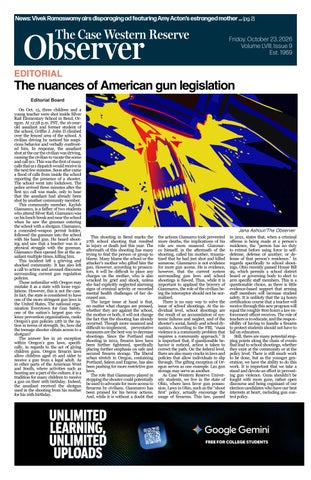
Jana Ashour/The Observer This shooting in Bend marks the 27th school shooting that resulted in injury or death just this year. The aftermath of this shooting has many trying to find the person or group to blame. Many blame the school or the attacker’s mother who gifted him the gun. However, according to prosecutors, it will be difficult to place any charges on the mother, who is also wracked by grief and shock, unless she had explicitly neglected alarming signs of criminal activity or recorded mental health challenges of her deceased son. The larger issue at hand is that, no matter what charges are pressed, whether they are against the school, the mother or both, it will not change the fact that the shooting has already occurred. Though more nuanced and difficult-to-implement, preventative measures are the best way to decrease shootings. Since the Portland mall shooting in 2012, firearm laws have been further tightened, specifically placing further emphasis on safe and secured firearm storage. The liberal urban stretch in Oregon, containing Portland, Salem and Eugene, has also been pushing for more restrictive gun laws. The role that Gianmarco played in stopping the shooter could potentially be used to advocate for more access to firearms by civilians. Gianmarco has been praised for his heroic actions. And, while it is without a doubt that
the actions Giamarco took prevented more deaths, the implications of his role are more nuanced. Gianmarco himself, in the aftermath of the shooting, called his mother, traumatized that he had just shot and killed someone. Gianmarco is not evidence for more gun access. He is evidence, however, that the current system surrounding gun laws and school shootings is flawed. Thus, while it is important to applaud the bravery of Gianmarco, the role of the civilian being the interceptor should not be normalized. There is no easy way to solve the issue of school shootings. At the individual level, school shootings are the result of an accumulation of systemic failures and neglect, and of the shooter’s social, family and school dynamics. According to the FBI, “mass violence is a community problem that requires a community approach.” It is important that, if questionable behavior is noticed, action is taken to correct the path. On the federal level, there are also many cracks in laws and policies that allow individuals to slip through. The gifting exception of Oregon serves as one example. Lax gun storage may serve as another. As Case Western Reserve University students, we live in the state of Ohio, where laws favor gun possession. Laws in Ohio, such as the “shoot first” policy, actually encourage the usage of firearms. This law, passed
in 2021, states that, when a criminal offense is being made at a person’s residence, the “person has no duty to retreat before using force in selfdefense, defense of another, or defense of that person’s residence.” In regards specifically to school shootings, Ohio recently passed House Bill 99, which permits a school district board or governing body to elect to arm specific staff members. This is a questionable choice, as there is little evidence-based support that arming staff members will increase student safety. It is unlikely that the 24 hours certification course that a teacher will receive through this new program will equal the roughly 800 hours a law enforcement officer receives. The role of teachers is to educate, and the responsibility of having to handle a firearm to protect students should not have to fall on educators. Still, there are many potential stopping points along the chain of events that lead to school shootings, whether they exist at the community or at the policy level. There is still much work to be done, but as the younger generation, we have the ability to do this work. It is important that we take a stand and devote an effort in preventing gun violence. Guns shouldn’t be fought with more guns, rather open discourse and being cognisant of our election candidates who have our best interests at heart, including gun control policy.
News
The Case Western Reserve Observer Friday, October 23, 2026 observer.case.edu Volume LVIII, Issue 9
Vivek Ramaswamy airs disparaging ad featuring Amy Acton’s estranged mother ahead of election day Maria Burrus
News Editor
As the Ohio midterm elections rapidly approach, Republican nominee Vivek Ramaswamy and Democratic nominee Dr. Amy Acton have begun ramping up the intensity of their campaigning strategies. On Monday night, Oct. 19, Ramaswamy’s campaign released a 60-second advertisement video featuring Donna Arthur, the estranged birth mother of Acton. When initially released, it was spread without the legally required political disclosure tags. The campaign team officially claimed ownership over the ad on Tuesday night, Oct. 20, with Ramaswamy confirming that his team had spent $4 million to air it across the state ahead of election day. Arthur was not paid for her participation in the ad. Throughout the video, Arthur consistently calls her own daughter a “liar” and insinuates that Acton suffers from mental health issues which would make her unfit to serve as the next governor of Ohio. “It’s not easy for a mother to say this, but Amy has a serious problem,” Arthur said in the video. “She is a liar; she lies about her past. Don’t let her become your governor. If you think she’ll make your life better, you’re fooling yourself.” Amy Acton became estranged from her birth mother at the age of 12 when her mother’s husband reportedly sexually abused her. The sexual abuse she faced led to her and her brother, Philip Stearns, being removed from
Republican nominee Vivek Ramaswamy released a political advertisementIn an attempt to create a “campaign ending moment” against Democratic nominee Amy Acton. The ad features Acton’s mother, Donna Arthur, disparaging Acton’s role as a potential governor for Ohio. Courtesy of Gage Skidmore via Wikimedia Commons Arthur’s custody and placed in their father’s care. The last time Acton saw her mother was the day of her stepfather’s court hearing. Arthur remained married to her husband even after he was charged until he passed. After seeing the video, Stearns commented on Ramaswamy’s campaign. “It’s not surprising that Vivek Ra-
maswamy has stooped to such a despicable low as to attempt to turn the sexual abuse Amy endured at 12 years old from our birth mother’s husband into a political talking point,” Stearns said. “This desperate, disgusting attack reveals exactly who Vivek Ramaswamy is at his core – a pathetic excuse for a man who is willing to hurt
anyone as long as it gets him what he wants.” The ad has faced bipartisan disapproval and intense backlash. Alyssa Farah Griffin, former White House director of strategic communications and assistant to the president for President Donald Trump, said, “Honestly, [it was] the grossest ad I can think of. I was racking my brain for something worse. Anyone behind it should be ashamed.” Cincinnati-area Congressman Greg Landsman described the advertisement as one of the most despicable things he has ever seen in politics. The Democratic Governors Association also condemned the campaign’s tactics, accusing Ramaswamy of exploiting Acton’s personal trauma for political gain. Despite the criticism, Ramaswamy’s campaign has continued to defend the advertisement. Campaign manager Jonathan Ewing told Axios that the ad was a “campaign-ending moment” for Acton, arguing that voters should hear criticism from people who know her personally. At a conference in Cincinnati on Wednesday, Oct. 21, Vice President JD Vance addressed the video saying, “I’m a little bit disgusted when I see Republicans who are whining more about that advertisement than about Democrats’ agenda.” With Election Day coming up, Acton and Ramaswamy are continuing to make their final appeals to Ohio voters. Ultimately, Ohio voters will decide which candidate they believe is best suited to lead the state when they head to the polls on Nov. 3.
Katie Zacharia steps down as the White House Press Secretary after five days Maria Burrus
News Editor
After Karoline Leavitt stepped down as White House press secretary, citing family commitments, Kate “Katie” Sharon Zacharia stepped up to the podium. However, after just 120 hours, she was fired following widespread criticism of her sole press briefing and controversy surrounding her credentials. Zacharia’s five-day tenure made her the shortest-serving White House press secretary in history. Zacharia attended Pepperdine University for her undergraduate and law education but did not pass the California bar exam after graduating. Despite misrepresenting herself as an attorney on her social media, she never retook or passed the bar exam in any state. After graduation, she moved to Beijing China to work on the international practice team for Zhong Lun Law Firm. In February, she was appointed as the deputy assistant secretary for the public affairs office of the Department of Homeland Security but resigned the following month. Prior to being selected as the White
House Press Secretary, Zacharia served as a senior communications advisor to the Trump Media & Technology Group and Truth Social. On Oct. 9, in President Donald Trump’s formal announcement of Zacharia’s appointment, he said that Zacharia had worked on his election campaigns in addition to her communication advising positions. On Truth Social, Trump later said, “She has an unblemished record of support and has been a loyal and brilliant supporter, right from the beginning.” “My job is to amplify and communicate [Trump’s] message, interact with the press and build relationships and communicate clearly the message of the administration,” Zacharia said. “I’m not being hired as White House counsel.” According to Zacharia, Leavitt set a high standard for her to follow, and Zacharia hoped to continue Leavitt’s legacy by “delivering strong results for our country and communicating to the American people the major wins that this Administration is making every single day.” On Oct. 13, Zacharia delivered her first and only press briefing, speak-
ing for 14 minutes about Trump’s accomplishments while appearing to rely heavily on a script. After her remarks, she answered only three questions, all from conservative outlets. In the White House’s press release, they called Zacharia’s performance “commanding” and claimed that it “served as a strong introduction to her tenure and highlighted the Trump Administration’s record of delivering historic successes for the American people.” However, many members of the general public disagreed. Zacharia spent the following three days facing immense criticism and appearing in multiple interviews to defend her abilities. Zacharia attributed her shaky debut to insufficient preparation time but refused to criticize the administration. “It’s hard to generate sympathy for this woman, but there was no way for her to succeed. It takes years to be ready to do that job,” said Joe Lockheart, President Bill Clinton’s former press secretary. “It was very unfair for her, but very bad judgment on her part to think she could wander out there and smile.” Lockheart later added, “It one more time shows how Trump
cheapens everything he touches. Now, he has tried to put someone in that job who reflects him, not the country and the values and the power of this country.” On Oct. 16, as Trump was boarding a flight to travel to a midterm election campaign rally in Georgia, he stopped to make a few comments to reporters on the White House Lawn. He mentioned that he had a conversation with Zacharia in which he asked her to reconsider the position. He commented that he would allow Zacharia to still work for him “in some form, but maybe a more pleasant form.” Later that day, Zacharia announced her departure from the role, bringing her brief tenure as White House press secretary to an end after just five days. Despite Trump’s offer to keep her in his administration in a different capacity, Zacharia still faces criticism from her press briefing and questions regarding her qualifications. However, she then uploaded a post on her social media where she praised the president. “I wish more Americans appreciated him,” Zacharia said. “No one will ever make America great the way he has and continues to.”
News 3
observer.case.edu
Cleveland Clinic Lutheran Hospital workers end strike with a new contract Alyssa Wang
News Editor
Workers at Cleveland Clinic’s Lutheran Hospital have ratified a new three-year contract, ending a 16-day strike sparked by disputes over wages, health insurance costs and workplace protections. The striking employees ranged from licensed practical nurses (LPNs) and nursing assistants to housekeeping staff and maintenance workers. After months of negotiations failed to lead to an agreement, approximately 200 employees, represented by the Service Employees International Union (SEIU) District 1199, prepared to strike. On Sept. 23, workers walked off the job and began a strike that would last more than two weeks. Negotiations between the union and hospital leadership started in February, but the two sides struggled to reach a compromise before the employees’ previous contract expired in April. As discussions continued, union members raised concerns about rising healthcare premiums and deductibles, workplace safety and the terms of the hospital’s proposed agreement. According to Spectrum News 1, the union also sought limits on mandatory drug testing, arguing that employees should not face testing unless there are visible signs of impairment. Vanessa Dalesandro, regional director for SEIU District 1199, said the union remained willing to negotiate, but would not accept an agreement that got rid of any existing protections. “We’re still willing to have conversations,” Dalesandro said in an interview with Spectrum News 1. “We’re still willing to continue bargaining.
The clinic wants us to surrender rights and protections that we’re not looking to surrender.” Employees were concerned that higher healthcare costs could diminish the value of any increase in wages. They argued that better compensation would mean little as rising insurance expenses continued to eat into their earnings. Brian Higgins, a power plant mechanic at Lutheran Hospital and a SEIU District 1199 executive board member, criticized the hospital’s negotiations. “They’re asking us to accept crumbs and work without the protections we deserve, while caregivers are assaulted and threatened on the job,” Higgins said in an interview with Cleveland 19 News. “That’s not respect, and it’s not ‘world-class.’” On Oct. 1, Cleveland Clinic moved to end active employee health benefits for striking workers who no longer met eligibility requirements. This decision drew criticism from the union, which said employees had received less than six hours’ notice, despite existing deductions of healthcare premiums from their September paychecks. “These caregivers deserve better than threats and intimidation from their employer who claims to care about their workforce and the patients they serve,” Dalesandro said. The union argued that the loss of active coverage placed additional pressure on workers who were already striking over healthcare affordability. In response, SEIU District 1199 passed a resolution to help members maintain healthcare coverage through the federal Consolidated Omnibus Budget Reconciliation Act known as COBRA. COBRA insurance allows workers
to maintain the same health insurance plan for over a year after a job loss. However, costs are often much higher since the coverage is retroactive. Meanwhile, according to Cleveland Clinic, the affected workers no longer met the eligibility requirements for active employee benefits because they had not worked their scheduled shifts. They also said that employees were pointed towards continued coverage options. Then, on Oct. 8, union members at Lutheran Hospital ratified a new contract with Cleveland Clinic. The deal includes a nearly 11% increase in wages over three years, an additional 50 cents per hour for employees with at least six years of service, new certification based pay, a ratification bonus and increased shift differentials. Other provisions include improved paid-time-off protections, stronger protections for the union’s right to bargain during the contract term, and protections for religious holidays. Even though the agreement didn’t specifically target healthcare premium costs, it delivered a substantial pay increase that will offset the rising costs of healthcare for employees. Cleveland Clinic welcomed the agreement, emphasizing its commitment to their employees and patients. According to a statement released by the Cleveland Clinic, “The contract reaffirms [our] commitment to patient safety, caregiver well-being and the community we serve. This longstanding safety measure helps support a safe environment for patients and caregivers. We look forward to moving ahead together with a shared focus on providing safe, high-quality care for our community.”
News -inBrief Democratic-Aligned Groups Sue Over Federal Crackdown on Voting By Zach Montague From The New York Times
Supreme Court Blocks Trump From Denying Gender-Transition Care to Federal Prisoners By Ann E. Marimow From The New York Times
Trump Wields an Unprecedented $277 Million in Final Midterm Stretch By Theodore Schleifer From The New York Times
Meta ordered to pay $25B in New Mexico for misleading users on privacy By Ian Duncan From The Washington Post
‘There are no people’: Springfield, Ohio, faces loss of Haitian residents By Arelis R. Hernández From The Washington Post
New Mexico Sues Jeffrey Epstein’s Lawyer and Accountant By Khadeeja Safdar From Wall Street Journal
Trump officials ask Supreme Court to let border security project resume in national park By Justin Jouvenal From The Washington Post
Largest project in zoo history: Cleveland Metroparks Zoo to open new Primate Forest By Julia Thyret and Madisan Green From Cleveland 19 News
Sherwin-Williams cuts about 40 positions at Cleveland headquarters By Kaylee Remington From Cleveland.com
State attorneys general step up plans to counter Trump’s meddling in midterms By Peter Stone From The Guardian
Gas plume prompts emergency response at Howmet Aerospace facility in Cuyahoga Heights After more than two weeks of strikes at the Cleveland Clinic’s Lutheran Hospital, its employees and leadership have settled with a consensus. The strike arrose from disputes over wages, health insurance costs and workplace protections, ending with an agreement to increase wages. Courtesy of Cards84664 / Wikimedia Commons
By Damon Maloney From News 5 Cleveland
Life
The Case Western Reserve Observer Friday, October 23, 2026 observer.case.edu Volume LVIII, Issue 9
‘The Love Hypothesis’ has too many confounding variables Reva Kolhe Layout Designer Spoilers for “The Love Hypothesis” (2026). As someone who has read all of Ali Hazelwood’s STEM romance novels, I was excited to watch “The Love Hypothesis” (2026) adapted to the screen from the 2021 novel. The movie premiered Sept. 23 on Prime Video. Prime was on a roll with book-to-screen adaptations “Off Campus” (2026) and “Every Year After,” (2026) but this one did not seem to follow through. “The Love Hypothesis” follows Olive Smith (Lili Reinhart), a 26-year-old Ph.D. student at Stanford University. Olive wants to convince her friend Anh (Rachel Marsh) that she is completely over their mutual friend Jeremy (Nicholas Duvernay) so that Anh feels comfortable pursuing him. With the fear of getting caught spending a late night in the lab rather than on a date, she impulsively kisses a man in the hallway as Anh walks in. This man turns out to be Dr. Adam Carlsen (Tom Bateman), a professor at Stanford University. Olive and Adam agree to fake dating, so that Olive can convince her friends she has moved on, and Adam can prove he is not a flight risk to secure funding for his research that is currently frozen. The audience follows Adam and Olive through their fake relationship where, along the way, they develop real feelings for each other. When the casting announcement came out, I felt the actors were cast
accurately. Although many people were disappointed over the casting of Tom Bateman for Adam Carlsen, I was not one of them. During filming, Lili Reinhart posted TikToks, showing how the actors embodied the characters from the books. Yet, in the movie script itself, some of the dialogue did not seem realistic, including Olive and Adam regarding their relationship as a science experiment. Additionally, Bateman’s character’s way of speaking seemed robotic and monotonous. This creative decision took away from the story and made his character less realistic and unnatural. Some aspects of the movie seemed just as I had imagined when I read the book. One thing I felt the movie did well was the scene where Olive and Adam meet for the first time in the lab bathroom. I was also very happy to see that they included my favorite quote, “Carry yourself with the confidence of a mediocre white man.” However, there were many things that were left out or altered. For example, Dr. Aslan (Jeananne Goossen) played a more prominent role in the novel than depicted in the movie. She was Olive’s Ph.D. advisor and supported Olive throughout her entire Ph.D. She was also the one who said, “Carry yourself with the confidence of a mediocre white man.” Olive only emails Tom (Arty Froushan) because Dr. Aslan is retiring, so her lab will no longer have the funding Olive needs for her project. Adam finds out about Tom’s threats when Olive accidentally plays the recording of her presentation that she had kept for Dr.
Aslan to see. Since Dr. Aslan is not her mentor in the movie, she never records her presentation and the exchange between Tom and Olive is never recorded. In the movie, Adam finds out about Tom’s behavior because Anh tells him. While the change was not bad, I found it unnecessary and that it served little purpose to the overarching plot of the movie. Another unnecessary change was the full pivot of Malcolm’s (Jaboukie Young-White) character from the book to the movie. Malcolm is portrayed as someone who does not take things seriously and eventually drops out of graduate school. Though this creative decision was intended to add more drama to the film, it only diminished Olive and Malcolm’s relationship. In the movie, the two roommates were not as close, and they spent most of their time arguing. In the book, however, Malcolm and Olive had a flourishing friendship and Malcolm was the first person to know about Olive’s fake relationship. I also disliked that they cut out Holden’s character. In the book, Holden was Adam’s closest friend and fellow Stanford professor, who dates Malcolm later in the story. He was the one who warned Olive about Tom, and I felt he had a lot of influence, helping Tom and Olive realize their feelings for one another. All of the coffee dates and the double date with Holden and Malcolm are replaced with cocktail parties and house parties hosted by Olive’s friends. The movie audience was not able to see the development in Olive and Adam’s relation-
ship through the coffee dates, nor were they able to see the growth in Adam and Malcolm’s relationship. Adam ghosting Olive was also completely out of character due to his novel portrayal, and I felt that it was added for flair or so that Olive could rely on Anh more. While I knew not everything could make the cut in the movie adaptation, I was hoping for the major events to be left intact. As a science major myself, I was disappointed to see the lack of scientific accuracy. Olive would come into the lab wearing shorts, an unbuttoned lab coat or wearing her lab coat and goggles outside the lab, all of which are not permitted in a real laboratory. The movie also captures the lifestyle and role of a Ph.D. student inaccurately. In the movie, Olive is called out of class to go see Dr. Carlsen. This is what leads to the fake dating contract agreement. Students in higher-level education do not typically get called out of class for a meeting that could have been arranged through email. Additionally, Ph.D. students are extremely dedicated to and passionate about their work. This made the scene where one Ph.D. student admitted to spilling Mountain Dew on her experiment extremely unrealistic. Overall, the characters in the movie did not portray authentic Ph.D. students. While “The Love Hypothesis” (2026) might not be a book-accurate adaptation, it was fun to watch and laugh at the things Olive and Adam got themselves into, and to hear the dramatic music that played when Adam Carlsen entered the room.
The adaptation of the novel, "The Love Hypothesis," authored by Ali Hazewood, premiered on Sept. 23 on Prime Video. Stanford University PhD student Olive Smith (Lili Reinhart) is seen on the left with professor Dr. Adam Carlsen (Tom Bateman) on the right. The fake relationship to lovers trope makes this movie an entertaining watch, despite not being an accurate adaptation of the novel's plot.. Courtesy of Philippe Bossé via Amazon MGM Studios
Life 5
observer.case.edu
‘Death Becomes Her’ resurrects the classic story with a modern twist Jeannelle Tellado Contributing Writer Spoilers for “Death Becomes Her.” Trigger Warning: mentions of suicide and death. This September the Tony-winning musical comedy “Death Becomes Her” came to Playhouse Square. A musical “revitalization” of the classic 1992 movie, this stage show adds its own blend of modern humor, fantastic special effects and quite a few songs that became popular on social media. The opening song introduces Viola Van Horn (Nasia Thomas), a mystical woman who promises to tell the audience “a secret [they] would die for,” setting the tone of the musical. Backed by a collection of dancers, the lyrics lay out themes of sex, love, beauty, revenge and the dark cost of a perfect eternity that echoes through the show. The next few scenes switch to a campier perspective, introducing the main characters, Madeline Ashton (Jackie Burns) and Helen Sharp (Kristen Bell Williams). Madeline is a vain actress who enjoys spending time with her old friend Helen, the failing writer, because of how miserable Helen’s life is compared to hers. The tables are turned as Helen shows off her attractive, plastic surgeon fiancé, Ernest Menville (Ken Marino), to Madeline, who immediately is infatuated with him. This sharp contrast really sets the tone for the entirety of the show. It shows the capabilities the musical has to balance the horror and darkness with over-the-top musical numbers and sharp-witted humor. The introduction of each character immediately highlights their main personalities alongside their flaws, which gives the viewer an all-around understanding of the cast before diving head first into the main story. The plot picks up after these introductions, each scene filled with a perfect blend of comedy, atmospheric music and incredible acting. Madeline steals Ernest from Helen over the course of one dinner party, followed immediately by their wedding and Helen’s mental breakdown. Helen then plans her revenge in a psychiatric ward. In a 10-year time jump, Madeline ages, becoming depressed, while Helen returns to her life, looking younger and more beautiful than ever. As Madeline spirals into a panic about her age and fading looks, she finds herself at Viola Van Horn’s shop, who offers her a potion of eternal youth, warning Madeline to take good care of her body. Meanwhile, Helen seduces Ernest and convinces him to help her murder Madeline. Madeline and Helen fight and Madeline falls—or perhaps is pushed—down a flight of stairs. Despite the damage to her body, Madeline does not die, concluding the first act. The second act starts with a messy chase through a hospital, as Helen and Ernest try to get Madeline medical help. Madeline discovers that Helen has taken Viola’s potion as well. After a brutal fight between the two women—with masterfully done special effects—Ernest stops the two women, and they convince him to repair their bodies. Meanwhile, the women plot to
give Ernest Viola Van Horn’s potion so he can continue to repair them. Compared to the first act where the women were at odds with one another, they now find themselves working together, leading to more hilarious banter and messy arguments that give the audience an idea of why the women became friends in the first place. Now, the narrative focuses on Ernest, and the show gives him more stage time and songs compared to the first act. His own moral dilemmas and insecurities are learned through a song that includes medical malpractice, singing furniture and increasing amounts of alcohol consumption. He grapples with his own life and potential, and he is ultimately given the choice to live forever. He rejects this despite every other character in the show giving in, offering a different insight into immortality than the other characters. He does not want to live forever and be forced to watch his friends and the world around him have an end while he himself does not. This sentiment is shared with
the man that they both loved, but the one man who could do a good enough repair job for them, Madeline reminds Helen that she is not alone, promising to stay by her side for all eternity. The show then jumps to fifty years in the future, where Madeline and Helen, still young and beautiful, clean their own gravestones and see Ernest, who tells the women of the life he had after escaping them. As he tells the women about preparing for his end, they angrily shoo him away, lamenting that they will never experience their own end. That sentiment soon passes, and they walk off stage with one final nod towards their Cleveland audience, humorously asking “What would Tim Misny do?” Similar to the 1992 movie, the musical offers valuable commentary on modern beauty standards that remains potent. Although Madeline is played by the same actress, the show uses the characters and props around Madeline to indicate how much she has aged. Side characters constantly comment on
to be content. Ernest, who did not drink the potion, had a happy life with his wife and children, and is content to die naturally. Meanwhile, Madeline and Helen have stayed friends for fifty years and, although they occasionally lament their lives, they seem to have no qualms about their actions. The immortal dancers in Viola Van Horn’s shop offer a unique perspective as well, as they spend their days hiding away from the world, partying and indulging in their youth and beauty. They seem more than happy with how their lives are, glad for having maintained their flawlessness. The show stealer for me, however, was Viola Van Horn. She opens the show by joking with the audience and interjects at different points throughout, echoing her warnings to the characters and the audience, as each decision leads them closer to their end—or lack thereof. Thomas’ vocals were absolutely incredible, and her every appearance reminded the audience of the true gravity of the actions oc-
The musical comedy based on the 1992 movie, “Death Becomes Her,” came to Playhouse Square this September. The Tony-winning show reimagines the classic movie with a popular soundtrack that demonstrates the cost of perfection with humor and drama. Courtesy of Matthew Murphy and Evan Zimmerman the women twice throughout the show, although ultimately his musical numbers are humorously interrupted and rejected by the women in different ways: He is hit on the head with a shovel, yelled at or pushed off a roof. The climax of the show takes place in Viola Van Horn’s shop, as Ernest refuses to take the potion that Viola Van Horn, Madeline and Helen offer him. As he stands upon the roof, contemplating jumping over being immortal, he sings about wanting to live and die on his own terms, only to be unceremoniously interrupted by Viola Van Horn as she takes back her potion and shoves him off the roof. Mourning the loss of not only
her appearance, making pointed comments about how old she is, and her outfits change from sexy and glamorous to more covered up and modest. Perhaps that in itself is part of the show’s message. To the audience, Madeline looks the same as she did 10 years ago when performing in her Broadway show. However, to herself, she is convinced that she is old and ugly, which consumes her thoughts no matter how much her closest people try to comfort her. The consequences of immortality are touched on by various characters in the show, allowing the audience to think about their own stance on the matter. Characters on both sides of the debate are shown
curring. Though the musical interjections by Viola Van Horn are a bit out of place at the end of both acts, Thomas’ performance was so compelling and spectacular that I was happy to simply have more time to hear her voice. Nearly every joke in the show managed to land perfectly, and I cannot remember seeing a comedy show that I enjoyed this much. Despite the humor layered throughout the show, the overarching theme of how achieving perfection comes at a cost, was centered by the inclusion of horror elements. Overall, the show did a spectacular job at retelling the story of “Death Becomes Her” in a way that felt new, exciting and fun for the whole audience.
6
Life
Friday, October 23, 2026
‘The Sixth Faction’ struggles to be divergent Riya Kulkarni Life Editor Spoilers for “The Sixth Faction” and the “Divergent” series. There’s a certain nostalgia that comes with returning to one’s roots. For me, it’s the world of young adult dystopian fiction, because there is nothing more appealing to a newly-established teenager than toppling the current government. The 2010s brought forth multiple widely successful dystopian series like Suzanne Collins’ “The Hunger Games” trilogy (with two prequel books released in this decade), James Dashner’s “The Maze Runner” series and, of course, the “Divergent” series by Veronica Roth. After five books, three novellas and three movies—a fourth movie was cancelled after the poor reception of the third—Roth revealed that there was more she wanted to give to the series. Sixteen years after the release of book one, “Divergent,” Roth announced “The Sixth Faction,” a reimagining of the series, a duology presenting an alternate storyline where decisions were made differently. The concept in itself read slightly like fanfiction, with the promise of more complexity, entry into new worlds and a revisit to the characters that fans loved so much. Taking place in a futuristic version of Chicago, “Divergent” introduces readers to a society divided into five
factions: Amity, the peace-loving; Candor, the honest; Erudite, the curious; Dauntless, the fearless; and Abnegation, the selfless. We meet Beatrice Prior, born in Abnegation, about to choose what faction she will live with for the rest of her life based on the results of an aptitude test. Typically results will point to a single faction, but Beatrice’s results do not. Showing aptitude for Dauntless and Erudite in addition to Abnegation, she is classified as Divergent, with a resistance to faction computers that is dangerous should anyone else, especially those in power, find out. Beatrice must make a choice—join a new faction or stick to the world she grew up in. In the original series, she joins Dauntless, where she adopts the nickname “Tris,” tries to assimilate during the initiation process and falls in love with her training instructor, Four. It is at this same point where the plot of “The Sixth Faction” drifts from the original story. A tragedy during the Choosing Ceremony pushes Beatrice to remain in Abnegation, a decision she regrets the moment she makes it. She proceeds to leave the factions entirely to begin a new life under a new name—“Tris.” This change at the very beginning of “The Sixth Faction” set the tone for the rest of the novel. Larger revelations were trivialized when Tris learned them so early into the story just because she would not discover them during her time in Dauntless. Tris
Sixteen years after the release of the first "Divergent" novel, author Veronica Roth published "The Sixth Faction," a retelling of the popular original story. The new novel retells the adventures and consequences main character "Tris" faces while choosing a faction, but the novel seems to fall flat in creating new plotlines that are deviate from the original novel. Courtesy Zoë Van Dijk from HarperCollins
Courtesy of Nelson Fitch learns much more about Tori, a tattoo artist from Dauntless who also administers the aptitude tests, and Tori explains in much more detail what exactly it means to be a Divergent, which Tris would otherwise have learned in the middle of Dauntless initiation. Characters like Colin, the Dauntless initiate who was not able to jump off of the train with the other initiates to join the group after the Choosing Ceremony reference small scenes that used to have no meaning. Tris’ character has marginally changed in her new environment— perhaps for the better. She’s a little stronger and smarter than her Dauntless counterpart, making her a more enjoyable main character. Roth also included perspectives from Four and Tris’ twin brother Caleb, who left Abnegation for Erudite. The latter is a perspective never seen before, an inside look into the inner workings of Erudite written uniquely in the second person, while Caleb is nearly swayed by Erudite Faction Leader Jeanine Matthews. It can be assumed that something quite similar occurred behind the scenes in “Divergent.” Beatrice also stays Abnegation for much longer, allowing for some well-integrated world building. Much of the context surrounding Abnegation in the original series came through the jokes and stereotypes made from the outside, but “The Sixth Faction” lets the reader dive into the deeper and darker aspects of the faction. The Penalty of Silence is a law-backed punishment for children preventing them from talking for up to two days. The Memory Vault is equally suspiciou s, as Beatrice is targeted by the council when she admits to seeing something strange, and must fight against her memory being wiped by her own father. These are some of the actions that Erudite spotlights in its divisive propaganda, providing that perspective on the outside. We also learn much more about the factionless and the way their society is set up—which is so reminiscent of a faction society that it makes one question whether the factionless are any different. From here, the story could have become completely different, but much of the book was very clearly a nostal-
gia trip, and characters were conveniently placed to recreate iconic scenes from the original “Divergent.” With his mother—who is proven to not be dead very quickly—attempting to get him to join the factionless, Four still meets Tris, beginning their love story. They still go through each other’s fear simulations—though Tris puts together Four’s identity without needing to see his fear landscape—and they still risk their lives climbing the ferris wheel together. Tris will still befriend Christina despite not attending Dauntless initiation, and their bond is reminiscent of the original trilogy. In playing to her old fanbase far too much, Roth may have missed the chance to build something new and add onto her world in a way that only the creator can. At the same time, Roth rewrites these wellloved scenes and improves upon them, showcasing her growth as a writer. It was disappointing to see that “The Sixth Faction” was unable to counter the fanfiction allegations. The alternate storyline merely shifts the lens slightly, which means that most of the characters are exactly where we first found them in the original series. Many of the events of the story, going past the nostalgia, would have still happened should Tris have chosen Dauntless. Caleb’s path would be close to the same, at least at the beginning, and perhaps the underground happenings in Abnegation would have still taken place. Though this seems natural in execution, this feels narrow for an alternate universe. The plot does not drift far from the original story. Tris’ trials remain focused on a sort of competition to rise to the top of the ranks so she can become a Fox—the factionless secret agents who secure supplies for the community—a competition that just feels like the progression of initiation all over again. This revisit to the five factions is not over yet. During Roth’s tour for “The Sixth Faction,” it was announced that the sequel and conclusion to the series, “The Sixth Faction: The Last Testimony,” will be released sometime in February. With it, we will see if Roth goes past the fan service to create something new with the world that we love so much.
Life 7
observer.case.edu
The confusion and chaos that was ‘Primetime’ Riya Dixit Advertising and Partnerships Manager Spoilers for “Primetime.” Trigger Warning: suicide. When I watched this movie, I knew nearly nothing about the show, “To Catch a Predator” or its program host, Chris Hansen. In fact, my friend and I only watched it for Robert Pattinson, who portrays Chris Hansen in the movie. When it was over, we both sat in silence contemplating what we had just watched. For those of you who are not up to date on your reality television, “To Catch a Predator” is a segment that ran from 2004-2007, hosted by Chris Hansen, who would catch predators using decoy actors. The show was immensely popular but viewers scrutinized the show’s ethics. Hansen described “Primetime” to be “98% fiction” and he refuted many of the movie’s claims. He criticized the production team for not consulting him or his colleagues. Despite this, Hansen purchased multiple advertisement spots before the movie screenings to promote his Tru-Blu network. In “Primetime,” Chris Hansen is played by Robert Pattinson whose main goal in 2026 seems to be to play the most villainous looking characters. He seems to be doing pretty well, considering his character of Antinous in “The Odyssey” (2026) and his performance in this movie. Other notable actors were Merrit Wever who played the producer, Andi, and Skylar Gisondo who played Dan Plum, an aspiring actor who was hired in the movie to play a decoy. The overall cast did a pretty good job, though there were moments where Wever fell a bit flat. “Primetime” opens with Chris tracking down one of the predators, which is how the audience gets a glimpse into the process that went into finding and catching these predators. Chris finds an actor or decoy who engages with a predator online and poses as an underaged child. They then lure that predator to a house where they reveal themselves as an undercover TV crew filming all the events that took place. Watching this on-screen with no context, it felt like a strange concept to turn into entertainment, but, since the police were arresting the people involved, maybe it was doing some good for the community. However, the movie began to take a dark turn, when we see NBC studio executives challenge “To Catch a Predator” running during primetime airing, causing Chris to become obsessed with getting the show to have better ratings and a stronger audience base. He pushes his staff to expose predators that would make the show the biggest show on air. By now, the movie began to feel uncomfortable and honestly all over the place. This is also around the time we meet Dan, who gets hired by the show at the beginning of the movie and isn’t told what he is doing until about halfway through. He is thrown into a scene with an extremely dangerous predator and becomes traumatized from this interaction. Despite this, he stays, because Chris convinces him that the work he is doing on this show is better than anything else he will ever be involved in. One of Chris’ staff members then gets a lead about potentially uncovering a government official. Chris, on the verge of mental breakdown due
The psychological thriller movie, “Primetime,” premiered on Sept. 5 at the Venice International FIlm Festival. The thriller is a dramatization of the reality television series ,“To Catch a Predator,” where the host, Chris Hansen (Robert Pattinson), works with a vigilante group to catch child predators. However, the film examines the fine line between performative activism and entertainment. Courtesy of A24 to the media finding out about his affair, decides to follow the lead. This is when this movie begins to spiral out of control, leading to the politician they were chasing to commit suicide on camera, ending the story. As a whole, the movie felt choppy and abrupt, building into the eerie feeling walking out of the movie. With more context about Chris and people’s concerns about the show, I realized two things. The first was that a lot of people have associated Chris over the years with the idea of performative justice. The movie shows this through the intentional selection of predators they hunt for and Chris’ attitude in the few conversations with Dan, where he talks about how Dan is a hero for society. Chris becomes obsessed with the fame and praise that he receives. This can be seen in how the only reason Chris even wanted to do the politician story was to prevent backlash
from the news story of him having an affair. At this point in the movie it felt like Chris was doing this show for less noble reasons and more for his own personal glory. Chris is supposed to be this morally grey character who just becomes more corrupt as he goes on and you get that feeling from the way Pattinson talks, the way they play with the lighting and even the music. The second thing I realized was that the seemingly abrupt and empty ending was intentional. The movie ends with the politician they were hunting taking his own life during the filming of his confrontation. The last line we hear is “I can salvage this,” from Andi and the movie fades to the last scene with Dan getting some mail from SAG-AFTRA. When the story of the politician taking his life hit the public, there was intense backlash, raising questions about the ethics surrounding this show. When I learned about
this, the movie’s abrupt ending made sense. “Primetime” was supposed to build to Chris’ downfall and the ending, particularly Andi’s line “I can salvage this” is very telling about how deep Chris and the crew were. At this point, it was not really about catching the predator but about entertainment for the viewers. “Primetime” gives us a small glimpse into Chris’ descent into performative justice, the idea of doing good solely for outside approval. The movie ended abruptly because at the end the audience saw how Chris got his own show cancelled. While the film struggled with an overall disjointed narrative, its strength lies in its cultural commentary. In today’s world, with the internet and the constant pressure to seek others’ approval, “Primetime” is a movie that forces the audience to think about the digital age’s impact on our self-worth.
Fun
The Case Western Reserve Observer Friday, October 23, 2026 observer.case.edu Volume LVIII, Issue 9
Which apple variety are you? Aries
Taurus
Gemini
Cancer
Ambrosia
Crabapple
Pink Lady
Honeycrisp
Leo
Virgo
Libra
Scorpio
Mutsu
Jonathan
SnapDragon
Cosmic Crisp
Sagittarius
Capricorn
Aquarius
Pisces
Winter Banana
Gala
Golden Delicious
Fuji
Which apple variety are you?
1 2 3 4 5 6
What is your favorite apple treat (a) Applesauce (b) Plain apples (c) Apple tarte tatin (d) Apple pie
7 8
Which decade speaks to you? (a) 2010s (b) 2000s (c) 1980s (d) 1960s What flavor of apple cider are you (a) Sparkling cider (b) Cold cider (c) Hot cider (d) Hard cider
What is your favorite subsection of fall? (a) Early September (b) Early October (c) mid-October (d) Late October What is your favorite piece of fall media (a) Halloween (b) Twilight (c) Gilmore Girls (d) Over the Garden Wall How do you approach apple picking? (a) Pick as much as you can as fast as you can (b) Sample more apples off the trees than apples in your final basket (c) Pick one of every apple variety available (d) Enter the orchard with an apple plan, and exit with the best apples in hand What is your favorite shade of fall leaf? (a) Red (b) Orange (c) Yellow (d) Brown What is your fall spirit animal? (a) Rabbit (b) Squirrel (c) Skunk (d) Bear
Quiz Results: If you chose mostly A Gala You’re a little rough around the edges, but you’re strong. You are what they call an apple of all trades but a master of none. That’s okay, you’re still delicious. If you chose mostly B Cosmic Crisp Despite your starry name, you fit the stereotype. There’s nothing wrong with being normal. After all, an apple doesn’t have to be the sweetest or the crispiest to be well loved. If you chose mostly C Pink Lady You’re a bit of a diva, and that is perfectly okay. Sometimes extra is best, this minimalistic world could use a little more sparkle. You’re a bright addition to the apple basket. If you chose mostly D Granny Smith You’re old. We hate to be the bringer of bad news but it’s true. Perhaps you’re a little bitter with age, but you’re best found in baked goods. We appreciate you all the same.
Fun
observer@case.edu
9
Strands: Eating Apples ways to (not) reply to an email
Misspell the name of the 1 person you are sending the
email to. Bonus points if the email features the name in the email address, signature and introductory paragraph. Why check that at all? It’s still going to the same person, right?
Passive aggressive emojis. 2 Maybe you were just a bit confused, or you were trying to diffuse some of the tension in the email you were planning to send. A smiley face next to a clearly frustrated statement is a great idea.
One. Word. Answers. Some3 times simplicity is best. Maybe succinct is your style. People should be interested enough to reply with followup questions. Quantity of responses over quality, right?
Thumbs-up reactions. Why 4 even take the time to send a
response, if you can click a button to do it for you? Why even take the time to choose a reaction, if the thumbs-up works in every single context? Be efficient.
Reply to all. This email could 5 have been a direct one. Now,
the whole email chain of fifty knows way too much. Perhaps the email chain is another form of social media, or you want to demonstrate your email-writing skills to a wider audience.
late at night. 6 LetSendyouremails recipient guess what
you meant by “tomorrow” as you carefully tread the line between days. You have no reason for a scheduled send, after all. You need to get this message out now.
Copy-paste an email to an7 swer questions. You frown
Kiera Ng/The Observer
anya's ahahahahas
upon the one-word party, and you wish to communicate your response in at least two. Why start from scratch, when your emailer has provided you with a worksheet? You even made your responses a different color!
Forget to read the email 8 chain. Why go searching for
context when you can just ask for it all over again? The three-paragraph, detailed email surely doesn’t have the answers you are looking for, right?
Send AI-generated emails. 9 Those are great until you see “If you'd like, I can also create a shorter version suitable for a text message or SMS reminder.” after the signature. Same goes for unfilled templates. Your recipient’s name is not “<name>.”
Don’t send the email. You 10have transcended humanity
and can communicate purely based on vibes. They will telepathically know what you mean and will absorb your response through the cloud.
10 Fun
Friday, October 23, 2026
Bobbing for Apples!
Riya Kulkarni/The Observer
Wordle in one
Riya Kulkarni/The Observer
Opinion
The Case Western Reserve Observer Friday, October 23, 2026 observer.case.edu Volume LVIII, Issue 9
The art of the wicked Christopher Clarizio Contributing Writer Humans are creatures of paradox. My favorite example is Arnold Schoenberg, who, while rigorously studying and teaching archaic practices of musical harmony, invented twelve-tone serialism, a system that is not just different from the old harmonic system, but intentionally incompatible in every way. We often observe these
stark contrasts between creators and their creations. This can create moral dilemmas for us when a beautiful work has been created by immoral or outright disgusting people. To avoid discussing moral relativism and absolutism, let it be assumed that all moral judgments are from the consumer’s point of view, no matter what one believes in. Many people say that, when such a conflict arises, we are morally obligated to not engage with the art of the wicked. On a surface level, this may seem intuitive: That person was bad, so it would be wrong to engage with their art. Yet, after some thought, it is not only difficult to make reasonable arguments supporting that position, but it can also lead to serious, negative consequences. To begin addressing this argument, let us first consider the practical issues with such a stance. If we stop consuming art from those who we believe to be morally questionable, we immediately and drastically reduce the amount of art available to us. Again, specific works and artists now off-limits depend on the moral standards of the individual consumer. However, for almost any conventional moral system, it is not unreasonable to say that a significant portion of art becomes unethical to consume. Yet, there is another practical concern even within the latter point: how are we to determine which creators are aligned with our values? With current and more recent artists, the issue is diminished but not abated. Modern technology allows us to quite reliably peer into the lives of most creators, allowing us to be the judge of their lives and, more importantly, their work. But, how reasonably can we judge a peo-
ple from hundreds, if not thousands, of years ago? The only other possible explanation would be to work backwards and judge the creator based o n their creation. It should be apparent that such an approach is completely untenable. The most upright of us may write a tale containing violence, hatred a n d evil, while the most depraved can write of peace, love and goodness. Regardless, both methods require the consumer to evaluate the moral standing of every artist they wish to engage with. On a separate note, the arguments that support categorizing art as “correct” motivates oppressive actions such as book burning or restrictions on the press. The effects of such thought on a societal level are summed up in the aphorism, “Those who cannot remember the past are condemned to repeat it.” If we willingly forget the evils of the past by discouraging engagement with the work of wicked people, then we are at greater risk of falling into similar patterns. Similarly, on a personal level, one of the most important factors in growing and changing as a person is grappling with foreign ideas, even if the result of the effort is rejection. If we limit what art we consume, we limit who we can become. All the arguments thus far presented may be readily dismissed by saying either “acting morally often requires great sacrifice” or “none of the arguments actually address whether it is ethical or unethical” or both, so let us now delve into morality itself. We can start by focusing only on the individual. First, when someone reads a story or an autobiography involving murder, is the reader guilty of the same crime? Of course not. The reader can hold the evils within their mind and contemplate or judge them without taking part. Similarly, is the reader liable for the crimes of the author? Again, it would be absurd to think so. While this should be enough to say that it is not immoral to consume art from the morally questionable, some will argue that it is immoral because, by consuming the art, the consumer supports the views and opinions of the author. Thus the immorality arises between
the consumer and the ideas of the author. Here, there is nothing to say except that there must clearly be a difference between consuming and endorsing. If we again consider an extreme example, many historians read the writings of Joseph Stalin, yet do not condone his actions. Often people read literary works and respond with critique. And so, there is no reasonable argument that can say it is immoral to consume art created by people who we consider morally incorrect. In light of everything, this evaluation is quite freeing. By consuming
art from all people, we are able to learn from all points of view, throughout all of history, across the world. We should remember, however, that this does not remove us from moral responsibility entirely, but rather shifts what we are responsible for. Let us, therefore, continue to strive for perfection, but do so supported by all of humanity’s greatest art.
The Case Western Reserve Observer Established in 1969 by the undergraduate students of Case Western Reserve University
Penelope Cloonan Executive Editor & Publisher PRINT Aleksandra Majewski Director of Print Ellie Palaian Director of Print Maria Burrus News Editor Alyssa Wang News Editor Riya Kulkarni Life Editor Lily Zhang Opinion Editor Abhishek Nambiar Sports Editor Abby Shazivari Copy Editor Kashvi Madhwani Copy Editor Olivia Wen Copy Editor Oviya Gowder Copy Editor Elizabeth Willing Copy Editor DESIGN Kiera Ng Director of Design Jana Ashour Director of Design Helen Cai Layout Designer Aditi Ghosh Layout Designer Reva Kolhe Layout Designer Mansi Swaminathan Layout Designer Natalie Chang Layout Designer Talia Jun Graphic Designer Kristina Guo Graphic Designer Anna Trusova Graphic Designer DIGITAL MEDIA Moses Fleischman Director of Digital Media Matthew Stall Video Editor Aditi Darodkar Video Editor Assitant Lydia Park Video Editor Assistant Obafmi Tidjani Web Editor GianMarco Miraglia Web Editor Assistant Phillip Kornberg Photo Editor Neelanjana Komanduri Photo Editor Rebekha Repp Social Media Manager Esha Bagora Social Media Editor Ben Kang Social Media Editor Daniel Chin-Garita Social Media Editor BUSINESS Anya Lin Director of Business Operations Divya Kurma Accounts Manager Riya Dixit Ad and Partnership Manager Justin Rosentover Ad and Partnership Manager The Observer is the weekly undergraduate student newspaper of Case Western Reserve University. Established in 1969, The Observer reports news affecting students and provides an editorial forum for the university community. Unsigned editorials are typically written by the opinion editor but reflect the majority opinion of the senior editorial staff. Opinion columns are the views of their writers and not necessarily of The Observer staff. For advertising information, contact via e-mail at observer@case.edu. LETTERS TO THE EDITOR should be e-mailed to observer@case.edu or submitted on our website at observer.case.edu. Letters can be mailed to Thwing Center 11111 Euclid Avenue, Suite 01, Cleveland, Ohio 44106. For policy and guidelines related to the submission of Letters to the Editor, refer to observer.case.edu/submit-a-letter. The Observer is a proud member of CWRU’s University Media Board. Follow Talia Jun/The Observer The Observer on TikTok and Instagram @cwruobserver.
12 Opinion
Friday, October 23, 2026
We need more umbrella organizations David Kaplan Contributing Writer Case Western Reserve University is somewhat unique among other colleges. Most colleges have one single organization, often called “Student Government,” that distributes funds to student clubs. CWRU, on the other hand, has eight: the Class Officer Collective (COC), the Interfraternity Congress (IFC), the Panhellenic Council (PHC), the University Diversity Collaborative (UDC), the University Media Board (UMB), the University Program Board (UPB), Residence Hall Association (RHA) and the Undergraduate Student Government (USG). Each of these organizations receive some cut of the Student Activities Fee, the semesterly $265 fee included in the undergraduate tuition fees, and they distribute it to the individual student clubs underneath them. Each of these organizations sends one member and has an equal vote at the Student President’s Roundtable (SPR), which is the group that speaks and acts on behalf of the student body to make decisions that affect all students and influence university administration. The system works for the most part. Dividing the student clubs into umbrella organizations divides responsibility, which makes everybody’s lives easier. This way, each group can focus on their specialty. The division also helps make sure each segment of student interests is represented properly. UDC represents the cultural clubs. UMB represents the media clubs. IFC/PHC represents Greek life. UPB represents the segment that puts on large events. The outlier, however, is USG, the first umbrella organization, and the one from which the others were formed. For clubs, USG is the default. It encompasses more than 200 miscellaneous clubs, from professional organizations, to design teams, to dance teams, to various random interest groups. They represent everybody else, but by doing so, they end up representing nobody. Because USG organizations are so varied and numerous, the leadership of USG does not have the ability to accurately represent them. Take UMB
Kristina Guo/The Observer as an example. The UMB president represents the media organizations and has a personal connection to the well-being of media clubs. If they misrepresent the interests of the media to the university, all of the member clubs get upset. The same is true of the other umbrella organizations. But what of USG? As mentioned, USG clubs are plentiful and have no unifying interest. How can the USG president advocate for all of the different student interests represented by the clubs under them? There are simply too many disparate clubs for the USG president to represent them all in a meaningful capacity.
Additionally, there are so many USG clubs and only so many people on the USG Finance Committee. Thus, USG has to put funding caps on each of its child organizations. No USG organization can receive more than $4,000 per semester, without exception. This makes a lot of sense, as it reduces the workload on USG Finance and limits the amount of damage one organization can do. With the funding cap, the maximum amount of money that can be misspent by one organization per semester is $4,000. Without the funding cap, the potential loss is infinite. However, these benefits
Courtesy of Rdikeman via Wikimedia Commons
come at a significant downside. For some of the larger clubs, the funding cap limits what they can do. Design teams, large interest groups or teams that travel are in a bind because USG simply cannot give them the money they need to perform to their fullest potential. The solution is simple: Add more umbrella organizations. The media clubs have their own organization, so why can’t the professional clubs? Or the design teams? Or the advocacy clubs? Or the competition teams? Or the interest groups? Giving each major division of clubs their own corresponding umbrella organization gives each segment of student interests a fair representation at the high levels of student leadership, and more importantly, gives them a representative who will be able to represent. Further, each umbrella organization can have special procedures, provisions and events that cater to their clubs specifically. For example, the design team umbrella organization can coordinate the sharing of equipment and expertise. The competitions umbrella organization can help organize travel. The professional organization can organize networking events. The advocacy clubs can organize advocacy events. Additionally, umbrella organizations can better organize events that promote inter-club bonding. Even further, each umbrella organization gives students a space to explore clubs that, based on their current membership, they might be interested in. USG has a place. At almost every other university, all clubs are handled in a manner similar to USG. But CWRU is not anywhere else. Our past students saw fit to divide USG into the umbrella organizations as we know them. They gave the media clubs, the cultural clubs, the frats and sororities and UPB their own representation. Other groups of clubs deserve to have the same treatment.
Opinion 13
observer.case.edu
Automated aesthetics Angelina Vincent Staff Writer You swipe up. A beauty influencer holds up a tiny pink tube, twists the cap open and glides it across her lips. Below her post, a caption tags the shade, the brand and a link to buy it before it sells out. You do not need another lip oil since you already own four that look identical on your skin. Yet, twenty seconds and two clicks later the order is placed, and you could not say why. Defenders of online beauty trends frame digital tutorials as democratic tools for self-expression, and most consumers agree in principle: 72% cite authentic self-expression as the primary driver of their beauty choices rather than social obligation. What people say in theory, however, rarely reflects how they shop in practice. Despite celebrating individuality, the modern digital landscape produces an uncanny homogeneity: Users sculpt the exact same facial features, adopt identical micro-trend wardrobes and curate their routines around a hyper-specific, algorithmic mold. Ask women why they buy into these cycles, and they will claim a desire for artistic freedom. Their shopping carts tell a duller story. Algorithmic pressure did not invent unrealistic beauty standards— it merely digitized them. Modern social platforms operate on procedures engineered to reward repetition and rapid engagement. Consequently, female beauty standards no longer evolve slowly over decades—they cycle at a dizzying, fastfashion pace. One month demands
the hyper-curated minimalism of the “Clean Girl Aesthetic,” requiring a shelf full of sheer tints and sleek gels, while the next pivots toward dramatic, heavy-coverage glam as per a “brat Summer.” As a result, beauty functions less like personal art and more like an anxious compliance check, where women worry whether their features, clothes or routine match what is currently deemed “in vogue.” What digital feeds do is stage that pressure and pair it with relentless hyper-consumption. Scrolling past influencer after influencer using the same viral blush or high-end serum supplies a fresh motive: fear of missing out. The old beauty counter gave you a salesperson, a physical mirror and time to think. TikTok and Instagram offer instant buy buttons and an endless stream of polished idealizations. Small wonder that consumers feel locked in a toxic loop, where the sheer volume of beauty clutter builds up while selfesteem plummets because they do not look like the filtered ideal. The constant influx of products into the market creates a snowball effect. The routine continues to expand. As soon as a few influencers add extra steps to their skincare routine, expectations rise and what used to be optional quickly becomes
the default. That loop explains why a basic cosmetic routine has expanded into overflowing drawers of microtrend products, turning beauty into an expensive rat race. Worse still, t h e s e shifting stan-
Anna Trusova/The Observer
dards keep women trapped in an unattainable loop, where emerging trends, from costly aesthetic interventions to fast-cycling body standards, ensure that perfection remains an exclusive commodity. A transfer of personal agency corrodes the meaning of true style. The original point of beauty rituals was self-expression and cultural connection, offering a way to reflect identity and background rather than conform to what market shelves dictated. Short-lived internet trends delete both halves of that purpose. Modern beauty tracking rewards conformity over character, turning personal style into a hidden tax on female identity. None of this is an argument against enjoying makeup or caring for your appearance. Taking pride in your appearance and engaging in creative rituals remain valid forms of self-care. Nor is it a call to shame the individual, who is simply navigating a system designed to extract maximum profit from human insecurity. Thus, the solution is not total abandonment, but intentionality. It is recognizing beauty as a personal canvas rather than a standardized checklist dictated by a media platform. Skip the viral purchase when it serves no purpose. Buy thoughtfully when something genuinely brings you joy, and cultivate a look based on who you actually are rather than what the internet decides. An aesthetic chosen under online pressure is not self-expression. It is simply consumerism with better graphic design.
Cleveland Browns: a blind eye to sexual misconduct medic entertainment. But Watson’s past makes this pattern hard to ignore. While playing for the Houston Texans, twenty-seven Cleveland is a city that loves its women filed civil lawsuits against sports teams, and Browns fans are him, alleging non-consensual sexual nothing if not fiercely loyal. But loy- contact and forced oral sex. Watson alty does not excuse accountability. settled claims with most of the womSince the Cleveland Browns’ re- en, two Texas grand juries declined cent three-game winning streak, con- to indict him and the last two lawversations involving starting quarter- suits were dismissed with prejudice back Deshaun Watson’s prior history in 2026. Though the NFL suspended of sexual misconduct quickly shifted him for 11 games and fined him $5 back to his football performance. The million in August 2022, he was still Browns were winning and, for many previously signed by the Cleveland fans, that was enough to dismiss the Browns on a fully guaranteed $230 24 civil cases against Watson. Profes- million contract. The Browns’ decisional sports organizations frequent- sion sent a message that reaches far ly resort to this pattern: when an beyond the bounds of football. If athlete performs well, accountability sexual assault and misconduct can’t becomes an afterthought. Through be taken seriously within reteam decisions, media coverage nowned professionand social media trends, allegaal organizations of sexual misconduct and tions, what domestic violence are more does that easily brushed under the mean for the rug or rest of reframed as cothe population? That’s not to suggest that an allegation immediately affirms a player’s guilt. Sports organizations like the NFL invest in their players and routinely assess their players’ discipline, performance and ability to contribute to a winning season. But when cases of sexual misconduct
Niha Gajula Contributing Writer
arise, it suddenly becomes acceptable to put civil lawsuits aside to focus on the value of players within the game. According to head coach Todd Monken, the only way to make this go away is to play good football. It seems like nobody told the new hire about the Cleveland sports curse. It is clear that winning becomes the perfect distraction from questions that shouldn’t just disappear because a team is doing well. In some sports media, such as Taylor Rooks’s pregame interview on Prime Video’s Thursday Night Football, Watson’s return was framed as a comeback story, a story of breaking through adversity and restoring fans’ loyalty. However, acting like the quarterback just came back from an injury or a rough patch isn’t exactly the same as facing 24 sexual misconduct allegations. The problem extends beyond the NFL and Cleveland. In 2022, NBA player Miles Bridges pleaded no contest to a felony domestic violence charge involving the mother of his two children. He received three years of probation and no jail time, while two additional felony charges on child abuse were dismissed as part of his plea deal. Bridges returned to play for the Charlotte Hornets in November 2023 after missing the 20222023 season. The charges against Bridges were condemnable, and outrage quickly ensued following his return to the NBA. But the conversation almost immediately shifted towards internet memes and edits of Bridges that made domestic violence a viral joke. This is exactly how social media
platforms perpetuate sexual assault and domestic violence culture. Short form content like TikTok and Instagram Reels thrive on viral humor, short clips and fan edits. An athlete’s name or image can become a trend within hours, detaching them from the controversy completely. Serious allegations and even felony charges start to blur into the background as fans create edits of a player, allowing athletes to remain marketable and entertaining. While violence against women becomes the punchline of a sick internet joke, the women affected are expected to disappear from the conversation. Humor isn’t inherently harmful, and not everyone participating in a trend wants to excuse violence. But viralizing these conversations that are already easily ignored allows the public to excuse it and keep scrolling. The athlete gets another minute of fame, and the severity of their misconduct dissipates. Fans shouldn’t have to denounce their teams to demand better from them, but loving a team also doesn’t mean turning a blind eye on the team’s athletes. The Browns can win games and fans can celebrate, but none of that has to come at the expense of accountability. The problems arise when winning becomes an excuse to stop asking questions, the media turns misconduct into a comeback story and social media trends make it all a practical joke. Cleveland has never had a problem staying loyal to its teams. But maybe it’s time that loyalty came with some expectations too.
Sports Weekly Scores
Men’s soccer surges as women’s soccer fights to keep postseason hopes alive
Football vs Saint Francis (10/10)
W 52-10
vs Waynesburg (10/17)
W 41-6
Men’s Cross Country Oberlin In-Regional Rumble (10/17) 1st of 19 teams
Women’s Cross Country Oberlin In-Regional Rumble (10/17) 1st of 22 teams
Swim & Dive Oberlin Early Invite (10/9-10) 1st of 8 teams
Men’s Soccer at WashU (10/10)
W 2-0
vs No. 10 Chicago (10/17)
W 2-1
Women’s Soccer at No. 1 WashU (10/10)
L 0-2
at No. 11 Chicago (10/17)
W 4-0
Men’sTennis ITA Cup (10/15-18)
The Case Western Reserve Observer Friday, October 23, 2026 observer.case.edu Volume LVIII, Issue 9
No team scoring
Volleyball 2026 UAA Round Robin #2 vs Brandeis (10/11) L 2-3 vs WashU (10/11) L 0-3 vs John Carroll (10/14)
L 2-3
vs Otterbein (10/17)
L 0-3
Elle Palain Director of Print Men’s Soccer The No. 4 nationally ranked Case Western Reserve University men’s soccer team is in the midst of a historic season. Still unbeaten, the Spartans are building a strong case for a NCAA tournament appearance and a potentially long postseason run. Over the past two weekends, the Spartans defeated the WashU Bears and The University of Chicago Maroons in two exciting matchups, extending its unbeaten streak to a program-record of 12 games. The Spartans traveled to St. Louis to face the Bears on their home turf, scoring just four minutes into the game. After third-year midfielder Owen Guffey, a St. Louis native, struck the crossbar, graduate student Saiheed Jah headed the rebound into the back of the net. The goal marked Guffey’s team-leading fifth assist of the season and Jah’s second goal. Despite facing pressure for the remainder of the first half, the Spartans carried their 1-0 lead into halftime. CWRU wasted little time extending their lead, scoring just four minutes into the second half. After the Bears’ goalkeeper punched away a CWRU throw-in, Guffey received the rebound and fired a shot off the crossbar and down into the back of the net. The goal marked Guffey’s first of the season, making the moment particularly special as he got to celebrate in front of friends and family in his hometown. The Spartans defended their net tirelessly for the remainder of the half, securing a 2-0 victory and a shutout on the road. The Spartans carried that momentum back to DiSanto field, where they faced UChicago in a dramatic comeback victory. After falling behind 1-0 in the first half, CWRU responded in the 52nd minute when third-year Mitchell Fein drew a foul inside the 18-yard box. Fourth-year co-captain Cormac Apostolides converted the resulting penalty kick to level the score at 1-1. With just 14 minutes remaining, Fein delivered again. After settling the ball just outside the 18-yard box with a forward touch, he fired a shot into the back of the net to give the Spartans the lead and complete the
The Case Western Reserve University men’s soccer team continues its historc start, setting a program-record 12-game unbeaten streak with recent victories over WashU and UChicago. Backed by key plays from third-year Mitchell Fein and Owen Guffey, the undefeated Spartans remain on track for an NCAA postseason apperance. In contrast, the CWRU women’s team faces an uphill battle after tough conference losses to WashU and UChicago, dropping their national ranking to No. 41. Both teams play this weekend as they host Brandeis and NYU at DiSanto Field. All photos courtesy of Phillip Kornberg / The Observer comeback. His performance earned him University Athletic Association (UAA) Athlete of the Week Honors. The two victories pushed the Spartans to 12 games unbeaten, setting a new program record for the longest unbeaten streak to begin a season and surpassing the previous mark of 11 games set in 2006. Having not made the NCAA tournament since 2023, CWRU is now well positioned to return to the national stage. As one of just six undefeated teams across Division III, the Spartans are also in contention to host postseason games as they look to extend their historic run. Women’s Soccer While the men’s team continues its historic unbeaten run, the CWRU women’s soccer team is off to a rough start in conference play. The Spartans hold a 1-2 UAA record and have continued to slide in the national rankings, putting their postseason hopes in jeopardy. In St. Louis, the Spartans took on the two-time defending national champion Bears, who entered the matchup unbeaten in 62 consecutive games over two seasons. WashU has not lost since falling to California Lutheran University in the 2023 NCAA Championship game.
Despite creating scoring opportunities in the final third, CWRU struggled to contain the Bears’ attack. WashU broke through on its seventh corner kick of the first half, sending the Spartans into halftime trailing 1-0. The Bears extended their lead just three minutes into the second half with another goal off a corner kick. However, the Spartans held their ground defensively for the remainder of the game. Second-year defender Mia Modrovich played a key role in containing WashU’s twotime UAA Offensive Player of the Year, Olivia Clemons, limiting her to just one shot on goal and keeping her off the scoresheet. The Spartans ultimately fell 2-0. CWRU then returned to DiSanto Field to face UChicago, but the matchup proved even more difficult. The Maroons came out aggressively, scoring in the 15th minute before adding two more goals within the next six minutes. The first came off a corner kick, while the second and third were awarded on a penalty kick that drew strong objections from Spartan players. UChicago carried a commanding 3-0 lead into halftime, while CWRU managed just one shot on goal in the opening 45 minutes. The Spartans showed renewed confidence after the break, intensifying their attack in the final third. However, they were unable to find the net, and the Maroons added a fourth goal with just 49 seconds remaining to seal a 4-0 victory. As of Oct. 18, the Spartans sit at No. 41 nationally, leaving their postseason fate uncertain. With four conference games remaining, CWRU will need a strong finish to keep its NCAA tournament hopes alive. Both teams will continue playing this weekend as they host Brandeis University and New York University at DiSanto Field. The Spartans will face the Judges on Friday, Oct. 23, before taking on the NYU Violets on Sunday, Oct. 25, in a pair of important conference matchups.
Sports 15
observer.case.edu
Different paths, similar goals for Upcoming CWRU men’s and women’s swim Games and dive Abishek Nambiar Sports Editor A new season has begun for the swim and dive teams of Case Western Reserve University. Coming off the heels of top 40 finishes for both the men’s and women’s teams at the 2026 NCAA championships (33rd for the men and a 23rd-place tie for the women), the teams will be looking to build upon that success and have another productive season—though such an outcome will come through a different path for each team. The women’s team will be returning several key players from last year’s effort. Among them are two of the four members who earned All-America honors last year: third-year Marina Oria and second-year Sohalya Rawlins. Both make their return alongside four other Spartan national qualifiers: third-year Anna Brown and fourthyears Ava Ellis, Sheila Monera Cabarique and Maggie Rose Rook. Many upperclassmen members of last year’s squad return for 2026, though the program is also joined by three first-year swimmers: Catherine Kwong, Andrea Phua and Emma Salerno. Looking ahead, the Spartans have numerous events to look forward to, ranging from their midseason meet to the UAA championships along with the prospect of sending numerous swimmers to the NCAA championships. Rook noted all of these events as major highlights, particularly drawing attention to the latter.
“It’s always such a special experience to compete alongside some of the best swimmers in the country,” Rook said. “One of my favorite parts has been participating in the relays with Special Olympics athletes… Being able to return one last time as a senior would mean so much to me, and it’s definitely something I’m working hard toward.” As for the team at-large, Rook is confident in their ability to perform at their highest level all throughout the season. “For the team, I hope we can continue building a strong, positive team culture, push each other to be our best both in and out of the pool, and see everyone reach their individual goals,” Rook said. “Ultimately, I want us to make the most of this season, support one another and finish the year knowing we gave it everything we had.” While the women’s team finds itself with a strong foundation for success, the men’s team finds itself in a rebuilding phase. There are only two fourth-years on the team: swimmer Michael Boelens and diver Jack Rudofsky. The team also returns only one of its two All-American athletes from last season, that being second-year diver Ryan Wells. Conversely, there are 15 new members of the men’s team, with 12 of them being firstyears. Two of the new members are second-years making their collegiate debut, with the last being second-year Nick Klein transferring from Division I Colgate University to swim for the Spartans. Boelens acknowledged the new identity of the team this year but
noted how it also brings a fresh perspective for the team. “We’re definitely a younger team this year. It’s a different energy, but I think in a good way,” Boelens said. “The underclassmen bring a lot of enthusiasm, and they’re fresh and eager to improve. For the upperclassmen, a big part of this year is setting the tone and making sure everyone feels like they belong here from day one.” The team got the chance to shake things out for the first time during the Oberlin Early Invite from Oct. 9-10 at Oberlin College. Ultimately, the Spartans placed first out of eight teams at the meet, a strong result to kick off the season and a good idea as to what to expect from the team this season. “I think it was a good first look at where we are,” Boelens said. “Early-season meets are less about fast times and more about seeing who can race when they’re tired, and a lot of people did that well. The freshmen especially stood out. They came ready to compete, and it showed.” Ultimately, a different path lies ahead for each of the two teams. The women will look to build upon the success they’ve had over the past few seasons, while the men will look to maintain their success as they enter a new era defined by many new members to the team. The first true opportunity for both teams to show their worth will come this Saturday, Oct. 24 as the Spartans host Ohio Wesleyan University and Centre College at Veale Natatorium for their first home meet of the season.
78 years and counting, but a hopeful future Charles Klineman Contributing Writer There was a brief moment in the top of the eighth inning of Game Six of the American League Championship Series (ALCS) when it felt like the Cleveland Guardians’ baseball season just might continue. Angel Martinez was hit by a changeup with the bases loaded and ended up scoring Nathaniel Lowe from third. The hope was short-lived, however, as Brayan Rocchio struck out to end the inning, and a two-run home run by Tampa Bay’s Yandy Diaz propelled the Rays to a commanding 7-3 lead. Cleveland failed to score in the top of the ninth, as Chase DeLauter popped out to the Tampa Bay catcher Liam Hicks, giving Tampa Bay a 4-2 series victory. With the loss of the ALCS, Cleveland is officially out of the playoffs, two games shy of the World Series. Although the Guardians held a promising 2-1 series lead, a rain delay and three back-to-back losses ended their season for good. With this loss, they extend their 78-year World Series drought, which remains the longest streak in Major League Baseball (MLB). This was the closest Cleveland has come to hosting the trophy since its loss in
the 2016 World Series to the Chicago Cubs. In many ways, Cleveland’s season was defined by a rivalry with another Chicago team: the White Sox. The two teams played thirteen games and split them evenly. Chicago won the season-series 7-6, while Cleveland surged in the American League Division Series (ALDS), overcoming an 0-2 deficit to win 3-2 in a stunning reversal. The White Sox led the American League Central division from July 4 until Sept. 16, when Cleveland overtook Chicago and held the division until the end of the season. By winning the American League Central division, Cleveland, with its 85-77 record, received a first-round bye going directly into the ALDS, amid a historically weak American League. Despite this, Cleveland’s return to the ALDS and comeback to win the division gave Guardians fans a taste of the ALCS for the second time in three years. While the Guardians may have lost in the ALCS, there is good reason for Cleveland to have hope for next season. Its exceptional slate of rookies—Chase DeLauter, Parker Messick and Travis Bazzana—isn’t going anywhere. In Triple-A Columbus, Ralphy Velazquez is an elite prospect at first base, which could potentially help the Guard-
ians with an area it struggled with this season: the long ball. Perhaps Cleveland falling just short of a World Series might inspire its owners to increase payroll a little bit in order to push the team over the edge. Cleveland’s ace pitcher, Gavin Williams, has time left on his contract, as do left-fielder Steven Kwan and All-Star closing pitcher Cade Smith. José Ramírez is still under club control as well but he was injured throughout a fair amount of the season following surgery on his broken hamate bone. If he is able to recover well, the future Hall of Fame third baseman is a bona fide superstar. Moving into next year, the Guardians will suffer knowing that they were unable to capitalize on a 2-1 series lead in the race for the pennant. Despite this, Stephen Vogt has once again managed the lowest payroll in baseball to the playoffs, the closest the franchise has come in ten years to hoisting a trophy. As MLB gears up for labor negotiations, a lockout seems quite likely. The exact state of next season is unclear to both parties. Until then, however, Guardians fans should stay hungry: a suite of young players, true superstars and a terrific front office should excite them through the offseason.
Football
at Hiram
10/24
Swim & Dive vs Ohio Wesleyan 10/24 Veale Natatorium, 12:45pm vs Centre 10/24 Veale Natatorium, 12:45pm
Men’s Soccer vs Brandeis
10/23 Disanto Field, 5pm
vs NYU
10/25 Disanto Field, 11am
Women’s Soccer vs Brandeis
10/23 Disanto Field, 7:30pm
vs No. 22 NYU 10/23 Disanto Field, 1:30pm
Volleyball 2026 UAA Round Robin #3 vs NYU
10/25
vs Emory
10/25
16 Sports
Friday, October 23, 2026
CWRU football blows out Saint Francis 5210 in decisive Homecoming win Abishek Nambiar Sports Editor In an absolute victory on the DiSanto Field turf, the Case Western Reserve University football team defeated Saint Francis University 5210 on Saturday, Oct. 10. The game, which was the first-ever meeting between the two teams, took place as part of Homecoming Weekend at CWRU. The Spartans dominated the Red Wolves from kickoff. A punt by Saint Francis on their opening drive was blocked by third-year defensive back Jake Kavcic, giving CWRU possession at the Red Wolves’s 17-yard line; the block also put third-year running back Andy Kavcic in prime position to run for an eight-yard touchdown two plays later giving the Spartans an early 7-0 lead. Two more touch-
downs followed in the rest of the first quarter; one came via a 42-yard pass from fourth-year quarterback Pierce Olsen to fourth-year wide receiver Beau Wolf and other through a 19yard pass from Olsen to Andy Kavcic. Meanwhile, the Spartan defense held off Saint Francis to merely a field goal by the end of the quarter. The Olsen-Andy Kavcic connection continued going into the second quarter as the latter scored his third touchdown of the game through a six-yard pass from the former. This was the only score of the period, as CWRU’s defense continued to lock up the Saint Francis offense; the Red Wolves were held to only 22 yards of offense on 15 plays during the second quarter. More action followed in the third quarter, Jake Kavcic tackled Saint Francis’s punter for a safety, further padding the Spartans’s lead. Andy
Kavic and Olsen found each other again for a touchdown off a 27-yard pass, while fourth-year running back Mitchell Waite found the ball to score yet another touchdown for his team to put the score at 42-3 by the end of the period. A third Spartan running back got points on the board early in the fourth quarter, as second-year Aaron Alexander scored on a four-yard pass to extend the Spartan advantage to 49-3 with 13 minutes left in the match. Saint Francis eventually found the endzone with a touchdown halfway through the period, though by that point the game was irrecoverable given the sheer size of the Red Wolves’s deficit. Fourth-year kicker Colin Corum ended things off for the Spartans with a 22-yard field goal to seal his team’s resounding victory. In the end, the CWRU defense held the Saint Francis offense to
only 183 yards while also recording six sacks and 10 tackles for loss over the game’s duration. Additionally, the 52 points scored by the Spartans marked their highest count since October of last year. The Spartan dominance also continued into the following week as CWRU defeated Waynesburg University 41-6, highlighted by two interceptions returned for touchdowns by second-year defensive back Yaw Gyamfi. These were returned for 70 and 60 yards, respectively, with Gyamfi becoming one of only four players in program history to record multiple pick-sixes in a single game. Next on the schedule for the Spartans is an away game against Hiram College in Hiram, Ohio on Saturday, Oct. 24. This contest will mark the first time since 2012 that the two in-state opponents have faced each other.
On Saturday, Oct. 10, the Case Western Reserve University football team bew out Saint Francis University in a decisive Homecoming Weekend victory at DiSanto Field. The 52-10 win came at the end of an electric game headlined by a dominant Spartan offense and an equally strong defense. Sports Editor Abhishek Nambiar recaps all the biggest moments from the game. All photos courtesy of Phillip Kornberg/The Observer