Life: 5 Observers review ‘5 Lesbians Eating a Quiche’ (pg. 6)
The Case Western Reserve
Observer
Friday, October 2, 2026 Volume LVIII, Issue 7 Est. 1969
NEWS
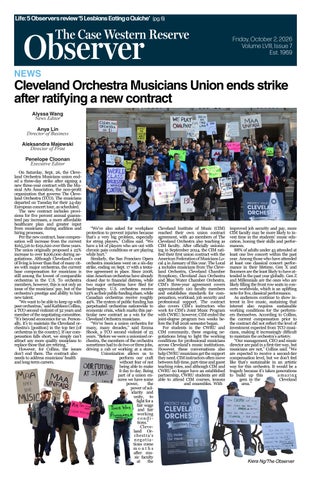
Cleveland Orchestra Musicians Union ends strike after ratifying a new contract Alyssa Wang News Editor Anya Lin Director of Business Aleksandra Majewski Director of Print Penelope Cloonan Executive Editor On Saturday, Sept. 26, the Cleveland Orchestra Musicians union ended a three-day strike after signing a new three-year contract with the Musical Arts Association, the non-profit organization that governs The Cleveland Orchestra (TCO). The musicians departed on Tuesday for their 24-day European concert tour, as scheduled. The new contract includes provisions for five percent annual guaranteed pay increases, a more affordable healthcare plan and greater input from musicians during audition and hiring processes. Per the new contract, base compensation will increase from the current $165,516 to $191,620 over three years. The union originally proposed a 25% increase to over $206,000 during negotiations. Although Cleveland’s cost of living is lower than that of many cities with major orchestras, the current base compensation for musicians is still among the lowest of comparable orchestras in the U.S. To orchestra members, however, this is not only an issue of the musicians’ pay, but of the orchestra’s prestige and ability to hire new talent. “We want to be able to keep up with peer orchestras,” said Kathleen Collins, a TCO second violinist of 32 years and member of the negotiating committee. “It’s beyond economics for us. Personally, it’s to maintain the Cleveland orchestra’s [position] in the top tier [of orchestras in the country]. If our compensation falls short, we simply can’t attract any more quality musicians to replace those that are retiring.” However, for Collins, the issues don’t end there. The contract also needs to address musicians’ health and long-term careers.
“We’ve also asked for workplace protection to prevent injuries because that’s a very big problem, especially for string players,” Collins said. “We have a lot of players who are out with chronic pain conditions or are playing while hurt.” Similarly, the San Francisco Opera orchestra musicians went on a six-day strike, ending on Sept. 17 with a tentative agreement in place. Since 2008, nine American orchestras have already closed due to financial distress, while two major orchestras have filed for bankruptcy. U.S. orchestras receive 13% as their public funding share, while Canadian orchestras receive roughly 49%. The system of public funding has perpetuated orchestras nationwide to economic crisis, which marks this particular new contract as a win for the Cleveland Orchestra musicians. “We’ve been a union orchestra for many, many decades,” said Emma Shook, a TCO second violinist of 25 years. “Before we were a unionized orchestra, the members of the orchestra sometimes had to do two or three jobs, driving a cab or working at a store. Unionization allows us to perform our craft without fear of not being able to make it day to day. Being part of a union ensures we have some power, the power of solidarity and unity, to fight for a fair wage and fair working conditions.” Cleveland Orchestra’s negotiations come months after music faculty at the
Cleveland Institute of Music (CIM) reached their own union contract agreement, with 40 members of The Cleveland Orchestra also teaching as CIM faculty. After officially unionizing in September 2024, the CIM ratified their first union contract with the American Federation of Musicians Local 4 in January of this year. The Local 4 includes musicians from The Cleveland Orchestra, Cleveland Chamber Symphony, Cleveland Jazz Orchestra and Blue Water Chamber Orchestra. CIM’s three-year agreement covers approximately 120 faculty members and establishes standards for compensation, workload, job security and professional support. The contract also covers CIM’s instructors who work for CIM’s Joint Music Program with CWRU; however, CIM ended the joint-degree program two weeks before the Fall 2026 semester began. For students in the CWRU and CIM community, these ongoing negotiations bring to light the working conditions for professional musicians across Cleveland’s music institutions. However, these conversations also help CWRU musicians get the support they need. CIM instructors often move between full-time, part-time and guest teaching roles, and although CIM and CWRU no longer have an established partnership, CWRU students are still able to attend CIM courses, lessons and ensembles. With
improved job security and pay, more CIM faculty may be more likely to invest time in the students’ music education, honing their skills and performances. 88% of adults under 45 attended at least one live concert within the past year. Among those who have attended at least one classical concert performance in their lifetime, Gen X and Boomers are the least likely to have attended in the past year globally. Gen Z and Millennials are the ones who are likely filling the front row seats in concerts worldwide, which is an uplifting note for live, classical performance. As audiences continue to show interest in live music, sustaining that interest also requires sustainable working conditions for the performers themselves. According to Collins, the current compensation prior to the contract did not reflect the level of investment expected from TCO musicians, making it increasingly difficult to maintain the orchestra’s artistry. “Our management, CEO and music director are paid in a first-tier way, but musicians are not,” Collins said. “We are expected to receive a second-tier compensation level, but we don’t feel like that’s sustainable in an artistic way for this orchestra. It would be a tragedy because it’s taken generations to build up this amazing gem in the Cleveland area.”
Kiera Ng/The Observer
News
The Case Western Reserve Observer Friday, October 2 observer.case.edu Volume LVIII, Issue 7
Federal judge freezes Trump administration’s international student visa rule Alyssa Wang
News Editor
A federal judge has temporarily blocked a Trump administration rule that would have limited international students to four years in the United States, halting the policy one day before it was set to take effect. U.S. District Judge F. Dennis Saylor IV of the District of Massachusetts issued the ruling Sept. 14 after a coalition of higher education organizations and labor groups challenged the Department of Homeland Security’s (DHS) new visa restrictions. For now, the decision maintains the previous system that generally allows international students to remain in the U.S. for the duration of their university programs. Under the rule, which DHS finalized in July, students and exchange visitors holding F-1 and J-1 visas generally would have been limited to four years in the country. Students whose programs lasted longer would have needed to apply for an extension. The rule also would have limited foreign journalists holding I-visas to only 240 days in the U.S. The rule would have replaced the
Courtsey of Gage Skidmore via. Flickr long-established policy known as “Duration of Status,” which allows international students to remain in the country as long as they maintain their academic status and continue making progress in their studies. This system has been in place for decades. According to Saylor, the DHS failed to follow required procedures under the Administrative Procedure Act
and,therefore, the groups challenging the rule had leverage to succeed. He also questioned the department’s justification for imposing the new restrictions, which DHS stated were intended to combat visa fraud and protect national security. Saylor wrote that the rule could cause significant disruptions to colleges and universities, particularly be-
cause many graduate and doctoral programs take longer than four years to complete. He warned that the changes could lead to enrollment declines and substantial financial losses for higher education institutions. Institutions such as Harvard University and Massachusetts Institute of Technology have large international student populations, especially among graduate students, according to Saylor. Higher education organizations that challenged the rule welcomed the change in decision. Miriam Feldblum, executive director of the Presidents’ Alliance on Higher Education and Immigration, said the ruling preserves the existing system while the legal challenge continues. On the other hand, DHS officials criticized the reversal. James Percival, DHS general counsel, argued that the ruling prevents immigration officials from addressing what the administration considers abuse of the student visa system. The preliminary ruling does not permanently eliminate the four-year limit policy. Saylor postponed the rule’s effective date while the lawsuit proceeds which leaves the door open for the administration to appeal the decision.
Updates to University Hospital’s proposed demolition plan for historic Little Italy homes Aditi Darodkar
Video Editor Assistant Historic homes along Cleveland’s East 115th Street may soon be demolished. The 12 homes, owned by University Hospitals Main Campus (UH), are at the center of a debate over the extent of which UH values redevelopment versus preservation. In July, the Ohio Department of Development awarded the Cuyahoga County Land Bank a $230,000 grant for the demolition work involving the properties. Now, UH is asking the City Planning Commission to support this project. The City Planning Commission is an advisory committee working alongside the Cleveland Landmarks Commission, whose approval will ultimately determine whether UH can move forward with the project or not.
The same 12 homes have been threatened by demolition multiple times in the past few decades. For a long time, almost no maintenance has been done on the homes nor have they been rented out to tenants. In UH’s presentation to the City of Cleveland’s Central East Design Review Committee, officials claimed that their demolition efforts were “in the business of patient care, not housing.” Although UH proposed building a Healthcare Center of Excellence at the site in 2005, UH has not confirmed the major purpose of this specific expansion. However, in the near future, UH hopes that demolishing the houses will make room for two interim, expanded parking lots and a green area for patients. In an email statement released to The Observer, UH stated that they will “work with [their] partners to salvage
and repurpose parts of the homes that UH has owned for decades and are seeking permission to raze the structures thereafter.” UH continued that they are “still working to determine the best long-term use for the property, but it will ultimately be based on the clinical needs of [their] patients.” While UH has owned the properties for years, city records indicate that maintenance and utility connections have been shut off for the past 25 years. On Sept. 3, Cleveland Restoration Society President Kathleen Crowther argued in a letter to the City of Cleveland “that deterioration should not become a self-fulfilling justification for demolition.” This is not the first demolition project UH has initiated. In 2023, UH demolished “a single-story, 17,000-square-foot trauma training center at 2071 Cornell,” according to
Cleveland Magazine. Currently, it “remains a vacant lot—aside from a collection of shipping containers stored on the site.” Historic preservation advocates argue that improving these homes should take priority rather than expansion. “I always have a challenge to take on a historical preservation project and no one steps up to buy them,” Blaine Griffin, Ward 6 Councilman and City Council President, said. “It gets me frustrated when people pick and choose what houses they’re going to be upset about and try to protect. A house in Buckeye should be just as worth saving as a house in University Circle.” The Observer has not yet heard back after requesting a comment from University Circle Inc., Cuyahoga County Land Bank and councilman Griffin.
Cleveland Clinic and Luminai are speeding up patient care with AI Olivia Wen
Copy Editor Following Luminai’s announcement of their partnership with Cleveland Clinic in April, Cleveland Clinic finally released an official announcement on Sept. 9 announcing the deployment of Luminai to be used in their hospital system. Luminai is an artificial intelligence startup based in San Francisco founded in 2020 by Kesava Kirupa Dinakaran. The company is specifically focused on healthcare optimization. “When I first started working in healthcare, I expected those costs to be spread across hundreds of operational
work streams. They’re not. They’re concentrated in roughly a dozen—a handful of massive work streams eating almost everything,” Dinakaran writes in his founder letter. He believes that AI, namely Luminai, will be the answer to fixing healthcare processes and lowering operational costs. At Cleveland Clinic, the goal is to turn manual administrative labor into a process automated with AI. Its first course of action is to use Luminai’s AI system to identify, understand and transcribe external referrals into the electronic medical record (EMR). As a result, patients can be connected with the care they need more efficiently. Dinakaran also aligns its AI with existing hospital or clinic systems by
integrating their infrastructure and standard operating procedures into the AI system. Since healthcare is unique from person to person, Luminai still relies on human intervention when ambiguity arises. However, the difference is that Luminai routes the full context of the encountered issue to the proper team that is able to resolve the problem. The solutions as a result of human intervention are then looped back into the AI system, continuously developing the intelligence even after implementation. With rising costs and stakes to modernize health systems, “Our collaboration with Luminai allows us to apply AI in ways that meaningfully support our teams by reducing administrative bur-
den and improving patient satisfaction,” said Cleveland Clinic chief digital officer Rohit Chandra. However, this isn’t Cleveland Clinic’s first implementation or collaboration with an AI startup. Previously, they partnered with Ambience Healthcare in Feb. 2025 and Dyania Health in Aug. 2025 are a couple of examples. Ambience Healthcare is an AI documentation software used to document patient visits and generate summaries for patients and caregivers. Dyania Health leans on the research side, focusing on recruiting participants for clinical trials. Cleveland Clinic’s new partnerships demonstrate their interest in advancing and growing alongside AI.
News 3
observer.case.edu
Trump administration withdraws from UN human rights council Maria Burrus
News Editor
On Feb. 4, 2025, President Donald Trump signed an executive order withdrawing the United States from the United Nations Human Rights Council (UNHRC). This becomes the second time the country has withdrawn from the council. The UNHRC is a 47-member intergovernmental institution. Members discuss how to improve human rights around the world and draft resolutions, prompting governments to take action in their respective countries. Every four and a half years, all 47 members, including the U.S., are expected to peer review its human rights records under the Universal Periodic Review, examining the entirety of U.N. member states’ human rights records. However, last year, Trump decided to remove the U.S. from the council. This decision aligns with the Trump administration’s policy of scaling back U.S. involvement in international organizations and agreements that do not align with U.S. national sovereignty.
Trump signed the executive order in Feb. 2025, triggering a 180-day review period. The Secretary of State, Marco Rubio, was tasked with evaluating whether the council aligned with the interests of the U.S. This decision finally culminated this month, when the White House reaffirmed the U.S. decision to leave the council and criticized the council’s jurisdiction over the U.S. The administration solidified that there would be a firm refusal to cooperate with the UNHRC or seek a seat in the future. The UNHRC was created in 2006 during the George W. Bush administration. However, Bush opted out of joining the council amid concerns that human rights offenders would be able to join the council through nomination. In 2009, the Barack Obama administration had a differing opinion and took a seat on the council to highlight the importance of human rights in U.S. policy. Nikki Haley, the former governor of South Carolina, served as the U.N. ambassador for the U.S. from 2017 to 2018. In 2018, while Haley was ambassador, Trump withdrew the U.S. from
the UNHRC for the second time in American history, claiming the council had a bias against Israel. Haley called the institution a “cesspool of political bias.” Mike Pompeo, the Secretary of State at the time, argued that the U.S. could not “remain a part of a hypocritical and self-serving organization that makes a mockery of human rights.” Both argued that the council’s membership of countries such as the Democratic Republic of the Congo and Iran, which they viewed as having abusive human rights records, demonstrated the organization’s failures and justified the U.S. withdrawal. The council has often been criticized by non-government organizations (NGOs) for allowing council members to disregard their own wrongdoings and use the platform to their own global political advantage. The only two countries that have been debarred from the UNHRC are Libya, for their regime’s attacks on unarmed protestors in 2011, and Russia for their unwarranted mass civilian casualties in 2022. Gennady V. Kuzmin, Russia’s U.N. deputy ambassador, claimed their removal was an “attempt by the U.S. to
maintain its dominant position and total control in international relations.” In 2017, in an announcement to the U.N. General Assembly, Trump said, “It is a massive source of embarrassment to the United Nations that some governments with egregious human rights records sit on the U.N. Human Rights Council.” When former president Joe Biden took office in 2021, the U.S. rejoined the UNHRC to renew the country’s international engagement. However, in 2024, the U.S. opted out of renewing their seat for his second term. “I’ve always felt that the U.N. has tremendous potential,” Trump said before signing the order. “It’s not living up to that potential right now. It hasn’t for a long time.” “A lot of these conflicts that we’re working on should be settled, or at least we should have some help in settling them,” Trump said. “But we never seem to get help.” The executive order reads, “some of the UN’s agencies and bodies have drifted from this mission and instead act contrary to the interests of the United States while attacking our allies and propagating anti-Semitism.”
UDC World Expo showcases diversity of CWRU campus Penelope Cloonan
Executive Editor
On Sept. 20, the Undergraduate Diversity Collaborative (UDC) held their fall flagship named Under One Sky: World Expo 2026. World Expo is traditionally UDC’s in-house student activities fair. Every UDC organization is required to attend, gathering over 60 active member clubs in a reunion at Case Western Reserve University for a night of cultural fusion and grass roots advocacy. This year, World Expo featured a performance by Naadam, a UDC organization that performs Indian classical music. Through vocal and instrumental performances, they spotlighted Carnatic and Hindustani traditions, bringing them to CWRU’s doorstep. Carnatic violinist and second-year student Satya Parameswaran commented on her experience performing. “I was very excited leading up to our UDC performance and it was my first time performing for a UDC event. There were a few issues with the mic system, but overall I thought the performance went well and it was a good experience!” Parameswaran said. “I think UDC provides great opportunities to showcase different cultures and Naadam would love to perform at more UDC events in the future!” Another change from last year was the layout of the tabling organizations. The student organizations were randomly spread out across the ballroom, as opposed to being grouped by common themes such as advocacy or culture. President of UDC and fourthyear Amrita Saini commented on the impact of the change. “[The layout] creates space where conversations happen.” Saini said. “So that allowed for organizations to talk to the people right next to them.” Conversations and the intermingling of diverse communities are highlights of UDC’s programming. Having a dedicated activities fair for just their organizations allows CWRU students, first-years especially, to discover a
Every year, the University Diversity Collective (UDC) hosts the flagship event known this year as Under One Sky: World Expo 2026. The event allows every club under the umbrella organization to table and speak to interested students about getting involved. Courtsey of UDC piece of home or new community on campus. Saini elaborated on the need for World Expo and organizations under UDC. “[World Expo] really shows Case students that there are various communities that exist here,” Saini said. “Despite how small our campus can be at times, it welcomes them into whatever group they want to be a part of or any culture they want to explore.” These changes were generally well received by both attendees and member organizations. UDC made a concerted effort to bring more people together in the space. Muslim Student Association (MSA) co-president and third-year Fadia Naqash also commented on the changes to the World Expo event. “I really liked world expo this year in comparison to last year! It felt more structured but was chaotic like many big UDC events tend to be.” Naqash said. “I think being [a part] of UDC has
its pros and cons but I’m grateful for the relative consistency it tries to provide.” Some UDC organizations see World Expo as an opportunity to bring their efforts to a wider audience. Vihaan Majumdar, treasurer of the Case Bangla Association commented on the experience as a tabling organization. “I think the world expo gives a platform to a diverse range of clubs, from big organizations representing countries to the smallest of organizations, such as ours,” Majumdar said. “Because of the world expo, students can understand the wide diversity on campus, which will always have room to grow.” However, the experience was not consistently positive for all the organizations present. Some reported low interest or traffic at their individual tables. For example, co-president of Taiwanese American Student Association (TASA), fourth-year Andrew Ke commented on their turn-out for
World Expo. “I think it was maybe marginally beneficial, but compared to similar tabling opportunities like D360/Worldwide Welcome and Student Activities Fair, there was barely anyone new that came to our table actually interested in joining TASA.” Ke said. Even still, there is perceived value in having UDC as an umbrella organization. Ke further commented on TASA’s relationship to UDC. “We do value being a part of the larger UDC community to an extent because they do offer us a lot of funding for our events,” Ke said. “We also appreciate when they promote our events in their emails. But I think UDC as an [organization] definitely has room for improvement with their organization and communication.” Though it is far from perfect, UDC and its yearly flagship World Expo event remains a staple on CWRU’s campus.
Life
The Case Western Reserve Observer Friday, October 2, 2026 observer.case.edu Volume LVIII, Issue 7
beabadoobee’s ‘Pylon’: homesickness wrapped up in an album Lily Zhang Opinion Editor Filipino and British singer-songwriter beabadoobee’s fourth fulllength album, “Pylon,” released on Sept. 18. The artist remarked that the album was made while she was on tour, exploring feelings of homesickness that result from time away from home. First on the album is “Pylon,” the title track captures the bittersweet feeling of homesickness. The song starts off with soft instrumentals and gradually builds into a grittier, electric guitar track. The singer-songwriter explains that her album name, “Pylon” refers to the physical metal pylon structures that transmit power, which were one of the only constants she experienced in the flurry of touring. The song “Pylon” serves as an earnest introduction to the album, and the buildup towards the end of the song sets the stage for the next few upbeat, rock-adjacent songs. “Sun Has Set,” this album’s first single release, starts strong with a heavy drumline. The singer expresses an angry disappointment against an unknown person through the loud, layered electric guitar. She sings the phrase “the sun has set,” indicative that whatever relationship that was shared has now come to a close. Instead of the airy voice she used in the opening song “Pylon,” beabadoobee now sings with more intensity. Though her next song, “Estranged,” takes on a more upbeat tone. Yet, the content of the song still remains pessimistic. beabadoobee sings about the numbing experience of being in a slump. She sings how she does not “wanna leave [her] home again,” possibly alluding to her conflicted feelings about going on tour. In great contrast to the light-hearted sound of “Estranged,” “Switchblade,” the second single release of the album, takes a much darker, brooding tone. The singer asks open-ended questions to the listener: “Do you start the fight or take the flight?” The song has an almost jarring backtrack, adding to a solemn, pensive tone. The song ends in a joint chorus, with what seems to be children's voices all singing the chorus, only enhancing the off-kilter atmosphere of the song. beabadoobee returns to bittersweet longing in “Write Me A Letter.” She expresses her complex feelings and the difficulty of talking about them; she says that she will write them in a letter instead. This song acts as a brief interlude of self-reflection and shows her effort to improve upon how she feels instead of stewing in her emotions like in “Estranged.” “It’s Alright” has an upbeat rock beat, reminiscent of her past songs such as “Apple Cider” from her album “Loveworm.” She sings to an unknown person, urging them to make her feel better. However, the relationship is complicated, as she seems to view this person less as a substantial relationship and more as a distraction from her problems. She tells this person to
beabadoobee's newest album, "Pylon," puts listeners in their feelings as the singer describes the rollercoaster of emotions she faces while experiencing homesickness. The songs are emblematic of beabadobee's sound, featuring a mix of wistful and intense vocals and electric guitar melodies. Courtesy of Justin Higuchi via. Wikimedia Commons “waste [her] time” and “take the wheel,” implying that this person may be a stand-in for her other issues that lay unresolved. This thread continues in her next track, “In Motion,” a floaty track intersected by an angry chorus that shows her emotional instability. “Memories,” her third single release from the album, is a sweeter track describing an earnest appreciation and love for a person. She recounts details about the person, saying that “she sees [them] in all shades of blue.” The song acts as a break between the more angsty tracks that come before and after it. “Nothing To Prove,” made in collaboration with founder of Paramore Hayley Williams, is the most joyous and carefree track of the album. It details the singer’s
thoughts about letting go of past wrongs and living life happily. “Radio” brings back the harsh electric feel. beabadoobee breaks the fourth wall in this song with the promise that “you’ll listen to this song on the radio.” She sings about a person who has done her wrong in the past, saying that she doesn't need to explicitly address them, as her feelings are all displayed in her music. “Powerlines,” featuring lead vocalist Brendan Yates from the punk band Turnstile, brings back the motif of metal pylons and roadside architecture. The sound is obscure and creeping, almost as if it is nighttime. In comparison, the next track, “Spark,” sounds like dawn, with a gentler tone and a laid back, largely acoustic back-
ing track. The recurring theme of homesickness is brought back in full force in the next track, “Despite That.” In this song, beabadoobee expresses how, after being on the road for so long, all she wants to do is go home and see her special person. The closing track, “Satellite,” returns back to more of a placid, pensive tone. Instead of a pylon being the motif that connects her disparate journey together, it is now the satellite, which reconnects her with her loved ones across the world. “Satellite” serves as a wistful ending streaked with sadness. For those who are missing home, or counting the days down until fall break, take a chance on beabadoobee’s new album “Pylon.”
Life 5
observer.case.edu
Taylor Swift’s glitter pen has not made an ‘Encore’ Riya Kulkarni Life Editor Nearly a year after Taylor Swift’s record-breaking 12th album release, “The Life of a Showgirl,” it was revealed to great surprise that this era has more to show. After many easter eggs, “Patient Zero” was announced as a single, complete with new photos, alternate versions (acoustic and piano) and alternate covers, sparking murmurs across the internet of a potential new album release. The rest of the “Encore” was announced the very next day, with a total of four tracks set to release on Sept. 25. “[We] just wanted to reflect and take in how grateful we were for the moment we were in, but there was a studio there and we did what we do when we feel anything at all: We wrote more songs” said Swift in the Instagram post. Each track tells a different story, each one being uniquely different from each other and the album that preceded them. The first of the new tracks is the single itself, “Patient Zero,” which truly feels like a one-sided conversation—or a warning. Swift attempts to reach out to the new partner of her ex (a relationship left for good reason), to try and protect them from what’s to come. The song starts with the suspicion that this partner may need help, which carries through into the chorus. “If you’re sick of him, I got you,” sings an empathetic Swift, remarking upon the several patterns in this new relationship that just seem to be too familiar. The story of the lyrics carry this track even if it falls short musical-
ly at times. Set to a synth-like tune with a light, jumpy bass reminiscent of “Midnights,” the chorus stands out as the strongest part of the song, while the bridge seems to musically fall apart. The music video to “Patient Zero,” starring Dakota Johnson and Colin Farrel with Taylor Swift premiered at MTV’s Video Music Awards with Swift winning the new artist director trophy. The tone of the video detaches this song further from the glittery showgirl. The scenery is pared back, bleak, cold and gray—a sterile place to fit the theme of a toxic relationship outbreak. The song tells a story, and the music video does not deviate far from it. Swift and Johnson remain mirror images of each other, a pattern that Farrel’s character does not seem to miss. “I thought you were different,” he says to Johnson’s character, to which her reply was “Different from who?” It seems as though some patterns cannot truly be broken. Next is “Cleveland!” which—let me make it really clear—is not as much about the city as it is the person who brought her there. “Cleveland!” is a happy song, a sort of response to hate comments about Swift and her relationship with her husband, Kansas City Chiefs tight end Travis Kelce. “Hate all you like… this is the love of my life,” sings Swift in an attempt to prove to the world that she is unfazed by the media. The track itself is cheery and light. The combination of bells, light percussion and bright piano make it the most like the glittery songs in “The Life of a Showgirl.” While not the most revolutionary song mu-
sically or lyrically, it wonderfully balances happy and sarcastic tones. Swift’s unadulterated joy despite the media is nearly infectious, and it’s hard to not smile when listening in. The song has a bridge reminiscent of the outro from “Daylight” from Swift’s seventh album, “Lover.” “You only need to find one person in this entire world who doesn't find you completely insufferable,” concludes Swift, “I found mine.” It is this happy declaration that cues into the end of the song. The third “Encore” track is “Pink Clouding,” a song that after three listens makes you realize that the lyrics are not nearly as cheerful as the upbeat, ethereal melody may indicate. The song begins with several pink synonyms, the construction of rose colored glasses that allowed the couple to avoid very clear red flags. “Neither of us knew at the time that I was a liar,” reflects Swift, “I still wonder how to tell you sorry.” This dissonance makes the song really interesting, though it’s hard to feel those themes of regret or guilt through the upbeat melody. The connection to “The Life of a Showgirl” is marginal at best, and these themes are not new, yet the track in itself is musically strong. “Encore” concludes with “Babylon,” a song I am convinced is straight from the album “evermore” from the light guitar and the exposed vocals. It’s an austere song that chastises the idea of moving forward too fast with no appreciation for the present. Swift comments upon the “twenty watches in the safe ‘cause your time is money,” describing this emotionless climb to
the top. Home life is just too mundane, with “[no] elbows on the table and the neighbor’s lawn,” Swift describes this need to move forward as detrimental to the people left behind, a feeling that only ends with regret for never giving these people enough attention. These memories are described as a song, and “that melody is all you want,” when it is gone. It is with this moment of regret and recollection that “Encore” ends. To frame these songs as an “Encore” is perhaps the main complaint I seem to have with these four songs. “Cleveland!” is the closest to the style of the “The Life of a Showgirl” era, but the rest of the songs seem to be rather disconnected. To further increase this disconnect, the entirety of “Patient Zero”—especially in the music video—seems to completely be in dissonance, with a clear lack of glitter that was present in the “The Fate of Ophelia” and “Opalite” music videos. This passion project isn’t really a continuation of a previous era, and it doesn’t need to be. Forcing the era into these songs almost reads as a marketing play over a genuine gift to the fans, and it doesn’t help that the pre-sale for “Patient Zero” began before the rest of “Encore” was even announced. Though they needed some time to get used to, the new “Encore” tracks are not a hard listen, but it’s safe to say that these four songs are unique, and not necessarily from any other era. At the very least, “Encore” serves as a moment to appreciate “The Life of a Showgirl” for the phenomenon that it was, every track telling a different story.
Singer-songwriter Taylor Swift released "The Life of a Showgirl: The Encore,” including four additional tracks from the album "The Life of a Showgirl." The new tracks address more somber themes than the original album, missing the glitter and feathers from last year's release. Courtesy of Jana Beamer via. Flickr
6
Life
Friday, October 2, 2026
5 Observers review ‘5 Lesbians Eating a Quiche’ Riya Kulkarni Life Editor
Major spoilers for “5 Lesbians Eating a Quiche.” From Sept. 25-27, Players’ Theater Group (PTG) staged the unpredictable and beautifully absurd “5 Lesbians Eating a Quiche,” their first full-length play of the year. Therefore, five Observers, driven by curiosity, were also in attendance. It’s the year 1956, and the Susan B. Anthony Society for the Sisters of Gertrude Stein have gathered for their tradition of the Annual Quiche Breakfast. This is a sacred occasion that everyone in the Society looks forward to, and it would be insane should any sister not bring a quiche to the event (Marjorie’s days are numbered). What was supposed to be a happy day went sideways when the air raid sirens crashed the party, signaling the end of the world. The missile-proof headquarters proves to be a safe haven from the attack, thanks to the work of Events Chairwoman Vern (Maya Zimmer), but now the sisterhood remains isolated from the rest of the world. So brings the introspective revelations and the question of survival—and whether the group has enough eggs to last the four long years they will be locked away. After all, “the egg is as close to Jesus than any food can get,” according to Lulie (Shriya Myneni). Riya Kulkarni, Life Editor: 4.75/5 “5 Lesbians Eating a Quiche” is exactly as zany as the title indicates. It takes a unique cast of characters to whole-heartedly commit to the egg nearly as strongly as they swear off men and meat. Each one commits to the values of the sisterhood in her own, uniquely crazy way. Lulie refuses to waste her own eggs so she chooses to get pregnant, Ginny (AJ Williams) completely dissociates into a euphoric state when left alone with a quiche, Vern commits to the role of Events Chairwoman very seriously and remains protective over the sisterhood, Wren (Johanna Perry) is the glue that holds the sisterhood together and Dale (Tanya Clemens) refused to speak to a man after an incident at the beach when she was three years old. This last story was told through a well-delivered monologue by Clemens, who brought to life Dale’s family with facial expressions and voice changes to sell the part. Clemens was isolated from the rest of the cast with a bright spotlight overhead, and her delivery was both comedic and somewhat sad. It was hard to stop laughing from the sheer absurdity of the story in the first place (a bad experience at the lake after learning that women could not swim) to actually process how sad it was that Dale had dealt with so much loss at such a young age. This concrete establishment of characters was aided by the prevalent audience interactions that made this show so unique. At the very beginning, four of the sisters leave the stage to talk to the audience in character. Later, audience members were called by their name tags provided at the beginning of the show to participate in a group declaration that everyone was truly a lesbian. This immersive experience drew people in, and time passed with the audience none the wiser.
Anya Lin Director of Business
Neelanjana Komanduri Photo Editor
Kiera Ng Director of Design
Penelope Cloonan Executive Editor
Neelanjana Komanduri, Photo Editor: 5/5 Players’ Theatre Group’s rendition of “5 Lesbians Eating a Quiche” was a hilarious, eccentric and clever show that never stopped making me laugh. They delivered clever innuendos through drawn out metaphors for various mature themes. I was compelled by their ability to immerse us within this simultaneously serious and unserious show about quiche (the most glaring innuendo of them all) through stellar acting and audience engagement. They practically made us part of their society after encouraging the entire audience to proclaim that we’re lesbians. I’m genuinely impressed by the actors’ ability to hold it together while delivering all of these priceless lines, such as when they claimed that their society was against both men and meat. It was impossible to predict their next move. I could’ve never guessed that one of the members would suffer a bloody death to radiation, or that another would be pregnant with a boy destined to repopulate America. What started as a group of old-timey women eating quiche ended as a society of lesbians making statements with double meanings so overtly sexual that the audience couldn’t stop laughing. For instance, they kept talking about how they were averse to putting sausages in their quiches. As a vegetarian, I wouldn’t like that very much either, but it’s pretty obvious that vegetarianism wasn’t the goal here. The jokes went beyond the script. The actors were masterful at sneaking in facial expressions in scenes—such as when they were fighting over the quiche—that made the dialogue that much more ridiculous. I wish I had the sly comedic ingenuity of whoever wrote this show. By the latter half of the show, everything they said made me laugh, go wide-eyed with astonishment, or both. Plot twist after plot twist, innuendos were no longer just innuendos and chaos broke loose for good. Suffice to say, this was the first play I saw at CWRU and if every show makes me laugh as much as this one did, I might be spending a lot more time in the theaters.
the cake,” said Howard. Eventually, in the two weeks of full rehearsal, the cast (mostly Williams) ended up consuming around 10 cakes. Apparently, the cast found it delicious, and Myneni was always vying for another forkful. “I was always just like a few more bites, a few more bites,” she said. “It's not acting; it's fully real.” This dedication to the production, even to details as minute as the texture of the prop, was palpable from my seat and gave this show the vitality it needed to shine.
Anya Lin, Director of Business: 5/5 Watching “5 Lesbians Eating a Quiche” was an immersive, almost psychedelic experience where each scene was more peculiar than the one before it. Even Co-Directors Ada June Howard and Aliaksandra Turchak found it almost too ridiculous to attempt before warming up to its empowering themes. “We read it several times and realized it was not just about this like craziness and silliness, and it was actually like the play’s conveying some really important messages…that women can live in a world without men just fine,” they noted. More than just its chaos and feminist messaging, what made me love the show even more are the behind-thescenes details. To my surprise, the “quiche” eaten onstage for each of the three shows was not a quiche, but a homemade vanilla cake recipe that took time to perfect. “AJ [Williams], the actor who played Ginny, experimented for weeks on end trying to figure out the best texture for
Kiera Ng, Director of Design: 4.78/5 Never have I ever considered that I would be sitting in a room watching a show called “5 Lesbians Eating a Quiche,” and yet I couldn’t recommend a better way to spend a Friday night. Not only is it a comedic, immersive experience, it also sheds light on widespread gender inequality in the mid 20th century. Full of satire and layers of symbolism, the show left the audience pondering the true meaning of eggs, posing and sisterhood on the walk home. By addressing the crowd as though we were a part of “The Susan B Anthony Society for the Sisters of Gertrude Stein,” and later having us all come out as lesbian loud and proud. These elements of the show kept the audience engaged and entertained, unsure if they would be the next one to be called out for not bringing a quiche (sorry not sorry, Marjorie). Set in a bomb shelter of a quiche-loving community, the show highlights the never-ending list of expectations society places on women. One such expectation is a woman’s need for a man to solve her problems. Through planning, teamwork and honesty, the sisterhood had already planned out a way to survive the next four years and repopulate the world, without needing a man to lead the way. While their methods for surviving and repopulating were questionable, they were making do with what they had in a bomb shelter and 57 widows—well, lesbians. After the bomb had dropped, you could feel the tone shift and society’s expectations being lifted, bringing hope for an accepting and
freeing world. “5 Lesbians Eating a Quiche” brought to life the meaning of girlhood through satire, crowd interactions, teamwork and their motto: “No Men. No Meat. All Manners.” Penelope Cloonan, Executive Editor: 4.79/5 “5 Lesbians Eating a Quiche” is a lot of things, but boring is not one of them. PTG is no stranger to odd shows. They value treasures such as “Neofuturism,”30 student-written and performed plays in 60 minutes, and the Starkid Productions musical “The Trail to Oregon,” a musical parody of the videogame, “The Oregon Trail,” performed just last spring. The heart of student theater is bizarre yet, somehow, “5 Lesbians Eating a Quiche” feels like a natural evolution. All five lesbians (plus the 57 in the audience) were present, accounted for and deeply funny, but Vern certainly stole the show. Donning capris and a can-do attitude, Vern was probably the most traditional lesbian on stage. From her first few moments on stage, every other word out of her mouth was an innuendo while the rest of them were an ego trip. Vern’s dialogue walks a narrow line between being hilarious and uncomfortable, but through sheer force of Zimmer’s acting talent, it works. I would trust no one else to turn my meeting room into a Cold War-era bunker. “5 Lesbians Eating a Quiche” is camp, while still being sincere. There is real love between those women, and not all of it is comedically erotic. When Lulie announces her pregnancy, the group gets over themselves despite the previous animosity from the group and launches into problem solving mode quickly. Dale is willing to risk her life to bring her sisterhood quiche and you can feel the emotional weight of her sacrifice over her irradiated explosive death. Being a part of that audience and being welcomed into the loving lesbian sisterhood was a feeling like no other. While the production was otherwise stellar, I must dock points for Marjorie’s inclusion. Marjorie, you know what you did.
Five members of The Observer attended the Players' Theater Group first full-length play of the year, "5 Lesbians Eating a Quiche." The play discussed themes of gender equality in the mid-twentieth century. Besides quiche, the show served up hilarious jokes, innuedos and bits, earning high praise all around from its reviewers. Courtesy of Nealey Barak
Fun
The Case Western Reserve Observer Friday, October 2, 2026 observer.case.edu Volume LVIII, Issue 7
Anonymous Hungry Observer reviews ‘5 Lesbians Eating a Quiche’ Anonymous
Hungry Observer Anonymous Hungry Observer, 4.5/5 I’ve got to be honest. I was there for the quiche. I assumed that some quiche would be provided to the attendees. After all, after watching a play titled “5 Lesbians Eating a Quiche,” it’s only natural that the audience would get hungry. It’s safe to say that my egg-filled dreams did not come true. Perhaps many of the play attendees saw me with a notebook,
carefully scribbling down notes. Maybe they assumed that I was here for a project or something meaningless like that. I was noting down something much more special—recipes. I needed to know what went into the quiche that had all five widows—lesbians—completely enthralled. I wanted to try the beautiful work of art that merged egg, gruyere, bell pepper, rosemary and even goat cheese, all wrapped in that crust. To my horror, not one quiche was real. My trust was forever gone. Let me begin with the fact that only one quiche was even edible. When Dale, played by Tanya
Strands (something's fishy)
Clemens, made her sacrifice and went to go rescue the quiches, I realized very quickly that none of the quiches brought out were edible. They were fake quiches made from foam, a betrayal to all the real quiches out there, waiting for their moment in the limelight. I still cannot understand how an entire sisterhood would survive off of these synthetic quiches. So much for giving eggs to the future generation. To add on to this, the only quiche that was actually consumed on stage was not even quiche. According to Shriya Myneni, who plays Lulie, “The quiche was cake, like a vanilla type cake
thing. It was not quiche at all. I can't stand egg.” Aside from her controversial takes about eggs, the idea that not one egg would feature in a play about quiche (and no, eggs in cake do not count) is blasphemous. The Susan B. Anthony Society for the Sisters of Gertrude Stein reveres the egg, so much so that to not bring a quiche is a slight against the sisterhood. This needs to carry forward into the quiche that makes the stage. Aside from that major detail, the rest of the play was comedic and enjoyable. At least these characters are serious about their food, almost as serious as I am.
Wordle in one!
The winner of Fat Bear Week has been crowned Riya Kulkarni
Life Editor
It was the Fat Bear Week finale, and only one bear could be crowned the winner. The fight was between adult female 910 and 89 Backpack, children of former Fat Bear Week winners Answers for games will be on the next issue. 409 Beadnose and Holly. Was this face-off a feat of nepotism? Last week's answers The bears did not comment on the application process. In a neck-and-neck battle to the finish, Backpack emerged as the winner with 103,344 votes. 910 was a little over 5,000 votes behind with 98,253 votes. The win came as a surprise to many, even though Backpack gathered many votes year after year. Backpack barely made it through his own semifinals, with a lead of only 4,100 votes. 910, however, had a clear lead of 70,000 votes. Backpack had no need to fight with the other bears. His silence and his strength is more than enough to establish his dominance at Brooks River, making him a fan favorite for his gentle soul. He has very few scars, as he never has the need to pick a fight. He was also very hard to photograph, keeping to himself more often than not. It was this quiet presence that made bear
enthusiasts fall in love, perhaps the thing that propelled him to the winner’s seat. The taste of victory was not new to Backpack. It was one-year-old Backpack’s insistence on clinging to his mother’s back during river swims that inspired his name. Nearly a year later, however, Backpack suffered a mysterious leg injury, leaving the world to wonder whether or not he would survive to future seasons. With love and care from his mother, Backpack healed, gaining the strength to go forth into the world, becoming a regular character at Brooks Falls. His reputation has granted him access to all of the best fishing spots, and he has taken many bears under his wing. Despite the addition of bear families in the running for the fattest spot, none of them made it to the final match. No amount of baby bear cubs were enough to last in this competition. For Backpack, it was slow and steady that he won this race. When asked about what he planned on doing with his newfound fame, Backpack had no comment, in English of course. It is safe to say that he will return to his normal routine, consuming more fish to prepare for next year.
Opinion
The Case Western Reserve Observer Friday, October 2, 2026 observer.case.edu Volume LVIII, Issue 7
EDITORIAL
Personal engagment with politics Editorial Board On Sept. 24, the United Nations headquarters in New York City hosted a general assembly. Among the invited members was the Prime Minister of Israel, Benjamin Netenyahu. Netenyahu has become an incredibly inflammatory political figure; an independent commissioner from the United Nations who found t h a t Israel h a s
la Harris’s 2024 presidential campaign, she was met with outrage. Many thought that the pop star’s access to a large audience obligated her to utilize the audience in some way. Roan previously criticized the Democratic Party’s handling of LGBTQIA+ legislation as well as of the Israel-Palestine conflict. Even though Roan voted for Harris, she wasn’t going to endorse them like other big-name celebrities such as George Clooney and Taylor Swift. Do celebrities have an ob-
give them the best publicity. This is not to discredit the intentions and hearts of the celebrities who have done good, such as all of those who protested at the UN headquarters last Thursday. This is to say that the voices of “everyday” civilians can hold as much weight as that of celebrities. A celebrity is one person at a protest. You can be another. We cannot engage in politics vicariously through celebrities. Instead of urging some arbitrary ce-
lebrity to become more involved in politics, maybe it is time that we take it upon ourselves to become involved. Ohio general elections are coming up soon, and voter registration is still open. The 2028 national presidential elections are also creeping up. Take the time and effort to register, research the candidates and step into politics yourself. The right to an individual vote is valuable and should not be muddled by vague celebrity endorsements.
The Case Western Reserve Observer Established in 1969 by the undergraduate students of Case Western Reserve University
O
r bse
ver
e been /Th n u J respona Tali sible for multiple genocidal acts in Gaza. As a religation sult, many were unhapp y to convince with Netenyahu’s pres- e n c e their millions of fans in New York City. At the time of the of a political view- point? general assembly, hundreds of proRoan’s response, though not retestors, consisting of political orga- ceived well by the general public, nizations, civilians, political figures contains much merit. Celebrity and celebrities, turned up at the UN culture and the political sphere in headquarters. They held signs and the U.S. have become so entangled donned shirts reading “Fund peo- that it is hard to discern where the ple not bombs” and “Let Gaza live.” boundary lies, if there should be Amongst the many protesters were any at all. Although celebrities and political figures such as Brad Land- influencers may have substantial er, a Democratic Party nominee fanbases, they are not obligated to for New York’s 10th congressional enter the political discourse online. district, and celebrated actors and Ultimately, it is not their job to, for artists such as Cynthia Nixon and example, influence the outcome of Tony Kushner. Following the pro- an election. Of course, this does not test, hundreds of protestors were mean that those with larger platarrested, including the democratic forms cannot engage in political candidate for New York’s 13th con- matters at all. It just means that they gressional district Darializa Avila should have to. There are ways that Chevalier and celebrities such as celebrities can use their platform to Susan Sarondon, Hannah Einbind- promote beneficial causes without er and Caleb Hearon. pigeonholing their audience. A good On social media news sources, example is sing-songwriter and acone might notice an influx of com- tress Olivia Rodrigo’s recent, indements applauding celebrities for pendently-run “Daisy Chain Fields” protesting. Or, one might see news music festival, which featured an headlines centering around the ce- all-woman lineup. All net proceeds lebrities who were arrested. Per- of “Daisy Chain Fields” went to a haps, a substantial amount of the variety of non-profit organizations general public relies on celebrities supporting girls and young women. as political figureheads. A recent Or Dolly Parton, who was known study found that 70% of American for her many philanthropic efforts, voters fail a basic civic literary test, such as her Dollywood Foundation, likely due to a combination of poor- or her donation of $1 million to ly structured civic education and a Vanderbilt University to fund corolack of personal motivation to learn. navirus research. Instead of taking the time to learn Still, it is important to note that about political candidates, individ- celebrities, no matter how peruals may rely on taking directives sonable and moral they seem, are passively from their favorite celeb- people with a public relations team rities. behind them. No matter how reWhen singer-songwriter Chap- latable they may seem to us, many pell Roan refused to endorse Kama- will engage with and do things that
On Sept. 24, Penelope the United Nations ties as political figureheads. A recent Cloonan Executive Editor & Publisher headquarters in New York City study found that 70% of American hosted a general assembly. Among voters fail a basic civic literary test, PRINT the invited members was the Prime likely due to a combination of badAleksandra Majewski of Print Minister of Israel, Benjamin Net- ly Director structured civic education and a Ellie Palaian Director of Print enyahu. Netenyahu has become an lack of personal motivation to learn. incredibly inflammatoryMaria political of taking the time to learn Burrus Instead News Editor figure; an independent Alyssa commisabout political candidates, individuWang News Editor sioner from the United Nations als may be relying on taking direcRiya Kulkarnitives Life Editor found that Israel has been responpassively from their favorite Lily Zhang Opinion Editor sible for multiple genocidal acts in celebrities. Abhishek Sports Gaza. As a result, many were Nambiar unWhenEditor singer-songwriter and perhappy with Netenyahu’sAbby presence Chappell Roan refused to Shazivariformer Copy Editor in New York City. At Kashvi the time of endorse Kamala Harris’s 2024 presMadhwani Copy Editor the general assembly, hundreds of idential campaign, she was met with Wen Copy protestors, consisting of Olivia political an Editor outpouring of outrage. Many Oviya Gowder Copy Editor We’ve all been there, trying to thought organizations, civilians, political that the pop star’s access to Elizabeth Willing study or finish that last assignfigures and celebrities, turned up a Copy largeEditor audience obligated her to utiment all we want to do held is … lize the audience in some way. Roan at the when UN headquarters. They anything Maybe we’re oversigns andelse. donned shirts reading had previously criticized the DemoDESIGN whelmed withnot thebombs” work we “Fund people andhave “Let cratic Party’s Kiera Ng Director of Design to do,live.” or maybe we the feelmany the presGaza Amongst proJana Ashour sures perfectionism and don’t testersofwere political figures such Director of Design Cai Layout Designer want to Lander, start. We push Helen ourselves as Brad a Democratic Party to “lock in,” call it quits too of- Layout Designer nominee forbut New York’s 10th conAditi Ghosh ten, feeling district, guilty each time weKolhe pick Layout Designer gressional and celebrated Reva up our and phones to doomscroll again actors artists such as Cynthia Mansi Swaminathan Layout Designer and Doing anything but Nixonagain. and Tony Kushner. Following Natalie Chang Layout Designer the wehundreds have piled always the work protest, of up protestors Talia Jun Graphic Designer seems to feel better than actually were arrested, including political getting things done, but the sinkcandidates such as the democratic Kristina Guo Graphic Designer ing feeling for in our knowing candidate Newstomach York’s 13th con- Graphic Designer Anna Trusova we’ve wasted time is much worse. gressional district Darializa Avila Can we really thesesuch pauses Chevalier andconsider celebrities as DIGITAL to be “breaks” if we feel worse after MEDIA Susan Sarondon, Hannah EinbindMoses Fleischman Director of Digital Media taking er and them? Caleb Hearon. Stall Video Editor We trap ourselves insources, a cycle On may social media newsMatthew of counterproductivity and double one might notice an influx of com-Video Editor Assitant Aditi Darodkar the timeapplauding it takes to complete a task. ments celebrities for Lydia Park Video Editor Assistant In this “popcorn mindset, we showing up and brain” protesting. Or, one Obafmi Tidjani Web Editor work getthat littlemany done,ofthen stop mightand notice the news GianMarco Miraglia working think about we Web Editor Assistant headlinesand center around thehow celebriPhillip Kornberg Photo Editor could be were working. By the time we ties who arrested, perhaps as resume work, we feel ashamed, a way ofour grabbing the attention of Neelanjana Komanduri Photo Editor not refreshed, andthat, we stay up late readers. It seems particularly Rebekha Repp Social Media Manager in catch up. amount of in attempts the U.S., to a substantial Esha break public is notrelies shameful, notSocial Media Editor theA general on Bagora celebriBen Kang Media Editor when it has the potential to act as Social a tool that makes productivity much more efficient. We just need BUSINESS to know how to use them. Anya Lin Director of Business Operations Just as an athlete wouldn’t do Accounts Manager Divya Kurma 150 consecutive bicep curls while Ad and strength training atRiya theDixit gym, as Partnership Manager Justin Rosentover Ad and Partnership Manager students we must take meaningful breaks in reasonable intervals. One The Observer weekly undergraduate student newspaper of Case popular example isofthe this is the PoWestern Reserve University. Established in 1969, The Observer reports modoro method, where 5 minute newsfollow affecting breaks 25students minutesand of provides work an editorial forum for the university community. Unsigned editorials are typically written by the opinion editor (10 minutes of break to 50 minutes but reflect the majority opinion of the senior editorial staff. Opinion columns are the views of their writers and not necessarily of The Observer staff. For advertising information, contact via e-mail at observer@case.edu. LETTERS TO THE EDITOR should be e-mailed to observer@case.edu or submitted on our website at observer.case.edu. Letters can be mailed to Thwing Center 11111 Euclid Avenue, Suite 01, Cleveland, Ohio 44106. For policy and guidelines related to the submission of Letters to the Editor, refer to observer.case.edu/submit-a-letter. The Observer is a proud member of CWRU’s University Media Board. Follow The Observer on TikTok and Instagram @cwruobserver.
Opinion 9
observer.case.edu
No consumption of Harry Potter, not even secondhand, is ethical
Anna Trusova/The Observer Sophia Byl Contributing Writer The wizarding world of Harry Potter has been a fantasy realm that many have happily indulged in since 1997. The capabilities of a storyline as deep and fleshed-out as J.K. Rowling’s Hogwarts makes it easy to lose yourself in every nook and cranny that Rowling has masterfully detailed in the book series. For decades, while the wider public has unearthed nearly every last secret the books and movie renditions have to offer, there’s also been a large amount of skimming over some of the more uncomfortable subtleties in Harry Potter. Fan theories love to discuss which characters would fall in love if things were slightly different and who would still be alive. However, the subtexts of why certain characters got married to each other, and why certain individuals were killed off while others were spared and celebrated for their heroic deeds—those warrant taking a closer look at.
Some may argue that Harry Potter is a product of its time, and that the types of harmful stereotypes perpetuated by the books were more normalized at the time that Rowling wrote them. What this opinion fails to consider is that the hatred and bigotry towards multiple different minorities manages to seep into every corner of the wizarding world, and the person authoring those words is an outspoken transphobic, homophobic and all-around bigot. By this point in time, it is a well established fact that Rowling donates big bucks to antiLGBTQIA+ organizations such as For Women Scotland, an organization that has been lobbying for governments to adjust gender-based language in various laws. Rowling even founded her own anti-trans foundation bent on delivering sex-based rights only to women assigned female at birth. These biases, among others, manifest aggressively in the Harry Potter series. Take racist names like Cho Chang and Kingsley Shacklebolt and the portrayal of goblin bankers as rudimentary anti-Semitic
stereotypes. Or, consider Rowling explicitly confirming on social media that lycanthropy is a metaphor for HIV and furthering common homophobic stereotypes by depicting werewolves as feminine men who mainly attack children. Over the past five years or so, as Rowling’s bigotry has manifested more publicly than ever, many former Harry Potter fans have made an active effort to take a step back. Refusal to fund any of Rowling’s projects—the books, the movies, the video games—is a helpful advancement. However, projects that put their own spin on the wizarding world, such as fanfiction and secondhand consumption of Harry Potter media (from libraries or used book sales) is still accepted as ethical by many who disagree with Rowling’s opinions. While it’s true that borrowing Harry Potter and the Deathly Hallows from your local library or writing fanfiction about Harry Potter and Draco Malfoy dating is nowhere near as morally questionable as donating to The J.K. Rowl-
ing Women’s Fund, there is more effort that can be made in terms of triumphing Rowling’s hate. By continuing to consume Harry Potter, or Potter-adjacent content, we submit (or at least passively accept) the bigoted stereotypes that serve as the foundation for this fantasy realm. Hatred is inextricably woven into the fabric of Harry Potter’s world, and there is little that can be done to separate the enjoyable plot points from the explicit biases they are tied to. Interacting with Rowling’s fictional world, even without throwing her money, means continuing her harmful legacy in society as a whole. Consuming Harry Potter content in an era with thousands of other fantastical worlds to give our attention to is a conscious choice, one that can be changed with as little as a simple thought and a small amount of effort to keep searching for better work to support. If we want to truly condemn Rowling and the misdeeds she has committed against minorities everywhere, the best we can do is to simply let her art go.
A diamond is forever but so is the bloodshed votion. The slogan worked so well that few buyers thought to ask where the stone had been before it reached the jeweler’s case—a question the diaIn 1947, the De Beers Group, a Brit- mond industry has never been eager to ish diamond company, handed the answer. world four words: “A diamond is forConsider what a diamond actually ever.” With these words, they pulled is. Lab-grown and natural diamonds off the impressive trick of persuad- are built from the same carbon atoms ing generations of lov- in the same crystal structure, making ers that a big, s h i n y them “chemically, physically, and oprock was the m o s t tically identical.” Even seasoned gemrespectable ologists need specialized equipment to proof of spot the difference. Nothing the eye or dehand can detect separates the two, so the real difference lies in the journey each takes to reach the display cases. The lab-grown journey is the simpler one. These stones are grown in controlled laboratories rather than dug from the earth, and their production generally leaves a lighter carbon footprint. A lab-grown stone has no chain of custody running through a war zone, and grading labs such as the Geminological Institute of America (GIA) and International Gemological Institute (IGI) note on each report that the diamond was made in a laboratory. For mined diamonds, the journey can be brutal. A common type of natural diamonds, called conflict diamonds, come out of war zones and bankroll armed groups. T h e y Kristina Guo/The Observer
Angelina Vincent Contributing Writer
frequently rely on forced labor, often that of children. Militias have kept control of mining regions through brutality, pressuring civilians to work under threat of death, and laborers in affected areas still endure dangerous conditions with little to no pay and non-existent labor rights to protect them. The damage extends to the land as well. Mining can strip forests, erode soil and poison water supplies with toxic chemicals, while abandoned pits can become breeding grounds for disease or sites of drowning. Buyers who recoil at this history are reassured that an international system exists to keep such stones out of the market. That system is the Kimberley Process, established in 2003 to certify rough diamonds as conflict-free, but its definition is narrow and its enforcement is riddled with loopholes. Since a diamond is certified by the country that last exported it, a stone smuggled out of one nation can be certified as ethical by another. For example, in 2008, Zimbabwe’s army took over the Marange diamond field and killed more than 200 people, including miners and residents. Yet, the country’s gems still count as conflict-free under the KP’s definition. Russia, whose stateowned Alrosa company faces U.S. sanctions for helping fund the invasion of Ukraine, remains a KP participant. A label that survives both a massacre and a war of aggression is a marketing convenience, not a moral guarantee. That certainty is exactly what mined stones cannot offer. Fairness requires
acknowledging that not every mined diamond is a blood diamond. Côte D’Ivoire, which was torn apart by a diamond-funded civil war, now directs its diamonds toward peaceful economic development. But that is precisely the difficulty for a conscientious shopper, because when certification can be evaded and origins obscured, no one can be certain which kind of stone rests on the finger. The moral burden lands on the buyer, who is asked to trust a system with documented gaps. Defenders of natural stones point to rarity and ancient origins, and the appeal is easy to understand: a gem that took billions of years to form underground feels like a gift from nature rather than a product, and thus some buyers place symbolic weight on it. I would not dismiss that feeling, but diamond rarity differs greatly from what marketing suggests. De Beers spent much of the last century controlling how many diamonds reached the market to manipulate supply and demand. Scarcity was always manufactured, and it is a strange virtue to prize a stone because fewer people can own it, especially when others paid for it with their safety and their land. “A diamond is forever” was a brilliant line, but the sentiment makes a poor substitute for a clear conscience. When an identical stone exists without the bloodshed, the scarred landscapes or the lingering doubt about its origins, choosing the mined one is no longer tradition but a decision. An ethical buyer should make the right one.
Sports Weekly Scores
CWRU volleyball takes on UAA Round Robin in first weekend of conference play
Football vs Washington and Jefferson (9/26) L 7-35
Men’s Soccer at Trine (9/26)
The Case Western Reserve Observer Friday, October 2, 2026 observer.case.edu Volume LVIII, Issue 7
W 2-0
Women’s Soccer at Denison (9/26)
L 2-3
vs Heidelberg (9/29)
W 1-0
Men’sTennis Everybody vs. Cancer Invitational (9/25-9/27) No team scoring Oberlin Invitational (9/26-27) No team scoring
Women’sTennis ITA Fall Regional Championship (9/25-27) No team scoring
Volleyball 2026 UAA Round Robin #1 vs Carnegie Mellon (9/26)
L 3-0
vs Chicago (9/26)
L 3-0
at Rochester (9/27)
W 3-0
Abhishek Nambiar Sports Editor Over this past weekend, the Case Western Reserve University volleyball team opened conference play with a trip to Rochester, New York for the first University Athletic Association (UAA) Round Robin of the season. The Spartans lost to Carnegie Mellon University (CMU) and the University of Chicago (UChicago) on Saturday, Sept. 26 before closing the weekend with a sweep of host University of Rochester on Sunday, Sept. 27. Reflecting on the weekend, third-year setter Avery Basinger applauded the persistence of her teammates even through the setbacks against CMU and UChicago. “I think our team had a great mindset all weekend, even when we were down sets against UChicago and CMU,” Basinger said. “We kept fighting no matter the score, which kept our energy high and the sets close.” To kick off the Round Robin run, the Spartans faced then-No. 8 ranked CMU. The match began relatively close, with both teams going neck-and-neck and CWRU eventually working its way to a 1413 lead. However, a 7-1 run from the Tartans allowed them to pull away with the lead and take the set 25-19. The second set followed a similar pattern; after falling behind 11-7, CWRU responded with five straight points, including two aces from Basinger, to take a 12-11 lead. The Spartans remained within one point at 19-18, but CMU closed the set on a 6-2 run to win 25-20. The third set was tightly contested, featuring eight ties through the first 22 points. CWRU remained within three points at 19-16 before another CMU run put the Tartans in position to close out the match. CMU eventually took the set, 2518, completing the 3-0 sweep of the Spartans. Later on Saturday, CWRU faced then-No. 24 ranked UChicago. The Maroons took control of the contest early, turning an 8-7 lead in the first set into a 16-8 advantage
Battling through a tough opening at the UAA Round Robin tournament in Rochester, NY, Case Western Reserve Univeristy’s volleyball team showed grit against their strong competition. However the Spartans bounced back on Sunday, sweeping hosts Rochester 3-0. The Spartans will now head to Granville Township, OH on Oct. 3 for a Saturday doubleheader against Ohio Wesleyan and Denison. Courtesy of Tim Phillis / CWRU Athletics before going on to take the opening set 25-12. The Spartans were quick to respond in the second set, fighting their way to a 9-6 lead after trailing 6-5. CWRU maintained the pressure and held a 15-14 advantage before UChicago regained control, finishing the set with nine of the final 11 points to win 25-19. The Spartans did not let down, however, continuing to put up a fight in the third set as the two teams battled through 10 ties; CWRU eventually took a 21-19 lead. UChicago answered with three straight points, but first-year outside hitter Maya Zarow tied the set at 22 with a kill. The Maroons then scored the final three points to take the set 2522 and complete the sweep. On Sunday, the Spartans returned to the court in Rochester ready to bounce back from their prior struggles, and they did just that as they swept the hosts 3-0. CWRU came out strong in the opening set, winning nine consecutive points on the serve of first-year Ava Felgar to build an 11-2 lead. Rochester battled back and cut the deficit to one at 19-18, but the Spartans responded by winning the final four points to take the set, 25-19.
The second set was another close contest, with neither team leading by more than two points until an attacking error by the Yellowjackets gave CWRU a 15-12 advantage. The Yellowjackets tied the score at 15, but the Spartans answered with a 4-1 run that enabled them to hold on to their lead, culminating in a 2521 victory. This momentum carried into the third set, as the Spartans used a 7-1 run to take a 19-12 advantage. Rochester again attempted to rally, but CWRU maintained control and closed out the set, 2519, completing the 3-0 sweep. Commenting on the win against Rochester, CWRU’s first UAA win of the season, Basinger highlighted areas of improvement for the team. “We need to focus on staying consistent from the first point to the last and cutting down on unforced errors,” she said. “If we keep the same fight we showed this weekend and clean up our execution, we can compete with anyone in the conference.” Next up for the Spartans is a duo of matches in Granville, Ohio on Saturday, Oct. 3. The first against Ohio Wesleyan at 2 p.m., and the second against Denison University at 4 p.m.
Star players and shocking upsets: what to expect from the 2026 WNBA playoffs Ivan Shen Contributing Writer On Sunday, Sept. 27, the playoffs for the Women’s National Basketball Association (WNBA) kicked off, pitting eight teams head-to-head in a series of games to decide the winner of the 2026 season. With many of the season award-winning players in the playoffs, these eight teams have a lot to offer. The No. 1 seed Minnesota Lynx is led by the unanimous Rookie of the Year Olivia Miles and Coach of
the Year Cheryl Reeve. Miles leads the team with 19.8 points and six assists a game, and surrounding her are quick guards, such as Kayla McBride, to share the ball and play in their pick-and-roll scheme, snaking through defense to get mid range shots. The No. 8 New York Liberty is the leading team in defensive rebounds and have strong forwards, including Breanna Stewart and Jonquel Jones, to match up against the more powerful opponents. Stewart, a two-time league MVP, dropped 34 points with two steals and blocks on the Lynx in
Game 1 of the series between Minnesota and New York; this was two points off the franchise record, while the rest of the team generated good shot attempts with intricate playcalls and ball movement. The Liberty’s strengths were on full display as they eliminated the Lynx in Game 2 on Sept. 29, the first time a No. 1 seed was eliminated by a No. 8 seed in WNBA playoffs history.
Continued on page 11
Sports 11
observer.case.edu
Upcoming from page 10 Star players and shocking upsets Games
Reigning champions, No. 3 Las Vegas Aces, play a fast-paced offense designed to allow drives to the basket. The 3-time Associated Press WNBA Player of the Year A’ja Wilson leads the Aces with 26.2 points and 9.4 rebounds, commanding the attention of the defense. This helps create great opportunities for her teammates to score as they fight for their fourth championship in five years. Star point guard Caitlin Clark and the No. 6 Indiana Fever are the leading team in field goal percentage, generating the most points per game. However, with their star player Aliyah Boston coming off of a flare-up in the right leg in the last game of the regular season, the Fever are looking for some help from their other players while Boston continues to heal from her injury. The No. 2 Golden State Valkyries are the definition of an all-around team, and they are my personal pick for the team that wins it all. Like their men’s counterpart, the Golden State Warriors, the name of the game is the 3-point shot. The Valkyries currently lead the league in 3-point shots attempted and made. However, unlike their counterparts, the Valkyries turn the ball over the least due to their deep rotation of guards that can handle the ball. The No. 7 Dallas Wings have a deadly guard duo, with 2025 Rookie of the Year Paige Bueckers and Arike Ogunbowale to couple up with Jessica Shepard, who was recently named the 2026 Most Improved Player of the Year. They attempt the most field goals of any team by run-
Cross Country Paul Short Run
Football at Westminster
“It never gets old, does it? Cleveland, you will have another October to remember!” The voice of longtime Cleveland radio broadcaster Tom Hamilton rang out across radios throughout Northeast Ohio following the Cleveland Guardians’1-0 victory over the Boston Red Sox at Fenway Park. The win clinched Cleveland’s eighth playoff appearance in 11 seasons and their third straight year of October baseball. A total of seven runs were scored in the series, starting with five on Tuesday (a 3-2 Guardians win) and then back to back 1-0 shutouts on Wednesday and Thursday for the Red Sox and the Guardians respectively. Left fielder Angel Martinez provided Cleveland’s single run Wednesday, a line shot off of Red Sox starting pitcher Ranger Suarez and only the tenth home run given up by Suarez on the year. Martinez has had an exceptional month of September, batting .254 with an on-base plus slugging of 0.756. Meanwhile, Cleveland pitching shut out the Red Sox, holding them to just two hits on the night. Martinez is just one of many success stories of young players this season for Cleveland. Right fielder Chase DeLauter has also had a terrific rookie campaign. Starting off with four home runs in three games during the season opener in Seattle back in March, DeLauter’s .287 batting average ranks fifth in the American League (AL). Of the three all-stars Cleveland sent to the Philadelphia Phillies in July, two were rookies:
10/3
Men’s Soccer at Rochester
Courtesy of John McClellan via Wikimedia Commons ning plays to get shots in the middle of the paint, which is usually set up with a screen by Shepard. The No. 5 Washington Mystics are a different story. Instead of the modern 3-point hunting that most teams seek, the Mystics boast strong players that play gritty defense and get to the rim and the free throw line. Behind their center Shakira Austin’s 17 points and 9.5 rebounds a game, they attempt the most free throws and secure the second most rebounds per game. They also have the highest shot frequency under the basket, an anecdote of their playstyle. Last but not least, the No. 4 Atlanta Dream show off a unique identity. On defense, they create chaos on the perimeter, leading the league in steals and finishing the posses-
sion by securing rebounds and loose balls. The 2026 Defensive Player of the Year Angel Reese, who was traded this year to the Dream, bolsters both ends of the court, averaging 16.4 points, 12.1 rebounds and adding 1.8 steals to the mix. With the goal of winning the championship, teams will have to navigate injuries, off nights from star players and unexpected challenges, giving all eight teams an opportunity to clinch the title. While much of the postseason may have already unfolded by the time this issue goes to print, the remaining games will showcase the adjustments coaches make to counter their opponents. That constant back-and-forth between strategy and execution could ultimately shape who emerges as champion.
Guardians clinch third straight playoff appearance Charles Klineman Contributing Writer
10/2
second baseman Travis Bazzana and starting pitcher Parker Messick. Messick has been exceptional this season. Continuing a long-running tradition of elite Cleveland pitching, Messick’s 2.56 earned run average is third in the AL. During the Thursday game in Boston, pitcher Joey Cantillo pitched five strong innings, giving him 15 scoreless innings in his last three starts. Notably, this occurred after Cantillo, who began the year as a starting pitcher, and then was moved to pitch his games out of the bullpen. If Cantillo can continue to have strong appearances out of the bullpen, he could serve as an excellent pitcher come the playoffs. Cleveland’s pitching staff has continued to be terrific all year, and much of that comes down to its tendency to keep its pitchers healthy. Cleveland has used six pitching starters this year with the only major change to the rotation occurring when Foster Griffin was acquired at the trade deadline from the Washington Nationals, moving Slade Cecconi to the bullpen. This makes Daniel Espino, who started in place of Cantillo, became one of the pitchers to make a start for Cleveland this season, while the team’s core rotation has remained among the most stable in baseball. The Guardians followed up the series win over the Red Sox by traveling to Kansas City to play against the Royals, the final series of the regular season. Friday’s game would be messy, as the Guardians and Royals were tied at seven runs apiece before Cleveland scored five runs in the top of the ninth inning on one hit, a double by Mar-
tinez. An 11-5 win over the Royals on Saturday, combined with a loss dealt to the Chicago White Sox by the Colorado Rockies clinched the division for Cleveland. The two games in Kansas City highlighted the strength of Cleveland’s bullpen, as the Royals’ bullpen imploded both Friday and Saturday night. Cleveland’s bullpen, in contrast, has been lights out all year long. Pitchers Hunter Gaddis and Erik Sabrowski provide strong high leverage options, while closer Cade Smith is tied for first in the major leagues with 41 saves. In order to succeed in the American League Division Series (ALDS), Cleveland will either have to contend with the Houston Astros or the Chicago White Sox. The White Sox have been Cleveland’s biggest rivals all year, and the Astros, despite being from the scuffling American League West, are not trivial opponents. In order to win the ALDS, Cleveland will have to rely on its starting pitching and its bullpen to keep their opponents contained to a couple of runs while its young players drive the offensive train. In addition, Cleveland will have home-field advantage, and they’ve played October baseball three years in a row. Veterans left fielder Steven Kwan, catcher Austin Hedges and third baseman Jose Ramirez have been here before, and if they can swing the bat well, Cleveland may well be able to challenge the American League East for the chance to play in the World Series. If Cleveland can keep the games within striking distance and take down their opponents, Guards Ball might just end up in the Fall Classic.
10/3
Women’s Soccer at Rochester
10/3
Men’s Tennis ITA Fall Central Region Championship 10/2-10/4 at Wayne State University
10/2
Blue & Gold Invite
10/3
Women’s Tennis CMU Invite #2
10/3
Volleyball Denison Tri-Match vs Ohio Wesleyan
10/3
at Denison
10/3
12 Advertisement
Friday, October 2, 2026