News: RTA receives 20 million dollar grant to become more accessible (pg. 2)
The Case Western Reserve
Observer
Friday, September 18, 2026 Volume LVIII, Issue 5 Est. 1969
SPORTS
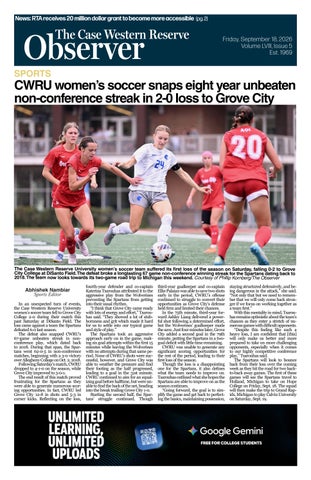
CWRU women’s soccer snaps eight year unbeaten non-conference streak in 2-0 loss to Grove City
The Case Western Reserve University women’s soccer team suffered its first loss of the season on Saturday, falling 0-2 to Grove City College at DiSanto Field. The defeat broke a longlasting 67 game non-conference winning streak for the Spartans dating back to 2018. The team now looks towards its two-game road trip to Michigan this weekend. Courtesy of Phillip Kornberg/The Observer
Abhishek Nambiar Sports Editor In an unexpected turn of events, the Case Western Reserve University women’s soccer team fell to Grove City College 2-0 during their match this past Saturday at DiSanto Field. The loss came against a team the Spartans defeated 6-0 last season. The defeat also snapped CWRU’s 67-game unbeaten streak in nonconference play, which dated back to 2018. During that span, the Spartans went 62-0-5 in non-conference matches, beginning with a 3-0 victory over Allegheny College on Oct. 2, 2018. Following Saturday’s match, CWRU dropped to 4-1-0 on the season, while Grove City improved to 3-0-1. The end result of this match proved frustrating for the Spartans as they were able to generate numerous scoring opportunities. In fact, CWRU led Grove City 12-8 in shots and 5-3 in corner kicks. Reflecting on the loss,
fourth-year defender and co-captain Katerina Tsarouhas attributed it to the aggressive play from the Wolverines preventing the Spartans from getting into their usual rhythm. “I think that Grove City came ready with lots of energy and effort,” Tsarouhas said. “They showed a lot of stubbornness and grit which made it hard for us to settle into our typical game and style of play.” The Spartans took an aggressive approach early on in the game, making six goal attempts within the first 15 minutes while leaving the Wolverines with no attempts during that same period. None of CWRU’s shots were successful, however, and Grove City was able to weather the pressure and find their footing as the half progressed, leading to a goal in the 31st minute. CWRU continued to aim for an equalizing goal before halftime, but were unable to find the back of the net, heading into the break trailing Grove City 1-0. Starting the second half, the Spartans’ struggle continued. Though
third-year goalkeeper and co-captain Ellie Palaian was able to save two shots early in the period, CWRU’s offense continued to struggle to convert their opportunities as Grove City’s defense held firm and limited their chances. In the 75th minute, third-year forward Ashley Liang delivered a powerful shot following a determined effort, but the Wolverines’ goalkeeper made the save. Just four minutes later, Grove City added a second goal in the 79th minute, putting the Spartans in a twogoal deficit with little time remaining. CWRU was unable to generate any significant scoring opportunities for the rest of the period, leading to their first loss of the season. Though the loss is a disappointing one for the Spartans, it also defines what the team needs to improve on. Tsarouhas outlined what she hopes the Spartans are able to improve on as the season continues. “Going forward, the goal is to simplify the game and get back to perfecting the basics, maintaining possession,
staying structured defensively, and being dangerous in the attack,” she said. “Not only that but we need to remember that we will only come back stronger if we focus on working together as a team first.” With this mentality in mind, Tsarouhas remains optimistic about the team’s chances as they enter a stretch of numerous games with difficult opponents. “Despite this feeling like such a heavy loss, I am confident that [this] will only make us better and more prepared to take on more challenging opponents, especially when it comes to our highly competitive conference play,” Tsarouhas said. The Spartans will look to bounce back from their loss over the coming week as they hit the road for two backto-back away games. The first of these games will see the Spartans travel to Holland, Michigan to take on Hope College on Friday, Sept. 18. The squad will then make the trip to Grand Rapids, Michigan to play Calvin University on Saturday, Sept. 19.
News
The Case Western Reserve Observer Friday, September 18, 2026 observer.case.edu Volume LVIII, Issue 5
RTA receives 20 million dollar grant to bring accessible transportation to Cleveland Alyssa Wang
News Editor
On Sept. 9, the Greater Cleveland Regional Transit Authority (GCRTA) received a $20 million federal grant to improve accessibility at seven stations along its Green Line light rail, bringing the agency closer to making its entire rail system accessible to riders with mobility challenges. The grant, awarded through the Federal Transit Administration’s All Stations Accessibility (ASA) Program, will fund the rehabilitation of seven out of 11 stations. The program was created through the 2021 Infrastructure Investment and Jobs Act to address accessibility improvements at outdated transit stations. The FTA announced $233 million in accessibility funding for eight projects across five states, including the $20 million award to GCRTA. The Green Line stretches roughly 10 miles from Tower City Station in Downtown Cleveland to the Green Road Station in Shaker Heights. The seven Green Line stations included in the project are Belvoir, Courtland, Coventry, Eaton, South
Park, Southington and West Green. The Green Line has 11 stations in total, meaning the grant will address the remaining stations that are not currently Americans with Disabilities Act (ADA) accessible. The project will restore 40-yearold stations with the installation of new concrete platforms equipped with tactile warning panels. Other improvements will include redesigned ramps, sidewalk replacements, elevated sections of platforms to improve access to trains and improvements to parking spaces, including curb ramps. “This award represents a major milestone for GCRTA and Greater Cleveland,” GCRTA General Manager and CEO India L. Birdsong Terry said in the agency’s announcement. “Once this work is complete, every rail station in our system will be ADA accessible.” The investment also has implications beyond the seven stations because public transportation connects Cleveland with communities throughout Northeast Ohio. U.S.. Senator Jon Husted, R-Ohio, said the funding will address deteriorating platforms and sidewalks while improving access between Cleveland and the eastern suburbs. He
also said the project will provide transportation for workers and visitors while contributing to the region’s economy. The station work is part of a larger series of federal investments in GCRTA’s rail accessibility. According to transportation-industry reporting based on FTA project selections, the agency previously received $8 million through the ASA Program for improvements at the East 79th Street station and $16 million for accessibility improvements at eight Blue Line stations. The FTA said its latest accessibility awards are intended to address older “legacy” transit stations across the country that were built before current accessibility standards. GCRTA’s project is one of eight projects receiving funding in the latest round, which also includes transit agencies in Pennsylvania, Maryland, Illinois and California. For GCRTA, completing the Green Line project would prove the agency’s commitment to making the rail stations more accessible. Decades-old infrastructure will be updated, and more accessible connections for riders with disabilities will be provided across Cleveland.
Keimyung University nursing students visit CWRU Olivia Wen
Copy Editor Over the summer, between July 26 and Aug. 5, the Frances Payne Bolton School of Nursing (FPB) at Case Western Reserve University hosted a cohort of 10 undergraduate students from Keimyung University (KMU) in Daegu, South Korea. Keimyung University is a private Christian university that was founded in 1954 by American missionary Reverend Edward Adams and local Presbyterian Church leaders Reverends Choi Jaehwa and Kang Ingu. Keimyung University is one of FPB’s global collaborating partners amongst others such as the University of Hong Kong and Taipei Medical University, for example. Among the 10 undergraduate students, six of them were nursing majors, three were part of social work majors and one was a business student. “The purpose of the program is to provide students from Keimyung University College of Nursing with valuable educational experiences through exposure to the CWRU/ FPB academic environment, clinical settings, community care programs, and innovative learning opportunities,” said Manager of International Nursing Programs Tomoko Sippel and Associate Dean for Global Affairs and Planetary Health Deborah Lindell. The program began last year after receiving a proposal. Dr. Eunsuk Lee, a faculty member at Keimyung University College of Nursing and CWRU alumna, reached out
to bring her students to Cleveland. Now, CWRU welcomes the second year of the program. During the program, the students attended lectures from CWRU nursing faculty and clinicians. Students also engaged in clinical observation visits and simulation activities. However, as it was over the summer, they weren’t able to interact with the majority of FPB’s nursing students. In addition, the visiting students toured campus, and indulged in Cleveland’s culture. Part of the itinerary was a Wade Oval Wednesday event hosted at Wade Oval, as well as a Cleveland Guardians baseball
game over at Progressive Field. Sippel noted, “on the final day of their visit, the students from Keimyung University did very informative presentations on three topics related to health and nursing practice in South Korea. Faculty, staff, and students from FPB attended, including senior nurses from Hong Kong who happened to be at FPB at the same time for our Hong Kong University-Hong Kong Jockey Club Nurse Leadership Development Program.” In the future, both CWRU and KMU intend to continue offering similar programs for interested students of all majors.
News -inBrief House Directs Trump to Halt War With Iran or Secure Congress’s Approval By Robert Jimison From The New York Times
Judge Blocks Trump Rule Aimed at International Students and Journalists By Chris Cameron From The New York Times
ICE likely violated First Amendment by issuing warning to critic, judge rules By Joanna Slater From The Washington Post
New York City Council Members Call for Ban on YouTube in Schools By Shalini Ramachandran From Wall Street Journal
Mamdani Sues Trump Administration Over New Immigration Rule By James Fanelli and Michelle Hackman From Wall Street Journal
Immigrants’ Lawyers Say U.S. Is Redacting Documents Proving Legal Status By Minho Kim From The New York Times
Northeast Ohio natives plan movie soundstage in Euclid, on long-vacant industrial site By Michelle Jarboe From News 5 Cleveland
Ohio candidates seeking to regulate data centers both invest in them By Morgan Trau From News 5 Cleveland
Dr. Nicole Saphier, Trump’s surgeon general pick, faces Senate questions over her vaccine stance By The Associated Press From NBC News
U.S. acknowledges for the first time that it has deployed weapons in space By The Associated Press From NBC News
Keimyung University is a large private Christian University located in Daegu, South Korea. KMU sent a cohort of 10 students and Dr. Eunsuk Lee (fellow CWRU alumni) to spend some time at the Frances Payne Bolton School of Nursing and explore CWRU/Cleveland. Courtesy of Tomoko Sippel/CWRU
Chip-enabled EBT cards issued to even more SNAP recipients By Claudia Dimuro From Cleveland.com
Life
The Case Western Reserve Observer Friday, September 18, 2026 observer.case.edu Volume LVIII, Issue 5
“Earle Meets World” meets family conflict and tangled storylines Esha Bagora Social Media Editor Netflix’s new reality series “Earle Meets World” follows influencer Alix Earle through what the streamer describes as a season of “real-time messiness” in her post-college life. The eightepisode season features Alix’s blended family: her father, Thomas “TJ” Earle; his wife, Ashley Earle; their three children (Izabel Earle, Penelope Earle and Thomas James Earle II); Alix’s mother, Alisa Earle; Alix’s younger sister and fellow content creator Ashtin Earle; and Sally Carden, Alix’s longtime friend. The season contains many interwoven storylines, beginning after Alix’s breakup from NFL wide receiver Braxton Berrios, whom she dated for nearly three years. Despite never making an appearance on camera, Berrios’ presence is felt each time Alix revisits the relationship throughout the season. Alix addresses the breakup directly in the finale when she calls him to ask why he was so certain they would never reconcile. The show also touches on Alix’s launch of a skincare brand and Alisa’s health scare, though both received comparatively little screen time.
Another storyline follows Ashtin, who is repeatedly encouraged by Ashley to date more seriously, despite Ashtin’s evident reluctance. Ashley positions herself as invested in her stepdaughters' relationships, inserting herself into family conversations about Alix’s breakup. Moreover, the show also notes that neither daughter fully trusts her not to record and share private moments. This reveals a family dynamic that the show never fully explores, despite it being much more interesting. Ashley joined the Earle family after TJ ended his marriage with Alisa, and the season suggests the change still shapes the household years later. Rather than a woman who has quietly earned her place in the family, Ashley reads as someone who expects that trust to simply be extended to her, growing visibly frustrated when Alix, Ashtin or Alisa don't follow through. What the show underplays is TJ’s negligence in handling this conflict. As the family’s “dadager,” TJ holds considerable influence over both daughters’ public and private lives, yet he consistently diffuses tension with humor rather than addressing it directly. In one scene, he jokes about Alisa’s dating life rather than acknowledging
any real friction. This means that Ashley’s involvement remains unchecked, not because TJ is unaware of it, but because confronting it would disrupt the peace he seems most interested in preserving. If Ashtin and Alix's relationship struggles are shaped by the family's dynamics, as the season implies, TJ's conflict avoidance is arguably more responsible for that than anything Ashley does directly. Alisa, by contrast, is largely absent from the show’s central tensions. She’s affable in her scenes with TJ, but that ease reads less like genuine resolution and more like an unwillingness to engage. The one exception is during the health emergency storyline, during which she appears far more present and involved than she does elsewhere in the season. Outside of that, she offers little in the way of guidance or intervention for her daughters, leaving Alix and Ashtin to navigate Ashley's involvement largely on their own. The show’s younger cast members are strikingly different. Izabel and Penelope, TJ and Ashley’s older daughters, are shown creating their own content in a manner that closely mirrors Alix and Ashtin’s, raising questions the show doesn't really address about how early the family's content-driven life-
style is being passed down. Thomas, the youngest, is a notable exception. He does not partake in this lifestyle, and his scenes feel comparatively less performative than much of the cast. The larger issue with "Earle Meets World" is one of emphasis. A significant portion of the season is devoted to a relationship with someone who isn't in the show at all, while storylines that involve the cast members actually present—Alix's business venture, Ashtin's career and the friendship between Alix, Ashtin and Carden—are given comparatively little room to develop. The scenes that do focus on that friend group, moments of Alix, Ashtin and Carden spending time together, are among the strongest in the season, suggesting the show may have underestimated its own best material. Ultimately, “Earle Meets World” sets up a more compelling family drama than it delivers. The most interesting tension in the season isn’t Alix’s breakup, but the imbalance at the center of her family—a stepmother who behaves as though her place shouldn’t be questioned and a father who avoids ever questioning it. Whether the show intends to make that case or not, it's the throughline that emerges most clearly by the finale.
Books to get you fall-ing love with reading Penelope Cloonan Executive Editor Riya Kulkarni Life Editor What screams fall more than cozying up with a lovely cup of apple cider and an even better book? Perhaps you could jump into a pile of leaves while wearing a flannel, but that is neither here nor there. There is something special about the time between the end of summer leading up to Halloween, an eerie feeling that builds up to October but is not yet at its peak. There is something strange in the air; everything is not as it seems. Let the curiosities draw you in. If you can find the time, crack open one of these books in the spirit of the season. “Ninth House” by Leigh Bardugo Picture this: a college campus in the Northeast during autumn. Red and orange leaves fall to the ground, there’s a chill in the air and strange undergraduates can be found who may or may not be magical. Dark academia, the genre as well as the sub-culture, romanticizes and explores all things odd and collegiate. The “Ninth House” trilogy is dark academia done right. Galaxy “Alex” Stern can see ghosts and she is not a fan. After an unfortunate young life full of ghosts and homicide, Alex finds herself at Yale University, uncovering the mysteries of their storied secret societies. Through flashbacks a n d magical investigations, the reader falls deep beneath
the surface of one of America’s most prestigious universities. If your undergraduate life is feeling stale, inject a little mystery with “Ninth House.” “Katabasis” by R.F. Kuang How far would you go for a recommendation from one of the most notable professors in Cambridge? How does hell sound? Two people who perfectly capture the slight academic insanity combined with the troves of knowledge that characterizes your typical Ph.D. candidate, Alice Law and Peter Murdoch make t h e journey through hell to rescue their advis o r , P r o fessor Jacob Grimes, after a magical experiment gone wrong exiles him there. It’s the perfect combination of dark academia and philosophical paradoxes—a very unique way to portray magic without being too fantastical or difficult to believe in. Grab your chalk and make surewith twists and turns.
your pentagram circles are closed, because this journey is one filled with twists and turns.
At around 100 pages, “Carmilla” is a quick but worthwhile read that will suck you in.
“Carmilla” by Joseph Thomas Sheridan Le Fanu While Halloween is not for another month, it is hard not to jump the gun with a horror piece. Classics like “Frankenstein” and “Dracula” will be at the top of every list, but it is nice to get a niche pick every once in a while. “Carmilla” is the original vampire novella, coming out 25 years before “Dracula.” Unlike its counterpart, “Carmilla” is not a horror novel in the sense that it will scare you. It is certainly curious, but it is not all frightening. “ C a r milla” tells the story of Laura, a secluded young woman who has a chance encounter with the mysterious Carmilla. The two form a fast friendship which blossoms into an obsessive love. At the risk of spoiling a centuries old novel, Carmilla is more sinister than she appears.
“The Twilight Saga” by Stephenie Meyer Though it is a hard departure from previous books on this list, no fall reading list would be complete without a young adult paranormal series. Horrible weather, a desaturated color palette and the beginnings of seasonal sadness: “The Twilight Saga” has all this and more. While the movies from the late 2000s and early 2010s tend to be more popular, there is a reason that the books have a cult following. However dramatic the movies seem, know that the books dial it up to eleven. Enter the life of Bella, an outof-place teenager living in Oregon. Over the course of her high school years, she falls in love with a vampire, gets embroiled in a supernatural war, contemplates mortality and, of course, learns about mitosis. With the changing seasons, sometimes you need to feel those heightened emotions through the lens of a teenager. No matter how hectic your fall is shaping up to be, take comfort in the fact your season is not made worse by supernatural drama.
Jana Ashour/The Observer
More books lost in the pile of leaves include: “Little House on the Prairie” by Laura Ingalls Wilder; “Little Women” by Lousia May Alcott; “The Hound of the Baskervilles” by Sir Arthur Conan Doyle; “Anne of Green Gables” by Lucy Maud Montgomery; “The Night Circus” by Erin Morgenstern.
4
Life
Friday, September 18, 2026
Alex Warren’s ‘WILDCHILD’: a lesson on what it means to feel Riya Kulkarni Life Editor Alex Warren is back with his sophomore album, and he’s on a mission to make listeners feel something on his own road to healing. To him, each song is a lesson on love, grief and everything in between. “Every season of life you go through, there’s a record that can help you understand that feeling,” promises Warren in his interview with American Songwriter. “So this record is essentially … a tutorial on how to feel.” Each track tells a different story, describing the many facets of life. “EMERALD EYES” is a punchy start to the album, a grand song beginning with a grand piano flourish. It’s a love song in its purest form—a loud declaration of one’s own feelings of being utterly taken in by another person. “That drug you’re dealing is a piece of my soul,” sings Warren, “Say you’ll never let me go.” The song then proceeds to almost cheekily end on the piano it started with, as if this confession never happened. The piano carries forward into “SAME STARS,” a ballad telling the story of a past loss that briefly builds to a raw intensity at the bridge. Warren wonders how things could remain the same despite the grief, how he could possibly remain the same. The stars will “never be the same, I’ll never be the same,” Warren realizes, for the loss he has begun to cope with has changed him. What follows is two love songs with very different moods. After the weight that came with listening to “SAME STARS,” “PASSENGER,” the third single by release date, provides a light, fun melody. It follows the feeling of pursuit, begging for some confirmation. Warren remains stuck in “the passenger side,” allowing someone else to have full control over his feelings, but he “wonder[s] what it feels like” to actually mean something to his lover. “RESCUER,” the final single to be released a mere three weeks before the album, is calmer and much more
vulnerable, showing how love can also heal. Warren talks about how he was “torn to pieces” before he was found, how this love “broke the curse.” It reflects on a healthy relationship, a welcome respite from the fears of this world. “CRY WOLF” mimics the “The Boy Who Cried Wolf” fable with a gospel-style chorus. “So don’t come crying to me,” sings Warren, firm in his decision to separate from a toxic relationship, from a person who kept trying to play the victim to bring him back. With a similar level of maturity, some amount of gospel and a change in subject matter, we transition to the second single to release, “FINE PLACE TO DIE.” With a more final tone to the lyrics, the ballad hopes for a love that stays until the end, no matter how the end may be. Should the relationship come crumbling down, sings Warren, “All I ask is that I get to burn with you.” Even with the fire and ash, the relationship must stand. To perfectly bisect the tracklist, Warren includes an interlude, titled “ARE YOU HAVING FUN, ALEX?” Should the raw emotional vulnerability of the first six tracks not be enough, now would be the perfect time to grab the tissues. Set to soft strings, Warren plays voice clippings of his father through childhood memories. Warren explains this feeling to American Songwriter: “you’re realizing that he’s telling you, 20 years from now … but he’s pointing it at the younger me, and he’s giving you life lessons and saying, ‘I love you.’” The one-sided message, this letter to the future, lasts a minute and a half. “What are you up to, Alex?” asks the man in the video to the man presumably watching, “Are you makin’ music?” The ending was a message in itself, and the silence that follows holds words that could not be said—the recipient was no longer there to hear them. With the emotional context and setup, it’s Warren’s turn to reply in “I MISS YOU MORE,” as a sort of life update. The song largely focuses on the feeling of continuing to live, to experience milestones without
Courtesy of Jack Dytrych via Atlantic Records that person to support you and see it all. “What I'd give to hear your voice on nights like this,” remarks Warren, telling the story of growing up, getting married and even having a child of his own—all without his father. But time can only move forward, something Warren slowly copes with at the bridge (once again, just as grand and vulnerable). The tone remains somewhat mellow in the transition to the much calmer “ONLY THING LEFT.” There’s the feeling of exhaustion, the question of whether it is that time to leave this relationship, to stop the constant battle that drains the couple, to walk away from something that may be past saving. “We’re not out of love, we’re just out of fight,” sings Warren, holding onto that little piece of hope that things may get better with distance.
Alex Warren released his sophomore album ‘WILDCHILD,’ featuring a discography detailing the rollercoaster of love and grief in life following his father's early death. Courtesy of Mike M. Cohen via Wikimedia Commons
It’s time for a mood change, and “FEVER DREAM” is ready to deliver. The best way to describe the instrumentals for this track is bouncy, enough for an energy boost (and perhaps a dance). The first of the singles on this track, released Feb. 26, this song has rightfully made its waves on the internet, radio—even on Warren’s tour. The track tells the story of love at first sight in a loud, declarative way, as if the singer is begging to be heard. With a pressing beat and a raw intensity, “WON’T GO BACK AGAIN” describes the feeling of “setting [himself] on fire” just to “keep [another] warm,” the act of giving parts of yourself away to keep someone else happy. The reflection in the lyrics takes place after leaving the toxic relationship, and with liberation comes clarity. “LAST TIME,” epitomizes that feeling of not knowing when things will end. Warren wishes that he would “have known that it was the last time,” regretting the assumption that he would have gotten more time. The final track is the titular “WILDCHILD.” The title is Warren’s childhood nickname, and the lyrics are appropriately from the perspective of Warren's late father, the one who gave him that nickname. It’s a story of a parent who only wants the best for his son, but is just out of reach. “Don’t let a cruel world take your light away,” advises the lyrics, the paternal instinct to protect their child from the darkness of this world. The bittersweet feeling comes from the knowledge that this is the most that he can do as a father after passing away so soon, with no ability to be there for his child. The song ends with an electric guitar solo from John Mayer, Warren’s father’s favorite artist. It is with the hum of the electric guitar that this emotional rollercoaster comes to an end. With Warren’s Finding Family on the Road tour wrapped up and several shows scheduled for December and January, there is plenty to look forward to after the “WILDCHILD” debut. For now, take a chance to just feel your feelings, inspired by the vulnerability of this tracklist.
Fun
The Case Western Reserve Observer Friday, September 18, 2026 observer.case.edu Volume LVIII, Issue 5
Which non-Observer UMB organization are you based on your zodiac sign? Aries
Taurus
Gemini
Cancer
Footlighters
WRUW-91.1 FM
IMPROVment
Case Reserve Review
Leo
Virgo
Libra
Scorpio
Discussions
W8EDU
Photography Club
CWRU Podcast
Sagittarius
Capricorn
Aquarius
Pisces
Studio 300
Players' Theatre Group
CWRU Film Society
LUX
What you should do for these important upcoming holidays Smarty McPants
Contributing Writer It is the middle of September. For many college students, this is a slogging time of classes, day after day, with no break until the end of October. In the midst of this fog of work, let me enlighten you about some upcoming holidays and how to celebrate them. Yes, you. If you’re reading this on the day it is released, as you should be, please know that today, Sept. 18, is National Report Kickback Fraud Day. Honestly, I can’t believe that I have to remind you about it. If you try to bribe anyone today, please report it to athenianeditors@ case.edu. There are many important holidays o n Saturday, Sept. 19. They include, but are not limited to,
Batman Day, National Butterscotch Pudding Day and National Overthinkers Day. Naturally, the only way to celebrate Sept. 19 is to eat butterscotch pudding while watching “The Batman” (2022). Or “The Dark Knight” (2008). Keep it simple. Or do you not want it simple? How about “Batman v Superman: Dawn of Justice” (2016)? Oh no, that movie was terrible. There is also “The Joker” (2019). Is that even a Batman movie? He is only a baby b a t
there. No, watch “Batman” (1989). Wait, there’s also “Batman” (1966). And there is also “Batman” (1943)? I don’t know. Don’t put this kind of pressure on me. Saturday is also National Talk like
a Pirate Day and National Meow Like a Pirate Day. The second of these could be a difficult holiday to celebrate, as I know many students do not own cats, but never fear, there is always a solution. I’ve heard there are stray cats around the top of the hill in South-
side, and I’ve personally seen a few around Severance. As for the talk like a pirate part? I dunno man you figure that one out. On Sunday, there is International NFT Day, a topic so dead that many may wonder why it even deserves international attention. On this day, please do the world a favor and celebrate this holiday with the art of forgetting. That is, unless you’re a YouTuber whose
name rhymes with “Pogan Saul” and spent $635,000 on an NFT that’s now worth probably $100 in which c ase sucks to be you. Blockchain may be forever, but NFTs should stay in the past. Never utter the w o r d again. Also o n Sunday is National Pepperoni Pizza Day. Unfortunately the person who is writing this part in particular cannot eat pepperoni for religious reasons so the onus is on you, the reader, to report back about your National Pepperoni Pizza Day. Feel free to send us your reports at observer@case.edu. To end on a good note, National String Cheese Day is also on Sunday, and, in my opinion, is the most important holiday on this list to celebrate. Thank you for celebrating these important holidays.
6 Fun
Friday, September 18, 2026
Connections
Anya's ahahahahas Academic Stalkers Riya Kulkarni
Life Editor
“I think it’s time I hired a PI,” you say to your friends at the corner table of Fribley Commons. Your friends don’t know how to respond. “Don’t they hire you?” says one friend, confusion written all over his face. You forgot that this was the university where research terminology was more prevalent than true crime podcasts. In reality, you needed the other kind of PI—a private investigator to hopefully give you answers to the mysteries you have been dealing with. It all started when you looked at your trash can and realized that there was a significantly increased amount of paper in there. Maybe you wouldn’t have noticed if you hadn’t just taken the trash out that morning, but soon you began to wake up with pen marks on your face, small but still visible—blue and black dots that littered your forehead. Scrubbing it off every morning had become a daily routine. You would have chalked this up to some new sleep-deprived memory gap—perhaps you worked late and fell asleep on your pen—if it weren’t for the Canvas notifications that began a few days ago. “We know who you are,” they read, “and we are almost here.” By the third message (“Good job studying”) which came well into the night, you had your concerns. It was this you now narrate to your friends. “That’s so weird,” says another friend, sitting next to your still-bewildered research-minded companion, “If I didn’t know any better, I’d think you were being followed. But, why?” You had no clue. After all, there were much better ways to communicate, and the Canvas notifications weren’t attached to any class. It was almost as if something in the system was communicating with you, almost as if this person wasn’t even a person at all. How was that even possible? It was this very situation that made a very amused police officer hang up on you when you called. It seemed that typically stalkers didn’t communicate with their victims through Canvas, at least not through messages purely meant to induce academic turmoil. Whoever this was never seemed to sleep and texted all around the clock—not that this would rule out anyone on campus. You realize that you must take matters into your own hands. The plan was solid. Your exam was tomorrow, so you needed to study regardless, and the mystery person would always pop up as you started to do work. All you needed to do was wait for a message, and catch the person in the act. So came to life the ultimate dorm room stakeout. You sit, side-by-side with your roommate, problem set on the desk and snacks in hand. Every now and then one of you would peek out the window or glance nervously around the room, trying to make out figures in the shadows that moved as the moon rose in the sky. You work in silence, not able to tell if the exam or the stalker was making you more nervous. So the night continued, but the doom never came. By the time the sun had risen in the sky, you managed to go through every chapter, but you still had no clue who was watching you. Now, there is nothing you can do except get ready to go take that exam. You walk with fatigue, sleep wrapping around every step as you make your way to your seat in the lecture hall. The room is buzzing with nervous murmurs as students quiz each other in desperation, one last ditch attempt to get even more information into their heads. Placing your backpack at the front, you sit down just as that noise starts to fade and all eyes lock on the stack of test papers in the professor’s hand. With some delay, the test paper makes its way to your desk. You stare at it, blinking, rubbing your eyes, trying to discern whether what you saw in front of you was real or some sort of sleep-deprivation daydream. It seemed that the paper in front of you had a very ominous message at the header, one no one else seemed to have a reaction to. The last puzzle clicks into place in your head and the panic starts to rush in. There was nothing you could do now. “I’m here!” reads the message at the top of the test paper, for your exam was the stalker all along.
GOT BAD JOKES THAT NO ONE WANTS TO SEE? EMAIL ATHENIAN-EDITORS@CASE.EDU. Answers for Connections will be on the next issue.
Fun
observer@case.edu
Top 10 tabletop games (definitive list) MAHJONG
MAHJONG
MAHJONG
DUNGEONS & DRAGONS
TICKET TO RIDE
CANDY LAND
PASS THE PIGS
MAHJONG
LAST PLACE: CATAN.
Answers from last week
SET
Opinion
The Case Western Reserve Observer Friday, September 18, 2026 observer.case.edu Volume LVIII, Issue 5
EDITORIAL
The cost of progress Editorial Board
University Hospitals Cleveland Main Campus (UH CMC) has recently announced plans to demolish 12 historic buildings that line E. 115th St. These houses are sandwiched between UH CMC and the Wolstein Research Building, and are owned by UH CMC. Students may also recognize these buildings as the ones neighboring Little Italy. In 2000, UH leased the majority of the houses to University Circle Inc. (UCI). The non-profit organization helped to manage and maintain the houses since then, which included leasing the properties to prospective tenants. Over the years, though, UCI began returning these houses back to UH until UCI fully terminated the Master Lease in 2022. Still, since the time UH leased these houses to UCI, the management has been poor, leading to the buildings’ deterioration. By late 2024, the public utilities had been completely disconnected for at least 12 of the UHowned houses. This past month, UH has decided to move forward with the demolition of these houses in favor of facility expansion. Specifically, UH wants to create a new building, or collection of buildings, called the “Healthcare Center of Excellence.” UH has made many claims as justification for this demolition. For one, they claim that the houses are not historical landmarks and only contribute minor architectural or historical character to the surrounding area. The targeted buildings along E. 115th St. were built in the 1800s and 1900s, making some of them almost two centuries old. They are not officially considered historical landmarks, but they still hold historical significance. They also state that these buildings have no economic potential, and that the buildings are in too poor of a condition to be saved otherwise. It is ironic; the reasons that UH cites for
razing the buildings are products of their neglect through the past decades. UH is not alone in its expansion. The Cleveland Clinic Foundation (CCF), which is already quite notorious for displacing the underserved population in its goal to reach farther heights, also has its own demolition plans. The clinic plans on adding a new “E” building to its main campus, collecting yet another letter of the alphabet. To do this, the CCF plans on tearing down three residential properties on Cedar Avenue and E. 90th St.. Like UH, the CCF highlights the deteriorating state of the houses as justification for tearing it down. Put bluntly, both hospitals see these buildings as an obstacle in the way of the two hospitals making money. This discourse brings a larger question to the surface: does preserving tradition impede on progress? How do we balance conservation with change? To start answering this question, one must first consider the definition of progress. What is progress? Progress, put simply, is a type of change that is positive or beneficial. With this definition, however, we must also consider the beneficiaries. In the case of the demolitions, there seem to be few tangible beneficiaries. Of course, the ones behind the demolitions will say that everyone will benefit, or that it will be for some greater good. In reality, it is maybe just the higher-ranking officials of UH and CCF that will reap any direct benefits and see an uptick in their income. It is unclear for the rest of the general public who will really gain anything from this change. If “progress” only benefits a small handful of people, can we really call it that? The changes being heralded by UH and CCF are little more than a capitalist facade. They are one more advancement for the hospitals to brag about and another way for them to attract interest. But, what about progress for the sake of progress? Specifically,
Neela Komanduri/The Observer what about progress in science and medicine? After all, much of science is trying to understand the world around us and to improve the human experience. The hospitals are using the excess of medical progress to explain away the demolitions. However, medical progress is inherently flawed. Historically, what is defined as medical progress has come with a steep cost—the cost of life. It is almost ironic that the field of saving lives has caused countless other lives to end. This is all to say that progress at the expense of destruction is not progress at all. True progress is not
supposed to be easy. However, wiping out an entire cluster of houses to make way for a new building is easy. Not working within medical guidelines is easy. On the other hand, asking for multiple perspectives and thinking critically takes more time and consideration. To all of the future scientists, doctors, engineers and lawyers at Case Western Reserve University, remember to not be swept away in your endeavors to improve the human condition. It takes effort to do good. This is an effort worth taking, and it allows us to make the type of change that really counts.
Appreciating food service workers at CWRU Lydia Park Contributing Writer If you have spent any amount of time scrolling through Case Western Reserve University’s Reddit content or overheard conversations on campus, it is easy to fall into the habit of treating campus dining as a nameless, faceless system. We complain about a long line at peak lunch hour or an entrée running out, completely detached from the human labor happening behind the counter. When we label CWRU’s dining as “bad” or “inedible,” we ignore the real people behind every plate: the dedicated staff at Leutner and Fribley who work so tirelessly to feed thousands of us every single day. The employees who run our dining halls aren’t just faceless employees, but the backbone of our daily campus experience. Long before students drag themselves out of bed for an 8:30 a.m. lecture, the morning preparation crew is already chopping vegetables, simmering soups and setting up food stations. Throughout the day, the staff manages high-stress rushes during the noon and 6 p.m. peaks with remarkable
Courtesy of CWRU efficiency, serving thousands of hungry, hurried students in short windows. Beyond the sheer physical labor of cooking, cleaning and restocking, the dining staff provides a rare element of warmth on an academically intense campus. For many students—especially freshmen adjusting to living away from home—a welcoming smile at the swipe register, a cheerful check-in from a server at the grill or a staff member remembering a customary order offers an important sense of community. These are real people with their own individual lives, personalities and stories. They have families and homes to look
forward to after work, like taking care of their loved ones or eating their favorite meal. It is important that we recognize them as such and thank them for their time, and not view them as a mere extension of the school. If you’ve ever experienced working in food service in any capacity, you would know that the responsibility is inherently demanding, physically taxing work. When students project their frustration over meal plans or institutional policies toward the CWRU staff that serves us food, it misplaces blame entirely. The front-line staff isn’t deciding campus meal rates or setting administrative
budgets. Instead, they are doing their absolute best with the supplies provided to them to cook real, scratch-made food and keep us fed under demanding conditions. Critiquing administrative choices is fair game on a college campus, and most of us miss our home-cooked meals and hometown eateries. But the next time you walk into Fribley Commons or Leutner Commons, take a moment to acknowledge the effort and say a genuine “thank you.” Treating the dining staff with the gratitude they deserve shouldn’t be optional—it should be the absolute bare minimum.
8
Opinion
Friday, September 18, 2026
Hidden hazard of the digital age Afshan Ara Staff Writer Recently, I was volunteering at the University Hospitals clinic. My role consists of reading books to children and encouraging them to read along. As I was reading a book to a five-yearold girl, she mentioned that she had a cell phone. Intrigued, I asked her if it had a screen and what she used it for. She mentioned that she used it to play mobile games at home. After some thought, I realized that she was too young for a smartphone. For me, leisure time at the age of five looked different. Although it’s not her fault that she has access to a mobile device, I can’t help but wonder how early exposure to digital screens
would affect her development. Unfortunately, this does not make her an outlier. Many kids in this generation have access to technology, for better or for worse. There is no doubt technology has made our lives easier, but to what extent? Rates of depression and anxiety among adolescents have only increased in the past decade, and is something that can be attributed to increased social media use. Former U.S Surgeon General Dr. Vivek Murthy has called for congressional action and for companies to label platforms with warnings of potential mental distress. I think this a useful moment of progress, especially since social media
The Case Western Reserve Observer Established in 1969 by the undergraduate students of Case Western Reserve University
Penelope Cloonan Executive Editor & Publisher PRINT Aleksandra Majewski Director of Print Ellie Palaian Director of Print Maria Burrus News Editor Alyssa Wang News Editor Riya Kulkarni Life Editor Lily Zhang Opinion Editor Abhishek Nambiar Sports Editor Abby Shazivari Copy Editor Kashvi Madhwani Copy Editor Olivia Wen Copy Editor We’ve all been there, trying to Oviya Gowder Copy Editor study or finish that last assignment when all we want to do is … DESIGN anything else. Maybe we’re overwhelmed with the work we have Kiera Ngto Director of Design do, or maybe we feel the pressures Jana Ashour Director of Design of perfectionism and don’t want to Cai Layout Designer start. We push ourselvesHelen to “lock Aditi Ghosh in,” but call it quits too often, feel- Layout Designer Revaup Kolhe ing guilty each time we pick our Layout Designer phones to doomscroll again and Talia Jun Graphic Designer again. Doing anything but the work Kristina Guo Graphic Designer we have piled up always seems to Annagetting Trusova Graphic Designer feel better than actually things done, but the sinking feeling in our stomach knowingDIGITAL we’ve MEDIA Moses Fleischman wasted time is much worse. Can we Director of Digital Media really consider these pauses to be Matthew Stall Video Editor “breaks” if we feel worse tak-Video Editor Assitant Aditiafter Darodkar ing them? Tidjani Web Editor We may trap ourselvesObafami in a cycle Phillip Kornberg Photo Editor of counterproductivity and double Neelanjana Komanduri Photo Editor the time it takes to complete a task. In this “popcorn brain” mindset, weSocial Media Manager Rebekha Repp work and get little done, then stop Esha Bagora Social Media Editor working and think about how we Bentime Kangwe Social Media Editor could be working. By the resume our work, we feel ashamed, BUSINESS not refreshed, and we stay up late Anya Lin Director of Business Operations in attempts to catch up. A break is not Riya shameful, Dixit Adnot and Partnership Manager when it has the potential to act as a Accounts Manager Divya Kurma tool that makes productivity much more need to Theefficient. Observer We is thejust weekly undergraduate student newspaper of Case knowWestern how toReserve use them. University. Established in 1969, The Observer reports Just an athlete wouldn’t do an editorial forum for the university newsas affecting students and provides 150community. consecutive bicep curls while Unsigned editorials are typically written by the opinion editor strength training at the gym,of the as senior editorial staff. Opinion columns but reflect the majority opinion students must takewriters meaningful are the we views of their and not necessarily of The Observer staff. For breaksadvertising in reasonable intervals. One via e-mail at observer@case.edu. information, contact popular example of this is the Po-be e-mailed to observer@case.edu or LETTERS TO THE EDITOR should submitted on our website at observer.case.edu. Letters can be mailed to Thwing Center 11111 Euclid Avenue, Suite 01, Cleveland, Ohio 44106. For policy and guidelines related to the submission of Letters to the Editor, refer to observer.case.edu/submit-a-letter. The Observer is a proud member of CWRU’s University Media Board. Follow The Observer on Facebook, Twitter, TikTok and Instagram @cwruobserver.
companies like Meta Platforms have already been found guilty of prioritizing profits over individual safety. Personally, I did not have a smartphone until I was in my sophomore year of high school. At the time, I was upset with my mom’s decision to restrict my cell phone usage and felt like her rationale was an exaggeration. However, recent data and observation has caused me to realize that there was good reason to limit my cell phone use. Children’s brains are the most impressionable from birth until the age of three. Nowadays, many young kids spend their free time using screens, no matter the occasion. I have witnessed several parents give their children iPads and phones as a quick way to occupy them. Children have no need for a smartphone until they can responsibly use and understand the consequences of using technology. The need for instant gratification pushes many parents to give into the demands of their children. However, it is important to understand that there is a difference between regulated mobile game usage and unregulated cell phone usage. There should be restrictions on cell phone usage for kids who have not yet refined their executive function and decision-making. Excessive access to the internet not only exposes kids to toxic internet culture, but also leads to the likely development of self-esteem issues. They may also lose the ability to meaningfully interact with peers, develop behavioral problems and have difficulty regulating their emotions. Besides the mental and emotional toll, increased phone usage leads to higher rates of obesity and sleep deprivation. If there is anything that should be prioritized for growing children, it is their physical health which largely relies on nutrition, rest and physical activity. It is understandable that children may have cell phones solely for communication purposes. Once after school activities, clubs and social obligations become routine, it is necessary to have a line of communica-
tion with a parent or legal guardian. This need does not usually arise until the age of middle school, though. Parents (like mine) understand that they are responsible for managing their children’s schedules who do not have those kinds of capabilities yet. Lessening the burden of parenting is understandable, especially with more than one child. Still, there are ways to navigate this challenge without introducing potentially dangerous agents of socialization. If certain family dynamics do require that the children have access to a phone, there should be firm boundaries. Ensuring children have limited screen time that does not interfere with sleep schedules is a good start to healthy technology habits.
Kristina Guo/The Observer
Opinion 9
observer.case.edu
The value of walking Owen Lee Contributing Writer During your journey to class, you’ll likely see people rushing past you on shuttles, bikes, scooters, skateboards, single-wheeled contraptions and everything in between. “How nice it would be to have something like that,” you may think to yourself, envying their speed as you see them disappear into the distance. Originally, I, too, wished I had a scooter. In the weeks leading up to move-in, I realized a harsh reality: Most of my courses were 25 minutes from my dorm, hidden away on the other side of campus in the Bingham Building or Millis Schmidt Auditorium, to name a couple. I began researching scooters, as the thought of walking so far every day was impossible to grasp. However, I procrastinated and soon found myself on campus scooter-less. Initially, I was grumpy with having to walk everywhere. However, as I’ve gotten more accustomed to my routine, I’ve found the daily walks through campus to be the highlight of my day. A walk can be whatever you want it to be. It can be an excuse to skip leg day at the gym or a time to watch the birds and listen to your new favorite podcast. Walks hold different values for each student. For many of us, walks can offer
Talia Jun/The Observer a decompression from a difficult lecture or a three-hour-long lab. Walking through Case Western Reserve University’s beautiful campus and seeing the rabbits frolicking through the grass or the squirrels scurrying around is a nice reset from the lined paper and white screen you’ve been staring at all day. These walks are also a time to socialize and to see familiar faces. Sometimes, I’ll see my roommate, friends or classmates and join them on their walk. What’s nice is that it’s a time just for talking. It’s not
like you’re at the library, talking with a friend when you both know that you need to get back to work. You’re also not at Leutner, trying to get some words out while your mouth is full of French toast. While you’re walking, there’s nothing else that you can do except walk and talk. Walking has physical benefits, too. After sitting for so long in class or in the library, it’s such a great feeling to be moving about. On the days when you can’t get to the gym, play sports or exercise, you can tell yourself, “I walked today.”
But most of all, each walk is a journey, a shared walk by every student at CWRU. You’ll walk through the Tinkham Veale University Center, using the blue accessibility button to hold the door for the person behind you as the smell of Dunkin’ Donuts and coffee wafts through the air. You’ll join the masses waiting at the crosswalk on Euclid Avenue and walk as a pack up the Binary Walkway that leads towards Case Quad. You and many others will step around the emblem of the Spartan on the ground to make sure you graduate on time. There’s a sense of comradery to it as everyone shares this same journey and trek. Each walk makes you feel more connected to CWRU, to your fellow students and to the campus. It often feels important to optimize as much of your time as possible. The quicker you can get to classes, the more you can sleep in. The faster you get to the Kelvin Smith Library, the more time you will have to study. The walks through campus often feel like a transition time that should be shortened as much as possible, which has led many of us to ride scooters, bikes or take shuttles. It is important to understand that these walks are not just something that we should rush through to get to our next task. They are a time to decompress, to see familiar faces, to exercise and to feel connected to CWRU as you join the many others who are sharing the same journey.
The tipping trap Angelina Vincent Contributing Writer The tablet spins around. Three buttons glow across the top: 18%, 22% and 25%. A fourth button sits below them in smaller, grayer type, simply reading “No Tip.” The employee waits for you to choose, as does the woman in line behind you. You bought a coffee. 16 seconds and one latte handoff later, your thumb lands on 22%, and you could not say why. Defenders of tipping call gratuities a reward for good service, and most Americans agree in principle: 77% cite service as a major factor in how much they leave. What people report, however, rarely matches what they do. Pooling decades of studies on this tipping question, researchers found that service ratings explain less than 2% of the variation in tip percentage. Ask diners to describe their own habits, though, and they will claim a swing from roughly 9% for poor service to 25% for excellent. Their receipts tell a duller story. Gratuity guilt did not arrive with the touchscreen; it has always existed inside tipping norms. In one survey, 60% of American respondents admitted they tip to avoid feeling guilty and 44% to avoid embarrassment, alongside the 85% who cited the social norm itself. Thus, despite gratitude itself scoring high on the same list of reasons to tip, it has never operated alone. What digital checkout does is stage that pressure. Flipping a screen makes soliciting a tip easy and strips the awkwardness from the worker’s side of the counter, while the employee watching the customer chooses
supplies a fresh motive: shame. The old paper slip gave you a pen, a blank line, and privacy. A tablet offers time constraints and an audience. Small wonder that 72% of Americans now say they get asked to tip in more places than they did five years ago, that two-thirds think poorly of the system, and that 30% call it out of control. The escalation follows a mechanism economists have already mapped. Model the norm as the previous period’s average tip, let a few customers exceed it because generosity feels good, and the average climbs. With that, the next period’s norm
climbs with it. That loop explains why the restaurant standard roughly doubled over the last century from 10% to a range some American travel guides now put at 15% to 25%. Restaurants have long nudged the cycle along by printing suggested amounts on the check. The screen finishes the job. Defaults now set the anchor before the
diner forms any judgment at all. That transfer of financial power is what corrodes the meaning of tipping. The reason customers keep tipping over an automatic service charge is control; they want to
Talia Jun/The Observer
pay according to what level of service they actually received, and to show gratitude in proportion to how grateful they feel. A preset button deletes both halves of that. Modern tipping tracks the size of the bill rather than the quality of anything, which turns it into a hidden fee on the cost of eating out. The gap shows most plainly when a worker simply takes a finished item off a shelf and passes it across the counter, then turns the terminal towards you asking 22%. What service have they done that is worth tipping for? None of this is an argument against paying the server. The federal tip credit has frozen the tipped minimum wage at $2.13 an hour since the 1960s, despite its original design tying it vto half of the regular minimum wage, which would put it near $3.62 today. Tips supply roughly 58% of income for servers in full-course restaurants. In states that have eliminated the tip credit and require employers to pay the full minimum wage on top of tips, poverty among tipped workers is roughly half the rate seen elsewhere. The people working behind the counter didn’t create this system, they’re the ones left to navigate it. Thus, the fix is not stinginess. It is transparent menu pricing that covers the real cost of labor, pushing financial responsibility onto the employer, not the customer. Until restaurants adopt that model, treat the default tip for what it is: a suggestion from the party collecting the money. If no one served you, there is no service to tip for. When someone does, tip generously and let the tip reflect the service you actually received, not whatever percentage a tablet happens to suggest. It is just a toll with better graphic design.
Sports Weekly Scores
The Case Western Reserve Observer Friday, September 18, 2026 observer.case.edu Volume LVIII, Issue 5
US Open recap: a smash hit and loss of love on home soil
Cross Country
Olivia Wen Copy Writer
Alumini Race (9/12) No team scoring
Maria Burrus News Editor
Men’s Soccer vs Lycoming (9/12)
W 3-0
vs Allegheny (9/13)
W 3-1
Women’s Soccer vs Grove City (9/12)
L 0-2
Volleyball CWRU Quad 2026 vs Kenyon (9/11)
W 3-0
vs Allegheny (9/12)
W 3-1
vs Colorado College (9/12)
L 1-3
at Oberlin (9/16)
W 3-0
Women’sTennis
Big Red Invite (9/12-13) No team scoring
The U.S. Open, home to too many honey deuces and influencer ring lights, came to a close last weekend, showcasing several thrilling performances. After a circuit that began in January with the Australian Open, the last of the Grand Slam tennis events closed out this year’s professional tennis season in New York City. Qinwen Zheng made an unforgettable mark on this year’s tournament. Known as a top five player and gold medalist at the 2024 Paris Olympics, Zheng missed significant time in 2025 due to a chronic right elbow injury. In that time, her rank fell from No. 4 to No. 121 just before the U.S. Open began. Due to this fall, she was not selected for the Open’s seeding and had to play qualifying matches. During the qualifying matches Zheng impressively knocked out 2025 Australian Open major winner Madison Keys in the third round, and six-time Grand Slam winner Iga Świątek in the fourth. Zheng came back from a 0-5 deficit in both matches. This was before her match against former world No. 2 ranked Elena Rybaki-
na, where Zheng lost in three sets, 6–3, 1–6, 4–6. However, Zheng had an amazing run and she became the first qualifier to reach the Grand Slam quarterfinals since Emma Raducanu in 2021. In women’s doubles, Taylor Townsend completed her career Grand Slam with her partner Kateřina Siniaková. After winning Wimbledon in 2024, the pair claimed the Australian Open title in 2025, followed by victories at the French Open and U.S. Open this year. With this victory, Townsend took home her Career Grand Slam, one of the most impressive milestones in international competitive tennis. Rybakina’s path to the women’s title included a crucial victory against fan-favorite Coco Gauff, with her winning 3-6, 6-4, 6-4. Rybakina then advanced to Saturday’s final against two-time defending champion Aryna Sabalenka. In an intense three-set match, Rybakina won her first U.S. Open title with scores of 6-4, 5-7, 6-2. The win also advanced Rybakina to world No. 1, ending Sabalenka’s 99-week reign at the top of the rankings. On the men’s side, there were multiple impressive games. One of the more shocking matches was early in the tournament when No. 4 Novak Djokovic received a swift out in the men’s singles, after losing to unseeded Mariano
Navone. Looking to the end of the championship, Ben Shelton had a remarkable run. On Sept. 8, he played a quarterfinal against Carlos Alcaraz, who sat out of the French Open and Wimbledon this year due to a wrist injury break. Their match hit a new record for the longest running match, ending at 3:33 a.m., after a five set duel leading to Shelton winning the upset with a 146 mph ace (6-7, 6-1, 6-3,1-6, 7-6). Though exhilarating to watch, it received much criticism as the match didn’t start until a little after 11 p.m. Compared with Wimbledon’s 11 p.m. curfew, the scheduling seemed particularly unusual. On Sunday, Shelton and Alexander Zverev faced each other in the men’s final on the Arthur Ashe court. Zverev came out strong in the first set and put pressure on Shelton for the remainder of the match. Briefly shifting the momentum, Shelton took the third set, but Zverev regained control to close out the match. Zverev, the champion, dominated the match with his powerful serve, consistency and composure, while Shelton relied on his aggressive serve and home U.S. crowd. Although Shelton showed an impressive fight in his first Grand Slam final appearance, ultimately it was the number one seed of the tournament that took home the trophy for Germany.
12 Sports
Friday, September 18, 2026
Senior Spotlight: 11 Spartans, one lasting legacy
Upcoming Games Cross Country All-Ohio Challenge
9/18
Football vs Shenandoah 9/19 Disanto Field, 12 pm
Men’s Soccer vs Kenyon
9/19 Disanto Field, 6 pm
vs John Carroll
9/23 Disanto Field, 7 pm
Women’s Soccer vs Hope
9/18
vs Calvin
9/19
vs Penn St. Behrend
9/23
Men’s Tennis Denison Invitational
Case Western Reserve University celebrated its 11 graduating women’s soccer players during Senior Day at DiSanto Field on Sunday, Sept. 6. During their past seasons, the team has accomplished a record of 35-9-13 and earned three NCAA Tournament appearances despite coaching changes and significant injuries. Their leadership and sense of community has left a last legacy for the program. Courtesy of CWRU Sports
Ellie Palaian Director of Print On Sunday, Sept. 6, the nine seniors and two graduate students of the Case Western Reserve University women’s soccer team’s 2027 graduating class were celebrated during Senior Day before the team’s match against Capital University at DiSanto Field. Over the course of three seasons, this class has built a legacy defined by a 35-9-13 record and three NCAA Tournament appearances, including two as hosts. More than just a successful class, these 11 players have helped shape the identity of CWRU Women’s Soccer, leaving an unforgettable mark on the program and establishing the foundation for the team that exists today. When the Class of 2027 joined the women’s soccer program, the team was coming off a national championship runner-up finish, setting the bar at an all-time high for the future of the program. From the beginning, this class embraced those expectations, helping foster a culture built on competitiveness, accountability and, above all, family. “This graduating class learned from some of the best players this program has ever had,” said thirdyear midfielder Vivian Nohra. “They came into a program that was highly competitive, structured and intense, and they were all able to navigate it together and to keep that intensity and success even after those older girls graduated.” Despite the program’s success over the past three seasons, marked by winning records and no more
than five losses in a single season, this class has faced its fair share of challenges along the way. After their first year, former head coach Abby Richter left the program and current head coach Alyssa Johnson stepped into the role. This transition meant the class lost the coach who recruited them and the coach they had chosen to play for, forcing them to adapt to a new coach with a different mentality and approach to the game. Apart from the coaching change, this class has also been plagued by injuries that have kept many of its members off the field. From ACL, MCL, medial patellofemoral ligament (MPFL) and labrum tears to hip surgeries and meniscus repairs, this class has seen it all. Through these setbacks, they grew stronger both mentally and physically, finding new ways to contribute and support their teammates even when they could not do so on the field. “The thing I will miss the most about this graduating class is the bonds that I’ve created with them and the connection that they bring to the team,” said second-year forward Emily Callanen. “They genuinely feel like my older sisters and contribute so much to making our team feel like a family. All of them have had to face their individual battles with injuries and playing time, but I think the biggest adversity they’ve had to face is the weight of the expectations from the loss of the previous graduating class. They’ve handled this though with enormous amounts of maturity and confidence. They haven’t let it change who they are or who they want to be for this team and I can’t wait to enjoy the rest of the season
under their leadership.” Despite everything they have been through, this class has continued to show up for one another. With such a large group and so many ambitious goals, finding time to be together could have been difficult, but they always made it work. That bond is evident in the way they play, compete and support one another. These girls are more than teammates or even friends, they have become sisters, on and off the field. “Their class is so close to each other,” Nohra said. “It was evident when I first came to CWRU and it is evident now. They support each other and choose each other everyday, and it is truly a sight to see.” In their final season of collegiate soccer, the class has kept its goals simple: have fun, leave everything on the field and make the most of the time they have left together. Their impact on the program is undeniable, and their absence will be felt next season. But for now, they are focused on the present, determined to enjoy every moment and maximize their last season together. “I feel so fortunate to have been able to grow the past three years with these seniors,” Nohra said. “They are such close friends, who always support each other, and they have taught me so much about how to be a better friend and a better teammate. I will miss them a lot next season.” For an extended profile of each of the nine seniors and two graduate students, visit https://observer. case.edu. Disclaimer: Ellie Palaian is a third-year on the women’s soccer team.
9/19-9/20
Women’s Tennis Kenyon Invite
9/19-9/20
Volleyball 2026 Grove City Invitational vs Marietta
9/18
vs Mount St. Joseph
9/19
vs Thiel
9/19