News: CWRU Civil and Environmental Engineering Chair receives Ohio Sea Grant award (pg. 2)
The Case Western Reserve
Observer
Friday, September 11, 2026 Volume LVIII, Issue 4 Est. 1969
NEWS
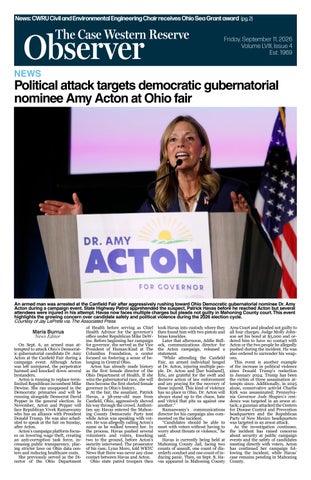
Political attack targets democratic gubernatorial nominee Amy Acton at Ohio fair
An armed man was arrested at the Canfield Fair after aggressively rushing toward Ohio Democratic gubernatorial nominee Dr. Amy Acton during a campaign event. State Highway Patrol apprehended the suspect, Patrick Havas before he reached Acton but several attendees were injured in his attempt. Havas now faces multiple charges but pleads not guilty in Mahoning County court. This event highlights the growing concern over candidate safety and political violence during the 2026 election cycle. Courtesy of Jay LePrete via. The Associated Press
Maria Burrus News Editor On Sept. 6, an armed man attempted to attack Ohio’s Democratic gubernatorial candidate Dr. Amy Acton at the Canfield Fair during a campaign event. Although Acton was left uninjured, the perpetrator harmed and knocked down several bystanders. Acton is running to replace termlimited Republican incumbent Mike Dewine. She ran unopposed in the Democratic primaries and will be running alongside Democrat David Pepper in the general election. In November, Acton and Pepper will face Republican Vivek Ramaswamy who has an alliance with President Donald Trump. He was also scheduled to speak at the fair on Sunday, after Acton. Acton’s campaign platform focuses on lowering wage theft, creating an anti-corruption task force, increasing public transparency, placing stricter laws on Ohio data centers and reducing healthcare costs. She previously served as the Director of the Ohio Department
of Health before serving as Chief Health Advisor for the governor’s office under Republican Mike DeWine. Before beginning her campaign for governor, she served as the Vice President of Human:Kind at The Columbus Foundation, a center focused on fostering a sense of belonging in Central Ohio. Acton has already made history as the first female director of the Ohio Department of Health. If she wins the gubernatorial race, she will then become the first elected female governor in Ohio’s history. At the fair, the assailant, Patrick Havas, a 38-year-old man from Canfield, Ohio, aggressively shoved his way through the crowd. Authorities say Havas entered the Mahoning County Democratic Party tent while Acton was speaking with voters. He was allegedly calling Acton’s name as he walked toward her. In the process, Havas pushed several volunteers and voters, knocking two to the ground, before Acton’s security intervened. The prosecutor of his case, Lynn Moro, told WKYC News that there was never any close contact between Havas and Acton. Ohio state patrol troopers then
took Havas into custody where they then found him with two pistols and brass knuckles. Later that afternoon, Addie Bullock, communications director for the Acton campaign, released a statement. “While attending the Canfield Fair, an armed individual lunged at Dr. Acton, injuring multiple people. Dr. Acton and [her husband], Eric, are grateful for the swift and decisive action of law enforcement and are praying for the recovery of those injured. This kind of violence has no place in Ohio. Dr. Acton will always stand up to the chaos, hate and vitriol that pits us against one another.” Ramaswamy’s communications director for his campaign also commented on the incident. “Candidates should be able to meet with voters without having to worry about threats or violence,” he said. Havas is currently being held at Mahoning County Jail, facing two counts of assault, one count of disorderly conduct and one count of inducing panic. Then, on Sept. 8, Havas appeared in Mahoning County
Area Court and pleaded not guilty to all four charges. Judge Molly Johnson set his bond at $5,000 and ordered him to have no contact with Acton or the two people he allegedly pushed during the incident. He was also ordered to surrender his weapons. This event is another example of the increase in political violence since Donald Trump’s reelection in January 2024. Trump has been the victim of three assasination attempts since. Additionally, in 2025 alone, conservative activist Charlie Kirk was assassinated; Pennsylvania Governor Josh Shapiro’s residence was targeted in an arson attack; a gunman attacked the Centers for Disease Control and Prevention headquarters and the Republican Party of New Mexico headquarters was targeted in an arson attack. As the investigation continues, the incident has raised concerns about security at public campaign events and the safety of candidates meeting directly with voters. Acton has continued her campaign following the incident, while Havas’ case remains pending in Mahoning County.
News
The Case Western Reserve Observer Friday, September 11, 2026 observer.case.edu Volume LVIII, Issue 4
CWRU Civil and Environmental Engineering Chair receives Ohio Sea Grant award Rebekah Repp
Social Media Editor Within the past few months, Dr. Xiong (Bill) Yu, Opal J. and Richard A Vanderhoof, Professor and Chair of the Department of Civil and Environmental Engineering at Case Western Reserve University, received an Ohio Sea Grant Award. This project was among five others awarded in the Ohio Sea Grant’s 2026 to 2028 Research Program, which totaled to $1.2 million to be distributed over the following two years. The funding was granted by the National Oceanic and Atmospheric Administration and Ohio State University. Yu’s research, “AI-Empowered Smart Sewer Systems for Stormwater Overflow Reduction in the Lake Erie Watershed,” stems from his longheld interest in multi-physics processes underground and intelligent infrastructure. “Our research essentially aims at how we effectively reduce or emulate overflow in the water system, like stormwater or sewer,” Yu said. The problem is especially important for cities like Cleveland that use combined sewer systems, where stormwater and wastewater flow through the same pipes. During heavy rain, these systems can
exceed their capacity and overflow onto streets and into homes, creating health and safety concerns for residents. According to Yu, cities currently rely on two main approaches to reduce overflow: gray and green infrastructure. Gray infrastructure increases the capacity of existing systems, while green infrastructure uses natural features such as vegetation and soil to manage and filter stormwater. “If gray infrastructure costs maybe $1 to reduce given amounts of stormwater overflow, green infrastructure [costs] may be 40 cents,” Yu said. “It’s more cost effective, but again, it has limits.” Yu’s research project involves neither gray nor green infrastructure, but a new type: smart infrastructure. This type of infrastructure is a lot cheaper than the other two types, with a much higher capacity for work. It uses rainfall forecasting and automated controls to monitor and manage sewer systems. “Overall, smart infrastructure is a cost-effective way to reduce overflow, but at the same time, it requires the system to have a forecast capability and a bit of control,” Yu said. “That’s the intelligence part.” Yu hopes that with this new technology, cities can have faster and more reliable ways to minimize
stormwater overflow and monitor the systems currently in use. In order to track and monitor the status of stormwater in reserves today, there must be sensors at each location that researchers want to track. However, with the smart technology, individual locations combine into clusters that can be tracked from one central location or node called a ‘centroid.’ “All the nodes have a hydraulic equation, and the links make a physical equation,” Yu said. “Only one is the condition at these 10 nodes, but we can estimate the water flow at any any location. That’s the goal. That’s effective monitoring.” In the end, Yu’s goal is to predict and prevent failures or problems in existing infrastructure before they occur. By the end of 2028, Yu and his team hope to use their research to advise their partners, including the City of Rocky River Wastewater Plant, Greater Cincinnati Metropolitan Sewer District and Northeast Ohio Regional Sewer District. “We should be able to work with our partners to generate assessments of their systems and provide recommendations,” Yu said. “I cannot guarantee they can be implemented, but theoretically, we can do a lot of scenario analysis to provide recommendations for their planning.”
Student suicide reignites public scrutiny against ICE-issued ankle monitors Olivia Wen
Copy Editor Trigger Warning: suicide This summer, under former Secretary of Homeland Security Kristi Noem, the U.S. Department of Homeland Security (DHS) motioned to expire Temporary Protected Statuses (TPS) for several countries, including but not limited to Ethiopia, Somalia, South Sudan and Yemen. TPS is a temporary immigration status issued to countries under particular conditions such as armed conflict, environmental disasters or unusual national emergencies that prevent its citizens from returning safely. Under TPS, people “are not removable from the United States,” meaning they cannot be deported and can obtain documentation to work legally in the U.S. When TPS expires, immigrants lose protection from deportation and any ongoing work permits are terminated, which reverts immigrants to their previous immigration status. On July 27, Haitian TPS was terminated, as it “no longer met the TPS conditions” according to Noem. Despite Noem’s claim, it is acknowledged that Haiti has been under a state of emergency since March 2024 and received a Level 4 travel advisory due to crime, kidnapping, terrorism and unrest, creating an unsafe environment. “Changing the immigration status
of these individuals is not in the best interest of the United States nor Ohio,” said Ohio Governor Mike DeWine in June while TPS termination was being pursued. There are around 30,000 Haitians in central Ohio and about 15,000 Haitians living in Springfield, Ohio alone. Across Ohio, Haitians have been summoned to Immigration and Customs Enforcement (ICE) offices to receive ankle monitors to detect movement and location. DHS has not published an official justification, though ankle monitors are believed to make it easier for ICE agents to locate immigrants and initiate raids. Just last week on Aug. 31, the suicide of 20-year-old Wright State University student Pierre Damas Bel ignited scrutiny of ICE as he took his life after being forced to wear an ankle monitor. In 2024, Bel and his family legally arrived in the U.S. through CBP Home Mobile Application, a free online application that allowed migrants without entry documents to make appointments at designated access points on the U.S. southern border. This function was removed in Jan. 2025 and currently operates to notify the U.S. Government of intent to self-deport. Shining in both academics and athletics, Bel’s circumstances changed after being issued an ankle monitor by ICE on July 29. After losing TPS, Bel turned down the chance to play soccer for Wittenberg University and could no longer
maintain his ROTC membership. “I came to this country to pursue my education,” Bel said in an Instagram post. “I didn’t come here to commit a crime or hurt anyone. Yet now I’m walking through the streets of the United States with a GPS monitor on my leg, carrying a feeling of shame and humiliation that I never imagined I would experience. So now, how am I supposed to play college sports with a GPS monitor on my leg?” His family also communicated he was bullied due to the ankle monitor. “After my son was outfitted with an ankle monitor, he felt like he was treated like an animal,” Bel’s father Pierre Ronal Bel said. “He took two trips to Cincinnati and Westerville to plead with the officers to remove the bracelet since he’s a soccer player and he felt embarrassed and humiliated. When he’s among his classmates at the university, he was bullied a lot with a lot of people telling him he’s a criminal.” On Aug. 31, Bel told his father he wasn’t feeling well mentally because of the bullying. His father told him to come home to talk. That morning, he walked into oncoming traffic on Interstate 70 and took his life. Bel’s death has brought renewed attention to the consequences of TPS termination, including stigma surrounding immigration. His community has come together to mourn his passing and raise awareness of the uncertainty now facing thousands of Haitian immigrants across Ohio.
News -inBrief Election Officials Grapple With Uncertainty as Supreme Court Considers Mail Ballot Plan
By Eileen Sullivan and Adam Sella From The New York Times
Salvadorans to Keep Deportation Protections for Now, Trump Officials Say
By Jazmine Ulloa, Madeleine Ngo and Annie Correal From The New York Times
Elon Musk Targets Democrats on Transgender Issues in Key Senate Races By Neil Vigdor From The New York Times
U.S. announces bans on Canadian imports including alcohol, motorcycles By Rachel Lerman From The Washington Post
Judge rules West Point policy restricting professors’ speech is unconstitutional By Hannah Natanson From The Washington Post
Ohio companies announce layoffs, closures affecting over 850 workers By Mariyam Muhammad From The Columbus Dispatch
Smithsonian Secretary Lonnie Bunch Steps Down Amid Strife With Trump By Kelly Crow From Wall Street Journal
New York City Temporarily Bans AI in Classrooms Through Middle School By Joseph De Avila From Wall Street Journal
Ohio to announce which charter schools will share $100M+ in federal grants By Laura Hancock From Cleveland.com
Man accused of assault, inducing panic at Dr. Amy Acton event pleads not guilty By Morgan Trau and Scott Noll From News 5 Cleveland
Legislation to curb political violence continues to stall at Ohio Statehouse By Morgan Trau From News 5 Cleveland
News 3
observer.case.edu
Cleveland National Air Show Kashvi Madhwani
Copy Editor
For Case Western Reserve University students, the roaring of the U.S. Navy Blue Angels overhead is a good sign that Labor Day weekend is fastapproaching. Between Sept. 5 and 7, the annual Cleveland National Air Show took place. The show is hosted at Burke Lakefront Airport—right along Lake Erie—with impressive aerial displays offering students a much needed break from the long lectures. Military teams like the Blue Angels showcase real world physics and aerodynamics, inspiring a wave of wonder over the spectators, maybe even inspiring kids in the audience to pursue aviation. Whether you watched it from campus or the lakefront, the show was truly spectacular. The airshow aims to celebrate Cleveland’s aviation history and support local charities. Between performances, viewers can see static aircraft displays, explore vintage warbirds, meet military aviators and visit the Rock & Roll Hall of Fame, making it a crowd-favorite tradition that signals the start of fall in Cleveland.
Phillip Kornberg/The Observer
Life
The Case Western Reserve Observer Friday, September 11, 2026 observer.case.edu Volume LVIII, Issue 4
JENNIE’s ‘Fallen Angel’ flies into a new era Riya Kulkarni Life Editor With pomp and a good amount of surprise, JENNIE’s first solo EP “Fallen Angel” made its debut to streaming platforms on Aug. 28. With “Ruby (The Complete Collection)” released in celebration of JENNIE’s debut solo album a mere five months prior—the pivot was nearly unexpected. The only clues fans received were during the summer festival circuit, as Jennie Kim previewed unreleased tracks of all of the songs making the digital release. Over the span of one week—after the release was announced on Aug. 21— theorizing from fans began as to which songs would be included on the anticipatory EP. This EP brings a completely new era to JENNIE’s music that can be described as dreamy with an edge, especially in comparison to older, highenergy hits like “Mantra” or “like JENNIE.” While there may not be a clear storyline in this tracklist—three songs spanning a tight eight minutes—there is a decent variety in musicality in the progression of the EP. So, hold on to your angel wings, and let us journey through these songs. First on the tracklist is “FALLEN ANGEL,” our titular track, which made its debut at Lollapalooza on Aug. 1. The music video was teased the same day the EP was announced, with equally as many creepy couples as there was breathtaking scenery. The final video did not disappoint, creating that angelic atmosphere with a slightly sinister edge. It opens with a child in a surreal dreamscape,
glowing eyes plastered on the shardlike structures all around her. We are taken through several starkly different scenes, unsettling undertones increasing through to the cult-like gathering of singing children at the very end. Perhaps there was a story to be told here, but the visuals and scenery were the crowning features of this short film. “FALLEN ANGEL” as a song is an apt introduction to this softer era in JENNIE’s discography, with soft instrumentation and a lo-fi feel. The lyrics cling onto the dream that one day that a dying relationship could settle into something more permanent, despite how much it has fallen. “Wherever we land is where we turn into a home,” sings JENNIE with this hope of settling. The vulnerability comes through in this fear that the attachment was broken, that without the relationship “these wings are of no use.” This naive hope brings a light feel to the song despite the fears. Next is “HEAVEN,” which debuted live at the Governor’s Ball Music Festival in June. It contrasts the most with the rest of the songs on this EP in tone and lyrics, with a darker chaos resonating throughout the song. There is significantly more base to create a more dramatic backing track, complete with a distorted electric guitar echoing the entropy of the song itself. For JENNIE, the “crash and burn” is her “favorite part” of her relationship, which she insists is a heaven to her even if the world refuses to agree. The theme of hope carries on, but there is the subconscious realization that placing hope in an otherwise toxic relationship is of no use.
Courtesy of Le Xuân via Wikimedia Commons The final track of the digital release is “Less than a Lover,” which is a single previously released on July 24 after being performed at the Governor’s Ball that epitomizes summer. The music video is slightly meta in its creation, as the main narrator (JENNIE) explains the story of the short film she wants to create, about a girl who “wants to avoid love, wants to avoid responsibilities.” What follows is a montage of a pair (not lovers, but not quite friends either) traveling through Spain during what looks to be summertime—a sip at a cafe, spending time in a villa and driving to the beach. From the lighting to the story, it is simple, warm and bright in the way that summer is. The story ends with the girl simply drifting out of frame, perhaps realizing she was too close for comfort, or perhaps it was just a statement about how ephemeral the summer could be with nothing to tie oneself down.
The song itself also conveys this light and airy feel, with a light base and electric guitar to frame JENNIE’s lyrics, as well as a light choral melody in support. The song begs that we “don’t think too much” to remain devoid of any attachments, which are necessary steps to fully enjoy each moment. This is why this singer wants “a little bit less than a lover,” a certain someone who “[gets] a little bit more than another.” In concept, the feeling is almost a dream, detached from anything tangible that could potentially get one stuck. If nothing else, this EP is a testament to JENNIE’s versatility as a singer and songwriter, showcasing a much more raw and vulnerable tone that pivots from older songs. Even better, the experience doesn’t end there. With the physical release of the EP expected to arrive on Oct. 30 with three additional songs, there is plenty to look forward to in this new era of JENNIE’s music.
Playlist of the Week: songs for a stormy summer evening Neelanjana Komanduri Photo Editor “SleepWalker” – LEAP Dense clouds swallow what’s left of the blue sky until your vision seems to go monochrome. Frontman Jack Scott perfectly encapsulates the terror of a world gone bleak with his lamentful vocals backed by upbeat, yet tense rock melodies. This song tackles difficult emotions such as guilt, regret and loneliness, cultivating a sense of peace when reality is quite the opposite. The paradoxical nature of LEAP’s music and eerily relatable lyrics have a hold on me that will never let go. “Middle Of The Night” – Lenny Monsou There’s an undeniable electricity in the air now, coupled with humidity making the ground appear damp. You wonder why it looks like the middle of the night despite the clock reading past 5 p.m. Lenny Monsou’s raspy voice drives the soul of this shoegaze-inspired track to explore the emotional vulnerabilities of our late-night minds. The indistinct guitar creates a wall of sound, drowning out the wistful lyrics and mixing perfectly with the storm’s deep, rumbling warnings.
The late summer air is warm and suffocating, buzzing with the electricity of an impending storm. It’s something that can’t be romanticized as aesthetic nor demonized as simply being bad weather. Whether or not our feelings toward the weather reflect a human need to project our chaos upon the world around us, nothing can beat listening to moody music with a storm brewing overhead. Grab your umbrella and get ready to experience the true soul of Cleveland rain. “Flawless” – The Neighbourhood The winds have died down, not a soul is around and even the thunder seems to have been quelled. Unfortunately, nothing this flawless lasts forever. Frontman Jesse Rutherford exposes the anxieties of waiting for the other shoe to drop when things are going too well. It's a suffocating feeling that resembles the pin drop silence moments before a torrential downpour. His drifting vocals combined with moody guitar rhythms and visceral drum beats make this song my all-time favorite from the album even if Rutherford himself hates it for being too dramatic. “Eternity” – Telescreens The clouds never truly recede, hiding the sun behind them even as night approaches, every color a shade darker than it was before. This seven minute song ponders the bigger picture of life, from relationships to belonging to existential purpose, with raw and emotional vocals from frontman Jackson Hamm. There’s no better song to fall asleep to as the clouds fade into a starless night sky, leaving you with a feeling of acceptance.
“England’s Dreaming” – Boston Manor The silence breaks, and the dreamlike state has nearly evaporated. We instead picture ourselves in England on a calm rainy day, being misted with rain. Serene, that is, until frontman Henry Cox breaks into the chorus with punchy melodies and gritty vocals. This song describes a painful sense of disconnect between oneself and the world around them, making it one of my favorites to put on when the weather begins to ramp up in intensity. “Your Blood” – Nothing But Thieves The rain from the worst thunderstorms always starts out laughably slow. The sky is still thick with tension, waiting for the moment where peace is replaced by pouring rain. Nothing But Thieves enmeshes this atmosphere with the agony of being trapped in a draining relationship. Frontman Conor Mason slowly builds melodic suspense through soaring vocals that beautifully convey raw despair and frustration. It’s at this moment that the sky splits open and sheets of rain begin to pour mercilessly.
“Bacalar” – Dead Poet Society As the storm recedes and the world goes back to normal, the clouds begin to lighten. What remains is an air of sadness that doesn’t really make sense. This track creates the haunting sense of grief that ensues after leaving a special place, paired with a guitar sound reminiscent of being underwater and Jack Underkofler’s piercing vocals. Alternative and hard rock band Dead Poet Society is masterful at making the listener really feel something, and listening to this song when I was leaving home for the first time was an emotional storm in and of itself. In Cleveland, it sometimes feels like these storm clouds last for an eternity. And even so, the storm feels ever-returning at times like these. Perhaps we should use it as a moment to slow down for a beat and take in this moment.
Fun
The Case Western Reserve Observer Friday, September 11, 2026 observer.case.edu Volume LVIII, Issue 4
Which made-up "Florida man..." headline are you based on your zodiac sign? Aries
Taurus
Gemini
Cancer
Florida man calls emergency services after getting pumpkin-shaped trick-or-treat basket stuck on head
Florida woman places steak in neighbor’s mailbox for two weeks in attempt to spread mad cow disease
Florida men deface bookstore after claiming to have written the Bible together while high
Florida man arrested for distracted driving after eating whole rotisserie chicken with both hands
Leo
Virgo
Libra
Scorpio
Florida man punches hole through neighbor’s wall with microwave after repeated noise complaints
Florida man sues state after being denied marriage with pet ball python
Florida woman impersonates incarcerated identical twin at work for eight years
Florida man attempts to steal ocean water from beach with tarp-lined sedan backseat
Sagittarius
Capricorn
Aquarius
Pisces
Florida man flees on motorized tricycle with 168 stolen cans of beer
Florida women arrested after carving person-sized hole in award-winning giant watermelon
Florida woman superglues bare feet to floor at Olive Garden after being denied 12th basket of breadsticks
Florida man working at Pizza Hut calls police after not understanding pizza order made with Australian accent
1 2 3 4 5 6
What introductory course are you? Which ice cream flavor do you choose? (a) Strawberry (b) Neopolitan (c) Vanilla (d) Chocolate
You have a free afternoon. You probably spend it: (a) Doing puzzles (b) Spending time with friends (c) Start five new crafts (d) Taking a nap
Overheard CWRU
Compilation of out-of-pocket things heard across campus
"I just feel like entropy would be a good kisser." "It's not a stuffed animal, it's Moses." "Do ducks count as birds?"
In a lecture hall, you will probably be sitting: (a) In front of the professor (b) Right in the middle of the seating (c) It changes every time (d) Balcony (yes, even when there is none)
QUIZ RESULTS: If you chose mostly A: CHEM 105: You are a rational thinker. Everything makes much more sense when calculations What section of The Observer do you find yourself reading the most? are a means to an end. You probably like doing personality quizzes in the Fun section of The Case Western Reserve Observer.
(a) News (b) Opinion (c) Life (d) Fun
What is your go-to study spot? (a) Kelvin Smith Library (3rd floor) (b) Mather House (c) Tinkham Veale University Center (d) Wade Pioneer Room Your favorite place to get food is: (a) The basement of Tomlinson Hall (b) The Jolly Scholar (c) BRB Café (d) Leutner Commons
If you chose mostly B: PSCL 101: You like trying out a lot of different things, and perhaps that makes you a jack of all trades. That means nothing in the eyes of Freud, and perhaps you conditioned yourself into thinking that you’re more normal than you actually are. If you chose mostly C: BIOL 214: You like to sample a little bit of everything, and enjoy variety over depth. You are here for the journey, and not the destination. You prefer intuitive decisions over deep analysis. You probably see Anki more than your family. If you chose mostly D: PHYS 115: You like taking shortcuts and probably did not love calculus. That’s okay, but you need to be aware of your limitations. Challenge yourself. Derive that formula, join a new student organization or just try to learn something new.
6 Fun
Friday, September 11, 2026
Connections
Sudoku
Answers for Connections and Sudoku will be on the next issue.
Opinion
The Case Western Reserve Observer Friday, September 11, 2026 observer.case.edu Volume LVIII, Issue 4
EDITORIAL
Labor Day is still a day of labor for healthcare professionals Editorial Board
Labor Day is a federal holiday that honors the American labor movement through national celebration, namely with a day off from work. Undergraduate students, among others, merely recognize it as a long weekend on the first Monday of September. With Labor Day weekend behind us, students may feel rested, having spent the weekend reconnecting with friends, exploring downtown Cleveland or spending leisurely time in their dorms. Labor Day does not hold the
same meaning for everyone, though. While some of the United States gets a day off, essential workers, particularly healthcare workers, see Labor Day as just another Monday. Frustration with the healthcare system and recent waves of strikes bring into discussion the state of the American hospital system. On April 29, Ohio healthcare workers protested outside of the Cleveland Clinic Lutheran Hospital for higher compensation and lower patient ratios. Nurses and certified nursing assistants reported having as many as up to 26 patients at a time. For reference,
The Case Western Reserve Observer Established in 1969 by the undergraduate students of Case Western Reserve University
Penelope Cloonan Executive Editor & Publisher PRINT Aleksandra Majewski Director of Print Ellie Palaian Director of Print Maria Burrus News Editor Alyssa Wang News Editor Riya Kulkarni Life Editor Lily Zhang Opinion Editor Abhishek Nambiar Sports Editor Abby Shazivari Copy Editor Kashvi Madhwani Copy Editor Olivia Wen Copy Editor We’ve all been there, trying to Oviya Gowder Copy Editor study or finish that last assignment when all we want to do is … DESIGN anything else. Maybe we’re overwhelmed with the work we have Kiera Ngto Director of Design do, or maybe we feel the pressures Jana Ashour Director of Design of perfectionism and don’t want to Cai Layout Designer start. We push ourselvesHelen to “lock Aditi Ghosh in,” but call it quits too often, feel- Layout Designer Revaup Kolhe ing guilty each time we pick our Layout Designer phones to doomscroll again and Talia Jun Graphic Designer again. Doing anything but the work Kristina Guo Graphic Designer we have piled up always seems to Annagetting Trusova Graphic Designer feel better than actually things done, but the sinking feeling in our stomach knowingDIGITAL we’ve MEDIA Moses Fleischman wasted time is much worse. Can we Director of Digital Media really consider these pauses to be Matthew Stall Video Editor “breaks” if we feel worse tak-Video Editor Assitant Aditiafter Darodkar ing them? Tidjani Web Editor We may trap ourselvesObafami in a cycle Phillip Kornberg Photo Editor of counterproductivity and double Neelanjana Komanduri Photo Editor the time it takes to complete a task. In this “popcorn brain” mindset, weSocial Media Manager Rebekha Repp work and get little done, then stop Esha Bagora Social Media Editor working and think about how we Bentime Kangwe Social Media Editor could be working. By the resume our work, we feel ashamed, BUSINESS not refreshed, and we stay up late Anya Lin Director of Business Operations in attempts to catch up. A break is not Riya shameful, Dixit Adnot and Partnership Manager when it has the potential to act as a Accounts Manager Divya Kurma tool that makes productivity much more need to Theefficient. Observer We is thejust weekly undergraduate student newspaper of Case knowWestern how toReserve use them. University. Established in 1969, The Observer reports Just an athlete wouldn’t do an editorial forum for the university newsas affecting students and provides 150community. consecutive bicep curls while Unsigned editorials are typically written by the opinion editor strength training at the gym,of the as senior editorial staff. Opinion columns but reflect the majority opinion students must takewriters meaningful are the we views of their and not necessarily of The Observer staff. For breaksadvertising in reasonable intervals. One via e-mail at observer@case.edu. information, contact popular example of this is the Po-be e-mailed to observer@case.edu or LETTERS TO THE EDITOR should submitted on our website at observer.case.edu. Letters can be mailed to Thwing Center 11111 Euclid Avenue, Suite 01, Cleveland, Ohio 44106. For policy and guidelines related to the submission of Letters to the Editor, refer to observer.case.edu/submit-a-letter. The Observer is a proud member of CWRU’s University Media Board. Follow The Observer on Facebook, Twitter, TikTok and Instagram @cwruobserver.
the optimal number of patients for a single nurse to take charge of—while maintaining quality care—is three to four. Understaffing is detrimental for both the professionals giving care, as well as the patients receiving care. The shortage leads to safety risks for both parties, where patients have more unregulated time and workers are more vulnerable to occupational health hazards or patient violence. This short staffing combined with unfulfilling pay creates a subpar working environment. These issues are not specific to just Cleveland. On July 8, Brigham and Women’s Hospital nurses went on strike after the Mass General Board of Directors (MGB) refused to negotiate wages, health insurance costs and nurse retention policies. After striking, MGB locked nurses out of their hospitals for four days, relying only on temporary nurses and jeopardizing patient safety. That same year, the CEO of Mass General Hospital Anne Klibanski received a 9% raise worth about 800,000 dollars, putting Klibanski’s salary at a whopping 9.2 million dollars. On the other hand, nurses in Boston make an average of about 20% higher than the national average, while the living costs in Boston are 50% that of the national average. Thus, many nurses barely make enough to make rent and live comfortably. At Case Western Reserve University, we are surrounded by hospitals. In fact, many students come to CWRU just for the proximity to hospitals such as the Cleveland Clinic and University Hospitals. The nationallyranked Cleveland Clinic in particular is a source of pride and joy for the city of Cleveland. Go to a baseball game or the airport and you will likely see some sort of advertisement for the hospital. However, there is a darker underbelly to the Cleveland Clinic that cannot be fully masked by its sterile, patientfacing front. With every expansion of the hospital’s main campus, whether that be additional research buildings or more outpatient clinics, entire residential communities, often lowincome and underserved, are being displaced. Thus, in the namesake of progress, Cleveland Clinic drives out the ones they think are in the way. Those actions don’t track with a hospital who believes “that every life deserves world class care.”
Hospitals almost always have the same taglines and advertise some variation of one-word statements: they serve, protect, heal, teach or learn. They are always “here for you” and they say that you “deserve the care you need.” The unfortunate truth is that most hospitals, though labelled as non-profits, are as much a business as other corporations like Walmart or Amazon. Furthermore, hospitals are interlocked with insurance companies, which in and of itself is a gargantuan establishment designed to maximize profits. Thus, healthcare workers, especially those on the frontlines and who have the most extended patient contact, are often mistreated by the for-profit healthcare system. Without proper infrastructure to support the individuals who work with patients, patients receive less quality care. This is ironic considering that every hospital’s “mission” is to serve their patients as best as possible. Like every other major corporation, hospitals are full of flaws. That being said, hospitals are still a place of great knowledge and potential, and where one can see both the best and the worst of humanity. Just earlier this year, a group of Cleveland Clinic surgeons performed a novel roboticallyassisted lung transplant successfully. Researchers affiliated with University Hospitals and the Cleveland VA may have discovered a new treatment for Parkinson’s. Everyday, lives are saved at these hospitals through the hard work of nurses, nursing assistants, clinical lab scientists, and more. However, the same professionals who are saving lives and doing critical work are undervalued and overworked. For a day that is supposed to celebrate American workers, it is unfortunate that some of our most essential workers have not felt this appreciation. Since a majority of CWRU students are interested in healthcare professions, it is especially pertinent for them to be able to view the healthcare field under a critical and unbiased lens and to understand the faults in the system. Acknowledging the shortcomings of choosing a healthcare profession makes for more healthcare providers who will have the courage to advocate for change. The more aware we are now sets a precedent for a more prospective future in creating a healthcare system that benefits all parties involved.
Anna Trusova/The Observer
8
Opinion
Friday, September 11, 2026
The optimal number of traffic deaths is not zero Justin Rosentover Contributing Writer
In 2018, the Cleveland City Council adopted an emergency resolution, which aimed to eliminate traffic fatalities in the city. This initiative is part of a larger network called “Vision Zero,” which aims to eliminate all traffic fatalities. Since its beginning in Sweden, the program has spread around the world, being adopted in more than 70 cities in the U.S. alone. Many of the practices advocated by Vision Zero are legitimate. They include traffic calming measures like traffic circles and constricting roads near intersections. Here in Cleveland, the city installed its first 100 speed tables and flat-topped bumps with priority to residential streets exhibiting medium traffic volumes, lowering average speeds by nearly eight mph.
The problem with Vision Zero is not so much in practice as in theory, though. The program revolves around the idea that, in the words of the U.S. Department of Transportation, “zero is the only acceptable number of deaths and [sic] on our highways, roads, and streets.” This is simply false. There must be some number of deaths that is practical because preventing them all would incur costs that are too steep. This was the favorite example of economist Walter Williams, who wrote numerous times about how the huge numbers of lives lost in traffic accidents could be saved with a five or 15 mph speed limit. “We look at the costs of having a 5 mph speed limit and rightly conclude that saving those 36,000-plus lives are not worth the costs and inconvenience. Most of us find it too callous, when talking about life, to explicitly weigh costs against benefits,” Williams wrote in a
column published after his death in 2020. But weigh we must, because if we were to reduce traffic speeds to five mph on every road, huge numbers of productive hours would be lost and, with them, prosperity. If you are rushed to the hospital in need of surgery, but the surgeon is delayed due to traffic, then it hardly seems that a safe road has reduced the number of fatalities to zero. In fact, a 1999 research journal found that the loss of income from eliminating road deaths would result in a net increase of 1,145 deaths per year. Norwegian ethicist Beate Elvebakk wrote about this rejection of cost-benefit analysis and the other ethical problems of Vision Zero in a report from the Research Council of Norway. She concluded that the focus on eliminating road deaths is intellectually inconsistent. It focuses exclusively on outcomes (reducing traffic deaths) and yet
Anna Trusova/The Observer
ignores the trade-offs associated with that view. Elvebakk points out that instructing the government to do anything possible to reduce traffic deaths no matter the cost allows the government to act in ways we might not approve of. “[The “no trade-off” view] means that it is the outcome of our actions, rather than the actions themselves, that are ascribed moral value. Arguably, such a position poses a danger as the position of the authorities in a political system, as undesirable acts can be justified with reference to the moral value of the end,” Elvebakk wrote in her “Ethics and road safety policy.” Elvebakk also points out that Vision Zero is overwhelmingly concerned with traffic deaths, severe injuries and risks increasing the overall accident rates. “The focus on reducing serious accidents, rather than on reducing the level of risk, implies that more monies are spent on roads that carry more traffic. In practice, this means that roads that carry less traffic will on average become less safe, that is, the road users will take higher risks on lesser used roads,” Elvebakk writes. In “The Vision Zero Handbook,” a group of scholars attempt to counter this argument by setting up straw man arguments and then burning them down. They dismiss criticisms of the fixation on zero deaths by claiming that “proponents of Vision Zero accept that it cannot immediately be fully implemented.” In other words, they do not actually support the idea they are writing in defense of. In fact, Elvebakk is aware of this as she herself says that “in Sweden, based on Vision Zero, the goal is to reduce the number of fatalities in traffic by 50% in the period 1996-2007. The results so far, however, are not very promising.” The goal of reducing traffic deaths is, of course, admirable. However, Vision Zero serves as a reminder that blindly pursuing even an admirable solution without regard for costs can be more dangerous than the problem being solved. Vision Zero is catchier than “vision fewer deaths than now,” but a catchy slogan does not justify policy. Luckily for the traffic planners of Cleveland and the rest of the U.S., there is a way to massively reduce traffic fatalities that is worth the cost. Self-driving cars are the greatest innovation in urban safety since the electric traffic signal—first installed right here on Euclid Avenue. Waymo, the leading autonomous vehicle (AV) company created by Google, claims to reduce serious injuries in crashes by 94% and reduce pedestrian crashes with injuries by 93%. An independent study from the Insurance Institute for Highway Safety found that Waymo’s cars get in crashes at a rate 68% lower than the humans they drive alongside. We should, however, take our own advice and look at the costs. It is true that AVs will probably put Uber and taxi drivers out of business and reduce incomes for personal-injury lawyers, but this solution makes transportation cheaper with the savings especially benefiting low-income households. And yet, even with self-driving cars, accidents will still occur. But we should not let the obsession with the number zero distract us from the very real way in which technology has solved the problem of road safety. If we are serious about traffic safety, we will accept that some number of deaths is unavoidable and welcome in the age of the self-driving car.
Opinion 9
observer.case.edu
A conversation on immortality Theodore Phan Contributing Writer In June, a human being received a treatment designed to make old cells behave younger. And not just behave younger. Be younger. This was a matter of science fiction, until it wasn’t. ER-100, developed by Life Biosciences, is an experimental therapy for optic neuropathies, or any damage to the nerve that relays visual information from the human eye to the brain. The treatment isn’t meant to make anyone immortal, but simply to demonstrate, as proof of concept, that the treatment is safe. The company had already conducted multiple rounds of treatment in animal clinical trials, including mice and primates, before this trial was approved by the FDA in Jan. 2026. The science behind the treatment itself, though, is based on a controversial, yet provocative idea: that some of the biological changes associated with aging may be entirely reversible through certain stem cell factors. Researchers have spent years investigating whether cells can be partially returned to a more youthful state through a process known as epigenetic reprogramming. Epigenetics is a field of genetic study on how genes are controlled and expressed in cells. For example, while a skin cell and stomach cell contain the same DNA, a skin cell would express genes that are left unexpressed in a stomach cell and vice versa, allowing cells to carry out specialized functions despite originating from the same DNA. These switches for genes, however, start to function improperly over time, switching on and off the incorrect genes for specific cell types. Epigenetic reprogramming is when scientists turn on and off certain genes within a cell to facilitate proper function. The proposed treatment would enable epigenetic reprogramming by switching on three Yamanaka stem cells transcription factors (OCT4, SOX2 & KLF4) present in all cell types, allowing for any cell to reset its epigenetic clock and thereby function correctly while silencing the rest of genome again. This would, in essence, functionally reset the cell’s age. This was demonstrated in recent mice and primate trials and, now, will be attempted on human clinical trials though Life Bioscience’s new ocular treatment. Now, this is not to say that we are anywhere near close to proving that humans can reverse aging, much less live indefinitely. A successful result in mice does not guarantee a successful treatment in humans. Even if this therapy works, it may ultimately be useful only for treating specific diseases. But I think we should ask the uncomfortable question anyways: What happens if it works? I believe we have a responsibility to think about the consequences of transformative technologies before they become a reality. Modern society is built around aging. We educate young people because they will eventually enter the workforce. We spend decades working because we expect to eventually retire. We accumulate savings because we expect our productive years to be limited. We pass wealth from one generation to another because each genera-
Kristina Guo/The Observer tion eventually dies. Each and every one of those cycles would be broken in a world where scientists develop a treatment that allows people to remain healthy for decades longer than they otherwise would have. Everything we have ever known about these cycles would transform the way humans operate. Would retirement still begin at 65? If someone remained healthy and cognitively capable at 90, why should they leave the workforce? Would people have three or four careers over the course of their lives? What would happen to the socio-economic ladder? Would someone go to college at 18, work for 30 years, return to school at 55 and begin an entirely new profession? The stages of life that currently seem natural might begin to look arbitrary. These are issues that society will have to grapple with in the coming decades if we are to prevent another coming of Artificial Intelligence. With AI involved, longevity research becomes a part of a much larger issue. AI did not suddenly appear when ChatGPT was released in 2022. The field had been developing for seven decades by then and had already made significant breakthroughs beginning in 2015 with Google Deepmind’s AlphaGo, an AI model that beat the world’s top player at Go, a game with more moves than countable atoms in the observable universe, using a strategy never before considered by humans. Even more significantly, Deepmind released
another significant breakthrough only two years later in 2018 when it created AlphaFold, an machinelearning engine that allowed scientists to accurately predict tertiary protein shapes for the first time ever, making significant progress towards one of the largest shortcomings in the biological sciences. In the decade leading up to ChatGPT’s release to the greater public in 2022, it was already becoming clear that increasingly powerful machine-learning systems could eventually have profound consequences. Yet, these developments occurred largely out of the public eye, not because researchers were deliberately attempting to hide them, but because the public itself did not pay much attention to the technology despite tech’s worldwide impact with smartphones and social media at the time. As such, much of the broader public conversation about AI only occurred after AI swarmed classrooms, workplaces and our personal lives. Today we are still determining how schools should respond to AI-generated work, how governments should regulate capable and increasingly autonomous systems, how employees and companies should adapt to automation and how individuals should protect themselves against new forms of misinformation. Perhaps we could have asked some of those questions earlier, even if in 2016, people still believed that AI was a distant reality decades away from impacting our present lives. We couldn’t have predicted what AI would become,
but we could have begun thinking about the future while it was still coming. When a technology is in its experimental phase, we still have the luxury of time to ask what kind of future we want to build with it. Once it becomes ubiquitous, the conversation changes from asking, “what should we do?” to “how do we deal with what has already happened?” Longevity research gives us the opportunity to practice thinking ahead and it is hardly the only technology deserving of our attention to its potential impacts on society. CRISPR could change how we treat and possibly prevent genetic disease. Gene drives could give humans the ability to alter the fate of species and ecosystems, including and especially our own. Quantum computers could threaten some of the encryption protecting modern digital life, while also promising to revolutionize prediction of nature itself. True nuclear fusion, achieved as a proof of concept in 2022, has since been expanded on in the hopes of allowing humanity to grasp the power of the limitless energy from the sun right on Earth. Brain-computer interfaces could change the boundary between what it means to be human and machine. None of these futures are guaranteed, but that is no reason to ignore them. It is a reason to discuss them and to begin to have conversations with the researchers responsible for our futures while we still can.
Sports Weekly Scores
Wrigley Field fails the challenge of outdoor volleyball Penelope Cloonan Executive Editor
Football at Rochester (9/4)
W 38-20
Men’s Soccer vs Juniata (9/5)
W 2-1
at Wooster (9/6)
W 3-0
at Oberlin (9/9)
W 4-0
Women’s Soccer vs Pacific Lutheran (9/4)
W 5-1
vs Capital (9/6)
W 3-1
vs Baldwin Wallace (9/9)
W 2-0
Volleyball 2026 Great Lakes Cross Over vs Kenyon (9/4)
W 3-0
at Heidelberg (9/5)
W 3-1
vs Hanover (9/5)
L 1-3
vs Baldwin Wallace (9/4)
L 1-
Women’sTennis Allegheny Invite
The Case Western Reserve Observer Friday, September 11, 2026 observer.case.edu Volume LVIII, Issue 4
No team scoring
The first week of September saw the inaugural Southeastern Conference (SEC)/Big Ten Challenge Week for women’s volleyball. Between Sept. 1 to 6, 34 teams from two of the biggest collegiate sports conferences in the U.S. faced off at host campuses around the country. Throughout the week, anticipation grew for the final two matches set to take place at Wrigley Field, home of Major League Baseball’s Chicago Cubs. When the day finally came, Wrigley Field was transformed. Tarps covered parts of the outfield to accommodate floor seats in addition to packed stands surrounding the temporary court just past second base. While it is not unusual for baseball fields to be rented out for other events—mainly concerts and pop-up soccer events—it was an intriguing choice to put the game of indoor volleyball outside. The University of Kentucky and Penn State played the first match to be hosted at Wrigley Field, or any MLB ballpark for that matter, on Sept. 6 at 6 p.m. CDT. Despite initially tight gameplay, Kentucky took home the first two sets, in large part due to the efforts of outside hitter Brooklyn DeLeye. Penn State was able to disrupt Kentucky’s momentum and take home the third set. The fourth set went to Kentucky in a landslide win 25-15. Match one ended with the fourth set, and Kentucky went home with the honor of winning the first volleyball game hosted at Wrigley Field. Surrounded by 43,067 fans, it was the second most attended Division I women’s volleyball game in history. Anticipation only grew for the closing match. Nebraska fans have shown up big for their team before. In 2023, 92,003 fans gathered in Memorial Stadium—University of NebraskaLincoln’s football field—to watch Nebraska take on the University of Nebraska at Omaha on home turf. Dubbed “Volleyball Day,” it was the most attended Division I women’s volleyball game in history. Nebraska took the crowd’s energy
Courtesy of Jeremiah Johnson via. Wikimedia Commons. and swept Omaha 3-0. The game took place in late August at 7 p.m. CDT, in the historically much drier state of Nebraska. It is a credit to the weather in Nebraska above all else, that this event was able to take place. The fans filled the space they were able in record-setting numbers, but Nebraska itself kept the game going by keeping the court dry. The same cannot be said for the state of Illinois. First serve for the final event of the night—University of Nebraska vs. University of Missouri—was set for 8:00 p.m. CDT. The first set began with dominance from Nebraska, which was quickly undercut by frequent falls. Only three points in, the game was paused due to player safety concerns. Moisture had built up on the court and was causing players to slip and slide during play. The towel crew came out first, then players from both teams joined to try and dry the court as well. After a long towel break, play resumed. As spectacular as the matches were, Wrigley Field is just not set up to host late-night outdoor volleyball. Chicago lies off the shore of Lake Michigan and is famous for its tumultuous weather, namely windy humidity. Throughout the night,
between each match and set, blowers and a towel crew came out to try and relieve some moisture from the court. Additionally, the court where the games were played was made of top of the line flooring—Taraflex— and was reportedly treated with special moisture resistant coating. The organizers were aware of Chicago’s conditions, and tried their best to mitigate those effects. Their plans failed. Practice and the earlier match had drier conditions, which the teams could play comfortably through. By late evening, the humidity had become too much, and despite frequent pauses in play to try to keep players safe, the game was suspended. The score as it stands as of print was 11-7, favoring Nebraska. The Big Ten Conference defeated the SEC with a record of 16-13. As of print, the match between Nebraska and Missouri has not been rescheduled. Rescheduling at Wrigley Field is not currently possible both due to the on-going MLB season and continued weather concerns impacting player safety. Kentucky and Penn State hold the honor of playing the only outdoor volleyball game at Wrigley Field, and it is looking like it will have to stay that way.
The inaugral Southeastern Conference/Big Ten Challenge Week culminated on Sept. 6 with a historic outdoor volleyball doubleheader at Wrigley Field in Chicago, Illinois in front of 43,067 fans. The University of Kentucky claimed a 3-1 victory over Pennsylvania State University in the venue’s first-ever volleyball match. However, Chicago humidity and severe court condensation forced officials to suspend the match between the University of Nebraska and the University of Missouri due to player safety concerns, with no current plans for rescheduling. Courtesy of Ryan Dickey via. Wikimedia Commons.
Sports 11
observer.case.edu
Upcoming Spartans stay busy with numerous games over Labor Day Games weekend Abhishek Nambiar Sports Editor Over this past Labor Day weekend, the student athletes of Case Western Reserve University continued their hard work. The vast majority of games played by CWRU teams over the weekend saw the Spartans emerge victorious, providing further momentum as each of these teams continue their 2026 campaigns. Football The CWRU football team opened its season on a strong footing as they defeated the University of Rochester 38-20 this past Friday, Sept. 4. The game, which took place in Rochester, New York, saw graduate student quarterback Aaron Filips throw for 356 yards and four touchdowns, both personal bests for his collegiate career. The Spartans as a whole were firing on all cylinders during the game, with the offense racking up a total of 445 yards while the defense held Rochester to a mere 164 yards. CWRU was the first to score during the game, via an 11-yard touchdown pass from Filips to wide receiver Jake Otto. This effectively set the tone for the rest of the game as the Spartans never gave up their lead and even held Rochester scoreless during the second and third quarters. Though the Yellowjackets scored two touchdowns in the fourth quarter, it was not enough to overcome the significant lead that the Spartans had put up, thus sealing their win. The team now enters their bye week, getting some time to rest before their home opener on Saturday, Sept. 19, when they host Shenandoah University for a noon match at DiSanto Field. Men’s Soccer Following a dominant season opener victory, the CWRU men’s soccer team continued the momentum into the long weekend as they scored a pair of victories, improving to 3-0-0 for the season. The first of these two games saw the Spartans welcome Juniata College to DiSanto Field on Saturday,
Sept. 5. The game began relatively quietly, though 10 minutes into the game Juniata scored a goal, gaining an early edge. With a little over a minute left in the period, secondyear Gavin Trosch sent a ball into the goal to tie the score. Only 30 seconds later, an attempted penalty kick by fourth-year and co-captain Cormac Apostolides was recovered by firstyear Leo Miranda and second-year Micah Rossen, and the latter successfully scored the ball to put the Spartans on top. The second half of the game saw numerous possession changes but no successful shots, thus allowing CWRU to claim a 2-1 victory in the game. The next day, the squad traveled to Wooster, Ohio to take on the College of Wooster. The Spartans wound up dominating the Fighting Scots 3-0, giving them a win in their first road game of the season. Second-year Alex Eby fired the team’s first shot at the 18th minute, followed up by fourthyear Ohta Kamiya nine minutes later. The game’s outcome was effectively decided in the 78th minute with a goal from Rossen. While Wooster pursued an aggressive strategy with four corner kicks and three shot attempts in the final ten minutes, none of it was enough to put a dent in the Spartans’ lead. The squad returns to Cleveland this weekend as they host Lycoming College at DiSanto Field on Saturday, Sept. 12. Kickoff is at noon. Women’s Soccer The No. 11 nationally ranked CWRU women’s soccer team had a weekend to remember as they celebrated their Senior Day on Saturday, Sept. 6 to honor the program’s graduating seniors. Complementing the celebrations was a 3-1 victory over Capital University at DiSanto Field. The match was a dead heat through the entire first half, as both teams failed to find the back of the net for much of the period, resulting in a 0-0 score at halftime. Things began to turn around for the Spartans in the second half, however, when first-year Sonora Hale found the back of the net in the 47th minute, with an assist from second-year Izzy Probst.
The No. 11 ranked Case Western Reserve University women’s soccer team finished off a memorable Senior Day with a 3-1 victory over Capital University at DiSanto Field on Saturday, Sept. 6. After a scoreless first half, first-year Sonora Hale score in the 47th minute with an assist from secondyear Izzy Probst. Although Capital managed to score a goal, with third-years Ashley Liang and Abby Welker’s subsequent goals, the Spartans secured a final score of 3-1 prior to their home game against Grove City College. Courtesy of Philip Kornberg/The Observer.
Together they scored the first goal of the game and landed Hale her third of the season. Though Capital scored a goal of their own nine minutes later, it was countered not too long after by a successful penalty kick from third-year Ashley Liang. To top it all off, third-year Abby Welker added on a goal in the 85th minute thanks to an assist from Hale, all but sealing the Spartans’ victory. Next up on the schedule for the squad is a home game against Grove City College on Saturday, Sept. 12 at DiSanto Field. Kickoff is at 2:30 p.m. Volleyball The CWRU volleyball team made the trip to Wooster, Ohio over the weekend for the Great Lakes Crossover, an annual meet hosted by Heidelberg University. The first of the squad’s three games for the meet saw them defeat Kenyon College 3-0 on the evening of Friday, Sept. 4. CWRU was consistently dominant throughout the match, holding a lead over Kenyon for the majority of the first two sets. The third set saw an early battle between the teams with Kenyon taking an 11-9 lead, though the Spartans would later take back the lead, ultimately winning the set to secure the shutout win. Match two for the Spartans saw them defeat the hosts Heidelberg 3-1. CWRU started the game strong with a solid 25-15 win in the first set. Though the Spartans fell to the Student Princes 17-25 in the second set, they bounced back in sets three and four to secure another win for the meet. The Spartans’ third match of the meet saw them fall to Hanover College 3-1. Though the contest was a close one between the two teams, Hanover was almost always slightly ahead. The Panthers won the first two sets, before falling to the Spartans in the third set but then clinching the fourth set to seal their victory. On a brighter note, third-year Sophia Datto reached a career 1,000 digs during the match against Hanover, becoming the 22nd player in program history to achieve the feat. The woes for the squad continued into the week following the meet, however, as they fell to Baldwin Wallace University 1-3. While CWRU emerged victorious in the first set, they went on to drop the three subsequent sets to Baldwin Wallace, giving the Spartans a loss to the Yellow Jackets for the second year in a row. Despite the setbacks, many opportunities remain for the Spartans to bounce back. The first of them come this weekend when the annual CWRU Quad takes place in Horsburgh Gymnasium. First up for the Spartans in this tournament is a match against Hiram College on Friday, Sept. 11. Women’s Tennis The CWRU women’s tennis team kicked off their season with a trip to Meadville, Pennsylvania for the annual Allegheny Invite on Sunday, Sept. 6. Across matches featuring opponents from Mercyhurst University, Tiffin University and Allegheny College, the Spartans ultimately finished the meet with a 5-5 record in singles matches and a 5-7 record in doubles. Following up this meet is the Spartans’ next event: the Big Red Invite hosted by Denison University in Granville, Ohio. Matches will be taking place on Saturday, Sept. 12 and Sunday, Sept. 13.
Cross Country
Alumni Race
9/12
Football vs Shenandoah 9/19 Disanto Field, 12 pm
Men’s Soccer vs Lycoming
9/12 Disanto Field, 12 pm
vs Allegheny
9/13 Disanto Field, 3 pm
Women’s Soccer vs Grove City 9/12 Disanto Field, 2:30 pm
Women’s Tennis Big Red Invite
9/12-9/13
Volleyball CWRU Quad 2026 vs Hiram 9/11 Hosburgh Gymnasium, 6:30 pm vs Allegheny 9/12 Hosburgh Gymnasium, 10:30 am vs Colorado College 9/12 Hosburgh Gymnasium, 2 pm at Oberlin
9/16
12 Advertisement
Friday, September 11, 2026