Editorial: Promoting mental-wellbeing through the beginning of winter (pg. 11)
The Case Western Reserve
Observer
Friday, November 6, 2026 Volume LVIII, Issue 11 Est. 1969
NEWS
Ohio Democrats secure major victories in contentious state and federal races
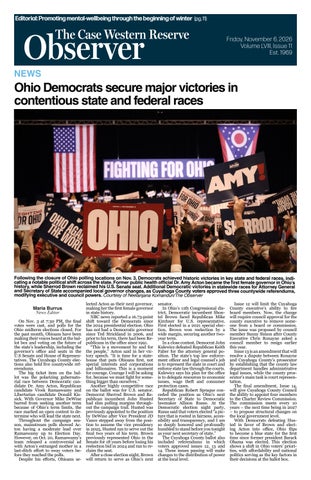
Following the closure of Ohio polling locations on Nov. 3, Democrats achieved historic victories in key state and federal races, indicating a notable political shift across the state. Former public health official Dr. Amy Acton became the first female governor in Ohio’s history, while Sherrod Brown reclaimed his U.S. Senate seat. Additional Democratic victories in statewide races for Attorney General and Secretary of State accompanied local governor changes, as Cuyahoga County voters approved three countywide referendums, modifying executive and council powers. Courtesy of Neelanjana Komanduri/The Observer Maria Burrus News Editor On Nov. 3 at 7:30 PM, the final votes were cast, and polls for the Ohio midterm elections closed. For the past month, Ohioans have been making their voices heard at the ballot box and voting on the future of the state’s leadership, including the governor’s office and seats in the U.S Senate and House of Representatives. The Cuyahoga County elections also held five countywide referendums. The big ticket item on the ballot was the polarizing gubernatorial race between Democratic candidate Dr. Amy Acton, Republican candidate Vivek Ramaswamy and Libertarian candidate Donald Kissick. With Governor Mike DeWine barred from seeking another term because of Ohio’s term limits, the race marked an open contest to determine who will lead the state next. Throughout the campaign season, mainstream polls showed Acton having a moderate lead over Ramaswamy up to Election Day. However, on Oct. 20, Ramaswamy’s team released a controversial ad with Acton’s estranged mother in a last-ditch effort to sway voters before they reached the polls. Despite his efforts, Ohioans se-
lected Acton as their next governor, making her the first female governor in state history. NBC news reported a 16.73-point shift toward the Democrats since the 2024 presidential election. Ohio has not had a Democratic governor since Ted Strickland in 2006, and prior to his term, there had been Republicans in the office since 1991. “This is a movement by and for the people,” Acton said in her victory speech. “It is time for a statehouse that puts Ohioans first, not special interests and corporations and billionaires. This is a moment for courage. Courage I will be asking for, because we must fight for something bigger than ourselves.” Another highly competitive race on the ballot was for U.S. senator. Democrat Sherrod Brown and Republican incumbent John Husted had slim polling margins throughout the campaign trail. Husted was previously appointed to the position by DeWine after Vice President JD Vance stepped away from the position to assume the vice presidency in 2025. Husted ran to serve out the final two years of his term. Brown previously represented Ohio in the Senate for 18 years before losing his reelection bid in 2024 and ran to reclaim the seat. After a close election night, Brown will return to serve as Ohio’s next
senator. In Ohio’s 11th Congressional district, Democratic incumbent Shontel Brown faced Republican Mike Kirchner for U.S. representative. First elected in a 2021 special election, Brown won reelection by a wide margin, securing another twoyear term. In a close contest, Democrat John Kulewicz defeated Republican Keith Faber for the attorney general position. The state’s top law enforcement officer and legal counsel’s job is to represent the state in court and enforce state law through the courts. Kulewicz says his plan for the office is to delegate resources to economic issues, wage theft and consumer protection cases. Republican Robert Spraque conceded the position as Ohio’s next Secretary of State to Democratic lawmaker Allison Russo. At the Democratic election night party, Russo said that voters elected “a picture that is rooted in fairness, accessibility and transparency, and I am so deeply honored and profoundly humbled to stand before you tonight as your next secretary of state.” The Cuyahoga County ballot also included referendums in which voters approved issues 12, 13 and 14. These issues passing will make changes to the distribution of power at the local level.
Issue 12 will limit the Cuyahoga County executive’s ability to fire board members. Now, the change will require council approval for the county executive to remove someone from a board or commission. The issue was proposed by council member Sunny Simon after County Executive Chris Ronayne asked a council member to resign earlier this year. Issue 13 is an amendment that will resolve a dispute between Ronayne and Cuyahoga County’s prosecutor by establishing that the county law department handles administrative legal issues, while the county prosecutor’s main task is court representation. The final amendment, Issue 14, will give Cuyahoga County Council the ability to appoint four members to the Charter Review Commission. The commission meets every 10 years – the next time being in 2027 – to propose structural changes on the local government level. With Democrats defeating Husted in favor of Brown and electing Acton into office, Ohio flips to become a blue state for the first time since former president Barack Obama was elected. This election shows a shift in Ohio voters’ priorities, with affordability and national politics serving as the key factors in their decisions at the ballot box.
News
The Case Western Reserve Observer Friday, November 6, 2026 observer.case.edu Volume LVIII, Issue 11
Animal rights activists win decisive trial over peaceful protest Olivia Wen
Copy Editor Since early May, animal rights activists from the international group Animal Equality have been protesting outside the Kroger headquarters, located in downtown Cincinnati. On Wednesday, Sept. 23, eight of those activists escalated the protests and chained themselves to the front entrance of the building. Soon after, nine activists were arrested by Cincinnati police for criminal trespassing and resisting arrest. Additionally, from Oct. 25 to 27, the group protested at a Communications Media Management Association (CMMA) conference, that Sayer Crompton, a senior director at Kroger participated in. Animal Equality is a group that has vocalized their apprehension with the meat, fish, egg and dairy industry regarding animal cruelty and climate change. They have established agreements with corporations across the
globe like Huevos Guillen in Spain, Carrefour in Italy, and more to improve animal welfare policies. Their demonstrations are part of a bigger movement against Kroger’s current policy of selling caged eggs— eggs that are laid by hens that live in wired and enclosed areas. “Hens are social animals who like to forage for food, take dust baths, perch and care for their families. The cages are so small and crowded that hens cannot spread their wings or exhibit other natural behaviors,” the Animal Equality webpage writes. Animal Equality is concerned with animal welfare for hens and argues that Kroger should be able to honor their promise. With the launch of Kroger-brand Cage-Free Eggs in early 2016, they promised a goal to transition to a 100% cage-free egg supply by 2025. However, in 2022, Kroger broke the promise in an official statement, claiming that “cage-free egg supply continues to outpace customer demand, despite Kroger’s efforts to
Courtesy of Animal Equality invest in prices” and that “given the current rate of industry progress and consumers’ demand for affordability, we do not expect to achieve our 2025 goal.” Kroger adjusted their goal to reach a 70% supply of cage-free eggs by 2030 rather than the originally promised 100% supply.
On Oct. 30, the Animal Equality protesters won at a court hearing with the defense asserting that their peaceful protests were protected by the First Amendment. The activists were victorious in their trials and are able to continue their protests until Kroger agrees to meet with them to establish a plan for ending caged-eggs.
University Hospitals servers go offline after cybersecurity threat Riya Kulkarni
Life Editor
University Hospitals servers have remained offline for over two weeks. On Oct. 22, unusual activity was detected on hospital servers, forcing the hospital to disconnect from the internet with the fear of a cybersecurity threat. Alongside it, digital services such as MyChart were also impacted, preventing patients from accessing lab results, making online payments, managing prescriptions and scheduling appointments. “We are working around the clock to address the issue and restore access,” said UH in an announcement on the hospital website, “At this point, we do not currently have an estimated timeline for completion.”
Over a week after this announcement, the shutdown remains in effect as the hospital attempts to ensure patients still receive the care that they need. “We are working to minimize the impact on patients. We have rescheduled some appointments and elective procedures,” said the hospital in a statement released on Oct. 26, “We made significant progress over the weekend in restoring our systems to full operability. Still, we continue to work through challenges and that will continue through the week.” According to WKYC studios, approximately 97% of appointments and procedures have still occurred as the hospital continues to keep main functions running. Many patients have not felt the effects of the
cybersecurity incident. “As a UH patient, it has yet to significantly impact my experience with the hospital system, which I’m very grateful for,” said second-year student Izzy Wilson. The phone system has remained unaffected by the cybersecurity threat. In fact, UH is now calling patients to remind them about appointments, “We are reminding patients of upcoming appointments the old fashioned way—we’re calling them,” said UH in a letter obtained by 3News in WKYC studios, provided by a UH staff member. The letter indicates that typical workflows are being adjusted in order to manage patient needs despite many services remaining unavailable. These services include telehealth visits, which were typi-
cally accessed through MyChart. UH hopes to come up with alternatives for patients such as in-person, Zoom or telephone visits. Prescribing protocols have also reverted back to manual means. Due to the standard electronic methods of prescribing medications also being taken offline, prescriptions are being handwritten and faxed, and patients must call for refills. The hospital continues to work with law enforcement and cybersecurity experts to elucidate the cause of the cybersecurity threat. Until then, patients wait for access to come back. “I think it probably shouldn’t have happened in the first place,” said Wilson, “But to my understanding, they’re doing what they can to get the system back up and running.”
Ohio approves Issue 3 to amend the voter identification requirement law Elizabeth Willing
Copy Editor
On Nov. 3, voters across Ohio chose whether to approve Issue 3, the Require Voter Identification Amendment, and 65.3% of them said yes. This constitutional amendment requires in-person voters to present government-issued photo identification, including an Ohio driver’s license or Ohio state ID, a U.S. passport and a U.S. military ID. This excludes university IDs and out-of-state driver’s licenses. Absentee voters must provide one of the aforementioned photo IDs, as well as one other government-issued identifier. Individuals with reli-
gious objections to being photographed may present alternative forms of identification instead. This impacts many students at Case Western Reserve University, as only 15.1% of undergraduate students are Ohio residents. This means that many students who wish to vote in Ohio elections likely do not possess an Ohio driver’s license or Ohio state ID. Therefore, CWRU students must possess another form of federal ID when voting at the ballot box. This amendment solidifies an existing law into the Ohio Constitution. In 2023, Governor Mike DeWine signed House Bill 458 into law, which established Ohio’s current voter identification requirements. Because this law already exists, this amend-
ment does not have any immediate effect; rather, it makes it harder for future lawmakers to change the law. Former 2026 Ohio gubernatorial candidate Vivek Ramaswamy sparked the conversation of this amendment when he wrote and published an opinion article this May. State lawmakers then voted on it in June before Issue 3 was added to the November ballot. Ohio Issue 3 was supported by both governor-elect Dr. Amy Acton as well as Ramaswamy. It also received support from President Donald Trump, the Ohio Republican Party and state GOP legislative leaders. Supporters argued that it not only preserves the current election security measures established by the law but also
provides additional protection against potential legal challenges. Legislative Democrats, American Civil Liberties Union (ACLU) of Ohio and Common Cause Ohio were some of the opponents of Issue 3. They argued that the fraud concerns that supporters refer to are non-existent. Furthermore, they say that the existing law has been functioning, and the amendment was an unnecessary step. Second-year student Bronwyn Harmon agrees with the opponents’ arguments and stresses the importance of making voting as easy and accessible as possible. “We should want as many people to vote as possible, and we should not be putting up barriers to prevent that,” Harmon said.
News 3
observer.case.edu
Democrats sweep midterm elections across the country Maria Burrus
Copy Editor
Courtesy of Kenneth C. Zirkel via Wikimedia Commons
Courtesy of Leoniceno via Wikimedia Commons
Courtesy of NewtonsBucket via Wikimedia Commons
Courtesy of Antonioaesparza via Wikimedia Commons
This week, midterm elections across the country were held in all states, with seats in the United States Senate, House of Representatives and state governor offices. The democrats entered this election cycle with a clear mission: flip the Senate and the House. They succeeded. Democratic candidates centered their campaigns on growing public frustration with the cost of living, the war in Iran, national corruption and the Trump administration. Meanwhile, Republicans focused on border control enforcement, tax cuts to manage rising living costs and the “America first” agenda. In the race for 35 U.S. Senate seats, Republican candidates across the country suffered major losses in key swing states. South Carolina Democrat Annie Andrews won a senate seat in a state that gave President Donald Trump nine electoral votes just two years ago, by a margin of over 15%. South Carolina’s senate seat hasn’t been blue since 1998. Similarly, North Carolina saw Democrat Roy Cooper snatch the senate seat from Trump-supported Republican Micheal Whatley, flipping the seat in Democrats’ favor. In Iowa, Democrat Josh Turek flipped the senate seat blue after Republican Senator Joni Ernst opted not to run for reelection. Maine’s incumbent Republican U.S. senator, Susan Collins, conceded to Democrat Troy Jackson early Wednesday morning, Nov. 4. This ends Collins’ bid for a sixth term and concludes her nearly 30-year career in Congress. Jackson’s victory makes him the first Democrat to hold this Senate seat since 1995. In Kansas, Democratic megachurch pastor Adam Hamilton defeated Republican incumbent Roger Marshall. Hamilton will serve as the state’s first Democratic senator in 94 years, pioneering a revolutionary change for Kansas. His campaign focused on compassionate, neighborly care in politics, stating, “Kansans are decent people. They’re good people, they’re pragmatic, they care about each other. Love boldly, serve joyfully and lead courageously.” Michigan voters selected Democrat Dr. Abdul El-Sayed in the decisive race against Republican Mike Rogers. El-Sayed, the former public health official, will become the first Muslim U.S. senator in history. He used his voice to harness young voters who were angry with the cost of living and corruption in politics. In his victory speech, El-Sayed contrasted Rogers’ campaign platform saying, “they want an America that is too small for some of us, but we know America is big enough for all of us.” Texas won a majority of electoral votes for conservatives in the 2024 presidential election, but the state just elected their first democratic U.S. senator since 1988, showcasing a major shift in Texas politics. As a former school teacher, his policy focuses on lowering everyday costs and defeated opponent Ken Paxton whom he named “the most corrupt politician in America.” “We just showed that a politics of division is no match for a politics of love,” Talarico said after his win. Gina Hinojosa also contributed to the Democrats’ breakthrough in Texas, securing a victory in the gubernatorial race. Previously having served as a U.S. representative for her state,
she became the first Latina governor in Texas history, beating incumbent Greg Abbott for the seat. New Hampshire also saw a historic first, where voters elected Democratic Rep. Chris Pappas, the first openly gay man elected to the U.S. Senate. Another key swing state which flipped its governor seat was Georgia. Voters elected Democrat Keisha Lance Bottoms, a historic milestone since she is the first black woman to serve as governor in the U.S. New Mexico made history by electing a former Congresswoman and Interior Secretary Deb Haaland as the nations’ first female Native American governor. Her victory extended Democratic rule in New Mexico. Nationwide, Republicans were unable to flip a single Democratic-held governor’s mansion. Despite new Democratic governors shaping up to take office in January, Ohio, Iowa, Georgia and Texas will still contend with Republicancontrolled state legislatures, which could create roadblocks to their policy agendas. All 435 seats in the House of Representatives were up for reelection, but the Democratic Party was projected to win majority control early into the night. They flipped seven seats, bringing them to a total of 258 – 40 more than the 218 seats required for majority. Trump commented on the blue surge, citing his absence from the ballot as the reason for the lack of Republican turnout. “I wasn’t on the ticket, and because I wasn’t on the ticket, we couldn’t get enough people out to vote,” Trump said. When asked if he believed the initiation of the Iran war may be the culprit for some of the switched results, Trump reiterated the war to be a “very wise decision” and was adamant that he “would do that again.” Vice President JD Vance showed a contrasting view to that of the president, claiming that the Republican wipeout could fully be attributed to the Iran war. In a social media post on X, Vance said, “If you’d like to argue it was worth it, that losing the Senate for the next six years was worth it, then do so.” Despite the country-wide Republican defeat, the president insisted, “I consider it to be the most successful two-year period in the history of any president.” Having gained control of both chambers of the U.S. Congress, Democrats now have the power to subpoena and conduct oversight investigations on the Trump administration. Some Democrats have vowed to attempt to impeach the president for a third time, and this new majority gives them the ability to do so. U.S. House Minority Leader Hakeem Jeffries told reporters, “I wouldn’t characterize it as investigating [the Trump administration] like crazy. We’re going to follow the facts, apply the law, be guided by the Constitution and let the chips fall where they may.” As the newly elected members of Congress prepare to take office in January, Democrats’ main goal will be focusing on four major areas: reversing Medicaid cuts, extending the Affordable Care Act, bringing back tariff power to Congress and ending the war with Iran. Citizens nationwide will watch in anticipation as lawmakers work to deliver on their campaign promises and the priorities that helped them secure their majority.
Courtesy of Jpardo210 via Wikimedia Commons
Courtesy of Department of the Interior via Wikimedia Commons
Courtesy of ArenLeBrun via Wikimedia Commons
Courtesy of Iowa General Assembly via Wikimedia Commons
Life
The Case Western Reserve Observer Friday, November 6, 2026 observer.case.edu Volume LVIII, Issue 11
Sasha Alex Sloan returns with the genre-diverse ‘And The Crowd Goes Mild’ Riya Kulkarni Life Editor Trigger Warning: discussions of eating disorders. Known best for her song-writing in notable chart favorites like Camilla Cabello’s “Never Be the Same” and, more recently, Olivia Rodrigo’s “What’s Wrong With Me,” Sasha Alex Sloan returns with her fourth studio album, “And The Crowd Goes Mild.” The album is the second to release under an independent label, and Sloan tells a story in every song, with a diverse tracklist that never seems to get old on a repeat listen. “I thought I was done with my artist stuff,” reflected Sloan in an interview with SongwriterUniverse, telling her management that she wanted to focus on music ghostwriting. Yet, with the writing of the first single “Glitter,” Sloan felt the urge to come back. Released on Oct. 23, over two years after her previous album, “Me Again,” this new album features 10 tracks in 30 minutes. Like the subject material indicates, the opening track and lead single, “Glitter,” sticks as Sloan tells the story of the struggle to forget someone. The song itself leans toward a pop-rock feel, with soft percussion in the verses that builds through the chorus into the bridge, creating a high-energy introduction. “I still find you everywhere just like glitter. No, you’ll never come off,” sings Sloan. Everything reminds Sloan of this person, no matter where she might find herself, remnants of her past remain. From “Glitter,” the tempo picks up as we transition into “Still be me.” Sloan inserts herself into a hypothetical deteriorating relationship, channeling the desperation to prevent losing someone. She ultimately admits that “You’ll still be you, and I’ll still be me,” even after coming up with many different ways to change, to repair what was left of that relationship. “Empty,” the next song on the track, is an admission that some fixes are out of one’s own control. With this vulnerability, the music takes a backseat with a soft guitar and minimal bass.
Courtesy of Justin Higuchi via Wikimedia Commons “I kept trying to fix you … You’re still empty,” remarks Sloan, realizing that her attempts were blinded by love. No amount of fixing was ever enough for that relationship, and she becomes more sure with that fact as the song progresses. “Keeping score” describes an internal conflict, beginning with a persistent piano and a drum that closely resembles a heartbeat. The lyrics are vulnerable, another confession of never being fully detached from a person. Sloan tries to dismiss any remaining memories, convinced that she has forgotten, but her “body won’t let [her] forget” what that person used to mean to her. She continues to react—her “stomach drops” and she “starts to shake” at any mention of this person—despite all efforts to move on. Sloan expresses this feeling of being trapped within her body despite all attempts to move on. The rock effect ramps up in the transition to “2018,” an amused reflection of what it means to grow up. From going to Home Depot to going to bed early, Sloan comments on all of those things she would have laughed
at herself for doing, were she younger. “Those were the days, and we didn’t even know,” she sings, with the realization that those youthful moments would never come again. This more upbeat tempo continues on to “Fun,” the third and final pre-release single on the album, and it adds to this confusion of becoming an adult. Sloan voices the thoughts that many keep in their heads as they try to figure themselves out. “I see somebody winning, and I wish it was me,” sings Sloan, trapped in a paranoid feeling that prevents her from the antics of her youth, hoping she can go back to the fun she used to have. Next is “ED,” which begins with a slow combination of piano and bass that makes the tone that much darker. A clever metaphor rests in these lyrics, hard to catch unless you listen carefully, as what appears to be a bad relationship with a lover is actually revealed to be a toxic relationship with one’s own body when dealing with an eating disorder. “I feel in control when I let him control me,” she sings, “So I let him control me.” The beau-
ty of these lyrics is the admission that the disorder is destructive, yet the urge to not let things change can still be too great. Each time they “break up” she comes back to the disorder, not fully comfortable with the person she would be without it. “What it isn’t” is one of Sloan’s favorites on the album. “I may not have learned what to do,” admits Sloan to SongwriterUniverse, “but I know what not to do.” With a slightly more pared back musical quality, Sloan reflects on what it means to grow despite getting things wrong. Coping with the slowly darkening state of the world, “Delusional optimism,” attempts to combat the otherwise depressing reality with an upbeat bouncing tone and peppy chorus. “That’s my good ol’ depression anthem,” comments Sloan in her interview. The album ends on a calmer note with the titular track, “And the crowd goes mild.” The song tells a story with a contemplative, rolling melody—incurring an almost nostalgic feeling. In it, Sloan describes the urge to change the person she was for popularity, trying to guess what people would want her to sing. This story comes full circle because, regardless if the song was upbeat, actually fun to sing or not, “And the crowd goes mild” proves that art truly is meant to be created, not perceived. Any song will have critiques, so Sloan lets go of that perception, doing what makes her happy. This hopeful lesson is a peaceful conclusion to the album. As a victory lap after the album release, Sloan continues to lean into the indie feel of her music with a short concert tour in seven cities: Los Angeles, New York City, Nashville, Toronto, Chicago, San Francisco and Boston. With the concerts taking place at smaller venues, Sloan hopes to bond with fans. “I am so excited to have these like special, intimate shows because it’s more fun for me as an artist to be able to see people and connect and talk,” said Sloan to SongwriterUniverse. Until then, perhaps spend a half hour to appreciate the layers of vulnerability and humor present throughout this album.
What to do this week(end): 11/6/26 Daylight saving time has just ended, which means we have one less hour of precious sunlight. For those who have just moved to Cleveland, things can get tough as the winter sets in and the weather gets worse. Couple that with the ramping up of academics from now until the end of the semester and the fall blues can get you down. That doesn’t mean there aren’t still plenty of opportunities to get out and have some fun!
The Brokes Date: Nov. 6 Price: $18 “Too broke to stroke?” is their tagline. The premiere Strokes cover band is returning to Cleveland “under the cover of darkness.” While they may not be the real band, their energy is electric and their performances are great. They play long sets, with classics like “Reptilia” and “Last Nite” as well as other notable favorites. If you can't get enough of the Strokes but don't want to drop all your savings to see them, check out the Brokes.
Cavaliers vs. Knicks Date: Nov. 7 Price: $53+ Knicks in 5! Cavs in … ? This Saturday, the Cleveland Cavaliers face off against the New York Knicks. The game is sure to be a blast! While you're there, be sure to say hello to beloved mascots Moondog and Sir C.C.!
“Sweeney Todd: The Demon Barber of Fleet Street” Date: Nov. 6-8 Price: $17+ Stephen Sondheim’s classic musical comes to Cleveland, starring the “demon barber of Fleet Street” and the odd cast of characters. The story is one full of mystery, secrets
Moses Fleischman Director of Digital Media
and revenge. For more information, check out our review of the show in last week’s issue. The show is only here for a few more days, and it's something you won't want to miss! “What are we doing?” Date: Nov. 6 Price: $15 For fans of “Whose Line is it Anyways” and “Make Some Noise,” this improv comedy gameshow is a no-brainer. Local comedians compete for points (and laughs) in this game show, and are determined to knock your socks off. Additionally, for any improv lovers, the Imposters Theater—where the show will be—has tons of improv comedy this weekend! Pigeons Playing Ping Pong Date: Nov. 7 Price: $51+ As a slightly more niche recommendation than The Strokes, Pi-
geons Playing Ping Pong are live at the House of Blues this Saturday. Their funky sound and jam band feel will surely have you and your friends moving and grooving. As an added bonus, the area around the House of Blues is well worth exploring before the concert! “Spectacular Freedom: Andrew Wyeth and the Modern American Watercolor” Date: Through Jan. 18, 2027 Price: $8 The Cleveland Museum of Art showcases their newest exhibition, the work of American watercolor artist Andrew Wyeth. His work showcases the breadth and evolution of watercolor as a medium over time, and the exhibit dives into his personal history and impact on the medium. For fans of vivid landscapes and flowing colors, this exhibit is for you.
Life 5
observer.case.edu
Ashe's ‘The Girl of Your Dreams’ inspires you to dance past life’s One Pot Coventry struggles Anya Lin Director of Business
Kiera Ng Director of Design One year after her collaboration with FINNEAS on their album, “The Dream,” singer-songwriter Ashe has released her fourth solo album, “The Girl of Your Dreams.” This album brings listeners through a story of heartbreak, empowerment and healing. Ashe inspires her listeners to keep their heads up and standards high as they navigate love and life. With 11 tracks, “The Girl of Your Dreams” brings contrasting themes that mesh together, creating a journey for all to hear. The album begins with “Stop The Wedding!” It has strong themes of empowerment and is the long awaited sequel to Ashe’s breakout song, “The Moral of the Story.” Both songs are inspired by her personal experience in a young, abusive marriage. While “The Moral of the Story” explains why a relationship can end up so sour, “Stop The Wedding!” expands on how to leave it. Rather than pretending to still be in love and being afraid of the outcomes, Ashe advises anyone listening to pay attention to the red flags and “Stop The Wedding!” “Lasso The Moon” and “Love Bomb” go with this empowerment theme, bringing a groovy and humorous tone to the album. Ashe claims that all it takes to win her over is to lasso the moon and to not waste her time if the feelings aren’t real. Her sarcasm (like telling them to “drop the love bomb on yourself,”) urges listeners to never lower their expectations when in a relationship. “Blue Hour,” “Sunburn,” “Always September” and “Sweet Caroline” add a nice contrast to the album. “Blue Hour” and “Sunburn” are bittersweet reflections. In both songs, Ashe sings about how her partner was always negative, how she remembers the sun while they only remember the burn left behind. “Always September” is about struggling to move on when you know the goodbye is forever. Just like how September has unpredictable weather, her relationship was unpredictably hot and cold, leaving her stuck in a lukewarm September. “Sweet Caroline,” despite sharing a name with Neil Diamond’s endearing song, is about betrayal. Ashe sings about getting backstabbed in a friendship poisoned with jealousy and questions why it turned out this way. These four songs bring alive the waves of sorrow and reflection that we inevitably face throughout our lives. “Stardust” and “Swan Lake” are about falling in love and taking chances. “Stardust” brings to life the magic that a relationship can have, and it also reflects on how great life could have been if the relationship didn’t fall through. Rooted in how stardust symbolizes cosmic connection, Ashe uses this song to incorporate the bittersweet tinge to breaking up. “Swan Lake” is also upbeat and groovy, inspiring listeners to dance in spite of any doubts. Ashe sings about how you should just “get in the water, it’s fine,” and how it’s still worthwhile to relish in the imperma-
Kiera Ng Director of Design Rating: 7/10 With the weather getting colder, nothing is nicer a nice warm bowl of soup. Even better is an all-you-caneat soup with ingredients you can pick yourself. A few weeks ago, we visited One Pot in Coventry through a University Program Board (UPB) food tour, where we had the all-you-caneat hot pot and Korean BBQ dinner option for $34.99 at the UPB-subsidized cost of $10 per person. Here are our thoughts: The soup: We tried the pork bone broth and the spicy Szechuan butter borth. They were not especially flavorful, but we went for the ingredients, not the soup. The hot pot ingredients: There was a good selection of ingredients: fish cakes, enoki mushrooms, bamboo shoots and assorted thinly sliced meats. The meat quality did not stand out, but we couldn’t identify anything bad about it either. Additionally, with the extensive selection, plates would be delivered almost abruptly. It was nearly impossible to figure out which slices of meat were which and who ordered what.
“The Girl of Your Dreams,” singer-songwriter Ashe’s fourth solo album, was released this Oct. The album tells of Ashe’s journey with themes such as heartbreak, empowerment and healing. These 11 songs do not follow linear progress, instead ebbing and flowing through life’s emotions. Courtesy of Elizabeth Marsh via Wikimedia Commons nence of life. Both of these songs mention dancing and being happy with the positive moments even if they’re short-lived. The ninth track of the album— and also its namesake—“The Girl of Your Dreams,” revolves around the insecurity felt during a secure relationship. After being in a toxic, abusive marriage, it almost feels too good to be true to be loved unconditionally. Ashe mentions her wounds and wonders when her partner will wake up and realize how broken she truly is. This song brings listeners through the motions of healing and learning to fall in love again. The very last track of the album, “Funeral,” talks about being deeply in love. It continues the story from “The Girl of Your Dreams,” where Ashe realizes that she found her person. When she is with them, every storm is enjoyable and she reflects that this relationship was the best decision of her life. She dreams of spending the rest of their lives together, enjoying the mundane and exciting alike, even explaining how he will be the last speech at her funeral. This last track brings the album full circle, going from running away from an
abusive relationship, to learning to heal, to finally learning how to fall in love again. While the album doesn’t tell a chronological story, Ashe’s choice of song order allows listeners to experience the album like we do life—as an emotional roller coaster that we learn to discover ourselves in. Beginning the album with “Stop The Wedding!” and ending it with “Funeral” ties together the album as a whole, leaving listeners with a happy, sweet ending that paints the light at the end of the tunnel. Ashe’s stylistic choices of strings, slow piano, marimba and upbeat drums (all present in a single song) creates a fascinating dynamic that helps convey the raw emotions of her story. When comparing this work with her other albums, listeners get to see a new side of her story as she navigates a healthy relationship while also inspiring self-empowerment. No matter what you’re going through in life right now, “The Girl of Your Dreams” has a little bit of everything to offer its listeners: learning how to find yourself, loving again, healing and reflecting through the ups and downs of life, all while still dancing.
The KBBQ: We loved the flavor of the KBBQ ingredients, especially the Korean-style pork belly and galbi. The other pork belly options, however, were more fat than meat, which was not as enjoyable. However, we would advise against getting both KBBQ and hot pot together. With so much cooking at the same time, it was very difficult for our party to cook the meat to the perfect doneness. We had to eat constantly just to keep up, making the experience less enjoyable. Sauce station: The sauce station was sizable, with the classic soy sauce, sesame oil, garlic and green onions. Some notable additions to their sauce bar were shallot sauce and crushed peanuts. While we personally enjoy adding peanuts and sesame to our hot pot and KBBQ sauces, this can also be an allergy concern. On top of the sauce ingredients, they also had kimchi, cucumber salad, oranges, melon and aiyu jelly dessert that served as refreshing palate cleansers between hot pot and KBBQ rounds. The vibes: The restaurant was very busy, with carts of ingredients constantly going down the aisles, but this did not pose a problem when we visited. When it was very busy, it was a little cramped inside, which may be more difficult to traverse for those with mobility aids. The decor was unexpectedly futuristic and eccentric, with large metallic figures and a wall of soju bottles, which we found very cute. Final notes: Although it is not the best hot pot in the world, One Pot offers excellent bang-for-your-buck East Asian food with a large selection of ingredients in a kitschy, bustling environment.
6
Life
Friday, November 6, 2026
“Boris Lurie: Echoes of Memory” brings Jewish art and music to CWRU Anya Lin Director of Business On Nov. 2, Case Western Reserve University partnered with The Maltz Museum to host “Boris Lurie: Echoes of Memory,” consisting of a live violin performance, art exhibition and discussion of the life and work of Boris Lurie by the Boris Lurie Art Foundation. This conservation is part of a national series by the foundation, following the travelling art exhibit “Boris Lurie: Nothing to Do But To Try,” which is being featured in the Maltz Museum from Oct. 18 to Jan. 27. The event opened with remarks by Executive Director of The Maltz Museum Aaron Petersel, followed by a lecture about Jewish-Latvian-American artist Boris Lurie from Executive Director of the Boris Lurie Art Foundation Stephanie Stebich. It also included a solo performance by Ilana Zaks-Nederland-
er, a concert violinist and current faculty of the Boston University Tanglewood Institute and Rollins College. Stebich’s lecture delineated a biography of Lurie’s life, from his childhood in Riga, Latvia, his survival in Nazi multiple concentration camps, to his immigration to the U.S. and co-founding of the avant-garde NO!Art movement. Each point was accompanied with a presentation of a few examples of Lurie’s art, emphasizing how Lurie’s experience translated into his expression. Much of the event was a solo violin performance by Zaks-Nederlander, who played a collection of pieces by early 20th-century Jewish composers. Before each piece, Zaks-Nederlander explained the story of how each piece was composed as a result of the composer’s experience with the Holocaust. Some of the pieces Zaks-Nederlander performed were written
while the composer was held in concentration camps, and many were written within two decades post-World War II. To third-year CWRU student Hakuto Higuchi, this made Zaks-Nederlander’s performance the most memorable part of the event. “Each performance had such a different tone and feel which also aligned with the background of the artist that she also talked about,” Higuchi said. “[Zaks-Nederlander] was actually really good.” The combination of an informational lecture paired with musical performances made this event unique compared to other historical events. Hearing about the violinist and musical aspect of the event is what enticed both Higuchi and first-year student Rikako Sato to attend. “I’m not a huge history person and get bored fast when people present on it, but I love music and how it can convey emotion, so I re-
ally enjoyed this lecture,” Higuchi said. Events with music “can really benefit because it’s hard to understand the type and variety of emotions people can have during historical events.” “That was one of the reasons why I wanted to go, because I’m interested in music,” flute player Sato said. “If there were other talks that would incorporate dance or visual art, or something, I think those kinds of events would be really cool.” For the month of November, The Maltz Museum is offering free general admission to the public, including admission to the Boris Lurie exhibit, sponsored by the Ohio Holocaust and Genocide Memorial and Education Commission. Tickets must be reserved in advance online at the Maltz Museum’s website. Additionally, through the CWRU Division of Student Affairs’ Free Access Program, admission to The Maltz Museum is free once a week for students with valid student IDs.
Playlist of the week: Noah Kahan takes over fall Anya Monga Social Media Editor The leaves have fallen, and the trees are starting to look barren. Until it starts snowing, this new season has a particular name, stick season. Coined in New England and used for generations, “Stick Season” became the name of Noah Kahan’s breakout single-turned-album in 2022. In honor of Cleveland entering stick season and Noah Kahan announcing ticket sales for the second leg of “The Great Divide” tour, take some time to explore some well-kept hidden gems from his previous albums. “She Calls Me Back” - Noah Kahan Considered one of the more upbeat songs on Kahan’s discography, “She Calls Me Back” perfectly encapsulates the feeling of having a crush. This song has a strong percussive beat that creates this forward, peppy, simple motion, almost like skipping. It would not be a Noah Kahan song if anxiety was not referenced in some way or another. For this particular song, that anxiety feels a lot more like anxious excitement in the verses, cresting to a calmer chorus that replicates the calm felt when Kahan’s love interest talks to him. Yes, this feeling is scary, and allowing yourself to put so much into a relationship with another who might not reciprocate is terrifying, but there is also a sense of happiness and pure joy that comes from loving another person that is woven into the essence of this particular song. That joy is worth a listen. “The View Between Villages” - Noah Kahan “The View Between Villages” is
a bit more somber than “She Calls Me Back.” Split into just two verses, the first half of this song is nostalgic. Kahan drives down this twisting valley he’s known all his life, and he’s transported to a simpler time. The music itself is reflective of that simplicity; there’s really only an electric guitar as accompaniment in the first half of the verse before a light percussion picks up in the second half. The accompaniment crescendos to the middle of the second verse, where Kahan expresses how that simplicity he felt driving home is now inundated with reminders of how much he has changed. “The View Between Villages” grapples with the feeling of returning to a home that is both extremely familiar and completely foreign, a sentiment college students know all too well when returning for breaks. “A Few of Your Own” - Noah Kahan Kahan’s music is known for its sadness, but something that can be looked over in this oversimplification is this sense of hope that permeates through most of his songs. “A Few of Your Own” is a song where you don’t have to dig too deep to find that sense of hope; this song has hope bursting from its seams, ready to give the listener a nice, warm hug. Here Kahan writes of the quiet reassurance he receives from his lover in the form of companionship. He appreciates all of the memories they made when they were “young and dumb on the edge of the world,” and his love chooses to stay with him through all the
memories they continue to make. Along with this sense of hope, there seems to be a level of wonder embedded in this song, almost like Kahan can’t believe his luck with a partner that chooses to love him unconditionally. If you need a reminder to embrace the good around you, “A Few of Your Own” might be the song for you. “Maine” - Noah Kahan When I was younger, I saw this post online that mentioned how all college students have this drive to change the world for the better. Having experienced a bit of college, I have found that ambitious drive radiating everywhere around campus. I have also come to realize that college has the potential to wear down that drive as well. “Maine” was written by Kahan when his drive to pursue music as a career was dwindling, so for about the first minute of the song, you get to hear Kahan learn to love music again by just fingerpicking on an acoustic guitar. Not a single word is uttered. When the lyrics do start, they yearn at levels only matched by Mr. Darcy in “Pride and Prejudice,” yet they don’t yearn for another person, rather a simpler time when Kahan’s dreams seemed as mindlessly obvious as breathing. If the fall storms seem to be weathering down your spirits, the nostalgia in “Maine” might be what you need. Noah Kahan touches on many different themes in his songs. In my eyes, though, he has always had a consistent one: to treasure all that makes you who you are.
All album covers courtesy of Republic Records
Fun In photos: Halloweekend
The Case Western Reserve Observer Friday, November 6, 2026 observer.case.edu Volume LVIII, Issue 11
8 Fun
Friday, November 6, 2026
Which 2026 movie/TV show should you watch based on your zodiac sign? Aries
Taurus
Gemini
Cancer
"Star City"
"Street Fighter"
"Avatar Aang: The Last Airbender"
"Shaun the Sheep: The Beast of Messy Bottom"
Leo
Virgo
Libra
Scorpio
"Furious"
"Sense and Sensibility"
"The Pitt"
"Look Back"
Sagittarius
Capricorn
Aquarius
Pisces
"Spider-Noir"
"Widow's Bay"
"East of Eden"
"Moana"
overheardCWRU Compilation of out-of-pocket things heard across campus
"Have you ever…bulgogied yourself?" " You know what that means? It means that I’m your dad." "That's not a center of mass… that's the flat part of my head" "What’s the boba to dog conversion rate?" "Sperm is pretty cool, but I like eggs better because I’m a woman and a feminist." "Did you know the S in USG stands for fencing?" "REALLY?!?!?" "They’re turning Greg Abbott into a Waymo by tomorrow." "My two legs look like one leg…I’m separating them." "This request is incest."
Last week's answers
Fun 9
observer@case.edu
You can have class here
ways to procrastinate studying for your exams Meal prepping breakfasts, 1 lunches and dinners for the entire week. You might fail
your test, but at least you won’t starve. You might as well meal prep for the rest of the semester while you're at it.
Deep cleaning your entire 2 apartment, including asking to clean your suitemates'
rooms. Floors, toilets, countertops, behind the closet, washing machine filter… all of it will be impeccable by the time your exams roll around.
Going grocery shopping 3 multiple times because you “forgot” something the first
time…and the time after that...and also the time after that… Oh no, it looks like I didn't get Cheez-its, I guess I have to go back again.
Starting a very involved 4 self-care day. Start with your oil cleanser, then gentle face
cleanser, then serum, toner, moisturizer one, moisturizer two and face mask. Then shampoo, hair mask and oil and literally anything else before then washing it out
Caring very deeply about 5 needing to exercise for at least an hour every day when you've never stepped foot in the gym for the past three months. Today will be leg day, push day, pull day, cardio day and ab day.
Deciding you need to be 6 more involved in clubs and going to meetings you never had before. Letterboxing? Let's do it. Mahjong? No idea how to play, but I should go to their general body meeting for the full 1.5 hours.
Courtesy of Riya Kulkarni
Connections!
Making to-do lists for the 7 entire month, as if you don’t already have enough things
to do within the next few days. At least now you know exactly what readings you have to do three Thursdays from now.
Cleaning out your iPhone 8 storage. Your phone has been crying at you for a few
months that it only has a gigabyte of storage left, but you've been ignoring it the whole time. Now, the day before your exams, sounds like the perfect time to respond to your phone's cries for help.
Scrolling social media end9 lessly...No comment needed.
Doing all your laundry and 10telling yourself you will start
Courtesy of Anya Lin Answers for games will be on the next issue.
studying when it finishes. This includes towels, sheets, window dressings, pillow covers and everything else. If your apartment is going to be clean (point 2), then it will be CLEAN.
Opinion
The Case Western Reserve Observer Friday, November 6, 2026 observer.case.edu Volume LVIII, Issue 11
EDITORIAL
Promoting mental-wellbeing through the beginning of winter Editorial Board On Nov. 1, daylight saving time ended this year. For many, this “falling back” is valued due to the extra hour of rest. For others, this indicates an official transition into the cold winter days and an earlier nightfall. Changes in seasons can be exciting. The cold winter months are usually associated with holidays such as Thanksgiving, Christmas, Kwanzaa and Hanukkah. Winter delivers the anticipation of snow, candy canes and all of the accompanying festivities. However, changes in seasons can also bring about events that are less enjoyable. A decrease in sunlight and the presence of colder weather may cause seasonal affective disorder (SAD). SAD, known more colloquially as seasonal depression, is a type of depression often associated with the winter season. The reduced sunlight in winter plays a major role in facilitating SAD; reduced levels can lead to disturbances of circadian rhythms, serotonin levels and melatonin levels. It doesn’t require a medical diagnosis of SAD to acknowledge that the winter seasons can generally lower moods and drain one’s energy. It is important for everyone to devote more effort to self-care rituals and engaging activities in the coming months. For Case Western Reserve University students, this is especially important given Cleveland’s infamous subzero winter climate. Furthermore, much of the student body hailing from warmer states such as California may not be used to the darker days and frigid temperatures. It has become normalized for college students to be unhappy and stressed over schoolwork. Indeed, college culture champions concepts like sleep deprivation, caffeine overloading and a general air of burnout. This rings especially true for CWRU students, where many of us are high-achieving and take advantage of the educational opportunities that undergraduates have access to, such as the research facilities, in addition to coursework. These sen-
timents may be exacerbated in the winter, and the default mindset for a student may just be to push through the harder months. However, this doesn’t need to be the case. You can start caring for yourself at the personal level. Simple things such as learning a new hobby for ten minutes a day can help bring novelty to the everyday. Starting a show just watching one new 20 minute episode a day provides a consistent way to end a night. Taking the time to actively listen to a new song instead of only while studying also provides an opportunity to take intentional time for yourself. Scheduling time to go for dinner with friends, even if it is just once a week, provides something to look forward to. All this to say, it is incredibly important to set aside time for yourself. There are many ways, both on and off-campus, to ward off the winter blues. Go visit the Cleveland Museum of Art, where you can recreate warmer days by enjoying the fleeting hours of sunlight in the glass-panneled atrium. Go to the neighboring Cleveland Botanical Garden and immerse yourself in the tropical climate that lies inside the glass barriers of the greenhouse. Go to one of the many club events that are hosted nearly daily. Even something seemingly small, like going to office hours, serves as a respite from the cold and a way to connect with professors and fellow students. It is also equally important to explore off campus. Taking the same route daily to attend classes, eating the same meals and going to the same extracurricular activities may create the illusion that we are anchored down to our academic responsibilities, and may make things feel more overwhelming than they truly are. As snow piles up, daily routines may start to feel stuffy and lackluster. Getting off campus, even if just for a couple of hours, can provide a mental reset from the mundane. Cleveland is a city with many hidden gems to discover, if you make the intent to do so. Get tickets to a play or musical at Playhouse Square and appreciate the beautiful architecture of the Connor Palace Theatre. Embrace the cold weather and attempt ice skating at Public Square. Or, if ice skating doesn’t
Talia Jun/The Observer
sound appealing, go tobogganing at The Chalet in Mill Stream Run Reservation. Something that requires less physical commitment would be to stroll through the city after dark to sightsee Cleveland while Illuminate CLE brings vivid lighting displays in the heart of Public Square. As students, we often place aca-
demics and extracurricular activities at the forefront. However, we should also put effort into other aspects of ourselves, such as our mental and socio-emotional well-being. There will always be an exam, quiz or application due. Don’t let these responsibilities take away your personhood and ability to have fun.
The Case Western Reserve Observer Established in 1969 by the undergraduate students of Case Western Reserve University
Penelope Cloonan Executive Editor & Publisher PRINT Aleksandra Majewski Director of Print Ellie Palaian Director of Print Maria Burrus News Editor Alyssa Wang News Editor Riya Kulkarni Life Editor Lily Zhang Opinion Editor Abhishek Nambiar Sports Editor Abby Shazivari Copy Editor Kashvi Madhwani Copy Editor Olivia Wen Copy Editor Oviya Gowder Copy Editor Elizabeth Willing Copy Editor DESIGN Kiera Ng Director of Design Jana Ashour Director of Design Helen Cai Layout Designer Reva Kolhe Layout Designer Mansi Swaminathan Layout Designer Natalie Chang Layout Designer Talia Jun Graphic Designer Kristina Guo Graphic Designer Anna Trusova Graphic Designer DIGITAL MEDIA Moses Fleischman Director of Digital Media Matthew Stall Video Editor Aditi Darodkar Video Editor Assitant Lydia Park Video Editor Assistant Obafemi Tidjani Web Editor GianMarco Miraglia Web Editor Assistant Phillip Kornberg Photo Editor Neelanjana Komanduri Photo Editor Esha Bagora Social Media Editor Benjamin Kang Social Media Editor Daniel Chin-Garita Social Media Editor BUSINESS Anya Lin Director of Business Operations Divya Kurma Accounts Manager Riya Dixit Ad and Partnership Manager Justin Rosentover Ad and Partnership Manager The Observer is the weekly undergraduate student newspaper of Case Western Reserve University. Established in 1969, The Observer reports news affecting students and provides an editorial forum for the university community. Unsigned editorials are typically written by the opinion editor but reflect the majority opinion of the senior editorial staff. Opinion columns are the views of their writers and not necessarily of The Observer staff. For advertising information, contact via e-mail at observer@case.edu. LETTERS TO THE EDITOR should be e-mailed to observer@case.edu or submitted on our website at observer.case.edu. Letters can be mailed to Thwing Center 11111 Euclid Avenue, Suite 01, Cleveland, Ohio 44106. For policy and guidelines related to the submission of Letters to the Editor, refer to observer.case.edu/submit-a-letter. The Observer is a proud member of CWRU’s University Media Board. Follow The Observer on TikTok and Instagram @cwruobserver.
Opinion 11
observer.case.edu
The problem with choosing the world’s best Owen Lee Contributing Writer Who is the best? This tends to be the question we ask in every genre, sport, competition or field. In soccer, the Ballon d’Or, an annual award given to the greatest player of the year, embodies the role of being the best. However, the award has increasingly become a major source of controversy and debate. Let us begin with the voting process. The men’s Ballon d’Or is not voted for by the fans, but by 100 journalists from the top 100 ranked nations in soccer. The journalists rank their top 10 players in order, giving a corresponding amount of points to the players in each respective rank. The trouble manifests from the criteria by which soccer players are ranked. Journalists are told by the official organization to vote based on the following criteria in order of importance: individual performances, decisive and outstanding nature, collective performances and titles won and sportsmanship and impartial play. Since the criteria is so broad, it’s practically impossible to objectively decide who is the best player of the year. For example, consider the 2026 Ballon d’Or announced on Oct. 26. There were three main candidates surrounding the debate: Harry Kane, Lamine Yamal and Kylian Mbappé. Some argued Harry Kane deserved the win, scoring 73 goals and winning the Bundesliga title. Lamine Yamal won the 2026 FIFA World Cup and LaLiga, while having a combined 45 goals and assists. Kylian Mbappé won the UEFA Super Cup, totaling 71 goals and assists, is the fifth on the all-time Champions League goalscoring list and won the Adidas Golden Boot for his performance in the 2026 World Cup. It’s clear that these players are all really talented, but can you really choose the best player based on these varied statistics?
And this is without taking into account a multitude of other factors. Players all have different roles within their team and play different positions. For example, defenders rarely win the Ballon d’Or, not since Fabio Cannavaro won in 2006, as the fans and press often favor flashy goals and assists over honest defense. Additionally, a striker who plays for a team where the tactic is to pass the ball will have better statistics than a midfielder who tries to control the game and helps the team win by keeping possession of the ball. The teams influence the winners of the award, too. A player on a star-studded national team will have better chances of winning the World Cup than a player playing on a national team in their first World Cup. Statistics are often not enough to decide a clear-cut winner, so social media now plays a huge role in influencing votes. It has reached the point where players and clubs have campaigns for the Ballon d’Or, highlighting their statistics and achievements throughout the season. Every interview, reel edit or highlight contributes to a player’s image and their chances of winning, as it shapes the public’s perception and, ultimately, the opinions of voters. Tellingly, there is incredible tension and controversy surrounding the award by both fans and players alike. On social media platforms, you can find fans arguing in the comment sections of videos, or commentators debating who will win. There is no clear rubric for deciding the winner, no single statistic that will guarantee the award and it is often based on perception. As a result, the award has become too competitive and high-stakes. For example, in 2024, the Ballon d’Or ceremony was boycotted by Real Madrid because they felt that their player, Vinícius Júnior, was unfairly robbed of the award. When there are organizations boycotting the event, players have their own
Kristina Guo/The Observer campaigns and public relations team to help sway the public and with fans getting in heated debates over who should win, it raises the question of whether or not this award is still celebrating individual talent. Lately, the celebration seems to be about marketing, popularity and riled controversy. In truth, there will always be controversy surrounding this award. It is incredibly difficult to give a single player an award in a team sport, especially if these players play differ-
ent positions and contribute different purposes to the team. However, behind all the pressure, news and media, it is important to remember that the original purpose of this award is to give praise to the player. This is not just applicable in soccer, but in all fields. It is easy to forget the purpose of awards, to join in on the debate and argue who is the best. However, we shouldn’t let competition overshadow the achievements and the winners themselves.
Effort versus intention in awarding the Nobel Peace Prize Joseph Rosentover Ads and Partnerships Manager On Oct. 9, international jurist and human rights activist Navi Pillay won the 2026 Nobel Peace Prize. As with nearly every Peace Prize, there was a minor degree of controversy. Most of it focused around Pillay’s involvement with the International Criminal Court, a body which the United States has long objected to and which has been condemned by the Israeli government for a perceived bias against Israel. However, it is very hard to object to Pillay’s actual track record as a fierce opponent of Apartheid in her native South Africa, the Rwandan genocide and the ongoing Rhoingya genocide in Myanmar. The Nobel Peace Prize is the only Nobel Prize given for possible achievement, either in hope of future success or in admiration for effort, rather than for tangible results. Since 2021, not a single Nobel Peace Prize has been for a successful achievement, possibly excepting Pillay’s work in South Africa. Last year’s prize went to Maria Machado, who for all her laudable efforts has not brought about a democratic government in Venezuela.
Jana Ashour/The Observer But this is not a recent phenomenon. The Nobel Peace Prize has been awarded seven times for attempts to ban nuclear weapons. Yet, nuclear weapons are not banned. Freedom advocates in Belarus, Russia, Iran, China
and Pakistan have all won the prize over the last 20 years and yet those countries remain as authoritarian as ever. Colombia’s then-president won in 2016 for an unpopular peace agreement with a Marxist guerilla group
which was rejected in Colombia by popular referendum. Henry Kissinger himself thought his prize was undeserved in hindsight and tried to return it. Virtually all those awarded during the period between the World Wars ended up looking absurd when Hitler invaded Poland in 1939. Perhaps most ironically, the 1929 award was given to Secretary of State Frank Kellogg for the Kellogg-Briand Pact, an agreement to “condemn recourse to war for the solution of international controversies” that was signed by, among others, Japan, Germany and Italy. This is not to say every prize has been aspirational, as the five Norwegians who award the prize have also recognized tangible humanitarian success. The Red Cross has won three times and has without a doubt provided valuable humanitarian support for its entire existence. Norman Borlaug, whose work on genetically engineering disease-resistant wheat has probably saved billions of lives, won in 1970. But these prizes are in the minority. Continued on page 12
12 Opinion
Friday, November 6, 2026
continued from page 11 What does peace mean for the Peace Prize? Further, this does not mean that all speculative Peace Prizes have been failures. A prize was given for the Camp David Accords, a signed peace treaty between Israel and Egypt— which, despite continued war in the Middle East, have held up. The Good Friday Agreement (prize in 1998) in Northern Ireland has held for 28 years. But that Good Friday Agreement prize was the second awarded for ending conflict in Northern Ireland. These prizes have held up in hindsight, but at the time could have as easily been failures.
There are very valid questions about how long after a peace we can consider it to have held. Is 10 years enough? The Treaty of Versailles lasted 20. 30 then? 50? Nobel Prizes can only be awarded to living people (hence Ghandi’s omission) and if we wait too long, the time to recognize individual’s contributions will pass us by. But it is only with the benefit of hindsight that we can see what has created peace and what has not. Only now that the era of duck and cover drills is over can we tell that the Cold War, far from causing a mass extinction, led to the most peaceful pe-
riod on record. Neville Chamberlain famously declared that the Munich Agreement with Nazi Germany meant “peace in our time” in 1938 and then oversaw the beginning of the bloodiest war in human history. Alfred Nobel endowed his prize for “the person who has done the most or the best” to promote peace, not for the person who has tried the hardest. Effort is important, nothing can be achieved without it, but it is insufficient for recognition. Francis Halzen won the Nobel Prize in Physics this year not just for thinking about a neu-
trino observatory at the South Pole, but for building it and then detecting high-energy neutrinos. In this spirit we should recognize efforts like that which eliminated smallpox from the face of the planet and thereby saved countless lives. We should honor people like those who (eventually) ended the genocide in Bosnia and the leaders who have at least partially democratized countries like Nepal and Armenia. Nobel wanted to reward those who have provided “greatest benefit to humankind.” The Peace Prize ought to live up to that ideal.
Checkmate doesn’t discriminate Oviya Gowder Copy Editor
tion, demonstrating that women are more equipped at analytical cognition whereas men have better motor The International Chess Federa- skills. Moreover, females more eastion (FIDE) oversees all chess compe- ily pull from their long-term memory titions occurring at the international while males are better at the spatially level and defines the standards need- manipulating objects in their mind. ed to earn each chess title. Grandmas- Clearly, each sex has their own cogter (GM), the most prestigious title, nitive strengths, but variations in the must attain a rating of 2500. Ratings brain differ more between individuare earned by competing, and in the als than genders, so it’s still trivial to simplest words, the more one wins, claim that males are “more intellithe higher rating points one gains. gent” than women. Grandmaster is followed by the InOther than biological reasons, culternational Master and FIDE master tural reasons also play a role in why title with a rating of 2400 and 2300 there is distinction between the ratneeded, respectively. To be called a ings. On a smaller scale, the disparWoman Grandmaster (WGM), FIDE ity between the ratings required for has stated that a 2300 is required. Woman Grandmaster and GrandThe word “woman” is before the master reflects a similar situation highest ranking title and career-de- at my local chess tournaments back fining award that a professional chess home. I’ve been competing since I player seeks the second they enter the was eight years old, and every tourcompetition arena. At first, the word nament had an award designated as seems misplaced, like the Federation the “Top Female” award. It was an wanted to make the distinction. It is award exclusive to girls competing possible that this distinction could be that wouldn’t otherwise place. attributed to the fact that many womAt face value, these slight advanen-only competitions exist such as the tages, both at the international level Women’s World Chess Champion- and my hometown, make it easier ship and U.S. Women’s Chess Cham- for women and girls to win in compionship, so a separate ranking sys- petition or earn a title. Sure, any tem is needed. However, a majority woman or girl is perfectly capable of tournaments are “Open,” meaning of and allowed to earn an award or they allow people from any gender to the GM title. FIDE actually created compete against each other. Still, the these lower expectations to encourqualifying ranking for women is 200 points lower than men. Why is this? It has been well established that males and females are biologically different. Researchers have found that before puberty, there is zero difference in testosterone levels between the two. After puberty, it is a different story. Males experience a 30 time increase in testosterone which contributes to the difference in aspects like muscle mass and hemoglobin. Males have 35-40% more lean muscle mass, concentrated more in the upper body, which contributes to greater strength and speed for more vigorous activities like sprinting. A 12% difference in hemoglobin indicates that males’ cells can carry more oxygen for a certain amount of blood, an asset for endurance-based activities. This is why there are differences in statistics between males and females in sports. But chess is an intellectual game. Do differences between sexes extend to the brain? Male and female brains have slight anatomical differences. The corpus callosum, a white band of tissue that connects the two brain hemispheres, is larger in females than in males. Thus, females have a strong interhemispheric connection, as compared to males, who have a more developed intrahemispheric communica-
age more women into playing chess, a traditionally male-dominated game. Women holding women-specific titles like WGM can gain a discount for future tournaments just as those with the GM title can. Similarly, the Top Female award provides lingering hope to a player that even though they can’t earn a place in the competition, they still had the possibility to go up on stage and proudly accept this runner-up award. The problem is that by setting lower expectations to supposedly level the playing field solely because women are considered a minority inadvertently drives women away from competing. While there may be good intentions behind these actions by the Federation, misunderstandings arise about why the distinction exists if both genders are both intellectually capable of playing the game. The existence of the pay gap between genders due to unconscious gender bias and societal expectations regarding family responsibilities also cause women to earn an income less than men. This drives the image that women are not as capable. Reasonably, people’s instinct may be to point at this reason to explain the rating disparity. Chess is male-dominated not because fewer women desire to play chess but because they weren’t allowed to compete in public spaces.
They have always played the game in more private settings alongside men, but once chess was popularized, women were excluded, making accessibility harder. Therefore, women formed their own chess clubs and competitive leagues to not only form a community but launch their own professional career. Many women, including Louisa Fagan, Vera Menchik and currently Judit Polgár have repeatedly shown that they strongly hold up against male competitions, so, again, it’s not about a lack of mental capacity. Rather, it is the lack of opportunity that has led to a constantly dwindling population of women in chess. Lowering the bar and setting “attainable” goals isn’t the ideal solution. Rather, further media representation showcasing successful women in chess is one of many better routes to take to encourage younger girls wanting to compete. The Netflix limited series “The Queen’s Gambit” does a stellar job by casting a female lead in a story surrounding her monumental journey in the competitive chess world in a time period where men dominated the 64-square boards. Many professional fields have started to see a rise in the number of females or losing the male-dominated status. Changing norms requires everyone, even the FIDE, to reconsider the definition of equality.
Jana Ashour/The Observer
Sports
The Case Western Reserve Observer Friday, November 6, 2026 observer.case.edu Volume LVIII, Issue 11
A sneak peek into the CWRU basketball season Ivan Shen Contributing Writer On Friday, Nov. 6, the Case Western Reserve University women’s and men’s basketball teams kicked off their 2026-2027 season as a new generation of players stepped into leadership roles. The women’s basketball team went 11-14 overall last season, placing sixth in the University Athletic Association (UAA) conference. Being a smaller team overall, their philosophy revolved around fast paced playing, stamina, strategic defense against bigger teams and aggressive rebounds. “We’re usually undersized in every game we play…so it’s something we’re used to at this point,” fourth-year forward and co-captain Maura Schorr said. “So in our game plans…we practice getting in front…and then usually double in the post.” Although the team graduated three seniors, including leading scorer Emily Plachta, the Spartans welcomed four first-year players and one graduate transfer. “Everyone has meshed super well…all of our first years, they all stepped up, asked questions, and
everyone is really eager to learn,” Schorr said. “I think one of our strengths this year is that we’re a lot deeper than we’ve been in past years, and everyone’s really improved a lot.” The team is looking to come back better than ever. Schorr noted that their energy in practice has been high and everyone is contributing in their own ways. The team played their first game on Friday, Nov. 6 against Chatham University in the Coach Vicki Staton Tipoff Classic in Washington, PA and then played Washington and Jefferson College on Saturday, Nov. 7. Meanwhile, the men’s basketball team went 12-13 overall last season, also placing sixth in the UAA. Last season, four players graduated, including Ethan Edwards, who famously set program and UAA scoring records. However, a strong set of returning talent still remains. With the large part of the team being underclassmen, many of them are looking to step up on the court. One of these players is Shyam Patel, a second-year guard who averaged 8 points and 4 rebounds per game while ranking second on the team in minutes played last season. Another player is second-
The Case Western Reserve University men’s and women’s basketball teams tip off their 2026-2027 seasons this weekend, with both programs looking to build on their season from last year. Following the departure of key seniors and record-setting scorers, both teams are integrating large incoming classes while relying on returning core players to step into leadership roles. Courtesy of Phillip Kornberg/The Observer year forward Alex Vincent, who averaged 10 points, 7 boards and 2 blocks per game. With seven freshmen joining the team, the team relies on its five returning fourth-years—Julian Scott, Drey Fox, Logan Brown, Ethan
Nowak, and Elvin Stowell—to provide leadership. The CWRU men’s basketball team play their first home game on Nov. 6 against Kenyon College at 7 P.M. in the Bill Sudeck Tournament.
CWRU men’s soccer ties Emory in secondto-last game of regular season Abhishek Nambiar Sports Editor In their second-to-last game of the regular season, the Case Western Reserve University men’s soccer team tied Emory University 1-1 in a tightly-fought contest in Atlanta, Georgia. If the Spartans won this game, they would have clinched the UAA championship—marking the third such instance in program history and first since 2011. While the team wasn’t able to get over the hump on Saturday, fourth-year midfielder and team co-captain Sean Wilson nonetheless called attention to the solid performances by his teammates. “Obviously, there is some disappointment that we weren’t able to leave Atlanta with three points and clinch the UAA title. At the same time, we’re happy with our overall performance and the way we competed,” Wilson said. “There are certainly things we can continue to improve on, but I think it was a positive weekend for us as we approach the end of the regular season and get closer to tournament play.” The first half saw a strong offensive push from the Spartans as they fought their way to nine shots over the course of the period compared to only one shot attempt by the Eagles. Though CWRU was able to attempt numerous shots, they were unable to convert most of them; the only goal of the period for the Spartans came at the 42-minute mark as fourth-year defender Cameron Thayer shot a goal into the back of the net with an assist from second-
Case Western Reserve University’s men’s soccer played Emory University to a 1-1 draw in Atlanta, missing the opportunity to win the UAA championship by one win. Despite the result, the Spartans remain in contention for the title as they enter their final game of the regular season. The team will return home this Saturday, Nov. 7 to face Carnegie Mellon at DiSanto Field for Senior Day, with kickoff set for 1 p.m. Courtesy of Phillip Kornberg/The Observer year midfielder Aydin Sumer. Emory’s offense back fired on all cylinders in the second half, outshooting the Spartans 7-1 during this time. The Eagles struggled to convert their shorts into goals, until a breakthrough in the 75th minute as they found the back of the net to tie the Spartans. CWRU was unable to attempt any shots for the remainder of the period, though a failed shot by Emory in the 85th minute did prevent the Spartans from suffering their first loss of the season.
Reflecting on the game, Wilson noted the biggest priority for him and his teammates was to take things one at a time, focusing on their strengths and improving on their weaknesses rather than solely focusing on the UAA title, even as the Spartans remain in contention. “The biggest thing is continuing to take things day by day and not making the occasion bigger than it needs to be,” Wilson said. “We understand that the UAA title is in play, and obviously, it would be great to call ourselves UAA champi-
ons, but that’s not the end goal for this team. There will naturally be a lot of excitement surrounding the team, but trusting what has gotten us to this point, and continuing to focus on ourselves will be really important.” This coming Saturday, Nov. 7, the Spartans will be hosting Carnegie Mellon University at DiSanto Field for both teams’s final match of the regular season, as well as Senior Day for the graduating fourthyears of the CWRU team. Kickoff is at 1 p.m.
14 Sports
Friday, November 6, 2026
Master Your Mind brings mental health support to CWRU Athletics
Weekly Scores Football vs Thiel (10/31)
W 51-7
Men’s Cross Country UAA Championships (10/31) 5th of 8 teams
Women’s Cross Country UAA Championships (10/31) 6th of 8 teams
Men’s Swim & Dive at Carnegie Mellon (10/31) L 105-194
Women’s Swim & Dive at Carnegie Mellon (10/31)
L 90-210
Men’s Soccer at Emory (10/31)
T 1-1
Women’s Soccer at Emory (10/31)
W 1-0
Volleyball CWRU Tri-Match vs William Smith (10/31)
L 0-3
vs Calvin (10/31)
L 1-3
vs Bethany (11/4)
W 3-0
Ellie Palaian Director of Print Trigger Warning: discussions of suicide and mental illness One in five student-athletes manages a mental health struggle, yet fewer than half the students who report these struggles seek help. Between 2002 and 2022, suicide deaths among NCAA student-athletes doubled, making suicide the second-leading cause of death among this population. Recognizing the growing need for mental health support among studentathletes, particularly those balancing the academic and athletic demands of Division III (DIII) competition, Case Western Reserve University took action. Since Oct. 2025, CWRU has provided free mental health counseling to all varsity teams and individual student-athletes through Master Your Mind LLC, a mental health and performance coaching organization led by former DIII athlete Carlie Grandjean. The initiative aims to expand access to mental health resources and prioritize the well-being of the Spartan athletic community. James C. Wyant Director of Athletics and Chair of Physical Education, TJ Shelton, hired Grandjean and her company to provide mental health and performance support to CWRU student-athletes and teams. A former DIII lacrosse player at Denison University, Grandjean holds a master’s degree in clinical mental health counseling and brings both professional expertise and firsthand experience to her work. Having navigated the de-
mands of DIII athletics herself, she understands the unique challenges student-athletes face in balancing their academic, athletic and personal lives. “I was really good friends with a lot of different sports teams [at Denison],” Grandjean said. “And the common factor that just kept coming up was, ‘I’m mentally struggling with this.’ It was never physical, especially at the collegiate level … and we didn’t really have a lot of resources or support to manage the mental side of the sport or just the mental side of being a human being.” Grandjean’s path to becoming a mental health counselor and performance coach was not always clear. However, after experiencing the devastating loss of a close friend and fellow student-athlete during her time at Denison, she felt called to make a difference. The experience inspired her to become someone others could turn to for support, creating a safe space for student-athletes navigating challenges of their own. “In 2019, a really good friend of mine, Sean Bonner, [who] was on the baseball team died by suicide while we were on campus. He was the type of guy that everyone else went to for support and a good laugh. And truly, no one would have ever thought that he was really struggling as much as he was,” Grandjean said. “I made it my passion to get my master’s degree in clinical mental health counseling and figure out how I can specialize in working with athletes,” Grandjean said. In 2023, Grandjean founded Mas-
ter Your Mind, a company focused on sports psychology. As the company’s sole owner and practitioner, she has expanded her reach beyond CWRU, working with collegiate and high school athletic programs as well as private individual clients. “I might not always have the best answers or I might not be the smartest person out there, but at least someone knows that they have a space that they can turn to,” Grandjean said. Grandjean acknowledges the stigma that often surrounds mental health, but encourages student-athletes to prioritize their well-being. She hopes athletes will take advantage of the resources available to them, emphasizing that mental health is just as important as physical health and athletic performance. “You can really look at therapy, and maybe there’s a stigma around the word therapy, but look at these services as an opportunity for you to learn more about how your mind works and develop skills to support yourself in the best way possible in order to show up and live the life that you ideally want to live,” Grandjean said. “We practice our sport physically [more than] two hours a day. We might lift an additional hour on top of that. We are physically working out our body and training our body every single day. The least we can do is have an hour of time to just focus on the mental side of our life and our sport per week.” CWRU student-athletes and coaches interested in scheduling a session with Master Your Mind can visit masteryourmindllc.com or email masteryourmindllc@gmail.com.
CWRU cross country brings out strong performances at UAA Championships Abhishek Nambiar Sports Editor Over this past weekend, the men’s and women’s cross country teams of Case Western Reserve University took part in the UAA Championships in Warrensville, Illinois. Both teams turned in strong showings on individual and team levels as they prepare for future competitions. The men’s team finished in fifth place at the meet, highlighted by a fourth-overall finish by fourthyear Jacob Slater that earned him All-UAA First Team honors for the first time in his career. Slater was joined in receiving All-UAA honors by third-year Donovan Crowley, earning his first all-UAA cross country honor as he placed ninth overall at the meet. Of the 10 Spartans who competed at the UAAs, nine of them recorded season-best times—with eight of them marking career highs. Among those with the most dramatic improvements was second-year Kian Schneeweis, who improved upon his previous record by over a minute and 10 seconds. Schneeweis attributed the strong showings to his teammates’ consistent mentality going into the meet. “Everyone’s been really locked
in on training together, developing our team culture. And I think the races we ran this season before the UAAs were kind of difficult courses, not great competition,” Schneeweis said. “So we didn’t have a chance to prove ourselves, but we all knew it was there. We just needed to execute.” The women’s team had an equally strong showing at the meet, turning in a sixth-place finish out of eight teams at the meet. This placement was headlined by eight of the 10 runners on the team recording career-best times. The charge was led by second-year Halina Tompkins and her 19th-place finish; she improved upon her previous personal record by nearly half a minute and recorded the fastest time by a Spartan in the 6K in two years. Tompkins took note of what led to the widespread success for the Spartans at the meet. “The biggest thing is consistency. This team shows up every day, for ourselves and for each other, and we push each other to be better. This meet was finally the opportunity for us to showcase that work,” Tompkins said. “Also, we are lucky enough to have the support of two incredible coaches that help push us, while listening to each athlete’s individual needs and goals. With-
out them, we would certainly not have had the same results.” With the UAAs having given the Spartans a chance to prove themselves, the top runners on both teams now look ahead to two NCAA meets to finish the season: the Great Lakes Regional on Saturday, Nov. 14 and the DIII Championships on Saturday, Nov. 21. These meets will provide opportunities for the Spartans to further showcase what they are capable of as they enter the final stretch of their season. “We’ve been consistently ranked in the 25th to 30th in the nation … we felt that we have the caliber to compete with [higher-ranked] teams,” Schneeweis said. “So now that we have the results to show it … it gives us confidence. These results give us the confidence to know that we can compete.” Similar sentiments were expressed by Tompkins. “[The] UAAs showcased what we are capable of. Now, the goal is to build on that success and use it as leverage to have our best performance at regionals,” Tompkins said. “Training-wise this means sharpening up on top of the base training we’ve built throughout the season, and really prioritizing recovery so that we are our strongest on the start line.”
Sports 15
observer.case.edu
Historic champions to dominant Upcoming victories: This week in sports Games Abhishek Nambiar Sports Editor Charles Klineman Staff Writer NFL As the trade deadline for the National Football League (NFL) nears, numerous teams have begun making major moves. Among the most highprofile moves was made by the Tennessee Titans; they traded defensive tackle Jeffery Simmons to the Chicago Bears in exchange for three draft picks, including the Bears’s first-round picks in 2027 and 2028. Simmons’ impact on the field was immediately felt this past Monday as the Bears defeated the defending champions, the Seattle Seahawks, 34-17, helped in part by Simmons’ six total tackles and one sack during the game. Also making moves are the Indianapolis Colts, a team that looks to be preparing for a full rebuild after firing general manager Chris Ballard back in October. Defensive tackle DeForest Buckner was traded to the San Francisco 49ers in exchange for a fourthround pick, while guard Quentin Nelson was dealt to the Seahawks in exchange for a 2027 third-round pick and a 2028 fifth-round pick. Colts’ running back Jonathan Taylor has also garnered trade interest from numerous teams, though for the time being he remains in Indianapolis. WNBA Halloween brought a lot of record firsts for the WNBA, including a record high viewership for the playoffs with 3.3 million viewers watching Game 7. Going into the final round, neither the Atlanta Dream nor the Golden State Valkyries had a championship under their belt, so the matchup was set to be historic no matter the outcome. The Valkyries took an early lead in a tight Game 1, followed by a decisive victory by the Dream in Game 2. The series remained a tight back and forth with Atlanta forcing a Game 7—the first in WNBA history. At their home arena, affectionately named “Ballhalla,” the Valkyries won it all. In only their second year of existence, the Golden State Valkyries became the youngest team to ever win the WNBA finals. Throughout the playoffs, the Dream’s press coverage was haunted by scheduling conflicts. The Dream plays their regular season games at Gateway Center Arena in College Park, Georgia, which has a capacity of 3,500. For the finals, the Dream moved up to State Farm Arena, which is shared with their NBA counterpart: the Atlanta Hawks. While the WNBA and NBA seasons do not have much overlap, the playoffs do coincide with regular season NBA games, which can create conflicts if not carefully accounted for. Game 3 was rescheduled to Oct 21 from Oct. 22 due to a concert. Then Game 4 conflicted with the Hawks home opener, so the Dream moved their game up to 1 p.m. Game 6 also conflicted with a regular season game, which also moved the Dream game up to 12:30 p.m. Even still, following low scoring during games four and five, the Dream came back in a big way for Game 6. In that same mid-day game, Dream forward Angel Reese earned her status as a defensive asset and the rebounding leader for the 2026 season with 14 rebounds and 6 assists. The Dream had a standout performance with a final score of 80-69. In the end, the Dream’s secondwind was not enough. The Dream took
Penelope Cloonan Executive Editor
Kashvi Madhwani Copy Editor
a slight early lead in Game 7, with the Valkyries holding just as narrow of lead in the second half. Forward Gabby Williams scored 30 points, almost half the Valkyries’ total score, becoming one of two players to score 30 or more points in a winner take all finals game. Her performance throughout the finals also earned her Finals MVP. The Valkyries beat the Dream and earned their first WNBA championship in a 68-63 victory.
kee Brewers having won the title for the first time in franchise history in five games over the Tampa Bay Rays. The Brewers finished with the best record in Major League Baseball (MLB) this year, with 103 wins and 59 losses. Only one other team, the Los Angeles Dodgers, finished with tripledigit wins this year, and they were swept in four games by Milwaukee. In the World Series, the Brewers battled the Rays, who toppled Cleveland to reach the World Series, and had the best record in the American League with 98 wins and 64 losses. Tampa, too, was on the verge of a sweep before a miraculous rally in the bottom of the twelfth inning Game Four pushed the series to a fifth game. It wouldn’t matter for the Rays, though, thanks to a terrific performance from the Brewers’ most dominant starter: National League Cy Young finalist Jacob Misiorowski. This was followed up by the Brewers dominant bullpen, who closed the game out, allowing just a single run in the bottom of the ninth inning. Of all of the arms in Milwaukee’s bullpen, perhaps none have been more impressive than Aaron Ashby. Ashby pitched eighteen innings during the postseason, giving up zero runs, earned or unearned. This is a new postseason record, beating out Andrew Miller’s streak of 16 scoreless innings for the Cleveland Indians in 2016. Ashby’s run, in addition to its dominance, was also marked by his versatility. In the nine postseason games he pitched in, he was awarded with one win, two holds and three saves, pitching an average of two innings per game. Other players of note throughout Milwaukee’s run for the championship included catcher William Contreras, who received the World Series Most Valuable Player award. He slashed .381/.435/.429 throughout the series, with two runs scored and four runs batted in. However, his defense behind the plate was exceptional, highlighted with his 13 automated ball-strike challenges, resulting in 10 overturns. The all-star catcher has been phenomenal all season, and he was able to cap it off with a great performance in the Fall Classic. As the Brewers returned to Milwaukee, they were greeted with a terrific parade. 750,000 fans showed up to support their team, close to 150% of the population of the city of Milwaukee. The city has long awaited its World Series win, and now, following a dominant season with great hitting and great pitching, they have their title in the Fall Classic.
Formula 1 In a historic moment for Formula One (F1) racing, 20-year-old Mercedes-AMG Petronas driver Kimi Antonelli won the 2026 World Drivers’ Championship (WDC) at the Mexico City Grand Prix. The Italian driver finished third in the race, earning him enough points to win his first title in his second season ever racing in F1, with four races remaining this season. This win ends an incredible season with Mercedes but, more importantly, makes him the youngest world champion the sport has ever seen, breaking a long-standing record of Sebastian Vettel’s from 2010. He is also the first Italian driver to win the title since Alberto Ascari in 1953. The race in Mexico City was chaotic, with two safety cars and a 33-minute red flag stoppage due to a major accident involving Atlassian Williams driver Valtteri Bottas. After all the excitement, Red Bull’s Max Verstappen won the race and Scuderia Ferrari’s Lewis Hamilton claimed second. Despite starting fourth after qualifyings, Antonelli managed his tyres and pace with precision, going past Ferrari’s Charles LeClerc after a standing restart, which is when a race has been suspended with a red flag, maintaining this overtake the rest of the race to finish third overall. Following the podium ceremony, where veteran champions Verstappen and Hamilton hoisted Antonelli onto their shoulder, Mercedes team principal Toto Wolff praised his young driver. Antonelli expressed overwhelming gratitude over the team radio after finding out he’d won, breaking into tears as he said, “We did it! Thank you so much,” as he slowed his pace on his cool-down lap. MLB A weak grounder to second base, and a throw to first. Jake Bauers, the National League Championship Series Most Valuable Player, steps on the bag, and the 2026 Major League Baseball season comes to an end, the Milwau-
Courtesy of Missvain via Wikimedia Commons
Football at Grove City College
11/7
Cross Country Wooster Twlight 5K
11/6
Swim & Dive at Gannon
11/7
Wrestling Mount Union Invite
11/7
Men’s Soccer vs Carnegie Mellon 11/7 Disanto Field, 1pm Senior Day
Women’s Soccer vs Carnegie Mellon 11/7 Disanto Field, 3pm
Volleyball vs Wooster
11/7
Horsburgh Gymnasium, 6pm Senior Day
Men’s Basketball 2026-27 Bil Sudeck Tournament vs Kenyon 11/6 Horsburgh Gymnasium 7pm at Saint Vincent
11/11
Women’s Basketball Coach Vicki Staton Tipoff Classic vs Chatham 11/6 vs Washington & Jefferson 11/7 at John Carroll
11/11
16 Advertisement
Friday, November 6, 2026