Editorial: Sensationalism in political ads (pg. 11)
The Case Western Reserve
Observer
Friday, October 30, 2026 Volume LVIII, Issue 10 Est. 1969
NEWS
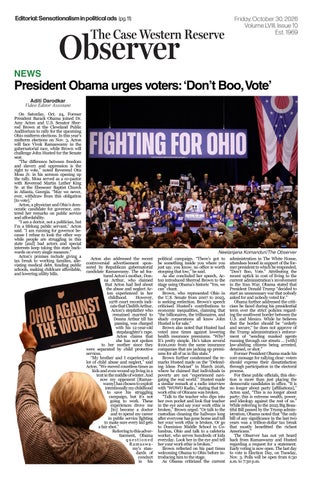
President Obama urges voters: ‘Don’t Boo, Vote’ Aditi Darodkar Video Editor Assistant On Saturday, Oct. 24, Former President Barack Obama joined Dr. Amy Acton and U.S. Senator Sherrod Brown at the Cleveland Public Auditorium to rally for the upcoming Ohio midterm elections. In this year’s midterm elections on Nov. 3, Acton will face Vivek Ramaswamy in the gubernatorial race, while Brown will challenge John Husted for the Senate seat. “The difference between freedom and slavery and oppression is the right to vote,” noted Reverend Otis Moss Jr. in his sermon opening up the rally. Moss served as a co-pastor with Reverend Martin Luther King Sr. at the Ebenezer Baptist Church in Atlanta, Georgia. “May we never, ever, withdraw from this obligation [to vote].” Acton, a physician and Ohio’s democratic candidate for governor, centered her remarks on public service and affordability. “I am a doctor, not a politician, but I’m a lifelong public servant,” Acton said. “I am running for governor because I refuse to look the other way while people are struggling in this state [and] bad actors and special interests keep taking this state backwards on every single measure.” Acton’s prmises include giving a tax break to working families, alleviating medical debt, funding public schools, making childcare affordable, and lowering utility bills.
Neelanjana Komanduri/The Observer Acton also addressed the recent controversial advertisement sponsored by Republican gubernatorial candidate Ramaswamy. The ad featured Acton’s mother, Donna Arthur, who claimed that Acton had lied about the abuse and neglect Acton experienced in her childhood. However, 1978 court records indicate that Cledith Arthur, Acton’s stepfather who remained married to Donna Arthur till his passing, was charged with his 12-year-old stepdaughter’s rape. Acton claims that she has not spoken to her mother since they were separated by child protective services. “My brother and I experienced a lot of child abuse and neglect,” said Acton. “We moved countless times as kids and even wound up living in a tent in the middle of winter. And now my opponent [Ramaswamy] has chosen to exploit intentionally my childhood to save his struggling campaign, but it’s not going to work. These experiences drove me [to] become a doctor and to spend my career in public service fighting to make sure every kid gets a fair shot.” Referring to this advertisement, Obama questioned Ramaswamy’s standards of conduct in his
political campaign. “There’s got to be something inside you where you just say, you know, no office is worth stooping that low,” he said. As she concluded her speech, Acton introduced Sherrod Brown to the stage using Obama’s historic “Yes, we can” chant. Brown, who represented Ohio in the U.S. Senate from 2007 to 2025, is seeking reelection. Brown’s speech criticised Husted’s contributions to economic inequalities, claiming that “the billionaires, the trillionaires, and shady corporations all know John Husted is for sale.” Brown also noted that Husted had voted nine times against lowering health insurance premiums. “Why? It’s pretty simple. He’s taken several $100,000 from the same insurance companies that are jacking up premiums for all of us in this state.” Brown further condemned the remarks Husted made on the “Defending Ideas Podcast” in March 2026, where he claimed that individuals in poverty are not “experienced navigating the real world.” Husted made a similar remark at a radio interview with “WOWO Radio,” stating that the work ethic of Ohioans was broken. “Talk to the teacher who dips into her own pocket and look that teacher in the eye and say your work ethic is broken,” Brown urged. “Or talk to the custodian cleaning the hallways long after everyone has gone home and tell her your work ethic is broken. Or go to Dominion Middle School in Columbus, Ohio and talk to a cafeteria worker, who serves hundreds of kids everyday. Look her in the eye and tell her your work ethic is broken.” Brown reflected on his past times welcoming Obama to Ohio before introducing him to the stage. As Obama criticized the current
administration in The White House, attendees booed in support of the former president to which he responded, “Don’t Boo, Vote.” Attributing the recent uptick in cost of living to the current administration’s involvement in the Iran War, Obama stated that President Donald Trump “decided to start an unnecessary war that nobody asked for and nobody voted for.” Obama further addressed the criticism he faced during his presidential term over the strict policies regarding the southwest border between the U.S. and Mexico. While he believes that the border should be “orderly and secure,” he does not approve of the Trump administration’s enforcement of “sending masked agents running through our streets … [with] law-abiding citizens being arrested, detained, or shot.” Former President Obama made his core message for rallying clear: voters should express their dissatisfaction through participation in the electoral process. For these public officials, this election is more than just placing the democratic candidates in office. “It is no longer about party [affiliations],” Acton said, “This is no longer about party; this is extreme wealth, power, and ideology against the rest of us.” While referring to the 2025 Big Beautiful Bill passed by the Trump administration, Obama noted that “the only bill of any significance in the last two years was a trillion-dollar tax break that mostly benefitted the richest Americans.” The Observer has not yet heard back from Ramaswamy and Husted regarding a request for a statement. Early voting is now open. The last day to vote is Election Day, on Tuesday, Nov. 3. Polls will be open from 6:30 a.m. to 7:30 p.m.
News
The Case Western Reserve Observer Friday, October 30, 2026 observer.case.edu Volume LVIII, Issue 10
Roger E. Susi Interdisciplinary Research Building grand opening Olivia Wen
Copy Editor On Oct. 21, Case Western Reserve University leadership announced that the newly opening Interdisciplinary Science and Engineering Building (ISEB) would officially be named the Roger E. Susi Interdisciplinary Research Building, in recognition of a $50 million donation from Roger and Kayoko Susi. Later that week, an open house was held showcasing the building to alumni. The construction of the building began in November 2023 with the demolition of Yost Hall. The Susi building is now the largest building on the Case Quad spanning a whopping 189,000-square-feet with five floors. The floors will consist of both dry and wet labs, as well as a core facilities space. On the ground floor, there will be a Caribou Coffee cafe accessible to both the general public and CWRU students. Researchers are expected to begin moving into the building in mid-December, while the public sections of the Susi Building are expected to open to students around the same time. Although there will not be classes held in the building, student research assistants will be able to access research labs and utilize the building’s resources. “Interdisciplinary” isn’t included in the name for no reason. The interdisciplinary attitude shines through the seven different clusters that make up the research labs of the Susi building, each covering about half a floor of the building. The clusters contain spaces for faculty and students from the College of Arts and Sciences, the Case School of Engineering and the School of Medicine.
The Roger E. Susi Interdisciplinary Research Building had its grand opening on Oct. 21, and attendees were able to see the building’s research lab clusters before researchers begin their work in December. Each cluster targets a specific area of research ranging from electrochemical engineering to neurotechnology, emphasizing a commitment to promoting innovation. Courtesy of Case Western Reserve University The first cluster is the James M. Galm, PhD, PE, Electrochemical Engineering & Energy Science section in which researchers will be working on batteries and semiconductor technology. The Advanced Materials and Manufacturing cluster is focused on developing and reimaging new materials. The Precision Diagnostics and Therapeutics cluster is developing smarter ways to localize diseases and deliver treatment. Meanwhile, The Molecular Therapeutics cluster researchers will work to advance drug discovery and develop more promising treatments for patients. The third floor includes the NeuroTechnology cluster, working to ad-
vance technologies that help restore function after neurological injury. The NeuroRobotics cluster will use knowledge from animal species to build robots. Last but not least is the Climate and Ecosystem Science cluster which will be investigating the effect of climate change on the living species around us. “Everybody uses materials, so we can make materials for the NeuroRobotics cluster, or for the [James M. Galm, PhD, PE Electrochemical Engineering & Energy Science] cluster next door or for the Precision Diagnostics & Therapeutics cluster,” said Svetlana Morozova, an Associate Professor in the Department of Macromolecular
Science and Engineering, in an interview with the CWRU Newsroom. She is also one of the researchers who will be on the first floor of the Susi Building—in the Advanced Materials & Manufacturing research cluster. As the larger Susi Building project is finally done, the next main construction project is the construction of the new Jack, Joseph and Morton Mandel Humanities Building to be located across the street from the Mandel Community Studies Center on Bellflower Road. The new additions to CWRU’s campus highlight the university’s commitment to the campus master plan and a forward-looking vision for the physical development of the campus.
Ohio’s expedited pardon project surpasses 300 pardons Alyssa Wang
News Editor
Ohio Gov. Mike DeWine’s Expedited Pardon Project has granted pardons to 323 individuals with prior convictions since its establishment nearly seven years ago. The program’s goal is to rehabilitate people with past nonviolent criminal convictions and help them move forward with their lives. DeWine announced the 300 recipient milestone on Oct. 6 in a news release from the Ohio governor’s office. More than 340 additional individuals were actively working toward an expe-
dited pardon at the time. The program, launched in December 2019, was designed to help individuals with prior convictions or low-level criminal records who have demonstrated rehabilitation and maintained law-abiding lives for years after their convictions. “A criminal record comes with a lifetime of restrictions, but I believe those who’ve truly reformed their lives deserve a second chance to live up to their full potential,” DeWine said in the announcement. “That second chance starts with a pardon. It has been great to hear about the transformational impacts these expedited pardons have
Courtesy of Stu Spivack/Wikimedia Commons
had on recipients’ lives and how doors are finally opening to allow them to achieve their dreams.” The project offers an alternative to Ohio’s traditional clemency process which can face delays as pardon applications are reviewed. Through the expedited process, eligible candidates can receive assistance preparing their requests and can move more quickly toward consideration for a pardon. According to The Ohio State University’s report of the program, accepted applicants receive free legal assistance through participating law schools and legal organizations in Ohio. Their appeals are submitted to the Ohio Parole Board for a hearing, after which the board makes a recommendation to the governor. DeWine retains the final authority to grant or deny each pardon. To qualify, applicants generally must have completed their sentences for the Ohio convictions they are seeking to have pardoned at least 10 years prior. They must have avoided additional criminal convictions during the 10 years, made good-faith efforts to fulfill sentencing requirements and demonstrated a history of employment or a compelling reason for unemployment. Community service is also part of the eligibility criteria. There are certain convictions that disqualify candidates from the pro-
gram. However, anyone who does not qualify may still pursue a pardon through Ohio’s traditional clemency process. The governor’s project emphasizes that meeting the minimum eligibility requirements does not guarantee a pardon. Each applicant’s circumstances are reviewed individually before the case proceeds through to the program. In 2021, Ohio law changed to allow a record sealing to be ordered alongside an unconditional pardon. When an individual receives a pardon through the program, it is up to the discretion of DeWine as to whether a written sealing directive will be attached. However, a judicial sealing is still a possibility even if the governor does not grant the writ with the pardon process. The milestone comes as the program continues to work with individuals seeking relief from the long-term consequences of criminal convictions. A pardon may improve formerly incarcerated individuals’ access to employment and other opportunities, although its results depend on the circumstances of the individual’s case. With 323 pardons granted and more than 340 applicants still working towards consideration, as of Oct. 6, the project continues to offer a route to clemency for eligible Ohioans seeking a fresh start.
News 3
observer.case.edu
A guide to the 2026 Nobel Prize winners Rebekah Repp
Staff Writer
From Oct. 5 to Oct. 12, this year’s Nobel Prizes were awarded in six different categories. Nominations of Nobel Prize winners can be made by thousands of qualified nominators such as university professors, scientists, laureates or members of national academies. Each year the Nobel Committee, made of five members appointed by the Norwegian parliament, spends months reviewing the nominees before carefully selecting one person, group or organization to be that year’s recipient. The first ever Nobel Prizes were awarded in 1901. The Sveriges Riksbank Prize in Economic Sciences was added to the original five prizes 67 years later to honor Alfred Nobel, a businessman and entrepreneur who had instituted the prize. The first prize announced for 2026 was the Nobel Prize in Physiology or Medicine, awarded to Karl Deisseroth, Peter Hegemann and Georg Nagel for their discoveries in neuroscience. Through their research of channelrhodopsin, a protein in a single-celled alga that acts as a light-gated ion channel. The researchers used their findings to create a switch to power nerve signals in the human body based on light. This opened up a new field called optogenetics, a technique which uses genetics and optics to monitor cells, usually neurons, with high precision. Their discoveries have allowed neuroscientists to control individual brain cells with light and map neural circuits for the first time. The 2026 Nobel Prize in Physics was awarded to Francis Halzen for his research on neutrinos. Neutrinos are subatomic particles that are almost unidentifiable in the natural world. Since they lack an electric
Justice Department Charges James Comey for the Third Time By McKinnon de Kuyper From The New York Times
U.C.L.A. Asks Judge to Dismiss Trump Lawsuit Over Antisemitism Courtesy of ProtoplasmaKid/Wikimedia Commons charge and only interact with matter through gravity, the particles can pass through anything including a human body. Halzen led the concept and creation of sensors on the South Pole that are able to track collisions between neutrinos and the nucleus of an atom, which produced a flash of light. By creating this on a large scale, scientists could detect neutrinos and better explain cosmic events. Henri B. Kagan and Kenso Soai were awarded the Nobel Prize in Chemistry for their discoveries in asymmetric organic synthesis. Molecules that are chiral exist as two variants that are mirror images of each other. Each variant can produce drastically different results due to their “handedness” when used in biological and chemical applications. Through manipulating chemical reactions, the scientists awarded were able to produce only one version of the variant from the reaction, something no one else had done before. The Nobel Prize in Literature was awarded to Anne Carson for her combination of classical and contemporary literature. The literature
prize is awarded for an author’s full life contribution rather than just a singular work. Carson combined playful writing and dialogue with serious tones from classical literature in works such as Autobiography of Red and The Beauty of the Husband. As a Greek scholar, she used her knowledge to weave myth, philosophy and characters into her works. Often, Carson explored etymologies of words in her books, and wrote a mix of poems, essays and novels but usually her writing defies typically style labels. The Nobel Peace Prize was awarded to Navanethem “Navi” Pillay for her lifelong effort in defending peace. As a judge, chair and commissioner, South African Pillay has used international law to defend anti-aparthid activists and deliver the first ever international conviction for genocide influencing the law globally. Each of these prizes were given to individuals who have dedicated their lives to a cause and left a lasting impact in their field and in the world. In the words of Alfred Nobel, the prize is awarded for “the greatest benefit to humankind.”
Cleveland City Council extends moratorium on data centers Aleksandra Majewski
Director of Print
On Oct. 19, Cleveland City Council extended its moratorium on new standalone data centers and their expansion until Jan. 29, granting officials additional time to develop new regulations on the rapidly growing industry. The original moratorium passed on July 15 was set to expire Oct. 20. The extension may terminate sooner if the city implements new restrictions for building data center facilities; however, for now, the city seems to be at a standstill. The moratorium’s purpose is to prevent the city from reviewing or granting permits among other approvals for the expansion of existing standalone data centers or constructing new standalone data centers. Preexisting data centers are able to continue operating normally. Cleveland currently houses roughly two dozen data centers, though none of which are classified as hyperscale standalone facilities by the city. Councilman Charles Slife has said Cleveland’s zoning code is lagging behind the fast-expanding industry. During this period, officials must form a general consensus on modern
News -inBrief
data center regulations, as such facilities strain local utilities and consume large amounts of resources. City Council and Mayor Justin Bibb’s administration have not yet ratified permanent legislation, prompting the need for an extended moratorium. “We’re really trying to get this right,” Councilman Brian Kazy said. Ohio ranks as the fifth-largest state in the U.S. for data center capacity, with over 200 operational facilities across the state. Their enormous demand for electricity has raised public concern that the cost of new generation and grid infrastructure could result in higher electricity bills for residential customers. A hyperscale data center can utilize as much electricity as 100,000 homes. Large facilities can also consume substantial amounts of water and produce concerns about noise and air pollution. The Council held three public hearings in late September and early October to discuss the data centers. At the Sept. 24 hearing, several Cleveland residents spoke against the establishment of large-scale data centers. “The people get nothing out of it,” Cleveland resident Annie McAneny said. “The only ones that actually
benefit long term are the people who own the centers, which are these billionaire developers. Several city officials have advised against shutting out the industry entirely. Data centers in Ohio generated over 95,000 jobs and approximately $26.4 billion in economic output in the fiscal year of 2024, according to the Ohio Chamber of Commerce Research Foundation. Councilman Mike Polensek said he is against “mega centers” but does not want to repel existing businesses that have not prompted significant complaints. The city has recruited industry specialists, utility representatives, Cleveland residents, city officials and business and nonprofit leaders to establish a Data Center Working Group aimed to assist officials in determining how future data centers should be restricted. This could include concerns regarding zoning, electricity demand, water consumption and residential consequences, yielding progress during the moratorium period. City officials are now faced with the decision of adopting permanent rules or continuing to navigate the extended moratorium, and they have until Jan. 29 to do so.
By Alan Blinder From The New York Times
Trump Administration Backs Down on an Opioid Ban After Kratom Industry Lobbying By Christina Jewett From The New York Times
Trump administration can block immigration judges from closing deportation cases By Justin Jouvenal From The Washington Post
Grand Jury Declines to Indict Former White House Aide Cassidy Hutchinson By Sadie Gurman and C. Ryan Barber From Wall Street Journal
A Student Article About the ‘Cornell 7’ Case Is Prompting a Campus Outcry at Columbia By Roshan Fernandez From Wall Street Journal
Trump returns to Ohio as Ramaswamy faces backlash over ad By Jessie Balmert From The Columbus Dispatch
New rural children’s hospital stalls as Ohio awaits Trump admin greenlight By Samantha Hendrickson From The Columbus Dispatch
Ohio secretary of state requests federal investigation into voter registrations in Cleveland By Cliff Pinckard From Cleveland.com
As Browns prepare to leave, Cleveland City Council refuses to pay $1 million for lakefront stadium repairs By Nick Castele From Signal Cleveland
Ohio’s US Senate race tops half-a-billion dollars in ad spending By Josh Croup From Cleveland 19 News
Life
The Case Western Reserve Observer Friday, October 30, 2026 observer.case.edu Volume LVIII, Issue 10
‘Ten Kings of Hell’: A Journey through the Medieval Afterlife Aarohi Mehta Contributing Writer What awaits us after this life? Is death an end or just a transition? Throughout history, different cultures and religions have allowed for different interpretations to the mystery of death. Immerse yourself in the medieval Korean Goryeo dynasty (918-1392). In collaboration with the National Museum of Korea, the Cleveland Museum of Art presents the “Ten Kings from Hell: The Afterlife in Medieval Korea.” The exhibit reflects the envisionment of the afterlife at the time, shaped by Buddhism, the legacies from previous dynasties and cultural influences. This exhibit takes you through the story of death, purgatory, torture and the promised land, available to explore from Oct. 11 to Jan. 3. As I walked into the softly lit first room of the exhibit, I was greeted by Anicka Yi’s “Bending Willow Branches,” a bioluminescent-style piece inspired by radiolaria, an ancient microorganism. This glowy, undulating piece of artwork allows the viewer to question whether death is really the end. This question sets the mood for the further journey into the afterlife. Another display contained an array of exquisite pieces of pottery coated with celadon glaze, resulting in a beautiful jade green shade. There were smooth, glossy tea sets and incense burners with molded dragon designs. Some pieces, including a dragon-decorated mirror, are examples of the influence of the Chinese Han Dynasty—that existed earlier than this one—on how people lived, created art and told stories in the Korean Goryeo dynasty. Many of these luxury objects were placed in tombs meant to “dispel darkness by reflecting light” according to the information plaque. It was believed that placing luxury objects in tombs could comfort the dead as they transitioned into the afterlife. Upon entering the next room, I was encompassed by grand, full-length an-
cient scrolls. These scrolls were richly embellished and resplendent. These scrolls represent the 10 Kings of Hell, and each scroll depicts the court of one of the kings. In each court, the souls of the deceased are presented for their actions to be judged. They are tortured or rewarded accordingly. Each scroll recounts a distinct scenario before the king. These courts reflect Buddhist ideologies and the judicial system during the Goryeo period. As this process comes to an end in the 10th court, the soul is reincarnated. The story extends far beyond these depictions, and the drafts of scrolls given from the National Museum of Korea demonstrate the gruesome torture methods used against evildoers. Chaos ensues in one of these scrolls as animal headed figures mercilessly agonize sinners before the king. These scrolls were noticeably wider and featured finer, sharper lines highlighting their intricate details. The vibrant colors used throughout these works created a visually striking composition, which provided quite the contrast to their ghastly depictions. Other forms of media were also present in this exhibit. In a room off to the side, a short movie played following the journey of different characters—some scientists and some hikers—through the aftermath of a nuclear radioactive fallout. The film hopes to bring awareness to the idea that destruction of our planet is sinful. Another screen invited viewers to participate in a digital interactive activity where participants could replicate gestures and postures depicted in various paintings. For example, a painting of a particular Buddhist deity with their hand raised would be displayed on the screen, prompting participants to imitate the figure’s pose. A short paragraph providing information would appear about the particular painting once the body language was successfully matched. I found it to be fun, responsive and informative, successfully engaging its audience. As I concluded my visit, I noticed an area where the creators of this exhib-
Courtesy of BotMultichill / Wikimedia Commons it give the audience a space to reflect. Participants were welcomed to write notes for a variety of purposes—to commemorate a passed loved one or record any resonating thoughts from the exhibit. These notes were then hung up on, creating a wall of personal reflections from visitors, varying in language and purpose. Although I did not write a note, I appreciated this opportunity to quietly gather my
thoughts. As I read the other notes, I made connections to my culture and to the exhibit, leaving me with a sense of melancholy. This exhibit offers a glimpse into how society during the Goryeo Dynasty in Korea envisioned the journey after death. I encourage anyone interested in exploring cultural traditions, religious beliefs and ideas about the afterlife to pay this exhibit a visit.
should be just recognizable enough to get some nods, all with the comfort of not stealing the show.
character“ on Pinterest and you’re off to the races. Bonus points if you can find one that is not from an anime. Caution: after a few years of one color, you may run out of ideas.
Halloween Costumes! Penelope Cloonan Executive Editor
White Rabbit, dressing dapper with a stop watch in hand. If you wish to be a little whimsical and a little mysterious, try the Cheshire cat and find a tree to hide in and surprise a stray trick-or-treater.
Is the scariest thing this Halloween the fact you left planning your Halloween costume to the last minute? Are you feeling completely uninspired? Do you want to avoid being a black cat or bedsheet ghost? As of print, you might be cutting it a little close, but you can give it the good old spooky college try. Let us brew up some inspiration with a selection of The Observer Editorial Board’s Halloween costumes.
Marty McFly Picture this: you’re in your research lab with your wiley old mentor and he tells you he has discovered a way to time travel with his car, and you are going to test it out. You are not in a lab remotely relating to time travel, but you carry on, hands-on experience is worth a lot. Grab a puffer vest, denim jacket, plaid shirt and flux capacitor because you are going back to … campus?
“Alice’s Adventures in Wonderland” Fall down the rabbit hole of Halloween costumes with this classic tale. Alice herself simply needs a blue dress and a black bow in the hair, but the options do not end here. Perhaps you wish to don the ears and become the
Jellycat Beanie babies are so 1990s, Jellycats are all the rage now. If you’re looking to spice up an animal costume, simply add the signature tag and be a Jellycat. If how quickly these popular stuffed animals sell out are any indicator, this low effort costume
Riya Kulkarni Life Editor
Fairy An oldie but a goodie, and certainly a step above a black cat. If you have a theater streak, embody Titania or Puck from William Shakespeare’s “A Midsummer Night’s Dream.” If Disney is more your wheelhouse, be Tinker Bell or make it a trio costume and be the Fairy Godmothers from “Sleeping Beauty.” Of course, there is always the generic fairy, defined only by themself. With wings, enough glitter and a can-do attitude, you too can have a little magic this Halloween. Random character with [insert hair color] Is your hair an unnatural color already? Would you like it to be? Dyeing your hair has many perks, you’re easy to find in a crowd, children are endlessly confused by you and, when Halloween rolls around, you have the luxury of being lazy. Look up “[color] hair
Night and Day Do you and your friend have absolutely different aesthetics? If they are practically night and day, why not be just that? Embrace the contrast and turn it up for the spooky season. Have one friend don bright clothes, sparkles and a healthy amount of white, and the other friend wear as much black as they possibly can. Make sure to take photos at either dawn or dusk! A Bee “According to all known laws of aviation, there is no way a bee should be able to fly.” You too can defy the laws of physics this year and be a bee. All you really need for this costume is a yellow and black striped outfit, but real go-getters will opt for wings and antennae. There’s a bee? Yes, and it’s you.
Life 5
observer.case.edu
Attend the tale of "Sweeney Todd: The Demon Barber of Fleet Street" at Playhouse Square Penelope Cloonan Executive Editor “Sweeney Todd: The Demon Barber of Fleet Street,” the beloved dark musical comedy, graces the Hanna Theatre stage from Oct. 23 to Nov. 8, and it is just as unsettlingly hilarious as ever. In a new production by Great Lakes Theater, fall into a tale of revenge, love and, of course, scamming. Nothing beats the opening number of “Sweeney Todd.” “The Ballad of Sweeney Todd” serves as a major expositor, establishing the character of our protagonist, Sweeney Todd (Mark Bedard). A spotlight goes up on a Londoner warning the audience about the “...tale of Sweeney Todd.” He is then joined by another man with a similar sentiment, before the company abruptly cuts in to offer haunting support of Sweeney’s demonic plot. The Great Lakes Theater company made the choice to have the actors heavily utilize the aisles, which only added to the scare factor. As this exposition began, ensemble members creeped along the aisles before snapping into action to sing their parts. Via uncomfortable eye contact and leering cast members, the audience is fully immersed in the story. As the ballad winds down, the audience is introduced to Sweeney Todd in the flesh as he steps off the boat to London. Sweeney strikes a menacing presence immediately, dressed plainly in a tank top, jeans and suspenders. Compared to the rest of the cast in purposefully anachronistic Victorian garb, Sweeney is a man out of time. Sweeney does find a home in his old barbershop, just above landlord Mrs. Lovett (Jillian Kates) who makes “the worst pies in London.” Kates is a triumph in the role. Being the main source of the play’s comedy genre is no joke, and yet, through every murder and human-meat pie, Mrs. Lovett has a playfully silly retort. Mrs. Lovett is by
no means exempt from the dark tone of the play, but she is a definitive point of brightness. What follows is Sweeney’s quest for revenge against the men who sent him away and doomed his wife, as well as Mrs. Lovett’s unsuccessful romance with Sweeney, the young lovers’ successful romance and plenty of graphic, bloody murder. It is a faithful adaptation of the gorgeous musical that amps up the horror just in time for Halloween. In contrast to the dark plot that Sweeney and Mrs. Lovett follow, the young lovers Anthony (Ethan Flanagan) and Johanna (Ana Lauren Rodriguez) navigate a compellingly fraught romance. It is impossible not to root for Anthony in his tireless pursuit to rescue Johanna from first Judge Turpin (Matthew Wright), then the sanitarium. Though he may be a bit absent-minded at times, Anthony has a heart of gold, and Flanagan sells you on it. His counterpart Johanna is just as lovable. Rodriguez portrays Johanna with the perfect innocence you would expect from an ingénue, all while playing a deceptively difficult soprano part. Much of Johanna’s songs mimic the flittering of her beloved songbirds, which requires a lot of stamina. Rodriguez does not falter. Her performance with Flanagan in “Kiss Me” parts one and two were particularly of note, challenging the earlier “Johanna” for the best performed love song in the play. You cannot help but fall in love alongside the couple. Above amazing performances and the scary good time, the costuming still stood out. Some costumes were certainly simpler than others—Sweeney and Johanna’s Act I costumes are almost distractingly modern—but overall, the Great Lakes Theater production had a distinct and consistent style: Victorian with a dark, steampunk twist. Mrs. Lovett is a lovesick chef-turned-cannibal-accomplice, so she fittingly has crazy bright red hair
Courtesy of Roger Mastroianni via. The Great Lakes Theater and skirts with plenty of movement. The Beadle (Ricky Moyer) and Judge Turpin are your more straight-laced, Victorian gentlemen, so they wear the most traditional costumes. The con man Adolpho Pirelli (Sean Patrick Doyle) is dressed as a matador with a shock of pink hair, only adding to his ability to draw crowds. The costumes all uniquely match their characters. It is easy to quickly invoke a Victorian feel in costuming by taking shortcuts, but this production avoids those traps. Often in historical costuming, there is the impulse to avoid color entirely, but Victorian style was not inherently drab. This is seen especially with the ensemble costumes, blending steam-punk and goth patterns with hallmarks of Victorian style, all in beautifully rich color. Throughout the show, Mrs. Lovett wears Louis heels (named after King Louis XIV). While these heels are a popular choice for performance shoes as they afford more stability than a standard stiletto, minor details like this do the legwork to quickly evoke a Victorian feel, even when Mrs. Lovett is dressed in red studded leather for Act II. Even when the production takes these wild risks, the costumes all clear-
ly exist in the same vaguely Victorian society. As the tone gets darker moving into Act II, the entire cast wears eye black to create the effect of sunken eyes. All of the costumes, with the exception of Johanna, use black and jewel tones heavily. As a symbol of their removal from their humanity, both Sweeney and Mrs. Lovett don studded leather and bright red in an elevation of their Act I costumes. It is not Victorian, but it is grounded enough to add to their menacing air without distracting the audience from the more minute attention to detail in other costumes. The Great Lakes Theater’s production of “Sweeney Todd” also falls under their reduced ticket pricing for those 25 and under. Patrons under 25, which includes most undergraduate students, can purchase $15 tickets for any Great Lakes Theater production at the Hanna Theatre and $30 tickets for their seasonal production of “A Christmas Carol” at the Mimi Ohio Theatre. On both counts, that is worth more than the price you pay. If you are a student looking for a cost-effective yet scarily good time, check out “Sweeney Todd: The Demon Barber of Fleet Street” at the Hanna Theatre now through Nov. 8.
What to do this halloweek(end) Riya Kulkarni Life Editor The spooky and the scary are finally upon us. Halloween falls on a Saturday this year, a feat that we will not see again until 2037. Clearly, this is a sign that we must take advantage of the Halloween fun on and around campus. If spooky is not your thing, or you have grown tired after Halloween marketing started following Labor Day, fear not! There are plenty of non-Halloween activities to do as well. “Moments That Matter” Date(s): Friday Oct. 30 to Saturday Nov. 7 Price: $15 for CWRU Students with ID Let us conclude with something less scary. The Department of Dance at CWRU is putting on their Faculty and Guest Artist Concert, “Moments That Matter,” at the Mather Dance Center with four dance numbers: Mark Morris’s “Words,” Gary Galbraith’s “Whispering Caves,” Yidi Lin's “Until Then,” and a new solo by Richard Oaxaca. The show will incorporate music from Cleveland Institute of Music graduates pianist Karin Tooley and cellist Joe Teeter. Open during and past Halloweek-
end, take a break from the scares for some beautiful art. Skeleton Grove at the Holden Arboretum Date(s): Monday, Oct. 29 to Sunday, Nov. 1 Price: $21 Fair warning, your spine may get some shivers. More than a dozen skeletons have entered the Holden Arboretum, lying in various poses all throughout the park among the fall leaves. These tall, artist-designed skeletons each have their own personality and are allegedly friendly. Take the chance to explore fall colors, and meet these skeletons for yourself. Cuyahoga Valley National Park Date(s): Anytime, preferably during the day Price: Free! Speaking of fall foliage, catch some of the red, orange and yellow. Though we are going past the peak time to see these colors, there are still plenty of hues at the Ledges area trails in Virginia Kendall. Open 24 hours, the park is known for its scenery. Get some crisp cold air as the ground crunches under your feet, some of the last good days until the cold begins to seep in.
Fall Art Market Date(s): Friday, Oct. 30, 6-10 p.m. and Saturday Oct. 31 10 a.m. to 6 p.m. Price: Free! Here’s one more way to appreciate the beauty of fall before it leaves us forever. The Fall Art Market is the place to go to find fall themed crafts and gifts. Peruse the selection of art from guest and resident artists and partake in the creativity in Lakewood’s Screw Factory. Pumpkins and Piranhas Date(s): Friday, Oct. 30, 5:308 p.m. Price: $20 The Greater Cleveland Aquarium turns haunted after hours, and the ghosts of fish past come to haunt. That second part does not happen, but there will be underwater jack-olanterns and skeletons, activities and photo opportunities. Don that costume (bonus points if it is some sort of marine life), and just keep swimming. Haunted Museum Tours Date(s): Friday, Oct. 30, 6:457:45 p.m. Price: Free! Speaking of ghosts, likely human ones this time, the Cleveland Museum of Art is said to be haunted—one
of the most haunted museums in the country. There is no better time to walk through the haunted halls, hearing tales of ghosts and the unexplainable, all while exploring the various galleries. Cleveland Monsters vs. Milwaukee Admirals Date(s): Saturday, Oct. 31, 2-5 p.m. Price: $15-100 Halloween afternoon brings forth a different kind of monster, specifically the hockey kind. The Monster Mash returns to Rocket Arena, with a trick-or-treat route all along the concourse. Bring your costumes and your friends, and celebrate Halloween in the most sporty way. Jolly-Ween Cookout and Jam Date(s): Saturday, Oct 31, 6 p.m. - 12 a.m. Price: Free! For something a little bit more on campus, head over to Jolly’s Pizza for some music and good eats. There will be a cookout, with food information yet to come, a costume contest and finally a jam session. Bring your costumes, your friends and your musical instruments for some more spooky fun. Happy Halloween!
6
Life
Friday, October 30, 2026
Cinematic Symphony Orchestra’s ‘Symphony of Horrors’: spooky nostalgia Anlin Wei Staff Writer Picture Lydia Deetz in a red wedding dress, Ghostface, Molly Weasley, Beetlejuice and Beetlejuice (there were only two, fittingly). What do these characters all have in common? Each one was a musician in the Cinematic Symphony Orchestra (CSO) on Saturday, regaling the audience with a “Symphony of Horrors.” The show, which ran in Maltz Performing Arts Center’s Silver Hall, featured music from classic Halloween films, including “Psycho,” “The Addams Family,” “The Nightmare Before Christmas,” “Beetlejuice,” and “Jaws,” to name a few of the 16 pieces played. The night began with one of the most recognizable and chilling musical themes of all time: Bach’s Toccata and Fugue in D minor. From the start, as sound filled every corner of the hall, I could tell I was in for an immersive experience. With strings, woodwinds, brass and percussion, the group cap-
tured the oppressive, bone-rattling feeling of a church organ playing at full intensity. From there, the orchestra moved onto more modern fare, demonstrating its unique talents. The unsettling piano theme from the 1978 slasher film, “Halloween,” was accented with harp and a rainmaker, a particularly uncommon sight at a concert. Next up was “Psycho,” alternating between lyrical segments and the iconic squealing strings. Other musical highlights were the sensitive and sweet French horn solo in “The Omen,” the dramatic switches between walls of sound and warm, melodic segments in “The Mummy” and the precise intensity of the double basses in “Jaws.” The music brought back memories of my first time seeing each movie and hearing their scores—the fear, horror, suspense and elation. This performance was truly a love letter to film music, which many call a love letter to classical music. The heritage of Western classical music can be seen in nearly every modern film
Courtesy of Ricardo Zárraga.
Courtesy of Jason Dell via Cinematic Symphony Orchestra score, from horror movies borrowing from the dissonance and distinctive rhythms of Igor Stravinsky, to the romantic and adventurous tunes of Erich Wolfgang Korngold, one of the most influential classical-turned-film composers in early Hollywood. The musicians’ hard work and infectious enthusiasm for their art translated beautifully into a captivating auditory experience. The orchestra did not just impress with their musical ability, for they brought a sense of connection to the listeners. Throughout the concert, people chuckled as they recognized iconic themes from their childhood or relived good memories. “The Addams Family” theme had the audience snapping along and bopping to the choir’s vocals reminiscent of the 1960s. A surprise encore had everyone calling out, “Ghostbusters!” Seeing the audience react to the music together reminded me of the power of popular culture and how deeply ingrained music-making is in each person. Snapping together during “The
Addams Family” was a way of recognizing each other as a part of a shared culture, and of participating in the group project of humanity. Every single audience member left that concert smiling, not just to themselves, but to the people around them. Whether they were in their Sunday best or in astronaut suits, they experienced a beautiful night together. The Cinematic Symphony Orchestra is truly a gem in the crown of Cleveland’s music scene. It was founded in 2023 by Dr. Andrew Keller with the mission of bringing professional-caliber live film music to as many people as possible. Student tickets are $15, making this one of the most accessible ways to experience live music. Upcoming concerts include “Christmas At the Movies,” featuring scores from holiday movies, “Love is in the Air,” with music from romance movies, and “The Lord of the Rings Symphony.” Each event is an opportunity to be part of a wider community and to connect with anyone you choose to bring with you.
Genre blending horror book recommendations for this Halloween Elizabeth Willing Copy Editor Are you looking to test your nerves this Halloween? These five horror novels will leave you peering into every dark corner, triple checking the locks on your doors and even questioning your own mind. Each one of these authors masterfully constructs worlds that feel so real that you’ll be frantically shutting the book closed. From novels to anthologies, no two books are alike, but they’ll all keep you captivated on an eerie October night. Each of the featured books incorporates horror with another genre. Ranging from mystery to historical fiction to even satire, one of these tales will shake you to your core. So, this Halloween, make sure to pick up one of these books … and watch your back. “Never Whistle at Night: An Indigenous Dark Fiction Anthology” edited by Shane Hawk and Theodore C. Van Alst Jr. Throughout time and across cultures many groups of Indigenous people have come to the same conclusion—never whistle at night.
This anthology from various authors offers 26 bone chilling stories rooted in Indigenous culture and history. Each one is a unique tale that will have you on the edge of your seat. From haunting ghosts and ominous creatures to equally terrifying humans who desperately search for revenge, you never know what terrors await you on the next page. While short, each story includes rich descriptions and relatable characters that will do more than just have you checking over your shoulder. They make you question the monster lurking in your own nature. “Strange Pictures” by Uketsu This book is a fusion of crime and horror that is tied together by nine cryptic drawings and nine separate mysteries. These sketches come from seemingly unrelated circumstances: a woman's blog posts, a child’s craft and a murder victim’s final communications. Nonetheless, Uketsu carefully strings a spider web that intertwines the characters, as well as their mysteries. “Strange Pictures” is just as clever in its complex puzzles as it is in vivid ambiance. It has all of the suspense of a classic horror novel, but
the twists and turns drag the reader into its pages. The reader becomes the detective alongside the characters, and is forced to live every horror with them as well. “Root Rot” by Saskia Nislow Join a family as they travel to their grandfather’s lakehouse, where nine children begin to notice some rather odd sights. This family vacation twists into a nightmare, as time and space begin to meld. This novella is akin to a folktale, as it creates a twisting dimension filled with dysfunctional family dynamics and ecohorror. Try to hold onto your sense of reality, because at the lakehouse, familiar memories are slowly consumed by the uncanny, and no one is what they appear to be. With a large cast of characters, and even more shadowy corners, “Root Rot” will leave you lost in the weeds. “Between Two Fires” by Christopher Buehlman Enter a time that has long passed with this medieval horror epic that follows a disgraced knight as he strives for redemption. In 14th century France, a former knight named Thomas becomes swept up in a war with heaven when he
finds an orphaned girl who is determined she can confront this evil. However, throughout this novel there is something even more terrifying than demons, fallen angels or the risen dead—mankind. The true gruesomeness of Buehlman’s writing is his ability to remind the reader of people’s ability to commit truly horrific acts. In “Between Two Fires,” follow Thomas into battle, as he fights not just for his own redemption but for the fate of humanity. “Bunny” by Mona Awad Samantha Heather Mackey is a scholarship student at a small, highly selective Master of Fine Arts program in New England. The rest of her fiction writing cohort is a clique of wealthy young women who all refer to each other as Bunny, and almost appear to act like one. But the Bunnies begin to invite Samantha into their group, leading her to descend deep into their rabbit hole. Awad blurs the line between reality and fiction, with body horror and satire adding to Samantha’s separation from coherence. Samantha fails to comprehend the events around her, yet readers are forced to watch each event in horror, unable to look away.
Life 7
observer.case.edu
“Street Fighter” immerses you into its world Jeannelle Tellado Staff Writer Minor Spoilers for "Street Fighter" Hollywood has been on a streak of great video game adaptations this year, from indie film “Iron Lung” (2026) to recent blockbuster “Resident Evil” (2026). “Street Fighter” (2026) adds to the acclaimed list of adaptations and offers a more humorous and hopeful story. The movie follows estranged brothers Ryu (Andrew Koji) and Ken Masters (Noah Centineo), who are recruited by martial artist Chun-Li (Callina Liang) to compete in the World Warrior Tournament. As this happens, they find themselves involved in a more dangerous plot against dictator M. Bison (David Dastmalchian) and are confronted by enemies from their past. I was lucky enough to attend an advanced screening of the movie at the Cleveland Cinematheque, where the director of the movie, Kitao Sakurai, hosted a Q&A panel at the end. Sakurai was originally born in Kyoto but was raised in Cleveland, so it was exciting to see a Cleveland artist working on such a large project and sharing a piece of that with his community. It was also fun to see the small Cleveland details he included in the movie. This movie is not Sakurai’s first video game adaptation, having worked on the “Twisted Metal” (2023) television series, which is slated to have a third season. Prior to attending the movie, I did not know much about the Street Fighter franchise. But I didn’t need to. A big strength of the movie is that viewers do not need to have prior knowledge to enjoy the movie. The premise itself is explained early on, and the world is brought to life by the eccentric and col-
orful characters that inhabit it. From the start, viewers are transported back to the 1990s, with an incredible soundtrack and set to match. As the characters arrive in Metrolao, the main setting of the movie, the vibes change to a more cyberpunk and apocalyptic blend, but the movie still manages to retain the ’90s vibes and nostalgia. The movie is filled with action-packed fight scenes, most of which take place outside of the actual fighting tournament, which I found amusing. Each fight was memorable in its own way, and the movie used combat to introduce the viewers to new characters or reveal new information about them. In the panel, Sakurai described his intentions for this as every fight having its own “logline.” He wanted each fight to be unique and memorable enough that it can be recognized by viewers in just a few words. One of my favorite parts of the movie was the incorporation of handdrawn, 2D animations. Every flashback was 2D animated, contrasting with the otherwise live action film. The movie begins in 2D, showing an event that takes place six years before present-day. Backstories for characters like Chun-Li and Blanka (Jason Momoa) are also revealed through animated scenes. The final scene of the movie, hinting at a sequel, is also animated. I think this was a clever choice, especially if they have not casted their newest villain. During the panel, Sakurai said that the production team experimented with a few ways of showcasing flashbacks—casting younger actors or using computer-generated imagery to age current actors backwards. The team ultimately decided to use handdrawn animation because it allowed for more creative, fantastical elements to be added to scenes, and it was a nice nod to the original 2D games.
The cast for the movie was absolutely incredible, filled with a combination of actors, pro wrestlers and musicians, who each delivered in such a way that made their characters compelling and lively. Despite the over-the-top outfits, hair styles and abilities, nothing seemed tacky or fake, blending in well with the world around it and seeming very natural. This reminded me of the 2023 “One Piece” live action show, which similarly adapts wild powers and character designs without making it seem too ridiculous. Finding that balance between fantastical elements and realism is something that really strengthens these kinds of adaptations and helps viewers become more immersed in a fictional world. When the movie ended, Sakurai came onto the stage to begin the panel. After being asked standard interview questions by a host, he answered a few audience questions about the
creative process as well. I absolutely loved learning about the behind-thescenes details and why certain creative decisions were executed, so being able to hear the directors thoughts, especially in person, was a really fun way to end the night. When listening to the fan questions and hearing Sakurai’s responses, I could see the passion reflected in both the creator and the fans. As for me, this movie has made me obsessed with the “Street Fighter” franchise. The ending left the movie at a cliffhanger, perfect for a sequel, and I sat there wishing I could watch more and experience the rest of the story. Immediately after leaving the theater, I started researching the game characters, listening to the music of some of the actors and even playing as Ryu in “Super Smash Bros.” I can only hope that any day now, we shall receive an announcement for its sequel.
"Street Fighter," the latest video game-to-movie adaptation, incorporates live-action and 2D filmography to capture the iconic game's intense fight scenes, 90s essence, and eccentric characters. Kitao Sakurai, the movie's director who was raised in Cleveland, participated in a Q&A panel at the Cinematheque after an advanced showing of the movie. Courtesy of IMDB
Fun
The Case Western Reserve Observer Friday, October 30, 2026 observer.case.edu Volume LVIII, Issue 10
What not to do this Halloweek(end) Anya Lin
Director of Business In the Life section, you read about Life Editor Riya Kulkarni’s suggestions for what to do this Halloweekend. In this Fun section, I am here to tell you what not to do. Rob a bank Price: Free! Sure, everyone might be wearing masks, costumes and everything—and you should do the same if you’re so inclined—but please, do not go rob a bank. Go trick-ortreating, or go to a masquerade party. DO NOT rob a bank. Thank you. Study organic chemistry Price: Your mental well-being Maybe you should actually study for your organic chemistry class. Maybe you have a test on Friday (CHEM 223: Introductory Organic Chemistry I), or maybe you have a test on Thursday (CHEM 224: In-
troductory Organic Chemistry II). Maybe you should actually really study for this organic chemistry exam because your midterm grade in Chem 224 was a big fat D. Either way, don’t study organic chemistry this weekend! Drop a 45-pound weight on your foot and break it Price: $1000+, and a few shattered bones Just a few thousand dollars in medical bills can get you in and out of urgent care, X-ray machines, splints and casts, all in one weekend! Unless you are truly ready for such an adventure, please take care when transferring weight plates in Veale Convocation, Recreation and Athletic Center, especially 45-pound weight plates that seem awfully likely to shatter your metatarsals if dropped upon your foot. Try to slide down a chimney Price: Free! This is your reminder that it is
sexanddating
Pick-up lines for Halloween huzz
still October! No matter how wasted you get during Halloweekend, this is your formal reminder to not try to slide down the chimney like Santa Claus. It is still far too early. Please check back in early December about when it is socially acceptable to try again. Binge the "Camp Rock" trilogy and learn the march from "Camp Rock 2: The Final Jam" Price: Free! (to get a trial of Disney+) Here’s a solid option to not try this weekend if you’re not too into Halloween. Even the most predictable of plots, like that in the first "Camp Rock" movie, can become wildly enjoyable if you go in with the right goals, like learning the Camp Rock march. My concern, however, is that you will become too invested in finishing the trilogy, learning all the dances and memorizing all the songs in one night, so you should not attempt this in just one short weekend.
Set up for a party and don’t attend the party Price: Free! (free labor) This is for all the homebodies who don’t want to actually attend any parties, but want to experience the anticipation of one anyway. Savor the excitement of seeing all your friends and random strangers dance the night away in your shared living room, then as soon as the first people show up at the door, run away as fast as possible. This might seem fun for some, but I do not recommend this unless you receive compensation for all the party prep work.
Mini crossword
Aphrodite
Greek Goddess of Love Halloween is a time for spooks and frights, but that jump-scary atmosphere also makes it the perfect time for another kind of heartpounding experience. If you want to take advantage of this special time of the year, especially with an extended Halloweekend like this one, take heed of these pick-up lines. Maybe the best move is to avoid the direct pick-up line and compliment someone on their aura instead.Costumes may make it hard to see what people look like, but this one is good whether or not you can clearly see someone: “Wait, is your costume glowing? Oh, never m ind, that’s just your aura.” Decorating for Halloween is also a critical time to start talking with people. I’ve planned the perfect little line here for when you’re making jack-o-lanterns: “These pumpkins are hard to carve, but you’ve already carved yourself into my heart.” I’ve got one that’s perfect anytime your huzz mentions foliage, cooling weather or anything vaguely autumn-related. Even if you don’t use it around Halloween, it stays useful through the first, more autumn-like part of November. If you remember, you could even save it for next year: “It’s winter for me, since I’ve already fallen for you.” I’m not sure how many people will be trick-or-treating, but for those who are, keep this one in your candy basket: “This candy is flavorless since you’re already so sweet.” Feel free to remix it to match the flow of the conversation and make it smoother than a Hershey’s chocolate bar. On the contrary, this one’s for those who are preparing to go out to parties: “Are you Halloweekend? Because I want to go out with you every day.” Sometimes it’s better to be direct. Evaluate the situation before deciding whether to use a straightforward one or one that’s a little more subtle. If you want to avoid any subtleties, ask this outright: “Will you be my spooky pookie?” The Greek Goddess of Love’s top choice is also the best last-minute pick. When discussing last-minute costumes or plans, pull this on out: “I don’t know what I want to be for Halloween, all I know is that I want to be yours.” I guarantee anyone would swoon to that. No matter what you’re doing this Halloween, take some of my (admittedly cheesy) pick-up lines with you. I’ve done all I can to help you succeed during this historic Halloweekend. It’s up to you, you Halloween rizzler, to make these work.
Answers for all games will be on the next issue.
Last week's answers
Fun
observer@case.edu
Strands: Candy Time! The haunting of production night Riya Kulkarni
Life Editor
Riya Kulkarni/The Observer
Kristina Guo/The Observer
An obituary for our departed (not dead) friend Wendy Chen Anya Lin
Director of Business Our beloved editorial board member Wendy C. Chen , 19, departed peacefully to the University of Pennsylvania on May 7, 2026. A celebration of her days at Shine-On-Forever-Case-Western-Reserve will be held in the University Medi a Board office at 5:30 p.m. on Oct. 4. Born in Philadelphia in August, 2007, Wendy Chen attended Case Western Reserve University for one year. After being accidentally ghosted by the former Observer Editorial Board , she joined the team as a copy editor in April , 2026. In the two weeks that she actually did anything at The Observer, she was recognized for her remarkable storytelling ability and received the Biggest Yapper award . Wendy liked the color pink , A-line jeans, and larping Dover S treet Market S tussy. She was always down to try new things, like falling while skiing, falling while playing badminton and falling while ice skating. Some might even say she never left the ground , as she was unable to jump. She will be forever remembered for singing beautiful karaoke , embodying the crying child (see photo) and sleeping overnight in Kelvin Smith Library. To send her friends regards or flowers, please call (248) 434-5508. Truth be told , we miss her very much . To Wendy: enjoy UPenn!
It was a dark and surprisingly cloud-free night. The editorial board, decked out in a spectrum of costumes, bustled around the University Media Board Office as per usual, collecting photos and graphics, adjusting spacing and adding edits to articles. A chill was ever-present in the room, but that was attributed to the air conditioning. They were in a basement, after all. It was only when one editorial board member ran out of the stacks, out of breath and red in the face, when concern began to spread. It seemed as though a peculiar squeaking sound was coming from the black shelves, and she couldn’t figure out where it was coming from. All members were accounted for. Who could possibly be lurking in there? Two directors took a deep breath, bracing themselves as they headed toward the source of the sound. It was not unlike the sound of rubber ducks, with a tune reminiscent of Bach’s Toccata and Fugue in D Minor, but severely off-key and high-pitched. The sound grew louder and louder as they continued into the stacks, reaching a height behind the last shelf. There lay at least 50 rubber ducks, spelling a very ominous message: “Hello!” Fearing the worst—that The Athenian had somehow broken into production night—the directors searched for a speaker, or some source of what could barely be called a song. No speaker could be found, and the ducks refused to cease their cries. It was only after a shout arose from the design bay that the ducks finally stopped singing. The pair of directors rushed back into the main part of the office. To their surprise, every mouse at the monitors was moving on its own at a record speed, and keys on each keyboard were depressing in sync. One layout designer looked up, a look of amazement in her eyes. “The paper is constructing itself!” she exclaimed. But how could this be? The print team turned to their own computers, shocked to see that every single article had been marked as final edited. Every copy editor breathed a sigh of relief when they saw it, for every single small detail had been carefully fact-checked and corrected. The editorial board grew to be equal parts terrified and elated, for the feat was a miracle indeed. It was only when they glanced at the masthead when they realized what had happened. At the very end of the list of human members of the editorial board came a name that everyone insisted on not adding: The Ghost of UMB Office. For one night only, production night was haunted.
9
10 Fun
Friday, October 30, 2026
Ghosty Word Search
Riya Kulkarni/The Observer
Wordle in one
Riya Kulkarni/The Observer
Opinion
The Case Western Reserve Observer Friday, October 30, 2026 observer.case.edu Volume LVIII, Issue 10
EDITORIAL
Sensationalism overtakes political ads Editorial Board Trigger Warning: mentions of sexual assault Ohio’s general election is set to take place on Nov. 3, and the state is abuzz with advertisements for and against candidates. Among the contests for this year’s ballot, the most prominent are those for Ohio Governor and Ohio U.S. Senator. The race for governor features Democrat Amy Acton, Republican Vivek Ramaswamy and Libertarian Don Kissick. Students at Case Western Reserve University may notice an influx of political ads during election season. One advertisement in particular by the party of Ramaswamy, against his main opponent Acton, has been especially inflammatory. Acton is a physician and served as the former Director of the Ohio Department of Health under the outgoing Governor Mark DeWine. Acton’s priorities for Ohioans include reducing costs of daily living by implementing tax breaks for working-class families, targeting corruption within the state government and improving the quality of public school education. Acton has spoken openly about her tumultuous upbringing, including bouts of homelessness, overall neglect and abuse. She credits these hardships with shaping her commitment to public service and uplifting working families. Acton was later accepted into medical school and focused on child advocacy in her work as a practicing physician. Ramaswamy is a businessman and former 2024 presidential candidate. He started his career on Wall Street, trading stocks for the hedge fund QVT; he also founded his own biopharmaceutical company in 2014, among other entrepreneurial ventures. He later withdrew his bid and endorsed current president Donald Trump. Ramswamy prioritizes making “Ohio the greatest state in the country” by making it more affordable, allowing Ohioans to thrive without heavy financial burden. He aims to reduce taxes, energy bills, revive its industry in steel production and increase the quality of public education. Ramaswamy is endorsed by President Trump, Vice President JD Vance and current governor Mike DeWine, among others. A recent ad produced by Ramaswamy’s campaign team, featuring Acton’s estranged mother, has sparked backlash across the entire nation, and both Democratic and Republican parties. In this ad, Acton’s birth mother, Donna Arthur, speaks against Acton, calling her a liar and claiming she needs mental support, making her an unfit candidate. Acton’s aforementioned rough childhood was due in part to Arthur’s second husband, a stepfather of Amy, who sexually abused and raped Amy as a child. Arthur contributed to this abuse by siding with her husband. As a result, Acton and her brother were removed from Arthur’s custody.
Acton testified against the husband, but Arthur and her husband fled Ohio before a verdict could be made. Ramaswamy’s decision to air this advertisement has been condemned by many. Governor DeWine called it incredibly troubling, though he maintained his endorsement of Ramaswamy. Senator John Husted, a current Republican candidate for U.S. Senator, stated that he “would not run that ad.” Former Republican Ohio Congressman Jim Renacci also condemned the ad. Former President Barack Obama also sided with Acton, appearing with her at a local rally in Cleveland. On the other hand, Trump and Vance sided with Ramaswamy, praising his actions. The series of events has exposed the hypocritical sensationalism used by political parties. Trump, who applauded the airing of the ad, seems to consider Acton as a criminal finally brought to justice while having 88 criminal charges himself. He is the first U.S. president in history to be criminally indicted. Trump’s stance on sex offenders is also quite clear, given his extensive relationship with late sex offender Jeffery Epstein. More of the Epstein files released in March 2026 detail reports of a woman who states that Trump assaulted her when she was a minor in the 1980s, making him an alleged sex offender as well. Furthermore, these tactics show how sensationalized arguments are frequently used to advance political agendas without substantive evidence. For instance, right-wing rhetoric often uses “grooming” as a buzzword to justify any anti-LGBTQ legislation. Thus, they justify legislation because they seemingly care about the safety and wellbeing of the children. Ironically enough, it may be the very same groups that are turning a blind eye, or even supporting, this ad exploiting Acton’s childhood as a victim of child molesting and rape. These types of ads don’t just apply to Acton, a recent advertisement targeting Sherrod Brown, a former Democrat Ohio senator who is re-running, has made the claim that Brown’s legislation during his time as senator forced individuals to undergo sex-change surgery. This advertisement, released by the Senate Leadership Fund, one of the main groups supporting Republicans, features the anecdote of a woman who was told she was transgender by her doctor and then treated against her will with hormone treatments and surgery. She then regretted these procedures and wanted to de-transition. The advertisement implies that Brown’s legislation in Ohio is what led to the victimization of this woman, who was presumably an Ohio citizen. However, it was later proven that the woman was from Texas, not Ohio. She lived and received all of the aforementioned treatments in Texas, so her experience, though impactful and not to be overlooked, has little implications for Brown. This discourse has only further shown that much of the current political conversations are purposefully inflammatory, often
at the cost of accuracy and clarity. It is very important that individuals are able to critically think for themselves instead of blindly trusting social media and political advertisements as fact. This mindset should not be applied to just one party, but to all. Although our everyday lives may be busy, it is critical to remember that, as residents of Ohio and the U.S., our status as voters is a direct influence on those currently in power.
Thus, it is important that we take some time to carefully research each candidate, overlooking the barrage of media. General elections for Ohio are slated to take place very soon. If these events have revealed anything, it is that the current political system requires much reform. We can do our part to shape positive change by engaging in productive political discourse and informed voting.
The Case Western Reserve Observer Established in 1969 by the undergraduate students of Case Western Reserve University
Penelope Cloonan Executive Editor & Publisher PRINT Aleksandra Majewski Director of Print Ellie Palaian Director of Print Maria Burrus News Editor Alyssa Wang News Editor Riya Kulkarni Life Editor Lily Zhang Opinion Editor Abhishek Nambiar Sports Editor Abby Shazivari Copy Editor Kashvi Madhwani Copy Editor Olivia Wen Copy Editor Oviya Gowder Copy Editor Elizabeth Willing Copy Editor DESIGN Kiera Ng Director of Design Jana Ashour Director of Design Helen Cai Layout Designer Reva Kolhe Layout Designer Mansi Swaminathan Layout Designer Natalie Chang Layout Designer Talia Jun Graphic Designer Kristina Guo Graphic Designer Anna Trusova Graphic Designer DIGITAL MEDIA Moses Fleischman Director of Digital Media Matthew Stall Video Editor Aditi Darodkar Video Editor Assitant Lydia Park Video Editor Assistant Obafmi Tidjani Web Editor GianMarco Miraglia Web Editor Assistant Phillip Kornberg Photo Editor Neelanjana Komanduri Photo Editor Rebekha Repp Social Media Manager Esha Bagora Social Media Editor Ben Kang Social Media Editor Daniel Chin-Garita Social Media Editor BUSINESS Anya Lin Director of Business Operations Divya Kurma Accounts Manager Riya Dixit Ad and Partnership Manager Justin Rosentover Ad and Partnership Manager The Observer is the weekly undergraduate student newspaper of Case Western Reserve University. Established in 1969, The Observer reports news affecting students and provides an editorial forum for the university community. Unsigned editorials are typically written by the opinion editor but reflect the majority opinion of the senior editorial staff. Opinion columns are the views of their writers and not necessarily of The Observer staff. For advertising information, contact via e-mail at observer@case.edu. LETTERS TO THE EDITOR should be e-mailed to observer@case.edu or submitted on our website at observer.case.edu. Letters can be mailed to Thwing Center 11111 Euclid Avenue, Suite 01, Cleveland, Ohio 44106. For policy and guidelines related to the submission of Letters to the Editor, refer to observer.case.edu/submit-a-letter. The Observer is a proud member of CWRU’s University Media Board. Follow The Observer on TikTok and Instagram @cwruobserver. Talia Jun/The Observer
12 Opinion
Friday, October 30, 2026
Editor’s Note: Make a plan to vote this midterm election Penelope Cloonan Executive Editor Tuesday, Nov. 3, is Election Day. While it is important to vote in every election cycle—including special elections and any relevant primaries—outside of presidential election years, the midterm elections are some of the most impactful. The deadline to register to vote was Oct. 5, so while it may be too late to take the first step, for those who are registered and do not have a concrete plan in place to vote, I urge you to make one. One of the more important things to be aware of if you plan to vote in-person is Ohio’s voter ID laws. Ohio has some of the strictest voter ID laws in the U.S. When voting in-person, voters must present a valid, non-expired photo ID. This may include an Ohio driver’s license, Ohio state ID, interim Ohio state ID, U.S. passport or passport card, U.S. military ID, Ohio National Guard ID or U.S. Department of Veterans Affairs ID. Out-of-state driver’s licenses do not count, but federal IDs do. In some cases, front and back copies may be accepted.
For a U.S. passport, the photo copy must include name, photograph, identifying information and the passport’s expiration date. If you forget your ID on election day and still want your vote to count, you can cast a provisional ballot and return to the board of elections office within four days to present a valid photo ID. Early in-person voting is also an option. In Ohio, early voting ends on Nov. 1 at 5 p.m., so if doing your civic duty is the thing that will make your Hallo-weekend, by all means, cast your ballot during the spooky season. Voters are able to vote early at their designated polling location following normal election procedures. Actually getting to the polls can be difficult, which is why it is important to make a plan as soon as possible. Map out public transit routes, form a group or otherwise decide to carpool now if you have not already. Another barrier you might face is your schedule on election day. While it is illegal under Ohio law (Ohio Rev. Code §3599.06) for employers to penalize taking a “reasonable amount of time to vote on election day,” course schedules tend to be more fluid. If you are
able, talk to your professors in advance or otherwise block out time to go vote. If you are unable to do so on election day, ensure that you can vote early or, if you received one in time, make sure you send in an absentee ballot. For in-state and out-of-state students alike, absentee or mail-in ballots are an option but, again, the deadline to request one has passed. Case Western Reserve University has a majority out-of-state undergraduate population. While this would have been a greater concern before registration, know that your right to vote as a college student has been enshrined in Supreme Court precedent since the 1970s. In 1979, the Symm v. United States case declared the denial of residency rights and, by extension, voting rights, to college students was unconstitutional. In Ohio, college students may choose to vote in Ohio if they have lived in the state for more than 30 days. That being said, for the population of students who will be using absentee ballots this year, make sure to send in ballots well before election day to ensure they count. Conditional deadlines vary state to state, but they all fall into two
camps: the ballot must either be received or postmarked by election day. Ohio requires that absentee ballots be received by election day in order to count. Other states rely on postmarking as a tracker. In years prior, all mail that was received by a post office had to be postmarked on that day to signify receipt. This meant that as long as the post office received the ballot by election day, it would be counted. However, beginning the end of 2025, the United Postal Service stopped ensuring that mail would be postmarked the day it was received. This can absolutely impact if your vote counts. If you are voting absentee this year, know your state’s deadline and attempt to get it in as early as possible. No matter how you vote this year, remember to educate yourself. At some point, it becomes too late to register or grab your ID that you forgot in your dorm. However, it is never too late to read up on the candidates. Ohio is historically a swing state, and you have the power to push the needle. Amidst tight races and heavily charged political ads, your ballot can make an impact. Make an informed choice this election season.
Artificial intelligence usage in political ads Jacqueline Huh Staff Writer As the 2026 midterm elections approach, AI-generated political advertisements are popping up all over the country. According to the Wesleyan Media Project, which tracks political spending, at least 220 ads have been produced or enhanced with AI by candidates or political action committees this election cycle. They have cost campaigners more than $137 million. AI-generated videos gained popularity during the last presidential election cycle in 2024. Additionally, the Wesleyan Media Project discovered that 81% of the AI-created ads were sponsored by Republican candidates or groups, 12% by Democrats and the remainder by independent candidates or groups. This surge in popularity led to many experts fearing a rise in deepfake, misleading videos. Deepfakes are AIgenerated videos in which a real person is prompted to say or do something that didn’t actually happen. In response, 31 states have passed laws prohibiting deepfakes or requiring AI disclosures, according to the National Conference of State Legislatures. However, because the usage of AI is so new, there is yet to be permanent federal legislation regulating its use for nonintimate purposes. However, the federal Tools to Address Known Exploitation by Immobilizing Technological Deepfakes on Websites and Networks (TAKE IT DOWN) Act approved in May 2025 remains as the only nationwide rule addressing intimate deepfakes. However, deepfakes are not the central use of AI in political propaganda. It’s mainly being used to portray political opponents in a satirical light. One of the many examples of this can be seen in the North Carolina Senate race. Jessica Bichler was running for the North Carolina Senate as a Democratic candidate, when she appeared in an ad aired by her
Anna Trusova/The Observer opponent, Republican candidate Senator Michael Lee. The ad showed an AI-generated Bichler contorting her body into absurd shapes, while making claims about her stances on policing and healthcare. Bichler is hardly the only candidate being edited by AI. New data shows AI political advertisements like these are popping up all over the country as we speak. Some view AI as an extension of art in politics. For hundreds of years, politicians have depicted opponents with exaggerated traits or shown them in ways that reflect their policies unfavorably. AI is, in a sense, the next version of the political cartoon.
However, the novelty of AI technology, along with its ability to generate lifelike videos, could influence voters in unpredictable ways. Additionally, the relatively low spending reflects that AI is an accessible, inexpensive tool that allows under-resourced candidates to produce creative ads without the high costs of a traditional production. The use of AI may be more convenient to certain political candidates, but it increases the risk of misrepresenting their policies on issues. Regulating the usage of AI in political ads is ambiguous and faces major legal struggles as commercials reuse words the candidate actually
said. This leaves it up to us to crosscheck information across credible sources. Political ads should not be our main sources of political information regardless, as the culture is to skew their opponents in a negative light. Ideally, the goal of political ads should not be to slander their opponent’s name. It should give voters enough information to ask a much more important question: Will giving my vote to this person bring change? As AI technology continues to evolve, the challenge for voters is not just recognizing what may be false information, but understanding how the information they see online is selected and presented.
Opinion 13
observer.case.edu
Accountability should not require an audience Aditi Darodkar Video Editor Assistant Why does the simple fact that an action is morally unethical not immediately warrant scrutiny and, when appropriate, legal action? Why did it take a public lawsuit, national media coverage and public outrage fueled by The Cornell Daily Sun’s reporting for a two-year-old case to receive renewed attention? Why did Matthew Van Houten, the New York District Attorney (DA), reopen the criminal investigation only after public attention surrounding the case intensified? Accountability in response to public outrage is not accountability at all—it is damage control. When legal institutions respond only after their inaction becomes publicly visible, they are not demonstrating that the systems in place worked. They are demonstrating that external pressure
Talia Jun/The Observer
was necessary to make those systems work. The Cornell rape case exemplifies this sentiment. On Sept. 21, 2026, The Cornell Daily Sun published an editorial naming the seven men at the center of a public lawsuit filed on Sept. 14 by an anonymous plaintiff, Jane Doe. The lawsuit presented new allegations and evidence, including Snapchat text messages and images, which were not previously included in Cornell’s Title IX investigation in 2024. On Sept. 28, Van Houten subsequently announced that his office would reopen the criminal investigation, stating that he wanted to determine whether this additional evidence could change the office’s original assessment of the case. Yet, Van Houten opened his statement by attributing “the community outrage stemming from the incomplete news and social media coverage” as the reason why he must explain the lack of criminal charges in the initial investigation. Only in the statement’s concluding paragraph does Van Houten mention the appearance of new evidence. The sequence is telling. If the new evidence, presented by the civil suit, independently warranted renewed investigation, why is public outrage presented as the reason for pursuing justice? Van Houten’s own framing places the public’s reaction at the forefront and new evidence at the end. This distinction matters. Justice should not become worth pursuing simply because public confidence in legal institutions has begun to erode.
Whatever Van Houten’s intentions may have been, the statement raises a larger institutional question: Would the investigation have been reopened without the public attention surrounding it? The failing of legal institutions is not limited to the New York DA and certainly not to this decade. In a 2016 trial, Stanford University student, Brock Allen Turner, was tried and convicted on three counts of sexual assault charges in California. Despite evidence presented during the trial, including Turner’s history of drug and alcohol consumption, first responder recountings and eyewitness testimonies, the presiding judge Aaron Persky sentenced Turner to only six months of jail and three years of probation. Turner ultimately served three months. Persky cited the potential “severe impact” of a longer prison sentence on Turner’s future. Public outrage and petitions eventually contributed to a recall campaign against Persky, resulting in his removal from the bench in 2018. Herein lies another instance when the public and media were required to hold those in power accountable for their blatant disregard towards gender-based violence. A similar pattern can be seen in the cases of Harvey Weinstein and R. Kelly, where investigative journalism and subsequent public attention played significant roles in bringing allegations and institutional failures into broader public view. These cases demonstrate the power of journalism and public scrutiny to expose conduct that might otherwise receive insufficient attention. But that is precisely the problem: public scrutiny is no longer simply a safeguard against institutional failure, it is the engine driving institutional accountability. Journalism and public pressure can force institutions to confront questions they might otherwise avoid. The Cornell Daily Sun’s reporting, for example, brought renewed attention to a case that had previously re-
mained largely outside national conversation. The investigative pieces by the New York Times and The New Yorker agitated the decades-old allegations against Harvey Weinstein, leading to his eventual convictions. The past and the present have unquestionably proved that public pressure produces legal accountability. But a functioning system should not require journalists to uncover a problem before an institution recognizes it. It should not require a lawsuit before an investigation is reconsidered. It should not require national attention before misconduct is appropriately punished. Legal accountability has become inherently unequal. Cases that attract public attention receive the necessary proceedings and repercussions, while cases that remain private may not receive the same institutional urgency. The result is a system in which visibility, rather than the underlying conduct, can determine how quickly institutions respond, or if they respond at all. The argument here is not to ignore public outrage. It is to realize that the entire premise upon which the legal system is built relies on objective investigation and prosecution. Despite the established procedures for investigating allegations, defined circumstances for reopening investigations and mechanisms for reviewing initial legal responses, the true catalyst for change seems to be public reaction. At a certain point, institutional inaction becomes a failure not only of the institutions responsible for enforcing accountability, but of the constituents who have allowed accountability to become contingent on visibility. The task, then, is not simply to demand accountability when the public is watching, but to amend a system in which an audience has become a prerequisite for justice. If accountability only begins once the public starts watching, then perhaps the real failure occurred long before the headlines.
LTTE: Vote for reproductive rights Rosemary Cranston Planned Parenthood Generation Action For many of us, reproductive healthcare can feel like someone else’s problem. Maybe you’ve never had to worry about an unintended pregnancy. Maybe you’ve never gotten a sexually transmitted infection (STI) tested. Maybe you’re not even sexually active, and the only thing you’re getting screwed by right now are your exams. But your sex life, or lack thereof, shouldn’t determine whether you care about reproductive freedom. And with another Election Day around the corner, reproductive justice isn’t just a personal issue. It’s a political one, too. It can be tempting to view reproductive healthcare through the lens of our own experiences. If we are not sexually active, we might assume that contraception, STI services or abortion access has little relevance to our lives. While that might seem true, healthcare policy does not operate on an individual basis. Decisions about which services are available, how they are funded and who can access them affect entire communities, not just those
who anticipate needing them. Caring about reproductive health does not require that we will personally need every service it encompasses. It requires recognizing that our own experiences are not universal, and that healthcare policies affect people whose circumstances differ from our own. For instance, Planned Parenthood’s defunding crisis demonstrates how political choices can affect access to care. Although the organization is frequently discussed in the context of abortion, it also provides contraception, STI testing and treatment, family planning services, cancer screenings and other preventive care. Signed by President Donald Trump on July 4, 2025, the One Big Beautiful Bill Act included a provision that blocked federal Medicaid reimbursements for one year to certain healthcare organizations that provide abortions. Although Medicaid funds were already prohibited from covering most abortions, this provision also restricted reimbursements for other covered services provided by the affected organizations. As a result, low-income patients who relied on Medicaid faced additional barriers to obtaining care, and the funding losses
contributed to clinic closures and disruptions in access to preventive services not only across Ohio, but across the entire country. For many individuals, losing access to a clinic can mean more than finding another place to make an appointment. It can mean traveling farther for care, waiting longer for an appointment or going without preventive services altogether. These barriers can be especially difficult for people with limited transportation, inflexible work schedules or tight budgets. Even when a service remains technically available, that does not guarantee that everyone who needs it can realistically obtain it. As a result, this is what makes reproductive healthcare an election issue. In 2023, Ohio voters approved a constitutional amendment protecting reproductive rights. But that vote did not remove the current influence of elected officials over healthcare funding and legislation. The Nov. 3 election will determine who holds offices that can influence these issues, including seats on the Ohio Supreme Court, whose decisions can affect how laws are interpreted and enforced. The question is not simply whether reproductive freedom is protected in principle,
but whether people can access the healthcare those protections are meant to safeguard. As college students, we have an opportunity to do more than observe the political decisions being made around us. We can educate ourselves about the candidates seeking office, examine their records and positions on reproductive healthcare and consider how their decisions could shape access to care throughout Ohio. Before Nov. 3, take the time to research the candidates on your ballot and make a plan to vote. Voting is not the only part of civic engagement, but it is an extremely actionable and important duty that directly determines who will make these decisions. We should recognize that the policies we support today can shape the opportunities and choices available to others tomorrow. We may not all share the same experiences, but we all have a role in deciding what kind of healthcare system our communities will have. This election, we have an opportunity to put that principle into practice. Our responsibility is not to wait until reproductive freedom becomes a personal issue, but to recognize its significance before it does.
14 Opinion
Friday, October 30, 2026
Did the internet evolve music marketing for the better? Riya Kulkarni Life Editor During yet another ill-timed perusal of various social media platforms, I find myself time and time again running into promotional content for new music, usually in the form of clips from a music video or artists lip-syncing to their own lyrics. Sometimes, the songs are yet to be released and these little clips are meant to build anticipation for their official release. Other times, the songs are released and the social media clips serve as a promotion. The rise of streaming platforms moves us past the days when radio and television were the sole marketing source for music. Take the Beatles, for example, who still have the most No. 1 hits on the U.S. Billboard Hot 100, a record that they set in 1965. The Beatles gained massive popularity at a time when the major sources of marketing came from physical record sales, radio and television. At the same time, that type of marketing was not possible for all artists, reducing any sort of competition against well-established artists in the industry. Radio marketing was a careful artform within itself. Charles Duhigg, in his book, “The Power of Habit,” explained that the stickiest of songs were not the ones that stood out, but the ones that already seemed familiar, songs that people did not need to make a conscious effort to listen to. When hip-hop group OutKast released “Hey Ya!” producers believed they had curated a catchy new song that sounded like it would be popular, simply because it was a sound never heard before. Funnily enough, “Hey Ya!” was severely disliked because of its unfamiliarity, but Arista Records needed the song to be a success. By sandwiching this song in between more well-known familiar songs, radio stations were able to make “Hey Ya!” much more familiar, causing more retention with listeners. Since then, marketing has changed. Music is much more accessible through various streaming platforms, and artists must try to stand out and reach listeners in attempts to not drown in the large selection of songs. But streams are n o t
Talia Jun/The Observer nearly as profitable as selling physical records, so in order to turn a profit, artists need a large listening base to their albums. So begins the age of social media promotions. Benson Boone’s “Beautiful Things,” as an example, is a song that’s severely fractured. The first minute is calmer, after which the song continues to ramp up to the well-known chorus almost abruptly, a choice that has been said to reflect the conflict in his mindset. The song is vulnerable and has meaning, a plea to the universe to protect the people that Boone loves, and it made waves on streaming platforms, exceeding his next top song, “In The Stars,” by over one billion streams on Spotify. But, only the punchy chorus seemed to trend on social media, becoming a sound byte on the internet that most could recognize fairly quickly. It was easy to snip a small part of the abruptly progressing track—just enough for a reel or post. The sound byte allowed for the song to grow much more,
playing in malls and on radios. “Beautiful Things” released in 2024. By this time, social media served as an excellent place for musicians to grow. Starting from the release of Vine in 2013, followed by Musical.ly in 2014—which later became known as TikTok—media began to shift from stationary posts and long-form videos to short-form, punchy clips. YouTube and Facebook (now Meta) hopped on this trend, creating a place for Shorts and Reels. Creators were only required to put together content lasting a minute or two, and they needed to make these short seconds count. The “sandwich” marketing strategy described by Duhigg flourished in the short-form video environment. Marketers could draw viewers in with a hook that is familiar or catchy while also effectively introducing the idea or product being marketed to the public. Without the need to have consumers click on a link or a YouTube video, creators simply must charm the algorithm to get their content to circulate. Physical products aside, this can also apply to music promotion. By playing the same part of the song each time, artists create familiar sound bytes to increase retention for the whole song. Take, for example, an upand-coming artist sitting his piano teacher down to show her the new song he composed. This was the beginning of “golden hour” by JVKE. It starts as a sweet moment between teacher and student and ends in a relatively emotional reception, with the new song sandwiched in between. “golden hour” is still JVKE’s most popular song by a considerable measure, and his exposure as an artist only grew after that. This also means that mainstream music must step up its game to remain in sight. Taylor Swift is known for marketing strategies to the point where easter eggs are scattered across in-person pop-ups, award show speeches and media
announcements. Recently, Swift released “The Life of a Showgirl: The Encore,” with several new vinyl and CD variants for the new four songs, all after launching physical records for “Patient Zero,” before “Encore” was even a concept. Marketing was aided by engagement challenges from Swift’s official public relations (PR) account, Taylor Nation. Swifties took to the website and social media to promote the music and buy merchandise, even before the songs had been released. Perhaps the response was a testament to Swift’s popularity, but the quality of the music that was put out didn’t seem to matter. All opinions—both positive and negative—were enough to have the algorithm bring the topic of the music to the forefront of many viewers’ home pages. Although popular artists’ PR teams have the resources to produce overkill promotional content, the playing field is still level for so many up-and-coming artists to share their music. Artists can break into the industry by playing the algorithm to reach those small groups of interested people, as not all popular artists’ content is able to consistently reach the algorithm for the masses. But the constant promotion can get tiring. In a 2022 post on X, upand-coming artist Chelsea Cutler explained the disconnect and burnout she still feels with marketing her music. “It feels exhausting to be constantly thinking of how to turn my daily life into ‘content’” said Cutler, “to be told by everyone in the industry that this is the only effective way to market music right now.” Small artists are forced to play the role of performer and content creator in hopes of getting enough streams and sales. Social media and the rise of streaming have changed music forever. Though this new era means dodging sound bytes and clear marketing ploys, it brings forth a more diverse and welcoming space for artists to let their work shine.
Sports Weekly Scores
Varied results for Spartans across weekend slate of matches
Football at Hiram (10/24)
W 38-0
Men’s Swim & Dive vs Ohio Wesleyan (10/24) W 250.5-41.5 vs Centre (10/24)
W 229-71
Women’s Swim & Dive vs Ohio Wesleyan (10/24) W 250.5-41.5 vs Centre (10/24)
W 129-108
Men’s Soccer vs Brandeis (10/23)
W 2-0
vs NYU (10/25)
T 2-2
Women’s Soccer vs Brandeis (10/23)
L 1-2
vs NYU (10/25)
L 1-2
Volleyball 2026 UAA Round Robin #3 vs NYU (10/25) L 2-3 vs Emory (10/25) L 0-3
Upcoming Games Football
vs. Thiel 10/31 (Disanto Field, 1pm)
Cross Country UAA Championships
10/31
Swim & Dive at Carnegie Mellon
10/31
Men’s Soccer at Emory
10/31
Women’s Soccer at Emory
The Case Western Reserve Observer Friday, October 30, 2026 observer.case.edu Volume LVIII, Issue 10
10/31
Volleyball CWRU Tri-Match vs William Smith (10/31) 10/31 Horsburgh Gymnasium, 11am vs Calvin 10/31 Horsburgh Gymnasium, 3pm vs Bethany (10/31) 11/4 Horsburgh Gymnasium, 7pm
Abhishek Nambiar Sports Editor Men’s Soccer This past weekend the Case Western Reserve University men’s soccer team maintained its undefeated record against UAA opponents, hosting two conference rivals at DiSanto Field: Brandeis University on Friday, Oct. 23 and New York University on Sunday, Oct. 25. Third-year midfielder Ashton McNally opened the scoring for CWRU against Brandeis with a goal in the fourth minute, firing a shot from just over 20 yards. Fourth-year and co-captain defender Cormac Apostolides helped double the Spartans’ lead in the 23rd minute with a penalty kick. Though the Judges increased the offensive pressure in the second half—outshooting the Spartans nine to four in the period—the dedicated CWRU defense kept them from converting any of their shots and sealed a 2-0 victory for the Spartans. A tougher challenge came on Sunday against NYU, as the Spartans came back from a two-goal deficit to tie the Violets 2-2. NYU opened the scoring in the 23rd minute, which was the only goal of the first half as the two teams went back-and-forth on possession and missed shots. NYU scored a second goal in the 55th minute, following a pair of corner kicks, but the Spartans responded just three minutes later with a goal courtesy of Apostolides. CWRU earned numerous corner kicks during the remainder of the match but were unable to convert any of them until second-year midfielder Micah Rossen, with assists from Apostolides and third-year midfielder Owen Guffey, sent the ball into the back of the net with 14 seconds left on the clock. Next for the team is a game against Emory University in Atlanta on Saturday, Oct. 31. A CWRU victory, along with a University of Rochester loss to Carnegie Mellon University, would secure the first outright UAA
title for the Spartans in program history. Women’s Soccer The CWRU women’s soccer team’s struggles continued into this past weekend with a pair of 2-1 losses: the first against Brandeis on Friday and the second against NYU on Sunday. Against Brandeis, the Spartans started strong, scoring past the Judges’s goalkeeper within the first ten minutes. Second-year forward Emily Callanen sent a low shot off a pass from fellow second-year forward Izzy Probst into the back of the net in the eighth minute, giving CWRU an early lead that remained for the rest of the period. However, the Spartans’s inability to extend their lead proved detrimental in the second half as Brandeis scored two goals within a 10 minute time span. The Spartans were ultimately unable to score an equalizer even as they outshot the Judges eight to three. On Sunday, the Spartans faced an early deficit when NYU scored off a corner kick in the fourth minute to take a 1-0 lead. CWRU fought back later in the first half as first-year midfielder Sonora Hale shot a goal over the goalkeeper’s head in the 38th minute to tie the game. The Spartans carried that momentum into the second half, nearly taking the lead on an early attempt from Probst. NYU eventually took back control, however, scoring a goal in the 78th minute to break the tie. A later shot attempt by Callanen missed wide, sealing the Violets’ victory. Two games remain on the Spartans’ schedule for this season as they look to enter into the NCAA tournament. The first will see them travel to Atlanta to take on Emory University on Saturday, Oct. 31. Volleyball The CWRU volleyball team traveled to St. Louis for the third UAA Round Robin tournament of the season, losing both matches—first to 11th-ranked NYU and then to 20thranked Emory University.
Against NYU, the Spartans fell 3-2 to the Violets. CWRU had an early lead in the game, winning both of the first sets 25-22 on account of critical kills from third-year hitter Madeline Halter. However, the Spartan momentum waned from the third set onwards as the Violets took the third set with a 21-25 win. CWRU was unable to catch up for the remainder of the game, as NYU took the final two sets to clinch the win. In the match against Emory, the Eagles jumped out to a 7-2 lead to start the set. They maintained their lead for the remainder of the set, despite the Spartans’ effort to close the gap. The second set featured a backand-forth battle for the lead before Emory scored seven consecutive points, eventually sealing their victory. The third set was another close contest between the Spartans and Eagles, but Emory was able to outpace CWRU and win 22-25, sealing a 3-0 sweep against the Spartans. Four regular season matches remain for the Spartans. Two of these will come on Saturday, Oct. 31 as the Spartans host Hobart and William Smith Colleges and Calvin University for a tri-match at Horsburgh Gymnasium. CWRU faces the Herons at 11 a.m. and the Knights at 3 p.m. Swim and Dive The CWRU swim and dive teams hosted Ohio Wesleyan University and Centre College in a tri-meet on Saturday, Oct. 24 at the Veale Natatorium. The men’s and women’s teams swept both their counterparts, giving them a 2-0 start to the season. The Spartans scored no less than 192 points against each opponent on Saturday, the largest victory being a 250.5-41.5 win by the men’s team over Ohio Wesleyan. Next for the Spartans is a dual meet against Carnegie Mellon on Saturday, Oct. 31 in Pittsburgh. The CMU men’s team is ranked seventh and the women 13th, so a bigger challenge certainly lies ahead for the Spartans come Halloween.
LeBron James faces former team as 76ers host Cavaliers Jacqueline Huh Staff Writer Before LeBron James decided to join the Philadelphia 76ers in free agency this past July, the entire world was watching and waiting to see when he would make his decision and where he would go. The Cleveland Cavaliers and the Miami Heat were potential candidates before James decided on the 76ers. It made sense for James to join the Cavaliers given his history with the team; Cleveland selected him with the No. 1 pick in the 2003 NBA draft, he grew up in nearby Akron, Ohio and he led the Cavs to their first and only NBA title in 2016. Finishing his career with the team would have been the perfect ending to his longlasting career, but he decided to join the 76ers in the end, reportedly because of its roster construction.
James faced the team that drafted him for the first time as a 76er on Oct. 22. The match-up was highly anticipated, given that James had considered both teams as potential destinations after announcing he would not be returning to the Los Angeles Lakers for the 202627 season. In the end, Philadelphia wiped out a 29-point deficit in their home opener and stunned Cleveland 114-106. James had 17 points and 10 rebounds in the biggest comeback win of his career, with his new teammates also bringing meaningful contributions to the game. Fellow Sixers newcomer and shooting guard Jaylen Brown had 21 points to his name, point guard Tyrese Maxey recorded 32 points and longtime Sixers center Joel Embiid scored 24 points over the course of the game. The 76ers were notably inconsistent during the first half, missing 11
of 15 3-pointers and having 14 turnovers in the period. However, Philadelphia refused to go down without a fight. Booed from the court after trailing 69-45 at half-time, the Sixers took the lead for the first time with just under seven minutes remaining in the fourth quarter, with 15 unanswered points putting them ahead with a 104-95 lead. The result caps off a thrilling start for James’ fourth tenure with a new team after the 76ers defeated the New York Knicks 106-100 in New York on the opening night of the season to spoil the defending champions’s homecoming. The 76ers and Cavaliers will be playing each other again on Friday, Nov. 6 in Cleveland. This game will mark James’ first time playing in his hometown team’s arena as a member of the Sixers, which will certainly make for another highly anticipated match.
16 Sports
Friday, October 30, 2026
Talia Jun/The Observer