Law students pass divestment bill through Student Bar Association
Shejuti Wahed Social Media Content Creator
The Law Students for Justice in Palestine (LSJP) presented a bill calling for disclosure and divestment from “companies complicit in the violence against Palestinians” twice this year, most recently to the Case Western Reserve University Law Student Bar Association (SBA) in September. Any student in the CWRU School of Law was eligible to vote from Sept. 25-29. Results released the following day showed 198 out of 629 students in the law student body (31.5%) participated in the election. The bill passed with 68% (135 votes) in favor and 32% (63) not in favor.
The passage of this bill was not without roadblocks—LSJP had proposed the bill to SBA in February, after which the SBA Executive Board blocked the bill from Senate floor discussion. LSJP stated, “We discovered that the university’s general counsel had informed SBA executives that the
bill violated Ohio’s anti-boycott law. We disagree and would note that our members have routinely witnessed the Office of General Counsel’s bias for Zionist causes and overt surveillance of the anti-Zionist movement on campus.” The fall semester’s new SBA Executive Board agreed to present the bill and facilitate a full student body vote in September.
During the voting period, LSJP had a meeting with the Office of Student Conduct that presented many restrictions regarding the language they could use on social media. In particular, part of the summary email they received from the Office of Student Conduct said, “‘From the river to the sea’ has been determined by the University to be intimidating and/ or threatening, and is therefore not permitted in any form.” They specified that this includes “electronic, verbal, or written communications of any format,” and their reasoning was based on “receiving concerns from members of the University community.”
CLIMATE ACTION CONTEST
LSJP views the banning of the usage of this phrase during the voting period to be a “one of the most explicit and unconstitutional attempts by the university to restrict students’ freedom of speech.” By banning the usage of this “critical mobilizing and unifying phrase,” they claim that this “reveals how vehemently antiPalestinian this administration has become and how committed it is to use word bans to intimidate and chill Palestinian advocacy and speech on campus.”
Professor Raymond Ku of the School of Law commented on the banning of this phrase. He said, “The University’s absolute prohibition fails to distinguish between true threats directed at an audience to instill fear in the targeted audience as opposed to speech directed more generally or even to different audiences that make some members of the community uncomfortable and/or afraid.”
In the past, LSJP had also presented this resolution to the Graduate Student Council (GSC). This also
passed over a Zoom General Assembly in May, moved from its previously scheduled location in Adelbert Hall. The resolution passed by simple majority, with 28 “yays,” two “nays,” four “abstains” and 11 “no votes.” “This Resolution is in agreement and solidarity with Resolution 31-15, CWRU Undergraduate Student Government’s divestment resolution, passed in November of 2022,” the GSC Executive Board stated in their newsletter.
The SBA resolution was passed through a direct referendum by the student body, while the GSC and Undergraduate Student Government resolutions were voted on by the elected student representatives. This distinction is significant because a direct referendum involves the entire student body in the decision-making process, and their opinions are thus more directly reflected.
Per university comment, the university has no plans to respond to the resolution passed by the SBA. Dean Paul Rose of the School of Law also had no response.
[1st Place] Legacy of resilience: How my ancestors inspire a greener tomorrow
Alessandro d’Amico Contributing Writer
I often think of how my great-greatgrandmother Maria must have felt trying on shoes for the first time at age eleven. I think of how her daughter Rina must have felt when her husband abandoned her shortly after the birth of my grandmother, leaving her with two kids and no clear way forward in Italy during the aftermath of World War II. I think of the struggle my whole family went through to raise my grandmother Graziella and my great-aunt Carla. I think of Graziella’s husband of fifty years—my grandfather Romano— who vividly remembered his older sister grabbing his hand and begging him to run faster, bomb sirens wailing overhead, until the day he died. These stories scare the deepest parts of my soul. I don’t want to live like my Graziella’s grandfather, Tommaso, who owned a small charcoal shop in a village in Italy, doing back-breaking work from morning to night. My family has persevered through great difficulties for hundreds of years under Italy’s sharecropping system, called “mezzadria.” Even after being freed from the shackles of this archaic feudal system, they were thrown into the woes of World War II. In 80 short years, my family came to the U.S. and turned their life around. Most families change and forget, but my family chose to change and remember, and this gives me something to fight for. So, with the understanding that modernity brings opportunity comes the desire to ensure that this opportunity exists for those who will come af-
ter me, whether they are related to me or not. It would break my heart if my five-year-old cousin had to spend the final third of her life living in a postapocalyptic hellscape. With this desire to fight comes an optimistic vision of the future revolving around innovation, adoption and social change. Innovation has repeatedly changed the way people live, and it will do so again. In the last 100 years, technology has developed to vastly improve people’s lives. Eighty years ago, U.S. scientists created the first self-sustaining nuclear reaction, paving the way for nuclear power, which today provides the world with cheap, safe and green electricity. Ninety years ago, polyethylene plastic was synthesized for industrial use, setting the stage for the modern plastic-based economy. Today’s scientific and engineering challenges such as genome editing, industrial-scale nanomaterials and fusion energy currently seem unsolvable but will be more realistic with every passing decade. By understanding that humanity does not need all the solutions right now, pessimism about the current state of things may be replaced with hope for the future. Technology adoption is crucial to a green transition. A lot of energyhungry countries like the U.S., China, India and Indonesia all use significant amounts of coal despite the availability of greener options, such as nuclear, or cheaper options, such as geothermal. State-of-the-art technologies like biodegradable plastics, modern heat insulation and heat pumps promise to deliver results as soon as they are employed. These technologies could make an impact today but need to be deployed at a large scale to be able to do
so. Social change is required to reach a future where people can emit zero net greenhouse gasses. Reduction in consumption will alleviate many pressing problems, from e-waste to plastics, but requires a fundamental change in the way societies across the globe view consumption. A change that will have a very strong impact, for example, is allowing more electronic devices to have replaceable batteries. Most cell phones and laptops have their battery as their first component of failure. Despite this, most people replace a phone when it gets old and stops working, instead of investigating the source of the issue and replacing the battery if needed. Therefore, the question is not why I’m fighting but why you’re pessimistic about the future. When people feel powerless and don’t take action,
they give up all their agency and let bad actors have their way. By understanding that the future need not be gloomy, we can shape the future to best fit our idyllic vision. To reach the point of net zero, it is important that environmentalists understand that giving up is the single most selfish thing they could do. Had any of my family members thrown their arms in the air and given up, then I would not have been here today, and if I give up, I am effectively reducing the quality of life of the people after me, like my baby cousin. Climate change is an ever-more pressing issue, and it therefore demands more people to care, not fewer. We need to fight to preserve the quality of life we’ve gained over the past 100 years and must strive to do so in the most environmentallyfriendly manner possible.
2024 ELECTION UNIVERSITY CIRCLE AND CLEVELAND
Zachary Treseler News Editor
BALLOT GUIDE
The Observer created this ballot guide to explain the six-page ballot that Ohio voters will face on election day. Please check the website for the Center for Civic Engagement and Learning for more information on where to get ballot information if you live far from campus housing or are registered to vote in another state.
Disclaimer: This ballot guide is not an endorsement from The Observer, Case Western Reserve University or the author for a particular candidate or issue.
CAMPUS DIVIDE
Students who are Ohio voters will be voting for their representatives in the Ohio House of Representatives, which, due to CWRU’s position in technically two cities, changes depending on which end of campus you live on.
For those in the City of Cleveland, which includes all of the North Residential Village and the new South Residential Village residence halls, the race is between incumbent Democrat Terrence Upchurch and Republican Donna Brown, a community activist involved in the 2020 push to reopen Ohio businesses. Those who are in Cleveland Heights—Murray Hill and Carlton Road residents—are deciding between Democrat Juanita Brent, who currently represents 22nd District, and Justyn Anderson, who works at ECMD International Music & Film Distribution.
The one municipal election that CWRU students might vote in is for Cleveland Heights’ City Council, where incumbent James Posch is running on a non-partisan ticket. Posch was nominated to fill the seat earlier this year after the previous occupier relocated outside of Cleveland Heights. While he is running as a non-partisan, he is a registered Democrat.
CITY ELECTIONS
Redistricting
ISSUES
ISSUE 1
In the most simple terms, Issue 1 proposes a state constitutional amendment. It will disband the current Ohio Redistricting Com- mission—the current body that makes voting districts and is made up of seven elected representatives. Instead, a new group will take its place, the “Ohio Citizens Redistricting Commission” to draw these state maps. Organizers claim that this group will be made up of Democrats, Republicans and Independents who reflect the state’s geographic and demographic area, banning poli- ticians from the process.
CMSD tax levy and bond
ISSUE 49
This calls for an op- erating levy increase and a $295 million bond extension for 35 years. On the former, property taxes will increase by $301 for $100,000 of proprie- tary value, forecasted to be $3.73 per week for a middle-value home. Many within CMSD call this increase as necessary to avoid an impending budget shortfall. The CEO of CMSD, Warren Morgan, noted in his latest State of the Schools address that the district is expecting a $110 million shortfall.
This will increase the tax on cigarettes from 1.5% to 3.5% to sup- ply more funding for Cuyahoga Arts and Cul- ture, a public arts funder in Northeast Ohio.
The proposal has its proponents in various Cleveland-area cultural institutions, such as MoCA Cleveland and the Children’s Museum of Cleveland.
“Outer Banks” season four delivers sun-kissed adventures and character development alike
Maryum Shaik Contributing Writer
On Oct. 10, “Outer Banks” returned for its highly anticipated fourth season, delivering even more thrilling adventures and complicated relationships. The first half of the season, which includes five episodes, was released on Netflix and quickly garnered 15.5 million viewers as reported by TheWrap.
Directed by Jonas Pate, the show follows teenager John Routledge—referred to as John B. (Chase Stokes)—and his close friends JJ (Rudy Pankow), Kiara (Madison Bailey) and Pope (Jonathan Daviss), collectively known as the Pogues. Their adventures revolve around the legendary Royal Merchant treasure, closely linked to John B’s father’s disappearance. Amidst all the excitement, the ongoing rivalry with the Kooks—the group of “rich kids” on the island—creates much of the conflict throughout the seasons.
Season four picks up with the Pogues 18 months after their treasure discovery. While they are celebrated by the town for their accomplishments, the action quickly intensifies after the treasure-finding ceremony. The group is approached by Wes Genrette (David Jensen), an elderly man who extends a new mission to them: finding a legendary amulet that he believes will save him from being haunted and cursed
as his family was. The show successfully introduces this intriguing premise, setting the stage for a season filled with danger and discovery.
As they delve deeper into the hunt for the amulet, each member of the Pogues grapples with their own motivations. John B. wrestles with leadership demands and expectations, while Sarah (Madelyn Cline) seeks to carve out her identity and distance herself from her father’s and brothers’ legacies. JJ confronts personal obstacles that challenge his loyalty, Kiara stands up for her beliefs and Pope strives to protect the bonds they’ve formed. Additionally, romantic relationships evolve, particularly between JJ and Kiara.
The show also dedicates more time to specific characters, such as Rafe Cameron (Drew Starkey), Sarah’s brother. In the previous three seasons, Rafe is portrayed as a complex antagonist struggling with his relationships with his father and the Pogues. This season sees him undergo another character development arc, forcing him to make choices that will significantly impact his future. The introduction of Rafe’s new girlfriend, Sofia (Fiona Palomo), adds further complexity to his journey and highlights the ongoing rivalry between the Pogues and the Kooks. Central themes of loyalty, friendship and the consequences of ambition continue to resonate throughout season four. Characters are pushed to their limits, uncover
shocking truths and face dangerous enemies.
Visually, season four captures that sun-kissed, nostalgic vibe of crashing waves, surfing and latenight bonfires that immediately come to mind when mentioning “Outer Banks.” The soundtrack remains consistent with previous seasons, featuring a mix of catchy indie tracks that create a youthful energy
and sense of adventure. Overall, this latest season did not disappoint. It strikes a good balance between adventure, character development and unexpected plot twists. The evolution of relationships among the Pogues and Kooks and the exploration of personal challenges make this season another hit, leaving viewers eager to see what comes next.
Players’ Theatre Group triumphs with a hopeful “Tick, Tick… Boom!”
Maya Zimmer Contributing Writer
The anxieties of growing older vibrated throughout the recently sold-out production of “Tick, Tick… Boom!” by Players’ Theatre Group (PTG). The quirky, small-cast poprock musical was powered by a kickass band, an amorphous foldable futon and a vibrant creative team.
In the autobiographical musical set in New York City in the 1990s, composer and lyricist Jonathan Larson—known as Jon (Cam Grealis)—breaks the fourth wall to tell the story of his personal and artistic struggles as he anticipates his 30th birthday. The tick-ticks that personify Larson’s anxiety grow faster and louder throughout the show, as Jon’s girlfriend Susan (Johanna Perry) pressures him to settle down outside
of Manhattan and his best friend Michael (Chris Tipton Jr.) suggests he give up his dreams of musical theater for a more lucrative, stable career.
The recent PTG production, nestled in the intimate venue of Clark 400, featured an imaginative staging by co-directors Jonathan Morris and Ava “Ave” Tallarida. The seating arrangement immersed the audience in Jon’s rundown apartment, with posters of his artistic influences scattered across the walls. Morris and Tallarida utilized all areas of this makeshift apartment, at times setting actors free throughout the space as if each audience member were a guest at Jon’s birthday party. Morris and Tallarida broke up this comfort by contextualizing each scene with the larger story of America in the ’90s. Two televisions and one computer screen guided this narrative throughout the production; they jumped from archival weather reports to protests of the growing AIDS crisis to photos of Jon’s childhood. This seamless latticework of the real and the imagined highlighted the musical’s themes of political resistance without overshadowing the artistic soul of its intimate story.
Grealis led this story with impressive stamina and charming humor, and his climactic solo “Why” was just as spectacular as it was genuine. Tipton Jr. portrayed Michael with a relaxing ease before breaking hearts in the foreboding song “Real Life.”
Perry’s elegant vocals and epic solo “Come To Your Senses” complexly balanced Susan’s independence with her love for Jon. This trifecta of actors triumphed as a fluent team full of energetic chemistry.
Still, the production of a musical centered around a 30-year-old man’s fears of growing older might not seem like an intuitive fit for a college campus. The PTG production rejected this notion by shamelessly exuding a youthful edge fueled by eccentric choreography courtesy of Maizy Windham and a great sense of humor. Morris noted of the contradiction between the actors’ and the characters’ ages that “it’s easy to abstract it away,” emphasizing that “we all deal with anxieties and stresses.”
The relevance of this production was solidified by its brief yet poignant resolution in which Jon and his friends discover a voicemail from Stephen Sondheim, Larson’s greatest musical inspiration and artistic mentor. Theater students on campus might have recognized Sondheim’s voice as that of Professor Christopher Bohan, a hallmark of Case Western Reserve University’s Department of Theater and an artistic advisor to many, including Morris himself. As Sondheim told Jon, “You’re going to have a great future,” PTG told young artists on campus that despite the many tick-booms of life, they have reason to maintain hope for their great future, too.
Left to right: John B (Chase Stokes), Sarah (Madelyn Cline), Kiara (Madison Bailey), Cleo (Carlacia Grant), Pope (Jonathan Daviss) and JJ (Rudy Pankow) are up for another season of hoodwinks on Outer Banks. Courtesy of Netflix
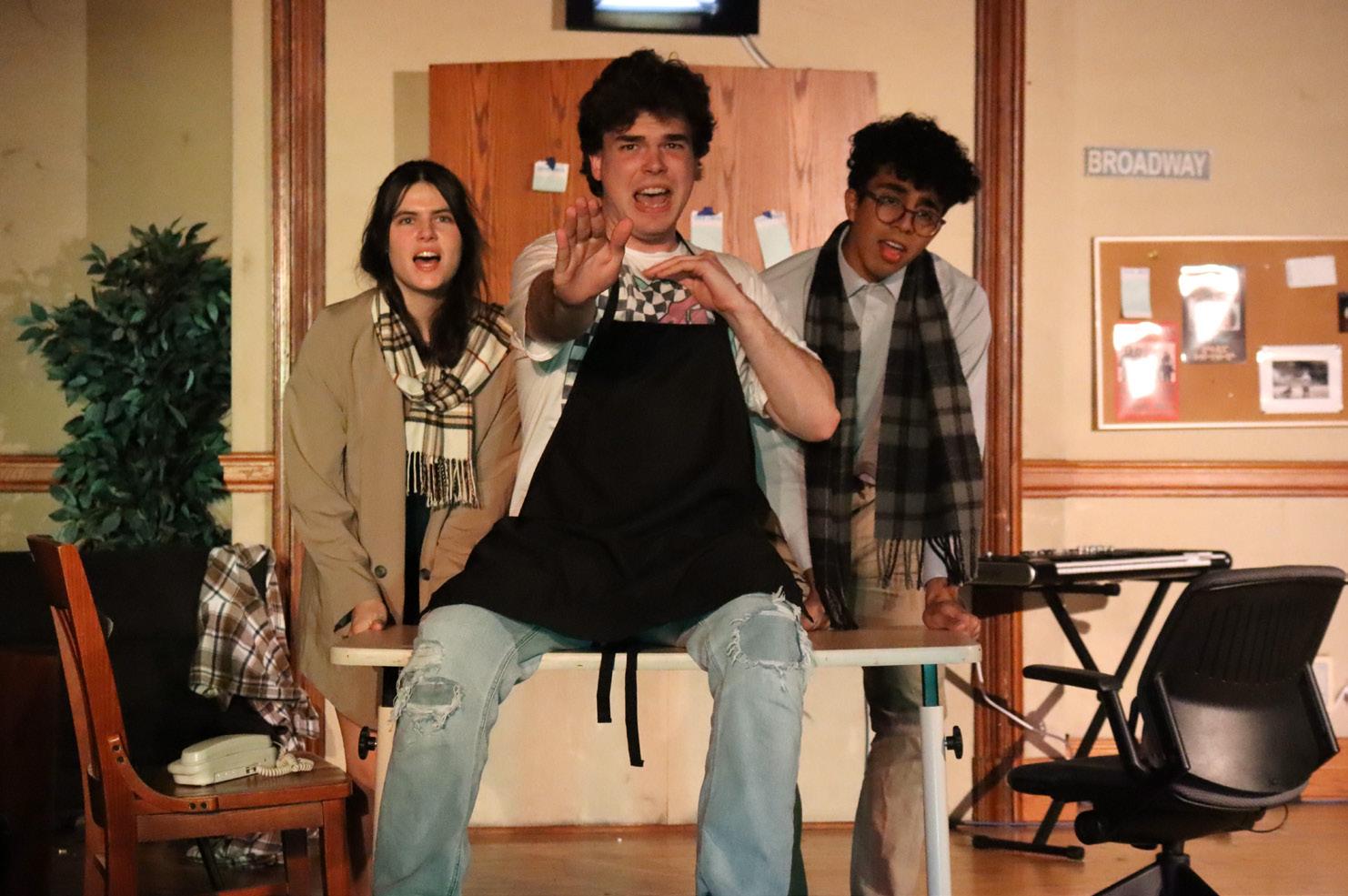
Left to right: Johanna Perry, Cam Grealis and Chris Tipton Jr. starred as Susan, Jon and Michael in PTG’s recent production of “Tick, Tick... Boom!” They each gave their characters a unique energy and meshed with one another perfectly through their songs and acting. Elena Cangahuala/The Observer
oSTEM’s HalloQueen Drag Show is consistently great
Kate Gordon Life Editor
It’s rare to find a Case Western Reserve University on-campus event that pulls you in every year, reserve Springfest and perhaps Thwing Study Over, if you can brave waiting in line for that long. However, oSTEM’s annual Halloween-themed drag show is one such event, at least for me. The performances, all of which come from locally based drag queens, are phenomenal, and the energy in Tinkham Veale University Center ballroom is always spirited, friendly and welcoming of diversity in all its forms.
oSTEM, which stands for Out in Science, Technology, Engineering and Math, is an organization dedicated to empowering LGBTQIA+ people in STEM fields. Its HalloQueen Drag Show is a yearly event—except for 2022, in which they threw a winter holiday-themed show instead—that began in my first year of college, 2021. I’m not sure that the energy or turnout of their first drag show has ever quite been replicated, but the event remains a CWRU Halloween staple. It’s also many students’ first introduction to drag. A show of hands at the beginning of the night revealed that it was about half of the attendees’ first-ever drag show, so I have to applaud oSTEM for bringing this experience to so many students, particularly first-years.
This year’s performers were Natasshja Norielle, JolieeBlak, Sarahtonin, Lady Inferno and The Art of Omega, all of whom have performed previously at CWRU. Each queen performed two lip sync numbers, one before and after intermission, and Natasshja Norielle and The Art of Omega took turns MCing. There wasn’t a bad performer in the bunch—each queen was a fantastic dancer, full of confidence and moved around the room to in-
teract with the audience fully. However, I do think The Art of Omega and Lady Inferno were the night’s standouts.
The former was voted Cleveland’s best drag queen, and brought humor as well as looks to the stage. The Art of Omega’s first number was Pokemon-themed; she dressed up in a pink vinyl nurse’s outfit and lip-synced to Shania Twain’s “Man! I Feel Like a Woman!” with “woman” bleeped out and replaced with “Nurse Joy.” For her second number, she wore leggings and a sports bra and interspersed poses on a genuine Nintendo Wii Balance Board with dance segments to Ariana Grande’s “positions.” I love it when queens get creative and aren’t afraid to take risks to make their audience laugh, and The Art of Omega did exactly that. On the other hand, I liked Lady Inferno because she seemed to be the best dancer of the bunch, landing her splits and cartwheels gracefully. While I didn’t fully understand her first number’s ode to the show “Bad Girls Club,” I always appreciate a niche pop culture reference. As an honorable mention, Sarahtonin danced to the Monster High Theme Song, which I loved as well.
oSTEM’s executive board also seemed pleased with how the night turned out, especially considering the amount of work it takes to organize the event. President and fourth-year student Alexandra Pérez-Robles said, “My favorite part of the Drag Show is seeing the performances and getting to know the Cleveland drag scene. We try to work with different queens and kings each year so we’ve been able to build a pretty extensive network. The Drag Show is the largest event oSTEM puts on and there are a lot of responsibilities, so it’s hard to juggle finances, catering, promo, etc., even working together as an exec. There are a lot of moving parts behind the scenes and months of plan-
ning, [so] we have to ensure they all work together on D-day.” Of the event’s reception by students, she said, “We’ve gotten great feedback; students loved the vibe we created and the queens’ performances. We also held a costume contest this year, and so many people dressed up and participated! I think, as the only LGBTQ+ club on campus, we provide a space for connection and visibility.”
If you want to get involved with oSTEM, you can join their CampusGroups to receive their newsletter and follow them on Instagram (@
ostematcwru). There’s currently a form linked in their bio accepting applications for their mentorship program. Their next event is Finals Care Packages, which will be held on Dec. 9 from 3-4 p.m. in Thwing Student Center 101. Finally, if you’re interested in being part of the planning process for the drag show, they recruit a decorations committee from their general body, so you can be on the lookout for that next year. Until then, however, hopefully the memories of their last show is enough to tide everyone over until Halloween 2025.
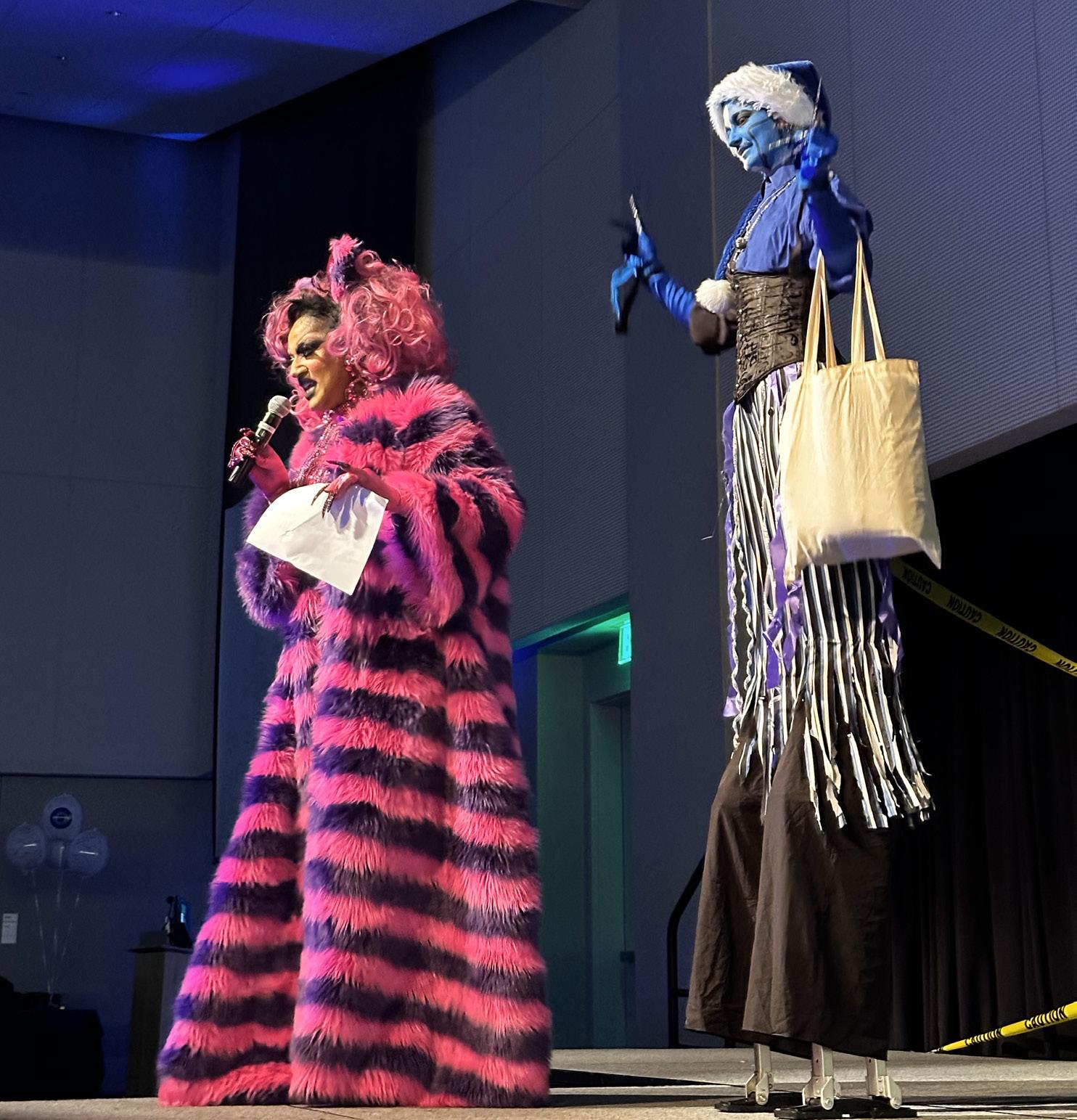
First-year student and costume contest winner Atlas Rivera is congratulated by drag queen performers at oSTEM’s HalloQueen Drag Show. Courtesy of Josef Broz/oSTEM
Hannah Johnson/The Observer
Darcy Chew/The Observer
Zachary Treseler/The Observer
Observer
Fun
What We've Been Listening To
(Isn't It) Obvious Alessia Cara
Kethan Srinivasan
PRBLM
Friday Pilots Club
Kethan Srinivasan
APT
Rosé ft. Bruno Mars
Lucas Yang
All Girls go to Heaven Zolita
Zachary Treseler
Everything is Romantic
Charlie XCX ft. Caroline Polacheck
Kate Gordon
Come a Little Closer
Cage the Elephant Clay Preusch
Overheard CWRU
Compilation of out-of-pocket things heard across campus
"Call your daddy."
"I deserve an honorary philosophy degree because every time I do my signals homework, I start contemplating my life."
"I'm drunk, remember?"
"This is a cry for help. It's 4:23 a.m. and I'm still editing this page."
Tyler Vu/The Observer
Opinion
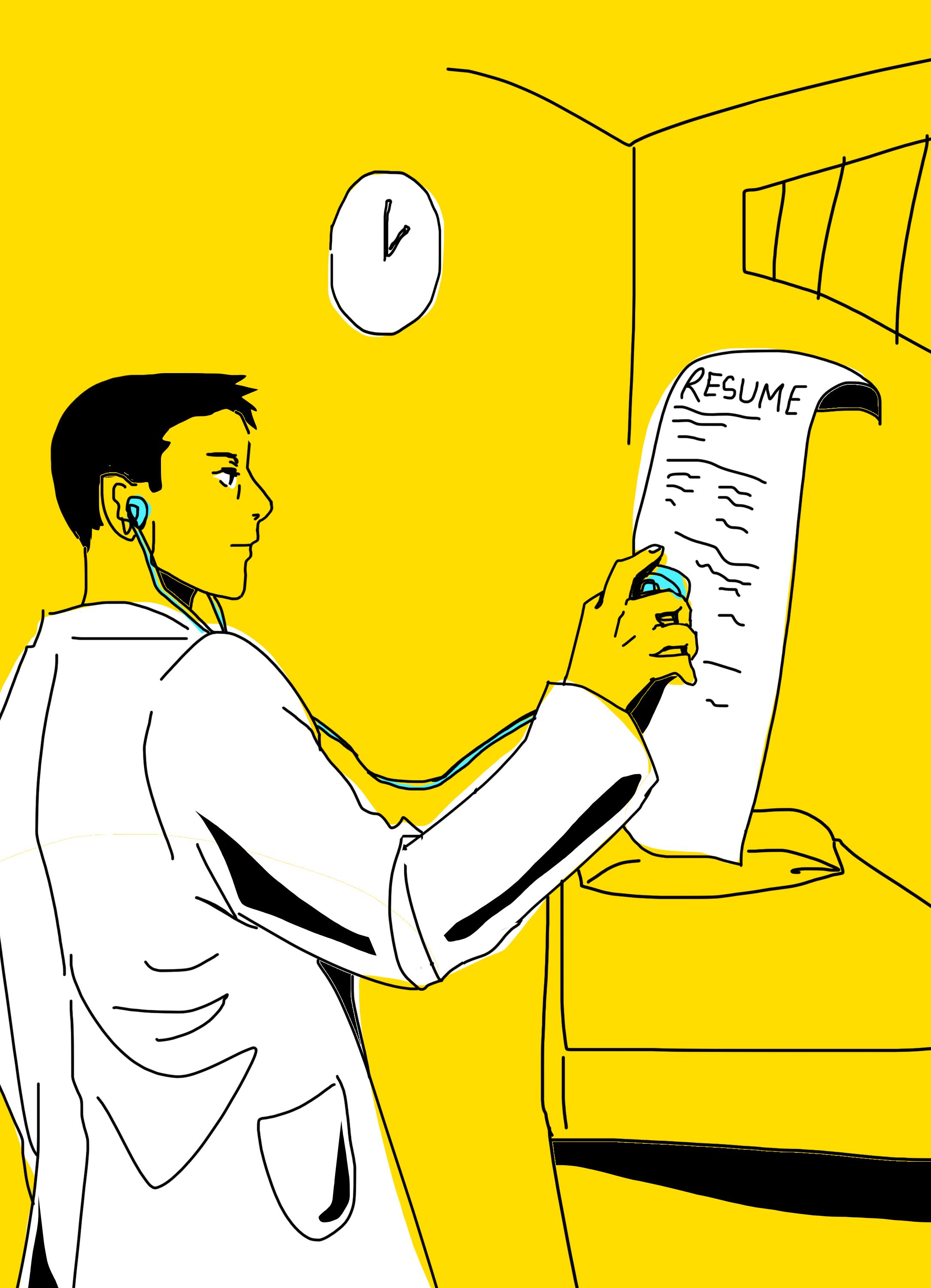
Solving health inequality is about more than padding your resume
Ify Chidi Contributing Writer
Scrolling through CampusGroups’ listings for health inequality-related student organizations at Case Western Reserve University can be overwhelming. At the time of writing, 11 different clubs claim to address health inequities in Cleveland, with more added each year. These pre-med clubs often present themselves as focused on solving health inequality, but are they really making a difference, or are they just there to boost their exec’s medical school applications?
CWRU’s proximity to four major healthcare systems and its tier1 medical school naturally attracts students eager to pursue healthcare careers. Yet, the rapid proliferation of premed organizations claiming, and failing, to effectively serve the local community has become a growing problem.
Many of these clubs use up valuable university resources—meeting spaces, funding and volunteer opportunities—without delivering significant community impact. Instead of creating lasting change, they often engage in surface-level projects like one-time health fairs—held on campus and majorly utilized by CWRU students—or awareness campaigns that fail to address root causes. These initiatives do little more than enhance resumes, diverting university funds from more effective, well-
organized efforts.
A closer look at their work reveals a lack of continuity and measurable outcomes. Cleveland, like many urban areas, faces deeply rooted healthcare disparities. Addressing these issues requires sustained engagement and a deep understanding of the community’s needs. However, many pre-med clubs focus on shortterm volunteerism—sometimes even “voluntourism”—where students log a few hours, take a couple of pictures and move on. These projects often emphasize easily quantifiable “successes” like volunteer numbers or food donations, which may look good on applications but fail to make a lasting impact. It’s unclear if this is due to a lack of knowledge or malicious intent.
Not all health-related clubs on campus are guilty of this. Some, like Partners in Health, genuinely build relationships with local organizations and contribute meaningfully to their causes. However, clubs that exist mainly for resume padding undermine these sincere efforts, sometimes even raising expectations in the community only to disappear when it’s no longer convenient.
Students today face immense pressure to stand out in a competitive medical school admissions process, and community service has become commodified—a box to check rather than a meaningful act. However, as future healthcare professionals, we have a responsibility to engage in service that genuinely
helps. The Cleveland community deserves more than a revolving door of volunteers with no long-term commitment.
CWRU should address this issue by ensuring that clubs meet specific community engagement standards before receiving approval or resources. The Undergraduate Student Government should encourage the federation of similar clubs, and mentorship and partnership programs should be expanded. Students should work with established organizations with a proven record
of community service rather than starting new clubs for the sake of it. Pooling resources and collaborating with public health experts and medical humanities could create a far greater community impact.
Pre-med students are part of the future of healthcare, and their service should reflect a real commitment to improving lives—not just padding resumes.
To help Cleveland meaningfully, we must move beyond performative activism and strive for real, lasting change.
The Case Western Reserve Observer
Established in 1969 by the undergraduate students of Case Western Reserve University
Shivangi Nanda Executive Editor & Publisher
PRINT
Elie Aoun Director of Print
Téa Tamburo News Editor
Zachary Treseler News Editor
Kate Gordon Life Editor
Hannah Johnson Opinion Editor
Darcy Chew Sports Editor
Sahar Kapasi Copy Editor
Ella Lasky Copy Editor
Isabella Lopez Copy Editor
Siya Motwani Copy Editor
Katherine Riley Copy Editor
DESIGN
Auden Koetters Director of Design
Clay Preusch Photo Editor
Elizabeth McHugh Layout Designer
Tyler Vu Layout Designer
Shareen Chahal Layout Designer
Lucas Yang Graphic Designer
Mulan Ma Graphic Designer
DIGITAL MEDIA
Joce Ortiz Director of Digital Media
Aambar Agarwal Social Media Manager
Shejuti Wahed Social Media Content Creator & Video Editor
Kethan Srinivasan Social Media Content Creator
Noah Henriques Web Editor
Moses Fleischman Web Editor Assistant
Esha Bagora Social Media Editor
BUSINESS
Kamila Sattler Sanchez Director of Business Operations
The Observer is the weekly undergraduate student newspaper of Case Western Reserve University. Established in 1969, The Observer reports news affecting students and provides an editorial forum for the university community. Unsigned editorials are typically written by the opinion editor but reflect the majority opinion of the senior editorial staff. Opinion columns are the views of their writers and not necessarily of The Observer staff. For advertising information, contact The Observer via e-mail at observer@case. edu.
LETTERS TO THE EDITOR should be e-mailed to observer@case.edu or submitted on our website at observer.case.edu. Letters can be mailed to Thwing Center 11111 Euclid Avenue, Suite 01, Cleveland, Ohio 44106. For policy and guidelines related to the submission of Letters to the Editor, refer to observer.case.edu/submit-a-letter.
The Observer is a proud member of CWRU’s University Media Board. Follow The Observer on Facebook, Twitter, TikTok and Instagram @cwruobserver.
On small talk, awkwardness and the fear of social interaction
Katharina Staehr Staff Writer
You walk into a room, a party, a dining hall, a networking event, a family gathering—and immediately you’re confronted with an unsettling prospect: having to make small talk with someone you barely know. What will you talk about? How do you circumvent the impending awkward silence?
Yup, we’ve all been there. Making good conversation can sometimes feel like winning the lottery. The opening “How was your day?” question can be a real hit-or-miss. At times it will open a treasure trove of laughs and smiles, connection over shared experiences or fervent and passionate debate; other times the conversation will fizzle into silence after an exchange of terse descriptors such as “good,” “long” or “tiring.” It is situations like the latter that we associate most with our anxiety surrounding social interaction. We anticipate an interaction suffused with long moments of sparse conversation or none at all, accompanied with uncomfortable eye contact. Simply put, we fear that we won’t know what to talk about.
Yet our fear of conversation, ironically, also arises from the fact that we are social creatures. We rely on connection to others and seek acceptance. The idea of being judged scares us, and the risk of saying something that the person across from us might take the wrong way is terrifying, too. Especially in professional settings—be it a job fair, a conference or a symposium—the pressure to impress a prospective employer, mentor or impactful figure propels us into a nervous trance, and we dodge the discomfort by forgoing the conversation altogether. What’s more, at networking events we often find ourselves walking into crowds of people organized into smaller, impenetrable circles. As we stand amongst these tight clusters of people who all appear to know each other and are seemingly indifferent to newcomers, networking rises from an avenue for social interaction to a considerable feat.
In an effort to diminish our anxiety of social interaction, we may
turn to preparation—from watching YouTube tutorials boasting the “secret” to small talk to rehearsing our life stories in our heads and making mental notes about what questions to ask. While these efforts may lead us to some success, they fail to address the fact that interactions occur “in the moment” and are left to the spontaneity of context, time and location. Thus, it is impossible to “fashion” a conversation before it has occurred—and it can even be counterproductive as we stumble over our words in an attempt to follow a predetermined “script.”
There is no step-by-step “instruction manual” for the perfect conversation, but there are strategies we can use to facilitate interactions and take away from the looming social anxiety.
Creating a comfortable environment is the foundation for starting a comfortable conversation. Making eye contact lets the person you are talking to know you are genuinely interested, just as smiling, the occasional nod, leaning inward and an open posture show them that they are being heard. Not only does this invite the other person to feel comfortable talking to you, but it also takes away from the pressure that we place on ourselves to come up with endless things to say. Instead, we can harness one of our most powerful tools: listening.
In the professional sphere, creating a comfortable environment relies on a spirit of openness. Changing the physical organization from tight clusters to inviting half-circles encourages people to join the space and conversation, rather than scare them away. If you find yourself between isolated groups of people in a big room, open up your body and posture, make eye contact and smile to grant yourself a spot in the circle. Then, maintain the body language to allow others to enter, too.
Clearly, asking yes–no questions offers little room for expansive dialogue, but asking questions that are too open-ended can kill a conversation just as quickly. Take “How was your vacation?” for example. It’s an overwhelmingly broad question that is often returned with a “great” or “very relaxing,” followed by some meager elaboration. Asking “What was the
highlight of your trip?” however, requires deeper reflection, demands a story and yields a unique answer. As you embark on your conversational adventure, it can also be helpful to look out for commonalities: a place you have both been to, a hobby you both have, a club you are both in—or even something as small as wearing the exact same pair of shoes. Finding common ground not only forges connection but also unleashes stories and interesting experiences when you feel the conversation is starting to run dry. Lastly, perhaps the most important part to any conversation is the attitude we have toward it. If we go into an interaction anticipating its awkwardness, more often than not, it will be awkward. However, approaching a conversation with the goal of keeping it fun and spirited will replace a strained and uncomfortable environment with laughter, jokes and a good time. On the same note, every social
interaction is an opportunity to learn something unique about another person: their family story, a quirk about them, the house they grew up in or a passion they have been pursuing since childhood. There should be no expectation that a deep conversation must ruminate on society’s biggest issues. Learning about how a person thinks—their values, morals and goals—can be just as valuable, if not more.
With all this, however, it’s important to resist the urge to remember and practice all these tricks for your next conversation. Instead, let the conversation take its natural course and employ the aforementioned tools when the time is right. Next time you walk into a party, a career fair or a club event and feel the looming awkwardness, embrace the stumble, lean into curiosity and have fun. Sometimes the best connections arise when you least expect them.
The pre-professional system is not a waste of time
Catherine Choi Staff Writer
The U.S. education system has a unique structure. In order to pursue a career in certain fields—such as medicine, law or teaching—students have to go through a pre-professional program that prepares them for entrance into professional schools while they pursue an undergraduate degree. Some people think that requiring students to spend four years attaining a degree that barely contributes to their career development is a waste of time and argue that we should do what most other countries do: make medicine, law and teaching undergraduate courses so that students can graduate and start working at an earlier age. However, taking things slow has its benefits. The primary benefit of pre-pro-
fessional programs is that they alleviate the pressure put on high school students and incoming college freshmen. Areas such as law or medicine require students to be able to process intensive amounts of information in a relatively short amount of time, adapt to a unique method of learning and manage high workloads. For this reason, getting accepted into these professional institutions is extremely difficult and requires that you prove that you have an understanding of the nature of the profession and the capacity to overcome challenges. This process can put a lot of pressure on high school students applying for college if medical school is an undergraduate, rather than a graduate, program. For instance, in South Korea, high school students who are applying for law or medical school are required to be at the top of their
class, have a high CSAT score, have ample amounts of extracurricular experience and experience a lot of competition due to the limited number of students medical schools recruit. The pre-professional system, which requires students to spend the first four years of adulthood pursuing an undergraduate degree, gives students enough time to prepare for the tough process ahead by helping them establish effective life and study habits.
The pre-professional programs give students time to learn the real world, which differs from the academic one. In academics, there is a clear structure, and most of the time, we get what we want as long as we put in the effort. In real life, there are many factors beyond our control, scenarios without clear-cut answers and lessons that we can only learn from engaging with our
surroundings. If high-intensity professional curricula are provided to undergraduates as new adults, they are likely to miss out on opportunities to learn from life experiences because they are too busy studying. As a result, students are at risk of remaining immature into their late 20s. By taking the time to simply live their lives for the first four years of adulthood, students can develop skills that are necessary to live alongside others, learn how to take care of themselves and, most importantly, acquire the necessary wisdom to protect and advocate for themselves. These experiences are not something that others can teach you with a formula but instead are things that you must realize on your own.
Continue reading on page 10
Lucas Yang/The Observer
Newspapers aren’t the problem: The political effect of critical thinking and media
Editorial Board
Much of the importance of education lies in the fact that students are empowered to think for themselves. We must be able to hear the opinions of others and form our own thoughts on what those in authority or our peers have to say. This is especially pressing during this election season. It can be easy to be misled or swayed in a political climate where both major parties are constantly at each other’s necks. Furthermore, during the COVID-19 pandemic, psychologists noticed a decline in the critical thinking skills of Millennials and members of Generation Z as they found themselves growing more stressed and focused on immediate, rather than long-term concerns. Knowing this, it’s imperative that we continue to ask questions and understand certain biased or underhanded political statements rather than blindly accepting what we are told.
Recently there has been controversy surrounding The Washington Post, a major newspaper purchased in 2013 by Jeff Bezos, the billionaire owner of Amazon. An article from The New York Times in 2023 outlines Bezos’ increasingly active role in the company: “These days, Mr.
Bezos knows more about the news business. And in recent months, he has become more involved with The Post’s operations … Mr. Bezos has said he wants The Post to be profitable, but it is unlikely to reach that target this year.” The crux of the recent controversy, though, lies in The Post’s final decision not to publish a presidential endorsement of Vice President Kamala Harris despite having already drafted a statement.
This likely wouldn’t have been as big of a deal if those on the staff of the newspaper hadn’t come forward to claim that Bezos was responsible for the decision. According to Robert Kagan along with multiple columnists, Bezos had made the final call despite the editors’ complaints. Bezos then wrote in an editorial: “Presidential endorsements do nothing to tip the scales of an election … No undecided voters in Pennsylvania rare going to say, ‘I’m going with Newspaper A’s endorsement.’ None. What presidential endorsements actually do is create a perception of bias.”
Presidential endorsements create a perception of bias because they are inherently biased. That is the point—having an opinion in the hopes that it will be influential, or at least generate discussion. Yet with the uncertain polling of the presidential race between Harris and
former President Donald Trump, no one is sure who will secure the presidency. The vote is liable to sway in any direction in the days leading up to Nov. 5. It doesn’t seem too far off to say that Bezos is worried about what could happen to his market share if Trump were to win the election. After all, Trump has been highly critical of the newspaper in the past, as they repeatedly endorsed Democrats during his time in, and running for, office. And perhaps Bezos should be concerned—Trump has shown time and time again to be a vindictive man.
Publishing an endorsement is not the only way to make a political statement. In fact, actions can be more telling. The chief executive officer of Blue Origin, an aerospace company founded by Bezos, met with Trump hours after the Editorial Board of The Post had drafted its original endorsement of Harris. Amazon’s CEO also reached out to speak to the former president over the phone. By allowing some of his top executives to speak with Trump, Bezos willingly became politically involved despite trying to present an unbiased front. Furthermore, publishing an editorial about why you will not endorse a candidate— especially when your paper has for the past two election cycles—is, ironically, also a political state-
ment. A newspaper that publishes opinions cannot be unbiased, and a newspaper owned by one of richest men in the world with direct lines to government leaders certainly cannot be unbiased.
As much as we may hate to admit it, the reality is that money is power in our country. The fact that Bezos, a billionaire, even owns one of our major media sources—not to mention has authority over what is allowed to be published—is power. Billionaires are not just people who have money. They are people who have a stake in our government, our economy and our livelihoods, just like politicians.
That being said, during the time leading up to the 2024 presidential election, make sure to keep a critical eye out for bias. It’s inherent in most of the worthwhile statements we have to say, and not necessarily a bad thing. Everyone is entitled to their opinions, just as everyone should be able to critically disentangle their own beliefs from that which the media spoon-feeds them. In today’s political climate, we don’t need newspapers, or those over our media, to remain unbiased. What we need is to stop allowing systems which we have created and continue to uphold—such as our free market economy—to dictate our democracy.
The choice is clear: Vote for democracy
Aambar Agarwal Social Media Manager
In a few days, we will know who the next president of the United States will be.
The prospect is both exciting and terrifying. If one candidate wins, we will have triumphed over hate and division. We will make history. Democracy will be preserved. But if the other candidate wins, we will have succumbed to hate. Our freedoms will be stripped from us. Democracy will crumble.
Vice President Kamala Harris and former President Donald Trump paint starkly different visions for our future. Harris’ vision is progressive and full of hope; she promises to restore abortion rights, protect voting and LGBTQIA+ rights, fight against gun violence, tackle climate change and reform the Supreme Court. She pledges to lower everyday costs, strengthen Social Security and Medicare, rectify the immigration system and stand with our allies. Meanwhile, Trump’s vision is regressive and autocratic; he promises to escalate abortion bans, attack voting rights, eliminate LGBTQIA+ protections, push concealed carry laws, roll back climate policies and contest election results. He plans to increase everyday costs, cut Social Security and Medicare, carry out large-scale deportations, eliminate the Depart-
ment of Education and stand with dictators. He pledges to unleash the Department of Justice on his critics, purge the federal government of disloyal civil servants and consolidate power in the executive branch.
It is clear that Harris will deliver on her promises. Even as vice president, she has worked on ensuring gun safety, protecting the climate and preserving abortion rights. Likewise, it is clear that Trump will deliver on his threats. After all, he pursued his 2016 campaign promises during his first term, hindered only by supporters of the Constitution and his political inexperience. He tried to defund sanctuary cities, maintained ties with Russia, condoned white nationalist groups and cut taxes for corporations and the wealthy. He attempted to have the Department of Justice prosecute his political rivals, separated families at the border, broke U.S. foreign policy, refused to accept a peaceful transfer of power and tried to overturn the results of the 2020 presidential election.
Countless people have endorsed Harris, including President Joe Biden, former Presidents Barack Obama, Bill Clinton and Jimmy Carter, former Vice Presidents Dick Cheney and Al Gore, musicians Taylor Swift and Beyoncé and billionaires Bill Gates and Melinda French Gates. Even Republicans have supported her, such as former Reps. Liz Cheney and Adam Kinzinger, Sena-
tor Mitt Romney and former Georgia lieutenant Gov. Geoff Duncan. Trump’s own White House staff has backed her, from the former Director of the Federal Bureau of Investigation James Comey to former Homeland Security and Counterterrorism Advisor to the Vice President Olivia Troye and former White House press secretary Stephanie Grisham. Harris has received support from all ends of the political spectrum.
On the other hand, numerous Trump administration officials have warned against Trump’s reelection. His longest-serving chief of staff, John Kelly, claimed that Trump would rule as a dictator, citing his admiration for dictators, such as Adolf Hitler, and his desire to employ the military against U.S. citizens. Thirteen former aides backed Kelly’s remarks, warning of Trump’s desire for absolute, unchecked power. Even his former vice president, Mike Pence, has warned that Trump put himself above the Constitution, which no president should ever do. They have labeled him a fascist, conman and predator—and all are lifelong Republicans.
With Trump’s hateful and undemocratic plans, disastrous first term and lack of support among his own White House staff, it is clear that he is unfit to be president. Harris is the only democratic option. Yet, despite everything, the polls are
tied. And nearly 4% of Americans in battleground states—Pennsylvania, Michigan, Wisconsin, North Carolina, Georgia, Nevada and Arizona— remain undecided.
This 4% may become who decides the outcome of the 2024 presidential election. Some undecided voters say they are dissatisfied with both candidates, and others state they simply do not care about the election. But neither reason makes sense. How can you view Harris, our current vice president with decades of experience in all three branches of the government, and Trump, a twice-impeached convicted felon who idolizes autocracy, as equal? How can you not care about who leads our country? How can you ignore the threat to democracy that Trump poses? Having the right to vote is a privilege and a responsibility. It is our responsibility to vote for the candidate that is best for our country. It is our responsibility to uphold the founding principles of our country—to uphold our freedoms and democracy. It is our responsibility to guarantee future fair elections.
We cannot regress to being an authoritarian nation, where women, people of color and LGBTQIA+ individuals have no rights. We cannot allow Trump’s Project 2025 to become a reality. We must move forward—not back.
The choice is clear: Vote for Kamala Harris by Nov. 5.
The pre-professional system from page 8
Another benefit of the pre-professional program is that you do not have to make a major life decision right away. As we enter college, a lot of people are surprised that their original career aspirations are not what they thought and, consequently, are not the right path for them. It is also unlikely that 18-year-olds who are overwhelmed with college applications, only know small fragments about their future career and are under parental pressure will know exactly what they want to pursue. If degrees such as
medicine, law or teaching are undergraduate courses, some people may realize that such fields are not for them until after they put in the hard work. Additionally, they will not be burdened by the sunk costs of the professional courses they have already taken or have to start from scratch if they decide they want to switch to a new career path. By requiring students to get an undergraduate degree by partaking in a pre-professional education program, students can take the time to get professional guidance in setting
their career goals. They will also get the opportunity to consider whether the money and respect that doctors and lawyers get is worth the hard work they will have to put in for the next few years before making a career decision.
The fact that you were smart in high school does not guarantee that you will be successful in college and vice versa. Additionally, academic intelligence is not the only requirement to be successful in a career. Those who are intelligent can be horrible doctors, and those who are not so academically
intelligent may be very good at their job by utilizing skills in other areas. For this reason, one’s performance in high school—where you were likely immature, unmotivated or over-influenced by external factors—should not be the sole determinant of what you will do with your life. Although it may seem like a waste of time to pursue a degree that you know you will not use in life, having the opportunity to live the first four years of adulthood in undergrad and taking the time to mature can be very beneficial in the long run.
Embracing or enduring fall: How to navigate the upcoming cold months through mental health practices
Aleksandra Majewski Contributing Writer
Fall can only be perceived by people in two different ways—there is no in-between. You have those who love fall and accept its beauty, and you have those who despise it. I have yet to meet someone who feels neutral about the season. With that said, there comes what I call a “coldweather slump” in the upcoming fall and winter months. You might ask yourself: How do I combat this feeling, and is the cold directly responsible?
As the days get shorter, so might our ability to concentrate throughout the day. A decrease in daily sunlight can affect our vitamin D levels, even causing deficiencies. According to the Cleveland Clinic, about 35% of adults in the United States experience a vitamin D deficiency. Symptoms of this may include alterations in mood, bone and joint pain and fatigue. Fatigue can cause a decrease in concentration, which some of us can attest to experiencing during this cold seasonal stretch.
In fact, there is even a clinical disorder, known as seasonal affective disorder (SAD), that is caused by the decrease in daylight hours during the colder months. It disrupts your internal clock and is a severe type of depression that resolves in the springtime without treatment. SAD affects approximately 5% of adults in the United States and usually persists for about 40% of the year, according to the American Psychiatric Association (APA). Symptoms of this may include but are not limited to, feeling down or sad almost daily, a loss of interest in activities once found pleasurable, fatigue or low energy during
the day, oversleeping, difficulty with concentration and feelings of hopelessness. An imbalance in serotonin and melatonin can additionally play a role in the causes of this disorder, affecting the mood and/or sleep patterns of diagnosed individuals.
Don’t fret, though. The odds may be against us, but preventative measures are achievable. The mental toll that a colder climate may take on us is something that can be counteracted. Vitamin D deficiency is best
treated with vitamin D supplements, which are available in prescription or over-the-counter forms. Light therapy has emerged as a common treatment among diagnosed patients experiencing SAD, which is the use of a light box every morning for at least a half hour. For those who don’t find light therapy effective, antidepressants are an alternate treatment. As for others experiencing the first signs of the “winter blues,” this can be combated by setting aside time
for a daily 30-minute walk while the sun is still shining, balancing your diet, maintaining a consistent sleep schedule, incorporating relaxing hobbies into your daily life and being in a supportive and uplifting environment.
Through healthy habits designed to boost a positive mentality and increase concentration, we, like Elsa from the movie “Frozen,” will also be able to say, “The cold never bothered me anyway.”
LTTE: A response to Thomas Kim Hill
Jay Geller
Samuel
Rosenthal Professor of Judaic Studies
I appreciate the time taken by a Case Western Reserve University alumnus and retired schoolteacher Thomas Kim Hill to engage with my letter to the editor of The Observer (“An appeal to reconsider how we think about Jews, Arabs and the Israeli-Palestinian conflict,” May 13, 2024). However, Hill’s letter to the editor is full of factual mistakes and tendentious claims. Among them: He claims that the “majority of Jews
who founded Israel … immigrated after the Holocaust.” He is wrong. The vast majority of Jews living in Israel at the time of independence had lived there before the Holocaust. Only one of the 37 signatories of the Israeli Declaration of Independence arrived in the land after the Holocaust. Not a single member of Israel’s first governing cabinet arrived after the Holocaust. Hill recommends scholarship that endorses the Khazar thesis, which claims that today’s Ashkenazi Jews are actually the descendants of Turkic peoples from the Caucasus Mountains. That thesis is a fringe theory that has almost no support among the main-
stream scholarly community, but it finds support among conspiracy theorists and antisemites of various political leanings who seek to deny contemporary Jews’ connection to the Land of Israel or Palestine.
Hill claims that the Israeli state “violates a core value of democracy” by having a religious identity. In fact, there is no universal definition of democratic values. Moreover, countries such as Costa Rica, Denmark, England, Iceland and Norway have state churches or national churches, and no one seriously questions their democratic bona fides on that basis. The democratic constitutions of Argentina, Bulgaria,
Finland, Georgia and Greece, among others, expressly privilege Christianity. Israel guarantees freedom of religion to all its citizens while defining itself officially as a Jewish and democratic state. The relationship between those two attributes remains a topic of debate in Israel’s vibrant public sphere, as it does in the public sphere of other democracies with national churches. As I wrote in my initial letter to the editor, we need to stop thinking about Israeli, Palestinian, Jewish and Arab societies and histories on American, Western and Christian terms and start thinking about them on their own terms.
Auden Koetters/The Observer
Sports
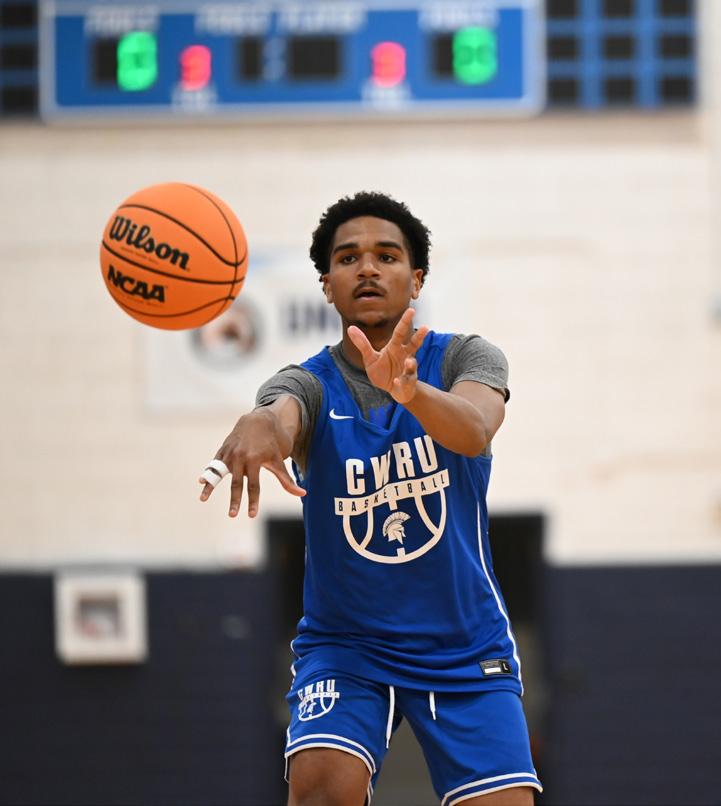
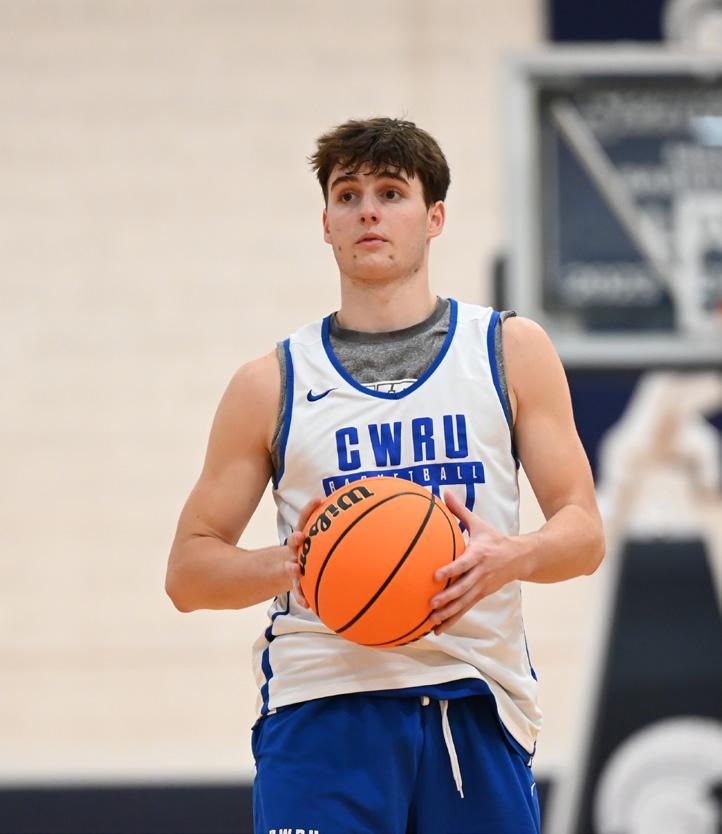
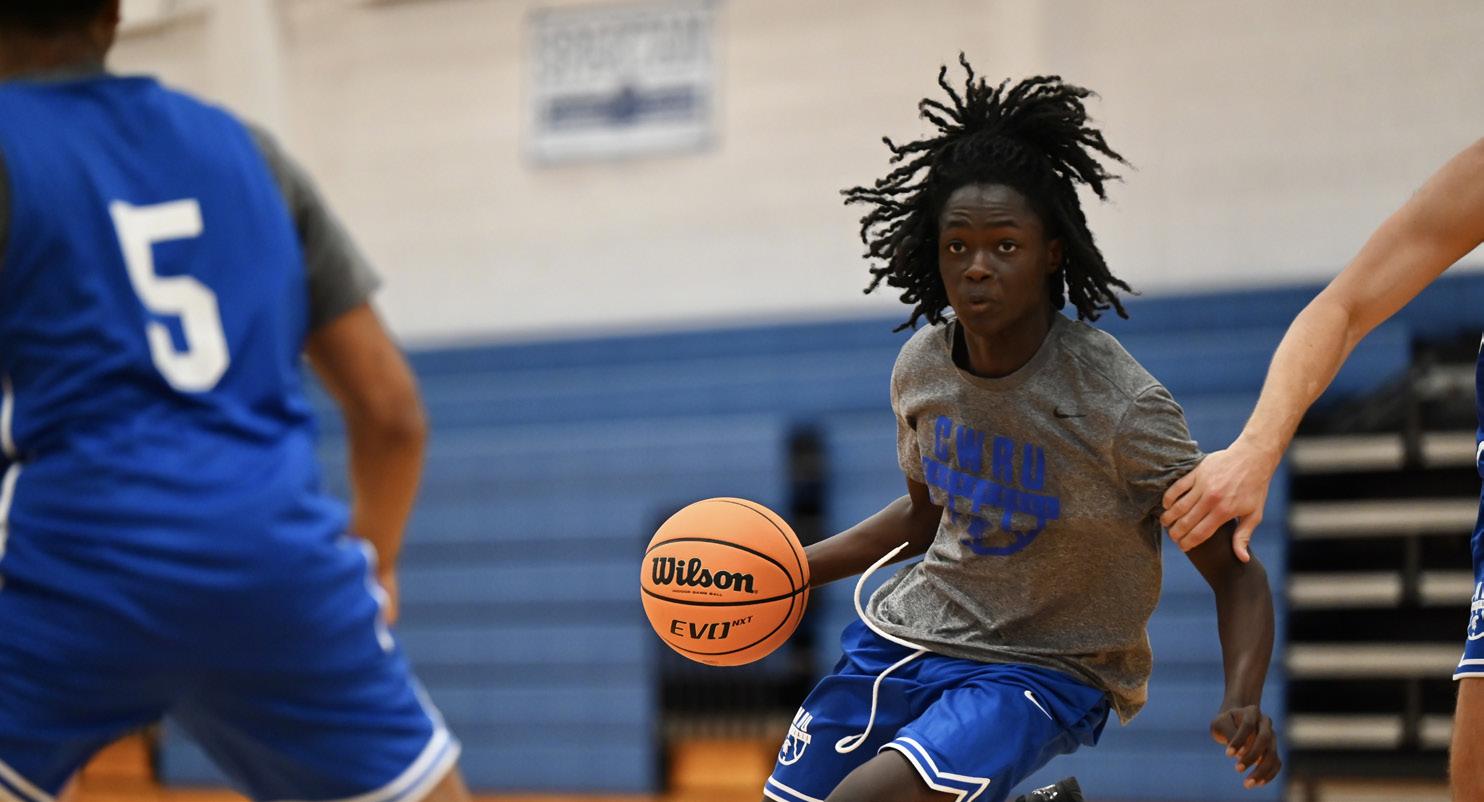
Men’s basketball season preview
Darcy Chew Sports Editor
Last spring, the Case Western Reserve University men’s basketball concluded an outstanding 2023-2024 season with their third consecutive NCAA appearance. The team finished their campaign 23-5, which broke the previous season’s program record of 22 wins in a season. In UAA play, the Spartans went 10-4, tied with New York University for the league title and won an automatic bid for the NCAA, where they were seeded sixth.
CWRU hosted the first round of the NCAA Championships, where they beat both Mary Baldwin University and No. 22-ranked Hope College. During the Round of 16, the Spartans fell to No. 11-ranked University of Wisconsin-Platteville 75-95, and with the finish, the Spartans matched the
best finish in program history. They also ended the season with a program highest final ranking of 11th in the D3hoops.com Top 25. Another outstanding accomplishment by the team was going undefeated at home for the first time in program history. The Spartans will look to defend its second consecutive UAA Championship title.
With the graduation of graduate students Anthony Mazzeo, Colin Kahl, Preston Maccoux and Richie Manigault, as well as fourth-year Luke Thorburn, the squad will look to fill their shoes. Mazzeo was named UAA Athlete of the Week five times during the 2023-2024 season, finishing the campaign with an average of 19.5 points per game and a new school record of 545 total points in a season. Kahl led the team in rebounds with 7.5 and 27 total blocks, and he has signed to play professionally for the Carrick Cruisers in Ireland. Both Maccoux and
Manigault played in all 28 games, averaging 9.3 and 6.8 points, and 2.7 and 2.2 rebounds, respectively. Thorburn was one of the three players to start all 28 games and contributed an average of 3.2 points and 4.8 rebounds.
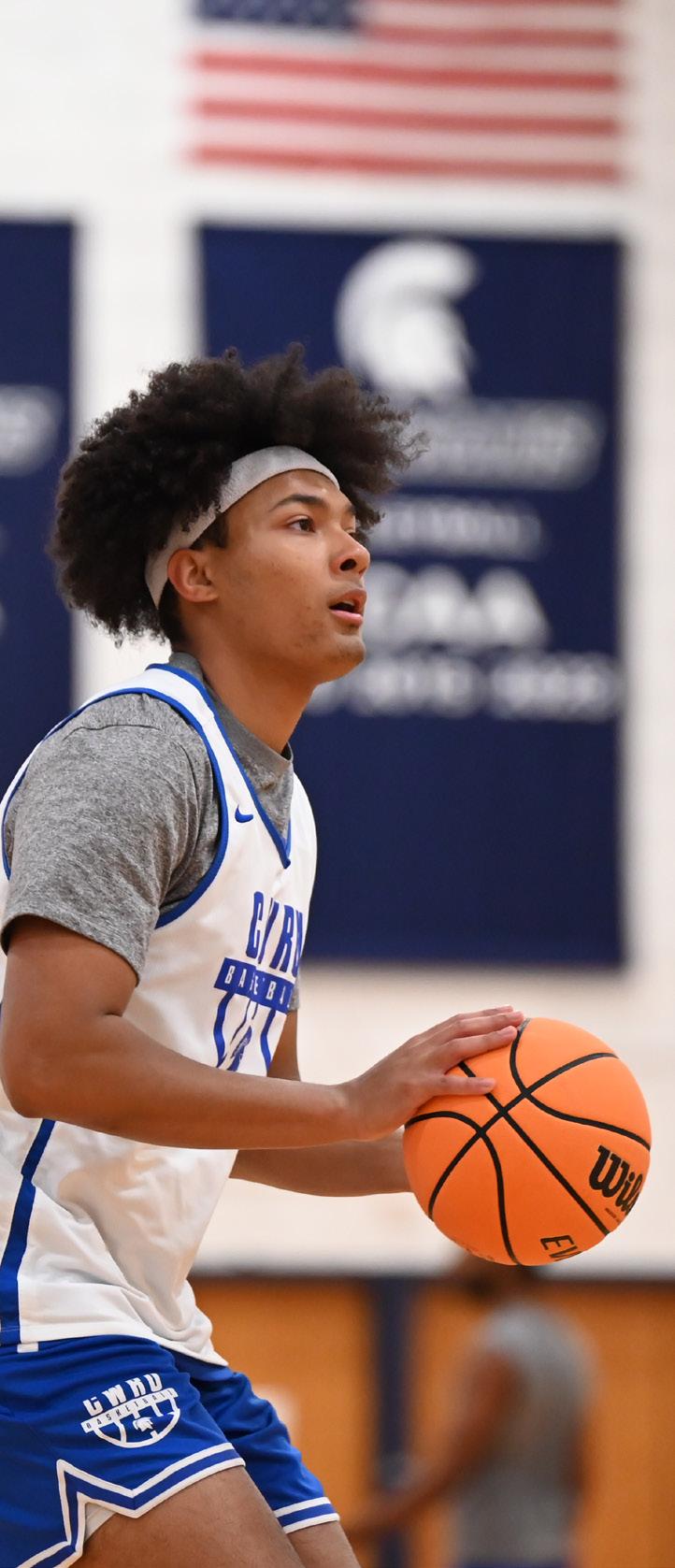
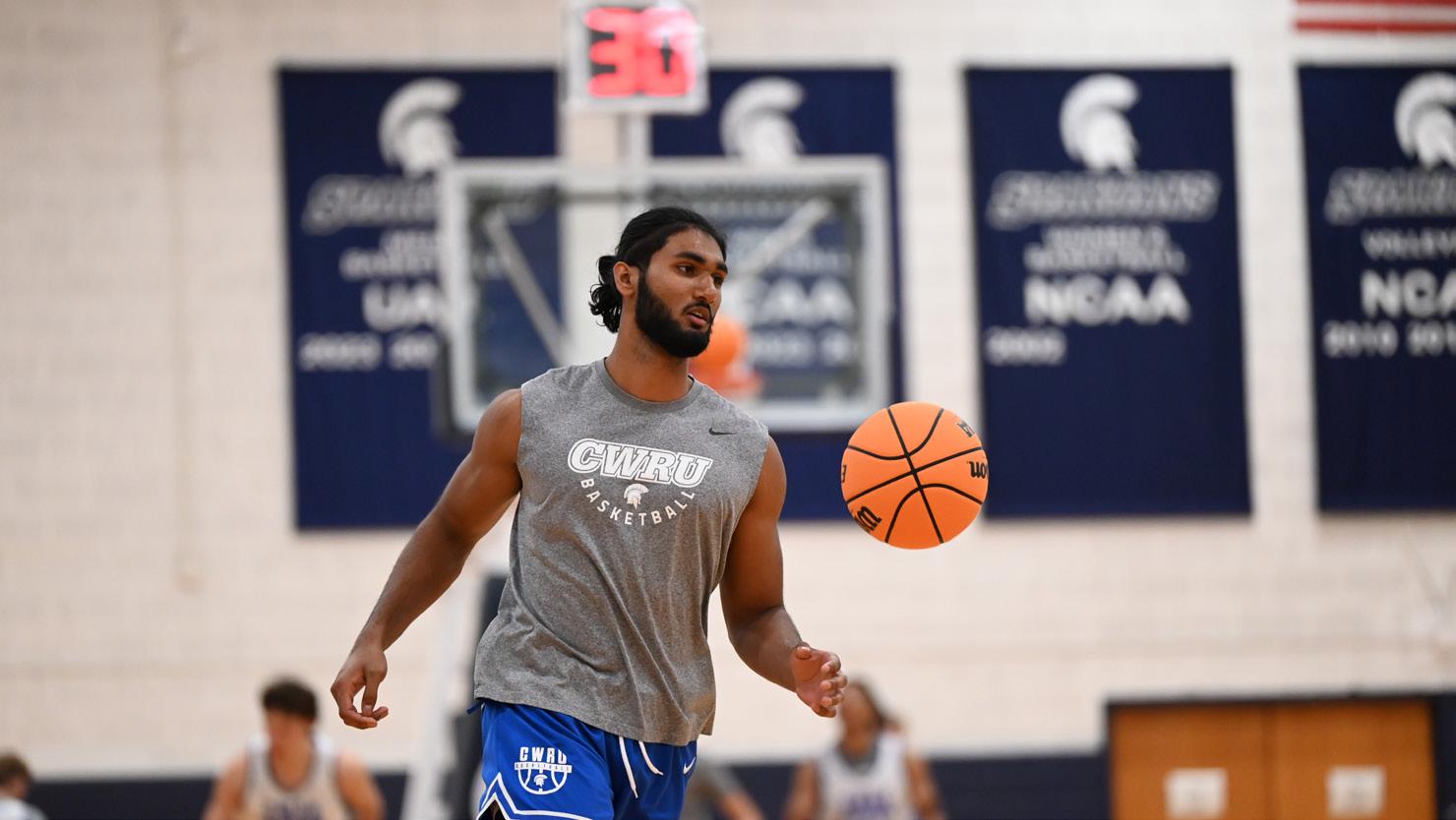
However, the team still has some key players from the 2023-2024 season returning to the court, including fourth-year forward Umar Rashid, who contributed to the team’s strong defense. He led the team with 1.46 blocks per contest and averaged 8.9 points with 7.0 rebounds per game. Fourth-year guard Sam Trunley aided offensively with the third-highest points per game with 13.0 and a 43.8% overall shooting percentage.
The squad also welcomes more than half its total of 21 players, including seven first-years: forward Nolan Demski and guards Eli Teslovich, Matthew Ellis, Stylianos Marios Martzoukos, Jeremiah Lepp, Henry
Stowell and Musa Ndow. Four graduate students will also be joining and playing for the Spartans: guard Wade Jackson who played for Hamilton College, guard Christian McDaniel who played for Loyola Marymount University and Belmont Abbey College, guard Nicholas Schiavello who played for Wheaton College and guard Andy Barba who played for Duquesne University (DI).
The team also welcomes new Assistant Coach Brandon Staley alongside Head Coach Todd McGuinness as he begins his eighth season with the team.
The men’s basketball team will kick off the season on Nov. 8 with the annual Bill Sudeck Tournament. The Spartans will host SUNY Brockport, SUNY Canton and Penn State Altoona in Horsburgh Gymnasium, where the squad will take on Penn State Altoona at 7 p.m.
No. 17-ranked volleyball sweeps Carnegie Mellon and UChicago in final round robin
Following the momentum of their record-breaking opening win streak, the Case Western Reserve University volleyball team dominated against Carnegie Mellon University and the No. 15-ranked University of Chicago in the final UAA round robin. The Spartans are currently 20-4 overall and finished second in the conference regular season with a 5-2 record.
The Spartans began Sunday’s matches against Carnegie Mellon, where they took the first set with 2517. While the Tartans put up a fight and took the following two sets 2523 and 25-14, the Spartans followed up with another win 29-27 to push
them into the decisive fifth set. Their victory over Carnegie Mellon came from a kill by fourth-year right side and outside hitter Chloe Maciejewski. Offensively, the final kill by Maciejewski contributed to her matching a career-high of 14 kills. Fourthyear outside hitter Rea Marfatia led with 16 kills and contributed 15 digs. Fourth-year setter and right outside hitter Carly Scott achieved an impressive triple-double with 12 kills, 24 assists and 15 digs. This was the Spartans’ first triple-double since the 2010 season. Other team leaders in the match included first-year defensive specialist Sophia Datto with 20 digs and first-year Avery Basinger with 31 assists.
Following an intense match against Carnegie Mellon, the Spar-
tans faced off against No. 15-ranked UChicago. The Spartans took a three-set victory over the Maroons, marking a total of nine for the season.
The Spartans had a strong start to the first set with an early 6-2 lead, which they later extended to 12-5 after third-year middle blocker Amanda Ngo notched a kill. The Spartans continued with the momentum to win the first set 25-18.
The Maroons tried to make a comeback and had a dominating lead to begin the second set, as they took 12 of the first 15 points. However, their lead did not last long as thirdyear middle blocker Kiya Levy’s kill triggered a 10-0 run for the Spartans, placing them up 13-12. The Spartans eventually emerged victorious to take the second set 25-23 win.
The final set of the day for the Spartans began with the two teams trading small runs, with the Spartans eventually gaining a 14-10 lead off of a 5-0 run, triggered by another Levy kill. This set remained tense, though, and the 4-point lead was the biggest lead of the set. The Maroons put up a fight, as they tied the score five times before a service and attack errors gave CWRU its three-set victory.
The squad will be on the road this weekend, traveling to Grove City, Pennsylvania, to compete in a trimatch against Westminster College and Grove City College. The Spartans will return to Horsburgh Gymnasium for two more home contests before the quarterfinals of the UAA Championships, where they will face seventh-seeded Brandeis University.
Darcy Chew Sports Editor
All photos courtesy of Phillip Kornberg/The Observer
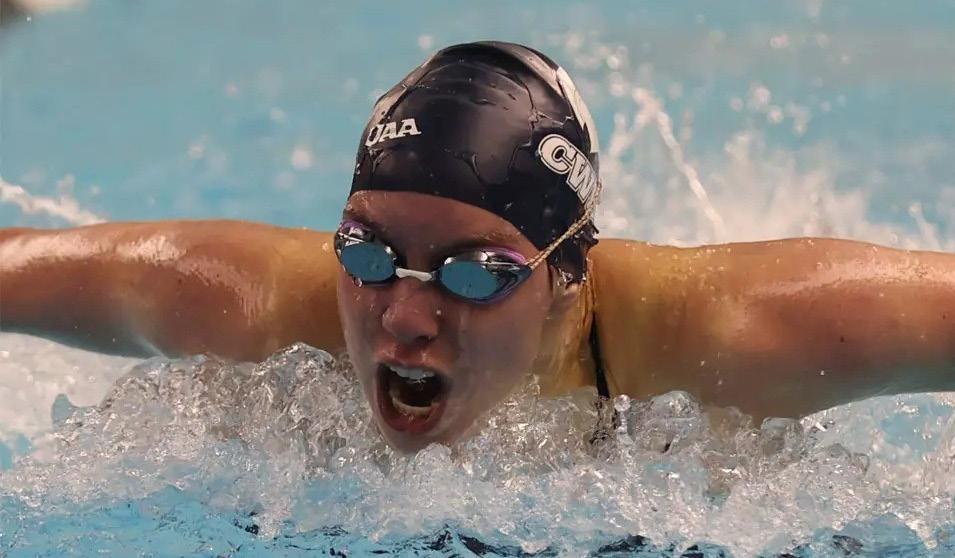
CWRU swimming and diving sweeps all events in dual meet with Ohio Wesleyan
Abhishek Nambiar Staff Writer
On Saturday, Oct. 26, the Case Western Reserve University men’s and women’s swimming and diving teams prevailed over Ohio Wesleyan University during their first home meet of the season, which took place at Veale Natatorium. Both teams soundly dominated their respective events, with the men’s team winning 241-35 and the women’s team winning 249-46. All 32 events contested at the meet saw the Spartans emerge victorious, giving the men’s and women’s teams their second consecutive win of the season.
On the women’s team, CWRU started the meet strong with a win in the 200-yard medley relay (1:49.05) courtesy of third-year swimmer Claire Kozma and fourth-years Simone Vale, Kate Menzer, and Gabriella Chambers. Chambers and Kozma went on to tie in the 50-yard freestyle with a time of 24.11 before each achieved an individual win of their own; Chambers won the 500-yard freestyle (5:20.39), while Kozma prevailed in the 100-yard freestyle (53.49). Meanwhile, Menzer achieved a victory of her own in the 400-yard individual medley (4:48.82).
Many other swimmers on the team recorded individual wins of their own as well. Fourth-year Selah Dean achieved a pair of wins of her own, placing first in the 200-yard butterfly (2:13.38) and 200-yard backstroke (2:12.94). Fourth-years Angeli Paull and Adriana Kamor recorded wins in freestyle events, with Paull winning the 1000-yard freestyle (11:08.87) and Kamor the 200-yard freestyle (1:59.00).
Meanwhile, fourth-years Madison McDaniels and Erica Rice swept the breaststroke events; McDaniels won the 100-yard race (1:09.68), while Rice bagged the 200-yard contest (2:36.84). Additionally, fourth-year Amelia Myhrvold and third-year Kailyn Smith secured victories in the
100-yard backstroke (59.17) and 100yard butterfly (1:00.45), respectively.
As for women’s diving events, both of them were swept by fourth-year diver Abigail Wilkov; she won the 1-meter dive with a score of 275.60 and 3-meter dive with a score of 269.45. And to conclude the women’s events for the meet, the 200yard freestyle relay team of Kozma, Chambers, third-year Eliza Dixon and fourth-year Kelly Vann came out on top with a time of 1:38.94.
Like the women’s team, the men’s team posted very strong results across the board. The men’s events opened with the 200-yard medley relay, which was won by the group of fourth-year Ben Zuo and thirdyears William Froass, Julian Kim, and Mason Bencurik (1:34.48). Bencurik went on to win the 100-yard freestyle (47.03) and 200-yard freestyle (1:44.11), while Froass achieved a victory in the 100-yard butterfly (51.33).
The Spartan domination continued through the rest of the men’s events. In freestyle events, fourthyear Stephen Hogeman bagged the 50-yard freestyle (22.18), fourthyear Griffin Gushman the 500-yard freestyle (4:52.29) and first-year Owen Miao the 1000-yard freestyle (9:56.53). In backstroke events, fourth-years Anthony Colangelo and Zach Toothman nabbed victories in the 100-yard contest (54.20) and 200-yard race (1:59.89), respectively. Both breaststroke events were claimed by CWRU courtesy of fourth-year Jiro Batt in the 100-yard breaststroke (1:01.03) and thirdyear Spencer Ahten in the 200-yard breaststroke (2:12.31).
More individual wins were recorded by fourth-year Peter Meng in the 200-yard butterfly (1:54.26) and third-year Joshua Hernandez in the 400-yard individual medley (4:13.89). As for diving events, both saw fourth-year Alex Waltman emerge victorious; he won the 1-meter dive with a score of 275.05 and the 3-meter dive unopposed. Finally, the meet concluded with the men’s 200-
yard freestyle relay, with the group of Froass, Zuo, Bencurik and third-year Zach Halsey securing a win with a time of 1:25.23. The Spartans will look to keep
their momentum going this Saturday, Nov. 2, as they head to Pittsburgh to face the No. 7-ranked men’s team and No. 15-ranked women’s team of Carnegie Mellon University.
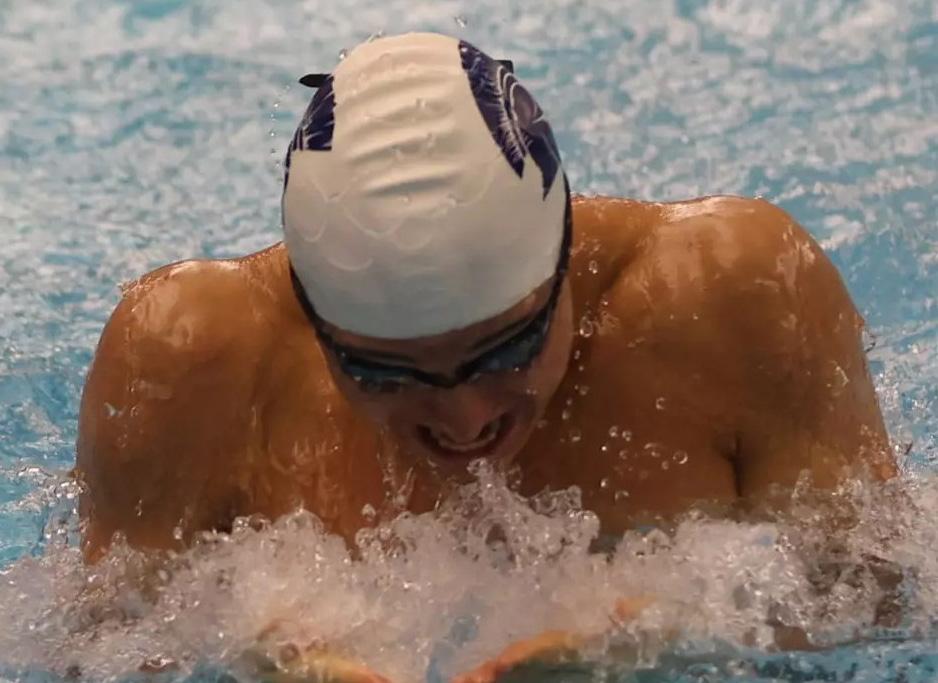
Third-year Kailyn Smith adds wins to both the 100-yard backstroke and 100-yard butterfly at the Ohio Wesleyan home
Fourth-year Jiro Batt claims the 100-yard breaststroke at the Ohio Wesleyan home meet, touching the wall at 1:01.03.
Tim Phillis/CWRU Athletics
Scores and Upcoming Games
Men’s Soccer
CWRU at Chicago (10/25) - T 0-0
CWRU at WashU (10/27) - T 1-1
CWRU vs Brandeis (11/3, 1:30 p.m., DiSanto Field)
Cross Country
CWRU at UAA Championships (11/2)
Swimming and Diving
CWRU vs Ohio Wesleyan
Men’s team: W 241-25
Women’s team: W 249-46
CWRU at Carnegie Mellon (11/2)
CWRU at Westminster (10/26) - L 14-17
CWRU vs Washington and Jefferson (11/2, 1 p.m., DiSanto Field)
CWRU at Adrian Invitational (11/2)
UAA Round Robin #3
CWRU at Carnegie Mellon (10/27) - W 3-2
CWRU vs Chicago (10/27) - W 3-0
CWRU vs Westminster (11/2)
CWRU at Grove City (11/2)
CWRU vs John Carroll (11/6, 7 p.m., Horsburgh Gymnasium)