INSiGHT is published quarterly by Council for World Mission Ltd 114 Lavender Street, #12-01, CT Hub 2 Singapore 338729 T: (65) 6887 3400 F: (65) 6235 7760 E: council@cwmission.org W: www.cwmission.org
INSiGHT Editorial Committee The Council for World Mission is a worldwide partnership of Christian churches. The 36 members are committed to sharing their resources of money, people, skills and insights globally to carry out God’s mission locally. CWM was created in 1977 and incorporates the London Missionary Society (1795), the Commonwealth Missionary Society (1836) and the (English) Presbyterian Board of Missions (1847).
Rev. Dr Young-cheol Cheon, CWM MS – Communications (Editor) Prof. Lilian Cheelo Siwila, University of KwaZulu-Natal Rev. Dr Alesana F Pala’amo, Malua Theological College Mr Andy Jackson, United Reformed Church Dr Alison Gray, CWM MS – Discipleship and Dialogue Scan QR code for online version
Company Limited by Guarantee Registered in Singapore Unique Entity Number 201206146Z Copyright © 2026 Council for World Mission Ltd. Al l R i g h ts R e se rve d . C o n te n t ma y n o t be re p ro d u ce d , d o w n l o a d e d , d i sse mi n a te d, published, or transferred in any form or by any means, except with the prior written permission of Council for World Mission Ltd.
CONTENT 5
Editorial
44
CWM News
6
Revisiting Mission in a Catastrophic World Rt Rev. Vicentia Kgabe
48
Member Church News
48
CWM TV
12
Revisioning Mission: From Whose Location? Rev. Dr Wati Longchar
18
Not By Might, Nor By Power: Restorying Mission in a Time of HyperComplexity Rev. Dr Kuzipa Nalwamba
24
The Netherlands Journey in Confronting Its Slavery Past: Reflections and the Role of Churches Kathleen Ferrier
26
Revisioning Mission: Christian Mission in the Midst of Religious Nationalism Rev. Dr Selvam Robertson
33
Revisioning Mission in the Pacific: A Journey from Remembering to Reimagining and Responding Rev. Dr Matagi Jessop Vilitama
39
Caribbean Churches as Prophetic Communities of Life, Justice, and Transformation Rev. Izett Samá Hernández
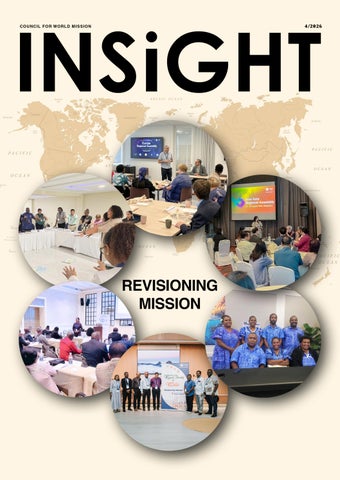
Editorial The theme of this issue of INSiGHT is “Revisioning Mission.” This is also the theme of the CWM Regional Assemblies being held across CWM’s six regions in the second half of 2026. “Revisioning Mission” was one of the sub-themes of the CWM Assembly held in 2024, calling the CWM to discern afresh what participation in God’s mission means amid rapidly changing global and local realities. This issue brings together papers based on keynote speeches delivered at the 2026 CWM Regional Assemblies. Drawn from the diverse contexts of CWM’s six regions, these contributions reflect how churches are revisioning mission in response to the particular challenges, histories, and hopes of their communities. Together, they offer a rich and contextual conversation on what faithful participation in God’s mission may require today. Revisioning mission is not simply about developing new strategies or programmes. It requires us to revisit inherited understandings of mission, listen deeply to different contexts and voices, and discern where God is already at work. From Africa, Rt Rev. Vicentia Kgabe, in “Revisiting Mission in a Catastrophic World,” reflects on overlapping crises of conflict, poverty, climate change, inequality, and political instability. She calls for mission centred on life, transformation, justice, reconstruction, and hope. From East Asia, Rev. Dr Wati Longchar asks a fundamental question in “Revisioning Mission: From Whose Location?” He challenges mission shaped primarily from centres of power and argues that revisioning must begin by listening to people at the margins and their struggles for dignity, justice, peace, identity, and the integrity of creation.
From South Asia, Rev. Dr Selvam Robertson considers Christian mission amid the growing influence of religious nationalism. He calls churches to engage contextually, collaborate with people of other faiths, stand with marginalised communities, and resist religious ideologies that exclude or diminish others. From the Pacific, Rev. Dr Matagi Jessop Vilitama reflects through the imagery of Moana, interconnectedness, and the “liquid church.” Remembering the past becomes a way of navigating the future as churches discern God’s presence in ecological struggles, diaspora communities, digital spaces, and the “in-between” places of contemporary life. Finally, from the Caribbean, Rev. Izett Samá Hernández calls churches to become “prophetic communities of life, justice, and transformation.” Reflecting on poverty, inequality, migration, climate vulnerability, discrimination, and violence, she urges churches to renew ecumenical relationships and work together across the region. Drawing on Isaiah 43, she reminds us that being God’s witnesses means refusing silence before injustice, learning from the past without being confined by it, and recognising the “new thing” God is already doing through solidarity, cooperation, and hope. Together, these regional reflections remind us that revisioning mission is an ongoing act of discernment. Our calling is to listen, remember, reimagine, and respond faithfully, participating in God’s mission towards justice, reconciliation, and life-flourishing communities.
From Europe, Rev. Dr Kuzipa Nalwamba reflects on mission in an age of “hyper-complexity.” Her call to “re-story” mission emphasises participation in the Spirit’s work, listening to suppressed stories, repairing wounded relationships, and relinquishing control. Kathleen Ferrier examines the Netherlands’ continuing journey of confronting its slavery and colonial past, highlighting truth-telling, apology, dialogue, reparatory justice, and the role of churches in addressing enduring racism and inequality.
4/2026
5
Revisiting Mission in a Catastrophic World Rt Rev. Vicentia Kgabe Leaders of the Council for World Mission Africa Region, sisters and brothers in Christ, theologians, ministers, and ecumenical partners, gathered from across our beloved continent: I am deeply grateful for the privilege of addressing this Africa Regional Assembly on the theme “Revisiting Mission in a Catastrophic World.” There is something unsettling and profoundly theological about this theme. It refuses the luxury of speaking of mission as if the world were well and instead compels us to locate Christian witness within the wounds, contradictions, and groaning of creation. In Pauline terms, the whole creation groans for liberation (Romans 8:22–23); mission must therefore be discerned not outside catastrophe, but in the very places where life is threatened and hope is contested. We gather as Africans in a world of overlapping catastrophes: wars and armed conflicts; climate change; poverty amid extraordinary wealth; forced migration; gender-based violence; unemployment; corruption; political instability; democratic regression; religious extremism; technological disruption; ecological destruction; and a growing crisis of hope. Yet we have not gathered merely to catalogue catastrophe. Our task is theological and missional: to ask where the Triune God is at work amid catastrophe and how the church may faithfully participate in that divine activity. This raises the ecclesiological question: where is God calling the Church to stand, speak, serve, and suffer in such a world? Christian mission does not originate in ecclesial strategy, institutional anxiety, or denominational expansion. It originates in God. The church does not invent a mission and then invite God to bless it. The Father sends the Son; the Father and the Son send the Spirit; and, in the power of the Spirit, the church is drawn into God’s reconciling and life-giving movement towards the world. This Trinitarian grammar is the theological heart of the missio Dei: mission is first God’s mission, not the church’s activity. And if mission belongs to God, the church must
6
4/2026
continually discern where God is already at work— particularly in the places and among the people the world has pushed to the margins. This understanding also guards against an ecclesiocentric account of mission. As 20th century missiology recovered with renewed force, the church is missionary because it is sent; it is not the owner of mission. Its vocation is sacramental and participatory: to bear witness, in word and deed, to the reign of God inaugurated in Jesus Christ and anticipated by the Spirit. 1.
Revisiting mission from African soil
To revisit mission is not to abandon the Gospel. It is to ask whether our understanding and practice of mission remain faithful to the Gospel in the world God has placed us in. For us Africans, revisiting mission requires us to revisit its history. We cannot pretend that Christian mission in Africa has an uncomplicated past. The Gospel reached many parts of our continent, entangled with colonial expansion. Missionaries established schools, hospitals, churches and institutions that profoundly shaped African societies. Many gave their lives in faithful service. 2.
We honour that history.
However, Christian honesty compels us to present the full picture. The Bible was often received within the same historical context as the flag, the gun and gunpowder, and the dispossession of African lands. a. African cultures were sometimes described as primitive.
b. c. d. e.
African spirituality was demonised. African names were replaced. African languages were marginalised. African ways of knowing were dismissed
At times, Christian mission was conflated with the transmission of European civilisation, as though fidelity to Christ required cultural assimilation. Such a conflation must be subjected to theological critique, because the catholicity of the Gospel cannot be reduced to the cultural form of any one people. This is precisely why the work of African theologians, such as Kwame Bediako, remains so important. Bediako challenged the assumption that Christianity is fundamentally foreign to Africa. He helped African Christians understand that conversion to Christ does not require them to renounce their African identity. The Gospel must take flesh in every culture while also judging and transforming it. The doctrine of the Incarnation is instructive here: “the Word became flesh and lived among us” (John 1:14). Christian faith is never culturally disembodied. Yet, no culture is identical with the Gospel. Inculturation therefore requires both affirmation and critique under the lordship of Christ. The question for African Christianity is not: Can Africans become sufficiently Western to be authentically Christian? Rather, the question is: What does it mean to follow Jesus Christ authentically as Africans? This changes everything. Mission is no longer something brought to Africa. It is something Africa participates in. African Christians encountered the Gospel, engaged with it deeply, translated it into their culture, celebrated it through song, dance, prayer, and preaching, and interpreted it in light of their African experience. Christianity did not simply “arrive” in Africa as a European possession. Africa has ancient Christian histories, and during the modern missionary period African Christians actively received, translated, interpreted, and transmitted the faith. The encounter with Christ has produced distinctive African Christian expressions and has profoundly reshaped world Christianity. In our own time, the demographic centre of Christianity has shifted decisively towards Africa and the wider Global South. Africa can therefore no longer imagine itself merely
as a recipient of mission. Africa is a missionary continent. The question is no longer “Who will evangelise Africa?” It is now “What gifts does Africa offer to God’s mission in the world?” 3.
Theology must begin where people hurt
John S. Mbiti’s influential account of African religious thought foregrounds the relational and communal character of personhood. While African societies are neither monolithic nor reducible to a single anthropology, Mbiti’s work remains important for resisting the fiction of the isolated self and for recovering the theological significance of belonging, kinship, community, creation, and relationship with God. This resonates deeply with Paul’s image of the Body of Christ: “If one member suffers, all suffer together with it” (1 Corinthians 12:26). This means that catastrophe can never be understood merely as another person’s suffering. a. When Sudan bleeds, Africa bleeds. b. When communities in the Democratic Republic of Congo are devastated by violence and resource extraction, Africa bleeds. c. When children are hungry, Africa bleeds. d. When women are violated, Africa bleeds. e. When migrants drown while crossing seas in search of dignity, humanity bleeds. f. When drought destroys a farmer’s livelihood, creation groans. g. When young people lose hope, our collective future is at risk. African relational theologies therefore offer a significant critique of radical individualism. Read alongside Paul’s theology of the Body of Christ, they remind us that salvation has personal dimensions but is never merely private: God reconciles persons into a people and gathers a fragmented creation into communion. In a catastrophic world, Ubuntu can be articulated missiologically as follows: my flourishing cannot be severed from my neighbour’s. The Christian doctrine of communion deepens this insight: in Christ, the other’s suffering places a claim upon me. Therefore, mission must be concerned with the restoration of relationships—with God, with one another, with creation, and even with ourselves. 4.
The God of mission is the God of life
The language of missio Dei reminds us that mission
4/2026
7
is grounded in the identity and actions of the Triune God. God is not a static deity whom the church mobilises for its projects; God is the living God, whose creative, redemptive, and sanctifying love moves towards the world. Jesus declares: “I came that they may have life, and have it abundantly” (John 10:10). This means that wherever life is threatened, diminished, exploited, or destroyed, God’s mission calls us to those places. a. Mission, therefore, cannot be reduced to increasing church membership. b. Mission cannot simply mean planting congregations. c. Mission cannot merely mean preserving denominations. d. Mission cannot simply mean preserving institutions These may serve mission, but they are not the fullness of mission. Therefore, the church must ask not only: “How many people came to church?” but also: “Did life flourish because the church was present?” This is not simply a secondary social issue added to a supposedly “spiritual” mission. Instead, it is a missionary question because the biblical witness insists on linking love of God with love of neighbour, reconciliation with justice, and redemption with the flourishing of God’s creation. 5.
Mercy Oduyoye: Mission must hear African women’s voices
Any African theology of mission that fails to take the experiences and theological insights of African women seriously is incomplete. Mercy Amba Oduyoye, a foundational voice in African women’s theology, has insisted that theology must be accountable to the lived realities of African women. Her work exposes the contradiction in proclaiming liberation while patriarchal structures remain intact in households, societies, and churches. Theology, on this account, is not credible merely because it is eloquent; it must be tested by whether it contributes to the fullness of life. African women have sustained Christianity on this continent. a. They have prayed. b. They have evangelised. c. They have raised funds. d. They have taught children. e. They have cared for the sick. f. They have buried the dead. g. They have maintained congregations.
8
4/2026
h.
They have preserved faith through war, migration, poverty, and political upheaval.
We rightly celebrate their resilience. But there is a danger in celebrating women’s resilience while leaving untouched the conditions that force women to be constantly resilient. We should not glorify suffering. Women should not be forced to remain strong endlessly because institutions fail to treat them fairly. Mission must therefore confront patriarchy not only in society but also within the church. Oduyoye’s theological contribution also warns us against romanticising culture. African cultures, like all cultures, contain both life-giving resources and destructive possibilities. They must therefore be received with discernment and brought under the judgement, grace, and transforming promise of the Gospel. African culture encompasses beautiful aspects that foster community, hospitality, dignity, and a sense of belonging. However, it also includes practices that can undermine women and girls. The Gospel cannot simply baptise culture. The Gospel must also transform culture. i. Women must therefore not simply participate in mission. j. Women must shape mission. k. Women must shape theology. l. Women must shape budgets. m. Women must shape institutions. n. Women must shape ecclesial priorities. o. Women must sit where decisions are made. And the church must become one of the safest places in Africa for women and children. If women fear violence in our churches, our theology of liberation is incomplete. If women do most of the church’s work yet remain excluded from its centres of authority, our theology of the Body of Christ needs scrutiny. 6.
Mission must confront economic catastrophe
We cannot speak about God’s mission in Africa without addressing economics. Africa is extraordinarily rich. Our soil holds vast mineral wealth. Our continent has agricultural potential, biodiversity, creativity, and human capital. Yet millions of Africans remain trapped in poverty. This contradiction is not accidental. Mission must
therefore ask uncomfortable questions. a. Who owns Africa’s resources? b. Who benefits from their extraction? c. Who owns the land? d. Who carries the debt? e. Who controls global trade? f. Who profits from African conflict? g. Who controls the technologies increasingly shaping African economies? h. Who owns the data? i. Who determines the value of African labour? j. Why does a continent so rich continue to have so many poor people? We must ask why people are hungry. There comes a point when giving bread without asking why people lack bread becomes inadequate discipleship. Christian diakonia must include mercy, but biblical justice presses further: it asks how social, political, and economic arrangements distribute vulnerability, wealth, land, labour, and power. The prophets understood this. Amos declares: “Let justice roll down like waters, and righteousness like an ever-flowing stream.” Mission therefore has an unavoidable economic dimension. The biblical traditions of the Sabbath, Jubilee, prophetic justice, and Jesus’ proclamation of good news to the poor prevent the church from treating economic arrangements as theologically neutral. It requires churches that are courageous enough to challenge exploitative economic arrangements. k. It requires ethical investment. l. It requires responsible stewardship of church land. m. It requires support for young entrepreneurs. n. It requires advocacy on debt, land, taxation, employment, and natural resources. Mission must not only comfort the poor but also ask why poverty persists. 7.
Mission in the climate emergency
The African continent is among the regions most vulnerable to climate change, despite contributing relatively little to the historical causes of the crisis. Once again, the poorest suffer first. This makes climate change a theological issue. Psalm 24:1 reminds us that “The earth is the Lord’s and all that is in it.” The earth does not belong to governments, corporations, or to us. It belongs to God.
material for endless human consumption. African Indigenous knowledge has much to teach the global church about land, community, interconnectedness, and responsibility towards unborn generations. The ecological crisis also requires us to listen closely to African women, whose lives are often directly affected by water scarcity, food insecurity, and environmental degradation. Ecological and gender justice are therefore deeply interconnected. Mission in Africa must become green, not because environmentalism is fashionable, but because creation belongs to God. 8.
Jesse Mugambi: From liberation to reconstruction
The Kenyan theologian Jesse N. K. Mugambi proposed “reconstruction” as a major paradigm for African Christian theology in the post-Cold War and postcolonial context. His proposal did not render liberation obsolete; rather, it asked what theological responsibility entails when resistance must be coupled with the patient work of rebuilding institutions, communities, and moral imagination. This remains an important missionary insight. There are times when resistance is necessary, but after resistance comes the difficult task of rebuilding. Africa knows how to resist. We resisted colonialism, apartheid, dictatorship, and racism. But the missionary question for our generation is also: What are we building? a. What kind of Africa are we constructing? b. What kind of democracy? c. What kind of economy? d. What kind of church? e. What kind of education system? f. What kind of communities? g. What kind of future are we creating for our children? Mission cannot only denounce what is wrong. Mission must imagine what is possible. Nehemiah looked at the broken walls of Jerusalem and organised people to rebuild them. That too is mission. Perhaps the church in Africa must become a community of reconstruction. h. Reconstructing trust. i. Reconstructing economies. j. Reconstructing communities. k. Reconstructing institutions. l. Reconstructing relationships. m. Reconstructing hope.
Therefore, creation cannot be reduced to raw
4/2026
9
9.
Young Africans are theologians of the present
Africa is the world’s youngest continent by demographic measures. For the church, this is not merely a statistic but a missiological summons. Yet churches continue to tell young people, “You are the church of tomorrow,” as if baptism conferred a deferred belonging. Young Africans are asking questions about unemployment, mental well-being, climate change, artificial intelligence, sexuality, gender, politics, corruption, identity, entrepreneurship, migration, and the future. The church cannot simply offer inherited answers to questions young people no longer ask. Mission begins with listening. Young Africans must not merely be the objects of our youth ministries. They must become theologians, interpreters, and architects of mission. 10. Mission must be decolonised Revisiting mission in Africa also entails decolonising mission. Decolonisation does not mean rejecting everything that came from outside Africa. Nor does it mean romanticising everything African. It means interrogating power. a. Whose theology is regarded as authoritative? b. Whose books fill our seminaries and universities? c. Whose languages dominate theological education? d. Whose liturgical expressions are deemed normal? e. Whose knowledge counts? f. Who controls mission resources? g. Who determines mission priorities? h. Who sets the agenda? African theologians such as Tinyiko Sam Maluleke have persistently challenged African Christianity to take context, agency, and power seriously and to resist forms of theological dependence in which Africa is treated primarily as an object of interpretation rather than as a subject of theological knowledge. Africa cannot continue to produce theology merely in response to questions generated elsewhere. Theology is always contextual, even when it claims universality. African theology must therefore be self-consciously rooted in Scripture, the Christian tradition, and African histories and realities. It must not exist merely to interpret Africa for Western audiences.
10
4/2026
African theology must help Africa encounter God through Africa’s own questions. 11. The church must recover its prophetic courage Africa does not simply need a praying church; it needs a praying church whose contemplation matures into prophetic courage. In Scripture, worship and justice are inseparable. The prophets repeatedly reject piety that coexists comfortably with exploitation. Prayer and prophecy therefore belong together. We need churches willing to tell governments: govern justly. a. To corporations: Do not exploit Africa’s people or its creation. b. To armed groups: Lay down your weapons. c. To perpetrators of gender-based violence: This must stop. d. To corrupt leaders: Public office is a sacred trust, not an avenue for personal enrichment. e. To those who promote xenophobia or Afrophobia: The stranger bears God’s image. f. To religious leaders: Do not manipulate people’s faith for money, influence, or power. But prophetic integrity requires the church to speak to itself, too. g. We cannot demand accountability from governments while resisting accountability in churches. h. We cannot condemn corruption while tolerating financial mismanagement within ecclesial institutions. i. We cannot preach dignity while abusing power. j. We cannot preach equality while practising patriarchy. k. We cannot preach reconciliation while nurturing tribalism, racism, xenophobia, or denominational arrogance. Mission requires integrity, because the credibility of the proclamation is inseparable from the form of life of the proclaiming community. An ecclesiology of mission must therefore include repentance, accountability, safeguarding, transparent governance, and the disciplined use of power. 12. From institutional survival to God’s mission As the Council for World Mission, perhaps we must have the courage to ask: Are we resourcing God’s mission—or our own institutional survival? The two are not always aligned. Our buildings matter. Our institutions matter. Our denominations matter. Our structures matter.
But they are instruments of mission. They are not the mission itself.
Christian hope is not naive optimism. Optimism says circumstances will probably improve.
Our budgets reveal our operative theology. Allocation is never merely administrative: where we allocate money, land, personnel, and institutional attention reveals what we believe God’s mission requires.
Christian hope confesses that even when the stone has been rolled away from the entrance of the tomb, God remains the God who raises the dead. Resurrection is not a metaphor for easy improvement; it is the eschatological negation of death and the ground of Christian resistance to despair.
13. Africa must send Africa must also reclaim its vocation as a sending church, while refusing to reproduce the paternalism, cultural superiority, and asymmetrical power that characterised significant strands of earlier missionary movements. Christian sending is patterned not by domination but by the self-emptying way of Christ (Philippians 2:5–11). African Christianity has gifts that the global church needs. Our songs. Our spirituality. Our theology of community. Our experience of suffering and hope. Our understanding of resilience. Our traditions of storytelling. Our emphasis on relationship. Our witness to a God encountered not only in the individual but also in community. These gifts do not belong to Africa alone; they belong to the Body of Christ. Africa must therefore participate in the global mission with confidence—not as a junior partner, not as a permanent recipient, not as an ecclesial dependency, but as an equal participant in God’s mission. 14. From catastrophe to reconstruction, resurrection, and hope Christian faith neither denies catastrophe nor spiritualises suffering. At its centre is the crucified Christ. The cross reveals both the extremity of human violence and God’s costly solidarity with a wounded world. But Christianity refuses to end the story on Good Friday. There is Easter. This is where African theology speaks powerfully to a world in a state of catastrophe. Our continent bears scars. a. Yet Africa continues to sing. b. Africa continues to worship. c. Africa continues to create. d. Africa continues to give birth. e. Africa continues to imagine. f. Africa continues to hope. g. Africa’s scars are real. But so is Africa’s resurrection.
And perhaps that is one of Africa’s greatest missionary gifts to the world: the stubborn refusal to accept that death has the final word. 15. Conclusion: Africa, arise Sisters and brothers, revisiting mission in a catastrophic world requires us to rediscover a simple yet revolutionary truth: God is still at work. The Spirit is still moving. Christ is still calling. The church is still being sent. But perhaps God is sending us in a different way. a. From mission as expansion to mission as transformation. b. From mission as domination to mission as participation. c. From mission to Africa, to mission from Africa, and with Africa. d. From mission centred on institutions to mission centred on life. e. From mission that speaks to mission that listens. f. From mission that comforts victims to mission that also confronts the systems that produce victims. g. From mission concerned only with humanity to mission embracing God’s whole creation. h. From liberation alone to liberation, reconstruction, and reconciliation. Let the next generation of African theologians arise, and let them come from our townships, villages, universities, informal settlements, congregations, women’s organisations, youth movements, seminaries, and digital spaces. Let Africa not simply inherit theology. Let Africa generate theology for the healing of the nations. Ultimately, missio Dei is not about protecting Christianity as an institution or a cultural possession. It is about the church, by the Spirit, participating in the Triune God’s reconciling, liberating, and lifegiving movement towards the world God loves. Such a witness will require a missiology that is Trinitarian in its source, Christological in its pattern,
4/2026
11
pneumatological in its discernment, ecclesial without being ecclesiocentric, contextual without being captive to context, prophetic in its public witness, and eschatological in its hope. And perhaps Africa’s testimony to this catastrophic world must be this: Catastrophe does not have the final word. God does. So let Africa rise—not to dominate God’s mission, but to participate in it with confidence. And let the church in Africa, standing amid the catastrophes of our age, have the courage to discern where the Spirit is moving—and then to follow. The mission is God’s. The world is God’s. Africa is God’s. By grace, we have been invited to participate in what God is already doing. May we have the wisdom to discern it, the courage to embrace it, and the faithfulness to see it through. References Bediako, K. (1995). Christianity in Africa: The Renewal of a Non-Western Religion. Edinburgh: Edinburgh University Press. Bediako, K. (2004). Jesus and the Gospel in Africa: History and Experience. Maryknoll, NY: Orbis Books. Bosch, D.J. (1991). Transforming Mission: Paradigm Shifts in Theology of Mission. Maryknoll, NY: Orbis Books. Maluleke, T.S. (1996). “Black and African Theologies in the New World Order: A Time to Drink from Our Own Wells.” Journal of Theology for Southern Africa, 96, pp. 3–19. Mbiti, J.S. (1969). African Religions and Philosophy. London: Heinemann. Mugambi, J.N.K. (1995). From Liberation to Reconstruction: African Christian Theology after the Cold War. Nairobi: East African Educational Publishers. Oduyoye, M.A. (1995). Daughters of Anowa: African Women and Patriarchy. Maryknoll, NY: Orbis Books. Oduyoye, M.A. (2001). Introducing African Women’s Theology. Sheffield: Sheffield Academic Press. New Revised Standard Version – Bible Rt Rev. Vicentia Kgabe is a South African theologian, educator, and Anglican bishop, serving as the Bishop of Pretoria in the Anglican Church of Southern Africa. She holds a PhD in Practical Theology from the University of Pretoria, an LLM in Canon Law from Cardiff University, and qualifications in leadership and enterprise management. She has also been awarded an honorary degree by Berkeley Divinity School at Yale. She has served in university, church, and development governance, and currently chairs the Centre for Anglican Women’s Research and Leadership in Africa. Her ministry is shaped by a commitment to leadership development, reconciliation, gender justice, theological education, and youth empowerment.
12
4/2026
Revisioning Mission: From Whose Location? Rev. Dr Wati Longchar Who decides for whom? Traditionally, people in the “center,” the privileged class, decide the content and practice of Christian mission. These people in the “center” are mainly middle-class men, often from Euro-American backgrounds. Their experiences have shaped and continue to shape Christian mission till today. On the other hand, the people in the “margin,” the poor people, have always been the object of charity and Christian missions. Their voices and experiences have never been acknowledged in doing mission. Danger of Locating a Christian Mission in the “Centre” We tend to interpret the Bible from the experience of people in the centre. Two examples of Jesus’ parables from the gospel may be mentioned as examples: Matthew 20:1-15 speaks of workers in the vineyard, where a landowner hires labourers at different hours of the day, but everyone is given the same wages. The landowner had absolute power to decide: whom to pay, how much to pay? And who is right and wrong? The unfair treatment to those who started their work during the early hours was not regarded. Their voices were ignored. For the people in the “centre,” the parable is nothing, but it is about God. • The landowner is God. • Action of benevolence and grace. • Nobody should complain. • God will bless you more if you do not complain. • A grumbling labourer is not good; greedy. For the people in the “margin,” it is a justice and survival issue. • The landowner is not God but a cunning capitalist. • Not benevolence and grace, but unkind biased action. • The intention is to “divide and rule”—create feelings of favored and unfavored laborers. • It is an issue of justice—fighting against exploitation. • Courageous labourers who raise their voices against the manipulative system of rich.
How do we legitimize injustice by glorifying the landowner as God? Is there any biblical evidence that the landowner is God? From whose experience should we revision our mission? We cite another example of the capitalist reading of the Bible. Matthew 25:14-30 is the Parable of Talents. A master goes on a journey and gives bags of gold or talents to three servants—five, two, and one. The first two servants double their money and receive praise, while the third could not make any profits and so was punished. We have been interpreting the first and second servants as the honest, hardworking, faithful, and good stewards. Some uncritical preachers have compared the talents with the gifts of singing, dancing, and leading Bible studies; some even compared bringing unbelievers to Christ in double numbers, or multiplying the congregations among unbelievers. The third person is lazy, disobedient, disrespectful, and unfaithful. Some compared him to a demon. Let us remember. This master expects 100% profit. He rejoices in maximum profit. He has no concept of sustainable development and sharing. The first and second are cronies who must have cheated, abused, and exploited the powerless to please the master. Unfortunately, we make this corrupt capitalist into God, though he is not God. The third man said, “24Then the man who had received one bag of gold came. ‘Master,’ he said, ‘I knew that you are a hard man, harvesting where you have not sown and gathering where you have not scattered seed. 25 So I was afraid and went out and hid your gold in the ground. See, here is what belongs to you.” He opted for a non-exploitative
approach. He rejected the accumulation of wealth, exploitation of labour, and extraction of God’s creation. Above all, he challenged the master’s view of economic growth. He did not care about the punishment inflicted on him. We see the same situation in our society today. The people in the power are always right. But we need to acknowledge that it is the privileged class who are creating false ideologies/doctrines and narratives primarily to protect their vested interests on the one hand and keep a section of the people in slavery conditions for easy exploitation on the other. The power and slavery are thus intertwined. To legitimize dominating power, unjust social structures are often legalized and supported by the constitutions of the different governments or customary laws, practices, and traditions because they control the power structure. Where do we locate God’s mission—the center or the marginalized ones? If we do not relocate God’s mission among the margins and groaning planet Earth, we will miss the calling of the church in this challenging world. Furthermore, we will be serving the interest of those who exploit the poor. Revisioning mission from the margins will revitalize God’s mission. Different Layers of Margins—A Product of Unjust Power Structure While revising from the margins, one should not think that marginality is homogenous and it is divine design. The margin is complex and multifaceted, and it is a product of unjust power structures. Broadly, we can categorize the marginalization into ten groups (or more), and each of them brings new missiological challenges because of their unique experiences of marginalization and locations:
4/2026
13
a)
disabled people whose presence is seen as a burden to the family and society, seen as objects of charity, sinners, and cursed by God; they are challenging that “giftedness” reflects the image of God. LGBTQI+ people who are seen as those with a psychological and mental imbalance, born abnormal, and indulging in sinful same-sex relations and acts are challenging to recognize the diverse God’s gift of sexual experiences. people living with HIV and AIDS who are seen as drug abusers, sexual abusers, and cursed by God are challenging the oppressive and unequal power relationship and healthcare. Indigenous people who are denied their culture, spirituality, and land and who cannot compete within the dominant capitalist market system are challenging exploitative economic growth without respect for land and its resources. migrant workers who are exploited for maximum profit and forced to perform dirty and dangerous work without social security are demanding justice and a dignified life. farmers and laborers who survive by selling their labor in scorching sun and rain are considered inferior and incapable are demanding fair treatment and dignity. dalits who suffer socially and religiously as the lowest group of the caste system, bearing the stigma of untouchability and whose touch, shadow, and sight pollute the people of other castes, are challenging segregation of human beings on the basis of caste while affirming personhood. The Black and people of color are seen as cursed by God, inferior beings who are destined to be slaves of others. They are challenging white hegemony, affirming the power of Black. women who are treated as inferior, subordinate beings whose bodies are commodified as mere objects of enjoyment and pleasure for others are challenging the evils of patriarchy, asserting that both men and women are endowed with God gifts to transform the world. the unprecedented climate change challenges no peaceful coexistence of life without care of God’s beautiful planet.
history—to inaugurate God’s Kingdom. Among the nameless people God reveals Godself of liberator! Jesus was born in a manger, a ragged cowshed, an open and unprotected place. People who gathered around him were people in the margin. They were without any political power or religious authority: women, children, strangers from the east, and poor people like the shepherds who were landless and who did not have any legal protection and from whom the rich people refused to buy even milk and vegetables. People who welcomed Jesus were thus excluded ones. The angel announced the good news: “Peace among you,” was among the excluded people. It means the good news starts from the margin, and God’s mission needs to be revised from the experiences of excluded and marginalized ones. The Bible further testifies that God took sides with the people in the margin. God continues to take sides with the marginalized people even today. Therefore, to hear God’s voice, we must listen to the testimonies, pains, and sufferings of those on the margin.
We believe that all these layers of marginality are divine design. This false ideology creates exclusion and marginalization and exploitation, including unmindful exploitation of earth’s resources.
Namaan, Nameless Girl, Prophet Elisha, and Servant - 2 Kings 5:1-19 presents a story of how people in the margins became the agents of healing. Naaman suffered from leprosy, though he was also a successful commander of the army of the king of Syria, and his skillful and dedicated work had won favor from the king and the people. The nameless little girl—the prisoner and victim of war, displaced
b)
c)
d)
e)
f)
g)
h)
i)
j)
God’s Revelation Took Place Among the Margins Felix Wilfred1, a Catholic theologian, says that God chose the “margin”—the people on the underside of
14
4/2026
Wilfred further says that the agenda from the periphery—the longing for justice, peace, identity, and right to resources—is the agenda of God, the voice of God. The real future of humanity, thus, comes from periphery and not from the decisions and deliberations of the people who dominate the world. From the site of God’s visitation—the margins—a new world, a radical transformation, has to take shape.2 In biblical tradition, the socially excluded people are the privileged spaces for God’s compassion and justice. God’s Voice from the Margins—Old Testament, New Testament, and Today—for Revisioning Mission Revisioning mission requires listening to the testimonies, pains, sufferings, and hopes and aspirations of the people outside the power structure. Many testimonies in the Old and New Testaments and the contemporary world describe how people in the margins were used and continue to use as God’s instruments for healing, transformation, and change. We discover a reversal of the value system in those stories. A few examples may be cited here.
from her family, her people, and her place—was put to forced labor, working for Naaman’s wife, but she became an agent of healing. We see the following contrasting positions of the two—Naaman and the nameless little girl; Naaman is powerful the nameless girl is powerless and helpless. Naaman is a ruler the nameless girl is ruled. Naaman is a conqueror the nameless girl is conquered, abused, and misused. Naaman is an army commander the nameless girl is a victim of the army. Naaman is a slave owner the nameless girl is a slave. Naaman is a predator the nameless girl is a victim. Naaman needed healing the nameless girl offered help/healing. Naaman has a name the girl does not have a name.3 In her pitiable and pathetic experience of war and dislocation, the nameless girl knew what Naaman was going through in his life. She knew Naaman’s pain and sorrow. Instead of rejoicing over his misfortune and pain, the nameless girl offered healing words. It was indeed difficult for the ruler to listen to the words of the ruled. The ruler wanted to be healed by maintaining royal power and offering wealth. First, he obtained an official letter from the king of Aram, thinking that the subjects would respect and obey the royal authority and power. Second, he took huge quantities of silver, gold, and other garments to impress and appease the prophet Elisha. As was common protocol at that time, Naaman expected that the prophet would come out, bow down before him, and perform rituals like calling on the name of God, waving his hand over his body, and curing his leprosy miraculously. The ruler thought that he would thus be healed. But it happened in quite a different way. Instead of going and meeting Naaman, Elisha sent a message through a messenger, “Go and wash in the Jordan seven times, and you shall be clean” (v.9). Naaman felt insulted and took this as disrespectful not only to him but also to the king. He became angry and decided to go away without obeying what
Elisha asked him to do. But then another word of healing came from his servant, “My father, if the prophet had told you to do some great thing, would you not have done it? How much more, then, when he tells you, “Wash and be cleaned” (v. 13). Only when he listened to the voice of his servant did he finally get healed. God’s way of healing demands humbleness, listening to the cries of people, and acceptance of powerless but not by display of power and wealth. In whose voice do we discern God’s voice? Naaman or nameless girl, servant, and Prophet Elisha? We cannot ignore the marginalized’s voice for healing the wounded world. The Rich Man and Lazarus in Luke 16:19-21 talks about a person in the center and another on the margin. The Rich Man and Lazarus. The Rich Man—He is dressed “in purple and fine linen” (v19a). It is very striking that the rich man is identified by his dress—purple and fine linen attire. He is not identified with his name but was identified with his wealth. In the Bible, purple and fine linen are mentioned in a few places (Rev. 18:12; Prov. 18:12; Ezek. 27:7). This most luxurious fabric is associated with royal or quasi-royal dignity. This signifies that the rich man is extremely rich. Since he had everything at his disposal, it says he “feasted sumptuously every day” (v. 19 b). “Every day?” Wonderful. The diet of the ordinary people was simple, and at times, the poor passed the day without proper food. For the rich man, every day was a feast. A banquet was a daily occurrence. The parable says he feasted lavishly, not just on special occasions. We can imagine that his halls were filled with noble guests in rich attire and his antechambers with servants. Everything that could make life splendid and joyous was in profusion and in abundance. The wealth was certainly acquired at the expense of the poor through the oppressive patronage system of his time. The system was based on wealthy patrons who loaned money to poor clients with heavy taxation. When the clients failed to pay their loan, their land was confiscated. A rich man like this one would have accumulated massive wealth due to unjust system. Poor Lazarus—Lazarus was at the gate of the rich man. To live at somebody’s gate waiting for the leftover food or burnt bread is terrible and painful. It is indeed a humiliating condition. He was waiting with the dogs. Lazarus is not only hungry and thirsty but
4/2026
15
is covered with sores, carrying a loathsome disease (perhaps leprosy). He was not only untouchable but was also extremely sick, a sign of impurity, pain, and suffering. He is indeed a disabled person. Since he was an impure and an untouchable person, Lazarus would not have had any relatives, friends, or helpers. He was left alone, except for the dogs. The Bible says that things associated with dogs were unclean. It means Lazarus’ presence pollutes others. Lazarus is seen as a person cursed by God. But God did not. In whose context do we have to locate our theology? The rich man or Lazarus? Jesus called him by his name! The Greek name “Lazarus” is derived from two Hebrew words, Eli-ezer, meaning “God helps/God helped.” Naming implies identity, which involves recognition, respect, and rights. With a name, a person becomes somebody. Jesus addressed him with a name. Lazarus is no longer a nobody but somebody with rights, dignity, and worth. A core of God’s revelation in Jesus Christ is to make nobody into somebody. God’s mission involves nurturing nobody so that they experience God’s compassionate love. People and multinational companies—The stories of the promoters of mega-development projects and victims of such development are not new to Asian countries. We have many painful stories of those who tried to build development at the expense of the poor, and the land and its resources: These voices represent people in power—the center. Minorities should sacrifice for the sake of the majority’s benefits. Development is good for people. Industries are good for people and the nation. Governments are doing development for the future generation of people. People need industries to enhance their economy and living standard. Development alone can alleviate poverty. People are poor because of the lack of industry. Industry will generate more employment and bring more money and comfort. Development is a sign of progress and civilization. These voices represent people in the margins—the poor and excluded ones. Our homes have been washed away because of flooding. There is no drinking water and food. We want to speak our mother tongue. The land is our mother; how can we sell our land? 16
4/2026
Mother Earth provides us with crops and food. If we have land, the land will feed us for more than 3,000-5,000 years. When the mountain disappears, what will be our identity? If we leave our ancestral village, what will be our culture and spiritual identity? When all the trees have been cut down, where will the animals and birds find a home? When all the waters are polluted, what will we drink? Do we have to buy water? When all the air is unsafe to breathe, can we buy air? In whose voice do we discern God’s voice? The dominant decision-making power represents the voice of mammon; it is cruel and coldhearted. The people in the margin are being forced to sacrifice for the sake of the so-called “majority.” Their voices reflect the absolute dominant power of the hegemonic intellect in society. People who thirst for mammon regard marginal communities as nonbeings and nonexistent and God’s gift of the land and its resources as mere objects to be exploited. But for God, the margins. Pointers for Revision Mission God’s voice from the margin is distinct. Their voices need to be heard, and their vision of life should form the basis of revisioning mission. People in the margins, through their yearnings for life with dignity and justice, offer alternative visions of a world free of forces that abuse and deny life for all. They challenge us to work towards new patterns of inclusiveness, sharing, and transformative action. In a world where people are treated as commodities and are also mistreated on account of their identities, such as gender, ethnicity, color, caste, age, disability, sexual orientation, and economic and cultural locations, we are challenged to build up persons and communities in ways that help them to experience God’s gift of life. Some of the core values we need to reaffirm are: Binding the wounds of the victims and offering actions of compassion and solidarity. Confronting and transforming the forces that cause suffering and deprivation. It involves continued struggle and commitment to transform those sinful social structures and liberate the victims. Protecting and respecting all life, justice, peace, and integrity of all creation by standing together with people’s movement fighting for justice. Advocating that people are the true subjects of the nation; a nation cannot progress without participation of people, and work for people-
-
oriented development and management of resources. Nurturing a life of self-sufficiency and ecofriendly vision of life; there is no human security without water, air, animals, plants, and all ecologically suffering beings; the land should not be reduced to a mere commodity; it is the foundation of all living beings.
Concluding words—Can Dry Bones Come Back to Life4? God told the prophet Ezekiel, “Tell my people, ‘God says: I’ll bring your hope back to life – O my people! I have given that responsibility to the people who still have love and compassion in their hearts. When they bring your hopes for justice back to life, you’ll realize that I am God. I’ll breathe life into you, and you’ll live. Then I’ll lead you to straight back to a time of justice, and you’ll realize that I am God. I’ve said it, and I’II do it – God’s Decree.’” “God grabbed me. God’s Spirit took me up and set me down in the middle of an open plain strewn with bones. He led me around and among them – a lot of bones! There were bones all over the plain – dry bones, bleached with by the sun” “God said to me, `Can these bones live?’ “I said, `God, only you know that.’ “God said to me, `Prophesy over these bones: “Dry bones, listen to the message of God!” Ezek.37:1-5. Dry bones, in the book of Ezekiel, signify utter hopelessness and exclusion. Josef P. Widyatmadja5 compares dry bones with disposable people (“wong cilik” in the Indonesian language) in our society. Like a disposable syringe, people are bought and thrown out after use. After use, they have no value. The passage Ezekiel 37: 1-5 reflects not only hopelessness but also the despair of people. The people of Israel were in exile in Babylon. They were put under slavery. They experienced exclusion and discrimination on all fronts and were treated worse than second-class citizens. They were people with no freedom and rights. To avoid discrimination, they opted to learn and speak the oppressor’s language and adopt the oppressor’s cultures, names, and religious practices, thinking that they would be accepted. The process gradually led people to lose their identity and roots. They became like the dry bones. In despair, people sang, “By the rivers of Babylon, we sat and wept when we remembered Zion.” (Ps. 137:1) God told Ezekiel to go and prophesy among the dry bones. He did as commanded by God, and the dry bones returned
to life. The living God was with them. God is there among marginalized people even today, and if we go and build solidarity, they will come back to life. Commitment to transform the life of the “dry bones to life” is the location of God’s mission. “Giving life” is the purpose of God’s mission.
Notes 1. 2. 3. 4.
5.
Felix Wilfred, Margins: Site of Asian Theologies (New Delhi: ISPCK, 2008), p. 5. bid., 10-11, Naveen Rao (2015) Centred on the `Margin. Clark Journal of Theology, Vol. V, No. 2, pp. 8-10. For more detail, see Transformative Actions for Common Future: Biblical and Theological Reflections from the Margins, PTCA Contextual Bible Study, No. 2 (Kolkata: PTCA & DBC, 2020), pp. 1-5 Widyamadja, P. Josef. Jesus and Wong Cilik: Transformative Diakonia – Theology with the Marginalized Peoples of Asia, PTCA Study Series No. 10 (Kolkata: PTCA, 2025).
Rev. Dr Wati Longchar is a prominent Naga theologian, ordained Baptist minister from Northeast India, and the executive director of the Foundation for Theological Education in Asia and the Pacific. He serves as an international associate missionary and theological consultant, focusing heavily on contextual theology and ecumenical leadership across Asia.
4/2026
17
Not By Might, Nor By Power: Re-storying Mission in a Time of Hyper-Complexity Rev. Dr Kuzipa Nalwamba Introduction: Gathering in Unsettled Times We gather not in a time of stability but in a time of what might be called hyper-complexity. This term, developed by ecumenical scholars Marina Ngursangzeli Behera, Michael Biehl, Risto Jukko, and Kenneth R. Ross, describes a situation in which we face not merely interconnected crises but a deeper and more troubling contestation: we cannot agree on what the crises actually are, whose suffering counts, and what kind of future we should desire together. In ecological debates, migration disputes, and conflicts around nationalism and identity, actors disagree not only about solutions but about the definition of the problems themselves. This is the context in which we are called to revision mission. We gather not in a time of stability but in a time of hyper-complexity. In ecological debates, migration disputes, and conflicts around nationalism and identity, actors disagree not only about solutions but about the definition of the problems themselves. In such a context, the church can no longer imagine itself as standing outside the world’s crises, offering solutions from a position of neutrality. The church is not a pure agent descending from outside into a contaminated world. We are implicated in the histories, structures, and relationships that have contributed to many of the challenges we now face. This is the context in which we are called to revision mission. The World Council of Churches (WCC) has been walking this path of discernment, drawing on a rich ecumenical tradition that stretches back to the International Missionary Council (1921) and forward to the present. I bring you greetings from the fellowship of 352 churches in more than 120 countries, and I want to share with you three interlocking dimensions of the WCC’s current missiological reflection: the paradigm of Together towards Life (2012), the emerging methodology of “re-storying” for the 2028 World Conference on Mission and Evangelism, and the witness of a prophetic voice we have recently lost, the Tongan theologian Jione Havea.
18
4/2026
The Gift of Together towards Life: A Paradigm Shift in Mission Theology The foundational document shaping the WCC’s contemporary understanding of mission is Together towards Life (2012). Adopted in 2012 by the WCC, Together towards Life: Mission and Evangelism in Changing Landscapes represents a decisive paradigm shift in ecumenical missiology through the work of the Commission on World Mission and Evangelism (CWME). As mission historian David J. Bosch argued in his magisterial Transforming Mission, paradigm shifts in mission theology are never merely academic exercises; they emerge from the church’s struggle to faithfully proclaim the gospel in radically changing historical contexts. The Recovery of Missio Spiritus The document’s central theological proposal is the recovery of missio Spiritus—the mission of the Holy Spirit. Unlike earlier models that understood mission primarily as the church being sent by Christ (the missio Dei framework of the 1950s and 1960s), Together towards Life insists that the Spirit is already present and active in the world, and that the church’s mission is to discern and join what the Spirit is already doing. As the document states: “The Spirit is at work in the world, empowering people to become witnesses to God’s love. The Spirit is present and active in all cultures, religions, and ideologies, but especially among the marginalized and poor.” This emphasis on the Spirit’s priority has profound implications for how we understand the agent and location of mission. The church is not the sender but the discerning community. We do not bring God
to a God-forsaken world; we seek to recognize where God’s Spirit is already breathing life into dry bones (Ezekiel 37), already healing what is broken, already resisting the forces of death. As missiologist Kirsteen Kim has observed, the recovery of missio Spiritus represents a “radical recentering” of mission theology away from ecclesiastical institutionalism and toward the Spirit’s free and unpredictable work in the whole creation. Mission from the Margins The second major contribution of Together towards Life is its emphasis on “mission from the margins.” The document argues that those who live on the edges of society—the poor, the displaced, the oppressed—possess a unique hermeneutical privilege. This is not romanticization of poverty but a theological claim rooted in the witness of Scripture itself: God’s preferential option for the poor (Exodus 22:25-27; Amos 5:11-15; Luke 1:46-55), Jesus’s announcement of good news to the poor in Nazareth (Luke 4:16-21), and the early church’s recognition that God has chosen “the poor in the world to be rich in faith” (James 2:5). As Korean theologian Hyunju Bae has written, mission from the margins “challenges the dominant Western paradigm of mission as ‘sending to,’ replacing it with a paradigm of ‘listening with’ and ‘learning from.’ “ Honest Self-Critique Yet let me be honest with you. Even as we celebrate this document, we must acknowledge its limitations. The framework proposed by Behera, Biehl, Jukko, and Ross observes that even in the selfcritical passages of Together towards Life, “some passages...are still written as if the Church were the sanctuary of holiness.” The authors insist that mission theology must “start from the consciousness of our unavoidable involvement in the current situation.” The church is not a pure agent descending from outside into a contaminated world; it is implicated in the very powers that have created the current crises, including colonial violence, ecological destruction, and economic inequality. As they candidly write, “we must admit that we are implicated in the powers that have created the current situation.” This admission does not constitute a rejection of Together towards Life. Rather, it represents a more rigorous application of its own missio Spiritus logic. If the Spirit is already present and active in the world prior to and beyond the church, then the church’s first act of mission cannot be proclamation from a position of presumed purity. It must be listening, discernment, and the humble acknowledgment that
we, too, stand in need of the Spirit’s transforming work. “Not by Might nor by Power”: The 2028 Conference and the Re-storying Methodology It is with this theological foundation that the CWME is preparing for the next World Conference on Mission and Evangelism, scheduled for 2028. The theme of the conference is drawn from Zechariah 4:6: “Not by might, nor by power, but by my Spirit, says the LORD of hosts.” A Text for a Time of Crisis This ancient text, addressed to Zerubbabel in the post-exilic period of political and theological crisis, directly challenges any mission model that relies on human strength, institutional power, or strategic control. As Old Testament scholar Carol L. Meyers notes, the vision of Zechariah 4 presents a radical alternative to the political calculations of imperial restoration: the rebuilding of God’s people will be accomplished not by military force (might) or political influence (power), but solely by the mysterious, uncoercible agency of God’s Spirit. In the context of the 2028 conference, this text is not merely a pious sentiment but a theological claim with practical implications. In a world of hyper-complex crises, where no single actor possesses the wisdom or power to resolve the challenges we face, the church is called to a mode of mission that operates precisely through the relinquishment of control. This is not a counsel of despair but a summons to trust: the future of God’s mission does not depend on our capacity to manage it. Renew, Repair, Reorder, Recreate The conference theme is being developed with a specific elaboration: “Witnessing to the Spirit’s mission to renew, repair, reorder and recreate.” This fourfold framework offers a richly textured understanding of how the Spirit works in hyper-complex contexts, each dimension drawing on biblical and theological resources. Renew speaks to the need for spiritual and ecclesial transformation as a prerequisite for authentic mission. As Paul writes to the Romans, “Do not be conformed to this world, but be transformed by the renewing of your minds” (Romans 12:2). We cannot offer renewal to the world if we ourselves are not being renewed by the Spirit. This is a call to ongoing conversion, to the painful work of unlearning the habits of power and control that have distorted Christian mission for centuries.
4/2026
19
Repair addresses the wounds of history. The conference process explicitly names the legacies of colonialism, the transatlantic slave trade, and the marginalization of Indigenous peoples as requiring reparative engagement. The concept of repair resonates with the Hebrew concept of tikkun (repair of the world) and with the growing body of theological literature on reconciliation, reparations, and restorative justice. Mission cannot simply look forward; it must look backward and participate in the Spirit’s work of healing historical wounds. This is uncomfortable work for churches that have benefited from these histories, but it is essential work if mission is to be truthful and just. Reorder speaks to the eschatological dimension of mission. We are not merely rearranging the furniture of a broken world; we are participating in God’s reordering of a fractured creation. This eschatological orientation, rooted in the prophets’ vision of a new heaven and a new earth (Isaiah 65:17-25) and in Paul’s language of “new creation” (2 Corinthians 5:17), allows the church to act with urgency but without anxiety: ultimate renewal lies in God’s hands. We are called to be faithful participants, not anxious managers. Recreate points toward new possibilities that cannot be anticipated from within existing frameworks. In hyper-complex crises, the future is genuinely open. The Spirit’s mission is not merely to restore a lost past but to bring into being what has not yet existed—a theme captured in the divine promise of Isaiah 43:19: “I am about to do a new thing; now it springs forth, do you not perceive it?” This orientation toward the new requires imaginative courage, the willingness to let go of familiar patterns and to trust that God is doing something beyond our capacity to predict or control. Re-storying: A Spirit-Led Methodology But the 2028 conference is developing not only a theme but a distinctive methodology, and this is where I want to focus our attention. The methodology is organized around the concept of re-storying. At the meeting of the CWME in Kingston, Jamaica, in April 2026, the concept was articulated as “a Spirit-led retelling of the stories that shape faith and mission.” As The Salvation Army’s summary of the meeting explains, re-storying “invites us to recover and renew narratives that have caused harm or exclusion, to listen deeply to voices from the margins, and to explore together how God is healing, reconciling and restoring right relationships with one another, with Creation and with God.”
20
4/2026
Christine Gooden Benguche, preaching at the opening service of the Jamaica meeting, defined re-storying more theologically. Drawing on Job 38:411, she described it as “a profound realignment of a disordered world.” She outlined four theological movements: recognizing divine supremacy beyond human understanding; affirming cosmic intentionality in creation; respecting divine boundary-setting against chaos; and accepting human limitation in the face of wider reality. Most critically, she called for a shift “from control over creation toward participation within it.” This language of relinquishing control in favour of participation is exactly what Zechariah 4:6 demands: not by might, not by power, but by the Spirit. The re-storying methodology addresses a fundamental challenge of hyper-complexity: if we cannot agree on what the problem is, and if any intervention is risky and unpredictable, how then shall we practice mission? The answer, emerging from the CWME process, is that mission becomes the patient, Spiritled work of recovering suppressed narratives, repairing damaged relationships, and reordering the imaginative frameworks within which communities understand themselves and their world. A Participatory, Multiyear Process Importantly, the conference is not a single event but a multiyear, participatory process. It began with global consultations and regional hearings and will culminate in a gathering in the Pacific region. Contributions are particularly encouraged from communities whose voices have too often been marginalized or silenced: Oceania (including Pasifika, Māori, and First Nations peoples of Australia), disability networks, Indigenous networks, Dalit communities, youth and student movements, women’s networks, and migrant and diaspora communities. As the WCC’s announcement of the conference process states, this reflects a shift “from ‘mission to the margins’ toward ‘mission from the margins,’ “ a move that builds on the foundation laid by Together towards Life while pushing it toward more radical implementation. A Prophet of the Pacific: Jione Havea and the Gift of Talanoa I cannot speak about re-storying without honouring a voice that has shaped this methodology more than almost any other, a voice we tragically lost on 29 April 2026. Rev. Dr Jione Havea, a Tongan Methodist theologian, biblical scholar, and pastor, was widely regarded as the leading global voice for Pasifika (Pacific) theology.
A Life of Prophetic Witness WCC General Secretary Jerry Pillay described Havea as a voice who “helped to shift theology away from fixed systems and toward an ongoing, shared, and culturally grounded conversation, especially shaped by Pacific and marginalized voices.” François Pihaatae, WCC president from the Pacific, called him “the prophet of the Pacific.” What made Havea so significant for our re-storying methodology was his work on talanoa, a Pacific concept of inclusive storytelling that he used to “prise open Biblical texts.” As he explained in his book Losing Ground: Reading Ruth in the Pacific (2021), talanoa is a combination of three elements: stories, the telling of those stories, and conversation about those stories—a practice that cannot be captured in a single English word. Havea proposed talanoa as a non-colonial model for biblical interpretation that emphasizes minoritized peoples and communities, arguing that it is “probably also more in keeping with the culture underlying the biblical texts” than most Western critical methods. Talanoa as a Way of Being The significance of talanoa for missiology cannot be overstated. As Havea wrote elsewhere, “Talanoa is not a method that one applies to a text; it is a way of being in relationship with texts and with one another.” This resonates deeply with the relational, Spirit-led orientation of Together towards Life. Whereas conventional exegetical traditions have often privileged the lone scholar who masters a text through critical distance, talanoa privileges the community that encounters a text together through mutual listening and vulnerable sharing. Pacific theology is not alone in making this contribution. African theologian Kwame Bediako similarly argued that the gospel flourishes when Christian communities are able to interpret faith through their own languages, histories, and cultural memories. While Havea’s talanoa emphasizes communal storytelling and mutual listening, Bediako’s work highlights cultural translation and theological self-understanding. Together they remind the global church that mission is not the transmission of fixed formulas from a centre to a periphery, but participation in God’s work already present within people’s own stories and contexts. Touching the Wounds Havea was not merely an academic. From 2013 to 2022, he was a member of the WCC’s theological study group for the Pilgrimage of Justice and Peace.
He played a significant role at the Arusha Conference on World Mission and Evangelism (2018), where he coordinated Bible studies and created spaces where “Scripture came alive as a living, unsettling, and healing witness.” Fernando Enns, who walked with Havea in the Pilgrimage of Justice and Peace Reference Group, recalled a defining moment: “When we started our pilgrim team visits and discussed the need to ‘visit the wounds’ of the hosting communities, it was Jione who insisted: ‘It has to be touching the wounds!’ “ This insistence on touching rather than merely visiting, on proximity rather than distance, is at the heart of re-storying. We do not observe suffering from a safe remove; we enter it, and we allow it to transform us. As Havea himself wrote, “Theology that does not touch wounds is not worthy of the name.” Climate Justice and Decolonisation Havea was also a passionate advocate for climate justice. His project “acClimatise the Lectionary” offered a systematic rereading of the Revised Common Lectionary through the lens of climate crisis, asking how familiar texts might speak differently when read from within a context of rising sea levels and threatened Pacific islands. The WCC recognized this work as “a meaningful contribution to the Ecumenical Decade of Climate Justice Action.” Athena Peralta, director of the WCC’s Commission on Climate Justice and Sustainable Development, noted that Havea brought “creativity and prophetic power to biblical study, exploring paths of decolonisation and advancing climate justice within the churches.” A Partner to CWM The Council for World Mission knew Havea well. He served as a Partner in Mission and a key facilitator in its Discernment and Radical Engagement (DARE) programme. Through this work, he helped develop DARE into a global platform for theological reflection and dialogue. He edited multiple volumes in the CWM DARE series, including Gospel for Workers, Religion and Power, Theologies from the Pacific, and Scripture and Resistance, works that amplify voices from the margins and have become key resources in theological education worldwide. As the World Communion of Reformed Churches stated in its memorial: “His legacy will continue to live on in the pages of transformative theological writings, in the lives of those he mentored, and in the ongoing struggle for justice, dignity, and lifeflourishing communities. The Talanoa continues,
4/2026
21
and it will carry his voice for a long time yet.”
Conclusion: Revisioning Mission as Re-storying
Europe’s Shifting Place
These threads converge in a compelling vision of mission for our time.
What does this WCC perspective mean for your context, Europe? Europe is no longer the centre of global Christianity, and this shift offers an opportunity to reimagine mission beyond colonial patterns of sending and control. Yet Europe remains marked by deep tensions around migration, nationalism, ecological crisis, and the enduring legacies of colonialism. In these contested spaces, where even the nature of the crisis is disputed, re-storying offers a different path. Rather than seeking to reclaim influence, it invites Europe to listen, to voices from the margins to communities shaped by colonial histories, and to those whose experiences challenge dominant narratives. Mission begins not with power, but with attentive participation in the Spirit’s work already unfolding in the world. The Call to Listen In such a context, the re-storying methodology offers a way forward that does not require Europe to return to a position of power. Indeed, it requires exactly the opposite. Re-storying invites Europe to listen. To listen to the voices of the Pacific, of Africa, of Asia, of the Indigenous peoples whose lands were colonized by European powers. To listen to migrants and refugees within European borders whose stories challenge comfortable narratives of European identity. To listen to young people who are demanding a different future. This is not easy. Listening to stories that implicate us in harm is painful. But as Jione Havea insisted, we must do more than visit the wounds; we must touch them. And in touching them, we may find that the Spirit is already at work, not despite the wounds but precisely in and through them. Relinquishing Might and Power The call to Europe is the same call that Zechariah issued to Zerubbabel: not by might, nor by power, but by my Spirit. Europe has relied on might and power for too long—first through colonial domination, then through economic and political influence, and sometimes through a missiology that confused Western cultural forms with the gospel itself. The invitation of the 2028 conference is to relinquish that reliance and to discover what mission looks like when it is grounded not in strength but in vulnerability, not in control but in participation, not in sending but in receiving.
22
4/2026
We are living in a time of hyper-complex crisis. We cannot agree on what the problems are, let alone on the solutions. In such a time, strategic plans and institutional power are not enough, indeed, as Jione Havea and the re-storying methodology both suggest, they may be part of the problem. Together Towards Life offers a paradigm shift: mission is not our project but our participation in the Spirit’s already-active mission. The 2028 conference offers a practice: re-storying. And voices such as Jione Havea and Kwame Bediako offer examples of how Christian communities discover afresh the presence of God through their own stories, histories, languages, and struggles. The Council for World Mission has a long history of reimagining what mission means. From its origins in the London Missionary Society (1795) to its current identity as a global fellowship of churches, CWM has been a site of contestation and renewal. The WCC is your partner in this journey. Together, we are being invited to revision mission not as a project we control but as a story we enter—a story whose author is the Spirit, whose plot is the renewal of all creation, and whose ending is not yet written because it remains open to transformation. Together towards Life as a mission paradigm is still being unpacked, and we have Jooseop Keum, the current CWM general secretary, to thank for launching and documenting this vision during his tenure as CWME moderator. We subsequently have the late Peter Cruchley to thank for envisioning the current process towards the 2028 CWME conference, which echoes the “call at the Conference on World Mission and Evangelism in Arusha—to think of ways to de-colonize mission.” Not by our might. Not by our power. But by the Spirit of the Lord. May we have the courage to tell new stories. May we have the humility to listen to old stories we have ignored. And may we have the faith to trust that the Spirit is already renewing, repairing, reordering, and recreating, even, and perhaps especially, in the most contested spaces. References Bae, Hyunju. “Mission from the Margins: A FeministPostcolonial Reading of Together towards Life.” In The Future of Mission Cooperation: The Living
Legacy of the International Missionary Council, edited by Risto Jukko, 85–102. Geneva: WCC Publications, 2022. Behera, Marina Ngursangzeli, Michael Biehl, Risto Jukko, and Kenneth R. Ross. Hope in Times of Crisis: Reimagining Ecumenical Mission. Eugene, OR: Cascade Books, 2025. Bediako, Kwame. Christianity in Africa: The Renewal of a Non-Western Religion. Edinburgh: Edinburgh University Press, 1995. Bosch, David J. Transforming Mission: Paradigm Shifts in Theology of Mission. Maryknoll, NY: Orbis Books, 1991. Havea, Jione. Losing Ground: Reading Ruth in the Pacific. London: SCM Press, 2021. Havea, Jione. “Talanoa and the Bible: A Pacific Way of Reading Scripture.” In Theologies from the Pacific, edited by Jione Havea, 13–28. London: SCM Press, 2021. Havea, Jione. “Theology That Touches Wounds.” In Vulnerability and Resilience: Body and Liberating Theologies, edited by Jione Havea, 1–12. Eugene, OR: Cascade Books, 2020. Jukko, Risto, ed. A Hundred Years of Mission Cooperation: The Impact of the International Missionary Council 1921–2021. Geneva: WCC Publications, 2022. Kim, Kirsteen. “Mission from the Margins and the Theology of the Spirit.” International Review of Mission 103, no. 2 (2014): 236–249. Paas, Stefan. Pilgrims and Priests: Christian Mission in a Post-Christian Society. London: SCM Press, 2019. Ross, Kenneth R. Mission as Transformation: A Reader. Oxford: Regnum Books, 2021. Walls, Andrew F. The Cross-Cultural Process in Christian History: Studies in the Transmission and Appropriation of Faith. Maryknoll, NY: Orbis Books, 2002. World Council of Churches. Together towards Life: Mission and Evangelism in Changing Landscapes. Geneva: WCC Publications, 2012. World Council of Churches. “WCC Commission Meets in Jamaica amid Climate Crisis, Conflict, and Calls to ‘Re-story’ Mission.” Geneva: World Council of Churches, 2026. World Council of Churches. “WCC Mourns Jione Havea, ‘Prophet of the Pacific.’” Geneva: World Council of Churches, 2026.
from the University of Pretoria, and MTh and MDiv degrees from Trinity Theological College, Singapore. Her previous roles include service with the Council for World Mission, as lecturer and academic dean at the United Church of Zambia Theological College, and with the International Fellowship of Evangelical Students and as high school teacher. Her research interests include eco-theology, mission, and the history of Christianity.
Rev. Dr Kuzipa Nalwamba is programme director for Unity, Mission and Ecumenical Formation at the World Council of Churches. Ordained in the United Church of Zambia, she joined the WCC in 2019 and was appointed to her current role in November 2022. She holds a PhD in Dogmatics and Christian Ethics
4/2026
23
The Netherlands Journey in Confronting Its Slavery Past: Reflections and the Role of Churches Kathleen Ferrier Personal Story and Focus I have a very personal story to share with you today. I have structured this presentation to discuss the developments we have seen here in the Netherlands regarding the slavery past and its consequences in our society today. Next, I will share observations from other EU countries and then broaden the perspective to include geopolitical changes. Throughout, I will reflect on the role that churches play in these processes. Developments in the Netherlands I served as a member of Dutch Parliament from 2002 to 2012. Each year, at the end of November, activists would come to Parliament to hand over a manifest concerning Black Pete. Black Pete was traditionally part of a famous children’s feast celebrated on 5 December, in which Saint Nicholas, coming by boat from Spain, arrives in the Netherlands, accompanied by a group of black servants characterized by stereotypes of African descent. These figures are portrayed as unable to speak proper Dutch or think intelligently, and are depicted as scary to children, tasked with punishing those who misbehave. The activists urged Parliament to initiate a public debate about Black Pete as a racist phenomenon. I recall that very few parliamentarians showed interest in receiving the manifest. There was little to no interest, and it was unthinkable at the time that Parliament would start a debate on Black Pete and potentially disrupt a cherished tradition. Today, however, Black Pete is no longer part of the celebration. The saint from Spain is now accompanied by kind persons of various skin colors.
24
4/2026
Keti Koti and National Recognition We celebrate Keti Koti in Suriname on 1 July and, though less abundantly, in the Netherlands. Keti Koti marks the abolition of slavery on 1 July 1863. Since 2002, there is a national slavery monument in Amsterdam’s Oosterpark, where people and officials gather each year to celebrate the breaking of the chains. In 2013, during the 150th anniversary of the abolition of slavery, there were expectations that the Dutch government would issue an apology, but it did not happen. The government firmly refused. Today, however, the government of the Netherlands, many cities, banks, and companies have apologized, and the King of the Netherlands has apologized as well, on Keti Koti 2023. Even more: he also asked for forgiveness for what his ancestors did not do to end slavery. Extensive research is underway, including a study requested and funded by the king on the royal family’s role in colonial times, which will soon be publicly available. The Netherlands as a Leader in Addressing Colonial Past The Netherlands has taken a leading role in openly dealing with its colonial history. Apart from Brussels, I know no cities, banks, or private companies in other countries that have apologized for their involvement in slavery, and no other EU monarch has asked for forgiveness for their family’s failure to end slavery. Societal Movements and Public Debate These changes have been possible thanks to societal movements. In the Netherlands, “Kick Out Zwarte Piet,” started by activist Jerry Affryie, sparked public debate and resistance. The Black Archives, opened in 2015, provide public access to historical records. The government convened a committee to
advise on addressing the shared colonial history, recommending three clear phases: recognition, apology, and repair. The worldwide Black Lives Matter movement raised public awareness about systemic racism and discrimination. In Dutch Parliament, black politicians helped change perspectives, including that of Prime Minister Mark Rutte, who publicly acknowledged the ongoing impact of the colonial past and apologized for his earlier views. Research continues to show that institutional and systemic racism and discrimination persist in Dutch society, and concrete actions are needed. The Power of Societal Action The examples I share highlight how societal change is driven by activism, scientific research, and other forms of action. Lasting change requires a transformation of perceptions and convictions within society. James Baldwin, in his book “The Fire Next Time,” asserts that a country’s institutions are shaped by its spiritual situation. Ultimately, the spiritual state of a country determines its institutions and politics. The Importance of Churches and Religious Institutions Religious institutions, certainly churches, are vital because they reach deep into society and understand what lives within communities. Churches have a crucial role in shaping the spiritual situation of a country. The Dutch Council of Churches has acknowledged their role in the slave trade and slavery. In 2013, the council published research findings and accepted responsibility for the abuse of theology and white power for financial and other gains. When the public debate intensified, thanks to movements like Black Lives Matter and Kick Out Zwarte Piet, churches were called upon to act and demonstrate awareness of their crucial position in shaping the country’s spiritual state. Truth and Reconciliation Initiatives Ideas emerged, such as establishing a Truth and Reconciliation Commission inspired by South Africa’s experience under Bishop Desmond Tutu leadership. While the context differs and victims and perpetrators are no longer alive, the aim was to create a platform for sharing all perspectives and emotions, ideally on national television.
This idea led to two initiatives: a theater performance called “The Waarheidscommissie,” focusing on Human Zoos in Europe, and the Foundation for the Healing Processing of the Slavery Past (“Heilzame verwerking Slavernijverleden”), founded by Bianca Groen Gallant. This foundation hosts a nomadic exhibition that encourages dialogue and conducts research, such as exploring the history of black presence in white village churches and facilitating dialogues between black and white church communities. This serves as an example of how churches can lead by example, influencing the state. Apologies, Reparations, and Ongoing Challenges Before the official apologies it was made clear to the Dutch government that apologies could not be the end. As the prime mister said: this is a comma, not a final dot. The big question is: what comes after the comma? According to the advice, after apologies there must come reparatory justice, not merely symbolic gestures. Governments often fear these words, reparations and reparatory justice, associating them with financial compensation. My advice to the Dutch government, which was not followed, was to prioritize dialogue, to listen and to understanding before considering monetary reparations. Most people seek serious awarenessraising, inclusion of the slavery past of all ethnicities in school history books, and recognition of institutionalized racism and discrimination, rather than financial compensation. Equality among all countries in the Kingdom of the Netherlands is also desired, but in practice, disparities persist. The Caribbean part of the kingdom faces neglected challenges, such as climate change effects, which receive less attention than similar issues in the European part. International Perspectives and Colonial Legacy Recently, the neglect of the Caribbean part of the kingdom was highlighted when the Netherlands abstained from voting on a UN resolution calling for reparatory justice for the transatlantic trafficking of enslaved Africans. The Caribbean part of the kingdom was neither consulted nor informed of this decision, illustrating ongoing inequality. Colonial behavior endures, evidenced by the recruitment of teachers and nurses from former colonies without reciprocation. Colonialism, in
4/2026
25
a sense, continues, with one part of the world exploiting another for its own benefit. Signs of Change and Global Shifts Despite these challenges, change is happening. Having lived abroad, most recently in Hong Kong, I observed the need to shift focus from a Eurocentric perspective. Power relations are evolving, and the world is changing rapidly. The US is no longer a reliable stakeholder for the EU, and democratic values are under threat. New allies and partners are needed, and they are to be found in the Global South, where younger populations bring creative ideas. The south is already part of the north; in the Netherlands, over one million migrant Christians and hundreds of international churches play an important societal role. The Role of CWM and Spiritual Leadership As James Baldwin emphasized, spiritual institutions lead societies, and political institutions follow. In these times, as former colonies and other countries seek new allies, it is vital to utilize CWM and its strong networks. These networks understand daily lives and challenges, in so many different places and that is evident in CWM and Programme Reference Group gatherings. We discuss pressing issues as changes progress rapidly. Our last gathering in Madagascar allowed us to share experiences and review CWM reports. Young people pursue inter- and multi-religious contacts to address climate change, and churches in China offer valuable insights. Mutual learning is essential. Conclusion: A Call for Boldness These times require churches to be bold and brave, to recognize the importance of their role in a world in turmoil. Churches must stand for and embody the values lived by Jesus Christ, the Lord of Life.
Kathleen Ferrier is chair of the Dutch UNESCO Commission. She connects the four UNESCO domains, safeguards the mission of the Dutch UNESCO Commission, speaks about peace, human rights, education, culture, and democracy, and gives a face to the commission in the Netherlands and internationally.
26
4/2026
Revisioning Mission: Christian Mission in the Midst of Religious Nationalism Rev. Dr Selvam Robertson 1.
Religious Nationalism
1.1. Introduction My sincere gratitude to the CWM family for inviting me to be the keynote speaker at the South Asia Regional Assembly 2026, from 3-7 August 2026, in Bangkok, as CWM journeys towards its Jubilee in 2027. I am presenting my keynote address in the form of a paper titled: “Revisioning Mission: Christian Mission in the Midst of Religious Nationalism.” This paper presents, in two parts, an overview of religious nationalism and mission, respectively, and proposes a few considerations while revisioning mission in the context of religious nationalism. The first part analyses various aspects of religious nationalism, and the second examines the mission and offers some basics for revisioning mission in the context of religious nationalism without attempting definitions and precise proposals. 1.2. Nationalism Nationalism is “a group identity defined in terms of political, ethnic, or cultural identities, associations, and attachments”1 where the role of religion was, to some degree, present in all ages. History suggests that “Religion remains enormously influential in the formation of communal identities throughout most of the world, and nationalist ideologies will likely continue to draw on religious symbols and ideas for moral and political legitimacy.”2 The only difference is the pattern or intensity of religious influence. 1.3. Nationalism and Religion Nationalism and religion have always had a subtle or obvious connection. Studies have proven that “nationalism is not strictly a modern phenomenon and that premodern political leaders also used religion to strengthen communal identity for the sake of maintaining their own power.”3 It is also evident that ritual practices are always used to mobilize the manipulation of religious symbols, mythologize historical memories, and instill prejudice for nonreligious causes, including nationalism. Both in premodern and modern eras, “religion has been
used as an identity marker to determine who should be excluded from the nation.”4 In other words, premodern and modern national identities, to some extent, were constructed through the exclusion of the domestic other. Some believe that religions use nationalism and national ideologies to establish their own value system within society. On the other hand, others accept the possibility that “religious symbolism and rhetoric can be misused in the advancement of political and nationalistic causes.”5 This is clearly visible in this century. Recent definitions of religion “stress the importance of order, albeit in a conceptual as well as in a political and social sense”6 and insist that religion can bring such order. Further, religion, like secular nationalism, “can provide a faith in the unitary nature of a society”7 which, in fact, would authenticate both political rebellion and political rule. Besides, one of the basic human needs is to have “a secure and established identity.”8 Nationalism addresses this need. It is now being realized that religion can serve such a function. 1.4. Complexity of the Relationship between Religion and Nationalism The relationship between religion and nationalism is complex and hard to determine. It is evident from the paradox that religious symbols and practises sometimes exert influences and meanings that reach well beyond the interests and intentions of those political elites who attempt to manipulate them. Further, religious traditions are sometimes inadequately portrayed as neutral collections of symbols, rituals, and narratives that take on whatever meanings a user ascribes to them at a given point in time. On the contrary, “Religious traditions are socially embodied, manifest in culture and extend over time. The meanings of religious symbols have histories. Rituals exert their power through social processes that reach beyond what a particular practitioner or leader might try to use them for. Mythical stories take hold and often assume a life of their own, especially in their capacity to captivate shared imagination, mobilizing popular sentiments, or ignite passion.”9 This is mostly evident in countries where religious elements hold sway. It is also noted that religion is not merely an ethnic, cultural, or national identity marker. Even nationalisms, including secular ones, draw upon religious motives, symbols, and narratives. There are different patterns of the relationship between religion and nationalism across countries.
1.5. Religious Nationalism The objective of religious nationalism is to consider a nation as a sacred communion. Here, the authentic national identity is equated with religious identity. It parallels (national) authenticity with a sense of reverence and significance to group identity, resembling the traditional concept of holiness in religious traditions. This develops into the idea of group purity. The desire for “group purity” exposes the intricate connections between ethnicity, nationality, and religion.10 They intermingle and mutually reinforce one another in religious nationalism, which resembles and may even be considered a form of religion. The challenge is that “this trend has gained prominence in the late twentieth and early twentyfirst centuries, often intertwining with instances of religious terrorism.”11 This is obvious from the following definitions of religious nationalism. The expression religious nationalism “is typically used to refer to a situation in which religion is used as a tool or veil to justify nationalistic attitudes and actions.”12 Still further, the religious dimensions of nationalism “refer to ways that various symbols, narratives, myths, rituals, and consecrated spaces, and times are selectively retrieved or appropriated, adapted, and deployed to imagine, mobilize, and perpetuate conceptions of national identity and membership.”13 Hence, it is analytically hard to simply segregate and compartmentalize the religious from the secular when engaging with varieties of nationalisms. Religious nationalism is also “the belief that a country’s historically predominant religion should be a central part of its national identity and drive policymaking.”14 And “religious nationalism is most likely to be constructed in places where a critical mass of the population identifies with one religion.”15 Another view is “Religious nationalism typically occurs in societies that do not have a high degree of religious pluralism or in which religion is closely
4/2026
27
associated with the national culture.”16 The critical part is that religious nationalism uses religious values to legitimize policy programs. At the institutional level, religious nationalism strives to establish formal links between politics and a particular religious group, suggesting that religion and the state are formally intertwined in various ways. Religious nationalism assigns a formal political role for religion. At the same time, it does not always “lead to autocratic politics.”17 This makes the analysis of religious nationalism much more difficult. 1.6. Reasons for the Growth of Religious Nationalism Although there are many reasons for the growth of religious nationalism, a few stand out. They are: 1. “Globalization,”18 which challenges traditional values and moral frameworks within societies. 2. The notion that the cultural colonialism of Western ideas undermines the traditional values and traditional religious constructs of society and the state. 3. The view that the West’s secular nationalism erodes religious influence in public life. 4. Religious nationalism has become a common ground to stand against the secular West. 5. A hope for the revival of religion in the public sphere. 6. Rejection of secular nationalism as Western and neocolonial. 7. “Rebellions against the secular authorities.”19 8. The consideration that secular governments and politics “do not represent the underlying morality of large groups within a society.”20 9. The view that secular ideas and institutions are accountable for the moral decline within countries. 10. The assumption of the West that there is something seriously wrong with the religions in the non–Western world. 11. The conviction that it was secular nationalism, and not religion, that has gone wrong. 12. The perception that the Western models of nationhood (democratic and socialist) have failed, and therefore, religion is a hopeful alternative. 13. The longing of newly independent countries for an indigenous form of religious politics free from the blot of Western culture. 14. “The resurgence of parochial identities based on ethnic and religious allegiance,”21 a characteristic of the new world order, where national identity has moved from secularist to
28
4/2026
more explicit religious interpretations because it helps modern state elites reinforce their own political legitimacy. 15. Religious nationalism in India was “the reaction of declining classes, landlords and kings, to the changing scenario, where through industrialization, communication and modern education, India was emerging as a secular democratic nation”22 which shook the feudal classes, and landlord-kings of both Hindus and Muslims. 1.7. Consequences of Religious Nationalism The connection between religion and nationalism has existed throughout history in some form. It has found opportunity and expression in our times, unlike previous eras, in the form of full-blown religious nationalism. It will remain with us for a long time, despite the perceived adverse consequences. The idea of the sacredness of a community and the unique sanctity of its territory attempts to justify the rhetoric of group purity, and it may result in destructive consequences for excluded groups. In such contexts, even minute differences between people are magnified and classified manipulatively and destructively against others, even when they live in close proximity to one another. More serious is “the use of religious systems to support and articulate the language of purity and authenticity”23 which leads to uncompromising, vindictive, and even unexpected acts of purification. And it hardly leaves any room for the numerically vulnerable minority sections. And often, authentic national identity is equated with the nation’s majority or dominant religion. During the late 20th and early 21st centuries, religious nationalism has led “to increasing amounts of religious terrorism.”24 This synchronizes with the idea that religion often tends to sanction killing. Connected to this is that heads of state have been “assassinated by religious radicals”25 for failing to comply with the religious demands of religious nationalists. Some countries “have used religious literature both to justify and magnify the significance of their nationalist claims,”26 even on the basis of myths. Another fact is “one third of the world’s population experience hostility because of their religious affiliation,”27 irrespective of any religion. Religious nationalism is a threat to “the march of dalits and women, struggling for equality,”28 like any other group.
The “introduction of legislation to enforce strict compliance with religious practises”29 is the most adverse consequence.
people to open commitment to Christ.”32 But the fact remains that there are many possibilities for holistic transformation and life-flourishing mission.
Development of a special relationship between the state and the dominant religious group “manifests itself on such issues as religious education in the schools, religiously based national holidays, public benefits to a particular religious group, and a formal role for the main religious group in shaping public policy.”30 This has become a reality. These pave the way for religious nationalism and religious terrorism to continue.
The CWM Theology Statement, in this context, is very relevant and prophetic:
2.
Mission
2.1. Definition It is simply impossible to arrive at a final or comprehensive definition of mission, despite various attempts, as it is ever-changing in light of contextual and global demands. What remains unchanging is missio Dei (God’s mission) as exemplified in the life and witness of Jesus Christ and passed on through the church, the body of Christ. Christianity is missionary by its very nature. Its mission is to express the dynamic relationship between God and the world, as portrayed in the Old Testament (God is God of history and God of promise) and then in the birth, life, death, resurrection, and exaltation of Jesus of Nazareth. The missionary nature of the church is grounded in the gospel. 2.2. Mission in General The mandate for mission comes to us from Jesus, though there is no uniform view on mission or a specific term for mission in the New Testament. The church plays a significant role in God’s mission, irrespective of different nationalisms. She has to strive to establish righteousness, justice, and peace, and to strengthen the values of the reign of God through the Holy Spirit’s empowerment. It is encouraging to note the observation that “the Christian faith has always designated as evil whatever destroys life. It has never affirmed its trust in God without challenging the power of anti-gods. It was concerned itself with the victims of society, but not without calling to repentance the perpetrators of injustice.”31 Our mission is to live the life of Christ in the world. It is an attempt to show God’s love in the context. A note of caution is that “while the mission of bringing health, education, relief, and justice into the lives of people has been well received, Asia has largely resisted the aspect of mission that aimed at calling
CWM embraces the vision of a different world, a world liberated from the course of injustice, inequality and indifference, a world transformed by the power of the Spirit to become a life-flourishing, Justice-supporting and peace-affirming. For the new world, where all lives are flourishing, justice is exercised and peace affirmed, CWM and its member churches, together with Christians around the world, commit ourselves to remaining on the journey of ‘Confessing Witness’ (Missio Confessionis) as an expression of our faith in action and our approach to engagement with God’s mission.33 2.3. Mission in Our Times Mission, irrespective of its vibrant nature and multifaceted possibilities in differing contexts, is being criticized from within and without. The reason is that what is relevant in one context may not be in another, even if the mission could address global concerns. Mission, in our times, shall be determined by the contextual and global needs. Contexts vary from place to place and time to time; therefore, mission takes different forms. A paradigm shift in mission, therefore, is irresistible for relevance. The statement “crisis is the point where danger and opportunity meet”34 of David J. Bosch is reassuring. Wesley Ariarajah, taking a cue from prophet Jonah, cautions that the missionary and God can be at odds with each other. It reminds us that our wisdom can fail, but God’s mission will continue. He also writes that “The history of mission is full of attempts to ‘redefine’ mission, to re-evaluate our understanding of the relationship between the Gospel, the church and the world, and to rethink towards ‘Mission in Christ’s Way.’ ”35 Mission was never static, though the underlying principles are constant. CWM, in its Jubilee celebration documents, has comprehensively articulated substantial possibilities for mission in the present context. The lists can go on if we also consider others’ priorities. But the fact remains that the mission is predominantly local, contextual, and a form of theology from below, and it can also be global or ecumenical. This aligns with the explanation that theology is interpreting our faith in relevant ways to the context. It is so inspiring that bold mission approaches are
4/2026
29
echoing from different quarters in line with CWM that “For empire to be resisted it needs to be unmasked and identified. The mission model of resistance locates the community of resistance as a part of society, not a removed sect. It is a network of like-minded people, who may be poor, suffering, oppressed, or in solidarity with those on the margins. The prime missional concern is to transform the society by affirming life as a way of resisting the life-denying forces of empire.”36 The other view, “Mission is rooted in counter-creative communities who are in empire but not of empire”37 illustrates the newer developments. During the past two millennia, mission ideas have been influenced by contexts. It is not an accident. The point that “mission as contextualization is an affirmation that God has turned toward the world,”38 based on David J. Bosch, is timely and heartening. The declaration that “There is much healing to be done, much justice to be instituted, and much community to be built. The gospel never lost its relevance for Asia.”39 stresses the future possibilities of mission. The CWM statement that “Mission as Accompaniment speaks of shared pilgrimage, deep conversation, strong relational ties, mutual support, and shared commitment to advocacy and action.”40 It calls for wider cooperation and collaboration for mission to be purposeful. A fruitful engagement for mission requires inclusive partnership. This is underlined as, “All people of goodwill are exhorted to contribute towards the construction of the new world order, traditionally called the Kingdom of God. The mission of the future will be realized by millions of people of goodwill working in the secular world. It will be the mission of the lay people.”41 Courage is required to sincerely collaborate with people of other faiths. In other words, “we are to work hand in hand with all the people of goodwill, including adherents of other faiths, to break down all gender and racial barriers so as to bring about a holistic understanding of the presence of the church in the world.”42 As CWM and other bodies have suggested various possibilities of engagement for mission, I would confine myself only to revisioning mission in the context of religious nationalism. 2.4. Revisioning Mission in the context of Religious Nationalism It is time to draw lessons from the above outline of religious nationalism and mission for revisioning mission. The thought “while religion polarizes, spirituality binds”43 shows the multiple possibilities
30
4/2026
through which the mission can be revisioned. Our analysis also shows that complicity in the face of harmful and oppressive values and systems does not contribute to mission. The mission should guard against being accused of serving as an agent of globalization, though it can be global as well. Our analysis has shown that religious nationalism emerged to counter the effects of globalization. The mission needs to purge and redeem itself from the general perceptions that the mission promoted and colluded with Western colonialism, which invaded traditional values, moral frameworks, and undermined traditional religious constructs of society and the state, and caused erosion of religious influence in public life. The seeming tendency of religious nationalism to reject everything Western and modern secularism calls for the mission to be locally and contextually situated, and demands a careful scrutiny of the choice and structure of the mission in different contexts. Since religious nationalism emerged as a rebellion against secular authorities, governments, and politics for neglecting religious inputs, revisioning the mission requires a careful balancing between the mission and the place of local religions in addressing various local concerns. It demands a close relation between the mission and the local religious traditions while being vigilant about oppressive elements invading the dignity of life in the form of religious practices. The accusation that secular formations failed to represent the moral convictions of significant groups is very relevant to the revisioning of mission. Often, we are fascinated by promoting individualism, a legacy of the Enlightenment, without regard for the prevalent communitarian principles. Individual rights need serious attention in line with the objectives of being part of a larger community. It is important to be sensitive to the allegation that the Western world holds that there is something wrong with the non-Western religions of the world. As our focus is mission (spirituality), the consideration of liberative praxis and life-flourishing engagements can precede and supersede other mission methods. The persistent claim that secular nationalism, rather than religion, has gone wrong calls for a reconsideration of the values, standards, objectives, and commitments underpinning the mission. Because what was considered cultured and civilizing
in one part of the world is different in another, and is interpreted as a tendency toward dominance. A longing for an indigenous form of religious politics is the strongest aversion to outsider influence in systems of politics, morality, spirituality, and lifestyle. It calls for a deeper sensitivity to local religious sentiments that might often sound unreasonable. This makes the mission to formulate programs that promote the values of the reign of God more urgent, rather than embarking on counterproductive engagements. Equating majority religious identity with national identity and prioritizing religious identity over the necessity for plurality of identities in our time, without being sensitive to the numerically vulnerable, their presence and rights are parochial. However, the revisioning mission can pay serious attention to identity claims to avert the sense of being invaded and uprooted. The usage of religious systems to support and articulate the language of purity, sacredness, and authenticity of a majority group against others is devastating in many ways. Numerous instances are before us. Along with CWM’s bold commitment to a new world order, empowered by the resurrection vision, the mission may explore possibilities to counter such devastating attempts. Introspection from us is also warranted to evaluate whether we ignorantly promote such closed theologies/ considerations. Religious nationalism has successfully manipulated religious literature and scriptural texts to justify what is considered right by the majority religious group to the extent of producing exclusivist national historiographies. This has serious implications for our rude use of our own religious texts and metaphors to derive what we want, without considering that all interpretations are subjective. A relevant mission approach requires advocating the paradigm of everchanging and ever-new interpretations resulting from contexts, times, and perceptions without absolutizing. In the context of the introduction of legislation to enforce strict compliance with religious practices, policy programs of the state are becoming the programs of the majority religious community without any consideration for the others and their sentiments and values, sporadic terror, maybe in the name of religion, and stark human rights violations that seriously affect mission. It is time we revision our mission to be in solidarity with the marginalised and the vulnerable and to empower them.
Consideration of David J. Bosch’s thesis that, “in the field of religion, a paradigm shift always means both continuity and change, both faithfulness to the past and boldness to engage the future, both constancy and contingency, both tradition and transformation… Neither extreme reactionary nor excessively revolutionary approaches …will help the Christian church and mission to arrive at greater clarity or to serve God’s cause in a better way”44 can be a cautious guiding principle for the revision of the mission. Our critical approach to the mission should be to groom it without dismantling it. A universal human rights perspective may also be explored in the context of religious nationalism. 2.5. Conclusion Mission is not a finished product. It continues to revision and engages amidst a variety of challenges. Religions are becoming missionary and continuing to grow with strength and influence. Uncritical acceptance of science and development models will not unveil their non-neutral sway. Even a complete separation of religion from the state also leads to unbridled religious authority to keep the state at bay from any control over religion. We have explored only the mission in the context of religious nationalism. Such exercise can be done in many other contexts. Religious nationalism demands very intense cooperation, collaboration, and engagement from various walks of life to explore new vistas of mission relevant to the present era. It is a new context, and it requires constant efforts to be relevant and engaged. It is a timely call to enter into untrodden and unfamiliar roads to stay useful and relevant. What was once considered unfamiliar territory, and not the domain of mission, is now a challenging possibility. I have not proposed any practical suggestion or any specific model of mission, as we are at the threshold of seeking ecumenical knowledge to experiment with new methods and directions. Mission is a continuing possibility.
Notes 1.
2.
Atalia Omer and Jason A. Springs, Religious Nationalism (Santa Barbara, California: ABC- CLIO, 2013), 1. J Christopher Soper and Joel S Fetzer, Religion and Nationalism in Global Perspective (United Kingdom: Cambridge University Press, 2018), 229.
4/2026
31
3. 4. 5.
6.
7. 8.
9. 10. 11.
12.
13. 14.
15.
16.
17. 18.
19. 20.
21. 22.
23. 24.
25. 26.
32
Atalia Omer and Jason A. Springs, 26. Atalia Omer and Jason A. Springs, 29. Ruth A. Wienclaw, “Religious Nationalism,” EPSCO, Accessed 10 June 2026, https://www.ebsco.com/ research-starters/religion-and-philosophy/religiousnationalism. Mark Juergensmeyer, Religious Nationalism Confronts the Secular State (Delhi: Oxford University Press, 1996), 32. Mark Juergensmeyer, 35. P. K. Hormis Tharakan, “Religious Nationalism and National Security,” in Challenges of Religious Nationalism in India Today, edited by Joy K. Pulikan (Bangaluru: ITA Publications & ATC Publishers, 2019), 187. Atalia Omer and Jason A. Springs, 21. Atalia Omer and Jason A. Springs, 21-38. Ruth A. Wienclaw, “Religious Nationalism,” EPSCO, Accessed 10 June 2026, https://www.ebsco.com/ research-starters/religion-and-philosophy/religiousnationalism. Ruth A. Wienclaw, “Religious Nationalism,” EPSCO, Accessed 10 June 2026, https://www.ebsco.com/ research-starters/religion-and-philosophy/religiousnationalism. Atalia Omer and Jason A. Springs, 89. Laura Silver, Jonathan Evans, Maria Smerkovich, Sneha Gubbala, Manolo Corichi, and William Miner, “Comparing Levels of Religious Nationalism Around the World,” Pew Research Center. Accessed 20 June 2026, https://www.pewresearch.org/ global/2025/01/28/comparing-levels-of-religiousnationalism-around-the-world/. J Christopher Soper and Joel S Fetzer, Religion and Nationalism in Global Perspective (United Kingdom: Cambridge University Press, 2018), 14. Ruth A. Wienclaw, “Religious Nationalism,” EPSCO, Accessed 10 June 2026, https://www.ebsco.com/ research-starters/religion-and-philosophy/religiousnationalism. J Christopher Soper and Joel S Fetzer, 7-15. Ruth A. Wienclaw, “Religious Nationalism,” EPSCO, Accessed 10 June 2026, https://www.ebsco.com/ research-starters/religion-and-philosophy/religiousnationalism. Mark Juergensmeyer, , 2- 45. Ruth A. Wienclaw, “Religious Nationalism,” EPSCO, Accessed 10 June 2026, https://www.ebsco.com/ research-starters/religion-and-philosophy/religiousnationalism. Mark Juergensmeyer, 1-21. Ram Puniyani, Religious Nationalism: Social Perceptions &Violence (Delhi: Media House, 2020), 375. Atalia Omer and Jason A. Springs, 18- 38. Ruth A. Wienclaw, “Religious Nationalism,” EPSCO, Accessed 10 June 2026, https://www.ebsco.com/ research-starters/religion-and-philosophy/religiousnationalism. Mark Juergensmeyer, 34-47. Atalia Omer and Jason A. Springs, 35.
4/2026
27. CWM Theology Statement, Rising to Life: Breaking out from Babylon, 10. 28. Ram Puniyani, 32. 29. P. K. Hormis Tharakan, “Religious Nationalism and National Security,” in Challenges of Religious Nationalism in India Today, edited by Joy K. Pulikan (Bangaluru: ITA Publications & ATC Publishers, 2019), 187. 30. J Christopher Soper and Joel S Fetzer, 15. 31. David J. Bosch, Transforming Mission: Paradigm Shifts in Theology of Mission (Maryknoll, New York: ORBIS BOOKS, 1996), 354. 32. S. Wesley Ariarajah, “Mission in the Context of Religions and Cultures,” in Issues in Contemporary Christian Mission, compiled by K.S. Imchen (Kolkata: SCEPTRE, 2023), 409. 33. CWM Theology Statement, Rising to Life: Breaking out from Babylon, 42. 34. David J. Bosch, 2-7. 35. S. Wesley Ariarajah, 416-418. 36. Sindiso Jele, “Calling for Communities of Resistance in the Context of Empire,” in Mission and Context edited by Jione Havea (London: Lexington Books/ Fortress Academic,2020), 162. 37. Peter Cruchley, “Counter-creating Mission in but not of Empire,” in Mission and Context, edited by Jione Havea (Lanham, Maryland: Lexington Books/ Fortress Academic, 2020),136. 38. Deborah Storie, “Mission and Violent Conflict,” in Mission and Context edited by Jione Havea (London: Lexington Books/Fortress Academic,2020), 155. 39. S. Wesley Ariarajah, 417. 40. Council for World Mission Strategy Framework 2020-2029, Rise to Life: Confessing Witness to LifeFlourishing Communities, 9. 41. Augustine Kanjamala, SVD, The Future of Christian Mission in India (Bengaluru: Theological Publications in India, 2016), 319. 42. M. Surekha Lobo, “Emerging Trends in Christian Mission: A Feminist Perspective,” in The Emerging Challenges to Christian Mission Today, edited by S.M. Michael SVD and Jose Joseph SVD (Pune & Delhi: Ishvani Kendra & Christian World Imprint, 2016), 58. 43. Eunice Karanja Kamaara, “Who is Christ for Ali?: Refugees in Post-Truth Age,” in Mission and Context, edited by Jione Havea (Lanham, Maryland: Lexington Books/Fortress Academic, 2020),73. 44. David J. Bosch, 366.
Rev. Dr Selvam Robertson is a minister of the Church of South India and an experienced theological educator and church leader. He holds a doctorate in religion, with his PhD research focusing on freedom of religion. From 2006 to 2025, he served as principal of a theological college in Andhra Pradesh, where he contributed to theological education, ministerial formation and institutional leadership. Since May 2025, he has been serving with the Senate of Serampore College.
Revisioning Mission in the Pacific: A Journey from Remembering to Reimagining and Responding Rev. Dr Matagi Jessop Vilitama Introduction Revisioning mission in the Pacific calls us to reflect on who we are, where we have come from, and where God is leading us. Rooted in the wisdom of Oceania, this reflection draws on Moana (ocean) as a theological metaphor for interconnected life, community, and God’s presence in creation. In our liquid continent, water does not separate islands but connects them, shaping our identity, spirituality, and understanding of mission. As the Pacific faces climate change, geopolitical tensions, decolonisation, and growing social and cultural challenges, churches are called to discern new pathways for mission. The concept of the “liquid church” invites us to move beyond institutional boundaries towards an all-embracing and interconnected ecclesiology, grounded in the life and ministry of Jesus Christ. This reflection explores how mission can nurture lifeflourishing communities through relationships with God, one another, Moana and Fonua (land). Drawing on Indigenous wisdom, biblical perspectives, and the lived experiences of Pacific communities, it asks a fundamental question: Where are we being called to join God in mission today? 1.
Revisioning mission in the Pacific
Kia ora and fakaalofa lahi atu from Niue, one of the smallest island nations in the world. I greet you in my language: “Fakaalofa lahi atu.” In essence, this greeting in my Indigenous language means “Love to you in all its fullness.” Again, as I share this space with you, I greet you: “Fakaalofa lahi atu!” 1.1 The task of revisioning Let me confess from the outset that the task of revisioning mission is equivalent to the depth and width of the sea – it is a vast and massive task, not an exercise that can be undertaken quickly or lightly. In other words, it is beyond me. It is beyond any single one of us. The good news is that, collectively
and collaboratively, we can flow together and move barriers – creating new pathways and shaping new realities. Revisioning through the lens of our liquid continent reminds me of an Indigenous Moana proverb, “Aalo e fohe ki tua ke holo e vaka ki mua” or “Aalo ki tua ke holo ki mua” (“Thrust the paddle back to propel the canoe forward”). The backward movement of the paddle speaks to “remembering,” “recalling,” and “acknowledging” the past in order to give direction and navigate the future (revisioning). In our Oceania wisdom, to move forward with clarity and intentionality, we must remember, recall, and rely on our ancestral wisdom, traditional knowledge, culture, and collective experience of God to discern and navigate our way forward. 1.2 Mission in the liquid continent The Pacific region is confronting a convergence of crises that many regional civil society organisations describe as a “polycrisis” involving climate change, geopolitical competition, unfinished decolonisation, economic vulnerability, and the growing militarization in the region. While Pacific governments generally agree on the importance of climate action, development, and regional stability, there is often limited consensus on how to address increasingly contentious issues such as West Papua, Kanaky/ New Caledonia, deep-sea mining, foreign military influence, and nuclear security. Deep-sea mining has emerged as one of the region’s most controversial environmental issues. Several governments see seabed mineral extraction as a potential source of economic growth and
4/2026
33
government revenue. However, a large coalition of Oceania churches, environmental organisations, Indigenous leaders, and community groups has called for either a moratorium or a complete halt to commercial mining activities until significantly more scientific evidence is available. There is no regional consensus on whether deep sea mining should proceed, be delayed, or be prohibited entirely. Across these issues, a common theme emerges: Oceania churches and communities consistently call for policies grounded in holistic spirituality, communal self-determination, dignity, peace, human rights, climate justice, environmental protection, decolonisation, and Oceania sovereignty. By contrast, our governments are often required to balance these aspirations against diplomatic relationships, aid dependence, security partnerships, and economic pressures. 1.3 Water/Moana: Liquid continent The task of revisioning mission in our region covers these fundamental concerns. But more than naming the common challenges we face today, we are called to a hermeneutical exercise. I propose a metaphor that is foundational to our regional identity: water, Moana, or ocean. The Pacific is defined by water. Oceania is a liquid continent, with hundreds of islands across a vast ocean. Western explorers wrote in history books about islands separated by water. Our people speak about islands connected by water – united by Moana (first voiced by the late John Doom of Tahiti). Jesus, the living water, connects and unites us. The water and blood that flowed from Jesus on the cross flowed back to him in his resurrection, carrying all of us back to him and creating this living body – the body of Christ, the church. 1.4 The living Moana In the biblical context, the notion that water is life is articulated in Jesus’ encounter with the Samaritan woman at the well (John 4). The story is well known to us. Jesus requested a drink from a Samaritan woman. She reminded Jesus of the longstanding division between Jews and Samaritans, including gender, social, and religious separation. Jesus responded, “If you knew the gift of God and who it is that asks you for a drink, you would have asked him and he would have given you living water” (John 4:10). Jesus answered, “Everyone who drinks this water will be thirsty again, but whoever drinks the water I give them will never thirst. Indeed, the water I give them will become in them a spring of water welling up to eternal life” (John 4:13–14).
34
4/2026
In essence, Jesus is claiming to be the “living water.” In his encounter with the woman, Jesus addresses the human condition and redefines what it means to be “water,” bringing life to parched and crumbling environments. 1.5 Liquid church Central to Moana theology is the understanding that “we are moana and moana is us.” Our bodies are made up of up to 80% water in babies and around 60% in adults. In other words, “we are walking moana.” Pauline ecclesiology describes the Christian ekklesia as the body of Christ. This “Moana body” becomes a metaphor for the “liquid church” – a body called to mission, worship, service, and ministry in a world thirsty for spiritual nourishment. Church as body (Fonua) grounds mission in metaphors of the human person, land, and earth ecosystems, while church as Moana includes water, sea, and marine ecosystems. This theological understanding lends itself to an all-embracing and interconnected ecclesiology beyond human boundaries. The liquid church reflects diversity without separation: a body of walking moana ebbing and flowing, creating life and thriving relationships. Jesus’ movement was fluid and flexible, in contrast to the structured religious institutions of his time. His ministry reached people from all walks of life, challenged political structures, and spoke love and justice to power and authority. The liquid church in Oceania can pattern its mission on Jesus’ life and movement, contextualised through socio-cultural practices such as umu, lovo, or hangi. 1.6 Moana lens on revisioning mission Revisioning mission through the lens of Moana means remembering where we have come from. It means recalling the stories and experiences of our “Matua he Lagi” (Creator from the heavens), our ancestors, and revered elders – matriarchs and patriarchs. The backward movement of our paddles suggests that revisioning is not passive or submissive; it does not happen only in prayer and contemplation, although it is often revealed with clarity in moments of pause and meditation. Revisioning is a verb. It is an active process that takes place “on the way” and is often clarified and fully received in collective discernment and fellowship. God is with us in our ministry with our congregations at home and in diaspora, in our prophetic ministry to those in power, in our calling to advocacy for Moana and Fonua (biodiversity/God’s creation), in our role with our leaders in geo-political arenas, and in our ‘being’ with Christ in mission. In solidarity with Christ,
we become walking Moana in action, overcoming obstacles and barriers before us and creating new contours and pathways. Seeing through our tears, water flows upwards – we are drawn back to Moana. We are complete. 2.
Mission, Jubilee, and life-flourishing communities
Our guiding questions are: How do we define a life-flourishing community? How can we create lifeflourishing communities? Defining life-flourishing communities depends on particular contexts, environments, and sociocultural expectations. No single metric determines a life-flourishing community. However, reflecting on our conversations yesterday and leading up to this assembly, especially bearing in mind the task of revisioning mission in Oceania, we recall a mantra that resonates across the liquid continent (and beyond): “Ko au ha ko koe, ko koe ha ko au” (I am because you are, you are because I am). In other words, “We are Moana, we are Fonua, we are interconnected.” In a holistic theological understanding, “God is our essence – our life.” Without life, there is no flourishing. 2.1 Life-flourishing communities In the spirit of Jubilee, we, the CWM family, are revisioning mission – discerning a way of living that reflects the calling and very nature of God. The calling is to discern and act collectively to realise God’s love and justice for all communities – the “household of God” – communities that are more than economically successful or materially prosperous. In revisioning mission in our Jubilee season, how do we create a healthy environment conducive to flourishing in right relationship with God, one another, Moana, and Fonua, sustaining life, dignity, belonging, culture, and hope for present and future generations? The Pacific person is not understood primarily as an isolated individual but as a person in relationship – with family, village, church, ancestors, land, and the wider community. Our traditional proverb captures the interconnectedness of the Pasifika household: “Olaola e moui ka tumau e fakafetuiaga” (Life flourishes when people and all of creation are constantly interconnected). 2.2 Liquid church and the umu/lovo/hangi (traditional earth oven) Umu, lovo, and hangi are traditional methods of cooking for families and community social functions. Whenever there is a wedding, birthday, celebration, or even a funeral, there is a community umu event.
The umu is inherently communal. Its preparation involves the magafaoa (extended family) and the maaga (village/community). While a standard umu involves only the immediate family, a feasting umu embraces the community. Traditionally, the umu was the main form of cooking – a daily reality. Although most Niuean households today own an electric or gas oven or other modern cooking facilities, families and communities still prefer traditional umu-cooked food. Intergenerational transmission (spiritual values and traditional knowledge) – Children follow their fathers and mothers, learning as they watch and listen, practising by repeating what was shown to them. At the same time, they listen to stories, genealogies, and history in their little clusters around the umu. Laughter often breaks out, and sometimes an argument is heard; the community may break into song while working together. The community umu becomes a hub of fellowship in service – a sea of community in action, movement, service, and fetuiaga (fellowship). Christian egalitarianism – Around the communal umu, social hierarchy is largely absent. Compared with formal ecclesial settings, where hierarchy is often apparent, umu fellowship is egalitarian in nature. The local pastor, member of parliament, and church and community elders are accessible. A non-church member can approach the local pastor or elder around the umu and speak casually about common issues and concerns in ways that might not be possible in a formal church setting. The egalitarian nature of the umu space allows flexibility and accessibility without expected restrictions. Opportunities for mission and pastoral relationships arise in these fluid environments. Although values of respect and honour are observed in the informal umu space, authentic relationships are built. The ‘fetuiaga of the umu’ (fellowship / church) provides a definition of a flourishing community in that it promotes principles of flourishing families and households, intergenerational relationships, mutual care, radical hospitality, reciprocity, reconciliation and a most natural sense of belonging. Spiritual and social flourishing – Part of the challenge we face in Oceania is the persistent colonial imposition of separation between the sacred and the profane, the spiritual and the physical and social, and the individual and the community. The Moana understanding of flourishing cannot easily separate the spiritual from the social. Mission in Oceania should include spiritual flourishing characterised by worship, justice, compassion, reconciliation,
4/2026
35
hope, integrity, and service. The missional goal of the umu community is not simply to produce more Christians, but to nurture communities in which the life of Christ becomes visible in the way people live together – communities where spiritual and social life are woven together. Ecological flourishing – Central to life-flourishing communities in Pasifika are Fonua and Moana in theology and mission. Yesterday’s presentation spoke to the significance of both Moana and Fonua for the identity and flourishing of the liquid continent. Central to revisioning mission in Oceania, then, is the question: “How can we, as humans, live in right relationship with the Life that sustains us?” It is essential for Oceania to protect the ecological neighbours critical to our future flourishing: reefs, forests, kelekele (soil), vai (freshwater), tufugatia (biodiversity), tau kautahi (coastlines), and kai (food systems). The community flourishes with creation, rather than at the natural environment’s expense. Intergenerational flourishing – We often make the mistake of believing that “young people are the future of the church.” Our social structures are often at odds with the value of all generations in our communities. The church has a calling to intergenerational flourishing; just as elders are valued as custodians of traditional knowledge and wisdom, emerging generations should have a place at the table and a voice that is heard and valued. Future generations are not an afterthought; they are already part of the community’s moral horizon. Collective wisdom is required to ensure the flourishing of the present and future church and community. “Life-flourishing communities” is a consequence of the undergirding interconnectedness of the “household of God.” Our existence in Moana and Fonua demonstrated in the umu fellowship (church) is woven together. Christian mission in the Pacific is called to nurture life-flourishing communities – communities where God’s life-giving purposes are embodied through right relationship with God, neighbour, community, culture, Fonua and Moana – so that people and creation can flourish together for generations to come. 3.
Revisioning mission in the Pacific: Where are we being called?
3.1 History of London Missionary Society mission Legend has it that, in 1795, an ecumenical group of lay leaders (Congregationalist, Presbyterian, Methodist, and Baptist) met at a café (teahouse) in London and prayed for a revelation from God. Their
36
4/2026
hearts were set on God’s mission. They felt called to establish a missionary society that would send missionaries to other parts of the world to share the Good News of Jesus, seeking to save those they regarded as pagans from what they saw as the darkness of sin and “uncivilised” worlds. In 1797, the vision to go to all nations and preach the Good News of Jesus Christ became a reality. From the centre to the margins – From the centre of the British Empire, London, emerged the London Missionary Society (LMS), a missionary movement whose legacy was carried forward into what we know today as the Council for World Mission (CWM). From the centre of the Empire, Christian missionaries were sent to the so-called “margins” – Oceania, China, India, Africa, and other parts of the world. These were the places where they felt called to mission. Through this agency, the church helped shape the histories of Oceania and other parts of the world. 3.2 Indigenising and pilgrim principles of mission Indigenising principle – This concerns how the gospel affirms people where they are in their own cultural settings; God accepts us as we are, situated within socio-cultural realities, even with our prejudices. The first Christians, for example, were Jewish, part of the Temple community and followers of Jewish law, while also identifying Jesus as the Messiah. Their new belief was woven into their Jewish religious life. There was no demand that they abandon their culture before becoming Christians. God meets people within their reality. But there is another side to the coin: the pilgrim principle. Pilgrim principle – This is the sense within the Christian community that, ultimately, their true home is not this world. Their deepest loyalty belongs to Christ and his Kingdom – something greater than any single culture. This creates tension within the society in which they live because their pilgrimage is towards something beyond it. They are accepted within their culture, yet their faith goes beyond it. This tension is central to the analysis. Theology addresses real-life experiences, including life’s difficult situations. 3.3 Where: Inner and communal transformation Mission begins in the transformed heart. There is a Moana and Fonua within one’s being that belongs to God. The movement of God’s Spirit is ever present and stirs the soul. Hence, the emphasis needs to be on inner transformation first. The translatability of God’s message begins in one’s heart. It is where
the experience of and relationship with God begin and move us to engage in mission. Thus, mission is seen less as getting people into Christianity and more as participating in God’s movement of love, reconciliation, transformation, and creation. The conviction of hearts and lives belongs to God, not us. Too often, we trap Christianity in a transactional model in which believing the correct things leads one to behave correctly in order to be accepted by God. The transformational journey begins with an encounter with God and a conversion of the heart that develops a new consciousness, leading one to live differently and participate in God’s mission of transforming the world. We often separate mission from worship. We often hear that mission is the result of worship or vice versa. Worship and action belong together. It is a continuum. Contemplation is not escaping from the world. It enables us to see the world differently and therefore respond differently. This is particularly important for mission because Christians are called to act from “being,” rather than simply from religious activity. 3.4 Attempting to identify the “where” in the mission From the liquid continent, we are challenged to question the modern approach to mission: Are we perpetuating the “Christianization of those at the margins,” or are we called to join God where God is present and serving? The traditional “north/westsouth” trajectory of mission has reversed direction, with missionaries from the “underside” leading mission work in north-western countries. Emerging migrant congregations are socio-cultural hubs, custodians of language and heritage, and sources of connection to ancestral homes in Oceania. How are our home churches assisting diaspora congregations in mission and witnessing to God’s ministry for our communities and the “other?” 3.5 Centre and margin versus God as “hyphen” Firstly, we are living in a hyphenated, in-between reality – a “liquid culture” where nothing is ever permanent. Moana (ocean) connects the islands and is a metaphor for God, the glue that holds everything together. Interconnected existence defines who we are in Oceania. Our tupunas (ancestors) lived in a “liminal space,” always transitioning but remaining connected to our Taoga (living treasures). Revisioning is paddling together, knowing that we cannot successfully navigate the future without being guided by our past. Secondly, we are called to the “in-between” space
to be the laupapa hyphen (bridge). We connect. In contextual theology, a hyphen represents the lived reality of believers navigating dual or multiple heritages, such as Māori–Pākehā, Samoan–palagi, ni-Vanuatu–Solomon Islander, or Kiribati–Tuvaluan. There are those in our communities who have multiple hyphens, such as Niuean–Samoan–Tongan people living in Niue. In these multi-ethnic contexts, where do they belong, and how can we help these loved ones – and there are many – to flourish and thrive as individuals and in community? Thirdly, how do we engage in mission with people in hyphenated contexts, or while living in them ourselves? Oceania churches are growing new congregations in diaspora spaces. Many occupy hyphenated spaces, serving as “connectors” through their Christian faith and ethnic and cultural values; they are custodians of their socio-cultural identities. These diaspora faith communities serve as a hyphen between first-generation migrants and emerging generations, transmitting spiritual values and cultural identities. Moreover, as hyphenated Christians, they engage in mission by advocating for other migrant communities and for the many who are lost in the sea of highly secular realities. Fourthly, living in a fluid and ever-evolving metaverse, we are called to re-vision mission in virtual spaces where there is constant change. How do we navigate relationships in a digital world? How do we do mission and attend to pastoral care? We witnessed this reality during the COVID lockdown. As a church called to mission in a digital world, I was involved in creating a digital church, a platform where Niue people in isolated spaces were able to meet, worship online, and share and witness to our faith. How do we navigate mission in the metaverse? 3.6 Mission: Digital nations and virtual realities Tuvalu is making history by building the world’s first digital nation in response to climate change, including a digital twin, cloud government, legal sovereignty, and a cultural archive to preserve language and heritage. Finally, our Moana is a hyphen in geopolitical terms. Nuclear testing and the economic, political, and military influence of powerful nations continue to affect our communities. How do we speak to power in these hyphenated spaces? Do we have the courage to speak reason, justice, and truth to power? Do we have the empathy to speak love and compassion to our communities caught in these hyphenated spaces? Jesus quietly joined the two disciples in the hyphen (in the “liminal space”) between Jerusalem and
4/2026
37
Emmaus (Luke 24:13–35). He offered them stories, memories, reason, love, encouragement, comfort, peace, and company as they journeyed together. Jesus revealed himself in the moment of pause, in the act of the umu moment – the breaking of bread. We are to recognise Christ as revealed in us and others when we live and become “as Christ” to one another. That is where we are called: to uncomfortable, troubled, and messy places. We are called to be “as Christ.” May we recognise him in others as they attend to and serve us. Christ is in his element, in mission; let us join him in Moana and Fonua. Wherever he leads us, may we recognise the “burning bush;” may we recognise him in the suffering and celebration of Moana and Fonua. Conclusion Revisioning mission in the Pacific is not simply about finding new strategies or expanding church programmes. It is about discerning where God is already present and serving, and joining God’s movement of love, reconciliation, transformation, and creation. As the indigenous Moana proverb reminds us, “Aalo ki tua ke holo ki mua” – thrust the paddle back to propel the canoe forward. We cannot navigate the future without being guided by our past. The vision of the “liquid church” calls us to become a living, interconnected body of Christ, moving beyond institutional, cultural, and geographical boundaries. Through the communal fellowship of the umu, we discover the values of mutual care, radical hospitality, reconciliation, and belonging that sustain life-flourishing communities. In our changing world, mission also calls us into diaspora communities, digital spaces, ecological struggles, and geopolitical realities where justice, dignity, and peace are at stake. Like Jesus walking with the disciples on the road to Emmaus, we are called to accompany others in these hyphenated spaces, recognising Christ in one another. Wherever Christ leads us, let us join him in Moana and Fonua, nurturing life-flourishing communities. Rev. Dr Matagi Jessop Vilitama is the current chair of the Niue Language Commission (NLC). He started his training in Niue before undertaking further theological studies at Otago University and Ministry Formation at Knox Theological College in Dunedin, New Zealand. His early ministry was rooted in Niue, serving the village of Avatele and several leadership roles in the Ekalesia Kerisiano Niue (EKN). In 2008, he moved to Australia, pursuing postgraduate studies where he graduated with a Doctor of Philosophy, majoring in ecclesiology and contextual theology. Whilst researching he served as a part-time
38
4/2026
minister at Ramsgate Uniting Church. Following his PhD studies he continued to serve in the Uniting Church in Australia (UCA) as Mission and Leadership Presbytery Minister for Georges River Presbytery, and also the Lead of the Uniting Church Multicultural Circle of Interest. Matagi later returned to Niue supporting the leadership of the Ekalesia Kerisiano Niue (EKN) and currently chairs the Niue Language Commission. He is an artist who has exhibited in Niue, New Zealand and Australia. He has also composed more than 50 hymns and songs that express Niuean faith in the Niuean language.
Caribbean Churches as Prophetic Communities of Life, Justice, and Transformation Rev. Izett Samá Hernández Introduction We are living through hard times in the Caribbean: times of uncertainty, times of deep crisis, times that call for a church that is attentive, awake, willing, and ready to act. A church that knows its mission, understands its calling, and lives as a true witness to God. A church that understands its prophetic responsibility. This means keeping our eyes open and speaking out against injustice. It means proclaiming the Good News, allowing hope to prevail, and finding ways to transform the realities that oppress our people. Are we being that church in our region? Are we truly bearing witness to God’s call? What are we speaking out against? What good news are we proclaiming? What do we have to offer? I invite us to look at the realities of our region and reflect on the place of our communities within them. We will use the see–judge–act approach offered by Popular Bible Reading. 1.
Beginning with lived reality
To understand the Caribbean today, we must see more than a geographical space. We are a community of peoples whose lives are bound together by colonialism, slavery, migration, struggles for independence, and the search for social justice. Our region is rich in cultural, political, linguistic, and ethnic diversity. The sea and our history unite us, as do the strength and spiritual richness of our peoples. Yet ours is a complicated reality. Deep social inequalities, fragile economies, political tensions, and migration mark our lives, while the effects of climate change leave us increasingly exposed. Consider the following: 1.
Economic poverty remains high across the region.
2. • • • • 3. • • •
Inequality is high and increasing in most countries, with Gini figures ranging from 0.38 to 0.57. The forces driving inequality include: The divide between formal and informal employment. Gaps in education. Wealth concentrated in tourism and extractive industries. Family remittances. Poverty levels differ, but the structural causes are shared: Dependence on tourism leaves countries extremely vulnerable to global shocks. Widespread informal employment means limited access to contributory social protection. Productivity in agriculture and services remains very low.
4.
Climate vulnerability and persistent educational gaps remain pressing concerns.
5.
Social policies are not sufficient to overcome these structural divides.
6.
Deep inequalities of race, gender, and ethnicity persist.
7.
Climate vulnerability is the greatest multiplier of poverty. The Caribbean is among the regions most affected by: Hurricanes. Flooding. Drought. Coastal erosion. Rising sea levels.
• • • • •
The social crisis deepens these political and economic realities. It grows out of economic
4/2026
39
hardship, but also out of rigid cultural and social beliefs that affect the quality of our people’s lives. As churches, we must remain attentive to: • Poverty and social inequality. • Unemployment and insecure work. • Gender-based violence. • Racial discrimination and exclusion because of sexual orientation, gender identity, or disability. • Violence, insecurity, and organised crime. • Food insecurity. • Threats to the rights of historically marginalised groups. • The migration of our young people. Our region is caught in a vicious circle: deep inequality, little social mobility, weakened social bonds, inadequate policies, and inequality reproduced from one cycle to the next. Where, then, do religion and ecumenical life stand within this picture? • Catholic, Protestant, and Evangelical churches are present across the region. • African influence is part of our religious life. • Evangelical and Pentecostal churches have grown significantly, reshaping religious, community, and public life in many territories. • Religious diversity also includes Hinduism and Islam, with particularly important historical roots in Trinidad and Tobago, Guyana, and Suriname. • Our ecumenical organisations, including CWM, CANACOM, and CANAAC, still struggle to bring together a wide range of denominations and countries. The English-speaking Caribbean predominates. The long inactivity of the Caribbean Conference of Churches has also limited our region’s participation in the global ecumenical movement. Today, the World Council of Churches is taking steps to renew ecumenical life in the Caribbean, and the positive responses from several leaders and denominations give us much hope. I believe renewing our ecumenical relationships is urgent. In these circumstances, our communities need stronger bonds of solidarity and cooperation if our mission is to have the reach and impact we long for in the Caribbean. Let us reflect together: • What injustices exist in your context? Where are churches and faith communities exercising their prophetic responsibility, and where do they remain silent? Which historically marginalised groups cannot count on the churches to speak alongside them in their struggle for justice, equity, and participation?
40
4/2026
•
What alliances, relationships, covenants, and forms of cooperation are we building with other churches and faith communities across our region?
Following our chosen approach, let us now turn to the Bible, seeking to understand these realities in the light of God’s Word and the ethical values of the Gospel. 2.
Turning to the Bible
The Caribbean’s realities challenge us as churches. They call us to examine our responsibility towards our peoples and to find spaces and ways of working together across the region. We must acknowledge that we cannot meet these challenges alone. We need to connect, to support one another, to walk together, and hold one another up. Times of crisis also offer possibilities. Today, we can consider both the need and the opportunity for stronger regional cooperation. What light does Isaiah 43:9–18 shed on our situation? Isaiah speaks of hope, liberation, and the rebuilding of a people’s identity after defeat, exile, and the loss of everything that once made them feel secure. At its heart is this assurance: God is not confined to what God has done before. Even when all seems lost, God can open new paths. The passage belongs to the wider section of Isaiah 40–48, where the prophet announces the people’s liberation and proclaims Yahweh’s sovereignty over the gods of the nations. The prevailing note is no longer a warning of judgement. It is comfort, and hope for a different future. Let us dwell on three emphases: “You are my witnesses” “You are my witnesses,” declares the Lord, “and my servant whom I have chosen.” (Isaiah 43:10) Here, the prophet assures us that God trusts us. God recognises us, empowers us, and challenges us. These words carry a call to concrete action. To be a witness is to make a commitment. It requires us to stand on the side of what is right. We cannot claim to be witnesses while allowing injustice, choosing only certain struggles, excluding others, or remaining indifferent. We cease to bear witness when we shut our eyes to oppression, violence, discrimination, and the suffering of people, communities, and nations.
Witness comes with risk. All of us, women and men, must be ready to face the consequences. We may lose privileges we thought were ours. We may find ourselves confronting oppressive powers. But this is precisely the way Jesus walked. God chose us, trusting that we could understand the ethical life to which we are called, confident that we would stand on the side of good. Every time a church excludes people or tears itself apart, every time we shut down dialogue, tolerate injustice, or treat others with contempt, we betray that trust. What are we doing for our people? For the peoples of our region? For Haiti? For Cuba? For those pushed to the margins in our own countries? Many governments in our region have chosen to stand with power. What will we do as the church? How will we bear witness to the God of justice whom we proclaim? In this passage, God already counts us as witnesses, trusting that, whatever happens, we will act justly and give a faithful account, through our lives, of God’s presence among us. Being chosen is a calling, rather than a privilege to claim: a calling to work for dignity, peace, and justice wherever we find ourselves. “Do not remain in the past” “Forget the former things; do not go on living in the past.” (Isaiah 43:18) Our past must not confine or paralyse us. It carries much pain, but it must also move us forward. This is not a call to erase our history. It is a call to learn from it and keep walking. We cannot spend our lives looking back at what once was or mourning what is no longer here. Historical memory helps us discover fresh meaning and new ways forward. It helps us embrace visions and actions that speak to today’s circumstances, using new approaches. To stop living in the past is to wake up, become aware, and recognise our prophetic responsibility. It is to trust that God is at work now, just as God was in the past and always will be, because history belongs to God. As Luke 9:62 reminds us, we must put our hand to the plough and keep our eyes ahead.
See what God is making new “I am going to do something new! It is already happening; can you not see it?” (Isaiah 43:19) Here is an invitation to join in the good that is already unfolding, the good that God is already doing. We may not always recognise it, but signs of hope surround us. Whenever someone raises their voice in defence of another person’s rights, whenever a community opens its doors to those who have been marginalised or excluded, we see God making all things new. For new things to take root, we must unlearn practices of domination, exclusion, and violence, and embrace ways of living that are ethical, affirm dignity, and bring freedom. God’s promise is not an empty one. What seems impossible becomes reality in God. If paths can open in the desert, surely we can open paths of solidarity and cooperation among ourselves. In the uncertainty and desolation left by the latest hurricane in Cuba, calls, messages, and material support from our sister churches in the Caribbean helped hope to blossom. These are the new things God is already doing. God calls us to join in, to multiply them, and carry them further. Trusting in what God is making new in our region gives us assurance and courage to keep working. This is a call to trust and to act together as communities and as churches. It is a call to bear witness to unity, cooperation, and kinship within the rich diversity that makes us who we are. The passage calls us to: • Accept our responsibility as witnesses. • Trust that God is at work in history. • Recognise God’s presence here and now. • Bring our voices, our resolve, and our actions together so that hope may flourish across the Caribbean. 3.
Returning to life
With the light and understanding Scripture has given us, we return to life, to our own realities, ready to transform them. The crises we face necessarily shape the church’s mission. This is God’s mission, and God calls us to take part in it.
4/2026
41
We must undertake this mission together, sharing resources, experiences, gifts, prayer, and biblical and theological formation. We need to move beyond acting alone and attending only to the local concerns of each church. We need to work together in earnest, recognising that we belong to one body: whatever touches one part touches us all. Let us pay attention to the communities, territories, and countries that are most vulnerable. Let us come together to support them, sustain them, and help them rise. Justice requires that every community have an equal opportunity to participate, share, cooperate, and receive. We must also embrace our prophetic responsibility. We must speak against the structures that place our peoples at risk, against attacks on the environment and damage to the integrity of the whole of Creation. We must raise our voices against every form of oppression and refuse to remain silent before injustices that wound life itself. Now is the time to set priorities and identify where the greatest problems lie, so that we can act. We must also recognise the strengths we already have and put them to work through concrete actions for communities living with deprivation, exclusion, and oppression. We must offer alternatives, new ways, and new approaches that become practical help for those most in need. It is time to wake up and recognise our responsibility to life, justice, and the common good. Many of our communities live in circumstances that deny their dignity. They hold fast to faith, waiting for others whom God has also called to awaken and bear witness through solidarity, compassion, and love of neighbour. Our Caribbean needs and deserves to see all the good God does through the concrete actions of the Church. May justice, dignity, well-being, compassion, and solidarity overflow in every corner of the Caribbean. And may this blessing reach us through hands joined in shared endeavour, through steps taken in companionship, and through communities that stand together, placing at their heart the ethical commitment to those God has entrusted to our care.
42
4/2026
Rev. Izett Samá Hernández is a pastor, theologian, and educator who has served the Presbyterian-Reformed Church in Cuba for more than 20 years. A graduate of the Evangelical Seminary of Theology in Matanzas, Cuba, she has published nationally and internationally on Black theology, gender, and social justice. She currently serves as president of the church’s General Council and previously served as moderator of its Synod from 2023 to 2025. She also serves on both the Central Committee of the World Council of Churches (WCC) and the Executive Committee of the World Communion of Reformed Churches (WCRC).
AT A GLANCE
CWM News Member Church News CWM TV
CWM NEWS
CWM East Asia Regional Assembly calls for unified vision in revisioning mission Thirty-five delegates from Council for World Mission (CWM) member churches in East Asia gathered in Singapore from 24 to 27 August for the CWM East Asia Regional Assembly 2026, discerning together how churches can respond faithfully to changing realities across the region. The assembly brought together church leaders, laypersons, women, and young people in a shared space of worship, theological reflection, and dialogue. At the heart of the gathering was a call to discern the signs of the times, listen to the Holy Spirit, and respond faithfully to God’s call to mission.
East Asia MSP-V Round Table turns mission discernment into action Representatives from Council for World Mission (CWM) member churches in East Asia gathered in Singapore from 27 – 29 August for the East Asia Mission Support Programme V (MSP-V) Regional Round Table. The Round Table brought together 15 delegates representing the Presbyterian Church of Myanmar (PCM), Gereja Presbyterian Malaysia (GPM), Presbyterian Church of Korea (PCK), Hong Kong Council of the Church of Christ in China (HKCCCC), Presbyterian Church in Singapore (PCS), and Presbyterian Church in Taiwan (PCT).
44
4/2026
Korean editions of Decolonising Palestine and Theology after Gaza launched in Seoul The Korean editions of Decolonising Palestine: The Land, the People, the Bible by Mitri Raheb and Theology after Gaza: A Global Anthology, edited by Mitri Raheb and Graham McGeoch, were launched on 11 September at the Korean Church Centennial Memorial Building in Seoul, South Korea. The event brought together around 70 theologians, ecumenists, youth leaders, and pastors. It was hosted by the National Council of Churches in Korea and the National Council of YMCAs of Korea, and organised by the Korean Centre for Ecumenical Studies. The two Korean editions were published with support from the Council for World Mission (CWM).
Africa MSP-V Round Table equips member churches for transformative mission Eighteen representatives from six Council for World Mission (CWM) member churches in Africa gathered in Swakopmund, Namibia, from 2-6 September for the CWM Africa Mission Support Programme V (MSP-V) Round Table, seeking to strengthen their capacity to turn contextual mission priorities into actionable, sustainable strategies. The Round Table brought together mission enablers, project managers, and finance managers, providing a collaborative space for churches to deepen their understanding of MSP-V and develop mission proposals grounded in the realities of their communities.
Africa Regional Assembly calls for courageous mission in a catastrophic world Thirty-four participants from across Africa gathered in Swakopmund, Namibia, from 31 August to 4 September for the Council for World Mission (CWM) Africa Regional Assembly 2026, seeking faithful and life-giving responses to the interconnected crises confronting communities and creation. Held under the theme, “Revisioning Mission in a Catastrophic World,” the assembly brought together representatives of CWM member churches, ecumenical partners, and resource persons for worship, contextual Bible study, theological reflection, and dialogue.
Master of Theology programme in Transformative Ecumenism begins in South Korea Seven students from Malawi, Zambia, Madagascar, India, Taiwan, the Philippines, and Syria began the Council for World Mission (CWM) Master of Theology programme in Transformative Ecumenism at the Global Ecumenical Graduate School of Seoul Jangsin University in South Korea in September. The three-semester programme combines academic study, theological reflection, and contextual learning to equip emerging ecumenical leaders to engage critically with global and local realities.
CANACOM celebrates 40 years of shared mission with renewed call to climate justice The Caribbean and North American Council for Mission (CANACOM) celebrated four decades of ecumenical partnership and shared Christian witness with its 40th anniversary celebrations in Trinidad and Tobago, hosted by the Presbyterian Church of Trinidad and Tobago (PCTT) and the Church of Scotland Trinidad (COST), from 11–13 September 2026.
Onesimus Project Core Group reimagines reparatory justice as a living movement The Onesimus Project (TOP) Core Group gathered in Kingston, Jamaica, from 18 to 21 September to reflect on how reparatory justice can be strengthened as a living movement rooted in truth-telling, repentance, repair, liberation, and restored relationships. At the heart of the fourday meeting was a deeper question: how can TOP move beyond being perceived primarily as a programme associated with funding opportunities or compliance requirements and become embedded as a key pillar in the missional life of Council for World Mission (CWM) member churches?
4/2026
45
Pacific churches turn shared discernment into action at MSP-V Round Table
The Onesimus Project transforms reparatory justice into economic opportunity in Guyana
Thirty-six delegates from 12 Council for World Mission (CWM) member churches in the Pacific gathered in Auckland, New Zealand, from 16 – 18 September for the Pacific Mission Support Programme V (MSP-V) Round Table 2026, strengthening their shared commitment to mission shaped by the realities and voices of diverse Pacific communities. Held under the theme, “Discern, Design, Develop,” the gathering brought together general secretaries, mission enablers, project managers, and finance managers to deepen their understanding of MSP-V and translate regional mission priorities into practical action.
The Guyana Congregational Union (GCU) is putting reparatory justice into practice through an initiative designed to create economic opportunities and strengthen livelihoods for descendants of enslaved people. During a recent engagement visit to Guyana, CWM Coordinator of The Onesimus Project (TOP) Rev. Wellington Mthobisi Sibanda met with the GCU team implementing the Onesimus Project – Reparatory Justice Revolving Fund.
Call for applications: Master of Theology in Theological Education for an Economy of Life at University of KwaZulu-Natal The School of Arts at the University of KwaZulu-Natal (UKZN) is inviting applications for its Master of Theology by Dissertation, with a special focus on Economic and Eco Justice, offered in partnership with the Council for World Mission (CWM).
46
4/2026
Pacific Regional Assembly calls churches to paddle together in “One Vaka” Sixty-nine participants from all 12 Council for World Mission (CWM) member churches in the Pacific gathered in Auckland, Aotearoa New Zealand, from 14-16 September for the CWM Pacific Regional Assembly. United by a call to “Revision Mission” amid the challenges facing Pacific communities and inspired by the image of “One Vaka” — one canoe — the assembly affirmed that, despite being separated by vast distances and shaped by different contexts, Pacific churches remain deeply interconnected in God’s mission and are called to journey together.
CWM General Secretary calls for lifeaffirming mission in Cunningham Lectures at University of Edinburgh Council for World Mission (CWM) General Secretary Rev. Dr Jooseop Keum delivered three Cunningham Lectures at New College, University of Edinburgh, on 5, 7, and 8 October. Under the theme, “What Does It Mean to Be Human? Slavery, Artificial Intelligence, Creation, and Mission,” Keum explored the interconnected challenges of technological transformation, decolonisation, and ecological destruction, calling for radical discipleship in response to the life-denying forces shaping today’s world.
CWM Africa Regional Communications Workshop strengthens collaboration towards Jubilee The Council for World Mission (CWM) brought together communications representatives from its six African member churches for the Africa Regional Communications Workshop, held from 10-12 October in Johannesburg, South Africa. The three-day workshop provided a platform for participants to strengthen regional communications networks, exchange experiences, and explore opportunities for greater collaboration in sharing stories of mission across the continent.
CWM Programme Reference Group sharpens missional priorities ahead of Jubilee The Council for World Mission (CWM) Programme Reference Group (PRG) gathered at the CWM Singapore office from 15-17 October to reflect on how CWM’s programmes can contribute to mission renewal, foster lifeflourishing communities, and strengthen the organisation’s journey towards Jubilee 2027 and the 2028 Assembly. The meeting brought together 10 PRG members, CWM General Secretary Rev. Dr Jooseop Keum, programme staff, and resource persons. Participants reflected on the signs of the times, including war, religious nationalism, ecological destruction, migration, artificial intelligence, and young people’s search for wellbeing and belonging.
CWM Caribbean Regional Assembly reaffirms commitment to solidarity, advocacy, and transformative action Thirty delegates representing the Council for World Mission (CWM) Caribbean member churches gathered in Mandeville, Jamaica, from 25-28 October for the CWM Caribbean Regional Assembly. Convened under the theme, “Re-visioning Mission as Prophetic Witness: Caribbean Churches for Life, Justice, and Transformation,” the assembly provided a sacred space for theological reflection, open dialogue, contextual analysis, and collective discernment, culminating in a Caribbean Regional Action Plan for solidarity, advocacy, and transformative action.
4/2026
47
MEMBER CHURCH NEWS
CWM TV
Luton Peace Walk marks 30 years of faith, friendship, and community More than 200 people of different faiths, cultures, and backgrounds walked together through Luton, UK, to mark the 30th anniversary of the town’s annual Peace Walk, offering a visible witness to unity at a time of growing division and intolerance. Beginning at St Mary’s Church, the anniversary walk continued to Guru Nanak Gurdwara before concluding at Luton Central Mosque. Along the route, participants were welcomed by different faith communities and learned about their beliefs, traditions, and contributions to the wider community.
Church of South India launches 80th anniversary celebrations with renewed call for unity, hope, and justice The Church of South India (CSI) marked the beginning of its 80th anniversary celebrations with an inaugural worship service centred on the theme, “Journey of Faith: Affirming Hope and Justice,” inviting congregations to reflect on eight decades of Christian witness and renew their commitment to unity, justice, and mission.
48
4/2026
CWM TALK
Partners in Mission Series: Rev. Dr Lungile Mpetsheni
CWM TALK
Dr Alison Gray, Mission Secretary Discipleship and Dialogue, Europe Region
Introduction to TIM 2026
EMW General Assembly 2026 Message : Decolonising Mission
4/2026
49