The Council for World Mission is a worldwide partnership of Christian churches. The 36 members are committed to sharing their resources of money, people, skills and insights globally to carry out God’s mission locally. CWM was created in 1977 and incorporates the London Missionary Society (1795), the Commonwealth Missionary Society (1836) and the (English) Presbyterian Board of Missions (1847).
INSiGHT is published quarterly by Council for World Mission Ltd 114 Lavender Street, #12-01, CT Hub 2 Singapore 338729
T: (65) 6887 3400
F: (65) 6235 7760
E: council@cwmission.org
W: www.cwmission.org
INSiGHT Editorial Committee
Rev. Dr Young-cheol Cheon, CWM MS – Communications (Editor) Prof. Lilian Cheelo Siwila, University of KwaZulu-Natal
Rev. Dr Alesana Pala’amo, Malua Theological College
Mr Andy Jackson, United Reformed Church
Rev. Dr Graham McGeoch, CWM MS – Discipleship and Dialogue
Scan QR code for online version
Company Limited by Guarantee Registered in Singapore Unique Entity Number 201206146Z
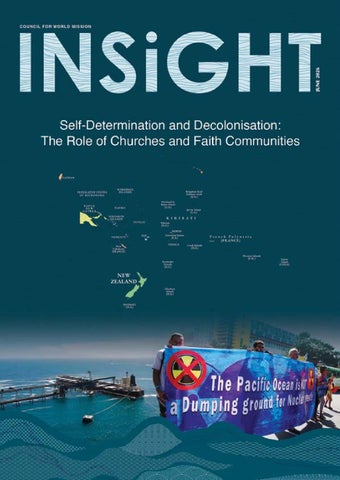
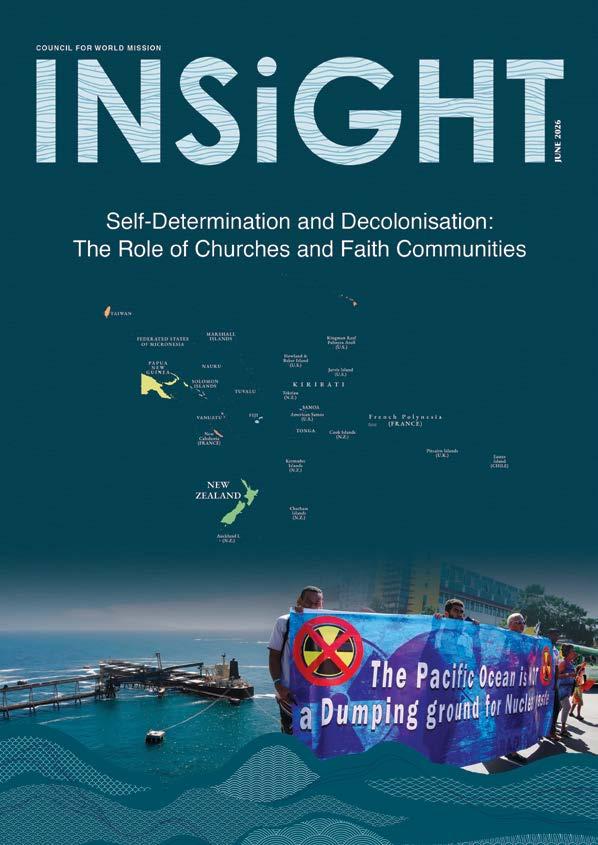
The theme of this issue of INSiGHT is “SelfDetermination and Decolonisation: The Role of Churches and Faith Communities.” The articles are drawn primarily from two recent significant ecumenical gatherings: the Global Consultation on Self-Determination and Decolonisation, held in Papeete, Tahiti, Ma’ohi Nui (French Polynesia), and the Taiwan Ecumenical Forum: The Right to Self-Determination and the Missionary Role of the Church in the Geopolitical Context of Taiwan, held in Taipei. The fruits of these meetings remind us that the struggle for self-determination is not a peripheral political concern for the church but a matter of faith, discipleship, and gospel witness.
In “Freedom as the Way of Jesus: selfdetermination and the kingdom of God,” Rev. Dr Huang Po-Ho presents a compelling theological vision in which self-determination is rooted in the liberating ministry of Jesus Christ. He argues that the kingdom of God is a counter-imperial reality where freedom, dignity, and human flourishing are restored, inviting the church to accompany communities in their pursuit of justice rather than reinforce structures of domination.
In “Self-determination and decolonisation: from colonial legacies to collective liberation in the Pacific,” Dr Carlyle G. Corbin draws on decades of diplomatic experience to trace the “island ethos” uniting Pacific peoples and the hard-won victories of Kanaky and Ma’ohi Nui at the United Nations, underscoring the church’s enduring role in this unfinished work.
In “Self-determination process of Ma’ohi Nui: challenges and prospects,” Antony Géros recounts the decades-long struggle for reinscription on the UN list of Non-Self-Governing Territories and the continuing refusal of France to engage in genuine decolonisation dialogue.
In “Self-determination process of Hawaii: challenges and prospects,” H. E. Leon Kaulahao Siu presents a legal case for the Hawaiian Kingdom’s continuity as a sovereign nation under prolonged occupation and calls for the UN to correct its historic error in validating statehood.
In “Towards ecumenical alliances for advocacy, reparations, and public witness,” Rev. James Shri Bhagwan frames the Pacific’s Ocean of Peace vision—decolonised, demilitarised, denuclearised, and decarbonised—as both a theological and political imperative, urging churches to organise across borders in solidarity.
In “Self-determination in Dalit community,” Rev. Philip V. Peacock notes that Dalit self-determination is not a demand for territorial sovereignty but a radical call for social transformation, pursued through both constitutional law and religious conversion as acts of dignity and self-authorship.
In “Taiwanese people’s quest for equality in the world,” Dr I-Chung Lai reflects on the Taiwanese people’s continuing quest for equality, dignity, and meaningful participation in the international community in a complex geopolitical environment.
In “Unquenchable fire,” Rev. Dr Jooseop Keum draws on the image of the burning bush and the legacy of missionary Frank Schofield to reflect on sustained, unyielding faithfulness in mission amid weariness and injustice.
This issue is further enriched by Dr Jin Young Choi’s insightful contribution, “A decolonial reading of Ephesians: for resisting the postcolonial empire.” The article provides a valuable biblical and theological reflection on resisting contemporary forms of empire through decolonial readings of Scripture.
Together, these contributions invite us to reconsider the missionary vocation of the church in a world marked by geopolitical tensions, colonial legacies, and growing inequalities. As always, this issue concludes with updates on CWM news, member church news, and CWM’s video productions from the second quarter of 2026, accessible via QR code.
We offer this issue with the hope that these reflections inspire member churches and faith communities to renew their commitment to God’s mission of building life-flourishing communities where justice and peace embrace all creation.
Freedom as the Way of Jesus: SelfDetermination and the Kingdom of God
Rev. Dr Huang Po-Ho
Abstract
This paper argues that self-determination is a key dimension of Jesus’ way of building the Kingdom of God. In his ministry, Jesus consistently affirms human dignity by calling individuals to freely choose repentance, discipleship, and love. Such self-determination is not understood as autonomous individualism, but as freedom restored and oriented toward obedience to God and care for others. Jesus himself embodies this dynamic through his voluntary submission to God’s will, revealing that true freedom is fulfilled in self-giving love. While the Kingdom of God remains fundamentally God’s initiative, human self-determination functions as a means through which divine grace takes concrete form in history. The Kingdom thus grows wherever liberated human freedom responds faithfully to God’s call in communal and transformative ways.
Introduction: Geopolitical tensions, empire, and the Oceania context
The contemporary global landscape is marked by intensifying geopolitical tensions, characterised by the resurgence of great-power rivalry, militarisation, and competing claims of national security.1 Across many regions, security is increasingly defined through state-centric and strategic frameworks, often at the expense of the lives, dignity, and identity of peoples. This global climate has profound consequences for communities living at geopolitical crossroads, where imperial interests, military presence, and economic extraction intersect with long histories of colonisation.
Oceania stands prominently within this landscape. The region has long been shaped by colonial
domination, nuclear testing, military occupation, and ongoing struggles over land, sovereignty, and political voice.2 For Indigenous peoples in places such as French Polynesia, Kanaky/New Caledonia, and West Papua, contemporary geopolitical tensions are not abstract global dynamics but lived realities that affect cultural survival, political identity, and everyday security.3 These contexts reveal how national security narratives often deepen division and conflict, while silencing the voices of communities most directly affected.
Against this backdrop, the question of selfdetermination emerges not merely as a political claim, but as an urgent ethical and theological concern. It raises fundamental questions about whose security is prioritised, whose voices are heard, and how justice and peace can be meaningfully pursued. For communities of faith, these questions call for theological reflection grounded in the Gospel and attentive to lived realities. This paper approaches selfdetermination as a faith and human rights principle, engaging the Oceania context as a critical lens through which to explore the liberating vision of the Kingdom of God, the struggle for decolonisation, and the role of churches in cultivating people-centred security and solidarity in a fractured world.
Self-Determination as a Faith and Human Rights Principle
Self-determination is widely recognised in international law and human rights discourse as the right of peoples to freely determine their political status; pursue their economic, social, and cultural development; and participate meaningfully in decisions that shape their lives. For minority and Indigenous communities, self-determination is essential, because their rights, identity, and well-being cannot be guaranteed by majority rule alone. It is enshrined in key instruments such as the United Nations Charter,4 the International Covenant on Civil and Political Rights,5 and the Declaration on the Rights of Indigenous Peoples.6
Beyond its legal and political significance, selfdetermination affirms the inherent dignity, agency — that is, the collective capacity to act and decide — and responsibility of communities, recognising that human flourishing is inseparable from the freedom to participate in shaping one’s destiny. It calls for attention not only to individual rights but also to the collective capacity of communities to make decisions in accordance with their identity, values, and traditions.
For the Christian faith, self-determination resonates deeply with core theological commitments. The Gospel proclaims liberation, justice, and life in abundance, affirming that all people are created in the image of God and called to participate in God’s redemptive work in the world. Following Jesus entails living in freedom—not as licence for domination or self-interest, but as a gift and responsibility that enables communities to act in alignment with God’s justice and love. Christian faith thus provides both the moral framework and the spiritual imperative to support and nurture the capacity of peoples, advocating for structures and practices that uphold human dignity, relational accountability, and collective responsibility. In this sense, self-determination is not merely a political or legal concept but a deeply theological one: it calls the church to engage faithfully with the ways communities are empowered or constrained and to bear witness to God’s liberating activity in history through advocacy, accompaniment, and solidarity.
Self-Determination
in the Oceania Context
Oceania’s Indigenous peoples have endured centuries of colonisation, settlement, and external control. French Polynesia was colonised by France in the 19th century and remains an overseas territory with limited political autonomy. Kanaky/New Caledonia experienced French colonial rule beginning in the mid-19th century, with its Indigenous Kanak population marginalised politically and economically, and independence movements emerging again in the 20th century (1984). West Papua was colonised by the Dutch
and later incorporated into Indonesia in 1969 under a controversial act, leading to ongoing struggles for political recognition and self-determination. These histories of external domination, land dispossession, and cultural suppression continue to shape the social, political, and spiritual realities of the peoples of these islands.
For Indigenous communities in Oceania, selfdetermination is therefore not a theoretical principle but an essential right, foundational to their survival, identity, and dignity. It affirms their collective capacity to shape social, political, and cultural life according to their values, traditions, and aspirations, while honouring their deep connection to land and ancestral heritage. Selfdetermination in these contexts is inseparable from movements for justice, peace, and the dignity of all life, as communities seek to reclaim identity denied by colonial structures and ongoing political constraints.
From a Christian perspective, self-determination resonates with the Gospel’s affirmation of human dignity, particularly for those marginalised or oppressed. The church is called to stand in solidarity with communities whose selfdetermination is denied, to advocate for their rights, and to support processes that enable them to participate meaningfully in shaping their own futures. In this sense, self-determination in Oceania is both a legal and theological imperative, inviting the church to listen attentively, accompany communities in their struggles, and bear witness to God’s liberating work in the world.
Jesus’ Way and the Kingdom of God: Freedom and Self-Determination
The call to self-determination finds its deepest theological grounding in the life, ministry, and mission of Jesus. In proclaiming the Kingdom of God, Jesus embodied a liberating way that affirmed the dignity, and voice of those marginalised and oppressed. He healed the sick, welcomed the excluded, and challenged structures of domination, revealing that God’s
reign is rooted not in coercion or imposed authority, but in freedom, justice, and relational accountability. This liberative vision invites all peoples to participate actively in shaping their lives in accordance with God’s justice and love.
For communities whose rights and identities have been denied, such as Indigenous peoples in Oceania, the Gospel models a way of being that affirms self-determination as a spiritual and moral imperative. Jesus’ example demonstrates that true freedom requires both personal and collective identity: individuals and communities are called to make choices consistent with God’s purposes, guided by conscience, communal values, and covenantal relationships. The Kingdom of God is not a distant ideal but a present reality in which oppressed peoples can exercise agency, reclaim identity, and engage in transformative participation.
In this regard, self-determination is both a human and a theological vocation. Christian discipleship requires that the church recognise and support the God-given capacity of communities to determine their own futures, particularly those whose capacity has been historically constrained by colonial and political structures. Standing in solidarity with peoples striving for self-determination is therefore not merely political advocacy but an expression of faithful participation in God’s redeeming work. The church’s role is to accompany, listen, and empower, bearing witness to God’s liberating presence and nurturing the conditions in which communities can flourish according to the justice and freedom revealed in Jesus’ life and ministry.
Self-Determination: Identity, Freedom, and the Gospel-Culture Dialogue
Self-determination represents both selfhood— the cultivation of identity—and the capacity to determine freely one’s path in social, political, and spiritual life. Identity, shaped by culture, history, and communal memory, provides the grounding for who communities are, their values, and their vision of flourishing. Yet identity alone is insufficient if it cannot be exercised freely: communities must
possess the capability to make decisions and act in accordance with their values. In this way, selfdetermination is inherently relational, connecting the integrity of cultural selfhood with the power to enact freedom responsibly.
The Gospel is always present within diverse cultures, engaging with both their positive and negative elements. It does not operate as an external force that merely “respects” or “redeems” culture; rather, it struggles within culture, revealing injustices, offering hope, and shaping communities toward God’s vision of justice, freedom, and flourishing. Through Christ, communities are called to freedom—not as licence for domination or self-interest, but as participation in God’s justice and love. In this dynamic, identity and freedom are mutually sustaining: cultural selfhood informs ethical and relational exercise of freedom, while freedom allows that identity to flourish in alignment with God’s purposes.
For the church, this theological insight frames its engagement with communities as both pastoral and prophetic. Supporting self-determination means accompanying communities as they negotiate their cultural and spiritual identity, while advocating for conditions that enable genuine freedom. In doing so, the church participates in God’s redemptive work, witnessing to a Kingdom in which peoples can live authentically as God’s image-bearers, exercising both identity and freedom in ways that honour God, neighbour, and creation. Self-determination, then, is a theological principle where Gospel and culture are inseparable, making identity and freedom inseparable elements of human dignity and communal flourishing.
Self-Determination and the Kingdom of God
The Kingdom of God, proclaimed by Jesus, is not merely a spiritual ideal but a radical, counter-imperial reality that offers freedom, dignity, and hope to those marginalised by oppressive powers.7 In the first-century context, Roman imperial authority sought to dominate every aspect of life, marginalising the poor, the
ethnic minorities, and the socially excluded. Jesus’ message of the Kingdom proclaimed an alternative promise from God: a realm where God’s justice, mercy, and liberation reign, and where the powerless and oppressed are recognised as full participants in God’s plan. Self-determination—integrating identity and freedom—finds its deepest expression within this Kingdom, as communities are invited to exercise capacity in alignment with God’s justice, rather than the coercive logic of empire.
For marginalised communities, including Indigenous peoples in Oceania, the Kingdom of God frames self-determination as both a spiritual and a social vocation Identity and freedom are gifts to be exercised responsibly in the context of communal life, resisting structures of domination while participating in God’s liberating work. The exercise of self-determination within this Kingdom reflects God’s vision for human flourishing: it restores dignity, empowers identity, and creates spaces where communities can shape their futures according to their values, culture, and aspirations.
For the church, the Kingdom-oriented vision of self-determination carries both theological and practical responsibilities. The church is called to stand in solidarity with those denied freedom and identity, to advocate for justice, and to accompany communities in ways that reflect the liberating presence of God. By doing so, the church participates in the ongoing in-breaking of God’s Kingdom, bearing witness to an alternative social and political order where human dignity, freedom, and identity are affirmed as integral to life in God’s reign. Self-determination, therefore, is not simply a political or cultural concern; it is a Kingdom imperative, enacted in the tension between God’s liberating promise and the structures of empire.
Decolonisation and the Church in Oceania
Decolonisation in Oceania remains an ongoing struggle for political, cultural, and spiritual selfdetermination. Indigenous peoples in French Polynesia, Kanaky/New Caledonia, and West Papua continue to face the legacies of colonial
rule, including restrictions on political agency, land dispossession, and the marginalisation of cultural knowledge and practices. For these communities, decolonisation is not simply the withdrawal of external control but the reclaiming of identity, autonomy, and freedom, rooted in their history, culture, and relationships with the land. Self-determination and decolonisation are inseparable: both affirm the right and responsibility of communities to shape their futures in ways consistent with their values and God-given dignity.
Viewed through the lens of the Kingdom of God, decolonisation resonates with the liberating promise Jesus proclaimed to those marginalised under imperial powers. The Gospel invites communities, churches, and ecumenical networks to walk in solidarity with those seeking freedom and justice, recognising their leadership and respecting the knowledge embedded in their cultures and struggles. Churches in Oceania and beyond are called to accompany communities, to listen deeply, and to support spaces where their voices can be heard in national, regional, and global arenas. This accompaniment is not directive; it is participatory, relational, and attentive, enabling communities to exercise both freedom and identity while embodying the justice and wholeness promised in God’s Kingdom.
In this perspective, decolonisation is not only a political or social process but also a faithful enactment of self-determination. It reflects participation in God’s redemptive work, where the church’s role is to stand with, amplify, and journey alongside communities rather than to lead or instruct them. Through such collaboration, churches embody their vocation as witnesses to the Kingdom, supporting Indigenous peoples as they reclaim their identity, exercise capacity, and shape their social, cultural, and spiritual life.
Pathways for Common Action: Local, Regional, and Global
A theology of self-determination invites a fundamental reorientation from the logic of national security toward the vision of people’s
security.8 National security frameworks, shaped by territorial sovereignty, military power, and geopolitical competition, often deepen fear, justify violence, and reinforce separation between peoples. In contrast, people’s security centres on the protection of life, dignity, culture, land, and community. It prioritises the well-being of peoples rather than the preservation of state power, and it recognises that true security emerges from justice, mutual trust, and shared responsibility. Within this framework, self-determination is not a threat to peace but a foundation for it, as it affirms the identity of communities to live without domination and fear.
People’s security naturally generates solidarity. When communities are recognised as subjects rather than objects of political order, relationships shift from competition to mutual care. Solidarity across cultures, borders, and histories becomes possible, offering a genuine response to the deepening geopolitical conflicts of our time. Rather than reproducing the divisions imposed by colonial borders or contemporary ideological blocs, people-centred solidarity creates spaces for shared struggle, healing, and cooperation. This solidarity reflects the interdependence of peoples and affirms that no community’s flourishing can be secured at the expense of another’s suffering.
For the faith communities, this vision calls for pathways of common action that transcend national, ethnic, and ideological boundaries. As communities shaped by the Gospel, churches are uniquely positioned to gather people across divisions and to witness to an alternative order rooted in compassion, justice, and hope. In doing so, churches do not align themselves with competing empires but participate in the realisation of what may be described as the compassionate empire of God—a Kingdom proclaimed by Jesus that resists domination and centres the marginalised. Through local accompaniment, regional ecumenical cooperation, and global advocacy, churches can help cultivate people’s security and solidarity, walking together with
communities toward the realisation of selfdetermination as a sign of God’s reign among the peoples of the world.
Conclusion
Self-determination, understood theologically, is neither a narrow political claim nor a purely cultural aspiration; it is a faith-filled struggle for identity, freedom, and dignity rooted in the lived experiences of peoples. Emerging from the interaction of Gospel and culture, selfdetermination affirms communities as active subjects in history, capable of shaping their futures in response to God’s liberating call. When placed within the horizon of the Kingdom of God proclaimed by Jesus—a compassionate, counterimperial promise to those marginalised by dominant powers—self-determination becomes a sign of God’s reign breaking into concrete realities of injustice, colonisation, and exclusion.
In Oceania and beyond, the ongoing pursuit of decolonisation reveals that peace cannot be secured through domination or geopolitical rivalry, but through people-centred security grounded in solidarity, justice, and mutual care. Churches, as part of a global ecumenical fellowship, are invited to walk together with communities in this struggle—not as instructors or arbiters, but as companions and witnesses. By transcending national and ideological boundaries, churches participate in God’s compassionate empire, nurturing spaces where peoples can reclaim identity, exercise freedom, and live toward the fullness of life promised in the Gospel. In this shared journey, self-determination becomes not only a demand for justice, but a hopeful expression of faith in God’s ongoing work of liberation in the world.
Notes
1. World Council of Churches, Ecumenical Call to Just Peace (Kingston, 2011).
2. Epeli Hau‘ofa, “Our Sea of Islands,” The Contemporary Pacific 6, no. 1 (1993): 147–161.
3. Stephen Henningham, France and the South Pacific (Honolulu: University of Hawai‘i Press, 1992).
4. United Nations Charter (1945) United Nations, Charter of the United Nations, Article 1(2), which affirms “the principle of equal rights and self-determination of peoples” as a foundation for international peace and friendly relations.
5. ICCPR / ICESCR, United Nations, International Covenant on Civil and Political Rights (1966), Article 1; see also International Covenant on Economic, Social and Cultural Rights (1966), Article 1, affirming that “all peoples have the right of self-determination.”
6. Indigenous Peoples United Nations General Assembly, United Nations Declaration on the Rights of Indigenous Peoples (UNDRIP), A/RES/61/295 (2007), especially Articles 3–5 on self-determination, autonomy, and self-government.
7. N. T. Wright, Jesus and the Victory of God (Minneapolis: Fortress Press, 1996).
8. Huang Po Ho, People’s Security and Selfdetermination: Overlapping Identities and Selfdetermination in Asian Contexts, Decolonizing Politico-Religious Relations in Asia – interfaith Dialogue Towards Sustainable Peace in the PostNation-State Era, edited by Yoshihiro Yakushige, Executive Committee for the Roundtable on Decolonisation of Politico-Religious Relations in Asia, Kyoto, 2025. P. 101.
Rev. Dr Huang Po-Ho is the director of the Academy for Contextual Theologies in Taiwan and currently serves as Adjunct Professor at the Claremont School of Theology in the United States. He is a Board Member of the United Board for Christian Higher Education in Asia, Chairperson of the Board of the Asia-Pacific Theological Union (APTU), and Convener of the Asian Forum for Theological Movements.
Self-Determination and Decolonisation: From Colonial Legacies to Collective Liberation in the Pacific
Dr Carlyle G. Corbin
I reflect in part on my personal experience as a former minister of external affairs of a Caribbean territory – the Virgin Islands - which struggled to advance towards the full measure of selfgovernment as a territory recognised by the United Nations (UN) as non-self-governing.
Through that period until now, I recall the experience of working closely with my Pacific colleagues over the decades at the UN through organisations such as the Alliance of Small Island States (AOSIS) and other intergovernmental institutions. To its credit, the UN saw wisdom in bringing together Caribbean and Pacific territories for a cross-fertilisation of ideas on advancing decolonisation from an island-specific perspective.
There indeed exists an “island ethos” that unites us. Island ethos. It is a phrase coined by the late ambassador of Papua New Guinea to the UN, H.E. Renagi Renagi Lohia who served with distinction in the 1990s. He described this ethos as our collective spiritual connection to our oceans and seas, to our waters, to our precious lands, to our foods, to our way of life, to our spiritual outlook on the world. All of these things and more reflect our commonalities. One of my CHamoru colleagues as far back as 1995 charged me with the responsibility of sustaining this link we share as island peoples. He told me in the corridors of a UN regional seminar that I was to be a link in this connection.
I did not know that this would be the final time that I would see my friend and share our stories. He
would pass away unexpectedly not long after. I received a spiritual message that day to continue the struggle with the grace of God. I continue to keep my promise to my friend and brother to do all that I can in service of the decolonisation of our people.
Whenever I arrive in Ma’ohi Nui, I reflect upon my first time that I was blessed to come to these sacred shores. This was in 1999 – some 27 years ago. As now, I was asked to deliver a keynote address – at that time, it was the Eighth Nuclear Free and Independent Pacific Conference. The conference was held at the Evangelical Church of French Polynesia (Eglise Evangelique de la Polynesie Francaise) – the predecessor of the Ma’ohi Protestant Church. Vibrant civil society organisations of the day such as the Pacific Concerns Resource Centre, the Nuclear Free and Independent Pacific, the Pacific Council of Churches, and others joined in deep discussions on the challenges to colonialism, the human consequences of the nuclear testing which blanketed the region, and many related issues which remain with us today. Since then, new issues have emerged which threaten to impact the ecosystem of the region.
Through it all, the Pacific Conference of Churches (PCC) had always been instrumental in fighting for fundamental human rights in the region. (I am also reminded of a once-vibrant Caribbean Council of Churches with a similar focus that supported the Caribbean independence movements.) The focus of PCC then - as it is now - encompasses the right to self-determination which the UN General Assembly has long recognised as a fundamental human right. As is written in the concept note of this conference, “Decolonising discipleship begins by naming harm, listening to Indigenous testimony, and restoring agency to those whose voices were marginalised.” To this end, the church remains a most critical and sustained institution in the promotion of self-determination and decolonisation for the Pacific and beyond.
The independence of much of the Pacific and the Caribbean during the Decolonisation Acceleration
Period of the 1960s through 1990 is a clear indication of what can be achieved with unity and commitment. I wish to cite two examples, that of Kanaky and of Ma’ohi Nui. We have seen the successful re-inscription of Kanaky on the UN list of non-self-governing territories in 1986. This was achieved after an epic political and diplomatic battle at the UN with strong support from a number of Pacific states. The effort was led by a dynamic ambassador of Vanuatu who was the chair of the UN Fourth Committee at that time. Many bear the scars of that battle. But if there are no scars, then, were not the people worth fighting for? And as we are aware, many have fallen in Kanaky while working to advance their fundamental human rights.
As we work to complete the unfinished business of decolonisation, the considerable and sustained support from the church must be duly recognised and heralded. Dr Soojin Chung of the Princeton Theological Seminary wrote that “this period between the 1960s and 1980s witnessed an important shift that moved the discourse of World Christianity from one promoting worldwide Christian unity to one facing the decolonial reconfiguration of Third World Christianity.” The Pacific Council of Churches remains in forefront of that transition.
The church has played an historical role in the self-determination of Kanaky as evidenced by the Protestant and Catholic associations which led to the formation of the Union Calédonienne (UC) party, the largest party of the FNLKS. From a regional perspective, the PCC held its 12th General Assembly in Noumea in 2023 with one of the central themes as “Transformation as SelfDetermination.”
PCC General Secretary Rev. James Bhagwan, in testimony before the UN Decolonisation Committee in 2024, expressed Pacific concerns about the insistence of the administering power on holding the third referendum on independence in 2021 despite Kanak requests that it be delayed because of the major impact of the COVID-19 epidemic on their community. Because of the
Kanaky decision of non-participation in the referendum, the results were not a true reflection of the position of the people. However, attempts to force acceptance of this non-result led to resistance among the people, and the tragic loss of life. In the struggle for self-determination, Martinique psychiatrist Frantz Fanon’s words ring true: “We revolt because we cannot breathe.”
Most recently, the Pacific Peoples’ Mission to Kanaky in 2025 found that the Kanak right to self-determination was being undermined and international commitments on decolonisation were being breached. The mission – led by the Pacific Network on Globalisation (PANG), Pacific Conference of Churches (PCC), and the Protestant Church of Kanaky New Caledonia (Église protestante de Kanaky Nouvelle-Calédonie) was conducted in April 2025 in response to invitations from Kanaky and customary church leaders. The findings of the mission revealed persistent inequality, systemic discrimination, and external political interference. The Pacific Council of Churches continues to stand with the people of Kanaky as it does with the self-determination of peoples of the wider region.
It was a deep learning experience for me as a young diplomat to witness the earlier Kanaky reinscription process at the UN in the 1980s. This was a vital lesson in the diplomacy of small states at an earlier stage of my career. This would serve well in the upcoming struggle for the re-inscription of Ma’ohi Nui some 27 years later in 2013 after several years of sustained struggle to achieve the re-inscription amidst mounting pressures. This struggle was won with the strong support of Pacific ambassadors at the UN led by the Solomon Islands, Nauru, Samoa, and others.
Ma’ohi Nui President Oscar Manutahi Temaru, never wavered in his commitment to ensure that Ma’ohi Nui would be re-inscribed to the UN list to ensure that access to a genuine decolonisation process under UN auspices would be restored. Against considerable odds, Ma’ohi Nui prevailed.
President Temaru continues to encourage these efforts. Current President Moetai Brotherson,
former Senator Richard Tuheiava, leader in the Assembly of French Polynesia Tony Geros, and many others worked closely together to accomplish the re-inscription of Ma’ohi Nui to the UN list of non self-governing territories – only the third time in the history of the UN that this had been accomplished. It was 17 May 2013. It was a good day. God gave us wings that day.
I have had the honour of working with Ma’ohi Nui in that epic battle to gain re-inscription. We all have the scars to show for successfully completing that task against all odds that included intense diplomatic and other pressures. With the grace of God we prevailed.
Churches led by the Maohi Protestant Church alongside the Pacific Conference of Churches continue to be instrumental in the Ma’ohi Nui struggle for genuine decolonisation. They are consistent and longstanding advocates for the multifaceted issues of self-determination, the reclamation of Indigenous identity, the mitigation of nuclear testing effects, and much more. Our current efforts to mobilise UN support for the Ma’ohi Nui decolonisation work programme are well underway.
From the global perspective, the World Council of Churches (WCC) has consistently worked in solidarity on the issues of self-determination and decolonisation. The WCC has expressed its consistent support for a nuclear-free Pacific, standing in solidarity with affected communities in Ma’ohi Nui, the Marshall Islands, and Kiribati, calling for independent assessments of nuclear test impacts, reparations, environmental remediation, and universal ratification of the Treaty of Rarotonga, and of the Treaty on the Prohibition of Nuclear Weapons.
Overall, the WCC has continually reaffirmed its position that true peace requires the dismantling of colonial systems of control and oppression, and has supported the maintenance of Ma‘ohi Nui and Kanaky on the UN decolonisation agenda until full self-determination is achieved. The WCC has also called for an international review of the
political status of Hawai’i, the full implementation of the UN Declaration on the Rights of Indigenous Peoples, demilitarisation, a global ban on deepsea mining, and climate advocacy. These are major components of a decolonial agenda which the church continues to champion.
Support for the principle of self-determination even stretches to Europe, with churches expressing recent solidarity with Greenland’s right to self-determination, urging respect for human rights, offering prayers, and reiterating support for human rights, dignity, and respect for international law. We must also take note of the challenges faced by our CHamoru brothers and sisters in Guahan in the Northern Pacific who are confronting the most intense military buildup in the history of the region while also seeking to complete a self-determination process amid the unilateral authority of an administering power which seeks to define the voter eligibility in their political status referendum.
All of these issues are raised at the level of the UN and its role in the decolonisation process. In a statement to the 2026 organisational meeting of the UN Decolonisation Committee a few weeks ago, the UN Secretary-General “warned the enduring legacy of colonialism — marked by entrenched economic exploitation, racism, inequality and exclusion from decision-making — continues to shape the world’s remaining 17 nonself-governing Territories.” While his reference was to those on the formal UN list, it is only a part of a full list of territories to be decolonised at the global level. The Secretary-General noted:
It is a fact that while the UN has committed to ending colonialism, the job is incomplete as we progress through the midterm of the Fourth International Decade for the Eradication of Colonialism. Our world has come a long way, with well over 100 nations gaining independence since 1945. Yet the legacy of colonialism has left profound scars through the deeply-rooted mechanisms of economic exploitation, as well as in the
form of racism, inequality and persistent exclusion from decision-making bodies.
As we progress in the process of selfdetermination, our intention must be towards evolution. It is either evolution or it would be stagnation. We either evolve, or we stagnate. A status quo is not a safe harbour and can often be a slippery slope downward. Some peoples may even disappear as part of a forgotten history of a once proud people. We must endeavour not to become an “ex-people.” As President Temaru reminded the UN on several occasions in various formal statements, “Colonialism by consent is colonialism nevertheless.” Indeed, true democracy cannot take root within the framework of a colonial condition. It only yields the illusion of democracy. With the continued commitment of the church in the struggle for genuine decolonisation in the Pacific, we shall prevail.
Dr Carlyle G. Corbin is an international advisor on governance and senior analyst in the Global Dependency Studies Project expert group. He is executive secretary emeritus of the Council of Presidents of the United Nations (UN) General Assembly and a UN independent expert on decolonisation.
The SelfDetermination Process of Ma’ohi
Nui: Challenges and Perspectives
Antony Géros
In this sanctuary of faith and resistance, where our ancestors drew strength and hope, we affirm that decolonisation is not only a political or temporal claim. It is also a spiritual call for justice, dignity, and recognition of divine sovereignty over our lands, seas, and peoples.
A Brief Reminder of the History of this Struggle
From as early as 1978, the party Tavini Huiraatira
No Te Ao Ma’ohi – FLP, founded in 1977 under the presidency of Oscar Manutahi Temaru, structured this demand for self-determination in a period marked by French nuclear tests between 1966 and 1996.
This struggle was then carried forward regionally and internationally by the Union for Democracy (UPLD) starting in 2011, with the strategic and decisive contribution of our former senator Richard Tuheiava, supported and strengthened by our diplomatic mentor Dr Carlyle Corbin, whom I am pleased to greet among us today.
The resolution adopted by the Assembly of French Polynesia on 19 August 2011, together with the decisive support of the Ma’ohi Protestant Church and the Pacific Conference of Churches (PCC), enabled Ma’ohi Nui to be re-inscribed on 17 May 2013, on the United Nations list of NonSelf-Governing Territories under the Special Committee on Decolonisation (C-24).
This achievement would not have been possible without the commitment of the churches and the solidarity of small Pacific island states, including Vanuatu, Samoa, Tuvalu, Nauru, and the Solomon Islands.
Since then, our situation has been reviewed each year in June before the C-24, and in October before the Fourth Committee of the UN General Assembly, thanks to the courageous and persistent voices of our petitioners.
Progress Achieved Through the United Nations Process
The UN process has led to major progress. In May 2016, following the C-24 regional seminar in Managua, Nicaragua, the C-24, the Fourth Committee, and ultimately the UN General Assembly recognised the permanent sovereignty of the people of Ma’ohi Nui over all their natural resources — land, marine, aerial, and suboceanic.
The territorial elections of May 2023 confirmed this aspiration: Tavini Huiraatira obtained a relative majority and 38 seats in the Assembly for a five-year mandate.
As early as October 2023, our institution created a special commission on decolonisation, laying the foundations for dialogue distinct from the French institutional framework defined by the Organic Law of 27 February 2004.
However, significant challenges remain. The French State still refuses to recognise the 2013 UN re-inscription and to engage in a genuine decolonisation dialogue.
In response, Tavini Huiraatira, together with the Ma’ohi Protestant Church, referred the matter in October 2024 to the United Nations Human Rights Committee in Geneva, invoking violations of the International Covenant on Civil and Political Rights.
The concluding observations published in December 2024 are explicit: France is infringing upon the right to self-determination of the Ma’ohi and Kanak peoples.
At the same time, the Assembly of French Polynesia and Tavini Huiraatira have brought legal actions before French administrative courts
seeking to compel the opening of a genuine decolonisation dialogue.
The Administrative Tribunal of Papeete classified the matter as an “act of government,” a category not subject to judicial review, and rejected our claims. We have appealed, and the case should be examined in 2027.
Regardless of the outcome, we will pursue all available domestic remedies.
At the end of this process, expected around 2028–2029, we plan to again bring the matter before the UN Human Rights Committee, arguing that France is violating the right of the people of Ma’ohi Nui to freely and fairly exercise their right to self-determination, in accordance with the UN Charter and the International Covenant on Civil and Political Rights that France has ratified.
Recent Developments
However, we could not remain waiting. In December 2025, the UN General Assembly adopted a resolution calling on France not only to engage in dialogue with Polynesian institutions, but also to establish a “constructive programme of work” to facilitate this process.
In this perspective, the special commission on decolonisation of the Assembly of French Polynesia recommended the creation of a local dialogue platform bringing together:
• Public institutions of Ma’ohi Nui
• Religious communities
• Trade unions
• Non-governmental organisations recognised as serving the public interest
• Scientific and academic communities
A structured document prepared in 2024, organised into five major stages, also defines the themes of dialogue between the political institutions of Ma’ohi Nui and the French State.
Key issues include:
• Exploration and possible exploitation of deep-sea resources within our Exclusive
Economic Zone
• Compensation for victims of nuclear testing, deep wounds that call for truth and reparation
However, France’s continued refusal to recognise the 2013 UN re-inscription keeps these recommendations pending implementation.
The Role of Churches and the International Community
Nevertheless, new perspectives are emerging through the remarkable mobilisation of the local, regional, and international faith community, including:
• The Synod of the Ma’ohi Protestant Church
• The Pacific Conference of Churches (PCC)
• The Council for World Mission (CWM)
I wish to salute their constant support for the reinscription of Ma’ohi Nui since 2011, as well as their active presence within UN bodies to bring forward, from a theological perspective, the voice and suffering of the Ma’ohi people.
I also thank the Council for World Mission for organising this consultation here in Tahiti, at a particularly sensitive moment for the effective, fair, and informed exercise of the right to selfdetermination for the peoples of Ma’ohi Nui, Kanaky, and West Papua.
Since 2013, and even more since the return of Tavini Huiraatira to power in May 2023, we have faced sustained diplomatic opposition seeking to prevent the activation of traditional UN decolonisation mechanisms, such as:
• C-24 visiting missions
• Regional seminars
In this context, this Global Consultation of CWM represents an opportunity for strategic engagement with the international community.
While France may oppose certain UN initiatives on our territory, it cannot obstruct the engagement of the global faith community in support of justice and self-determination.
Pacific Regional Solidarity
New perspectives are also emerging through political solidarity across the Pacific region.
The creation of the Pacific Inter-Parliamentary Assembly (AIPP) in Fiji in late 2025, and the establishment of its Decolonisation SubCommittee, which I have the honour of chairing, expands our field of action.
The first inaugural meeting of the AIPP will be held in Tahiti in August 2026, with one of its key priorities being: the sovereignty of Indigenous peoples over their natural resources, particularly deep-sea resources.
A Final Reflection
Before concluding, allow me to reflect briefly on the world around us.
The conflicts currently shaking the Middle East, particularly the war involving Iran, remind us how fragile the international order remains when power prevails over justice and the rights of peoples.
These distant crises resonate even in the Pacific. They reveal that in a world structured by power relations, peoples who do not fully possess their sovereignty remain exposed to decisions made elsewhere, without them.
Liberation theology teaches us that God hears the cry of the peoples and calls the church to stand on the side of human dignity.
Therefore, the prophetic mission of the churches of the Pacific is not to remain silent in the face of injustice, but to accompany peoples toward the full recognition of their rights.
The self-determination of Ma’ohi Nui is not an act of rupture, but a path of responsibility and peace. It is based on the conviction that true stability arises from justice, and that justice begins with the recognition of a people’s right to freely decide their future.
May our journey be guided by faith, illuminated by truth, and animated by hope.
Conclusion
The churches, guardians of memory and hope, have a decisive role to play.
Let us mobilise so that Ma’ohi Nui may attain its full sovereignty in peace, dignity, and reconciliation.
May God bless Ma’ohi Nui, its people, and our noble missions.
Antony Géros is vice-president of Tavini Huiraatira No Te Ao Maohi, president of the Assembly of French Polynesia, and president of the Pacific Inter-Parliamentary Assembly (AIPP).
Self-Determination Process of Hawaii: Challenges and Prospects
H.E. Leon Kaulahao Siu
PART 1
I will begin today with the historical, legal, and political foundations for the restoration of the Hawaiian Kingdom as a sovereign, independent state. Then we will discuss Hawaii and the United Nations mechanisms for self-determination and decolonisation.
By the mid-19th century, the Hawaiian Kingdom was a recognised, literate, and progressive nation with extensive international treaty relations. However, an illegal 1893 military intervention by the United States, followed by an illegal “annexation” in 1898, initiated a period of prolonged occupation that continues to the present day.
The core argument for the restoration of Hawaii as a sovereign state rests on the principle of “continuity”: that the sovereignty of the Hawaiian Kingdom was never lawfully extinguished or relinquished or acquired by the U.S. or any other foreign entity. Despite the imposition of various U.S.-installed governments (the Republic of Hawaii, Territory of Hawaii, and State of Hawaii), international law and specific admissions of guilt by the U.S. government—most notably the 1893 address of President Grover Cleveland to the U.S. Congress and the 1993 “Apology Law” signed and issued by President Bill Clinton— confirm the Hawaiians’ claim of their Kingdom’s ongoing existence.
Currently, a growing Hawaiian independence movement seeks to reinstate the Kingdom’s lawful jurisdiction, citing the fraudulent nature of U.S. claim of dominion over the Hawaiian Islands and the persistent suppression of the national identity of Hawaiian subjects.
Historical Foundation of Sovereignty (1810–1892)
Prior to the U.S. illegal intervention of 1893, the Hawaiian Kingdom was a highly developed and diplomatically integrated nation-state as evidenced by the following:
• Unification and Governance: Following the 1810 unification by Kamehameha the Great, the Kingdom evolved into a constitutional monarchy. King Kamehameha III issued the Declaration of Rights (1839) and the first Constitution (1840).
• International Recognition: In 1843, the Hawaiian Kingdom became the first nonEurocentric nation to be formally recognised as sovereign by the United Kingdom and the Kingdom of France. The United States and Belgium followed months later. Then others.
• Diplomatic Reach: By the late 1890s, the Kingdom maintained over 130 diplomatic and consular posts worldwide and had established 44 bilateral treaties with nations including Russia, Germany, Japan, China, and various European powers.
• Social Development: The nation was characterised by high literacy rates, a flourishing trade economy, universal respect for human rights, and a neutral stance regarding international conflicts.
The Illegal Intervention and “Annexation”
The transition of the Hawaiian Kingdom from independence to U.S. control was marked by two distinct phases of illegality: The 1893 illegal Coup d’état and the 1898 illegal annexation.
The 1893 Illegal Coup d’état
In January 1893, a group of white businessmen, supported by armed U.S. Marines, staged a coup to unseat Queen Lili‘uokalani.
• The Queen’s Conditional Yield: To avoid bloodshed, Queen Lili‘uokalani yielded her authority to the U.S. government (not the insurgents), protesting the intrusion as an international wrongful act and demanding the U.S. president restore the proper governing authority of the Hawaiian Kingdom.
• The Blount Report: In December of 1893 U.S. President Grover Cleveland, based on
the official report by his investigator, James Blount, concluded that the U.S. intervention of January 16, 1893 was an “act of war” against a friendly, sovereign nation. Cleveland asserted the U.S. had international moral and legal obligations to restore the queen, but the U.S. Congress failed to implement the settlement.
The 1898 Illegal Annexation
In 1893 and 1897, attempts to have a Treaty of Annexation ratified by the U.S. Senate were thwarted by massive petitions of protests from the Hawaiian people and constitutional objections raised by key U.S. Senators. However, in 1898, at the outbreak of the Spanish-American War, annexationists in Congress invoking the pretext of military necessity, resorted to passing a domestic “joint resolution” (the Newlands Resolution) posing as a “treaty of annexation,” to take possession of the Hawaiian Islands.
• Pretext of Military Necessity: The outbreak of the Spanish-American War provided the U.S. Department of War an excuse to seize Hawai‘i to use as a military base for Pacific expansion.
• Lack of Treaty: Under international law, a domestic joint resolution has no lawful authority to transfer territory or sovereignty from one sovereign nation to another. Consequently, since no treaty of annexation ever existed, there never was a lawful transfer of Hawaii’s territory or sovereignty to the United States.
Legal Arguments for Continuity
The Hawaiian Kingdom’s claim to contemporary existence is supported by several legal principles and international precedents.
The Principle of Continuity
International law holds that a state does not cease to exist simply because its government is overthrown or its territory is occupied.
• Non-extinguishment: A sovereign state can only be extinguished by conquest, agreement, or abandonment. Since none of these situations occurred, the Hawaiian Kingdom was never extinguished. It is a nation in continuity.
• Expert Testimony: Legal scholars, including Prof. Matthew Craven (SOAS, University of London), Prof. Francis A. Boyle, and many others have published findings confirming that the Hawaiian Kingdom is a sovereign state in continuity.
Treaty Obligations
The bilateral and multilateral treaties established in the 19th century were never formally abrogated.
• Dormant Treaties: Under customary international law, these treaties, though dormant, remain in force.
• Successor States: It is estimated that 154 of the 193 UN Member States share either direct (14) or successor (140) treaty relationships with the Hawaiian Kingdom.
International Standing
• Permanent Court of Arbitration (PCA): In the 2000 case Larsen v. Hawaiian Kingdom, the PCA recognised the standing of both the Hawaiian subject and the Hawaiian Kingdom government, implicitly acknowledging the state’s continuity.
• United Nations Filings: Numerous complaints and petitions have been filed with the UN Security Council, the General Assembly, and the Human Rights Council regarding the illegal occupation.
Consequences of Prolonged Occupation
The U.S. presence in Hawai‘i is a fraudulent and illegal occupation, resulting in significant social, economic, and legal damage.
Legal and Human Rights Violations
• Criminal Jurisdiction: Because U.S. and “State of Hawai‘i” courts lack lawful jurisdiction, the prosecution of Hawaiian subjects under the laws of the occupier is
• Ex Injura Jus Non Oritur: This fundamental principle of law dictates “unjust acts cannot create lawful ones.” Thus, the illegal seizure of the Hawaiian Kingdom in 1893 means the Republic of Hawaii (1895); the Territory of Hawaii (1898); and the State of Hawaii (1959) were not and are not lawful.
viewed as a war crime under the Geneva IV Convention and Laws of Occupation.
• Land Fraud: Since the U.S. never acquired lawful title, all land conveyances that were processed through the Territory of Hawai‘i and the State of Hawai‘i are considered clouded or completely void.
• Suppression of Identity: The U.S. has pursued a policy of “denationalization,” rebranding Hawaiian nationals as “Native Americans” to shift the issue from international sovereignty to domestic ethnic rights.
Socioeconomic Impact
• Economic Dependency: 90% of food, goods, and energy are imported through U.S. channels, leaving the people vulnerable to any disruption in supply or delivery.
• Marginalisation: The imposition of American cultural customs has marginalised many Hawaiians, leading to high rates of disenfranchisement, poverty, and homelessness.
• Environmental Hazards: Military presence, runaway urban development and unrestrained tourism have led to catastrophic environmental risks, such as the US Navy’s 2021 leakage from giant fuel storage tanks at Red Hill, threatening the island’s primary aquifer.
The Restoration Movement
The movement for restoration has matured from emotional protest to a methodical, lawful effort to reactivate the Hawaiian Kingdom government.
Conclusion: The Path Forward
The restoration of the Hawaiian Kingdom is not only a political necessity but a moral imperative to achieve Pono (righteousness/balance). The proposed solution involves:
• U.S. Withdrawal: A peaceful transition of control from the United States to the Hawaiian Kingdom government.
• International Recognition: Through reactivated engagement with treaty partners and the correction of an error made by the United Nations General Assembly the Hawaiian Kingdom will be able to once again
take its place among the nations.
• Governance by Aloha: Adherence to the Kingdom’s laws and the principles of neutrality and Aloha to resolve disputes and rebuild a prosperous society.
The mechanisms of law and spirit are already in place, put there by God and the wise men and women who birthed our nation and lovingly nurtured it into a significant participant upon the world stage. They helped to forge the concept of international neutrality, applied the profound principles of Biblical law to their government, and demonstrated the ideal that Aloha is a better way than armed conflict to resolve a dispute — even if it takes over 100 years!
It is this amazing power of Aloha that Queen Lili‘uokalani invoked and put into motion, that has preserved Hawai‘i as a people and a nation. Hawai‘i has acted with honesty, humility, courage and grace throughout this long ordeal. It is this Aloha, God’s Aloha that will carry Hawai‘i forward over the coming hurdles, to stand as a testimony to the world — of justice, mercy and peace — a truly shining example of the awesome reconciling and healing power of God’s Aloha
PART 2
Hawaii and UN Decolonisation
The United Nations was founded in 1945 right after the utter devastation of World War II. All the nations were in agreement on keeping that kind of mass destruction from ever happening again.
The United Nations was formed with two lofty objectives to reform the world. The primary mandate was to provide a setting to resolve international disputes through peaceful means — no more wars... especially no more devastating World Wars.
Decolonisation
The UN’s second purpose was to decolonise the world.
At that time 75% of the nations of the world were
under the rule of about eight colonial powers. Thus, the UN adopted self-determination and decolonisation as its second priority.
In 1946 the UN General Assembly compiled a list of Non-Self-Governing Territories (NSGTs), colonies and territories to be decolonised, and adopted procedures by which those captive nations could freely choose their future form of governance. About 100 colonies and possessions were on that list of Non-Self-Governing Territories. Hawaii ended up on that NSGT list.
Although Hawaii was technically still a sovereign nation under hostile occupation and not a colony or territory of the US, nevertheless, the US placed Hawaii on the UN’s decolonisation list. No one questioned or objected because it was universally assumed that Hawaii was legitimately a territory of the United States.
By the late 1950s, decolonisation was in full bloom with many prominent colonies gaining independence through the mechanisms of the United Nations. The US became nervous about the possibility of losing two highly valued “territories,” Alaska and Hawaii, to decolonisation. So, the US contrived a scheme to secure permanent integration of Alaska and Hawaii into the US as the 49th and 50th US states by conducting selfdetermination referenda to simulate legitimate decolonisation processes.
Statehood Plebiscite
In 1958 and 1959, the US conducted “statehood votes” in Alaska and Hawaii. But they were rigged to assure the outcome favoured statehood. There was no provision on the ballot for any other choice other than statehood, and only U.S. citizens were allowed to vote.
UN System Hijacked
The US then reported the results of the plebiscites to the UN General Assembly indicating the U.S. had fulfilled its sacred obligation as a protective power and that the people of Alaska and Hawaii had overwhelmingly consented to become states of the United States.
The United Nations General Assembly, without verifying how the plebiscite was conducted, accepted the United States’ report and passed UNGA Resolution 1469 certifying that the political status of Alaska and Hawaii had been settled and Alaska and Hawaii had henceforth been admitted as the 49th and 50th states of the United States.
This is how the US hijacked the UN’s decolonisation process to secure the US’ claim to Hawaii. It is the UN’s erroneous validation that consent was given by the people for Statehood that stands in the way of a free Hawaii.
Solving the problem
Now that we know where the problem lies, we can address it and solve it.
With the help of Pacific Islands nations that are UN member states, we are initiating a call for the UN General Assembly to review the facts and procedures that led to the adoption of UNGA Resolution 1469. Upon discovering it made an error, comply to its obligation under the UN Charter to correct the error by rescinding Resolution 1469.
This would repudiate and invalidate the United States’ claim of sovereignty over the Hawaiian Islands. And, by default, the Hawaiian Kingdom, a sovereign, independent nation in continuity, steps up as the lawful government for the Hawaiian Islands and negotiates a peaceful, orderly withdrawal of the US from the Hawaiian Islands.
Thus, through peaceful means, the illegal occupation of the Hawaiian Islands by the United States would be brought to an end and the Kingdom of the Hawaiian Islands would be reinstated and affirmed as a sovereign, independent state.
A simple review by the General Assembly of UNGA Resolution 1469 would trigger the return of the Kingdom of the Hawaiian Islands to its proper standing as a sovereign, independent, neutral country.
PART 3
The UN’s Broken Decolonisation Process
In 1946 the General Assembly under Chapter 2 of the UN Charter created a mechanism to assist colonial and occupied nations to freely choose their future form of governance. The various colonial countries submitted the names of their colonies and other possessions to be placed on a list of Non-Self-Governing Territories (NSGT) and pledged to assist these NSGT in selfdetermination. Many colonies began to use this opportunity to end decades and even centuries of colonial rule.
In 1960, the United Nations General Assembly passed Resolution 1514 (XV), also known as the Declaration on the Granting of Independence to Colonial Countries and Peoples. This historic declaration affirmed the right of all peoples to selfdetermination and called for an immediate and unconditional end to colonialism. It also created the Special Committee on Decolonisation (C-24) to provide the necessary support mechanism for decolonisation.
Of the hundred or so that have been on the list of NSGT, roughly 80% have gained independence and membership in the United Nations using the UN’s decolonisation system. In the 1990s the UN enjoyed a sudden growth in membership with the breakup of the Soviet Union, Yugoslavia, and Czechoslovakia as well as some from the NSGT list.
Today, the UN’s mechanism, the Special Committee on Decolonisation (C-24) for peaceful, orderly decolonisation, has strictly limited its scope of work to only the 17 nations remaining on the NSGT list, leaving dozens of other peoples and nations seeking self-determination without access to the UN’s or any other peaceful decolonisation process.
The last two states to join the UN are Timor Leste in 2002 and South Sudan in 2011. Both became UN members only after engaging in bloody wars of liberation where they suffered such horrifying losses, the UN was forced to intervene with
peacekeepers and broker treaties granting these nations independence from their respective oppressors.
Sadly, by its policy of not accepting any new candidates into its decolonisation process, the UN leaves violent wars of liberation as the only option for unlisted nations to exercise their right to self-determination and to gain independence. This unfortunate situation needs to be remedied.
In 1990, 2000, 2010, and 2020, the United Nations General Assembly issued resolutions declaring each decade as, “the decade for the eradication of colonialism.” We are now more than half-way into the 4th decade but no closer to the eradication of colonialism than we were 40 years ago.
In 2021, the UN Human Rights Council passed HRC/A/48/7, “The Negative Legacies of Colonialism on the Enjoyment of Human Rights,” calling on all United Nations agencies to renew their efforts to end all forms of colonialism.
Despite platitudes and grandiose declarations, the world is no closer to eradication of all forms of colonialism than we were 40 years ago.
To address this need, the 500-member Conference of NGOs (CoNGO) is forming a sub-committee called the Working Group for Self-Determination to encourage and assist the United Nations to reactivate and expand its decolonisation mechanisms so it can achieve its mandate for decolonisation through peaceful and orderly means.
Mahalo nui loa for your kind attention to my presentation. A hui hou aku…
H. E. Leon Kaulahao Siu is the minister of foreign affairs for the Hawaiian Kingdom and serves as a key diplomat, strategist and spokesman for the Hawaiian Kingdom. He has been involved since the early 1970s in the movement to reinstate the Hawaiian Kingdom as an independent country. He was nominated for the 2017 Nobel Peace Prize; received the Knight Grand Cross of the Order of Kamehameha; and the Sergio deMello Peace Award.
Towards Ecumenical Alliances for Advocacy,
Reparations, and Public Witness
Rev. James Shri Bhagwan
1. Ma’ohi Nui and the pathway of the sun: why this gathering matters
It is no coincidence that Ma’ohi Nui is where we are. This is not simply a location; it is a living reminder that self-determination is not an abstract right. It is the daily struggle for a people to breathe freely, speak freely, steward land and ocean responsibly, and carry their children into the future without being managed as an afterthought of empire. The Council for World Mission’s concept note names this with clarity: French Polynesia remains a non-self-governing territory, and the question of political agency is inseparable from resource control, militarisation, and the legacy of nuclear coloniality.
An ecumenical alliance, therefore, is not an abstract idea for us. It is something we have already been practising—imperfectly, but steadily—through advocacy and accompaniment. The Pacific Conference of Churches’ solidarity decisions show a clear pattern: we stand with peoples whose political status remains contested, whose land and ocean are treated as strategic assets, and whose dignity is too often negotiated away in the language of “stability” or “security.” This is why Ma’ohi Nui and Kanaky remain central starting points for any credible ecumenical advocacy agenda: they hold together the unfinished business of decolonisation, the nuclear legacy, and the pressures of militarisation and extractive economies.
So when I ask, “How do we follow the pathway of the sun?” I am not reaching for poetry alone. I mean: how does truth rise here—and keep moving—across our Blue Pacific and into the
places where decisions are made? How do we ensure our theology and ministry are never done with our backs to the suffering of the vulnerable— and never trapped in the safe language of sympathy? The purpose of this meeting is to strengthen alliances that can hold pressure in a time of geopolitical shifts and growing conflict, while keeping the focus on the rule of law, international norms, and multilateral pathways— not because those systems are perfect, but because the alternative is that power becomes its own justification.
The Council for World Mission frames this work in a way that is both biblical and practical: shalom is not the quiet of control but right relationship; Jubilee interrupts permanent dispossession; peace requires justice and the courage to confront systems that normalise occupation, militarisation, and extraction; unity is the credibility of witness; and the Spirit honours many tongues, not one. That is the theological spine of this presentation: alliances that listen, accompany, advocate, and persist.
2. Ocean of Peace as a regional horizon: decolonised, demilitarised, denuclearised, decarbonised
We are operating in a world where “security” language is being redefined through strategic rivalry. In such times, the unfinished business of decolonisation can be sidelined, and militarisation can be rebranded as stability. But the Pacific knows what happens when our ocean is treated as a chessboard: our islands become “assets,” our waters become “space,” and our people become collateral.
That is why the Ocean of Peace framing matters— not as a slogan, but as a regional horizon that can hold our moral and political commitments together. In September 2025, the Pacific Islands Forum Leaders’ Communiqué affirmed the endorsement of a Blue Pacific Ocean of Peace Declaration and anchored it in international law and a Pacific-led approach to peace and security (forumsec.org). The same communiqué also welcomed the 40th anniversary of the South Pacific Nuclear Free
Zone Treaty (Treaty of Rarotonga) and reaffirmed the region’s commitments on nuclear-related issues (forumsec.org).
For the churches, that regional horizon needs to be translated into four commitments that belong together: decolonised (because without agency there is no peace, only managed order), demilitarised (because “national security” has too often been purchased with Pacific vulnerability), denuclearised (because nuclear harm is not only history; it is intergenerational), and decarbonised (because climate injustice is structural violence and therefore a peace issue) (forumsec.org).
We should be honest about the pressures that make this harder. Militarisation now arrives wrapped in development language, technology partnerships, policing support, and “interoperability” exercises. Climate finance arrives with conditions. Adaptation projects can become new forms of dependency. And in all of this, the people most affected are too often the least heard. Dr Huang Po Ho names the danger of state-centric “security” language that silences communities at the crossroads of imperial interests, and he calls us toward a people’s security lens grounded in dignity, land, culture, and community wellbeing.
This is also why our alliances must resist false choices. We do not choose between climate justice and decolonisation, or between sovereignty and human security, or between ecological integrity and economic survival. A true Ocean of Peace cannot be built while peoples remain colonised, while oceans are militarised, while nuclear harms are unresolved, and while carbon dependency continues to displace and dispossess communities.
3. The Pacific Conference of Churches solidarity and self-determination agenda: what is possible when we are organised To keep past activities to a minimum, I will name only what matters here: what is possible, and therefore replicable and expandable through partnership.
The Pacific Conference of Churches Executive Committee has approved a practical solidarity and self-determination agenda across Ma’ohi Nui and Kanaky, Tanah (West) Papua, Hawai‘i, and Aotearoa New Zealand. This is not simply a set of statements; it is a pathway of prayer, accompaniment, advocacy, and public witness. It also helps us say clearly, in this meeting, that self-determination is not only about territories on a United Nations list. It includes Indigenous peoples within settler states—especially Māori in Aotearoa New Zealand and First Nations peoples in the land now called Australia—whose rights and futures must be defended with equal seriousness.
Three examples show what can be scaled through partnership:
1) Congregational mobilisation as public witness. The Pacific Conference of Churches has called member churches and national councils of churches to mark the Sunday nearest 14 July as Freedom Sunday for Kanaky and Ma’ohi Nui, and to mark 1 December as Freedom Sunday for West Papua—turning prayer into public awareness and sustained attention.
2) Holding legal, theological, and diplomatic threads together. Hawai‘i reminds us that decolonisation advocacy is not only about territories still on the United Nations list; it is also about contested histories and contested legal narratives. The Pacific Conference of Churches has begun to integrate Hawaiian self-determination into its self-determination pillar work, noting concerns about the United Nations General Assembly Resolution 1469 (1959) process and calling for fuller presentation and capacity-building within Pacific church leadership spaces.
3) A disciplined regional structure. The Pacific Conference of Churches is looking to establish a Self-Determination Working Group with church representatives from the eight existing member-territory contexts, precisely so the work is coordinated rather than fragmented—shared formation, shared evidence, shared messaging, and shared follow-through.
To scale this, we also need what I sometimes call a “division of grace”: the Pacific Conference of Churches as regional anchor; the Council for World Mission as strategic capacity-builder (formation, theological grounding, and practical pathways for action); and the World Council of Churches, including the Commission of the Churches on International Affairs, as global ecumenical advocacy infrastructure that can help navigate United Nations ecosystems and sustain engagement beyond headline crises.
One guardrail must be spoken clearly: selfdetermination cannot replicate empire through ethnocentrism or ethno-nationalism. Indigenous dignity and minority rights belong together, or the struggle becomes another form of domination. That is not an add-on to our theology; it is the discipline that keeps liberation faithful.
Self-determination also calls us to recover the strength of cultural and traditional leadership where appropriate—not as nostalgia, and not as a rival “empire,” but as a reminder that our peoples have long practised governance rooted in relationship, restraint, and responsibility. Customary leaders, elders, and cultural institutions often carry a people’s memory of land and ocean boundaries, obligations of reciprocity, and the disciplines of consensus that protect the vulnerable. In many parts of Oceania, even creation itself is treated as a neighbour rather than an object—whales, for example, are not merely “resources” or “tourism icons,” but living relatives and signs of a sacred ocean order that commands humility. When we take traditional leadership seriously, we strengthen a self-determination that is peoplecentred, ecologically grounded, and resistant to the temptation to replace one form of domination with another.
4. Capacity for advocacy and reparations: United Nations processes, Universal Periodic Review submissions, and peoples’ processes If we are serious about keeping pressure on, then we must be organised around the accountability tools already available—especially in times when geopolitics makes justice inconvenient.
First, United Nations decolonisation processes remain essential. Public witness at the United Nations Special Committee on Decolonisation and the Fourth Committee of the United Nations General Assembly matters, not because the process is perfect, but because it keeps colonial realities visible within multilateral space, and it keeps peaceful pathways open when other options are being normalised.
Second, we must add a major instrument that is often under-used by churches: the Universal Periodic Review of the United Nations Human Rights Council. The Office of the United Nations High Commissioner for Human Rights maintains the Universal Periodic Review calendar, deadlines, and the participation pathways for “other stakeholders,” including faith-based civil society. (ohchr.org) The civil society technical guidelines for the fourth cycle are clear that submissions should be focused and analytical, highlight key concerns, and include concise recommendations, including attention to implementation. (ohchr.org)
For this consultation, the practical commitment is straightforward: we need coordinated submissions (and follow-up advocacy) for the Universal Periodic Reviews of France, United States of America, Republic of Indonesia, Australia, and New Zealand—because these states sit at key intersections of colonial administration, militarisation, Indigenous rights, and regional influence. The Pacific Conference of Churches Self-Determination Working Group can be the organising mechanism that ensures these submissions are not one-off documents but part of a sustained cycle: community listening → evidence → recommendations → follow-up → reporting back to communities.
Third, reparations must be named as part of discipleship, not as an optional add-on once political questions are settled. The concept note gives us a strong biblical frame: Jubilee interrupts permanent dispossession and insists that land is ultimately God’s, held in trust for community and future generations; shalom is right relationship;
and truth-telling and repentance are part of “decolonising discipleship.” In Ma’ohi Nui, that reparative agenda must include nuclear justice. Dr Carlyle G. Corbin reminds us of the ecumenical mandate for a nuclear-free Pacific, including the need for independent assessment of nuclear test impacts, reparations, and environmental remediation for affected communities.
Fourth, we should also keep in mind peoples’ processes—such as the Permanent Peoples’ Tribunal—as an avenue to hear testimony, establish public record, and keep moral pressure alive when formal channels are delayed or managed. The point is not to replace law, but to keep truth visible until law catches up.
Finally, there is a specific partnership task for global churches and national councils of churches in administering and influential states: mobilise in the metropoles. If policy and narrative are formed in Paris, Washington, Jakarta, Canberra, and Wellington, then churches and national councils in those places must become organised allies— supporting advocacy, submitting into Universal Periodic Review cycles, briefing decision-makers, and amplifying Indigenous testimony on domestic and international platforms.
5. Crossing boundaries: artivism as advocacy — and why FestPAC Hawai‘i 2024, MACFest 2026, and FestPAC 2028 in Kanaky matter If we want public witness that actually reaches people, we cannot live only in United Nations rooms and policy language. The 13th Festival of Pacific Arts and Culture in Hawai‘i (FestPAC Hawai‘i 2024) made that plain. Held 6–16 June 2024 under the theme “Ho‘oulu Lāhui: Regenerating Oceania,” it carried a message bigger than performance: regeneration of identity, language, memory, and future. It was people’s diplomacy—Pacific truth carried through chant, song, weaving, carving, dance, and story—often travelling further, and landing deeper, than our formal statements.
The same applies to the Melanesian Arts and Culture Festival 2026 (MACFest 2026) to be
hosted in Fiji. For the church, that is not extracurricular. It is a boundary-crossing space where communities name what extractive development and militarised security have done to our people, where youth and women artists carry trauma and hope into the open, and where cultural integrity becomes a form of resistance. Our role is accompaniment, not control: creating safe space, resourcing artivists, and ensuring the witness that rises in culture is not left floating, but connected to real accountability pathways.
And then comes the moment we must prepare for: FestPAC 2028 in Kanaky New Caledonia. Hosting FestPAC in Kanaky is never “only cultural.” It is unavoidably political—and it will require maturity: self-determination that refuses to replicate empire through ethnonationalism, and a commitment to Indigenous dignity alongside minority rights and a shared future. That is also why we need to name and support community-driven selfdetermination efforts already underway. In 2024, the Pacific Conference of Churches supported the weeklong residency on culture, Indigenous knowledge, spirituality, and resilience culminating in the annual Elo production—diverse artistic expressions that strengthen identity, heal trauma, and keep the struggle for dignity visible in a way policy language often cannot. Alongside this, the revival of traditional voyaging through initiatives such as the Santal Cup signals another strand of practical self-determination: reclaiming ocean knowledge, restoring intergenerational leadership, and reasserting Indigenous stewardship over sea space that has too often been militarised, extracted, or administratively controlled.
So the call for ecumenical alliances is straightforward: support the cultural infrastructure of liberation. That means accompanying and resourcing initiatives like Elo and the Santal Cup, safeguarding artists and cultural practitioners, and translating the truth carried through performance and voyaging into disciplined advocacy—so what rises in culture is carried, with integrity, into the Pacific Conference of Churches SelfDetermination Working Group’s wider work,
the Universal Periodic Review process, United Nations engagement, and Pacific Islands Forum advocacy.
Closing
The Council for World Mission has invited us into a consultation that is deliberately practical: testimony, theological reflection from the margins, engagement with people’s movements, and clear pathways for action—local, regional, and global. The Pacific Conference of Churches comes into this meeting with a solidarity and selfdetermination agenda that is already concrete, and with a clear next step: establishing a SelfDetermination Working Group that can coordinate accompaniment, advocacy, and public witness— so pressure is sustained, and communities remain at the centre.
The pathway of the sun is not a metaphor for optimism. It is a discipline of persistence. It means truth rises—and keeps moving—until peace is no longer merely declared, but practised.
Rev. James Shri Bhagwan, an ordained minister in the Methodist Church in Fiji, is general secretary of the Pacific Conference of Churches.
Self-Determination in Dalit Community
Rev. Philip V. Peacock
Caste, the South-Asian system of social hierarchy, dates back at least 3,000 years. It is a system of graded hierarchy based on notions of purity and pollution, which divides South Asian society into innumerable jatis and sub-jatis. Contrary to popular perception, South Asian society is not divided into four castes. This perception is founded on both a dominant sociology of knowledge produced by colonial anthropologists, on the one hand, and, on the other, their Brahmin interlocutors. In reality, however, there are about 16,000 different caste communities to be found in India.
Dominant discourses on caste imagine four castes, namely the Brahmins, the priestly caste that occupies the top of the social hierarchy; the Kshatriyas, the warrior caste in position two; followed by the Vaishyas, the business caste; and finally the shudras, the servant caste that occupies the lowest tier. This four-tier hierarchy is legitimised by a body theology that argues that Brahmins emerge from the head of the divine, the kshatriyas from the shoulders, the Vaishyas from the thighs and the shudras from the feet.
It becomes evident that this picture is incorrect and dominant ideology when one considers that this does not account for the vast number of socalled untouchable communities. Officially, the so-called untouchable castes make up around 17 to 18 percent of the Indian population. However, this is a contested statistic since it only accounts for those belonging to the Hindu, Buddhist, and Sikh communities and excludes Christians and Muslims. This injustice is the subject of an entirely different discussion and for our purposes it would suffice to say that Dalits constitute around 23 to 25 percent of the Indian population, making them the largest oppressed group in India and perhaps the world with the exception of women.
The word “Dalit” carries a weight that goes far
beyond the administrative categories the Indian state has typically used to describe those who exist at the margins of its caste order. Derived from the Sanskrit root meaning “broken,” “ground down,” or “oppressed,” the term was first given formal political content by B.R. Ambedkar, who, as Gopal Guru notes, defined it comprehensively in his journal Bahishkrit Bharat. Ambedkar described “Dalithood” as a kind of life condition characterising the exploitation, suppression, and marginalisation of Dalits through the social, economic, cultural, and political domination of upper-caste Brahminic structures.
For Gopal Guru, “Dalit” is not simply a name for a community — it functions as a hermeneutical key that unlocks what polite political language is designed to conceal. Guru draws on thinkers like Baburao Bagul to show that the term has a hermeneutical ability to recover the emancipatory potential of the historical past of Dalit culture, grounded not in mere linguistic construction but in a materialist epistemology historically built through the revolutionary struggle of Dalits. In this sense, to use the word “Dalit” is to perform an act of interpretation — to read the social order from below, from the vantage point of those it has broken, and in doing so, to expose what dominant narratives systematically hide.
Dalits in India face a deeply entrenched system of oppression rooted in purity and pollution. Considered inherently polluted, they have historically been barred from temples, shared water sources, and social spaces, while being forced into occupations deemed degrading by upper castes — such as sanitation work and handling the dead. This stigma of pollution is not incidental but foundational to how caste operates, shaping every dimension of Dalit life.
This oppression is sustained through systematic exclusion and division. Dalits have been denied land ownership, access to education, and the right to protest, while facing alarming rates of violence — including assault, rape, and arson. Internally, the Dalit community is fragmented along geographic, linguistic, subcaste, and gender lines, a division deliberately engineered by upper-
caste power structures to prevent collective resistance. Dalit women bear a disproportionate burden, caught at the intersection of caste, class, and patriarchy.
The cumulative effect is profound poverty and psychological harm. Landlessness, lack of infrastructure in Dalit settlements, and barriers to education keep most Dalits in destitution — a bitter irony given that 60 percent of Dalits labour in agriculture yet face starvation. Beyond material deprivation, centuries of oppression have produced what Dalit theologians call a “wounded psyche” — a deep erosion of selfworth, accompanied by fatalism, powerlessness, and suppression of Dalit history and cultural identity.
Self-Determination Beyond the Nation: The Distinctive Dalit Contribution
The Dalit movement brings a singularly important and often overlooked perspective to the global conversation on self-determination. In most conventional usages, self-determination is framed as the right of a people to constitute themselves as a sovereign nation-state — to draw borders, fly a flag, and command a territory. The Dalit movement, for the most part, does not seek this. It does not aspire to carve out a new geography from the political map of South Asia. Rather, it mounts a far more radical challenge: the demand for the transformation of the social order itself. This distinction is not a concession to weakness; it is a conceptual contribution of the first order.
It is worth acknowledging that some Dalit thinkers and activists have indeed imagined a territorial homeland. The concept of Dalitstan, modelled in part on the logic of national self-determination that animated Partition-era politics, represents a strand of thought that refuses to surrender the language of sovereign territory. Yet even this vision, where it exists, is driven not by ethnic nationalism but by the exhausted logic of a community that has found every other avenue of dignity blocked. It is a counsel of last resort rather than a first aspiration.
Far more representative of Dalit political imagination is the vision of Begumpura, the “city without sorrow,” articulated by the 15th-century poet-saint Ravidas. Begumpura is not a nationstate. It is a utopian social vision in which the architecture of caste, the wall of pollution and purity, the inherited shame and inherited privilege, has been dismantled entirely, and all people live in dignity. It is a vision of transformation from within, a reimagining of the social whole, not a withdrawal from it. This is Dalit self-determination at its most expansive: not the right to govern a separate territory, but the right to remake the common world.
It is here that B.R. Ambedkar’s insistence on the relationship between political and social democracy becomes indispensable. For Ambedkar, political democracy, the right to vote, to stand for election, to be counted as a citizen, were necessary but catastrophically insufficient. “Political democracy,” he warned, “cannot last unless there lies at the base of it social democracy.” Social democracy, as Ambedkar defined it, is a way of life that recognises liberty, equality, and fraternity not as compartmentalised ideals but as a mutually reinforcing unity. Where the social order remains structured by hierarchy, by untouchability, by the daily rituals of degradation, the formal equality of the ballot box is an empty vessel. The vote that is cast in fear, or in the shadow of the landlord’s gaze, or by a body that will be beaten for drinking from the wrong well, is not the exercise of freedom. Ambedkar understood that the liberation of Dalits required nothing less than the democratisation of Indian society in its bones.
This is the distinctive contribution Dalits make to the discourse of self-determination: they insist that the question is not merely “who governs?” but “what kind of society do the governed inhabit?” Self-determination, in the Dalit register, is not satisfied by political representation alone. It demands the transformation of the entire social, cultural, and symbolic order — the abolition of the logic of pollution, the dismantling of inherited shame, the construction of a world in which every body is accorded equal worth.
Two Paths Toward Emancipation: Law and Religion
Confronted with a social order that denied them dignity at every turn, Dalit communities and thinkers have historically pursued selfdetermination through two primary fields of engagement: law and religion. These are not arbitrary choices. They represent the two most powerful systems through which human societies organise identity, belonging, and legitimacy — the two arenas in which the grammar of worth is most authoritatively written. To contest caste, Dalits recognised they would need to contest it in both. Each path carried its own possibilities and its own contradictions, and together they trace the full arc of a people’s refusal to accept the terms of their own abasement.
The Emancipatory Possibilities and Limits of Law
The relationship between Dalits and the law in India is inseparable from the towering figure of B.R. Ambedkar himself, a man who earned doctorates from Columbia University and the London School of Economics, practised law, and ultimately served as the principal architect of the Indian Constitution. The iconic image of Ambedkar holding aloft the Constitution of India is one of the most charged and contested images in modern Indian political culture. For Dalit communities, it is not merely a historical photograph. It is a declaration: that the law belongs to them too; that the document which defines the republic was shaped by a man who had been barred from drinking at public taps and renting rooms from upper-caste landlords; that constitutional rights are not a gift from the powerful but a claim wrested from history.
The Indian Constitution was, in significant part, Ambedkar’s answer to the question of how law might be made to serve those the social order had systematically excluded. It abolished untouchability under Article 17, guaranteed fundamental rights regardless of caste, and instituted a system of reservations, affirmative action, in education and public employment, recognising that formal equality on paper without substantive support would reproduce
the same hierarchies under a new name. These provisions represented a genuine gamble on the transformative power of constitutional democracy: a bet that law could be made to push back against the grain of a society structured by caste.
Dalit political mobilisation has frequently drawn on this constitutional inheritance. The protections against atrocities enshrined in the Scheduled Castes and Scheduled Tribes (Prevention of Atrocities) Act, the reservation policies that have enabled a generation of Dalit students to access higher education, the use of public interest litigation to contest discriminatory practices: all of these represent the ongoing project of holding the state accountable to the promises inscribed in its founding document. Law, in this frame, becomes a site of resistance, a language in which claims for dignity can be articulated in terms the powerful are formally obliged to hear.
And yet Ambedkar himself was under no illusions about the limits of law. He knew, with the clarity of a man who had lived both sides of the question, that law is not self-executing, that it requires political will, institutional integrity, and a social culture willing to honour its provisions. The Atrocities Act has been routinely subverted by police forces that share the caste prejudices of perpetrators; reservation policies have faced sustained upper-caste backlash and judicial narrowing; the abolition of untouchability on paper has done nothing to abolish the practice in the lanes of India’s villages. Ambedkar’s own famous disillusionment with the Constitution, his lament, near the end of his life, that the document he helped draft might be burned if it failed to serve the people, expresses the tragic tension at the heart of legal emancipation: law can open a door, but it cannot force a society through it. The law is a necessary but insufficient instrument of liberation, and Dalit experience has tested this truth more rigorously than perhaps any other community in the world.
Religion as Self-Determination: Conversion and the Reclamation of the Symbolic Universe
If law addresses the architecture of the state, religion addresses the architecture of meaning,
the symbolic universe through which a people understand who they are, what they are worth, and what kind of world they inhabit. Caste is not merely a legal or economic arrangement; it is a theological claim. It asserts that the social hierarchy of pollution and purity is cosmically ordained, divinely sanctioned, inscribed into the very body of the universe. To contest caste fully, Dalits recognised, was to contest the religious framework that authorised it. The turn to religion, therefore, is not a retreat from politics; it is politics carried into the deepest layer of social life.
The roots of this religious self-determination run deep in Indian history. Long before the organised mass conversion movements of the 20th century, there existed a tradition of anti-caste spirituality that refused the Brahminic ordering of the sacred. The Bhakti movement, from the medieval period onward, produced poet-saints— Ravidas, Kabir, Tukaram, Chokhamela—who insisted on direct, unmediated access to the divine, bypassing the priestly hierarchy that had made Brahmin intercession the price of spiritual legitimacy. Ravidas, himself born into the leatherworking community and thus considered among the lowest of the low, composed devotional poetry of extraordinary power that refused the terms of caste pollution. His Begumpura, as noted, was not a mystical escape from the world but a reimagining of the social world from the vantage point of those the existing order had cast out.
By the late 19th and early 20th centuries, this anti-caste religious impulse had crystallised into organised movements of considerable political force. The Adi-Dharm movement, which emerged in Punjab in the 1920s under the leadership of figures such as Mangoo Ram, articulated a powerful counter-claim: that the so-called untouchable communities were not the degraded residue of a Hindu social order but rather the original inhabitants of the land, the Adi (original) people, who possessed their own ancient religious heritage predating the imposition of caste. AdiDharm was not merely a religious movement; it was a declaration of civilisational priority, a refusal to accept Brahminic Hinduism’s narrative that Dalits were ontologically subordinate. Similarly, the Adi-
Dravida movement in South India, particularly in Tamil Nadu, asserted the primordial dignity of Dravidian communities against the claims of a Sanskritic Brahminic order understood as a northern imposition. Both movements pioneered the logic that would animate subsequent Dalit religious self-determination: the idea that to choose one’s own religious identity is to reclaim the story of one’s own origin, worth, and destiny.
The mass turn to Christianity among Dalit communities, which began with significant momentum in the 19th century and has continued unevenly through the present, represents another dimension of this religious self-determination. For many Dalit converts, Christianity offered a theological framework in which the logic of pollution was explicitly repudiated, a God who was born into the lowliest of circumstances and lay outside the systems of power, ultimately being killed by them, a table at which all were in principle equally welcome, and a community of faith that stood, at least in its best moments, against the hierarchies of the world. The practice of conversion in this context was not simply a change of creed; it was an act of exit from a symbolic universe that had designated one as subhuman, and an act of entry into a community that, however imperfectly, affirmed one’s dignity. It is telling that the growth of Christianity in India has been concentrated most heavily among precisely those communities, Dalits and Adivasis, who had the most to gain from leaving behind a religious order that sanctioned their oppression.
It is, however, the conversion of B.R. Ambedkar and his followers to Buddhism on 14 October 1956 — just weeks before his death — that stands as the most symbolically charged act of religious self-determination in modern Indian history. Ambedkar had long wrestled with the question of religion and liberation. As early as 1935, at the Yeola conference, he had declared that while he had been born a Hindu, he would not die one — a resolution that sent shockwaves through Indian religious politics and prompted overtures from Muslims, Sikhs, and Christians who each hoped to receive the Dalit community. That Ambedkar ultimately chose Buddhism after more than two
decades of deliberation was itself a statement of extraordinary theological and political precision. Buddhism, as Ambedkar understood it, was a tradition born on Indian soil, requiring no deference to foreign authority; it was a philosophy rooted in the repudiation of caste, the insistence on the equality of all beings, and the centrality of reason and ethics over revealed hierarchy. His Navayana (“New Vehicle”) Buddhism, articulated in his final masterwork The Buddha and His Dhamma, was a thoroughgoing reinterpretation of the tradition in light of Dalit emancipation, a Buddhism that placed social justice at its centre and understood the sangha (community) as a vehicle not for individual spiritual escape but for collective liberation from oppression.
What is perhaps most important for our purposes, however, is not the specific content of the tradition Ambedkar chose but the nature of the act of choosing itself. Conversion, understood in the Dalit context, is not a passive assimilation into an alien creed. It is not asking permission. It is not appealing to the dominant order to be recognised or included. It is the unilateral act of a community that takes into its own hands the most fundamental question of all: who are we? To convert is to say: the story you told about us, that we were born polluted, that we were cosmically ordained to serve and suffer, that our degradation was written into the order of things is a lie, and we refuse it. We will inhabit a different symbolic universe, organised around different values, narrating a different account of our origins, worth, and destiny. Conversion is, in this sense, an act of epistemic sovereignty: the claim of a community to author its own meaning, to refuse the identity assigned by its oppressors, and to constitute itself anew on its own terms.
This is why attempts by upper-caste Hindu nationalist forces to criminalise conversion, the so-called “anti-conversion laws” that have proliferated across Indian states in recent decades, are experienced by Dalits not merely as religious restriction but as a direct assault on their right to self-determination. To forbid conversion is to insist that Dalits remain trapped within a symbolic universe that authorises their
oppression. It is to say: you must not only endure caste discrimination in the social world; you must inhabit, at the level of your deepest selfunderstanding, the cosmology that justifies it. The Dalit refusal of this demand is one of the most radical assertions of self-determination in contemporary political life.
Conclusion: Self-Determination as Social Transformation
The Dalit struggle for self-determination is one of the longest and most searching experiments in human liberation in modern history. Spanning more than a century of organised resistance, and drawing on a much deeper well of spiritual refusal that reaches back through the Bhakti poets and the Adi movements to the very origins of caste oppression, it has consistently posed the question of what it means for a people to be free in its most uncompromising form. Not the freedom to be governed by one’s own kind while the social order remains intact, but the freedom to inhabit a world restructured from its foundations according to the principles of dignity, equality, and fraternity.
Dalits have sought this freedom through two primary channels, and both are essential to understanding the full scope of the movement’s vision. Through law, they have insisted that the promises of constitutional democracy be made real, that the abolition of untouchability, the guarantee of equal rights, and the provision of compensatory justice not remain ink on parchment but be enforced in the lived world of the village, the school, the workplace, and the court. In doing so, they have also exposed the limits of legal transformation when it is not accompanied by social and cultural change, an exposure that has lasting lessons for all who seek to use the instruments of the state in the service of justice.
Through religion, they have claimed the right to inhabit a different symbolic universe, to refuse the cosmology that authorised their degradation, and to enter communities of meaning organised around their own dignity and worth. The mass conversions to Buddhism and Christianity, and the earlier assertion of distinct Adi religious
identities, are not expressions of confusion or foreign influence; they are acts of self-authorship by communities who refused to accept that the story of their debasement was the final word about who they are.
Together, these two paths point toward the most important contribution the Dalit movement makes to the global discourse on self-determination: the insistence that freedom is not merely political but social, not merely institutional but cultural, not merely a matter of who holds power but of the kind of world that power is used to build. In the vision of Begumpura, in Ambedkar’s demand for social democracy, in the act of conversion understood as epistemic sovereignty — in all of these, the Dalit movement offers the world a more exacting, more honest, and ultimately more hopeful account of what it means for a people to determine their own destiny. For Dalits, self-determination is therefore not merely about statehood or national independence. It is about transforming social structures that deny humanity. It involves struggles in politics, religion, culture, and economics to create a society in which Dalits can live with dignity and equality.
In short, Dalit self-determination means the right of oppressed communities to define their own identity, represent themselves politically, control their labour and resources, and shape the social order in which they live
The struggle is far from over. But it has permanently enlarged the horizon of what liberation can mean.
Rev. Philip V. Peacock serves as the general secretary of the World Communion of Reformed Churches (WCRC) in Hannover, Germany. An ordained minister of the Church of North India, he previously taught theology as associate professor at Bishop’s College, Kolkata. He also served the WCRC as executive secretary for Justice and Witness before taking up his present role.
Taiwanese People’s Quest for Equality in the World
Dr I-Chung Lai
Taiwan’s Unending Journey Toward Freedom
The modern history of Taiwan is a testament to a people’s tireless quest for freedom and human dignity. From 1895 to 1945, under Japanese colonial rule, the Taiwanese people struggled to be treated with equality and respect. When the Chinese Nationalist Party (KMT) fled to Taiwan in 1949 after the civil war, a new era of authoritarianism began. For 38 long years under martial law, our people lived under a regime that silenced their voices. Yet, they rose heroically against dictatorship, fuelled by a longing for the democracy we finally cherish today.
However, our quest for true peace and selfdetermination is far from over. As we transitioned into a vibrant democracy at the dawn of the 21st century, another formidable shadow emerged. Today, the government in Beijing denies Taiwan’s right to exist in the international community and threatens to annex our home by force. Compounding this struggle, remnants of the old authoritarian regime now seek to align with China’s ambitions, further endangering our hardwon democracy.
Taiwan’s freedom remains incomplete—not because we lack the will, but because our right to self-determination and full democratic reform is being stifled by external coercion. China has become the greatest obstacle to our people’s pursuit of a just and free future. I share this story with you, my brothers and sisters in Christ, seeking your prayers, understanding, and solidarity as we strive to protect the light of freedom in this corner of the world.
The Root of Oppression: Twisted Nationalism and the Fear of Truth
The suppression Taiwan faces today from China is multifaceted and relentless—ranging from
military intimidation and international isolation to the corrosive spread of disinformation targeting our democratic institutions. While many observers view Beijing’s hostility as a mere lingering echo of the Chinese Civil War, this perspective fails to capture the deeper spiritual and ideological struggle at play.
Although the Chinese Communist Party (CCP) shares a bloody history with the Nationalist Party (KMT), the “civil war” justification has become a hollow narrative. Even after the KMT essentially conceded defeat decades ago, Beijing persists in claiming the conflict remains “unfinished” until Taiwan is annexed. This obsession is not about settling an old debt; it is about fuelling a manufactured nationalism to sustain CCP’s absolute power.
Since the tragedy of the 1989 Tiananmen Square Massacre, the CCP has systematically cultivated a fervent, anti-Western nationalism to replace a dying communist ideology and bolster its own legitimacy. In this narrative, Taiwan is portrayed as a “stolen” territory that must be reclaimed to restore national pride. By framing democratic values as “evil Western influences,” the regime seeks to rally its people against a perceived external enemy, deflecting attention from the fundamental yearning for freedom within its own borders.
Under the leadership of Xi Jinping, this distortion has only intensified. Democracy, human rights, and universal values are now treated as criminal concepts because they challenge the CCP’s claim to supreme authority. Taiwan has thus become a dual target: it is seen as a symbol of past national weakness to be erased, and more dangerously, as a living proof that democracy can flourish within a Chinese-speaking society. The very existence of our free-willed democracy is a threat to a regime built on total control.
We must see the threat against Taiwan for what it truly is. It is not about “preventing independence” from a regime that has never governed our island for a single day. Rather, it is the weaponisation of history to serve a leader’s personal legacy and
a party’s survival. We ask for your discernment and prayers as we stand against these forced narratives, holding onto the truth that freedom is a gift from God, not a concession from a state.
A Fragile Peace: The Unspoken Burden of Taiwan
Taiwan has been described as “the most dangerous place on earth,” a title that carries a heavy weight for the 23 million souls who call this island home. Today, we live under a relentless shadow of military coercion. What experts call “grey zone operations” is, for us, a daily reality of intimidation. In 2020, there were 320 recorded incursions by PLA fighter jets; by 2025, that number surged to 5,700—a 15-fold increase in just six years. With naval destroyers constantly stationed just outside our waters, the threat of conflict is no longer a distant possibility, but a hovering presence.
In this high-stakes environment, our leadership faces the agonising task of preparing for the worst while praying for the best. To safeguard our families and our future, Taiwan has committed to a record defence budget of 3.3% of our GDP, with plans to reach 5% by 2030. Yet, we understand that true security cannot be bought with weapons alone; it requires a world that acknowledges our right to exist in peace.
The global call to “maintain the status quo” often places a disproportionate burden on the Taiwanese people. In the name of regional stability, our daily practice of democracy is frequently scrutinised, and our quest for self-determination is often silenced to avoid “displeasing” a powerful neighbour, i.e., China. The very mention of “sovereignty” or “equality” is treated as an “inconvenient issue” in international discourse. For many, Taiwan is a geopolitical problem to be managed; for us, it is a vibrant democracy being stifled by a forced silence.
History shows that the people of Taiwan have often been swept into wars not of our own choosing—first as colonial subjects during World War II, and later as a reluctant front in a foreign civil war. Today, we find ourselves at another
crossroads of potential conflict. This tension does not stem from any provocation on our part, but from a ruler’s desire to claim Taiwan as a political trophy to cement a personal legacy. We do not seek conflict; we seek the simple dignity of a people allowed to chart their own course. We share these realities not for political gain, but in the hope that you might see the heart of our struggle and remember us in your discernment and prayers.
Taiwan’s Struggle for Dignity in a Fragmented World
Taiwan today stands at the turbulent centre of a shifting global order. As the war in Ukraine and conflicts in the Middle East have forged new, troubling alliances—such as the “CRINK” group (China, Russia, Iran, and North Korea)— these powers collectively challenge the very foundations of international peace established after World War II. While some of these alliances face internal strain, the strategic bond between China and Russia has only intensified, casting a long shadow over the Indo-Pacific.
In the West, we witness a growing dissonance. The internal ruptures within the Western consensus, as noted by world leaders, suggest a world becoming more fragmented and less predictable. While major democracies in the Pacific strive to maintain their alignment with the United States, the ground beneath us is shifting. China has poured immense resources into Southeast and South Asia to counter-balance this influence, and its military coercion now extends beyond Taiwan, striking at the security of Japan and the Philippines through relentless “grey zone” tactics.
Beyond the military threat, there is a quieter, more pervasive campaign to erase Taiwan’s presence from the human family. In many parts of the Global South, our very identity is being systematically invalidated. Our passports—the symbol of our citizenship—are increasingly rejected in various nations, and our officials are downgraded in international forums. Even in the sacred realms of culture and sport—where the human spirit should be celebrated—Taiwanese
voices are silenced. Whether it is a cheerleader in a stadium or a filmmaker at a festival, the message from Beijing is clear: your right to exist as “Taiwanese” is subject to our permission.
The uncertainty of global leadership only deepens our anxiety. As great powers like the United States and China prepare to meet and discuss the “Taiwan Question,” there is a profound and painful irony: despite being a fullfledged democracy where the will of the people is sovereign, Taiwan remains excluded from the conversations that will decide its future. We find ourselves in a position where our destiny is treated as a bargaining chip among giants, often without our seat at the table. We share this not as a political grievance, but as a reflection on the struggle of a people to simply hold onto their God-given right to self-determination in an age of giants.
The Unintended Complicity: How the UN and the Global South Became Instruments of Taiwan’s Isolation
The United Nations was envisioned as the ultimate sanctuary for smaller and weaker nations, a place where, regardless of size or strength, every voice could be heard and every grievance addressed. For many nations in the Global South, the UN has been a vital vehicle for safeguarding their rights and building alliances against hegemony. Yet, for Taiwan, this sanctuary has been transformed into a mechanism of systematic segregation.
This isolation is often justified through Chinese deliberate distortion of UN Resolution 2758. While the resolution says nothing about Taiwan’s status, Beijing has successfully reframed it to claim global recognition of its sovereignty over our island. Although major democracies like the United States, Japan, and European nations have formally challenged this misinterpretation, UN agencies continue to use it as a shield to bar Taiwan’s participation. This was most painfully evident during the 2020 pandemic, when the World Health Organization not only denied Taiwan a seat but even ignored our early warnings about the virus—a silence that compromised global safety. When political manoeuvring supersedes
the mission of saving lives, the moral foundation of these institutions is called into question.
Today, Taiwan has become an “invisible neighbour” in the global village. Our presence is felt everywhere—through the technology in your hands and the semiconductors powering the world—yet we are erased from the rooms where the world’s regulations are decided. Even the smallest sovereign nations, with populations under 25,000, possess the dignity of recognition that is denied to 23 million Taiwanese people.
The deepest fear among our people is not just the threat of conflict, but the silence that might follow. Over 120 nations, largely from the Global South, currently align with Beijing’s narrative on the status of Taiwan. Most distressingly, nearly 90 of these nations have signed statements that could be interpreted as condoning “any means” to settle the Taiwan issue by China. This suggests that in the event of an unprovoked attack, the very institutions built to prevent war might be used to delegitimise our right to self-defence. We find ourselves in a tragic paradox: to survive this institutional abandonment, we are forced into an absolute reliance on Western powers, further deepening the geopolitical divide. We share this with you so that you may understand the profound spiritual and physical isolation of a people who simply ask for the right to stand among others as equals.
The Moral Weight of Our Struggle: Beyond the Echoes of War
The harsh geopolitical isolation Taiwan faces in its quest for freedom has raised profound moral and spiritual challenges within our society. After paying a heavy price for our democracy, the painful discovery that we still cannot master our own destiny has led some to despair. This disillusionment breeds a dangerous scepticism toward the very values we fought for. Some have begun to wonder if decency is merely a form of weakness, and if truth is only defined by power. In their exhaustion, they may find themselves drawn to “strongman” figures who promise results at the expense of the rule of law and due process. This is the first great internal shadow: when a
people lose faith that justice can prevail through righteous means.
For others, the constant state of being “the world’s most dangerous place” has led to a deep, collective weariness. There are those who feel so disenfranchised that they choose to remain in the status quo forever, not out of conviction, but out of survival. Yet, we know that when a person— or a nation—stops longing for a higher purpose, their sense of responsibility and vitality begins to wither. When the right to hope is stifled, the human spirit begins to degenerate.
True and enduring peace in the Taiwan Strait cannot be achieved simply by the absence of war; it must be rooted in equality and justice. Our quest for sovereignty is, at its heart, a simple longing for the dignity to be treated as equals in the global family. Self-determination is not a political slogan; it is a fundamental human right, just as justice is the right of every soul to be seen and valued. Today, our struggle is often dismissed as a “geopolitical inconvenience” in the halls of power. But we believe that the quest for a more just world must include the 23 million people of Taiwan. We continue this journey not because it is easy, but because the light of freedom and the dignity of equality are worth the weight of the shadow. We ask you to see us—not as a strategic problem to be solved, but as a people striving to keep our faith in democracy alive amidst an unyielding storm.
Dr I-Chung Lai is president of the Prospect Foundation and a visiting researcher at Cornell University.
Unquenchable Fire
Rev. Dr Jooseop Keum
Exodus 3:1-10
There the angel of the Lord appeared to him in flames of fire from within a bush. Moses saw that though the bush was on fire it did not burn up.
Galatians 6:9
Let us not become weary in doing good, for at the proper time we will reap a harvest if we do not give up.
On the wall of my sitting room at home, there is a wooden logo of the Presbyterian Church of Taiwan, which I received as a gift from Rev. Tan Sin-liong last year. The title of my sermon, “Unquenchable Fire,” is inspired by the logo.
Most Reformed or Presbyterian churches display the symbol of the Burning Bush, accompanied by the motto “Nec tamen consumebatur,” which translates to “Yet it was not consumed.” It was adopted in 1583 at the Twelfth National Synod of the French Reformed Church, when it was resolved that a seal be made. The phrase refers to God’s appearance to Moses in the Book of Exodus (Exodus 3:2), where a bush burned intensely but was not consumed by the flames, symbolising God’s sustaining presence.
When Moses turned aside to look, he saw a bush that burned with fire, yet it was not consumed. In Latin tradition, the phrase Nec tamen consumebatur captures the wonder of that moment: fire present in full intensity, and yet no destruction. This is not merely a curious miracle; it is a revelation of who God is and how God works in the world—and in us.
Fire in Scripture often signifies God’s holiness, power, and presence. Fire purifies, fire judges, fire transforms. Normally, fire consumes what it touches. And yet here, at the foot of Horeb, God reveals a different kind of burning: a fire that fills without annihilating, that dwells without destroying. The bush remains fully itself even as it is wholly aflame.
This is our first lesson: God’s presence does not erase our humanity; it fulfils it. Moses did not encounter God in a grand palace or a mighty cedar, but in an ordinary, fragile bush. God chooses what is small and vulnerable, not to burn it away, but to make it a dwelling place of glory. Likewise, God does not call us to be consumed into nothingness, but to be filled with divine life while remaining truly ourselves.
Second, Nec tamen consumebatur speaks to the mystery of sustained faith. Many of us know what it is to burn—to labour, to suffer, to give ourselves for others. We fear exhaustion, burnout, and spiritual dryness. But the burning bush proclaims that when the fire is God’s, it does not destroy; it sustains. The problem is not the fire, but the source. Fire fuelled only by our own strength consumes us. Fire kindled by God renews us, even in the wilderness.
Third, this phrase points us toward the church and the people of God. Throughout history, God’s people have been pressed, persecuted, and afflicted—yet never consumed. At the dawn of the catastrophic world, we have been astonished by the empire’s lawless robbery, violation of international law, and aggression against other countries.
The big and small emperors ridicule the citizen who claims democracy and self-determination as if they were an Almighty One. However, empires rise and fall; the bush still burns. The same fire that dwelt in the bush dwelt in Mary’s song, Magnificat, without consuming her, descended at Pentecost without destroying the apostles, and still rests upon fragile vessels of clay like us today.
Finally, Nec tamen consumebatur is fulfilled in Christ Himself. On the cross, divine love burns with its most incredible intensity. Christ is consumed by suffering, yet not defeated by it. Death touches Him, but does not destroy Him. Resurrection reveals the ultimate burning bush: life passing through death without being consumed. Hope wins over fear, despair, and cynicism.
So, when God calls Moses, He first shows him this sign before the mission comes as a mystery. Before obedience comes vision. Today, God still
calls us to turn aside and see—to behold a fire that does not destroy, a holiness that heals, a presence that sustains.
As I said, the title of my sermon today is “Unquenchable Fire.” In fact, it is the title of a book written by Dr Frank William Schofield, one of my most admired missionaries who served in Korea. Dr Schofield (1889-1970) was a British-born Canadian veterinarian, missionary, and Korean independence activist. He was also known by his Korean name Seok Ho-pil.
In 1916, Schofield moved to Korea at the age of 27 to serve as a Presbyterian missionary and lecturer at Yonsei University’s medical school. Korea was then under Japanese rule, and Schofield became known for openly criticising Japan’s repressive policies. In 1919, he became one of the only foreigners informed in advance of the March First Independence Movement protests, now considered a seminal event in Korean history. Schofield became one of the only foreigners to be notified of the activists’ plans in advance. One of his students, Yi Gap-seong, gave him copies of the March First Independence Declaration, and Schofield distributed them amongst his colleagues at the medical school and to foreign governments.
Schofield photographed and documented the protests and reported on the Japanese violent suppression to the international press.
On 15 April 1919, amidst an intense Japanese raid on the vicinity of Suwon and Anseong that left hundreds of homes burned down and dozens dead, the Jeamni massacre occurred. During this event, Japanese soldiers lured 20 to 30 Korean Christians into a church, opened fire on them, and then burned the church down to destroy the bodies. Despite his disabled arm and leg, he rode a bicycle for parts of the journey through the countryside. He photographed the ruins of the church and other buildings. He conducted interviews with witnesses and confronted Japanese authorities at the scene. Schofield compiled his findings into reports, including “The Massacre of Chai-Amm-ni” and “Report of the Su-chon Atrocities,” and published his articles as a book titled Unquenchable Fire.
The next year, Schofield was expelled from Korea and forced to return to Canada by the Japanese authorities. After the Korean liberation in 1945, Schofield returned to Korea and spent the remainder of his life as a professor at Seoul National University. He was the first non-Korean to be buried in Seoul National Cemetery.
Therefore, I am not ashamed of mission. But we ought to decolonise mission and should not forget these legacies of liberation either! Mission ought to be an everlasting fire for the hope and liberation of all suffering humanity and creation. In a world marked by uncertainty, conflict, war, and exploitation, the missionary calling remains clear. We are invited to move—not driven by fear, but led by hope; not propelled by urgency alone, but grounded in love, justice, and compassion.
In the letter to Galatians, Paul appeals, “Let us not become weary in doing good, for at the proper time we will reap a harvest if we do not give up.” As we stand at the threshold of a catastrophic time, the words of the Apostle Paul meet us not with sentimentality but with honesty. “Do not grow weary.” Paul does not pretend that weariness is rare. He assumes it. He names it. And he speaks directly into it.
Weariness is familiar to us. We labour in a world marked by widening inequality, ecological devastation, violent conflict, and the lingering wounds of colonial histories. We accompany partners and communities who carry deep pain. We push against systems that resist transformation. And often, the fruits of our labour feel delayed, partial, or invisible. In such a context, fatigue is not a personal failure; it is a human response to sustained struggle.
Yet Paul does not say, “Do not feel weary.” He says, “Do not grow weary in doing what is right.” There is a difference. Weariness may visit us, but it must not be allowed to take root in our calling. Fatigue must not become resignation. Discouragement must not become surrender.
Paul’s encouragement is grounded in hope, but not cheap hope. He speaks of harvest—but a harvest that comes “in due time.” Not on our schedules. Not according to our metrics. Not
necessarily within the limits of a single project cycle. Biblical hope is patient hope. It trusts that God is at work beyond what we can immediately see, measure, or control.
For a prophetic community like the Taiwan Ecumenical Forum, this matters deeply. Our vocation is not to guarantee immediate outcomes, but to remain faithful to the work of justice, solidarity, and accompaniment. Faithfulness, Paul reminds us, is itself an act of resistance in a world addicted to quick results and visible success.
The danger we face is not simply exhaustion, but cynicism—the quiet belief that nothing really changes, that our efforts are too small, that the forces arrayed against life are too strong. Galatians 6:9 confronts that temptation directly. It insists that doing what is right always matters, even when the harvest feels distant. The harvest Paul speaks of is ultimately God’s. Our task is to keep sowing seeds of justice, compassion, and courage.
Paul said, “I planted the seed, Apollos watered it, but God has been making it grow. So neither the one who plants nor the one who waters is anything, but only God, who makes things grow. The one who plants and the one who waters have one purpose, and they will each be rewarded according to their own labour. For we are coworkers in God’s service; you are God’s field, God’s building.”
Dear sisters and brothers, dear coworkers and comrades in mission, let us make this Taiwan Ecumenical Forum (TEF) a time and space to renew our courage, to listen deeply, to serve faithfully, and to embody Christ’s presence wherever we are placed. Our mission as TEF is rooted in partnership and mutual commitment. We are not alone in our calling. Across continents, cultures, and communities, we bear witness together to God’s transforming justice and love. In this Forum, let us deepen our partnerships, walking alongside one another in service and solidarity toward the life-flourishment of Taiwan through self-determination. Let us be Unquenchable Fire to be bold in sharing the liberating Gospel, attentive to the life, justice, and peace of the marginalised, and fearless in
responding to God’s call wherever it leads us. The destructive force of fire surrounds us even today, but God never allows us to be destroyed.
Last but not least, I would like to pray to the Triune God to bless, protect, and guide the Taiwanese churches and people, especially the Presbyterian Church in Taiwan which is an Unquenchable Fire in this holy island! Bless TEF to be bold in witness, faithful in service, and transformative in action—together as the global family of prophets. May we become, by grace, burning bushes ourselves: aflame with God’s justice and love, yet not consumed. Amen.
Rev. Dr Jooseop Keum currently serves as the general secretary of the Council for World Mission (CWM). He is also a distinguished professor of World Christianity at the Yonsei University in South Korea and a professor extraordinarius at the University of South Africa (UNISA).
A Decolonial Reading of Ephesians: For Resisting the Postcolonial Empire1
Dr
Jin Young Choi
Although many nations achieved formal independence from colonial rule through anticolonial struggles in the second half of the 20th century, colonialism has not disappeared. Direct political and economic domination through military force over colonies has been replaced by indirect, more complex forms of domination through globalisation and transnational capitalism.2
As a migrant from a formerly colonised country, I see how the power of the postcolonial empire operates on a global scale. After Korea’s liberation from the Japanese Empire, the intervention of the two emerging world superpowers—the United States and the Soviet Union—divided the nation, followed by the Korean War. South Korea has become one of the fastest-growing developed countries, but its military remains subordinate to the United States. While economic globalisation based on free trade promised mutual benefits and prosperity for both developing and developed countries, in fact, it has protected political and economic elites and reinforced disparities between the Global North and South.
Biblical interpretation should ask questions of empire and power since biblical texts have been used both to support imperial projects and to inspire resistance against them. This essay offers a decolonial reading of Ephesians, as the text, full of language of power and cosmic imagery, displays a distinctive perspective and position on the current situation of postcolonial empire.
Ephesians and the Empire Ephesians provides little historical information about its audience or social setting. Thus, some commentators argue that Ephesians is primarily a theological reflection on the church and its spiritual significance. It implies that a majority of
its recipients are Gentiles (2:11) and depicts the post-Pauline church in which the unity of Jews and Gentiles has been realised. Why then does unity still matter?
In colonial cities, such as Ephesus, Jews were integrated into the dominant society so that one does not need to assume actual hostility and its resolution between Jews and Gentiles (Maier 2013, 124). Instead, it is argued that Ephesians employs the ideology of the Roman Empire, such as concord and peace, to promote social order and stability. While appropriating imperial language and images can be viewed as anti-imperial resistance, such an interpretation suggests that Christ’s reign replaces Roman imperial rule and that the church serves as an alternative to the empire. Alternatively, Ephesians’ use of imperial ideology is understood as presenting an accommodationist stance towards the empire.
A decolonial reading should further examine how the text functions ideologically in its original setting and in later interpretations. What does it mean that a minority group within the empire mimics imperial politics as a survival strategy? And does their own language of lordship and power suppress the presence of women, children, and slaves? What is the impact of the interpretation that is inattentive to power language in contemporary postcolonial situations? Rather than limiting inquiry to ancient Rome, readers must ask how an imperial vision embedded in Ephesians continues to shape contemporary religious and political imagination.
The Cosmic Christ and the Postapocalyptic
One of the most distinctive features of Ephesians is its portrayal of Christ. Ephesians presents an exalted cosmic Christ—Christ who has already been enthroned in the “heavenly places” (epouranioi) and reigns above all powers and authorities (1:20–21). This depiction differs significantly from Paul’s apocalyptic vision. In his undisputed letters, Paul sees that the cross exposes violence by political powers, behind which spiritual forces exist, and that it is only “the beginning of the destruction of the evil powers” (Elliott 1994, 111–13). Although Christ’s
resurrection inaugurates God’s victory, the powers that crucified Jesus have yet remained unconquered. The crucified Christ is the power and wisdom of God, which is hidden in mystery (1 Cor 1:18; 2:1–8). Paul’s apocalyptic conviction is theocentric in that “the Son himself will also be subjected to the one who put all things in subjection under him, so that God may be all in all” (1 Cor 15:28).
In contrast, in Ephesians Christ is the one “who fills all in all,” and the mystery of Christ is now revealed not only to the apostle but also to every human being, and to “the rulers and authorities in the heavenly places” through the church (Eph 3:3–5, 9–10). The mystery of the gospel is not the crucified Christ but the relationship between Christ and the church (5:32; 6:19). Instead of emphasising the tension between the present age and the age to come, Ephesians depicts that Jesus’ death has reconciled Jews and Gentiles (2:14–16). In other words, Jesus died for the church, which is at the centre of God’s plan for the unity of all creation, accomplished by the exaltation of Christ (5:25). The cosmic Christ functions as a supreme ruler as God “has put [subjected, hypetaxen] all things under his feet and has made him the head over all things for the church” (1:22).
This theological vision has important political implications, as, with Christ’s universal sovereignty, believers participate in this victory by being raised and seated with Christ in the heavenly realms (2:5–6). While such imagery may have offered comfort and assurance to believers, it also risks reproducing the logic of empire by imagining salvation through domination and hierarchical control—a vision of universal rule that can easily support later forms of political and ecclesiastical domination.
Imperial Citizenship and Empire Building
Another major theme in Ephesians is the creation of a unified people of God. The letter celebrates the reconciliation of Jews and Gentiles through Christ, who created “one new humanity” (2:14–15). Whereas Greek and Roman elites formed a transimperial alliance based on their cultural
and educational privilege, the Christian church established its own cosmopolitan social identity, grounded in common religious and moral beliefs and practices (Perkins 2009, 27–29). The concept of “sojourners” (paroikoi) in early Christian writings represents the formation of collective identity as being estranged in one’s own homeplace (Heb 11:13;1 Pet 1:1; 2:11).
Contrastingly, Ephesians claims that believers are “no longer strangers [ksenoi] and sojourners [paroikoi]” but “fellow citizens [sympolitai] with the saints and members of the household [oikeioi] of God” (2:19). If “strangers” and “sojourners” imply a way of cosmopolitan living, the identification of sympolitai associates Christians with the civic life of any local communities while universalising their presence in the Hellenistic political setting of polis. In addition, “the household of God” displays a concrete building structure, reminiscent of familia Caesaris, the imperial household. These identity markers signify a new type of theopolitical entity. The Christian civic identity is universalised through the extension of the realm to the heavenly places, where they found their citizenship, and through the expansion of their social body.
Such a formation of the social body imitates the imperial body-building project. The imagery used to describe the building (oikodomē) of the body is temple-building (2:21; 4:16). Temples, shrines, and monuments built in major cities of the Roman Empire functioned to exhibit its expansive power and thereby fostered a sense of unity. The civic concord or homonoia that the empire pursued presupposed the conquest of enemies and the suppression of the colonised. The peace Christ proclaimed to those who were far off and near (2:17) reminds the audience of “an imperial peace that stretched across the whole world” through military conquest” (Maier 2013, 133).
Christ’s giving of grace also fortifies the unity and order of the communal body, employing military imagery (4:8; cf. 6:10–20). Christ’s gift (dōrea or doma) serves to build up the body until all attain maturity and stability (4:7–13). The gift here differs from Paul’s discussion of spiritual gifts (charismata) in 1 Corinthians and Romans, where
the diversity of gifts is celebrated. Moreover, Christ’s giving establishes hierarchy (3:7; 4:11, 12).
The Roman Empire brought diverse peoples under a single political order. Similarly, early Christians developed their own collective identity as a people whose allegiance transcended local ethnic and political boundaries. However, such universalising discourse could also mirror imperial patterns of inclusion and exclusion.
Internalising the Imperial Logic in the Household
Ephesians not only depicts the unity and peace that Christ brought on social and global scales but also internalises the imperial ethos and order at the expense of others in and outside of the community. First, unity requires redrawing the boundary of the newly constituted body. Gentiles who were formerly alienated from Jewish privilege (politeia) are now alienated from “the life of God” if they are unrelated to Christ (2:1–2, 12; 4:17). While Gentiles as a collective become enemy as they belong to the cosmic evil power, Jews are also described as “total other” in that their Jewishness no longer guarantees entry into the polis and the household of God, as is proved by the abolishment of Law (2:15). The unity in Ephesians is the absorption of a people (Israel) into the new people of God through the suspension of the former identity.
Additionally, the theopolitical notion of unity in the household of God reinforces hierarchies through the household codes. The claim that “we may no longer be children” reflects the imperial ideal of manliness (andra teleion) that the corporate body must attain (4:13–14). The word to describe God’s subjection (hypetaxen) of all things (1:22) is used for wives who ought to be subject (hypotassomenoi) to their husbands, “for the husband is the head of the wife just as Christ is the head of the church” (5:22–23). Symbolic power is transferred from Christ’s cosmic domination over all to the husband, linking the larger household of God with the household codes (5:21–6:9), which instructs wives to submit to husbands, children to obey parents, and slaves to obey masters.
Ephesians demonstrates not only the formation of a Christian identity at domestic, political, and universal levels but also the shift from counterhegemonic to hegemonic claims in relation to imperial politics. A decolonial reading analyses the power that operates in the formation of subjects. When the text describes the church as an alternative to the empire that surpasses all powers, or when the church asserts Christian triumphalism on that basis, how might the church engage empires?
American Empire and White Evangelicals
In his book American Empire, Andrew J. Bacevich points to America’s transcendent status and mission, stating that “God’s promise of peace on earth remained unfulfilled; it was now incumbent upon the United States, having ascended to the status of sole superpower, to complete God’s work.” The “sole superpower” has employed indirect control in maintaining the global order.
This postcolonial imperial situation was further complicated by political events such as Donald Trump’s (re)election as president of the United States. How could one explain Trump’s explicit political control, which is based solely on the nation’s economic interests and accompanied by his intervention in the global order? His policy is to cut off all connections, slam all doors, and fortify boundaries with anti-trade and anti-immigration regulations. This empire seeks unity and security by suppressing women, refugees, religious others, and sexual minorities. This empirebuilding project is based on exclusion rather than on bringing together all members of national and international societies.
Large numbers of white Evangelicals have supported political movements that promote American nationalism and exceptionalism. Over 80 percent of white Evangelicals voted for Trump in both the 2016 and 2024 presidential elections. Religious leaders have frequently invoked themes from Ephesians—including unity, spiritual warfare, and divine authority—in support of national political agendas. When Trump’s election was announced in 2016, Ronnie Floyd, former president of the Southern Baptist Convention and
a member of Trump’s Evangelical advisory board, issued a written statement: “I pray sincerely that God might grant wisdom to our new commander in chief to lead our nation in righteousness and toward peace and justice. This is a time to rebuild and to reconcile, to lock arms with our fellow Americans and work with our elected officials for a better future” (Religion News 2016). More than once, he used the imagery of spiritual warfare in Ephesians to gain Evangelical supporters. Presidential candidate Ted Cruz boldly said, “I believe in Ephesians. We need to put on our whole body armor” (Boston Review 2015). These are a few examples in which the imperial language and militant images of Ephesians were used in the hegemonic discourse of US politics.
Concluding Remarks
We must examine empire and (post)colonialism to expose the ideological aspects of the text and its interpretations. The language of power is not just embedded in the text. The theological language of cosmic Christ and the universal church is performative, shaping Christian identity and praxis. Ephesians’ superimperial vision of Christ contributed to alliances between the Constantine empire and the church, and beyond.
While Ephesians emphasises the work of the cosmic Christ as bringing “together parts which have been scattered and separated,” mutuality and interdependency that does not consider “the asymmetries of power might end up reinforcing distorted connections” (Rieger 2007, 269). The problem is the exploitation that marginalised people suffer within the global system of connections. As far as subjection is encouraged by imperial and patriarchal orders, the language of reconciliation, interconnectedness, or love can legitimise and reinforce oppression. Only when we raise the issue of power differentials in the postcolonial empire can we engage and support the increasing interdependence of people in the globalised world.
In the face of neoliberal global capitalism and aggressive economic nationalism going hand in hand, what can the church provide? Before celebrating unity, reconciliation, and
interconnectedness, a decolonial reading must analyse the web of power relations in which religious institutions and discourses are also implicated and articulate an alternative vision. Human beings imagine God through language and within our experiences. If imperial-colonial experiences shape our perception of God as an imperialist God, how could we create an alternative space in which we experience the just and merciful God anew? In the struggles against empires, it is time to rearticulate the cosmic Christ as the One who is for all people and for creation as interconnected and interdependent. Rereading Ephesians challenges us to keep seeking other ways of imagining God, Christ, the world, and the future of humanity and creation.
Works Cited
Rieger, Joerg. Christ and Empire: From Paul to Postcolonial Times. Fortress Press, 2007.
Maier, Harry O. Picturing Paul in Empire: Imperial Image, Text and Persuasion in Colossians, Ephesians and the Pastoral Epistles. Bloomsbury, 2013.
Elliott, Neil. Liberating Paul: The Justice of God and the Politics of the Apostle. Orbis Books, 1994.
Perkins, Judith. Roman Imperial Identities in the Early Christian Era. Routledge, 2009.
Notes
1. This article is a short version of the chapter included in Scripture and Resistance edited by Jione Havea (Lexington Books/Fortress Academic, 2019). This essay was written in the US context, but I acknowledge that decolonial readings of the Bible should engage with epistemologies and movements in the Global South.
2. However, as of 2026, we continue to witness the exercise of military power evident in Russia’s invasion of Ukraine and Israeli attacks in Gaza, Lebanon, and Iran. The United States has played a key role in shaping and sustaining the contemporary global order.
Dr Jin Young Choi is professor of New Testament and Christian Origins and the Baptist Missionary Training School Professorial Chair in Biblical Studies at Colgate Rochester Crozer Divinity School. Her research explores early Christianity, race, gender, political economy, and empire.
Global Consultation on Self-Determination and Decolonisation: Role of Churches and Faith Communities
Statement
Ia Atua te Atua. Ia fenua te fenua. Ia taata te taata. Ia mau te pito o te here. Ua maitaì roa ia. PARAU MAU! (May God remain fully God; may the earth remain faithful to its vocation; may humankind fully embody its humanity; may the bond of Love be strengthened; all is profoundly good. Amen.)
1. Purpose
Gathered under the auspices of the Ètārētia Porotetani Māòhi (EPM), the Pacific Conference of Churches (PCC), and the Council for World Mission (CWM), we convene in Papeete to discern, in prayer and public responsibility, the role of churches and faith communities in advancing self-determination and decolonisation in a world marked by enduring coloniality, racialised injustice, occupation, dispossession, and economic violence. We are joined by church and ecumenical leaders, customary and traditional authorities, academics, human rights advocates, and — most importantly — those who carry in their bodies and communities the wounds of occupation, nuclear harm, militarisation, and extractive control.
We meet in Te Ao Māòhi not as observers, and not as “ecumenical tourists of justice,” but as participants in a kairos moment — a decisive, Spirit-weighted time of truth-telling and alignment. The fenua (land) remembers; the moana (ocean) and the vai (waters) remember; the raì (sky) remembers. Reefs remember explosions; bodies remember radiation; languages remember being disciplined; and God remembers. In this place, memory is not passive: memory is resistance
Therefore, we offer this Consultation Statement as:
• a shared confession that neocolonialism, empire-building, necropolitics, and ecological violence are incompatible with the Gospel.
• a public theological declaration that selfdetermination is sacred right and responsibility of peoples, in accordance with the principle that all are created equal.
• a set of non-negotiables for an authentic Ocean of Peace in Oceania; and
• a call to reparative practice, transformative action, and sustained accompaniment
2. Method
In keeping with CWM’s strategic commitment to Life-Flourishing Communities and Living God’s Justice, and shaped by the theological vision of Mission from the Margins, this consultation adopted a participatory and dialogical process that moved beyond analysis toward prophetic alignment. Our methodology included:
• testimonies from communities living under occupation, political dependency, militarisation, nuclear contamination, and extractive economies.
• biblical and theological reflection “from the margins,” where those most affected are not objects of concern but subjects of history and agents of God’s transforming work;
• small-group discernment, collective listening, and drafting processes aimed at convergence rather than competition.
• engagement with people’s movements, customary and traditional authorities, and community leaders; and
• liturgical spaces for lament, resistance, and hope, recognising that worship and witness belong together.
This statement therefore carries both the urgency of lived experience and the discipline of shared discernment. It is offered in humility, knowing that the communities most harmed must remain
central in correcting, expanding, and owning what follows.
3. Framing
3.1 A Māòhi starting point: land, ocean, and Indigenous spirituality as moral ground
We begin where we are: on sacred oceanic soil, in the wider Māòhi homeland (Māòhi Nui), within Moana Nui (the Great Ocean). Here, land and ocean are not commodities or “real estate”. They are living relations — kin, teacher, covenant partner — entrusted for care across generations.
In French Polynesia, this relational world has been violated by nuclear coloniality
Between 1966 and 1996, France conducted 193 nuclear weapon detonations at Moruroa and Fangataufa. The harm is ecological, bodily, spiritual, and political: carried in sickness, contested compensation, displaced communities, damaged reefs and lagoons, and the continuing struggle for truth, remediation, and dignity. French Polynesia remains on the United Nations list of Non-Self-Governing Territories (re-inscribed in 2013), yet decisive powers over defence, foreign affairs, currency, and strategic decisions remain external. The “autonomy without sovereignty” offered by empire is not peace; it is managed dependence.
From this Ma‘ohi context, we name coloniality in Oceania as more than a legal status. It is a system that normalises domination through territorial governance, militarisation, extractive control of land and sea, demographic engineering, debt dependency, and the slow erosion of language and communal authority. We name this as necropolitics: regimes that calculate acceptable levels of Indigenous sickness, displacement, and exposure to contamination, deciding who may live fully and who must die slowly.
3.2 An Ocean of Peace requires nonnegotiables
We affirm without hesitation: a true Blue Ocean of Peace must be decolonised, demilitarised, denuclearised, and decarbonised. Anything less becomes vocabulary that baptises postponement.
Our non-negotiables are:
• self-determination as the right and responsibility of peoples, including meaningful authority over political status and control of economic, social, cultural, and natural resources;
• peoples’ security and solidarity in place of militarised “national security” frameworks that deepen fear and silence affected communities.
• nuclear truth and justice, including recognition of harm, reparations, and environmental remediation;
• resistance to extractive economies on land and in the ocean and a just transition beyond fossil fuels, where land theft, debt dependency, and ecological destruction are no longer treated as “development”;
• truthful naming and identity, where reconciliation never demands that Indigenous peoples surrender name, memory, or belonging as the price of peace; and
• commitment to international law and a rulesbased order, even as we build stronger island-led strategies beyond weakened multilateral habits.
3.3 What we have named together: shared patterns across distinct struggles Across Oceania and beyond, self-determination remains contested, unevenly recognised, or actively suppressed. We named these patterns through concrete struggles, including:
• Kanaky/New Caledonia: re-inscribed on the UN list in 1986, yet experiencing “managed decolonisation” where procedures can be acknowledged while substantive sovereignty is constrained. We recognise the profound contestation surrounding the 2018–2021 referenda, including the legitimacy crisis of the final vote held during COVID-19 and boycotted by many Kanak communities. We also received the church’s witness in naming: the 2013 decision to hold together “Kanaky” (sovereign identity) and “New Caledonia” (inherited colonial reality) as a vocation of truthful encounter and reconciliation.
• West Papua: where denial of selfdetermination is intertwined with militarised repression, demographic transformation, and extractive violence. We heard the church’s costly witness as a theology of life against what many describe as a slowmotion genocide.
• Guåhan/Guam and the CHamoru people: where militarisation becomes intimate, shaping land, water, housing, health, disaster response, and the everyday dignity of life, compounded by contamination, rising extractive threats, and the continuous erosion of Indigenous CHamoru sovereignty.
• Hawai‘i: where a presentation argued that credible pathways for self-determination have been constrained by historical and international processes, and called for renewed UN attention to ensure peoples are not “locked out” of peaceful and lawful avenues for self-government.
• American Samoa: where we affirmed that self-determination includes a people’s right to determine the timing and form of political change — rooted in the self-determination of our forefathers that secured our communal lands, seashores, and people — while safeguarding communal land and cultural systems of governance.
• Oceanic kinship - Taiwan as an ancestral horizon in our Pacific story: Our Pacific identity is not only local; it is ocean-wide. Many of our languages belong to the Austronesian family, and linguists and archaeologists widely locate the earliest diversification of Austronesian languages among the Indigenous peoples of Taiwan, before movements south through the Philippines and onwards into Island Southeast Asia and Oceania. This does not erase older and deeper ancestries in Near Oceania, nor the complex interweaving of peoples along the way; it names one strand of kinship that links us across Moana Nui and strengthens our commitment to solidarity across the oceanic family.
We also acknowledged the role of regional platforms, such as the Pacific Islands Forum and the Melanesian Spearhead Group, their consensus decision-making process, convening power, and in sustaining high-level political dialogue on related issues. This includes on the importance of cultural and customary leadership in keeping relationship with land and ocean — and with one another — at the centre of political imagination. By extension, we uphold traditional conservatory practices of terrestrial and oceanic resources, within our lands, Exclusive Economic Zones (EEZs), and support implementation of the 30/30 principle, where practically possible.
4. Theology, Bible and church
4.1 Self-determination as gospel truth
For the church, self-determination is not merely juridical. It is grounded in the conviction that every people is created in the image of God (Genesis 1:27) and bears a God-given dignity that cannot be traded away for political convenience or economic gain. The biblical witness refuses systems that normalise domination: the Exodus story declares God’s desire for liberation from bondage; the prophets denounce those who trample the poor and seize land and livelihood; and Jesus announces good news to the poor and freedom for the oppressed (Luke 4:18–19). Christ came that life may abound (John 10:10); therefore, regimes that organise slow death are contrary to God.
To bear God’s image is to have dignity, responsibility, and the ability to help shape community life. Systems of domination that prevent people from influencing their political, economic, and cultural affairs oppose this divine purpose. The biblical story of the Exodus reminds us that God does more than just relieve the suffering of oppressed people; He frees them from bondage so they can become a community capable of living in covenant. Liberation restores agency, responsibility, and the chance to live faithfully before God.
We also name omnicide as an anti-creation doctrine: nuclear arsenals, militarised oceans, extractive capitalism, and climate inaction together constitute a war against creation itself. In the Pacific, these are not abstractions. They are already tearing through coral, fisheries, subsistence economies, and the conditions for life.
We affirm peace as right relationship, not managed silence. The biblical vision of shalom rejects “the quiet of control” and calls for restored relationship — people with each other, with their lands and waters, and with God.
The Jubilee tradition (Leviticus 25) interrupts permanent dispossession and insists that land is ultimately God’s, held in trust for community and future generations. The church cannot preach reconciliation while refusing to name land theft, occupation, nuclear harm, or militarisation.
A Christian theology of self-determination, therefore, affirms the right of peoples to resist domination and to shape their political and cultural lives, while also insisting that all nations remain accountable to the justice of God. Selfdetermination is not the final horizon of human destiny, but it can be an important expression of humanity’s God-given dignity and responsibility within history. As the church, we are called to accompany peoples in their struggles for justice, to resist systems of domination, and to bear witness to the God who alone is sovereign over all nations and who calls the whole earth into a future of justice, reconciliation, and peace.
4.2 Indigenous spirituality and Christian witness: not rivals, but sites of encounter
We reject the liturgical silencing of Indigenous cosmologies and oceanic spiritualities. In Ma‘ohi and wider Pacific worlds, land and ocean are sacred relations; the moana is not an empty stage for imperial manoeuvres but a living body. Theologies that refuse to learn from Indigenous epistemologies participate in the same epistemic violence as colonial governance.
We therefore affirm: Indigenous law, cosmology, and spirituality are sites of revelation and moral truth. The Spirit honours many tongues (Acts 2) and does not require cultural erasure for communion. In John 17, unity is the credibility of witness; in Ephesians 2, Christ breaks down dividing walls not by erasing identities, but by reconciling them in justice.
4.3 Repentance and decolonising discipleship
We confess that churches have too often walked with colonial forces — blessing flags, silencing Indigenous languages, disciplining bodies, and preaching spiritualised salvation while ignoring concrete chains. We name this as sin and call it what it is: complicity with empire.
We also honour another story: Indigenous prophets, catechists, pastors, women and men who, grounded in their lands, oceans, and ancestral wisdom, have taken the Gospel as a weapon against domination. Their witness calls the global church away from neutrality. The Gospel offers no refuge in false balance where life is being stolen.
We reject any theology that blesses empire, disguises occupation as “universalism,” or sanctifies nuclear and military “security” while our islands absorb the fallout. A truly Christian and oceanic faith must be anti-colonial, antinecropolitical, and anti-omnicidal — or it risks idolatry in the service of power.
5. Our call
In this Kairos, we commit ourselves to common action: accompaniment that is participatory and relational; public theology that protects life, land, and ocean; and advocacy that is disciplined, lawful, and courageous.
5.1 Calls to states exercising colonial control and to the international community
We call on France, the United States, Indonesia, and all states exercising colonial power in Oceania to:
• acknowledge colonial realities rather than hiding behind legal fictions and euphemisms;
• enable the full exercise of self-determination through good-faith dialogue and negotiations with the relevant governing institutions on future political status, with credible international standards and oversight where requested.
• facilitate and ensure the implementation of educational programmes to the local communities on the different options of selfdetermination under the meaning of the UN Charter and international standards.
• ensure fair electoral and consultation processes that respect Indigenous identity, participation, and consent.
• provide reparative justice for nuclear testing, military contamination, land dispossession, and human rights abuses, including health support, compensation, and environmental remediation;
• demilitarise and decarbonise, reducing military footprints, halting new base expansion that threatens communities and ecosystems, and committing to ambitious emissions reductions and a just transition; and
• ensure the permanent sovereignty of the peoples of the territories that claim their right to self-determination, over their data, knowledge systems, narratives and natural resources including terrestrial, marine, aerial, and seabed resources.
We urge the United Nations and Member States to defend and renew international law, including:
• strengthening and resourcing pathways for peaceful self-determination consistent with the UN Charter, human rights covenants, and the UN Declaration on the Rights of Indigenous Peoples;
• reactivating and reforming UN decolonisation mechanisms so that peoples are not excluded from credible and peaceful avenues; and
• supporting implementation of the Fourth International Decade for the Eradication of Colonialism (2021–2030) through regional platforms, including cultural organisations and cross-regional learning among island territories.
• facilitating visiting missions from regional
5.2
intergovernmental or interparliamentary bodies, or from church international and/or regional organisations and platforms, in the relevant territories that claim their right to self-determination.
Calls to regional leaders and institutions
We request that this Statement be conveyed to:
• Chairpersons of the Pacific Islands Forum (PIF), the Melanesian Spearhead Group (MSG), and their respective Secretariats, to take heed of our call, and to ensure that these non-negotiables inform the Action Plan derived from the region’s Ocean of Peace Declaration;
• on the PIF and MSG to urgently follow-up with Indonesia on the outstanding visit by the Office of the High Commissioner for Human Rights to the Papuan Provinces of Indonesia;
• on the PIF and the MSG to review Indonesia’s participation in their platforms if the visit by the OHCHR does not materialise by the 55th PIFLM, to be held in Palau, from 30 August 2026;
• the PIF and the MSG to strengthen dialogue mechanisms for CSOs, especially churches, and Indigenous communities on self-determination and related issues, and ensure that issues raised are tabled at their annual leaders’ meetings;
• on the PIF and the MSG to urgently seek UN intervention, through ad hoc visits, especially to the Papuan Provinces of Indonesia and Kanaky-New Caledonia, leading up to and during UNGA81 in September 2026; and
• the Pacific Islands Parliamentary Assembly (PIPA) Chair and its Secretariat, with a request to present the outcome statement of this Global Consultation during its forthcoming inaugural meeting to be held in Tahiti, Maohi Nui, from 1 to 7 September 2026.
5.3 Calls to churches, ecumenical bodies, and theological institutions
We call the church to decolonise discipleship that does not spiritualise suffering but confronts its structural causes. We stand with what many in this consultation named as the community
of the crucified: peoples and places treated as expendable so that others may benefit.
We commit to:
• truth-telling and repentance, including confessing where mission was entangled with empire, land seizure, and cultural erasure;
• accompaniment and protection of communities at risk, including those facing militarisation, criminalisation, and violence for non-violent advocacy;
• ecumenical alliances for reparations, remediation, and public witness at local, regional, and global levels;
• protection and renewal of language, culture, and memory as front-line dignity and resistance;
• formation for peoples’ security: strengthening community resilience, nonviolent accompaniment, and traumainformed pastoral care; and
• integrating decolonisation theology and the incompatibility of empire with the Christian faith into theological education and ministerial formation.
In all follow-up actions, we insist on the full participation of women and young people, and we will strengthen interreligious alliances, including with Indigenous and traditional spiritualities, where this supports life, dignity, and justice.
5.4 Follow-up and implementation
We recommend a joint follow-up mechanism (CWM–PCC with EPM and impacted churches, including EPKNC), mandated to:
• finalise and disseminate this Consultation Statement / Call to Action;
• oversee development of theological and pastoral resources, including liturgies of lament and hope, and guidance for advocacy rooted in peoples’ security;
• coordinate advocacy pathways (local, regional, global), including preparation for future convenings where invited; and
• report back through agreed ecclesial and ecumenical channels, with transparent timelines and resourcing commitments.
We further request:
To CWM
• continue to engage beyond this statement, including capacity for theological and legal advocacy;
• keep Mission from the Margins as method, ensuring impacted communities remain epistemological anchors, not symbolic gestures; and
• where invited, convene a future consultation in Kanaky/New Caledonia to strengthen solidarity and planning.
To PCC
• carry this statement as a regional ecumenical mandate, sustaining accompaniment and advocacy for fundamental human rights and self-determination across Oceania;
• continue and, where invited, expand solidarity missions and monitoring, building on precedents already undertaken with impacted communities;
• build on existing opportunities for cultural and artistic (artivism) advocacy; and
• equip member churches for public theology and non-violent accompaniment that protects life, land, and ocean.
Closing resolve
We close as we began: refusing managed peace, refusing postponed justice, and committing ourselves to truth-telling, reparative practice, and courageous public witness, so that life may abound. This statement is not the end. It is a draft of courage — a call to deeper listening and bolder action — offered for Indigenous churches, theologians, activists, and communities to correct, expand, and own in the journey ahead.
Ia Atua te Atua. Ia fenua te fenua. Ia taata te taata. Ia mau te pito o te here. Ua maitaì roa ia. PARAU MAU!
Participants of the Consultation Tahiti, 5 March 2026
The Right to SelfDetermination and the Missionary Role of the Church in the Geopolitical Context of Taiwan
The Taiwan Ecumenical Forum Communiqué
“The Spirit of the Lord is upon me, because he has anointed me to bring good news to the poor, he has sent me to proclaim release to the captives, recovery of sight to the blind, to set at liberty those who are oppressed, to proclaim the acceptable year of the Lord” (Luke 4:18-19)
The Taiwan Ecumenical Forum, at the invitation of The Presbyterian Church in Taiwan (PCT), met in the midst of the turmoil, suffering, destruction, death and oppression of a world order under the sway of hegemonic Empires competing for territory on land and sea, resources, wealth and power through war, economic coercion and political aggression. The whole oikumene - all peoples and creation itself - are groaning under the weight of violence and exploitation as there is an unmasking of the brutal reality of global power relationships and the rules of international law no longer seem to apply.
The Forum engaged through the eyes of faith, in a deep spiritual and theological reflection on the mission of the Church in the present geopolitical situation, particularly in relation to the threats to the freedom of the peoples of Taiwan within a global perspective.
The Forum foregrounded a Gospel-centred vision of people’s security, shifting away from notions of national security based primarily on military defence. Instead, they emphasised solidarity among the peoples and with creation — both
crucified by injustice — focusing on people’s freedom, identity, agency and autonomy through seeking peace and justice.
The Forum affirmed our common identity not defined by nationalism but shaped by love in our identification with the koinonia of the suffering, oppressed and crucified peoples.
In this context, the Forum made up of partner churches, ecumenical organisations, the PCT, and representatives from other contexts of oppression, came to reflect in hope and confessing faith in the God of Life. Together they affirmed that the struggle for freedom of oppressed people, including their rights to self-determination and their pursuit of justice and peace is both a matter of faith and a Gospel imperative central to the mission of the church, and fully guaranteed under international law.
The Forum strongly affirmed that the quest for freedom and liberation from oppression wherein oppressed people are the subjects and authors of their own collective futures is a profoundly spiritual issue central to the dignity and identity of human persons created in the image of the Triune God (Imago Dei). The Forum further affirmed that God is the God of the oppressed and that solidarity with the marginalised and oppressed is foundational to God’s will in full harmony with seeking the integrity of all of creation.
As communities shaped by the Gospel, churches are uniquely positioned to gather people across divisions and witness to an alternative order rooted in compassion, justice, hope and love. The Gospel call is for direct and active dialogue, engagement and active solidarity between suffering peoples overcoming the constraints of political or nationalist identities.
The Forum celebrated the public witness of the PCT in their continuous struggle for human rights and transitional justice, social care for the
Taiwanese society, and the prophetic voice calling for the freedom and right to self-determination of the peoples of Taiwan.
As an expression of global solidarity, the Forum was enriched by testimonies of the struggles for freedom and self-determination from the Dalit community, West Papua, Latin America and the Philippines. The sharing of these specific contextual experiences revealed the common struggle against Empires and global systemic oppression. There was a strong affirmation that genuine freedom, justice and peace can be achieved only through solidarity among oppressed peoples transcending national and ideological boundaries, and through a shared commitment to the values of the kingdom proclaimed by Jesus Christ. Such solidarity calls for collective action to dismantle and overcome all systemic and structural causes of oppression.
The Forum ended with a strong expression of support from partner churches, ecumenical organisations, mission organisations, world Christian communions and academic institutions and a clear call to churches and ecumenical communities worldwide to stand in solidarity with the PCT and the peoples of Taiwan in their struggles for freedom, dignity and the right to selfdetermination rooted in justice and peace. There was a resounding commitment to forge together a global koinonia of the crucified peoples and the earth bringing together churches and social movements in pursuit of justice, peace and selfdetermination for all peoples and for the whole of God’s creation.
Accompanied by the power of the Holy Spirit and uplifted by the koinonia of the faithful, the Forum reaffirmed the call to embrace God’s Mission and “Therefore we do not lose heart” (2 Cor. 4:16).
Obituary: In Loving Memory of Rev.
Dr Jione Havea
With deep sorrow and profound gratitude to God for a life richly lived in service to the church and the world, the Council for World Mission (CWM) mourns the passing of Rev. Dr Jione Havea, who was called to eternal rest in Tonga, in the Pacific, his beloved homeland and theological horizon.
CWM, Cook Islands Christian Church deepen mission partnership
The Council for World Mission (CWM) held a mission consultation with one of CWM’s newest member churches, the Cook Islands Christian Church (CICC), from 22–25 April in East Tamaki, Auckland, New Zealand.
Church leaders commit to anti-racist justice and theology at CWM programme in Malaysia
From 13–17 April, 29 church leaders representing 22 member churches of the Council for World Mission (CWM) gathered in Port Dickson, Malaysia, for the 2026 Deconstructing Racism: Reconstructing Justice (DRRJ) programme.
A joint statement on the integrity of the Taiwan Ecumenical Forum (TEF) and misleading communications against it
The Council for World Mission (CWM) and the World Communion of Reformed Churches (WCRC) strongly condemn the organised dissemination of misleading communications, veiled threats, and coercive messages directed at TEF participants—issued under the name of the so-called “Ecumenical Watch Group on Church Integrity & Governance.”
Taiwan Ecumenical Forum opens, calling churches to stand in solidarity for selfdetermination
The Taiwan Ecumenical Forum (TEF) opened on 16 April at the Changhua Christian Hospital (CCH) International Education and Training Centre in Taiwan under the theme, “The Right to Self-Determination and the Missionary Role of the Church in the Geopolitical Context of Taiwan.”
CWM welcomes first-ever youth coordinator to strengthen global mission
The Council for World Mission (CWM) will welcome its first youth coordinator, Karabo Mamabolo, on 1 July, marking a significant milestone in the organisation’s commitment to global youth mission. Karabo will be based in the CWM office in Johannesburg, South Africa.
CWM, Unisa sign MOU to launch PhD programme for future mission leaders
The Council for World Mission (CWM) and the University of South Africa (Unisa) have signed a Memorandum of Understanding (MOU) to establish a PhD programme in transformative mission. The agreement was formalised on 9 April, marking a significant step in developing future leaders in mission studies.
CWM consultation calls Presbyterian Church of Mauritius to renewed mission focus
A Council for World Mission (CWM) mission revisioning consultation held 25–27 March brought together Presbyterian Church of Mauritius (EPIM) leaders to reflect on the future of the church.
CWM workshop in Europe explores youth and migration, mission and hospitality
Seventeen participants representing member churches of the Council for World Mission (CWM) and ecumenical partners across Europe and Africa gathered in London from 11–15 May for the Youth and Migration workshop under the 2026 Europe Youth Initiative.
CWM, Cevaa, and UEM general secretaries meet in Wuppertal to strengthen mission cooperation
The general secretaries of the Council for World Mission (CWM), the Community of Churches in Mission (Cevaa), and the United Evangelical Mission (UEM) held their annual meeting at the UEM office in Wuppertal, Germany, from 11 to 12 May.
Programme Reference Group calls churches to be active partners in God’s mission
The Council for World Mission’s (CWM) Programme Reference Group (PRG) met in Antananarivo, Madagascar, from 8 to 10 May, bringing together PRG members, CWM leadership, programme staff, member church representatives, and ecumenical partners from Africa, East Asia, South Asia, the Caribbean, Europe, and the Pacific.
The Onesimus Project core
group sets
direction on reparative mission ahead of CWM Jubilee
The Onesimus Project (TOP) core group gathered in Antananarivo, Madagascar, from 7 to 8 May to reflect on the future direction of the programme and its role in strengthening the Council for World Mission’s (CWM) global witness for reparative justice, truth-telling, and healing.
Presbyterian Church of India marks centenary with general assembly in Shillong
The Presbyterian Church of India (PCI) convened its 46th Biennial General Assembly and Centenary Celebration 2026 in Shillong, Meghalaya, India, from 28 April to 3 May.
Africa consultation galvanises local churches to act on land, mining, and justice
An Africa consultation on mining, land, and justice, jointly convened by the Council for World Mission (CWM) and World Council of Churches (WCC), took place from 21-25 April in Gaborone, Botswana. Thirty participants gathered for the consultation.
Churches challenged to become refuges for migrants, displaced communities
Church representatives and ecumenical leaders from across the Council for World Mission’s (CWM) global partnership gathered in Mae Sot, Thailand, from 27 to 30 May for the Church in Action: A Place of Refuge – Faith Communities Engaging with Migrant and Refugee Communities programme.
CWM consultation with Presbyterian Church of Vanuatu reaffirms missional vision
Church leaders, pastors, lay leaders, women, youth, and Sunday school teachers from the Presbyterian Church of Vanuatu (PCV) gathered in Port Vila from 27 to 30 May for a joint mission consultation with the Council for World Mission (CWM).
CWM consultation explores new approaches to mission, ministry with children
Twelve representatives from Council for World Mission (CWM) member churches and an ecumenical partner from the World Communion of Reformed Churches (WCRC) gathered in Auckland from 16 to 26 May for the CWM Re-Visioning Education – Mission and Ministry with Children Consultation.
The Onesimus Project in Malawi strengthens
efforts to combat labour exploitation in tea-growing communities
The Onesimus Project (TOP) in Malawi is strengthening efforts to address labour exploitation and modern-day slavery in tea-growing communities through its project, Empowering Communities to Combat Modern-Day Slavery: Awareness and Training, implemented by the Churches of Christ in Malawi (CCM).
CWM welcomes three new interns for 2026
The Council for World Mission (CWM) has welcomed three new interns who have begun serving across its offices in Singapore, Johannesburg, and London.
CWM Board of Directors convenes in Auckland ahead of Annual Members’ Meeting
The Council for World Mission (CWM) Board of Directors convened in Auckland, New Zealand, from 19 to 20 June, focusing on key organisational priorities ahead of the Annual Members’ Meeting (AMM), which opens on 22 June.
CWM Annual Members’ Meeting in Auckland calls churches
to embrace Jubilee vision
The Council for World Mission (CWM) opened its Annual Members’ Meeting (AMM) in Auckland, New Zealand, on 22 June, bringing together delegates from its global partnership of 36 member churches. Held under the theme “Oceans of Hope: Envisioning Jubilee from the Pacific,” the three-day gathering is providing a space for sharing stories, insights, reflections, and conversations that will culminate in collective discernment as CWM journeys towards its Jubilee in 2027 and Assembly in 2028.
Partnership, local mission, flourishing communities: PCANZ leader shares vision
As the Council for World Mission (CWM) Annual Members’ Meeting (AMM) convenes in Auckland, Presbyterian Church of Aotearoa New Zealand (PCANZ) Assembly Executive Secretary Rev. Erin Pendreigh highlighted the importance of partnership, local mission, and community flourishing in a rapidly changing world. Pendreigh, who began her role in February 2026, is leading the host church for this year’s AMM.
The Council for World Mission (CWM) Annual Members’ Meeting (AMM) issued two public statements addressing urgent challenges affecting communities in the Pacific and Africa. Adopted by delegates representing CWM’s global partnership of 36 member churches, the statements focus on the growing promotion of deep-sea mining in the Pacific and rising xenophobic violence against African migrants in South Africa.
Delegates to the Council for World Mission (CWM) Annual Members’ Meeting (AMM) heard a powerful call from Pacific representatives to respond with urgency to the ecological, social, political, and economic challenges facing Pasifika communities.
CWM Annual Members’ Meeting charts course towards Jubilee 2027 and Assembly 2028
The Council for World Mission (CWM) Annual Members’ Meeting (AMM) concluded in Auckland, New Zealand, on 24 June, with delegates endorsing key strategic priorities that will shape the organisation’s journey towards Jubilee 2027 and Assembly 2028.
CWM Pacific communications workshop strengthens regional collaboration for Jubilee
Ten communications representatives from Council for World Mission (CWM) member churches across the Pacific gathered in Auckland, New Zealand, from 26-28 June for the CWM Pacific Regional Communications Workshop, a three-day programme aimed at strengthening collaboration, communication, and regional partnerships.
Statement on Rising Social Tensions and Violence Against
African Migrants in South Africa
We, the delegates representing the Council for World Mission’s global partnership of 36 member churches, gathered in Auckland, New Zealand, under the theme, “Oceans of Hope: Envisioning Jubilee from the Pacific,” and journeying toward CWM’s Jubilee in 2027, raise our collective voice in response to the escalating xenophobic violence in South Africa.
CWM invites global communion to celebrate CWM Sunday 2026
The Council for World Mission (CWM) invites its global family of member churches and partners to celebrate CWM Sunday 2026 on 19 July under the theme “Revisioning Mission.” Observed each year on the Sunday closest to 18 July, CWM Sunday commemorates the restructuring of the Council for World Mission in 1977 and offers churches an opportunity to celebrate God’s mission through worship, reflection, and a renewed commitment to justice, partnership, and transformation.
Church of Jesus Christ in Madagascar equips leaders to pursue ethical financial stewardship
The Church of Jesus Christ in Madagascar (FJKM) held a training session on finance and monetary policy in April for church leaders across Madagascar amid national discussions on possible currency reform.
Presbyterian Church of Vanuatu holds first executive meeting in Santo
The Assembly Executive of the Presbyterian Church of Vanuatu (PCV) held its first executive meeting of 2026 from 14 to 16 April at Kalomoana Church in the Maringo Session, Santo Presbytery. The meeting marked the first executive gathering chaired by Moderator Ps. Firiam Kalmara Tony outside the PCV Head Office and his first official visit to Santo since assuming leadership of the church following the 2025 General Assembly. MEMBER CHURCH NEWS