GUARDIAN A Publication of the Commercial Vehicle Safety Alliance
Volume 33, Issue 3 3rd Quarter 2026
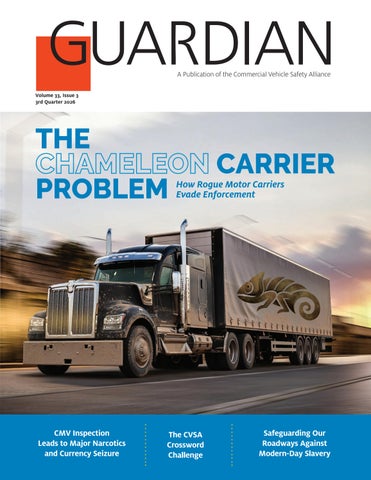
THE PROBLEM
CMV Inspection Leads to Major Narcotics and Currency Seizure
CARRIER
How Rogue Motor Carriers Evade Enforcement
The CVSA Crossword Challenge
Safeguarding Our Roadways Against Modern-Day Slavery
GUARDIAN Third Quarter Volume 33, Issue 3 www.cvsa.org
IN THIS ISSUE n Insight President’s Message ......................................................................................................1 Executive Director’s Message .................................................................................... 2 n Regional News NYSDOT Displays New Electric Pickup at Auto Show............................................. 4 Georgia Showcases Partnership-Driven Enforcement During Operation SafeDRIVE........................................................................................5 Florida Highway Patrol Updates......................................................................................6 Mississippi CTED Welcomes Two New Troopers Following Historic MDPS Cadet Class 70.....................................................................................................8 Achieving CVE Training Excellence in Texas..............................................................10 Virginia State Police Conduct Human Trafficking Awareness and Intermodal Chassis Project ...........................................................................................11 Hawaii Participates in International Roadcheck 2026............................................ 12 Updates from Mexico ....................................................................................................... 15
GUARDIAN A Publication of the Commercial Vehicle Safety Alliance
GUARDIAN “Guardian” is published quarterly by the Commercial Vehicle Safety Alliance with support from the Federal Motor Carrier Safety Administration. CVSA and FMCSA are dedicated to the government and industry working together to promote commercial motor vehicle safety on North American highways. Copyright 2026, CVSA. All rights reserved. No part of this issue may be reproduced without written permission from the publisher. For comments, suggestions or information, email communications@cvsa.org.
Commercial Vehicle Safety Alliance
@CVSA
n Local News CMV Inspection Leads to Major Narcotics and Currency Seizure.................. 19 Local Member Vice President Derek Malena Featured in International Roadcheck Video ........................................................................... 20 Remembering Sgt. Josh Boykin ................................................................................21 Austin Police Department Updates ........................................................................22 Albany Police Department and NYSDOT Aren’t Just Horsing Around...........24 n Cover Story The Chameleon Carrier Problem: How Rogue Motor Carriers Evade Enforcement...................................................................................................25 n CVSA Committee and Program News CVSA Visits the Canadian Senate and Parliament During Summer Board Meeting......................................................................................... 33 What's Taking Professional Drivers Even Before They Can Collect Social Security.............................................................................................34 A View from the Michigan Inspector’s Challenge...............................................36 Your Emotions Are a Choice: A Conversation with Professional Driver Ross Reynolds......................................................................38 n Inspector's Corner The CVSA Crossword Challenge ....................................................................................41 n Government News The Legislative and Regulatory Rundown ............................................................42 n From the Driver's Seat What National Truck Driver Appreciation Week Means to Professional Drivers ...................................................................................................... 43
CVSA is looking for interesting, relevant content for its quarterly magazine. We would be happy to consider your news, ideas, insights and articles on issues facing the commercial motor vehicle safety community for upcoming editions of “Guardian” magazine. The deadlines for upcoming editions are available at www.cvsa.org/guardianmagazine/deadlines-for-submissions. Questions? Please contact CVSA Writer-Editor Emily Moorhead at emily.moorhead@cvsa.org.
n Knowledge Matters Safeguarding Our Roadways Against Modern-Day Slavery: Human Trafficking Screening Tool for CMV Enforcement.......................... 44 Knowing What Moves .............................................................................................46 Truck Fires, Fuel Systems and the Aftertreatment Blind Spot: What We Can Do Better Together..................................................................... 47 n Industry Perspectives Western CMV Safety Summit to Spotlight Success Stories............................. 49 Driving Excellence: Industry Training Course Reinforces Safety and Regulatory Standards....................................................................... 49 Beyond Compliance: Strengthening Biohazard Transportation Safety Across North America Through CVSA Leadership.......................................... 50 The Fight Against Freight Fraud Requires More Than Enforcement.............52 Bringing About the Next Era of Rapid Decline (In a Good Way!)...................53 This material is based upon work supported by the Federal Motor Carrier Safety Administration under a grant/cooperative agreement/subaward. Any opinions, findings, conclusions or recommendations expressed in this publication are those of the authors and do not necessarily reflect the view of the Federal Motor Carrier Safety Administration and/or the U.S. Department of Transportation.
INSIGHT
PRESIDENT’S MESSAGE Reflecting on the Journey
By Maj. Erick McGuire, Commercial Vehicle Enforcement, Florida Highway Patrol As my tenure as your president comes to an end, I find myself looking through the windshield one last time, reflecting on a journey that has been deeply humbling, sometimes immensely challenging, but mostly overwhelmingly rewarding. Serving as president of CVSA has been a monumental privilege. It is an experience that constantly balances an urgent sense of responsibility with immense gratitude. Representing thousands of local, state, provincial, territorial and federal commercial motor vehicle safety officials and professionals across Canada, Mexico and the United States is an honor I do not take lightly. It has been a daily reminder that our collaborative decisions directly protect human lives on every highway across North America. Looking back, my deepest feeling is one of immense gratitude. No leader operates in a vacuum, and the successes of this past year belong entirely to our dedicated community. I am profoundly grateful to the CVSA headquarters staff, whose tireless work behind the scenes keeps our international engine running smoothly. I owe a massive debt of thanks to our passionate leaders of region/ local/associate memberships, committees and programs. They are the true workforce that drives our mission forward. I would like to thank my wife, Angela, for her unwavering support and sacrifice throughout my career. I would also like to thank my leadership and colleagues at the Florida Highway Patrol, who allowed me to dedicate the long weeks on the road necessary to fulfill this international role. Lastly, I would like to thank God for presenting this opportunity and giving me the strength to complete the journey. A core theme of my presidency has been recognizing that while enforcement is necessary, safety must be a permanent mindset. Roadside inspections, data collection and out-of-service criteria are vital tools, but our ultimate goal rises far above mere compliance metrics. Throughout my term, we have striven to foster a culture in which every motor carrier, driver and inspector views safety as a shared moral responsibility. This year, we made significant strides in translating raw data into actionable insights, helping our member jurisdictions strategically deploy resources to proactively prevent crashes. Central to achieving this vision is the critical role of high-quality training that CVSA continues to provide. Uniformity on our roadways is impossible without uniformity in
Left to right: Erick, daughters Amber and Ashlee, and his wife Angela.
our education. Our comprehensive training programs ensure that inspectors across North America possess the sharp, up-to-date skills necessary to identify critical safety hazards. By equipping our workforce with standardized, top-tier instructional resources, we empower them to perform their duties with absolute confidence and accuracy, which remains one of our most powerful tools for preventing commercial motor vehicle crashes. Navigating the rapidly shifting landscape of commercial transportation has also highlighted our need for organizational agility, particularly in fostering and integrating new technology. The deployment of advanced vehicle systems, automated driving features and evolving digital frameworks requires CVSA to remain forwardthinking. Over the past year, we have worked diligently to modernize our approach. A key highlight has been our continued progress with the Level VIII Electronic Inspection, which represents the future of data-driven enforcement. This commitment to innovation remains the foundation of the Alliance, and I am proud of how we have adapted to meet modern transportation challenges. Equally rewarding has been our focus on education, public awareness and human connection. Traveling across our member jurisdictions to engage directly with industry partners, hear the perspectives of professional truck and bus drivers, and stand alongside our roadside inspectors has been deeply moving. Programs like Operation Safe Driver, Brake Safety Week and our ongoing human trafficking
prevention initiatives remind us that our enforcement community is a powerful force for highway safety. These efforts prove that collaboration with industry and stakeholders, rather than conflict, is the most effective path to safer roads. As I prepare to pass the gavel and transition to the role of past president, I am filled with optimism for the future of CVSA. The leadership pipeline is robust, our membership is more engaged than ever and our mission remains clear. I am forever changed by the dedicated professionals I have served alongside, and I will remain committed to our collective vision: reducing commercial motor vehicle crashes, injuries and fatalities across North America. Thank you for the opportunity to serve as your CVSA president, and my sincere thanks to everyone who made this experience so meaningful. I look forward to continuing this journey and working alongside you all in the years ahead. Be safe and God bless! n
Thank you to my wife, Angela, for her unwavering support and sacrifice throughout my career. THIRD QUARTER 2026
1
INSIGHT
EXECUTIVE DIRECTOR’S MESSAGE The Importance of an Association Strategic Plan By Collin B. Mooney, MPA, CAE, Executive Director, Commercial Vehicle Safety Alliance
In today's rapidly changing environment, associations face increasing pressure to deliver value to members, remain financially sustainable, respond to emerging challenges, and maintain relevance within their industries or professions. Whether representing public safety professionals, commercial motor vehicle enforcement agencies, industry leaders or nonprofit organizations, associations must navigate complex issues while balancing the needs of diverse stakeholders. One of the most effective tools for accomplishing these objectives is a welldeveloped strategic plan. A strategic plan serves as the roadmap that guides an association's future. It establishes a clear vision, defines priorities, allocates resources effectively and provides measurable goals that help ensure long-term success. More than simply a document, a strategic plan is a framework for decision making that enables an association to remain focused on its mission while adapting to changing circumstances. One of the primary benefits of a strategic plan is that it creates organizational clarity. Associations often have numerous
2 GUARDIAN
programs, committees, initiatives and stakeholder interests competing for attention and resources. Without a strategic plan, organizations can easily become reactive, pursuing opportunities as they arise without evaluating whether they align with the association's core mission. A strategic plan helps leadership identify what is most important and provides guidance on where time, funding and effort should be invested. By establishing clear priorities, associations can avoid mission drift and ensure that every initiative supports their long-term objectives. Strategic planning also strengthens leadership and governance. An association board of directors is typically composed of elected or appointed volunteers who rotate through leadership positions over time. As board members change, maintaining continuity can be challenging. A strategic plan serves as a shared guide that transcends individual leadership terms and ensures consistency in organizational direction. New board members can quickly understand the association's priorities, while existing leaders can use the plan as a benchmark for evaluating progress and making informed decisions.
Another critical advantage of a strategic plan is improved member engagement and satisfaction. Members join associations because they expect value, whether through professional development, networking opportunities, advocacy, education, certifications or access to industry information. A strategic planning process often includes member surveys, focus groups and stakeholder feedback, allowing the association to better understand member needs and expectations. By incorporating this feedback into strategic goals, associations can develop programs and services that are relevant, meaningful and responsive. Members who see their concerns reflected in organizational priorities are more likely to remain engaged, participate in activities and renew their memberships. Financial stewardship is another area where strategic planning provides substantial benefits. Associations operate with finite resources and must make careful decisions regarding budgets, staffing, technology investments and program development. A strategic plan helps align financial resources with organizational priorities, ensuring that expenditures support the mission and desired
INSIGHT
MARK YOUR CALENDAR
outcomes. Rather than making decisions based solely on short-term considerations, leadership can evaluate investments through the lens of long-term strategic objectives. This disciplined approach improves financial sustainability and helps associations maximize their return on investment. In addition, a strategic plan enhances accountability throughout the organization. Effective plans include specific goals, measurable objectives, timelines and performance indicators. These elements allow boards, staff, committees and members to assess progress objectively. Regular reviews of strategic goals create opportunities to celebrate successes, identify challenges and make necessary adjustments. Accountability not only improves organizational performance but also builds trust among members, partners, sponsors and other stakeholders who expect responsible stewardship of resources and transparent decision-making. The strategic planning process itself can be just as valuable as the final document. Bringing together board members, staff, committee leaders and stakeholders to discuss the association's future encourages collaboration and shared ownership of organizational goals. These discussions often reveal emerging trends, potential risks and new opportunities that may not have been apparent previously. The process fosters alignment among leadership and creates a collective understanding of the association's mission, vision and priorities. When stakeholders contribute to the development of the plan, they are more likely to support and champion its implementation. Associations also operate in environments that are constantly evolving due to technological advancements, regulatory changes and shifting member expectations. A strategic plan helps organizations anticipate and prepare for these changes rather than simply react to them. Through environmental scanning and longrange thinking, associations can identify future challenges and position themselves to respond proactively. This forward-looking perspective is essential for maintaining relevance and ensuring continued organizational success.
often require sustained effort, coalition building and resource commitment over several years. A strategic plan helps identify advocacy objectives, establish priorities and coordinate activities that support the association's mission. By maintaining a clear strategic focus, associations can more effectively influence policy outcomes and represent the interests of their members. Furthermore, a strategic plan strengthens an association's credibility with external stakeholders, including government agencies, industry partners, sponsors, donors and potential members. Organizations that demonstrate a clear vision and well-defined objectives are often viewed as more professional, effective and trustworthy. Strategic plans communicate purpose and direction, helping stakeholders understand how the association intends to achieve its mission and create value.
2027 COHMED Conference
JANUARY 25-28, 2027 TAMPA, FLORIDA Presented by the Cooperative Hazardous Materials Enforcement Development (COHMED) Program, the COHMED Conference is a focused, one-of-a-kind event for individuals and organizations involved in the regulation, enforcement and safety of the transportation of hazardous materials and dangerous goods. Join us Jan. 25-28, 2027, in Tampa, Florida, for the COHMED Conference. To learn more, visit www.cvsa.org/events/ cohmed-conference. n
Ultimately, a strategic plan is essential because it transforms an association's vision into actionable goals. It provides direction during periods of uncertainty, promotes accountability, aligns resources with priorities and creates a foundation for sustainable growth. While the specific goals and objectives may evolve over time, the discipline of strategic planning ensures that an association remains focused on what matters most. In an increasingly competitive and complex environment, associations cannot afford to rely on good intentions alone. Success requires thoughtful planning, disciplined execution and a commitment to continuous improvement. A well-crafted strategic plan provides the structure necessary to achieve these outcomes, enabling associations to serve their members effectively, fulfill their mission, and remain strong and relevant for years to come. n
For associations involved in advocacy and public policy, strategic planning is particularly important. Legislative and regulatory priorities THIRD QUARTER 2026
3
REGIONAL NEWS
REGION I
NYSDOT Displays New Electric Pickup at Auto Show By Jonathan Nicastro, Director of Modal Safety and Security, New York State Department of Transportation
On April 7, the New York State Department of Transportation (NYSDOT) Motor Carrier Enforcement Unit displayed its new electric pickup truck at the New York International Auto Show. The show took place at the New York state capital and featured innovative electric vehicles and equipment. NYSDOT took this opportunity to set up an outreach table featuring anti-human trafficking materials provided by TAT (formerly Truckers Against Trafficking). There was strong public interest in the anti-trafficking material, and the truck got a few looks as well. n
REGIONAL MAP Region I Connecticut, Delaware, District of Columbia, Maine, Maryland, Massachusetts, New Hampshire, New Jersey, New York, Pennsylvania, Puerto Rico, Rhode Island, U.S. Virgin Islands and Vermont Region II Alabama, American Samoa, Arkansas, Florida, Georgia, Kentucky, Louisiana, Mississippi, North Carolina, Oklahoma, South Carolina, Tennessee, Texas, Virginia and West Virginia Region III Colorado, Illinois, Indiana, Iowa, Kansas, Michigan, Minnesota, Missouri, Nebraska, North Dakota, Northern Mariana Islands, Ohio, South Dakota and Wisconsin Region IV Alaska, Arizona, California, Guam, Hawaii, Idaho, Mexico, Montana, Nevada, New Mexico, Oregon, Utah, Washington and Wyoming Region V Alberta, British Columbia, Manitoba, New Brunswick, Newfoundland and Labrador, Northwest Territories, Nova Scotia, Nunavut, Ontario, Prince Edward Island, Quebec, Saskatchewan and Yukon
4 GUARDIAN
NYSDOT staff, from left to right: Jonathan Nicastro, NYSDOT Director of Modal Safety and Security; Lawerence Johnson, Supervising Commercial Vehicle Inspector; Rich Lindemann, Chief Commercial Vehicle Inspector; Carolyn Ryan, Assistant Commissioner of Sustainability; Fleet Manager Stephen Miklich; and Michael Flynn, Senior Advisor to the Assistant Commissioner.
REGIONAL NEWS
REGION II
Georgia Showcases Partnership-Driven Enforcement During Operation SafeDRIVE By Lt. Stephen Burnham, CVE Projects and Research, Commercial Vehicle Enforcement, Georgia Department of Public Safety The Georgia Department of Public Safety hosted Federal Motor Carrier Safety Administration (FMCSA) Administrator Derek Barrs during Operation SafeDRIVE in April. During his visit, Administrator Barrs joined Commercial Vehicle Enforcement (CVE) Commanding Officer Maj. Andrew Montgomery and Lt. Stephen Burnham for an aerial overview of enforcement operations. The flight provided a unique perspective of Georgia’s statewide CVE footprint and highlighted coordinated enforcement efforts across multiple CVE regions. Following the aerial tour, Administrator Barrs traveled to the Monroe County inspection stations, where he observed field operations firsthand. While on site, he worked alongside CVE officers conducting traffic stops and inspections. Administrator Barrs had the opportunity to see Georgia’s CVE K-9 program in action, an increasingly valuable tool in roadside enforcement and criminal interdiction. The visit also highlighted the importance of industry partnerships. Administrator Barrs was welcomed in Monroe County by Seth Millican, president of the Georgia Motor
Trucking Association. His presence highlighted the collaborative relationship between enforcement agencies and the motor carrier industry, reinforcing a shared commitment to improving roadway safety. Partnerships between Georgia DPS, FMCSA, CVSA and industry stakeholders are essential to maintaining a safe and efficient transportation system. These coordinated efforts not only enhance compliance and reduce risk on the roadways but also support the uninterrupted flow of commerce that drives Georgia’s economy. DPS also recognized the role of professional drivers and carriers who consistently prioritize safety. Their daily commitment contributes significantly to protecting the motoring public while strengthening supply chains and economic stability throughout the state and beyond.
enforcement strategies and strong partnerships with federal and industry stakeholders, Georgia CVE remains committed to reducing risk on the roadways, improving compliance, and ensuring the safe and efficient movement of commerce across the state. n OPERATION SAFEDRIVE RESULTS (Georgia) • Level I Inspections:
113
• Level II Inspections:
32
• Level III Inspections:
372
• Out-of-Service Drivers:
88
• Out-of-Service Vehicles:
51
• Moving Violation Inspections:
296
• English Language Proficiency Violations:
1
• Arrests:
3
(Drug Possession, Contraband Possession, DUI)
Through initiatives like Operation SafeDRIVE, Georgia continues to demonstrate a balanced approach to commercial vehicle enforcement: one that prioritizes safety while supporting industry. By focusing on high-impact
CVE traffic stop on I-75 south in Atlanta, Georgia, during the April SafeDRIVE wave.
Sgt. 1st Class Swain deploys a CVE K-9 during an interdiction stop. Administrator Barrs assisting with CVE on inspections. THIRD QUARTER 2026
5
REGIONAL NEWS
REGION II
Florida Highway Patrol Updates
By Sgt. Denise Meredith, Commercial Vehicle Enforcement, Florida Highway Patrol
FHP Conducts Large Truck and Bus Enforcement Course Over the past few months, Sgt. Denise Meredith has presented a large truck and bus enforcement course to more than 30 agencies across the state. Troopers assisted with hands-on details, and officers and deputies from these agencies were able to sign up for the Trucks 101 courses available on CVSA Learning at learning.cvsa.org. n
Participants at this training session held at Daytona International Speedway included members from the following Florida local police departments (PD) and sheriff’s offices (SO): Apopka PD, Bunnell PD, Casselberry PD, Edgewood, PD, Clermont PD, Eustis PD, Lake Mary PD, Maitland PD, Marion County SO, Ocoee PD, Orange County SO, Osceola SO, Oviedo PD, Palm Bay PD, Sanford PD, Seminole County SO, Sumter County SO, Titusville PD, West Melbourne PD, Winter Park PD and members from the Law Enforcement Liaison Program. Left to right: A St. Johns County (Florida) Sheriff's Office Deputy (left) and FHP Tpr. J Hattle (right) conduct an enforcement detail after the large truck and bus training.
Sgt. Denise Meredith instructs the large truck and bus training at St. Johns County (Florida) Sheriff’s Office with attendees from Jacksonville (Florida) Police Department.
6 GUARDIAN
REGIONAL NEWS
Sgt. Denise Meredith (second from the right) and Sgt. Tim May (third from the left) teach the large truck and bus enforcement course to the Marco Island (Florida) Police Department.
FHP Leads a Safety Outreach Event During an outreach event held on March 14 at the Dumpster Runner’s spring training session held in Trinity, Florida, Tpr. Kevin Nelms and Tpr. Walkens William shared with participants the importance of seat belts, load securement, medical certificates, commercial driver’s license requirements and more. n
Left to right: Tpr. Walkens William and Tpr. Kevin Nelms led an outreach event at the Dumpster Runner’s spring training session.
THIRD QUARTER 2026
7
REGIONAL NEWS
REGION II
Mississippi CTED Welcomes Two New Troopers Following Historic MDPS Cadet Class 70
By Master Sgt. Victor McCarty, Public Affairs, Commercial Transportation Enforcement Division, Mississippi Department of Public Safety The Mississippi Department of Public Safety's (MDPS) Commercial Transportation Enforcement Division (CTED) recently welcomed two new troopers following their successful graduation from MDPS Cadet Class 70. Tpr. Ana-Rials Beasley and Tpr. Jacob Makamson completed months of intensive law enforcement training at the Mississippi Law Enforcement Officers' Training Academy in Pearl, Mississippi. Their training included physical fitness, legal instruction, defensive tactics, firearms proficiency, emergency vehicle operations, active shooter response and other critical law enforcement skills required of MDPS officers. Cadet Class 70 marked a significant milestone for MDPS. For the first time in agency history, recruits from all six MDPS law enforcement divisions trained together under a unified academy model. The class included cadets from the Mississippi Highway Patrol, Mississippi Bureau of Investigation, Mississippi Bureau of Narcotics, Mississippi Capitol Police, Mississippi Office of Homeland Security and CTED. Left to right: Tpr. Ana-Rials Beasley and CTED Director Lt. Col. Matt Lott.
Left to right: Tpr. Ana-Rials Beasley and Tpr. Jacob Makamson.
8 GUARDIAN
REGIONAL NEWS
The academy's unified training approach establishes a common foundation of professionalism, discipline and public service for all MDPS law enforcement officers, while allowing graduates to receive specialized training within their respective divisions following completion of basic academy requirements. As newly commissioned CTED troopers, Beasley and Makamson will continue specialized commercial motor vehicle (CMV) enforcement training as they prepare to carry out CTED's mission of promoting highway safety through CMV inspections, size and weight enforcement, hazardous materials enforcement and crash reduction initiatives across Mississippi. CTED congratulates Tpr. Beasley and Tpr. Makamson on this significant achievement and looks forward to their service to the citizens and the commercial transportation industry of Mississippi. n
Left to right: Tpr. Jacob Makamson and CTED Director Lt. Col. Matt Lott.
The historic 70th cadet class of the Mississippi Department of Public Safety.
THIRD QUARTER 2026
9
REGIONAL NEWS
REGION II
Achieving CVE Training Excellence in Texas
By CVE Lt. Daniel A. Martinez, Motor Carrier Bureau, Texas Department of Public Safety Since its inception, the Texas Department of Public Safety (TXDPS) Motor Carrier Bureau Commercial Vehicle Enforcement (CVE) Training Unit has been tasked with the responsibility of administering training to all Texas Highway Patrol (THP) personnel who are newly hired in the CVE service, as well as those employees who transfer into CVE, to conduct inspections on commercial motor vehicles (CMVs). This consists of CVE troopers, THP troopers, non-commissioned CMV inspectors and compliance review personnel. Motor Carrier Safety Assistance Program (MCSAP) law enforcement agencies are also required to send their officers to attend training conducted by the CVE Training Unit for certification. The CVE Training Unit currently comprises a CVE captain, a CVE lieutenant, eight CVE training sergeants and four non-commissioned training and research specialists. Three noncommissioned training and research specialists are all prior CVE law enforcement officers, including one team member who was hired from an out-of-state agency and another who is a retired Texas MCSAP officer. There is also a CVE Training Unit administrative supervisor with administrative assistants. The instructors in the CVE Training Unit are all certified by CVSA to teach North American Standard Inspection courses. Of the 12 current instructors in the CVE Training Unit, five are master instructors. They evaluate new instructors so they may obtain their final instructor certification after completing the Instructor Certification Course. CVSA has also selected training unit members to serve on the Curriculum Advisory Team (CAT), responsible for rewriting and updating training manuals for various CVSA certification courses, alongside other instructors and CVSA representatives. The CVE Training Unit has successfully instructed many CMV inspectors and conducted compliance review certification courses since its creation in August 2002, as the License and Weight Service expanded and
10 GUARDIAN
later became known as the Commercial Vehicle Enforcement Service. These classes consist of North American Standard Parts A and B, Intrastate Part C, General Hazardous Materials, Cargo Tank, Other Bulk Packaging, Passenger Carrier Vehicle Inspection, Investigative Safety Analysis, New Entrant Safety Audit Workshop, Level VI Inspection and CVE Weight Enforcement/Scale Calibration. Additionally, the CVE Training Unit is tasked with conducting yearly CVE recertification, MCSAP recertification and the compliance review/safety audit in-service. Recertification requires CVE Training Unit instructors to travel to numerous locations across the state to ensure all CVE and MCSAP personnel receive inspection updates and CVE refreshers for certification maintenance. All courses have been conducted effectively and efficiently, reflecting the unit’s instructors’ commitment to delivering content with clarity and relying on their experience and subject matter expertise. When the oversight of certification training courses transitioned from the Federal Motor Carrier Safety Administration's National Training Center to CVSA in 2023, the CVE Training Unit was able to adapt with versatility and confidence. School bus rules and oversight of their operations are another integral part of the CVE Training Unit. A training and research specialist oversees the department's school bus program. This person review statutes, rules, the administrative code and federal regulations to stay current on any changes that require implementation into the current school bus operation guidelines. The school bus training specialist is regularly called upon to answer questions about school bus safety rules and explain regulations and state laws to school bus drivers, school district personnel and motor coach representatives. The training and research specialist serves as a CVE Training Unit ambassador at school district training and in-services, as well as at state and national school bus conferences. School bus training is also provided to all Texas-certified inspectors during Intrastate Part C training.
The CVE Training Unit is also responsible for coordinating the annual Texas Challenge, which selects the top CVE personnel and MCSAP officers to represent Texas at the CVSA North American Inspectors Championship (NAIC). A CVE Training Unit instructor is assigned as the director for the Texas Challenge, and this person assigns tasks to all members of the CVE Training Unit and motor carrier bureau staff. This is a large undertaking that often begins before the prior year's competition concludes and runs the entire calendar year. The staff's advanced knowledge of federal regulations allows team members to create challenging scenarios across all inspection disciplines. The CVE Training Unit staff spend countless hours reviewing scenarios and assignments to ensure competition elements run smoothly and on schedule, making the event an efficiently managed process. Industry partners are also included in the state competition, enhancing the department's partnership with motor carrier officials in pursuit of motor carrier safety and compliance. The tireless efforts of the CVE Training Unit in working with the Texas Challenge winner in preparation for NAIC have proven helpful. Representatives from Texas have won NAIC five times in the last eight years – in 2017, 2018, 2022, 2024 and 2025 – with NAIC Grand Champion wins by CVE troopers and MCSAP officers alike. The knowledge and unwavering commitment of the TXDPS CVE Training Unit provide those it trains with the tools necessary to be knowledgeable partners in public safety by applying and adhering to current administrative rules, state statutes and federal regulations. n
REGIONAL NEWS
REGION II
Virginia State Police Conduct Human Trafficking Awareness and Intermodal Chassis Project By Sgt. Robert Scarborough, Virginia State Police During the weeks of May 5-7 and May 12-14, the Virginia State Police (VSP) Motor Carrier Safety Unit conducted an intensive enforcement and outreach initiative at the Port of Virginia facilities. A team of 37 motor carrier troopers, two motor carrier sergeants and one motor carrier 1st sergeant focused on conducting CVSA North American Standard Inspections on intermodal chassis entering and exiting port locations throughout the Tidewater region. Over the course of the operation, VSP personnel completed 1,148 roadside inspections of intermodal carriers. These inspections identified 44 driver-related deficiencies, resulting in 14 drivers being placed out of service and prohibited from operating any commercial motor vehicle until the violations were resolved.
Sr. Tpr. Jared Martin.
Inspectors also documented 2,269 safety violations on intermodal equipment. As a result, 323 intermodal carriers were removed from service and restricted from traveling on Virginia’s highways until necessary corrective actions were taken. A significant component of this project was the emphasis on raising awareness of human trafficking. All 1,148 professional drivers received educational materials and outreach information designed to help them recognize, prevent and report potential indicators of human trafficking. This ensured every operator inspected during the initiative became better equipped to support prevention efforts within the transportation industry. n
Sr. Tpr. Adam Hawkins.
The Port of Virginia – Virginia International Gateway.
Master Tpr. Bryan Phipps.
Sr. Tpr. Louis Milyko. THIRD QUARTER 2026
11
REGIONAL NEWS
REGION IV
Hawaii Participates in International Roadcheck 2026 By Susan Chang, Motor Carrier Safety Manager, Hawaii Department of Transportation
The Hawaii Department of Transportation Motor Vehicle Safety Office works closely with the Federal Motor Carrier Safety Administration (FMCSA) Hawaii Division Office to conduct inspections and investigations to keep Hawaii’s roadways safe for everyone. This year, International Roadcheck was conducted on the islands of Oahu, Maui, Kauai and Hawaii. On Oahu, motor carrier safety officers and the FMCSA Hawaii division investigator participated together at the Sand Island Scale Facility. The officers also traveled to the islands of Kauai and Hawaii to conduct inspections. n
INTERNATIONAL ROADCHECK RESULTS (Hawaii) • Commercial Motor Vehicle Inspections . . . . . . . . . . . . . . . . . . . . . . . . . . . 83 • Out-Of-Service Vehicle Violations . . . 13 • Out-Of-Service Driver Violations. . . . . 5 • Safety Violations Detected . . . . . . . . 148 • Citations Issued For Out-Of-Service Violations. . . . . . . . . . . .10
Ofc. Gene Gabriel performs an inspection on Kauai.
Ofc. Christensen Empleo directs a professional driver during an inspection.
Standing left to right: Hawaii officers Jun Herrera, Danson Cappo, Brett Wong, Kenji Quinones; FMCSA Investigator Jason Okada; and Hawaii officer Sean Roberts. Kneeling left to right: Hawaii officers Christensen Empleo, Sean Prendergast and Gene Gabriel.
12 GUARDIAN
REGIONAL NEWS
Ofc. Brett Wong uses SafeSpect to enter an inspection.
Ofc. Danson Cappo checks for load securement.
Ofc. Jun Herrera talks with a professional driver.
THIRD QUARTER 2026
13
Professional Development with CVSA Learning Earn CEUs While You Learn
Advance your skills and support your professional development with training from CVSA Learning. Many CVSA-developed and approved in-person and virtual training courses qualify for continuing education units (CEUs), giving you credit for expanding your knowledge and expertise.
1 CEU = 1 hour
(60 minutes of instruction)
0.5 CEU = Minimum credit (30 minutes of instruction)
Training completion is verified through attendance records and participation tracking. Select the Learning tab in your CVSA member portal to access training content. Content will vary based on membership type.
portal.cvsa.org portal.cvsa.org
REGIONAL NEWS
REGION IV
UPDATES FROM
SICT Celebrates 135 Years Driving Connectivity, Development and Well-Being in Mexico On the 135th anniversary of the Ministry of Infrastructure, Communications and Transportation (SICT), the head of the agency, Jesús Esteva Medina, highlighted the institution's historical role as a driving force for connectivity, development and well-being for the country. During his commemorative message, he stated that SICT has been key to uniting destinations, bringing communities closer and transforming the lives of millions of people through infrastructure and communications. "Every great project begins with a thought, with a conviction that transforms into action; in that way are born the roads that connect regions, the works that drive development, and the decisions that give hope and well-being to the people of Mexico," Esteva Medina expressed. The agency was created on May 13, 1891, under the name of the Ministry of Communications and Public Works (SCOP). Since then, it has accompanied the country's main processes of transformation and modernization, establishing itself as a strategic institution for national development. Over time, it evolved into the Ministry of Communications and Transportation, and on Oct. 20, 2021, it adopted its current name as the Ministry of Infrastructure, Communications and Transportation.
promoted initiatives such as the Mega-Pothole Patch, Artisan Routes and Safe Pathways, in addition to resuming the construction of school campuses. SICT’s work in rebuilding roads and communities affected by natural phenomena is also notable. In his message, Esteva Medina emphasized, "The road not only takes us to a place but also transforms us; the road is the destination when each step represents progress, dialogue and shared hope. Finally, he recognized the legacy of those who have been part of the institution's history and called for continued efforts to build a future of development and transformation for Mexico. "May these 135 years continue to chart a course of cooperation, development and transformation for Mexico. Long live the Ministry of Infrastructure, Communications and Transportation," he concluded, thanking the work and the commitment of the agency's members. n
Continued on next page
Within the framework of the administration led by President of Mexico Claudia Sheinbaum Pardo, SICT has strengthened its commitment to social justice and the well-being of the population, especially those who need it most. As part of the Sectoral Program for Infrastructure, Communications and Transportation 2025-2030, the agency has continued work on priority road and rail infrastructure projects. Likewise, it has
THIRD QUARTER 2026
15
REGIONAL NEWS
Continued from page 15
DGAF Strengthens Coordination with REPUVE to Modernize Vehicle Control and Reinforce Road Safety The General Directorate of Federal Motor Transportation (DGAF), headed by Luis Ruiz Hernández, participated in the Presentation of the Strengthening Model of the Public Vehicle Registry (REPUVE) in Zacatecas, an initiative aimed at bringing together a more efficient system for vehicle control, registration and monitoring nationwide. During the event held at the Regional Security Unit (UNIRSE) in Trancoso, Zacatecas, Ruiz Hernández highlighted the importance of moving toward the standardization and linking of vehicle records between DGAF and REPUVE, aiming to achieve more accurate, reliable and up-to-date information. Ruiz Hernández pointed out that DGAF currently manages a registry of over 1.2 million active units circulating on more than 50,000 kilometers of federal highways. Of the total registered units, 75% correspond to cargo transportation, 10% to passenger and
tourist transportation, 8% to auxiliary services, and 7% to private transportation. He emphasized that one of the main achievements is establishing, through this action, a solid connection between federal vehicle registries and the REPUVE system, which will allow the consolidation of a comprehensive database to strengthen security and vehicle supervision. In this regard, he highlighted that institutional coordination will allow permit holders to standardize units; replace deteriorated, stolen or lost verification stickers; and update information related to owners, license plates and licenses, thereby providing greater legal and operational certainty.
illuminators capable of detecting vehicles at speeds of up to 250 kilometers per hour. The technological infrastructure enables the identification of inconsistencies in real time and the issuance of automatic alerts to the Control, Command, Communication, Computing and Intelligence Center (C5I), thereby strengthening efforts to prevent and combat vehicle theft. The protocol act included Zacatecas Governor David Monreal Ávila, REPUVE General Director Paola Aceves Sandoval, state and federal authorities, and representatives of public security institutions. n
The model implemented in Zacatecas features 113 highway surveillance stations equipped with radio-frequency identification technology, analytical cameras and night
In the center, pointing up: Head of DGAF Luis Ruiz Hernández, Governor of Zacatecas David Monreal Ávila, Head of REPUVE Paola Aceves Sandoval. Others pictured are state/federal officials and representatives of public safety agencies.
16 GUARDIAN
REGIONAL NEWS
Certification Strengthening the Safety of LPG Transportation in Mexico The transportation of liquefied petroleum gas (LPG) represents one of the most sensitive strategic activities for energy, operational and road safety in Mexico. In a context where the professionalization of motor transportation is becoming increasingly relevant for North America, SICT-DGAF is promoting a new stage of technical specialization for operators in the hydrocarbons sector. As part of this strategy, the implementation of the Competence Standard EC1731 "Operation of the fifth-wheel tractor and semi-trailer for LPG transport" is being promoted. This aligns with the Official Mexican Emergency Standards NOM-EM-006-ASEA-2025 and NOM-EM-007ASEA-2025, issued by the Agency for Safety, Energy and Environment. These provisions establish new parameters to strengthen industrial, operational and environmental safety in hydrocarbon
transportation, positioning operator training and certification as essential components for reducing risks and improving the quality of highway service. The certification, endorsed by the National Council for Standardization and Certification of Labor Competencies (CONOCER), seeks to ensure that operators possess the necessary technical skills for the safe driving of specialized fifth-wheel tractor units and semi-trailers transporting LPG, considering fundamental aspects such as: Safety in operation and maneuvers Loading and unloading protocols Emergency response Preventive driving and specialized
operation Regulatory compliance regarding
hydrocarbons and motor transport
In addition to contributing to regulatory compliance, this initiative represents an opportunity to enhance the competitiveness of Mexican motor transportation against the international standards currently prevailing in North American logistics chains. The professionalization of human capital in the transportation of hazardous materials not only protects the operators but also communities, road infrastructure and the environment. The reduction of incidents and road crashes depends largely on technical preparation and the certification of labor competencies. In this regard, the DGAF calls on permit holders, transportation companies and sector operators to actively participate in evaluation, training and certification processes, creating a safer, more efficient and specialized motor transportation model. n Continued on next page
LPG vehicle displaying Official Mexican Emergency Standards.
THIRD QUARTER 2026
17
REGIONAL NEWS
Continued from page 17
Mexico Strengthens Motor Carrier Oversight During International Roadcheck 2026 CVSA continues to establish itself as the primary mechanism for cooperation in North America to promote commercial motor vehicle (CMV) safety through coordinated inspection efforts, regulatory enforcement and the harmonization of technical standards among Canada, Mexico and the U.S. Through initiatives such as International Roadcheck, the Alliance promotes the strengthening of enforcement practices and the uniform application of standards aimed at preventing crashes and improving motor carrier operating conditions in the region. From May 12 to 14, CMV inspectors from the three countries participated in the International Roadcheck, conducting inspections of drivers, vehicles and cargo at weigh stations, inspection points and temporary checkpoints. During the operation, authorities applied the CVSA North American Standard Out-of-Service Criteria to verify compliance with current regulations and to detect conditions that could pose risks to road safety, paying special attention to cargo securement and compliance with provisions related to electronic service records. SICT participated through staff assigned to fixed weight and dimension inspection stations and passenger terminals, conducting inspections of vehicles belonging to the Federal Freight Motor Carrier Service and the Private Freight Motor Carrier Service, in accordance with Mexican Official Standard NOM-068-SCT-2-2014. The inspections included verification of components essential to the safe operation of the vehicles, such as braking systems, steering, suspension, lights, tires, chassis and other elements related to the vehicles' physical and mechanical safety. As a result of Mexico’s participation during the three-day operation, the following results were obtained nationwide: Inspections conducted: 1,304 Penalties imposed: 49 Vehicles impounded: 6
SICT’s participation in International Roadcheck 2026 reaffirms Mexico’s commitment to strengthening road safety, supervising federal motor transportation and maintaining ongoing technical collaboration with the authorities and agencies that comprise CVSA. n
18 GUARDIAN
LOCAL NEWS
CMV Inspection Leads to Major Narcotics and Currency Seizure By Kyle Jahns, Commercial Vehicle Enforcement Unit, St. Louis County (Missouri) Police Department
A commercial motor vehicle (CMV) safety inspection recently led to the disruption of a major interstate drug trafficking operation. While stationed along an interstate corridor, Ofc. James Barry with the St. Louis County (Missouri) Commercial Vehicle Enforcement Unit observed a passing CMV with a severe, audible air leak. Ofc. Barry initiated a stop to conduct a roadside safety inspection and subsequently confirmed the air leak, along with several other notable regulatory violations. Over the course of the inspection and driver interview, Ofc. Barry observed multiple indicators of criminal activity. Notably, the driver was unable to articulate what cargo the vehicle was transporting. This prompted a closer examination of the trailer's contents to verify the load against the transport documentation. Inside the trailer, Ofc. Barry identified a "dummy" pallet used to simulate a legitimate shipment, along with several boxes not accounted for on the shipping papers. Upon obtaining consent to search the cargo, Ofc. Barry discovered a large quantity of vacuumsealed narcotics. A subsequent, comprehensive search of the tractor's sleeper berth revealed more than $1 million in U.S. currency. The ongoing investigation indicates the currency was being transported back to the West Coast following multiple narcotics deliveries that were made while the driver and co-driver traveled east across the country with the fraudulent load. The St. Louis County Drug Unit was requested at the scene to assist. Through the coordinated efforts of both units, the driver and co-driver were taken into custody and face charges related to drug trafficking, with federal prosecution pending.
During the traffic stop, Ofc. Barry discovered a large quantity of narcotics and more than $1 million in U.S. currency.
To protect the integrity of the ongoing investigation, further specific details regarding this seizure are currently being withheld. n
THIRD QUARTER 2026
19
LOCAL NEWS
Local Member Vice President Derek Malena Featured in International Roadcheck Video
By Chris Vinson, Commercial Vehicle Enforcement, Midlothian (Texas) Police Department; CVSA Class II Local Member President CVSA Class II Local Member Vice President Ofc. Derek Malena of the Allen (Texas) Police Department honed his acting skills in the Texas Department of Public Safety’s (TXDPS) video for CVSA’s International Roadcheck. Ofc. Malena introduced CVSA, described International Roadcheck and its aims, and provided tips for passenger vehicles driving around large trucks. Also speaking in the video were TXDPS Inspector Daniel Shimaneck, Texas Highway Patrol (THP) Tpr. J. Rogers and THP Tpr. H. Brackens. For the enforcement event, TXDPS joined forces with the Texas Comptroller’s Office
and the following police departments: Allen, Alvarado, Arlington, Euless, Fort Worth, Frisco, Garland, Grand Prairie, Hurst, Irving, Lewisville, Mansfield, McKinney, Melissa, Midlothian and Princeton. They worked together to ensure that commercial motor vehicles (CMVs) met critical safety standards and regulations. Throughout the 72-hour enforcement initiative, troopers, officers and inspectors conducted detailed Level I Inspections focused on driver qualifications, hours of service, cargo securement and more. n
Allen PD Ofc. Derek Malena (left) and Allen PD Traffic Sgt. Matt Koehrsen (right).
20 GUARDIAN
2026 TXDPS INTERNATIONAL ROADCHECK STATISTICS: • CMVs inspected . . . . . . . . ............ 904 • Vehicles placed out of service ..... 155 • Drivers placed out of service ........ 17 • Citations issued . . . . . . . . .............. 63 • Warnings issued . . . . . . . . .......... 1,285 • Fugitive arrests . . . . . . . . . .............. 4
LOCAL NEWS
Remembering Sgt. Josh Boykin
By Sr. Cpl. Timothy Cordova, Accident Investigator/Commercial Vehicle Enforcement, Dallas (Texas) Police Department Sgt. Josh Boykin was a 20-year veteran of the Dallas (Texas) Police Department. Early in his career, Sgt. Boykin quickly realized his passion for traffic and traffic enforcement. He began with the department’s DWI unit and amassed over 600 DWI arrests over his career. In 2017, Sgt. Boykin was invited to attend the North American Standard Inspection Parts A, B and C courses. Sgt. Boykin successfully completed the training and began his career as a roadside inspector. He went on to become certified in weight enforcement, General Hazardous Materials Inspection and Cargo Tank Inspection. Sgt. Boykin loved to crawl under the truck, even welcoming the least favorite trucks, like a smelly garbage truck. Sgt. Boykin was a leader in the unit and had a wealth of knowledge. He was always willing to step in and provide guidance and
mentorship to both new officers and his peers. Sgt. Boykin became well known in the North Texas community, often attending training and working with inspectors from other agencies. He strongly believed in teaching the next generation and served as an adjunct instructor at the police academy, where he taught traffic law, collision investigation and standardized field sobriety testing. Sadly, On May 29, Sgt. Boykin passed away from injuries he sustained in an off-duty accident. Sgt. Boykin's dedication, leadership and especially his friendship will be greatly missed by all who knew him. Sgt Boykin was an exceptional commercial motor vehicle officer and a distinguished leader in the Dallas Police Department. His legacy will live on through the years, and his memory will be carried in the hearts of many. n
THIRD QUARTER 2026
21
LOCAL NEWS
Austin Police Department Updates
By Sgt. Doug Floyd, Commercial Vehicle Enforcement Coordinator, Austin (Texas) Police Department
Austin PD CVE Officers Respond to Train Derailment On April 23, the Austin (Texas) Police Department (PD) Commercial Vehicle Enforcement (CVE) Unit was called to assist with traffic control at a train derailment. The call originated at 4:41 a.m., and patrol officers responded and blocked three local intersections. CVE officers were called at 6 a.m. and responded to cover those locations. A short time later, the railroad personnel arrived with heavy equipment to begin cleaning up the wreckage. During the cleanup, railroad officials decided to move the damaged railcars from the site to a yard in San Antonio, Texas. CVE officers were blocking the road and noticed that the railroad officials were loading train cars onto a flatbed trailer, leaving about 18 feet of rear overhang. The cars were about 10.5 feet wide and 71 feet long. CVE officers approached the railroad personnel and explained they needed permits to move the load on the highway. By the time they had planned for the movement, the permit office was closed for the day. The train cars were still blocking the tracks and needed to be moved. CVE officers, the trucking company and railroad officials worked together to come up with a solution and were eventually able to get permits for the safe movement of the oversized loads. n
22 GUARDIAN
LOCAL NEWS
Austin PD CVE Participates in International Roadcheck On May 12, the Austin PD CVE teamed up for CVSA’s International Roadcheck with the following Texas agencies: Texas Department of Public Safety, Cedar Park PD, Travis County Sheriff's Office and Burnet County Sheriff's Office. The enforcement event was set up along Highway 130. Altogether, the team performed 61 Level I Inspections and found 164 violations, placing 24 trucks and five drivers out of service. n
THIRD QUARTER 2026
23
LOCAL NEWS
Albany Police Department and NYSDOT Aren’t Just Horsing Around In March, the Albany (New York) Police Department and the New York State Department of Transportation (NYSDOT) partnered for a coordinated commercial motor vehicle (CMV) enforcement detail, using an uncommon but highly effective tactic: mounted officers guiding CMVs safely into the inspection site. The mounted unit played a key operational role, using its elevated visibility and mobility to safely direct a steady flow of CMVs into the checkpoint. Its efforts kept the inspection lanes active throughout the day. The unit included Albany police officers Kurt Johnson, Joshua Fuchs and Kyle Parker.
A screenshot of video footage from the inspection event.
The inspection team conducted driver and vehicle inspections. The team included Albany Police Department traffic safety investigators Chris Carriero and Troy Zalatan, along with NYSDOT motor vehicle inspector Mark Miller. Thanks to the mounted officers’ ability to “shag” – or pull in – CMVs efficiently, all three inspectors remained fully engaged, conducting safety inspections for the duration of the detail. A round of applause goes out to Chris Carriero for orchestrating the events of the day. n Kyle Parker runs the speed lidar while on horseback.
The joint CMV inspector and mounted officer team.
24 GUARDIAN
COVER STORY
THE PROBLEM
In the April 12 episode of the news program "60 Minutes," Federal Motor Carrier Safety Administration (FMCSA) Administrator Derek Barrs exposed the general public to what those in commercial motor vehicle (CMV) enforcement and the motor carrier industry already know: Reincarnated carriers are a rampant issue affecting transportation safety across North American highways. These “chameleon carriers,” as they are also known, systematically exploit a series of loopholes that allow them to shed their unsafe and noncompliant performance records, evade responsibility and continue operating – with little to no consequences for their actions. Under the previous system, it was relatively easy for motor carriers to obtain operating authority and a USDOT number. So, when unsafe operators racked up serious safety violations – risking shutdown orders from FMCSA or a decrease in business from companies that don’t want to associate with
CARRIER
How Rogue Motor Carriers Evade Enforcement
unsafe carriers with poor reputations – they would dissolve and reappear under a new identity following the same old tricks. They would keep the same trucks, the same drivers, the same management and the same bad habits, only under a new, clean record. And after that new identity got ruined with bad safety decisions and out-of-service violations, they would rinse and repeat. This was the reality of the situation for several decades, with strategies becoming more sophisticated over time. But it seems the times may be changing. With new systems and new legislation, these loopholes are finally beginning to close. With coordinated effort among legislators, regulators, enforcement, industry partners, safety experts and other interested parties – and a helpful increase in public interest – we may soon hear the final buzzer on this shell game.
“The motoring public deserves to travel North American roads safely,” said CVSA Executive Director Collin Mooney. “And the vast majority of professional drivers and motor carriers – those who remain compliant and safety focused – deserve to be on a level playing field where all companies are held to the same standards.” In this article, we’ll explore the reincarnation scheme, discuss the history of chameleon carriers, look at current legislation and new safety programs, review some pertinent case studies, and examine what enforcement can do at roadside and during an investigation. Please note that these issues are constantly evolving, and while we will discuss general trends, there’s no telling what will come next. The chameleon carrier issue is serious and complex, but we’re starting to see progress in this area toward a safety-focused future. Continued on next page
THIRD QUARTER 2026
25
COVER STORY
Continued from page 25
Checklist for Motor Carriers Audit Your FMCSA Portal: Is your FMCSA Portal account active? Is Login.gov tied to the correct
internal email? Is your listed company official a
single person who is responsible for ensuring all FMCSA Portal accounts for USDOT number company users are current and accurate? Have you removed former
employees or third-party access?
Red Flags to Fix:
Outside providers listed as company officials
Old email addresses tied to registration control
No clear internal registration owner
Scan to read the full transcript of the 60 Minutes episode.
The Reincarnation Scheme Under the previous series of systems in the U.S., there was a typical path that chameleon carriers would follow to take advantage of several loopholes. STEP 1:
Get Operating Authority and a USDOT Number
Obtaining operating authority and a USDOT number takes approximately a month and costs around $1,300 total. You need to file some paperwork, get a process agent and obtain insurance, likely the instant approval option with the least vetting and oversight. Under the previous system, it was unlikely that anyone would come to verify these requirements, at least not at the start. FMCSA’s new entrant safety audit doesn’t occur until a year into operation. Between 2020 and 2021, there was an 84% increase in granted operating authority applications.
professional drivers in America were not born here – and the overwhelming majority of them are safe, hardworking professionals who keep supply chains moving. But when a person is unfamiliar with language and cultural customs, trying to send money back home to family, worried about their legal work or immigration status, and/or threatened by their bosses, they’re more susceptible to becoming victims of these schemes. Those with criminal records: Professional
driving is one of a few occupations where a felony conviction doesn’t immediately disqualify you. Many formerly incarcerated individuals have safe, successful careers as truckers. However, chameleon carriers often target those with criminal records because people with limited options accept worse terms, lower pay and conditions that others wouldn’t accept. Low-skill drivers: This is where bad-actor
STEP 2:
Rent the Equipment – Or Lease It to Drivers
Renting is key here. Buying a new truck costs upwards of $200,000. Without capital or credit, you can’t build a fleet. And besides, why build assets that may be seized if it all goes south? So, perhaps you’ll lease your fleet. With as little as $1,000 down, you’re on the road. Or, if you already have an established business, you might obtain your trucks through whatever financing may be available to you and lease them to your drivers under a rent-to-own program – forcing them into a contract with high interest rates. Drivers' purchase installments are taken from their weekly paychecks, and the threat looms over their heads that if they lose their job, they lose their truck. If you want to read more about the rent-to-own scheme, which is often tied to labor trafficking, check out the fourth quarter 2025 “Guardian” cover article. STEP 3:
Source the Labor For these tactics to make you the most money, you don’t want experienced, qualified commercial driver’s license (CDL) holders. Their salaries are a little too pricey, and they’ll walk away when you pull out a manipulative equipment leasing contract or other red-flag tactics. You want those who are desperate for a job and will take any opportunity that comes their way. Those individuals generally fall into one (or more) of three categories.
26 GUARDIAN
Foreign nationals: Almost 19% of
CDL schools enter the picture. A chameleon carrier may operate their own CDL school or partner with one. Then the carrier hires recent graduates, leases them a truck and sends them on their way – with minimal training. The driver has no experience, no frame of reference for normal/safe motor carrier operations, a truck or bus lease to fulfill and a sense of “Well, at least I have a job.” STEP 4:
Do It All Over Again Every aspect of this scheme is designed to be easily and cheaply repeatable, while maximizing cash flow and minimizing risk. And when you’ve rung up too many violations, you simply switch to a new operating authority and USDOT number. According to the U.S. Government Accountability Office (GAO), reincarnated carriers are three times more likely to be involved in serious crashes than legitimate new entrants. From 2005 to 2010, 18% of carriers with chameleon attributes were involved in severe crashes, compared to just 6% of those without red flags. Some experts claim that anywhere from 10-20% of U.S. passenger carriers and trucking companies are chameleon carriers.
COVER STORY
3× MORE LIKELY
A chameleon carrier is easy to identify after the fact: A company with a poor safety history changes its name, shifts its structure, moves jurisdictions or reappears under a related identity. The more difficult question is whether the safety system can see the pattern before the next roadside inspection, audit or crash investigation.
Reincarnated carriers are three times more likely to be involved in serious crashes than legitimate new entrants.
THE HISTORY OF CHAMELEON CARRIERS ○␣
○␣
○␣
1970s-1980s: The Motor Carrier Act of 1980 was the culmination of a period of motor carrier deregulation spanning two decades and three presidencies. The act included a sweeping reduction in price controls, entry controls and collective vendor price-setting. Lower barriers to entry made it easier to register new corporate entities and acquire operating authority. EARLY 2000s: Motor carrier reincarnation gained heightened government scrutiny following several fatal highway crashes caused by severe negligence. Federal investigators discovered that the at-fault carriers had previously been shut down for safety violations but had simply rebranded to stay on the road. 2008-2012: Over the course of four years, the U.S. GAO planned, implemented and analyzed a study of operating authority applicants. Between 2005 and 2010, the number of carriers with chameleon attributes increased from 759 to 1,136. Additionally, the report concluded that while FMCSA had a formal vetting program, it applied almost exclusively to passenger carriers and household-goods movers. Freight carriers – representing 98% of new applicants – were largely unexamined. The report recommended expanding the vetting program through a data-driven approach, leading to the Application Review and Chameleon Identification (ARCHI) Program, which began in 2012.
○␣
JULY 6, 2012: Congress passed the Moving Ahead for Progress in the 21st Century Act, giving FMCSA broader statutory authority to track down and revoke reincarnated operators.
○␣
2014: FMCSA issued the Patterns of Safety Violations final rule, allowing the agency to shut down entire networks of motor carriers if a clear pattern of safety violations and structural replication was proven.
○␣
2016: FMCSA provided the ARCHI Program report to Congress. The program’s algorithm was said to automatically screen new applicants for shared matching data, such as vehicle identification numbers, addresses, phone numbers and officer names, but the program faced scrutiny over its effectiveness.
○␣
2020-2023: The boom in e-commerce and logistics during and after the COVID-19 pandemic caused a massive spike in new carrier registrations. Bad actors exploited the strain on regulatory infrastructure, scaling their operations into large rings that simultaneously operated dozens of burner USDOT numbers. While before this, most chameleon carriers were simply one business rebranding into another, this era brought about a higher rate of the highprofile scheme described above and in the 60 Minutes report.
○␣
APRIL 12, 2026: CBS News broadcasted an investigative report on 60 Minutes titled "Risk on the Road," bringing the issue to the public’s attention. The report exposed complex, multi-million-dollar international networks that illegally override truck drivers’ hours-of-service limits using remote apps and swap motor carrier names on trucks with duct tape and paper signs.
○␣
MAY 19, 2026: FMCSA launched Motus, the U.S. Department of Transportation’s new registration system. What Motus Aims to Do: Verify carrier information in real time Guide applicants to the correct
registration forms Cross-check identity and business
details Flag inconsistencies Increase transparency across systems Prevent bad actors from:
• Recycling identities • Creating shell companies • Re-entering the system undetected
The full report, Motor Carrier Safety: New Applicant Reviews Should Expand to Identify Freight Carriers Evading Detection, is available here: www.gao.gov/products/gao-12-364. Continued on next page
THIRD QUARTER 2026
27
COVER STORY
Continued from page 27
Motus: The New Registration System
Current U.S. Legislation
On May 19, FMCSA announced Motus, the new registration system for truck drivers, school bus operators and other motor carriers. The system gets its name from the Latin word for "movement," "motion" or "progress," and FMCSA says Motus will simplify the registration process, streamline identification, improve the user experience and incorporate enhanced verification tools. Motus satisfies the statutory mandate for a unified registration system (URS). FMCSA is in the process of sunsetting the current URS used for new applications for USDOT numbers and operating authority, registration components of the Motor Carrier Management Information System, and the former Interstate Commerce Commission Licensing and Insurance system, which was established in 1994. FMCSA says Motus “replaces a decades-old network of loosely connected applications rife with fraud, waste and abuse.”
The Building Unrivaled Infrastructure and Long-term Development for America’s 250th Act (BUILD America 250 Act), as amended, includes a provision regarding chameleon carriers. First, the legislation directs U.S. GAO to conduct a study that examines chameleon carriers on the nation’s roadways. The study will include:
Motus uses biometrics and modern data analytics to verify that those who apply for these numbers are who they say they are, and that the businesses they represent are legitimate, legal entities. Prior to Motus, it was incredibly simple to register as a motor carrier. And because the system comprised a framework of five or six disconnected applications, it was vulnerable to fraud at each point of data sharing. This led to data sprawl, information silos and blind spots. These circumstances allowed fraudulent companies to easily shed their negative safety records, create new corporate identities and evade federal oversight. Motus is a single, secure digital dashboard. It incorporates mandatory identity verification protocols (utilizing government-issued IDs and digital facial scans) and third-party business validation. FMCSA says the online process is simplified and will shorten processing times for motor carriers. The agency also says that law enforcement jurisdictions will benefit from increased accuracy and accessibility of registration data and FMCSA will use the enhanced data to identify unsafe operators and strengthen oversight of high-risk carriers.
With Margaret Edwards-Velasquez, CVSA Manager of Government Affairs The bill provides the following definition for a chameleon carrier: …the term ‘‘chameleon carrier” means a motor carrier, intermodal equipment provider, broker or freight forwarder, or an officer, employee, agent, authorized representative or other affiliated party of such an entity, that has, directly or indirectly, operated or attempted to operate a motor carrier, intermodal equipment provider, broker or freight forwarder under a new identity or as an affiliated entity to:
• The estimated number of chameleon carriers on roadways • The prevalence of chameleon carriers since the issuance of the 2012 U.S. GAO report titled “Motor Carrier Safety: New Applicant Reviews Should Expand to Identify Freight Carriers Evading Detection”
• Avoid complying with a Federal Motor Carrier Safety Administration order • Avoid complying with a statutory or regulatory requirement
• The estimated number of fatalities and bodily injuries and the amount of property damage caused by chameleon carriers since the 2012 U.S. GAO report
• Avoid paying a civil penalty • Avoid responding to an enforcement action
The study will also identify and analyze the methods/techniques used by chameleon carriers to evade law enforcement agencies, as well as FMCSA’s current monitoring and enforcement capabilities for detecting them.
• Avoid being linked with a negative compliance history • Avoid or evade increased insurance premiums, policy cancellations or underwriting restrictions by obtaining or attempting to obtain insurance coverage under a new or materially different identity, ownership structure or corporate form
Additionally, the legislation directs FMCSA to develop, test and implement an advanced automation tool to detect chameleon carrier applications during the USDOT number registration process. Specific capabilities of the advanced automation tool should include the ability to detect and compile evidence of chameleon carrier-like characteristics, monitor lapses in insurance coverage and provide information to determine whether an applicant should be granted a USDOT number. The BUILD America 250 Act also establishes an appeals process for requesting a review when the advanced automation tool denies a registrant a USDOT number.
• Misrepresent ownership, control, management or operational continuity to an insurer, broker or underwriter for the purpose of securing lower insurance rates or favorable coverage terms • Reincorporate, re-register or otherwise reconstitute a carrier entity following the denial, nonrenewal or cancellation of an insurance policy due to safety, claims or compliance history
WHERE THE LEGISLATION STANDS As of Aug. 6
○␣
Committee Approved
House of Representatives
○␣
Senate
This provision was added to the BUILD America 250 Act as an amendment, and the U.S. House of Representatives Transportation and Infrastructure Committee approved the entire legislation (including the amendment). The legislative text is awaiting approval by the full House of Representatives. In addition, the U.S. Senate has not yet begun its work on surface transportation reauthorization, which can include introducing its own version of the legislation or using the version passed by the House of Representatives as a starting point.
28 GUARDIAN
COVER STORY
CHAMELEON CARRIER CASE STUDIES CASE 1: Jan. 2, 2008 | Victoria, Texas
On Jan. 2, 2008, in Victoria, Texas, a full 47-passenger motorcoach was proceeding northbound on U.S. 59 when the motorcoach driver partially drifted off the roadway. The driver oversteered to avoid leaving the roadway, causing the motorcoach to cross back across both lanes, depart the roadway and partially enter an earthen median. The driver oversteered again in an attempt to reenter the roadway and then overcorrected once more. As a result of the final oversteer, the motorcoach yawed to the left, rotated counterclockwise and overturned onto its right side. The motorcoach struck a guardrail and slid onto its side for 112 feet before coming to rest across the road. Within five minutes, and before emergency responders arrived on scene, a pickup truck also traveling northbound on U.S. 59 struck the underside of the motorcoach.
As a result of the initial motorcoach rollover, one passenger was fatally injured, and 46 passengers and the driver received injuries ranging from minor to serious. The driver of the pickup truck sustained minor injuries when the pickup truck struck the undercarriage of the motorcoach. The National Transportation Safety Board (NTSB) concluded that the crash occurred because the driver fell asleep at the wheel. The report also identifies the motorcoach company as a reincarnated carrier that avoided unsatisfactory authority ratings/imminent hazard orders through a lease scheme with a related company. There may also have been several other related companies.
1
46
Fatality
Injured
Scan to download full report.
CASE 2: March 26, 2010 | Munfordville, Kentucky
On March 26, 2010, near Munfordville, Kentucky, a truck-tractor semitrailer was traveling south on I-65 when it departed the left lane and entered the 60-foot-wide depressed earthen median between the southbound and northbound roadways. The truck traveled across the median and struck and overrode the high-tension median cable barrier adjacent to the left shoulder of northbound I-65. It then crossed the shoulder and entered the lanes of northbound I-65. A 15-passenger van containing 12 occupants was traveling northbound in the left lane. As the truck crossed in front of the van, the van struck its tractor.
In the resulting crash and truck fire that ensued, the truck driver, van driver and nine van passengers died. Two child passengers in the van, who were using child restraints, sustained minor injuries. NTSB made 15 recommendations related to this crash. In the report, the motor carrier is identified as a probable chameleon carrier that shed its reputation in response to this deadly crash by engaging in a “gentleman’s agreement” with another carrier, using that carrier's operating authority while retaining its original drivers and management. The motor carrier was fined $13,950 and, in 2011, obtained a satisfactory rating on a follow-up compliance review.
11
2
Fatalities
Children Survived
Scan to download full report.
CASE 3: Jan. 28, 2023 | Louisville, New York
On Jan. 28, 2023, in Louisville, New York, at about 6 a.m., a bus was traveling west on New York State Route (SR) 37 at a speed of 53-54 mph. The bus was transporting 14 workers to a solar farm construction site. At the same time, a box truck was traveling east on SR-37 at about 59 mph. SR-37 is a two-lane roadway with one lane in each direction and a posted speed limit of 55 mph. The roadway was wet, and there was light snow in the area. As the two vehicles approached each other, the truck crossed over the highway centerline and collided with the driver’s side of the bus. As a result, six bus passengers died in the crash, two were seriously injured, five had minor injuries and one was uninjured. The bus driver sustained minor injuries, and the truck driver was seriously injured.
NTSB said the probable cause of the crash was the truck driver’s fatigue due to insufficient sleep and circadian disruption. Also contributing to the crash was the failure of the truck motor carrier to effectively manage driver fatigue and monitor unsafe driving, and the failure of the bus motor carrier to operate in compliance with Federal Motor Carrier Safety Regulations and a federal out-of-service order. Additionally, the ineffective oversight of the bus company during the New Entrant Safety Assurance Program and subsequent compliance reviews to ensure the carrier had appropriate safety management controls in place to mitigate its high crash rate and driver fatigue was a contributing factor. NTSB also determined the company that employed the truck driver was a chameleon carrier that was a continuation of another company, and the now-bankrupt company was using the new company to mask its poor safety rating. NTSB noted the number of drivers and power units – 60 employees and 59 trucks – was particularly high for a new carrier, which should have been a red flag during the company’s newentrant process.
6
Fatalities
Multiple Injuries
Scan to download full report.
Continued on next page
THIRD QUARTER 2026
29
COVER STORY
Continued from page 29
Red Flags for Chameleon Carriers with Katie Morton Director of Compliance Programs
DURING ROADSIDE INSPECTIONS
LACK OF BRANDING: Reincarnated carriers may use trucks without any noticeable branding, making it easier to quickly camouflage as a different carrier.
OBSCURED OR ALTERED USDOT NUMBERS: Numbers are painted over, taped on or displayed on magnetic signs that can be swapped out.
MISMATCHED VEHICLE/ TRAILER VINS: Does the vehicle identification number (VIN) match the current motor carrier’s registration?
HABITUAL LOG INCONSISTENCIES: Look for ELD manipulation or a recent shift from another fleet. Does the driver’s ELD data indicate operational continuity while the paperwork shows a brandnew carrier?
ASK QUESTIONS: During your conversation with the driver, ask who they work for and listen closely. Chameleon operators may share the same drivers, dispatchers and operating lanes across a ring of different "burner" USDOT numbers.
Canada’s Chameleon Carrier Problem: Seeing Past the Name on the Door Canada’s commercial transportation sector is facing a carrier-identity problem that will sound familiar to U.S. enforcement agencies: When an operator with a poor safety history changes names, structures, jurisdictions or related entities, does the safety system still see the risk? That issue has moved quickly from industry concern to national safety priority. The Canadian version of the chameleon carrier problem is shaped by Canada’s federal/provincial/territorial safety framework. Provinces and territories administer Safety Fitness Certificates, maintain carrier profiles, apply ratings and exchange safety information through national systems. Those tools are effective only if the right information follows the operation – not just the company name. Recent public reporting following a fatal collision near Brandon, Manitoba, showed why the issue matters. According to the Winnipeg Free Press and the Brandon Sun, the carrier involved in the crash had its Manitoba Safety Fitness Certificate revoked in 2021. It later continued operating in Manitoba under an Alberta certificate and adjusted company name. A driver was charged with dangerous driving causing death. The investigation and court process must be respected, but the policy question is immediate: How do jurisdictions ensure a carrier’s safety history cannot be outrun by new paperwork? That question was already on the national table at the Canadian Council of Motor Transport Administrators (CCMTA) annual meeting in Fredericton, New Brunswick. The discussion there was not simply about one province, one crash or one bad actor. It was about the structure of commercial carrier safety oversight: carrier profiles, Safety Fitness Certificate entry controls, facility audits, carrier data exchange, Driver Inc. (misclassification of driver employees as independent contractors), training quality, ELD integrity, corporate linkage and national consistency. The key Canadian development is the modernization of National Safety Code (NSC) Standards 7, 14 and 15. NSC 7 supports carrier and driver profiles. NSC 14 supports safety ratings and the Safety Fitness Certificate process. NSC 15 supports facility audits. Together, they form the practical backbone of how a carrier enters the system, how its safety record is monitored and how its compliance system is tested. “A carrier should not be able to outrun its safety history by changing the name on the door or the province on the paperwork. NSC modernization and better carrier data exchange are about making sure the system sees the risk pattern, not just the latest corporate label,” said Andrew Barnes, senior advisor of government relations and compliance at the Alberta Motor Transport Association (AMTA). “Road safety starts before the truck reaches the scale,” added AMTA President Robert Harper. “It starts with knowing who is operating, who is controlling the business and whether the safety history is real.” For chameleon carriers, those standards matter because the risk is often hidden in the links: shared ownership, common addresses, related businesses, equipment movement, prior sanctions, insurance changes, ELD practices, driver arrangements and management control. A modern safety system has to see those links. A company can change its name. The safety history should not disappear with it.
Want to Learn More?
Get Certified in NESA and ISA. Enforcement members: If this topic interests you and you’d like to pursue careerenhancing certifications, attend a New Entrant Safety Audit (NESA), NESA Workshop and/or Investigative Safety Analysis (ISA) course. Find an upcoming course on the CVSA website at www.cvsa.org/certification-training.
30 GUARDIAN
COVER STORY
How Mexico Combats Chameleon Carriers So called “chameleon” carriers – legal entities that dissolve and reappear under a new corporate name to evade sanctions, a record of violations or liabilities arising from crashes – pose a risk to safety and traceability in the motor carrier industry. In Mexico, the official response is implemented through administrative controls, unique registries for companies and vehicles, and interagency coordination designed to close avenues for fraudulent re-registration and vehicle identity cloning. Key controls include the following: • Documentary controls and permit requirements for motor carrier authorization The Directorship General of Federal Motor Carrier Transportation (DGAF) of the Secretariat of Infrastructure, Communications and Transportation (SICT) validates a carrier’s legal existence and suitability before issuing federal permits (freight, passenger or tourism). The review includes corporate formation with a transportation oriented corporate purpose, shareholder nationality clauses, tax registration with the Tax Administration Service (SAT), proof of address and other requirements that make it harder to create shell companies linked to international criminal networks. • Unique vehicle registration A core control is registration of the VIN in the Federal Motor Transport authorizations and permits system; a vehicle cannot be registered simultaneously to two permit holders. To transfer a vehicle to another permit, it must first be deregistered from the originating company. This mechanism prevents the erasure of violation histories or the “moving” of fleets with prior records to new corporate registrations. • Insurance and authorizations Vehicles must carry liability insurance (and passenger insurance for passenger and tourism services) to be admitted under a permit. The inability to pay premiums after major claims can force a company to cease operations voluntarily, but registration controls reduce fraudulent reuse of units. • Inspection and oversight In 2025, 45,475 physical mechanical inspections and 4,696 company inspections were carried out by DGAF and the National Guard – the latter empowered to issue citations and respond to crashes on federal highways. Integration of National Guard and DGAF databases to build carrier performance histories is critical; when operational, it enables targeted inspections, enforcement actions and the detection of cloning or corporate reappearance patterns.
Cloning and “Pirate” Carriers The National Chamber of Freight Transportation (CANACAR) has documented vehicle cloning: Vehicles that imitate the image or identity of established carriers to commit crimes. There are also “pirate” operators without SICT permits. Addressing these phenomena requires route surveillance, permit verification, VIN cross-checks and real-time validation of insurance policies.
Red Flags for Chameleon Carriers, continued
DURING INVESTIGATIONS When Comparing Multiple Businesses:
Do both companies have the same address and phone number?
Do both companies have an
overlapping list of employees? Do they have the same
supervisory personnel? Do they have continuity of
general business operation? Are there prior compliance
investigations and safety audits? When they answer the phone,
what company name does the representative use?
Helpful Paperwork:
Articles of incorporation
Records of duty status
International Fuel Tax Agreement reports
Roadside inspections
Maintenance records and receipts
Employment applications and other driver files
Drug and alcohol testing and documents policy
Challenges and Opportunities The sector comprises some 38,500 freight companies (784,904 vehicles registered to legal entities) and a significant vehicle leasing market. Sector heterogeneity, together with a lack of consolidated public, real time statistics on violations, limits proactive detection. Improving data sharing among the National Guard, DGAF and SAT, expanding inspection capacity, and deploying automated cross checks of VINs and insurance histories are priority measures to keep chameleon carriers in check.
Continued on next page
THIRD QUARTER 2026
31
COVER STORY
Continued from page 31
CVSA Reauthorization Policy Highlights Minimum Qualifications for Entry as a Motor Carrier CVSA supports the creation of minimum qualification standards for entry as a motor carrier. With the minimum qualification standards in place, motor carriers would be required to demonstrate they understand the rules they’re obligated to follow and are capable of meeting safety expectations, ultimately improving overall safety in the motor carrier community. The minimum qualifications could reduce instances of fraud within the registration system by creating a barrier with the demonstration of qualifications in which a reincarnated carrier looking to register a new USDOT number would be deterred from abusing the registration system. Improvements to the New Entrant Safety Audit Program The Alliance supports changes to the New Entrant Safety Audit Program to return the focus to motor carrier education. Education is a critical part of the new entrant safety audit and ensures motor carriers have the necessary tools at the beginning of their operations to operate safely in interstate commerce. Improving the new entrant safety audit can also lead to a more efficient and effective program. By having a more effective New Entrant Safety Audit Program, auditors can more easily identify motor carriers that are engaging in fraudulent activities.
Where Do We Go from Here? Between federal priorities, industry focus, increased public awareness and an all-encompassing focus on safety, it’s clear there’s change coming for motor carriers that choose to use reincarnation tactics. Here’s what we can expect over the next months and years during the fight against chameleon carriers. Stricter federal oversight: Efforts will continue in alignment with the introduction of Motus
and FMCSA’s commitment to adding more investigators. Verification tactics: FMCSA will continue to unmask “ghost offices” by restoring enforcement
of the principal place of business requirement to ensure carriers have real physical operations rather than fake or unverified addresses. Congressional legislation: Bills such as the BUILD America 250 Act will include anti-chameleon
carrier provisions, including tightening registration rules, improving data sharing between agencies, bolstering enforcement and investigative programs, and increasing penalties for motor carrier fraud. Increased industry focus: Motor carriers who operate in good faith will continue to protect
compliant professional drivers. Associations will keep speaking out against reincarnated carriers and help in the fight toward safer roads and a fair chance for all. Industry may tighten its vetting processes for selecting motor carriers for transport. Insurance companies may make changes to their programs. Public attention: This issue will become more widely known with the general public, and
the spotlight may help direct focus and resources toward solving the problem of chameleon carriers. Safety reputations are earned over time, not made anew overnight. Chameleon carriers are a serious safety concern on North American roadways. While this problem isn’t new, it has become more sophisticated and all-encompassing over time, and the issue is approaching a turning point. When motor carriers use reincarnation tactics, they put their drivers, enforcement personnel and the motoring public at risk. Everyone deserves safety on our roadways. Many cooperative parties and listening ears agree: It’s time this reincarnation scheme comes to an end, for good. n
For additional information on CVSA’s reauthorization priorities, go to www.cvsa.org/policy/reauthorization.
Safety reputations are earned over time, not made anew overnight. 32 GUARDIAN
CVSA COMMITTEE AND PROGRAM NEWS
CVSA Visits the Canadian Senate and Parliament During Summer Board Meeting During the CVSA Board of Directors meeting June 16-17, CVSA leadership and staff learned more about the Canadian legislative process during visits to the Canadian Senate and Parliament in Ottawa, Ontario. On June 16, the CVSA Board of Directors was recognized in the Senate of Canada by Sen. Leo Housakos, leader of the opposition in the Senate. CVSA leadership and staff also toured the iconic Senate of Canada building and observed the Senate session from the gallery. Senators, members of parliament (MPs) and staffers joined CVSA representatives for an event, hosted by Sen. Housakos, that included remarks from Sen. Housakos and MP Tim Louis, parliamentary secretary to the minister responsible for Canada-U.S. trade. Other notable attendees included Sen. Mohammad Khair Al Zaibak, Sen. Robert Black, Sen. Peter Boehm, Sen. Claude Carignan, Sen. Rosa Galvez, Sen. Michael MacDonald, Sen. Julie Miville-Dechêne, Sen. Mary Robinson, Sen. Krista Ross, Sen. Scott Tannas and MP Andréanne Larouche.
MP Tim Lewis.
Sen. Leo Housakos.
The next day, CVSA leadership and staff attended a question period on Parliament Hill. CVSA members witnessed the question period in the House of Commons, in which the government and opposition exchange questions and answers on the most pressing issues in Canadian politics. The issue of commercial motor vehicle safety was raised on the floor of the House. n Left to right: CVSA Director of Research Initiatives Tom Keane, CVSA Executive Director Collin Mooney, Parliamentary Secretary Tim Louis and CVSA President Maj. Erick McGuire.
Left to right: CVSA Executive Director Collin Mooney, CVSA Region V President Richard Robinson, CVSA Deputy Executive Director Adrienne Gildea, CVSA President Maj. Erick McGuire, CVSA Secretary Tpr. Beau Wittkowski, Impact Public Affairs Corp. President Huw Williams, Sen. Leo Housakos, CVSA Local Member President Ofc. Chris Vinson, Region III President Insp. Chris Keller, Region IV President Chase Livingston, Region I Vice President Christopher Rogers and Region V Vice President Richard Roberts. THIRD QUARTER 2026
33
CVSA COMMITTEE AND PROGRAM NEWS
What's Taking Professional Drivers Even Before They Can Collect Social Security By Rodolfo Giacoman, Fatigue Management Specialist, Commercial Vehicle Safety Alliance
About 21 years ago, Sean Doherty, my professional mentor, the smartest and most generous person I had the privilege of working alongside, died at the age I am today. He was 56. A philosopher, a businessman and a remarkable human being, he was taken far too soon. The reason was simple: He did not take care of his health. He did not get enough sleep, exercise or basic nutrients. He smoked and relegated his relationships and his own peace of mind to prioritize working around the clock. Like him, industry health analyses have frequently reported that the average life expectancy of long-haul truck drivers is approximately 61 years, although precise estimates vary depending on the population studied and methodology used. If those estimates are accurate, many drivers may not live long enough to fully benefit from the retirement years they spent decades working toward. Unfortunately, that is the story of so many careers spent empowering an economy that often forgets to empower the people who keep it moving. That is why earlier this year, I conducted a two-part webinar series titled Top Two Commercial Motor Vehicle (CMV) Driver Mortality Causes: 2026 Guidelines and Prevention. The recordings of both parts are available at www.nafmp.org/webinars.
Two Killers, One Workforce
In North America, atherosclerotic cardiovascular disease, or ASCVD, claims more professional drivers than any other condition. ASCVD is the type of cardiovascular disease in which arteries gradually narrow and become obstructed by plaque buildup. ASCVD, together with closely related metabolic disorders such as diabetes and chronic kidney disease, contributes to more than 1.6 million deaths across North America each year, an average of 4,500 every day. Then there is the occupational threat: fatiguerelated crashes. The National Transportation Safety Board suggests fatigue may be involved in approximately one-third of crashes that are fatal to the driver. Because fatigue is difficult to confirm without video or sensor data, the problem is almost certainly undercounted in official statistics. What makes fatigue particularly dangerous is that it not only causes crashes but also amplifies ASCVD. Poor sleep and chronic fatigue drive systemic inflammation, elevate blood pressure, impair insulin sensitivity and increase oxidative stress, all of which accelerate the same arterial damage that leads to heart attacks and strokes. The two killers are not separate. They reinforce each other.
34 GUARDIAN
Rodolfo and Sean share breakfast in New York City on Sept. 25, 2004, about eight months before Sean died on June 6, 2005.
What Happens Inside the Arteries The process behind most heart attacks is slow, quiet and starts long before any symptom appears. Healthy arteries are smooth, flexible pathways. Over time, several factors damage the inner lining, called the endothelium, making it sticky:
High blood pressure
Tobacco use
Diabetes
Chronic inflammation
Oxidative stress
Age
Once that lining gets sticky, cholesterol, other fats and calcium begin to accumulate. That buildup is called plaque. Some plaque calcifies into stable deposits. But unstable plaque can rupture after it accumulates. When it does, the body responds by forming a clot. In an alreadynarrowed artery, that clot can block blood flow entirely. When a coronary artery closes, part of the heart muscle stops receiving oxygenated blood. Muscle tissue begins to die. That is what leads to a heart attack. Studies suggest that sudden cardiac death is the first recognized manifestation of coronary artery disease in a substantial proportion of cases. There is no chest pain to recognize. No shortness of breath to prompt a call for help. That reality is precisely why monitoring biomarkers – measurable, objective indicators of what is happening inside the body – matters far more than waiting for symptoms.
An Aging Workforce at a Critical Threshold Research from the American Transportation Research Institute shows that the CMV driver population is aging. Over 40% of all CMV drivers are 50 or older. That is precisely the window when ASCVD risk rises sharply, especially for men, who face elevated risk starting around age 40. Women's cardiovascular risk rises substantially after menopause and gradually approaches that of men. When a profession's average life expectancy is 61, and most of its workforce is approaching that age, there is a compounding problem. It is a workforce health crisis caused by two silent, slow-moving killers.
New 2026 Guidelines: Earlier Intervention
In March 2026, the American College of Cardiology, American Heart Association and nine other major medical associations issued updated guidelines for managing ASCVD. These guidelines update how medical professionals should assess and treat ASCVD risk, and they move in one clear direction: earlier, more deliberate intervention. The 2026 guidelines recommend that doctors use a tool called the PREVENT online calculator. It factors in a broader set of biomarkers to estimate both 10-year and 30-year cardiovascular risk. The calculator accounts for:
Sex and age
Systolic blood pressure
Total and HDL cholesterol
Estimated glomerular filtration rate (a kidney function measure)
CVSA COMMITTEE AND PROGRAM NEWS
Body mass index (BMI)
Diabetes and smoking status
Medications to lower lipids and blood pressure
The calculator is free and available online at www.professional.heart.org/en/guidelinesand-statements/prevent-calculator. The 2026 guidelines also significantly lower the risk thresholds that should prompt clinical action. Under the prior 2018 framework, intervention was typically recommended once a person's 10-year cardiovascular risk exceeded 7.5%. The new guidelines now flag anyone above 3% risk as borderline and recommend that clinicians consider lipidlowering therapy starting at 5% to 10% risk, without waiting for a person to reach the high-risk threshold of above 10%. Cholesterol targets are also back. The new guidelines return to specific LDL numbers, not just percentage reductions, because LDL cholesterol remains the primary raw material for plaque formation. The lower it goes, the less material is available to accumulate in arteries. Two biomarkers that do not appear on a standard lipid panel are also getting attention: apolipoprotein B, which measures the actual number of plaque-forming cholesterolcarrying particles in the bloodstream rather than just their weight, as the standard lipid panel measures; and lipoprotein(a), a genetically determined cholesterol type linked specifically to a particularly dangerous form of coronary blockage.
Seeing What's Already There: The Calcium Score
One of the most actionable tools highlighted in the new guidelines is the coronary artery calcium score, a relatively low-radiation CT scan with exposure levels roughly comparable to those of other common screening imaging studies, such as mammography. It can reveal whether arterial damage has already begun. For men 40 and older and women 45 and older, this test can substantially reclassify risk, often moving someone from a low-risk calculation result to treatment. My cardiologist had been asking me to take this test, and I was sure my score would be zero. After all, I do practice what I preach, following the five keys to wellness (see the next section). But my score came back at 41. While mild, it means that arterial damage is already underway, so I’m now on a statin, the first line of medications to lower lipids. One possible
explanation is what some researchers call the "athlete's paradox," a phenomenon in which long-term high-volume endurance exercise may be associated with greater coronary calcification despite otherwise favorable cardiovascular health profiles.
Carriers should consider wellness incentives, such as:
Check out the Part 1 webinar for the specific therapies currently available and those being tested: www.nafmp.org/webinars.
Offering access to sleep accessories like eye
What Drivers Can Do
Drivers and the rest of us can do a lot to prevent our blood vessels from getting sticky. Stop smoking and practice the five keys to wellness:
Reimbursement for healthy grocery
purchases during trips Covering exercise program memberships or
basic exercise equipment masks, earplugs and white noise devices Working with medical examiners to ensure
drivers have access to evidence-based screening and referral pathways for sleep disorders when clinically indicated
1. Start by practicing mindfulness and lowering mental stress.
Check out NAFMP Module 2 on how to implement an effective safety culture and a fatigue risk management system at www.nafmp.org/courses.
2. Warm up your personal relationships by staying connected while on the road and spending quality time when at home.
The Fiduciary Case for Driver Health
3. Exercise regularly to improve your body's ability to use oxygen or VO2 max. 4. Be very picky about what you put in your mouth: Get your essential macro- and micronutrients and not too much else. 5. Get enough restorative rest by practicing sleep hygiene. Check out the Part 2 webinar for details on how to put these keys to wellness into practice, along with other free NAFMP resources: www.nafmp.org/webinars.
What Motor Carriers Can Do
Driver health is not only a personal matter. It belongs as part of the safety culture of every organization that puts a driver behind the wheel. That culture does not take hold unless it starts at the top. If leadership does not treat health as an operational value, drivers will not either. Education is the foundation, and not only once during onboarding. It should be continuous, woven into the routines of the organization. Compensation structures matter too. Compensation systems that inadvertently reward excessive work hours or discourage adequate rest can undermine wellness efforts. Sound scheduling, stable enough that a driver's body can align its circadian rhythm and sleep pressure to a consistent pattern, is one of the most direct levers a carrier can control. Circadian adaptation often requires several days and sometimes longer, depending on the magnitude and direction of the schedule change. Rotating drivers erratically through day and night shifts is the physiological equivalent of being permanently jetlagged.
When I talk to drivers about fatigue management and wellness, I often hear some version of this: “All of that sounds right, but I have to pay the rent.” And then I ask, “Are you planning to stop paying the rent next year? In five years? In 20?” As I wrote in the fourth quarter 2025 Guardian, in “The Perils of Not Understanding Your Fiduciary Duty,” motor carriers, drivers and all of us have a responsibility to protect the long-term viability of our businesses, careers and families. The careers that drivers have built and that carriers have invested in are not designed to run for a single quarter or even a year. They are built to support companies and families over a lifetime. Health is not a distraction from that goal. It is the foundation of it. You cannot drive a truck when you no longer have the years to drive. This profession asks a lot from drivers. Long hours, time away from home, physical isolation, irregular schedules, the pressure of tight deadlines and road conditions that demand constant attention. We owe it to them to take their health as seriously as we take their logs, their inspections and their compliance records. Invest in your drivers' health with the same intention you bring to maintaining your fleet. Apply the same discipline. Make it a nonnegotiable value. Not only because it is the right thing to do but also because accepting the possibility that many drivers may not live long enough to enjoy the retirement they worked for is not acceptable and is plain bad business. n THIRD QUARTER 2026
35
CVSA COMMITTEE AND PROGRAM NEWS
A View from the Michigan Inspector’s Challenge By Kevin Hogan, Hazardous Materials Specialist, Commercial Vehicle Safety Alliance In May, I attended and assisted with the Michigan Inspector’s Challenge, which was held at the Michigan State Police headquarters in Dimondale, Michigan. I served as a Michigan State Police motor carrier officer from 1986-2023, with 36 years in the commercial vehicle enforcement division, before retiring and joining CVSA staff. It was a pleasure to return to my roots and observe the next generation of inspectors as they further the mission of roadway safety across Michigan and North America. Congratulations to all of the competitors, especially Michigan Inspector’s Challenge winner Timuchin Aker, who represents Michigan at the 2026 North American Inspectors Championship. n
Ofc. Alexander Hincka.
Lt. Zach Hamilton.
Left to right: Sgt. Little and Ofc. Biegalski.
The competitors and volunteers at the Michigan Inspectors Challenge.
36 GUARDIAN
Left to right: Lt. Roberts, Lt. Zylstra and Lt. Haynes.
CVSA COMMITTEE AND PROGRAM NEWS
Ofc. Timuchin Aker.
Ofc. Kammeron Bennetts.
Lt. Zach Hamilton. Ofc. Scott Silkworth.
THIRD QUARTER 2026
37
CVSA COMMITTEE AND PROGRAM NEWS
Your Emotions Are a Choice: A Conversation with Professional Driver Ross Reynolds By Rodolfo Giacoman, Fatigue Management Specialist, Commercial Vehicle Safety Alliance
Professional drivers play a critical role in roadway safety, and few exemplify that responsibility better than Ross Reynolds, the first recipient of CVSA’s International Driver Excellence Award (IDEA). After a 40-year career with XPO Logistics, formerly Con-way Freight, Ross retired this year with more than 4 million crash-free miles, a reputation for excellence and a lasting impact on the drivers he mentored throughout his career. In Tucson, Arizona, many know him simply as "Coach." I recently had the opportunity to speak with Ross about his career, fatigue management, mentoring drivers and the lessons he learned over four decades behind the wheel. What stood out most wasn't his impressive list of accomplishments. It was his humility, commitment to helping others and a simple philosophy that guided both his professional and personal life. You can watch the conversation at www.nafmp.org/webinars or listen to it in the North American Fatigue Management Program (NAFMP) podcast at www.nafmp.org/#podcast.
A Career Defined by Professionalism Ross began driving while still in high school, operating a box truck in the late 1970s. After spending a short time working on aircraft electronics for Learjet, an economic downturn led to a large layoff. A freight manager offered advice that would shape the rest of his career: "If you learn how to drive a truck, you'll never be out of a job." Ross took that advice to heart. He spent four decades with XPO, becoming a trusted driver, trainer and mentor. In 2011, he was selected for a district safety manager position. However, when Cathy, his wife of more than four decades, faced a serious medical crisis that resulted in a lengthy hospital stay, he chose family over career advancement and returned to a role that allowed him to support her more directly. More recently, when the company asked him to extend his retirement date, he agreed to stay through February before retiring to spend more time caring for her at home. His decision reflects a theme that surfaced repeatedly throughout our conversation: Success is important, but people come first.
38 GUARDIAN
Excellence Behind the Wheel and Beyond Ross became the first IDEA recipient in 2015, a recognition reserved for professional drivers who demonstrate exceptional safety performance, leadership and character. His competitive driving record is impressive. He was a three-time finalist for the American Trucking Associations’ America's Road Team and spent a decade finishing among the top competitors at Arizona's truck driving championships. Since 2014, he has helped design the state's championship driving courses, sharing his expertise with future generations of competitors. Yet, Ross is most proud of helping other drivers succeed. Throughout his career, he devoted countless hours to coaching and mentoring fellow drivers, helping them sharpen their skills, improve their safety performance and achieve their own professional goals. Even after retirement, he continues to answer questions, provide guidance and support the next generation of professional drivers.
Managing Emotions and Managing Risk One lesson Ross shares with every driver: "I learned a long time ago in life, trucking and marriage and everything else: Emotions are a choice.” He added, "When somebody cuts you off, yells at you, honks at you or whatever, you can choose to get angry, or you can choose to back out of the throttle and let them go and just go on your merry way. I believe it is crucial to educate future truck drivers on etiquette and professionalism." The philosophy traces back to a book his mother-in-law used in women's Bible study titled "Your Emotions Are a Choice." Ross and Cathy read it together and consciously applied it to their lives. He taught the same principle to every driver he trained. “Professional drivers,” he said, “bear a special responsibility precisely because they have a choice about how to respond, and their responses affect everyone around them.” For Ross, emotional self-management is more than a life lesson. It's a safety strategy. Drivers who can manage frustration, anger and stress are better equipped to make sound decisions behind the wheel. It's a message that should resonate with all of us when driving.
Technology as a Coaching Tool Ross was deeply involved in rolling out electronic logging devices at XPO's Tucson operation, helping to cut a cumbersome training session in half after staying up past midnight to rebuild the curriculum from scratch. The transition from paper logbooks made life considerably easier for supervisors who had previously tracked each driver's hours of service by hand. Later, when in-cab cameras and drive-cam systems were introduced, Ross saw something the paper logs could never have shown him: Drivers falling asleep at the wheel. “We started noticing driving behaviors and camerarecorded events consistent with fatigue, including drivers appearing to fall asleep,” he said. "It was still an issue. It was just a few drivers who regularly wouldn't get enough rest before they came in to go to work." When the camera captured a fatigue event, such as a driver drifting toward the edge of the road, a sudden jerk of the wheel or unexplained hard braking, Ross would bring the driver in and show them the 12-second video. "It was, no pun intended, a real eye opener for them," he said. "Watching their eyes closing, their head bobbing up and down, they couldn't believe they were actually doing that." Most of the time, seeing the footage was enough to change behavior. When it was not, XPO applied progressive discipline. And when drivers repeatedly refused to engage with coaching, Ross offered a candid assessment: "Maybe this isn't the job for that particular person." Ross emphasized that repeated fatigue-related incidents require serious intervention because fatigue poses a significant safety risk to both the driver and the public. For companies that have not yet invested in cameras, Ross recommended monitoring driving hours, tracking how long it takes drivers to complete familiar routes, providing fatigueawareness training and, above all, training supervisors to recognize the signs of fatigue so they can keep impaired drivers off the road. "There's been several times when they've actually sent drivers home, knowing full well they were too fatigued to drive," he said.
CVSA COMMITTEE AND PROGRAM NEWS
Recognizing and Addressing Fatigue Ross offered a checklist that any driver can use to self-assess in real time. Warning signs include struggling to focus, missing traffic signals, failing to recall the last few miles driven, being unable to remember the last four or five vehicles that passed, neglecting to check mirrors or gauges and excessive yawning or blinking. "The driver needs to recognize those and actually do something about it," Ross said. "He has to make a choice to pull the truck over and get some rest." These warning signs are consistent with many fatigue indicators identified in driver fatigue research and in NAFMP. For milder drowsiness, he recommended several countermeasures: Listening to engaging podcasts over passive music, turning down the cabin temperature, keeping the cabin air filter clean to circulate fresh air and eating a light, nutritious snack, not anything that will trigger a sugar crash 20 minutes later. Water is generally a better choice for hydration than highly caffeinated beverages. While moderate caffeine consumption is not typically dehydrating for habitual users, excessive caffeine can contribute to sleep disruption and may mask underlying fatigue. But the single most powerful insight Ross shared may have been the one he offered about sleep. He taught every new line driver to go to bed at the same time every night, even on weekends, to maintain a stable circadian rhythm. "Maintaining a regular sleep schedule is extremely important," he said. While sleep regularity helps stabilize the body's circadian rhythm, adequate sleep duration remains essential for alertness, health and safe driving. His daily routine also aligned perfectly, though unrehearsed, with the five pillars of wellness the NAFMP teaches: exercise, nutrition, mindfulness, sound sleep habits and positive relationships. For Ross, the physical demands of city driving, climbing in and out of the trailer at every stop, and working in Arizona heat that can reach 125 degrees inside a trailer, provided natural exercise. He ate well, protected his sleep schedule and observed the Smith System's five keys: aim high in steering, get the big picture, keep your eyes moving, leave yourself an out and make sure they see you.
The Importance of Relationships Throughout our conversation, Ross repeatedly credited others for his success, especially Cathy. She supported him throughout his career and even helped write his acceptance speech when he received the IDEA. His mother-in-law, Debbie, moved in with the couple in 2016 to help care for Cathy while Ross was on the road and, at 85, is still an active and beloved presence in the household. Near the end of our conversation, I asked Ross how he managed to develop such a strong relationship with his mother-in-law. He didn't hesitate. "Take care of her daughter." Throughout his career, Ross built a reputation for taking care of people – his family, his coworkers, the drivers he mentored and everyone who had the opportunity to learn from him. His legacy extends beyond awards, miles driven or competition results. It can be seen in the drivers he coached, the safety culture he helped strengthen and the example he set for the commercial motor vehicle industry.
Ross Reynolds with his safe driving awards.
His career makes the case that safety and longevity in this industry are not accidents. They are the products of daily routines, an unshakable personal philosophy, smart use of technology, strong relationships and, above all, the deliberate choice to treat the roads and the people on them with the same care you would extend to your own family. n
Thank You to the IDEA Sponsor IDEA is sponsored by PrePass Safety Alliance, a non-profit, public-private partnership of state agencies and trucking industry leaders devoted to safe, secure and efficient use of North America’s highway system. This is the tenth year that PrePass Safety Alliance has sponsored the International Driver Excellence Award.
THIRD QUARTER 2026
39
The Brake Room Welcome to “The Brake Room” – the #2 CVSA place for dad jokes. To submit dad jokes, commercial motor vehicle and enforcement-related jokes, cartoons/comic strips, and funny tales from the squad car or break room for consideration in future issues, email CVSA Writer-Editor Emily Moorhead at emily.moorhead@cvsa.org.
You know what kind of doctor Dr. Pepper was? A fizzician. Pro tip: If you're ever attacked by a mob of angry clowns... Go for the juggler! I like waiters. They bring a lot to the table. What do you call a paper airplane that doesn’t fly? Stationary. Five ants rented an apartment with another five ants. Now they’re ten-ants. READER-SUBMITTED What do Winnie the Pooh and Alexander the Great have in common? The same middle name. Courtesy of Lt. Jason Smoak, South Carolina Department of Public Safety
Did you know kangaroo tastes a lot like beer? Apparently, it’s from all the hops. FOR THE HARRY POTTER FANS
Why can’t Professor Snape teach herbology? Because he can’t keep the lilies alive. How much does it cost to run Santa’s sleigh? 8 bucks, 9 if the weather is bad Courtesy of CVSA Deputy Executive Director Adrienne Gildea
Why can’t pirates say the alphabet? Because they always get lost at “c.” Courtesy of Steven “Ziggy” Zickefoose, Arizona Department of Public Safety
Credit: Hana Butkevicius, daughter of CVSA Director of Training Services Shannon Heck
40 GUARDIAN
INSPECTOR’S CORNER
INSPECTOR’S CORNER The CVSA Crossword Challenge
By Cpl. Dustin Henderson, Radiological/Nuclear Threat Detection Unit, Texas Department of Public Safety
In keeping with a tradition established by the 2023 North American Inspectors Championship (NAIC) Jimmy K. Ammons Grand Champion, Tomasz Krolak, I have created a crossword puzzle focused on commercial motor vehicle enforcement. The clues involve various aspects of North American Standard Inspection Parts A and B, General Hazardous Materials Inspection, Other Bulk Packaging Inspection and some general knowledge. I hope that CVSA members of all types will have some fun with this crossword challenge. I would like to extend my sincere appreciation to CVSA EditorWriter Emily Moorhead for her outstanding support and editorial expertise in publishing these articles. It has been a pleasure collaborating with her. My goal with this series has been to inspire fellow inspectors and provide practical knowledge that enhances safety and professionalism in the field. I hope readers have found value in the content. By the time this is published, NAIC will already have taken place in Pittsburgh, Pennsylvania, where everyone’s dedication and hard work will be on display. I look forward to seeing everyone there. I offer my best wishes to all of the competitors and sincere congratulations to the next Jimmy K. Ammons Grand Champion. Should you ever need assistance, please do not hesitate to reach out. God bless. n
Across:
Down:
3.
1.
In the U.S., each CMV equipped with an air brake manufactured on or after _______ 20, 1994, must have automatic slack adjusters in accordance with FMVSS § 571.121. 6. In the U.S., any trade, traffic or transportation within one state is _______ commerce. 8. How many regions make up CVSA? 9. In the U.S., the acronym for a vehicle that transports nine passengers for compensation. 11. Another name for retroreflective sheeting is _______ tape. 15. An MC-331 cargo tank is often used to carry what fuel? 16. What was the original name of NAIC? 22. In the U.S., this helpful table is found in § 172.101. 24. The acronym for the device that became fully required and enforceable for applicable fleets and drivers in the U.S. on Dec. 16, 2019, and in Canada on Jan. 1, 2023. 25. Hazard class for radioactive materials. 26. How many Class 8 placards are required on an intermediate bulk container that contains Class 8 materials that are not labeled? 27. What city held the first North American Inspectors Championship? 28. In Canada, NSC _______ 11B is what must be followed to complete an annual (periodic) inspection.
The minimum number of hours of rest required for the driver of a passenger-carrying vehicle. 2. This category of material does not have a placard to communicate its hazard. Hint: Ebola. 4. The _______ of label must be included on the shipping paper for a shipment of radioactive materials. 5. In the U.S., the maximum number of driving hours allowed for most interstate property-carrying drivers. 7. Number of labels required on a package that bears a Yellow-II label. 10. Another name for steering wheel free play. 12. Maximum number of months a CVSA sticker is valid. 13. This marking is exempt on bulk packages when already labeled or placarded. Hint: dead fish. 14. A bus is prohibited from having this type of tire on the steer-axle. 17. Hazard lamps on the rear of a CMV may be red or _______. 18. This CVSA conference focuses on hazmat training. 19. Last name of CVSA event photographer, Ken ____. 20. NOMS, which stands for Normas Oficiales _______, are the mandatory technical and safety regulations in this country, including those for transportation. 21. Shipping papers, when required, must be kept within arm’s reach, secured by a _______ belt. 23. CVSA staff member who tells the corniest dad jokes.
Across: 3. October 6. Intrastate 8. Five 9. CMV 11. Conspicuity 15. Propane 16. Challenge 22. Hazardous Materials Table 24. ELD 25. Seven 26. Two 27. Denver 28. Standard Down: 1. Eight 2. Infectious Substance 4. Category 5. Eleven 7. Two 10. Lash 12. Three 13. Marine Pollutant 14. Regrooved 17. Amber 18. COHMED 19. Carr 20. Mexicanas 21. Lap 23. Shannon Heck
THIRD QUARTER 2026
41
GOVERNMENT NEWS
THE LEGISLATIVE AND REGULATORY RUNDOWN By Adrienne Gildea, CAE, Deputy Executive Director, Commercial Vehicle Safety Alliance
Improving CMV Safety by Refocusing New Entrant Safety Audits As the U.S. Congress works to craft the next surface transportation reauthorization, CVSA staff is also hard at work meeting with Congressional offices to share the Alliance’s many recommendations to improve commercial motor vehicle (CMV) safety. In the second quarter 2025 edition of “Guardian,” this column highlighted CVSA’s recommendation to Congress that the Federal Motor Carrier Safety Administration (FMCSA) be directed to establish minimum qualification standards for entry as a motor carrier. If you missed it, check it out, because that policy recommendation goes hand in hand with another of the Alliance’s recommendations: to improve new entrant safety audits by implementing changes that return the safety audit’s focus to motor carrier education. Data shows that new entrant motor carriers perform less safely than established motor carriers. To address this, the new entrant safety audit program was established in 2006 to provide educational and technical assistance to the new entrant and gather safety data to assess the new entrant’s safety performance and the adequacy of its basic safety management controls. The program was intended to provide a mechanism for auditors to establish a positive relationship with a motor carrier, rather than one based on enforcement action, and allow auditors to successfully achieve buy-in from the motor carrier regarding compliance. However, in recent years, the new entrant safety audit program has lost its focus on motor carrier education. This is due, in part, to the need for auditors to meet timelines created by the Moving Ahead for Progress in the 21st Century Act (MAP-21), which required that new entrant safety audits be completed within 12 months (compared to the previous 18 months). This move to expedite the audit process led to changes in how the audit was conducted, decreasing the amount of documentation reviewed and allowing off-site audits to be conducted. In addition, the industry experienced a significant jump in new entrant registrations between 2019 and 2023. That means auditors are being asked to conduct more audits in less time.
42 GUARDIAN
However well intentioned, these changes have negatively impacted the quality of new entrant safety audits. Auditors can no longer devote necessary time to educating motor carriers and gaining support for creating a strong safety culture within the company. The shift in emphasis from quality motor carrier education to meeting the demands of a shortened timeline has left the motor carrier industry deprived of the educational opportunity intended by the safety audit program. This, in turn, leaves those same motor carriers less equipped to implement strong safety management practices that result in safer operations. As CVSA’s Reauthorization Working Group was developing the Alliance’s reauthorization policy positions, the group heard time and time again from inspectors and industry representatives that the new entrant program should be reformed to once again prioritize motor carrier engagement and education. When the new entrant safety audit is an educational interaction, rather than a punitive one, motor carriers reinforce good safety habits while learning how to improve their safety culture. This ensures motor carriers have the necessary tools to operate safely in interstate commerce, right from the start. To achieve that goal, the Alliance developed a series of recommended changes to the current new entrant safety audit program, which includes, among other things:
Granting states the authority to conduct on-site or off-site audits, at their discretion
Requiring a more comprehensive review of
documentation Requiring post-audit engagement and
education for high-risk motor carriers Check out our full list of recommended changes to new entrant safety audits on the CVSA Reauthorization webpage at www.cvsa. org/policy/reauthorization. In addition, CVSA recommends FMCSA conduct a five-year pilot program to determine if additional changes to the new
entrant safety audit program are appropriate, with participation of jurisdictions and motor carriers. The first three years would engage motor carriers in continual education and include ongoing assessments, while the last two years would include additional interventions based on safety performance data from participating motor carriers. It’s important to remember, as noted above, that these changes to new entrant safety audits must be coupled with implementation of new minimum qualification standards for aspiring motor carriers. It is critical to ensure that those entering the motor carrier industry are first required to demonstrate an understanding of their safety responsibilities before being permitted to operate in commerce. With this requirement in place, the new entrant safety audit program could return to its original mission of evaluating the safety performance of new motor carriers who have been in operation for a short time, and for those who need it, identifying weaknesses and tailoring education for their specific needs. New motor carriers will be better equipped to navigate the complex CMV landscape, establishing strong safety procedures and instilling a firm understanding of what it takes to operate safely. n
For a full list of CVSA’s reauthorization priorities, visit www.cvsa.org/policy/ reauthorization.
FROM THE DRIVER’S SEAT
FROM THE DRIVER’S SEAT What National Truck Driver Appreciation Week Means to Professional Drivers
By Cardell Benfield, Titan Transfer Inc.; America’s Road Team Captain, American Trucking Associations On most occasions, the 3.6 million professional truck drivers in the U.S. go unnoticed. After all, nearly everything we eat, wear and use is delivered by truck. Only on a few occasions do we find ourselves in the spotlight. One of the most recent examples was during the COVID-19 pandemic. For those few years, we were treated not only like heroes but almost like rock stars. It was the simple things that brightened our days during that time, the welcoming smiles from customers and the frequent free food and drinks offered at truck stops. Our essential role in keeping North America moving felt like an ongoing Driver Appreciation Week. My name is Cardell Benfield, and I am a professional truck driver for Titan Transfer Inc. During my 14-year career, I have driven 1.6 million safe miles. Recently, I began serving as an American Trucking Associations America’s Road Team Captain and as an ambassador for the Tennessee Road Team. Week after week, I lace up my boots, complete my pre-trip inspection and go about my workday. My blue-collar service to America is done without any expectation of recognition, although sometimes appreciation comes when it is least expected. My semitruck is 65 feet long and speed-limited to 70 mph. I maintain an eight-second following distance and check my mirrors every five to eight seconds, just as the "Facts for Drivers" book recommends. One afternoon, I was traveling west on I-24 outside of Murfreesboro, Tennessee. I noticed a motorist in the left lane beside me maintaining the same pace. I glanced over to see if they were distracted or perhaps trying to get my attention. What I witnessed was a moment that showed me what driver appreciation truly means. In the front seat, behind the wheel and wearing her seatbelt, was a mother with both hands on the steering wheel and her eyes focused ahead. In the back seat, safely strapped into a booster seat, sat a child who looked to be about five or six years old. Everything about the scene was completely normal except for one thing that made all the difference in the world to me.
The child was holding up a poster with cut-out letters that read: “Thank You for All You Do.” That moment is one I will carry with me throughout my career. That simple 2-by-3-foot poster board brought a smile from ear to ear and completely reshaped what National Driver Appreciation Week means to me.
bottlenecks. The American Trucking Research Institute ranked the Atlanta, Georgia, interchange at I-75 and I-285 as the fifth-worst bottleneck in the nation this year. Even with increasing traffic volume, motorists are often kind enough to let me merge over when it is safe to do so.
This happened when the world was beginning to return to work following the pandemic shutdowns. It gave me hope that the younger generation understands the importance and essentiality of my profession.
I have spoken with other professional truck drivers about what National Truck Driver Appreciation Week means to them, and their thoughts are very similar to mine. We simply hope to see a greater awareness and appreciation for this special week. One professional truck driver, Jerome, said it best: “A fist bump from the motoring public goes a long way.”
In return, I began to fully understand my own purpose as a professional driver, not only contributing to economic growth but also supporting the more than 15 million people who make up the U.S. trucking industry. In my research, National Truck Driver Appreciation Week serves as a tool for both progress and driver safety. It is part of the reason for the 34% decrease in fatal crashes per 100 million vehicle miles traveled from 2000 to 2020. It also encourages courtesy among drivers in major cities known for traffic
National Truck Driver Appreciation Week is a reminder of why I should walk with my head held high, not only during the second week of September but all year long. n
THIRD QUARTER 2026
43
KNOWLEDGE MATTERS
Safeguarding Our Roadways Against Modern-Day Slavery: Human Trafficking Screening Tool for CMV Enforcement
By Hillary Benanzer, Research and Project Development Specialist, TAT; and Maggie Dawson, State Programs Manager, TAT As the state trooper approached a truck he had pulled over for a traffic violation, he noticed something unusual about the female passenger. She appeared withdrawn, almost as if she were trying to make herself invisible, keeping her distance from the male driver. Something didn’t feel right. During his initial conversation with the driver, additional observations raised concerns. While speaking with the passenger separate from the driver, the trooper opened an app on his phone that provided guidance on potential indicators of human trafficking and screening questions to help assess the situation. With this guidance at hand, he was better prepared to recognize the signs of trafficking and respond accordingly. During their daily operations, including traffic stops, inspections or other common calls for service, law enforcement officers may encounter cases of human trafficking. To aid with its identification, University of California San Diego’s Transportation Research and Education for Driving Safety Center (TREDS) developed the Human Trafficking Screening Tool (HTST) for law enforcement, in partnership with TAT (formerly known as Truckers Against
44 GUARDIAN
Trafficking) and through funding from the Federal Motor Carrier Safety Administration. A readily accessible mobile application, HTST helps commercial motor vehicle (CMV) enforcement officers and other law enforcement personnel across transportation systems and communities identify potential indicators of trafficking during routine patrols and interactions. It includes a validated screening tool, key indicators of human trafficking and a customizable section for law enforcement officers to input local resources most beneficial to the communities they serve, such as victim advocates, shelters, food banks, social services, etc. The tool was created under advisement from the HTST Task Force, composed of law enforcement personnel, survivors of human trafficking and other anti-trafficking stakeholders, representing human trafficking prosecution, victim advocacy and a state trucking association. More than 20 survivors of sex and labor trafficking contributed their perspectives through focus groups, helping shape the
screening tool questions. The HTST was then tested by over 80 law enforcement officers across three states, first in controlled settings and later in real-world field environments, to ensure it is practical, effective and userfriendly. For more information about the HTST and instructions for downloading and accessing this resource, visit treds.ucsd.edu/programs/ law-enforcement/ht-screening-tool.html or scan the accompanying QR code. It is important to note that this tool is not intended to replace existing training, experience, or agency policies and protocols; it is an additional resource for law enforcement to use in the field when they encounter potential human trafficking incidents. For agencies interested in conducting in-depth human trafficking training for their officers, TAT has created a series of free, online law enforcement training modules. These training modules can be accessed at learning.cvsa.org or by directly emailing le@tatnonprofit.org. n
IDENTIFY ASSESS RESPOND A fre free mobile application developed with law enforcement and survivors off human trafficking, validated by h 80+ officers across multiple states, and designed to support frontline law enforcement in combating trafficking traff f icking in their communities. ff SCREENING TOOL Identify potential signs of trafficking during field encounters.
INDICATORS INDICAT A ORS AT Refer to guide of key indicators.
LOCAL RESOURCES Store resources most relevant to the communities you serve.
SCAN S CA AN N FOR LAUNCH LAUNC UPDATES AND EARLY ACCESS! LA
FOR MORE INFORMATION, CONTACT TREDS@UCSD.EDU
This project was funded by the Federal Motor Carrier Safety Administration.
KNOWLEDGE MATTERS
Knowing What Moves
By Jim Rhodes, CPA, MST, Executive Director, IFTA Inc.
Freight and hazmat numbers get refreshed every five years. A lot happens in between. Ask a state planner or an emergency manager what's actually moving through their corridors this week, and you usually get a pause. The best national read on freight movement – the numbers behind hazmat routing, infrastructure planning, response prep – comes from a survey conducted every five years. That's the Commodity Flow Survey, run jointly by the Bureau of Transportation Statistics (BTS) and the Census Bureau. It's a serious piece of work. The 2022 round was the seventh since 1993. It goes out to roughly 165,000 establishments across mining, manufacturing, wholesale, warehousing, and some retail and service businesses, asking what they ship, where it's headed, what it weighs, what it's worth and how it travels. For anyone watching the highways, BTS calls it the only public source of commodity-flow data for the highway mode, covering approximately three-quarters of all freight. It carries hazardous materials codes, too, which are exactly the details a first responder needs. So the survey is good. That isn't the challenge. The challenge is built into how it works: It comes around every five years, and it's a sample rather than a count; so by the time it's published, it's already describing a freight economy that's moved on. For four and a half years, the best highway-freight data in the country just keeps aging until the next round comes out.
46 GUARDIAN
Why the Gap Bites
For many purposes, five years is fine. Infrastructure money moves slowly, and longrun trends are exactly what a benchmark survey is meant to capture. The strain shows up in the safety and security work, where this month's traffic matters more than what rolled through three years ago. Take hazmat routing and emergency response. Where hazardous loads travel, how they get routed around populated areas, how responders prepare – all of it rests on knowing the commodity mix on specific corridors. Hazmat incidents on highways are reported to the Pipeline and Hazardous Materials Safety Administration (PHMSA), and they're not rare. PHMSA's data has long shown that the largest share of incidents occurs during loading and unloading, with a sizable chunk occurring en route. That tells a planner where the exposure sits, but only if they've got a current read on what's moving and where. When the underlying picture is years old, the routing assumptions and response plans built on top of it slip quietly out of date. A corridor's traffic can change after a new distribution center opens, a plant shuts down or a supply chain reroutes, well before the next survey catches it. The plan still looks solid on paper. It's just describing a road network that isn't quite there anymore.
Filling the In-Between Years
The question isn't whether to keep running the Commodity Flow Survey. Obviously, it should keep running. The question is whether that long stretch between surveys can be filled with something closer to a live feed.
That's where automated roadside reading comes in, and it's worth being clear about what it is and what it isn't. Equipment that reads hazmat placards and picks up commodity indicators on trucks as they pass, whether fixed or mobile, doesn't replace a national benchmark. What it can do is sit alongside that benchmark and provide corridor-level, near-real-time observations of what's genuinely on the road. The five-year national portrait becomes a living local sketch for the stretches a state actually worries about. And the value here isn't mainly about enforcement. It's preparedness. An emergency manager who knows the current hazmat profile of a corridor can stage resources and brief crews with much more confidence than one working off a survey from a few years ago. A planner can test the old assumptions against what's actually rolling through. The survey provides an authoritative baseline. Continuous observation gives you the part that the baseline can't – what's happening now.
The Short Version
The Commodity Flow Survey isn't going anywhere, and it shouldn't. It's the foundation. But a foundation that refreshes once every five years leaves a long window during which the people doing routing, planning and response are reading off an old map. Pairing that survey with timely, corridor-level data on what's actually moving is one of the more practical openings in this space. It doesn't mean tossing out a dataset everyone trusts. It means filling in the years between snapshots so that when someone asks what's moving through here right now, there's an answer. n
KNOWLEDGE MATTERS
Truck Fires, Fuel Systems and the Aftertreatment Blind Spot: What We Can Do Better Together By Elizabeth Lowry, Senior Risk and Safety Consultant, Holmes Murphy The 2026 news cycle has delivered several reminders that commercial motor vehicle (CMV) fires carry heavy consequences. In Tennessee, a tractor-trailer fire on I-40 near Kingston started in a fuel tank and backed up traffic for nine miles. In Maryland, a multi-vehicle crash on I-270 involving a tractor-trailer fire sent four patients to hospitals and triggered a hazmat response for spilled fuel. Similar incidents in North Carolina and New Jersey destroyed equipment, scattered cargo, melted asphalt and closed major routes for hours. These events are not isolated. For those of us working in transportation safety, they highlight a practical and urgent question: Since the widespread adoption of diesel exhaust fluid (DEF) and selective catalytic reduction (SCR) systems, beginning with the 2010 model year, have fire pathways in today’s diesel trucks – particularly where fuel systems meet high-heat aftertreatment areas – evolved in ways we have not fully addressed? CMV fires rarely make headlines until they close an interstate, destroy freight, injure a responder or worse. The numbers reveal a concerning trend. While overall highway vehicle fires have declined over the long term, large trucks continue to experience a high volume of incidents. National Fire Protection Association (NFPA) data show large trucks (including semitrailers, general-use trucks, dump trucks and tank trucks) were involved in an estimated 15,462 fires per year on average from 2018-2022 – higher than the 12,600 annual average reported for 2013-2017. These fires caused an estimated 46 civilian deaths, 102 injuries and $416 million in direct property damage annually, with large trucks accounting for a disproportionate share of severe outcomes and economic impact. The operational impact of these fires extends well beyond the initial event, often involving roadway closures, cargo loss, environmental cleanup, insurance exposure and complex preventability disputes when a fire leads to injuries, fatalities and extensive property damage. In many cases, the investigation ultimately turns toward whether maintenance conditions, component failures or earlier warning signs were present before the event occurred.
The Post-DEF Equipment Landscape
The Data Gap and the Alarming Post-2010 Trend
The 2010 emissions standards brought SCR with DEF and more complex aftertreatment systems across nearly all on-road diesel trucks. This introduced new architecture – additional sensors, wiring, dosing systems, heat shields and components exposed to diesel particulate filter (DPF) regeneration temperatures of up to 600°C.
National fire data has clear limitations. Reporting to the National Fire Incident Reporting System is voluntary in many jurisdictions, cause determination is difficult, and detailed component-level tracking by model year, emissions configuration or maintenance history is largely unavailable. This leaves a significant blind spot.
While DEF itself is not a fuel and should not be viewed as an ignition source, the DEF/ SCR era has clearly changed the equipment environment around heat management, maintenance demands, diagnostics and fuel-system proximity in ways that warrant closer study. Pressurized diesel fuel near high-heat areas, combined with aging repairs, vibration and operational pressures, appears to be creating different – and more challenging – risk profiles than those of pre-2010 equipment. Recent evaluations by the National Highway Traffic Safety Administration involving fuel leaks near heat sources in diesel vehicles underscore pathways we must examine seriously in Class 8 applications.
However, what we can see is troubling: Large truck fires have not declined in line with overall vehicle fire trends and have remained persistently high since the 2010 emissions shift. The combination of sustained incident volume, dramatically higher property damage and disruption costs, and repeated highvisibility events signals an alarming trend that demands action. That gap should not paralyze us. It should drive us to use the inspections and maintenance programs we already have more effectively – for true root-cause identification and the specific changes needed to reverse this pattern.
Continued on next page
THIRD QUARTER 2026
47
KNOWLEDGE MATTERS
MARK YOUR CALENDAR
State Crash Reconstruction Managers Annual Meeting OCTOBER 20-22, 2026 FORT WORTH, TEXAS
For more info, go to www.cvsa.org/crash.
Continued from page 47
Elevating What We Already Do: Root-Cause Focus to Reverse the Trend Standard fuel-system checks, aftertreatment inspections and tire programs are the foundation. To break the post-2010 cycle, we must elevate them to deliberate intelligence gathering that uncovers patterns unique to modern configurations and drives targeted improvements. For roadside inspectors: Use existing Level I-V Inspections to capture data that reveals systemic issues: When noting fuel odor, wet fittings, staining,
chafed lines, missing shields or soot outside normal paths, document the precise component, its proximity to aftertreatment heat sources and any repairs. For motor carriers: Transform routine preventive maintenance into a root-cause powerhouse: For every fuel, aftertreatment or wheel-end
repair, require detailed failure-pathway documentation (e.g., “cracked filter housing adjacent to regen heat shield – vibrationinduced abrasion”) linked to fault codes, duty cycle and vehicle emissions age. Analyze fleet-wide data: Are certain
model years, duty cycles or repair vendors showing elevated rates of heat-related fuel leaks, shield failures or DPF/SCR repeat issues? Use findings to implement engineering fixes – rerouted lines, upgraded clamps and shielding, or revised repair protocols. Correlate tire/wheel-end overheating
with aftertreatment stress and conduct structured post-fire or near-miss reviews that specifically examine emissions-system age and unresolved derates. Feed results back to OEMs and insurers to influence design, warranties and best practices. These steps do not replace what you’re already doing. They make existing efforts far more powerful, turning compliance data into prevention intelligence that can reduce both the frequency and severity in the DEF era.
48 GUARDIAN
Moving Forward Together This is not an argument against emissions controls. Clean air and highway safety can be compatible goals. It is a call to fully manage the risk profile of modern equipment. When technology changes the fire environment, our maintenance practices, inspection priorities and data systems must change with it. CVSA, FMCSA, fire investigators, insurers and OEMs already provide a strong foundation. A practical next step is a voluntary CMV fire review template that captures emissions system details, recent repairs, fault codes, area of origin and preventability factors. Aggregating this data will help distinguish random events from post-2010 patterns and guide the precise changes required. CMV fires are not inevitable. Many begin with conditions we can see, smell, document and repair – or escalate – earlier when we sharpen our existing tools with a root-cause lens focused on the post-DEF reality. Let’s look deeper than the flames – at the systems feeding them – so we can reverse this trend and send safer trucks down the road. CVSA, FMCSA, fire investigators, insurers, OEMs and motor carriers should consider a shared CMV fire data initiative focused on fuel systems, aftertreatment heat, wheelend/tire conditions, maintenance history and component-level failure patterns in the post2010 fleet. n
INDUSTRY PERSPECTIVES
Western CMV Safety Summit to Spotlight Success Stories
By Brenda Lantz, Associate Director, North Dakota State University, Upper Great Plains Transportation Institute
Innovative safety initiatives ranging from stateled education and enforcement programs to emerging technologies and industry-driven safety solutions will be highlights of the fifth Western Regional Commercial Vehicle Safety Summit, scheduled for Jan. 27-28, 2027, in downtown Denver, Colorado. The Summit is co-hosted by the North Dakota State University (NDSU) Upper Great Plains Transportation Institute (UGPTI) and the Colorado State Patrol, supported through a cooperative agreement with the Federal Motor Carrier Safety Administration (FMCSA). The event will bring together representatives from law enforcement agencies, driver licensing agencies, universities and industry partners from across the western region. Participants will have the opportunity to share success stories that are making a measurable difference in reducing commercial motor vehicle (CMV) crashes and improving roadway safety. They will gain valuable insights into the latest research, practical tools, proven best practices and collaborative strategies advancing CMV safety nationwide. In addition to showcasing successful programs and partnerships, the summit will address emerging issues and key trends shaping the future of CMV safety. Topics and sessions are being developed based on input gathered from states and territories throughout the FMCSA Western Service Center region regarding current projects, partnerships, challenges and areas of interest. The final agenda will be developed collaboratively with the summit advisory team, which includes representatives from NDSU-UGPTI, the North Dakota Highway Patrol, the Colorado State Patrol and FMCSA. Previous summits have generated significant outcomes, including the establishment of the NDSU-UGPTI Commercial Vehicle Safety Center (CVSC), the development of a webinar series and the creation of a comprehensive online resource center. The CVSC website (www.ugpti.org/outreach/cvsc) provides access to presentations, educational materials, webinar recordings and resources from prior summits. The CVSC also serves as a point of contact for universities, law enforcement agencies, driver licensing agencies and industry stakeholders seeking to build partnerships and advance CMV safety initiatives.
Driving Excellence: Industry Training Course Reinforces Safety and Regulatory Standards By Nichole Cefaratti, Motor Carrier Administration Manager, The Davey Tree Expert Company
The Davey Tree Expert Company, headquartered in Kent, Ohio, was proud to recently host 34 motor carrier professionals from across the commercial motor vehicle (CMV) industry for an advanced training session focused on vehicle-related roadside regulatory requirements and North American Standard Out-of-Service Criteria. The March course was delivered in collaboration with CVSA and led by CVSA Director of Inspection Programs Kerri Wirachowsky, alongside Joe Bowling of the Virginia State Police, Chris Vinson of the Midlothian (Texas) Police Department and Ronald Jenkins of The Davey Tree Expert Company. This training provided participants with critical insight into U.S. CMV safety regulations and reinforced the relationship between regulatory compliance and out-of-service conditions. The program supports ongoing industry efforts to enhance safety, ensure regulatory adherence and reduce roadside violations, with the ultimate goal of reducing injuries and fatalities on our roadways. “The CVSA Vehicle Inspection Course is one of the best courses I have taken,” said Dustin Roberts, motor carrier safety specialist at Davey Tree. “It provided far more value than I expected and equipped me with many practical tools I can use every day. This highly informative course is something I would recommend to everyone in the industry. The ongoing support has also been a true lifeline.” The program included detailed instructional modules designed to strengthen understanding in the following areas: Introduction to Level I-VIII Inspections Initial tractor inspection Tractor mid-section inspection Trailer and wheel inspection Subsequent tractor inspection Axle inspection Brake inspection Tractor interior inspection Fifth wheel movement How to properly conduct a Level I Inspection n
Additional details about the 2027 Western Regional Commercial Vehicle Safety Summit are available through the CVSC website. For more information, to discuss partnership opportunities or to suggest a topic for the upcoming Summit, please contact Brenda Lantz at brenda.lantz@ndsu.edu. n
Thirty-four motor carrier professionals attended the U.S. Industry Roadside Inspection Vehicle Requirements Training Course in March. THIRD QUARTER 2026
49
INDUSTRY PERSPECTIVES
Beyond Compliance: Strengthening Biohazard Transportation Safety Across North America Through CVSA Leadership
By Hajira Tahir, Transportation Safety Researcher, Daniels Health; Muhammad Abdullah Ahsan Shah, Site Safety Specialist, Daniels Health; and Fatima Mushtaq, Transportation Safety Researcher, Daniels Health
Biohazardous Materials Transportation
The safe transportation of biohazardous materials represents one of the most specialized and consequential responsibilities within North America's commercial transportation network. While hazardous materials enforcement traditionally focuses on flammable, corrosive or toxic substances, the movement of infectious substances and other biological materials presents unique challenges that intersect with transportation safety, public health, environmental protection and cross-border security. The COVID-19 pandemic demonstrated the importance of resilient supply chains for medical and biological materials. From diagnostic specimens and laboratory samples to regulated medical waste and infectious substances, thousands of shipments move daily across Canada, Mexico and the U.S. These movements support healthcare systems, research institutions, public health agencies and emergency response operations. However, they also require rigorous oversight to ensure that transportation-related incidents do not create risks to drivers, inspectors, first responders or the public. In this evolving landscape, CVSA continues to play an important role in promoting uniform inspection standards, inspector training, regulatory consistency and crossborder cooperation that contribute to safer transportation practices throughout North America.
Understanding the Transportation of a Biohazard Environment
Biohazardous materials encompass a range of substances that may contain infectious agents and pose risks to human or animal health if improperly handled, packaged or transported. These materials may include diagnostic specimens, laboratory cultures, medical waste, biological products, research materials and infectious substances regulated under national and international transportation frameworks. Unlike many traditional hazardous materials, biological hazards often present risks that may not be immediately visible. A packaging defect, labeling error, documentation discrepancy or temperature-control failure may not produce obvious warning signs during transit. Consequently, prevention relies heavily on compliance, training,
50 GUARDIAN
communication and systematic inspection programs. The increasing globalization of healthcare, pharmaceutical manufacturing, biotechnology research and public health surveillance has expanded the volume and complexity of biological shipments crossing international borders. As transportation networks become more interconnected, consistent safety standards become increasingly important.
Cross-Border Challenges and Shared Responsibilities
North America's integrated transportation system facilitates the movement of essential goods between Canada, Mexico and the U.S. Biological materials frequently move across these borders for diagnostic testing, pharmaceutical production, research collaboration, disease surveillance and healthcare delivery. Cross-border transportation introduces additional considerations, including differing regulatory frameworks, documentation requirements, packaging standards and inspection procedures. Although regulatory systems are largely harmonized through international standards, maintaining consistency across jurisdictions remains an ongoing priority.
Transportation safety in this environment depends upon effective collaboration among carriers, shippers, regulators, border agencies, enforcement personnel, public health authorities and industry stakeholders. No single organization can independently manage all aspects of biohazard transportation safety. This reality highlights the importance of organizations such as CVSA which provide a forum for cooperation and standardization throughout North America.
CVSA's Contribution to Safer Biohazard Transportation
CVSA's mission to improve commercial motor vehicle (CMV) safety directly supports the secure transportation of regulated biological materials. Through standardized inspection procedures, inspector certification programs, educational initiatives and enforcement activities, CVSA helps create a consistent framework for identifying and addressing transportation safety concerns. One of the Alliance's most significant contributions is the promotion of uniform inspection standards. Consistency in inspection practices helps ensure that CMVs transporting hazardous materials, including biological substances, are evaluated according to recognized criteria regardless of jurisdiction.
INDUSTRY PERSPECTIVES
CVSA's hazardous materials and dangerous goods inspection initiatives also help identify compliance issues before they escalate into serious incidents. These inspection activities help verify proper placarding, documentation, packaging integrity, vehicle condition and driver compliance with applicable regulations. Equally important is CVSA's commitment to professional development and training. Transportation safety continues to evolve alongside emerging technologies, changing regulations and new transportation risks. Ongoing education supports inspectors and enforcement personnel in maintaining the knowledge required to address increasingly complex transportation environments.
Emerging Risks and Future Considerations Several emerging trends will likely shape the future of biohazard transportation safety. Advances in biotechnology, precision medicine, pharmaceutical manufacturing and laboratory research are increasing demand for specialized transportation services capable of maintaining strict environmental controls and regulatory compliance. Digital technologies are also transforming transportation oversight. Electronic shipping documentation, real-time shipment monitoring, telematics systems and predictive analytics may provide new opportunities to improve visibility and risk management throughout the transportation process. At the same time, evolving public health threats underscore the importance of preparedness. Future disease outbreaks, emerging pathogens and global health emergencies may place additional demands on transportation systems responsible for moving critical biological materials safely and efficiently.
officials all contribute to the safe movement of biohazardous materials. Their collective commitment to compliance, professionalism, communication and continuous improvement forms the foundation of a safe transportation system. Every correctly completed shipping document, every properly secured package and every thorough inspection contribute to reducing risk and protecting communities.
While technology and regulations are important, transportation safety ultimately depends on people.
CVSA's emphasis on education, consistency and partnership reinforces this humancentered approach to safety.
Conclusion The transportation of biohazardous materials represents a critical intersection of commercial motor vehicle safety, public health protection and cross-border cooperation. As biological supply chains continue to expand and evolve, maintaining safe transportation practices will remain a shared responsibility across North America. Through standardized inspections, training initiatives, enforcement programs and collaborative leadership, CVSA continues to support a transportation environment that prioritizes safety, accountability and regulatory consistency. While biohazard transportation presents unique challenges, the principles that underpin CMV safety – prevention, preparedness, professionalism and partnership – remain essential to protecting drivers, communities and critical supply chains. By continuing to foster cooperation among member jurisdictions and industry stakeholders, CVSA helps strengthen the framework necessary for the safe and secure movement of biological materials across North America's highways and borders. n
Addressing these challenges will require continued collaboration among industry stakeholders, regulators, enforcement agencies, public health organizations and transportation professionals.
The Human Element of Safety While technology and regulations are important, transportation safety ultimately depends on people. Professional drivers, inspectors, safety managers, laboratory personnel, emergency responders and border THIRD QUARTER 2026
51
INDUSTRY PERSPECTIVES
The Fight Against Freight Fraud Requires More Than Enforcement By Joe Ohr, Chief Operations and Technology Officer, National Motor Traffic Freight Association
Imagine this scenario: A commercial motor vehicle (CMV) pulls into a facility for a scheduled pickup. The paperwork appears legitimate. The motor carrier information matches what the shipper expects to see. The driver presents credentials, and nothing immediately raises concern. Hours later, the freight is gone. Across North America, incidents like this are becoming increasingly common as criminal organizations adopt more sophisticated methods to infiltrate the supply chain. What once resembled opportunistic cargo theft has evolved into organized fraud schemes involving identity theft, motor carrier impersonation, spoofed communications, fraudulent pickups and cyber-enabled deception. For law enforcement officers, investigators, roadside inspectors and industry stakeholders, freight fraud presents a unique challenge. The indicators are not always visible because: The vehicle may appear legitimate. The paperwork may appear accurate. The individuals involved may present
convincing credentials. By the time fraud is discovered, the cargo is often hundreds of miles away, and recovery becomes significantly more difficult. This evolving threat was a recurring topic of conversation during the CVSA Workshop in Chicago, Illinois, this April. During my session at the event, I shared what the National Motor Freight Traffic Association (NMFTA) is doing to help combat this issue. At the workshop, discussions with enforcement officials and transportation professionals reinforced a reality many organizations already recognize: Freight fraud is no longer solely a
52 GUARDIAN
business problem. It is a transportation security issue that affects motor carriers, shippers, brokers, law enforcement agencies and consumers alike.
The challenge is bringing those perspectives together in a way that helps organizations learn from one another and respond more effectively to emerging threats.
Criminals continue to adapt their tactics. They exploit weaknesses in communication processes, leverage stolen identities, impersonate legitimate motor carriers and use technology to create increasingly convincing fraudulent transactions. In many cases, their success depends on information gaps between organizations.
Many of today's fraud operations are highly organized and often involve multiple actors working together. Criminal groups may use stolen business identities, spoofed email domains, fraudulent motor carrier profiles and social engineering tactics to gain access to freight. These schemes can cross jurisdictions and involve multiple organizations before being detected.
A shipper may observe suspicious activity but have no mechanism to quickly share what was discovered with others. A broker may identify a fraudulent motor carrier profile only after a load has been stolen. An enforcement agency may encounter a new scheme operating in one region while stakeholders elsewhere remain unaware of the threat. These information gaps create opportunities for bad actors. The transportation industry has long recognized the value of collaboration when addressing safety challenges. Vehicle inspection programs, enforcement initiatives and industry best practices have all benefited from cooperation among public and private stakeholders. Freight fraud requires a similar approach. Whenever I have the chance, I continue to tout in press releases, interviews and podcasts: No single organization can solve this issue alone. Motor carriers possess valuable operational insights. Brokers often encounter fraud indicators early in the transaction process. Shippers see the downstream impacts of fraudulent activity. Law enforcement agencies bring investigative expertise and visibility into criminal trends. Industry associations provide opportunities to convene stakeholders and share information.
As a result, prevention frequently depends on identifying patterns and sharing information before additional incidents occur. For enforcement personnel, that means maintaining awareness of emerging fraud trends and understanding how criminals adapt their methods. For industry stakeholders, it means implementing strong verification procedures, educating employees about common fraud indicators and reporting suspicious activity when identified. The good news is that awareness is growing. Across the transportation industry, organizations are increasingly recognizing that freight fraud is not simply a cost of doing business. It is a shared challenge that requires shared solutions. More companies are investing in fraud prevention measures, strengthening internal controls and participating in collaborative efforts to protect the supply chain. Freight fraud is a shared challenge that requires a shared response. By working together and exchanging information, industry and enforcement stakeholders can better protect the supply chain from evolving threats. As we continue this fight, collaboration may be one of our most effective tools. n
INDUSTRY PERSPECTIVES
Bringing About the Next Era of Rapid Decline (In a Good Way!)
By Dave Elniski, PhD Student, CTSP, CRSP, ATCL, Industry Advisor, Safety and Compliance, Alberta Motor Transport Association Canadian highway safety metrics, such as collision-related fatalities per vehicle-distance traveled and per number of registered vehicles (i.e., adjusted to better reflect actual vehicle usage rates, not just absolute numbers), saw a relatively rapid decline in the 1970s-2000s. Still good, but not great news. This decline in intensity has eased from the early 2000s to the present day, meaning that collision fatality rates have continued to drop but not as aggressively as they did in the second half of the 1900s. Canada's present-day performance, with approximately five road fatalities per 100,000 inhabitants, places it right about in the middle of the countries assessed by the International Traffic Safety Data and Analysis Group (IRTAD). The United States saw a similar 1970s-2000s decline in traffic fatalities, but, since the early 2010s, it has diverged from Canada with increasing fatality rates. There are many reasons for these declines and the more rapid reductions in fatalities in the second half of the 1900s. North America, in general, began to dramatically improve its highway infrastructure in the 1960s and onwards, a trend that coincided with major improvements in vehicle safety engineering. By the early 2000s, controlled-access freeways, energy-absorbing barriers, divided highways, proactive law enforcement and vehicles marketed for their safety features were everyday features of North American driving. More recent changes related to road safety include raising awareness of distracted driving, continuing to improve infrastructure and vehicle design, and increasing international collaboration on road safety management. However, further gains have been slower and harder to achieve as major structural changes have already been implemented. This is where I’m going to start to make predictions. In 2025, the Alberta Motor Transport Association published a book I wrote titled “Pro-Tech & Pro-Active,” which describes the fleet safety management technology landscape and strategies companies can use to improve their safety performance. The research I did for this book taught me many things, with one major takeaway: We are in a time of unprecedented technological advancement. This likely isn’t news to people reading this article. Technology and its rapid advancement are daily topics in mainstream media. I want to home in on the increasingly sophisticated safety technology being introduced annually into all vehicles. Things like lane departure warning with active steering control, automatic emergency
braking, blind spot monitoring, parking sensors, cameras, traction control and many, many other examples didn’t exist in the average vehicle just a few short decades ago. Nowadays, many of these items are very common, whether due to regulation or to their availability in basemodel vehicles. This means that every year, the proportion of vehicles equipped with such features on our highways steadily increases. This isn’t just limited to light passenger vehicles, either – advanced driver assistance features are found in Class 8 trucks and other commercial motor vehicles (CMVs), too. Consider vehicle age. According to one article, the average age of a vehicle in Canada is 10.5 years and 12.6 years for the U.S. This suggests that a substantial portion of vehicles on the road today in Canada and the U.S. were manufactured after 2013. Vehicles manufactured in 2013 saw safety features such as tire pressure monitoring, electronic stability control, anti-lock braking, multi-stage airbags, crumple zones, improved child seat anchors, backup cameras, blindspot monitoring, forward collision warning and lane departure warning systems. Some of these had been around for much longer; some were mandated, and some were only available on more expensive trim packages. However, vehicles of this vintage generally lacked features like active vehicle control (automatic braking, adaptive cruise control, lane centering and other semi-autonomous features). These newer vehicle safety features are improving vehicle safety, and manufacturers are refining them with every successive model year. Regulators are paying attention and mandating more and more safety features in new vehicles as time marches on. What this all means is that our highways are slowly transitioning in a very positive direction in terms of the suite of safety features on the average vehicle. With every passing year and as these features penetrate personal and commercial fleets, you are more likely to be driving next to passenger vehicles and CMVs equipped with increasingly enhanced safety features that are now capable not only of warning drivers about unsafe conditions but actually intervening when a driver fails to do so to prevent or at least reduce the severity of collisions. Shifts in public health and safety often move at a pace that is just a little too slow to be noticed in our day-to-day lives. We don’t generally pick up on slow change. Even though vehicle safety technology is rapidly advancing, the pace of this change from a daily motorist’s perspective isn’t fast unless one gets a new car every few months (not super common) or regularly uses
rental cars, which are typically very new vehicles (a little more common but still not the typical driver’s experience). It appears to me that we are living through a period of positive change (from a vehicle safety perspective). This doesn’t mean we should take our foot off the gas on efforts like promoting and enforcing safe driving behaviors, improving infrastructure, and actively exploring safer transportation alternatives, as these are critical to maintaining hard-won highway safety gains. But I do believe that we are going to see further reductions in fatality and serious injury rates in North America, driven purely by the proliferation of advanced vehicle safety technologies that enable vehicles to actively mitigate the causes of immediate collisions, even when drivers fail to act. Human error is generally accepted as the cause of over 90% of road collisions. Since the suite of safety technologies being introduced into vehicles today is the best yet at compensating for human error, it has the potential to produce significant system-wide gains. Furthermore, these build upon tried-and-true safety technologies to produce vehicles that offer both active and passive levels never before seen. Most importantly, we’re seeing these features introduced at scale: It’s no longer the case that advanced safety features are found only in luxury brands. Now, there are simplicities in my argument here. Safety technology gains are being introduced alongside competing risks that threaten to reduce their overall populationlevel effectiveness, such as driver complacency stemming from overconfidence in advanced safety features. The overall system will need to adjust when new risks threaten further gains, and we must recognize that these systems aren’t perfect and will produce new types of collision causes. This is a major strength of new vehicle safety technologies, though, as they are increasingly capable of compensating for driver error and, to some extent, emerging risks like complacency. As the prevalence of advanced safety technologies on our highways increases, I believe positive safety improvements will follow. It’s my hope – a hope grounded in evidence, logic and a little optimism – that we will see more rapid declines in traffic fatality rates, this time primarily due to smarter, safer vehicle design and proliferation alongside other continued efforts in other areas. That’s a type of decline I think we would all appreciate. n
THIRD QUARTER 2026
53
CVSA LEADERSHIP BOARD OF DIRECTORS PRESIDENT Maj. Erick McGuire Florida Highway Patrol VICE PRESIDENT Sgt. William Alarcon New Jersey State Police SECRETARY Tpr. Robert "Beau" Wittkowski Iowa State Patrol
REGION PRESIDENTS Region I Lt. Abraham Rosario Connecticut Department of Motor Vehicles Region II Capt. Virgil Verduzco Texas Department of Public Safety Region III Insp. Christopher Keller Michigan State Police Region IV Tpr. Chase Livingston Arizona Department of Public Safety Region V Richard Robinson Ontario Ministry of Transportation
REGION VICE PRESIDENTS Region I Sgt. Christopher Rogers Maine State Police Region II Lt. Stephen Burnham Georgia Department of Public Safety
LOCAL PRESIDENT Ofc. Christopher Vinson Midlothian (Texas) Police Department LOCAL VICE PRESIDENT Ofc. Derek Malena Allen (Texas) Police Department
Region III Capt. Chris Barr Indiana State Police Region IV Capt. Kevin Adkins Montana Department of Transportation Region V Richard Roberts British Columbia Ministry of Transportation and Transit
NON-VOTING LEADERSHIP ASSOCIATE MEMBER PRESIDENT Brett Graves, CDS Maverick Transportation LLC
Hazardous Materials Committee Tpr. Joshua Anderson North Dakota Highway Patrol
ASSOCIATE MEMBER VICE PRESIDENT Stephen Keppler Scopelitis Transportation Consulting LLC
Information Systems Committee Holly Skaar Idaho State Police
COMMITTEE CHAIRS Audits and Investigations Committee Jessica Davis Utah Department of Transportation Crash Data and Investigation Standards Committee Lt. Mike Maytum Nebraska State Patrol Driver-Traffic Enforcement Committee Capt. Chris Barr Indiana State Police Enforcement and Industry Modernization Committee Lt. Marcus Studer Michigan State Police
54 GUARDIAN
Passenger Carrier Committee Tpr. Brian Pfarrer New Jersey State Police Policy and Regulatory Affairs Committee Maj. Jon Smithers Indiana State Police Size and Weight Committee Jackie Darr North Dakota Highway Patrol Training Committee Keith Kerns Public Utilities Commission of Ohio Vehicle Committee Ofc. Christopher Vinson Midlothian (Texas) Police Department
PROGRAM CHAIRS Commercial Vehicle Brake Manufacturers Council Greg Dvorchak Hendrickson International Cooperative Hazardous Materials Enforcement Development Sgt. Brad Gibson Texas Department of Public Safety Human Trafficking Prevention Insp. Christopher Keller Michigan State Police Inspector Memorial Lt. Zachary Hamilton Michigan State Police International Driver Excellence Award Paul Claunch PrePass Safety Alliance International Roadcheck Terry Renfrow Reliance Inc.
Level VI Inspection M/Sgt. Todd Armstrong Illinois State Police North American Cargo Securement Harmonization Public Forum Lt. Roger Eberle Oklahoma State Patrol North American Inspectors Championship Richard Roberts British Columbia Ministry of Transportation and Transit Operation Airbrake Mike Tubaugh Grand Prairie (Texas) Police Department Operation Safe Driver Jonathan Nicastro New York State Department of Transportation PBBT Users Derek Livingston Minnesota State Patrol
CVSA STAFF Collin B. Mooney, MPA, CAE Executive Director collin.mooney@cvsa.org
Terry Kummer Crash Investigation Specialist terry.kummer@cvsa.org
Wendy Hall Manager of Administrative Services wendy.hall@cvsa.org
Adrienne Gildea, CAE Deputy Executive Director adrienne.gildea@cvsa.org
Rodolfo Giacoman Fatigue Management Specialist rodolfo.giacoman@cvsa.org
Dan Parks Manager of Federal Contracts and Grants dan.parks@cvsa.org
Nicole Leandro Director of Communications nicole.leandro@cvsa.org
Kevin Hogan Hazardous Materials Specialist kevin.hogan@cvsa.org
Margaret Edwards-Velasquez Manager of Government Affairs margaret.edwards@cvsa.org
Katie Morton Director of Compliance Programs katie.morton@cvsa.org
Matt Mullen Hazardous Materials Specialist matt.mullen@cvsa.org
Cassy Dafin Manager of Meetings and Events cassy.dafin@cvsa.org
Kristin Yednock, CMP, DES Director of Conference and Event Services kristin.yednock@cvsa.org
Annie DeGennaro Learning Management System Specialist annie.degennaro@cvsa.org
Paola Berridi Certification Coordinator paola.berridi@cvsa.org
Jake Elovirta Director of Enforcement Programs jake.elovirta@cvsa.org
Brett Dimmerling Learning Management System Specialist brett.dimmerling@cvsa.org
Madeleine Winslow Membership Coordinator madeleine.winslow@cvsa.org
Bill Reese Director of Hazardous Materials Programs bill.reese@cvsa.org
Carlisle Smith Level VI Inspection Specialist carlisle.smith@cvsa.org
Amy Molina Training Coordinator amy.molina@cvsa.org
Kerri Wirachowsky Director of Inspection Programs kerri.wirachowsky@cvsa.org
Mark Mills Multimedia Specialist mark.mills@cvsa.org
Emily Moorhead Writer-Editor emily.moorhead@cvsa.org
Hon. Christopher J. Turner (ret.) Director of Leadership Development and Member Services chris.turner@cvsa.org
Terry Moore Multimedia Specialist terry.moore@cvsa.org
Khari Vance Administrative Specialist khari.vance@cvsa.org
Jeremy Disbrow Roadside Inspection Specialist jeremy.disbrow@cvsa.org
David Findlay Inspection Decal Coordinator david.findlay@cvsa.org
Ken Albrecht Director of Multimedia Development ken.albrecht@cvsa.org Tom Keane Director of Research Initiatives tom.keane@cvsa.org Shannon Heck Director of Training Services shannon.heck@cvsa.org
John Sova Roadside Inspection Specialist john.sova@cvsa.org Kevin Andrews Traffic Enforcement Specialist kevin.andrews@cvsa.org
THIRD QUARTER 2026
55
CVSA SPONSORS ELITE
PREMIER
Black Pantone 109
PLATINUM
GOLD
56 GUARDIAN
CVSA SPONSORS SILVER Greyhound Lines Inc. Hoffman Transportation LLC/G&D Trucking Inc. Kuhnle Brothers Link Engineering Company Loadometer Corporation MANCOMM Inc.
American Bus Association Austin Powder Company AWM Consulting Service Brake Tech Tools Cargo Transporters Inc. FoxFury LLC
Prevost Republic Services Seikosoft Techni-Com Inc. United Motorcoach Association Werner Enterprises Inc.
BRONZE Alliant Insurance Services American Pyrotechnics Association Cassidy’s Transfer & Storage Ltd. DATTCO Inc. Florida Trucking Association
Groendyke Transport Inc. Hendrickson Jade Transportation Services Marsh McLennan Agency Nordion
Pressure Systems International Railsback HazMat Safety Professionals LLC Timi's Tours Twin Lake Trucking Ltd.
FRIENDS OF CVSA Institute of Makers of Explosives Linde Gas & Equipment Inc. Primary Utility Services
Rekor Scopelitis Transportation Consulting LLC Torc Robotics Inc.
Wilbur-Ellis Co. LLC
Welcome TO OUR NEW ASSOCIATE MEMBERS As of Aug. 6, 2026
Enhanced MCSAP Solutions LLC / Excargo Services / Fischer Consulting Inc. / Mike Reed DOT Consulting NECS / P&J Carriers Inc. / Shield DOT Compliance / Torque-Tight / Volvo Autonomous Solutions US LLC
THIRD QUARTER 2026
57
99 M Street, SE, Suite 1025 Washington, DC 20003
MARK YOUR CALENDAR
CVSA WORKSHOP
APRIL 4-8, 2027 | HILTON MINNEAPOLIS | MINNEAPOLIS, MINNESOTA
Join us April 4-8, 2027, in Minneapolis for the CVSA Workshop To learn more, visit www.cvsa.org/workshop.