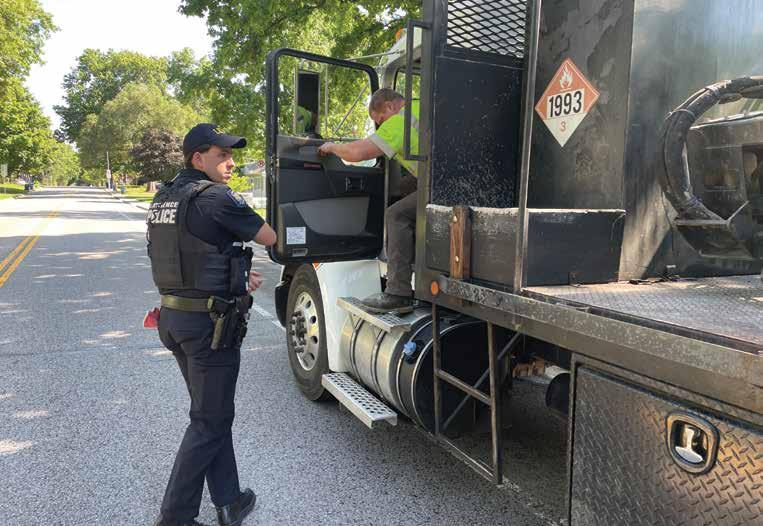
Exposing Labor Trafficking in North American Trucking BEHIND THE HAUL:
CVSA is looking for interesting, relevant content for its quarterly magazine. We would be happy to consider your news, ideas, insights and articles on issues facing the commercial motor vehicle safety community for upcoming editions of “Guardian” magazine. The deadlines for upcoming editions are available at www.cvsa.org/guardianmagazine/deadlines-for-submissions.
Questions? Please contact CVSA Writer-Editor Emily Moorhead at emily.moorhead@cvsa.org.
PRESIDENT’S MESSAGE
Enforcement Is a Process, But Safety Is a Mindset
By Maj. Erick McGuire, Commercial Vehicle Enforcement, Florida Highway Patrol
As I begin my term as your new president, I am filled with a deep sense of humility and gratitude. First of all, I would like to thank God for this incredible opportunity and for his guidance. I am also grateful for my family’s unwavering support, numerous sacrifices and belief in me. I would also like to show my gratitude for my past and present leadership within the Florida Highway Patrol and to my phenomenal colleagues and co-workers, who have been instrumental in my growth. As for the members of CVSA and fellow board members, thank you for the support and trust you have placed in me. This is an honor I do not take lightly. And to leaders who have guided the Alliance before me, thank you for your leadership and unwavering commitment. CVSA has always been and will continue to be built on the dedication and experience of its members. The strength of the Alliance lies not in any single role but in our collective commitment to safety.
As for our goal – to save lives and improve safety on North America's roadways – it remains our guiding star. As we look to the future, we must not only maintain our vigilance, but it would also be wise to embrace an advanced vision that leverages innovation and data. Our future will be filled with all types of innovations within the industry, and we must continue to foster and embrace these new technologies. Some of these “future advancements” from a few years back are current technologies that are in use today. As leaders in safety, we must continue to actively engage with these technologies and to work with industry to ensure they are developed with safety and enforceability as
primary considerations. We must support their deployment and, in turn, ensure training and inspection methods continue to keep pace with advancements. By doing so, we don't just react to the future; we help shape it.
To continue to completely encompass commercial motor vehicle safety, all jurisdictions must be able to fully leverage advanced data analytics. The mountains of data we collect during roadside inspections, coupled with new data from vehicle telematics and other technologies, are not just for compliance checks. They are a powerful resource for predictive analysis. By analyzing trends, we can move from reactive to predictive enforcement, which would target resources to areas of highest risk before crashes occur. This data-driven approach could assist with building smarter and more efficient enforcement strategies.
Ultimately, our collective efforts distill to a single, powerful act: making a difference one contact at a time. For enforcement officers on the roadside, every interaction with a driver is an opportunity not only to ensure compliance but also to educate, build relationships and promote a culture of safety. For our industry partners, this could come as a quick talk to drivers about the importance of a thorough pre-trip inspection, interactions with the mechanics referencing quality vehicle maintenance schedules and training sessions that reinforce the importance of safety to all employees. The human element of our work is indispensable. Technology and data are force multipliers, but they do not replace the wisdom, judgment and dedication of the people who make up this Alliance. It is in these individual contacts that trust is built and our
shared commitment to safety is demonstrated and reinforced.
This brings me to a core attitude that I have heard throughout my career and one which I believe helps define our goal: Enforcement is a process, but safety is a mindset. Enforcement is the necessary framework of rules, regulations and checks that ensures a baseline of compliance. It is the structured, procedural work we do to maintain order and hold bad actors accountable. Safety, however, is a deeper, more profound commitment. It is the unwavering belief held by every driver, mechanic, fleet manager and enforcement officer that preventing crashes and saving lives is the ultimate priority. This mindset goes beyond the letter of the law; it is about refining a philosophy where safety is not an afterthought but a fundamental value. We are all leaders, and as such, our task is to foster this mindset across the entire industry so that safety becomes an ingrained habit, not just a box to be checked during an inspection.
As I begin this new journey with you, I am excited to see what the Alliance can achieve in the next year. By embracing new technology, harnessing the power of data and remembering the profound impact we make one contact at a time, we will continue to lead the way in commercial motor vehicle safety. Together, with your knowledge and experience, we will build a future that is not only more efficient but, most importantly, safer for all who share our roads in North America. Thank you for your support and your commitment to this vital mission. I look forward to our work ahead. Be safe and God bless! n
Technology and data are force multipliers, but they do not replace the wisdom, judgment and dedication of the people who make up this Alliance.
EXECUTIVE DIRECTOR’S MESSAGE
The Importance of Research and Data Analysis Initiatives in Commercial Motor Vehicle Safety and Enforcement
By Collin B. Mooney, MPA, CAE, Executive Director, Commercial Vehicle Safety Alliance
The safety of North American roadways depends heavily on the ability to understand, predict and prevent risks associated with commercial motor vehicle (CMV) operations. Every year, large trucks and buses travel billions of miles delivering goods and transporting passengers, serving as the backbone of the economy.
Yet with this vital role comes a significant responsibility – to ensure that professional drivers and motor carriers function in a manner that prioritizes safety. Achieving this goal requires more than enforcement and compliance; it demands robust research and data analysis initiatives that guide evidencebased decisions, shape effective policies and enable targeted safety interventions.
Turning Data Into Insight
Data collection and analysis form the foundation of modern transportation safety management. Agencies such as the Federal Motor Carrier Safety Administration (FMCSA), along with state and provincial partners and organizations like CVSA, rely on accurate, timely data to understand where, when, why and how crashes occur. This information supports everything from roadside inspection programs to data quality initiatives to largescale crash causation studies.
Through research and analysis, raw data is transformed into actionable insights. For instance, crash data combined with inspection and violation records can reveal correlations between vehicle defects, driver behavior and crash likelihood. Patterns uncovered through data analysis help identify high-risk motor carriers, unsafe driving trends or systemic maintenance issues within certain sectors of the industry. This, in turn, allows regulators and enforcement officials to allocate resources strategically – focusing on the carriers, corridors and behaviors that present the greatest safety risks.
Evidence-Based Policy Development
Sound research enables policy decisions grounded in fact rather than assumption. CMV safety policies and enforcement strategies must constantly evolve to address emerging challenges, such as distracted driving, the integration of automated technologies and the changing dynamics of the transportation industry. Without research and data to evaluate these shifts, regulations risk being outdated or ineffective.
Decades of research on fatigue and crash risk informed the development of the North American Fatigue Management Program (NAFMP) to balance productivity with driver health and alertness. Similarly, the adoption of electronic logging devices (ELDs) was initially based on evidence showing that automated recording improves compliance and accuracy; however, the data has since highlighted the need for a third-party certification program to prevent the manipulation of data and fraudulent ELDs from entering the marketplace. These initiatives demonstrate how data-driven policymaking can directly enhance safety while promoting fairness and consistency across the industry.
Enhancing Enforcement Effectiveness
Law enforcement and inspection personnel play a critical role in ensuring CMV safety, but their work is most effective when guided by reliable data. Data analysis allows enforcement agencies to identify trends and target operations where they will have the most impact. For example, programs like FMCSA’s Compliance, Safety, Accountability (CSA) system use data to prioritize carriers for interventions based on safety performance indicators.
Advanced tools, such as predictive analytics, are increasingly being integrated into enforcement programs. These technologies can process vast amounts of information – from inspection results to telematics data – to predict potential safety issues before they result in crashes. For example, predictive models might flag a motor carrier whose vehicles show repeated brake violations, prompting proactive outreach or inspection. This approach not only improves safety outcomes but also increases efficiency by allowing limited enforcement resources to be deployed more strategically.
Measuring Progress and Accountability
Research and data analysis are also essential for measuring the effectiveness of safety initiatives. Policymakers and the public alike need to know whether investments in enforcement, technology and education are achieving their intended results. Continuous data evaluation provides a feedback loop, allowing agencies and organizations to adjust strategies, identify what works and discontinue what does not.
Programs such as FMCSA’s new Crash Causal Factors Program (CCFP) and the historical Motor Carrier Management Information System provide a comprehensive dataset framework to track progress over time. These resources not only support national-level analysis but also empower state and local agencies to evaluate their performance. Accountability, transparency and continuous improvement all depend on the integrity and availability of these data systems and programs.
Collaboration and Shared Responsibility
Effective CMV safety research and data initiatives rely on collaboration across jurisdictions and the transportation industry. State enforcement agencies, federal partners, industry associations, academic institutions and motor carriers each play a role in collecting, analyzing and sharing data. Collaborative
initiatives, such as the new CCFP, will bring together expertise and perspectives to identify root causes of crashes and to design evidencebased countermeasures.
Industry participation is especially valuable. Carriers often possess large amounts of operational and telematics data that, when shared responsibly and analyzed collectively, can contribute to a broader understanding of safety. Building trust and ensuring data privacy are essential to fostering such partnerships, but the potential safety benefits are significant. The transportation community as a whole benefits when data is leveraged for the common good.
The Future of Data-Driven Safety
Emerging technologies are transforming how data is collected and used in CMV safety. The increasing availability of connected vehicle data, advanced driver assistance systems and onboard telematics provides new opportunities for real-time safety monitoring. Artificial intelligence and data analytics platforms can detect anomalies, predict risk patterns and even recommend preventive actions before unsafe events occur.
As these tools evolve, the challenge will be to ensure that data remains accurate, secure and ethically managed. Data governance frameworks and standardized reporting systems will be critical to maintaining consistency and reliability across jurisdictions. Continued investment in research and data systems will allow regulators and enforcement agencies to stay ahead of emerging risks and to adapt quickly to technological change.
The Power of Information
Research and data analysis are the backbone of effective CMV safety and enforcement. They transform complex operational realities into measurable insights, enable more intelligent decision-making and foster collaboration across the transportation ecosystem. Every crash prevented, every unsafe motor carrier identified and every policy refined through data-driven analysis represents a tangible step toward safer roads.
In an industry as dynamic and essential as CMV transportation, the commitment to datainformed safety is not just a technical necessity – it is a moral and operational imperative. By investing in research and analytics, the CMV community strengthens its ability to protect lives, supports commerce and ensures that the transportation system operates with the highest standards of safety and integrity. n
Instructor In-Service
MARCH
10-12, 2026
SAVANNAH, GEORGIA
The CVSA Instructor In-Service is a three-day training event and will cover inspector inservice training materials for current certified state and federal inspectors and all changes to the certification training courses.
To learn more, visit www.cvsa.org/events/data-quality. n
CVSA/FMCSA Data Quality and Systems Training
MARCH
10-12,
2026 SAVANNAH, GEORGIA
CVSA/FMCSA Data Quality and Systems Training brings states together to share data quality stories and solutions. Participants will experience the synergy that happens when peers problem solve together.
To learn more, visit www.cvsa.org/events/ cvsa-instructor-in-service. n
REGIONAL MAP
Region I
Connecticut, Delaware, District of Columbia, Maine, Maryland, Massachusetts, New Hampshire, New Jersey, New York, Pennsylvania, Puerto Rico, Rhode Island, U.S. Virgin Islands and Vermont
Region II
Alabama, American Samoa, Arkansas, Florida, Georgia, Kentucky, Louisiana, Mississippi, North Carolina, Oklahoma, South Carolina, Tennessee, Texas, Virginia and West Virginia
Region III
Colorado, Illinois, Indiana, Iowa, Kansas, Michigan, Minnesota, Missouri, Nebraska, North Dakota, Northern Mariana Islands, Ohio, South Dakota and Wisconsin
Region IV
Alaska, Arizona, California, Guam, Hawaii, Idaho, Mexico, Montana, Nevada, New Mexico, Oregon, Utah, Washington and Wyoming
Region V
Alberta, British Columbia, Manitoba, New Brunswick, Newfoundland and Labrador, Northwest Territories, Nova Scotia, Nunavut, Ontario, Prince Edward Island, Quebec, Saskatchewan and Yukon
REGION I
Massachusetts State Police Attend First Multi-State Post-Crash Inspection Training Hosted by NCSHP
By Tpr. Andrew A. Amaral, Commercial Vehicle Enforcement Section, Massachusetts State Police
In July, the Massachusetts State Police attended North Carolina State Highway Patrol’s (NCSHP) first advanced training program for out-of-state law enforcement partners. Other participating agencies included Virginia State Police, South Carolina Highway Patrol, Mississippi Department of Public Safety and Kentucky State Police.
This advanced course was specifically designed to equip officers with the knowledge and technical skills needed to conduct forensic post-crash inspections of commercial motor vehicles (CMV). A CVSA Post-Crash Inspection
plays a critical role in promoting public safety, supporting crash investigations, ensuring legal clarity and maintaining accountability in the CMV industry.
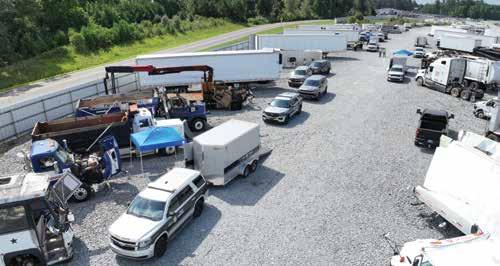
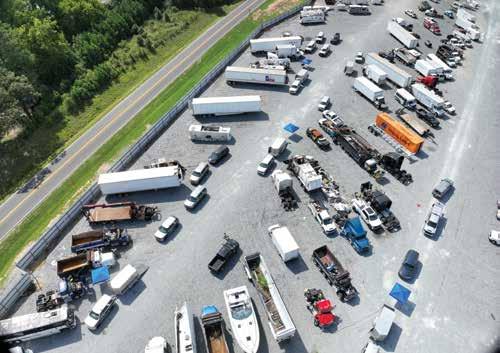
The intensive training focused on identifying causal factors in crashes and emphasized procedures essential to crash reconstruction and legal proceedings. The curriculum combined several days of classroom instruction with hands-on investigative techniques, ensuring participants could accurately collect and analyze post-crash data. Practical fieldwork was conducted at a
Practical fieldwork was conducted in a local scrapyard.
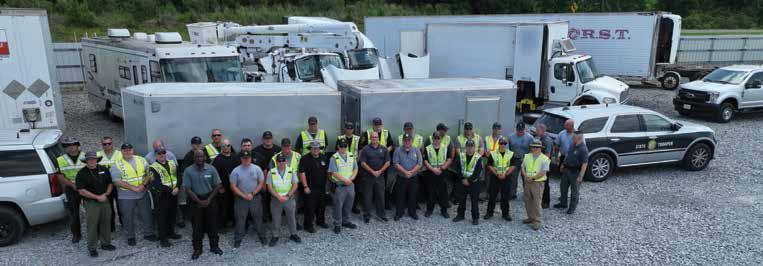
Aerial view of the trucks used for the training.
local scrapyard, where officers performed realistic post-crash inspections of wrecked and disabled CMVs. More than a dozen scenario-based exercises allowed students to identify mechanical defects, assess vehicle conditions and reconstruct crash dynamics as accurately as possible. Vehicles were carefully reassembled to reflect their pre-crash condition, giving participants an authentic view of the CMV prior to the crash. Students also practiced downloading and reviewing data from heavy vehicle event data recorders, enhancing their technical proficiency. Throughout the training, all participants
demonstrated the ability to conduct comprehensive inspections, identify safety violations, extract and confirm data from electronic control modules, and document their findings with precision.
This collaborative training initiative resulted in each participating state gaining a team of highly skilled troopers, better prepared to enforce both federal and state CMV regulations. The program represents a significant step forward in enhancing roadway safety and strengthening interstate collaboration in CMV enforcement. n
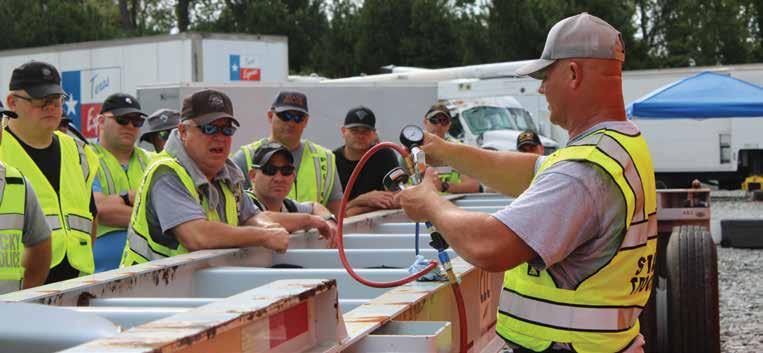
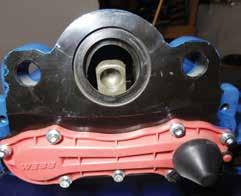
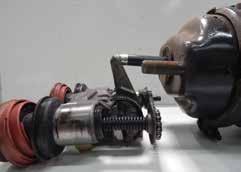
NCSHP Sgt. Michael Conley (left) and Master Tpr. Chelsey McGinnis (right) demonstrate changing a brake chamber diaphragm.
Class photo for the Post-Crash Inspection training.
Sgt. Conley (left center) and Master Tpr. McGinnis (right) provide instruction to students.
The Importance of Weight Compliance and Brake Safety
By Ofc. Kai Huang, Connecticut Department of Motor Vehicles
The role of commercial motor vehicle (CMV) inspectors is critical in ensuring the safety of our roadways. These inspections are not just regulatory formalities – they are essential measures that protect the lives of drivers, passengers and the public. When CMVs operate with defective brakes or exceed weight limits, the risks increase dramatically, particularly on downhill grades or in high-traffic areas.
A Real-World Incident: A Close Call in Bristol
Recently, I was dispatched to the Bristol (Connecticut) Police Department in response to a serious safety incident involving a CMV. According to a Bristol officer, a truck descending the hill by Memorial Road failed to stop at a stop sign at the intersection. The driver was barely able to bring the truck to a halt in a school parking lot. When the vehicle stopped, smoke was coming from the steering axle brakes, indicating extreme overheating. A Bristol officer who had been directing traffic nearby approached the vehicle and could feel the intense heat radiating from the front axle.
Upon arriving on scene, I immediately noticed that the CMV’s tires were sagging, suggesting the vehicle might be overweight. I contacted Ofc. Paul Lemieux to assist with his portable scales. The vehicle, registered for a maximum gross weight of 26,000 lbs., actually weighed 36,750 lbs. – more than 10,000 lbs. beyond its legal limit.
The excessive weight, combined with a long downhill stretch, rendered the truck unable to brake. The fact that the driver was able to bring the vehicle to a stop in a school parking lot – without injuring pedestrians or causing a multi-vehicle crash – was nothing short of fortunate.
Had the vehicle not stopped in time, it could have caused a devastating accident involving school property and, more alarmingly, students.
Inspection Findings:
A Series of Critical Violations
Following this near-miss incident, I conducted a full on-site motor vehicle safety inspection. The results revealed numerous violations that seriously compromised the safety and legality of the vehicle:
Brake System Deficiencies:
The brake linings on the right side of axle 2 were completely missing.
The same axle's right-side brakes were out of adjustment, and with the brake linings also missing, the entire rear axle was rendered effectively inoperative.
More than 20% of the vehicle’s brakes were found to be defective, a critical safety failure. According to federal regulations, any CMV with 20% or more defective brakes must be immediately placed out of service.
Weight Violations:
The vehicle was 20.9% overweight on the steering axle and 56.3% overweight on the rear axles.
The load on the steering axle and its drive axle tires all exceeded their rated limit, further stressing the suspension and braking systems.
Overloading significantly shortens the lifespan of vehicle components and greatly increases stopping distance, especially during emergencies.
Structural and Visibility Issues:
Several U-bolts securing the cab to the frame were loose, presenting a serious structural hazard that could lead to instability or failure in a crash.
Multiple lights and reflectors were inoperable, reducing the vehicle's visibility to other motorists, which is especially dangerous in low-light or adverse weather conditions.
Driver Violations: Unqualified and Unprepared
The inspection also uncovered serious violations on the part of the driver:
The driver was operating the CMV without a valid commercial driver’s license, which is legally required for vehicles exceeding 26,001 lbs.
Additionally, the driver failed to produce a valid medical certificate – a mandatory document that ensures commercial drivers are physically fit to operate such vehicles safely.
Given the combination of vehicle and driver violations, both the truck and its operator were placed out of service, and the vehicle was towed. This decisive action likely prevented what could have been a catastrophic event, particularly given the vehicle's final stopping point: a school parking lot where children and pedestrians are frequently present.
Lessons Learned: Safety Is Non-Negotiable
This case serves as a powerful reminder of the critical role that CMV safety inspectors play in protecting the public. Every inspection is an opportunity to prevent tragedy, save lives and ensure that our roads remain safe for everyone.
CMV drivers and carriers must understand that safety is not optional. It is a legal and moral obligation. Proper licensing, routine maintenance, weight compliance and functioning safety systems are not merely best practices; they are the minimum requirements for lawful and responsible operation.
As CMV inspectors, we do more than enforce regulations; we serve our communities. Through diligence, training and an unwavering commitment to public safety, we identify high-risk vehicles before they cause harm, protect lives and maintain the integrity of our transportation systems.
Final Thoughts
This incident in Bristol should be a wake-up call for anyone involved in commercial transportation. Had this severely overloaded and mechanically deficient vehicle not been stopped, the outcome could have been tragic, especially given its proximity to a school zone.
Enforcement action was taken following the inspection. Due to the number and severity of the violations, ranging from critical brake defects and structural hazards to driver qualification issues and significant overweight infractions, the carrier was issued a fine totaling $5,526. This penalty reflects the serious threat the vehicle posed to public safety and underscores the importance of regulatory compliance.
Compliance is not optional. It is the shared responsibility of drivers, carriers and enforcement personnel to ensure that every CMV on the road is safe, legal and properly maintained. n
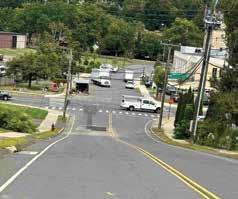
The intersection located at the bottom of the road and the nearby school where the truck made its final stop.
Florida Highway Patrol Updates
By Sgt. Denise Meredith, Commercial Vehicle Enforcement, Florida Highway Patrol
Hands Across the Border Traffic Enforcement Campaign
The Florida Highway Patrol (FHP) participated in the "Hands Across the Border" traffic enforcement campaign in a coordinated effort by law enforcement agencies in Georgia, Alabama, Florida, South Carolina and Tennessee to combat impaired driving during the Labor Day holiday weekend. This campaign includes sobriety road checks at state borders and aims to send a clear message that drunk and drugged driving will not be tolerated. The initiative began in 1991 as a friendly wager between the Georgia State Patrol and FHP and has since expanded to include all states bordering Georgia. The campaign is part of the National Highway Traffic Safety Administration's "Drive Sober or Get Pulled Over" enforcement effort, which continued through Labor Day. n
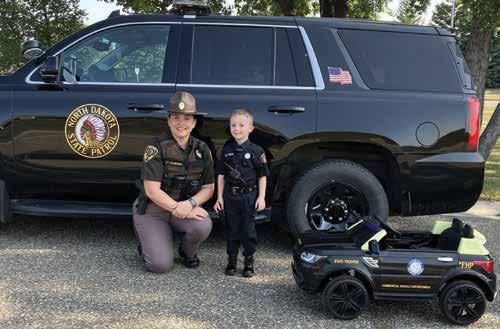
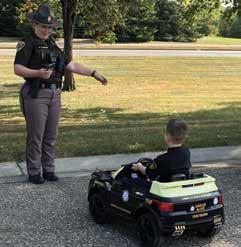
Covering the South to the North, FHP Junior Tpr. Lincoln worked together with North Dakota’s Lt. Jenna Clawson to promote safe highways across North America and to show appreciation to drivers during Driver Appreciation Week. n
Continued on next page
The “Hands Across the Border” traffic initiative started as a friendly wager between Georgia and Florida and has grown exponentially over time.
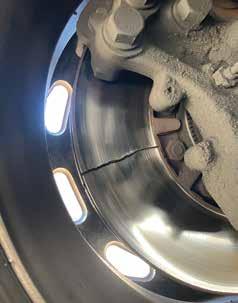
Cracked Brake Rotor Found During Brake Safety Week
By Sgt. Chris Davis, Motor Carrier Enforcement, Virginia Department of Motor Vehicles
During Brake Safety Week earlier this year, I found a severely cracked brake rotor during an inspection at the Bland Weigh Station in Bland County, Virginia. n
Continued from page 7
National Night Out
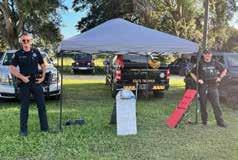
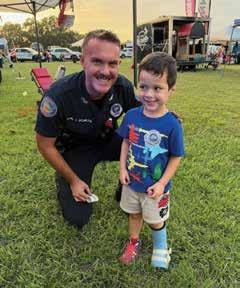
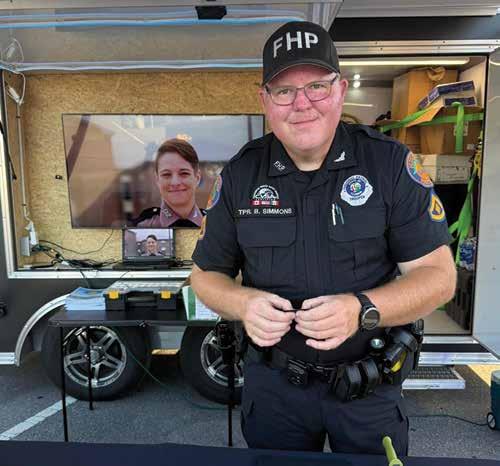
On Oct. 3, FHP Commercial Vehicle Enforcement across the state participated in National Night Out, an annual communitybuilding campaign that promotes police-community partnerships and neighborhood camaraderie. n
Tpr. Joseph Dowler (left) and Tpr. Jeffery Sudlow (right).
Tpr. Joseph Dowler (left) and Bryson Silva.
Tpr. Bobby Simmons.
Louisiana State Police Updates
LSP Conducts Intermodal Chassis Inspections at the Port of New Orleans
By Sgt. Will Pike, Transportation Safety Services, Louisiana State Police
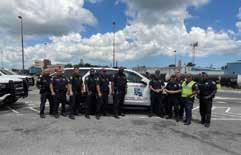
On June 24 and 25, 10 troopers with the Louisiana State Police (LSP) Motor Carrier Safety Assistance Program Unit, along with the Federal Motor Carrier Safety Administration (FMCSA), U.S. Department of Transportation (DOT) and New Orleans Harbor Port Security, conducted commercial motor vehicle (CMV) inspections at the Port of New Orleans. FMCSA and the U.S. DOT selected the Port of New Orleans to conduct inspections for intermodal chassis roadability.
According to its website, the Port of New Orleans sees more than 2,000 trucks hauling cargo in and out each day. Two particular intermodal equipment providers (IEP) were chosen for inspection based on preinvestigation visual inspections over multiple days. All IEPs were considered; however, two were selected based on the greater number of maintenance infractions observed.
Roadability inspections pertain to the maintenance posture of the IEP chassis pool, focusing on Parts 393 (Parts and Accessories Necessary for Safe Operation) and 396 (Inspection, Repair and Maintenance). Over two days, LSP conducted 40 Level I Inspections. As a result, four tractors (unit one), six chassis (unit two) and two drivers were placed out of service (OOS). The OOS violations included tire violations, intermodal chassis/ container securement violations, lighting violations, brake violations, commercial driver’s license (CDL) restriction violations and CDL medical certificate violations. Numerous other non-OOS violations were also cited.
The professionalism and skill of those who participated in the detail allowed the port to continue its normal operations without any delay in the arrival and departure of containers.
The coordination of multiple state and federal agencies guaranteed the success of the detail. The safety of the motoring public is always the ultimate goal, and each inspection could potentially save lives. These collaborative reviews/inspections help ensure compliance with federal safety regulations and support FMCSA’s ongoing mission to promote safety across all modes of freight transportation. n
Looking Beyond the Inspection
By Sgt. Gregory Handy Jr., Louisiana State Police
LSP troopers assigned to CMV enforcement recently made two major seizures during traffic stops on Louisiana’s interstates.
On Interstate 10, a trooper conducting a CMV inspection noticed a white plastic bag containing what appeared to be a large amount of cash. The stop ultimately resulted in the seizure of approximately $1.1 million in U.S. currency, 183 pounds of marijuana and seven grams of cocaine as well as the arrest of the CMV driver.
In a separate incident on Interstate 12, a trooper conducting a CMV inspection became suspicious of criminal activity and obtained consent to search the vehicle. The search led to the discovery of 55 kilograms of suspected cocaine and the arrest of the driver and co-driver.
While some might attribute these seizures to chance, they are the result of proactive training, sound judgment and strong supervision. Our CMV troopers are trained to recognize indicators of criminal activity through the Drug Interdiction Assistance Program, which equips law enforcement with techniques to identify CMVs and drivers engaged in illicit activity. Troopers also receive advanced training from Diamondback Specialized CMV Training, which focuses specifically on the commercial transportation industry.
These arrests demonstrate the value of ongoing, specialized training. Effective enforcement means looking beyond routine inspections and recognizing that CMVs can and do play a role in transporting illegal drugs on North American highways. n
Suspected criminal activity led to the discovery of 55 kilograms of suspected cocaine and the arrest of the
LSP trooper conducting a Level I Inspection on an intermodal chassis.*
*Photographs by FMCSA Safety Investigator Jeffrey Volpe.
LSP troopers preparing to conduct inspections on intermodal chassis at the Port of New Orleans.*
Left to right: Sr. Tpr. Ken Goodly, Ofc. Carlos Malanez, Master Tpr. Trey Indest, Tpr. 1st Class Jean-Fritz Cadet, Sr. Tpr. Oscar Soileau, Master Tpr. Keith Briggs, Master Tpr. Ronald Reggio, Sgt. John Martinez, Master Tpr. Toye Corkern, FMCSA Safety Investigator Jeff Volpe and Sgt. Kevin Leachman.*
truck driver and co-driver.
REGION II
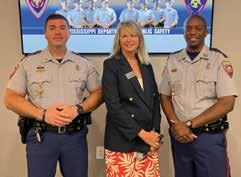
Mississippi Department of Public Safety Updates
By Master Sgt. Victor McCarty, Public Affairs, Mississippi Commercial Transportation Enforcement Division, Mississippi Department of Public Safety
CTED Intercepts Large Marijuana Shipment on I-20
On Sept. 11, Mississippi Department of Public Safety Commercial Transportation Enforcement Division (CTED) officers conducted a traffic stop on a white Volvo tractor-trailer on Interstate 20 East in Lauderdale County. During a routine inspection, officers noticed irregularities with the trailer’s bolt seal and discrepancies in the bill of lading.
Upon further inspection, officers discovered multiple pallets containing individually packaged marijuana, totaling approximately 1,050 pounds. The driver was taken into custody, and the vehicle and trailer were secured while the Mississippi Bureau of Narcotics took possession of the illegal shipment.
The following day, seizure and search warrants were issued for the truck, the driver’s electronic devices and other property associated with the shipment. This operation highlights CTED’s ongoing efforts to intercept illegal narcotics, ensure compliance with commercial motor vehicle (CMV) regulations and protect Mississippi roadways from criminal activity. n
CTED officers recovered approximately 1,050 pounds of marijuana at a traffic stop in September.
On July 31, the Louisiana State Police Commercial Vehicle Enforcement (LSP CVE) Region 1 partnered with the Mississippi CTED and the Mississippi Highway Patrol (MHP) for a joint enforcement, training and outreach initiative.
The coordinated effort focused on identifying and removing unsafe CMVs operating across Louisiana and Mississippi. Officers conducted a total of 22 inspections, uncovering 69 vehicle violations, two driver violations, six weight violations and 22 out-of-service violations.
This multi-agency operation underscores the importance of collaboration between neighboring states in promoting roadway safety and compliance within the CMV industry. By sharing resources, training and enforcement strategies, Louisiana and Mississippi are working together to reduce crashes, prevent unsafe operations and strengthen supply chain security across state lines. n
CTED Strengthens Ties with Justice Court Clerks
In May, Capt. Andrew Dellapenna and Master Sgt. Victor McCarty of CTED delivered a presentation at the Mississippi Justice Court Clerks Conference in Ridgeland.
The session was a resounding success, providing clerks from across the state with clarity on CMV enforcement laws, including how Title 77 of the Mississippi Code and the Federal Motor Carrier Safety Regulations apply in justice courts. Many clerks reported challenges processing CTED-issued citations, particularly when they referenced federal regulations.
Capt. Dellapenna and Master Sgt. McCarty walked participants through real-world examples, explained the structure of CTED authority and introduced a forthcoming quick-reference guide to assist clerks in their day-to-day duties.
The presentation underscored the importance of communication between CTED and the courts.
By equipping clerks with the knowledge and tools they need, CTED helps ensure consistent application of the law while supporting the shared mission of highway safety.
Events like this highlight the essential role of collaboration between enforcement and the courts in reducing crashes involving commercial motor vehicles in Mississippi. n
CTED Conducts Northern Region Saturation Detail in Troop D
From Aug. 26-30, CTED conducted a Northern Region Saturation Detail across the ten counties that make up Troop D. The multi-day enforcement effort focused on identifying unsafe CMVs, addressing driver violations and removing imminent safety hazards from the roadways.
During the operation, CTED officers completed:
41 overweight assessments
64 Level I Inspections
166 Level II Inspections
308 Level III Inspections
These inspections resulted in 387 CMV violations, along with 41 out-of-service drivers and 39 out-of-service vehicles.
Enforcement efforts also included:
326 justice court citations
Two felony arrests
Two misdemeanor arrests
11 drug seizures
Two weapons seizures
The saturation detail demonstrated CTED’s continued commitment to improving highway safety by identifying unsafe drivers and vehicles, enforcing weight laws and intercepting criminal activity tied to CMV operations.
By combining thorough inspections with targeted enforcement, CTED officers helped ensure safer roadways for both the trucking industry and the traveling public across northern Mississippi. n
Continued on next page
The Troop D saturation detail resulted in 387 CMV violations, along with 41 out-of-service drivers and 39 out-of-service vehicles.
LSP CVE, Mississippi CTED and MHP teamed up for a joint operation.
Capt. Andrew Dellapenna, Tracey Daniel of Mississippi Judicial College and Master Sgt. Victor McCarty.
Continued from page 11
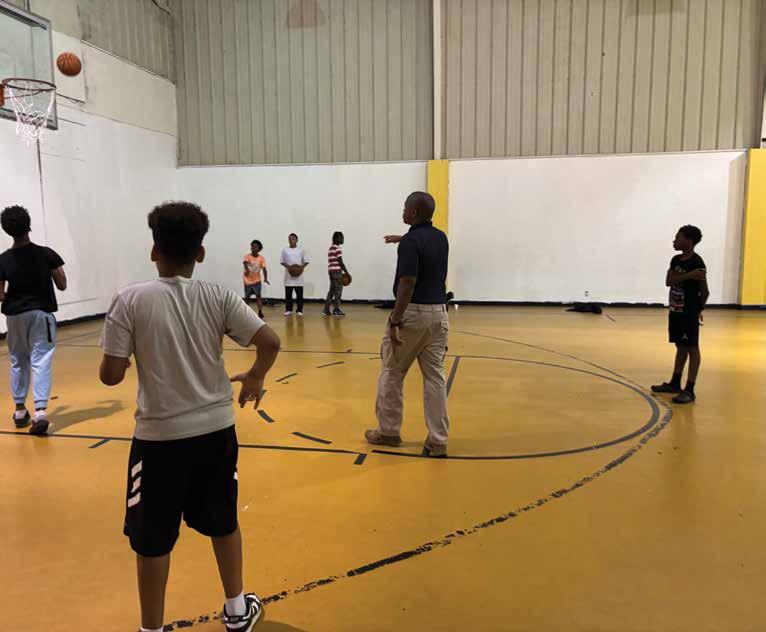
CTED Officers Participate in “Police Pals” Summer Program
This past summer, CTED officers joined local law enforcement partners in the “Police Pals” initiative, a new community engagement program created in collaboration with the Boys and Girls Club of Jackson.
The program is designed to build positive relationships between officers and youth by spending time together during the Boys and Girls Club’s daily “jump start hour” from 9-10 a.m. This hour typically includes games, light exercise and activities to energize participants before starting their classroom work.
Through Police Pals, CTED officers, along with members of MHP and other agencies, spent time playing games, participating in light workouts and interacting with children ages five to 18. By engaging in simple activities such as musical chairs, team exercises and group games, officers demonstrated a side of law enforcement that goes beyond uniforms and enforcement.
The goal of the program is to help young people see law enforcement as approachable, trustworthy and supportive community partners. By showing up consistently
throughout the summer, officers built meaningful connections with the youth, many of whom now know they have someone in law enforcement they can look up to and confide in.
CTED officers participated at both the Capitol Club and the Raymond Road Club locations, joining the program through the end of July. Programs like Police Pals demonstrate the value of community policing, where law enforcement agencies strengthen public trust by engaging with the next generation in positive, encouraging and fun environments. n
Officers hit the court with students at the Police Pals Boys and Girls Club program.
North Carolina State Highway Patrol Commercial Vehicle Enforcement Updates
North Carolina Trucking Association 2025 Truck Driving Championship
By Monica Greiss, North Carolina State Highway Patrol
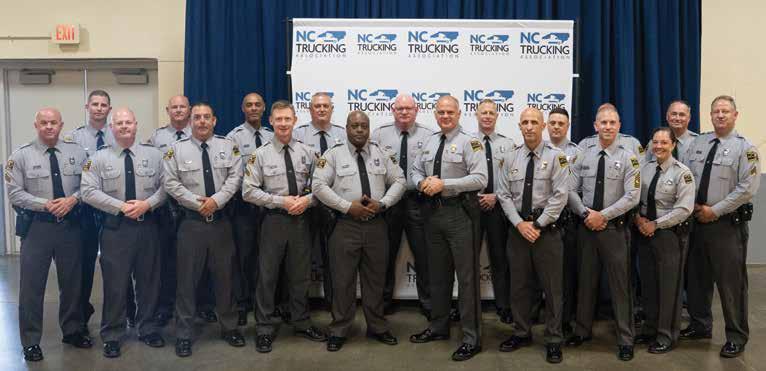
The North Carolina State Highway Patrol (NCSHP) – Commercial Vehicle Enforcement Section participated in this year’s North Carolina Trucking Association (NCTA) Truck Driving Championship (TDC). The competition took place June 6-7 at the North Carolina State Fairgrounds in Raleigh. NCSHP members assisted in judging during the competition.
The NCSHP provided an array of classic and current patrol vehicles in the static display. The vehicles displayed included the 2025 Ford Mustang, 1992 SSP Ford Mustang, 2025 Ford Explorer, 2025 Chevrolet Tahoe, 2025 Dodge Charger and the 1975 Plymouth Fury. NCSHP also had the mobile command unit present during the event. The mobile command unit serves as a mobile command post for special events and can be deployed as a mobile district office or troop headquarters. It is used for large-scale events or natural disasters.
The office space within the mobile command unit has the capacity for telecommunications and emergency/incident command. It is essentially a highway patrol office on wheels. Participants and their families were able to tour and visit the mobile command unit while it was present during the truck driving championship.
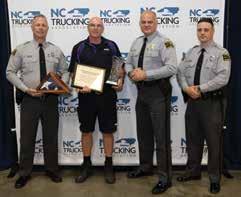
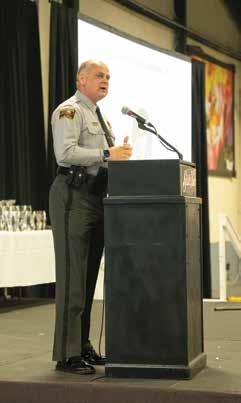
During the award banquet, Tpr. C. S. Baker presented on the University of California San Diego Transportation Research and Education for Driving Safety (TREDS) Just Drive: Deliver Distraction-Free program. The TREDS presentation is geared toward the risks and consequences of distracted driving and provides practical strategies to avoid cell phone use behind the wheel. NCSHP Commander Col. F. L.
Johnson Jr. spoke during this event. Col. Johnson awarded the 2025 NCTA Grand Champion, Michael Bills of FedEx, a special flag that had flown over the North Carolina state capitol. n
NCSHP troopers look forward to judging the truck driving competition each year.
Col. F. L. Johnson Jr.
Left to right: Tpr. C. S. Baker, Michael Bills (FedEx), Col. F. L. Johnson Jr. and Tpr. B. S. Johnson.
Continued from page 13
Advanced Post-Crash Inspector Course
By Monica Greiss, North Carolina State Highway Patrol
Sgt. M. G. Conley conducted an Advanced Post-Crash Inspector (APCI) course in July. Twenty-six out-of-state troopers attended this training, including members from the Kentucky State Police, Mississippi State Police, Massachusetts State Police, Virginia State Police and the South Carolina Highway Patrol. This is the first time in NCSHP history that an APCI course was conducted for all out-of-state participants.
The weeklong class consisted of classroom training and practical exercises. On the first day, NCSHP Commander Col. F. L. Johnson Jr. welcomed everyone to the class and presented each participant with a colonel challenge coin as a token of appreciation. The classroom portion involved instruction on the operation of the air brake system, the hydraulics and disassembling brake chambers, including the use of training props such as a brake board. The practical, hands-on exposure portion of the APCI course took place at Copart in Dunn, North Carolina. Nine stations were set up at Copart, and an instructor was assigned to each station.
The multiple stations allowed for smaller groups and provided individualized training. These stations consisted of rearing the truck system from the air compressor and using the process of elimination to determine factors
to seal up the air leaks. Participants were provided with instructions on how to conduct heavy vehicle downloads utilizing heavy vehicle event download recorder equipment. Participants provided positive feedback and expressed their appreciation for the individualized and hands-on training.
Members who completed this course can now take what they’ve learned back to their agencies, where they can teach others and perhaps start their own post-crash program. n
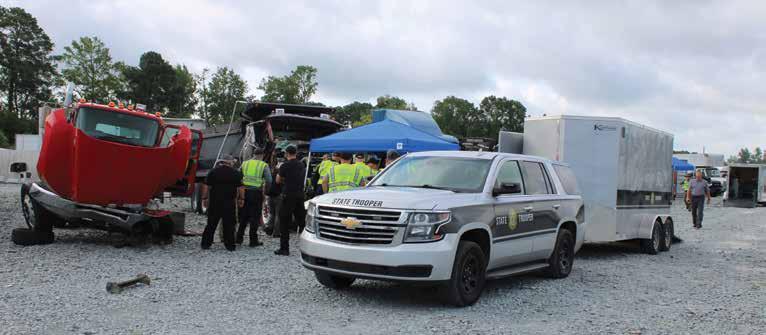
Students inspect crashed vehicles.
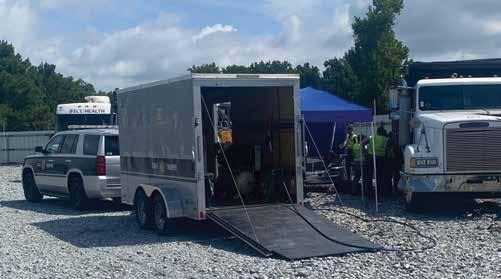
NCSHP post-crash trailer.
Col. F. L. Johnson Jr. welcomes students to the APCI course.
Why I Love NAIC
By Tpr. B. S. Johnson, North Carolina State Highway Patrol
The North American Inspectors Championship (NAIC) is the event I look forward to every year with genuine excitement. I’ve had the privilege of representing North Carolina three times, and each experience has pushed me to grow, both as an inspector and as a person.
To me, NAIC is more than a competition. It’s a chance to test my skills against the best inspectors from across North America – and an opportunity to learn from them. Physicist Richard P. Feynman once said, “If you are the smartest person in the room, find another room.” At NAIC, I am far from the smartest person in the room, and that’s exactly why I love it. The knowledge, experience and passion of the other inspectors inspire me year after year.
What makes NAIC truly special are the people. It’s refreshing to be surrounded by others who share the same dedication to commercial motor vehicle (CMV) inspections and safety. Whether we’re training, debating the finer points of the regulations over lunch or just sharing stories, I always walk away with new insights and lasting friendships. Some of my closest professional friends are people I met at NAIC – friends I can call anytime for advice, guidance or simply to catch up.
In my career, I’ve always believed in striving to “get better, not just older.” That belief led me to become a North American Standard Inspection instructor and to compete at NAIC. Every scenario makes me nervous, but it’s in that challenge that I grow. Each year, I’ve
improved, and this year I was honored to place in the top ten for both Level I Inspection and Passenger Carrier Vehicle Inspection.
Would I encourage others to attend NAIC? Absolutely. It’s a competition, yes – we all want to win – but it’s also a community where we push each other to be better and cheer for one another’s success. I never leave NAIC feeling like a loser if I don’t take home a trophy. I leave as a better inspector – and with friendships that mean more than any award. n
By Monica Greiss, North Carolina State Highway Patrol
Sgt. M. G. Conley conducted a traffic safety information presentation at the Concord Police Department on June 19. Members in attendance included the Cabarrus County Sheriff’s Department, Concord Police Department, Concord Fire and Rescue, the Department of Transportation and members from NCSHP. The goal of the presentation was to educate participants on postcrash investigations involving a CMV. The presentation explained how the NCSHP can assist allied partners when a post-crash investigation is needed. This training also reviewed the steps agencies can take to help preserve digital and physical evidence for download. The presentation also included items that post-crash investigators look for in line with federal mandates and federal regulations.
Members from the NCSHP included 1st Sgt. C. J. White, Tpr. A. W. Beck, Tpr. A. T. Doss and 1st Sgt. B. D. Vick. Upon completion of the classroom portion of the presentation, participants were invited to tour the post-crash trailer. Tpr. Beck spoke about the components of the CMV post-crash trailer and the tools that help the post-crash team successfully conduct investigations. The goal of the presentation is to educate and explain the reasoning behind what the NCSHP CMV post-crash investigation team does and how our allied partners can help to preserve evidence. Participants provided positive feedback and were pleased with the training. n
Tpr. B. S. Johnson.
Left to right: Tpr. B. S. Johnson, Ofc. Courtney West (Connecticut Division of Motor Vehicles) and Inspector Bob DeFrancesco (Nevada Highway Patrol).
Virginia State Police Updates
Virginia State Police Troopers Appreciate Truckers
By Sgt. Gregory Hamlett, Virginia State Police
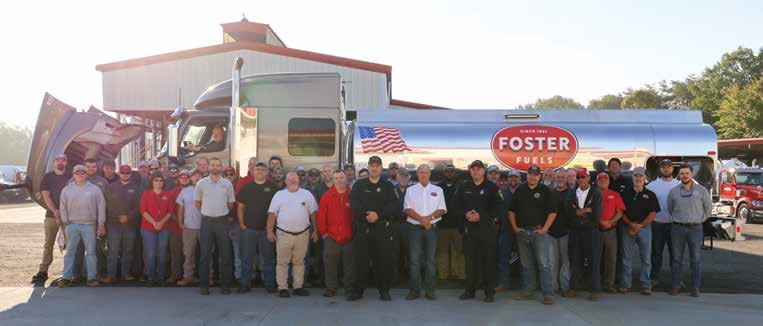
On Sept. 18, Virginia State Police (VSP) Motor Carrier Safety Units from Area 63 were invited to Foster Fuels Inc.’s Semi-Annual Driver Safety Meeting. Foster Fuels, located in Brookneal, Virginia, is a large distributor of bulk hazardous materials.
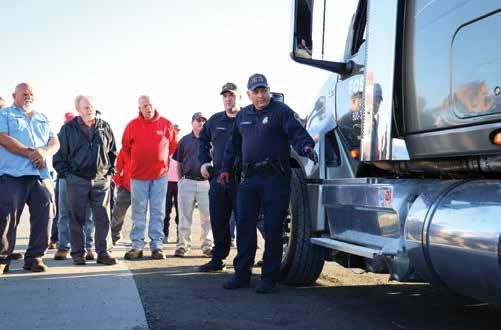
Master Tpr. Travis Comer and Sr. Tpr. Mark Gardner presented two training sessions to more than 120 professional drivers who transport hazardous materials. The training was designed to demonstrate to drivers what to expect during a roadside inspection and allowed them to ask questions about roadside inspection issues in a relaxed setting. Topics included commercial driver’s licenses and medical qualifications, electronic logging device requirements, shipping papers, emergency response information, placarding and markings for cargo tank vehicles, and equipment inspection.
This safety presentation was given during National Truck Driver Appreciation Week. During the presentation, the troopers expressed the VSP’s appreciation for the professionalism each driver demonstrates every day on the road. Foster Fuels and its drivers have been committed to providing safe transportation of hazardous materials for many years. The VSP Motor Carrier Safety Unit understands that highway safety cannot
be achieved without a collaborative effort among the trucking industry, truck drivers and law enforcement. VSP always appreciates the opportunity to speak with drivers and carriers to promote highway safety. n
VSP Motor Carrier Safety Unit presented to Foster Fuels during National Truck Driver Appreciation Week.
Sr. Tpr. Mark Gardner (left center) and Master Tpr. Travis Comer (right center) presented training sessions to more than 120 professional drivers.
Routine Inspection Stop Turns into Information Forum
By Sgt. Stevie Lowe, Virginia State Police
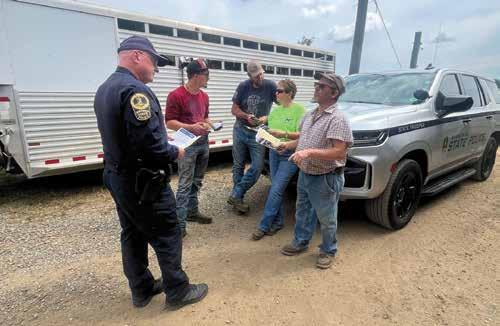
This spring, following a routine roadside inspection of a local farm business vehicle by a VSP Motor Carrier trooper, a community outreach program was born. As a result of the stop and the conversation with the farmer, the inspecting trooper became aware of a critical need for an outreach program to assist local farm business owners with understanding and complying with Federal Motor Carrier Safety Administration (FMCSA) regulations.
For farm businesses, bringing their products from the field to consumers involves a complex supply chain, with transportation as a critical link. FMCSA establishes regulations governing commercial motor vehicles, which can significantly impact farming operations. The VSP Motor Carrier Safety Unit's goal is to assist farm business owners in understanding and complying with these regulations. However, because of the unique and often time-sensitive nature of agricultural work, farm businesses have several specific exemptions. Understanding these exemptions is important to farmers to ensure they remain in compliance while continuing to maximize the efficiency of their farm business.
The first community outreach program was organized through a local farm cooperative with the VSP Motor Carrier Safety Unit as the lead agency. Other agencies presenting
included the Virginia Department of Motor Vehicles, West Virginia Public Service Commission Commercial Vehicle Enforcement Officers and local law enforcement agencies. At first, many farm business owners expressed confusion and frustration, stating they had never heard of the regulations and had been operating under the assumption that their businesses were completely exempt from any FMCSA or state regulations.
VSP Motor Carrier Safety Unit troopers presented a detailed PowerPoint presentation covering the Federal Motor Carrier Safety Regulations (FMCSR), including definitions of interstate and intrastate commerce, hoursof-service rules, the 150-air-mile radius exemption and definitions of agricultural commodities. The presentation provided a better understanding of the FMCSRs, and a two-hour-long question-and-answer session followed to help address specific questions.
As a result of this outreach program, several additional dates have been scheduled to help farm businesses understand the regulations and achieve compliance. VSP Motor Carrier Safety Unit troopers continue to respond to requests for information and have visited multiple farm businesses to answer questions. The troopers have assisted farm business owners in successfully navigating
the complexities of the FMCSRs while balancing highway safety with the agricultural exemptions designed to protect time-sensitive farming operations.
The core of compliance lies in understanding the rules, how they apply to specific vehicles and drivers, and when exemptions can be claimed based on location and season. By offering this outreach program, the VSP Motor Carrier Safety Unit aims to assist farm business owners in navigating the FMCSRs, staying current on regulatory guidance and becoming aware of other resources that may be available to help their businesses remain both efficient and compliant. n
Left to right: Master Tpr. Jerry Dixon, Heilyn Umberger (employee of R&L Farms in Wytheville, Virginia), Bob Hoistman (a customer from Marion, Virginia), Lynn Williams and Robbie Williams (owners and operators of R&L Farms).
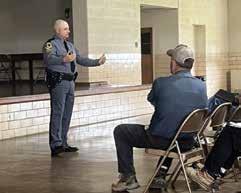
Master Tpr. Jerry Dixon presenting in Giles County in May at the first farm co-op meeting.
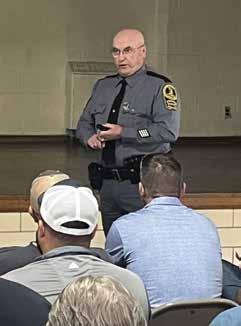
Master Tpr. Jeremy Melvin presenting in Giles County in May at the first farm co-op meeting.
Colorado CMV Data Improvement Initiative
By Helena Shea, Innovative Technology Deployment Program Manager, Colorado State Patrol
The Innovative Technology Deployment (ITD) Program architecture allows every state to see each other’s registrations, inspections and other work products associated with commercial motor vehicle (CMV) enforcement. It also enables national actions such as safety scores, out-of-service (OOS) orders and Performance and Registration Information Systems Management (PRISM) targeting.
Compliant Commercial Vehicle Information Exchange Window (CVIEW) systems aredeveloped in each state and linked nationally through the system, formerly known as SAFER, through a combination of cooperative agreements, memorandums of understanding, grants and program rules. This connects various state departments and the Motor Carrier Safety Assistance Program (MCSAP), ITD and PRISM. It is a complex network that may involve multiple state agencies, all dependent upon each other’s data quality and technical contracts to maintain mutual compliance with federal requirements.
No enforcement agency can effectively engage in mainline e-screening, pre-clearance or data-driven inspection practices without the data generated by the agencies that issue credentials, such as the International Registration Plan (IRP) and the International Fuel Tax Association (IFTA). No taxation or permit agency can lawfully exclude prohibited actors from registration and specialty operation or deploy a comprehensive audit program without access to enforcement and safety records that shed light on carrier status and activities.
In an effort to de-silo Colorado teams, build cooperation and improve data quality, the Colorado State Patrol (CSP) annually hosts field trips for our partners.
Professionals with overlapping missions convene for a morning safety brief and discuss the circle in which CMV data travels: from registration to roadside enforcement tools to compliance review to OOS/PRISM targeting and back to registration. The team loads up and
visits a port of entry (POE). They are issued ANSI for the day, and they observe screening and pre-clearance tools; POE size, weight and safety enforcement; and at least one Level I Inspection.
After lunch, the team meets back in our conference room, and we walk through how roadside inspections impact safety scores, audits, reviews and sometimes the generation (and identification) of “chameleon carriers.” A chameleon carrier is a fraudulent trucking company that tries to avoid accountability by shutting down and then reopening under a new name and USDOT number.
We then go over the Colorado CVIEW and Federal Motor Carrier Safety Administration systems that might be useful as our partners navigate the decisions they make during their part of the process. We ensure everyone has the correct access to resources and that they meet the experts who administer and use the systems. MCSAP sergeants hear from tax and compliance folks about the types of red flags that might warrant a referral from enforcement
DataQs and Civil Penalties Administrator Stephen Pratt (facing camera) describes the inspection being conducted by CSP Port of Entry Equipment and Technical Ofc. Cody Kistner at the Fort Collins Port of Entry on Sept. 16. (Photo credit: Erin Chilvers, Colorado FMCSA Systems Coordinator)
for an IRP/IFTA audit for education or attention, and the tax and audit folks hear from enforcement about the red flags they may encounter. The events began in 2024 and included professionals involved in IRP and IFTA audits at their nearest metro-adjacent POE. Through September and October 2025, CSP expanded the opportunity. We hosted five of these dates at two different POEs. We again included our tax and registration partners, in addition to the U.S. Department of Transportation Freight and Oversize Permitting teams, a few U.S. Department of Revenue fraud investigators, and increased numbers of management teams. The timing allowed for some of the nicest, most colorful inspection days that Colorado has to offer.
In 2024, Colorado leveled up to Expanded PRISM and began collecting USDOT numbers for every CMV registration, including those that only travel intrastate. This was a significant change for administrators in Colorado’s 64 counties. The 2025 event was expanded to welcome these new groups
of professionals and interested parties. We included folks from six of our most impacted counties on the in-person tours and have been invited to accompany the IRP team to present more CMV information to attendees at the counties’ statewide conference in early 2026.
These in-person visits grew out of Colorado’s de-siloing and process-mapping efforts to complete the Expanded PRISM process. The increased awareness of the various groups’ needs has led to an ITD-hosted weekly stand-up meeting where administrators from the IRP, IFTA audit, POEs and MCSAP can ask questions about each other’s processes and share information that might be mutually relevant.
We have been asked to increase the geographic diversity of these events next year and will explore those possibilities after the county conference event. n
Master Sgt. Jeremy Miller discusses CMV safety with guests at the Dumont Port of Entry on Sept. 10. (Photo credit: S. Pratt)
Port of Entry Mobile Unit Supervisor Barbara Watkins (left) discusses fixed port and mobile operations with guests at the Dumont Port of Entry on Sept. 3. (Photo credit: S. Pratt)
REGION III
PBBT 101: The Future of CMV Inspection
By Sgt. Derek Livingston, Minnesota State Patrol
What is a performance-based brake tester (PBBT)? As the name suggests, a PBBT is a machine that tests how well a vehicle’s brakes work by directly measuring brake forces. A roller dynamometer PBBT is the only approved brake performance tester in North America. The two manufacturers of PBBTs in the U.S. are Nepean Transport Equipment (formerly VIS) and Link Engineering Company (Link). There are two types of roller dynamometers in use: the portable unit and the fixed inground unit. Both types of PBBT serve a valuable purpose in commercial motor vehicle (CMV) safety and enforcement and are used to measure the brake performance at each wheel end, one axle at a time. The Minnesota State Patrol has two portable units and two in-ground units. The in-ground units are inside inspection sheds, and the portable units are moved around the state and set up roadside during saturation events.
PBBTs are crucial tools for inspectors to identify braking issues on a CMV. A visual inspection must accompany a PBBT test because while the PBBT will show an area of deficient brake performance, it won’t indicate if a brake is out of adjustment, if there is an air leak, if there are missing braking components or if there is an air supply issue to the brake itself. In my six years of experience with a PBBT, there were many times when the PBBT identified an issue with the vehicle that would have been overlooked in a visual inspection, especially with disc brakes (air or hydraulic) and electric brakes. As more vehicles are equipped with disc brakes and we continue to see more hydraulic-brake trucks pulling electric-brake trailers, PBBTs are the future of CMV inspections. With more agencies purchasing PBBTs, it is also important to ensure proper understanding of how to use the units during inspections.
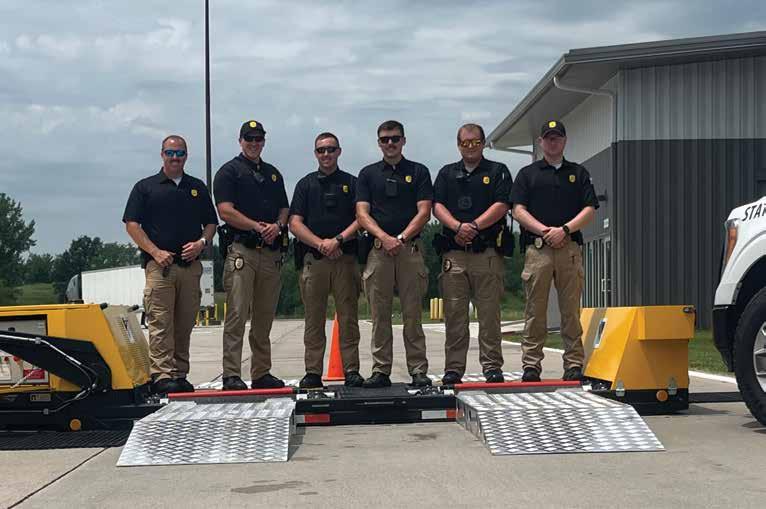
In April, Herb Bradley of Kansas Highway Patrol and I had the privilege to travel to Washington, D.C., and instruct the D.C. Metropolitan Police Department on the use of their new portable Link PBBT. Then in June, Herb and I traveled to Van Meter, Iowa, to instruct the Iowa State Patrol on their new portable Nepean PBBT. CVSA, in partnership with the Federal Motor Carrier Safety Administration, has put together a class for agencies new to the PBBT program, in which two experienced PBBT instructors travel to the agency to instruct up to six of their members in a train-the-trainer setting. The class participants sit through an eight-hour classroom portion that includes an exam at the end, with a score of 80% or higher required to pass.
Participants also complete a hands-on portion that includes PBBT setup and take-down. Participants demonstrate the setup of the PBBT and begin completing their initial eight PBBT tests on live trucks. These PBBT tests are
Left to right: Iowa instructors Tpr. Alex Taylor, Tpr. Joel Harrington, Tpr. Hunter Gehrke, Tpr. Blake Leonard, Tpr. Cameron Slagle and Tpr. Brett Hardin.
done alongside one of the class instructors to ensure the testing procedure is followed and to answer any questions. At the end of each day in the field, the participants take down the PBBT and demonstrate proper securement of the machine. On the final day of class, the participants take turns teaching a module of the course material to the instructors. This is done so they get the feel for the course material they will be teaching their future operators. There are currently 21 agencies using PBBTs, and we would love to see more. If your jurisdiction/agency is interested in learning more about PBBTs, reach out to an agency that uses them to set up a time to see them in action. The jurisdictions currently utilizing PBBTs are Colorado, Florida, Georgia, Indiana, Iowa, Kansas, Maine, Massachusetts, Michigan, Minnesota, Montana, Nebraska, New Jersey, New York, North Dakota, Oklahoma, South Dakota, Utah, Wisconsin, Wyoming, and Washington, D.C. n
PBBT Chat with Iowa State Patrol Tpr. Hunter Gehrke
Q: What did you like about the PBBT class?
A: I liked how the class was geared to being a hands-on training. It was very informative, and the hands-on applications gave me confidence in this new skill. This training set us up for success.
Q: Do you think using a PBBT is important and beneficial to your inspection process?
A: The PBBT is beneficial to inspections because it provides us an opportunity to check and verify braking effectiveness, something we don’t currently have the ability to verify during a roadside inspection.
Q: Would you recommend this class to others? Why?
A: I would recommend that all CMV inspectors attend the class. It allows inspectors to add another tool to their toolbox and pursue continuous improvement, all while doing their part to make our roadways safer.
Q: What was your biggest takeaway from this class?
A: I learned we have a great tool to check the braking effect on braking systems that we normally cannot check on inspections. n
Left to right: D.C. Metropolitan Police Ofc. Wen Ai, Ofc. Oscar Garibay, Ofc. Roy Khoury, Ofc. Jody O’Leary and Ofc. Ethan Way.
In April, Sgt. Derek Livingston and Herb Bradley instructed the D.C. Metropolitan Police on the use of its new Link PBBT.
REGION III
Minnesota State Patrol Celebrates National Truck Driver Appreciation Week
By Lt. Mike Engum, Minnesota State Patrol
Minnesota State Patrol values our local professional drivers more than we can say, so for National Truck Driver Appreciation Week in September, we wanted to do something special for them.
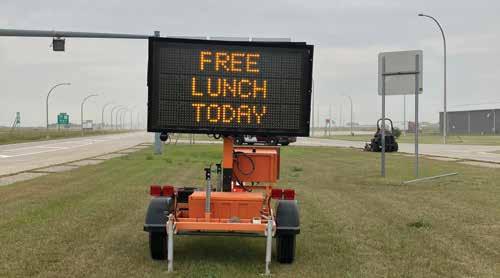
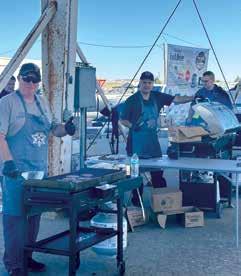
As an avid pit master, I took the idea in the BBQ direction. I reached out to local heavy tow companies along I-94 from the Minnesota/ North Dakota state line to Alexandria, Minnesota. We partnered with five companies and were able to offer drivers more than 350 free home-cooked meals.
This event gave drivers a reason to visit with commercial motor vehicle inspectors and talk shop, all while grabbing a free lunch. It’s always a pleasure to bring together enforcement and professional drivers. Many thanks to the following companies: Aggressive Towing, Jim’s Towing, Beyers Towing, Glenn’s Towing and Dan’s Diesel. n
Lt. Mike Engum invites drivers in out of the rain for a BBQ lunch.
The highway sign attracted more than 350 drivers for free meals.
Nevada Highway Patrol Celebrates National Truck Driver Appreciation Week
By Tpr. Jason Bringhurst, Commercial Enforcement Division, Nevada State Police
Nevada Highway Patrol Central Command celebrated National Truck Driver Appreciation Week (NTDAW) 2025 at the Osino check site. Osino is located on I-80 in Elko County, Nevada. Elko County is known for its rural ranching communities and its large gold mines.
This year, along with the Nevada Department of Transportation and many other sponsors, we handed out hamburgers, hot dogs, Indian cuisine and beverages. Approximately 500 hardworking truck drivers were served within just a few hours. Drivers were pleased to see that their dedication and hard work were appreciated. This year marks the third year in a row that the Osino check site has held an event for NTDAW.
Earlier in the week, Nevada Highway Patrol Central Command helped host an event for NTDAW with a local gold mining company. The event was held on a heavily traveled road just outside a large gold mine, expressing our thanks to our local commercial drivers who serve the region. n
Left to right: Sr. Tpr. John Whitfield and Sgt. Neil Morgon serve BBQ lunches to professional drivers.
Left to right: Lt. Kirt Beach, Tpr. Norbel Uribe and Capt. Matt McLaughlin man the grills.
Sgt. Neil Morgon and professional drivers during NTDAW.
UPDATES FROM National Road Safety Congress
From Aug. 25-27, the Ninth National Road Safety Congress of the National Association of Private Carriers (Asociación Nacional de Transporte Privado – ANTP) was held in San Juan del Río, Querétaro.
Luis Ruiz Hernández, Director General of the Ministry of Infrastructure, Communications and Transportation (SICT) General Directorate of Federal Motor Carriers (DGAF), opened the event. During his presentation, he stated that road safety must be addressed with a comprehensive approach involving the government, trucking companies, truck manufacturers and assemblers, and carriers. He emphasized the importance of ensuring everyone arrives home safely, this being the most critical objective.
During the first day of the congress, critical topics were addressed, such as driver fatigue and its causes and solutions. This problem primarily affects truck drivers due to long hours on the road, but it also affects enforcement and other motorists.
On the second day, several companies demonstrated some of their latest heavy-duty vehicle models on the test track, many of them incorporating technological innovations. This event was showcased at the Mexican Institute of Transportation (Instituto Mexicano del Transporte – IMT) of SICT.
The congress also highlighted the integration of artificial intelligence and new technological tools as means to improve road safety on highways used by heavy-duty vehicles and the safety of these same modes of transport. It also emphasized the importance of training truck drivers and improving working conditions, key factors for achieving fewer accidents on the roads.
Regarding the latter, it was stated that road safety is everyone's responsibility: government, enforcement, motor carriers, commercial drivers, passenger vehicle drivers and pedestrians. n
Promotion of the National Crusade for Road Safety 2025-2030
The seventh regular session of the National Mobility and Road Safety System was held on Aug. 28 with the goal of strengthening road safety as a long-range social policy. The session, organized by SICT and led by the Ministry of Agrarian, Territorial and Urban Development (Secretaría de Desarrollo Agrario, Territorial y Urbano – SEDATU), marked a decisive step in the national safe mobility agenda.
During the meeting, the National Crusade for Road Safety 2025-2030 was approved, a comprehensive strategy that seeks to reduce traffic accidents, improve public transportation and strengthen institutional coordination at all levels of government.
Key actions approved:
Launch of the National Crusade for Road Safety 2025–2030, as a joint effort between federal, state and municipal agencies
Approval of the work programs of the technical groups of the national system
Implementation of NOM-004, which establishes safety standards for vehicles and operators
Creation of a National Registry of Licenses and Sanctions to improve the traceability of drivers and offenders
Financing mechanisms to promote safe mobility projects at the local level
Improvement of public transportation as a key component of equitable and sustainable mobility
These actions are part of the National Mobility and Road Safety Strategy 2023–2042, which recognizes mobility not only as a service but also as a fundamental right.
With this institutional boost, the agencies involved reaffirmed their commitment to moving toward a safer, more inclusive and people-centered mobility model, aligned with the principles of sustainability, equity and social justice. n
Left to right: ANTP Executive President Leonardo Gómez Vargas, ANTP Board Chairman Alex Theissen Long and SICT-DGAF Director General Luis Ruiz Hernández.
English Training for Carriers: A Practical Tool for International Transportation
In response to the challenges of international transportation and the growing need to strengthen English communication skills, SICT-DGAF has designed a training program specifically aimed at cross-border transportation operators. The main objective is to provide practical language tools that allow them to perform their work more safely, effectively and confidently in international contexts. The focus is on the use of English that they truly need in their daily work, both inside and outside the cabin.
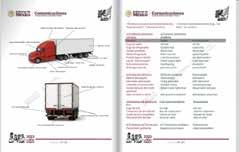
The course content has been developed based on real-life situations that operators face during their work. It includes key aspects such as interaction with police and customs authorities; basic technical vocabulary related to vehicle parts, cargo documents and road signs; and effective communication during loading and unloading operations and emergencies.
The entire program is structured progressively, beginning with general English vocabulary, progressing to specialized transportation terms, and developing communication skills applicable in the workplace. Finally, complex security-
related scenarios are addressed, where precise comprehension of the language is essential. To facilitate this process, the study materials are bilingual with an additional element: a phonetic approximation to English pronunciation, which allows accessible and useful learning from the first session. The intention is to guide the operator step by step, building confidence and skills that can be immediately applied.
You can view the material at the following link: online.fliphtml5.com/rlask/benc.
This initiative is part of SICT-DGAF’s commitment to regulatory improvement, promoting concrete actions that directly benefit the sector. English training not only improves international communication but also strengthens road safety, border crossing efficiency and the professionalization of transportation. Without seeking to complicate or impose requirements, the program was designed to be useful, understandable and aligned with the operator's reality. In an increasingly globalized environment, having these tools can make a real difference. n
Federal Government Promotes Construction of Rest Stops on Federal Highways
With the goal of contributing to road safety and the development of the country's road infrastructure, SICT announced the promotion of investment projects for the construction and expansion of rest stops in areas near the rightof-way of federal highways.
These spaces will be designed to provide rest and safety for users, especially long-haul federal transportation drivers, by offering comprehensive services such as food courts, restrooms, overnight spaces, first aid, refueling, and parking for light vehicles, buses and cargo vehicles.
The measure seeks to reduce the incidence of road accidents, in compliance with the provisions of Mexican Official Standard NOM087-SCT-2-2017, which regulates driving and rest breaks for federal transportation carriers.
Priority Sections for the Development of Rest Stops
The federal government has identified several highway sections with a high incidence of traffic accidents or that currently lack this type of infrastructure as priority areas, including:
Agrarian reform land in Puerto Juárez (Route 307, free road)
Other strategic sections in Sonora, Veracruz, Tabasco and Oaxaca
Guidelines and Requirements
Those interested in developing rest stop projects must adhere to the guidelines published by DGAF on its official website at micrs.sct.gob.mx.
Likewise, those who have a valid permit or have initiated the process to obtain one, in accordance with the Regulations for the Use of the Right of Way of Federal Highways and Surrounding Areas, may join this government initiative, provided they meet the requirements established in the agreement to simplify procedures published in the Official Gazette of the Federation on March 25.
With these actions, the government of Mexico reaffirms its commitment to user safety, the strengthening of road infrastructure and the modernization of federal motor transport. n
Example of a lesson focused on transport vocabulary.
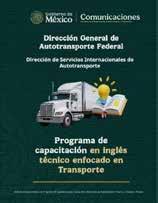
Cover of the English training program developed by DGAF.
Continued from page 25
SICT Strengthens Security on Federal Highways with Infrastructure Investment
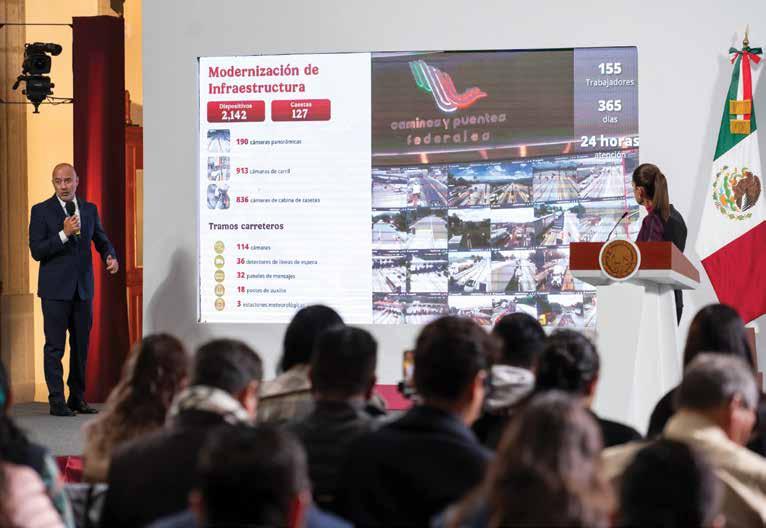
SICT announced a comprehensive security strategy on federal highways with the highest freight traffic. In a press conference led by President Claudia Sheinbaum Pardo and
SICT Secretary Jesús Antonio Esteva Medina, they detailed the actions that comprise this plan, including the closure of irregular access points, the installation of dynamic arches, infrastructure modernization and the construction of comprehensive bus stops.
Eighty irregular access points have been identified on the Mexico–Querétaro highway, of which 15 have already been closed, while on the Mexico–Puebla highway, 38 were detected, and two were addressed in July. The work consists of restricting exits using concrete segments, ditches and masonry walls to regulate traffic and enhance safety.
Dynamic arches will be installed at 12 strategic points along the highway network. This equipment is designed to recognize license plates, measure vehicle dimensions, record weights and control speed, which will improve road safety, prevent accidents and strengthen motor transport regulation.
They also highlighted the infrastructure modernization carried out by the Federal Revenue Roads and Bridges and Related Services (Caminos y Puentes Federales de Ingresos y Servicios Conexos – CAPUFE), which currently operates with 2,142 detection devices, including panoramic, lane-based and boothmounted cameras. Monitoring is carried out 24 hours a day, 365 days a year, with 155 workers, and the goal is to double this capacity during the current administration.
Finally, Esteva Medina emphasized the importance of the integrated rest stops, for which an investment of nearly one billion pesos will be made this year. Thirteen existing spaces will be formalized, and 10 more will be launched in 2025 with mixed investment. Between 2025 and 2030, the construction of at least 30 additional spaces is planned along the Federal Highway Network. These rest stops will offer access controls, rest areas, medical services, food courts and parking, to replace the so-called "cachimbas" (typically informal facilities where the drivers can rest, shower and eat) and guarantee safe and dignified spaces for truck drivers. n
SICT Secretary Jesús Antonio Esteva Medina and Dr. Claudia Sheinbaum Pardo, President of Mexico.
A Century of Safety: Manitoba Motor Carrier Enforcement Celebrates 100 Years of Service
By Sgt. Lexington Slater, Training and Standards, Manitoba Motor Carrier Enforcement
In 2025, Manitoba Motor Carrier Enforcement (MMCE) proudly marks its 100th anniversary –a century of unwavering commitment to road safety, infrastructure protection and industry collaboration. From its humble beginnings in the early 20th century to its current role as a provincial leader in commercial motor vehicle (CMV) safety, MMCE has evolved into a progressive, proactive, specialized government law enforcement agency that continues to shape the future of transportation safety in Manitoba.
A Legacy of Leadership
MMCE’s journey began with the regulation of motor carriers under the Motor Carrier Board, later evolving through the Highway Traffic and Motor Transport Board and eventually becoming the modern law enforcement body we know today. Over the decades, MMCE has adapted to legislative changes, technological advancements and the growing complexity of the transportation industry – all while maintaining its core values of integrity, accountability, industry focus and respect.
Today, MMCE operates eight permanent highway traffic inspection stations and 17 dedicated highway patrol areas across Manitoba’s 19,000 km of provincial highways. With a fleet of 25 patrol units and over 50
peace officers, MMCE ensures compliance with a wide range of safety-related legislation, all aimed at promoting road safety and protecting Manitoba’s infrastructure.
Under the umbrella of MMCE, the Motor Carrier Investigations Unit (MCIU) plays a key role in promoting safe CMV operations. MCIU conducts National Safety Code Standard 15 facility audits and safety-related investigations to assess carrier compliance with legislative requirements. Audits focus on critical recordkeeping areas, such as driver qualification, hours of service, vehicle maintenance and transportation of dangerous goods.
Facility audit results are added to the carrier’s profile and are a significant factor in determining the carrier’s safety fitness rating, helping to ensure accountability and regulatory compliance across the industry.
CVSA Partnership and Impact
As Manitoba’s lead agency for CVSA roadside inspections, MMCE plays a vital role in promoting uniform safety standards across North America. Each year, MMCE officers conduct more than 9,000 CVSA mechanical inspections, resulting in one in five vehicles being removed from service for safety violations. These efforts not only protect
Manitoba’s infrastructure but also safeguard the lives of all road users.
MMCE also provides CVSA training to other law enforcement agencies, reinforcing its commitment to education and collaboration. Officers regularly participate in seminars, trade shows and outreach events to help industry partners navigate evolving regulations and best practices.
Centennial Celebrations
To commemorate its centennial, MMCE has hosted a series of events throughout 2025, including historical exhibits, community engagement initiatives, and recognition ceremonies for current and retired officers. These celebrations honour the legacy of those who have served and highlight the agency’s continued dedication to innovation and excellence.
Looking Ahead
For MMCE, the focus remains clear: To be a strategic leader in transportation safety, continuously improving through education, enforcement and partnerships. With a strong foundation and a forward-thinking approach, MMCE is well-positioned to meet future challenges and continue protecting Manitoba’s roads for generations to come. n
Back row, left to right: Sgt. Lexington Slater, Deputy Chief Mike Wrixon, Sgt. Paul Laporte and Chief Kevin Mantie. Front row, left to right: Staff Sgt. Angie Brown, Prosecutions Administrator Charizze Illano.
From the Eyes of Local Members
Lawrence (Kansas) Police Officer Daniel Panel worked with Kansas Highway Patrol Technical Trooper Nick Wright to complete on-the-job training to receive his general hazmat certification. Ofc. Palen is one of 18 CVSA Class II Local Members in Kansas who are CVSA certified and one of only four local officers in Kansas who are hazmat certified.
Robert Cordasco of the Boston (Massachusetts) Police Department finally found an enforcement vehicle his size.
Dallas (Texas) Police Department Ofc. Tim Cordova conducts a post-crash inspection in July.
“I was almost done for the day, so, of course, that ‘just one more’ struck again! This driver had an invalid commercial driver’s license, was using and possessing marijuana, and there was a slew of violations and paperwork – but at least there was a rainbow for the impound.”
“This is from a truck and car show at MHC Kenworth in Alvarado, Texas, and we had to get a picture in the name of fighting crime. The owner of the Batmobile is a great friend of mine and a huge supporter of first responders. He is a tow operator and covers a large area of North Texas. When I need tools or items to assist with commercial motor vehicle crashes or investigations, he's always willing to help.”
—Sgt.
Harris County (Texas) Sheriff’s Office Deputy Rafael Deleon makes a stop during Operation Safe Driver and provides the driver with some safe driving education and a CVSA Operation Safe Driver pamphlet.
The Dark Knight heard that the Alvarado (Texas) Commercial Vehicle Enforcement (CVE) Unit was having problems with improper load securement, so he had to give a hand.
McDonald of the Alvarado CVE Unit
—Ofc. Chris Vinson, Midlothian (Texas) Police Department
St. Louis County PD Participates in Six Flags Bus Checks
By Ofc. Kyle Jahns, Commercial Vehicle Enforcement, St. Louis County (Missouri) Police Department
On May 2 and 9, the St. Louis County (Missouri) Police Department (PD) participated in bus checks at Six Flags St. Louis with the Missouri State Highway Patrol. The St. Louis Metropolitan PD is usually in attendance, but due to the recent tornadoes, they were required to conduct special details related to the damage caused and could not attend the bus check events.
During these two inspection events, officers from both agencies conducted a total of 34 Level I Passenger Carrier Vehicle Inspections, resulting in 51 violations. Three drivers and four buses were placed out of service. n
Inspectors completed 34 Level I Passenger Carrier Vehicle Inspections, resulting in 51 violations.
St. Louis County PD and the Missouri State Highway Patrol joined forces to complete the May bus check event.
Saving Your Own Life: A Critical Message to First Responders and CMV Operators
By Ofc. Darren Burkhart, Commercial Vehicle Enforcement Officer, City of Midlothian (Texas) Police Department
As a police officer for over 30 years and a firefighter/paramedic for more than 33, I’ve dedicated my life to serving and protecting others. Teaching has been a passion of mine for just as long. Since 1993, I’ve taught thousands of first responders and members of the public – starting with CPR and first aid, then moving into EMT and paramedic school, the fire academy and eventually police academy instruction.
Through all of this, the subject I’ve found most rewarding to teach is how to save a life. But what continues to weigh on my mind is a crucial question: We teach others how to save someone else’s life – so why don’t we teach them how to save their own?
A Personal Experience That Changed My Perspective
In 2017, while on vacation with my family, I found myself in a life-or-death situation. I choked on a piece of banana. I was completely alone. My airway was fully blocked. In those terrifying moments, I realized that no one was coming to save me.
As I began to lose consciousness, I instinctively grabbed the sides of a chair and performed an abdominal thrust on myself. Thankfully, it worked. I was able to dislodge the obstruction just in time. But I’ll never forget the darkness closing in or the thought that my family might find me dead.
I survived that day, but the experience forever changed how I view choking emergencies –especially for those of us who work alone or in isolated environments.
Choking Deaths: A Hidden Danger
According to national data, choking causes an estimated 5,000-5,500 deaths annually in the U.S. That number is likely even higher when accounting for unreported or misclassified cases.
Commercial motor vehicle (CMV) drivers are especially at risk. They spend countless hours alone in their trucks, often eating while driving or parked on the side of the road. If they begin to choke and no one is around, the outcome can be tragic. In fact, there are documented cases of drivers losing control and crashing due to choking – but how many of those lives could have been saved if a simple tool were available?
A Game-Changer: LifeVac
Fortunately, there’s now a way for people to save themselves in a choking emergency. The LifeVac is a suction-based device designed to clear airway obstructions. It reminds me of a toilet plunger in its design, but its effectiveness is no joke. This simple device can be used on others or on yourself, in almost any position, and without medical training. And, if you use a LifeVac in an emergency, the company will replace it for free.
Fire departments, EMS agencies and police departments across the country are beginning to carry these or similar devices on their vehicles. In fact, thanks to a generous donation, our department now has 50 devices deployed across patrol, traffic, CMV enforcement and criminal investigations units. We also carry them on the fire apparatus I serve on.
Why Every CMV Driver – and Every Department – Should Carry One
To all business owners, commercial drivers and fellow first responders: your life matters. The lives of your employees matter. The public’s lives matter. If you’re often alone or in a remote area, you need to have the tools to save yourself in an emergency.
These tools are compact, easy to use and affordable. Instructional videos are readily available online, and no special certification is needed. I’ve seen firsthand the potential of these suction-based devices, and I urge departments and companies across the country to make them standard equipment.
Final Thoughts
I look back on my own choking incident and wonder – how much faster could I have cleared my airway if I'd had this tool? What would’ve happened if my improvised thrusts hadn’t worked?
We train constantly to save others. But in the quiet moments – alone in a vehicle, a hotel room or at a remote scene – we may only have seconds to act.
The most important life you may one day have to save is your own.
Be prepared. Equip yourself. And stay safe. n
LifeVac Home Kit – Toddler and adult choking rescue device.
Edmonton Police Service Receives National Traffic Safety Award for CMV Education Program
By Chad Orydzuk, Communications Advisor, Public Affairs – Corporate Communications, Edmonton Police Service
The Edmonton (Alberta) Police Service (EPS) was recently recognized with a national traffic safety award for its commercial motor vehicle (CMV) training program, believed to be the first of its kind in North America.
The Canadian Association of Chiefs of Police (CACP) presented the award to members of the EPS Commercial Vehicle Investigation Unit (CVIU) at the annual CACP conference on Aug.12.
“We regularly educate drivers roadside during traffic enforcement about vehicle safety, load security and licensing. We saw a real opportunity to fill the gap in traffic safety education and provide an option to correct the situation, but by no means does this mean that drivers are not being held accountable,” said EPS Constable Kyle Westergaard.
The CVIU developed the program after identifying a significant knowledge gap among smaller motor carriers, many of whom lack formal training and are unfamiliar with Canadian regulations.
Officers often encountered legally licensed drivers, sometimes on temporary work visas, operating heavily loaded trucks and trailers without instruction in safe operation, load security or trip inspections.
While these drivers were legally permitted to operate the vehicles, their lack of knowledge posed serious public safety risks and exposed both themselves and their employers to potentially business-ending fines.
Launched in 2023, the free training program replaces punitive measures with preventative education. It creates a positive, nonconfrontational way for police and partner agencies to work with drivers and small businesses and build a culture of safety on the roads.
Traditionally, CMV drivers who were issued offense notice(s) had three choices: pay the ticket, plead not guilty, or plead guilty and request time to pay. Under the new program, first-time offenders have a fourth option: voluntarily participating in a safety training session.
Successful completion of the training program provides drivers with essential knowledge of legislation and safety practices, and their eligible offense notice(s) are withdrawn. The training curriculum was developed with the support of Alberta’s carrier services, specifically the Alberta Motor Transport Association, a strong advocate for health and safety at job sites and on highways.
As of Dec. 31, 2024, 581 drivers have been offered the new option, with 354 completing the training program.
Feedback has been overwhelmingly positive, and the relationships forged are expected to deliver safer roads through ongoing awareness, dialogue and training for years to come. n
by President Steve Sanderson
Accident Support Services International Ltd., Superintendent Chris Romanchych with the Royal Canadian Mounted Police and Chief Superintendent André Phelps with the Ontario Provincial Police.
Left to right: Constable Kyle Westergaard and Sgt. Dave Beattie accept the CACP award on behalf of the Edmonton Police Service. The award was presented by the CACP Traffic Safety Committee, represented
with
Left to right: Staff Sgt. Dan Furman, Constable Kyle Westergaard and Inspector Brad Mandrusiak with the Edmonton Police Service conduct roadside CMV inspections during a traffic safety campaign.
Local Officer Leads Level I Inspection Demonstration and Outreach to Industry
By Ofc. Christopher Vinson, Midlothian (Texas) Police Department; CVSA Local Member President
On June 18, Grand Prairie (Texas) Police Officer Mike Tubaugh partnered with Reliance Inc.’s Corporate Fleet Safety team to offer a North American Standard Level I Inspection demonstration in Grapevine, Texas. This Reliance Fleet Safety Summit event included more than 60 Reliance safety personnel –from managers to drivers – and was one of several summits held throughout the year to promote safety across the organization, which has 320 locations spanning 41 states. Such a setting could have been intimidating to any inspector, but the positive feedback from Reliance assured me that Ofc. Tubaugh presented with confidence and competence.
Ofc. Tubaugh took a unique approach to his presentation: He pre-recorded a video
of himself inspecting the undercarriage components so the large seminar audience would better understand what he was talking about when he demonstrated the truck inspection. This proved effective in helping the audience understand the depth of a Level I Inspection without having to go under the truck themselves.
Ofc. Tubaugh currently serves as chair of CVSA’s Operation Airbrake Program. Terry Renfrow, Reliance’s senior manager of fleet safety, is currently serving as chair of International Roadcheck. In these roles, they embrace roadway safety and uniformity through involvement and consistent enforcement and training. Their teamwork, which led to the live demonstration,
underscores the importance of connections made through the CVSA platform. I am proud that the CVSA Class II Local Members have created valuable partnerships with industry and improve roadway safety through teamwork and education.
I would also like to thank Reliance for placing their trust in these local officers and for providing them with the opportunity to serve in this capacity. These types of relationships unite enforcement and industry to help achieve the common goal of highway safety and regulatory compliance. n
Ofc. Mike Tubaugh leads a Level I Inspection demonstration to Reliance Inc.’s Corporate Fleet Safety team.
CVSA’s Apparel and Accessories Store
Select your item, customize the size/fit and color, and have it shipped directly to your house.
Goods and Accessories
l Bags
l Hats
l Flashlights
l Blankets
l Drinkware
l And More
Apparel
l T-Shirts
l Pullovers
l Jackets
l Dress Shirts
l Hoodies and Sweatshirts
l Vests and Outerwear
Available in a variety of colors in men’s and women’s cuts and sizes.
BEHIND THE HAUL:
Exposing Labor Trafficking in North American Trucking
Labor trafficking remains one of the most underreported and misunderstood crimes worldwide with more than 17 million global victims, equating to $64 billion in profits for traffickers each year, according to the International Labour Organization.
This crime happens in every industry – especially agriculture, hospitality and construction – and, unfortunately, there are high rates of labor trafficking in the commercial motor vehicle (CMV) industry as well. While the term "human trafficking" often evokes images of sex trafficking, labor trafficking – a form of modern-day slavery where individuals are coerced into work through force, fraud or threats – is pervasive and often invisible, even within regulated industries like trucking.
In North America, the coercive scheme of labor trafficking is embedded in legitimate supply chains and frequently targets the most vulnerable workers: low-income individuals, temporary foreign workers and immigrants. In a growing number of cases, victims are commercial drivers. With increased training and awareness, CMV enforcement officers/inspectors and industry representatives are in a unique position to detect, disrupt and respond to this crime.
Continued on next page
What Is Labor Trafficking?
The U.S. Department of Homeland Security defines labor trafficking as “the recruitment, harboring, transportation, provision or obtaining of a person for labor or services, through the use of force, fraud or coercion.” This can include withholding of wages or documents, manipulation of debt, personal intimidation and threats of deportation.
According to the U.S. Department of Justice, labor trafficking cases often involve legal jobs, such as agriculture, domestic work, construction and transportation, but with illegal and exploitative practices behind them.
The Canadian Criminal Code recognizes labor trafficking under Section 279.01, which prohibits trafficking for any purpose, including forced labor. Canadian labor trafficking investigations have increased in recent years, particularly involving foreign nationals working under the Temporary Foreign Worker Program (TFWP). TFWP is a government initiative that allows employers to hire foreign workers to fill temporary labor and skill shortages when no Canadians or permanent residents are
available. The program requires employers to obtain a Labor Market Impact Assessment (LMIA) to prove the need for a foreign worker and demonstrate that hiring them will not negatively impact the Canadian labor market. There are recent reports of employers taking advantage of the program and abusing workers.
In Mexico, trafficking for labor exploitation is a federal crime under Article 10 of the General Law to Prevent, Punish and Eradicate Crimes in the Matter of Human Trafficking. Mexican nationals, particularly indigenous and internal migrant workers, are vulnerable to exploitation in sectors including agriculture, construction and transportation. Mexico is also a major transit corridor for labor trafficking victims from Central and South America heading northward.
Yet, data remains limited. A 2021 report from the U.S. State Department’s Office to Monitor and Combat Trafficking in Persons stated that labor trafficking prosecutions continue to lag far behind sex trafficking. In 2020, 43% of federal trafficking prosecutions in the U.S. involved forced labor.
Labor Trafficking in the Trucking Sector
While precise statistics on labor trafficking in trucking are hard to quantify, some data is available. The Polaris Project, which runs the U.S. National Human Trafficking Hotline, documented at least 124 labor trafficking cases involving commercial drivers between 2015 and 2020. Most involved immigrant drivers, some of whom entered the country legally but were misled about the terms of their employment.
Additionally, federal agencies and nongovernment organizations have documented specific cases involving commercial drivers exploited through fraudulent job offers, excessive hours and illegal debt schemes.
Mandatory truck leases for trafficked drivers come with interest rates
as high as 30-40%
A 2019 investigation by the U.S. Department of Labor’s Wage and Hour Division unveiled that a South Dakota trucking company operator was convicted of exploiting dozens of H-2B visa workers, who were recruited from South Africa and Mexico. The H-2B nonimmigrant visa program permits employers to hire nonimmigrants to perform temporary non-agricultural labor or services. Drivers were forced to work long hours under the threat of deportation, paid less than the required wage rate, assigned to perform job duties outside of the certified job description and housed in substandard conditions. Several victims reported that their identification documents were confiscated upon arrival. Additionally, the company failed to pay the workers’ inbound and outbound transportation costs from their home countries as required, failed to pay housing and visa costs as required, and took impermissible deductions from H-2B workers’ wages. The company agreed to be debarred from participating in H Visa programs for five years.
In Texas in 2023, a 57-year-old man was recruited from Mexico to work in the U.S. as a farm laborer on a work visa. After his seasonal farm work ended, he was referred to a San Antonio trucking company and promised work as a truck driver and mechanic, including a weekly salary and a new work visa. However, after three months, the victim was paid minimally for his work as a mechanic and was required to drive a commercial truck with goods into northern states.
The driver was forced to violate mandated work-rest cycles, compromising his safety and that of other motorists on the roadway. When he insisted on being paid his wages and refused to continue work without due pay, the traffickers threatened to call immigration officials, falsely accused him of being a thief to local police and physically threatened him. It was later discovered that the traffickers intentionally hired other immigrants with the same scheme to obtain forced labor from them. The traffickers were arrested, and their business is no longer in operation.
According to the Joy Smith Foundation, an anti-human trafficking and anti-labor trafficking nonprofit organization in Canada, labor trafficking often targets temporary foreign workers, international students and newcomers to Canada who are seeking employment.
Recent data reveals troubling trends within the trucking industry in Canada:
39% of trucking companies that participated in the TFWP/LMIA program between 2019 and 2023 are no longer operational, leaving the fate of hundreds of recruited foreign workers unknown.
Small trucking companies (with fewer than 15 trucks) hired an average of 192% of their fleet size through foreign labor, demonstrating a heavy reliance on LMIA permits.
The Global Slavery Index suggests that approximately 69,000 people are living in modern-day slavery in Canada.
A Cycle of Exploitation
Labor trafficking and forced labor are significant problems within the trucking industry, exploiting vulnerable drivers and endangering the public. This can include immigrants lured by false promises as well as domestic drivers trapped in coercive schemes.
Newly arrived immigrants often don’t speak fluent English, lack familiarity with U.S. labor laws and are desperate to provide for their families. That makes them perfect targets for dishonest trucking companies that dangle promises of high wages, flexible work and even work visa sponsorships.
Recruitment:
Traffickers deceive job seekers about the true nature and/or conditions of the job. They may also “bait and switch,” replacing the employment agreement signed at the time of hire with a less desirable one without notice.
Employer-traffickers may charge recruitment fees and expenses, in some cases as much as a year’s pay or more.
Debt Bondage
Debt bondage is defined as “the status or condition of a debtor arising from a pledge by the debtor of their personal services or of those of a person under their control as a security for debt, if the value of those services as reasonably assessed is not applied toward the liquidation of the debt or the length and nature of those services are not respectively limited and defined.”
Labor-trafficked drivers are paid so little that they can never get out of debt, making them beholden to the company. The debt incurred as a condition of employment may be compounded by charging for:
Fines rather than disciplinary procedures for infractions.
Costs for fuel, uniforms, tools, personal protective equipment or other necessities for the job.
Costs for transportation, utilities or other expenses relating to the use of employer- or labor agent-provided housing, sometimes including things like paying for office toilet paper or use of the company parking lot.
Mandatory truck leasing (with interest rates as high as 30-40%) and deductions for truck maintenance, insurance and infractions/ ticket fees (commonly as much as a 90% reduction in paychecks). If a driver is fired, they often do not get to keep the truck or receive the funds they have paid. Paychecks often look more like invoices, listing negative amounts that reflect payments for the lease.
Employment Circumstances and Demoralizing Conditions:
Employers may require deposits, bonds and/or forced savings (sometimes called “runaway insurance”) with a promise of return on completion of the contract.
Continued on next page
INVESTIGATIVE REPORT
An investigative report by USA Today tells the story of a professional driver forced by his employer to lease his truck and haul washing machines and tires around Los Angeles for 16 hours a day – sometimes for a meager 67-cents-perweek paycheck after deductions for the lease, insurance, tires, registration and gas. He slept in his truck cab and was rarely able to make it home to see his family. When his truck broke down, the company fired him, seized the truck and kept the $78,000 he had paid toward owning it.
Read the full story at: www.usatoday.com/pages/interactives/ news/rigged-forced-into-debt-workedpast-exhaustion-left-with-nothing/
Mexico: March 16-20, 2026 Continued from page 37
CVSA
HUMAN TRAFFICKING PREVENTION
CVSA’s Human Trafficking Prevention Program seeks to reduce human trafficking throughout North America through coordinated enforcement and investigative and educational awareness measures within the commercial motor vehicle industry.
For more information, visit humantraffickingenforcement.org.
CVSA’s annual five-day human trafficking awareness, outreach, identification and prevention initiative aims to educate CMV drivers, motor carriers, law enforcement officers and the general public about the crime of human trafficking, the signs to look for and what to do if you suspect someone is being trafficked.
The dates for the 2026 Human Trafficking Awareness Initiative are:
U.S.: Jan. 12-16, 2026
Canada: Feb. 23-27, 2026
Victims’ personal identity documents may be withheld, including passports, IDs and work permits.
Living conditions may be substandard or fail to meet what was promised.
Victims may be misclassified as independent contractors to strip them of employee rights, with false promises of tax savings.
Long periods of isolation on the road can last for weeks or even months. Drivers cannot form relationships with each other as a social safety net.
Drivers may not see their families for months or years at a time.
Unsafe Labor Practices:
Excessive hours: Companies pressure or force drivers to exceed the legal limits on driving and working hours set by federal regulations, often to meet impossible delivery schedules.
Falsifying records: Drivers are sometimes required to forge their hours-of-service logs to help companies evade federal regulations.
Unsafe conditions: Many victims are forced to operate unsafe equipment, including vehicles with worn-out brakes or bald tires, putting the driver and the public at risk. Drivers may also be made to work without required industry safety training or equipment, such as gloves, boots or other personal protective equipment.
Threats:
Employers may threaten to terminate contracts, repossess trucks, and force victims to forfeit unpaid wages and savings and return travel expenses.
Traffickers may threaten to blacklist employees from future job opportunities for complaining or attempting to quit.
Traffickers may physically threaten victims and their families, their livelihoods and their immigration status.
How CMV Enforcement Can Make a Difference
CMV enforcement officers and inspectors may be the first – and sometimes the only –government representatives to interact with long-haul drivers on the road. As such, they are in a key position to spot red flags of labor trafficking. CMV inspectors have a unique opportunity because they can speak with drivers one on one, review documents and observe conditions in real time.
TAT (formerly Truckers Against Trafficking), through its partnership with CVSA, utilizes its CMV Enforcement Training to equip inspectors with tools to identify and report sex and labor trafficking.
Enforcement officers and inspectors, as well as members of the trucking industry and the public, can help spot trafficking by looking for these indicators:
Fearful behavior and coached/rehearsed speech: The driver appears timid, submissive and speaks as if they have been coached on what to say. They may also defer to a third party to answer basic questions.
Poor physical health: The driver shows signs of malnourishment, exhaustion or untreated medical issues.
Restricted movement: The driver is not allowed to speak freely or is visibly prevented from leaving a truck or work site.
Lack of control over documents: Someone else holds the driver's identification, such as their driver's license or passport. There are inconsistencies in documentation, such as mismatched IDs or employment contracts.
Poor working and living conditions: There are reports of working excessive hours without pay or evidence of substandard living conditions in sleeper berths or company housing.
Unusual truck behavior: A van or other vehicle frequently drops off or picks up an individual at a truck or rest stop.
Despite targeted training, detecting labor trafficking remains difficult. In many cases, traffickers condition victims to distrust inspectors and police. Victims often don’t self-identify, especially when they fear arrest, deportation or retaliation – threats they are constantly receiving from their traffickers/ employers.
Another challenge is that labor violations and trafficking exist on a continuum. Not every wage theft or housing abuse case rises to the legal definition of trafficking. However, recognizing exploitation early can prevent more serious abuses from escalating. Typically, labor exploitation involves violating labor laws and subjecting workers to unfair practices. It does not require the use of force, fraud or coercion, and victims are typically free to leave the situation, even if doing so causes hardship. Labor trafficking may start out as labor exploitation and get worse over time, evolving into labor trafficking.
How Industry Can Help
Motor carriers, driver training schools, recruiters and freight brokers all play a role in disrupting labor trafficking. One key step is vetting recruitment practices, especially when using subcontractors or third-party agencies to source drivers, whether domestically or internationally.
The U.S. Department of Labor and the Department of Homeland Security recommend that transportation companies:
Conduct due diligence on labor recruiters and staffing firms.
Provide clear contracts to workers in their native language.
Prohibit recruitment fees and document confiscation.
Establish whistleblower protections for workers who report abuse.
Transparency is the enemy of labor trafficking. When companies invest in transparency and direct hiring, it closes the door to traffickers. TAT also encourages companies to train their drivers, dispatchers and human resources departments to recognize and report signs of trafficking. Additionally, TAT recommends companies conduct an anti-trafficking audit to identify and remedy any policies or practices that cause or facilitate human/labor trafficking and/or exploitation. Since 2017, more than 1.5 million people in the transportation industry have completed TAT’s training programs.
Additionally, the National Private Truck Council, American Trucking Associations, the Joy Smith Foundation, Women In Trucking and other trucking organizations support anti-trafficking awareness campaigns, including distributing wallet cards with hotline numbers and placing informational decals in terminals and truck stops.
Questions for Potential Labor Trafficking Victims
BUILD RAPPORT AND ESTABLISH TRUST
How are you?
Are you okay?
Do you need rest?
Are you hungry? Thirsty?
Do you need medical attention?
How long have you gone without a full night’s sleep?
INQUIRE ABOUT POTENTIAL LABOR EXPLOITATION AND TRAFFICKING
When you aren’t driving this truck, where do you stay?
Do you live with your employer?
Does your employer charge you rent for where you live? Is it taken out of your pay?
Why are you working so many hours/days?
Do you want to work this many hours/days?
How did you find this job?
Do you owe money to your employer? How much?
• What is this debt for (job finding fee, documents, lodging, food)? What are you paying off?
If you have any fines for inspection violations, are you paying them or does your employer pay them?
• If your employer pays the fines, do they make you pay that debt back?
If your truck is towed, are you responsible for picking the equipment up from the tow yard?
• If not, who is responsible for retrieving the towed equipment?
• Who pays the tow yard fine? If your employer pays it, are you expected to pay them back?
Do you receive paychecks for your work? How often do you get paid? Are you paid by check, direct deposit or cash?
Are you allowed to see or talk to your family?
Do you get breaks? How often and how long?
Do you get days off? How many days per week/month?
• What happens if you ask for time off?
Continued from page 39
TAT CASE STUDY
A 2021 FreightWaves investigation found that truck drivers from Eastern Europe were being lured to the United States under false promises of well-paying jobs, only to find themselves “trapped in an alleged human trafficking scheme, forced to drive seven days a week and up to 20 hours a day and getting paid a fraction of what they were promised.”
In addition to the low wages and long hours, the company would regularly deduct the drivers’ pay for various reasons. Drivers also alleged the equipment wasn’t safe, including trucks with bald tires or worn-out brakes.
Reporting and Resources
Knowing where to report suspected trafficking is just as crucial as recognizing it. Several national hotlines and interagency task forces accept tips and offer guidance:
U.S. National Human Trafficking Hotline: 1-888-373-7888 or text “BEFREE” to 233733 www.humantraffickinghotline.org
U.S. Department of Homeland Security’s Blue Campaign: www.dhs.gov/blue-campaign
Canadian Human Trafficking Hotline: 1-833-900-1010 www.canadianhumantrafficking hotline.ca
Consejo Cuidadano en Mexico: Call or text 800-5533-000 www.consejociudadanomx.org
TAT: www.tatnonprofit.org
U.S. enforcement can also contact local FBI field offices or Homeland Security Investigations agents. In Canada, reports can be made to the Royal Canadian Mounted Police or provincial anti-trafficking units. In Mexico, specialized trafficking units within the Fiscalía General investigate these cases.
Importantly, enforcement personnel should avoid arresting or penalizing potential victims for immigration or licensing violations uncovered during inspections. Instead, a trauma-informed response – connecting the
individual with victim services or allowing them to speak safely away from traffickers – is best practice, according to TAT and federal guidance.
Victim assistance is individualized and aims to meet survivors where they are. When a survivor is connected to a service provider, the survivor may receive advocacy, medical assistance/ accompaniment to appointments; legal and immigration help (T-visa, which assists victims of human and labor trafficking); financial advice (such as how to get out of a contract); immediate needs coordination (such as help getting a cell phone and groceries and finding housing); and more.
Looking Ahead
As public awareness grows, so does the responsibility across the CMV ecosystem to recognize and prevent labor trafficking. More training, better screening practices and interagency collaboration are key to disrupting this crime.
In addition to helping individual victims, the goal needs to be about creating a culture where worker exploitation and labor trafficking aren’t tolerated in any form, regardless of the industry.
For CMV enforcement officers and inspectors, that work starts at the roadside. One stop, one conversation, one referral – it could change a life. n
CVSA Learning?
Select the Learning tab in your CVSA member portal to access training content. Content will vary based on membership type.
On CVSA Learning, You Can Access:
On-Demand Training Courses
Inspection Bulletins
Archived Webinars
Quick Fix, Inspector Focus and Inspection Bitz Videos
Essential Resources and Documents
Topics Include: Driver/Vehicle Inspections Hazardous Materials/Dangerous Goods Crash Investigations Carrier Investigations And More
Greyhound’s Crawford Lassiter Receives CVSA’s 2025 International Driver Excellence Award
On Sept. 24, the Alliance held its yearly awards luncheon at the CVSA Annual Conference and Exhibition in Denver, Colorado. When the time came to acknowledge this year’s International Driver Excellence Award (IDEA) recipient, the more than 600 individuals in the audience gave a standing ovation with rousing applause to Greyhound motorcoach operator Crawford Lassiter.
With 45 years of incident-free professional driving experience behind the wheel and more than 2.5 million safe miles as a driver, Lassiter was selected by CVSA as this year’s IDEA recipient.
“Thank you so much for this incredible honor,” Lassiter said as he addressed the annual conference attendees. “It truly means the world to me to be acknowledged this way.”
Lassiter, an Army veteran, has been working with Greyhound for the past 45 years. He has a passion for roadway safety and driver training. Not only is Lassiter an experienced motorcoach operator, but he is also the head driver safety instructor, spending hours on the road and in the classroom teaching, mentoring and helping new Greyhound operators and even new operators from other companies.
“Crawford embodies professionalism, pride and care for our passengers,” said Greyhound’s Regional Vice President Matthew Maglio, who nominated Lassiter for the award. “He’s not just a safe driver; he’s a mentor, a standard-bearer for the company and the whole industry, and he’s just a true team player who is always ready to help his students and colleagues.”
“On behalf of the Alliance, I’d like to congratulate Mr. Lassiter for his unwavering commitment to roadway safety, his impressive expertise and exceptional leadership as a safety instructor, and for always setting an outstanding example for others to follow,” said CVSA President Capt. John Hahn with the Colorado State Patrol.
“It’s drivers like Crawford who are bridging our legacy and our future,” Maglio noted. “His dedication, his accident-free record and his commitment to training the next generation show what it means to raise the bar for intercity travel.”
“Receiving this award reminds me of the importance of the work we do and the positive impact we can have on those around us,” said
Lassiter. “It reinforces my commitment to continue striving for excellence, to learn and grow, and to use every opportunity to make a difference.”
How has Lassiter managed to have all those safe driving miles over all those years? As an experienced driving safety instructor, his answer reflected his training experience.
“I use the Smith5Keys. Aim high in steering. Get the big picture. Keep your eyes moving. Leave yourself an out. And – make sure they see you.”
CVSA’s International Driver Excellence Award isn’t the only award Lassiter has received recently. The Pennsylvania Bus Association honored him with the Driver of Distinction Award, which recognizes outstanding drivers for their contributions to their company, their passengers, the motorcoach industry and the community in which they serve.
“I need to motivate the next generation of upcoming drivers and instructors to be courteous, helpful and safe,” said Lassiter. When asked what he likes most about his profession, Lassiter said he enjoys interacting with passengers and customers. He says, simply put, “I love driving.”
One key piece of advice Lassiter has for other professional drivers: “Come in early so you’re not rushing. That really messes up the rest of your day, when you’re trying to catch up.” Lassiter’s long, incident-free professional driving career would not have been possible without the support of the people around him. “I'm especially grateful to my family,” said Lassiter. “To my friends and mentors, thank you for your guidance, wisdom and for always pushing me to reach further.
“To my colleagues and everyone involved in this journey, this award is as much yours as mine,” Lassiter added. “Your dedication, hard work and creativity have been central to everything we accomplished. Working alongside such passionate individuals has been one of the most rewarding aspects of this journey.”
“Crawford is an asset to Greyhound, the intercity bus industry and commercial motor vehicle drivers everywhere,” added Maglio. “He’s known for his impeccable appearance – how he’s always in a pressed uniform with polished shoes and a professional demeanor. But even more importantly, he has a perfect accident-free record, perfect attendance and a winning attitude.”
When Lassiter isn’t on the road or training drivers, he enjoys deep-sea fishing, riding his motorcycle and spending time with his family.
As the leading organization working to improve commercial motor vehicle (CMV) safety and enforcement by providing guidance, education and advocacy for enforcement and industry across North America, CVSA recognizes the exceptional careers of professional CMV drivers and their commitment to public safety through the International Driver Excellence Award.
This annual award recognizes individuals who go above and beyond the performance of their duties as a CMV driver, distinguishing themselves conspicuously and beyond the call of duty through the achievement of safe operation and compliance carried out with evident distinction for an extended period of time. The nominated individual must be of personal character beyond reproach with no disqualifying past behavior, as indicated in the award criteria. Lassiter is the embodiment of those criteria.
The 2025 International Driver Excellence Award was sponsored by PrePass Safety Alliance. PrePass Safety Alliance brings together state and motor carrier industry decision-makers to advance safety and efficiency on our highways. PrePass Safety Alliance’s mission is to make highways safer and more efficient through innovative data-driven solutions.
Nominations for the 2026 award will open in spring 2026.
To learn more about the award program, visit www.cvsa.org/programs/idea. n
Lassiter addresses the audience as he accepts his award at the CVSA Annual Conference and Exhibition.
CVSA Learning Is for Everyone
By Kevin Andrews, Traffic Enforcement Specialist, Commercial Vehicle Safety Alliance
Is CVSA training only for commercial motor vehicle (CMV) roadside inspectors? Guess again. CVSA Learning has a whole new component for inspectors and officers who don’t do roadside inspections but want to learn more about CMVs and drivers. This new training area continues to grow. There are hundreds of thousands of law enforcement officers in North America, but only about 11,000-12,000 roadside inspectors in any given year. Because of this, many CMV traffic interactions likely don’t involve roadside inspections. Shouldn’t all officers have some basic knowledge about CMVs? CVSA thinks so, and this is why we have pursued this training opportunity.
CVSA has launched a new training category called Trucks 101. If you have visited CVSA Learning recently, you may have noticed it. This is a one-stop shop for all training geared toward officers who do not conduct roadside inspections. If you want to learn about CMVs, commercial driver’s licenses (CDLs), or CMV traffic enforcement, this is the place. This interactive training is designed in a roll-call style
so that you can complete each section in a short time. There is no need to travel for this training; take it at your convenience from any location.
Trucks 101 currently offers training on CMV enforcement, U.S. CDL basics and typical CMV crashes. Additionally, there are helpful charts to walk you through how to determine if a driver needs a CDL, what class of CDL is required, and when to check off the CDL, CMV and hazardous materials indicators on the traffic citation. If you conduct roadside inspections, please share this training opportunity with your fellow officers who do not. Then include them in your CMV enforcement activities, such as Operation Safe Driver, International Roadcheck, Brake Safety Week and the Human Trafficking Awareness Initiative. The more effective our traffic enforcement officers are, the safer drivers and trucks will be, improving overall highway safety. n
Trucks 101 (and much more training!) can be found at portal.cvsa.org.
CVSA Attends 2025 International Association of Chiefs of Police Impaired Driving and Traffic Safety Conference
By Jake Elovirta, Director of Enforcement Programs, Commercial Vehicle Safety Alliance
Members of CVSA staff attended the 2025 International Association of Chiefs of Police Impaired Driving and Traffic Safety (IDTS) Conference, held in August in Chicago, Illinois. The conference brings together law enforcement leaders and traffic safety professionals from the U.S. and Canada to focus on impaired driving prevention, traffic safety initiatives and enforcement strategies.
CVSA’s booth highlighted training resources, including Trucks 101, a new training program designed for law enforcement officers who are not a part of the Motor Carrier Safety Assistance Program. CVSA Traffic Enforcement Specialist Kevin Andrews and CVSA Crash Investigation Specialist Terry Kummer showed attendees how to create a CVSA Learning account and access the training library. They also discussed commercial motor vehicle (CMV) crash investigation training opportunities, and Kummer demonstrated tools used in crash investigations.
I was invited to present "CMV Enforcement: Why Your Agency Should Be Involved," which focused on how local jurisdictions can benefit from CMV enforcement training and the development of a CMV enforcement program.
Conference attendees included a wide range of law enforcement officers – representing state, county and local agencies – with a mix of command staff, supervisors and traffic officers. The conference provided an excellent opportunity to raise awareness about CMV safety, highlight CVSA training resources and foster discussions on expanding CMV enforcement at the local level. n
Trucks 101 covers CMV enforcement, U.S. CDL basics and typical CMV crashes.
Left to right: Andrews, Elovirta and Kummer.
A Historical Overview of the U.S. DOE/CVSA Cooperative Agreement and the Level VI Inspection Program
By Carlisle Smith, Level VI Program Specialist, Commercial Vehicle Safety Alliance
In 2025, CVSA reached a significant milestone: hosting its 200th Level VI Inspection certification course in San Diego, California. This event marked nearly four decades of progress and partnership between CVSA and the U.S. Department of Energy (DOE) in ensuring the safe transportation of highly sensitive radioactive materials across America’s highways.
Origins of the Level VI Inspection
The foundation of what we now call the Level VI Inspection Program dates back to 1986, when CVSA and the U.S. DOE entered into a cooperative agreement. The objective was to create specialized inspection criteria for commercial highway vehicles transporting spent nuclear fuel from shipments by the U.S. DOE.
Recognizing the unique safety and security needs of these shipments, a dedicated CVSA working group was formed. This group consisted of CVSA members from various
state agencies, representatives from the U.S. DOE, the U.S. Department of Transportation (DOT) and private industry stakeholders. Under the leadership of CVSA Director of Technical Services Gary Curtis and assisted by Jim Luman, retired Illinois State Police trooper and past CVSA president, the working group conducted several years of study and stakeholder engagement.
The outcome of these efforts was the development of a highly specialized inspection procedure for the safe inspection of transuranic (TRU) waste and radioactive materials and an associated strict out-ofservice criteria, designed to establish the highest standards of safety and compliance for these critical shipments.
The first shipment to the U.S. DOE’s Waste Isolation Pilot Plant (WIPP), a site for the disposal of TRU waste from U.S. DOE sites around the country, was on March 26, 1999,
from the Los Alamos National Laboratory in New Mexico. The first shipment from Idaho National Laboratory's nuclear facilities occurred on April 27, 1999. At that time, current CVSA Director of Hazardous Materials Programs Bill Reese was a hazardous materials specialist and one of the inspectors who inspected that first shipment.
Development of Certification and Training
Once the inspection procedures and outof-service criteria were established, CVSA and the U.S. DOE expanded their agreement to include the development of a formal training course. This course would certify enforcement personnel to perform the specialized inspection of TRU waste and radioactive materials in accordance with the new procedures.
An essential aspect of the certification training course was the high standard required to pass the course. An inspector must achieve
The first waste shipment leaves the Idaho National Engineering and Environmental Laboratory on April 27, 1999. Pictured left to right are Idaho State Police employees: Cpl. Bill Reese, hazardous materials specialist; Cpl. Tom Williams, commercial vehicle safety Level VI inspector; and Lt. Duane Sammons, MCSAP program deputy commander.
a 90% or higher on the final exam to pass the certification course. This has been the standard since the program's inception and adds to its integrity and validity.
To lead this initiative, CVSA appointed retired Lt. Col. James Daust as the first director of the Level VI Inspection Program. Daust was a former CVSA president, retired from the Michigan State Police. Under his leadership, the Alliance began routinely conducting specialized training courses to certify inspectors to conduct Level VI Inspections. In 1999, the CVSA Executive Committee approved the North American Standard Level VI Inspection Out-of-Service Criteria and its inspection procedures, which the Alliance continues to maintain, update and provide to certified Level VI inspectors to this day.
In 2002, CVSA Director of Administration Larry Stern became the new director of the Level VI Inspection Program, upon Daust's
retirement. Under Stern’s guidance, the program not only expanded its training reach but also enhanced interagency cooperation and program visibility.
Certification Training Courses
The first certification class occurred in Woodburn, Oregon, in 1992. Reese attended, successfully completed and passed the certification class. Since then, CVSA has held Level VI Inspection certification courses all over the U.S., certifying hundreds of inspectors to conduct Level VI Inspections.
In 2015, CVSA held its first Level VI Inspection certification course in Canada – in Pembrook, Ontario – to instruct Ontario’s Ministry of Transportation inspectors on inspecting shipments of uranium to be repatriated to the U.S.
CVSA has continued to host Level VI Inspection certification, train the trainer
and refresher courses regularly, ensuring a consistently high standard of inspection capability across participating jurisdictions.
As of this publication, there are 457 certified Level VI inspectors in North America.
Regulatory Integration and National Impact
In the '90s, the U.S. DOE mandated that its transuranic waste shipments adhere to Level VI Inspection protocols, thereby establishing a gold standard for the transportation of radioactive materials. Later that decade, some U.S. DOE shipments of cesium-137 transported from a facility in Colorado to Hanford, Washington, were used to test the Level VI Inspection procedure and draft the Level VI Inspection Outof-Service Criteria.
Continued on next page
On Feb. 21, 2006, the Idaho National Laboratory Advanced Mixed Waste Treatment Facility reached a shipping milestone. That day they had shipped 6,000 cubic meters of transuranic waste to the WIPP site in New Mexico. The picture shows the massive team responsible for achieving this milestone.
Continued from page 45
CVSA worked closely with the Federal Motor Carrier Safety Administration (FMCSA) to integrate the Level VI Inspection Out-ofService Criteria into federal regulations for highway route controlled quantity (HRCQ) shipments of radioactive materials.
In 2005, FMCSA incorporated the Level VI Inspection Out-of-Service Criteria and inspection procedures into the Federal Motor Carrier Safety Regulations (FMCSR). The FMCSRs now require any motor carrier transporting an HRCQ shipment of radioactive materials to pass a defect-free point-oforigin CVSA Level VI Inspection to maintain their hazardous materials safety permit. FMCSA’s adoption of the Level VI Inspection and its out-of-service criteria helped to institutionalize uniform enforcement nationwide.
Patches and Pins
Expansion Through Additional Agreements
In the mid-2000s, CVSA and the U.S. DOE’s Office of Civilian Radioactive Waste Management (OCRWM) entered into an additional cooperative agreement to support the development of a transportation plan for the Yucca Mountain nuclear waste repository in Nye County, Nevada. This agreement significantly expanded the scope of CVSA’s responsibilities, which now include:
Continuing Level VI Inspection certification training
Conducting peer reviews of state Level VI Inspection programs
Evaluating emerging transportation technologies for HRCQ shipments
Developing public outreach materials and display exhibits for the program
Participating in national conferences and meetings to educate stakeholders and the public
This phase of the cooperative agreement was administered by Lt. Duane Sammons, who had retired from the Idaho State Police, and directed by Stern, continuing the program's evolution and outreach efforts.
In 2009, the cooperative agreement between CVSA and the U.S. DOE OCRWM ended with the closure of the Yucca Mountain civilian spent fuel repository. In 2012, Stern retired and was replaced by current CVSA Level VI Inspection Specialist Carlisle Smith, who, at that time, was program manager of the Ohio Public Utilities Commission’s hazardous materials investigative unit.
Under Smith’s direction, the Level VI Inspection Program continues offering certification classes; the number of certified Level VI inspectors has increased; the program has expanded to offer annual Train the Trainer courses; an eight-hour refresher class is offered every year at the Cooperative Hazardous Materials Enforcement Development Conference; and program representatives attend meetings and conferences throughout North America to provide more information about the program.
The Level VI Inspection Program continues to be supported with funding from a cooperative agreement with the U.S. DOE’s Carlsbad Field Office. The program has been recognized by the American National Standards Institute (ANSI), where Smith represents CVSA on the ANSI N14 committee.
Reflections and Looking Ahead
Over the years, the Level VI Inspection Program has grown into a cornerstone of national radioactive materials transportation safety. The program not only provides critical inspection training but also serves as a platform for intergovernmental and industry collaboration. As of Oct. 6, there have been 14,610 shipments to the WIPP from U.S. DOE transuranic waste sites in New Mexico, California, Colorado, Idaho, Illinois, Ohio and South Carolina.
With the recent milestone of the 200th training class, the program's legacy of excellence continues, underscoring the importance of proactive regulation, interagency cooperation and public engagement in addressing the complex challenges of radioactive materials transport.
The current Level VI Inspection Program national instructor team consists of Smith, Reggie Bunner (West Virginia Public Service Commission), Kelly Horn (Illinois Emergency Management Agency and Office of Homeland Security), Brenda Tubbs (Indiana Department of Homeland Security), Juel Leuis (FMCSA), Artez Lester (Florida Highway Patrol) and Jim Farley (Nevada Highway Patrol).
As the U.S. continues to navigate the future of nuclear waste management and radioactive materials transportation, the CVSA Level VI Inspection Program will remain an essential component of national infrastructure safety for years to come.
For more information about the CVSA Level VI Inspection Program, visit www.cvsa.org/inspections/level-vi. n
The current Level VI Inspection pin.
An early-2000s Level VI Inspection patch.
The Perils of Not Understanding Your Fiduciary Duty
By Rodolfo Giacoman, Fatigue Management Specialist, Commercial Vehicle Safety Alliance
As a commercial driver…
Fiduciary duty is acting with the highest possible care and integrity for the long-term benefit of those who rely on you, even when it conflicts with your immediate self-interest. Your fiduciary duty means you have a fundamental legal and ethical obligation to act in the best interests of the people and entities who rely on you. That includes your family, your company and the public on the roads. Their best interest is not limited to today’s trip, this week’s family events or this month’s rent. It is a responsibility you will hopefully have for decades to come.
You and your commercial driver’s license (CDL) are your family’s most valuable financial asset. Your fiduciary duty is to protect these assets above any short-term gain. That means you must value your wellbeing, safety and compliance, even when it costs you an extra trip or a bonus.
Breaches of fiduciary duty happen when short-term gain is prioritized. A driver who speeds, operates an unsafe vehicle or drives fatigued risks their CDL and their family’s sustenance due to a crash. For the motor carrier, reckless driving or dishonest logbooks
expose the business to massive liability and risk its operating authority. Ultimately, any action that needlessly endangers the public is a breach of societal trust essential to this profession.
As
a motor carrier representative… Fiduciary duty is a core legal and moral obligation to operate the business in a way that safeguards the long-term wealth and survival of the enterprise and its stakeholders.
Your fiduciary duty means you have a fundamental legal and ethical obligation to act in the best interest of your shareholders or owners, employees and the public. Their best interest is not limited to this week’s current payroll, the quarterly income or this year’s financials. It is a responsibility to ensure the viability and profitability of the enterprise for decades to come.
Your obligation is to protect the company's most valuable, non-physical asset: its operating authority and reputation. Your duty is to provide a safe workplace and the resources necessary for your employees to meet their professional obligations without having to choose between safety and income.
And your duty is also to operate with the highest degree of caution and prudence to minimize the inherent dangers of commercial motor vehicles (CMV) on public roads.
Skimping on truck maintenance or encouraging unsafe driver practices might save a few dollars today. However, a single catastrophic crash or a poor safety rating may lead to higher insurance costs, legal judgments and the loss of contracts. These long-term consequences are a clear failure to protect the company's assets and financial future.
When a carrier pressures a driver to violate hours-of-service (HOS) rules, sends them out in a defective CMV or cuts pay for required work-related time, it puts drivers’ livelihoods and physical well-being at risk. If that driver is involved in a serious crash, the carrier becomes legally and ethically liable, thereby constituting a significant breach of its duty of care. Any policy, dispatch instruction or systemic failure that prioritizes profit over road safety is a direct breach of public trust and ultimately risks the company's operating authority.
Continued on next page
Continued from page 47
How to Fulfill Your Fiduciary Duty
Implementing a fatigue management program in accordance with the recommendations of the North American Fatigue Management Program (NAFMP) is one of the most direct and effective ways for both professional drivers and motor carriers to fulfill their fiduciary duties.
The NAFMP shifts the focus from merely complying with HOS rules to proactively managing the risk of fatigue, directly protecting the critical assets of all parties.
Considering Your Safety Department as Crucial to LongTerm Profits
While some motor carriers may view their safety department as an unprofitable cost center, this is a shortsighted perspective. A strong safety program is a crucial, high-value investment that delivers a significant return by reducing major expenses and increasing revenue. An ineffective or underfunded safety department, by contrast, can destroy a motor carrier's profitability.
A well-run safety department improves a motor carrier's bottom line in multiple ways:
Insurers base rates on a carrier's risk, which is determined by factors like crash history and Safety Measurement System (SMS) scores. A strong safety record demonstrates a lower risk, leading to more favorable insurance rates.
An effective safety department ensures compliance with Federal Motor Carrier Safety Regulations. This helps carriers avoid costly fines and penalties. A documented safety program also provides a strong legal defense against negligence lawsuits, protecting the company from nuclear verdicts.
Proactive safety measures, such as driver training, monitoring and regular vehicle maintenance, directly lead to fewer crashes. This reduces costs associated with vehicle repairs, cargo loss and legal fees.
A company with a strong safety culture is more likely to attract and keep qualified drivers. This helps the carrier avoid high driver turnover costs, including expenses for recruiting, hiring and training new drivers.
Safety protocols can improve fuel efficiency by promoting safer driving habits, like avoiding harsh braking and rapid acceleration. Preventive maintenance also extends vehicle lifespan and minimizes costly, unexpected repairs.
How to Fulfill Your Fiduciary Duty As a Commercial Driver…
FIDUCIARY DUTY PRINCIPLE
Duty to Protect Livelihood
Duty of Care to Others
Duty to Future Self/Family
HOW NAFMP HELPS FULFILL IT
The program offers training on sleep hygiene, nutrition, exercise, mindfulness, positive relationships and recognizing objective signs of fatigue. This knowledge empowers the driver to make informed decisions that value alertness. By managing their personal fatigue, they reduce the likelihood of a major crash or violations that could result in the loss of their license.
NAFMP training reinforces the understanding that fatigue is impairment. By teaching the driver how to remain alert, the program ensures the driver meets their ethical obligation to operate a CMV with the highest degree of care toward the motoring public.
By participating in a sleep disorder management program, a driver is investing in their long-term health, not just their job. Treating a chronic disorder like sleep apnea improves alertness and overall health, extending the driver's professional life and securing their family's future income.
How to Fulfill Your Fiduciary Duty As a Motor Carrier…
FIDUCIARY DUTY PRINCIPLE
Duty to Protect Company Assets
Duty of Care to Employees
Duty to Preserve Reputation
HOW NAFMP HELPS FULFILL IT
NAFMP requires establishing a fatigue risk management system that includes sound scheduling and fatigue detection technology. This proactively prevents fatigue-related crashes, which are the single biggest threat to a carrier’s solvency through liability claims, increased insurance premiums and the loss of the company's operating authority.
The program mandates comprehensive sleep disorder management for drivers. By actively screening and treating conditions like sleep apnea, the carrier removes a significant physical impairment. This demonstrates an active, ethical commitment to the driver's health and safety, directly defending against claims of negligent entrustment or failure to provide a safe workplace.
NAFMP promotes a corporate safety culture by providing training for executives, managers and dispatchers. When a carrier is known for valuing safety and investing in driver health, its reputation improves, securing better contracts with shippers and a superior public image.
The choice is simple: Will you manage risk proactively or wait to be managed by consequence? Fulfilling your fiduciary duty – whether to your family, your shareholders or the public – requires more than good intentions; it demands action. Failure to act is not a passive choice; it is itself a breach.
NAFMP provides the evidence-based roadmap you need. Don't risk a lifetime of professional investment and financial stability by treating fatigue management as an option. View it for what it is: the essential insurance policy for your career and your company's future.
For CMV and motor carriers ready to make this crucial, profitable investment, all training modules, implementation guides and program resources are available to you for free at nafmp.org. By engaging with these resources, you move beyond merely understanding the perils and take the decisive action required to prevent them.
Keep your questions and comments coming at rodolfo.giacoman@cvsa.org. n
INSPECTOR’S CORNER
My Journey from the Texas Challenge to NAIC
By Cpl. Dustin Henderson, Radiological/Nuclear Threat Detection Unit, Texas Department of Public Safety
I am Cpl. Dustin Henderson, and I serve on the Texas Department of Public Safety's (TXDPS) Radiological/Nuclear Threat Detection (Rad/ Nuc) Unit. I earned a Bachelor of Arts in government and served as an adult probation officer for four years before joining TXDPS. TXDPS commissioned me in June 2012, and I spent the first five years of my career with the Highway Patrol. I transferred to the Commercial Vehicle Enforcement (CVE) service in August 2017. TXDPS created the Rad/Nuc Unit in February 2024, which I soon joined. I am married to my beautiful wife, Cassandra, who is the backbone of my life, and we have two wonderful and brilliant children together: Colton (8) and Audree (5). I enjoy watching our children’s sports competitions, traveling with my family, hunting and fishing in my free time.
TXDPS, in conjunction with the Texas Trucking Association, hosts an annual competition called the Texas Challenge, which is similar to CVSA’s North American Inspector Championship (NAIC) at the regional and state levels. Six regions compete in the Texas Challenge, and each region's top three or four competitors go to the state competition to compete for a shot at NAIC. My first time competing was at the regional level in 2018. I was not yet certified in Cargo Tank Inspection and failed miserably overall. As a result of my embarrassment over how poorly I had performed, my drive to compete sparked to life.
I'm a numbers-type person, and the way the scoring system operates, hazardous materials (HM) play a significant role in the overall score, as the non-bulk HM and bulk HM scenarios account for 30% of that score. The written test covers general knowledge and usually includes several HM questions. This test makes up 20% of the overall score; the Level I Inspection scenario, 35%; and the Passenger Carrying Vehicle Inspection (PCVI) makes up the remainder. It was apparent that you needed to be savvy in HM. So, this was where my passion for HM began. To this day, every time I open my HM book, I learn something new.
I continued competing each year, learning new things. I made it a point to conduct more roadside inspections of HM. The more I did, the more DataQs I received, and I learned I was wrong. Thankfully, I always took photographs of what I inspected so I could
go back and learn. I spent numerous hours and days with the TXDPS CVE Training Unit members and fellow inspectors, learning because I was tired of failing. Their continued support throughout my journey has proven invaluable to my success. I began attending the Cooperative Hazardous Materials Enforcement Development Conference and online training hosted by CVSA. (If you have not taken the training, which is free to CVSA members, you're missing an excellent opportunity to learn and improve at your job!)
After doing this, the smoke finally cleared, and I began to understand HM. I still worked on improving at Level I and PCVI, and I noticed I started placing higher at the Texas Challenge.
Then in 2023, I was lucky enough to win the Texas Challenge and attend NAIC for the first time in Columbus, Ohio. I met with previous Texas NAIC Champions Jeremy Usener (TXDPS), Michael Trautwein (Houston Police Department (PD)) and Rommel Garcia (Houston PD), fellow competitor Chris Vinson (Midlothian PD), and numerous industry partners beforehand. From them, I learned how to compete. Even though we came from different agencies, we shared one thing: We wanted the title of Jimmy K. Ammons Grand Champion to stay in Texas. My first time attending NAIC, I didn't know what to expect. I was nervous and intimidated after listening to the other competitors' small talk, so I spent my evenings in my room studying to avoid failing like I did the first time at regionals. I ended up doing well, but I could still do better. Tom Krolak (Minnesota State Patrol) took the title home that year, so we had more work to do in Texas.
I competed again in 2024 at the Texas Challenge, and the good Lord helped me get to Indianapolis, Indiana, for NAIC, where I was lucky enough to move up one more spot. I prepared with a fellow competitor, Jared Koester (Ft. Worth PD), and he was always willing to help me, even though we were competing against each other. Again, we had the same goal: Bring the title back to Texas! This time at NAIC, I was less nervous and spent more time socializing and getting to know people. I ended up doing a little better in Indy overall, and the reason was that I spent more time getting to know people, which helped me relax. Koester earned the title of Grand Champion, so the title did come back to Texas in the end.
I had decided to give up competing. I experienced burnout from all the stress and traveling; however, my wife convinced our son and daughter to guilt-trip me into competing once again. I am so thankful they did. This year, I was able to conquer the Texas Challenge again. My supportive chain of command allowed other members from our Rad/Nuc Unit, who have also competed, to help prepare me for this year’s NAIC in Minneapolis, Minnesota. We visited numerous carriers' offices, set up scenarios, worked on timing and tried to identify violations. The finale rose in Minneapolis, where the stars aligned; the support from my family and friends, the training offered by our CVE Training Unit, CVSA, fellow competitors and industry partners all came together, and I was lucky enough to come out on top. The feelings have been overwhelming, and there are not enough words of gratitude to thank God, my family, my friends and everybody else who played an intricate role in this endeavor.
I say all of that to make this point: My biggest regret while competing was not getting to know more people sooner. The amount of light that other people can bestow upon you can genuinely make you better at your job –and more importantly, a better person. I am so thankful I stepped out of my comfort zone and made the effort to meet more people. Had it not been for them, there is no way I could have succeeded.
If there is anything I can do to help you, please do not hesitate to reach out. God bless you all and God bless Texas! n
Partnership and collaboration among enforcement, the commercial motor vehicle (CMV) industry and the agencies that regulate it are at the core of the Alliance. CVSA and its membership serve many functions. We maintain the North American Standard Inspection Program and all the pieces that comprise it. We provide certification and continuing education training for the inspector community, as well as critical safety training for motor carriers and their safety professionals. CVSA advocates for the CMV inspector community with policymakers and conducts educational outreach on an almost daily basis. The list goes on…
One of our most critical functions, however, is the role we serve in providing a forum for industry, enforcement and regulators to come together to identify solutions to the challenges we collectively face in achieving our shared mission of improved CMV safety. When we educate lawmakers and their staff about the Alliance and its purpose, one of the first things we share is that CVSA brings together subject matter experts from across the CMV arena to problem solve. Our meetings are working “roll up your sleeves” kinds of meetings, and this approach results in significant improvements to roadway safety.
One recent example of the power of our collaboration can be found in the changes that are on the horizon for the Federal Motor Carrier Safety Administration’s (FMCSA) DataQs program, which is the process by which individuals can challenge enforcement and inspection data by requesting a review by the issuing jurisdiction. Agencies that participate in the Motor Carrier Safety Assistance Program (MCSAP) use the DataQs system to respond to requests for data review. And, while the basic functionality is the same from jurisdiction to jurisdiction, how they each approach the review process itself can vary.
For the most part, this customized approach to DataQs is a good thing, and it allows jurisdictions to structure programs that work for them and the industry in their area. However, over the years, CVSA industry members and others in the motor carrier community have expressed concerns with
the consistency and efficacy of the DataQs system. CVSA has heard from carriers that were seeing what they considered reasonable DataQs rejected with no explanation. Others expressed concerns that the review was sent to the issuing inspector, obstructing the due process the system is intended to provide. Still others expressed concerns over delays and timelines. In particular, some in the motor carrier industry took issue with how challenges to an initial DataQs response are handled in some jurisdictions. Overall, these challenges undermined the credibility of the system and created frustration for industry.
For any regulatory model to be credible, it must be built on clear regulations, consistent enforcement and effective due process. In addition, the jurisdictions’ safety programs under MCSAP are built on motor carrier inspection data, and it’s critical that that foundational data be accurate. (For more on the role data plays in CMV safety program development and implementation, check out the article on page 2 from CVSA Executive Director Collin Mooney.)
Recognizing the importance of an effective, credible DataQs program, and hearing the rising concerns from industry, CVSA engaged with our member partners at the American Trucking Associations and the OwnerOperator Independent Drivers Association to discuss the program, our shared concerns and potential improvements. After many rounds of discussion and debate, we engaged with our federal partners at FMCSA to discuss the recommendations developed in collaboration with our industry partners. This engagement and collaboration began to pay off in September 2023, when FMCSA published a notice requesting comments on the agency’s proposal to establish a federal appeals process for reviewing DataQ determination challenges.
Though it took some time, the conversations and collaboration between the jurisdictions and our industry partners began to prompt substantive changes to the DataQs response and appeals process. In late 2023, the Alliance held a virtual meeting to discuss the proposal to develop CVSA’s comments to the notice. As it turns out, CVSA’s enforcement members
had significant concerns with the proposed federal review concept, and our comments reflected those issues. And again, the collaborative relationship with FMCSA became apparent as the agency heard that feedback, met with the CVSA Board of Directors in June 2024 and went back to the drawing board. This speaks not only to the power of bringing the jurisdictions together to provide a unified voice, but also to FMCSA’s commitment to this concept of engagement and collaboration among the jurisdictions, industry and the regulators.
In September 2024, CVSA hosted a presentation by FMCSA on their revised approach to improving the DataQs process. It was apparent that the agency had taken the feedback from CVSA and others and crafted a new approach that met the needs of industry and enforcement. Once again, CVSA brought the membership together to review the new proposal and provide additional feedback and, when the next round of comments was due in September 2025, the Alliance’s remarks were largely supportive of the proposal.
Once the new changes are implemented, we will monitor the results and continue to engage with our industry partners to ensure the system provides the necessary opportunities for due process in a timely manner. And in the meantime, we’ll start looking for the next issue to tackle, all with the goal of making our roads safer every day. n
(Mostly) Everything Relates to Fatigue
By Margaret Edwards, Manager of Government Affairs, Commercial Vehicle Safety Alliance
The U.S. Congress holds committee hearings to explore topics and hear from stakeholders as part of its work to prepare for upcoming surface transportation reauthorization legislation. So far this year, the House Transportation and Infrastructure Committee has held 13 hearings, and two covered topics such as roadway safety and trucking. The U.S. Senate’s Committee on Commerce, Science and Transportation has held two hearings focused on commercial motor vehicles (CMVs), with one addressing cargo theft and the other looking at issues facing the truck and bus industries. And CVSA uses each hearing as an opportunity to educate members of the U.S. Senate and House of Representatives on the Alliance’s priorities for surface transportation reauthorization.
One opportunity to educate members of Congress about the Alliance’s priorities comes in the form of submitting statements for the record. The statements for the record submitted by CVSA must connect the topics discussed at the hearing to the priorities important to roadside inspectors.
For example, when the House Transportation and Infrastructure Committee held a hearing on trucking in April, CVSA submitted comments that addressed the topics discussed in the hearing, such as solutions to challenges facing the industry, while also using the opportunity to share information about the Alliance’s reauthorization priorities.
While connecting the Alliance’s reauthorization priorities to the hearing topics, one thought that came to mind when drafting the comments was to connect multiple reauthorization priorities back to the issues surrounding fatigued driving and solutions to mitigate fatigue, which were covered in that hearing.
Fatigued driving is near the front of my mind because CVSA added a policy statement on fatigued driving to the CVSA Standing Policy Guide in September 2024. The policy statement supports a requirement that motor carriers implement a fatigue management program, and the discussion focused on how driver fatigue is a significant contributor to CMV crashes and poses a risk to road safety. The policy position and discussion highlighted the Alliance’s focus on mitigating fatigue-related driving to enhance safety on our roadways.
Mitigation strategies for fatigue are woven throughout CVSA’s reauthorization priorities. One such strategy relates to personal conveyance. CVSA supports capping the time
drivers can use personal conveyance. Currently, drivers can misuse and abuse personal conveyance to drive for an unlimited amount of time. Using personal conveyance to extend driving time increases the risk of fatigue and can endanger other road users. Placing a limit on the time a driver can use personal conveyance is a strategy to mitigate fatigued driving that should be implemented.
Another reauthorization issue related to fatigue is CVSA’s opposition to legislative exemptions. Exemptions granted by legislation do not always include safety considerations and are difficult to revoke once established. Because industry can pursue exemptions through an administrative process, CVSA opposes the inclusion of exemptions from federal safety regulations in legislation. The connection between legislative exemptions and fatigue arises because they often exempt drivers from the hours-of-service (HOS) rules. The HOS rules exist to prevent and manage driver fatigue by establishing a framework that, if followed, allows drivers to get the rest necessary to operate their vehicles safely.
Additionally, Congress may also grant legislative exemptions from the electronic logging device (ELD) mandate. For example, livestock and insect haulers are permanently exempted from the ELD mandate. CVSA opposes any effort to exempt a portion of the motor carrier industry from the requirements.
ELDs assist in the effective enforcement of HOS regulations. ELDs are a valuable tool for enforcing hours-of-service regulations, making it easier for inspectors to identify violations and remove unsafe, noncompliant carriers and drivers from roadways, while saving time for both enforcement and industry.
A final reauthorization priority that aims to address the issue of driver fatigue is promoting investments that address the nation’s CMV parking shortage. The availability of adequate parking facilities, strategically placed throughout the U.S., is a critical CMV safety issue. Without adequate parking facilities, drivers are faced with driving fatigued and/ or over the allowable time in the HOS rules. Increasing parking availability for CMV drivers would ensure they have safe places to rest, as required by safety regulations. By supporting investments in expanding CMV parking, these critical situations caused by fatigue can be alleviated.
In the upcoming surface transportation reauthorization legislation, Congress and the administration have the opportunity to prioritize solutions that mitigate fatigued driving. CVSA will continue to include these solutions that address fatigued driving and improve safety as part of its advocacy on the Alliance’s priorities ahead of the upcoming surface transportation reauthorization priorities. n
FROM THE DRIVER’S SEAT
Sharing the Road with the Next Generation of Drivers
By Wayne Ponschke, Professional Driver, United Parcel Service; America’s Road Team Captain
My name is Wayne Ponschke. I am a professional truck driver for United Parcel Service, and I’ve been in the trucking industry for 39 years, with 2.5 million miles of safe driving. I’m proud to be one of the 3.6 million safe truck drivers on the road today.
One of the best parts of what I do with the American Trucking Associations is its Share the Road program. Over the past two years, I’ve shared my experience with around 500 young men and women in driver education classes. Alongside other drivers, we teach these students about the blind spots on all four sides of a tractor-trailer.
We explain that in front of our truck, we need 510 feet of space to safely bring an 80,000-pound, fully loaded tractor-trailer to a complete stop. We stress how critical that space cushion is. Then we talk about how important it is that when they change lanes in front of us, they wait until they can see the entire front of our tractor in their rearview mirror. When they do that, they help us maintain that essential space cushion. As we continue around the truck, we explain how we communicate using our horn, lights and turn signals. What I enjoy most about these demonstrations is that I get to help students build good driving habits before they even get their licenses.
Next, we move to the right side of the trailer. We purposely place a vehicle halfway down the trailer and one lane over. We tell the students, “Later, when you sit in the driver’s seat, we’ll make this car disappear.” I want them to see the car now and remember it's there.
We explain that while it’s technically safe to pass us on the passenger side, it’s critical not to linger there. Pass us as soon and as safely as you can. I also point out that our tires are inflated to 105 psi. If we experience a blowout – and it happens, just like it does with cars – it sounds like a small explosion. If you’re not expecting it, it can be a real shock. That’s another reason why we don’t want drivers hanging out on the right side of our vehicle. Pass swiftly and safely.
Then we take them to the back of the truck and ask, “Is this the safest place to be?” Most of them say yes. I explain that it can be – if
you leave enough following distance. We recommend four to six seconds. I share a saying we use in the industry: “If you can’t see the driver in both mirrors, you’re too close.”
Then I explain the purpose of the rear underrun protection system, also known as the Mansfield bar or DOT bumper. It’s one of many safety innovations from the trucking industry that has saved countless lives. I elaborate that our trailers can straddle a fullsized tire without touching it. But if a car tries that, it’s a very different outcome. If I see a hazard like that ahead – say, a blown tire – I activate my four-way flashers to warn drivers behind me. I want them to stay back and see everything ahead.
We then bring the students around to the driver’s side of the tractor and explain that this is the preferred side to pass us on. It has our smallest blind spot. Again, we emphasize: Do not linger.
As a professional driver, I’m constantly scanning ahead – three blocks ahead in town, and half a mile ahead on the highway. That gives me time to adjust to changing conditions. If I need to change lanes and you’re sitting in my blind spot, it puts us both in a risky situation we don’t need to be in. That’s why I always use my signal early – to communicate my intent.
Next, we let them get into the tractor. I demonstrate the “three points of contact” rule for getting in and out safely: two hands and one foot, or two feet and one hand. Safety first.
As soon as they sit down and buckle their seatbelt, they light up. “Wow, you can see everything from up here!” they say. I smile and reply, “Really? You think you can see everything?” Then I add with a grin, “Besides being a professional driver, I’m also a magician.”
They give me a puzzled look. I ask them to pretend they’re changing lanes to the right. They signal, check their right mirror and start to move over. Every one of them thinks they made a safe lane change.
Then I ask, “Remember that car we talked about—the one on the right side of the
trailer?” They say, “Yes, of course.” I snap my fingers and say, “Poof! I made it disappear, right?” They look. “It’s gone!” they say.
Then I tell them, “Lean forward and check your mirror again.” Their eyes light up when they finally see the car. “Now I see it!” they say, smiling. That makes me smile every time.
While they’re still in the driver’s seat, I have four other students take positions: one in front of the tractor, one on each side (in the blind spots) and one about 50 feet behind the trailer, roughly four car lengths. I ask the student in the driver’s seat, “Can you see any of your classmates?”
The answer is always no. I explain that when I’m driving down a city street, I always stay aware of pedestrians, because they can disappear in an instant. As a professional driver, I take pride in making sure that whether you’re in a car or walking home from school, you arrive safely.
I drive a big, heavy, long truck. But I hope that by spending an afternoon with me, you understand this: We can all Share the Road – and get to the last stop of our day safely... HOME.
Wayne Ponschke (right) and President Elect for the Virginia Association for Health, Physical Education, Recreation and Dance Sean Niehoff (left).
The Future Is Mobile: The Next Era of CMV Screening
By Jim Rhodes, Commercial Vehicle Operations, Perceptics, and Evy Linkous, Product Marketing Manager, Perceptics
The Evolution of CMV Screening
Today, approximately 4 million commercial motor vehicle (CMV) inspections are conducted annually in North America. Even so, standardized screening only began around 45 years ago. In the 1990s, early computer and transponder systems promised expedited screenings, and today, e-screening has become commonplace across weigh stations in North America. The industry has evolved drastically in just four decades, and the next wave of innovation has already begun.
Over the years, weigh station officials have streamlined operations with technologies such as pre-screening, automated vehicle recognition, weigh-in-motion systems and more. However, weigh stations face a critical limitation: They can only screen vehicles at fixed locations. This makes them easy for carriers to avoid when intentionally bypassing safety screens, leaving high-risk areas like construction zones or detour routes unchecked. Mobile e-screening solutions help bridge this gap.
The Rise of Mobile E-Screening
Mobile e-screening has gained traction in recent years. While early solutions posed challenges when it came to the ease of setup and the scope of screening, today’s single-trailer systems deliver a wide range of screening capabilities, from automated license plate recognition, USDOT number and hazmat recognition to vehicle class and height detection.
These flexible, all-in-one solutions help improve roadway safety and enforcement efficiency. They allow agencies to deploy screening in locations where permanent facilities would be impractical or cost prohibitive. Common use cases include construction zones, detour routes or roadways with weight, height or hazardous freight restrictions.
Practical Applications of E-Screening
Recently, major thoroughfares critical to freight movement in the U.S. have been damaged by natural disasters. This extensive repair work disrupts traffic flow and reroutes traffic away from areas with existing weigh stations. Mobile e-screening solutions provide an immediate, scalable solution to continue monitoring traffic on alternate routes. Restricted routes may involve tunnels or bridges with vehicle limitations or areas where hazmat transport poses significant
environmental risks. Because these routes often lack space for additional infrastructure, mobile e-screening solutions enable safety restriction enforcement with a minimal footprint.
Some CMV drivers deliberately avoid weigh stations to avoid delays or fines. A study from Kentucky found that around 4.1% of trucks were illegally bypassing the weigh station. In areas where this is a known problem, mobile e-screening enables agencies to establish temporary screening stations along arterial roadways to discourage this behavior.
Mobile solutions extend beyond these use cases. They are also often deployed at existing weigh stations to increase capacity during peak hours or as a cost-effective alternative to fixed solutions.
These examples highlight the versatility of mobile screening, but as the technology improves, mobile screening could unlock previously untapped safety and data insights.
Looking Ahead
The CMV industry is still relatively new and continually evolving. As U.S. freight volumes increase and regulations become more complex, accurate and flexible solutions for data collection and enforcement will be critical to ensure roadway safety and ease congestion.
With automated vehicle recognition, classification and compliance monitoring built in, mobile e-screening solutions give agencies the flexibility to enforce safety rules wherever they’re needed most. By expanding the reach beyond traditional stations, mobile solutions pave the way for safer roads and smoother, more efficient commercial transportation. n
Managing Fleet Safety Technology: The Modern-Day Safety Professional’s New Core Competency
By Dave Elniski, Ph.D. Student, CTSP, CRSP, ATCL, Industry Advisor, Safety and Compliance, Alberta Motor Transport Association
The world of fleet safety management is dominated by discussions around compliance requirements and staying abreast of regulatory changes. We talk a lot about inspections from law enforcement and preventative maintenance practices. We regularly reiterate requirements for driver files, hours-of-service (HOS) compliance and, at the carrier level, internal monitoring to ensure compliance really is taking place. There’s a certain seasonality to this sort of communication, too, with tire chains being a common discussion topic in the fall and the hazards of working in high heat a topic when summer is nearly upon us.
New folks enter safety management positions regularly, meaning every year will be someone’s first year learning about a specific topic. I certainly benefited greatly from these topics being circulated in magazines like this one, on social media and through other sources like the Alberta Motor Transport Association (AMTA) and other provincial associations in Canada, the American Trucking Association and its partners, the OwnerOperator Independent Drivers Association, CVSA and the various departments of the industry’s many regulators.
What about when you’re quite familiar with these routine, compliance-centered topics? Sure, the regular reminders are still helpful, and you may even be in a position to write
and promote many of these topics within your organization or more broadly to the industry community. Those looking for new areas in which to build their knowledge, though, will eventually have to branch out and dig deeper, and safety technology is a great place to start.
I argue that being knowledgeable about the safety technologies applicable to a safety professional’s employment and areas of practice should be considered a core competency. Technology is constant in that it is constantly applied to all aspects of safety management and is constantly changing. This means that it’s an important area of knowledge for safety professionals, given its utility, and that, due to the constant evolution of technology, it requires routine, continuous engagement to stay current.
A challenge with this form of professional development is that it’s largely up to the individual to put together their own professional development plan and stick to it to be as efficient as possible with their time. Safety professionals are generally pretty good at seeking out the information they need to improve in their roles, though there are resources out there to help overcome this challenge.
Different regulators (i.e., government departments that oversee and enforce regulations) often have their own resources to
help. Trucking and other industry associations usually offer guidance in this space, and it can be worthwhile to look to other industries when overlap in subject matter is likely (for example, monitoring equipment for people working alone is useful across more industries than just trucking).
I recently had a book on this topic published by the AMTA titled “Pro-Tech & Pro-Active,” which can be accessed for free from AMTA’s website and purchased in paperback form from Amazon for cost-recovery pricing only (neither I nor AMTA receives any funds from downloads and purchases of this book). This book was written with the intent to provide trucking and busing industry safety professionals with a resource that not only describes the types of safety technologies currently available and the management practices that support them, but it also discusses strategies for proactive safety management, how to evaluate data when making purchasing and management decisions, and strategies for carriers at different places in terms of safety culture.
So, my points are as follows: First, fleet safety management technology should be part of safety professionals' routine professional development practices, and second, there are plenty of resources out there to help you get started. n
The Weight of the Wheel: How Stress Steers Safety
By Steve Keppler, Co-Director, Scopelitis Transportation Consulting LLC
A recent study of commercial drivers by Geotab found that 68% of drivers reported that work-related stress negatively impacts driving, and 78% believe that stress and mental health contribute to road dangers. Furthermore, research conducted by the Virginia Tech Transportation Institute reveals that risky driving behaviors, crash involvement and crash rates increase for drivers experiencing job stress, suffering an emotional or professional setback, legal difficulties, financial stress and those with generally lower life satisfaction. We also know driver health conditions like elevated blood sugar, hypertension and obstructive sleep apnea are prevalent in the commercial motor vehicle driver population and can be linked to or exacerbated by stress. What does this tell us about what we need to do to address driver stress and safety outcomes?
Stress can come from many places, and as an industry, we need to take a holistic approach to driver and risk management and not treat drivers like a commodity. Though we as an industry have made great progress in coaching and training on regulations and safety, we need to do a better job on the health and wellness side, as the data clearly shows it does
impact driver performance. Motor carriers often don’t know what is going on in a driver’s life or what is important to them on a work, health or personal level. Knowing drivers’ motivations and their idiosyncrasies helps motor carriers to proactively avoid unnecessarily adding to their already stressful lives. This holistic view is especially crucial when considering initiatives like CVSA's Operation Safe Driver Week, which aims to improve road safety through education and enforcement but also benefits from an understanding of the underlying factors impacting driver behavior and supporting drivers in addressing them.
As we know, many drivers are alone for large portions of their workday. While this is often the nature of the job, motor carriers need to intentionally foster social engagement and positive relationships with their drivers. There is a correlation between individuals with strong social connections and lower rates of depression, anxiety, chronic diseases and other mental health issues. When individuals have supportive relationships, they are more likely to have positive mental states, can better focus and engage in healthy habits, and make positive lifestyle choices, thereby reducing stress.
Motor carriers with a proactive safety culture who set clear expectations and demonstrate support of drivers will help to reduce driver stress. Motor carriers need to be transparent, open and honest and communicate their approach and what metrics they are using to measure and improve safety performance. Positive reinforcement works. Mentoring and coaching work. We know this, and the data backs it up. Yes, it takes time to do, but safety is not a cost; it is an investment.
We are humans. Humans make mistakes, and we should expect them. If drivers are too focused on what bad things could happen to them if they make mistakes, this adds stress and degrades their performance. Learning from failure allows us to grow and can also be taught to others.
There is a correlation between safety and stress. Being intentional about safety will reduce drivers’ stress and improve their performance and well-being. Health and safety don’t happen by accident. They need to be planned for and practiced. Let’s do a better job reinforcing this with drivers. We want them to come home safely to their families. n
68% commercial drivers reported that work-related stress negatively impacts driving
Anatomy of a Violation
By Sulev "Swede" Oun, Owner, O&K Truck Repairs Ltd.
In this article, I am going to use a few different scenarios looking at brake violations. I will differentiate between drum brakes and air disc brakes, as drum brakes are at the top of the list as far as violations go, compared to disc brake violations. Hopefully, by the end of this article, we might discover aspects of brake systems that most don’t consider. As you read, keep this thought in mind:
“Do disc brakes work better, or are we not catching issues because of the disc brake design, which includes the lack of a window of opportunity to catch violations?”
Drum Brakes
Why is it that, year after year, with maintenance and inspections, drum brakes are still at the top of violation lists? A typical commercial motor vehicle (CMV) runs through various requirements to ensure only a safe and regulatory-compliant vehicle is operating on our highways. The vehicle’s journey starts when it is first put into service. I find that whether a vehicle is brand new or used, someone will prepare it to make sure it fits the needs of the company. That means going through it with a fine-tooth comb. After all, it’s a new vehicle for the fleet, and everyone is excited. But what if someone doesn’t inspect it thoroughly because they assume it is brand new, or the used vehicle was advertised as thoroughly serviced and inspected? This is especially true when you see the annual inspection sticker on it.
Now, the vehicle is put into service, and the driver is excited about having a new vehicle to drive. The driver’s first task is to ensure there are no issues or defects with the vehicle. After all, Title 49 Code of Federal Regulations § 392.7 charges a driver to perform a pre-trip inspection. Why? Because § 396.7 says: “A motor vehicle shall not be operated in such a condition as to likely cause an accident or a breakdown of the vehicle.” Let’s emphasize this: “Unsafe operation forbidden.” Of course, this requires a pre-trip inspection. But wait. This vehicle is new, so why bother? After all, someone already went through it. So, maybe the driver just sits in the cab and checks off all the pre-trip items on the integrated electronic logging device so everyone with access to it can see the driver has performed their pre-trip. Up to this point, everyone has assumed there is nothing wrong with this vehicle because it is new to the fleet.
Time marches on, and another requirement has to be met, § 396.3, “Inspection, repair and maintenance,” which requires every motor
carrier and intermodal equipment provider to systematically inspect, repair and maintain, or cause to be systematically inspected, repaired and maintained, all motor vehicles and intermodal equipment subject to its control.
Now this vehicle goes through a preventive maintenance task. What happens if the person performing this task is not properly trained for it? Does the task include a thorough U.S. Department of Transportation-type inspection? A good example of this is when a slack adjuster exceeds the pushrod stroke limit. Let’s say axle 2, left side. They need the truck, so the tech just adjusts it and gives it their blessing. But the question remains: Why is that slack adjuster not maintaining proper stroke? Now the vehicle is back in service, and the driver knows it just came out of the shop with good preventive maintenance and inspection. It’s another good morning. So the driver sits in the cab and checks off all the pre-trip items.
Another requirement is § 396.17, “Periodic inspection.” Every motor vehicle must be inspected as required by this section. The inspection must include, at minimum, the parts and accessories outlined in Appendix A to this part. But what happens if the inspector is not in a state that has strict inspection requirements regarding the inspector? Has the person performing the inspection ever seen Appendix A? As a side note, throughout the years of providing various training for the industry in my state, I find that 99.9% of the techs don’t even know that Appendix A exists. However, performing the inspection, the inspector discovers the slack adjuster on axle 2, left side, has exceeded the pushrod limit. “No big deal,” he thinks. “I’ll adjust it up, put my sticker on it and let it rip.” However, in Appendix A, “Automatic Brake Adjusters,” it states that any brake that is found to be out of adjustment on initial inspection must be evaluated to determine why the automatic brake adjuster is not functioning properly, and the problem must be corrected for the vehicle to pass the inspection. But, if you’re not familiar with Appendix A, how would you know this?
Again, the driver was told the truck passed the annual periodic inspection and assumed everything was okay. And yes, again, they’re going to sit in the cab and satisfy everybody by checking off the required pre-trip items, assuming everything passes. However, as luck has it, the vehicle and driver get pulled over for a roadside inspection. After a thorough inspection, the officer informs the driver that a
violation is going to be cited for axle 2, left side, for exceeding the pushrod stroke limit. This is not just one violation, but two: § 393.47(e), “Brake out of adjustment” and § 393.53(b) “Automatic air brake adjustment system that fails to compensate for wear.” When questioned, the driver says that they performed a pre-trip inspection. Also, the sticker and paperwork indicate a recently performed annual inspection with a passing grade.
In this scenario, how many requirements have or have not been met? How many people assumed they met the criteria? After all, what is so complicated about a slack adjuster? It has a simple role. It’s a “lever” to apply the brakes and “automatically” maintain proper pushrod stroke – not to mention it is visible externally and thus easy to check.
Air Disc Brakes
Now we are going to look at air disc brakes. Even though they don’t have an external slack adjuster, they are designed with an internal automatic adjustment system. Note: Years ago, early iterations of disc brakes did utilize slack adjusters. This is why today’s air disc brakes are referred to as directmount type with no external slack adjuster. However, if you look at the pictures, you will see the internal portion, shown as a lever, and the sophisticated automatic adjustment mechanisms. The goal of the internal adjustment system is the same as the external automatic brake adjuster utilized in drum brake systems.
In my brake classes, I spend about one to two hours walking through the disc brake systems. Keeping it simple for this article, I will pose a question: How would you know that the internal automatic brake adjuster is working? After all, it’s not visible, yet it is essential to ensure that it maintains proper clearance. Too much clearance and the developed forces cannot be achieved. Keep in mind, each brake must do its share of the work to maintain a balanced braking system. If, for some reason, it over-adjusts, you can wind up with dragging brakes. Does it happen? Absolutely. Typically, it is discovered only if someone knows what to look for or when it is due for a disc pad replacement, and in that process, the adjuster fails to adjust manually or the caliper is frozen (not capable of floating). Usually, it is too late because of the limited window of opportunity to see the pads. We have a lot of requirements pertaining to automatic brake adjusters for drum brakes but nothing for the adjustment of disc brakes. As a guide, one
way is to physically grab the brake chamber and move it back and forth in a horizontal plane to the axle and check for movement. The movement should be equivalent to the thickness of a nickel. If it exceeds that, chances are pretty good the automatic brake adjusting mechanism isn’t maintaining proper pad-torotor clearance. This would be equivalent to having a slack adjuster exceeding proper push rod stroke.
My big question: Is anyone performing a maintenance task, annual inspection or roadside inspection able to check that the disc brake automatic brake adjuster is working correctly? And if it is a roadside inspection and there is excessive movement, where would you find it in the regulations, and how would you write it up? There is no regulation for excessive movement, and it is not checked at roadside. We check the drum brakes for this but not the disc brakes, and that is a problem. I’ve asked this to CMV inspectors in my state, especially the ones who have gone through my training.
This article is meant for awareness of what happens in the real world. It is intended to open dialogue and see if there is a better way to achieve the main goal – and that is to allow only safe vehicles and drivers to operate on our highways. n
The location of the brake chamber mount.
An internal view – note the lever, similar to a slack adjuster.
A typical external view.
Building a High-Performing Maintenance Program
By Brian Mulshine, Senior Director of TMT Product Management, Trimble
Many fleets manage hundreds, or even thousands, of breakdown events per year, which greatly impacts operational efficiency, driver safety and personnel retention rates.
When trucks are not moving, fleets and drivers are losing money on repairs and idle time. User-friendly software is essential for building a high-performing maintenance program. Artificial intelligence (AI) technology is automating manual steps, proactively diagnosing issues for preventive maintenance checks and creating a smarter, data-driven maintenance ecosystem.
However, technicians today need more support and tools to keep up with the frequency of breakdowns and the demands of their increasingly complex jobs with lean teams.
Frequency of CMV Breakdowns and Impact
A Federal Motor Carrier Safety Administration (FMCSA) study found that vehicle failure was a key factor in about 10% of commercial motor vehicle (CMV) crashes, with poor brake and tire maintenance cited as major culprits.
This finding is consistent with CVSA's 2024 International Roadcheck, which found defective service brakes were the most common vehicle-related violation. It also supports the claim that 40% of maintenancerelated roadside events are tire-related failures, according to the National Highway Traffic Safety Administration.
In another survey that Trimble conducted with Freightwaves regarding maintenance trends, fleets report that 2.5% to 5% of their vehicles
are in for repair or maintenance on any given day. This figure can fluctuate, especially in freezing weather.
Furthermore, 40% of those surveyed expect a vehicle to be out of service for three to six hours for minor issues, like a flat tire. However, more complex repairs that require a visit to a dealer often take much longer, averaging 3.5 days to complete.
When compounded across multiple breakdowns per year, many fleets experience significant delivery delays, driver frustration, resource reallocation and reduced customer trust. Unplanned breakdowns can also quickly become a financial burden. Most survey respondents reported paying $1,000 to $2,500 in maintenance expenses per breakdown.
Prevalence of Brake System Failures
As noted, one of the top issues contributing to truck breakdowns is brake failure, which can correlate with a lack of consistent, thorough preventive maintenance planning. Regular inspections and upkeep are essential to ensure system reliability.
When it comes to brake maintenance, technicians need to inspect air lines to make sure they are not rubbing against other components. Friction can cause holes in the lines, leading to unintended problems. Proper lubrication of brake components is also essential to prevent premature wear and to extend the life of a truck’s braking system.
Another factor is improper brake usage, particularly on steep grades, which may lead to overheating and reduced brake efficiency for drivers. Also, condensation frequently builds up in a truck’s air system, leading to moisture-related issues. Air dryers should be regularly serviced, and water should be drained from air tanks during routine checks.
FMCSA estimates that brake problems account for nearly 30% of all large truck crashes, underscoring the need for fleets to continue focusing on preventive maintenance practices and advancing their technology capabilities through intuitive software tools.
New Tech Empowering Drivers and Maintenance Professionals
Preventing roadside breakdowns and reducing safety risks for drivers is in everyone’s best interest. Modern trucks are more technologically advanced than ever, equipped with sophisticated telematics, electronic control systems and alternative powertrains (electric, hydrogen or compressed natural gas fuel cells), pushing maintenance programs to keep pace. New innovations are requiring maintenance teams to evolve traditional repair technicians into skilled diagnosticians proficient in data analysis and advanced repair techniques.
The industry is moving to cloud-based, datadriven maintenance solutions that improve uptime and operational efficiency. Today’s telematics platforms deliver much more than simple GPS tracking and now include predictive analytics, maintenance alerts and compliance monitoring that empower drivers, back-office teams and technicians to anticipate and address issues more proactively.
Investing in these technologies not only optimizes maintenance workflows but also supports technicians by enabling smarter decision-making and insight into detailed history repair reports. They also improve scheduling and asset utilization to create more uptime for the long term.
Building Standard Language for Maintenance Codes
An area that is becoming increasingly important for maintenance technicians is the use of standard language to track fault codes and repairs. As a member of the American Trucking Associations’ Technology & Maintenance Council (TMC), I have been overseeing the development of a VMRS Key Code standard that all fleets can use to code repairs and track maintenance activities. A shared language for technicians will reduce maintenance expenses by implementing improved optimization and leveraging the vehicle manufacturers' recommended service requirements.
Our task force benchmarked operator manuals from most vehicle and engine manufacturers and has been collaborating to standardize maintenance items. After years of collaboration, we are helping optimize intervals and communication between fleet management systems and manufacturers when service is needed. It will take time, but this is a significant step forward.
Attracting and Retaining Technician Talent
While utilizing standard key codes and investing in technology software are imperative to future-proofing maintenance programs, it still begins with the talent behind the work.
Data shows the demand for qualified maintenance professionals is steadily rising and is now at a turning point for the industry. The Tech Force Foundation’s recent Supply and Demand report estimates that a total of 971,000 auto, diesel, collision and aviation technicians will be needed by 2028, marking a 20% increase from previous projections. Tech Force’s report also found that there are currently a high number of replacement positions available, underscoring the industry’s need to prioritize technician retention and advancement.
With more pressure on the industry, competitive wages and comprehensive
training programs are a given, so incentives such as a faster path to employment, greater advancement opportunities, shorter workweeks and other options are being explored.
Equally important is the shop’s work environment. Providing the proper tools and technology, updating shops with heated floors and air conditioning, offering flexible scheduling, assigning manageable workloads and creating a healthy culture are essential today.
Future of Fleet Maintenance
Integrating advanced technology, finding ways to reduce the most common causes for breakdowns such as brake and tire issues, using standard language and codes to improve maintenance workflows, and creatively and authentically attracting and retaining technicians are a few foundational ways to build a strong and thriving fleet maintenance program.
As we move forward, technology, alternative fuels and electrification will continue increasing complexity for repair shops. They are going to drive new service and maintenance requirements that will bring new challenges for technicians – reaffirming the need for greater efficiency and talent pools to keep the fleet maintenance industry going strong for years to come. n
Conference Highlights Evolution and Future Growth of Autonomous Trucking
By Michael Stein, Writer-Editor, Upper Great Plains Transportation Institute
“Autonomous vehicles have the potential to significantly improve our transportation ecosystem,” is how one presenter framed the future of autonomous trucking (AT) during the second Autonomous Trucking Conference (ATC) held Sept. 15 and 16 at the Alerus Center in Grand Forks, North Dakota. The event was hosted by the North Dakota State University’s Upper Great Plains Transportation Institute. About 100 attendees from several states came eager to learn more about this rapidly growing sector of the transportation industry.
“Public acceptance is essential for autonomous vehicles (AV) to achieve their full potential,” continued Katelyn Magney-Miller, who represented Partners for Automated Vehicle Education (PAVE).
Along with public awareness, the 2025 ATC presenters covered a wide range of topics, including development updates, the climate challenges to year-round operations in northern regions, inspection procedures, first responder interactions, insurance and liability, potential applications, and projections for the future of AVs. Lively interactions between presenters and attendees raised several other related issues and questions.
Attendees at the conference included trucking and autonomous vehicle experts, industry representatives, technical entrepreneurs, safety specialists, law enforcement personnel, regulatory agency staff, community leaders, researchers and local government staff.
In the opening presentation, “How Do Autonomous Trucks Work,” Alex Rudin, a robotics and AI consultant with the nonprofit research and development firm MITRE, reviewed the various AV levels, ranging from the use of driver support to no driver support everywhere in all conditions. He also discussed the planning process for dispatching ATs and the myriad factors, such as steering, braking and reacting, to critical situations that must be incorporated into AT systems.
“Our mission is to deliver automated vehicle technology safely, quickly and broadly,” said Gary McCarthy, a former law enforcement officer now with Aurora, adding that a major goal of autonomous trucking is to reduce deaths and injuries. Presently, Aurora runs ATs as far as 1,000 miles from Dallas to Phoenix. Among the safety advantages autonomous trucks offer is the increased reaction time/ distance factor provided by lidar (light detection and ranging). “Lidar can detect, for
example, an animal on the road 600 meters ahead,” McCarthy said, “which offers a much greater reaction time. It can pick up a red-light runner in time to react and avoid a crash.”
McCarthy added that one of the company’s goals is to deploy ATs on ice and snow, and they are currently testing for that in Montana.
Rudin and McCarthy also discussed the future of the trucking industry workforce as ATs become more prevalent and the present aging workforce is reduced. These jobs, which will be more technical in nature, include terminal operators, fleet support technicians, command center specialists, fleet dispatch specialists, AV operations specialists, mapping quality specialists, and lidar and sensor engineers.
A panel representing the AV industry comprised McCarthy; Bart Teeter, also from a law enforcement background, now with Bot Auto; Kevin Siegel of Kodiak Robotics; and Richard Bishop of Bishop Consulting.
Bishop is considered one of the foremost authorities on AV technology. In the early 1990s, he managed the U.S. Department of Transportation’s (DOT) vehicle-highway automation research and development program, which led to the National Automated Highway System Consortium. He highlighted AT technology for addressing driver shortages, shorter transport times, increased safety and increased energy efficiency of 7% to 8%.
Bishop also addressed the issue of a national regulatory system. “Keep an eye on the AV industry pushing the U.S. DOT for greater regulations,” he said. “Right now, 25 states allow operations of fully automated trucks. Labor unions are pushing state legislators to require human drivers in driverless trucks, but those efforts have not yet been successful. Overall, the federal system is fractured, but it works for now.”
“Right now, it’s a patchwork,” said Teeter. “The interstate system is problematic because it’s not set up for autonomous interstate commerce. We need that federal support.” Siegel added that it could be one to two years before there’s a federal bill ready for interstate AT transportation.
Regarding safety and public awareness, Teeter said his company is constantly validating its systems. “We want to show that our technology is safe. We want trust, but we also want to earn that trust.” He added that his
company’s goal is to get the technology to be near flawless.
“With our ongoing testing, we can watch the entire run,” McCarthy said. “It’s the closest we can come to showing people how safe it is.”
AT technology is further ahead in the Sunbelt, a region of the United States generally considered stretching across the Southeast and Southwest. “That’s where everyone is starting,” Siegel said. “We have had experience with snow conditions, but we have not dedicated engineering time to that yet.” McCarthy said partnerships with states like Montana will help.
State departments of transportation were well represented with Michael Kisse, Cory Johnson, Eric Belford and Amanda Abruzzo of the North Dakota, Minnesota, Montana and Arizona DOTs, respectively.
Abruzzo said her state has a great infrastructure for AT technology. Arizona DOT includes a first responder working group to study all possible scenarios with the technology. She emphasized that communication is vital, as well as collaboration with manufacturers, government agencies and the community. Compiling metrics for data collection is also a vital piece of the AT puzzle.
Minnesota has established the Governor’s Council on Connected and Automated Vehicles. Johnson said they hope to have a regulatory bill in the next session, and education efforts have stepped up. Those initiatives include AV Day at the Capitol, which includes an AV demo. Kisse said North Dakota is very technology-friendly, and the state DOT is working on a plan to operate ATs with minimal risks.
“Federal oversight is very important, along with transparency with the public,” Abruzzo said. “The trucking industry is one of the most regulated in the country. What we lack is consistency across states.”
As AT efforts push north, new challenges arise. Belford said that despite the many safety advantages of AV technology, “We still have a lot to learn when adding snow and ice to the equation.” Montana regulates issues such as the use of tire chains, but Belford said, theoretically, “How does an autonomous truck put chains on?”
The Tuesday session opened with panel discussions on enhanced inspection procedures and interactions between ATs and first responders. John Sova, CVSA roadside inspection specialist, posed the question of performing roadside inspections of vehicles without drivers and what steps can be automated. CVSA has developed an enhanced CMV inspection program, which includes a database and user interface for enhanced inspections. Sova said a certification course has been designed with practitioners trained to a higher standard to conduct inspections before ATs go out on the road.
“This is a huge paradigm shift in enforcement,” Teeter said, referring to the efforts in Texas.
“These trucks are inspected every day. They are the most-inspected trucks in the state of Texas. Trailers have to pass inspection as well.”
McCarthy said his company began talking with first responders in 2020 and found “They were hungry to learn. We have to work together and build these types of partnerships. Across the industry, many former law enforcement officers have been hired. We take this very seriously.”
“We want to be part of the solution,” McCarthy said. “We want them to believe that we are doing the right thing.” Because human drivers react and AVs anticipate, Teeter said their hope is a reduction in traffic-related injuries and fatalities.
“There’s a fatality each day in Texas,” Teeter said. “There will come a time when we can reduce those.” Comparing the evolution of the technology to peeling an onion as each layer presents something new, Teeter said, “There are things that will come up we are not anticipating now.”
Insurance and liability for AVs is a relatively new area for the technology. Ben Lewis of Simulytic, which provides evidence-based risk scoring of AV deployments internationally, provided insights on regulatory issues and state-to-state considerations for this particular segment of the industry.
AT applications span the spectrum from agriculture to mining to construction and much more. Maynard Factor reviewed the company’s work with the Minn-Dak Farmers Cooperative, based in Wahpeton, North Dakota. Factor is with Kratos Defense, which develops systems, products and solutions for U.S. national security, allied nations and global commercial enterprises.
Using the leader-follower system (navigation data transmitted from a human-driven leader vehicle to a driverless follower, enabling it to navigate its route uncrewed), Kratos Defense deployed the first self-driving truck platoon in North Dakota to mitigate issues such as driver shortages, as well as maximize efficiencies, optimize production capacity and enhance safety. Its platooning system is currently in use to move sugar beets from piling facilities to the processing factory.
The conference wrapped up with interactive discussions of engagement, education and workforce development and the next decade of autonomous trucking. Magney-Miller made the case for public education when it came to gaining the public’s trust. According to PAVE surveys, 60% of responders said they would trust AVs more if they understood the technology.
“The Click It or Ticket campaign, which started in the 1990s, is a good example of how public education changed attitudes,” Magney-Miller said. “Seatbelt usage increased to 90% and saved hundreds of thousands of lives over the years.”
Another successful model of outreach and community education is “goMARTI,” a free, on-demand AV service in Grand Rapids, Minnesota, which was developed with the help of consulting firm PLUM Catalyst. Justin Johnson, PLUM senior director of technology, said it’s the first such app-based service in the community. Most vehicles have wheelchair access, and all have onboard human operators to assist riders.
“We do a lot of engagement with the community and receive a lot of local support,” Johnson said. “And all staff members are hired from within the community. The ridership has increased from 5,053 in the first year of operation to over 14,000 riders so far in this, the third year. Hours of operation have increased from 50 to 70 hours a week.”
Outreach efforts include demonstrations of goMARTI vehicles at Grand Rapids Tall Timber Days. “We bring the AVs there for folks to see and learn more about,” Johnson said.
With the aging workforce in the trucking industry, Magney-Miller said AT could increase the country’s gross domestic product by as much as $68 billion. “AV technology is a clear path to growth with higher-paying jobs as workers make the transition.” She added that many universities have developed curricula for AV-related positions.
Over the next several years of AV development and growth, Teeter said he does not expect perfection from the technology but said, “If we can reduce the number of deaths on the road, that’s more loved ones who come home safely to their families.” Siegel added that, at some point, it will be normal to see autonomous trucks on the road.
The conference included a live driverless autonomous research testbed (also known as a DART). The vehicle, a 2019 Jeep Grand Cherokee, includes integrated drive-by-wire, computing, localization, perception and power electronics. The vehicle is used for research purposes as one of several ground, air and sea autonomous platforms within MITRE's Mobile Autonomous Systems Experimentation lab. n
The conference included a DART. The Jeep Grand Cherokee has integrated drive-by-wire, computing, localization, perception and power electronics and is used for research purposes by MITRE.
How Real-Time In-Cab Safety Alerts Are Making a Difference in Highway Safety
By Brenda Colombus, Product Manager, Fleetworthy
Commercial motor vehicle (CMV) drivers know how quickly conditions on the road can change. One minute, traffic is moving at highway speed; the next, a sudden slowdown or collision brings everything to a halt. A fully loaded tractor-trailer traveling at highway speeds can require the length of nearly two football fields to stop – twice the distance of a passenger car. When unexpected slowdowns, work zones or roadside incidents occur, those few extra seconds of warning can make all the difference in preventing a crash.
According to the Federal Motor Carrier Safety Administration, nearly 494,000 police-reported crashes involving large trucks occurred in 2021. Almost 13% of all roadway fatalities that year involved a CMV. In 2022, the National Highway Traffic Safety Administration reported nearly 6,000 lives lost in truck-involved crashes – a 2% increase from the year prior.
Secondary crashes are particularly concerning. These happen when vehicles collide in the backed-up traffic from an initial crash or slowdown. A Pennsylvania Department of Transportation study found that nearly half of secondary crashes occurred more than two miles back from the origin of congestion, and many occurred over an hour after the initial incident. For truck drivers, the combination of long stopping distances and sudden traffic queues creates a dangerous recipe.
Traditional Warnings and Their Limits
Traditionally, states have long relied on tools like Dynamic Message Signs, radio advisories and websites to inform motorists of roadway hazards. While effective to a degree, these methods have limitations. Drivers may not see or process a sign in time, especially at highway speeds or when signs are obscured by weather or traffic.
The Rise of In-Cab Alerts
Emerging technology is now making it easier for transportation agencies to deliver critical traffic information directly into the cabs of CMVs through what are called "in-cab" safety alerts. These systems use telematics platforms already installed in millions of CMVs to provide real-time hazard alerts. Delivered through onboard electronic logging devices and mobile applications, these notifications give drivers real-time warnings about congestion, sudden slowdowns, crashes or
work zones. These in-cab alert systems enable transportation agencies to issue alerts such as "Sudden slowdown ahead” and “Congestion ahead.” Drivers receive timely alerts a few miles before an incident, giving them time to adjust their speed safely. Instead of finding out too late, or missing key information altogether, drivers get a clear heads-up – right in the cab, where it matters most.
What the Research Shows
Currently, state and transportation agencies across more than 23 states are deploying incab alerts to drivers. The question is, are these alerts making a difference in highway safety? And do drivers actually respond to the alerts they receive? The research says yes.
A recent study conducted by Purdue University (“Quantifying the Impact of In-Cab Alerts on Truck Speed Reduction in Ohio”) analyzed nearly 3,100 in-cab alerts drivers received across five major interstate corridors in Ohio. The study found that 22% of drivers slowed by at least 5 mph within 30 seconds of receiving a “Sudden slowdown” notification. Among trucks traveling 70 mph or faster, the percentage rose to 26%. Even modest speed reductions are meaningful for large trucks, since they create critical extra stopping distance.
In addition, a study conducted by Cleveland State University (“Determining the Effectiveness of Commercial Vehicle Safety Alerts”) analyzed the effectiveness of the alert system, particularly its congestion and sudden slowdown alerts on Ohio interstate freeways. A data-driven analysis was conducted using historical alert data, crash data and speed/ travel time data to evaluate the alerts' impact on congestion-related and secondary crashes. The analyses involved estimating safety and mobility benefits based on the pre- and postimplementation of in-cab alerts.
The analysis of secondary crashes showed an average decrease of 10 crashes in the after period compared to the before period, with reductions in all injury categories except serious injury cases. This conclusion came after analyzing two-year periods with and without sudden slowdown alerts.
In Indiana, research studies share a similar story. According to another Purdue University study (“Impact of In-Cab Alerts on Connected Truck Speed Reductions in Indiana”),
researchers reviewing more than 14,000 alerts found that 15-21% of drivers dropped their speed by at least 5 mph after receiving a congestion or dangerous slowdown alert, even before congestion was visible. Within three minutes, 80-85% of trucks were operating at safer speeds relative to the alert point. Just as importantly, 84% of trucks avoided hardbraking maneuvers, helping reduce secondary crash risk and creating smoother traffic flow overall.
Feedback from Drivers
So, what do drivers think of receiving alerts? Technology only works if drivers use it, and early feedback has been encouraging. Surveys in Ohio found that nearly nine out of ten drivers who received slowdown alerts said they were effective, with more than half calling them “very effective.” Trucking companies have also reported that in-cab alerts were effective tools for improving driver behavior and reducing at-fault crash risk. This strong adoption demonstrates how solutions designed with drivers at the center can foster real change across the industry.
Looking Ahead
Of course, no system is perfect. Not every driver responds to every alert, and some warnings aren’t perfectly timed for a truck’s exact location. Preventing “alert fatigue” will be key as more states expand the use of the technology.
Looking ahead, agencies and technology partners are already exploring how to broaden the scope of alerts. As states roll out more connected vehicle initiatives, incab alerts are likely to become one part of a larger ecosystem designed to improve safety and mobility. By combining traffic sensors, connected systems and analytics, states can detect problems faster and push alerts directly to the drivers who need them.
In-cab alerts won’t solve every highway safety challenge, but research shows they are having a positive impact on driving behavior when CMV drivers encounter sudden slowdowns. When drivers know what’s coming, they can act before it becomes a problem. In an industry where seconds can mean the difference between a safe stop and a tragedy, in-cab alerts are giving those seconds back and helping make highways safer for all. Everyone on the road benefits from safer, more predictable travel. n
Raising the Bar: Should Safety Managers Be Certified?
By Anastasiya Chugay, CEO, AIST Safety Consulting LLC
Who’s really keeping America’s roads safe –the inspectors who show up roadside or the safety managers who make daily decisions behind the scenes? The truth is, the most consequential role in trucking often rests in the hands of someone who may never have been trained, tested or held to any measurable standard. That raises a critical question: Should safety managers be certified?
The Current Gap
At present, anyone can be assigned the title “safety manager.” Too often, this role is filled by individuals tasked with administrative duties unrelated to the core mission of safety. The result? A dilution of responsibility and a decline in true oversight.
The industry’s mindset doesn’t help either. Safety is still too often perceived as intangible, felt only when a crash occurs, an audit fails, or violations stack up and carriers face shutdown. Until that breaking point, many fleets undervalue proactive safety management.
Recent Federal Motor Carrier Safety Administration data reveals a startling reality: Of approximately 690,000 interstate freight carriers eligible for a safety rating in 2021, around 94% were unrated. This gap shows that compliance enforcement is left mainly in
the hands of carriers – as it should be – but it also begs the question: How can we ensure carriers truly know what they’re doing and that the people tasked with managing safety are actually qualified for the job?
Why Certification Matters
Safety managers hold one of the most consequential roles in the motor carrier industry. Yet today, there is no consistent standard for who qualifies to carry that responsibility.
A certification, earned through structured training and a proctored exam, would create a benchmark. It would ensure that safety managers are not only qualified but also accountable for the decisions that directly impact public safety and a carrier’s compliance standing.
Certification could:
Establish a consistent, enforceable baseline of knowledge across the industry.
Strengthen carriers’ ability to maintain compliance and improve Compliance, Safety, Accountability scores.
Provide carriers with a verifiable level of expertise, ensuring clarity about whom they are entrusting with safety oversight.
Prevent safety managers from being relegated to clerical or administrative duties when, in fact, their role demands strategic oversight.
Elevate safety management to the level of professionalism and accountability it requires.
This accountability is critical. Whether a carrier employs a safety manager directly or outsources the function, certification would make clear that the individual responsible for safety is trained, vetted and prepared to bear that responsibility – including legal accountability where applicable. Today, many carriers, even small and mid-sized fleets, are increasingly turning to third-party safety management services to meet these needs. In such cases, certification would provide both carriers and regulators with assurance that the outsourced safety professional is operating to the same verifiable standard as an in-house manager.
Without certification, carriers remain vulnerable to inconsistency, mismanagement and preventable failures. With it, the industry gains a higher, uniform standard – one that better protects drivers, companies and the traveling public.
The Challenge
The biggest challenge is adoption. How do we encourage carriers to embrace certification? Should it be a mandatory requirement when hiring? Or should it remain optional but strongly incentivized?
Until there is a clear standard, the trucking industry risks repeating the same cycles: violations, poor ratings, accidents and shutdowns. Certification offers a proactive, preventive solution, but making it a reality will require commitment not just from regulators but also from carriers themselves.
The Open Question
Safety is too important to be left to chance – or to untrained hands. Certification could reshape the role of the safety manager into one that is measurable, accountable and respected.
The question that remains for industry leaders and regulators alike is this: Will certification be the next step in raising safety standards, or will it remain an optional idea embraced only by a few? n
Dean Trailways Hosts Annual Driver In-Service Training Focused on Safety and Collaboration
By Toby Archambault, Development and Compliance, Dean Transportation
On Aug. 5, Dean Trailways held its annual driver in-service training at its headquarters in Lansing, Michigan. The event brought together company drivers, law enforcement and safety experts for a hands-on educational experience aimed at enhancing roadway safety.
One of the highlights of the training was a mock Level I Motorcoach Inspection, conducted using portable inspection ramps. Drivers had the opportunity to observe the full inspection process firsthand, from driving onto the ramps to the detailed procedures involved in a Level I Inspection.
Michigan State Police Motor Carrier Sgt. Brian Ball and Motor Carrier Ofc. Doug Dawdy, who are both CVSA-certified motorcoach inspectors, led the demonstration. They walked drivers through each step of a proper inspection, explaining the most common motorcoach driver and vehicle violations and clarifying which infractions constitute out-of-service violations. They also discussed the criteria for receiving a CVSA decal and its placement.
Brett Black from the Michigan Trucking Association and the Michigan Center for Truck Safety was also on-site with a portable classroom and driving simulator, which included a motorcoach simulation program. This enabled drivers to practice navigating real-world driving scenarios in a controlled environment.
In addition to the inspection demo and the simulator, the training featured a mock crash scenario, a review of driver monitoring data, a mechanic-led review of equipment, idlingreduction goals and a team-building exercise. This event served as an outstanding example of industry and law enforcement working together to promote safety and professionalism on our roadways. n
Instructor Brett Black (left) provides setup instructions to drivers Chuck Lane (middle) and Dallas Henney (right) as they prepare to use the motorcoach driving simulator.
Instructor Brett Black of the Michigan Trucking Association/Center for Truck Safety stands beside the portable classroom/driving simulator used in training sessions.
Ofc. Doug Dawdy (left) and Sgt. Brian Ball (right) of the Michigan State Police/Commercial Vehicle Enforcement Division provide training on a proper Level I Motorcoach Inspection at the Dean Trailways driver in-service.
Sgt. Brian Ball and Ofc. Doug Dawdy demonstrate how to position a motorcoach on portable ramps for a Level I Inspection, assisted by Dean Trailways Trainer Ron Bosely behind the wheel.
Sgt. Ball and Ofc. Dawdy walk attendees through the procedures for inspecting the engine compartment during a Level I Motorcoach Inspection.
Sgt. Ball and Ofc. Dawdy (under the motorcoach) describe and demonstrate to the attendees the steps of a Level I Motorcoach Inspection while the motorcoach is on the ramps.
Behind the Wheel and Under Pressure: Musculoskeletal Risks in a High-Tech Trucking World
By Mark Samber, Independent Industry Advisor
Does the implementation of technology in trucking operations contribute to an increase in musculoskeletal injuries?
Technology in the trucking industry has brought significant changes through GPS tracking and automated transmissions alongside onboard cameras and electronic logging devices (ELDs). The digital revolution in logistics and safety enhances operations, yet it also raises concerns about whether this change leads to more musculoskeletal injuries among drivers.
The answer isn’t straightforward. In some cases, technology has alleviated physical strain. But in others, it has introduced new ergonomic risks or amplified existing ones. The industry must grasp the complex link between trucking technology and driver health as automation becomes a reality.
Tech-Induced Ergonomic Strain
Several beneficial technologies may, in theory, cause unintended physical strain during operation.
Electronic Logging Devices
ELDs have become mandatory throughout North America because they monitor driver hours to enforce regulations. The technology may restrict driver flexibility through rigid scheduling, limiting their opportunities for rest. As a result, drivers face time constraints, leading them to skip stretching.
Touchscreen Interfaces
Trucks from today's market use complicated digital panels that need drivers to perform multiple interactions. Drivers perform repetitive hand movements while maintaining uncomfortable wrist positions during wide console reaches, which can lead to carpal tunnel syndrome and shoulder and neck strains.
Camera Monitoring Systems
Rear- and side-view cameras can mitigate potential accidents, yet they require drivers to perform uncomfortable movements and body adjustments when looking at multiple displays. Repetitive twisting movements can lead to lower back pain, and excessively glancing at a screen can also increase neck strain.
Cognitive Overload and Physical Consequences
Truck drivers now face elevated cognitive demands due to technological advancements. The combination of real-time tracking and multiple communication devices, along with alerts, produces heightened mental stress for truckers. Physical symptoms appear as the body develops tense muscles due to constant alertness. The mental pressure from technology poses physical health risks because stress functions as a risk factor for developing chronic pain conditions.
Automation: A Double-Edged Sword
Automated driving systems, together with automated loading equipment, function as tools that promise to reduce physical workload. These systems decrease both manual tasks and physical work, yet this reduction in physical activity creates a new challenge, as extended sitting weakens the muscles in the core region.
The absence of movement produces stiff joints and decreases blood circulation throughout the body. Technology designed for an easier life sometimes produces less overall body movement, which acts as a primary factor in musculoskeletal injuries (MSKIs).
When Technology Helps
Not all tech is detrimental. In fact, several advancements actively combat MSKIs.
The combination of ergonomic seat design features, such as lumbar support and vibration reduction, and adjustable seat settings creates a system that decreases spine and hip discomfort. Advanced suspension technology in cabs successfully reduces the total body vibration experienced by drivers. Health monitoring technologies designed for wearability enable some fleets to provide drivers with fitness trackers that monitor activity levels
and fatigue. The implementation of voicecontrolled systems reduces driver physical contact while maintaining proper driving posture.
A Growing Concern in Industry Data
Industry surveys show an alarming trend over the last few years: A substantial portion of drivers have developed shoulder and wrist discomfort from operating technology-based controls.
Companies that operate newer fleets experience more screen-related neck complaints from drivers than the traditional analog cabs, and data has shown a relationship between technology use and ergonomic design problems in cab spaces, which demand new ergonomic assessments.
Designing with Drivers in Mind
Thoughtful design remains essential to ensure technology functions as a health-supporting tool for drivers.
The placement of screens and buttons in natural reach zones during interface design development helps reduce physical strain. The ELD system should implement scheduling algorithms that generate personalized break suggestions by analyzing driver movement data. Driver training should include teaching
them both how to use technology properly and how to maintain good posture, as well as practicing stretching and ergonomic techniques.
Final Thoughts
The implementation of technology in trucking operations will continue because it delivers significant advantages. Current technological advancements have delivered substantial improvements in safety standards, operational efficiency and regulatory compliance. The fast pace of technological development requires close monitoring to prevent safety problems from shifting from one issue to another.
The combination of technology with human body functions during real-world operations leads to MSKIs because of static postures, repetitive movements and exposure to vibrations. The analysis of physical strain represents only one aspect of the total equation. The protection of the driver’s well-being requires integrating fatigue management into the overall safety strategy.
Fatigue risk assessments help organizations detect dangerous routes and shift schedules as well as environmental elements that create hazards. The success of driver fatigue prevention depends on education and training programs that teach drivers to detect signs of fatigue and develop better sleep practices. Real-time driver fatigue
The placement of screens and buttons in natural reach zones during interface design development helps reduce physical strain.
monitoring is now possible through emerging technologies that combine biometric sensors with in-cab alert systems. The process of involving drivers in fatigue policy development creates ownership and produces strategies that reflect actual operational needs.
These integrated initiatives help decrease fatigue-related incidents while simultaneously addressing the physical impacts of extended work hours and technological workflow demands. The adoption of innovation requires us to maintain safety standards for drivers at the same level as before.
The industry needs to innovate with empathy to develop tools that support the physical demands of driving and foster driver longevity. n
A Ticking Time Bomb: Carbon Monoxide Poisoning in the Trucking Industry
By Muhammad Abdullah Ahsan Shah, Safety and Compliance Coordinator, Euro Link Logistic
The Invisible Threat
Imagine yourself drifting into a sleep so sound that you don't know peril has entered your cabin. For truckers, that peril is carbon monoxide (CO): a colorless, odorless gas that can strike unsuspectingly. Too frequently overlooked or out of view, CO is a silent but deadly killer.
Growing evidence reveals a disconcerting trend: Unintentional, non-combustion-related CO poisoning in the U.S. rose 30.4% between 2000 and 2021, while mortality rates declined elsewhere globally.
In the U.S., 624 people lost their lives due to accidental CO poisoning in 2022, the highest rate since 1999, and overall CO-caused fatalities, including fires and suicides, were 1,244.
The CO Hazard in Truck Cabins
While the statistics above represent overall CO deaths, there is also a risk specifically to truck drivers. In January 2023, a 61-yearold truck driver died after using a butane cooking stove in the sleeper berth. No exhaust leak or heater malfunction was found by investigators; the killer was the uncontrolled operation of a fuel-burning device in an enclosed, nonventilated space. Read more at: https://lni.wa.gov/safety-health/ safety-research/files/2024/71_254_2024s_ TruckDriverCOPoisoningSlideshow.pdf.
§ 393.77(b)(9) requires fuel-burning heaters to exhaust to the outside of the vehicle, and portable heaters are prohibited under § 393.77(a)(6). However, § 392.66 prohibits the operation of a commercial motor vehicle when an occupant has been affected by CO. Regulators must act to stop preventable deaths like these.
Why Drivers Are at Risk
Trapped Cabins: With doors tightly shut and minimal air exchange, slowly accumulating CO may be fatal before any signs become evident.
Winter Weather: Drivers often operate heaters or stoves to stay warm while idling; having additional combustion sources in an enclosed cabin heightens the risk.
Equipment Misconceptions: Even newer trucks can't guarantee safety; fully functional heaters and engines can still allow CO to build up silently.
No Early Warning System: Most cabins have no CO sensors, leaving motorists
in the dark until symptoms (headache, dizziness, confusion) become deadly.
The Stark Numbers Behind the Data
In the U.S., unintentional, non-fire-related CO poisoning averaged 430 fatalities annually from 1999 to 2010, and men were over three times more likely to be killed than women.
Worldwide, fatalities due to accidental CO poisoning declined by 53.5% between 2000 and 2021; but in North America, they had done just the opposite, increasing by 30.4%.
Conversely, a U.S. Consumer Product Safety Comission report estimated that CO detectors could reduce CO poisoning fatalities by 30-50% if installed and maintained properly.
Save Lives, Make Detection Mandatory
Mandatory Certified CO and Smoke Sensors Require all new commercial motor vehicles to have CO and smoke detection systems installed in cabins and sleeper berths. Retrofits should be provided for currently in-service vehicles under a phased compliance plan.
Prohibit Fuel-Burning Appliances in Cabins Enforce tough regulations against the use of butane or propane space heaters and stoves in enclosed vehicle compartments.
Driver Training and Education Programs Integrate CO awareness into driver training and routine safety education – covering symptoms, hazards and correct responses.
Regular Sensor Checks and Maintenance Procedures
Include detector testing in vehicle inspection schedules – a cheap, simple safeguard with potentially lifesaving effects.
Why It Matters
If drowsy on the road or during a long highway trek, a driver may not notice danger until it is too late. A basic sensor may sound the warning. The data makes the case:
Rising accidental CO deaths in the face of declining worldwide trends.
Real lives lost, preventable through awareness and early identification.
CO alarms save lives in houses; it's reasonable and imperative to apply that protection to cabins on trucks.
Act Before It's Too Late
The stealthy gas, carbon monoxide, is a creeping danger within truck cabins: hazardous and intangible, yet avoidable. With deaths quietly increasing, regulatory action is imperative.
Here is my urgent call to action: Leaders have a responsibility to mandate the installation and upkeep of CO and smoke detectors in commercial truck cabs and strictly ban the use of combustible devices.
This is not policy, but this is a lifeline. By deploying detection technology into position and demanding plain safety requirements, we can transform a ticking time bomb into a safe place to rest, for every driver on every route. n
2026 CVSA EVENT and INITIATIVES Calendar
JANUARY
U.S. Human Trafficking Awareness Initiative JAN. 12-16
APR IL
CVSA Workshop Chicago, Illinois APRIL 19-23
JUL Y
Operation Safe Driver Week JULY 12-18
OCT OBER
State Crash Reconstruction Managers Annual Meeting Date and Location TBD
U.S. Human Trafficking Awareness Initiative
FEB RUARY
COHMED Conference San Antonio, Texas FEB. 2-6
Canada Human Trafficking Awareness Initiative FEB. 23-27
MAY
International Roadcheck MAY 12-14
AUG UST
North American Inspectors Championship Pittsburgh, Pennsylvania AUG. 10-14
Brake Safety Week AUG. 23-29
NOV EMBER
North American Cargo Securement Harmonization Public Forum Ottawa, Ontario DATE TBD
CVSA’s human trafficking awareness and outreach initiative educates commercial motor vehicle drivers, motor carriers, law enforcement officers and the general public about the crime of human trafficking, the signs to look for and what to do if you suspect someone is being trafficked.
Website: www.cvsahumantraffickingprevention.org
Staff Contact Person: CVSA Director of Enforcement Programs Jake Elovirta | 202-998-1812 | jake.elovirta@cvsa.org
International Roadcheck MAY 12-14
CVSA’s highest-profile initiative, International Roadcheck, is a 72-hour high-visibility, high-volume commercial motor vehicle inspection and enforcement initiative.
Instructor In-Service and CVSA/FMCSA Data Quality and Systems Training Savannah, Georgia MARCH 10-12
Mexico Human Trafficking Awareness Initiative MARCH 16-20
JUN E
Summer Board of Directors Meeting Ottawa, Ontario JUNE 16-17
SEP TEMBER
CVSA Annual Conference and Exhibition Orlando, Florida SEPT. 20-24
DECEMBER
Winter Board of Directors Meeting Washington, D.C. DATE TBD
Operation Safe Driver Week JULY 12-18
Operation Safe Driver Week is a safe-driving awareness and outreach initiative aimed at improving driving behaviors through educational and traffic enforcement strategies.
Website: www.operationsafedriver.org
Staff Contact Person: CVSA Director of Enforcement Programs Jake Elovirta | 202-998-1812 | jake.elovirta@cvsa.org
Brake Safety Week AUG. 23-29
During Brake Safety Week, inspectors conduct inspections on commercial motor vehicles to identify brake-system violations.
Website: www.operationairbrake.org
Staff Contact Person: CVSA Director of Inspection Programs Kerri Wirachowsky | 202-998-1650 | kerri.wirachowsky@cvsa.org
BOARD OF DIRECTORS
PRESIDENT
Maj. Erick McGuire
Florida Highway Patrol
VICE PRESIDENT
Sgt. William Alarcon
New Jersey State Police
SECRETARY
Tpr. Robert Wittkowski
Iowa State Patrol
PAST PRESIDENTS
Col. Russ Christoferson
Montana Department of Transportation
CVSA LEADERSHIP
REGION PRESIDENTS
Region I
Lt. Abraham Rosario
Connecticut Department of Motor Vehicles
Region II
Capt. Virgil Verduzco
Texas Department of Public Safety
Region III
Insp. Christopher Keller
Michigan State Police
Region IV
Tpr. Chase Livingston
Arizona Department of Public Safety
Region V
Richard Robinson
Ontario Ministry of Transportation
NON-VOTING LEADERSHIP
ASSOCIATE MEMBER PRESIDENT
Brett Graves, CDS
Maverick Transportation LLC
ASSOCIATE MEMBER VICE
PRESIDENT
Stephen Keppler
Scopelitis Transportation Consulting
LLC
COMMITTEE CHAIRS
Audits and Investigations Committee
Jessica Davis
Utah Department of Transportation
Crash Data and Investigation
Standards Committee
Lt. Mike Maytum
Nebraska State Patrol
Driver-Traffic Enforcement Committee
Capt. Chris Barr
Indiana State Police
Enforcement and Industry
Modernization Committee
Lt. Marcus Studer
Michigan State Police
Hazardous Materials Committee
Tpr. Joshua Anderson
North Dakota Highway Patrol
Information Systems Committee
Holly Skaar
Idaho State Police
Passenger Carrier Committee
Tpr. Brian Pfarrer
New Jersey State Police
Policy and Regulatory Affairs Committee
Maj. Jon Smithers
Indiana State Police
Size and Weight Committee
Jackie Darr
North Dakota Highway Patrol
Training Committee
Keith Kerns
Public Utilities Commission of Ohio
Vehicle Committee
Ofc. Christopher Vinson
Midlothian (Texas) Police Department
REGION VICE PRESIDENTS
Region I
Sgt. Christopher Rogers
Maine State Police
Region II
Lt. Stephen Burnham
Georgia Department of Public Safety
Region III
Capt. Chris Barr
Indiana State Police
Region IV
Capt. Kevin Adkins
Montana Department of Transportation
Region V
Richard Roberts
British Columbia Ministry of Transportation and Transit
LOCAL PRESIDENT
Ofc. Christopher Vinson
Midlothian (Texas) Police Department
LOCAL VICE PRESIDENT
Ofc. Derek Malena
Allen (Texas) Police Department
PROGRAM CHAIRS
Commercial Vehicle Brake
Manufacturers Council
Greg Dvorchak
Hendrickson International
Cooperative Hazardous Materials
Enforcement Development
Sgt. Brad Gibson
Texas Department of Public Safety
Human Trafficking Prevention
Insp. Christopher Keller
Michigan State Police
Inspector Memorial
Sgt. Zachary Hamilton
Michigan State Police
International Driver
Excellence Award
Paul Claunch
PrePass Safety Alliance
International Roadcheck
Terry Renfrow
Reliance Inc.
Level VI Inspection
M/Sgt. Todd Armstrong
Illinois State Police
North American Cargo Securement
Harmonization Public Forum
Lt. Roger Eberle
Oklahoma State Patrol
North American Inspectors
Championship
Richard Roberts
British Columbia Ministry of Transportation and Transit
Operation Airbrake
Mike Tubaugh
Grand Prairie (Texas) Police Department
Operation Safe Driver
Jonathan Nicastro
New York State Department of Transportation
PBBT Users
Tpr. Lew Thomas
Colorado State Patrol
CVSA STAFF
Collin B. Mooney, MPA, CAE Executive Director collin.mooney@cvsa.org
Adrienne Gildea, CAE Deputy Executive Director adrienne.gildea@cvsa.org
Nicole Leandro Director of Communications nicole.leandro@cvsa.org
Katie Morton Director of Compliance Programs katie.morton@cvsa.org
Kristin Yednock, CMP, DES Director of Conference and Event Services kristin.yednock@cvsa.org
Jake Elovirta Director of Enforcement Programs jake.elovirta@cvsa.org
Bill Reese Director of Hazardous Materials Programs bill.reese@cvsa.org
Kerri Wirachowsky Director of Inspection Programs kerri.wirachowsky@cvsa.org
Chris Turner
Director of Leadership Development and Member Services chris.turner@cvsa.org
Ken Albrecht Director of Multimedia Development ken.albrecht@cvsa.org
Shannon Heck Director of Training Services shannon.heck@cvsa.org
Terry Kummer Crash Investigation Specialist terry.kummer@cvsa.org