DAF DRIVER
INSIDE THE UK’S #1 TRUCK MANUFACTURER
It for the Long Haul
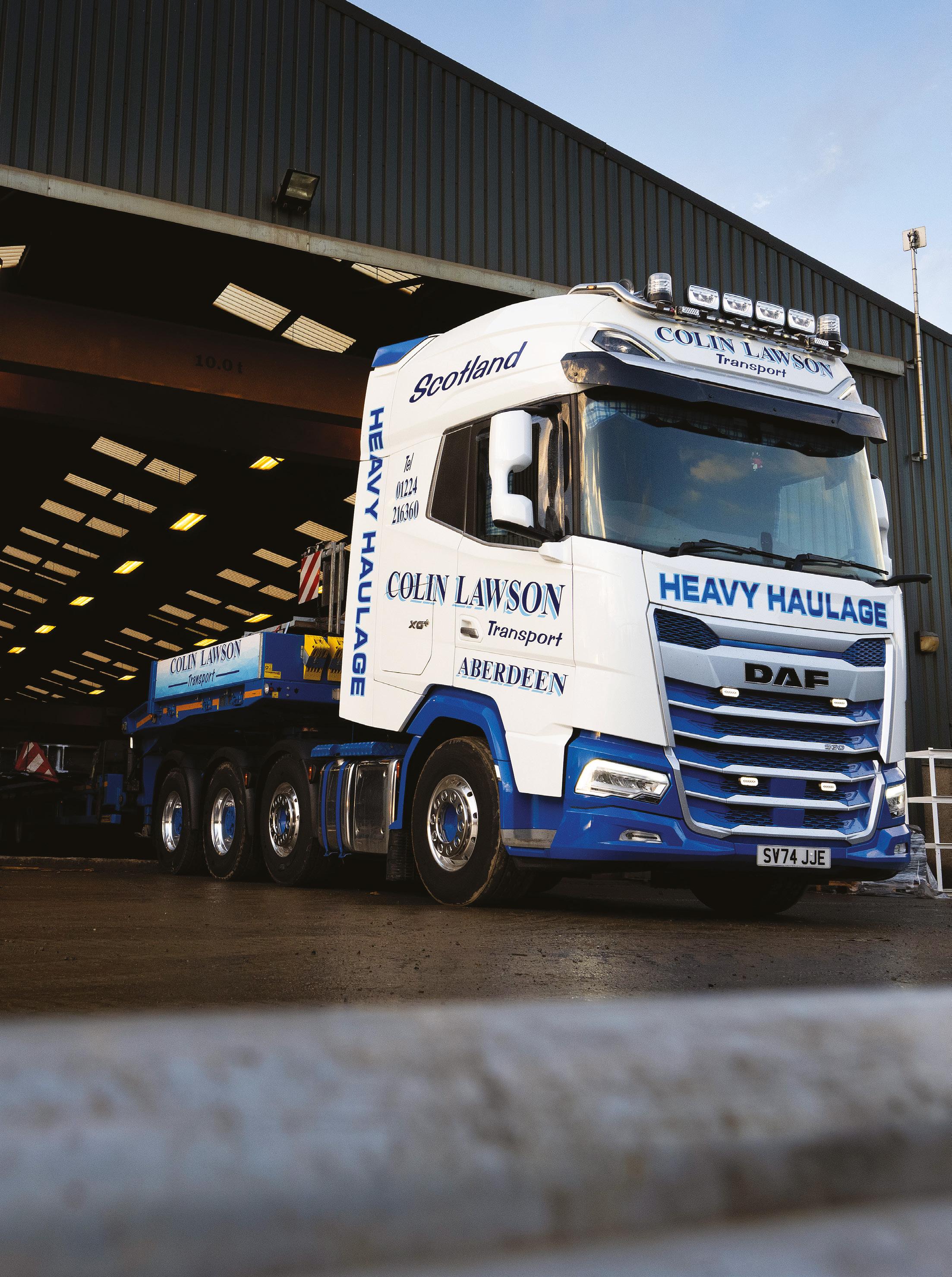
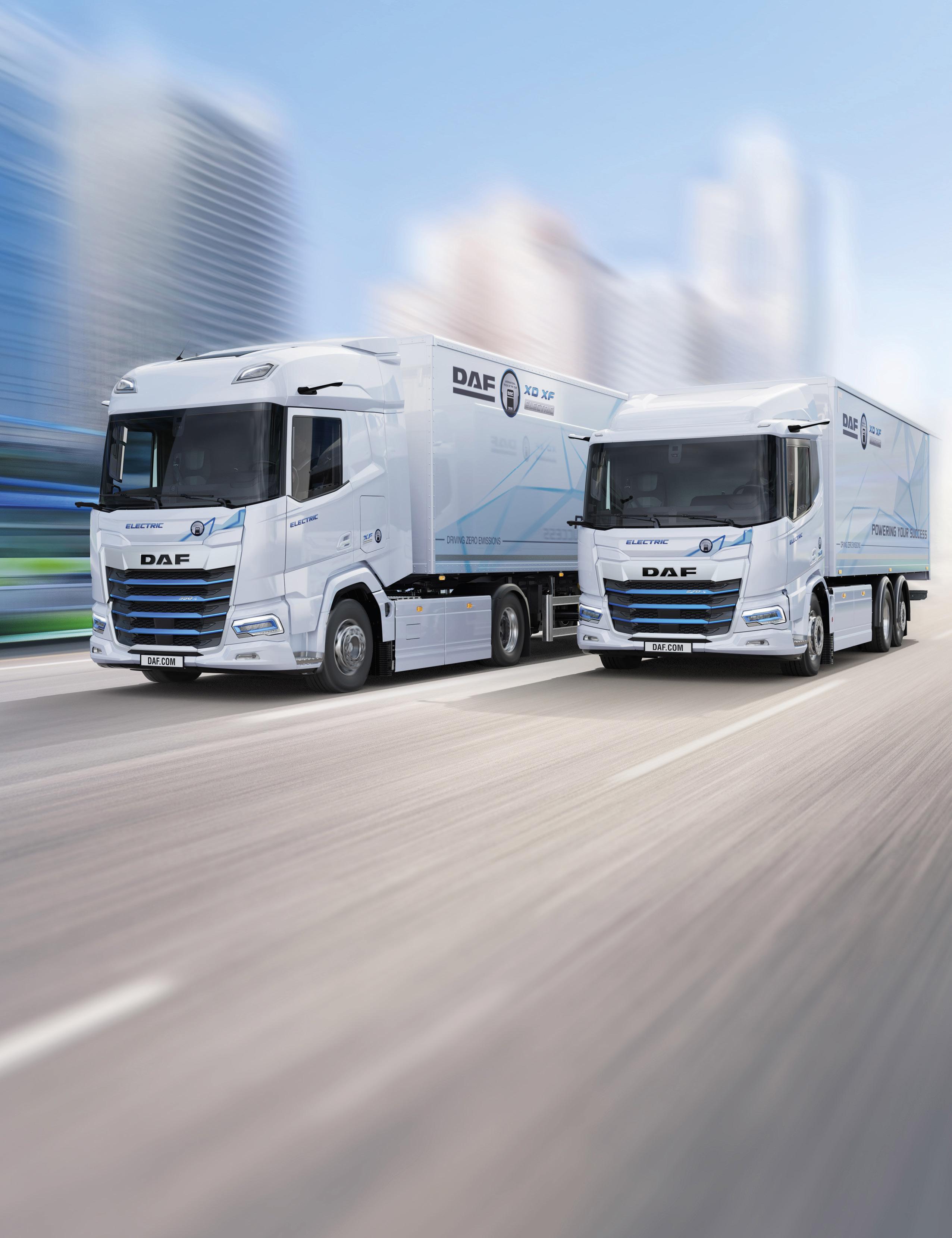
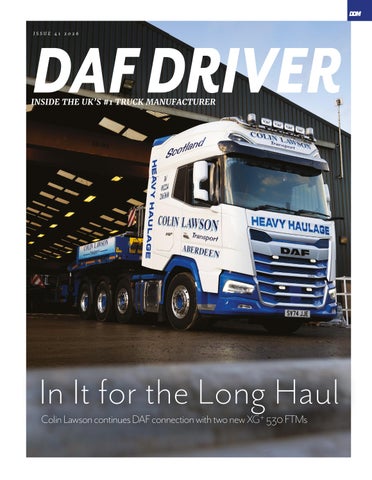
Colin Lawson continues DAF connection with two new XG+ 530 FTMs










































































It for the Long Haul
Colin Lawson continues DAF connection with two new XG+ 530 FTMs
“With 2026 now well under way, the road transport industry has just passed some genuine milestones in the journey towards zero emissions .”
Publisher - Matthew Eisenegger
When it comes to transport, the road ahead is changing faster than ever. In this issue, we spotlight a major leap forward for the UK haulage sector: the opening of new electric HGV charging hubs at Moto Exeter and Extra Baldock, delivered by GRIDSERVE. These are not just new facilities – they represent a critical step toward making battery electric vehicle (BEV) trucking a viable option for real-world, longdistance operations.
For years, one of the biggest barriers to electric haulage has been infrastructure. Range anxiety, limited charging availability and unsuitable layouts for large vehicles have all slowed adoption. But with purpose-built, high-capacity charging designed specifically for HGVs, the landscape is
beginning to shift. The question is no longer ‘if” electric trucks can work, but increasingly ‘when’ they will become part of everyday fleet operations.
At the same time, the logistics industry remains heavily reliant on diesel, tying it closely to global oil supply chains. Routes such as the Strait of Hormuz continue to play a crucial role in keeping fuel flowing, yet ongoing geopolitical tensions highlight just how vulnerable that dependence can be.
So, as new infrastructure comes online and technology continues to evolve, is it time for operators to seriously reconsider BEV trucks – not just as an environmental choice, but as a strategic one for resilience and future-proofing the industry? Enjoy the issue!
Look out for the dynamic QR codes in this issue of DAF Driver magazine. Simply open the camera on your mobile device and point it at the code, then sit back for some exciting additional content.

EDITORIAL
Publisher: Matthew Eisenegger
Managing Editor: Andy Stewart
Designer: Harold Francis Callahan
Editorial Address: Commercial Vehicle
Media & Publishing Ltd, 4th Floor 19
Capesthorne Drive, Eaves Green, Chorley, Lancashire. PR7 3QQ
Telephone: 01257 231521
Email: matthew@cvdriver.com
ADVERTISING
Advertising Sales: David Johns Telephone: 01388 517906
Mobile: 07590 547343
Email: sales@cvdriver.com
DESIGN
Art Editor: Harold Francis Callahan Telephone: 01257 231521
Email: design@cvdriver.com
CONTRIBUTORS
Emma Penny
Joseph Benjamin
Pip Dunn
Trinity Francis
Mark Vigil
Karl Hopkinson
Stevie Walker
Mark Ballantyne
Jack Sunderland
PUBLISHER
Commercial Vehicle Media & Publishing Ltd, 4th Floor, 19
Capesthorne Drive, Eaves Green, Chorley, Lancashire. PR7 3QQ Telephone: 01257 231521
NOTE
The publisher makes every effort to ensure the magazine’s contents are correct. All material published in DAF Driver magazine is copyright and unauthorised reproduction is forbidden. The Editors and Publisher of this magazine give no warranties, guarantees or assurances and make no representations regarding any goods or services advertised in this edition.
DAF Driver magazine is published under a licence from Commercial Vehicle Media & Publishing Ltd. All rights in the licensed material belong to Matthew Eisenegger or Commercial Vehicle Media and Publishing Ltd and may not be reproduced whether in whole or in part, without their prior written consent. DAF Driver magazine is a registered trademark.

If you are not going to keep this magazine for future reference please pass it on or recycle it.
Words: Joseph Benjamin
Photographs: Karl Hopkinson
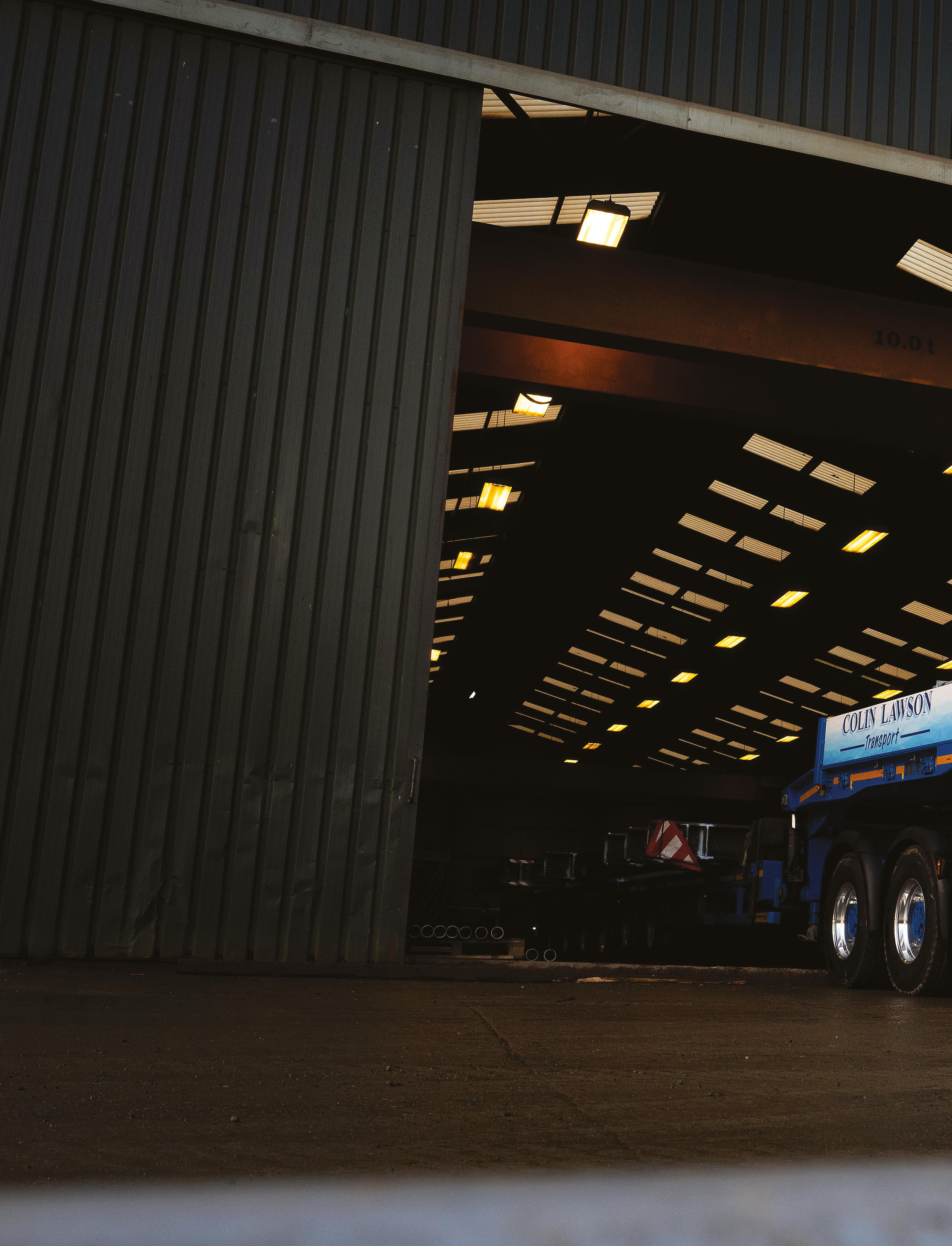
Serving the all-important north-east region of Scotland, Colin Lawson Transport continues to build on a growing reputation, helped by an affiliation with DAF that has been present since the business was founded.
Knocking on the door of its 30-year anniversary, Colin Lawson Transport has come a long way since it was established in 1997 with one truck – a DAF 2100. In fact, it has been quite the rapid rise; a phenomenon that started pretty much from the off.
“One truck very quickly became two trucks, and the company grew by just buying second-hand vehicles because that’s all we could afford at the time,” says Colin Lawson, owner and founder of the company. “Before we knew it, we were running 10 trucks within a few years of starting the business.”
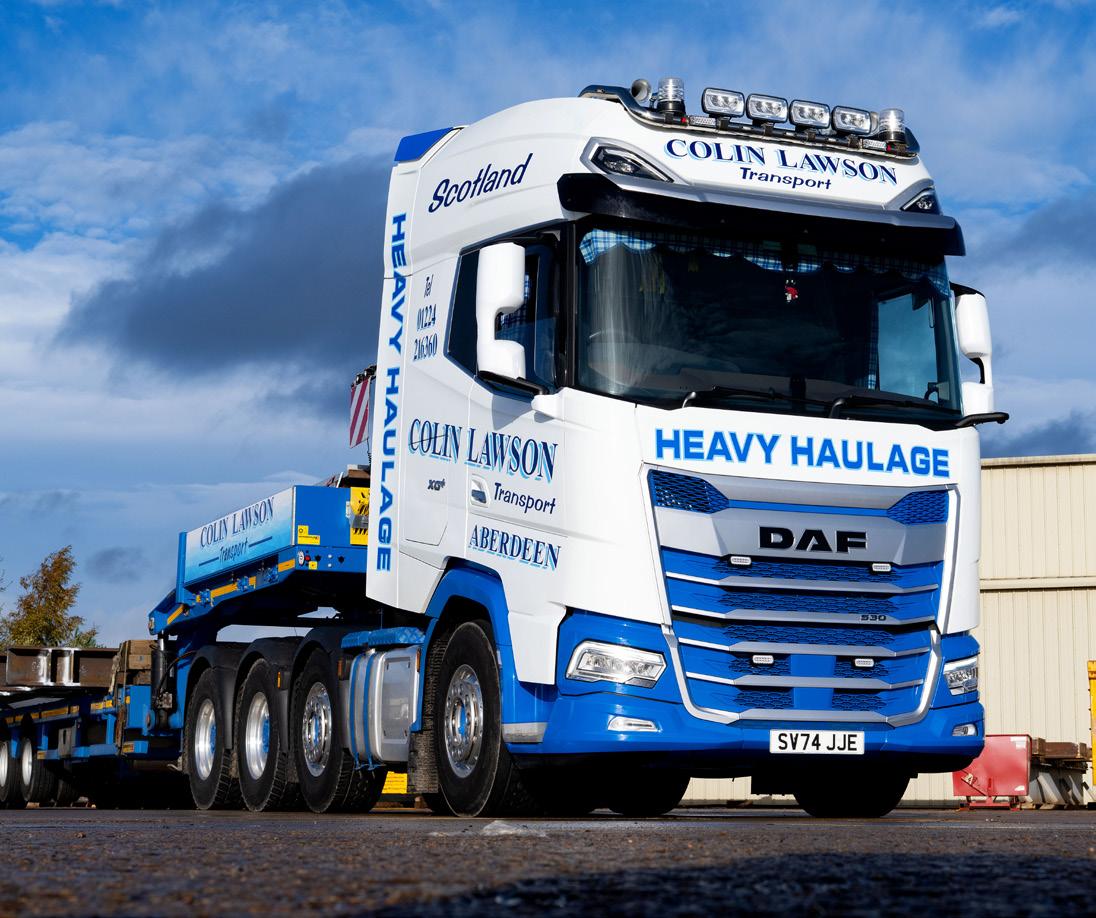
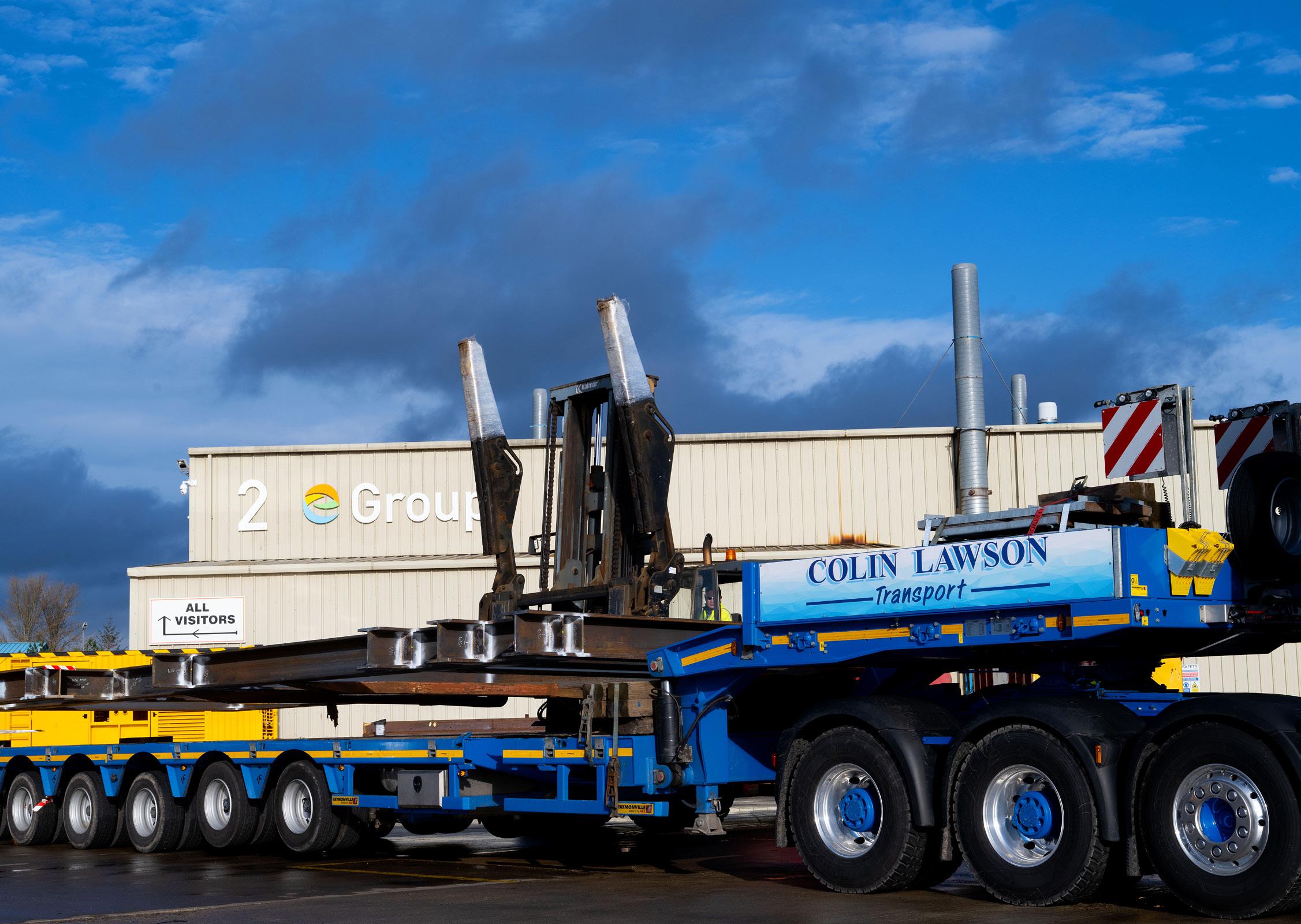
As the company grew, so did the service offering, with general haulage being complemented by aiding the nearby oil and gas requirements in and around Aberdeen. The business also boasts several truck-mounted cranes that are available for hire, as well units fit for heavy haulage. Starting out with a DAF, it made sense for Colin to stay loyal to the brand – a relationship that continues today. The latest recruits to the fleet are two XG+ 530 FTMs. “There was always a preference for DAF because we’ve grown the business with it and the back-up support was what we needed,” he says. “We’ve always had a great relationship with Norscot Truck & Van, partly because it was a family business like our own, but also because the people there supported me and I was forever grateful for that.”
New trucks started arriving in 2004 and for much of the time
between then and now, Colin has been looked after by Ivor Stewart, Key Account Manager at Norscot. But it was another key figure at the dealership who was responsible for Colin’s shift in mindset.
“The sales manager – and ex-owner – at Norscot at the time we started out, Raymond Massey, could see I was in it for the long term,” recalls Colin. “He sat me down one day and said he could see I was buying second-hand trucks that were up to four years’ old, and he encouraged me to go down the road of buying new vehicles. That’s what we did and we’ve continued ever since.”
Stuck on trucks
Colin has spent a lifetime in and around trucks. “At school, I was fascinated with trucks and buses and anything mechanical. My goal was always to be involved in transport, so that’s what I did,” he explains. “When I left school, I got a job working for Royal Mail and spent three years there, but the desire was always to be a longdistance truck driver. At 21, I did a ‘dual test’, which meant I could sit my HGV exam with a provisional car licence. It seems ridiculous now, but I was immediately made – I felt like the king of the road!”
Colin then drove for several companies before finding a steady job with Sandy Bruce Trucking. “I did a lot of long-distance work with Sandy, who sadly is no longer with us. But he actually ended up coming to work here with me! He built up a great business – he had
110 trucks at his peak – and I learned a lot from him.”
However, the lure of independence was too much for Colin and, having spent five years at another company, he knew it was time to go it alone. Nearly 30 years on from that decision, Colin Lawson Transport has 77 staff and last year ran 70 vehicles – a figure that has dropped a bit this year, but is set to rise again.
Drivers’ favourite
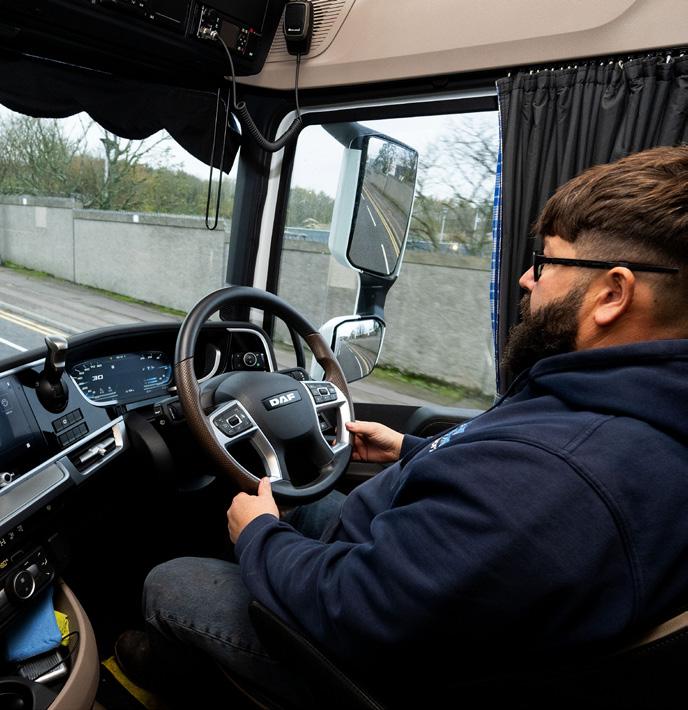
“We have a mixed fleet – DAF, MAN, Volvo, Mercedes-Benz and one Renault,” he explains. “I have to say the preference is the DAF – they are definitely the driver’s favourite.
Scania was always a big seller up here, but I would say DAF supersedes it now. In fact, one of the most experienced truck drivers in Aberdeen is a Scania fanatic – that’s all he ever drove. But I handed him a new DAF a few years ago and on his first trip away, he sent me a text saying he felt like a kid opening a new Christmas present. These comments, for a grown man, were unbelievable – saying it was the best truck he’d ever driven.”
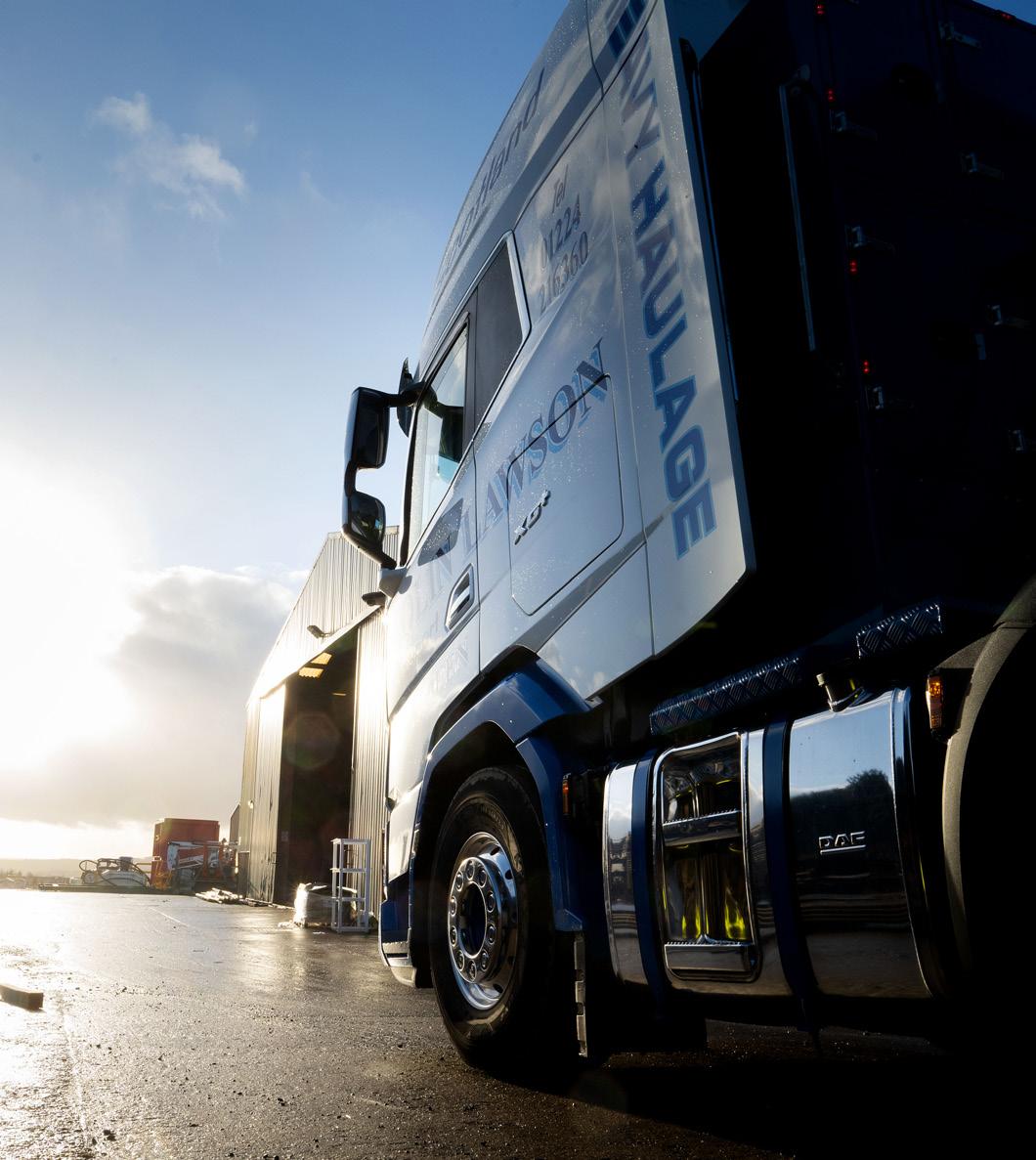
Within the company’s fleet of those 70 trucks there are 19 DAFs, including five XFs, eight XG+ tractor units, and one XG+ rigid which Colin describes as “absolutely stunning with an unbelievable presence”. In addition, there are five vintage DAF models which are no longer on the road; they’re kept in storage and used for classic truck road runs and shows.
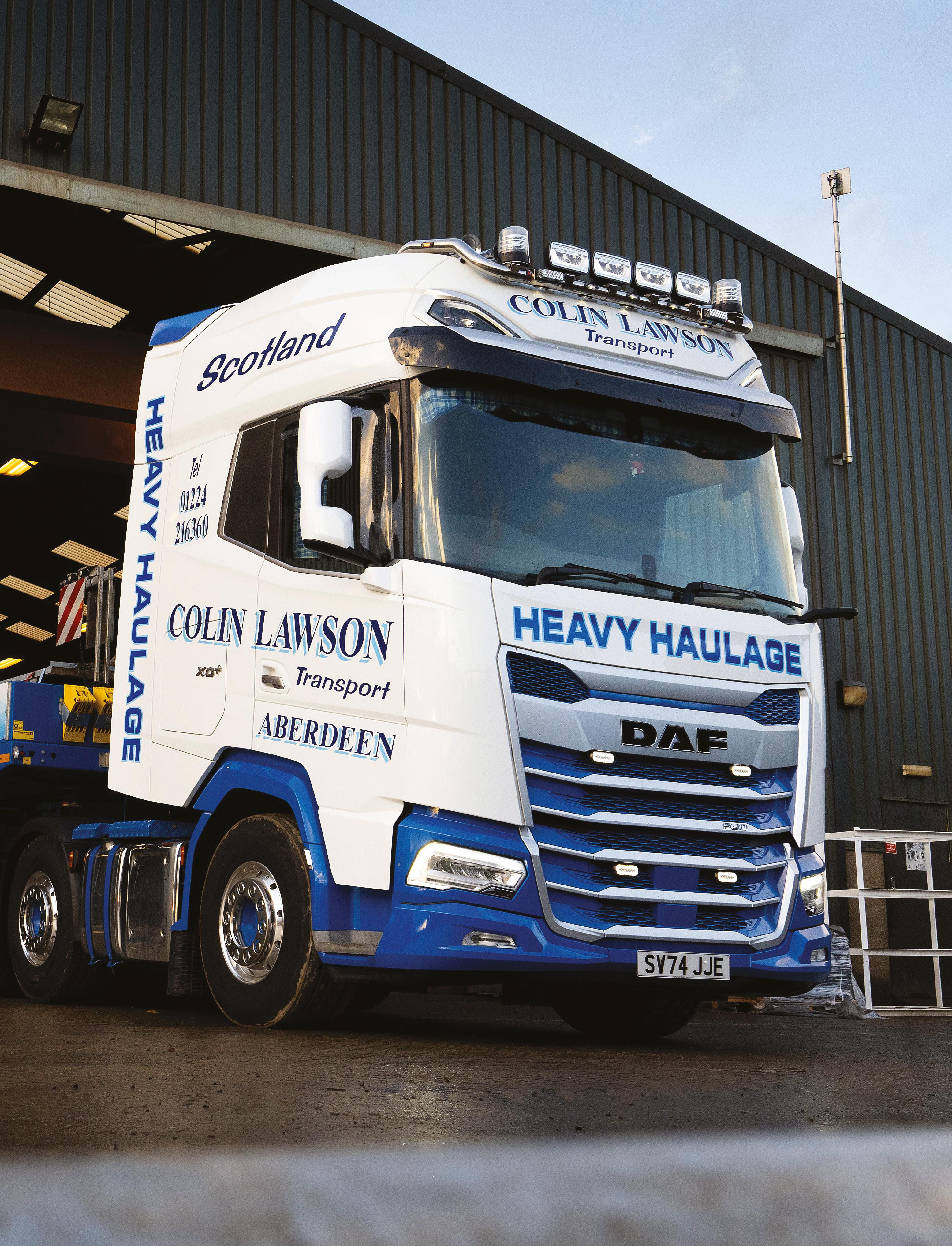
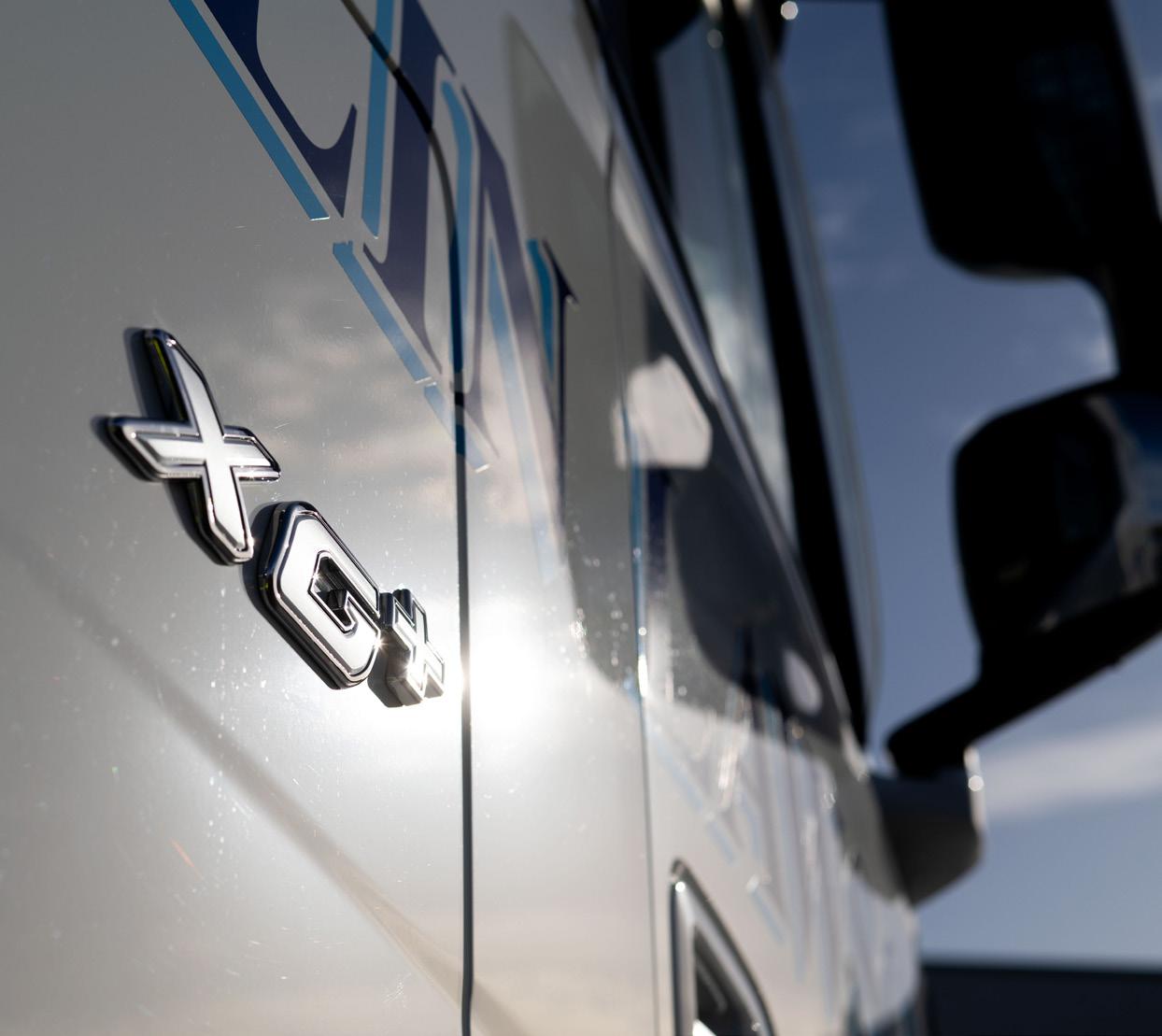
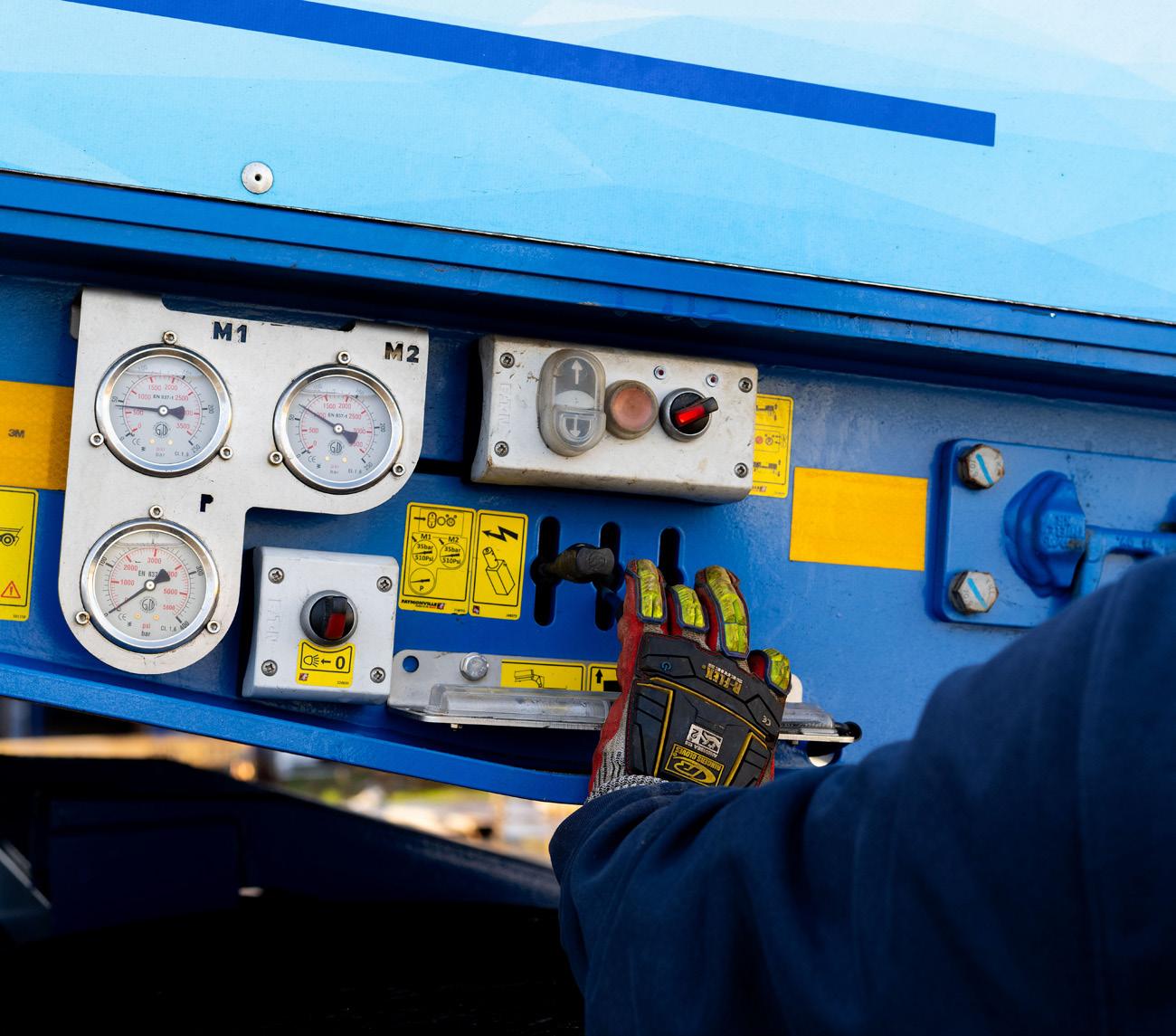
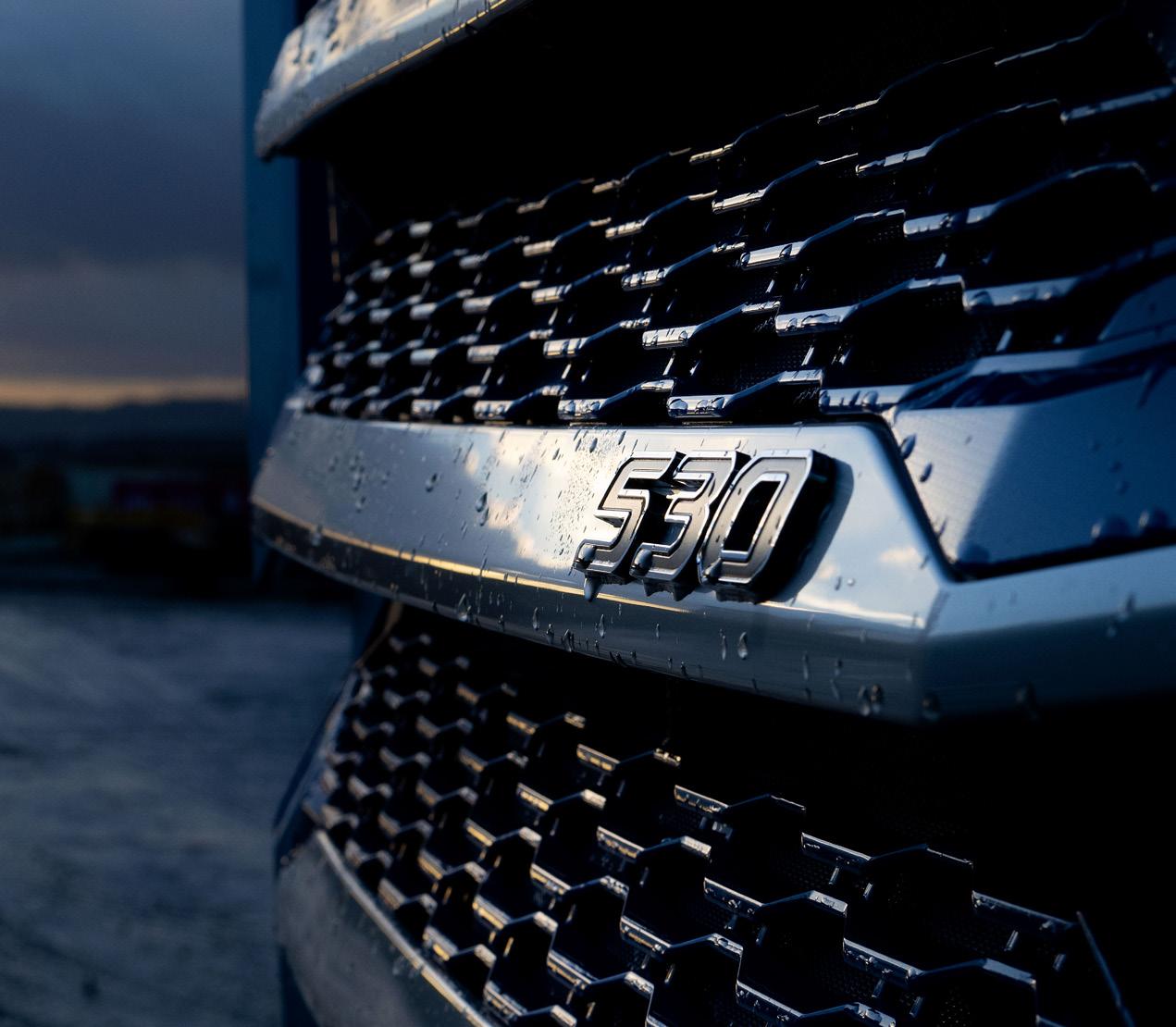
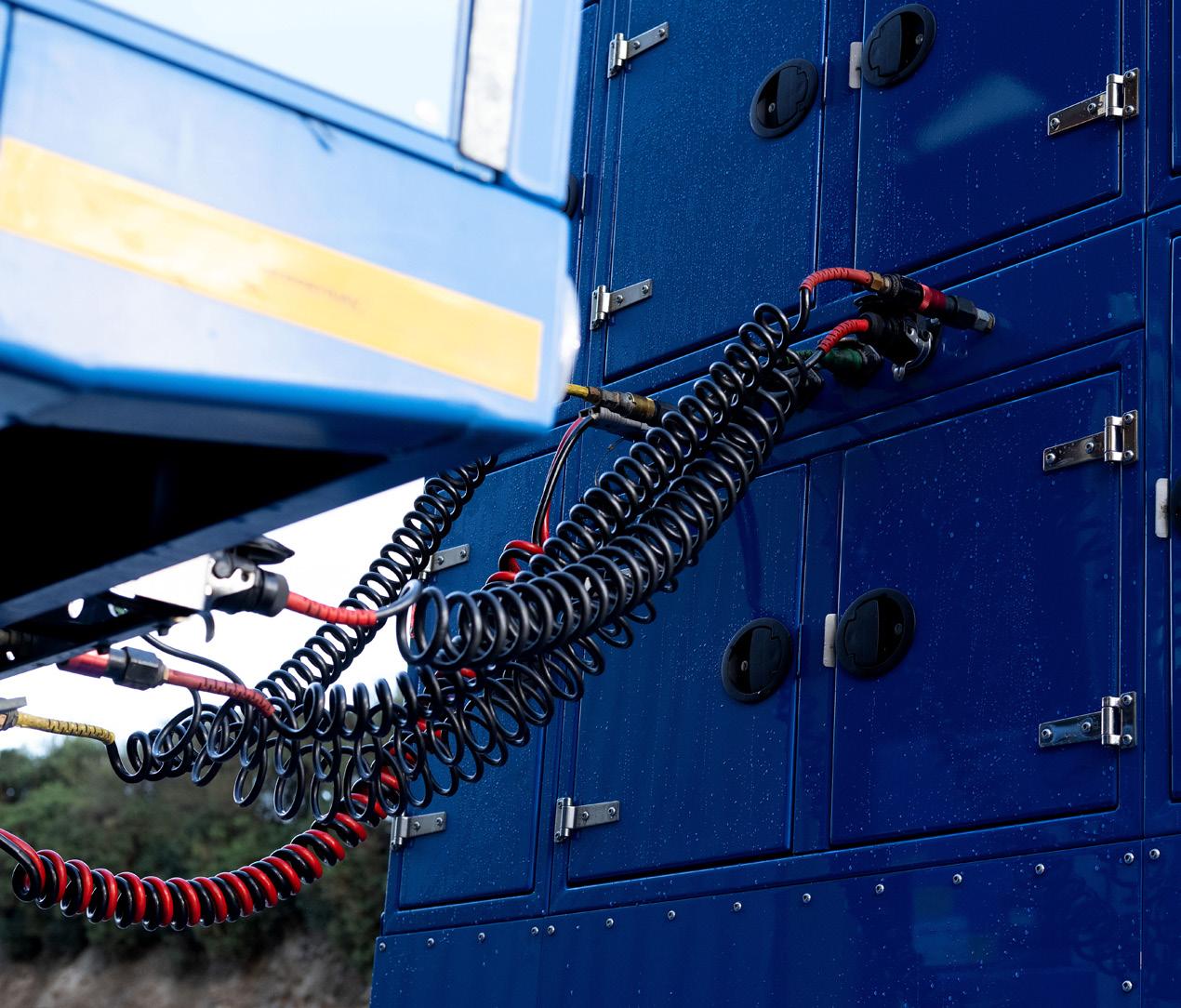
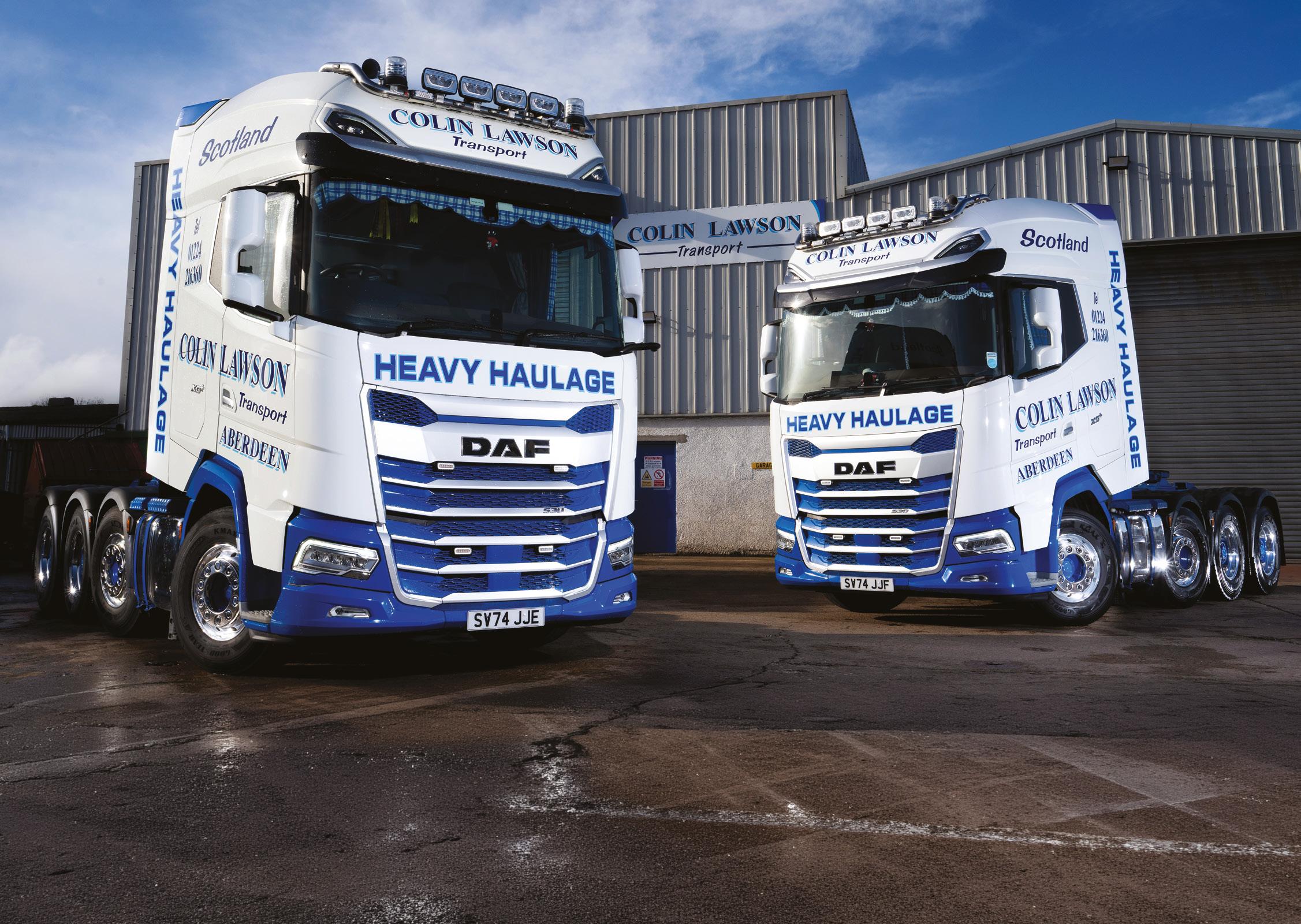
The mention of a ‘presence’ brings us neatly onto the two new XG+ 530 FTM 8x4 tractor units. “They are really nice trucks that have been performing very well since they arrived on the fleet,” reports Colin, who adds it was a relatively easy decision to make when it came to choosing which make and model to go for. “With heavy haulage, we could have bought anything. We already have two Volvo 8x4 FH16-750s which we will be looking to replace quite soon, so we could have got two more of them. But the DAF just ticks all the boxes,” he says.
“People may say they are a bit underpowered, but we don’t think that is the case at all. They are geared properly with sensible ratios, and they work and perform exceptionally well. The cab makes it a proper driver’s truck, and I would encourage anyone who runs big Scania trucks to have a look at them, because they really do meet all the needs of a driver and an operator.”
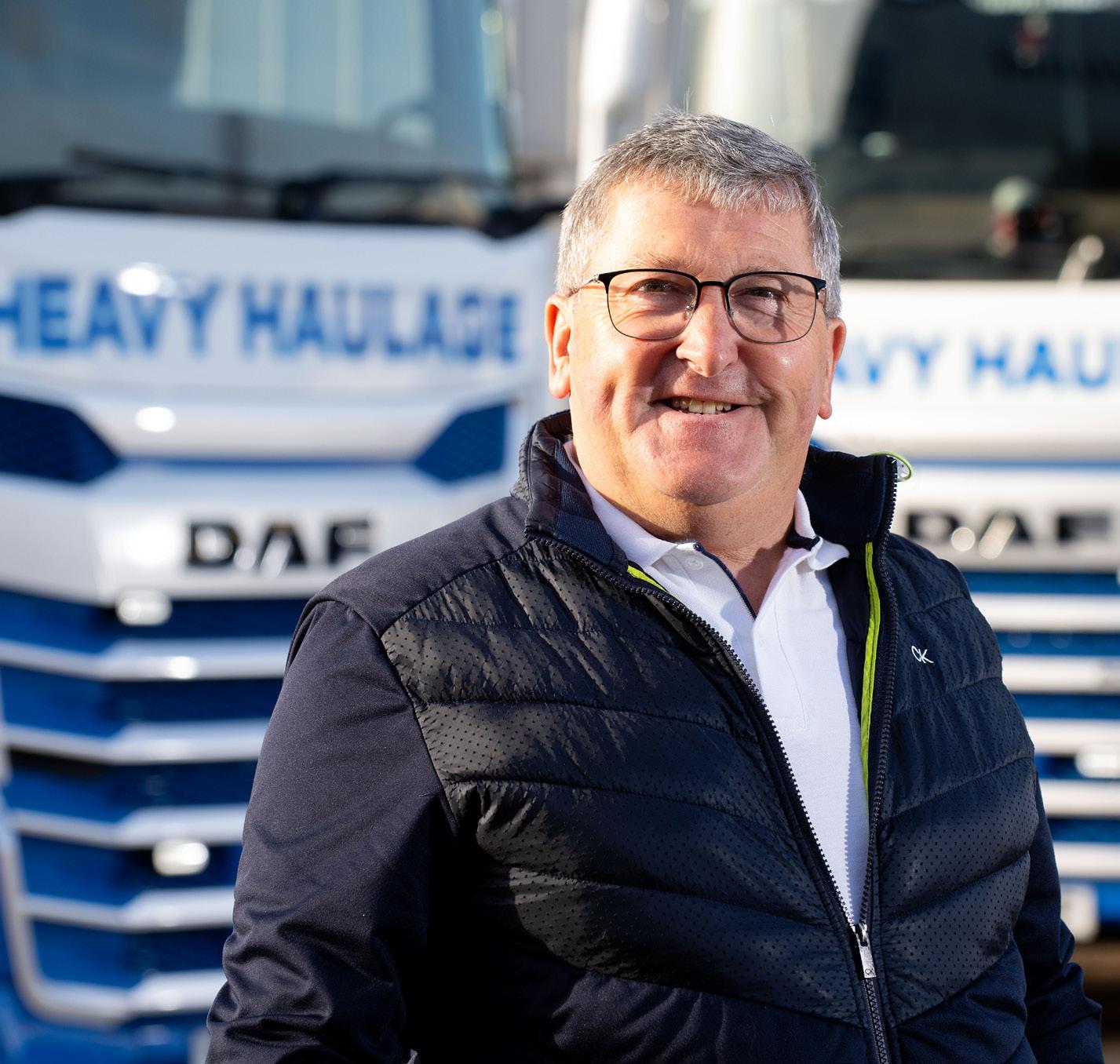
left: New XG+ are performing well
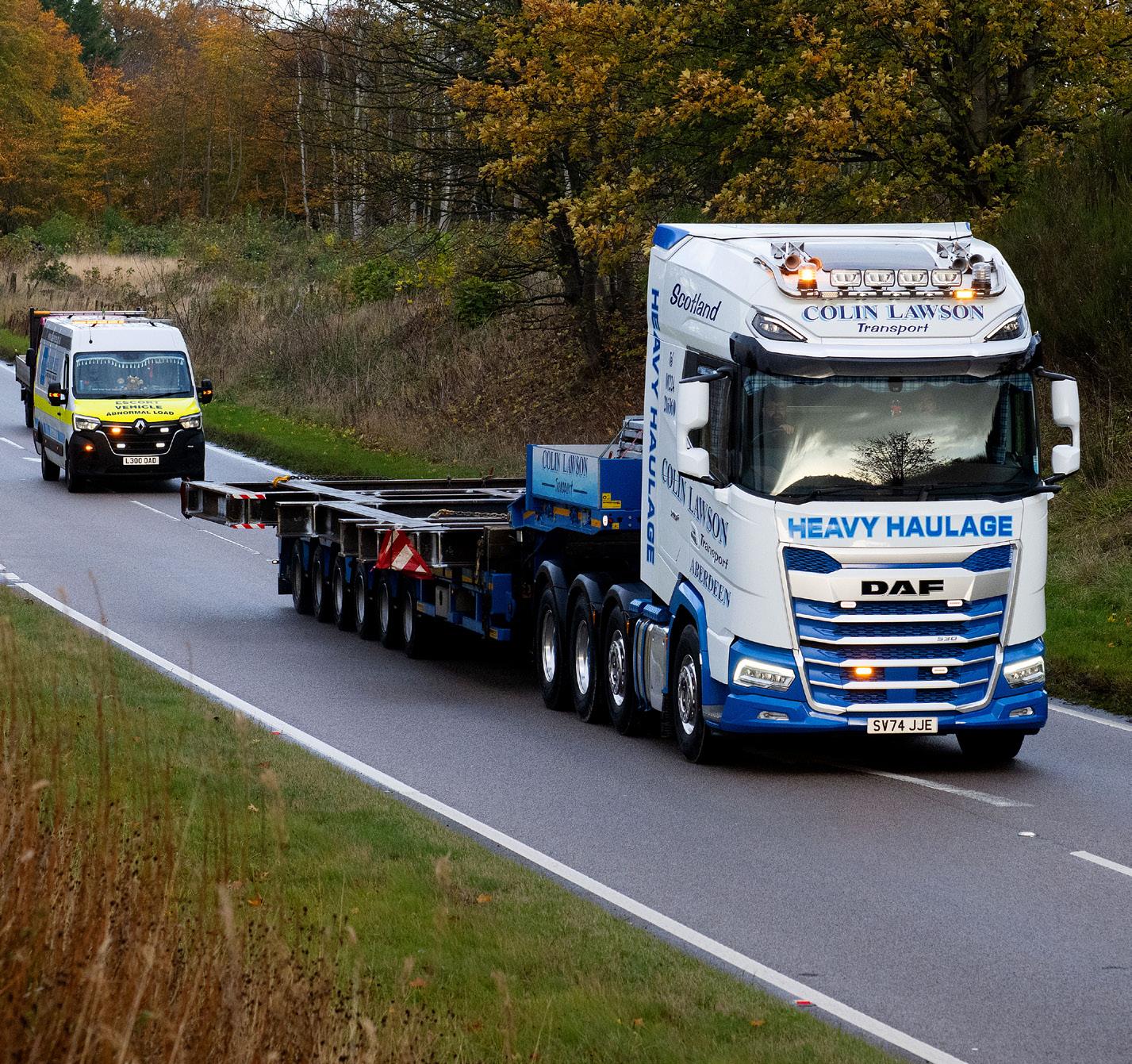
Top right: Colin Lawson started out in 1997 with just one DAF 2100
Right: DAFs are operator’s preferred truck brand
“WE CAN MOVE ANYTHING WITH THESE XG+S”
Talking of ticking boxes, the new arrivals at Colin Lawson Transport are fully loaded – which is down to Ivor making sure Colin’s drivers get the truck they need and deserve.
“Colin had some early New Generation XG+ trucks on order because I was desperate to get some new ones into him,” recalls Ivor. “They were FTGs and a premium specification that we couldn’t change. But Colin needed trucks at a certain time for a certain price, so he didn’t have a lot of choice. We were just coming out of covid and you couldn’t get trucks because there was a 16-18 month lead time, so he took them. As a result, to keep the drivers happy, he’s had to match that specification from the existing models with the new additions.”
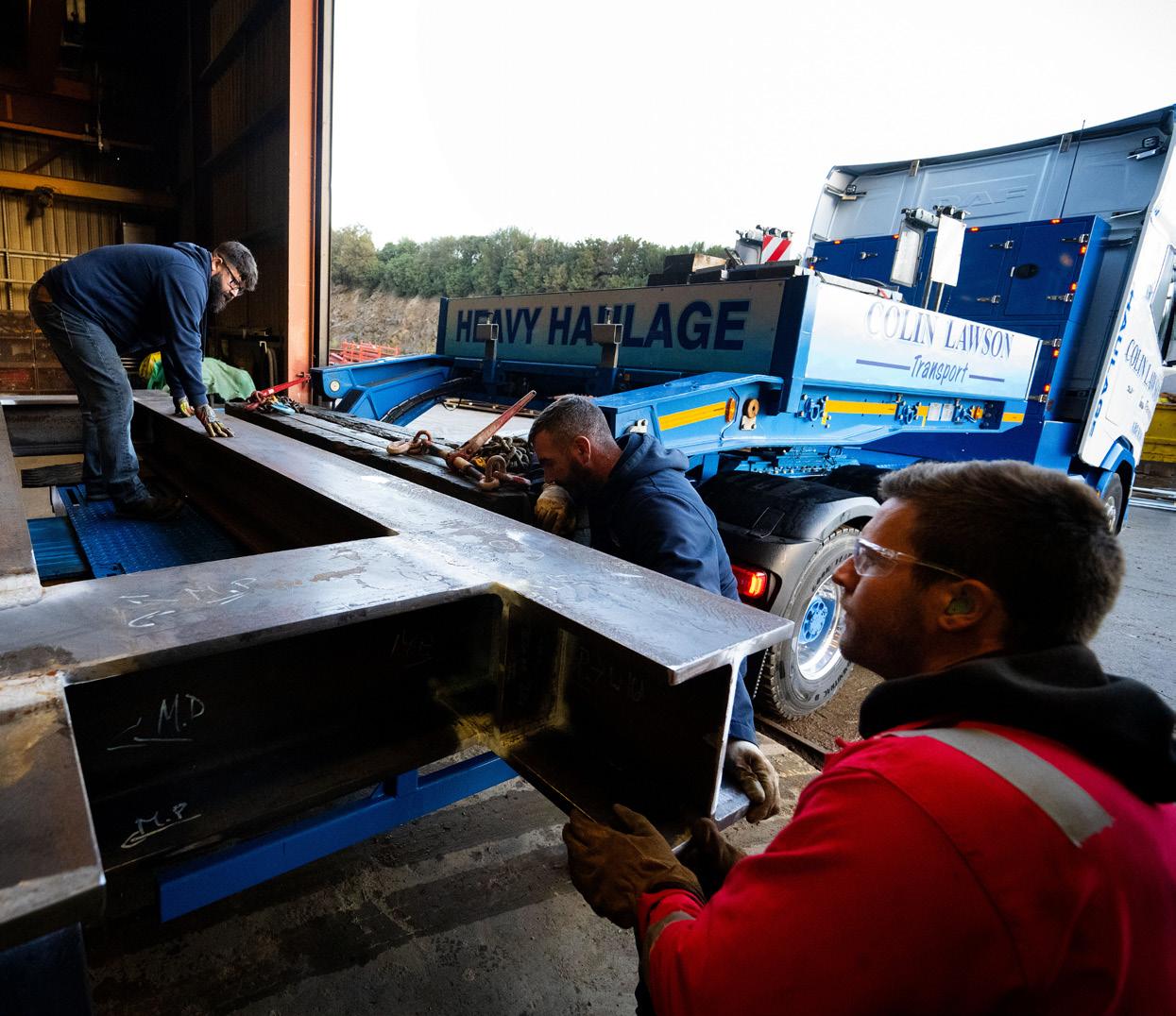
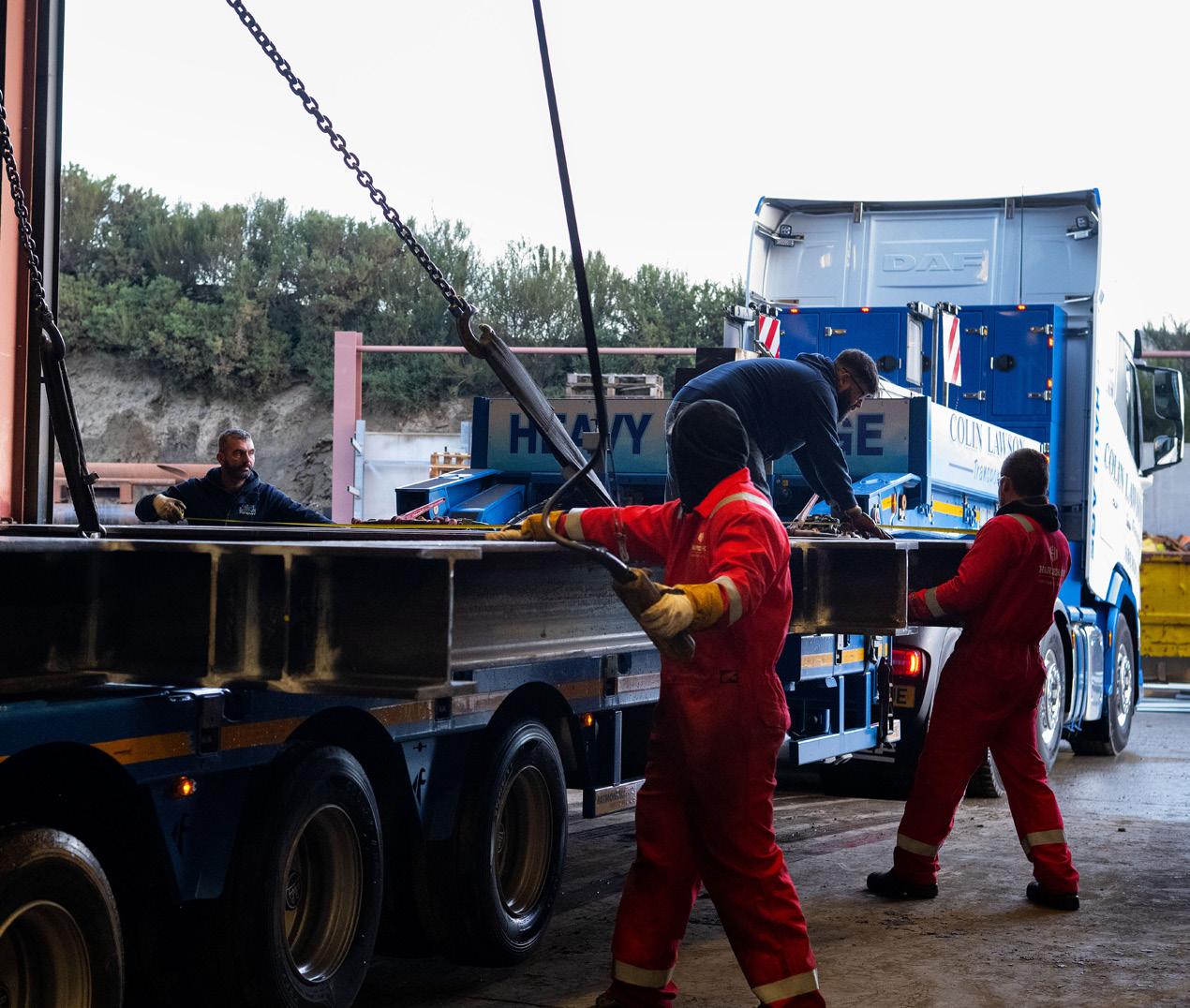
Colin says the XG+ duo have been in operation for over a year and have been performing very well. Reports from drivers, customers and also people who spot them in the street confirm they are very much up to the task. “Our client base are typically those who have a lot of heavy oil equipment up here in Scotland, but also all over the UK,” says Colin. “We can move anything with these XG+s, from plant equipment such as excavators and dumpers to 80-tonne steel reels and everything in between.
“We’re very lucky because we have a ‘one driver, one truck’ policy, so when the drivers are out or on holiday, the
trucks are parked up,” he explains. “That helps with driver retention, because they feel like it is their truck. I only ask of them one simple thing: before they leave, make sure the truck is washed and parked up safely.”
The two XG+ drivers are a great advert for DAF and the operator, and are regularly running 150-tonne STGO loads around the local area and further afield. “Axle technology has really progressed, which means the new trucks are able to handle the demands of heavy haulage with ease,” says Colin. “And to be fair, the trucks are probably cleaner now than they were when they were delivered. The guys make sure everything is polished, which makes the vehicles a great advert for us and DAF.”
Aside from Colin, loyalty seems to run within the company’s driver network too, he reveals. “The drivers who drove the first brand-new DAFs I bought in 2004 are still with us, and that’s all they want to use. I buy specific lorries for these drivers and I’ve tried teasing them onto other models, but they just tell me they’ll wait for a new DAF.”
The next generation
Like a chip off the old block, Jodie, Colin’s daughter, has caught the bug and is fully embedded in the family business, with high hopes and aspirations – and a major
accolade already achieved. “When Jodie was at university, she came to work with us a bit while she was doing her course. She did her HGV training and passed first time – at 18 years’ old – making her the youngest female truck driver in the UK. We then found out she was also the youngest female truck driver in Europe,” explains Colin. “After that news, we were approached by a German TV company that wanted to do a documentary on Jodie, and they spent a week filming here with us.” While she spends most of her time helping out in the accountancy and administration departments of the business, if she is needed, Jodie will jump straight into one of the trucks and get out on the road. And her choice of vehicle? “I’m not just saying this but, given the options, my favourite truck would definitely be a DAF,” she confirms.
As Colin Lawson Transport looks to celebrate 30 years in business next year, the company is in good shape for the next 30, when the evolution of the fleet will continue to serve customers in Scotland and the rest of the UK.
Looking ahead at potential arrivals, Colin says there are a few models up for renewal, but he is currently unsure of what badge these new trucks will sport on the bonnet. “Ivor will be getting a call at some point soon, but we need to keep the drivers happy with their vehicles – especially when there’s a driver shortage and keeping hold of the good ones is vital,” he says. “But when it comes to the DAFs, the drivers are willing to wait for them instead of driving another model, regardless of how old they are.”

Road haulage isn’t the only industry that’s laser-focused on pushing the boundaries of technology, comfort and efficiency.
Similar goals are shared by most if not all vehicle manufacturers, from car-makers right up to aeronautics engineers.
As a case in point, Gulfstream Aerospace has just unveiled the all-new Gulfstream G300, introducing a next-generation aircraft aimed squarely at the competitive super-midsize business jet segment.
The aircraft, announced during Gulfstream’s exclusive ‘Discover the Difference’ customer event in Savannah, Georgia, is designed to replace the highly successful Gulfstream G280 while pushing the category forward with improved technology, performance and cabin comfort.
The launch marks another step in the company’s strategy to modernise its product line-up under its parent company, General Dynamics. Executives say the G300 reflects more than a decade of development and investment aimed at reshaping the future of business aviation.
The unveiling came with considerable fanfare.
During the Savannah event, Gulfstream President Mark Burns revealed a full-scale mock-up of the aircraft and shared the first images of the G300 currently in production.
“Fuelled by a decade of investment and our futureforward approach, the Gulfstream next-generation fleet offers our customers the most innovative family of aircraft,” Burns said during the presentation.
“We know how important the super-midsize cabin segment is to our customers, so building on the highly successful G280 programme, the G300 will reenergise the category.”
The super-midsize class occupies an important niche in the private aviation market, offering long-distance capability while maintaining the operational flexibility of smaller jets. These aircraft are particularly attractive to corporate flight departments and charter operators seeking efficiency on transcontinental or trans-Atlantic transport routes.
Words: Jack Sunderland

Photographs: Gulfstream Aerospace
At the heart of the G300’s appeal is its performance. The aircraft is capable of flying 3600 nautical miles (6667 km) at Mach 0.80 – enough range to comfortably handle trans-Atlantic missions between major cities such as New York and London. For operators prioritising speed, it can fly 3000 nautical miles at Mach 0.84, putting it among the faster aircraft in its class.
The G300’s operational ceiling of 45,000 ft allows it to cruise above commercial airline traffic and many weather systems, enhancing efficiency and ride comfort. Power comes from high-thrust engines developed by Honeywell, paired with Gulfstream’s distinctive sweptwing design that improves aerodynamic efficiency and fuel economy. Another key feature is the aircraft’s short-field capability, enabling it to operate from smaller airports that larger business jets cannot access. This flexibility expands travel options for operators and reduces reliance on major hubs.
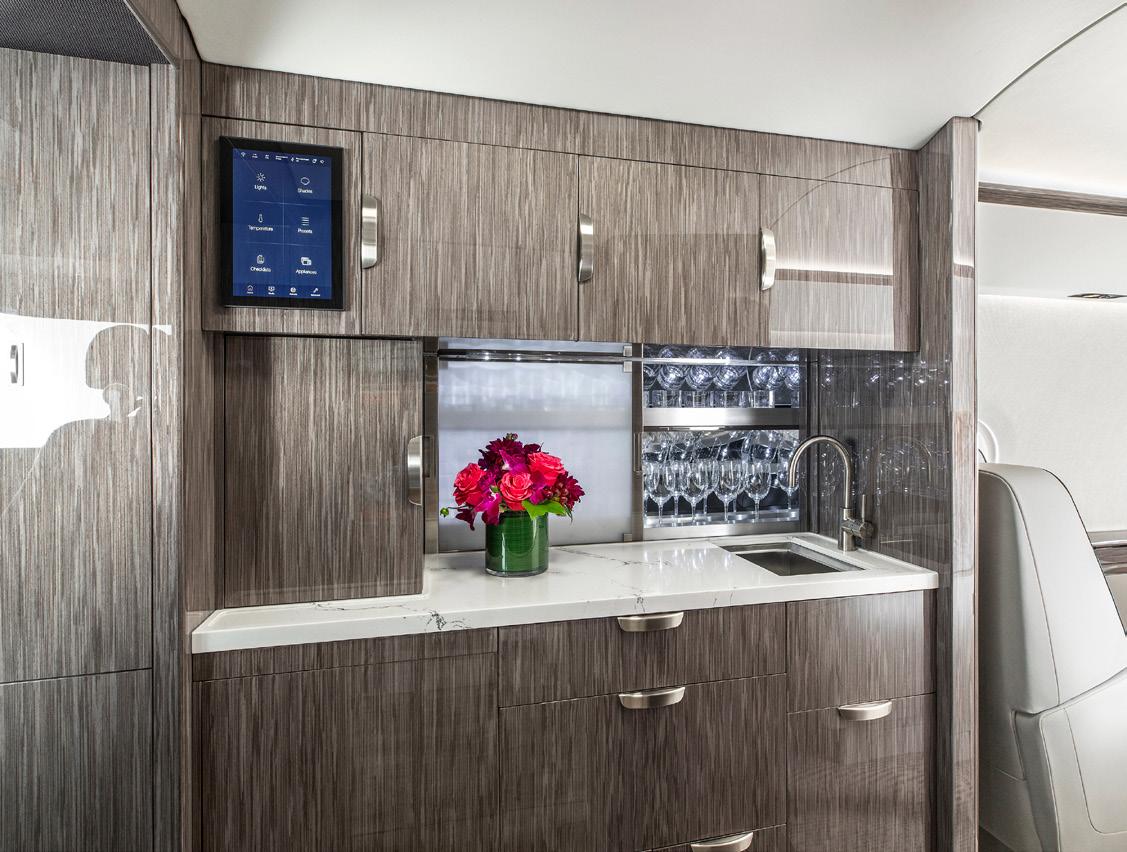

”Aircraft are no longer just transportation – they are flying offices and living spaces.”
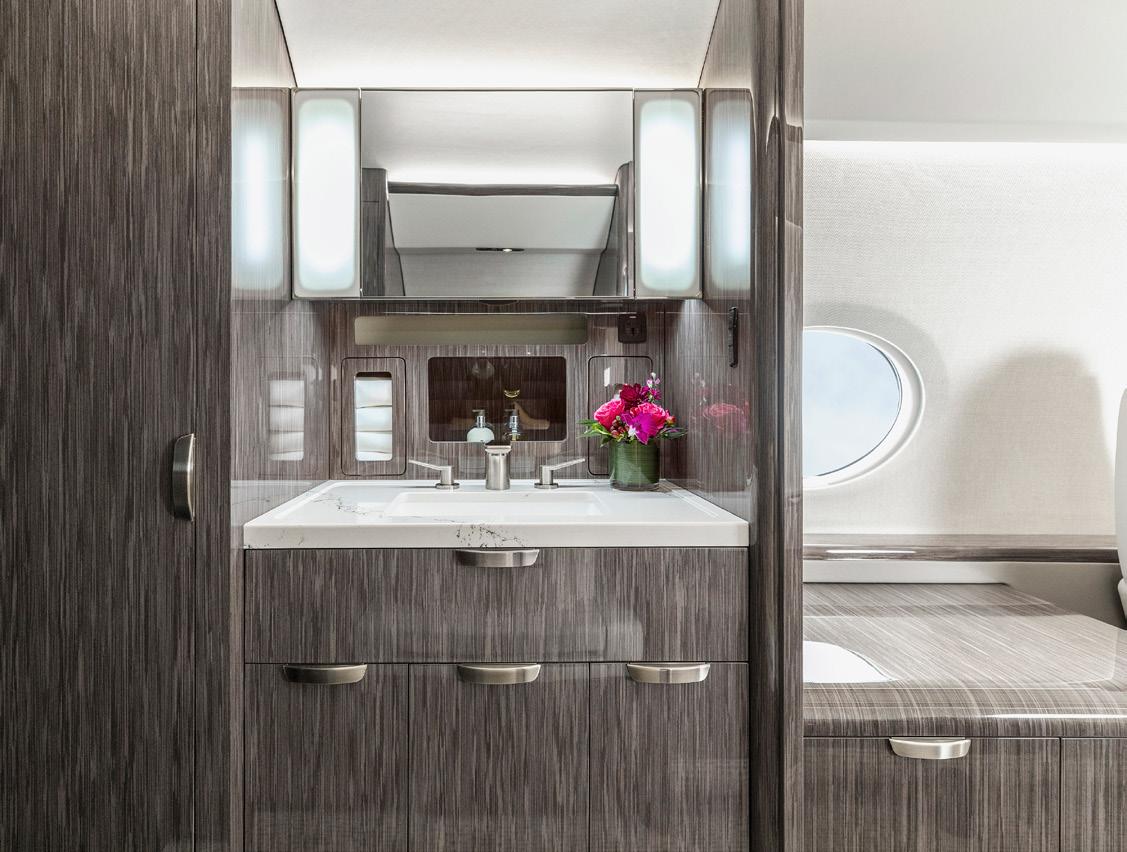
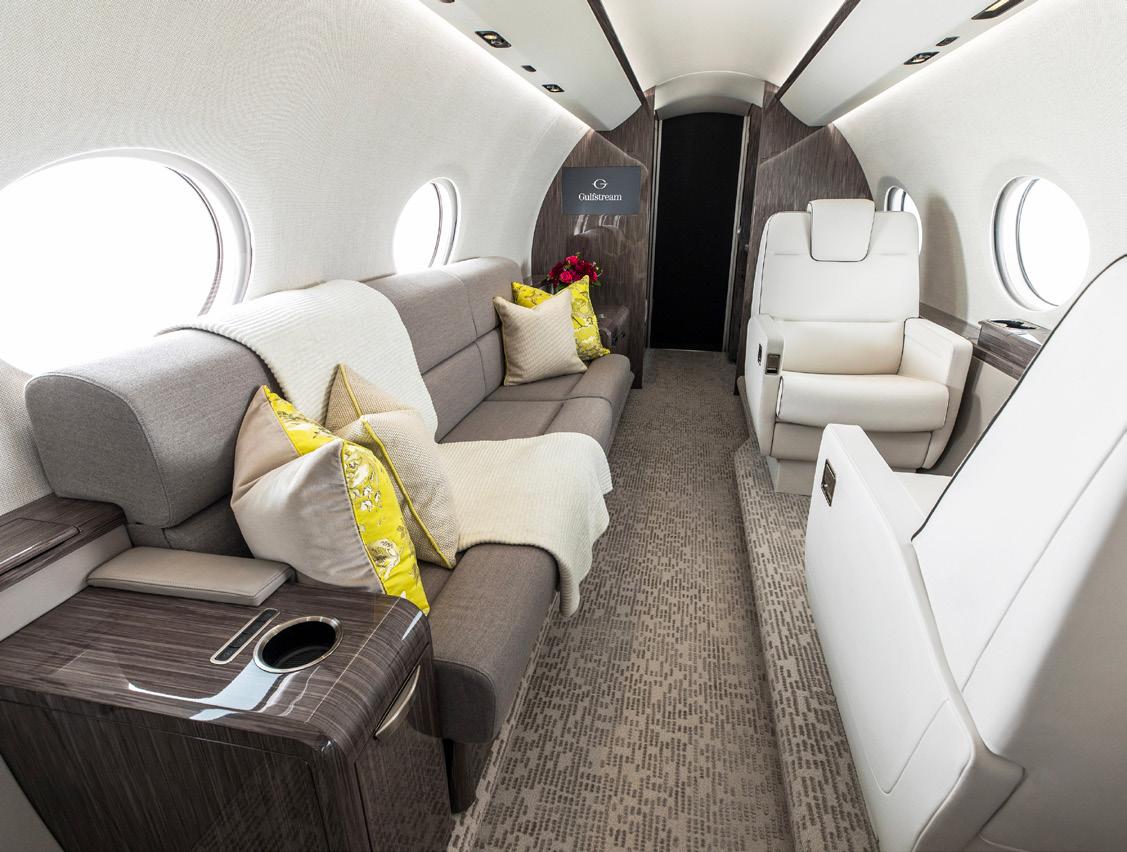
While performance is critical, Gulfstream continues to emphasise passenger experience as a central selling point. The G300 features 10 of the company’s signature Panoramic Oval Windows, allowing abundant natural light into the cabin. The jet also offers the longest cabin in its class, configured into two distinct living areas and accommodating up to 10 passengers.
Cabin health and comfort are key themes in the design. The aircraft maintains a cabin altitude of just 4800 ft when cruising at 41,000 ft, which can help reduce fatigue on longer flights. It also incorporates 100% fresh-air circulation and a plasma ionisation purification system, improving onboard air quality.
From a passenger perspective, these features align with a broader trend in private aviation: aircraft are no longer just transportation – they are flying offices and living spaces. Gulfstream’s cabin layout reflects this shift, providing space for meetings, relaxation or sleep during long journeys.
Pilots will encounter a major technological leap in the G300’s cockpit. The aircraft debuts the Harmony Flight Deck, a new avionics system centred around six touchscreen displays designed to simplify operations. The system incorporates ‘Phase-of-Flight intelligence’, which automatically adapts the display layout depending on whether the aircraft is taxiing, climbing, cruising or landing. This reduces pilot workload and helps crews focus on critical information during each stage of flight.
A Synthetic Vision-Primary Flight Display provides a 3D representation of terrain and runways, enhancing situational awareness – particularly in low-visibility conditions. Meanwhile, Gulfstream’s Predictive Landing Performance System calculates real-time runway stopping distances, helping pilots make safer landing decisions.
Taken together, these features reflect a wider shift in aviation toward automation and digital assistance systems that support – but do not replace – pilot decision-making.

Although the aircraft has only just been publicly revealed, the G300 programme is already well underway behind the scenes. Gulfstream engineers have completed nearly 22,000 hours of testing in laboratory facilities, including work at the company’s advanced Integration Test Facility. This complex features ‘Iron Bird’ capability, allowing engineers to simulate aircraft systems and test them before they ever reach the sky. The facility even conducted a simulated ‘first flight’ last month, providing early validation of the aircraft’s integrated systems.
In addition, the company has logged about 2000 hours of ground testing on the first aircraft, while manufacturing is underway on two additional test aircraft that will join the flighttest programme.
Based on the specifications and early demonstrations, the G300 appears poised to make a strong impact in the supermidsize market. Its blend of trans-Atlantic range, short-runway capability and advanced avionics positions it as a natural successor to the G280.
From a reviewer’s perspective, the aircraft’s biggest strengths are its balanced design philosophy. Rather than focusing solely on range or speed, Gulfstream has aimed for a comprehensive upgrade: improved cockpit technology, enhanced passenger comfort and efficient performance.
If the aircraft delivers on its promises during flight testing and certification, it could set a new benchmark in its category. For Gulfstream, the G300 is more than just a replacement aircraft – it is a statement of intent. By combining cutting-edge avionics, thoughtful cabin design and proven performance, the company hopes to redefine what customers expect from the super-midsize business jet.
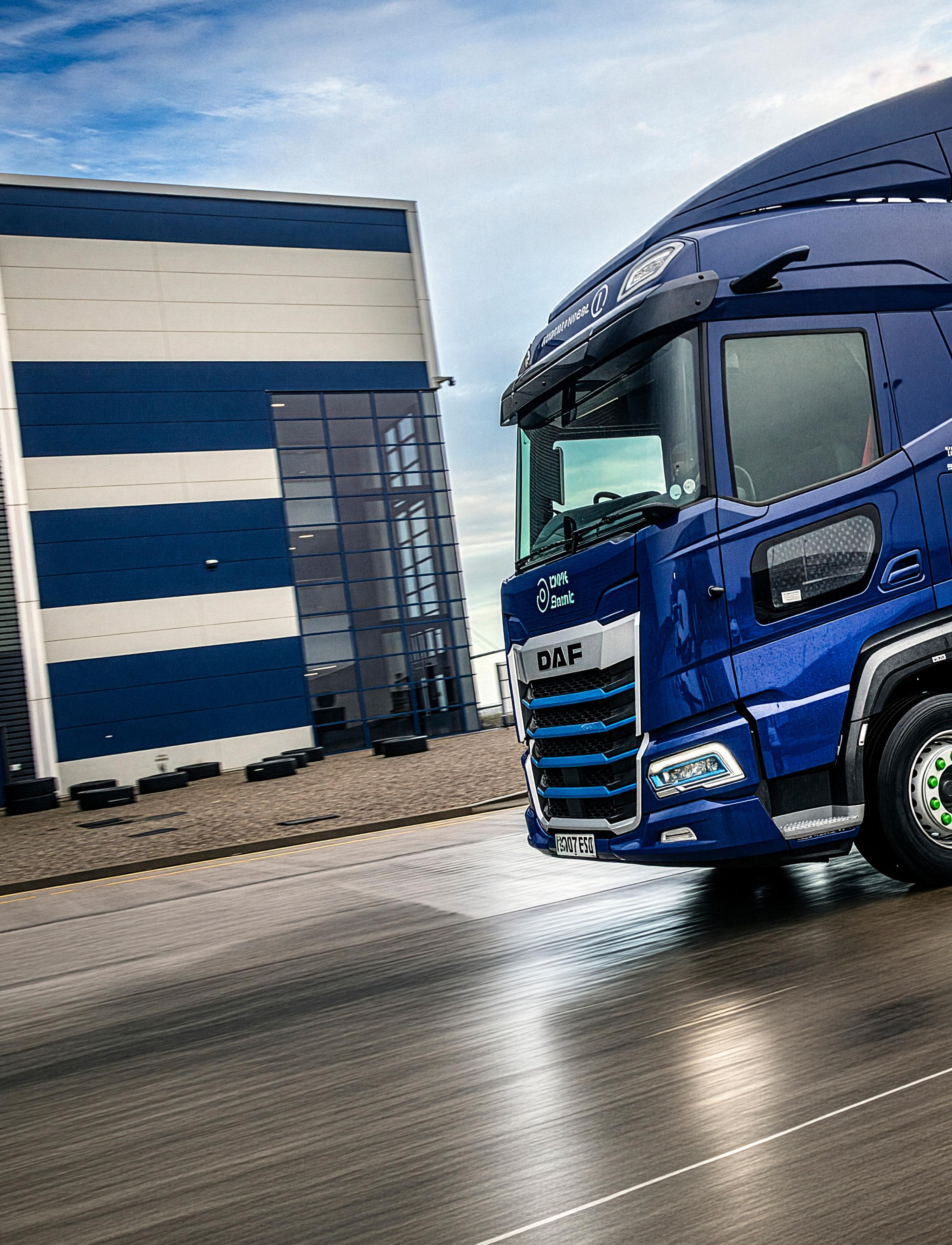
A DAF XF Electric has become the first eHGV to travel to Europe via the Eurotunnel. We follow the truck’s two-day trip from the UK to Germany.
Words: Mark Vigil Photographs: Kuehne+Nagel
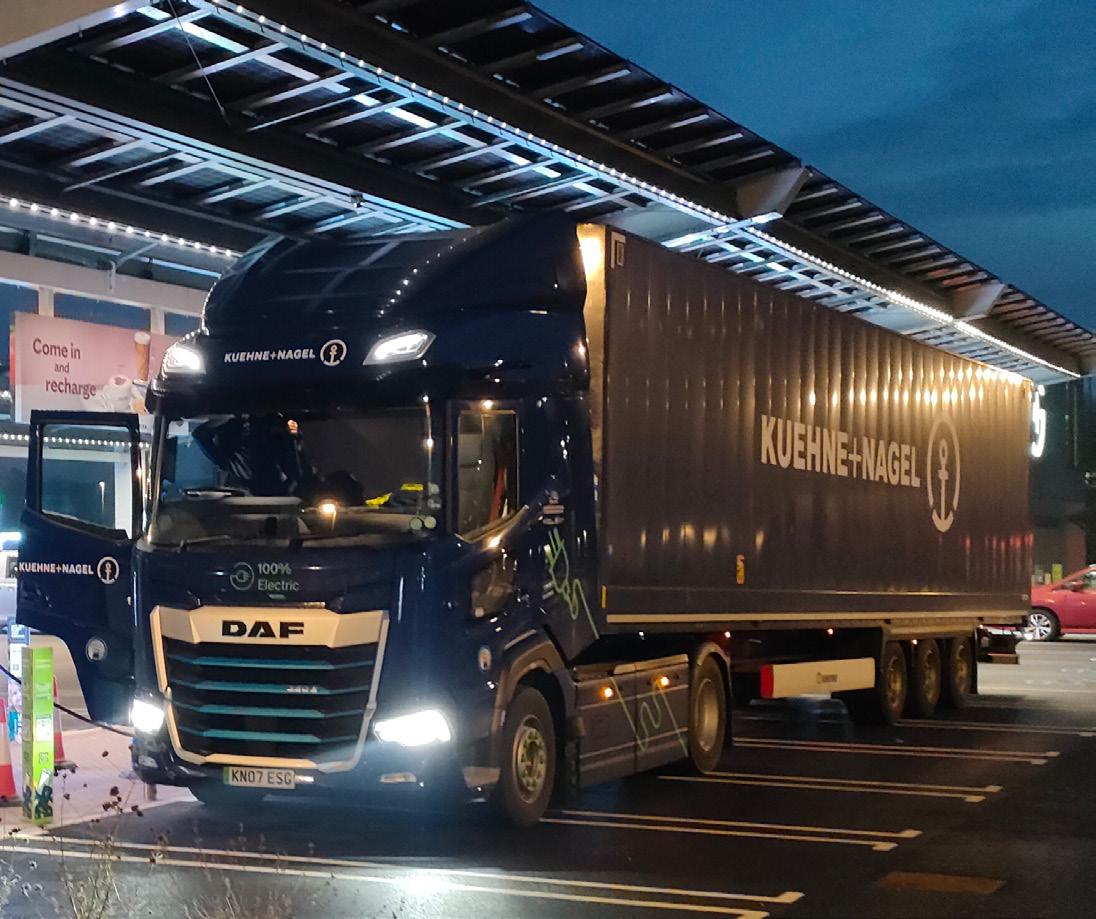
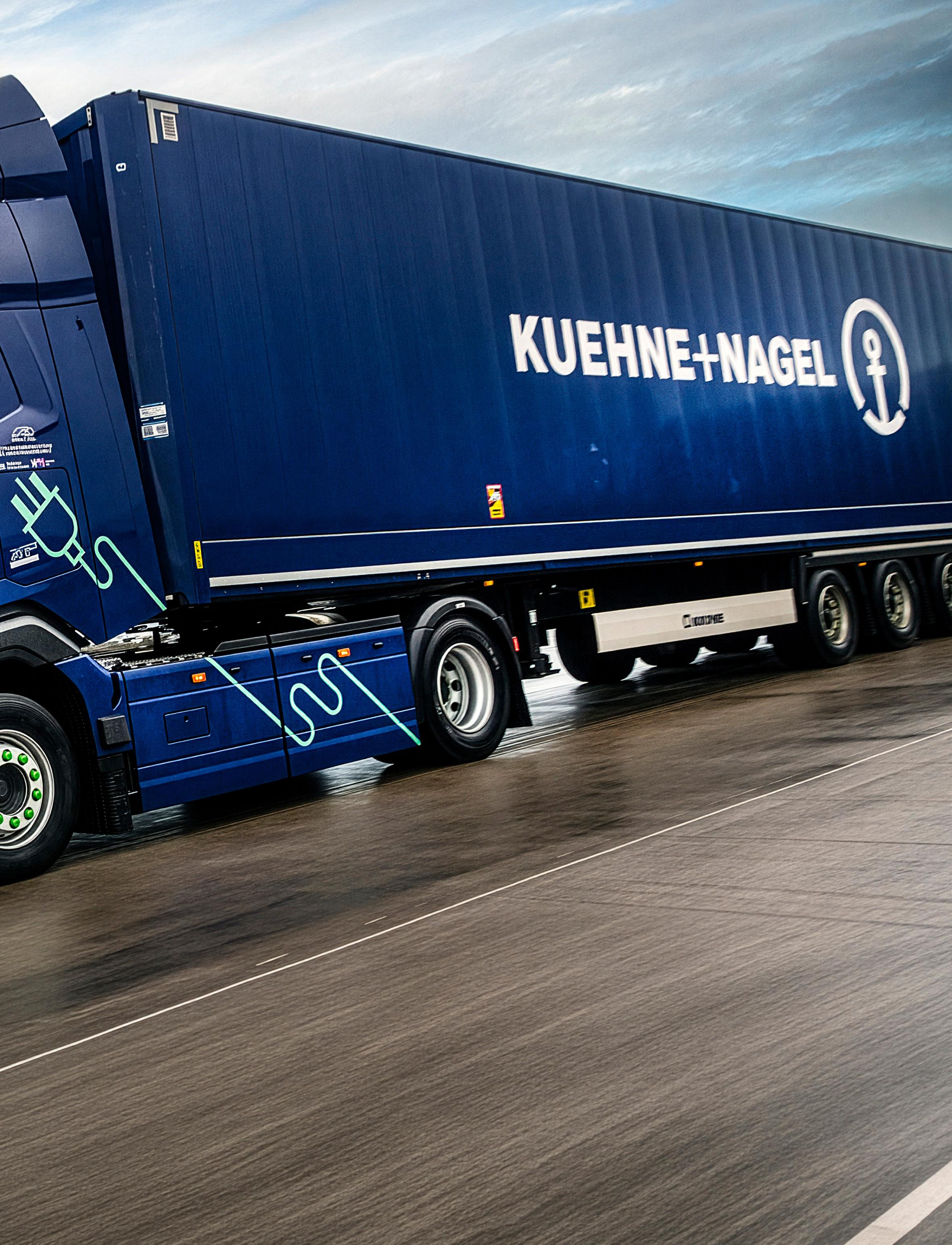
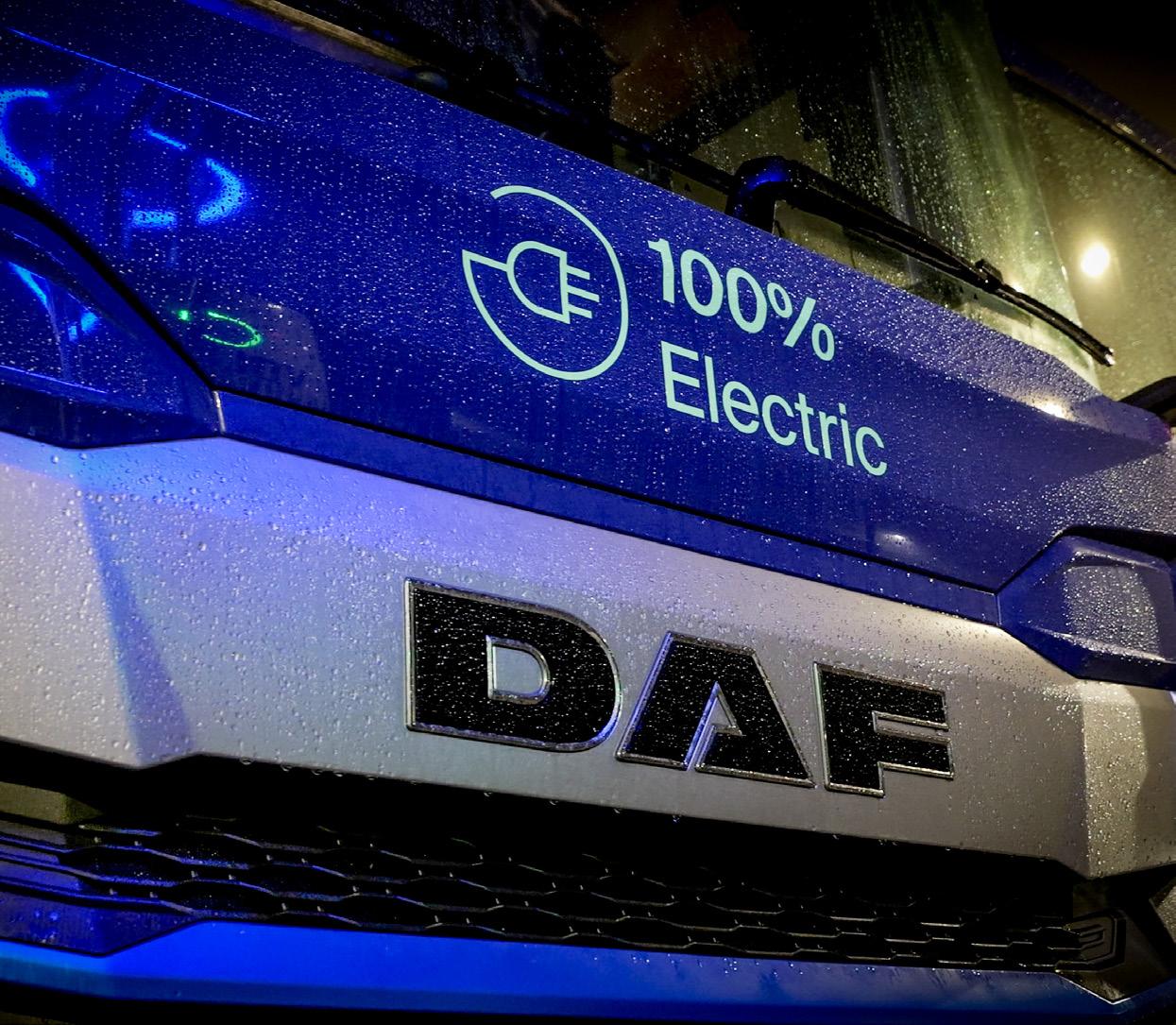
History was made on Monday January 19, 2026 when a DAF XF Electric, operated by Kuehne+Nagel and on route to Germany, became the first eHGV to travel to France via the Eurotunnel carrying a commercial load. More than simply a Channel crossing, the journey was also a further demonstration of the viability of electric trucks undertaking long-distance haulage.
DAF Driver followed the full 48-hour journey from its starting point at East Midlands Gateway, all the way to Kuehne+Nagel’s Haiger depot near Köln in Germany – taking in charging breaks, rest stops and the extensive media intertest this pioneering journey stimulated.
Getting started
A 4:30am departure saw the DAF XF Electric begin its journey at Kuehne+Nagel’s East Midlands Gateway location, just off Junction 24 of the M1. With a trailer filled to maximum volume, the 12,000 kg load, comprising 24 different consignments from 18 different customers, was destined for onward delivery to recipients across the west of Germany. In
the cab and sharing the driving to maintain delivery schedules, despite the necessary charging stops, were Adrian Szewcyzk and Mike Hickson.
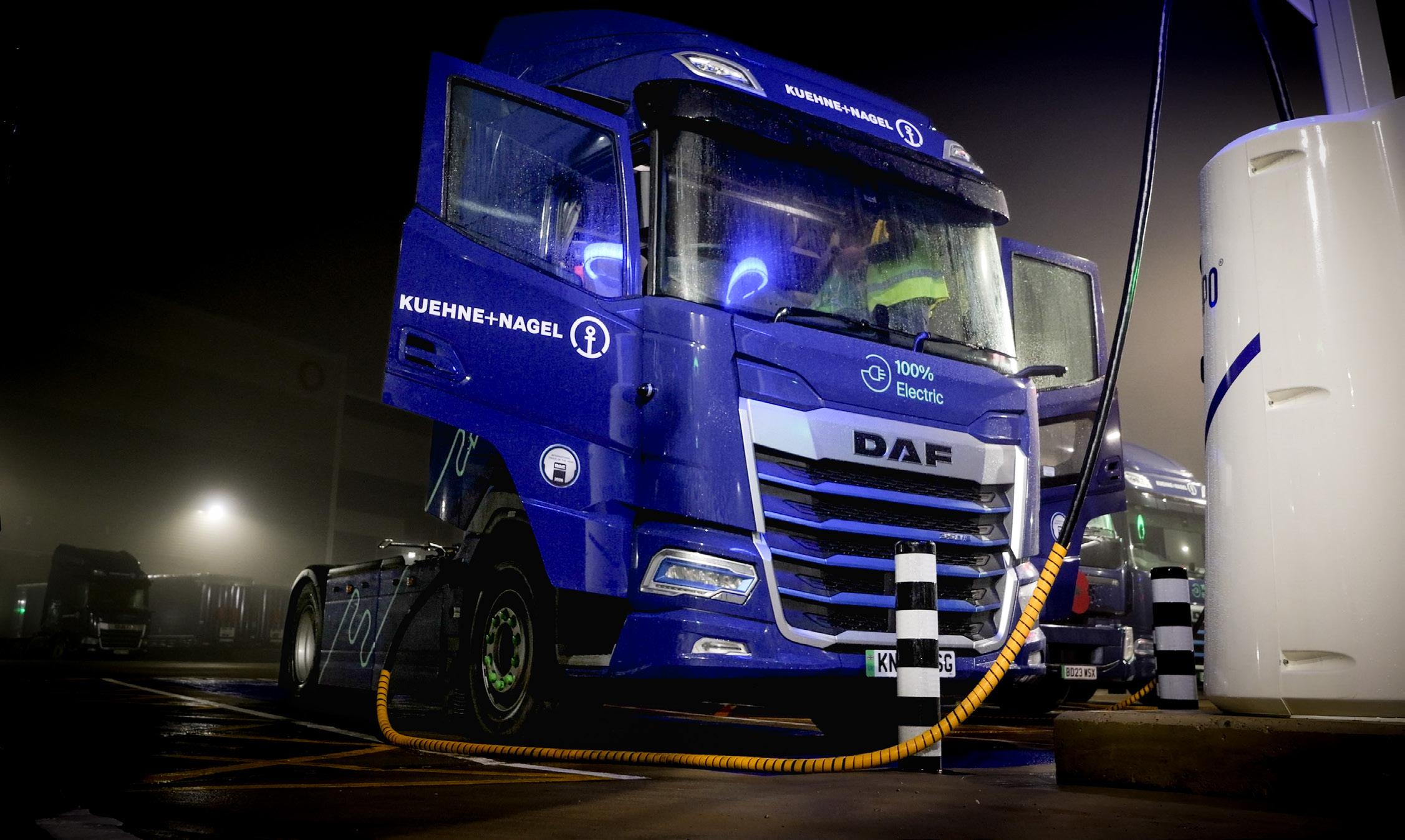
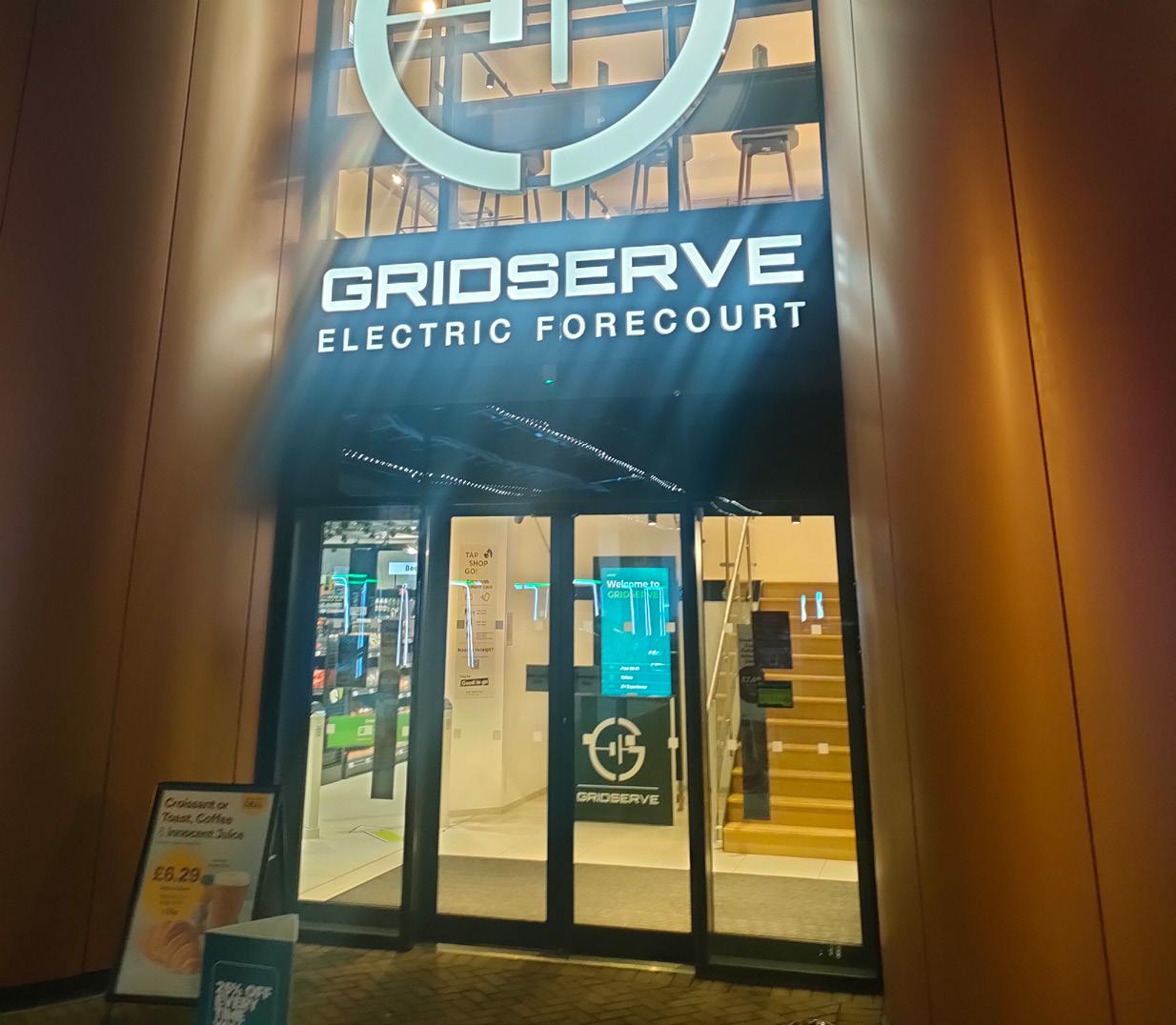
A central feature of the trip was effective charge planning throughout, which in the first instance consisted of a quick ‘snack charge’ at the Gridserve Electric Forecourt in Stevenage, 109 miles into the journey. Here the vehicle was on charge for around 25 minutes – long enough to see the battery sufficiently topped up to ensure it would comfortably make its next planned charging stop in Dunkirk.
Crossing the Channel
There was a great deal of media and stakeholder interest in this landmark event, with representatives from the Department for Transport, Kuehne+Nagel, Eurotunnel, Voltempo and DAF meeting the vehicle as it pulled into the Eurotunnel terminal.
The delegation followed the truck across the Channel by minibus before catching up with the truck in LeShuttle Freight Village in Calais, where a lunch, short presentation and more photo opportunities awaited.
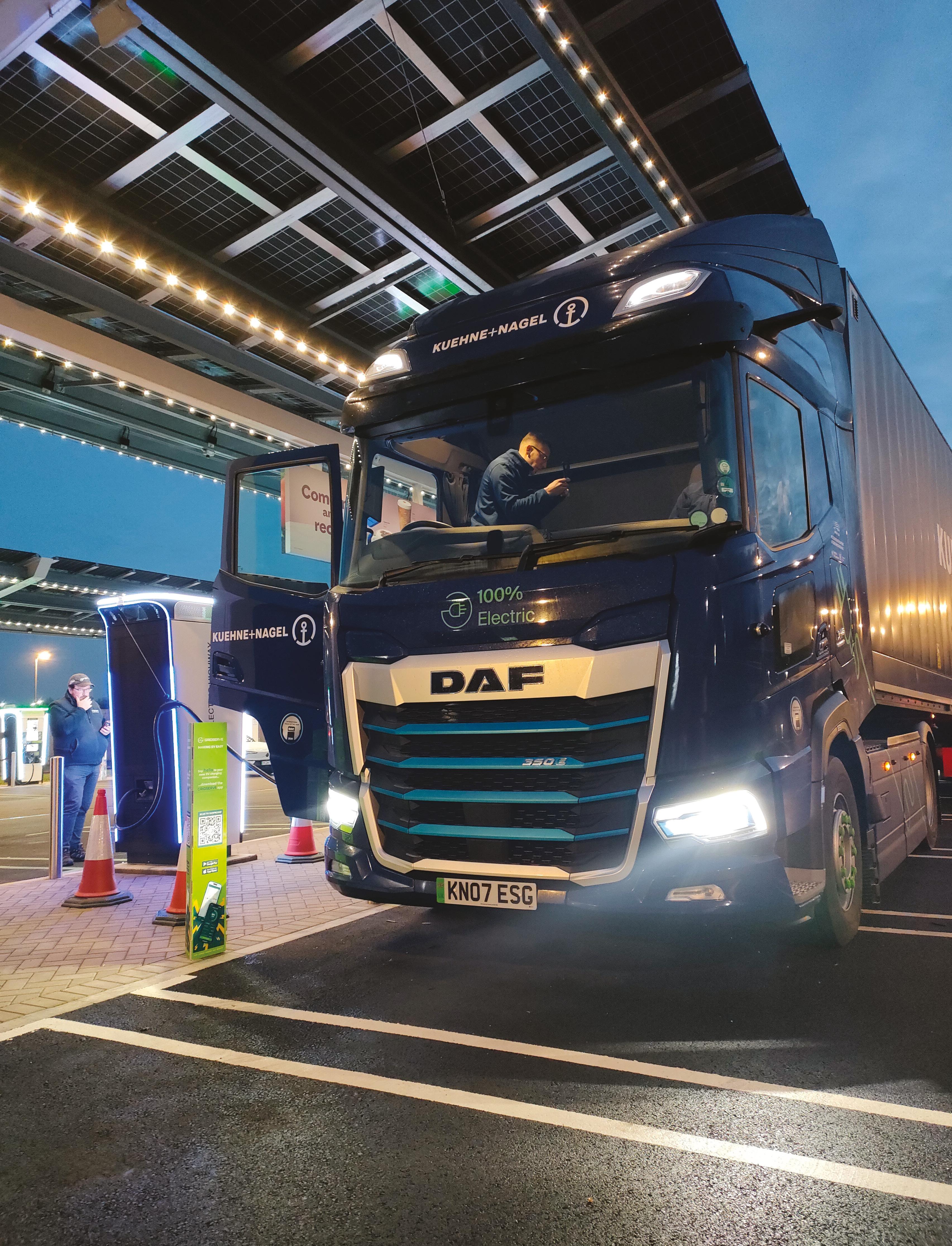
Kuehne+Nagel operate a fleet of 12 zero-emission tractors in the UK, which comprises four DAF XD Electric, four DAF XF Electric and four Renault E-Tech Ts. The DAF Electric models all feature PACCAR EX-D2 350 kW (480 bhp) e-motors and 525 kWh lithium-ferro phosphate (LFP) batteries, which provide a range of over 300 miles on a single change. With a maximum charging rate of 325 kW, the batteries can be fully charged in around 1.5 hours – or, more typically, they can be charged from 20 to 80% in around 60 minutes, making long-haul daily journeys of up to 1000 km a reality.
Media commitments on both sides of the Channel added a few hours to a typical LeShuttle crossing, but once the presentations in Calais were complete and customs was cleared, the truck was able to continue its journey onwards into Europe.
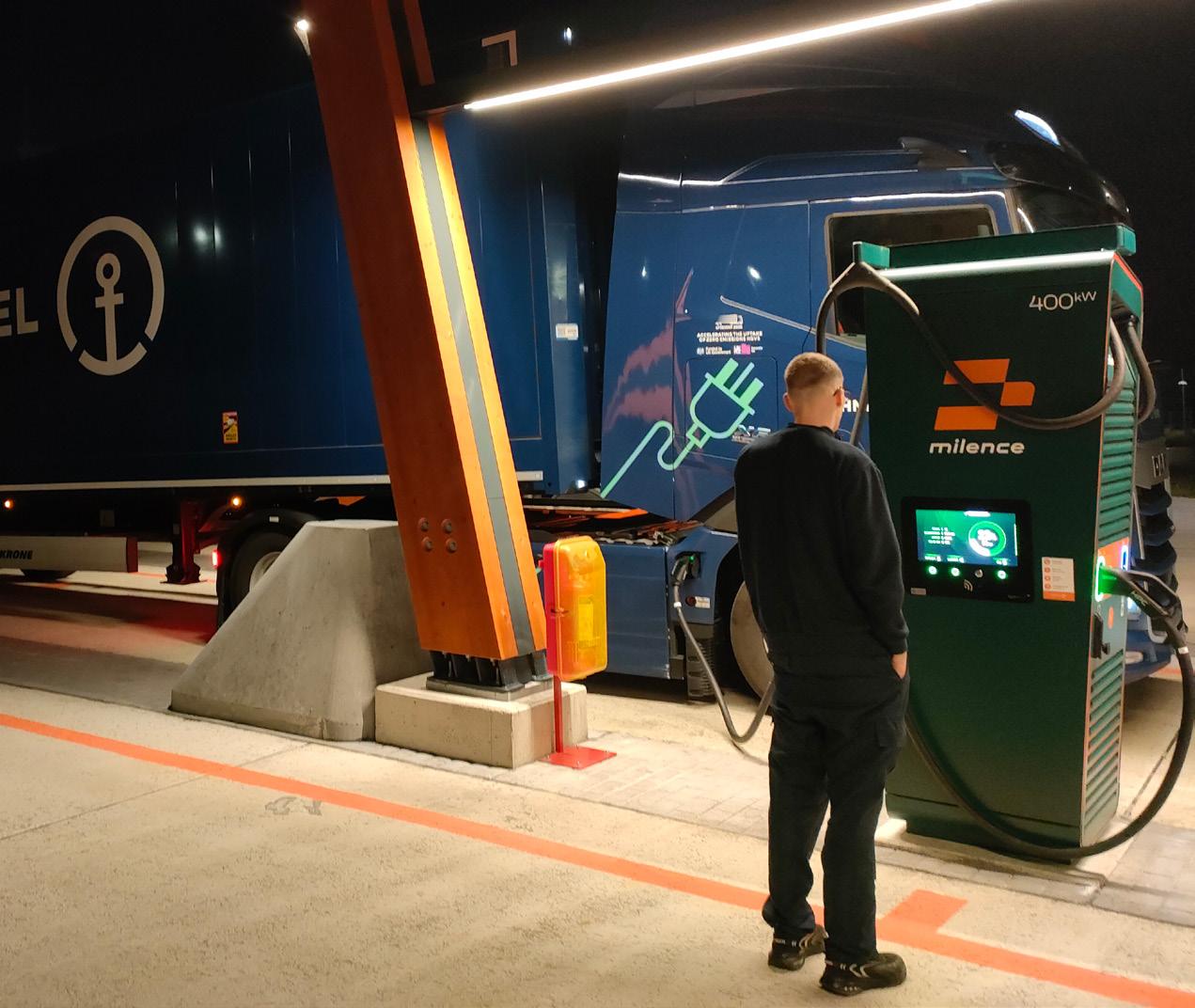
Upon leaving Calais, the truck made its way to the Milence charging station in Dunkirk, where it would take around 1.5 hours to fully charge, ready to take on the longest uninterrupted leg of its journey: 170 miles from Milence, Dunkirk to another Milence charging site in Maasmechelen, Belgium.
The truck arrived at Maasmechelen a little after 10pm. This was later than the journey would ordinarily have required, but the truck was still playing catch-up from its media commitments earlier in the day.
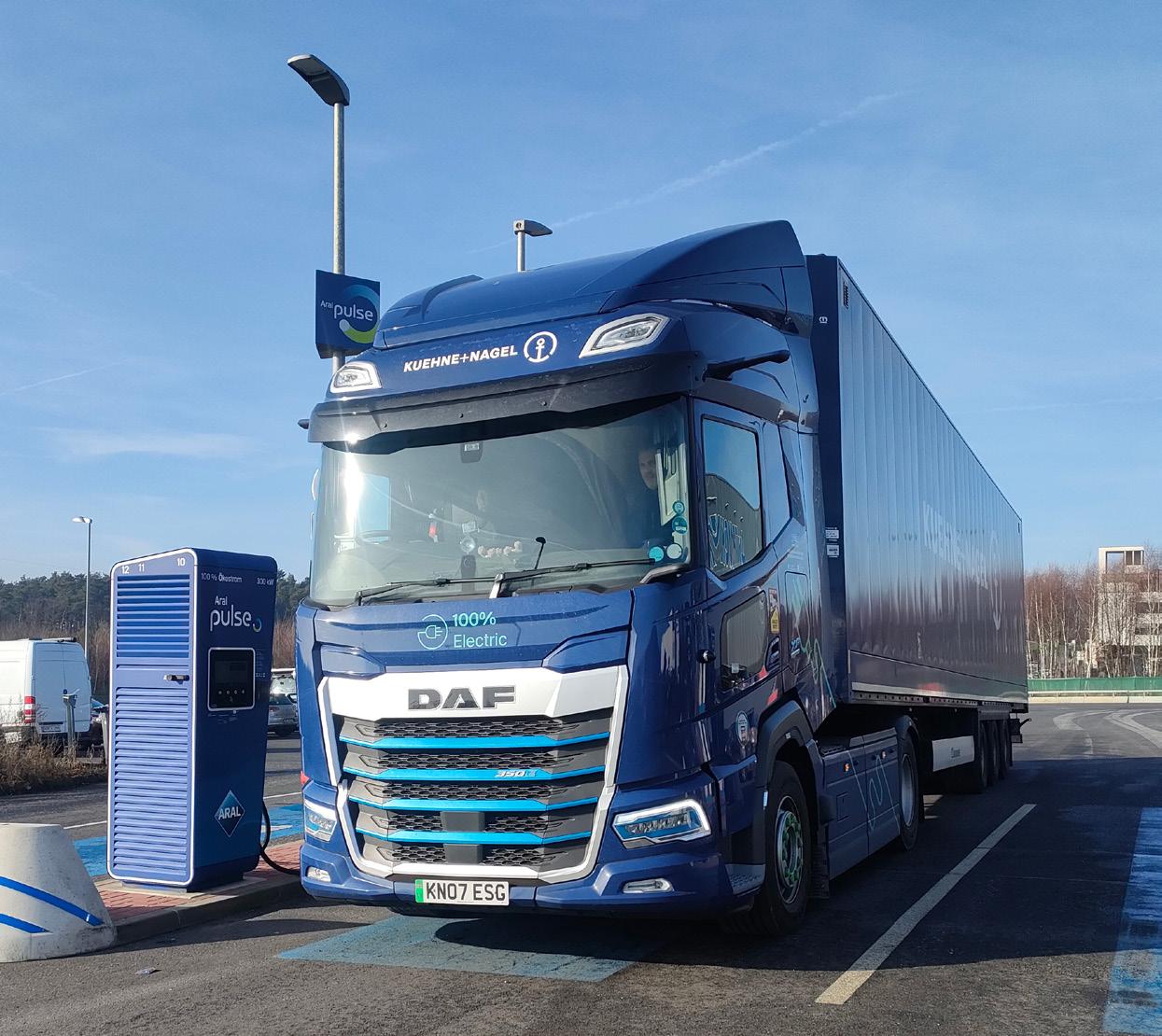
Once at Maasmechelen, the vehicle charged for another 1.5 hours or so before continuing a further 61 miles into Germany to an Autohof in Köln, where it would take an overnight stop. Without the media attention and associated delays this first trip generated, this journey will usually be achievable in a single 21hour double-manned shift – even with the charging stops. Rested and ready for the day ahead, Adrian and Mike set off in the morning with Kuehne+Nagel Haiger as their final destination. A 100-mile journey in total, they had one more charge stop 40 miles in, at Aral Bad Honnef. The logic behind this break was to
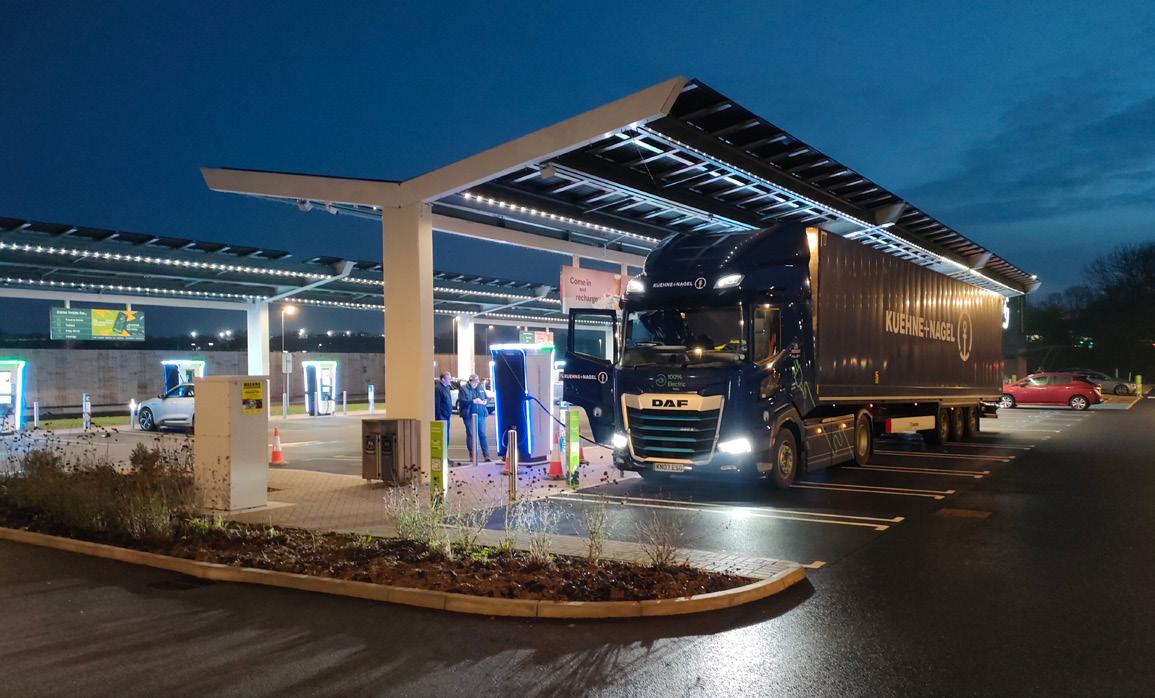
The truck and its drivers were treated to a celebrities’ welcome in Calais with press and media outlets eager for a photo, video and interview.
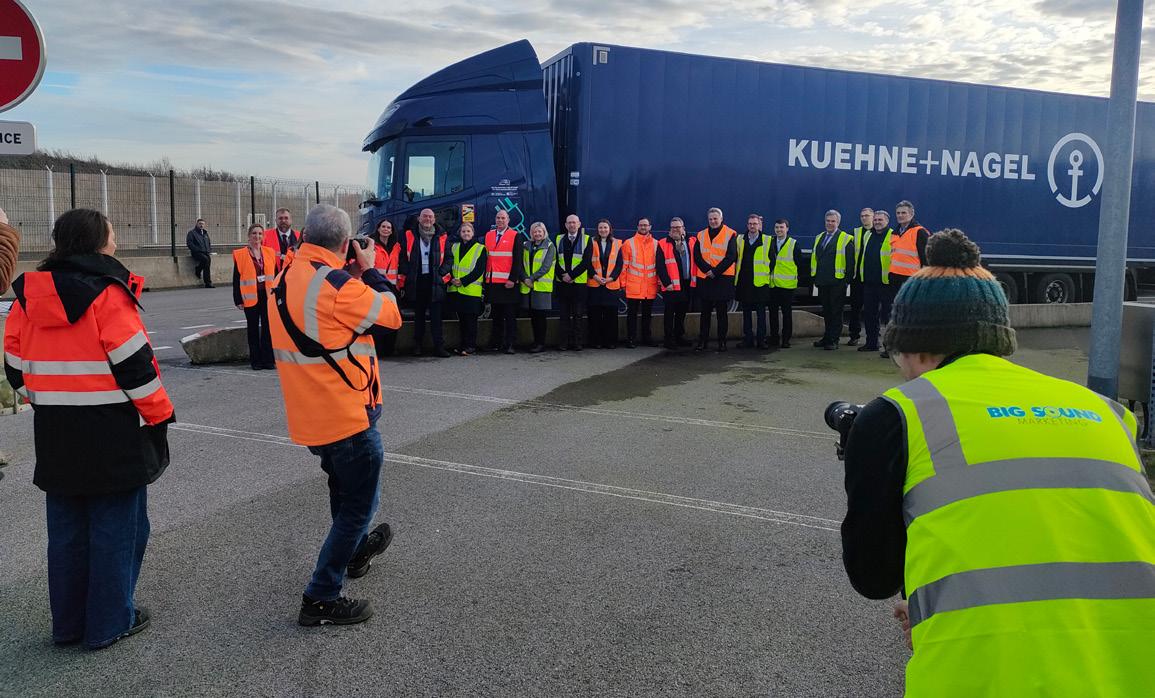
“THERE WAS A GREAT DEAL OF MEDIA AND STAKEHOLDER INTEREST IN THIS LANDMARK EVENT”
Adrian Szewcyzk regularly drives the K+N vehicle used for the Eurotunnel crossing, and his experience with the DAF XF Electric to date has been very positive. “It is a well-built and comfortable truck to drive,” he says.
“It’s smooth and quiet on the road. The cab is spacious and well laid out, making it comfortable for long shifts, and the reduced noise and vibration is a noticeable benefit throughout the day. The Digital Vision System works very well, providing clear and wider visibility in all conditions.”
He’s equally impressed with the vehicle and its capabilities after the return trip to Haiger: “It performed excellently on the Eurotunnel crossing, with the quiet operation and smooth drive making the experience straightforward and stress-free,” he says. “Overall, it’s a capable and practical electric truck that’s reliable, easy to work with and that can get the job done just as well as a diesel version.”
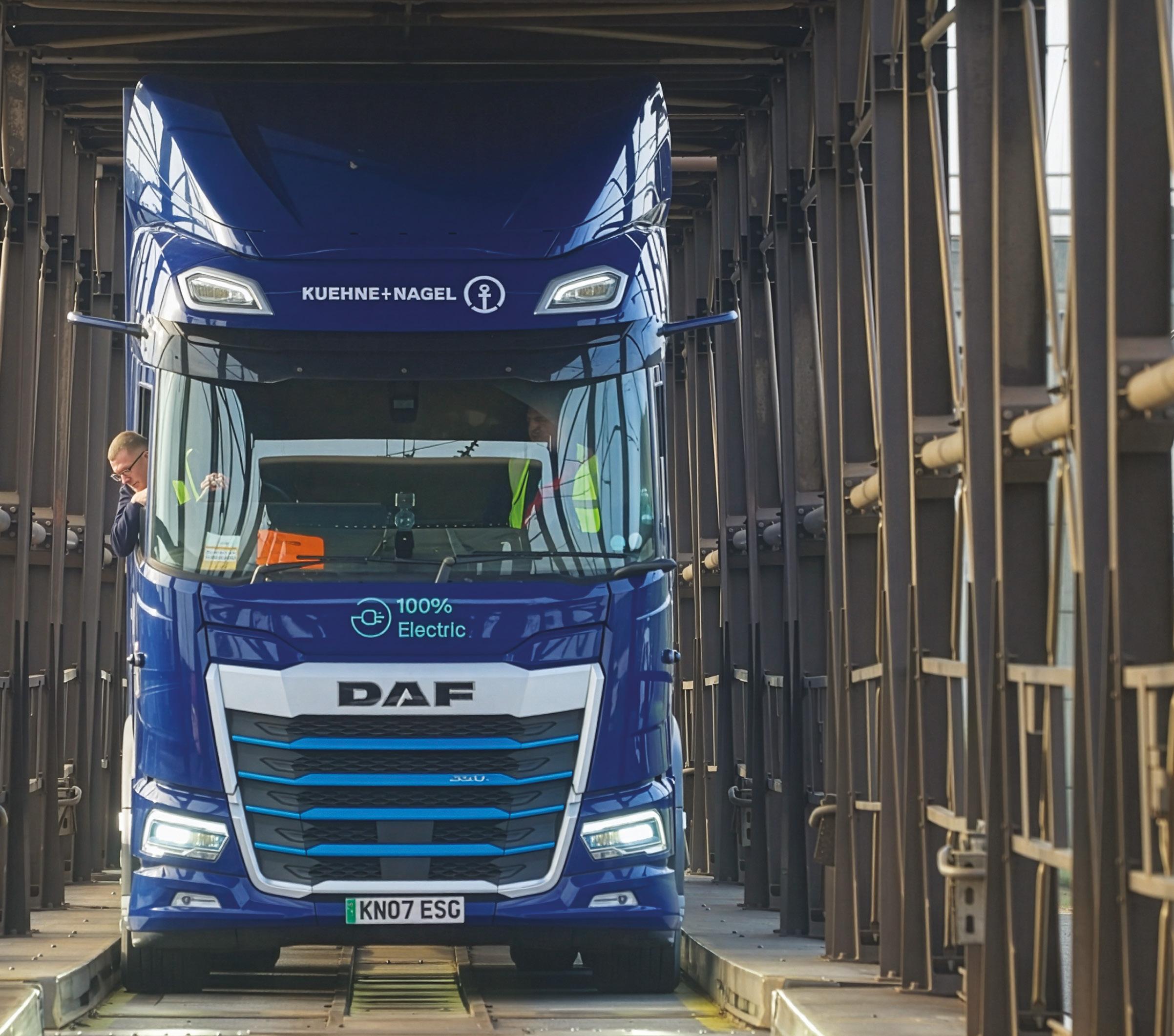
“RESTED AND READY FOR THE DAY AHEAD, ADRIAN AND MIKE SET OFF IN THE MORNING WITH KUEHNE+NAGEL HAIGER AS THEIR FINAL DESTINATION.”
Top right: Milence is one of a number of companies providing dedicated HGV charging points throughout Europe. With charging stations across France, Belgium, Netherlands, Germany, Spain, Italy, Norway and Sweden, they provide a convenient and truck-friendly environment for charging
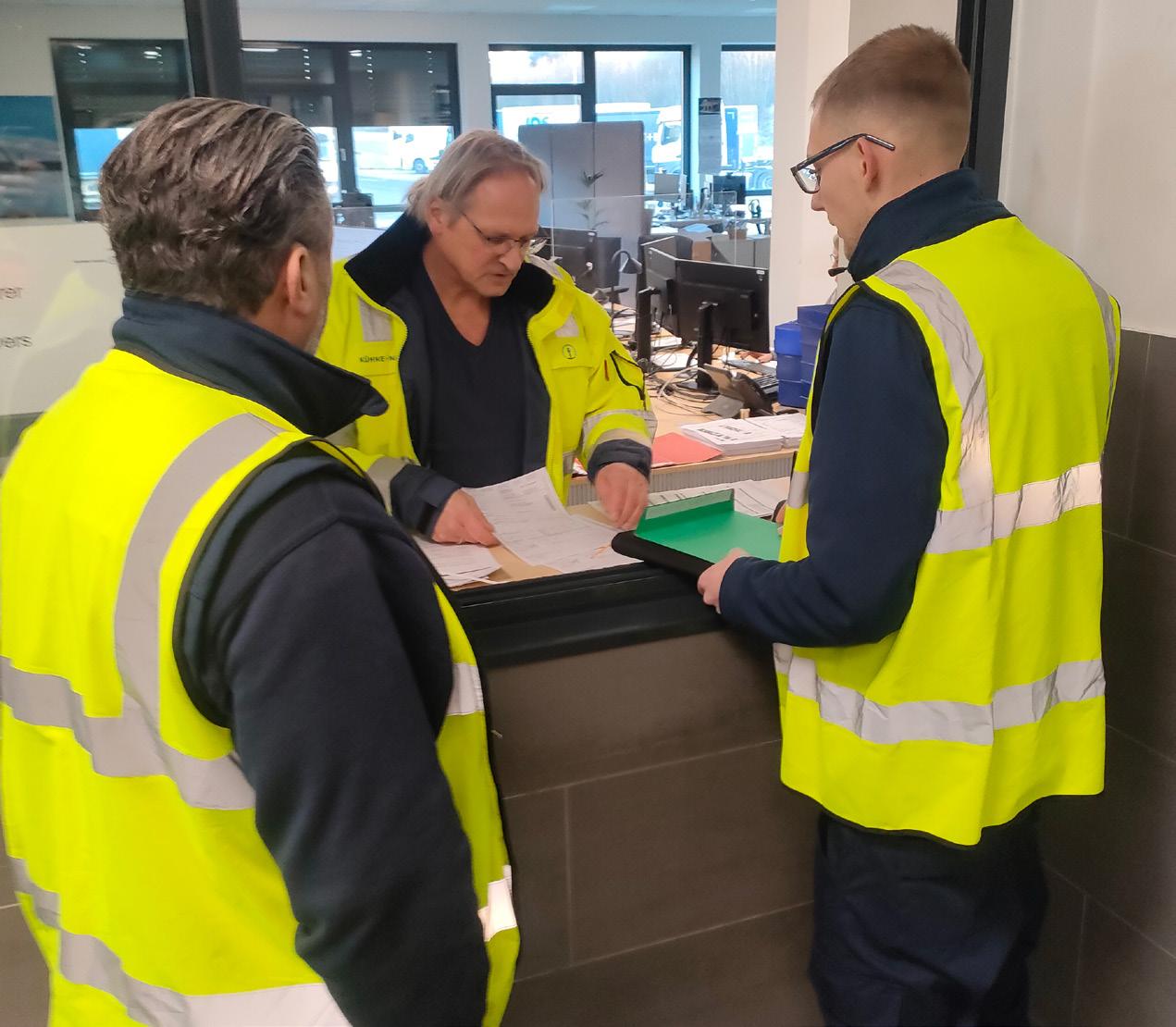
Middle right: Paperwork completed upon arrival at Kuehne+Nagel Haiger
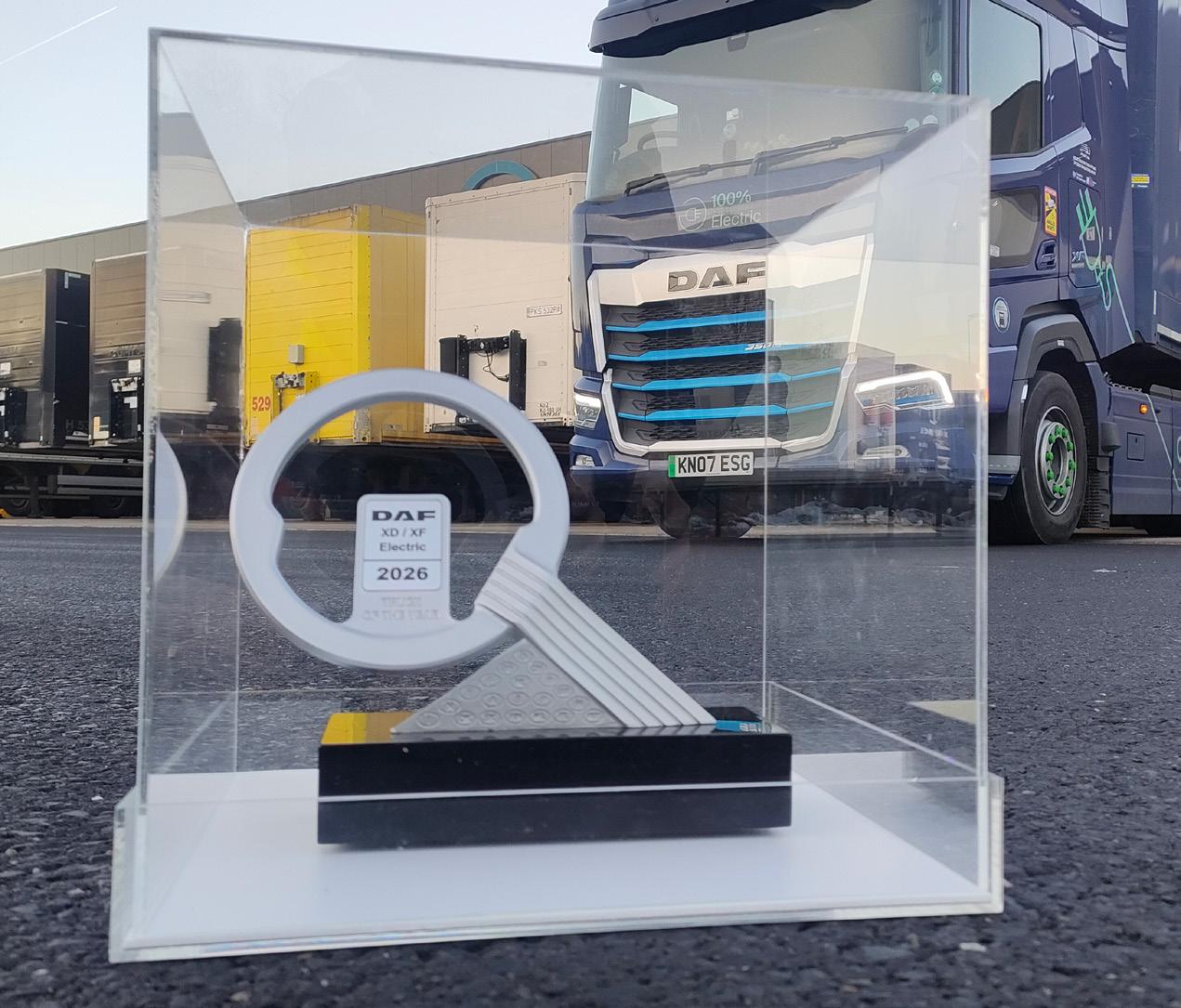
Bottom right: One item of cargo aboard the Kuehne+Nagel trailer from the UK was the International Truck of the Year 2026 trophy, awarded to DAF Trucks for the XF Electric and XD Electric.
give them enough charge to carry on the 60 miles to Haiger and then also complete the required 140 miles to get back to Milence Maasmechelen on their return leg.
And that was it, journey complete: 566 miles, four charging stops, zero tailpipe emissions. With the mission accomplished and the trailer swapped, the truck began its journey to retrace its steps and charging points to cover the 566 miles back to the UK (and the second ever Channel crossing of an eHGV via Eurotunnel!).
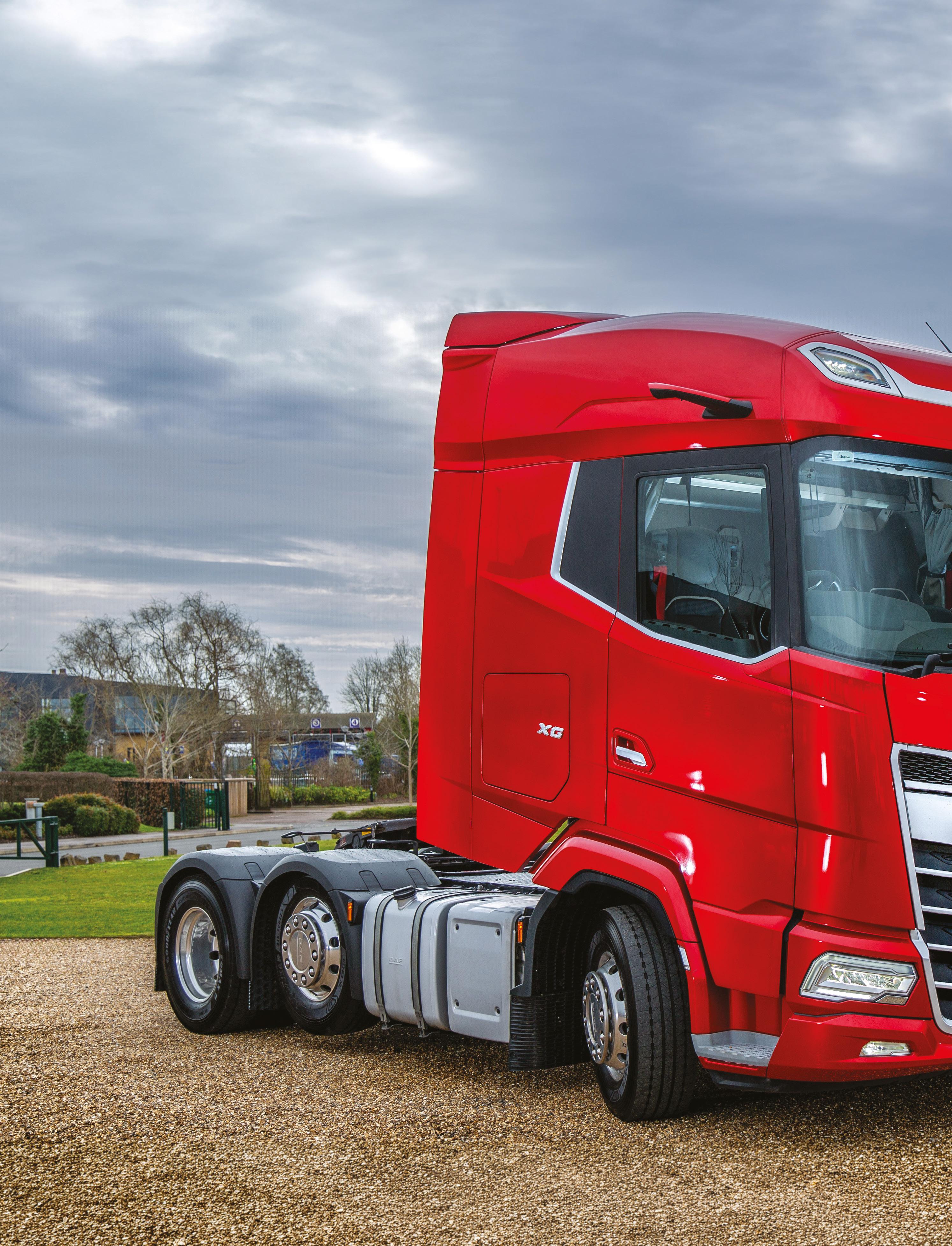
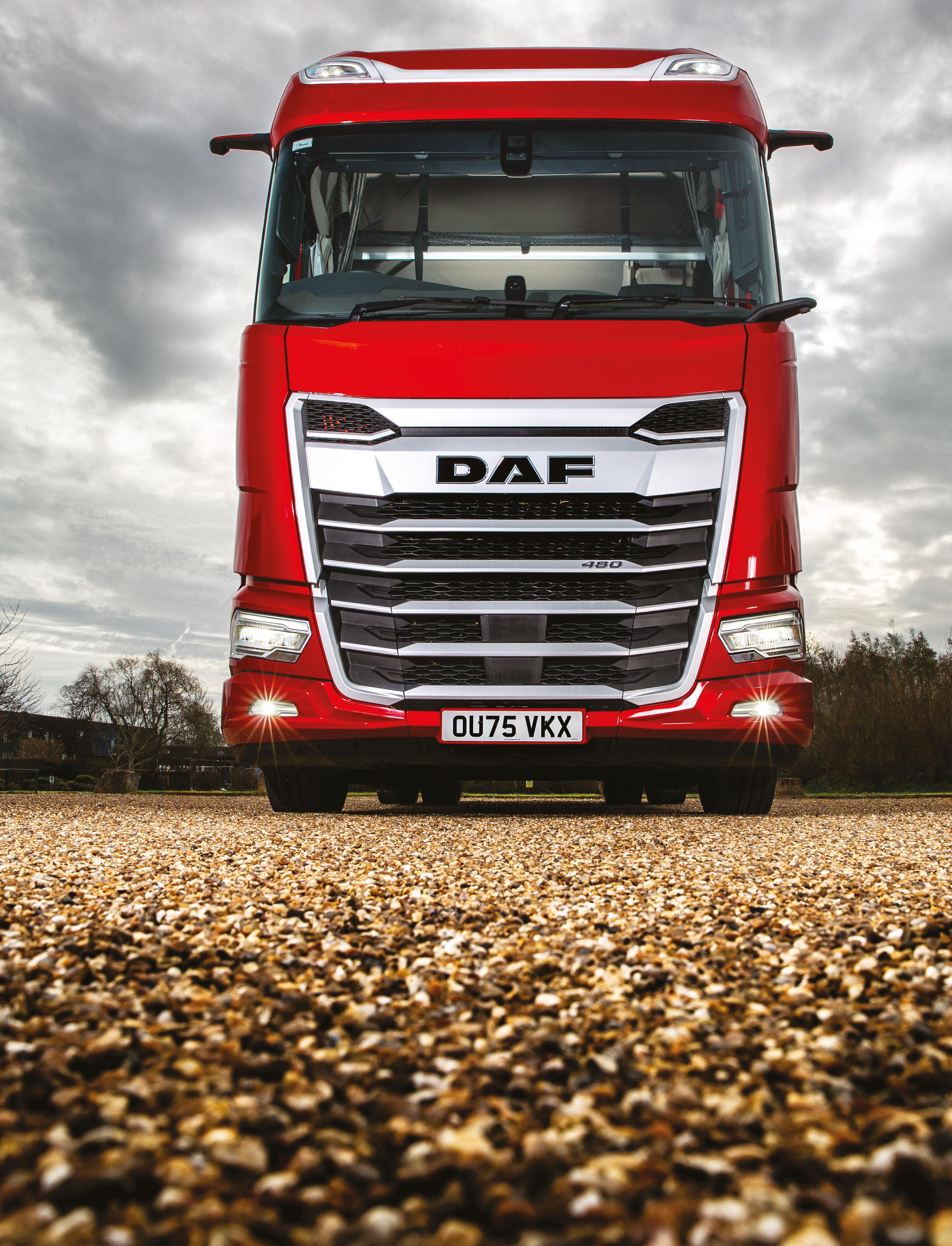
When chasing efficiency, a taller final drive ratio can make all the difference. We put DAF’s latest XG 480 demonstrator with 2.05:1 differential to the test during the gruelling Scottish winter.
When it comes to spec’ing a new truck, there’s a plethora of things to consider – from engine size and cab type to the number of axles, right down to floor mats and Anderson connections. The list of options can be a little overwhelming, especially when getting it wrong can be an expensive mistake.
One feature that’s often overlooked – yet can have a significant bearing on the total-life cost and overall profitability of a vehicle – is the final drive ratio. Most operators running in the 44-tonne sector will play it safe with a fairly standard 2.38:1 or 2.64:1 axle ratio (that’s 2.38 or 2.64 revolutions of the prop shaft to one full rotation of the driven wheel). This offers a good compromise between power, speed and fuel economy. A heavy-haulage operation may look towards lower gearing – typically around 4.55:1 – to give the required low-down grunt and reduce stress on the drivetrain. However, this will have a detrimental effect on fuel economy.
DAF’s latest generation of engines have been designed with down-speeding in mind – a fuel-efficiency strategy that focuses on reducing engine RPM at cruising speed. In conjunction with new TraXon gearbox shifting software, these engines work with the tallest available ratio, utilising the SR1344 rear axle. Previously only available in 4x2 configuration, the 2.05:1 differential is now an option in 6x2 tractor unit format, which opens it up to a whole new fuel-conscious market.
Tall story
During a discussion with DAF’s Press & Demonstration expert, Mandy Wannerton, I mentioned I was looking to replace a vehicle that has been working on a high-mileage, double-shifted contract. Lightly loaded and covering over 1300 km per day on a mixture of motorway and dual-carriageway, this is the perfect application for taller gearing. Mandy suggested I should try out DAF’s new XG 480 demonstrator, complete with the 2.05:1 differential, for a couple of weeks.
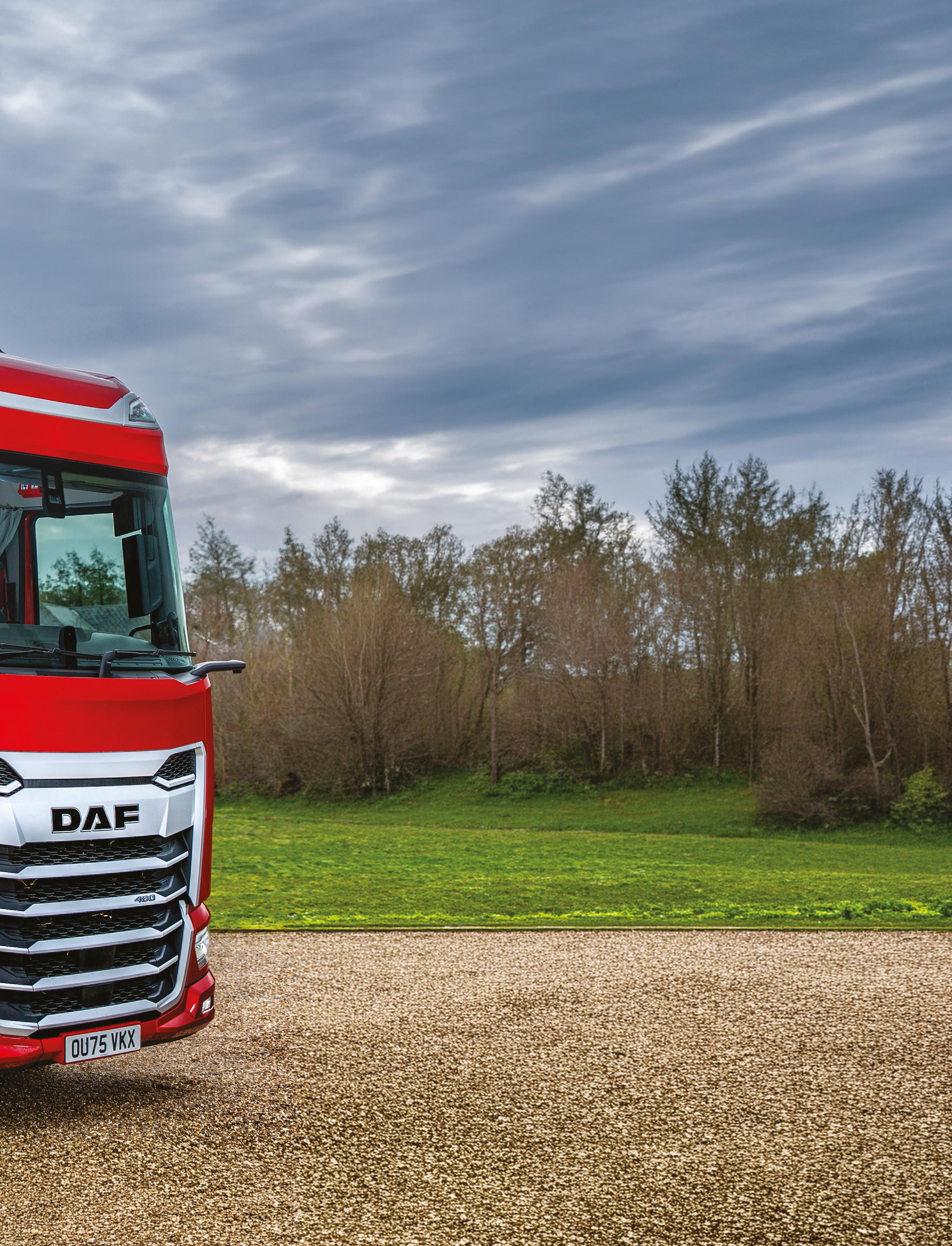
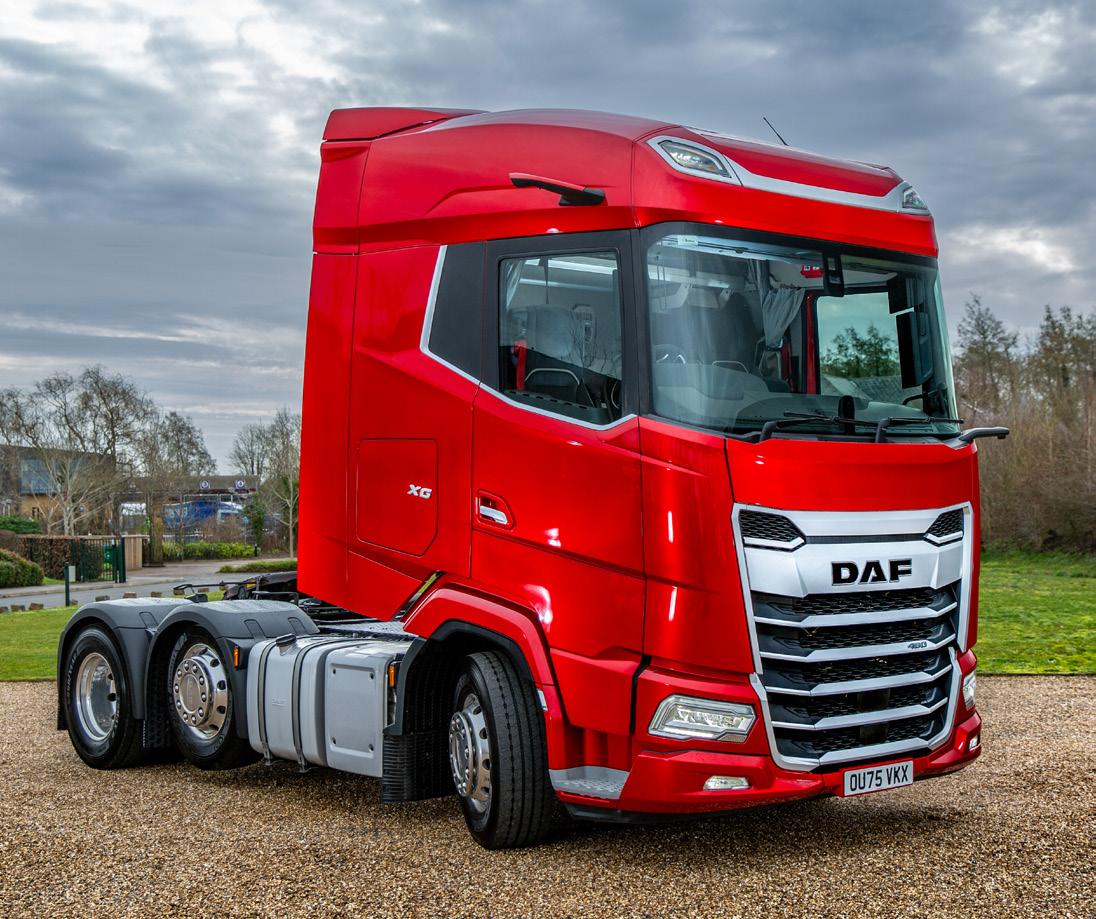
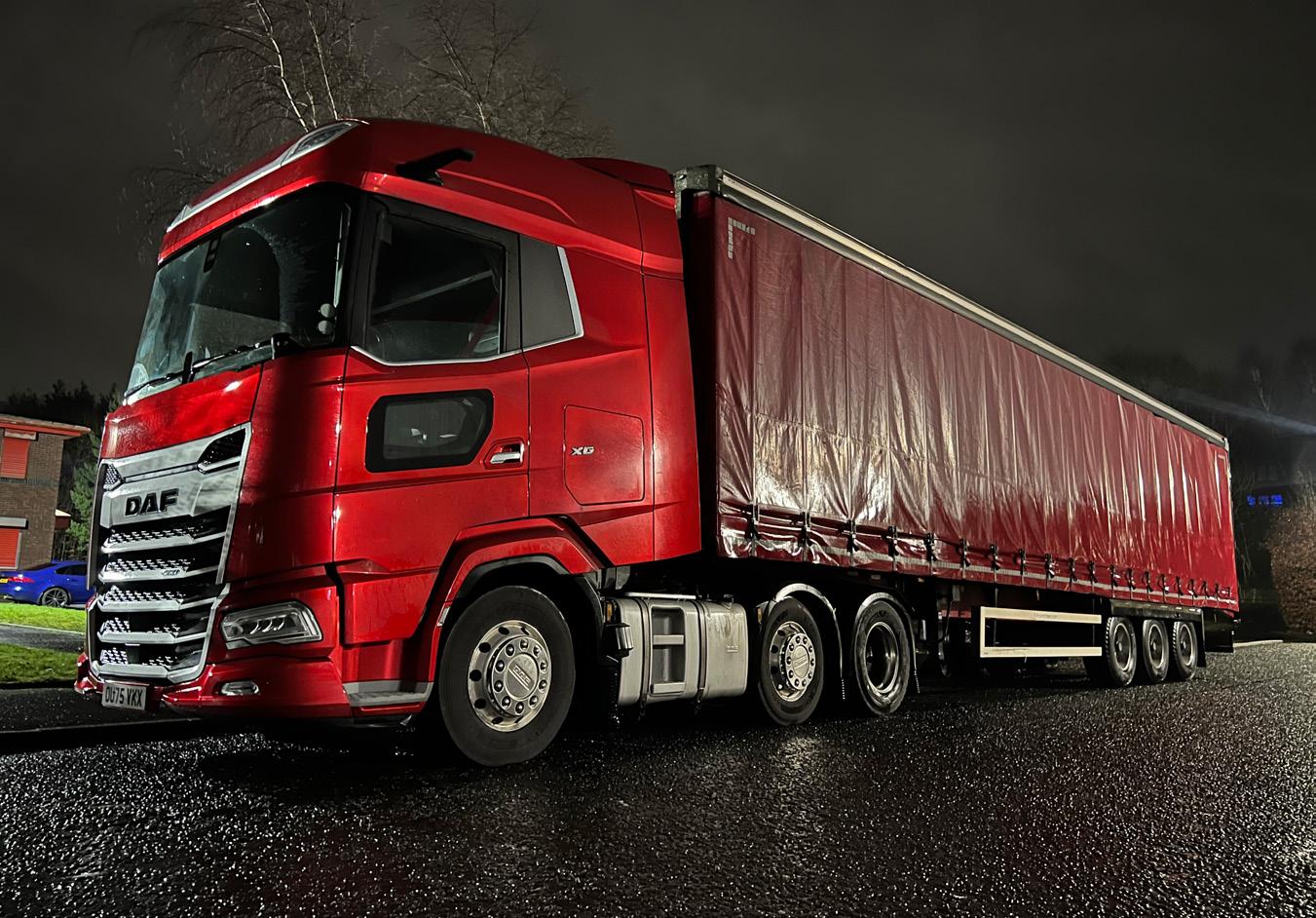
Up until this point, I have to admit differential ratio is something I haven’t spent a great deal of time considering, usually leaving it to the salesperson to decide or simply taking whatever was a good deal at the time. Although I have rarely been disappointed with the fuel economy of the trucks I’ve operated over the years, I can’t say I have been overwhelmed either – so I gratefully accepted Mandy’s offer and took delivery of the shiny, metallic, reddish-winecoloured XG demo truck to see if its tall/fast gearing was the answer to all my prayers.
For the maiden voyage with the XG, I decided on a quick run up to Airdrie with a refrigerated trailer full of empty trays, returning with a full load of potatoes – so fairly light on the way up and reasonably heavy on the way back. It all seemed pretty straightforward and a nice little taster session with the DAF, until the Scottish weather decided not to play ball, dumping a reasonable amount of wet snow onto the M74.
Wearing an almost new set of tyres, the DAF had no trouble with traction in the slushy snow; but unfortunately, with the forward-facing sensors covered in a thick layer of the white stuff, the truck was effectively blindfolded and I lost the use of Adaptive Cruise Control. To top it off, the northbound traffic started to become a bit panicky and brake lights began to flicker. To get the best out of the 2.05:1 axle, I had been advised to keep it moving –working best when pretty much flat-out with cruise-control switched on – so a snow-covered M74 was not the ideal working condition for the truck.
On reaching Albert Bartlett’s – heaven for potato lovers – I found the remaining spot to drop the trailer. This happened to be an angled, blind-side reverse between two trailers in the dark. The demo XG is fitted with the latest version of DAF’s DVS (Digital Vision System). In my opinion it still doesn’t have the clarity of a conventional mirror, but the resolution is noticeably improving and you cannot deny the joy of no longer having to clean salt-smeared glass.
“THE DIFFERENTIAL IS THE STAR OF THE SHOW – YOU SOON BECOME USED TO THE QUICK DOWN-CHANGES”
The DVS pan-out feature, which moves the camera angle to keep track of the rear of the trailer on tight turns, lent a hand when attempting such a blind reverse. I have to admit the cameras are pretty good and, in combination with a bit of sticking my head out of the window – and probably my tongue out in concentration –I found the trailer plonked neatly into position. After hitching up another potato-laden trailer, I set the compass south and hit the road into another sleet-filled sky. I grabbed a coffee at Cairn Lodge Services and cleared the snow from the sensor. By this time there was a good two inches of snow covering the trucks parked up for the night, but the sky had cleared. Things were looking up. Adaptive Cruise Control took over and the ‘Tattie Express’ picked up speed until it found the limiter – this is how it is meant to be. At this point, the digital rev counter read around 1000 rpm.
Second time’s the charm
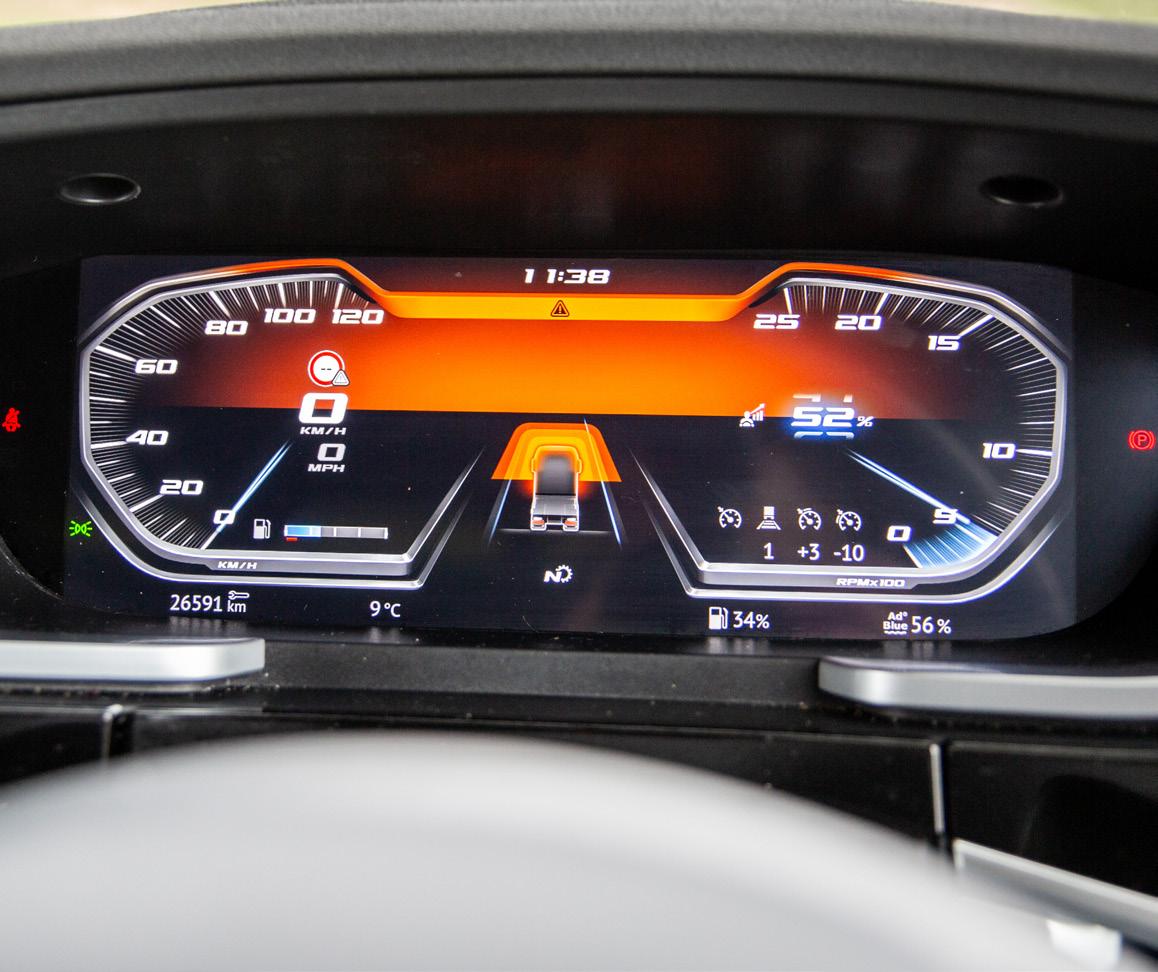
A little disappointed with the results from my first run – the inclement weather playing havoc with the fuel economy – I headed out for a second run. This time it was a 2:30 am start, heading north for Glasgow and Aberdeen. The weather was good and the curtainside trailer was loaded with around 20 tonnes of steel, so conditions were perfect for the XG. With Adaptive Cruise switched on and, as advised, set to its minimum position so I was less likely to get inadvertently caught up with slower vehicles, I sat back and let the Advanced Driver Assistance Systems (ADAS) read the road. I love the XG cab environment; it is very much a driver’s cab, with everything where it should be. I did find the phone set-up a little fumbly this time, but got there eventually; and it took me a minute or two to get my head around the steering controls for the digital dashboard. Once I got the hang of it, I was sorted.
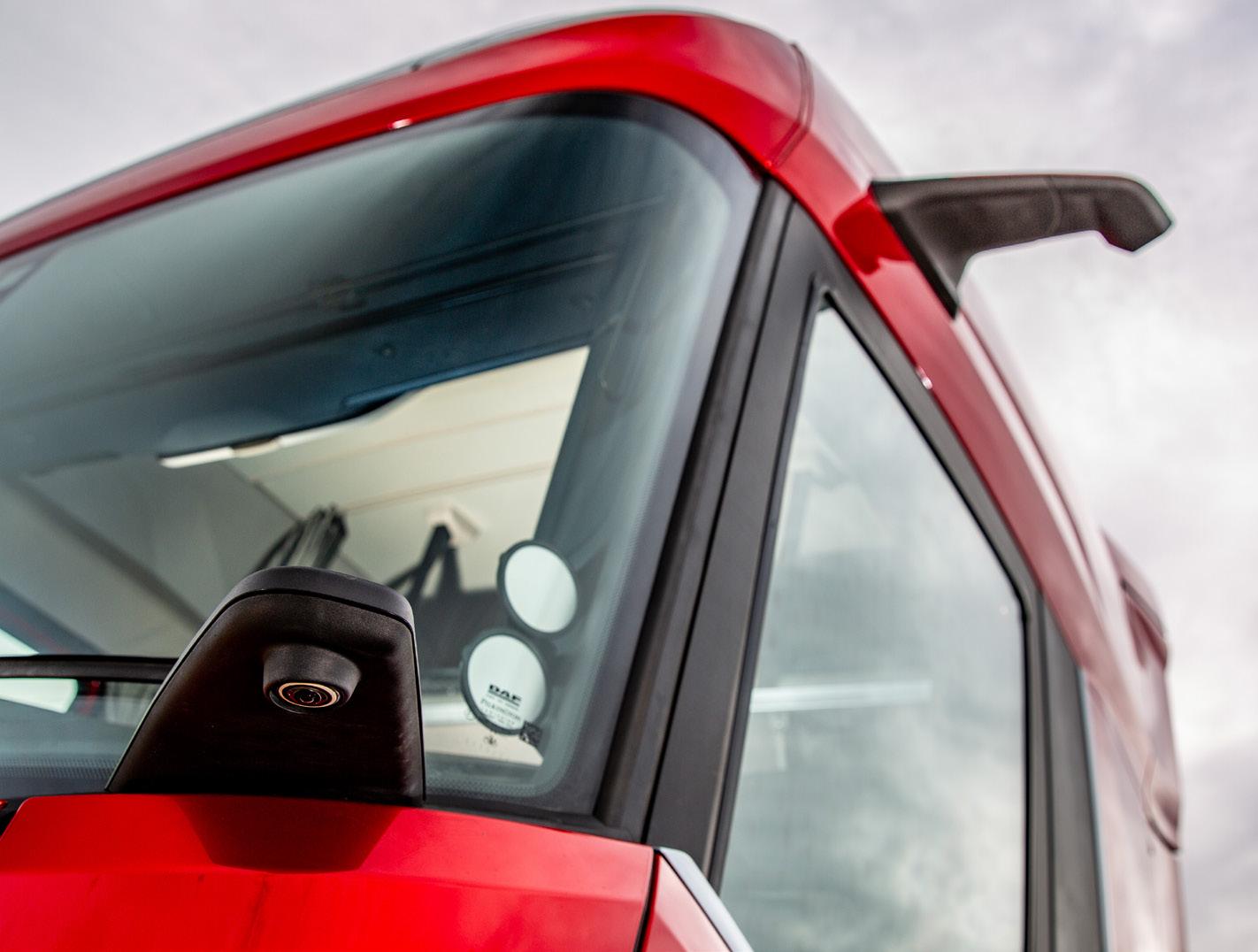
Top: DAF’s Corner View camera gives superb nearside visibility
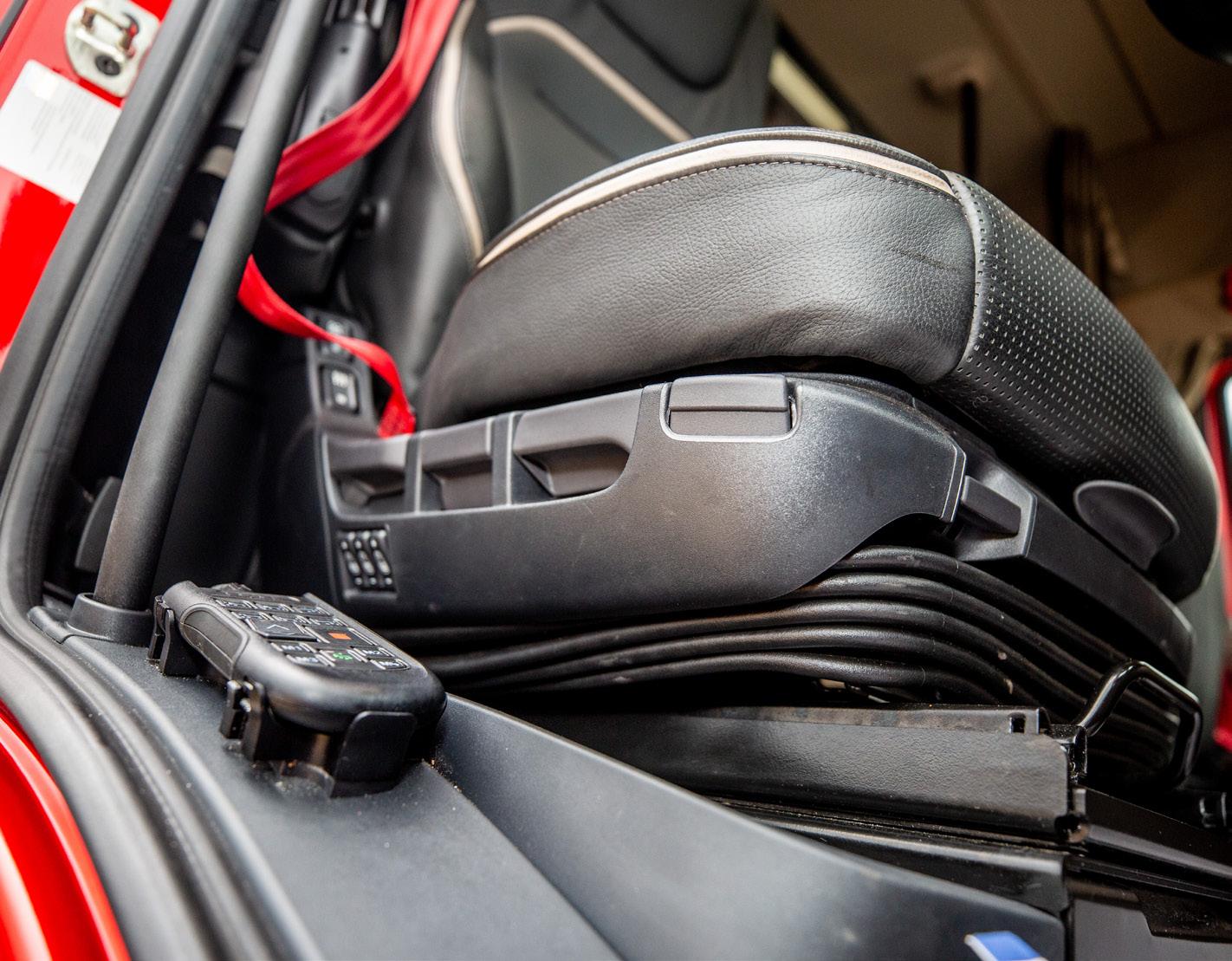
Middle: XG cab offers first-class driving comfort
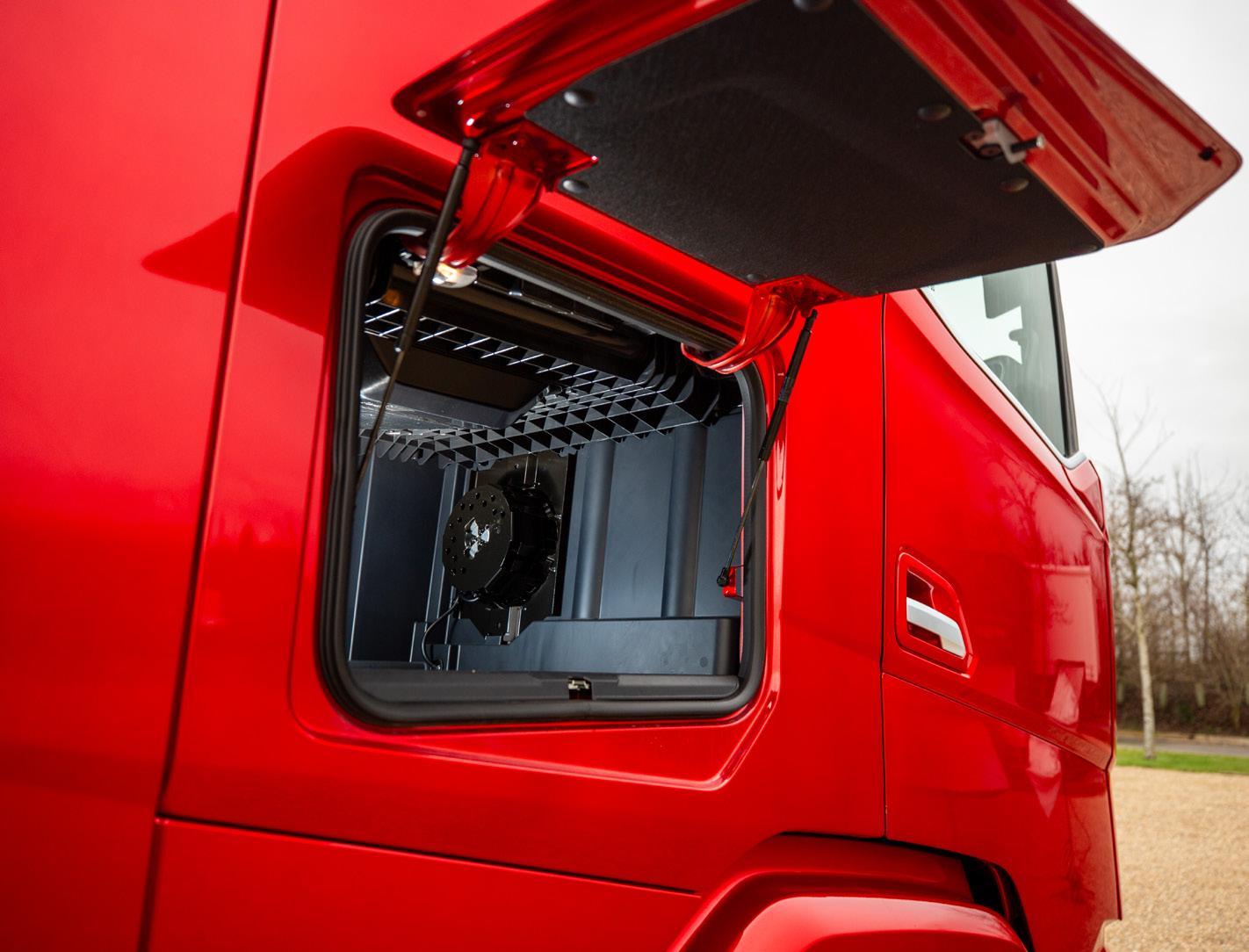
Bottom: Deep outside locker is perfect for dirty kit
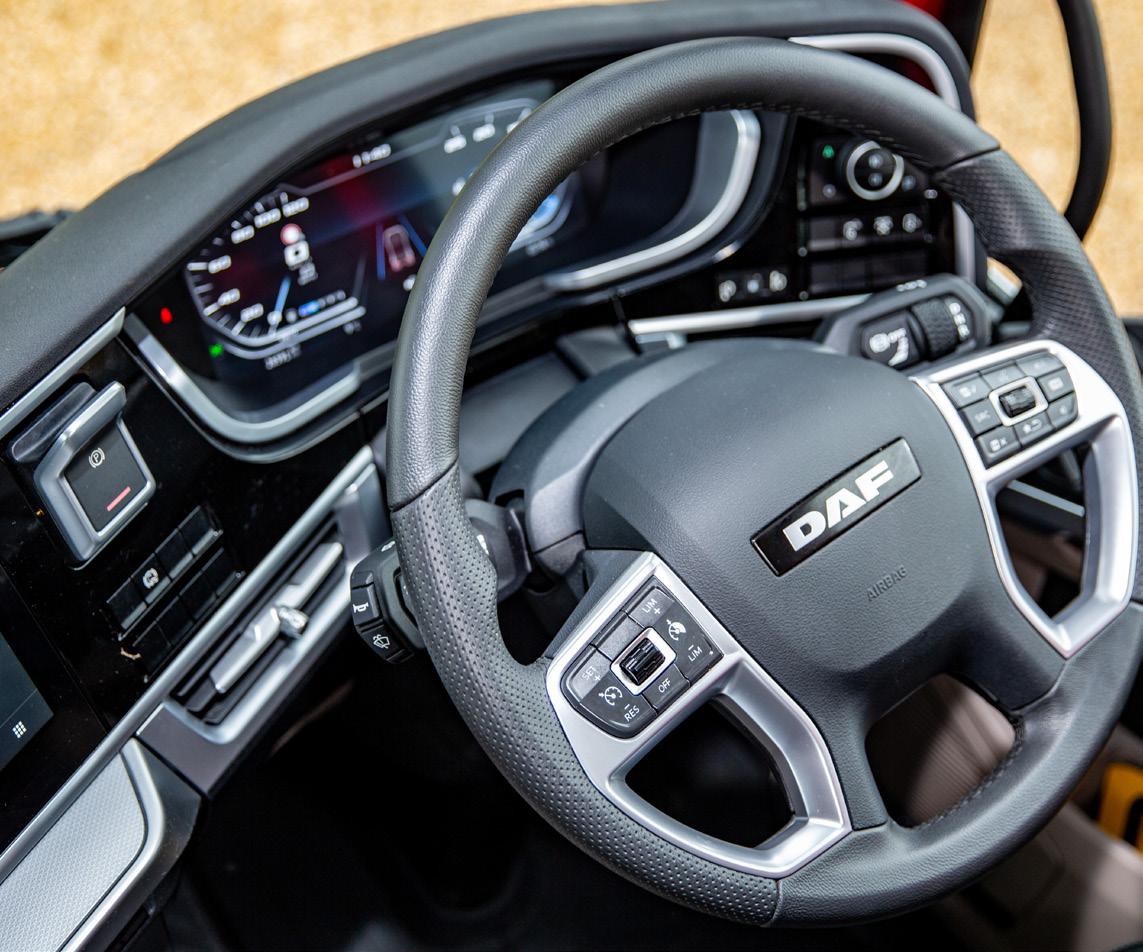
Top left: Latest dash design puts important controls close to hand
Top right: Driver can customise digital info display
Bottom left: XG 480 took the harsh Scottish winter in its stride
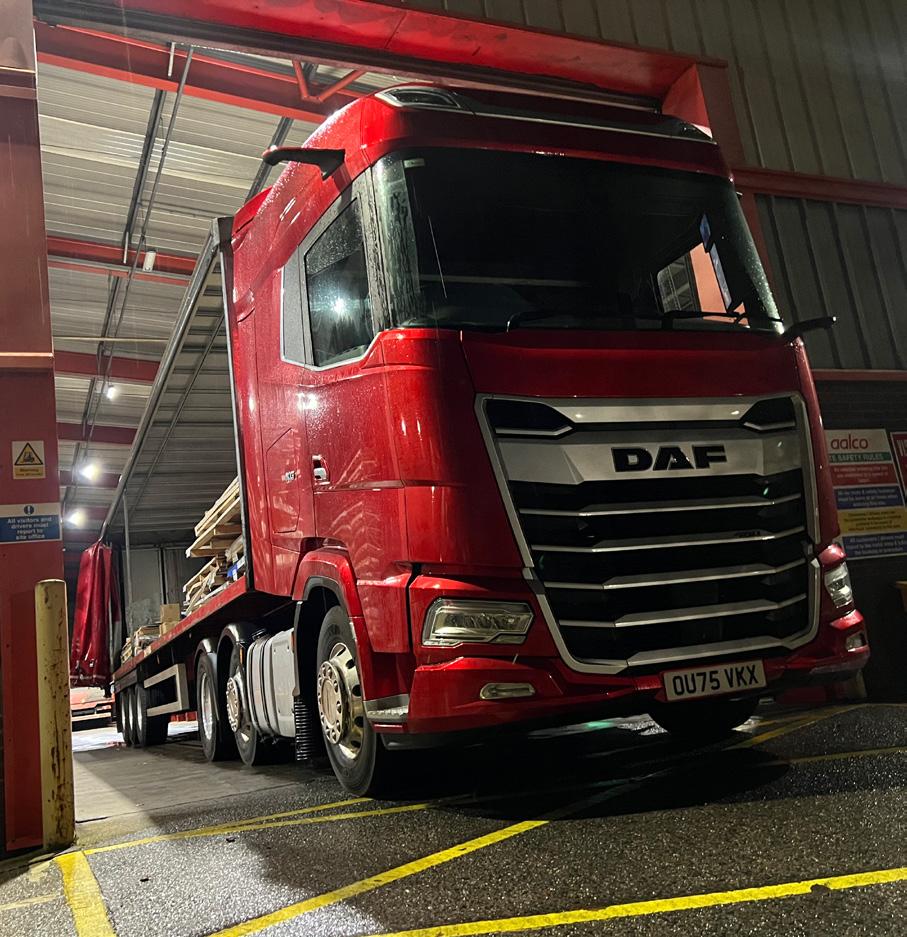
Bottom right: Strong wind meant we unloaded under cover
Opposite top: Taller differential set-up took some getting used to
Opposite bottom: Stevie was very impressed with XG demonstrator
I chilled out listening to an audiobook about adventurers Ben Fogle and James Cracknell rowing across the Atlantic. They toiled as the XG cruised its way north, its rev counter quickly adjusting as it hit each climb. The TraXon software doesn’t mess around, quickly dropping gears at the first sniff of an incline, intent on keeping a good head of steam. This is the secret to living with a fast/tall differential: a gearing strategy that gets its head down and charges at hills.
As I nosed onto the Friarton Bridge spanning the River Tay at around 6 am, Scotland threw another chunk of weather at me, hitting with a crosswind like a kick to the ribs. I immediately cancelled the cruise control and pulled into lane two. It’s a long way down to the river, so I’d rather stay on the bridge if it goes over.
Unbelievably, there hadn’t been a hint of wind up to this point – or at least, I hadn’t heard it in the serene
XG cab, which has virtually no wind noise thanks to its aerodynamic design, excellent soundproofing and lack of conventional mirrors. I continued to battle the wind for the rest of the journey to Aberdeen, but the DAF felt sure-footed and there was enough weight on the trailer to keep the wheels on the tarmac.
The battle continued at the delivery point, where I attempted to open the curtains with help from two members of staff. We gave up and decided to unload inside the warehouse and tie the curtains up for the return voyage.
We continued to put miles on the XG for a couple of weeks. Double-shifted, the poor thing hardly got a chance to cool down and racked up over 10,000 km in the period. We all love the XG cab; it takes much of the sting out of a day’s driving, making life
“THE RESULTS FOR US WERE QUITE OUTSTANDING, WITH A 1.5 MPG IMPROVEMENT OVER OUR CURRENT VEHICLE.”
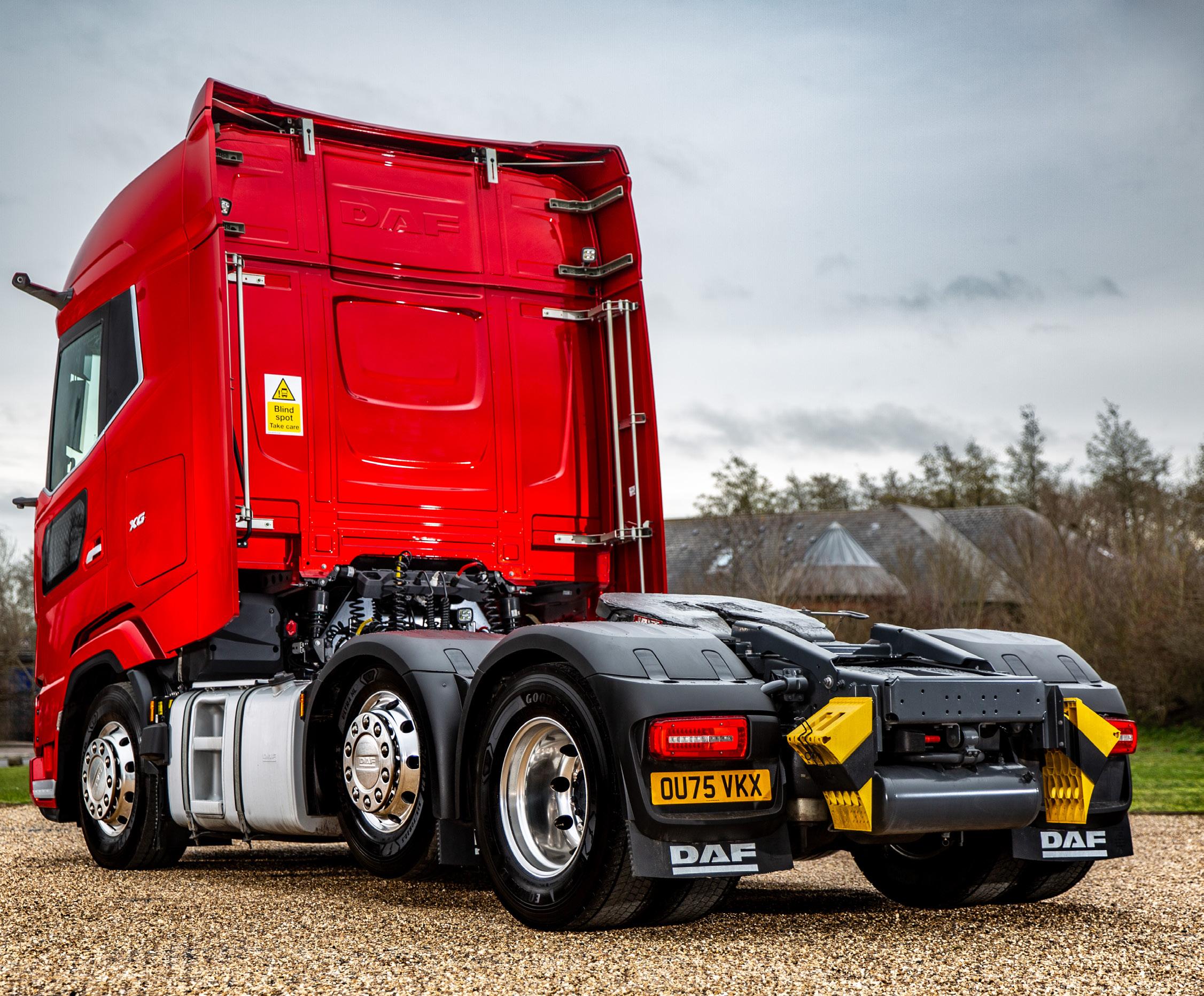
that little bit better. Although not as powerful as our own truck, the 480 bhp engine coped well at these weights and covered the run in a comparable time.
The differential, of course, is the star of the show and although it initially feels very alien, you soon become used to the quick down-changes as it tackles a hill. We have become very accustomed to trucks holding onto gears and lugging up hills in a bid to maximise fuel economy. The TraXon software, coaxing the 2.05:1 differential, throws the rulebook out of the window and the results for us were quite outstanding, with a 1.5 mpg improvement over our current vehicle. However, do bear in mind this set-up has been specifically formulated for lighter loads on faster roads. A conventional ratio may well prove a better solution in a more traditional operating environment.
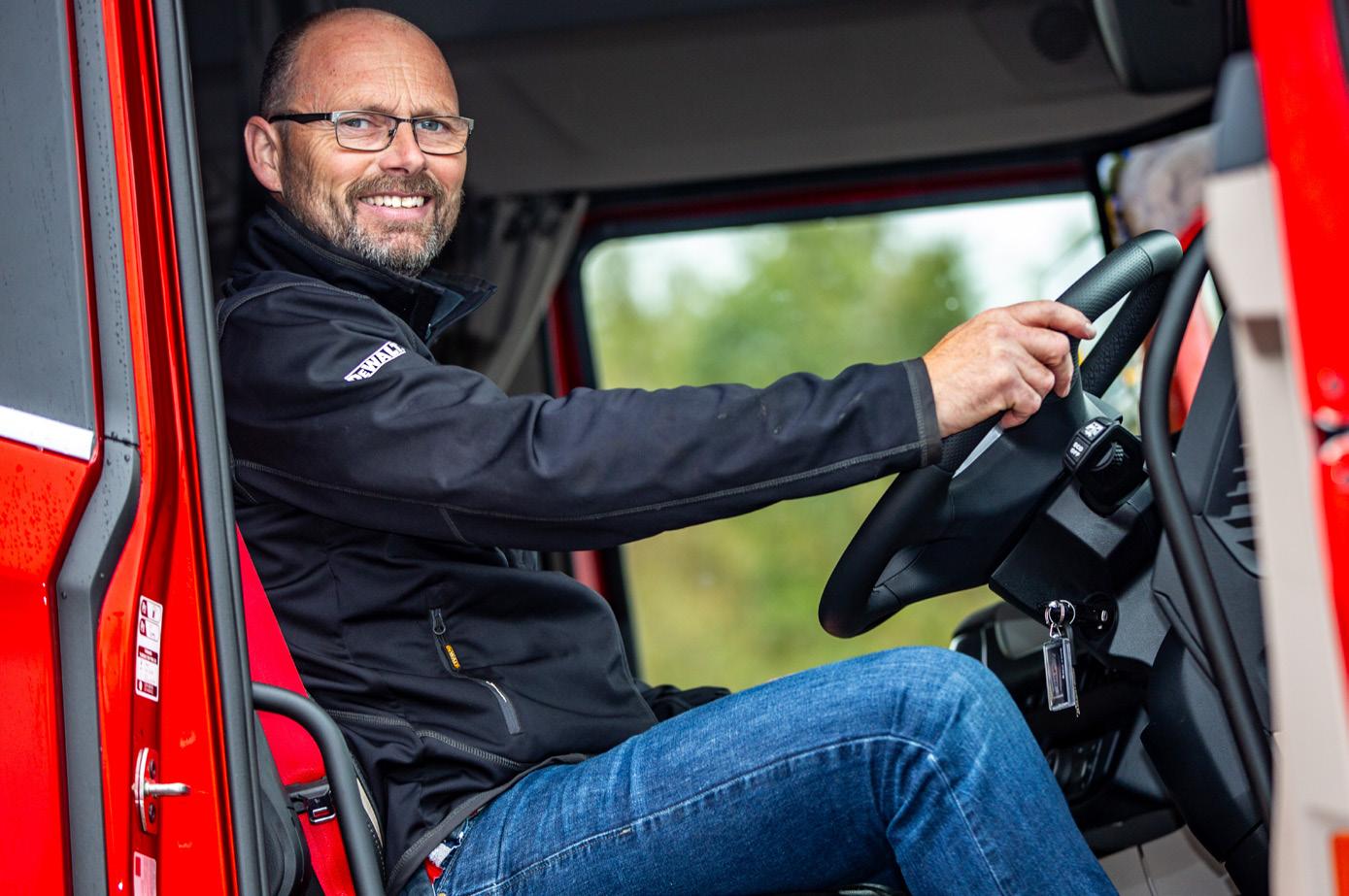
Reproduced
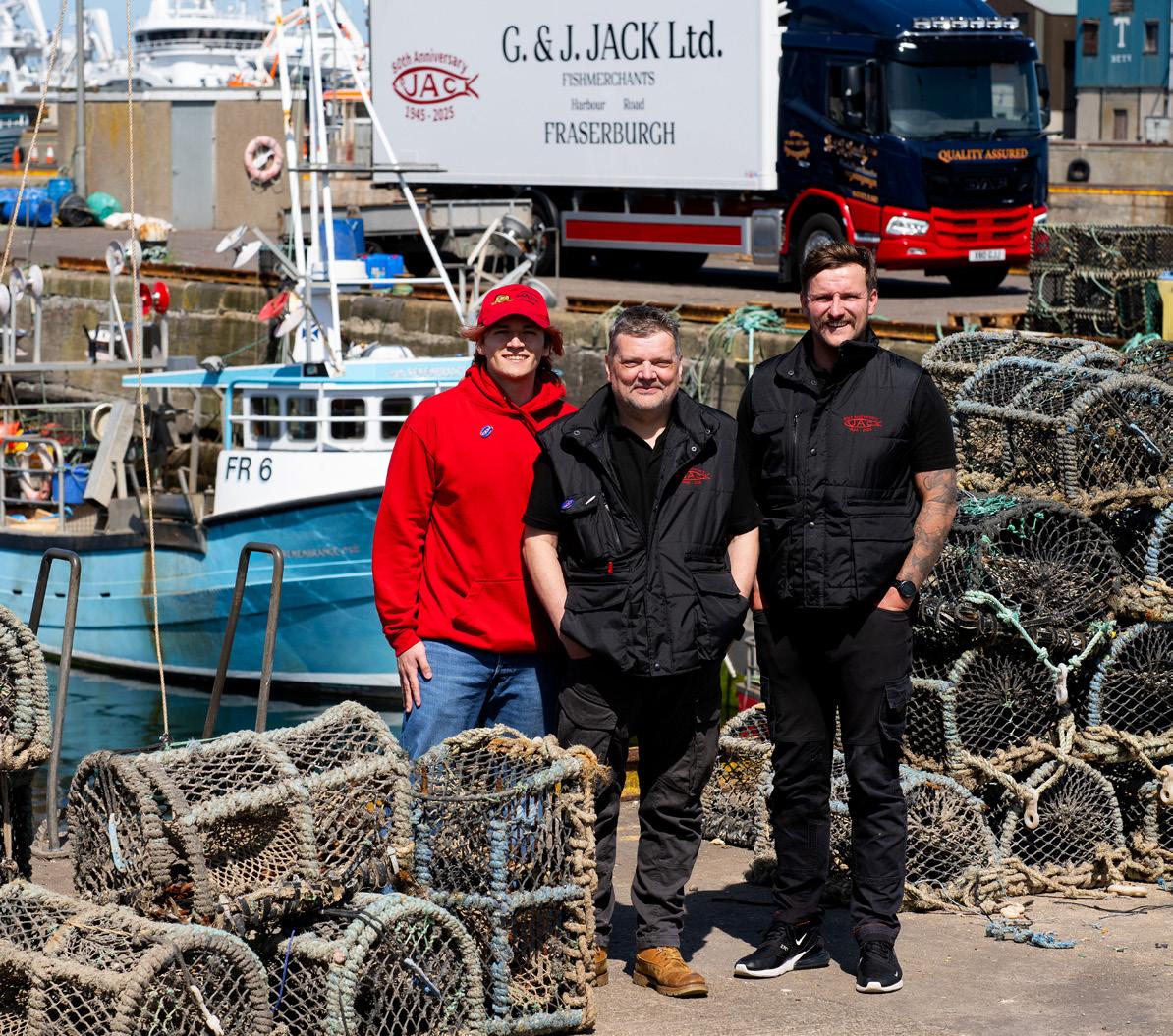
Time is of the essence for North-east Scotland fish merchant G&J Jack. Emma Penny discovers how it gets seafood from Scottish boats to Boulogne in France in less than 24 hours.
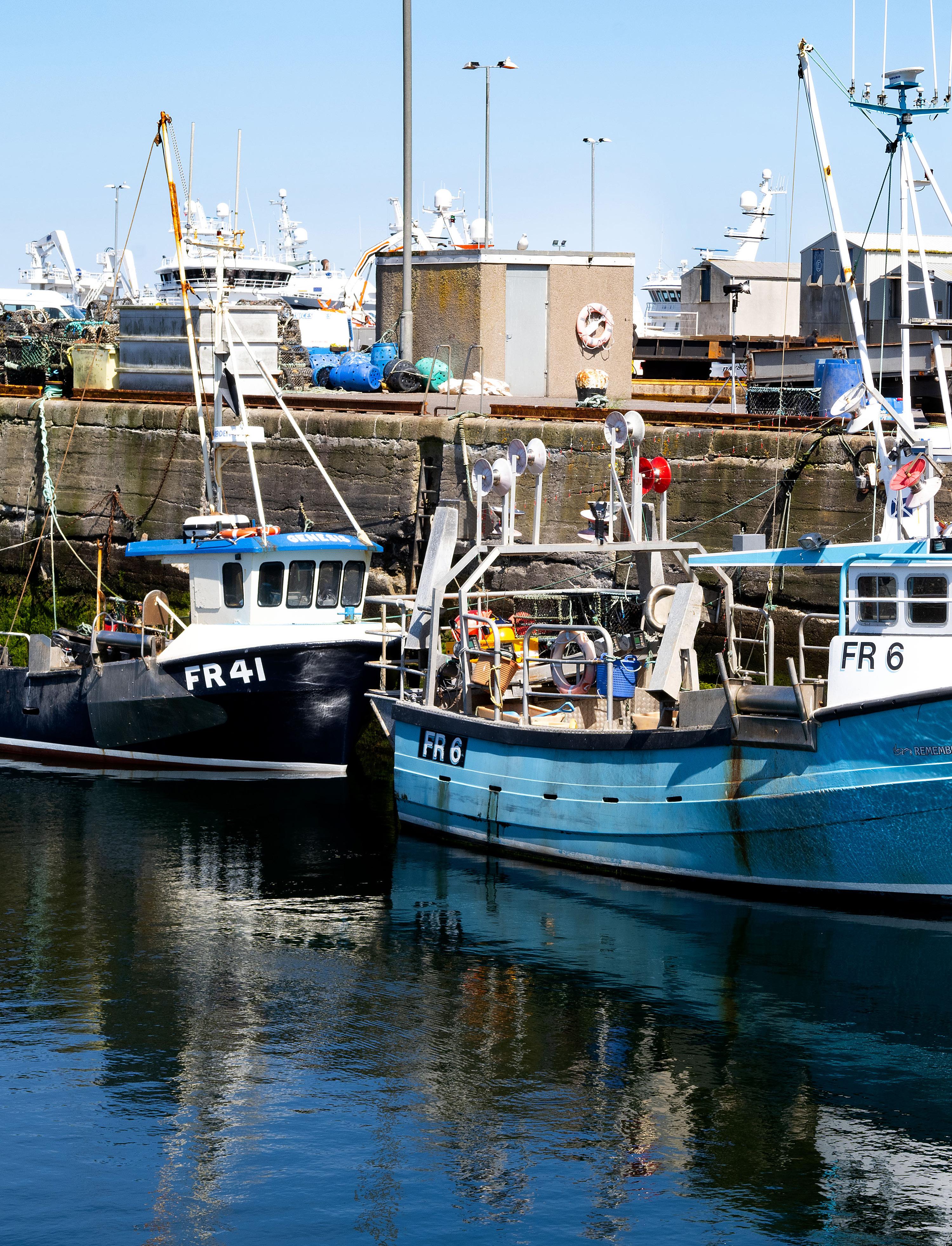
Seafood is Scotland’s largest food export, and it seems our continental neighbours can’t get enough. It’s why Fraserburgh fish merchant, G&J Jack, is celebrating 80 years in business and planning further expansion.
Martin Jack is the fourth generation to lead the business, which processes 90 tonnes of seafood each week. It exports 70% of this, sending 12 tonnes to Europe every day. “We cannot process enough to meet demand, so we are looking to expand,” says Martin.
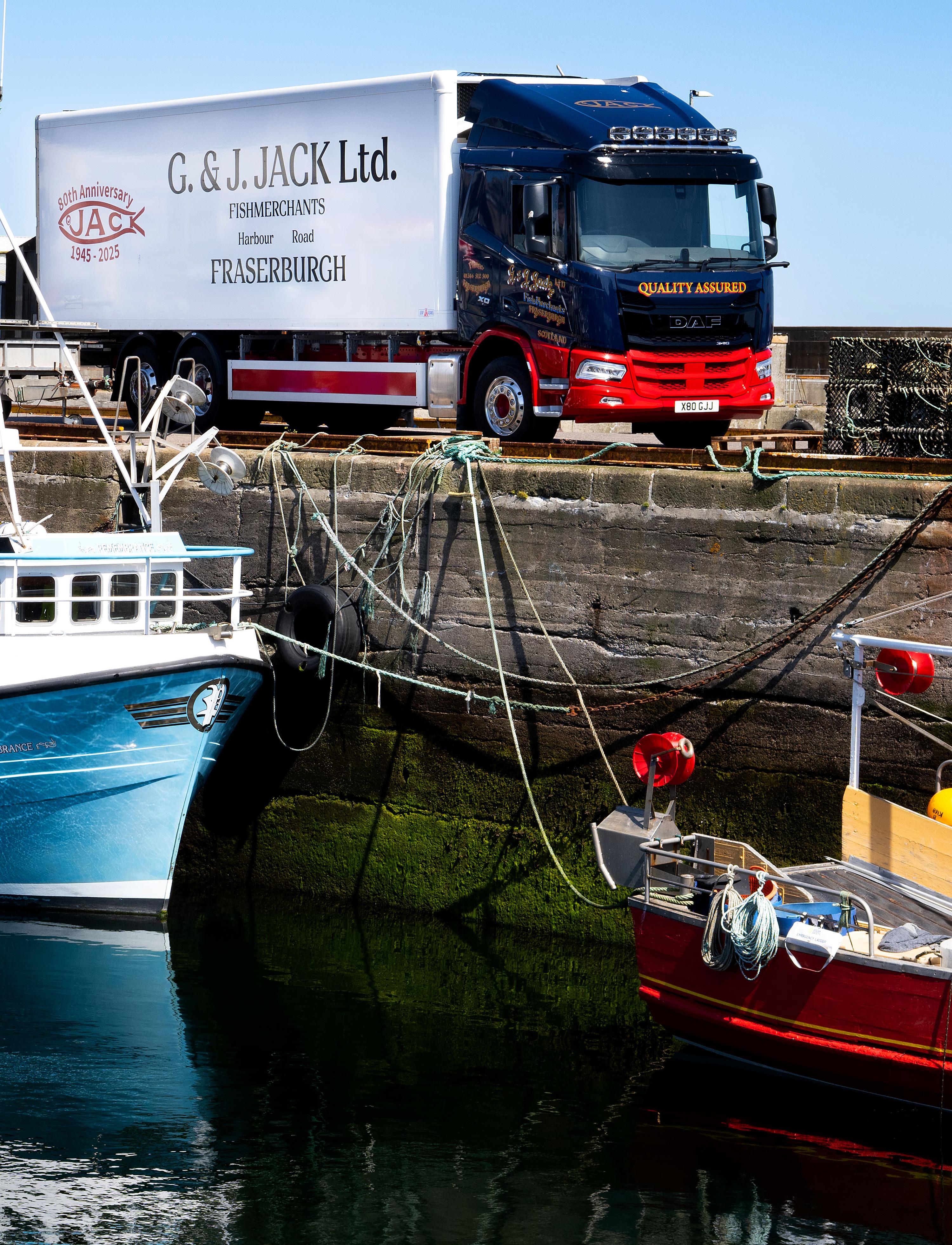
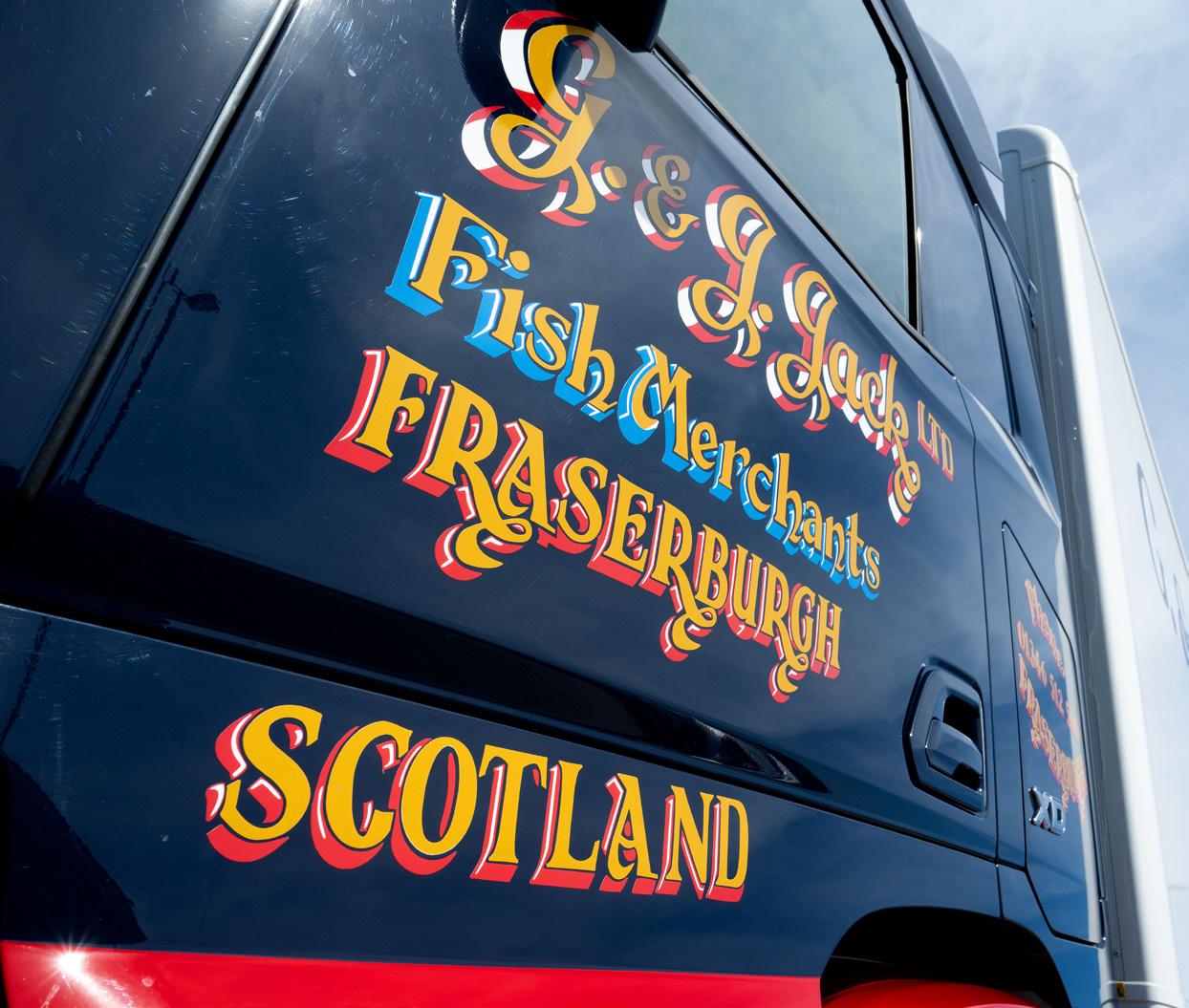
From the start, the business has built its reputation on quality, with ‘Quality Assured’ the first thing anyone would see on the dark-blue livery of the original Jack lorries. It’s something Martin says he is “obsessed” with, and why there is a focus on getting its seafood – a highly perishable product – to customers as quickly as possible.
It processes 25-30 species of seafood including haddock, monkfish, ling, scallops, langoustine, mackerel and more.
“Everything except cod,” says Martin. The process starts every weekday morning. Martin’s sons are responsible for buying fish, with Jason going to the fish market in Peterhead, Europe’s biggest white fish port, and Martin junior buying via Shetland’s electronic auctions. The business also has its own direct supply boats.
Fish are bought and taken immediately to the firm’s premises in Fraserburgh for processing. It exported whole fish in the past, but now everything is processed or filleted before it is
packed and loaded into one of the business’s four refrigerated artic trailers. The aim is to have that morning’s fish processed, loaded and leaving Fraserburgh at 2pm to arrive in Boulogne –Europe’s seafood distribution hub – by 8am the next morning.
After delivering into various RDCs and customers in Boulogne, the seafood will be sent across Europe to supermarkets, wholesalers, market stalls and other traders.
With road transport accounting for the largest proportion of time in the process, Martin says it’s important to have full control of it. “If something goes wrong, I can say ‘yes’ or ‘no’ and get things sorted out.” The need to resolve problems quickly and meet deadlines is one of the main reasons the Jack fleet is now entirely DAF, he explains.
“Lorries have always been a very important part of our business. My uncle ran a mix of Scanias and Volvos, but since I took over the business in 2013 we have run DAFs. They’ve been very reliable, and I think Norscot [the local dealership] genuinely cares about customer service and go the extra mile – they can’t do enough to help.
“When we had a gearbox problem 10 minutes out of Aberdeen, Norscot were there with a replacement truck within no time and we made the delivery. Our delivery window is tight, but I know if we have a breakdown anywhere in the UK or Europe, someone from DAF will be there very quickly,” he says.
“THE CURRENT FLEET INCLUDES THREE

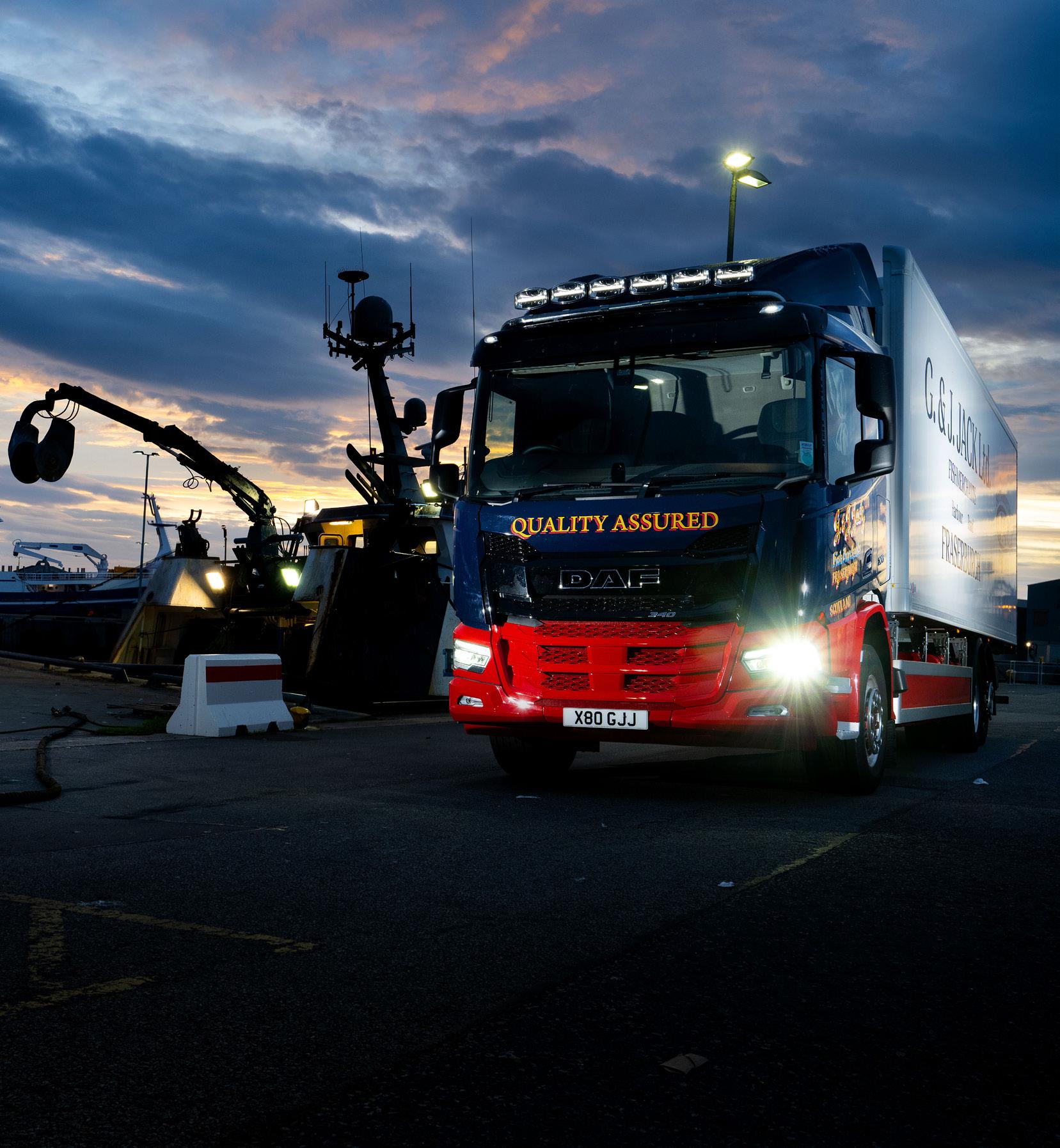
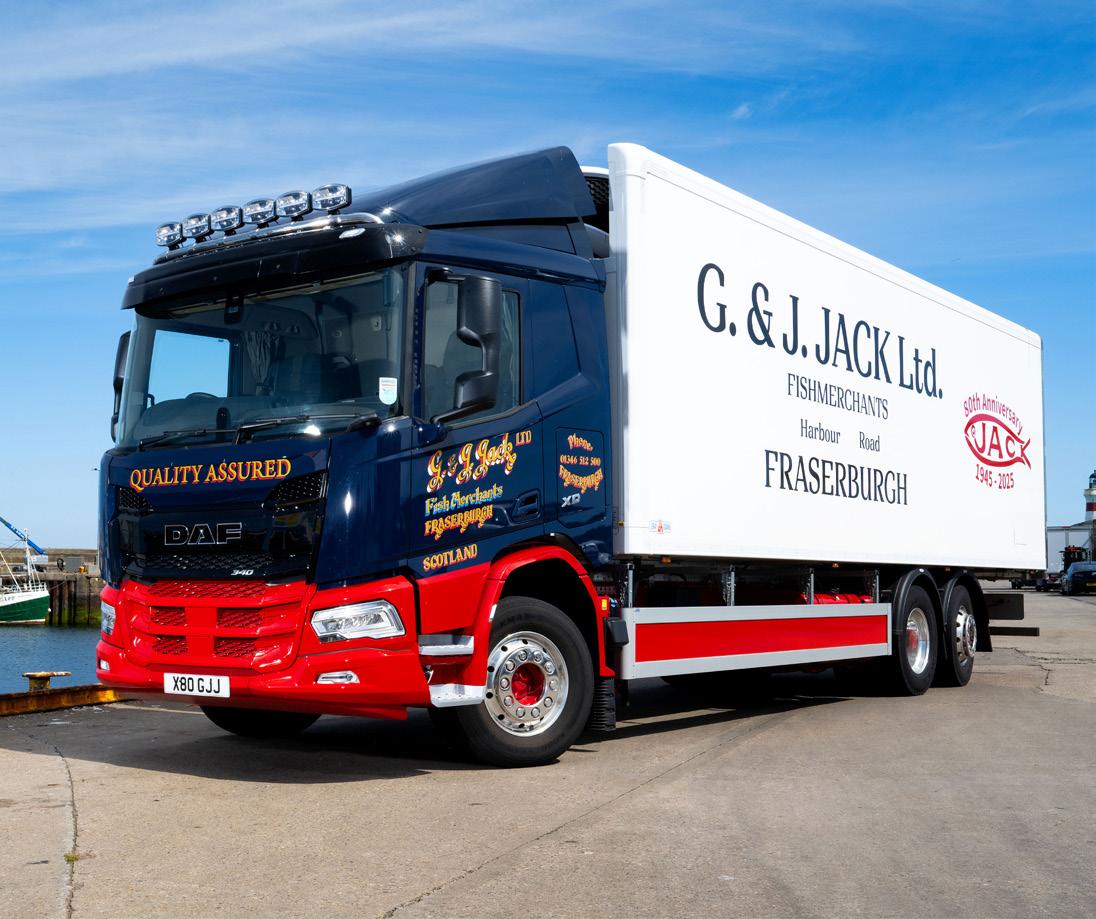
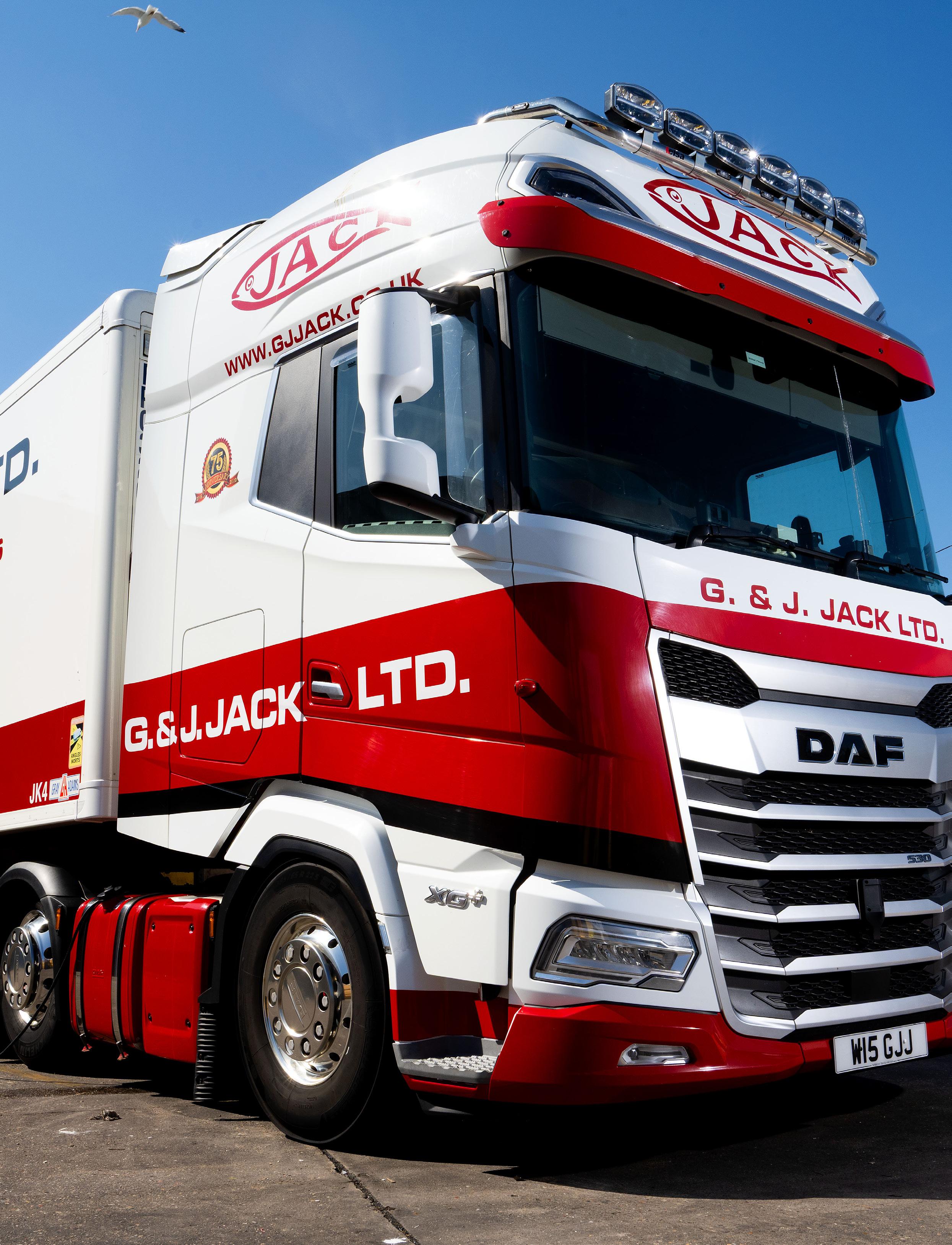
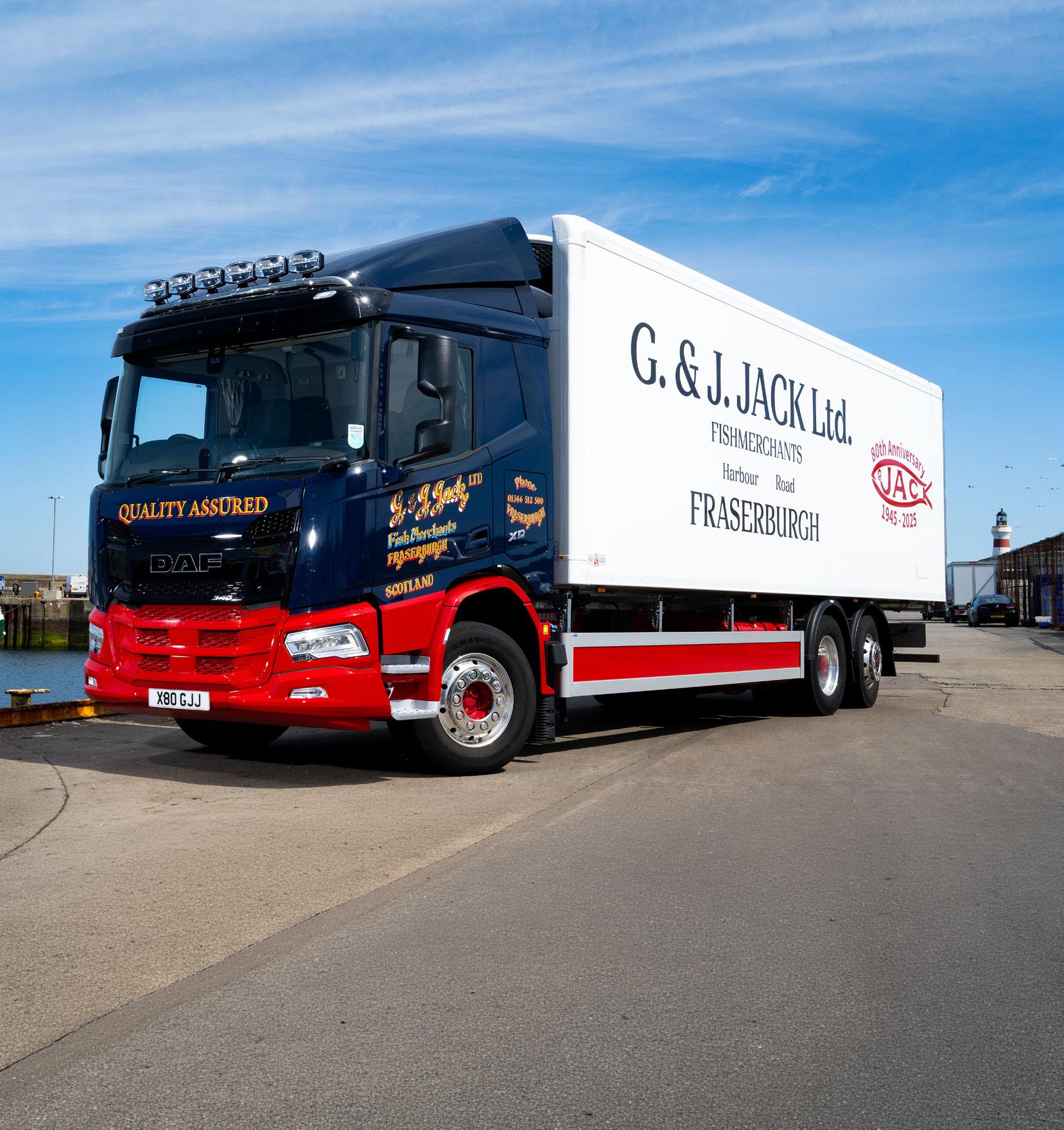
While the G&J Jack DAF tractor units sport the firm’s current red-and-white livery, the latest rigids are in the original colours of red and dark blue with the original style of signwriting too – a nod to the business’s 80th anniversary this year.
“Everything was in red and dark blue until we got two new B and C-reg tractor units,” says Martin. “The tractor units had been ordered by another haulier who didn’t take them, and we were desperate, so we just ran them in red and white and liked it.
“The new rigids in the original colour remind me of sitting with Bertie, who worked for us when I was little. I used to go to the fish market with my dad and then got a lift back to Fraserburgh in the blue-and-red lorry with him.”
In the past, when the firm sold fish whole, it ran five tractor units and seven artic trailers, but selling fillets – a 12-tonne load rather than 24 tonnes of whole fish –means it now runs three tractor units and four trailers.
The current fleet includes three top-spec tractor units, all XG+ 530 FTG models with a three-year R&M contract, bought for driver comfort and reliability. Two XD 340 4x2 rigids with refrigerated bodies have recently joined the fleet, alongside a further DAF rigid curtainsider.
The rigids have an important role to play, collecting fish from Peterhead fish market and picking up scallops and prawns from ports such as Ullapool and Mallaig, which are harder to access with larger trucks.
Euro trekking
The transport side of the business runs separately from the processing division, with Martin, Billy Walker and Transport Manager, Frazer Paterson, being shareholders in this arm of the operation. Billy has been with the business for almost 50 years, starting as a 20-year-old. After a short break of less than a year working with
another firm, he came back to Jacks in 2013 when Martin took over, driving full-time until late last year. He now spends more time in France, often picking up loads from SIVEP (the Veterinary and Phytosanitary Inspection Service at Calais) for delivery into customers, and then doing reloads so the driver is booked off and can rest.
He says: “When we set up the business, we knew that if a transport company could make it pay, we could. I’d have second thoughts about buying trucks to do it now; but we knew that with Martin, our main work was guaranteed.”
There is flexibility built into the system, with Lesmahagow-based haulier, Graeme Wardrop, taking three trailers a week to Boulogne for the firm. “If it’s quiet or there’s a holiday in France, it’s likely to be Wardrop who does less,” adds Billy.
A slick driver-swap system ensures loads aren’t held up on the way to France. After leaving Fraserburgh, the first stop is usually Bellshill, where Customs checks are completed and the lorry is sealed by vets. Then it travels on to Cairn Lodge or Carlisle, where a driver swap will see the load then head to Folkestone for LeShuttle.

Currently, one of the biggest problems in the journey is overnight road closures, he says. “There’s nothing unusual in finding every road south is closed at night. We try to go over the A66 and down the A1 as it’s not as congested and the diversions are not so bad.”
Brexit bother
Brexit has also added to the workload and potential delays, with nine out of 10 loads having to go through a physical control point which can take up to an hour. “With our schedule, we are up against it. We have certain customers where there are onward connections to Italy and Spain, and if their truck leaves without our fish it causes problems. But we usually make it.”
With such a dependence on export markets, the business worked hard to be ready for Brexit, including working alongside fellow seafood exporter O’Tooles to find a solution. Despite the preparation, Martin says he had never experienced a week like it. “We had two trucks away with double drivers and had done all the paperwork. We sent one truck to Boulogne, the other to Calais and both got stuck. We finally got delivered later that first week. It was the worst week of my working life!”
Coping with the reams of paperwork – both physical and digital – has added cost and led the business to employ two to three more staff. He says the government’s ‘new deal’ with the EU is unlikely to ease the burden: “It’s good for imports, but no good for exports – it’s even more paperwork.”
The transport business does some importing as Billy also organises backloads. These can be anything from carrots to cheese to catering chocolate. “During carrot season, we will do about 80 loads over a six-week period.”
But perhaps it’s fitting that fish boxes are one of the most common backloads for G&J Jack – and as they are so light, they also mean a higher mpg on the way home, with the DAFs achieving up to 10 mpg compared with the more normal 9 mpg when fully laden. “Boxes are rented to boats, then go to the market with their fish, to the processors, then to customers and we return them,” he says.

Left:
on rear doors reflect firm’s history
Bottom left: Latest rigids use firm’s original livery and signwriting
Bottom right: Company is celebrating 80th year in business
With Gray & Adams’ HQ just across the road from the G&J Jack yard, it’s little wonder the firms have worked together for many years. Gray & Adams built the business’s first refrigerated artic trailer in the 1970s – which was paired with its first DAF truck. It was also the first company to take the 33 ft Gray & Adams van, built with a one-piece, full five-element trailer with an experimental Petter refrigeration unit. The family are also more than business friends; Jimmy Adams married Margaret Jack, Martin’s aunt.

Words: Matthew Eisenegger
Photographs: Gridserve & Matthew Eisenegger
Gridserve accelerates UK zero-emission freight with two dedicated HGV charging hubs – and a real-world electric truck journey from Exeter to Baldock.
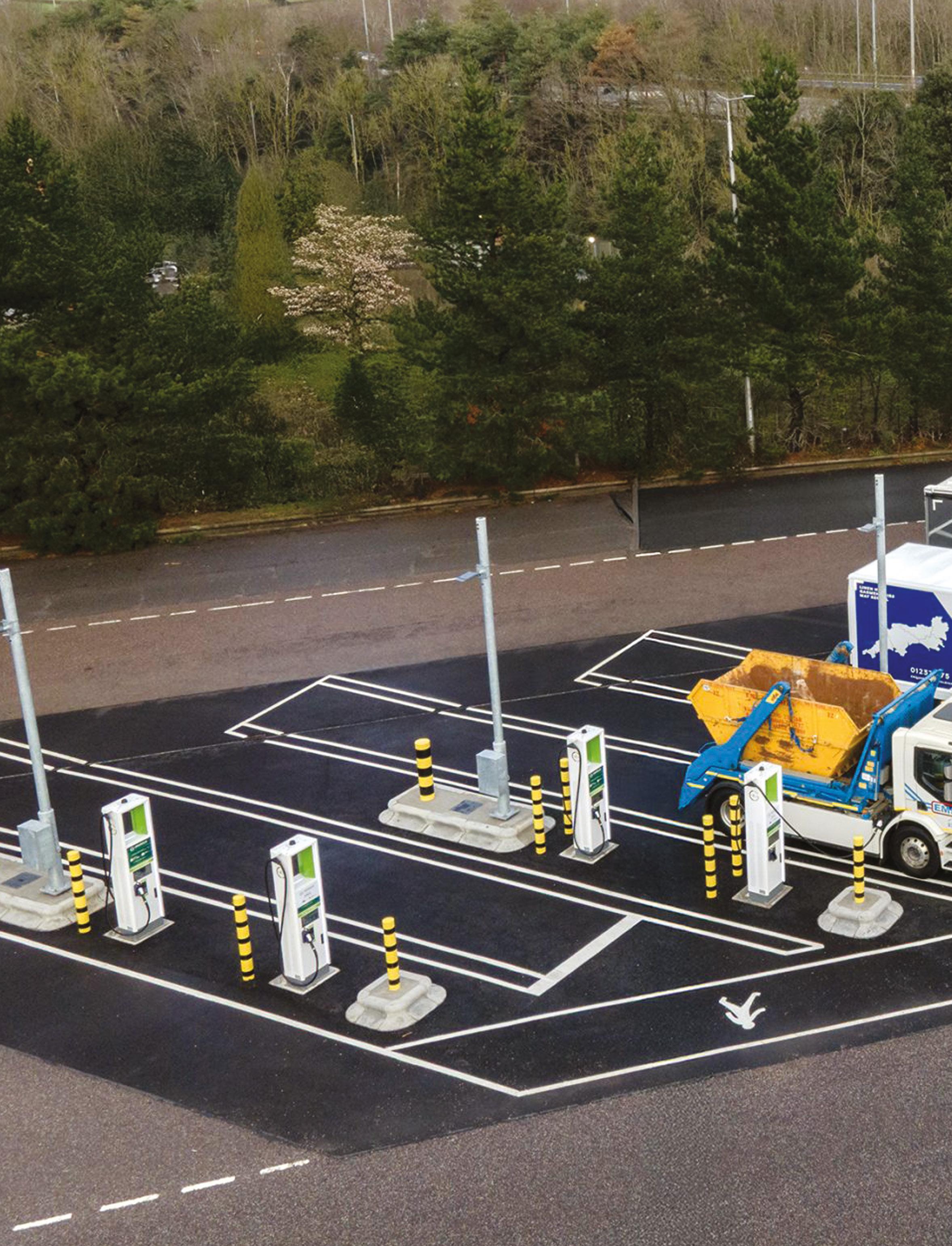
In a landmark step for the decarbonisation of heavy goods transport in the UK, Gridserve has officially unveiled two dedicated electric heavy goods vehicle (eHGV) charging hubs at Moto Exeter and Extra Baldock Services.
The new facilities represent the first publicly accessible charging infrastructure in the country designed specifically for large commercial trucks, marking a pivotal moment in making zero-emission freight a practical reality across long-distance routes.
To demonstrate the real-world capability of both the infrastructure and the latest generation of electric trucks, a DAF XF Electric completed a long-distance drive between the two hubs – travelling from Exeter in Devon to Baldock in Hertfordshire, a journey of more than 200 miles across the south of England.
The route offered a glimpse of what the future of UK freight could look like: silent, smooth-running electric trucks supported by purpose-built, high-power charging infrastructure positioned along major freight corridors.
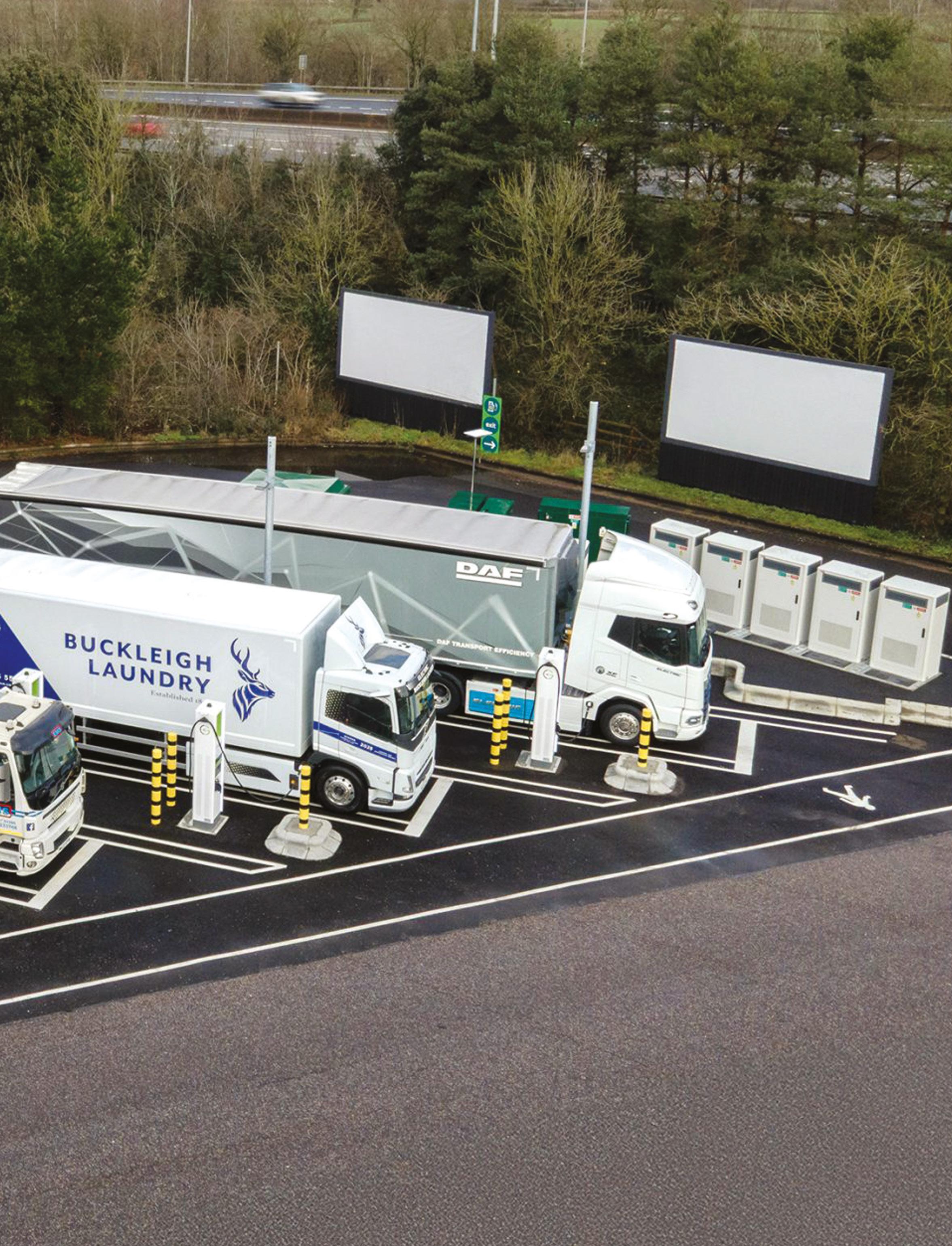
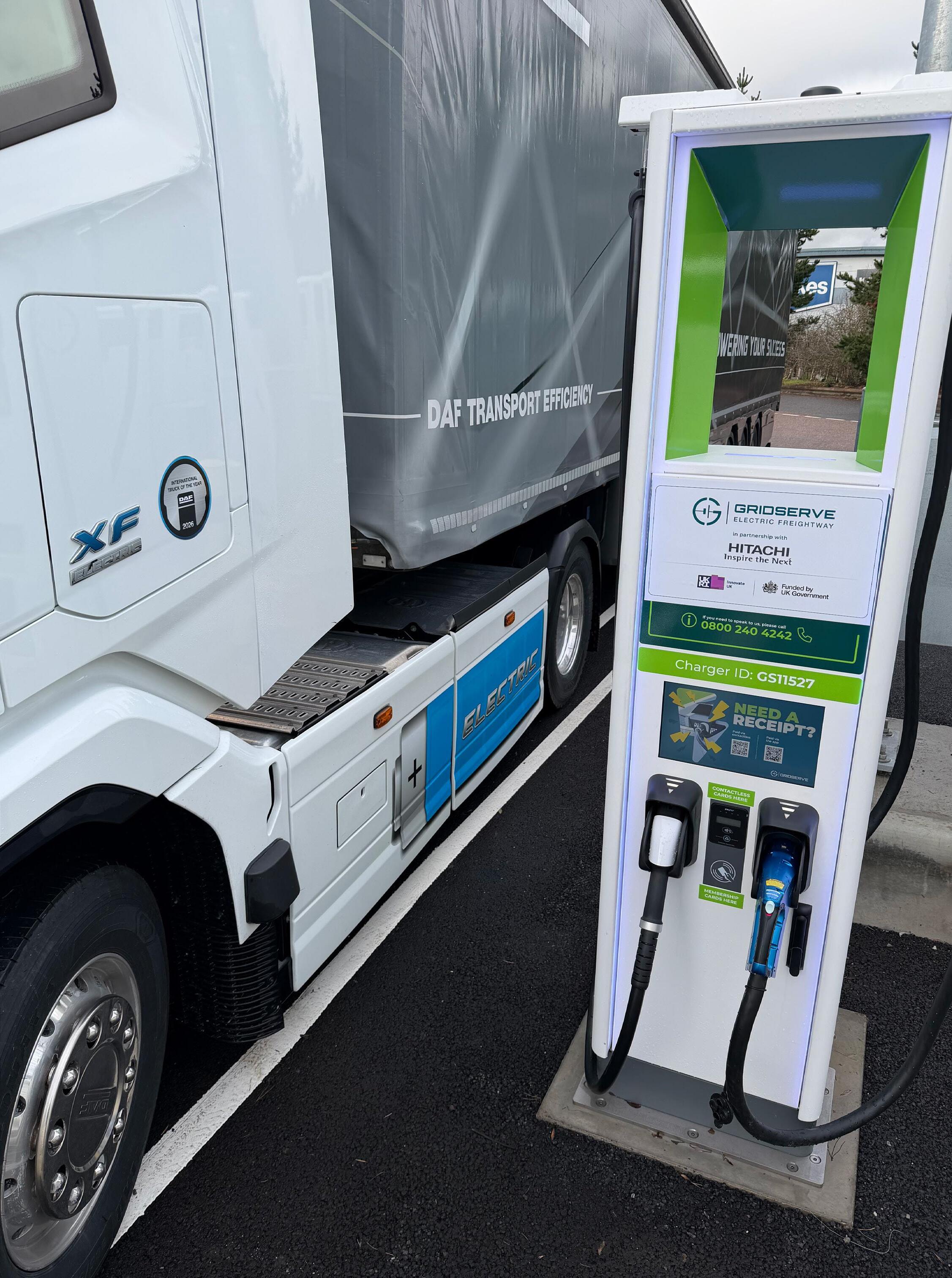
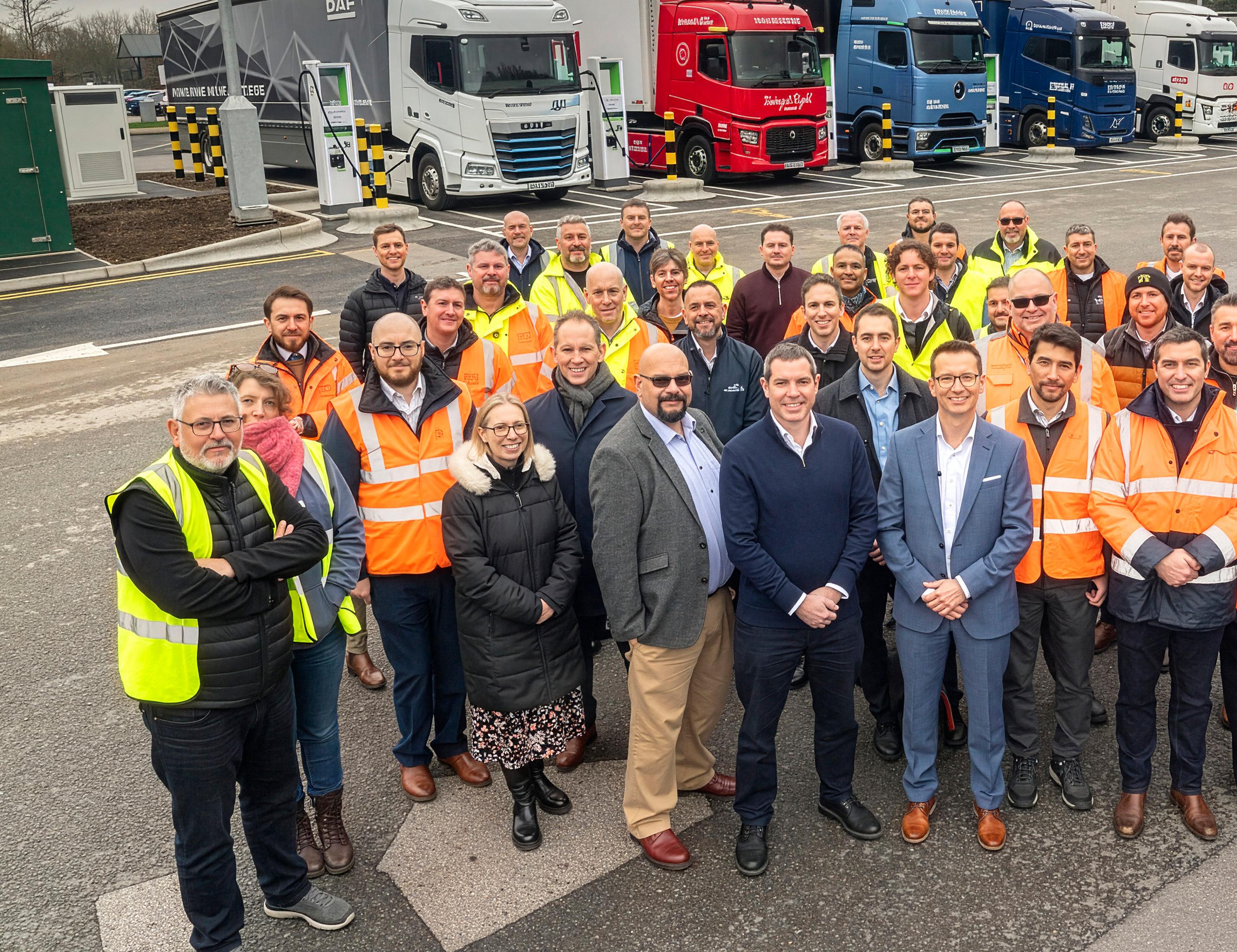
The new charging hubs form part of Gridserve’s ambitious Electric Freightway programme, an initiative designed to create a nationwide network of charging facilities tailored to the operational needs of heavy goods vehicles. Funded through the UK government’s Innovate UK via the Zero Emission HGV and Infrastructure Demonstrator programme (ZEHID), the Electric Freightway brings together a consortium of 25 leading hauliers, logistics operators and vehicle manufacturers. The goal is clear: accelerate the transition from diesel to electric trucks by ensuring reliable charging infrastructure is available where freight operators actually need it.
At Baldock, drivers will find six dedicated high-power charging bays, while the Exeter hub launches with four bays. Unlike conventional carcharging stations, these facilities have been designed specifically for heavy trucks. Drive-through charging lanes allow articulated vehicles to enter and exit without complex manoeuvring, while widened access areas accommodate large turning circles and longer wheelbases.
“AT
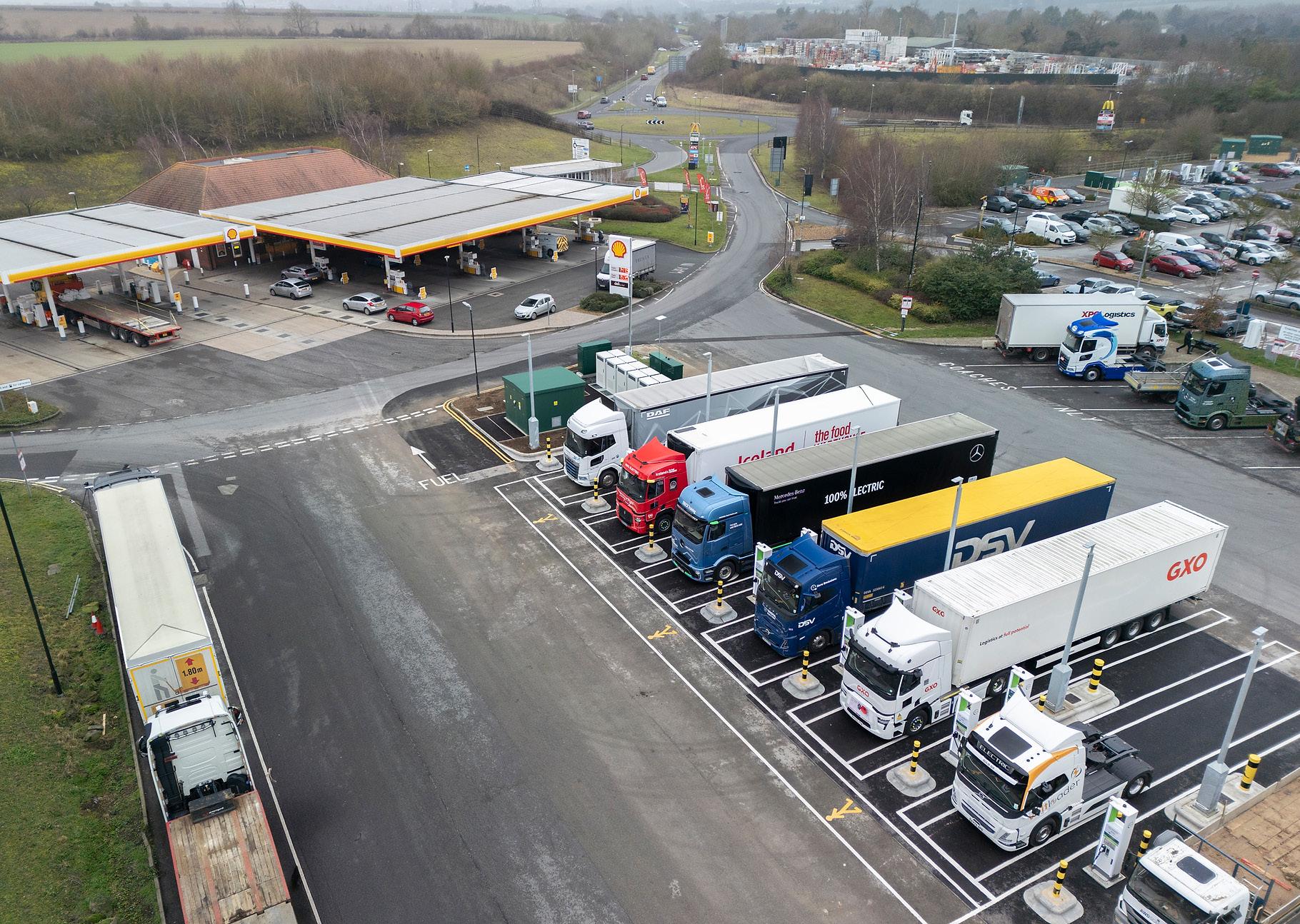
Safety features include enhanced road markings, improved lighting, CCTV coverage and wider pedestrian walkways so drivers can safely move between vehicles and service facilities.
The infrastructure also includes bespoke signage positioned at heights visible from HGV cabs – a seemingly small detail that highlights the level of practical design thinking behind the project.
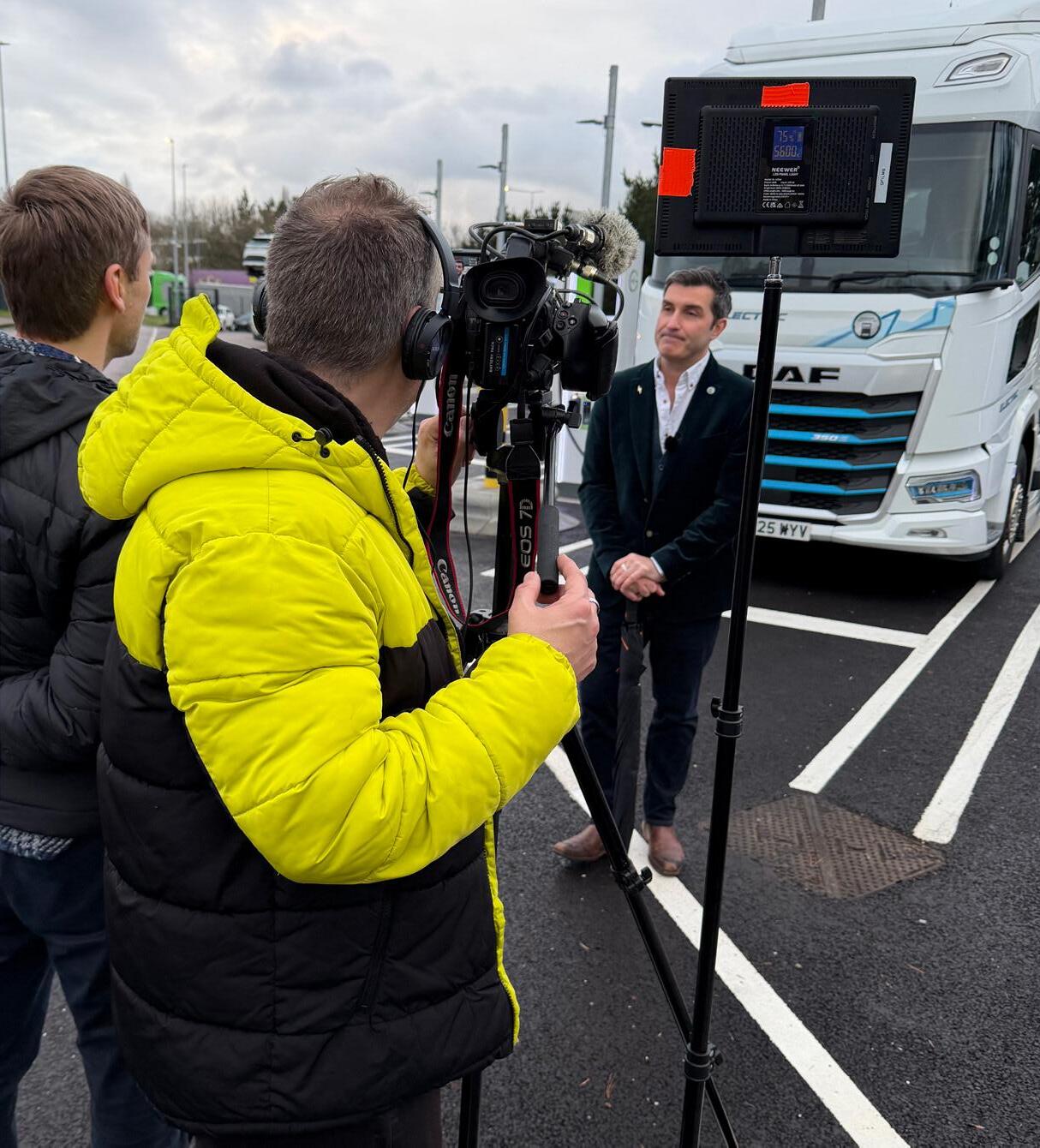
Sam Clarke, Head of the eHGV Programme at Gridserve, emphasised the importance of industry collaboration in the design process:
“A key strength of the Electric Freightway programme has been the consortium of leading hauliers and logistics operators, whose real-world insight has been critical in shaping the design, layout and technical capability of the hubs. Their input ensures the infrastructure reflects the operational needs of electric trucks – from vehicle size and manoeuvrability to charging power requirements and dwell times.”
To showcase the new infrastructure in action, a battery-powered XF Electric set off from the newly opened Gridserve hub at Moto Exeter and headed north-east toward Baldock. The route – which cuts across the southwest and into the busy freight corridors surrounding London – provided a realistic test of electric truck performance on mixed terrain including motorway cruising, rolling countryside and congested traffic approaches.
Behind the wheel, the first impression of the XF Electric is how different it feels compared with a conventional diesel truck. Powered by the
PACCAR EX-D2 electric drivetrain producing up to 350 kW (around 480 bhp) and 2400 Nm of torque, the truck delivers instant acceleration from a standstill. Even with significant vehicle weight, the power arrives smoothly and effortlessly.
Unlike diesel engines that build power gradually through revs, the electric motor produces its maximum torque immediately. Pulling away from motorway slip roads or climbing gentle gradients along the M5 and A1(M) feels remarkably effortless.
The truck’s three-speed transmission works almost invisibly in the background. Gear changes are so subtle, they are barely noticeable – a stark contrast to traditional heavy trucks where each shift can be felt through the cab.
Perhaps the most striking aspect of the drive is the near-silent operation. At motorway speeds, the loudest sounds inside the cab are wind noise and tyre contact with the road surface. The familiar rumble and vibration of a diesel engine are absent, replaced by a calm driving environment that significantly reduces fatigue over long distances.
The truck also introduces a driving feature more commonly associated with passenger electric cars: one-pedal driving. In this mode, lifting off
the accelerator automatically activates regenerative braking, slowing the vehicle while feeding energy back into the battery. Drivers can select different levels of regenerative braking depending on terrain or driving style. On rolling sections of motorway approaching the Midlands, the system allows the truck to gently decelerate without using the service brakes, helping to maximise energy efficiency while maintaining mooth control of the vehicle.
For drivers used to diesel trucks, the adjustment takes a little time, but the benefits quickly become clear. Reduced brake use not only improves energy efficiency, but also lowers maintenance costs and driver fatigue.
Another standout feature during the journey from Exeter to Baldock is the truck’s spacious cab design. The XF’s cab provides a generous interior space. For long-distance drivers, this translates into a more comfortable living and working environment. The truck offers a wide sleeping area, improved storage and a noticeably open feel compared with traditional HGV cabs.
During extended motorway driving, the quiet drivetrain and smooth acceleration combine to create a surprisingly relaxed driving experience –more reminiscent of a large electric car than a conventional 40-tonne truck.
Electric trucks must still address the fundamental challenge of range and charging logistics. The XF Electric is equipped with battery packs offering up to 525 kWh of capacity, delivering a real-world range of around 500 kilometres depending on load, terrain and driving style. Fast-charging capability means the batteries can be replenished quickly during scheduled stops. Under optimal conditions, a charge from 10% to 80% can take around 45 minutes, making it possible to align charging sessions with driver rest breaks.
The demonstration journey between Exeter and Baldock illustrates how purpose-built charging infrastructure enables practical long-distance electric freight operations. With hubs positioned strategically along key freight corridors, drivers can plan routes that integrate charging stops without significantly disrupting logistics schedules.
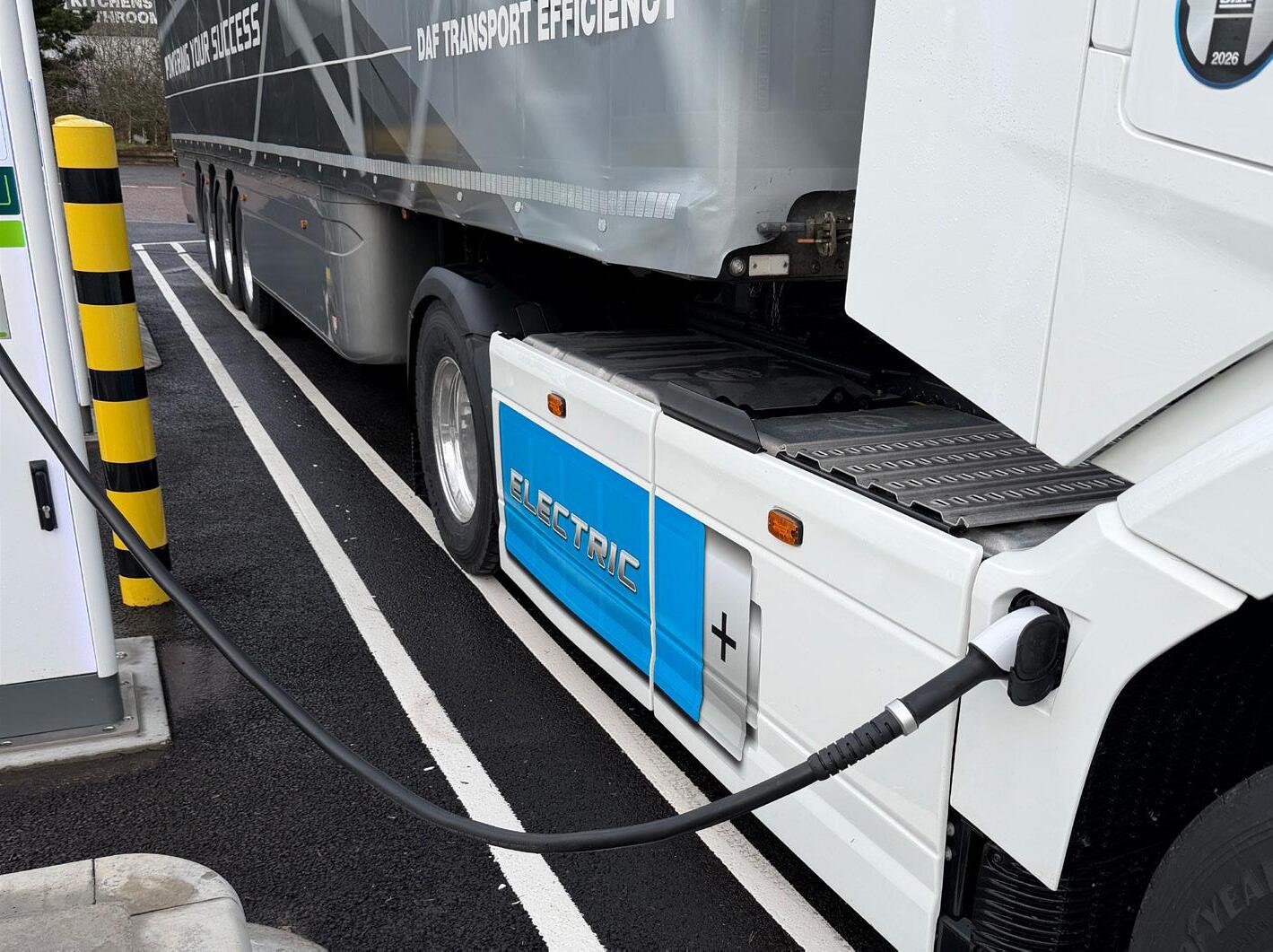
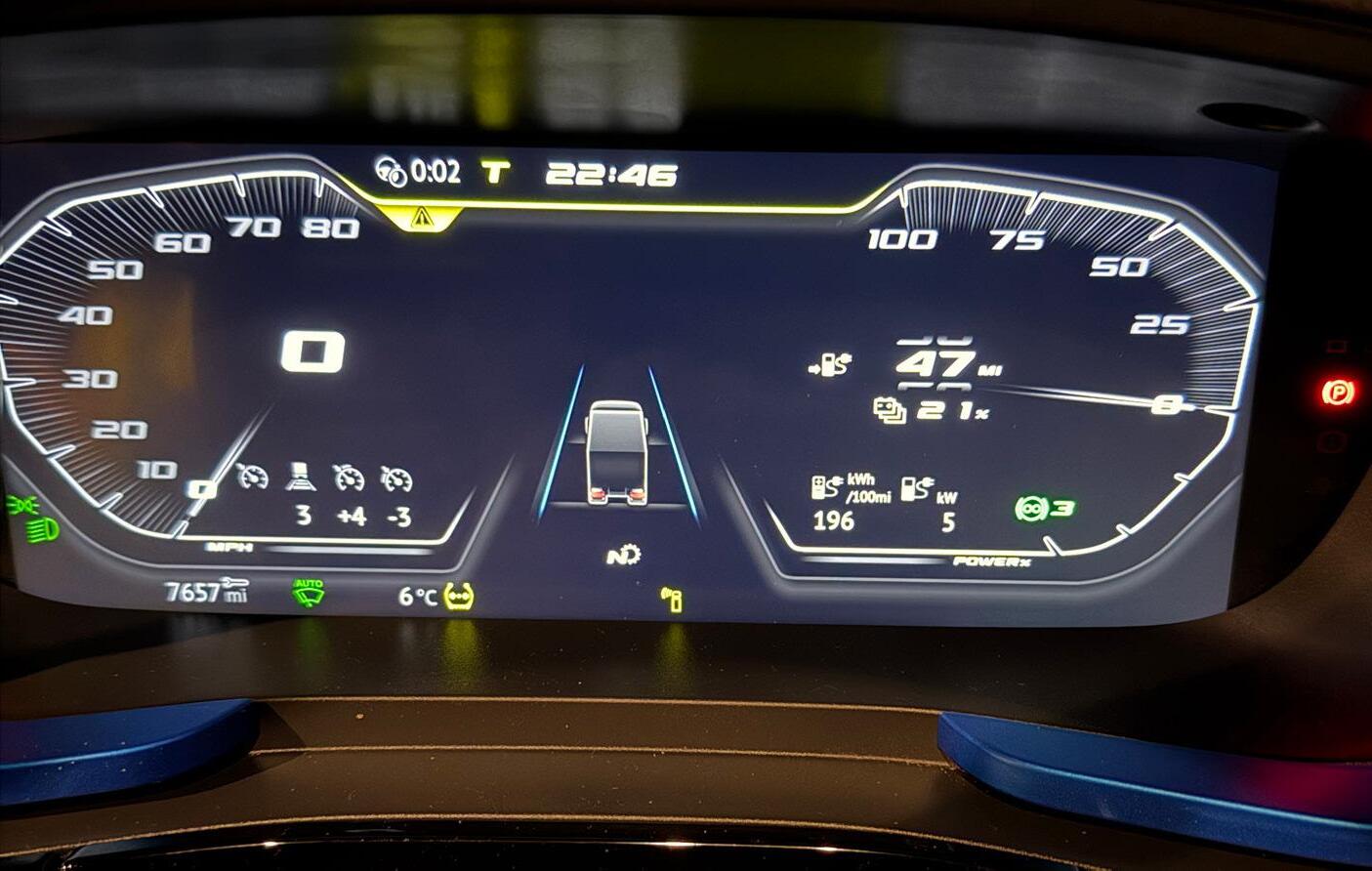
The Exeter and Baldock hubs are only the beginning. Gridserve plans to open several more electric truck charging locations across the UK, including sites at Tamworth, Thurrock, Leeds, Chester and Strensham North. Together, these locations will create a growing national network capable of supporting electric HGV fleets travelling between major logistics centres.
The implications extend beyond technology. Heavy goods vehicles represent only around 1% of vehicles on UK roads, yet they produce roughly 16% of domestic transport greenhouse gas emissions – making freight one of the most important sectors to decarbonise. By combining advanced vehicles such as the DAF XF Electric with purpose-built infrastructure, initiatives like Electric Freightway demonstrate zero-emission freight is moving rapidly from concept to reality.
The journey from Exeter to Baldock may be just one route across southern England, but it represents something much larger: the early stages of a national transition toward cleaner, quieter and more sustainable heavy transport.
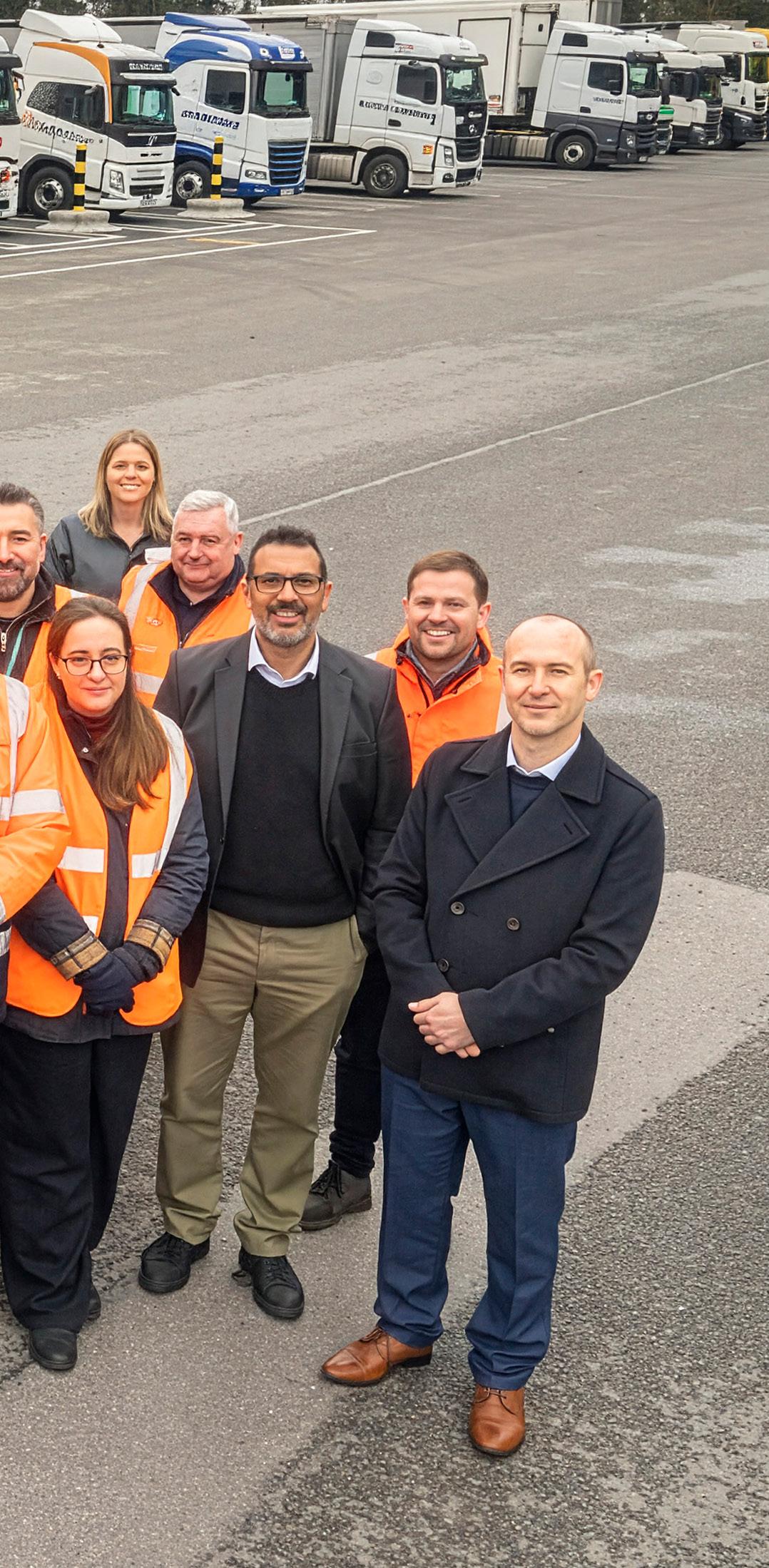
Above: Opening ceremony marked a major step for UK’s eHGV charging infrastructure
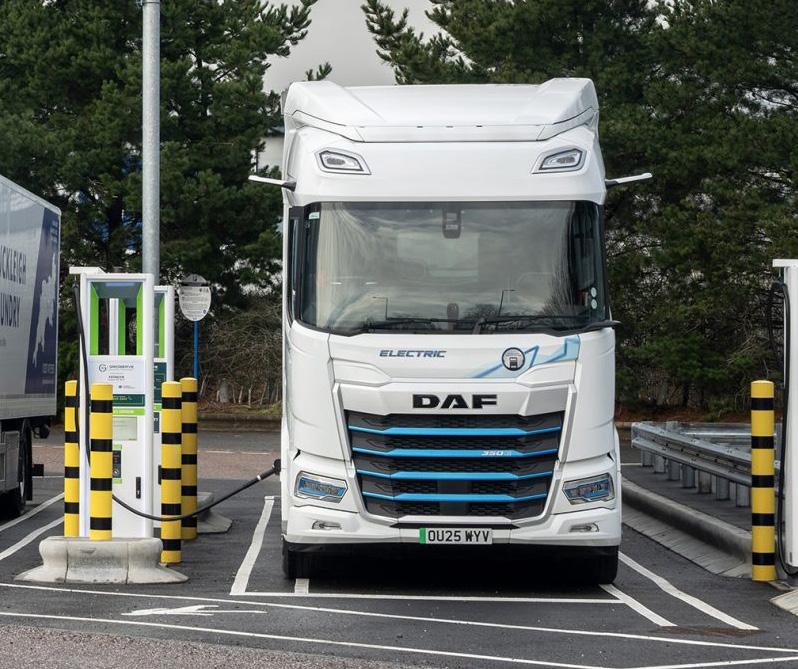
Top right: DAF XF Electric was one of the first trucks to use the new hubs
Bottom ight: Hub-to-hub journey was an enjoyable drive
Words & Photographs: Pip Dunn
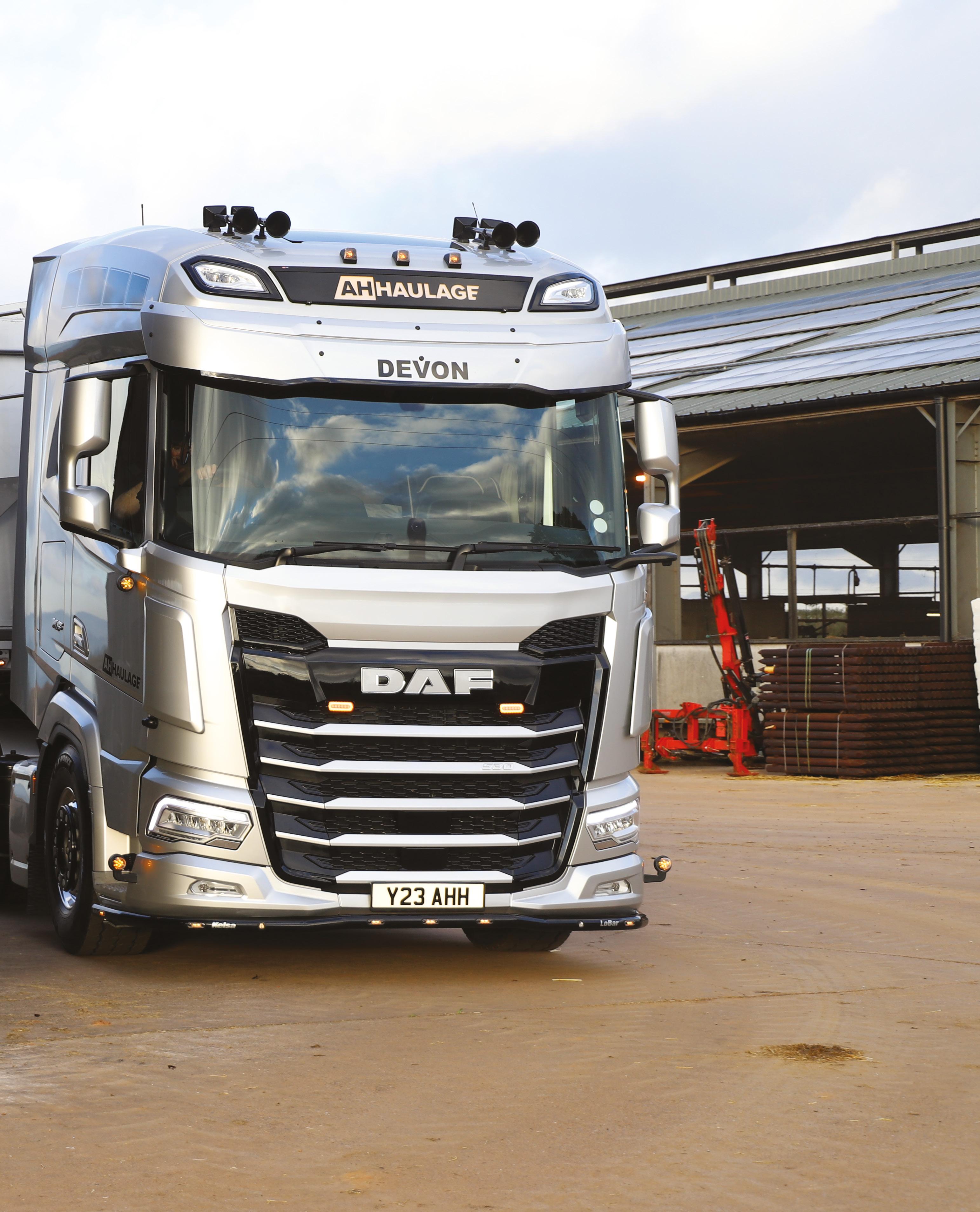
A smart XF530 with rear-steer tag axle is allowing owner-driver Adam Howe to serve the farmers of Devon.
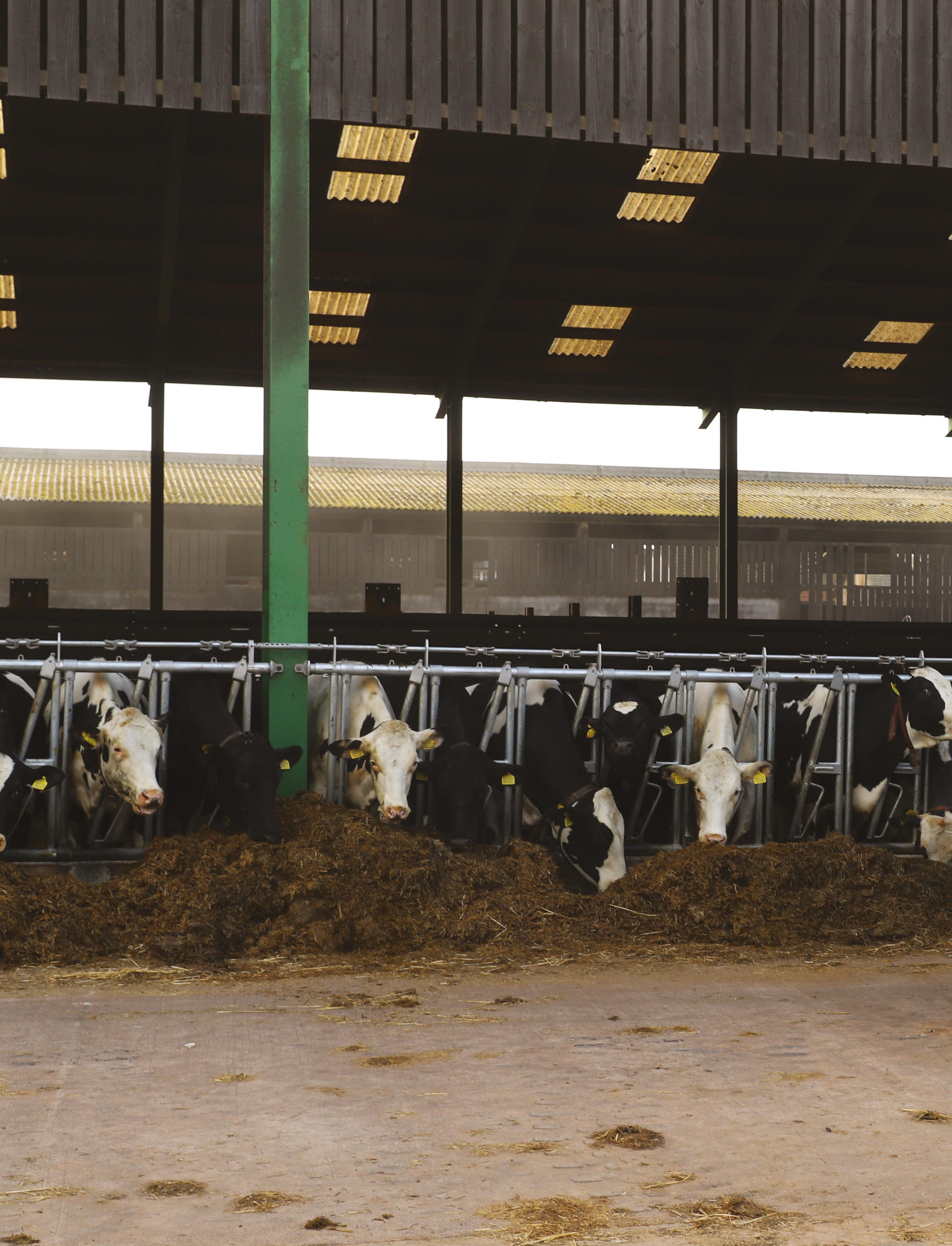
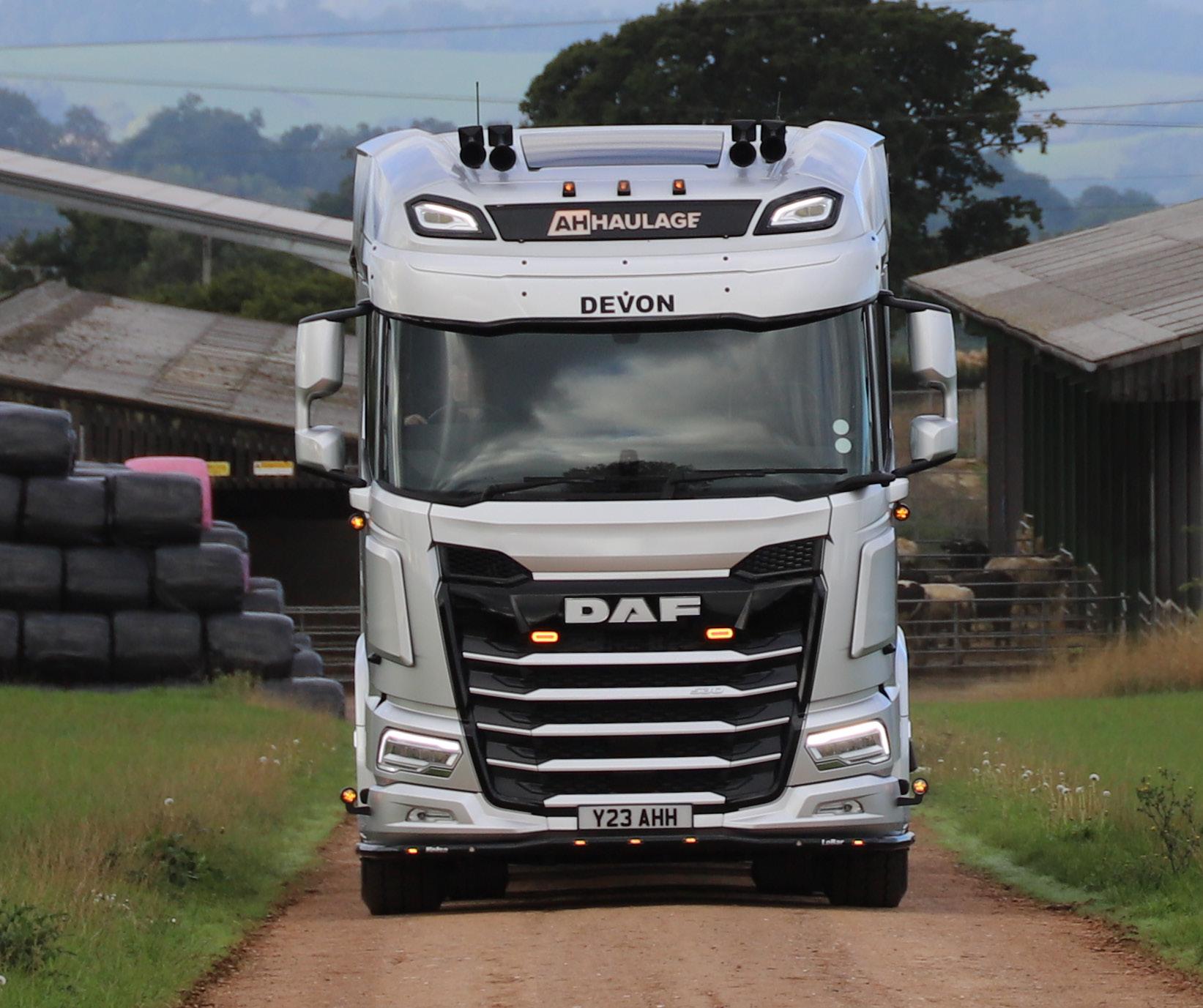
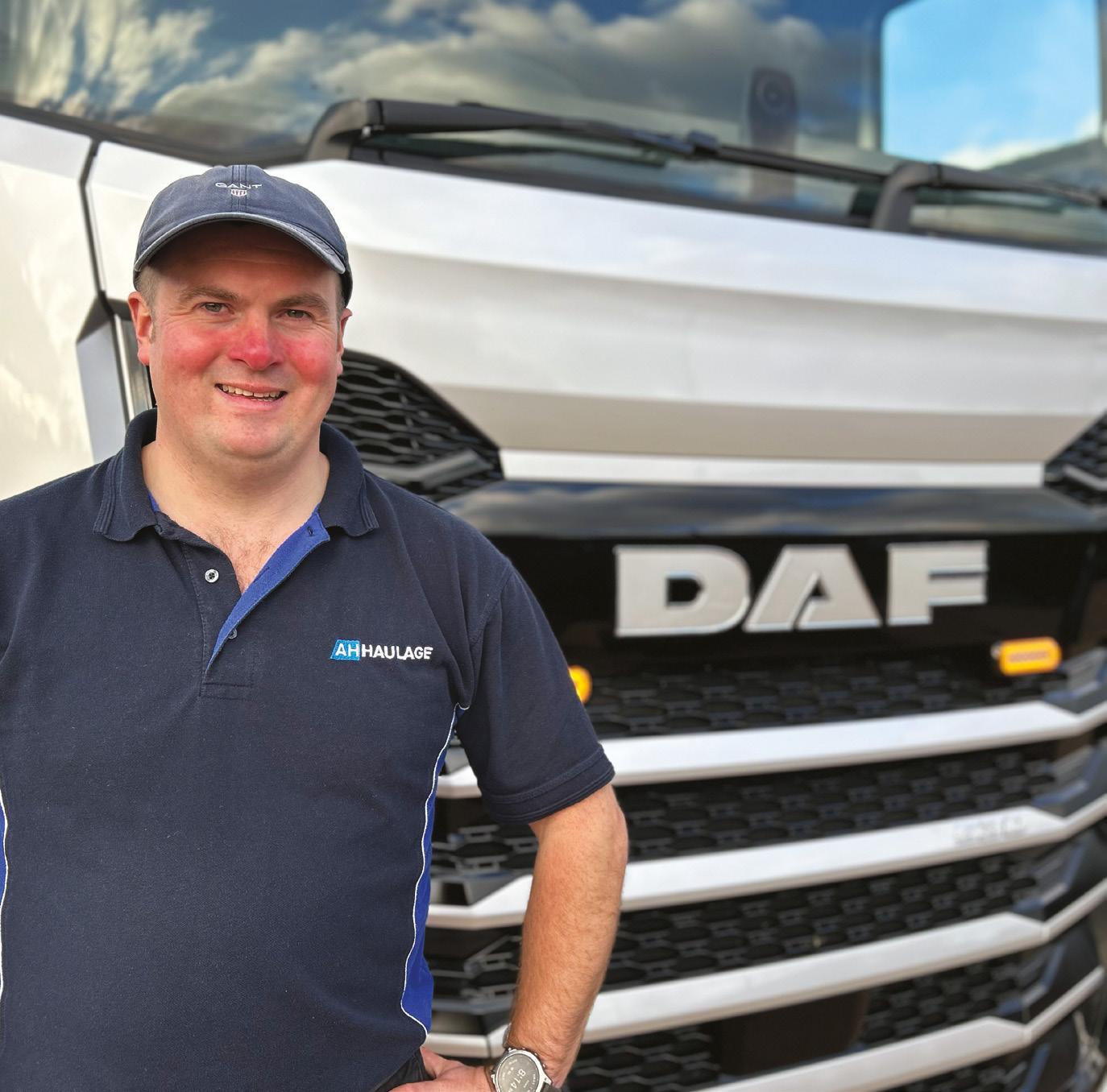
Working on a Sunday is commonplace in this industry, especially so in the animal feed business. The same applies to truck writers – we have to work on Sundays because often, it’s the only day the trucks we want to go and see are available. For this trip, there was a little more planning – but in the event, arranging to see Devon-based owner-driver Adam Howe’s stunning silver XF530 FTN wasn’t the challenge we were perhaps expecting. As we met on a farm near Budleigh Salterton one Sunday morning, the truck looked even better in the flesh. Adam is 34 and has been an OD for just over two years. “I’d worked for the family business since I was 16. My dad runs a business cleaning out chicken houses. He bought the first truck for hauling chicken muck: a 2006 DAF CF 6x4 hookloader and drag. Although this worked well, the process of loading and unloading skips was not efficient and took too much time, so the first artic was then purchased: a new
2015 DAF CF510 with a Fruehauf trailer, which is still in the fleet. The chicken muck haulage had its peaks and troughs, so a bulk-blowing feed trailer was purchased to fill the gaps.
Change of direction
“Becoming an OD was never part of my plan, but due to a change in circumstances it was sort of forced on me in 2023. I secured work as a sub-contractor for Crediton Milling Company hauling animal feed, and now 99% of my work is with CMC. I’m guaranteed at least two loads a day; sometimes it’s more depending on distance.”
All Adam’s work is local from his base at Uffculme. His work is to a variety of destinations, mostly in Somerset and Devon, but also into Cornwall. “Some 70% of the jobs are in Devon,” says Adam. “Generally, there are no nights out unless I choose to do them, or if a farm needs an emergency delivery. The truck is always prepared for a night out.”
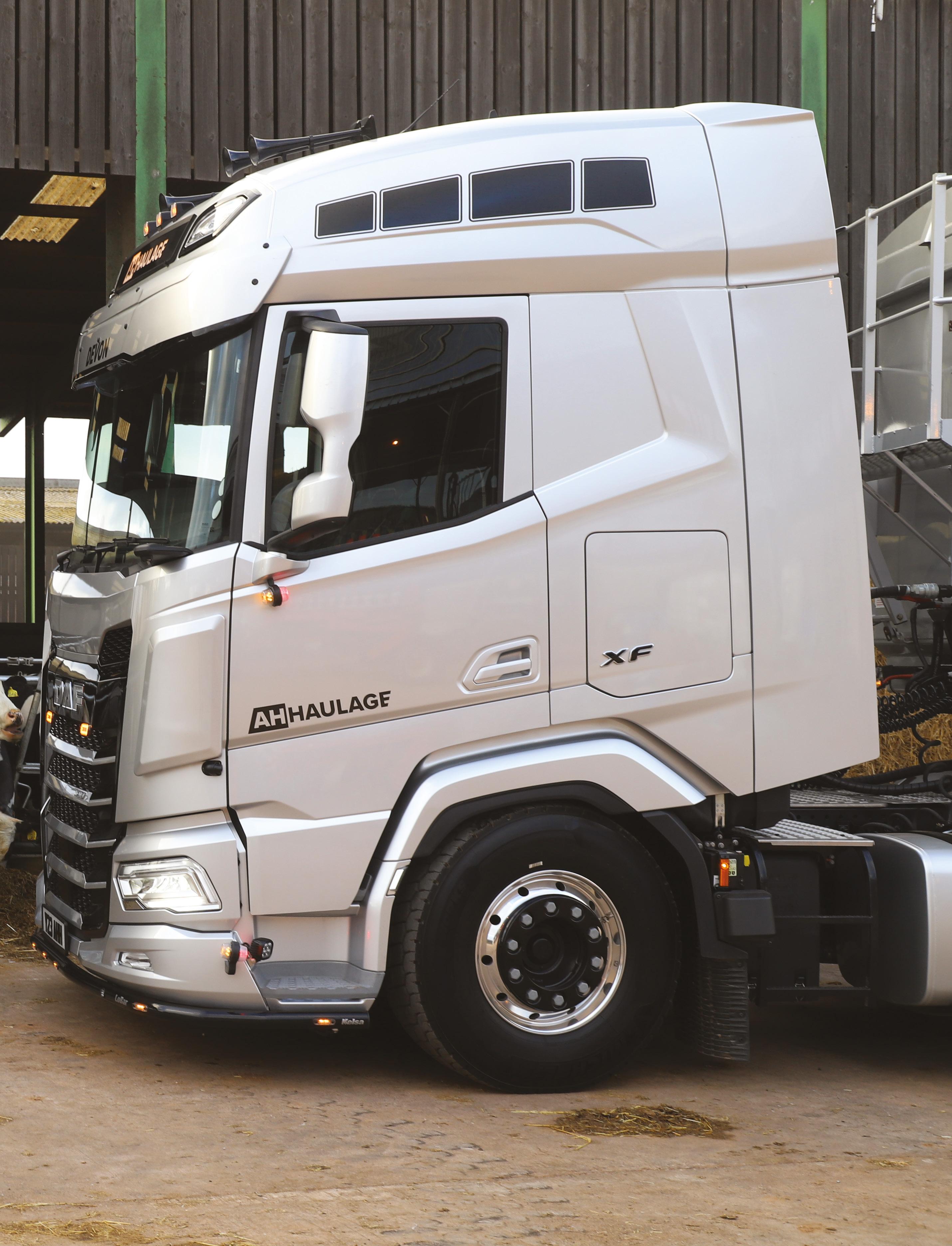
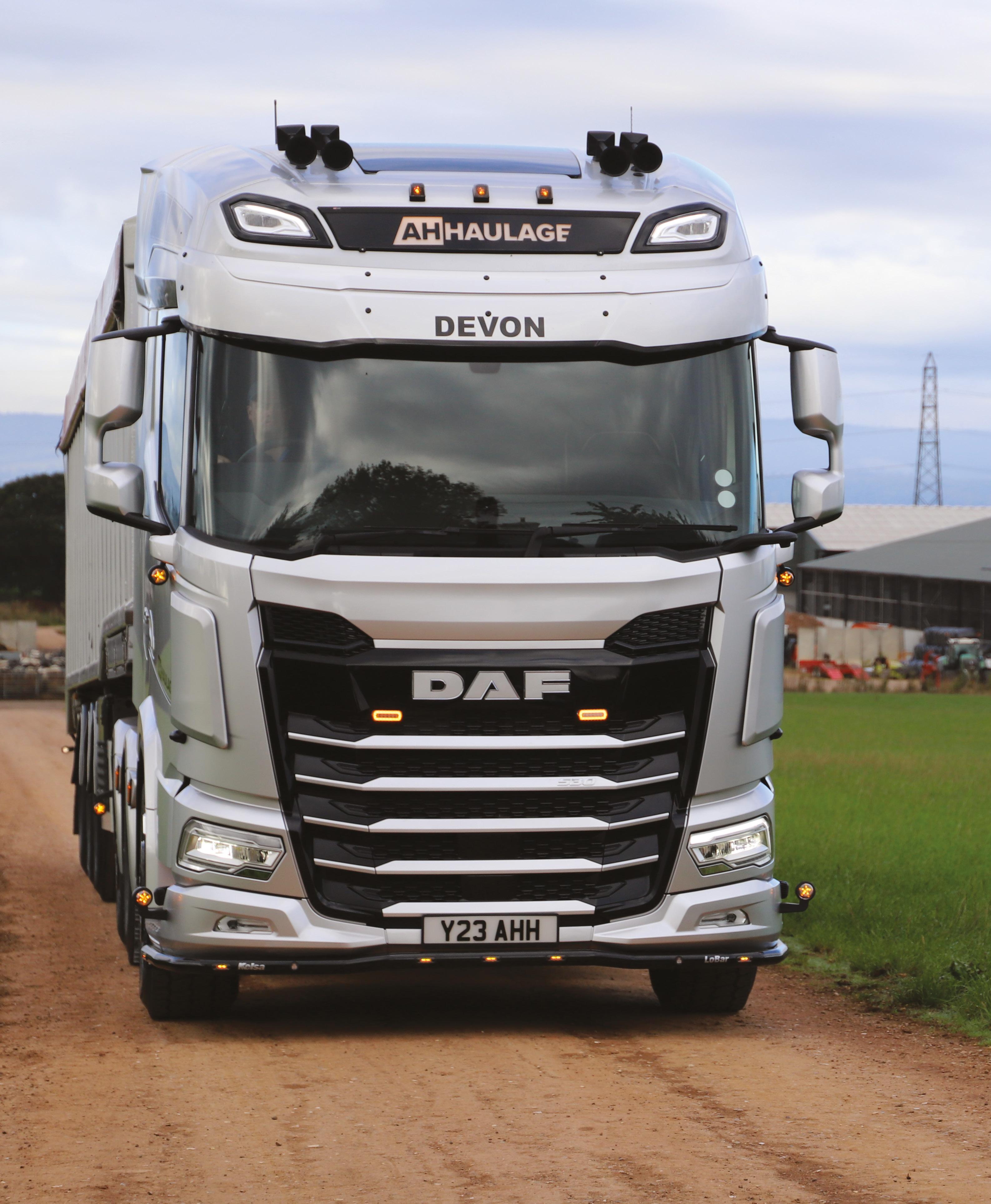
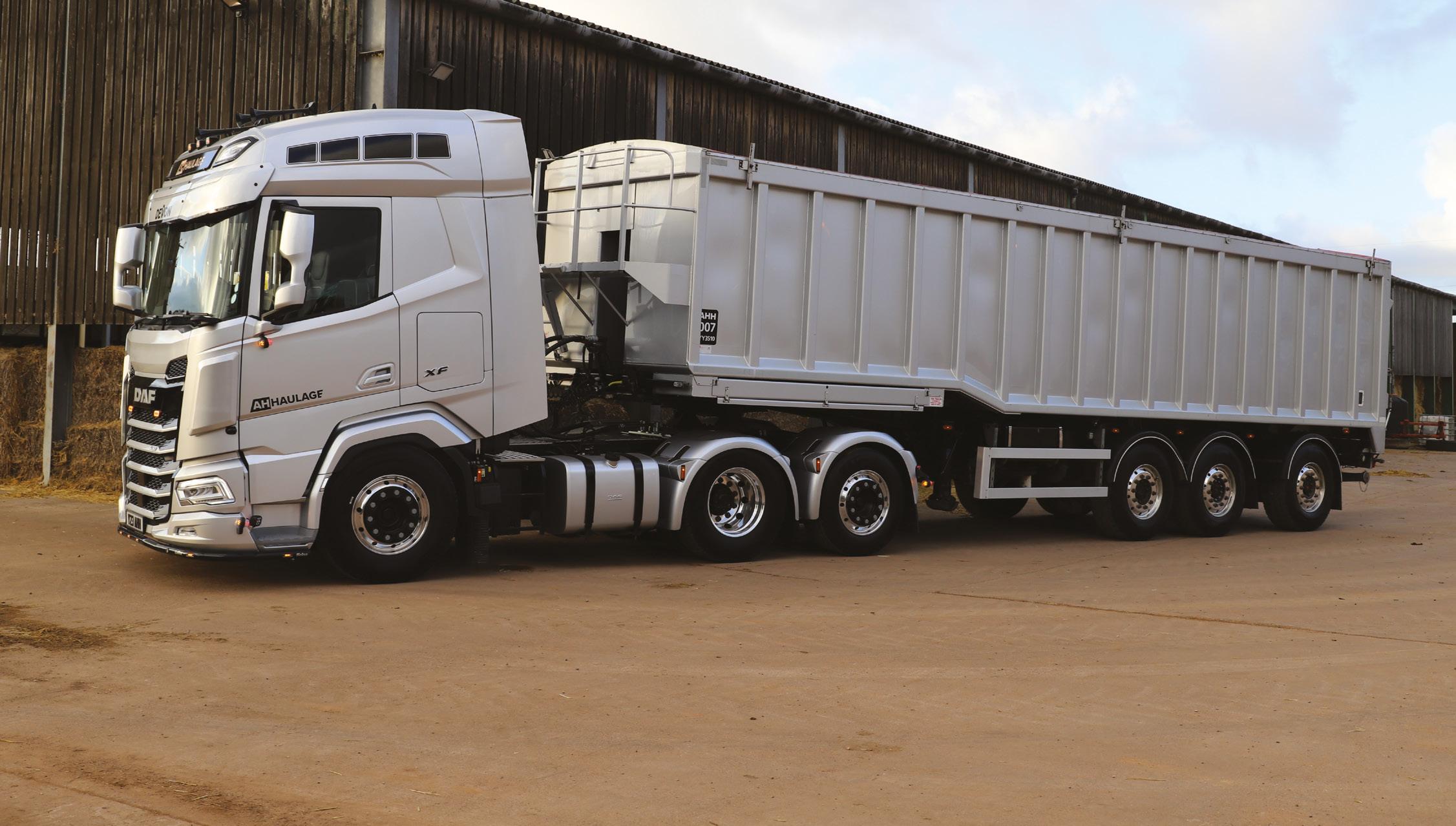
Adam always tries to load the following day’s delivery the night before. The truck is a rare FTN model: a 6x2 with a rear-steer tag axle. For Adam, manoeuvrability into the farms is his priority, and the FTN is head-and-shoulders the best set-up. The Muldoon trailer also has a rear steering axle and a lifting front axle, again helping manoeuvrability.
Adam previously had a CF530 FTR and in a perfect world would have gone for an XD for its lower cab, but he also needed the biggest engine as “there are a lot of hills in this area and 450 bhp won’t cut it.” So in order to get a 530 bhp MX13, he had to go for the XF – although in fairness it’s not much bigger than the XD. The XF is on full air suspension, useful for this work which has a lot of tracks and substandard secondary roads to contend with.
Despite having the bigger cab, he still opted for the highroof sleeper. “I looked at the flat roof, but this cab will be better when it comes to selling it.” He didn’t take R&M and instead has the truck maintained by a local company, but opted for the full three-year warranty.
Adam’s first lorry was a 19-plate CF530. “I loved it and would have happily had another, but they don’t make them anymore. It was a manual and that was the biggest change for me: going from a 16-speed manual to a 12-speed automated gearbox.
“I’M IN
OF
ALL DAY, BUT NO TWO DAYS ARE THE SAME.”
“I don’t plan to keep it past five years; and even then, I might look at its market value in 2.5 years as that might be the best time to sell it on.”
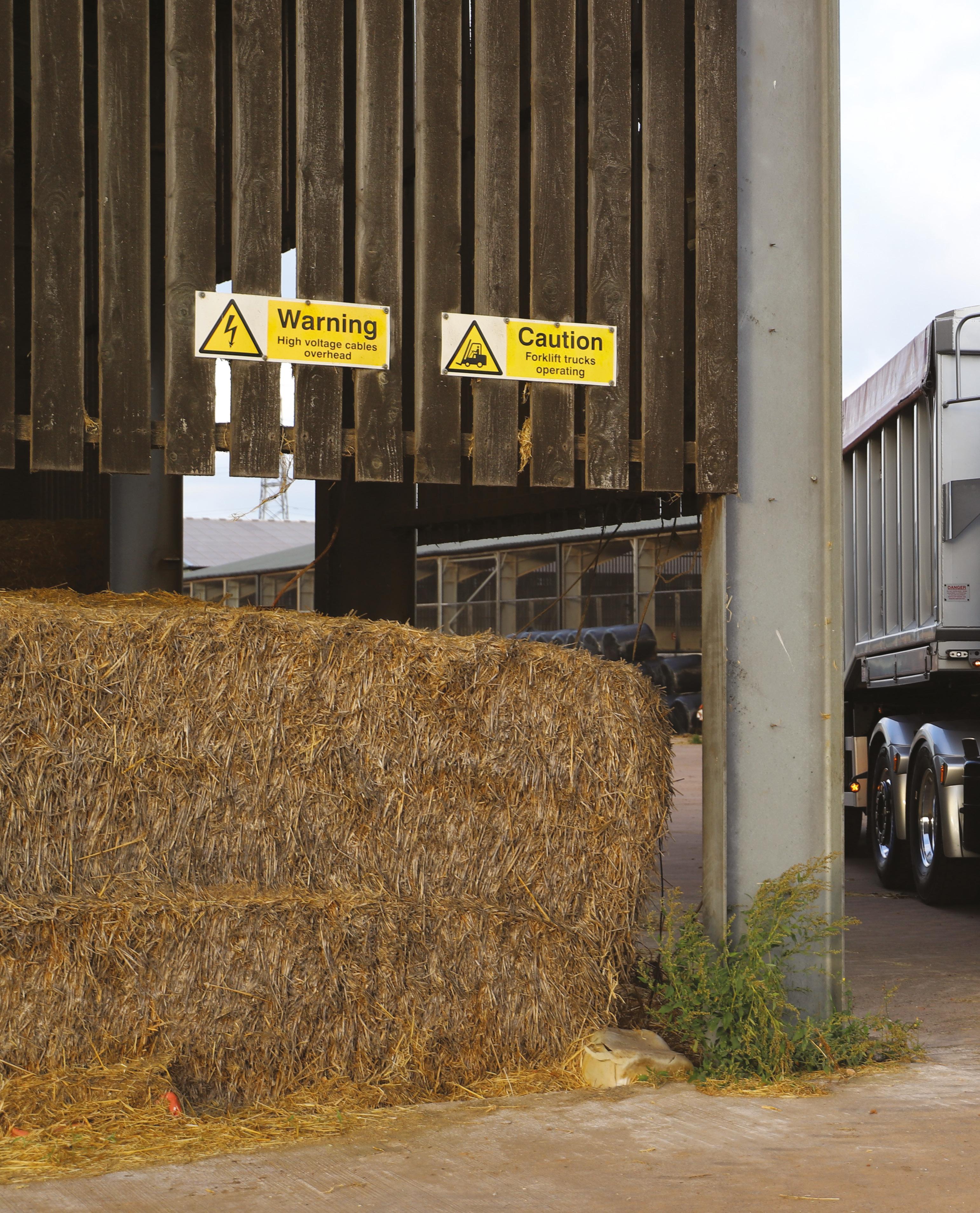
His work is all animal feed now. “I’m in and out of farms all day, but no two days are the same.” Because an artic cannot get into all farms, there are some jobs he can’t do. “CMC knows where I can and can’t go and plans accordingly. I’ve never failed to make a delivery, but sometimes I have to say I’d rather not go back to certain places because of access.”
The XF530 was ordered at the start of 2025 and delivered in just two months. However, it didn’t immediately go on the road – instead, it was taken for exhibition at the Royal Cornwall Show in June. Unfortunately, as bad luck would have it, the truck was hit by a cherry picker that fell off a trailer, which caused damage to the cab. Naturally, it had to go straight back for repair and the CF was kept on. Fuel consumption on this work is notoriously awful
compared with motorway hauliers. “The CF was delivering the early fives in mpg. If the XF gets closer to 6 mpg, I’ll be more than happy,” says Adam. The tractor weighs around 9 tonnes and he gets a 27.2-tonne payload.
Adam hasn’t gone for the Digital Vision System, but has specified DAF’s Corner View camera. “It’s brilliant. The all-round visibility is better than the CF. You can tell the windscreen is so much better.” He also is fully appreciative of the rear steer. “It’s phenomenal,” he says. The XF cab is a little wider than the CF, but Adam is “getting used to that”. However, the truck isn’t as heavy as you might think. “It’s got a retarder, but it’s still 200 kg lighter than the CF. It has alloy wheels to save weight.”
The dealer was Adams Morey at Bridgwater. “They’ve been fantastic. Mark, Tom and Scott are all very helpful, and were especially so during the accident. The back-up in the workshop is very good.”
Moving animal feed is a specialist job and calls for the best kit; and while it might be mucky, it doesn’t mean you can’t have a stunning truck. AH Haulage is proof of that.
Words: Trinity Francis Photographs: DAF Trucks
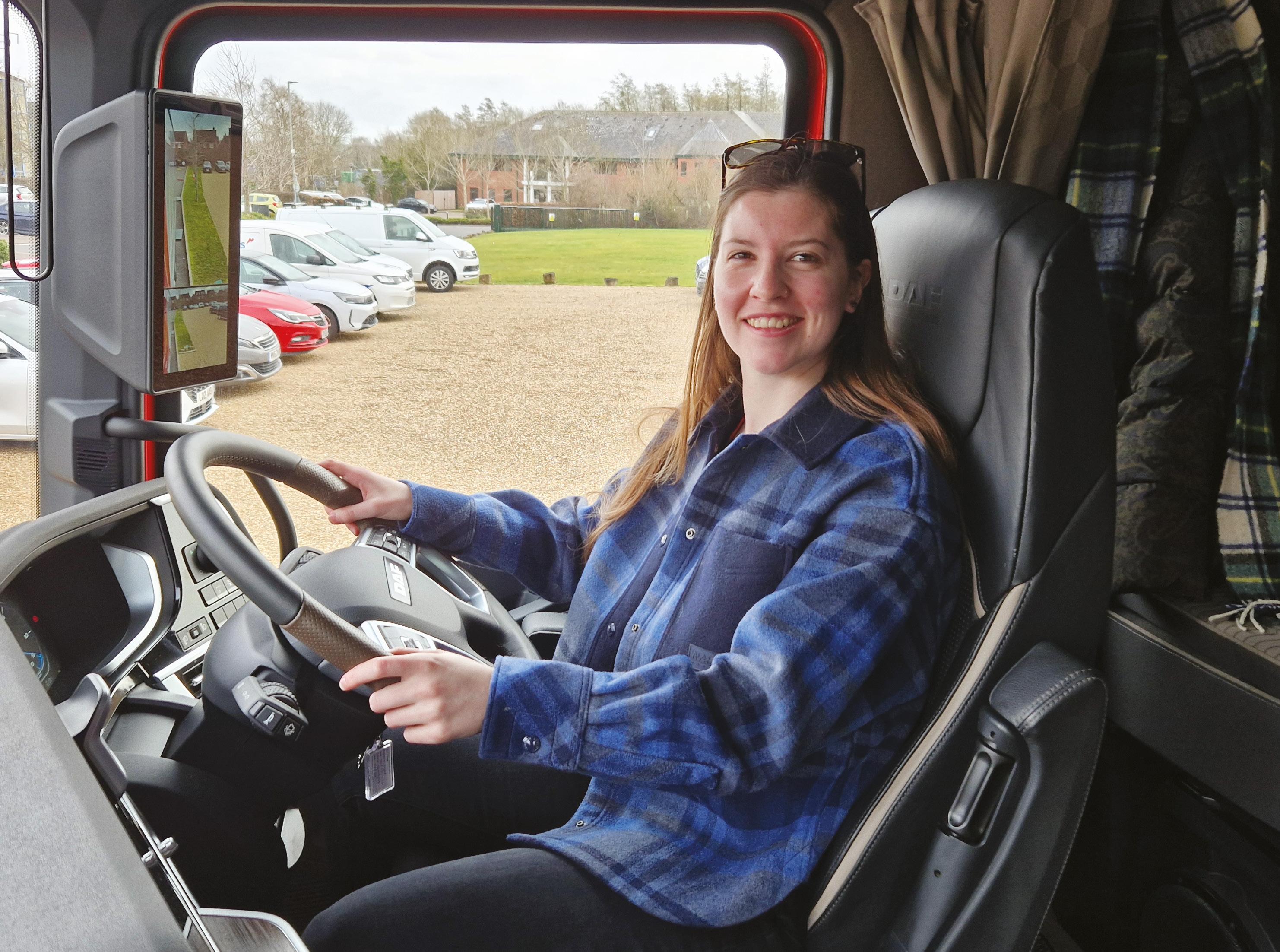
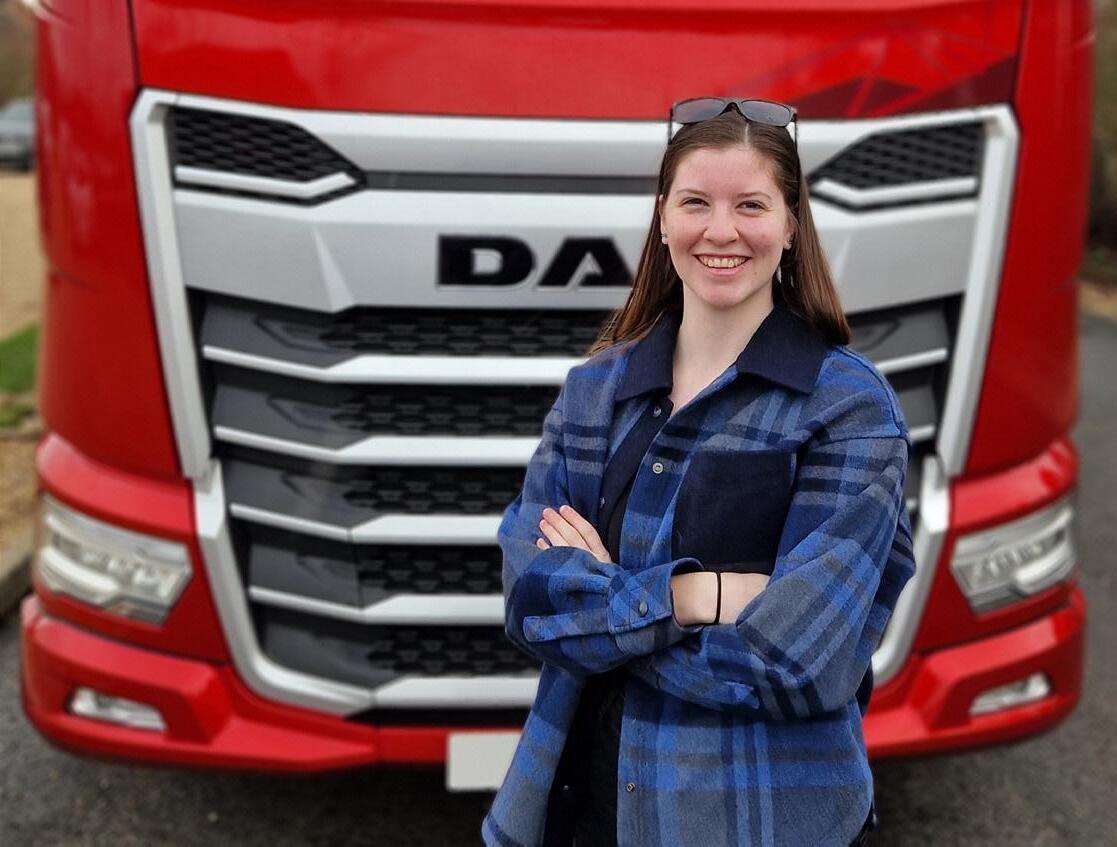
A lifelong passion for motor-vehicle muscle finally led transport journalist, Trinity Francis, to train for her C+E licence. It was an eye-opening experience, to say the least…
Throughout the Noughties, my dad religiously collected The Word magazine. Every month, the music mag would turn up on the coffee table with a Now Hear This! compilation CD attached to the cover. At the time, most of the music was forgettable; but a handful of the tracks I discovered on those CDs have stuck with me. Recently, Kendel Carson’s song I Like Trucks has been swirling around in my head again.
Just like its title, the song itself is similarly simplistic. She sings about trucks, cars and boys; and at the tender age of eight, I could just about wrap my head around two of those topics. Now, some might hark on about female empowerment and how hearing this changed my life, but it was more a matter of never having heard a woman be passionate about trucks up until that point.
At the time, I felt like a bystander, though; while some kids were obsessed with supercars, my thing was pick-up trucks and American muscle – but I didn’t have a practical outlet for this interest or an explanation as to where it came from. There was always something about their crazy proportions, noisy engines and insane power that drew me in.
Like most of us, I had no idea what I wanted to do when I grew up, but I decided it would centre around writing. Ultimately, this led me to writing about cars and trucks. Over the past five years I’ve driven and written about everything from Land’s End to John O’Groats in classic MX-5s, to flying round Goodwood Circuit at 100+ mph in McLarens. Then around three
years ago, I started writing about the world of road transport and logistics, and Carson’s words started resonating again.
Learning the ropes
Instead of just looking from the outside in, I wanted to get first-hand experience from a professional driver’s perspective – and the only way to do that was to get my own C+E licence. Aside from a peripheral understanding of some of the rules and regulations that drivers need to comply with, I had no idea what to expect. In total, it took three weeks spread over six months from start to finish, during which time I was humbled more times than I care to admit.
Going through the Driver CPC, Hazard Perception and Theory tests was manageable thanks to some last-minute cramming and plenty of revision, but the driving part was a different ball game. When I first learnt to drive a car, my dad and I clocked up more than 500 miles before I even had a lesson with an instructor; but seeing as it’s harder to get practice time in a truck, a week’s intensive training threw me in at the deep end. At the end of that week, I crumbled under the pressure and spectacularly failed my test. I moped around for another couple of weeks before I resolved not to let my nerves get the better of me. Six weeks later, I was the proud owner of a newly minted C+E licence – something I hadn’t even considered was possible more than 15 years ago when I was singing about trucks at the top of my lungs.
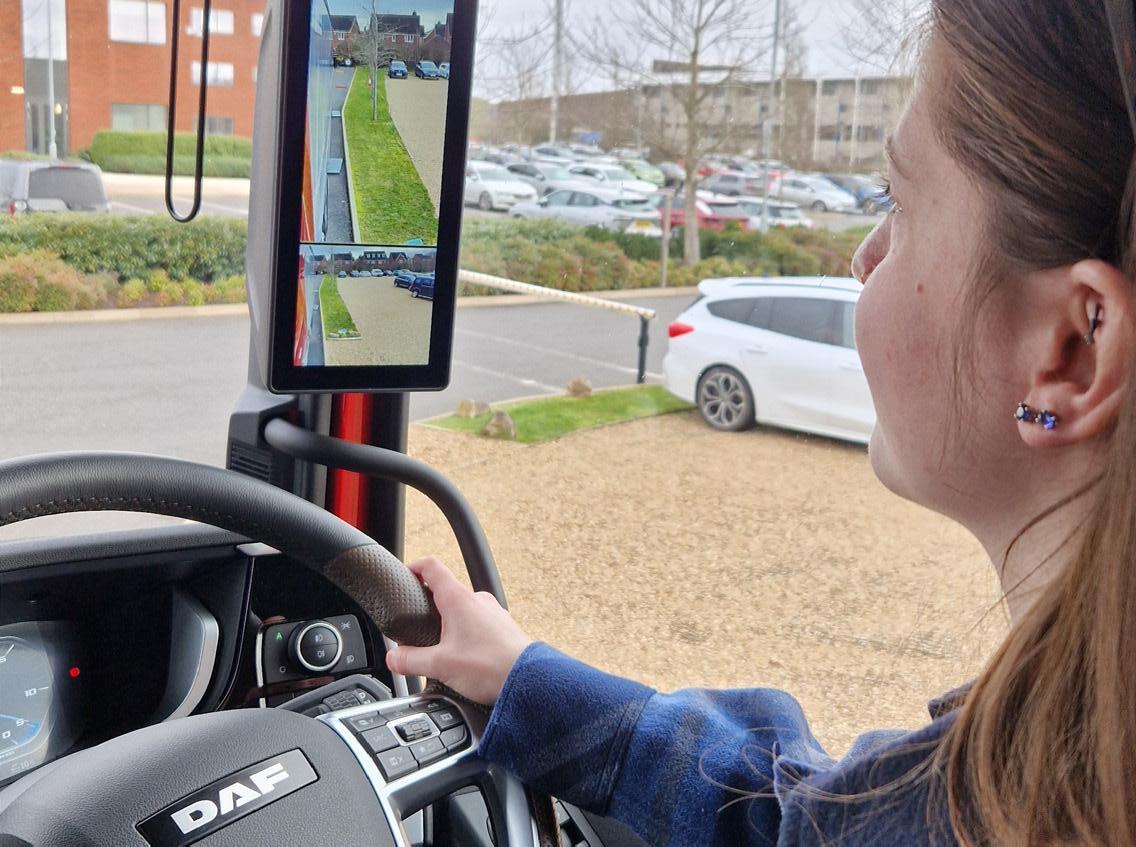
“My training took three weeks, during which I was humbled more times than I care to admit.”
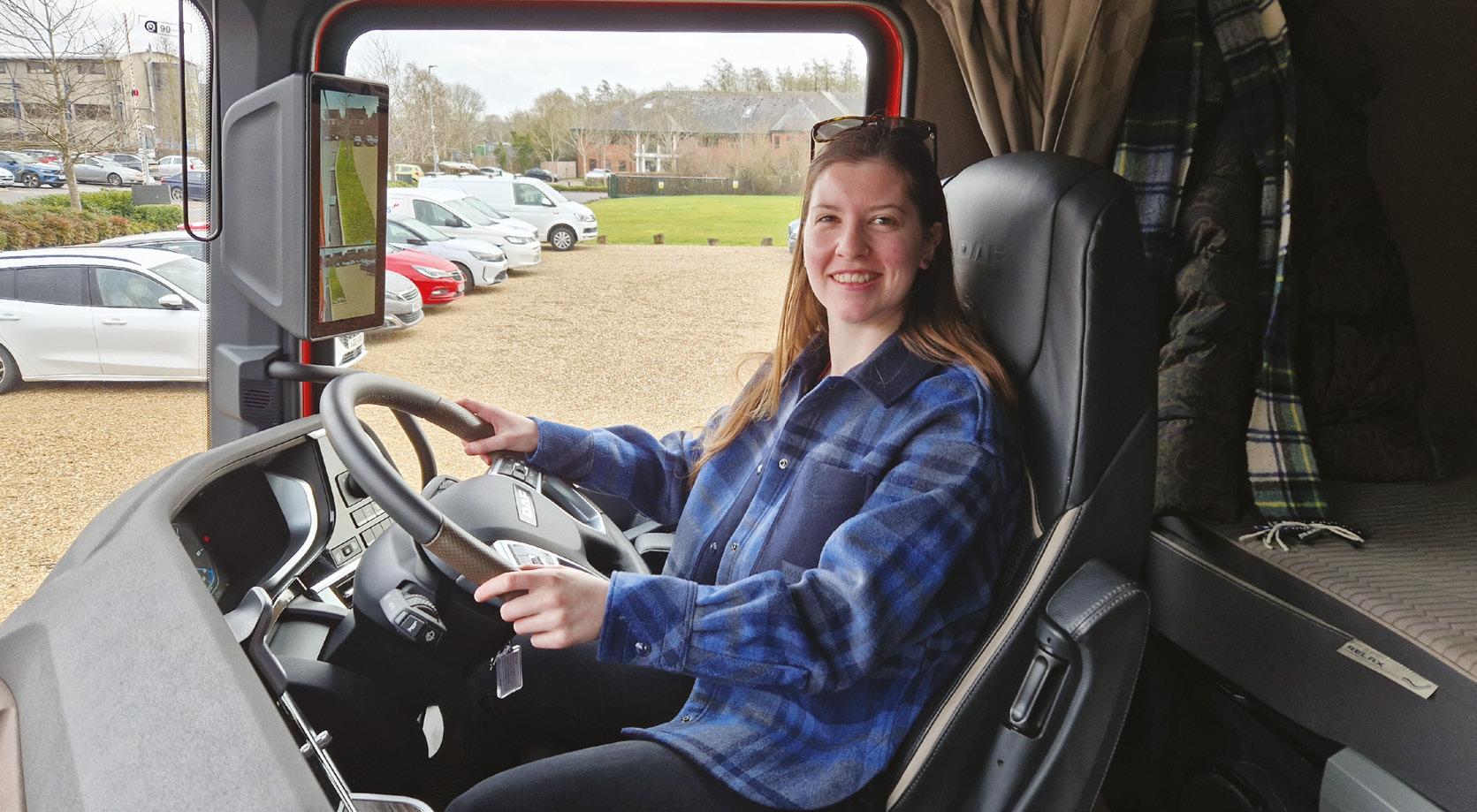
Far left: Trinity trained for three weeks
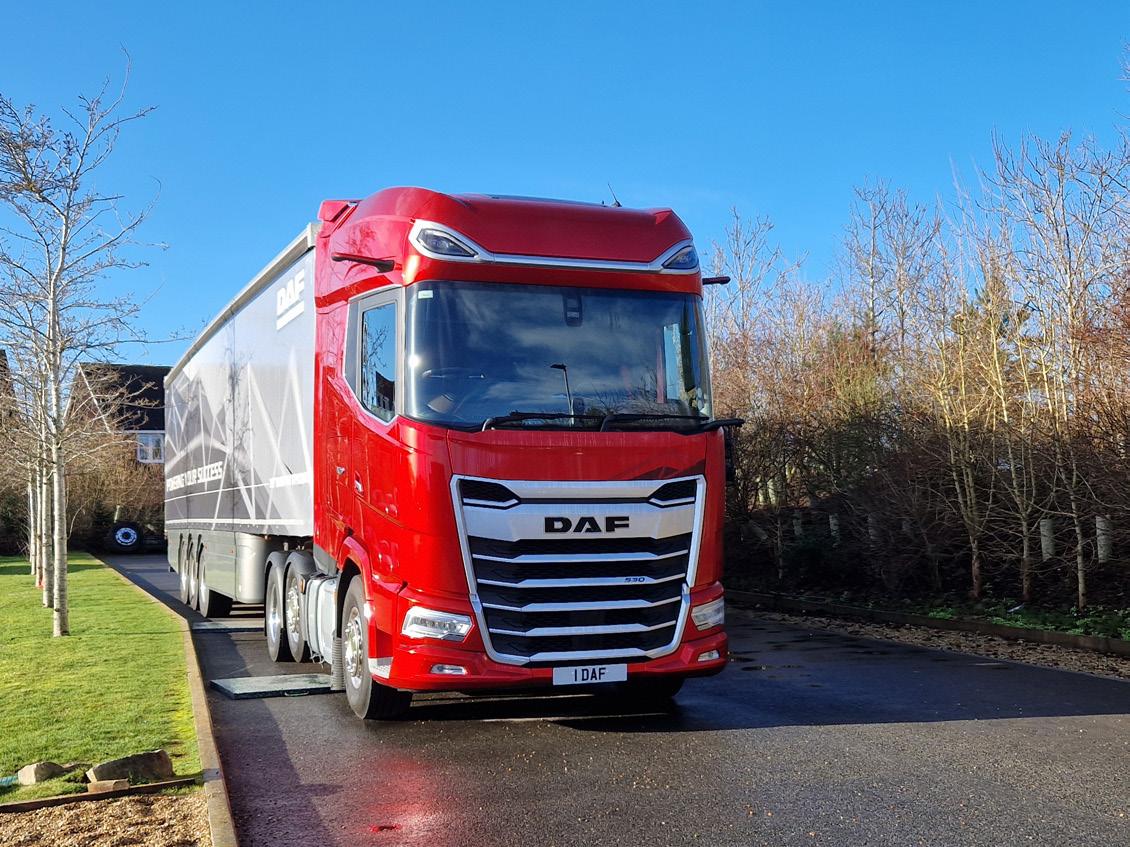
Top right: Reversing is a skill that’ll take a long time to master Left: Compared to her training vehicle, the latest XG+ demonstrates just how much truck technologuy has inmproved!
As difficult as it was, I now think I have a better understanding of how professional drivers feel. There’s an immense satisfaction in navigating challenging situations and owning the road, but it’s contrasted with other road users that act like you don’t exist and facilities that are non-existent or severely lacking. I’m acutely aware of the privilege of being able to drive trucks for the purpose of writing about them, rather than needing to hit a delivery slot or, God forbid, back onto a loading bay with no help.
One of the biggest shocks has been moving from 10-year-old trucks that had been ragged by trainees to brand-new vehicles. When I was learning, every session felt like an arm workout and every pothole made my bones rattle. Spending a day in a new DAF XG+ was like wafting on a cloud in comparison. The technology has come along significantly in the past decade, and I’ve been blown away by how much easier modern trucks are to drive.
As for what’s next, my focus now is to build up some more on-road experience and learn how to manage the momentum that comes with a full load. It’s clear the true art is in reversing – something I’ve no doubt will take years to master. But my future goal is to compete in truck racing, specifically BTRC. Again, it’s something I know will be a steep learning curve. But what can I say? I Like Trucks (and I like to go fast!).

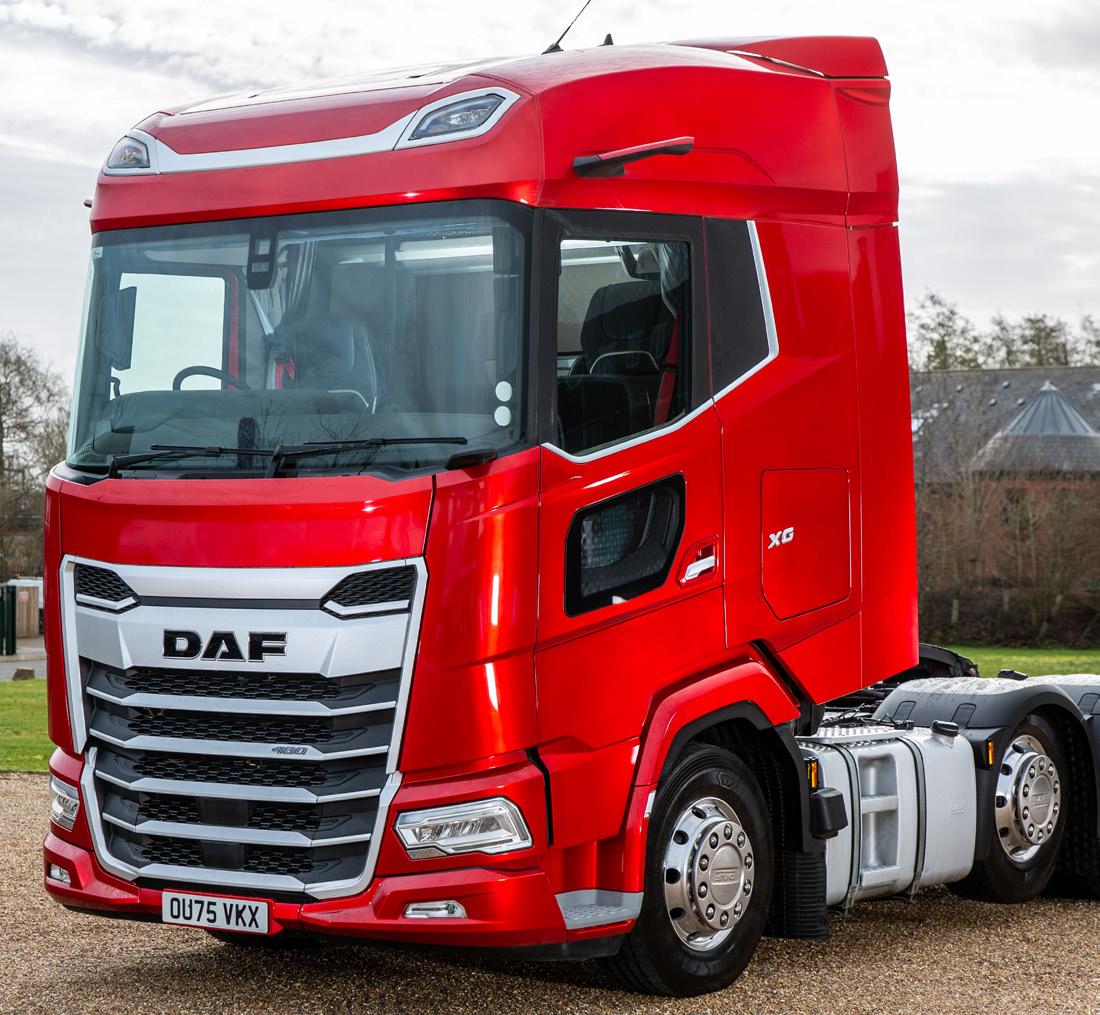
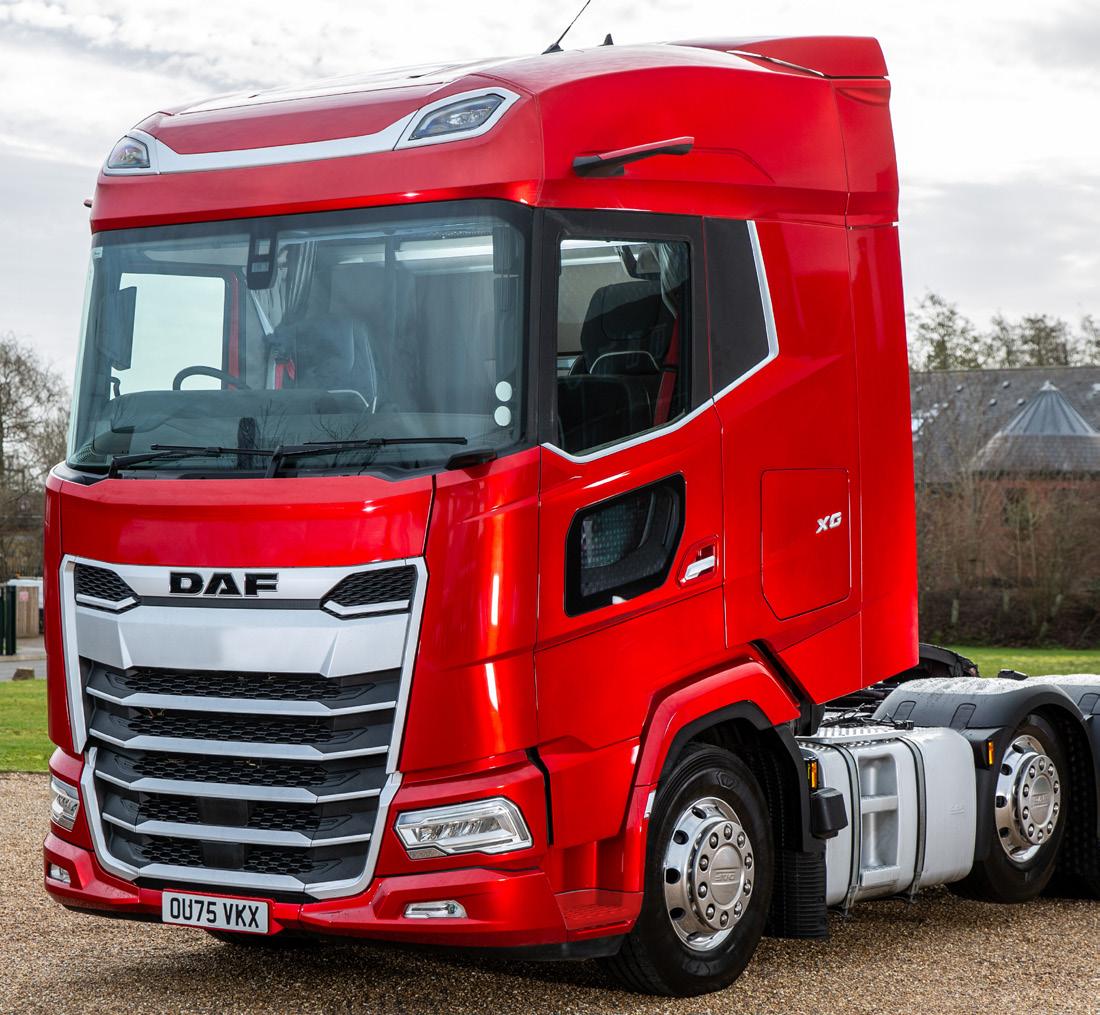
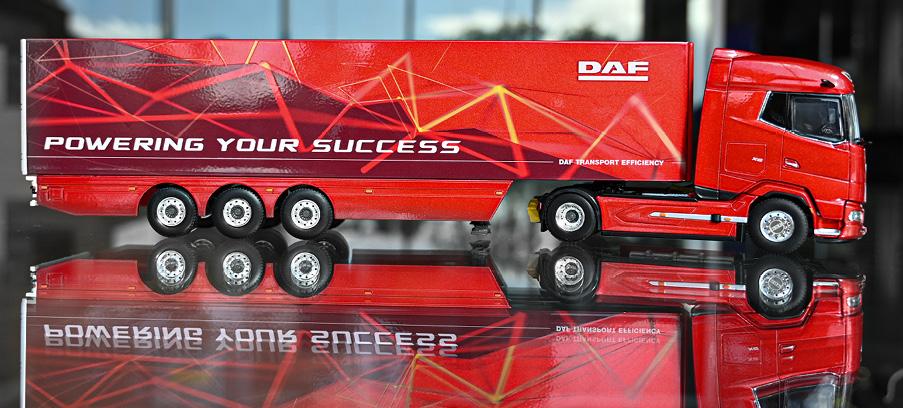
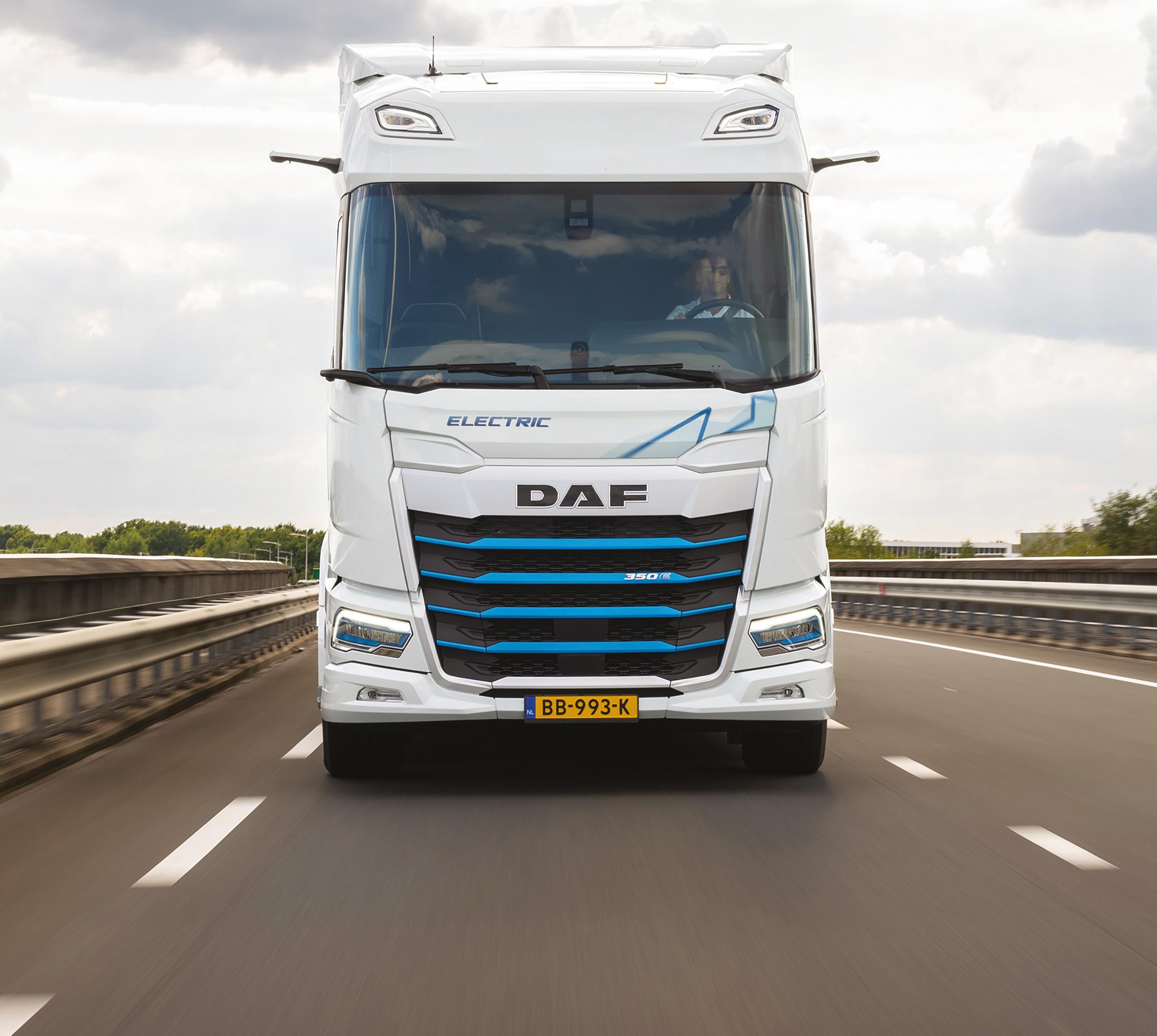
The prize in this edition is a DAF XG 4x2 tractor and tri-axle trailer miniature in 1:50 scale, for one lucky winner. Simply spot and mark the four differences on the images above. Once completed, either cut out or photocopy and post to DAF Driver magazine, 4th Floor, 19 Capesthorne Drive, Eaves Green, Chorley, Lancashire, PR7 3QQ
By Andy Stewart, industry pundit
Acursory flick through this issue should be enough to convince anyone that electric trucks are here to stay. Recently, two new hubs dedicated to charging battery-powered HGVs have been opened in the UK, and we also saw the first e-truck carrying a commercial load cross the Channel via Eurotunnel. The fact the milestonemaking vehicle was a DAF XF Electric will probably not surprise anyone.
I’ve spoken to many drivers and operators over my 20-plus years as a road transport journalist and editor, and I’ve noticed that many are initially against the concept of electric HGVs. On one level, I get it; I was sceptical at first – the roar of a diesel engine is emotive and can be deeply engrained in a trucker’s DNA. But
the degree of mistrust and misunderstanding about electric vehicles among some people leads me to suspect there’s also something else at play here: a deep-rooted reluctance to consider change.
The right fit
First, it’s worth noting diesel-powered trucks will be around for a good while – there are still use cases for which electric trucks are not best suited. But for some jobs – particularly those that have a regular, predictable route – they can make a great deal of sense. It’s still relatively early days and crucial things like financial incentives, the nationwide charging infrastructure and questions about payload in some weight categories obviously need more attention;
but despite these obstacles, increasing numbers of operators are finding e-trucks more than earning their keep.
I’ve noticed one other thing, too: despite initial misgivings, once a driver has actually strapped into an electric truck and taken it for a spin, they inevitably come out smiling. The immediate power and torque of a battery-powered drivetrain make for a superb driving experience – and with little noise other than that of the wind and the quiet hum of tarmac beneath the tyres, it’s bliss inside the cab.
Basically, what I’m saying is if you’re sceptical about electric trucks, maybe don’t knock ’em ’til you’ve tried ’em. If you have the opportunity, I urge you to give one a go – you might just be surprised.

The quality of a truck depends on the quality of the organisation behind it, which is why the DAF dealer network offers a unique advantage with the best geographical coverage of the UK, the most heavy truck experience and the longest opening hours of any truck franchise.

EV SL3 0ED 01753 681818 HUDDERSFIELD MOTUS Commercials ▲ HD2 1UR 01484 300500
HULL MOTUS Commercials ▲ EV HU9 5PJ 01482 795111 IPSWICH Chassis-Cab Ltd ★ EV IP6 0RL 01473 833003
PR5 8BW 01772 338111
Greenhous DAF ▲ B6 5TG 0121 326 6985
BIRMINGHAM MOTUS Commercials B33 0SL 0121 784 4023
BIRTLEY Ford & Slater DAF DH3 2SP 0191 406 8888
BLACKWELL H.W. Martin Fleet Maintenance Ltd DE55 5JY 01773 813313
BOURNEMOUTH Adams Morey Ltd ★ BH8 0BL 01202 524422
BRIDGWATER Adams Morey Ltd TA6 5LB 01278 550 970
BURTON ON TRENT MOTUS Commercials ◗ DE13 7AB 01283 248899
BURY ST EDMUNDS Chassis-Cab Ltd EV IP32 6NL 01284 768570
CAMBRIDGE Chassis-Cab Ltd ▲ PE28 9QR 0333 323 4040
CANTERBURY Channel Commercials PLC CT3 3DW 01304 841111
CARNFORTH Lakeland Trucks Ltd LA5 9DW 01524 734544
CASTLEFORD Pelican DAF ▲◆ WF10 5UB 01924 227722
CHESTERFIELD Ford & Slater DAF ▲ S40 2RG 01246 234213
CONWY Parrys Commercials Ltd LL28 5RA 01492 580303
CORBY Ford & Slater DAF ▲ NN17 4BA 01536 207980
COVENTRY Ford & Slater DAF ▲ CV3 4FL 02476 302856
CRAWLEY GB DAF Gatwick RH10 9NS 01293 537520
CRICK GB DAF DIRFT NN6 7BZ 01788 711699
CUMBERNAULD MOTUS Commercials ★ G67 3EH 0123 672 7771
DAVENTRY Brian Currie (Milton Keynes) Ltd ◗ NN11 8RF 01327 871770
DEESIDE MOTUS Commercials ◆ CH5 2QJ 01244 520853
DONCASTER MOTUS Commercials ▲ DN6 7BA 01302 727040
DONCASTER Fishlake Commercials Ltd ▲◆ DN8 4JD 01405 740086
DUMFRIES MOTUS Commercials DG2 0JE 01387 720820
DUNDEE Norscot Truck & Van Ltd ▲ DD2 4UH 01382 611166
DUNS J E Douglas and Sons ▲ TD11 3HS 01361 883411
DUNSTABLE HTC Dunstable LU5 4TP 01582 505464
EASTBOURNE Brewers DAF BN23 6PW 01323 745700
EASTLEIGH Adams Morey Ltd ◗ SO50 6RR 02380 875888 ELGIN Sheriffmill Motor Co Ltd IV30 6UH 01343 547121
MOTUS Commercials ▲ BA11 2FD 01373 468520
TBF Thompson BT51 5JZ 02829 558353
The extensive DAF national network delivers the best Back-Up in the business. Our flexible range of MultiSupport















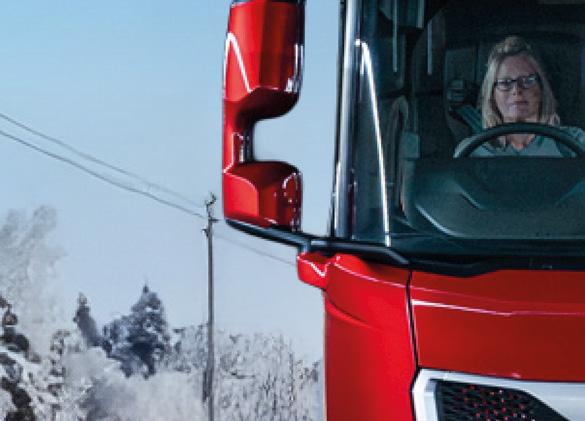
























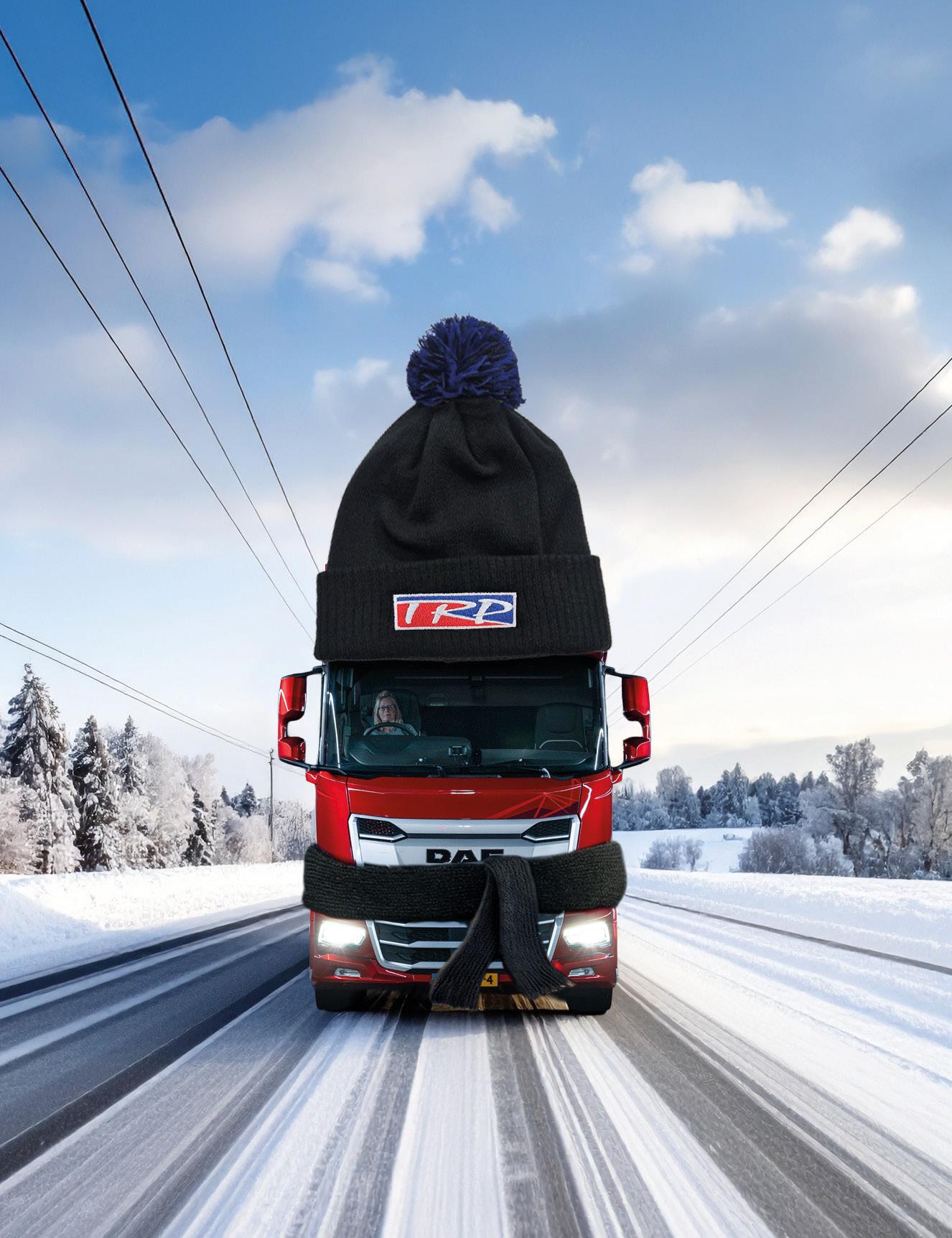






























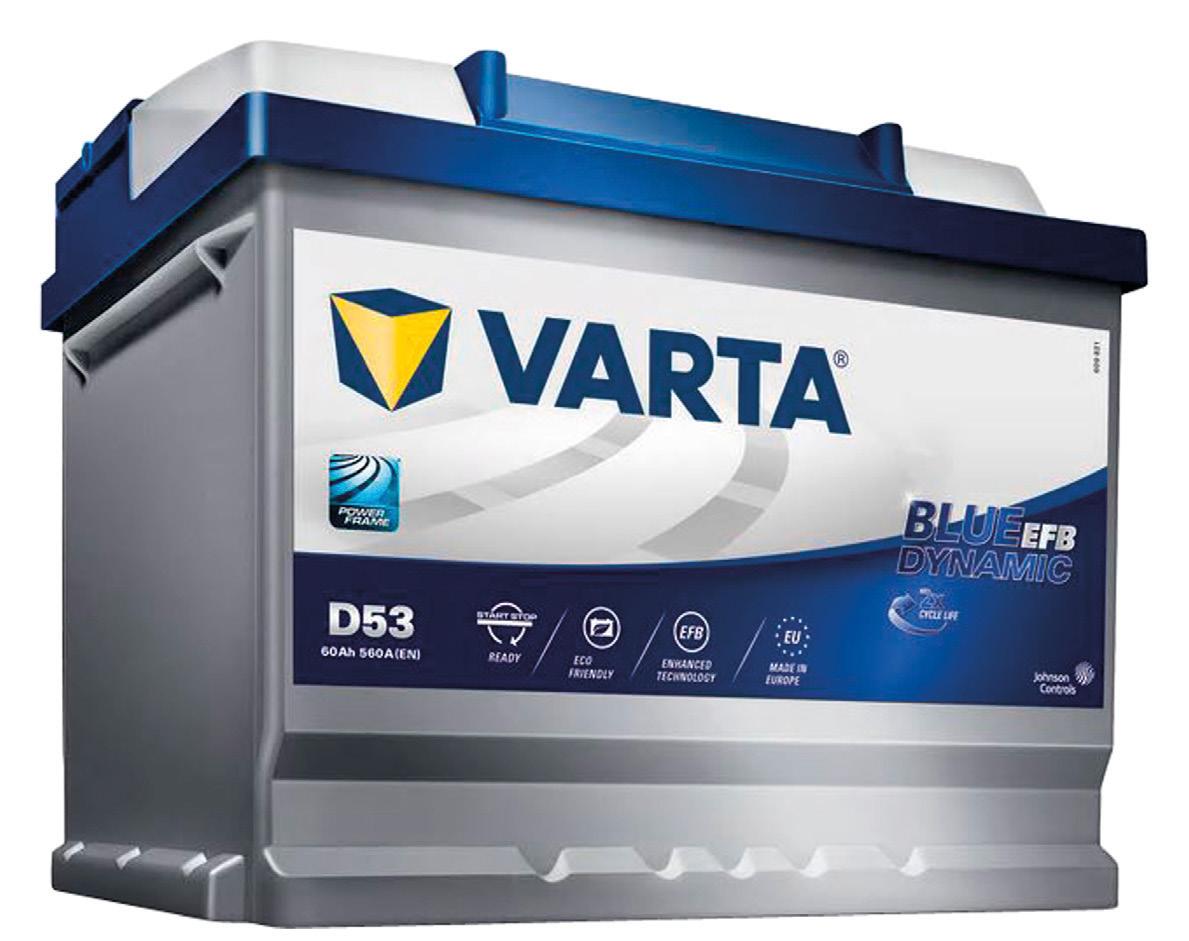
DAF Dealers have you covered with a full range for all truck and LCV applications: DAF Genuine, Varta and TRP batteries including Promotive, Endurance and Heavy Duty.
The unique VARTA® Promotive EFB is the most e ective battery ever for high energy demanding commercial vehicles. Unmatched performance merges with the highest vibration resistance to provide absolute reliability and a longer life.
• Most e ective solution for high energy demands including hoteling and highest vibration requirements
• Provides up to 40% longer life
• Prevents downtime
• Made in Germany – manufactured to the highest quality standards
• Original spare part – the largest manufacturers trust this product
• Latest Enhanced Flooded Battery (EFB) technology – for a longer life time
• Excellent vibration resistance - designed for end of frame installation
• Maximum capacity – for maximum performance
• 100% maintenance free – less work on the road for the truck driver
• OE-quality and tested batteries - 3 years warranty


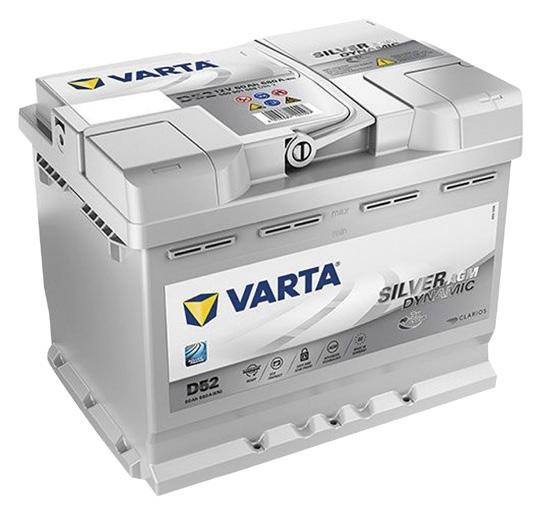
• 3 times the cycle of life for conventional batteries
• Highest cold cranking amperes (CCA) enables engine starts even in extreme climates while keeping comfort and safety features functioning
• Available in 5 models of varying capacity, CCA and size
• Recyclable and produced in an energy-saving way
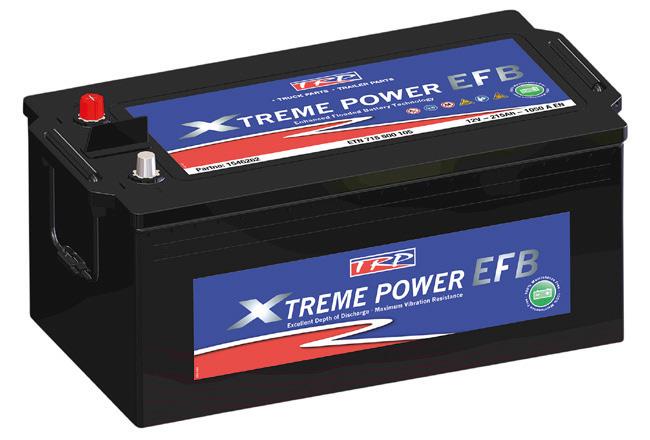
• Enhanced Flooded Battery (EFB) Technology – for maximum capacity
• Maximum vibration resistant – designed for end of frame installation
• Excellent depth of discharge – Xtreme Power EFB can be discharged up to 50% without damaging the Battery
• 100% maintenance free - trouble free solution
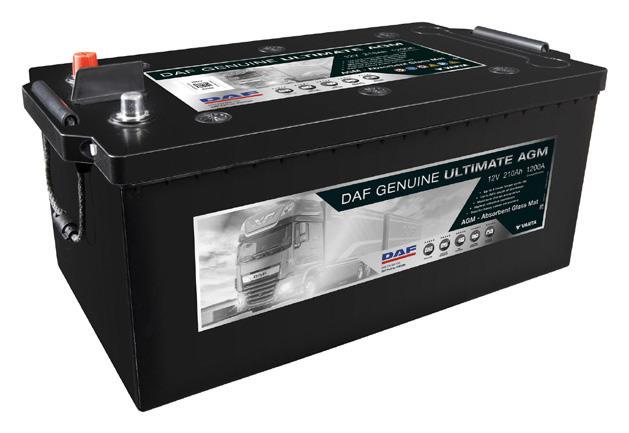
• Highest cycle life - 6x longer life time vs. conventional batteries & 3x longer life-time vs. EFB
• Best depth of discharge - AGM can be discharged up to 80% without damaging the battery
• Best charge acceptance – AGM batteries can be charged faster than conventional batteries
• Highest vibration resistance – designed for end of frame installation
• Hoteling function – made for trucks with heavy power consumers
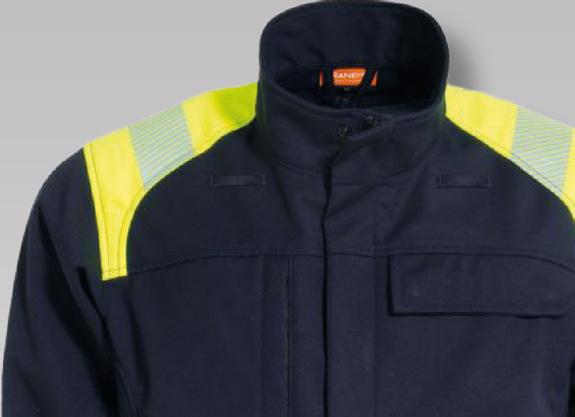
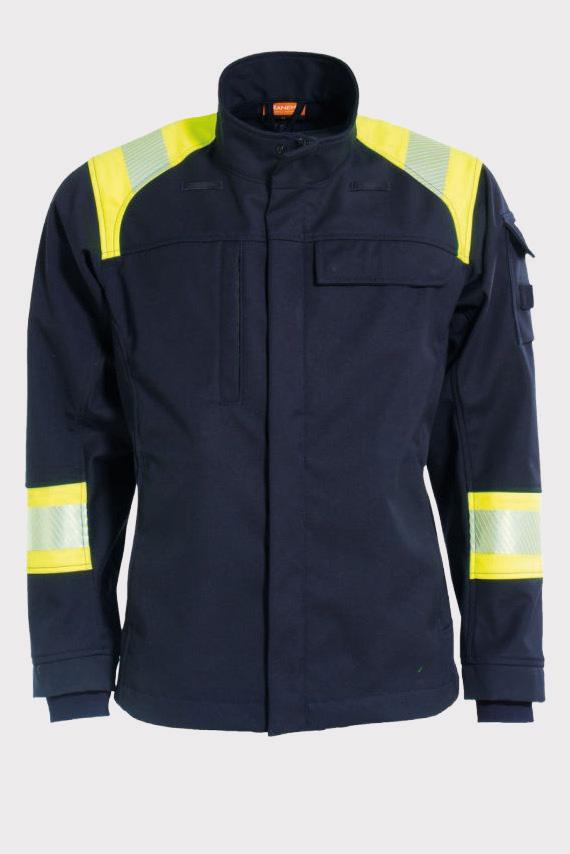
Flame Retardant Softshell Jacket – Yellow
SOFTSHELL JACKET: Class 3 hi-vis to EN471 ELIM: 23.0 cal/cm2 | Sizes: XS – 4XL




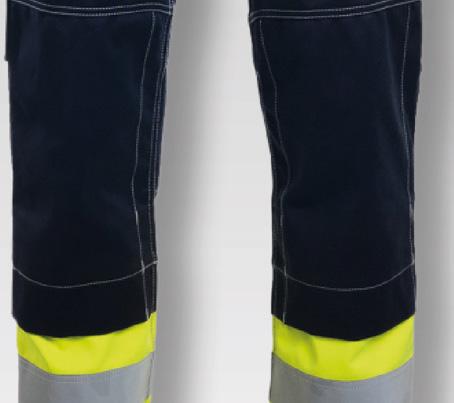

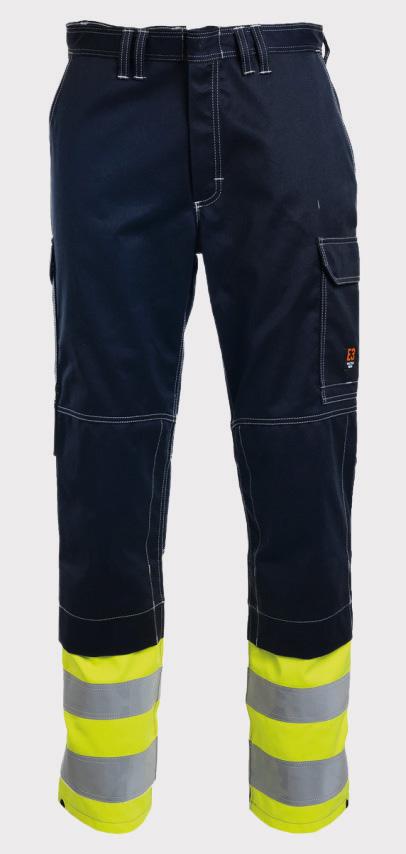
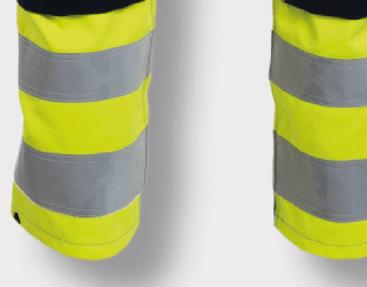

LADIES & MENS TROUSER: Class 1 hi-vis to EN471
ELIM: 27.0 cal/cm2
Ladies: 8-20 Mens: 30"S - 48"S / 32"R - 50"R / 32"T - 40"T
Inherent flame retardant high visibility trousers with a thin lining to achieve high protection against electric arc. The trousers also have a high protection against welding and grinding splashes. PFAS-free.
The front is made in Cantex Weld fabric, which provides additional high protection against welding and grinding splashes. The back in Cantex Stretch, provides the garment with flexibility and gives you freedom of movement with high levels of comfort. Front pockets. Hip pockets with flap. Cargo pocket with flap, mobile phone pocket and concealed D-ring and strap for ID-pocket. Ruler pocket with flap and reinforced bottom. Kneepad pockets with two di erent placement levels. Adjustable ankle width with press studs. Reinforced back hem. Contrast stitching.




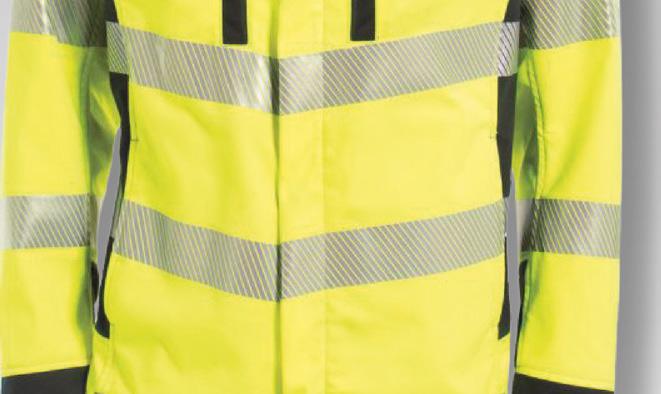
Non-metal, wind and water resistant inherent flame retardant high visibility softshell jacket with very high comfort.
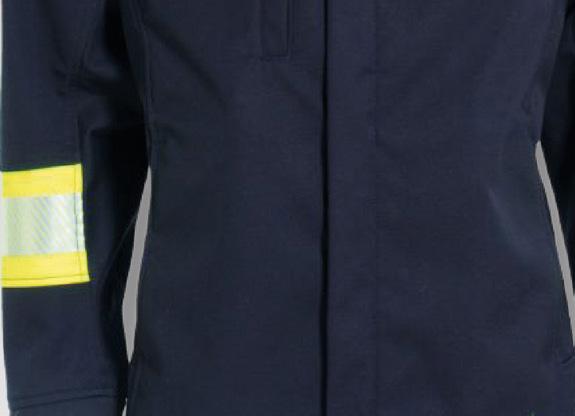
The jacket has a high Arc Rating and is ergonomically shaped for working with raised arms. Heat sealed reflective stripes for greater comfort. Concealed front zip and double storm flap with press studs. Two loops for communication equipment. Left chest pocket with flap. Right chest pocket with zip and hole for microphone. Side pockets with zip. Left sleeve pocket with flap, hidden D-ring and strap for ID-pocket. Inside knitted cu s in sleeves. Drawcord at the bottom of the jacket.
*The garment has a combined certification and is approved for EN ISO 20471 CL.3 when worn together with Tranemo trousers or bib´n´brace certified according to EN ISO 20471 CL.1 or CL.2.













SOFTSHELL JACKET: ELIM: 23.0 cal/cm2 | Sizes: XS – 4XL
Non-Metal, wind and water resistant Inherent Flame Retardant softshell jacket with very high comfort. PFAS-free.


The jacket has a high Arc Rating and is ergonomically shaped for working with raised arms. Heat sealed reflective stripes for greater comfort. Concealed front zip and double storm flap with press studs. Two loops for communication equipment. Left chest pocket with flap. Right chest pocket with zip and hole for microphone. Side pockets with zip. Left sleeve pocket with flap, hidden D-ring and strap for ID-pocket. Inside knitted cu s in sleeves. Drawcord at the bottom of the jacket. This garment is produced with new PFAS-free fabrics.





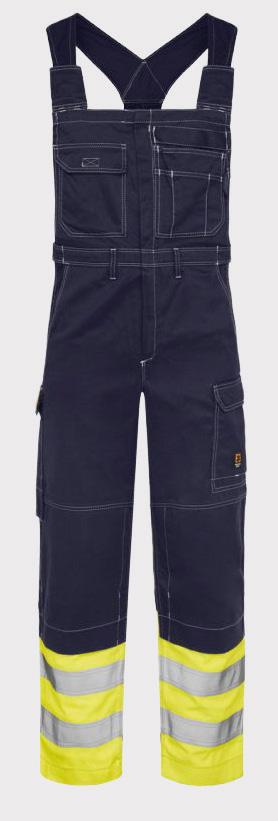
BIB ‘N’ BRACE: Class 1 hi-vis to EN471
ELIM: 27.0 cal/cm2
Sizes: 34"S - 48"S / 30"R – 50"R / 32"T – 40"T



Inherent flame retardant high visibility bib´n´brace with a thin lining to achieve high protection against electric arc. The bib´n´brace also has a high protection against welding and grinding splashes. PFAS-free. The front is made in Cantex Weld fabric, which provides additional high protection against welding and grinding splashes. The back in Cantex Stretch, provides the garment with flexibility and gives you freedom of movement with high levels of comfort. Adjustable braces with concealed plastic buckles. Elastic in back. Front zip. Chest pockets, one with flap. Concealed knife buttons. Inside pocket. Adjustable width and loops in waist. Side pockets. Cargo pocket with flap, mobile phone pocket, pencil loop and concealed D-ring. Ruler pocket with flap and reinforced bottom. Kneepad pockets with two di erent placement levels. Hip pockets with flap. Contrast stitching.






















Centurion White
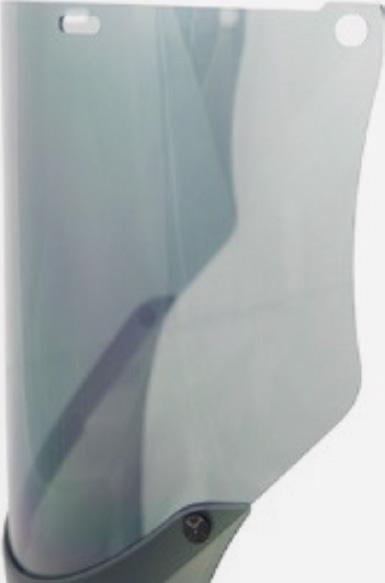
Nexus Contour XIV
Grey HT Arc Face
Screen Helmet Kit
ATPV 26CAL/CM
Part Number 2282805











Layer Flame Retardant



Anti-Static Balaclava





ATPV 22CAL/CM















Part Number



2282804 (One size)










Sizes 6 - 12






TOECAP - 200J polymeric composite non-thermic according to EN 12568







• The product has a 2-year shelf life, all other gloves of this type, have a 6-month shelf life.



• It has a cal/cm rating of 25cal and is tested to 5000v.


• This eliminates the need for a leather over glove.




• It is the most dextrous ARC/ELC insulated glove on the market with a thickness of 1.30mm.


• Once in use, it needs testing every 6 months.


• This is the standard requirement for all Arc/insulated gloves.









Size ranges from stock: 8, 9 & 10 (Size 11 to order)






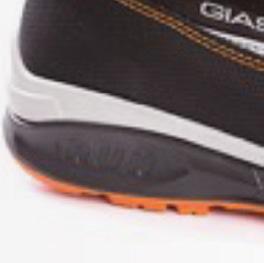




MIDSOLE - flexible anti perforation composite INSULATING fabric according to EN 12568
• Insulating rubber resistant to hydrolysis
ISO 5423:92, to hydrocarbons and to abrasion, anti-shock and anti-slipping SRC.

The bottom of the shoe, within some limits (no humidity, it doesn’t concern the upper), o ers electrical resistance against tension up to 1.000V - M Ω > 1.000.
• Electrical resistance: CSA Z195-14 Canadian standard increase 1 kV/sec - voltage 20.000V/60 Hz - duration 1 minute.
• Electrical resistance: ASTM F2413-11 standard increase 1 kV/sec voltage 20.000V/60 Hz duration 1 minute.


Sizes 3 - 12
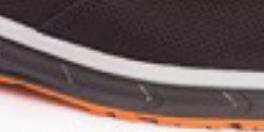

TOECAP - 200J polymeric composite non-thermic according to EN 12568




MIDSOLE - flexible anti perforation composite INSULATING fabric according to EN 12568
SOLE 3 RUN - three-densities polyurethane dielectric, resistant to hydrolysis ISO 5423:92, to hydrocarbons and to abrasion, anti-shock and anti-slipping SRC.
• The bottom of the shoe, within some limits (no humidity, it doesn’t concern the upper), o ers electrical resistance against tension up to 1.000V - M Ω > 1.000
• Electrical resistance: CSA Z195-14 Canadian standard increase 1 kV/sec - voltage 20.000V 60 Hz - duration 1 minute
• Electrical resistance: ASTM F2413-11 standard increase 1 kV/sec voltage 20.000V/60 Hz duration 1 minute
• Electric flow requirement less than 1,0 mA
• Dielectric Insole, extra comfort bi-material with activated carbon, removable, anatomic, absorbing, antistatic, perspiring insulating and antibacterial.