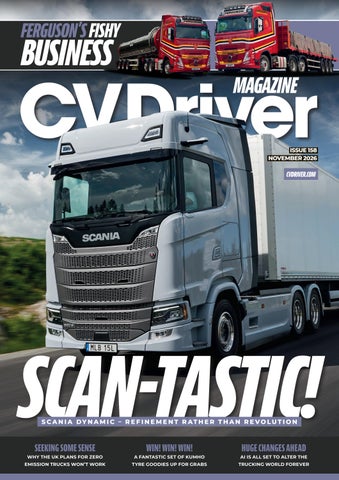
FERGUSON’S FISHY
BUSINESS
MAGAZINE ISSUE 158 NOVEMBER 2026
CVDRIVER.COM
SCAN-TASTIC! S C A N I A D Y N A M I C – R E F I N E M E N T R AT H E R T H A N R E V O L U T I O N
SEEKING SOME SENSE
WIN! WIN! WIN!
HUGE CHANGES AHEAD
WHY THE UK PLANS FOR ZERO
A FANTASTIC SET OF KUMHO
AI IS ALL SET TO ALTER THE
EMISSION TRUCKS WON’T WORK
TYRE GOODIES UP FOR GRABS
TRUCKING WORLD FOREVER
CONTENTS
INSIDE THIS NEW ISSUE
INFORMATION Free WiFi
Accomodation
FREE
FROM £25
MANAGEMENT Modern Showers Publisher: MatthewAlso Eisenegger
NOVEMBER 2026
Available
6 GREEN PLEA
CONTRIBUTORS Licensed Bar John Charles Launderette Steve Banner SO
vdriver.com
nts regulars
wonderful world of trucks ur say in our letters page nto another gritty subject vers are being mistreated solicitor Steven Hinchliffe
features
How the current rules
r
5
AL d Ba m £2 Editorial Address: Commercial nse fro Information ice ation ber L d Ltd, Vehicle Media & Publishing ar o m eB om sit Management Acc on 4th Floor 19 Capesthorne Publisher: Drive, Eaves Green, Chorley, Matthew Eisenegger Lancashire. PR7 3QQ Contributors Telephone: 01257 231521 Richard Simpson Email: matthew@cvdriver.com Ian Norwell Lucy Radley Secret Trucker
ADVERTISING Advertising Sales: David Johns Editorial Address: Commercial Mobile: 07590 547343 Vehicle Media & Publishing Ltd, 4th Floor sales@cvdriver.com 19 Capesthorne Email: Drive, Eaves Green, Chorley, Lancashire. PR7 3QQ Telephone: 01257 231521 EDITORIAL Email: matthew@cvdriver.com
Editor: John Threadgold Art Editor: Leo Gehlcken Advertising Advertising Sales: David Johns Telephone: 01257 231521 Telephone: 01388 517906 Email: design@cvdriver.com Mobile: 07590 547343
22 WAKEY WAKEY! Fatigue is one of the
on ending diesel truck
biggest hidden dangers
sales need to be changed
for any trucker.
and rethought
Don’t risk driving tired
12 CENTENARY SPECIAL We reveal first details
23 WIN! WIN! WIN! Yet another chance for
of the new Volvo trucks
you to grab a great bag
being launched to celebrate
of goodies from Kumho
the marque’s 100 years
Tyre – entry is easy!
14 BEWARE COPYCATS
26 FUTURE FLEETS
Cloned car number plates
AI is already with us and
are not just a danger to
in its early stages. Eventually
other car users. You could
it will change the life
be affected too
of every UK trucker
Email: sales@cvdriver.com Editorial
NOTE
Editor: Trevor Gehlcken ng UK trucks on the road The publisher makes every effort to ensure Art Editor: Leo Gehlcken ing what at the big event the magazines contents are correct. All Telephone: 01257 231521 s custom DAF workhorse design@cvdriver.com t on test with Ian Norwell materialEmail: published in CV Driver Magazine en to stop in bad weather is copyright and unauthorised reproduction n our simple competition Printing by spotting the difference if forbidden. The EditorsLtdand publisher MRC Print Consultancy
Uttoxeter Road, of this33magazine give no warranties, Longton, Stoke-on-Trent, guarantees or assurances and make no Staffordshire ST3 1NY Tel: 07764 951927 representations regarding any goods or services Note advertised in this edition. The publisher makes every effort to ensure the CV Driver Magazine is published under a magazines contents are correct. All material publishedCommercial in CV Driver MagazineVehicle is copyright Media & licence from and unauthorised reproduction if forbidden. n regardless – and sadly, Publishing The Editors andAll publisher of this magazine Ltd. rights in thegivelicensed no warranties, guarantees or assurances and r some, that’s the last thing material belong to Matthew Eisenegger or make no representations regarding any goods ey ever do. Turn to page 26 or services advertised in this edition. Commercial Vehicle and Publishing read our feature. CV Driver Magazine isMedia published under Commercial Vehicle Media Meanwhile van drivers areLtd anda licence mayfrom not be reproduced whether & Publishing Ltd. All rights in the licenced eing killed too, by being material belong to Matthew Eisenegger or in whole or in part, without their prior Commercial Vehicle Media and Publishing Ltd verworked and underpaid. and consent. may not be reproduced whether in whole written CV Driver Magazine ead Richard Simpson’s hardor in part, without their prior written consent. is Driver a registered trademark. tting piece on page 30. CV Magazine is a registered trademark.
But this issue isn’t all doom
nd gloom – there’s plenty fun stuff inside too. Flick
rough and as usual - enjoy!
Matt If you are not going to keep this magazine for future reference please pass it on or recycle it.
If you are not going to keep this magazine for future reference please pass it on or recycle it.
16 SCAN-TASTIC
Six-page special feature
29 WINTER WARMERS We provide some
revealing the lowdown
top tips to avoid
on Scania’s latest range
getting stuck as the bad
of model updates
weather approaches
16 CVDRIVER.COM November 2026
|
3
FE ATURED NEWS
M&S CAUSES SPARKS WITH NEW ELECTRIC TRUCKS ROLL-OUT OF TEN NEW DAF XD ELECTRIC TRACTOR UNITS MARKS SIGNIFICANT STEP IN RETAILER’S TRANSITION TO NET ZERO
F
ive of the ten vehicles are supported through the eFREIGHT 2030 project, part of the UK Government’s Zero Emission HGV and Infrastructure Demonstrator programme, funded by the Department for Transport and delivered in partnership with Innovate UK. One of these tractor units is fitted with an integrated inverter that draws power from the vehicle’s main DC battery and converts it into AC electricity. This enables the trailer’s refrigeration unit to be powered directly from the truck. This marks the first deployment of such inverter technology on a DAF truck in the UK. By enabling refrigeration to run on electricity rather than diesel, this innovation represents a significant step forward in the transition towards fully electrified transport operations. The ten vehicles are being deployed across two core logistics operations, with five units allocated to Fashion, Home and Beauty distribution and five assigned to Retail Food movements. Both duty cycles are well suited to electrification, combining predictable routing with demanding real-world payloads and utilisation levels. The XD Electric tractors are equipped with a five-battery pack 525 kWh of energy storage delivering 462 kWh of usable 4 | NOVEMBER 2026
capacity. In real-world operation, the vehicle currently in service is consistently achieving up to 300 miles on a single charge, with planned daily ranges expected to sit between 250 and 300 miles depending on route profile, load weight and operating conditions. Vehicles are expected to operate at gross weights between 32- and 42-tonnes, covering both lighter regional distribution and heavier retail food operations. Depending on location and duty cycle, the trucks will run on both single- and double-shift patterns, supporting annual mileages of around 100,000 kilometres per vehicle. Driver response to the new electric tractor has been highly positive. Drivers operating an in-service vehicle report strong approval of the XD Electric’s driveability, cab comfort, low noise levels and smooth power delivery, reinforcing confidence in wider fleet deployment. M&S Group fleet manager Mick Pethard said: “The LF Electric gave us the confidence that electric trucks can perform reliably in demanding retail operations. We’re not just trialling electric anymore – with the XD Electric, we’re scaling-up. The real-world range we’re seeing, combined with strong driver acceptance, means electric tractor units are becoming a practical solution for mainstream logistics.” ●
FE ATURED NEWS
WE’RE NOT JUST TRIALLING ELECTRIC ANYMORE – WITH THE XD ELECTRIC, WE’RE SCALING-UP
M&S has taken a big step in ts green ambitions
N OV E M B E R 2 0 2 6 | 5
FE ATURE
SEEKING SENSE IN THE MADCAP PLANS FOR ZERO EMISSION TRANSPORT
MATTHEW EISENEGGER URGES THE GOVERNMENT TO IGNORE THE CRIES OF THE LOONY GREEN LOBBY AND INSTEAD LISTEN TO THE EXPERTS IN THE TRUCK INDUSTRY
H
ere at CV Driver magazine we have watched in astonishment – and rising anger – as successive governments have played political football with plans to phase out petrol and diesel vehicles. All the staff here live and breathe commercial vehicles and between us we have over 100 years’ experience of the industry, so we do actually know what we are talking about. And we understand full well that while these plans may just about work for car drivers, the same can’t be said for vans and trucks. We don’t need to reel off here the numerous reasons why Britain’s hauliers can’t just flip over to emission-free trucks at the drop of a hat. But there are sufficient problems in our book as to why the current cut-off date for the sale of new diesel trucks by 2040 is totally unworkable.
Alarm bells are already ringing out loud among various truck industry bodies and the Tories – who enacted this plan in the first place – are now promising to scrap it if they are re-elected at the next general election. But still the loony lefties of the Green Party are insisting this cut-off date should be set in stone. These dreamers seem to believe that if we all went vegetarian, England would be full of happy pigs and cows roaming freely about the countryside. And they have zero idea about how their macrobiotic breakfasts manage to find their way onto their tables each morning – ie by truck. In fact, they seem to imagine that life would remain the same if we all went back to transporting goods using horses and carts. So here we must say: thank goodness
The RHA experts have their finger on the pulse of the commercial vehicle world. They understand its problems and dangers
6 | NOVEMBER 2026
for the Road Haulage Association (RHA), whose expert voice finally seems to be penetrating some of the thick skulls that reside in Whitehall. The RHA experts have their finger on the pulse of the commercial vehicle world. They understand its problems and dangers and while fully embracing the idea of an emission-free trucking world, they say it has to be achieved without trashing the whole UK economy. With profit margins among hauliers as thin as they are at present, that’s exactly what could happen if the government doesn’t wake up and smell the coffee over this issue pretty soon. The RHA has been firing wellreasoned arguments and studies towards Westminster for some time now and the latest report warns that decarbonising the
FE ATURE
Britain’s hauliers can’t just switch to emission-free vehicles at the drop of a hat
UK’s commercial fleets depends heavily on upskilling drivers and managers rather than relying solely on technology. The report, titled ‘Driving the Transition:
THE TRANSITION HAS TO BE DEVELOPED WITH OUR INDUSTRY AND IT HAS TO WORK WHETHER YOU RUN ONE VAN, A COACH FLEET OR HUNDREDS OF LORRIES Preparing the Road Transport Workforce For Net Zero’, is based on in-depth interviews with operators, manufacturers and sector bodies. It sets out the skills that HGV, coach and van operators will need if decarbonisation is to be practical, achievable and commercially viable. Drivers will need to understand charging procedures, range optimisation and energyefficient driving. Technicians will have to maintain diesel, battery-electric and potentially hydrogen vehicles side by side. Transport managers and depot managers will increasingly manage energy as well as fleets. The report stresses that a one-sizefits-all approach to training will fail. A coach operator running home-to-school services faces different challenges from a long-distance haulier and the skills needed to run an electric urban van fleet are not those needed for long-haul work. Training provision must reflect real world operational realities rather than assume
one solution works everywhere. Smaller businesses face the steepest barriers. More than nine in 10 freight operators employ 10 people or fewer and two thirds of coach operators run 15 vehicles or fewer. The report also finds the skills system is not responding quickly enough. Apprenticeship standards can take years to update, leaving new technology running ahead of the training available to support it. Richard Smith, RHA managing director, said: “Decarbonisation will not be delivered by fixed targets or technology alone. It will be delivered by people. “Drivers, technicians, engineers, transport managers, planners and business leaders will all need new knowledge and skills. Green skills and digital skills are increasingly part of the same conversation.
“This transition has to be developed with our industry and it has to work whether you run one van, a coach fleet or hundreds of lorries. “Vehicles. Infrastructure. Energy. Investment. Regulation. Skills. People. Every part is connected, and progress in one without progress in the others will not deliver the transition we need.” To resolve this crisis, the RHA is calling for: • A co-ordinated UK-wide approach so skills and qualifications transfer across devolved and regional boundaries • A regularly reviewed training pathway for road transport decarbonisation, led by the Department for Energy Security and Net Zero (DESNZ) with each devolved nation’s skills body and industry representation • A public portfolio of high-quality training resources covering zero-emission vehicles, energy systems, digital capability and artificial intelligence • More flexible apprenticeship funding, including wider access to short apprenticeship units for upskilling the existing workforce • Flexible and short, modular courses • A mechanism for rapid course development and funding in response to emerging technologies • Long-term, cross-party policy certainty so employers and training providers can invest with confidence. All of us at CV Driver magazine fully back the RHA in its efforts to bring some common sense to the green debate. We’ll be bringing you updates in each issue as they become available. ●
The RHA has made a series of recommendations to point our transport system in a greener direction
NOVEMBER 2026 | 7
FE ATURE
TRUCK MAKERS CALL FOR THREE-YEAR DELAY TO EU CO2 TARGETS
SEVEN ACEA COMMERCIAL VEHICLE MANUFACTURERS WARN THE MARKET FOR ZERO-EMISSION TRUCKS REMAINS FAR SHORT OF THE LEVEL REQUIRED TO MEET EXISTING TARGETS
E
urope’s leading truck manufacturers have made a joint call for the EU’s 2030 CO2 compliance deadline to be pushed back three years, arguing that charging infrastructure and operating economics are failing to keep pace with vehicle development. Collectively representing 97% of Europe’s commercial vehicle market, the manufacturers say they have invested heavily in developing zero-emission vehicles, but that many of the conditions needed to persuade operators to buy them remain outside their control. More than 60 zero-emission truck models and 25 bus models are now available in Europe. However, electric trucks accounted for only 2% of heavy-duty registrations last year and 2.4% during the first half of 2026. ACEA estimates that zero-emission vehicles will need to account for around 35% of new truck registrations by 2030 if manufacturers are to meet current CO2 requirements. Daimler Truck CEO and ACEA Commercial Vehicle board chair Karin Rådström described moving from today’s market share to 35% within three-anda-half years as an enormous challenge. Central to the industry’s concerns are charging infrastructure and total cost of ownership. The EU’s Alternative Fuels Infrastructure Regulation calls for around 20,000 truckdedicated charging points by 2030, yet ACEA says fewer than 2,000 suitable heavy-duty chargers are currently available. Installation has averaged around 50 chargers a month since AFIR was agreed in 2023. ACEA calculates that this needs
8 | NOVEMBER 2026
to increase to approximately 500 a month to meet the 2030 requirement. Grid access is another obstacle, with connections for some charging developments reportedly taking up to seven years. “Customers need infrastructure,” Rådström said. “They need to know that they can charge or fuel the vehicle when and where they need to.” Manufacturers also argue that operators need a convincing financial reason to move away from diesel. CO2-linked road
TRUCK FIRMS NEED TO KNOW THAT THEY CAN CHARGE OR FUEL THE VEHICLE WHEN AND WHERE THEY NEED TO charging and purchase incentives could help narrow the gap, but ACEA says implementation across Europe remains inconsistent. Only 13 of the EU’s 27 member states have introduced CO2-based road tolls, while relatively few provide a sufficiently large cost advantage for zero-emission trucks. “Infrastructure and TCO will determine whether a customer buys an electric truck or a diesel truck or bus,” Rådström said. The manufacturers’ principal objection is that OEMs face substantial penalties for missing CO2 targets, despite having limited control over infrastructure, electricity costs, taxation and operator purchasing decisions. “Penalties will not build a single charging station,” Rådström said. “It will not make energy cheaper or e-trucks more
profitable.” The financial implications could be substantial. Rådström said every percentage point by which Daimler Truck misses its target could result in a penalty of around €120 million. A ten-point shortfall could therefore amount to approximately €1.2 billion. ACEA believes the conditions necessary to support the transition are already around three years behind where they need to be and is calling for the 2030 compliance deadline to move to 2033 unless progress accelerates. Manufacturers insist this does not represent a retreat from decarbonisation. Scania and TRATON CEO Christian Levin said manufacturers want electric truck volumes to grow as quickly as possible, having already committed substantial investment to production capacity and technology. “We don’t want to sit with our half-empty factories, with our over-invested balance sheets, with potentially stranded assets,” he said. Chinese competition was also raised during the discussion, reflecting the growing presence of Chinese manufacturers at IAA Transportation. The CEOs said changes to CO2 legislation should not be used as a means of shielding European manufacturers from overseas competition, but stressed the importance of equivalent competitive conditions. Asked about potential trade restrictions on Chinese trucks, Rådström said the manufacturers did not have a collective position. “All of us are for a level playing field, and none of us are in favour of measures that limit trade,” she said. ●
NEWS Latest stories
NINE NEW DAFS AT VOLVO TRUCKS HEAD HAULAGE FIRM LAW NORTH FOR SOME DISTRIBUTION FISHY BUSINESS
LATEST DEAL DEEPENS RELATIONSHIP WITH PROVIDER ASSET ALLIANCE GROUP
A
sset Alliance Group and Law Distribution have deepened their relationship with the arrival of nine DAF XB 260 rigids sporting a fresh design. The new trucks, supplied on a five-year contract hire deal with full repair and maintenance, replace older vehicles in the haulage firm’s commercial vehicle fleet. They will be used for regional deliveries around Law Distribution’s Haydock base.
WHEN IT CAME TO DESIGNING THE VEHICLES, THE TEAM WERE BRILLIANT Angela Carus, managing director at Law Distribution, said: “We’ve worked together for many years. Asset Alliance Group are a great supplier and a great partner – they really know and understand our business. So, when it came to designing and speccing the vehicles, the team
were brilliant.” The 18-tonne DAFs offer the right balance between capacity and manoeuvrability, given they will deliver to residential addresses and commercial properties, making length and width important considerations. The curtain-sided trucks are fitted with cantilever tail lifts and dual toolboxes and feature solar panels mounted along the top of their bodies. The cells charge the battery continuously with solar energy, reducing fuel usage and CO2 emissions, while causing less degradation of the dynamo and battery. Law Distribution’s trucks also feature a fresh new livery, keeping the company’s blue, white and red colours in an updated design. “Asset Alliance Group were key in helping us deliver the new wrap. It’s been a great service, and they helped us throughout to shape something very smart that we can be proud of,” added Angela. ◼
The trucks feature a fresh new livery, keeping the company’s blue, white and red colours in an updated design
10
|
November 2026
SIX VEHICLE DEAL STRENGTHENS FERGUSON’S RELATIONSHIP WITH SWEDISH MANUFACTURER Ferguson Transport has strengthened its long-standing relationship with Volvo Trucks after taking delivery of six new Volvo FH Aero 6x2 tractor units, with a further three vehicles due to join the fleet in the coming weeks. The new trucks replace older FH models and will be deployed across the business’ diverse operations throughout the UK. With more than 50 commercial vehicles in its fleet, almost all of which are Volvos, the Highland-based operator says the marque remains its preferred choice thanks to its proven reliability, safety credentials and strong aftersales support. The new FH Aeros will operate on nationwide trunking and rural operations. One of the fleet’s most specialist applications involves transporting fresh salmon from harvest stations to processing facilities in insulated cylindrical tanks, with vehicles operating around the clock to Ferguson chose Volvo again for its new trucks
meet customer requirements. Depending on their role, the new trucks will operate between five and seven days per week, with some doubleshifted and running 24 hours a day. Each is expected to cover around 150,000 km annually and remain in service for five to six years.
S
P
P
Th
w
THE EXTERIOR OF THE STUNNING NEW ADDITIONS IS IMPRESSIVE The FH Aeros are powered by Euro 6-compliant D13TC Step E engines, which produce 500 hp and a peak torque of 2,800 Nm. These are paired with Volvo’s popular 12-speed I-Shift automated gearbox technology with I-See predictive cruise control to improve efficiency further. The latter allows the driver to tackle hills and gradients in a higher gear, saving fuel without losing speed. ◼
Res
660 HGV SPACES
SECURE.
PROTECTED.
PEACE OF MIND. The UK&Europe's largesttruckstop with award-winning security you can trust.
(+44) 1233 502 919
www.ashfordtruckstop.co.uk Waterbrook Park UNIT 14, Arrowhead Road Sevington Ashford TN24 0FL
“MyTruckParking” Reserveyourspotinadvance
YOUR SAFETY. OUR PRIORITY.
FE ATURE
VOLVO REVEALS FIRST DETAILS OF CENTENARY CELEBRATION SPECIAL
MODELS UPDATED INSIDE AND OUT TO IMPROVE DRIVER COMFORT AND AMBIENCE
I
n a prelude to the Volvo Group’s 100th anniversary celebrations in 2027, Volvo Trucks has unveiled a new special version of its FH, FH16, FH Aero and FH16 Aero tractor units. The Volvo 100-Year Edition has been updated both inside and out to improve driver comfort, ambience and to embrace the Group’s rich heritage. The centenary celebration model – available to order from September – can be purchased in most drivelines and chassis configurations that the FH and FH Aero are currently delivered in. The unveiling follows a series of recent updates to the electric, diesel and gas powertrains to improve performance, range, energy efficiency and power.
truck’s paintwork. The trucks are equipped with illuminated doorsteps, alongside LED strips on the console which can be set for either red or white ambient lighting. Another new feature is a welcome light – again, featuring the anniversary motif – which is projected onto the ground outside the truck when the door is open. The motif is also present on the new 3D-printed speaker grilles, while the curtains in the truck feature a line-up of Volvo’s various truck models from the last 100 years. A thicker, more luxurious black/grey floor mat with tan leather labels has also been added. Jan Hjelmgren, head of product management at Volvo Trucks, said: “This
special edition represents the peak of Volvo’s truck design and manufacture over the past century: the result of 100-years’ worth of continual improvement in safety, quality, driver comfort, productivity, fuel efficiency and emissions saving.” The Volvo FH has recently received significant powertrain updates for electric, gas and diesel models. It has also continually performed well in the Euro NCAP truck safety tests, with several configurations being named as the topmarked trucks in their segments. ● Below: The 100-Year Edition truck is a celebration of what Volvo Trucks has achieved over the past century
THIS SPECIAL EDITION REPRESENTS THE PEAK OF VOLVO’S TRUCK DESIGN AND MANUFACTURE Design director, Jonathan Disley, said: “The 100-Year Edition truck is a celebration of what we have achieved so far over the past century and is a special truck in more ways than one. The interior is both modern and premium, as well as an homage to Volvo’s history. The design was inspired by our Swedish heritage and the professionalism that comes from years of innovation and progress, alongside our customers’ trust and passion.” The seats have been redesigned with a new two-tone concept, a premium leather seat base and an embroidered anniversary motif. Tan leather details have also been added to match the striping details on the 12 | N O V E M B E R 2 0 2 6
w
CLASSIFIED
KUMHO’S MULTI-PERFORMERS • Outstanding mileage • Even wear • Excellent all-season performance
www.kumhotyre.co.uk
KumhoTyresUK
Kumho Tyre UK
November 2026 | 13 kumhotyre_uk
NEWS Latest stories
CLONED CAR NUMBER PLATES ARE A RISK FOR TRUCKERS TOO
CLONED PLATES CAN LEAVE INNOCENT DRIVERS FACING FINES AND POLICE INVESTIGATIONS FOR OFFENCES THEY NEVER COMMITTED
T
ruckers are being urged to watch for the warning signs of number plate cloning by Nationwide Vehicle Contracts (NVC). Criminals copy a legitimate registration number and use it on another vehicle, allowing them to evade speeding tickets, parking charges and congestion fees. Many victims do not realise they have been targeted until they receive a fine for a location they have never visited. Keith Hawes, director at NVC, is urging transport firms and their drivers to stay vigilant and act quickly if anything looks suspicious. He said: “For many drivers, the first sign that their number plate has been cloned is a fine for a journey they’ve never made. The key thing is not to ignore it. The sooner motorists challenge the notice, gather evidence and report their concerns, the easier it can be to prevent further problems.” NVC is advising fleets and their drivers to investigate immediately if they receive a speeding, parking or congestion charge notice from somewhere they have never visited; start receiving multiple penalty notices in a short period of time; are contacted by police about a vehicle that does not match their own; discover their registration has been linked to offences they know they did not commit; or are told their vehicle 14
|
November 2026
has been spotted in a different part of the country. If you suspect your plate has been cloned, check the details of the offence and compare them against your vehicle. In addition, gather evidence such as photographs, receipts, parking records or location data and contact the organisation that issued the fine or penalty. Furthermore, NVC says report the matter to the police and obtain a crime reference number; inform the DVLA if advised to do so and monitor for further notices and keep detailed records of all communications.
THE SOONER MOTORISTS CHALLENGE THE NOTICE, THE EASIER IT CAN BE TO PREVENT FURTHER PROBLEMS Also NVC warns that posting photos online that clearly show your registration plate could make that vehicle a target, along with advertising a vehicle for sale without obscuring the plate. NVC also warns against ignoring unexpected penalty notices, delaying reports of lost or stolen plates and failing to use anti-tamper fittings when
Police are promising to crack down on the use of illegal number plates
replacing registration plates. Keith said: “With thousands of new 76-plate vehicles hitting UK roads in September, now is a good time for drivers to familiarise themselves with the warning signs and know what action to take if something doesn’t look right.” The warning comes after the Government announced it is funding a new roads policing team that will target drivers using illegal number plates. The National Roads Policing
The Government is funding a new roads policing team that will target drivers using illegal number plates
Coordination Centre (NRPCC), says the Department for Transport (DfT), will bring together police forces from around England to share intelligence, improve collaboration and make better use of data. The crackdown will also include trialling new technology, such as specialised goggles that can detect number plates where criminals have tried to make them unreadable by cameras. ●
NEWS Latest stories
COUNCILS CLEAN UP LOGISTICS UK TURNS WITH FINES IN CLEAN SPOTLIGHT ON TRUCK AIR ZONES DRIVER HEALTH
VEHICLE OWNERS COUGH UP FOR A MASSIVE 10 MILLION FINES SINCE 2019
A
lmost 10 million Clean Air Zone (CAZ) fines have been issued since 2019, a Freedom of Information (FOI) request issued by MotorEasy has found. Some 9.6 million CAZ fines were issued in three cities alone: London, Bradford, and Portsmouth. MotorEasy also found that more than 300,000 repeat offences were recorded across Sheffield, Portsmouth, and Birmingham. It pointed out that some drivers may be genuinely confused by CAZ rules, while others may be ignoring them deliberately.
IT’S VITAL TO DO YOUR HOMEWORK BEFORE YOU LEAVE HOME Duncan McClure Fisher, CEO at Intelligent Motoring and founder of MotorEasy, said: “It’s really encouraging to see robust studies highlighting the positive health benefits of LEZs.
However, with eight emission zones currently operating in England, alongside schemes in Scotland – and each authority setting its own rules – it is easy for motorists to get caught out when travelling to a new city and face an unexpected fine. “With different demands placed on varying infrastructure across UK cities, it is sensible that emissions zones are operated at a regional level. However, there’s no doubt that the different CAZ rules do lead to confusion, with drivers often hit with a £120 fine before they’ve even parked. “So, it’s vital to do your homework before you leave home and always remember, if you’ve just replaced your vehicle to check the emission zone requirements for your home city too, as your new vehicle may not fit into the same CAZ category.” ◼ Below: Low emission zones are proving lucrative for local councils
GROUP ADDS ITS WEIGHT TO THE CAUSE BY SUPPORTING DRIVER HEALTH WEEK RECENTLY As part of the week-long event, Logistics UK shared guidance from contributors to its wellness hub Thrive on the practical steps drivers can take to improve their health and wellbeing. Thrive contributors have also been circulating their expertise, with Callum Jordan, a Level 3 personal trainer, providing tips for motivation and nutrition, and Liam Swain, a physiotherapist, offering targeted exercises for hips and shoulders – perfect for those who spend much of the working day sitting down. Logistics UK also called on the Government to prioritise improvement of the facilities available to professional drivers while out on the nation’s roads. Drivers can spend many hours in their cabs and while many enjoy the independence of working alone, there are limited opportunities to exercise, which can be compounded by a lack of nutritious food available while out on the road. Logistics UK’s chief executive
Ben Fletcher said: “It is drivers who ensure supermarkets shelves are stocked, hospitals equipped and businesses receive the goods they need to run their own operations. Drivers should not be taken for granted which is why it is essential there is a co-ordinated effort across industry and from policymakers to address the current variations in facilities available across the country and ensure proper support is in place so drivers and the UK economy can continue to thrive.” Last year, Logistics UK launched Thrive, its dedicated online hub designed to support the health and wellbeing of logistics professionals, providing resources covering nutrition, fitness and sleep. Since its launch less than 12 months ago, the platform has welcomed over a million digital engagements, showing that the appetite for guidance is keen among professional drivers and their employers." added Ben. ◼ A Level 3 personal trainer provides tips for motivation and nutrition
November 2026 |
15
FE ATURE
SCANIA DYNAMIC – REFINEMENT RATHER THAN REVOLUTION
SCANIA HAS INTRODUCED ITS NEW DYNAMIC RANGE, INCORPORATING REVISED AERODYNAMICS, IMPROVEMENTS TO DRIVER ACCOMMODATION AND A NUMBER OF TECHNICAL UPDATES. BUT WITH OPERATORS CONTINUING TO FACE PRESSURE ON COSTS, ARE THE CHANGES SIGNIFICANT ENOUGH TO MAKE A DIFFERENCE? CV DRIVER TAKES A CLOSER LOOK. 16 | N O V E M B E R 2 0 2 6
S
cania has never been a manufacturer particularly inclined towards unnecessary change. Its R- and S-series trucks have established a strong following among drivers and operators – and the Swedish company clearly believes there is still plenty of life in the existing platform. The new Dynamic is therefore more of an extensive update than a completely new truck. The underlying architecture remains familiar, as do the principal engine options, but Scania has concentrated on aerodynamics, cab comfort and operational efficiency. It is a sensible approach, although whether the changes justify the inevitable premium associated with a new specification will depend upon individual operators and their requirements.
Below: Mechanically, Dynamic continues to use Scania’s established engine families rather than introducing an entirely new range of power units
Exterior – subtle but significant changes The most obvious alterations concern the front of the vehicle, where Scania has revised the aerodynamic treatment to reduce drag. The redesigned front profile takes advantage of European regulations permitting greater flexibility in cab
DYNAMIC NEEDS TO BE JUDGED ON MORE THAN ITS APPEARANCE OR HEADLINE EFFICIENCY FIGURES dimensions, allowing manufacturers to improve aerodynamic performance without affecting permissible load lengths. There are changes to the front grille, lighting arrangement and airflow management around the cab. Revised
FE ATURE
A-pillars and additional aerodynamic detailing are intended to reduce turbulence, particularly at motorway speeds. Optional camera-based rear-view systems replace conventional mirrors, although this is an area where driver opinion remains divided. While cameras can improve visibility in certain circumstances and reduce wind resistance, many experienced drivers still prefer traditional mirrors, particularly when reversing or judging distances in difficult weather conditions. The Dynamic retains the familiar Scania appearance. There is no radical departure from the existing R and S-series design, and the changes are unlikely to be immediately obvious to anyone unfamiliar with the range. That is not necessarily a criticism. The current cab remains a relatively modern design, and there is little commercial justification for replacing an entire platform simply to achieve a different appearance. Inside the cab Scania has traditionally performed well when it comes to driver accommodation, particularly with its S-series flat-floor cab. Dynamic introduces a number of improvements, although the general layout remains much as before. The dashboard and driving position are familiar, with controls arranged around the driver and the digital instrumentation
continuing to provide access to vehicle information and assistance systems. Materials and interior finishes have been revised, while the seating incorporates redesigned head restraints and improvements intended to provide greater support. Perhaps the most interesting development is the revised sleeping accommodation. Scania now offers an 800mm-wide reclining bed with an adjustable backrest capable of being raised to approximately 60 degrees. This allows drivers to sit upright without having to improvise with pillows or cushions. For drivers spending several nights each week in their vehicles, it is a practical improvement and arguably more useful than some of the electronic features that manufacturers increasingly promote. Additional ambient lighting options and upgraded audio equipment are available, although their value will depend largely on specification and individual preference. Wireless phone charging has also been improved, with a magnetic arrangement intended to prevent the device moving around while travelling. There is also a ventilated external storage compartment designed to accommodate wet clothing and equipment. These are relatively modest changes, but they address some of the everyday inconveniences associated with living in a truck.
Although the S-series remains a comfortable long-distance working environment, personal preference will inevitably influence any assessment of the cab layout, storage arrangements and driving position. Engine choices Mechanically, Dynamic continues to use Scania’s established engine families rather than introducing an entirely new range of power units. The 13-litre Super engine remains central to the line-up, with outputs of 420, 460, 500 and 560hp. This six-cylinder unit has already demonstrated good fuel economy in independent comparisons, and its combination of torque delivery and relatively low engine speeds makes it particularly suitable for long-distance work. The newer 11-litre Super engine provides an alternative for applications where lower vehicle weight and payload considerations are important. Available in 350, 390 and 430hp versions, it offers a choice for operators who do not necessarily require the output of the larger engine. Scania also retains its 16-litre V8 range, with outputs reaching 770hp. There is undoubtedly still a market for the V8, particularly in heavy haulage and specialist applications, although the additional purchase cost and potential fuel consumption make it more difficult to
The dashboard and driving position are familiar, with controls arranged around the driver and the digital instrumentation continuing to provide access to vehicle information and assistance systems
N O V E M B E R 2 0 2 6 | 17
FE ATURE
The redesigned front profile takes advantage of European regulations permitting greater flexibility in cab dimensions
justify for routine general haulage. The popularity of the V8 among ownerdrivers is understandable, but for many fleet operators the six-cylinder Super will represent the more logical commercial choice. Battery-electric – another option for operators Alongside its diesel engines, Scania continues to expand its battery-electric heavy truck offering, with the Dynamic’s aerodynamic developments potentially providing benefits to electric configurations as well. Scania’s current battery-electric technology offers a range of power outputs and battery configurations intended to suit different operating requirements, from regional distribution to longer-distance transport. Depending on specification, Scania’s electric trucks can be equipped with battery capacities extending up to 720kWh (usable capacity), with claimed operating ranges approaching 600 kilometres in favourable conditions. However, actual range will depend on gross vehicle weight, terrain, weather, driving style and operating speeds. Electric powertrains offer the advantage of immediate torque delivery, reduced mechanical noise and zero exhaust emissions, characteristics that can make 18 | N O V E M B E R 2 0 2 6
them particularly suitable for urban and regional operations. The aerodynamic improvements associated with Dynamic are arguably just as relevant to electric vehicles as diesel models. Reducing air resistance lowers energy consumption, potentially extending range or reducing the electricity required to complete a journey. However, the commercial argument remains more complicated. Battery-electric trucks generally carry a substantial purchase price premium, while charging
infrastructure, electricity tariffs, payload implications and vehicle utilisation must all be considered. For operators working predictable routes with access to depot charging, the technology is becoming increasingly practical. Long-distance operators without reliable access to high-capacity charging facilities face a more difficult proposition. Scania’s decision to offer combustion, electric and gas technologies reflects the reality that there is unlikely to be a single powertrain solution suitable for every transport operation in the immediate future. Efficiency – will operators notice the difference? One of the principal claims surrounding Dynamic concerns improved efficiency. Scania suggests the aerodynamic and technical changes can deliver energy savings of approximately 2%, depending on configuration and operating conditions. It is important to put that figure into perspective. A 2% reduction in fuel consumption is worthwhile, particularly for vehicles covering high annual mileages, but it is not a dramatic improvement and may prove difficult to isolate during normal operations. Fuel consumption is influenced by numerous factors, including vehicle weight, terrain, weather conditions, tyre selection and, perhaps most significantly, driving style. For example, a tractor unit covering 120,000 kilometres annually and averaging 30 litres per 100 kilometres would consume
FE ATURE
approximately 36,000 litres of diesel. A genuine 2% reduction would save around 720 litres annually, equivalent to £1,440 at £2.00 per litre. Across a sizeable fleet, those savings become more substantial, although they must be considered against vehicle acquisition costs and any additional expenditure on aerodynamic equipment. For battery-electric versions, improved efficiency could provide similar operational benefits through reduced electricity consumption, although the financial savings would depend on charging costs and vehicle utilisation. It is also worth remembering that Scania’s Super powertrain already incorporates considerable efficiency improvements. Dynamic’s claimed savings should not be confused with those achieved when the Super engine was originally introduced. Ultimately, a meaningful assessment will require comparable vehicles operating over identical routes under controlled conditions. Safety and driver assistance Dynamic also incorporates developments in driver assistance and vehicle safety. Revised lighting and available camera systems aim to improve visibility, while technologies such as adaptive cruise control and forward distance monitoring
continue to play an increasing role in modern heavy trucks. Scania’s Safe Stop Assist system is particularly interesting, as it can respond to indications of driver incapacitation and bring the vehicle to a controlled stop. There are clear potential safety benefits, although the increasing complexity of electronic systems raises questions about long-term reliability and repair costs. Operators will also want reassurance that these systems remain straightforward to use and do not become intrusive during everyday driving. The CV Driver verdict The Scania Dynamic is a fairly predictable development of an already established product – and that is not necessarily a bad thing. There are worthwhile improvements to the cab, particularly the reclining bed and additional practical storage arrangements, while the aerodynamic changes should provide some operational benefit. However, the underlying vehicle remains largely familiar, and anyone expecting a substantial transformation in driving characteristics is likely to be disappointed. The engine range continues to offer plenty of choice, with the six-cylinder Super remaining the most commercially relevant option for mainstream haulage. The availability of battery-electric
THE DYNAMIC IS AN IMPROVED SCANIA RATHER THAN A FUNDAMENTALLY DIFFERENT ONE technology also provides an alternative for operators whose duty cycles and charging arrangements make electrification commercially viable. Dynamic therefore needs to be judged on more than its appearance or headline efficiency figures. Purchase price, servicing costs, reliability, residual values and dealer support will ultimately determine whether it represents good value. For existing Scania operators, it provides a logical progression without introducing too much unfamiliar technology. For those considering a change of vehicle, the improvements will need to be assessed against their individual operating requirements and financial considerations. The Dynamic is an improved Scania rather than a fundamentally different one. Whether that is enough will depend on what an operator expects from their next truck. ● Below: Optional camera-based rear-view systems replace conventional mirrors
N O V E M B E R 2 0 2 6 | 19
FE ATURE
THE DYNAMIC PROVIDES A LOGICAL PROGRESSION WITHOUT INTRODUCING TOO MUCH UNFAMILIAR TECHNOLOGY
The Dynamic retains the familiar Scania appearance. There is no radical departure from the existing R and S-series design
20 | N O V E M B E R 2 0 2 6
FE ATURE
N O V E M B E R 2 0 2 6 | 21
ADVERTORIAL
FATIGUE – THE FORGOTTEN RISK ON BRITAIN’S ROADS
MANY FIRMS OVERLOOK TIRED DRIVING WHEN DRAWING UP THEIR SAFETY STRATEGIES
D
river fatigue is one of the most underrated risks in transport management. Truckers are limited by law to how many hours per week they can drive, but various factors in their personal lives may mean they are exhausted even before they begin work. And the situation for van drivers is much more serious. With no real limits on how many hours they can operate at a time, some are little more than accidents waiting to happen as they risk falling asleep at the wheel. Now new research by GEM Motoring Assist has revealed that up to one in five crashes and around one in four fatal and serious incidents on UK roads are caused by fatigue – and this figure could in fact be far higher. James Luckhurst, GEM’s head of road
FATIGUE ISN’T SOMETHING THAT SUDDENLY TAKES OVER, IT BUILDS GRADUALLY Safety, said: “A fatigue-related crash is one of the most dangerous scenarios on our roads because the driver may have no opportunity to react at all. These collisions are often high speed and high impact, with devastating consequences.” The number of people killed or seriously injured on Great Britain’s roads has increased year-on-year, according to the latest DfT data. They show there were 29,911 road deaths and serious casualties in 2025, an increase of 4% compared to 2024. In terms of road deaths, there were 1,556 fatalities, a year-on-year decline of 3%, while there were 127,870 casualties of all severities, little change compared to 2024. Last year, the Royal Society for the 22 | N O V E M B E R 2 0 2 6
Prevention of Accidents (RoSPA) called on the Government to introduce standardised tests for assessing fatigue at the scene of road traffic collisions, similar to breathalyser tests for alcohol, establish a national registry of drowsy driving incidents and run public awareness campaigns targeting high-risk groups such as shift workers. Hot weather can significantly increase the risk of fatigue, especially on long motorway or dual carriageway journeys. Higher temperatures, bright sunshine and stuffy cabins all contribute to drowsiness, dehydration and reduced concentration, particularly for drivers who are already tired or have not rested properly. GEM is reminding fleets and their drivers that on hot days it is vital to stay hydrated, keep the vehicle well-ventilated and build in extra breaks to avoid the added strain that heat can place on the body. Common early warning signs of fatigue include frequent yawning, difficulty concentrating, drifting within a lane and missing road signs. As tiredness worsens, drivers may experience ‘microsleeps’ –
Above: Fatigue can affect truckers, even though they are restricted on how many hours they can drive
brief, uncontrollable episodes of sleep lasting a few seconds. At 70mph, a vehicle is travelling more than 100 metres in three seconds, meaning even a momentary lapse in attention can have serious consequences. “Fatigue isn’t something that suddenly takes over, it builds gradually, and your body gives clear warning signs. Ignoring those signs can cost lives,” said Luckhurst. “The key message is simple: if you are tired, you should not be driving. Planning ahead, recognising the signs of fatigue and taking timely breaks can make all the difference.” GEM Motoring Assist was established in 1932 as an independent, driver-based road safety association. Its aim is to improve safety for all road users by sponsoring and promoting collision-prevention measures throughout the UK, as well as providing motoring and safety information to its members. ●
CLASSIFIED
COMPETITION
YOUR CHANCE TO WIN THIS FANTASTIC PRIZE FROM KUMHO TYRES This month once again we are offering a fabulous box of goodies from Kumho Tyre in our easy to enter competition. The box contains a charging cable, umbrella, torch, pressure gauge for tyres and a high-capacity power bank. Kumho produces more than 68 million tyres every year, enough to provide every single person in the Netherlands with a set of four tyres… and a spare!
To win, answer this simple question: Tyres wear more quickly when under inflated? A: Ture B: False
LAST MONTH'S KHUMO WINNER: LOUIS HARMES, CHESHIRE
When you have decided your answer, simply email it to: sales @cvdriver.com. Label your email: ‘Kumho Tyres competition’ and don’t forget to include all your contact details. Closing date is: 4th December 2026 Employees of CV Driver magazine and Kumho Tyres are not allowed to enter and the editor’s decision will be final. No correspondence will be entered into.
LAST MONTH'S SEARCH IMPEX WINNER: NIGEL LAW, SKEGNESS
YOUR FIRST CHOICE FOR SECONDHAND TRUCKS
2021 - 23 AVAILABLE DECEMBER: •Scania 530S V8 •Scania 500S Super •Volvo FH 460 GT
PHONE TO OWN! MATT 07801 100 200 07980 100 200
SecondHandTrucks.co.uk
sales@secondhandtrucks.co.uk
November 2026
|
23
FE ATURE
AI is increasingly helping transport firms to run safer, more efficient operations
AI ALL SET TO CHANGE THE FACE OF TRUCK TRANSPORT
YOU MAY ALREADY MAKE USE OF ARTIFICIAL INTELLIGENCE – AND THIS IS JUST THE BEGINNING
24 | N O V E M B E R 2 0 2 6
FE ATURE
A
rtificial intelligence (AI) technology has the potential to transform operations for transport companies, their employees and customers, with many currently investigating the latest products or adopting them. Operators have been aware of the potential of AI to improve planning, safety, fleet management and efficiency for a while, but there are now a range of systems available on the market, ready to be integrated within their businesses. For example, Brigade Electronics offers the AI Human Form Recognition (HFR) Box, an adapter unit which bridges the gap between traditional camera technology and AI safety systems. According to the firm, it transforms existing vehicle camera systems into intelligent pedestrian detection solutions without the need to replace existing hardware. Originally designed for vehicles working on building sites, the AI HFR Box is installed between a vehicle’s camera and monitor and uses software to process video and identify the presence of vulnerable road users (VRUs), such as pedestrians and workers, triggering visual and audible notifications. The system is plug-and-play and supports both composite video baseband signal (CVBS) and analogue high definition (AHD) signals, maintaining compatibility across a broad range of older, as well as modern fleets. It has multiple camera input to support wider field coverage, ideal for larger vehicles or high-risk zones. With the AI HFR Box, minimal installation time and no system reconfiguration mean vehicles can be upgraded without lengthy downtime. There is also broad market suitability, with the system applicable across construction, waste, municipal, road haulage and other commercial sectors. Robert Timms, product manager at Brigade Electronics, said: “The AI HFR Box is a unique solution which turns any commercial vehicle’s standard camera system into an intelligent human form recognition detection tool. It is a significant step forward in vehicle safety which is affordable, sustainable and efficient.” Effective blind spot monitor Meanwhile, Brigade’s Backeye 360 AI camera system with HFR is a 360-degree
high-definition four-camera system enhanced by artificial intelligence technology to identify humans and effectively eliminate all blind spots. Providing a comprehensive view of the surrounding area of a vehicle in a single image, Backeye 360 AI audibly and visually alerts the driver when a person is detected using artificial intelligence. Robert added: “Backeye 360 AI uses four strategically positioned cameras to capture a complete view around the vehicle. Advanced image processing stitches these images together to create a single bird’s-eye view displayed on the monitor. “At the same time, embedded artificial intelligence analyses the camera feeds and identifies human forms within predefined detection zones. When a person is recognised, the system highlights them on-screen and alerts the driver. “This combination of visibility and intelligent detection helps drivers make more informed decisions during manoeuvring, reversing and low-speed operation.” Meanwhile, Geotab has launched the Go Focus Pro, a new AI-powered dash cam designed to provide 360-degree visibility and predictive risk detection for commercial fleets. Great integration The Go Focus Pro integrates directly with the MyGeotab platform and supports up to five weatherproof auxiliary cameras, enabling full coverage of the vehicle,
IT IS A SIGNIFICANT STEP FORWARD IN VEHICLE SAFETY WHICH IS AFFORDABLE, SUSTAINABLE AND EFFICIENT cargo area, blind spots and the trailer. It uses predictive AI models to detect hazards including forward-collision risks, traffic-light violations and vulnerable road users in blind spots. Also, in-cab audio alerts allow drivers to self-correct in real time, while managers can assign and track coaching sessions through the platform. Extra features include an automated driver score to identify repeat risky behaviours, Smart Sequence event filtering to reduce administrative review time, AI-based driver assignment using Radio Frequency Identification (RFID), Near Field Communication (NFC) or facial recognition, and a zero-latency live feed to assist with low-speed manoeuvres such as reversing and docking. Geotab said the Go Focus Pro operates through a fully AI-driven pipeline without systematic human video review. Claude Hochreutiner, principal video programme manager at Geotab, said: “Go Focus Pro brings real-time intelligence into the cab, giving drivers greater awareness and confidence while enabling fleets to take a more proactive approach to safety.” Also, Samsara has launched a Smart
Brigade’s AI HFR Box is installed between a vehicle’s camera and monitor
N O V E M B E R 2 0 2 6 | 25
ADVERTORIAL
downloads to infringement resolution in one central location, increasing speed and accuracy.
Above: The Go Focus Pro integrates directly with the MyGeotab platform
compliance platform that enables a proactive approach to tachograph compliance, helping organisations manage critical elements of driver safety and regulatory workflows in one place. Samsara said its platform eliminates the need for fragmented, legacy systems by seamlessly consolidating AI-based safety, telematics, and comprehensive compliance into a single experience. This includes in-cab alerts, with real-time warnings to help drivers avoid errors and stay safe before an incident occurs. There is also a centralised dashboard which means organisations can manage ever ything from tacho Iveco has introduced Stolen Vehicle Assistance, which integrates automated detection technologies
26 | N O V E M B E R 2 0 2 6
Superb results UK-Irish operator Mulgrew Haulage has used the Samsara system to cut driver hour infringements by 20% and unsafe driving by 72%. Praveen Murugesan, vice-president of engineering EMEA said: “Our customers’ operations in Europe are some of the most complex in the world, and there is a huge opportunity to use AI to spot risks and avoid infringements. “Smart Compliance takes the guesswork out of compliance by automating the toil that office teams grapple with every day.” In response to the problem of vehicle theft, Iveco has introduced Stolen Vehicle Assistance, which integrates automated detection technologies based on artificial intelligence and geofencing. Powered by Targa Telematics, virtual geographic boundaries can be defined, unusual movements can be detected, and once a theft is confirmed, recovery procedures can be activated without delay. The service is also supported by AI assistants, capable of analysing vehicle
data and operational context, correlating events and suggesting the most effective actions for operators to take. Following a validated alert, a 24/7 the Iveco Security Centre immediately coordinates with the relevant authorities, manages vehicle tracking and supports the recovery process. This end-to-end approach reduces response times, increases recovery rates – up to 90% – and helps limit the operational and insurance-related consequences of theft. Spain served as the trailblazer for the service, which has now been deployed across all European countries. Alberto Buttiglieri, product manager for safety and security services at Iveco, said: “With Stolen Vehicle Assistance, we help customers react quickly when a theft occurs and recover their vehicle as fast as possible. “By combining factory fitted connectivity, AI driven detection and a 24/7 Security Centre, we turn alerts into co-ordinated recovery actions that keep vehicles available and businesses running.”
●
Article originally published by the Society of Motor Manufacturers’ and Traders in its Transport Newsbrief
ADVERTORIAL
N O V E M B E R 2 0 2 6 | 27
ADVERTORIAL
TRUCKERS WARNED OF BRIDGE STRIKE RISKS AS PEAK TIME ARRIVES
COMMERCIAL OPERATORS FACE ALMOST DOUBLE THE DAILY NUMBER OF INCIDENTS SEEN ACROSS THE REST OF THE YEAR.
A
ccording to Network Rail, Britain averages around five bridge strikes a day, but that figure almost doubles in October and November, making it the peak time for incidents. The organisation attributes the seasonal increase to shorter days and increased delivery activity in the run-up to Christmas. LMP Legal, which specialises in commercial fleet and transport law, is warning that with bridge strikes expected to near-on double, operators need to be aware that the consequences of an incident can extend far beyond the immediate cost of vehicle damage. Most vehicles involved in railway bridge strikes are HGVs and buses, with each incident costing around £13,000 on average and the cumulative impact costing the UK taxpayer an estimated £23 million a year. As well as presenting a sizeable financial burden, bridge strikes can cause significant disruption to both road and rail networks. While the total number of reported bridge strikes has fallen by around 18% over the past decade, from 2,039 incidents in 2017 to 1,666 between April 2024 and March 2025, the latest figures suggest the longer-term decline should not lead to complacency. The 2024/25 total represented an 8.75% increase on the previous year. Network Rail’s latest campaign research also found that 43% of truck drivers admitted to not measuring their vehicles before setting off, while 52% said they did not take low bridges into account when planning their route. A bridge strike can result in police involvement and proceedings before the Traffic Commissioner, opening the operator up to scrutiny of the circumstances surrounding the collision, meaning the actions of the individual driver might not be the only issue under consideration. Investigators will also likely examine the systems and procedures an operator had put in place, including driver training,
28 | N O V E M B E R 2 0 2 6
route planning, vehicle height information, the use of technology such as AI-enabled camera and warning systems and the steps taken to manage the risk. As a result, operators need to be able to demonstrate not only that appropriate policies and procedures were in place, but that they were properly communicated, understood and implemented in practice, with evidence that reasonable steps had been taken to identify and manage the risk of a bridge strike. Where police attend an incident, drivers and their employers may also be required to provide information or statements, making it important that they understand their legal position from the outset and know how any evidence or information should be handled. Charlotte Le Maire, founder and partner at LMP Legal, believes that having access to specialist legal advice at an early stage is critical to ensuring both drivers and operators understand their responsibilities and the potential implications of an incident before the situation escalates. She said: “A bridge strike can quickly become more than a vehicle damage or insurance issue. While the immediate priority will understandably be dealing with the incident itself, operators also need to consider
Bridge strikes peak at this time of the year
Above: Charlotte Le Maire – advice for fleets to avoid problem with low bridges
the wider legal and regulatory implications. “Clear procedures, a good understanding among drivers of what is expected of them and access to appropriate legal support can all help operators respond much more effectively when something goes wrong. Without these safeguards, scrutiny can quickly move beyond the actions of the individual driver and towards the operator’s wider systems, procedures and approach to compliance.” ●
ADVERTORIAL
BLOWING AWAY THOSE WINTER BLUES
MAKE SURE YOU KEEP ON TRUCKING AS THE COLD WEATHER SETS IN
and registration plates before setting off. Brakes and air tanks: drain air braking tanks daily and ensure brake lines are clear and unfrozen.
The cold weather is approaching so make sure you don’t get caught out
I
t is a fact that winters in Great Britain are nowhere near as severe as they were 50 years ago. Back then, we were virtually guaranteed to suffer at least two bouts of heavy snow each year which would bring the country to a standstill plus a few sharp frosts that made cars and trucks virtually undrivable. So, with our milder winters nowadays, it would be easy to assume that the country’s transport system is no longer in danger of grinding to a halt. Some hope! Truckers are the safest group of drivers in the country. They are on the roads every week, they face the strictest regulations of all drivers and they carry the most valuable cargoes. But ask any commercial vehicle driver and they’ll tell you that at the first sign of a frost or a few flakes of snow, our car drivers collectively seem to lose all reason, become stuck, crash into things and cause major road blockages unnecessarily. And when this happens, it is the hero truckers who usually come to the rescue offering warmth, comfort and food for those in need. As we are now approaching that time of year again, our team of experts at CV Driver magazine have put together a few pieces of timely advice for all you hardy guys and gals out there who drive trucks, so read on and hopefully you’ll discover a few
Safe Driving Techniques Increase distance: Leave up to ten times the normal stopping distance on ice and compacted snow. Brake early and gently: Apply light, early pressure and avoid heavy braking that can lock wheels or cause a trailer skid. Use gears wisely: Pull off and drive slowly in the highest gear possible to maximise traction and prevent wheel spin. Watch for hazards: Stay alert for black ice, low winter sun glare and high crosswinds in open areas. Stick to main gritted routes where possible. things that may not have crossed your mind. Essential Vehicle Checks Tyres: check tread depth and inflation pressures frequently, as cold air reduces pressure. Ensure you have good tread for grip. Fluids: top up winter-grade screen wash, antifreeze and check oil and battery health, which suffers in the cold. Clear the body: remove all snow and ice from the cab, trailer roof, lights, mirrors
HERO TRUCKERS USUALLY COME TO THE RESCUE OFFERING WARMTH, COMFORT AND FOOD Emergency Preparation Pack a survival kit including a torch, blankets, warm clothes, high-visibility vest, food, water, and a scraper. ●
Check tyre tread depth and inflation pressures frequently
N O V E M B E R 2 0 2 6 | 29
CLASSIFIED
NEW
AWARD WINNING TRUCK STOPTHAT PROVI A NEW STRALIS
Based just minutes away UPTIME GUARANTEE AN from the M56 and M53, Formula Premier Truck Stop boasts over 100 overnight parking spaces, Luxury Shower Facilities, Launderette Services, Gym, Games Room Game Hub, Free Wifi and an on site Restaurant.
TRUCK STOP, BRIDGES ROAD, ELLESMERE PORT CH65 4LB info@formulaservices.co.uk 0151 350 6594 Formula Premier Truckstop @formulapremiertruckstop
Samantha’s Diner
THE UK’S LEADING SUPPLIER OF CAMERA SYSTEMS FOR HGVS & LCVS
Docklands truckstop and truckwash Samantha’s Diner
At Goole M62 junction 36 DN14 6UD
Docklands truckstop and truckwash
Remote Access DVRs can be accessed remotely Diner opening hours:using a client program installed on a users local At Goole M62 junction 36 DN14 6UD 6.30am-9pm computer, through a web portal or Truckwash 7.30am - 5pm Monday Monday to Thursday 6.30am-2pm Friday on a smart phone to Friday Last foodvehicle orders and shower Out of hours appointments • Live tracking 8pm Monday to Thursday and can be made • Live Streaming 1pm Friday or vehicle cameras • Remote video footage retrieval All meat locally sourced. 24-hOUr SEcUrE Traditional English fare pArkiNG at its best. All food Remote Access Weekend and4/5G out hours View and of manage your vehicles from your PC or mobile home made by Samantha please call or text to make including best pies and lasagne
01928 734 573 vision-uk.co.uk
Cleanest showers, best food, cleanest diner and best truckwash service as voted for by drivers! 30
|
SEE US O N
STAND 3B65
25 - 27 April NEC BIRMINGHAM
UP TO 11% FUEL SAVING
OUTSTANDING RELIABILITY
The most complete selection of fuel-efficient features for long distance missions”
The proven HI-SCR technology and the new driveline are designed for maximum reliability and performanc
NEW STRALIS XP: THE TCO 2 CHAMPIO
Discover the NEW STRALIS with a completely renewed drivel The NEW STRALIS with its Euro VI HI-SCR engine technolog TCO in every mission. Iveco HI-SCR also guarantees no dri regeneration. Thanks to the new services provided by the IVEC STRALIS XP, the TCO2 champion.
your booking. Site protected 24-hr ccTV
The UK’s largest Iveco dealer group.
November 2026
Dedicated sales line: 01772 426 704
07730 792140 or 07585 663185 Tel: 01405 766349 Web: disgoole.co.uk
Facebook: docklands samanthas diner
www.iveco-dealersh Birmingham Tel: 0121 359 5888
Cambridge Tel: 01223 861 371
Leicester Tel: 0116 226 5100
Peterbor Tel: 0173
Boston
Coventry
Nottingham
Sheffield
DRIVE HOME AN S-WAY WITH 5 YEARS FULL WARRANTY OR 2/3 YEARS REPAIR & MAINTENANCE. WE ARE THE ONE STOP SHOP FOR COMMERCIAL VEHICLES. OUR FAMILY OWNED BUSINESS HAS BEEN IN OPERATION FOR OVER 100 YEARS AND WE PRIDE OURSELVES ON PROVIDING A FIRST-CLASS SERVICE TO EVERY CUSTOMER WE SERVE.
WWW.GUESTS.CO.UK 0121 553 2737
TERMS & CONDITIONS APPLY. IMAGE FOR ILLUSTRATIVE PURPOSES ONLY.