Advertising Sales: David Johns Mobile: 07590 547343
Editorial Address: Commercial Vehicle Media & Publishing Ltd,
INSIDE THIS NEW ISSUE
CRASH BLAME
New study shows that bad driving and not bad roads are causing the majority of accidents
WEIGHTY MATTER
Electric truck rollout remains in doubt over loss of up to 11 per cent of payload
AI WARNING
While AI is improving road safety, some users are wasting its benefits by switching it off!
TYRE TALK
Too many truckers are neglecting one of the most important aspects of their vehicles
Email: sales@cvdriver.com
4th Floor 19 Capesthorne
Drive, Eaves Green, Chorley, Lancashire. PR7 3QQ
LONG HAULERS
WIN! WIN! WIN!
EDITORIAL
Telephone: 01257 231521
Email: matthew@cvdriver.com
Editor: John Threadgold
Art Editor: Leo Gehlcken
Advertising
Advertising Sales: David Johns
Telephone: 01257 231521
Telephone: 01388 517906
Email: design@cvdriver.com
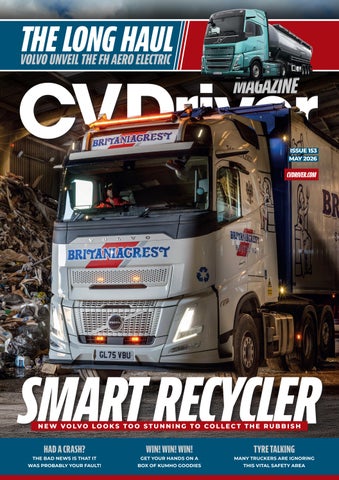
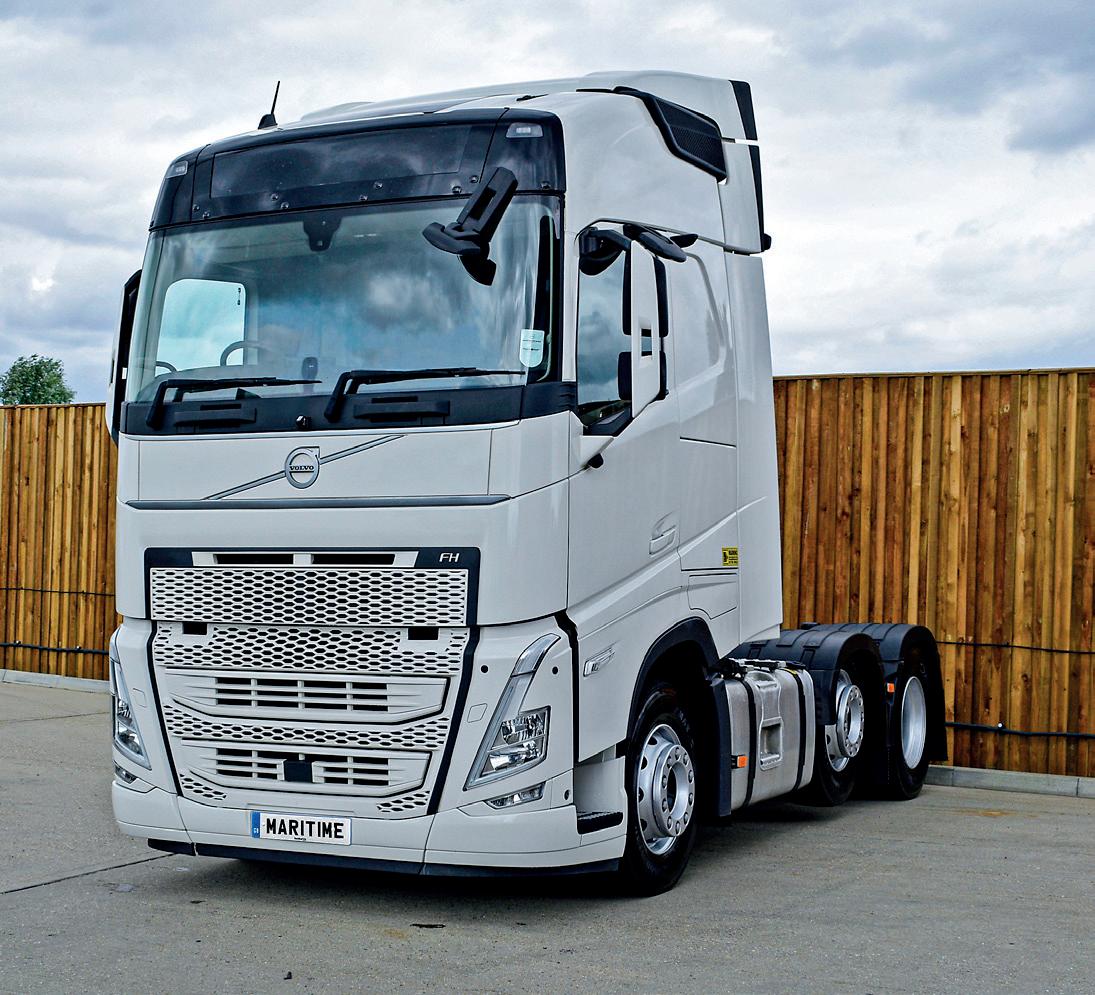
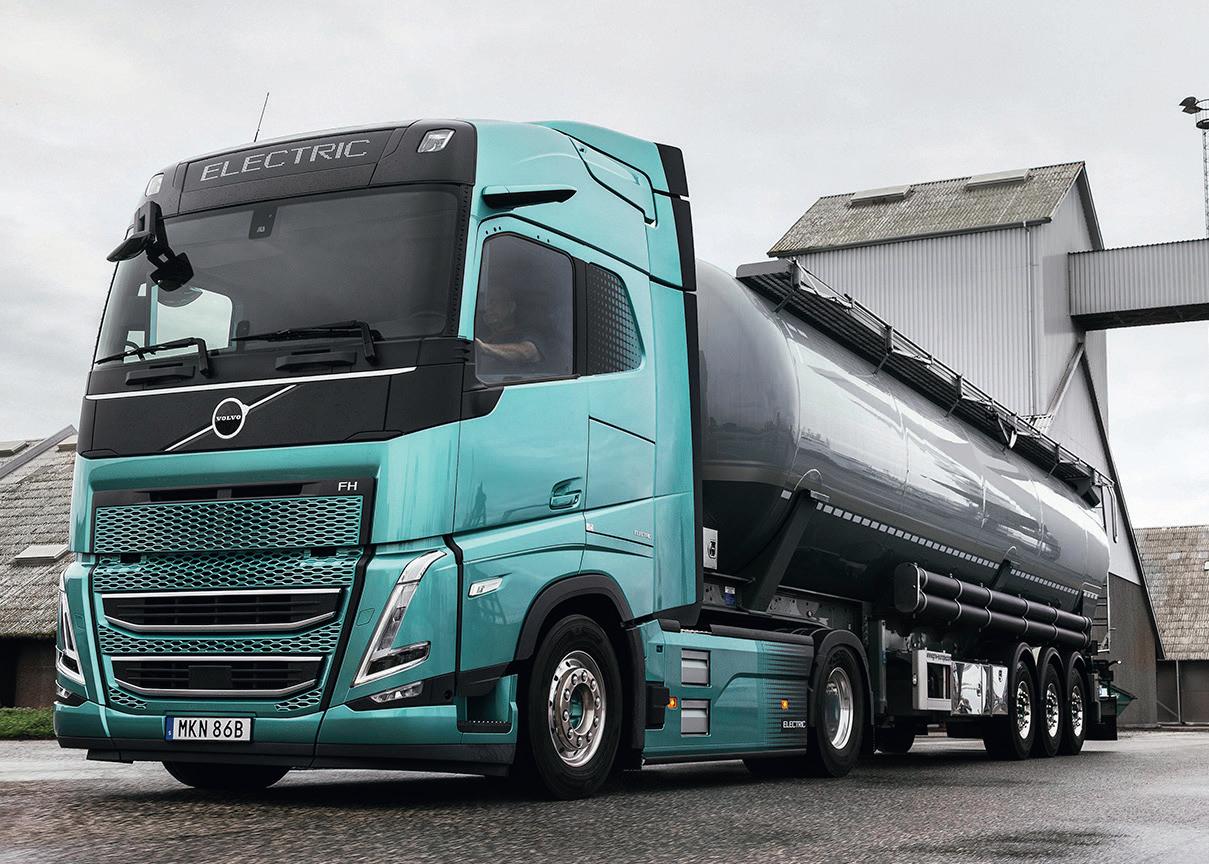
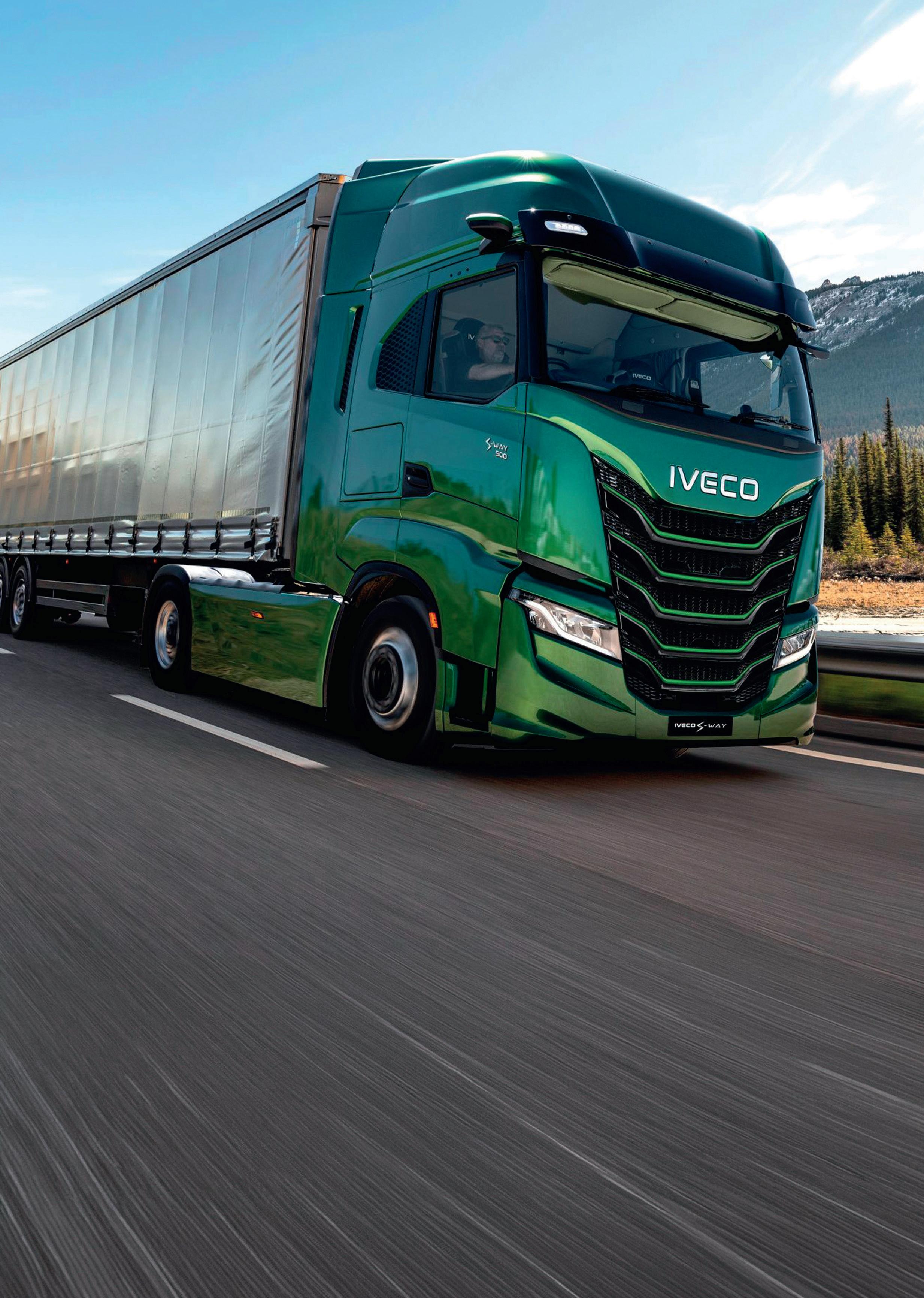
Meet Volvo’s new range of electric trucks capable of up to 435 miles on a single charge
Mobile: 07590 547343
Email: sales@cvdriver.com
NOTE
Editorial
Editor: Trevor Gehlcken
Art Editor: Leo Gehlcken
Telephone: 01257 231521
Email: design@cvdriver.com
The publisher makes every effort to ensure the magazines contents are correct. All material published in CV Driver Magazine is copyright and unauthorised reproduction if forbidden. The Editors and publisher of this magazine give no warranties, guarantees or assurances and make no representations regarding any goods or services advertised in this edition.
CV Driver Magazine is published under a licence from Commercial Vehicle Media & Publishing Ltd. All rights in the licensed material belong to Matthew Eisenegger or Commercial Vehicle Media and Publishing Ltd and may not be reproduced whether in whole or in part, without their prior written consent. CV Driver Magazine is a registered trademark.
If you are not going to keep this magazine for future reference please pass it on or recycle it.
SNOOPER SECRETS
We highlight how UK firm Snooper has been helping truck drivers to stay safe and efficient since 1979
There’s another great gift box from Kumho Tyres up for grabs in our easy competition
DIGITAL DAYS
Focus on the truck firms that are ditching their classic old paper based systems
ECONOMY GAINS FUEL NEW TRUCK PURCHASES
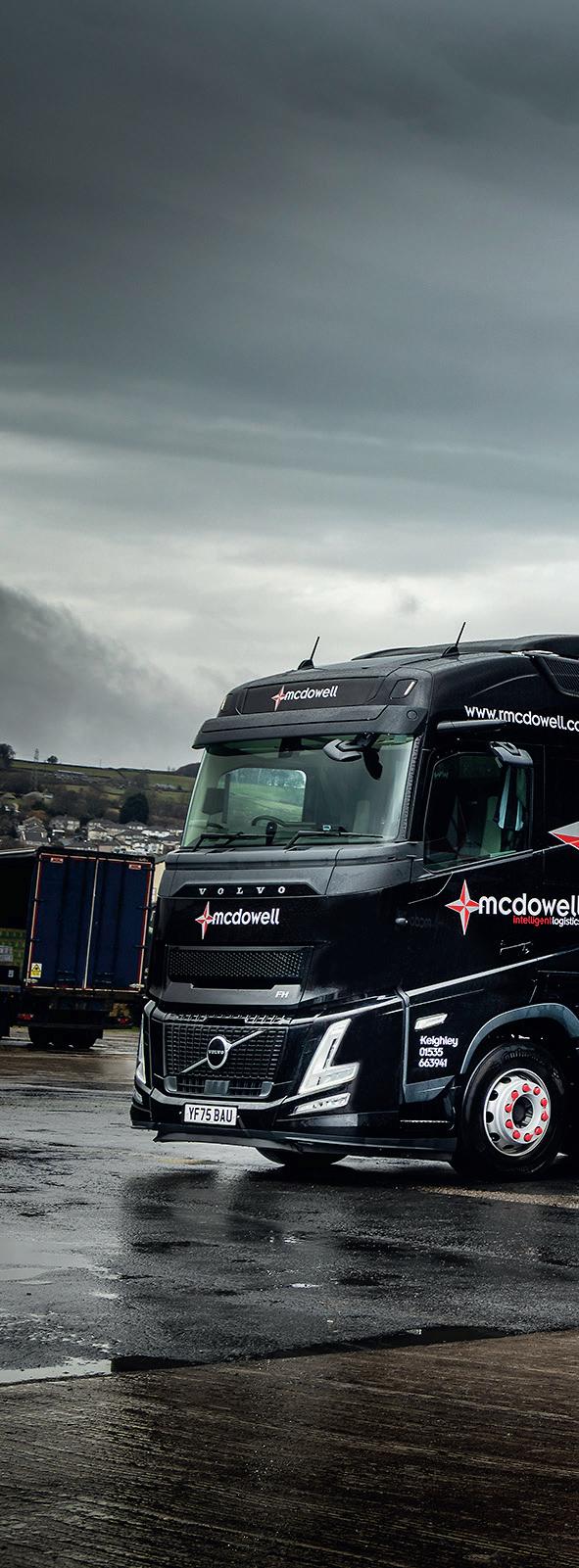
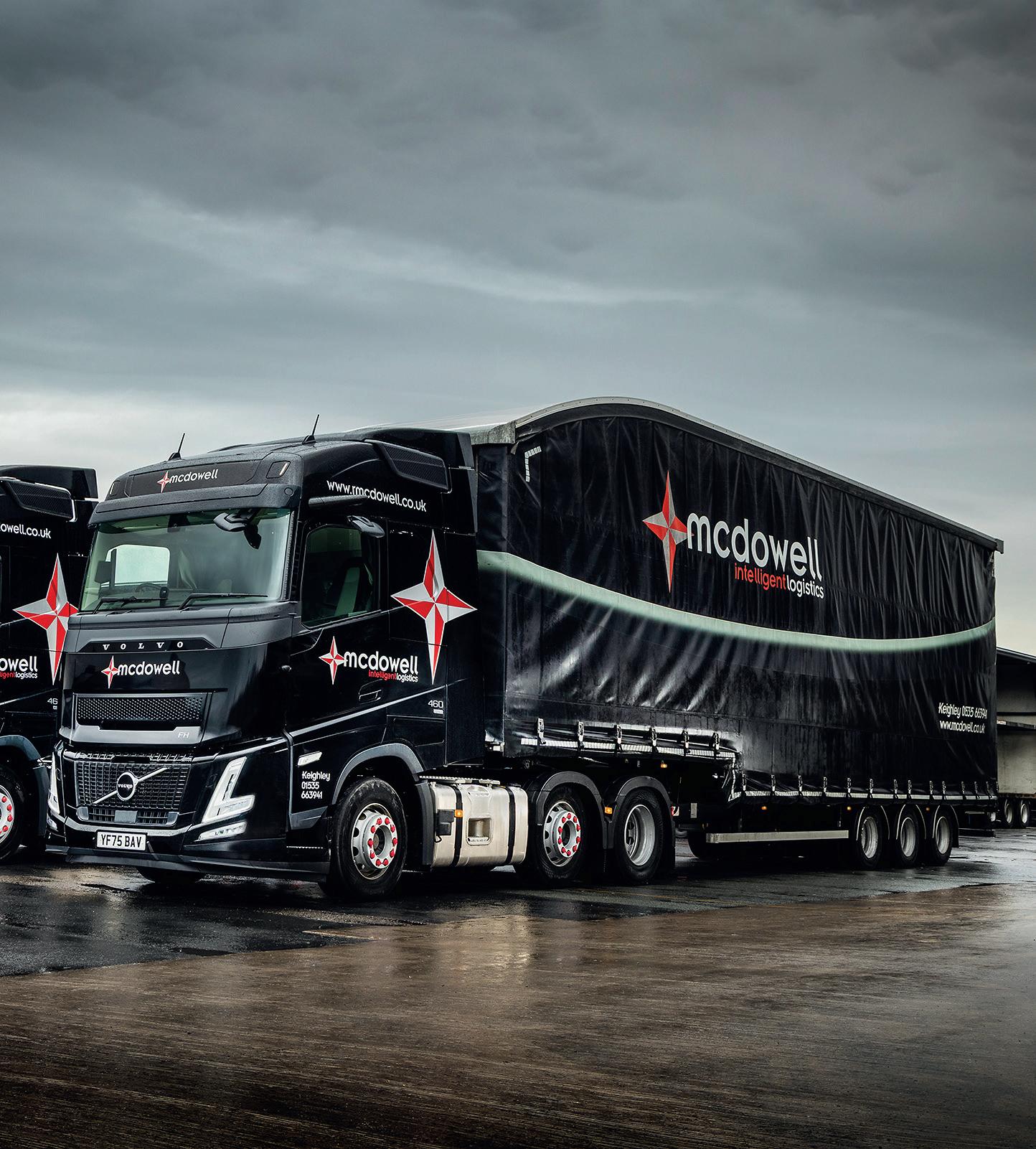
KEIGHLEY-BASED R MCDOWELL HAULAGE & DISTRIBUTION HAS TAKEN A NEW DIRECTION
Its commercial vehicle fleet has opted to acquire three Volvo FH Aero 6x2 tractor units to support its high mileage operations. The new arrivals are direct replacements to similar models previously supplied by a different manufacturer.
Geoffrey Hirst, director, said: “This is the first time we’ve chosen Volvo Trucks. From the first conversation, it was clear that its team understood our priorities and could deliver a solution that would make a real difference to our business.
“Fuel efficiency was a major factor. These trucks will each be covering up to 140,000km annually, so every litre saved has a big impact on our bottom line. Volvo’s turbo-compound technology really impressed us while we were trialling the Aero cab. We’re already seeing the benefits in smoother journeys and lower running costs, which reinforces that choosing Volvo was the right move for the long term.”
The FH Aeros are each powered by a Euro 6-compliant D13TC Step E
engine, which produces 460 hp and a peak torque of 2,600 Nm. Volvo’s ultra-efficient turbo-compound technology uses an extra turbine after the turbocharger to reuse excess energy from the exhaust. This allows energy to be converted to torque directly on the crankshaft, creating a powerful and extremely fuel-efficient engine.
The I-Save driveline also stands apart for delivering 300Nm more torque than the standard 460hp.
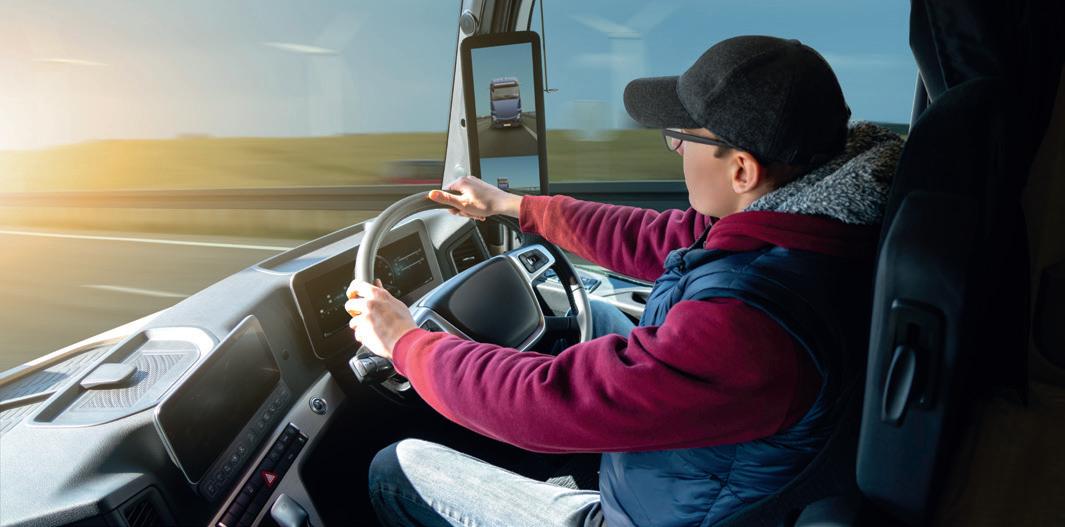
Aerodynamic efficiency is further aided by Volvo’s Camera Monitoring System (CMS), which replaces traditional exterior mirrors.
The trucks are all finished to a high specification, including leather upholstery, dual armrests, an adjustable steering wheel with neck-tilt functionality, and climate control. This comfortable working environment makes them ideally suited to the customer’s high mileage work, with each truck double-shifted on general haulage, operating across the UK up to six days a week. ■
EVERY LITRE OF DIESEL SAVED HAS A BIG IMPACT ON OUR BOTTOM LINE
LYMM TRUCKWASH
BEST IN THE UK WEBFLEET CALLS FOR FOCUS ON SAFETY
TITLE AWARDED BY INDUSTRY PROFESSIONALS IN SNAP’S INAUGURAL AWARDS
Lymm Truckwash – now in its 59th year and proudly family-owned – has been named the ‘Best Truck Wash (UK)’, following votes from more than 2,500 drivers and industry professionals.
Based at Lymm, Cheshire, just off the M6 and M56 motorways, the facility is widely regarded as one of Europe’s largest commercial vehicle wash operations, serving over 60,000 trucks each year. The award recognises the company’s ongoing commitment to delivering high standards of service, efficiency and care to its customers across the haulage sector.
IT’S A REAL TESTAMENT TO THE HARD WORK OF OUR TEAM
This latest accolade highlights Lymm Truckwash’s strong reputation within the industry, built over decades of consistent performance and investment in its facilities and team.
“We’re incredibly proud to receive this award, especially as it’s been voted for by the very people who use our services day in, day out,” said managing director Laura Cardwell, who bought the business from her parents in 2018 and moved it to
their current purpose built site at Poplar Park in 2019. “Its a real testament to the hard work of our team and our commitment to providing the best possible service for drivers and operators alike.”
The recognition comes at an exciting time for the business, as it continues to invest in its facilities to support growing demand and improve customer experience, with planning to add additional two wash bays, going from four to six bays.
Serving a broad customer base from major fleet operators to independent drivers from all over the UK and Europe, Lymm Truckwash remains focused on maintaining its high standards while supporting the wider UK and European haulage industries.
Lymm Truckwash is open Monday to Friday 7am to 4.45pm, and Saturday 7am to 11.15am. To find out more, visit: lymmtruckwash.co.uk ◼
NEW FIGURES SHOW IMPROVEMENTS IN ROAD SAFETY ARE LOSING MOMENTUM
This has prompted Webfleet to call for renewed focus on fleet risk management.
Data from the Office of Rail and Road shows that 1,931 people were killed or seriously injured on England’s strategic road network in 2024, up from 1,908 in 2023, while the casualty rate remained unchanged at 19.9 per billion vehicle miles travelled.
Provisional Department for Transport figures for the year to June 2025 put the number of people killed or seriously injured across Great Britain at 29,896, with little change on the previous 12 months.
These figures should prompt fleets to take a more proactive approach to risk, according to Webfleet, Bridgestone’s advanced fleet management solution.
“Any sign that road safety progress is slowing should be a prompt for organisations to take stock of how they are managing risk,” said Alex Crane-Robinson, regional director, UK and Ireland at Webfleet. “Road safety cannot be treated as a one-off initiative or something that is reviewed once a year.”
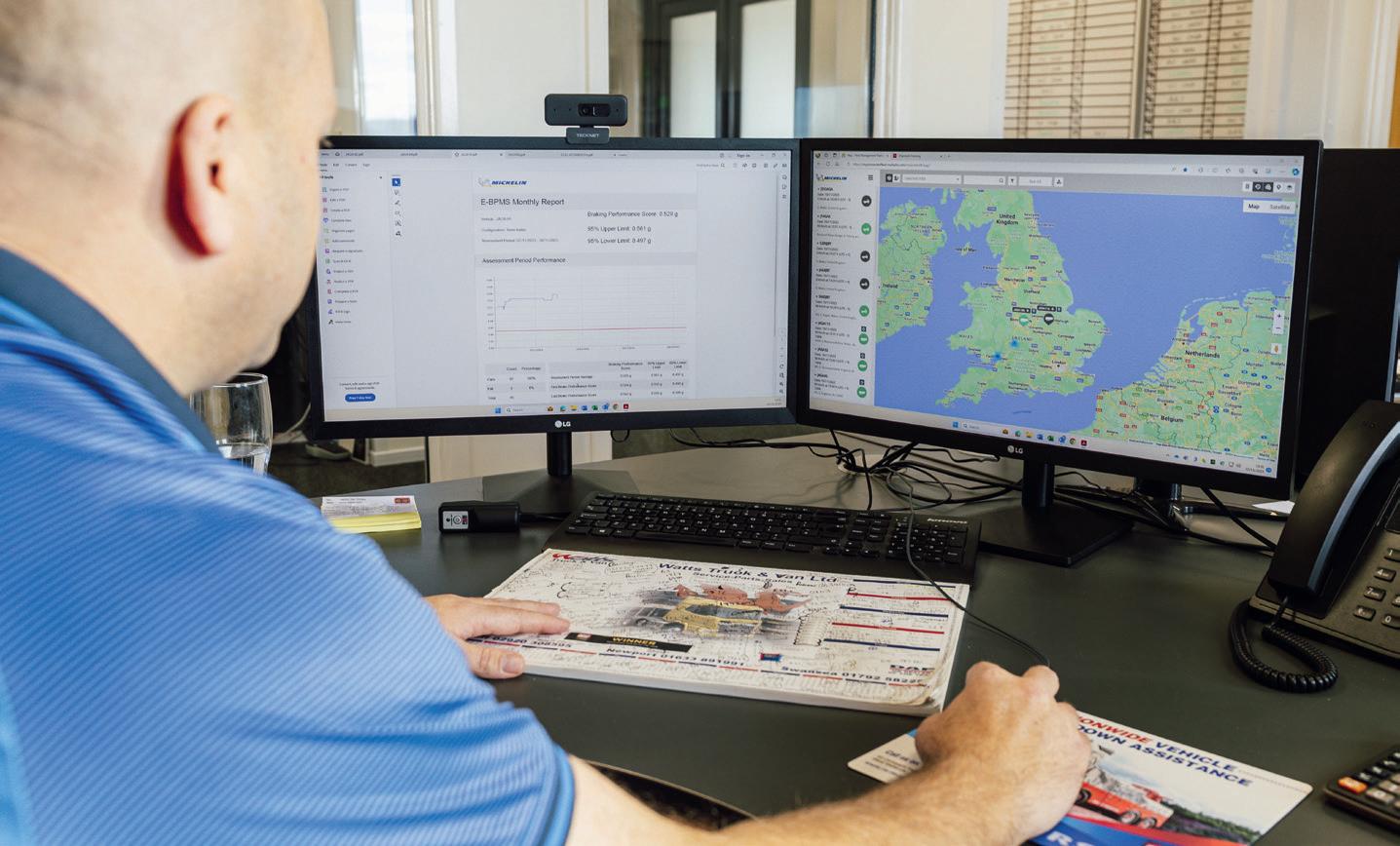
Crane-Robinson points out that fleets need to manage safety continuously, using fleet data to build a better understanding of incidents and their causes. This may include making better use of data already available through fleet management systems to spot patterns earlier and respond before problems escalate.
Patterns such as speeding, harsh braking, fatigue, recurring issues on certain routes and incidents at particular times of day can help fleets spot where risk is developing.
This kind of insight, he says, can support a more preventative approach, from tailored driver training and changes to schedules through to closer scrutiny of whether particular vehicles or routes are linked to repeated problems.
“Practical steps, backed by a clearer view of driver and vehicle risk, can make a real difference,” he said.
“When fleets have a strong understanding of day-to-day risk, they are better placed to intervene early and help prevent repeat problems.” ◼
DRIVER BEHAVIOUR PROVED THE MAIN CAUSE OF CRASHES NEW CHARGING MODEL FOR ELECTRIC VANS AND TRUCKS
ROAD CONDITIONS ARE OFTEN BLAMED AS AN EXCUSE FOR BAD DRIVING IT COULD ELIMINATE ONE
Anew road safety report has proved that driver behaviour and not road condition is the dominant factor in collisions.
The report, from AI-powered fleet technology specialist Motive, shows that drowsiness, distraction and aggressive driving consistently precede incidents, reinforcing the need for fleet chiefs to take action on distracted and unsafe behaviour.
The report analyses safety events captured in 1.2 billion hours of dashcam video to identify when, where, and why collisions occurred from 2024 to 2025.
Other key findings include that mobile phone use is among the top five risky behaviours linked to collisions, with use peaking in late afternoons. Among truck fleets, drivers in agriculture show the highest rates of mobile phone use.
The data also reveals that latenight driving is more dangerous than rush hour. Collision risk peaks at 3am, when it triples compared to midday.
Motive said the research shows the pressing need for driving analytics and why we need technology more than ever to help fleet managers and drivers tackle challenges leading to collisions.
Nyanya Joof, head of UK at Motive, said: “Our data shows that collision rates climb steadily as days get shorter, weather becomes more unpredictable and traffic volumes increase ahead of the holidays.
“But professional drivers don’t have the option to stay home –deliveries have to continue in all conditions. That’s where AI can make a real difference. When organisations have real-time alerts and handsfree communication built directly into their vehicles, they can detect danger sooner, respond to risk instantly and keep drivers safe, even when conditions are at their worst.” ◼
Below: This research shows the pressing need for driving analytics
OF THE DRAWBACKS OF USING ELECTRIC TRUCKS
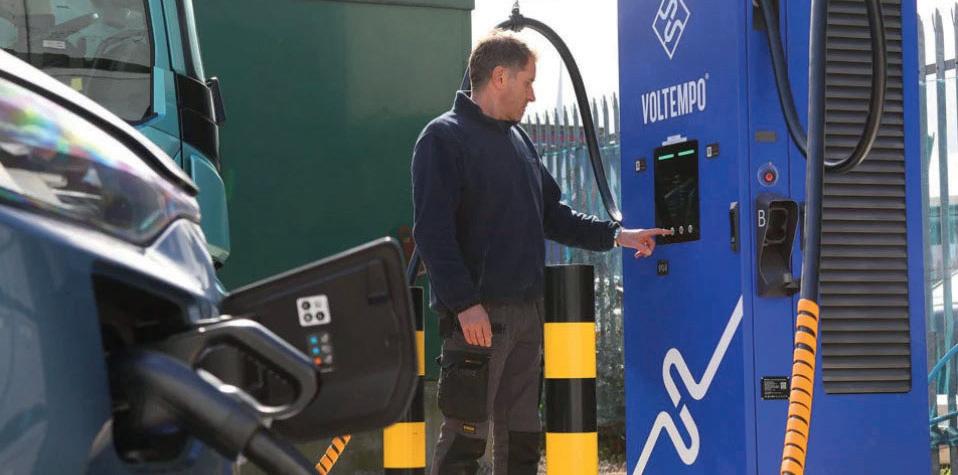
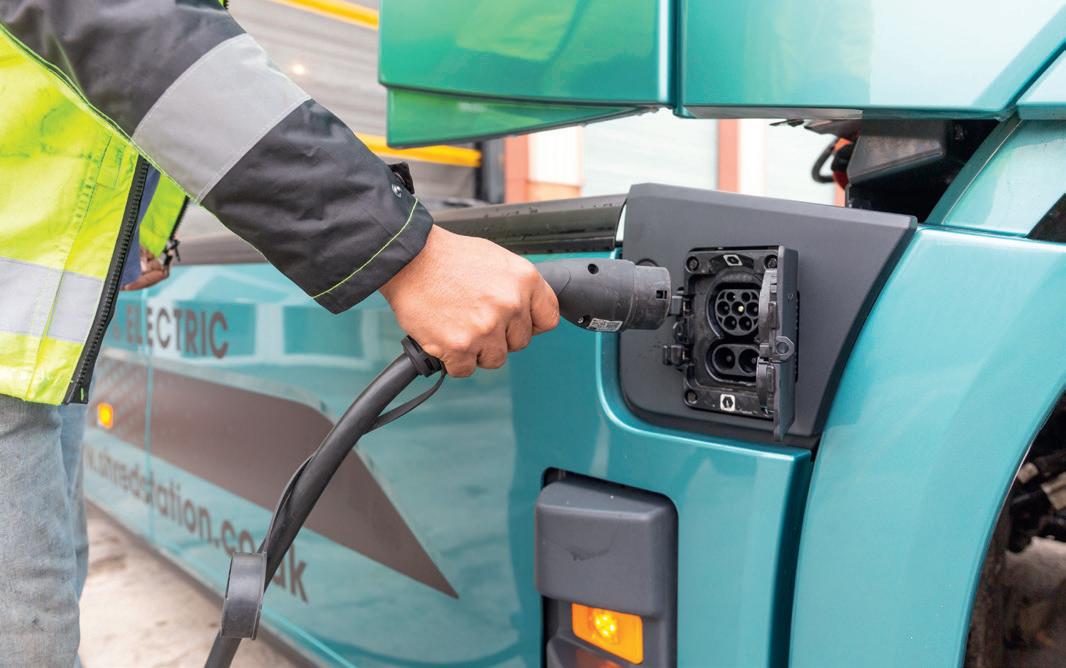
A new model for electric truck and van charging has been launched by Voltempo and Corpay. The partnership combines Voltempo’s network of commercial vehicle depot-based charging locations with Corpay’s global fleet payment platform, EV charging network and energy procurement capability.
The pair say it could help transform the economics of electric freight by allowing operators to access charging, energy and payments through a single platform, while avoiding the upfront capital investment typically required for depot charging infrastructure.
Voltempo, which leads the UK Government-backed eFreight 2030 consortium, is developing a nationwide network of highpower charging hubs located at logistics depots.
Through its Depot Charging as a Service (D-CaaS) model, Voltempo installs and manages charging infrastructure at depots and logistics sites, acting as a depot point operator (DPO) on behalf of depot owners and connecting those locations into
a wider secure charging network accessible to fleet operators.
Under the new partnership, Corpay’s global fleet platform will connect a selection of qualifying operators directly to the Voltempo charging network, enabling fleets to locate, book and pay for charging at participating depots using their existing EV charge cards, including Allstar Chargepass, all within a single billing relationship.
Simon Smith, CEO of Voltempo, said: “This partnership fundamentally changes how the freight industry electrifies. By bringing together charging infrastructure energy procurement and fleet payments into a single commercial model, we’re removing some of the biggest barriers operators face.
“We’re demonstrating that electric trucks and vans can be more profitable, more productive and ultimately better for operators’ businesses, with lower emissions as an additional benefit.” ◼
Below: EV's can be more profitable, more productive and better for businessesanalytics
DAF TRUCKS IS EV TRUCK MARKET LEADER FOR Q1 2026
TITLE FOLLOWS A POSITIVE START TO THE YEAR FOR ELECTRIC VEHICLE SALES
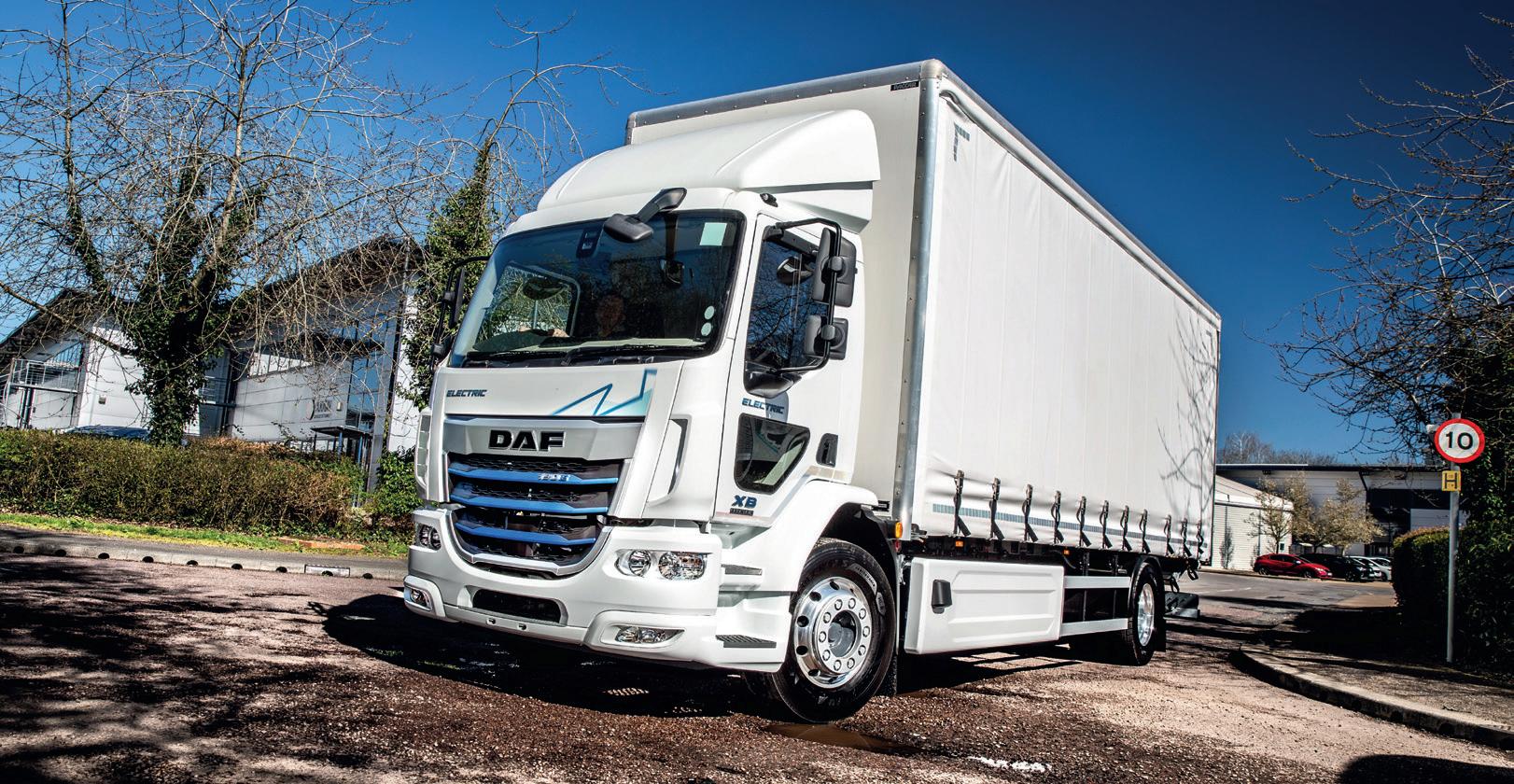
To celebrate DAF’s achievement in the electric truck marketplace, the manufacturer has unveiled a suite of limited-time-only finance deals across the XB, XD, XG Electric line-up. When combined with the government’s revitalised Zero Emission Truck Grant (ZETG), the offers make it even more attractive for operators to take either their first or next steps towards fleet decarbonisation.
Every finance package is offered to customers as a Contract Purchase through PACCAR Finance. Working similarly to a passenger car PCP agreement, customers make monthly payments against the truck and receive a guaranteed future value, giving flexibility to decide whether to return the vehicle, extend the finance or purchase the truck at the end of the term. To help operators and drivers build confidence with their new electric truck, all vehicles will come with the support of DAF Fleet Services, who provide triage services and VOR management to support uptime.
With high fuel prices presenting an ongoing challenge for haulage and logistics businesses, the new deals mean DAF’s medium duty offering, the 19-tonne XB
DAF IS PUSHING FORWARD WITH AN ATTRACTIVE PROPOSITION FOR FLEETS IN THE URBAN, DISTRIBUTION AND HAULAGE SECTORS
Electric, could save operators almost £19,000 over the course of a 60,000km per annum, 60-month contract purchase, compared to the combustion equivalent. For DAF’s distribution-focused XD EV, TCO calculations show that the electric truck could save more than £23,000 over five years and 500,000 kilometres, against a diesel XD. Fleets choosing the larger XG FTN EV could see savings in excess of £8,000 for the same contract specification.
“Our electric truck
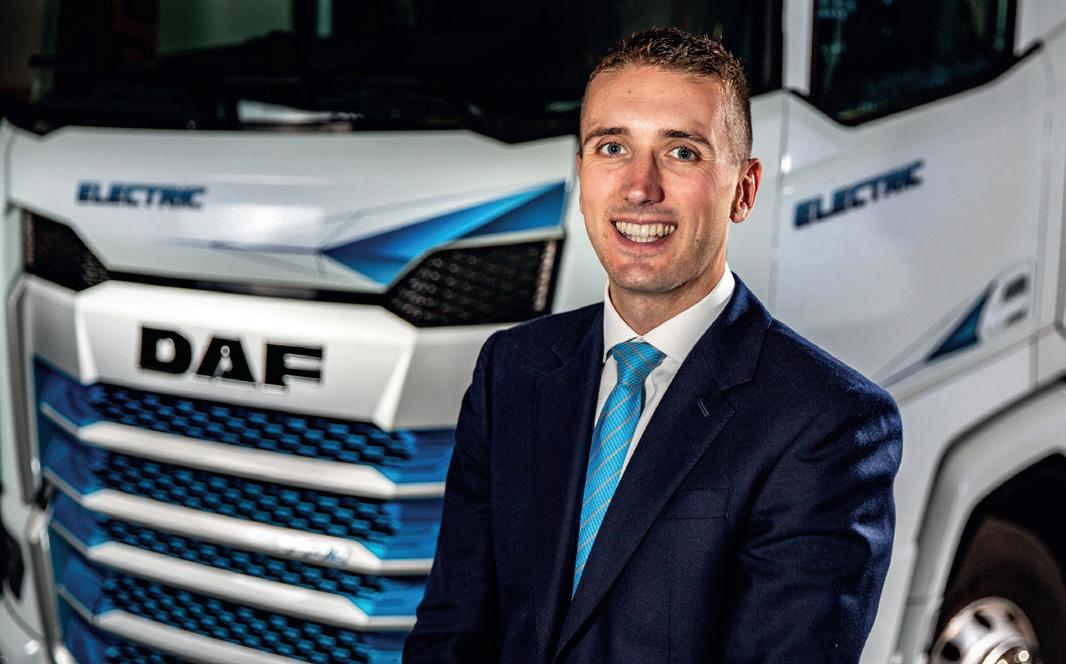
range offers customers an opportunity to cap their diesel dependency and make inroads into fleet decarbonisation at a time of great uncertainty at the pumps,” said Louis Jones, EV and connected services director at DAF Trucks. “Ending Q1 as UK EV market leader demonstrates that DAF is pushing forward with an attractive proposition for fleets in the urban, distribution and haulage sectors.
“DAF’s commitment to electric is reflected with our newly unveiled, limited-time finance deals. We want to make the road to decarbonisation as smooth as possible and these packages are just one of the
Left: DAF has unveiled a suite of limited-time-only finance deals across the XB, XD, XG Electric line-up
ways we’re helping to deliver that for customers.”
In addition to its diverse vehicle portfolio, DAF has a suite of complementary solutions that offer a near one-stop-shop approach to onboarding an electric fleet. One such example is PACCAR Power Solutions, which can supply an array of DC fast charging options – including the ChargeMax and PowerChoice – as well as a portable PacMobile charger capable of delivering 40kW continuously.
All can be complimented with tailored service packages and can be installed alongside PACCAR Power Solutions’ Battery Energy Storage System (BESS). Acting as a heavy-duty battery bank, BESS locally stores energy on-site and allows operators to capitalise on lower tariffs, retain excess solar energy and maximise vehicle efficiency when recharging vehicles. ◼
Below: Louis Jones – making electric trucks even more attractive for buyers
LAUNDRY CLEANS UP WITH NEW ELECTRIC TRUCK
ENGLAND’S OLDEST FAMILY LAUNDRY BUSINESS HAS TAKEN A BOLD STEP INTO THE FUTURE
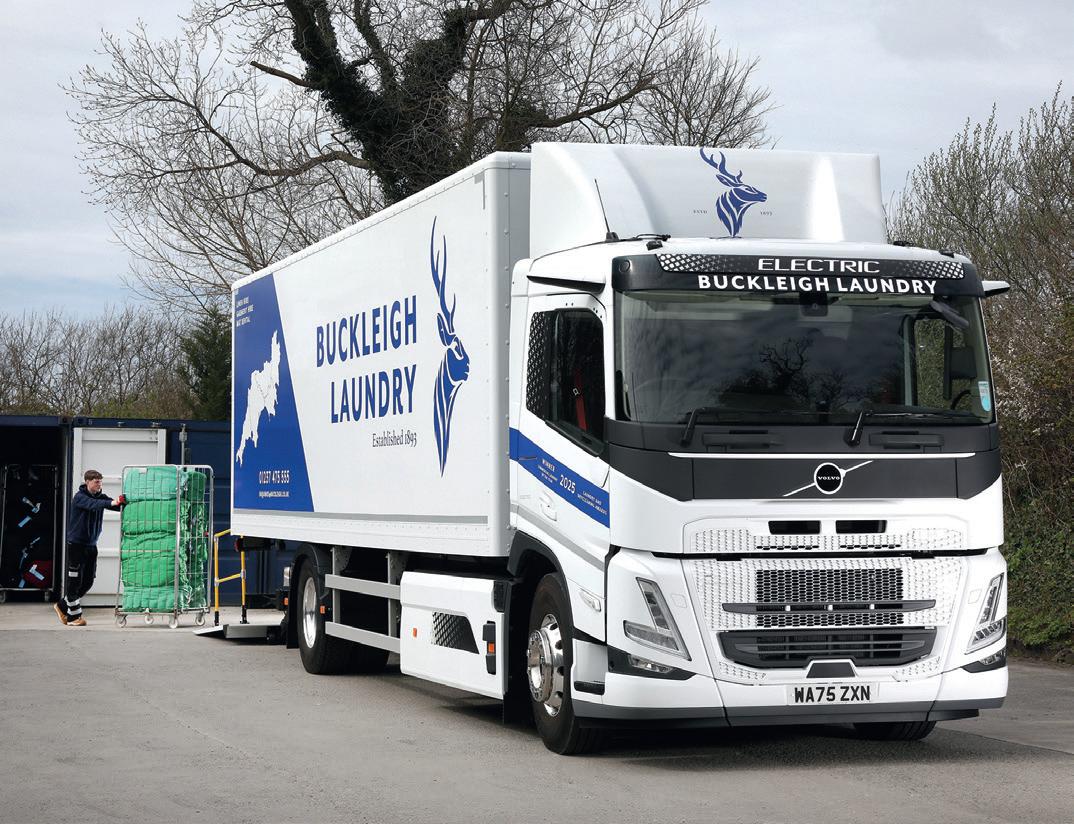
Anew Volvo FM Electric for Buckleigh Laundry will replace an older diesel truck – a move that will see it cut 32 tonnes of carbon emissions from its transport fleet each year.
The zero-tailpipe emission truck will be used for delivery and collection of the North Devon-based firm’s linen products to customer sites across the West Country.
Henry Boyle, managing director, said: “We take
sustainability seriously and we believe that going green is a clear commitment to the future. The sooner we begin looking for a clear strategy to cut our emissions, the greater the impact we will have – that’s the reason we opted to go down the electric route.
“This one vehicle will save 32 tonnes of carbon from our commercial vehicle fleet being emitted into the environment every year it’s in operation.”
Built on a 6,300mm
Left: The new Buckleigh Laundry electric Volvo truck
wheelbase, the 20-tonne FM Electric – which comes equipped with a box body and tail lift – is equipped with six batteries offering a maximum range of 300km. Power is delivered by two electrical motors which generate 450hp and 2,400Nm of continuous torque.
This is paired with a standard I-Shift gearbox to deliver a smooth and quiet in-cab driving experience. The impressive performance is handled by an electromobility traction control system to help manage power output on slippery surfaces, while different drive modes are available to set the desired performance, comfort, and energy usage levels.
The Volvo FM Electric will recharge at the firm’s depot overnight and be ready for use the following morning. The long-term plan for Buckleigh Laundry would be to electrify the entirety of its commercial vehicle fleet.
TRL UNVEILS NEW BRAND IDENTITY
TRL, the UK-based global centre for innovation in transport and mobility, has unveiled a new brand identity, its first major update in over a decade, marking a significant milestone in its evolution and future direction.
The refreshed brand introduces a new strapline, ‘Shaping Transport’, capturing TRL’s role at the forefront of nextgeneration mobility. The update reflects the organisation’s continued commitment to
delivering world-leading research and software solutions across surface transport and related markets.
With a team of expert software developers, researchers, scientists, engineers and specialists, TRL collaborates with clients and partners in more than 100 countries to tackle the most pressing transport challenges. Its traffic software solutions support over 400 cities worldwide, helping to keep
roads flowing, improve safety, reduce congestion and support the delivery of clean air targets.
The rebrand was developed in partnership with Stratos, a strategic creative and digital agency known for building brands and experiences with clarity and impact.
Stephen Lynn, marketing director, said: “This rebrand marks an exciting new chapter for TRL. Our new identity and the strapline ‘Shaping Transport’ better reflect who
“This is a proof-of-concept project; if this first electric truck can perform strongly then the plan is to transition our entire HGV fleet over time to electric,” added Henry.
THE PLAN IS TO TRANSITION OUR ENTIRE HGV FLEET OVER TIME TO ELECTRIC
“Some of the terrain we operate on in Cornwall and Devon is quite hilly and remote. It’s a challenging environment for it to prove itself but the early signs are hugely positive.”
The new Volvo FM Electric features a host of new technologies, including Volvo’s Camera Monitoring System, which replaces the traditional wing mirrors. The CMS improves aerodynamics, increases the driver’s field of view and also performs strongly in rainy and dark conditions, direct sunlight and even when driving in tunnels. ◼
we are today, a global leader driving innovation in mobility. As we continue to expand our impact worldwide, it was important that our brand clearly communicates both our heritage and our forwardlooking ambition.”
The new visual identity has been designed to bring greater clarity, consistency and impact across all TRL communications, reinforcing its position as a trusted partner in shaping the future of transport. ◼
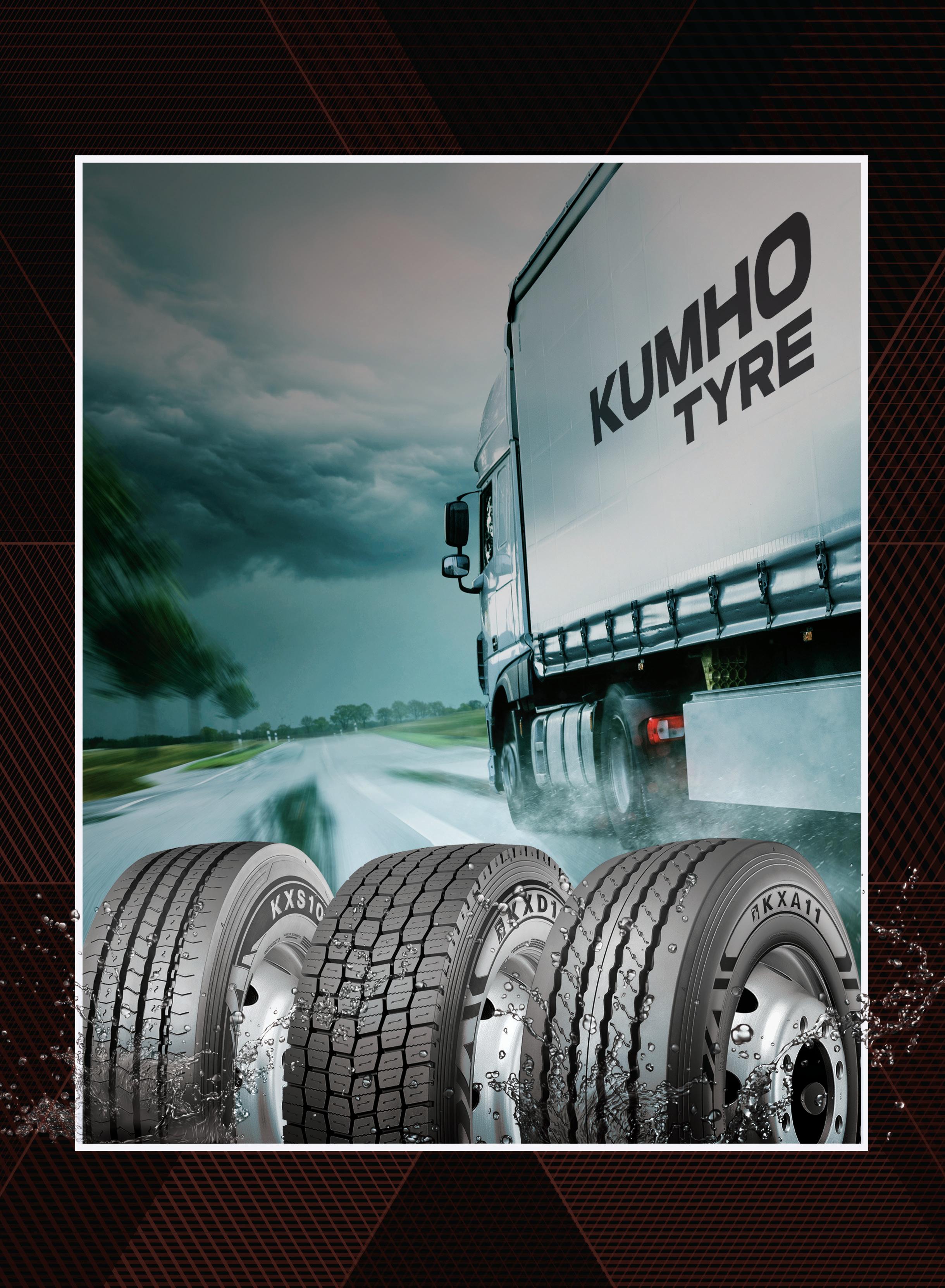
KUMHO’S MULTI-PERFORMERS
• Outstanding mileage
• Even wear
• Excellent all-season performance
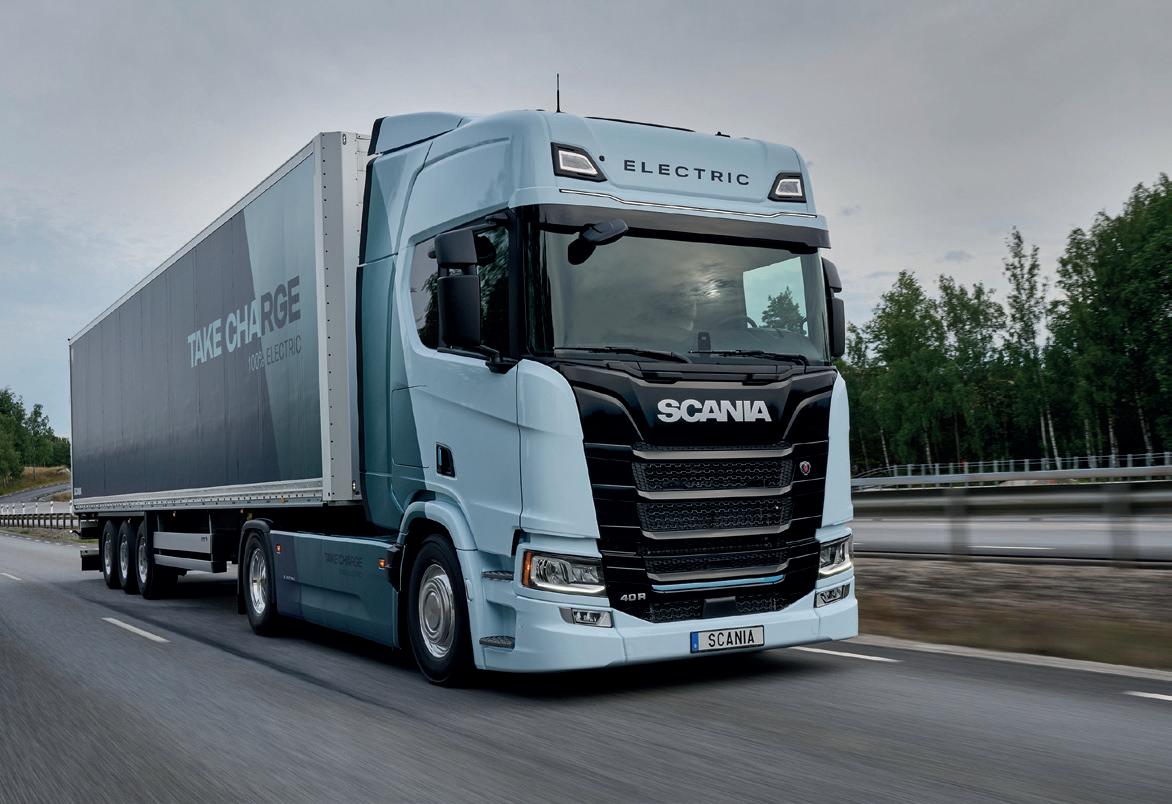
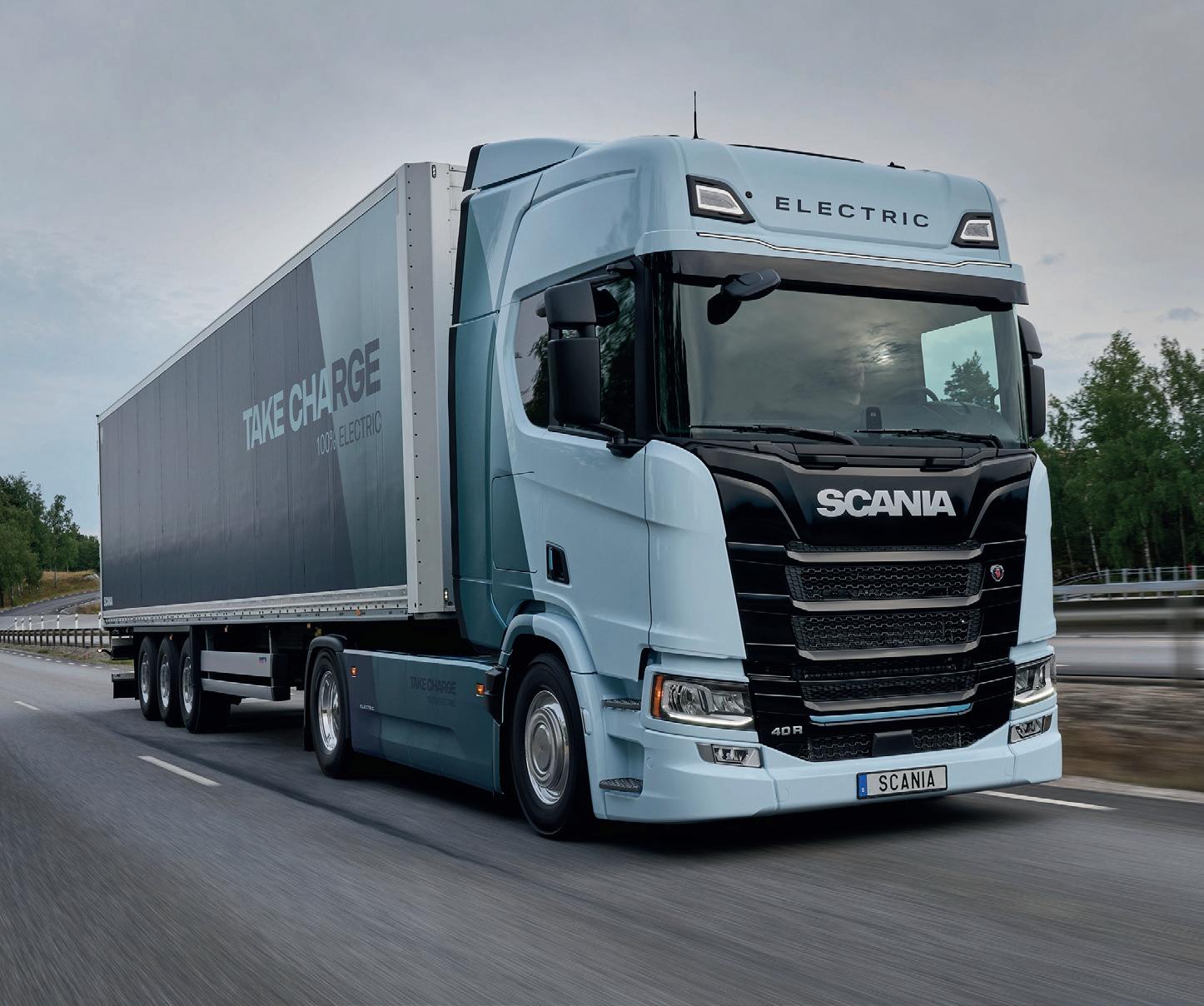
SCANIA’S SERVICES 360 PROGRAMME HAS JUST GOT BETTER…
…WITH THE INTRODUCTION OF TWO NEW REPAIR AND MAINTENANCE (R&M) OPTIONS
These are designed for operators running electric or vehicles older than five years old.
segment, used vehicle customers can choose from four different packages –Core, Plus, Full and Pro – which offer varying levels of service and maintenance: from the basic fleet maintenance and digital monitoring in Core through to the additional proactive and powertrain repairs that come with the Pro package.
Lars Gustavsson, senior vice-president and head of trucks at Scania CV AB, said: “We pride ourselves in being close to our customers’ pain points and extending Services 360 is a way to reach even more transport operators and cover the full ecosystem of needs around their business.
“No matter the type of powertrain, operation or business sector, the underlying goal of Services 360 is to support the customer and make them more profitable and sustainable for the long term.”
WE PRIDE OURSELVES IN BEING CLOSE TO OUR CUSTOMERS’ PAIN POINTS
First introduced in 2024, Services 360 is based on smart flexible maintenance planning supported by a suite of digital tools and services, which gives customers a range of different servicing packages that are tailored to their needs.
The expansion of this servicing programme comes as Scania continues to give as many of its customers as possible valuable peace of mind. And that’s true of the introduction of Scania Classic, an advanced service offering for Scania vehicles over five years old.
Acknowledging this price-sensitive
For the first time, BEV operators will be able to use Scania Services 360 programme, thanks to the addition of a new comprehensive R&M package that provides added peace of mind. By purchasing this service package, Scania will take care of all the BEV’s repair and maintenance needs, including anything related to the vehicle’s batteries. Lars added: “We want our battery electric truck customers to only focus on maximising the use of their vehicles.
“By offering a single service level we ensure that every repair, every interaction between systems and every unexpected issue is handled and covered by Scania, giving our electric truck customers all the support they need.”
These two new Scania Services 360 R&M offerings will be available to UK customers. Scania Classic is available to today, while Services 360 BEV package will be available to customers later in 2026. ◼
Above: Two new Scania Services 360 R&M offerings will be available to UK customers
DELIVERY FIRM TAKES FIRST DIRECTLY OPERATED TRUCK RHA CALLS FOR PAYLOAD INCREASE FOR EHGVS
ARROWXL FINDS IT’S CHEAPER THAN OUTSOURCING TO A THIRD PARTY
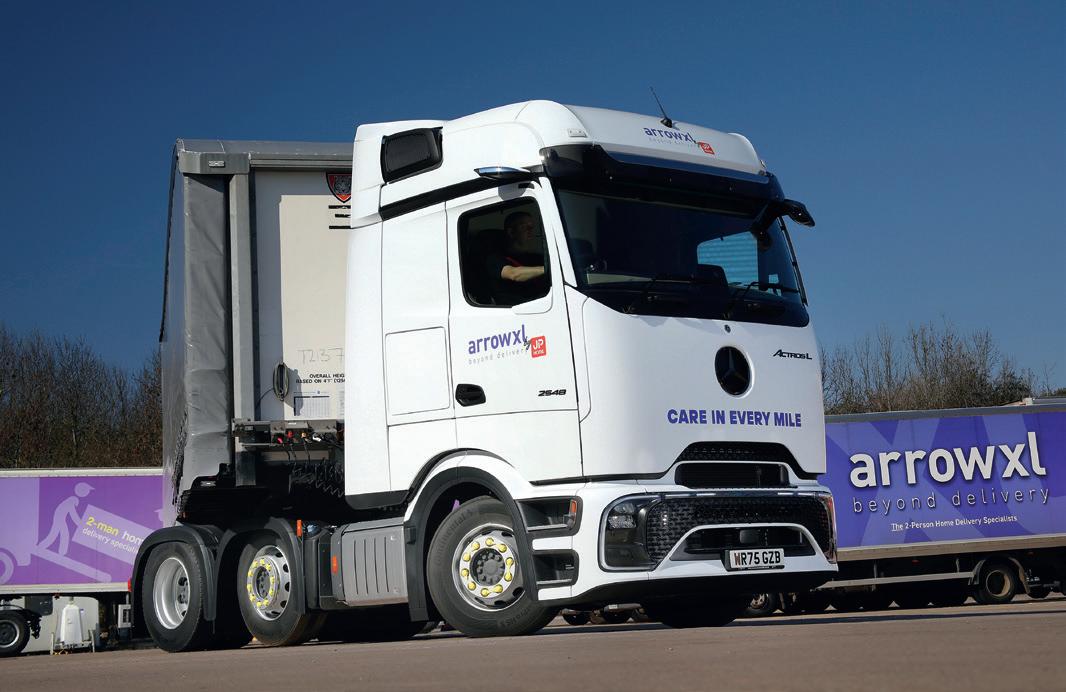
ArrowXL, the two-person delivery business, has added its first directly operated tractor unit – a Mercedes-Benz Actros L with ProCabin – to its commercial vehicle fleet with the support of Asset Alliance Group.
WE DID OUR HOMEWORK AND REALISED WE COULD MAKE SIGNIFICANT SAVINGS
The operator had previously outsourced its heavy traction requirements to third-party suppliers. However, Ian Pearson, procurement manager at ArrowXL, said following the recent purchase of the company by French logistics giant Jacky Perrenot, there was now a willingness to explore new approaches to boost performance.
“We did our homework and realised we could make
significant savings and add operational flexibility with this truck, which runs from our Worcester hub down to Devon and Cornwall, if we did it ourselves.
“Crucially, it was a model that Asset Alliance Group had in stock, which meant we could act quickly once we’d made the decision. Although it won’t be running at maximum weight, it will be pulling a doubledeck trailer and with 480hp it won’t be underpowered. It’s a fantastic bit of kit, which has been great for driver acceptance,” he says.
Taken on a three-year contract hire deal with full repair and maintenance, Asset Alliance Group organised driver training through the Mercedes-Benz dealer network to maximise driver safety and comfort and allow them to realise the truck’s MPG potential. ◼
Below: ArrowXL’s MercedesBenz Actros L with ProCabin
LESS CAPACITY FOR CARGO IS PUTTING TRUCK OPERATORS OFF BUYING ELECTRIC VEHICLES
Businesses running electric heavy trucks are losing up to 11.8% of payload capacity compared to equivalent diesel vehicles, according to the ‘Electric HGV Payload Loss Report,’ published by the Road Haulage Association (RHA).
Based on evidence from operators and vehicle dealers from across the UK, it finds that current regulations are forcing hauliers to run more vehicles to carry the same freight, pushing up costs by more than £28,000 per vehicle.
Meanwhile, it says, inadequate charging infrastructure enhances this problem further.
RHA managing director Richard Smith said: “Our industry is committed to decarbonisation, but it must be commercially viable. Our research shows that current regulations are creating a structural barrier. Without change, operators face higher costs, more vehicles on the road and reduced efficiency.
“If we want to accelerate the net-
zero transition, we need the right regulatory framework in place. As things stand, it doesn’t exist.”
The RHA is calling on Government to raise the maximum weight limit for electric HGVs to 46 tonnes, increase drive axle weight limits to 12.5 tonnes and establish a dedicated technical working group to take these issues forward.
It comes after the Association of Fleet Professionals (AFP) urged the Government to learn lessons from infrastructure issues impacting electric van adoption when considering the rollout of electric trucks.
In response to a consultation on developing a roadmap to phase out sales of new, diesel HGVs by 2040, the AFP says any new supply or demand-side regulatory frameworks will only succeed if infrastructure delivery keeps pace with vehicle supply. ◼
Above: Payload problems are forcing hauliers to shun electric vehicles
RAISING THE BAR ON COMPLIANCE
HOW TELEMATICS AND 24/7 CONNECTIVITY ARE TRANSFORMING FLEET STANDARDS
In an increasingly regulated transport environment, compliance is no longer a back-office function – it is a real-time operational priority. From driver hours legislation and vehicle safety standards to emissions monitoring and uptime obligations, fleet operators face growing pressure to remain compliant while maintaining efficiency.
For many operators, information is spread across systems, paperwork and calls. A missed warning, delayed repair, or unclear vehicle status can quickly become an expensive issue.
Against this backdrop, connected services are becoming essential tools, with Mercedes-Benz Trucks’ digital services supporting this shift. These connected services form part of Mercedes-Benz Trucks’ Digital Service World – a joined-up ecosystem that brings together vehicle data, service support and fleet insight to help operators stay compliant, plan effectively and avoid costly disruption. Together, these services create a continuous loop of visibility, action and improvement, helping operators move from reacting to issues to managing them proactively. For drivers, connected services reduce uncertainty on the road. Clear vehicle status, faster support and fewer unexpected disruptions help make day-to-day operations more predictable and less stressful. Telematics has evolved significantly beyond
simple vehicle tracking. Today’s systems provide ongoing, data-driven insights into vehicle condition, driver behaviour and operational performance. For compliance managers, this means greater visibility and control over key risk areas - from maintenance adherence to fuel efficiency and safety metrics.
At the core of this transformation is proactive maintenance. TruckLive Maintenance Management monitors key vehicle systems, identifying developing issues early before they escalate. This predictive capability not only reduces unplanned downtime but also helps operators meet their legal obligations for vehicle roadworthiness. In an environment where non-compliance can lead to significant penalties - or worse, safety incidents- early intervention is invaluable.
Building on this foundation, the introduction of Service24h Connected represents a significant step forward in compliance support. Fully integrated within the telematics ecosystem, the service provides automatic, real-time breakdown reporting and direct communication with the Mercedes-Benz Service24h network. When a fault occurs, relevant vehicle data is transmitted instantly, supporting faster diagnostics and a more efficient response.
For operators, this has clear operational and compliance implications. Faster resolution
times help operators manage the return of vehicles to a roadworthy condition more efficiently, reducing the risk of operating outside regulatory limits. Additionally, the digital record of incidents, responses and repairs supports robust audit trails – an increasingly important requirement in demonstrating due diligence to regulators and clients alike.
Another critical area where telematics supports compliance is driver performance. By capturing data on driving style, braking patterns, and fuel consumption, systems enable operators to identify behaviours that may compromise safety or efficiency. This data can then inform targeted training programmes, helping to align driver conduct with both company policies and legal standards. Environmental compliance is also firmly in focus. With tightening emissions regulations across the UK and Europe, operators must demonstrate measurable progress in reducing their environmental impact. Telematics data provides the transparency needed to track fuel usage, optimise routes, and support the transition to lower-emission operations - key factors in meeting sustainability targets and regulatory requirements.
Importantly, solutions from Mercedes-Benz Trucks are designed with integration in mind. By connecting vehicles, service networks and fleet management systems, they create a unified platform where compliance is embedded into daily operations rather than treated as a separate function.
As the regulatory landscape continues to evolve, the role of telematics will only become more central. Operators who embrace connected technologies such as Service24h Connected are not only improving efficiency, but they are also strengthening their compliance frameworks, reducing risk, and building more resilient operations. In a more complex and regulated operating environment, the ability to see clearly, act early, and stay connected is becoming essential.
Connected services are no longer an addon. They are becoming part of how modern fleets stay compliant, in control and ready for what’s next. ◼
IN FOR THE LONG HAUL
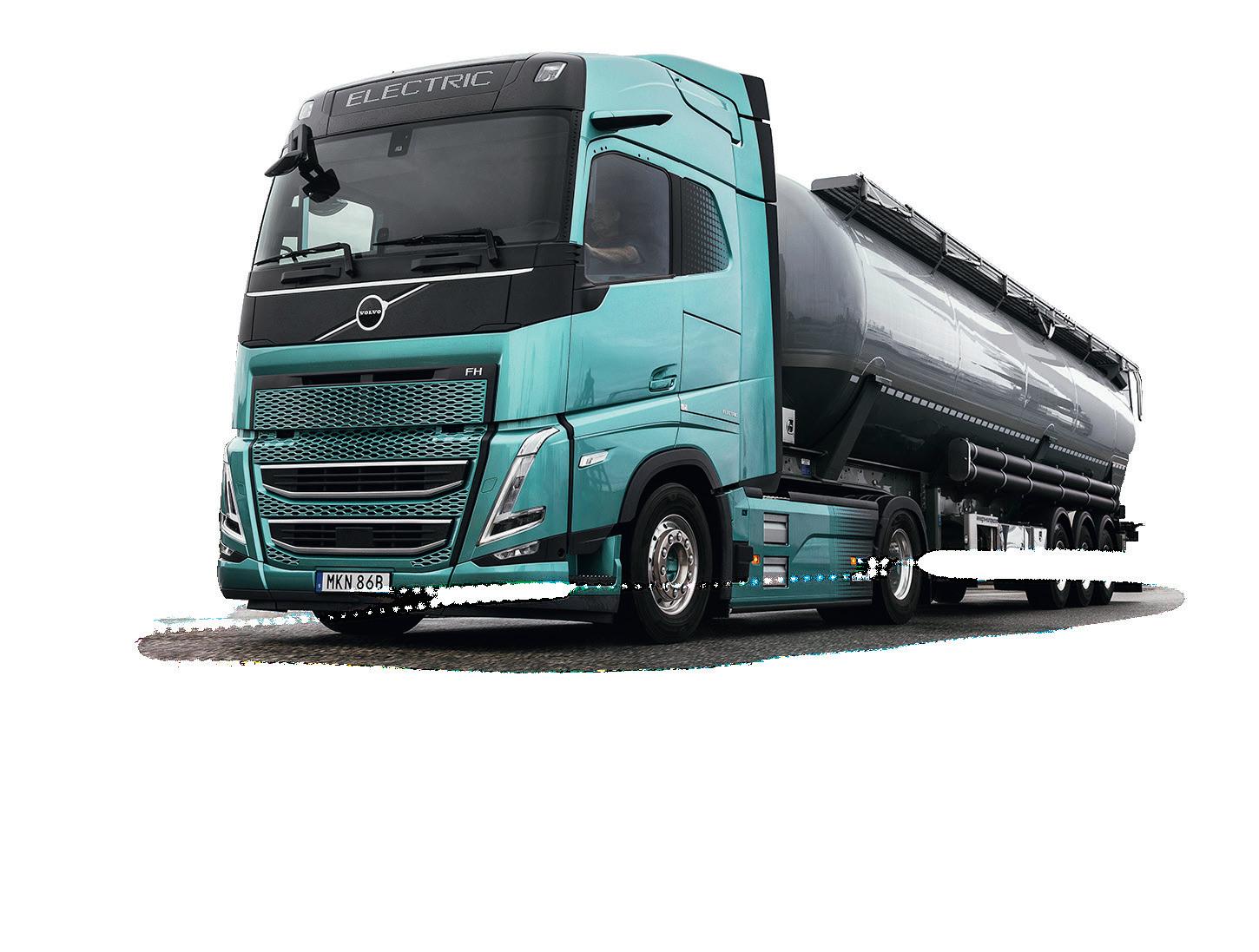
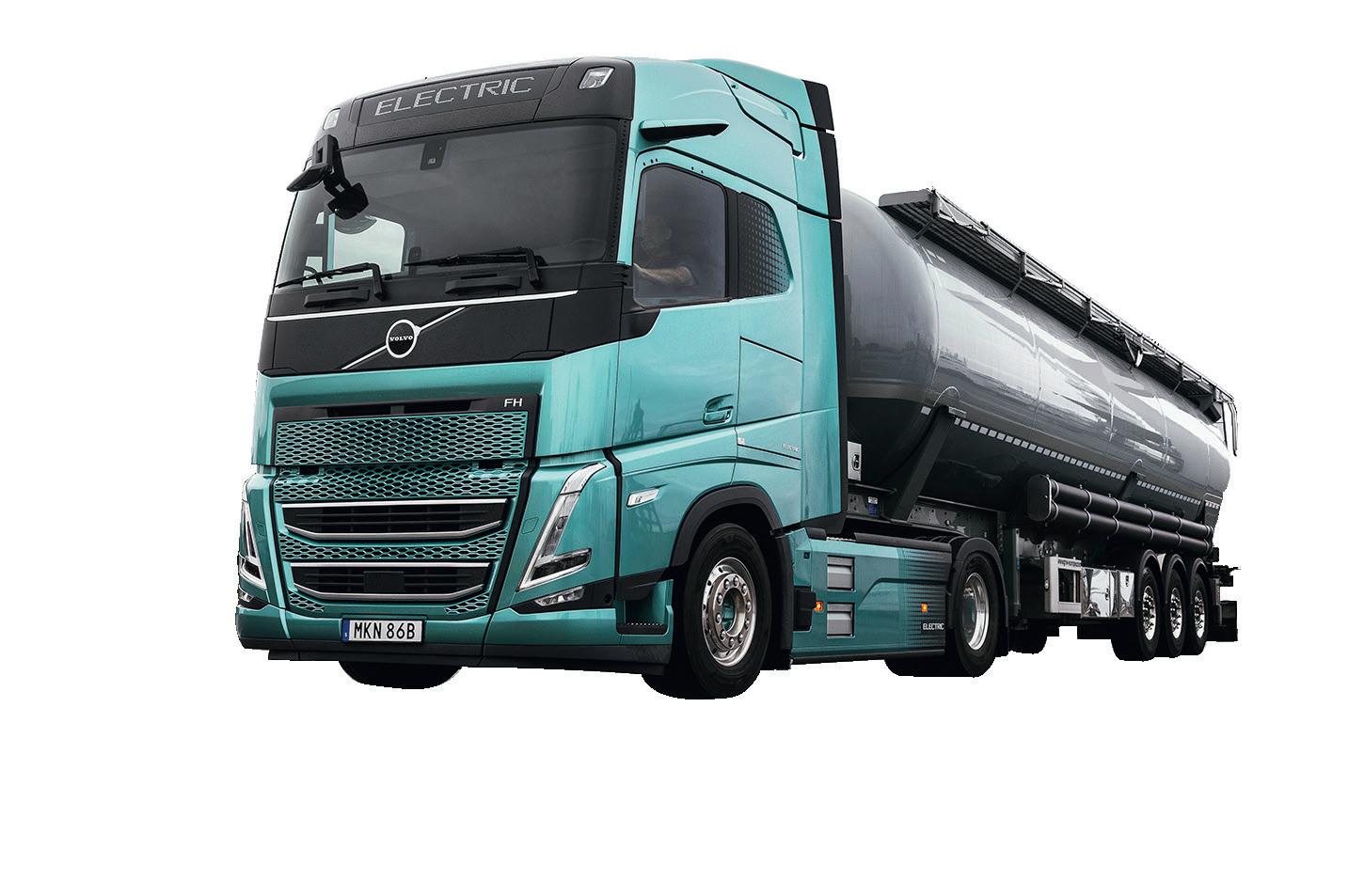
VOLVO TRUCKS HAS UNVEILED THE FH AERO ELECTRIC WITH EXTENDED RANGE, CAPABLE OF DRIVING UP TO 435 MILES ON A SINGLE CHARGE
Volvo Trucks has set a new benchmark for heavy-duty trucks with the launch of its latest electric models with improved performance, flexibility and ranges up to 700km.
The manufacturer is already a global leader in the electric heavy goods vehicle segment, with one of the largest electric truck line-ups in the industry. The company has now improved its offer further with some ground-breaking new additions.
First, a new long-distance electric truck, the FH Aero Electric with extended range, capable of driving up to 700km on one charge – a significant breakthrough for heavy electric trucks.
Second, the next generation heavy-duty
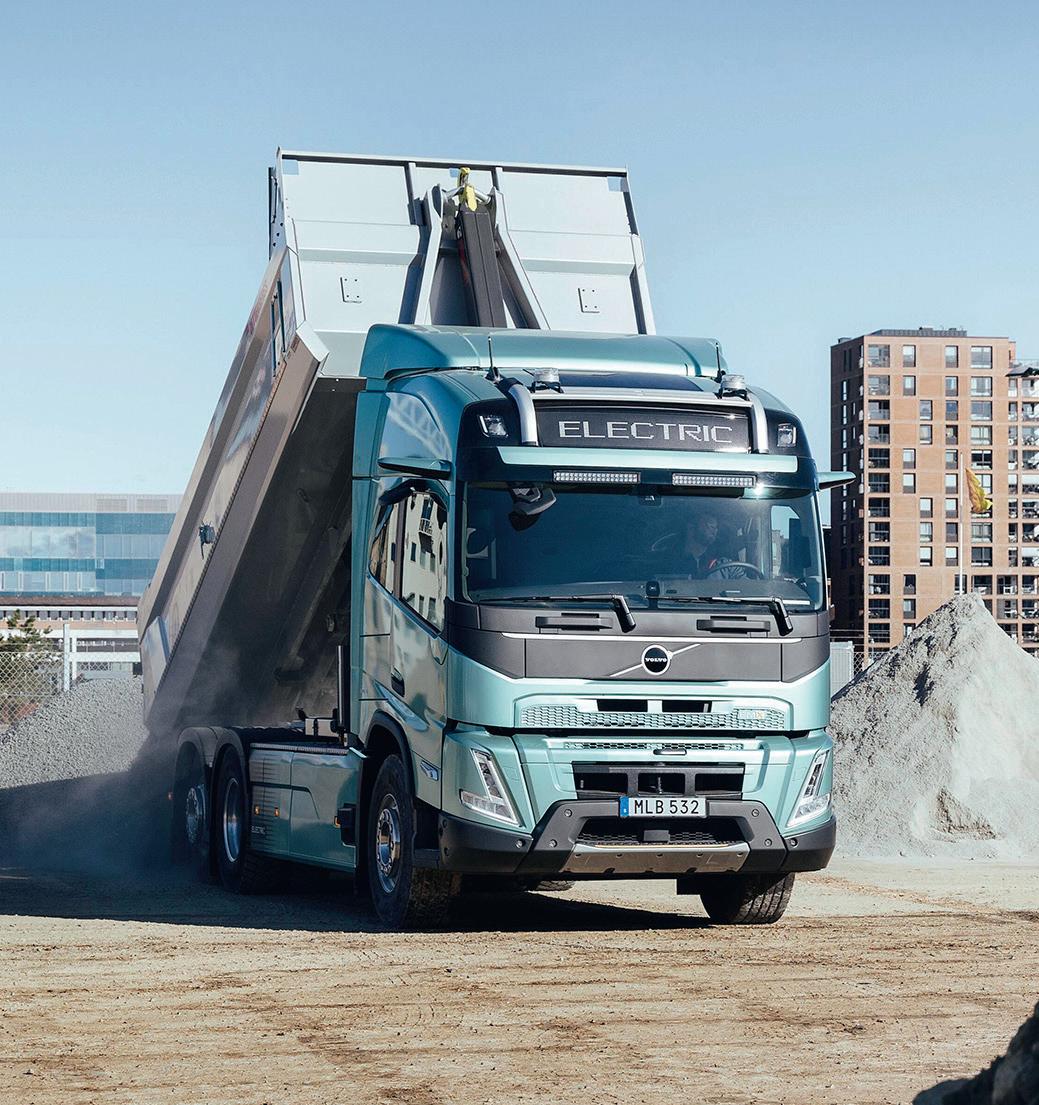
Volvo FH, FM and FMX Electric trucks, with major improvements in flexibility, productivity, driving comfort and with ranges up to 470 km – making it possible to switch even more transport assignments to battery-powered drivelines.
Roger Alm, president, Volvo Trucks, said: “We’re sharpening our offering here. We are broadening it and making electric solutions possible for an even wider range of transport assignments and also adding a cutting-edge electric truck with a range of up to 700km. This means we can fully match the business needs of our customers. It has never been easier to replace diesel trucks with electric ones.
“We stand firm in our belief that electric
vehicles will deliver a large part of the world’s truck transport in the future. With the amazing performance of all our new trucks, it’s easy to see why.”
New technology
The new Volvo FH Aero Electric with extended range can drive up to 700km on one charge, thanks to a new driveline technology, the e-axle, which creates space for significantly more battery capacity onboard. The truck is adapted to the new MCS (Megawatt Charging System) standard and can charge eight batteries from 20% to 80% in around 50 minutes. This charging can be done within the legislated rest period for truck drivers in the EU, improving productivity.
Alm said: “This long-haul electric truck is the best in the industry. It offers an outstanding range in combination with high payload, fast charging and great riding comfort. With this truck, our customers can drive really long distances and throughout an entire working day with the same productivity as diesel trucks.”
WE BELIEVE THAT ELECTRIC VEHICLES WILL DELIVER A LARGE PART OF THE WORLD’S TRUCK TRANSPORT IN THE FUTURE
Maximum flexibility
The new FH, FM, and FMX Electric trucks have an all-new driveline designed for maximum flexibility across different applications. It offers excellent driveability and is engineered so that the truck can power auxiliary equipment such as a
concrete mixer, hook lift or refuse unit without extra motors or add-ons.
This is due to an integrated gearbox power take-off (PTO) with increased functionality, enabling usage during driving. The trucks will have a range of up to 470km and can be charged from 20% to 80% in around 65 minutes.
“The next-generation FH, FM and FMX Electric are packed with new smart functions, they offer great driver comfort and make zero tailpipe emissions transport available for a very wide range of transport assignments,” said Alm.
All the new trucks are equipped with a gearbox optimised for electric transmission paired with dual motors to deliver smoother and more controlled performance. The new powershift gearboxes – eight-speed on the new Volvo FH, FM and FMX Electrics and six-speed on the FH Aero Electric with extended range – offer seamless gear shifting and also produce less noise and vibration for a more comfortable workday. The new trucks will be rolled out step-bystep to markets starting in 2026. ◼
NEED TO KNOW
Volvo FH Aero Electric with extended range
• Purpose: Long-haul and intercity transport, up to 700 km distance covered within one day
• Core feature: Compact e-axle integrating two electric motors and sixspeed gearbox into the rear axle, freeing up chassis space for more batteries.
• Up to 460 kW (623 hp) power output.
• More usable energy onboard and higher charging pace, ideal for hub-to-hub routes and two-shift operations.
• Total capacity: Up to 44-tonnes GCW (Gross Combination Weight). Flexible battery configuration to optimise balance between range and payload. Payload up to 28 tonnes.
• Range: Up to 700 km on a single charge.
• Charging: 700 kW MCS 20-80% in approximately 50 minutes | 350 kW CCS (Combined Charging System) 20-80% in approximately 85 minutes.
• Special capability: Electric power takeoff for refrigerated units eliminating the need for a separate diesel generator.
Volvo FH, FM and FMX Electric – next generation
• Purpose: On-road construction, regional distribution, urban logistics, utilities, refuse and heavy special applications.
• Core feature: New dual-motor drivetrain with purpose-built gearbox with eight gears to maximise electric torque. Up to 540 kW (731 hp) power output.
• Flexibility: Built for heavier loads and demanding topography; can be specified with twin-drive axles and low gearing for maximum flexibility.
• Total capacity: Up to 65-tonnes GCW (Gross Combination Weight). Flexible battery configuration to optimise balance between range and payload. Payload up to 23.8- tonnes (4x2 tractor).
• Range: Up to 470 km on a single charge.
• Charging: 350 kW CCS (Combined Charging Systems) 20-80% in around 65 minutes.
• Special capability: Multiple configurations with several power take-off solutions – split motors or dual-motor output for cranes, hook lifts or tipper bodies. Truck and body can be operated simultaneously.
FULLY FOCUSED ON HELPING TRUCKERS STAY SAFE, COMPLIANT AND EFFICIENT
SNOOPER REVEALS HOW ITS PRODUCTS ARE HELPING BRITAIN’S ARMY OF HARD-WORKING LORRY DRIVERS
Q. Can you give us a brief rundown of what Snooper offers for truck drivers?
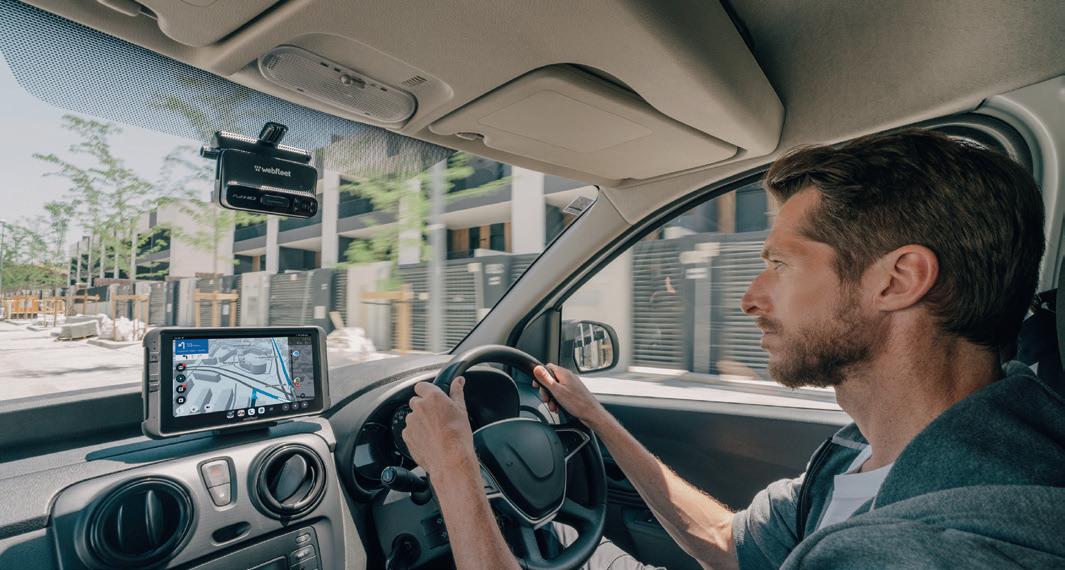
A. At Snooper, we’ve been supporting drivers since 1979 and today, we’re fully focused on helping truck drivers stay safe, compliant and efficient on the road. offering a range of truck-specific navigation and safety products, designed specifically for HGVs rather than standard cars. Our core products include Truck Sat Navs and the Bridge Saver low bridge detection system. Overall, everything we do is about one thing – making life easier and safer for truck drivers, whether that’s getting them to their destination efficiently or helping them avoid serious and expensive mistakes on the road.
Q. Some truckers use the satnav units from their cars when driving trucks. Do they really need a separate one and if so, why?
A. They really shouldn’t be doing that. Car satnavs are not designed for trucks and using one in an HGV can quickly lead to serious problems. They simply don’t take into account things like vehicle height, weight restrictions, or roads that are
unsuitable for larger vehicles.
That’s where a dedicated truck sat nav becomes essential.
A proper truck unit allows drivers to input their vehicle’s dimensions and weight, so the routing is tailored specifically to them. It actively avoids low bridges, weightrestricted roads and unsuitable routes and guides drivers along roads that are appropriate for HGVs.
Without that, drivers are effectively guessing – and that’s when you see incidents like bridge strikes or vehicles getting stuck on narrow roads.
So yes, a separate truck sat nav isn’t just a ‘nice to have’, it’s a critical tool for safety, compliance and avoiding costly mistakes.
Q. What are the standout features of your truck satnav units?
A. What really sets our truck satnav units apart is that they’re built specifically for truck drivers – not adapted from car systems.
The biggest feature is vehicle-specific routing. Drivers can input their height, weight, length and load type and the device
will calculate routes that are actually suitable for that vehicle, avoiding low bridges, weight restrictions and roads that simply aren’t fit for HGVs.
We also focus heavily on clarity and ease of use in the cab. Our units come with large, easy-to-read touchscreens and features like lane guidance and junction view, so drivers can clearly see where they need to be well in advance, especially useful on busy motorway networks.
Another standout is our multi-route planning, which allows drivers to plan complex journeys with multiple stops and choose the most efficient or economical route from the comfort of their home, helping save both time and fuel.
We also include a huge database of truckspecific points of interest, such as truck stops, fuel stations and AdBlue locations, things that are actually relevant to HGV drivers, not just car users.
Finally, we make sure our systems stay relevant with lifetime map updates and ongoing software updates, so drivers aren’t relying on outdated information.
Overall, it’s about giving drivers a system they can rely on, something that helps them drive safely, stay compliant, and avoid costly mistakes every day.
Q. You also offer bridge strike avoidance systems. Tell us a little about them.
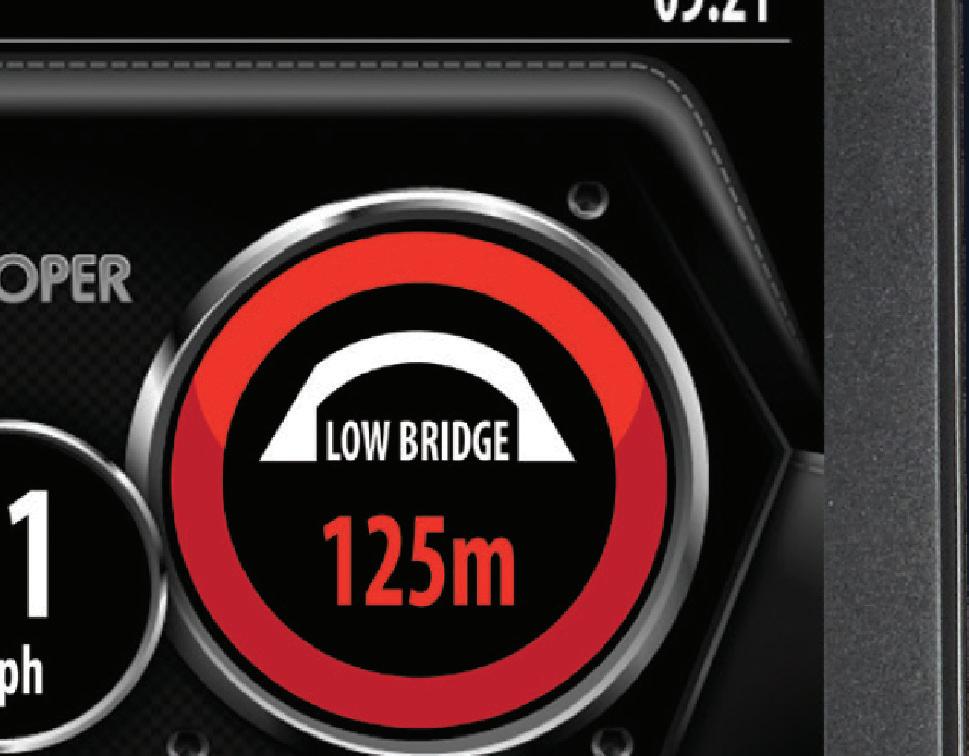
A. Yes, we do, it’s called our Bridge Saver and it’s one of our most popular products. It’s a dedicated low bridge detection system, designed specifically to help prevent bridge strikes, which are still a major issue across the UK. Unlike general satnav warnings, this is a focused safety tool that gives drivers clear, real-time alerts when they’re approaching a bridge that may be too low
Left: Snooper’s products are making life easier and safer for truck drivers
for their vehicle.
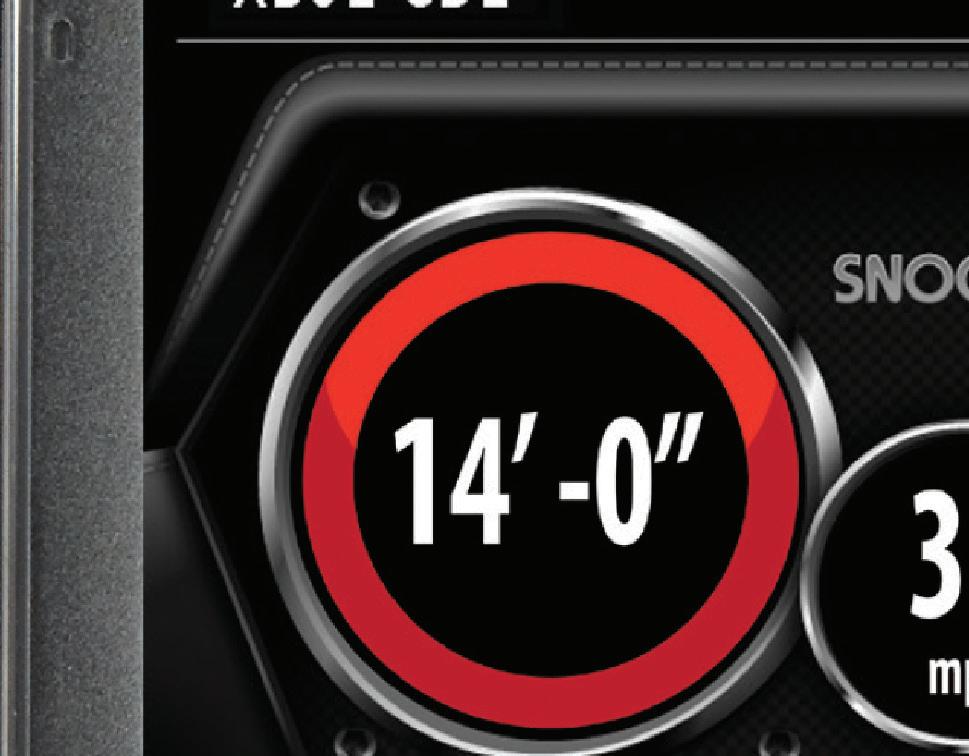
Drivers can input their vehicle height and dimensions and the system will warn them well in advance with both visual and audible alerts, giving them time to take action safely.
It’s already being used by over 10,000 drivers and it’s one of our best-selling products, which really reflects how serious the problem is and how valuable a dedicated solution can be.
At the end of the day, it’s about preventing costly mistakes. A single bridge strike can cause major disruption, damage, and delays, so having a system like this in place gives drivers that extra layer of confidence and protection on the road.
EVERYTHING WE DO IS ABOUT ONE THING – MAKING
LIFE EASIER AND SAFER FOR TRUCK DRIVERS
Q. What driving accessories does Snooper offer?
A. Alongside our main products, we also offer a full range of driving accessories and spare parts to support our truck sat nav systems. This includes things like replacement mounts, sun visors, power cables and USB leads, as well as carry cases and chargers.
We know that drivers are on the road every day, often in different vehicles, so parts can get worn, lost or damaged. That’s why it’s important for us to offer reliable, genuine replacements that keep everything working as it should.
Simple things like a sun visor to reduce glare, a hardwire cable for a cleaner install, or a replacement mount can make a big difference to usability in the cab.
Overall, it’s about making sure drivers aren’t left stuck if something small goes wrong, they can quickly replace it and carry on with minimal disruption
Q. Give us a brief rundown of the history of Snooper.
A. Snooper has a long history in the UK and was originally founded in Runcorn, near Liverpool, in 1979. Since then, the business has built a strong reputation for driverfocused navigation and safety products, particularly in the commercial vehicle sector.
Today, Snooper is part of In Phase
International Ltd, which is based in Nottingham and also owns Road Angel. It’s a very good fit for both brands, as Snooper is focused on the trucking market, while Road Angel specialises more in products for cars.
We currently supply our truck satnav products across the UK and Europe, although the UK remains our biggest market. That’s still where the brand is strongest and where we have the deepest connection with professional drivers.
The company has now been in existence for over 45 years, which gives us a huge amount of experience in this sector. We currently employ 15 people, including our R&D team, and that allows us to stay closely involved in product development and continue improving the experience for truck drivers.
Q. Do you have any new products or exciting plans coming up?
A. We’ve just launched our new 9-inch Truckmate S9900, which is a big step forward for us. The main reason behind it was simple, drivers told us they wanted a larger screen that was easier to see and use in the cab, especially on long journeys and in larger vehicles. We listened to that feedback and developed the S9900 to give them a bigger, clearer display and an even better overall navigation experience.
Looking ahead, we’ve also got a new line of satnavs and other products planned for 2027, so there’s a lot more to come. We’re continuing to invest in the category and in new ideas that will make life easier, safer and more efficient for truck drivers.
For us, it’s all about keeping close to what
drivers actually want and making sure our products continue to evolve with their needs.
Q. Do you offer any form of aftersales support in case something goes wrong?
A. Yes, we do. We offer full aftersales support in the UK during office hours and for our European customers this is handled by our German office, so there’s always support available.
We like to keep things simple. If something goes wrong, we deal with it quickly and properly. If we can fix the issue, we will, but if not, we’ll replace the unit without unnecessary delays.
For us, the customer is king. We understand that if a driver is off the road or dealing with faulty equipment, it’s costing them money. That’s why speed is so important in how we handle support. Our goal is always to get the customer back up and running as quickly as possible, with as little disruption as possible.
Q. Anything else you’d like to tell us about?
A. Yes, we’re a proud British brand with a long and rich history in the industry.
We also have our own in-house R&D team, which means we’re always looking at ways to improve and develop new products based on real driver needs.
If anyone has a great product idea or something they feel is missing from the market, we’re always open to hearing it, feel free to get in touch. ◼
Below: Snooper truck satnavs are built specifically for truck drivers – not adapted from car systems
AI BRINGS NEW SAFETY PROBLEMS TO THE FORE
ARTIFICIAL INTELLIGENCE IS MAKING HUGE SAFETY GAINS, BUT FLEETS GET A WARNING ABOUT EXACTLY HOW TO USE IT
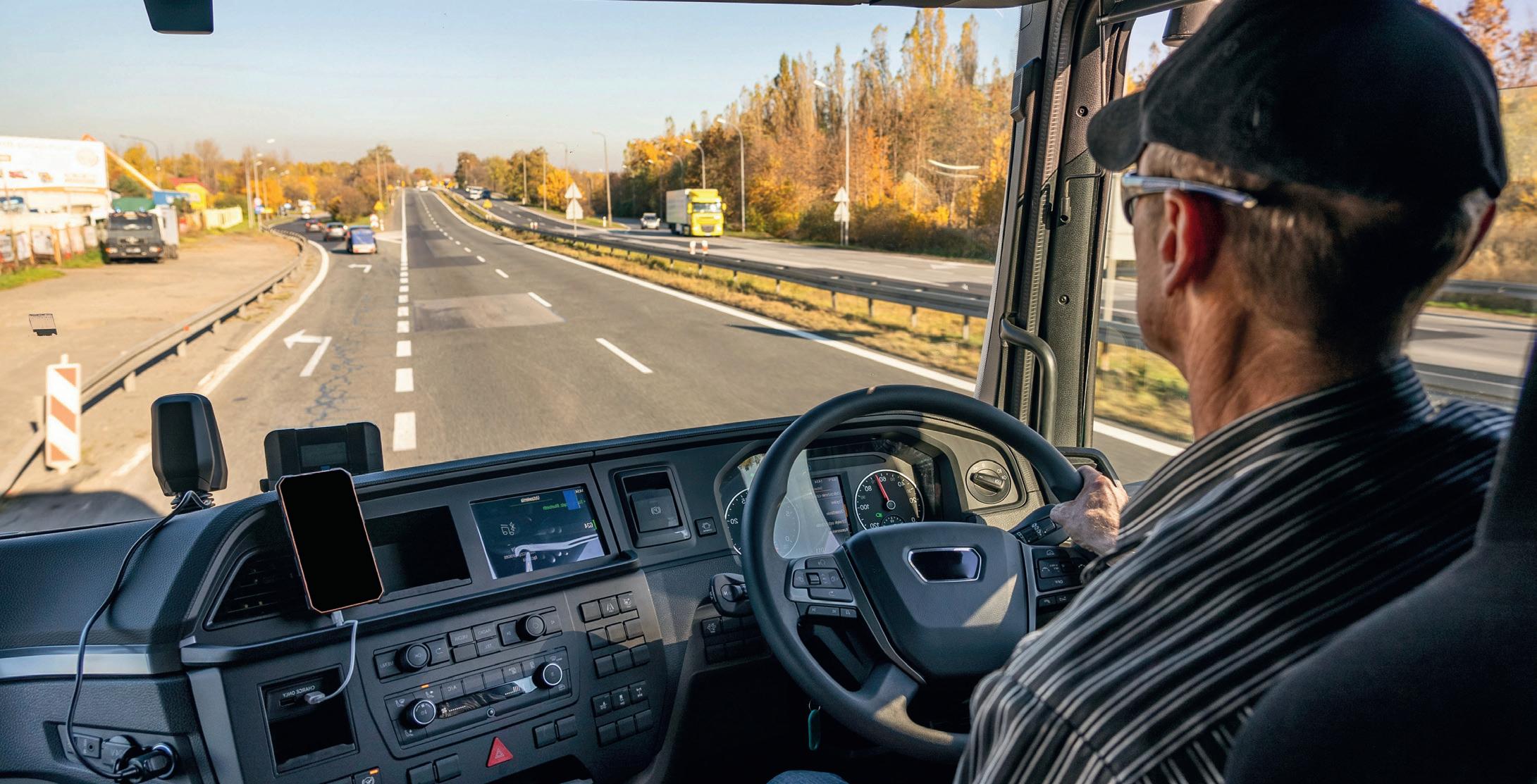
Artificial intelligence (AI) is set to make a huge improvement in road safety as more and more haulage firms introduce both forward and rearward facing cameras to predict dangerous situations.
But British fleets taking on this technology for the first time have been issued with a warning after experts studied its more advanced use in the USA.
Suppliers say fleets should avoid the temptation to lower camera sensitivity to reduce the number of alerts, as this can increase the risk of missing genuine safety events. False positives, where camera systems incorrectly flag driver behaviour or incidents, remain a challenge for fleets using dashcams. But it’s better being safe than sorry.
Issues have already emerged in markets such as the United States where inward facing cameras are more widely deployed and could
become a challenge for UK fleets if adoption of in-cab video monitoring increases as drivers get fed up with false red flags.
Fleets will be familiar with this concept in cars when thinking about an over-sensitive lane departure warning system or forward collision alert. These advanced safety systems can sometimes trigger incorrectly when driving.
The equivalent for dashcams could be something like flagging mobile phone use when actually, drivers were just scratching their ears.
Safety teams back at base can face large volumes of triggered events that require review. In some cases, this leads operators to reduce system sensitivity so fewer alerts are generated.
Missed events
Mark Miller, founder and chief executive of InsureVision, said that approach risks undermining the value of camera
Above: Fleets are being advised not to adjust the sensitivity of AI safety systems
programmes. He said: “Lowering sensitivity can mean the system misses events, including lower speed impacts that can still have serious consequences.”
Instead, he recommends truck firms to maintain higher sensitivity settings and rely on improved AI video analysis to filter incidents more accurately.
And Jaime Lox, senior product marketing manager for data platforms at Geotab, said false alerts can also undermine driver confidence in the technology. He said: “One of the biggest challenges is false positives. Once you lose the driver’s trust, the technology isn’t very useful.”
The problem often stems from how earlier generations of dashcam systems analyse footage. Miller said some camera systems rely on computer vision techniques that
analyse a single frame of video rather than how a situation develops over time.
These systems typically detect objects such as vehicles or phones and apply rules to trigger alerts based on distance or positioning.
However, road risk is dynamic and constantly evolving. Miller explained: “Risks on the road evolve over time. Systems that do not account for changes between frames can produce frequent alerts that do not reflect genuine danger.”
Improved accuracy
Claude Hochreutiner, principal video programme manager at Geotab, said improving accuracy has become a priority because inaccurate alerts waste time and reduce confidence in safety programmes.
“False positives can destroy confidence,” he said.
Hochreutiner explained how AI models used in video telematics are continuously retrained as new driving scenarios appear, allowing systems to improve accuracy over time.
“We see new situations every day. The only way to maintain accuracy is to retrain models and update them frequently,” he said.
Both Geotab and InsureVision believe improved AI analysis means fleets should capture more potential events rather than fewer. Miller said one fleet with around 5,000 vehicles increased camera sensitivity and saw the number of daily event clips rise from around 300 to as many as 7,000.
Fleet managers typically want systems that automatically highlight the most important incidents rather than forcing
them to review long periods of footage.
AI is increasingly used to prioritise events by severity so fleet managers can focus on the highest risk behaviours first.
InsureVision’s platform, for example, reprocesses clips and assigns severity scores to help identify which incidents require attention.
“If fleet managers can trust the scoring, they can run higher sensitivity settings with their dashcam without adding significant manual workload,” Miller said.
Paul Hollick, chair of the Association of Fleet Professionals (AFP) and chief executive of Lightfoot, said UK fleets, particularly those running commercial vehicles, are increasingly using forward facing cameras rather than inward facing systems.
Forward-facing dashcams are used to capture footage of road traffic collisions
Left: False positives, where camera systems incorrectly flag driver behaviour, remain a challenge for fleets using dashcams
(RTC) and help defend drivers against fraudulent claims. In-cab cameras that monitor driver behaviour remain far less common.
He said: “Most fleets have adopted forward facing cameras because they help with exoneration after a road traffic collision. In-cab cameras are still not widely deployed across most sectors.
“A lot of fleet managers would like the insight they provide, but culturally many organisations are not ready for that level of monitoring yet.”
Hollick said fleets also need to consider the wider technology environment inside modern vehicles when introducing additional monitoring systems. Drivers are already dealing with increasing numbers of alerts from advanced driver assistance systems (ADAS) and digital infotainment platforms.
He said: “There are already a lot of beeps and warnings coming from vehicles. Modern cars and vans have lane departure warnings, infotainment systems and mobile connectivity that drivers are interacting with.
“Fleets need to think carefully about how additional technology is introduced so that it genuinely improves safety rather than adding more distraction.” ◼
Below: Safety teams back at base can face large volumes of triggered events that require review
TAKE CARE OF YOUR TYRES, WARNS VENSON AUTOMOTIVE SOLUTIONS
TYRES ARE ONE OF THE MOST UNDERVALUED, YET CRITICAL, ELEMENTS OF TRUCK SAFETY, COST CONTROL AND EFFICIENCY
Welcoming the Government’s move to recognise leading tyre safety charity TyreSafe as a strategic partner in its road safety strategy, Venson Automotive Solutions says tyres are too often overlooked – and businesses need to play their part in educating drivers about tyre safety.
Some 2.1 million MOT failures were attributed to tyre defects during 2023-2024 and more than one third (36%) of those vehicles had received safety advisories on previous MOTs, according to the latest available data from the DVSA.
The 172 tyre-related incidents where people were killed or seriously injured in 2024 demonstrate that failure to manage tyres is putting fleet drivers and other road users at risk, says Venson.
“Tyre policies that worked a few years ago may no longer be fit for purpose, particularly as EV adoption increases,” said Lee O’Neill, operations director at Venson Automotive Solutions. “EVs are placing additional demands on tyres due to increased vehicle weight and instant torque, which can accelerate wear if tyre selection and maintenance are not managed correctly. Having the right advice is critical in keeping drivers safe.”
TYRES MAY NOT BE THE MOST GLAMOROUS PART OF A VEHICLE FLEET, BUT THEY ARE ONE OF THE MOST IMPORTANT
Operators should not wait until tyres are down to the legal tread depth limit, said Lee.
If a vehicle is already in for servicing, replacing tyres at the same time can be sensible, avoiding downtime on highmileage vehicles.
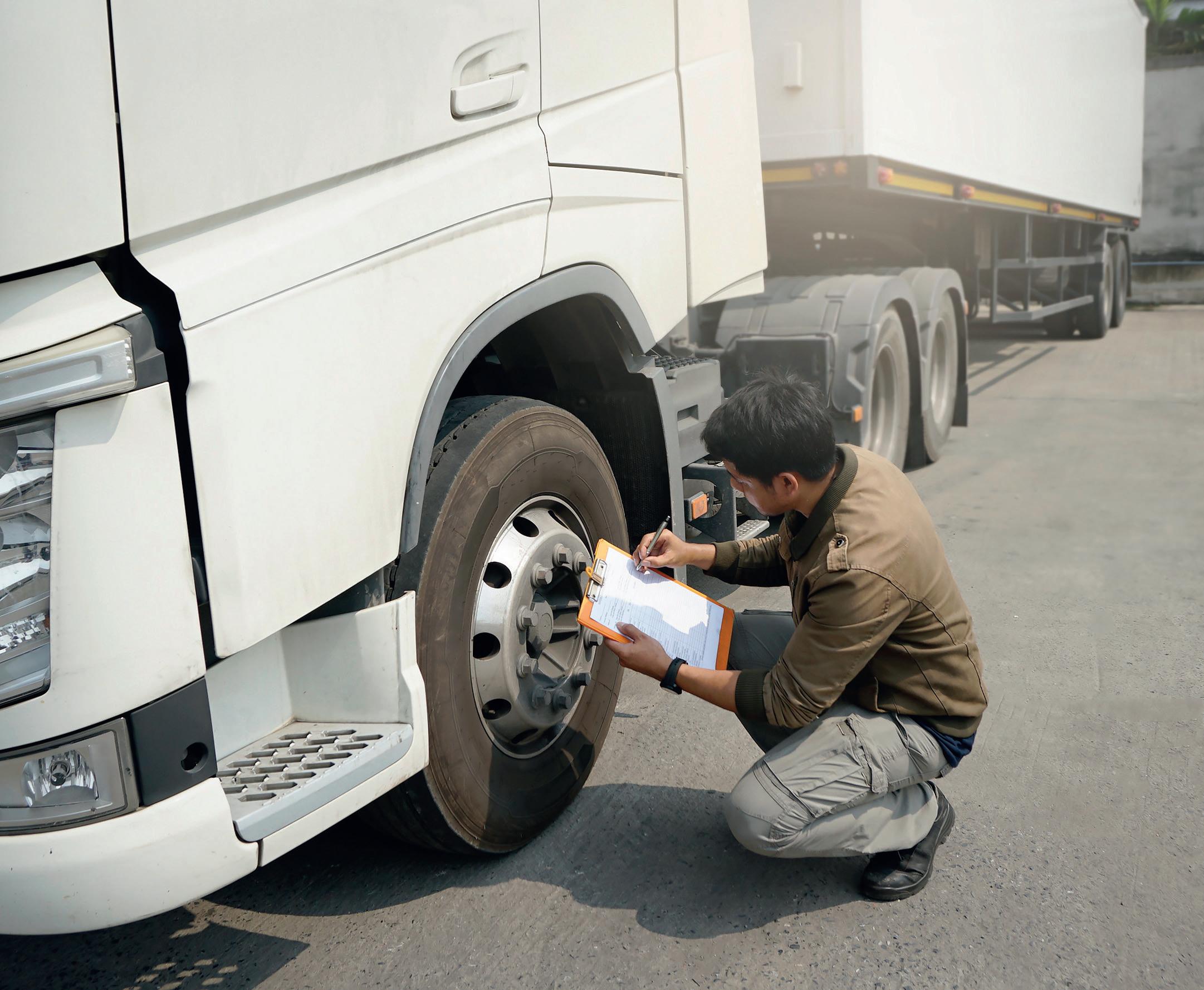
Meanwhile the importance of daily
walkround checks by drivers cannot be overstated, looking for pressure issues, uneven wear, and visible damage.
Correct inflation is particularly important for electric vehicles, which often require higher pressures to account for additional weight, says Venson.
With an eye on service, maintenance and repair (SMR) budgets, Venson cautions against blanket adoption of all-season tyres and wide-spread use of winter tyres.
While they can deliver benefits, it argues that they are costly, so a review of the operational requirements of the vehicle needs to be carried out first.
It is also critical that vehicle use and age/ mileage is considered, as investing in premium tyres might not deliver maximum benefit and unnecessarily increase SMR spend.
Lee added: “Fleet professionals, company car and van drivers can spend hours
Above: Daily walkround checks will flag up any issues with tyres
looking for, test driving and speccing their next vehicle. However, it is almost a racing certainty that in searching out the very latest technology and available ‘bells and whistles’, the one feature they probably ignore is tyres.
“Yet, tyre management represents a significant opportunity for fleets to improve safety, reduce downtime and better control costs, particularly during the transition to electric vehicles.
“Tyres may not be the most glamorous part of managing a vehicle fleet, but they are one of the most important.
“A proactive tyre strategy can deliver real benefits across safety, efficiency, and total cost of ownership to those fleets willing to invest the time.” ◼
Application
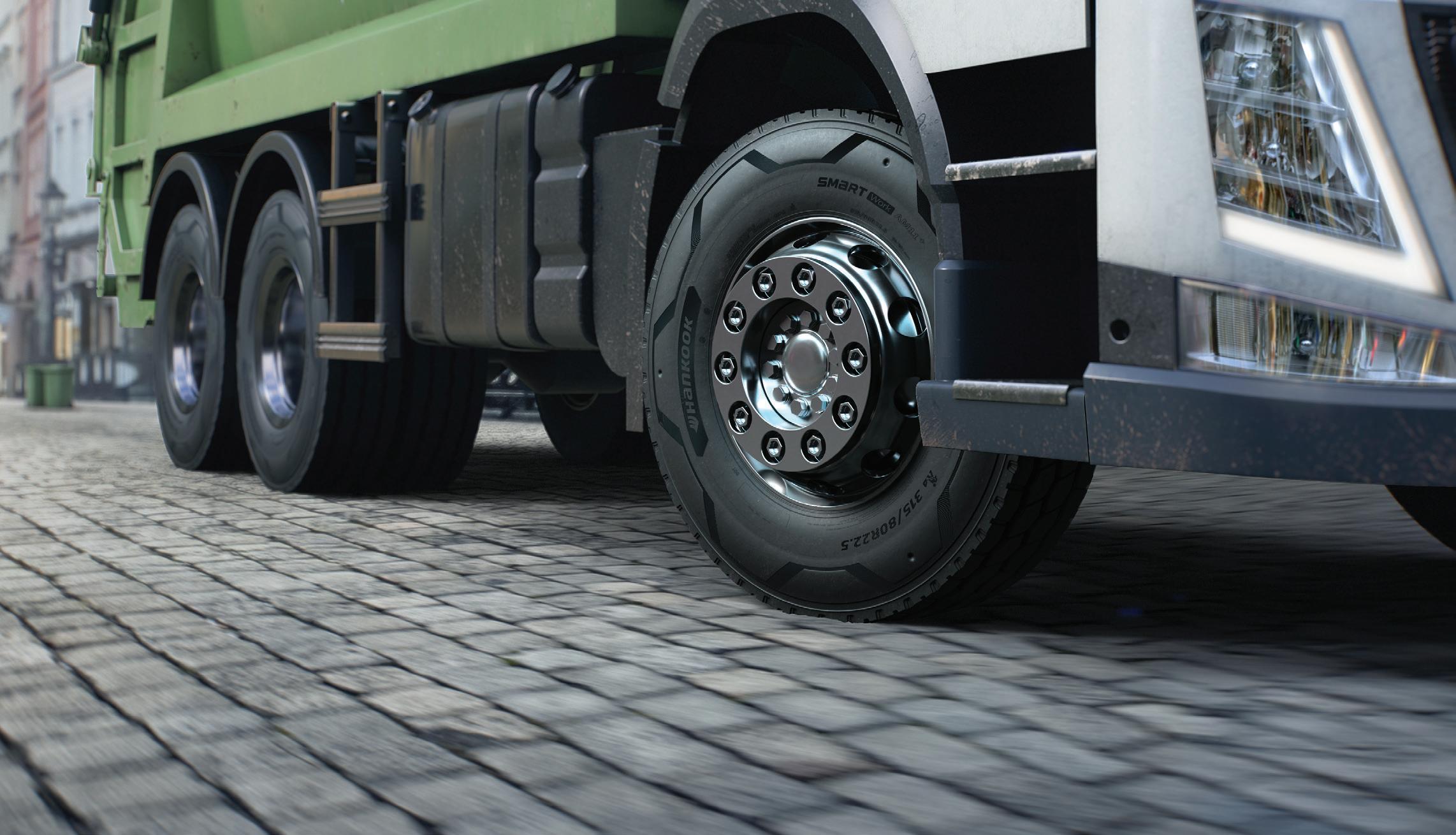
Our specialist for waste trucks: reinforced for resiliance, built for endurance
Reinforced sidewall for improved strength, durability and tyre life in urban areas.
and Snow Provides grip in mild winter weather.
3PMSF Certified Meets strict performance standards for reliable traction in severe winter conditions.
Mud
COMPETITION
YOUR CHANCE TO WIN THIS FANTASTIC PRIZE FROM KUMHO TYRES
This month once again we are offering a fabulous box of goodies from Kumho Tyre in our easy to enter competition. The box contains a charging cable, umbrella, torch, pressure gauge for tyres and a high-capacity power bank. Kumho produces more than 68 million tyres every year, enough to provide every single person in the Netherlands with a set of four
LAST MONTH'S KHUMO WINNER: WILLIAM FENWICK, DEVON
tyres… and a spare!
To be in with a chance to win, answer this simple question:
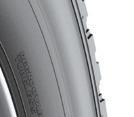
What is this symbol and what does it mean on the sidewall of a tyre?
When you have decided your answer, simply
email it to: sales @cvdriver.com. Label your email: ‘Kumho Tyres competition’ and don’t forget to include all your contact details. Closing date is June 1, 2026.
Employees of CV Driver magazine and Kumho Tyres are not allowed to enter and the editor’s decision will be final. No correspondence will be entered into.
LAST MONTH'S SEARCH-IMPEXWINNER: ROB FULLARTON - STAFFORD
A MESSAGE FROM FORMULA PREMIER TRUCKSTOP
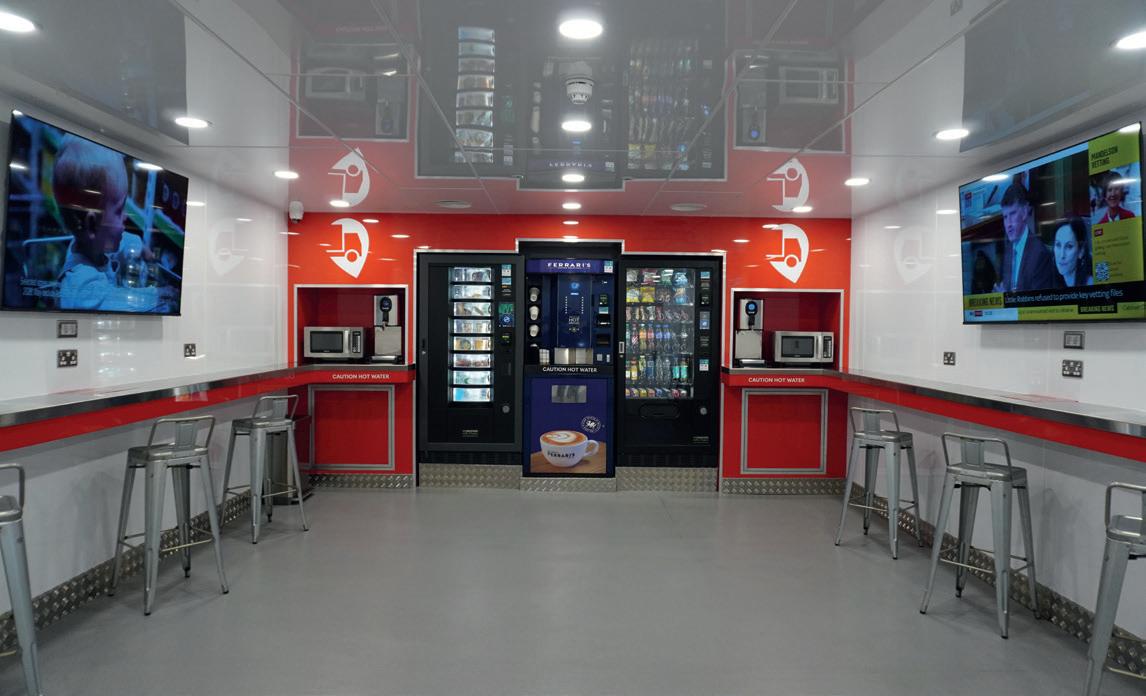
We have completely reimagined the ‘Self Service’ area that we offer as part of our facilities here at Formula Premier Truckstop. We wanted to create something fresh and functional to support the needs of the drivers who park with us. We have split up what used to be one area into two areas, creating new spaces that are dedicated to their purpose. Beyond our drivers lounge we now have our ‘Prep Kitchen’ which boasts three individual cooking stations which can be used simultaneously by three separate users. Each section has an induction hob, air fryer, combi oven, pots,
pans, utensils and sink – everything needed to make a delicious fresh meal or meal prep for the week ahead. The ‘Prep Kitchen’ also has preparation areas complete with stools to sit at while food is cooking to allow for a more relaxing experience.
In the space that was the self-service kitchen, we now have our ‘Grab and Go’ area. This has been designed to allow the drivers using it a moment of calm before heading back on the road. We have installed two water boilers and microwaves to allow drivers to fill up flasks and reheat food and have also added stools and TVs. Both
new areas are accessible 24/7 and can be used by customers staying on site, stopping for fuel, or just simply using us for a two-hour break – which we do not charge for.
We really hope the facilities we have created make the day
to day lives of the drivers using them a little bit easier and support them in their roles as professional HGV drivers.
Be sure to check it out when you Make Formula Your Next Stop. ◼
TRANSPORT FIRMS EMBRACE THE NEW DIGITAL AGE
IT’S GOODBYE TO ALL THE OLD PAPER-BASED SYSTEMS AS INCREASED COMPLIANCE REGULATIONS AND CUSTOMER EXPECTATIONS REQUIRE A SMARTER WAY TO WORK
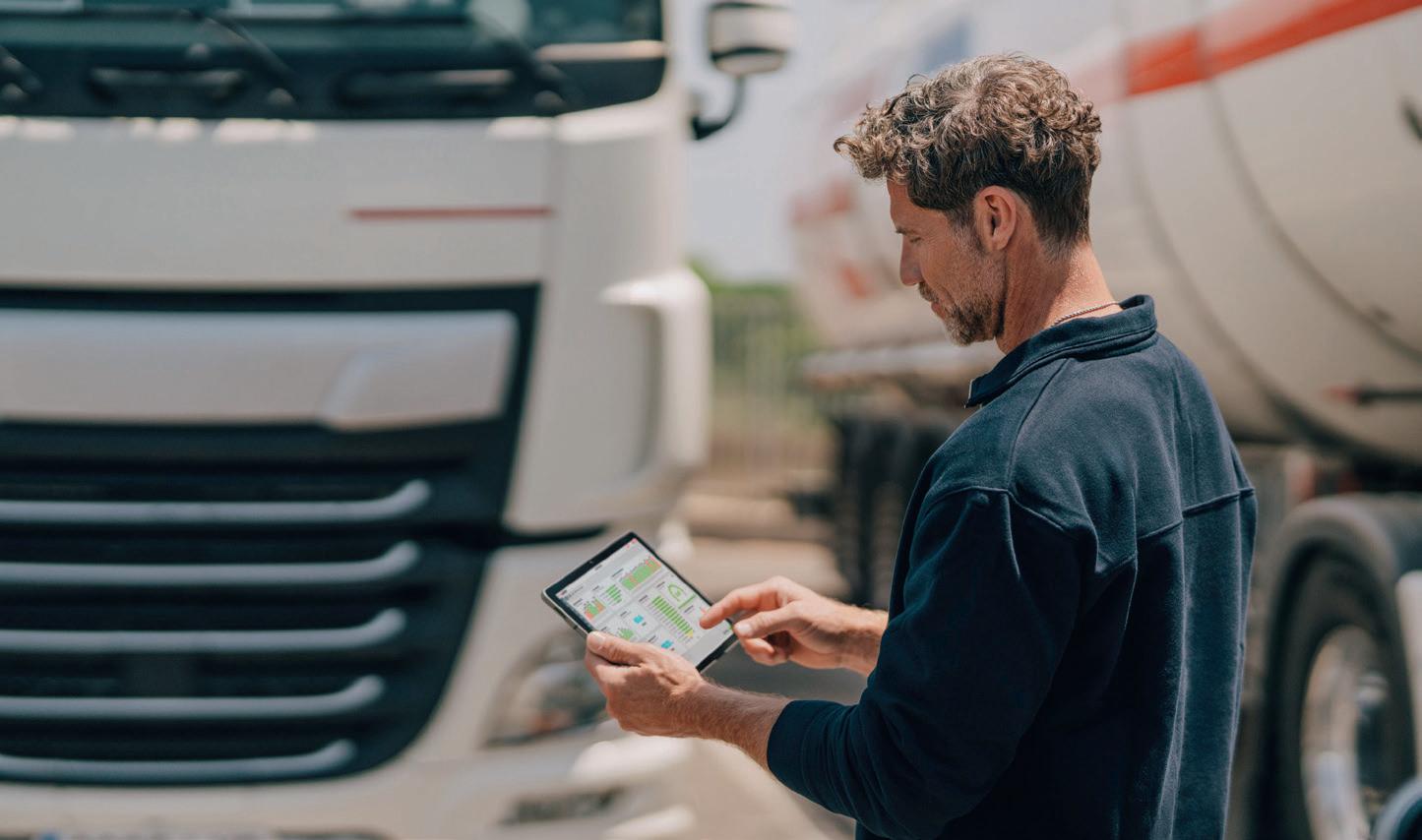
Across the haulage sector, firms are increasingly recognising the value of digital transport management systems (TMS) as they look to cut down on paperwork, reduce waste, improve compliance, and deliver consistent service.
Such systems provide excellent transparency of daily transport operations, helping managers eliminate recurring defects, look into individual vehicle performance, control parts and labour costs, as well as make time savings.
Rising fuel costs, tighter regulations and increasing customer expectations are also driving the need for smarter, more agile operations.
For example, Stourbridge-based materials and logistics specialist Pegasus Grab Hire, which provides grab hire, muckaway, aggregate and material supply, as well as volumetric concrete services, has been using AssetGo for several years.
The platform now supports the management of a fleet of more than 100 assets across several sites and has been fully embedded as Pegasus’s single, standardised central system for fleet compliance, daily driver checks, and
workshop maintenance management.
This ensures that checks, maintenance schedules and defect management are applied consistently, with full auditability, giving Pegasus real-time oversight and the ability to maintain compliance control.
From a workshop perspective, AssetGo gives end-to-end visibility of fleet condition, with defects logged, tracked and retained in the asset history.
It supports daily driver walk round checks, real-time defect reporting, rectification tracking, planned maintenance inspections, lifting equipment examinations, MoTs, vehicle excise duty monitoring and the secure storage of all statutory and compliance-related documentation.
Daniel Joyner, commercial manager and head of transport at Pegasus said: “As the fleet and number of sites have expanded, the system has allowed us to maintain a standardised approach to inspections, maintenance intervals, and defect management.
“Walkround checks are completed digitally, time-stamped and linked to each asset, with defects escalated immediately,
making compliance monitoring straightforward across the business.
“For our customers, that means greater reliability, reduced disruption and confidence that Pegasus operates a wellcontrolled, compliant fleet.”
Scottish streamline
Meanwhile, Inverness-based UBCivils has implemented Podfather software in an effort to streamline the management of its haulage operations.
Supporting infrastructure, energy and construction projects, UBCivils completes about 100 movements a day using Podfather for route planning and optimisation, real-time tracking, and electronic proof of delivery evidence.
Using the system, the firm has been able to vastly reduce its reliance on paper documents while improving the accuracy and currency of its record-keeping.
Real-time tracking and digitally captured date, time and location stamped
Above: Firms are increasingly recognising the value of digital transport management systems
photographs and signatures means UBCivils can see every vehicle movement and authorised users can access delivery information at the touch of a button.
Iain Peteranna, contract manager said: “Before Podfather, we were purely paperbased. We were duplicating delivery tickets numerous times and, due to the remoteness of some of the sites, this added extra delays in completing paper dockets and receiving them back to head office for processing.
“Any system that saves work hours is a great tool and will have a noticeable impact on the business.”
TRANSPORT
OPERATORS
WILL INCREASINGLY SWITCH TO EVER MORE SOPHISTICATED
DIGITAL SYSTEMS
Cashflow
boost
Also, a new bespoke TMS from HaulTech has boosted cash flow for Bolton-based aggregates and asphalt specialist A&F Haulage. The haulier operates 230 vehicles from 15 depots across the UK, supporting key infrastructure projects such as Hinckley Point and HS2.
HaulTech’s dedicated bulk haulage platform has reduced administration processes by up to 80% and, along with helping to create, assign and schedule jobs, it has made invoicing faster and more accurate.
The firm’s cloud-based TMS offers features from job booking and scheduling through to electronic proof of delivery and invoicing. It is compatible with all pallet network platforms and can work with compliance systems such as Hazchem.
A&F Haulage said it now has far better productivity because it is using one integrated system, which also gives it greater visibility across the entire business.
Hammad Majeed, managing director said: “HaulTech has been great as it links together all aspects of our business from transport planning and management to invoicing.
“One of the biggest ways it has impacted our business is that we can process invoices much faster. Getting those invoices out
quickly and in the right format can affect cash flow massively.”
Broader functionality
According to trailer repair specialist BP Commercials, its decision to migrate to a workshop platform from Freeway Fleet Systems, was driven by the need for broader functionality and greater visibility across the business.
The firm, an authorised Schmitz Cargobull service partner, operates a facility in Belfast, servicing and repairing trailers for transport operators in Northern Ireland and those arriving via the ferry from Great Britain.
Initially, BP Commercials needed a change in software after it became a Schmitz partner, prompting the need for more advanced parts stock management.
The Freeway mobile app is now used at both of BP Commercials’ workshop locations to capture all labour activity, helping managers monitor productivity and efficiency.
Data from the mobile devices is synchronised with the central asset management platform, giving the business round-the-clock oversight of ongoing work.
Digital sheets
Operators can now access digital inspection sheets, live job cards, invoices and detailed fleet information, including tyre tread measurements and damage reports, complete with photographic documentation.
Another key feature for BP Commercials is the software’s ability to analyse parts usage in detail.
This insight helps the business identify recurring faults and understand purchasing patterns, crucial information for a workshop that also acts as a parts supplier and must balance operational costs with customer pricing.
Freeway’s platform is designed to handle complex pricing structures, including fixed and variable labour rates, discounts, and seasonal or promotional pricing.
Roger Lundy, depot manager at BP Commercials said: “We do between 12 and 19 services a day and, with defects, we typically raise 30-40 job cards and send out up to 50 invoices. We needed a flexible system to track costs and manage all of the billing complexities.
“With Freeway, it’s very easy to create a job card, and by recording time and providing photographs, customers have full visibility and know what they are being invoiced for.
“For us, the system means we can raise an invoice quickly, knowing we’ve covered all our costs.”
What is apparent is that over the next few years, transport operators looking to improve efficiency and reduce costs will increasingly switch to ever more sophisticated digital fleet management systems. ◼
◼ Article first published in the Society of Motor Manufacturers and Traders’ Transport Newsbrief
Below: Checks, maintenance schedules and defect management are applied consistently
HZ LOGISTICS INVESTS IN DURITE DRIVER MONITORING SYSTEM
PART OF FIRM’S ONGOING COMMITMENT TO ENHANCE DRIVER SAFETY AND WELLBEING
HZ Logistics has invested in a driver monitoring system (DMS) from Durite as part of its ongoing commitment to enhancing driver safety and wellbeing, equipping its fleet with advanced AI-powered in-cab technology designed to detect and help prevent driver fatigue and distraction.
Durite, a leader in vehicle safety and compliance solutions, is supplying the system to support HZ Logistics in strengthening its safety and operational performance.
The deployment marks a significant step in HZ Logistics’ wider safety and operational strategy. HZ Logistics is an international road transport and logistics provider, specialising in time-sensitive deliveries across the UK and Europe, operating a round-the-clock fleet to support a diverse customer base.
With long-distance routes and tight delivery schedules forming part of its core operations, the company is focused on maintaining the highest standards of driver welfare, compliance and efficiency.
“We expect the Durite DMS to play a key role in proactively identifying early signs of driver fatigue and distraction,” said Ronald Livermore, driver trainer at HZ Logistics. “Rather than relying on reactive measures after an incident, the system allows us to intervene in real time, helping drivers correct behaviour before it becomes a risk. This ultimately supports a safer working environment for both our drivers and other road users.”
AI usage
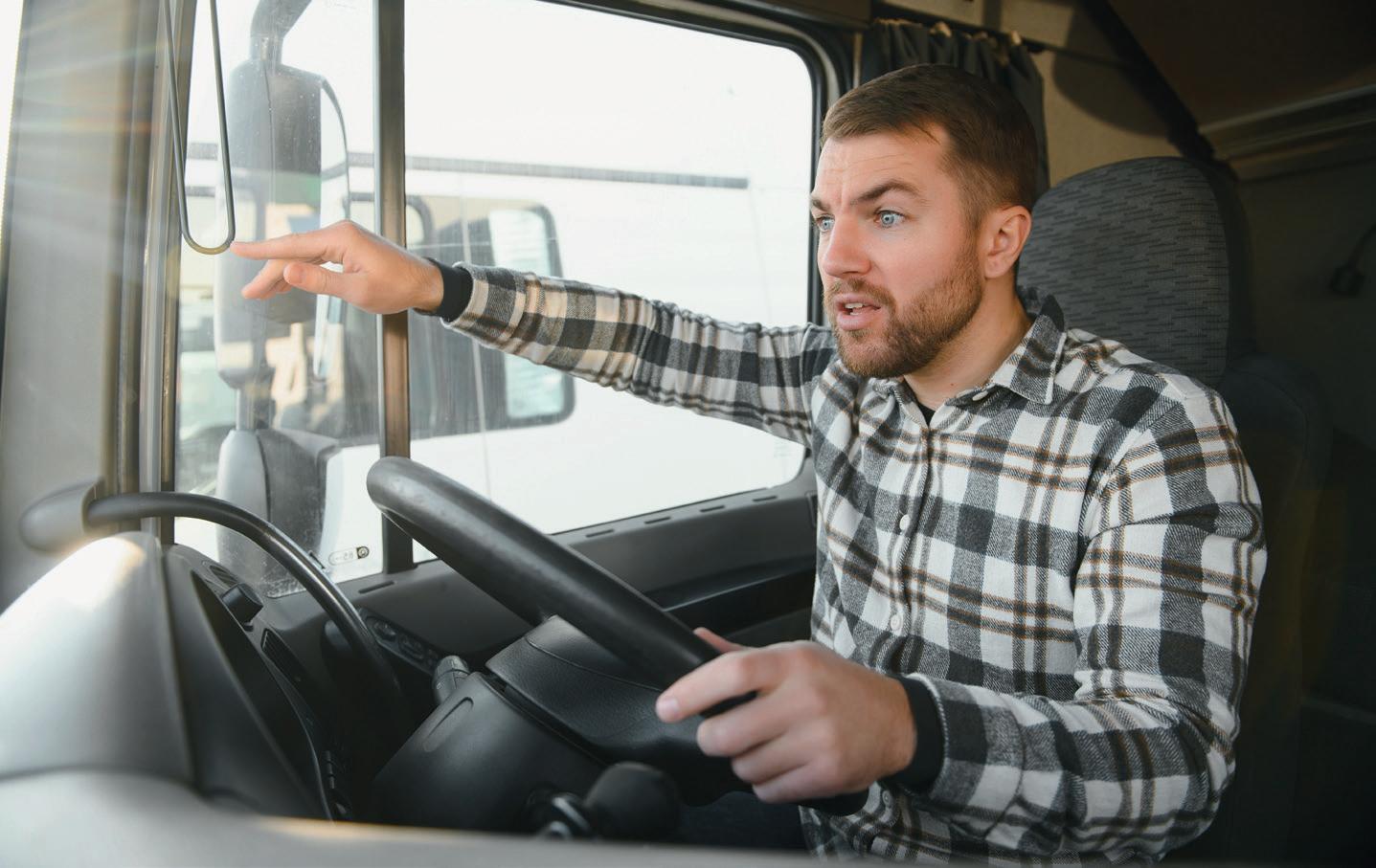
Durite DMS uses artificial intelligence to monitor indicators such as eye closure, inattentiveness and mobile phone use. These behaviours are among the highest risk factors within HZ Logistics’ operation, particularly given the long hours and varied driving conditions experienced
across its international routes.
When ‘risky’ behaviour is detected, realtime visual and audible alerts prompt the driver to refocus immediately, helping to reduce the likelihood of incidents before they occur.
“Real-time alerts act as an immediate reminder for drivers to refocus, which we believe will help reduce problematic behaviour in the moment,” added Ronald. “Over time, this is also designed to support stronger driving habits, as drivers become more aware of their actions and how they impact safety.”
THE SYSTEM ALLOWS US TO INTERVENE, HELPING DRIVERS CORRECT BEHAVIOUR BEFORE IT BECOMES A RISK
HZ Logistics expects the technology to support operational improvements, including reduced vehicle downtime, fewer route disruptions and improved fleet utilisation, by helping to prevent incidents before they escalate. The company also anticipates that the system will contribute to lower collision rates and may support insurance cost reduction over time.
The system also forms part of HZ Logistics’ broader strategy to combine technology with driver engagement, ensuring drivers feel supported rather than monitored. It complements ongoing initiatives in driver training, performance management, and operational efficiency, helping to build a positive safety culture across the business.
Smooth implementation
The implementation process, says Ronald, has been smooth, with the system integrating seamlessly into
existing operations and supported by clear communication throughout. Plus, compliance with industry safety standards such as DVS, FORS, and CLOCS was another key factor in HZ Logistics’ decision.
“Compliance is a key driver for us,” said Ronald. “Systems like the Durite DMS support our commitment to meeting and exceeding industry standards. Beyond compliance, it’s about creating a genuinely safer operation rather than simply ticking boxes.”
Proud to act
John Nobbs, sales director at Durite, commented: “We’re proud to support HZ Logistics in taking a proactive approach to driver safety and wellbeing. Our DMS is designed not only to help fleets meet compliance requirements, but to make a real difference in day-to-day operations by giving drivers the tools and awareness they need to stay safe on the road.”
The collaboration, explained John, reflects a shared focus on using technology to deliver meaningful improvements in driver wellbeing and fleet safety performance.
“We see this as part of a long-term investment in both safety and driver wellbeing,” Ronald says. “Technology like this is most effective when combined with strong communication and training, and we’re committed to ensuring it delivers real, measurable benefits across the business.”
Ronald goes on to explain that the investment underscores HZ Logistics’ ongoing commitment to putting driver safety and wellbeing at the heart of its operations. By proactively adopting advanced in-cab technology and embedding it within a wider culture of training, engagement and continuous improvement, the company is enhancing safety standards across its fleet. ◼
▪
▪
▪
▪
▪
▪
Proactively detect risky and distracted driving behaviours
With our innovative technology, you can identify and assess risky and distracted driving behaviours that might not be detected by traditional telematics.
Connect with us today!
Visit lytx.com/lytx-surfsight-solutions for more information.
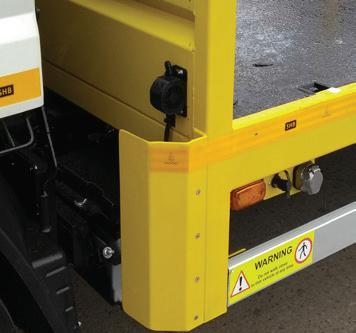
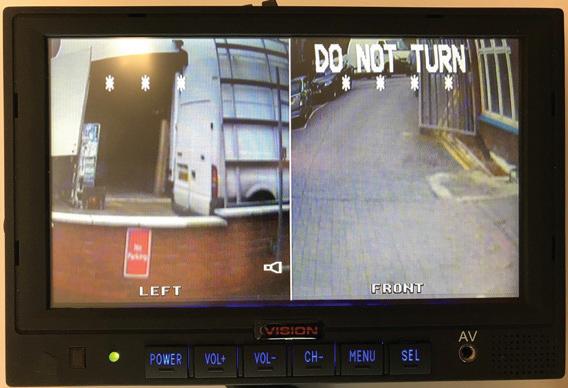
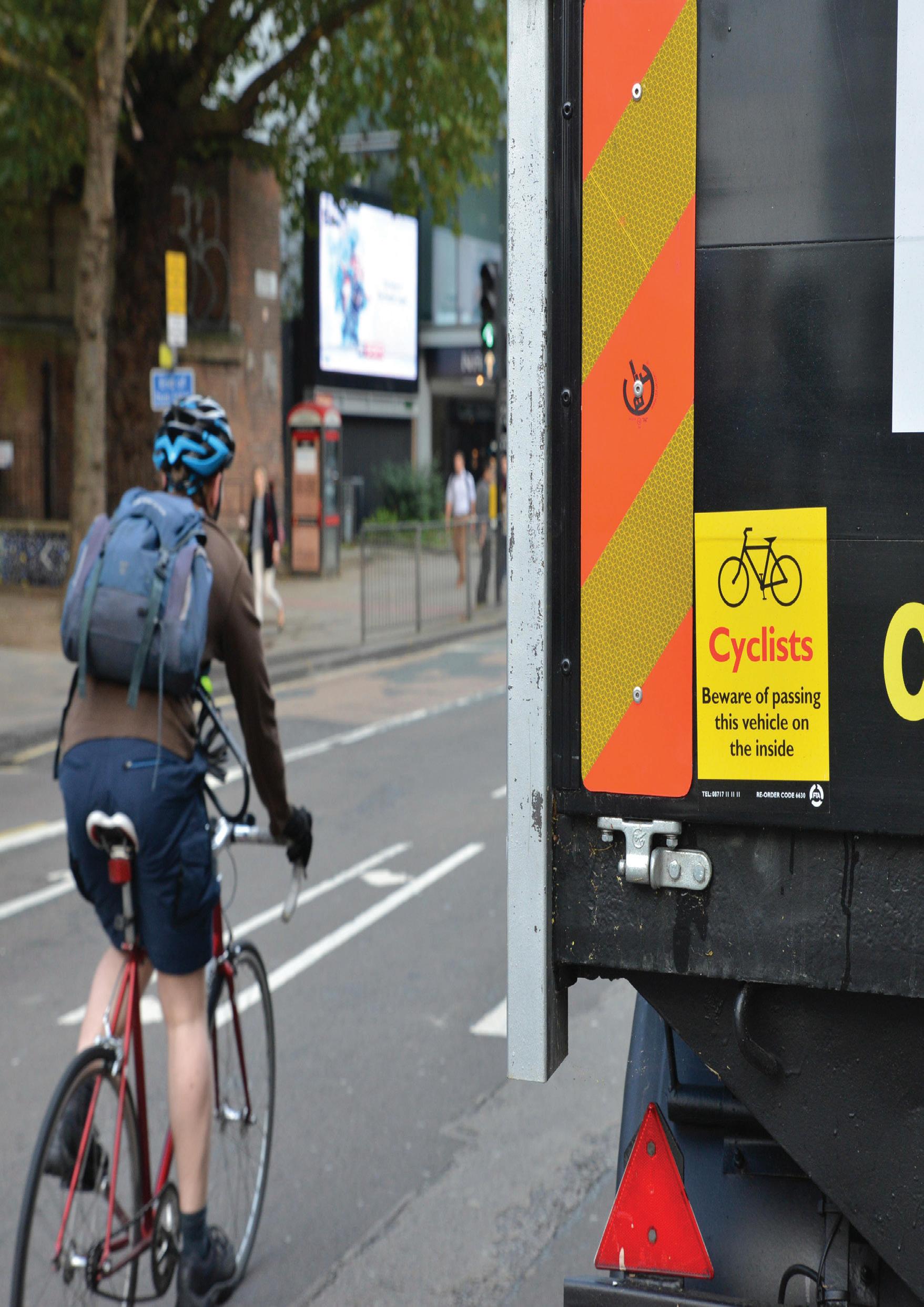
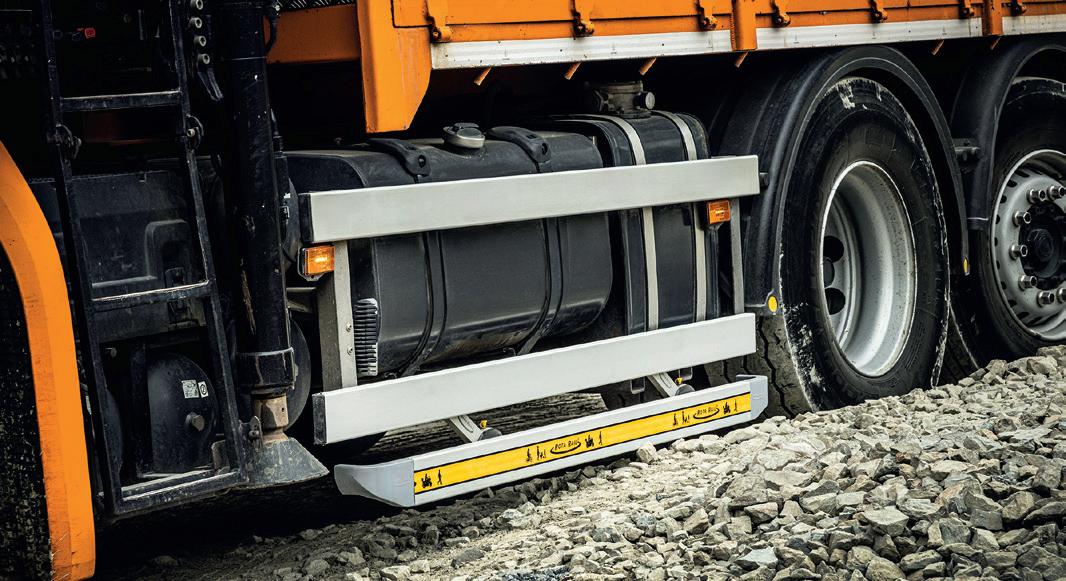
For 2021, Vision UK is offering safety equipment meeting the requirements of DVS, FORS and CLOCS schemes, to provide a higher level of driver assistance than is required by the guidlines
For 2023, Vision UK is offering safety equipment meeting the requirements of DVS, FORS and CLOCS schemes, to provide a higher level of assistance than is required by the guidelines 2026
For 2020, Vision UK is offering safety equipment meeting the requirements of DVS, FORS and CLOCS schemes, to provide a higher level of driver assistance than is required by the guidelines
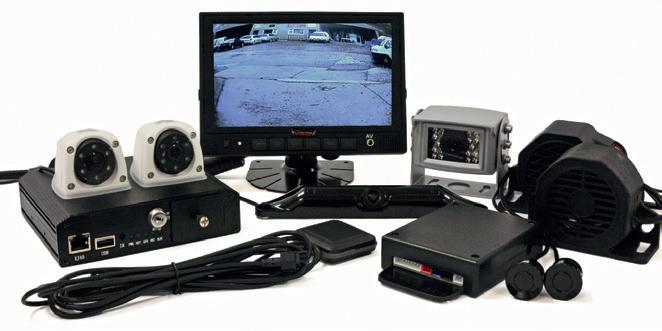
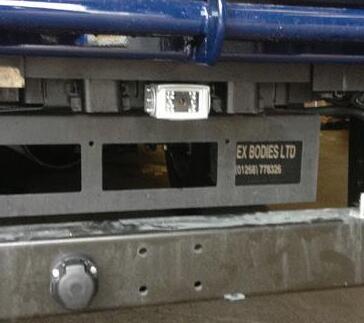
l Blind Sport Vision System for Construction Logistic Operators
l Vision and Recording System for Construction Logistic Operators
l High Resolution WDR Cameras
l Compliance systems (LDVS-70 SD or HD)
l CLOCS-70 system (system updated for 2020 with HD cameras