General High School Name Here
7-10
General High School Name Here
7-10
Discover the flexibility and depth of our Flexibooks with this comprehensive content sampler. Inside, you’ll find:
• The first 4 pages of a selection of units from each strand of our Year 7-10 content bank (aligned with WA Curriculum). The first sample unit for each year level is an example of a Teacher Edition.
• A full catalogue of available content.
• A user-friendly content selector form, complete with curriculum alignment codes for easy selection.
• Pricing details for workbooks (note: these prices are subject to change).
Why choose Flexibooks?
Flexibooks are fully customisable workbooks designed to meet the unique needs of your school. You can:
• Select exactly the content you want from our curriculum-aligned library.
• Add your own school-specific material.
• Modify or remove text and images as needed.
• Personalise the cover with your school name, logo, or even your own image.
Pricing starts from $30 per student. Minimum order: 50 copies.
Prefer a faster option? Try our pre-selected base books
Our expertly curated base books are ready to go—no customisation required. These workbooks provide full coverage of the Western Australian Curriculum and are ideal for schools seeking quality content with minimal prep time.
Pricing starts from $34 per student. Minimum order: 50 copies.
Complimentary Teacher Editions included: With every order, you’ll receive a free digital Teacher Edition, or a hardcopy (including digital access) can be purchased for $70 each. Teacher Editions include answers to all student questions, helpful teaching notes, extension tasks and suggestions for further learning.
Kim Lowe
e: kimlowe@matildaed.com.au
m: 0409 124 272

First published in 2026 by Flexibooks, a Division of Matilda Education Australia ABN 74 635 407 028 PO Box 112 Camberwell, Vic 3124 flexibooks@matildaed.com.au
Flexibooks content and illustration copyright © Flexibooks, 2026 Content provided by the school remains its property.
All rights reserved.
Except under the conditions described in the Copyright Act 1968 of Australia (the Act) and subsequent amendments, no part of this publication may be reproduced, stored in a retrieval system, or transmitted in any form or by any means, electronic, mechanical, photocopying, recording or otherwise, without the prior written permission of the copyright owner.
Disclaimer: The Australian Curriculum, Assessment and Reporting Authority (ACARA) neither endorses nor verifies the accuracy of the information provided and accepts no responsibility for incomplete or inaccurate information. In particular, ACARA does not endorse or verify that the material aligns with the Australian Curriculum content descriptions for the relevant year and subject. You can find the unaltered and most up-to-date version of this material at www.australiancurriculum.edu.au.
Acknowledgement of Country
We acknowledge the Aboriginal and Torres Strait Islander Peoples of this nation. We acknowledge the Traditional Custodians on whose unceded lands we have created this resource. We pay our respects to ancestors and Elders past and present.
Note about language: Please note that we use the terms ‘Aboriginal and Torres Strait Islander’ and ‘First Nations’ interchangeably. We acknowledge that there is no one term that is universally accepted and we use these terms with respect.
Cover photo: AdobeStock/Антон Сальников
Clip Art used with permission from Microsoft
Printed in Australia
While every care has been taken to trace and acknowledge copyright, the publishers tender their apologies for any accidental infringement where copyright has proved untraceable. They would be pleased to come to a suitable arrangement with the rightful owner in each case.


635: Change and
636: Navigating health information (PS1)
Making informed choices (PS2-4)
641: Respecting diversity (PH1-2)
642: Influences on respectful relationships (PI1)
643: Navigating emotional responses (PI2)
75: Rockclimbing (MM1-3)
644: Fitness program (MU1-2)
647: Characteristics of fair play (MI1-2)
648: Teamwork and collaboration (MI3)
Personal identity and change
Managing transitions
Changing and growing
Staying safe
Locating support
Protecting yourself and others
Making informed choices
Defining consent
Healthy and active communities
Healthy choices
Preventive health practices
Benefits of physical activity
Media influences
Interacting with others
Healthy relationships
Gender equality
Managing emotions
Movement skills
PE Log
Understanding movement
Participation in sport and physical activity
Increasing physical activity levels
Interpersonal skills
Leadership and collaboration
Ethical behaviours in sport
Personal identity and change
Developing identity
Sexual identity
Staying safe
Assessing health information
Harm minimisation
Safety skills and strategies
Consent
Healthy and active communities
Diversity
Health promotion
Interacting with others
Navigating relationships
Bullying
Power, coercion and control
Understanding emotional responses
Movement skills
PE Log
Understanding movement
Measuring the body’s responses
Physical activity plan
Interpersonal skills
Teamwork in sport
Fair play
Personal identity and change
Personal identity
Change and transition
Staying safe
Navigating health information
Safety skills
Enhancing health and wellbeing
Communication and consent
Healthy and active communities
Making informed choices
Respecting diversity
Interacting with others
Influences on respectful relationships
Navigating emotional responses
Movement skills
PE Journal
Understanding movement
Fitness program
Fitness improvement
Interpersonal skills
Effective leadership
Characteristics of fair play
Teamwork and collaboration
Personal identity and change
Influences on identity
Staying safe
Analysing health information
Managing risk
Emergency responses
Consent in relationships
Healthy and active communities
Health services
Promoting healthy behaviours
Influences on health outcomes
Interacting with others
Promoting respectful relationships
Sexuality and sexual health
Effects of emotional responses
Movement skills
PE Journal
Understanding movement
Understanding fitness levels
Personal fitness plan
Interpersonal skills
Improving performance
Influences on outcomes
Training principles

Flexibooks is Matilda Education’s custom publishing solution, specialising in print and digital workbooks personalised for your school.
Curriculum-aligned
New health and PE content aligned with the Western Australian Curriculum
• Start with a curated base book, customise it or build your own
• Choose your cover image, workbook title and content
• Add your own material such as policies, assessments, tests, worksheets, images and more …
• Prices starting from just $30 per student*
* Minimum order of 50 copies applies
Creating your own workbook is as easy as …
1 Browse our extensive selection of units prepared especially for the curriculum.
2 Choose content appropriate to your specific course outlines, student needs and school values.
Versions available for the WA Curriculum and the Australian Curriculum V9.0
3 Customise by adding, removing or rearranging the content or images (as little or as much as you’d like).
4 Review your workbook, suggest changes and/or approve it –we’ll take care of the rest.
Save time and feel confident knowing your Health and PE content is fully aligned with curriculum outcomes. Our expert team has handpicked the key topics and activities to create engaging workbooks that are ready for the classroom. Choose to purchase these at a discounted rate, or use them as a strong foundation and upgrade to a customised version tailored to your students’ and school’s priorities.
• Content has been written to explicitly align with the curriculum content descriptors and focus areas.
• Content is fully customisable and can be tailored to suit the needs of your course, students and school values.
• Workbooks are supported by a Teacher Edition that includes all student material, answers and suggestions for further learning.
• Facts, statistics and web links are frequently checked and kept up to date.





• Each unit begins with learning intentions and a pre-test activity to test students’ current understanding, and ends with review questions for teachers to test student learning and comprehension.


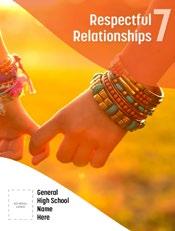
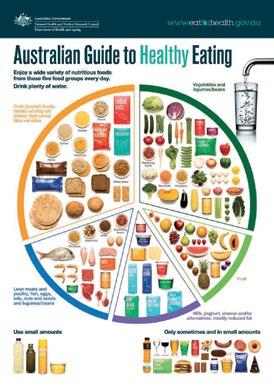
Author team: Lori Hill and Brooke Kenwright
Learning intentions
Physical, emotional and social changes
Physical changes
Emotional changes
Social changes
Coping strategies
Peer and family relationships
Developing and navigating friendships

I can:
• analyse the impact of changes and transitions
• evaluate strategies to support myself and others through changes
• identify ways to manage the physical, emotional, and social changes associated with puberty.
Before you start this unit, test your current understanding by completing the following questions.
1 What are some physical changes you think happen during puberty?
2 How might friendships change as you get older?
3 What is one thing you know about hormones?
4 What does feeling like you belong mean to you?
5 What is one strategy you like to use when you feel worried or stressed about changes in your life?
The human life span is full of changes. Many of these changes do not occur by choice. They are the result of:
• our genes, the DNA code that contains all the information about our physical growth
• our emotional development, e.g. becoming more confident and independent
• our social development, e.g. becoming responsible for others, like our own children.
As of 2025, the average life expectancy at birth in Australia is approximately 81.1 years for males and 85.1 years for females, while the average life span for Aboriginal and Torres Strait Islander peoples is estimated at 71.9 for males and 75.6 for females.
ClickView: There are six main stages in the human life: fetus, baby, childhood, adolescence, adulthood and old age. Learn about each of these stages. <https://clickv.ie/w/nns2>
1 Class discussion: Why do men, women and Aboriginal and Torres Strait Islander people each have different life expectancies? What is being done to increase the life expectancy of all Australians? What do you think could be done to ensure that Aboriginal and Torres Strait Islander people live longer? Read the Closing the Gap priorities, outcomes and targets to support your discussion: <mea.digital/FB_CGA1>



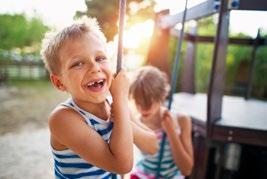


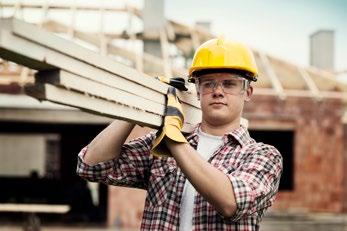

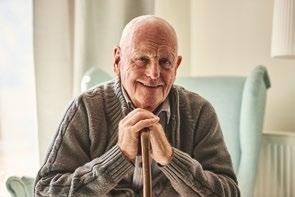

2 Complete the table provided to show the length of time each stage lasts and write what happens physically, emotionally and socially during that stage. The first three stages are done for you. When you get to puberty, describe the physical changes, and use adolescence to describe the emotional and social changes.
Conception 0–1 week
Example:
Sperm joins egg. Cells divide to form a ‘gamete’.
Infancy 0–2 years
Example:
Child begins life on breast milk or formula. Bones, organs, teeth and selfesteem develops.
Child is dependent on full time care.
Prenatal 2–38 weeks
Example:
Embryo forms after 4 weeks. By 28 weeks foetus can survive birth if lungs are developed. At 38 weeks child is fully developed.
Childhood 2–11 years
Children become more self-aware. Encouragement and affirmation are needed verbally and physically. Milk teeth fall out, adult teeth emerge. Language and reasoning develop rapidly. Friends and peers become increasingly important and influential. Social play should provide some foundation of physical activity. Sense of justice and fairness becomes important. Calcium, iron and other minerals and vitamins especially important to support growth phase.
Puberty 12–17 years
Puberty releases hormones into the body that create an awareness of sexuality and secondary sex characteristics— pubic hair, growth of the gonads, acne, facial hair and voice change in males. A growth spurt occurs. Calcium, iron and other minerals and vitamins especially important to support growth phase.
Middle age 40–69 years
Personal identity is revisited, as people review how they have spent their life and what they want to do with what remains. The term ‘midlife crisis’ is used to describe anxiety that emerges at this time. Physical activity needs to move towards low impact exercise as joints become worn out. Hair turns grey and white as hair follicles stop producing melanin. A lack of calcium earlier in life can lead to osteoporosis during this phase.
Adolescence 12–17 years
Self-awareness can become intense as personal identity is worked through. Having an accepted place among peers and friends is critical for selfesteem. Increasing sense of and need for independence. Most physical development has reached maturity by the end of this time. Social play can provide a decreasing foundation of regular physical activity.
Old age 70+
This phase brings a chance to reflect and turn towards younger generations as retirement from full-time work creates increased time. This can be challenging as many people may need goals, challenges and roles to maintain self-esteem. Physical deterioration can be slowed through low impact regular exercise and low fat, balanced diet, however, the phase will be impacted by the lifestyle adopted in the previous ones.
Adulthood 18–39 years
Independence comes with new responsibilities. Earning money and forming a career, long-term relationships, raising a family become a focus.
Minor physical development continues until about 21 years. Physical activity now needs to be planned. Weight gain can occur if, with the added responsibilities of adulthood and relationships and family, lifestyle balance slips. Hair loss can occur during this phase.
There are many ways of looking at what happens after death. Discuss what ideas are relevant to local concerns and beliefs.
Author team: Sandra Duncanson, Diane Hansen and Natalie Tencic

Learning intentions
Introduction
Safety strategies
Make clear plans
Trust your feelings
Be observant
Make yourself safe
Be assertive
Tell a trusted, responsible adult
Building a network you can trust
Peer pressure
Aggressive attitudes and behaviour
Online safety
Cyberbullying
online security
Accessing help
Calling out for help
Support networks
I can:
• evaluate community resources to seek help for myself and others
• identify protective behaviours and help-seeking strategies to ensure safety, including in online situations.
Before you start this unit, test your current understanding by completing the following questions.
1 What does ‘being safe’ mean to you?
2 Who could you talk to if you felt unsafe at school, at home or online?
3 What are some signs your body might give you if a situation feels unsafe?
4 What do you think ‘being assertive’ means?
5 What does ‘cyberbullying’ look like to you, and how might it happen?
The older you get, the more likely it is that your parents will give you more freedom to go places by yourself or with friends. With that freedom comes more responsibility for your own safety and for the safety of those around you.
Strategies you have in place and actions you take to make or keep yourself safe are called protective behaviours.
Thinking about your own safety, taking the time to develop strategies or plans, assessing new situations, and thinking about the ways in which you already ensure your own safety every day gives you more power to look out for yourself and your friends. Being safe means:
• protecting yourself from situations in which you might be physically or emotionally harmed
• making sure your behaviours do not physically or emotionally harm others
• feeling secure and supported
• knowing what to do and how to get help if you find yourself in an unsafe situation
• knowing who to tell if something happens that makes you feel scared, worried or confused.
1 Rate the following situations on a scale of 1–10 (1=very safe, 10=very unsafe) of how unsafe they might make you feel and give a reason for your rating.
a Swimming at an unpatrolled surf beach.
b Blogging about where you go to school, including photos of the way you walk home.
c A drunk or drug-affected person sitting next to you on a bus.
d Being in a car with the windows up when two people are smoking cigarettes.
e Leaving a party to walk home by yourself without telling anyone.
2 Have you ever been in an unsafe situation and had to take action make yourself safe? Explain the actions you took to ensure your safety.
While you cannot always control all of the factors that have an impact on your safety, there are things that you can do to minimise the risk of harm to yourself and others. Developing strategies to assess how safe a situation might be can help you to stay or make yourself safe, especially when you are out with friends or going somewhere by yourself.
If you are going somewhere by yourself or with friends, it is important that someone knows where you are and when you should be back. This is a great rule to follow no matter how old you are. Always make sure that a responsible adult (usually your mum, dad or guardian if you are at home, or a teacher if you leave the school grounds) knows:
• where you are going
• how you are getting there (both the type of transport and the route)
• who will be going with you and who you are meeting
• when you will be back.
If you are out with friends, stick together as a group and follow the plans you made. If you are going to be late home or any part of your original plan changes unexpectedly, always let your responsible adult know.
1 You are home by yourself and a friend calls you in a panic, saying they have just realised that an important part of an assignment you are working on together is due tomorrow. Your parents will not be home for another hour. Your friend’s house is 20 minutes away by bus. What do you do?
Unsafe situations can trigger reactions in our bodies and brains.
These can include:
• Goosebumps
• Feeling queasy or butterflies in your stomach
• Sweaty hands
• Shaking or wobbly knees
• Breathing faster than normal
• Feeling your heart pounding
• Feeling that something is not quite right.
You might not experience all or any of these signs in an unsafe situation, but if you do then pay attention to them. You might also experience similar feelings in safe situations, for example if you are nervous giving a speech. Know how your body reacts and any time you feel these sensations ask yourself:
• What possible unsafe situation is my body reacting to?
• What can I do to feel safe again?
It is always important to be careful around strangers or in unfamiliar places, but sometimes people we know well can bring on these ‘not quite right’ feelings, too. It is just as important to pay attention to these signs from your body around people you know as it is around strangers.
Remember: if something does not feel right, trust your feelings and act. Find a way to make yourself safe and tell a trusted adult.
One of the most powerful safety tools you have is simply paying attention. It is important to notice the signs that a situation might not be safe so you can react promptly and appropriately.
Use your eyes. Can you see any signs that the situation might be unsafe (for example, are strangers looking at you for no reason, has an area been surrounded by police tape or traffic cones, is there a rip or big waves, or heavy traffic)?
Author team: Lauren McGregor, Nicola Muller, Melissa Neish and Nat Tencic
Learning intentions
Respectful relationships
Respect Empathy, kindness and compassion
Disrespectful behaviour
Abuse, bullying and harassment
Power
Racism
Online protocols
I can:
• explain the roles of respect, empathy, power and coercion in developing respectful relationships.
Before you start this unit, test your current understanding by completing the following questions.
1 What does a healthy relationship look like to you?
2 How can respect and empathy help people get along better?
3 Why is communication important in friendships and family relationships?
4 What are some examples of behaviours that show disrespect?
5 How do you think online behaviour can affect friendships or relationships?
In all relationships, it’s important to treat others with respect. Respect is the glue that holds relationships together. Respect means that you accept somebody for who they are, even when they’re different from you or you don’t agree with them. It also means understanding and treating them like a separate person from you, a person who is in charge of their own body, actions and desires. This is someone’s autonomy and it must be respected. Respect should always be given to another, whether you like the person you’re interacting with or not. It’s the basic acceptance and understanding of another’s dignity, irrespective of their race, gender identity, ability, age, sexuality, status, wealth or intelligence.
We have a right to feel safe, happy and loved, and so does everyone on the planet. So, we have to treat everyone else the way we want to be treated, and hope that they will do the same. When we don’t respect each other, we might feel that we can be unkind, cruel, or hurt others, and not treat them with decency, but that’s not acceptable. We wouldn’t want to be treated that way, so we can’t treat others that way. We agree that we don’t want to live in a place where we aren’t cared for, safe or have our boundaries adhered to, so mutual respect is how we’re able to trust each other. This is the rule on which all relationships in a happy life and working society are based.
Think of a happy, healthy relationship like a pyramid. It starts with respect for each other, on which you can build trust. When you trust each other, you can show a bit more of yourself, and display kindness and compassion. That gentle kindness allows us to open up and be honest without fear of judgment. When we can open up, then we can care enough to be responsible for each other and support each other emotionally. When all of this is in place, we can eventually say we have a strong friendship and even love. All these qualities are driven by a sense of empathy, which means seeing things from others’ perspectives, as well as a belief in equality, meaning we think that all people are equally deserving of kindness, love and respect. And you can tell when you’re in a healthy relationship when you feel safe with this person, and that you can and are communicating openly.
FRIENDSHIP
MUTUAL RESPONSIBILITY
HONESTY, TRANSPARENCY
When a relationship is a complete pyramid, it’s strong and healthy. A healthy relationship is one where both parties are respected as individuals, emotional needs are met, and everyone feels safe and supported. If a stage in the pyramid of your relationship is missing, or a bit cracked and damaged, it means your relationship might not be strong, happy or healthy, and this part of your relationship may need attention. Both parties in a relationship are responsible for its health, and it’s a joint effort building a strong pyramid together, so communicate openly and talk about how to mend these cracks together.
To foster respectful relationships, you must show respect through your beliefs, actions and words. By using respectful practices in your interactions with others, you will promote healthy relationships and ensure that everyone feels valued. You can show respect by showing empathy, communicating clearly and openly without judgment, respecting personal boundaries, seeking consent, and not placing expectations on or making assumptions about others.
Empathy is the ability to understand the feelings and needs of others. You’ve probably heard people say, ‘try walking in someone else’s shoes’. We say this so we can imagine that person’s point of view. Then we can understand what they’re going through and how our actions make them feel, because we can imagine how we’d feel if it were happening to us. We show empathy by communicating that we understand the other person’s feelings and validating their experiences.
Without clear, open, honest communication, your relationships are likely to be unhealthy. Whether the relationship is with a parent or sibling, a friend, a boyfriend or girlfriend, or a teacher, communication is key. Without verbal and non-verbal communication, you are unable to express your feelings, thoughts, ideas and desires. In the context of a relationship, this means that if one member is unhappy or uncomfortable, they should communicate their feelings to the other person in order to find a solution. A lack of clear communication can cause confusion, pain and even lead to dangerous situations that impinge on someone’s autonomy and freedom, in which they might be forced to do something they do not want to do.
Consent is the means by which we respect another’s autonomy. Consent is permission for something to happen, or an agreement to do something. Seeking consent before doing something with someone, whether it’s playing a game, asking for a lift or having sex, is always absolutely necessary. If it’s not given, or not communicated clearly, you can cause serious harm and get into legal trouble (hint: anything other than an enthusiastic ‘yes’ isn’t consent! We’ll get into this more in the next section).
Once you have established an emotional or physical boundary, that boundary must be respected. Personal boundaries could include not wanting to enter into a romantic relationship or engage in sexual activity. While people’s boundaries can change as they grow and develop, no one should ever be pressured into changing their mind.
ClickView: Explore what a healthy romantic relationship should look like and what to consider if you’re entering a relationship for the first time. <https://clickv.ie/w/SCl3>
1 Think: In the table provided, brainstorm behaviours that make a relationship respectful or disrespectful.
Respectful
Disrespectful
In all relationships, it’s important to treat others with respect. Respect is the glue that holds relationships together. Respect means that you accept somebody for who they are, even when they’re different from you or you don’t agree with them. When we have relationships with other people, we may treat them differently depending on what type of relationship we have with them. You would hug your grandparent, but you wouldn’t do the same to your teacher. You probably wouldn’t talk to a friend the same way you would talk to your dentist. But respect should always be given to another, whether you like the person you’re interacting with or not. It’s the basic acceptance and understanding of another’s dignity, no matter their race, gender identity, ability, age, sexuality, status, wealth, or intelligence. We have a right to feel safe, happy, and loved, and so does everyone on the planet. So, we have to treat everyone else the way we want to be treated, and hope that they will do the same. When we don’t respect each other, we might feel that we can be unkind, cruel, or hurt others, and not treat them with decency, but that’s not okay. We wouldn’t want to be treated that way, so we can’t treat others that way. We agree that we don’t want to live in a place where we aren’t cared for or safe, so mutual respect is how we’re able to trust each other. This is the rule on which all relationships in a happy life and working society are based.
1 Think: Write down the ways you’d like to be treated by someone.
2 What are some ways you can show respect to others?
Learning intentions
Nutrition
Nutritious meals
what are nutrients?
Nutrition for adolescent growth
Media impacts
Accessible and safe physical activity
Factors influencing participation
ways to support participation
Risk behaviours
Behavioural factors
Mind, body, spirit
Being healthy
Maintaining a balanced lifestyle
Regulating digital environments
Sense of health and wellbeing
why we need mindfulness
Mindfulness techniques
Easy exercises
I can:
• plan and implement strategies to enhance my own and others’ health, safety, relationships and wellbeing
• evaluate the nutritional value of a variety of food choices
• propose behaviours that promote safe participation in physical activity.
Before you start this unit, test your current understanding by completing the following questions.
1 What do you think it means to be healthy?
2 Why is it important to eat a variety of different foods every day?
3 How much exercise do you think young people should get each day?
4 What factors might make it easier or harder for someone to be physically active?
5 In what ways, other than through your diet and physical activity, can you promote good health?
Nutrition is all about the food you eat and how it helps your body grow and stay strong and healthy. Your body needs the right nutrients (like vitamins, minerals, protein, carbohydrates, fats and water) to do everything it needs to do, from running in a sports match to concentrating in class and even sleeping well.
Think of your body like a car. Food is the fuel. The better the fuel, the better the car runs!
Eating a balanced diet helps you:
• focus and learn better at school
• grow and build muscles and bones
• fight off illness by keeping your immune system strong
• feel good—because good food affects your mood and energy levels.
Many Australians eat a very unhealthy diet. On the whole, our diet contains:
• too much fat
• too much sugar
• too much salt
• higher energy values than we offset by exercising
• not enough leafy and fibrous vegetables
• too much alcohol.
These can create or aggravate health problems like cardiovascular disease, type 2 diabetes, chronic kidney disease, cancers and obesity. As part of a healthy lifestyle, healthy eating plays a vital role in your growth and development. You need nutritious food to help your body to keep up with the demands of your muscles, bones and organs during this time in your life.
To stay healthy, try to eat a variety of foods from the five food groups:
• Vegetables and legumes/beans: full of vitamins, minerals and fibre
• Fruits: great sources of energy and vitamins
• Grain (cereal) foods: bread, pasta and rice (choose wholegrain when you can!)
• Lean meats, eggs, tofu and legumes: these give your body protein to build and repair itself
• Dairy: milk, cheese and yoghurt (great for your bones!)
Water is also super important. It keeps everything in your body working properly. Try to drink water every day and save sugary drinks for sometimes only.
Remember that healthy eating isn’t about being perfect; it’s about making smart choices most of the time, so your body gets what it needs to help you do your best every day.
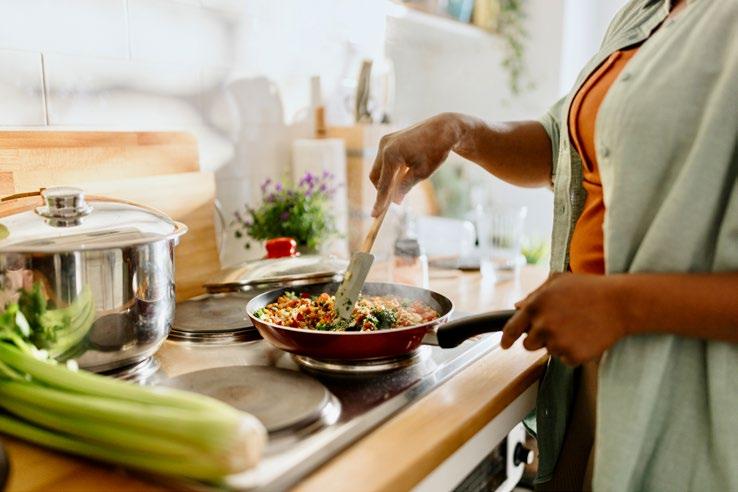
Nutrients are the components of foods essential for the body to function properly. These include fats, protein, carbohydrates, vitamins, minerals and water.
ClickView: In this video, you’ll learn about the different nutrients your body needs, like protein, vitamins and carbohydrates, and why they’re important for your growth, energy and health. You’ll also discover which foods contain these nutrients, which ones we should eat more of, and which ones are best saved as “sometimes foods”. <https://clickv.ie/w/WEt2>
1 Complete the following table by finding out what the best food sources are for each of the nutrients listed.
Nutrient Function
Carbohydrates
Primary source of energy for the body.
Fats
Secondary energy source for the body and insulation of body from the cold.
Best food sources
Protein
Growth and repair of body tissue such as bone, muscle and skin.
Vitamins
Assist in a range of chemical reactions occurring in the body such as energy release.
Also promote healthy skin and help to fight off infections.
Minerals
Help to maintain a range of internal body functions such as blood cell development, bone density and water balance.
Water
Maintains hydration of the body’s cells. Acts as a carrier for nutrients in the blood and assists in maintaining body temperature.
Author team: Diane Hansen, Lori Hill, Lauren McGregor, Sarah McKenzie, Melissa Neish, Isabella Roxburgh and Nat Tencic
Learning intentions
Gender and stereotypes
Understanding gender what are gender stereotypes?
Respect, empathy and decision-making
How gender expectations shape decisions
Respect in action
Gender equality and empowerment
How gender equality builds respectful relationships
Challenging assumptions and attitudes
Power, consent and violence prevention
How power affects behaviour what is consent?
Gendered violence
Violence prevention
Media, appearance and equality
Gender, inclusion and media messages
Gender in texts and storytelling
I can:
• explain key gender terms and recognise that gender can be diverse
• identify gender stereotypes/expectations and describe how they can affect choices, wellbeing and relationships
• use respect and empathy to make fair decisions and support inclusive, respectful relationships
• explain power and consent, recognise controlling/unhealthy behaviours, and describe how challenging harmful attitudes helps prevent gendered violence
• analyse how media messages shape ideas about gender and suggest ways to promote inclusion and equality.
Before you start this unit, test your current understanding by completing the following questions.
1 In your own words, what is the difference between sex and gender?
2 Write two gender stereotypes you have seen or heard.
3 What do you think gender equality means?
4 What is consent? Give one everyday example.
5 How can social media or advertising shape the way people think about gender?
Every day, the world around us sends messages about who we should be, how we should act and what’s ‘normal’, often based on whether we’re a boy, a girl or somewhere in between. These messages can come from family, friends, social media, TV shows, games or even school. Sometimes they lift us up, but other times they box us in. Talking about gender equality helps us notice those patterns and consider who decided what’s considered normal or whether it’s fair to everyone. When we understand how gender expectations shape our choices, we can see how they affect respect, empathy and relationships. We also start to recognise how equality makes our communities stronger and safer for everyone.
When you were born, someone probably looked at you and said “It’s a boy!” or “It’s a girl!”, but gender is much more than that. Sex refers to the biological differences between males and females (like chromosomes and anatomy), while gender is about the roles, expectations and behaviours that society teaches us.
Gender is a spectrum and not everyone fits neatly into one box. People may identify as male, female, both, neither or somewhere in between. Across cultures and history, ideas about gender have changed a lot. For example, in some Indigenous Australian communities, there are recognised non-binary identities that have existed for thousands of years. Understanding gender helps us notice when stereotypes, or unfair assumptions, limit people’s opportunities, confidence or sense of belonging.
ClickView: Understand the difference between sex and gender, consider how children learn gender stereotypes and analyse how gender norms have harmful effects on people’s health and wellbeing. <https://clickv.ie/w/A2Z3>
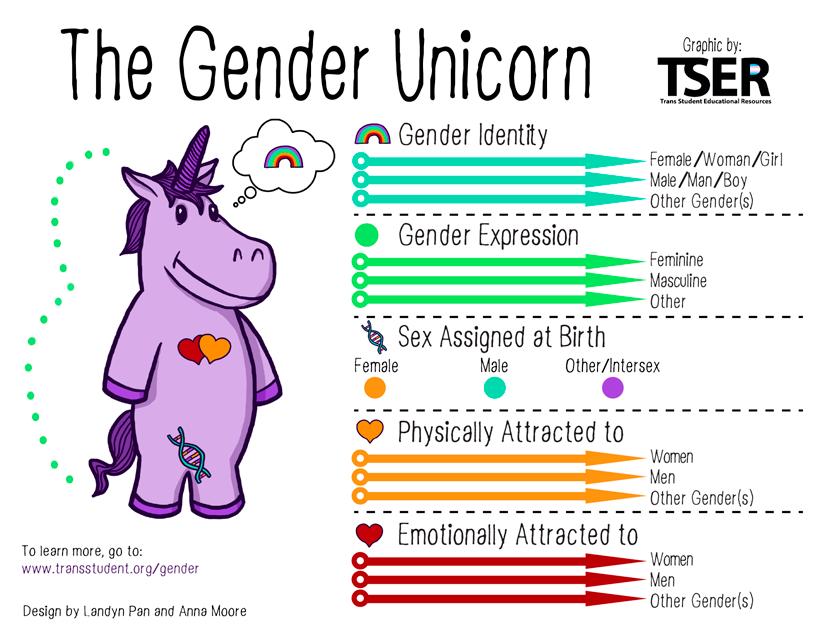
Important! Biological sex ≠ Gender identity ≠ Gender expression | Sexuality ≠ Gender.
Gender identity is how you feel inside about your gender, and whether it matches society’s ideas.
• Many people feel comfortable with the gender role they were given at birth. This is called cisgender—when your assigned sex and your gender identity match.
• Others feel different to the role they were given. This can include being transgender or gender non-conforming.
Gender non-conforming is an umbrella term for people whose gender identity or expression doesn’t match traditional expectations. This can include:
• transgender: identifying as a gender different from the one assigned at birth
• non-binary: not identifying as only male or female
• genderqueer, agender, gender fluid and many others.
Our gender identity can influence how we present ourselves to the world, how we think about ourselves, the spaces we feel welcome in and how others treat us.
We know there are boys and girls, but some people feel like they are a mix of both, and others feel like they are neither. Gender identity isn’t fixed—it can change over time. This doesn’t mean you 'choose' to be trans or cis, but it does mean your relationship with gender can grow and shift as you have new experiences.
ClickView: Learn about the range of gender identities. <https://clickv.ie/w/Wej4>
1 Think: In your own words, what does it mean to be a boy, a girl or gender non-conforming? (Hint: There are no wrong answers!)
2 In the table below, make a list of what makes someone a girl or a boy. Think about appearance, behaviours and activities. Consider how boys and girls typically behave, think and feel. What sort of things do they like and how do they speak?
Boys Girls
Learning intentions
How to use this Log
Part 1: Skills and sequences
Part 2: Strategies and tactics
Part 3: Lifelong physical activity
I can:
• explain how to use the PE Log to reflect on my learning across an indoor, outdoor and aquatic sport
• describe how my skills improve in different activity settings
• explain how strategies and tactics help performance by changing effort, space, time, objects and people during games
• describe how physical activity supports lifelong health and how being active in natural environments can build wellbeing and adaptability.
Before you start this unit, test your current understanding by completing the following questions.
1 What is the purpose of a PE Log?
2 Name the three different activity contexts you will reflect on in this unit.
3 What does 'efficiency' mean in skill performance? Give one example.
4 What is the difference between balance and stability?
5 List two lifelong benefits of staying physically active.
This PE log helps you reflect on your learning across a variety of activities. Each section begins with key term explanations to help you understand the movement concepts and performance ideas before answering the guiding reflection questions. You’ll use examples from three different sports—one indoor, one outdoor and one aquatic—to demonstrate how you apply and transfer your learning across contexts.
This section focuses on the development of your physical skills and how you apply them across different contexts and environments. You’ll explore how improving technique, control and efficiency allows you to perform more confidently and consistently. Reflect on how your balance, coordination and ability to adapt to various settings have improved over time.
• Different activity contexts and settings:
This means performing skills in a range of environments such as indoors (e.g. basketball), outdoors (e.g. athletics) and in the water (e.g. swimming). Each context presents different challenges, such as varying surfaces, equipment or weather conditions, which require you to adapt your movement and decision-making. Being able to perform effectively across multiple settings shows versatility and understanding of how environment influences performance.
• Increased efficiency in skill performance:
Efficiency means performing a skill with minimal wasted energy or unnecessary movement while maintaining accuracy and control. For example, an efficient swimming stroke uses smooth arm movements and correct breathing to reduce drag in the water. In team sports, efficient movement helps conserve energy and improves timing. As you refine technique, your movements become more economical and effective.
• Control of balance and stability:
Balance is the ability to keep your body’s centre of gravity over its base of support, and stability is how well you can maintain that control while moving or reacting to external forces. Good balance and stability are vital in almost every activity from holding a yoga pose to landing a jump safely in athletics or staying steady on a surfboard. Improving these skills allows you to perform with greater control and confidence in dynamic situations.
1 Complete the table after participating in each sport.
Indoor sport:
What specific skills did you focus on improving in this activity?
In what ways did you increase your efficiency in performing the skill?
How did you demonstrate control of balance and stability during your activity?
Outdoor sport:
What specific skills did you focus on improving in this activity?
In what ways did you increase your efficiency in performing the skill?
How did you demonstrate control of balance and stability during your activity?
Aquatic sport:
What specific skills did you focus on improving in this activity?
In what ways did you increase your efficiency in performing the skill?
How did you demonstrate control of balance and stability during your activity?
2 How did performing in a different context or setting change your approach or technique?
In this section, you’ll reflect on how you use strategies and tactics to perform effectively in games and movement challenges. You’ll consider how adjusting your effort, space, timing and interaction with others can give you an advantage. This helps you think critically about decision-making and teamwork during dynamic activities.
• Creating and using space through manipulation of effort, space, time, objects and people: This concept involves adjusting how you move and interact with others to gain an advantage in games or activities. For example, you might reduce effort to conserve energy, change speed to create time and space or position yourself strategically to block an opponent. In invasion games like basketball or netball, manipulating space might mean moving away from defenders to receive a pass, while in athletics or swimming, it could involve adjusting timing or pacing for efficiency.
• Manipulation of effort, space, time, objects and people: This refers to deliberately changing how you use these five elements to achieve a desired outcome. For example, manipulating effort means knowing when to sprint or slow down; manipulating space means choosing where to move; manipulating time means adjusting your pace or reacting quickly; manipulating objects means controlling equipment (like a ball or racquet); and manipulating people means influencing the positioning or actions of teammates and opponents. These tactical decisions show a deep understanding of movement strategy.
1 Complete the table after participating in each sport.
Indoor sport:
How did you and your team create or use space effectively in this activity?
Describe how you manipulated effort, space, time, objects or people to gain an advantage.
How did your strategy change as the game or activity progressed?
Outdoor sport:
How did you and your team create or use space effectively in this activity?
Describe how you manipulated effort, space, time, objects or people to gain an advantage.
How did your strategy change as the game or activity progressed?
Aquatic sport:
How did you and your team create or use space effectively in this activity?
Describe how you manipulated effort, space, time, objects or people to gain an advantage.
How did your strategy change as the game or activity progressed?
Author team: Michelle Nemec
Learning intentions
Impact of regular participation
Digital tools
Technology’s contribution
The impact of technology
Use of technology
Fitness circuit
Session outline
Circuit plan
Circuit evaluation
Reflective log
I can:
• identify physical activities designed to improve fitness
• explain the impact of regular participation in sport and physical activity on health, fitness and wellbeing.
Before you start this unit, test your current understanding by completing the following questions.
1 What do you already know about the benefits of playing sport or being physically active?
2 How do you think regular participation in sport can affect your health and wellbeing?
3 Can you think of a time when technology has helped you or someone you know to be more active?
4 Why do you think some people enjoy physical activity while others avoid it?
5 What role do you think schools and communities play in encouraging participation in sport?
Participation in physical activity can have a range of physical, social, spiritual and emotional benefits. For people with disabilities, participation in physical activity can contribute toward feelings of social inclusion and self-esteem; however, for some people, physical activity participation may heighten their sense of difference and ‘dis’ability. For many, being left on the bench, failing to connect with a ball, or being the last person chosen for a team can be a significant developmental experience. Negative experiences of physical activity during childhood can result in lifelong non-participation. The benefits of participation in physical activity are similar for everyone. As well as reducing the incidence of major health problems such as cardiovascular disease, diabetes, cancer and arthritis, physical activity can enhance mood, relieve stress, reduce depression, build self-esteem, develop social skills and reduce harmful behaviour.
To provide these positive physical activity experiences for everyone, organisers need to:
• set realistic goals
• emphasise enjoyment and participation
• offer competitive and non-competitive activities
• use modified and safe equipment, space and rules.
1 Individually, think of the best and worst experiences you have had participating in physical activity and complete the table below.
Experience
Why do you feel so strongly about it?
Is there anything you or anyone else could have done to make the experience better?
2 If possible, describe an experience that you have had where sport or physical activity has made you feel any of the following.
a In a better mood
b Less tense
c More confident about yourself
d More confident interacting with a group of people
For each category, list as many benefits of physical activity that you can think of. Two have been provided to get you started. Physical
• increases the size of heart and lungs
• strengthens muscles and bones
Social
• provides an opportunity to make and build friendships
• provides an opportunity to play in a team
Cognitive, emotional and spiritual
• helps us concentrate
• is a good outlet for stress
Technology can be used to help increase the number of people involved in physical activity and sport, encourage regular participation, as well as to enhance performance. It is ever changing and dynamic, using new equipment, resources and tools to benefit athletes. At the same time that technology increases, so do the questions we ask about its use, such as:
• Is technology impacting physical activity and sport for the better?
• What impact will technology have on physical activity and sport?
• Is technology making people more active?
• Is technology improving access to physical activity?
Technology doesn’t just refer to high-tech digital tools. Technology was even used back in the time of the ancient Olympics, where changes to the athletics track or the shape of javelins may have resulted in improved performances. Similarly, in many different cultures, fruit and rubber from trees were used to make balls, which could be kicked, thrown or hit in new types of games. Since then, improvements in technology have made sports equipment longer lasting, contributed to a decrease in injuries and supported people to participate more regularly in physical activity.
Learning intentions
Ethics in sport
Rules and etiquette
Player-officiated games
Understanding traditional games
Kai wana
Keentan
I can:
• describe modifications to equipment, rules and scoring systems that support fair play and inclusive participation.
Before you start this unit, test your current understanding by completing the following questions.
1 What does the word ethics mean to you, and how might it apply to sport?
2 Why do you think following the rules isn’t the only aspect of fairness in sport?
3 How can good sportsmanship make sport more enjoyable for everyone?
4 What do you think could happen in a game if no one followed the rules or showed respect?
5 Why do you think traditional Aboriginal and Torres Strait Islander games focused on cooperation and inclusion rather than competition?
When you play sport, you make choices all the time, such as whether to play fair, respect others and take responsibility for your actions. Ethics in sport means doing what’s right by showing fairness, honesty, respect and care for your teammates, opponents and officials.
In professional sport, ethical behaviour is essential. According to a 2023 Play by the Rules survey, 82 per cent of young athletes in Australia said they enjoy sport more when everyone plays fairly and shows respect. Yet, the same study found that one in three students had seen or experienced poor sportsmanship such as cheating, arguing with referees or disrespectful behaviour on the field. These moments can make people feel discouraged and reduce the fun of playing. Being ethical doesn’t mean you can’t be competitive, it means you compete with integrity. When players focus on fairness and respect, sport becomes more enjoyable and inclusive for everyone, not just those who are winning.
Ethical behaviour is what keeps sport safe, fair and enjoyable. Imagine a soccer match where everyone ignored the rules, argued over every call and tried to trick the referee—chaos! Rules are important, but ethics go beyond them. You might follow the rules but still act unfairly (e.g. celebrating in a way that humiliates your opponent).
Sports that promote ethics help build stronger communities. Studies by Sport Integrity Australia show that young athletes who practise ethical decision-making develop higher confidence, teamwork skills and empathy. Ethical sport teaches lessons that go beyond the field, it helps you become a better friend, classmate and community member.
Rules and etiquette, or manners, are used in activities and sports to govern how they should be played. ‘Fore!’, ‘The ball was out!’, ‘Goal!’, and ‘Go back to your corners’, are examples of what officials and participants say during different physical activities to indicate the way participants are expected to act.
Rules are consistent guidelines about how a sport or activity should be played. They are developed over time and become better known and applied once a governing organisation is formed. For example, football in England was only established as a sport when the English Football Association was formed in 1875. When people know and use rules, sport and physical activity can be played within common and consistent boundaries that ensure safety and allow people to improve within specified and agreed parameters. There are three main types of rules: official rules, modified rules and local rules.
• Official rules are developed and agreed upon by the game’s official governing organisation. They are followed in competitions and events, such as the Olympic Games, the National Rugby League, dance sport championships, and state championships.
• Modified rules are official rules that have been changed to allow for factors such as age, disability, gender or fitness level. These rules follow the official rules closely, and allow for improved safety and more participation. Examples of junior sports with modified rules include Minkey Hockey, Kanga Cricket, Auskick and Netta Netball. Examples for athletes with a disability include events like the Paralympics and wheelchair basketball.
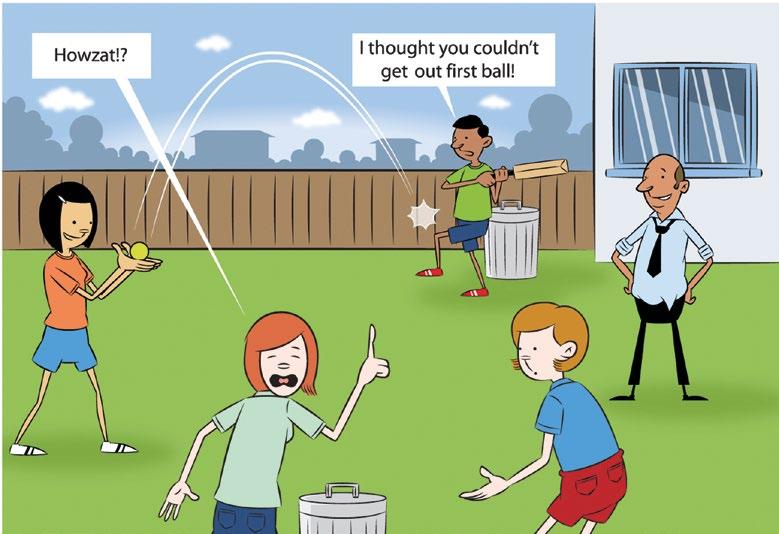
• Local rules are particular to an area. They are changes or alterations that have been made to official rules because of local conditions, needs and wants. Backyard, house, community or school games usually have local rules. Local rules can cater for age, playing area, time, equipment and intensity or level of competitiveness. Local rules may be small changes to the official rules (such as allowing four quarters instead of two halves because of hot weather), medium changes (such as playing only until it gets dark) or major changes (such as there being no uniforms, time limits, penalties or area restrictions).
When rules are established by official organisations, they also create a code of behaviour. The code is the accepted checklist of how players, coaches, officials and spectators should behave when involved in the sport or activity to maintain a good image of the sport and to keep all participants safe and happy.
People who do not follow the accepted code of behaviour can face consequences that restrict their involvement in the sport or activity. People who do follow the code are rewarded with continuing involvement in the sport or may be officially recognised by the organisation.
1 What would be an adequate consequence for each of the behaviours listed in this table? Match up the behaviours with appropriate consequences (there may be more than one).
Behaviour Consequence
1 Being a fair player throughout the game a Money fine
2 A coach yelling at referee’s decision b Suspension from games
3 Drug taking c Best and fairest award
4 Fighting with teammate d Ban from attending event
5 Tampering with game equipment e Lose the respect of the team
6 An athlete visiting sick children in hospital f Good job after sport career finishes
7 Bribing an official g Not being well liked by people
8 Betting on own match h Receive media criticism
Etiquette is what is seen in sport as the ‘right’ or ‘nice’ thing to do, keeping sport honourable and fair. Sometimes there are no rules to govern how players, coaches, officials and spectators should behave, so they are expected to follow the unwritten rules of fair play. Etiquette comes from a time in the past, before there were rules and codes of behaviour. It is a reminder to future generations of sportspeople to act in a way that is fair and will mean that the sport is well regarded. Etiquette can be found at all levels of sport, from international competitions, such as a footballer helping a player who has tripped over, to local competitions, where a golfer might call ‘Fore!’ when teeing off.
1 In groups of three or four, develop a game that combines the rules, codes of behaviour and etiquette from other games. As a class, play each group’s game. The game creators should try to take on coaching, officiating and captaining roles.
After playing all of the games, use the table provided to evaluate one, and then answer the questions.
Game Evaluation
Game name
Rules
Code of behaviour
Etiquette
Equipment
Area
Author: Katy Gerner
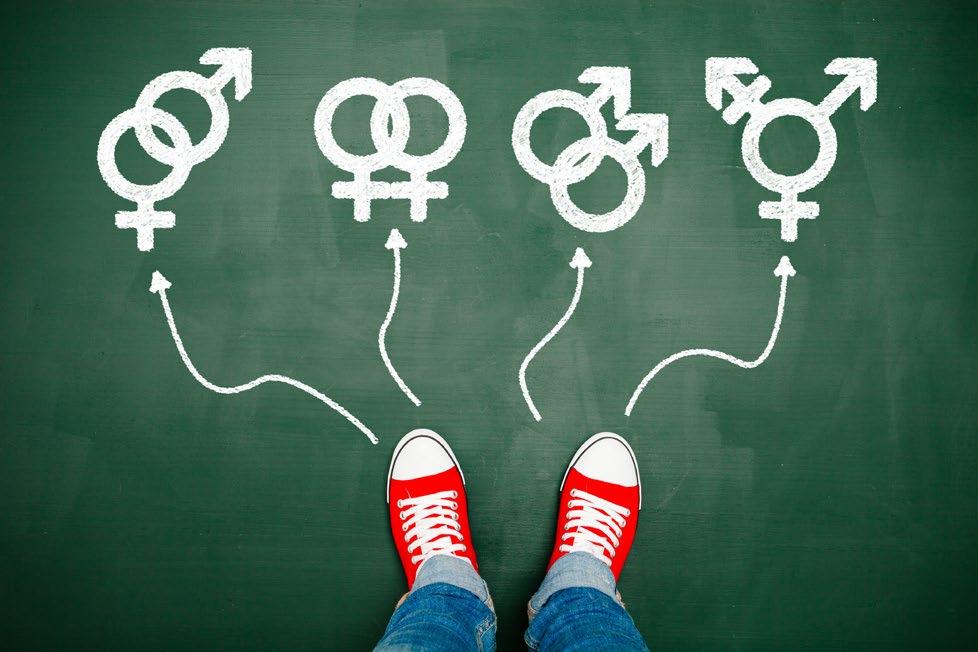
Learning intentions
Exploring identity during change
Changing feelings and attractions
Influence of puberty on identity
Understanding body changes during puberty
Cultural beliefs and expectations
Health information and support
Strategies to manage the impact of change
You’re still becoming you
I can:
• identify ways in which changing feelings and attractions form part of developing sexual identities
• explain the influence of values and beliefs on the development of identities.
Before you start this unit, test your current understanding by completing the following questions.
1 What do you think the word identity means?
2 How might puberty affect the way you see yourself or the way others see you?
3 What are some different parts of a person’s identity (e.g. name, interests, culture)?
4 Why do you think people’s feelings or attractions can change as they grow up?
5 Where could a young person go if they had questions about puberty, gender or sexual identity?
As you grow older, your body, thoughts and emotions go through many changes. These changes are a natural part of growing up and are influenced by something called puberty, a time when your body begins to develop and mature. But puberty doesn’t just change your appearance. It also brings new feelings, new questions and sometimes new ways of understanding who you are. This process of discovery is all about identity—how you see yourself and how you relate to the world around you.
Identity is a big word, but it simply means your sense of self. It includes things like your name, your interests, your values, your cultural background, your gender and your sexual identity. These parts of you might feel clear and certain, or they might feel like they’re changing or still being figured out, and that’s completely normal. Everyone’s journey through adolescence looks a little different, and there’s no ‘right’ way to experience it.
During this time, it’s common to start noticing changes in your feelings and attractions. You might begin to feel drawn to certain people—romantically, emotionally or physically. Some people discover that they’re attracted to people of the opposite gender. Others might realise they’re attracted to the same gender, or more than one gender. Some might not feel romantic or sexual attraction at all, and that’s valid too. These feelings can be exciting, confusing or even challenging at times, but they are a normal and important part of your development.
It’s also important to know that your gender identity (how you feel inside about being male, female, both, neither or somewhere in between) might become clearer or feel more complicated during puberty. While many people feel comfortable with the gender they were assigned at birth, others may feel differently. Exploring your identity doesn’t mean something is wrong; it means you’re paying attention to who you are becoming.
Remember: you are still growing, learning and discovering who you are. It’s okay to not have all the answers yet. The goal is not to force yourself to fit a label or make big decisions right away. Instead, it’s about being honest with yourself, learning how to respect others’ journeys and knowing where to find support when you need it.
ClickView: Learn what cultural identity, sexual identity, cliques and belonging mean, and explore the clues that might lead you to discover who you are, and who you really want to be. <https://clickv.ie/w/kIl3>
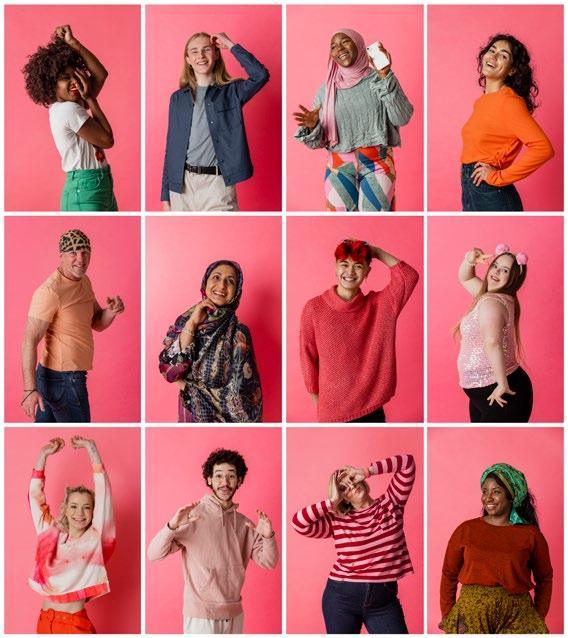
Ground rules for a safe and respectful discussion: listen respectfully to others, remember you don’t have to share anything personal about yourself, accept that everyone’s experience is valid and feel confident that it’s okay to say ‘pass’ if you don’t wish to answer.
1 As a class, discuss the following questions one at a time. Use the space provided to make notes.
• What makes up a person’s identity?
• Can your identity change over time? Why or why not?
• How does the way we see ourselves affect how we treat others?
• What makes it safe or unsafe to be yourself?
1 Create a visual collage using drawings, magazine cutouts or online images that represent different parts of your identity. Include at least five images or words that represent you now. You can include things like your values, culture, interests, emotions or things you care about. Make sure to include a title, for example, ‘This is Me!’ or something more personal. You might also want to include a ‘future me’ section showing what you hope to discover or grow into.
Author team: Sandra Duncanson, Diane Hansen, Brooke Kenwright and Nat Tencic
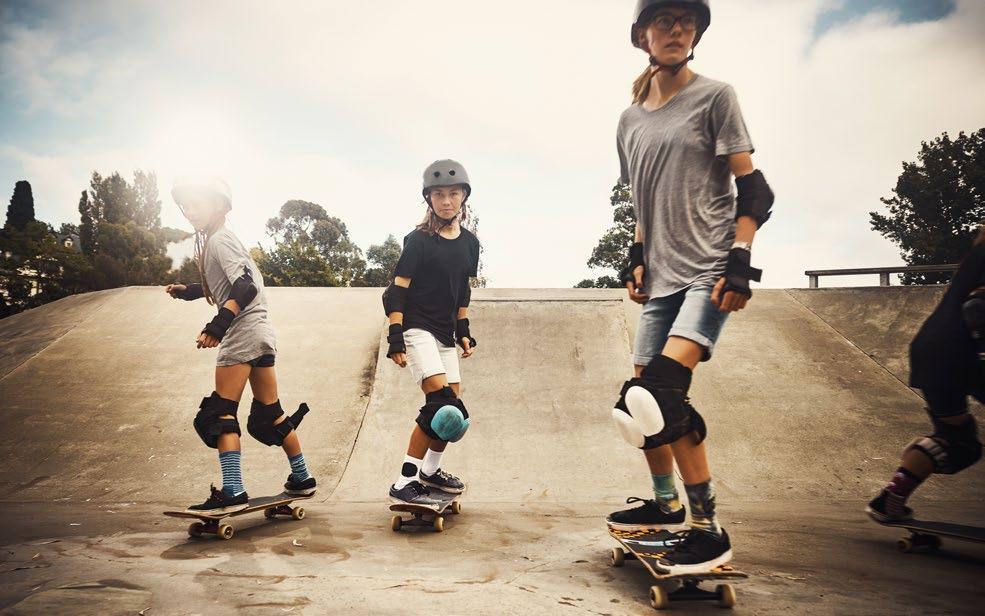
Learning intentions
Safety
Assertive responses and refusal skills
Know your comfort levels
Online environments
online harm
Sexting
First aid
Risk management
I can:
• refine protective behaviours
• evaluate community resources to seek help for myself and others (including basic first aid and CPR)
• identify skills and strategies to promote physical and mental health, safety and wellbeing in various environments.
Before you start this unit, test your current understanding by completing the following questions.
1 What does the word safety mean to you?
2 Have you ever used a strategy to get out of a risky or uncomfortable situation? What did you do?
3 What are some things that help you feel safe at home or school?
4 What do you already know about being safe online?
5 Do you think you would know how to help someone in an emergency?
Each of us would view the meaning of safety in a different way, depending on our experiences and personality. There may be different people, settings and circumstances that make us feel safer than others. For example, some people might feel safest when they are at home and everything is familiar to them, while others might prefer to be out in a crowded area.
When we feel we are in a safe environment we are able to let our true personality out and be ourselves. We do not need to use our defence mechanisms or pretend that we are something that we are not.
Many factors could result in us feeling unsafe or uncomfortable in certain situations. This could occur among strangers or friends, or on your own. It could happen at home, work, school or any other location. When we feel unsafe we feel threatened. This causes us to experience a whole range of emotions, including fear, anger, shame and jealousy. We automatically put up our defences and use whatever coping strategies we have developed.

1 List the things that you consider essential for you to feel safe.
2 Describe a situation that may cause someone to feel unsafe in the following settings: a Home
b School
c Work
d Other
3 Imagine you are in a situation where you feel unsafe or uncomfortable. What defence mechanism or coping strategies do you think you would use to handle the situation?
Our reactions and the strategies that we use to protect ourselves are sometimes just as destructive as the situation itself. We often develop self-protection strategies and behaviours when we partake in risk-taking activities that put us in danger of further harm.
1 What are some negative strategies that someone may use in an attempt to protect themselves?
2 How could you use a more positive approach for both yourself and the overall outcome?
3 When people feel supported they are less likely to act in a destructive way.
a Considering the statement above, what programs/strategies could be introduced at your school to encourage students to use more positive self-protection strategies?
b Choose one of these strategies and outline what steps would need to be taken to introduce it to your school community.
Just in the same way that people’s bodies grow differently and at different times, the types of activities we feel comfortable participating in change at different rates, too. Being safe includes feeling safe, so you should never agree to do anything that makes you feel unsafe or that you do not feel ready to do.
One of the hardest, but most important, things to do to ensure your safety is to say no to friends when they want you to do something risky. If your friends are pressuring you or even just asking you to do something you think is unsafe or inappropriate, it is important to say no, and, if necessary, remove yourself from the situation. If those people are really your friends, they will respect your choices.
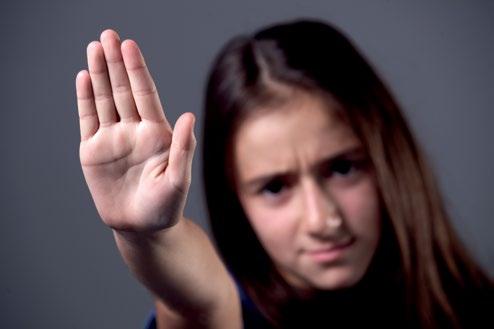

Learning intentions
Consent
Sexual consent who can and can’t consent
Communicating boundaries
My body, my rules
Communication styles
I can:
• apply skills and strategies to communicate assertively and respectfully when seeking, giving or denying consent
• evaluate community resources to seek help for myself and others
• refine protective behaviours.
Before you start this unit, test your current understanding by completing the following questions.
1 What does the word ‘consent’ mean to you?
2 When should you ask for someone’s consent? Give two examples.
3 Why is it important to say “no” if you feel uncomfortable about something?
4 What do you think ‘communicating boundaries’ means?
5 Who could you talk to if someone doesn’t respect your boundaries?
Consent is permission for something to happen, or an agreement to do something. Consent applies to everything. When you want to interact with someone’s body or property, you must get their consent. And when somebody wishes to do the same to you, they must get your consent first.
If you want to borrow or use something that belongs to someone else, you ask, don’t you? The same logic applies to touching, kissing, talking, hugging, or interacting in any way with someone’s body.
Your body is yours and yours alone. You have the right to make decisions about it and how it is treated. Remember, if that applies to you, that applies to everyone else too.
You can’t touch, kiss or hug someone without asking first, and someone can’t do those things to you without asking and you giving consent.
But it doesn’t stop there! Consent applies when you are interacting with people verbally and online too. It applies when you want to send something to someone or show them a picture or video. It applies when you want to speak to them about something difficult or even tell a joke.
ClickView: In this video, we’ll talk about consent and how to communicate clearly with others. You’ll learn what consent really means — that it’s not just about someone not saying no, but about them clearly saying yes. The video also explains what you can do if someone touches you in a way that makes you uncomfortable or that you didn’t agree to. Most importantly, it reminds you that if this happens, it is never your fault, and there are adults you can talk to who can help.
<https://clickv.ie/w/48t2>
1 Write: Identify some more examples of situations where one should ask for consent.
Sexual activity includes intimate activities with someone else’s body like kissing, sexual touching (including groping, digital penetration, caressing) and intercourse (this includes oral sex, anal sex, penile-vaginal sex).
Just like anything, you must obtain consent for any sexual act (even kissing or touching someone’s butt).
Sexual consent must meet the DEVICES rules and be freely and enthusiastically given. This is important because the consequences of acting without consent are very serious. Sexual activity without everyone’s consent is sexual assault. Sexual assault is a crime that can carry serious penalties. It also causes pain and trauma to victim–survivors that can stay with them their whole lives.
ClickView: In this video you’ll learn what consent is, why it matters and how it’s different from sexual harassment or assault. Understanding these terms helps you know your rights and how to respect others. <https://clickv.ie/w/o9t2>
1 What’s the age of consent in your state?
2 Outline how ‘consent’ is defined in your state.
4 List the penalties for sexual assault.
Remember DEVICES. You’re only within consent when it’s definite, enthusiastic, voluntary, informed, continuous and everyone gives it. Someone who feels threatened, is being lied to, is drunk or unconscious cannot consent to sexual activity.
ClickView: In this video, you’ll see a story about a young person feeling pressured by their partner to do something sexual. It helps explain what consent means – including that you have to give a clear “yes” and that you can change your mind at any time. The video also talks about coercion, which is when someone tries to pressure or guilt you into doing something you’re not comfortable with, and explains that being drunk or high means you can’t give proper consent. You’ll also learn about the laws around consent (which can be different depending on where you live in Australia) and how sexual contact includes things like kissing, hugging and touching. Most importantly, it reminds you that your body is your own and talking to a trusted adult can really help if you’re feeling unsure or uncomfortable. <https://clickv.ie/w/A8t2>
1 Watch this video: <mea.digital/FB_DC4>. Have a class discussion around the following questions:
a Who is and is not consenting in the video?
b How do you work out if someone can consent or not?
c Why might some people still want to give someone else tea, even if they say no?
d What could they do instead
Boundaries are the limits we set for ourselves in different situations—like how close we feel comfortable standing to someone, what kind of touch is okay or how much personal information we want to share. Everyone has different boundaries, and that’s totally normal. What’s important is being able to communicate those boundaries clearly and respectfully, especially when it comes to relationships, friendships or anything to do with consent.
Consent means giving permission for something to happen—and for that permission to be real, it must be freely given, informed, enthusiastic and can be taken back at any time. Communicating your boundaries is a key part of consent. For example, if you’re not comfortable hugging someone, it’s okay to say, “I’d rather not hug.” If someone asks to hold your hand and you don’t want to, you can simply say, “No thanks.” You don’t need to explain or apologise for setting a boundary.
It’s also important to listen when others share their boundaries. If a friend says they don’t want to talk about something, or if someone says “no” to physical contact, that needs to be respected—no questions asked. Respecting other people’s boundaries is just as important as expressing your own.
Practising how to communicate boundaries can take confidence, but it gets easier over time. You might feel nervous at first, especially if you’re worried about hurting someone’s feelings, but standing up for yourself helps keep relationships safe, respectful and healthy for everyone.
Learning intentions
What is diversity?
Living with diversity
Challenging discrimination
Racism
Sexism
Ableism
Homophobia
Values, beliefs and prejudices
Values and beliefs
Prejudices
Norms, stereotypes and prejudices: local to global
Traditions and community wellbeing
Cultural practices
Aboriginal and Torres Strait Islander Peoples
Cultural practices from Asia
Affirming diversity
I can:
• identify strategies that influence how communities value diversity propose actions I can take to promote inclusion in my communities
• explain the benefits to individuals and communities of valuing diversity and promoting inclusivity.
Before you start this unit, test your current understanding by completing the following questions.
1 What do you think the word diversity means in your school or community?
2 Can you think of some ways people in Australia are different from one another (e.g. culture, language, abilities)?
3 Have you ever seen or experienced prejudice or discrimination? How did it make you feel?
4 What are some positive things that can happen when people from different backgrounds live and work together?
5 What do you already know about stereotypes and how they can influence the way people are treated?
Diversity is all about valuing the things that make us different. In Australia, we are lucky to live in a diverse society. For example, think about your school community; every day you are at school you interact with people who are a little different to you. These differences could be to do with age, gender, family background, appearance, religious and political beliefs, values, hobbies, ability, personality—the list is endless!
All of these differences make us who we are, and it is important that they are respected. Just as you want to be valued for all of the things that form your unique identity, you should value the differences that make others unique, too.
1 What are some of the emotions people feel when they see diversity in their community?
2 How have you seen people reacting to diversity in their community in the media?
3 How do you personally feel about and react to diversity in your community?
Your exposure to diversity is only going to increase as you get older. You will see examples of diversity on television, in newspapers, at university, on social media and in your workplaces. Appreciating this diversity will make your life more interesting and rewarding by providing opportunities to learn and participate in new experiences. Interacting with people from different backgrounds is an easy and fun way to broaden your horizons and expand your understanding.
In 2016, an Australian advertisement called You Never Lamb Alone was launched. While this was an advertisement for lamb, it also made a point of celebrating the incredible diversity within Australian culture. Watch the video at the link provided and then answer the following questions.
<mea.digital/FB_DIV3>
1 What different groups of people are represented in the advertisement? Think about biological sex, language groups, gender identity, sexuality, religion, appearance and race.
2 List the ways in which diversity enriches a society.
3 How has diversity benefitted your own life? If you are stuck, think about what you have learnt from your friends. How have their life experiences and values helped you?
Discrimination is when someone is treated unfairly because of who they are or what group they belong to. It can affect people’s opportunities, health and sense of belonging. Research shows that young people who experience discrimination are more likely to feel anxious, depressed or disconnected from school. But when communities take action to challenge unfair treatment, they become stronger, safer and more inclusive.
In Australia and around the world, racism, sexism, ableism and homophobia are still issues we need to face. Learning about them helps us recognise unfair behaviour and gives us the tools to stand up for fairness and respect.
Australia is a multicultural country with almost half of Australians born overseas or who have a parent who was. Most people celebrate this diversity, but racist incidents still occur, especially online and in sport. Aboriginal and Torres Strait Islander Peoples have faced systemic racism since colonisation, including being denied rights and opportunities. Today, racism is still a major issue, affecting health, education and justice.
Racism means judging or excluding someone because of their race, skin colour, culture or religion. It can be very direct, like using racist insults or refusing someone a job. It can also be subtle, such as assuming someone can’t speak English well because of their appearance.
Racism often comes from stereotypes (over-simplified ideas about groups of people) or from fear of difference. Sometimes people copy racist attitudes they hear from family, friends, media or social media without realising how harmful those ideas are. But why do people believe racist things if they’re not true? Racism has a long history, including colonisation and slavery, where groups of people were treated as less human. These unfair systems created attitudes that still influence people today.
Experiencing racism can have serious effects on mental health, opportunities and the community. Research in Australia shows young people who experience racism are more likely to feel anxious, depressed or disconnected at school. People might miss out on jobs, housing or leadership positions because of discrimination. Racism divides people, creating mistrust and conflict instead of belonging and connection. A study by the Australian Human Rights Commission found that 1 in 3 people in Australia experience racism each year, and many of those are school-aged students.
ClickView: Learn about Adam Goodes’ personal experiences with racism and the emotional toll it took.
<https://clickv.ie/w/YN03>
Adam Goodes is a proud Indigenous man, two-time Brownlow Medal winner, Sydney Swans premiership player and 2014 Australian of the Year. He is also a member of the Indigenous Team of the Century.
In 2013, during an AFL game, Goodes was racially abused by a 13-year-old girl in the crowd who called him an offensive name. Goodes later said he didn’t blame the girl, but wanted to call out racism when it happened.
A few days later, Collingwood Football Club president Eddie McGuire made a racist remark on his radio show, linking Goodes to the King Kong musical then playing in Melbourne. Although both incidents received media attention, neither the girl nor McGuire were formally punished.
Goodes continued to face racism from sections of the crowd in following seasons. In 2015, after ongoing booing and racist abuse, he retired from AFL. Many people, including his club’s CEO, described his treatment as a disgrace and a shameful chapter in the game’s history.
Read the articles at <mea.digital/FB_DISP1> and <mea.digital/FB_DISP2> then answer the following questions.
Author team: Diane Hansen and Natalie Tencic
Learning intentions
Changing relationships
How relationships shift in early adolescence
How family relationships influence peer relationships
Behaviour in different social contexts
The different ‘selves’ we present
Balancing authenticity and adaptation
Respect for cultural norms
what does respect for cultural norms look like?
Challenges, misunderstandings and growth
I can:
• evaluate strategies for managing the changing nature of peer and family relationships
• explain the roles of respect and empathy in developing respectful relationships.
Before you start this unit, test your current understanding by completing the following questions.
1 How do you think relationships start to change as people move through early adolescence?
2 Why do you think friendships become more influential during this stage of life?
3 What does it mean to have rights and responsibilities in a relationship?
4 Why can conflict occur more often as young people start to want more independence?
5 Why might someone behave differently around family, friends or at school?
When you were younger, your world probably revolved around your family. Your parents, carers or siblings were the people you turned to for everything. But as you get older, something starts to shift. You might find yourself wanting more freedom, spending more time with friends or even feeling misunderstood at home. This is completely normal. It’s part of growing up and figuring out who you are. Your relationships, especially with your family and peers, begin to change in exciting, sometimes challenging ways. Understanding why these changes happen and how to handle them can help you build stronger, more respectful connections with the people around you.
As you move through early adolescence, relationships with family and friends naturally begin to change. You don’t stop needing your family, but your sense of independence, identity and peer group grows stronger. That means how you relate to your family and to your friends will likely evolve, and sometimes this change can feel confusing or even uncomfortable.
One of the most common changes is that peers (friends and classmates) tend to take on more significance. You might find that:
• you care more about what your friends think of you
• your emotional support or sense of belonging may start to come from friends rather than only family
• you may share more of your thoughts, problems or secrets with close friends.
This doesn’t mean your family becomes less important. In fact, both types of relationships can coexist and support one another. While your friendship group may play a bigger role in your daily life, your connection with family remains deeply meaningful. In a survey conducted by the Australian Institute for Health and Welfare, 79 per cent of people aged 15–19 rated their family as ‘extremely important’ or ‘very important’.
1 Make a list of all of the different types of relationships that you are a part of. Underline each of the relationships that you believe you have had a part in forming.
2 Choose three of the relationships and outline the benefits of each.
3 Think about your own friendship group. What qualities do these people possess that make them good friends?
Throughout adolescence, your friends will play a very important role in your life. There are other relationships that you will share that may be equally as important. Each of these relationships will require you to take on particular roles.
1 In the space provided, record the various characteristics that you must demonstrate in order to ensure that each relationship remains strong.
Son/daughter Student Employee Team member
In any relationship, you have certain rights and responsibilities. Your rights are the ways in which others should treat you. Your responsibilities are the ways in which you should treat others. When both sides are aware of their rights and responsibilities, the relationship is built on a solid foundation of common understanding and respect.
1 Using the space provided, devise a rights and responsibilities checklist that you could consider when making a new friend.
Rights
Responsibilities
2 Share your results with your class. You may wish to add extra rights or responsibilities that you may not have thought of.
Author team: Diane Hansen and Nat Tencic
Learning intentions
Introduction
Understanding bullying behaviour
Respect, empathy and power
Consequences of bullying
Psychological consequences
Social consequences
Impact on relationships
I can:
• explain the roles of respect, empathy, power and coercion in developing respectful relationships
• identify the impacts of bullying and harassment on relationships.
Before you start this unit, test your current understanding by completing the following questions.
1 What does the word bullying mean to you? Can you give an example?
2 In what spaces can bullying occur?
3 Why do you think people bully others?
4 How do you think bullying affects the person being bullied?
5 How might empathy and respect prevent bullying behaviours?
Bullying is the act of intentionally causing physical or emotional harm to someone. A bully will usually target someone who they think is weaker than them to intimidate them and gain power from that person’s fear or helplessness. Bullying can happen in many ways, and can be direct or indirect. Direct bullying includes things like physical abuse, teasing, name-calling and sexual harassment. Indirect bullying can often be a little harder to identify and includes things like intentionally excluding a person from social situations, spreading rumours, manipulation and giving dirty looks.
Bully tactics are learned behaviours. Generally, a person who bullies does so because other people around them, such as older siblings, neighbours and even teachers and parents, treat them that way. Those who grow up in an environment where there is fighting, name-calling, teasing, shame and blame learn to do it to others as it is all they know and they have never learned more appropriate ways of relating to others. For many young people, bullying is part of their everyday lives and they do not even know it. It may happen in their families, at school and in social and sporting situations.
A bully often hurts others because making someone else feel bad makes them feel better about themselves. However, that feeling may not last long and they may feel guilty and ashamed of their actions or may justify their behaviour by blaming the other person.
Bullying behaviours can often be grouped into defensive behaviours and aggressive behaviours. Defensive bullying behaviours are when a bully tries to protect themselves from being seen as responsible for their actions. This can include making excuses for what they did, blaming others for their mistakes or making jokes to suggest that other people are just ‘too sensitive’. Aggressive bullying behaviours, on the other hand, are actions that directly harm or intimidate others, such as name-calling, physical pushing, spreading rumours or deliberately leaving someone out. Both types of behaviours are damaging, but understanding them helps us recognise how bullies act and why it’s important to respond in a way that supports respect and safety.
Fortunately, behaviours are only patterns, and patterns can be challenged and changed!
ClickView: Explore what bullying is, its damaging effects and how it can be stopped. <https://clickv.ie/w/1tp3>
In small groups, discuss the following questions:
1 What are the differences between defensive and aggressive behaviours?
2 What causes bullies to be defensive?
3 What causes bullies to be aggressive?
Respect, empathy and power all play important roles in bullying. When respect is missing, people may treat others unfairly or unkindly, which can lead to bullying behaviours. Empathy (the ability to understand and share another person’s feelings) helps prevent bullying because it reminds us that our actions have real impacts on others. Power is also central to bullying, as bullies often use their power (such as being stronger, more popular or having more influence online) to control or hurt others. Building relationships based on respect and empathy, and using power in positive ways to support rather than harm, are key to preventing bullying and creating safer, kinder communities.
ClickView: Understand how to speak up about being bullied by listening to this true story. <https://clickv.ie/w/rup3>
Analyse the stories and articles at the link <mea.digital/FB_BU1> and complete the table.
Type of bullying behaviour
Physical intimidation or abuse
Specific bully tactic
Example: Pushing
What it was like for the other person
Example: Humiliating, hurtful
Exclusion
Emotional intimidation
Justification
Denial and blame
Making light of the issue
Discrimination
Threats and force
Learning intentions
What are emotions?
why do emotions feel so strong in the teenage years?
why do different people react so differently?
Personal factors and prior experiences
Personal factors
Prior experiences
Social and cultural influences
How culture shapes ‘emotional rules’
Friends, school and online worlds
Discrimination, belonging and emotional wellbeing
Norms, expectations, beliefs and attitudes
Expectations about ‘handling it on your own’
Gender norms
Beliefs that make bullying and ‘banter’ seem normal
Stigma, shame and self-talk
Respecting differences and building empathy
I can:
• explain personal, social and cultural factors that influence emotional responses and behaviour.
Before you start this unit, test your current understanding by completing the following questions.
1 What do you think an emotion is, and why do you think people experience emotions differently?
2 Why do you think emotions can sometimes feel very strong or overwhelming during the teenage years?
3 How do you think someone’s past experiences might influence how they react to a situation?
4 What role do friends, school and online interactions play in shaping how young people feel?
5 What kinds of unwritten rules about emotions exist in your family, cultural background or friendship group?
Emotions are signals from your brain and body that something important is happening. When you feel happy, your brain might be saying “this is good, I want more of this”; when you feel angry, it might be saying “something feels unfair or wrong” and when you feel scared; it might be saying “is this safe?”.
An emotion isn’t just one thing. It’s usually a mix of:
• Thoughts: what you say to yourself in your head
• Body sensations: heartbeat, breathing, butterflies, tense shoulders, shaky hands
• Behaviour: what you do next (e.g. go quiet, cry, laugh, walk away, slam a door, talk to someone)
You might think emotions are ‘good’ (like happiness) or ‘bad’ (like anger or sadness). But emotions themselves are not good or bad. They’re information. They’re like notifications popping up on your phone: ‘Hey, pay attention. Something’s going on here’.
ClickView: Learn about different strong emotions, how they affect us and strategies for managing them effectively.
<https://clickv.ie/w/Yao4>
If your feelings seem louder or more intense than when you were younger, that’s not just your imagination. Your brain is going through a major upgrade in the teen years. Parts that react to rewards, risk and social approval are very active, while the parts that help with planning and calming down are still developing. At the same time you’re dealing with schoolwork, friendships, identity, family expectations, social media, money worries and events happening in the world.
• According to the National Mental Health Commission, about one in seven children and adolescents aged 4–17 have a mental health condition such as anxiety, depression or behavioural difficulties.
• The Australian Institute of Health and Welfare (AIHW) found that, in 2020–22, around one in four young people aged 16–24 reported high or very high psychological distress (feeling very stressed, low or overwhelmed), and rates were higher for young women than young men.
• In the 2022 Mission Australia Youth Survey, nearly three in 10 young people aged 15–19 said they were experiencing high psychological distress, and about one in six rated their overall mental health as ‘poor’, with almost a quarter feeling lonely most of the time.
At the same time, it’s not all negative. An AIHW report found that most 15–19-year-olds (around six in 10) said they were happy and felt positive about their future.
So, in Australia, many teenagers are hopeful and positive and many are also dealing with strong, sometimes overwhelming emotions. If your feelings are intense or up and down, you are definitely not alone.
ClickView: Learn strategies for managing strong emotions like stress and shame, and understand the concept of intergenerational trauma. <https://clickv.ie/w/cbo4>
When something happens, people often say “it made me angry” or “it made me upset”, but usually, there’s more going on underneath. You can think of it like an emotion equation:
Event + what it means to you
→ thoughts in your head
→ feelings in your body
→ actions you take
For example:
Event: Two classmates look over at you and start whispering.
• Person A’s thoughts: “They’re probably talking about homework”
• Feelings: relaxed, maybe curious
• Actions: keeps working, might ask later what they were talking about
• Person B’s thoughts: “They’re laughing at me”
• Feelings: embarrassed, angry, hurt
• Actions: goes quiet, glares at them or sends an angry message later This is the same event, but two totally different emotional responses. The event matters, but so do:
• your past experiences (e.g. have you been laughed at before?)
• your beliefs (e.g. ‘people don’t like me’ vs ‘my friends usually have my back’)
• your social and cultural background (what’s ‘normal’ in your family or community?). The event is only one part of the story. What you bring to the event also shapes how you feel.
Think about these situations:
• One person loves presenting in front of the class; another feels sick with nerves.
• One person laughs at a joke; another feels really hurt.
• One person loves storms; another panics at thunder.
Some reasons for this include:
• Personal differences: personality, temperament, likes and dislikes.
• Prior experiences: what’s happened before (bullying, moving schools, praise, success, failure).
• Social influences: what family, friends, teachers and social media say is ‘normal’.
• Cultural influences: traditions, beliefs and unwritten rules in different communities.
• Norms and expectations: messages like ‘boys don’t cry’, ‘you must always be strong’ or ‘don’t talk about feelings’.
Australian reports show that many young people are experiencing higher levels of psychological distress now than in earlier years, which suggests that modern life including social media, school pressure and cost of living stress can make emotions harder to manage.
Understanding why emotions happen and why they differ between people can help you be kinder to yourself, be more understanding of others and notice when you or someone else might need extra support.
1 Think of a time when you and a friend (or someone you know) reacted differently to the same situation (e.g. getting a test result, being left out of a group or chat, a teacher raising their voice, someone making a joke, a sports result or performance). Your teacher may invite you to share this with a partner, but you only have to share what you’re comfortable sharing.
a What happened (the event)?
b How did you feel and react? Use emotion words and describe what you did.
c How did the other person feel and react?
d Why do you think your reactions were different? Think about personality, past experiences, beliefs, family/cultural rules, etc.
Primary writers: Michael McGrath and Melissa Kemble
Mountain biking is simply cycling off-road, usually on hilly dirt tracks or trails. Mountain bikes differ from normal road or commuter bikes in several ways. The frames are stronger, so they can handle the extra stress of the rugged terrain, and suspension is added to reduce jarring, especially on the rider’s wrists. Some bikes have spring-loaded suspension on the front forks only and are known as hard tails, while other full-suspension bikes have shock absorbers on the rear forks as well. Cross-country riders generally prefer hard tails while dedicated downhill riders will choose full suspension. Mountain bikes have fatter tyres with more knobby grip; often rows of rubber studs stick out to help them grip soft dirt, sand or mud.
1 Hard tail mountain bikes have spring-loaded suspension on which area of the bike?
2 True or false? Mountain bikes have:
a stronger frames than standard bike frames
b suspension added to help riders jump higher
c fatter tyres that have more grip than a street bike
3 Which type of rider prefers hard tail mountain bikes?
True False
True False
True False
A typical ‘hard tail’ mountain bike with front suspension. This is a standard mountain bike that is good for learning all the techniques and is a good compromise of performance, durability and cost.
The ‘soft tail’ or full-suspension mountain bike is more comfortable and controllable on steep, rough terrain, especially downhill racing. The downside is that it offers less efficient acceleration on hard surfaces like roads. Most good models have a rear suspension locking mechanism.
Protective equipment is essential for riding off-road trails. If going into the bush, the minimum of a helmet, eye protection and full-fingered gloves is recommended to protect riders from falls and tree branches. Shin guards, full-face helmet and body armour will save serious downhill riders a lot of pain and injury.
1 Fill in the gaps to label the mountain bike: brake cable, saddle, front shock, rim, pedal, chain.
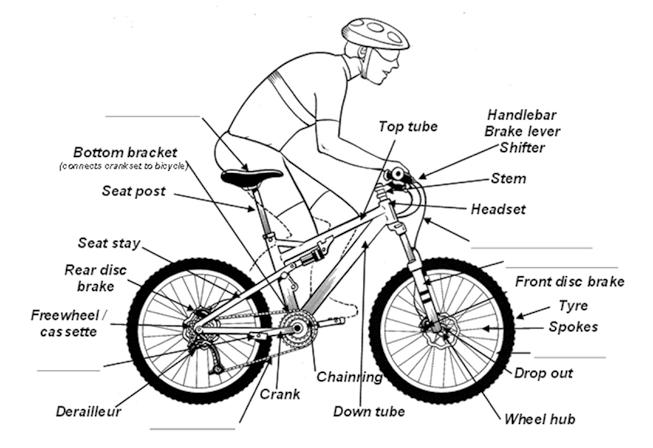
1 What type of suspension does a: a ‘hard tail’ mountain bike have? b ‘soft tail’ mountain bike have?
2 Which type of mountain bike is better for downhill racing?
3 The minimum protective equipment needed when riding in the b is a h , e protection and f gloves. Additional protective equipment includes a full-face h , b a and s pads.
1 Safety is essential if you are going to enjoy mountain biking. What problems or hazards may arise while mountain biking?
2 In pairs develop a checklist of what you may need to do before you set off on a ride.
3 Share your responses with the class and make any necessary modifications.
There are several mountain bike disciplines or types of competitive events. Cross-country racing is an Olympic sport and involves riding around an undulating off-road trail a set number of times. Cross-country mountain biking typically covers a wide variety of terrain, with hills, rocks, sand and water crossings common.
Endurance events are a popular form of cross-country racing and are held over a set distance or time, such as six-, 12- or 24-hour races or 50- to 100-kilometre events. Team events are quite common, where one team will take turns riding a set distance or time.
Downhill racing is similar to slalom racing in skiing. Riders race against the clock down a steep course, negotiating obstacles and rough terrain.
4X is a variation of downhill where four riders race each other down a technical descent.
Trials is a competition that requires riders to display a number of technical skills or tricks on a set obstacle course.
1 Which type of mountain biking competition is also an Olympic sport?
2 E events are a popular form of c racing and are held over a set d or t
3 What is downhill racing?
4 Which types of competition are described by the following statements?
a A type of race similar to slalom racing in skiing
b A race held over six, 12 or 24 hours
c A competition that requires riders to display technical skills or tricks
d A variation of downhill where four riders race each other
5 Describe the type of terrain common to cross-country racing.
Like many action sports, mountain biking requires skill and commitment. When facing a tricky section of trail or descending a steep hill, try to think ahead and visualise the route you want to ride. Once you are committed, it will be too late to hesitate. Changing your mind and trying to brake or leave the trail will often cause a fall.
Author: Elizabeth w illiams
Learning intentions
What happens to the body during exercise?
How to measure heart rate and breathing
Components of fitness
Cardiovascular endurance
Muscular strength
Muscular endurance
Flexibility
Evaluating body responses to activity
The talk test
Recovery rate
Designing a personal physical activity plan what should your plan include?
I can:
• design physical activities to improve fitness and wellbeing
• explain the impact of regular participation on health, fitness and wellbeing
• measure the body's response to physical activity.
Before you start this unit, test your current understanding by completing the following questions.
1 What changes do you notice in your body when you start exercising, such as running or playing sport?
2 Why do you think your heart beats faster when you are active?
3 How do you know when an activity feels easy, moderate or very hard?
4 What types of fitness do you think are needed for different activities, like sprinting, dancing or holding a plank?
5 Why might it be useful to measure your fitness rather than just guessing how fit you are?
When you exercise, even something as simple as walking upstairs, your body has to work harder to supply your muscles with energy. To do this, several body systems respond almost instantly. You might notice your heart beating faster, your breathing becoming deeper, your skin feeling warmer or you may even start to sweat. These reactions aren’t random, they’re your body’s way of helping you meet the demands of physical activity.
Your heart rate increases because your muscles need more oxygen to keep moving. At rest, most teenagers have a heart rate between 60 and 100 beats per minute (bpm), but during moderate exercise it can rise to 120–160 bpm and during intense activity it can climb even higher. The rise in heart rate helps pump blood more quickly to deliver oxygen and nutrients to working muscles. This is important because your body can’t store a large amount of oxygen; you have to keep bringing it in as you exercise.
At the same time, your respiration (breathing) rate increases. At rest, most young people breathe around 12–20 times per minute, but this can double or even triple during vigorous activity. You might notice that your breathing becomes deeper too, not just faster. This allows your lungs to take in more air so more oxygen can pass into the bloodstream. In Australia, studies show that young people who participate in at least 60 minutes of physical activity each day tend to have stronger heart and lung efficiency, meaning their breathing and heart rate return to normal more quickly after exercise.
Another change you may feel is warmth in your body. This happens because active muscles generate heat. To cool you down and prevent overheating, your body increases blood flow to the skin and activates sweat glands. Sweating is a natural cooling system—when sweat evaporates, it helps lower your temperature.
Understanding these reactions helps you learn how to exercise safely and recognise when your body is working at different intensities. Everyone responds slightly differently, but noticing your heart, breathing and temperature changes gives you useful clues about how hard you’re working and how fit you are.
To understand how your body reacts to exercise, you first need to know how to measure your heart rate and breathing rate accurately. These measurements help you track changes during activity, compare your results over time and understand how your fitness is developing.
If you measure your heart rate and breathing correctly, you’ll get clearer information about your fitness. It can show you whether you’re working at low, moderate or high intensity, how quickly your body recovers (a sign of good fitness), changes or improvements and which activities place the biggest demand on your heart and lungs.
Your heart rate is the number of times your heart beats in one minute. You can feel your heartbeat (or pulse) in places where an artery is close to the surface of your skin. The two most common places to check your pulse are:
• Radial pulse: on your wrist, just below the base of your thumb
• Carotid pulse: on the side of your neck, beside your windpipe.
To measure your heart rate, use your index and middle finger (never your thumb—your thumb has its own pulse). Press lightly until you feel the beat. Most people count their pulse for 15 seconds and multiply by four to get beats per minute (bpm).
A normal resting heart rate for young people aged 13–17 is usually between 60 and 100 bpm. During exercise, this can increase a lot, sometimes doubling, depending on intensity. For example, during brisk jogging, many teenagers reach 140–180 bpm. Learning to measure this helps you understand how hard your body is working.
ClickView: Learn about the features of the heart, how they function in the body and discover how heart rate is affected by exercise. <https://clickv.ie/w/z3p4>
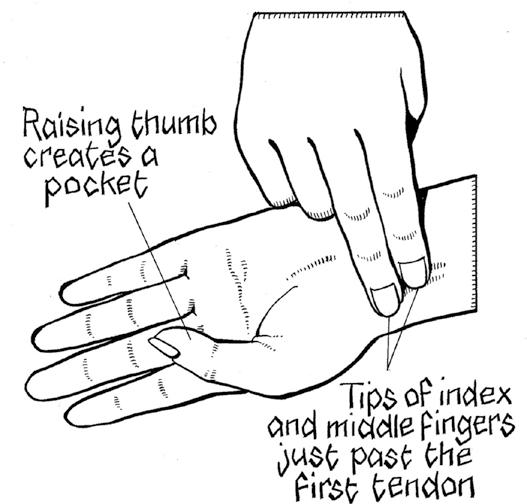
Your respiration rate is the number of breaths you take each minute. One breath equals a full cycle of breathing in and out. At rest, most teenagers breathe 12–20 times per minute, but this rate increases quickly as activity becomes harder. During moderate exercise you might breathe 20–40 times per minute, and during vigorous exercise, even more.
To measure your breathing rate:
1 Sit or stand still.
2 Count each breath for 30 seconds.
3 Multiply your number by 2 to get breaths per minute.
It helps to place a hand gently on your stomach or chest to feel the movement but try not to breathe unnaturally or exaggerate your breathing while counting.
ClickView: Learn about the respiratory system and breathing. <https://clickv.ie/w/33p4>
1 Try to find your radial pulse (wrist) and your carotid pulse (neck). Work with a partner to check if you’ve found the correct spot. Once you’ve found it, practise counting your heartbeat for 15 seconds.
2 Record your resting heart rate (bpm) and breathing rate (breaths per minute). Repeat twice to ensure accuracy.
Resting heart rate (bpm):
Resting breathing rate (breaths per minute):
3 Compare differences and explain why small variations happen.
4 Now compare your results with your partner’s. Partner’s resting heart rate (bpm): Partner’s resting breathing rate (breaths per minute):
5 Were your numbers similar? If not, what might have caused the differences?
6 Take a slow 2–3 minute walk around the space. Immediately afterwards, measure your breathing rate again.
a What changed?
b Was the increase small, moderate or large?
Learning intentions
What makes a team work?
Understanding team cues
Reading and responding to cues
Roles and responsibilities in teams
Understanding roles in a team
Analysing team outcomes
Connecting behaviour, communication and performance
Building team culture
The pillars of a great team culture
Future goals
I can:
• evaluate and apply leadership, collaboration and group decision-making processes when participating in physical activities
• use verbal, physical and situational cues to identify and respond to the feelings and motives of others in a team or group.
Before you start this unit, test your current understanding by completing the following questions.
1 What do you think makes a sports team work well together, apart from individual skill?
2 How do players communicate with each other during a game, even when they are not speaking?
3 Why do you think trust and respect are important in a team environment?
4 What different roles do you think people can have in a team, both on and off the field?
5 How do you think teamwork can affect how much a team enjoys playing sport?
When you think about sport, you might picture the winning goal, the fastest runner or the loudest cheer. But behind every successful team, there’s something even more important than skill—teamwork. Teamwork is what turns a group of individuals into a connected unit that can communicate, adapt and succeed together. In sport, effective teams are built on trust, communication and awareness. Research shows that around 75 per cent of successful sports outcomes are linked to strong teamwork and shared understanding, rather than just individual talent. Think of famous teams like the Matildas, the Boomers or the All Blacks; they don’t just rely on their stars, they rely on their ability to read each other’s cues, support one another and respond to situations as a unit.
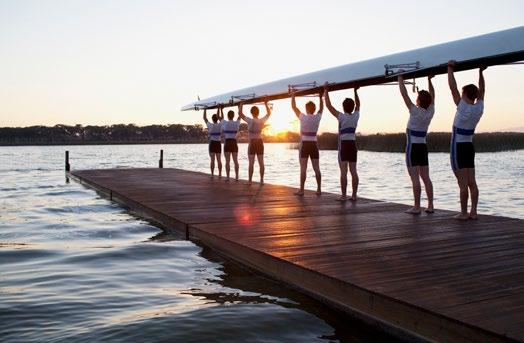
ClickView: Listen to and think about qualities of a good team member. <https://clickv.ie/w/pge4>
Teams constantly send out signals, or cues, that help players know what’s happening around them. These cues come in three main types:
• Verbal cues: things teammates say to guide, encourage or warn each other (e.g. “Man on!” or “Switch!”).
• Physical cues: gestures or body movements that communicate meaning (e.g. pointing to where to pass or clapping to show readiness).
• Situational cues: things happening in the environment that guide decisions (e.g. noticing a teammate is tired or seeing space open on the field).
In elite sport, players respond to these cues almost instantly. For example, research on soccer players shows they make three to five key communication decisions every 10 seconds during play. This means effective communication isn’t just helpful, it’s essential.
Studies in sports psychology show that teams with high communication and trust outperform others even when their average skill level is lower. For example, a study by the Journal of Applied Sport Psychology found that teams who regularly debriefed and shared feedback after games improved performance by 23 per cent over six weeks, compared to teams who didn’t reflect at all.
That means learning how to talk, listen and adapt to others could be the difference between winning and losing, both in sport and in life.
1 In teams, set up and participate twice in a simple relay course.
• Round 1: Communicate freely.
• Round 2: Complete the relay using non-verbal communication only (gestures, eye contact, signals).
2 Which round was smoother?
3 What did you notice about how your team responded to cues?
4 How did your body language affect your teammates’ confidence?
Have you ever played a game where you just knew what your teammate was about to do, even before they said anything? That’s not luck. It’s your ability to recognise and respond to verbal, physical and situational cues. In sport, athletes constantly communicate—sometimes out loud, but often through body language, eye contact and movement. Research shows that up to 70 per cent of communication in sport is non-verbal, meaning most teamwork happens without a single word being spoken. Learning to ‘read’ your teammates helps you make faster decisions and strengthens trust on the field.
In professional sport, the ability to respond to cues is what separates good players from great ones. For instance:
• In the AFL, midfielders track teammates’ eyes and shoulders to predict where the next kick will go.
• In volleyball, players learn to recognise small changes in body position to anticipate spikes or digs.
• Olympic relay runners train for months to perfect non-verbal baton handovers; one mistimed cue can cost the race.
A study by Sports Science Quarterly (2023) found that teams who trained specifically in ‘cue awareness’ improved reaction time and coordination by 18 per cent after four weeks. That’s proof that communication and observation are skills you can train, just like shooting or running.
1 Play a small-sided game (e.g. 4 vs 4 soccer), but in silence. Teams must use non-verbal communication only: gestures, pointing, eye contact or body movement. After 5–10 minutes, pause for reflection:
• What worked well without talking?
• What cues helped you understand your teammates?
• What moments were confusing or unclear?
2 Extension: Replay the same game but assign one player as the ‘leader’, who is the only player able to talk. Did one person talking help or hinder your teamwork?
Situational cues are things happening around you that help you make smart choices. They could include:
• the score or time left in the game
• a teammate’s energy level or frustration
• the weather or conditions on the field
• the position of defenders or space available
Good players notice these details and adjust their play accordingly. For example, if you see a teammate struggling after a long sprint, you might cover their position or call for a timeout.
Your teacher will set up four short stations (passing, dodging, defending and shooting). In teams, rotate through each station. Each player must complete the activity while noticing and responding to what others are doing (e.g. adjusting pace, offering help or changing position).
1 Between stations, take one minute to record what you noticed about your teammates and how you adjusted based on what you saw or felt.
a Passing station:
b Dodging station:
c Defending station:
d Shooting station:
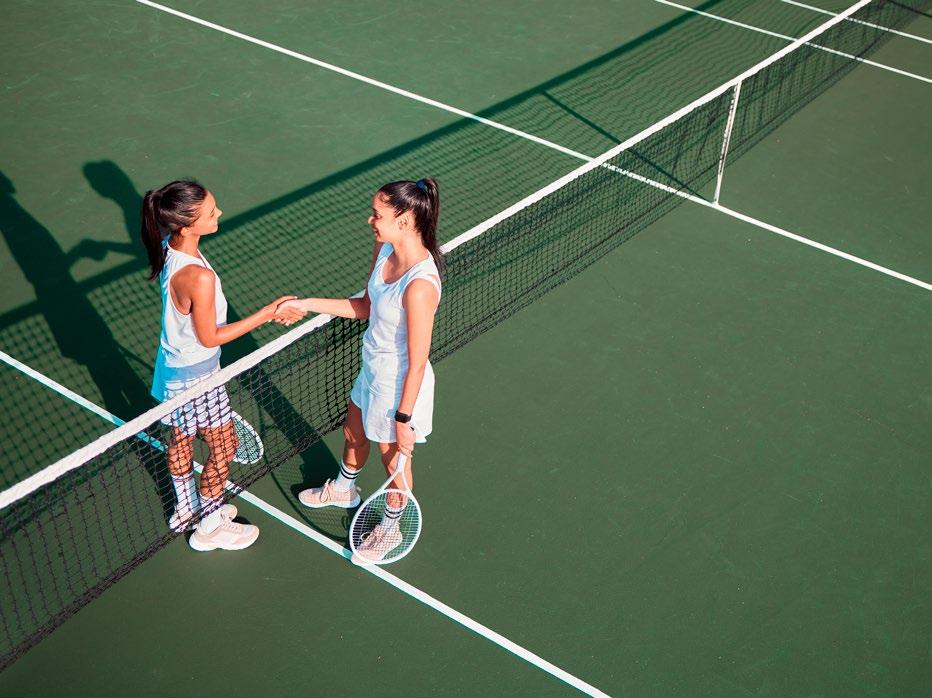
Learning intentions
What is fair play? why fair play matters
Modifying games
Modifying rules, equipment or scoring systems
Modifying games for enjoyment, inclusion and success
Safety and inclusion for all
Barriers to participation
Benefits of participation
I can:
• analyse modifications to equipment, rules and scoring systems that support fair play, safety and inclusive participation.
Before you start this unit, test your current understanding by completing the following questions.
1 What do you think the word fair means when it is used in sport and games?
2 Why do you think rules exist in sport? What could go wrong if rules didn’t exist?
3 Do you think winning is the most important part of sport? Why or why not?
4 How do you feel when players or teams cheat, even if they don’t get caught?
5 What does inclusion mean in sport and physical activity?
At its core, fair play means more than just ‘playing by the rules’. It’s a mindset, a set of values and the way those values are expressed in sport. While every sport has its own written rules, fair play is what helps ensure that those rules are respected, that participants treat each other with dignity and that the competition is not just about winning at any cost.
Some of the major components of fair play include:
• Respect: for opponents, teammates, referees and the rules themselves. Respect means accepting decisions even when they don’t go your way, speaking and acting politely and acknowledging good plays (by yourself or others).
• Integrity and honesty: not cheating, not bending or breaking rules secretly and being truthful in your actions. If you accidentally break a rule, you own up to it.
• Equity and fairness: giving everyone a chance, making sure conditions are balanced and adjusting things when needed so weaker or less experienced participants still can take part meaningfully.
• Sportsmanship in victory and defeat: being humble in success and gracious in failure. Being able to shake hands, thank opponents or applaud their efforts even if you lose.
• Safety and care: making sure no one is unfairly put at risk, either physically or psychologically.
You could see fair play as a kind of moral ‘spirit’ of sport that sits over the written rules. It’s what makes the difference when two teams follow the same rules but one acts in a way that everyone would call ‘fair’, while the other acts in ways that undermine trust, dignity or the spirit of competition.
Understanding fair play isn’t just a classroom exercise, it has real consequences. Fair play builds trust. If players believe the game is fair, they focus on performing rather than looking for loopholes or cheating. It improves enjoyment, people want to play (and watch) games where they believe everyone is playing honestly. It supports inclusion, when people see they will be treated fairly, they’re more likely to join, especially those who feel ‘less good’ at the sport. It connects sport to broader moral values, empathy, respect and fairness, that carry into school, work and relationships.
Yet, fair play is often threatened by pressures to win. Some athletes or teams may take shortcuts, bend rules, or exert unsportsmanlike behaviour to gain advantage. The temptation is real, especially in competitive settings.
The Equal Opportunity Commission (EOC) is a government organisation in each state and territory that aims to ensure that people are aware of their rights and responsibilities. Play by the Rules is an initiative developed in partnership with the Australian Sports Commission and all national sport and recreational agencies. This project educates sportspeople about their rights and responsibilities both on and off the field.
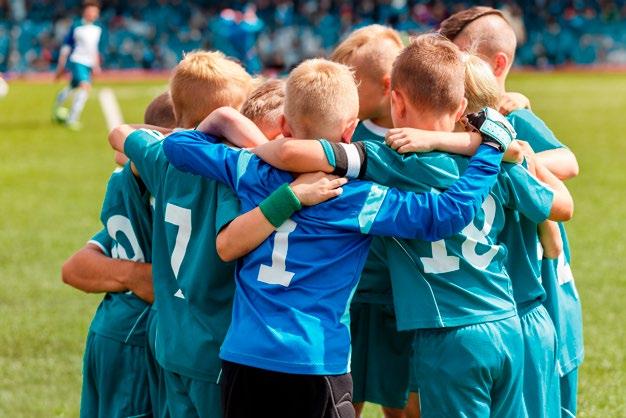
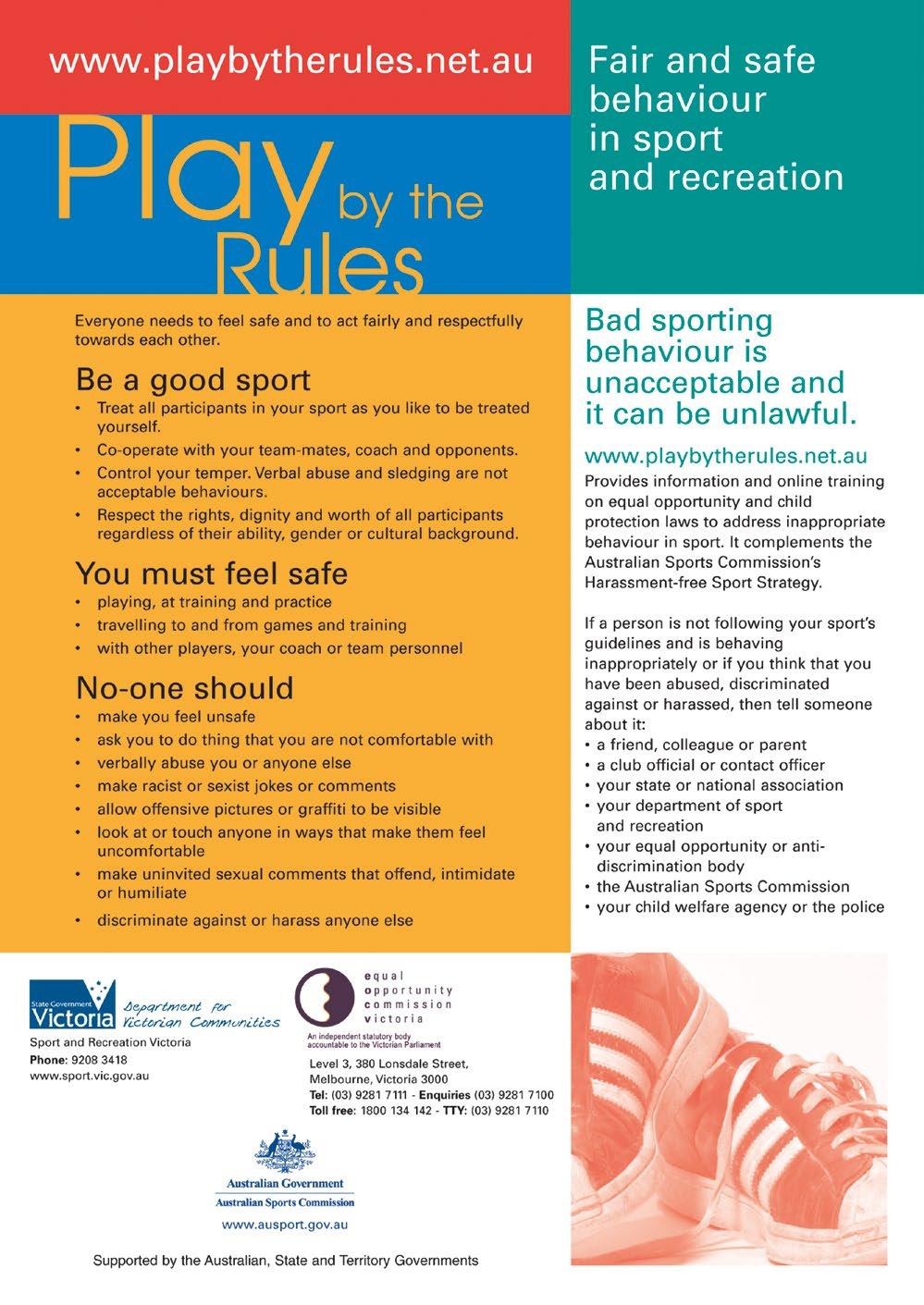
Different sports have different rules, but some rules are applicable to all sports
Poster reproduced with permission from Play by the Rules.
Author team: Michelle Bradford and Brooke Kenwright
Learning intentions
Challenges and opportunities
Roles and responsibilities
The roller-coaster of life
what is loss?
Types of loss
Grief
Stages of grief
Coping with grief
Stress management
Strategies to manage and reduce stress
Putting it into perspective
Assertiveness
I can:
• refine, evaluate and adapt strategies for managing changes and transitions.
Before you start this unit, test your current understanding by completing the following questions.
1 What kinds of changes or transitions have you experienced in the past few years?
2 How can changes in life be both exciting and challenging at the same time?
3 What are some roles and responsibilities you have now that you didn’t have when you were younger?
4 What does the term cultural identity mean to you?
5 How do you manage stress in your daily life?
Life, during the teenage years, has a habit of throwing challenges at us even if we do not feel ready to face them. But with every challenge comes an opportunity to grow and adapt.
ClickView: What’s the difference between challenges and adversity? What strategies can we use to empower ourselves to overcome them? What is resiliency? How can we develop a resilient attitude? How do insight, independence, initiative, creativity, humour and morality all play an important role in developing resiliency? How do we make a plan to meet new challenges and adversity in our lives? How do we develop a positive attitude? Watch the following video to find the answers to these questions. <https://clickv.ie/w/u7r2>
1 Use the following table to identify opportunities and challenges associated with adolescence. Challenge Opportunity
e.g. Physical changes to our body
An increase in height might create an opportunity to play new sports.
Depending less on our parents for financial support
Getting a part time job can help create financial independence.
Increasing study load
Studying successfully can create career opportunities.
Finding a good group of friends
Friends provide key support in helping us to cope with the stress of life changes.
2 What strategies could you use to turn challenges presented to you into opportunities?
Moving towards your final school years signifies the start of more changes or transitions.
1 Complete the timeline provided by describing what a positive future would look like for you.
My Year 12 results
Comment 1
The class could discuss what legacy means by talking about the influence of older family,
Author team: Diane Hansen and Natalie Tencic
Learning intentions
Digital literacy
Skills and knowledge
Media literacy
I can:
• determine the appropriateness and reliability of online health information.
Before you start this unit, test your current understanding by completing the following questions.
1 What does the term ‘digital literacy’ mean to you, and how do you use it in everyday life?
2 Can you think of examples where having poor digital skills could cause problems for someone’s health or safety?
3 What does ‘media literacy’ involve, and why is it important when looking at health information online?
4 Have you ever come across online health advice that you thought might not be true? How did you decide whether to trust it?
5 What is the digital divide, and who might be most affected by it?
The concept of digital literacy refers to a person’s ability to identify, select and use appropriate digital technologies in order to find and communicate information at a level that allows them to live, learn and work in a digital society. For many young people in Australia today, being digitally literate is considered standard— people born after the mid–late 1990s have grown up using digital devices and systems every day. Prior to this generation, technologies such as mobile phones and home computers were not things that most people had access to.
ClickView: Digital literacy means being able to use technology to find, understand and create information. It includes knowing how to communicate clearly and safely online, using things like messaging, social media, emails, videos and more. These days, digital communication is everywhere and it’s very powerful. It mixes written words, body language (like facial expressions on video) and spoken language all in one. That’s what makes it such a fast and flexible way to connect with others. Being digitally literate is a big advantage, especially when it comes to getting a job or working in a team. Every day you scroll through heaps of online messages, videos, posts and ads. Having the skills to figure out what’s true, what matters and how to respond makes you more confident and capable. For example, magazines used to just be paper and pictures. Now they’re interactive — you can watch videos, listen to music and even click to participate. That’s digital communication in action. Technology changes quickly, so it’s important to keep learning. Stay curious, try new apps and tools, and make technology work for you — not the other way around. Watch this short video on how to use digital tools effectively in the workplace and beyond: <https://clickv.ie/w/Wts2>
Having the skills and knowledge to use digital technologies confidently and appropriately is becoming more and more important as schools, workplaces and our social interactions increasingly rely on online tools. Some people develop these skills almost without thinking about it, simply by using these tools regularly and adopting new technologies as soon as they are available. You might be surprised if you stopped to think about all the skills and knowledge you need in order to do something as seemingly simple as sending an email, for example. You need to know how to operate a computer or smartphone, download and access an app or navigate in an internet browser to an email provider, understand how to open a blank email template, have typing skills to write your email, know the conventions of address lines and subject lines, and have the language skills to appropriately construct your email based on the context. To complete this task, a person must have experience with the relevant technologies, access to a digital device and the internet, and a certain level of physical and mental ability.
The inequity around people’s access to digital technology is known as the ‘digital divide’. Digital inclusion is a social issue that considers how access to devices and internet can improve a person’s life by allowing them access to information, social connection, emergency assistance and the ability to apply for and maintain work. For people with certain disabilities, living in remote areas, experiencing homelessness, or low levels of income or education, day-to-day tasks that most people take for granted are exponentially more difficult. According to the Australian Digital Inclusion Index, 9.4 per cent of Australians were considered highly digitally excluded in 2023.
1 In what ways would being digitally excluded affect your day-to-day life?
2 Consider the societal improvements that would be made if the digital divide no longer existed. Make notes in the space provided and compare with a classmate.
3 What are some ways that the digital divide could be reduced?
The ability to access, analyse and evaluate media is known as ‘media literacy’. In the context of digital media, this idea means being able to find information online, evaluate its credibility and identify misinformation. In a society where information and news is being distributed constantly through digital channels, this has become an essential skill.
ClickView: Learn what media is and how to interpret it. <https://clickv.ie/w/fus2>
Whether you are searching for information regarding a recent news story, researching online for a school assignment or just reading about something you find interesting, you need to be able to evaluate the content you access for credibility. Anybody can create a website or post an article online, so it is important that you consider the sources you use to access information.
When evaluating information online, you should ask yourself the following questions:
• Who wrote the information and how are they qualified?
• Are sources cited to back up any claims made?
• Can you identify any bias in the information?
• When was the information published or last updated?
• What is the purpose of the information?
When asking these questions, you should remain critical and skeptical so you do not fall into the trap of confirmation bias. This is when you unintentionally access, interpret and favour information that confirms your pre-existing beliefs. When viewing media online especially, we are at risk of confirmation bias due to algorithms that show us content that is similar to content we have already viewed, our tendency to access the same sources online regularly and the ease in which we can find alternative information that supports our views. In this way, people can filter their sources of information to such a point that all the information they access confirms their pre-existing beliefs and values without them even noticing.
ClickView: Bias is hard to avoid, but it can be really damaging, leading us to make poor choices without fairly weighing up the facts. This video looks at bias in the media and why it can be particularly harmful. <https://clickv.ie/w/mus2>
Learning intentions
Choices that shape our futures
Peer influence and social norms
Media and online influence
Family and cultural expectations
Emotional development and brain changes
Sexual health and informed choices
Understanding consent
Contraception and preventing STIs
Healthy relationships and decision-making
Substance use what are the risks?
Making safer, informed decisions
Risk-taking
Evaluating risks
Making safer decisions (even in the moment)
Building the ability to make informed choices
Skills for better decision-making what if you make a mistake?
I can:
• evaluate the impact of external influences on my ability to make safe and informed choices relating to health and wellbeing.
Before you start this unit, test your current understanding by completing the following questions.
1 What factors do you think influence the decisions young people make during adolescence?
2 Why do you think peer approval is so important to teenagers?
3 In what ways do you think media can make risky behaviour seem normal or harmless?
4 Why is it important to have accurate information before making choices about things like sexual health, vaping, alcohol or relationships?
5 Why do you think emotions can make it harder to make safe and informed choices in the moment?
Adolescents experience a unique time in life where physical, emotional and social changes occur rapidly. These changes are accompanied by an increased need for independence and identity development. During this period, health behaviours such as decisions about sex, alcohol, drugs, nutrition, exercise and relationships can be heavily influenced by several key factors. Understanding these influences helps young people make conscious, informed decisions rather than acting based on pressure or misinformation.
Friends play a powerful role in shaping attitudes and behaviours during adolescence. Whether it’s choosing to attend a party, experiment with vaping or engage in romantic relationships, peers can provide both positive and negative influences. Research shows that peer approval is one of the most significant predictors of risky behaviours in teens.
A 2023 survey by Mission Australia found that nearly 40 per cent of Australian teens identified their friends as a major influence on their decision-making, particularly when it came to drug and alcohol use. The presence of peers has been shown to increase the likelihood of risk-taking, especially in situations involving driving, substance use or sexual activity. However, peers can also have positive effects. Friends who value health, respect boundaries and support informed decisionmaking often influence others to do the same.
Social media and online platforms expose teens to constant messages about appearance, relationships, substance use and lifestyle. Influencers, celebrities and even friends can portray risky behaviours like partying, vaping or unsafe sexual practices as normal or glamorous, which can distort reality.
The eSafety Commissioner reported in 2022 that over 80 per cent of young people aged 13–17 had seen content that encouraged or normalised risky behaviour online, such as drug use or extreme dieting.
Exposure to idealised images or pornography can create unrealistic expectations around relationships, consent and body image, often leaving teens confused or pressured to act in ways that don’t reflect their personal values.
Media literacy, learning how to question and evaluate what you see online, is an important skill in resisting these pressures and making choices based on facts rather than filters.
ClickView: Learn about self-esteem and how the use of social media impacts it. <https://clickv.ie/w/_SS3>
1 As a class, debate the following proposals:
a Smoking should not be portrayed in films.
b Junk food advertising should be banned.
The attitudes and behaviours modeled by parents, caregivers and family members have a lasting impact on adolescents. Teens are more likely to delay sexual activity and substance use when parents are open, supportive and clear about expectations.
According to a Growing Up in Australia longitudinal study, adolescents who reported having open conversations with parents about alcohol and sex were less likely to engage in risky behaviours. In some cultural contexts, there may be specific values around gender roles, sexuality or the use of alcohol and drugs that influence young people’s choices, both positively and negatively. Family can be a protective factor or a source of conflict, depending on how connected teens feel and how accepted they are for who they are becoming.
The adolescent brain is still developing, especially the prefrontal cortex, which helps with planning, impulse control and decision-making. At the same time, the limbic system, responsible for emotions and reward, is highly active. This mismatch can lead to impulsive decisions or risk-taking in the heat of the moment.
Neuroscience studies show that teen brains are wired to seek reward, especially in social situations, which helps explain why risk-taking is higher when peers are watching. Emotional states such as stress, excitement or rejection can cloud judgment and lead to decisions that teens might not make in a calm state. Building emotional awareness and self-regulation skills helps young people recognise when they’re vulnerable to external influences or internal pressure.
ClickView: Learn about the dramatic changes which take place in the brain during puberty. <https://clickv.ie/w/gTS3>
1 Which of the following is most likely to increase an adolescent’s risk-taking behaviour?
a Spending time alone
b Being around supportive teachers
c Being with peers who encourage risky behaviour
d Reading about health risks online
2 What part of the adolescent brain is still developing and affects impulse control?
a Brainstem
b Prefrontal cortex
c Limbic system
d Temporal lobe
3 Which of these is a positive peer influence?
a Pressuring a friend to drink alcohol
b Sharing misinformation about STIs
c Encouraging a friend to speak up in class
d Laughing at someone’s boundaries
4 Social media always presents realistic and accurate depictions of teenage life.
True False
5 Describe one way a parent or caregiver might influence your choices about health or relationships.
Sexual health is not just about preventing disease or pregnancy, it’s about making informed, respectful choices about your body, relationships and values. In adolescence, curiosity and change are natural, but it’s important to have accurate information, clear boundaries and a strong understanding of consent and communication. Making informed choices about sexual health helps protect physical wellbeing and emotional safety.
Learning intentions
Promoting a respectful community
Understanding prejudice
Understanding marginalisation
Understanding homophobia
Understanding discrimination
Impacts of prejudice, marginalisation, homophobia and discrimination
Impacts on individuals
Impacts on communities
Impacts on schools and learning environments
Broader social impacts
Strategies and actions to promote respect
Being an upstander, not a bystander
Challenging biases, stereotypes, prejudices and discrimination
Proposing countermeasures to discriminatory behaviours and attitudes
Accessibility of community health resources
Barriers to accessing health resources
Evaluating accessibility
Critiquing diverse media representations
Understanding diversity in media
Media and popular culture’s influence on young people
I can:
• identify strategies and actions to challenge biases, stereotypes, prejudices and discrimination
• explain how individuals and groups can promote inclusion in their communities
• explain the implications of attitudes and behaviours on individuals and the community.
Before you start this unit, test your current understanding by completing the following questions.
1 What do you think the word diversity means in everyday life?
2 Can you think of an example of prejudice or discrimination you’ve seen in school, the community or online?
3 Why do you think it’s important for schools and communities to be inclusive of people from different backgrounds?
4 How do media (TV, social media, advertising) shape the way we think about gender, culture and identity?
5 What are some actions a bystander could take if they see someone being excluded or treated unfairly?
Respecting diversity means noticing and valuing our differences in culture, language, gender, sexuality, beliefs, abilities and life experience. A respectful community isn’t one where everyone is the same; it’s one where everyone is safe to be themselves and has fair access to opportunities and services. That takes awareness (spotting unfairness) and action (doing something positive about it).
Recent Australian data shows discrimination remains common. The Australian Bureau of Statistics (ABS) notes that around 1 in 6 Australians (17 per cent) experienced discrimination based on skin colour, ethnic origin or religion in 2024, a level similar to 2023. For people with disability, 10 per cent reported disability-based discrimination in 2022. These figures remind us why learning to recognise and challenge bias matters.
Prejudice is when someone makes a negative judgement about another person or group without really knowing them. The word means to ‘pre-judge’ and it usually comes from stereotypes or assumptions rather than facts. For example, thinking all boys are naturally better at sport or assuming someone from a certain background is ‘bad at English’ is prejudice.
For adolescents, prejudice might appear in the classroom, on the sports field or online. A teacher might expect less from a student because of their accent or classmates might decide someone isn’t ‘cool’ before even talking to them. These ideas can seem small but can build up and affect how people feel about themselves.
Prejudice limits opportunities and damages relationships. When people are judged unfairly, they may feel excluded, lose confidence or stop sharing their talents. Recognising prejudice helps you challenge it by treating people as individuals, asking respectful questions and rejecting stereotypes.
At lunch, a student says “Girls aren’t good at soccer, they just slow the team down”. Another student repeats it, nodding in agreement, even though some of the best players in the school team are girls.
1 How might this comment affect the girls who want to join?
2 Is this statement based on fact or assumption?
3 What could a bystander say or do?
Marginalisation happens when people are pushed to the ‘edges’ of society, not included in the centre of activity, decisions or opportunities. Think of the margins on a page: when you’re in the margin, you’re not part of the main story. Groups can be marginalised because of race, culture, gender, disability or social background.
In school, marginalisation might look like certain students never being asked to join group projects, or some cultures not being represented in assemblies or learning materials. It sends a message that their voices and contributions matter less.
The effects are serious. Marginalised students may feel invisible, disconnected or less able to succeed. But when communities actively bring everyone into the centre by celebrating different cultures, listening to diverse voices and making sure activities are inclusive, everyone benefits from broader perspectives and stronger friendships.
During group projects, a student with a strong accent is never chosen as a team leader. Classmates say “It’s just easier if someone else talks, people won’t understand you”. As a result, that student rarely gets a chance to show leadership skills.
1 How would this exclusion affect the student’s confidence?
2 What would inclusion look like in this situation?
3 How could classmates and teachers prevent marginalisation here?
Homophobia is prejudice or discrimination directed at people who are lesbian, gay, bisexual, transgender, queer or questioning (LGBTQ+). It can show up as hurtful words, exclusion, stereotypes or the idea that being straight is the only ‘normal’ way to be.
For adolescents, this might mean someone being teased for how they dress, hearing slurs used in the playground or seeing jokes online that mock LGBTQ+ people. Even if these things are said as ‘just a joke’, they can make people feel unsafe and unwelcome.
Homophobia doesn’t just harm LGBTQ+ students, it creates fear and divides communities. But when schools make it clear that homophobia isn’t tolerated, students feel safer and more supported. Respecting everyone’s identity allows people to be themselves, build confidence and thrive in learning and friendships.
A boy tells his friends he thinks another boy in the year level might be gay. One friend says “That’s gross” and the others laugh. The student they’re talking about overhears.
1 What messages are sent by this behaviour?
Author team: Lori Hill, Lauren McGregor, Sarah McKenzie, Melissa Neish and Nat Tencic
Learning intentions
Respectful relationships
Characteristics of respectful relationships
Rights, responsibilities and boundaries
Gender equality, empathy and respect
Respecting differences and opinions
Ethical responsibilities in relationships
Power and coercion
why power and coercion matter in relationships
Effects of power misuse and coercion
Unhealthy relationships in popular culture
The power and control wheel
Disrespect and violence
The gendered nature of violence
Disrespect
Types of violence
Types of abuse
Prevention of abuse and violence
Support
I can:
• evaluate the influence of respect, empathy, power and coercion on establishing and maintaining respectful relationships
• identify the characteristics of respectful relationships and how these can prevent violence and abuse.
Before you start this unit, test your current understanding by completing the following questions.
1 What do you think makes a relationship respectful?
2 How can popular culture influence what people believe about relationships?
3 Why do you think equality and fairness are important in friendships or relationships?
4 How might your family, culture or community shape the way you communicate with others?
5 Can you think of a time when respect helped solve a problem between people?
Respectful relationships are at the heart of healthy friendships, families and communities. They are shaped by many influences: personal, cultural, social and emotional. This unit explores the key factors that contribute to respectful connections with others and helps you understand your role in creating safe, fair and supportive relationships.
1 Think: In your own words, describe what a relationship is.
2 What kinds of relationships can you think of?
3 Consider three relationships in your life. How do you treat this person, how do you know your relationship is respectful, and how could you make it more respectful?
Person 1
Name: _____________________________________________________________________________________
Relationship: _______________________________________________________________________________
How do you treat this person?
How does this person treat you?
Do you feel this is a respectful relationship? If yes, how do you know? If no, how could you show each other more respect?
Person 2
Name: _____________________________________________________________________________________
Relationship: _______________________________________________________________________________
How do you treat this person?
How does this person treat you?
Do you feel this is a respectful relationship? If yes, how do you know? If no, how could you show each other more respect?
Person 3
Name: ______________________________________________________________________________________
Relationship: ________________________________________________________________________________
How do you treat this person?
How does this person treat you?
Do you feel this is a respectful relationship? If yes, how do you know? If no, how could you show each other more respect?
A respectful relationship is one where both people feel valued, safe and heard. Respect is more than just manners: it’s about recognising someone’s rights, feelings and dignity, even (especially) when you disagree. Key traits include honesty, trust, fairness, equality, kindness, empathy and good communication. It also means accepting differences in opinion, culture, background and ability; setting and respecting boundaries; treating each other with care; and being reliable.
Some of the important traits and behaviours that make relationships respectful include:
• Trust and honesty: You believe in each other; you tell the truth. Secrets that damage trust, or lies, damage respect.
• Open communication: You can share how you feel, what you think and what you need. You listen when the other person speaks, without interrupting or dismissing them.
• Empathy: Trying to understand how the other person feels; considering their experiences and viewpoint. It helps you respond with kindness rather than judgement.
• Fairness and equality: Making decisions together; sharing responsibilities; no one person always controlling the relationship or dominating power. Recognising each person has equal worth and rights.
Learning intentions
Family and social situations
why family and social life matter so much in adolescence
Understanding your feelings
Conflict resolution what happens in your brain during conflict? what If conflict gets out of control?
Rejection
How rejection affects us emotionally
Negotiation
The steps of a healthy negotiation
Responding to rejection, failure, harassment and violence when things don’t go your way when something goes too far what you can do
I can:
• evaluate emotional responses in different situations
• identify strategies for managing emotional responses and resolving conflict in family or social situations.
Before you start this unit, test your current understanding by completing the following questions.
1 What are some strong emotions you’ve felt recently, and what usually causes them?
2 Why do you think family and friendships can bring out both positive and negative emotions?
3 What does it mean to ‘manage your emotions’ rather than just react to them?
4 Have you ever experienced rejection or conflict? How did it make you feel?
5 Why do you think empathy and communication are important when dealing with emotional situations?
Family and friendships are two of the biggest influences on your emotional world as a teenager. Whether it’s a supportive sibling, a frustrating parent, a close friend or a complicated group chat, the people around you can bring out both your best and most challenging emotions. During this stage of life, you’re developing independence, exploring your identity and trying to find your place, which means family expectations and social dynamics can sometimes feel overwhelming or confusing.
Your family and your circle of friends are two of the most important parts of your life at this age. They influence how you see yourself, how safe and supported you feel and how you develop emotionally. Even though friends become more central in teenage years, relationships with parents or caregivers, siblings and other family members still play a huge role in your wellbeing.
In fact, surveys by the Australian Institute of Health and Welfare show that almost nine out of 10 (86%) of 16–17 year olds said their parents ‘accepted them as they are’ and over three-quarters of young people said their parents understood them or asked about their problems. That tells us many young people feel a sense of belonging and approval in their families. Still, family life is not always smooth. Measuring ‘family cohesion’, that is, how well family members get along, spend time together and communicate, is one way to assess how healthy the family environment is. But conflicts are common, for example, how often family members yell at each other is used in studies as a measure of tension.
When teens feel understood and supported by their family, it helps buffer stress and protect mental health. A 2025 report from the Growing Up in Australia study found that children whose parents had a positive relationship with each other tended to have stronger friendships themselves, meaning the health of relationships at home can ‘spill over’ into how you relate to peers.
Even in generally positive families, there will be times of friction. Some common scenarios include:
• Disagreements over rules or responsibilities: Curfews, chores, privacy or use of digital devices are frequent sources of conflict.
• Feeling misunderstood or unheard: You might feel your parents or siblings don’t ‘get’ what you’re going through.
• Feeling excluded or less prioritised: Sometimes, you might feel your needs are sidelined relative to siblings or other responsibilities.
Similarly, teenagers may experience exclusion or rejection from their peers, being left out or feeling ignored. Social exclusion, in particular, is an often hidden but deeply painful experience. A recent large survey by Orygen found that 60 per cent of young people aged 15–19 had experienced social exclusion in the prior 12 months, and those who did showed significantly worse mental health outcomes (e.g. feelings of loneliness and distress) compared with those who didn’t. Another study suggests about one in six children report being excluded in some way by peers, not always overt bullying, but subtle relational aggression (e.g. excluded from a group, ignored or rumours spread).
Bullying more overtly is also common. According to Bullying No Way, about 27 per cent of 9–15-year-olds in Australia reported being bullied every few weeks or more. These figures show that social pressure, exclusion and conflict are widespread, but they don’t make them any less painful or difficult to navigate.
Moreover, when social problems pile up on family conflicts, it can magnify emotional strain. If you feel isolated among friends at school and also feel tension at home, those negative emotions can feed into one another, increasing stress, anxiety or sadness.
When difficulties occur in family or social settings, strong emotions can burst up almost instantly, such as anger, sadness, shame, frustration or guilt. Here’s how to make sense of them:
• Recognise the trigger: Maybe your parent criticises your grades or your friend forgets to invite you to a hangout. The external event is often just a spark leaving you to deal with the deeper reaction.
• Identify the underlying feeling: Instead of just “I’m angry”, ask “Am I also feeling powerless? Hurt? Unfairly judged? Embarrassed?”. Often anger masks something more vulnerable.
• Check the story you’re telling yourself: You might think “They don’t care about me”, “I’m useless” or “I’m always the bad one”. These stories make emotions more intense. Recognising the story gives you distance from it.
• Decide how to respond: You can react immediately (yelling, storming out) or choose a more thoughtful path (pause, reflect and plan your response).
Some practical strategies you can use when family or social situations become emotionally charged include:
• Pause and breathe: Before shouting or leaving, take a few slow, deep breaths. Even a 10-second pause can prevent regret.
• Use ‘I’ statements: Instead of “You always ignore me”, try “I feel hurt when I’m left out because it makes me feel unimportant”. This shifts the tone from blaming to expressing how you feel.
• Ask for clarity: If something feels unfair, ask questions: “Can you help me understand why?” or “What were you trying to say?”. Sometimes misunderstandings cause the hurt.
• Schedule a calm time to talk: When everyone’s more relaxed, request a chat: “Can we talk about what happened earlier? I’d like to explain how I felt”. A calmer context leads to better listening.
• Set small boundaries: You might say “I need five minutes alone to calm down” or “I’d prefer we don’t discuss this until dinner”. Boundaries help protect your emotional space.
• Find an ally or support: Talk through your feelings with a friend, mentor, counsellor or sibling. You don’t have to navigate these feelings alone.
• Practise empathy: Try to see the situation from the other person’s view. Maybe your parent is under stress, or your friend is going through something you don’t know about. Empathy doesn’t excuse bad behaviour, but it can soften emotional reactions.
• Plan positive interactions: Small positive moments like a shared joke, helping with something or showing kindness build goodwill and make rough patches easier to repair.
1 In the table below, write the names or roles (mum, older brother, best friend, basketball teammate, etc.) of 3–5 people who are part of your regular life.
Family
Friends / Social
Primary writers: Michael McGrath and Melissa Kemble
Rockclimbing is an exhilarating recreational activity that can be done indoors on artificial walls or outdoors on natural rock faces, cliffs or even large boulders. Every able-bodied person has the ability to climb. Our bodies are naturally equipped to climb trees and rocks, and many of us would have done a fair bit of climbing as children.
The simplest forms of rockclimbing, such as bouldering, require very little gear, but special equipment and a good level of physical fitness are recommended before attempting more ambitious climbs. Sport climbers compete at different levels, both on man-made walls and natural rock faces. Competitions can be for speed over a set course or for reaching the highest point on a rock face.
1 Label as many of the pieces of gear pictured in the diagram as you can. Try and describe their functions or why they are important.
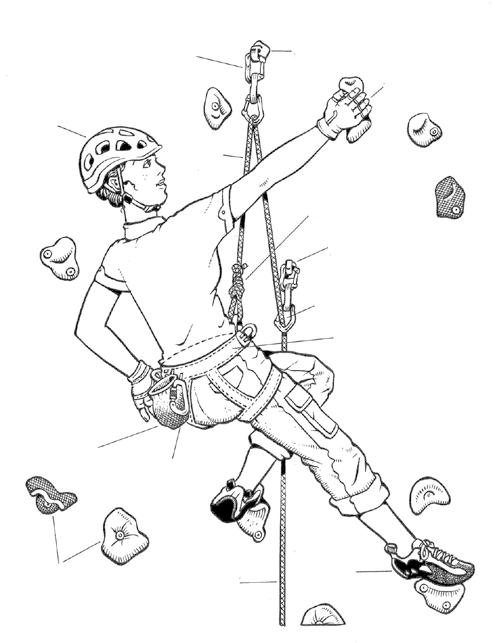
Climbing on a man-made wall involves much of the same equipment and techniques as climbing natural obstacles does, but it is done in a safer, controlled environment.
This climber is using a top rope with belay (safety) system on an indoor climbing wall. Hand and foot holds of different shapes are bolted to the wall.
The climber is wearing loose-fitting clothes that allow freedom of movement, but that cannot get caught in the equipment. Preparing for a safe climb also includes tying back long hair and removing jewellery.
Equipment, when used correctly, will reduce the chance of injury if a fall occurs. Ropes—and items to attach the rope to a solid object or another person—are the main items climbers use to ensure their safety when high above the ground. Climbing shoes and gloves help climbers maintain a sure grip on the rocks, and helmets protect their heads.
Following is a list of recommendations and advice for climbing equipment.
• Climbing shoes should be flexible with reinforced soles and toes made of a suitable, sticky material (like rubber) to help grip onto slippery rocks. Narrow toes can help climbers gain a toehold in small crevices or cracks in the rock.
• Helmets do not just protect a climber’s head from hitting the ground, they also protect climbers from dislodged rocks or pieces of equipment falling from above. Helmets should be lightweight and a snug fit. The front of the helmet should protrude far enough that the climbers face does not hit the rock face if they are pushed into it by a gust of wind or during a fall.
• Climbing harnesses provide a secure and comfortable method of attaching safety ropes to a climber or belayer (the person on the ground who controls the rope in case the climber falls). Climbing harnesses also carry most of the climber’s gear, such as extra karabiners, water bottles and nuts and/or camelots. Harnesses are also a welcome seat for the climber and belayer.
• A pair of gloves with reinforced palms are very useful to prevent rope burns when belaying. Fingerless gloves keep climbers’ hands warm, but allow them to feel the rock and hang on to minute fingerholds.
• Chalk absorbs sweat on a climber’s hands, helping them get a firmer grip on rocks and holds.
• Climbing ropes are rated according to their stretch characteristics. Dynamic ropes allow for a specific amount of stretch, to absorb shock during a fall.
• Static ropes do not stretch and are only used for top roping, abseiling down a rock face or pulling up equipment. They should never be used for lead climbing.
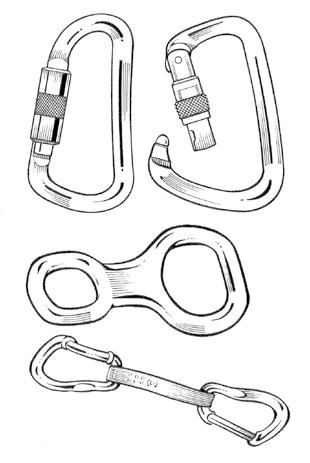
Climbing gear
a: Karabiners are quick-release shackles used to attach ropes to a climber’s harness, a belaying device or other ropes. The safest karabiners (screwgate karabiners) have a threaded locking barrel to keep them closed in case the rope twists. Karabiners must be checked for wear and stress cracks before every climb.
b: The figure-of-eight belaying device allows rope to slide through in a controlled manner so the belayer can prevent a climber from falling to the ground. The smaller loop is attached to the belayer’s harness by a karabiner and the rope runs around and through the larger loop.
c: Quickdraws are a quick and secure way to attach two pieces of rope together and are often used to attach climbing ropes to anchor points in rock faces when lead climbing.
1 Rockclimbing can be done i on man-made walls or o on natural rock faces, cliffs or l b
2 What are the main items climbers use to ensure their safety?
3 The best types of c s are flexible and have reinforced s . The toes should be made of a s material (like r ) to grip onto slippery rocks. N t can help climbers gain a toehold in small cracks in the rock.
5 Climbing ropes are rated according to their s c .
6 True or false? Static ropes:
a have plenty of stretch.
True False
b should never be used for lead climbing. True False
c are used for top roping or abseiling. True False
7 What are karabiners used for?
8 Q are a quick and secure way to attach t p of r together and are often used to attach climbing ropes to a p in rock faces.
9 Which loop on a figure-of-eight is attached to the belayer’s harness by a karabiner?
Rockclimbing is an activity that can be pursued in many places on many different types of rock. The basic techniques are the same—climbing up a wall using hands and feet—but the equipment used and the level of experience and skill required are quite different.
Artificial walls are where most people first try climbing. Climbing centres are a great place to start and usually offer lessons for beginners. They provide the necessary equipment and have instructors who can ensure climbers are safe.
Climbing walls use a variety of specially made holds that are bolted onto the concrete walls. These can be moved to create easier or more challenging climbs.
See <mea.digital/FB_RCA1> for a list of climbing walls near you.
Natural obstacles like cliff faces or mountains are where climbers come face to face with the unpredictable nature of rock. Footholds and handholds are not always readily available so climbers must use agility, common sense and skill to ascend. Natural rock faces can be slippery and have loose bits of rock that are easily dislodged.
Bouldering is a popular activity where climbers ascend low boulders without ropes. A spotter stands behind, but not directly below, the climber to help break their fall if they should slip. Soft-fall pads are often used as well.

Different types of climbs use safety equipment—ropes, karabiners and anchor points or protection—in different ways. First time climbers should always use a top rope with an experienced belayer on the ground.
Top roping is the safest form of rockclimbing. The climber is attached to a rope that is securely anchored above them. The rope is monitored and constantly adjusted by the belayer. The rope is tied to the climber’s harness through the belay loop using a rewoven figure-of-eight knot. This increases the level of safety in case of a fall.
Lead climbing is an advanced technique in which a climber ascends placing their own anchor point or protection (an anchor point is the term used when discussing the creation of an anchor system; the word protection is used when you use something to protect you from falling as far as you might otherwise) in front of them. The leader connects the safety rope to protection at regular intervals while ascending.
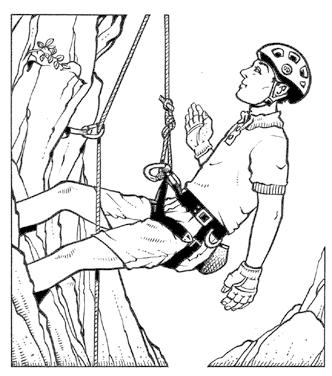
Belaying is an important skill that is critical to the safety of the climber. The belayer usually stands on the ground with the end of the rope securely fastened to a solid object, such as a rock or fixed anchor point, and controls the rope using a figureof-eight belaying device.
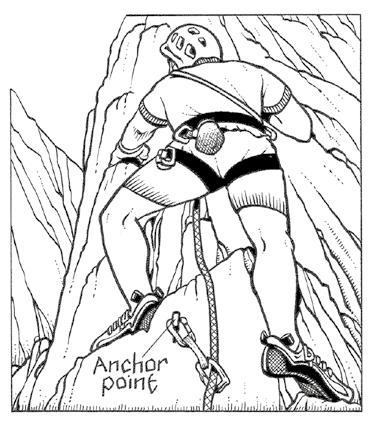
A belayer must remain alert and be prepared to take the climber’s weight to stop them falling.
Author: Emma Holder
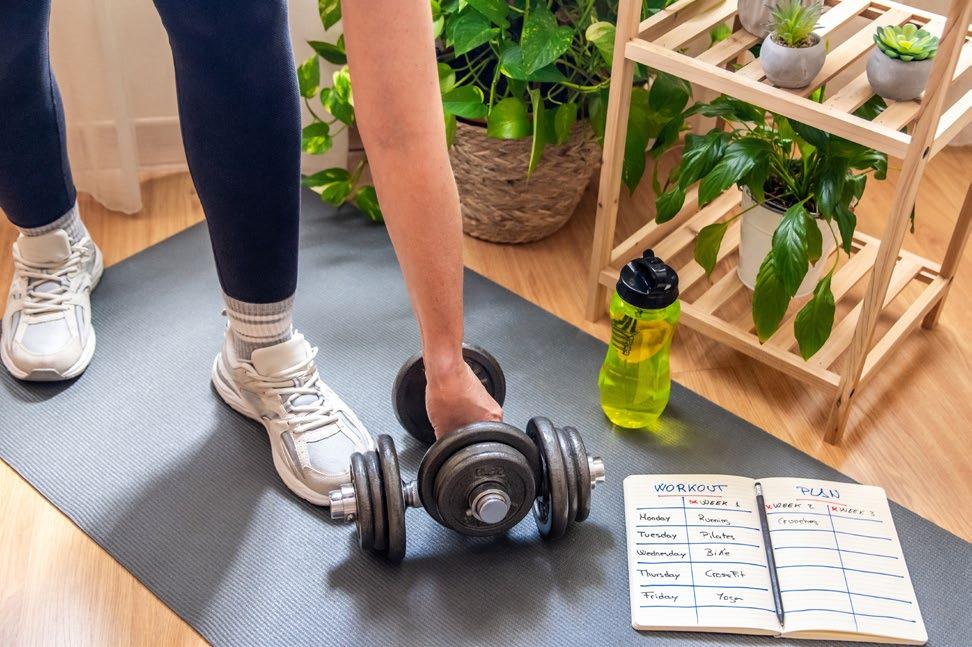
Learning intentions
What is fitness?
why fitness is important
Components of fitness
Flexibility
Strength
Endurance (cardiovascular/muscular)
Balance (and other skill-related components)
Measuring the body’s response
Heart rate (beats per minute, bpm)
Breathing/respiratory rate and perceived exertion
why measuring matters in your program
Using digital tools
Benefits of digital tools (and what to be careful about)
Design a personal fitness plan
Key elements to include
I can:
• design, implement and evaluate personalised plans for improving my physical activity levels to achieve health-related fitness, health and wellbeing outcomes
• measure my body’s response to physical activity.
Before you start this unit, test your current understanding by completing the following questions.
1 What do you think fitness means beyond just sport performance?
2 Why might fitness become more important during the teenage years?
3 What do you already know about the main components of fitness (strength, endurance, flexibility, balance)?
4 How do you think technology (apps, watches, trackers) can help or influence someone’s fitness progress?
5 Why do you think it’s useful to measure your body’s response during exercise (heart rate, breathing, etc.)?
When we talk about fitness, we’re not just referring to being able to run fast or lift heavy weights, it’s about how well your body works across many different areas so you can be healthy, strong, active and ready to take on everyday life (and the extra stuff you enjoy). For you, fitness matters because you’re growing, your body is changing, you’re learning new physical skills and you’re forming habits that can last a lifetime. Fitness can be defined in several ways, but one helpful way is: fitness is the capacity of your body to perform physical activity, recover, adapt and remain healthy. That means being able to move, stretch, lift, balance, breathe well, recover after effort and maintain these abilities over time. Fitness isn’t just about being the fastest sprinter in class or bench-pressing the most, it’s about each of the core components (flexibility, strength, balance and endurance) and how they come together to help you perform, live well, avoid injury and enjoy activity.
According to guidance from the Australian Institute of Health and Welfare (AIHW), physical activity supports healthy growth and development in children and adolescents, including muscle and bone strength, coordination, balance, mental health and more.
ClickView: Learn about physical fitness and how we can enhance it. <https://clickv.ie/w/5EN3>
You’re at a stage when your body is changing, bones are growing, muscles are strengthening, and the nervous system is refining coordination and balance. Being physically fit helps in several ways:
• Health benefits: Regular movement and fitness reduce the risk of chronic diseases later in life (such as type 2 diabetes or heart disease) and support healthy bones, muscles and posture.
• Performance benefits: Whether in PE class, sport or daily life (carrying bags, climbing stairs, walking long distances), having good fitness means you’ll feel stronger, less tired and more capable.
• Wellbeing and brain benefits: Physical activity supports better mood, reduced stress, improved concentration and sleep—all of which help you at school and in life.
• Habit-building: The habits you form now (for staying active, choosing movement instead of sitting and exploring a variety of activities) are likely to influence your future adult health.
Even though fitness and activity are so beneficial, many young people aren’t getting enough. In a 2017–18 survey by the AIHW, around 96 per cent of people aged 13–14 did not meet both the physical activity and screen-time recommendations, and only around 11 per cent of teenagers aged 15–17 met the recommended levels of physical activity. A more recent survey by the Australian Bureau of Statistics reports that, in 2022, only 5.6 per cent of young people aged 15–17 met the physical activity guidelines. This means the vast majority of teens are not achieving the guideline of at least 60 minutes of moderateto-vigorous physical activity each day as outlined in the national guidelines.
So, what’s happening? Many factors: increased screen time, less incidental movement (walking or playing outside), fewer opportunities or choices for varied physical activity, plus competing demands (study, part-time work, socialising, etc.). A report also noted that for children and adolescents, barriers and enablers vary a lot by gender, socioeconomic status, cultural background and environment.
Because you’re at this age where your habits are solidifying, the fact that so many young people aren’t meeting the physical activity levels means you have a chance to stand out by choosing to be active, by designing your own fitness plan and by understanding why you’re doing it. When fitness is done with purpose (not just ‘because the teacher said so’), you get more out of it. You’ll feel more confident in your body and more capable of physical challenges (PE class, weekend sports and recreational play); you’ll better understand how your body works and how it responds to effort (how your heart speed increases and how you recover), which gives you control; and you’ll build a foundation not just for this year, but for the next 5, 10, 20 years—being fit now means being more likely to be active, healthy and mobile later.
1 Keep a diary to record all incidental and/or planned exercise that you participate in during the course of a week. At the end of the week use two coloured highlighters to identify the type of activity.
a Explain what your diary entry tells you about your activity levels.
b What things could you do to increase your incidental exercise?
c How could you improve your planned exercise regime?
d Develop a weekly plan that records activity goals to improve your fitness. Mon
Incidental exercise
Planned exercise
When we talk about fitness, it isn’t just one thing. It’s a collection of different skills and abilities your body develops so you can move well, stay healthy and enjoy lots of activities. In this section we’ll explore the key components of fitness: what they are, why they matter and how they relate to you preparing for sport, everyday life and lifelong health.
Having just one component strong (e.g. endurance) isn’t enough for overall fitness. Your body works best when flexibility, strength, endurance and balance all develop together. For example, you might be able to run long distance (endurance) but if your muscles are weak (strength) and your joints are tight (lack flexibility), you risk injury or might not perform as well. A well-rounded fitness plan means your body is resilient, ready for many types of activities and less likely to plateau or get stuck.
A large Australian study of young people aged 9–17 found that fitness components (such as cardiovascular endurance, muscular strength and endurance) are not only indicators of current health but tend to ‘track’ into adulthood, meaning that if you build strength, endurance and flexibility now, you’re more likely to be fit as an adult.
ClickView: Learn about health-related components athletes engage in for their specific sport. <https://clickv.ie/w/8EN3>
ClickView: Learn how skill-related components are essential to excel in a specific sport. <https://clickv.ie/w/GEN3>
Flexibility refers to the ability of your joints and muscles to move through their full range of motion (ROM). For example, reaching overhead, bending down to tie your shoes or twisting your torso. It’s often improved through stretching, mobility work or activities like yoga.
If you’re more flexible, you’re less likely to hurt yourself when reaching, twisting or stretching. Tight muscles can pull on joints, limit your performance in sport and make everyday movements harder. For example, hamstrings that are tight can affect how you bend your knees or how you move when running and jumping.
As you grow, your bones lengthen and your muscles adapt, being flexible means your body can cope with these changes more easily.
ClickView: Try this beginner stretch routine for those new to flexibility training. <https://clickv.ie/w/SEN3>
Learning intentions
Fair play
Being a good sport
Ethical issues in sport
Characteristics and application of fair behaviour
Applying fair behaviour
Real-world case studies
Leadership strategies
Self-officiated play
Challenges of player-officiated games
I can:
• demonstrate fair play explain how ethical behaviour can influence physical activity outcomes for individuals and groups
• describe the characteristics of fair play and the application of fair and ethical behaviour in physical activity.
Before you start this unit, test your current understanding by completing the following questions.
1 What does the term fair play mean to you, both in sport and in everyday life?
2 Why do you think sportsmanship is considered an important part of being an athlete?
3 Can you think of an example where you saw someone demonstrate good sportsmanship? What made it good?
4 How might unfair behaviour (e.g. cheating, aggression, ignoring rules) affect a game and those involved?
5 Why do you think sporting role models are judged on their behaviour as well as their performance?
There may be situations throughout your sporting career when people or circumstances make your experiences with your sport less enjoyable. As a sportsperson, you deserve certain rights but you must also take responsibility for your own actions.
As a sportsperson you are constantly making decisions. Who will I throw to? Will I go to training? Do I choose to react to the referee’s call on me? How you react to these situations moulds you as both an athlete and a person.
Think of a sporting identity who you consider a role model. Is your opinion based entirely on their physical ability or is it also influenced by how they behave on and off the field? ‘Sportsmanship’ refers to your ability to maintain integrity and respect while abiding by the rules of your sport and heavily relies on the choices that you make.
View the following YouTube videos on good and bad sportsmanship.
<mea.digital/FB_STS1>
<mea.digital/FB_STS2>
1 Brainstorm the qualities that you believe make up good sportsmanship.
2 Explain why you think people watch the top five sports listed from the bad sportsmanship moments video.
3 Share your thoughts with your class and, as a group, design a sportsmanship checklist.
4 Using this checklist, design an A4 poster highlighting the attributes of good sportsmanship and display it in your classroom. You may choose to use the computer or create your own design. Use the box provided for planning.
5 Using the checklist, rate yourself in relation to sportsmanship. What things can you do to practise good sportsmanship?
Australians are proud of being seen as a sporting nation. Now more than ever, though, we are facing new and diverse ethical issues and concerns in sport. Ethics in sport refers to the ‘unwritten rules’ by which a person should behave and perform and is distinguished by how well we treat others and ourselves.
Ethical issues that you may encounter as a sportsperson:
• sportsmanship, or lack thereof
• ‘sport rage’ including harassment and bullying, and/or inappropriate behaviour by parents/spectators
• cheating or bias
• drug abuse
• type of media coverage, for example, inaccurate reporting of your performance or attitude.
1 What ethical issues have you experienced that are not listed here?
2 In your own experience of watching sport on TV, which sports receive the most media coverage? Why do you think this is?
3 How does the amount of coverage of female sports compare to the coverage of male sports?
Learning intentions
Working as a team
Decision-making strategies
Collaborative problem solving
I can:
• identify and evaluate strategies for decision-making when working in groups or teams that demonstrate leadership and collaboration skills.
Before you start this unit, test your current understanding by completing the following questions.
1 What do you think are the most important qualities needed for people to work well together in a team?
2 Why do you think some groups succeed while others struggle, even if the people in them have similar skills?
3 What role do you think communication plays in solving group problems?
4 When you are in a group task, what usually helps you feel included and heard?
5 Why do you think collaboration skills are important outside of school—in work, sport or community settings?
When a group of people work together towards a shared goal, for example winning a game, completing a challenge or solving a problem, that’s teamwork. But good teamwork is more than just putting people together. It involves each person doing their part, communicating clearly, having trust in one another and combining strengths rather than just duplicating effort.
Imagine two teammates on the field: one is fast and good at sprinting to get to the ball and the other is strong at passing and reading where the opposition will move. If they both simply try to do the same thing (say, both sprint without passing), their team will be weaker than if they each play to their strength and coordinate with each other. That coordination and role-sharing is what teamwork is about.
Working as a team also means thinking about:
• Shared goals: Everyone knows what the team is trying to achieve (e.g. win, score, defend).
• Roles and responsibilities: Someone may lead the attack, another may cover defence, another may cheer and encourage.
• Interdependence: The success of one person depends on the others. A pass doesn’t count if no one receives it; a sprint is wasted if teammates aren’t positioned.
• Communication and trust: You need to talk, signal, listen and trust that teammates will do their job so you can do yours.
ClickView: Learn how to ensure teammates are accountable to the team purpose. <https://clickv.ie/w/OMN3>
Your teacher will create a simple maze or obstacle course in an open space: this could include zig-zag paths, small objects to step over or marked zones to navigate. In teams of 4–6 students, one blindfolded team member must navigate the maze with only verbal directions from teammates who stand outside the course.
Instuctions:
1 Teams have three minutes to discuss their strategy before starting.
2 One member puts on the blindfold and attempts to complete the maze using teammates’ directions only.
3 Rotate roles so everyone has a chance to be the navigator and the guide.
4 Record your team’s completion time for each round.
5 Allow teams a second attempt. They can discuss what worked and adjust their communication strategy before retrying.
Team reflection questions:
1 How did your team decide on your communication strategy?
2 What worked well when giving or receiving directions?
3 What problems or confusion came up?
4 How did trust play a role in your success?
5 Did your team perform better the second time? Why or why not?
Individual reflection questions:
1 How did it feel to rely on your teammates’ instructions?
2 Did you find it easy or hard to speak up when guiding others?
3 What would you do differently next time to improve teamwork?
When your team (in PE, class work or any group activity) needs to choose what to do next, that’s decision-making. For example, deciding which player will defend, what play to use, when to switch roles or how to respond when the other team scores. In a team setting, it’s not just one person deciding, everyone may have ideas, you need to pick one plan and then commit to it. Good decision-making means the team:
• understands the challenge or situation
• gathers ideas or options (what we can do)
• chooses one option together (or agrees who chooses)
• puts the decision into action
• reflects on whether it worked.
In teams, making decisions well involves more than just choosing quickly, it’s about how you choose, who is involved and why you choose that option.
Some decision-making strategies that you and your team can adopt include:
• Consensus (everyone agrees)
• Everyone gives input, discusses and the team only begins when most agree.
• Best when: you have enough time, all members have useful ideas, you want everyone involved and committed.
• When it might be slow: if opinions vary a lot and time is limited.
• Majority vote / quick vote
• Team lists options, then takes a vote: more votes wins.
• Works when: you need speed, you want fairness (not just one person deciding) and you have clear options.
• Warning: People who lose the vote may feel less committed.
• Leader’s call (one person decides)
• A designated leader listens to input but then makes the decision alone.
• Works well when: time is very short, experience is uneven or one person has more knowledge.
• Warning: Might reduce team’s sense of ownership if done often.
• Rotation or shared roles
• Teams rotate who leads or who decides in different rounds.
• Good for development: different members get decision-making practise and responsibility.
• Structured decision process (e.g. nominal group technique)
• Every team member writes down ideas, then they share and rank them.
• Helps prevent one voice dominating, ensures quieter members contribute.
Author team: Susan Davenport and Lori Hill
Learning intentions
Personal identity
Role models your values
Identity crisis
Societal norms and stereotypes
How stereotypes are reinforced
Body image
Representation in the media
Cultural traditions
Attitudes of family and friends
Sport and body image
I can:
• analyse and evaluate factors that shape identities
• evaluate how individuals influence the identities of others
• discuss the impact of societal and cultural influences on personal identities.
Before you start this unit, test your current understanding by completing the following questions.
1 What does the term ‘personal identity’ mean to you?
2 What beliefs or ceremonies about growing up and becoming an adult do you participate in with your family?
3 How can living in a multicultural society shape the way people see themselves?
4 What is a stereotype, and can you think of an example you’ve seen in your life or in the media?
5 How do you think body image can affect the way someone feels about their identity?
Success in life, especially in the creation of positive and enduring relationships, starts with building a strong personal identity. Personal identity is all about who you are and how you see yourself. It’s shaped by many things, like your values, beliefs, culture, family, friends, interests and experiences. Your personal identity can include things like your personality, your likes and dislikes, your strengths, and what’s important to you. As you grow older, your identity will likely change and develop — especially during your teenage years when you’re exploring new ideas, building relationships and learning more about yourself. Understanding your personal identity can help you make choices that feel right for you, stand up for what you believe in and feel confident about who you are.
Role models play an important role in the development of young people. With so many to choose from, it is important to choose correctly. Role models are people we look up to and learn from because of the way they act, what they believe in or how they treat others. A role model can be anyone — a family member, teacher, friend, community leader, athlete or celebrity. Good role models show us positive behaviours and help us see what’s possible for our own lives. They can inspire us to work hard, make good choices and stay true to our values. During your teenage years, having strong, positive role models can help guide you through challenges, shape your goals and support you as you figure out who you want to be.
1 As a class, brainstorm the various ways, positive and negative, that role models may influence the behaviour of others.
2 Many adolescents look up to family members, sporting people and celebrities as role models. In the space provided, list what you think makes a good role model.
Comment 1
Responses may include, but are not limited to: What they wear, how they talk, who they hang out with, the sport that they play, the beauty products they use.
3 Think about whom you look up to as role models and then complete the following table.
Role model Positive attributes In what ways do you relate to this person?
I know that he loves me and he always has my best interests at heart. Fair, generous, loving My dad
Hard working, determined, proud, positive Sally Pearson
Having competed in sport I appreciate how hard she has to work as an elite athlete.
What have you learnt from this person?
To be patient with others, not to get frustrated when things don’t go my way.
That if you want to achieve something never give in.
4 Due to the public nature of their careers, most sporting people and celebrities become role models. However, this does not mean that they are good role models. Choose two examples of poor role models and provide reasons why these people do not fit your definition of a good role model. Share your response with the class.
5 Are you a good role model for your peers? Make a list of your positive attributes.
Adolescence can be an exciting time; however, with this freedom comes the responsibility of looking out for yourself. Making big decisions can be a daunting task. It helps to list your values, know yourself and identify your strengths and weaknesses. Your values are those ideas, qualities or things that you think are important and good. For example, if you value your body, you will look after it through exercise, a good diet, vaccinations and by avoiding harmful drugs and unnecessary risks.
1 In groups of three, make a list of 20 values that you believe are important. As an individual, rank them in order of most important to least important. Share your response with your group and discuss differences in opinions.
Author: Brooke Kenwright
Learning intentions
Understanding emergencies
Recognising when an emergency is happening
Water emergencies
Pools on the beach
Lakes and dams
Rivers
Road emergencies
Alcohol and drugs
Speed
Dangerous driving and distraction
Fatigue
Inexperience
Reducing your risk on the road
Substance-use emergencies
Legal and illegal drugs
Types of drugs and their effects
Prevention strategies and your role
I can:
• evaluate strategies for managing situations where my own or others’ health, safety or wellbeing may be at risk
• evaluate strategies to enhance my own, others’ and the community’s health, safety, relationships and wellbeing
• analyse health information related to alcohol, drugs or other harmful substances and road safety
• identify skills and strategies to manage situations where a response to an emergency situation is required.
Before you start this unit, test your current understanding by completing the following questions.
1 What situations do you think would be considered an emergency, and why?
2 Why is it important for young people to know how to respond in an emergency rather than waiting for adults?
3 What risks do you think are most common for teenagers in road, water or substance-related situations?
4 What actions should a bystander take to keep themselves safe when helping in an emergency?
5 How can making safe choices before an activity reduce the chance of an emergency occurring?
Emergencies are events that require immediate action, because someone’s life, health or safety is at serious risk, whether it’s a friend choking, a car crash or someone who has become unconscious. The sooner we recognise the signs and respond appropriately, the better the chance of preventing serious harm or death.
One of the first steps in any emergency response is asking: Is this a normal situation or is someone in danger? You might see:
• someone not responding when you call their name
• someone struggling for breath, turning blue or pale
• a person who has fallen and appears injured
• a situation that’s changing fast: smoke, fire, flood water rising or a car skid.
In Australia, we can see how serious these situations are just from the numbers. The Australian Institute for Health and Welfare (AIHW) reports that in 2023–24, injuries were responsible for about 1 824 454 emergency-department (ED) presentations and that in 2022–23 there were 15 332 deaths from injury. What this tells us is that emergencies (or at least serious injuries) happen a lot, and not always in ways we expect.
1 Access a copy of St John Ambulance Australia’s DRSABCD Action Plan online to familiarise yourself with the process. Use the following statements to complete the table.
• Airway of a casualty must be cleared, if blocked.
• Check the area is free from hazards and risks.
• If normal breathing, place in recovery position and monitor the breathing. If not, start CPR immediately.
• Call 000 for an ambulance or ask another person to make the call.
• An Automated External Defibrillator (AED) can help save lives.
D Danger can cause further injury or accidents; avoid danger yourself and protect others from it.
R Response from a casualty means they are conscious and may be able to tell you what happened; no response will mean you are dealing with an unconscious person.
S Send for help if the casualty does not respond.
Gently shake or squeeze the casualty’s shoulders and ask their name. Make them comfortable, check for injuries and monitor further response. Call 000 if necessary.
A
B Breathing and other signs of life will determine how you will proceed.
Open the casualty’s mouth and check for foreign material. Put the casualty into the recovery position by supporting their neck and turning them onto their side. Use your fingers to clear any foreign material from their airway. Then tilt their head back and down.
C Cardiopulmonary resuscitation (CPR) is given when there are no signs of life: no breathing, no responding and no moving.
Locate the lower half of the sternum in the centre of the chest. Give 30 chest compressions (almost two compressions per second), followed by two breaths.
D Attach AED as soon as one is available and follow the voice prompts. Continue CPR until qualified help arrives, signs of life return or you are physically unable to continue.
Water environments are places where fun, freedom and risk all meet. For many of us in Australia, heading out for a swim is a normal part of life. But that familiarity can sometimes hide just how quickly things can go wrong. According to the Royal Life Saving Society, there were 357 drowning deaths in Australia in the 12 months prior to June 2025, a rise of 27 per cent over the 10-year average.
Non-fatal drowning incidents (where someone is submerged or nearly drowned and rescued) can also lead to serious long-term physical and psychological harm. This means that water safety is not just about avoiding deep water or big waves. It’s about understanding the risks, being prepared and making smart choices every time you go near water.
ClickView: Learn about the potential causes of water fatalities. <https://clickv.ie/w/l9W3>
1 Complete the following survey as a class.
a Can you swim 25 metres?
b Do you feel confident in the water?
c Have you ever participated in a lifesaving or first aid course?
2 Analyse the data to determine how many of your classmates would have the skills and the fitness to save someone from drowning.
3 What type of training could you do to improve your fitness levels and skills?
The number of private pools being built is on the rise. As a result, the risk of pool-related accidents and injuries has also increased and so has the amount of government legislation about pool safety. Every pool must be suitably fenced. In addition, pool owners and swimmers should be aware of the dangers of owning a pool, how to reduce relevant risks and how to cope in an emergency.
• Obey lifeguards at public pools.
• Check pool rules before swimming.
• Walk around the pool; do not run.
• Check the depth indicators before swimming or diving.
• Check that there is no-one under the water before diving or jumping.
• Do not push or dunk others.
Author team: Michelle Bradford, Sandra Duncanson and Nat Tencic

Learning intentions
Asking for, giving and denying consent
Consenting to sex acts
Bodily autonomy
Respectful sexual relationships
Personal values
Taking responsibility
I can:
• examine how strategies, such as communicating choices, seeking, giving and denying consent, and expressing opinions and needs can support the development of respectful relationships, including sexual relationships.
Before you start this unit, test your current understanding by completing the following questions.
1 What does a healthy relationship look like to you?
2 How might trust and communication affect a person’s ability to give or receive consent?
3 Why is it important for consent to be ongoing in a relationship?
4 How can understanding a partner’s non-verbal cues help in respecting their boundaries?
5 Why might someone in a relationship find it hard to say “no,” even if they want to?
Consent is permission for something to happen, or an agreement to do something. Consent applies to everything. When you want to interact with someone’s body or property, you must get their consent. And when somebody wishes to do the same to you, they must get your consent first.
Consent is essential to a healthy, respectful relationship. Remember that when a relationship is healthy, we show empathy and we respect someone’s ability to make their own choices, and we don’t make them do anything we don’t want them to do. Because consent is a sign of respect, it is applied at the base of the pyramid, to every interaction we have with everyone. If you want to borrow or use something that belongs to someone else, you’d ask, wouldn’t you? The same logic applies to touching, kissing, talking, hugging, or interacting in any way with someone’s body.
Your body is yours and yours alone. You have the right to make decisions about it and how it is treated. Remember that if that applies to you, that applies to everyone else too. That’s empathy in action!
Consent is a clear, enthusiastic ‘yes’ and nothing else. You should be able to read a positive tone, comfortable body language, a smile and a big ‘yes’ all point to consent being given.
There are some simple rules to follow to make sure you really have consent. It’s simple if you remember it’s one of the DEVICES you can use for something to happen!
Definite – It’s a definite ‘yes’ or it’s not consent. ‘Maybe’, ‘I don’t know’, ‘depends’ and ‘not sure’ DON’T COUNT. Neither does silence. It must be an affirmative, definite verbal ‘yes’.
Enthusiastic – It’s given genuinely and with enthusiasm; it’s made clear that it’s something the person very much wants to do.
Voluntary – It’s not given because that person feels like they have to. They are not coerced or forced; they give consent of their own free will.
Informed – People know exactly what they’re agreeing to. That means explaining what will happen and the potential consequences and risks of the agreement to all involved. It also means obtaining consent again if details of the agreement change.
Continuous – Consent is not a one-time thing! It is ongoing, must be given at every stage of the agreement and can be taken back at any time.
Everyone – Everyone involved in an act must have given consent that follows DEVICES.
Specific – It refers to one specific act; it does not give you free rein to do anything else unless consent is obtained again.

1 Think: How is asking for consent an important part of a respectful relationship? 2 Think: What can happen in a relationship when someone does something without consent? 3 Think: How might the person who didn’t consent feel?
As much as we need to learn how to ask for and obtain meaningful consent before we can have sex, we also need to learn how to give, refuse or withdraw consent.
Giving consent means accepting the proposal the DEVICES way: definitely, enthusiastically, voluntarily and with all the information needed to make a reasonable decision. Everyone must consent to every act and their consent must be ongoing. Sexual consent must also be specific. Sex isn’t just intercourse from a penis into a vagina. Imagine that penile–vaginal intercourse is just one bit of the whole meal on your sex plate. There’s also oral sex, mutual masturbation, anal sex, deep kissing, hand jobs, penetrating with fingers and so many more things. There’s sending nude photos and explicit messages. There are different settings you can have sex in, different toys and tools you can use, and all these elements must be considered when consenting to sex. If you consent to one thing, but then your partner tries something else without asking, that’s out of consent.
You are entirely within your rights to refuse consent at any time, for any reason (including no reason at all). You are not obliged to explain your reasons to your partner, even if they ask. You can refuse sex altogether, or you can consent to some acts but not others. Your partner must respect your decision, or they will be acting outside of consent.
Sexual activity includes intimate activities with someone else’s body like kissing, sexual touching (including groping, digital penetration, caressing) and intercourse (including oral sex, anal sex, penile–vaginal sex). It includes intimate activities with your own body, either alone or in someone else’s presence (e.g. masturbation and mutual masturbation), and includes sharing sexual images and materials with another person (e.g., sexting, sending nude images, cybersex, etc).
Just like anything, you must obtain consent for any sexual act (even kissing, touching someone’s body, or sending a nude image of yourself).
Sex is an activity that requires those participating to put themselves in a vulnerable position. You’re often naked, physically close to someone, sharing intimate details about yourself, exposing sensitive and private body parts to someone else and literally putting your body in someone else’s hands (or mouth or genitals). It can be intimidating for sure!
1 Explore: What are some reasons people choose to have sex? Think about emotional, physical, social or relationship reasons. There are no right or wrong answers, just try to consider a range of perspectives.
2 Reflect: What are your personal thoughts and feelings about the idea of having sex now or in the future?
• What influences your feelings?
• Are there values, beliefs or cultural expectations that shape your views?
• What would need to be in place for sex to feel respectful, safe and consensual?
Note: You won’t have to share your personal answers unless you feel comfortable. The goal is to think critically about your own values and understand the choices people make.
Consent is required to ensure that everyone engaging in sexual activity feels safe and has control over their own bodies, limits, and boundaries.
Sexual consent must meet the DEVICES rules, and be freely, enthusiastically given. This is important because the consequences of acting without consent are very serious. Sexual activity without everyone’s consent is sexual assault. Sexual assault is a crime that can carry serious penalties. It also causes pain and trauma to victim–survivors that can stay with them their whole lives.
Author team: Michelle Bradford, Katy Gerner, Diane Hansen, Nat Tencic and Elizabeth w illiams
Learning intentions
Raising awareness
Influencing attitudes
Promoting healthy behaviours
overcoming barriers to healthy choices
Encouraging a holistic view of health
Increasing community connection
Promoting respect and inclusion
Communication
Promoting safe practices
Creating strategies
Mental health
Good mental health
Mental illness
Building strong mental health habits
I can:
• explain how awareness, attitudes and influences can shape health choices
• use practical strategies to promote healthy and safe behaviours, including overcoming barriers
• describe how connection and support improve wellbeing, including basic mental health protective factors and when to seek help.
Before you start this unit, test your current understanding by completing the following questions.
1 Give two examples of healthy behaviours relevant to teenagers.
2 What is the difference between being aware of a health issue and changing behaviour because of it?
3 List three influences that can shape a young person’s attitudes/choices. Briefly explain how one influence can affect behaviour.
4 A friend dares you to take a risky shortcut home from school because ‘everyone does it’. What are two safe choices you could make, and what is one likely consequence of each choice?
5 Who are two trusted people/services a teenager could reach out to if they felt unsafe, overwhelmed or pressured to do something risky?
Raising awareness is a vital first step in promoting healthy behaviours, and involves drawing attention to health issues, equipping yourself and others with knowledge and understanding why certain behaviours matter for overall wellbeing. This means connecting the facts to your lived experience: showing not just that there are risks, but how these risks can affect you, your friends, your school life and your future.
Raising awareness can take several forms:
• Analysing real campaigns: Examining public health campaigns aimed at youth (e.g. mentalhealth awareness, sleep hygiene or digital safety) and asking: Who is the audience? What’s the message? What visuals are used? What behaviour is being asked for?
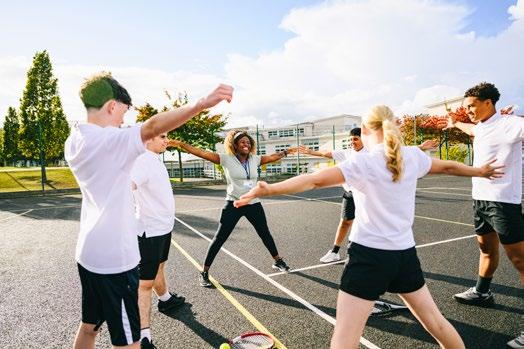
• Making connections with the data: Using statistics to connect to personal relevance (e.g. ‘Almost four in 10 of your age cohort may experience a mental-health disorder in a year’, then ask: ‘What does that mean in our school, our friendship groups and our online lives?’)
• Mapping factors that influence awareness: Recognising that awareness is influenced by many factors such as peer norms, social media, family, the school environment, culture and access to services. Explore why some young people might not be aware of certain risks? What barriers exist?
• Creating ‘lightbulb’ moments: Activities could include a short survey of your cohort’s perceptions of a health issue (e.g. ‘How many hours sleep do you think a teen needs?’), followed by sharing actual evidence and reflecting on the gaps. This helps raise awareness through surprise or contrast (‘I thought … but actually …’).
Raising awareness is about helping others to see what the issues are, why they matter and how they connect to their lives before moving on to ‘how to change’ and ‘what to do’. It sets the stage for deeper work in influencing attitudes, promoting healthy behaviours, boosting community connection and leading youth-led initiatives.
• Informed choice: Awareness gives young people the foundation for making healthier choices rather than arbitrary ones.
• Shared language: When the whole class (or school) becomes more aware, discussions become richer and you can talk with peers and family using shared understandings rather than misconceptions.
• Foundation for later action: Awareness alone isn’t enough, but without it, it’s hard to move into attitude-change, behaviour-change or community initiatives.
• Reduction of stigma and normalising help-seeking: When awareness includes mental health, safe practices, respect and inclusion, it helps destigmatise these topics.
1 As a class, discuss the following questions:
• Why do some issues get more attention in the media than others?
• How does awareness help prevent stigma or misinformation?
• When does ‘awareness’ become ‘action’?
• What is the difference between being aware of something and caring enough to change it?
Influencing attitudes is the bridge between awareness and action, it’s about understanding why people think, feel and behave the way they do, and how those beliefs can be reshaped to promote healthier outcomes. For young people, attitudes toward health are shaped by a complex web of influences: family, peers, school culture, social media and even celebrities or online influencers. By exploring these influences, you can become more conscious of your own perspectives and learn how to positively influence others.
1 In pairs, choose one of the short case scenarios below and role-play short conversations showing how to respond constructively and influence attitudes without shaming or judging.
• A friend skips meals to ‘stay fit’.
• A classmate jokes that ‘boys shouldn’t talk about feelings’.
• Someone posts a risky trend online for likes.
2 As a class, discuss the following questions:
• What phrases felt supportive vs. dismissive?
• What made it easier or harder to influence positively?
1 In small groups, choose one health topic (e.g. sleep, vaping, stress, body image or inclusion) and design a short awareness campaign with the goal of changing attitudes, not just providing information. Use slogans, visuals and tone that reflect empathy, respect and youth voice. Present ideas via a poster, slideshow or short video pitch.
2 Peers vote on which campaign feels most persuasive and authentic.
Attitudes are learned and reinforced over time. For teens, peer influence plays a particularly powerful role. The Australian Institute of Family Studies reports that adolescence is a stage where fitting in becomes a central focus meaning that peers can shape everything from opinions on vaping and alcohol to views on body image and exercise. Digital environments amplify these effects: research from the eSafety Commissioner (2024) found that almost 70 per cent of teens say they’ve changed their opinions or behaviours after seeing something on social media, both positively (e.g. health challenges or motivational content) and negatively (e.g. diet culture or risky trends).
Influencing attitudes isn’t only about persuasion; it’s also about understanding empathy, communication and values. Campaigns that successfully shift public opinion like #ThisGirlCan, R U OK? or Headspace’s ‘Small Steps’ focus on connection and relatability, not shame or fear. They frame health in positive, inclusive and empowering ways, showing that everyone has the capacity to make small, meaningful changes.
Research consistently shows that positive attitudes correlate with healthier behaviours. Young people with optimistic, growth-oriented mindsets report better coping strategies, stronger social connections and higher academic engagement. A 2022 study by Beyond Blue found that teens who regularly engaged in positive self-talk and social connection were 40 per cent more likely to report good mental health than those who didn’t.
Promoting healthy behaviours builds on the understanding gained through raising awareness and influencing attitudes, it’s about moving from knowing and believing to actually doing. For young people, this means developing daily habits and routines that support physical, mental and social wellbeing.
Healthy behaviours include a wide range of actions including engaging in regular physical activity, maintaining balanced nutrition, practising mindfulness, getting adequate sleep, managing screen time and building positive social connections. According to the Australian Institute of Health and Welfare (AIHW, 2023), nearly 80 per cent of Australian adolescents do not meet the national physical activity guidelines of at least 60 minutes of moderate to vigorous exercise per day. In addition, a 2022 Sleep Health Foundation report found that around 35 per cent of teenagers get fewer than seven hours of sleep each night, which is well below the recommended 8–10 hours for their age group. These figures highlight how promoting healthy habits isn’t just about knowledge; it’s about helping to overcome the real-world barriers that make healthy choices harder to maintain.
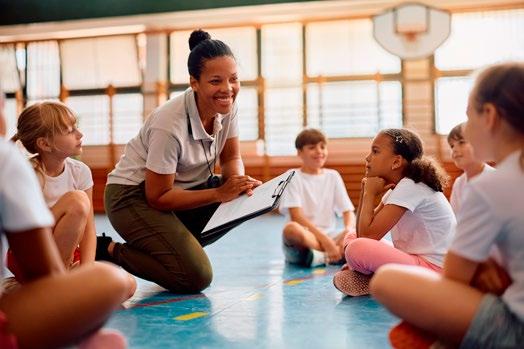
Author team: Bodye Darvill, Nicole Harvey and Brooke Kenwright
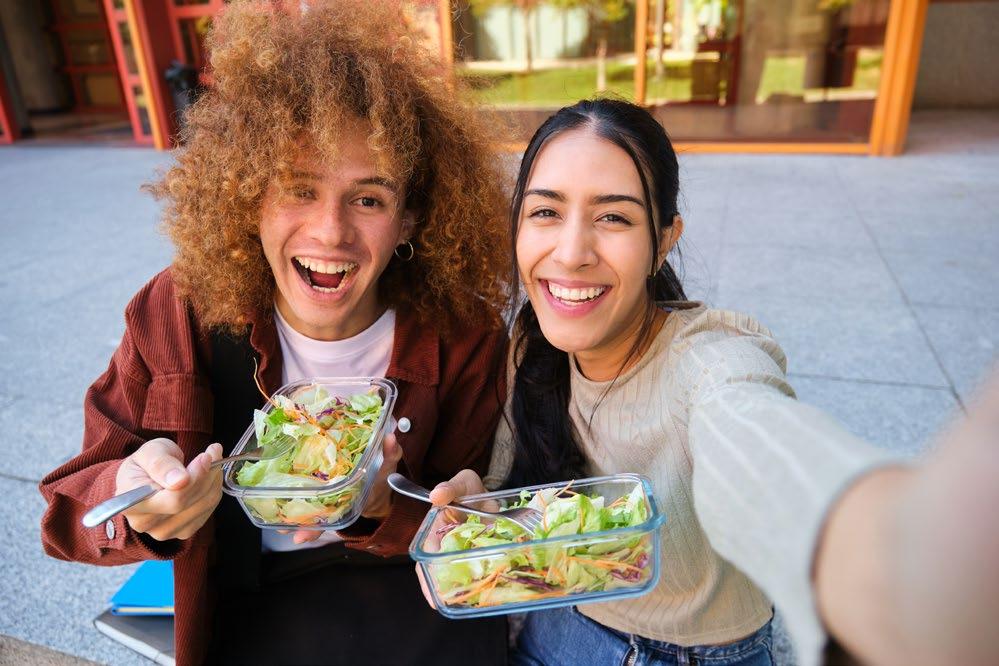
Learning intentions
Social determinants of health
The social and economic gradient in health
Employment, income, housing and environment
Knowledge, awareness and access
Health literacy
Barriers to access
Social networks and support systems
Mental wellbeing and peer support
Health systems of First Nations
Australians
Respecting cultural knowledge
Traditional diets of First Nations
Australians
Cultural rights in maintaining traditional food practices
Sustainable food preparation
Local and sustainable food production
Packaging, single-use plastics and ethical consumption
Climate change and personal responsibility
Nature experiences and eco-identity
Developing connection to Country/Place
Help-seeking
Social, cultural and economic factors
Peer support
I can:
• explain how people’s living conditions and opportunities can affect health and fairness
• explain how health literacy and access to services affect health outcomes and help-seeking
• describe how support networks can improve wellbeing and influence choices
• recognise how food, culture, Country and sustainability can influence health and the environment.
Before you start this unit, test your current understanding by completing the following questions.
1 What does the term ‘social determinants of health’ mean?
2 Give two examples of how someone’s environment or income could affect their health choices.
3 What is health literacy?
4 Name two barriers that might stop a person from accessing health services.
5 How might a friend or support network influence someone’s wellbeing or help-seeking?
When we talk about why some individuals or communities are healthier than others, it’s not just about the choices people make (like diet or exercise). Many of the most powerful influences are social, economic and environmental, the wider conditions in which people are born, grow, live, work and age. These are often called the social determinants of health. Because these determinants influence everything from what foods are affordable, to how easily someone can visit a doctor, to how safe their neighbourhood feels, they play a huge role in health equity (fairness in health outcomes). According to the World Health Organization, social determinants can account for 30–55 per cent of health outcomes.
In practical terms:
• someone in a low-income household may skip preventive checkups or delay seeing a doctor because of cost or transport issues
• a person living in an inner city with many job opportunities, good public transport, healthy supermarkets and green spaces may find it easier to make healthy choices
• in rural or remote Australia, lower employment participation, higher housing stress and less access to internet or services all contribute to worse health outcomes.
These factors also accumulate over time. A child born into lower socioeconomic conditions may have fewer opportunities (in nutrition, education or safe housing) and therefore carry a higher risk of poorer health into adulthood.
Understanding social, economic and environmental factors means recognising two important points.
• Choice is constrained by context: It’s unfair (and inaccurate) to simply say ‘you should make healthy choices’ without looking at what structures support or limit those choices. A person living in a neighbourhood without a fresh food shop, or with unsafe streets so they can’t walk or exercise easily, will face added challenges.
• Health equity matters: If two people have the same lifestyle in every way but different incomes or housing conditions, and they end up with different health outcomes, then we have a fairness problem. Studying these factors helps identify where systemic changes are needed (e.g. improving access to healthcare, better housing policies and supporting employment) rather than just telling individuals to change.
Health tends to follow a social gradient, the lower your socioeconomic position (e.g. lower income, lower educational attainment, insecure employment), the higher your risk of poorer health outcomes. The Australian Institute of Health and Welfare (AIHW) explains that in Australia, and worldwide, that gradient exists.
In Australia, about 10.5 per cent of the population lived in low-income households in 2017–18. In 2022–23, the Gini coefficient for low-income households was 0.307. The Gini coefficient ranges from 0 = equality to 1 = maximum inequality. Australia was ranked 16th highest among 37 OECD countries for income inequality.
ClickView: Development is often associated with economic success—countries with higher standards of living and material wealth like those found in Europe and North America. However, this perspective is only one way to compare countries on the global stage, has strong ties to colonialist histories and doesn’t necessarily capture a place’s environmental and socioeconomic sustainability or even the population’s general happiness. Learn what it means for a place to be ‘developed’. <https://clickv.ie/w/wxZ3>
1 Using the data at the following link, list the wealthiest and poorest countries of 2024 by GDP per capita in the table provided.
<mea.digital/FB_WH10>
For remote, rural and regional areas, people tend to have worse social determinants of health (e.g. lower employment, lower income or housing stress) and worse health outcomes (e.g. higher avoidable mortality) compared to metropolitan areas.
1 Suggest three ways in which living in a rural or remote area could affect a woman’s health and wellbeing (both physical and mental).
2 Suggest three advantages and disadvantages of living in a place where ‘everybody knows everybody’.
Advantages
Disadvantages
Author team: Michelle Bradford, Rena ou yang and Kate Penn
Learning intentions
Introduction to sexuality
Understanding identity and diversity
Influence of media and society
Sexual anatomy
The male reproductive system
The female reproductive system
Puberty
Making safe, informed and respectful choices
Consent and communication
Contraception and protection
Teenage pregnancy
Understanding STIs and regular check-ups
Media, technology and sexuality
The role of social media
The impact of pornography and online content
Decision-making and consequences
Emotional and social consequences
Physical health and safety
I can:
• analyse factors that shape identities
• evaluate how individuals influence the identities of others
• analyse societal and cultural influences on sexuality and sexual health behaviours.
Before you start this unit, test your current understanding by completing the following questions.
1 What does the term sexuality mean beyond sexual activity?
2 What influences can shape a young person’s understanding of sexuality?
3 Why is it important to learn about consent and communication before entering relationships?
4 How can media and social media influence attitudes towards sexuality and body image?
5 Why might people experience sexuality and sexual identity differently over time?
Sexuality is a natural and important part of being human. It’s not just about sexual activity, it’s about how we understand and express ourselves as people. Sexuality includes our biological sex, gender identity, sexual orientation, emotions, attractions, relationships and values. It’s about how we feel, think and act in relation to others and ourselves. Everyone’s experience of sexuality is unique, and can develop and change over time.
Many influences shape how we understand sexuality such as family, culture, religion, media, peers and personal experiences. For example, the ways relationships and gender are portrayed in movies or on social media can influence how we see what’s ‘normal’ or acceptable. But it’s important to remember that there’s a huge range of experiences and no one way to be or feel. Learning about sexuality helps us make informed, respectful and safe choices as we grow and form relationships.
Sexuality also connects to our identity, the way we see ourselves and how others see us. This might include:
• Gender identity: how we understand and express our gender (e.g. male, female, non-binary or gender diverse).
• Sexual orientation: who we are romantically or sexually attracted to (e.g. heterosexual, gay, lesbian, bisexual, pansexual or asexual).
• Gender expression: how we show our gender through clothes, behaviour or style.
According to Minus18 and the Australian Institute of Health and Welfare (AIHW), around 11 per cent of Australian secondary students identify as LGBTQIA+, meaning they identify as lesbian, gay, bisexual, transgender, queer, intersex, asexual or another diverse identity. Recognising and respecting this diversity is essential for creating safe, inclusive spaces where everyone feels valued and accepted.
ClickView: Understand the terms ‘gender identity’, ‘gender expression’ and ‘sexual orientation’, and consider how to make more inclusive language choices. <https://clickv.ie/w/05Z3>
There are four identities that make up your overall identity. These are your personal identity (who you are and what you like), your social identity (the similarities you share with others), your sexual identity (who you are romantically and/or sexually attracted to) and your gender identity (whether you identify as male, female or somewhere in between).
Personal identity: Your personal identity is how you see yourself compared with those around you. It’s what makes you unique from other people. Your hobbies, education, interests and personality traits all shape your personal identity, but it doesn’t stop there! Even your favourite foods or the role you hold in your family (such as being the oldest or youngest child) shape your personal identity.
Social identity: In contrast, your social identity is about the similarities you share with others. Your social identity includes categories such as social class, race, gender, religion and sexual orientation. While being part of a particular group can give you a sense of belonging, it’s important to be mindful not to adopt an ‘us vs. them’ mentality towards others who are not in your group.
Sexual identity: Your sexual identity is how you see and express yourself sexually. This includes who you are attracted to, who you want to have romantic relationships with and who you want to have sexual experiences with. Many people know from a very early age what their sexual identity is, while others might not know until they’re adults (or longer). Your sexuality is not a choice, it is different for everyone and is a natural part of who you are.
Gender identity: Your gender identity is how you perceive your gender (male, female or somewhere in between), how you want to show this to others, and how you want others to treat you. The physical features you were born with (sex assigned at birth) don’t necessarily define your gender identity.
ClickView: There’s been a rise in the number of young Australians identifying as LGBTQIA+ and advocates say it’s a sign that young Aussies feel more comfortable talking about their gender and sexual identity. <https://clickv.ie/w/o5Z3> iStock/Deagreez
Everyone has a sexual identity (or orientation); it is different for everyone and it cannot be assumed. Sexual orientation refers to a person’s sexual, physical and emotional attraction to others, and is a natural part of who we are. Your sexual orientation might stay the same over your whole life or it may change. This doesn’t mean you’re ‘confused’ or ‘choosing’, it just means you’re still learning about who you are and what attractions and relationships feel right to you. Some common terms to refer to sexual orientation include:
• Heterosexual/Straight: attracted to members of the opposite sex
• Homosexual/Gay/Lesbian: attracted to members of the same sex
• Bisexual: attracted to members of both sexes
• Asexual: absence of sexual attraction.
Inclusive language
You can never assume someone’s sexual identity, so it’s really important to be mindful not to use heteronormative language (words that assume everyone is straight) and instead make sure to use inclusive language (words that are not specific to any gender).
Heteronormative language reinforces stereotypes and assumptions about who people are, who they are attracted to and who they can love. By making assumptions about others’ sexual identities or relationships, we may be telling them that anyone who does not fit these expectations is ‘abnormal’ or ‘different’. Using inclusive language that does not make assumptions is a way of showing respect and honouring diversity.
1 Read the following examples of heteronormative language and explain what was wrong with the phrase. Then re-write it to use inclusive language.
a ‘Can you ask your mum and dad if I can come over?’
b ‘When a girl grows up and gets a boyfriend...’
1 As a class or in groups, debate whether you think that sexual orientation is influenced by nature (biology) or nurture (environment). Make notes in the space provided.
Learning intentions
Understanding emotional responses
Managing emotions for health and wellbeing
The impact of extreme or uncontrolled emotion
Emotional awareness in relationships
Consequences of not recognising emotions
Applying emotional management in real life
I can:
• explain what emotions do (and why they can feel stronger in adolescence)
• identify my triggers and body warning signs when emotions are building
• use a few practical strategies to calm down and choose a helpful response
• show empathy and communicate respectfully to protect relationships
• describe what can happen when emotions are ignored or pushed down.
Before you start this unit, test your current understanding by completing the following questions.
1 What is an emotion, and what is it meant to ‘signal’ to us?
2 Write one example of a trigger that might lead to anger, worry or sadness.
3 Name two physical signs your body might show when you’re stressed or angry.
4 What is one healthy strategy you already use to calm down when emotions feel big?
5 In one sentence, what does ‘empathy’ mean in a friendship?
Emotions are powerful signals that help us navigate the world around us. They tell us what we value, alert us to danger and help us connect with others. Everyone experiences emotions such as happiness, anger, sadness, excitement and fear, but how we respond to those emotions can make a huge difference in our relationships and wellbeing. When you feel angry because of an argument with a friend, that emotion itself isn’t ‘bad’. What matters is how you manage it. Do you shout and say something hurtful, or do you pause and explain how you feel? Your emotional response determines whether the situation gets better or worse. Research shows that teenagers experience emotions more intensely than adults because the part of the brain responsible for regulating emotions, the prefrontal cortex, is still developing. This doesn’t mean teens can’t control emotions, it just means learning how to is part of growing up.
Emotional awareness (being able to name and recognise what you’re feeling) is the first step to managing emotions. People who can identify their feelings are more likely to make calm decisions, solve conflicts effectively and maintain healthy friendships. Try to pause and ask yourself: What am I feeling right now and why? This simple question can shift your response from automatic to intentional.
1 Below is a list of common emotions. Tick any that you’ve experienced strongly in the past week.
Positive emotions
Neutral/complex emotions Challenging emotions
Happy Surprised Angry
Calm Confused Frustrated
Excited Bored Sad
Proud Curious Worried
Hopeful Disappointed Jealous
2 For each emotion you ticked, think about what caused it and how you reacted. Fill out the table below. An example has been provided for you.
Emotion What triggered it? How did I react? Was my response helpful or unhelpful? Why?
Example: Angry My friend cancelled our plans last minute I ignored their texts Unhelpful. I made the situation worse instead of expressing how I felt.
3 Which emotions do you find easiest to recognise? Which are harder?
4 How do your emotions affect your relationships with friends or family?
5 How might being more aware of your emotional responses help you in the future?
6 Research shows that emotional awareness is linked to better mental health. In a 2023 Australian Psychological Society survey, 72 per cent of teens who regularly reflected on their emotions reported higher wellbeing compared to 38 per cent who rarely did. What might this tell you about the value of emotional awareness?
Our emotions don’t just affect our minds; they also affect our bodies. Stress, anxiety or anger can increase heart rate, raise blood pressure and even weaken the immune system. In fact, the Australian Institute of Health and Welfare (AIHW, 2023) reports that nearly 40 per cent of young Australians aged 16–24 experience high or very high psychological distress at some point. Managing emotions in healthy ways can dramatically improve your wellbeing.
Positive emotion management means finding strategies that help you stay calm and in control, even when things get tough. These strategies might include:
• breathing techniques to reduce tension
• exercise, which releases endorphins (the body’s ‘feelgood’ chemicals)
• talking to someone such as a friend, teacher or counsellor when you feel overwhelmed
• mindfulness or journaling to track emotions and reflect on triggers.
Learning to regulate emotions doesn’t mean ‘bottling them up’. It’s about expressing them appropriately. For example, if you’re stressed about exams, ignoring your feelings might lead to burnout. A healthy response would be to recognise your stress and make a plan such as breaking study tasks into smaller steps, taking breaks or asking for help. Over time, these habits help build emotional resilience, the ability to bounce back from challenges.
ClickView: In order to be calm and at ease with ourselves, we need regular periods where we do something rather strangesounding: process our emotions. Here is a guide to this essential psychological move. <https://clickv.ie/w/dCZ3>
1 As a class, discuss the various ways people within our society use different activities to reduce stress levels.
2 In pairs, choose one of these activities and research it further so that you are able to demonstrate it to your classmates.
Learning intentions
How to use this Journal
Part 1: Skills and sequences
Part 2: Strategies and tactics
Part 3: Lifelong physical activity
I can:
• use the PE Journal to reflect on three sports and support my reflections with simple evidence
• improve my skills and sequences by balancing speed, accuracy, efficiency and complexity, and explain how a skill can transfer between activities
• make better strategy/tactics decisions in new or challenging situations by adjusting effort, time and space
• plan for lifelong physical activity using FITT and simple check-ins, and explain how to be active safely in natural environments.
Before you start this unit, test your current understanding by completing the following questions.
1 What does the speed–accuracy trade-off mean in skill performance?
2 In your own words, what is efficiency in movement? Give one example from sport or exercise.
3 What makes a sequence more complex? Give one example.
4 What is skills transference, and why is it useful in PE?
5 What does FITT stand for, and how could it help you plan a weekly activity routine?
This PE journal helps you reflect on your learning across a variety of activities. Read the introduction for each part, review the key term explanations and answer the guiding questions using specific examples from your three chosen sports. Aim to show how your thinking and performance transfer across contexts. Where possible, include simple evidence (short video timestamps, coach/peer cues, percentages, lap splits or stroke counts).
This section focuses on how well you perform skills and how you assemble them into sequences under realistic conditions. You’ll examine the tradeoffs and links between speed, accuracy, efficiency and complexity, and show how skills transfer from one activity to another. Your goal is to refine technique so that sequences remain controlled and effective even as task demands increase.
• Speed:
Speed describes how quickly you execute a movement or complete a phase (e.g. time to release a pass, split times over 25 m, approach speed before takeoff). You should consider the speed–accuracy tradeoff and how going faster can increase error unless technique is stable. Useful checks include segment times, reaction time and time-to-contact decisions (when to accelerate/decelerate). Purposeful speed is not just ‘faster’, it’s fast enough to achieve the task without breaking form.
• Accuracy:
Accuracy is the degree to which your outcome matches the target (e.g. hitting a zone, landing on a mark, placing a ball to space). It depends on consistent technique, appropriate visual focus and controlled force. Because accuracy often drops as speed rises, you’ll learn to prioritise cues (body alignment, follow-through, contact point) and use feedback to stabilise outcomes. Tracking hit-rates or target zones across sessions helps you see whether changes persist beyond a one-off success.
• Efficiency:
Efficiency means achieving the same (or better) performance with less wasted energy or motion. In practice, it looks like smoother lines, optimal rhythm and stable postures (e.g. a streamlined body position in swimming or footwork that reduces unnecessary steps before passing). Indicators might include lower perceived exertion at the same pace, reduced stroke count per lap or fewer adjustments before executing a skill. Efficient movers tend to hold form under fatigue and pressure.
• Complexity:
Complexity grows as you add degrees of freedom (more joints, actions or decisions), tighter timing windows or higher variability (defensive pressure, uneven terrain). A complex sequence (e.g. receive → turn → feint → pass to runner) requires technical control and perception-action coupling. Building complexity should be progressive: stabilise the core skill, then layer decisions, constraints or combinations without losing quality.
• Skills transference:
Transference is applying a skill or principle learned in one context to another (near transfer: similar tasks; far transfer: different tasks sharing key features). For example, open-shoulder body positioning in soccer can transfer to receiving in hockey; streamline and rotation control in freestyle can inform body alignment in kayaking; two-foot landings from volleyball help in basketball rebounding. Effective transfer focuses on invariant features (e.g. balance on contact, eyes to target, early preparation) more than surface details.
1 Complete the table after participating in each sport.
Indoor sport:
Where did you push speed without losing form? What evidence shows it worked (split times, reaction, release timing)?
Which accuracy cue made the biggest difference (alignment, contact point, follow-through)? How did you track it?
How did you improve efficiency (stroke count, fewer steps, lower RPE at same pace)?
Describe a complex sequence you performed. What made it complex and how did you keep control?
Outdoor sport:
Where did you push speed without losing form? What evidence shows it worked (split times, reaction, release timing)?
Which accuracy cue made the biggest difference (alignment, contact point, follow-through)? How did you track it?
How did you improve efficiency (stroke count, fewer steps, lower RPE at same pace)?
Describe a complex sequence you performed. What made it complex and how did you keep control?
Aquatic sport:
Where did you push speed without losing form? What evidence shows it worked (split times, reaction, release timing)?
Which accuracy cue made the biggest difference (alignment, contact point, follow-through)? How did you track it?
How did you improve efficiency (stroke count, fewer steps, lower RPE at same pace)?
Describe a complex sequence you performed. What made it complex and how did you keep control?
2 Give one example of skills transference between two of your sports. What ‘invariant’ cue carried across?
This section develops your decision-making. You’ll plan responses for new or challenging situations, examine how tactical choices impact outcomes and deliberately adjust effort, time and space. You’ll also evaluate the effects on skills, strategies and tactics, choose and implement responses and reflect on previous performance to refine your next plan.
• New/challenging movement situations: These are contexts where your usual plan may not work: unfamiliar opponents, changed rules, environmental constraints (current/wind) or role switches. Success relies on reading constraints quickly, simplifying the task (clear cue → simple plan) and choosing a workable first attempt you can adapt after feedback. Treat these as experiments: define the problem, try a controlled solution and review immediately.
Learning intentions
Perceived exertion
Heart rate monitoring
Breathing and talk test
The talk test
Recovery
Evaluating responses together
I can:
• evaluate plans for improving or maintaining my own physical activity levels
• analyse and measure the body's response to physical activity.
Before you start this unit, test your current understanding by completing the following questions.
1 How can you tell when your body is working hard during physical activity, even before you measure anything?
2 What physical signs might you notice when moving from light activity to vigorous activity?
3 Why might it be useful to understand how your body responds to exercise, rather than just how long you exercise for?
4 What methods could you use to judge how hard you are exercising without using any equipment?
5 Why do you think different people might experience the same activity as easier or harder than others?
When you exercise, your body sends signals to your brain about how hard it is working. These signals include things like your heartbeat, breathing, muscle fatigue and even how much effort it feels like it takes to move. Perceived exertion is your personal rating of this effort.
The rate of perceived exertion (RPE) is a scale that helps you measure this effort. Most commonly, it is a scale from 0 to 10, where:
• 0 = No effort, completely at rest
• 1–2 = Very light effort, like a slow walk
• 3–4 = Moderate effort, you can talk comfortably
• 5–6 = Somewhat hard, talking requires short sentences
• 7–8 = Hard effort, talking is difficult
• 9 = Very hard, can only speak a word or two
• 10 = Maximum effort, unable to continue
Using perceived exertion is important because it helps you exercise safely. Research shows that your RPE usually matches your heart rate and oxygen consumption, meaning it’s a reliable way to monitor intensity even if you don’t have equipment. For example, a 2018 study found that teenagers who monitored their RPE were able to maintain exercise within safe intensity ranges, improving cardiovascular fitness without overexertion.
Understanding your perceived exertion is key to improving fitness and preventing injury. Not all exercises feel the same for everyone—what feels ‘moderate’ for one person might feel ‘hard’ for another. By tuning into your body, you can adjust the intensity of your workouts, track progress over time and avoid pushing too hard, which can lead to fatigue or injury.
1 Find a safe area for movement. Start with walking for 2 minutes. Pause and rate your effort on the 0–10 scale. Jog for 2 minutes. Rate your effort again. Finish with a sprint or fast run for 30–60 seconds. Rate your effort. Record your results in the table below.
Activity RPE (0–10)
Notes (breathing, heart rate, ability to talk)
2 Write a short paragraph about which activity felt hardest and why.
3 Consider how you could adjust intensity in future workouts to maintain a safe and effective effort.
Your heart rate is the number of times your heart beats per minute (bpm). It increases during physical activity to pump more oxygen-rich blood to your muscles. Heart rate is one of the most important ways to measure how hard your body is working.
• Resting Heart Rate (RHR): The number of bpm when your body is at rest. For most teenagers, this is about 60–100 bpm. Athletes often have lower resting heart rates, sometimes around 40–60 bpm, because their hearts are more efficient.
• Maximum Heart Rate (MHR): The fastest your heart can safely beat during exercise. A simple estimate is 220 minus your age. For a 16-year-old, the MHR is about 204 bpm.
• Target Heart Rate (THR): The recommended heart rate range to improve fitness, typically 50–85 per cent of your MHR. Exercising within this range improves cardiovascular health without overexerting your body.
Heart rate provides objective evidence of how hard your body is working. Unlike perceived exertion, heart rate is measurable, making it easier to track improvements in fitness over time. Research in adolescent populations shows that monitoring heart rate during exercise can increase adherence to fitness programs and improve cardiovascular outcomes. For example, a 2020 Australian study found that teens who tracked heart rate during exercise were more likely to maintain moderate-to-vigorous activity levels for the recommended 60 minutes per day.
Monitoring your heart rate is important for several reasons:
• Safety: You can avoid overexertion and reduce the risk of injury or fainting.
• Progress tracking: Seeing changes in resting heart rate or recovery heart rate over time indicates improvements in fitness.
• Intensity management: Heart rate helps you stay in the right intensity zone to meet health guidelines.
By combining heart rate monitoring with perceived exertion, you can make your workouts both effective and safe.
ClickView: Learn how the heart powers everything we do. <https://clickv.ie/w/pdo4>
ClickView: Understand the anatomy of the heart and the changes that occur during exercise as well as long term adaptations of the heart and cardiovascular system. <https://clickv.ie/w/vdo4>
1 Sit quietly for 5 minutes. Place two fingers on your wrist or neck to find your pulse. Count the number of beats in 60 seconds. Record your resting heart rate in the space below.
2 Calculate your estimated maximum heart rate (220 – your age).
3 Calculate your target heart rate range (50–85% of MHR).
4 Write a short paragraph explaining how you can maintain your target heart rate during exercise.
Learning intentions
Team and group performance
Key factors that influence team performance
Motivation
Types of motivation
Teamwork
Key teamwork skills
Leadership why leadership matters in teams
How leaders build strong teams
Evaluating personal contribution
Understanding your role in a team
How personal contribution affects team performance
Self- and peer-assessment tools
I can:
• identify and evaluate strategies for decision-making when working in groups or teams that demonstrate leadership and collaboration skills.
Before you start this unit, test your current understanding by completing the following questions.
1 What do you think makes a team perform well, beyond individual skill levels?
2 How might communication affect the success of a team during physical activity or sport?
3 What motivates you to try your best in team or group activities?
4 Why do you think leadership is important even when there is no official team leader?
5 How could reflecting on your own behaviour help improve a team’s performance?
Team and group performance refers to how well a group of people works together to achieve a shared goal. In sports, physical activities and even school projects, team performance is about more than just the skills of individual members, it’s about how well the group communicates, supports each other and coordinates their actions.
In Australia, sports are an important part of culture, with more than 11 million Australians participating in organised sport each year (Australian Bureau of Statistics, 2023). Whether it’s football, netball, cricket or rowing, teams that work effectively together tend to win more games, have higher enjoyment and sustain participation over time. Teams that don’t communicate or share responsibilities often struggle, even if they have very skilled individuals.
Good team performance improves outcomes and enjoyment for all members. When a team performs well:
• each member knows their role and responsibilities
• members communicate clearly and make decisions together
• there is trust and support among team members, which helps during stressful situations.
Research shows that teams with strong cohesion and communication can improve overall performance by up to 20–30 per cent compared to uncoordinated teams. In Australia, community sports clubs that report high teamwork and communication also see higher retention rates among young athletes, particularly those aged 15–18.
ClickView: Learn how a high performing team is one who establishes clear purpose and shares a sense of belonging with players who are accountable to their roles and responsibilities, provide feedback to each other and have a team approach to leadership. <https://clickv.ie/w/3rq4>
Improving team performance isn’t just about practising skills, it’s about understanding how a team works. The most successful teams consistently demonstrate four essential elements: clear roles, effective communication, shared goals and supportive teamwork behaviours. Each of these plays a different but equally important role in helping a group function smoothly and perform at its best.
ClickView: Learn about the key traits of high-performing teams. <https://clickv.ie/w/wsq4>
Every effective team has members who understand exactly what their job is. Roles give structure to a group and ensure each person’s strengths are used in the best possible way. In sport, this might mean having defenders, attackers, playmakers or captains. In a class-based activity, roles might include timekeeper, organiser, strategist or skill specialist.
Having clear roles helps a team by:
• reducing confusion during performance
• ensuring no important tasks are missed
• helping members feel confident and prepared
• preventing conflict over ‘who should be doing what’.
When roles are not clear, teams often experience mistakes, overlap or frustration. Research into youth sport participation in Australia shows that teams with clear role identification report higher player satisfaction and lower dropout rates, especially among teenagers (Sport Australia, 2022). This suggests that youth are more likely to stay engaged and perform well when they understand how they fit into the team.
Communication is the backbone of every high-performing team. It includes talking, listening, giving instructions, asking questions and even non-verbal signals like hand gestures, pointing or eye contact.
Teams that communicate well can:
• make quick decisions under pressure
• adjust strategies during play
• warn teammates about risks
• encourage or motivate others when things get tough.
Good communication is specific, timely and respectful. Instead of “Pass it!”, a strong communicator might say “Jess, left side!” so the message is clear. Similarly, listening is just as important as speaking—teams fall apart when members talk over each other or ignore instructions.
Goals give a team direction. Without a goal, even highly skilled individuals may work in different directions or lose focus. A clear goal answers the question: What are we trying to achieve?
Good team goals are:
• Specific (e.g. ‘Complete 10 passes in a row’)
• Measurable (something you can track)
• Shared (agreed upon by everyone)
• Realistic (challenging but achievable)
When goals are shared, team members feel more connected and motivated. They understand the purpose of their actions and they can evaluate whether they are improving. Most importantly, shared goals encourage teamwork; everyone knows they’re working together for a common result.
In school settings, teams with shared goals show greater cooperation and higher overall performance because each member understands what success looks like and how their role contributes to it.
Supportive teams perform better because members feel valued and confident. Encouragement builds morale and reduces anxiety, which is especially important for teenagers who may be worried about making mistakes in front of peers.
Support can look like:
• positive feedback (“Great pass!”)
• helping teammates understand a skill
• staying calm when the team is under pressure
• motivating others after errors
• recognising effort, not just talent
Australian youth sport research shows that supportive team environments are one of the strongest predictors of long-term participation for young people aged 12–18. Students who feel encouraged are more likely to stay engaged, take risks and ultimately improve.
On the other hand, negative comments, even small ones, can quickly damage confidence and teamwork. A single discouraging moment can affect a team’s performance for the entire activity.
These factors don’t work alone, they reinforce each other.
• Clear roles make communication easier.
• Strong communication helps the team stay focused on the goal.
• Shared goals boost motivation and encouragement.
• Ongoing support helps team members carry out their roles confidently.
When all four factors are present, performance improves not just individually but across the whole group.
ClickView: Learn about the features of high-performing teams in sport. <https://clickv.ie/w/8sq4>
1 Form groups of 4–5 students and choose a short physical activity (e.g. a relay race, mini soccer game or obstacle course).
2 As a group, set a clear goal for your performance (e.g. ‘Complete the relay in under 2 minutes’ or ‘Pass the ball at least 10 times without dropping it’).
3 Assign roles to each member (e.g. runner, passer, leader, motivator).
4 Complete the activity and discuss as a group:
• Did everyone understand their role?
• How did your team plan help achieve the goal?
Author: Michelle Bradford
Learning intentions
Ethical behaviour in sport
What shapes our participation and performance?
why equitable participation matters
Treatment of Aboriginal and Torres Strait
Islander Peoples in sport
Performance-enhancing drugs and ethical debates
Anabolic steroids
Erythropoietin (EPo)
Human growth hormone (HGH)
Doping
Drug testing
Ethical debate
Integrity bodies: Keeping sport fair, safe and respectful
Sport Integrity Australia
Sporting Tribunals
Australian Human Rights Commission
Court of Arbitration for Sport
I can:
• analyse how ethical behaviour can influence physical activity outcomes for individuals and groups.
Before you start this unit, test your current understanding by completing the following questions.
1 What does ethical behaviour in sport mean? Give one example.
2 Name two things (other than talent) that can influence how well someone performs or participates in sport.
3 What do you think ‘equitable participation’ might mean in a school sport context?
4 What is a performance-enhancing drug (PED)? Name one PED you’ve heard of.
5 Who do you think helps keep sport fair and safe? Name one organisation or role.
Ethical behaviour in sport is about more than simply following the rules, it’s about showing respect, fairness and integrity in every situation, whether you are winning, losing, training or supporting others. When you act ethically, you make choices that protect the spirit of the game. This includes being honest with umpires, treating opponents with respect, avoiding dangerous behaviour and accepting responsibility for your actions. Ethical athletes understand that how you play the game is just as important as the result.
Research shows that Australian sport has been increasingly affected by issues linked to poor ethical behaviour. In the 2022 Sport Integrity Australia junior sport survey, around one in five young athletes reported witnessing poor sideline behaviour, such as verbal abuse or arguments with officials. These behaviours don’t just affect the atmosphere of a game, they can influence fairness, emotional safety and even the willingness of young people to stay involved in sport. When you play ethically, you contribute to a positive environment where everyone feels supported and safe.
Ethical behaviour also helps maintain the integrity of competitions. For example, deliberately breaking the rules to gain an advantage such as faking injuries, appealing falsely for decisions or intentionally fouling can change the outcome of a game and damage trust within a team. In a national study by the Australian Sports Commission, 83 per cent of young athletes said that fairness was the most important value in sport, yet many also admitted feeling pressured by coaches, teammates or crowds to ‘bend the rules’ to win. This highlights how ethical choices are not always easy; they often require courage, selfcontrol and strong personal values.
Acting ethically also strengthens your own mental and social development. When you treat others with fairness and respect, it leads to better relationships with teammates, improves group cohesion and helps you become a leader others want to follow. Ethical behaviour shows maturity and it demonstrates that you understand that sport is not just about competition, but about character. The way you choose to act can inspire others and influence the overall culture of sport in your school and community.
ClickView: Learn about what club culture is. <https://clickv.ie/w/Swu4>
ClickView: Learn about the benefits of positive culture in sport. <https://clickv.ie/w/Xwu4>
ClickView: Learn how positive culture is developed in sport. <https://clickv.ie/w/Exu4>
ClickView: Learn about the importance of observing and adjusting team culture as a player and leader. <https://clickv.ie/w/Zwu4>
Read each of the short scenarios showing an ethical dilemma in sport, then answer the questions that follow.
1 Netball: During a fast pass into the goal circle, you brush the ball with your fingertips before it goes out of court. The umpire doesn’t see it and awards the throw-in to your team. Your teammates immediately move into position to take advantage. Do you tell the umpire you touched it, or stay quiet and keep the advantage?
a What is the ethical issue?
b What actions could each person take?
c What is the most ethical choice, and why?
2 AFL: Your coach is frustrated with the opposition’s fast ball movement. At half-time, they tell the backline to ‘be more physical’ and ‘slow their runners down, even if it means a few hard bumps’. One teammate whispers that this basically means to ‘take someone out’ to stop their play. Do you follow the coach’s instruction, potentially risking injury to others, or refuse and risk being benched?
a What is the ethical issue?
b What actions could each person take?
c What is the most ethical choice, and why?
3 Soccer: In the final minutes of a tied match, an opposing striker gets past you and is heading for goal. You know you can’t catch them, but you could stick your leg out and trip them without making it look obvious. Do you commit the foul to stop the goal, or let the play continue and defend fairly?
a What is the ethical issue?
b What actions could each person take?
c What is the most ethical choice, and why?
4 Junior tennis coaching: You volunteer as an assistant coach for younger students. A parent continuously yells instructions and criticisms at their child from the stands, even after being asked to stop. The child is clearly upset and distracted. Do you step in again and risk the parent becoming angry, or avoid confrontation and let the behaviour continue?
a What is the ethical issue?
b What actions could each person take?
c What is the most ethical choice, and why?
5 Athletics: You know one runner in a long-distance race is unwell. They ask you not to spread it around because they’re worried they’ll be pulled out of the event. When the race starts, you notice they’re struggling. Do you inform the coach or officials, protecting the athlete and others, or stay silent because it helps your chances of winning?
a What is the ethical issue?
b What actions could each person take?
c What is the most ethical choice, and why?
Author: Marie James
Learning intentions
Levels of participation
overcoming barriers to activity
Staying motivated and maintaining engagement
Rules and safety
Rules, fairness and inclusion
Training principles
The FITT principle
Core training principles
Training and wellbeing
Overtraining
The role of rest and recovery
I can:
• participate in and evaluate activities designed to enhance health, fitness and wellbeing.
Before you start this unit, test your current understanding by completing the following questions.
1 What are three different ways a person your age might participate in physical activity?
2 Name two barriers that can stop teens being active, and give one practical strategy to overcome each barrier.
3 What’s the difference between intrinsic and extrinsic motivation? Give one example of each.
4 Why do sports have rules? List two reasons linked to fairness and/or safety.
5 What does FITT stand for, and how could it help you plan training for a goal?
When we talk about participation in physical activity or sport, we’re looking at how often people move, play, train or compete and in what ways. Participation isn’t just about being in a formal team or club; it includes recreational activities (like walking, cycling or skateboarding), organised sport (club games or school sports teams) and informal activity (like playing at the park with friends).
In Australia, recent national data from AusPlay shows that while many people are active in some way, there are differences by age, gender, location and access. For example, in the survey of children and youth, a key finding is that participation tends to drop when young people move from primary into secondary school and beyond.
In practical terms, this means some of you may already be engaging regularly in physical activity, while others may find themselves less involved, and there are lots of reasons why that happens. Being physically active brings many benefits including improved fitness, mental health, social connections, development of skills and long-term wellbeing. Youth who grow up playing sport or being active are more likely to stay active as adults. On the flip side, when participation drops, you miss out on those benefits, which makes it important to understand where people engage, why some stop or reduce activity and what we can do to keep ourselves involved.
There’s no single reason why someone is highly active or not. Several factors come into play:
• Personal factors: your motivation, your enjoyment of an activity, your skill level and your confidence in being active.
• Social factors: friends, family support, club environments and opportunities to join teams or groups.
• Environmental factors: access to facilities, cost of equipment or participation, transport and safe and inclusive options.
• Life stage/school factors: as you get older you may face more study demands, part-time work, less free time or changes in priorities.
• Cultural/economic factors: for some groups the cost or availability of programs can limit participation or they may feel excluded because of gender, background or other reasons.
Knowing these factors helps you reflect on your own level of activity and what might support you staying active or what might be making it harder.
1 List possible reasons young people might stop or reduce their sport or activity when they move into older school years. Think about changes in school demands, peer groups, interests, costs, confidence and access.
2 As a class, discuss what could help stop the drop-off.
1 Use the AusPlay website <mea.digital/FB_TP1> to pick one sport or one demographic group (age/ gender/ region) and find what the participation rate is, and whether it has changed over time. Prepare a summary with a graph or chart.
2 Why might the rate be what it is? What could increase participation?
Even though most people know that regular physical activity is good for their health, not everyone manages to stay active. Barriers, the things that make it difficult to participate, can be personal, social or environmental, and they affect everyone differently.
For example, you might want to go for a run, but it’s too dark after school. Or maybe your local club is too expensive, you don’t have transport, or you feel nervous joining a new team. For others, motivation, body confidence or study stress can get in the way. These are all common barriers that influence participation.
According to the Australian Sports Commission’s AusPlay survey (2023), around 38 per cent of teenagers aged 15–17 are not active enough to gain health benefits. The report highlights that participation often drops sharply during high school, especially among girls who are less likely to take part in organised sport once they reach Year 10. Similarly, the Australian Bureau of Statistics (ABS) found that lack of time, study pressure and competing priorities are the top reasons young people reduce or stop physical activity.
Understanding these challenges is the first step to overcoming them, and to building a lifestyle that includes regular, enjoyable movement.
Barriers can be grouped into several categories:
• Personal barriers: low confidence, fear of failure, poor body image, injury or lack of skills.
• Social barriers: peer pressure, not having friends to exercise with, family responsibilities or feeling excluded in team environments.
• Environmental barriers: lack of facilities, unsafe or poorly lit areas, no transport, bad weather or high costs for club memberships or uniforms.
• Psychological barriers: lack of motivation, feeling self-conscious or thinking ‘I’m not sporty’.
Content bank
Health
Expressly aligned with the new Western Australian Curriculum Get a head start with our curated ‘base-book’ range, customise further (if you wish) or start from scratch and create your own!
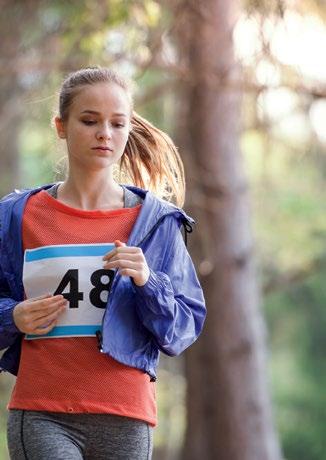
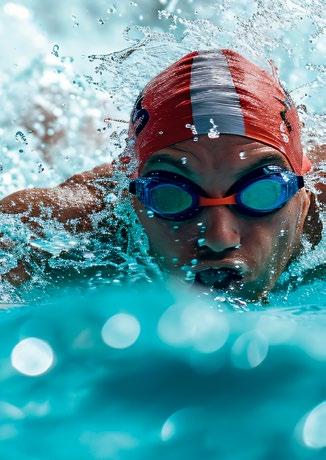
Flexibooks is Matilda Education’s Western Australian Curriculum custom publisher, specialising in print and digital workbooks to help you:
• tailor your approach to the needs of your students
• review your curriculum choices annually and stay up-to-date
• avoid buying textbooks from which students use only a handful of chapters
1 Browse our extensive selection of units prepared especially for the curriculum.
2 Choose content appropriate to your specific course outlines, student needs and school values.
Choose between printed, digital or blended print and digital options

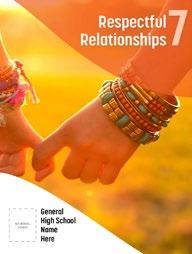
3 Customise by adding, removing or rearranging the content or images (as little or as much as you’d like).
Health and Wellbeing
10
4 Review your workbook, suggest changes and/or approve it –we’ll take care of the rest.
Supported by a Teacher
Customise with your school name Include your school crest or logo
Each year level follows an inquiry-based learning model. Our content offering includes:
• curriculum-aligned content designed to test higher order thinking
• practical and authentic activities to engage students
• current facts, statistics and web links
• ICT activities to progress student learning
Contact us to browse our content bank for your booklist or school purchase on 1300 277 235 or email flexibooks@matildaed.com.au
Influential people
Evaluating health messages
Media influences on food choices
Idealised portrayals of food
Food trends and ‘superfoods’
Food branding and packaging tricks
How media shapes the way we see ourselves and others
Body image and the media
Gender roles and the media
Relationships and the media
Respect, empathy and decision-making
How gender expectations shape decisions
How gender equality builds respectful relationships
Challenging assumptions and attitudes
Power, consent and violence prevention
Media, appearance and equality
Gender, inclusion and media messages
Gender in texts and storytelling
How
Social
Gender stereotypes and power
Gender equality
Gender inequality and discrimination
How gender roles shape choices
Recognising strengths beyond gender
Challenging harmful stereotypes
Creating positive gender norms
628 Understanding emotional responses
Why emotions feel so strong in the teenage years
Why people react so differently
Personal factors and prior experiences
How culture shapes ‘emotional rules’
Friends, school and online worlds
Discrimination, belonging and emotional wellbeing
Expectations about ‘handling it on your own’
Beliefs that make bullying and ‘banter’ seem normal Stigma, shame and self-talk
633
Emotional
Understanding
Respecting
Ethical
Effects
Unhealthy
Harmful substances and decision-making
Media, peer and culture influences on substance use
How media shapes body image
The effects of processed food on nutrition and health
Nutritional needs for healthy living
Analysing food information
Promotional advertising techniques
Cultural importance of food beyond nutrition
Relationships, respect and media influence
Respect, consent and healthy relationships
Gambling awareness
gambling and media/technology link
and community health programs
Overcoming
Encouraging a
Increasing community connection
Promoting respect and inclusion
Promoting
social and economic
in health
Employment, income, housing and environment
Health literacy
Social networks and support systems
Mental wellbeing and peer support
Health systems of First Nations Australians
Respecting cultural knowledge
Traditional diets of First Nations Australians
Cultural rights in maintaining traditional food practices
Sustainable food preparation
Local and sustainable food production
Packaging, single-use plastics and ethical consumption
Climate change and personal responsibility
Nature experiences and eco-identity
Developing connection to Country/Place
Developing
Challenging gender assumptions
Taking action against disrespect
Signs of an unhealthy relationship
Power dynamics
Power and inequality in society
Power in relationships
Balancing power and building equality
Addressing violence and discrimination
Violence and power
Types of
Truth-telling
Sexual
Consent and communication
Contraception and protection
Teenage
We recommend choosing ‘Basic’ sports for Years 7 & 8 and ‘Advanced’ sports for Years 9 & 10. Advanced units include review questions and activities to test higher order thinking. Additional sports units may be available on request.

Base Book Our selection of curated content to perfectly meet the curriculum (uncustomised)
Page-by-page replica of the student workbook with answers, research suggestions, and suggested topics of conversation for further learning. Complimentary digital only access provided with all student workbooks (1 user per 50 copies ordered). Print and Digital copies may be purchased for $70.
• All prices are direct to school. For booklist prices, please contact your bookseller directly.
• Teacher Editions are available via direct sale in conjunction with a student workbook order.
• All prices include GST.
Plastic sleeve $4.50
Customised workbooks in excess of 200 pages are priced on application
It is free to customise your workbooks. You can do this by rearranging or removing sections or images, adding your school’s name and logo to your printed cover, adding your own assessments, worksheets, activities, and more. It is your book, so go ahead and make it unique!
Minimum order of 5 copies for subsequent orders.
50–149 copies: $165
150–249 copies: $275
250+ copies: $385
Reprints under 50 copies and teacher edition only orders will incur a freight charge of $55 No freight is charged if ordering via a bookseller
Supplier (distributor) details
Penguin Random House Distribution ABN: 28 004 815 703 7/26