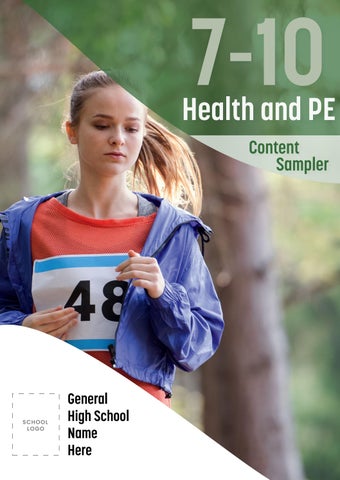
7-10
Health and PE Content Sampler
S CH O OL LO G O
General High School Name Here
Flexibooks Years 7-10 Health and PE Content Sampler Discover the flexibility and depth of our Flexibooks with this comprehensive content sampler. Inside, you’ll find: •
The first 4 pages of a selection of units from each strand of our Year 7-10 content bank (aligned with AC9.0). The first sample unit for each band is an example of a Teacher Edition.
•
A full catalogue of available content.
•
A user-friendly content selector form, complete with curriculum alignment codes for easy selection.
•
Pricing details for workbooks (note: these prices are subject to change).
Why choose Flexibooks? Flexibooks are fully customisable workbooks designed to meet the unique needs of your school. You can: •
Select exactly the content you want from our curriculum-aligned library.
•
Add your own school-specific material.
•
Modify or remove text and images as needed.
•
Personalise the cover with your school name, logo, or even your own image.
Pricing starts from $30 per student. Minimum order: 50 copies. Prefer a faster option? Try our pre-selected base books Our expertly curated base books are ready to go—no customisation required. These workbooks provide full coverage of the Australian Curriculum Version 9.0 and are ideal for schools seeking quality content with minimal prep time. Pricing starts from $34 per student. Minimum order: 50 copies. Complimentary Teacher Editions included: With every order, you’ll receive a free digital Teacher Edition, or a hardcopy (including digital access) can be purchased for $70 each. Teacher Editions include answers to all student questions, helpful teaching notes, extension tasks and suggestions for further learning. Contact your account manager today for a quote! e: flexibooks@matildaed.com.au t: 1300 277 235
AC_7-10_SAMPLER_2026_BOOK.indb 1
31/07/2026 3:51:46 PM
Flexibooks Years 7-10 Health and PE Content Sampler
First published in 2026 by Flexibooks, a Division of Matilda Education Australia ABN 74 635 407 028 PO Box 112 Camberwell, Vic 3124 flexibooks@matildaed.com.au Flexibooks content and illustration copyright © Flexibooks, 2026 Content provided by the school remains its property. All rights reserved. Except under the conditions described in the Copyright Act 1968 of Australia (the Act) and subsequent amendments, no part of this publication may be reproduced, stored in a retrieval system, or transmitted in any form or by any means, electronic, mechanical, photocopying, recording or otherwise, without the prior written permission of the copyright owner.
Disclaimer: The Australian Curriculum, Assessment and Reporting Authority (ACARA) neither endorses nor verifies the accuracy of the information provided and accepts no responsibility for incomplete or inaccurate information. In particular, ACARA does not endorse or verify that the material aligns with the Australian Curriculum content descriptions for the relevant year and subject. You can find the unaltered and most up-to-date version of this material at www.australiancurriculum.edu.au.
Acknowledgement of Country We acknowledge the Aboriginal and Torres Strait Islander Peoples of this nation. We acknowledge the Traditional Custodians on whose unceded lands we have created this resource. We pay our respects to ancestors and Elders past and present. Note about language: Please note that we use the terms ‘Aboriginal and Torres Strait Islander’ and ‘First Nations’ interchangeably. We acknowledge that there is no one term that is universally accepted and we use these terms with respect.
Cover photo: AdobeStock/Halfpoint Clip Art used with permission from Microsoft Printed in Australia While every care has been taken to trace and acknowledge copyright, the publishers tender their apologies for any accidental infringement where copyright has proved untraceable. They would be pleased to come to a suitable arrangement with the rightful owner in each case.
ii
AC_7-10_SAMPLER_2026_BOOK.indb 2
31/07/2026 3:51:47 PM
Contents Base book contents pages (AC9.0)
1
Flexibooks information
5
Sample units (Years 7/8) 601: Changing and growing (P01-03)
7
610: Healthy relationships (P04-07)
11
625: Health promotion (P08-10)
15
670: PE Log (M01-03)
19
614: Increasing physical activity levels (M04-06) 23 616: Ethical behaviours in sport (M07-09)
27
Sample units (Years 9/10) 634: Personal identity (P01-03)
31
643: Navigating emotional responses (P04-07) 35 650: Analysing health information (P08-10)
39 iii
AC_7-10_SAMPLER_2026_BOOK.indb 3
31/07/2026 3:51:47 PM
82a: Badminton (M01-03)
43
645: Fitness improvement (M04-06)
47
666: Transferring skills (M07)
51
647: Characteristics of fair play (M08-09)
55
Content bank
59
Content selector form
71
Pricing
73
iv
AC_7-10_SAMPLER_2026_BOOK.indb 4
31/07/2026 3:51:47 PM
Year 7 – Base book Identities and change Managing transitions Changing and growing Interacting with others Healthy relationships Managing emotions Defining consent Making healthy and safe choices Protecting yourself and others Media influences Healthy choices Preventive health practices Moving our bodies PE Log Making active choices Participation in sport and physical activity Physical activity environment awareness Increasing physical activity levels Learning through movement Ethical behaviours in sport Leadership and collaboration
ISBN 978 1 4586 2379 9
AC_7-10_SAMPLER_2026_BOOK.indb 1
©FLEXIBOOKS 2019
1
31/07/2026 3:51:47 PM
Year 8 – Base book Identities and change Developing identity Sexual identity Assessing health information Power, coercion and control Interacting with others Navigating relationships Bullying Diversity Consent Making healthy and safe choices Health promotion Moving our bodies PE Log Making active choices Measuring the body’s responses Physical activity plan Learning through movement Strategies, skills and predicting outcomes Fair play Teamwork in sport
2
ISBN 978 1 4586 2379 9
AC_7-10_SAMPLER_2026_BOOK.indb 2
©FLEXIBOOKS 2019
31/07/2026 3:51:47 PM
Year 9 – Base book Identities and change Change and transition Safety skills Gender equality Interacting with others Influences on respectful relationships Respecting diversity Navigating emotional responses Communication and consent Making healthy and safe choices Enhancing health and wellbeing Moving our bodies PE Journal Making active choices Fitness improvement Fitness program Learning through movement Characteristics of fair play Effective leadership Teamwork and collaboration
ISBN 978 1 4586 2379 9
AC_7-10_SAMPLER_2026_BOOK.indb 3
©FLEXIBOOKS 2019
3
31/07/2026 3:51:47 PM
Year 10 – Base book Identities and change Influences on identity Interacting with others Promoting respectful relationships Effects of emotional responses Consent in relationships Making healthy and safe choices Managing risk Analysing health information Health services Promoting healthy behaviours Influences on health outcomes Moving our bodies PE Journal Making active choices Understanding fitness levels Physical activity in outdoor settings Personal fitness plan Learning through movement Transferring skills Influences on outcomes Improving performance
4
ISBN 978 1 4586 2379 9
AC_7-10_SAMPLER_2026_BOOK.indb 4
©FLEXIBOOKS 2019
31/07/2026 3:51:47 PM
Flexibooks The experts in customised workbooks Flexibooks is Matilda Education’s custom publishing solution, specialising in print and digital workbooks personalised for your school. Curriculum-aligned
Health and PE
Simple and flexible
7
Health Education
8
Physical Education
Print and digital
9
Elective: Sports Science in Motion
10
Teacher Edition
New gloss General covers now High School Name available! Here SCHOOL LOGO
SCHOOL LOGO
General High School Name Here
SCHOOL LOGO
General High School Name Here
SCHOOL LOGO
General High School Name Here
New health and PE content aligned with the Australian Curriculum Version 9 • Start with a curated base book, customise it or build your own • Choose your cover image, workbook title and content • Add your own material such as policies, assessments, tests, worksheets, images and more …
Available for the Australian Curriculum V9.0
• Prices starting from just $30 per student* * Minimum order of 50 copies applies
Creating your own workbook is as easy as … 1 Browse
our extensive selection of units prepared especially for the curriculum.
2 Choose
content appropriate to your specific course outlines, student needs and school values.
3 Customise
by adding, removing or rearranging the content or images (as little or as much as you’d like).
4 Review
your workbook, suggest changes and/or approve it – we’ll take care of the rest.
www.flexibooks.com.au
AC_7-10_SAMPLER_2026_BOOK.indb 5
31/07/2026 3:45:10 PM
Curated base books – now available Save time and feel confident knowing your Health and PE content is fully aligned with curriculum outcomes. Our expert team has handpicked the key topics and activities to create engaging workbooks that are ready for the classroom. Choose to purchase these at a discounted rate, or use them as a strong foundation and upgrade to a customised version tailored to your students’ and school’s priorities.
What are the benefits of a Flexibooks workbook?
Defining consent
What
sound and feel like? does consent look, is a
Consent sounds and feels like. what consent looks, It is you hints to work out smile and a relaxed posture. again. It should give body language like a Think about DEVICES, tic tone of voice and freely with an enthusias definite yes, it comes These help them stay alive. under threat. stress responses to given without feeling create bodies their threat, wild, your brain would you saw a lion in the they’re in danger or under have. For example, if lion or escaping. When people feel like the animals most fighting by and that humans to help you survive are biological defences heart rate and muscles lion in order to survive. or ‘cuddle up’ to the your body, firing up your feeling send out messages to Some animals ‘play dead’ four key responses to ways we deal with threats. but we still have these day, every But those aren’t the only lions s, we don’t come across We do that too. Nowaday threat can either fight your when you feel like you threatened. and fawn. It’s before, which happen talked about): freeze of fight or flight responses understand (and less You’ve probably heard that are important to two other responses for consent. or run away. There are they can be mistaken a threat. That’s d those two because might just be to appease it yes, important to understan saying or all, saying nothing at might seem like they’re Even though someone not very DEVICES is it?
The
e or fawn
fight, flight, freez four stress responses:
FLIGHT
FAWN
People-pleasing Avoiding conflict by agreeing, flattering others • Prioritising others needs over own no • Difficulty saying
• •
Vector/Illusart
• Workbooks are supported by a Teacher Edition that includes all student material, answers and suggestions for further learning.
ing
Media AS; Alamy Stock
FIGHT • Irritability • Anger • Short-temper • Aggression
Stuckness Collapse Immobilisation Spacing out Dissociation Depression Shame
ide to Healthy Eat
Alamy Stock Vector/YAY
• Content is fully customisable and can be tailored to suit the needs of your course, students and school values.
• • • • • • •
Practices
The Australian Gu
Johanna Velasquez;
• Anxiety & fear • Panic • Avoiding • Chronic worry
FREEZE
Preventive health
ClickView: Eating the right foods is super important for staying confusing. In this video, healthy you’ll learn how to We’ll show you why make smart food choices , but knowing what’s ‘healthy’ can sometimes feel eating well matters using tips from the and how it can help Australian Guide to you feel great every Healthy Eating. day. <https://clickv. ie/w/REu2>
Alamy Stock Vector/Diana
• Content has been written to explicitly align with the curriculum content descriptors and focus areas.
ISBN 978 1 4202 XXXX
X ©FLEXIBOOKS 2025
9
• Facts, statistics and web links are frequently checked and kept up to date. • Each unit begins with learning intentions and a pre-test activity to test students’ current understanding, and ends with review questions for teachers to test student learning and comprehension. prices from
Pick your own price point with printed, digital or blended print and digital options available Pricing is subject to change.
General High School Name Here
l Health and Medica
4
ISBN 978 1 4202 XXXX
l
X ©FLEXIBOOKS 2025
$30.00
Health and Wellbeing
S CHOOL LOGO
National Health and Medical Research Council (2017) Australi Research Council, an Guide to Healthy used with permiss Eating. Canberra: ion Nationa
10
ClickView videos are integrated within content to enhance student’s learning experience and consolidate learning
Contact us to browse our content bank for your booklist or school purchase on 1300 277 235 or email flexibooks@matildaed.com.au
03/26
www.flexibooks.com.au
AC_7-10_SAMPLER_2026_BOOK.indb 6
31/07/2026 3:45:13 PM
Author team: Lori Hill and Brooke Kenwright
Changing and growing
iStock.com/Portra
Changing and growing Learning intentions Physical, emotional and social changes Physical changes Emotional changes Social changes
Coping strategies Peer and family relationships Developing and navigating friendships
ISBN 978 1 4202 XXXX X
AC_7-10_SAMPLER_2026_BOOK.indb 7
©FLEXIBOOKS 2025
7
31/07/2026 3:45:14 PM
Changing and growing
Learning intentions I can: •
analyse the impact of changes and transitions
•
evaluate strategies to support myself and others through changes
•
identify ways to manage the physical, emotional, and social changes associated with puberty.
Pre-test: Show what you know Before you start this unit, test your current understanding by completing the following questions. 1
What are some physical changes you think happen during puberty? __________________________________________________________________________________________________ __________________________________________________________________________________________________
2
How might friendships change as you get older? __________________________________________________________________________________________________ __________________________________________________________________________________________________
3
What is one thing you know about hormones? __________________________________________________________________________________________________ __________________________________________________________________________________________________
4
What does feeling like you belong mean to you? __________________________________________________________________________________________________ __________________________________________________________________________________________________
5
What is one strategy you like to use when you feel worried or stressed about changes in your life? __________________________________________________________________________________________________ __________________________________________________________________________________________________
Physical, emotional and social changes The human life span is full of changes. Many of these changes do not occur by choice. They are the result of: •
our genes, the DNA code that contains all the information about our physical growth
•
our emotional development, e.g. becoming more confident and independent
•
our social development, e.g. becoming responsible for others, like our own children.
As of 2025, the average life expectancy at birth in Australia is approximately 81.1 years for males and 85.1 years for females, while the average life span for Aboriginal and Torres Strait Islander peoples is estimated at 71.9 for males and 75.6 for females. ClickView: There are six main stages in the human life: fetus, baby, childhood, adolescence, adulthood and old age. Learn about each of these stages. <https://clickv.ie/w/nns2>
8
ISBN 978 1 4202 XXXX X
AC_7-10_SAMPLER_2026_BOOK.indb 8
©FLEXIBOOKS 2025
31/07/2026 3:45:14 PM
Changing and growing
Different life spans 1
Class discussion: Why do men, women and Aboriginal and Torres Strait Islander people each have different life expectancies? What is being done to increase the life expectancy of all Australians? What do you think could be done to ensure that Aboriginal and Torres Strait Islander people live longer? Read the Closing the Gap priorities, outcomes and targets to support your discussion: <mea.digital/FB_CGA1> __________________________________________________________________________________________________ __________________________________________________________________________________________________ __________________________________________________________________________________________________ __________________________________________________________________________________________________ __________________________________________________________________________________________________ __________________________________________________________________________________________________ __________________________________________________________________________________________________
Adolescence
Old age
Childhood
Adulthood
Death
ISBN 978 1 4202 XXXX X
AC_7-10_SAMPLER_2026_BOOK.indb 9
iStockphoto/ugurhan; iStockphoto/BlackJack3D; iStockphoto/Prostock-Studio; iStockphoto/Imgorthand;
Middle age
Infancy
iStockphoto/amazingmikael; Getty Images/Catherine Ledner; iStockphoto/gpointstudio; iStockphoto/AnnaNahabed;
Puberty
Prenatal
iStockphoto/Dean Mitchell; iStockphoto/vyasphoto
Conception
©FLEXIBOOKS 2025
9
31/07/2026 3:45:21 PM
Changing and growing
2
Complete the table provided to show the length of time each stage lasts and write what happens physically, emotionally and socially during that stage. The first three stages are done for you. When you get to puberty, describe the physical changes, and use adolescence to describe the emotional and social changes.
Conception 0–1 week
Prenatal 2–38 weeks
Example:
Example:
Sperm joins egg. Cells divide to form a ‘gamete’.
Embryo forms after 4 weeks. By 28 weeks foetus can survive birth if lungs are developed. At 38 weeks child is fully developed.
Infancy 0–2 years
Childhood 2–11 years
Example:
Children become more self-aware. Encouragement and affirmation are needed verbally and physically. Milk teeth fall out, adult teeth emerge. Language and reasoning develop rapidly. Friends and peers become increasingly important and influential. Social play should provide some foundation of physical activity. Sense of justice and fairness becomes important. Calcium, iron and other minerals and vitamins especially important to support growth phase.
Child begins life on breast milk or formula. Bones, organs, teeth and selfesteem develops. Child is dependent on full time care.
10
Puberty 12–17 years
Adolescence 12–17 years
Puberty releases hormones into the body that create an awareness of sexuality and secondary sex characteristics— pubic hair, growth of the gonads, acne, facial hair and voice change in males. A growth spurt occurs. Calcium, iron and other minerals and vitamins especially important to support growth phase.
Self-awareness can become intense as personal identity is worked through. Having an accepted place among peers and friends is critical for selfesteem. Increasing sense of and need for independence. Most physical development has reached maturity by the end of this time. Social play can provide a decreasing foundation of regular physical activity.
Middle age 40–69 years
Old age 70+
Personal identity is revisited, as people review how they have spent their life and what they want to do with what remains. The term ‘midlife crisis’ is used to describe anxiety that emerges at this time. Physical activity needs to move towards low impact exercise as joints become worn out. Hair turns grey and white as hair follicles stop producing melanin. A lack of calcium earlier in life can lead to osteoporosis during this phase.
This phase brings a chance to reflect and turn towards younger generations as retirement from full-time work creates increased time. This can be challenging as many people may need goals, challenges and roles to maintain self-esteem. Physical deterioration can be slowed through low impact regular exercise and low fat, balanced diet, however, the phase will be impacted by the lifestyle adopted in the previous ones.
ISBN 978 1 4202 XXXX X
AC_7-10_SAMPLER_2026_BOOK.indb 10
Adulthood 18–39 years Independence comes with new responsibilities. Earning money and forming a career, long-term relationships, raising a family become a focus. Minor physical development continues until about 21 years. Physical activity now needs to be planned. Weight gain can occur if, with the added responsibilities of adulthood and relationships and family, lifestyle balance slips. Hair loss can occur during this phase.
Death There are many ways of looking at what happens after death. Discuss what ideas are relevant to local concerns and beliefs.
©FLEXIBOOKS 2025
31/07/2026 3:45:21 PM
Author team: Lauren McGregor, Nicola Muller, Melissa Neish and Nat Tencic
Healthy relationships
iStock.com/monkeybusinessimages
Healthy relationships Learning intentions Respectful relationships Respect Empathy, kindness and compassion
Disrespectful behaviour Abuse, bullying and harassment Power Racism
Online protocols
ISBN 978 1 4202 XXXX X
AC_7-10_SAMPLER_2026_BOOK.indb 11
©FLEXIBOOKS 2025
11
31/07/2026 3:45:24 PM
Healthy relationships
Learning intentions I can: •
explain the roles of respect, empathy, power and coercion in developing respectful relationships.
Pre-test: Show what you know Before you start this unit, test your current understanding by completing the following questions. 1
What does a healthy relationship look like to you? __________________________________________________________________________________________________ __________________________________________________________________________________________________
2
How can respect and empathy help people get along better? __________________________________________________________________________________________________ __________________________________________________________________________________________________
3
Why is communication important in friendships and family relationships? __________________________________________________________________________________________________ __________________________________________________________________________________________________
4
What are some examples of behaviours that show disrespect? __________________________________________________________________________________________________ __________________________________________________________________________________________________
5
How do you think online behaviour can affect friendships or relationships? __________________________________________________________________________________________________ __________________________________________________________________________________________________
Respectful relationships In all relationships, it’s important to treat others with respect. Respect is the glue that holds relationships together. Respect means that you accept somebody for who they are, even when they’re different from you or you don’t agree with them. It also means understanding and treating them like a separate person from you, a person who is in charge of their own body, actions and desires. This is someone’s autonomy and it must be respected. Respect should always be given to another, whether you like the person you’re interacting with or not. It’s the basic acceptance and understanding of another’s dignity, irrespective of their race, gender identity, ability, age, sexuality, status, wealth or intelligence. We have a right to feel safe, happy and loved, and so does everyone on the planet. So, we have to treat everyone else the way we want to be treated, and hope that they will do the same. When we don’t respect each other, we might feel that we can be unkind, cruel, or hurt others, and not treat them with decency, but that’s not acceptable. We wouldn’t want to be treated that way, so we can’t treat others that way. We agree that we don’t want to live in a place where we aren’t cared for, safe or have our boundaries adhered to, so mutual respect is how we’re able to trust each other. This is the rule on which all relationships in a happy life and working society are based. Think of a happy, healthy relationship like a pyramid. It starts with respect for each other, on which you can build trust. When you trust each other, you can show a bit more of yourself, and display kindness and compassion. That gentle kindness allows us to open up and be honest without fear of judgment. When we can open up, then we can care enough to be responsible for each other and support each other emotionally. When all of this is in place, we can eventually say we have a strong friendship and even love. All these qualities are driven by a sense of empathy, which means seeing things from others’ perspectives, as well as a belief in equality, meaning we think that all people are equally deserving of kindness, love and respect. And you can tell when you’re in a healthy relationship when you feel safe with this person, and that you can and are communicating openly. 12
ISBN 978 1 4202 XXXX X
AC_7-10_SAMPLER_2026_BOOK.indb 12
©FLEXIBOOKS 2025
31/07/2026 3:45:25 PM
Healthy relationships
SAFE
LOVE
OPEN COMMUNICATION
FRIENDSHIP EMPATHY
EMOTIONAL SUPPORT MUTUAL RESPONSIBILITY
EQUALITY
HONESTY, TRANSPARENCY KINDNESS TRUST RESPECT
When a relationship is a complete pyramid, it’s strong and healthy. A healthy relationship is one where both parties are respected as individuals, emotional needs are met, and everyone feels safe and supported. If a stage in the pyramid of your relationship is missing, or a bit cracked and damaged, it means your relationship might not be strong, happy or healthy, and this part of your relationship may need attention. Both parties in a relationship are responsible for its health, and it’s a joint effort building a strong pyramid together, so communicate openly and talk about how to mend these cracks together. To foster respectful relationships, you must show respect through your beliefs, actions and words. By using respectful practices in your interactions with others, you will promote healthy relationships and ensure that everyone feels valued. You can show respect by showing empathy, communicating clearly and openly without judgment, respecting personal boundaries, seeking consent, and not placing expectations on or making assumptions about others. Empathy is the ability to understand the feelings and needs of others. You’ve probably heard people say, ‘try walking in someone else’s shoes’. We say this so we can imagine that person’s point of view. Then we can understand what they’re going through and how our actions make them feel, because we can imagine how we’d feel if it were happening to us. We show empathy by communicating that we understand the other person’s feelings and validating their experiences. Without clear, open, honest communication, your relationships are likely to be unhealthy. Whether the relationship is with a parent or sibling, a friend, a boyfriend or girlfriend, or a teacher, communication is key. Without verbal and non-verbal communication, you are unable to express your feelings, thoughts, ideas and desires. In the context of a relationship, this means that if one member is unhappy or uncomfortable, they should communicate their feelings to the other person in order to find a solution. A lack of clear communication can cause confusion, pain and even lead to dangerous situations that impinge on someone’s autonomy and freedom, in which they might be forced to do something they do not want to do. Consent is the means by which we respect another’s autonomy. Consent is permission for something to happen, or an agreement to do something. Seeking consent before doing something with someone, whether it’s playing a game, asking for a lift or having sex, is always absolutely necessary. If it’s not given, or not communicated clearly, you can cause serious harm and get into legal trouble (hint: anything other than an enthusiastic ‘yes’ isn’t consent! We’ll get into this more in the next section). Once you have established an emotional or physical boundary, that boundary must be respected. Personal boundaries could include not wanting to enter into a romantic relationship or engage in sexual activity. While people’s boundaries can change as they grow and develop, no one should ever be pressured into changing their mind. ClickView: Explore what a healthy romantic relationship should look like and what to consider if you’re entering a relationship for the first time. <https://clickv.ie/w/SCl3>
ISBN 978 1 4202 XXXX X
AC_7-10_SAMPLER_2026_BOOK.indb 13
©FLEXIBOOKS 2025
13
31/07/2026 3:45:25 PM
Healthy relationships
Applying understanding 1
Think: In the table provided, brainstorm behaviours that make a relationship respectful or disrespectful.
Respectful
Disrespectful
Respect In all relationships, it’s important to treat others with respect. Respect is the glue that holds relationships together. Respect means that you accept somebody for who they are, even when they’re different from you or you don’t agree with them. When we have relationships with other people, we may treat them differently depending on what type of relationship we have with them. You would hug your grandparent, but you wouldn’t do the same to your teacher. You probably wouldn’t talk to a friend the same way you would talk to your dentist. But respect should always be given to another, whether you like the person you’re interacting with or not. It’s the basic acceptance and understanding of another’s dignity, no matter their race, gender identity, ability, age, sexuality, status, wealth, or intelligence. We have a right to feel safe, happy, and loved, and so does everyone on the planet. So, we have to treat everyone else the way we want to be treated, and hope that they will do the same. When we don’t respect each other, we might feel that we can be unkind, cruel, or hurt others, and not treat them with decency, but that’s not okay. We wouldn’t want to be treated that way, so we can’t treat others that way. We agree that we don’t want to live in a place where we aren’t cared for or safe, so mutual respect is how we’re able to trust each other. This is the rule on which all relationships in a happy life and working society are based.
Being respectful 1
Think: Write down the ways you’d like to be treated by someone. __________________________________________________________________________________________________ __________________________________________________________________________________________________ __________________________________________________________________________________________________ __________________________________________________________________________________________________
2
What are some ways you can show respect to others? __________________________________________________________________________________________________ __________________________________________________________________________________________________ __________________________________________________________________________________________________ __________________________________________________________________________________________________ __________________________________________________________________________________________________
14
ISBN 978 1 4202 XXXX X
AC_7-10_SAMPLER_2026_BOOK.indb 14
©FLEXIBOOKS 2025
31/07/2026 3:45:25 PM
Author team: Nigel Chin, Katy Gerner, Diane Hansen, Lauren McGregor, Nicola Muller, Melissa Neish and Nat Tencic
Health promotion
iStock/StockPlanets
Health promotion Learning intentions What is health promotion? Initiatives targeting health, safety and wellbeing
Management strategies for health and safety Managing mental health Managing physical health Managing social safety
Youth health campaigns First Nations youth health campaigns Youth health campaigns for all young people Creating a school action plan
ISBN 978 1 4202 XXXX X
AC_7-10_SAMPLER_2026_BOOK.indb 15
©FLEXIBOOKS 2025
15
31/07/2026 3:45:27 PM
Health promotion
Learning intentions I can: •
explain how media and influential people in the community impact attitudes, beliefs, decisions and behaviours in relation to health, safety, relationships and wellbeing
•
identify health promotion initiatives which target relevant health, safety and wellbeing issues for young people and ways to manage them.
Pre-test: Show what you know Before you start this unit, test your current understanding by completing the following questions. 1
What do you think the term health promotion means? __________________________________________________________________________________________________ __________________________________________________________________________________________________
2
Can you think of any health campaigns you’ve seen in your community, at school or online? __________________________________________________________________________________________________ __________________________________________________________________________________________________
3
Why do you think it’s important to educate people about health rather than just treat illness? __________________________________________________________________________________________________ __________________________________________________________________________________________________
4
What health issues do you think are most relevant to young people today? __________________________________________________________________________________________________ __________________________________________________________________________________________________
5
How might health promotion help prevent accidents or risky behaviours? __________________________________________________________________________________________________ __________________________________________________________________________________________________
What is health promotion? Health promotion is all about helping people live healthier, safer and happier lives. It means giving people the information, tools and support they need to make good choices for their health, and creating environments (like schools and communities) that make those choices easier. Whether it’s eating nutritious food, avoiding smoking, feeling strong mentally or staying safe, health promotion is for everyone. This unit explores how communities, especially First Nations communities, run amazing campaigns to promote health and how you can take action at school too. ClickView: Learn why good health and wellbeing are important and how you can help <https://clickv.ie/w/A7N3>
16
ISBN 978 1 4202 XXXX X
AC_7-10_SAMPLER_2026_BOOK.indb 16
©FLEXIBOOKS 2025
31/07/2026 3:45:27 PM
Health promotion
Initiatives targeting health, safety and wellbeing Across Australia, a wide range of health initiatives are designed to keep young people safe, healthy and supported. These initiatives focus on physical, mental, emotional and social wellbeing, and are often delivered in schools, sporting clubs or local communities to reach as many young people as possible. These initiatives don’t just give information, they often include interactive activities, opportunities to hear from real people and ways for young people to take action. Whether it’s designing posters, running a lunchtime stall or inviting a guest speaker, schools play a key role in helping students become health promoters in their own communities.
Be You Be You is a national initiative designed to support mental health and wellbeing in schools and early learning centres across Australia. Led by Beyond Blue in partnership with headspace and Early Childhood Australia, Be You helps educators create positive, inclusive environments where students feel safe, supported and connected. It focuses on early intervention (recognising signs of mental distress before they become serious issues) and gives teachers the tools and training to respond appropriately. In a Be You school, students might experience wellbeing-focused activities like mindfulness exercises, gratitude journaling, classroom check-ins or wellbeing walls. The aim is to promote resilience, strong relationships and a sense of belonging. With over 13 000 schools registered, Be You has reached more than 4 million students, helping to make mental health support a core part of everyday school life. For young people, this means learning how to manage emotions, build healthy friendships and reach out for help when it’s needed.
R U OK? Day R U OK? Day is held every September and is Australia’s national day of action for checking in on others’ mental health. The goal is simple but powerful: to encourage people to ask “Are you OK?” and follow up with real support if someone is struggling. For young people, R U OK? Day teaches the value of empathy, listening and speaking up when a friend might be going through a tough time. At school, R U OK? Day might involve special assemblies, yellow-themed fundraisers, peer-led discussions or roleplays that help students learn how to start conversations and respond with care. With one in five young Australians experiencing high levels of psychological distress, initiatives like R U OK? Day play a vital role in reducing stigma and helping people feel safe to open up. The campaign’s key message that ‘a conversation could change a life’ reminds students that even small actions can make a big difference to someone’s wellbeing.
Healthy Harold Life Ed program Healthy Harold is the mascot of the Life Ed program, one of the most recognisable and long-running health education initiatives in Australia. With a friendly giraffe guiding the way, students learn about making safe and healthy choices in areas such as nutrition, drug and alcohol awareness, vaping, cyber safety and respectful relationships. The program is delivered through mobile classrooms (Life Ed vans), online modules and in-person sessions with trained educators. What makes Healthy Harold so effective is its interactive, engaging style—students watch videos, share stories and take part in activities that make real-life scenarios easier to understand. In 2022 alone, more than 700 000 students participated in the program. Healthy Harold empowers young people to think critically, resist peer pressure and feel confident in making choices that protect their health and wellbeing.
Road safety campaigns Adobe Stock/Daria Nipot
Every day, young people travel to school on foot, by bike or in vehicles, and every journey comes with risks. That’s why initiatives like National Road Safety Week and Bike Safety Week aim to keep students informed and alert. These campaigns teach important safety behaviours, such as wearing helmets, using pedestrian crossings, staying visible with bright clothing and avoiding distractions like phones or headphones. Road injuries remain one of the leading causes of death and serious injury among children aged 10 to 14 in Australia, so education in this area is vital. In schools, road safety initiatives may include visits from police officers, Walk Safely to School Day events, bike tune-up clinics or student-led poster campaigns. Students learn that even simple actions, like stopping to look both ways or wearing a properly fitted helmet, can save lives. With evidence showing that helmets reduce serious head injuries by up to 69 per cent, road safety is not just about rules, it’s about making smart, life-saving choices.
ISBN 978 1 4202 XXXX X
AC_7-10_SAMPLER_2026_BOOK.indb 17
©FLEXIBOOKS 2025
17
31/07/2026 3:45:28 PM
Health promotion
Lead the change: Your health, your voice 1
In small groups (3–4 students), choose a health or wellbeing topic you care about, and that is relevant to your peers or your own lived experiences. You might select one from the examples that follow, or you can choose your own. •
Mental health and stress
•
Vaping or smoking
•
Online safety and cyberbullying
•
Healthy eating and nutrition
•
Road or bike safety
•
Friendship and respectful relationships
•
Sleep and screen time
•
Cultural identity and belonging (including First Nations youth wellbeing)
2
Use class time or homework to explore real-life campaigns connected to your topic.
3
Use your findings to identify:
4
•
What strategies make these campaigns effective?
•
What visuals, slogans or tools do they use?
•
How do they connect with young people?
As a group, design your own school-based health promotion campaign, including the components listed in the following table. Complete the table with your planning and ideas.
Component
Campaign planning
Campaign title Catchy, clear and meaningful Target audience Who are you trying to reach? Key message What’s one big idea or message you want people to remember? Promotional materials Poster, video storyboard, slogan, TikTok script, social media tile, badge/sticker design, etc. School action plan What events or actions could your campaign include? Call to action What do you want your peers to do as a result of your campaign?
18
5
Create your promotional materials to showcase to your class.
6
As a group, present your campaign to the class in a 3–5 minute pitch. You must explain your health issue, showcase your promotional materials and describe your action plan and how it could be rolled out in your school.
ISBN 978 1 4202 XXXX X
AC_7-10_SAMPLER_2026_BOOK.indb 18
©FLEXIBOOKS 2025
31/07/2026 3:45:28 PM
PE Log
Adobe Stock/matimix
PE Log Learning intentions How to use this Log
Part 1: Movement skills Part 2: Movement strategies Part 3: Movement concepts
ISBN 978 1 4202 XXXX X
AC_7-10_SAMPLER_2026_BOOK.indb 19
©FLEXIBOOKS 2025
19
31/07/2026 3:45:29 PM
PE Log
Learning intentions I can: •
use the PE Log to reflect on learning across three sports and explain how skills/strategies transfer between settings
•
improve movement skills by using teacher/teammate feedback, travelling safely through obstacles and adapting movement sequences to create/use/defend space
•
plan, trial and evaluate strategies/tactics for different scenarios, including using balance/base of support and predicting what will work
•
apply key movement concepts to improve performance.
Pre-test: Show what you know Before you start this unit, test your current understanding by completing the following questions. 1
What is the purpose of a PE Log, and why do you use indoor, outdoor and aquatic examples? __________________________________________________________________________________________________ __________________________________________________________________________________________________
2
What does it mean to use feedback to improve a skill? Describe one step you would take after receiving a cue. __________________________________________________________________________________________________ __________________________________________________________________________________________________
3
When travelling through/over/under obstacles, what are two safety checks you should consider? __________________________________________________________________________________________________ __________________________________________________________________________________________________
4
What does it mean to create or defend space in a game? Give one example. __________________________________________________________________________________________________ __________________________________________________________________________________________________
5
Name the five movement variables and give one example of how changing one variable could change performance. __________________________________________________________________________________________________ __________________________________________________________________________________________________
How to use this Log This PE log will help you reflect on your learning and growth through a range of physical activities. You’ll explore how your skills, strategies and understanding of movement contribute to your overall performance, health and wellbeing. Each section begins with explanations of key terms, followed by reflection questions. Use examples from three different sports—one indoor, one outdoor and one aquatic—to show how you apply and transfer your learning across different settings.
Part 1: Movement skills In this section, you focus on how you move and how well you refine movement over time. You will use teacher and teammate feedback to improve technique, learn to travel safely and efficiently through obstacles and adapt movement sequences to create, use and defend space in games. You’ll also apply feedback to refine swimming strokes and the composition of a group dance sequence, showing control, coordination and purposeful change.
20
ISBN 978 1 4202 XXXX X
AC_7-10_SAMPLER_2026_BOOK.indb 20
©FLEXIBOOKS 2025
31/07/2026 3:45:29 PM
PE Log
•
Implementing teacher feedback to refine movement: Implementing feedback means turning advice into action: identifying a specific cue, trying it in the next attempt and checking whether performance improves. Effective refinement follows a cycle—observe → adjust → test → review— and is most powerful when the cue is simple and measurable (e.g. ‘keep eyes level on landing’, ‘enter water in a tight streamline’). Over time, consistent feedback use builds more efficient, consistent and confident movement.
•
Travelling around, over, up, under and through obstacles: Obstacle travel develops agility, strength, coordination and judgment. You learn to plan a route, choose appropriate locomotor skills (e.g. vault, crawl, jump, climb) and manage safety (spotting landings, controlling speed, using hands/ feet effectively). The same principles apply in water (e.g. swimming through hoops, duck-dives) and on courts/fields (weaving cones), reinforcing spatial awareness, body control and risk assessment.
•
Adapt movement sequences to create, use and defend space in games: A movement sequence is a linked series of actions (e.g. feint → drive → receive → pivot → pass). Adapting sequences in games means altering the order, timing or direction to open space for attack or close it in defence. For example, adding a hesitation step before a cut can draw a defender; defensively, mirroring and narrowing angles can remove passing lanes. The goal is to choose and adjust sequences that best match the current situation.
•
Feedback from teammates, knowing when to travel, mark or intercept: Teammate feedback includes concise cues (‘time’, ‘left’, ‘switch’) and post-play notes (‘hold width’, ‘earlier lead’). Knowing when to travel means when to move into/through space (not the ‘travelling’ footwork violation); it relies on scanning the play, reading body cues and communicating. Marking uses body position to limit options; intercepting anticipates flight or movement patterns. Good teams blend communication with movement timing.
•
Refining swimming strokes using feedback: Stroke refinement targets body position (streamline), breathing timing, catch/pull path, kick rhythm and rotation. Small adjustments such as head alignment, early vertical forearm, consistent exhale and steady kick reduce drag and improve propulsion. Using lap splits or stroke counts helps you check whether the change is effective. Peer or coach feedback plus short video clips make errors visible and guide deliberate practice.
•
Refining composition of group dance sequence: Composition is how movement ideas are selected and arranged (structure, motif, contrast, transitions, unison vs. canon). Refinement focuses on clarity (everyone knows counts and pathways), expressive intent (how dynamics communicate an idea) and spatial design (levels, directions, formations). Feedback often targets timing (‘enter on 5’), spacing (‘tighter diagonal’) and dynamics (‘softer exit’), turning a series of moves into a coherent performance.
Applying movement skills 1
Complete the table after participating in each sport.
Indoor sport: What feedback did you act on this lesson and how did it change your technique? Describe how you planned and executed travel through obstacles. What did you adjust for safety and efficiency? Give an example of a movement sequence you adapted to create/use/defend space. What changed and why? What teammate cues helped you decide when to move, mark or intercept? Outdoor sport: What feedback did you act on this lesson and how did it change your technique? Describe how you planned and executed travel through obstacles. What did you adjust for safety and efficiency?
ISBN 978 1 4202 XXXX X
AC_7-10_SAMPLER_2026_BOOK.indb 21
©FLEXIBOOKS 2025
21
31/07/2026 3:45:29 PM
PE Log
Give an example of a movement sequence you adapted to create/use/defend space. What changed and why? What teammate cues helped you decide when to move, mark or intercept? Aquatic sport: What feedback did you act on this lesson and how did it change your technique? Describe how you planned and executed travel through obstacles. What did you adjust for safety and efficiency? Give an example of a movement sequence you adapted to create/use/defend space. What changed and why? What teammate cues helped you decide when to move, mark or intercept?
2
Which stroke element did you refine (e.g. breathing, catch, kick) and how did you measure improvement? __________________________________________________________________________________________________ __________________________________________________________________________________________________ __________________________________________________________________________________________________
3
What compositional change improved your group dance (timing, spacing, dynamics, transitions)? __________________________________________________________________________________________________ __________________________________________________________________________________________________ __________________________________________________________________________________________________
Part 2: Movement strategies In this section, you will plan and trial strategies for specific scenarios, apply previously successful strategies to new challenges and understand how static and dynamic balance (and the base of support) underpin effective play and smooth flow. You will also predict which tactics are likely to work before you try them, based on cues from opponents, teammates and the environment.
22
•
Developing and implementing appropriate strategies for scenarios: Scenario planning means selecting an overall plan that fits the situation (e.g. pressing after a turnover, conserving energy in a long relay). Implementation turns the plan into role-specific actions—who moves where, when the trigger happens, which pass or line you prefer. Good strategies are simple, repeatable and measurable (‘three quick passes to shift the zone’, ‘wide lead to the pocket’, ‘negative split pacing’).
•
Solving new movement challenges by applying previously successful strategies: Transfer happens when a familiar idea solves a fresh problem (e.g. ‘give-and-go’ from basketball becomes a ‘wall pass’ in soccer; drafting concepts inform pacing in a swim). You identify the principle that worked—create width, change speed, disguise intention—then adapt it to the new context. Reflection after each attempt (‘What stayed the same? What did we tweak?’) strengthens strategic flexibility.
•
Static and dynamic balance, similarities between bases of support and flow of movement: Static balance (stillness) and dynamic balance (control during motion) both rely on aligning the centre of mass over an appropriate base of support (BoS). Wider BoS increases stability (e.g. defensive stance), while a narrower BoS allows quicker directional changes (e.g. attacking cuts). Recognising these similarities helps you choose stances and transitions that maintain flow—continuous, purposeful movement that connects actions without loss of control. ISBN 978 1 4202 XXXX X
AC_7-10_SAMPLER_2026_BOOK.indb 22
©FLEXIBOOKS 2025
31/07/2026 3:45:29 PM
Author team: Emma Bisland, Dylan Chown, Lori Hill and Melissa Kemble
Increasing physical activity levels
iStock/Morsa Images
Increasing physical activity levels Learning intentions Games and recreation Traditional games
Physical activity levels, sleep and sedentary behaviours Increasing physical activity levels
Regional games
Influences on physical activity choices
Modified games
SMART goal setting Time management
Outdoor activities Orienteering
Ac tivities for increasing social connection and wellbeing
Hiking
ISBN 978 1 4202 XXXX X
AC_7-10_SAMPLER_2026_BOOK.indb 23
©FLEXIBOOKS 2025
23
31/07/2026 3:45:31 PM
Increasing physical activity levels
Learning intentions I can: •
design a physical activity plan
•
evaluate strategies to increase physical activity levels to achieve health and wellbeing outcomes.
Pre-test: Show what you know Before you start this unit, test your current understanding by completing the following questions. 1
What types of physical activity do you enjoy most, and why do you think people choose different types of activity? __________________________________________________________________________________________________ __________________________________________________________________________________________________
2
Why do you think physical activity is important for people your age? __________________________________________________________________________________________________ __________________________________________________________________________________________________
3
What things can make it hard for teenagers to be active every day? __________________________________________________________________________________________________ __________________________________________________________________________________________________
4
How do you feel after being active, compared to when you’ve been sitting for a long time? __________________________________________________________________________________________________ __________________________________________________________________________________________________
5
Who or what influences your own physical activity levels (e.g. friends, family, sport, school, technology)? __________________________________________________________________________________________________ __________________________________________________________________________________________________
Games and recreation
24
ISBN 978 1 4202 XXXX X
AC_7-10_SAMPLER_2026_BOOK.indb 24
Adobe Stock/pressmaster
Games and recreational activities are more than just fun, they are powerful ways to build health, social connection and movement habits. When you play games (whether team games like futsal or netball or non-team recreation like jumping rope or frisbee), you are using your body in many ways including running, changing direction, jumping, catching, throwing and dodging. These movements help develop your muscles, bones, coordination, balance and endurance. Over time, playing games often can improve your heart health, reduce your risk of gaining unhealthy weight and help you feel more confident and connected with others.
©FLEXIBOOKS 2025
31/07/2026 3:45:32 PM
Increasing physical activity levels
Recreation doesn’t always mean organised sport. It can include informal play, laughter and trying something new such as tag games, bike riding, board games that involve movement or even dancing. When we think of recreation, we also think of enjoyment, friends or family and being active without it feeling like a chore. Because you enjoy it, you’re more likely to keep doing it. In terms of social connection, games and recreation are ideal because they often involve others such as friends, classmates or siblings. That builds teamwork, fair play, communication, taking turns and recognising that being active can be inclusive (not just for ‘sporty kids’).
Traditional games Aboriginal and Torres Strait Islander peoples have developed a wide variety of traditional games, and these games are an invaluable part of their cultural heritage. Traditional games remain a means of preserving, reinforcing and sharing valuable traditions. This explains why the modern versions of the games, which use balls instead of spears and pool noodles instead of waddies (traditional clubs or hunting sticks), are more than just a fresh and culturally appropriate way to increase physical activity.
The role of Elders 1
Research the role of Elders as guardians of the cultural significance of traditional games.
2
As a class, prepare a proposal for a program of traditional games at your school that must be approved by local Elders. Make notes in the space provided. __________________________________________________________________________________________________ __________________________________________________________________________________________________ __________________________________________________________________________________________________ __________________________________________________________________________________________________ __________________________________________________________________________________________________ __________________________________________________________________________________________________ __________________________________________________________________________________________________ __________________________________________________________________________________________________ __________________________________________________________________________________________________
Protection and preservation Traditional games support and promote the cultural, spiritual, emotional and social wellbeing of Aboriginal and Torres Strait Islander children and young people. They also provide all Australians, especially teachers and students, with the opportunity to learn about, experience and appreciate aspects of Aboriginal and Torres Strait Islander history, culture and language. Unfortunately, although schools are playing a big part in reviving traditional games in Australia, there are still no traditional Aboriginal and Torres Strait Islander games festivals and they are not featured at larger sporting events around the country.
Celebrating traditional games As a class, prepare a proposal for a major traditional games festival showcasing and celebrating Aboriginal and Torres Strait Islander cultures. 1
Divide the class into small groups.
2
Each group must research a specific area relating to the event (e.g. games to be played, venue suggestions).
3
Groups should then come together to present their research and ideas. Collate and summarise the major steps to form a proposal. Remember to justify both the event and the funding required.
ISBN 978 1 4202 XXXX X
AC_7-10_SAMPLER_2026_BOOK.indb 25
©FLEXIBOOKS 2025
25
31/07/2026 3:45:32 PM
Increasing physical activity levels
Let the games begin Aboriginal and Torres Strait Islander people have a diverse range of games and pastimes designed to improve hand-eye coordination, agility and fitness; tell stories; perform ceremonies; pass on important values; and have fun. Mentoring, mimicry and play were the Aboriginal and Torres Strait Islander way to teach essential life skills.
Running game: Edor Edor, or ida in the Torres Strait Islands, is an excellent game to warm up and begin your session. The game is likely to have travelled down to mainland Australia via Samoan missionaries, and has been played for as long as locals can remember in the Arukun Aboriginal community in northern Queensland.
Edor Read the edor factsheet available on the Australian Sports Commission website and then answer the following questions. <mea.digital/FB_PG1> 1
As a class, play a game of edor. Once everyone understands the game, try some of the suggested variations.
2
Reflect on your experiences playing edor and then answer the following questions. a
What did you enjoy most about edor?
__________________________________________________________________________________________________ __________________________________________________________________________________________________ __________________________________________________________________________________________________ b Suggest a teamwork strategy for the next time you play edor. __________________________________________________________________________________________________ __________________________________________________________________________________________________ __________________________________________________________________________________________________ __________________________________________________________________________________________________ c
Of the different game variations in which you participated, which variation made the game the most enjoyable and why?
__________________________________________________________________________________________________ __________________________________________________________________________________________________ __________________________________________________________________________________________________ __________________________________________________________________________________________________ 3
Aboriginal worldview places the group ahead of the individual. Describe how this way of being impacts on teamwork when playing edor. __________________________________________________________________________________________________ __________________________________________________________________________________________________ __________________________________________________________________________________________________ __________________________________________________________________________________________________ __________________________________________________________________________________________________ __________________________________________________________________________________________________
26
ISBN 978 1 4202 XXXX X
AC_7-10_SAMPLER_2026_BOOK.indb 26
©FLEXIBOOKS 2025
31/07/2026 3:45:32 PM
Ethical behaviours in sport
iStock/Peopleimages
Ethical behaviours in sport Learning intentions Ethics in sport Rules and etiquette Player-officiated games
Understanding traditional games Kai Wana Keentan
ISBN 978 1 4202 XXXX X
AC_7-10_SAMPLER_2026_BOOK.indb 27
©FLEXIBOOKS 2025
27
31/07/2026 3:45:33 PM
Ethical behaviours in sport
Learning intentions I can: •
describe modifications to equipment, rules and scoring systems that support fair play and inclusive participation.
Pre-test: Show what you know Before you start this unit, test your current understanding by completing the following questions. 1
What does the word ethics mean to you, and how might it apply to sport? __________________________________________________________________________________________________ __________________________________________________________________________________________________
2
Why do you think following the rules isn’t the only aspect of fairness in sport? __________________________________________________________________________________________________ __________________________________________________________________________________________________
3
How can good sportsmanship make sport more enjoyable for everyone? __________________________________________________________________________________________________ __________________________________________________________________________________________________
4
What do you think could happen in a game if no one followed the rules or showed respect? __________________________________________________________________________________________________ __________________________________________________________________________________________________
5
Why do you think traditional Aboriginal and Torres Strait Islander games focused on cooperation and inclusion rather than competition? __________________________________________________________________________________________________ __________________________________________________________________________________________________
Ethics in sport When you play sport, you make choices all the time, such as whether to play fair, respect others and take responsibility for your actions. Ethics in sport means doing what’s right by showing fairness, honesty, respect and care for your teammates, opponents and officials. In professional sport, ethical behaviour is essential. According to a 2023 Play by the Rules survey, 82 per cent of young athletes in Australia said they enjoy sport more when everyone plays fairly and shows respect. Yet, the same study found that one in three students had seen or experienced poor sportsmanship such as cheating, arguing with referees or disrespectful behaviour on the field. These moments can make people feel discouraged and reduce the fun of playing. Being ethical doesn’t mean you can’t be competitive, it means you compete with integrity. When players focus on fairness and respect, sport becomes more enjoyable and inclusive for everyone, not just those who are winning. Ethical behaviour is what keeps sport safe, fair and enjoyable. Imagine a soccer match where everyone ignored the rules, argued over every call and tried to trick the referee—chaos! Rules are important, but ethics go beyond them. You might follow the rules but still act unfairly (e.g. celebrating in a way that humiliates your opponent). Sports that promote ethics help build stronger communities. Studies by Sport Integrity Australia show that young athletes who practise ethical decision-making develop higher confidence, teamwork skills and empathy. Ethical sport teaches lessons that go beyond the field, it helps you become a better friend, classmate and community member.
28
ISBN 978 1 4202 XXXX X
AC_7-10_SAMPLER_2026_BOOK.indb 28
©FLEXIBOOKS 2025
31/07/2026 3:45:33 PM
Ethical behaviours in sport
Rules and etiquette Rules and etiquette, or manners, are used in activities and sports to govern how they should be played. ‘Fore!’, ‘The ball was out!’, ‘Goal!’, and ‘Go back to your corners’, are examples of what officials and participants say during different physical activities to indicate the way participants are expected to act.
Rules Rules are consistent guidelines about how a sport or activity should be played. They are developed over time and become better known and applied once a governing organisation is formed. For example, football in England was only established as a sport when the English Football Association was formed in 1875. When people know and use rules, sport and physical activity can be played within common and consistent boundaries that ensure safety and allow people to improve within specified and agreed parameters. There are three main types of rules: official rules, modified rules and local rules. •
Official rules are developed and agreed upon by the game’s official governing organisation. They are followed in competitions and events, such as the Olympic Games, the National Rugby League, dance sport championships, and state championships.
•
Modified rules are official rules that have been changed to allow for factors such as age, disability, gender or fitness level. These rules follow the official rules closely, and allow for improved safety and more participation. Examples of junior sports with modified rules include Minkey Hockey, Kanga Cricket, Auskick and Netta Netball. Examples for athletes with a disability include events like the Paralympics and wheelchair basketball.
•
Local rules are particular to an area. They are changes or alterations that have been made to official rules because of local conditions, needs and wants. Backyard, house, community or school games usually have local rules. Local rules can cater for age, playing area, time, equipment and intensity or level of competitiveness. Local rules may be small changes to the official rules (such as allowing four quarters instead of two halves because of hot weather), medium changes (such as playing only until it gets dark) or major changes (such as there being no uniforms, time limits, penalties or area restrictions).
Backyard cricket rule changes
Codes of behaviour When rules are established by official organisations, they also create a code of behaviour. The code is the accepted checklist of how players, coaches, officials and spectators should behave when involved in the sport or activity to maintain a good image of the sport and to keep all participants safe and happy. People who do not follow the accepted code of behaviour can face consequences that restrict their involvement in the sport or activity. People who do follow the code are rewarded with continuing involvement in the sport or may be officially recognised by the organisation.
ISBN 978 1 4202 XXXX X
AC_7-10_SAMPLER_2026_BOOK.indb 29
©FLEXIBOOKS 2025
29
31/07/2026 3:45:34 PM
Ethical behaviours in sport
Consequences 1
What would be an adequate consequence for each of the behaviours listed in this table? Match up the behaviours with appropriate consequences (there may be more than one). Behaviour
Consequence
1
Being a fair player throughout the game
a
Money fine
2
A coach yelling at referee’s decision
b
Suspension from games
3
Drug taking
c
Best and fairest award
4
Fighting with teammate
d
Ban from attending event
5
Tampering with game equipment
e
Lose the respect of the team
6
An athlete visiting sick children in hospital
f
Good job after sport career finishes
7
Bribing an official
g
Not being well liked by people
8
Betting on own match
h
Receive media criticism
Accepted etiquette Etiquette is what is seen in sport as the ‘right’ or ‘nice’ thing to do, keeping sport honourable and fair. Sometimes there are no rules to govern how players, coaches, officials and spectators should behave, so they are expected to follow the unwritten rules of fair play. Etiquette comes from a time in the past, before there were rules and codes of behaviour. It is a reminder to future generations of sportspeople to act in a way that is fair and will mean that the sport is well regarded. Etiquette can be found at all levels of sport, from international competitions, such as a footballer helping a player who has tripped over, to local competitions, where a golfer might call ‘Fore!’ when teeing off.
Create a game 1
In groups of three or four, develop a game that combines the rules, codes of behaviour and etiquette from other games. As a class, play each group’s game. The game creators should try to take on coaching, officiating and captaining roles. After playing all of the games, use the table provided to evaluate one, and then answer the questions. Game
Evaluation
Game name Rules Code of behaviour Etiquette Equipment Area
30
ISBN 978 1 4202 XXXX X
AC_7-10_SAMPLER_2026_BOOK.indb 30
©FLEXIBOOKS 2025
31/07/2026 3:45:34 PM
Author team: Susan Davenport and Lori Hill
Personal identity
Adobe Stock/InsideCreativeHouse
Personal identity Learning intentions Introduction Factors shaping identities Gender-specific pressures and how they shape identity
ISBN 978 1 4202 XXXX X
AC_7-10_SAMPLER_2026_BOOK.indb 31
©FLEXIBOOKS 2025
31
31/07/2026 3:45:36 PM
Personal identity
Learning intentions I can: •
identify strategies to cope with and manage the impact of changes and transitions.
Pre-test: Show what you know Before you start this unit, test your current understanding by completing the following questions. 1
What aspects of your world contribute to the different parts of your identity? __________________________________________________________________________________________________ __________________________________________________________________________________________________
2
How do your family and community influence the way you see yourself? __________________________________________________________________________________________________ __________________________________________________________________________________________________
3
Have you ever felt pressure to act or look a certain way to fit in? Where did that pressure come from? __________________________________________________________________________________________________ __________________________________________________________________________________________________
4
How does media (social media, TV, music, advertising) affect the way young people view themselves? __________________________________________________________________________________________________ __________________________________________________________________________________________________
5
Why is it important to be able to express your identity freely and feel accepted for who you are? __________________________________________________________________________________________________ __________________________________________________________________________________________________
Introduction Adolescence is a period of physical and emotional development, of maturity and competence, of strengthening identity formation and of changing relationships with family and peers. Throughout this period, young people negotiate more independent relationships with their parents and develop a network of friends and acquaintances that extends beyond family. The importance of the environment on youth development is widely recognised, with the maturation of young people widely influenced by their surroundings and relationships with parents, teachers and peers. Of the social environments that influence young people’s behaviour, family and school are the most important. A sense of connectedness and belonging to family and school is recognised as being important for the emotional health and wellbeing of young people in Australia.
32
ISBN 978 1 4202 XXXX X
AC_7-10_SAMPLER_2026_BOOK.indb 32
©FLEXIBOOKS 2025
31/07/2026 3:45:36 PM
Personal identity
Factors shaping identities Impact of community on personal identity While young people’s experience of belonging to or identifying with a particular culture can enhance their resilience and promote overall wellbeing, some adolescents not born in Australia may be at risk of poor mental health from stresses related to migration, resettlement and acculturation, as well as exposure to traumatic experiences. David L Bennett, Peter Chown and Melissa S-L Kang, Medical Journal of Australia 2005; 183 (8): 436-438. Communities can be defined by location, race, ethnicity, age, occupation, or interest in particular problems or outcomes. Connectedness to community is enhanced by participation in community activities. This participation can take a number of forms including volunteering, participation in clubs and community organisations, socialising with friends and cultural activities. 1
List some communities in which you are a member: Answers may include family, band, school, class, team, dance troupe, volunteer group, choir. __________________________________________________________________________________________________ __________________________________________________________________________________________________ __________________________________________________________________________________________________ __________________________________________________________________________________________________
Belonging to a community can affect an individual’s personal identity in many ways. The suburb that you live in is a useful example. Suburbs that promote a ‘clean and safe’ environment often reflect the attitudes of its community members. Similarly, the presence of activity equipment and sporting facilities makes physical activity possible within communities. A focus on physical activity can influence an individual to pursue an active lifestyle, thereby enhancing their sense of self. 2
Suggest ways that the communities that you listed could impact your personal identity. Strengthen your personal identity by increasing feelings of self-worth, pride, friendship, sense of __________________________________________________________________________________________________ belonging. __________________________________________________________________________________________________ __________________________________________________________________________________________________
Impact of family on personal identity Adolescence can be a period of development when the role of family is lessening in the lives of young people. A lot of emphasis is placed on the importance of peer groups and how they become more significant than family at this age. While friends do become important, the quality of the relationship is different. Peers can provide intimacy based on equality while parents provide a relationship based on a power imbalance. Peer relationships, therefore, have a purpose, but do not usually become more important to young people. Adobe Stock/Rido
ISBN 978 1 4202 XXXX X
AC_7-10_SAMPLER_2026_BOOK.indb 33
©FLEXIBOOKS 2025
33
31/07/2026 3:45:37 PM
Personal identity
3
4
The following list provides some examples of developmental events that may occur during the life of an adolescent. Beside each example identify whether it would have a positive (+ve) or negative (-ve) impact on an adolescent’s personal identity: •
having a beer with Dad: _____
•
adolescent getting a driver’s licence: _____
•
adolescent leaving school: _____
•
adolescent leaving home: _____
•
parental separation: _____
•
parents establishing new relationships: _____
•
illness of parent: _____
•
adolescent getting a job: _____
•
financial difficulties: _____
•
onset of mental illness in parent: _____
•
domestic violence: _____
•
adolescent starting a new, intimate relationship: _____
•
adolescent experiencing work/study changes: _____
•
adolescent getting a first car: _____
•
unexpected death of parent: _____
Comment 1
•
parent becoming unemployed: _____
Student experiences can mean that there may be varying responses.
Select three points from the list and explain your classification: i
�������������������������������������������������������������������������������������������������� �������������������������������������������������������������������������������������������������� �������������������������������������������������������������������������������������������������� ii �������������������������������������������������������������������������������������������������� �������������������������������������������������������������������������������������������������� �������������������������������������������������������������������������������������������������� iii �������������������������������������������������������������������������������������������������� �������������������������������������������������������������������������������������������������� ��������������������������������������������������������������������������������������������������
34
ISBN 978 1 4202 XXXX X
AC_7-10_SAMPLER_2026_BOOK.indb 34
©FLEXIBOOKS 2025
31/07/2026 3:45:37 PM
Author team: Catherine Brandon and Nat Tencic
Navigating emotional responses
iStock/FatCamera
Navigating emotional responses Learning intentions Family and social situations Wh y family and social life matter so much in adolescence Understanding your feelings
Conflict resolution
Negotiation The steps of a healthy negotiation
Responding to rejection, failure, harassment and violence When things don’t go your way When something goes too far What you can do
What happens in your brain during conflict? What If conflict gets out of control?
Rejection How rejection affects us emotionally
ISBN 978 1 4202 XXXX X
AC_7-10_SAMPLER_2026_BOOK.indb 35
©FLEXIBOOKS 2025
35
31/07/2026 3:45:39 PM
Navigating emotional responses
Learning intentions I can: •
evaluate emotional responses in different situations
•
identify strategies for managing emotional responses and resolving conflict in family or social situations.
Pre-test: Show what you know Before you start this unit, test your current understanding by completing the following questions. 1
What are some strong emotions you’ve felt recently, and what usually causes them? __________________________________________________________________________________________________ __________________________________________________________________________________________________
2
Why do you think family and friendships can bring out both positive and negative emotions? __________________________________________________________________________________________________ __________________________________________________________________________________________________
3
What does it mean to ‘manage your emotions’ rather than just react to them? __________________________________________________________________________________________________ __________________________________________________________________________________________________
4
Have you ever experienced rejection or conflict? How did it make you feel? __________________________________________________________________________________________________ __________________________________________________________________________________________________
5
Why do you think empathy and communication are important when dealing with emotional situations? __________________________________________________________________________________________________ __________________________________________________________________________________________________
Family and social situations Family and friendships are two of the biggest influences on your emotional world as a teenager. Whether it’s a supportive sibling, a frustrating parent, a close friend or a complicated group chat, the people around you can bring out both your best and most challenging emotions. During this stage of life, you’re developing independence, exploring your identity and trying to find your place, which means family expectations and social dynamics can sometimes feel overwhelming or confusing.
Why family and social life matter so much in adolescence Your family and your circle of friends are two of the most important parts of your life at this age. They influence how you see yourself, how safe and supported you feel and how you develop emotionally. Even though friends become more central in teenage years, relationships with parents or caregivers, siblings and other family members still play a huge role in your wellbeing.
36
ISBN 978 1 4202 XXXX X
AC_7-10_SAMPLER_2026_BOOK.indb 36
©FLEXIBOOKS 2025
31/07/2026 3:45:39 PM
Navigating emotional responses
In fact, surveys by the Australian Institute of Health and Welfare show that almost nine out of 10 (86%) of 16–17 year olds said their parents ‘accepted them as they are’ and over three‑quarters of young people said their parents understood them or asked about their problems. That tells us many young people feel a sense of belonging and approval in their families. Still, family life is not always smooth. Measuring ‘family cohesion’, that is, how well family members get along, spend time together and communicate, is one way to assess how healthy the family environment is. But conflicts are common, for example, how often family members yell at each other is used in studies as a measure of tension. When teens feel understood and supported by their family, it helps buffer stress and protect mental health. A 2025 report from the Growing Up in Australia study found that children whose parents had a positive relationship with each other tended to have stronger friendships themselves, meaning the health of relationships at home can ‘spill over’ into how you relate to peers. Even in generally positive families, there will be times of friction. Some common scenarios include: •
Disagreements over rules or responsibilities: Curfews, chores, privacy or use of digital devices are frequent sources of conflict.
•
Feeling misunderstood or unheard: You might feel your parents or siblings don’t ‘get’ what you’re going through.
•
Feeling excluded or less prioritised: Sometimes, you might feel your needs are sidelined relative to siblings or other responsibilities.
Similarly, teenagers may experience exclusion or rejection from their peers, being left out or feeling ignored. Social exclusion, in particular, is an often hidden but deeply painful experience. A recent large survey by Orygen found that 60 per cent of young people aged 15–19 had experienced social exclusion in the prior 12 months, and those who did showed significantly worse mental health outcomes (e.g. feelings of loneliness and distress) compared with those who didn’t. Another study suggests about one in six children report being excluded in some way by peers, not always overt bullying, but subtle relational aggression (e.g. excluded from a group, ignored or rumours spread). Bullying more overtly is also common. According to Bullying No Way, about 27 per cent of 9–15-year-olds in Australia reported being bullied every few weeks or more. These figures show that social pressure, exclusion and conflict are widespread, but they don’t make them any less painful or difficult to navigate. Moreover, when social problems pile up on family conflicts, it can magnify emotional strain. If you feel isolated among friends at school and also feel tension at home, those negative emotions can feed into one another, increasing stress, anxiety or sadness.
iStock/Courtney Hale
ISBN 978 1 4202 XXXX X
AC_7-10_SAMPLER_2026_BOOK.indb 37
©FLEXIBOOKS 2025
37
31/07/2026 3:45:40 PM
Navigating emotional responses
Understanding your feelings When difficulties occur in family or social settings, strong emotions can burst up almost instantly, such as anger, sadness, shame, frustration or guilt. Here’s how to make sense of them: •
Recognise the trigger: Maybe your parent criticises your grades or your friend forgets to invite you to a hangout. The external event is often just a spark leaving you to deal with the deeper reaction.
•
Identify the underlying feeling: Instead of just “I’m angry”, ask “Am I also feeling powerless? Hurt? Unfairly judged? Embarrassed?”. Often anger masks something more vulnerable.
•
Check the story you’re telling yourself: You might think “They don’t care about me”, “I’m useless” or “I’m always the bad one”. These stories make emotions more intense. Recognising the story gives you distance from it.
•
Decide how to respond: You can react immediately (yelling, storming out) or choose a more thoughtful path (pause, reflect and plan your response).
Some practical strategies you can use when family or social situations become emotionally charged include: •
Pause and breathe: Before shouting or leaving, take a few slow, deep breaths. Even a 10-second pause can prevent regret.
•
Use ‘I’ statements: Instead of “You always ignore me”, try “I feel hurt when I’m left out because it makes me feel unimportant”. This shifts the tone from blaming to expressing how you feel.
•
Ask for clarity: If something feels unfair, ask questions: “Can you help me understand why?” or “What were you trying to say?”. Sometimes misunderstandings cause the hurt.
•
Schedule a calm time to talk: When everyone’s more relaxed, request a chat: “Can we talk about what happened earlier? I’d like to explain how I felt”. A calmer context leads to better listening.
•
Set small boundaries: You might say “I need five minutes alone to calm down” or “I’d prefer we don’t discuss this until dinner”. Boundaries help protect your emotional space.
•
Find an ally or support: Talk through your feelings with a friend, mentor, counsellor or sibling. You don’t have to navigate these feelings alone.
•
Practise empathy: Try to see the situation from the other person’s view. Maybe your parent is under stress, or your friend is going through something you don’t know about. Empathy doesn’t excuse bad behaviour, but it can soften emotional reactions.
•
Plan positive interactions: Small positive moments like a shared joke, helping with something or showing kindness build goodwill and make rough patches easier to repair.
My people, my emotions 1
In the table below, write the names or roles (mum, older brother, best friend, basketball teammate, etc.) of 3–5 people who are part of your regular life. Family
38
ISBN 978 1 4202 XXXX X
AC_7-10_SAMPLER_2026_BOOK.indb 38
Friends / Social
©FLEXIBOOKS 2025
31/07/2026 3:45:41 PM
Author team: Ben Dawe, Sandra Duncanson, Katy Gerner, Nicole Harvey, Lori
Analysing health information
Hill, Brooke Kenwright, Lauren McGregor, Melissa Neish and Liz Steele iStock/FatCamera
Analysing health information Learning intentions Understanding health messages How health messages are constructed and why you should question them
Harmful substances and decision-making The risks: short-term and long-term Decision-making: how to handle the choices Media, peer and culture influences on substance use
Body image and media influence
Nutrition and culture Nutrients Cultural importance of foods beyond nutrition
Relationships, respect and media influence Respect, consent and healthy relationships
Gambling awareness How gambling and media/technology link
Personal safety and community health programs What do community health programs do?
How media shapes body image
Processed food and nutrition
Inclusive health and accessibility Disability and discrimination
The effects of processed food on nutrition and health Nutritional needs for healthy living Analysing food information Promotional advertising techniques
ISBN 978 1 4202 XXXX X
AC_7-10_SAMPLER_2026_BOOK.indb 39
©FLEXIBOOKS 2026
39
31/07/2026 3:45:43 PM
Analysing health information
Learning intentions I can: •
analyse health information, services and media messaging about relationships, lifestyle choices, health decisions and behaviours
•
evaluate the influence of health information on my own, others’ and community’s attitudes and actions.
Pre-test: Show what you know Before you start this unit, test your current understanding by completing the following questions. 1
Where do you think most young people get messages about health, lifestyle and body image? __________________________________________________________________________________________________ __________________________________________________________________________________________________
2
Why do you think some health messages online about vaping, alcohol, food or fitness are confusing or hard to trust? __________________________________________________________________________________________________ __________________________________________________________________________________________________
3
How can advertising encourage young people to believe unhealthy behaviours (such as gambling or substance use) are normal or harmless? __________________________________________________________________________________________________ __________________________________________________________________________________________________
4
Why might it be difficult for young people to tell the difference between evidence-based health messages and ones designed to make money or gain followers? __________________________________________________________________________________________________ __________________________________________________________________________________________________
5
What community health programs do you know of in your local area? __________________________________________________________________________________________________ __________________________________________________________________________________________________
Understanding health messages Every day, people are exposed to countless messages about health through social media, advertising, TV, friends, websites and influencers. These messages shape how we think about our bodies, our behaviours and what ‘healthy’ looks like. Understanding health messages means asking questions like: Who created this message? What’s the goal? Is it reliable? What assumptions are made? Is this information helpful or harmful? As an adolescent, you’re at a time where peer influence, identity and media really matter. According to a recent survey of young Australians aged 12–17, 63 per cent get health information from social media, and 77 per cent of them say it’s hard to tell what’s true and what’s false. Over 40 per cent have tried or considered trying something new after seeing it on social media, and 41 per cent say social media makes them wish their body was different. These statistics show how powerful health messages are, and how much they can shape your decisions, sometimes without you noticing.
40
ISBN 978 1 4202 XXXX X
AC_7-10_SAMPLER_2026_BOOK.indb 40
©FLEXIBOOKS 2026
31/07/2026 3:45:43 PM
Analysing health information
How health messages are constructed and why you should question them Health messages don’t just appear out of nowhere. They are created by people or organisations with the aim of achieving an outcome, sometimes positive (e.g. public health campaigns) and sometimes commercial (e.g. adverts for fad diets, supplements or ‘wellness’ products). They often use persuasive techniques: catchy slogans, endorsement by influencers, before-and-after photos, ‘natural’ claims or outlandish promises. Since so much of your health information comes via social media and peers, it’s really important to build your ‘healthmessage radar’: •
Check the claims. If it sounds dramatic, magical or too good to be true, it probably needs more investigation.
•
Look for evidence. Has it been reviewed by experts? Are there reliable data or reputable organisations behind it?
•
Consider diversity. Does the message assume everyone has the same body, background or abilities? If so, it may miss how health differs for different people (e.g. those with disabilities, from remote areas or First Nations communities).
•
Reflect on how it makes you feel. If a message makes you feel anxious, ashamed or inadequate instead of informed and empowered, it might be harmful.
•
Talk it through. Discuss with friends, family or teachers for a second opinion.
By doing this, you help protect yourself from misleading or harmful health messages and make stronger, more informed choices about your own health behaviours.
Critiquing and sharing support 1
Choose a source of health advice (e.g. a blog post, book or community health centre) and create a checklist of criteria you could use to evaluate its credibility. __________________________________________________________________________________________________ __________________________________________________________________________________________________
2
Consider the issue of confidentiality when accessing health information and advice. Why is this important? What sources of health advice can you trust to provide confidentiality? __________________________________________________________________________________________________ __________________________________________________________________________________________________ __________________________________________________________________________________________________ __________________________________________________________________________________________________ __________________________________________________________________________________________________ __________________________________________________________________________________________________ __________________________________________________________________________________________________
3
In pairs, brainstorm methods for storing and sharing records of reliable health information sources. These could include websites, books or people. Try to think of both digital and non-digital solutions. __________________________________________________________________________________________________ __________________________________________________________________________________________________ __________________________________________________________________________________________________ __________________________________________________________________________________________________ __________________________________________________________________________________________________ __________________________________________________________________________________________________
ISBN 978 1 4202 XXXX X
AC_7-10_SAMPLER_2026_BOOK.indb 41
©FLEXIBOOKS 2026
41
31/07/2026 3:45:43 PM
Analysing health information
Choosing the right source 1
For each of the following scenarios, identify which source of health information would be the most appropriate to access for help. Scenario 1: Sam wants to change his diet to improve his overall health. a
A blog post by a fitness influencer
b The Australian Government Department of Health website c
A video on YouTube by an unknown user
Scenario 2: Eliza is feeling overwhelmed trying to balance schoolwork and sporting commitments and needs strategies for managing stress and anxiety. a
An online chat service provided by a mental health organisation (e.g. Beyond Blue)
b A friend’s social media post c
A magazine article from several years ago
Scenario 3: Jackson is thinking about trying vaping and wants to research the risks. a
A recent scientific study published in a medical journal
b An advertisement from a vape company c
A discussion thread on an online forum
Harmful substances and decision-making iStock/charinporn thayot
When we talk about harmful substances in the context of health, we mean things like alcohol, tobacco (including e-cigarettes) and illicit drugs. For young people, these substances have real implications for growth, brain development, decision-making and long-term health. Understanding how and why these substances pose risks helps you make more informed choices when you’re faced with them. Adolescence is a key time. Your brain is still developing, especially the parts that handle impulse control, risk assessment and planning ahead. Introducing harmful substances during this period can alter the way your brain forms connections, meaning decisions you make now can have effects far beyond your teenage years. For example, the Australian Institute of Health and Welfare (AIHW) notes that young people aged 10–24 are a ‘vulnerable population’ when it comes to alcohol and drug-related harms, because their brains are still developing. In Australia, the latest Positive Choices survey of students aged 12–17 found: •
about 22 per cent reported having at least one full serve of alcohol in the last month
•
around 16 per cent had used e-cigarettes (vaped) in the last month
•
about 7 per cent had used cannabis in the last month.
These figures show that while many teens do not engage in regular substance use, a significant minority are involved, and given the stakes (health, relationships and legal risk), it’s worth thinking carefully about decision-making. ClickView: Learn which drugs can be misused and the potential harm they can cause. <https://clickv.ie/w/yVS3>
42
ISBN 978 1 4202 XXXX X
AC_7-10_SAMPLER_2026_BOOK.indb 42
©FLEXIBOOKS 2026
31/07/2026 3:45:45 PM
Badminton
Badminton About badminton Badminton is an indoor sport played in either singles or doubles combinations. The players use a racquet and shuttlecock (sometimes called a bird). The court is divided by a net. The goal of each team is to win points by forcing an error from the opponent or by playing a winning shot.
Badminton court and markings
Rules Shots landing within the lines bounding the singles or doubles court are in.
Scoring In badminton, scoring is done using the rally scoring system, which means that the person who wins a rally scores a point, whether or not they were serving. Games are played until one player has 21 points (for shorter games, a lower score can be nominated). The rally system of scoring was introduced in 2006. A match is the best of three games.
Research 1
Use the internet to research the previous scoring system and reasons why the new system may have been introduced. __________________________________________________________________________________________________ __________________________________________________________________________________________________ __________________________________________________________________________________________________ __________________________________________________________________________________________________
Serving •
When serving, the shuttlecock must be struck below hip height, with the head of the racquet below the height of the serving hand.
•
The serve must be completed once the swing has commenced. During this time, the receiver is not allowed to move until the shuttlecock has been struck.
•
When serving, the server and receiver must be standing within their respective service/receiving boxes.
ISBN 978 1 4202 XXXX X
AC_7-10_SAMPLER_2026_BOOK.indb 43
©FLEXIBOOKS 2023
43
31/07/2026 3:45:45 PM
Badminton
Singles play •
The serve is taken from the right-hand service box, serving diagonally to the receiver.
•
The service area and playing court for singles is ‘long and skinny’.
•
If the server wins the point, they move to the left-hand service box and continue serving. The receiver must also move.
•
Should the server lose the rally, the opponent scores a point and serves the next rally from the appropriate service box. If the score is an even number, they serve from the right-hand box. If the score is an odd number, they serve from the left-hand box.
Doubles play The service area for doubles is ‘short and fat’. The playing court forms the outer boundaries.
Serving sequence •
Each member of the serving side has the opportunity to serve.
•
If the server wins the rally, they continue serving. The serving pair swap sides so as to serve to a new receiver.
•
Should the server lose the rally, the next serve by the opposing team is taken from the right-hand service box if the score is an even number and from the left-hand box if the score is an odd number. The server is determined by the side of the court the player was standing in at the commencement of the rally.
Play by the rules 1
Develop a pocket guide that outlines the basic rules of badminton. Use this guide during class when you need to be reminded of the rules!
Review questions 1
How many points are badminton games played to? __________________________________________________________________________________________________
2
When is a point won? __________________________________________________________________________________________________
3
4
Answer true or false to the following statements describing play when serving: The shuttlecock must be struck below hip height.
True
False
The head of the racquet cannot go above the serving hand.
True
False
The serve does not need to be completed once the swing has begun.
True
False
In singles play, where is the serve taken from? __________________________________________________________________________________________________ __________________________________________________________________________________________________
5
44
Answer true or false to the following statements describing doubles play: If the server on a team wins the rally, they continue to serve.
True
False
If the server on a team loses the rally, the other player on that team takes the serve.
True
False
The serving team swap sides each time a point is won.
True
False
ISBN 978 1 4202 XXXX X
AC_7-10_SAMPLER_2026_BOOK.indb 44
©FLEXIBOOKS 2023
31/07/2026 3:45:45 PM
Badminton
Reflect Throughout the unit, your teacher will provide you with the opportunity to learn, practise and refine a variety of defensive and offensive tactics. 1
Use your theory book to keep a weekly performance log that allows you to record information about your performance. Include the following information in your reflection. a
What new tactics or plays you have learned and your ability levels when performing each skill.
b Teacher feedback that you found useful to improve your performance. c
Situations in which each play would be suitable to execute.
d What you are going to do to either improve or maintain your performance.
Skills With all badminton shots, the action of key body parts largely determines the outcome of the shot.
Arm The arm obviously controls the speed of the racquet head and ultimately that of the shuttlecock. In power shots the arm is bent and then snapped into a straight locked position—very similar to the action of throwing a ball.
Wrist The shuttlecock and badminton racquet are relatively light instruments. Consequently many badminton shots are played with a very wrist-heavy action. The wrist has a major impact upon the speed, direction and type of shot played. At the commencement of the swing for many shots, the racquet head trails the wrist until it snaps forward just on impact.
Body Generally, most shots are played using a side-on action. From their initial position, a player’s body weight transfers from the rear foot to the front foot, while rotating through the waist.
Grip (hand) The basic grip can effectively be achieved by shaking hands with the racquet. To ensure a correct grip has been achieved, check that: •
the V formed between the thumb and index finger runs directly in line with the shaft
•
the butt of the racquet is in the palm of the hand
•
the grip lies across the base of the fingers.
For backhand shots, the racquet is turned 30 degrees to the right to gain greater leverage and control.
Forehand grip
Backhand grip
ISBN 978 1 4202 XXXX X
AC_7-10_SAMPLER_2026_BOOK.indb 45
©FLEXIBOOKS 2023
45
31/07/2026 3:45:45 PM
Badminton
Top tips 1
As a class, develop checklists that you can use to remind you about appropriate technique when applying various badminton shots.
2
Keep a copy of each checklist in your theory book so that you can use it to remind you about appropriate technique.
Review questions 1
Which parts of the body control the speed of the racquet (and shuttlecock)? __________________________________________________________________________________________________
2
Because the s major impact upon the s
3
In a forehand grip, the t and i of the racquet is in the p racquet. The b . base of the f
4
and racquet are relatively l ,d and type of s
, the action of the w played.
finger form a along the s of the hand and the g
has a of the
lies a
the
For backhand shots, how many degrees should the racquet be turned? __________________________________________________________________________________________________
Shots Serving The three serves covered have a similar stroke technique, with only slight variations based on the aims of the serve: •
The shuttlecock is held between the index finger and thumb and released over the front foot.
•
The serve is made with a side-on body position angled towards the receiving box.
•
The feet are shoulder-width apart.
•
The body weight transfers from the back foot to the front foot as the shot is executed.
•
At the commencement of the stroke the arm is bent and the wrist is cocked.
•
The racquet head is hip height and nearly parallel to the floor.
•
The player should swing down and through with the shot. The wrist should lead the racquet head until contact, when it is snapped straight.
•
The player should follow through and up into the receiving position. Body weight should be on the front foot with the racquet held high, waiting for the return shot.
High serve The high serve is hit high and deep pushing the opposition player back. Ideal in a singles game as the deep boundary affords more court space for such a shot.
High service
46
ISBN 978 1 4202 XXXX X
AC_7-10_SAMPLER_2026_BOOK.indb 46
©FLEXIBOOKS 2023
31/07/2026 3:45:45 PM
Author: Catherine Brandon
Fitness improvement
Adobe Stock/Marina_Nov
Fitness improvement Learning intentions Mental health benefits of physical activity What this means for you
Setting realistic goals Fitness circuit Personalised fitness programs FITT principle Designing a training program
Games, recreation and outdoor pursuits Challenges and what to do about them
ISBN 978 1 4202 XXXX X
AC_7-10_SAMPLER_2026_BOOK.indb 47
©FLEXIBOOKS 2025
47
31/07/2026 3:45:47 PM
Fitness improvement
Learning intentions I can: •
evaluate physical activities designed to enhance health, fitness and wellbeing
•
identify strategies for incorporating physical activities into my life
•
analyse the use of games, recreational activities and outdoor pursuits to improve components of health, fitness and wellbeing.
Pre-test: Show what you know Before you start this unit, test your current understanding by completing the following questions. 1
What do you already know about how physical activity can support mental health? __________________________________________________________________________________________________ __________________________________________________________________________________________________
2
What types of fitness activities or sports do you enjoy most, and why do you think you enjoy those more than others? __________________________________________________________________________________________________ __________________________________________________________________________________________________
3
What do you think makes a fitness goal realistic or achievable for a young person? __________________________________________________________________________________________________ __________________________________________________________________________________________________
4
What fitness component do you personally think you are strongest in (e.g. strength, speed, flexibility) and why? __________________________________________________________________________________________________ __________________________________________________________________________________________________
5
Why do you think warm-ups and cool-downs matter before and after exercise? __________________________________________________________________________________________________ __________________________________________________________________________________________________
Mental health benefits of physical activity When you think of physical activity such as running, playing team games or going for a bushwalk, it’s easy to picture just the physical side: stronger muscles, faster running and more endurance. But what’s often less obvious (yet extremely important) is how much your brain and your mental health benefit too. For teenagers, this connection between movement and mood, and between exercise and mental strength, can be a real game-changer. Better mood and less stress: After a good game of basketball, a run or a bike ride, many teens report feeling calmer, more focused and more able to manage stress. That’s because physical activity helps your brain switch off constant worrying and lets you reset. Improved concentration and school performance: When you move, your brain gets more blood flow, more oxygen and more stimulation. That means when you return to class, you may notice you’re more alert, less restless and more ready to learn. 48
ISBN 978 1 4202 XXXX X
AC_7-10_SAMPLER_2026_BOOK.indb 48
©FLEXIBOOKS 2025
31/07/2026 3:45:47 PM
Fitness improvement
Stronger mental resilience: Being active, especially in team games or outdoor challenges, builds confidence, social connection (you’re with friends) and a sense of achievement (you did something, you improved). These help protect your mental health long term. Habits that last: Developing an active lifestyle now doesn’t just help you now, it’s setting you up for adulthood. Since mental health in young adulthood is strongly tied to habits developed in teenage years, putting movement into your weekly routine pays off. iStock/Nastasic
The period of adolescence is full of changes: hormones, social pressures, academic demands and identity formation. Physical activity offers more than a ‘break’ from all that, it helps the brain. Research shows that regular activity stimulates neurochemicals like endorphins, dopamine and serotonin— these are the ‘feel-good’ chemicals that can lift mood, boost motivation and reduce stress. On top of that, studies link higher levels of movement (especially moderate-to-vigorous physical activity) with better cognitive function (such as attention, memory and planning) in young people. This means that staying active doesn’t just help you physically, it can help you think better, concentrate more in class and deal with mental pressures more effectively. A recent review found a strong association between exercise and reduced risk of mental-health issues: kids and adolescents who do regular physical activity report fewer symptoms of anxiety and depression and higher self-esteem. For example, an Our Futures Institute study using the ‘Big 6’ set of health behaviours found that adolescents who did physical activity six days per week had around 37 per cent lower depression scores, 30 per cent lower psychological distress scores and 12 per cent lower anxiety scores compared with those who did very little. So the numbers are clear: movement = less distress, better mood and stronger brain.
What this means for you Physical activity isn’t just ‘good for you’ in the physical sense. It’s a powerful ally for your mind as well, helping you feel better, think better, connect better and handle the ups and downs of teenage life more confidently. So next time you choose to move, remember you’re doing it for your body and your mind. Practical tips: •
Try to aim for at least 60 minutes a day of movement (as recommended) but remember and, every bit of activity counts. Doing something is far better than nothing.
•
Mix it up: team games (social benefit), individual fun movement (like skateboarding or cycling) and outdoor pursuits (fresh air). Variety keeps it interesting and helps different parts of your brain and body.
•
Pay attention to how you feel: Maybe after a session you’re more positive, your head feels clearer or you’re less tense. These are signs your brain is benefitting.
•
Use movement as a mental-health tool, not just a physical one. If you’re feeling stuck, tired, unmotivated or stressed, a short walk, game or outdoor session can shift your mind.
•
Connect with friends or family: There’s extra mental health benefit when you’re active socially (laughing, chatting, moving together).
•
Be realistic: Some days will be better than others. The goal is consistency, not perfection. If you miss a day, don’t worry, get back the next day.
Setting realistic goals If you are setting a goal, it is important to identify exactly what it is that you really want to achieve. Consider what kind of goal you are setting (short-term, long-term, process, performance or outcome). A realistic and achievable goal will be one that is challenging, but not too difficult to accomplish. ClickView: Learn how to set goals. <https://clickv.ie/w/KUS3>
ISBN 978 1 4202 XXXX X
AC_7-10_SAMPLER_2026_BOOK.indb 49
©FLEXIBOOKS 2025
49
31/07/2026 3:45:48 PM
Fitness improvement
SMART goals An acronym that is commonly used to describe and remember the elements of goal-setting is ‘SMART’. Specific
(What actions will you do?)
Measurable
(How and when will you measure activity or progress?)
Achievable
(Is the goal challenging, but not impossible to achieve?)
Realistic
(Is your plan and time frame realistic—can you stick to it?)
Time frame
(Set days and times for your activities and a date for completion and/or review.)
For example, if Tom wishes to improve his ability to shoot goals in basketball, which approach do you think will be most effective in making this goal a reality? A: ‘I hope to improve my goal shooting.’ B: ‘I will practise shooting goals three times a week for six weeks. I will do this for 45 minutes on a Monday, Wednesday and Thursday straight after school.’ Tom is more likely to follow through with ‘B’ because he has thought about how he will achieve his goal of improvement in making a time for practice. He has set a short-term process goal. Tom could also have chosen a performance goal. At the moment he can score a goal in four out of ten attempts. His goal might be to increase this scoring rate to seven out of ten. He might decide that a reasonable time frame is six weeks based on his knowledge and experience. Tom can write down his goal and monitor his progress. He may find that he achieves his target in three weeks. If this happens he might review his goal and try to shoot from the three point line or introduce a distraction. If after six weeks Tom has not achieved his goal, he may find that he needs to review the time frame or the amount of practice he is doing. Even if he does not quite achieve his aim, Tom may still be pleased with his progress and will know how far he has come. You can make your goals even SMART–ER by adding Evaluation and Rewards. Evaluation It is very important to keep your goals in mind and review them regularly. Was your time frame realistic? Was your goal achievable? Are you on track? Rewards
Keep yourself motivated by having a list of ‘rewards’—things you can do or enjoy to give yourself a pat on the back for your small successes. For example, if I stick to my rehearsal schedule every week, I will...
•
treat myself to a sports magazine
•
stream a new movie to relax
•
take a day off training
•
go out with friends.
It is very important to acknowledge and celebrate your progress!
Sample of Tom’s SMARTER goal plan Goal: To increase goal shooting success rate from 4/10 to 7/10.
50
S
I will shoot goals three times a week for six weeks.
M
I will test myself once a week and record the result.
A
I know that previously when I practised each day I improved within 2 weeks—this is a challenging but achievable goal.
R
If I train straight after school I will be able to stick with it as I am usually free at this time.
T
I will do this for 45 minutes on a Monday, Wednesday and Thursday straight after school for five weeks beginning April 6.
E
I will review this plan after six weeks.
R
Each week that I achieve my training target, I will reward myself by going out with friends on Friday after school.
ISBN 978 1 4202 XXXX X
AC_7-10_SAMPLER_2026_BOOK.indb 50
©FLEXIBOOKS 2025
31/07/2026 3:45:48 PM
Transferring skills
iStock/South_agency
Transferring skills Learning intentions Transferable strategies Understanding movement strategies
Understanding skill transfer Positive transfer of movement skills Negative transfer of movement skills Neutral transfer of movement skills
Understanding outdoor skill transfer
ISBN 978 1 4202 XXXX X
AC_7-10_SAMPLER_2026_BOOK.indb 51
©FLEXIBOOKS 2025
51
31/07/2026 3:45:51 PM
Transferring skills
Learning intentions I can: •
transfer and adapt skills and strategies from previous experiences to create successful outcomes in unfamiliar movement situations.
Pre-test: Show what you know Before you start this unit, test your current understanding by completing the following questions. 1
What skills or strategies have you learned in one sport that you think could be useful in another activity? __________________________________________________________________________________________________ __________________________________________________________________________________________________
2
Why might playing a variety of sports help someone become a better overall athlete? __________________________________________________________________________________________________ __________________________________________________________________________________________________
3
What do you think is meant by 'reading the play' in sport? __________________________________________________________________________________________________ __________________________________________________________________________________________________
4
How could communication and decision-making skills transfer from sport to outdoor or everyday challenges? __________________________________________________________________________________________________ __________________________________________________________________________________________________
5
Why do you think adapting to new environments or unfamiliar activities can be challenging? __________________________________________________________________________________________________ __________________________________________________________________________________________________
Transferable strategies Transferring skills means using what you already know in a new context. For example, understanding how to create space in basketball by spreading out, making quick passes and communicating with teammates can help you perform better in soccer, hockey or even ultimate frisbee. Studies in sports science show that athletes who can identify and transfer movement patterns across games develop decision-making skills up to 30 per cent faster than those who only practise in one context. This ability to ‘read the play’ is a key feature of expert performers. Research also highlights that many elite athletes developed across multiple sports before specialising. For instance, 71 per cent of AFL players surveyed by the AFL Players Association in 2022 reported playing at least two other sports growing up such as basketball, athletics or cricket. Their coaches say this variety helped them transfer agility, spatial awareness and communication strategies across disciplines.
Understanding movement strategies Every successful performance in sport and physical activity depends on more than just skill, it’s also about how you think, move and make decisions in dynamic situations. Movement strategies are the tactical choices and coordinated actions that help players and teams perform effectively. They involve understanding where to move, when to move and how to adapt to what’s happening around you. Whether you’re creating space to receive a pass, defending against an opponent or deciding
52
ISBN 978 1 4202 XXXX X
AC_7-10_SAMPLER_2026_BOOK.indb 52
©FLEXIBOOKS 2025
31/07/2026 3:45:51 PM
Transferring skills
when to change direction, you are using movement strategies. These strategies are universal, they appear across invasion games like basketball, soccer and hockey, as well as in outdoor activities such as orienteering and team challenges. Learning to recognise and apply these strategies builds what’s known as movement literacy, the ability to transfer knowledge and skills from one activity to another. This is what allows athletes to transition smoothly between different sports or challenges. For instance, the communication and spacing used in netball can improve coordination in ultimate frisbee, while anticipation and timing skills developed in tennis can transfer to defending in soccer. By understanding core strategies like creating space, defending space, transition play, communication and teamwork, decision-making, and anticipation and timing, you can become a more adaptable, confident and strategic mover, both on the field and beyond it.
Creating space (offensive strategy) Creating space is one of the most fundamental principles in almost every team sport. It refers to how players position and move to make it easier for themselves or teammates to receive the ball or object. By spreading out, making well-timed runs and avoiding clustering, teams can stretch the opposition’s defence and open up passing or scoring opportunities. In sports like basketball, this might mean cutting toward the basket after a pass, while in soccer it could involve running into open space behind defenders or switching play to the opposite side of the field. Good spacing doesn’t happen by accident, it’s the result of awareness, timing and teamwork. Players need to constantly read the play, anticipate where the next opening will be and move with intent. Studies in sports performance have found that teams with effective spatial awareness complete 25–30 per cent more successful passes per match compared to those who rely on individual skill alone. The ability to create and exploit space is transferable across nearly all invasion games, from hockey to ultimate frisbee, and is a key factor in maintaining possession and building attacking momentum.
Defending space (defensive strategy) Defending space is the tactical counterpart to creating space. It involves positioning and movement to reduce the opponent’s options by cutting off passing lanes, marking players closely and staying goal-side of attackers. Effective defence relies less on speed and more on anticipation, reading the play and communication. In basketball, this might look like a zone defence where players guard specific areas rather than individuals. In netball or soccer, defenders may focus on marking a player while still tracking the ball’s position. Defensive strategies are highly transferable across sports because they rely on similar core principles such as maintaining balance, predicting movement and staying aware of both the ball and opponents. Players who understand defensive spacing can adapt to a variety of game contexts, from team defence in hockey to man-marking in touch football. According to research by the Journal of Sports Sciences (2021), teams that effectively coordinate defensive positioning concede up to 40 per cent fewer scoring opportunities, demonstrating how tactical structure can outweigh raw athleticism.
Transition play (attack–defence shifts) iStock/skynesher
Transition play refers to the rapid shift between defence and attack, or vice versa, after possession changes. It tests a team’s ability to react quickly, reorganise and exploit opportunities before the opposition resets. In basketball, this might be a fast break following a rebound; in soccer, it’s the counterattack after a turnover. The key is speed, awareness and decision-making, knowing when to push forward and when to slow down to maintain control. Successful transitions depend on communication and anticipation. Players must instantly switch mental and physical gears, moving from a defensive to an attacking mindset. This adaptability is vital in outdoor sports too, for instance, in orienteering or adventure racing, quick transitions between navigation and physical challenges determine overall performance. Sports data analysis shows that teams converting at least 20 per cent of their transition opportunities often outperform opponents by significant margins, underscoring the importance of mastering this movement phase.
Communication and teamwork Communication underpins every other movement strategy. It includes both verbal communication (calling names, giving instructions, encouraging teammates) and non-verbal communication (eye contact, gestures, body language). In fast-paced environments, clear and consistent communication ensures everyone on the team understands their role and anticipates play. Research in team sports psychology indicates that athletes who communicate effectively during gameplay demonstrate up to 15 per cent faster decision-making and 25 per cent higher overall team coordination scores. Good teamwork goes beyond talk; it’s about trust and shared understanding. Knowing that your teammate will make a certain run, hold a defensive position or call for the ball creates fluidity and confidence within a group. Whether you’re
ISBN 978 1 4202 XXXX X
AC_7-10_SAMPLER_2026_BOOK.indb 53
©FLEXIBOOKS 2025
53
31/07/2026 3:45:54 PM
Transferring skills
playing netball, soccer or participating in an outdoor challenge course, cooperation and communication allow individuals to perform as a unified system rather than as isolated players. These skills are highly transferable, not only between sports but also to real-world contexts like leadership, problem-solving and collaborative learning.
Decision-making Decision-making in movement is about choosing the best option in the moment including when to pass, when to shoot, where to move or how to position yourself. In any dynamic sport, players are constantly making split-second decisions based on what they see and anticipate. For example, a basketball player might decide between driving to the basket or passing to a teammate on the perimeter, depending on the defender’s position. In soccer, players must decide whether to hold possession or make a through ball under pressure. The quality of these decisions often determines the success of a play more than technical skill alone. Effective decision-making develops through practise, observation and feedback. Players who learn to ‘read the game’ can identify patterns and react proactively rather than reactively. Studies in cognitive sports science show that expert players make accurate tactical decisions up to 30–40 per cent faster than novices, largely due to better pattern recognition and situational awareness. Decision-making skills transfer beyond sport too, they support problem-solving in outdoor challenges (like deciding the best route in an orienteering task) and strengthen critical thinking in everyday life.
Anticipation and timing Anticipation and timing involve predicting what will happen next and moving at exactly the right moment. In sports, milliseconds matter and being early or late can completely change the outcome of a play. For example, a defender who anticipates a pass can intercept it before it reaches the opponent, while a hitter in volleyball must time their jump perfectly to connect with the ball at its peak. These skills rely on reading body cues, understanding the flow of play and recognising triggers that signal what’s about to happen. Anticipation is one of the most transferable movement skills across all physical activities. In hockey, it helps players react to rebounds; in basketball, it enables quick defensive shifts; and in outdoor activities like mountain biking or rock climbing, it helps participants plan movements and manage risk. According to performance studies, athletes who focus on anticipation drills can improve reaction times by up to 20 per cent within just a few weeks. When combined with good timing, anticipation builds confidence, efficiency and precision in movement allowing athletes to perform smoothly even under pressure.
Compare and contrast 1
Work in small groups to identify and record similarities and differences between basketball and netball movement strategies. Focus on attack, defence, communication and decision-making. Then discuss how the strategies could transfer from one sport to the other. Aspect
54
ISBN 978 1 4202 XXXX X
AC_7-10_SAMPLER_2026_BOOK.indb 54
Basketball strategy
Netball strategy
Similarities / transfer opportunities
©FLEXIBOOKS 2025
31/07/2026 3:45:54 PM
Characteristics of fair play
iStock/FG Trade Latin
Characteristics of fair play Learning intentions Fair play Being a good sport Ethical issues in sport
Characteristics and application of fair behaviour Applying fair behaviour Real-world case studies Leadership strategies
Self-officiated play Challenges of player-officiated games
ISBN 978 1 4202 XXXX X
AC_7-10_SAMPLER_2026_BOOK.indb 55
©FLEXIBOOKS 2026
55
31/07/2026 3:45:56 PM
Characteristics of fair play
Learning intentions I can: •
demonstrate fair play explain how ethical behaviour can influence physical activity outcomes for individuals and groups
•
describe the characteristics of fair play and the application of fair and ethical behaviour in physical activity.
Pre-test: Show what you know Before you start this unit, test your current understanding by completing the following questions. 1
What does the term fair play mean to you, both in sport and in everyday life? __________________________________________________________________________________________________ __________________________________________________________________________________________________
2
Why do you think sportsmanship is considered an important part of being an athlete? __________________________________________________________________________________________________ __________________________________________________________________________________________________
3
Can you think of an example where you saw someone demonstrate good sportsmanship? What made it good? __________________________________________________________________________________________________ __________________________________________________________________________________________________
4
How might unfair behaviour (e.g. cheating, aggression, ignoring rules) affect a game and those involved? __________________________________________________________________________________________________ __________________________________________________________________________________________________
5
Why do you think sporting role models are judged on their behaviour as well as their performance? __________________________________________________________________________________________________ __________________________________________________________________________________________________
Fair play There may be situations throughout your sporting career when people or circumstances make your experiences with your sport less enjoyable. As a sportsperson, you deserve certain rights but you must also take responsibility for your own actions.
Being a good sport As a sportsperson you are constantly making decisions. Who will I throw to? Will I go to training? Do I choose to react to the referee’s call on me? How you react to these situations moulds you as both an athlete and a person. Think of a sporting identity who you consider a role model. Is your opinion based entirely on their physical ability or is it also influenced by how they behave on and off the field? ‘Sportsmanship’ refers to your ability to maintain integrity and respect while abiding by the rules of your sport and heavily relies on the choices that you make.
56
ISBN 978 1 4202 XXXX X
AC_7-10_SAMPLER_2026_BOOK.indb 56
©FLEXIBOOKS 2026
31/07/2026 3:45:56 PM
Characteristics of fair play
Identifying and designing View the following YouTube videos on good and bad sportsmanship. <mea.digital/FB_STS1> <mea.digital/FB_STS2> 1
Brainstorm the qualities that you believe make up good sportsmanship. __________________________________________________________________________________________________ __________________________________________________________________________________________________ __________________________________________________________________________________________________
2
Explain why you think people watch the top five sports listed from the bad sportsmanship moments video. __________________________________________________________________________________________________ __________________________________________________________________________________________________ __________________________________________________________________________________________________ __________________________________________________________________________________________________
3
Share your thoughts with your class and, as a group, design a sportsmanship checklist.
4
Using this checklist, design an A4 poster highlighting the attributes of good sportsmanship and display it in your classroom. You may choose to use the computer or create your own design. Use the box provided for planning.
ISBN 978 1 4202 XXXX X
AC_7-10_SAMPLER_2026_BOOK.indb 57
©FLEXIBOOKS 2026
57
31/07/2026 3:45:56 PM
Characteristics of fair play
5
Using the checklist, rate yourself in relation to sportsmanship. What things can you do to practise good sportsmanship? __________________________________________________________________________________________________ __________________________________________________________________________________________________ __________________________________________________________________________________________________ __________________________________________________________________________________________________ __________________________________________________________________________________________________
Ethical issues in sport Australians are proud of being seen as a sporting nation. Now more than ever, though, we are facing new and diverse ethical issues and concerns in sport. Ethics in sport refers to the ‘unwritten rules’ by which a person should behave and perform and is distinguished by how well we treat others and ourselves. Ethical issues that you may encounter as a sportsperson: •
sportsmanship, or lack thereof
•
‘sport rage’ including harassment and bullying, and/or inappropriate behaviour by parents/spectators
•
cheating or bias
•
drug abuse
•
type of media coverage, for example, inaccurate reporting of your performance or attitude.
Exploring ethical issues 1
What ethical issues have you experienced that are not listed here? __________________________________________________________________________________________________ __________________________________________________________________________________________________ __________________________________________________________________________________________________
2
In your own experience of watching sport on TV, which sports receive the most media coverage? Why do you think this is? __________________________________________________________________________________________________ __________________________________________________________________________________________________ __________________________________________________________________________________________________
3
How does the amount of coverage of female sports compare to the coverage of male sports? __________________________________________________________________________________________________ __________________________________________________________________________________________________ __________________________________________________________________________________________________
58
ISBN 978 1 4202 XXXX X
AC_7-10_SAMPLER_2026_BOOK.indb 58
©FLEXIBOOKS 2026
31/07/2026 3:45:56 PM
Flexibooks Customised workbooks for your school Content bank
Years 7–10 Health and physical education Australian Curriculum Version 9.0 New content Expressly aligned with the Australian Curriculum Version 9.0 Get a head start with our curated ‘base-book’ range, customise further (if you wish) or start from scratch and create your own!
Health and PE
S CHO O L LO GO
7
General High School Name Here
www.flexibooks.com.au
AC_7-10_SAMPLER_2026_BOOK.indb 59
Health Education
SCH OOL LOGO
General High School Name Here
8
Physical Education
S CH OOL LOGO
9
General High School Name Here
59
31/07/2026 3:45:57 PM
Curriculum-aligned content for years 7–10 Flexibooks is Matilda Education’s Australian Curriculum custom publisher, specialising in print and digital workbooks to help you: • tailor your approach to the needs of your students • review your curriculum choices annually and stay up-to-date • avoid buying textbooks from which students use only a handful of chapters
Creating your own workbook is as easy as … 1 Browse
our extensive selection of units prepared especially for the curriculum.
2 Choose
3 Customise
content appropriate to your specific course outlines, student needs and school values.
Choose between printed, digital or blended print and digital options
by adding, removing or rearranging the content or images (as little or as much as you’d like).
Health and Wellbeing
Include you r school crest or logo
SC H O O L LOGO
10
General High School Name Here
4 Review
your workbook, suggest changes and/or approve it – we’ll take care of the rest.
Supported by a Teacher Edition that includes all student material, answers and suggestions for further learning
Customise with you r school na me Each year level follows an inquiry-based learning model. Our content offering includes: • curriculum-aligned content designed to test higher order thinking • practical and authentic activities to engage students • current facts, statistics and web links • ICT activities to progress student learning
Contact us to browse our content bank for your booklist or school purchase on 1300 277 235 or email flexibooks@matildaed.com.au
www.flexibooks.com.au
AC_7-10_SAMPLER_2026_BOOK.indb 60
60
31/07/2026 3:45:57 PM
Years 7 and 8 health and physical education Unit
Unit name
Topics
Pages
Identities and change 600
Managing transitions
What is normal when you start high school? Being resilient Growth mindset Developing new relationships Self-awareness Social awareness Values and beliefs Code switching Seeking help
14
601
Changing and growing
Physical, emotional and social changes Coping strategies Peer and family relationships Developing and navigating friendships
30
617
Developing identity
Development of identities Values Cultural influence
20
618
Sexual identity
Exploring identity during change Changing feelings and attractions Influence of puberty on identity Understanding body changes during puberty Cultural beliefs and expectations Health information and support Strategies to manage the impact of change
22
619
Assessing health information
Assessing sources of health information Health consumer skills and strategies Consumer protection Consumer influences Understanding health information Analysing health information Health information, products and services Sexual health information Getting help
16
620
Power, coercion and control
Personal power Social power Gender stereotypes and power Gender equality Gender inequality and discrimination How gender roles shape choices Recognising strengths beyond gender Challenging harmful stereotypes Creating positive gender norms
30
610
Healthy relationships
Respectful relationships Empathy, kindness and compassion Disrespectful behaviour Abuse, bullying and harassment Power Racism Online protocols
16
611
Managing emotions
What are emotions and why do we have them? The emotion-behaviour connection Alternating responses and practising empathy Regulating strong emotions How emotions impact others Stressful situations and relationship repair
20
605
Defining consent
What is consent? How to ask for consent How to give consent (and work out if you want to) Online risk Sexual predators
14
626
Navigating relationships
How relationships shift in early adolescence How family relationships influence peer relationships Behaviour in different social contexts The different ‘selves’ we present Balancing authenticity and adaptation Respect for cultural norms Challenges, misunderstandings and growth
20
Interacting with others
www.flexibooks.com.au
AC_7-10_SAMPLER_2026_BOOK.indb 61
61
31/07/2026 3:45:58 PM
Years 7 and 8 health and physical education Unit
Unit name
Topics
Pages
Interacting with others (cont.) 627
Bullying
Understanding bullying behaviour Respect, empathy and power Consequences of bullying Impact on relationships
14
628
Understanding emotional responses
Why emotions feel so strong in the teenage years Why people react so differently Personal factors and prior experiences How culture shapes ‘emotional rules’ Friends, school and online worlds Discrimination, belonging and emotional wellbeing Expectations about ‘handling it on your own’ Beliefs that make bullying and ‘banter’ seem normal Stigma, shame and self-talk Respecting differences and building empathy
22
624
Diversity
Living with diversity Challenging discrimination Racism Sexism Ableism Homophobia Values, beliefs and prejudices Norms, stereotypes and prejudices: local to global Traditions and community wellbeing Cultural practices Affirming diversity
38
623
Consent
Consent Sexual consent Who can and can’t consent Communicating boundaries Communication styles
16
622
Safety skills and strategies
Assertive responses and refusal skills Online harm Sexting First aid Risk management
16
Making healthy and safe choices 603
Protecting yourself and others
Safety strategies Building a network you can trust Peer pressure Aggressive attitudes and behaviour Online safety Cyberbullying Online security Accessing help Support networks
24
609
Media influences
Advertising Influential people Evaluating health messages Media influences on food choices Idealised portrayals of food Food trends and ‘superfoods’ Food branding and packaging tricks How media shapes the way we see ourselves and others Body image and the media Gender roles and the media Relationships and the media
34
606
Healthy choices
Nutritious meals Nutrition for adolescent growth Accessible and safe physical activity Factors influencing participation Ways to support participation Maintaining a balanced lifestyle Regulating digital environments Mindfulness techniques
20
www.flexibooks.com.au
AC_7-10_SAMPLER_2026_BOOK.indb 62
62
31/07/2026 3:45:58 PM
Years 7 and 8 health and physical education Unit
Unit name
Topics
Pages
Making healthy and safe choices (cont.) 607
Preventive health practices
Healthy food choices Dietary guidelines Community programs Sun safety Road safety Pedestrian safety Bicycle safety Public transport Water safety Smoking and vaping
28
621
Harm minimisation
Substance use Recreational drugs Peer pressure Harm minimisation strategies
12
604
Making informed choices
Alternatives to traditional medicine Basic first aid Asthma Anaphylaxis
10
625
Health promotion
Initiatives targeting health, safety and wellbeing Managment strategies for health and safety Managing mental health Managing physical health Managing social safety Youth health campaigns Creating a school action plan
28
602
Locating support
Health resources Health organisations Accessing health information, products and services
14
670
PE Log
Part 1: Movement skills Part 2: Movement strategies Part 3: Movement concepts
Moving our bodies 8
We recommend including optional sports units in this section, if page count allows.
Making active choices 612
Participation in sport and physical activity
Impact of regular participation The impact of technology Fitness circuit
20
613
Physical activity environment awareness
Protecting physical activity environments (bushwalking trails, surf beaches, skate parks, sporting fields) Reimagining use of community spaces to encourage more active lifestyles Minimal-impact recreation, custodial responsibility for Country/Place
TBC
614
Increasing physical activity levels
Games and recreation Outdoor activities Physical activity levels, sleep and sedentary behaviours Increasing physical activity levels Influences on physical activity choices SMART goal setting Time management Activities for increasing social connection and wellbeing
32
608
Benefits of physical activity
Energy and physical activity Incidental physical activity Specific benefits of physical activity Specific benefits of leisure and recreation Physical activity and improved quality of life
20
629
Measuring the body’s responses
How to measure heart rate and breathing Components of fitness Cardiovascular endurance Muscular strength Muscular endurance Flexibility Evaluating body responses to activity The talk test Recovery rate Designing a personal physical activity plan
18
(content under development)
www.flexibooks.com.au
AC_7-10_SAMPLER_2026_BOOK.indb 63
63
31/07/2026 3:45:58 PM
Years 7 and 8 health and physical education Unit
Unit name
Topics
Pages
Making active choices (cont.) 630
Physical activity plan
Setting personal fitness goals Daily physical activity program
6
Learning through movement 616
Ethical behaviours in sport
Ethics in sport Rules and etiquette Player-officiated games Understanding traditional games
12
615
Leadership and collaboration
Leadership skills Building team cohesion Group dynamics Inclusion and respect Roles and responsibilities
16
633
Strategies, skills and predicting outcomes
Factors that enabled success in activities and how to transfer to other contexts Justifying strategies selected in response to outdoor movement challenges (rope courses, bushwalking, canoeing) Predicting outcomes and testing proposed approaches
TBC
632
Fair play
Why fair play matters Modifying rules, equipment or scoring systems Modifying games for enjoyment, inclusion and success Barriers to participation Benefits of participation
16
631
Teamwork in sport
Understanding team cues Reading and responding to cues Roles and responsibilities in teams Analysing team outcomes Connecting behaviour, communication and performance Building team culture
16
(content under development)
www.flexibooks.com.au
AC_7-10_SAMPLER_2026_BOOK.indb 64
64
31/07/2026 3:45:58 PM
Years 9 and 10 health and physical education Unit
Unit name
Topics
Pages
Identities and change 634
Personal identity
Factors shaping identities Gender-specific pressures and how they shape identity
12
635
Change and transition
Challenges and opportunities Roles and responsibilities Types of loss Stages of grief Coping with grief Strategies to manage and reduce stress Assertiveness
22
637
Safety skills
Protective behaviours Your right to be and feel safe Strategies for improving your safety Support networks
14
667
Gender equality
Gender and stereotypes Respect, empathy and decision-making How gender expectations shape decisions How gender equality builds respectful relationships Challenging assumptions and attitudes Power, consent and violence prevention Media, appearance and equality Gender, inclusion and media messages Gender in texts and storytelling
32
649
Influences on identity
Personal identity Societal norms and stereotypes Body image Cultural traditions Attitudes of family and friends Sport and body image
14
642
Influences on respectful relationships
Characteristics of respectful relationships Rights, responsibilities and boundaries Gender equality, empathy and respect Respecting differences and opinions Ethical responsibilities in relationships Power and coercion Effects of power misuse and coercion Unhealthy relationships in popular culture The power and control wheel Disrespect and violence Types of violence Types of abuse Prevention of abuse and violence
36
641
Respecting diversity
Promoting a respectful community Impacts of prejudice, marginalisation, homophobia and discrimination Strategies and actions to promote respect Being an upstander, not a bystander Challenging biases, stereotypes, prejudices and discrimination Barriers to accessing health resources Understanding diversity in media Media and popular culture’s influence on young people
30
643
Navigating emotional responses
Why family and social life matter so much in adolescence Understanding your feelings Conflict resolution Rejection Negotiation When things don’t go your way When something goes too far What you can do
22
639
Communication and consent
Communicating consent Legal requirements Sex, consent and the law Age of consent Digital consent, porn and sexting Stealthing See something, say something!
16
Interacting with others
www.flexibooks.com.au
AC_7-10_SAMPLER_2026_BOOK.indb 65
65
31/07/2026 3:45:58 PM
Years 9 and 10 health and physical education Unit
Unit name
Topics
Pages
Interacting with others (cont.) 657
Promoting respectful relationships
How emotions influence our relationships Recognising emotional triggers and responses How emotions influence respect and disrespect Developing emotional regulation and empathy tools Challenging gender assumptions Taking action against disrespect Signs of an unhealthy relationship Power dynamics Power and inequality in society Power in relationships Balancing power and building equality Addressing violence and discrimination Violence and power Types of abuse Truth-telling and reconciliation
26
659
Effects of emotional responses
Understanding emotional responses Managing emotions for health and wellbeing The impact of extreme or uncontrolled emotion Emotional awareness in relationships Consequences of not recognising emotions Applying emotional management in real life
16
653
Consent in relationships
Asking for, giving and denying consent Bodily autonomy Respectful sexual relationships Personal values Taking responsibility
18
658
Sexuality and sexual health
Understanding identity and diversity Influence of media and society Sexual anatomy Puberty Consent and communication Contraception and protection Teenage pregnancy Understanding STIs and regular check-ups Media, technology and sexuality The role of social media The impact of pornography and online content Decision-making and consequences Emotional and social consequences Physical health and safety
36
Making healthy and safe choices 636
Navigating health information
Digital literacy Media literacy
8
638
Enhancing health and wellbeing
Complementary health practices Benefits (and limitations) First aid CPR DRSABCD Safe blood practice
26
640
Making informed choices
Choices that shape our futures Peer influence and social norms Media and online influence Family and cultural expectations Emotional development and brain changes Sexual health and informed choices Understanding consent Contraception and preventing STIs Healthy relationships and decision-making Substance use Evaluating risks Building the ability to make informed choices
38
651
Managing risk
Physical, social and emotional health Risk-taking Peer pressure Consent and respectful relationships Online risks Privacy and security
20
www.flexibooks.com.au
AC_7-10_SAMPLER_2026_BOOK.indb 66
66
31/07/2026 3:45:58 PM
Years 9 and 10 health and physical education Unit
Unit name
Topics
Pages
Making healthy and safe choices (cont.) 652
Emergency responses
Understanding emergencies Recognising when an emergency is happening Water emergencies Road emergencies Substance-use emergencies Prevention strategies and your role
34
650
Analysing health information
Understanding health messages Harmful substances and decision-making Media, peer and culture influences on substance use How media shapes body image The effects of processed food on nutrition and health Nutritional needs for healthy living Analysing food information Promotional advertising techniques Cultural importance of food beyond nutrition Relationships, respect and media influence Respect, consent and healthy relationships Gambling awareness How gambling and media/technology link Personal safety and community health programs Inclusive health and accessibility Disability and discrimination
36
654
Health services
Understanding health information Accessing health and support services Media messaging and body image Lifestyle choices and decision-making Critiquing and creating health information and media messages
26
655
Promoting healthy behaviours
Raising awareness Influencing attitudes Promoting healthy behaviours Overcoming barriers to healthy choices Encouraging a holistic view of health Increasing community connection Promoting respect and inclusion Promoting safe practices Mental health Mental illness Building strong mental health habits
32
656
Influences on health outcomes
The social and economic gradient in health Employment, income, housing and environment Health literacy Social networks and support systems Mental wellbeing and peer support Health systems of First Nations Australians Respecting cultural knowledge Traditional diets of First Nations Australians Cultural rights in maintaining traditional food practices Sustainable food preparation Local and sustainable food production Packaging, single-use plastics and ethical consumption Climate change and personal responsibility Nature experiences and eco-identity Developing connection to Country/Place Help-seeking
28
www.flexibooks.com.au
AC_7-10_SAMPLER_2026_BOOK.indb 67
67
31/07/2026 3:45:58 PM
Years 9 and 10 health and physical education Unit
Unit name
Topics
Pages
Moving our bodies 672
PE Journal
(content under development)
Part 1: Movement skills Results feedback to help refine a skill Using digital tools to record performance and provide feedback for responding to external stimuli Adapting to increased complexity due to change in equipment Analysing performances and proposing improvement strategies Constructive feedback on performance of a movement sequence Part 2: Movement strategies Alternative responses based on previous performance outcomes Specialised movement skills with rules/conditions modified to vary complexity Adapting strategies for different equipment Evaluating strategies in game situations and suggest improvements Part 3: Movement concepts Manipulation of force and speed applied to objects; different movement paths Ways the body absorbs force; effectiveness of techniques in preventing injury Evaluating team improvement through modifications to use of space and time Creation of synchronous and individual movement in group performance
TBC
We recommend including optional sports units in this section, if page count allows.
Making active choices 645
Fitness improvement
Mental health benefits of physical activity Setting realistic goals Fitness circuit FITT principle Designing a training program Games, recreation and outdoor pursuits Challenges and what to do about them
20
644
Fitness program
Why fitness is important Components of fitness Heart rate (beats per minute, bpm) Breathing/respiratory rate and perceived exertion Benefits of digital tools (and what to be careful about) Design a personal fitness plan
18
660
Understanding fitness levels
Perceived exertion Heart rate monitoring Breathing and talk test Recovery
10
665
Training principles
Levels of participation Overcoming barriers to activity Staying motivated and maintaining engagement Rules, fairness and inclusion The FITT principle Core training principles Training and wellbeing Overtraining The role of rest and recovery
20
662
Physical activity in outdoor settings
Benefits of outdoor physical activity Local outdoor environments and community spaces Access to aquatic and outdoor environments Community promotion of outdoor activity Culturally significant physical activities
14
661
Personal fitness plan
Analysing and goal setting Putting your plan into action Ongoing monitoring and adjustment Evaluation and reflection
22
647
Characteristics of fair play
Learning through movement
www.flexibooks.com.au
AC_7-10_SAMPLER_2026_BOOK.indb 68
Being a good sport Ethical issues in sport Applying fair behaviour Leadership strategies Self-officiated play Challenges of player-officiated games
12
68
31/07/2026 3:45:58 PM
Years 9 and 10 health and physical education Unit
Unit name
Topics
Pages
Learning through movement (cont.) 646
Effective leadership
Leadership styles Leadership skills and qualities Teamwork Group dynamics Interpersonal skills Goal setting and time management Motivation and encouragement Motivation during challenges
22
648
Teamwork and collaboration
Working as a team Decision-making strategies Collaborative problem solving
10
666
Transferring skills
Transferable strategies Understanding movement strategies Understanding skill transfer Positive transfer of movement skills Negative transfer of movement skills Neutral transfer of movement skills Understanding outdoor skill stransfer
14
664
Influences on outcomes
Ethical behaviour in sport Why equitable participation matters Treatment of Aboriginal and Torres Strait Islander Peoples in sport Performance-enhancing drugs and ethical debates Integrity bodies: Keeping sport fair, safe and respectful
28
663
Improving performance
Team and group performance Key factors that influence team performance Types of motivation Key teamwork skills Why leadership matters in teams How leaders build strong teams Evaluating personal contribution Understanding your role in a team How personal contribution affects team performance Self- and peer-assessment tools
22
www.flexibooks.com.au
AC_7-10_SAMPLER_2026_BOOK.indb 69
69
31/07/2026 3:45:58 PM
Years 7–10 sports We recommend choosing ‘Basic’ sports for Years 7 & 8 and ‘Advanced’ sports for Years 9 & 10. Advanced units include review questions and activities to test higher order thinking. Additional sports units may be available on request. Unit
Unit name
Topics
Pages
Basic
81
Australian Rules football
Rules, skills and tactics
16
6
82
Badminton
Rules, skills and tactics
10
6
83
Basketball
Rules, skills and tactics
12
6
84
Cricket
Rules, skills and tactics
10
6
85
Cross-country running
Skills and tactics
6
4
100
Dance
Types of dance (salsa, samba, ballet, ballroom, breakdance, Aboriginal and Torres Strait Islander dance, tap, square dance)
16
6
74
Field athletics
Rules and technique (javelin, discus, shot-put, high jump, long jump, triple jump)
12
6
115
Futsal
Rules, skills and tactics
14
6
86
Golf
Rules, skills and technique
8
4
68
Gymnastics
Skills and technique Safety and equipment Types of gymnastics (artistic, rhythmic, trampolining)
14
6
79
Handball
Rules, skills and tactics
14
6
111
Hiking
Safety and equipment Environmental awareness
14
6
87
Hockey
Rules, skills and tactics
14
6
116
Indoor cricket
Rules, skills and tactics
12
6
114
Indoor hockey
Rules, skills and tactics
12
6
78
Mountain biking
Skills and technique Safety and equipment
14
6
88
Netball
Rules, skills and tactics
18
6
108
Paddling
Skills and technique (kayaking, canoeing, rafting) Safety and equipment
16
6
75
Rockclimbing
Skills and technique Safety and equipment Types of rockclimbing
12
6
103
Snorkelling
Skills and technique Safety and equipment
6
N/A
91
Soccer
Rules, skills and tactics
16
6
117
Sofcrosse
Rules, skills and tactics
10
4
92
Softball
Rules, skills and tactics
14
4
76
Surfing
Skills and technique Equipment
14
6
93
Swimming
Rules, skills and technique
12
6
94
Table tennis
Rules, skills and tactics
8
6
112
Tchoukball
Rules, skills and tactics
12
4
95
Tennis
Rules, skills and tactics
14
6
96
Touch football
Rules, skills and tactics
10
4
97
Track athletics
Rules, skills and technique (short, medium and long distance, relays)
12
4
73
Ultimate Frisbee
Rules, skills and tactics
14
6
98
Volleyball
Rules, skills and tactics
14
4
99
Weight training
Skills and technique Safety
18
4
107
Yoga
An overview and history Poses
6
4
www.flexibooks.com.au
AC_7-10_SAMPLER_2026_BOOK.indb 70
70
31/07/2026 3:45:58 PM
Customisable years 7–10 health and PE workbooks Content selection
Choose the year level for your workbook
Tick the units that you wish to include (our year level suggestions are provided)
Australian Curriculum Version 9.0
Return this completed form to your Account Manager for a quote
School __________________________________________________________
Contact name ________________________________
Content selection for Year ________ and my expected student numbers are _________
Total page count (auto-calculated) __________
Personal, Social and Community Health - Health Education Suggested Unit
Years 7/8 Health and PE
Pages Curriculum Code Tick
Movement and Physical Activity - Physical Education Suggested Unit
Years 7/8 Health and PE
Identities and change Year 7
600
Managing transitions
Pages Curriculum Code Tick
Moving our bodies 14
P01-02; 04-06; 08-10
Year 7 & 8
670
PE Log
8
M01-03; 07; 09
Year 7
601
Changing and growing
30
P01-03; 04-10
We recommend including optional sports units in this section, if page count allows. See below for full list of available sports.
Year 8
617
Developing identity
20
P01-02; 04-06; 09-10
Year 7
612
Participation in sport and physical activity
20
P05-06; 10; M01-02; 04-06; 08-09
Year 7
613
Physical activity environment awareness
TBC
M05
Year 7
614
Increasing physical activity levels
32
P05-06; 08; 10; M01-03; 04-06; 07-09
Year 8
608
Benefits of physical activity
20
Year 8
22
Making active choies
P01-03; 04-10
618
Sexual identity
Year 8
619
Assessing health information
16
P02; 08-10
Year 8
620
Power, coercion and control
30
P01-03-04-10
Year 7
610
Healthy relationships
16
P01; 03; 04-07; 08-10
Year 7
611
Managing emotions
20
P02; 04; 06; 08-10
Year 7
605
Defining consent
14
P01-03; 04-07; 08-10
Interacting with others
Year 8
626
Navigating relationships
20
P01-02; 04-07; 08; 10
Year 8
627
Bullying
14
P04-06; 08; 10
Year 8
628
Understanding emotional responses
22
P01-06; 08-10
Year 8
624
Diversity
38
P01; 03; 04-06; 08-10
Year 8
623
Consent
16
P04; 06-07; 08-10
Year 8
622
Safety skills and strategies
16
P04-10
Year 7
603
Protecting yourself and others
24
P02; 4-07; 08-10
Year 7
609
Media influences
34
P01; 03-07; 08-10
Year 7
606
Healthy choies
20
P01; 05-06; 0810; M04-09
Year 7
607
Preventive health practices
28
18
P10; M04; 06
Physical activity plan
6
P06; 10; M0406
Year 7
616
Ethical behaviours in sport
12
P04-06; 10; M01-02; 07-09
Year 7
615
Leadership and collaboration
16
P04-06; 10; M09
Year 8
633
Strategies, skills and predicting outcomes
TBC
M07
Year 8
632
Fair play
16
P04-05; 08; 10; M04; 08-09
Year 8
631
Teamwork in sport
16
P04-06; 10; M01-02; 09
Basic 111
Hiking
6
87
Hockey
6
14
116
Indoor cricket
6
12
114
Indoor hockey
6
12
78
Mountain biking
6
14
88
Netball
6
18
108
Paddling
6
16
75
Rockclimbing
6
12
103
Snorkelling
N/A
6
91
Soccer
6
16
117
Sofcrosse
4
10
92
Softball
4
14
Harm minimisation
12
Year 8
604
Making informed choices
10
P01; 05-06; 08; 10
Year 8
625
Health promotion
28
P04-07; 08-10; M04; 06 P02; 04-06; 8-10
14
Basic Tick
Advanced Pages
Tick
Pages
Tick
Advanced
P01-02; 04-06; 08-10; M04-07
621
Pages
Measuring the body’s responses
Years 7-10 Sports
Year 8
Locating support
629 630
Unit
P02; 04; 06; 8-10
602
Year 8 Year 8
Learning through movement
Making healthy and safe choices
Year 8
P01; 05-06; 0910; M04-06; 09
Pages
Tick
14
Unit
Years 7-10 Sports
81
Australian Rules football
6
16
76
Surfing
6
14 12
82
Badminton
6
10
93
Swimming
6
83
Basketball
6
12
94
Table tennis
6
8
84
Cricket
6
10
112
Tchoukball
4
12
85
Cross-country running
4
6
95
Tennis
6
14
100
Dance
6
16
96
Touch football
4
10
74
Field athletics
6
12
97
Track athletics
4
12
115
Futsal
6
14
73
Ultimate Frisbee
6
14
86
Golf
4
8
98
Volleyball
4
14
68
Gymnastics
6
14
99
Weight training
4
18
79
Handball
6
14
107
Yoga
4
6
Return this completed form to your Account Manager for a quote
www.flexibooks.com.au
AC_7-10_SAMPLER_2026_BOOK.indb 71
31/07/2026 3:45:58 PM
Customisable years 7–10 health and PE workbooks Content selection
Choose the year level for your workbook
Tick the units that you wish to include (our year level suggestions are provided)
Australian Curriculum Version 9.0
Return this completed form to your Account Manager for a quote
School __________________________________________________________
Contact name ________________________________
Content selection for Year ________ and my expected student numbers are _________
Total page count (auto-calculated) __________
Personal, Social and Community Health - Health Education Suggested Unit
Years 9/10 Health and PE
Pages
Curriculum Code
Movement and Physical Activity - Physical Education Tick
Suggested Unit
Years 9/10 Health and PE
Identities and change
Pages
Curriculum Code
TBC
M01-03
Year 9
634
Personal identity
12
P01-03; 05; 09
Year 9
635
Change and transition
22
P01-02; 04; 06; 08-10
Year 9
637
Safety skills
14
P02; 04; 06-08; 10
Year 9
667
Gender equality
32
P01; 03; 04-10
Year 9
645
Fitness improvement
20
P10; M04-06
Year 10
649
Influences on identity
14
P01; 03; 05; 09-10
Year 9
644
Fitness program
18
P10; M04-06
Year 9 & 10
Year 9
642
Influences on respectful relationships
36
P03; 04; 06-07; 08-10
Year 9
641
Respecting diversity
30
P01; 03; 04-06; 09-10
Year 9
643
Navigating emotional responses
22
P02; 04-07; 08; 10
Year 9
639
Communication and consent
16
P03; 04-07; 08-10
Year 10
657
Promoting respectful relationships
26
P01; 03; 04-07; 08-10
Year 10
659
Effects of emotional responses
16
P04; 06; 10
Year 10
653
Consent in relationships
18
P04; 06-07; 08-10
658
Sexuality and sexual health
36
673
PE Journal
We recommend including optional sports units in this section, if page count allows. See below for full list of available sports.
Making active choies
Interacting with others
Year 10
Year 10
660
Understanding fitness levels
10
P10; M04; 06
Year 10
665
Training principles
20
P05; 10; M04-06; 08
Year 10
662
Physical activity in outdoor settings
14
P01; 05; 09-10; M04-05
Year 10
661
Personal fitness plan
22
P10; M04-06
Learning through movement Year 9
P01; 03; 04-07; 08-10
647
Characteristics of fair play
12
P04; 10; M08-09
Year 9
646
Effective leadership
22
P04; 10; M09
Year 9
648
Teamwork and collaboration
10
P10; M01-02; 08-09
Year 10
666
Transferring skills
14
M01-03; 07; 09
Year 10
664
Influences on outcomes
28
P01; 05; 08-10; M05; 08
Year 10
663
Improving performance
22
P04; 06; 10; M02; 08-09
Making healthy and safe choices Year 9
636
Navigating health information
8
P08-10
Year 9
638
Enhancing health and wellbeing
28
P08-10
Year 10
640
Making informed choices
38
P01; 03-04; 06-07; 08-10
Year 10
651
Managing risk
20
P03-04; 06-07; 08-10
Basic Unit
Years 7-10 Sports
Pages
Tick
Advanced Pages
Year 10
652
Emergency responses
34
P08-10
Year 10
650
Analysing health information
36
P01; 04-07; 08-10
111
Hiking
6
87
Hockey
6
14
Year 10
654
Health services
26
P01; 05-06; 08-10
116
Indoor cricket
6
12
Year 10
655
Promoting healthy behaviours
32
P01; 04-07; 08-10
114
Indoor hockey
6
12
78
Mountain biking
6
14
88
Netball
6
18
108
Paddling
6
16
75
Rockclimbing
6
12
103
Snorkelling
N/A
6
91
Soccer
6
16
117
Sofcrosse
4
10
92
Softball
4
14
Year 10
656
Influences on health outcomes
Tick
Moving our bodies
P01; 05-06; 08-10
28
Basic Pages
Tick
Advanced Pages
Tick
Tick
14
Unit
Years 7-10 Sports
81
Australian Rules football
6
16
76
Surfing
6
14 12
82
Badminton
6
10
93
Swimming
6
83
Basketball
6
12
94
Table tennis
6
8
84
Cricket
6
10
112
Tchoukball
4
12
85
Cross-country running
4
6
95
Tennis
6
14
100
Dance
6
16
96
Touch football
4
10
74
Field athletics
6
12
97
Track athletics
4
12
115
Futsal
6
14
73
Ultimate Frisbee
6
14
86
Golf
4
8
98
Volleyball
4
14
68
Gymnastics
6
14
99
Weight training
4
18
79
Handball
6
14
107
Yoga
4
6
Return this completed form to your Account Manager for a quote
www.flexibooks.com.au
AC_7-10_SAMPLER_2026_BOOK.indb 72
31/07/2026 3:45:58 PM
Flexibooks Customised workbook options Model
Description
Print & Digital
Digital
B&W
Colour
B&W
Colour
Flexi Light
Up to 100 pages (customised)
$41
$48
$34
$41
$30
Flexi Value
100-200 pages (customised)
$49
$61
$42
$54
$38
Base Book
Our selection of curated content to perfectly meet the curriculum (uncustomised)
$45
$55
$38
$48
$34
Teacher edition
Customisation
Page-by-page replica of the student workbook with answers, research suggestions, and suggested topics of conversation for further learning. Complimentary digital only access provided with all student workbooks (1 user per 50 copies ordered). Print and Digital copies may be purchased for $70.
It is free to customise your workbooks. You can do this by rearranging or removing sections or images, adding your school’s name and logo to your printed cover, adding your own assessments, worksheets, activities, and more. It is your book, so go ahead and make it unique!
Notes
Minimum order of 50 copies
• All prices are direct to school. For booklist prices, please contact your bookseller directly.
Minimum order of 5 copies for subsequent orders.
• Teacher Editions are available via direct sale in conjunction with a student workbook order. • All prices include GST.
Other extras Plastic sleeve $4.50 Customised workbooks in excess of 200 pages are priced on application
Freight 50–149 copies: $165 150–249 copies: $275 250+ copies: $385 Reprints under 50 copies and teacher edition only orders will incur a freight charge of $55 No freight is charged if ordering via a bookseller
Supplier (distributor) details Penguin Random House Distribution ABN: 28 004 815 703
7/26
www.flexibooks.com.au
AC_7-10_SAMPLER_2026_BOOK.indb 73
31/07/2026 3:45:59 PM
AC_7-10_SAMPLER_2026_BOOK.indb 74
31/07/2026 3:45:59 PM