











Tanya Gibb and Janelle Ho




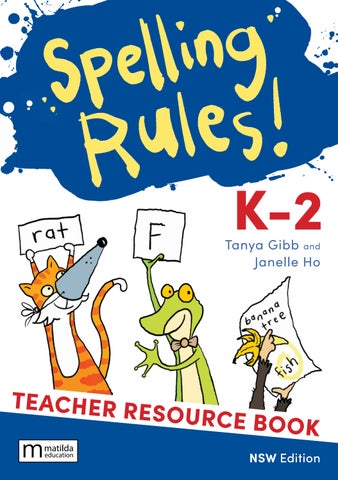
Spelling Rules! K–2 Teacher Resource Book
NSW Edition
ISBN: 978 0 6550 9264 3
Publisher: Catherine Charles-Brown
Designer and typesetter: Trish Hayes
Illustrator: Stephen Michael King
Series editor: Marie James
Indigenous consultant: Al Fricker
Acknowledgement of Country
Matilda Education Australia acknowledges all Aboriginal and Torres Strait Islander Traditional Custodians of Country and recognises their continuing connection to land, sea, culture, and community. We pay our respects to Elders past and present.
This edition published in 2023 by Matilda Education Australia, an imprint of Meanwhile Education Pty Ltd
PO Box 118, Burwood, Victoria, Australia 3125
T: 1300 277 235
E: customersupport@matildaed.com.au
W: www.matildaeducation.com.au
First edition published in 2008 by Macmillan Science and Education Australia Pty Ltd
Copyright © Tanya Gibb 2008, 2016, 2023; Janelle Ho 2023
The moral rights of the authors have been asserted.
All rights reserved. Except under the conditions described in the Copyright Act 1968 of Australia (the Act) and subsequent amendments, no part of this publication may be reproduced, in any form or by any means, without the prior written permission of the copyright owner.
Educational institutions copying any part of this book for educational purposes under the Act must be covered by a Copyright Agency Limited (CAL) licence for educational institutions and must have given a remuneration notice to CAL.
These limitations include: restricting the copying to a maximum of one chapter or 10% of this book, whichever is greater. For details of the CAL licence for educational institutions, please contact:
Copyright Agency Limited
Level 11, 66 Goulburn Street
Sydney, NSW 2000
Toll-free phone number (landlines only): 1800066844
Telephone: (02) 9394 7600
Fax: (02) 9394 7601
Email: memberservices@copyright.com.au
Website: https://www.copyright.com.au
Publication data
Authors: Tanya Gibb, Janelle Ho
Title: Spelling Rules! K–2 Teacher Resource Book
ISBN: 978 0 6550 9264 3
Printed in Australia by Courtney Brands Dec-2022

Spelling Rules! is a bestselling series of seven student books and two Teacher Resource Books, which have been reproduced in a NSW edition. This edition includes digital resources and Scope and Sequence charts updated for the NSW English Syllabus. The Spelling Rules! program is based on sound learning theory and pedagogy, using strategies that embed spelling in the long-term memory. The program systematically develops phonological, visual, kinaesthetic, morphemic and etymological spelling knowledge so that students learn how to spell at the same time as they are learning the spelling of specific words.
The Spelling Rules! student books and Teacher Resource Books work together as a complete spelling program. They can also be used independently as stand-alone resources for student use or teacher reference.
The Spelling Rules! program has been designed to provide spelling instruction that is systematic, purposeful and sequential. Each student book includes a scope and sequence chart and units of work for students to complete. Each unit focuses on one or more English language sounds or letter patterns. These sounds or letter patterns are featured in the word list for each unit.
High-frequency words are also included in the word lists. High-frequency words are words that students are likely to encounter when reading, and that they are likely to need when expressing their own ideas in writing. It is useful for students to learn the spelling of high-frequency words because automatic spelling recall helps increase their fluency when writing.
Activities in the student books focus specifically on the words in the word lists and also on teaching spelling in the context of reading and writing. Many activities incorporate vocabulary development and understanding of grammatical patterns to assist students in creating their own effective written texts.
It is recommended that students spend a small amount of time practising their spelling each day. Focusing on a few words at a time, and reinforcing these, has proven to be the best way to ensure students retain spelling knowledge. It is anticipated that each unit in the student books will be completed over the course of a school week, with the extra activities suggested in the Teacher Resource Book used to supplement and reinforce all aspects of the student books.
Spelling is a tool for writing, in making meaning, in communicating effectively and to assist in ‘getting the message across’ to the reader. Writers need to spell consistently and according to the conventions of the language they are writing in so that their writing can be read by others. It is also useful as a reader to have an understanding of spelling, to help make sense of a written text, although you do not need to be a good speller to be a good reader.
Spelling is a highly complex process. It involves selecting the correct pattern of letters to represent the sounds in speech. In English writing, this means learning 26 letters of the alphabet and combining them to represent approximately 40 speech sounds or phonemes – and there are over 600 combinations of letters to use to represent those 40 phonemes. No wonder spelling can be difficult! And no wonder it is important to explicitly teach students the system.
Another aspect of English that has rendered its spelling more challenging is the fact that English has adopted many words from other languages, and the spelling of these adopted words usually reflects the spelling – but not always the pronunciation – of the original language. Yacht is an example. Understanding that this word was adopted from the Dutch jacht can help students understand why the spelling does not reflect the English pronunciation. Also, pronunciations have changed over time so that the spelling of some words no longer reflects their pronunciation. Knew and gnaw are examples: originally the k and the g were pronounced, and the spelling remains the same even though the pronunciation has changed.
Homophones also add to the complexity of spelling in English. Homophones are words that sound the same but have different spellings and meanings, for example there, their and they’re
For some learners of English as a second language, there are certain sounds that are difficult to hear or difficult to pronounce. For example, for speakers of Spanish as a first language, /th/ in them can easily become /d/; Arabic speakers might have difficulty distinguishing between /p/ and /b/; and Japanese speakers might have difficulty distinguishing between /l/ and /r/.
It’s important to stay aware of the special circumstances of all your students and be prepared to remedy any difficulties.
It is likely that you will encounter a minority of students who are natural spellers. These students will become quite proficient spellers without explicit teaching instruction. However, even these students will stumble over spelling an unknown word unless they have been given the knowledge to help them work out how to go about it.
Students need to be taught how to spell. Providing them with books and writing opportunities is a part of the equation, but these strategies will not, in themselves, teach the majority of students to spell. The vast majority of students need formal, systematic and sequential instruction. They need to be taught how spelling works, as well as the strategies and knowledge they can use to become independent, confident spellers and spelling risk-takers.
To make progress as spellers, students need opportunities to engage in writing every day. The more time students spend engaged in writing activities, the more opportunities they have to try out what they are learning.
Learning to spell involves the following types of spelling knowledge: Phonological awareness enables students to identify the sounds in spoken words and to manipulate and blend the sounds for reading and creating texts.
Phonic knowledge enables students to use letter patterns (grapheme-phoneme correspondences, digraphs, trigraphs and so on) when spelling.
Orthographic knowledge enables students to use their understanding of the spelling system when reading and creating texts. For example, they recognise that words do not start with zz , ss or ff and that words usually do not end with -v but can end with -ve .
Morphological knowledge involves an understanding of the meaning or function of words, or parts of words, and applying this knowledge to spelling. It involves thinking skills.
Etymological knowledge involves an understanding of the origins and history of words and the effect these have on spelling patterns. Remembering and making analogies involves thinking skills. Additionally, visual and kinaesthetic knowledge supports acquisition and retention of spelling understanding. Visual knowledge uses memory of how letters and words look, and of the visual patterns in words. It relates to students’ visual skills.
Kinaesthetic knowledge uses the physical memory of the feeling when saying different sounds and words, and when writing the shapes of letters and words. It relates to tactile perceptual awareness.
According to current brain research theory, the brain and its functions can be likened to a computer. A computer’s hard drive can be compared to our long-term memory. That’s where we store information that we want to be able to retrieve at any time in the future for re-use. The human brain has a huge capacity for long-term storage.
The RAM or useful working memory of a computer is finite. If we overload a computer or expect too much of it at any one time, it will freeze or send the message ‘not enough memory’. The working memory in a human brain is also finite. Students need opportunities to process new information and then store it in their long-term memories (internal hard drive) for future use. It helps students to be exposed to small amounts of new information at a time. To expect them to learn too much in one session is asking for that ‘not enough memory’ message.
Another useful computer analogy is that if we work on a computer but don’t save the files, they disappear. If new information in the brain’s working memory is not transferred to long-term memory, it will be lost. If we want student brains to recognise that spelling retention is important, then we need to present small amounts of spelling to them at any one time, and then give them time to reinforce, practise and consolidate this information so that it is saved in their long-term memories. Otherwise, their brains will do the equivalent of sending it all to the trash. Human brains sort out the trash from the useful knowledge that’s worth storing while we are asleep. This is why, as teachers, we sometimes feel that we are getting nowhere, having to re-teach the same information for weeks, with none of it seeming to sink into students’ brains. Repeated exposure to information in small doses and plenty of practice will ensure that the information (spelling knowledge) gets saved in students’ long-term memories.
Our brains also establish links and pathways between old information and new information. A sequential spelling program that builds on previous learning makes learning to spell a more manageable task for students. Presenting information to be learned through auditory, kinaesthetic and visual experiences supports students’ differing learning styles, and multiple sensory experiences also assist in establishing these connections and building on knowledge.
The Spelling Rules! program is designed to ensure that students commit spelling knowledge to long-term memory. An acronym that can summarise the strategies that will help spelling move from working memory to long-term memory is SLLURP.
Say the word carefully and slowly to yourself.
Listen to how each part of the word sounds in sequence.
Look at the patterns of letters in the word and the shape of the word.
Understand rules, word meanings and word origins.
Remember similar words you can already spell and relate this knowledge to any new word.
Practise writing the word until it is firmly fixed in long-term memory. A useful sequence for students to use is ‘look, say, cover, write, say, check’.
There are five stages of spelling that students progress through, at individual rates, in order to become successful spellers.
Student Books K, 1 and 2 in this series focus on the first three stages, which are the pre-phonetic stage, the early phonetic stage and the phonetic stage.
The five spelling stages are linear but at times a student may be operating in two stages at once. For example, a competent speller who usually operates in the conventional stage might become a phonetic speller when attempting to spell a word that is totally unfamiliar such as a mathematical or scientific term.
The pre-phonetic stage is when students first become aware of print. They might ask you to write a shopping list for them, or notice when you skip words in a story that they have heard before. They understand what print is for, but they do not yet understand how it works.
The student might use invented letters as well as some copied and conventional letters and/or scribble. They will ‘read’ it aloud to you, because they understand the concept that writing can be read and that the message remains constant.
Supporting the Learner
• Ensure that students can hear individual words in a stream of speech by speaking slowly and clearly. When you read big books or class books, point out in the text where each word ends and the next word begins.
• Explore the sounds in words with students. Show how words can be separated into individual sounds and how the sounds can then be rejoined.
• Write with students, in front of students and for students as their scribe. Encourage students to write, scribble and experiment.
• Teach the conventions of English print. Show students how print in English is read from left to right, a page is read from top to bottom, and a book from front to back.
The child is becoming aware of print conventions and is drawing scribbles and pretend letters. This needs to be interpreted and ‘read’ by the child. The sample ‘reads’: Dear Aunty Helen
In the early phonetic stage, students are starting to associate sounds with symbols and might recognise some letters in the environment, for example on shop signs or in their name.
They might use consonants or single letters to represent words or sounds in their writing. They are developing their knowledge of letters. Students are starting to understand sound–letter relationships and to spell words with two letters, or words with three letters that follow the pattern consonant–vowel–consonant (CVC) such as ‘mum’. They might also have started to develop a list of high-frequency words that they recognise from their reading and use in their writing, including their own name or the names of siblings or friends.
Supporting the Learner
• Reinforce students’ early understanding of sound–letter relationships, especially through using CVC patterns (mum, dad).
• Sound out words with students.
• Orally blend and segment syllables in words. Clap out syllables to make up actions for syllables in multi-syllable words.
• Have students blend onset and rime to say one-syllable words.
• Provide lots of opportunities for students to engage in writing and encourage students to ‘have a go’ at spelling.
The student understands that writing is meant to be read and that the message can be read consistently. The student is not able to recognise individual words in a stream of speech and therefore omits the gaps between words when writing. The student writes all the letters known in upper-case except for ‘li’, which forms part of her own name, ‘Ali’.
The student relies on memory to ‘read’ the text This is Ali’s work.
The student is associating symbols with sounds. The student has started the sentence string using an upper-case I and completed it with a full stop. The writing still contains a mixture of upper-case and lower-case letters.
The sentence reads: I did cooking and we ate it.
In the phonetic stage, students represent words in a phonetic way. Their writing can often be read quite well by adults because it is logical and students show an understanding that they need to match letters for sounds, and to use their understanding of English orthography.
Students are starting to show awareness of spelling rules and some conventions of written language such as full stops (orthographic knowledge).
A vocabulary of high-frequency words is being stored in the long-term memory and students are able to retrieve these words when required.
• Explicitly teach letter–sound correspondences and provide opportunities for students to practise their newly acquired knowledge.
• Help students remember spelling patterns by explicitly examining words that include the patterns and pointing out significant visual features as well as mnemonic clues.
• Teach students how to examine the visual patterns and shapes of words.
• Point out examples in student writing or class reading where sounds need combinations of letters to represent them, for example ‘sh op’.
• Support students in developing a core vocabulary of high-frequency words and ensure you help them store the words in long-term memory.
• Begin to teach students about prefixes and suffixes as required in their writing.
• Teach students about word families (play, plays, playing).
• Teach students about contractions, for example I’m, don’t.
• Explicitly teach students strategies for working out the spelling of unfamiliar words. Articulate for them the strategies you would use. Say to students, ‘Let’s sound it out . . . Let’s write it and see if it looks right . . . Let’s think about other words that sound the same – do we know how they are spelt?’ And so on. Thinking out loud like this as a model for students helps to reinforce what they can do when spelling an unfamiliar word.
• Have students write specific texts such as letters, cards, shopping lists, stories and poems.
• Introduce proofreading strategies.
• Play spelling games or games derived from spelling practice, for example Scrabble®, bingo, snap.
High-frequency words are correct (the and of ). It is possible to read the student’s writing and the student is starting to form words – febywe is a phonetic attempt to spell February . (It is also possible the student is not pronouncing February in a way that will assist even phonetic spelling attempts.) The text reads: the 9th of February .
The student’s writing is progressing, but is still phonetic. Words are seen as discrete units and are written separately. High-frequency words are usually written correctly (on, I, to, the ). There is the correct use of upper-case I, and the self-corrected use of upper-case to start the sentence. Less common words are spelt phonetically using some letters to represent many (sceltnetns for skeletons ). The student is prepared to tackle quite complex vocabulary. Correct pronunciation and sounding out the word might have assisted the student when attempting to spell museum (moozem ) and dinosaurs’ (dinsoos ).
The sentence reads: On a rainy day I went to the museum and I saw dinosaurs’ skeletons .
The text is relatively easy to read and all words are written as discrete units. The student is spelling some high-frequency words correctly (and, the, they, you, said ), but not others (die for did , oov for of ). The student is still approaching spelling phonetically, but the phonetic spelling is not completely regular. The student copied Once upon a time from the board, but did not correctly copy time . The student is not pronouncing mother correctly, and has misspelt it twice using muvh. The student is adding extra letters because he or she is stretching the words to sound them out, hence uiel for will .
The text reads: Once upon a time lived eight koalas. The mother said you will go and get some bread so they did. The mother was very proud of them.
The student spells simple one-syllable words (and, it, had) and high-frequency words such as look (in lookt) correctly. The text is easy to read; all words are written as discrete units and the phonetic spelling is fairly regular. The student has correctly copied Bearded Dragon from the board. The student does not use y for the short y sound at the end of the word prickly (prikule)
The student is not pronouncing prickly correctly, having stretched the word to sound it out, and has added an extra vowel sound between k and l. The student has not learned the suffix ed for looked (lookt) . The student is not pronouncing felt correctly, and has spelt it filt . The student does not recognise a sentence.
The text reads: Logan had a bearded dragon. It felt prickly and it looked scary.
In the transitional stage, students become aware of factors other than phonics that they can bring to spelling, for example visual knowledge of the way words look as well as orthographic knowledge of particular spelling patterns, especially more common ones such as ing, ed, scr, ay; knowledge of spelling rules such as ‘change y to i before adding -ly’; and understanding of word families. They are able to use syllabification and morphological knowledge.
They are able to use analogy to work out how to spell words or parts of words. They might know how to spell fry and day and so spell Friday as Fryday .
Students have developed a substantial core vocabulary of high-frequency and topic-specific words.
Supporting the Learner
• Explicitly teach spelling patterns to students.
• Build on student understanding of word families.
• Extend students’ understanding of the use of morphemes and etymology to remember spelling patterns.
• Encourage students to use visual knowledge to check spelling.
• Further develop students’ list of high-frequency words.
• Encourage students to write, and ensure they have a variety of purposes for which to write.
• Encourage students to read, and ensure they are exposed to a variety of texts.
• Expect that students will proofread their own work to identify words that might not be spelt correctly.
The student has committed to memory some high-frequency words with common letter patterns: think, because, so, went. Errors are still made: frends Words are spelt in different ways within the same piece of writing: shold and shod for should; school and shcool for school and preckul for preschool; and were and wear for wear. The more common word of a homophone pair has been used: wood for would and no for know.
The text is easy to read.
In the conventional stage, the speller knows the rules and conventions of English and understands the complex relationship between phonemes and graphemes. Students will often know when they cannot spell a word. Conventional spellers use a variety of strategies to work out how to spell unfamiliar words and to remember known words, including the use of external references such as dictionaries. They have a large number of learned words, including topic-specific vocabulary, that they can retrieve from their longterm memory.
• Support students as they further develop their use of phonic/phonological, orthographical, morphemic, visual, kinaesthetic and etymological knowledge to spell. For example, phonological: revise irregular or uncommon letter patterns; visual: ensure that students are exposed to and focus on visual patterns in words; kinaesthetic: writing and typing words for themselves to support physical memory of the shapes of letter patterns and words; etymological and morphemic: thinking about word origins, word families and connections between words supports the brain in storing spelling in long-term memory.
• Expect students to have a comprehensive list of words that they are able to retrieve from their longterm memory to use in their writing.
• Ensure that students are given opportunities to read and write more complex texts for a range of purposes and an expanding range of audiences from familiar to unfamiliar, and more formal audiences.
• Expect that students will proofread their written work with a high degree of accuracy, using external references when necessary.
High-frequency words are correctly spelt. The student is applying rules (for example, doubling the m in swim when adding -ing; changing y to i to add -es for the plural lollies ). The student has correctly used the upper-case for Thursday and an apostrophe to indicate an abbreviation in didn’t. The student uses sentence boundary punctuation and correctly identifies that Thursday is a proper noun.
Affix
The general term for a prefix or suffix, i.e. a morpheme added to either the beginning or end of a base word.
Analogy
Equivalence or likeness; recognising how to spell one word because of its similarity to another, e.g. sip and pip
Antonym
A word or word group with a meaning opposite to that of another word or word group, e.g. full and empty .
Auditory perception
Ability to distinguish sounds.
Base word
The basic form of a word, e.g. help . Prefixes and suffixes are added to the base word to change the meaning, indicate tense, form the plural etc., e.g. helped, helping, helpful .
Blend
A combination of two consonants in which each retains its distinctive sound, e.g. /br/ in bread , /cl/ in clasp
Compound word
Two or more words joined together to produce a new word with a different meaning, e.g. wheel + chair wheelchair .
Consonant
All the letters of the alphabet that aren’t vowels.
Contractions
Formed when two words are combined and then a letter or letters are omitted, e.g. didn’t for did not , I’ll for I will . Apostrophes are used in place of the deleted letter or letters.
Conventional speller
Someone who understands the conventions of spelling and applies them consistently when spelling.
Digraph
A pair of letters that represent a single speech sound, e.g. ea in beat , sh in shop , ar in dark .
Early phonetic speller
Someone who is starting to associate sounds with symbols and might recognise some letters in print.
Etymology
The origin and history of a word. It can often assist in understanding the reason for a word’s spelling.
Final sound
The last sound heard in a word, e.g. /d/ in bread
Grapheme
The smallest unit of writing to represent a sound, e.g. t in tip , th in these, mb in thumb
High-frequency words
Words that are commonly used in texts and speech.
Homographs
Words of different origin and meaning that are spelt the same, e.g. live in I live at home and a live one ; bear in polar bear and to bear a burden
Homophones
Words that are pronounced the same but have different spellings and meanings, e.g. deer and dear
Initial sound
The first sound heard in a word, e.g. /s/ in stop .
Invented spelling
Spelling made up when a child is first learning to write. Sometimes called temporary spelling .
Letter–sound relationship
The way a sound is represented in writing.
Long-term memory
Where information is stored for later retrieval.
Medial sound
A sound that occurs within a word or syllable that is neither initial nor final.
Minimal pairs
Two words that differ by only one phoneme, e.g. hot/hat, get/pet.
Mnemonic
A memory cue, e.g. The principal of a school is my pal.
Morpheme
The smallest grammatical unit of language that has meaning. It can be a word, e.g. sit or by, or an element of a word, such as mis- in mistake or -ing in singing
Morphology
The study of word formation in a language by analysing word parts and word derivation.
Onset and rime
The beginning part or sound of the word is the onset and the rest of the word is the rime, e.g. m-atch . The breaking of words into beginnings and endings.
Peer assessment
Assessment undertaken by peers.
Phoneme
The smallest unit of sound in a language.
Phonemic awareness
Ability to recognise that words are made up of individual sounds (phonemes) and use letter–sound correspondences to read and spell words. (Sometimes used interchangeably with phonological awareness .)
Phonetic speller
A speller who represents words in a phonetic way.
Phonological awareness
Ability to recognise larger units of sound in addition to phonemes, e.g. syllables, onset and rime. Enables students to recognise and generate rhyming words, count syllables, and separate the beginning and ending of words. (Sometimes used interchangeably with phonemic awareness .)
Phonology
The sound system of language.
Prefix
An affix attached to the beginning of a base word to change the meaning, e.g. the prefix un- + base word like unlike .
Pre-phonetic speller
A speller who is just becoming aware of print. They might use invented letters as well as some copied and conventional letters and/or scribble.
Pronunciation
The act of producing speech sounds.
Proofreading
Checking a written text for correct spelling and other conventions of writing such as punctuation and grammar.
Root word
See Base word.
Sight word
A common word that often cannot be sounded out and that needs to be memorised, e.g. the, said, come .
Silent letter
A letter that does not represent a sound, e.g. w in wrestle , k in knight .
An affix attached to the end of a base word to change the meaning, e.g. base word + the suffix -ly like likely .
Syllable
A unit of sound within a word, e.g. to-mor-row. A syllable must contain a vowel or the letter y when it is acting as a vowel. Syllables usually start with a consonant: Sa-tur-day. Double consonants are usually split down the middle: hap-py. A word consisting of one syllable is monosyllabic. A word consisting of two or more syllables is multisyllabic or polysyllabic
Synonyms
Words that have the same or similar meaning, e.g. throw and toss
Tense
The form of the verb that shows time. Auxiliary verbs and/or suffixes attached to the end of the base form of the verb are used to show when an action happens, e.g. She play s . She is play ing . (both are present tense) She played . (past tense) She will play . (future tense)
Transitional speller
A speller who is starting to use knowledge of particular spelling patterns, spelling rules, word families, syllabification and morphemes as well as phonological knowledge to spell words.
Upper-case and lower-case letters
Two forms of the letters of the alphabet. Upper-case letters are used to indicate the beginning of a sentence or the initial letter of a proper noun.
Visual perception
Ability to distinguish between shapes, objects and patterns by using the sense of sight.
Vowels
The letters a, e, i, o and u . The letter y is a semivowel, as it is a consonant that sometimes represents a vowel sound.
A consistent approach to the teaching and learning of spelling throughout the school will benefit students, their families and staff. An important first step in implementing a whole-school approach to spelling is to develop a spelling policy.
To begin with, staff members or a small subcommittee of staff members can meet to discuss how spelling is currently taught, what the school community (including families) expects regarding the teaching and assessing of spelling, what expectations there are of student achievement, and how government testing results and government benchmarks affect spelling in the school.
A written survey for all staff members or by grades or year groups will elicit the sort of information required by the Spelling Committee. Ask questions such as: How do you currently teach spelling? Are you confident that the approach you use is working? For all students? For the majority of students? Which students are not benefiting from the school’s current approach to spelling? What is best about the school’s current approach? What concerns do you have about spelling in your classroom and across the school? What would you like to see happen regarding spelling across the whole school? What support would you like in order to implement a whole-school approach?
Schools might also find it useful to gain the support of families at this stage. If a whole-school approach is to be implemented then the support of families in policy input and purchasing of resources, as classroom volunteers and at-home spelling partners, will be necessary as well as appreciated. The Spelling Committee could devise a questionnaire for families so that the views of parents and caregivers are taken into account when formulating the school’s spelling policy.
On pages 17–19 you’ll find a sample policy to use as a starting point. Adapt it to suit your school’s needs. It contains the following sections:
Philosophical Statement and Rationale
Why is a whole-school program needed? What does the school value and believe about spelling? What particular learners is the school made up of (e.g. First Nations students, students with disability including students for whom AUSLAN is a first language, gifted and talented students, EAL/D students)?
Aim/s Clearly articulate the overall aim/s of a whole-school approach to spelling.
Objectives Make broad statements of the values and attitudes, skills and knowledge that are promoted by the school’s policy.
Curriculum Links or Standards These can be found in the NSW ESA English K–2 Syllabus and the Australian Curriculum V9.
Student Assessment Outline the ways of collecting, recording and using assessment information in the school.
Teaching Implications Cover the time frame for policy implementation (including factors such as the funding and purchasing of resources, teacher inservice training, training requirements of volunteers, staff meetings, team meetings and so forth) as well as:
• how spelling will be taught in each year group and to the range of learners in the school, including the possibility of subject-accelerated progression in the area of spelling for gifted spellers
• how and when students will be assessed and how the assessment information will be reported to families
• the role of families in supporting the development of their child’s spelling as well as each student’s role and responsibilities.
Support Material/Resources Which resources will be used/purchased? Who will be responsible? Will the school purchase a commercially available whole-school program such as Spelling Rules!?
Evaluation How will the policy be evaluated and revised, by whom and in what time frame?
S cholar S ville S chool
phiLoSophy
The staff and families at Scholarsville School believe that learning how to spell correctly is a valuable tool for reading and creating texts and as such is useful across the entire school curriculum.
We recognise that:
• not all students will be natural spellers and that some students will struggle to attain and retain spelling knowledge
• learning to spell is a complex task involving phonological, orthographic, morphemic and etymological knowledge, as well as visual and kinaesthetic memory, and that individual students will rely on each area to a different extent
• the vast majority of students need formal, systematic and sequential instruction about the way spelling works, as well as the strategies they can use and the knowledge they can develop to become independent, confident spellers and spelling risk-takers
• all students need support in spelling, including struggling spellers, gifted spellers, students for whom English is an additional language or dialect, and Aboriginal students
• the working memory of a human brain is finite. Students need to be exposed to small amounts of new spelling information at any one time. They then need opportunities to practise and consolidate this new information so that it is stored in their long-term memories for future use.
rationaLe
The enrolment at Scholarsville School includes 35% of students are students for whom English is an additional language or dialect. These students need opportunities to make connections between home languages and Standard Australian English. aim
The aim of the whole-school spelling policy is to provide all students with systematic and sequential instruction in English spelling so that they develop positive attitudes to spelling, learn strategies to support their spelling learning and experience success in spelling.
objeCtiveS
1. Students will value correct spelling and develop confidence in themselves as learners of spelling.
2. Students will develop phonological, orthographic, morphemic and etymological spelling knowledge.
3. Students will develop skills and strategies to help them remember spelling and tackle new words.
See the NSW English Syllabus.
In Early Stage 1 (Kindergarten) students will:
• develop positive attitudes about spelling and attempts to spell
• learn to use phonological, phonic, morphological and orthographic knowledge when spelling
• blend, segment and manipulate single letter grapheme-phoneme correspondences in single syllable words
• break words into syllables and/or phonemes as a spelling strategy
• match and blend common phonemes-graphemes to spell CCVC and CVCC words; delete, add and substitute phonemes in words
• recognise some rules and conventions of English spelling, e.g. that words do not begin with ff
• read and begin to spell some common consonant digraphs (ship, will), vowel digraphs (book, peep), split digraphs (cake, hive); high-frequency words (the), taught homophones (to, two) and personally significant words (their own name)
• use spelling conventions to add suffixes for plurals and tense
• recognise rhyme, alliteration, onset and rime and syllables, and use these when spelling words
• begin to develop an understanding of proofreading for their own written work.
In Stage 1 (Year 1) students will:
• build on skills and knowledge developed in Kindergarten
• develop their ability to use phonological, phonic, morphological and orthographic knowledge when spelling
• blend, segment and manipulate single letter grapheme-phoneme correspondences
• match and blend phonemes-graphemes to spell CCVC, CVCC, CCCVC and CCCVCC words; delete, add and substitute phonemes in words
• decode words with consonant digraphs (ship, will), vowel digraphs (book, dream), split digraphs (cake, hive) and 2-initial consonant blends (splash)
• recognise when to double final consonants to add a suffix (swim, swimming)
• spell some high-frequency taught quadrigraphs (‘eigh’ in eight)
• use spelling conventions to add suffixes, e.g. for plurals (-s, -es), comparative and superlative
adjectives (kind, kinder, kindest) and -er to make nouns for people (garden, gardener)
• use morphological knowledge to spell compound words (bedroom), contractions (don’t) and homophones (wood/would)
• spell taught, high-frequency words
• recognise rhyme, alliteration, onset and rime and syllables, and use these when spelling words
• develop an understanding of proofreading their own written text.
In Stage 1 (Year 2) students will:
• build on skills and knowledge developed in Year 1
• develop their ability to use phonological, phonic, morphological and orthographic knowledge when spelling
• delete, add and substitute graphemes in words
• decode words with consonant digraphs (ship, will), vowel digraphs (book, peep), split digraphs (time, rule), trigraphs (catch, judge) and quadrigraphs (‘augh’ in daughter, ‘ough’ in brought)
• use spelling conventions to add common prefixes, e.g. join → re join, fair → unfair, appear → disappear)
• use spelling conventions to:
▶ add suffixes for plurals (-s, -es)
▶ add suffixes for tense (cheer, cheered)
▶ spell comparative and superlative adjectives (sweet, sweeter, sweetest)
▶ add suffixes for word families (skip, skipped, skipping)
▶ spell irregular verbs (swim, swam)
▶ add -er to make nouns for people (bake, baker)
• use morphological knowledge to spell compound words (bedroom) and homophones (dear/dear, where/wear)
• spell taught, high-frequency words
• recognise rhyme, alliteration, onset and rime and syllables, and use these when spelling words
• further develop their ability to proofread written text.
Student spelling achievement will be assessed weekly in each class, by class teachers, using a combination of students’ writing samples, dictation tests and tests of the spelling lists covered in the Spelling Rules! program.
Information about students’ spelling achievement will be recorded and this information will be provided to families informally, as the need arises, and formally, in response to requests from families or as determined by the teacher.
Families will be provided with half-yearly and yearly written reports that outline spelling progress and development.
The school will implement this policy commencing Term 1.
Each class will spend 15 minutes per day on explicit spelling instruction. Spelling instruction will also be integrated across all areas of learning. Spelling instruction will be supported by the classroom expectation that all students will engage in writing, daily, for a variety of purposes and audiences, and that this writing will be context based.
Spelling instruction will be part of each day’s program as well as occurring spontaneously during the course of any activity that provides a teaching opportunity for spelling.
Spelling Rules! resources will be purchased for each student and class teacher during Term 4 of the year before use. Teachers will familiarise themselves with the program.
In preparation for implementation of this policy, year-group meetings will be held on the first Mondays in October, November and December.
Whole-staff training and professional development opportunities in spelling will be organised.
Evaluation of the policy and policy review will commence in October. Year-group meetings will be held on the first Mondays in October, November and December. Year groups will provide written feedback to the Spelling Committee about the impact of this policy on students and staff.
The Spelling Committee will compile a written report for the school community on the progress of policy implementation, and make further recommendations to school management regarding teacher training, resources (personnel and equipment) and so on.
A spelling classroom for Kindergarten to Year 2 will feature a selection of texts on display or readily accessible to students and equipment for experimenting with words and spelling. This equipment might be part of a spelling learning centre, established in one area of the classroom. It is also important that classroom management practices support students’ acquisition of spelling knowledge.
textS on diSpLay or readiLy aCCeSSibLe to StudentS
These can include:
• lists of useful words: names of students, topic words, high-frequency words, word families, days of the week, months, a weather chart with words to attach for hot, windy, cloudy, rainy and so on
• lists of stories read, poems learned, songs known
• a class timetable
• class rules constructed with student input: Walk inside, Use inside voices, Look after property, Put things away, Listen to your friends
• signs and labels on all items and art work, constructed with student input, e.g. art cupboard, teacher’s desk, Goldie the Goldfish
• examples of student texts
• student stories and other texts that have been handwritten by you or another adult, or published on a computer
• class books created jointly with the students (and opportunities for these to be borrowed by students to share with their families at home)
• attractively presented and interesting reading materials, both literary and factual
• dictionaries, word books, student spelling books, personal word lists, ‘have a go’ books.
Establish a spelling learning centre in your classroom for interested students, students who need extra spelling practice, or able spellers wanting more challenges. Games and activities could be for individual students, or students could be allowed to work in pairs or groups. The spelling centre could also be used when parent helpers and volunteers are available (or ‘buddies’ from older classes, if your school supports this practice).
The spelling learning centre could include equipment such as:
• task cards in a box, with word searches, tongue twister challenges, crossword puzzles
• spelling games – Scrabble®, Boggle®, bingo, teacher-created games and resources
• assorted writing materials: whiteboards, paper, cardboard, marker pens, felt pens, pencils, chalk, charcoal, crayons
• magnet letters, letter tiles, letter cards, alphabet charts
• play dough for making letters, and to improve hand strength and therefore fine motor control
• a sand trough for writing words and letter shapes
• magazines, scissors and glue
• computers and tablets
• audio recordings of poems, stories, chants and recorded sounds
• percussion instruments to repeat sequences of sounds or rhythm patterns, or to create beats for the syllables in words.
To support spelling development:
• allow time for students to write and spell every day
• encourage reference to written language in the classroom during the week, and allow time to revisit and re-read the written texts and to point out aspects of spelling
• provide specific lists of spelling words for students to learn. These lists need to be based on letter patterns or sounds and provide a clear scope and sequence of spelling skills. The lists should also allow for the addition of high-frequency words and words from students’ own writing
• encourage students to refer to a wall chart that lists steps they can follow in working out how to spell a word, for example Reproducible 1, blown up to A3 size
• include parents and other volunteers, and/or peer tutors
• use varied grouping arrangements (ability grouping, mixed-ability grouping, pairs, small groups, mixedage groups).
It is important to develop auditory, visual and kinaesthetic perception in young children, because these form the basis for the development of phonological, visual and kinaesthetic spelling knowledge, among other things.
auditory perCeption
Auditory perception can be developed using the following activities:
• recognising and labelling sounds
• repeating a sequence of sounds
• learning to distinguish beginning, final and middle sounds in words
• breaking a word into component sounds or syllables
• clapping out a rhythm
• clapping the syllables in words
• recognising rhyming words, alliteration and assonance, onset and rime
• using ‘look, say, cover, write, say, check’.
You will find that during early spelling development students will more readily hear the sound at the beginning of a word. They are usually next able to identify the final sound, and then lastly the sounds in the middle of a word.
viSuaL perCeption
Visual perception can be developed using the following activities:
• learning to really look at letters, and combinations of letters
• distinguishing between letters in written activities (e.g. by colouring every t )
• looking at the shapes and lengths of words (e.g. the different shapes of dog, elephant )
• using consistent letter shapes and neat writing so that letters and words are easily recognisable
• taking a mental picture of a word, and writing it in the air with eyes closed
• using ‘look, say, cover, write, say, check’
• doing any activity that requires students to use their eyes to problem-solve: jigsaw puzzles, categorising words by shape, matching and sorting words into word families, sequencing objects by colour, shape, size.