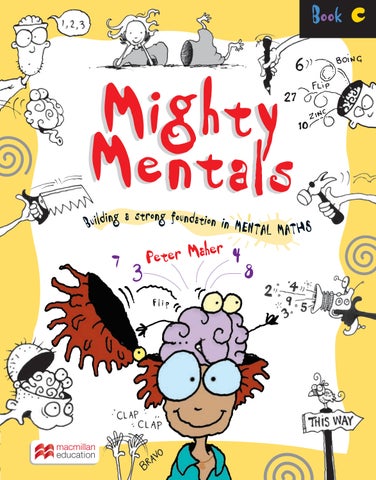
Mi g hty M e n ta ls
Building a strong foundation in m e n t a l m a t h s
M i g ht y Mental s is the only mentals textbook
series to purposefully and systematically teach mental computation skills. Through a clear scope and sequence, the focus is on developing students’ automatic response.
The four books in the Mighty Mentals series provide a systematic and logical program featuring: ★ a unit of work focusing on a specific concept for each week ★ a tip or strategy for each unit to help students work through the exercises ★ handy maths facts and glossary pages ★ student progress and self-assessment chart ★ pull-out answer section in the middle.
Use alongside any general Maths textbook to add a strong mental computation component!
Book C
Mi ghty Me nt als
Building a strong foundation in m e n t a l m a t h s
7 3
r e h a M r e t e 4 P
8
Flip
9780732999582
9780732999599
9780732999605
9780732999612
By the same author:
9781420284386
Student Book Australian Curriculum Level NZ Curriculum Level
MM_BkC_99605_cvr_prs.indd 1
9781420284393
A
B
9781420284409
C
D
3
4
5
6
4
5
6
7
6/25/20 3:14 PM
Mi g hty M e n t a ls
Book C
r e h a M r e t e P Name
Class
Con t e n ts Scope and Sequence................................................ Inside front cover Note to Teachers and Parents................................. 2 Handy Maths Facts .................................................. 4 How Well Am I Doing?............................................. 6 Units 1–32 ................................................................ 8–71 Glossary..................................................................... 72 Answers section in middle of book
1 99605_MM_C_Txt_repMar17.indd 1
15/03/2017 4:19 pm
Note to teachers and parents Developing mental arithmetic skills Automatic response—the ability to quickly recall basic mathematical facts, or to apply a known fact to a slightly modified situation or application—is an essential prerequisite for success in mathematics. The development of modern technology and its applicability to the classroom in the form of the hand-held calculator has not diminished the significance of the role that mental arithmetic should play in schools. On the contrary, the advent of modern technology has increased the need for accurate mental arithmetic skill development in students. Without relatively accurate estimation prior to calculation, merely accepting at face value a solution on a screen can be fraught with danger. Inadvertently hitting the wrong buttons on a calculator is a commonly occurring fact of life. The result on the screen should never be blindly accepted. When we consider the fact that the great majority of the calculations secondary school students complete are done on the calculator, the validity of this point can be readily perceived. By the end of primary school, a student should be in the habit of estimating and rounding off prior to using a calculator for computational purposes. Appropriate estimation is reliant upon a sound knowledge of basic number facts, which should have been developed consistently throughout the primary years.
2
The better a student’s abilities with mental arithmetic, the less time he or she will have to devote to looking up answers on a screen, in a book or on a chart. This point is demonstrated graphically with the game of ‘beat the calculator’. Line up your students in pairs and tell them that some maths questions are going to be asked of the students who progressively come to the head of the line. Offer a calculator
99605_MM_C_Txt_repMar17.indd 2
to one of the two students. Both will want it but only allow one to prevail. The other student will complain about how unfair the game is until the rules are made clear. The student with the calculator must press the appropriate buttons and display the correct answer. Ask the pairs of students questions they should be able to recall relatively quickly, such as 2 x 5 or 7 + 4. Now watch the student with the calculator complain that the game is unfair because the calculator is an encumbrance. Slip in the question 9 x 35 to see who is first with the correct answer. If the student using mental arithmetic is highly competent, 350 – 35 = 315 (10 lots of 35 minus one lot of 35) might still beat the calculator’s 9 x 35 = 315. It is also the case that the faster a student is with his or her basic number facts, the greater is the likelihood of structural computational success. Algorithms, such as long multiplication and division, contain numerous steps and stages. Students with inadequate mental arithmetic skills often take so long to recall a basic number fact that they forget the stage of the algorithm that they are progressing through. For these students the necessary foundation of times tables knowledge is inadequate—it is like trying to build on a foundation of sand. Without the necessary prerequisites of number facts competence, the algorithmic ‘house’ will tumble down. It is invariably the case that the broader a student’s body of mathematical knowledge, the more he or she will achieve in the subject and the more enjoyment that student will derive from the discipline. The message is clear: regularly practise automatic response games and activities, chants and rounds and all will benefit. Try to teach these number facts in as fun and meaningful a way as possible. Incorporate concrete materials and incentives into your number facts lessons.
15/03/2017 4:19 pm
Above all, teach for understanding. When teaching the 3 times table, show that the digits in the multiples will always sum to 3, 6 or 9. Show that the answers to the 9 times table always sum to 9. Show that adding on 8 is no harder than adding on 10—just jump back 2. Explain that the metric prefix ‘kilo’ stands for the number 1000, therefore there have to be 1000 grams in a kilogram and 1000 metres in a kilometre and, heaven forbid, 1000 tons of TNT in a kiloton bomb. The patterns that make number-facts-recall easy are out there and easy enough to find. Make the effort to demonstrate them at every possible opportunity. This book and the other books in this series will show you how.
How to use this book The challenge of acquiring appropriate automatic response capabilities demands a structured and planned approach in schools. Mental arithmetic skills should be developed in a systematic manner over a period of years. The program should encompass the full range of the mathematics curriculum, covering measurement and space facts, data and chance questions as well as number problems. The four books in this series assist with the development of mental arithmetic skills in a systematic and logical manner. Each book in the series contains 32 units of work. Each unit contains six sets of questions, which can represent one set per school day with one left over for homework. Alternatively, one day per week could be devoted to the completion of the six sets. Each exercise in the book focuses on a specific concept, such as multiplying by multiples of 10, or the properties of 2D and 3D shapes. The exercises have been set out in a logical sequence according to topic, for example times tables should be taught prior to the concept of
99605_MM_C_Txt_repMar17.indd 3
a common multiple; the concept of one-tenth should be taught prior to the first decimal place. However, the order in which the exercises are completed can be varied to suit the needs of your students. The exercises are at their most useful when linked to the topic under review in the classroom at the time. The Scope and sequence chart on the inside front cover of this book will assist you to plan for the use of this book and to make it as relevant as possible to your students’ individual learning capabilities. At the top of each unit of work there is a tip for the students, to help them work through the exercises in that unit. At the bottom of each unit, you will find the relevant state outcomes. The Handy maths facts on pages 4–5 are included as useful reference material for students. How well am I doing? on pages 6–7 affords the students the opportunity to record their scores on the unit exercises and to rate their own progress and performance. A list of answers is found in the middle of each book and can be removed and stored if deemed appropriate.
The terms used in this book The questions presented in this book utilise a wide variety of mathematical terms that are designed to reflect the structure of the discipline and to develop a student’s mathematical vocabulary. Knowing, for example, that the terms ‘add’, ‘sum’, ‘total’ and ‘altogether’ all refer to the process of addition will have obvious benefits when a student has to tackle an addition problem set in context, or when problem solving. A Glossary is provided on page 72 as a ready reference.
3 15/03/2017 4:19 pm
Handy Maths Facts
0
1
2
3
4
5
6
7
8
9
10
11 12
0
0
0
0
0
0
0
0
0
0
0
0
0
1
0
1
2
3
4
5
6
7
8
9
10
11 12
2
0
2
4
6
8
10
12
14
16
18
20
22 24
3
0
3
6
9
12
15
18
21
24
27
30
33 36
4
0
4
8
12 16
20
24
28
32
36
40
44 48
5
0
5
10
15 20
25
30
35
40
45
50
55 60
6
0
6
12
18 24
30
36
42
48
54
60
66 72
7
0
7
14
21 28
35
42
49
56
63
70
77 84
8
0
8
16
24 32
40
48
56
64
72
80
88 96
9
0
9
18
27 36
45
54
63
72
81
90
99 108
10
0
10
20
30 40
50
60
70
80
90 100 110 120
11
0
11
22
33 44
55
66
77
88
99 110 121 132
12
0
12
24
36 48
60
72
84
96 108 120 132 144
x or
÷
Tests for divisibility
Metric prefixes milli means one thousandth (1/1000) centi means one hundredth (1/100)
1x
All whole numbers
2x
Even numbers
3x
Digits sum to 3, 6 or 9
4x
kilo means 1000
5x
mega means 1 000 000
6x 7x
Metric equivalences
8x 9x
= 100 cm etre (m) = 1000 mm
1m
10 x
1
11 x
00 m kilometre (km) = 10
00 g 1 kilogram (kg) = 10
12 x
kg 1 tonne (t) = 1000 L 1 litre (L) = 1000 m
4 divides into last 2 digits Numbers ending in 5 or
0
Even multiples of 3 Double the unit and find the difference between this and the tens. It will equal 0, 7 or 14 8 divides into last 3 digits Digits sum to 9 Numbers ending in 0 Subtract units from total Numbers in both the 3 x
tens to get 0 or 11 and 4 x tables
Place value chart
Thousands Period
Ones Period
hundreds
tens
units
hundreds
tens
units
4
9
3
8
1
5
4 99605_MM_C_Txt_repMar17.indd 4
0
Four hundred and ninety three thousand, eight hundred and fifteen
15/03/2017 4:19 pm
Polygons (2D Shapes)
triangle
heptagon
quadrilateral
octagon
pentagon
nonagon
hexagon
decagon
dodecagon
Polyhedra (3D Objects)
cube
cone
sphere cylinder
triangular-based pyramid
square-based pyramid
triangular prism rectangular prism
5 99605_MM_C_Txt_repMar17.indd 5
15/03/2017 4:19 pm
H o w w e ll a m l d o ing? After you complete each set of work, fill in your score out of 10. At the end of the six sets, rate yourself in the following way:
I = Can improve; E = Encouraging effort; S = Strong performer; H = Hero! Topic
Unit 1
Addition: Adding 1–20 to multiples of 10
2
Addition: Adding 2-digit numbers
3
Subtraction: Subtracting 1–20 from multiples of 10
4
Subtraction: Subtracting 2-digit numbers
5
Multiplication: The 1 times to 6 times tables
6
Multiplication: The 7 times to 12 times tables
7
Multiplication: Multiples of 10
8
Division: Divisors of 1 to 6
9
Division: Divisors of 7 to 12
10
Division: Dividing multiples of 10
11
Multiplication: Multiples and common multiples
12
Division: Factors
13
Doubling
14
Halving
Set A Set B Set C Set D Set E Set F
My Rating
6 99605_MM_C_Txt_repMar17.indd 6
15/03/2017 4:19 pm
Topic
Unit 15
Place value to 1 million
16
Rounding off to 10 000
17
Fractions: Fraction of an amount
18
Fractions: Equivalence and simplest form
19
Decimals and their fraction equivalences
20
Decimals: Addition and subtraction
21
Sequences
22
Number strings
23
Length and perimeter:
Set A Set B Set C Set D Set E Set F
My Rating
Conversions and missing sides
24
Area: Concept and application
25
Mass: Units and conversions
26
Capacity/volume: Units and conversions
27
Time: Digital and analogue conversions
28
Time: Unit equivalences
29
Money: Making amounts, addition and subtraction
30
2D and 3D: Properties and directions
31
Chance: Concepts of likelihood
32
Revision: All sorts
7 99605_MM_C_Txt_repMar17.indd 7
15/03/2017 4:19 pm
Unit 1 Addition: pl s of 10 g mu ti e n t l 1–20 o i Add Set B
N u m b er a n Algebra
d
Questions like 30 + 12 are most easily done mentally, left to right.
Make the sum 30 + 10 + 2—add the tens first and then the units.
Set E
1
Set A 1
30 + 12 =
2
40 + 14 =
3
20 + 11 =
4
70 + 15 =
5
50 + 17 =
6
80 + 17 =
7
60 + 19 =
8
30 + 19 =
9
50 + 16 =
10
80 + 18 =
14 + 40 =
1
17 + 30 =
2
11 + 80 =
3 4 5 6 7 8 9 10
19 + 20 = 16 + 70 = 15 + 50 = 13 + 30 = 18 + 60 = 17 + 70 = 19 + 40 =
Find the sum of 20 and 31 _____
2
What is the total of 70 and 12? _____
3
What is the total of 40 and 11? _____
4
Add 17 to 80 _____
5
What is 13 and 40 altogether? _____
6
Find the sum of 50 and 19 and 10 _____
7
What is 30 plus 12 plus 20? _____
8
Is the total of 20, 30, 10 and 17 equal to 87? _____
9
Add 13 onto the total of 40 and 30 _____
10
Find the total of 20 and 10 and 30 and 16 _____
8 99605_MM_C_Txt_repMar17.indd 8
15/03/2017 4:19 pm
Set C 1
10 + 10 + 14 =
2
10 + 20 + 13 =
3
20 + 20 + 18 =
4
20 + 40 + 18 =
5
30 + 20 + 11 =
6
50 + 30 + 16 =
7
40 + 40 + 12 =
8
30 + 40 + 17 =
9
70 + 10 + 12 =
10
20 + 40 + 18 =
Set D 1
18 + 20 + 20
=
2
11 + 30 + 40
=
3
17 + 20 + 30
=
4
12 + 30 + 50
=
5
19 + 60 + 10
=
6
15 + 20 + 20
=
7
18 + 30 + 30
=
8
13 + 10 + 60
=
9
16 + 40 + 40
=
10
11 + 50 + 20
=
Set F 1
I had 14 basketball cards and then bought 20 more. I now have _____ cards.
2
It was 13 degrees and rose 20 more degrees to reach a top of _____ degrees.
3
Our first three batters scored 20, 15 and 40. We were 3 for _____ runs.
4
At a stud I saw 30 chestnuts, 10 greys and 14 browns. I saw _____ horses altogether.
5
In Year 5 there are 40 right- and 16 left-handers. There are _____ Year 5 students altogether.
6
My purse holds a $20 and a $50 note and $13 in change. I have $ _____ in total.
7
5X own 40 video games and 5Y own 17 games. Between them they own _____ video games.
8
In our first three netball games we scored 20, 18 and 30 goals. We have scored _____ goals in total.
9
The three rainy days this month produced 11 mm, 40 mm and 10 mm of rain: a total of _____ mm.
10
My mum owns 30 pairs of shoes and my dad 14 pairs. Between them they own _____ of shoes.
NSW: Number NS3.2; Qld: Number concepts N4.2; Vic: Mental computation and estimation 4.2; WA: Number N4.3; SA: Number 3.8
99605_MM_C_Txt_repMar17.indd 9
pairs
9 15/03/2017 4:19 pm
N u m b er a n Algebra
d
Unit 2 ing digit numbers 2Add n: Additio Set B When adding 2-digit numbers mentally, start with the tens and then add the ones, for example 32 + 44 = 30 + 40 (70) + 4 + 2 (6) = 76.
Set A
1
17 + 61 =
22 + 17 =
2
25 + 54 =
37 + 31 =
3
37 + 62 =
54 + 33 =
4
25 + 53 =
62 + 35 =
5
12 + 86 =
71 + 22 =
6
23 + 55 =
83 + 12 =
7
31 + 45 =
45 + 33 =
8
12 + 66 =
54 + 25 =
9
32 + 51 =
22 + 61 =
10
44 + 54 =
1 2 3 4 5 6 7 8
9 10
1 2
Set E 3
10 99605_MM_C_Txt_repMar17.indd 10
73 + 26 =
Find the sum of 27 and 32 _____ Add 52 and 44 _____ What is the total of 73 and 41? _____
4
83 plus 33 equals _____
5
What is 72 and 83 altogether? _____
6
Find the sum of 53 and 55 _____
7
Add 83 and 66 together _____
8
Is the total of 64 and 41 more than 100? _____
9
77 plus 52 equals _____
10
What is 24 and 92 altogether? _____
15/03/2017 4:19 pm
1
Set C 2 Find the sum of:
65 and 42
Set D Find the
73 and 42
3
81 and 31
4
66 and 53
5
83 and 54
6
94 and 52
7
77 and 52
8
87 and 42
9
68 and 41
10
73 and 62
1
44 and
2
73
37 and
3
82
54 and
4
82
27 and
5
91
55 and
6
73
63 and
7
83
48 and
8
81
27 and
9
81
34 and
10
84
52 and
73
total of:
Set F 1
Our openers scored 23 and 54. Between them they scored _____ runs.
2
My hand span is 15 cm and my dad’s is 22 cm. Between us, we span _____ cm.
3
5X own 23 pets and 5Y own 42 pets. The Year 5 total is _____ pets.
4
My foot is 24 cm long and my mum’s is 25 cm. Together our feet stretch _____ cm.
5
Our two cars cost $57 and $32 to fill with petrol, a combined cost of $ _____.
6
The goal attack shot 33 goals and the goal shooter 54 goals. Together _____ goals were scored.
7
Our two gas bottles cost $24 and $41 to fill. Dad had to pay $ _____ to fill them both.
8
Mum drove 34 km yesterday and 75 km today. The two trips totalled _____ km.
9
My two maths books are 64 and 45 pages long, a total of _____ pages altogether.
10
The Guides sold 84 sausages today and 65 yesterday, a total of _____ sausages.
NSW: Number NS3.2; Qld: Number concepts N4.2; Vic Mental computation and estimation 4.2; WA: Number N4.3; SA: Number 3.8
99605_MM_C_Txt_repMar17.indd 11
11 15/03/2017 4:19 pm
N u m b er a n Algebra
d
Sub
Unit 3 Subtraction: ples of 10 ng ti fr mul om c 1–20 i a t tr
For questions such as 40 – 18, take the tens away first (30) and then take away the units (30 – 8 = 22).
Set E
1
Set A 1
40 – 14 =
2
50 – 11 =
3
80 – 15 =
4
70 – 18 =
5
30 – 17 =
6
90 – 14 =
7
50 – 12 =
8
40 – 12 =
9
60 – 11 =
10
90 – 16 =
Set B
1
3 tens – 1 ten and 6
2
7 tens – 4 tens and 4
3
9 tens – 3 tens and 8
4
8 tens – 5 tens and 2
5
4 tens – 2 tens and 8
6
5 tens – 3 tens and 7
7
6 tens – 2 tens and 9
8
8 tens – 3 tens and 6
9
7 tens – 2 tens and 8
10
9 tens – 3 tens and 7
What is the difference between 50 and 14? _____
2
Take 17 from 70 _____
3
90 minus 16 = _____
4
Is the difference between 60 and 14 equal to 70 – 24? _____
5
Are 50 – 11 and 70 – 31 equal differences? _____
6
Take 15 from 60 _____
7
Are 80 – 17 and 70 – 27 equal differences? _____
8
Remove 12 from 90 _____
9
Remove 18 from 50 _____
10
Reduce 70 by 13 _____
12 99605_MM_C_Txt_repMar17.indd 12
15/03/2017 4:19 pm
S
0
Set c
1
50 – 10 – 10 – 4 =
2
70 – 20 – 20 – 5 =
3
80 – 40 – 20 – 7 =
4
40 – 20 – 10 – 2 =
5
60 – 30 – 10 – 4 =
6
90 – 40 – 20 – 8 =
7
50 – 10 – 20 – 5 =
8
70 – 30 – 20 – 6 =
9
50 – 20 – 10 – 3 =
10
80 – 20 – 10 – 4 =
S et D 2 6 tens –
1
tens – 12
=
ens – 14
=
2t 7 tens –
2
ns – 13 =
3 te 9 tens –
3
s – 17 =
4 ten 8 tens –
4
6 tens –
5 6 7 8 9 10
2 tens –
2 5 tens –
15 =
tens – 18
=
ens – 11
=
3t 8 tens –
ns – 19 =
4 te 7 tens –
s – 11 =
3 ten 6 tens – 8 tens –
3 tens –
12 =
Set F 1
I had 80 swap cards and gave away 14. I now have _____ swap cards.
2
I shot for goal 50 times at training and missed on 13 occasions. I scored _____ goals.
3
15 of the 60 children in Year 5 were ill. _____ children were at school.
4
17 of our 60 DVDs are concerts. _____ of our DVDs are not concert discs.
5
Mum has 12 fewer smart cards than Dad. Dad has 30 cards; Mum has _____ cards.
6
Granddad weighed 90 kg and then lost 18 kg on a diet. His current weight is _____ kg.
7
My brother owns 40 CDs, 18 of which are R & B. _____ are not R & B CDs.
8
14 of last week’s 40 phone calls were for Mum. _____ calls were not for Mum.
9
18 of the 60 points the rugby team scored came from the full back. _____ points came from the other players.
10
I ate 13 of the 50 lollies in the lolly bag. I have _____ lollies left.
NSW: Number NS3.2; Qld: Number concepts N4.2; Vic: Mental computation and estimation 4.2; WA: Number N4.3; SA: Number 3.8
99605_MM_C_Txt_repMar17.indd 13
13 15/03/2017 4:19 pm
Unit 4ngSubtracgtion: b rs t num e 2-di i i t Subtrac Set B
N u m b er a n Algebra
d
The best way to do questions like 87 – 52 is this: Tens first (80 – 50 = 30). Then the units (7 – 2 = 5). Then combine the two parts (30 + 5 = 35).
Set E
Set A
1
78 – 24 =
2
84 – 22 =
3
66 – 41 =
4
98 – 36 =
5
55 – 23 =
6
69 – 37 =
7
84 – 41 =
8
75 – 52 =
9
88 – 54 =
10
72 – 61 =
1 2 3 4 5
70 + 4 – 20 – 2 = 50 + 8 – 30 – 3 = 80 + 9 – 20 – 1 = 60 + 7 – 20 – 5 = 90 + 7 – 40 – 3 =
6 7 8 9 10
1
Remove 12 from 78 ____
2
Reduce 84 by 22 ____
3
Subtract 17 from 98 ____
4
Find the difference between 74 and 12 ____
5
Take 13 from 67 ____
6
Remove 18 from 59 ____
7
Reduce 75 by 14 ____
8
Subtract 15 from 68 ____
9
Find the difference between 77 and 11 ____
10
Take 18 from 69 ____
70 + 5 – 40 – 3 = 40 + 6 – 20 – 4 = 80 + 8 – 50 – 5 = 60 + 1 – 40 – 1 = 70 + 5 – 30 – 3 =
14 99605_MM_C_Txt_repMar17.indd 14
15/03/2017 4:19 pm
Set C
Set D
Answer ‘true’ or ‘false’ to these statements.
_
1
7 tens and 4 ones – 3 tens and 2 ones
_
2
8 tens and 6 ones – 5 tens and 4 ones
_
3
9 tens and 8 ones – 2 tens and 5 ones
_
4
6 tens and 6 ones – 4 tens and 1 one
_
5
7 tens and 4 ones – 4 tens and 3 ones
_
6
7 tens and 5 ones – 3 tens and 5 ones
_
7
8 tens and 5 ones – 5 tens and 4 ones
_
8
6 tens and 9 ones – 2 tens and 3 ones
_
9
8 tens and 8 ones – 4 tens and 7 ones
_
10
5 tens and 8 ones – 3 tens and 5 ones
62 – 21 = 52 – 11 ______
1 2 3 4 5 6 7 8 9 10
78 – 54 = 68 – 44 ______
64 – 22 = 54 – 12 ______
98 – 76 = 88 – 86 ______
62 – 21 = 52 – 11 ______
94 – 72 = 84 – 62 ______
68 – 34 = 58 – 44 ______
93 – 72 = 83 – 62 ______
74 – 23 = 64 – 33 ______
99 – 55 = 89 – 65 ______
Set F 1
12 of my 23 items of clothing still fit me. I will have to give away ____ items of clothing.
2
13 of our 46 tomatoes are damaged. ____ tomatoes are in good condition.
3
17 of the 98 plants in our garden are trees. ____ are other types of plants.
4
23 of the 64 squares on the chessboard are occupied by pieces. ____ squares are not occupied.
5
27 of my 88 coins are gold coins. ____ are silver coins.
6
14 of the 57 cans in the pantry are soup. ____ cans are not soup.
7
Dad blew out 36 of his 48 candles. ____ candles remained lit.
8
I used 31 of the 52 cards in the deck for a card house. ____ cards were not used.
9
17 of the 88 books in our house are sport books. ____ books are not about sport.
10
University lasts for 31 weeks a year. ____ weeks are holidays.
NSW: Number NS3.2; Qld: Number concepts N4.2; Vic: Mental computation and estimation 4.2; WA: Number N4.3; SA: Number 3.8
99605_MM_C_Txt_repMar17.indd 15
15 15/03/2017 4:19 pm
Unit 5 Multiplication: tables ti es s m to 6 m ti e The 1 Set B
N u m b er a n Algebra
d
Set A
Knowing that any table that uses an even number must give an even answer, like 2 x 4 or 7 x 6, might help you learn your tables. Remember also that an odd answer will only result from an odd number x another odd number, like 5 x 9.
Set E
8x1=
1
6x4=
2
4x6=
2
7x3=
3
11 x 4 =
3
9x2=
4
3x3=
4
11 x 5 =
5
8x2=
5
10 x 1 =
6
4x5=
6
6x6=
7
7x1=
7
8x4=
8
5x6=
8
9x3=
9
4x4=
9
5x2=
10
12 x 3 =
10
6x5=
ct of 12 and 4
Find the produ
1
1
____
1 ____
Multiply 3 by 1
2 3 4 5 6 7 8 9 10
Seven groups
of 2 make ____ lve equals ____
Five times twe
qual ____
9 groups of 1 e
r 8 times ____
Add 6 togethe
__
ct of 4 and 9 __
Find the produ
8 together ____
Multiply 3 and
qual ____
Twelve pairs e
self equals ____
by it Five multiplied
16 99605_MM_C_Txt_repMar17.indd 16
15/03/2017 4:19 pm