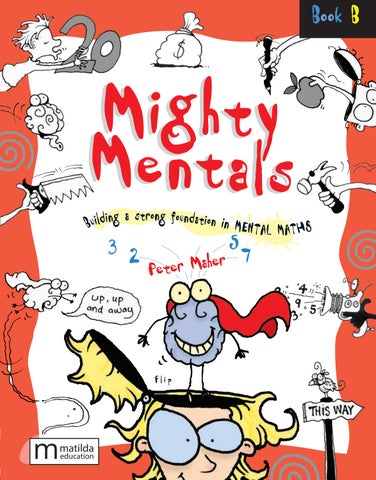
Mi g hty M e n ta ls
Building a strong foundation in m e n t a l m a t h s
M i g ht y Mental s is the only mentals textbook
series to purposefully and systematically teach mental computation skills. Through a clear scope and sequence, the focus is on developing students’ automatic response.
The four books in the Mighty Mentals series provide a systematic and logical program featuring: H a unit of work focusing on a specific concept for each week H a tip or strategy for each unit to help students work through the exercises H handy maths facts and glossary pages H student progress and self-assessment chart H pull-out answer section in the middle.
9780732999582
9780732999599
9780732999605
Use alongside any general Maths textbook to add a strong mental computation component!
Book B
Mi ghty Me nt als
Building a strong foundation in m e n t a l m a t h s
3 2
5
7 r e h a M Peter
9780732999612
By the same author:
Flip
9781420284386
Student Book Australian Curriculum Level NZ Curriculum Level
MM_BkB_99599_cvr_prs.indd 1
9781420284393
A
B
C
9781420284409
D
3
4
5
6
4
5
6
7
12/18/20 1:04 PM
Mi g hty M en t a ls
Book B
r e h a M r e t e P Name
Class
Con t e n ts Scope and Sequence................................................ Inside front cover Note to Teachers and Parents................................. 2 Handy Maths Facts .................................................. 4 How Well Am I Doing?............................................. 6 Units 1–32 ................................................................ 8-71 Glossary..................................................................... 72 Answers section in middle of book
99599_MM_B_Txt_repMar17.indd 1
15/03/2017 12:32 pm
Note to teachers and parents Developing mental arithmetic skills Automatic response—the ability to quickly recall basic mathematical facts, or to apply a known fact to a slightly modified situation or application—is an essential prerequisite for success in mathematics. The development of modern technology and its applicability to the classroom in the form of the hand-held calculator has not diminished the significance of the role that mental arithmetic should play in schools. On the contrary, the advent of modern technology has increased the need for accurate mental arithmetic skill development in children. Without relatively accurate estimation prior to calculation, merely accepting at face value a solution on a screen can be fraught with danger. Inadvertently hitting the wrong buttons on a calculator is a commonly occurring fact of life. The result on the screen should never be blindly accepted. When we consider the fact that the great majority of the calculations secondary school students complete are done on the calculator, the validity of this point can be readily perceived. By the end of primary school, a child should be in the habit of estimating and rounding off prior to using a calculator for computational purposes. Appropriate estimation is reliant upon a sound knowledge of basic number facts, which should have been developed consistently throughout the primary years.
2
The better a student’s abilities with mental arithmetic, the less time he or she will have to devote to looking up answers on a screen, in a book or on a chart. This point is demonstrated graphically with the game of ‘beat the calculator’. Line up your students in pairs and tell them that some maths questions are going to be asked of the children who progressively come to the head of the line. Offer a calculator
99599_MM_B_Txt_repMar17.indd 2
to one of the two students. Both will want it but only allow one to prevail. The other student will complain about how unfair the game is until the rules are made clear. The child with the calculator must press the appropriate buttons and display the correct answer. Ask the pairs of students questions they should be able to recall relatively quickly, such as 2 x 5 or 7 + 4. Now watch the child with the calculator complain that the game is unfair because the calculator is an encumbrance. Slip in the question 9 x 35 to see who is first with the correct answer. If the student using mental arithmetic is highly competent, 350 – 35 = 315 (10 lots of 35 minus one lot of 35) might still beat the calculator’s 9 x 35 = 315. It is also the case that the faster a student is with his or her basic number facts, the greater is the likelihood of structural computational success. Algorithms, such as long multiplication and division, contain numerous steps and stages. Students with inadequate mental arithmetic skills often take so long to recall a basic number fact that they forget the stage of the algorithm that they are progressing through. For these students the necessary foundation of times tables knowledge is inadequate—it is like trying to build on a foundation of sand. Without the necessary prerequisites of number facts competence, the algorithmic ‘house’ will tumble down. It is invariably the case that the broader a student’s body of mathematical knowledge, the more he or she will achieve in the subject and the more enjoyment that student will derive from the discipline. The message is clear: regularly practise automatic response games and activities, chants and rounds and all will benefit. Try to teach these number facts in as fun and meaningful a way as possible. Incorporate concrete materials and incentives into your number facts lessons.
15/03/2017 12:32 pm
Above all, teach for understanding. When teaching the 3 times table, show that the digits in the multiples will always sum to 3, 6 or 9. Show that the answers to the 9 times table always sum to 9. Show that adding on 8 is no harder than adding on 10—just jump back 2. Explain that the metric prefix ‘kilo’ stands for the number 1000, therefore there have to be 1000 grams in a kilogram and 1000 metres in a kilometre and, heaven forbid, 1000 tons of TNT in a kiloton bomb. The patterns that make number-facts recall easy are out there and easy enough to find. Make the effort to demonstrate them at every possible opportunity. This book and the other books in this series will show you how.
How to use this book The challenge of acquiring appropriate automatic response capabilities demands a structured and planned approach in schools. Mental arithmetic skills should be developed in a systematic manner over a period of years. The program should encompass the full range of the mathematics curriculum, covering measurement and space facts, data and chance questions as well as number problems. The four books in this series assist with the development of mental arithmetic skills in a systematic and logical manner. Each book in the series contains 32 units of work. Each unit contains six sets of questions, which can represent one set per school day with one left over for homework. Alternatively, one day per week could be devoted to the completion of the six sets. Each exercise in the book focuses on a specific concept, such as odd and even numbers, or digital and analogue time conversions. The exercises have been set out in a logical sequence according to topic, for example multiplying by six or 12 should be taught prior to dividing by
99599_MM_B_Txt_repMar17.indd 3
six or 12; the concept of length should be taught prior to its application with the concepts of perimeter and area. However, the order in which the exercises are completed can be varied to suit the needs of your students. The exercises are at their most useful when linked to the topic under review in the classroom at the time. The Scope and Sequence Chart on the inside front cover of this book will assist you to plan for the use of this book and to make it as relevant as possible to your students’ individual learning capabilities. At the top of each unit of work there is a tip for the students, to help them work through the exercises in that unit. At the bottom of each unit, you will find the relevant state outcomes. The Handy Maths Facts on pages 4–5 are included as useful reference material for students. How Well I Am Doing? on pages 6–7 affords the students the opportunity to record their scores on the unit exercises and to rate their own progress and performance. A list of answers is found in the middle of each book and can be removed and stored if deemed appropriate.
The terms used in this book The questions presented in this book utilise a wide variety of mathematical terms that are designed to reflect the structure of the discipline and to develop a student’s mathematical vocabulary. Knowing, for example, that the terms ‘add’, ‘sum’, ‘total’ and ‘altogether’ all refer to the process of addition will have obvious benefits when a student has to tackle an addition problem set in context, or when problem solving. A Glossary is provided on page 72 as a ready reference.
3 15/03/2017 12:32 pm
Handy Maths Facts
+ or
–
0
1
2
3
4
5
6
7
8
9
10 11 12
0
0
1
2
3
4
5
6
7
8
9
10 11 12
1
1
2
3
4
5
6
7
8
9
10 11 12 13
2
2
3
4
5
6
7
8
9
10 11 12 13 14
3
3
4
5
6
7
8
9
10 11 12 13 14 15
4
4
5
6
7
8
9
10 11 12 13 14 15 16
5
5
6
7
8
9
10 11 12 13 14 15 16 17
6
6
7
8
9
10 11 12 13 14 15 16 17 18
7
7
8
9
10 11 12 13 14 15 16 17 18 19
8
8
9
10 11 12 13 14 15 16 17 18 19 20
9
9
10 11 12 13 14 15 16 17 18 19 20 21
10 10 11 12 13 14 15 16 17 18 19 20 21 22 11 11 12 13 14 15 16 17 18 19 20 21 22 23 12 12 13 14 15 16 17 18 19 20 21 22 23 24 0
1
2
3
4
5
6
7
8
9
10 11 12
0
0
0
0
0
0
0
0
0
0
0
0
1
0
1
2
3
4
5
6
7
8
9
10 11 12
2
0
2
4
6
8
10 12 14 16 18 20 22 24
x
3
0
3
6
9
12 15 18 21 24 27 30 33 36
4
0
4
8
12 16 20 24 28 32 36 40 44 48
or
5
0
5
10 15 20 25 30 35 40 45 50 55 60
6
0
6
12 18 24 30 36 42 48 54 60 66 72
7
0
7
14 21 28 35 42 49 56 63 70 77 84
8
0
8
16 24 32 40 48 56 64 72 80 88 96
9
0
9
18 27 36 45 54 63 72 81 90 99 108
10
0
10 20 30 40 50 60 70 80 90 100 110 120
11
0
11 22 33 44 55 66 77 88 99 110 121 132
12
0
12 24 36 48 60 72 84 96 108 120 132 144
÷
4 99599_MM_B_Txt_repMar17.indd 4
0
0
15/03/2017 12:32 pm
Mass
Length 10 mm = 1 cm 1000 mm = 1 m
1000 g = 1 kg
100 cm = 1 m
g gram(s)
1000 m = 1 km mm millimetre(s)
1000 kg = 1 t kg kilogram(s) t tonne(s)
cm centimetre(s) m metre(s) km kilometre(s)
Capacity 1000 mL = 1 L
Time
1000 cm3 = 1 L 1 cm3 (water) weighs 1 g
60 seco
mL millilitre(s)
60 min
L litre(s)
24 hou
g gram(s)
7 days
cm cubic centimetres
365 da
3
nds = 1
utes =
ek
year leap ye
12 mon
ths = 1
rs = 1 d
100 ye
ay
= 1 we
ys = 1
10 yea
1 hour
rs = 1 d
ys = 1
366 da
minute
ars = 1
ar
year
ecade
century
5 99599_MM_B_Txt_repMar17.indd 5
15/03/2017 12:32 pm
H o w w e ll a m l d o ing? After you complete each set of work, fill in your score out of 10. At the end of the six sets, rate yourself in the following way:
S = Some work to do; G = Getting stronger; F = Finalist; or C = Champion! Unit
Topic
1
Addition: Bonding to 20
2
Addition: Adding on multiples of 10
3
Addition: Adding on 1–9
4
Subtraction: Subtracting from 20
5
Subtraction: Subtracting multiples of 10
6
Subtraction: Subtracting 1–9
7
Doubling and near doubling
8
Halving and near halving
9
Multiplication: The 6 times and 12 times tables
10
Multiplication: The 7 times and 8 times tables
11
Multiplication: The 9 times and 11 times tables
12
Division: Dividing by 6 and 12
13
Division: Dividing by 7 and 8
14
Division: Dividing by 9 and 11
My Set A Set B Set C Set D Set E Set F Rating
6 99599_MM_B_Txt_repMar17.indd 6
15/03/2017 12:32 pm
Unit
Topic
15
Mixed multiplication and division
16
Odd and even numbers
17
Place value: Digit recognition
18
Rounding off: Nearest 10, 100 and 1000
19
Sequences: Finding terms and rules
20
Number strings
21
Fractions and decimals
22
Length: Units and conversions
23
Perimeter: Concept and missing sides
24
Area: Concept and application
25
Mass: Units and conversions
26
Capacity/volume: Units and conversions
27
Time: Digital and analogue conversions
28
Time: Unit equivalences
29
Money: Economical ways of making amounts
30
2D and 3D: Properties and directions
31
Chance: Concepts of likelihood
32
Revision: All sorts
My Set A Set B Set C Set D Set E Set F Rating
7 99599_MM_B_Txt_repMar17.indd 7
15/03/2017 12:32 pm
N u m b er a n Algebra
U
d
g n t to 20 i i ion: B nd o dd nit 1 A
Our number system is based on the number 10 because we have 10 fingers. See if you can bond to 10 + 10 (20) quickly!
Set E
1 2 3 4 5 6 7 8 9
8 99599_MM_B_Txt_repMar17.indd 8
10
Set B
Set A 1
20 = 5 +
1
20 = 12 + 3 +
2
20 = 19 +
2
20 = 5 + 11 +
3
20 = 2 +
3
20 = 2 + 12 +
4
20 = 16 +
4
20 = 3 + 13 +
5
20 = 11 +
5
20 = 3 + 16 +
6
20 = 3 +
6
20 = 13 + 1 +
7
20 = 18 +
7
20 = 4 + 9 +
8
20 = 7 +
8
20 = 5 + 7 +
9
20 = 14 +
9
20 = 9 + 10 +
10
20 = 0 +
10
20 = 7 + 1 +
d 14 ____ Find the sum of 6 an d 12 ____ Find the sum of 8 an
17 and 3 ____ Add 3 to the total of ____ 4 and 6 altogether? What is 9 and 1 and m of 8 and 12? ____ su e th an th e or m 2 What is __ Add 7 to 4 and 16 __ 9 and 11 ____ Add 8 to the sum of 6 altogether? ____ What is 5 and 15 and 9 plus 11? ____ an th r te ea gr 6 is t ha W 7 and 13 ____ Add 9 to the sum of
15/03/2017 12:32 pm
Set C 1
20 = 2 + 2 + 2 +
2
20 = 3 + 3 + 2 +
3
20 = 1 + 1 + 12 +
4
20 = 5 + 1 + 12 +
5
20 = 4 + 14 + 1 +
6
20 = 3 + 1 + 2 +
7
20 = 2 + 3 + 14 +
8
20 = 7 + 11 + 1 +
9
20 = 0 + 10 + 5 +
10
20 = 4 + 10 + 2 +
S et D
Wh at ed to m number is needwith: ake 20, starting
1
14?
2
18?
3
15?
4
11?
9? 5 8? 6
7
12?
8
13?
9
20?
0? 10
Set F 1
I need $20 and have saved $8. I still need to save _____.
2
There are 20 books in a set. I have 13 and still need _____ more.
3
We need 20 runs to win the game and have scored 3. We need _____ more runs.
4
I made $20 with a $5 note, two $2 coins and _____ dollar coins.
5
I am missing 20 cents. I found 5 cents. I still need to find _____ cents.
6
I need to do 20 sums for homework. I have completed 9. _____ more sums to go!
7
I must travel a journey of 20 kilometres on my bike. I am at the 4 kilometre mark. I have _____ kilometres to go.
8
I have to iron 20 shirts and have finished 11. _____ shirts to go.
9
My dad wants to lose 20 kilograms on his new diet. He has already lost 3 kilograms. _____ kilograms to go!
10
I must paint 20 metres of fencing. 5 metres have been painted. _____ metres still to paint. NSW: Number NS2.2; Qld: Number concepts N3.2; Vic: Mental computation and estimation 3.2; WA: Number N3.3; SA: Number 2.8
99599_MM_B_Txt_repMar17.indd 9
9 15/03/2017 12:32 pm
Unit 2 10 f p s o g mult le d d in on i : n A ti Addi o S
N u m b er a n Algebra
d
Adding on 10, 20, 30 etc. to a number is as simple as adding 1, 2 or 3 etc. to the tens place. The units are not affected. See how well you can do this with the following questions.
et B
Set A
1
3 + 20 =
1
80 + 4 =
2
5 + 40 =
2
40 + 8 =
3
7 + 30 =
3
20 + 2 =
4
4 + 50 =
4
60 + 5 =
5
8 + 70 =
5
30 + 7 =
6
6 + 90 =
6
30 + 1 =
7
1 + 30 =
7
50 + 3 =
8
9 + 80 =
8
90 + 6 =
9
2 + 50 =
9
70 + 9 =
10
8 + 60 =
10
80 + 1 =
Set E 1
Find the sum of 23 and 70 ____
2
Add 27 to 50 ____
3
What is the total when 20 is added to 55? ____
4
What is 43 and 30 altogether? ____
5
What is the sum of 60 and 19? ____
6
Add 40 to 46 ____
7
Find the total of 68 and 30 ____
8
What is 70 more than the sum of 3 and 8? ____
9
Is the sum of 36 and 20 more than 55? ____
10
Is the total of 60 and 12 and 10 equal to 92? ____
10 99599_MM_B_Txt_repMar17.indd 10
15/03/2017 12:32 pm
Set C
0
Set D
1
5 + 40 + 2 =
2
4 + 20 + 3 =
1
3
7 + 60 + 1 =
2
4
2 + 50 + 2 =
3
5
6 + 70 + 1 =
4
6
4 + 30 + 4 =
5
7
1 + 80 + 8 =
6
8
0 + 70 + 3 =
7
9
2 + 2 + 2 + 90 =
8
10
3 + 1 + 3 + 40 =
9
21 + 70 = 43 + 40 = 38 + 30 = 23 + 50 = 15 + 40 = 56 + 20 = 49 + 50 = 45 + 20 =
10
17 + 80 = 44 + 30 =
Set F 1
I had 27 posters and then was given 20 more. I now have ____ posters.
2
Sam has 40 more posters than the answer above. Sam has ____ posters.
3
Sara has shot 37 netball goals. Her personal best is 20 more than this total. Her PB is ____ goals.
4
I saved $50 and then was given $33. I then had ____.
5
Marie scored 30 more runs than me. I scored 53 runs. She scored ____ runs.
6
I own 11 pairs of shoes. Elisa has 20 more pairs than me. She owns ____ pairs of shoes.
7
In the morning it was 7 degrees. Then it rose 30 degrees. The temperature was then ____ degrees.
8
I weigh 31 kilograms. My dad weighs 40 kilograms more. He weighs ____ kilograms.
9
My team scored 47 points and lost by 30. Our opponents scored ____ points.
10
I scored 46 points for long jump, 50 points less than the winner. The winner scored ____ points. NSW: Number NS2.2; Qld: Number concepts N3.2; Vic: Mental computation and estimation 3.2; WA: Number N3.3; SA: Number 2.8
99599_MM_B_Txt_repMar17.indd 11
11 15/03/2017 12:32 pm
N u m b er a n Algebra
U
d
t g 9 n 1— i ion: Ad i o d n nit 3 Add
Remember to start with the largest number first and use strategies; e.g. when adding on 7, 8 or 9 add on 10 and jump back 1, 2 or 3. Adding on 1, 2, 3, 4, 5 or 6 will become easier with practice.
Set A 1 2
1
13 + 4 =
17 + 2 = 15 + 1 =
2
18 + 6 =
3
12 + 5 =
11 + 3 = 16 + 2 =
4
17 + 4 =
5
14 + 5 =
13 + 3 = 1 + 12 =
6
5 + 15 =
7
4 + 11 =
2 + 19 = 3 + 16 =
8
5 + 19 =
9
4 + 12 =
2 + 15 = 3 + 16 =
10
6 + 15 =
3 4 5 6 7 8 9 10
Set E
Set B
1
Add 9 to 27 _____
2
Add 4 to 56 _____
3
What is the sum of 34 and 7? _____
4
What is the sum of 72 and 3? _____
5
What is 48 and 5 altogether? _____
6
What is 48 and 6 altogether? _____
7
Find the total of 6 and 32 _____
8
Find the total of 36 and 9 _____
9
Is the sum of 75 and 7 more than 82? _____
10
Is the sum of 23 and 8 equal to 31? _____
12 99599_MM_B_Txt_repMar17.indd 12
15/03/2017 12:32 pm
Set C 1
15 + 7 =
2
19 + 9 =
3
17 + 8 =
4
11 + 9 =
5
19 + 9 =
6
8 + 13 =
7
9 + 15 =
8
7 + 16 =
9
8 + 18 =
10
7 + 19 =
Set D 1
46 + 7 =
2
83 + 4 =
3
52 + 5 =
4
92 + 6 =
5
74 + 9 =
6
9 + 67 =
7
3 + 48 =
8
6 + 55 =
9
2 + 97 =
10
5 + 81 =
Set F
1
In the morning it was 6 degrees. It rose 25 more degrees in the afternoon. It was then _____ degrees.
2
It was 13 degrees in Hobart. It was 8 degrees hotter in Adelaide. In Adelaide it was _____ degrees.
3
My team scored 66 points but lost by 8 points. The winning team scored _____ points.
4
At half time in the netball the Phoenix were 37 goals. They scored 6 goals in the third quarter. At three-quarter time they had scored _____ goals.
5
I owned 39 lollies and then was given 5 more. I now have _____ lollies.
6
My brother has 4 more lollies than this total. How many does he have? _____
7
I own 17 CDs and was given 7 more for my birthday. I now own _____ CDs.
8
I have ridden 92 kilometres on my trail bike. My brother has ridden 6 kilometres more than me. He has ridden _____ kilometres on his bike.
9
I am 9 years old. My sister is 3 years older than me. She is _____ years old.
There are 23 trees in my garden and 8 in next door’s garden. The 2 houses have 10 _____ trees altogether. NSW: Number NS2.2; Qld: Number concepts N3.2; Vic: Mental computation and estimation 3.2; WA: Number N3.3; SA: Number 2.8
99599_MM_B_Txt_repMar17.indd 13
13 15/03/2017 12:32 pm
Unit 4 : Sub ractin g from 20 ion t ct Subtra Set A
N u m b er a n Algebra
d
If you can bond to 20, taking away from 20 will be very easy. Just remember that subtraction is simply the opposite of addition.
Set E
14 99599_MM_B_Txt_repMar17.indd 14
1
20 – 10 =
2
20 – 18 =
3
20 – 11 =
4
20 – 17 =
5
20 – 16 =
6
20 – 13 =
7
20 – 12 =
8
20 – 15 =
9
20 – 19 =
10
20 – 14 =
Se t B 1
20 – 3 =
2
20 – 7 =
3
20 – 5 =
4
20 – 9 =
5 6 7 8
20 – 1 = 20 – 8 = 20 – 0 = 20 – 4 =
9
20 – 6 =
10
20 – 2 =
1
How many times can you take away 5 from 20? ____
2
How many times can 2 be taken away from 20? ____
3
How many times can you take away 1 from 20? ____
4
What is left over if you take 4, then 6 away from 20? ____
5
What is left over after taking away 3, twice, from 20? ____
6
Can you take 7 away from 20, 3 times? ____
7
Remove 8 from 20 and add on 2 ____
8
Remove 5 from 20 and double the answer ____
9
Remove 2 from 20, 4 times ____
10
Remove 16 and then 2 and then 1 from 20 ____
15/03/2017 12:32 pm
Set C 1
Set D
4
2 7 How many more do you 3 1 need to take away from 20 4 5 to reach 0? 5 0 6
3
7
6
8
8
9
2
10
9
1
20 – 2 – 7 =
2
20 – 8 – 1 =
3
20 – 0 – 0 – 9 =
4
20 – 4 – 4 =
5
20 – 5 – 5 =
6
20 – 3 – 3 – 3 =
7
20 – 5 – 3 – 2 =
8
20 – 1 – 1 – 1 =
9
20 – 8 – 1 – 4 =
10
20 – 7 – 1 – 2 – 3 =
Set F 1
I had 20 cents and spent 15 cents. I had ____ cents left.
2
It was 20 degrees and then fell 11 degrees. It was then ____ degrees.
3
My birthday is on the 20th of June. My friend was born on the 12th of June. I am ____ days older than she is.
4
I can’t find 4 of my 20 pairs of socks. I can only find ____ pairs of socks.
5
My team scored 20 goals and I scored 7 of them. The rest of the team scored ____ goals between them.
6
I had to rule a 20-centimetre line, but my line was 8 centimetres short. My line was ____ centimetres long.
7
My dad’s birthday is the 20th of May. Today is the 8th of May. He still must wait ____ more days.
8
My dog weighs 20 kilograms and my cat weighs 9 kilograms. My dog is ____ kilograms heavier than my cat
9
Of the 20 t-shirts I own, 6 are too small. Only ____ fit me.
10
3 of my 20 video games are rally-driving games. ____ are not rally-driving games. NSW: Number NS2.2; Qld: Number concepts N3.2; Vic: Mental computation and estimation 3.2; WA: Number N3.3; SA: Number 2.8
99599_MM_B_Txt_repMar17.indd 15
15 15/03/2017 12:32 pm
Unit 5 Subtraction: f g 10 o p es t multi l n rac i t Sub
N u m b er a n Algebra
d
Just like when we add on 10 or 20 or 30, when 10 or 20 or 30 is taken away from a number, we simply need to change the tens place. The units are not affected.
Set E
16 99599_MM_B_Txt_repMar17.indd 16
Set A 1
37 – 30 =
2
28 – 20 =
3
29 – 20 =
4
32 – 30 =
5
94 – 90 =
6
35 – 30 =
7
18 – 10 =
8
27 – 20 =
9
31 – 30 =
10
33 – 30 =
Set B
1
46 – 20 =
2
37 – 10 =
3
74 – 20 =
4
51 – 30 =
5
88 – 30 =
6
24 – 10 =
7
95 – 20 =
8
66 – 30 =
9
93 – 20 =
10
59 – 30 =
1
Take 20 from 37 ____
2
Take 30 from 72 ____
3
Subtract 20 from 84 ____
4
Subtract 30 from 66 ____
5
Reduce 71 by 20 ____
6
Reduce 94 by 30 ____
7
Find the difference between 64 and 20 ____
8
Find the difference between 72 and 30 ____
9
Remove 20 from 87 ____
10
Remove 30 from 91 ____
15/03/2017 12:32 pm