








Review letters modelled.
Trace lower-case and then upper-case (capital) letters within lines to reinforce the letter, and to help develop students’ kinaesthetic memory.

Noun, verb, adverb patterns for all review letters.
For the teacher, links to grammar, punctuation, spelling and vocabulary, and literary elements.
Helpful tips.
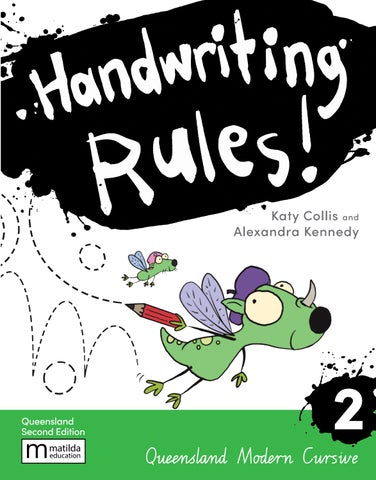
Handwriting Rules! Year 2
QLD Edition
ISBN: 978 0 6550 9291 9
Designer and typesetter: Trish Hayes
Illustrator: Stephen Michael King
Series editor: Marie James
Indigenous consultant: Al Fricker
This edition published in 2024 by Matilda Education Australia, an imprint of Meanwhile Education Pty Ltd Melbourne, Australia T: 1300 277 235
E: customersupport@matildaed.com.au www.matildaeducation.com.au
First edition published in 2015 by Macmillan Science and Education Australia Pty Ltd
Copyright © Katy Collis and Alexandra Kennedy 2015, 2021, 2024 The moral rights of the authors have been asserted. Printed in China by Central Sep-23


Clear instructions to teach each exit, entry or join.
A variety of activities to reinforce the join.
Trace and then independently write a joke or proverb. All sentences model different aspects of the English curriculum appropriate for Year 2, while being fun and motivating for students.

Self-assessment feature to encourage students to take responsibility for their own progress.
My name is .
Draw a picture of your favourite funny character from a story.
(character name)
(story title)
Trace then write.
Trace.
Trace.
Handwriting: clockwise letters; body letters (m, n, r).
Grammar: plural noun (meerkats), singular nouns (numbat, rat); adverbs (merrily, noisily, rapidly); doing verbs; possessive apostrophe (sailor’s) ; adjectives (pink, delight); prepositional phases (in the morning, in the night). Punctuation: upper-case (capital) letter to start a sentence; full stop.
Spelling and vocabulary: missed, moped, moved, needed, neigh, nod, noticed, roll, rub; suffixes –ily, –ing, –ed (noisily, warning, nibbling, needed); rhyme (night/delight, warning/morning). The word numbat is based on the word noombat from the Noongar language. Literary elements: alliteration; ancient rhyme (over 2000 years old) for weather forecasting.
Trace then write.
Trace then write.
Pink in the morning a sailor’s nod noticed neigh rub roll missed moped move needed Review:
a sailor’s delight. warning. Pink in the night,

Draw a square around your best m.
Draw a circle around your best n.
Draw a triangle around your best r.
Trace then write. Trace.
Handwriting: clockwise letters; head and body letters (ascenders) (h, k, b).
Grammar: singular nouns (hippo, kangaroo); adverbs (happily, kindly); doing verbs (bump, bury); question and answer; question word (why).
Punctuation: upper-case (capital) letter to start a sentence; question mark; full stop.
Spelling and vocabulary: beagle, bump, burped, buzzed, help, hippo, hit, hope, hug, kangaroo, kick, kneel; digraph ‘ur’ (burped). The word kangaroo is based on the word gangurru from the Guugu Yimithir language. The word braak is from the Gunai-Kurnai language. It means sulphur-crested cockatoo. Literary elements: alliteration; riddle; joke; word play (died); onomatopoeia (burped, buzzed).
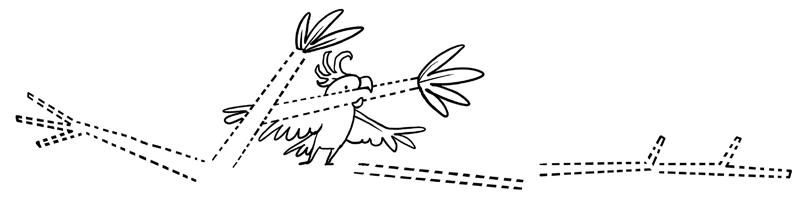
Trace and finish the pattern.
Review:
Trace then write.
Trace then write.
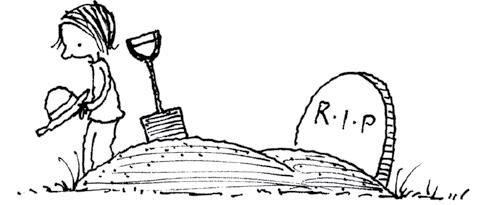
Draw a square around your best h. Draw a circle around your best k. Draw a triangle around your best b.
Trace then write. Trace. Trace.
Trace and finish the pattern.
Handwriting: clockwise letters; body and tail letters (descenders) (p, j).
Grammar: noun groups (a thousand miles, a single step); articles (The, a); adverbs (proudly, jauntily).
Punctuation: upper-case (capital) letter to start a sentence; full stop.
Spelling and vocabulary: jester, jiggle, jog, join, jostle, jump, peep, poked, pop, push, pout; digraph ‘th’ (thousand, with); ‘le’ ending (jiggle, jostle, single).
Literary elements: alliteration; Chinese proverb; onomatopoeia (pop).
Trace and finish the pattern.
Review: Clockwise letters m, n, r, h, k, b,
Trace then write.
Trace then write.
a single step.
Draw a square around your best p. Draw a circle around your best j.
Trace then write.
Handwriting: straight-line letters; body letter (i); head and body letters (ascenders) (t, l).
Grammar: prepositional phrases (on the ironing board); adverbs (impolitely, toothlessly, lazily); doing verbs (itching, loafing); saying verb (talking); being verb (are); question and answer; question word (why); adjectives (big, wrinkly).
Punctuation: upper-case (capital) letter to start a sentence; question mark; full stop.
Spelling and vocabulary: apostrophe for contraction (they’re); changing y to add –ed or –ly (lazily, tried); homophones (to/too/two); leap, lift, lifting, loosen, lug, tell, trampled, tried, tripped, try. Literary elements: alliteration; riddle; joke.
Trace then write.
Trace then write.
Why are elephants so wrinkly?
They’re too big to fit on the
ironing board.
Draw a square around your best i.
Draw a circle around your best t.
Draw a triangle around your best l.
Review: Straight-line letters i, t, l, x, z
Trace then write.
Trace.
Trace.
z x z x z x z X Z X Z X Z
Trace and finish the pattern.
Handwriting: straight-line letters; body letters (x, z).
Grammar: adjectives (better, flexible, stubborn); adverbs (zappily, flexibly); doing verbs (relaxing, zooming); statement.
Punctuation: upper-case (capital) letter to start a sentence; full stop.
Spelling and vocabulary: word families (flex, flexible, flexibly); coax, drizzle, fix, fizzed, flex, grizzle, mix, taxi, text, whiz.
Literary elements: alliteration; onomatopoeia (grizzle, drizzle, fizzed, whiz); portmanteau word (zonkey = zebra + donkey); Aesop fable ‘The Reed and the Olive Tree’, moral: It is better to be flexible than stubborn.
Trace and finish the patterns.
Trace then write.
Trace then write.
It is better to be flexible
than stubborn.
Draw a square around your best x. Draw a circle around your best z.
Trace then write.
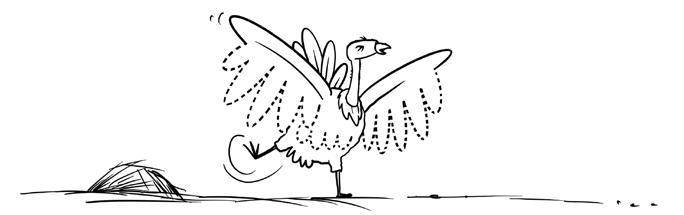
Handwriting: anticlockwise letters; body letters (u, v, w).
Grammar: personal pronouns (we); prefix and suffix (untidily); adverbs (untidily, vocally, wildly); doing verbs (untying, viewing, wobbling); statement.
Punctuation: upper-case (capital) letter to start a sentence; full stop.
Spelling and vocabulary: arrive, dive, drive, undid, undo, undone,
unzip, upend, visit, vote, wanted, watched, waved, wished; prefix un–(undid); ‘a’ for short o sound (wanted, watched). The word wagun is from the Bundjalung language. It means brush turkey.
Literary elements: alliteration; Aesop fable ‘The Four Oxen and the Lion’, moral: United we stand, divided we fall.
Trace and finish the pattern.
Trace then write.
Trace then write. arrive dive drive visit vote wanted watched waved wished
United we stand, divided we fall.
Draw a square around your best u.
Draw a circle around your best v.
Draw a triangle around your best w.
Trace then write. Trace. Trace. Trace.
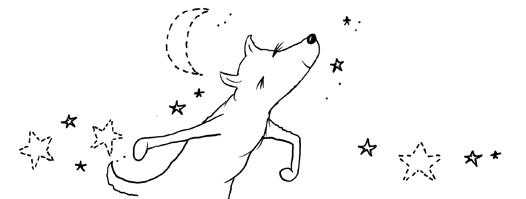
Handwriting: anticlockwise letters; body letter (a); head and body letter (ascender) (d); body and tail letter (descender) (q). Grammar: personal pronouns (I, you); adverbs (angrily, daintily, quietly); proper noun (Queenie); saying verb (quacking); verbs; question; question word (what).
Punctuation: upper-case (capital) letter to start a sentence; full stop; question mark. Spelling and vocabulary: act, add, agree, drag, drop, droop; apostrophe for contraction (I’ve); qu and squ (quacking, squashed, squeezed, squished). The word dingo is based on the word dingu from the Dharug and Dharawal languages. It means wild dog. Literary elements: alliteration; riddle; word play (quilt/cover).
Trace and finish the pattern. Review:
Trace then write.
Trace then write.
What did the quilt say to squashed squeezed squished act add agree drag drop droop
the bed? I’ve got
you covered.
Draw a square around your best a. Draw a circle around your best d. Draw a triangle around your best q.