Self-assessment feature to encourage students to take responsibility for their own progress.
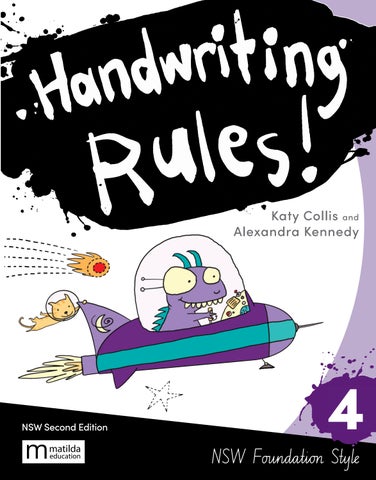
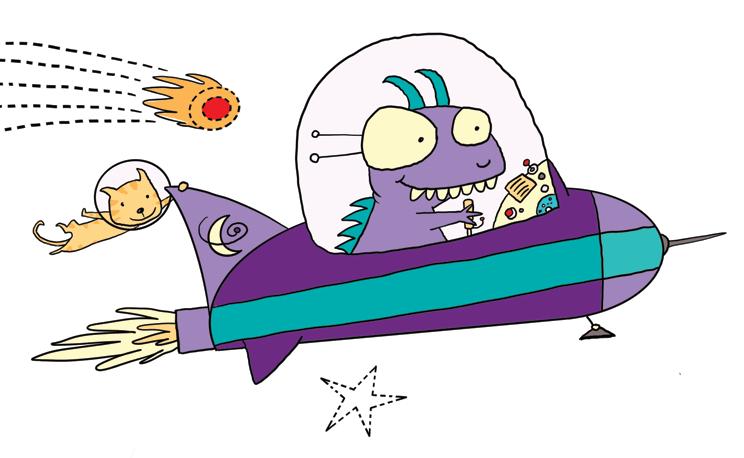
Humorous illustrations to reinforce concepts.
A variety of practice activities. These provide an English syllabus context for handwriting, to give it meaning and make it fun and motivating for Year 4 students.
For the teacher, links to grammar, punctuation, spelling and vocabulary, and literary elements.
Handwriting Rules! Year 4
NSW Edition
ISBN: 978 0 6550 9279 7
Designer and typesetter: Trish Hayes
Illustrator: Stephen Michael King
Series editor: Marie James
Indigenous consultant: Al Fricker
This edition published in 2024 by Matilda Education Australia, an imprint of Meanwhile Education Pty Ltd Melbourne, Australia
This year you will be entering the amazing worlds of FLUENCY and LEGIBILITY. You will learn how to write faster using special joins. You will develop a writing style that is easily read by others.
JOB APPLICATION: HANDWRITING EXPLORER
Name:
Date of birth:
Previous handwriting experience:
Why I would make a good handwriting explorer:
Practise printing in these smaller lines. Look on the back cover and check you’ve remembered the 7 s’s.
Trace then write.
A wise old owl sat in an oak.
The more he heard the less he spoke.
The less he spoke the more he heard
Why aren’t we all like that wise old bird?
Trace then write the capital letters.
B C D
Handwriting: lower-case and capital printing. Grammar: statement, question, sentences. Punctuation: capital letters to start sentences, full stops, question mark. Spelling and vocabulary: rhyme (heard/bird, oak/spoke). Literary elements: Mother Goose rhyme.
Trace then write.
Little Robin Redbreast sat upon
a rail;
Niddle noddle went its head
Wiggle waggle went its tail.
Trace then write the punctuation marks.
Check your letter size, slope and spacing as you print.
Label any extra parts you like. Give the creature a name.
Handwriting: using printing to label diagrams. Grammar: adjectives, nouns, noun groups. Spelling and vocabulary: suffix -some. Literary elements: mythical creatures (dragons, beasts).
A diagonal join goes from the exit kick at the main line up to the next letter. then keep going up . . . until you get to the start of the next letter.
up up up Make an exit kick . . .
Trace then write. Remember to make smooth diagonal joins.
hu hy in im er ki ke kn ky
kr mn mi mu mm my mp ni ny nu nn ui uy up ur um un the bee 's knee s
Circle your smoothest join. Underline a join that needs more practice.
u ul ul ul ul ul
then keep going up . . . to the very top . . . then retrace to make the next letter.
Trace then write. Be careful when you retrace the join. ab ah al ak at cl ch ck
To connect a diagonal join to a tall letter, continue the exit kick all the way up to the top, then retrace to make the next letter. Make an exit kick . . .
th t� tl uk ub ut ul at it th get into hot water pick of the litter
My retracing to make joins is improving good fantastic .
Use a diagonal join to join from q to u.
Review: Diagonal joins from q and z
Continue the exit kick on the tail of the q all the way up to the blue line.
Trace then write.
qu
qu qu qu qu qu qu qu qu qu
The quick queen queued quietly for quoit s.
When you make a diagonal join from the letter z, remember to make a little wave at the bottom of the z. little wave z
Trace then write.
ze zi zl zu zy zz ze zy sneeze wheeze freeze breeze squeeze
Write your own words that have a diagonal join from z.
I remembered to make a little wave on z sometimes often always .
Handwriting: diagonal joins from q to u, and from z. Spelling: common letter pairs, rhyme (sneeze/wheeze/freeze/breeze). Literary elements: alliteration.
There’s a very funny in sect that you do not often spy, And it i sn’t quite a spider and it i sn’t quite a fly; It i s something like a beetle, and a little like a bee,
But nothing like a woolly grub that climbs upon a tree. It s name i s quite a hard one, but you’ll learn it soon, I hope.
So try: Tri- Tri-anti-wonti Triantiwontigongolope.
Write the poem. Draw a triantiwontigongolope in the box above. Review: Diagonal joins
The Triantiwontigongolope
Make an then keep going up, then lift your pencil almost to the blue line . . . and drop-in the letter. u uc uc ua exit kick . . .
Trace the letter pairs. Remember to draw a longer exit kick.
Trace then write. Review: Drop-in joins To link a, c, d, g, o and q drop them onto the exit of the letter in front.
The ugly duckling turned into a swan .
Only a true prince ss can feel a pea beneath 20 mat�re sse s and 20 feather bed s.
Handwriting: drop-in joins after letters with exit kicks. Grammar: prepositional phrases (into a swan; beneath 20 mattresses and 20 featherbeds), compound word (featherbeds). Punctuation: sentence punctuation. Spelling and vocabulary: plurals adding -s or -es, animal young (ducklings, cygnet). Literary elements: references to fairy tales (‘The Ugly Duckling’, ‘The Princess and the Pea’, by Hans Christian Andersen). ma
That’s a cygnet!
Review: Horizontal joins
wi vi ry xy
Trace then write.
A horizontal join is a line with a little wave. It’s used from o, r, v, w and x.
To make a horizontal join to an anticlockwise ellipse letter you need to retrace.
Trace then write.
vo
Review: Horizontal joins
Go along the then retrace . . . and write your blue line . . . anticlockwise ellipse letter.
xo xa wa wo va wa wd
Trace then write.
rowdy zoom ogre body odd rage crowd
roam moan moat groan rogue toad boat
Trace then write.
The rowdy ogre groaned a s she fell into the moa�
Handwriting: horizontal joins to drop-in letters. Grammar: sentences. Spelling and vocabulary: ‘ow’ digraph (rowdy, crowd), ‘oa’ digraph (groan, moat, moan, toad, boat). Literary elements: fantasy character (ogre) and setting (moat), gender representation (she).
Review: Horizontal joins
From the go up . . . then retrace down. exit .
Trace then write.
To join a letter that finishes near the blue line to a tall letter, you need to retrace.
sturbing spooki sh fearle ss
kooky oddball lurk e xtraordinar� starle ss broken
Trace then write.
It wa s very dark and the wind howled horribly around her.
Circle your five best horizontal joins.
Handwriting: horizontal joins to tall letters. Grammar: adjectives (spooky, weird, dark), adverb (horribly), compound sentence with coordinating conjunction (and). Spelling and vocabulary: ‘ow’, ‘oo’, ‘ir’, ‘ur’, ‘ar’, ‘ur’ digraphs. Literary elements: alliteration (howled horribly), fantasy settings/scary genre, quote from The Wonderful Wizard of Oz by L Frank Baum (1900).
Trace then write.
There wa s a man in our town , And he wa s wondrou s wi se;
He jumped into a bramble bu sh , And scratched out both hi s eye s; And
when he saw hi s eye s were out ,
With all hi s might and main
He jumped into another bu sh , And scratched them in again . Review: Horizontal
Draw a star next to the line that shows your best writing. (Think about shape, slope and letter sizes.)
Handwriting: horizontal joins. Grammar: relating verb (was), pronoun reference (a man-he). Literary elements: Mother Goose rhyme, idiom ‘might and main’ meaning ‘with all his strength or power’ – relevant to time when Mother Goose stories were first published (1695).
Review: Joins to f Remember! To make a diagonal join to f, lift your pencil and drop the f onto the exit kick of the letter in front.
Go up . . . almost to the then drop-in f. blue line . . .
Trace then write. Remember to lift your pencil.
Trace then write. Remember to retrace the top of the f.
Trace then write.
But to make a horizontal join to f, you need to retrace.
I remembered when to lift my pencil and when to retrace sometimes often always .
Handwriting: drop-in join to f. Grammar: adjectives, nouns, saying verbs (huffed, puffed), noun group (The awful wolf), past tense. Spelling and vocabulary: common letter pairs, rhyme (huff/puff/bluff, swift/drift). Literary elements: reference to folk tale (The Three Pigs).
The letter f can join to other letters from its crossbar. Just make a horizontal join at the crossbar.
Review: Joins from f
Or, to join to a tall letter, continue the crossbar up and then retrace down.
fr fi fa fl
Trace then write.
piffle sniffle wiffle waffle fly flip flop fla sh flow