











Clear instructions to teach or review each join. Self-assessment feature to encourage students to take responsibility for their own progress.
A variety of activities to practise each join. Activities provide an English syllabus context for handwriting, to give the activities meaning and make them fun and motivating for Year 3 students.
For the teacher, links to grammar, punctuation, spelling and vocabulary, and literary elements.

Handwriting Rules! Year 3
NSW Edition
ISBN: 978 0 6550 9278 0
Designer and typesetter: Trish Hayes
Illustrator: Stephen Michael King
Series editor: Marie James
Indigenous consultant: Al Fricker
This edition published in 2024 by Matilda Education Australia, an imprint of Meanwhile Education Pty Ltd Melbourne, Australia T: 1300 277 235
E: customersupport@matildaed.com.au www.matildaeducation.com.au
First edition published in 2015 by Macmillan Science and Education Australia Pty Ltd
Copyright © Katy Collis and Alexandra Kennedy 2013, 2021, 2024 The moral rights of the authors have been asserted. Printed in China by Central Sep-23


This year, you are going on an amazing handwriting journey to a world of joins and links. Be sure to have your passport ready.
Handwriting Passport
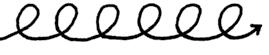


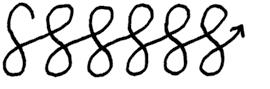
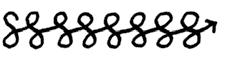
Remember to sit the letters on the main line correctly.
Make up your own patterns using these letter shapes.
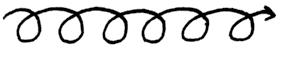
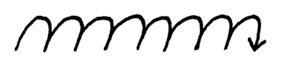


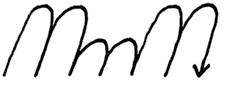
Think about where you will start each letter. n r m h k b p
Make up your own patterns using these letter shapes.
Trace then copy.
Remember to keep the slope the same.
Make up your own patterns using these letter shapes.
Review: Shape and slope
Make the letters stretch and shrink.
Remember! Form each letter correctly. Keep the slope the same.
Handwriting: forming letters correctly, keeping slope consistent. Literary elements: reference to characters from Alice’s Adventures in Wonderland by Lewis Carroll (1865).
Review: Labelling diagrams
Use these words to label the robot. Use your best printing.
listeners runners pump driver jammers camera processor speaker zoot
Write a caption.
Capital letters always sit on the main line.
Trace then write the capitals that use downstrokes.
A E F H I J K L M N T V W X Y Z
Trace then write the capitals that use anticlockwise movements.
Trace then write the capitals that use clockwise movements.
C G O Q S U B D P R
Write the missing capital letters.
A C D G H L N P R S V Z
Review: Lower-case and capital letters
Use this spelling alphabet when you want to be clearly understood.
Trace the NATO alphabet.
Alpha Bravo Charlie Delta Echo Foxtrot
Golf Hotel India
Juliet Kilo Lima
Mike November
Papa Quebec
Oscar
Romeo
Sierra Tango Uniform
Victor Whiskey X-ray
Yankee Zulu
Spell your name in the NATO alphabet.
Trace the capital letter and then make up your own alphabet.
A B C D E F G H I J K L M N O P Q R S T U V W X Y Z
Spell a friend’s name in your new alphabet.
Trace then write.
Write numerals to answer each question.
What year were you born?
What is your phone number?
What time do you get up in the morning?
What time do you go to bed on a school night?
What time does school start?
. . , ,
: : ; ; - - _ _
' ' “ " “ "
“That’s the alphabet!” shouted the class. Trace then write.
“What do you call a collection of letters?” asked the teacher.
That elephant can spell!
Handwriting: punctuation revision. Grammar: collective noun (class), saying verbs (asked, shouted), being verbs (‘is’ in That’s). Punctuation: full stop, comma, question mark, exclamation mark, colon, semi-colon, hyphen, dash, apostrophe, quotation marks. Spelling and vocabulary: contraction (That’s).
Review: Size, shape and slope
Watch your letter size, letter shape and slope. Make sure your letters face the right way.
Rewrite the text correctly. ?
”
“WHat dO You CALL a grOUP of chilDren asked San jay.
“That‘s a La !" yellEd RoSie.
“You're corrEct“‘ saidtheTEAcher.
My letter shapes need to improve are good are fantastic
My letter sizes are inconsistent are good are fantastic . My letter slope is inconsistent is good is consistently good .
Handwriting: slope, letter shape, letter size. Grammar: question, exclamation, saying verbs (asked, yelled), collective noun (class), being verbs (‘is’ in That’s , ‘are’ in You’re. Punctuation: full stop, capital letter to start a sentence, exclamation mark, question mark, quotation marks. Spelling and vocabulary: apostrophe for contraction (That’s, You’re).
Letters that finish on the main line need an exit kick. This kick will help you join letters later on. Joining letters carefully helps you write faster while still making sure that others can read your writing. u main line
Track these letters that need an exit kick.
u u u u u a a a a a d d d d d d d m m m m m m m n n n n n n n n h h h h h h h k k k k k k k
i i i i i i l l l l l l l l l t t t t t t t t
An exit kick is a quick, smooth change in direction on a letter that finishes on the main line.
Trace then write.
Trace the letters and add exit kicks to the letters that need them.
a b c d e f g h i j k l m n o p q r s t u v w x y z
Trace then write.
hill till mill
ant land hand hind kind mind
him dim mil k hut hunt mud
Rate your exit kicks on a scale from 1 to 5. 1 means you need a lot more practice. 5 means your kicks are fantastic.