Matilda Education Australia acknowledges all Aboriginal and Torres Strait Islander Traditional Custodians of Country and recognises their continuing connection to land, sea, culture, and community. We pay our respects to Elders past and present.
This edition published in 2024 by Matilda Education Australia , an imprint of Meanwhile Education Pty PO Box 118, Burwood, Victoria, Australia 3125
T: 1300 277 235
E: customersupport@matildaed.com.au
W: www.matildaeducation.com.au
First edition published in 2008 by Macmillan Science and Education Australia Pty Ltd
The moral rights of the author have been asserted.
All rights reserved. Except under the conditions described in the Copyright Act 1968 of Australia (the Act) and subsequent amendments, no part of this publication may be reproduced, in any form or by any means, without the prior written permission of the copyright owner.
Educational institutions copying any part of this book for educational purposes under the Act must be covered by a Copyright Agency Limited (CAL) licence for educational institutions and must have given a remuneration notice to CAL.
These limitations include: restricting the copying to a maximum of one chapter or 10% of this book, whichever is greater. For details of the CAL licence for educational institutions, please contact:
Copyright Agency Limited
Level 12, 66 Goulburn Street
Sydney, NSW 2000
Toll-free phone number (landlines only): 1800066844
Grammar Rules! comprehensively addresses the interrelated strands of Language, Literature and Literacy in the Australian Curriculum English V9, 2022. The Grammar Rules! series supports students’ development of knowledge, understanding and skills in reading, viewing, speaking, writing and creating texts.
The Australian Curriculum English recognises that learning in English is recursive and cumulative, so each book in the Grammar Rules! series is designed to build on concepts covered previously and for an expanding range of audiences and purposes.
Grammar Rules! provides a conceptually sound scope and sequence of context-based activities that support teaching and learning in English. Although the title for the series is Grammar Rules! , the series in not just about grammar. The series provides opportunities for students to explore texts created for aesthetic, imaginative, reflective, informative, persuasive, analytical or critical purposes, or any combination of these, as well as learn how to create texts for different audiences.
The model texts provided in the workbooks can be used for reading comprehension and for learning about text structures and features as well as for vocabulary expansion. Student Book 6 also teaches the conventions of punctuation and some aspects of spelling, for example, word roots (etymology); literary elements, such as onomatopoeia, metaphor, simile, personification, imagery and alliteration; the way visual elements function to support or construct meaning, as well as features such as character, setting and plot in narrative texts, and narrative structures, including chronological order and flashback.
Grammar Rules! comprehensively supports the aim of the Australian Curriculum English V9 to ‘help students learn to analyse, understand, communicate and build relationships with others and the world around them. It helps create confident communicators, imaginative and critical thinkers, and informed citizens.’
Student Book 6
U nits of work
Student Book 6 contains 35 weekly units of work presented in a conceptually sound scope and sequence. The intention is for students to work through the units in the sequence in which they are presented. See the Scope and Sequence Chart on pages 6–7 for more information. There are regular Revision Units that can be used for consolidation or assessment purposes.
The sample texts in Student Book 6 are generally based on the themes of places, times and cultures. This allows teachers and students to focus on the way language is structured in the different types of texts according to purpose and audience. Students can then use this knowledge to critically evaluate, respond to and create texts in other learning areas.
i cons
G
Encourages students to create texts of their own to demonstrate their understanding of the text structures and features taught in the unit. These activities focus on written language; however, many also provide opportunities for using spoken language to engage with others, make presentations and develop skills in using ICT.
Highlights useful grammatical rules and concepts. The rule is always introduced the first time students need it to complete an activity.
rammar r U les ! G
lossary
Tells students that a special hint is provided for an activity. It might be a tip about language features or a reminder to look at a rule in a previous unit.
A valuable glossary is provided at the end of Student Book 6 . Teachers and students can use this as a reference for terminology and rules introduced in Student Book 6 . Page references are also given for the point in the book where the rule or tip was first introduced so that students can go back to that unit if they need more information or further revision of the concept.
At the centre of Student Book 6 is a practical pull-out Writing Log so that students can keep track of the texts they have created or attempted to create. The Writing Log also includes a handy reminder of the writing process, as well as a checklist of types of texts for students to try.
U nit a t a G lance
Unit tag States the main language focus
Sequenced
activities
Activities focus on reading comprehension, text features and structures, vocabulary, grammar or punctuation
Type of text
Highlights the type of text and purpose of the sample text
Rule!
Introduces students to a new concept
Grammar Rules! Teacher Resource Book 3-6
Tip! Reminds or gives a special hint
Try it yourself! Gives students opportunities to apply their knowledge and skills to create their own texts. Students can engage in planning, drafting and editing their texts and using different modes and media to enhance presentation of their texts.
Full teacher support for Student Book 6 is provided by Grammar Rules! Teacher Resource Book 3–6 .
Here you will find valuable background information about teaching English along with practical resources, such as: T strategies for teaching text structures and features T grammar and punctuation wall charts
T literacy games and activities T teaching tips for every unit in Student Book 6 T assessment strategies T answers for every unit in Student Book 6.
Scope and Sequence
Unit Unit name
Type of text
Purpose of text Clauses, sentences Nouns, noun groups, pronouns, adjectives
Verbs and verb groups Adverbs, prepositional phrases, connectives, conjunctions
Language and vocabulary Literary devices
19 Where Would You Go? Argument to persuade sentences possessive apostrophes, collective nouns objective and subjective language, cohesion
20 Land Sale! Advertisement alliteration, parody, fractured tales
21 A Future Poem to respond to reflect articles, noun groups cohesion, word associations
22 Mummification Explanation to inform sentences possessive apostrophes connectives time sequence, punctuation, comic strips
23 The Accidental Traveller Narrative to entertain sentences first- and third- person pronouns flashback, idiom, narrative voice
24
25 Correspondence Email to inform open and closed questions degrees of formality
26 The Melting Pot Menu to inform to persuade noun groups verb groups word associations alliteration, metaphor
27 The Rights of the Child Podcast to inform to persuade verb groups, subjectverb agreement emotive vocabulary, acronyms proverbs
28 Top Wonder Written argument to argue a point of view, to persuade verb groups subjective language, paragraphs
29 Resistance Report to inform to persuade clauses (dependent, main, embedded) verb groups emotive vocabulary, subjective language
30
31 Chichén Itzá Media interview to inform to describe to persuade pronouns, noun groups reference
32 Lion Safari, Kenya Advertisement to persuade nouns, noun groups verbs homophones, prefixes personification, imagery
33 Don’t Let Them In Narrative and playscript to entertain dialogue, point of view character, plot, narrative voice, flashback
34 Multicultural Australia Information text/ Report to inform noun groups word origins, affixes, brackets
35 REVISION
Verb groups, tense, adverbs, conjunctions
This is a personal recount in the form of an email. It uses past tense verbs, adverbs and conjunctions to sequence events in time.
Dear Grandma and Grandpa,
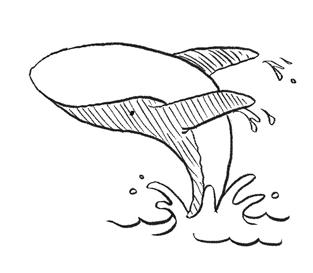
We arrived on the Gold Coast yesterday, and today we went whale watching. We had travelled approximately two kilometres offshore before the captain of our whale watching boat spotted a water spout and headed towards it. When we got to a couple of hundred metres from the whales, she stopped the engine, and we drifted as we observed two humpback whales that were breaching. When they breached, they leapt out of the water head first and then flopped back onto the surface with a big splash. Not long after that, the whales noticed our boat and meandered over. They poked their heads out of the water and spied on us. Their bodies hung vertically in the water. They were magnificent. I loved today. I love you.
Kenan
Verbs and verb groups are words for doing (action), saying, thinking and relating (being). have made will be was thinking did speak had finished
Read Dear Grandma and Grandpa. Underline the verbs and verb groups I
Write three verbs or verb groups that tell what the humans did.
Write three verbs or verb groups that tell what the whales did.
The form of a verb shows whether an activity happened in the past, is happening now, happens regularly or is always happening, or might happen in the future. This is called tense .
Auxiliary verbs (did, have, was) and suffixes (–ed, –t, –ing) help to show the tense past tense I kissed I did kiss I have kissed I was kissing present tense I am kissing We kiss future tense I will kiss
5
Change the form of each verb to show that the action happened in the past.
The tour guide (will advise) us about whale behaviours. The captain (announces) , ‘Jingeri jimbelung, hello friends.’
We (can attract) the whales’ attention.
The whales (swim) here from Antarctica.
I (am enjoying) the whale watching tour.
Complete each sentence with an auxiliary verb to show that the actions happened in the past. 6 was have were did have I thought about visiting my aunt.
7
The whales travelled a long way.
We busy on our holiday in Kombumerri country. I taught some words in the Yugambeh language.
The Kombumerri people not have a didgeridoo as a traditional instrument.
Adverbs can help establish a time frame for what is happening in a text. yesterday soon now tomorrow finally immediately weekly Conjunctions can link clauses in a sentence to show the time sequence. when then while until since before
Write the words in Dear Grandma and Grandpa that show time sequence.
8 after when since when I love whales more than ever I went to the Gold Coast.
9
Use a conjunction from the box to complete each sentence. Use a capital letter to start a sentence.
I saw the humpbacks, I felt really happy. we were on holiday, we stayed at a caravan park at the beach. we ate dinner, we went for a walk.
Use an adverb from the box to complete each sentence.
I hurt my foot
I have English homework but I can practise my guitar . Dinner will be ready . Arianna finished her homework. now soon later finally yesterday
Write a personal recount that tells about somewhere you have been or something you have done. Or, write a recount from the point of view of a character in a novel you are reading telling about somewhere that character has been. Use adverbs and conjunctions to sequence events in time. Publish the recount as an email to a family member or friend, or to the story character’s family member or friend.
Noun groups, simile, objective and subjective language
2 Green Sea Turtles of the Great Barrier Reef
This informative text is a description. It uses noun groups with descriptive and classifying adjectives to describe the subject.
The Great Barrier Reef is a magnificent habitat and nesting area for the critically endangered green turtle. The adult green turtles love to eat the tasty seaweed and algae found in the warm waters of the Pacific Ocean. These gentle plant eaters are olive green in colour with perhaps some brown, reddishbrown or black markings. Each turtle has quite distinctive face markings. The shell is a cross between circular and heartshaped and might grow to a metre long. It is a creamy colour underneath. Green turtles have oar-shaped flippers to pull themselves through the water like a canoe, and their heads and nostrils make them look like little aliens when they rise above the surface of their watery tropical paradise.
Noun groups can be expanded to give a detailed description of a person, place, animal or thing. A noun group can include an article , descriptive adjectives and another noun used as an adjective to classify . a gooey chocolate brownie
An adjectival phrase usually follows directly after the noun a thin and crispy pizza with cheese and mushrooms
Read Green Sea Turtles of the Great Barrier Reef. I
Write four noun groups that include descriptive adjectives.
Create your own noun groups by completing the table. 2
Descriptive adjective Noun used to classify Noun magnificent coral reef dog decrepit guitar truck
Build interesting noun groups for the noun ocean. Use any combination of adjectives. 3
Language can be objective (factual) or subjective (evaluative). objective: Green turtles eat seaweed and algae. subjective: Green turtles love to eat seaweed and algae.
Write two examples of subjective language from the text. 4
A simile is a literary device. It builds an image of a noun by comparing it to something else using ‘like’ or ‘as’. She ran as fast as lightning . Its eyes were like black marbles
Find two similes in Green Sea Turtles of the Great Barrier Reef. What two things are compared in each simile? 5
Draw lines linking the word groups to create similes. 6 as dry as cats and dogs as cold as a bone fight like thunder work like ice sings like an angel a face like a dog
Create similes of your own. 7 as hungry as as sparkly as snores like a sings like a eats like a as slow as
Write a description of a real or imaginary place. Use interesting noun groups to create a detailed description. Use similes to add to the imagery.
This personal recount uses a variety of sentence types to retell and evaluate events.
My Trip to the Zoo
Last Saturday, my cousin, Satoshi, and I went to the zoo. We visited the apes first. My favourite apes are orangutans because they are very clever. We watched one orangutan. He gathered a pile of empty potato sacks, and he carefully stacked them into a pile. He fussed with the sacks and finally sat on them. He was extremely industrious.
After the apes, we visited the bears and the elephants but we decided that our favourite animals for the day were the mountain goats. They nimbly climbed their rock mountain, even the babies.
Overall, I enjoyed the day very much. It was totally amazing, and I hope to go back there soon.
A clause is a group of words that expresses an idea and contains a verb . A simple sentence is a single clause.
A compound sentence consists of independent clauses that each make sense on their own. A complex sentence consists of two or more linked clauses where one clause is the main (independent) clause and the other clauses are dependent on it to make sense.
Read My Trip to the Zoo. Circle the verbs and verb groups. Underline the conjunctions (and, because, but). I
2
Form compound sentences. Join each pair of simple sentences using a conjunction from the box.
The meerkats were cute. The otters were cuter than the meerkats.
We liked the lemurs. We liked the sun bears.
It wasn’t very crowded. We couldn’t find seats together.
We could watch the ‘Birds of Flight’ at 1 pm. We could see the crocodiles at 1 pm. and but yet or
3
Add an independent clause to each line to create compound sentences.
We had lasagne for dinner and . The beach was crowded but . I could read a science fiction novel or . I prefer science fiction so .
4
Adverbs can tell manner ( quietly ), time ( soon ) or place ( there
Adverbs can add meaning to verbs. smiled cheekily danced happily cackled madly
Adverbs can add meaning to adjectives. extremely talented really witty very honest
Underline the adverb and circle the verb in each sentence.
The lions roared loudly.
The koalas dozed peacefully.
The bears looked at us occasionally.
Long, blue giraffe tongues poked out stickily.
5
Underline the adverb and circle the adjective in each sentence.
The bears looked very relaxed. The whole thing was totally terrifying. Zoos are extremely interesting places. The goats were really clever.
6
Re-read My Trip to the Zoo.
Find three adverbs that add meaning to verbs
Find three adverbs that add meaning to adjectives .
7
Write a sentence starting with each adverb below.
Choose an animal described in My Trip to the Zoo . Write about the events from the animal’s point of view . Describe the animal’s thoughts and feelings and what the animal is seeing and hearing. Use detailed noun groups and adverbs .
This imaginative text is a narrative that tells part of a Greek myth. It uses prepositional phrases and adjectives to set the scene.
The Monster in the Labyrinth
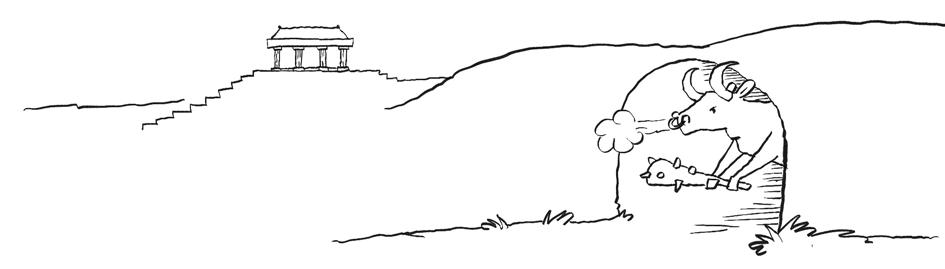
In a dark, cavernous underground labyrinth, beneath the city of Knossos, on the island of Crete, lurked a dreadful beast. The beast was a Minotaur. It had the body of a man, the head of a bull and it feasted on human flesh. Its horns were as sharp as swords. Its bloodcurdling bellow sent terror into the hearts of all who heard it. The labyrinth was a gigantic, winding maze, and once a person entered, they were never seen again. At the beginning of every year, to placate the beast, King Minos sent seven young men and seven young women into the maze as sacrifices to the Minotaur.
Read The Monster in the Labyrinth. What happened to people sent into the labyrinth? I
A prepositional phrase consists of a preposition (e.g. in, on, under, between, with, for, by ) followed by a noun or pronoun . A phrase can tell place, time or manner. across the bridge by morning for a long time with its claws without him
In The Monster in the Labyrinth, underline the prepositional phrases that tell place (where) the action occurred.
Write the prepositional phrase in The Monster in the Labyrinth that tells time (when the action occurred).
Add three prepositional phrases to the beginning of this sentence to set the scene and tell where.
lurked a ferocious dinosaur.
The writer of The Monster in the Labyrinth has forgotten to use paragraphs. Talk with a partner. Draw a / where each new paragraph should start.
Write the simile used in The Monster in the Labyrinth. 6
What does the use of this simile add to the myth?
7
Create similes of your own to suit the minotaur myth.
Remember the rule on page 11.
The maze was as .
The Minotaur’s head was as . The Minotaur’s bellow was like .
Some adjectives tell the quantity or order of a noun. one mango the last mango the second row a few cherries many
Find one number adjective used in The Monster in the Labyrinth. 8
Choose a number adjective from the box to complete each sentence. 9 He tried hard but still came in the race. Our school has planted eucalypts. children walk to school day.
dozen many last each thirty every some
I’ll need a eggs for the omelette. child can have a turn. people are diligent recyclers.
Find six descriptive adjectives used in The Monster in the Labyrinth. I0
Which of the adjectives do you think adds the best description to the story? Why?
I I
Find two noun groups in The Monster in the Labyrinth that use a noun to classify in a noun group.
I 2
Find antonyms in The Monster in the Labyrinth for ‘delightful’ and ‘straight’.
Antonyms are words with opposite meanings. pleased displeased fight surrender
Research the ending of the myth Theseus and the Minotaur and draw a comic strip to represent the events in the narrative. Or, research another myth from around the world and prepare a retelling to present to your class. You might like to choose a First Nations’ Dreaming story to retell.