



Monique Miotto
Tracey MacBeth-Dunn

Series editor and lead author
Author Contributing authors
Craig
Loretta
Ingrid
Andrew
Lisa
This edition published in 2021 by
Matilda Education Australia, an imprint of Meanwhile Education Pty Ltd
Melbourne, Australia
T: 1300 277 235
E: customersupport@matildaed.com.au www.matildaeducation.com.au
Copyright © Macmillan Science and Education Australia 2012
The moral rights of the author have been asserted. First edition published in 2012.
All rights reserved.
Except under the conditions described in the Copyright Act 1968 of Australia (the Act) and subsequent amendments, no part of this publication may be reproduced, stored in a retrieval system, or transmitted in any form or by any means, electronic, mechanical, photocopying, recording or otherwise, without the prior written permission of the copyright owner.
Educational institutions copying any part of this book for educational purposes under the Act must be covered by a Copyright Agency Limited (CAL) licence for educational institutions and must have given a remuneration notice to CAL.

Licence restrictions must be adhered to. For details of the CAL licence contact: Copyright Agency Limited, Level 15, 233 Castlereagh Street, Sydney, NSW 2000. Telephone: (02) 9394 7600. Facsimile: (02) 9394 7601. Email: info@copyright.com.au
Publication data
Author: Miotto, Monique and others
Title: Active Maths 9: Homework Program (Australian Curriculum edition)
ISBN: 978 1 4202 3067 3
Publisher: Colin McNeil and Peter Saffin
Project editor: Eve Sullivan
Editor: Laura Davies
Illustrator: Paul Lennon (cartoons)
Cover designer: Dim Frangoulis
Text designer: Dim Frangoulis
Production control: Loran McDougall
Permissions clearance: Elizabeth Sim Typeset in Times Ten Roman 10/13 pt by Sunset Digital and Nikki M Group
Printed in <country> by <printer name>
1 2 3 4 5 6 7 25 24 23 22 21 20
At the time of printing, the internet addresses appearing in this book were correct. Owing to the dynamic nature of the internet, however, we cannot guarantee that all these addresses will remain correct.
The author and publisher are grateful to the following for permission to reproduce copyright material:
ClassPad screenshots reproduced with permission from Shriro Australia Pty Ltd, 9, 10, 47, 48, 113, 114, 135; Geometer’s Sketchpad screenshots © by KCP Technologies, www.keycurriculum.com, 63, 64, 65; TI-Nspire screenshots reproduced with permission from Texas Instruments Australia Pty Ltd, 11, 49, 50, 115, 116, 137
The author and publisher would like to acknowledge the following:
Microsoft Excel screenshots © 2012 Microsoft Corporation. All rights reserved, 21, 22, 36, 101, 102, 103, 123, 124
While every care has been taken to trace and acknowledge copyright, the publishers tender their apologies for any accidental infringement where copyright has proved untraceable. They would be pleased to come to a suitable arrangement with the rightful owner in each case.
This page intentionally left blank.
For 1–2, list the like terms.
[Like terms]
[Like terms]
For 3–7, simplify the expressions by collecting the like terms.
[Simplify like terms]
[Simplify like terms]
[Simplify like terms]
[Simplify like terms]
[Simplify expression]
[Simplify expression]
[Simplify expression]
[Simplify expression]
[Simplify expression]
[Algebraic fractions]
[Expand: distributive law]
[Expand: distributive law] [Algebraic fractions]
[Substitution]
[Substitution]
[Substitution: formula]
[Substitution: formula]
Tom’s wage, W, is represented by the formula: W = 50 + 17h where h is the number of hours he works. Find his
[Simplify expression]
For 21–30, the simple interest, I, on an amount of money, P, that is invested at a certain interest rate, r%, for a certain time, T, can be calculated using: I = PrT 100 .
21 Find the simple interest, I, if:
[Substitution: simple interest]
a P = 400, r = 5% and T = 2.
b P = 10 000, r = 4.3% and T = 6.
c P = 4500, r = 7% and T = 3.
For 23–27, find the simple interest earned.
23 $7000 is invested at 4% p.a. for 3 years.
[Substitution: simple interest]
24 $1400 is invested at 3 1 2 % p.a. for 2 years.
[Substitution: simple interest]
25 $230 000 is invested at 5.6% p.a. for 3 1 2 years.
[Substitution: simple interest]
26 $3900 is invested at 7% p.a. for 6 months.
[Substitution: simple interest]
22 Saul was asked to calculate the simple interest earned if $1600 is invested at 3% p.a. for 5 years. His working is shown here:
I = ? P = 1600 r = 3% = 0.03 n = 5
I = PrT 100 I = 1800 × 0.03 × 5 100 = 2.7
The simple interest is $2.40.
a His answer is wrong. How would he have known this?
b What did he do wrong?
c What is the correct answer?
[Substitution: simple interest]
27 $82 000 is invested at 2.1% p.a. for 15 months.
[Substitution: simple interest]
28 If $1500 is invested at 4.1% p.a. for 2 years, calculate:
[Substitution: simple interest]
a The simple interest earned.
b The total amount at the end of the 2 years.
29 Juanita is saving for a house. She invests $23 000 at 6.5% p.a. simple interest. Calculate the total amount she will have at the end of 3 years.
[Substitution: simple interest]
30 Melissa wants to go on a $12 000 package holiday in 18 months. If she invests $10 000 at 8.2% p.a. would she have enough money? Explain.
[Substitution: simple interest]
1 Circle the linear equation.
[Linear equation]
2 Check, using substitution, which of the following equations have x = –2 as a solution.
[Substitution: check answer]
3–18, solve for the unknown.
[Solve: 1 step]
[Solve: 1 step]
[Solve: 1 step]
[Solve: 2 step]
[Solve: 2 step]
[Solve: 2 step]
[Solve: 2 step]
[Solve: 2 step]
[Solve: pronumeral both sides]
[Solve: pronumeral both sides]
[Solve: pronumeral both sides]
[Solve: pronumeral both sides]
[Solve: brackets]
[Solve: brackets]
[Solve: complex]
[Solve: complex]
[Solve: complex]
Solve the following equation, giving your answer as a fraction: 2 7 31 5 pp =
[Solve: complex]
[Rearrange formula] [Rearrange formula]
Solve: 5(2n + 3) = 3(4n – 1)
Rearrange the formula to make h the subject: A bh = 2
Rearrange the formula to make r the subject: A = 2prh
23 If y = 4x + 1, a write an equation to find x if y = 19.
[Substitution: solve equation]
b solve to find x
24 The formula for finding the circumference, C, of a circle is C = 2pr
[Substitution: solve equation]
a If the radius is 5 cm, find C to 1 decimal place.
b If C = 49.6, what is the radius? Answer correct to 1 decimal place.
For 25–28, the simple interest, I, on an amount of money, P, that is invested at a certain interest rate, r%, for a certain time, T, can be calculated using: I = PrT 100 .
25 For each of the following substitute the given values to get an equation and then solve it.
[Simple interest: solve equation]
a Find I if P = 200, r = 5 and T = 3.
b Find P if I = 150, r = 4 and T = 2.
26 For each of the following substitute the given values to get an equation and then solve it.
[Simple interest: solve equation]
a Find r if I = 180, P = 3000 and T = 1.5.
b Find T if I = 29 400, P = 120 000 and r = 3.5.
27 How long will Leo need to invest $1700 at 6.5% p.a. if he wishes to make $550? Answer correct to the nearest year.
[Simple interest: solve equation]
[Simple interest: solve equation]
28 In 3 years Rani wants to buy into a business for $100 000. If she wants to invest her inheritance of $85 000, what simple interest rate will she need to get if she is to have enough money? Answer correct to 2 significant figures.
29 Martha’s phone plan charges her 10 cents per call plus 3 cents per second.
[Linear equation: application]
a Write an equation for the cost of a call (C) in terms of the length of the call (s) in seconds.
b How much will Martha have to pay for a 2-minute call?
c How long can she talk for $1.30?
30 Mary, a car sales person, receives a base salary of $450 per month and a commission of $100 for each car sold.
[Linear equation: application]
a Write an equation for Mary’s monthly income (I) in terms of the numbers of cars sold (n).
b How much will Mary earn in the month of December if she sells 12 cars?
c How many cars did she sell if she earned $2950?
We use pronumerals (letter symbols) to represent an unknown quantity in our working in much the same way as you might use a box in a number puzzle. We also use pronumerals to represent quantities that can take a range of values, allowing us to describe a variety of situations with just one statement. In this investigation, we will review some of the different ways pronumerals are used.
1 Write equations to represent the following riddles, using the pronumerals suggested, and then solve the riddles.
2 Use pronumerals to complete the missing labels in the following figures. a b [Write an equation] [Interpret a diagram] x x
a Double a mystery number (n) is equal to its square. What is the number?
b The sum of two consecutive counting numbers is 19. Let the smaller number be s. What are the two numbers?
c The product of two consecutive even numbers is 224. Let the smaller number be e. What are the numbers?
d The length of a rectangle is triple its width. Let the width be w cm. The perimeter of the rectangle is 96 cm. What is the length of the rectangle?
x
3 For each of the following tables write a rule for y in terms of x.
[Describe a pattern]
4 Give the x- and y-coordinates of the points shown below:
[Interpret a graph]
A ( , ) B ( , )
C ( , ) D ( , )
E ( , ) F ( , )
G ( , ) H ( , ) I ( , )
5 Gustavo wants to earn $4000 interest over 5 years. He can get 4% p.a. simple interest. He has started the calculation below to work out how much he needs to invest. Complete it to find out how much he needs to invest.
[Use a formula]
He should invest $
6 The graphs below show the volumes (V) of various containers as a function of their heights (h). Match the containers to their graphs by drawing an arrow.
[Interpret relationships]
7 Consider this sequence of numbers: 1, 5, 9, 13, 17, 21, 25, ...
[Look for patterns]
[Generalise]
Numbers in a sequence are called terms.
a Find the difference between each consecutive pair of terms. What do you find?
b This type of sequence is called an arithmetic sequence. Let d represent the difference between consecutive terms. What is the value of d?
c We can represent the value of the nth term in this sequence as tn where n = 1, 2, 3, ... For example, t3 = 9. What is t5?
d There are two ways of describing a sequence. The first way is to write a rule showing how to get from one term to the next. This is called a difference equation. Complete this difference equation:
tn+1 = tn , where n = 1, 2, 3, ...
e The other way of describing a sequence involves writing a rule for the nth term. Complete the rule for the nth term of this sequence:
tn = t1 + ( – 1)4, where n = 1, 2, 3, ... and t1 is the first term of the sequence.
f Use this formula to find the 60th term of this sequence.
8 Consider this sequence of numbers: 2, 6, 18, 54, 162, ...
[Look for patterns]
[Generalise]
a Find the difference between each consecutive pair of terms. What do you find?
b Compare the ratios of each term to the one before, e.g. 6/2. What do you find?
c This type of sequence is called a geometric sequence. Let r represent the common ratio between consecutive terms. What is the value of r?
d What is t5 of this sequence?
e Complete the difference equation for this sequence:
tn+1 = tn , where n = 1, 2, 3, ...
f Complete the rule for the nth term of this sequence:
tn = t1 × ( – 1), where n = 1, 2, 3, ... and t1 is the first term of the sequence.
g Use this formula to find the 12th term of this sequence.
Algebraic expressions can be used to describe the patterns in geometrical shapes such as the relationship between the circumference and radius of a circle. In this task, you will write, simplify and evaluate some common algebraic expressions used in measurement.
1 The formulas used to calculate the circumference and area of a circle of radius r are examples of algebraic expressions.
[You can work in standard mode and tap , instead of pressing E to obtain decimal answers.]
• Working with the M application, tap Edit then Clear All Variables then tap OK and 2πr⇒c using the 9 keyboard. Press E. On the bottom toolbar, tap Standard to change the mode to decimal unless the calculator is already in decimal mode.
• Now repeat this process for the formula A = πr 2
• To substitute values into the defined expressions, use the U symbol located in the soft keyboard 9, then OPTN. To find the circumference and area of a circle of radius 10 cm, type ‘c|r = 10’ and ‘a|r = 10’.
a What is the circumference (correct to 1 decimal place)? cm (approx.)
b What is the area (correct to 1 decimal place)? cm 2
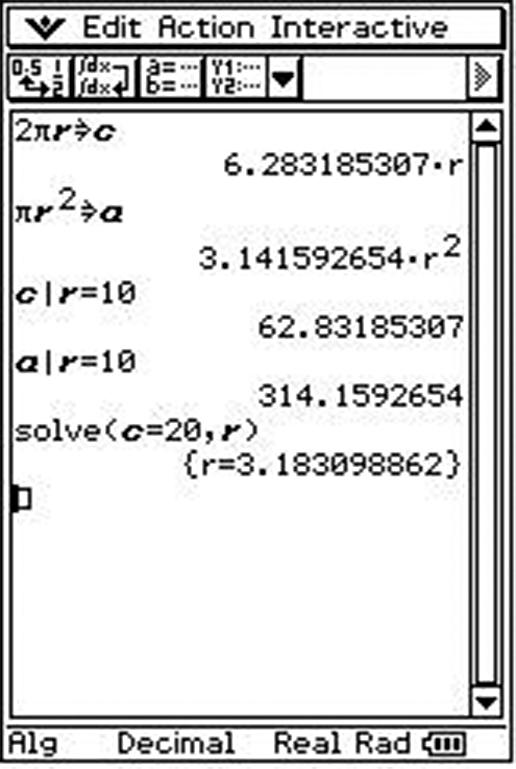
c Now find the radius of a circle with circumference of 20 cm, correct to 1 decimal place. Still using the M application, tap Action then Equation/Inequality then Solve. Type ‘solve(c = 20,r)’. Press E cm
2 Now define the simple interest earned, I, on an amount of money, P, that is invested at a certain interest rate, r%, for a certain time, T. Then use this formula to find the principal if the interest earned is $150, the interest rate is 4% and time the money is invested is 2 years.
[It is important to use the 9 italicised variables for b and h and not the b and h from the 0 keyboard if the multiplication signs are omitted.]
• Type ‘ prt 100 W i’. Press E
• Tap Action then Equation/inequality then solve. Type ‘i=150,p)|{r=4,t=2}’then press E. What is the amount of money invested?
3 Samantha went to JC Hi-Fi and bought 25 blank DVDs. She paid $28.75.
a If p is the cost of a single DVD, complete this equation: × p =
b Now use ‘solve (25p = 28.75, p)’ to find the cost of a single DVD. Cost per DVD = $
c Write an expression for the cost, c, of purchasing a number, n, of DVDs, each priced at $1.05.
d Now use your calculator to calculate the number of DVDs if the cost was $32.55.
Try this!
A tin can has volume V = πr 2h, where r is the radius of the base and h is the height of the can. Use your calculator to find the following (correct to 1 decimal place):
a volume of a tin can with radius 5 cm and height 10 cm
b radius of a tin with volume 100 cm 3 and height 5 cm
c height of a tin with volume 200 cm 3 and radius 3.5 cm.
Make sure that you do not delete your answers from the calculator.
Algebraic expressions can be used to describe the patterns in geometrical shapes such as the relationship between the circumference and radius of a circle. In this task, you will write, simplify and evaluate some common algebraic expressions used in measurement.
1 The formulas used to calculate the circumference and area of a circle of radius r are examples of algebraic expressions.
[When you move on to a new problem, it is a good idea to clear all variables used previously. This can be done by pressing b1 4.]
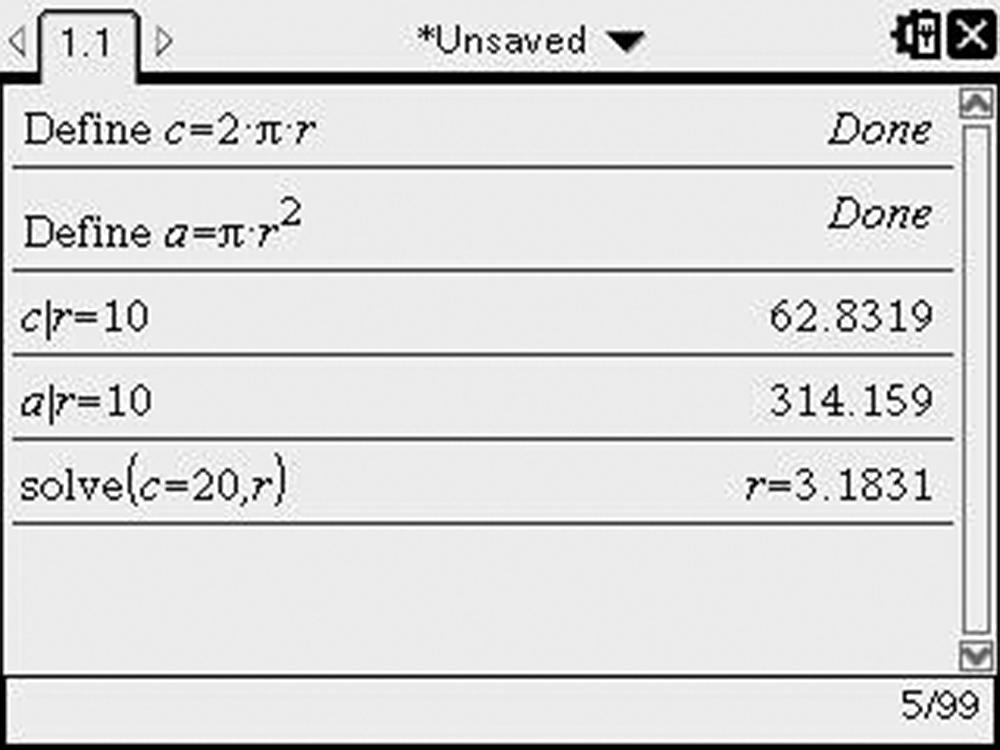
• Open a new document with a Calculator page. Press b11 to select Define from the Actions menu. Type ‘c = 2π × r’. Press ·
• Now repeat this process for the formula ‘A = πr 2’
• To substitute values into the defined expressions use the ñ (with) symbol. To find the circumference and area of a circle of radius 10 cm, type ‘c|r = 10’ and ‘a|r = 10’. In the Auto Mode, the calculator gives exact values. To find decimal approximations press /·
a What is the circumference (correct to 1 decimal place)? cm
b What is the area (correct to 1 decimal place)? cm 2
c Now find the radius of a circle with circumference of 20 cm. In the same calculator page press b31 to select Solve from the Algebra menu. Type ‘solve(c = 20, r)’. Press /· for an approximate answer. cm
2 Now define the simple interest earned, I, on an amount of money, P, that is invested at a certain interest rate, r%, for a certain time, T. Then use this formula to find the principal if the interest earned is $150, the interest rate is 4% and time the money is invested is 2 years.
[It is important to include × signs between pronumerals, each of which is shown as a . on the screen between the variables. Otherwise, the calculator treats bh as one variable.]
• Press b11 to select Define from the Actions menu. Type ‘ i = p r t 100 ’. The fraction template can be used by pressing /p. Press ·
• Type ‘solve (i=150, p)|r=4 and t=2’. The and command can be typed manually with a space on either side. What is the amount of money invested?
3 Samantha went to JC Hi-Fi and bought 25 blank DVDs. She paid $28.75.
a If p is the cost of a single DVD, complete this equation:
× p =
b Now use ‘solve (25p = 28.75, p)’ to find the cost of a single DVD. $
c Write an expression for the cost, c, of purchasing a number, n, of DVDs, each priced at $1.05
d Now use your calculator to calculate the number of DVDs if the cost was $32.55.
Try this!
A tin can has volume V = pr 2h where r is the radius of the base and h is the height of the can. Use your calculator to find the following (correct to 1 decimal place):
a volume of a tin can with radius 5 cm and height 10 cm
b radius of a tin with volume 100 cm 3 and height 5 cm
c height of a tin with volume 200 cm 3 and radius 3.5 cm.
Remember to save your calculator page!
1 A result obtained when an experiment is conducted is called an .
[Definition of terms]
2 The set of possible outcomes of a probability experiment is called a
[Definition of terms]
[Sample space]
3 A team plays 2 games. They can win (W) or lose (L) each game. No draws are allowed. Draw a tree diagram and use it to write the sample space for the possible outcomes of the two games.
A student rolled a die 10 times and tallied the results as shown. Use this data for 4–9
4 How many times did the student roll a 2?
[Trial]
5 What was the relative frequency of rolling a 2? Give the answer as a fraction.
[Relative frequency]
[Relative frequency]
6 Which event(s) had a relative frequency of 1 5 ?
7 What was the experimental probability of rolling a 2?
[Experimental probability]
8 If the die is fair, what is the theoretical probability of rolling a 2?
[Theoretical probability]
[Theoretical probability]
9 If the number of trials (rolls) was increased to 1000, what would you expect to happen to the experimental probability?
For 10–15, one card is drawn at random from a standard deck of 52 cards.
[Theoretical probability]
10 What is the theoretical probability that the card is a spade? Give the answer as a simple fraction.
11 Find Pr(Ace) as a simple fraction.
[Theoretical probability]
12 Find Pr(Ace of spades) as a fraction.
[Theoretical probability]
13 Locate Pr(spade) on this probability scale.
[Theoretical probability]
14 Locate Pr(Ace) on the scale above.
[Theoretical probability]
15 Locate Pr(Ace of spades) on the scale above.
[Theoretical probability]
For 16–18, Bag 1 contains 5 counters numbered 1 to 5. Bag 2 contains four different-coloured marbles.
The following lattice diagram shows all possible outcomes if one item is selected at random from each bag.
17 Find Pr(white marble) as a simple fraction.
[Theoretical probability]
18 Find Pr(red marble and 5) as a decimal fraction.
[Theoretical probability]
19 Find Pr(yellow or red marble and a number less than 3) as a fraction.
[Theoretical probability]
20 Find the complement of the event in 19.
[Complementary events]
For 21–23, the table shows the number of CDs of each artist in stock at the Melbourne and Sydney Mighty Music Megastores.
Calculate each probability as a fraction in simplest form.
21 Pr(CD randomly selected by a customer is a The Mathematicians CD).
[Theoretical probability]
16 Find the total number of possible outcomes.
[Lattice diagram]
[Theoretical probability]
22 Pr(CD randomly selected by a customer at the Melbourne store is a Trigonometrics CD).