Australian Curriculum Australian Curriculum edition











































Authors







Series editor and lead author
Contributing authors

This edition published in 2021 by
Matilda Education Australia, an imprint of Meanwhile Education Pty Ltd
Level 1/274 Brunswick St Fitzroy, Victoria Australia 3065 T: 1300 277 235
E: customersupport@matildaed.com.au www.matildaeducation.com.au
Copyright © Macmillan Education 2012
The moral rights of the author have been asserted. First edition published in 2012.
All rights reserved.
Except under the conditions described in the Copyright Act 1968 of Australia (the Act) and subsequent amendments, no part of this publication may be reproduced, stored in a retrieval system, or transmitted in any form or by any means, electronic, mechanical, photocopying, recording or otherwise, without the prior written permission of the copyright owner.
Educational institutions copying any part of this book for educational purposes under the Act must be covered by a Copyright Agency Limited (CAL) licence for educational institutions and must have given a remuneration notice to CAL. Licence restrictions must be adhered to. For details of the CAL licence contact:
Copyright Agency Limited, Level 15, 233 Castlereagh Street, Sydney, NSW 2000. Telephone: (02) 9394 7600. Facsimile: (02) 9394 7601.
Email: info@copyright.com.au
Publication data
Author: Miotto, Monique and others
Title: Active Maths 10: Homework Program (Australian Curriculum edition) Workbook
ISBN: 9781420230697
Publisher: Colin McNeil and Peter Saffin
Project editor: Claire Lavin
Editor: Joanne Gower
Illustrator: Paul Lennon (cartoons), Andy Craig and Nives Porcellato (technical diagrams)
Cover designer: Dim Frangoulis
Text designer: Sunset Digital
Production control: Loran McDougall
Permissions clearance: Elizabeth Sim
Typeset in Times Ten Roman 10/13 pt by Sunset Digital and Nikki M Group
Printed in Australia by Courtney Brands 1 2 3 4 5 6 7 25 24 23 22 21 22
Internet addresses
At the time of printing, the internet addresses appearing in this book were correct. Owing to the dynamic nature of the internet, however, we cannot guarantee that all these addresses will remain correct.
While every care has been taken to trace and acknowledge copyright, the publishers tender their apologies for any accidental infringement where copyright has proved untraceable. They would be pleased to come to a suitable arrangement with the rightful owner in each case.
The authors and publisher are grateful to the following for permission to reproduce copyright material:
© Australian Curriculum, Assessment and Reporting Authority 2012. For all Australian Curriculum material except elaborations: This is an extract from the Australian Curriculum. Elaborations: This may be a modified extract from the Australian Curriculum and may include the work of the author(s). ACARA neither endorses nor verifies the accuracy of the information provided and accepts no responsibility for incomplete or inaccurate information. In particular, ACARA does not endorse or verify that: The content descriptions are solely for a particular year and subject; All the content descriptions for that year and subject have been used; and The author’s material aligns with the Australian Curriculum content descriptions for the relevant year and subject. You can find the unaltered and most up to date version of this material at http://www.australiancurriculum.edu. au/. This material is reproduced with the permission of ACARA, iv; Graph, ‘Annual mean temperature anomalies for Australia’ from ‘Australian Annual Mean Temperature Anomalies’, Bureau of Meterology, Australian Government <http://www.bom.gov.au/ climate/change/amtemp.shtml>, 46; Casio ClassPad screenshots reproduced with permission from Shriro Australia Pty Ltd, 9, 10, 12, 61, 62, 81, 82, 83, 107, 108, 109, 110, 125, 126, 135, 136, 153, 154, 155, 156; Extract from ‘The science behind southeast Australia’s wet, cool summer’, Climate Commission, 48; Extract from ‘Climate change still a reality despite soggy summer, warns report’ by David Wroe, Sydney Morning Herald, 15 March 2012, 45; TI-Nspire screenshots reproduced with permission from Texas Instruments Australia Pty Ltd, 13, 14, 16, 63, 64, 85, 86, 87, 111, 112, 113, 114, 127, 128, 137, 138, 157, 158, 159, 160; Graph, ‘Global average temperature from 1950 to 2011, shown as the variation (anomaly) in degrees Celsius from the 1961–1990 average. La Nina years shown in purple, others in red’, World Meteorological Organization, 47
The author and publisher would like to acknowledge the following:
Microsoft Excel screenshots © 2012 Microsoft Corporation. All rights reserved, 30, 31, 32, 51, 70, 71, 161, 162.
While every care has been taken to trace and acknowledge copyright, the publisher tenders their apologies for any accidental infringement where copyright has proved untraceable. They would be pleased to come to a suitable arrangement with the rightful owner in each case. 201000_
For 1–4, match the following expressions and terms to the statements in the questions.
[Substitution] [Substitution]
[Algebra: terms]
[Algebra: terms]
[Algebra: terms]
[Algebra: terms]
[Substitution]
[Substitution]
If x = −5 and y = 4, what is the value of 3(x + 2y)?
[Substitution: formula]
–6, write an algebraic expression for:
[Algebra: terms]
[Algebra: terms]
[Substitution: formula]
8 more than triple
For 7–10, find the value of the expressions if x = 3, y = −2 and m = 5.
[Substitution]
[Substitution: formula]
If the radius of a circle can be found using the formula r = c 2 π , where C is the circumference of the circle, calculate the radius of a circle with a circumference of 22.4 cm. Answer correct to 1 decimal place.
For 15–30, simplify fully:
[Simplify like terms]
[Simplify like terms]
[Simplify term]
[Simplify like terms]
[Simplify like terms]
[Simplify like terms]
[Simplify expression]
[Simplify term]
[Simplify expression]
[Simplify expression]
[Simplify expression]
[Simplify term]
[Simplify term]
[Simplify term]
[Expand: distributive law]
[Simplify expression]
[Simplify expression]
[Simplify expression]
[Simplify expression]
[Simplify expression]
[Simplify expression]
[Simplify expression]
[Add algebraic fractions]
[Add algebraic fractions]
[Add algebraic fractions]
[Simplify expression]
[Subtract algebraic fractions] [Subtract algebraic fractions] [Multiply algebraic fractions]
[Simplify complex expression]
[Multiply algebraic fractions]
[Divide algebraic fractions]
[Divide algebraic fractions]
[Indices: mixed]
[Indices: mixed]
[Indices: mixed]
[Mixed algebraic fractions]
[Complex algebraic fractions]
[Indices: mixed]
[Indices: mixed]
[Complex algebraic fractions]
For 21–30, simplify fully, giving your answers without negative indices.
[Indices: mixed]
[Indices: mixed]
[Indices: mixed]
[Indices: mixed]
[Indices: mixed]
The aliens who live on Planet Zorg mine three different types of radioactive elements, which they then use to power their spacecraft. These aliens conduct extensive investigations of their galaxy and need to power the spaceships with the correct type of fuel for their missions. For long journeys, they need to use an element for fuel that decays slowly, whereas for shorter voyages they can use a fuel that decays more rapidly.
[Interpret a graph]
1 The alien scientists know that one kilogram of radioactive substance decays exponentially according to a rule of the form y = 2-kx, where y represents the amount of substance present, in kilograms, after x years and k is referred to as the decay constant. Consider the graph of y = 2-x for x ≥ 0.
a What is the value of k in the equation y = 2-x?
b Use the graph to determine what y is equal to when x = 0.
c There is one kilogram of radioactive substance to begin with. Use the graph to determine the weight of substance that is left after one year.
d How much of the substance remains after two years?
e Use the rule to determine how much substance is left after 10 years.
f The x-axis is referred to as an asymptote of this graph. This means that the graph approaches but never touches this line. What does this mean about the amount of substance that will remain in the long run?
2 The three radioactive elements that the aliens on Planet Zorg use to power their spaceships are Groanium, Dashium and Astrodium. One kilogram of each element decays according to the rule y = 2-kx, with each element having a different decay factor, k
a Complete the following table.
b Which element has the: i largest k value? ii smallest k value?
3 The graphs of y = 2-0.2x , y = 2-
[Use substitution]
x and y = 2-0.05x are shown together on the axes below.
a Use the rules to show why each graph has a y-intercept at (0, 1).
b Complete the table below.
c Plot each of the points (x, y) from the table above on the graph above and, hence, determine the rule and element corresponding to each curve.
Top curve rule:
Middle curve rule:
Bottom curve rule:
[Read a graph]
4 The half-life of a radioactive substance is the time taken for the amount of substance to decrease by half. So if you start with one kilogram of a radioactive element, then the half-life of the element is the time it takes for the weight, y, to decrease to 0.5 kg. x years
1 y 2 4 6 8 10 12 14 16 18 20 0
a On the graph locate 0.5 on the y-axis and draw a horizontal line across until it touches the bottom curve. Draw a vertical line from this point to the x-axis. The value on the x-axis is the half-life of Groanium. What is the half-life of Groanium?
b What is the half-life of Dashium?
c What is the half-life of Astronium?
d How does the value of k, the decay constant, in the rule y = 2-kx, affect the half-life of the element?
5 Which radioactive element would be the best choice to use in spacecraft used for long journeys? Give a reason for your answer.
[Interpret a graph]
6 There are many other radioactive elements on Planet Zorg and the aliens are keen to put these to good use in their space explorations. Their scientists have studied three of these substances, which also decay exponentially, and their research has shown that each substance decays according to a different rule.
The name of each substance and the rule according to which it decays is shown in the table below. In each case y represents the amount of substance present in kilograms after x years. Substance Decay rule
a Complete each of the following tables of values quoting answers correct to 2 decimal places. i Planetonium
b On the axes below, plot three graphs of amount present, y, in kilograms after x years. Label each graph with the name of the substance.
c In order for a radioactive substance to be useful for space travel, it must have a half-life of at least four years. Which of Planetonium, Plusonium and Pluranium would be suitable for such use?
In this task, you will investigate a machine that feeds on fractions. The fraction machine is f f f 1 1 1 = + , where f is the original fraction and f1 is a new fraction.
For example, if you feed in 3 5 , the machine
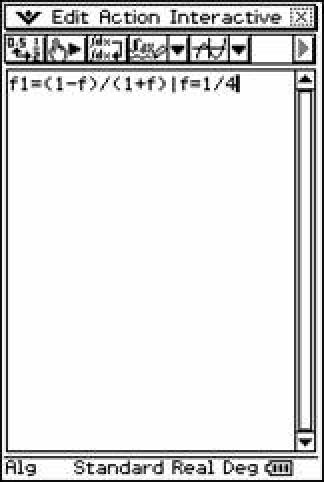
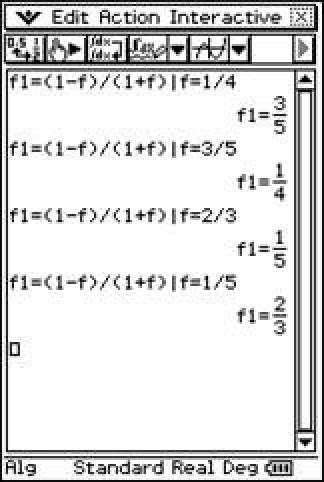
1 Using the main application on your calculator, find the output when f = 1 4 Type f1 = (1 – f) / (1 + f) | f = 1 / 4 and press E.
[The symbol | means ‘with’ and is used for substitution. To locate |, tap k and then OPTN.]
2 a Suppose 3 5 is fed into the machine. The output is fed back into the machine, then the new result is fed back into the machine, and so on for 1000 processes altogether. Describe what happens and predict the final result.
b Repeat a, starting with the fraction 2 3
[There is no need to type the formula again. Highlight the original entry and press G to copy. Tap the next entry line and tap H to paste. Then edit the entry and press E.]
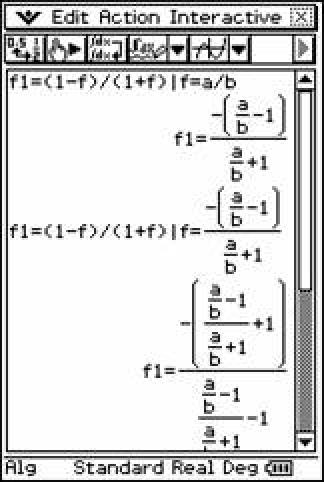
3 If the original fraction is a b , predict the result after one million processes.
To check your answer, use f1 = (1 – f) / (1 + f) | f = a / b. Substitute the output for f. To simplify the result, tap Actions, then Transformation, then Simplify. Copy the previous output, paste after simplify( and close the brackets. Press E
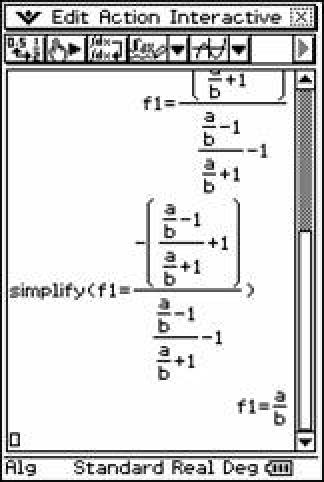
4 Summarise your findings about the fraction machine.
5 Now investigate what happens when you feed a negative fraction into the machine.
[Use the Simplify command to test whether an output in terms of pronumerals can be simplified.]
6 When f =− 3 5 , the machine returns 4. Find some other proper fractions (in simplest terms) that produce a positive whole number. Describe, in general terms, the fractions that return a whole number.
7 Show that the output fora b is equal to ab ba + –. Use this to explain your results from 6.
Try this!
Another fraction machine produces the fraction f2: f f f f 2 2 1 1 = + .
Find outputs for 1 2
anda nd anda nd ,, ,. What do you notice?
Now find and simplify the outputs for f a b = and f = –a b Use the results to explain why the outcome always has the same sign as the original fraction.
Student comment
In this task, you will investigate a machine that feeds on fractions. The fraction machine is f f f 1 1 1 = + , where f is the original fraciton and f1 is a new fraction:
For example, if you feed in 3 5 , the machine
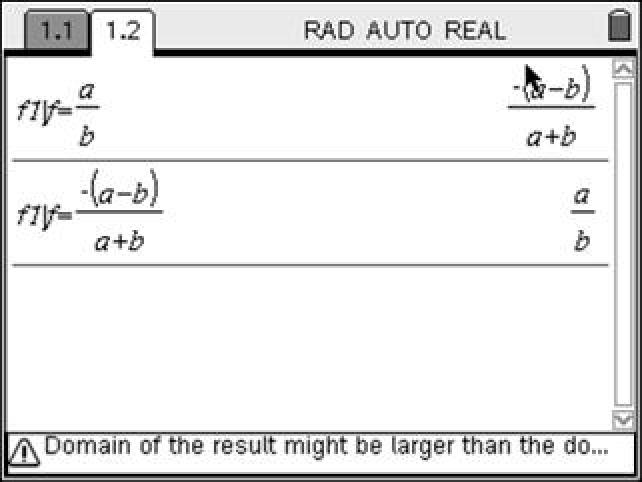
1 Open a new Calculator page and make sure the calculator is in Exact mode. Press b11 to select Define from the Actions menu. Type f 1 = (1 – f ) ÷ (1 + f ) and press ·. To find the output when f = 1 4 , enter f 1 | f = 1 ÷ 4.
[Press I for the symbol that means ‘with’ and is used for substitution.]
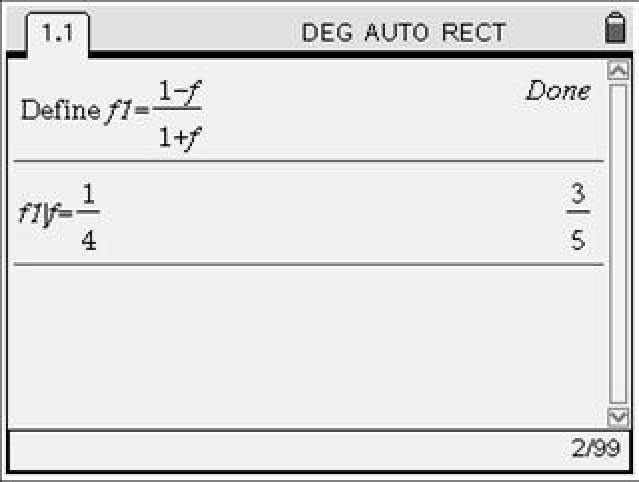
2 a Suppose 3 5 is fed into the machine. The output is fed back into the machine, then the new result is fed back into the machine, and so on for 1000 processes altogether. Describe what happens and predict the final result.
b Repeat a, starting with the fraction 2 3
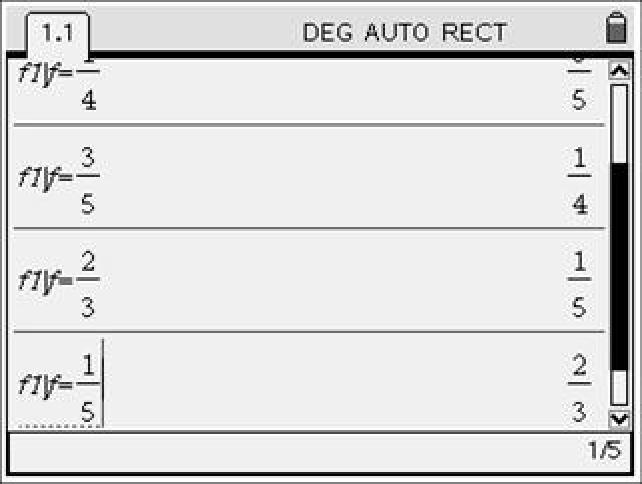
3 If the original fraction is a b , predict the result after one million processes.
To check your answer, enter f 1 | f = a ÷ b. Then, to substitute the output for f, press £ until the output is highlighted and press ·