Understanding Temperature Calibration Equipment in Industrial Applications Accurate temperature measurement is a critical requirement across a wide range of industrial sectors, including manufacturing, pharmaceuticals, food processing, energy, and aerospace. Even small temperature deviations can lead to product defects, safety risks, regulatory non-compliance, and costly downtime. For this reason, industries rely heavily on calibration practices to maintain measurement integrity.
Temperature calibration is the process of verifying and adjusting temperaturemeasuring instruments to ensure they provide accurate readings traceable to recognized standards.
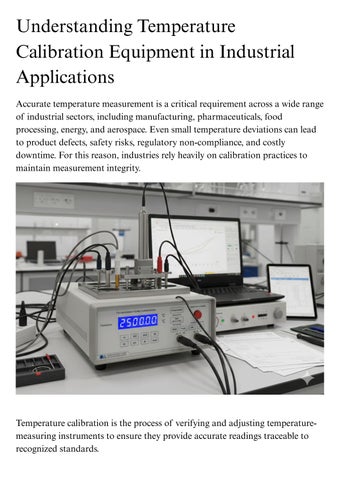
Temperature Calibration Equipment plays a central role in this process by providing stable, repeatable, and highly accurate reference conditions against which instruments can be tested.
Why Temperature Accuracy Matters in Industrial Environments In industrial applications, temperature affects nearly every stage of production and operation. In chemical processing, incorrect temperature readings can alter reaction rates. In pharmaceutical manufacturing, improper temperature control can compromise drug stability and efficacy. In food and beverage production, inaccurate temperature measurements can result in spoilage or food safety violations. Regulatory standards such as ISO 9001, ISO/IEC 17025, FDA regulations, and GMP guidelines all emphasize the importance of accurate and traceable temperature measurements. Without proper calibration, temperature sensors and instruments may drift over time, leading to unreliable data and compliance issues.
What Is Temperature Calibration Equipment? Temperature calibration equipment refers to specialized tools and systems designed to simulate known temperature values with a high degree of accuracy and stability. These devices are used to compare the readings of thermometers, sensors, probes, and transmitters against a reference standard. Common types of temperature calibration equipment include: Dry block temperature calibrators Temperature baths (liquid calibration baths) Reference thermometers Precision temperature controllers Data loggers and readout devices Each type is suited to specific industrial needs, depending on the required temperature range, accuracy, portability, and environmental conditions.
Common Industrial Applications
Manufacturing and Process Industries In manufacturing environments, temperature calibration ensures consistent product quality and process control. Equipment such as ovens, furnaces, heat exchangers, and injection molding machines rely on calibrated temperature sensors to maintain stable operating conditions. Pharmaceutical and Biotechnology Pharmaceutical facilities require extremely tight temperature tolerances. Temperature calibration equipment is used to validate autoclaves, incubators, cold storage units, and cleanroom monitoring systems. Proper calibration supports regulatory compliance and ensures product safety.
Food and Beverage Processing Temperature calibration is vital for cooking, pasteurization, refrigeration, and storage processes. Calibrated temperature instruments help prevent contamination, ensure food safety, and meet health authority requirements. Energy and Utilities Power plants and energy facilities depend on temperature measurement for turbines, boilers, pipelines, and environmental monitoring systems. Accurate calibration improves operational efficiency and reduces the risk of equipment failure.
Types of Temperature Calibration Equipment Explained Dry Block Calibrators Dry block calibrators are widely used in industrial applications due to their portability and ease of use. They feature a metal block with drilled wells that hold temperature probes and sensors. These units are ideal for field calibration and routine maintenance checks. Temperature Baths Liquid temperature baths offer superior stability and uniformity compared to dry block systems. They are commonly used in laboratory environments where
high accuracy and low uncertainty are required, particularly for delicate or high-precision sensors. Reference Thermometers Reference thermometers serve as the comparison standard during calibration. These instruments are calibrated to higher accuracy levels and are traceable to national or international standards.
Benefits of Using Proper Temperature Calibration Equipment Using the correct temperature calibration equipment delivers several important benefits: Improved measurement accuracy Reduced measurement uncertainty Compliance with industry and regulatory standards Extended lifespan of temperature instruments Lower risk of product defects and recalls Consistent calibration practices also help organizations identify instrument drift early, reducing unexpected failures and downtime.
Calibration Frequency and Best Practices The frequency of temperature calibration depends on several factors, including instrument usage, environmental conditions, regulatory requirements, and historical performance. High-risk or critical applications may require more frequent calibration intervals. Best practices include: Maintaining calibration records and traceability Using equipment with known accuracy and uncertainty Performing calibrations under controlled conditions Having calibrations conducted by trained professionals Whether calibration is performed in-house or by an external service provider, the quality of the equipment used directly impacts the reliability of results.
Onsite vs. Laboratory Calibration Industrial facilities often choose between onsite calibration and laboratory calibration services. Onsite calibration minimizes downtime and is ideal for large or permanently installed equipment. Laboratory calibration, on the other hand, offers tighter environmental control and is preferred for high-accuracy requirements. In both cases, reliable temperature calibration equipment is essential to ensure accurate, repeatable, and traceable results.
Conclusion Temperature calibration equipment is a foundational element of industrial measurement systems. From ensuring product quality to meeting strict regulatory requirements, accurate temperature calibration supports safe, efficient, and compliant operations across industries. Understanding how different types of equipment function and where they are best applied allows organizations to make informed decisions and maintain confidence in their temperature measurements. Custom Calibration is designed to support accurate, reliable, and traceable temperature measurements across industrial and laboratory applications. We work with precision calibration equipment used to verify and adjust thermometers, sensors, probes, and temperature-controlled systems to ensure compliance with industry standards and regulatory requirements.