Improve Accuracy and Compliance
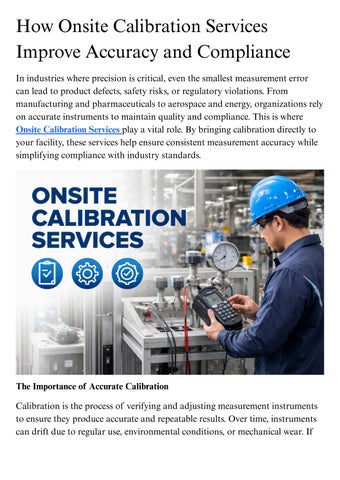
In industries where precision is critical, even the smallest measurement error can lead to product defects, safety risks, or regulatory violations. From manufacturing and pharmaceuticals to aerospace and energy, organizations rely on accurate instruments to maintain quality and compliance. This is where Onsite Calibration Services play a vital role. By bringing calibration directly to your facility, these services help ensure consistent measurement accuracy while simplifying compliance with industry standards.
The Importance of Accurate Calibration
Calibration is the process of verifying and adjusting measurement instruments to ensure they produce accurate and repeatable results. Over time, instruments can drift due to regular use, environmental conditions, or mechanical wear. If
left unchecked, this drift can compromise product quality, process efficiency, and safety.
Accurate calibration ensures:
Reliable measurement results
Consistent product quality
Reduced risk of rework or scrap
Confidence in test and inspection data
Without proper calibration, organizations may unknowingly operate outside acceptable tolerances, increasing the likelihood of failed audits or costly recalls.
What Are Onsite Calibration Services?
Onsite Calibration Services involve trained technicians visiting your facility to calibrate instruments in their actual operating environment. Instead of shipping equipment to an external laboratory, calibration is performed on location using traceable standards and documented procedures.
This approach minimizes equipment downtime and allows calibration to reflect real-world operating conditions, which often improves measurement accuracy compared to offsite calibration alone.
Improving Accuracy Through Real-World Conditions
One of the biggest advantages of onsite calibration is that instruments are calibrated where they are used. Environmental factors such as temperature, humidity, vibration, and electrical interference can affect instrument performance. When equipment is calibrated offsite, these variables may differ significantly from actual operating conditions.
Onsite calibration helps improve accuracy by:
Accounting for real environmental influences
Eliminating changes caused by transportation or handling
Verifying instrument performance under normal operating loads
Allowing immediate adjustments if issues are detected
This ensures that measurements remain accurate not just in theory, but in daily operation.
Reducing Downtime and Measurement Risk
Shipping instruments to an external lab can take days or even weeks, leading to production delays or the use of backup equipment that may not be ideal. Onsite Calibration Services significantly reduce downtime by allowing instruments to be calibrated without leaving your facility.
Reduced downtime means:
Less disruption to production schedules
Lower risk of operating with uncalibrated instruments
Faster identification and correction of measurement issues
By keeping equipment in service and properly calibrated, organizations maintain consistent accuracy across all processes.
Strengthening Regulatory Compliance
Many industries are governed by strict quality and regulatory standards, including ISO 9001, ISO/IEC 17025, FDA regulations, and industry-specific compliance requirements. Accurate calibration is a core expectation of these standards, and proper documentation is essential during audits.
Onsite calibration supports compliance by:
Providing complete calibration certificates and records
Ensuring traceability to national or international standards
Verifying tolerance limits against documented specifications
Supporting audit readiness at all times
Because calibration is performed on location, quality teams can directly observe procedures and confirm compliance with internal and external requirements.
Consistent Documentation and Audit Readiness
Accurate documentation is just as important as accurate measurement. Onsite calibration technicians typically provide detailed calibration reports, including
before-and-after data, pass/fail results, and traceability information.
This documentation:
Simplifies audit preparation
Demonstrates control over measurement systems
Supports corrective actions when needed
Aligns with quality management system requirements
With regular onsite calibration, organizations maintain a clear and defensible calibration history for every instrument.
Supporting Preventive Maintenance Programs
Onsite calibration is often integrated into broader preventive maintenance and quality assurance programs. During calibration, technicians can identify early signs of instrument wear, damage, or instability.
This proactive approach allows companies to:
Address issues before they cause failures
Extend instrument lifespan
Improve long-term measurement reliability
Reduce unexpected downtime
By combining calibration with expert evaluation, businesses gain deeper insight into the health of their measurement systems.
The Role of Expert Guidance
Beyond the technical calibration itself, many organizations benefit from professional guidance on calibration intervals, tolerance limits, and compliance strategies. This is where calibrate consulting becomes especially valuable. Consulting support helps organizations design calibration programs that align with regulatory requirements, operational needs, and risk management goals.
With expert consulting, companies can:
Optimize calibration schedules
Avoid over- or under-calibration
Ensure compliance with evolving standards
Improve overall measurement confidence
This strategic approach strengthens both accuracy and compliance across the organization.
Cost Efficiency Without Compromising Quality
While some organizations assume onsite calibration may be more expensive, it often proves cost-effective in the long run. Reduced downtime, fewer shipping costs, lower risk of non-compliance, and improved measurement reliability all contribute to long-term savings.
When accuracy and compliance are maintained consistently, organizations avoid the hidden costs of errors, rework, and failed audits.
Conclusion
Accurate measurements and regulatory compliance are non-negotiable in today’s quality-driven industries. Onsite Calibration Services provide a practical, reliable, and efficient way to maintain instrument accuracy while strengthening compliance with industry standards. By calibrating equipment in its real operating environment, reducing downtime, and ensuring complete documentation, onsite calibration supports both operational excellence and audit readiness.
When combined with expert consulting and a well-structured calibration program, onsite calibration becomes a powerful tool for maintaining precision, confidence, and long-term success.