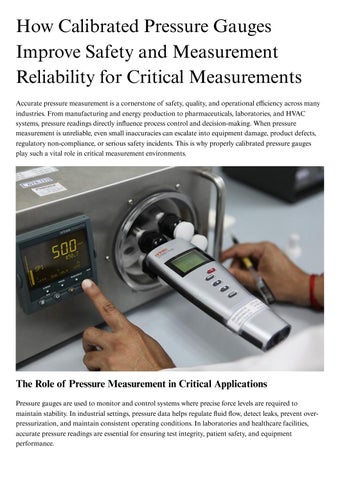
How Calibrated Pressure Gauges Improve Safety and Measurement Reliability for Critical Measurements Accurate pressure measurement is a cornerstone of safety, quality, and operational efficiency across many industries. From manufacturing and energy production to pharmaceuticals, laboratories, and HVAC systems, pressure readings directly influence process control and decision-making. When pressure measurement is unreliable, even small inaccuracies can escalate into equipment damage, product defects, regulatory non-compliance, or serious safety incidents. This is why properly calibrated pressure gauges play such a vital role in critical measurement environments.
The Role of Pressure Measurement in Critical Applications Pressure gauges are used to monitor and control systems where precise force levels are required to maintain stability. In industrial settings, pressure data helps regulate fluid flow, detect leaks, prevent overpressurization, and maintain consistent operating conditions. In laboratories and healthcare facilities, accurate pressure readings are essential for ensuring test integrity, patient safety, and equipment performance.
When pressure readings drift outside acceptable tolerances, systems may operate beyond safe limits without operators realizing it. This can result in system failure, hazardous releases, or compromised product quality. Reliable pressure measurement is not optional—it is a fundamental requirement for operational safety.
How Calibration Directly Impacts Safety Calibration verifies that a pressure gauge is reading accurately compared to a known reference standard. Over time, gauges are exposed to vibration, temperature changes, mechanical stress, and environmental conditions that cause gradual deviation. Without calibration, these deviations remain undetected, increasing the risk of unsafe operating conditions. Properly calibrated instruments help ensure pressure limits are maintained within safe ranges. For example, pressure relief valves rely on accurate readings to activate correctly. If a gauge underreports pressure, systems may unknowingly exceed safe thresholds. Conversely, over-reporting pressure can cause unnecessary shutdowns, leading to downtime and productivity losses. By maintaining accurate pressure readings, calibrated pressure gauges act as an early warning system, helping operators identify issues before they become dangerous or costly.
Improving Measurement Reliability and Consistency Measurement reliability means that a gauge provides consistent, repeatable readings over time. This reliability is essential in critical processes where even minor variations can affect outcomes. In pharmaceutical production, pressure inaccuracies can alter batch consistency. In manufacturing, they can compromise tolerances or damage machinery. Calibration ensures gauges perform consistently across their entire measurement range. It confirms linearity, repeatability, and accuracy, giving operators confidence that pressure data reflects real system conditions. This reliability allows teams to make informed decisions based on trustworthy data rather than assumptions. When organizations rely on Calibrated Pressure Gauges, they reduce uncertainty in their measurement systems and improve overall process control.
Supporting Regulatory Compliance and Quality Standards Many industries operate under strict regulatory and quality frameworks such as ISO standards, FDA regulations, and industry-specific compliance requirements. Accurate measurement data is often a documented requirement during audits and inspections. Pressure gauges that are regularly calibrated provide traceable documentation demonstrating compliance with recognized standards. Calibration certificates confirm that instruments meet accuracy requirements and have been verified using traceable reference equipment. This documentation helps organizations pass audits, avoid penalties, and maintain certifications.
Beyond compliance, calibration also supports internal quality assurance programs by ensuring measurement systems align with established quality objectives.
Reducing Equipment Downtime and Maintenance Costs Unreliable pressure measurements often lead to reactive maintenance rather than proactive prevention. Equipment failures caused by inaccurate pressure readings can result in unplanned shutdowns, emergency repairs, and lost production time. Routine calibration helps identify gauge drift or damage early, allowing corrective action before failures occur. This proactive approach extends the lifespan of pressure gauges and the systems they monitor. It also reduces the likelihood of catastrophic failures that carry higher repair costs and safety risks. By maintaining accurate measurement instruments, organizations can optimize maintenance schedules, reduce downtime, and protect valuable assets.
Enhancing Decision-Making and Operational Confidence Operators, engineers, and quality managers rely on pressure data to make critical decisions every day. When measurements are inaccurate, decisions are based on flawed information, increasing risk and inefficiency. Calibrated instruments provide confidence that pressure readings reflect true operating conditions. This confidence improves response times, supports process optimization, and allows teams to focus on performance improvements rather than troubleshooting measurement errors. Accurate pressure data also enables better trend analysis, helping organizations identify long-term system behavior and implement continuous improvement strategies.
Final Thoughts In environments where safety, compliance, and performance are non-negotiable, pressure measurement accuracy cannot be left to chance. Proper calibration ensures gauges deliver reliable data, protect personnel and equipment, and support regulatory requirements. The use of Calibrated Pressure Gauges is a critical investment in operational integrity, helping organizations reduce risk while improving measurement confidence. For businesses seeking dependable pressure measurement and professional calibration expertise, partnering with an experienced provider makes all the difference. Custom Calibration delivers precisiondriven calibration services designed to support safety, reliability, and long-term performance across critical applications.