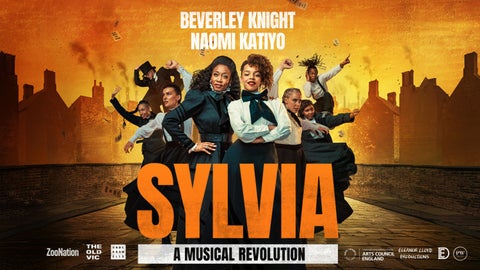
CONTENTS ABOUT THE COMPANY A MESSAGE FROM KATE PRINCE CREATIVES CAST PLOT BREAKDOWN AND SCENE SUMMARY SCENE AND SONG LIST CHARACTER BREAKDOWN SYLVIA IN LONDON: A TIMELINE CONTEXTUAL INFLUENCES ZooNation COLLABORATOR: DANNIELLE ‘RHIMES’ LECOINTE THE SCRIPT: AN INTERVIEW WITH BEVERLEY KNIGHT LESSON PLAN IDEAS - ACTING THE DANCE: ZooNation COLLABORATOR JADE HACCKETT LESSON PLAN IDEAS - DANCE AN INTERVIEW WITH KATRE PRINE, JOSH COHEN AND DJ WADE LESSON PLAN IDEAS - MUSICAL THEATRE THE DESIGN: AN INTERVIEW WITH LIGHTING DESIGNER NATASHA CHIVERS LESSON PLAN IDEA - DESIGN GLOSSARY PERFORMANCE WORKSHEET FURTHER OPPORTUNITIES USEFUL RESOURCES AND FURTHER READING CREDITS
03 04 05 06-08 09-12 13 14-17 18-20 21-22 23-24 25 26-27 28 29-30 31-33 34-36 37 38-39 40 41 42 43 44
ABOUT THE COMPANY
ZooNation, founded by Kate Prince in 2002, is best known for its full-length narrative dance productions which are strongly influenced by Hip Hop culture and music. ZooNation’s work is supported by a dynamic programme of engagement and talent development, helping young artists and communities build skills, knowledge and confidence in our distinctive style of dance theatre.
03
A MESSAGE FROM KATE PRINCE Kate Prince (Book, Lyrics, Director and Choreographer for Sylvia) is Artistic Director of ZooNation: The Kate Prince Company, which she founded in 2002. Kate is an Associate Artist at The Old Vic and at Sadler’s Wells, where ZooNation is also a Resident Company. Productions for ZooNation: The Kate Prince Company include Into the Hoods, Some Like It Hip Hop, The Mad Hatter’s Tea Party, Groove on Down the Road, ZooNation: Unplugged and Sylvia (a coproduction with The Old Vic). The company has also created special performances for Nelson Mandela’s 90th Birthday celebrations held in Hyde Park 2008, the 2011 Laurence Oliver Awards, and the Beijing Olympic and Paralympic Handover ceremonies in 2008. Kate’s TV credits include Strictly Come Dancing, So You Think You Can Dance, Top of the Pops and Ant & Dec’s Saturday Night Takeaway. She recently choreographed the feature film of Everybody’s Taking About Jamie, for which she was also the choreographer of the stage show. Kate received an Olivier Award nomination for Best Theatre Choreographer for the production. In total her extraordinary work has been nominated for three Olivier Awards, a South Bank Sky Arts Award, a What’s on Stage Award, and two Critics’ Circle National Dance Awards. Kate has an MA from Edinburgh University and an honorary PHD from Winchester University, and in 2019 she received an MBE for services to dance in the Queen’s Birthday Honours list.
When I turned 18, I don’t remember rushing out and exercising my right to vote. It hadn’t been made important to me by either my education or my upbringing. It was something I took for granted. I don’t even remember the first time I voted. Amongst many other topics - I hope ‘Sylvia’ will make both women and men think twice about the importance of voting - and about what so many people sacrificed in the UK to win us that right. Sylvia Pankhurst devoted her life to fighting for equality - not just for the working-class men and women in the UK - but in later life she was a radical anti-colonialist, anti-racist and anti-fascist. She was the first person in the UK to employ a black journalist. She lived in Ethiopia, fighting fascism and upon her death was given a state funeral by Haile Selassie and named an honorary Ethiopian. I hope you enjoy studying ‘Sylvia’. Love, Kate
04
CREATIVES Book, Lyrics, Director and Choreographer
Kate Prince
Wigs, Hair and Makeup Orchestraions
Mark Dickman
Resident Director
Bradley Charles
Resident Choreographer
Jaye Marshall
Priya Parmar
Book
Musical Supervisor/Musical Director Sean Green
Cosume supervisor
Caroline Stevens
Casting Director
Props Supervisor
Fahmida Bakht
Josh Cohen and DJ Walde
Music Set and Costume
Stuart Burt CDG
Ben Stones Dramaturgy
Lighting
Cynthia De La Rosa
Lolita Chakrabarti
Wigs, Hair & Makeup Supervisor
Helen Keelan
Natasha Chivers & Hector Murray
Sound Video and Animation
Additional Music
Kate Prince
Additional Lyrics
Tachia Newall
Associate Musical Director
Adam Watcher
Digital Music Programmer Lucy Baker-Swinburn
Tony Gayle Orchestra Manager
Oli Briant
Andrzej Goulding
05
CAST BEVERLEY KNIGHT MBE Emmeline Pankhurst
KELLY AGBOWU Mrs Flora ‘The General’ Drummond / Betty Savoy
LAUREN AZANIA Swing
NAOMI KATIYO Sylvia Pankhurst
ZION BATTLES CLAUDIA ROSE-CARLIER Swing
Swing
EBONY CLARKE
Emily Davison / Daisy Parsons
06
CAST ELOISE DAVIES
SOLOMON DAVY
Annie Kenney / Norah Smyth
Prime Minister Asquith / Richard Pankhurst
NATHAN LOUIS-FERNAND
JAYE MARSHALL
Swing
Swing
COLLETTE GUITART
LEAH HILL
Clementine Chruchill / Julia Scurr
Edith Garrud / Mollie Bird
TACHIA NEWALL Keir Hardie/Lord Cromer
UZUAZO O’DAVID Harry Pankhurst
07
CAST CASTELL PARKER
CLEVE SEPTEMBER
Winston Churchill / George Lansbury
Lloyd George / Lord Curzon
KIRSTIE SKIVINGTON Adela Pankhurst
IVANO TURCO
ELLENA VINCENT
Silvio Corio / Sir Almroth Wright
Christabel Pankhurst
KENEDY SMALL Jennie Churchill / Edna Payne / Grace Roe
08
PLOT BREAKDOWN AND SCENE SUMMARY
They were often sent to prison and went on hunger strike. The more violent activists, of which the Pankhurst family were central, became known as suffragettes, a term originally coined by the Daily Mail to ridicule them. Throughout Sylvia, the Pankhurst daughters are repeatedly imprisoned and arrested, often going on hunger strike.
Sylvia tells the story of the suffrage movement at the end of the 19th and beginning of the 20th century, specifically through the story of the Pankhurst family, including Emmeline Pankhurst (played by Beverley Knight) and her daughters Adela, Christabel and Sylvia. Today, all British citizens over the age of 18 share a fundamental human right: the right to vote and to have a voice in the democratic process. But this right is only the result of a hard-fought battle. The suffrage campaigners of the 19th and early 20th century, including the suffragists and suffragettes, struggled against opposition from both parliament and the public to gradually gain the vote for the whole population. At the end of the 19th century, there had been small, peaceful protests by a group known as the suffragists. The group was made up of mainly middle-class women and campaigned peacefully. The organisation built up supporters in Parliament, but private members’ bills to give women the vote all failed. In the year 1903 (where the show Sylvia begins) the Women’s Social and Political Union (WSPU) was founded by Emmeline Pankhurst in Manchester. The group also consisted of middle-class women, who felt pushed to take a less peaceful approach to gaining the vote than the suffragists, including making bombs and setting fire to buildings, heckling politicians, holding marches, chaining themselves to railings, attacking policemen and smashing windows to make their voices heard.
09
PLOT BREAKDOWN AND SCENE SUMMARY There were two major political parties — the Conservative Party and the Liberal Party. Around the same time, Keir Hardie was a politician who was setting up a new party, the Labour Party, which at that time was very small with Hardie as the only MP. In Sylvia we see how the party is transformed from having one seat to having 27 seats in a general election, giving them much more power. Hardie marked himself out as a radical with the subjects he advocated for, including free schooling, pensions, Indian self-rule and importantly, women’s rights. He became very close to the Pankhursts (almost certainly having a romantic affair with Sylvia Pankhurst) and was inspired to throw himself into the cause of women’s suffrage. He was a speaker at the major demonstrations in favour of votes for women. He was also a pacifist. Whilst he supported the suffrage movement, he had difficulties with the more violent aspects of the protests. Another character who features prominently in Sylvia is a young MP who goes on to become Home Secretary and later Prime Minister — twice. His name is Winston Churchill. In his early career, Churchill was part of the Conservative Party, before defecting to the Liberal Party over disagreements, and then later back to the Conservative Party where he was Prime Minister during the Second World War. In Sylvia, we see Winston Churchill as a young MP in Manchester, where many of the WSPU demonstrations were taking place. Unlike Hardie, Churchill was not a supporter of women’s right to vote, as is seen in Sylvia. We also see that Churchill’s mother, Lady Jennie Churchill, was fiercely against women’s right to vote; however, Clementine Hozier, later Clementine Churchill his wife, was defiantly in favour of the suffrage movement, which caused many arguments as you will see in the show.
10
PLOT BREAKDOWN AND SCENE SUMMARY Whilst the suffragettes protested by more aggressive means, often there were debates about the use of violence. In 1910, a Conciliation Bill allowing some women the right to vote containing over 250,000 signatures is approved by Prime Minister Asquith however, it does not pass through the various committees. In response is an event that becomes known as ‘Black Friday’. Three hundred women march on Parliament to petition Prime Minister Asquith and are met by police. A six-hour period of intense violence and assaults takes place. Witnesses allege that sexual assault took place at the hands of police. Over 100 women are arrested, although all following charges were later dropped. Winston Churchill (now Home Secretary) refuses to undertake an inquiry into the events of the day. Four days later, another 200 women march on Downing Street to demand immediate action by Asquith. Both Sylvia Pankhurst and Keir Hardie become more disillusioned with the WSPU and their violent means, moving towards pacifist means and aligning closer with the socialist moves of the Labour Party. In 1913, Emily Davison is killed after she steps out in front of the King’s horse at the Epsom Derby. A member of the WSPU, she intended to disrupt the Derby for the suffrage cause, though her exact motives are unknown. Thousands attend her funeral. With mounting disagreement about the WSPU’s violent methods and whether the vote should be extended beyond middleclass women, Sylvia and Adela are kicked out of the WSPU by their own sister, Christabel, and mother, Emmeline. By 1914, Adela has been forced to emigrate to Australia by her mother, and Sylvia has settled in the East End, establishing the East London Federation of Suffragettes (ELFS) and the free newspaper The Women’s Dreadnought. Against her mother’s wishes, Sylvia continues to put pressure on the government to get the voices of women of the working classes heard. She marches five women from the East End of London to have an audience with Prime Minister Asquith. The women detail the conditions of working women in the East End. Asquith promises to give the subject serious thought.
11
PLOT BREAKDOWN AND SCENE SUMMARY Sylvia continues to put pressure on the government to get the voices of women of the working classes heard. She marches five women from the East End of London to have an audience with Prime Minister Asquith. The women detail the conditions of working women in the East End. Asquith promises to give the subject serious thought. On the brink of war, David Lloyd George, a Liberal MP, attempts to make a truce with Sylvia, promising to support the Reform Bill in due course if the Pankhurst family put an end to militant action. Emmeline and Christabel, now estranged from Sylvia, refuse. In 1915, Keir Hardie dies, and Sylvia loses a companion and long-time ally. In 1916, David Lloyd George replaces Asquith as Prime Minister. By 1917, Sylvia has met journalist Silvio Corio, an Italian anarchist. They will go on to live together and have a son, Richard Pankhurst. They will never marry, something Emmeline will never come to accept as she does not believe women should have children if they are unmarried. In 1918, The Representation of the People Act is passed, allowing women over the age of 30 and men over the age of 21 to vote. Women must be married or home or landowners. While Emmeline and Christabel are pleased, for Sylvia, this has not gone far enough, as working women are still without the vote. She continues to campaign for full suffrage.
12
SCENE AND SONG LIST ACT TWO
ACT ONE The Foundations 1903 ‘First Steps of A Revolution’
The Third Wheel 1906 ‘It’s All Good (Reprise)’
The Alliance 1904 ‘Sisterhood, Solidarity, Suffrage’ ‘Did You See Me?’
The Prisoner 1906 ‘Hey Sis’ ‘Look For the Light’
The Position on Women 1904 ‘It’s All Good’ ‘Women Are Stronger in The Home’ ‘Clementine’
The Little Brother 1910 ‘I’ll Stay By Your Side’
The Portrait 1904 ‘Be The Change’ The Headlines 1905 ‘Make Some Noise’ The General Election 1906 ‘Don’t Let Me Down’
The Case Against Women 1910 ‘Men Are Just Better Put Together Than Women’ ‘One Of the Doomed’ The Conciliation Bill 1910 ‘March Women March’ ‘Be The Change’
The Rebellion 1911 ‘Suffrajitsu’ ‘I Know Where You Live’ The Cat & Mouse Act 1913 ‘You Can’t Force Us’ ‘Catch Me If You Can’ The Price of Freedom 1913 ‘I Don’t Want Blood on My Hands’ The Sacrifice 1913 ‘Way Down’ The Reckoning 1913 ‘What Have We Become’ ‘You’ve Changed’ The Split 1914 ‘Hey Sis’
The New Beginning 1914 ‘I Believe in The Golden Age (Rise Up)’ The Testimonies 1914 ‘Audience With Asquith’ The Italian 1914 ‘Sylvia, Silvio’ The War 1914 ‘What’s Next?’ The Forgotten Women 1918-1928 ‘Hear Me Now’ ‘Stand Up’ The End ‘Rise Up’ ‘March People March’
13
CHARACTER BREAKDOWN
THE PANKHURSTS
SYLVIA (1882-1960)
Second daughter of Emmeline Pankhurst. Won a scholarship to the Royal College of Art in London, a course which she did not complete in order to pursue her political activities. In 1914, Sylvia was expelled from the Women’s Social and Political Union (WSPU) after disagreements with Christabel and Emmeline about the focus of their activities and the lack of democracy within the union. Sylvia argued that they should take a more socialist approach and address issues other than women’s suffrage. Opposed to the First World War, Sylvia also disagreed with Emmeline and Christabel’s support of conscription and the war effort. Sylvia settled and died in Ethiopia, was given a prestigious burial, and buried in a plot reserved for Abyssinian heroes. In 2001, a campaign began for a statue of Sylvia to be erected in College Green, opposite the House of Commons. In 2018 a statue of Millicent Garrett Fawcett was unveiled on the green — the first woman to have a statue there. Five members of the cast of Sylvia, along with Kate Prince, attended the unveiling ceremony. There remains no statue to commemorate Sylvia’s contribution to the cause. Sylvia’s artistic talents were often used on the banners and artwork associated with the WSPU. This includes the three colours of white, (representing purity) purple (dignity) and green (hope).
CHRISTABEL
ADELA
Eldest and most militant of Emmeline’s daughters. She moved to Paris in 1913 from where she directed the attacks carried out by the WSPU.
Third daughter of Emmeline and Richard Pankhurst. Left the WSPU in 1911, strongly rejecting their violent and militant approach. Emigrated to Australia at Emmeline’s insistence (she paid the £20 fare) where she became a Socialist.
(1880—1958)
(1885—1961)
EMMELINE
RICHARD
Founder of the WSPU, and whose name is synonymous with the Suffragette cause. Embarrassed by Sylvia’s common-law relationship (rather than marriage) which meant that Sylvia’s son Richard was born out of wedlock.
Husband of Emmeline Pankhurst, a barrister, who was highly supportive in Emmeline’s fight for women’s suffrage. Stood for election as a Liberal MP.
A statue of Emmeline stands in Victoria Tower Gardens, next to the House of Commons. Her book, My Own Story, was published in 1914.
(1889-1910)
(1858—1928)
(1836—1898)
HARRY Sylvia’s younger brother, who died after contracting polio.
15
THE WOMEN ANNIE KENNEY (1879—1953)
In 1905 Kenney was imprisoned, along with Christabel Pankhurst, after heckling Sir Winston Churchill and Sir Edward Grey at a political meeting in Manchester. In 1906 Kenney attempted to obtain an audience with Herbert Asquith, the Chancellor of the Exchequer, but was arrested. She was offered the opportunity to avoid prison if she would cease her campaigning for 12 months but chose the six-week prison sentence regardless. Kenney was made Deputy Leader of the WSPU in 1912.
NORAH LYLE-SMITH (1874—1963) A WSPU organiser who worked with Sylvia in the East End. She helped to finance their activity.
EMILY WILDING DAVISON (1872—1913)
Joined the Suffragettes in 1906. Endured seven hunger strikes and 49 incidences of force feeding. On the night of the 1911 census, Davison hid in a cupboard in the Houses of Parliament, meaning that she could register it as her address. Davison is most famous for her actions at Epsom Derby. During a race in which the King’s horse, Anmer, was running, Davison ran out in front of the horse. It is thought she may have been carrying a Suffragette flag or may have been attempting to attach a sash or badge to the horse. She was knocked unconscious after the collision and died four days later having never regained consciousness. It has never been established whether she intended to die as a result of her actions at the Derby: she carried a return train ticket in her pocket and had entries in her diary for the week following the Derby. Davison studied at Royal Holloway, University of London, and Cambridge University. In 2017, Royal Holloway opened its new library bearing her name.
CLEMENTINE CHURCHILL (1885—1977)
Wife of Winston Churchill, marrying him in 1908, six months after they met. Supporter of the women’s suffrage movement.
LADY JENNIE CHURCHILL(1854—1921)
Mother of Winston Churchill. Opposed the suffrage movement.
EDITH GARRUD (1872—1971)
One of the first female martial arts instructors in the Western world, Garrud trained the WSPU bodyguards in self-defence techniques. Several Suffragettes were trained in Jujitsu.
FLORA ‘THE GENERAL’ DRUMMOND (1878—1949)
Scottish Suffragette who joined the WSPU in 1906. Nicknamed ‘The General’ due to her military style uniform of epaulettes and jackets and riding a large horse. Organised rallies and demonstrations and earned a reputation for being able to deal with hecklers.
JULIA SCURR, BETTY SAVOY, ELSIE WATKINS, EDNA PAYNE, DAISY PARSONS, MOLLIE BIRD: A group of six East End women who were afforded an audience with the Prime Minister, Lord Asquith, to make their case for the vote for working-class women.
16
THE MEN (1856—1915) KEIR HARDIE Founder of the Independent Labour Party, and first Labour MP. Was one of
(1874—1954) SILVIO CORIO Italian anarchist and journalist. Long-term partner of Sylvia Pankhurst who
several men arrested in their support of women’s suffrage. In 1908 he resigned as Leader of the Labour Party and spent the rest of his life campaigning for various causes, including the fight for votes for women. He developed a close relationship with Sylvia Pankhurst.
rejected the idea of marriage. Together they had one child, Richard Pankhurst, in 1927.
WINSTON CHURCHILL (1874—1965) Most well known for being Prime Minister in 1940—1945 and 1951—1955, Churchill was Home Secretary between 1910 and 1911. He refused to engage with the Suffragette’s militant and violent actions, telling his wife Clementine in a letter that, ‘I have told them I cannot help them while the present tactics are continued’.
DAVID LLOYD GEORGE (1863—1945) Was Prime Minister of the United Kingdom from 1916 to 1922. A Liberal Party statesman and politician from Wales. Under Lloyd George’s government, the Representation of the People Act was passed in parliament in February 1918 – extending male suffrage alongside a limited franchise for women.
LORD CROMER (1841—1917)
First president of the National League for Opposing Woman Suffrage — an organisation which was formed by the amalgamation of the Women’s National Anti-Suffrage League and the Men’s League for Opposing Woman Suffrage.
SIR ALMROTH WRIGHT KBE CB FRCSI FRS (1861—1947)
Wright was strongly opposed to women’s suffrage. He argued that women’s brains were innately different from men’s and were not constituted to deal with social and public issues. His arguments were most fully expounded in his book The Unexpurgated Case Against Woman Suffrage (1913). In the book, Wright also vigorously opposes the professional development of women.
GEORGE CURZON (1859—1925)
Was Prime Minister of the United Kingdom from 1916 to 1922. A Liberal Party statesman and politician from Wales. Under Lloyd George’s government, the Representation of the People Act was passed in parliament in February 1918 – extending male suffrage alongside a limited franchise for women.
GEORGE LANSBURY (1859—1940) Was a British politician and social reformer who led the Labour Party from 1932 to 1935. Apart from a brief period of ministerial office during the Labour government of 1929–31, he spent his political life campaigning against established authority and vested interests, his main causes being the promotion of social justice, women’s rights, and world disarmament.
17
SYLVIA IN LONDON A TIMELINE BROMLEY PUBLIC HALL 1913
In 1913, Sylvia founded the East London Federation of the Suffragettes who held their first public meeting at Bromley Public Hall on 14th February. Following this initial meeting the group continued their protest at the local police station where they broke windows. In response Sylvia was arrested and fined, a situation she found herself in again after her first public speech a few days later in the East End.
VICTORIA PARK 1913
In May 1913, Sylvia arranged a march from the East India Docks all the way to Victoria Park. At the park, speakers from the trade unions and Labour Party spoke in favour of rights for women. It was a march of hope and inspiration and was supported by working people. Emmeline and Christabel were not impressed by the support from the Labour Party and as a result they banished Sylvia from the Women’s Social and Political Union (WSPU). From this point, the Bow Branch became known as the East London Federation of Suffragettes (ELFS)
400 OLD FORD ROAD 1914
The East London Federation of Suffragettes had several headquarters in Bow throughout the years with 400 Old Ford Road being their third headquarters. While there, Sylvia also used the building to open an affordable wholesome food restaurant, and provided sanctuary and support to women who were struggling to pay the rent while their husbands were fighting in the First World War.
18
SYLVIA IN LONDON A TIMELINE 45 NORMAN GROVE 1914–1934
During this period Sylvia provided work for local women by setting up a toy factory, with a creche for those who had young children. The nursery moved to larger premises in 1915, and the toy factory moved to Kings Cross in 1934 where it continued until the 1950s
WOODFORD 1923
Sylvia’s health deteriorated following a six-month prison sentence in 1921. Following her political and social work during the First World War, Sylvia decided to move to Woodford along with her partner Silvio Corio. They set up a home at the Red Cottage in Woodford Wells and had a son. While in Woodford she continued her political career and developed her interest in Ethiopia, where she eventually moved to in 1956 and spent the rest of her life until she died in 1960.
CLERKENWELL GREEN 2026
Clerkenwell Green was the start of London’s first May Day march in 1890, is home to the Marx Memorial Library and is dubbed ‘the headquarters of republicanism, revolution and ultra-non-conformity’. The Sylvia Pankhurst Memorial Committee has therefore chosen it as the ideal home for a memorial statue of Sylvia Pankhurst, which they have been campaigning for since 1988.
19
SYLVIA IN LONDON THE ROYAL ALBERT HALL The Royal Albert Hall was the venue for some of the most memorable speeches and events in the fight for women to gain the vote. On almost thirty different occasions between 1908 and 1913, the Hall found itself at the front line of the women’s struggle, hired by several different militant and pacifist suffrage groups, as well as the National League for Opposing Women’s Suffrage, as a location for their meetings.
“Every seat in the great Albert Hall was sold long before the day of the meeting, and hundreds of people were turned away at the doors. The vast audience was composed almost entirely of women, and there were 200 women stewards in white dresses.” The Women’s Social and Political Union (WSPU)’s Sylvia Pankhurst describing their first meeting in the Hall, April 1908
Perhaps unsurprisingly, by April 1913 after the escalation of violent and destructive acts, the Trustees of the Hall (along with many venues in London) banned Emmeline Pankhurst, her daughters, and the Women’s Social and Political Union from further use of the Hall. The militant suffragettes had become the first political group to be banned by the Hall’s trustees! Although full suffrage didn’t come until 1928, after some women were given the vote in 1918 the Hall relaxed this ban. On 16 March 1918 the suffragettes hired the Hall for a special Celebration of the Women Suffrage Victory meeting, where Mrs Pankhurst and her daughter Christabel both spoke.
20
CONTEXTUAL INFLUENCES HISTORICAL AND POLITICAL FACTORS: FAMILY RELATIONSHIPS
Sylvia explores the ways in which relationships between the Pankhursts changed because of Christabel’s close relationship with her mother and their equally powerful belief in the WSPU cause. In particular, Sylvia was strongly opposed to the violent tactics used as she was a pacifist. The other Pankhurst siblings were undervalued by Emmeline.
A WOMAN’S RIGHT TO VOTE
In 2026 we might take our voting rights for granted. However, it is still only under 100 years since all women over the age of 21 were granted the vote in 1928. (The voting age was lowered to 18 in 1970 following the Representation of the People Act 1969).
FREEDOM OF SPEECH
Throughout the WSPU activities, their approach was to disrupt rallies and speeches. They were often shouted down by others (both men and other women who disagreed with their fight for equality).
LAW AND THE RIGHT TO PROTEST
The WSPU and those demonstrating in support of them were treated roughly by the police, and Black Friday was a particularly low point in the relations between law enforcement, government and those wishing to protest. Subsequent treatment of those on hunger strike in prison amounted to torture.
POLITICS
The political landscape in the early 20th century was a rapidly changing one. The founding of the Independent Labour Party, the defection of Churchill from the Conservatives to the Liberals and the impact of the First World War, all had implications for the suffrage cause. Sylvia’s father, Richard Pankhurst himself had been a founding member of the Manchester Liberal Union and so Sylvia was born into a political family.
PEACEFUL PROTEST
In contrast to the militant approach used by the WSPU, the National Union of Women’s Suffrage Societies, led by Millicent Garrett Fawcett (aged only 19), took a peaceful approach but was overshadowed by the hostile responses to the methods of the WSPU.
21
CONTEXTUAL INFLUENCES SOCIAL FACTORS
GRIEF
VIOLENCE
The Pankhurst family lost Richard Pankhurst in 1898, and Harry in 1910. In addition, the family rift emerged as the daughters formed different opinions about the direction of the WSPU. This led to Adela and Sylvia both emigrating to other countries — suffering a different type of grief at their separation.
In the subsequent shaping of the Suffragette history, it is easy to forget that their campaign involved arson, bombing houses and postboxes, attacking individuals and cutting communication networks. In today’s climate we might assign the label of ‘terrorist’ to those who undertook such actions.
ADULTERY AND SOCIAL NORMS Sylvia went against social norms by dating KeIr Hardie the leader of the Labour Party, a man who was almost twice her age and married. Despite all the good things Sylvia Pankhurst fought for to gain better women’s rights she did this whilst also betraying other women, Keir Hardie’s wife and her mother Emmeline Pankhurst, who was the same age as Keir and his friend.
22
ZooNation Collaborator DANNIELLE ‘RHIMES’ LECOINTE IN 2022 ZOONATION: THE KATE PRINCE COMPANY WELCOMED ITS FIRST EVER ASSOCIATE ARTISTIC DIRECTOR DANNIELLE ‘RHIMES’ LECOINTE. HERE IS WHAT RHIMES HAS TO SAY ABOUT HER NEW ROLE AND WHY SHE BELIEVES COLLABORATION WITH OTHERS IS KEY. “For me the role of an Associate Artistic Director looks at how the systems, processes and team can accentuate the artistry and how it can support what we are working on behind the scenes. I see myself as an artist and creative through and through but now being on this side of things I get to look at things in a different perspective and consider how I can make what we do even better. How can I work on the processes we have in place and have a further vision of the long-term goal and what we want to create in the future? Kate is the boss; she always has the final say and productions are her vision. However, I believe my role is to also challenge this at times, look at how we can expand on Kate’s vision and to see if we can think differently about it; I get to challenge Kate’s creative thinking and the teams, to push our limitations and try and look at where we are not thinking outside of the box. What’s great about Kate and I being able to work together in our roles is that we get to share the load, there is only so much one person can do. So, my role is to fully support Kate so that we can reach more people, create more work and support her with the growth of ZooNation as a company.
I believe collaboration is fundamental to a successful production. I think that everything I personally produce is about collaboration, I cannot create my vision without all the other creatives involved. I stand by the ethos of if you are set designer, producer or sound you should have free range to sit in your craft and bring your ideas to the table; that is super important for me. So even though I have my own vision, I cannot produce that on my own as no man is an island and so it is about working with those people, depicting it together. The same way I am here to challenge Kate’s creative thinking those people are here to challenge mine too and I then challenge theirs, for me this is what true collaboration is. This is the same for the cast, it is about allowing them to sit in their own artistry and give them material that they can personally interpret, and it’s beautiful to watch that unfold before exploring it together as artists.
23
ZooNation Collaborator DANNIELLE ‘RHIMES’ LECOINTE WHAT IS YOUR TECHNIQUE AND CREATIVE APPROACH TO CREATING WORK AND DEVELOPING A SPECIFIC ROLE OR SCENE? First, it depends on the work I am creating, the way I approach Hip-Hop theatre would be different to musical theatre or a straight acting scene. I use the picture postcard technique, so creating still moments before incorporating movement to help bring those stories to life when it comes to dance with a story-based number. However, if I am working with a script and I have text I want people to read that text and hear it organically. In the same way we naturally have conversations, seeing how we respond and how we react. So, what does that mean creatively as actors in a space? Let’s see how we respond and react; let’s find the nuances and what doesn’t work. Then it’s music - which is a huge part in my creative practice as I do work with dance most of the time. Music influences how I move, my mood and how I put things together. I see creativity like having a giant pot and you pour a lot of ideas in and pick things out to try and challenge – it must be playful a lot of the time.
AN EXAMPLE OF THIS IS WHEN I WORKED ON THE SCENE ‘AUDIENCE WITH ASQUITH’: The scene is about five women who are giving a testimonial in Parliament to politicians to try and get women the vote. They are talking about real life stories that have been weaved into the show and the scene doesn’t have any choreography, it is all about what they are saying, the delivery of those lines and the meaning of that. I had a day where I spent time with them and we looked at their back stories, how do the women connect to each other? Where are they? How long have they known each other? What are the secrets that the audience don’t know but influence how we view them? That is an important thing for me, what is hidden but helps us as an audience really see who you are. I just had time to spend with them and pull out.
all that information and play with it. By the end of us running it the second time everybody was in tears! The actors were in tears, the creatives were in tears watching it and I was trying to give them feedback whilst in tears myself. It was such a beautiful moment. Being able to work with such amazing artists and pull things out of them is beautiful. It isn’t just about delivering something it is about us as artists being able to experience it with you as the audience and realising what we are saying, who we are saying it for and why it even exists – truly representing these people whose stories we are getting to tell. That was my favourite thing to do in this whole process.
WHAT DID YOU USE AS INSPIRATION TO HELP WITH THE CREATION OF SYLVIA? Images are a big thing for me because I am a visionary and I like to see things. I looked at images of suffragettes in general and how they moved and stood. I also used research that was already in existence including this incredible pack Ben Stones (set and costume designer) had put together. I also rewatched the Suffragette movie and just tried to really get into the zone of it and what it means. I sat with the music a lot to understand the rhythms too as there are so many. Kate also has a very clear vision of what she wants it to look like in her head so a lot of it is her vision. Sometimes when you come in as an Associate Director you are there to accentuate that vision; sometimes it can be like this isn’t mine so this might not be what I would do but I can’t change it. Other times I can sprinkle my own artistic flair on parts, some Rhimes sauce and vision to help with what Kate is doing. It’s about watching how Kate is moving in the room; just really watching and listening to what it is that she wants to do. Often Kate will give a brief of what she wants a scene to feel like, so it is about considering what is needed for the scene to feel that way.
CAN YOU GIVE YOUR TOP THREE TIPS FOR WORKING WITH OTHER CREATIVES TO MAKE A SHOW SUCCESSFUL? 1. Listen. Listening to each others ideas and be willing to try them whether they make sense to you or not is vital. 2. Being willing to fail. Find the things that do not work, because the things that do not work will eventually get you to the things that work. 3. Prioritise play and imagination. Often we dim down our imaginations which can be detrimental. Get still, listen to the music, read the text, go for a walk to dream and imagine it
WHAT ADVICE WOULD YOU GIVE TO AN INSPIRING PERFORMER WISHING TO ENTER THE PROFESSIONAL INDUSTRY? Look at who you want to be like. Don’t compare yourself but get inspiration from those who are in the industry and are where you want to go. Research them, read up on what they did. This doesn’t mean you have to do the same thing, but it allows that inspiration to come to you. Who can you be around, follow or ask questions to? Who can you email? You may not get an email back but just putting yourself out there is going to give you confidence. It is about getting into the types of environments the people you want to be like are in. To learn about Rhimes' creative biography visit this link for more infomation
24
THE SCRIPT - AN INTERVIEW WITH BEVERLEY KNIGHT HOW HAVE YOU GONE ABOUT RESEARCHING YOUR ROLE IN SYLVIA? “I’m very much interested in history and would describe myself as a history anorak! There is also a famous Wolverhampton Suffragette, Emma Sproson, who became Wolverhampton’s first female councillor so I take pride in that connection. This show is important now because history also reflects the world in its current state. Helen Pankhurst asked women to contribute a Pledge for 2028 which marks the centenary of universal suffrage in the UK. Mine would be: ‘By 2028, I would hope that we see the need for movements like #MeToo as a thing of the past. I hope that we will all look back on this time and never even dream of behaving in that way.’ In our society, women bear the brunt of any kind of inequality. Today we need to fight the inequality of pay which still exists. I find it incredulous that such a thing still happens. My favourite moment in the show so far is the depiction of Black Friday where we break the fourth wall and show the point of view of the women who were attacked and assaulted as they tried to march to Parliament. You see these women, standing strong and powerful, but also see the brutality of the police as the violence begins.
Emmeline Pankhurst is a very strong woman, and in my performance, I’m trying to show her complexity. She was very clear in her favouritism towards Christabel, who was the main strategist for the WSPU and the Suffragette cause. The family divisions that happened between the Pankhursts is no different to the way in which Brexit has divided families today. We must remember that Emmeline was a Victorian woman, and family relationships were different then — showing favouritism wasn’t frowned upon. It’s difficult to say that I like Emmeline but I’m enjoying playing her. Emmeline is heroic but inherently flawed, but show me a hero who isn’t.”
25
LESSON PLAN IDEAS ACTING ACTING FOCUS WORKSHOP written by Rachel Howes
There are a lot of dynamic relationships in the production of Sylvia, but I particularly love the Churchills’ story. In the scene It’s All Good (Reprise) you see Winston Churchill and his mother Lady Jennie and fiancée Clementine. All three characters are clearly struggling with the new family dynamics after Winston became betrothed to Clementine. Lady Jennie is used to being an influential role in Winston’s life, but Clementine who is soon to become his wife has a different outlook on things, especially on the matter of suffrage and wants things to be done her way. Winston clearly feels in the middle of two such strong minded, powerful women and wants to upset neither party. For the director this scene is all about characterisation for the relationship triangle to unfold clearly for the audience.
TEACHERS PREPARATORY ACTIVITIES: • Download and print a copy of the script for It’s All Good (Reprise) for each student. • Gain access to IT facilities for the lesson as students will need this for research. • Download a copy of the It’s All Good (Reprise) backing track.
26
LESSON PLAN IDEAS ACTING STARTER:
Divide students into groups of three and ensure each student has a character to play. Ask students to have an initial read-through of the script whist thinking about the message behind the scenes.
ACTIVITY ONE:
Read students the above statement about the scene. Give students a short period of time to go away and conduct some background research into their character, particularly their political stance. They may wish to also look at images to gain a greater understanding into how to embody their character too.
ACTIVITY TWO:
Ask students to write a diary extract in character. In particular, writing about how they feel about the new family dynamics and the effect this has on their everyday life and political stance. Once students have had independent time to complete this you may wish to ask some to read them aloud as good examples.
ACTIVITY THREE:
Now get students to re-join their trios and work on the scene. They should focus on their new understanding of their character and apply this knowledge and inspiration to the characterisation of their performance. Ask them to also spotlight their use of action/ reaction when exploring the scene and how their character reacts to another’s line.
EXTENSION ACTIVITY:
This scene is performed using sprechgesang, a type of dramatic vocalisation which sits between speech and song. Play the backing track for students and ask them to consider how they would use sprechgesang to perform in time with the melody
PLENARY:
Ask students to complete a peer assessment on one another’s performances before writing a reflective journal on the workshop process and what they have learnt.
27
THE DANCE - ZOONATION COLLABORATOR JADE HACKETT CAN YOU DESCRIBE YOUR CREATIVE PROCESS FOR THE CHOREOGRAPHY AND WHAT YOU DID TO BRING YOUR VISION TO LIFE? I would always start by looking at the scene and asking the fundamental question what does this section need and what is the story trying to be told. Sometimes simplicity with the steps is the best, as the scene has a strong intention and drive, so we just need to create exciting movement to illustrate that moment. Sometimes it is foundations, like funk and soul that are needed, or sometimes it is more contemporary/lyrical movement that best tells the narrative. It also depends on what style the music is that will dictate the style of choreography.
CAN YOU DESCRIBE HOW YOU COLLABORATED WITH KATE PRINCE AND THE PERFORMERS TO USE DANCE TO COMMUNICATE YOUR STORY AND INTENTIONS TO THE AUDIENCE? Fortunately, I have worked with Kate for many years now, so I feel that as a creative practitioner I understand a lot of her process and methodology, so we have a good shorthand on how to work together. The narrative and story always come first, so we stage and block the pieces first and then we ‘colour’ it with the choreographic steps.
IF YOU COULD GIVE ONE PIECE OF ADVICE TO ANYBODY WANTING TO ENTER THE PROFESSIONAL WORLD OF DANCE, WHAT WOULD IT BE? Utilise the time you have whilst you’re training to cultivate your own creative voice… I think there are plenty of opportunities to learn how to execute different genres of choreography, but knowing and understanding yourself and what you have to offer the industry is no one else’s responsibility but your own. Spend time to learn that about yourself, so you can forge that career that suits who you are as an individual.
WHAT DID YOU USE AS A STIMULUS TO HELP WITH YOUR CHOREOGRAPHIC PROCESS FOR SYLVIA? WAS THERE ANYTHING THAT KATE PRINCE ASKED YOU TO DRAW ON AS INSPIRATION?
I would say that the character of who’s story was being told was the main stimulus. Two sections that specifically come to mind as examples are Jennie Churchill’s song WOMEN ARE STRONGER IN THE HOME and Clementine’s song ONE OF THE DOOMED, which are the 2 sections I choreographed. For Jennie Churchill’s song I drew on the angle that we gave to her character of having a Jamaican/Dance Hall background, so a lot of those types of steps were used in that choreography. Her character is very loud, brash and controlling so that is reflected in the movement. Much like with Clementine, she is meant to be supported by women of high society positions, so the choreography of the supporting artists in that scene are quite dainty to reflect how they would have been seen in those days.
28
LESSON PLAN IDEAS DANCE DANCE FOCUS WORKSHOP written by Rachel Howes
Teachers Preparatory Activities: • Ensure you have access to the BBC News article from activity one. • Download the opening image from the following article for the starter activity. • Download the song Suffrajitsu from the show Sylvia for students to dance to. • Complete a dance warm up with students prior to beginning the workshop.
“I was really taken by the story behind suffrajitsu and the lengths the suffragettes had to go to just to try and maintain their safety and basic human rights, this helped to inspire the number Suffrajitsu and the physical theatre idea behind the movement, as I really wanted the story to resonate with the audience.” Kate Prince
• You may wish to provide students with a mat to work on in activity two.
29
LESSON PLAN IDEAS DANCE STARTER:
Show students the image of Edith Garrud demonstrating jujutsu techniques on a volunteer, but do not tell them what it is about. As a group or individually ask students to brainstorm what they feel they see in the collage of images and share these as a class.
ACTIVITY ONE: As a class read the article by BBC News about Suffrajitsu to help students gain a better understanding of the images and the story behind them. Explain to students that Jiujitsu is a type of martial arts fighting method that does not include the use of weapons. It involves, tackling, holds, throws, hits, kicks. However, Jiujitsu was also seen to be a gentle method of martial arts that involves a perception of yielding to the opponents attack to gain a sense of control. Ask each student to work individually and come up with one movement inspired by the suffragettes’ self-defence and the use of jujitsu. Once each student has a movement join everyone’s movements together to create a short motif. This is about students collaborating to create the motif and they should work together to come up with the best order to ensure the movements flow.
ACTIVITY TWO: Group students into pairs. Ask them to create a short call and response duet based on the images of Edith Garrud demonstrating jiujitsu on a volunteer. You may wish to allow students to use mats here. Remind students this is not about actually preforming jiujitsu on one another but instead, coming up with physical, theatre-based movements or gestures to help represent the idea of jujitsu being performed through dance to music. Once they have completed their duets ask students to adjoin these to the original short motif they created as a class. And practice performing this to the Suffrajitsu song from the show.
EXTENSION ACTIVITY:
You may wish to allow students time to a) teach their choreography to other pairs b) to join them together or c) create a performance piece where they incorporate different techniques such a formations, transitions, unison, canon, fragmentation, levels, dynamics and travel sequences.
PLENARY:
Allow Each group to share their performance with one another before writing a reflective journal on the workshop process and what they have learnt.
30
COLLABORATING WITH OTHERS | AN INTERVIEW WITH KATE PRINCE, JOSH COHEN & DJ WALDE Why is a hip hop, funk, and soul musical the perfect medium for the story of Sylvia Pankhurst? Kate Prince: Hip hop writer Alonzo Westbrook said that ‘hip hop is the artistic response to oppression’ and in all the productions ZooNation’s made over the past 20 years, we’ve tackled the theme of oppression, whether it’s the stigma around people with mental health issues or the treatment of refugees globally. When I wanted to work on this story, I knew I wouldn’t change genres from the one I’ve been working in for 20 years and I think Alonzo Westbrook’s quote encapsulates the reason why. Funk feels like revolution to me. It’s the groove and how it sits in your body. I also think if Sylvia Pankhurst was alive today, she’d have been a massive hip hop fan.
Can you tell us about your song-writing process? Josh Cohen: For Sylvia, it happened in two main ways. The first way was very much script and lyrics driven. Kate came up with passages of lyrics and script, just words on a page with no music. Then DJ and I sat with that material and tried to find places we could get a little bit of musical inspiration, or the beginning of a song idea. And once we had an idea, we’d go back to Kate to see if it resonated with her, so that as a unit we could start to create a song. We’d push and pull the lyrical content that Kate had made to find a new musical idea that would best house those words. DJ Walde: The second, and more traditional way we came up with songs, was by brief writing from a section of text when we knew that Kate had an idea of where she wanted to go. This would lead us to a style of music, and we would write three examples based on this style and float them back to Kate to see if any were hitting the right ballpark. Whichever one was the winner we’d develop further.
Which song is your favourite and why?
Kate Prince: I keep having different favourite songs, but currently it’s ‘Stand Up’. In the 2018 work-in-progress, this was written for Emmeline Where does the inspiration for a new song and the suffragettes to sing in response to the death of Emily Davison. come from? DJ Walde: From many places. Sylvia-wise, it’s the script and where we’re at But dramaturgically, this wasn’t the right place for us to do it anymore. I wanted to keep it, so now it’s the song the working men and women sing with it. But, essentially, a lot of our inspiration comes from the pallet of when everybody in the UK gets the vote over the age of 21, apart from music that we like to listen to and make. We all have a shared language around funk, soul, hip hop from the 70s onwards. A lot of the inspiration can four million working class women who are completely left out. It’s about come from a song that seems to fit, or a genre that might work best for the their will not to give up and fight for 10 more years to get the vote. The song has taken on a whole new feel, vocal arrangement, score and area that Kate is working in. context, and it’s the song I can’t stop singing at the moment. Josh Cohen: Sometimes the inspiration is also very much emotion- based. So, we’ve hit a certain moment in the show and Kate knows she wants to achieve a certain emotional feeling, so the next question is: what could communicate that? What style or bit of musical influence could help tell that piece of the story? That’s often a piece of the puzzle.
Josh Cohen: It changes from day to day. I honestly don’t have a favourite. You spend so much time with the songs that your feelings about the music shift all the time — what you like and what you’re into. An example of a piece of music that’s successful in the show is ‘Make Some Noise’ in Act 1 because it manages to take the musical styles and genres that we’re into and neatly beds them together with a dynamic piece of storytelling from Kate, and that’s exciting. It’s exciting in the way that lots of good musicals are exciting; you’re getting a good piece of music and an interesting piece of story, well performed, and well sung. When all those things come together, it’s great. Luckily for us there’s a number of those moments in the show. DJ Walde: There are sections which always ping out at me, but if I had to mention one, it would be ‘Suffrajitsu’ at the beginning of Act 2. It just has an energy and it’s really nice because everyone gets to fly with this song. It’s a real synergy of song, music, and dance, and it’s always an earworm.
31
COLLABORATING WITH OTHERS | AN INTERVIEW WITH KATE PRINCE, JOSH COHEN & DJ WALDE How are the different genres of music used in Sylvia to tell the story? DJ Walde: The genres are chosen from the sound pallet we like to work in, which is mainly funk, soul and hip hop. It also depends on what we’re working on. For example, if there’s a sequence that requires movement, then we know we need something up and funky, so that will dictate the rough sound pallet for that section. Whereas if we’re going somewhere with a lot of dialogue or underscore, we might not want anything too busy, so we’d just use chords underneath it. Kate Prince: It’s interesting because I don’t think we face the question about what genre to use to tell a piece of the story in a particularly conscious way. I think we just do it instinctively — we find ourselves in certain genres that seem to work. We have a wheelhouse of things the three of us like, so in this show that tends to mean we’re often in the land of funk, soul, hip hop and RnB, but we also lean into a more cinematic sound. Each of these genres have light and shade and the ability to be happy or sad, so we try and orient ourselves somewhere within the range of what all these different genres have to offer.
Who are your musical influences and have any of them inspired the songs in Sylvia? DJ Walde: Classically, it’s the pallet we’ve mentioned already. But if we’re going to name some names, it’s Prince, Janet Jackson, any funk, and soul in the late 70s up to the birth of hip hop. And then all that sample-based hip hop from 80–86, De La Soul mainly, and people like A Tribe Called Quest. That kind of conscious hip hop. Basically, all of it, all of the music. Josh Cohen: For me, there’s a really short answer to the question, which is so many musical influences and, yes, many of them have inspired the songs in Sylvia in different ways. There are many different artists in the funk, soul, RnB, hip hop, and even rock at times, arenas that we draw on. One thing we can say for sure is that we’re very aware of our musical influences and try to be selective about which bits of inspiration to take at what point — this is a big part of the job. Kate Prince: ‘I Believe In The Golden Age’ is inspired by Tom Misch. ‘First Steps Of A Revolution’ is inspired by Chaka Khan — specifically, the song ‘Like Sugar’. There’s also a bit of Radiohead and Prince thrown in there. Erykah Badu is top of my list, as well as Aretha Franklin. Beverley Knight is also one of my musical influences — ‘Coulda Woulda Shoulda’ and ‘Get Up’ being two of her many hits.
32
COLLABORATING WITH OTHERS | AN INTERVIEW WITH KATE PRINCE, JOSH COHEN & DJ WALDE How has the music/movement developed since the 2018 work- in-progress run? Kate Prince: In the most basic sense, the music has developed because in 2018 we had been writing for one year and now we’ve been writing for six. We’ve also added some new songs: ‘Look for The Light’ and ‘First Steps Of A Revolution’ are brand new. The Old Vic’s Artistic Director, Matthew Warchus, said to me in 2018, ‘musicals aren’t written, they’re rewritten’. I was a bit like ‘Huh? I don’t get it’. But now, six years on, with the number of re-writes we’ve done, I understand. It just keeps changing throughout the process until the right thing settles. The music has had time and love given to it, and we have a massive music team supporting us now. Josh Cohen: It’s hard for us to have a bird’s eye view because we’ve been so close to the show, but I would say that some of the songs have become better realised versions of what they always were. Some of it has been about editing and throwing things away, because the shape of the play has changed and become tighter and smoother, and the music must respond to that. You’ve got to learn to let go of some of your older songs, which feels hard at the time but it’s ultimately for the best. We’ve also become aware of recurring themes in the show, so we’ve leant into those more. We’ve recognised the themes that have come to represent a character, a moment, or a feeling, and we come back to them in the show by weaving in musical themes. DJ Walde: In a practical way, the script has changed and continues to change, so we’ve had to develop in a way that works best for the script. You can’t get too attached to certain moments because sometimes they must change as the shape of the script changes. Some things from 2018 just aren’t in the same format, they still work in the same way, but there must be practical changes.
How has the music in the show influenced the dance/movement? Kate Prince: Normally, I’m given music, I listen to that music, and I interpret it. But with this show, and all the shows I’ve written with Josh and DJ, the process is quite skewwhiff. Sometimes I’ll have lyrics and the music and dancing will follow. Other times, I know the style of dance, so we start from that and work back. Every song is different. It’s always led by story and a certain dance style will express a particular beat of story. Josh and DJ have so much patience with me when I’m trying to create a piece of dance because they know the dance is everything to me. DJ Walde: Our musical decisions are led by the dance style that we’re working with. It’s not always the case, but if we know that there’s going to be a dance number or a movement number, we know it needs to have a certain energy or pace. If there’s lots of action happening, the number would need a certain tempo, so often the movement is based more on the tempo of the music. Or if we know there’s a particular stylistic thing that Kate’s trying to get across, then we can lean into that. Josh Cohen: It’s almost a thing that works in both directions. At the end of the day, it’s a play, so we’re finding music that helps tell the story in a way that Kate finds effective. Then, once we’ve made the music, Kate responds to it in terms of movement. From time to time, it works the other way round, which is the traditional dance company/ZooNation way. Kate has a strong sense of movement and that comes first because she knows it’s going create a certain feeling in the room. In that situation, we’re working to brief and creating a piece of music that allows her to use that movement.
33
LESSON PLAN IDEAS MUSICAL THEATRE MUSICAL THEATRE WORKSHOP written by Rachel Howes
*Please note this workshop is broken down into activities so that you can complete it in your own time and at your own pace, depending on student ability. When Kate was younger, she watched a political television show called The West Wing, which she loved, and made her think about politics and look at it differently; particularly voting and what it is like to be a woman in this world that we live in. This interest influenced her desire to create this piece about the suffragette movement.
Teachers Preparatory Activities:
• Watch the clip of number ‘March Women March’ on YouTube • Sing through and familiarise yourself with the song, learning the basic melody the basic melody using the instrumental track prior to the Acting Through Song workshop • Use this lyrics sheet or sheet music to familiarise yourself with the themes of the song • Complete a vocal warm up with the students at the start of each section/lesson of the workshops.
34
LESSON PLAN IDEAS MUSICAL THEATRE STARTER:
Read students the above statement about Kate Prince. Give them two minutes to brainstorm as a group everything they feel and think of when they talk about politics and gender in politics. Ask them to particularly focus on what they know about political history, the suffragettes, and women’s rights. Then digest this and discuss as a group, focussing on how politics has changed over time.
ACTIVITY ONE:
Ask students to read through the lyrics as if it were a monologue and they were thinking about the delivery of it from an acting perspective. Ask students to consider the following three questions: 1. What do you think the song is about? 2. What emotions do we think are portrayed in the lyrics? 3. If we looked at emotions as gestures, what types of gestures would make these emotions clear to the audience?
“When I was younger, I became obsessed with a political television show called The West Wing and it really made me think about politics and look at it differently; particularly voting and about what it is like to be a woman in this world that we live in. I wanted to make a piece of theatre about a group of women from over a hundred years ago who had no rights.” Kate Prince
35
LESSON PLAN IDEAS MUSICAL THEATRE ACTIVITY TWO: Explain to students that the focus of this workshop is conveying the political message and emotions of the suffragettes to the audience through acting through song and movement. To do this they must focus of their use of the following skills: • Awareness of the audience • Interaction and response to other performers • Appreciation of the musical accompaniment • Physical skills such as: body language, actions and gestures, facial expressions, energy, and mannerisms. • Ask students to watch the following clip ‘March Women March’ from the show. • Ask students to consider how the cast use the skills listed above to help portray their message clearly to the audience.
ACTIVITY THREE: Break students into smaller groups of 3-4 and give each group a section of the song. Each group will need to create accompanying movement to their section of the song. This may be physical theatre/ gesture based to help portray each line of the song to the audience. For example, for the lyrics “I said stop”, students may push their right hand forward with a flat palm to imitate them trying to stop somebody. This can also be performed individually, in unison or have action/reaction movements to one another in pairs. *Note you may wish for non-musical students to act as the ensemble at the back of the stage who are policing the suffragette’s protest. This is a non-singing role, but they may use props such as batons or hats to create a similar style of movement in response to the suffragette’s protest.
ACTIVITY FOUR:
Give students the opportunity to teach the other groups their section of movement, it is suggested to do this in a chronological order to avoid confusion and allow student to recap and rehearse each section as they learn.
PERFORMANCE:
Once all sections of the movement have been taught join these together to create one whole performance. Remind students when rehearsing this that the sole focus is to provide the audience with a greater understanding of the storyline using acting through song and movement. To make this performance successful they should consider: awareness of the audience; interaction with other performers, body language, actions and gestures, facial expressions, energy, and mannerisms.
36
THE DESIGN | AN INTERVIEW WITH LIGHTING DESIGNER NATASHA CHIVERS Can you describe what you used as a stimulus to help your lighting designs for Sylvia? For this I used a combination of gigs, black and white films, black and white photos, and work that I’ve done with Frantic Assembly, plus some of the ideas Kate and I had on Message in a Bottle, such as some of the spots, squares and corridors.
Can you illustrate how you use different colours, types of lighting and effects to help portray different themes and moods through lighting? Well, the choice for this show was to mainly use black and white throughout, so it has a very monochromatic look to reflect the oppression the women were experiencing at that time and give a sense of an historic black and white film. When we do use colour, it is very bold and bright in contrast, to reflect the moments of hope and joy.
Can you explain how you collaborated with other creatives to bring Sylvia to life? The creative team had a couple of days together, where went through the script scene by scene and Kate explained her vision for each section. Mainly I worked with Andrzej, the video designer, as obviously that is light so we had to work closely and carefully together to compliment one another’s work.
What skills do you consider to be important to fulfil your role as a lighting designer? I would say that you need to be quite calm and laid back. Really, you’re the only department that can’t really prepare too much as obviously you need all the lights and the venue, so you can’t kick into gear until you’re in the space, at which point you have to move quite quickly so you have to keep your head under the pressure. I would also say the ability to be quite sensitive, ultimately, you’re part of a team that is telling stories and making the audience feel something and so in order to do that you have be fairly sensitive yourself in order to create that same emotion for the audience.
How did you begin your career in the world of lighting design and what advice would you give to anyone wishing to follow in your footsteps? Drama schools and lighting design courses are a good place to start, but really you only learn by practice, so I would say just get yourself into as many opportunities as possible to practice your craft. For further information on Natasha’s professional lighting works please visit her website natashachivers.co.uk
37
LESSON PLAN IDEAS DESIGN DESIGN FOCUS WORKSHOP written by Rachel Howes
*Please note you can use students work from the dance focus workshop completed prior to this or the script from the acting focus workshop for activity two. Remember design isn’t just about the design, it is about understanding the directors brief, conducting research to gain inspiration and develop ideas. Then pitching your own ideas in line with the brief, making plans and being adaptable and able to make changes, lots of changes, because there are always curveballs along the way! Most importantly it’s about teamwork and collaborating with others to create a sense of harmony
Teachers Preparatory Activities: • Gain access to IT facilities for the lesson as students will need this for research. • Download and print the supporting gel colour wheel worksheet and initial design ideas worksheet. • Download the supporting PowerPoints for Types of Lighting. • Decide whether you wish to use the script from the acting focus workshop which you will need to download and print in advance or students pre-completed work from the dance focus workshop.
38
LESSON PLAN IDEAS DESIGN
STARTER:
Ask students to research and annotate the colours on the gel colour wheel worksheet to gain an understanding of what different colours can be used to represent on stage for example, emotions, feelings, or tenseness. Once this research is completed you may wish to allow students time to share their research and add additional information which others found to their own colour wheel.
ACTIVITY ONE:
Display the PowerPoint for types of lighting and go through each of the lighting types with the class. Encourage students to make notes whist you do this.
ACTIVITY TWO:
You can either use students work from a pre-completed dance focus workshop of the script from the acting focus workshop for this task. Using either the dance work or acting script discussed above ask students to complete the initial design idea worksheet focusing on their choice of lighting. They will therefore also need to refer to their notes for the different types of lighting and gel colour wheel. Students will need to choose different points from the script or dance that will require different types of lighting or a lighting change and use the table to design this. They should include: • The Cue line/time of when is the lighting going to change. • The type of lighting they wish to use such as a follow spot. • The colour of lighting they wish to use based on the emotion, feeling or intensity they are wishing to create for the audience. • A justification for each of their lighting choices. They will need to consider how each lighting choice impacts the overall performance and what symbolic message might it portray to the audience.
39
GLOSSARY
SUFFRAGE
The right to vote in political elections.
SUFFRAGIST
A person who supports the rights of members of society to vote, including women and members of the working classes who previously could not vote.
HOLLOWAY PRISON
Opened in 1852 this London prison became an all-female prison in 1903. The first Suffragette arrived in 1906. Emily Wilding Davison was held here, and once threw herself down the stairs.
STRANGEWAYS PRISON
SUFFRAGETTE
Opened in 1868, this Manchester prison housed Suffragettes including Emily Wilding Davison and Christabel Pankhurst.
SOCIALIST
nose or mouth into the stomach. Once the tube was in place, fluid or liquidated food was funnelled into the tube. This demanded a number of nurses, a doctor and several wardens who would hold the prisoner down and insert a steel gag to hold the woman’s mouth open. The procedure often induced vomiting and caused long-lasting damage to the health of many of the women who underwent such treatment.
Originally intended by the Daily Mail as an insult, the term describes those fighting through organised protest and often violent means.
Someone who believes in the political ideology of Socialism, the goal of which is to spread wealth more evenly and to treat all people fairly.
PACIFIST
An individual who opposes the use of violence to settle disputes, advocating instead for a peaceful resolution.
HUNGER STRIKE
An individual’s refusal to eat whilst in prison.
WSPU
Women’s Social and Political Union, founded by Emmeline Pankhurst in 1903.
FORCE FEEDING An intrusive attempt to feed someone through a rubber tube which was inserted via the
CAT AND MOUSE ACT
(Prisoners Temporary Discharge for Ill-Health Bill). Replacing the force-feeding of those women on hunger strike, the act allowed women to be released from prison on licence once they had become very weak. They were then given a period to recover (often in nursing homes) before then being recalled to prison. Because force feeding had become so controversial, the Act allowed politicians to place the blame for physical harm on the women themselves. The nickname of Cat and Mouse refers to the way in which cats repeatedly release their captured prey before eventually killing it.
40
PERFORMANCE WORKSHEET INITAL TASKS Are you coming to watch Sylvia live in the theatre? Why not use the Initial Ideas worksheet for students to make notes as they watch the show? You can then use the completed worksheet later to support with their written work.
A THEME/ISSUE
GENRE
AN IDEA
STORYLINE
A SOUND
COSTUME
SET
LIGHTING/SPECIAL EFFECTS
MUSIC STYLE
DANCE STYLE
YOUR FAVOURITE CHARACTER
AN ACTION
A DANCE NUMBER
A PREVALENT LINE OR LYRIC
A MEMORABLE MOMENT
AN UNFORGETTABLE SCENE
Ask students to make notes when watching the show on the following production elements and topics. After watching the show, they can share their views with their peers and add note from others points that they may have missed in a different coloured pen. They can use this later to help them write a review of the show.
41
FURTHER OPPORTUNITIES ZooNation WORKSHOPS ZooNation offers a range of Workshops both virtually and face to face. Workshops re tailored to meet all levels of experience from Key Stage 3 and above. Working with partners we can create and deliver workshops that: Allow students to explore a range of dance styles that originate from Hip Hop Culture including Breakin', House, Groove, Waacking, Krump, Nu Wave, and the funk styles of Popping and Locking. Cover repetoir from the productions Some like it Hip Hop, The Mad Hatter's Tea Party, Sylvia, Ebony Scrooge and Message in a Bottle. Question and Answer sessions to support coursework. Our teachers are the best within the industry, and all are working professionally as dancers and choreographers. All teachers complete regular training with the company to prepare them for their teaching work and all company teachers have a recent DBS check. We also welcome bookings from groups with special or additional needs. ZooNaton is committed to enabling all participants to engage in workshops, equally and with dignity and respect. Email workshop@zoonation.co.uk to book a workshop.
42
USEFUL RESOURCES AND FURTHER READING LINKS
ZooNation.co.uk sadlerswells.com OldVictheatre.com ZooNation Dance on Demand CDMT Accredited Schools and colleges Training Winston Churchill Votes for Women! Huffington Post: Winston Churchill versus the Women BBC: Suffrage sites added to Heritage list Blog: Historiography and Suffragettes History Extra: Suffragettes Reading List National Schools Partnership: Suffragette Social Changers
BIBLIOGRAPHY Avoid Being A Suffragette by Fiona MacDonald, Book House, 2009. Votes for Women: the Pioneers and heroines of female suffrage by Jenni Murray My Own Story by Emmeline Pankhurst, Virago Press Deeds Not Words by Helen Pankhurst Sceptre 2018 Emmeline Pankhurst: A Biography by June Purvis, Routledge, 2018 Death in 10 Minutes: Kitty Marion — activist, arsonist, suffragette. Dr Fern Riddell, Hodder & Stoughton 2018 Votes For Women: The Virago Book of Suffragettes, edited by Joyce Marlow, Virago Press, 2000 Being a Dancer: Advice for Dancers and Choreographers by Lyndsey Winship High Kicks: The Essential Guide to Working as a Dancer by Donna Ross The Theatre Careers Handbook by Stage Jobs Pro
RESOURCES
The National Archives: Suffragettes on File: What did the struggle for the vote involve? The National Archives: Women’s Suffrage The National Archives: The Official Watch List The National Archives: The Hunger Games Information about the hunger strikes. The National Archives: Motoring towards liberation The Suffragette’s use of motor cars during their campaign. What does a dramaturg do? ’The Making of Sylvia’
43
CREDITS
Written by Chantal Spiteri and Rachel Howes Plot Breakdown and Summary by Joseph Hancock Photography by Manuel Harlan Special Thanks To all contributors of Sylvia, from those who supported finanically to those who gave their creativity, time and energy, and most importantly those who come to watch. This show would not have been made possible without any of you. Special mention to The Old Vic and 14-18 NOW