An Introduction to Pride and Prejudice* (*sort of) ���������������� 3 Interview: Isobel McArthur...................................................4-5 The Music.................................................................................... 6 Comedy Staging: Jos Houben Interview...................................7 Interview: Martin Leonard – Associate Director ������������������ 8 Q&A: Finlay Glen - Assistant Director.............................. 9-10 Design inspirations with Ana Inés Jabares-Pita..............11-12 Further reading......................................................................... 13 Lesson Plans..........................................................................14-17 Teacher Worsheet......................................................................18
Education Resource by Carl Woodward Production photographs by Matt Crockett © Moss Empires Ltd 2021
2
An insight into the making of the production of Pride and Prejudice* (*sort of) exploring how Jane Austen’s novel was brought from page to stage. Including a synopsis, exclusive interviews with members of the creative team, and lesson plans.
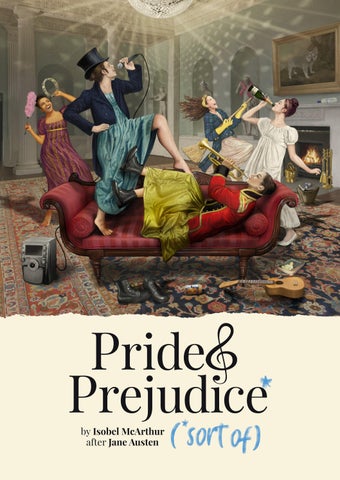
It is a truth universally acknowledged that the British public never tires of re-treading Jane Austen’s classic, from the classic films, TV remakes to stage plays. Isobel McArthur’s Olivier Award winning Pride and Prejudice* (*sort of), which was first staged at the Tron in Glasgow in 2018 is now embarking on a nationwide tour. This female-driven production filters a classic work through a 21st-century lens. It burrows into everweaving themes: racism, sexism, class; the ache of irrelevance; why relationships are worth it, however agonising they get. The terrific cast transform themselves from Austen’s unnamed “below the stairs” staff into the Bennet family and their suitors by slipping on posh frocks in between blasts of karaoke. The entire production canters along like a thoroughbred racehorse; It’s an invigorating ride.
3
“THE future of our industry relies on universal access to creative outlets for young people,” says Isobel McArthur, writer and director of Pride and Prejudice* (*sort of), during rehearsals. McArthur and I meet three years after our first encounter at Holy Innocents, a rehearsal space above a church in Chiswick, where the company of the popular twist on the Jane Austen classic Pride and Prejudice* (*sort of) – produced by David Pugh and Cunard – is rehearsing. “Life is unpredictable, unbelievable,” she says, laughing. “The amount of rug pulls, sudden changes, and things I could never have imagined: they all happened. I should still be pulling pints at the bar; none of this makes sense.” This inventive show started its first national tour in late 2019 and early 2020. Fast forward through a global pandemic, and the show transferred to the West End in 2021 – during difficult Covid-19 restrictions. It went on to win the Olivier Award for Best Entertainment or Comedy Play. Now, Pride and Prejudice* (*sort of) is on a UK tour, scheduled to visit Northampton, Chelmsford, Wolverhampton, Nottingham, Shrewsbury, Bath, Aberdeen, Canterbury, Lichfield, Leeds, Southampton, and more. I caught the show again recently at Newcastle Theatre Royal, and am happy to report that the entire production canters along like a thoroughbred racehorse; It’s an invigorating ride. Does it get harder following success in terms of people expecting things? “Massively,” she says. “‘Success can make life easier in some ways. It might bring in more work. But with that comes enormous pressure. The notion of the ‘difficult second album’ bares out.” “I would hope anybody reading this knows that shows are good because they win awards,” says McArthur. “And artists aren’t less valid if they don’t. If awards count for anything, it’s because of the real-world impact on the professionals involved – our chances of further employment increase, bills can be paid. But whether any play is good – the general public decide that, live, watching it.”
The future of our industry relies on universal access to creative outlets for young people. McArthur completed an undergraduate degree in Scottish literature at the University of Glasgow, followed by an MA in acting at the Royal Conservatoire of Scotland. “When it comes to rules for theatre-making, I’m cautious. There’s good practice of course - and there’s wisdom that comes from experience. But we create a problem when we suggest there’s a rulebook because the question becomes “Who has it? And who doesn’t?” Enough people perceive an exclusivity around theatre and plays as it is.” She perceives a strong sense of impostor syndrome in the theatre industry. She believes that during the creative process, rules tend to create the most formulaic art: audiences don’t want to watch that: “they want a degree of unpredictability,” she says. “The only rule I would take as essential for any process like this is absolutely respecting every single person that you’re working with and cultivating an atmosphere of kindness and mutual support,” says McArthur. “‘We are all in service to the show and to the audience and that must be the only real rule to follow,” says McArthur. “‘When making art, it’s usually when you start to impose too many rules
4
that the imagination is suffocated. I remember sitting down and thinking, ‘What’s the formula?’ If I can figure that out, I’ll be able to make great plays for the rest of my life’, you think. But it doesn’t work like that. Notions of our person success, of earning money, of our egos – these things all alienate us from our creativity. We just need to want to create. We have to go back to basics.” What does she think of the pearl-clutching around swearing in her version of Jane Austen’s text? “The language of exclusion works in many directions,” she says. “One of the things about swearing is that you might say it can offend some people in the audience. In all the places of working-class conversation – whether schools, factories, or households – swearing takes place, and it’s not violent. It’s always self-deprecating. And it’s artful. Nobody ever swears at someone else; they tend to say things like ‘‘F*** me, my life’s a mess!” or “‘Jesus, this is a disaster.’” What, I ask, will success look like for this tour? “Having new audiences see the show who might have felt a bit tentative about seeing period work or costume dramas. I’d love to reach a new generation of audiences who were maybe a bit too young to see it the first time around. And we are going to visit some theatres that we’ve never played before and reach communities that we haven’t engaged with before.”
These are trying times for regional and touring theatre. For instance, it’s hard to escape a strong thread of doom, with widespread cuts to arts funding, a decline in creative subjects in state schools, and recent research showing that arts subjects account for the smallest proportion of A-level entries since 2010. “The arts are essential, not just for mental health and emotional well-being, or for their social lives, but also for their futures.” She shakes her head slowly. “Without access to theatre in state schools, we’re going to leave so many bright young people behind. Pride and Prejudice isn’t brilliant because posh people are fascinating. It’s brilliant because those same high-status people are deeply flawed – and no one is better placed to expose their hypocrisy, their ugliness, their absurdity, than the lower classes,” says McArthur. What’s next? “I have two new big, exciting projects. One of which is a new musical with original songs; all the work I have done previously was with existing songs. This will be the first time we have worked on all new compositions, and that is an adaptation of a brilliant Mancunian novel. I have another project that will see me going abroad.” She is refreshingly straightforward about maintaining focus under pressure. “I am extremely grateful to get to do this for a job. Keep the heid,” she explains is a Scottish phrase meaning stay calm - “It really isn’t a matter of life or death.”
Isobel McArthur has reshaped Pride and Prejudice in a way that Austen could not. Her most inspired idea is to use karaoke as a tool to involve as well as entertain the audience; seeing this show is like a speedread. Whimsical though it may seem, this sort of sideways exploration on display here is invited by a show that filters history through the consciousness of the #MeToo era, making merry with the glamorous superficialities of Regency society – while sneaking Carly Simon and Bonnie Tyler into its storytelling and doing away with many of its inhibitions.
Every Day I Write The Book
Lady In Red
Will You Still Love Me Tomorrow
I Think I Love You
You’re So Vain
Dedicated To The One I Love
Everybody Knows That I Love You
Something Changed
At Last
Young Hearts Run Free
Holding Out For A Hero 6
“Comedy is speed,” says Jos Houben, wryly, “In good drama, things need to move forward. My role is about helping to set up a rhythm sequence between performers and then stopping it, halting it or realising a double take, or even syncopating it. In this show, the way that they present it is directly to the audience and that has a certain urgency to it, like a Commedia dell’arte play.” We are talking between Pride and Prejudice* (*sort of) rehearsals about his role directing the physical comedy on the audacious retelling of Jane Austen’s most iconic love story. He continues: “Therefore, if you lack urgency – which is the key characteristic of this type of physical comedy –the comedy element feels out of place. It is inherent in the style; the higher you go with the tempo the more a body is engaged, the more we suddenly realise the farce of the behaviour, the comedy of the handling of an object or the humour of a simple misunderstanding.” The Belgian-born, Lecoq-trained actor is responsible for the comedy staging on this production. He is a towering figure representing the highest form of physical theatre and clowning today. Houben is internationally acclaimed as a leader in the field of Comedy and Physical Theatre.
“I had seen Pride and Prejudice* (*sort of) before, and I admired it very much,” he says. “I was honoured when producer David Pugh asked me to collaborate on this production. The advantage I have here, of course, is that the outline is there. I don’t have to invent it; it’s in their body because they have the muscle memory and the physical history of telling this story, in their own unique way. He remains fascinated by the craft of comedy staging, which has led to a fruitful life in academic teaching (“I learn as much as I teach,”) but while he is self-aware he is totally determined to remain curious and enthusiastic about his craft. What, I ask, is the secret of good comedy? “Firstly, you have to love it; you need to like it. Of course, the secret is to watch a lot. Because I think that is what is underestimated: imitation.” How did he approach the comedy staging? “For me, the advantage here is that they have rewritten it. Pride and Prejudice is not a play; they have pulled a play out of it with their sense of humour and with their Glaswegian spirit,” he says.
7
With a passion for Theatre and drama at school, his journey has been anything but straightforward. "I didn’t come from a theatre family, and initially didn’t think directing was a job that I could pursue," he says. "I had to discover that it was possible to carve out my own path." During a break from rehearsals, we discuss what the role of an associate director entails. "Often, my job is balancing being helpful without stepping on the director's toes," he explains. "It’s about finding that sweet spot—supporting creativity while also protecting the show’s original vision." With an upcoming UK tour spanning over 30 weeks across various cities, Martin’s responsibilities expand significantly. "Once we hit the road, every venue presents its own challenges. I'm there to troubleshoot issues that arise in different spaces," he says, explaining the unique demands of working at different UK theatres. “Whether it’s adjusting blocking or accommodating sightline issues, my goal is to ensure the production remains true to its original intent." Throughout our conversation, Leonard stresses the significance of maintaining the integrity of the show's vision while allowing room for exploration. He adds that how by Week 12, cast members might forget specifics or innovate in ways that stray from the rehearsed material. "It becomes my duty to remind them of the framework we established during rehearsals while also giving them the freedom to play and keep things fresh," he says. Highlighting the director's role, Martin recognises the delicate dynamics of theatre making. "A good director sets the tone for the entire creative team," he says. On working with Isobel McArthur, he says that she understands the pressure actors face and “fosters an atmosphere of trust and support.”
When discussing the importance of civic pride in regional theatre, he recalls his upbringing in Reading, which was once viewed by Arts Council England(ACE) as a cultural wasteland. “Thankfully, there are now some very interesting theatre companies making work in Reading: such as Reading Rep, Rabble Theatre and Dante or Die!” "Theatres are like community centres; they're vital for fostering creativity and connecting people," Leonardreflects, paying tribute to Leeds Playhouse, leading the charge in community engagement. Are there any books he’d recommend aspiring theatre directors read? 'Directing: A Handbook for Emerging Theatre Directors' by Rob Swain, and 'The Director's Craft' by Katie Mitchell’,” he says. “Both are useful guides for how you can employ clear intellectual rigour to your directing and devise a solid rule-based process (but this as a process might not be for everyone - i.e. you can be more visual, or actor led, or instinctive in your approach)” What is his advice for aspiring directors? "View every opportunity as a learning experience, even if it seems small. You never know what skills you'll acquire that will be valuable down the line," he urges. He reinforces the importance of supporting the director's vision, confessing that directing can sometimes be a lonely path. As our conversation concludes, he reassures anyone with similar dreams. "There’s no prescribed route. Your path might not look traditional, and that's okay. Keep striving, stay curious, and remember that there’s always room to grow," says Leonard.
1. Tell us a bit about you and how you ended up working as an assistant director on Pride and Prejudice *sort of I’m an early career director and stage plays through a theatre company called Dryad Theatre which I run with the producer Georgie Polhill. Georgie is also David Pugh’s assistant, and he came to see the last show that we put on at the Finborough Theatre at the end of last year. David subsequently brought me in to work for him part time and when they decided they wanted an assistant director on Pride and Prejudice* (*Sort of) I was suggested. I met up with Isobel (writer/director) and Martin (associate director) and then was brought on to the team. It’s been a wonderful experience.
2. What is working with Isobel McArthur in the rehearsal room like then? It’s inspiring, because you see the level of skill and intelligence required to make a show like this work. It doesn’t happen by accident. Stylised comedy needs to be so precise, and Isobel has a real command of how it works. I’ve seen shows that adopt a similar tone but are half baked or imprecisely executed and can end up alienating an audience because they can be made to feel outside of the joke, as if it’s funny but they don’t get it. This show is the opposite. It’s inclusive. The audience get what the show is doing at every turn, and the joke, as Isobel says, is therefore on the character, not the audience. That’s because it has been both written and made with an almost scientific, rhythmical precision. As a director she’s also very thoughtful and conscientious, which means every member of the team feels supported and which also ultimately helps the work. That’s been instructive for me.
3. What advice do you have for young people who want to pursue a creative career? Did you come from a theatrical background? If you’re interested in making theatre, then try and see lots of it to work out what you like. There are often schemes in place to help young people go to the theatre on the cheap. Failing that, sneak in at the interval. Or, if you’re not criminally inclined, try and get a job in a theatre. Just see as much as you can. Then, find a way to make your own work. If you go to university then join the drama society - once you leave university, you’ll realise how amazing it is to have resources for making theatre and a ready pool of people you can make work with for free. I didn’t use it as much as I’d have liked to. Once you’re out in the real world you must fund all your shows and pay people, and it all gets harder. But stay positive and try and find a way. It can be done. And work can breed work. If I hadn’t put on my last show I wouldn’t be working on this job - I couldn’t have foreseen that putting on a play in a fringe theatre could lead to me working on this. So, make work, meet people and keep going as long as it gives you joy. I do come from a theatrical background - my parents are both actors. I therefore don’t know how instructive my path into the industry is because, unusually, it was a world I was already somewhat familiar with. For most people it’s a world they discover and must navigate on their own. My previous advice still holds true though! 4. When children in schools 150 years from now are taught ‘Pride and Prejudice Sort of’, what will be the one message their teachers will want them to take away? An English teacher would use it as a bridge to connectwith the novel, because the play is such a playful and accessible adaptation which nevertheless remains trueto the spirit of the original. It’s a perfect way of showing just how funny and satirical and psychologically astute Jane Austen was. A history teacher would use the text as an example of how in the 21st century people began to reinterpret history and culture because of an increased awareness of power relations and how they have shaped society. One of the core messages of the play is that ‘servants are integral to love stories. You try having a whirlwind romance
without clean bedding.’ Isobel identifies this ‘oversight on Miss Austen’s part,’ and applies a feminist gaze on the events of the novel, bringing it into the 21st century. A drama teacher would use it to show just how playful and inventive you can be with theatre. They’d say, ‘See, if you want you can have characters from hundreds of years ago singing karaoke, and you can make birds and storms on stage just using cleaning products. All you need is your own, and the audience’s, imagination. It’s all play, it’s all make-believe, so make it up!’ 5. How did you get into this game? What turned you on to directing? A love of theatre and of reading plays. Directing, when you’re working from text rather than devising, is aboutmediating between the text and the audience, shaping how the text is experienced for the audience. So as someone who loves both reading plays and going to the theatre, it seemed a natural fit. 6. Jane Austen: how would you sum up her impact on society and culture? She’s an eternal artist. She advanced the novel as an artistic form, was a masterful storyteller, and remains unparalleled in her powers of observation: her characters are just as complex and real as you or me. No one is let off the hook. She saw through people and through her society and identified timeless truths about humanity. There’s a reason we still read her today, andwill go on reading her for a long time. She was a genius. 7. Every director has a different way of creating theatre. What’s yours? My practice is still evolving so I couldn’t say for sure. But I think my starting point is always to try and serve the story as best as possible. That’s it for me. Serve the world, serve the story and work towards the deepest and most honest understanding of who these people are and how they relate to each other. And then work hardto make sure that’s being translated to an audience. 8. Is there anything you’d like to add? Enjoy the show - it’s a hoot!
A Costume Designer is the person responsible for designing the costumes for a production, making sure they match the period, style and Director’s vision for the piece, as well as being practical for the Performer. Tim Walker has been a big inspiration for us. He is a fantastic storyteller through very bold images. We adore fantasy and fairy tales! This picture reminded us of the windows at the Tron Theatre in the original production, and a staircase felt like the perfect playground for Georgian times.
We love mess and cakes. Who doesn’t? You need to come to see the show and find where the cakes are! Each scene of the show happens in a different home. One fun way we found to differentiate homes is through the food, drinks and nibbles they offer in each of them.
This image inspired the costumes for the 5 sisters. All the characters are colour coded, so all the character and costumes changes are easier to follow track. Mary looks quite pissed off in this picture! (She wears a pink dress that looks like the pelmet of the Criterion Theatre).
We loved the colours and atmosphere of this one. But we also love the horse!
11
Miss Bingley has too much SHADE, that is whys wears the darkest dress. She wears a beautiful silk tartan dress inspired on Alexander McQueen and Vivian Westwood. Her brother and her match outfits as well as their face.
Fabric shopping in London, TONI textiles, did you know that in this shop is where Bianca del Rio (Ru Paul Drag Race) was recently seen buying fabric for her next sequins dress?
In Georgian times they wouldn’t wear underwear they would wear these undergarments (as you can see in this picture which were semi-transparent with buckets of water on top so they looked like Greek sculptures.)
12
Primary texts (Austen’s novels) and secondary sources (critical analysis, biographies, and articles). Austen, Jane Pride and Prejudice Edited by Janet Todd, Cambridge University Press, 2006. Austen, Jane Sense and Sensibility Edited by Edward W. Said, Penguin Classics, 2003. Austen, Jane Emma Edited by Margaret Anne Doody, Penguin Books, 2017. Tomalin, Claire Jane Austen: A Life Vintage, 1990. Johnson, Claudia L. Equivocal Beings: Politics, Gender, and Sentimentality in the New World University of Chicago Press, 1999. Kaplan, Deborah Jane Austen and the Gendered Politics of Fiction Women’s Studies, vol. 42, no. 3, 2013, pp. 297-318. LeFaye, Deirdre, ed. Jane Austen’s Letters Oxford University Press, 1995. Butler, Marilyn Jane Austen and the French Revolution Palgrave Macmillan, 2016. Harris, Jocelyn Jane Austen’s Secret Radical I.B. Tauris, 2017. Atma Rama [1937-] Woman as a novelist: a study of Jane Austen Doaba House, 1989. Tuite, Clara. Austen’s Political Perception: The Influence of the Novel The Romantic Review vol. 28, no. 4, 2017, pp. 425-444. www.janeausten.co.uk
www.janeaustensociety.org.uk
www.janeaustensworld.com
13
Character Role Play OBJECTIVES •
Students will understand different perspectives by exploring character motivations.
•
Students will develop improvisation and performance skills.
MATERIALS •
Selected excerpts from Pride and Prejudice (focus on key characters like Elizabeth Bennet, Mr. Darcy, and Mr. Collins).
•
Character cards that describe traits and motivations.
INTRODUCTION •
10
mins
Introduce Pride and Prejudice and discuss the social context and main themes.
• Briefly describe the main characters and their relationships.
ACTIVITY 1: Character Understanding • •
15
mins
Divide students into small groups and assign each group a character from the text (e.g., Elizabeth, Mr. Darcy, Mr. Collins).
Provide character cards with information on each character’s motivations and key quotes.
• Students discuss and prepare a short summary of their character’s perspective within a given scene.
ACTIVITY 2: Role Play • •
25
mins
Each group creates a short role-play that showcases their character’s perspective in a pivotal scene from the novel, like the first ball or the proposal scene.
Encourage the groups to add personal interpretations or twists based on their discussions.
• Groups perform their scenes to the class, emphasizing emotion and character motivations.
CLOSURE •
Discuss how the characters’ motivations influence their actions and relationships.
• Reflect on how role-playing enhances understanding of character dynamics in literature.
10
mins
Hot-Seating Character Exploration OBJECTIVES •
Students will deepen their understanding of characters through questioning.
•
Students will practice verbal and non-verbal communication skills.
MATERIALS • •
Chairs for hot-seating.
Excerpts from Pride and Prejudice for reference.
INTRODUCTION •
10
mins
Discuss the concept of ‘hot-seating’ where one student embodies a character while others ask questions.
• Explain the importance of character insights for a richer understanding of the text
ACTIVITY 1: Character Selection •
15
mins
Have students choose a character from Pride and Prejudice they want to explore.
• Each student prepares by thinking about their character’s feelings, motivations, and relationships.
ACTIVITY 2: Hot-Seating •
25
mins
Select one student to sit in the ‘hot seat’ as their chosen character while classmates ask questions.
•
Encourage students to respond as their character would, using knowledge from the text to guide their answers.
• Rotate through characters so that several students have the chance to experience hot-seating.
CLOSURE • •
10
mins
Reflect on the insights gained from the hot-seating activity.
Discuss how understanding a character’s viewpoint can change perceptions of their actions in the story.
• Talk about empathy in literature and its relevance to real life.
Ensemble Storytelling Through Movement OBJECTIVES
•
Students will summarize and convey key events from the text using physical movement and dialogue.
•
Students will develop teamwork and creative representation skills.
•
MATERIALS Excerpts summarising key scenes from Pride and Prejudice.
•
Open space for movement
INTRODUCTION
10
mins
• Provide an overview of a specific scene from Pride and Prejudice (e.g., the first ball at Netherfield). • Discuss how storytelling can convey emotions and plot through ensemble performance and movement.
•
ACTIVITY 1: Scene Breakdown
20
mins
Divide students into small groups and assign each a specific scene to work on.
• Each group discusses the main events, characters, and emotions portrayed in their scene. • Groups create a narrative structure outlining the beginning, middle, and end of their scene.
• •
ACTIVITY 2: Creating Movement
25
mins
Encourage groups to convey their scene through a blend of dialogue, movement, and physical expression.
They should prepare a performance that lasts around 3-5 minutes, focusing on key gestures, positioning, and emotional expression.
• Allow time for rehearsal.
ACTIVITY 3: Performances •
•
20
mins
Each group performs their scene for the class.
Encourage students to watch actively, focusing on the movements and emotions that convey the essence of the story.
•
CLOSURE
10
mins
Reflect on the performances. Discuss how movement and expression can bring a text to life and enhance understanding.
• Explore how ensemble storytelling represents collaboration and shared interpretation in literature.
Session 1 Outline In this session the group will learn how to bring the story of Pride and Prejudice* (sort of) to life physically. They will be asked to create their own movements and tableaux and transitions (or linking movements) between these. By the end of the session, students should be able to have a physical interpretation of the story that can be practiced with music.
LINKS TO THE CURRICULUM PE: Perform dances using a range of movement patterns, sustained physical activity Interpretation of a character emotions and feelings, and showing this physically Active listening and evaluation techniques
WHAT THE GROUP WILL NEED Space to move around and dance on the spot.
WARM UP: Simon Says (Stage Directions Version) A game for helping your students learn stage directions. This game follows the usual rules of “Simon Says.” Students should only do what the caller says if they say, “Simon says.” If they do not put “Simon says” in front of the instruction and the student does it anyway, they are eliminated. The teacher calls out stage directions, such as downstage right or centre. Students can only move to those places on the stage if the teacher says “Simon says” in front of it. Any students who move there otherwise are eliminated. Try to keep the calls coming quickly to keep the game interesting.
TASK 1 Introduce physical storytelling and how we create still pictures to tell a story using our bodies. The children just need to find a space to get ready to be creative with the storytelling task. This would work well as a group exercise with them creating a group image/ tableau. They can all become different characters in each picture they make together Make sure that the images they create are frozen- as you can link these together later. Age: 7 to adult Group size: Pairs Time: 15-20 mins Skills: Improvisation
Status is the key to great improvisation In pairs, create a still image where one of you has a higher status than the other. Show your image to the others and let them guess who is “high” and who is “low”. • Discuss why there may be areas of disagreement • Make another image showing high and low status in a different way • Try to make an image where you have equal status and see if the onlookers agree! After all tableaux’s have been created, lead a re-cap to remember them all together. You may need to pause in between sections of the re-cap if the group need a little longer to get into each picture.
TASK 2 During the time in which Pride and Prejudice (1797) is set, social status played a major role in affecting relationships and interactions with other members of society. In this time, a person’s value depended on their possession of a fortune. In Pride and Prejudice by Jane Austen, the effect of social status is shown through the relationships and statuses of Mr. Darcy, Elizabeth Bennet, Mr. Collins, and Lydia Bennet. Darcy shows the effects of superiority on relationships in his pursuit of Elizabeth. In the beginning, he believes he is too good for Elizabeth and even refuses to dance with her at the Meryton Assembly. 2-3 min to create each transition depending on the group
Mr Darcy (high status)
The Bennett Family (medium status)
Servant (low status)
TASK 3 Think of the physicality of individuals – facial expressions and posture. Once all the transitions have been made, lead a run through of all the transitions and pictures to do together. You may need to pause in between sections of the re-cap if the group need a little longer to get into each picture. Hopefully it should be running together as a smooth piece by this point.
Rehearsal You can rehearse this as many times as you have time for or would like to with your group. A nice way to extend the task for older groups is to add lines from the story or a narrator to their piece, to give a really polished performance.
EVALUATION QUESTION Something to think about at the end of this session and a different way for teachers and pupils to reflect on the session: What is special about seeing a story brought to life using status? How does it make it more accessible for an audience? Students can either write down their answers or you can do this as a class discussion.