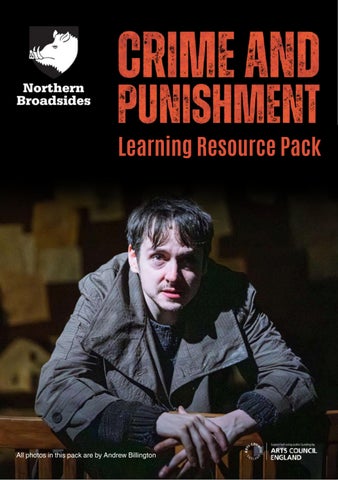
Learning Resource Pack
All photos in this pack are by Andrew Billington
about this pack We hope teachers and young people alike will enjoy our production and find this learning resource pack both engaging and inspiring. Designed to support and enrich the theatre experience, the pack offers a range of ideas, activities, and discussion points to help students connect more deeply with the play and its themes. The materials can be used before attending the performance to introduce key ideas, characters, and context, helping to build excitement and curiosity ahead of the visit. They can also be explored afterwards to encourage reflection, discussion, and further creative or critical responses to the production. With the selection of content included, teachers are encouraged to choose the activities and resources that best suit the interests, abilities, and needs of their students. We hope the pack provides a flexible and enjoyable way to extend learning both inside and beyond the classroom.
2
about NORTHERN BROADSIDES Northern Broadsides is a theatre company based in Halifax, West Yorkshire. We create bold, accessible, and irreverent shows and inspiring creative engagement programmes. We are well-known for producing classic and new plays that resonate with contemporary audiences while celebrating the cultural landscape and diverse voices of the North of England. For over 34 years, Northern Broadsides has toured extensively across the UK and internationally, bringing high-quality theatre to audiences everywhere. Recently, the company toured J.M. Barrie’s Quality Street (2023); a regency rom-com that inspired the name of the famous chocolates, and a bold, refreshing interpretation of William Shakespeare’s As You Like It (2022). Throughout 2024-25 we worked with our local communities to deliver Iron People, a climate-inspired creative project and performances, as part of CultureDale, Calderdale’s year of culture. We also established our first ever youth theatre.
3
CONTENTS SECTION 1 Pages 5 - 16 The World of Crime and Punishment
SECTION 2 Pages 17 - 18 Key Themes in Crime and Punishment
SECTION 3 Pages 19 - 36 Crime and Punishment Workshop Activity Ideas
SECTION 4 Page 37 Young People Production Feedback
4
SECTION 1 The World of Crime and Punishment by Fyodor Dostoevsky Raskolnikov, a poor former student, believes that extraordinary people have the right to commit crimes if it serves a greater purpose. To test this theory, he murders a pawnbroker and her half-sister. After the crime, he becomes consumed by guilt, paranoia, and illness, drawing suspicion from the police inspector Porfiry. At the same time, he struggles with tensions surrounding his family, particularly his sister Dunya’s engagement to the arrogant Luzhin, and encounters the manipulative Svidrigailov, who is obsessed with Dunya. As Raskolnikov grows increasingly tormented, he finds comfort in Sonya Marmeladov, a compassionate young woman forced into prostitution to support her family. Encouraged by Sonya’s faith and kindness, he eventually confesses both to her and to the authorities. Sentenced to eight years in a Siberian prison, Raskolnikov begins a path toward redemption, with Sonya remaining devoted to him throughout his suffering.
5
Dostoevsky started his story in autumn 1865 – toiling at it, he told a friend, “like a penal labourer” – it was a distillation of all the philosophies, influences and experiences he had absorbed over many years. On its publication in 1866, it immediately gripped a society in turmoil, not least because it coincided with a botched assassination attempt on the Tsar. Its revolutionary and original literary style also caused a sensation. Dostoevsky was telling a murder story from the murderer’s own perspective, mining his leading character’s inner world and, in the process, making him human and conflicted rather than simply two-dimensionally evil. Less a whodunit than a ‘whydunit’, Crime and Punishment allowed its writer to explore his own feelings alongside all the ideas that had fascinated him during his eventful life so far: ideas around psychology, morality, inner turmoil, guilt and redemption, and elemental questions about faith and the meaning of life. At the same time, he also took the nihilistic concepts so loved by Russia’s ‘radicals’ and sought to discredit them as dangerous and destructive.
6
OUR PLAY In our version of Crime and Punishment, we brought a bold and playful style to Dostoevsky’s classic novel, his huge canvas of larger-than-life characters brought to life by only a handful of actors. In Crime and Punishment, characters are often called by different names. This is because in Russia, people have three names - a first name, a patronymic (based on their father’s name) and a surname. Which name is used depends on how close someone is to them or their social relationship. First names and patronymics are sometimes shortened into nicknames to show greater familiarity or affection - for instance, Razumikhin calls Raskolnikov “Rodya” because they are close friends. Some characters are referred to mainly by surname, while others may be mentioned without a surname at all.
7
CHARACTERS In order of appearance Rodion Romanovich Raskolnikov – A former student in St. Petersburg, recently dropped out of university Nastasya – Servant for the landlady of the building where Raskolnikov rents a room Alyona Ivanovna – A pawnbroker who often serves the most desperate customers Katerina Ivanovna – Marmeladov’s wife, a hard-working woman Razumikhin – Raskolnikov’s friend from university Dunya – Raskolnikov’s sister Sonya – Marmeladov’s daugher Marmeladov – Sonya’s father, married to Katerina Ivanovna, an ex-civil servant Lizaveta – Alyona’s sister Porfiry Petrovich – The chief investigator Svidrigailov – A wealthy gentleman with a disreputable past
8
The Setting Set in the busy streets of St. Petersburg during the 1860s, Crime and Punishment transforms the city into almost a character itself. The overcrowded taverns, filthy alleyways, cramped apartments, and suffocating heat mirror Raskolnikov’s collapsing mental state and growing moral corruption. His tiny, coffin-like room reflects his isolation and emotional imprisonment, while the chaotic streets expose the brutal inequality and desperation of Russian society. Everywhere he turns, poverty and decay fuel the tension that drives both his crime and his psychological torment. Dostoevsky uses the setting not just as a backdrop, but as a powerful symbol of guilt, suffering, and redemption. The misery surrounding characters like Marmeladov’s family highlights how poverty pushes people into hopeless and destructive situations, while the packed city crowds only deepen Raskolnikov’s loneliness and alienation. By the novel’s end, the move to a prison in Siberia marks a dramatic shift — away from the corruption of the city and toward the possibility of spiritual rebirth and redemption.
9
The SET DESIGN
10
11
12
AN INTERVIEW WITH LAURIE SANSOM We sat down with Northern Broadsides’ Artistic Director and Joint CEO, who has adapted and directed the show, to find out more about the creative thinking behind the production. What drew you to stage this production now? I was thirteen years old when I first read it. My English teacher, Miss Payne, encouraged me to move on from Agatha Christie to something more literary. Ever since then, the book has stayed with me – and for quite a long time, it has given me nightmares! It’s the story of a young man living with the guilt and shame of what he’s done, with the police on his tail and suspicion closing in around him. It’s incredibly gripping. At its heart it’s a psychological thriller: we watch a detective playing cat and mouse with a young man who has committed a terrible act of violence. I come to it differently now, though. What I see more clearly is that Dostoevsky is deeply interested in what drives a young person to commit violence. That feels incredibly relevant today, especially in the context of the huge success of Netflix’s Adolescence. Right now, there seems to be a kind of moral panic around young men resorting to violence. But I think this is something society has always had to grapple with: why do people do it? Dostoevsky was asking that question back in 1866 which is astonishing. 13
Arguably more than almost any other novel, Crime and Punishment is one of those books that people say, “I’ve never read it, but I feel I should.” about. It’s great to know we can put a really dynamic version on stage, so people can spend just two hours in the theatre with us and get to know this story. Hopefully it might encourage people to go back to the book. Tell us about the challenge of condensing a huge novel into a stage show with 3 actors! One of the obvious challenges is deciding what to leave out and what to focus on. Some of that is about dramatic logic, but it’s also thematic – it’s about what you’re most interested in exploring in the story. We’re particularly interested in the psychology, and how to explore that on stage with one protagonist and two actors playing all the other characters. That immediately suggests that these other characters are, in some way, extensions of his own psychology. What we’ve discovered is that there are probably two characters in the book who resist Raskolnikov making them part of his own fantasy or narrative. One of them is Porfiry, the detective, and the other is Sonya, the young sex worker he falls in love with. Obviously, part of the pleasure is watching an actor play lots of different parts, but it also throws up different themes. For example, having one older actor playing Marmeladov, Raskolnikov's Father, and Porfiry suggests that these are all paternal figures. That’s been really interesting, and it’s something I hadn’t really noticed in the book before. 14
The other major aspect is Raskolnikov’s very uncomfortable relationship with women. There’s something clearly misogynistic in his worldview, which the book explores. You have female figures who seem to represent opposite poles: Sonya, who is described as pure, holy, and morally good, and Alyona, the widow he murders, who is described as an old hag – penny-pinching, grasping, and mean. That worldview is built into the novel, and suggests that this kind of toxic thinking is part of what leads someone to commit such an act of violence. Have you made any significant changes in this adaptation? Because we’re intending the show to be pretty faithful to the book, the job really becomes one of filleting it – taking things out, rather than changing very much. It’s all in there if you want it, and you could tell lots of different versions of this story depending on what you keep and what you discard. I’m also keen to bring out the dark comedy that runs throughout the novel. Classic books tend to occupy an earnest, monolithic position in the literary canon, and therefore we assume they can’t possibly be funny or satirical. But I think a lot of Crime and Punishment is Dostoevsky satirising a St Petersburg of desperate inequality. There are definitely some larger-than-life characters in the novel. Raskolnikov himself is multifaceted; he’s bright, described as disarmingly good-looking, can be charming but his most often incredibly blunt, and can also be very funny. The book lets us inside his head, and we’ve tried to capture that complexity. 15
Tell us more about the design and visual story of the show. One of the key approaches we’re taking to the design is thinking about how much of the story takes place in Raskolnikov’s lonely garret room at the top of the house. In the novel, it’s described as being as cramped as a coffin, and sometimes there are four or five people in that room at once. He spends a huge amount of time there, often feverish or ill or just lying in bed thinking. There’s a suggestion that the whole story is almost exploding out of that room, and we’re trying to capture that in how we stage the production. We’re also thinking a lot about transformation: how one thing can become another, so the story can melt between scenes and incidents. This studio tour is a first for Northern Broadsides, can you tell us about the decision to create this piece on a smaller scale? It’s really exciting to be working in very intimate spaces with this story. It’s a new adaptation, written for just three actors, and that made it feel particularly well suited to smaller venues where the audience can be right up close to the action. In some ways, it still feels like a work in progress. We’re adapting a 750-page book, and we’re very conscious that we’re taking things out, shaping it, and wanting to learn from how audiences respond. That feedback feels really important, so that the production can develop and grow as it goes along, and potentially move onto bigger stages later.
16
For now, though, it’s a really exciting opportunity to get very close to a highly intense story. I hope that audiences will be as gripped by the story as I have been since I first read it at thirteen. The story also offers a sense of redemption in the end, and hints at faith – not in an abstract sense, but through the love he develops for another person, through genuine feeling and empathy. I think that’s something anyone who has lost connection and is feeling isolated needs to cultivate. Ultimately the story explores the impact of a horrific crime on the person who perpetrated it, and the process of them taking accountability.
17
SECTION 2 Key Themes in Crime and Punishment Human Nature vs Social Environment Crime and Punishment explores how both human nature and social environment can influence criminal behaviour. Raskolnikov’s decision to commit murder is shaped by the harsh poverty and suffering around him, but also by his own pride, intelligence, and growing sense of isolation. Dostoevsky suggests that crime is rarely caused by one single factor; instead, it develops through a combination of personal beliefs and difficult social conditions. Social Environment The play is set in the overcrowded and poverty-stricken streets of St Petersburg. The city itself reflects despair and moral decline. Raskolnikov lives in extreme poverty, cut off from society and struggling to survive. These harsh conditions increase his frustration and alienation, helping to push him towards the murder of the pawnbroker. This shows how poverty and suffering can damage a person’s sense of morality. Human Nature – The Idea of the Extraordinary Man Alongside these social pressures, Raskolnikov’s own personality also contributes to the crime. He believes he is an “extraordinary man” who exists above ordinary moral rules. His intellectual arrogance leads him to think that some people have the right to commit crimes if it benefits society. This belief separates him emotionally from other people and allows him to justify murder to himself. 18
The Conflict Between Nature and Nurture Crime is presented as the result of both internal and external pressures. Raskolnikov’s dangerous theories combine with the misery of his environment, creating the conditions for violence. However, the play also shows that guilt, compassion, and human connection remain powerful forces within him. His eventual suffering suggests that rejecting morality and humanity leads to psychological punishment. Modern Relevance Crime and Punishment remains relevant in modern UK society because many of the issues explored still exist today. Poverty, mental health struggles, and social inequality can all contribute to crime and feelings of isolation, particularly among young people. Debates about knife crime, youth violence, and the impact of deprivation on communities reflect Dostoevsky’s idea that crime is often shaped by both personal choices and difficult social conditions. This theme of isolated young men becoming disconnected from society is also explored in the TV drama Adolescence, which examines how loneliness, anger, and social pressures can influence behaviour and identity.
19
SECTION 3 Crime and Punishment Workshop Activity Ideas Warm-Up/Icebreaker: “The Oscars Game” (15 mins) Instructions: Break into small groups (3–4 people) Give each group a fake film title (e.g., The Last Honest Person, City of Shadows, The Angry Grandma, The Lovely Turnip) They have 5 minutes to create a 20-second trailer Encourage big energy, bold choices, and quick decisionmaking Sharing: Groups perform their trailers as if they are in the running for the category of Best Picture Purpose: Builds ensemble quickly Encourages creativity without overthinking Gets them physically and vocally engaged Just have fun and breaks the ice
20
Pre-Show Activities Aims of the Activities To introduce key themes: morality, justice, poverty To explore the psychology behind extreme choices To prepare audiences to watch actively and critically Activity 1 Small Group Task: The “Extraordinary Person” Theory A young man develops a theory that some “extraordinary” individuals have the right to break moral rules if their actions ultimately benefit humanity. In groups, discuss: What makes someone “extraordinary”? Who decides? Can intelligence justify harm? Are there historical or modern figures who believed rules didn’t apply to them? Each group writes: 3 arguments FOR this theory 3 arguments AGAINST it Share back and compare ideas
21
Activity 2 Drama Exercise: Moral Dilemma in Action Scenario Work Give each group a moral dilemma scenario inspired by the themes. For example: A student steals medication they can’t afford for a family member. A whistleblower leaks damaging information for “the greater good.” Someone commits fraud to escape poverty. A person believes removing one harmful individual will improve many lives. Groups must create a 3-minute scene that shows: The dilemma The justification The consequences (emotional or practical) The groups will then share back to the others
22
Activity 3 Creative Writing Activity: “Character Thoughts” (10 mins) Write these sentence starters on the board: “Nobody understands that I…” “The thing I can’t escape is…” “People think I’m…” Ask the young people to write a short internal monologue from the perspective of a lonely or struggling character. Then connect it to the performance: “As you watch the show, think about whose perspective you trust and whether the central character deserves sympathy.” This helps them emotionally connect before watching.
23
Post-show Activities Aims of the Session To reflect critically on the production and its themes To explore moral choice, environment, and consequence To connect the story’s ideas to today’s society To encourage creative response through discussion and drama Discussion Activity: Crime and Punishment – Nature vs Nurture Young people go into small groups. Provide each group with paper and pens. Discussion Prompts 1. Is environment a main reason for crime? How does poverty influence choices? Does society create criminals? Is desperation an excuse? 2. The main character and his actions Why does he justify what he does? Does he believe he is morally superior? At what point (if any) does he realise he is wrong? 3. Relevance today Are there modern parallels? Do people today justify harmful actions in similar ways? How do social inequality, pressure, or isolation affect behaviour now?
24
Creative/Drama Activity Reimagining the Themes The Focus Explore crime, morality, guilt, justice, or environment. Consider: What could be different to prevent the main character’s actions? What environmental factors might change the outcome? Who could intervene? Option 1: Performance-Based Create a short scene (2–3 minutes maximum). Must include: A clear setting At least two characters A moral dilemma A moment of decision Option 2: Detailed Scene Plan Create a structured scene outline including: Setting (where/when?) Character profiles (age, background, motivations) The central conflict The turning point Alternative outcome (how events could change) This option suits those less comfortable performing but still encourages deep thinking. Whichever the groups decide, they should be encouraged to share back to the rest of the group. 25
Activity 6 : Creative Writing Activity: “The Manifesto” Ask students to imagine a character who believes they are extraordinary. They write: A secret diary entry OR A speech/manifesto Prompt questions: Why are they different from others? What rules shouldn’t apply to them? What are they willing to do? What makes someone “important”? Twist: Halfway through, ask: “What happens when someone starts believing their own ideas too much?” That naturally introduces moral conflict and consequences.
26
Different options for more accessible activities & discussions These activities are designed to help groups with additional access needs to explore the show in a more inclusive, and enjoyable way. The aim is for everyone to feel comfortable taking part, connecting with the themes of the show, and most importantly, coming away having fun. These activities were tested with a group, and we found that building in additional breaks, alongside a balance of short discussions and more active games and activities, helped participants stay engaged and enjoy the experience at their own pace. Discussion Activity: “what are you looking forward to most at the Crime and Punishment play?” How it works: Sit together in a big group or small groups with an adult or facilitator supporting each group. Invite participants to share what they are excited, curious, or interested to see in the theatre show. This could be the story, characters, music, costumes, set design, or anything else. Participants can join in however feels comfortable for them, such as speaking, showing pictures or gestures, drawing, or sharing one-word answers. Keep the discussion relaxed and flexible, allowing extra thinking time and short breaks if needed. Encourage listening, sharing ideas, and making sure everyone can contribute in their own way. 27
The Drama Scene Game Aims: Have fun and enjoy creating something together Try out drama in a relaxed and low-pressure way Build confidence through playful performance Offer a break from the main topic of the session while still working creatively as a group How it works: Split into small groups of 3–4 people. Each group should have an adult/ support to help guide the activity, support communication, and make sure everyone can take part in a way that feels comfortable for them. Give each group a fun made-up film title, for example: The Last Honest Person, City of Shadows, The Angry Grandma, or The Lovely Turnip. Groups have around 5 minutes to create a short 20-second trailer together. Encourage participants to contribute in different ways, such as acting, suggesting ideas, narrating, making sound effects, holding props, or helping with decisions. Keep instructions clear and simple, and offer extra time or breaks if needed. Sharing: Each group can share their trailer with the wider group as if they are nominated for the “Best Picture” award at the Oscars. Participants should only share in ways they feel comfortable with. 28
Set Design Discussion: “What do you think?” This activity helps participants explore the design of the show and share their own interpretations in an accessible and creative way. How it works: Sit together in small groups with an adult or facilitator supporting each group. Show participants photos of the set from the show (pages 10-12). These can be printed images or displayed on a screen/tablet. Give participants time to look closely at each image before discussing. Invite the group to share their thoughts and reactions to what they can see. There are no right or wrong answers. Participants can respond in different ways depending on what works best for them, including speaking, pointing, using keywords, drawing, or choosing from suggested options. Prompt questions (use as needed): What do you notice in the set? How does it make you feel? What kind of place do you think it is? What do you think might happen there? Does anything surprise you? Support needs: Allow extra thinking time and breaks if needed. An adult or facilitator can help prompt discussion or rephrase questions to support understanding and participation. Encourage all contributions and value different ways of responding, including non-verbal responses. 29
Scene/Script Work Activity Activity 7 - Group Performance Activity: “Staging the Crime” Aims Students work in small groups to rehearse and perform the extract from the play, making creative decisions about character, movement, tension, and atmosphere. The activity is suitable both before and after the show. Step 1: Read the Scene In pairs: Read through the extract together. Decide what the most important moment in the scene is. Identify: -who has power -who feels vulnerable -where tension changes Step 2: Rehearse the Scene Groups rehearse a short performance of the extract. Students should think about: vocal delivery movement use of space facial expression pauses and silence pace and tension The pairs will share back to the group or to another group and feedback.
30
Activity 8: Creative Writing Exercise: Rewrite the scene in Modern Britain Aims: To explore how the themes are still relevant today. To develop adaptation and performance skills. To encourage discussion about crime, guilt, and responsibility in modern society. In either pairs or individually, young people will rewrite and perform the extract (pages 32-35) as if it were happening now in Britain. They should: update the setting modernise the dialogue adapt the characters think about how crime and punishment work in modern society Encourage students to think about the pressures facing teenagers and young adults today. Examples: cost of living crisis loneliness and isolation social media comparison lack of opportunities male mental health struggles toxic online communities fear of public exposure or cancellation toxic masculinity
31
Sonja's Room – Act Two Raskolnikov has come to visit Sonya, who has begun to trust as a friend and confidant.
32
33
34
35
SECTION 4 Young People Production Feedback
“I really enjoyed the show. It was unique and I loved the fact that there were only three people in the whole show that played multiple characters. The actors did very well at having major differences between their roles despite obviously being one person.”
“I really liked the use of lighting and shadow. It gave a really eerie vibe. I also liked the use of multi-roling. I thought it gave the actors the opportunity to show off their versatility.”
“I liked the fact characters had lights in their pockets for when the stage was dark.”
“I loved the use of lighting to show importance of different elements. Also, I liked how the actors swapped the set and took us to different places.” 36