






Joe Green, The Stratford’s director of dining, dresses up as a knight for A Royals of the Realm Signature Experience. (Photo courtesy of

Joe Green, The Stratford’s director of dining, dresses up as a knight for A Royals of the Realm Signature Experience. (Photo courtesy of
Commentary by Ashely Bohlin
At The Stratford in Carmel, every Signature Experience is designed to spark curiosity, create meaningful connections, and bring a sense of adventure to everyday life. In July, our members stepped into a storybook as we celebrated our Royals of the Realm Signature Experience. It was a day filled with medieval fun, fascinating discoveries and a feast fit for kings and queens.
Our royal adventure began with a visit to the Indy Fencing Club, where members learned about the rich history of fencing and how it evolved into the Olympic sport we know today. Watching demonstrations, discovering the techniques behind the sport, and hearing stories about its centuries-old origins made for an engaging and educational experience.
The excitement continued with a visit from marine biologists Cynde McInnis and Bailey Ulrich and their famous Whalemobile, a life-size inflatable humpback whale. Members enjoyed an interactive presentation featuring real whale artifacts before stepping inside the whale itself to explore its skeleton, muscles and internal organs. Guided by expert marine educators, everyone left with a deeper appreciation for these majestic creatures.
After a day of adventure and discovery, members gathered for a medieval-inspired feast featuring warm soup served in bread bowls, hearty giant turkey legs and Chef Laura’s famous bread pudding. Crowns, laughter and great company made this royal celebration one to remember. For more, visit stratford-living.com.


We’re expanding the Marque e experience with one goal in mind: illuminating the possibilities for your next chapter! Our upcoming independent living expansion will include...
• e Flats: two unique oor plans and personal garage parking
• Terraces II: sophisticated one- and two-bedroom + den residences
• e Commons: a community hub featuring pickleball courts and a covered waterfront patio Reserve your future home and start planning for a rewarding retirement today!

To schedule a tour or learn more now, visit marque eseniorliving.org/expansion or scan the QR code.


It’s our 5th birthday - and we’re giving you
Meridian Audiology LLC is a private Audiology practice, founded by Alison Wyss, Au.D. and Kira VonBlon, M.S. in 2001 after working together as Audiologists in an ENT setting for more than 12 years. The seasoned Audiologists strive to consistently provide premier care to patients with hearing loss, tinnitus and auditory processing disorders as well as those who want to protect their hearing from damage. Kira and Ali are available to evaluate your hearing and walk through your many options if you are a hearing aid candidate. They will spend the time explaining the differences in hearing aids, the best options for the hearing concerns you have, and will even have their billing company call to verify if you have a benefit or discount plan for hearing aids through your insurance. We believe we can make the difference in you feeling comfortable and confident with your individual hearing loss action plan.

H Happy Birthday to Meridian Audiology! For August and September 2026, we’ll give 10% off a set of new hearing aids OR a bluetooth accessory! New purchases only and cannot be not combined with any other discounts
Your hearing is more important than you may realize: Research is consistently showing us that hearing loss is related to diseases such as diabetes, cardiovascular disease, chronic kidney disease, autoimmune diseases and arthritis…and untreated hearing loss can lead to social isolation, loneliness, anxiety, falls and a quicker rate of cognitive decline in those predisposed to dementia. Hearing loss is an easily treated piece of your total health puzzle. Let us help you find your solution!
UPCOMING EVENTS:
SEPTEMBER 15, 2026: Our next Auditory Rehabilitation Class This class is perfect for those who still have frustrations and communication issues that exist beyond their hearing aids $45 charge for 2 attendees CALL TO RSVP
OCTOBER 6, 2026: Lunch and Learn with ReSound hearing aid company and opportunity for you to try hearing aids in a dynamic environment for no charge! Meridian Audiology is located in Nora and is open 9am-4pm Monday-Friday by appointment only. We accept most major insurances, offer convenient scheduling via phone or email and are independent of other medical practices or hospitals.
911 E. 86th Street, Suite 035 *317731-5386
info@meridianaudiology.com meridianaudiology.com
By Mark Ambrogi mark@youarecurrent.com
Lee Ann Balta’s specialty is assisting seniors during their downsizing journey.
Balta is a certified senior housing professional for Century 21 Scheetz. She partners with Betzy Bautista to lead the team. Balta has worked with Bautista since 2010. Bautista was Balta’s administrative assistant until two years ago, when Bautista obtained a real estate license and they became partners.
“We are better together, for sure,” said Balta, who works out of the Century 21 Scheetz office in Zionsville.
Balta presents free Silver Journey Senior Living Series seminars at 2 p.m. on the second Monday each month at Hussey-Mayfield Memorial Public Library in Zionsville. The Adult Children Series is held at 4:30 p.m. the third Tuesday of each month at HusseyMayfield. They are 90-minute sessions and aren’t used as marketing tools.
“We’re not there to sell them anything,” she said.
Balta said approximately 70 percent of the population wants to age in place and live independently.
“Some people look at a 55-and-over community as kind of a resort with activities and amenities,” she said.
She said her clients are not always buying a smaller house or condominium; they are often moving into senior living communities.
“I’m 59, so most of my clients are around my age,” she said. “Everybody knows five or six Realtors. You end up using the one you know, like and trust or the one you feel will advocate for you the most or the one you feel safe with.”
Balta said there is a longer process of building a relationship with those in the process of downsizing.
“Just the consideration of what the next chapter looks like is just so much more than the real estate piece,” she said. “The real estate piece is just the last piece of what tends to be a bigger puzzle. It’s just a journey that I enjoy taking with people, building relationships years before they’re ready to actually make that step.”
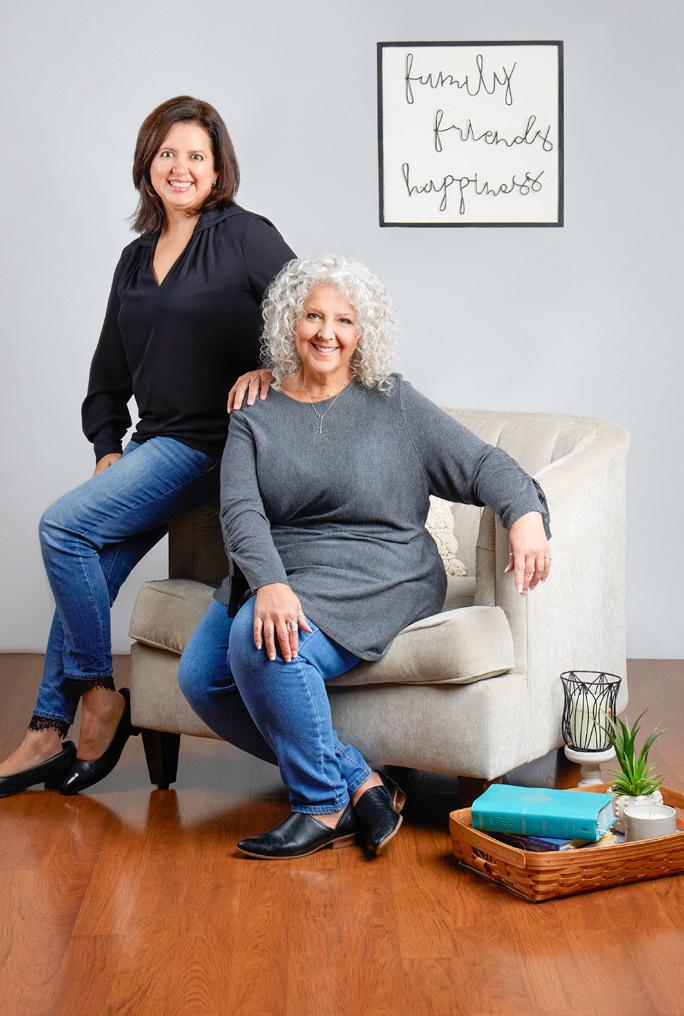
Balta said she helps clients process the steps and provides a support system.
“It’s talking about the market and the mental process of what’s going and what’s staying,” she said. “How do we remove all the unwanted items or wanted items that can’t necessarily go with them? A lot of people get stuck on what to do with this household of stuff.” Balta said she often introduces clients to others who have gone through the process of downsizing or who are going through it at the same time.
“I try to have them focus on what’s next,” she said. “They’re downsizing, so what do they really want to take with them? If we can just focus on that, that starts to help them move in that direction. I often say don’t worry about the stuff that’s left behind, I’ll take care of that. That’s what my team does. It’s real estate, but it’s not real estate in the traditional sense of, ‘Call me when you’re ready to sell.’ That’s way too late in the process.”
Balta starts with a consultation to see what the clients’ support team is like as far as family members and close friends.
Continued on Page 17
Commentary by Dr. David Sullivan and Dr. Kenneth Stumpf
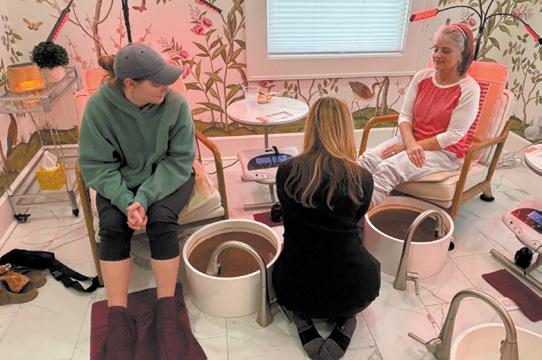
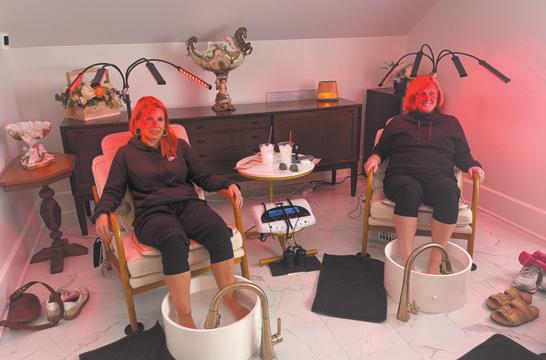
If you have been struggling with stubborn toenail fungus, there is finally a revolutionary, non-invasive solution that delivers impressive results without the need for oral medications or potential burning from a laser. ToeFX, the advanced, FDA-cleared light therapy treatment, is transforming the way podiatrists address fungal infections.
ToeFX offers a sophisticated, safe and completely painless approach to restoring nail health. Unlike traditional treatments that can come with systemic side effects or require long, complicated daily regimens, ToeFX utilizes a highly effective photodisinfection process. By applying a specialized topical serum that binds to fungal organisms and activating it with precise red LED light, the treatment selectively disrupts the fungus while leaving your healthy tissue completely untouched.
The convenience of ToeFX is unmatched. Dr. David Sullivan states that patients “love that the treatment is per-

formed in-clinic, with each session lasting less than 20 minutes.” The protocol is simple and efficient, typically involving a series of visits every two weeks. This streamlined approach makes it easy to integrate into your busy schedule, and because it is non-invasive, there is absolutely no downtime following your appointment.
The clinical results are truly encouraging. Many patients report visible improvement in the appearance of their nails after just a few sessions, with continued progress as the new, healthy nail grows out. Studies reveal success rates of 73 percent, 81 percent in clinical observations. Dr. Kenneth Stumpf said it is “a preferred choice for those seeking a reliable, modern, and drug-free alternative to clear their nails effectively.”
Dr. David Sullivan and Dr. Kenneth Stumpf are boardcertified foot surgeons at Westfield Foot and Ankle, LLC. Contact them at appt@westfieldfoot.com or 317-896-6655.
� Join Us Monthly at The Hussey-Mayfield Library, Zionsville Expert Panels, Actionable Advice, Supportive Community
SENIOR LIVING SERIES: Medicare Decoded: What It Covers, What It Doesn't, and What It Costs You AUGUST 10 2 PM
g Scams, Schemes & Senior Safety: How to Protect What You've Earned SEPTEMBER 14 2 PM
g Legal Documents Every Senior Should Understand (Before It's Urgent) OCTOBER 12 12 PM
ADULT CHILDREN OF AGING PARENTS SERIES:
g The Driving Conversation No One Wants to Have AUGUST 18 4:30 PM
g How to Have the Hard Conversations Without Becoming the Bad Guy SEPTEMBER 15 4:30 PM Caregiving Without Collapse: Roles, Boundaries, and Burnout OCTOBER 2014:30 PM Brought to you by Lee Ann Balta, Certified




By Mark Ambrogi mark@youarecurrent.com
Lois Craig knows she is going to miss volunteering at Indianapolis Colts training camp.
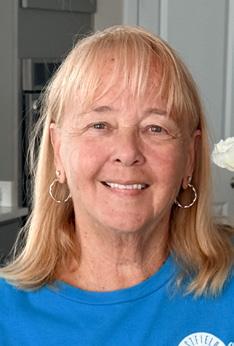
Craig is the volunteer coordinator for transportation for Colts players and families to and from the field at Grand Park. The 73-year-old Westfield resident has been in the role since the first Colts camp in Westfield in 2018. The Colts have announced this year’s training camp, which begins July 29, will be the final one at Grand Park.
“I thoroughly enjoy it,” said Craig, a retired City of Carmel employee. “They’ve been a great group of guys. Our Colts are awesome. They are thankful and respectful. They ask us our name. They want to know about us when we’re driving them to and from the field. That’s the majority of them. There are few you know to leave

alone because they don’t want to be bothered. The families are friendly. They want to know about you, too. They’ve been great and we’re all going to miss them. We were all sad they weren’t coming back.”
Craig’s husband, Mark, also volunteers.
Westfield resident Bill Kirsch, 76, and his wife, Sandy, are volunteers in ride assistance for the players. There

Sandy and Bill Kirsch, assist in transporting players to the field.
(Photo courtesy of Bill Kirsch)
was no camp in 2020 because of the COVID-19 pandemic. In 2021, there was no contact with the players at camp, so Kirsch took tickets and took fans back and forth from the parking lot that year.
“I’ve enjoyed pretty much everything, except the heat,” Kirsch said. “You don’t realize how big these guys are until they sit down next to you. Most of them are pretty talkative, pretty good guys.”
His most memorable experience was when his wife drove a full load of offensive linemen to the field.
“I was in the cart behind her,” Kirsch said. “She didn’t get far before you saw the tire going down in the back. She did a good job driving it on three wheels. But by the time she got there, the tire was almost on fire and it was smoking. The guys in my cart started laughing, pointing to the cart.”
Kirsch said they learned later after a new tire was put on that there was a weight limit of 1,000 pounds.
“The five guys on the cart were over 300 pounds,” he said.
Kirsch said they are supposed to get special new volunteer shirts this year.
“It’s like the final frontier,” he said Ron Metzig, a 79-year-old Westfield resident, will volunteer for the third time. He helps

Continued on Page 8







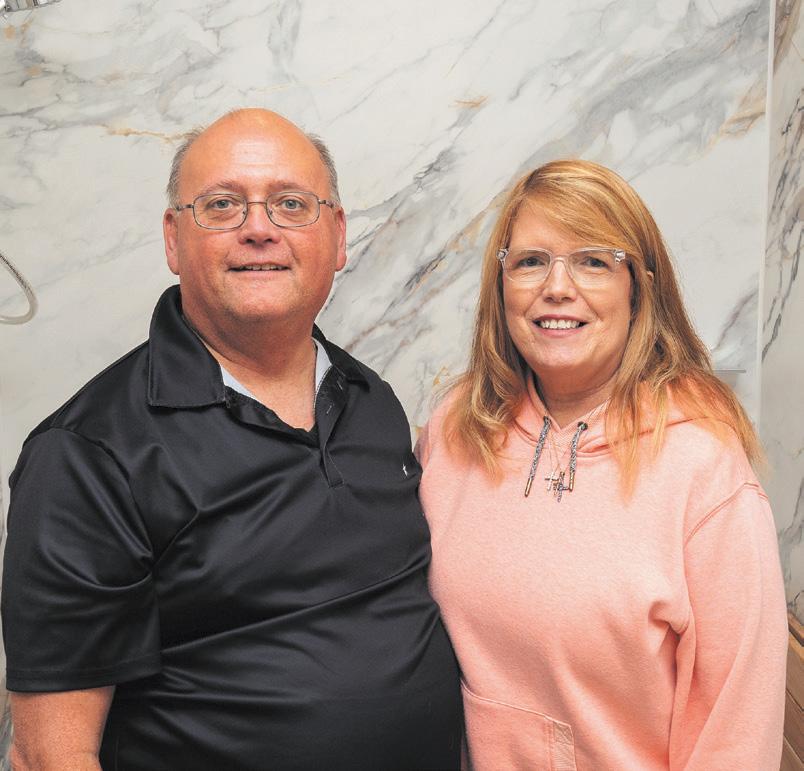




Continued from Page 6
seat fans in the grandstand.
“The best parts of volunteering at Colts Camp have been helping fans find the best spot to sit for each practice for the best fan experience, showing the kids where to stand for the best autographs after practice and guiding the handicap fans to our special seating areas,” Metzig said. “I think that the best memories come from helping the kids get their footballs, jerseys or football memorabilia autographed after each practice and the expression on their faces when they are right up front on the rail along the field.”
Metzig said he will miss the fan contact experience and making each person feel welcome.
“We get the chance to meet people from all over the area as you strive to find them the best seat in the house each day, even engaging in a quick conversation with them and the huge fan support here at Grand Park,” he said.
Mark Samuels has volunteered every year since 2018. Samuels, who lived in Fishers before a recent move to Evansville to be closer to his wife’s aging parents, plans to do four volunteer shifts in August.

“I started doing ride assistance for fans and then after a couple of years I met the Colts Player and Family and Friends golf cart drivers and I switched to working with them for the last several years,” Samuels said. “I enjoy helping the families out, and this position allows you to see a lot of the behind-thescenes parts of camp.”
Samuels, 66, said he’ll miss the routine of getting to camp each day, working behind the scenes, and camaraderie he built with the other long-term drivers.
Samuels retired in October 2023 after more than 30 years at Lilly as an IT project manager.
“I tried working as a dog walker and new car delivery driver but was kind of bored, so I went back to work full time as an IT project manager as a contractor for Lilly,” Samuels said. “I like to be busy and work with people so I also worked at the Fishers Event Center when it opened up until moving down to Evansville.”
Commentary by Dan Scripter
When I ask people how they feel about their balance, the first thing they tell me is that they can stand on one foot for a length of time. While standing on one foot is a tool — and one I use regularly to assess a person’s balance — it is a small piece of the overall picture of balance. Balance affects each of us as we stand, move, and perform activities of daily living (ADL).
Understanding balance, and how it changes as we age, is important to prevent accidents and injuries. There are two types of balance: static and dynamic.
Static balance (maintaining position) is the ability to keep your center of gravity within the base of support (BOS). An individual’s center of gravity is typically a few inches below the navel, and it shifts with gender, body shape, body size, muscle distribution, and age. Imagine for a moment, standing on a two-foot square. When you are balanced, your feet are in a relaxed stance, directly under you or slightly wider even if the square starts to shrink in size. Dynamic balance is the ability to move beyond the BOS while maintaining postural control. An example would be leaning forward to place a plate on a table without stepping forward. This skill often declines in older adults due to age-related changes, cognitive decline, reduced lower leg strength and endurance, limited range of motion, and neurological issues such as numbness in the feet or legs.

There are a few things that you can do at home to help prolong your ability to maintain your balance. We use the movements below, along with others, with our clients at Motion 4 Life Fitness. They focus on ankle range of motion (ROM), core strength, and training for the feet.
Ankle ROM and lower leg strength:
• Toe Raises: Sit in a chair with your feet flat on the floor. Keep your heels planted while lifting your toes toward your shins, then lower them back down. Perform the movement with one foot or both. Begin with two sets of eight reps, resting 30 seconds between sets, and prog-
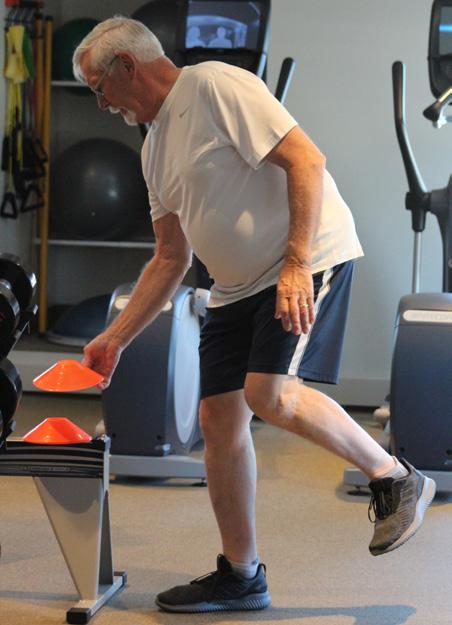
Motion 4 Life Fitness member Leon Walker works on his balance.
(Photo courtesy of Motion 4 Life Fitness)
ress over the next few weeks to three sets of 15 reps.
• Heel Raises: Sit in a chair with your feet flat on the floor. Press through your toes to lift your heels until you’re on your tiptoes, then lower your heels back to the floor. Perform the exercise with one foot or both. Start with 2 sets of 8 reps, resting 30 seconds between sets, and progress over the next few weeks to 3 sets of 15 reps.
• Standing Heel to Toe Rocks: Stand upright, tummy pulled toward your spine, with a hand on an object for balance, such as a counter or table. Put your right foot forward and left leg behind about hip-width apart. Raise the toes of the front foot with the back foot on the floor. Rock forward until the front foot is fully on the ground, pushing through the front big toe for balance, and the back heel is off the ground. Rock backward until you return to the starting position. Do two sets of 12 repetitions then switch sides, rest 30 seconds between sets. If you feel any dizziness, or notice anything that feels wrong, see your doctor immediately. If you want to work more on your balance, see your doctor for a program near you, or find a gym and work with a certified personal trainer who specializes in working with older adults.


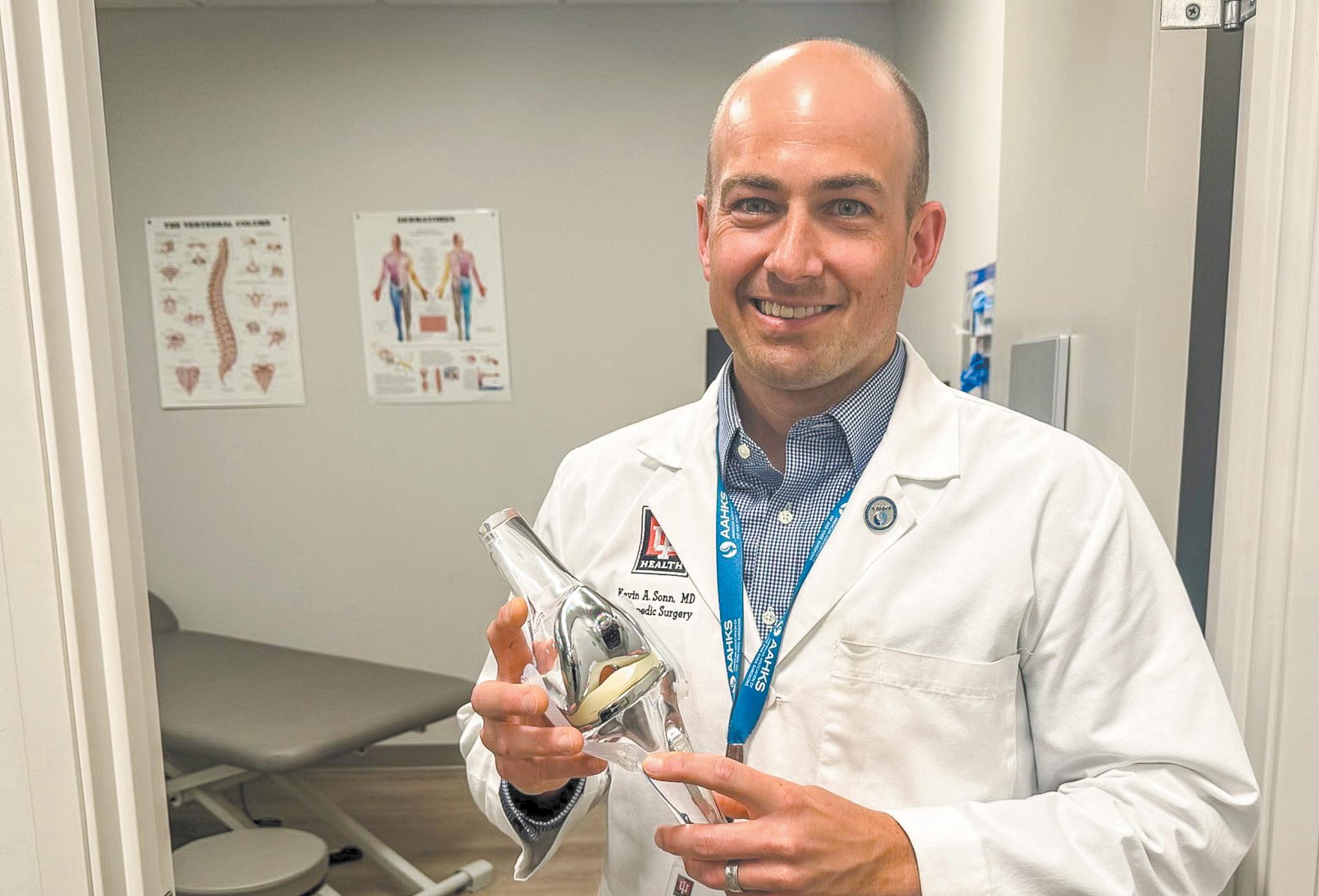
By Dr. Kevin Sonn, orthopedic surgeon at IU Health Fishers

For many adults over 55, joint pain can slowly take away the activities they love, whether it’s walking the neighborhood, gardening or keeping up with grandchildren. When pain becomes chronic and begins to affect quality of life, joint replacement surgery may become part of the conversation. But how do you know if it’s the right choice for you?
Joint replacement surgery is a common and effective procedure used to treat damaged joints, most often the hip, knee or shoulder. The surgery involves replacing worn or damaged parts of the joint with artificial components to reduce pain and restore movement.
At IU Health Orthopedics & Sports Medicine in Fishers, specialists offer a full range of joint replacement options, including hip, knee and shoulder procedures, depending on your needs.
Joint replacement is not the first step in treatment. Most patients are initially treated with non-surgical approaches such as medication, physical therapy or lifestyle changes.
You may be a good candidate for joint replacement if:
• You have persistent joint pain that limits your daily activities
• You experience reduced mobility or difficulty walking or climbing stairs
• Your symptoms have not improved with nonsurgical treatments
• Joint damage is impacting your overall quality of life
At IU Health, care teams evaluate each patient individually, considering the severity of symptoms, overall health and personal goals before recommending surgery.
If you’re experiencing joint pain but aren’t sure if you’re ready to consider surgery, there are helpful ways to learn more. Your first step is typically a
consultation with an orthopedic specialist. During this visit, your care team will review your diagnosis and explain treatment options so you can make an informed decision.
IU Health also offers joint replacement seminars designed to help patients better understand their condition, available treatments and what to expect throughout the process. These sessions can be especially valuable if you’re weighing your options and want to feel more confident in your next step.
If non-surgical treatments are no longer effective, your care team may recommend joint replacement as the best option to relieve pain and improve function.
Preparation begins well before surgery. Patients undergo a thorough medical evaluation to ensure they are healthy enough for the procedure. This may include reviewing medications, completing lab tests and assessing heart and lung health. You’ll also receive guidance on how to prepare your home for recovery, such as arranging help with daily tasks and minimizing fall risks.
Joint replacement surgery typically takes one to
two hours and is performed under anesthesia. After surgery, your care team will guide you through recovery, focusing on pain management and helping you begin moving safely.
Patients begin walking with assistance the same day of surgery. Recovery is supported by a multidisciplinary team that may include physical therapists, occupational therapists and care coordinators, all working together to help you regain strength and mobility.
Choosing joint replacement surgery is a personal decision, but you don’t have to make it alone. With expert evaluation, personalized care plans and educational resources, IU Health helps patients understand their options and feel confident in their next step.
If joint pain is keeping you from living life to the fullest, it may be time to explore your options. Learning more can help you determine whether joint replacement is the right path toward moving more comfortably and staying active in the years ahead. For more information, visit iuhealth.org/ joints.
By Mark Ambrogi mark@youarecurrent.com
Bob Zoccola found another niche in his second career.
After 26 years as a trial attorney, Zoccola decided to make the move into investment banking after learning more about the work.
“One of my clients was in international business, and she gave me the opportunity to get into international business, which I jumped at,” he said. “When I learned what (investment bankers) did, I thought I could do this, and this would be fun.”
It’s so much fun that the 83-year-old is still doing it nearly 30 years later.
That client who gave him the opportunity was the late Christel DeHaan, who owned Resorts Condominiums International before selling it.
At the time he shifted careers, Zoccola was based in London working with partners in a firm.
“They were investment bankers, and that’s who taught me that career move,” he said. “I’ve been blessed with a wonderful, loving and supporting family. I’ve been blessed with opportunities to meet interesting, successful people that showed me ideas and exposed me to ventures that I never would have seen without their help.”
After the firm was sold, he had another client who owned and operated a family office in Jackson Hole, Wyo. He joined the team, where wealthy people would make funds available.
“We used their funds to do other ventures,” he said.
Now, Zoccola has his own company.
“I partner with other people who are either in the space or they recommend something to me,” he said. “Most of what comes our way now is word of mouth because they know what we do and they refer people to us.”
Zoccola moved to Carmel in 1972.

When he was with the firm, he conducted business in 152 nations.
Zoccola said he developed new skills when he became an investment banker.
“But a lot of the skills I developed as a trial lawyer and a licensed mediator (was) because a mediator is basically an arbitrator or a judge who makes a decision,” he said. “A mediator just gets the parties to talk and see if they can’t identify common ground.”
He now owns a company, Zolutions, LLC.
“It’s part time, although there are moments when you know you got the deal inside the 1-yard line where you have to be ready to close the deal and make that a priority,” he said. “I try not to have too many things on my plate at one time, so that I’m able to give the right attention to any customer that I’m working with.”
Zoccola moved to Indianapolis in 1960 to attend Butler University. He majored in mathematics and then attended the University of Minnesota’s law school.
“I met the love of my life at Butler, and after law school, she brought me back here because she was a Hoosier and didn’t want to live in Minnesota,” he said.
His wife, Ann, died in 2019. He has 59-year-old twin sons, Boyd and Jim, and five grandchildren.
His sons and grandchildren all graduated from Carmel High School.
Bob Zoccola moved to The Stratford in October 2024.
“I’m the chair of Lifelong Learning, where I find speakers that I think would be interesting for our residents to hear about and learn from,” he said. “I ask
the residents to give topics that they would like to hear about and then I go find the speaker. Once a week, I lead a group that meditates here.”
Zoccola has kept a gratitude journal for more than 25 years.
“I write things that I’m grateful for that day, and what I found is the more you do it, the more things you’ll notice in the world to be grateful for,” he said. “To me, it transforms the way you see the world.”
Zoccola said it’s an activity that he encourages everyone to try.
He said he gets involved in as many activities as he can at The Stratford.
“There are so many interesting people here,” he said. “When you hear their stories, you just go, ‘Wow.’ I mean intelligent, interesting people, and to hear their stories is special.”
By Mark Ambrogi mark@youarecurrent.com
Justin Steill and his team have developed a forte in helping older adults downsize their homes.

“Downsizing has always been a service we offer but it has become increasingly a larger part of our business over the past five years,” Steill said. “We help a lot of people downsize into smaller homes. Then the next step is senior living communities.”
Steill is the owner and team leader of Homes With Steill Real Estate Group with Berkshire Hathaway HomeServices Indiana Realty. The office is in Carmel and Steill lives in Westfield.
“We serve a lot of clients in the Hamilton County area but also work in Indy Metro from Greenwood to Avon,” Steill said.
Steill holds open houses on weekends, usually Sunday afternoons.
Steill has a 12-person team. The team was established in 2013 and has been a part of Berkshire Hathaway HomeServices since 2019.
Steill has helped lead a team that has served more than 1,000 families and closed more than $600 million in real estate. It is among the 20 largest teams in the Berkshire Hathaway network nationwide.
“I am passionate about building relationships, fostering connections and serving as a trusted resource for all your real estate needs,” Steill said. “Whether buying, selling or investing, our proven process ensures exceptional results. We are committed to delivering the best possible outcomes for our clients.”
For more, visit justinsteill.bhhsindianarealty.com.
“I am passionate about building relationships, fostering connections and serving as a trusted resource for all your real estate needs.”









Commentary by Christine Stolle advance.
For many older adults, there’s no place they’d rather be than home. Aging in place offers familiarity, independence and comfort. But remaining safely at home isn’t simply a matter of wanting to stay there. It requires thoughtful legal, financial, and practical planning long before a health crisis occurs.
Here’s what every family should know. Start with the legal foundation
One of the most important steps in aging in place has nothing to do with your house. It starts with your legal documents.
Every adult should have a health care power of attorney, durable power of attorney, living will and medical release of information (HIPAA). These documents allow you to choose the people who can make decisions on your behalf if you’re ever unable to do so yourself.
Without them, your loved ones may have to petition the court for guardianship, a process that can be expensive, time consuming, public and emotionally draining. More important, it means someone else may end up making decisions that you would have preferred to make yourself.
Before making major financial decisions, explore available funding options such as home equity lines of credit (HELOCs), reverse mortgages, VA benefits or Medicaid programs that may help offset costs. And be cautious about gifting money or property, as doing so could affect Medicaid eligibility because of the program’s five-year look-back period.
Know when more help is needed
One of the most difficult conversations families face is recognizing when living independently is no longer realistic.
Conditions such as dementia, Parkinson’s disease or recovery from a stroke often require more than occasional assistance. They may require skilled care that goes beyond what a spouse or adult child can safely provide.
Families should openly and honestly discuss activities of daily living (ADLs), including bathing, dressing, toileting, transferring and mobility. Understanding when additional support is needed before burnout occurs can make all the difference for both the individual needing care and the family members providing it.
Aging in place doesn’t mean staying in the same house forever
Many people assume the only choices are remaining in their current home or moving directly into assisted living. Fortunately, there are many options in between.

A paid-off house still has expenses
Owning your home outright doesn’t mean living there is free.

It’s also important to review how your home is titled and ensure you have an up-to-date will or trust. Proper planning can help avoid probate while also preserving future long-term care planning options.
Property taxes, homeowner’s insurance, utilities, repairs and ongoing maintenance continue regardless of whether you have a mortgage. Many families underestimate these recurring expenses when planning for retirement.
In addition, staying in your home safely may require modifications such as:
• Installing grab bars
• Building wheelchair ramps
• Replacing tubs with walk-in showers
• Widening doorways
• Improving lighting and accessibility
These upgrades can become costly, especially if they’re made during an emergency rather than planned in

Communities designed for older adults, such as 55-plus neighborhoods, maintenance-free villas, condominiums and independent living communities, can significantly reduce the burden of home maintenance while allowing individuals to maintain their independence and active lifestyles.
Sometimes aging in place simply means finding a home that’s better suited for the next stage of life.
Understanding the cost of long-term care
Long-term care is one of the largest financial challenges many families will ever face.
Although Medicare plays an important role, it generally covers only short-
Continued on Page 15
Continued from Page 14
term skilled care following a hospitalization. It does not pay for ongoing custodial care, which is the type of assistance many older adults eventually need.
Depending on your circumstances, long-term care may be funded through:
• Personal savings
• Home equity
• Long-term care insurance
• Veterans benefits
• Medicaid
Planning ahead is critical. Estate planning tools such as Medicaid Asset Protection Trusts and Veteran Asset Protection Trusts can help protect assets while preserving eligibility for benefits, but they must be established well before care is needed. Waiting until a crisis occurs often eliminates many of the available planning opportunities.
Even the most devoted caregivers can experience burnout, lost income, declining health, and strained relationships.
Building a successful aging-in-place plan means recognizing that family support has limits. Adult day programs, respite care, in-home caregivers, and formal family caregiver agreements can provide valuable support while helping loved ones maintain healthy boundaries.
Plan for life after the loss of a spouse
The death of a spouse can dramatically change someone’s ability to remain at home.
A surviving spouse may suddenly face reduced household income, the loss of a primary caregiver or unexpected ownership and title issues involving the home.
Planning ahead can help ensure that a surviving spouse has both the legal authority and financial resources needed to continue living safely and comfortably.
Aging in place is absolutely achievable for many families, but successful aging in place rarely happens by accident.
It requires thoughtful legal planning, realistic financial preparation, honest family conversations and a willingness to plan before a crisis forces difficult decisions.
The earlier you begin, the more options you’ll have.



Anyone can dream of retirement. Reify helps make it real.
“Reify” means to make an abstract idea concrete—and that’s exactly what we do
Reify
(Advertorial)
Commentary by Margaret Gooley Vice President and CERTIFIED FINANCIAL PLANNER® Reify Wealth Advisors
For some individuals, long-term care planning is less about whether you can afford care and more about how you want to pay for it, in addition to what opportunity costs you are willing to accept. Long-term care includes services like in-home assistance, assisted living, or skilled nursing care. In the state of Indiana, the costs of these services can vary significantly depending on the location and level of care. The expenses can sometimes go on for years and create meaningful financial and emotional stress if not planned for in advance.
The goal of planning ahead isn’t just to cover the costs, it’s to do so efficiently, without disrupting your broader financial and legacy plan. The core decision often comes down to two approaches: purchasing insurance or self-funding care using your own assets. The time to make this decision is typically between the ages of 55 and 65.
The self-funding method means setting aside a portion of your own portfolio specifically for future care needs. For those that have the ability to pursue this method, it provides full control and flexibility related to the money. Assets can be invested how you choose and used for any other purpose (including inheritance) if not needed for care.
In addition, this method provides simplicity because there is no underwriting, no policy terms to be concerned with and no claims process to manage. On the other hand, self-funding means taking on all of the risk related to an unknown prolonged care situation, which can erode even a substantial portfolio. The money earmarked for care also takes on the opportunity cost of not being used for other expenses in retirement and significant care expenses could reduce what you pass on to heirs or charitable organizations.
Some clients choose this approach if they have sufficient liquidity and are comfortable absorbing a potential high-cost scenario without affecting their lifestyle or other longterm goals.
Another option to pay for longterm care is an insurance policy. In most cases, these policies are issued using a hybrid product where life insurance or an annuity is combined with long-term care coverage. If care is needed, the policy provides benefits. If not, there is typically a death benefit paid to beneficiaries. Unlike a traditional long-term care insurance policy, which is a “use it or lose it” benefit, there is typically value in a hybrid policy even if care is never needed.
In addition, if started early enough, a lump sum or series of premiums can be turned into a larger pool of future benefits. Many of these hybrid policies offer fixed premiums, reducing uncertainty and they can help preserve other assets intended for your heirs.
However, long-term care insurance policies do often have upfront costs, can be complex with various benefit triggers or riders and lower flexibility since the funds are less accessible. Hybrid policies can be appealing for individuals who want to transfer some of the financial risk related to long-term care while still maintaining a predictable outcome for their estate.
Further, some clients will choose a middle ground approach where a dedicated portion of their investment portfolio is earmarked specifically for long-term care and balance some of the risk with a smaller insurance policy for catastrophic scenarios.
Some of the key questions to ask as you navigate this decision include: How important is protecting your estate? Are you comfortable with the uncertainty of potential care costs? Would large healthcare expenses change your lifestyle plans? Do you prefer control or risk transfer? How is your health and would you qualify for coverage?
The bottom line is, there is no one-size fits all solution. Instead, the decision comes down to aligning your financial capacity with your personal preferences. Self-funding emphasizes flexibility and control. Long-term care insurance offers leverage and protection. The key is to make the decision proactively, while you have the most options available.
By Ken Severson editorial@youarecurrent.com
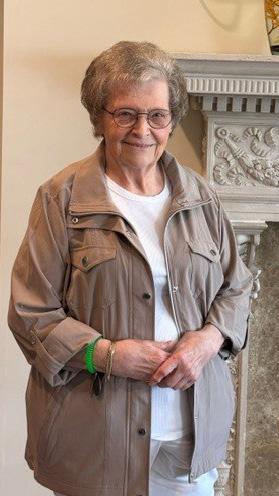
It’s never easy leaving your home state or your home, but it’s something that Mary Buchanan did — and she’s thriving.
Buchanan, who turns 82 next month, is a new resident of the Sycamore Reserve Senior Living in Indianapolis. She moved there in May and has enjoyed Sycamore immensely since her daughter Shelly did a search on where Buchanan could live.
“(My daughter) took care of everything for me,” Buchanan said. “That was a big help.”
Buchanan described the search experience as a major reason for wanting to live there and she has not had any regrets.
“In my time here, I’ve liked it so much,” Buchanan said. “I can be myself with all my friends I’ve accumulated. They have been great and wonderful and it’s been that (Sycamore).”
Buchanan, who lived in Indianapolis with her daughter prior to her move, is a native of Charles City, Iowa. She also lived in Cedar Rapids, Iowa. Buchanan, who attended business school in Minnesota, worked for many years with the LeFebure Co. of Cedar Rapids, a major manufacturer of bank security equipment, safes and vault doors.
A widow, Buchanan has two daughters, Shelly and Tracy. Tracy lives in Iowa City, Iowa.
Buchanan is a big fan of the Iowa Hawkeyes football team and of fellow
Continued from Page 4 Whatever you are planning to do this Summer, do it without leg pain.
“These are all tasks that need to be done, and we’re starting to build a plan to delegate those tasks,” Balta said. “If they’re rich with people and a support system, then there may not be costs associated with the move, except for maybe at the very end when we’re selling the real estate. If they don’t have people, then we may need to hire a packer and a mover. I’m looking for those movers and packers that specialize in serving seniors because they know to be gentle, caring and respectful.”



Jeffery P. Schoonover, MD RPVI, DABVLM Chief Medical Officer, Fellow, American Vein & Lymphatic Society
Schedule a consult today!
Are swollen ankles, leg heaviness, and muscle cramping keeping you from your daily routine? Call Indiana Vein & Lymphatic today and get on the road to better health.
IN-OFFICE EVALUATION AND TREATMENT FOR:
• Varicose Veins/Chronic Venous Insufficiency
• Spider Veins
317.348.3020
1.888.LEG.VEIN (534.8346) info@indyveins.com
Hawkeye and Indiana Fever star Caitlin Clark, She said she also enjoys working with her hands and lists quilting, knitting and crocheting as her hobbies.
“Idle hands are the devil’s work,” Buchanan said, laughing. “I miss my daughter in Iowa and I miss Iowa, but I’ve been loving my life here and it’s been more than fun.”
Online auctions can help with items not being moved.
“I’m a huge trash-to-treasure girl, so I love online auctions because people aren’t traipsing through the house,” she said.
At Balta’s most recent auction from a 3,500-square-foot home, the auctioneer sold all but three items. The funds made from the auction could help with moving costs.
“We help people find joy in this and in going through the next process,” she said. “Every person’s journey is different and it’s so customized.”
For more, visit yoursilverjourney.com.


• Lymphatic Physical Therapy
www.indyveins.com indyveins


“PrimeLife is such an asset to Carmel and Hamilton County! Everything they do makes our lives easier.”
Kathy C. - Member

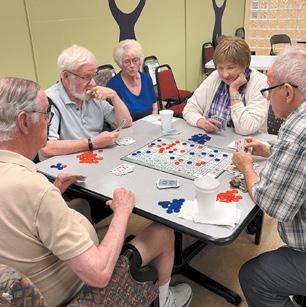

Programs and services that help adults age 55+ lead more active and connected lives.
More than 50 clubs and activities plus 45 fitness classes weekly
• Basic Membership: All activities plus indoor track and weight room *
• Enhanced Membership: All Basic plus Fitness and Aquatic Classes *
*Insurance benefits like Silver Sneakers & Renew Active cover cost of Basic Membership
The following services are FREE to anyone age 55+ (no membership needed):
• Daily hot lunches
• Wednesday Lunch & Learn Sessions
• SHIP (Medicare) Counseling
• CICOA Community Health Worker Assistance
• AARP Senior Planet (technology) lectures & workshops
• Transportation for Hamilton County residents to essential services







By Hannah Vandlandingham hannah@youarecurrent.com
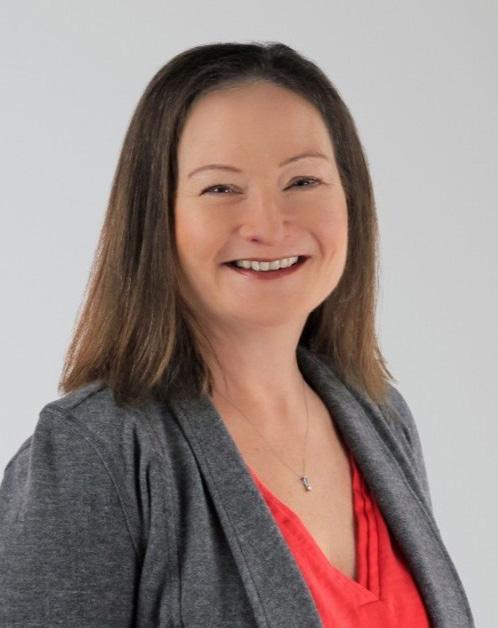
After working for several years in the corporate world, Stacey Williams has made a significant career shift. As she looked to transition into a more specialized and local position, she came across Seniors Helping Seniors and took the opportunity to open a location of her own.
“As I started thinking about leaving corporate and doing something more local, I wanted to focus on seniors or kids,” Williams said. “Seniors Helping Seniors was an opportunity that I saw, and it just speaks to my heart.”
Seniors Helping Seniors is an in-home care service designed to connect seniors with caregivers their own age. The similarity in age aims to promote understanding, connection and relatability between seniors and their caregivers.
Williams said she is passionate about fostering connections between seniors and caregivers because of her personal experience with her grandmother and her caretaker.
“My grandmother had suffered a stroke and lived for about 10 years after that, but had really significant health challenges. My family was very, very
seeking care.
“The majority of older people want to age in place in their homes, because that’s what they know, and that’s where they’re comfortable,” Williams said. “(For us) it’s about creating the environment where they can do that safely (while) getting the help that they need.” Williams finds hiring caregivers to be especially rewarding, enjoying the conversations with those who are passionate about the job.

“When you get somebody who’s in it for the right reasons; (when) you get a caregiver who comes in and they’re telling you stories about who they’ve given care to, and they get really emotional… that just warms my heart,” she said.
Williams’ Seniors Helping Seniors coverage areas are Hamilton and Hancock counties and eastern Marion County.





“I really want to be the local resource that people think of when they think of needing care,” Williams said. “I’m hoping Seniors Helping Seniors creates that brand awareness that people know automatically the high quality of care that we provide, and that we will be the go-to resource. I just want us to be that community resource in my territory… but I’m certainly starting here in Hamilton County.”
For more, visit seniorshelpingseniors.
editorial@youarecurrent.com
Marquette, a nonprofit continuing care retirement community senior living destination in Indianapolis known for its exceptional lifestyle offerings and personalized care, broke ground on Part I of a significant expansion featuring the highly anticipated Terraces II development, a new residential option called The Flats. Construction began June 16 on the first phase, which includes The Commons, an amenities enhancement featuring indoor multiuse sports court and waterfront lounge spaces. The ambitious multiphase project, a $102 million investment, will add 69 luxury apartment homes, 25 innovative stacked flats and a major expansion of the community’s central gathering space, representing the second most comprehensive development in the community’s history.
Anticipated opening in 2029, Terraces II will feature the same striking façade with glass wall corner units and sophisticated architectural design mirroring the popular Terraces I building, comple-
mented by a welcoming dining venue and convenient underground parking facilities. The development also introduces an innovative housing concept with 25 hybrid homes they are calling The Flats – a unique residential option that combines the privacy of independent homes with thoughtfully designed, single level flats, spacious layouts and generous outdoor enjoyment.

“This expansion represents our commitment to meeting the evolving needs of today’s discerning seniors who seek both luxury and an active, engaging lifestyle,” stated Jake Cox, executive director of Marquette. “The Terraces II, The Flats and amenities development will set a new standard for senior living, combining our residents’ love for recreational activities like pickleball with sophisticated dining and living spaces that foster community connection.”
Key Features of the development: Luxury apartment homes (69 units)
• Spacious, well-appointed residences full of natural light and premium finishes

• Multiple floor plan options to suit
diverse lifestyle preferences
• Exceptional comforts such as fireplaces, modern amenities and accessibility features innovative stacked flats (25 units)
• Unique living concept combining privacy, convenience and connectivity.

• Thoughtfully designed for optimal comfort and functionality
• Covered parking and private outdoor spaces

• Premium Amenities
• Exclusive on-site dining venues featuring chef-prepared cuisine
• Secure underground or at grade covered parking with direct building access
• Seamless integration with existing community amenities and services: The Marquette Athletic Club, natatorium, resident garden, chapel, Township Tavern and creative arts spaces.
KAREN SIGMAN AGENCY LLC

THE DIFFERENCE IN MEDICARE SUPPLEMENTS OR ADVANTAGE PLANS/HMO/PPO, WHAT IS THE NEW BIRTHDAY RULE FOR SUPPLEMENT PLANS? CAN I SIGN UP FOR MEDICARE OR MEDICAID PLANS NOW OR DO I HAVE TO WAIT? WHAT DO I DO TO SIGN UP FOR MEDICARE WHEN LEAVING AN EMPLOYER PLAN BEFORE 65 AND AFTER? SHOULD I STAY ON THE EMPLOYER PLAN UNTIL LATER IN LIFE?
I AM A VETERAN AND I WANT MORE MEDICARE BENEFITS WITH AN ADVANTAGE PLAN? DOES IT GIVE MONEY BACK FOR MEDICARE PART B PREMIUM? CAN I GET DENTAL, VISION, SILVER SNEAKERS, OVER THE COUNTER, OR GROCERY BENEFITS TOO?
SCHEDULE A GROUP OR INDIVIDUAL APPOINTMENT AT HOME OR OFFICE WITH A LICENSED AGENT NO OBLIGATION TO ENROLL