Measuring
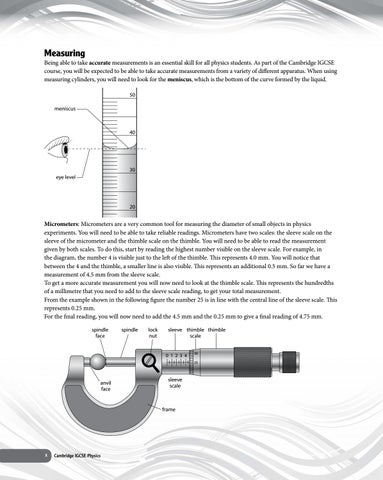
Being able to take accurate measurements is an essential skill for all physics students. As part of the Cambridge IGCSE course, you will be expected to be able to take accurate measurements from a variety of different apparatus. When using measuring cylinders, you will need to look for the meniscus, which is the bottom of the curve formed by the liquid. 50 meniscus
40
30 eye level
20
Micrometers: Micrometers are a very common tool for measuring the diameter of small objects in physics experiments. You will need to be able to take reliable readings. Micrometers have two scales: the sleeve scale on the sleeve of the micrometer and the thimble scale on the thimble. You will need to be able to read the measurement given by both scales. To do this, start by reading the highest number visible on the sleeve scale. For example, in the diagram, the number 4 is visible just to the left of the thimble. This represents 4.0 mm. You will notice that between the 4 and the thimble, a smaller line is also visible. This represents an additional 0.5 mm. So far we have a measurement of 4.5 mm from the sleeve scale. To get a more accurate measurement you will now need to look at the thimble scale. This represents the hundredths of a millimetre that you need to add to the sleeve scale reading, to get your total measurement. From the example shown in the following figure the number 25 is in line with the central line of the sleeve scale. This represents 0.25 mm. For the final reading, you will now need to add the 4.5 mm and the 0.25 mm to give a final reading of 4.75 mm. spindle face
spindle
lock nut
sleeve thimble thimble scale
0 1 2 3 4
30 25
anvil face
sleeve scale
frame
x
Cambridge IGCSE Physics