We are working with Cambridge Assessment International Education towards endorsement of this title. Any references or material related to answers, grades, papers or examinations are based on the opinion of the author(s).
S
A
M
P
LE
1 Characteristics & classification of living organisms
i Original material © Cambridge University Press 2021. This material is not final and is subject to further changes prior to publication.
S
A
M
P
LE
We are working with Cambridge Assessment International Education towards endorsement of this title. Any references or material related to answers, grades, papers or examinations are based on the opinion of the author(s).
Original material © Cambridge University Press 2021. This material is not final and is subject to further changes prior to publication.
We are working with Cambridge Assessment International Education towards endorsement of this title. Any references or material related to answers, grades, papers or examinations are based on the opinion of the author(s).
LE
Computer Science for Cambridge IGCSE™ & O Level
P
PROGRAMMING BOOK FOR JAVA
S
A
M
Dave Duddell
Original material © Cambridge University Press 2021. This material is not final and is subject to further changes prior to publication.
We are working with Cambridge Assessment International Education towards endorsement of this title. Any references or material related to answers, grades, papers or examinations are based on the opinion of the author(s).
University Printing House, Cambridge CB2 8BS, United Kingdom One Liberty Plaza, 20th Floor, New York, NY 10006, USA 477 Williamstown Road, Port Melbourne, VIC 3207, Australia 314–321, 3rd Floor, Plot 3, Splendor Forum, Jasola District Centre, New Delhi – 110025, India
LE
79 Anson Road, #06–04/06, Singapore 079906 Cambridge University Press is part of the University of Cambridge.
It furthers the University’s mission by disseminating knowledge in the pursuit of education, learning and research at the highest international levels of excellence. www.cambridge.org Information on this title: www.cambridge.org/9781108910071 © Cambridge University Press 2021
First published 2021
P
This publication is in copyright. Subject to statutory exception and to the provisions of relevant collective licensing agreements, no reproduction of any part may take place without the written permission of Cambridge University Press.
20 19 18 17 16 15 14 13 12 11 10 9 8 7 6 5 4 3 2 1 Printed in Malaysia by Vivar Printing
A catalogue record for this publication is available from the British Library
M
ISBN 978-1-108-91007-1 Programming Book Paperback with Digital Access (2 Years) ISBN 978-1-108-82419-4 Digital Programming Book (2 Years) Additional resources for this publication at www.cambridge.org/go
Cambridge University Press has no responsibility for the persistence or accuracy of URLs for external or third-party internet websites referred to in this publication, and does not guarantee that any content on such websites is, or will remain, accurate or appropriate. Information regarding prices, travel timetables, and other factual information given in this work is correct at the time of first printing but Cambridge University Press does not guarantee the accuracy of such information thereafter.
A
Exam-style questions and sample answers have been written by the authors. In examinations, the way marks are awarded may be different. References to assessment and/or assessment preparation are the publisher’s interpretation of the syllabus requirements and may not fully reflect the approach of Cambridge Assessment International Education.
S
The information in Chapter 12 is based on the Cambridge IGCSE, IGCSE (9–1) and O Level Computer Science syllabuses (0478/0984/2210) for examination from 2023. You should always refer to the appropriate syllabus document for the year of your examination to confirm the details and for more information. The syllabus document is available on the Cambridge International website at www.cambridgeinternational.org.
NOTICE TO TEACHERS IN THE UK It is illegal to reproduce any part of this work in material form (including photocopying and electronic storage) except under the following circumstances: (i) where you are abiding by a licence granted to your school or institution by the Copyright Licensing Agency; (ii) where no such licence exists, or where you wish to exceed the terms of a licence, and you have gained the written permission of Cambridge University Press; (iii) where you are allowed to reproduce without permission under the provisions of Chapter 3 of the Copyright, Designs and Patents Act 1988, which covers, for example, the reproduction of short passages within certain types of educational anthology and reproduction for the purposes of setting examination questions.
Original material © Cambridge University Press 2021. This material is not final and is subject to further changes prior to publication.
S
A
M
P
LE
We are working with Cambridge Assessment International Education towards endorsement of this title. Any references or material related to answers, grades, papers or examinations are based on the opinion of the author(s).
Original material © Cambridge University Press 2021. This material is not final and is subject to further changes prior to publication.
We are working with Cambridge Assessment International Education towards endorsement of this title. Any references or material related to answers, grades, papers or examinations are based on the opinion of the author(s). CAMBRIDGE IGCSE™ & O LEVEL COMPUTER SCIENCE: PROGRAMMING BOOK
Contents 4.5
The items in orange are available in the digital edition that accompanies this book.
How to use this series
vii
How to use this book
viii
Acknowledgements x 1 Introduction to Java 1.2
The origins and reasons for the development of the Java language The Java Platform
2 Algorithms
Algorithms 6 Structured English 7 Program logic constructs 7 Design tools 10
M
2.1 2.2 2.3 2.4
2 3
3 Variables and arithmetic operators 3.1
Using variables in a high-level programming language Variable types Declaring variables Variables, constants and literals Initialising variables Assignment statements and arithmetic operators Use of an identifier table as part of the design process
A
3.2 3.3 3.4 3.5 3.6
S
3.7
17 17 18 20 21 22 28
5.1 5.2 5.3 5.4 5.5
The basic concepts Relational expressions Logic expressions IF statements CASE statements
The Java Platform Input and output Object-oriented programming (OOP) Running a simple program using the Java Platform
49 50 51 55 66
6 Iteration 6.1 6.2 6.3 6.4 6.5
Iteration and loop constructs The For loop The While loop The Do while and Repeat until loops Exiting a loop
73 75 82 86 87
7 Subroutines 7.1 7.2 7.3 7.4 7.5 7.6 7.7 7.8 7.9 7.10 7.11
Terminology 91 Subroutine use 92 Java use of subroutines 95 The scope of variables 100 Using pre-defined subroutines 101 Random number generation 101 Mathematics functions 104 String-handling methods (functions) 106 Using text files for input and output 111 Exception handling 112 The Java framework for file handling 112
8 Arrays
4 Options when learning programming 4.1 4.2 4.3 4.4
5 Selection
P
1.1
4.6 4.7
LE
Introduction vi
Input, output and comments in Java code 38 Integrated Development Environments 41 Some tasks using arithmetic 42
35 35 36 36
8.1 8.2 8.3 8.4 8.5
Terminology and concepts Declaring, instantiating and initialising Iteration using arrays Using arrays in standard methods of solution Using combinations of arrays
116 116 118 122 127
vi Original material © Cambridge University Press 2021. This material is not final and is subject to further changes prior to publication.
We are working with Cambridge Assessment International Education towards endorsement of this title. Any references or material related to answers, grades, papers or examinations are based on the opinion of the author(s). Contents
9 Designing algorithms The context for the design process Top-down design Structure diagrams
10 Checking inputs 10.1 10.2 10.3 10.4 10.5
Validation and verification 142 Categories of validation 142 Programming validation 144 Verification 151 Check digit 152
11 Testing
156 157
12.1 12.2 12.3
Suggestions for tackling the question 169 Coding a solution 172 Final thoughts 173
13 Examination practice
178
Appendix – Language-specific reference and OOP
189
Glossary
194
P
Categories of error The testing framework
12 Programming scenario task
Solutions
S
A
M
11.1 11.2
133 135 135
Debugging 159 Using a debugger 160 Using a trace table in a dry-run 164
LE
9.1 9.2 9.3
11.3 11.4 11.5
vii Original material © Cambridge University Press 2021. This material is not final and is subject to further changes prior to publication.
We are working with Cambridge Assessment International Education towards endorsement of this title. Any references or material related to answers, grades, papers or examinations are based on the opinion of the author(s). CAMBRIDGE IGCSE™ & O LEVEL COMPUTER SCIENCE: PROGRAMMING BOOK
Introduction Study of the Cambridge IGCSE™, IGCSE (9–1) and O Level Computer Science syllabuses (0478/0984/2210) requires practical programming experience. Java is one of three programming languages recommended on these syllabuses, along with Python and Microsoft® Visual Basic.
LE
The programming book for Java covers all of the specific programming requirements for the syllabuses. However, it could be used by anyone as an introduction to the Java language. The book is written with no assumption of any prior knowledge and there is no need for access to external reference sources.
Language
Java provides the normal functionality expected of a procedural or imperative high-level programming language. The syntax and constructs required for this functionality as detailed in the syllabuses are introduced in this book.
Support
P
Java is also an object-oriented programming language. However, the syllabuses do not require study of object-orientation. This book therefore includes only minimal discussion of object-orientation. Coverage is limited to the object-oriented features needed to allow the running of a Java program containing the procedural language syntax and constructs.
M
The book directly supports the syllabuses in the sense that chapters 1–11 cover subject matter which will help learners to prepare for examination on Algorithms, Programming and Logic Paper. In addition, there are further chapters provided specifically to aid revision and preparation for the examination. To support learning, many of the chapters include exam-style tasks. Solutions to all the chapter tasks can be found on the digital part of this resource. There are examples of appropriate solutions that show how to turn logical ideas into actual programs. There is also a series of exam-style questions in Chapter 13.
A
Developing programming skills
S
A major feature of the syllabuses is the recognition that the creation of a successful program requires more than just the ability to write program code. There is emphasis on the need for the application of problem-solving and computational thinking skills. These can be used initially to identify the program requirements. Following on, suitable design techniques should be employed before program code is written. The main chapters in this book support this approach. In particular, to support learning, these chapters include numerous tasks; both within the chapter and in the end-of-chapter questions. Most of these encourage the learner to apply computational thinking skills in addition to coding skills.
viii Original material © Cambridge University Press 2021. This material is not final and is subject to further changes prior to publication.
We are working with Cambridge Assessment International Education towards endorsement of this title. Any references or material related to answers, grades, papers or examinations are based on the opinion of the author(s). How to use this series
How to use this series
P
LE
The coursebook provides coverage of the full Cambridge IGCSE, IGCSE (9–1) and O Level Computer Science syllabuses (0478/0984/2210) for first examination from 2023. Each chapter explains facts and concepts and uses relevant real-world contexts to bring topics to life, including two case studies from Microsoft® Research. There is a skills focus feature containing worked examples and questions to develop learners’ mathematical, computational thinking and programming skills, as well as a programming tasks feature to build learners’ problem-solving skills. The programming tasks include ‘getting started’ skills development questions and ‘challenge’ tasks to ensure support is provided for every learner. Questions and exam-style questions in every chapter help learners to consolidate their understanding.
M
The digital teacher’s resource contains detailed guidance for all topics of the syllabuses, including common misconceptions to elicit the areas where learners might need extra support, as well as an engaging bank of lesson ideas for each syllabus topic. Differentiation is emphasised with advice for identification of different learner needs and suggestions of appropriate interventions to support and stretch learners.
S
A
The digital teacher’s resource also contains scaffolded worksheets for each chapter, as well as practice exam-style papers. Answers are freely accessible to teachers on the ‘supporting resources’ area of the Cambridge GO platform.
There are three programming books: one for each of the recommended languages in the syllabuses – Python, Microsoft Visual Basic and Java. Each of the books are made up of programming tasks that follow a scaffolded approach to skills development. This allows learners to gradually progress through ‘demo’, ‘practice’ and ‘challenge’ tasks to ensure that every learner is supported. There is also a chapter dedicated to programming scenario tasks to provide support for this area of the syllabuses. The digital part of each book contains a comprehensive solutions chapter, giving step-by-step answers to the tasks in the book.
ix Original material © Cambridge University Press 2021. This material is not final and is subject to further changes prior to publication.
We are working with Cambridge Assessment International Education towards endorsement of this title. Any references or material related to answers, grades, papers or examinations are based on the opinion of the author(s). CAMBRIDGE IGCSE™ & O LEVEL COMPUTER SCIENCE: PROGRAMMING BOOK
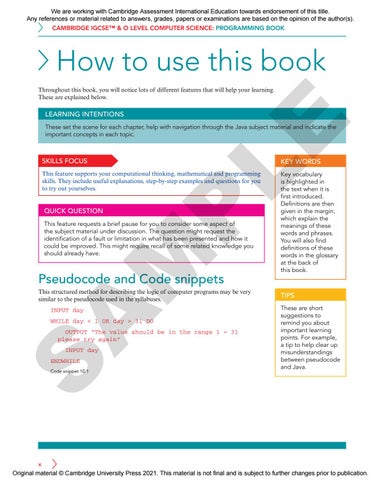
How to use this book Throughout this book, you will notice lots of different features that will help your learning. These are explained below.
LE
LEARNING INTENTIONS These set the scene for each chapter, help with navigation through the Java subject material and indicate the important concepts in each topic.
SKILLS FOCUS
KEY WORDS
QUICK QUESTION
P
This feature supports your computational thinking, mathematical and programming skills. They include useful explanations, step-by-step examples and questions for you to try out yourselves.
M
This feature requests a brief pause for you to consider some aspect of the subject material under discussion. The question might request the identification of a fault or limitation in what has been presented and how it could be improved. This might require recall of some related knowledge you should already have.
Pseudocode and Code snippets This structured method for describing the logic of computer programs may be very similar to the pseudocode used in the syllabuses.
A
INPUT day
WHILE day < 1 OR day > 31 DO OUTPUT "The value should be in the range 1 – 31 please try again" INPUT day
S
ENDWHILE
Code snippet 10.1
Key vocabulary is highlighted in the text when it is first introduced. Definitions are then given in the margin, which explain the meanings of these words and phrases. You will also find definitions of these words in the glossary at the back of this book.
TIPS These are short suggestions to remind you about important learning points. For example, a tip to help clear up misunderstandings between pseudocode and Java.
x Original material © Cambridge University Press 2021. This material is not final and is subject to further changes prior to publication.
We are working with Cambridge Assessment International Education towards endorsement of this title. Any references or material related to answers, grades, papers or examinations are based on the opinion of the author(s). How to use this book
Programming tasks
LE
Programming tasks give you the opportunity to develop your programming and problem-solving skills. Answers to these questions can be found in the solutions chapter, on the digital part of this resource. There are three different types of programming tasks:
DEMO TASKS
You will be presented with a task and a step-by-step solution will be provided to help familiarise you with the techniques required.
PRACTICE TASKS
CHALLENGE TASKS
P
Questions provide opportunities for developing skills that you have learnt about in the demo tasks.
Challenge tasks will stretch and challenge you even further.
M
SUMMARY
There is a summary of key points at the end of each chapter.
EXAM-STYLE QUESTIONS
A
Questions at the end of each chapter which you can use to test your knowledge, understanding or skills. Some of these may require the use of knowledge from previous chapters. Answers to these questions can be found in the solutions chapter, on the digital part of this resource.
S
NOTE: As there are some differences in the way programming statements are structured between languages, you should always refer back to the syllabus pseudocode guide to see how algorithms will be presented in your exam.
xi Original material © Cambridge University Press 2021. This material is not final and is subject to further changes prior to publication.
We are working with Cambridge Assessment International Education towards endorsement of this title. Any references or material related to answers, grades, papers or examinations are based on the opinion of the author(s). CAMBRIDGE IGCSE™ & O LEVEL COMPUTER SCIENCE: PROGRAMMING BOOK
Acknowledgements
LE
The authors and publishers acknowledge the following sources of copyright material and are grateful for the permissions granted. While every effort has been made, it has not always been possible to identify the sources of all the material used, or to trace all copyright holders. If any omissions are brought to our notice, we will be happy to include the appropriate acknowledgements on reprinting. Thanks to Getty Images for permission to reproduce images:
S
A
M
P
Cover Nerthuz; Inside Chapter 1 John Lund, Chapter 2 Andriy Onufriyenko, Chapter 3 Yuichiro Chino, Chapter 4 Andrew Brookes, Chapter 5 AniGraphics, Chapter 6 zf L, Chapter 7 schulz, Chapter 8 KTSDESIGN/SCIENCE PHOTO LIBRARY via Getty Images, Chapter 9 Nikada, Chapter 10 Rizky Panuntun, Chapter 11 Yuichiro Chino, Chapter 12 Nora Carol Photography, Chapter 13 Yuichiro Chino, Chapter 14 filo
xii Original material © Cambridge University Press 2021. This material is not final and is subject to further changes prior to publication.
We are working with Cambridge Assessment International Education towards endorsement of this title. Any references or material related to answers, grades, papers or examinations are based on the opinion of the author(s).
Chapter 1
S
A
M
P
LE
Introduction to Java
IN THIS CHAPTER YOU WILL: •
understand why Java is so widely used
•
learn how Java programs can easily be transferred to different devices
•
learn about the Java Platform product.
Original material © Cambridge University Press 2021. This material is not final and is subject to further changes prior to publication.
We are working with Cambridge Assessment International Education towards endorsement of this title. Any references or material related to answers, grades, papers or examinations are based on the opinion of the author(s). CAMBRIDGE IGCSE™ & O LEVEL COMPUTER SCIENCE: PROGRAMMING BOOK
Introduction There are three good reasons for choosing to learn to program in Java: • • •
For the beginner, Java is a straightforward language to learn. The software needed to write and run programs is free. Java is probably the most widely used programming language in the world.
LE
At the time of writing, there are around 3 billion devices running Java, 12 million people developing Java programs and 25+ billion Java Cards in use in the world. (A Java Card is a smart card, like a credit card or a mobile phone SIM card, that has a microchip with software written in Java installed on it.)
This chapter explains the features that have made Java such an important programming language and includes details of how and why the language was created. The Java Platform is also introduced.
1.1 The origins and reasons for the development of the Java language
P
Java is based on the C programming language, which was developed in the 1970s. In the 1980s, the C language was expanded and transformed into a new language called C++. Java arrived in 1995. Java made use of many of the features of C++ but removed some of the more complex features. Sun Microsystems were responsible for the development and marketing of the early versions of Java. More recently, the product has been taken over by the Oracle Corporation.
KEY WORDS
microchip: a solidstate device with installed software.
port: a word used to describe the transfer and installation of software from one system or device to a different system or device.
There are many different devices or systems that can be connected to the internet. It is therefore vital that it is easy to port software from one system or device to a different one. The porting of software involves transferring it to the new device and making the software usable there.
compiler: software used to translate program code into an intermediate code.
A
M
The aim was for Java to be a language for writing programs that could be run on any hardware. At first, it was developed for use in things like fridges and washing machines; for example, a fridge has a microchip in it to monitor the temperature inside and switch the cooling unit on or off as required. However, people soon began to realise that the internet would provide more opportunities for the use of Java.
portability: a measure of how easy it is to transfer software from one system or device to a different system or device and make it usable.
A program with good portability is one that can be transferred to many different types of device and installed on each device with minimum effort. Java can be ported in the following way: The program is written in Java. A compiler is used to convert the program into Java Byte Code. The Java Byte Code is transferred to the target hardware. A Java Virtual Machine already installed on the hardware translates the Java Byte Code, allowing the program to run.
S
1 2 3 4
The Java Virtual Machine is software that has to be created for specific hardware. However, there is only one version of the Java Byte Code for any particular program. This Java Byte Code can be ported to any hardware that has the Java Virtual Machine installed. As the alternative to this portability is to create and transfer a different specific executable file for every different type of hardware, you can see that Java’s portability is preferable.
Java Byte code: an intermediate code for a program that can be ported to different hardware devices. Java Virtual Machine: software installed on a hardware device that runs a program by using the Java Byte code.
2 Original material © Cambridge University Press 2021. This material is not final and is subject to further changes prior to publication.
We are working with Cambridge Assessment International Education towards endorsement of this title. Any references or material related to answers, grades, papers or examinations are based on the opinion of the author(s). 1 Introduction to Java
QUICK QUESTION Because Java is readily portable, many of us will have software running on our systems that was originally developed using Java. Are you aware of any such software running on the systems you use?
1.2 The Java Platform
LE
In learning to program, you will need to use only a small part of the programming language that experienced developers use. However, you will find it useful to know some of the terms used to talk about Java. The Java Platform is the product that includes the Java language together with a variety of software to be used to support program development. There are three different versions of the Java Platform: One version is for software to be used on a server.
•
One version is for mobile devices.
•
The third version is Java Standard Edition (JSE). This is the one you will use because it is suitable for developing a program on a PC.
P
•
The JSE includes the Java Development Kit (JDK), which contains the compiler. With this you can write programs and convert them to Java Byte Code. The JSE also contains the Java Runtime Environment (JRE), which, in turn, contains the Java Virtual Machine. This allows a program to be run.
M
JRE is often installed by itself when the only requirement is to be able to run a Java program.
Figure 1.1 shows the relationship between the most important parts of the Java Platform. Java Standard Edition (JSE)
Java Development Kit (JDK)
Java Runtime Environment (JRE)
A
ALLOWS A PROGRAM TO BE WRITTEN
Java Virtual Machine
ALLOWS A PROGRAM TO BE RUN
Java Platform: the product that contains the programming language plus supporting software.
Java Standard Edition (JSE): the version of the Java Platform that is provided for developing programs to run on a PC. Java Development Kit (JDK): the part of the Java Platform that is provided for writing programs and converting them into Java Byte code. Java Runtime Environment (JRE): the part of the Java Platform that is provided for running a program using the Java Virtual Machine.
S
Compiler CONVERTS TO JAVA BYTE CODE
KEY WORDS
TRANSFERS TO TARGET HARDWARE
RECEIVES JAVA BYTE CODE
Figure 1.1: An overview of how the parts of Java Standard Edition are used
3 Original material © Cambridge University Press 2021. This material is not final and is subject to further changes prior to publication.
We are working with Cambridge Assessment International Education towards endorsement of this title. Any references or material related to answers, grades, papers or examinations are based on the opinion of the author(s). CAMBRIDGE IGCSE™ & O LEVEL COMPUTER SCIENCE: PROGRAMMING BOOK
The product is often updated. Fortunately, the changes very rarely affect the language features that you will be using as you begin to learn how to program. At the time of writing, the latest version is Java SE 13. Some earlier versions are also still supported.
QUICK QUESTION
LE
Do you know which version of Java you expect to use? If you are unsure, you could visit the web pages provided by Oracle.
SUMMARY
Java is the most widely used programming language in the world. Its success is due to the portability of Java programs. Java provides software to run on devices that are connected to the internet.
Portability allows you to easily transfer programs to other types of device. It is achieved through the use of Java Byte Code and the Java Virtual Machine.
P
The product that is provided is called a Java Platform.
Java Standard Edition (JSE) is the version of the Java Platform that is used for developing programs to be run on a PC.
M
The two major parts of the Java Platform are the Java Development Kit (JDK) and the Java Runtime Environment (JRE).
END-OF-CHAPTER QUESTIONS
S
A
1 State what code is used by the Java Virtual Machine. 2 Describe the different uses of JDK and JRE.
4 Original material © Cambridge University Press 2021. This material is not final and is subject to further changes prior to publication.
We are working with Cambridge Assessment International Education towards endorsement of this title. Any references or material related to answers, grades, papers or examinations are based on the opinion of the author(s).
Chapter 2
A
M
P
LE
Algorithms
S
IN THIS CHAPTER YOU WILL: •
understand the concept of an algorithm
•
learn how the three logic constructs (sequence, selection and iteration) can be used in an algorithm
•
understand that a preliminary algorithm design can be presented in Structured English
•
learn that a detailed algorithm design can be created using pseudocode or a flowchart
•
learn about the components used to construct a flowchart
•
create a preliminary design using a flowchart.
Original material © Cambridge University Press 2021. This material is not final and is subject to further changes prior to publication.
We are working with Cambridge Assessment International Education towards endorsement of this title. Any references or material related to answers, grades, papers or examinations are based on the opinion of the author(s). CAMBRIDGE IGCSE™ & O LEVEL COMPUTER SCIENCE: PROGRAMMING BOOK
Introduction The aim of this book is to support you while you are learning how to write computer programs using Java. This chapter introduces some concepts that you need to consider before you begin to write program code. These concepts apply whichever programming language you use.
LE
First of all, you need to understand that a program can be described as an algorithm – a series of actions to achieve a specific outcome. You then need to be familiar with methods of presenting an algorithm design. The following statements sum up the reasons why the content of this chapter is important: Actually writing a computer program should be seen as the last step in a problem-solving process.
•
Unless the problem is very simple, a solution should be documented as an algorithm design before it is implemented as a program. A documented design has all of the details recorded so that there can be no misunderstandings when coding begins.
•
You need to be familiar with methods that are used to document a design.
•
In the chapters dealing with different elements of the Java language, you will be provided with designs for problem solutions. These may be presented together with the corresponding Java code or with a request for you to write the code.
2.1 Algorithms
P
•
M
There are different ways that a computer can be used to solve a problem. In this book, you are going to learn about a particular approach. In this approach, a program is designed, then implemented by writing program code using a high-level programming language. This is a type of language that tells the computer what it must do and how it should do it. Java is one of many languages of this type. A program written in Java will consist of one or more algorithms. An algorithm can be defined as a series of actions. These actions must follow a logic that is suitable for solving a problem.
A
We do not use the term ‘algorithm’ much in daily life. However, there are many examples of activities in our daily routine that follow a series of actions – in other words, an algorithm. Examples include making a cup of tea, following a cooking recipe, repairing a tyre. The following is a suggestion for an algorithm to be used when two players are going to play chess.
algorithm: a series of actions required to achieve a specific outcome.
Place the chessboard on a table with a white square bottom right. Place the pieces on the board. Choose who is to play white. White makes the first move. Players take turns to make a move. Play continues until there is a final result.
S
1 2 3 4 5 6
KEY WORD
There are several points to note here: 1
It is not essential to number the actions. However, using the numbers highlights the fact that, in this example, the actions must be carried out one after another.
6 Original material © Cambridge University Press 2021. This material is not final and is subject to further changes prior to publication.
We are working with Cambridge Assessment International Education towards endorsement of this title. Any references or material related to answers, grades, papers or examinations are based on the opinion of the author(s). 2 Algorithms
2 3 4
There is a lot of detail missing, such as how the chess pieces are arranged on the board and how a final result is achieved. We will discuss this later in the chapter. The order in which the actions in the algorithm are performed must follow a logic that is suitable for solving the problem. The version shown here does have a slight problem with the logic.
2.2 Structured English
LE
In Section 2.1, a full English sentence was used to define each action in the chess algorithm. This approach could be used as a first step in producing a design for an algorithm for a computer program. However, it would take a long time to write it, and then a long time to read it when the next stage in the design process began.
Place board on table. Place pieces. Choose who is white. White moves. Players take turns. Continue until final result.
Structured English: a method of documenting a design using brief English statements.
P
An alternative is to use Structured English. Here is an example for the chess algorithm discussed in Section 2.1:
KEY WORD
M
Each action is now described using English words, but using as few as possible. There is no defined way of writing Structured English. In Section 2.3, Structured English is used to define the design for some algorithms that illustrate the logic constructs that can be used in an algorithm. When you come to design a program for yourself, you may find it useful to begin with a Structured English representation of the design.
PRACTICE TASK 2.1
A
Consider the order of the actions in the chess-playing algorithm design in Section 2.2. Identify the problem with the logic. Suggest an improved version by rearranging the order of the actions.
2.3 Program logic constructs
S
A logic construct controls the order in which algorithm actions take place. There are three options: sequence, selection and iteration.
Sequence
It is possible for an algorithm to consist of a simple sequence of actions where each action happens once and there are no alternative routes available. The chess problem in Section 2.2 is an example. As another example, we can consider the design of an algorithm for a program that a teacher might use. This simple program takes a score achieved by a candidate in an exam and converts it to a percentage mark.
KEY WORDS logic construct: a means of controlling the order in which algorithm actions are performed. sequence: a logic construct where individual actions in an algorithm follow one after another in order.
7 Original material © Cambridge University Press 2021. This material is not final and is subject to further changes prior to publication.
We are working with Cambridge Assessment International Education towards endorsement of this title. Any references or material related to answers, grades, papers or examinations are based on the opinion of the author(s). CAMBRIDGE IGCSE™ & O LEVEL COMPUTER SCIENCE: PROGRAMMING BOOK
Algorithm 1 The design could be written in Structured English as follows: Input total mark possible. Input candidate mark. Calculate percentage. Output percentage.
LE
DEMO TASK 2.1
You have been asked to write a program that will calculate the number of tins of paint that would be needed to paint a wall. You are not ready to start programming yet, but you are going to consider a design. Solution
The first thing you need to do is to think about the problem and decide what data you would need for the calculation. The following would be a sensible list: The length of the wall.
•
The height of the wall.
•
The area that one tin of paint would cover.
•
How many coats of paint you would expect to use.
P
•
M
You can see that you will need to calculate the area of the wall before you can calculate the number of tins needed. The following is, therefore, a sensible Structured English design for your program: Input length.
Input height.
Calculate area.
Input area covered by one tin.
Input number of coats.
Calculate number of tins needed.
Output number of tins needed.
A
S
QUICK QUESTION
Would there be any problem if there was a different order of the tasks in the above design?
Selection
As an example to illustrate this construct, we can return to considering a program for a teacher. Suppose the teacher now wants a program that converts the percentage mark to a grade. It is no longer possible for the algorithm to consist of one simple sequence.
8 Original material © Cambridge University Press 2021. This material is not final and is subject to further changes prior to publication.
We are working with Cambridge Assessment International Education towards endorsement of this title. Any references or material related to answers, grades, papers or examinations are based on the opinion of the author(s). 2 Algorithms
Algorithm 2 The following could be a suitable design: Input total mark possible. Input candidate mark. Calculate percentage.
Selection items
LE
Grade as Distinction if percentage above 80. Grade as Merit if percentage in range 61–80. Grade as Pass if percentage in range 40–60. Grade as Fail if percentage less than 40.
KEY WORDS
Output grade.
Iteration Algorithm 3
P
This algorithm illustrates the use of the selection construct. You should note that there is a condition being tested to control which action happens (the choice of grade depends on the candidate percentage). In this example, the use of the selection construct does not affect the logical flow of the whole program. In other examples, there might be two alternative sections of the algorithm that could be followed. The result from testing the condition chooses which one is followed.
M
So far, the program is only providing a grade for one candidate. If the teacher needs a program to output a grade for every candidate, then a simple change can be made to the design, as follows: Do the following for each candidate: Iteration Input total mark possible. Input candidate mark. Calculate percentage.
A
Grade as Distinction if percentage above 80. Grade as Merit if percentage in range 61–80. Grade as Pass if percentage in range 40–60. Grade as Fail if percentage less than 40.
Output grade.
S
This illustrates the use of iteration, which is the last of the three logic constructs. This is where a group of actions is repeated several times. There are two points that are worth noting at this stage. The first is that there is a lack of detail in these designs. For example, there is no formula included for the calculation of the percentage. The second is that indentation has been used to help the reader to follow the logic. Indentation is where the start of the text on a line of the design is moved away from the left-hand margin. The example in Algorithm 3 shows the use of two levels of indentation.
selection: a logic construct in which alternative algorithm actions are possible with the choice dependent on testing a condition. condition: the criteria that are tested which provide either TRUE or FALSE as an answer.
KEY WORD iteration: a logic construct in which a sequence of actions in an algorithm is repeated several times.
TIP Iteration is a rather formal word. Many people will refer to this as ‘looping’.
9 Original material © Cambridge University Press 2021. This material is not final and is subject to further changes prior to publication.
We are working with Cambridge Assessment International Education towards endorsement of this title. Any references or material related to answers, grades, papers or examinations are based on the opinion of the author(s). CAMBRIDGE IGCSE™ & O LEVEL COMPUTER SCIENCE: PROGRAMMING BOOK
PRACTICE TASKS 2.2–2.3 2.2 For all of these designs, it is possible that the teacher would find the program more useful if something else were output as well as the percentage or grade. Identify a sensible additional output, then rewrite one of the designs to include this extra output. You might need an extra input as well!
CHALLENGE TASKS 2.1–2.2
LE
2.3 The Structured English in Algorithm 3 does not have the most sensible logic. Rearrange the statements to improve the logic.
2.1 A program is needed to work as a calculator. The user is asked to input two separate numbers and an arithmetic operation (+ , × or −). The program must then calculate the answer. This answer must be output.
Create a Structured English design for this program including suitable input and output.
P
2.2 Consider again the design in Algorithm 2. Identify one or more reasons why the teacher might want to add to the algorithm to extend what the algorithm does. Explain your reasons. Provide a Structured English design that includes the extra features.
M
2.4 Design tools
As we have seen in the previous examples, a programmer will sometimes be writing a program requiring only a few lines of code. At the other extreme, a large organisation may, from time to time, require the development of a much more complex softwarebased system.
A
For the complex software-based system, the development team will have a wide variety of design tools available, from which they can choose the most suitable. By contrast, a program with few lines of code can be written without any use of design tools. If there is going to be a design process, then in the final stage a detailed design must be documented. The amount of detail in this detailed design should be sufficient for the programming to begin.
S
In Section 2.3, three designs are presented in Structured English for an algorithm to be used by a teacher. These designs illustrate the program logic constructs that are used in an algorithm (sequence, selection and iteration). You are not expected to use Structured English for a detailed design. However, it is useful to consider the level of detail included in these designs and whether there is sufficient detail for programming to begin. There are three aspects to consider: 1 2
Each algorithm requires the calculation of a percentage. Such a simple calculation probably does not need to be further detailed in the designs. Algorithms 2 and 3 require a grade to be given depending on the percentage mark. The detail provided for this is essential because each teacher will have their own specific set of rules for deciding on a grade.
TIP In the context of software development, you will often come across a reference to a system or to a program. It is best to consider these as having the same meaning.
KEY WORD detailed design: the final product of a design process that contains enough detail for programming to begin.
10 Original material © Cambridge University Press 2021. This material is not final and is subject to further changes prior to publication.
We are working with Cambridge Assessment International Education towards endorsement of this title. Any references or material related to answers, grades, papers or examinations are based on the opinion of the author(s). 2 Algorithms
3
Algorithm 3 involves an iteration. A detailed design would need to specify how this should be implemented in the algorithm.
Figure 2.1 shows the stages of design leading to program coding. It shows that there are two techniques available for detailed design: pseudocode and flowcharts. Detailed design
LE
Pseudocode
Conversion possibly needed
Preliminary design
Flowchart
Writing program code
P
Figure 2.1: Stages of design leading to program coding
This section provides some comments about pseudocode and some details regarding flowcharts.
Pseudocode
M
Pseudocode is a way of representing the sequence and logic of a program using natural language words, a bit like Structured English but much more detailed. You can use pseudocode to provide a design that has all of the coding components that would be used in an actual programming language. Therefore, a design presented in pseudocode looks like a program code listing. The design can be understood by programmers of any language.
pseudocode: a way of unambiguously representing the sequence and logic of a program using both natural language and code-like statements.
S
A
This book will introduce examples of pseudocode in each of the following chapters alongside the corresponding Java code.
KEY WORD
11 Original material © Cambridge University Press 2021. This material is not final and is subject to further changes prior to publication.
We are working with Cambridge Assessment International Education towards endorsement of this title. Any references or material related to answers, grades, papers or examinations are based on the opinion of the author(s). CAMBRIDGE IGCSE™ & O LEVEL COMPUTER SCIENCE: PROGRAMMING BOOK
Flowcharts
KEY WORD
A flowchart is a graphical representation of a detailed design for an algorithm. It uses a set of symbols, which are illustrated and defined in Table 2.1. Symbol
Use
LE
The terminator symbol: there is one at the start and one at the end (referred to as ‘STOP’) of the flowchart sequence.
flowchart: a diagram used to document a detailed design for an algorithm that shows the logical flow of the actions.
An action symbol: it is used to show that the action required is either an input of a value or the output of a value. There must be only one arrow going in and one arrow going out.
P
An action symbol: sometimes referred to as the ‘process symbol’. It is where one or more actions can be defined. There must be only one arrow going in and one arrow going out. An action symbol: referred to as the ‘decision symbol’. It defines a condition to be tested.
M
There must be only one arrow going in but there must be two arrows coming out. One of the outgoing arrows must be marked TRUE or T and the other marked FALSE or F.
A
The arrow is used to define the sequence or flowline of the actions defined in the flowchart.
Table 2.1: Flowchart symbols
There are a couple of points to make about the use of flowcharts: A flowchart is normally presented as a design going from top to bottom, rather than from left to right, with the start terminator at the top and the stop terminator at the bottom. A flowchart is normally used for a detailed design. In this case, each of the three action symbols must contain specific details of the action. Pseudocode is suitable for this.
S
1
2
In the following chapters, when a detailed design is provided for you, this will usually be presented as a flowchart and as pseudocode. Flowchart 2.1 shows an example of a flowchart constructed as a preliminary design for a program that provides a quiz for a user. Note how iteration is included by the use of an arrow returning to an earlier stage in the algorithm.
12 Original material © Cambridge University Press 2021. This material is not final and is subject to further changes prior to publication.
We are working with Cambridge Assessment International Education towards endorsement of this title. Any references or material related to answers, grades, papers or examinations are based on the opinion of the author(s). 2 Algorithms
START
Set score to zero
LE
Question output
Answer input
FALSE
Correct? TRUE
5th question?
FALSE
M
TRUE
P
Increment score
Output score
A
STOP
Flowchart 2.1: A flowchart for a program that provides a quiz for a user
KEY WORD
The overall logic is defined here in this preliminary design. Note the need to initialise the value for the running score to zero before any questions are asked. This score is increased only if the user provides a correct answer. Only five questions are asked.
initialise: an action that provides a value for a variable before the variable is first used in a program.
S
The design does not consider how the questions and the answers are stored in the program.
DEMO TASK 2.2
You wish to create a program that adds up a series of values that are input. You decide to create a flowchart as a preliminary design. At this stage, you are going to use Structured English to label the flowchart symbols. (In later chapters you will be using pseudocode.)
13 Original material © Cambridge University Press 2021. This material is not final and is subject to further changes prior to publication.
We are working with Cambridge Assessment International Education towards endorsement of this title. Any references or material related to answers, grades, papers or examinations are based on the opinion of the author(s). CAMBRIDGE IGCSE™ & O LEVEL COMPUTER SCIENCE: PROGRAMMING BOOK
CONTINUED Solution After considering the requirement, you realise that a loop (iteration) will be needed. In each iteration, the newly input number must be added to a running total. For this to work properly, the total must be set to zero before the loop begins.
LE
Flowchart 2.2 shows the flowchart for the preliminary design. START
Set total to zero
Add value to total
TRUE
M
Any more values?
P
Input a value
FALSE
Output total
STOP
A
Flowchart 2.2: A preliminary design flowchart for an algorithm to add up values
PRACTICE TASK 2.4
S
Create a flowchart for a program that could be used by a teacher. You can use the Structured English design for Algorithm 1 provided in Section 2.3. You are not asked to provide pseudocode to define the actions.
CHALLENGE TASK 2.3 In Challenge Task 2.2, you created a Structured English design for a program to be used by a teacher. The design had some added features to make it more useful. You now need to document that design as a flowchart. You can use Structured English from your design to label the symbols.
14 Original material © Cambridge University Press 2021. This material is not final and is subject to further changes prior to publication.
We are working with Cambridge Assessment International Education towards endorsement of this title. Any references or material related to answers, grades, papers or examinations are based on the opinion of the author(s). 2 Algorithms
SUMMARY An algorithm consists of a series of actions. An algorithm uses logic constructs to define the order in which the algorithm actions are performed. The three logic constructs are: sequence, selection and iteration. Structured English can be used to define an initial design for an algorithm.
LE
Structured English contains brief statements, not full sentences.
The final stage of the design process should be the creation of a detailed design.
There should be sufficient detail in a detailed design to allow program code to be written. A detailed design for an algorithm can be presented as pseudocode or as a flowchart.
Pseudocode uses code components similar to ones used in a programming language and can be read and understood by programmers of any programming language.
P
A flowchart is a diagram which shows the order in which actions are performed in the algorithm.
END-OF-CHAPTER QUESTIONS
M
1 Give definitions for the following terms: i an algorithm ii a logic construct iii sequence iv selection v iteration. 2 State what the following flowchart symbols are used for:
S
A
3 Consider the following scenario: A shopkeeper needs a program to calculate the total bill for items bought by a customer. The program is to work as follows: • The following will be repeated for each different item bought: 1 The price for one item will be input. 2 The number of that type of item bought will then be input. 3 The price will be calculated for the number bought of this item. 4 This price will be added to a running total.
• The total price to pay will be output. For example, if you were to buy five pencils and some other items: 1 The price of one pencil will be input. 2 The input for the number of pencils bought will be 5. 3 The price for these five pencils will be calculated. 4 That price is added to a running total. Construct a flowchart for this program. You can use Structured English to label the symbols.
15 Original material © Cambridge University Press 2021. This material is not final and is subject to further changes prior to publication.