1.2
Human organ systems
We have seen that the different parts of plants are called organs. Animals also have organs. For example, an eye is an organ. The heart is an organ, and so is the brain. The organs in a human work together in teams. A group of organs that work together is called an organ system.
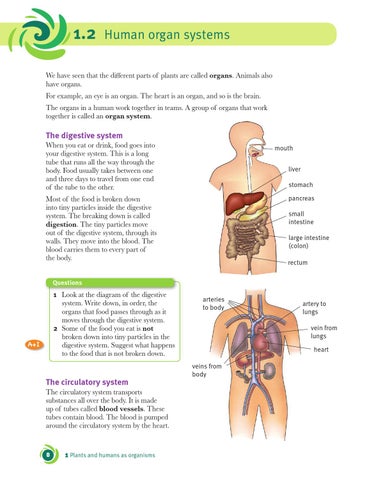
The digestive system When you eat or drink, food goes into your digestive system. This is a long tube that runs all the way through the body. Food usually takes between one and three days to travel from one end of the tube to the other.
mouth liver stomach pancreas
Most of the food is broken down into tiny particles inside the digestive system. The breaking down is called digestion. The tiny particles move out of the digestive system, through its walls. They move into the blood. The blood carries them to every part of the body.
small intestine large intestine (colon) rectum
Questions
1 Look at the diagram of the digestive system. Write down, in order, the organs that food passes through as it moves through the digestive system. 2 Some of the food you eat is not broken down into tiny particles in the digestive system. Suggest what happens to the food that is not broken down.
A+I
The circulatory system The circulatory system transports substances all over the body. It is made up of tubes called blood vessels. These tubes contain blood. The blood is pumped around the circulatory system by the heart.
8
1 Plants and humans as organisms
arteries to body
artery to lungs vein from lungs heart
veins from body