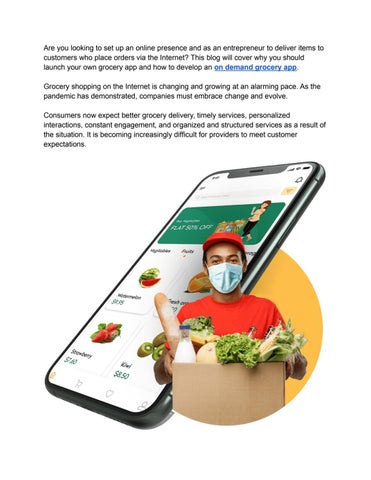
Are you looking to set up an online presence and as an entrepreneur to deliver items to customers who place orders via the Internet? This blog will cover why you should launch your own grocery app and how to develop an on demand grocery app. Grocery shopping on the Internet is changing and growing at an alarming pace. As the pandemic has demonstrated, companies must embrace change and evolve. Consumers now expect better grocery delivery, timely services, personalized interactions, constant engagement, and organized and structured services as a result of the situation. It is becoming increasingly difficult for providers to meet customer expectations.
What is the white-label grocery delivery app? Internet and mobile are increasingly being used to power businesses. Customers can interact with these businesses through the Internet and mobile front end. Instead of hiring a team and developing apps over time at a high cost, businesses are opting to purchase white-label apps. External developers design business applications that are attractive, functional, and cost-effective. What is a white-label application, exactly? White Label App is created by an external team. The company can rebrand the app with its own logo with the help of an external team. Customers must believe that after the re-branding, the company has built it on its own.
The business model for on-demand grocery delivery apps The grocery app business adopts a somewhat different business model. Inventory Model The platform collects and stores items from various sources. Customers place orders, which the app picks up and delivers through an internal or external supply network. Regardless of the seller, orders are shipped with the site's logo.
Multiple merchants in a marketplace model The platform has no control over the stock. Rather it connects customers with nearby grocery stores. The buyer submits an online order, which is then turned over to a food store. Transportation is managed by an internal logistics network, which collects items and delivers them to the customer.
The Retailing Model The shopping model is one of the most popular in the global economy. The buying approach is adaptable to any market. Customers don't get to choose which retailer they want to buy from before they place an order, therefore it's comparable to the multi-seller approach. The application is in charge of the network through which its content is distributed.
The advantages of using a white-label grocery delivery app Instead of developing grocery delivery apps from the beginning, entrepreneurs nowadays prefer to use the white-label option. Before investing in a white-label app, you should be told about the benefits and drawbacks.
White-label apps have the following benefits: ● Building a white-label grocery delivery app requires less upfront capital. ● After launch, a white-label grocery delivery app development company provides support. ● The source code and other proprietary rights are entirely under your control. As a result, the order can be converted into a cash process.
Consider these factors before deciding on a white-label grocery delivery app. Selecting an appropriate white-label solution provider● Check that the white-label grocery delivery app meets critical security requirements. ● Is complete documentation provided by the white-label app solution provider? ● When can the white-label grocery app be expected to arrive? Encouragement and Help You will need constant help and support from the app development team when you launch a new app for the first time. 1. Is the demo provided by the app development firm? 2. Before launching a white-label grocery delivery app, inquire about the software tests the company conducts.
3. For example, will the development firm guarantee data recovery and help in the event of a hardware failure?
A white-label grocery delivery app should have the following features. Here are some essential features for a white-label grocery delivery app:
Panel Admin ● ● ● ● ● ● ● ● ●
Product Catalogue System Advanced Reports and Statistics Seller Approval and Management Commission Management Delivery Staff Management Multiple Revenue Channels Tax Management Subscription Packages Management Multiple Level of Administrative Access
Sellers/ Vendors Panel ● ● ● ● ● ● ●
Delivery Managing Slots Advertisements on Banners Dashboard Bulk for Vendors Huge data files import/export Map out the location of the shop. Management of Requests for Order Refunds Plans For Subscription Requests to cancel orders Management
A panel of Clients and Buyers ● ● ● ● ● ● ● ● ●
Auto-Detect User Location Product Search Multi-Cart Guest User Checkout Order Substitution Single Item Cancellation Order Tracking PWA Multi-currency
Delivery Panel ● ● ● ● ● ●
The radius must be defined. Accept the Order or Reject it Buyers and sellers can be contacted by clicking on their names and dialing their phone numbers Delivery Dashboards for order tracking Getting to the Locations of the Sellers and the Buyers Operating Order Cancellation at Any Time is a Timely Convenience
How to make your own Postmates-style grocery app The company's business model is used to build grocery delivery apps. Examples of grocery delivery business concepts include the inventory model, marketplace, shopping model, and hyper-local model. Because Postmates is based on the shopping model, a customer app, a supermarket app, an admin dashboard, and a delivery agent app are the most important features to include in a Postmates clone app.
Conclusion When it comes to starting an online grocery delivery business, white-label solutions can be a great option. White-label grocery delivery app solutions are a good choice because of benefits such as cost-effectiveness, speed to market, and after-sales support and assistance.