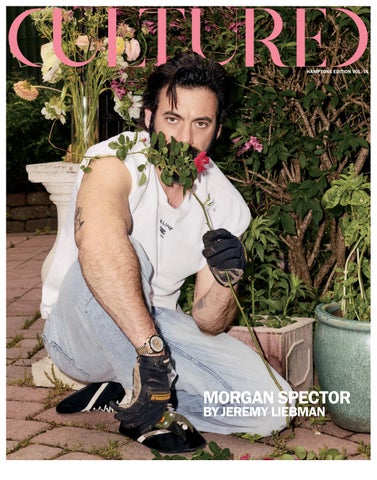
HAMPTONS EDITION VOL. IX
MORGAN SPECTOR BY JEREMY LIEBMAN
T:14 in
B:14.25 in
“ Ce n tu r i es - ol d a r m o r i n s p i res m e — l i n ks e ngi nee red t o b e s t r o n g e r t o g e t h e r. I ex p l o r e t h a t c ra f t s m a n s h i p a n d tra n s l a te i t i n to m od e r n a d o r n m e nt. ” — E VA N Y U R M A N
ARMORY COLLECTION
scanlantheodore.com Americana Manhasset, NY | Flatiron, NYC | Hudson Yards, NYC NorthPark, Dallas | Bal Harbour Shops, Miami | CityCenter, DC
A Beachfront Paradise in Miami’s Most Coveted Address
This limited collection of light-filled homes in the sky, designed by the visionaries
Skidmore, Owings & Merrill (SOM), Rottet Studio, and Landscape Architecture by Enea Garden Design, is an unrivaled oceanfront opportunity in exclusive Bal Harbour.
NOW UNDER CONSTRUCTION
THREE- TO SIX-BEDROOM RESIDENCES PRICED FROM $13 MILLION RIVAGEBALHARBOUR.COM | 786.572.3441
SCHEDULE A PRIVATE PREVIEW AT OUR SALES LOUNGE IN BAL HARBOUR SHOPS ADJACENT TO MAKOTO
Letter From the Editor
24 26 28
Are we already halfway through summer? It seems that no sooner does one arrive in the Hamptons to open a house for the season—brushing off the dust and !lling the shelves with farmstand produce and flowers—than it’s already time to think about the impending fall. Of course, that’s not true. There’s a vastness to summer: the unscripted hours, the longer days, and a slate of cultural programming out East so expansive we !lled two of our Hamptons editions with it all. You’re holding the second one. After breezing around town with Sarah Pidgeon and stopping by the home of collector Glenn Fuhrman in June, we return with more: on the cover of this issue is the ever-iconic Ina Garten, a titan
of the East End who invited us inside the barn where she develops her best recipes. Her fellow cover star is Morgan Spector, best known as Mr. George Russell on The Gilded Age, who spent a day in the garden with us. There’s also a trove of Hamptons lore: a peek inside artist John Alexander’s studio, a conversation with Donna Lennard about il Buco al Mare, and a meditation on the legacy of longtime denizen and danceworld legend Bob Wilson. For those in search of even more reading material, we’ve tapped actors, writers, artists, and more to share their essential summer books. If you start now, you might be able to read them all.
— SARAH HARRELSON
30 32 34 36 38
Morgan Spector photographed by Jeremy Liebman wearing a full look by Celine and watch by Omega in New York.
22
Ina Garten photographed by Jeremy Liebman at her barn in East Hampton.
CULTURED HAMPTONS JULY / AUGUST 2026
THE ART DIET These are the 10 must-see shows to catch during the second half of the summer.
ONE PERFECT DAY The Hamptons can be a garden of earthly delights. We narrowed down six essential pop-ups and events for your calendar.
‘I DIDN’T EVEN HAVE A LOCK ON THE DOOR’ John Alexander reflects on nearly half a century of making art in the Hamptons— and hobnobbing with its most famous denizens.
LATE SUMMER LUNCH The fruits and veggies from your favorite farmstand will never taste better than right now. Our food editor Mina Stone shows how to make your favorite flavors last.
GEORGE CIVERIS IS HAMPTONS-PASSING The comedian goes in on off-menu calamari, the Gawker book club and why “laugh-out-loud funny” is a lie.
ROOTED IN THE LAND Amagansett’s il Buco al Mare is designed to make guests feel at home. That’s because it grew out of its founder’s own.
MAGIC HOUR Ugo Rondinone has toiled away at a sprawling garden and three new bodies of work that pay homage to the spark he found out East.
STAY THE NIGHT Whether it’s a sun-dappled Colonial in Sag Harbor or a marina monument in Montauk, we’ve rounded up the best new places to stay while summering in the Hamptons.
40 42 44 46 52 58 60
FROM LA TO MONTAUK Three iconoclastic artists with roots in California took over the Ranch this summer for a sculptural ode to totemic scale.
THE HAMPTONS EN PLEIN AIR The crisp air and salty spray of the Atlantic suffuse the work of artist couple Gwen O’Neil and Tommy May.
THE SEASON’S SWAN SONG Before the annual migration south, we pay homage to the East End’s sartorial legacy.
HOT SOCIALIST SUMMER Morgan Spector has taken over TV as a swarthy industrialist on The Gilded Age. Offscreen, the actor is more interested in bread and roses.
EVERYBODY LOVES INA The Barefoot Contessa’s secret? A sense of neighborly warmth and abundance that’s increasingly hard to !nd stateside.
IT’S AN ISLAND. WHAT DO YOU EXPECT? Psychoanalyst Jamieson Webster flips through the memories imbued in Shelter Island.
WHEN WILSON CAME TO WATER MILL One year since the passing of legendary theater director Robert Wilson, a cohort of his collaborators looks back at the indelible mark he left behind.
VOL IX
SOUTHAMPTON | EAST HAMPTON
wealth mission
Let’s talk vision
investments legacy Every so often you reach a moment that demands an important conversation. When it arrives, Glenmede is ready with sophisticated wealth and investment management solutions delivered with the personalized service you deserve. glenmede.com
THE BEST IN BEAUTY, NOW IN EAST HAMPTON VIOLET GREY’s latest outpost on Newtown Lane delivers a top-shelf curation of expertvetted products to the seaside destination.
Photography by GRANT LEGAN
VIOLET GREY 66 NEWTOWN LN, EAST HAMPTON, NY 11937 | VIOLETGREY.COM
Art Diet:
“NEVER THE LESS” BY ROSS BLECKNER
ROSS BLECKNER, THROBBING HEARTS, 2018. PHOTOGRAPHY COURTESY OF THE ARTIST AND GUILD HALL.
When: Aug. 9–Oct. 25
up in size before crafting his large-scale works. Here, these studies are placed alongside the !nal products.
Why It’s Worth a Look: This exhibition highlights a lesser-known aspect of Bleckner’s practice. Before he makes a composition, the artist tests handmade paints on black paper, gradually moving
Know Before You Go: Over the course of his career, Bleckner has produced and kept thousands of these studies, which also show the artist testing experimental brushstrokes and new styles.
Where: Guild Hall, East Hampton
“THE DISAPPEARANCE OF LANDSCAPE: OAKLEYVILLE, 1964–2022”
10 Must-See Shows in the Second Half of the Summer LOOKING FOR A REPRIEVE FROM THE BEACH? HERE ARE 10 SHOWS THAT JUSTIF Y PLOT TING AN ESCAPE FROM THE GREAT OUTDOORS AS THE SEASON REACHES ITS CLIMA X. BY ISABELLA BERNSTEIN
26
CULTURED HAMPTONS JULY / AUGUST 2026
PAUL THEK, NOTEBOOK SPREAD OF THE BURMA ROAD, 1972. PHOTOGRAPHY COURTESY OF THE ESTATE OF PAUL THEK AND THE WATERMILL CENTER.
Where: The Watermill Center, Water Mill
community of Oakleyville, a hub for queer artists dating back to the 1960s.
When: Aug. 29–March 20, 2027 Why It’s Worth a Look: To continue the Peter Hujar and Paul Thek craze that just won’t stop this year, this exhibition examines the work of the duo alongside the work of photographers Sheyla Baykal and Matthew Leifheit. All four artists spent time in the intimate Fire Island
Know Before You Go: These days, sea level rise threatens Oakleyville. Experts anticipate that the area will be inaccessible within the next 30 to 50 years, bringing another layer of imminent danger to a community already living through a turn toward anti-queer totalitarianism nationwide.
VOL IX
“ROBERT NAVA”
SUMMER PROGRAMMING
“LA MONUMENTAL”
Where: Peter Marino Art Foundation, Southampton
Where: The Ranch, Montauk
When: Through Oct. 3
When: Through Nov. 15
Why It’s Worth a Look: The creatures in Nava’s paintings are monsters in the classical sense, hybrid forms and chimeras rendered in acrylic, spray paint, and grease pencils. His rough gestures (and the head-spinning speed at which he paints) animate the 10 large-scale canvases on view at the Peter Marino Art Foundation, which feature geese, dragons, hydras, and other fantastical beings that push the boundaries of taste as far as they can go.
Why It’s Worth a Look: Los Angeles, with its urban sprawl and vast industrial spaces, has long beckoned artists interested in scale and possibility. Three artists with deep Angeleno roots—Matt Johnson, Nancy Rubins, and Paul McCarthy—bring the city to Montauk with three behemoth statues on view all summer and beyond.
Know Before You Go: Nava’s style may defy conventional art-world sensibilities, but his proponents remain deeply embedded in it. His !rst New York solo was at Vito Schnabel’s Chelsea space, and the Mugrabi family has been known to collect his pieces.
“THE SYNCHRONICITY TALISMAN: AN ANCIENT FUTURE AMULET FEAST” BY ANGELBERT METOYER
ANGELBERT METOYER, VAN GLORIOUS, 2026. PHOTOGRAPHY COURTESY OF THE ARTIST AND TRIPOLI GALLERY.
JENNY HOLZER, UNTITLED FROM “INFLAMMATORY ESSAYS,” 1979–82. PHOTOGRAPHY COURTESY OF THE ARTIST AND SHOOSTER ARTS & LITERATURE. © JENNY HOLZER, MEMBER/ARTISTS RIGHTS SOCIETY (ARS), NEW YORK.
Where: Shooster Arts & Literature, Sag Harbor When: Open through the season Why It’s Worth a Look: Many museums couldn’t unite works by Jean-Michel Basquiat, Claes Oldenburg, and Jenny Holzer under one roof—but this Sag Harbor whaler’s cottage can. This summer, Shooster will also present photography from Helmut Newton, New York’s Marcia Resnick, and German artist Werner Rohde, alongside European design objects such as a pine sofa by Uno Kristiansson and collectibles by Jean Prouvé.
Know Before You Go: Johnson, who works out of an indoor-outdoor studio by the Paci!c, offers a vast con!guration of shipping containers. Rubins, who lives and works out of Topanga Canyon, crafted a silver supernova out of reclaimed boats. And McCarthy, who houses decades of his work in a vast industrial compound in East LA, presents a 40-foot-wide bronze cast of a bacchanalian riff on Disney’s Snow White.
“HALO IN A HAYSTACK” BY MICHAEL BÜHLER-ROSE
Know Before You Go: The !ne art, design, and antiques dealer’s star-studded curation is complemented by a conversation series featuring artists, curators, and writers Max Blagg, Bill Fine, Camille Okhio, Sasha Bonét, Eliot Duncan, Norman Scherer, and David Fishkind.
Where: Tripoli Gallery, Wainscott When: Through Aug. 3
When: Opening July 18
TONY BECHARA, COLOR IN MOTION IV (CUBE), 2024. PHOTOGRAPHY COURTESY OF LISSON GALLERY. © ESTATE OF TONY BECHARA.
Where: Parrish Art Museum, Water Mill When: Through Nov. 1 Why It’s Worth a Look: In the !rst-ever comprehensive survey of Bechara’s work, viewers can trace the late Puerto Rican artist’s life through his vibrant abstract paintings and sculptures. See his pixelated pointillism—rendered on circular, triangular, and square canvases—inspired by everything from !fth-century Byzantine mosaics to Georges Seurat to nascent digital technology. Know Before You Go: The show is part of the museum’s yearlong program devoted to exploring America’s history and ever-developing identity. The Bechara exhibition runs alongside a solo from Sanford Biggers and ahead of upcoming presentations on Abstract Expressionism and American Impressionism on the East End.
“HEDGES AND EDGES: BARBERSHOPS, COMMUNITY GARDENS, AND THE ARCHITECTURES OF CARE” BY DAMIEN DAVIS Where: Southampton African American Museum
“TONY BECHARA: AN ARTIST OF MANY WORLDS”
MICHAEL BÜHLER-ROSE, STUDIOLO WINTER ‘26 (FDR & GRAND ST.) 1-4 (DETAIL SHOT), 2026. PHOTOGRAPHY COURTESY OF THE ARTIST AND HALSEY MCKAY.
Where: Halsey McKay, East Hampton
“BOUND BY WIRE AND TIME” BY PAM BROWN Where: The Arts Center at Duck Creek, East Hampton
When: Through Aug. 10 When: Aug. 22–Sept. 27
Why It’s Worth a Look: Metoyer, who splits his time between Houston and the Netherlands, presents an Afrofuturist vision rooted in mythology derived from across the ancient world. New works on Tyvek and glassine explore the talisman as an object of remembrance, connecting communities to their ancestors through time and space. Know Before You Go: Through his work, Metoyer presents a vision of time that is circular rather than linear, weaving Black identity into threads of ancient histories and imagined futures.
VOL IX
Why It’s Worth a Look: In this sculptural site-speci!c series, Davis investigates spaces of ritual, care, and community gathering by pulling from the museum’s own history as a Black barbershop serving the Southampton community. Know Before You Go: Large-scale mirrored acrylic works dot the space, joined by sculpture and live barbers cutting hair. A portion of the project’s funding will also go toward the creation of the Hamptons Black Arts Council’s community garden on museum grounds.
Why It’s Worth a Look: What do a rare Minor Threat 7-inch record, a gleaming ghanta, and an Anish Kapoor monograph all have in common? This artist may very well collapse them into a single frame using the proto-Photoshop method of wood intarsia. Know Before You Go: Bühler-Rose’s collections draw upon the ephemera accumulated across the communities he frequented growing up: the Hare Krishna movement, punk and hardcore music scenes, and academia.
Why It’s Worth a Look: The origins of the material used in Brown’s skeletal metal sculptures are as important as the structures themselves. For her latest show, the Long Island artist employs scrap metal and other salvaged material to create animal-like forms derived from the very detritus that threatens their habitats. Know Before You Go: Brown also uses sewing and other craft techniques that blend domestic labor with industrial manufacturing practices.
CULTUREDMAG.COM
27
One Perfect Day THE HAMPTONS CAN BE A GARDEN OF EARTHLY DELIGHTS: TOO MUCH TO DO AND NOT ENOUGH TIME. WE NARROWED IT DOWN TO SIX ESSENTIAL POP-UPS AND EVENTS THAT BELONG ON YOUR CALENDAR. BY OLIVIA SILVA
Spending a dreamy day in the Hamptons isn’t hard—choosing where to spend it is. Whether it’s a lazy Monday you’re after or a full weekend getaway, we’ve compiled an itinerary full of pampering, performances, and play at a must-visit roster of destinations out East. 8 a.m. – FORWARD__Space Substitute your morning coffee for a visit to the iconic Barn in Bridgehampton, where FORWARD__Space, the jet-set’s dance and !tness studio, is returning for its seasonal summer residency. Each of Kristin Sudeikis’s classes combines dance, cardio, conditioning, and meditation for newcomers and experienced movers alike. Accompanied by a no-skip soundtrack, you’re guaranteed to leave both euphoric and sweaty.
2 p.m. – Violet Grey East Hampton From there, head over to Violet Grey, the meticulously stocked luxury beauty retailer. The boutique has put down roots with three U.S. stores: on Melrose Place in Los Angeles, off Madison Avenue in Manhattan, and in East Hampton, the last of which opened in May. The space, designed by Rafael de Cárdenas in
28
Shooster Arts & Literature 197 MADISON STREET
3 p.m. – Hamptons Community Outreach Later in the afternoon, step into the home studio of Purethread founder Jill Heller. Its pre-fall collection will be showcased in the intimate boutique on July 30, alongside summer styles from Agolde, Perfect White Tee, and B.B. Wallace. This isn’t your runof-the-mill studio visit: A percentage of the proceeds from the shopping experience will go toward Hamptons Community Outreach, an organization providing essential services to underserved communities on the East End. 5 p.m. – BookHampton Next, hit East Hampton’s Main Street and browse the shelves of BookHampton for your next beach read. Odds are it’ll be signed—the store’s calendar is stuffed to the gills with author talks all summer long. On the docket this season are appearances by Colson Whitehead, Glenn Fuhrman, Andrew Sean Greer, and Angela Duckworth. Maybe the beloved independent bookstore’s owner, legendary art dealer Larry Gagosian, will even stop by to listen in. 7 p.m. – Guild Hall End the night at Guild Hall, the premier event space that’s been holding down the East End for nearly a century. This summer, it has the programming of record: For the cranky and literary, spend an evening with CULTURED cover star Fran Lebowitz. For the aesthetes, sit down for an evening with Met curator David Breslin. Or perhaps you’d rather catch the Pope of Trash, John Waters himself. From dance performances to discos, there’s no shortage of fun to be found.
CULTURED HAMPTONS JULY / AUGUST 2026
ABOVE: ARTWORK BY RENE RICARD AND TABLE BY JEAN PROUVÉ.
Guild Hall
Violet Grey
158 MAIN STREET
66 NEWTOWN LANE
BookHampton
Purethread
41 MAIN STREET
181 N FERRY ROAD
ALL PHOTOGRAPHY COURTESY OF THE LISTED BUSINESSES.
12 p.m. – Shooster Arts & Literature After a quick shower and a short drive to Sag Harbor, drop by Shooster Arts & Literature to peruse Lauren Shooster’s collection of !ne art, antiques, and rare books housed in a former ship chandlery. This July, the gallery is launching a Farm Annex, a seasonal farmstand bringing fresh flowers, produce, and more into the art space. But the real draw after your gallery visit/grocery run is a conversation series organized by director Pamela Willoughby, where artists, writers, and curators such as Max Blagg, Bill Fine, and Camille Okhio go deep on their work in an intimate setting.
collaboration with Farin Samnani, harks back to the golden age of department store makeup counters, with product exclusives and in-store events featuring the kinds of brands that inspire ravenous loyalty all summer long.
VOL IX
SOHO UPPER EAST SIDE EAST HAMPTON BELMONT PARK VILLAGE
‘I DIDN’T EVEN HAVE A LOCK ON THE DOOR’ JOHN ALE X ANDE R RE FLEC T S O N NE ARLY HALF A C E N T U RY O F MAKIN G AR T IN T HE HAMP TON S — AN D HO B N O B B IN G WIT H IT S MO S T FAM O U S DE NIZ E N S .
For nearly !ve decades, painter John Alexander has watched the East End evolve from a quiet enclave of farmers, !shermen, writers, and artists into the glamorous destination it is today. What began as a chance encounter with Willem de Kooning in Houston ultimately led Alexander to Springs and then Amagansett, where he built both a home and an artistic practice deeply rooted in the rhythms of the landscape. This conversation is personal for me. Alexander is not only an artist whose work I have long admired, but also my father-inlaw. Over the years, I have come to know him not just through his paintings, but through long dinners and family gatherings where he shares stories about the East End he has called home for nearly half a century. Here, he reflects on the larger-thanlife characters who have shaped his life, from Larry Rivers and John Chamberlain to Bill Murray and Lorne Michaels. Along the way, he sounds off on old Amagansett, life in the studio, and the enduring curiosity and light that continue to animate his work. When did you first settle in the Hamptons, and what brought you out there? In 1976, Willem de Kooning made his one and only trip to Houston. He had a dear friend who lived there. She knew what a fan I was and said, “Would you be willing to take him around?” I was 31. I couldn’t believe it. We got on like a house on !re. He asked me to come to Springs [in the Hamptons] and visit him. So I got in my old El Camino and drove there that summer. I thought, There’s something magical about this. The Hamptons landscape has greatly impacted your work. The fauna and the flora have a profound effect on the subject matter of my paintings.
30
I set up an easel outside. So many artists talk about how they came out here because of the light. I get my inspiration by staring at stuff, and then, like a jigsaw puzzle, I’ll take an image from here, from there, and build these complicated compositions. How do you think the art scene has changed over the years? When I !rst came here, there were a number of artists, but you could probably put them all in a restaurant. Now, there are bunches of them. And what we didn’t have before were galleries. There are galleries everywhere now. And they come, and they go. You co-founded a vodka company with Dan Aykroyd, for which you designed the iconic skull bottle, and you’re very close with Lorne Michaels, of Saturday Night Live. How did you get connected to that group of people, who also have a connection to the Hamptons? It happened by accident. I was still living in Houston, and a dear friend of mine, Van Schley, was a somewhat successful conceptual artist. He bought a minor league baseball team as a conceptual art piece: He was going to run the team for the summer and document every phase of it. And he was also good friends with a then-unknown Bill Murray. And when Murray was hired by Saturday Night Live to replace Chevy [Chase], Van said, “Why don’t you come through Houston?” My house was open to people in those days. He came, and we became very good friends. What do comedians and visual artists have in common? The really good ones are insecure. Myself included. I’m always asking, “What do you think?” Also, artists are very observant people. Comedians are very similar.
CULTURED HAMPTONS JULY / AUGUST 2026
ABOVE: ARTWORK BY RENE RICARD AND TABLE BY JEAN PROUVÉ.
You’re one of the only artists with a studio right in one of the major towns of the Hamptons. Can you talk about how it’s evolved? For many years, I didn’t even have a lock on the door. I’d just slide the barn door closed and go home at night. But then the town began to get bigger and everything began to change. Now you have drunk teenagers peeing behind your studio. A hundred percent. They go back there and do drugs or whatever they do, but we do our best to keep them away. You still have a pretty open-door policy for collectors, artists, and anyone who wants to pop by, which is great. Speaking of big collectors, my dad—we only learned this after Harrison [Waterstreet, Cohen’s husband] and I started dating— had bought some of your work. You were the first living artist my dad bought, ever. Yes. This is long before I met you. I was introduced to him at a barbecue.
Larry [Gagosian]’s? Yeah. Labor Day. The person who introduced us was going on about how he and his wife had my work. And Steve interrupted him and said, “I know John Alexander’s work.” I had no idea. He said, “You’re the !rst painter my wife Alex and I bought after we got married, we decided we wanted to start putting a collection together.” Marlborough Gallery, at that time, was the biggest gallery in New York. He said, “Why don’t we go there?” Coincidentally, my work was up and they bought a fairly large picture. I have baby photos in front of that picture. It’s fate. Last question: If you’re putting together a dinner party, which five people, alive or dead, would you invite to the Hamptons? The yoga group: Ben Bradlee, Lorne Michaels, Paul McCartney, and Alec Baldwin. Oh, and John Eastman. He was its founder, and he’s a big collector. His dad was the lawyer for [Jackson] Pollock, de Kooning, Franz Kline. His son took over after his father died, and he put the yoga team together.
VOL IX
PORTRAIT BY JENNY GORMAN AND STUDIO SHOT BY TRIA GIOVAN PHOTOGRAPHY, ALL COURTESY OF JOHN ALEXANDER.
BY SOPHIA COHEN
VOL IX
CULTUREDMAG.COM
31
MEET YOUR NEW FAVORITE SALAD T HE FRU IT S AND VEGGIE S FRO M YO U R FARM S TAN D OF C H O I C E WILL NE VE R TA S T E B E T T E R T H AN T HE Y D O RIGH T NOW. O U R FO O D E DITO R MIN A S TONE SH OWS U S HOW TO M AKE T HE MO S T O F T HE M WIT H AN E FFOR T LE S S L AT E - SU MME R REC IPE . BY MINA STONE
When it comes to summer cooking, I follow a few simple tenets. The !rst one is minimal stove use. (When I do need the stove, I use it in the morning.) The second is making the most of your farmstand. Produce will never taste better than in the summer when the fruits and veggies develop their natural sugars in the bright sun and heat. The third is prepping things ahead of time. I like the peace of mind knowing that I can spend
my day at the beach and come home to a dinner that is, for the most part, already made.
To prepare: Slice the zucchini on a mandoline or very thinly with a sharp knife. Layer it on the platter you want to serve it on, one or two layers, overlapping the slices. Squeeze the juice of two limes over the zucchini. Cover the platter with plastic wrap and place it in the refrigerator until you are ready to serve.
To serve: Take the platter out of the refrigerator and sprinkle the crushed peanuts over the top. Drizzle with a little olive oil (this is one of the few times I will say not too much). Zest the third lime and then squeeze the juice of the third lime over the salad. Finish with a good pinch of flaky salt. Garnish with herbs, if using, and serve.
Here’s a late-summer recipe for using the best of what the East End’s farmstands have to offer, with a little inspiration from travels to Senegal thrown in, too. Hot countries tend to have all the secrets for how to !ll your table with big flavors for minimal effort. PHOTOGRAPHY BY MIKAL EVANS AND COURTESY OF MINA STONE.
Shaved Zucchini Salad with Crushed Peanuts and Lime Serves 4–6 My friend Mikal introduced me to this salad. She lived with her family for eight years in Senegal where she ate this at a restaurant on an island called Mar Lodj and has been re-creating it ever since.
32
You’ll need: • 4 zucchini or mixed summer squash and pattypan (1 zucchini will feed about one to two people) • ½ cup roasted and salted peanuts, !nely chopped • 2–3 organic limes, for zest and juice • Extra-virgin olive oil • Flaky salt, such as Maldon • Optional: parsley, cilantro, or mint leaves
CULTURED HAMPTONS JULY / AUGUST 2026
VOL IX
Artisan Tabletop + Antique Decor Handmade in Italy 225 Main St, Amagansett ilbucovita.com | @ilbucovita
GEORGE CIVERIS IS HAMPTONS-PASSING T HE C O ME DIAN GOE S IN ON OFF - ME N U CAL AM ARI , T HE G AWKE R BOOK C LU B , AN D WH Y “ L AU GH - O U T- LO U D FU NN Y ” I S A LIE . BY KARLY QUADROS
If it all sounds a bit obtuse, think again. Like all the best writers and comedians, Civeris has a keen eye for speci!city and human foibles. He’ll bring his stand-up to Guild Hall on Aug. 30 for his !rst show on the East End. Before then, CULTURED sat down with Civeris to talk about the book that made him, the Gawker Slack chat, and the most abused phrase in literary criticism. This is your first show in the Hamptons. What’s your relationship to the place? Was it aspirational growing up? I’ve spent some time in East Hampton over the years. I wouldn’t say it comes naturally to me—I’m Hamptons-passing, if I wear the right clothes. But I’ve had some genuinely nice trips out there. I once spent a week there with Sam Taggart, and we found the things that felt normal to us and went to those. I really like Bostwick’s. It’s the kind of restaurant you’d !nd in any beachside town, and the secret is the offmenu buffalo calamari. Lobster rolls, !sh and chips. It’s fun to !nd the places that don’t feel Gagosian-adjacent. Where do you find your next read? I actually really enjoy reading book reviews as a form, and often I enjoy reading reviews of books I’ll never read more than ones of books I have read. But in terms of actual discovery, it’s mostly friends’ recommendations. I have a Slack with my former Gawker colleagues that we made when we were all !red, and we have a books
34
channel. I get a lot of recommendations from there. What’s the best one you’ve gotten from the Slack? I recently read Truth & Beauty: A Friendship by Ann Patchett. It’s a memoir about her friendship with the writer Lucy Grealy, who had a tragic backstory and ultimately died of a drug overdose. The book was so not what I expected from Patchett. PHOTOGRAPHY BY LEO PEREZ AND COURTESY OF THE ARTIST.
George Civeris moved through many worlds before he landed on the stand-up circuit: academia, tech, and even a stint as the senior editor of Gawker’s relaunch (RIP). As a key !gure in the 2020s Brooklyn alt-comedy scene, he’s turned mental gymnastics into a competitive sport. Look no further than StraightioLab, the podcast he co-hosts with Sam Taggart, where the pair and their guests take a topic they deem “straight culture” and dissect it at length. Previous episodes have tackled overhead lighting, monogamy, and cruises (not cruising).
One of my favorites was The Babysitter at Rest by Jen George, a book of short stories that are legitimately laugh-out-loud funny. It reminds me of Miranda July’s short story collection, No One Belongs Here More Than You, which was a huge touchstone when it came out. Slightly absurdist, weird, millennial girl !ction. Just really good. Do you ever have the opposite reaction when someone gives you a recommendation, and you wonder why on earth they thought you’d enjoy it? I genuinely could not get into Speedboat by Renata Adler, which so many people have recommended to me. I’d almost rather read a dragon fantasy novel than something that’s almost what I want it to be. Do you have favorite funny authors— people who are actually laugh-out-loud funny? Can I say something on the record? One of my biggest pet peeves in book reviewing is the phrase “laugh-out-loud funny” applied to things that simply are not. It’s almost a flex, as if to say, I am so intelligent that I found this unfunny book hilarious. Don’t lie to me. There are books that are laughout-loud funny. Portnoy’s Complaint is laugh-out-loud funny—probably the funniest book I’ve ever read. It’s funny in the way a sitcom is funny, which is what that phrase actually means. Otherwise, say droll. Say humorous. Say cheeky or witty. I’m sorry to be recommending Philip Roth in 2026, but there it is. I also love Lucky Jim by Kingsley Amis. Someone once told me it was the ur-campus novel. It’s about
CULTURED HAMPTONS JULY / AUGUST 2026
a dissatis!ed adjunct navigating various indignities at some university. It’s interesting to see how much has stayed the same: the ego-driven arguments among faculty and students, the comedies of manners around disagreements that are aesthetic, ethical, or touch on political correctness.
And Love Junkie by Robert Plunket, which had a moment a couple of years ago when it was reissued. It’s from the ’90s; at some point, Madonna optioned it. It’s about a suburban housewife who ends up embroiled in New York’s gay art world. A very funny !sh-out-of-water story.
VOL IX
ROOTED IN THE LAND AMAGANSETT’S IL BUCO AL MARE IS DESIGNED TO MAKE GUESTS FEEL AT HOME. THAT’S BECAUSE IT GREW OUT OF ITS FOUNDER’S OWN. BY SOPHIA SHYER
You lived many different lives before il Buco. Walk us through some of them. I went to Italy for the !rst time when I was 17, living with a family in Sardinia. I went on to study at Duke and then NYU, where I trained as a !lmmaker. I graduated from college, went to !lm school, fell in love with a !lmmaker, and then he tragically passed away from a brain aneurysm right before our wedding. About a year later, while I was trying to produce a screenplay he had written, I met Alberto Avalle, a charismatic Italian, while working as a bartender at Arqua in Tribeca. He was a food purist,
36
a world traveler, and an adventurer. After that, my life took a turn. Is it true that il Buco originally began as an antique shop? Alberto and I were partners in life and in business, and we started out collecting antiques to sell in Italy. We soon realized we desperately needed somewhere to store all the Americana we’d amassed. One afternoon while crossing cobblestoned Bond Street, a set of hand-wrought light sculptures in artist Warren Muller’s studio caught my eye. A few months later, the space was ours. It was 2,000 square feet for $2,000 a month. We !lled it with our curated collection of antiques and started sharing the occasional glass of wine and lunch with neighbors. We procured a wine and liquor license, and il Buco became a speakeasy restaurant where you could buy the table you were dining at. Three years later, we stopped selling antiques to focus entirely on the restaurant. What were your inspirations for the restaurant, its design, and its menu? I began my career as a !lmmaker, so il Buco was like an independent !lm
CULTURED HAMPTONS JULY / AUGUST 2026
production. I work from instinct, so it was never about executing a concept. It was about creating a warm feeling, inviting our guests into our home. The antiques were already there—the hutches, the old chairs, the objects we’d been collecting with love over time. These objects and textures gave il Buco a mood that couldn’t be manufactured. The food followed the same logic. We started as a tapas bar, shaped by the time Alberto and I had spent traveling Spain together. Eventually, we found our way back to Italy, to his family in Foligno, in Umbria, and the menu followed us there. Ingredient-!rst, seasonal, rooted in the land: that philosophy remained constant over the past 32 years. What has your relationship to the Hamptons been over the years? I’ve been out East for a long time. I’ve always been drawn to the sea to disconnect. My father had a home there for almost 30 years, and I rented in Sag Harbor for many winters before I bought a small 1960s cottage almost 10 years ago in Springs. As for al Mare, it was de!nitely not in the works before the pandemic. I was
intractable about it: no way, no how, was I going to have a restaurant where I go to relax. We dipped a toe in summer 2020 when we took over my friend Fernando Trocca’s Mostrador at the Marram hotel in Montauk. Il Buco al Mare opened just barely in time for Memorial Day 2021. Where are your favorite places to go in the Hamptons to eat, to shop, and to unwind? For shopping, I love Winnie Beattie’s Warm, 180 the Store in Amagansett, Ganeaux, French Presse for bedding, and Lori Leven’s Love Adorned market in Amagansett Square—Henry Lehr is a forever favorite. When I’m entertaining at home in Sag Harbor, I load the car with things from Alimentari—bread, cheese, anchovies, colatura, bottarga—and then shop the farmstands like Balsam and Amber Waves and the !sh markets for whatever’s local. My mornings start with a sauna, meditation, yoga, a cold plunge in the bay. Then I’m off to ride my horse, Stallone, through the !elds and often on Gibson Beach. By evening, I’m usually at al Mare for dinner, since I’ve likely skipped lunch entirely.
VOL IX
PHOTOGRAPHY BY NOE DEWITT AND COURTESY OF IL BUCO.
Donna Lennard never predicted she would open a restaurant—il Buco found her. In 1994, she and her then-partner began serving splashes of wine out of their Bond Street antique shop. Manhattan is particularly rough on restaurants, but despite the odds, il Buco not only survived but thrived—branching off into a grocery store and outposts in Amagansett and Ibiza. Now, after spending years !nding the right ingredients, Lennard opened up to CULTURED about her journey from there to here and what she swipes from il Buco al Mare’s Amagansett kitchen for dinner.
MAGIC HOUR A DECADE AGO, AR T I S T S U GO RON DIN ONE AN D JOHN GIORNO FE LL IN LOVE WIT H A PRO PE R T Y O N T HE N OR T H FORK . S IN C E T HE L AT T E R’S PA S S ING , RONDINONE HA S TO ILE D AWAY AT A S PR AWLIN G G ARDE N AN D T HRE E NE W BO DIE S OF WORK T HAT PAY HOM AGE TO T HE SPARK T HE C O U PLE FO U ND O U T E A S T. BY JACOBA URIST
PHOTOGRAPHY BY LEO PEREZ AND COURTESY OF THE ARTIST.
Ugo Rondinone at his New York studio.
Ugo Rondinone’s Long Island home was an accident. He and his late husband, John Giorno, an artist known for his legendary Pop-esque poem paintings, already had a Delaware Water Gap getaway. But one weekend, over 10 years ago, while visiting Rondinone’s late gallerist, Barbara Gladstone, in Mattituck, her real estate agent happened to call to see if she knew anyone looking for a place. On a lark, they took a look. The Swiss-born Rondinone, whose Day-Glo desert hoodoos near Las Vegas, Seven Magic Mountains, instantly entered the land-art pantheon when they were unveiled in 2016, felt an immediate connection to the North Fork space. They “were overwhelmed by the beauty of the property—its old trees, its garden, its water views,” he recalls.
38
Rondinone wanted to dedicate something beautiful to Giorno after losing him in 2019. With landscape designer Dennis Schrader, he plotted a lush, velvety garden on his !ve acres out East, a project that Rondinone says “now occupies much of my time whenever I am there.” His years of making environmental art have prepared him well. “The maintenance of a moss garden is endless,” he laments. “We invented netting, so we could spread the moss by grinding it and mixing it with yogurt.” So far, a private memorial stands in tribute: three of his amorphous cloud sculptures that look like ancient rock formations, one of his famous aluminum-cast tree sculptures, and a 20-foot-high concrete fountain that drips water, drop by drop, from its summit.
CULTURED HAMPTONS JULY / AUGUST 2026
Mattituck is a place of refuge and creativity for the artist. Over the last decade, he has developed three distinct bodies of work in the Long Island studio. His sunset paintings capture the North Fork’s magic-hour vista in front of his house, while his sailboat series assembles driftwood and canvas into hand-sewn sails. Most recently, he’s crafted a trio of readymade sculptures, still evolving, from rusted, vintage farm tools—unearthed from a Long Island garage sale—that look just like the ones his grandparents used to tend their small potato farm in Matera, Italy. Come September, Rondinone will unveil a new exhibition of 15 towering resin “waterfalls” infused with crushed blue
gemstones at Gladstone Gallery in New York (alongside a concurrent presentation of glass works at the gallery’s Brussels outpost). The New York show has been two years in the making. “Each began as a small clay line shaped directly from my hands around a thin wire, leaving my !ngerprints embedded in the surface,” he explains. But like his sunset, tree, stone, or rainbow motifs, this installation transcends nature as literal subject matter, reflecting personal, psychological states of being. Natural elements are a metaphor for the human condition, he clari!es, “through which we confront longing, solitude, awe, fear, transcendence—geological and mortal time exist within the same material.”
VOL IX
Available for pre-order now at www.culturedmag.com
STAY THE NIGHT WHETHER IT’S A SUN-DAPPLED COLONIAL IN SAG HARBOR OR A MARINA MONUMENT IN MONTAUK, HERE ARE A FEW OF THE NEW AND NEWLY REDONE HOTELS IN THE HAMPTONS WHERE YOU CAN REST YOUR HEAD THIS SUMMER. BY ISABELLA BERNSTEIN This season, an abundance of new (and improved) hotels and restaurants alight out East. We’ve done the homework and distilled the !ve places worth the trip. So, come over and stay a night. Or two. Or three.
The property: Everything that’s old is new again at Hotel Corduroy, a freshly renovated historic hotel situated at the edge of Montauk. The intimate property, originally built in 1983, is !tted with playful Atlantic character and nestled between Sunset Beach and the marina. The gathering space: With its charming
outdoor seating areas and splayed green lawn, the hotel welcomes guests to snack and sip cocktails, calling to mind a bygone era before cellphones interrupted every meditative moment.
BARLUME BEACH
What you won’t find anywhere else: Looking for the perfect summer soundtrack? Guests are met with a curated collection of cassettes, ranging from yacht rock to blues, to enjoy through private in-room speakers.
THE MAIDSTONE
Montauk
East Hampton
The property: A breezy minimalism suffuses Barlume’s new addition to its Mediterranean-meets-Manhattan hospitality portfolio. Its latest is the full vacation package. In the inaugural Hamptons season for its Montauk hotel, guests will !nd themselves transported to a world of sunny design and Sicilian eats. At the beach club and lounge, guests can enjoy seasonal sips and snacks, and thriving nightlife programming complete with live entertainment and DJs.
The property: At more than 150 years old, the charming inn far predates the term “boutique hotel.” After a recent renovation from LDV Hospitality, the Michelinrecognized East Hampton landmark is !ner than ever.
Sag Harbour
The property: After its Nantucket and Martha’s Vineyard locations set the standard for island summering, it’s only logical that Faraway extends its luxury alcoves to the East End. Open for its !rst season in Sag Harbor, the new hotel revamps the once heralded Baron’s Cove. The design, complete with scalloped accents and pastel-shaded beach chairs, makes Faraway a quintessential East Coast villa.
coast with Italian classics (and some vibrant seafood, too).
The restaurant: No summer day is complete without a lavish dinner where you can schmooze and socialize, and Faraway has the perfect setting for it. Fashioned by Executive Chef and Culinary Director Jarad McCarroll, the hotel’s supper spot Zagara brings Amal! charm to the Hamptons
What you won’t find anywhere else: Sometimes, even the most relaxing of destinations—the beach—can get tiring. For a reprieve from your reprieve, Faraway offers spa services from Onda Beauty, the Tribeca facial staple, for guests looking for time to recharge.
MONTAUK YACHT CLUB
Montauk
The property: In its third season after an extensive renovation, the Montauk Yacht Club is the marina destination of the Hamptons. Guests can stay in one of the waterfront resort’s luxurious rooms or historic 1928 cottages. This year, you can also enjoy some private extracurriculars: new padel, tennis, and pickleball courts are open to break a sweat before cooling off with a dip in one of Montauk Yacht Club’s three pools, private beach, or cabana spa. The restaurant: Alba took over New York and LA—now it’s Montauk-bound. Indulge in aperitifs or a multi-course meal. You can even bring the kids to pizza-making classes during the day. What you won’t find anywhere else: The Montauk Yacht Club has opened the Salty
40
The restaurant: One bene!t of staying at a hotel run by one of New York’s most scrumptious eateries is that your next Beli !nd is just steps away—we recommend the fresh seafood selections.
Club, with family-friendly programming including !shing excursions and tennis clinics. Feeling adventurous? Try sur!ng, stand-up paddleboarding, or e-bike tours.
CULTURED HAMPTONS JULY / AUGUST 2026
What you won’t find anywhere else: Driving can be such a drag—sometimes, you just have to take a boat. Complete with 19 marina slips, Barlume makes it possible to arrive. Private charters, rentals, and harbor tours are a breeze for guests looking to enjoy the nautical life.
The restaurant: The Maidstone’s dining is top-notch, with a kitchen helmed by Scarpetta’s Jorge Espinoza. Seasonal produce only: guests can enjoy everything from fresh salmon crudo with green apple to chilled lobster with chanterelle mushrooms to whole branzino in butter and lemon. What you won’t find anywhere else: Popups galore. Craving a coffee? Sample the best at the Fellini Coffee truck. Looking to redecorate? Get inspiration and one-of-a-kind pieces at the Salon 21 exhibition. Had Brooklyn’s Sushi Koju on your to-try list? Make a reservation for a night of omakase in the garden. Just itching for some good ol’ retail therapy? Stuart Weitzman’s got you covered. No lines necessary.
VOL IX
PHOTOGRAPHY BY MATT KISIDAY (FARAWAY AND HOTEL CORDUROY) AND ANDREW WERNER (THE MAIDSTONE), ALL COURTESY OF THE HOTELS.
FARAWAY
HOTEL CORDUROY
Montauk
On view
Alan Ruiz: De sol a sol
Through May 31, 2027
Dan Flavin: nine sculptures in fluorescent light Permanent installation
Dia Bridgehampton The Dan Flavin Art Institute 23 Corwith Avenue Bridgehampton, New York
diaart.org
FROM LA TO MONTAUK THREE ICONOCLASTIC ARTISTS WITH ROOTS IN CALIFORNIA— MATT JOHNSON, PAUL MCCARTHY, AND NANCY RUBINS—TOOK OVER THE RANCH THIS SUMMER FOR A SCULPTURAL ODE TO TOTEMIC SCALE.
ALL PHOTOGRAPHY BY OLLIN CULBERT AND COURTESY OF THE RANCH.
PAUL MCCARTHY, SISTERS, 2013.
There are only three works in the Ranch’s summer show, “LA Monumental.” But as the exhibition’s title suggests, you can’t miss them. Sculptures by the celebrated Los Angeles–based artists Nancy Rubins, Paul McCarthy, and Matt Johnson tower like carnival rides over the expansive outdoor gallery-cum-horse farm in Montauk. The artists, ages 47 (Johnson), 73 (Rubins), and 80 (McCarthy), share an interest in mining nostalgia for inspiration and realizing their visions on an epic scale. (Hamptons-based crane operators had their work cut out for them.)
42
Rubins—who is known for creating blooming, unwieldy spirals of cast-off objects from hot water heaters, televisions, and airplane parts—teamed up with the Ranch founder Max Levai to source decommissioned !shing boats in Montauk for her new work, a spiraling totem titled Friends of Pluto. Johnson, who also uses everyday materials to create witty sculptures, assembled an array of shipping containers into a stick-!gure giant sitting pretzel-style on the ground, Meditating Figure. Finally, McCarthy presents Sisters, a massive bronze featuring bizarrely twinning !gures from his long-running body of work inspired by Snow White.
CULTURED HAMPTONS JULY / AUGUST 2026
The artists may be best known for working in expansive LA studios, but their ambitions are right at home in Montauk’s wideopen spaces. Ahead of the show, they sat down with Alex Scull, who collaborated with Levai this summer, and ruminated on the paths that led them there. —Julia Halperin Nancy Rubins “I was a student in the early part of the ’70s. At that time, my !nancial resources were slim, but I had good imagination and a lot of energy. Not only could I not afford oil paint or bronze, but I really didn’t have any interest in it. Instead, I was aware of
these marvelous shapes that were being disposed of: used coffee cups. I started amassing large quantities of these. Being that the Vietnam War was going on, the school had access to an Army Surplus store where we could buy huge canvases for very little. I began making large con!gurations with these surplus canvases, refuse cups, and the wet mud clay in the slurry bucket at the ceramics department. The work was highly temporal: when the clay dried, the work was complete, and I then disposed of it. I realized that it was not only important to develop a form that transcended its original materials and became something completely
VOL IX
of Chris [Burden, who taught in the art department until 2005]. I don’t think any other school would have hired me. I actually never sold a work of art till probably ’91 or ’92. I was never really interested in New York at all. I thought it was arrogant, and I didn’t want to go there. I carried a key chain that said ’I Love New York’ for about 18 years and never went there.
NANCY RUBINS, FRIENDS OF PLUTO, 2026. © NANCY RUBINS.
different—the sense of time, imbued in the object, was very important to me. Once I got out of school, I began accumulating massive quantities of objects that were compelling to me. I had no real yearning, especially, to build the monumental—the work demanded to be huge. Over time, the elements I worked with and my form of working evolved. However, the re!ection of time and the object’s transcendence have been a continuum. Over the recent years, I’ve been working with materials like scrap airplane parts, hot water heaters, trailers, children’s playground equipment, and boats. And I had been catching these objects at their cusp, right before they were to be melted down to become another object. I began buying airplane parts many years ago from a gentleman named Mr. Huffman for 10 cents a pound. During my friendship with Mr. Huffman, he would show me images of him in the National Geographic from right after WWII with a mobile smelter that he had designed and took around the Southwest, melting down the war !eet. Years later, a gentleman who I had been buying metal elements from for many years brought to me a series of aluminum cartoonish spring animals that were made for children beginning in the late ’40s and early ’50s to ride outside of shopping centers, parks, and playgrounds. At this moment in time, these toys were deemed unsafe and were being removed from the playgrounds. I wasn’t sure how to approach them. I was thrown off by their figurative nature. I have always avoided overt figures. I tend to think the figure is implicitly in any and every object we make. But I realized that, en masse, they could become abstracted forms. Then I realized that these were the airplanes that Mr. Huffman had melted down in the Southwest. These spring
VOL IX
riding toys were produced immediately after WWII, and the baby boom took off. I started thinking about the long history of the objects: what they were before they were airplanes, what they were before they were any object at all. Aluminum in the Earth, and, before the Earth was formed, particles in space. As my work has evolved, the sense of transformation of the materiality of the objects and my own understanding of time seems to be a continuum. In the most recent work that I just finished at the Ranch, Friends of Pluto, which consists of used and reused smallish aluminum boats held together with stainless steel wires, one can get a simple education of physics and time.” Paul McCarthy “My childhood house was built by a contractor from California who went broke, so the subdivision was only three streets in the middle of nowhere. If you went out the front door, it looked like The Truman Show. Out the back door, there was nothing for a few hundred miles. I couldn’t get into a university because my high school grades were terrible, so I ended up in this agricultural school. I ended up meeting a number of really interesting students and teachers at that school, which is a really unusual agricultural school in the middle of nowhere. Then I ended up at the University of Utah. They were real political. This is ’65 to ’67. The Peace and Freedom Party was formed, so I ended up in the middle of Utah, at a Marxist school, encouraging students to make conceptual films. All the young faculty were fired after about two years, and everybody who was hip in the school dispersed. Through San Francisco, Utah, and then when I moved to LA and went to school [at USC], I didn’t think much about galleries. I ended up teaching at UCLA because
Sisters was a sculpture I made in 2013. I made one Snow White, but using that as a prototype really abstracted. I decided I didn’t like the direction it was going, but I didn’t want to change the one I’d already started, so I started to make a second one. Then I realized I could put them together. All the way back to the ’60s, I’ve stacked things. The drawings are stacked. A lot of sculptures are stacks. It’s something I’ve known about my work for a long time, in a kind of totem sense. Even with all the solo shows I’ve done in the last couple of years, I’ve mixed two or even three bodies of work. They play off each other even though they’re sometimes separated by 10, 12, 15 years. At this point, I’m not making many monumental sculptures anymore. The big pieces I’ve made are the big sets that I’ve shot films in. There’s one 18,000-squarefoot room in the studio that has six or seven of them. A lot of the work now is monumental in a digital sense. I’ve probably accumulated a few million images and terabytes of videos. It’s to the point that you can’t show it. I remember once sitting on a panel with Chris, and he said he only needed one photograph, and I said I needed a thousand. It’s a joke, but there’s something about frames and film in relation to action or time. With A.I., there’s so much acceleration. You can make a thousand with the snap of a finger, so there’s some kind of uselessness about what I’m making. It’s dysfunctional by its nature.” Matt Johnson “I was always building and experimenting with things, both in painting and with objects. I only ‘discovered’ sculpture through working in art school. I found myself wanting to learn how to work with tools and how to make molds, cast plaster, and learn to weld. When I was in college, I had a cousin whose family had a barn that his father had turned into a crazy house, with lofts and bridges and triangle windows. It made an impression on me as this indoor-outdoor space that was creative and malleable. That expansive space in a semi-rural setting offers, I think, freedom—enough space to have shipping containers around. If I were in a smaller space in the city, I might not have made that creative connection. Even when I had studios in the city, I’ve always collected stuff and made
work about the things that exist in my environment. One thing that I did in Baltimore—which I think was inspired by Nancy’s work because I’m pretty sure I saw images of her stuff in magazines—I collected all these tires, from around the city, and I piled them all up in the oldest building at MICA. It’s an old classical building with marble !oors like out of the Gilded Age, with a cascading staircase, and on either side, they have these replicas of these Greek statues from the Acropolis. I installed it all in the middle of the night, so it was a complete surprise to everyone. The whole place smelled like rubber. I started to work outside, and the city started to become my studio. I started doing these, as I called them, subtle interventions, but they were really just going around the city and making mischief.
MATT JOHNSON, MEDITATING FIGURE, 2026.
Around 2019, I started experimenting with different sculptural compositions using bricks, cinder blocks, and scraps of rebar—cheap construction materials. I had some shipping containers at my studio that I was using as storage spaces, and I started to look at them as just big bricks, like Legos that could be used to compose a large sculpture. I started to think about what the containers themselves represented. They are vessels that relate to us humans, but they are also filled with goods for trade. They represent capital. They are shells and beads for trading. They are like a pile of coins. Sculpture is often comprised of resources: a block of stone, a lump of clay, or scrap metal to be melted down and recast. I use them like bits of data, pieces of a whole, like stones in a wall or two-by-fours in a house, or lines of code in an algorithm. This sculpture [at the Ranch] has essentially traveled around 12 million miles at sea before it was retired. That’s like traveling around Earth 500 times.”
CULTUREDMAG.COM
43
THE HAMPTONS EN PLEIN AIR T HE C RI SP AIR AN D SALT Y S PR AY OF T HE AT L AN T I C SU FFU S E T HE WORK OF AR T I S T C O U PLE GWE N O’NE IL AN D TOMM Y M AY, WH O C R AF T T HE IR CANVA S E S AG AIN S T T HE LON G I S L AN D L AN D SCAPE . BY JACOBA URIST PHOTOGRAPHY BY JESSICA DALENE
The Hamptons have always been a haven for artist couples, from legendary Abstract Expressionists to current pillars like Eddie Martinez and Sam Moyer. But there’s one husbandand-wife duo out here—Gwen O’Neil and Tommy May—that uses the Long Island landscape not only as muse but as joint studio space. Together, they work en plein air, embracing the magic of midnight sprinklers and bleachy East End sunlight. O’Neil grew up in the Springs after her parents relocated from Manhattan post-9/11 when she was 10, and her intensely colored, swirling, and stippled paintings are a bold spin on pointillism. Each summer, she and May return to her childhood backyard, where they prepare for their fall exhibitions. In recent years, the formerly Los Angeles–based couple more permanently reembraced the East Coast, moving their artist-run space Blue Door Gallery to Brooklyn’s Boerum Hill in 2025. Their fall shows, will be displayed in cities by the sea. In October, O’Neil will debut a new body of work at Almine Rech’s Monte
44
Carlo location. And May, who deploys a wet-on-wet method, will present a series of brilliantly saturated coastal abstractions at Megan Mulrooney in LA this September. The pair sat down with CULTURED to re!ect on 12 summers spent painting outside in East Hampton. When did you start using the outdoors as your summer studio? Gwen O’Neil: Tommy and I met at the Savannah College of Art and Design, where we were both studying photography. Our first summer together, Tommy came out and visited me at my parents’ house here. He had started painting at that time. There was no studio, so he had to do it outside. Watching Tommy paint in the Hamptons got me to start painting. Tommy May: That first summer I visited her in 2014, it was like, “Oh God, why does Gwen’s new boyfriend want to paint in our house?” So I would lean paintings against a tree, towards the back of the deck. After I went home, Gwen started sending me photos of all the canvases that I had left
CULTURED HAMPTONS JULY / AUGUST 2026
behind, and she had started staining them with the hose and pigments. What are you both painting this summer in East Hampton for your upcoming shows? O’Neil: In one of my first LA shows, I studied topographical maps of [the city], where we lived for 10 years. Monte Carlo is similar—a city on a hill and on the water. Of course, Formula 1 has such a big presence in Monaco. I started to think about the landscape and cars. For my upcoming show at Almine Rech’s location there this October, I’m looking at a lot of maps of Monaco and how the roads weave in and out of the hills and canyons. This exhibition also marks a departure from the darker stains I use and embraces a lighter atmosphere in color and density. May: My show in September with Megan Mulrooney is inspired by an experience I had last summer watching the sunrise in the middle of the ocean with my dad, who is a fisherman. We go way out to the canyons to chase tuna about a hundred miles offshore of Martha’s Vineyard. Out here, Gwen’s dad studies architecture, and her
mom is an interior designer, so the house is a really creative place. We are cooking incredible meals on the deck with our paintings scattered everywhere. There’s Led Zeppelin blasting. How do you handle the Hamptons’ summer weather when you work outside? O’Neil: We’ve made mistakes, for sure. I’ve left a canvas or two out in the backyard, and the sprinklers have come on at night, or it will suddenly rain. But if it happens during the staining process, it adds a really nice quality to the painting—99 percent of our work is about nature. To have those natural elements do their thing organically, without our touch, is special. After painting outside, I like to bring them inside my childhood bedroom. May: In Gwen’s work, stuff has fallen from the tree, and the sun has made marks around it, almost like a photographic technique. In one of my paintings, there’s a paw print from our beloved dog, Hampton, who recently passed away. I actually adopted him in Savannah, before I ever even visited the Hamptons.
VOL IX
Gwen O’Neil and Tommy May in the Hamptons with their dog, Hampton, who passed after this shoot. Artwork by O’Neil, 2025-26.
VOL IX
CULTUREDMAG.COM
45
THE SEASON’S SWAN SONG Before the annual migration south, we pay homage to the fowl that descend on the East End in late summer. From the mute swans ruling the waters of Georgica Pond to the rare!ed elegance of Truman Capote’s Hamptons crowd or Eothen’s keepers, birds of a feather certainly flock and party together. In this closet edit, surrealist bird motifs, liquid silk tailoring, and buoyant whites evoke the visceral sensation of a mid-afternoon swan dive—where high leisure meets high-summer motion.
BY TINA ZHANG
LOEWE BUTTERFLY SUNGLASSES These butterfly sunglasses offer a modernist edit to the oversized, architectural frames favored by Truman Capote’s midcentury circle.
DRIES VAN NOTEN CLUTCH This structured essential riffs on glassy aquatic lines, elevated with a heritage silhouette and perfect arc of resin.
KHAITE MULES ZOË DE GIVENCHY WATERING CAN
Consider this the ultimate pivot from a long terrace lunch to an impromptu evening swim—a glazed leather wedge built for both.
A nod to Hubert de Givenchy’s storied friendship with Bunny Mellon, this design object elevates a weekend pastime into a modern art form.
Borrow a styling trick from the midcentury with a vintage silk scarf loosely tied around the handle of your bag of choice.
ALL PHOTOGRAPHY COURTESY OF THE BRANDS.
GOLDEN GOOSE SILK SCARF LOEWE HOOPOE BIRD CHARM Af!x this calfskin and resin hoopoe bird charm to your favorite daytime tote for a whimsical lift.
LEO LIN AVA MAXI DRESS For those looking for a “mate for life,” this jacquard dress featuring an impressionistic late-summer scene is a perfect match.
46
CULTURED HAMPTONS JULY / AUGUST 2026
LOUIS VUITTON JUNGLE PLATES Flock to the dining terrace with these detailed bread plates from Louis Vuitton. The hand-painted foliage adds an artful touch that brings to mind the long lunches of Eothen’s most legendary hostesses.
FFORME DRESS Tactile plissé and fluid lace from Fforme’s spring runway mirror the ripples of a swan gliding across estate waters, bringing soft glamour to evening dressing.
VOL IX
CHANEL EARRINGS These cascading black-and-white jewels from Chanel offer an avant-garde wink to Capote’s storied party dress codes.
VALENTINO FEATHERS SCARF
ISSEY MIYAKE ADVENTITIOUS TOP
Whether you’re flying solo or with a flock, you’ll float right through the late August night in this airy number from Valentino.
Channel the sleek motion of birds in flight with Issey’s signature technical precision and an eccentric wing-like drape.
ALTUZARRA DRESS A surrealist bird motif wraps around the neckline of this silk piece, an eye-catching anchor for an evening out East.
ELEVENTY JACKET The classic suit jacket, made for the weekend in a Himalayan pink hue, channels the sun-faded elegance of Capote’s intellectual uniform.
TOVE SKIRT This high-octane crimson skirt in textured fringe catches the coastal breeze with every step.
MIU MIU COAT Miu Miu delivers the ultimate crisp, gabardine layer, best styled with the top button left open in a graceful nod to Babe Paley’s elegant ease.
KHAITE TOP Here, a classic bustier top is reworked with Khaite’s signature nonchalance. Frayed organza trim evokes the elegance of feathery plumage.
VOL IX
MICHAEL BARGO BENI RUG For the ultimate hostess, entertaining starts from the ground up. Hand-woven in Morocco from Atlas Mountain wool, this striking pattern brings an old-world romance to a modern salon interior.
LOEWE RAFFIA PUZZLE FOLD TOTE A quintessential summer companion, this raf!a bag is reimagined with a botanical twist featuring hand-embroidered artichoke flowers.
CULTUREDMAG.COM
47
HOT SOCIALIST SUMMER MO RG AN SPEC TO R HA S TAKE N OV E R T V A S T HE SWAR T H Y INDU S T RIALI S T GEORGE RU S SE LL O N HBO’S THE GILDE D AGE . OFF SC RE E N , T HE AC TOR I S MORE IN T E RE S T E D IN B RE AD AN D RO S E S . BY ELISSA SUH PHOTOGRAPHY BY JEREMY LIEBMAN STYLING BY BAILEY MOON
Morgan Spector is holding a dibble— a small wooden tool with a pointed crosscut used to press holes in the soil and plant seeds. His 8-year-old daughter made it in woodshop, he shares over Zoom from his home in rural New York. The earthy simplicity of such an object, I’ll soon learn, suits the !annel-ready actor, who has a woodsman beard and eyes that simultaneously invite you in and seem to get away with something. As the brooding industrialist George Russell on HBO’s The Gilded Age, Spector, with his gallantry and smoldering restraint, has become the object of desire otherwise known as “Railroad Daddy” to his fans. When I ask him about the phenomenon, he grins and says with unperformed humility, “There are many daddies, and I am but one. My time, I am sure, will pass.” Spector, 45, did not take the obvious path to stardom. His alma maters are Reed College—the famously rigorous, intellectually contrarian liberal arts school in Portland, Oregon, from which Steve Jobs failed to graduate—then the American Conservatory Theater in San Francisco, then years of New York stage work before film and television found him. His screen roles have tended toward a particular type: quiet, stoic outsiders, faintly dangerous in their modes of self-preservation. The FBI agent Dante Allen in Homeland. Herman Levin in The Plot Against America. And now George Russell, at once a ruthless capitalist and tender husband to Carrie Coon’s Bertha. (In the third season of The Gilded Age,
48
though, the couple separates as George decamps to Arizona to expand his railway empire, and is increasingly at odds with each other.) Spector, politically minded, wasn’t sure he could inhabit a man whose entire existence is the accumulation of capital. For the actor, choosing a role is a bit like choosing a romantic partner. “It was like going on a date with a finance executive and thinking, This is never gonna work,” he says of reading the script and trying on the character. But it did. Playing a robber baron has, if anything, sharpened, rather than softened, his politics. Spector does not see humanizing George Russell as an act of absolution. People are capable of causing harm and structural injustice without being purely evil, he argues, and recognizing that complexity enriches our critique rather than diluting it.
“There are many daddies, and I am but one. My time, I am sure, will pass.” Spector speaks passionately about politics as an everyday reality—which, for him, it is. He grew up in Guerneville, California, a redwood-ringed town and longtime gay getaway from San Francisco, where leather play, bear weekends, and ACT UP activism
CULTURED HAMPTONS JULY / AUGUST 2026
coexist with the unhurried rhythms of a place that largely lets people be. His first acting experience came at age 7 with a Jenner, California, theater company rooted in the radical ideals of 1970s San Francisco. Politics, in other words, were part of the landscape long before his own became a subject of public debate. Spector and his wife, actor and director Rebecca Hall, to whom he has been married to since 2015, have been notably outspoken about their stances on the war in Gaza and genocide of the Palestinian people in an industry that has been, for the most part, conspicuously silent. “Signing an open letter or adding your name to something—it just feels like the least you can do,” he tells me. Spector has done considerably more. Last fall, he traveled to Capitol Hill alongside Congresswoman Delia C. Ramirez and Cynthia Nixon to lobby for the Block the Bombs Act, which would withhold offensive weapons transfers to Israel. He also appeared in campaign videos for New York’s Mayor Zohran Mamdani, poking fun at Hamptonites clutching their pearls over the prospect of a socialist mayor— “the Hamptons is basically in group therapy about the mayoral race”—and in 2020, he helped produce filmmaker Yael Bridge’s The Big Scary “S” Word, unraveling Americans’ convictions about the socialist movement. These are not the gestures of someone carefully managing a brand. “Some artists choose to fight this fight. Some artists don’t. I have enormous love
“Some artists choose to fight this fight. Some artists don’t. I have enormous love and respect for people who do.” and respect for people who do,” Spector says pointedly but not piously, of his peers who’ve stayed quiet. “The people that don’t—I don’t really think about.” When I ask whether the outspokenness has cost him roles, the self-deprecation returns: “Am I not getting jobs because I’ve been outspoken, or am I not just because I suck? Or because the business is in total decline?” He reserves the bulk of his anger for people with actual political power. Fatherhood has only turned up the volume. Marriage and parenthood are anchoring parts of his identity, predating fame and seemingly insulated from it. It’s no accident that the character he most identifies with across his career is Herman in The Plot Against America: a man reckoning with how much he can actually protect his family in a moment of real political crisis. “That question lingers for me,” he says. “How much can I actually be a bulwark against chaos, and how much am I just one more person being buffeted about on the currents of history?”
VOL IX
Morgan Spector wears a full look by ERL with a watch by Omega, holding a knight helmet from Costume Armour.
VOL IX
CULTUREDMAG.COM
49
Morgan wears a full look by Tom Ford.
VOL IX
Morgan wears a coat, pants, and sarong by Dries Van Noten.
Morgan wears a full look by Ferragamo.
Morgan wears a full look by Saint Laurent.
VOL IX
CULTUREDMAG.COM
51
52
CULTURED HAMPTONS JULY / AUGUST 2026
VOL IX
Morgan wears a full look by Celine with a hat by Stetson and watch by Omega. Grooming by Rheanne White Photography Assistance by Ryan Carter Location: The Hancock
VOL IX
CULTUREDMAG.COM
53
EVERYBODY LOVES INA AMERICAN AUDIENCES HAVE BEEN RELIABLY DRAWN TO THE BAREFOOT CONTESSA SINCE HER BREAKTHROUGH AT THE TURN OF THE NEW MILLENNIUM. HER SECRET? A SENSE OF NEIGHBORLY WARMTH AND ABUNDANCE THAT’S INCREASINGLY HARD TO FIND STATESIDE. BY EMMELINE CLEIN PHOTOGRAPHY BY JEREMY LIEBMAN
When I arrive at Ina Garten’s bucolic home in East Hampton, where she’s lived since the ’90s, she has a silver tray of champagne !utes in her hands and a mischievous smile on her face. I was lucky enough to meet a universally beloved New York legend at an especially auspicious moment: 10 days into Pride Month, with the Knicks up 3–1 in the playoffs. On the other hand, we were a month out from this country’s highly inauspicious 250th birthday, a particularly pessimism-inducing moment. After the year of the gooner and the loneliness in!uencer, Garten’s cherubic grin embodies something that, if Knicks mania is any indication, American culture seems to be starving for: the ideal of neighborliness, a sense of abundance, a hearth. Garten—the entrepreneur, celebrity chef, and hostess extraordinaire otherwise known as the Barefoot Contessa—is known for a convivial welcome that might be as well-loved as her cooking. She adores greeting guests with a grin, a hug, a joke, and a drink. “A lot of people leave the door open and have the guests let themselves in,” she tells me. Rookie mistake: “How you feel at the door determines how you’re going to feel for the evening.” Nearly 50 years since she took on her moniker (the name of a Westhampton specialty foods store she bought on a whim in the ’70s), Garten still embodies the “elegant and earthy” energy that drew us in in the first place. By the turn of the millennium, she had parlayed that title, along with her gift for conjuring casual luxury and insouciantly sumptuous recipes, into a Barefoot Contessa cooking show that rocketed her to stardom. Her 13 cookbooks have sold millions of copies. These days, she hosts Be My Guest, an effervescently endearing cooking and interview show
54
featuring Garten’s famous friends-cumfans, from ballerina Misty Copeland to The New Yorker editor David Remnick. She’s preparing for the release of her forthcoming cookbook, Simply Ina, and the fall launch of her new podcast, Happy Hour with Ina, which started a bidding war. (Vox Media won.) Garten’s remarkable staying power reveals an enduring appetite: for her recipes, of course, but also for her devotion to the dying art of caring for and conversing with not just loved ones, but strangers who might well become loved ones—IRL and regularly. Though Garten might be the physical incarnation of a bygone era’s boomer-style, cable television celebrity, her legions of acolytes span a shockingly diverse spectrum: When I mentioned I was writing about Garten to my own friends, almost everyone came out as a superfan. One credited Garten’s show, and her approach to “sucking the marrow out of life,” with saving her from a depressive fugue state—a balm for the wounding edicts of a world that constrains women’s appetites. A straight man argued that Garten offers soothing “northeastern nonna ASMR.” Another, this one bisexual, called her a “hetero-optimistic-anti-natalist-icon,” and several gay guys, citing her long history of featuring queer friends on her show since the early 2000s without fetishizing or stigmatizing them, deemed her close to the platonic ideal of an ally. When I arrived at the Edenic barn where Garten films her show, it was immediately clear that God was a fan, too—the forecast had predicted thunderstorms, but the sky was the same inviting blue as her tidy chambray blouse. I’d arrived mid-shoot, and we all migrated into her pastorally opulent gardens. Garten, a pair of hedge clippers in hand, was game for anything. When the photographer politely revealed that another
CULTURED HAMPTONS JULY / AUGUST 2026
of this issue’s cover stars had posed with gardening tools, so she might need to abandon them, she noted that they weren’t a prop—she was hoping to get some pruning done between shots. She passed them off to her assistant (also in oversized chambray), who began !itting about clipping “hangnails.” I asked if there were any questions Garten had never been asked, but had always wanted to answer. She replied with an impish smile and a sideways retort: she would tell me her least favorite question: What’s next? “My current favorite expression is, ‘Go as far as you can see. When you get there, you’ll be able to see farther.’ If you have a goal, you’re going to miss so many opportunities along the way.” In a world enamored with the concept of “agency” as promoted by our Big Tech overlords––one that emphasizes individualism and strict goal orientation––Garten lives according to a credo of can-do collectivity. “What I missed as a child was connection,” she says, leaning conspiratorially across the kitchen table to explain why she finds interviewing people to be so satisfying, and citing her intimate bond with the writer Ann Patchett as an example. “We all need to find somebody who believes in us. I didn’t have that growing up.” After a childhood spent navigating difficult relationships with her parents, meeting Jeffrey, her husband—a fixture on the show and recurring character in her cookbooks—changed all that. (The pair have known each other since Garten was 15). Garten rejects the favored trauma plots of the last decade in favor of a question: “What are you going to do with it?” This question informs her feminism, which embraces a staunch emphasis on self-determination and a reverence for domesticity and care that she feels fellow
feminists sometimes “look down on.” “It’s the ability to be conscious that you have all the options, which we didn’t have in the ’70s, [and] the ability to change your mind.” When asked what she thinks of tradwives, she said she doesn’t consider herself one, though she wouldn’t judge one, so long as they’re intentional about it. “A lot of people fall into a life, and then one day they go, Oh my God, I’ve got kids and dogs, and my husband’s out on a golf course, and I don’t like this life.” Garten comes by this philosophy honestly; she purchased the Barefoot Contessa on a whim, while working a stultifying job in government finance. Dissatisfied in DC, she saw a classified ad for a store for sale and hit the road, realizing she “didn’t want to work in a place where I had zero chance of becoming head of the organization because I was a woman.” Instead, she switched lanes, driving full speed into one where “I could succeed because of my own drive and intelligence, and didn’t depend on a man to promote me.” Needless to say, she has executed that vision deftly. As our conversation came to an end, Garten returned to her least favorite question, wondering aloud, teasingly, whether I might actually want to know what’s next for her. She wouldn’t predict anything too far out, but she could tell me what she’d be up to that weekend: a dinner party to celebrate Simply Ina, some prep work for her new podcast’s launch, and a few cosmos at Bridgehampton’s Topping Rose House to round things out. Her characteristic vivacity, not to mention her faith in the transcendent power of a straightforwardly good time, left me with an undeniable pep in my step. Two days later, the Knicks took home the championship.
VOL IX
Ina Garten in her East Hampton barn, where she shoots her shows.
“If you have a goal, you’re going to miss so many opportunities along the way.” —INA GARTEN
VOL IX
CULTUREDMAG.COM
55
VOL IX
“We all need to find somebody who believes in us. I didn’t have that growing up.” —INA GARTEN
VOL IX
CULTUREDMAG.COM
57
58
CULTURED HAMPTONS JULY / AUGUST 2026
VOL IX
“I could succeed because of my own drive and intelligence, and didn’t depend on a man to promote me.” —INA GARTEN
VOL IX
CULTUREDMAG.COM
59
IT’S AN ISLAND. WHAT DO YOU EXPECT? PSYCHOANALYST JAMIESON WEBSTER FLIPS THROUGH THE MEMORIES— GOOD AND BAD—IMBUED IN HER EXPERIENCE OF SHELTER ISLAND. BY JAMIESON WEBSTER PHOTOGRAPHY BY BRONWEN WICKSTROM
On Sept. 7, 2002, a boyfriend brought me to my !rst wedding as an adultish person. I was 23. The bride wore Marc Jacobs. The guests possessed that otherworldly category of cool downtown New Yorkers carry best when they wash up en masse somewhere else. They were married on the rolling green behind an old inn on a peninsula surrounded by bays, beaches covered in shells, water dotted by the masts of sailboats, and the tide carrying them like soldiers in formation. One of the hotel’s claims to fame was that Oppenheimer and other scientists met there in 1947 after the atomic bombs that ended World War II were dropped. I had never heard of this place: Shelter Island. A mere two hours from New York, it all felt impossibly far away: marriage, adulthood, the gaggle of cool people, the Ram’s Head Inn itself. It took me nearly 10 years to !nd my way back. One friend was improbably hooking up with the owner of the Sunset Beach hotel. (Sunsets on Shelter are genuinely strange. Something about the
60
sheltered winds, the meeting of so much land and water, the way clouds gather there before dissolving.) Another, who always had more money than the rest of us, rented a house across the bay on the North Fork. A third had taken up with a man who lived on the island year-round. I bopped between them, with the awe, the memories, the longing all swirling around as if I hadn’t forced myself to forget that someplace this beautiful existed this close by. At some point, John Malkovich appeared in a dress and held court at movie producer Andrew Karsch’s house. (Karsch also worked for Ted Kennedy during his presidential campaign and was the brother-in-law of RFK Jr., whom he has since renounced over his alignment with Trump.) I met Jay Bulger there, too, who had just made his documentary Beware of Mr. Baker and was plotting his next !lm. Arman Naféei always seemed to be DJing for the same group of 20 of us deep into the night; everyone else had to catch the last ferry home at 11 p.m. Jump cut: I never really left.
CULTURED HAMPTONS JULY / AUGUST 2026
I have other names for the island now: Hell-ter Island, Lonely Island, Shit-Talk Island, Incest Island, Racist Island, HateYour-Neighbor-as-Yourself-in-Paradise Island. Anywhere lived long enough eventually reveals what is interminably dif!cult about people, especially people on vacation. “It’s an island!” locals always say, “What do you expect?” Then come the familiar complaints about the Hamptons spilling north, the prices of everything getting higher (a miraculous steak grilled on an open !re at Léon 1909, a restaurant started by Valerie Mnuchin, is over $90), how that’s terrible except, of course, for one’s property value. Sigh. There’s Marie Eiffel, the island’s unof!cial French ambassador, who runs a market, clothing store, and restaurant, and has caused quite the stir in recent years. (I won’t get into it here, just Google it.) She introduced me to my partner and can therefore be considered partly responsible for the existence of our daughter. There are the summers I now spend with her, just as I spent much of my son’s preadolescence there too.
After camp at Sylvester Manor (a former provisioning plantation sustained by enslaved labor) or afternoons at the Yacht Club’s youth program (the type of establishment that historically refused entry to African Americans and Jews), we escape to Crab Creek. There are never more than 10 people on this stretch between the marsh preserve and the wider Sound. At high tide, water rushes through the inlet so quickly that you can float on the currents like river rapids. Kids run wild, trapping blue crabs in mud holes, making aquariums full of baby blow!sh that look like little pearls when caught. These inlets act as nurseries. I’ve become an expert clammer, digging into primordial mud, testing my resolve against worms, anemone-like creatures, everything crawling over my ankles as I wait for the feel of hard shells on my heels. Sometimes, when the sun catches !re on the shallow marsh waters and a white egret coyly !shes as my daughter paddles through the pond, I remember that it’s a miracle I somehow found my way back here.
VOL IX
VOL IX
CULTUREDMAG.COM
61
WHEN WILSON CAME TO WATER MILL IT’S BEEN ONE YEAR WITHOUT THE LEGENDARY THEATER DIRECTOR AND WATERMILL CENTER FOUNDER, ROBERT WILSON. A COHORT OF HIS COLLABORATORS LOOKS BACK AT THE INDELIBLE MARK HE LEFT BEHIND. BY KARLY QUADROS
His stage productions—marked by stark relationships between light, space, and movement, often across many hours—took root in countless locales, from his Spring Street loft to the grand Old World opera houses of Europe, but perhaps no place was so important to Wilson and his work as an abandoned Western Union research center in Water Mill. He purchased the property in 1986 and converted it into the Watermill Center, a creative nucleus that attracted a vast tribe of artists, writers, musicians, scholars, and other characters that formed a constellation around him throughout his career. From inestimable art-world !gures like Philip Glass and Lucinda Childs to cult iconoclasts like Tom Waits and David Byrne, Wilson seized upon what made an artist tick and invited them into his world. On the !rst anniversary of his passing, CULTURED reached out to six artists whose lives were touched by Wilson to reflect on his life, work, and legacy. WILLEM DAFOE, ACTOR What springs to mind when you think of Bob now? I worked with him briefly on the !rst batch of “VOOM Portraits” in 2007, and he told me he had seen me at the Wooster Group and that he’d wanted to work with me someday. I got the impression he had never seen me in a movie, and while aware of certain pop culture events, it seemed he had stopped seeing movies sometime in the ’60s. I worked with Bob substantially on Life and Death of Marina Abramović and
62
“Bob was like a teacher in some ways. Submission to the form was essential, and in that I found great freedom.” —WILLEM DAFOE The Old Woman. I was struck by his instinctive and playful approach to making things. Bob was like a teacher in some ways. I think because he worked with so many different people from different cultures and traditions, he always had to educate them on his highly designed and precise gestural language for the actor. Submission to the form was essential, and in that I found great freedom. He would often quote people who had influenced him: “The space behind you is as important as the space in front of you.” “I have never asked a performer what they are thinking.” “Try to touch everyone, and you get no one; try to touch one person, and you’ll touch everyone.” Sometimes I felt the play or opera of a performance was a way to go deeper into his aesthetics and theatrical language of his world, rather than using his techniques as a mode to interpret. His instruction to the performer was about gesture, timing, tone—never psychology. Everything was rooted in action, which appealed to me immensely. THOMAS KAMM, SET DESIGNER AND ARCHITECT What springs to mind when you think of Bob now? I was Bob’s set designer from 1979 through 1987. I will never forget !rst
CULTURED HAMPTONS JULY / AUGUST 2026
meeting him. I was scheduled by his producer to meet during a break in an early rehearsal of Medea. I assumed it was an interview. Big portfolio under my arm, I climbed the stairs to the second floor of a loft on Broome Street. The rehearsal was still underway, and I settled into a corner to observe. Once Bob was free, we had a long conversation about Medea and his vision for making new work on video. When he !nally needed to get back to rehearsing, I had to ask, “Do you want to see my portfolio?” He replied, “Oh no, no. I can see you’re a great artist.” And that was that. And that was Bob. He was quick to see the potential in the people he gathered around him. How did Bob and his approach to making art inspire your practice? I can think of three lessons. First, working with Bob taught me to see more clearly. We all tend to experience things the way we expect them to be or have experienced them in the past. Bob had the amazing ability to see without that !lter. Second, the power of visual relationships. If you’ve ever seen Bob’s work, you’ll understand that the lighting serves to isolate each element—actor, prop, scenic element—as its own powerful object. The relationships of those objects to each other, in space, in time, in historical context, in motif, establish the power of Bob’s imagery. Third would be the openness of his process. His working process was intuitive and personal, but open to all sorts of outside and seemingly random influences. CARLOS SOTO, THEATER DESIGNER What springs to mind when you think of Bob now? I was !rst captivated by Glass’s music for Einstein on the Beach and learned only later that there was an entire visual and performative universe connected to it, which eventually became almost mythical to me, culminating in my redesign of the costumes for the 2012 revival.
Everything about Bob was suffused with a mythical tint. Some years later, when I was 15, Vanity Fair published a pro!le on Bob and his Watermill Center, accompanied by a trio of portraits by Annie Leibovitz in which he played the role of magician. That autumn, his Alice played at the Brooklyn Academy of Music. I became obsessed; my fate sealed—I’d run away with his circus. The following spring I wrote him a letter and he responded; thus started three decades of friendship, learning, practice, striving to always do the “wrong” thing—that is, the least obvious. Our ages were far enough apart that my relationship to him inevitably took on an almost !lial cast, and I attempted to transcend his highest expectations with the same determination as I would for a parent. My own father being absent, Bob naturally assumed an outsize role in my
“Everything about Bob was suffused with a mythical tint. My own father being absent, Bob naturally assumed an outsize role in my life as a benevolent, if authoritative, figure.” — CARLOS SOTO
VOL IX
ALL PHOTOGRAPHY COURTESY OF THE WATERMILL CENTER.
When Robert Wilson founded his experimental performance company in 1968, he named it the Byrd Hoffman School of Byrds after a teacher who helped him manage a stutter as a teenager. This simple nod to the importance of mentors—to nurture, to challenge, and enliven—returns like a refrain whenever those close to Wilson (“Bob” to friends) speak of the legendary avant-garde theater director and artist or his half-century career.
Robert Wilson in 2001.
VOL IX
CULTUREDMAG.COM
63
Wilson at a staging workshop for The Meek Girl in the South Wing with Thomas Lehman and Charles Chemin, 1994.
life as a benevolent, if authoritative, !gure: a model for how to be and often how not to be. Our friendship originated as that of artist and acolyte, mentor and novice. How did Bob and his approach to making art inspire you in your practice? Of all the conversations (touching on subjects both very high and very low), of all the guidance, the sharing and demanding, a recent bit of advice glimmers. It was sometime in 2020 or 2021, after more than two decades of mentorship and collaboration. I forget the context, whether it was in response to an observation I shared or an image I suggested, but with an air of admiration, he remarked, “It’s extremely elegant, but it’s also possible to be too elegant.” ELISE HERGET, MANAGING DIRECTOR OF THE WATERMILL CENTER What was your relationship to Robert Wilson and his work? I worked with Bob for 15 years at the Watermill Center, the last !ve leading the organization alongside him. When I started,
64
I was 20, a college student. Bob always said you learn to walk by walking or falling down. You learn by doing. He had an incredible trust in young people, a way of bringing you in and making you feel you were an essential part of something greater. What springs to mind when you think of Bob now? His smile, the mischievous one. It often felt like, even with his silences, he was bringing you in on something. Sometimes funny, other times serious, and when you least expected it, profound. What are your memories of him in the Hamptons? We spent a lot of time in the car. His assistant driving, Bob in the passenger seat, me in the back. Answering emails. Always working, and always late. ANNA CALVI, MUSICIAN What was your relationship to Robert Wilson and his work? I was a fan of his work for many years,
CULTURED HAMPTONS JULY / AUGUST 2026
especially The Black Rider. I was lucky enough to write the music for two of his operas: The Sandman and Moby Dick. Do you remember the first time you met him? Your first impression? It was in Düsseldorf. I remember spending time with him in a studio with Hal Willner. I thought he was very charming, and I loved his sense of absurdist humour, which de!nitely comes out in his work. What springs to mind when you think of Bob now? I will forever be amazed by his intuition, his ability to sculpt light and movement. He had such a singular vision. It was incredible to watch him work. We did several workshops together, and they always pushed me further than I felt I was capable of, in the best possible way.
“It often felt like, even sometimes in his silences, he was bringing you in on something. Sometimes funny, other times serious, and when you least expected it, profound.” — ELISE HERGET
What do you think his lasting legacy will be? As a pioneer of avant-garde theater and a singular artist, with an interior world like no one else.
VOL IX
Pollock-Krasner House Contemporary Series Past
+
Present
+
Future
Contemporary artists in dialogue with the historic home and studio of Jackson Pollock and Lee Krasner. Review current and past exhibitions and book your next visit with us at pkhouse.org. Matthew Satz Untitled (Blue Poles, Pink Folds) 2026 Oil and Guache on Linen Photographs by Rachel DeLoache Williams