WITH
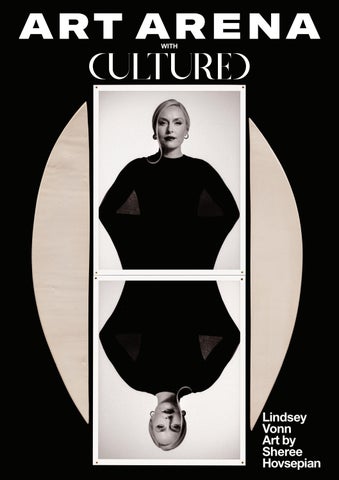
Lindsey Vonn Art by Sheree Hovsepian
THE
OYSTER
PERPETUAL
ROLEX FOR AN OFFICIAL ROLEX JEWELER VISIT ROLEX.COM
ROLEX # AND OYSTER PERPETUAL ARE & TRADEMARKS. NEW YORK
135 WOOSTER STREET, NEW YORK
Table of Contents
20
Contributors
50
Masthead
Bisa Butler and Faith Kipyegon
24
58
22
Behind the Cover
Pickup 72
Letter from the Editor
Full Court Dress
27
76
26
Greetings from Art Arena
Sydney Bordonaro 78
30
Artists and Athletes 34
Sadie Barnette and Paige Bueckers
Courtney Mays 80
Brittany Hampton 82
Kesha McLeod 84
42
Deborah Roberts and Sheryl Swoopes ART ARENA X CULTURED
16
Dex Robinson 86
Merch Madness Volume 01
October 3, 2026– January 31, 2027 Organized by the Fine Arts Museums of San Francisco
brooklynmuseum.org
©Rumiko Takahashi/Shogakukan; ©PAPIER/Jirō Taniguchi, Masayuki Qusumi, FUSOSHA; “Hinemosu notari nikki”; ©Tetsuya Chiba/Big Comic (Shogakukan); ©Mari Yamazaki, Tori Miki/Shinchosha; ©Fujio Akatsuka; ©Hirohiko Araki & LUCKY LAND COMMUNICATIONS/Shueisha; ©Kazumi Yamashita/KODANSHA LTD.; ©Gengoroh Tagame/Futabasha Publishers Ltd.; ©Fumi Yoshinaga/HAKUSENSHA, Inc.; ©Eiichiro Oda/Shueisha
104
Lindsey Vonn, Through the Lens of Sheree Hovsepian
152
Emily Tisch Sussman 154
WAGonomics 168
116
The Secret to The Hapa Blonde’s Success 132
Collector Series
The New Sports Media 180
Ones to Watch 194
Overtime
136
Kevin Love 142
Elliot and Kimberly Perry 144
Clara Wu Tsai 148
Gardy St. Fleur ART ARENA X CULTURED
18
Volume 01
NFL LOOKS DRAFT DAY TO GAME DAY
January 29 - September 6, 2027 Kent State University Museum 515 Hilltop Drive Kent, OH 44242 www.kent.edu
@ksumuseum Kent State University Museum
Contributors
ART ARENA X CULTURED
Sheree Hovsepian
Naima Green
New York–based artist Sheree Hovsepian works across photography, sculpture, and assemblage, creating layered compositions that explore intimacy, materiality, and the self as a fragmented subject shaped by memory and embodied experience. Her connection to sport is similarly grounded in the body—its strength, discipline, movement, and capacity for continual transformation.
Naima Green is a Brooklyn artist returning to her roots as a competitive tennis player. Her photographs are in the collections of MoMA, the Smart Museum, the High Museum, the Hessel Museum, and the International Center of Photography, among others.
Dionne Cochrane
Frankie de la Cretaz
Based in New York, executive producer and casting director Dionne Cochrane has spent over 15 years leading creative production across the beauty, fashion, and commercial spaces. While she always had the height for sports, she was drawn to the arts from an early age, a passion that ultimately shaped her career. Still, she has remained a loyal New Jersey– turned–Brooklyn Nets fan since 1996.
Frankie de la Cretaz is an independent journalist who roots for the (women’s) sports teams in their adopted hometown of Boston, but they’re still mourning the loss of the WNBA’s Miami Sol, even though it folded nearly 25 years ago.
20
Volume 01
Avon Dorsey
Lena Vazifdar
Shelton Boyd-Griffith
Stylist and writer Avon Dorsey has held fashion editor roles at Essence and Hypebeast, and regularly contributes to Vogue. A Baltimore native now living and working in New York, he has styled a range of celebrities—from models and Oscar winners to Olympians and Super Bowl champions.
Writer Lena Vazifdar resides in the San Francisco Bay Area with her husband and daughter. Between chasing passport stamps and stories, she hopes to one day hang a Hockney in her home and fulfill a longtime hoop dream of watching Steph Curry courtside at a Warriors game.
Fashion and culture writer Shelton Boyd-Griffith lives and works between St. Louis and New York, where he curates his own little world with walls decorated by Black queer artists like Texas Isaiah and Jonathan Lyndon Chase. Though he never caught the sports bug himself, it runs in his DNA as the son of a ride-or-die, card-carrying member of Raider Nation.
Bradford William Davis
Ann Binlot
Andrew Gelwicks
Bradford William Davis publishes eyeblack, an investigative sports newsletter that helps you keep your eye on the ball. He has consumed more stadium press box soft serve than should be legally allowed while writing across print and web, including for Business Insider, GQ, ESPN, and his hometown New York Daily News.
Ann Binlot is a New York–based writer and editor. She covers art, fashion, travel, design, and culture, and has contributed to The Wall Street Journal, Wallpaper*, and Vanity Fair. Her work has taken her around the world—from Art Basel Hong Kong to the 2024 Paris Olympics.
Andrew Gelwicks is a New York–based stylist whose greatest athletic achievement will be styling Lindsey Vonn for this cover.
Contributors
21
ART AND SPORT MOVE PEOPLE
Masthead
Sarah Harrelson Founder & Editor-in-Chief, CULTURED
Michi Jigarjian Founder & CEO, Art Arena | WOAH
Leah Faye Cooper Guest Editor, Art Arena X CULTURED Mickalene Thomas Founding Creative Director, Art Arena
Isolde Brielmaier Chief Strategy Officer, Art Arena | WOAH
Lindsay Kagawa Colas Founding Sports and Talent Advisor, Art Arena
Ian Malone Director of Brand, CULTURED
Treat Swarstad Art Director, Art Arena X CULTURED
Editorial Karly Quadros Assistant Managing Editor, CULTURED Sam Falb Assistant Editor, CULTURED
Ann Binlot Contributing Articles Editor, Art Arena X CULTURED Madison McTaggart Visuals Coordinator, Art Arena X CULTURED
Megan Hullander Copy Editor, CULTURED
Isabella Bernstein Editorial Intern, CULTURED
Strategy & Publishing Amanda Gillentine Senior Director, Strategic Partnerships, Art Arena | WOAH Jorge Marron Digital Director, Art Arena | WOAH Kirby Kane Associate Director, Art and Cultural Programming, Art Arena | WOAH
Lily Cohen Project Manager, Art Arena | WOAH Ayinde Olukotan Project Coordinator, Art Arena | WOAH Deepty Joshi Office Manager, Art Arena | WOAH
PR & Social PR DADA Goldberg
Social Le CollectiveM
Substack Tell&Co.
Advertising Inquiries amanda@woah.world
ART ARENA X CULTURED
22
Volume 01
Nonsites Revisited James Perkins
September 17th - November 14th 150 Orchard Street, New York
Behind the Cover By Isabella Bernstein
On a blistering summer afternoon in Manhattan, artist Sheree Hovsepian met with ski champion Lindsey Vonn at the outset of her final Olympic season. In her first editorial cover, the photographer captures the dynamism of the legendary athlete at a pivotal moment in her career.
In honor of this publication’s mission, we knew that we wanted to capture Lindsey Vonn through the eyes of an artist rather than a traditional fashion photographer. Sheree Hovsepian, known for corporeal work blending analog photography with sculptural mediums, shot Vonn, surrounded by Hovsepian’s familiar motifs. The first American woman to win Olympic gold in alpine ski racing, Vonn has three Olympic medals, eight World Championship titles, and 20 World Cup globes. As one of the most accomplished ski racers in history, Vonn is the perfect cover star for Art Arena and CULTURED.
Photography by Jorge Marron.
ART ARENA X CULTURED
Hovsepian’s signature abstractions of the body eloquently record the athlete’s resilience. After an exceptional comeback from retirement at age 41, Vonn is in the midst of recovering from the injury she faced racing in the 2026 Winter Olympics with a torn ACL. After the pair met, Hovsepian got to work to produce our cover. 24
Volume 01
Behind the Cover
25
ART AND SPORT MOVE PEOPLE
Letter from CULTURED
The Art, Architecture, Fashion, and Design Magazine. Throughout my career, I’ve found the most rewarding parts of being an editor to be working with people I respect and admire, delving into topics I’m deeply passionate about, and bringing stories to life through today’s most thought-provoking and visually resonant platforms. I could not be more honored to help lead a project that combines all three, alongside Editor-in-Chief Sarah Harrelson and the CULTURED team. Over the past few months, Art Arena and CULTURED have collaborated on this special issue, exploring the historical, inextricable, and ever-growing relationship between art and sport. In keeping with Art Arena’s mission of platforming women artists and athletes, these pages celebrate a breadth of talent in both fields—from art world luminaries and Olympic champions to emerging creatives and competitors on the rise. For the inaugural Art Arena x CULTURED issue, we’ve pored over remarkable art collections—including New York Giants and Gotham FC co-owner Emily Tisch Sussman’s—and brought accomplished duos together in conversation, like WNBA star Paige Bueckers and noted multidisciplinary artist Sadie Barnette. Stylist Andrew Gelwicks, writer Jazmine Hughes, and photographer Naima Green are among the contributors, and for the cover story, Sheree Hovsepian shot her first editorial—an intimate, striking study of skiing legend Lindsey Vonn. Few things are more arresting than art, or more captivating than sports. We are thrilled to share this exploration of both, from Art Arena and CULTURED— the first of more to come. Leah Faye Cooper Guest Editor
Website: culturedmag.com Instagram: @cultured_mag TikTok: @cultured_mag
ART ARENA X CULTURED
26
Volume 01
Letter from Art Arena
ART AND SPORT MOVE PEOPLE. Art and sport have always shaped culture. They challenge how we see ourselves and one another. They create icons, shift perspectives, and bring people together. At their best, they give us a way to understand the world—and imagine what might come next. Art Arena was created around the belief that there is something powerful in bringing these two worlds together. Founded by Work of Art Holdings® in collaboration with Mickalene Thomas and Lindsay Kagawa Colas, Art Arena is a media and experiential platform connecting art and sport, with women artists and athletes at its center. Through storytelling, live cultural experiences, and creative collaborations, we create space for the people shaping both fields to be seen and heard in new ways. This inaugural Art Arena x CULTURED publication is one expression of that mission. Beyond these pages, Art Arena will come to life through conversations and long-form editorial, gatherings around major moments in art and sports, artist-athlete collaborations, public art, and community partnerships. At the heart of it all is a shared language. Art and sport both ask something of us: discipline, imagination, vulnerability, ambition, and the willingness to push beyond what already exists. And both have the power to create opportunity, visibility, and lasting cultural impact—not only for the people at their center but for the next generation watching. This is the beginning. We hope you’ll join us on these pages, online, and in the moments still to come. The Art Arena Team
Website: artarena.world Instagram: @artarena.world Substack: artarena.substack.com TikTok: @artarena
Editor’s Letter
27
ART AND SPORT MOVE PEOPLE
TANIA FRANCO KLEIN
YANCEY RICHARDSON NEW YORK
Artists Players from the U.S. women’s soccer team show off their gold medals at the 1999 Women’s World Cup in Pasadena, California. Photography by Roberto Schmidt via Getty Images.
and Athletes
In a series of conversations, six artists and athletes convene over shared passions, triumphs, and losses.
By Isabella Bernstein ART ARENA X CULTURED
32
Volume 01
Upon a shallow glance, some artists and athletes may seem to have little in common. But strip away their titles, dig a little deeper, and the commonalities are rather abundant. Both artists and athletes grapple with the same fundamental questions hovering over their careers: What is perfection? How much practice does it take to achieve it? Which of these metrics will determine one’s legacy? Our Artists and Athletes portfolio brings together key figures from each field to deliberate these questions with one another, parsing their answers in a rare yet necessary cross-disciplinary conversation. Middle-distance runner Faith Kipyegon and textile artist Bisa Butler connect over their African heritage—and how they continue to support the people that supported them—while collage artist Deborah Roberts and WNBA trailblazer Sheryl Swoopes talk Texas and Black beauty standards. The madness of basketball and multimedia artistry are strikingly analogous to young basketball star Paige Bueckers and interdisciplinary artist Sadie Barnette, as are their deeprooted sources of influence. These conversations reinforce the throughline between art and athleticism, and how, regardless of the medium used to express ourselves, our common thread is a desire for connection to one another and ourselves. Artists and Athletes
33
ART AND SPORT MOVE PEOPLE
From the Court to the Canvas By Sam Falb
Sadie Barnette and Paige Bueckers ART ARENA X CULTURED
34
Volume 01
Photography by Miles Diggs.
Artists and Athletes
35
ART AND SPORT MOVE PEOPLE
ART ARENA X CULTURED
36
Volume 01
The celebrated artist and WNBA star compare notes on flow states, hard-earned confidence, and the freedom of letting instinct take the lead. Perfection, Paige Bueckers and Sadie Barnette agree, is a dubious pursuit. Basketball is too messy for a flawless game; art too personal for any universal measure of perfection. What matters is the feeling that comes before the result: the repetition, the rhythm, the instinct, the sudden sense that everything has clicked. Recently, the WNBA star and artist talked about finding that feeling, losing it, and learning how to return. Maybe the point is to get lost. On the court, Bueckers disappears into rhythms the Dallas Wings guard has rehearsed thousands of times. In the studio, Barnette disappears into a drawing, music playing as she takes the occasional dance break between lines. Both know that the deepest kind of concentration can look a lot like surrender. They are after something difficult to quantify: the feeling of being fully, unmistakably there. When do you feel most like yourself: during the work or after it’s finished? (Sadie Barnette) I feel most like myself when I’m listening to music in my truck. What type of truck do you have? (SB) It’s a Toyota Tacoma, black on black. Photography by Smeeta Mahanti.
Artists and Athletes
37
ART AND SPORT MOVE PEOPLE
(Paige Bueckers) I feel most like myself in the preparation of the work— the practice, the repetition—and then when I’m out there on the court, I feel it as well. You kind of just get into a flow state of mind where you’re out there living your passion and joy. What’s something your field celebrates that you secretly think is overrated? (PB) Perfection is overrated. There’s no such thing as a perfect game. Basketball is imperfect. There are so many mistakes that happen in the game—turnovers, missed shots. But honestly, there aren’t many overrated things in basketball. Everything is so important. (SB) I don’t exactly have an answer, but I’ll just use it to explain an overlap that I see between hoop and art. I first learned this from rap music: It’s not just about what you say but how you say it. That’s so prevalent in basketball, and maybe that’s why a lot of artists really fuck with basketball, because it’s not just about getting the three points—it’s about how you make it look, and the swag and elegance that you put on it. Is there a compliment you’ve received that has stayed with you longer than any accolade? (PB) When people tell me I’ve helped them reconnect with their faith or find a belief in God—where somebody who wasn’t necessarily a believer is now a believer. Sharing my faith is a really huge thing for me, and that’s way bigger than basketball: the trust in my faith. (SB) Mine is going to be really small compared to that. My framer, who frames all my drawings, told me that they stopped measuring my drawings because they’re always exactly the perfect size that I say they are—to the thirtysecond of an inch. It’s so nerdy, but I was like, Oh my God, this is the best day of my life. Has success in your respective fields made you more confident or more self-conscious? (SB) I would say the thing that’s made me more confident is therapy, if you want the real answer. (PB) That’s real. ART ARENA X CULTURED
38
Volume 01
“If you’re not grounded, then even a great success won’t feel like a success, because you’re comparing it to the next thing.” —Sadie Barnette (SB) Success is subjective, and people are so caught up in the result that they forget about the process, and I think that’s where it really comes from—when you put in the work and surround yourself with people that you love. (PB) Success makes you confident, but it also makes you selfaware—you don’t get complacent. It’s all about staying grounded, staying present, and just trying to win the day. (SB) I love “win the day,” because if you’re not grounded, then even a great success won’t feel like a success, because you’re comparing it to the next thing. What’s something you’ve had to unlearn to get where you are now? (PB) For me, it was thinking I was invincible. In high school, I thought I couldn’t get injured. I was super healthy, everything was going right for me, and then adversity hit in college. To have that humbling experience taught me: I’m not invincible, these things can happen to me. Adversity strikes everybody in different ways. Life is literally about how you respond. In university, I had to learn how to handle that, embrace it, and actually seek it out. (SB) I’m learning to unlearn some perfectionist tendencies. Even though my work is so invested in material Artists and Athletes
39
ART AND SPORT MOVE PEOPLE
“Adversity strikes everybody in different ways. Life is literally about how you respond.” —Paige Bueckers perfection and pushing the limits of what’s possible with drawing and with commercial processes and machining, the thing I had to unlearn is that I should be normal. I’m not that normal, but there are still layers to uncover, to let yourself fully be who you are, and it’s always a journey, especially with art, which can be a long, slow burn. If someone could watch one ordinary day of your life, what would surprise them most? (SB) Maybe how much I dance. I just like dancing and cleaning in the studio and at home—but definitely dancing in the studio. If I’m really feeling it, I’m drawing and then I’m taking a little dance break, drawing, taking a little dance break. (PB) For me, I think it would be how much I sleep. Recharging. I’m a napper. I’m not really good at napping in the car, but everywhere else, I can find a way. I’ve always loved to nap. Who has influenced you in a way that people might not expect? (PB) For me, I think it’s my three little siblings. I don’t necessarily draw basketball inspiration from them, but human inspiration—wanting to be a good role model, a great person, and someone that they can emulate and look up to. Obviously, they’re their own people, but I want to make them proud as much as I can. (SB) I would definitely echo family. A lot of my work has been about my family, like the historical moments that we ART ARENA X CULTURED
40
Volume 01
have, and also just the small moments, birthday cakes, you know, life. If you could preserve one moment from your career forever, which would it be and why? (PB) It would be the national championship game from my senior year. It was the culmination of so much—gratitude, overcoming adversity, and making it through so much turmoil throughout my entire college career. (SB) For me it’s not so much a moment but a feeling that I would want to preserve. It’s the feeling of drawing and just being in the state of really making the work, and the work is coming through you and it’s not about anything else outside of it. Those are the moments that I really try to preserve—when the music is perfect, the sunlight is perfect, and just making is the right thing to do.
Artists and Athletes
41
ART AND SPORT MOVE PEOPLE
Two Texas Legends on What Links Their Disparate Passions
Deborah Roberts and Sheryl Swoopes ART ARENA X CULTURED
42
Volume 01
Photography by Mark Poucher.
Artists and Athletes
43
ART AND SPORT MOVE PEOPLE
The acclaimed artist and WNBA icon talk sports, beauty standard, and always getting up—no matter how hard they fall.
Photography by Bill Baptist.
ART ARENA X CULTURED
44
Volume 01
Artists and Athletes
45
ART AND SPORT MOVE PEOPLE
“Practice makes perfect.” It’s an age-old sentiment, dating back to the 1500s, but Sheryl Swoopes knows what it takes firsthand. She remembers it being bandied about in the WNBA, where the Texan was the first player signed in 1996, the year before the league tipped off. She’d go on to become a three-time MVP, four-time champion with the Houston Comets, and three-time Olympic gold medalist. How many hours of practice does that take? Swoopes called up artist Deborah Roberts to talk about the pursuit of greatness. Roberts—a mixed-media fabricator of the body whose work has landed in collections stretching from the Whitney Museum of American Art to LACMA to the Modern Art Museum of Fort Worth in her native Texas—can relate to the need for resilience. Here, the two trade stories on stumbling, falling, and getting back up to go further than before. Did you both grow up sports fans? (Deborah Roberts) My love of sports came from my father. He would bet on the football games. Every Sunday I would have to read him the line to see if he won anything. I was a big fan of the Lady Longhorns and the University of Texas. But [while playing for Texas Tech] you beat us so badly… (Sheryl Swoopes) Just a couple times. (DR) Still hurts. (SS) I started playing basketball when I was seven. The more I played it, the better I got and the more committed I was. I wanted to be great. I’m sure, Deborah, when you decided this is what you were going to do, you wanted to be great. (DR) I didn’t have anyone in my circle who was an artist who could even tell me about art. It was a lot of figuring it out, falling, getting up. It’s the same thing with any field— just a dedication that one must have to build on their dreams. (SS) They say in sports, practice makes perfect. I don’t know how many times you probably started a drawing and got rid of it, or did another one and had to go back and fix it.
I got pregnant when the WNBA first started. There was a moment when I was coming back, when I stopped and questioned myself: Will I actually be able to do this? You’re competing at the highest level with some of the best ART ARENA X CULTURED
46
Volume 01
players in the world. It wasn’t an injury; it was a pregnancy, which is really hard in this field. I thought, This is no different from other times that I’ve been knocked down. (DR) It’s impressive. I work with unforgiving material sometimes, where you can’t make mistakes. Every time you put something down, you’re hoping that it’s going to say and mean something to someone else, and create a dialogue. In both your fields, there are larger conversations about representation. How have you seen those change over the course of your careers? (SS) I remember when the WNBA started in ’97, there were so many people who said it wouldn’t last five years. Here we are in season 30. That says a lot about the growth of the game, about women’s sports, but it also says a lot about women. When we’re given an opportunity, we make the most of it. When brands catch on and they want to have a piece of these women, you’re not just getting an athlete. You’re getting an athlete, a businesswoman, an entrepreneur, a mom, a sister, a friend. As far as we’ve come, we still have so much more work to do. But you have to start somewhere. (DR) During the recent big boom of Black art, everybody was buying. If you weren’t buying Black art, you weren’t buying art. Dior came, Louis Vuitton came. We have to be smart when that stuff happens, to center yourself in a way, financially, that you’re secure for the rest of your life. Everything ebbs and flows. Museums are collecting fewer and fewer Black women artists. You really have to be 89 and in Pampers and a wheelchair in order to get collected. The men have it a little easier, but not that much. It’s always a struggle, but you have to keep focused and keep expanding your work in a way that is intentional. For female athletes, there’s often this criticism of masculinity within the female body. How do you feel about being exposed so openly, and people picking apart the things that make you historically, racially, you? (SS) I didn’t personally, but I had friends and teammates who did. We’ve seen all the criticism of Serena Williams before she retired. When I look at the women in the WNBA, when I look at all these little girls out there—Black, white, Brown, doesn’t matter the color—I think about how social media has created this image of what a beautiful, strong, healthy, gorgeous young lady should look like. That’s where a lot of us in the WNBA come in, because our voices are powerful. Artists and Athletes
47
ART AND SPORT MOVE PEOPLE
“I wanted to be great. I’m sure, Deborah, when you decided this is what you were going to do, you wanted to be great.” —Sheryl Swoopes
ART ARENA X CULTURED
48
Volume 01
(DR) It’s hard trying to dismantle the standard of beauty, and we know most times it doesn’t include us. You have these little Black girls, Hispanic girls, looking at these images of this blonde-haired, blue-eyed person who’s 95 pounds. When I came out of the womb, I was 95 pounds. (SS) The beauty standards for a Caucasian woman and a Black or Brown woman are very different. When I look at Serena Williams, I see beauty, strength, and power. People want to talk about her muscles and her butt, like, “She’s too big.” My response is, “Too big for who?” As a Black woman, lots of times we look at her and we’re like, Dang, I wish my butt could look like that. There are times I’m like, Serena, what are you doing? I want those muscles, I want those legs, I want those thighs. I’ve never allowed myself to listen to what other people think of my body size and my looks. It’s all in me.
Artists and Athletes
49
ART AND SPORT MOVE PEOPLE
Photography by Javier Romero.
ART ARENA X CULTURED
50
Volume 01
When Legacy– Not Accolades– Becomes the True Measure of Success By Karly Quadros
Bisa Butler and Faith Kipyegon Artists and Athletes
51
ART AND SPORT MOVE PEOPLE
The textile artist and Olympic gold medalist on ambition, resilience, and what it means to build something that outlasts you.
Photographed by Cameron Strand.
ART ARENA X CULTURED
52
Volume 01
Artists and Athletes
53
ART AND SPORT MOVE PEOPLE
For Faith Kipyegon, there is an art to athletics. The 32year-old middle-distance runner is the first to win three consecutive Olympic 1,500-meter titles and holds the women’s world record for the mile (a meteoric 4.07.64 seconds). Like many artists, Kipyegon grapples with her legacy: Will it be determined by the races she has won, or by the opportunities her success creates for those who follow? With over eight major global gold medals, Kipyegon’s path to victories has demanded its share of resilience. After taking up competitive running at 14 in Kenya’s Rift Valley, she rose from racing barefoot to setting multiple world records, even after giving birth to her daughter in 2018. Last year, she attempted to become the first woman to run a four-minute mile. Despite missing the historic benchmark by just over six seconds, the effort became part of a legacy extending well beyond the track. In January, she partnered with Nike to break ground on a maternity facility in her hometown of Keringet. “I don’t have anything else to prove to the world,” Kipyegon says. “I’m so happy that upcoming athletes are like, I want to be like Faith Kipyegon.” The same questions animate textile artist Bisa Butler, whose quilted portraits recover and celebrate Black life and history across generations. After a recent health scare, the 53-year-old former high school art teacher—now a fulltime artist—sat down with Kipyegon to talk about her own legacy and the pressure the two women feel to sustain the communities that, for so long, sustained them. Fine art and professional sports are notoriously difficult fields to break into. What eventually made you take the plunge? (Bisa Butler) Art was the thing that I did the best. (Faith Kipyegon) In Africa, I was running away from problems. I got into sports thinking about changing the situation for my family and the community. When one girl is educated, the whole neighborhood benefits, and I thought, I have to do this to change my community. That is what has really driven me to where I am today. (BB) My father is from Ghana. With the schooling system, if you don’t pass certain levels, you’re relegated to farm work. So by the time you reach certain levels, there is that expectation. He said he always knew that it was a prophecy in a way: You’re the one. With that, he became a college president. ART ARENA X CULTURED
54
Volume 01
“We’re here for now, but we’re not here forever” —Bisa Butler (FK) In Africa, you always find ways to help each other. I was raised in a humble background where finding $10 was tough. I had to work very hard to earn that $10, especially with running. I was like, I want to achieve this. I think sport will drive me to get this $10. Breaking down barriers can also make someone a figurehead. How do you think about your responsibility to your communities? Is that a source of pressure? (FK) It’s a little bit of pressure, but at the same time, it’s enjoyable. When I won my first gold medal in Rio, my community benefited: 31 families got electricity. From many years of darkness to, boom, electricity. And I was so grateful when Nike committed to putting up a maternity ward in my community.
It’s a little bit much, I will say, because my community now expects more and more, knowing that this one person can change our community completely. It feels a little tough. (BB) In the U.S. right now, African-American women have been dismissed from their jobs in the past year because it’s no longer in vogue to make sure that you have a certain number of Black employees.
A lot of people are looking at me like, Okay, she found a way to sustain herself. She makes quilts. I find entrepreneurs looking to artists for this way out. What are those things that were taught to me outside of the system that are now gonna sustain me? Do you feel a responsibility to bring up the next generation? (BB) My students mean so much to me. About four months ago, I had a brain aneurysm; immediately, my students who had graduated years earlier came back home from college and helped me finish my projects. I want young people to Artists and Athletes
55
ART AND SPORT MOVE PEOPLE
“I don’t have anything remaining to prove to this world. I want the next generation to have the mindset of, I want to achieve more than Faith Kipyegon.” —Faith Kipyegon
ART ARENA X CULTURED
56
Volume 01
realize that the skills they have are inside of them. Don’t look for external validation. You have to reach the well within; it is absolutely possible that you can find something and make a life for yourself. (FK) I’m so happy that my name is out there now. You have to be patient and disciplined to achieve what you want. I would love to see the next generation dreaming of big things. How do you grapple with setbacks, whether it’s health or a goal that you weren’t able to achieve? (FK) Setbacks are always there. I don’t think challenges are permanent. You have to think of new goals to drive you to what you want to achieve. (BB) Our thought processes, although we do different things, are exactly the same. I know people who are way more talented than me who gave up on those dreams a long time ago. I’m not saying that they are not successful in their lives, but they gave up on the magic that I saw in them. It’s within yourself to believe that you’re going to get back up. What’s driving you forward at this moment? (FK) The love of sports still gives me the courage to continue. I don’t have anything remaining to prove to this world. I want the next generation to have the mindset of, I want to achieve more than Faith Kipyegon. (BB) I’m super ambitious, and this time of recovery has taught me to calm down. Don’t forget that part of your ambition is taking care of your own body, your own spiritual sense, and getting that rest.
I’ve always felt like the ultimate artists I see usually start a fellowship, create a residency, or open a school. There has to be life after yourself. We’re here for now, but we’re not here forever. Faith, you are able to provide that electricity and OB-GYN care for the women in the community. I still haven’t gotten that thing yet, and for me, I’m not successful until I can help people. Long after I’m gone, the legacy will remain, and people will still be able to live and succeed because of something I’ve done to help.
Artists and Athletes
57
ART AND SPORT MOVE PEOPLE
Pickup
“Frederick Johnson Playground exemplifies the city at its most equitable: welcome to all and a particular gift to its neighbors.”
By Bradford William Davis Photography by Naima Green ART ARENA X CULTURED
Naima Green and Bradford William Davis capture the indelible charm and vitality of New York’s beloved courts and fields. 60
Volume 01
A spin around the block tracks to a familiar beat: deli, stoop, school, hoop, bounce, bounce, slap, pass, repeat. More than any other American city, New York streets are metronomic in how they manifest communal movement. The ubiquity of city courts is proof. The relative absence of trimmed lawns and cul-de-sacs associated with American residential life doesn’t impede outside life, as any Knicks—in five!—fan can attest. We want to reframe the courts dotting city streets as more than a mere accommodation for our tight quarters, but a blessing of New York’s closeness. Its courts and fields flaunt the distinct shape of city play: a universe of world-renowned competitions, open runs, prize-winners, and lazy summer days navigated with a simple “Who got next?” For this issue, we documented five New York City courts: Frederick Johnson Playground, Wright Brothers Playground, West 4th Street Courts, Brooklyn Bridge Park, and Barrier Playground. They are green, black, slate, occasionally red, and seasonally orange and blue when Brunson is feeling it. Some demand you come correct. Others are more patient with your pursuit of excellence— or at least aight-ness. While every place we visited is special in its own right, some, like the Cage and Barrier, are destinations, hosting tournaments that draw crowds well past their respective neighborhood perimeters. Others are community oases and if-you-know-you-know gems. For neighbors, it’s the backyard some never had and, with it nearby, many will never need. Pickup
61
ART AND SPORT MOVE PEOPLE
ART ARENA X CULTURED
62
Volume 01
Frederick Johnson Playground
7th Avenue & 150th Street, New York, New York 10039
Few cities offer more access to a game coded for elites than New York, where all NYC Parks–run tennis courts across the five boroughs are available for a nominal annual fee. Frederick Johnson Playground exemplifies the city at its most equitable: welcome to all and a particular gift to its neighbors. Named after the one-armed Harlem native and enjoyed by Althea Gibson, Frederick Johnson is tucked behind a slate of public housing developments and the Dunbar Apartments—some of Black America’s first quality apartment housing. As a result, it offers a special service to those less likely to summer in the Hamptons, or even the New Yorkers who may not have a pied-à-terre but can camp out for hours at Central Park. Nothing reveals the privilege of leisure quite like trying to squeeze in a hit before your next shift. But Harlem deserves its luxuries.
Pickup
63
ART AND SPORT MOVE PEOPLE
Wright Brothers Playground
St. Nicholas & Manhattan Avenue, New York, New York 10027
ART ARENA X CULTURED
When Tupac Shakur starred in the 1994 drama Above the Rim as a drug dealer recruiting a young hooper for his streetball team, he filmed some of the movie’s most iconic basketball scenes at Harlem’s Rucker Park. Though the rapper is most synonymous with the image and sound of the West Coast, Rucker offered Pac a quasi-homecoming. Just a brisk uphill walk from the legendary court featured in the movie is the court that first shaped a legend: P.S. 028 Wright Brothers on 155th and St. Nick. Even when school isn’t in session, Wright Brothers is still a home to kids honing their craft to make the leap to Rucker—and maybe even further than that. 64
Volume 01
Pickup
65
ART AND SPORT MOVE PEOPLE
West 4th Street Courts
ART ARENA X CULTURED
66
Volume 01
272 6th Avenue, New York, New York 10012
Pickup
The Basketball Mecca’s basketball mecca. In a Greenwich Village saturated with people drawn to its bohemian reputation while paradoxically smoothing it out, one viral TikTok at a time, “the Cage” at West 4th is something of a safe haven for the sport’s beauty and grit. (Consider that the graceful inside-out game of Julius “Dr. J” Erving and the skillful muck of ’90s Knicks icon Anthony Mason were both cut on West 4th.) Even NBA stars making cameos sometimes line up alongside the chain link with other spectators and hurried pedestrians taking a quick detour from their commute. Prepare to call your own fouls. Or better yet, don’t waste your breath. Ball up top. 67
ART AND SPORT MOVE PEOPLE
ART ARENA X CULTURED
68
Volume 01
Brooklyn Bridge Park
334 Furman Street, Brooklyn, New York, 11201
Pickup
Football—the all-feet-no-hands original—is a renewed American obsession further amplified by the craze around the 2026 FIFA World Cup. And it can be, maybe most scenically, enjoyed at one of New York’s newer waterfront parks. Opened in 2012, the Brooklyn Bridge Park soccer fields rest along the East River and offer expansive views of Lower Manhattan in between regular pickup matches and structured competition. Though soccer can be attempted on any wide sidewalk or narrow alley, these sprawling turfs display how the city is making space for the game in all its forms. 69
ART AND SPORT MOVE PEOPLE
Barrier Playground
36-04 Horace Harding Expressway, Rego Park, New York 11374
ART ARENA X CULTURED
The poet Homer said he discovered the game while journeying through Sparta, but you won’t find New York handball in 70mm. This version, our version, most directly descends from the Irish, who brought the rubber-ball-against-wall style enjoyed across the city. Competitors take turns smacking the ball against the concrete until a missed connection or bad bounce crowns a victor. There are thousands of handball courts across the city—many of them restored in a 2000 Parks Department renovation project—sharing spaces with basketball hoops and jungle gyms. The sport’s spiritual and modern home is a few miles east in Forest Hills at The Barrier, known by some as “Handball Haven.” 70
Volume 01
Pickup
71
ART AND SPORT MOVE PEOPLE
Full Court Dress
Simone Biles before the “Superfine: Tailoring Black Style” Met Gala, on May 5, 2025. Photography Steve Eichner for WWD.
“Every project is a big break as it always gives way to other opportunities and adventures.” —Courtney Mays
By Leah Faye Cooper ART ARENA X CULTURED
74
Volume 01
From what’s on their playlists to the brands they’re shopping and the art they’re coveting, get to know the stylists behind sports’ best-dressed athletes.
As stylish as they may be, many of today’s best-dressed athletes did not earn that designation on their own. Those incredible tunnel fits? The street style looks that inspire our online shopping sprees? The breathtaking, bespoke looks worn by a select few as they ascend the Met Gala steps on the first Monday in May? A cadre of stylists who specialize in dressing athletes is often responsible for making that magic happen. With more and more athletes weaving fashion into their personal brands—and labels clamoring to dress them— these stylists’ work is becoming increasingly visible. What’s less visible, however, are the journeys they took to build their careers, the art and fashion that inspires them, and their own approaches to personal style. In their own words, Sydney Bordonaro, Brittany Hampton, Courtney Mays, Kesha McLeod, and Dex Robinson tell us just that. Full Court Dress
75
ART AND SPORT MOVE PEOPLE
“Every single fit is a hitter.” Sydney Bordonaro
Hometown: Pittsburgh, Pennsylvania The roster of athletes I’ve styled— past and present—includes: Tarik Black, Cameron Brink, Rae Burrell, Kahleah Copper, Chelsea Gray, Isabelle Harrison, Tobin Heath, Tyler Herro, Natisha Hiedeman, Hannah Hidalgo, Deja Kelly, Jewell Loyd, Marina Mabrey, Skyy Moore, Kelsey Plum, Christen Press, Didi Richards, Trinity Rodman, Jaedyn Shaw, Jaxon Smith-Njigba, Hailey Van Lith, Courtney Williams, Grant Williams, and many, many others. I’d say close to 100 over the last five years.
My take on the best tunnel fits: Angel Reese has been eating since her rookie season. Every single fit is a hitter. A lot of respect to her and her team. If we’re talking all-time, you have to mention Russell Westbrook’s name also. I think he’s one of the first guys to really get it poppin’ in the mid-2010s and to bring that style back from the Iverson days. You’ll catch me cheering for the: Pittsburgh Steelers or any team LeBron or my clients are on. When I win the lotto, I’m buying: A home in the Hollywood Hills.
My first job in fashion was: In August 2021, when Jewell Loyd asked me to style her for her pregame tunnel walks. This was before WNBA fits started to really pop off. I played Division I basketball at Pepperdine and Long Beach State University and got my master’s in sports management because I wanted to be a sports agent. Covid derailed my first job as an agent assistant in May 2020. After moving back to LA, Jewell randomly hit me up, and I fell into styling athletes. It’s been the most unexpected blessing. I got my big break: In May 2023, doing a global Google Pixel campaign with Napheesa Collier, Kahleah Copper, Dearica Hamby, Isabelle Harrison, Arike Ogunbowale, Kelsey Plum, and Didi Richards. Not only was it my first major commercial, but it was my first actual production. Prior to that, I had only styled pregame tunnel walks. I learned more on set over those three weeks than I did in the previous year and a half of styling. I’m eternally grateful for that opportunity— it changed my life! I learned style from: My nana, my mom, and Allen Iverson. The first artist who resonated with me was: Allen Iverson—an artist with a basketball. My style GOAT is: Teyana Taylor—forever and always! Clockwise from top: Tyler Herro, Jaedyn Shaw, Rae Burrell, Kelsey Plum, Allen Iverson, and Isabelle Harrison.
ART ARENA X CULTURED
Two incredibly dressed athletes (who I don’t work with): Jordan Clarkson and Olivia Miles.
76
Volume 01
Full Court Dress
77
ART AND SPORT MOVE PEOPLE
“Layers have always been my armor.” Courtney Mays
Hometown: Cleveland, Ohio The roster of athletes I’ve styled— past and present—includes: Mookie Betts, Sue Bird, Tina Charles, Steph Curry, Brittney Griner, LeBron James, Jonquel Jones, DeAndre Jordan, Kevin Love, Baker Mayfield, Chris Paul, Megan Rapinoe, Breanna Stewart, Diana Taurasi, Karl-Anthony Towns, Russell Westbrook… I could keep going! My first job in fashion was: At a local boutique in my hometown. A family friend owned an accessories store called Details, where I worked on the sales floor while also assisting with buying trips and with visual merchandising. I was only 15 or 16 years old, but I was completely captivated. It was my first real glimpse into the fashion world that I had always dreamed of, and it confirmed that fashion wasn’t just an interest but an art form and a means of storytelling where I wanted to thrive. I got my big break: Every project is a big break, as it always gives way to other opportunities and adventures. But I would say that moving to New York was my first big break! New York was a true kaleidoscope of inspiration, and it allowed me to nurture my love of fashion. It was risky and challenging, but it was the engine that got me here. I learned style from: My parents have always been my greatest style inspirations. My mom embodies effortless elegance—her wardrobe is timeless, thoughtful, and every bit as beautifully curated as the interiors she created in our homes growing up. My dad is the definition of classic sophistication, never without his silk tie, a beautiful watch, and a perfectly tailored double-breasted suit. Together, they taught me that true style is less about following trends and more about expressing yourself with intention, confidence, and attention to detail.
Clockwise from top: Miles Davis, Kind of Blue; Sue Bird; Mickalene Thomas, Le Déjeuner sur l’herbe: Les trois femmes noires (detail), 2010; and Chris Paul.
ART ARENA X CULTURED
an artist I had admired for so long. Then my friend and colleague Lindsay Kagawa Colas connected me with Mickalene Thomas. These are the people I am most excited about. Artists are my version of celebrity. My style GOATS are: A splash of Jenna Lyons and Tracee Ellis Ross mixed with Willy Chavarria, Solange, and Jeff Goldblum. Three incredibly dressed athletes (who I don’t work with): Tyrod Taylor, Dwight Powell, and Ashlyn Harris. The best tunnel fits: Are authentic and fit well. I’m impressed by athletes who embrace their authentic sense of style and have a true understanding of their size and proportions rather than trying to create viral moments. Honestly, my favorite tunnel look photos are captured as teams are heading onto or off of team buses or exiting hotel lobbies. Something about the light and street style element always feels elevated. And any photo by Jim Poorten! Always on my playlist: Miles Davis. I could win a gold medal in: Taboo or Heads Up, as long as my partner, Candice, is on my team. And I’m the vibe setter: the playlist, the lighting, the charcuterie board—I got you! You’ll catch me cheering: In the words of the oracle Ms. Issa Rae, “I’m rooting for everybody Black.” Black women doing anything, actually, but especially all of us in the sports community. There is such a vast community of women who truly move the needle in the business on and off the court. They are the inspiration and the voice of many leagues.
The first artists who resonated with me were: The members of the funk band Cameo. When I was 8 years old, my dad took me to our local record store for an album signing. As an adult, my longtime client Kevin Love introduced me to Rashid Johnson—
78
Volume 01
Full Court Dress
79
ART AND SPORT MOVE PEOPLE
Hometown: San Francisco, California The roster of athletes I’ve styled— past and present—includes: Cameron Brink, Paige Bueckers, Sabrina Ionescu, CeeDee Lamb, Evan Mobley, Nika Mühl, Koa Peat, Kelsey Plum, Sloane Stephens, Nigel Sylvester, and Russell Westbrook. My first job in fashion was: I had my first two jobs in fashion at the same time. I was a junior agent at Ford Models while simultaneously becoming the in-house stylist at Nickelodeon.
Brittany Hampton
I got my big break: Winning House of DVF. It opened doors, but the career I’ve built since has come from years of consistency, meaningful relationships, and always showing up. I learned style from: The women in my family. My grandmother was a fashion designer, so I’ve always paid attention to how people tell stories through what they wear—building a brand without saying a word.
The first artist who resonated with me was: Diane von Furstenberg. I did my college entry project on her and later had the opportunity to work for her. I’ve always admired her work ethic and the way she embraces every type of woman through her brand. The best tunnel fits: Tell a story that reflects a player’s true personality. We see athletes in uniform most of the time, so the tunnel is a chance for them to express who they are beyond the game. It gives fans a glimpse into their individuality before they ever step onto the court. Right now I’m wearing: A cropped tee, a full-zip hoodie, tailored trousers, a Goyard shawl, Nike Moon sneakers, and rings stacked on both hands. I’m en route to Ibiza and I like to travel comfortably, with plenty of layers. I could win a gold medal in: The details. It’s always about the details. You’ll catch me cheering for: The Golden State Valkyries and the Golden State Warriors. When I win the lotto, I’m buying: A work of art by Kara Walker and a home in Sausalito, California.
Clockwise from top: Brittany Hampton with Nika Mühl and Paige Bueckers ahead of the 2024 WNBA Draft; Diane von Furstenberg; Hampton and Goapele; San Francisco Bay Area; Hampton with Jenette McCurdy and Ariana Grande, while working at Nickelodeon.
ART ARENA X CULTURED
“The details. It’s always about the details.” 80
Volume 01
Full Court Dress
81
ART AND SPORT MOVE PEOPLE
Kesha McLeod
“You can always tell when someone is wearing the clothes versus when the clothes are wearing them.” Hometown: Queens, New York. The roster of athletes I’ve styled— past and present—includes: Jonquel Jones, Deebo Samuel, P.J. Tucker, Serena Williams, Venus Williams, and elite talent across sports and entertainment. My first job in fashion was: Working at Mony’s and Pulse in Green Acres Mall. It taught me that fashion is just as much about people as it is about clothes. I got my big break: My career has been built through a series of opportunities, but one of the first pivotal moments was working with stylist Rachel Johnson on projects for her client, LeBron James. It gave me a firsthand look at the level of excellence, precision, and professionalism the industry requires. I learned style from: My cousins. They introduced me to brands like Iceberg, Girbaud, and whatever was next before I even knew what fashion was. Watching them taught me that style wasn’t about labels. It was about confidence, individuality, and wearing the clothes instead of letting the clothes wear you. The first artist who resonated with me was: Pharrell Williams. I met him at The Neptunes Present... Clones album release at Tower Records, and from that moment, I was hooked on the intersection of music, style, and culture!
Two incredibly dressed athletes (who I don’t work with): Stefon Diggs and Shai Gilgeous-Alexander. Right now I’m wearing: A Velour Garments sweatsuit and a sports bra. That’s my off-duty uniform. If I’m not running around for work, you’ll probably find me in the winter or summer version of this every day. I could win a gold medal in: Persistence. I’ll figure it out, one way or another. You’ll catch me cheering for the: New York Knicks. Hometown heroes. Always on my playlist: N.E.R.D. Whether I need energy or I’m winding down, they’re always in rotation. Courtside or box seats: Courtside if I’m client-facing. Box seats if I’m actually trying to get work done. Bed at 9 p.m. or dinner at 9 p.m.: Bed at 9 p.m. My phone goes on Do Not Disturb at 8:45 p.m., and everybody who knows me knows not to expect a reply after that. When I win the lotto, I’m buying: A commissioned coffee table by Rashid Johnson for my open-to-nature home in upstate New York or Connecticut.
My style GOAT is: I honestly can’t pick just one. My clients become my muses, and some of them are the actual GOATs in their sports. Being able to study how they move through the world continues to shape how I think about style. My personal wardrobe MVPs are: A double-breasted blazer, a pair of Nike Vomeros, and a great pair of black trousers. I feel like I can conquer the world, be comfortable, and still mean business. Clockwise: McLeod; McLeod’s first styling gig; McLeod and her cousin, Sakenna Jeffries; McLeod and Pharrell Williams; McLeod in Green Acres Mall.
ART ARENA X CULTURED
The best tunnel fits: Are authentic. You can always tell when someone is wearing the clothes versus when the clothes are wearing them.
82
Volume 01
Full Court Dress
83
ART AND SPORT MOVE PEOPLE
Dex Robinson
Hometown: Richmond, Virginia. Richmond taught me how to make a way out of no way— and how to find beauty where other people might miss it. It’s where I learned that style isn’t about labels; it’s about identity, confidence, and community. Richmond gave me my eye long before fashion did.
My style GOAT is: Pharrell Williams. He’s never just worn clothes—he builds worlds. Seeing that kind of creative range from another Virginia kid made it feel possible for me, too.
The roster of athletes I’ve styled—past and present—includes: Mikal Bridges, Jaylen Brown, Justin Fields, Tim Hardaway Jr., Jalen Hurts, Khalil Mack, DK Metcalf, Nigel Sylvester, Tyrod Taylor, PJ Washington, and many others across the NFL, NBA, and beyond.
Two incredibly dressed athletes (who I don’t work with): Nickeil Alexander-Walker and Tyrese Haliburton.
My first job in fashion was: A designer menswear sales intern at Nordstrom. I learned merchandising, fittings, and, most importantly, how clothes move on real people. I got my big break: By earning people’s trust. Every opportunity—from athletes to Nike and Jordan Brand—came because someone believed I could tell their story with intention. I learned style from: My family first. I grew up around people who understood that how you presented yourself mattered, even if you didn’t have much. My grandmother especially taught me the basics: leave the house clean, neat, and matching, and learn how to make something out of whatever you have. From there, I kept learning by watching Black people get dressed—at church, family functions, barbershops, and on my HBCU campus. The culture has always been my greatest fashion school.
My personal wardrobe MVPs are: Boots, a great bag, and a great pair of denim.
The best tunnel fits: Feel timeless but still show range. They don’t feel like costumes—they feel like an extension of the person wearing them. Right now I’m wearing… Diallo, of course—pieces that feel intentional, lived-in, and quietly confident. I could win a gold medal in: Layering. Two tops, maybe three— and somehow it still looks effortless. You’ll catch me cheering for: Is this a real question? Knicks in five. Courtside or box seats? Courtside. The energy is better—and if the fit can’t be seen, what are we doing? Bed at 9 p.m. or dinner at 9 p.m.? Dinner at 9 p.m. Always. When I win the lotto, I’m buying: A work by Barkley L. Hendricks and a home in London. No hesitation.
The first artist who resonated with me was: Lenny Kravitz. He made rock-star ease feel elegant, masculine, and completely his own.
Clockwise from top: Robinson has always been inspired by the sartorial prowess of the Black men and women who came before him, like the beauty school graduates pictured here; Robinson with his Kappa Alpha Psi fraternity brothers; Robinson on set with Jasmine Daniels; Robinson styling Tyrod Taylor; Robinson styling Will Anderson Jr.; Taylor.
ART ARENA X CULTURED
“Someone believed I could tell their story with intention.” 84
Volume 01
Full Court Dress Full Court Dress
85
ART AND SPORT MOVE PEOPLE
Merch Madness
Hank Willis Thomas, Guernica.
From Murakami’s Dodgers merch to Daniel Arsham’s role as creative director for the Cleveland Cavaliers, contemporary artists are reshaping how sports culture is designed, worn, and collected.
By Shelton Boyd-Griffith ART ARENA X CULTURED
88
Volume 01
Round21 for the WNBA: All-Star Collection Guernica by Shema Love.
Merch Madness
89
ART AND SPORT MOVE PEOPLE
ART ARENA X CULTURED
90
Volume 01
In 2025, Takashi Murakami reimagined Los Angeles Dodgers merchandise with a collection featuring his unmistakable smiling flowers, vibrant palette, and Japanese katakana lettering. Released in tandem with the team’s World Series championship, the collaboration blurred the line between licensed apparel and collectible artwork—the familiar jersey became a wearable extension of Murakami’s artistic practice. The collaboration arrived with sports merchandise having already moved beyond souvenirs. Jerseys, sneakers, and collectibles have become cultural objects, carrying the visual language of contemporary artists into stadiums, streets, and secondary markets. Long before artists began designing objects associated with fandom, athletes were already subjects of artistic inquiry. Sports have offered artists a language for exploring movement, identity, celebrity, competition, and cultural memory. Today, artists are not only depicting sports; they are shaping the objects through which sports culture is experienced. “There’s always been a history of Western art—and in various other art forms or traditions—of representing athletes,” artist Hank Willis Thomas says. “It’s an ancient correlation between representation, art, and sports.”
Merch Madness
91
This page: Hank Willis Thomas, Saving Grace. Opposite page: NBA Long Sleeve T-Shirt by Hank Willis Thomas.
ART AND SPORT MOVE PEOPLE
Hank Willis Thomas, Success is No Accident.
ART ARENA X CULTURED
92
Volume 01
Merch Madness
93
ART AND SPORT MOVE PEOPLE
From Greek sculpture and Roman mosaics depicting athletic competition to Francisco Goya’s La Tauromaquia, jousting reliefs, Jean Metzinger’s Cubist cyclist, and Katsushika Hokusai’s rikishi wrestlers, artists have long turned to sports to examine power, spectacle, beauty, and identity. In the 20th century, that dialogue continued through artists like Andy Warhol, whose series Athletes immortalized sporting figures including Muhammad Ali and Kareem Abdul-Jabbar, as well as Jean-Michel Basquiat, who repeatedly referenced boxing, baseball, and Black sports icons in his work. Jeff Koons’s Equilibrium sculptures, as well as Roy Lichtenstein, Jacob Lawrence, and Barkley L. Hendricks’s early basketball paintings further expanded the ways athletics could be represented in contemporary art. The Olympic Games, perhaps the world’s most recognizable sporting event, have a long tradition of artist-designed posters that transform competition into visual culture. Across decades, artists including LeRoy Neiman, David Hockney, Ernie Barnes, Rachel Whiteread, and Clotilde Jiménez have contributed works that commemorate the event while reflecting their own distinct artistic languages. This page: Julian Gaines, Jet. Opposite page: Julian Gaines, Tim Thwaites.
ART ARENA X CULTURED
Contemporary artists continue to mine athletics as subject matter. Tschabalala Self’s 2020 painting Sprewell— 94
Volume 01
Merch Madness
95
ART AND SPORT MOVE PEOPLE
ART ARENA X CULTURED
96
Volume 01
“I grew up as an athlete, and I grew up as an artist. Being able to bring sports to life through apparel and fashion in a way that feels beyond just the game is what made it important for me to connect the two.” —Shema Love which depicts a couple embracing, with one figure wearing a jersey honoring New York Knicks icon Latrell Sprewell—recently resurfaced as the Knicks captured the 2026 NBA championship, demonstrating how sports imagery continues to circulate through cultural moments. Artists including Alvin Armstrong, Jansson Stegner, and Esmaa Mohamoud have similarly turned to athletics to explore identity, memory, and representation. As sport evolved aesthetically, its visual language became inseparable from the competition itself. Logos became symbols of belonging, uniforms expressions of identity, and sneakers design objects in their own right. Merchandise, too, became a way for fans to signal their connection to teams, players, and moments. “Sport is probably one of the most ubiquitous forms of human interaction in the world,” Thomas says. “It’s also a huge design element. You see it in the branding, the uniforms, and the way sports are promoted and commemorated. It’s always been a marriage between art, design, and sports.” Murakami’s Dodgers collection exemplifies this shift. Rather than simply placing artwork onto apparel, the Merch Madness
97
Victor Solomon, Kintsugi Ball.
ART AND SPORT MOVE PEOPLE
collaboration fused his recognizable visual vocabulary with one of baseball’s most iconic franchises. His smiling flowers and Japanese typography transformed championship merchandise into something that resonated with collectors, fashion audiences, and lifelong Dodgers fans alike. The demand for these collaborations is reflected in their rapid sellouts and emergence on secondary markets, where limited-edition releases circulate among collectors on platforms like StockX and Grailed. That logic extends beyond apparel. Limited-edition skateboard decks are another avenue for artists to reinterpret functional objects as collectible works. The Skateroom has collaborated with artists like Cindy Sherman, Luc Tuymans, Mickalene Thomas, and Hikari Shimoda to transform the skateboard into both sporting equipment and a contemporary artwork. Other collaborations reveal the range of possibilities within the space. Hebru Brantley’s partnership with the Chicago Bulls and Daniel Arsham’s appointment as creative director of the Cleveland Cavaliers demonstrate how artists can reshape a franchise’s visual identity. In 2024, Romero Britto brought his signature pop exuberance to the Miami Heat through a collection of T-shirts, bags, backpacks, and a Wilson basketball, all adorned with his recognizable patterns, bold colors, and geometric motifs. Thomas has explored this intersection firsthand through his collaboration with Bleacher Report and Mitchell & Ness, joining a growing group of contemporary artists delving into sports apparel. For him, jerseys are not simply objects of fandom; they are carriers of memory, identity, and cultural history. For artist Victor Solomon, the connection between art and sports comes from the shared language embedded within competition itself. “There’s a meritocracy in sport that is clean,” he says. “It’s one of the few areas in life where there’s a very distinct goal everyone on the field or court is in pursuit of, and everyone watching has a clear understanding of what that goal is.” That philosophy is central to Solomon’s practice, which transforms basketballs, trophies, and other sporting objects into sculptural works that examine craftsmanship, luxury, and athletic culture. His collaborations with the NBA and WNBA—including work on the NBA’s postseason trophy suite and the WNBA’s end-of-season and event trophies—reflect the growing conversation between sports, art, and design.
Victor Solomon, Dream Team Vessel.
ART ARENA X CULTURED
Chicago-born artist Julian Gaines’s relationship with sports began long before his career as an artist. A former collegiate athlete, Gaines turned toward art after an injury redirected his path, finding a creative expression rooted 98
Volume 01
Merch Madness
99
ART AND SPORT MOVE PEOPLE
“Sport is probably one of the most ubiquitous forms of human interaction in the world.” —Hank Willis Thomas
ART ARENA X CULTURED
100
Volume 01
in identity, Black ephemera, and sports culture. His work explores the visual and cultural connections between athletics and everyday life, including footwear collaborations with Nike. “What I started to realize was, art propels athletics,” Gaines says. “Aesthetics drive an athlete. We always play better and feel better when we look better.” And the commonalities don’t end there. “There’s freedom for creativity that is quite prevalent within both art and athletics,” he says. “The discipline required in athletics is similar to the discipline required in art.” That same fluid relationship between creativity and sport is central to Shema Love’s artistry. Her collections with the WNBA explore the intersection of fashion, culture, and basketball—a connection she says never needed explaining. “They were just never separate for me,” she says. “I grew up as an athlete, and I grew up as an artist. Being able to bring sports to life through apparel and fashion in a way that feels beyond just the game is what made it important for me to connect the two.” Love approaches merchandise less as fan gear than fashion design. “I’m just a fashion girl,” she says. “Being able to design merch that’s fashion-forward, rather than just putting words or a logo on a T-shirt, was my desire.” That intention became reality when WNBA legend Lisa Leslie wore one of Love’s jerseys courtside during All-Star Weekend, creating a full-circle moment for a league that once offered few options beyond standard logo apparel. Sports have inspired artists for centuries. Increasingly, the exchange runs both ways: Artists are shaping how sports are seen, worn, and remembered. The jersey, once a symbol of allegiance alone, has become a fashion object, a collectible, and a canvas. In that shift, the material culture surrounding sports—the uniforms, trophies, and merchandise—becomes part of the spectacle itself.
Merch Madness
101
ART AND SPORT MOVE PEOPLE
Member FDIC
Lindsey Vonn wears dress by Naeem Khan. Earrings by Pomellato.
You Can Tell Lindsey Vonn to Slow Down. You Can’t Expect Her to Listen.
By Jazmine Hughes Photography by Sheree Hovsepian Styling by Andrew Gelwicks
Months after a devastating crash ended her Olympic comeback, Lindsey Vonn is doing what she always has— getting right back up. It’s one thing to inscribe your own grand story in the great book of American achievement, as Lindsey Vonn— a two-time gold medalist at the FIS Alpine World Ski Championships, four-time overall FIS Alpine Ski World Cup champion, the first American woman to win Olympic gold in downhill skiing, and generally considered one of the greatest alpine ski racers of all time—has done again and again. It’s another to inspire someone else’s. Indeed, one of the biggest stories in the American sports world this year was Serena Williams’s return to tennis, four years after her retirement. Turns out, we have Vonn to thank, in part. The pair have known each other for years, drawn together by their shared experience of being, well, GOATs— elite athletes competing at the highest level of their sport, and usually winning. “We’re all in the same circle, Serena and LeBron and Steph and Brady,” Vonn tells me one July afternoon. They all understand each other in a way few others can. That’s why, even before Williams announced her comeback, Vonn had a hunch that her friend was going to return to the court. “I just had a feeling, and then her coach was like, ‘Yeah, dude, she’s doing it because of you,’” Vonn says, with a small grin. “Then Serena told me the same thing: ‘You did it, so I can do it, too.’” In 2019, five years after her own retirement, Vonn made an August return to the slopes, replete with a titanium knee replacement. The GOATs understood why. “Everyone knew why I did it, and there wasn’t really a question of ‘Should I do it?’” she says. She was 39, which meant she drew plenty of criticism about her comeback, much of it centered on the idea that she was too old to compete at the same level. “The only person who had anything different to say was Roger [Federer], because he is so Swiss and concerned about my well-being—like, I’m already pushing the limit because I’ll go too fast,” she laughs. “Everyone else was like, man, you’re tough as hell. I was like, Sure, I’ll take it.”
Dress by Sportmax. Earrings by Vhernier.
ART ARENA X CULTURED
It didn’t take long, though, for her to start racking up accolades again: within a year of returning, she clinched her 83rd World Cup win, and qualified for the 2026 Winter Olympics this past February, her fifth appearance in the Games. She’d ruptured her ACL mere days before her event, but pledged to ski anyway. You might remember how it ended for her: 13 seconds into her downhill run, Vonn’s 106
Volume 01
Lindsey Vonn
107
ART AND SPORT MOVE PEOPLE
Gown and shoes by Gucci. Earrings by Cartier. Watch by Rolex.
ART ARENA X CULTURED
108
Volume 01
Lindsey Vonn
109
ART AND SPORT MOVE PEOPLE
“If someone beats me, it’s because I made a mistake. I don’t blame someone else for being better than me; I blame myself.”
Dress by Quine Li.
ART ARENA X CULTURED
110
Volume 01
Lindsey Vonn
111
ART AND SPORT MOVE PEOPLE
ART ARENA X CULTURED
112
Volume 01
right arm got clipped by a gate, which swung her body off course. Spectators could hear her cries of pain before she was airlifted off the slope with a complex fracture in her leg and rushed into emergency surgery. In the days following, media coverage and her comment section were filled with equal parts well-wishes and I-told-you-sos about her age and ability. Vonn wants everyone to remember one important detail: before all that, she was dominating. Age was irrelevant to her, but other people wouldn’t stop bringing it up. In her early 40s, Vonn—who has competed in the sport since she was 7—was, by many measures, performing better than she had for the majority of her career. Before her Olympic crash, she was actually winning her category. “It’s not like, because I’m older, I can’t ski anymore,” she says, sounding rightfully fed up. “If my body can do it, then it’s my talent. It’s like riding a bike. It’s not like I suddenly forgot how to ski. If I didn’t think I could win, I wouldn’t be doing it. I just found it really hilarious that people could criticize me for literally everything, and I really enjoyed proving them wrong.” More than the criticism, Vonn got mad props, especially from male athletes. She was happy for the recognition, of course, but she tells me she wished the conversations were about her winning, not her persevering. Her love for competition could fill oceans. Most people have a thirst to prove themselves; Vonn’s is nearly insatiable, a fervor. It’s a baseline characteristic, set deep in her stone. Vonn tells me about a speech she’d made earlier in the day at a retail business conference in Orlando. While she was on stage, the host asked her if they could play a little game. Vonn immediately responded, “Can I win?” Her competitiveness is reflexive. “If someone beats me, it’s because I made a mistake,” she says. “I don’t blame someone else for being better than me; I blame myself. I know what I’m capable of, and if I don’t live up to my own expectations, then that’s only on me.” Her competitive spirit extends beyond gender: In 2012, after winning the downhill World Cup title the season before, Vonn applied to the FIS to compete against men. Their response was impossible: she’d have to quit the women’s tour entirely, re-register as a man, then build her point profile back. Simply put, “They didn’t want me to do it,” she says. She regrets not being able to see what she could’ve accomplished. “It would’ve been great for the sport, and it was a missed opportunity.” By July, she tells me that she’s past the gnarliest parts of recovery, which started with five surgeries. Life is starting to look normal again. She has just gone to the FIFA World Cup final with her sister (she loved Shakira’s halftime performance, but had some notes for Justin Bieber), taken Lindsey Vonn
113
Dress by Akris. Earrings by Carina Hardy.
ART AND SPORT MOVE PEOPLE
“Everyone else was like, man, you’re tough as hell. I was like, Sure, I’ll take it.” a vacation, and wrapped up a few work trips. “It was a very traumatic few months,” she says. She likens it to the isolation of the early Covid pandemic. “I just feel really free, and I’ve got so much energy. You just want to go into the street and explore.” She’s also getting better at handling the criticism that comes from being in the public eye. Seeing people criticize athletes like Williams or LeBron James for playing while “too old,” despite their proficiency, has helped her realize that haters just wanna hate. Social media has also been an important tool in chronicling her recovery, a journal of sorts. Two weeks after the injuries, Vonn posted a video detailing exactly what her body had endured, complete with videos of bone scans. “Just holding it in hurts me more than saying what’s on my mind,” she says. “I’ve always been an open person, and I’m not perfect, and I don’t pretend to be.” But more than that, Vonn cites her goldfish-like memory as her means of getting through dark times. It’s a characteristic she learned from her mother, Linda Krohn, who had a stroke while giving birth to her. Vonn has always felt that her own hardships paled beside her mother’s. No matter what she faced, she could overcome it. Krohn, who died of ALS in 2022, could not. “You can’t hang onto the bad things that happen to you,” Vonn says. She remarks on how many people were surprised that she was so positive after her crash. “I’m like, what am I gonna do, sulk in my misery? No, I got to move forward. You just have to keep living life, and that’s always been the way I’ve thought about it. I give everything I have to everything I do. I don’t have any regrets because of it.”
Dress by Sportmax. Earring by Vhernier.
ART ARENA X CULTURED
114
Volume 01
Lindsey Vonn
115
ART AND SPORT MOVE PEOPLE
Megan Rapinoe
Megan Rapinoe on Sept. 24, 2023, in Chicago, Illinois. Photography by Daniel Bartel.
Your Favorite Athletes’ Favorite
Street Style Photographer
“At the end of the day, all athletes love photos of themselves. I don’t care what anybody says, they love it.” —Richard OntiverosGima
By Leah Faye Cooper ART ARENA X CULTURED
118
Volume 01
Richard Ontiveros-Gima, also known as The Hapa Blonde, walks us through his unlikely, fascinating career journey— from working at the Four Seasons to photographing NBA players as they exit the hotel on game day. Street Style
119
ART AND SPORT MOVE PEOPLE
There are many elements fueling the ongoing love affair between sports and fashion: athletes hiring stylists to plan a season’s worth of looks, point guards sitting front row at fashion week, the NFL minting Kyle Smith as fashion editor, and teams investing in creative directors. But those style moments only travel as far as the photographers capturing them. Few photographers have a more comprehensive— or impressive—portfolio of athlete street-style photography than Richard Ontiveros-Gima, better known as The Hapa Blonde. The moniker nods to both his Hawaiian roots and signature hair color. “You don’t have to be good at it in the beginning, you just have to start,” the New York–based photographer tells me, explaining that he fell into photography by chance after initially pursuing a career in hospitality. I first discovered Ontiveros-Gima’s splashy, candid images of NBA players exiting hotels in late 2020 while scrolling through LeagueFits—the wildly popular Instagram offshoot of SLAM magazine. The account now documents fashion across various major sports leagues, but at the time, it was solely dedicated to the NBA. Ontiveros-Gima’s photos had a distinct street-style quality; nearly all the other tunnel fit pictures are taken, as the term implies, in NBA tunnels. “It stuck out because no one else was really doing it at that time,” the photographer says of his early work. Soon, players like Jordan Clarkson and Shai GilgeousAlexander were hiring Ontiveros-Gima as their personal photographer during fashion weeks in New York and Paris, and others were sending him DMs to alert him of their off-duty whereabouts in the event that he was around to snap some pictures. You won’t find any photos of Ontiveros-Gima on his Instagram account, and until now, he hasn’t done any interviews; he prefers to stay behind the camera and let his work speak for itself. But as he starts to consider the photography he’d like to do in the future, he tells me about the athlete fashion photos that have helped define his career thus far. You were born and raised in Hawaii. How did you end up in New York?
Image courtesy of Richard Ontiveros-Gima.
ART ARENA X CULTURED
I was an exchange student my senior year of high school and studied abroad in Oman. Afterward, I thought I wanted to pursue international politics, so I went out of the country for college. I started in London but hated it. Then I went to Egypt for a year, and when I came home for the summer, I got a job at the Four Seasons and was like, Maybe hospitality is my thing? So I switched my major, studied abroad again in Thailand, then finished my education in Dubai. 120
Volume 01
Shai Gilgeous-Alexander
Street Style
121
ART AND SPORT MOVE PEOPLE
Angel Reese
ART ARENA X CULTURED
122
Volume 01
Jordan Clarkson
I graduated in 2014 and wanted to move back to the U.S., but thought Hawaii was just a little too small, so I moved to New York. What a whirlwind.
Yeah, I know. So up until that point, had you even picked up a camera?
No. I had a sales and marketing job in the regional office of a hotel company. I was on 53rd Street and Sixth Avenue, so across was The London hotel. At the time, that’s where all these celebrities would stay. TMZ was in the same office building as mine and I got to know some people who worked there. I’m a huge pop culture fan. When I decided I hated my job, they were like, “Why don’t you come and work for us?” I did that for a year. Then I was like, I’m going to do the photography side of this. Street Style
123
Image courtesy of Richard Ontiveros-Gima.
ART AND SPORT MOVE PEOPLE
What were you doing initially at TMZ?
I was the person with the video camera catching celebrities outside of press stops and events, trying to get them to speak. How did you pick up photography, and why were you drawn to it?
It was completely by accident. When you work at TMZ, you see the same photographers all the time, so I built a really big network. Once I tried taking photos, I found that I really, really liked it, and it was just a matter of trial and error. You don’t have to be good at it in the beginning, you just have to start. I’m pretty sure the first time I saw your work was on LeagueFits.
Most likely.
Image courtesy of Richard Ontiveros-Gima.
ART ARENA X CULTURED
Thanasis Antetokounmpo
124
Volume 01
Russell Westbrook Street Style
125
ART AND SPORT MOVE PEOPLE
Dwyane Wade
ART ARENA X CULTURED
126
Volume 01
Kyle Kuzma Are you a big sports fan?
I am now. I wasn’t when I first started. What prompted you to start shooting NBA players?
This was around 2018, and I was way more into football than basketball. Odell Beckham Jr. was on the Giants and I would go to games just to watch. I got to know him as a fan; he didn’t know I was a photographer until years later. I went a couple of times to shoot the team walk-ins, just as a hobby, but that’s what got me into the sports realm. At the time, so much of my work depended on celebrities’ press schedules, and them coming to town for The Tonight Show or Good Morning America. When that all stopped during the pandemic, I realized that the NBA was still going on, and in New York we’re lucky because we have two teams—so you have twice as many teams coming in to play. Street Style
127
Image courtesy of Richard Ontiveros-Gima.
ART AND SPORT MOVE PEOPLE
A friend of mine, Fredo, wanted to shoot players coming out of their hotels. So we started it during the pandemic, and it was just the two of us. A lot of times there was rain, snow, even a blizzard, but we were outside shooting them. It stuck out because no one else was really doing it at that time. You had team photographers shooting, more often than not, only in the tunnel when players were arriving at the arena. Having come from TMZ and being such a big pop culture fan, what was it like to suddenly have this big following from shooting NBA players?
I started my Instagram account in September 2019, and within six months I had a pretty big following because one of the first people I worked with was Kim Kardashian. Back then, you would gain a decent following every time a celebrity tagged you. Kim helped grow mine to around 20,000 by tagging me every time I shot her. So that’s what I was known for at the time, like, “Oh, you shoot Kim and Kendall and Hailey Bieber.” Pivoting a little bit to sports helped to diversify my audience. It’s very hard to get a 50/50 male-female audience split, and I’m 49.6 percent male and 50.4 percent female, so it’s pretty close. Adam Glyn was known for shooting hotel walkout photos, but that was before Instagram really took off. Now that’s how so many people discover street style photography.
I doubled my following in a year, solely from shooting NBA players. And it also just gave us something to do because we were in lockdown; it was a way to pass the time. I wouldn’t post every player on my feed, but I would post them on my story and blind tag them, because if they were to repost, that would open up a line of communication and we could DM back and forth. There was an opportunity that no one else had really tapped into, so it worked out in our favor. It just snowballed. The athlete-meets-fashion space has really exploded since 2019. What’s changed most since you started?
Image courtesy of Richard Ontiveros-Gima.
ART ARENA X CULTURED
Back then you had people like Russell Westbrook and Jordan Clarkson and Kyle Kuzma; they would always dress up, and you knew that they would put something on and the rest of the team would be in sweats. But a lot of these guys follow LeagueFits, they see what’s posted, and I think that helped to push other athletes to be like, Maybe I should 128
Volume 01
Ayesha and Steph Curry Street Style
129
ART AND SPORT MOVE PEOPLE
Serena Williams
ART ARENA X CULTURED
130
Volume 01
get into this, too. So that’s been a change. Also, when I started, you didn’t see a lot of athletes doing fashion weeks. But around 2021 and 2022, everything shifted. Now you see way more. We’re seeing a lot more eyes on women’s sports, and on WNBA style in particular. Do you think we’ll start to see women athletes represented in street style the way male athletes are?
I would love to see that, and things are definitely trending in that direction. The WNBA tunnel is a whole runway, and I love it. And now you have athletes like A’ja Wilson and Angel Reese going to the Met Gala. In the past, you rarely saw women athletes at the Met Gala, aside from Serena Williams. I haven’t explored shooting women much, but I think that may be the next niche I start working in. Now players are hiring you as their personal photographer for fashion weeks and other events. Is that the kind of work you want to do more of?
What I prefer to do, honestly, is to work with people on an individual basis rather than doing one-and-done things. In the beginning, I probably said yes to every single person that asked, but now, things have to be a little more meaningful and substantial than just random party photos. Jordan Clarkson was actually the first player I built a relationship with, and that was just by being outside of a hotel shooting him on the way to a game. But they all love it. And I think that’s another thing, too. At the end of the day, all athletes love photos of themselves. I don’t care what anybody says, they love it.
Image courtesy of Richard Ontiveros-Gima.
Street Style
131
ART AND SPORT MOVE PEOPLE
Collector
Sotheby’s art handlers hold Andy Warhol and Jean-Michel Basquiat’s untitled work during a media preview on May 3, 2024. Photography by Timothy A. Clary via Agence France-Presse.
Series
“I’m interested in high art, but I’m also interested in self-taught artists from the 1930s and ’40s, and women who were making art because they had to—not in a market-driven way, but in a spiritual, personal way.” —Gardy St. Fleur
By Gaia Sanchez Santos ART ARENA X CULTURED
134
Volume 01
It takes a certain disposition to build a great art collection: One must have the patience to wait, the instinct to spot what’s brilliant before the market catches up, and the discipline to pass on hype in favor of substance. Those same traits are often honed on a court or a field—or close enough that the energy is palpable. The collectors featured in this installment of our Collectors Series all move through the world of sports— as players, team owners, advisors, and legacy holders. For each of them, that world largely shapes how they see, acquire, and think about art. Gardy St. Fleur built a career advising NBA players on how to find what resonates with them and collect accordingly. Clara Wu Tsai, co-owner of the Brooklyn Nets, New York Liberty, and Barclays Center, turned her personal collecting philosophy into a public art program reaching thousands of fans each night. Emily Tisch Sussman, whose family co-owns the New York Giants and herself co-owns Gotham FC, collects with an eye toward amplifying women’s stories. Meanwhile, Elliot and Kimberly Perry, who are deeply embedded in professional basketball, treat collecting like a team sport: with mentors, community, and the conviction that no one builds a great collection alone. And then there’s five-time NBA All-Star Kevin Love, who purchased an Ed Ruscha work years ago and has been acquiring pieces ever since. Not all art enthusiasts are sports fans; not all sports fans love art. But for this group, one simply doesn’t exist without the other. Collector Series
135
ART AND SPORT MOVE PEOPLE
Between Olympic medals and offensive rebounds, NBA power forward Kevin Love has found time for a lesser-known pursuit: amassing an enviable art collection. The trove features a roster of all-star artists of the last century, from Ed Ruscha and George Condo to Rashid Johnson. Discovering that fellow NBA stars Carmelo Anthony and LeBron James were also in the game may have set Love on the path, but advisor Jane Suitor and dealer Vito Schnabel have helped him carve out a niche all his own.
Kevin Love What Do Basketball Stars Talk About in the Locker Room? Fine Art, According to Kevin Love.
It’s an off-court passion much like the Kevin Love Fund, which he started after a panic attack during a 2017 game to raise awareness and encourage others to pursue activities that bolster their emotional well-being. For Love, it’s puzzling through his own anxieties through the work of another. Here, he discusses the origins of this practice, the Cindy Sherman that got away, and how building an art portfolio can require just as much maneuvering as a full-court press. Where does the story of your personal collection begin? It probably began before I knew I was collecting. I grew up around music, film, and a very specific kind of West Coast/Pacific Northwest visual language. I was always drawn to mood, atmosphere, and storytelling. But in terms of collecting seriously, I would say it started in my late 20s, when I realized art could be more than something I admired from a distance. It could become part of my daily life and a way to understand myself better. The first contemporary piece I bought was Ed Ruscha’s The End. That felt like an entry point that made sense to me. There was text, film, humor, ambiguity, and a kind of American mythology all wrapped into one. From there, I started educating myself, asking questions, going to galleries and fairs, visiting studios, and I realized how much I didn’t know. How would you characterize your collection today? What themes or qualities tend to pull you in? It’s personal, and probably more autobiographical than I realized at first. I’m drawn to artists who can hold tension— beauty and discomfort, humor and sadness, control and chaos. There’s a lot of language in the collection, a lot of works that reference film, the body, memory, anxiety, and American identity. I like when a work has an immediate visual pull, but then keeps revealing itself over time. Ruscha does that for me. Rashid Johnson does that. Gordon Parks, Nan Goldin, and Tracey Emin. Those are artists who make you feel the human story behind the image. I’m interested in work that has presence, but also vulnerability.
This page: Rashid Johnson, Untitled Anxious, 2018. Opposite page: George Condo, Untitled, 2017, and Ed Ruscha, The End, 2021.
ART ARENA X CULTURED
Which work in your home sparks the most conversation when teammates, friends, or family come over? Doug Aitken’s EXIT always gets people talking. It’s bold, it’s reflective, it has this cinematic quality, and the word itself is loaded. People see it and immediately
136
bring their own interpretation to it. Is it funny? Is it ominous? Is it about leaving, starting over, escaping, ending something? That’s what I love about it. The Tracey Emin neon also stops people in their tracks. It says “An Insane Desire For You.” There’s something very direct and emotional about it. It’s intimate, but because it’s in neon, it also has this public-facing quality, almost like a confession in lights. Mental health advocacy has become such an important part of your public life. Has that perspective influenced the kinds of artists or stories you’re drawn to collecting? I don’t think I can separate the two. Once I became more open about my own mental health, I started recognizing certain emotional frequencies in art more clearly. I’m drawn to artists who are willing to sit with anxiety, vulnerability, identity, pain, or contradiction without trying to clean it up too much. Rashid Johnson’s work has been especially important to me in that way. There’s an intensity and unease in some of his pieces that feels very honest. George Condo, too. There’s beauty, but also distortion and psychological complexity. Art can give form to things we don’t always have language for. That’s also what I try to do through my mental health work: create space for people to name what they’re feeling. What work in your home have you spent the most time staring at? Probably one of the Ruscha “The End” works. I never get tired of the ambiguity. In sports, endings are always present. End of a game, end of a season, end of a chapter, end of a version of yourself. But “the end” can also be funny, cinematic, or even freeing. I’ve also spent a lot of time with the Antony Gormley sculpture. As an athlete, I’m always thinking about the body—how it moves, how it breaks down, how it carries pressure. Gormley’s work has this quiet force. It feels physical and psychological at the same time. Is there one piece that got away, or that you still think about? One that comes to mind is Cindy Sherman’s Untitled Film Still #21. I remember seeing it and immediately thinking about Hitchcock, suspense, New York, identity, performance—all these things I’m already drawn to. It had that cinematic quality I love, but also this deeper question about who we become when we’re being looked at. Sometimes the ones that get away are important because they sharpen your eye. They teach you what you really respond to. You’ve developed relationships across sports, fashion, entertainment, and art. What’s the most unexpected introduction that’s led to a meaningful acquisition? Some of the most meaningful art conversations started in basketball spaces. Talking with Melo [Carmelo Anthony] during the 2012 Olympics, talking with LeBron, realizing that guys I knew through the game were also thinking seriously
Volume 01
Collector Series
137
ART AND SPORT MOVE PEOPLE
Rashid Johnson, Untitled Anxious, 2018.
ART ARENA X CULTURED
138
Volume 01
Collector Series
139
ART AND SPORT MOVE PEOPLE
ART ARENA X CULTURED
140
Volume 01
about art… that opened a door for me. Then, through people like my art advisor Jane Suitor and Vito Schnabel, those conversations became more focused and educational. I’ve been lucky to have people around me who pushed me to look more closely, ask better questions, and not just chase names. The unexpected part is that the path into art wasn’t linear. It came through locker rooms, dinners, friendships, studio visits, and a lot of curiosity. When you’re considering a new acquisition, what ultimately tips you from admiration into commitment? It’s usually a combination of instinct and time. I have to feel something immediately, but I also want to know that the feeling isn’t temporary. If I keep thinking about the work after I’ve left the room, that’s usually a sign. Then I want to understand the context: the artist’s practice, where the piece sits within their work, why it matters, and whether it adds something meaningful to the collection. I don’t want to acquire something just because it’s available. It has to feel like it belongs in the conversation I’m building. Does collecting feel similar to building a team, or is it a completely different instinct? There are similarities. You’re thinking about chemistry, balance, and how one piece changes the energy of the whole room. A collection can’t just be all “stars.” Sometimes a quieter work is what gives the bigger pieces space to breathe. But collecting is also very different because it’s more internal. Basketball is about performance and outcome. Collecting is more about attention. It’s about slowing down, listening to your instincts, and letting the collection evolve as you evolve. What’s a rookie collector mistake you made early on that you’d never make today? Trying to know everything too quickly. Early on, you can feel pressure to have an opinion or to understand the market, the
Collector Series
history, the language. But the best thing you can do is admit what you don’t know. I’ve learned to be patient. See the work in person when possible. Ask questions. Read. Listen to people who know more than you. And don’t buy something just because you feel like you’re supposed to like it. Your eye has to be educated, but it also has to be honest. Which artist are you currently most excited about, and what makes their work resonate with you right now? I return to Ed Ruscha’s work time and time again and was lucky enough to acquire a beautiful work on paper, Woman on Fire. I try to follow what the emerging artists are up to but my interest seems to be drawn to more established artists like Gormley and his work—artists who are already part of the canon of art history. Not only has contemporary art enhanced my living environment but the narrative has added a greater dimension to my life. What book changed the way you think about art? Early in my collecting journey, Jane Suitor gave me a copy of Why Your Five Year Old Could Not Have Done That: Modern Art Explained. It helped me realize that contemporary art isn’t about having all the answers, it’s about curiosity. That mindset has stayed with me. The more I’ve learned about art, the more comfortable I’ve become asking questions and sitting with ambiguity. Do you have an art-fair or museumgoing uniform? Usually a good jacket, relaxed trousers, something simple underneath, and shoes I can put miles on. I like clothes with some texture or history to them—vintage, workwear, tailoring, pieces that feel lived-in. I don’t want to look overthought, but I do want it to feel intentional. In a way, it’s similar to collecting. I’m drawn to things that have character, but don’t have to announce themselves too loudly.
141
This page: Hank Willis Thomas, O! thus be it ever, 2021. Opposite page: Antony Gormley, SMALL LOOK V, 2015.
ART AND SPORT MOVE PEOPLE
Alongside his wife, the retired NBA player—and part-owner of the Memphis Grizzlies— spends time mentoring the next generation on what it means to build a collection and a community.
Elliot and Kimberly Perry Elliot and Kimberly Perry Approach Art Collecting as a Team Sport.
A game-ready strategy is perhaps the most intuitive way for a professional athlete to go about collecting art. For Elliot Perry, that is his play—building a collection on his own terms, and winning. As a veteran NBA player with 10 seasons on the court, Perry is now part-owner of his former team, the Memphis Grizzlies. Beyond his role as an executive, Perry and his wife, Kimberly, also spend time mentoring players—including 2011 MVP Derrick Rose—sharing valuable insights into the world of art and financial planning. “I want to pay it forward by helping the next generation of players toward a similar path,” Perry says. The Perrys have amassed a personal art collection spanning hundreds of items and artifacts including works by Radcliffe Bailey, Torkwase Dyson, and Alma Thomas. The couple recently shared their collection with the Harvey B. Gantt Center for African-American Arts + Culture in Charlotte, North Carolina, for the exhibition “Beyond Boundaries: Black Abstraction in the Elliot and Kimberly Perry Art Collection.” Kimberly and Elliot tell us about the factors that shaped their approach to collecting, from childhood memories to the mentors who taught them to see art as a team sport. What are your earliest memories of art? (Elliot Perry) I would say in my childhood, as early as I can remember. My grandfather marched in the Memphis sanitation strike in 1968, and I can clearly recall those iconic Ernest Withers photos of the sanitation workers carrying their “I AM A MAN” protest banners. (Kimberly Perry) Aside from Elliot helping to train my eye as an adult, I’ve always had an appreciation for art. Not so much fine art, but I’ve always leaned toward the arts in general—from visual art to furniture. And with Elliot, I discovered abstract art and am now a true fan of the medium. Are there any standout artworks that you remember from your childhood? (EP) In addition to our family photographs, my mother did have a Curtis Jeré brass piece that resembles a 3-D starburst with midcentury molded birds on it. Kimberly and I eventually acquired that piece from her, and we now have it in our home. My uncle also had velvet paintings with vivid male and female renderings on his wall during the ’70s, but I never made the connection to “fine art” back then because the art in
ART ARENA X CULTURED
142
our home simply reflected who we were as a family. (KP) My father owned a huge carved wooden mask that he brought from Mexico, which always resonated with me. My mother and grandmother also had a lot of decorative furniture and items around the house, including some fancy candelabra from a popular company called Home Interiors back then. What was the first art piece that you purchased as an adult? (KP) My first adult purchase was a famous art print by John T. Biggers. (EP) My first purchases included works by Ernest Withers and a diasporic print by Paul Goodnight that I remembered seeing featured on The Cosby Show. How do you determine which artworks will become a purchase for your home? (EP) We love figurative art, abstraction, and works on moving blankets. We certainly want to push the envelope on what Black art—along with all the different artistic mediums from the diaspora—is and can be. (KP) It’s become personal in the way that we acquire our art. There’s a connection with initially meeting an artist and learning their personal backstory. Do you work with an art advisor to acquire any of your works? (KP) No. There’s no middleman involved in our collection process. (EP) We know every artist personally, so it’s never just a transactional process for us. Former NBA player Darrell Walker became one of my early mentors and introduced me to collecting art while I was still playing in the league. He introduced me to several artists, including Benny Andrews and Elizabeth Catlett, and taught me the importance of being a caretaker of an artist’s work as opposed to just being a collector or working with a broker. Tell us about lending works from your collection to the Harvey B. Gantt Center and working with curator Dr. Anita N. Bateman. (EP) For our “Beyond Boundaries” exhibition at the Gantt Center, we wanted to see how Black art patrons would respond to an all-abstract exhibition that doesn’t have human figures on display. It was partly inspired by Darby English’s [book] 1971: A Year in the Life of Color. (KP) Dr. Bateman was a pleasure to work with, and she helped us fill the entire center with works from our personal collection.
Volume 01
Ultimately, the exhibition’s conversation was a throughline across each of the gallery’s three floor spaces, featuring artwork dating from 1950 to 2026. Do you have any words of advice for young artists and collectors? (EP) It’s important to remember that art and the process of collecting art are team sports. I learned this early on from amazing people like my mentors A.C. Hudgins and Darrell Walker, along with network support from power couple Martin Nesbitt and Dr. Anita Blanchard, Pérez Art Museum Miami Director Franklin Sirmans, Dr. Darryl Atwell, and, of course, Kimberly. We
Collector Series
share notes on what’s happening in and around our community, and we always advocate for young artists and collectors to tell authentic stories from their own points of view, and not solely from an academic perspective. (KP) It doesn’t cost you anything to look at art. It’s important to look, read, learn, and be inquisitive about art, which eventually leads you to become a collector. Each person’s collection should be unique and should reflect who they are as a person. Alma Thomas, Sunset Duet, 1976, Acrylic on canvas. Collection of Elliot and Kimberly Perry.
143
ART AND SPORT MOVE PEOPLE
It’s the day after the New York Liberty defeated the Las Vegas Aces 93–85 to win the 2026 Commissioner’s Cup Championship, and Clara Wu Tsai couldn’t be more thrilled. The co-owner of Brooklyn Sports & Entertainment—the parent company of the Liberty, Barclays Center, and the Brooklyn Nets—has been integral in pushing the WNBA team toward success, resulting in a 2024 WNBA Finals victory and the Liberty becoming the first WNBA team to win two Commissioner’s Cup Championships.
Clara Wu Tsai The private collector is a champion of bringing art to the public.
Wu Tsai, who started her personal collection in 2017, honored the Liberty’s 2024 championship win by commissioning artist LaToya Ruby Frazier to take portraits of the team’s winning roster. That series was the first commission for Brooklyn Art Encounters, a multi-year initiative implemented by Wu Tsai to bring world-class contemporary art to Barclays Center. This fall, the arena will unveil Sarah Sze’s Wave, an installation hanging above its main entrance. Below, the philanthropist and businesswoman discusses how building her own personal art collection led to Brooklyn Art Encounters, and what it means for the surrounding community. How did you start collecting art, and what are some key pieces in your collection? I thought that living with art would enhance my everyday life. One of the first works that I acquired was an Agnes Martin, and I loved it. I was drawn to the combination of restraint, beauty, and rigor in her practice. The next piece of consequence I bought was a Félix GonzálezTorres light string. Both of them have this quiet simplicity, but at the same time, there’s a lot of feeling in them, almost like they’re moving. Over time, I started becoming drawn to contemporary artists like Rashid Johnson, Sarah Sze, and Derek Fordjour. How did that lead to you starting an art program at Barclays Center? Since then, my collecting philosophy has changed a bit—it’s less about acquiring works and more about supporting artists, because not that many people can live with great art. I became interested in creating opportunities for more people to encounter it, and that’s what led to the idea behind Brooklyn Art Encounters. Its purpose is to spark curiosity and imagination, and maybe awaken some sort of creative impulse. That’s one of the most powerful things that public art can do. LaToya Ruby Frazier’s The Liberty Portraits was her first public art commission. How did that conversation start?
LaToya Ruby Frazier, The Liberty Portraits: A Monument to the 2024 Champions, 2024–2025. Image courtesy of the artist and Gladstone Gallery.
ART ARENA X CULTURED
I first met LaToya at a Gordon Parks Foundation gala. We had a shared passion for basketball and also for elevating women athletes. She always dreamed of collaborating with the WNBA, and as our team advanced to the championships, inviting an artist of her caliber to create portraits of the team felt like the right thing to do.
144
LaToya shows us the sacrifices that are required, the mental and physical strength required, and the love that really sustains them through the highs and lows of professional sports. There’s a difference between acquiring work for a private collection and commissioning it for a public building. How does your thinking shift when the audience is more than 17,000 people who came to watch basketball? The audience changes everything because when you’re acquiring work for a private collection, you’re thinking about living with it, and how it’s going to speak to you over time. At Barclays, we’re thinking about a public encounter, because our audience isn’t arriving with the intention of seeing art. That means the work has to capture their attention, make them curious, and draw them in without requiring specialized knowledge. The challenge is to commission work that’s rigorous enough to gain merit in the art world, but also resonates with the broader public. Paul Pfeiffer’s residency and Kambui Olujimi’s Skelly sculpture are both deeply rooted in Brooklyn. How did you think about what Brooklyn Art Encounters owes the neighborhood? Paul Pfeiffer has spent his career exploring sports media spectacle and stadiums, so Barclays is a natural setting for his work, and his residency is going to extend beyond Barclays through workshops that he’s going to run with Shaun Leonardo for other artists, educators, and young people in Brooklyn on the topic of broadcast media. Kambui’s commission is rooted in Brooklyn’s history and culture, and is going to feature bronze figures playing the game of Skelly, and through that, it celebrates Brooklyn, past and present. What do you hope to accomplish with Brooklyn Art Encounters? I want artists to see Barclays as a place where they can realize ambitious public commissions, and I hope visitors discover artists whom they may never have encountered otherwise, and I hope they feel inspired and lighter as they go about their daily lives. Museums ask people to come to the art. You’re putting the art where people already are. Do you think that changes what art can do? Museums will always play an essential role, but not everyone feels comfortable walking into a museum. Here, we’re reaching people where they are, and so that changes who gets to experience art. Someone who comes for a game or a concert may unexpectedly discover an artist whose work will stay with them after they leave. Ultimately, our goal is to make art more accessible and to create opportunities for people to encounter it in their daily lives.
Volume 01
Collector Series
145
ART AND SPORT MOVE PEOPLE
Caroline Monnet, Mooniyang. Image courtesy of the artist.
ART ARENA X CULTURED
146
Volume 01
Collector Series
147
ART AND SPORT MOVE PEOPLE
Gardy St. Fleur For the NBA’s Go-to Art Advisor, Education Tops Acquisition.
Passionate about art and sports in equal measure, Gardy St. Fleur sketched out a career that’s an ideal mix of both.
talks about art. He’s not texting you to say, ‘Good game.’”
It’s an overcast Brooklyn morning, and Haitian-born art advisor Gardy St. Fleur is walking us through his Bed-Stuy office, which, if we didn’t know any better, we would think was a gallery. Works by Alteronce Gumby, Abigail Lucien, and Nathaniel Mary Quinn hang in the front room; Sénèque Obin and André Pierre line the walls around his desk in the back space. Seated on a wooden bench near the entrance is Luis, a lifelike crocheted sculpture by Luis Flores, made in the artist’s likeness. “I love the fact that when people come in here, they always say it’s like a real person,” St. Fleur says of the work.
You work with a lot of NBA players, partly because so many of them have the means to collect. As women’s sports become increasingly popular, do you think you’ll see more female athletes get into collecting?
St. Fleur’s love of art was sparked by his father, who collected and commissioned pieces in Port-au-Prince before his death when St. Fleur was 6. Shortly after his father died, St. Fleur moved to New York with his mother, becoming a Knicks fan as soon as he touched down. At 14, he made his first acquisition: a small painting by Haitian artist Fritz St. Jean. His twin passions for sports and art eventually converged in his career as an art advisor. Today, St. Fleur advises a roster of current and retired NBA players—Harrison Barnes, Kyrie Irving, and Amar’e Stoudemire among them—and is increasingly working with athletes in other professional leagues. Here, he talks to us about business, his personal art collection, and why Brooklyn—not Manhattan—is the epicenter of his art world. How did you get into advising athletes? Athletes were just people in my community. Being from New York, I used to hang out around the courts at West 4th Street and Rucker Park. And it really started off with me believing that athletes were more than just people to capitalize on. Everyone knows these guys have money, so everyone’s trying to sell them something. Instead of being transactional, I focused more on teaching. It was tough when I first started. I’d send players educational material and they’d say they weren’t interested. But I knew if I could get just one or two to come look at some art, I could start to create a new narrative around athletes as art collectors. So I just didn’t give up.
Florine Demosthene, Untitled, 2018.
ART ARENA X CULTURED
Acquisition comes last for me. I don’t tell the rookies who come into the NBA to buy art. I’m like, “Let’s look and observe first; you’re not there yet.”
For sure, though they obviously don’t make as much money. But I know a lot of female athletes are showing interest, so I think we’ll gradually start to see more and more of them collecting. Are there any artists your clients are particularly drawn to at the moment? There are a few. Sydney Cain is one, and there’s a lot of interest in Jay Payton and Ilana Savdie, as well. Over the past few years, artists have been producing, producing, producing, but my clients aren’t moving fast at the moment. They’re saying, “I’m not going to overhype artists. I’m going to take my time and really figure out what this person is creating— what’s the real substance there?” They’re not buying just to buy. There are some great works in the front room of this space. What draws you to the pieces you keep in the back around your desk? I’m interested in high art, but I’m also interested in self-taught artists from the 1930s and ’40s, and women who were making art because they had to—not in a market-driven way, but in a spiritual, personal way. You have David Hammons, you have Sydney Cain, and there’s Paul Gardère, the first Haitian artist in residence at the Studio Museum of Harlem. I’ve been archiving Luce Turnier’s work and life story for the longest. She passed away in 1994. You have a studio in the same building as your office. How do you use that space, and what do you enjoy about working in Brooklyn?
What is your process like?
I have the space downstairs for artists. They can come work for free through a referral. But they can also come talk to me and the players who visit the office. That creates a community.
I work with players directly, so I’m not working with managers or agents. And I’m always bringing players into artists’ studios—rugged, unrefined walk-up studios where people aren’t pretentious and players can feel comfortable asking any question they want.
In Brooklyn, I’m closer to a lot of the artists I work with, and my overhead is low. I’m not trying to chase Manhattan. I accept my practice for what it is, and I want my clients to feel that as well. It’s chill; we can dig in, look through books, and walk to three different artists’ studios. I love it here.
I send a newsletter out every other week with information about certain artists and what’s going on in the art world, and a lot of players and artists come by the office to ask questions. The office is strictly for my clients, artists, close friends, and family. I don’t use players’ likenesses or post them on social media; they’ll tell you: “Gardy only
148
Volume 01
Collector Series
149
ART AND SPORT MOVE PEOPLE
Gardy St. Fleur’s office photographed by Chris Choe. Luce Turnier, Nude Woman in Chair, 1977.
ART ARENA X CULTURED
150
Volume 01
Collector Series
151
ART AND SPORT MOVE PEOPLE
Legacy, and how to build upon it, is a thread woven through Emily Tisch Sussman’s career and in the art she has amassed in her Hamptons home. Born into a family known for both co-owning the New York Giants and collecting art, she received a formative education in both worlds. Her collection, like her nonlinear career, sits between inheritance and independence, pairing family heirlooms with contemporary acquisitions of her own.
Emily Tisch Sussman From a William Wegman inherited from her grandmother to a photographer she discovered through her podcast, the collector explains why the future of her family’s art collection looks nothing like its past.
Her professional pursuits and approach to acquiring art have been shaped by a desire to amplify voices historically denied a platform. After the births of her three children, Tisch Sussman left a career in politics and launched She Pivots, a media company and podcast centered on women’s transformative career journeys. The same impulse extends to women’s sports: Through her co-ownership of NWSL team Gotham FC and sponsorship of Dystany Spurlock, the first Black woman to compete in NASCAR’s ARCA Menards Series, she’s illuminating a broader cultural shift in women’s athletics. At Gotham FC, that effort has ranged from a partnership with New York City Mayor Zohran Mamdani to offer $15 tickets to the Queens Classic, to hosting high-profile New Yorkers at the games. Spike Lee, Sue Bird, Ashley Graham, and Eli Manning have all appeared in the stands, while Gotham FC players have become increasingly visible at local events, positioning the team as integral to the city’s landscape. Below, Tisch Sussman reflects on her art collection and how her commitment to amplifying female voices and emerging talent shapes what she acquires. Where did the story of your art collection begin? A lot of the collection began with some incredible works I inherited from my grandparents. Art means so much to me, and I have really specific memories of being with my grandparents. Bringing those works into my own home, hanging and framing them differently, and making it part of my family’s story is important to me. My grandmother loved William Wegman, and we have a piece called Little Red Riding Hood, which is already bringing so much joy to my kids. What’s your most recent acquisition? I commissioned the artist Guy Stanley Philoche to create portraits of my children based on images that captured their happiness and personalities. His work is all about highlighting the joy of childhood, and the portraits hang together as a series.
What piece in your home sparks the most conversation from visitors? A Kenneth Noland from my father’s collection. It used to hang in his office, and we designed our living room around it. I love the scale, the intensity of the color, and the straightness of the lines. What do you look for when acquiring art? I want it to be something that brings us joy and evokes conversation. I think a lot about the platforms I can provide, whether it’s through the podcast, sports, or art. No matter the medium, I like to make sure that I’m providing a platform for women and people who don’t have as much access. I like to be in discovery. At this point, I’m looking for smaller, on-the-verge artists. I was lucky to inherit a lot of work by prominent artists, and that’s not something that I’m looking to build my collection with now. Advocacy for women runs through your work. How has that shaped your collection? I am attracted to women’s stories, so art that speaks to women’s experiences shapes how I collect. I’m also thinking about how to support the artists I interview, and collecting their work feels like a meaningful extension of that. I’m a sponsor of Dystany Spurlock, and we did a cultural integration at her race. Her helmet will one day be a piece of art that I will collect and have in my house with the photographs we took together at the race. Is there anything you are coveting? I had photographer Rachelle Steele on the podcast. She was serving in the Navy during Hurricane Katrina and photographed it. The experience was so traumatic that she stopped taking photographs for many years. Eventually, she returned to photography as a way to heal, and the work she’s creating now is beautiful. I’d love to start collecting her photographs. Do you have advice for people who want to start collecting? Really, anything is accessible at some level. You can support artists by speaking their name into a room, giving them credit for introducing you to something, or even bartering for art. Things are accessible if we think creatively about it.
Are there any works that hold special meaning to you?
Kenneth Noland, Graded Exposure, 1967.
ART ARENA X CULTURED
I worked with photographer Leigh Webber to do underwater photographs of my kids. Instead of traditional family photos, we did underwater photo shoots where we had props and looked like mermaids. We’ve printed them really big, and they have been really special pieces in our home.
152
Volume 01
Collector Series
153
ART AND SPORT MOVE PEOPLE
WAG onomics
Victoria “Posh Spice” Adams and David Beckham at Party in the Park 2000. Photography by Ken Goff.
How Women Took Over the Business of Men’s Sports From the Sidelines
By Kati Chitrakorn ART ARENA X CULTURED
When the term WAG entered the collective lexicon, the wives and girlfriends of high-profile athletes were known largely for their partners, wardrobes, and the occasional WAG-versus-WAG tabloid spectacle. But passive box-seat spectators they are no more. Kristin Juszczyk has built a fashion brand worn by the likes of Simone Biles and Taylor Swift; Laila Hasanovic is a model and content creator with deals spanning Dior and Mercedes-Benz. Today’s WAGs are influential and increasingly in demand, with devoted followings and thriving businesses all their own. 156
Volume 01
Ayan Broomfield
Image courtesy of Ayan Broomfield.
WAGonomics
157
ART AND SPORT MOVE PEOPLE
Paige Paul
ART ARENA X CULTURED
158
Volume 01
It’s no longer just the courts that command attention at a tennis match. While superstars like Jannik Sinner, Frances Tiafoe, and Tommy Paul competed in the U.S. Open in August, equal interest was given to their respective wives and girlfriends (WAGs), who have transformed gameday appearances into high-profile branding opportunities. Danish model and beauty entrepreneur Laila Hasanovic, who went public with Sinner in late 2025, is a regular fixture in VIP sections at major tennis tournaments worldwide, earning her the media moniker the “First Lady of Tennis.” Canadian former tennis player Ayan Broomfield, who began dating Tiafoe in 2015, has been using her growing influence to bring more Black women to the court. Dairy Boy, the cult clothing and lifestyle brand of American entrepreneur Paige Paul (née Lorenze), predated her relationship with Paul, who she married in July, but their alliance certainly hasn’t hurt its conversion into a longer-lasting sensation. By combining a distinctly nostalgic, countrycore aesthetic with smart product drops and high-visibility sports partnerships, Dairy Boy went from a viral trend to a fast-scaling enterprise, with revenue that grew 160 percent from 2024 to 2025. (The Pauls started dating in 2022.) But how did these sideline staples build enough power to have leverage? As Vickie Segar, the global chief sports and entertainment officer at advertising giant Ogilvy, puts it, “Sports is culture. We fall in love with human stories, so when it comes to sports and athletes, that includes the participants in their lives.” This WAG landscape is a far cry from the 2000s, when the term was popularized by the British tabloids, who packaged the women as passive, hyper-glamorous spectacles. Even when they weren’t courtside, WAGs were chronicled hitting designer boutiques or dancing drunk on tables— behavior widely blamed for the restrictions placed on WAGs during England’s 2010 World Cup campaign in South Africa. (This, of course, coincided with a moment when female celebrities writ large, including Britney Spears, Lindsay Lohan, and Jessica Simpson, faced severe, relentless, and intrusive scrutiny by the media.) Stripped of individual agency, women like Victoria Beckham, Cheryl Cole, and Coleen Rooney were framed as superficial fashion accessories, blamed for team losses and treated as visual objects for public consumption. But Beckham—already a household name as one-fifth of the Spice Girls when she met David in 1997—arguably introduced a new model for leveraging media fame for both members of a couple. The international and bona fide luxury fashion and beauty business she founded in 2008 pulled in an estimated $175 million in revenue last year. WAGonomics
159
Image courtesy of Paige Paul.
ART AND SPORT MOVE PEOPLE
Jannik Sinner and Laila Hasanovic
Jannik Sinner and Laila Hasanovic at the Monte-Carlo Country Club on April 12, 2026. Photography by Julian Finney via Getty Images.
ART ARENA X CULTURED
160
Volume 01
WAGonomics
161
ART AND SPORT MOVE PEOPLE
Karl-Anthony Towns and Jordyn Woods
ART ARENA X CULTURED
162
Volume 01
“We fall in love with human stories, so when it comes to sports and athletes, that includes the participants in their lives.” —Vickie Segar Social media has given fans greater access to sports couples’ personal lives while giving those couples more control over their own image. Today’s generation of WAGs has redefined the traditional role of passive supporter by striking brand deals that drive mainstream interest in the ATP and WTA tours and the NBA, among other leagues and competitions. Their ability to serve as an entry point for fashion and other largely female-based consumer sectors in the world of sports has made them extremely attractive to companies. (Consider that last year, Taylor Swift singlehandedly brought in $1 billion in equivalent brand value to the NFL with her stadium appearances at husband Travis Kelce’s games. The star’s near-unprecedented fame had broadcasters regularly turning their cameras from the field to the stands, to the ire of numerous, largely male, fans.) A quick sketch of the WAG-brand industrial complex: Athletic lifestyle label Alo has signed marketing deals with several wives and girlfriends of athletes, including Georgina Rodríguez, who married footballer Cristiano Ronaldo on Aug. 11; Winnie Harlow, model and fiancée of NBA player Kyle Kuzma; and Alexandra Leclerc, wife of Ferrari F1 driver Charles Leclerc. Leclerc has also partnered with L’Oréal Paris and Bvlgari, and Rodríguez with Chopard. Meanwhile, Burberry has been partnering with F1 WAGs like Francisca “Kika” Cerqueira Gomes, who is in a relationship with professional driver Pierre Gasly, and Carmen Montero Mundt, who this month became engaged to longtime partner George Russell. Elsewhere, Tiffany & Co. has partnered with Antonela Roccuzzo, wife of footballer Lionel Messi; Desiré Inglander, who in June WAGonomics
163
Karl-Anthony Towns and Jordyn Woods at Madison Square Garden on May 12, 2025. Photography by Elsa via Getty Images.
ART AND SPORT MOVE PEOPLE
married Olympian pole vaulter Armand Duplantis; and Kelly Piquet, who is dating F1 driver Max Verstappen. The influence of these deals is remarkable. From January to July 2026, Rodríguez generated $5.4 million in media impact value (or MIV, a measurement of the return on investment of marketing activations) for Alo, with another $519,000 generated from third-party mentions, such as media articles and fan support, according to the A.I.powered brand analytics firm Launchmetrics. During the same time frame, Jordyn Woods, a TV personality and member of the Kardashian extended universe who recently married New York Knicks center Karl-Anthony Towns, generated $668,000 in MIV for MAC Cosmetics, and another $170,000 in third-party mentions. (A $125 orange clutch that she wore during the championship, from her own brand, Woods by Jordyn, was also briefly put on display at the Guggenheim after the Knicks win, after fans embraced it as a good-luck charm during the Knicks’ title run.) Meanwhile, Gomes generated $318,000 in MIV for Calvin Klein, $337,000 in MIV for Burberry, and $483,000 in MIV for the online fashion retailer Revolve, all of which stemmed from her own posts. Unlike some content creators, who may be younger or come from middle-class backgrounds, “these women have the disposable income to buy these products,” which, for their audience, adds “that extra layer of legitimacy,” says Alison Bringe, Launchmetrics’ chief marketing officer. They’re aspirational, but social media also makes them approachable. Take Rodríguez, who went from Gucci sales associate to Netflix reality TV star and luxury brand ambassador over the decade she has been with Ronaldo. Experts are reluctant to comment on sponsorship rates for WAGs, noting that fees vary significantly depending on follower size, level of engagement, public image, and niche. “For one-off deals, they can run from tens of thousands of dollars all the way up to the hundreds of thousands, while you can get seven-figure multi-service beauty deals,” offers Peter Knell, who previously worked for IMG and ITB Worldwide before founding Knell, a business development and partnerships agency specializing in high-profile talent and brand deals. Segar of Ogilvy says the industry generally still prices at $10 CPM, meaning that an advertiser pays $10 for every 1,000 times an advertisement is displayed or viewed.
Pierre Gasly and Francisca Gomes in Paris on Sept. 26, 2023. Photography by Dominique Charriau via Wire Image.
ART ARENA X CULTURED
But the shrewdest among the WAGs, like Paul, have pivoted to solo ventures entirely, building massive, independent, and long-term businesses in and out of the realms of fashion and beauty. See, for example, Kristin Juszczyk, wife of San Francisco 49ers fullback Kyle Juszczyk, who went viral for creating custom, fashionable 164
Volume 01
Pierre Gasly and Francisca Gomes
WAGonomics
165
ART AND SPORT MOVE PEOPLE
“I think there is a misconception that these women don’t know or don’t care about sports. They are really invested.” —Maddy Sells game-day apparel out of sports jerseys. In January 2025, she co-founded the clothing label Off Season with seasoned entrepreneur Emma Grede (of Good American and Skims). The brand has since collaborated extensively with major leagues including the NFL, NBA, MLB, and Formula 1, creating licensed fan apparel that has been worn by Taylor Swift and Simone Biles—both of whom now boast WAG status, as the wives of Kansas City Chiefs tight end Travis Kelce and Indianapolis Colts player Jonathan Owens, respectively. Despite the staggering numbers, Maddy Sells, the founder and host of the social media series WAG Talk, still believes that the wealth of knowledge and experience of these women remains largely undervalued by their partners’ respective leagues themselves. In Sells’s now-viral posts, she quizzes partners courtside or near locker rooms. “I think there is a misconception that these women don’t know or don’t care about sports,” Sells says. “They are really invested.” Much of the interest in WAGs, outside the sensationalism of their relationships or immaculate dressing, could be attributed to a widespread desire for more female voices in sports media. Women remain underrepresented in newsrooms and podcasting at large. In sports coverage, the average broadcast or podcast show devotes 65 percent of discussion to sports and 35 percent to life, according to 2025 research from the Los Angeles–based school USC Annenberg. “When women host, that balance shifts— with more authentic and nuanced storytelling. Episodes with women address women’s issues 4.5 times more than men’s shows, pulling neglected stories into the spotlight,” a report from the school claims.
ART ARENA X CULTURED
166
Volume 01
So powerful are the communities some wives and girlfriends have built that it doesn’t matter if they are no longer in a relationship with an athlete. Case in point: Morgan Riddle, whose nearly six-year relationship with U.S. tennis star Taylor Fritz ended earlier this year. Despite the split, Riddle has shared in interviews that she will still attend the U.S. Open; she already has brand deals and partnerships to create content and cover the tournament. Segar attributes Riddle’s resiliency to her relatable nature and genuine passion for tennis: “Her page is about experiencing her life. Being a WAG was only part of the story. Maybe now she has to rethink her content strategy, but people are just as interested in her, whether she’s dating an athlete or not.” “We are still looking at WAGs too much as fashion and beauty influencers and are devaluing their sports knowledge,” says Segar, of the pigeonholing of the leagues’ most valuable new players. “They’re smart businesswomen who also understand and love the game. There’s been some old-school thinking that women aren’t as integrated or as serious as male sports fans… but women are multifaceted. We can watch sports and care about our outfit.”
WAGonomics
167
ART AND SPORT MOVE PEOPLE
The Content Creators
Lisa Leslie during an interview with host Jay Leno on June 24, 1997. Photography by Margaret Norton for NBC Universal.
Rewriting the Rules of Sports Media
As women’s sports break records for viewership and investment, a new wave of content creators explain the online culture fueling the boom—and how they’ve cracked the code. You’ve probably heard by now that women’s sports are booming. Investment, viewership, and salaries are all higher than ever, and women’s leagues have become big businesses. Fans of the WNBA, PWHL, NWSL, and other leagues have long known that there’s more than athleticism on display; professional women’s sports are ripe for off-field storylines and drama. The spike in interest didn’t come from nowhere. Yes, the athletes themselves have been building these leagues, but content creators on social media have also been instrumental in bringing eyeballs to the games. On platforms like Instagram, TikTok, and Threads, creators have made the case for women’s sports, offering compelling narratives in bite-sized packages. The captivating content has helped build massive followings for both creators and the athletes they cover. And just as queer women have been central to many of these leagues as athletes and as fans who sustained franchises before anyone else paid attention, they make up a sizable portion of these online tastemakers.
By Frankie de la Cretaz ART ARENA X CULTURED
The diverse voices behind the most beloved women’s sports accounts are sparking cultural conversations that differ drastically from those centered on men’s sports— and are often far more interesting. 170
Volume 01
Emily Anderson and Lesley Ryder
Maddy Brown
Nicolette Mason
Cassie Chantel
Mariah Rose
Lacey Conine
Jackie Johnston
Janae Sims
Ava Wood
Content Creators
171
ART AND SPORT MOVE PEOPLE
ART ARENA X CULTURED
172
Volume 01
Emily Anderson and Lesley Ryder, “Gal Pal Sports” Instagram and TikTok: @galpalsports Berwyn, Illinois Soccer
Emily Anderson and Lesley Ryder are wives, better known to their followers as Gal Pal Sports. Their content is lighthearted and satirical, often parodying current events. Best known for their women’s soccer content, they occasionally branch out into other sports if something catches their eye. “When you start making content, it can start feeling like a chore, which I never want,” Ryder says. “We are here having fun.” Gal Pal Sports has spoofed everything from Holly Rowe’s tear-inducing draft interviews to journalist Christine Brennan’s hyperfocus on Caitlin Clark, while also previewing teams through an “Is my team okay?” format. They often cover large sporting events like the Olympics, Paralympics, and World Cup. “With the commentary and podcasts in men’s sports, the vibe is, ‘I think this and I am right and debate me,’” says Ryder. “I don’t have fun with that. Women’s sports content tends to be more conversational, less one-sided, and there’s an opening for a response. It makes it a more welcoming space, so it’s no surprise that women’s sports creators are generating huge followings.”
Maddy Brown, “WNBAdata” Instagram and TikTok: @wnbadata Seattle, Washington Basketball
In a world of content dominated by game recaps and off-court drama explainers, Maddy Brown is filling the gap in data and analytics. She’s known for using numbers to tell stories about women’s basketball, or quicker hits like “WNBA things I coded this week.” Her videos analyze everything from players’ assist rates to whether WNBA fans hate A.I. to LSU coach Kim Mulkey’s crashouts. Brown never intended to make WNBA content, but as she became a fan of the league in 2022, she noticed a lack of video content dedicated to its stats. A doctoral student in mathematics, she decided to take on the project of analyzing WNBA statistics as a way to learn data science.
Content Creators
173
Sarah Fillier of the New York Sirens and Kiara Zanon of the Toronto Sceptres at the Coca-Cola Coliseum in Toronto, Ontario, Canada, on April 21, 2026. Photography by Indrawan Kumala.
ART AND SPORT MOVE PEOPLE
“Men’s sports media has been established in its roles and traditions for longer, so women’s sports media has the freedom to be different and better, and to hold ourselves to a higher standard.” —Jackie Johnston “When I was first making videos, there were a lot of men watching my content,” says Brown. “Since this isn’t as much of an established lane for women’s sports, it’s important to take the storytelling route rather than just presenting an advanced stat. I focus on the players that people know and can grab onto.”
Cassie Chantel, “Coach C” Instagram and TikTok: @cassiechantel Athens, Georgia Basketball
Cassie Chantel’s videos—socially conscious content where women’s basketball meets analytics and culture—started as a personal outlet; she wanted to talk women’s hoops with other people but didn’t know anyone who shared her passion. A high school basketball coach, Chantel brings a sharp understanding of X’s and O’s, while her fluency in off-court culture broadens her appeal.
ART ARENA X CULTURED
174
Volume 01
Chantel cites an exchange with WNBA icon Candace Parker on one of her videos as one of the most productive conversations her content has sparked. And players like Saniya Rivers and Natasha Cloud have said they appreciate her takes. Still, Chantel knows that the women’s basketball world is adjusting to having the same critical eye applied to it as to the men’s game. “A lot of people take things as personal attacks on players even when it’s not personal—it’s about basketball,” Chantel says. “Socially, we want to protect women and we know historically there are these nasty conversations about women and there are double standards, but at some point we do have to find a way to be able to have these conversations so that they’re constructive.”
Lacey Conine, “Double Hockey Stix” Instagram: @double.hockey.stix Anaheim, California Hockey
“I’m known for being loud and opinionated about everything,” Lacey Conine jokes when asked to describe her Double Hockey Stix content. “Most people who follow me would say ‘social justice within hockey,’ but that’s the macro of what’s going on in the world.” Conine’s account is unique in that Double Hockey Stix is a merch brand as well as a meme account. “My shirts are memes, so I don’t really see them as separate things,” Conine says. They specialize in pumping out timely content and jokes related to current events in hockey, never taking themselves too seriously while also recognizing that hockey culture is a microcosm of the larger world— and, therefore, very serious. “The women’s hockey creator community feels like family,” Conine says. “I have seen these people come up from a brand-new account to having 20,000 followers. Because other sports are bigger than hockey with larger followings, the PWHL fandom is really intimate.”
Content Creators
175
ART AND SPORT MOVE PEOPLE
Jackie Johnston, “Coach Jackie J” Instagram and TikTok: @jcubedhax Washington, DC Women’s sports generalist
Jackie Johnston, or Coach Jackie J, as she is known to her nearly one million TikTok followers, pinches herself after making a career out of being the world’s biggest women’s sports fan. She built a following with her queer lens, covering the games and gossip from a fan’s perspective. What started as a hobby became a full-time job; she was even named the voice of a National Women’s Soccer League broadcast on Victory+ alongside Olympic gold medalist Kelley O’Hara. “The fact that these athletes who I grew up watching know who I am now is crazy,” Johnston says. The content creator knew she “could die happy” when she got to appear on The RE—CAP Show with her childhood idol, soccer legend Christen Press. “The opportunity that women’s sports has to rewrite what it means to be part of sports media is cool to me,” says Johnston. “I’m proud to be part of the culture that decides what we are going to do. Men’s sports media has been established in its roles and traditions for longer, so women’s sports media has the freedom to be different and better, and to hold ourselves to a higher standard.”
Nicolette Mason Instagram and TikTok: @nicolettemason Brooklyn, New York Women’s sports, fashion, and business
A consultant, strategist, content creator, and co-host of the Full Court Femme podcast, Nicolette Mason’s sports content mixes fashion and business with social justice and politics, often reporting from New York Liberty games alongside the iconic Ellie the Elephant mascot. “I fell deeply in love with the WNBA during the 2023 season,” Mason says. “The vibe and atmosphere around nonmen-centric sport is inherently different. There are safer spaces and environments, and more openness around all types of people being included regardless of the level of fandom you are at.” Mascot “Ellie the Elephant” of the New York Liberty dances during the game against the Atlanta Dream on June 30, 2026. Photography by Elsa via Getty Images.
ART ARENA X CULTURED
As players sign more brand deals and earn substantially higher salaries under the WNBA’s collective bargaining agreement, Mason brings the lens of financial literacy to her work. She also highlights the political consciousness 176
Volume 01
Content Creators
177
ART AND SPORT MOVE PEOPLE
of athletes and fans while striving to be “intentional about creating space and conversation around power and equity on the business side.”
Mariah Rose, “Hoops For Hotties” Instagram and TikTok: @hoopsforhotties Atlanta, Georgia Basketball
Mariah Rose is making basketball content for the girls, the gays, and the theys. If there’s a big storyline happening in basketball, you can always count on Rose to break it down for her massive following. “I’m not a pro player or analyst, so I’m not gonna cosplay as one,” Rose says. “I just want to explain what happened in a way that is digestible.” Rose says that she never wants to gatekeep, and considers herself accessible to the casual fan. Even as her platform grows—she knows that the players themselves are watching and engaging with her content—she’s clear that her audience is her boss. She’s intentional about how she approaches her women’s basketball content versus the videos she makes about the men’s game. “There are privileges men have in the sports world, and they are rewarded for bad behavior,” Rose says. “Female athletes aren’t provided the same luxury, so I try not to feed into that. I’m a girl’s girl. I try to be sensitive with what I’m talking about; I don’t want to be the source of other women’s pain.”
Janae Sims, “Auntie Nae” Instagram and TikTok: @auntienae95 Dallas, Texas Basketball
Janae Sims built her brand as the self-described gay auntie of women’s basketball. Her account started as a place to share her pride in being an aunt, but quickly grew beyond her inner circle into a platform known for showing the fun side of WNBA players. “I’m not just a ‘set up a camera and talk about the games or their stats’ creator,” Sims explains. “My content is showing players as people. I come to TikTok exactly as I am; I’m happy to show up as the gay aunt authentically.” Watching Sims’s videos, you would think that she had preexisting relationships with the players she dances with. But she says those connections formed organically, through players watching her content and reaching out. ART ARENA X CULTURED
178
Volume 01
“Women’s sports content tends to be more conversational, less one-sided, and there’s an opening for a response.” —Lesley Ryder “We have mutual experiences in life,” Sims says. “I did play basketball. The league is super queer, and a lot of players I got close to went through shared experiences in relationships. They saw me telling my story on socials and reached out. When we hang out at games and league events, we are able to talk, and it’s cool that they see me as a friend.”
Ava Wood, “365 Hockey Girl” Instagram and TikTok: @365_hockeygirl Seattle, Washington Hockey
365 Hockey Girl is an apt name for Ava Wood’s online persona. It’s all women’s hockey, all the time. “My goal is to be a translator between traditional media and fans,” Wood says. “As someone who came to hockey later, it can be inaccessible.” Her platform is relatively new, but it’s taken off rapidly. Women’s basketball creators paved the way for women’s sports content, but Wood is in the right place at the right time with the rise of the Professional Women’s Hockey League, the 2026 Winter Olympics, and hockey’s sharp upward trajectory. Wood’s content ranges from satirical takes to spur-of-themoment reactions to women’s hockey news to 101-level explainers. She knows how unwelcoming the sport can be for newcomers and wants to remove barriers to entry. “I have intentionally chosen to decenter men [in my content],” says Wood. “I made the decision not to talk about them and funnel my energy into uplifting women’s hockey. My brand is not just what I talk about but what I don’t.” Content Creators
179
ART AND SPORT MOVE PEOPLE
Ones to Watch
Venus Williams, Serena Williams, Anna Kournikova, and Martina Hingis hold up their trophies after the French Open women’s doubles final in Paris, 1999. Photography by Thomas Coex via Getty Images.
In celebration of art and sport, we turned to renowned artists and athletes to ask: Who is on the brink of greatness? They’ve got their eyes on a supremely talented bunch.
By Isabella Bernstein ART ARENA X CULTURED
182
Volume 01
When words fail to connect us, we create a medium of unity that transcends the barriers of speech. Art is a visual vocabulary that requires no translation—brushstrokes, photographs, and sculptures becoming a lucid vocabulary. Similar communication is achieved through the kinetic language of sport, each stride and point a marker of our instinct to move through the world together, not alone. At a moment of heightened polarization, this year has sparked global enthusiasm and accord through both forms: the Frieze Fairs and Art Basel; the Winter Olympics, the World Cup, and a Knicks championship. In celebration of art and sport, Art Arena and CULTURED tapped some of today’s foremost athletes and artists to share the rising stars they believe will become the future of their fields. From what a WNBA legend loves about one high school player’s game to the work that stopped a celebrated photographer in her tracks, here are the ones to watch before they become the champions of tomorrow. Ones to Watch
183
ART AND SPORT MOVE PEOPLE
Athletes
Sylvia Fowles on Jalynn Belton Sylvia Fowles is a Naismith Memorial Basketball Hall of Famer and assistant coach with the Portland Fire. Fowles spent 15 seasons with the Chicago Sky and Minnesota Lynx, winning two WNBA championships and Finals MVP honors in 2015 and 2017. She was named WNBA MVP in 2017 and won four Olympic gold medals with Team USA. The second overall pick in the 2008 WNBA Draft, Fowles was a standout at Louisiana State University. Her No. 34 jersey has since been retired by both LSU and the Minnesota Lynx.
ART ARENA X CULTURED
“She is a caring, confident individual who carries herself like a leader and stays hungry and determined to succeed at the highest level.” “Class of 2027 combo guard/small forward Jalynn Belton is a phenomenal up-and-coming basketball player from Miami—and an even better person. I’ve had the privilege of watching her grow from a young athlete to a soon-to-be college player as she prepares to choose where she’ll continue her career at the next level. She is a caring, confident individual who carries herself like a leader and stays hungry and determined to succeed at the highest level. Jalynn played on my AAU team, the Miami Suns Team Fowles EYBL U17, for the last three years, and she consistently set the tone on both ends of the floor. She is a well-rounded player, but what I love most about her game is her creative passing and overall productivity on the court. She sees plays one step ahead, keeps possessions flowing, and has a knack for making the right read—whether that’s finding a teammate for an easy bucket or creating her own shot. She can score at all three levels, rebounds her position, and competes defensively, making her impact felt in every part of the game. Jalynn has also been a part of four state championship teams at Miami Country Day School. She volunteers her time to help coach and mentor girls in the Miami Suns youth program, giving back to the next generation and modeling what it means to be a leader. She brings energy, humility, and a team-first mindset to everything she does. People should be paying attention.”
184
Volume 01
Ones to Watch
185
ART AND SPORT MOVE PEOPLE
ART ARENA X CULTURED
186
Volume 01
Athletes
Tatyana McFadden on Dakota Nesbitt Born with spina bifida—a congenital disorder that paralyzed her from the waist down—Tatyana McFadden began racing at 8 years old and is now among the fastest women in the world. The track and field athlete has won 22 Paralympic medals during multiple Summer and Winter Paralympic Games and swept the wheelchair marathon Grand Slam four consecutive years, winning Boston, London, Chicago, and New York City in 2013, 2014, 2015, and 2016.
Ones to Watch
“She approaches every discipline with incredible dedication and a heart that simply refuses to quit.” “The para sports program in Baltimore, the Bennett Blazers, is truly something extraordinary, providing a transformative platform that gives young athletes with disabilities the opportunity to discover their strength, resilience, and limitless potential. What makes this program particularly special is the profound impact it has on young girls, who so often lack visible role models in adaptive sports. Among those rising stars is the remarkable Dakota Nesbitt, an all-around athletic powerhouse competing in track and field, triathlon, swimming, and wheelchair basketball. From the moment I met Dakota, I saw a reflection of my younger self—that same burning determination, competitive fire, and genuine love for sport radiating from her. She approaches every discipline with incredible dedication and a heart that simply refuses to quit. Dakota is not just an exceptional athlete; she is an exceptional human being, and watching her journey unfold has been nothing short of inspiring. With the foundation she is building through this program and the relentless work ethic she demonstrates every single day, it would be no surprise to anyone watching to see Dakota proudly representing her country on the Paralympic stage one day. She is exactly the kind of athlete and role model that programs like this were built to create.”
187
ART AND SPORT MOVE PEOPLE
Artists
Janette Beckman on Alexandra Sapp Janette Beckman is a London-born and New York–based photographer. For more than four decades, she has been synonymous with music photography, documenting the changing landscape of rock, rap, and hip hop through portraits of the industry’s underground and mainstream subcultures and figures. She has published five books and is featured in permanent collections of the Smithsonian National Museum of African American History and Culture, the Museum of the City of New York, and the National Portrait Gallery.
Alexandra Sapp, Welcome to the Golden!Isles.
ART ARENA X CULTURED
“Pre-pandemic, I was teaching a photography class at The New School’s Parsons School of Design, and Alexandra was one of my students. She was working on her documentary, Welcome to the Golden Isles, about growing up on St. Simons Island in coastal Georgia— a project she started in 2017. It’s a coming-of-age story rooted in the American South, a reflection of her own youth, and a portrait of the next generation.Through the intimate experiences of teenagers, each navigating race, class, identity, and belonging, the film questions how young people inherit legacies of pain and resilience and what it means to either embrace, reject, or reshape these inheritances. In the midst of film production, the murder of Ahmaud Arbery, a local Black man whose death brought global attention to Glynn County, dramatically heightens the stakes, forcing the subjects and the town to confront uncomfortable truths about complicity, silence, and courage.The breathtaking natural beauty of the coastal South contrasts with the painful histories of injustice.” 188
Volume 01
Ones to Watch
189
ART AND SPORT MOVE PEOPLE
ART ARENA X CULTURED
190
Volume 01
Artists
Gillian Laub on Pia Paulina Guilmoth New York–based photographer and filmmaker Gillian Laub is best known for her familial narratives, in which she documents political and emotional division between generations. Her 12-year visual project on racial and social segregation in Montgomery County, Georgia, Southern Rites, became an HBO documentary that premiered in 2015. Laub is also highly sought after for her vibrant, unlikely celebrity portraits, including Amanda Seyfried, Laverne Cox, and Dolly Parton.
“We are inundated with images every day, and it has become rare to find work you can’t move past—work that makes you want to know more and see more. That is what happened the first time I saw Pia Paulina Guilmoth’s photographs. The pictures felt familiar and unplaceable at once. I discovered she makes them where she lives, with the people close to her, on land that means something to her. So much work now is intellectual—beautiful to look at but hard to feel. Her photos hold beauty too, but it comes from somewhere deeper, and that is what makes it stay with you. It holds beauty and fragility together. There is growth and ruin, staying and leaving, all of it rooted in the land.”
Pia Paulina Guilmoth, Flowers Drink the River.
Ones to Watch
191
ART AND SPORT MOVE PEOPLE
Artists
Kennedy Yanko on Melissa Joseph Kennedy Yanko is a painter, sculptor, and installation artist. Known for combining found metal with her signature paint skins, the St. Louis native often draws on Abstract Expressionism and Surrealism. Yanko was the 2021 artist in residence at the Rubell Museum in Miami, and presented two solo exhibitions in 2025— “Retro Future” at Salon 94 and “Kennedy Yanko: Epithets” at James Cohan.
“Melissa Joseph’s use of felt is both inventive and deeply moving. She transforms this humble material into richly textured scenes drawn from everyday life, memory, and personal experience. Through her meticulous process, felt becomes a medium capable of conveying intimacy and warmth, inviting viewers to slow down and consider the quiet significance of ordinary moments.”
Melissa Joseph, Casserole Country, 2026. Photography by Mark Waldhauser.
ART ARENA X CULTURED
192
Volume 01
Ones to Watch
193
ART AND SPORT MOVE PEOPLE
Overtime
Florence Griffith Joyner displaying her gold and silver medals at the XXIV Summer Olympic Games in Seoul, 1988. Photography by Tony Duffy via Getty Images.
To close out the issue, our editors found three luxury objects that capture the glitter and grace of sport. A watch, a bracelet, and a gilded sculpture sit at the intersection of athletic elegance and artistic excellence. Overtime delivers the final wins.
By Ian Malone ART ARENA X CULTURED
196
Volume 01
Sport is about more than the final score. It is also about spectacle. Even before the rules of modern athletics were formalized, the uniformity of players, the geometry of the field, and the presence of a crowd created an aesthetic language. With the advent of television, the visual power of the game expanded. As the media landscape swelled, so did sport’s cultural reach. Today, athleticism is ingrained in every facet of art, fashion, film, and design. Sport can no longer be neatly separated from these worlds, just as the individual athlete and artist increasingly resist easy distinction. We looked for not only brands but individual pieces that exemplified the intersection of competition and creativity. History infuses Monica Rich Kosann’s tennis bracelet, which glitters on and off the court. Rolex, a pioneer of performance timepieces, combines technical excellence with decorative flash. Artist Mallory Tolcher’s glitzy hoops bring the kinetic spirit of the game into everyday living spaces. Here, we’ve gathered a selection of premier luxuries for athlete and artist alike, honoring both the discipline and play that sport brings to every medium it touches. Overtime
197
ART AND SPORT MOVE PEOPLE
In Full Color
Oyster Perpetual 36 by Rolex Understatement has long been part of Rolex’s vocabulary. The Oyster Perpetual 36 offers a kaleidoscopic counterpoint. Crafted from Oystersteel, the watch revisits the house’s Jubilee motif, first introduced in the 1970s, and spells out the Rolex name in a riot of ten colors across its dial. The effect lands somewhere between Pop Art and precision engineering. Here, one of watchmaking’s most recognizable names becomes the decoration itself.
ART ARENA X CULTURED
198
Volume 01
A Lost Treasure, Reimagined
Tennis Bracelet-CE™, Born 1978. Finally Authentic™ by Monica Rich Kosann. In 1978, Chris Evert lost her diamond bracelet during a U.S. Open match, temporarily halting play and, in doing so, giving the tennis bracelet its name. Nearly five decades later, jeweler Monica Rich Kosann has partnered with Evert on a piece that returns the icon to its origin story. Drawing on Evert’s memory of that day, the gold bracelet transforms details from the court into precious stones: a pear-shaped diamond drop evokes a bead of sweat; a green emerald, the court itself; and crisp lines of natural diamonds recall the white markings beneath her feet.
Overtime
199
ART AND SPORT MOVE PEOPLE
Interior Swagger
The Hustler by Mallory Tolcher With her collection Dress Code, multidisciplinary artist Mallory Tolcher transforms basketball nets into a meditation on style, status, and spectacle. Her chain nets recast the history of fashion in the NBA as one shaped by discipline and rebellion, blurring the line between functional object, interior design, and fine art. The Hustler, with its cascading gold chains and unmistakable shimmer, looks back to the intersection of basketball and hip hop, when athletes and musicians developed a shared visual language of swagger, aspiration, and excess.
ART ARENA X CULTURED
200
Volume 01