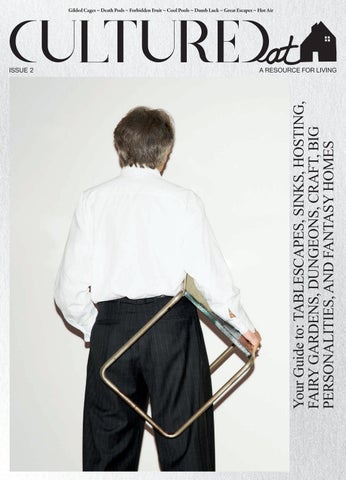
Your Guide to: TABLESCAPES, SINKS, HOSTING, FAIRY GARDENS, DUNGEONS, CRAFT, BIG PERSONALITIES, AND FANTASY HOMES
Gilded Cages ~ Death Pods ~ Forbidden Fruit ~ Cool Pools ~ Dumb Luck ~ Great Escapes ~ Hot Air
WELCOME
Welcome to the Issue For nearly 15 years, CULTURED has dedicated itself to illuminating the inner lives of artists. Last year, we launched an annual design publication to document the ways that they live in the physical world, too. The second issue of CULTURED at Home is a continuation of that commitment. Our team crisscrossed the world to capture interiors that fuel and foster the creative lives of their inhabitants. In these pages, you’ll encounter environments as wide-ranging as the artists they house—from a Madrid tower covered floor-toceiling in gold leaf to a remote Japanese island where architects and friends gather for a groundbreaking ritual. We visit ornate British country homes and jam-packed New York lofts where women artists have flouted society’s pressures to make their life’s work. What connects these stories, and these spaces, is a belief on the part of their inhabitants that the way we live can shape what we put out into the world. As you flip through this second volume, consider the many opportunities each day offers us to slow down and appreciate our surroundings. Holding a magazine in your hands is a lot like tracing the curves of a sink, or clocking the way the morning light falls across the floor. This issue is a tribute to that kind of reflective pause. I hope you’ll take one yourself.
Gilded Cages ~ Death Pods ~ Forbidden Fruit ~ Cool Pools ~ Dumb Luck ~ Great Escapes ~ Hot Air
On the cover: Ulrich Fiedler photographed by Bahar Kaygusuz in Berlin holding a Marcel Breuer stool from the Bauhaus Canteen.
Your Guide to: TABLESCAPES, SINKS, HOSTING, FAIRY GARDENS, DUNGEONS, CRAFT, BIG PERSONALITIES, AND FANTASY HOMES
Sarah Harrelson
FOR THOSE who know Creators of luxury kitchen appliances. Established 1683.
Experience it
The difference is Gaggenau
Geometry of Life [Chapter 2]. A movie shot at Palazzo Molteni, Milan. moltenigroup.com / shop.molteni.it
Sogno in rosso notes of black pepper and milk foam
The designer’s source for furniture, lighting, and decor.
Lumens.com
THIS NO-CLOTHES-ON-THE-CHAIR MOMENT WAS BROUGHT TO YOU
BY
MORE ROOM FOR WHAT MATTERS™
BEDROOM
AND
CALIFORNIACLOSETS.COM
HOME
STORAGE
833.718.8191
SOLUTIONS
OR VISIT A SHOWROOM
los angeles new york london
www.woven.is
THE ELEGANCE OF THE
Essential. THE FAIRCROFT™ KITCHEN COLLECTION
AN INSTRUMENT OF
Intention. THE FAIRCROFT™ KITCHEN COLLECTION
THE POETRY OF
Pragmatism. THE FAIRCROFT™ KITCHEN COLLECTION
THE FAIRCROFT™ KITCHEN COLLECTION ITEM 1...... WID E SPRE A D FAUCET IN BRILLIA NCE® P OLIS H ED NIC K EL ITEM 2...... P ULL- D O W N FAUCET IN BRILLIA NCE® STAINLE S S ITEM 3...... D EC K M O U NT BRID GE FAUCET IN U NL AC Q UERED BR A S S
OCT. 20-25, 2026
All for New Paths
Still from Artist Dialogues video on Lita Albuquerque showing Malibu Line, 2024. Artwork © Lita Albuquerque. Commissioned by Los Angeles Nomadic Division. Text and design © 2026 J. Paul Getty Trust
getty.edu
60
Contents Workshop
74
Crown Molding A barber in Poland clips controversial architectures
Salon
76
Mini Monument The many lives of an Aldo Rossi Secrétaire
Hosting
78
Omar and Patricia Host a Wedding in Spain No planner, just friends
80
Tish and Tom Host Day into Night Raven Smith maps the illusions of country life
86
Jing and Cynthia Host a Ritual on a Remote Japanese Island Architects and friends break ground in the forest
Storage
88
A World Within This wardrobe holds more than you think
Portrait
90
Body Language Artist Carlos Martiel performs the architecture of endurance
94
The White Cube Is Dead. Long Live the Apartment Gallery. Ulrich Fiedler and Katharina Evers stage museum-quality shows at home
100 The Silk Whisperer Hermès’s Cécile Pesce on the carré as confidante 104 How Much Should a Kitchen Hide? Sven Baacke and Sam Chermayeff trade notes from the factory floor 106 Old Crafts, Young People Who’s reviving architecture’s oldest trades? Funeral
114 A Tale of Forever Homes and Designer Death Andrew Pasquier journeys from Père Lachaise to the cryochamber
Remodel
118 It’s an Airbrushed Age. These 8 Designers Are Resisting. Dan Thawley on design that pits toughness against tenderness
Bath
122 These Sinks Are Made for Washing Sam Chermayeff and his students make a case for play, even with the plumbing
* The alchemy of senses
62
Contents
Tabletop
129 Tabletop Adam Charlap Hyman assembles the ultimate resource for tablescaping
Vanity
145 Double Take Artist Amie Siegel reveals the hidden mirrors of Pompeii
Garden
154 Lily-Rose Depp Gets the Fairy Garden of Her Dreams Tender, enchanted, and drought-tolerant
Home
160 Ignasi Monreal Bought a Tower Above Madrid and Covered It in Gold Leaf An inner sanctum for an anxious age 168 King of Plastikville Post-punk legend Lary 7 reigns over an East Village time machine 174 Good Architecture In 1955, Eliot Noyes built a home for a storied collector. Philosopher Simon Critchley reckons with his choices. 182 ‘I Am a Magpie’ The treasures Jack Pierson can’t bear to part with, tucked away in his rambling Palm Springs home 188 Like a Scandinavian Married a Californian Communal living, Malibu style 194 New York’s Longest-Leaseholding Women Artists Open Their Doors Four artists in their 70s and 80s are still working away above a changing city 212 A Concrete Castle in the American Countryside David Hartt turns his lens on Henry Chapman Mercer’s hand-poured opus 220 A Field Guide to Domestic Kink Jarrett Earnest ventures into four New Yorkers’ homes, where decor meets desire
Resource
228 The CULTURED at Home resource for Design Books, Galleries, Hotels, Films, and Museums
USA_CULTURED_Flexform - ADV GROUNDPIECE_S _NEW.indd 1
03/08/26 12:12
64
EDITOR LETTER
While researching home-design advertising from the early 1970s for an essay on the textile artist Robert Earl Paige, I came across letters to the editor in Ebony from readers complaining that the magazine’s home advice had become too commercial. They wanted their home advice back, free from advertisers’ interests. I was struck by how evident the intrusion of commerce seemed to them. The integration of content and commerce is now so complete that it’s nearly invisible. What those Ebony readers could hardly have anticipated was how intimate that machinery would become: a world full of diversions engineered to feel like fulfillment, calibrated so precisely to our own interests that we stop reaching past them. Desire no longer feels like agency, or even a worthy pursuit. But aspiration beyond the scroll requires work. This issue is dedicated to the folly, the indulgence, the rapture of aspiring to more and chasing it down. Fantasy homes like Ignasi Monreal’s gold-leafed Madrid perch and Tish Weinstock’s country escape. Obsessive collections like Ulrich Fiedler and Katharina Evers’s Bauhaus holdings, Lary 7’s sound systems, Jack Pierson’s vintage trove. Pursuits closer to devotion: Jing Liu building a refuge on a remote Japanese island, Carlos Martiel making his own body a monument. A Ukrainian barber fading architecture into skulls. Dungeons staged in Brooklyn rentals. Under these passions and experiments runs an older resistance: to limits, to mortality, perhaps even to satisfaction itself. Andrew Pasquier confronts the question directly: What do we want when we want never to stop wanting? His essay on designer death, on the modern quest to live forever, takes the logic of desire to its most literal extreme. Ultimately, we’re not entranced by the destination, especially when it’s at our fingertips, but by the chase. The striving, the building, the conspiring to get where we want to go. Whether that ends in a Nottingham estate, a kigumi shrine, or a body on ice waiting for a future that will take it back.
Alexandra Cunningham Cameron
66
Contributors
Patricia Rezai
Jing Liu
Libby Sellers
Andrew Pasquier
Patricia Rezai is a poet and creative consultant who has worked across the fashion, art, and music industries. Poetry has always been her greatest passion; she has published four books over the years. Her creative universe is inspired by eroticism and female empowerment, themes that have become the common thread running through her collaborations with cultural institutions and brands.
Jing Liu has been a practicing architect for more than 15 years, leading SO-IL’s engagement with sociopolitical issues of contemporary cities, in projects like the Artist Lofts North Omaha and the Cleveland Public Library’s Martin L. King, Jr. branch. Her projects span collaborations with contemporary choreographers and visual artists, and public design in cities from Melbourne to Indianapolis.
Libby Sellers is a London-based design historian, curator, and cultural commentator. Formerly senior curator at London’s Design Museum and founder of Gallery Libby Sellers, she now collaborates with international museums, brands, and cultural organizations while writing on contemporary design, visual culture, and collecting.
Andrew Pasquier is a Paris-based editor and cultural critic who writes on art, design, and visual culture. He is also editor-in-chief of cult queer magazine BUTT.
Adam Charlap Hyman
Omar Sosa Omar Sosa is a Barcelona-born creative director, editor, curator, and publisher. In 2008, he co-founded Apartamento, the influential independent interiors magazine and publishing house, where he spent 17 years as co-publisher and creative director. Since 2013, he has been the art director of the Italian lighting company Flos.
Sam Chermayeff Cynthia Leung Cynthia Leung is a writer, performer, and communications consultant. She is a contributing editor to CULTURED at Home, and has written on art and fashion for 032c, PIN-UP, Modern Weekly, and the South China Morning Post. As a former stagiaire at Chez Panisse she put her stomach to paper for the Dimes Times Emotional Eating cookbook and remains always hungry.
Raven Smith Raven Smith is a London-based Sunday Times bestselling author and columnist, often dubbed “the funniest man on Instagram.” His books include Trivial Pursuits (2020) and Men (2022), called “Wise, sharp and naughty” by The Observer. He writes a popular American Vogue column and appeared in HBO’s Industry.
Carlos Motta Carlos Motta is a multidisciplinary artist whose work explores gender, sexuality, and postcolonial politics. His major survey exhibition “Pleas of Resistance” premiered at Museu d’Art Contemporani de Barcelona in 2025, traveled to OK Linz (2026), and will open at Nikolaj Kunsthal in Copenhagen (2027).
Sam Chermayeff is an architect, designer, academic, and contributing editor to CULTURED at Home. Trained in architecture at the University of Texas at Austin and the Architectural Association, London, Sam is a founding partner of Sam Chermayeff Office. The studio’s work ranges from large residential towers to community centers to kitchens and furniture. He is currently a professor at Angewandte, Vienna.
Adam Charlap Hyman is a contributing editor to CULTURED at Home, as well as a New York–based designer, artist, and the co-founder of Charlap Hyman & Herrero, an architecture and design firm recently honored with the 2026 Smithsonian National Design Award for Interior Design. His projects range from set design to residential interiors, freestanding buildings to store and exhibition design.
Dan Thawley Dan Thawley is an Australian-born journalist, curator, and editor based in Paris. He is the artistic director of MATTER and SHAPE, the annual design salon in the Jardin des Tuileries, and spent 14 years as editor-in-chief of the cult Belgian biannual A Magazine Curated By. He has authored books with Rimowa, Erdem, and the OTB Group.
This page, top to bottom and left to right: Photography courtesy of Patricia Rezai, by Anna Bauer, by Patrick Fetherstonhaugh, by Dougal Macarthur, by Anna Huix, by Jade Lai, by wowephotography, courtesy of Andrew Pasquier, by Richard Dowker, by Manuel Carreon Lopez, by Ellena Hudson, and by David Powers.
Oscar Murillo
68
Contributors
Lawrence Kumpf
Julia Halperin
Lawrence Kumpf is the founder and artistic director of Blank Forms, a nonprofit supporting experimental and creative music. He has organized international exhibitions, published widely on artists including Don Cherry, Catherine Christer Hennix, and Éliane Radigue, and co-directs the Maryanne Amacher Foundation.
Julia Halperin is an arts and culture journalist and editor-at-large of CULTURED. She is co-founder of the Burns Halperin Report, the largest report of its kind tracking equity and representation in the art world, and is a regular contributor to The New York Times and The Financial Times.
Simon Critchley Simon Critchley has written over 20 books, including studies of Greek tragedy, David Bowie, football, suicide, Shakespeare, how philosophers die, and a novella. He is the Hans Jonas professor of philosophy at the New School for Social Research in New York. As co-editor of “The Stone” at The New York Times, Critchley showed that philosophy plays a vital role in the public realm.
Luisa Opalesky Luisa Opalesky is an American photographer, director, and movement director based in New York. Her practice integrates her background in dance and film to capture body rhythm, lively energy, and human diversity, in the city and in nature. Her work appears in Interview, The New York Times, and collaborations with Valentino.
Jarrett Earnest Jarrett Earnest is a writer and curator living in New York, and the only things he talks about are art, sex, and books.
Bahar Kaygusuz Bahar Kaygusuz is a photographer and visual artist living in Berlin-Kreuzberg. Her work moves between documentary observation and poetic condensation, and focuses on ideas of cultural, gender, and social belonging, as well as questions of identity.
Amie Siegel Amie Siegel is an artist working across film, video, photography, and installation. Her work traces the hidden lives of objects and the systems of value that surround them, most famously in Provenance, which followed Chandigarh’s modernist furniture from Indian government offices to Western auction houses. She lives and works in New York.
Se Young Au Se Young Au is a multidisciplinary artist and writer based in Los Angeles. Their work is at the intersection of digital collage, personal archive, installation, and olfaction. Au has exhibited at the Henry Art Gallery, El Segundo Museum of Contemporary Art, Craft Contemporary, and the Institute for Art and Olfaction. They have been a guest artist lecturer at Cornell University and the University of California, Irvine.
Jesper D. Lund
Janelle Zara Janelle Zara is a longtime contributor to publications that start with art—Artnet, ARTnews, The Art Newspaper, and more—as well as other outlets including The Guardian, Frieze, Elle Decor, and The Financial Times. In 2019, she published her first book, Simon & Schuster’s Masters at Work, then in 2025 launched a podcast for the Felix Art Fair.
Jesper D. Lund is a Danish photographer and director who lives and works between New York and Paris. In 2014, he co-founded Office, a New York–based magazine dedicated to fashion, art, music, and culture.
Thomas Valtin Thomas Valtin is an analog handprinter and photographer who brings together form, fabric textures, and silhouettes to create clean, architectural imagery. His work plays with sharp contrasts, unconventional angles, and minimalist framing to create visuals that feel both raw and polished.
This page, top to bottom and left to right: Photography by Ruba Katrib, by Taylor Dafoe, courtesy of Jesper D. Lund, by Leopold Stoeckert, by Andrew Zuckerman, by Jonathan Grassi, by Jae Kim, by Jason Schmidt and courtesy of Thomas Dane Gallery, courtesy of Janelle Zara, by Ryan Nickel, courtesy of Bahar Kaygusuz, and courtesy of Se Young Au.
Yoshitomo Nara
70
Contributors
Tim Barber
Adrian Gaut
Stephen Kent Johnson
David Hartt
Tim Barber is a photographer, editor, curator, and the founder of the web projects tinyvicesarchive.com, Time & Space, and Dream Sequence Editions. In 2025 he launched Rectangle Room, a bookstore and exhibition space for contemporary photography on Eldridge Street in New York.
Born in Portland, Oregon, Adrian Gaut initially pursued painting before falling in love with large-format architectural photography. After relocating to New York, he has exhibited and published work worldwide, with a notable book on Los Angeles architecture, Wilshire Boulevard. He is working on his second book.
Stephen Kent Johnson is a photographer based in New York who specializes in architecture and interiors. Trained as an art director, he shoots for designers, architects, and publications like Architectural Digest, The World of Interiors, and WSJ Magazine.
David Hartt is an artist and an associate professor of fine arts at the University of Pennsylvania. His work explores how historic ideas and ideals persist or transform over time, and has been exhibited internationally and is held in several public collections. He is represented by Bortolami Gallery, Corbett vs. Dempsey, Labor, and Galerie Thomas Schulte.
Ricardo Labougle
Akari Endo-Gaut
Ricardo Labougle is a Spanish-Argentine photographer whose work over the past three decades has focused on architecture, interiors, portraiture, and landscape. Discovered by the legendary editor Min Hogg in 1996, he began a long collaboration with The World of Interiors. He is the author of more than a dozen photography books published by international publishers such as Vendôme Press and Taschen.
Akari Endo-Gaut is a New York–based style director and creative and curatorial consultant. Born in Japan and shaped by a decade in Paris studying fine art and architecture, she works across fashion, tabletop, gardening, and interiors, with a particular interest in the dialogue between materials, objects, and spaces.
Lee Mary Manning Lee Mary Manning is an American photographer and visual artist based in New York. They are represented by Canada gallery.
Matt Grubb Matt Grubb was born in San Francisco and received his MFA in photography from Yale University. His work spans genre and usage, incorporating elements of artwork, editorial, fashion, and commercial photography. He lives in Brooklyn.
Monica Nelson
Isaac Zamet Weighing 79 kg, Isaac Zamet is a writer from London. His fiction, journalism, and poetry have appeared in a range of titles including Vogue, The Financial Times, and DIE QUIETER PLEASE. For screen, he has written and developed documentaries for Sky Arts, Sky History, and the Oscarwinning Rise Films. He is the poetry editor of New Papers and one half of the material culture blog Abscondita.
Monica Nelson writes about history through material culture, design, and nature. She is the author of Edible Flowers: How, Why, and When We Eat Flowers (Monacelli, 2021), These Long Shadows: Women’s House Museums in the American South (Atelier Éditions, 2026), and Antiques Today (forthcoming), and is the founding photo and design director of Wilder Quarterly.
This page, top to bottom and left to right: Photography courtesy of Tim Barber, courtesy of Adrian Gaut, courtesy of Stephen Kent Johnson, by David Heald, by Gustavo Peruyera, by Adrian Gaut, by Francesca Wade, courtesy of Matt Grubb, by Ellena Hudson, and by Ryan Nickel.
ONE PURPOSE. THREE PATHWAYS. THE EMERGING ARTISTS FELLOWSHIP. THE PETER HORT QUALITY OF LIFE GRANT. THE ARTISTS LIVING WITH CANCER GRANT.
The Rema Hort Mann Fund was established on our deep belief in the healing powers of creativity and community. In our work, we’ve discovered meaningful kinship and connection between emerging artists and individuals battling cancer. We envision a world where both cancer patients and artists have access to the resources and sustenance necessary for their well-being and creative potential. remahortmannfund.org
Please scan the QR code to donate or visit givebutter.com/RHMF2026
72
MASTHEAD
CULTURED at Home Editor-in-Chief Guest Editor Creative Director Executive Editor Editor-at-Large Kitchen and Bath Editor Resource Editor Contributing Editors Senior Vice President, Chief Revenue Officer Vice President of Sales, Art and Fashion Director of Brand Marketing and Production Manager Public Relations Sales Consultant, Home and Travel Director of Marketing Strategic Advisor Junior Managing Editor Photo Editor Research Editor Copyeditor Junior Designers
Sarah Harrelson Alexandra Cunningham Cameron Erin Knutson Mara Veitch Adam Charlap Hyman Sam Chermayeff Monica Nelson Cynthia Leung Jason Wigginton Carl Kiesel Lori Warriner Ian Malone Hailey Powers Ethan Elkins Dada Goldberg Priya Nat Sara Zelkind Carol Smith
Design Intern
Cami Fateh Dondre Stuetley Sophie Lee Eveline Chao Paul Bille Treat Swarstad Satoka Shibasaki
Printer
Shapco Printing, Inc., USA
WIKTORIA AND FILIP BIELICKI, OBJEKT GALLERY. PHOTO: TOMO YARMUSH
NEW YORK November 6— 8, 2026
74
WORKSHOP
CROWN MOLDING From a barbershop in Katowice, Poland, Bohdan Vasylkov transforms men’s scalps into plinths for outrageous sculptures, producing results both tender and masterful. For CULTURED at Home, he transformed four heads of hair into controversial feats of architecture from across the world.
GUGGENHEIM MUSEUM Architect: Frank Lloyd Wright; Built: 1959; New York, New York
SYDNEY OPERA HOUSE Architect: Jørn Utzon AC, Peter Hall; Built: 1973; Sydney, Australia
PYRAMID AT THE LOUVRE Architect: I.M. Pei (Ieoh Ming Pei); Built: 1989; Paris, France
HEYDAR ALIYEV CENTER Architect: Zaha Hadid Architects; Built: 2012; Baku, Azerbaijan
Available for pre-order now at www.culturedmag.com
76
CULT OBJECT A 1987 Secrétaire Designed by Aldo Rossi Giulia Molteni describes the allure one piece of furniture that shaped her family company’s legacy. A proud walnut column with a lock on its first drawer has followed Molteni Group Chief Marketing Officer Giulia Molteni from one home to the next. It began in her family’s storied Tobia Scarpa–designed abode in Brianza, Italy, where products and prototypes proliferated, blurring business with family life and, ultimately, legacy. Aldo Rossi conceived the object—a writing desk called Carteggio—for Molteni&C in 1987, a banner year for the architect as he built out his newly launched Manhattan studio with museum, hotel, and urban planning projects. Purpose-built to facilitate handwritten correspondence and personal organization, the desk domesticated the totemic postmodern buildings that would earn Rossi the Pritzker Prize three years later. Today, the rituals Carteggio was made to serve have largely vanished, but its genteel appeal has not. re the rs , we es dra op its el “In nv ,e rs tte le
e ar
do cu m en no ts te ,k bo ey ok s, s, pe co ns in , s, pe an dw nc hit ils ep draw ap ings er, by th e chi ldren , and well-pre served secre ts.”
Photography courtesy of Molteni&C.
Molteni —Giulia
HOSTING
Hosting
Photography by Jesper D. Lund.
An invitation is an open door, and family is anyone who walks through it. Our hosts caroused in the English countryside, communed with spirits on a Japanese island, and deputized friends to plan their wedding in a Spanish palace.
78
COOL
OMAR AND PATRICIA HOST A WEDDING IN SPAIN Omar Sosa and Patricia Rezai skipped the wedding planner and let their artist friends make everything. By Patricia Rezai Photography by Omar Sosa and David Luraschi
I remember the first time Omar came to visit me in Madrid. I staged a still life on the dining table: fresh pomegranates and a box of condoms. We’d just met in Ibiza, mid-Covid. More than five years later, one of those uneaten pomegranates is still intact — dried out on my bookshelf, an homage to the abundance of our love. Omar proposed last November in the Peter Zumthor–designed thermal baths in Vals, Switzerland. He pulled out the most beautiful ring, shaped like an open pomegranate full of rubies. I’m a full-blown romantic caught up in an erotic, ritualistic fantasy, and Omar is a design freak flying free. We decided 2026 was a great year to get married — and to buy a house and refurbish it. YOLO! Omar had a vision of a wedding curated by friends instead of a wedding planner. We don’t yet know how things will morph or what will materialize in the end, but whatever our wedding becomes, we’re sure it will be a shared effort and a celebration of common love.
THE LOCATION Omar and I started spending summers at LOS LLANOS, in Albacete, a special place for us that belongs to friends of ours. My ring is inspired by a pomegranate I picked in the garden there, and years ago I wrote Omar a love letter fantasizing about celebrating our love there one day. When our friend Barbara and her mother heard we’d gotten engaged, they offered us Los Llanos for the wedding. We knew immediately it was meant to be. Omar and I looked at each other, and there was not one second of doubt.
THE RING ALICE WAESE made the ring Omar used to propose to me, an open pomegranate of rubies. THE INVITATIONS Lingerie designer ANDREA PIMENTEL did the calligraphy for our invitations. She is also creating the lingerie for my wedding night.
THE FOOD I haven’t been to many weddings, but of the few I have been to I rarely remember the food. This became important to us. I wanted to work with BANAFSHEH FARHANGMEHR, a Persian chef, to celebrate my Persian roots. Omar loved the idea; he’d always envisioned a table abundant with food and the chaos of dishes being passed from one side to another. Let’s hope our guests won’t be expecting jamón...
THE CAKE Having the pastry artist ANDREA SHAM make our cake feels like the cherry on top — dessert is very important to me. Andrea and I could speak about wedding cake forever, lost in a sweet paradise.
THE FLOWERS I speak with the artist CONIE VALLESE every day. We share the language of flowers. She created my bouquet, a sculptural ode to what unites us.
THE DRESS Everyone asks, “What about the dress?” My algorithm was an overdose of bridal trends, but none felt like me — until I flew to Mallorca to meet ROSA ESTEVA, the founder of Cortana. I remember telling her, “I want to appear as an ethereal illusion dripping in lace.” She flew a prototype dress to Barcelona a couple of weeks later for me to try on. The moment they unpacked it, I couldn’t believe it. I texted her, “My heart just skipped a beat, that’s it. We have it.”
HOSTING
THE SCENT Scent artist SISSEL TOLAAS had the idea of making a special molecule that symbolizes our love.
THE TABLE BENGT THORNEFORS, of the textile label Magniberg, created what we now call “the endless tablecloth,” a 40-meter-long fabric with printed flowers tossed everywhere. We want to contrast the opulence of the house’s interiors with something fresh and modern.
THE ATMOSPHERE The celebration needed music, wine, and also a photographic trace. YASMINA DEXTER is in charge of music for the party. DANIEL BAUGHMAN offered to give a sound bath with his collection of Tibetan bowls, and PEDRO VIAN is doing a soundscape for the ceremony. The wine will be handled by STEFANO COLOMBO, a front-runner of natural wine in Barcelona.
THE PHOTOS Phones will be banned, so DAVID LURASCHI, whom we jokingly call our official photographer, will be in charge of pictures. He also took this photo of us, together in the pool.
80
TISH AND TOM HOST A PARTY IN THE COUNTRY By Raven Smith Photography by �esper D. Lund
On Friday afternoons, London develops a full-blown fantasy life. Group chats fill with chintzy cottages, scrumpy swimming holes, proper pub gardens, and tastethe-difference tomatoes. The city exhales west, towards the Cotswolds and the Chippings, woodland lodges, windfall orchards, and jam-making: the restorative illusion of country life. We’ve become frighteningly fluent in the language of escape. We know the country playbook: wellies by the door, wool on the body, a dog with a World War II soldier’s name. A quick walk that lasts three hours followed by cake from a tin, the forcing of rhubarb, and foraging of kindling. Once the kids are tucked and chickens penned, everyone ends up in the kitchen. Rosemary-sprigged gin and tonics. The Aga, of course. Ottolenghi’s Simple lying open. It’s tempting to roll your eyes; I can feel my eyes rolling, too. “Cottagecore” has become so aestheticized that the British countryside has become more of a mood board than a real place. Don’t we all fantasize about becoming the sort of person who knows their butcher’s name? Someone who buys eggs from a farm’s honesty box? Who deadheads? Who pickles? It’s difficult to simply visit the country because we arrive preloaded with references: Wuthering Heights, Brideshead Revisited, the cottage from The Holiday. Perhaps that’s because it has become one of Britain’s greatest myths. Not the wild, sublime landscape of the Romantics, or Kate Bush, or even Monty Don, but something less grandiose and more aspirational: a place where the Wi-Fi is patchy enough to forgo the vulgarity of emails.
“My favorite part of entertaining is getting ready beforehand. I love the ritual of putting on music and getting dressed up,” says Weinstock.
TISH WEINSTOCK’S Somerset piéd-à-champ is where Britain’s favorite fantasy gets to stretch its legs. Tish and her husband, TOM GUINNESS, host a rotating cast of weekenders — friends, extended family, everyone’s children — while remaining refreshingly skeptical of proceedings. What are people really buying when they buy a second home? “Of course, escaping the grind of the city is a luxury,” Tish says. “Being in nature is a luxury. But more than that, it’s about nourishing rituals — spending time as a family, long Sunday lunches, watching my husband cook — I absolutely cannot cook.” Time is the true extravagance when you leave the dopamine metropolis. A second home is a second clock. Of course, there is a performance to all this — there has to be. Tish thinks that’s part of the appeal. “You’re performing leisure,” she says. We often think of performance in opposition to authenticity, but perhaps they’re closer bedfellows than we’d like to admit. Kids put on the cape before they think they can fly. We put on the walking boots before we believe we can slow down. I’d argue that all hospitality is a kind of performance. Isn’t hosting, at its best and its worst, painstakingly choreographed? By Sunday evening the car is packed again. The boots are muddy. The children are asleep before you even reach the motorway. The fantasy dissolves somewhere around the North Circular; London waits exactly as you left it, brisk and demanding. But something comes back with you: the conviction that another way of living might be possible. That’s the real reason we keep leaving. Every Londoner is six months away from buying a place in the country. They’ve been six months away for 15 years. What they’re really shopping for isn’t another house — it’s somewhere their pretending isn’t quite pretending anymore.
“We stole these bits of armor from our wedding. The artist �oe Rush from Mutoid Waste made all these weird demon knight figures that we scattered throughout the castle.”
HOSTING
“I always like a good cocktail to kick off the evening. If it’s dinner, a margarita. If it’s a lunch I’ll make a bloody mary.”
“I tend to ply everyone with drinks to make up for the fact that I can’t cook.”
“I love an all-ages party. You need that tension between the wise old crows and teen tearaways.”
“Having endless options for seating is key, whether that’s a rug on the lawn or a bed in the drawing room. I want guests to feel free to lounge around. It’s also because I’m incredibly lazy.”
82
“There’s something so easy about being in the countryside. Time stops and you can appreciate the beauty of nature. I find it very meditative.”
“Tom is a phenomenal cook. In fact, he’s pretty good at everything. I don’t think I would want to entertain without him. He’s what makes it fun.”
HOSTING
“The sound of silence gives me anxiety. You always need a good playlist when entertaining. Playing records is Tom’s way of ensuring I don’t make any annoying requests.”
“The key to any good meal is having an array of good condiments.” “I hate the formality of plated food. Family style is so much more relaxed and easy.”
84
“I always find it quite hard to eat at a big dinner, as I’m usually boring someone with a very long-winded story, or I’m too overstimulated to pick up my knife and fork. I usually end up snacking in the kitchen later on when everyone’s left.”
“I love the shift in energy once dinner is over. Everyone generally starts to get a bit silly.”
“I’m such a sucker for an afterdinner game like charades or the name game, especially when playing with family. It gets very competitive.”
HOSTING
“There’s something about being in the countryside which tends to encourage — but also excuse — bad behavior.”
“I love an outfit change mid-party. We have a dressing-up box full of old coats and dresses that people can dress up in.”
“The key to being a good host is being able to relax into wherever the night takes you, then relying on your husband to kick everyone out.”
��
�IN� AND CYNT�IA �OST A �IT�AL ON A ���OT� �APAN�S� ISLAND Te�t by �ing Liu Captions by Cynthia Leung Photography by Benjamin Spears
There is a moment in life when all that’s behind us congeals in front of us, to shape into whatever comes after. That moment came when my diagnosis landed. I looked up from New York City, the base of my practice and family, and realized that something was missing. The first overseas trip I took after regaining some semblance of life was to Ishigaki. I had heard about these Yaeyama Islands in the past, but they remained an impermanent mark floating somewhere in the Pacific Ocean and the southeastern shores of China — a Blue Zone where people lived long, healthy lives. I took the 9 a.m. �� ��press flight and landed at ��:�� a.m., immediately greeted by a warm rush of cicadas and salt wind. I snapped pictures of banyan tree roots and coral bones, walked along rain-carved mountain paths and stone walls, swam and sunbathed. Far from the shining crystals of cities, I inhaled the darkest nights of Asia. On the island, nothing is static, the oldest fisherman of the Taira family told me. Indeed, time doesn’t pass idly here. All it took was a few meals with the locals before the slow-motion paradise turned into a stage for stormy human affairs. From the ��th century through World War II, Yaeyama was traded among kingdoms, subjugated by war, and host to refugees — its population forced to assimilate and adapt. In the remote northern part of the island, those who survived carved lives out of terrain that offered no guarantees, refusing to vanish. “We are all immigrants,” said Nose-san’s wife. Their shop on the main street sold knives of all kinds for survivors who lived off the mountains and the sea. Shortly after my first visit, I decided to become the new custodian of a plot of land on the northern peninsula that the Noses owned — a sloped subtropical forest inhabited by leeches, insects, songbirds, turtles, moss, mushrooms, and wild boars. Relics lay hidden in the undergrowth: a concrete dam where two streams converge, a well and a stone with “water source” carved next to an indecipherable year. Here was the source of life for forgotten settlers. Between two ancient banyan trees is a clearing, dark bluish-green shales spilling out from the collapsed wall beneath it like a stage. In Yaeyama, utaki (御嶽) is a grove where people gather, a porous threshold between human and spirit worlds, and one of the most profound expressions of Yaeyama culture. Ritual takes place here: harvest festivals and prayers for safe passage. Only Noro and Yuta priestesses may enter these sites to address their ancestors, invoke rain and pacify storms, and mediate between the land and the living.
“This trip explores the radical potential of friendship. It was also meant as a line of questioning regarding the motivations of being an architect.”
“I’m the child of someone who was himself a child at the tail end of World War II in Asia; I think about war a lot. When one is so vulnerable, one sees clearly and intuitively what human nature is.”
“�ing’s idea was to build a future home and to open it to other women who were plotting their next acts. As a failed publicist, a failed chef, a failed journalist, and a failed artist, I thought her move was a bold one.”
On Aug. �, ����, �annah Arendt wrote to �arl �aspers, “I’ve begun so late, really only in recent years, to truly love the world � Out of gratitude, I want to call my book on political theories Amor Mundi.” That book became The Human Condition. Standing in a utaki, I realized what I was missing. Amor Mundi — the possibility of what the world could be, permeated by the sounds of wind and rain, the drift of the tide, the moon, and the bond of stone to river. I wonder what architecture belongs here, with no blueprints or pro formas, but deep conversations with the Earth and with women who have lived, died, survived, and chosen to love, still. I have brought families and friends here, always without any concrete idea of what we would do, except tread the land and listen to the forest. This spring, a group of my architecture students and my friend Cynthia — whom I cared for through her diagnosis and treatment before I underwent my own — came to discover the island. Together, we brought a strange, momentary disturbance and potentiality to the northern peninsula. I asked the students to make a mark and an offering, using the materials already here, for the new priestesses of the island. It’s been a year since my diagnosis and my becoming this land’s custodian. For the first time, I felt adequate to do the same.
“On this tropical island, we cleared a path through dense forest. Ducking under prickly plants and weaving between millions of branches, I reali�ed �ing was the braver of the two of us, ready to slash down colocasias, no matter how beautiful, to achieve clarity of vision.”
HOSTING
“�ing was a dancer like me.�
“To be a good host is to understand how to be a good guest.”
“There was a capitalist moment on the beach: We found seashells larger than our heads, unpolished crystals the size of our hands, plastic in the form of a laundry basket, lengths of rope, a toy. The line between treasure and trash was thin, and we wordlessly collected objects in a frenzy, according to some animal hoarder logic. These would become offerings to consecrate friendship in the cave.”
“Through �ing, I came to understand this thing called architecture: structures that can give tangible relief when life is overwhelming and chaotic.”
“I’m more Hippie �alifornia; �ing’s more Megacity China. She said that only later in life did she understand this thing called nature — a certain smell of the earth, a sound of rain on elder trees, a symphony of birds singing whether or not you’re present.”
“Ritual is a popular word now, but for the ancients, it’s just a bodily way to establish the feeling of being seen.”
“We were in the forest. She held the knife and I followed; we took turns for hours. At the end of our journey, when we were almost at the main road, we reached a point of conflict, where one’s idea of what is Natural and what is Right needs to be expressed in the open.”
“I said, ‘There needs to be a sense of mystery,’ even if there is a path.”
STORAGE
88
There’s more space than you think. Beyond your closet, throughout your home, California Closets creates hidden worlds where your belongings come alive. Inspired by nature, curated premium finishes can be layered together with specialty materials and hardware. The possibilities are endless.
The beauty is in what you don’t see. Hidden Hardware creates a refined sense of custom millwork.
When California Closets lights up, your favorite things are bathed in an otherworldly glow.
A night out means you need your accessories to be close at hand — store your jewels in the vanity and your neckties in the forest.
Your rubber boots are waiting for you. Why not pull them on and wander the woods?
Your closet is your world — open it up and see what’s inside.
A World Within
A closet is never just a closet. On its shelves and behind its doors, entire worlds await – in the clothes, keepsakes, and treasures that carry our memories and accompany us on every adventure. CALIFORNIA CLOSETS brings that sense of possibility to all rooms and spaces, large or small. Highly personalized, every custom design can transform a “mess” into a portal. Where will you go? Illustration by Harim Choi
PORTRAIT
Portraits
Photography by Luisa Opalesky.
The design ecosystem crosses cultural, commercial, and disciplinary boundaries. The figures profiled here—furniture dealers, creative directors, and performance artists— reveal the myriad ways that one person’s eye can influence how the rest of us view the world.
90
Y L D ANGU O B A GE Since he began his practice, Havana-born artist Carlos Martiel has been drowning, hanging, and piercing his body with arrows. Now, he’s deciding what other media, beyond his own flesh, to incorporate into his work.
INTERVIEW BY CARLOS MOTTA PHOTOGRAPHY BY LUISA OPALESKY
PORTRAIT
In 2021, following the murder of George Floyd and in the midst of the Black Lives Matter movement, the artist Carlos Martiel stood naked and motionless, handcuffed on a pedestal in the middle of the Solomon R. Guggenheim Museum in New York. The one-night performance, Monumento II, was both a temporary monument to the oppressed and a defiant cry for justice. For more than a decade, Martiel has used his body as his medium, often pushing it to the limit in order to draw attention to systems of oppression and structural racism. He has pierced, sutured, and excised his own skin, made himself unconscious, and surrendered to fumigation by insecticide. He has buried and drowned himself alive—multiple times, including at the 2017 Venice Biennale, in response to the drownings of migrants in the Mediterranean.
Image caption
Martiel belongs to a lineage of performance artists, from the Serbian artist Marina Abramović to the Guatemalan artist Regina José Galindo, who have funneled their experiences with state violence into art that puts their bodies on the line and compels others to bear witness. His work also nods to the power of organized resistance: In a video called Cuerpo presented at El Museo del Barrio in 2024, he filmed himself hanging in a noose from the ceiling, his weight supported by people taking turns to hold him up. “I don’t paint abstract pictures,” Martiel says. “My work is not intended to decorate.” The artist grew up in Havana and studied at Cuba’s national fine arts academy and Cátedra Arte de Conducta (the latter was founded by Tania Bruguera, another daring and politically engaged performance artist). In his hometown, he began experimenting with drawings made from his own blood as well as early performances like Marea (Tide), 2009, in which he buried himself in sand, waiting for two hours for the tide to roll over him. In this rare interview with his friend, the Colombian artist Carlos Motta, translated from Spanish, Martiel looks back on his career to date and discusses endurance, nudity, and Havana, the city that was his earliest stage.
92 murder of George Floyd, followed by an unprecedented wave of protests in the United States and around the world. In the United States, we saw the removal of numerous Confederate monuments, something I never imagined would be possible. Monumento II condemns structural racism and historical violence. It denounces the repressive policies that have led to the mass incarceration of countless migrants and people of African descent in the United States, as well as the dismantling and separation of so many families in this country. Without words and through the enduring gesture of resistance, it tells the story of a Cuban body subjugated by a global economic power. MOTTA: What was the process of imagining this performance in response to the historical and symbolic weight of the museum’s architecture? MARTIEL: By remaining handcuffed atop a pedestal in the center of the Guggenheim rotunda, Monumento II subverts the logic of the traditional monument through the mere presence of my body. By occupying a space historically associated with whiteness, power, and structures of cultural legitimacy, the work confronts narratives of glorification and reveals the violence that often remains hidden. Carlos Martiel exploring New York’s foliage.
CARLOS MOTTA: I’d like to begin in Havana, where you began your public actions and performances. Can you describe how your earliest works responded to the everyday experience of navigating that city? CARLOS MARTIEL: Being a visual artist has been the greatest gift the universe has given me in this lifetime. It has been my most powerful weapon in fighting most of the battles I’ve had to face. Art has given me the teeth to chew through and digest painful experiences, to come to terms with my life, and expand my consciousness. My early work in Havana was rooted in my life experiences as a Black man and clearly expressed my discontent with a repressive and authoritarian sociopolitical system. My work was destined to be seen as subversive, both because of the subjects it addressed and the spaces it occupied. At its core, it was an act of rebellion, transgression, and protest—a response born from a conscious unwillingness to accept the reality in which it lived. My body was the only accessible medium available to express myself in a society that punishes freedom of expression. MOTTA: Were you also referring to the deteriorating state of Havana’s architecture and urban infrastructure?
could exercise my freedom and imagine a different reality—one that would transcend circumstances that were very difficult to bear. MOTTA: Is that what led you to performance art as a means of expression and reflection? MARTIEL: Creating performance art in that context was like being struck by lightning—a force that violently burst into my life, demanding that I understand that another reality was possible. It made me realize that I had a voice, that I had something meaningful to contribute, and a legacy to leave behind. My work isn’t just about exposing injustice; it also challenges those who witness it, especially in public spaces. The act of contemplation—and of being physically present with the work— becomes an ethical responsibility, one that asks viewers to confront the suffering of others and to consider their own ability to help transform that reality. MOTTA: I had the opportunity to attend your performance Monumento II at the Guggenheim in 2021—a museum whose identity is inseparable from its iconic architecture. You stood on a pedestal at the center of the rotunda, naked, motionless, and handcuffed. Your Black body, at once vulnerable and defiant, was displayed within the stark white building, creating a striking image of the violence generated by structural racism. How did this idea come about?
MARTIEL: Claiming public space as my own was a deeply revealing experience. It allowed me to create both a map and an archive of my everyday life: the sea, the Malecón, the river, the cemetery, the decaying urban spaces, and even MARTIEL: The “Monumento” series came my own home. Every corner of the city about during the pandemic. During the held the potential to be a stage where I Covid-19 lockdown, we witnessed the
MOTTA: Social inequality and injustice are your subjects, while your materials are time, your body, and the spaces you intervene in. How do you understand your relationship with duration, with the passage of time? MARTIEL: Life is, quite simply, an experience, since there is nothing material we can take with us from this world when we die. To live an experience requires time; it is, without question, the only thing we truly possess within this illusion we call reality. Time is our most valuable resource. Precisely because our experience of it is finite, our existence gains intensity and momentum. As you point out, my artistic materials are essentially reduced to the only things I possess in this life: time, a body, and space filled with possibility. MOTTA: Is the use of time in your work a strategy for fostering identification with the audience? MARTIEL: By sharing a durational experience, they cease to be distant observers and begin to experience the passage of time, fatigue, uncertainty, and endurance from within their own bodies. I agree with you that working with the body is one of the most effective means to create communication and emotional connection. MOTTA: Are you also suggesting that duration has a political dimension? MARTIEL: Through durational works, I aim to invite the audience to reflect on the historical processes of oppression and violence that racialized bodies have suffered and endured throughout history and across different parts of the world. I want to highlight that resistance has been essential for human survival. I believe
PORTRAIT that resistance can be expressed in a particularly powerful way through works that challenge the limits of the body and our physical capabilities. MOTTA: Your nudity stands in stark contrast with the public and institutional spaces you intervene in. Can you reflect on how nudity contributes to your work? MARTIEL: I like to say it’s an act of bodily honesty. My work is part of a process of self-recognition and acceptance that transcends art. It’s the way I’ve found to connect with myself and cultivate acceptance and respect for who I am. My naked body within institutional spaces makes visible the communities that have been objectified, exploited, and denied recognition in a deeply racist and exclusionary society, as well as within the art world. I don’t paint abstract pictures. My work is not intended to decorate; it seeks to invite critical reflection on human vulnerability and the cycles of injustice and violence that we, as a society, have yet to overcome. MOTTA: In Cuerpo, 2022, participants supported your naked body with a rope tied around your neck. They were preventing you from suffocating, making them a literal embodiment of the metaphor you propose about surviving in the context of historical and systemic racist violence. MARTIEL: Cuerpo grew out of my research into the history of public lynchings in the United States during the 19th and 20th centuries. Though it reflects on political and racial violence in this country, this work also offers an optimistic message about the present and future of humanity, as it speaks of the individual and collective responsibility we all share to support one another, a responsibility we cannot evade and that the universe constantly urges us to embrace. MOTTA: It’s striking how in that piece you invite participants to collaborate, yet at
the same time they become responsible for your survival. MARTIEL: The solution to many of our problems, if not all of them, lies in our own hands. A more humane society is just a single thought away, and, of course, the action to back it up. MOTTA: How do you envision the future development of your work? MARTIEL: Over the past two decades, through my work with my own body, I have sought to convey a message of social justice. My performance practice has evolved over time: I have worked in public spaces with a very minimalist aesthetic, but more recently I have incorporated installations as an integral part of my practice. I have created contemplative pieces, but I have also involved volunteers, the public, and even my own family. In 2020 I began experimenting with photography, video, installations, sculpture, and textile art. This summer I’m focusing on a series of drawings entitled
“Metaphysics of Power,” which explores the connections between social and moral responsibility, spirituality, and quantum physics, and which I will be turning into a series of prints in the near future. I’m interested in continuing to expand my practice into other media without abandoning the body as the central focus of my research. More than changing the subject, I want to delve more deeply into the same questions from new perspectives.
94
The White Cube Is Dead. Long Live the Apartment Gallery. For four decades, dealers ULRICH FIEDLER and KATHARINA EVERS have unearthed exemplary objects of modern design for the most discerning museums and collectors. Now, they stage museumquality exhibitions from their Charlottenburg flat. By Photography
LIBBY by
SELLERS BAHAR
KAYGUSUZ
PORTRAIT
The curious thing about looking is that it often rewards a second glance. From a distance, a room dissolves into a single impression. Move closer, and a solitary object can expound an entire life’s work. In the Berlin gallery-cum-home of Ulrich Fiedler and Katharina Evers, that object is, unexpectedly, a block of kitchen knives. Chosen with care and sharpened through use, the knives suggest precision and order, generosity and geniality, and an appreciation for the beauty found in utility rather than ornament alone. Above all, they reveal a habit of mind: the conviction that the smallest details are often the most incisive. As specialists in Bauhaus, De Stijl, and the wider currents of European Modernism, the Fiedlers have carried that same conviction through more than four decades of professional life. Through galleries, first in Cologne and later in Berlin, they built a reputation for scholarship, discernment, and an academic instinct for placing objects within
larger histories. Their eyes linger on details over which others might pass: the honesty of patina, the exactness of a joint, the ingenuity of a lamp’s switch, the subtle distinction between rarity and significance. That approach has earned them the trust of institutions, industry professionals, and private collectors alike. Clients such as Donald Judd became collaborators, and legendary collectors like Alexander von Vegesack became trusted museum custodians. As international art advisor and design specialist Simon Andrews confirms, “There can scarcely be an international museum or significant private collection that does not now preserve historic artifacts that have at some point been guided by the Fiedlers’ sensitive hands.” Yet for all that authority, the two wear their expertise remarkably lightly. A question about a chair drifts into stories about their first date, then to Ulrich’s keen sushi skills, before somehow returning to the historical memory of the chair. Katharina, immaculate in an archi-
tectural shirt and handfuls of sculptural rings, corrects a date, revises a provenance, or quietly steers the conversation back on course. Ulrich concedes that many domestic decisions end the same way. “Katharina rules,” he says with mock resignation. The joke lands because it captures the balance of the partnership: instinct tempered by exactitude; enthusiasm augmented by order. Time spent with the two leaves the impression not of gatekeepers protecting knowledge, but of people genuinely animated by sharing it. When Ulrich began trading through the brocantes of Europe in the early 1980s, original works by Marcel Breuer or Walter Gropius occupied a very different place within the market. Much of what now sits comfortably within the Modernist canon still needed identifying, researching, and occasionally rescuing. Ulrich continues to delight in recounting the first Mies van der Rohe chair he pulled from a dumpster: an early lesson, he says, in recognizing value where others saw only waste. “I work for the resurrection
Opposite page: Katharina Evers and Ulrich Fiedler lounging on a Ludwig Mies van der Rohe sofa. Above: Of his expansive knife collection, Fiedler notes, “I can fillet any fish.”
96
Fiedler says of the grand entryway to his apartment gallery, “There is a book about Berlin entrance halls, which says it’s the nicest in Charlottenburg. If you ring at Galerie Ulrich Fiedler, you can enjoy it.”
PORTRAIT
“I work for the resurrection of lost Modernist design.” —Ulrich Fiedler of lost Modernist design,” he repeats. Joined by Katharina, whose organizational discipline gave the enterprise its structure, he opened Galerie Ulrich Fiedler in 1986. Entire exhibitions grew from a single artifact. A Marianne Brandt ashtray became an essay on Bauhaus pedagogy; a photograph of Lilly Reich exhibition designs opened onto a survey of Wilhelm Wagenfeld glass. The object was never the whole story. It was simply the most elegant place to begin. After years of white cube galleries and presentations at TEFAF Maastricht, Design Miami, and Frieze Masters, Galerie Ulrich Fiedler now conceives a handful of museum-quality exhibitions each year from the couple’s Charlottenburg apartment. As Ulrich confirms, “A stand-alone gallery was no longer
the ideal. It’s not the concept of the future.” Rather than a retreat, the move feels like the logical distillation of all that came before. Open by appointment, with the occasional impromptu visit from an overenthusiastic student, the apartment functions as a place where the Modernist’s utopian ideals remain not merely preserved but lived. Visitors arrive via a magnificent Jugendstil staircase, past shelves of the gallery’s many publications, before entering the exhibition space where a solo Léger painting or a Corbusian shade of blue on the walls might offer the framework for a Charlotte Perriand stool. The adjoining office, recently reconfigured as more salon than bureau, is where their holistic understanding of modern culture converges over coffee and conversation. Before long, those discussions migrate to the kitchen-dining
room, where Ulrich finds his flow preparing lunch. Katharina jokes about the few intrepid souls who have ventured beyond the kitchen threshold into the private quarters behind, but it’s an understandable error given that the progression is more curatorial than domestic. Furniture by Shiro Kuramata and Jasper Morrison, Katharina’s collection of artworks by Karin Sander, and Ulrich’s Bauhaus photographs all vie for attention. It is an extraordinary apartment. Move closer, and it becomes something rarer: the latest expression of an idea the couple have spent over four decades refining. The object was never the whole story. It was simply the most elegant place to begin.
98
“A stand-alone gallery was no longer the ideal. It’s not the concept of the future.”—Ulrich Fiedler
PORTRAIT
Opposite page, above: Fiedler says, “This reminds me of finding my first early Mies van der Rohe chair in the garbage at the end of the ’70s.” Above: Fiedler with his favorite lighting, an Indi lamp by Wohnbedarf, and a Marcel Breuer stool from the famed Bauhaus Canteen in Germany. He notes that it was among Breuer’s first tubular designs.
100
The Silk Whisperer
PORTRAIT
It takes two years to bring a single carré—the iconic silk scarf of Hermès—to life. Behind that meticulous process of design and development is Cécile Pesce, the house’s creative director of women’s silk. By Alexandra Cunningham Cameron
Photography by Thomas Valtin
Set Design by Sarah Possamai
A simple square of fabric can be a remarkable shapeshifter. It holds back our hair, carries our babies, and wraps our lunches, all with care and tenderness. The scarf is a case study in human ingenuity, showing how a practical object becomes a symbolic one, acquiring meaning through color, gesture, and function. In our hands, it takes the measure of our imaginations.
space to put all my stuff and to continue to work very peacefully. Cameron: Tell me more about your independent art practice. Pesce: I do a kind of patchwork. I buy pieces of lace or scraps of fabric, colorful ones, from Japan or Africa. I imagine a landscape, placing and layering them on paper or on other fabric, just for me. Cameron: Is there anything that you collect obsessively, that has no connection to your work? Pesce: Naturally, fabrics are my favorite. Small pieces, huge pieces, ribbon and lace. I also like to buy plates. I don’t know why. I love to buy just one or two, with a special design like a daisy or a sunflower. It’s a bit kitsch, but I love it. Cameron: Where do you find these things? Pesce: Mostly at flea markets or small antique shops. Cameron: I find that shopping in flea markets, where there are many layers of objects, is the best way to develop your eye. Pesce: It really is. I love to go into very small shops. I’m looking for nothing special, but each time I buy something. Cameron: What actually happens between a finished design and a finished carré? How many hands does a single scarf pass through? Pesce: Oh, lots of hands. Lots of eyes too. First, we choose the designer, the artist, and then the subject of the design. Very often it’s inspired by the theme of the year. The second step is the mockup. I always say, “We don’t sell art pieces; we sell carrés.” Our design drawing process—an engraving—is to decide the color story. Color is a language, so deciding what to say with it is very important to us. Finally, the finishing: the hand-rolled edge. The edge is a strong signature at Hermès. It’s a long time until we decide it, maybe two years between the first rendezvous and the scarf in the shop. It takes lots of love. Cameron: Can you describe what this process looks like in Hermès textile workshops in Lyon? Is there a chance for human error? How disciplined is it? Pesce: Our process is very specialized to Hermès. Everything takes place in a bespoke factory made only for Hermès. C’est fait à la main. Cameron: Your last collection that I saw in New York—the haute soie—was very nightlife and glamorous, with a mix of silk and leather and beading that looked like studs. How do you create that type of tension in your designs: of beauty, but also some edge and toughness?
Pesce: It’s a question of intuition. The silks have the biggest audience of all Hermès products, so we need a large and varied collection: some are more edgy, others more rock, fashion, or academic. Cameron: The scarf crosses over into different realms. It accentuates the body; it can be a tool for carrying and wrapping things; it can be styled in interiors. One of my favorite pieces of furniture was made by the designer Dan Friedman in the 1980s. It’s a discarded pouf bound with fabric and rope, a banal object transformed into something very special. Do you find that silk behaves differently in different settings? Pesce: Yes, for sure. If you want to put a carré on the wall, you choose a specific design to be in harmony with the room. If you choose a carré for yourself, it’s more like a beauty accessory. You have also different sizes. Carré 90, that’s the original. You have the carré 70, more easy, I would say. You have the big one in cashmere silk, carré 140, it’s more casual. For me, it’s a very good friend, the carré. You can do everything with it. It’s playful. Cameron: How would you advise someone to incorporate the scarf into their home? Pesce: My advice is to buy four or six carrés, patch them all together, and place them on the sofa. Or like a curtain! It’s very, very exceptional. You can mix design and color, you can play. Just one, it’s a little bit sad. Cameron: I noticed this in your styling on the body, also. You add, you layer, you experiment. Pesce: Yes, you can knot two carrés. Put it like a top, or even like a dress. It’s fancy, it’s original. Today’s fashion in the street is a little bit boring, in my opinion, you know? We need to be free, and to be joyeux. Cameron: I’m curious about your perspective on other artists and designers. Is there anyone working today whose sense of material or space you adore or envy? Pesce: My latest discovery is the Finnish artist Henni Alftan. She’s a painter, but her practice is similar to photography because she works within a frame. The colors are amazing. She’s very sensitive, sensible, and feminine. Voilà. Cameron: I hope to see this collaboration come to life one day. Pesce: You have to wait another two years at least. You know the timeline.
Few people speak this pattern language as fluently as Cécile Pesce. After two decades at Hermès, and six years spent directing women’s silk, she has guided teams of artisans and artists in expertly crafting kaleidoscopic incarnations of the house’s storied scarves, tracking the cultural moods and preoccupations of the 21st century. Despite stewarding one of the most recognizable designs in global fashion history, she approaches this extraordinary responsibility with the bright, hearty insouciance of someone tending a backyard garden. I spoke to Cécile about her creative life: how she replenishes her references and protects an independent practice, and why the Hermès carré endures as a tool for transforming not just our bodies, but also our homes and moods. Alexandra Cunningham Cameron: You came from fashion, but you’ve been with Hermès for more than 20 years. I’m curious to know what training or habits you’ve had to unlearn as you’ve made your way into silks. Cécile Pesce: You know, I haven’t changed anything. I simply stopped making clothes. My work is about understanding the aesthetic essence of the object in my hand and guiding it to where I feel it truly belongs. My work is a vocation, really. Cameron: You’ve collaborated with many artists in your career, from Hiroshi Sugimoto to Kermit Oliver. Has any artist ever upended your process? Pesce: Not really, because we offer a service. I have to go into each artist’s head to collaborate and to end up with, at least, a very nice project with a good design that is one part them and one part Hermès. Cameron: Is there a place in your life, a room or a garden or maybe a museum, that has moved you? Pesce: I had my own room as a child. That was my space to imagine, to play with my dolls. It’s very precious to have your own place. I continue to need it, just to be in contact with creation. I recently bought a house in Brittany, so now I have lots of
102
“It’s a very good friend, the carré. You can do everything with it. It’s playful.”
PORTRAIT
Hair and Makeup by Natsuki Oneyama Set Design Assistance by Perceval Rebeche
104
How Much Should a Kitchen Hide? CULTURED at Home’s Kitchen and Bath editor hoards Gaggenau ovens. He sat down with the man who designs them for an hour-long conversation. %\ 6DP &KHUPD\HII 3RUWUDLW E\ $NRVXD 9LNWRULD $GX 6DQ\DK I have at least six Gaggenau ovens and just one place to live. Most are from an older series with mirrored fronts WKDW VHHP WR ÀW LQ PDQ\ NLQGV RI FRQWHPSRUDU\ DUFKLWHFWXUH That said, we are not QRVWDOJLF 0\ VWXGLR DQG , XVH them as references as we WU\ WR UHWKLQN ZKDW D NLWFKHQ can be. With this in mind, I VDW GRZQ ZLWK 6YHQ %DDFNH Gaggenau’s head of design, to discuss aspirations and how ZH VKRXOG WKLQN DERXW QHZ machines in our home. We WDONHG DERXW VWRYHWRSV WKDW disappear and ovens that tie WKH URRP WRJHWKHU :H VSRNH about clean lines, and at least FRQVLGHUHG PDNLQJ D PHVV
6YHQ %DDFNH VWDQGLQJ RYHU D *DJJHQDX RYHQ
Sam Chermayeff: I should confess, I buy every ’70s Gaggenau oven that comes up for sale in Berlin. They’re always in great condition—the Germans take exceptional care of their possessions. Where does your own Gaggenau story begin? Sven Baacke: I can see you collect a lot. I do, too. You know the saying “Everything is a remix.” Sometimes when we create things, we also improve them, but often the essence is already there. I started at Gaggenau in 2001 as an intern. I had hoped to work with Lord Norman Foster or John Pawson, but didn’t manage. Chermayeff: Did you study architecture or design? Baacke: I studied product design. I loved it because you could make things with your hands. Chermayeff: But you wanted to work for Pawson or Foster, which is to say, minimalist architects. You imagined designing products with them? Baacke: The kind of design we do is closely related to architecture. You can never really design anything to be timeless, but Gaggenau is one of those brands where people still buy the old products. In some ways they look even more modern today. Chermayeff: I noticed a significant shift in your ovens around 2007. The design becomes about the knob, in a sense. Is that part of the transition you ushered in? The control, the clarity of it? Baacke: You know what else happened in 2007? The first iPhone came to market. It launched just before our new ovens, and we were all saying, “Oh my God, that’s us. Slide to unlock.” We had just designed an oven with a physical
PORTRAIT
Photography by Alexander Stuhler and courtesy of Gaggenau.
´:KHQ , VWDUWHG WKH NLWFKHQ ZDV VWLOO D YHU\ YLVLEOH ZRUNVSDFH 7KLQN DERXW WKH )UDQNIXUW .LWFKHQ³HYHU\WKLQJ ZDV RQ GLVSOD\ DQG ZLWKLQ UHDFK 1RZ ZH·YH UHDFKHG D SRLQW ZKHUH VRPHWLPHV \RX FDQ·W HYHQ WHOO WKHUH·V D NLWFKHQ DW DOO µ ³6YHQ %DDFNH interface, and suddenly everything was digital. These appliances can do much more now, but the challenge is managing that complexity while preserving simplicity. Cooking shouldn’t feel like working on a computer. It’s tactile, which is why we brought back the ring, this physical element. My life is organized by my iPhone, but in my heart, I still love sitting on my old ’70s BMW. Chermayeff: Would you say that ovens today, compared to 10 years ago, actually have less complexity? Baacke: We often describe our philosophy as “traditional avant-garde.” It’s not about reinventing the wheel every day. Gaggenau follows what we call the professional kitchen principle. We always ask ourselves, What would a professional chef want? It’s about products with uncompromising performance that can also integrate naturally into the architecture. Chermayeff: I’m always trying to convince clients to use your induction cooktop that hides beneath the countertop, so that when it’s off, you literally don’t see it. But how much do people actually want things to disappear? Baacke: When I started, the kitchen was still a very visible workspace. Think about the Frankfurt Kitchen—everything was on display and within reach. Now we’ve reached a point where sometimes you can’t even tell there’s a kitchen at all. Today someone might want an entire wall of refrigeration disguised as cabinetry, with no handles because everything is push-to-open. Chermayeff: That’s really cool, by the way— the push-to-open refrigerators. Baacke: Architects were very happy when we introduced them. Chermayeff: Here in Germany, architects have drawn kitchens on a 60-by-60centimeter grid for decades. Cabinets, ovens, refrigerators—everything fits that system. That was the promise of modernism: universal appliances for everyone. Today, though, Gaggenau products are quite different. They’re specialized, not for everyone. Baacke: Architects naturally think in grids. That’s how they’re trained. But they also love breaking out of them, which is when things become interesting. To be honest, even today’s customers are moving beyond the idea of a standard kitchen format. The kitchen and how people use it have evolved enormously. Chermayeff: I think messy kitchens will come back, but maybe that’s because I love to host. Are you a cook? What’s your family relationship to the kitchen? Baacke: I really enjoy having people over,
opening a bottle of wine, cooking over an open fire, getting your hands dirty. Chermayeff: My parents would never have asked a guest to chop a carrot. Today, if you came to my house, I’d probably hand you a knife. I guess that explains why kitchens opened up and why we stopped cooking while facing a wall. The kitchen has become genuinely communal, not just performative. Has that changed the way you think about designing kitchens and kitchen tools? Baacke: I live in Munich, where housing is very expensive. You look at the huge mansions and think, What on earth? There’s just so much space. But I think we’re moving away from that. Today, life is more about experiences than possessions. Chermayeff: Cooking is one of the few activities where you can relax and actually do something. Baacke: Or driving. I collect old cars, and they demand your full attention. What does it really mean to be rich now? Have you
been to Villa Necchi in Milan? Chermayeff: Sure. Baacke: I love sitting by the pool there, in the morning, watching the gardener work. Sometimes I imagine owning that house—but instead of paying a gardener, I’d be the one gardening. To me, that’s the ultimate luxury. Chermayeff: That’s a very elegant way to think about it. Let me ask one last question. We’ve talked about these tools as performance objects that last for generations. But kitchens are also funny. Someone spills something, someone burns a cake, people laugh. Where can design become lighter? Baacke: In the end, we only provide some building blocks. I love it when a party ends in complete kitchen chaos. That’s exactly what should happen. You can always clean it up later.
´0\ SDUHQWV ZRXOG QHYHU KDYH DVNHG D JXHVW WR FKRS D FDUURW 7RGD\ LI \RX FDPH WR P\ KRXVH ,·G SUREDEO\ KDQG \RX D NQLIH , JXHVV WKDW H[SODLQV ZK\ NLWFKHQV RSHQHG XS DQG ZK\ ZH VWRSSHG FRRNLQJ ZKLOH IDFLQJ D ZDOO µ ³6DP &KHUPD\HII
106
Trade Secrets
OLD CRAFTS, YOUNG MASTERS An artisan’s skills die with them—unless a new generation develops their own appetite for keeping craft practices alive. Six young practitioners show us what they’re working with. By Isaac Zamet
, ÀUVW XQGHUVWRRG WKH VWDNHV RI FUDIW ZKLOH ZDWFKLQJ WKH VWDJJHULQJ FOLPD[ RI 7DUNRYVN\·V Andrei Rublev ZKLFK , GRZQORDGHG IURP L7XQHV DV D WHHQDJHU $ \RXQJ %RULVND WKH JULHYLQJ VRQ RI D UHFHQWO\ GHFHDVHG EHOOIRXQGHU PLUDFXORXVO\ PDQDJHV WR FDVW D FRORVVDO FKXUFK EHOO ZLWK WKH KHOS RI KLV IHOORZ YLOODJHUV 2QO\ DIWHU LW ULQJV IRU WKH ÀUVW WLPH GRHV KH FRQIHVV WKDW KLV IDWKHU GLHG EHIRUH SDVVLQJ KLP WKH VHFUHWV RI KLV WUDGH +HUH WKH WHUURU RI IDLOHG WUDQVPLVVLRQ LV VXSSODQWHG E\ WKH HFVWDV\ RI FRPPXQDO SURGXFWLRQ 7RGD\ WKH VROXWLRQ LV QRW VR VLPSOH 'HDWK NQHOOV DUH ULQJLQJ IRU FUDIW WUDGHV DFURVV WKH :HVWHUQ ZRUOG 7KH HGLWLRQ RI %ULWDLQ·V 5HG /LVW D GLUHFWRU\ GHYHORSHG WR DVVHVV WKH YLDELOLW\ RI KHULWDJH FUDIWV GHWHUPLQHG WKDW RI YLDEOH FUDIWV LQ WKH 8 . DUH FULWLFDOO\ HQGDQJHUHG³ WKDW LV QRW HQRXJK SUDFWLWLRQHUV UHPDLQ WR WUDQVPLW QHFHVVDU\ VNLOOV WR WKH QH[W JHQHUDWLRQ 'RHV DQ\RQH FDUH LI WKH ODVW EHOOIRXQGHUV LQ %ULWDLQ JLYH XS RU GLH RII" 3DUW RI WKH FKDOOHQJH LV H[SODLQLQJ ZK\ H[DFWO\ DOO XV GLJLWDO GHQL]HQV
VKRXOG DQG ZKDW LV ORVW ZKHQ PDWHULDO NQRZOHGJH IDGHV DZD\ $PHULFDQ VFKRODU )DWKHU -RKQ &XONLQ RQFH VDLG ´:H EHFRPH ZKDW ZH EHKROG µ ,QGHHG ZH HPERG\ DQG UHSURGXFH WKH UHDOLWLHV RI RXU PDGH ZRUOG DQG WKH ORVV RI YDULHW\ WKHUHLQ GLPLQLVKHV XV :H ORVH D WDFWLOH ZLVGRP DERXW WKH HDUWK·V HOHPHQWV ZH ORVH D YHQXH IRU FRPPXQLQJ ZLWK WKH SDVW D VLWH IRU DOPRVW SK\VLFDO FRQWDFW ZLWK LW $ERYH DOO WKH ORVV RI FUDIW EHDUV GRZQ RQ IRUPDO DQG PDWHULDO SOHQW\ 3XW VLPSO\ WKH ORVV RI FUDIW IRUHWHOOV DQ DHVWKHWLF IDPLQH 7KH VL[ \RXQJ SHRSOH IHDWXUHG KHUH ZRUN LQ KLVWRULF FUDIW WUDGLWLRQV VWDLQHG JODVV PXG EULFN DGREH KHPS OLPH EODFNVPLWKLQJ DQG VKULQH FDUSHQWU\ 7KH\·UH DOVR EULQJLQJ WKH VSXQN\ ÁDPH RI \RXWK WR PHWKRGV WKDW LQ VRPH FDVHV GDWH EDFN WR SUHKLVWRU\ 2PDU .DVVDE DQ (J\SWLDQ PXG EULFN VSHFLDOLVW VKDUHV D JRRG SRUWLRQ RI KLV MRE GHVFULSWLRQ ZLWK WZHQW\VRPHWKLQJV RI DQFLHQW (J\SW·V 0LGGOH .LQJGRP 0ROO\ -RUGDQ %HH D
VWDLQHG JODVV DUWLVW GHVFULEHV KHU ZRUN DV D ´WHVWDPHQW WR WKH GLYLQLW\ RI KXPDQ EHLQJV µ +RZ PDQ\ RI XV FDQ FODLP WR FRPPXQH ZLWK FHQWXULHV· ZRUWK RI KLVWRU\ RQ D JLYHQ GD\" 2I FRXUVH HQJDJLQJ ZLWK WKH SDVW GRHVQ·W H[SOLFLWO\ LPSO\ WUDGLWLRQDOLVP³WDNH *HRUJHPPD +XQW·V H[SHULPHQWV ZLWK SODQW ÀEHUV DV VXVWDLQDEOH EXLOGLQJ PDWHULDOV RU -RDQQD .HDQH /RSH]·V LQTXLULHV LQWR WKH FRQQHFWLRQV EHWZHHQ DGREH VWUXFWXUHV DQG HDUO\ QXFOHDU ERPE WHVWV LQ WKH 8 6 &UDIW ZKHQ EURXJKW LQWR FRQWDFW ZLWK WKH FRQWHPSRUDU\ FDQ SURYRNH TXHVWLRQV DURXQG VXVWDLQDELOLW\ DQG RIIHU D QHZ HQWU\ SRLQW LQWR XQGHUVWDQGLQJ WKRUQ\ UHFHQW KLVWRULHV 5HJDUGOHVV RI WKHLU VSHFLDOWLHV RQH WKLQJ LV FOHDU KRZ UHDGLO\ WKLV ZRUN JDWKHUV SHRSOH $IWHU DOO PDQ\ RI WKHVH PHWKRGV RI FRQVWUXFWLRQ FDQQRW EH GRQH DORQH 7KH ORVV RI FUDIW WUDGLWLRQV VHYHUV WKH OLQN EHWZHHQ RXU ZRUOG DQG WKH DEXQGDQFH RI WKH SDVW %XW WKHUH DUH VWLOO ZD\V WR VWLWFK WKH WZR EDFN WRJHWKHU
PORTRAIT
7KH WRROV XVHG E\ WRS WR ERWWRP 5LQWDUR .RWDQL 2PDU .DVVDE -RDQQD .HDQH /RSH] DQG 7RPDV .R]HO (DFK UHÁHFWV WKH UHJXODU XVH RI LWV RZQHU DV ZHOO DV WKH HTXDOO\ UHJXODU PDLQWHQDQFH WKDW NHHSV LW LQ ZRUNLQJ RUGHU /RSH]·V DGREH UDVS UDNH VDZ ZRRGHQ WURZHO DQG -DSDQHVH PHWDO WURZHO IRU H[DPSOH RQO\ EHDU WUDFH DPRXQWV RI WKH DGREH EULFNV WKH\ DUH XVHG WR FXW DQG VKDSH DQG PXG SODVWHULQJ WKH\ ÀQLVK
108
Biomaterial Developer
GEORGEMMA HUNT LONDON, UK $JH
*HRUJHPPD +XQW ZRUNV DV D ELRPDWHULDO GHYHORSHU DQG DUFKLWHFWXUDO SUDFWLWLRQHU HPSOR\LQJ EXLOGLQJ WHFKQLTXHV GDWLQJ EDFN WR WKH %URQ]H $JH 7UDLQHG DW &DPEULGJH DQG WKH &HQWUH IRU $OWHUQDWLYH 7HFKQRORJ\ +XQW LV QRZ DW WKH 8QLYHUVLW\ RI (DVW /RQGRQ GHYHORSLQJ D ELQGHU IUHH PDWHULDO IURP FRPPRQ EXOUXVK What is hemp lime? How do you build with it? ,W·V PDGH IURP WZR HOHPHQWV WKH LQQHU SDUW RI D KHPS SODQW DQG D VWRQH WKDW·V EHHQ FUXVKHG LQWR GXVW <RX DGG ZDWHU DQG WKH VWRQH GXVW ELQGV WKH SODQW ÀEHU LQWR D FKXQN\ ELVFXLW WH[WXUH ,I \RX·UH FDVWLQJ LW RQWR D ZDOO \RX SDFN EXUJHU VKDSHG OXPSV E\ KDQG JHQWO\ WDSSLQJ WKHP DURXQG WKH HGJHV
Would you live in a house built of hemp and lime? <HV EXW , ZRXOG ZDQW WR EXLOG WKH EXON RI LW ZLWK RWKHU ELRPDVV VRXUFHV +HPS LV LQVXODWLQJ EXW \RX FDQ JHW VLPLODU SURSHUWLHV IURP SODQWV WKDW GRQ·W QHHG DUDEOH ODQG :H FDQ ORRN WR WKH ODQGVFDSH IRU H[LVWLQJ JOXWV RI ÀEHU ZDVWH OLNH EUDFNHQ ZKLFK H[LVWV DFURVV WKH 8 . DQG ,UHODQG :H FXW DQG FRQWURO LW EXW KDYH QR XVH IRU LW
Do natural materials get an unfair reputation? 2QH SRSXODU P\WK LV WKDW QDWXUDO EXLOGLQJ PDWHULDOV GRQ·W KDYH WKH VDPH GXUDELOLW\ RU OLIHVSDQ DV QHZ VWHHO FRQFUHWH RU SODVWLF IRDP PDWHULDOV %XW WKHUH DUH QDWXUDO PDWHULDO EXLOGLQJV WKDW KDYH EHHQ VWDQGLQJ IRU WKRXVDQGV RI \HDUV When you’re working with these materials, do you feel like you’re partaking in something
ancient or futuristic? $ ELW RI ERWK 7KHUH DUH VRPH GD\V ZKHQ ,·P WUXGJLQJ WKURXJK WKH ZHWODQG DQG KDQG KDUYHVWLQJ FURSV WKDW , IHHO VR FRQQHFWHG WR SHRSOH RI WKH SDVW %XW P\ WLPH LQ WKH ODE ZKHUH ,·P WKLQNLQJ DERXW IXWXUH DSSOLFDWLRQV RI WKHVH PDWHULDOV LV IXWXULVWLF LQ D ZD\
Master Carpenter
PORTRAIT
RINTARO KOTANI KUMAMOTO, JAPAN ��e� ��
������o �o���� ��e� �p �� ��e �o������s o� �o��o�� ��e�e����e� ��� ��� �o� �ee� ����e� �o ����� ��s �������s ����� ������� �����e� �e ��s�e�� �e���e � miyadaiku� � ��p��ese ��s�e� ���pe��e�� ��o ���e �ee� �� �o�����o�s e�p�o� �� ��p�� �o� ��o�� ����� �e��s� �o���� ������o ����e�s ��e �o����� �o� �o��� s���pe���� ��s �oo�s �s �e �oes� What’s one tool you never go to work without? � s���pe���� s�o�e� Who’s your star in the world of shrine carpentry? ��e ���ee � s�o�� p��o�� o� �������e�� �e�p�e �� �������� �s��� ��e�e����e� What do your friends think of your job?
�eop�e ��e o��e� ��p�esse� �e���se � �o��� �� ��e s�e�eo��p���� ����e o� � miyadaiku� ��� ���s s��� � �espe��e� p�o�ess�o�� ���� ������e ���� ��� miyadaiku possess e����o�������� s�pe������ s����s�
spe����� �oo ���� ���e o� ��� �espe����� ��e s���e� �����e o� ��e ���o�� ��� s������ ������ ����e�� ��� �s���� ��se�� ��e��e� � �� ����� �o��se� o� ��e ��s� �� ��o�� o� �e�
What do you think about while you’re working? � ����� ��o�� ��e �o�������� �e����s o� �o����� �������� p�o������ �e������� �o��� ��o�����
What fascinates you most about shrine and temple architecture? ��e �������s o� ���es ��� �o�e�s� ���ee����e�s�o��� ������� ��� ��p���e ��e �o�e�e�� o�
sp��s���� ���es ��� ��e so��� �e�����e �ppe�����e o� �o�e�s �� ��oo�� ��so ��e �o����� o� �e��s ��� ����e�s� ���� ���e �e����e� ����� �o��e��e� �o� �����e�s o� �e��s ���o��� �������o��� �o��e�� ��o�e� ����o�� �e����� o� ����s o� �e��� ��s�e�e�s�
110
Blacksmith
TOMAS KOZEL
CENTRAL BOHEMIA, CZECH REPUBLIC �ge� ��
�o��s �o�el is � ��ech �l�c�s�ith fro� �entr�l �ohe�i� li�ing on � f��il� f�r� with li�estoc�� c�rpentr� wor�shops� �n� � forge he sh�res with his �rothers� �ron wor� ��tes ��c� to ��� in the region �n� sur�i�e� the cit� of �l��no�s in�ustri�l centuries �s �n �rt r�ther th�n tr��e� �o�el continues to wor� in th�t �rtis�n�l line� How did you become a blacksmith? �s � chil�� � �tten�e� �e�ie��l�the�e� su��er c��ps in the ruins of �el��er� ��stle� �e were recre�ting the �e�ie��l �ge� so we nee�e� e�uip�ent li�e ��es� �ni�es� �n� co�ts of �r�or� �h�t w�s how � st�rte�� What is the most dangerous part of the work you do? � h��e not h�� �n� �ig wor�shop in�uries� �ut the worst thing is �cci�ent�ll� pic�ing up hot iron� What is your favorite blacksmithing
technique? �ost forging processes �uil� off of one �nother� � �o especi�ll� en�o� forge wel�ing� �here�s so�ething �l�ost ��gic�l ��out �oining two pieces of steel together using nothing �ut he�t� � h���er� �n� �n �n�il� What is the blacksmithing scene like? �here �re � lot of �l�c�s�ithing co��unities here in the ��ech �epu�lic� �o�e �re f�nt�stic� while others c�n �e � �it to�ic� �e h��e so�e gre�t festi��ls where �l�c�s�iths fro� �ll o�er �urope co�e together� �he �ost f��ous is �ef�iston� hel� �t �elf�t�n ��stle� �t�s one of the l�rgest �l�c�s�ithing
g�therings in �urope� What happens at a blacksmithing festival? �su�ll� we �re gi�en � wor� or � the�e� �his �e�r� � thin� it w�s ���r� �n� white�� �ou h��e three hours to ���e �n o��ect� �hen �t night� we sit �n� t�l� ��out �l�c�s�ithing� � li�e it� Do you feel connected to the past through your work? ��solutel�� �l�c�s�ithing grows �irectl� fro� the p�st�the �esigns� the techni�ues� e�en the w�� � �l�c�s�ith thin�s� �ut �o�ern �l�c�s�ithing c�n �e incre�i�l� cre�ti�e �n� inno��ti�e� � �esign c�n feel co�pletel� conte�por�r��
e�en if the w�� it�s ���e still relies on tr��ition�l forging techni�ues� Is it easy to make a living from blacksmithing? �t�s possi�le� �t�s e�s� to f�ll into the h��it of opti�i�ing pro�uction �t the e�pense of goo� cr�fts��nship �n� thoughtful �et�ils� �h�t�s � p�th � tr� to ��oi�� � prefer �n origin�l solution for e�ch pro�ect� e�er� piece is in�uence� �� its �t�ospheric �n� �rchitectur�l surroun�ings� �ou c�n ���e the wor� e�sier� �n� perh�ps e�rn �ore �one�� �ut th�t is not where � �n� h�ppiness� �t is li�e ��l�ncing on the e�ge of � �nife�
Adobe Builder
PORTRAIT
JOANNA KEANE LOPEZ SANTA FE, USA $JH
-RDQQD .HDQH /RSH] OLYHV LQ D KLVWRULF XQLQFRUSRUDWHG YLOODJH LQ 6DQWD )H &RXQW\ 1HZ 0H[LFR 6KH SUDFWLFHV WKH YHUQDFXODU FUDIW WUDGLWLRQV RI WKH $PHULFDQ 6RXWKZHVW HVSHFLDOO\ DGREH URRWLQJ KHU LQ WKH OLQHDJH RI adoberas DQG enjarradoras ZRPHQ ZKRVH NQRZOHGJH RI EXLOGLQJ SODVWHULQJ DQG FDULQJ IRU HDUWKHQ DUFKLWHFWXUH KDV VKDSHG 1HZ 0H[LFR IRU FHQWXULHV What is adobe? How do you build with it? ,W·V D PXG EULFN PDGH RI FOD\ VDQG DQG XVXDOO\ VWUDZ 6RPHWLPHV SHRSOH DGG PDQXUH 7KHQ LW·V PL[HG ZLWK ZDWHU DQG GULHV LQ WKH VXQ ,W·V QRW EDNHG LQ D NLOQ How did you come to work with it? 2Q P\ GDG·V VLGH WKH /RSH] VLGH ZH KDYH DQ ROG ODQG JUDQW FDOOHG /RSH]YLOOH IURP WKH V 7KHUH DUH ROG DGREH EXLOGLQJV WKDW P\ JUHDW JUDQGSDUHQWV EXLOW WKHUH WKDW DUH QRZ DEDQGRQHG , QHYHU PHW WKHP DQG WKH\ GLGQ·W HYHQ OHDYH PDQ\ SKRWRJUDSKV EHKLQG
EXW WKH\ KDQG EXLOW WKHVH KRPHV ZLWK WKH GLUW IURP WKH \DUG DQG WKH ZRRG IURP WKH PRXQWDLQV :RUNLQJ ZLWK DGREH ZDV D ZD\ WR OHDUQ PRUH DERXW P\ IDPLO\ Do you have a favorite sensation when working with your hands? , ORYH WKH PXG SODVWHULQJ WKH enjarrando 7KHUH·V DOVR RIWHQ PLFD D JOLWWHU\ VLOYHU\ VLOLFDWH LQ WKH DGREH VR WKH VWUXFWXUH NLQG RI VSDUNOHV ZKHQ \RX·UH ÀQLVKHG +LVWRULFDOO\ PHQ ZRXOG GR WKH DGREH EULFNV DQG ZRPHQ ZRXOG GR WKH PXG SODVWHULQJ , XVH D WURZHO WR VPRRWK WKH PXG D SUDFWLFH SDVVHG GRZQ E\ RWKHU ZRPHQ , IHHO OXFN\ WR EH DEOH WR SDVV WKDW VNLOO RQ
How do you get that specific adobe color? 7KHUH·V D W\SH RI SDLQW FDOOHG aliz ZKLFK FRPHV IURP WKH 6SDQLVK YHUE alisar WR VPRRWK ,W·V D FOD\ VOLS VXEVWDQFH WKDW \RX SXW EXWWHUPLON LQ EHIRUH SDLQWLQJ LW RQWR WKH ZDOOV ,W·V DQ ROG VFKRRO ZD\ RI SDLQWLQJ DGREH Your recent work focuses on adobe and military infrastructure. What’s the relationship? 1HZ 0H[LFR LV ZKHUH WKH ZRUOG·V ÀUVW QXFOHDU ERPE ZDV GHWRQDWHG WKH 7ULQLW\ WHVW 7KHUH·V DQ ROG DGREH KRXVH FDOOHG WKH 0F'RQDOG 5DQFK +RXVH ZKHUH WKH\ DVVHPEOHG WKH SOXWRQLXP FRUH RI WKDW ERPE 7KH\
GHWRQDWHG LW DERXW WZR PLOHV DZD\ IURP WKH KRXVH EXW LW·V VWLOO WKHUH <RX FDQ YLVLW LW 7KHUH DUH DOO WKHVH LQWHUVHFWLQJ PRGHUQ DQG DQFLHQW KLVWRULHV ZLWK DGREH What mood does working with adobe inspire for you? ,W·V D YHU\ VSLULWXDO SUDFWLFH EHFDXVH LW FRQQHFWV PH WR P\ IDPLO\ ,W·V DOVR VRPHWKLQJ WKDW , FDQ FUHDWH D FRPPXQLW\ DURXQG ,W·V QRW D PDWHULDO WKDW ,·P DORQH LQ P\ VWXGLR ZLWK³LW·V D PDWHULDO RI UHODWLRQVKLSV DQG UHODWLRQVKLS EXLOGLQJ
112
Earthen Architect
OMAR KASSAB CAIRO AND ASWAN, EGYPT ���� ��
���� ������ �� �� �������� ������� ������������ ������� ������� ���������� ������ �� ������ �� ������ �������� ���� ����� ��� ���� ��� ���� ����� ��� ����� ����� ������ ���� ������ ��� ���� ������� ����� ��� ������ �� ������� ���� �� ��� ����� ����� ���� ������� �� ���������� �������� ��������� ��� ��� ������ �������������� ���������� What is mud brick? How do you build with it? ���������� ������ �� ����� ���� ��� ������ ���� � ������ ����� ���� ��� �� ��� ��� �� ���� ��� ���� ���� ������� �� ���� ������� ���� �� ������ �� ������� �� ������� �� ��� ������� ���������� �� ��� ���������� You work on structures that are sometimes 5,000 years old. Do you feel more connected to the past or the present? ��������� � ��� �� ����� ��� �������� ������ �� ���� ��� ��� ������� ���� ���� ���� ����� ����������� ������
��� ��� �������� �� �������� ���� ���������� ���������� ������� ��� ����� �� ���� ��� ��� ������ Would you live in a house made of mud brick? � ������� ��� �� ������ � ���� �� � ��� ����� ������ �������� �� ������ �������� ���������� ��� ������ ������ ��� ���������� �� ������������� ������� ��� ����� ��� ������� ������ �� ���� �� � ������� ����� �� ������� ��� ���� ������ ��� ���� �� ������ ���� ������� ��� ���� �������� ��� ���� ������ ��� ������ ��� ���� ����� ����������� ����������� ��������� �� ��� ���� ���
What’s one tool you never go to work without? � �������� ������ ��� �� ��� ����� ��� ������� �� ��� � ���� ���� �������� ���� ����������� ����� ����� ��� ������� ������ ���� ��� ����� �� ��� ��������� ������� ��� ��������� ������ �� ��� ������ �������� �� ������� ����� Does the size of the brick indicate different periods of inhabitation? ���� ��� �� ���� ������� ������ �� ����������� �� ��� ������ �������� ���� ���� ������� ��� ������� ������� ���� ���� ���� ������ ���� �������� ������ �� ���� � ��� ��
�������� �� ���� ��������� ��� ���� �� ��� ������ �������� What’s it like to work with the material day to day? � ��� �� �� �� ����� �� ������� ������� ��� ��� ������� ������ ������� ���� ��� ������� �� ��� ������� ��� ����� �� ���� � ������ ��� ��� ���� ����� ��� ����� ������ ������ ������� ���� ���� ������ ��� ��� ���� ����������� ��� ���� ��� ���� ��� �������� So it gets messy. ����� ������ �� ����
�������
PORTRAIT
Stained-Glass Maker
MOLLY JORDAN BEE COLOGNE, FRANCE ���� ��
����� ���������� � ������ �� ������� ������ ��� �������� ���������� ����� ������ ��� ������� ��������������� �� ��� �������������� ��� �� ������������� ������� ��� � ������� ����� ������ ��� ������� ����������� ��� �� ��� ���������� �� ����� ��� ��� �� ���� ���� ������ ���������� � ����� �� ������� ����� �� ��� ������� ���������� What are you working on in Cologne? ��� ��������� ������� �� � ����� ����� ���� �� ��� ����� ���� ����� ���� ������ �� � ���������� �� ������� �� �� ���� ������ ���� ��������� �� ���������� ��� ������ ��� ���� ���� ����� ��� ������ ��� ����� ���� ������ ���� ��� ������ ��� ����� ��� �������� ���������� ��� ��� ������ ��� ��������� ��� ��� ��� �����
������ �������� ��������� ����� ��� ���� ������ ��������������� ������� How do you experience the connection between craft and religious spaces? ������ �� ����� ������ ������ �� ���� �� ���������� �� �������������� ��� ���� ���� � ��������� �� ��� �������� �� ������ ������ ���� ��� ���� ���������� ���� ��� �������� ��� ���� ���� ��� ������ ��� ����� ������ ���� �������� ���� ���� ���� ���� ����� ����� �� ��� �� �������� �� ��� ��� ���� �� � �������� �� ����� ����������
Who’s your star in the world of glass? ����� ������� �� ������� ����� ���������� ��������� ������ ���� ���� ��� ������ Is that even glass? ����� ����� ������� ���� ���� ��������� ��� �������� ������������ ��� ��� ��� ����� ���� ������ �� ���� �������� Stained glass is on the Red List of endangered crafts. Have you seen a community rallying around it? ���� ������������ ������� ��� ����� �� ���� �� ����� ���� ������ ��� �������
��� ��� �� �������� ��� ��������� ��� ���� ������ �� ����� �� � ���������� ������ ����� ����� ���� ���� � ��� �� ������ ����������� ��� ��������� ��� �� � ��� �proposed lead restrictions are stricter for women given the potential impact on reproductive health�� ����� �������� ������ ���� �� ��� ���� ����� ���� � ���� ����� ���� ����� ��� ���� ����� ��� �������� �� ������ �� ����� ���� �� �� �� ���������
114
Forever Homes and Designer Death Powerful people once built monuments to be remembered by. Today’s elite prefer to chase immortality, paying large sums to store their future corpses in a cryonics vault hidden in the Alps.
Left page: Photography (crypts) courtesy of searagan via Getty Images and (pod) Sarco.
By Andrew Pasquier
There are few places more charming to bathe in liquid nitrogen for eternity than Rafz, Switzerland. Tucked up against railroad tracks in the alpine town (population 4,766), a nondescript white building hovers over a subterranean storage facility for cryopreserved bodies. The facility, run by the nonpro!t European Biostasis Foundation, is one of only about a half-dozen such organizations in the world engaged in the sci-! work of freezing bodies at negative 185 degrees Celsius in the faint hope that medical advances will one day lead to resurrection. While sub-zero suspension, and the space-age visions it churns up, remains a niche choice, an upper stratum of the contemporary elite has soured on preparing for death, investing in longevity research instead of tombs. From ancient pyramids to modernist mausoleums, designing for death has long been an obsession of the rich and mighty. What happens when the one percent seems more interested in maximizing their own lifespan than investing in what they leave behind?
Photography courtesy of (casket) Loop Biotech and (crypt) LordHenriVoton via Getty Images.
In the long and storied tradition of death architecture, “interment” at the cryopreservation facility in Rafz is scienti!cally advanced but aesthetically banal: steel vats, tubes, probes, and all-around bleak lab-rat vibes. Whether you view the below-zero work of the foundation as the elite future of sepulchral design or plain quackery depends on your philosophical perspective—and your wallet. Full-body cryopreservation with Tomorrow Bio, the af!liated for-pro!t company, runs up a bill
starting at €200,000. If you’re cash-strapped, just settle for preserving the most important part: your brain. That will be €75,000, danke. Witnessing the European Biostasis Foundation facility, a sort of transhumanist graveyard, reveals a tragedy of cultural imagination. From Memphis to Rome to contemporary burial grounds the world over, designing spaces for death has been a boundless motivator of artistic expression. Ashes to ashes, sure, but at least surround our powdery remains with the beauty of marble angels and chiseled alcoves? When I ask Dr. Emil Kendziorra, CEO and co-founder of Tomorrow Bio, about this tension, he disagrees with the premise. “Cryopreservation is the furthest thing away from burial. In fact, burial would be the worst thing that could happen to my clientele.” His mortality-opposed market prefers the sanitized glint of an exam room where functionality reigns. “People choose cryopreservation like they do a medical treatment. It’s a totally different value proposition: an informed scienti!c choice, more than an emotional choice tied to aesthetics.” Deemed dead by state coroners, the cryopreserved hold out hope for revival. In theory, this leaves little need for sentimentality, ritual, or ornament. It does, however, require estate planning: Like the pharaohs of ancient Egypt, the Alcor Life Extension Foundation—the Maserati of U.S.-based cryopreservation organizations— will store your “memory box” in a salt mine in Kansas.
What happens when the one percent seems more interested in maximizing their own lifespan than investing in what they leave behind?
116
Beyond cryopreservation, Jeff Bezos and Sam Altman each have hundreds of millions tied up in life-extension biotech !rms. States are investing too. The Kingdom of Saudi Arabia is the chief backer of the Hevolution Foundation, a Riyadh-based nonpro!t “dedicated to extending healthy human lifespan and advancing the science of aging.” At a summit in Beijing last year, a hot mic caught Vladimir Putin and Xi Jinping— authoritarians without guardrails or term limits— chummily discussing organ replacement as a road to longer living. At least the despots of the past died, and often young. Ours is a vampiric age. I live in Paris, and one of my favorite places to read in the city is Cimetière du PèreLachaise. I appreciate it less as a religious site than as a triumph of death urbanism in the West. Opened in 1804, then outside
the city’s borders, it was the !rst “garden cemetery” in Paris. Though it is a paragon of 19th-century Romanticism, with its cobbled dead-end footpaths, willow trees, and decaying funerary art, its origins were no more sentimental than the vats at Rafz. As churchyards across the insalubrious 18th-century city !lled up with the dead, authorities grasped for a solution: Starting in the 1780s, abandoned quarries to the south of Paris were crammed with the remains of an estimated 6 million people, a millennium of souls exhumed and relocated. Open carts !lled with bones and soil crisscrossed the landscape day after day, transferring the deceased to their new resting place. Above the entrance to the Paris Catacombs, an inscription still reads: Arrête! C’est ici l’empire de la Mort. An Enlightenment-coded bid for more real estate and public health imperatives created, by accident, the gothic netherworld that would inspire many artists, writings, and vagabonds of the Romantic era. Less than a century after its establishment, 19th-century elite would come to view an ornamental sepulcher in PèreLachaise, or the Green-Wood Cemetery in Brooklyn, or Monumentale in Milan, as the bucolic status symbol du jour. Wending my way through the dense rows of tombstones and phone-booth-esque familial shrines at PèreLachaise a few weeks ago, I was struck by how many of its most arresting design touches are not the NeoGothic stone carvings or poetic inscriptions discussed in guidebooks and on placards. Far more interesting were the temporary symbols of ongoing devotion, the tacky bits: plastic hearts and withered flowers, colorful ceramic crosses and fading photographs curling in on themselves. Day-old lipstick on the plexiglass installed around Oscar Wilde’s modernist tomb, or a mountain of fresh flowers for a Kurdish singer I’d never heard of. A cemetery like Père-Lachaise is not merely a disposing place for bodies, but an experiment in symbolic immortality (not the techno-futurists’ farcical attempt at the literal kind). Here, private death becomes public object.
Photography courtesy of the European Biostasis Foundation.
The capsules contain precious goods, from diaries to diamond rings, that high-paying customers will want on hand when their distant “second lives” begin. Alcor is headquartered in a windowless stucco building surrounded by palm trees and parking lots in Scottsdale, Arizona. It’s hard to imagine Paris Hilton (net worth $400 million) or Peter Thiel (net worth $31.9 billion) walking through the door, yet here lies their expensive fate. Both are allegedly prepaying customers.
Philippe Ariès, a pioneer of French cultural studies and expert on mortuary history, theorized that the history of attitudes toward death is also the history of the discovery of the individual (in 1974’s Western Attitudes toward Death: From the Middle Ages to the Present). As Western society edges toward ever more extreme forms of individualism, with Silicon Valley at its helm, death and how we design memorials for it become the prerogative of the to-die, rather than communal rites and sites for posterity. If cryopreservation represents the ultimate me-me hubris, new green burial trends similarly leave little for future generations to contemplate. Memorial forests delicately space bodies across the forest !oor, banning physical monuments as a matter of policy and principle. Or consider “Natural Organic Reduction,” the euphemistic term for human composting. Katrina Spade, founder of Seattle-based Recompose—the world’s first company to offer legal human composting since 2019—originally proposed the Urban Death Project, a communal system in which bodies would be placed sequentially into a large vertical composting core inside a multistory building, producing finished soil at the bottom. When the communal body-vat proved difficult to market, she pivoted to Recompose’s current system of individual hexagonal “recomposition” vessels. Mass graves, though more efficient, lack mass appeal. In Genesis, when God told Adam, “dust thou art, and unto dust shalt thou return,” he had a very real point.
As a design object, the human composting pods— eight-by-four-foot stainless steel vessels filled with wood chips, alfalfa, straw, and your loved one’s body—come closer to this biblical maxim than most. As much could be said about memorial forests, where one’s body organically decays into the ground: a poetic choice, both spiritually and environmentally (and likely my own dying wish). These days, interment in a gaudy cemetery like Père-Lachaise feels over-the-top and out-of-touch, while cryopreservation, on the other extreme, seems like a foolhardy rejection of the (very real) premise. For secular-minded Western liberals, eco-burial presents itself like a culturally astute solution (though, of course, commonplace in other cultures worldwide). Cheap, “alternative,” guilt-free. Yet, the throngs of multinational tourists shuf!ing through the gates of Père-Lachaise each morning are not there for bodies—they’re filing in for a history lesson. They, like me, seek a physical communion with the past that a leaf-strewn forest !oor won’t quite replicate, and which an unvisitable nitrogen-filled vat certainly can’t. More than vampires, we are historians. As a field of monuments, a cemetery accepts biological death while resisting a social one. In a moment of fraying social bonds, these carved stones are a collective gift to the art of not forgetting, and therefore, to everlasting life.
Photography courtesy of (urn) Loop Biotech and (pod) Sarco.
Whether you view cryopreservation as the elite future of sepulchral design or plain quackery depends on your philosophical perspective—and your wallet.
118
Da n Th a w
le y
Though their practices—and their studios— are worlds apart, they share a desire to reckon with a set of no-longer-ignorable forces: the obsolescence of the industrial world, the precarity of the natural world, and the frictionless inevitability of the digital world. An appetite for risk and an unpredictability of process are common threads here. So, too, is a desire to privilege the act of making over cookie-cutter results, leaving space for the organic, the grotesque, the romantic, and the fragile. For the second edition of CULTURED at Home, eight designers tell us how their work gums up the modernity machine.
French-Argentine designer Nicolas Zanoni uses melted polystyrene and woven wire to conjure life from an imperfect concoction of heat, pressure, gravity, and chance. The result is melted, layered seating, evocative of a millefeuille, with pillowy blue or green forms relaxing into permanent drips. Zanoni celebrates the anomalies and haphazard reactions of his materials, allowing hardware store products like coiled steel and industrial foam to reveal minds of their own. “When you have too much time, you think too much,” says Zanoni. “When you have less, you become more radical in your choices. Gesture becomes central, like in sculpture. It is a very instinctive way of creating... This idea is also reflected in the tools I use. Fire is almost impossible to control. It burns too much, it destroys. I control it somewhat, but I let it decide for me.”
This spread, clockwise from top left: Photography by Antoine Grenez, Tom Dagnas, Ludovico Grantaliano, and Grace Prince. All photography courtesy of the artists.
Yet innovation persists. Today, a raft of radical young makers is pouring, welding, sanding, printing, and scavenging their way to new forms. Based everywhere from Champagne to Lagos, and working with materials ranging from insect resin to industrial foam, this group merges organic waste with elements of industry to create objects that jar us out of the stupor and alienation of modernity.
M GIU L E
BRUSSELS, B AND
The landscape of design in 2026 is a minefield of waxing and waning possibilities. Raw materials are scarce, craft practices are disappearing, the machines of the industrial age are grinding to a permanent halt, and an appetite for a digitally rendered reality is rampant. As anyone with an Instagram feed can see, our world of smooth, airbrushed expectations has produced equally safe design.
NICOLAS ZANONI, PARIS, FRANCE,
by
, 2026. hair mC ofoa Pyr ni, ano sZ ola Nic
der-coated perfection is
ou
It’s an Airbrushed Age. These Eight Designers Are Resisting. Po w
t. Unwieldiness is in. This group is welding, weaving, and burning their way toward a new movement in design thinking.
REMODELING
The practice of the Swiss-based British sculptor Grace Prince exemplifies a collective desire for new forms via an ambiguous morphology of tension and asymmetry that conjures the unfinished and the undone. From cable ties and mesh embedded in plaster to distorted sheet steel and free-flowing molten glass poured by hand, Prince’s vessels and furniture challenge the eye by creating a sense of transition in action: shapes that warp, opaque and transparent textures that peel off and melt into one another. “Unlike industrial tools, no two traces by hand can be the same,” says Prince. “These traces speak with far more depth to me, better harnessing the honesty and vulnerability of materials. Of course, I’m not against industrial tools, and as work scales up, they become necessary. Perhaps allowing traces of both is best.”
, ITALY ME
Lud ovic o Gr anta lian
24. p, 20 lam re” ad M o“
, 2026. rince eP rac yG pb lam ble Ta
LUDOVICO GRANTALIANO, RO
GRACE PRINCE, ZÜRICH, SWITZERLAND
d (Vase), 20 25. title
Grace Prin ce, Un
In Rome, Ludovico Grantaliano marries polished steel tubing with found seashells for his “Madre” lamps, which filter light through found mother-of-pearl fixtures suspended from an articulated steel framework with exposed wiring. He describes his practice as driven by a fascination with “the designed and the undesignable,” and the nautilus-shaped shell “lampshades” he utilizes as “elements that resist prediction, authorship, and formal control.” The aquatic beauty of Grantaliano’s chosen medium is in arresting juxtaposition to the clinical, stripped-back skeleton he builds around each shell—evoking a poetic, if unnerving, dialogue between the mechanistic and the organic.
ORI ORISUN
M
ER
H
BRU SSE LS, BELGIUM
CHAMPAG
NE
, 2026. av, Morphogenesis erh nM risu Ori O
The Brussels-based wunderkind Ori Orisun Merhav allows nature more of a hand in her work than most designers. She has carved an unusual niche for herself in the investigation of insect-derived shellac: a viscous amber resin secreted by the female lac bug that hardens from a sticky liquid into brittle, bubbling planes. Recently, her phantasmagorical creations— originally mouth-blown into shape by the artist—have taken on new life thanks to her recent adoption of 3D printing, allowing the liquid resin to form into drippy layers of varying thicknesses. Morphogenesis, 2026, a glowing, embryonic vessel composed of an irregular stratum of injected shellac, was acquired by the Centre Pompidou this spring.
, FRANCE
s, A mp ho ras 1 4,
2025 .
OG E TH
ALLIAKI
S,
Theo
ki llia a G
In a bucolic studio on the grounds of a winery in Champagne, France, Theo Galliakis tinkers with classical forms—think thrones, urns, and candelabra—fused out of geometric slats of copper or steel riveted together and heated with a naked flame. The designer’s process yields shifting gradients of metallic shades that continue to evolve, based on humidity and oxidation, over time. “Imperfection is proof of life,” says the Eindhoven graduate of the reactionary sprays of pink and orange iridescence that he coaxes out of his smooth, flat surfaces. “When heat hits the surface, the material responds organically—metal has its own soul and yields to the flame in its own way. That tension between the imperfections of the hand and the unrepeatable reaction of the fire is where the true value of my work lives.”
The Insects Tree Table, 2024. nder eU M eet M av,
Ori Ori sun Me rh
This spread, clockwise from top left: Photography by Studio Mimesis + Anwyn Howarth, courtesy of Sarah Myerscough Gallery; by Marco Cappelletti; by Erik Benjamins; by Tino Seubert; and by Theo Galliakis. All photography courtesy of the artists.
AV ,
120
SOFT BARO�UE, LJ
LJANA, SLOVENIA B U
Detox” rail, Soft Baroque, “Inox
REMODELING
2023.
Even industrial steel—an overused and abused material in the field of industrial design—takes on new life when pushed and pulled in different directions. In the Slovenian-Australian duo Soft Baroque’s “Inox Detox” series, laser-cut tubes, the kind used for commercial handrails, are CNC-cut to create branch-like table legs and coat racks, rails and armchairs sprouting interlocking joints and curling hooks that seem to simultaneously pierce and grow out of each other. “We enjoy finding ways to subvert industrial materials and processes by interrupting an existing supply chain or product stream,” says designer Saša &tucin, who, together with her Australian-born cofounder Nicholas Gardner, has exhibited work at institutions including the Victoria & Albert Museum and the Swiss Institute. “It is a way of embracing its inherent aesthetics but also questioning its place in the consumer landscape and value system.”
, U.K. ON
TINO SEUBERT, LON D
2018.
The German designer Tino Seubert imbues his creations with irony, reappropriating both the glass panels and spider hinges once destined for balconies and swimming pool gates into kinetic bowls, screens, and column lamps that the Patrick Batemans of this world would be remiss to ignore. His “Anodised Wicker” collection combines rattan weaving with extruded aluminum tubing, an industrial-versus-artisanal fusion that Seubert has riffed on since its debut at the Hepworth Wakefield museum in 2018. “All of my rattan weaving is self-taught through YouTube tutorials and endless experimentation,” says the designer. “Cane behaves very differently when woven around aluminum compared to wood, so that was something I had to figure out through making.”
TM ello, cus-B r a mi M Nife
. 2023 owl, B / hw Benc
M AR CUSBELLO , LAGOS,
dised Wicker” stool, Tino Seubert “Ano
IGERIA NNifemi Marcus-Bello’s approach to design
EM NIF
I
considers the spiritual and political concerns of his people. Exhibited from MoMA to the new Fondazione Dries Van Noten in Venice, Bello’s tempered metal furniture, objects, and installation works examine the relationships between geography and value—questioning the effects of colonialism on resources and labor. Sand-casting bronze before turning to aluminum and later to scrap copper, Bello reinterprets traditional African archetypes— headrests, curved benches, and stools— but it’s a 2023 sculptural series that he says exemplifies the call-and-response of man and machine best. “I trained as an industrial designer, but was a maker first,” says Bello, off the back of a banner year of international exhibitions and commissions. “The [“Tales by Moonlight” series] in aluminum exemplifies this.”
122
BATH
WHAT’S IN A SINK? An insistence on white porcelain has blinded us to the great possibilities of the water closet. Sam Chermayeff and his Vienna design students are resisting—in the form of four designs that reimagine the potential of the bathroom sink. By Sam Chermayeff Office and the students of Die Angewandte, Institute of Architecture, Vienna Photography by Zara Pfeifer
The sink has always illuminated how our culture sees the body. In the 18th and 19th centuries, it was practically furniture, allowed to be visible, even ornamental. With Modernism, the sink became a tool for mass hygiene: clean, white, standardized. In the 1970s, color entered the bathroom. Surfaces became softer, more sensual, more emotional. The space became connected to comfort, sexuality, and the exploration of the body. Today, we find ourselves back in a place of maintenance and control. We accept the sink as a standardized system of components: faucet, siphon, water, drainage, standard dimensions. But a sink is never just a tool. Around it are the small objects of daily life, from toothbrushes and scissors to glasses, creams, razors, and towels. This is a design problem: the bathroom needs these objects, but rarely grants them pride of place. They are ever present, but often hidden. What if all that clutter weren’t proof of a sink’s failure, but a sign of its soul? CULTURED at Home’s Kitchen and Bath editor, along with his team of students in Vienna, proposes five designs that reimagine its potential.
124
CASCADE
Cascade is a sink split in two: one part basin, one part to hold everything else. The tray drains into the basin, the faucet swivels between them. Clutter gets a defined place, where wet hands touch wet things.
BATH
DRAINBOARD
The sink basin’s typology originates from a time before running water; its primary use as a vessel is outdated. Drainboard trades the basin for a working surface—somewhere to rinse, scatter, and leave your things. No more balancing on the edge or disappearing into a cabinet.
126
CHARMS
Charms makes you wonder: Is the arrangement good? Steel chains drape underneath the basin like the stucco ornaments of 18th-century sinks, becoming hooks for the things you need. A toothbrush hung low, close to the floor, is the kind of decision only you get to make.
BATH
HIS + HERS + MINE
It was never the basin that made sharing a sink awkward. It was always the mirror above it. His + Hers + Mine is a mirror that transforms any standard sink. To be used together, or alone. Together: You next to me. Alone: Me in the center. The 90-degree fold reveals an (uncomfortable) true reflection of how others see me.
128
SINKS DESIGNED BY SAM CHERMAYEFF OFFICE WITH CONRAD DORNINGER, ÖMER GÜREL, BENDEGÚZ MOLNÁR, KÄTHE VULPI, ELIAS GESER, AND XUETING LIU
AROUND THE SINK
The sink as a place to linger. The basin doesn’t move—the light and seat do. Mounted on two arms, they rotate independently around it, constantly rearranging the bathroom and your body. Maybe these places can be about comfort, pleasure, and sensuality again. After all, this may be the most intimate moment we spend with ourselves all day.
TABLETOP
TABLETOP
130
Those who appreciate the artistry of the table, in all its many forms, acknowledge that the materials and codes associated with the practice of setting one have shifted as society’s values have. The gradual fading of formality from culture has given rise to dining for entertainment rather than for ceremony. A renewed interest in craft—across fashion, interiors, and objet—has substituted the complete china services that might have defined a well-appointed table a century ago with collections of tableware assembled across periods, cultures, and sources. Yet it would be hard to prove that the intricate rituals of the past have actually been simplified over time, as we might assume. There remains an infinite number of ways to express one’s point of view; one’s relationship to food, friends, and family; to service and to gratitude; to rarity and plenty, through the way one sets a table. And despite the waning of the days when myriad magical shops, presided over by figures of singular taste, invited one to explore the possibilities of this field, there is more access than ever to tools of the trade from all over the world. I hope you will find this handheld offering no less rewarding.
xo ADAM CHARLAP HYMAN
DINNERWARE
HELEN VON BOCH BALL DINNER SERVICE 1970s 19-piece dinnerware set that forms a sphere when stacked. From Italy by Villeroy & Boch. etsy.com, Various sizes, $3,020
LOUISE BOURGEOIS X FWM BONE CHINA PLATE Features imagery from Louise Bourgeois’s Ode à l’Oubli. From USA by Louise Bourgeois. store.fabricworkshopandmuseum.org, Ø 10.5in, $60
TABLETOP
HELLA JONGERIUS SNAIL BOWL Surreal bowl by Dutch industrial designer. From Germany by Nymphenburg. nymphenburg.com, H 5 W 21 D 21cm, $3,545
STACKABLE “CONE” TABLE SET Ambrogio Pozzi’s dinnerware becomes a cone when stacked. From Italy by Pierre Cardin. 1stdibs.com, Various sizes, Inquire for pricing
DINNERWARE AFTER ROY LICHTENSTEIN Glazed ceramic dishes with artist’s stamp. From USA by Jackson China for Durable Dish Co. christies.com, Various sizes, Inquire for pricing
SET OF 2 OUTDOOR MARKET STEEL PLATES For outdoor dining; designed by Jasper Morrison. From Denmark by HAY. hay.com, Ø 20cm, $42
MAX DINNERWARE SET Engineered to lock into a compact column for maximum cabinet efficiency. From Italy by Lella & Massimo Vignelli. hellerfurniture.com, Various sizes, Inquire for pricing
132
SET OF 4 RIBBON DINNER PLATES With motifs hand-painted by the artist Pilar Almon. From USA by Charlap Hyman & Herrero. ch-herrero.com, Ø 10.63in, $270
MONOGRAMMED DINNER PLATE Widely customizable; ideal gift for newlyweds. From Italy by Este Ceramiche Porcellane. esteceramiche.com, Ø 27.5cm, Inquire for pricing
PREMIUM BAMBOO LEAF BOAT TRAYS Made from thick bamboo leaves for superior sturdiness. From USA by BambooMN. bamboomn.com, L 6 W 2.75in, $27.88
DINNERWARE
A NASTRO PLATE Hand-blown glass by esteemed Venetian maestro. From Italy by Yali Glass. yaliglass.com, Ø 25cm, $271
VIENNA PORCELAIN “FAUX BOIS” SOLITAIRE Painted en grisaille; once owned by Ann and Gordon Getty. From Austria; Antique. christies.com, Various sizes, Inquire for pricing
MASSIMO & LELLA VIGNELLI STACKING DINNERWARE Melamine resin dinnerware; conveniently stackable. From Italy by Articoli Plastici Elettrici. hivemodern.com, Various sizes and prices
FLORAL PLATE Handcrafted in Japan; glazed to prevent food stains. From Japan by Ogata. shop.ogata.com, H 55 Ø 275mm, €184
TRADITIONAL MARBLED PLATE Affordable yet one-of-a-kind marbled earthenware. From France by Atelier Savalli. faience-apt.fr, Ø 19cm, €65
TAMEGROUTE CERAMIC PLATE Handmade in Tamegroute, known for their raw green glazes. From Morocco by Moroccan Tastics. moroccantastics.com, Ø 21cm, $29.80
PORCELAIN GOLD BORDER PLATE From art by Maurizio Cattelan and Pierpaolo Ferrari. From Italy by Toiletpaper Shop. shoptoiletpaper.com, Ø 27cm, $54
UPPLAGA PLATE Classic, affordable porcelain with ruffled edge. From Sweden by IKEA. ikea.com, Ø 11in, $7.99
SERVEWARE
TABLETOP
FILET COBALTS OVAL PLATTER Tin-glazed earthenware with a hand-painted decorative border. From France by Gien. us.gien.com, Ø 16in, $264
ARJE GRIEGST PORCELAIN SOUP TUREEN Rare 1970s tureen with trompe l’oeil seashell effect. From Denmark by Royal Copenhagen. etsy.com, H 28 W 24cm, $1,460
LILY BLUE CONCHA SERVING PLATTER Inspired by 18th c. French faience; by Remy Renzullo. From Portugal by Carolina Irving & Daughters. ci-daughters.com, Ø 40cm, $350
BAMBOO STEAMER 2 TIER Great for steaming different ingredients with different cooking times. From USA by Korin. korin.com, H 5.3 Ø 5in, $11.50
DONALD JUDD SOUP BOWL Produced from technical drawings housed in Judd Foundation Archives. From France by Puiforcat. juddfoundation.org, H 5.65 Ø 27.5cm, Inquire for pricing
CLASSIC PEDESTAL CAKE STAND Handcrafted; fit for cake, fruit, cookies. From England by Hôtel Silver. hotelsilverltd.com, H 5.75 Ø 10in, $650
ITALIAN MAJOLICA BOAR’S HEAD TUREEN Boar’s Head Tureen with oddly realistic eyes. From Italy; Antique. chairish.com, W 8.5 D 15 H 9in, $895
VICTORIAN TRANSFERWARE PLATTER 19th c. Victorian transferware platter; for display or use. From England; Antique. aestheticantiques.com, L 16.25 W 12.25in, $350
CONVIVIO BUTTER DOME Pewter dome for 4 oz of room-temperature butter. From Italy by Match. match1995.com, H 3.9 Ø 5.6in, $199
OVAL CABBAGE PLATTER Earthenware platter with lifelike cabbage leaf design. From Portugal by Bordallo Pinheiro. us.bordallopinheiro.com, L 16.9 W 12.6in, $115
FOUR AMERICAN SILVER LEAFFORM TRAYS Silver trays with veined cabbage and water lily leaves. From USA by Tiffany & Co. christies.com, Various sizes, Inquire for pricing
SEAWEED YELLOWWARE BOWL Featuring seaweed decoration; circa 19th c. From USA; Antique. chairish.com, L 15 W 15 H 7in, $429
KURLAND BLANK NOUVEAU SIDE PLATE Figurative porcelain plate dating from the Classicist period. From Germany by KPM Berlin. kpm-berlin.com, L 9.75 W 6in, $286.44
134
FLATWARE
BAMBOO SILVERPLATE 5-PIECE PLACE SETTING Silverplate flatware echoing bamboo. From France by Alain Saint-Joanis. alain-saint-joanis.com, Various sizes, $649
CACCIA 24-PIECE CUTLERY SET Modernist flatware by Luigi Caccia Dominioni. From Italy by Alessi. us.alessi.com, Various sizes, $600
JOSEF HOFFMANN 135 5-PIECE SET Viennese Secessionist silverware with geometric composition. From Germany by Wiener Silber Manufactur. wienersilbermanufactur.com, Various sizes, Inquire for pricing
CUTLERY SET BY BACIOCCHI ASSOCIATI Featuring carved stone handles and handcrafted molded elements. From Italy by Baciocchi Associati. nilufar.com, Various sizes, Inquire for pricing
LOBSTER CRACKER The go-to cracker in lobster-esque red. Also for use on crabs. From USA by Norpro. norpro.com, L 5.5in, $8
PICCOLO SPOON IN IRIS Electric blue-hued spoon to use for stirring. From Germany by G.F. Heim Söhne. porta-nyc.com, L 12.5cm, $12
BAROCCO SALAD SERVING SET Decorative sterling servers with old-world character. From Italy by Zaramella Argenti. antiquecupboard.com, L 9in, $209
DELARBOULAS STEEL & PINK ACRYLIC FLATWARE SERVICE Acrylic flatware blending color and transparency. From France by Delarboulas. bidsquare.com, Various sizes, $6,500
CUTLERY SET MATT EDITION Contemporary Korean cutlery; engraving available. From Korea by Horang. thehorang.com, Various sizes, 39,000 ₩
QUEEN ANNE 68-PIECE FLATWARE SERVICE Traditional English sterling flatware. From England by Worcester. 1stdibs.com, Various sizes, $18,849
MAGNETIC CUTLERY FAMILY SET Magnetic, durable, and vibrant cutlery for camping. From USA by Full Windsor. fullwindsor.com, Various sizes, $101.99
FLATWARE
TISTIX ONE-OF-A-KIND CHOPSTICKS Each pair anodized one by one. From USA by Si Golraine. tistix.com, L 9.34in, $200
TABLETOP
ASPARAGUS TONGS Tongs with grooves cut specifically for transferring asparagus. From USA by Scandicrafts. vermontkitchensupply.com, L 7.5in, $14.99
HOT POT BRASS WIRE DIPPER For hot pot meals; increasingly hard to find. From China; Handmade. kkdiscount.com, L 9in, $1.99
BISTROT SOLID SERVING SET Handmade French flatware available in a wide range of colors. From France by Sabre. us.sabre-paris.com, Various sizes, $93.50
SNOW PEAK TITANIUM SPORK SMALL Highly sought after Japanese spork; ideal for backpacking. From Japan by Kōrogi. korogi.com, L 4.3in, $12
LIQUID FLATWARE Digitally manipulated, Dalíesque in overall design. From USA by Charlap Hyman & Herrero. marta.la, H 23.2cm, Inquire for pricing
50-PACK WRAPPED BAMBOO DISPOSABLE CUTLERY For dining when there is no table involved. From USA by Bio & Chic. bioandchic.com, Various sizes, $117.47
VIRGIL ABLOH OCCASIONAL OBJECT CUTLERY SET Deconstructed cutlery by Virgil Abloh. From Italy by Alessi. us.alessi.com, Various sizes, $800
SET OF 6 CHATEAUBRIAND “TURTLE” STEAK KNIVES Tortoiseshell-handled steak knives handmade in La Monnerie. From France by Alain Saint-Joanis. alain-saint-joanis.com, L 7in, $672
136
DRINKWARE
MILANO WHISKEY GLASS IN GREY Hand-blown glass by esteemed Venetian maestro. From Italy by Yali Glass. yaliglass.com, H 8cm Ø 8.5cm, $368
HOFFMANN PATRICIAN SERVICE Hoffmann crystal in production for over 100 years. From Austria by J. & L. Lobmeyr. neuegalerie.com, Various sizes, Inquire for pricing
COLETTE COLLECTION Handblown; inspired by 17th-century Georgian goblets. From Italy by CHH & Yali Glass. yaliglass.com, Various sizes, $387
ANTIQUE ENGLISH STERLING & HORN CUPS 19th c. horn drinking cups with sterling silver rims. From England; Antique. chairish.com, H 7 W 4 D 4in, $450
INCISED MASONIC GOBLET A circa 1840 ceremonial form that remains useful. From Germany; Antique. invaluable.com, H 12cm, Inquire for pricing
SANAA FRUIT BASKET TEA SET Stainless steel tea set modeled after apples and pears. From Italy by Alessi. invaluable.com, Various sizes, Inquire for pricing
HARCOURT 1841 RED WINE GLASS Iconic red wine glass crafted in crystal. From France by Baccarat. baccarat.com, H 6.13in, $330
PETER PELZEL CARAFE & GLASSES Transparent smoked glass by Venetian manufactory. From Italy by Vistosi. invaluable.com, Various sizes, Inquire for pricing
TOWER WINE CUP Hand-painted porcelain depicting a tower struck by lightning. From USA by Marc Armitano Domingo. armitanodomingo.com, H 2.88in, $300
SMOKE SET OF 2 WATER GLASSES BY JOE COLOMBO Mouth-blown crystal glasses with side-oriented stems. From Italy by Arnolfo di Cambio. artemest.com, H 5.3 W 2.8 D 2.8in, $320
DRINKWARE
TABLETOP
A NASTRO GOTO Hand-blown glass by esteemed Venetian maestro. Matching carafe available. From Italy by Yali Glass. yaliglass.com, H 8cm Ø 8.5cm, $165
SET OF 6 ZINC TALL TUMBLERS Classic tumblers drawing inspiration from zinc bar tops in Paris. From France by La Rochère. larochere-na.com, H 5in Ø 3.75in, $85
BECHER LATTE MACCHIATO Designed to mark Kurland’s 225th anniversary. From Germany by KPM. kpm-berlin.com, Various sizes, €95
CANNAGE WATER GLASS Adorned with Cannage, similar to that seen on guest seating at Christian Dior’s shows. From France by Dior. dior.com, H 11cm Ø 9cm, $390
FRONTIER ULTRALIGHT COLLAPSIBLE CUP Ergonomic camping cup that fits in your pocket when folded. From Australia by Sea to Summit. seatosummit.com, L 4 W 4 H 3.5in, $14.95
SET OF 500 RIPPLE TO-GO CUPS 500 to-go cups with superior gription. From USA by Uline. uline.com, H 6 Ø 4in, $90
SET OF 12 BODEGA 17-OZ. GLASSES Extra-durable, stackable, affordable everyday drinking glasses. From USA by Crate & Barrel. crateandbarrel.com, H 4.72 Ø 3.4in, $54.95
EMME LARGE An informal take on Murano glass by Parisian glass design pioneer Marcantonio Brandolini. From Italy by Laguna~B. lagunab.com, H 11cm Ø 8cm, €160
BARWARE
138
FISH-SHAPED BOTTLE OPENER Playful fish-shaped bottle opener in sculptural brass. From Austria by Carl Auböck. 1stdibs.com, L 9.45in, Inquire for pricing
YUKIWA COCKTAIL STRAINER Ergonomic strainer available in six finishes. From Japan by Yukiwa. starshaker.com, L 14 W 3 D 8cm, $25
VINTAGE CARL AUBÖCK KEY BOTTLE OPENER Viennese brass accessory combining utility and wit. From Austria by Carl Auböck. aubock.com, L 4in, $800
PYRAMID COASTERS WITH CASE Coasters made from handwoven iraca palm. From Colombia; Handmade. bestofcolumbia.com, Ø 5in, $6
5051 ICE BUCKET Sleek Italian ice bucket with timeless Modernist form. From Italy by Alessi. us.alessi.com, H 5.51 Ø 5.71in, $300
YUKIWA ICE PICK Sleek and durable ice pick for the discerning drinkmaker. From Japan by Yukiwa. starshaker.com, L 24 W 4 D 5cm, €54
ROMA RED & BLACK ASHTRAY Available in a multitude of electric colorways. From Italy by Morici. artemest.com, L 9.4 W 9.4 H 2in, $240
SWIZZLE STICK Made of real wood; harvested, cured, and trimmed by hand. From USA by Cocktail Kingdom. cocktailkingdom.com, L 9in, $17.99
CONNEMARA MARBLE SET OF 4 WHISKEY STONES Made from non-porous stone native to Ireland. From Ireland by Carrolls. us.carrollsirishgifts.com, L 1 W 1 H 1in, $25.95
HANDCRAFTED ROSE KOI SHOT GLASS Made with traditional cut-crystal techniques; dazzling reflections abound. From Japan by Edo Kiriko. masuhome.com, H 1.9 Ø 2in, $190
SAKE SERVER Pewter sake server with hammered indentations. From Japan by Ogata. shop.ogata.com, Various sizes, €417
JEAN DESPRÉS SILVERPLATED ART DECO COCKTAIL SHAKER Silverplate cocktail shaker with geometric Art Deco style. From France by Jean Després. liveauctioneers.com, H 8.8in, $900
BOTTLE HOLDER BY GABRIELLA CRESPI Designed in the 1970s by the great Gabriella Crespi. From Italy by Gabriella Crespi. pamono.com, H 10.6 W 3.7 D 5.1in, $3,158
TEA AND COFFEE
PERL TEA CUP IN BLACK PLATINUM First dodecagonal shape in European porcelain history. From Germany by Nymphenburg. nymphenburg.com, L 15 W 15 H 5cm, $2,519
ANDY WARHOL COLOR CHANGING BANANA MUG Add a hot beverage and this mug will turn from black to white. From USA by Galison. store.moma.org, H 4in Ø 3.5in, $20
BAMBOO MATCHA WHISK Each whisk made from one piece of bamboo split along its grain. From Japan by Kurasu. kurasu.kyoto, H 6 Ø 3in, $38.50
PHILIPPE MALOUIN VITE COFFEE MAKER New for 2026; industrial-style coffee maker taking the form of a screw. From Italy by Alessi. us.alessi.com, L 6.3 W 3.94 H 6.7in, $175
GIO ESPRESSO SET A classic ceramic espresso set by Enza Fasano in a deep red. From Italy by Enza Fasano. porta-nyc.com, H 5cm Ø 6cm, $38
PHI SILVER-PLATED MOCHA CUP Petite mocha cup by French heritage silversmith. From France by Puiforcat. puiforcat.com, H 3.6 Ø 4.6in, $545
DAMERO TEA TRAY Woven from iraca palm leaf by Colombian artisans. From Colombia by Magnetic Midnight. magnetic-midnight.com, H 3 W 24 D 24cm, $385
TABLETOP
BLOSSOM TEA STRAINER Art Nouveau sterling silver strainer from a 1919 design. From Denmark by Georg Jensen. georgjensen.com, H 4.57in, $1,400
JOSEF HOFFMANN MELON COFFEE SERVICE A coffee service by the great Josef Hoffmann evoking melons. From Austria by Augarten Porzellan. augarten.com, Various sizes, €1,820
ADONIS COFFEE CUP IN BLACK TINES Precious ribbed coffee cup and saucer by Wolfgang von Wersin. From Germany by Nymphenburg. nymphenburg.com, L 15 W 15 H 6cm, $1,138
CORAL TEA UTENSILS Crafted by Federico de Vera from natural coral; for display. From USA by De Vera. deveraobjects.com, Various sizes, Inquire for pricing
LIGHTING
140
SILVER-PLATE SIGNED CANDLESTICKS Elegant candlesticks with Desprès’s signature gourmette. From France by Jean Desprès. incollect.com, H 5 Ø 5in, $7,000
WOLFARD OIL LAMP Made from glass known for its strength; oil sold separately. From USA by Wolfard Glassblowing Co. wolfard.com, H 12 W 4.5in, $85
COROLLE PORTABLE LANTERN Designed with Noé Duchaufour-Lawrance; to be used as a centerpiece. From France by Dior. dior.com, H 9 Ø 4.5in, Inquire for pricing
YSTAD-METALL CANDLESTICKS Circa 1920s Swedish candlesticks; turn dial to push candles up. From Sweden by Ystad-Metall. invaluable.com, H 14cm, Inquire for pricing
GIOVANNA TEALIGHT VOTIVE HOLDER Handmade Italian pewter; lovely on its own or in a grouping. From Italy by Misto Lino. mistolino.com, H 4.25 Ø 3.75in, $74
CANDLE HOLDER BAMBOO Produced from a 1952 design by Josef Frank. From Sweden by Svenskt Tenn. svenskttenn.com, H 17in, $370
MELTED HAND-CAST BRONZE CANDLE HOLDER Beautifully grotesque bronze candle holder. From Italy by Osanna Visconti. osannavisconti.com, H 13 W 20 D 13.5cm, $1,677
LIGHTING
TABLETOP
GOLD PAPER FOIL CANDLE CUFFS Festive candle cuffs for birthdays and holidays. From Germany by 32NorthSupplies. etsy.com, Ø 4in, $7.95
TAPERED CANDLES, SET OF 2 Perfectly proportioned beeswax candles. From USA by Porta. porta-nyc.com, H 12 W 1in, $16
“MARGARETA SLINGAN” CANDLESTICK Modular candlestick holder; shape around your tablescape. From Sweden by Lars Holmström. 1stdibs.com, W 134cm, $500
ROCOCO CANDELABRA Circa 1770 candelabra taking the form of a ruin. From France; Antique. bofferdingnewyork.com, H 19.5 W 13.25 D 7.25in, Inquire for pricing
MOUSQUETON PORTABLE TABLE LAMP For outdoor dinners; a carabiner hook at top allows for hanging. From Denmark by Hay. hay.com, L 19.5 W 19.5 H 30.5in, Inquire for pricing
PIETER-JOZEF LAIGNEIL CANDLESTICK Circa 1900 amorphous, Flemish Art Nouveau candlestick. From Belgium by P.J. Laigneil. invaluable.com, H 9in, Inquire for pricing
PIETER-JOZEF LAIGNEIL CANDLESTICK Circa 1900 amorphous, Flemish Art Nouveau candlestick. From Belgium by P.J. Laigneil. invaluable.com, H 9in, Inquire for pricing
100-PACK OCTAGONAL PAPER BOBECHES Paper bobeche to protect hands from dripping candles. From USA by Tonini Church Supply Co. tonini.com, Ø 3.5in, $46.50
CHRISTIAN TECHOUEYRES BRASS PALM TREE LAMP Designed for Maison Jansen; to be used as a centerpiece in place of candles. From France by Maison Jansen. 1stdibs.com, H 85 Ø 65in, $14,039.56
ACCESSORIES
142
A FILO CARAFE 1.5L Hand-blown glass by esteemed Venetian maestro. Matching glasses available. From Italy by Yali Glass. yaliglass.com, H 21cm Ø 15cm, $444
CARACOL HANDWOVEN IRACA PLACEMAT Available in 18 handwoven iraca colorways. From Colombia by Macondo Forever. macondoforever.com, Ø 15in, $33
CHAINMAIL OYSTER SHUCKING GLOVE A stainless steel mesh glove to aid in avoiding kitchen injuries of all kinds. From China by Schraf. webstaurantstore.com, Various sizes, $89.99
9098 PEPPER MILL Postmodern, geometric pepper mill by Michael Graves. From Italy by Alessi. us.alessi.com, H 5.2 Ø 2.48in, $195
VINTAGE CAST IRON DINNER BELL Soup's On! Charming dinner bell to wrangle your guests. From USA; Antique. paulmaddenantiques.com, L 6 W 4in, $95
VAN DAY TRUEX SILVER FRUIT BASKET Weighty silver version of a fruit vendor’s wooden basket. From Portugal by Tiffany & Co. shrubsole.com, H 3.5in, $10,000
VALLAURIS WOVEN CERAMIC BASKET IN GREEN GLAZE A woven ceramic fruit basket in a mesmerizing green glaze. From France; Antique. 1stdibs.com, H 9 W 30 D 22cm, $1,256
CASALE EXTRA-SMALL OAK CUTTING BOARD Handmade cutting board with architectural joinery. From Italy by il Buco Vita. ilbucovita.com, L 17.25 W 12.25in, $295
SHELL PLACE CARD HOLDERS Real shells rendered useful for the table. From USA by HS Seashells. hsseashells.com, Various sizes, $4
BEESWAX BREAD BAG A handmade bread bag of organic cotton treated with beeswax, organic jojoba oil, and pine resin. From England by Labour And Wait. labourandwait.co.uk, L 46 W 18cm, $33
CASE OF 1,000 MOIST TOWELETTES Individually wrapped wet wipes for distribution after finger foods. From USA by Wet Nap. uline.com, L 5 W 8in, $51
BICYCLE VERBENA PLAYING CARDS For table games of all sorts. From USA by Bicycle Cards. bicyclecards.com, L 3.5 W 2.5 H 1in, €11.99
ACCESSORIES
TABLETOP
PAT ALBECK RARE BREEDS APRON 1970s apron depicting species protected by the National Trust. From Ireland by Pat Albeck. etsy.com, One Size Fits All, $35.75
LARCO SQUARE COASTER SET Produced by a small Amsterdam-based studio. From the Netherlands by Pien Studios. pienstudios.com, L 5 W 5in, $127
TABLE NAPKIN DISPENSER Dual-sided dispenser with rubber feet to protect surfaces. From Canada by Frost. frostproductsltd.com, L 4 W 8 H 5in, $49
STERLING SILVER TENNIS-THEMED FIGURAL NAPKIN RING Fitted with tennis net, racquets, and shield cartouche. From England; Antique. 1stdibs.com, Ø 1.66in, $395
MELAMINE BANANA SLICER Save time chopping bananas for a fruit salad. From USA by Gygi. gygi.com, L 9.5 W 3in, $3.99
SHIRO KURAMATA SALT & PEPPER SHAKER Modular spice set by celebrated Japanese designer. From Japan by Sointu. casatigallery.com, H 3 W 2 D 2in, Inquire for pricing
10-PACK BENT GLASS STRAWS WITH BRUSH Dishwasher-safe set of borosilicate glass straws. From China by Forma Professional. restaurantware.com, L 8in, $11.53
1820S DECORATED MOCHAWARE PEPPER POT Rare English mochaware with unique dendritic patterns. From England; Antique. ebay.com, H 6 W 2.25in, $875
BLADE VASES IN SILVER Organic yet sharp Viennese silverwork by Ted Muehling. From Germany by Wiener Silber Manufactur. wienersilbermanufactur.com, Various sizes, $990
SQUARE ROUND TOOTHPICKS An often forgotten necessity for many meals. From USA by Diamond Brands. diamonddoesitbetter.com, L 2.5in, $2.49
PUTRELLA CENTERPIECE BY ENZO MARI A slightly bent double-T-shaped metal industrial beam becomes a tray. From Italy by Danese Milano. modernplanet.com, H 3.5 W 19.3 D 4.7in, $790
LIMITED EDITION MICACEOUS CLAY BEAN POT 3D printed from a micaceous clay body; use or display. From USA by Virginia San Fratello and Ronald Rael. lupceramics.com, H 14in, $3,000
144
TABLE LINENS
CUSTOM PAPER PLACEMATS IN BULK Customizable, affordable paper placemats; minimum order of 25. From USA by Imprint Now. imprintnow.com, Various sizes, Inquire for pricing
TRE MONTE LINEN SET “F74” PLACEMAT IN ECLISSE BLUE Featuring hand-worked triple scallops Graphic linen placemat with elegant geometric pattern. and eyelet detail. From Italy by Chiarastella Cattana. From Italy by Schweitzer Linen. chiarastellacattana.com, L 18 W 15in, €20.49 schweitzerlinen.com, Various sizes, Inquire for pricing
SET OF 4 FESTIVAL DINNER NAPKINS IN SKY Available in 101 colorways. From Italy by Sferra. sferra.com, L 20 W 20in, $81
PLACEMAT TEXTILE BARANQUILLA Josef Frank textile with vibrant botanical patterning. From Sweden by Svenskt Tenn. svenskttenn.com, L 17.7 W 13.8in, $57
SET OF 4 MONTAUK NAPKINS Napkins with allover floral pattern on hand-spun cotton. From India by D’Ascoli. dascoli.co, L 20 W 20in, $250
MARINE TABLECLOTH Cobalt blue tablecloth featuring array of marine life. From Switzerland by Ebneter & Biel. ebneter-biel.ch, Various sizes, Inquire for pricing
50-PACK ADULT BIBS Adult-sized bibs for seafood boils or everyday use. From Portugal by 360OnlinePrint. 360onlineprint.com, Various sizes, $259.86
PLAZA HOTEL MONOGRAMMED FRETTE NAPKINS Set of 4 unused stock napkins from the Plaza Hotel's steakhouse. From Italy by Frette. remembertheplaza.com, L 22 W 22in, $60
GALINA TABLECLOTH IN GREEN Elegant tablecloth with layered botanical appeal. From India by D’Ascoli. dascoli.co, Various sizes, From $490
DAWN PLACEMAT Featuring a color spectrum representing the sunrise and sunset. From USA by Berea College Student Craft. bcstudentcraft.com, L 18 W 14in, $35
SILENCER TABLE PADDING Prevent scratches and scuffs beneath a decorative linen. From USA by Matouk. matouk.com, L 88 W 68in, $175
about FACE
VANITY
On the wall or in the hand, the mirror has held us in thrall since its inception—a vessel for our psychic noise. In anticipation of her forthcoming work, I Diseredati (The Dispossessed), artist Amie Siegel fixes the object in our sights, mining the lost city of Pompeii’s vast storage facilities to make us see double. Artwork by Amie Siegel By Alexandra Cunningham Cameron
iiepmoP – erutluC fo yrtsiniM nailatI eht fo ysetruoc yhpargotohP .selpaN fo muesuM lacigoloeahcrA lanoitaN ,kraP lacigoloeahcrA
stcejbo tsom ekiL .erol s’iiepmoP ni ecalp euqinu a dloh srorriM noitatnorfnoc ynnacnu na tpmorp yeht ,ytic deirub eht morf detcartxe neddus dna efil yliad ,dercas dna raluces ,tneserp dna tsap neewteb gnidloh iniburehc tciped iiepmoP ssorca seocserf dehtraenU .htaed a ni flesmih ta gnizag sussicraN ro ,sserd yeht sa seidal rof srorrim pu deddebme niamer srorrim naidisbo depahs-dnomaiD .retaw fo loop dna ,salliv naiepmoP detavacxe fo sllaw draytruoc roiretni eht ni morf delluP .edisni dnuof erew eznorb dna revlis fo srorrim dlehdnah stcejbo gnitcefler eseht ,hsa dna dum cinaclov fo sretem htaeneb ,rocéd fo sedom eht gnilaever—dlrow rehtona ot latrop a tseggus a gnirujnoc osla tub ,oga sraey 000,2 revo fo ytinav dna ,etteliot nac ew mlaer emorhconom suoropav a ,dlrowrednu lartceps ,tnatsid .emarf a hguorht ta reep ylno
secart iiepmoP fo srorrim eht ta kool esolc s’legeiS ,)dessessopsiD ehT( itaderesiD I fo daerht elgnis a krow larutplucs dna ,stnirp ,smlfi fo seires a s’ytic eht fo nruter evitaluceps eht htiw denrecnoc weiv no ,nigiro fo setis rieht ot stcejbo citsemod fo trap sa sraeppa krow s’legeiS .7202 gnirps ni ”,srettaM lacigoloeahcrA .tnemtimmoC iiepmoP“ oigroiG ot sknaht htiw ,inailiV aerdnA yb detaruc eD annasoR ,elaviC annA ,onairaM aruaL ,isitoM dna nodnoL ,yrellaG enaD samohT dna ,enomiS fo yrtsiniM nailatI eht fo ysetruoc segamI .selpaN lanoitaN ,kraP lacigoloeahcrA iiepmoP – erutluC .selpaN fo muesuM lacigoloeahcrA
dloheb ot elbissopmi stecaf gnisoppo owt sti htiw ,rorrim dnah ehT gnilicnocer fo ytilibissopmi eiree eht sekove ,ylsuoenatlumis snoitairav sseltnuoC .yadot fo dlrow eht htiw noitazilivic tsol s’iiepmoP eil won ytic deniur eht ssorca semoh morf ainnellim retfa derevocer eht fo anitap cinaclov eht htiw dereyal secafrus riehT .egarots ni ylevitpeced a ot dehsinrub ro ,gnillaf morf nekorb ,noitpure naivuseV eht fo drocer a si hcae ,seirutnec revo stsigoloeahcra yb neehs hserf .tcapmi fo tnemom lufetaf etalp-ssalg fo seires a stneserp legeiS ,emoH ta DERUTLUC roF gnirud stsivihcra yb derutpac( yhpargotohp lanigiro dna sevitagen rieht srorrim fo noitceles a ot gnirotser ,)seirutnec ht02 dna ht91 eht etarapes owt ,sedis owt—stcejbo lanoisnemid sa sutats enogyb .delicnocer eb reven nac taht seititne
146
tuoba ECAF Photography courtesy of the Italian Ministry of Culture – Pompeii Archaeological Park, National Archaeological Museum of Naples.
llarht ni su dleh sah rorrim eht ,dnah eht ni ro llaw eht nO nI .esion cihcysp ruo rof lessev a—noitpecni sti ecnis ehT( itaderesiD I ,krow gnimochtrof reh fo noitapicitna ruo ni tcejbo eht sexfi legeiS eimA tsitra ,)dessessopsiD seitilicaf egarots tsav s’iiepmoP fo ytic tsol eht gninim ,sthgis .elbuod ees su ekam ot legeiS eimA yb krowtrA noremaC mahgninnuC ardnaxelA yB Mirrors hold a unique place in Pompeii’s lore. Like most objects extracted from the buried city, they prompt an uncanny confrontation between past and present, secular and sacred, daily life and sudden death. Unearthed frescoes across Pompeii depict cherubini holding up mirrors for ladies as they dress, or Narcissus gazing at himself in a pool of water. Diamond-shaped obsidian mirrors remain embedded in the interior courtyard walls of excavated Pompeian villas, and handheld mirrors of silver and bronze were found inside. Pulled from beneath meters of volcanic mud and ash, these reflecting objects suggest a portal to another world—revealing the modes of décor, toilette, and vanity of over 2,000 years ago, but also conjuring a distant, spectral underworld, a vaporous monochrome realm we can only peer at through a frame. The hand mirror, with its two opposing facets impossible to behold simultaneously, evokes the eerie impossibility of reconciling Pompeii’s lost civilization with the world of today. Countless variations recovered after millennia from homes across the ruined city now lie in storage. Their surfaces layered with the volcanic patina of the Vesuvian eruption, broken from falling, or burnished to a deceptively fresh sheen by archaeologists over centuries, each is a record of the fateful moment of impact. For CULTURED at Home, Siegel presents a series of glass-plate negatives and original photography (captured by archivists during the 19th and 20th centuries), restoring to a selection of mirrors their bygone status as dimensional objects—two sides, two separate entities that can never be reconciled.
Siegel’s close look at the mirrors of Pompeii traces a single thread of I Diseredati (The Dispossessed), a series of films, prints, and sculptural work concerned with the speculative return of the city’s domestic objects to their sites of origin, on view in spring 2027. Siegel’s work appears as part of “Pompeii Commitment. Archaeological Matters,” curated by Andrea Viliani, with thanks to Giorgio Motisi, Laura Mariano, Anna Civale, Rosanna De Simone, and Thomas Dane Gallery, London and Naples. Images courtesy of the Italian Ministry of Culture – Pompeii Archaeological Park, National Archaeological Museum of Naples.
148
150
152
GARDEN
Gardens
Photography by Se Young Au.
The greatest gardens are wild and disciplined. They honor land and place as much as the people who tend them. When Lily-Rose Depp and 070 Shake bought their dream home in Los Angeles, they sought out a rare-plant specialist to transform its AstroTurfed backyard into something uncommon and mystical.
154
Sarita Jaccard Gives Lily-Rose Depp the Fairy Garden of Her Dreams The actor sits down with the landscape designer who transformed the rambling slope behind her Los Angeles bungalow into a resilient escape. INTERVIEW BY LILY-ROSE DEPP IMAGES BY SE YOUNG AU Lily-Rose Depp is the first to admit she doesn’t have a green thumb. But the actor grew up in and around gardens—her mother and grandmother were both avid gardeners, and her mother tends to all manner of plants on her Paris terrace. Depp’s interest in caring for one of her own only came about two years ago, when she purchased a small cliffside home with her partner, Danielle Balbuena (the musician known as 070 Shake), in Los Angeles. She hired Sarita Jaccard to steward the parcel of untamed land that tumbled down the hill beneath it. Jaccard, a landscape architect with a focus on native ecologies, is a cult name among Angeleno aesthetes who want a garden that feels both wild and welcoming. Her taste is low-water and local, and she pulls from a rotating cast of characters that includes milkweed, salvia, California wild rose, and deer grass. The 37-year-old Argentine-American landscape designer treats every site as a story that started before her, a dialogue between designer and dweller, but also among elements of the landscape. (She doesn’t usually do roses, but she made an exception for Depp, who wanted a reminder of her grandmother’s garden in France.) Here, the actor turns interviewer, asking Jaccard about her gardening practice, her philosophy, and the spiritual benefits of tending plants by hand. Lily-Rose Depp: My partner and I bought a house together almost two years ago, and we totally fell in love with it. The small garden had potential, but it wasn’t lush. We both felt it could become this magical little fairy garden. I wanted to find someone who could see that and maximize what was there. I didn’t know any landscape designers, so I didn’t know where to start. Trusting somebody in your home—your private space—is such an intimate, emotional task. Then my best friend’s husband said, “You should talk to Sarita.” We met at the house. Sarita, I immediately loved your energy. I thought you were fabulous, smart, and knowledgeable.
I felt like you understood what we wanted to do. Sarita Jaccard: There was a connection sensibility-wise. It’s nice to agree with someone philosophically and not just aesthetically, because the work is so personal. It can bring out certain dynamics in couples, but you two were so positive. It was a bonding experience. But for some people, it surfaces other things. I end up witnessing a lot of it. Depp: Is it the clashing of ideas, or is it that so much of what people want is just tied up in memory and emotion? Jaccard: People have a very specific idea of what feels good outdoors based on their upbringing or where they’re from.
GARDEN
156
A lot of it is based on memory. Two people can have completely different ideas of what a sanctuary is, and they have to find a way to meet in the middle. Depp: How do you approach that? Jaccard: I try to placate everybody. I let everyone get their voice out—if there’s tension, I allow it. It’s total therapy work. Afterward, I’ll make a drawing that pulls a bit from what everyone said. Depp: Do you have any hard nos, things you just won’t do? Jaccard: I only work with people I feel aligned with. A real no for me, because my practice started in ecology, is a water-guzzling garden that doesn’t take local plant life into account. A lot of families think they need a lawn— I’ve always managed to steer them another way. Depp: At first, Dani’s and my garden was just a bunch of fake grass. I thought, Maybe we’ll plant real grass down there. When you don’t have a green thumb, like me, you go back to the gardens you know. What is your first memory of feeling connected to nature in that way? Jaccard: My mom is from Argentina, all my extended family is there, and we spent a lot of time in Buenos Aires as I was growing up. I have so many memories of walking my grandmother’s dogs with her through different parks, looking at the plants. Depp: What made you take the jump and start your own practice? Jaccard: I was lost for a while. I was working for nonprofits in the social justice and land-use spheres while doing web and graphic design to actually pay the bills. When I moved to LA, I worked for a small landscape design firm and had a lot of responsibility very fast. Between that, self-teaching, and taking my own jobs on the side, I felt confident enough to branch off. Depp: What did that self-teaching look like? Jaccard: It really just means having the will to let others teach you. I took native plant courses at the Theodore Payne Foundation and bought a lot of books. But, really, I’ve learned so much from the plant installers I work with. That on-the-ground knowledge from people who’ve physically been doing it for years is invaluable. Depp: My mom and my grandma both have total green thumbs. My mom has a lot of plants on her terrace in Paris. They’re both always telling me, “You just have to get your hands dirty, make mistakes, and fix them.” When people want to develop their sense of how to grow things, what do you encourage them to do? Jaccard: It’s so important to get to know the plants by hand, to learn how much water they’re happy with, and when they start to droop. I always encourage people to go out with the hose and monitor the garden yourself, even just for a month. It’s therapeutic. Depp: We travel a lot, but it’s become an amazing ritual for me to be out there with my little watering can whenever I’m home. It makes me feel like I’m nourishing something. I love to cook, and it gives me the same feeling. It’s an exchange of love. Why is native planting so important to you? Jaccard: So many reasons. One is acknowledging the original stewards of the land, what the planting palette looked like before colonization and industrialization. When we’re given the privilege of private ownership,
it’s important to enter from a listening place. Native plants also feed butterflies, birds, and bees, which affects humans and the whole landscape of our city and state in ways we wouldn’t notice until we lose them. Depp: I know you recently worked on a school in Watts, which is incredible. What was that like, since you’ve done more private spaces than public ones? Jaccard: I’m trying to take my practice more into community spaces. The project is an elementary school, a lot of concrete with an atrium that wasn’t well maintained. We put in native plants and I made little cards with facts about each one so teachers can make a lesson of it. Depp: You said your parents are noses-in-their-books types, and you’re a hands-in-the-dirt girl. A school garden is where those two worlds meet—there’s something sweet about that. When I was in elementary school, we’d go to a community garden a block away. I have such vivid memories of eating peaches off the tree and planting little things—really visceral, tactile memories. It reminds me of how, when we first met, I told you I wanted roses in my garden. I was so nostalgic for them; they were something I loved growing up, but I also wanted to be ecologically conscious and respectful to the land. How do you blend that consciousness with giving people the things they’re really dreaming of? Jaccard: We live in such a globally interconnected world that it’s hard to completely shut out non-native plants. As landscape designers, we need to leave a little room for that. I made sure your roses were all very low-water. You have family in France, where the rose is such a symbolic plant. Those moments are a way of acknowledging the world we actually live in, where we’re not isolated from other cultures. Depp: Do you feel that there’s a growing interest in the work you do? Jaccard: I think there is. The more distant we get from tactile things and the outdoors, the more people want to reconnect. As the systems that govern our world become hard to trust, self-sufficiency starts to matter more to people. I do think people tend to care better for the Earth when they garden. Depp: What’s your advice for someone who doesn’t have much space but is craving that connection to nature at home? Jaccard: The most gratifying thing, both practically and aesthetically, is to try growing food: herbs, a pot with a little lemon tree. Right now, I have some salvias, sages, and herbs, though my garden is a bit neglected, embarrassingly. I think it’s like that for a lot of people in any trade: You neglect your own because you’re fullthrottle for everybody else. Depp: If you could build your ultimate dream garden, what would it look like? Jaccard: In my dream scenario, I’d have a lot of land and invite people to make their own little gardens communally. I’d experiment on a bigger scale. And it would be an animal sanctuary, where I could rescue. Depp: As long as they don’t interfere with the plants. Jaccard: Honestly, if they’re living their best life, they can interfere. I’m okay with that.
GARDEN
158
HOME
Homes
Photography by Lee Mary Manning.
At home, the detritus of our lives is stacked precariously on tables or displayed delicately on shelves, arranged by chance or design. Even the most refined interiors contain drawers and closets full of memories and mess. These homes in Malibu, Madrid, New Canaan, Palm Springs, and New York span from ad hoc to landmark, a novel selection of the most desirable places to be.
160
g h u t a To o B l a we re n r in o iM
af Le ld
d Covered It n a d i in G r d a o M
Ri car do La bougle
Ign a s
At the height of the pandemic, Spanish artist Ignasi Monreal bought a tower in central Madrid, sight unseen. Together with the architect Guillermo Santomà, he created an inner sanctum for turbulent times—one lined top to bottom in gold leaf. After all is said and done, Monreal would rather be the tower’s guest than its owner.
By by Om y h ar S osa Photograp
HOME
In The Temple of the Golden Pavilion, Yukio Mishima tells the story of Mizoguchi, a young man so obsessed with beauty that he can only resolve his fixation by destroying it. The story of Ignasi Monreal’s home in Madrid begins at the other end of that same idea: destroying a place in order to create one where beauty can grow untamed. Monreal bought the tower—then an odd, anonymous structure in central Madrid—impulsively in the middle of the pandemic. What followed was a long process of demolition and intuition— and a friendship with Guillermo Santomà, the Catalan architect known for defying predictability and sometimes comfort. Together, armed with hundreds of sheets of gold leaf, they turned the tower into something closer to a temple than a home, a space of design extremes that has become entwined with Monreal’s public identity while unexpectedly serving as a private refuge from Monreal’s nomadic life. In an age in which houses are expected to conform, to be efficient and convenient, this one proposes something else: ritual, discomfort, reflection, and the strange freedom of surrendering to a space more willful than its inhabitant.
162
OMAR SOSA: Why did you decide to buy a home without seeing it in person? IGNASI MONREAL: I had been looking for two years, and in Madrid it felt like everything followed more or less the same patterns. Then suddenly this appeared in the middle of the pandemic. I thought, This is it. I knew I wanted something special. The house finds you, not the other way around.
SOSA: What did you feel when you arrived at the tower for the first time? MONREAL: I waited two or three years for them to give me the keys, and when I walked through the door, my heart sank. I thought, I’ve just spent all my savings on this. I hadn’t planned to go this far when I started the project. I tried it out for a few months almost without furniture, because I didn’t want to settle in yet. I knew I wanted to change something—I wanted something much lighter. Then one night I ran into Guillermo Santomà at a party, told him about it, and he said, “Come on, I’ll do it for you.” That’s how the project started, in the Madrid night. SOSA: The house was already a tower, which is not normal at all. Then you added another layer by putting yourself in Guillermo Santomà’s hands. How did that process begin? MONREAL: It grew. We simply started with demolition and kept seeing where things went. At first I was going to hand-paint the whole thing; I had bought it to make a mural. At one point I had thought about gold, but I thought it wouldn’t really fit Santomà’s universe. Then one day Guillermo went to visit a cathedral where there are murals painted on gold leaf. He sent me some photos and said, “What do you think of doing something in monochrome metallic?” And I said, “Hello, this is amazing.” He was leaning towards silver, but I wanted to go completely mad. For me there was something very beautiful in this process. One thing was the friendship that developed with Santomà, and another was discovering that a work can also be mine without needing to look like it was made by me. The house helped me understand that my work goes beyond what the world perceives, and that it is still developing and still being built. SOSA: At what point did you understand that this place was not going to be utilitarian? MONREAL: There wasn’t really a single moment. It was a process. It does have a use, but not in the common utilitarian sense. But that’s like saying that a temple is not utilitarian. In the end, it has a slightly more spiritual use, although that’s not exactly the word. It’s a place you go to and something changes in the biochemistry of your brain. It puts you in a very specific state of mind. That is its use. Daily domestic life was never the aim. But the use it has for me, in terms of who I am and how I live, is extremely practical. SOSA: It has something of a meditative temple, a place where you recharge.
MONREAL: Even a MONREAL: l ibrar y, almost more than a house. It’s a library with a bed, a bathroom, and a kitchen. SOSA: Does that feeling SOSA: continue when you’re not there? Knowing that this place exists in your life, has that changed anything? MONREAL: Creating this work MONREAL: was very performative. It changed the way I think, the way I work, and sometimes when I’m painting, I even pass things through that filter: How would this look in the tower? Whether I’m there or not, it affects me. After this project, I’m completely convinced that radical architectures and spaces have their own personality. I recently started reading Mishima’s The Temple of the Golden Pavilion, and I think that book explains very well the relationship between a building and a person, the obsession and the bond that can be created through beauty. Something similar happens to me with this place. And it’s idealized most of the time, because I’m not there. SOSA: I’m very interested in how spaces force you to live in a particular way. MONREAL: Yes, it’s performative in that sense. Living here, not there, is a ritual. SOSA: All houses impose rituals, but most people want a house to adapt to them. The tower asks you to adapt to it. And then there is the mental idea of the first house you buy: that thought of, From here I could drop dead, whatever happens. Did you think that? MONREAL: That’s how I felt when I bought it: That’s it, check, whatever happens I have a roof over my head. Obviously, then it became something else. Now I don’t feel so much like the owner or master of the space, but more like a guest. The owner is the tower. The tower owns itself. Maybe I build that up in my head, and that’s why I relate it so much to Mishima’s book, because I spend more time outside it than inside it. SOSA: Have you thought about how you imagine it in the future, what your life there will be? MONREAL: I’ve thought about it many times, but then I’ve always found that reality is something else. So I’ve decided to let it be what the tower wants, and to go little by little. It’s the best point of return I could have found because, once the first 24 hours of readjustment are over, it becomes a space of serenity, magic, and contemplation. You can spend hours looking at the walls and seeing how they change color and how the light changes. SOSA: Gold has something energetic. In the history of humanity, it is the metal and the color that cross all cultures. MONREAL: People have gone mad for gold. It’s also the color of the sun. But technically the tower is made of copper leaf with a gold effect. Copper develops a patina, which I really like. It’s a very photogenic space, but it changes a lot between photos and real life. What’s special about this place is not just that it’s beautiful: it’s the frequency it has once the first 24 hours have passed. The gold, although people don’t believe it, is very subtle. In photos it looks like a lot, but when you’re there it stops feeling excessive and simply becomes an ever-changing halo of color in which you are reflected. The
whole house responds to your movements. There is a mirror effect. SOSA: If you spent a whole month here, you would probably discover things you still don’t know. MONREAL: Definitely. You come out affected. For example, when you shower, the whole bathroom is black mirror. Sometimes I open the wardrobe doors to close it all in. Steam starts coming out, everything goes black, I put techno music on full blast with the speakers, and it feels like I’m showering in Berghain. It’s an experience I had never had. It wasn’t planned. I discovered it in winter because in summer I showered with the windows open and the steam didn’t build up. The bedroom is all black velvet and gathers a lot of dust. There are beams of light that come out like spotlights and leave you completely blind. When you lie down, you see the dust falling and it looks like it’s snowing. It’s magical. Maybe a normal person would say, All that dust, how awful. I think, How beautiful. SOSA: What cleaning routines do you have? MONREAL: Someone comes, thank God, and she’s amazing. In any case, the house requires you to live as we were saying: It requires rigor in cleaning and order. When everything is immaculate, that’s when it gives the most of itself. That’s why I try to keep it always empty, so I can appreciate the space. SOSA: There are houses that ask for total neatness. It’s not that you demand it of yourself; it comes naturally to keep them impeccable. MONREAL: Yes. And it thanks you when you do it. SOSA: You live in several places. What is your concept of home? MONREAL: Right now, home is wherever I spend more than a month, where my family can be, the usual things. Lisbon has been a base, but I’m not really anywhere. SOSA: And what is your concept of comfort? MONREAL: It has changed a lot in recent years. I’ve been sober for a year. Before that, I would have told you that my idea of comfort was a place to spend my hangovers: a sofa, Netflix, a little blanket. Now it’s another story. Comfort is a place where I can establish a good routine, exercise in the mornings, wake up with good light, where it’s beautiful, where there is peace, sonic and visual calm. Now I find comfort in a space like [Ricardo] Bofill’s, where I spent a few months. The room I stayed in was the most austere and aggressive you could imagine. It was like being in an incredible cave. There was nothing: a chair, a bed, the bathroom, and a chest of drawers. SOSA: When you move constantly, books become both a burden and something you deeply miss. Having one place for them all feels like a good solution. MONREAL: Exactly. I don’t know to what extent they’re all going to fit in the tower, because I’m already filling it up, but it’s very well made for reading. There’s incredible light, there’s peace; you grab four cushions, you can lie down anywhere, you move around. Over time I’ve realized that it is becoming a library with a bed and a kitchen I never use. SOSA: So the tower doesn’t function like a conventional utilitarian house, but as a place to return to in order to think, read, and empty your head. MONREAL: Exactly. It’s a place to return to, but I don’t need to consume it all the time. It has its mystery, and I think part of its force is precisely there.
HOME
à om nt pty a S o em le rm as ab li le eing g t of Gu s b in ce d a din pie or an lace e ed flo r ft u al p re he . Tha li ed yo on ed t ible of rpet put er. M on ss ts ca n nd si si o is ca u na vi p ns e u gs Ig en as co th yo le
164
dre pa o w als ho t’s n of er. I isio ign ow v t a s e t a os is th of m n at le its . he is p to me itc life xam en tre e k ck e ak ex Th ba an t
HOME
r he at og e a t ed am e ign ec er es it b wh ne d s , — o wa ies on al er part ecti ime lose w o p t c e t st os s th ho intr end few s. h d ug an r l sp a nd ho s fo ea ith rie n t iend ace onr w f e Ev fr pl M or
166
ad re to d e oo ac m l pl r rea a you on fs er, s M o ns ge d. ro e pe an in e rv à ch m r th bse g r ne at u e o in hi th yo ov nd ang n a ch o ac e s m at st ok a dit dju lo rid er- ns ld is me rea to ad ev tio go is d d es M eir ec e f. Th an an lik of th refl th lea
HOME
o nt y i ed a i llw rr ha e ca n. he u ar nsio e t ss yo me av cro or, di beh n ou rrid er ace soo y t o p s . en w c oth d s y a ter om arro an an entl u en e m is n o ght er yo Th th int Li diff as
KING OF PLASTIKVILLE
168
Post-punk legend Lary 7 reigns supreme over an East Village time machine where a century of gear makes sound and image magic.
By Lawrence Kumpf Photography by Tim Barber Lary 7’s Plastikville is fugitive East Village history: an autarkic, all-analog studio assembled from residual technologies, scavenged machines, and obscure vestiges of technical knowledge. Plastikville is the downtown music world’s parainstitutional home studio and archive, underground to the underground, and the filmmaker and musician’s kingdom. Lary, who just turned 70 in April, is no nostalgic collector—he’s an archaeologist of endangered media, piecing together the fragile conditions under which endangered sounds are coaxed into existence. For decades, anyone in the art world who cared how their work looked on film turned to Lary—then working under the moniker Lary Lamé. He shot nowlegendary photography of artworks by downtown artists like Jenny Holzer, Richard Prince, Matthew Barney, and Christopher Wool. Less widely known, however, is Lary’s own work, which moves across film, photography, music, and performance. His projects often take shape over decades, remaining in process, continually edited, revised, and rarely venturing beyond the walls of Plastikville. I had planned to interview Lary on Saturday at 3 p.m., but I wasn’t surprised when I didn’t hear from him until around 3:30, as he was only just waking up. I met him at five for a conversation about reviving old sound systems, shooting for Barbara Gladstone, and New York in the ’80s 80s..
HOME
At the center of Lary’s is a salvaged radio broadcast console and a multitrack tape machine, pieces of professional equipment that would have been prohibitively expensive for a home studio when many of their original recordings were made, but have long been discarded by the industry.
170
Lary 7: I’ve been, um, keeping myself from going nuts by driving myself crazy. Does that make any sense to you? Lawrence Kumpf: It does. What year did you move into this place? Lary 7: In ’84. I was bumming around here after art school in the ’70s. I fell in love with the city. Sorry, I’m eating. Kumpf: We can edit that out. /DU\ , ZHQW WR ÀOP VFKRRO LQ %XIIDOR That was the smartest thing I did in my whole entire life. I paid $38 in rent. The school gave us extra money to buy school supplies. Instead, I bought a camera and VRPH ÀOP , ERXJKW VRPH KDVKLVK I bought some great records. I ZRUNHG LQ >DYDQW JDUGH ÀOPPDNHU and photographer] Hollis Frampton’s laboratory. We were REVHVVHG ZLWK WKH GLJLWDO %XW WKHUH was no Internet back then; it was just a pipe dream. We couldn’t sleep at night; we were so obsessed with it. Kumpf: When you moved to New York after that, did you start doing art photography right away? Lary 7: Not quite. At one point I worked in this mural shop under the &KU\VOHU %XLOGLQJ GRLQJ JLJDQWLF black-and-white murals. I was in catalog houses—they were the worst—taking pictures of girls in their underwear all day. It was like a factory, an assembly line. I thought, Get me out of here. So I had to start my own business. The people who pushed me into that were sculptors—people like Richard Mock and Vito Acconci. They were like, “We need you, man. No one’s doing this.” I’ve got a big collection of antique Hollywood lights here that I used to shoot art—I stubbornly wanted to put glamour lighting on sculptures. That was my formula. I was working at Leo Castelli when %DUEDUD *ODGVWRQH VQDSSHG PH XS Kumpf: What year did you start working IRU %DUEDUD" /DU\ 7KH PLG · V %DUEDUD ZDV JUHDW I didn’t know my art history, but she latched onto me and just went crazy. She said, “I’m going to have you photograph everything.” Kumpf: Who else was she showing when you started working for her? Lary 7: In the early days? Well, Richard 3ULQFH ZDV KHU ELJ ÁDJVKLS DUWLVW That was so much fun. We would get the big 8-by-10, haul it down to his studio, and have a nonstop photo party all night. Those were fun days. That became the bread-and-butter camera. I would haul these enormous dinosaurs around. I had four of them. I’d be chauffeured around in a limousine, then I’d have to haul it onto the
loading dock and into the freight elevators. When I had time off, I went to Europe. I’d bring an 80-pound trunk all over, doing all these crazy performances. Now you know why my back is broken. Kumpf: You told me that when you moved into this place, you used to keep it completely empty. What ZDV WKH ÀUVW REMHFW \RX EURXJKW LQ" Lary 7: I had a friend working in the %ULOO %XLOGLQJ ZKR WROG PH KH ZDV scrapping out a whole studio. I went and saw this giant tape-loop echo machine from 1955 lying in a pile. Serial number 12. I think there are only a couple in the world. So I brought it home. I was like, Am I crazy? Then one day I threaded some tape on it, and I was like, Oh my god. You can hear it on that track I did with Jarboe, the mysterious EDM track we did called “Volcano.” That’s the tapeloop echo. She said to me, “Nobody has a sound like that.” Kumpf: When did you meet Jarboe? Lary 7: I was invited to audition for [Jarboe’s rock band] Swans in 1982, but I didn’t know who they ZHUH 6R , ERXJKW WKHLU ÀUVW (3 DQG went back to the garment factory ZKHUH ZH OLYHG LQ %URRNO\Q DQG blasted it on my big speakers. I thought it was interesting, but I didn’t bother to track them down because I knew I would not want to tour. I can’t go in the darkroom on an airplane or tour bus. My whole life would have come to a grinding halt. So I met Jarboe 10 years after that, and we started horsing around in the studio. Kumpf: Did you meet [band founder] 0LFKDHO *LUD ÀUVW" , PHDQ -DUERH wasn’t in the band in ’82. Lary 7: Well, I knew Michael from the scene. It was one big party down here, I’ll tell you. The thing is, a lot of those people didn’t make it out of their 20s. My roommate was 29 when she Amy Winehoused it, man. What a bunch of hellraisers we were. Things today seem really provincial and tame by comparison. I can’t wrap my head around it. You look around the streets here and think, Wow, whatever happened here sure is over. Kumpf: Who lives in your building now? Lary 7: I’m not sure. In the early days, it was quite the free-for-all. We barely had electricity. Kumpf: When you started recording musicians in here, what was the setup? /DU\ 7KH ÀUVW SLHFH RI IXUQLWXUH , JRW when I moved in here in the ’80s was a vibraphone. Then I got a kitchen table, a Hammond organ, DQG D EDVV ÀGGOH 'RZQ LQ P\ 6WXGLR % , KDYH DQ $ 9RLFH RI WKH
Theatre all set up. I came home RQH GD\ DQG WKLV -%/ VSHDNHU ZDV sitting cone-up on the sidewalk right in front of my building. A big one. In the old days, someone would ride by on his bike and kick that for the hell of it. There’s no malice anymore. So I got it. I must admit, it sounds pretty good. I’m tinkering with the crossover, the dividing network, and I like it. I know it’s not proper, but I think a big part of the sound comes from the cabinet, the resonance. That’s the sound I grew up with. Anyways, in the ’80s, music was changing. The big hot thing was the [mass-produced] polyphonic toy synthesizer, the Fairlight, drum machines, all these kinds of things. In some ways, it seemed NLQG RI DQWLVHSWLF DQG VWLÁLQJ 7KH drummer’s not allowed to even touch the ride cymbal. He’s in the bathroom shooting up heroin. I said, “Okay, show me the exit sign. I’m out of here.” Plastikville is like a big sandbox, and me and my friends are playing in it. At the time, we were trying to be serious musicians, and we were never, ever allowed into recording studios. Kumpf: You told me once you recorded Roy Harper. Lary 7: He was so nice. WFMU, the radio station, called me up and said, ´2XU VWXGLR LVQ·W ÀQLVKHG &DQ ZH bring Roy Harper over, roll tape, and broadcast that?” I did that all the time. Kumpf: What about Tom Verlaine? You have a new record coming out with Verlaine and Jutta Koether? Lary 7: I’m waiting with bated breath. I think we started that record in 2001. We used my spooky hauntedhouse organ, the Philicorda, which is a crazy neon oscillator organ from the ’60s. That’s a wild piece. We used the Hammond organ with the Leslie speaker here. She also brought her various keyboards. Stuff like that. Tom would show up with his guitar and the little amp, and we’d hook him up with a proper speaker and a special microphone. Kumpf: Who’s still in this neighborhood? Lary 7: Kembra Pfahler is down the street. I believe Ikue Mori still lives in her house. Elliott Sharp was here—I think he still has his spot. When I got here, the main language was Spanish, because of all the Caribbean and Latin people. Then the neighborhood became all Eastern European. Now there’s no ethnicity here. Now it’s just money. Kumpf: Money, the new ethnicity. Lary 7: That’s right. Exactly right.
HOME
“I’ve got a big collection of antique Hollywood lights here that I used to shoot art in the ’80s—I stubbornly wanted to put glamour lighting on sculptures.That was my formula. I was working at Leo Castelli when Barbara Gladstone snapped me up.”—Lary 7
172
Vacuum tubes, 8-track cartridges, reel-toreel tapes, and collections of camera lenses are stacked throughout the studio. Perched atop one pile is what appears to be an 8-track copy of The Jickets, Lary’s band in an obscure format.
HOME
“What a bunch of hellraisers we were. Things today seem really provincial and tame by comparison. I can’t wrap my head around it. You look around the streets here and think, Wow, whatever happened here sure is over.” —Lary 7
174
Good Architecture Eliot Noyes designed a home for a storied collector in New Canaan in 1952. One worldrenowned philosopher—and repeat visitor— reckons with the architect’s choices. By Simon Critchley Photography by Akari Endo-Gaut and Adrian Gaut Archival Imagery Sourced by Aisha Madsbjerg
HOME
We will come to the groundhog soon, I promise. The !rst thing you notice, approaching the Ault House, is that you do not arrive at it so much as into it. The house comes into view gradually, set back from the road, less a building confronting you than a clearing that opens to receive you. This quality of openness, of space organized around welcome rather than enclosure, is the house’s deepest signature. It was left there deliberately, 70 years ago, by the man who designed it.
176
Previous spread, main image: The Eliot Noyes– designed entrance to the house with Japanese holly trees. Bottom left: Dogwood trees in the garden. Bottom right: Lee Ault Collection artwork on the lawn. This page, top left: A JL11 Space Lounge Chair by Jehs+Laub for Fritz Hansen. Top right: Artwork from the Lee Ault Collection in the foyer. Main image: “The foyer is the room with the most light in the house by far. This is further exempli!ed by the light provided by the moon at night via the skylight. On full moons in particular, the entire hallway lights up, casting the most gorgeous shadows,” says Aisha Madsbjerg.
Look, I’m really no architectural historian. But I know that Eliot Noyes completed this residence for Lee Ault—the collector, dealer, and former Art in America publisher—in New Canaan in 1952. It sits minutes away from his own home. Noyes was one of what came to be called the Harvard Five: the group of Gropiustrained modernists who settled in New Canaan in those postwar years and built, among the old colonial houses and the clapboard churches, a series of structures that still stand among the purest achievements of human-scale modernist architecture in America.
Philip Johnson’s Glass House is the most famous. Noyes’s homes are the most livable. For me—I have spent some very happy times there with its current custodians, the Madsbjergs, and with my wife, Sophia—what distinguishes the house is its treatment of the boundary between inside and outside, or rather, its refusal of that boundary as a categorical fact. The long, low horizontals, the flat roof, and the capacious and beautiful, pale wooden floors seem to grow from the
HOME
Top right: The living room with China Chairs by Hans J. Wegner for Fritz Hansen, a PK54 table by Poul Kjærholm for Fritz Hansen, Glo-Ball S2 Pendant by Jasper Morrison for FLOS, and MG501 Cuba Lounge Chair by Morten Gøttler for Carl Hansen & Søn. Main image: The living room with James Turrell’s Aten Reign, 2013, hanging and PK9 Chairs by Poul Kjærholm for Fritz Hansen.
ground rather than rest upon it. The endless glass opens the domestic world onto the Connecticut woodland. None of this is ostentatious. The house doesn’t announce itself. What it does, quietly and with great consistency, is extend the human into the natural and draw the natural into the human. To sit in the main living space, as I have done in both the heat of midsummer and the cold of midwinter, is to dwell in a room that is also, inseparably, the outside light pouring in through the glass. The light shifts continuously and calmly as the morning moves into afternoon and evening. There is a porosity of
inside and outside—a continuous conversation that no wall quite resolves. This brings me back to the groundhog. When I stayed at the house with my wife a couple of summers back, Saadia and Christian warned me about a persistent “groundhog problem.” I glimpsed the beasts scuttling across the lawns in the morning and evening. I discovered that a few intrepid ones were attempting to burrow underneath the walls of the house, presumably with the intention
178
Main image: The bedroom with Etsuko Ichikawa’s “Trace Series,” 2009 and 2011, hanging. The room also features a PK71 Side Table by Poul Kjærholm for Fritz Hansen and GloBall T1 Table Lamp by Jasper Morrison for FLOS. Madsbjerg notes, “Seen in the bedroom window is the reflection pool. Although it doesn’t serve much function, it is perhaps the part of the house that I have put the most work into. I would say I’ve spent tens of hours cleaning and repainting it. Although it does prove very tedious, I feel very grateful to help contribute to the livelihood of the house, and seeing the reflecting pool clean and tidy always triggers a very small sense of pride within me.” Bottom left: The walled garden.
of surfacing in the middle of the dining room. I grew rather fond of these furry architects and spent a lot of time pondering their subterranean existence. They were part of the house’s ambience, together with the frogs and crickets that formed a chorus for us on summer evenings as we lounged by the little lozenge-shaped pool. • In the chapter of Being and Time that concerns space, Martin
Heidegger makes the point that the German words for space and spatiality—Raum and Räumlichkeit—are etymologically linked to the ideas of “room” and “roomliness.” Space, in other words, is not primarily the in!nite, homogeneous, mathematized void that Descartes and Newton bequeathed to modernity. It is the room I am in, with its temperature and light, its aspect, the direction in which its windows and doors open. Space, for Heidegger, is always organized around dwelling. It is measured not in yards or meters, but in what he calls estimation—a stone’s throw, a plume of pipe
HOME
Main image: “The majority of the books around the house belong to my father. I would consider him the epitome of a lifelong learner. When I’m bored, I enjoy looking through all of the mismatched books on the shelves,” says Madsbjerg. Right: Fixtures throughout the house. Bottom left: Sung Jang’s Untitled, 2018, hangs on the wall. The room also features PK9 Chairs by Poul Kjærholm for Fritz Hansen, an Essay Table by Cecilie Manz for Fritz Hansen, VL 45 Radiohus Pendants by Vilhelm Lauritzen for Louis Poulsen, and NR 45 Serving Cart by Hans J. Wegner Oak for PP Møbler. Bottom right: The foyer featuring Henri Matisse’s Les citrons au plat d’étain, 1926.
smoke away, the distance a voice carries, the length of the tunnel down which a groundhog quietly scurries. The house has a sunny side and a shady side. The sun tracks across it through the morning and leaves it behind in the afternoon. These are not incidental features; they are the spatial character of the place, as fundamental as its materials. Nothing about the Noyes house is abstract. When you are in it, you are not—as the Cartesian picture would have it—a thinking
subject enclosed in a body confronting an extended world. You are, as Heidegger puts it, already out there, the world all around you. To dwell is not to be “in here,” enclosed within my skull and skin, but “out there” with you, in the shared space of the room we inhabit. The !eldstone, the glass, the wood—these materials do not separate you from the land, they mediate your belonging to it. The house enacts Heidegger’s point not by argument but through experience, the only honest way to enact it. It is also a terri!c place to be during a storm or a long rain shower.
180
In a late essay on art and space, Heidegger writes that space, thought existentially, is a clearing-away—a Räumen. “Clearing-away brings forth the free,” he writes, “the openness for man’s settling and dwelling.” This is not the kind of clearing typical of the minimalist or the declutterer. It is something older and more fundamental: the opening of a space in which human life can genuinely unfold, in which things can show up as themselves rather than as data points or objects of theory.
The great modernist Portuguese poet Fernando Pessoa, writing under his heteronym Alberto Caeiro (a shepherd-philosopher living on a hillside, and a poet of enormous simplicity and wry humor), arrived at the same thought from a different direction: “What matters is to know how to see, / To know how to see without thinking, / To know how to see when seeing / And not think when seeing.” But this, Caeiro goes on, “requires deep study, / Lessons in unlearning.”
Top: The pool with artwork from the Lee Ault Collection. Of family time at the house, Madsbjerg says, “Cooking is incredibly important to us, with the strongest institution in the family being ‘scouse,’ a weekly Sunday lunch where the bulk of the day is spent in preparation for whatever elaborate meal we have decided to make together. It’s one of the ways we spend time together despite all of our busy lives.”
Good architecture, the Noyes house suggests, is precisely such a lesson. It does not impose a theory of space upon you; it allows space—and the world beyond its walls—to reveal itself. The trees are just trees. The light is just light. The stone is just stone. The wood is just wood. Our friend, the groundhog, is just a groundhog. These plain facts, encountered in a building that has been cleared to receive them, turn out to be inexhaustible.
HOME
‘I AM A MAGPIE’ 182
BY SARAH HARRELSON PHOTOGRAPHY BY EVAN MCKNIGHT
JACK PIERSON POSSESSES A COLLECTOR’S URGE SO RAMPANT THAT HE HAD TO OPEN A GALLERY TO SELL OFF HIS SPOILS. THE TREASURES THAT THE ARTIST AND DEALER CAN’T BEAR TO PART WITH ARE TUCKED INTO EVERY NOOK AND CRANNY OF HIS RAMBLING PALM SPRINGS HOME.
HOME
Jack Pierson at home in Palm Springs, California.
Jack Pierson’s first taste of the object trade was as a small boy running around the flea markets of Plymouth, Massachusetts, in the late 1960s. His mother ran an antique shop out of a chapel, and young Jack absorbed
her love of old stuff. He developed uncanny salesmanship, trawling the swap meet aisles, angling for deals on sheet music and sterling silver to sell high. Pierson would offer $5 for something!—!charming the seller by saying he needed to ask for his mother’s permission to make the payment!—!then flip it for $15. “It was a nice way to augment lawn-mowing money,” he says. This was long before the artist, known for his photographs and assemblage works, emerged from the so-called Boston School!—!a cohort of pioneering photographers including Nan Goldin, David Armstrong, Philip-Lorca diCorcia, and the Starn twins!—!that anchored the city’s queer underground in the ’70s and ’80s. In 2023, after a decades-long career that saw his work land in the permanent collections of American institutions including the Met, LACMA, and the Whitney, Pierson parlayed his youthful flea market huntsmanship into Elliott Templeton Fine Arts!—!a gallery he named for the wealthy aesthete in W. Somerset Maugham’s 1944 novel, The Razor’s Edge!—!on the Lower East Side. While the space’s remit has evolved from an antique shop housing its proprietor’s wares to a contemporary art gallery showcasing artists he admires, it remains an earnest reflection of its founder’s eye!—!and love of the marketplace. “I’m the typical toxic masculine collector,” Pierson confides. “I’ll want something really badly. Then once I get it, I don’t need it anymore.” Today, the polymath’s personal collection!—!the pieces he can’t bear to part with!—!is spread across his homes in New York’s Greenwich Village and Palm Springs, California. The latter also graces the cover of CULTURED Editor-in-Chief Sarah Harrelson’s first book, The Cultured Collector. For the second issue of CULTURED at Home, the pair sat down to talk shop.
184
Sarah Harrelson: Do you remember when you first started to consider yourself an artist? Jack Pierson: I was always doing watercolors and making things, but I wasn’t the teenager in a beret announcing, “I am an artist.” It was more like, “I do this and that, and I like to collect a little.” It was nothing systematic. Real collectors are completists. They say, “I have to have every single one of these.” Do you know what I mean? Harrelson: Totally. Pierson: I have to have every single thing for the three days I’m into that thing. Then I forget it, and I’m on to the next. I’m not a completist. I’m a magpie. Harrelson: Did any of your collecting patterns change as your art career grew? Pierson: My career started around 1990, and I had this intuitive urge to do for others what had been done for me. People bought work from me early on; they helped me. I wanted to pass that along. Harrelson: Are you impulsive when you buy? Pierson: Super impulsive. Gut, sentimental. Will it help someone or won’t it? I’m not strategic. Harrelson: I love “Will it help someone?” I’ve done that in small ways too. Those are the pieces you never regret, no matter where the artist’s career goes. Pierson: Early on, when people bought from me, I never thought they were being helpful. I thought, Oh my god, they really want it. Maybe they did. But people trust artists’ opinions!—!when they buy a work, it makes a difference. When Ross Bleckner bought two of my drawings in 1990 or ’91, that was news for a month. They were probably $250. But “Ross Bleckner bought two”!—!it does something for your confidence. Harrelson: Do you trade with other artists? Pierson: I trade if someone asks. I want to do it more, but I’m shy about it. I trade with Richard Tinkler all the time, even though I don’t need to!—!he just gives me things. I love his work. Harrelson: Tell me how you collect in California versus New York. Pierson: California tends to be smaller!—!can it fit in a suitcase to get it out here? I’m also a big fan of the “country auction,” afternoon sales. That’s where you find a Walt Kuhn watercolor. Walt Kuhn, to me, is a huge artist. Harrelson: You mean LiveAuctioneers? Pierson: Yes. Harrelson: There are always unbelievable deals from the photography-only auction house on there. Pierson: Probably, but I don’t tend to collect photography. I don’t really think it’s art. Harrelson: Jack! Pierson: Old black-and-white photography, maybe. But whatever. Harrelson: So what do you collect, then? Pierson: Let me tell you a story first. This was one of the first times I was taken to a fancy collector’s house. It was in San Francisco, and the lady was giving me a tour with her!—!what do you call it?!—!curator beside her. “This is the Rothko, this is the Rosenquist, this is the Rauschenberg.” Then she comes to a little square painting!—!white brushstrokes, a foot square!—!and goes, “And this is the!—!,” and looks at the curator, who says, “Ryman.” I knew it was a Ryman anyway, but I thought it was so funny. She didn’t know her own Ryman. Harrelson: I have a few stories like that, too. Pierson: Now I’m about to be just like that, because I just got a painting by an artist whose first name I don’t even know. Last name is Yackulic. I got it from Gern en Regalia in New York for $2,000. Harrelson: What kind of collections do you like to see? Pierson: Really expensive, highly curated ones. Harrelson: With your work in it. Pierson: I guess I do like that too. But honestly, I like to see people having fun. In my old age, I’ve leaned further into my own aesthetic, which is clutter and dust and stuff I like. We all have dreams of a minimalist environment with one perfect Ryman on a white wall in the hallway. But that’s never going to happen to me. Harrelson: You have the warmer, more inviting approach. Pierson: There are people who do the spare thing so well. I was once invited to the great decorator-architect
“In my old a ge, I’ ve leaned fur ther into my own aesthetic, w hich is clutter and dust and stuf f I like.”—Jack Pierson
HOME
186
“People bought wor k fr om me ear l y on; they helped me. I wanted to pass that along.” —Jack Pierson
HOME
Axel Vervoordt’s!—! Harrelson: The castle. Pierson: It’s so fucking cool. He puts the Andy Warhol piss painting against a wall with all its paint peeling off, and it looks fantastic. That guy blows my mind. Harrelson: Me too. It’s really not my aesthetic, but I love everything he does. In the 30 to 40 years since you started collecting, do you have a favorite piece or collecting story? Pierson: Five or six years ago, The New York Times Magazine sent me to photograph George Condo in his studio uptown. I’ve known him forever!—!a Boston guy too, though they never put him in the Boston School. On his desk, I see this crappy black-and-white picture of him, young. I said, “What’s this?” He said, “Oh, Andy took that of me in the ’80s. It came up at auction, and I figured I should get it.” I walked out thinking, What a loser I am. I was in New York in the ’80s, I saw Andy Warhol, and I never said anything to him because I wanted to wait until the right moment. George Condo was photographed by Andy, and now here I am photographing him. What a schmuck. Cut to two weeks later. It’s the anniversary of Stonewall, so Sotheby’s does a big sale. They plundered Warhol’s archive for anything gay!—!Fire Island, all of it. In 1983, my crowd was the Pyramid Club drag queens: Taboo!, Hapi Phace, Jimmy Paul, who’s a famous hairdresser now. I never did drag, because I was too homely or whatever, but I was their roadie. But for Gay Pride ’83, they put me in semi-skag drag, just sunglasses and a wig and a weird T-shirt, and I walked down the street in the middle of the three of them. Suddenly, Andy Warhol stepped off the curb and took our picture. We giggled. Never thought about it again for 40 years. I’m scrolling through the gay auction, and, boom, there’s the picture. I couldn’t believe it. I didn’t want to tell anyone because, in my mind, it was going to be very in demand. I lose things at auction all the time by waiting until it’s live. So I took a deep breath!—!I need this picture!—!and put a $10,000 reserve on it. I got it for $900. Harrelson: No way. Pierson: I know. I wasn’t collecting it as a work of art. I was collecting it because it’s an Andy Warhol picture of me. Harrelson: I want to know more about your Palm Springs house. Pierson: I’ve been working on it since I got it in 2000. There’s plenty besides art. This lamp was an early purchase from the Billy Wilder auction. I saw it in the catalog and thought, Fun to have a little bedside lamp and say it was Billy Wilder’s. I won it for $600. Then the invoice comes, and the shipping is $3,000. I call Beverly Hills: “Why is the shipping $3,000?” They said, “It’s six feet tall.” I thought it was a night-table lamp. That’s an ironic collecting story. Harrelson: I have to come visit Elliott Templeton, your gallery on the Lower East Side. It grows right out of the antique shop, doesn’t it? Pierson: Part of the Elliott Templeton idea was, Maybe I can get rid of some of this stuff. Then it became, Better to sell work by people still making things than my old stuff. That collecting mentality turned me into a shop owner. But really, it came out of the last show I did with Shaun [Caley Regen, the founder of Regen Projects, which represents Pierson], where I curated my own work into a retrospective. At the end of the install, I thought, This is what I really like: putting things on the walls and making them look good, putting this next to that. I wanted to do it more than twice a year at my own shows, so I got a gallery just to let the impulse out. That’s what I love most, even more than the studio!—!getting it on the wall and making it make sense. Harrelson: Artist, collector, curator. Pierson: Right now, I’m just a dopey guy with no pants on because I was late for your call.
188
LIKE A
MARRIED A
BY JANELLE ZARA PHOTOGRAPHY BY STEPHEN KENT JOHNSON PRODUCED BY MICHAEL REYNOLDS ILLUSTRATIONS BY MARIA KNUTSON-CHRISTOPHERSON “I really don’t love to design things that you can put your finger on,” says Roman Alonso, who, with Steven Johanknecht, founded the Los Angeles interior design studio Commune in 2004. “We like to mix things up a bit,” Alonso adds, noting an irreverent mélange of influences at the heart of their practice. A recently completed Malibu project provides a prime example, pulling from a panoply of eras and cultures to draw “a very fine line between what’s contemporary and what’s vintage.” Picture: a 1960 shearling Henning Kjærnulf armchair with a contemporary ottoman by LA textile designer Adam Pogue, sitting harmoniously below a Kojima Shoten lantern handmade in Kyoto. The clients were an East Coast couple with a penchant for surfing who wanted to build a vacation home on the rocky Malibu promontory of Point Dume. The homes overlooking the coastline’s idyllic cliffs span a far-flung range of architectures. “You see all kinds of things,” Alonso says. “Some are good. Some are really horrible.” In contrast (thankfully) to a prevalent Malibu style of “too much glass, too much steel,” these clients were more drawn to the wellworn textures of a Scandinavian summer
house. For commune, those Modernist contours struck an immediate resonance with surf shack, a midcentury residential style distinguished by its humble wooden interiors. Among Malibu’s great and varied archetypes, surf shack happens to be one of Alonso’s favorites, he says. “Everything else I could do without.” In a highly coveted, difficult-to-permit area, the pair was lucky enough to acquire a property that had already permitted plans for construction. The catch? The 10,000-square-foot house charted by those plans was “monolithic,” according to Alonso, “and for lack of a better word, boring.” Locked into the gargantuan footprint of someone else’s vision, Commune focused on carving out spaces that felt more intimate than expansive. From the outside, a contrast of materials cultivates an illusion of three separate but connected buildings. Two limewashed brick wings are a subtle nod to the work of Scandinavian Modernists like Hanne Kjærholm and Jørn Utzon. The central barn-like space is clad in boards of weathered Monterey cypress, which developed their silvery patina during a full year left outdoors in Northern California. “If there’s one thing that ties all our projects together, it’s that love for the handcrafted,
and natural finishes that will age well with time and with use,” Alonso explains. Inside, more California woods: walls of bleached, hand-finished cypress, contrasted by the deep richness and graphic wood grain of cabinets custom-built from claro walnut. In true Southern California fashion, glass doors framed in steel glide into the walls along the home’s perimeter, dissolving the gap between inside and outside. Inside, to combat an abundance of space, “we created different worlds,” Alonso continues. The open plan of the central barn, which can comfortably accommodate upwards of 30 guests, is arranged to encourage large parties to retreat into more intimate gatherings. Each corner is uniquely attuned to the movement of the sun: The custom breakfast table by California furniture-maker Tripp Carpenter catches the best morning light, while vintage Swedish armchairs form a reading nook overlooking a garden that becomes luminous in the late afternoon. Looking at the project as a whole, the range of influences begins to blur together, like one big happy family: “It’s like a Scandinavian married a Californian, and invited their friends from all over the world.”
HOME
The home’s cypress exterior serves as the backdrop for a lush front patio, surrounded by landscaping culled by Garden Culture. A Studio Joye ceramic table and seating are illuminated at night by Remains for Commune cylinder exterior wall lanterns.
190
The focal point of the Great Room (above) is a custom Japanese washi paper pendant by Kojima Shoten. It hangs over a J.B. Blunk redwood bench. On the wall is Christy Matson’s Commission Landscape of Point Dume, 2023. The kitchen’s stunning green hue comes by way of Heath Tiles in Jade Manganese, installed over claro walnut cabinetry. In an alcove of the primary bedroom, the family reclines in a Goddard Armchair by Pinch London, set over a rug by Grand Splendid and next to a 1950 lamp by Hans Bergström.
HOME
The Great Room (top left) also features a Nazca Culture Gauze Textile from AD 1–700, as well as an Espenet dining set and wicker bench by the Fong Brothers. Claro walnut cabinetry extends into the office (top right), which features an off-kilter curtain and footstool by Adam Pogue, as well as an Eames desk chair and vintage Hans Wegner Mega Papa Bear Chair. The main deck (bottom left) houses a custom redwood table and benches by Lucas Ford.
192
The home’s stark brickwork is coated in Portola Paints Limewash. An Agra wool rug in Juniper by Armadillo Rugs is thrown over Black Spanish Alicante terra cotta tiles by Exquisite Surfaces.
HOME
In the primary bedroom (top left), a claro walnut headboard by Ido Yoshimoto and bed and nightstand by Tomlinson Woodworks are complemented by a Lisa Viscardi for Commune table lamp. The guest bedroom and bathroom (top right and bottom left) feature a cypress vanity and concrete countertop by Concreteworks, with Vola fixtures. Carved walnut drawer pulls are by Green River Project. In the primary closet (bottom right), walnut is offset by a custom Swedish flatweave rug by Doris Leslie Blau.
194
New York’s LongestLeaseholding Women Artists Open Their Doors Rent stabilization gave Mary Miss, Bonnie Lucas, Nanette Carter, and Kunié Sugiura the chance to build careers in New York. Fifty years on, all four are still at home, and still at work. By Julia Halperin Photography by Lee Mary Manning
HOME
Most people experience New York from the street, surrounded by an ever-growing number of slop bowl restaurants and shuffling tourists with their heads bowed toward their phones. But there’s another New York just a few floors up—one where artists who moved here 50 years ago are still working away in rentstabilized or rent-controlled apartments that they frugally maintain, even as start-up founders and influencers move in next door.
Miss, Bonnie Lucas, Nanette Carter, and Kunié Sugiura work across media, including assemblage, Land art, and photography. They all struck out on their own at a time when the mainstream art world was not particularly hospitable to them. Many worked other jobs to make ends meet. But their affordable live-work spaces enabled them to remain productive and independent in both life and art. Their experience strikes a sharp contrast with the New York of today, where young artists get priced out of their apartments and studios every few years. With rents climbing, the rising generation is often forced to choose between staying in the city and doing the work they want to do.
A cohort of artists, now in their 70s and 80s, has spent their creative lives in these idiosyncratic spaces, just a freight elevator ride away from some of New York’s most expensive addresses. They built their own walls in order to cover them with drawings, plans, and These women managed to collages. They dedicated their move forward without such lives—and their homes—to art at compromises. Through a time when society did not quite countless changes—marriages know what to do with women ending, galleries closing, a who eschewed conventional new generation of collectors milestones, like having children and curators discovering their or moving to the suburbs. They work—their homes served as never made a distinction between part laboratory, part haven, and their personal and professional an endless source of inspiration. lives, and they couldn’t imagine For CULTURED at Home, four being any other way. of them opened their doors to show us how their homes and art It is not a stretch to say that real continue to evolve in tandem, just estate made a life of art-making a few stories above New York’s in New York possible for the bustling streets. women in these pages. Mary
196
Mary Miss, 82 Mary Miss has spent her career encouraging people to pay attention to the natural world. By building wetlands, sunken structures, and cantilevered bridges, she invites viewers to see water and earth from unusual perspectives. One of her best-known works is South Cove, an installation that includes a jetty arching into the Hudson River and a raised metal tower at the edge of Battery Park. Perhaps ironically, she devises all of her projects from a home and studio that could not be more urban: a converted warehouse loft in Tribeca. Today, Miss uses the front half of the space as offices for her environmental nonprofit, City as Living Laboratory. The back half is living space, adorned with mementos from her expansive travels and artwork gifted by friends. In the living room, a crown shelf is filled with richly colored ceramic jugs. In the bedroom, what looks like a geometric sculpture is in fact part of a windmill that she picked up on a road trip. It’s a fitting ornament for an artist who finds beauty in what most people take for granted.
HOME
Tribeca
“The painter Hedda Sterne was a really good friend of mine. She had this hanging in her kitchen. I’d always admired it.”
“We’ve gone to Budapest and Hungary and Transylvania many times,” Miss says of herself and her husband, the artist George Peck. “We’ve collected these great pots, and I have a cabinet full of all kinds of weird things that we’ve collected over the years.”
198
“This is a wonderful little object we got in a flea market in Hungary. In these markets, they would take one look at me, the outsider, and charge me more. So I would walk separately from George and ask him to negotiate. He said, ‘How are we gonna get it home?’ We managed.”
HOME
“In 1968, I moved into an old herring factory on Jay Street. It didn’t take long to figure out that the smell was not going away. The owner of Bazzini, a nut company, said he had a building nearby that he wasn’t using. He knew artists were beginning to move into the area. It was a totally raw space. I built it out myself and got people to come do the plumbing and electric. My friends were buying places in New York for $7,000 or $15,000, but I never had the money. This place has gone through transformations over the years. In 1970, when I moved in, I was married to an artist. He had a studio in the middle area, and I used the front part. When we split, I painted the wall [in the living area] turquoise. I’ve lived in Texas, Colorado—this was my Southwest influence. I started meeting all these really wonderful young women: Elizabeth Murray, Hannah Wilke, Jackie Winsor, Alice Aycock. That period of the ’70s was just so rich. It set a tone for a way of thinking that stayed with me. It’s one thing to step outside galleries like [Land artist] Robert Smithson and those guys did. They had the support of [art dealer] Virginia Dwan. I was going out and building these things on my own. And I was empowered to do that [by other women artists]. It was a time of taking things apart and putting them back together to suit ourselves. Without that, I never would’ve started my nonprofit, City as Living Laboratory. And here we are, more than 15 years later, working with universities, city agencies, and museums. We’re about to start a project that addresses flooding here in New York City. I did some improvements so George [Peck, an artist and Miss’s husband] could move in here in about 1990. He insisted on a decent kitchen, hot water. Those luxuries. When we first met, my sister and mother were here for Christmas, and he came to pick me up. We were all sitting with coats on. He said, ‘What’s wrong with these people?’ I’m in the highest-income ZIP code in New York City. I’m a protected tenant. I’ve been offered a lot of money to leave, but it’s not enough money to be able to have a live-work space like this in New York. I’ve had this imaginarium—this place I could dream things up. On the floor, things got laid out and built over the years. I cut twoby-fours with a saber saw and then transported them upstate to build a wetland. I’m an artist who wanted to step into the world, and this place has allowed me to do that.” —Mary Miss
200
Nanette Carter has called herself a “scapeologist”: her woodcuts, collages, and paintings conjure landscapes, underwater scenes, and visions of outer space all at once. At her prewar apartment on Riverside Drive, her collages sprawl across entire walls. The constructions draw on a rich brew of influences ranging from Black American quiltmaking and jazz to Japanese prints and Russian Constructivism. Carter’s home suits the work. With tight corners and bowed walls, it stands in contrast to the prototypical spare artist’s loft. But the space is unquestionably inhabited by an artist, with tables overflowing with scraps of paper and work by her mentors and artistic forebears such as Al Loving and Romare Bearden on the walls. Carter, who is also an accomplished educator, is included in exhibitions this fall at the Maryland Institute College of Art and the Newark Museum of Art.
HOME
“I’m not married, never married. I have no children. So all of my energy and time has really gone into my career.”
202
“These are early works. One is of eggs on a table and the other is an early oil painting.”
“I started using Mylar in the late ’90s. I don’t know of any other artist who’s been working on Mylar as long as I have.”
HOME
“My first studio was my childhood bedroom in Montclair, New Jersey. When I went to Oberlin, we had art studios, but I still brought my work to my room. There was something about that privacy. When I moved here in 1981, I had been living in Englewood, teaching printmaking and drawing at the DwightEnglewood School. But no one from New York would travel out to my studio.
“I love greenery. I love to grow things. I don’t have a yard, so this is what I do instead.”
My mother had always talked about how she wanted to live in New York, on Riverside Drive. Back then, there were very few Black people here. I came by and talked to the super, and he said, ‘I probably shouldn’t do this, but come and see this space.’ I said, ‘Listen, I want it.’ I envisioned this living space as my studio. I had someone come in to get rid of the molding on this [main] wall. In Englewood, I was primarily working on the floor—there weren’t a lot of walls. Here, sometimes, I draw on the walls. Having nature outside my window and the river right there has given me so many ideas. The kitchen was painted white. I wanted yellow, and I added this green outline. I had someone scrape all the [white] paint—years of paint. I know for a fact that I would not get on a subway or bus to go to another space to work. And if I did, I probably would only work from 9 a.m. to 5 p.m. Here, I can come back after dinner. At night, I can sit and look at a work under track lighting. If I’m thinking about something in bed, I can go and hit it right away. I hang my work in the hallway. I call it the Nanette Carter Museum. The shape of this environment has inspired me. For instance, the living room is not a rectangle— this building bows. I love the asymmetry. I love this strange quality. I want the work to take on a mysterious quality, too.” —Nanette Carter
204
Bonnie Lucas’s art has been described as “evocative of a place between a Barbie dreamhouse and a landfill nightmare.” You could say the same of her apartment, which is located above Rice to Riches in SoHo and filled with bottles of Elmer’s glue and bags of beads, toys, and dolls’ clothes that she buys at Chinatown discount stores. Lucas’s raw material is the detritus of girlhood. In her uncanny collages, dolls are headless or mummified, hiding in a forest of green yarn or swirl of pink polyester. Lucas, who supported herself for decades as a part-time art teacher, began selling work consistently only in the past few years. With the help of her gallery, ILY2, she has shown at Art Basel Miami Beach and is now preparing for her first solo museum show at the Aldrich Contemporary Art Museum in Connecticut in 2027.
HOME
“I love my art more than anything else, so I let it take over.”
206
“This is my worktable— an old dining room table I found on the streets of Cambridge, Massachusetts. I’ve been working on it for 55 years, and I adore it. It’s big enough to make big pieces.”
HOME
“I moved into this tenement-style walk-up 47 years ago. I live and work and make all of my art within 400 square feet on the fourth floor. I love the coziness of my place. I love rolling out of bed and saying, ‘I’m gonna just move over to my table and work away.’ In the spring of 1979, I was about to graduate with my MFA from Rutgers. At that time, SoHo was king. I came down on the subway and walked around handing out index cards saying, ‘I need an apartment. Call collect.’ I passed a community nonprofit, Little Italy Anti-Poverty Organization. It was a dusty place with an older lady sitting at a desk. I said, ‘Do you know any apartments?’ She said, ‘Oh, there’s one upstairs.’ It was $150 [a month]. The super didn’t have a key, but the neighbors said it was fantastic. So I took it without seeing it. A week later, I walked up, opened up the door, and it was one of the most exciting moments of my life. I told my friends, ‘There’s a little bit of heaven at the top of the stairs.’ “I used to sleep back here [on a lofted bed], but my gallery helped me renovate my apartment two years ago. I can’t do the ladder anymore. They hired an assistant, she put up all of the storage, ordered my new bed, and got me all these boxes.”
My life in New York as a renter defies all the stereotypes about living in New York. The owner is lovely. I’m a rent-stabilized tenant. The people with power and money in the art world did not pay attention to me, but because my rent has always been very low, I never felt serious pressure to work full time. My practice involves shopping for items in discount stores. Chinatown, which is a few blocks away, is one of my favorite places. My gallery helped me renovate my apartment two years ago. I said, ‘I can’t climb the ladder [to reach the loft bed] anymore.’ Most of my work is on the small side, but I’ve never had artist’s block and I’ve made art for 55 years. If you had visited me four years ago, you wouldn’t have been able to walk in my living room. We didn’t knock down any walls, but we ordered my new bed, got all these boxes, and put my large work in storage. They got me an extra table, so I have an extra surface. I have never hooked into the general ideas of how women should live. I have never owned property. I never married, never had kids. I never really wanted to. I love using baking soda to wash my dishes, things like that. I feel like I craftily got to do an end run around our culture. I chose to do only a few things well. What were those things? Make art. Have great friendships. And have a part-time boyfriend. It’s all you need.” —Bonnie Lucas
208
The Japanese artist Kunié Sugiura’s Chinatown apartment building has lived many lives. In the 1880s, it housed the first Chinese opera house in New York. Then, it became a boardinghouse. Before Sugiura moved in, the fourth floor, where she now lives, was home to a radical feminist nonprofit. Since 1973, it has been her home and studio. Over the past five decades, Sugiura developed a vast body of work that includes photogram portraits of artists like Jasper Johns and Yayoi Kusama and six-foot-tall compositions that combine photography and monochrome painting. Originally trained as a scientist, she has a flair for the experimental; sometimes, she reworks X-rays of her body into surrealist composites. Although she has created boundary-pushing work throughout her career, the art world’s attention arrived late. Last year, the San Francisco Museum of Modern Art mounted Sugiura’s first American survey; this fall, Frank Elbaz will present her work at Art Basel Paris. Back home, though, very little has changed. Most mornings, she wakes up in her 2,400-square-foot loft and follows her appetite to make something new.
HOME
“When I moved here, there were 40 beds, and it cost 50 cents a night. Forty guys were sleeping in here.”
“I got sick in 1990, and I got a bunch of X-rays. During Covid time, I still had them. So I turned them into something.”
210
“I don’t know why those handprints are there. When I went to wash my hands, I probably had acrylic on them, so I put them there.”
HOME
“This piece is called Rack. I saw one day that some store threw this thing out on the street. So I brought it back here. I like it because it’s six-sided, so it’s a little bit like DNA. I like that you can see it this way or that way.”
“I found the apartment in 1973, when I separated from my ex-husband. I looked at maybe 20 lofts in SoHo and the East Village, but couldn’t find anything. One day, I made an appointment and came over here. Nobody answered, [but] somebody walked by who lived upstairs. He showed me the place, and it blew my mind. I thought, This is more than I could dream of. When I was married, we lived on 86th Street, and I had a separate studio. But I like to work until like 10 or 11 at night. So I like the studio and home closer together. I am a little claustrophobic, so I need some kind of freedom. With a place of this size, I can walk around even when I can’t go outside, like during Covid. When I first moved in, I thought, I can sleep anywhere. So I turned the bedroom into a darkroom. Two years ago, the landlord changed the windows. So now the darkroom is not good. Sometimes, when I make smaller work, I use the kitchen. I have a smaller developer there. Above the sink, you see two handprints. I don’t know why. When I went to wash my hands, I probably had acrylic on them, so I put them there. It’s been 30 years, and I still pay the same rent. But I have to do everything. I put in two air conditioners. I changed the toilet seat. There’s no elevator—it’s a 175-year-old building. I walk up the stairs.” —Kunié Sugiura
212
HOME
A Concrete Castle in the American Countryside Between 1908 and 1912, Henry Chapman Mercer— the founder of Moravian Pottery and Tile Works— built a hand-poured concrete castle in Doylestown, Pennsylvania. The result is Fonthill—a labor of love composed of 44 grotto-like rooms encrusted with his own tiles. For the second edition of CULTURED at Home, artist David Hartt turns his lens to the enigmatic craftsman’s monumental project.
Photography by David Hartt
214
HOME
In a bid to display his wide array of tiles, Mercer mixed medieval, Gothic, and Byzantine architectural styles throughout the castle. He also put a couple other collections on display: approximately 1,000 prints are showcased, as well as 6,000 books that are still on their original shelves.
216
HOME
In addition to its 44 rooms, the 19,000-squarefoot castle boasts an impressive 32 staircases, 18 fireplaces, and over 200 windows.
218
Mercer wanted his castle to have “the poetry of the past with the convenience of the present.” It has indoor plumbing, electric lighting, and steam radiators, as well as a veritable bonanza of concrete, used to make desks, wardrobes, dressers, and bookshelves.
HOME
220
A FIELD GUIDE TO
DOMESTIC KINK CAN FANTASY THRIVE AMID THE TRAPPINGS OF DAILY LIFE? ONE WRITER VENTURES INTO THE HOMES OF FOUR NEW YORKERS TO CONSIDER THE INTERSECTION OF DESIGN AND
DESIRE.
BY JARRETT EARNEST PHOTOGRAPHY BY MATT GRUBB
I was once wedged into an elevator at the Marriott Marquis with someone holding a nylon bag roughly the size of a Great Dane. Eyeing it, I asked, “Collapsible sling?” “Foldable Saint Andrew’s cross,” he smiled back.
“Ah!” (For those not up on 16th-century martyrdom, that’s the one shaped like an X.) Just like for tech workers, real estate agents, or lobbyists, there are conventions for fetishists and leather daddies, all taking place in the very same
HOME
The axiom brings us to the somewhat contradictory intersection of design and desire. The problems of interior decoration must answer to different criteria when catering to the erotic imagination, which lies somewhere between the surface of the body and the depths of the mind. It’s more a question of what you “think” you see—and what you actually feel— I love seeing how everyone styles the same the setup playing to an individual’s own fantasies, nondescript hotel furnishings to fit their customized with the agility to change based on the players or the needs: beds are flipped on their sides or wrapped scene, which are themselves changing all the time. in rubber, tubular equipment is assembled, curtains are redraped, and lots of LED bulbs are strategically The anonymity of a hotel room is perfect for this kind placed in fixtures or snaking in coils on stands—room of experimental shape-shifting. But what happens after room temporarily transformed into a living wet when the erotic imagination laps against the non-sexy dream, only to be packed up and hauled away at the stuff we live amongst? At home, the pictures on the end of the weekend and repeated somewhere else. walls and books on the shelves inscribe an “identity” (“The endless metonymy of desire,” the psychoanalyst shored up by everything from rugs and sentimental Jacques Lacan called it, but also, fuck him.) For me, tchotchkes to highly functional coffee makers and it’s like encountering imagination in its purest form: ceiling fans. Then again, sexy is a state of mind… evidence that things can always be weirder and wilder than they appear, that our relationships with interiors It’s the incredible permeability of the erotic imagination are dizzyingly malleable, and that all kinds of activity that interests me, bringing it in line with my feelings can unfold in spaces that never envisioned them. about art as a transformational force in the world. So Nothing about the Marriott Marquis seems conducive I visited a handful of kinksters across Brooklyn who have created their own dungeons and sex spaces in to fisting, and yet… their homes, to glimpse how they make room for the When considering decor for sexual fantasy, it is fantasy, setting their personal stages for ever-new important to remember, as one dom recently told scenes. me, “You can be anywhere when you’re blindfolded.” corporate hotels. I was there for a kink gathering, as were hundreds of other guys in shiny latex and dog collars on leashes, black leather silhouetted by the same generic taupe and gray surroundings. That contrast never stops being funny— even, in its own way, hot.
1. THE TOP FLOOR OF A LARGE APARTMENT BUILDING IN BUSHWICK
222
A small landing at the top of a spiral staircase has been enclosed to create a tiny room that opens onto the roof. M. uses it every day as his home office, complete with a standing desk. It also does double duty as a guest bedroom with a hulking Murphy bed— where Mom stays when she visits. It triples as the site for rope bondage, with metal hardware punctuating the baseboards. A hole had to be cut into the ceiling and a laminated beam added to the building’s structure in order to install metal mounts capable of bearing the weight of the large hanging bamboo pole and a suspended human body. M.’s partner, T., a Brooklyn native and an engineer who works on construction sites, does the tying. The floral wallpaper is a cream and sage pattern with rabbits and birds and curling vines; the dark wood furniture is mostly culled from estate sales and relatives’ homes. Rope bondage is highly aesthetic, guided in part by the elegance of each line and knot, how the lengths of rope are used in their entirety, or else their excesses hidden. When T. photographs his ties, curtains are pulled along a track that circles the perimeter in alternating black or white fabric to mask the wallpaper, windows, et cetera. He’s found that “art looks good on white; porn looks good on black.” The curtains separate the scene visually from the room’s multifunctional domestic touches and physically intensify the experience of bondage. “It’s just different from being blindfolded— being in a space where you can’t see anything.”
HOME
WHAT HAPPENS WHEN THE EROTIC IMAGINATION LAPS AGAINST THE
NON-SEXY STUFF WE LIVE AMONGST?
2. A DUPLEX ON THE OTHER SIDE OF BUSHWICK
224
The ground-floor apartment connects with a partly subterranean garden-level space that has been fully transformed into a secret dungeon. (Allegedly, the other six units don’t know about it.) C.J.—a former menswear designer from Dallas—constructed the space around the narrative of the fallen angel. “I love the contrast of two opposing elements,” he says, referring to remnants of a Catholic upbringing, fetish ritual, and a touch of goth. The walls and furniture are either matte black or silver metal with the exception of the high-sheen latex curtains snaking across a wall and one corner. The slightly dimpled surface scatters the light with bouncing folds; panels of it can be pulled back to reveal a small sunken patio outside and several mirrors. The recessed lights in the ceiling are usually kept blood-red. He has a nine-hour playlist labeled “SENSUAL MUSIC TO FUCK HIM.” A serious researcher with an exacting eye for detail, C.J. uses some equipment that is prefab (the metal sling), while other pieces are carefully sourced: “I had to get the human-sized dog cage in Lithuania because I wanted openings for the head and hands here and here,” he says, gesturing to the top and side. The glory of the room is a wardrobe-like structure of his own design dubbed the “breeding wall,” a multifunctional plywood box with padded openings. Inside, you can either lie on your back, ass and ankles sticking out, or have your entire lower body on the outside of the box, ready to be hooked to a grid of D-rings. It’s painted black, with the screws, joints, and rough plywood texture still visible. He instructed his carpenter to “make it look like I’m a sicko and I made it myself.”
3. THE PARTIALLY UNFINISHED BASEMENT OF A BROWNSTONE IN BED-STUY
HOME
Stone walls with exposed PVC pipes periodically trickle and rush with the sounds of water. The ceilings are low, just over six feet, and foam tiles cover the dirt floor that slants slightly upward toward the back wall. D. is an especially handy and visual person, a designer specializing in product and display who studied sculpture in art school. “What is a basement for? Storage and hobbies—and my hobby is sex.” He started envisioning this as a sex space when he moved in with his husband in 2021: “Why not have kinky sex in a kinky room instead of the bed you sleep in all the time?” Flat cutouts of green-and-white-painted Corinthian columns he made for their wedding ceremony are propped around for a touch of drama. D. built a lot of the intentionally rough furniture himself: the low platform bed with multiple hooks on the sides for restraints and an overhead metal spreader bar; the A-frame “fuck bench”—a low sawhorse with padded red vinyl across the top and low matching cross beams along the bottom. A glossy red tool chest filled with sex toys sits in front of a red-and-black weight bench, with dumbbells resting nearby. (The space also doubles as their home gym—D. claims it makes working out feel hotter.) Narrow horizontal mirrors track sight lines around the square room at genital height, like ribbon windows in a house by Le Corbusier. They catch soft reflections in dim red lights—the muted gleam of the stone, the vinyl, the metal, the skin. Even with a box fan, the air just hangs there, an atmosphere.
THE PROBLEMS OF INTERIOR DECORATION MUST ANSWER TO DIFFERENT CRITERIA WHEN CATERING TO THE EROTIC IMAGINATION, WHICH LIES SOMEWHERE BETWEEN THE SURFACE OF THE BODY AND THE DEPTHS OF THE MIND.
226
4. A SUNNY FIFTH-FLOOR CONDO ON THE BORDER OF PROSPECT HEIGHTS
Floor-to-ceiling windows on two sides of the main space open onto the kitchen. As a day job, T. runs tech services for a finance corporation. He is also a well-known rope artist and kink photographer. For his scenes, the couch is usually moved out of the room into the foyer, and gray foam tiles are laid across the floor. A display of collars, ball gags, restraints, and hoods is always on view behind the television, while an assortment of dildos and chastity cages lives on display in the bathroom. To get the proper focal length, the rigging and anchors—which are drilled right into the concrete ceiling—are at an angle facing the opposite corner. During the day, and especially while photographing or tying, the shades are drawn as much for privacy as to help cut the heat—the fan is essential, especially in the summer. A strip of Velcro runs along the edge of the ceiling for attaching more curtains, creating a black fabric room within a room that visually isolates the figure, as though it is dangling in outer space. The experience is a claustrophobic emptiness, the psychic extension of the erotics of physical constraint. These curtains also screen out domestic life: a marble-topped kitchen island with a grocery store orchid, an electric kettle, and a blue plastic pitcher that glows in the sun. High on the wall, in the corner over the refrigerator, are two identical, inexpensive blackandwhite clocks, synchronized— a homemade bootleg of Felix Gonzalez-Torres’s conceptual sculpture “Untitled” (Perfect Lovers), 1987–90. That art work, and the freedom to make and remake it for oneself, unites the creative possibilities of both kinky sex and great art—our imagination will find a way to evade strictures and normalcy, to find freedom even within constraint, appearing, connecting, and shifting for moments at a time.
HOME
228
RESOURCE
Design and Architecture Collections Our editors’ favorite places to explore design culture. Continent Africa Asia
City Cairo, EG Benin City, NG Cape Town, ZA Hong Kong, HK Holon, IL New Delhi, IN Tokyo, JP
Europe
Seoul, KR Doha, QA Vienna, AT Brussels, BE Ghent, BE Zürich, CH Berlin, DE Cologne, DE Munich, DE Weil am Rhein, DE Copenhagen, DK Barcelona, ES Helsinki, FI Paris, FR Versailles, FR Dundee, GB London, GB
Dublin, IE Florence, IT Milan, IT
North America
Rome, IT Amsterdam, NL Rotterdam, NL Wrocław, PL Stockholm, SE Montréal, CA San José, CR Atlanta, US Bloomfield Hills, US Boston, US Brockton, US Brooklyn, US Chatham, US Chicago, US Cleveland, US Dallas, US Doylestown, US Grand Rapids, US Honolulu, US Houston, US Indianapolis, US Kansas City, US Los Angeles, US Milwaukee, US Minneapolis, US New Haven, US New York, US
Newark, US Philadelphia, US Providence, US Richmond, US Salem, US San Francisco, US Toledo, US Washington, DC, US Oceania South America
Williamsburg, US Melbourne, AU Buenos Aires, AR Montevideo, UY
Name Relevance Egyptian Museum 1902 museum that holds over 170,000 artifacts, including pharaonic antiquities Museum of West African Art New institution central to the restitution of the Benin Bronzes Zeitz Museum of Contemporary Art Africa Updated 1921 grain silo hosts largest collection of contemporary art from Africa M+ Museum Herzog & de Meuron–designed museum of visual culture, design, and architecture Design Museum Holon Israel’s first design museum, housed in Ron Arad’s ribboned-steel building Bikaner House Private collection of modern and contemporary Indian art Kiran Nadar Museum of Art Cultural center in a heritage building by India Gate, New Delhi 21_21 Design Sight In Roppongi district, Tadao Ando and Issey Miyake’s museum and research gallery Japan Folk Crafts Museum Founded by Soetsu Yanagi, the home of the mingei folk-craft movement Dongdaemun Design Plaza Zaha Hadid’s flowing landmark hub for design exhibitions, fairs, and events Museum of Islamic Art Designed by I.M. Pei on its own island off the Corniche Museum für angewandte Kunst Devoted to applied arts, design, and the legacy of the Wiener Werkstätte Horta Museum Victor Horta’s Art Nouveau house and studio in Saint-Gilles Design Museum Gent Contemporary design and its impact on everyday life plus Belgian Art Nouveau Museum für Gestaltung Zürich Design and graphic arts museum near the Pavillon Le Corbusier Bauhaus-Archiv Museum and archive holding the world’s largest collection on the school’s history Tchoban Foundation Foundation and museum devoted to historic and contemporary architectural drawing Museum für Angewandte Kunst Köln Museum of applied arts, spanning medieval to modern Die Neue Sammlung The world’s largest collection of applied art and industrial design Vitra Design Museum Frank Gehry’s building houses Vitra’s collection of modern furniture Danish Architecture Center The center for Danish and international architecture in the BLOX building Design Museum Denmark In a former hospital on Bredgade, home to the Danish Chair Collection Rosenborg Castle 17th-century Renaissance castle holding the Danish crown jewels and regalia Design Museum of Barcelona Rijksmuseum In the DHUB building, Barcelona’s museum of product and decorative design Designmuseo Devoted to Finnish and international craft and decorative arts Cité de l’architecture & du patrimoine France’s museum of architecture and heritage featuring casts, models, and drawings Musée des Arts Décoratifs A trove of decorative arts, design, and fashion in a Louvre wing Musée National du Château de Versailles Louis XIV’s palace outside Paris, the apogee of French royal architecture V&A Dundee Scotland’s first design museum in Kengo Kuma’s dramatic, cliff-like building British Museum In Bloomsbury, London’s encyclopedic museum of world antiquities Design Museum London’s museum of product, graphic, fashion, and architectural design Sir John Soane’s Museum Regency house-museum crammed with antiquities and drawings Victoria and Albert Museum Foundational collection of decorative arts and design Irish Architectural Archive Dublin organization dedicated to conserving Ireland’s architectural heritage Palazzo Pitti The Medici’s grand Renaissance palace across the Arno in Florence Palazzo Vecchio/Palazzo della Signoria Fortress-like town hall, a landmark of Renaissance civic art and architecture Triennale di Milano Milan exhibition palace in Parco Sempione, devoted to architecture and craft Bayerisches Nationalmuseum Rich in decorative arts, crafts, and one of the world’s great Nativity-scene collections MAXXI – National Museum of 21st Century Arts Zaha Hadid’s flowing concrete museum in Rome’s Flaminio district Rijksmuseum National museum spanning Dutch art, craft, and Golden Age decorative design Nieuwe Instituut and Sonneveld House Institute for architecture and design culture and the Sonneveld House Museum of Architecture Only museum dedicated to architecture in Poland ArkDes National museum of architecture and design on Skeppsholmen island Canadian Centre for Architecture Research museum and archive devoted to architecture and the built environment Museo de Arte y Diseño Contemporáneo Costa Rica’s museum of contemporary art and design High Museum of Art Richard Meier–designed modernist museum of American and global art Cranbrook Art Museum Museum of 20th- and 21st-century art, craft, and design on Cranbrook campus Museum of Fine Arts, Boston Encyclopedic collection of decorative arts and Art of the Americas Fuller Craft Museum Devoted entirely to contemporary craft and the material world Brooklyn Museum Art museum with historic American period rooms Shaker Museum Shaker design, furniture, and material culture Art Institute of Chicago Architecture, design, and decorative arts on Michigan Avenue Cleveland Museum of Art Museum in University Circle rich in art and decorative arts across cultures Dallas Museum of Art Downtown museum with a dedicated design and decorative arts department Michener Art Museum Bucks County museum rooted in the studio-craft tradition Grand Rapids Art Museum In Michigan’s historic furniture city, an art and design museum in a LEED Gold building Bishop Museum Foremost collection of Polynesian and Hawaiian cultural material Museum of Fine Arts, Houston Its Bayou Bend estate showcases American decorative arts in period rooms Indianapolis Museum of Art Newfields campus integrating art, design, and 152 acres of gardens and nature Nelson-Atkins Museum of Art Art, decorative arts, and the Bloch Building The David Geffen Galleries at LACMA Controversial Peter Zumthor-designed wing now open after 15 years in development J. Paul Getty Museum European paintings, sculpture, and lavish French decorative arts Milwaukee Public Museum Museum of natural and cultural history Minneapolis Institute of Art Art, design, and decorative arts, including period rooms Walker Art Center Leading museum of contemporary art and design with a sculpture garden Yale University Art Gallery American decorative arts in a Louis Kahn building American Folk Art Museum American folk and self-taught art in Lincoln Square Cooper Hewitt, Smithsonian Design Museum Andrew Carnegie’s Fifth Avenue mansion, showing contemporary and historical design Metropolitan Museum of Art Architecture, design, and a celebrated suite of period rooms on Fifth Avenue Museum of Modern Art Home to the first museum architecture and design department, founded in 1929 Newark Museum of Art Newark, New Jersey’s museum of American art and decorative arts Philadelphia Museum of Art On Benjamin Franklin Parkway, a museum of art, architecture, and decorative arts RISD Museum Art, design, and decorative arts on the Rhode Island School of Design campus Branch Museum of Design Virginia’s only design museum, in Richmond’s historic Branch House Peabody Essex Museum Asian, maritime, and global art, architecture, and design San Francisco Museum of Modern Art Architecture and design collection spanning the modern and contemporary De Young Museum Strong in American arts, crafts, and textiles in Golden Gate Park Toledo Museum of Art Celebrated for its glass collection and SANAA’s Glass Pavilion Museum of African American History & Culture David Adjaye’s bronze building, colloquially known as the Blacksonian Renwick Gallery Near the White House, devoted to American craft and decorative arts Colonial Williamsburg Virginia’s living-history museum of American colonial decorative arts and crafts National Gallery of Victoria Indigenous and non-Indigenous art from the colonial period to the present day Museum of Latin American Art of Buenos Aires Devoted to Latin American art with design and architecture exhibitions Museo Casa Vilamajó Modernist architect Julio Vilamajo’s 1930 house-museum in Montevideo
RESOURCE
Design and Architecture Galleries Our editors’ favorite places to explore design commerce. Continent Africa Asia
City Lagos, NG Cape Town, ZA Bengaluru, IN Mumbai, IN New Delhi, IN Tokyo, JP Seoul, KR
Europe
Brussels, BE Prague, CZ Berlin, DE Copenhagen, DK Barcelona, ES Paris, FR
Leith, GB London, GB
Tbilisi, GE Athens, GR Dublin, IE Milan, IT
Rome, IT Venice, IT Amsterdam, NL Rotterdam, NL Oslo, NO Moscow, RU Saint Petersburg, RU Stockholm, SE North America
Vancouver, CA Mexico City, MX Cambridge, US Chicago, US Los Angeles, US
Miami, US Minneapolis, US New York, US
Oceania South America
Oakland, US Philadelphia, US Santa Fe, US Sydney, AU Auckland, NZ Rio de Janeiro, BR São Paulo, BR
Name Tiwani Contemporary Southern Guild General Items AEQUO DAG Nature Morte Talwar Gallery Ginza Graphic Gallery Ippodo Gallery KCDF Gallery Kukje Gallery Maniera OWN VI PER Gallery Ulrich Fiedler Dansk Møbelkunst Etage Projects Side Gallery A1043 Anne Sophie Duval Galerie Chastel Maréchal Galerie Jacques Lacoste Galerie Kreo Galerie Patrick Seguin Jousse Entreprise Laffanour Galerie Downtown Carpenters Workshop Gallery Bard Abel Sloane 1934 Crosta Smith Gallery Gallery Fumi Rose Uniacke Sarah Myerscough Gallery CH64 Gallery Breeder Pallas Projects Erastudio Galleria Rossella Colombari Giustini/Stagetti Nilufar Gallery Rossana Orlandi Gallery Caterina Tognon Giorgio Mastinu Frozen Fountain Galerie Vivid Format Oslo Booroom Gallery Palaty Jackson Design Modernity Douglas Reynolds Gallery AGO Projects Masa MIT List Visual Arts Center Volume Gallery Edward Cella Art & Architecture Gallery ALL Marta Nina Johnson Gallery Walker Art Center Idea House a83 Ateliers Courbet Bossa Cristina Grajales Demisch Danant Donzella Elliott Templeton Fine Arts Emma Scully Gallery Friedman Benda The Future Perfect Hostler Burrows x HB381 Jacqueline Sullivan Gallery Magen H Gallery Maison Gerard R & Company Salon 94 Creative Growth Fleisher/Ollman Shiprock Santa Fe Bonham Gus Fisher Gallery Mercado Moderno Brazil Modernist / Pereira & Matis Ginsberg Galeria
Relevance Lagos outpost of the London-founded gallery Collectible design from Africa and its diaspora A former school-provisions store celebrating everyday Indian design objects Pairs Indian craft traditions with contemporary collectible design One of the deepest collections of 20th-century Indian modern masters Conceptual, lens-based, and installation work in Neeti Bagh Contemporary South Asian sculpture, photography, and installation Ginza’s long-running graphic design gallery Refined contemporary Japanese ceramics, lacquer, and craft-led design Run by the Korea Craft & Design Foundation Leading gallery in Seoul’s Samcheong-dong gallery quarter Limited-edition furniture and objects from leading contemporary architects Brussels gallery presenting contemporary collectible design Prague gallery focused on architecture and design Early-20th-century design, including Bauhaus, De Stijl, and European modernism Leading authority on Danish furniture, from Wegner and Juhl to Mogensen Copenhagen gallery showing experimental collectible design Latin American historical design, especially Brazilian and Mexican masters 20th-century lighting and contemporary design in the Marais Art Deco and 20th-century French decorative arts on the Left Bank 20th-century French and Italian decorative arts and design 20th-century French decorative arts, notably Jean Royère and Serge Mouille Commissions contemporary design and deals in 20th-century lighting Postwar French masters: Prouvé, Perriand, and Le Corbusier 20th-century French design, from Perriand to Paulin, Tallon, and Szekely Prouvé, Le Corbusier, and postwar French and American design Commissions sculptural, art-driven contemporary collectible design Harbor district gallery devoted to Scottish craft, design, and material culture Early-20th-century design and lo-fi European avant-gardes French design of the 1920s–’40s, from Art Deco to early modernism Sculptural, craft-driven contemporary collectible design Interior designer’s Pimlico gallery pairing curated antiques with her own work Contemporary craft, with an emphasis on wood and natural materials 20th-century and contemporary Georgian art and design In Metaxourgeio district, showing emerging contemporary art and design Artist-run space in Dublin’s Liberties of experimental Irish art Milan gallery dealing in Italian postwar and contemporary design Authority on Italian 20th-century design, from Gio Ponti to the radicals 20th-century Italian design and international contemporary work Influential Milan gallery of Italian postwar masters and contemporary design Courtyard gallery and salon for experimental and postwar Italian design Dedicated to experimental contemporary studio glass in the Murano tradition Modern and contemporary design, architecture, and rare books Longstanding Dutch contemporary design and furniture Rotterdam gallery specializing in Dutch and European 20th-century design Norwegian and Scandinavian contemporary craft and design Moscow gallery presenting 20th- and 21st-century collectible design Saint Petersburg gallery presenting contemporary Russian design Scandinavian 20th-century design and modern masters On Stockholm’s Sibyllegatan, dealer in 20th-century Scandinavian design Historic and contemporary Northwest Coast Indigenous art Contemporary design, architecture, and craft Showcasing collectible Mexican and Latin American design Contemporary art center presenting cutting-edge art, architecture, and design West Town gallery championing emerging contemporary American design Focused on the intersection of art and architecture, featuring drawings and models Contemporary collectible design bridging East and West Experimental contemporary collectible design from emerging artists In Miami’s Little River, presenting contemporary art and design Restored 1941 “Idea House,” a model of modern living and design objects Nonprofit for experimental projects across architecture, art, and design Chelsea space for artisanal decorative arts and maker collaborations Specializing in midcentury and contemporary Brazilian design Tribeca gallery dealing in 20th- and 21st-century collectible design and craft Postwar French design, with emphasis on the late 1950s–’70s in Chelsea 20th-century and contemporary design Jack Pierson’s “old gay antique shop” Contemporary collectible design in Uptown space Major force in 20th-century and contemporary collectible design Contemporary design presentations in a townhouse setting 20th-century and contemporary Nordic and American design 20th-century and contemporary collectible design with emerging artists 20th-century French design, especially the Free Form era Leading dealer of French Art Deco and contemporary design Tribeca space known for Brazilian modern and radical Italian design Jeanne Greenberg Rohatyn’s space presenting design alongside fine art Nonprofit space supporting artists with developmental disabilities since 1973 Known for self-taught, outsider, and contemporary American art Native American artworks and modern furniture Functional art and contemporary designers showcase Contemporary and historical art in New Zealand and the wider Pacific area Contemporary and vintage Brazilian design 20th- and 21st-century Brazilian design Latin American modern and contemporary art
230
RESOURCE
Design and Architecture Films Films our editors watch for design references. Year 1928 1929 1940 1943 1944 1957 1958 1959 1963 1966 1968 1968 1969 1970 1970 1972 1972 1973 1973 1975 1975 1975 1975 1977 1977 1978 1978 1982 1982 1982 1984 1985 1986 1986 1987 1987 1987 1988 1988 1988 1990 1990 1991 1991 1992 1993 1995 1995 1995 1996 1996 1996 1997 1997 1997 1998 1998 1999 1999 2000 2000 2001 2001 2001 2001 2002 2002 2003 2003 2003 2004 2005 2006 2006 2008 2009 2013 2014 2015 2015 2016 2016 2018 2018 2019 2025 2025 2025
Title The Crowd The Kiss The Philadelphia Story Meshes of the Afternoon Gaslight Tiga Dara Mon Oncle Good Morning The Leopard Daisies L’Écume des jours Rosemary’s Baby Midnight Cowboy Claire’s Knee Performance Solaris The Bitter Tears of Petra von Kant The Holy Mountain The Long Goodbye Barry Lyndon Grey Gardens Jeanne Dielman, 23 quai du Commerce... The Stepford Wives House Suspiria Eyes of Laura Mars Fedora E.T. the Extra-Terrestrial Fanny and Alexander Tootsie Paris, Texas Mishima: A Life in Four Chapters Blue Velvet She’s Gotta Have It Baby Boom Gap-Toothed Women Three Men and a Baby Big Coming to America Dead Ringers Edward Scissorhands I Don’t Want to be Remembered as a Chair High Heels Daughters of the Dust The Lover The Age of Innocence Party Girl Safe Sense and Sensibility Basquiat Irma Vep The Watermelon Woman Eve’s Bayou The House of Yes The Ice Storm Buffalo 66 Practical Magic American Beauty Magnolia Requiem for a Dream Yi Yi Hedwig and the Angry Inch In the Mood for Love La Ciénaga The Others Far From Heaven The Hours Dogville Goodbye, Dragon Inn Something’s Gotta Give Nobody Knows Caché Marie Antoinette Reprise Still Walking A Single Man The Great Beauty The Duke of Burgundy High Rise The Danish Girl Toni Erdmann Moonlight Black Panther The Favourite The Souvenir Peter Hujar’s Day The Testament of Ann Lee Hamnet
Director King Vidor Jacques Feyder George Cukor Maya Deren and Alexander Hammid George Cukor Usmar Ismail Jacques Tati Yasujirō Ozu Luchino Visconti Věra Chytilová Charles Belmont Roman Polanski John Schlesinger Éric Rohmer Donald Cammell and Nicolas Roeg Andrei Tarkovsky Rainer Werner Fassbinder Alejandro Jodorowsky Robert Altman Stanley Kubrick Albert and David Maysles Chantal Akerman Bryan Forbes Nobuhiko Obayashi Dario Argento Irvin Kershner Billy Wilder Steven Spielberg Ingmar Bergman Sydney Pollack Wim Wenders Paul Schrader David Lynch Spike Lee Charles Shyer Les Blank Leonard Nimoy Penny Marshall John Landis David Cronenberg Tim Burton Jane Treays Pedro Almodóvar Julie Dash Jean-Jacques Annaud Martin Scorsese Daisy von Scherler Mayer Todd Haynes Ang Lee Julian Schnabel Olivier Assayas Cheryl Dunye Kasi Lemmons Mark Waters Ang Lee Vincent Gallo Griffin Dunne Sam Mendes Paul Thomas Anderson Darren Aronofsky Edward Yang John Cameron Mitchell Wong Kar-Wai Lucrecia Martel Alejandro Amenábar Todd Haynes Stephen Daldry Lars von Trier Tsai Ming-liang Nancy Meyers Hirokazu Kore-eda Michael Haneke Sofia Coppola Joachim Trier Hirokazu Kore-eda Tom Ford Paolo Sorrentino Peter Strickland Ben Wheatley Tom Hooper Maren Ade Barry Jenkins Ryan Coogler Yorgos Lanthimos Joanna Hogg Ira Sachs Mona Fastvold Chloé Zhao
Relevance Graphic cinematography of people in the modern metropolis Art Deco spills into the machine age in high-contrast sets Luxe interior sets designed by Cedric Gibbons and Edwin B. Willis Surrealist Los Angeles noir with well-lit roses Cluttered Victorian interiors and now-iconic euphemism Scenes of urban life in Jakarta during the mid-1950s Whimsical take on the materiality of modernism Set in suburban Tokyo in the 1950s 1860s-set historical epic about a crumbling dynasty Surrealist interiors designed by Ester Krumbachová and Karel Lier Surreal architecture, tonal palette, and 1960s avant-garde sets The Dakota building in NYC serves as Polanski’s Bramford building Tenement apartments contrasted with Western Texas Pastoral French summer images that make perfect screenshots Set in a reclusive rock star’s mansion in London Futuristic space station as a worn and cluttered environment Entire film takes place in the lavish bedroom of a fashion designer Mexican avant-garde surrealist film The historic High Tower apartment complex in Hollywood Various country houses like Castle Howard and Powerscourt Estate Now-iconic ramshackle Hamptons mansion Daily chores and life of a widow in a Brussels apartment Intensely manicured Connecticut estates and women Six schoolgirls are devoured by a house Colorful Art Deco sets by designer Giuseppe Bassan Disco-giallo style: gritty NYC streets, glamorous interiors Relives big-budget 1950s Hollywood designed by Alexandre Trauner Now-iconic suburban 1980s home interiors Lavish holiday scenes and historical interiors 1980s homophobia, Cesca chairs, and pastel ceramics Vast Texas landscapes and graphic interiors Colorful, high-concept art direction that feels like a play Neo-noir thriller with graphic, surreal, lo-fi interiors Fort Greene, empty loft, peak 1980s Diane Keaton’s girl-boss apartment Lo-fi documentary, cinéma vérité of its very own kind 1980s modern paradise, Memphis, Michele De Lucchi’s First Chair 1990s child takes over a SoHo loft The scenic estate Zamunda Royal Palace and African artifacts Art direction centered on light from blinds and 1980s lamps Iconic postmodern set of pastel suburbs and a Gothic mansion Documentary about the Shakers Postmodern, bold, colorful, and camp interiors Production design by Kerry James Marshall Set in French Indochina in 1929 A moody and crowded portrayal of Gilded Age New York Dingy Chinatown loft full of her wardrobe and records Suburban malaise in pastel carpeted sets and lonely frames Features the Saltram House, Wilton House, and others Reconstructed SoHo galleries and artist studios Parisian 1990s interiors and style A lo-fi and DIY 1990s portrayal of urban Philadelphia American Southern Gothic drama with iconic interiors Black comedy with Parker Posey as a Jackie O. fan 1970s suburban Connecticut designed by Mark Friedberg Lo-fi bowling alleys, stylized interiors, and real-life sets Now-iconic whimsical coastal cottage filled with flowers Immaculate and lifeless interiors with use of the color red One day in the San Fernando Valley: Tom Cruise and raining frogs Coney Island apartment Taiwanese film with expert art direction A musical within a musical with high-concept sets Iconic Hong Kong interiors and art direction Argentinian country house and a pool from another era Cloth-draped furniture in an eerie country house interior Privileged American suburban family home Rustic, rambling, flower-filled home in downtown New York High-concept set design: a minimalist small town is on a soundstage A Taipei revival theater that is closing Nancy Meyers–core: Hamptons edition Tokyo apartment interiors Parisian middle-class apartment Millennial Rococo: shot at Versailles and gets the china correct Peak male writer apartments; don’t miss the Artemide lamps Contemporary Japanese interiors Overly art-directed Midcentury Modernism Roman apartments and terraces Dark wood, velvet, object collections, ambiguous period detail Ode to Brutalism Designed by Eve Stewart; lavish sets of historic Copenhagen Shot in Bucharest apartments Designed by Hannah Beachler with vibrant Miami scenes Afrofuturist sets Baroque palace interiors shot in fisheye Recreated 1980s London apartment Westbeth artist loft recreates a real 1974 New York apartment Historical musical tour of the Shakers Set design reflects the rustic, unrefined reality of the first 1599 Globe Theatre
RESOURCE
Design and Architecture Hotels Our editors’ dream design destinations. Continent Africa
Antarctica Asia
Europe
Location Makgadikgadi, BW Amboseli, KE Maasai Mara & Samburu, KE Essaouira, MA Fez, MA Marrakesh, MA Palmar, MU Windhoek, NA Volcanoes National Park, RW Graaff-Reinet, ZA Plettenberg Bay, ZA Swellendam, ZA Whichaway Camp, AQ Dubai, AE Shanghai, CN Hong Kong, HK Bali, ID Jakarta, ID Jodhpur, IN Hokuto, JP Maebashi, JP Naoshima, JP Onomichi, JP Tokyo, JP Tokyo, JP Cardamom National Park, KH Seoul, KR Noonu Atoll, MV Rangali Island, MV Phuket, TH Lech, AT Vienna, AT Brussels, BE Sofia, BG Mürren, CH Sils-Maria, CH Prague, CZ Berlin, DE Copenhagen, DK Madrid, ES Fiskars Village, FI Helsinki, FI Paris, FR London, GB Tbilisi, GE Santorini, GR Sifnos, GR Rovinj, HR Pienza, IT Porto Ercole, IT Venice, IT Kotor, ME Tivat, ME Maastricht, NL Ålesund, NO Orkanger, NO Røros, NO Steigen, NO Évora, PT Harads, SE Jukkasjärvi, SE Stockholm, SE Istanbul, TR
North America
South America
Oceania
Fogo Island, CA Montreal, CA Tofino, CA Soufrière, LC Oaxaca de Juárez, MX Beverly Hills, US Canyon Point, US Miami Beach, US New Orleans, US New York, US White Sulphur Springs, US Iguazú, AR Porto Feliz, BR Salvador, BR Torres del Paine, CL Medellín, CO Arequipa, PE Urubamba, PE Ahuriri Valley, NZ Tetiaroa, PF
Name Jack’s Camp Kitirua Plains Lodge Saruni Basecamp L’Heure Bleue Palais Riad Laaroussa Royal Mansour Marrakech Salt of Palmar Zannier Omaanda Wilderness Bisate Lodge Drostdy Hotel The Old Rectory Hotel & Spa Schoone Oordt Country House White Desert Camps Burj Al Arab Amanyangyun The Fleming Alila Villas Uluwatu Hotel Des Indes Menteng Ajit Bhawan Hotel Keyforest Hokuto Shiroiya Hotel Benesse House Onomichi U2 Hoshinoya Tokyo Kaika Tokyo Shinta Mani Wild Rakkojae Seoul Soneva Jani Conrad Keemala Rote Wand Gourmet Hotel Altstadt Vienna The Dominican Sense Hotel Hotel Drei Berge Hotel Waldhaus Sils Alchymist Grand Hotel & Spa Provocateur Hotel Villa Copenhagen Hotel Silken Puerta America The Torby Hotel Helka Hôtel Bus Palladium Nuage Hotel Brown’s Hotel Town Hall Hotel & Apartments Rooms Tbilisi Istoria Stamna Sifnos Monte Mulini Casa Newton Hotel Il Pellicano Airelles Palladio, Venice Hotel Forza Mare Regent Porto Montenegro Kruisherenhotel Maastricht Hotel Brosundet Bårdshaug Herregård Vertshuset Røros Manshausen Convento do Espinheiro Treehotel Icehotel Stallmästaregården Adahan DeCamondo Pera Ecole St. Pierre Hotel Fogo Island Inn Hotel St Paul Wickaninnish Inn Jade Mountain Hotel Escondido Oaxaca The Beverly Hills Hotel Amangiri Delano Miami Beach Hotel Peter & Paul The Twenty Two The Greenbrier Awasi Iguazu Fasano Boa Vista Villa Bahia, Salvador Explora Patagonia Wake Medellín CIRQA Explora Valle Sagrado The Lindis Lodge The Brando
Relevance Moroccan-style tented safari camp with herds of zebras Elephants and Mount Kilimanjaro are within sight Luxury eco–bush camps scattered across Kenya Jimi Hendrix maybe wrote “Castles Made of Sand” here 17th-century Moorish palace with a relaxed price Imagined by King Mohammed VI with a latticework hammam Graphic, striped riad redesigned by Camille Walala Thatched-roof retreats immersed in heritage and wildlife Gorilla trekking permits are extra at this Rwandan lodge A mix of Victorian and Karoo architecture Ancient milkwoods shade the swimming deck Family-run luxury countryside inn with rose gardens Space-age geodesic domes at the South Pole Postmodern spectacle born from a sketch of a sail Aman’s minimalist-lux imperial restoration outside the city Maritime, retro design in trendy Wan Chai neighborhood Minimal resort cantilevered over the Indian Ocean A new renovation brings this hotel back to Art Deco Palace resort steeped in Rajasthani craftsmanship A museum hotel with permanent display of Keith Haring 1970s concrete Brutalist box reimagined for today Art island museum hotel Former shipping warehouse frequented by cyclists 17-story ryokan with a rooftop onsen and custom kimonos Hotel and art storage in the same building Indoor-outdoor living tents in Cambodian national parks 130-year-old house with lotus pond and yellow mud sauna Exclusive overwater sanctuary in private lagoon Underwater suite in the remote Indian Ocean Fantasy eco-resort nestled in the lush hillside Centuries-old ski resort with minimal white maple rooms Boutique hotel crammed with modern art in quiet area 19th-century facade on the site of a former 15th-century abbey Contemporary glass by Italian and Bulgarian architects Eclectic renovated chalet nestled in the Swiss Alps Eclectic rooms with alpine views and literary guestbook Baroque hotel in a district of gardens and palaces Formerly the Danish central post office, now pure Scandi modern Former 1930s publishing house in the intellectual district, Vera 24-room hotel and showcase of Finnish craftsmanship 19 different architectural firms collaborated on this hotel Modern and affordable hotel with free sauna Rock and roll boutique hotel with cinematic interiors Slow living a four-minute walk from Avenue des Champs-Élysées A 1911 copper elevator remains in this Art Nouveau building Eleven Georgian townhouses pieced together over time Edwardian hotel with modern design elements Contemporary Cycladic architecture on Perivolos Beach Fragrant gardens and a saltwater pool overlook the sea Countryside estate in Val d’Orcia turned boutique hotel Beachside luxury hotel overlooking the Adriatic Sea 1960s celebrity royalty haunt this colorful hotel on the cliff Reimagined 16th-century landmark on Giudecca Island Seaside boutique hotel on private beach Riviera-style luxury with views of the Bay of Kotor 15th-century Dutch monastery brought into the present Historic house turned hotel with vast library and grounds Convent from the 15th century in the middle of Alentejo Affordable heritage hotel rich in Norwegian tradition Minimalist cabins in the Steigen Archipelago with sea views 47 rooms in a renovated national Art Nouveau landmark Experimental cabins in the tall pines of Sweden 20 suites made of ice and snow from the Torne River The city’s very first inn and former stable master’s farm Restored 19th-century mansion in the Beyoğlu district Former French Catholic school, now 17-room boutique hotel Ultramodern hotel atop jagged rocks in remote Canada Boutique hotel in Beaux-Arts building in Old Montreal Tasteful lodge amid evergreens in the surf town of Tofino Open-air, 600-acre beachfront estate with sanctuaries Modernist interiors attached to a 19th-century house Hollywood Regency style at its finest on Sunset Blvd. Aman’s 600-acre resort built into the rock of Canyon Point Iconic Miami Beach resort with a storied past Former Catholic church in the Faubourg Marigny district Newly opened historic revival luxury hotel near Union Square Colorful historic presidential getaway and golf destination Private rainforest immersion near Iguazú Falls A midcentury modern resort 60 miles from São Paulo Two mansions on a UNESCO World Heritage Site Intimate and private luxury retreat on Chile’s Lake Pehoé Megastructure modernism with longevity spa and biohacking Former monastery built from white volcanic stone Overlooks a former corn plantation at 9,500 feet above sea level Luxury lodge built in a dramatic 6,000-acre valley Ecoluxury on Marlon Brando’s French Polynesian atoll
232
RESOURCE
Design and Architecture Books Our editors’ reading list of design theory, photography, fiction, and history. Year 1485 1570 1753 1851 1856 1896 1905 1910 1925 1926 1933 1941 1943 1949 1951 1958 1961 1963 1966 1968 1969 1971 1972 1972 1974 1977 1977 1978 1979 1980 1980 1981 1982 1988 1990 1992 1994 1995 1995 1996 1996 1998 1999 1999 1999 2000 2001 2002 2003 2004 2004 2008 2009 2010 2010 2011 2011 2012 2012 2013 2014 2015 2015 2015 2016 2016 2017 2019 2019 2021 2021 2022 2022 2023 2023 2024 2024 2024 2025 2025 2025 2025 2026 2026 2026 2026 2026
Title Ten Books on Architecture The Four Books of Architecture An Essay on Architecture The Stones of Venice The Grammar of Ornament “The Tall Office Building Artistically Considered” The House of Mirth Howards End The Great Gatsby Architecture In Praise of Shadows Space, Time and Architecture The Fountainhead The Aleph and Other Stories Design, Designer, and Industry The Poetics of Space The Death and Life of Great American Cities Twentysix Gasoline Stations Design as Art The System of Objects The Sciences of the Artificial Learning from Las Vegas Invisible Cities The Unknown Craftsman Autoprogettazione A Pattern Language The Language of Post-Modern Architecture Delirious New York Furniture: A Concise History Formal Exercise No. 2 The Social Life of Small Urban Spaces Grid Systems in Graphic Design Uncommon Places The Design of Everyday Things City of Quartz The Repeating Island Architecture and Disjunction Less but Better S, M, L, XL A House Is Not a Home Minimum Thinking Architecture At Home: An Anthropology of Domestic Space Hertzian Tales The Practice of Everyday Life Women Designers in the USA, 1900–2000 Austerlitz The Nature of Order Influential Styles: From Baroque to Bauhaus The Anxious City Basic Forms of Industrial Buildings Designing Design The Thinking Hand The IKEA Catalog The Vignelli Canon The Business of Design Dieter Rams: As Little Design as Possible The Artist’s House The Shape of Design In the Temple of the Self The West-African City Art and Decolonization in 20th-Century Nigeria Les Heures claires de la Villa Savoye Modern Living in the New Era Abundance Not Capital Islamic Architecture on the Move The New Urban Crisis Atlas of Furniture Design The Dutch House Pan-Arab Modernism 1968–2018 Sandfuture Barbie Dreamhouse: An Architectural Survey The Secret Life of the Modern House Rose Uniacke at Work The Slip Philosophy of the Home The Italian Interiors of Elsa Peretti Machine à Amuser Dwelling Peter Shire’s Grand Tour The Beauty of Impermanence Portrait of a House: Conversations with B.V. Doshi Knife, Fork, Spoon: Modernist Cutlery 1900–2025 These Long Shadows In the House The Architectural Casino Residential Architecture
Author/Editor Leon Battista Alberti Andrea Palladio Marc-Antoine Laugier John Ruskin Owen Jones Louis Sullivan Edith Wharton E.M. Forster F. Scott Fitzgerald Lewis Mumford Tanizaki Jun’ichirō Sigfried Giedion Ayn Rand Jorge Luis Borges Charles and Ray Eames Gaston Bachelard Jane Jacobs Ed Ruscha Bruno Munari Jean Baudrillard Herbert Simon Venturi, Scott Brown, & Izenour Italo Calvino Soetsu Yanagi Enzo Mari Alexander, Ishikawa, & Silverstein Charles Jencks Rem Koolhaas Edward Lucie-Smith Ettore Sottsass William H. Whyte Josef Müller-Brockmann Stephen Shore Don Norman Mike Davis Antonio Benítez-Rojo Bernard Tschumi Dieter Rams Rem Koolhaas & Bruce Mau Bruce Weber John Pawson Peter Zumthor Irene Cieraad Anthony Dunne & Fiona Raby Michel de Certeau Pat Kirkham W.G. Sebald Christopher Alexander Judith Miller Richard J. Williams Bernd and Hilla Becher Kenya Hara Juhani Pallasmaa IKEA Massimo Vignelli Keith Granet Sophie Lovell Kirsty Bell Frank Chimero Margot Brandlhuber & Michael Buhrs Jérôme Chenal Chika Okeke-Agulu Savoye & Delhomme Jonathan Bell Fitz, Krasny, & Architekturzentrum Wien Christiane Gruber Richard Florida Vitra Design Museum Ann Patchett Camacho, Alsayer, & Soares Justin Beal PIN–UP x Mattel Dominic Bradbury Rose Uniacke Prudence Peiffer Emanuele Coccia Estelle Hanania Wim van den Bergh Emily Hunt Kivel Christoph Radl Tosin Oshinowo & Julie Cirelli Dayanita Singh Dung Ngo Monica Nelson Alton LaDay Ines Weizman Kazuo Shinohara
Relevance Text linking classical architecture to humanist ideals Rules of proportion shaping Western architecture for centuries Primitive hut concept defines origins of architectural form Architecture tied to culture, craft, and political values Encyclopedia of decorative patterns from Egyptian to Elizabethan Early skyscraper theory—“form follows function”—emerges Detailed observations about interior styles and social meanings Houses and interiors as moral landscapes Critique of Jazz Age American ideas of wealth, class, and love Historical framing of modern architecture movement Now-classic essay about Japanese aesthetics Key modernist history linking culture, technology, and space Controversial take on man’s ego, architecture, and collectivism Short story collection of “unimaginable spaces” Philosophy of functional, elegant product design Phenomenology of intimate spatial experience Human scale critique of urban planning orthodoxy Artist’s book of 26 vernacular photographs Playful exploration of everyday design objects Semiotics, Marxism; how objects form a “grammar” in our lives Design as problem-solving discipline Popular culture reshapes architectural meaning Postmodern fiction that describes fantastical cities Value of craft in modern industrial society Blueprints for building furniture System of design patterns for built environments Defines symbolism and plurality in architecture Manhattan as a laboratory of architectural culture Materials, makers, and global perspectives on furniture Postmodern furniture and radical object design Observation-based urban design principles Modernist grid as an organizing visual principle Photographs of the American landscape from 1972–73 User-centered design and usability principles Now-classic book on Los Angeles’s complicated development Colonialism’s legacy and the “carnivalesque” nature of the region Essays from 1975–91 that argue against modernist ideology Ten principles of good industrial design Experimental book merging architecture and graphic design Messy interiors and improvisational lifestyle Stark visual essay by the minimalist himself Philosophy of materiality and presence Academic tome edited by cultural anthropologist Uses metaphor of “electronic potentials” Everyday spatial practices shape urban meaning Women’s design work from Arts and Crafts to modernism Fragmented descriptions by an architectural historian of WWII Deep structure and harmony in built form Comprehensive overview of Bauhaus objects and interiors Emotional and psychological urban experiences Vernacular photographs, often collected Japanese minimalism and philosophy of design Embodied cognition in design process Cultural impact of mass interior design Modernist graphic design philosophy Professional practice and economics of design industry Comprehensive study of Rams’s work Relationship between an artist’s home and their creative practice Philosophy of design process and making Survey of the house as the locus of intellectual worlds Models and reflections on a no-longer-“plannable” West Africa Modernism in the years surrounding 1960 independence History and family archives of Le Corbusier’s iconic house Survey of modern interior design and domestic spaces Imagines a non-extractivist and non-exploitative architecture From 18th-century Ottoman tents to Islamic motifs in 1960s Hawaii Inequality and spatial dynamics of cities 1,000-page reference book from 1780–present Novel about an opulent childhood home and its history Uses Kuwait as a case study and Pan-Arab Modernism as a lens The life of Minoru Yamasaki, architect of the World Trade Center Six houses and their furniture and each period of design Explores how we live today through images and historical essays Masters of photography and Uniacke’s own musings Artists who lived on Manhattan’s Coenties Slip, 1956–67 The home as a psychological space, even in the digital age Two luxurious homes richly photographed The life and death of the Beistegui penthouse apartment Speculative fiction with heart and soul and beautiful imagery Published by Apartamento, a colorful tour of Memphis Architecture of adaptability from the Sharjah Architecture Triennial Dialogues about architecture and photography More than 500 pieces of flatware 14 homes in the American South look at women’s history 33 visionary talents A biography as history of place The Japanese architect’s re-editioned catalog, first published in 1964
NOVEMBER 4–8, 2026 AT PARK AVENUE ARMORY IN NEW YORK CITY TICKETS AVAILABLE AT THESALONNY.COM
PRODUCED BY SANFORD L. SMITH + ASSOCIATES IMAGE COURTESY OF DAVID GILL GALLERY