Cultural Survival R
T
E
r
Y
arterly l Qu •1 va 97 i v
6 202 to
Self-Determination Through Indigenous Governance
L
6
Cultural Sovereignty
R
g Cultur al Su
A
atin br e el
U
YEARS
C
Q
VOL. 50, ISSUE 3 • SEPTEMBER 2026 US $4.99/CAN $6.99
SEP T EMB E R 2026 VO L UME 5 0, ISSUE 3 BOARD OF DIRECTORS
Page 16
Page 18
PRESIDENT
FEATURES
VICE PRESIDENT
12 The Enduring Life of Indigenous Self-Governance Systems Irma A. Velásquez Nimatuj (Maya K’iche’) Despite ongoing colonial and State pressures, Indigenous self-governance systems persist globally.
Kaimana Barcarse (Kanaka Hawai’i)
John King
TREASURER
Steven Heim CLERK
Nicole Friederichs Marcus Briggs-Cloud (Maskoke) Keith Doxtator (Oneida) Kate R. Finn (Osage) Laura Graham Richard A. Grounds (Yuchi/Seminole) Lyla June Johnston (Diné/Tsétsêhéstâhese) Stephen Marks Mrinalini Rai (Rai) Jannie Rueije (Saami) Stella Tamang (Tamang) FOUNDERS David & Pia Maybury-Lewis Cultural Survival Headquarters 2067 Massachusetts Ave. Cambridge, MA 02140 t 617.441.5400 f 617.441.5417 www.cs.org Cultural Survival Quarterly Managing Editor: Agnes Portalewska Contributing Arts Editor: Phoebe Farris (Powhatan-Pamunkey) Copy Editor: Jenn Goodman Designer: NonprofitDesign.com
15 Indigenous Governance to Address the Challenges of Our Times Charles Nogueira Tarepang (Tarepang) Lessons from the Indigenous Council of Roraima, Brazil. 16 Gunayala: A Living Model of Autonomy and Self-Government Iniquilipi Chiari-Lombardo (Guna) Gunayala in Panama integrates traditional governance, cultural practices, and ancestral territory. 18 Reclaiming Indigenous Self-Governance in Minahasa: Reviving Community Authority in a Modern Nation-State
Gerard Tiwow (Tombulu’, Minahasa) Reclaiming self-determination in Indonesia requires integrating traditional principles of consensus and collective responsibility into contemporary administrative frameworks.
Copyright 2026 by Cultural Survival, Inc. Cultural Survival Quarterly (ISSN 0740-3291) is published quarterly by Cultural Survival, Inc. at PO Box 381569, Cambridge, MA 02238. Periodical postage paid at Boston, MA 02205 and additional mailing offices. Postmaster: Send address changes to Cultural Survival, PO Box 381569, Cambridge, MA 02238. Printed on recycled paper in the U.S.A. Please note that the views in this magazine are those of the authors and do not necessarily represent the views of Cultural Survival.
Writers’ Guidelines
View writers’ guidelines at our website (www.cs.org) or send a self-addressed, stamped envelope to: Cultural Survival, Writer’s Guidelines, PO Box 381569, Cambridge, MA 02238.
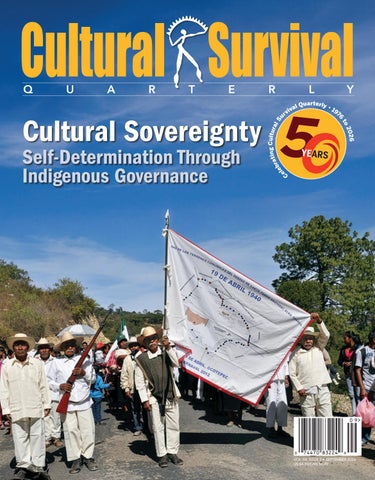
On the cover: Ñuu Savi Peoples and Agrarian Authorities take part in a parade in Santo Tomas Ocotepec, Oaxaca, Mexico, commemorating the autonomy of their communal territory (see page 28). Photo by Prócoro Rodríguez.
STAY CONNECTED www.cs.org Donors like you make our work around the world possible. Thanks so much for being part of Cultural Survival! ii
| www.cs.org
20 Governance Rooted in the Land: Maasai Models of Collective Leadership and Community Responsibility Alice Tipap (Maasai) Maasai governance is a resilient, collective system that integrates leadership with land, culture, and community responsibility.
Page 20
Page 22
22 Indigenous Peoples Are Canada’s Political and Economic Future Avexnim Cojti Ren (Maya K’iche’) In Canada, Indigenous Peoples advocate for the protection of traditional lands and inherent sovereignty, resisting large-scale resource extraction. 24 More than a Leader, More than a Town Marcus Gentz (Rehoboth Baster) How Indigenous self-governance continues to shape the identity of the Rehoboth Baster community in Namibia. 26 When the Land Speaks, the Community Listens Oscar Ogole (Karamojong) How Indigenous self-governance protects climate knowledge and food systems in Abim, Karamoja, Uganda. 28 Indigenous Peoples’ Self-Governance Rises to the Challenges of Today Elvia Rodríguez (Ña’a Ñuu Savi, Ñuu Yuku Tuyuja) Indigenous self-governance persists as a resilient, living practice deeply rooted in the inseparable connection between community, culture, and territory, adapting and challenging colonial State structures.
DEPARTMENTS 1
Executive Director’s Message
2
In the News
10 Environmental Defenders Water and Life Are Worth More than Lithium
4
Indigenous Arts Indigenous Futurism
30 Grant Partner Spotlight Mukkuvar Collective
6
Rights in Action The Jequitinhonha River Through Indigenous Eyes
32 Staff Spotlight Edison Andrango (Kichwa Otavalo)
8
Indigenous Knowledge Heal the Land, Heal Our People: Fighting to Free the Klamath River
33 Bazaar Artist Kilaya
CULTURAL SURVIVAL STAFF
EXECUTIVE DIRECTOR’S MESSAGE
Cultural Sovereignty: Self-Determination Through Indigenous Governance Halito akana (Hello friends),
I
ndigenous governance models, practiced for millennia and rooted in our cosmovisions, traditions, laws, and cultural values, are systems of cultural sovereignty through which our Peoples enact self-determination and ensure balanced relationships within communities and with our more-than-human-relatives in the lands and waters we call home. Our traditional models of governance often center collective decision-making, community responsibility, and respect for ancestral knowledge, which is intertwined with the natural laws of Mother Earth. By maintaining self-governance, Indigenous communities protect their cultural identity, strengthen local leadership, and address social, economic, and environmental issues in ways that reflect their Peoples’ values, needs, and perspectives. International bodies like the United Nations recognize the effectiveness and global importance of Indigenous governance in managing land, water, and biodiversity, improving well being, and addressing inequities, and the UN Declaration on the Rights of Indigenous Peoples affirms rights to self-determination and self-government. In this issue of the CSQ, we share examples of cultural sovereignty in practice from the regions where we work.
Some lessons that arise include: • Indigenous governance systems have endured for centuries, surviving colonialism, State pressures, and modern challenges. They are living systems rooted in ancestral knowledge and adaptable to community needs. • Leadership is based on service to the community, not personal power. Authority is earned through demonstrated responsibility, wisdom, and integrity. Decision-making is collective. • Governance is inseparable from stewardship of land, water, plants, and animals. The land and all beings, flows, and entities are seen as living relatives with whom we have reciprocal relationships
and responsibilities to protect. They are not treated merely as resources. • Political, spiritual, and cultural life are intertwined. Elders and knowledge keepers guide decisions and maintain traditions. • Women and youth are recognized as vital to governance, carrying knowledge of food systems, environmental stewardship, cultural continuity, and more. • Indigenous governance systems face ongoing threats from State policies, extractive industries, and legal frameworks that often undermine autonomy. Recognition of Indigenous governance by States is often partial or conditional, leading to tensions and manufactured dependency. Despite these pressures, communities continue to assert their rights, resist dispossession, and adapt their governance to new realities. • Indigenous governance is not static, but incorporates new tools, technologies, and organizational forms to address modern challenges such as climate change and legal advocacy. The most important message is perhaps one that Irma Velásquez Nimatuj (Maya K’iche’) points out: “The challenge, according to those consulted in the regions where Cultural Survival operates, is not proving that Indigenous self-governance works, but rather getting nation States to stop sabotaging it.” Our systems have governed our Peoples from the beginning. Our greatest challenges are the outside threats that hinder our self-determination. As a supporter of Cultural Survival, you contribute to the efforts of Indigenous Peoples who are safeguarding knowledge systems, languages, and lifeways for future generations. Please give generously at www.cs.org/donate. Hטchi yakoke li hoke (I thank you all so much),
Aimee Roberson (Choctaw and Chickasaw), Executive Director
Aimee Roberson (Choctaw & Chickasaw), Executive Director Mark Camp, Deputy Executive Director Avexnim Cojtí (Maya K’iche’), Director of Programs Alicia Moncada (Wayúu), Director of Advocacy and Communications Verónica Aguilar (Mixtec), Program Associate, Keepers of the Earth Fund Maha Akamine, Keepers of the Earth Fund Program Assistant Edison Andrango (Kichwa Otavalo), Indigenous Rights Radio Program Assistant Nadia April (Damara and Nama), Keepers of the Earth Fund Program Coordinator Diana Ariza Monroy, Community Media Program Assistant Marita Calderon (Quechua), Executive Assistant Carmem Cazaubon, Capacity Building Program Assistant Miguel Cuc Bixcul (Maya Kaqchikel), Accounting Associate Jess Cherofsky, Advocacy Program Manager Michelle de León, Grants Coordinator Roberto De La Cruz Martínez (Binnizá), Information Technology Associate Danielle DeLuca, Senior Development Manager Nataly Domicó (Embera Eyabida), Keepers of the Earth Fund Program Assistant Georges Theodore Dougnon (Dogon), Capacity Building Program Assistant David Favreau, Logistics and Operations Assistant Shaldon Ferris (Khoisan), Indigenous Radio Program Coordinator Sofia Flynn, Accounting & Office Manager Nati Garcia (Maya Mam), Capacity Building Manager Cesar Gomez Moscut (Pocomam), Community Media Program Coordinator Djalma Gonçalves (Aranã Caboclo), Brazil Special Projects Associate Byron Tenesaca Guaman (Kañari Kichwa), Fellowships Coordinator Alison Guzman, Donor Relations Coordinator Emma Hahn, Development Associate Adriana Hernández (Maya K’iche’), Grantmaking Coordinator Belen Iñiguez, Publications Distribution Assistant Natalia Jones, Advocacy Coordinator Mariana Kiimi (Na Ñuu Sàvi/Mixtec), Advocacy Associate Dev Kumar Sunuwar (Koĩts-Sunuwar), Community Media Program Coordinator Rosy Sul González (Kaqchikel), Indigenous Rights Radio Program Manager Marco Lara, Social and Digital Media Coordinator Kevin Alexander Larrea, Information Technology Associate Maya Chipana Lazzaro (Quechua), Bazaar Vendor Coordinator Jamie Malcolm-Brown, Communications & Information Technology Manager Candela Macarena Palacios, Executive Assistant Onkemetse Maruping (Naro), Program Assistant Ñushpi Quilla Mayhuay Alancay (Quechua/Kolla), Advocacy Coordinator Edson Krenak Naknanuk (Krenak), Lead on Brazil Diana Pastor (Maya K’iche’), Media Coordinator Guadalupe Pastrana (Nahua), Indigenous Rights Radio Producer Camila Paz Romero (Quechua), Keepers of the Earth Fund Program Assistant Ilenia Perez (Guna), Panama Advocacy Coordinator Agnes Portalewska, Senior Communications Manager Tia-Alexi Roberts (Narragansett), Editorial & Communications Assistant Elvia Rodriguez (Mixtec), Community Media Program Assistant Mariana Rodriguez Osorio, Executive Assistant Emilse Siares (Kolla), Bazaar Program Assistant Carlos Sopprani, Human Resources Associate Thaís Soares Pellosi, Executive Assistant Abigail Sosa Pimentel, Human Resources Assistant Adriana Sunun (Maya Kaqchiquel), Community Media Program Coordinator Candyce Testa (Pequot), Bazaar Events Manager Miranda Vitello, Development Coordinator Candy Williams, Human Resources Manager Pablo Xol (Maya Qʼeqchiʼ), Design and Marketing Coordinator
INTERNS
Kirsten Eagan, Angel Ribeiro Ferreira, Emily Pahuamba
Cultural Survival Quarterly September 2026 | 1
IN TH E N E W S Australia | Indigenous Protected Area Established MAY
A new Indigenous Protected Area covering 1.6 million hectares was declared in Australia, creating a major conservation corridor managed directly by Traditional Owners.
Canada | Proposed Hate Crime Law Excludes Indigenous Protection Mechanisms JUNE
Canada’s new hate crime legislation fails to explicitly address systemic racism and hate speech directed at Indigenous Peoples, undermining reconciliation efforts and leaving Indigenous communities vulnerable to discrimination.
Chile | Proposed Legislative Reform Threatens Mapuche Land Recognition JUNE
Miskito leader Brooklyn Rivera died in State custody on May 30, 2026.
Nicaragua | Miskito Leader Dies in Custody MAY
Brooklyn Rivera (Miskito), founder of the YATAMA political party and lifelong defender of Miskito rights, died after nearly three years in Nicaraguan State custody. He was detained in 2023 in a forced disappearance.
Global | Indigenous Land Defenders Remain Most Targeted Globally JUNE
A global report by Front Line Defenders reveals that Indigenous land and environmental defenders continue to face disproportionately high levels of violence, criminalization, and lethal attacks.
Global | Report Highlights Indigenous Practices as Climate Solutions JUNE
New research by Conservation International reaffirms that lands managed by Indigenous Peoples experience lower deforestation rates and higher biodiversity retention than non-Indigenous protected areas.
Indigenous organizations in Chile oppose proposed amendments to the country’s Indigenous Law, warning the changes would make it easier to commercialize or divide collective ancestral territories.
Chile | Court Halts Copper Mine Expansion Over Indigenous Consultation Failures JUNE
A Chilean appellate court ordered a freeze on a major copper mining expansion project following legal appeals by local Indigenous communities, ruling that developers failed to conduct mandatory consultation processes or properly assess impacts on local water resources and cultural heritage.
DRC | Indigenous Communities Secure Forest Titles
JUNE
Bantu and Indigenous Mbuti communities in Tshopo province have obtained legal control over 31 community forest titles, safeguarding over 1 million hectares.
Chile | Court Condemns Media Outlet for Discrimination JULY
A Chilean court ruled in favor of Machi 2
| www.cs.org
Millaray Huichalaf, a Mapuche spiritual leader, finding Radio Bío Bío guilty of broadcasting content that promoted racial discrimination.
Canada | Wildfires Disproportionately Displace Indigenous Communities JULY
Severe wildfires in Canada forced thousands of residents to evacuate, with remote First Nations communities suffering a disproportionate share of destruction and displacement.
Ecuador | Awá Territory Gains Global Conservation Recognition JULY
In a victory for community governance, the ancestral territory of the Awá Peoples in Ecuador was added to the United Nations Environment Programme’s ICCA Global Registry, which recognizes Indigenous-led conservation efforts.
Argentina | Historic Law to Combat Sexual Violence Enacted JULY
The Octorina Law was passed in Salta province officially categorizing the systematic sexual abuse of Indigenous girls and women by non-Indigenous men as a hate crime.
Mongolia | Ulaanbaatar Declaration Adopted AUGUST
Adopted at the UN Convention to Combat Desertification (UNCCD) COP17 Mayors’ Forum in Ulaanbaatar, Mongolia, the Ulaanbaatar Declaration commits leaders to advance sustainable land management and drought resilience, marking a fundamental shift from viewing Indigenous pastoralists as “vulnerable stakeholders” to recognizing them as rightsholders, guardians of nature, and essential solution providers.
ADVOCACY UPDATES
Bolivia: Legal Victory for the Seque Jahuira Community
In 2024, the Seque Jahuira (Aymara) community in the municipality of Viacha, Bolivia, filed a series of complaints with State authorities and the Office of the Ombudsman regarding the contamination of their territory with cyanide, mercury, and arsenic, seeking action to protect the community’s individual and collective rights. After a year without results, in June 2025, Indigenous authorities once again demanded that the Ombudsman initiate constitutional legal action for violations of the rights to water, a healthy environment, health, and Free, Prior and Informed Consent. In October 2025, the Ombudsman finally filed a constitutional action against six State institutions, culminating in Constitutional Judgment 0102/2026-S1 in February 2026, which granted the requested legal protection and concluded that the institutions had committed a systematic and structural failure to protect the affected communities.
Kenya: Pastoralists Seek Justice for Toxic Waste Legacy
For decades, Indigenous Rendille and Gabra communities in Kargi and Kalacha, Marsabit County, Kenya, have lived with the devastating legacy of alleged toxic waste left behind during oil exploration in the 1980s. Families have reported unexplained illnesses, rising cancer cases, loss of livestock, and the continued struggle to access safe water. Pastoralist Peoples Initiative (PPI), working alongside affected community members, has supported efforts to amplify their voices and pursue justice through Kenya’s legal system. In April, communities and allied organizations filed a case before the Environment and Land Court, marking an important milestone in the community’s pursuit of accountability and environmental justice. Beyond the legal process, it reflects the resilience of pastoralist communities determined to protect their land, health, and future generations, safeguarding their right to a clean, healthy, and sustainable environment for all.
Brazil: A’uwẽ-Xavante Leaders Take “Green” Railway to Geneva
Amid the so-called “green” energy boom, A’uwẽ-Xavante leaders traveled more than 9,000 kilometers from the Brazilian Cerrado to the United Nations in Geneva to ask the question, who pays for the world’s clean energy transition? For the A’uwẽ-Xavante Peoples
Cultural Survival’s Advocacy Program launches international campaigns in support of grassroots Indigenous movements as they put pressure on governments and corporations to respect, protect, and fulfill the rights of their communities.
of Brazil, dreams are ways they share knowledge: Elders receive songs, ceremonies, and guidance for their communities while they sleep. To dream, the Xavante say, they need their territory whole. A federal railway is set to cut through it, impacting more than 23 Indigenous Peoples’ ecosystems and the cradle of Amazonian waters. From July 13-17, A’uwẽ-Xavante and Xikrin leaders brought that warning to the 19th session of the UN Expert Mechanism on the Rights of Indigenous Peoples, where, together with Cultural Survival, they launched the international campaign, “Let the A’uwẽ-Xavante Keep Dreaming.” The campaign confronts a paradox at the heart of global climate policy, where clean energy infrastructure for commodities sold as climate solutions are advanced over Indigenous territories without Indigenous Peoples’ consent. Read the advocacy report and sign the petition (scan the QR codes). Petition
Report
Russia: Daria Egereva (Selkup) and Natalia Leongardt Remain in Prison
Indigenous leaders and organizations from around the world continue to demand the immediate and unconditional release of Daria Egereva (Selkup) and Natalia Leongardt at international forums, including UN Climate Week 2026 in Yeosu, South Korea, the UN Climate Change Conference (SB64) in Bonn, Germany, and the 19th session of the UN Expert Mechanism on the Rights of Indigenous Peoples. At SB64 in June, the International Indigenous Peoples’ Forum on Climate Change and the Indigenous Peoples’ Caucus made the powerful decision to reconfirm Egereva as Co-chair of the Forum until her full release. The women, who are Indigenous rights defenders, have been accused of participating in “activities of a terrorist organization” under Article 205.5 of the Russian Criminal Code, which carries a sentence of 10-20 years of prison, and have been detained since December 17, 2025. The message is clear: Indigenous defenders should not be criminalized for engaging in international arenas to defend their rights and territories. A closed-door hearing for the women was held on August 5 in Moscow City Court. Supporters and representatives of diplomatic missions were allowed into the courtroom only to hear the decision read. The women will remain detained until at least September 15, when the next court date is scheduled.
Read more news at www.cs.org/latest. Cultural Survival Quarterly September 2026 | 3