Cultural Survival Q
U
A
R
T
r
R
L
arterly l Qu •1 va 97 i v 6 202 to
atin br e el
Y
Indigenous Sovereignty, Traditional Knowledge, and Collective Well Being
6
g Cultur al Su
PATHWAYS TO HEALING
E
YEARS
C VOL. 50, ISSUE 2 • JUNE 2026 US $4.99/CAN $6.99
J UNE 20 26 VO L UME 5 0, ISSUE 2
Page 16
Page 18
Page 20
Page 22
BOARD OF DIRECTORS PRESIDENT
FEATURES
VICE PRESIDENT
16 The Evolution of the Indigenous Determinants of Health Framework and the Struggle for Indigenous Midwifery Recognition Geoffrey Roth (Lakota), Dora-Lucia Mendez-Alfonzo (Tseltal), and Alejandro Bermudez-del-Villar (Mestizo) An Indigenous rights-based approach to global health policy.
Kaimana Barcarse (Kanaka Hawai’i)
John King
TREASURER
Steven Heim CLERK
Nicole Friederichs Marcus Briggs-Cloud (Maskoke) Keith Doxtater (Oneida) Kate R. Finn (Osage) Laura Graham Richard A. Grounds (Yuchi/Seminole) Lyla June Johnston (Diné/Tsétsêhéstâhese) Stephen Marks Mrinalini Rai (Rai) Jannie Staffansson (Saami) Stella Tamang (Tamang) FOUNDERS David & Pia Maybury-Lewis Cultural Survival Headquarters 2067 Massachusetts Ave. Cambridge, MA 02140 t 617.441.5400 f 617.441.5417 www.cs.org Cultural Survival Quarterly Managing Editor: Agnes Portalewska Contributing Arts Editor: Phoebe Farris (Powhatan-Pamunkey) Copy Editor: Jenn Goodman Designer: NonprofitDesign.com Copyright 2026 by Cultural Survival, Inc. Cultural Survival Quarterly (ISSN 0740-3291) is published quarterly by Cultural Survival, Inc. at PO Box 381569, Cambridge, MA 02238. Periodical postage paid at Boston, MA 02205 and additional mailing offices. Postmaster: Send address changes to Cultural Survival, PO Box 381569, Cambridge, MA 02238. Printed on recycled paper in the U.S.A. Please note that the views in this magazine are those of the authors and do not necessarily represent the views of Cultural Survival.
Writers’ Guidelines
View writers’ guidelines at our website (www.cs.org) or send a self-addressed, stamped envelope to: Cultural Survival, Writer’s Guidelines, PO Box 381569, Cambridge, MA 02238.
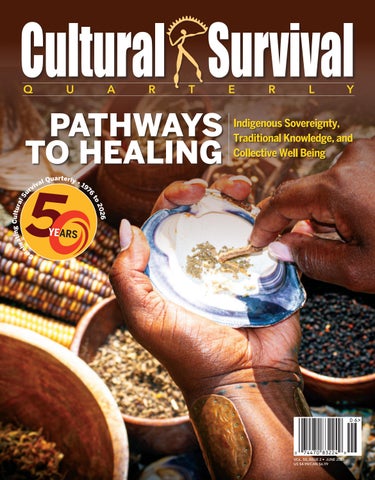
On the cover: Indigenous plant medicines being made (see page 22). Photo by Gabriel Rudd AKA Itsnotiq.
STAY CONNECTED www.cs.org Donors like you make our work around the world possible. Thanks so much for being part of Cultural Survival! ii
| www.cs.org
18 I’m Still Here: An Artist’s Journey of Sobriety, Resilience, and Presence Jeremy Arviso (Diné, Hopi, Akimel O’odham, and Tohono O’odham) Arviso shares his powerful journey from incarceration and addiction to a life of sobriety, global artistic leadership, and cultural advocacy. 20 Ancestral Healing in a Changing World: Voices from Chobokwane Georges Theodore Dougnon (Dogon) Interview with Naro traditional healer Qhoncobe Khanxla Daxo. 22 Indigenous Knowledge-Based Medicine Expands the Future of Healthcare Chenae Bullock (Shinnecock) Indigenous Knowledge-Based Medicine is a sophisticated, holistic system of care.
24 Social Workers’ Roles in Ensuring Indigenous Peoples' Health Hilary N. Weaver (Lakota) Indigenous social workers leverage Traditional Knowledge and professional values to advance global health. 26 A Legacy of Helpers in Indian Country Pamela Begay (Diné) The Kathryn M. Buder Center for American Indian Studies at Washington University supports Native Americans and Alaska Natives to serve their communities. 27 Beyond Survival Ukhing Nue Chak (Chak) Achieving Indigenous wellness through culture, community, and nature in Bangladesh. 28 Reviving the Feminine Path Kelaia Acevedo Three Indigenous Youth Fellows safeguard Traditional Knowledge in Colombia, Costa Rica, and Ecuador.
DEPARTMENTS 1
Executive Director’s Message
2
In the News
4
Indigenous Arts MC from the Hills: Moko Koza (Naga)
6
Special Report In Guna Yala, the Hammock Holds Everything. The Sea Is Coming for It All.
10 Indigenous Knowledge Regenerative Agriculture: Reclaiming Food Sovereignty Through Indigenous Wisdom
12 Rights in Action The Ayoreo Peoples, the Chaco, and the Right to Remain Uncontacted 14 Women the World Must Hear Sehila Mota Casper 30 KOEF Grant Partner Spotlight: Marka Cololo Copacabana Antaquilla Puquina Nation (MACCANP), Bolivia 32 Staff Spotlight Nataly Domicó (Embera Eyabida) 33 Bazaar Artist Associação Indígena Pykôre
EXECUTIVE DIRECTOR’S MESSAGE
Pathways to Healing: Indigenous Sovereignty, Traditional Knowledge, and Collective Well Being Halito akana (Hello friends),
I
hope you, your loved ones, and your communities are well. It’s Spring where I live; the plants are awakening, and the birds are singing exuberantly as the sun rises. After a dry winter, the streams and our community’s water supply are running low. Thankfully, rain arrived recently as we planted corn, giving us renewed hope for the growing season. Yet, it all feels precarious as climate change underscores how globally cumulative actions impact our local conditions. Indigenous cosmovisions centered on interconnectivity and relationality teach us how one cannot be truly well without also tending to the wellness of the beings and world around us. This Traditional Knowledge shapes how we care for ourselves and each other, informing what it means to be well and to heal in ways that are holistic, community-oriented, and guided by our relationships to Mother Earth. Although colonialism disrupted our lifeways, including our systems for nurturing health and wellness, Indigenous Peoples are revitalizing these practices. In this issue, you’ll learn about holistic systems of care rooted in ancestral wisdom informing the present and shaping the future of our communities. These stories speak to the healing power of Indigenous midwifery, culturally-based arts, intergenerational transfer of knowledge about traditional medicines, reviving the feminine path, and a movement shaping social work that incorporates Indigenous Knowledge and respectfully serves Indigenous people. As Hilary Weaver (Lakota) writes, “When we are guided by and can embrace our own ways of being and knowing, we continue our focus on the person and their community, spiritually, physically, emotionally, and psychologically. The health of the whole person is essential for the health of communities.” And as Ukhing Nue Chak (Chak) explains, “…well being is not only about physical health, but also about safeguarding traditions, protecting nature, and maintaining strong community connections.” Our communities need us to be well, and
we need our communities and our environments to be healthy to experience mutual flourishing. The World Health Organization (WHO) articulated health as a human rights issue in its 1946 Constitution, and it was formally bound in international law in 1966, via Article 12 of the International Covenant on Economic, Social, and Cultural Rights. More recently, in 2023, the UN Permanent Forum on Indigenous Issues adopted a member-led study with input from the Indigenous Determinants of Health Working Group. In the same year, the WHO adopted the Indigenous Determinants of Health, including “Indigeneity” and “colonialism,” when member states passed Resolution 76.16 on the Health of Indigenous Peoples and began directly supporting the design and development of Indigenous-led implementation plans. The second draft of the Global Plan of Action for the Health of Indigenous Peoples (2027–2040) is now available for review and consultations. Reflecting Indigenous wisdom, the WHO and other bodies define Indigenous Determinants of Health as holistic, collective factors that shape well-being beyond just biomedical models, including connection to land, culture, language, self-determination, and traditional knowledge. These factors are essential for addressing health inequities rooted in colonization, racism, and environmental degradation, and ultimately, they benefit all of humanity and Mother Earth. As a supporter of Cultural Survival, you are contributing to the efforts of Indigenous Peoples who are safeguarding knowledge systems, languages, and lifeways for future generations. You are also helping us to amplify the voices of those who are leading the way to healing humanity and co-creating a future of mutual flourishing for all of us. Please give generously at www.cs.org/donate. Hטchi yakoke li hoke (I thank you all so much),
Aimee Roberson (Choctaw and Chickasaw), Executive Director
CULTURAL SURVIVAL STAFF
Aimee Roberson (Choctaw & Chickasaw), Executive Director Mark Camp, Deputy Executive Director Avexnim Cojtí (Maya K’iche’), Director of Programs Alicia Moncada (Wayúu), Director of Advocacy and Communications Verónica Aguilar (Mixtec), Program Associate, Keepers of the Earth Fund Maha Akamine, Keepers of the Earth Fund Program Assistant Edison Andrango (Kichwa Otavalo), Indigenous Rights Radio Program Assistant Nadia April (Damara and Nama), Keepers of the Earth Fund Program Coordinator Diana Ariza Monroy, Community Media Program Assistant Marita Calderon (Quechua), Executive Assistant Carmem Cazaubon, Capacity Building Program Assistant Miguel Cuc Bixcul (Maya Kaqchikel), Accounting Associate Jess Cherofsky, Advocacy Program Manager Michelle de León, Grants Coordinator Roberto De La Cruz Martínez (Binnizá), Information Technology Associate Danielle DeLuca, Senior Development Manager Nataly Domicó (Embera Eyabida), Keepers of the Earth Fund Program Assistant Georges Theodore Dougnon (Dogon), Capacity Building Program Assistant David Favreau, Logistics and Operations Assistant Shaldon Ferris (Khoisan), Indigenous Radio Program Coordinator Sofia Flynn, Accounting & Office Manager Nati Garcia (Maya Mam), Capacity Building Manager Cesar Gomez Moscut (Pocomam), Community Media Program Coordinator Djalma Gonçalves (Aranã Caboclo), Brazil Special Projects Associate Byron Tenesaca Guaman (Kañari Kichwa), Fellowships Coordinator Alison Guzman, Donor Relations Coordinator Emma Hahn, Development Associate Adriana Hernández (Maya K’iche’), Grantmaking Coordinator Belen Iñiguez, Publications Distribution Assistant Natalia Jones, Advocacy Coordinator Mariana Kiimi (Na Ñuu Sàvi/Mixtec), Advocacy Associate Dev Kumar Sunuwar (Koĩts-Sunuwar), Community Media Program Coordinator Rosy Sul González (Kaqchikel), Indigenous Rights Radio Program Manager Marco Lara, Social and Digital Media Coordinator Kevin Alexander Larrea, Information Technology Associate Maya Chipana Lazzaro (Quechua), Bazaar Vendor Coordinator Jamie Malcolm-Brown, Communications & Information Technology Manager Candela Macarena Palacios, Executive Assistant Ñushpi Quilla Mayhuay Alancay (Quechua/Kolla), Advocacy Coordinator Edson Krenak Naknanuk (Krenak), Lead on Brazil Diana Pastor (Maya K’iche’), Media Coordinator Guadalupe Pastrana (Nahua), Indigenous Rights Radio Producer Camila Paz Romero (Quechua), Keepers of the Earth Fund Program Assistant Ilenia Perez (Guna), Panama Advocacy Coordinator Agnes Portalewska, Senior Communications Manager Tia-Alexi Roberts (Narragansett), Editorial & Communications Assistant Elvia Rodriguez (Mixtec), Community Media Program Assistant Mariana Rodriguez Osorio, Executive Assistant Emilse Siares (Kolla), Bazaar Program Assistant Carlos Sopprani, Human Resources Associate Thaís Soares Pellosi, Executive Assistant Abigail Sosa Pimentel, Human Resources Assistant Adriana Sunun (Maya Kaqchiquel), Community Media Program Coordinator Candyce Testa (Pequot), Bazaar Events Manager Miranda Vitello, Development Coordinator Candy Williams, Human Resources Manager Pablo Xol (Maya Qʼeqchiʼ), Design and Marketing Coordinator
INTERNS
Kelaia Acevedo, Miranda Gonzalez, Mara Moldavan, Sandra I. Pelaez, Linda Ravolatsara
Cultural Survival Quarterly June 2026 | 1
IN TH E N E W S Philippines | Supreme Court Upholds Indigenous Consent Over Mining Interests FEBRUARY
In a historic win for ancestral land rights, the Philippine Supreme Court ruled that mining companies must secure the Free, Prior and Informed Consent of Indigenous Peoples before renewing operations.
Ecuador | Kichwa Guardians Defend Yasuni Biodiversity FEBRUARY
Indigenous Kichwa communities in Ecuador have launched a landmark initiative to serve as the frontline defenders of the 190,000-hectare Yasuní Biosphere Reserve from encroaching mining and oil interests. This strategic buffer zone borders the Tagaeri-Taromenane Intangible Zone, home to Tribes living in voluntary isolation.
Brazil | Amazon River Dredging Halted FEBRUARY
In a significant victory for Indigenous land and water rights, the Brazilian government suspended dredging operations on the Tapajós River following two weeks of intense protests by Indigenous communities.
Argentina | Indigenous Peoples Rally to Protect Glaciers
MARCH
On March 2, representatives of Indigenous Peoples, Indigenous organizations, and civil society from Indonesia, the Philippines, Brazil, Colombia, Peru, Suriname, Paraguay, the U.S., Russia, Denmark, and the UK adopted the Jakarta Declaration, an international call to protect Indigenous Peoples in Isolation.
Kenya | Indigenous Lands Under Threat MARCH
“Voices from the Land,” a report by the Kenya National Commission on Human Rights, reveals that Indigenous communities are facing widespread land dispossession and environmental damage due to large-scale investment projects.
Tanzania | Communities Demand Justice from World Bank MARCH
Tanzanian Indigenous communities have filed a formal grievance against the World Bank, charging the institution with failing to repair the devastation caused by its $100 million REGROW project.
UN | 25th Anniversary of UN Special Rapporteur APRIL
Indigenous communities and environmental activists in Jujuy are intensifying protests against proposed reforms to Argentina’s Glacier Law that would potentially open the door to contamination of vital freshwater reserves.
The 25th anniversary of the mandate of the UN Special Rapporteur on the Rights of Indigenous Peoples was commemorated in April. Rodolfo Stavenhagen served as the first Special Rapporteur on the situation of human rights and fundamental freedoms of Indigenous Peoples from 2001- 2008. The current Special Rapporteur is Dr. Albert Barume (Batwa).
U.S. | California Pledges 7.5 Million Acres to Tribal Stewardship
Canada | Nuchatlaht First Nation Wins Major Title Appeal
MARCH
MARCH
California has unveiled a landmark policy to return 7.5 million acres of land and coastal waters to Indigenous stewardship, fulfilling a 175-year-old promise. 2
Indonesia | Jakarta Declaration Adopted
| www.cs.org
APRIL
The Nuchatlaht First Nation is celebrating the return of their land rights on Nootka Island on a ruling by the British Columbia Court of Appeal.
Colombia | Indigenous Peoples Define Collective Position in Santa Marta APRIL
Participants from 57 countries drafted a Position of Indigenous Peoples in the First Conference on Transitioning Away from Fossil Fuels.
Canada | First Nations Win Legal Battle over Alberta Separation Referendum MAY
An Alberta judge has thrown out a decision to issue a petition for a referendum on Alberta Providence separation. Athabasca Chipewyan First Nation and three Blackfoot Nations claimed victory in their legal challenge of the referendum, as they oppose separation.
U.S. | Pe’ Sla Defended by Lakota Youth MAY
Oglala Lakota youth occupied two active drill pads for one week to save Pe’ Sla, a sacred high-elevation meadow in the Black Hills of South Dakota. The mining company that had been drilling for graphite near Pe’ Sla formally withdrew their Plan of Operations for the Rochford Mineral Exploration Project.
Australia | Mining Company to Pay $108 million to Traditional Owners MAY
Mining company Fortescue was ordered to pay approximately $150 million AUD ($108 million) for cultural damage linked to iron ore mining operations conducted without the consent of Yindjibarndi Traditional Owners in Western Australia’s Pilbara region.
North America | FIFA World Cup Partners with Indigenous Nations JUNE
The 2026 FIFA World Cup is partnering with the Puyallup Tribe in Seattle, along with the Musqueam, Squamish, and Tsleil-Waututh Nations in British Columbia, to highlight Indigenous Nations.
ADVOCACY UPDATES
Cultural Survival’s Advocacy Program launches international campaigns in support of grassroots Indigenous movements as they put pressure on governments and corporations to respect, protect, and fulfill the rights of their communities.
suffered for defending his territory against extractive industries. He demanded effective protection measures in accordance with the Escazú Agreement for himself and other Indigenous defenders who have been criminalized, as well as real guarantees of protection for defenders of human rights in Colombia.
Cultural Survival, Qhana Pukara Kurmi Contribute to UN Secretary General Report on Reprisals Faced by Indigenous Leaders Russia: International Community Calls for Immediate Release of Daria Egereva (Selkup) and Natalia Leongardt APRIL
Cultural Survival, Batani International Foundation, and over 100 Indigenous rights activists from around the world demanded the immediate and unconditional release of Daria Egereva (Selkup) and Natalia Leongardt at the 25th Session of the UN Permanent Forum on Indigenous Issues. Both women, who are Indigenous rights defenders, have been accused of participating in “activities of a terrorist organization” under Article 205.5 of the Russian Criminal Code, which carries a sentence of 10-20 years of prison. In a joint letter to President Putin, press statements, and several actions during the Permanent Forum, the Russian government was urged to uphold its international human rights obligations, particularly those related to freedom of expression, association, and participation in public affairs. The message is clear: Indigenous defenders should not be criminalized for engaging in international arenas to defend their rights and territories.
Cultural Survival Denounces Criminalization of Indigenous Defenders at the 25th Session of the UNPFII APRIL
A delegation from Cultural Survival attended the UN Permanent Forum on Indigenous Issues, held April 20-24 in New York. Our Advocacy team presented our annual “In Memoriam” report detailing murders of Indigenous defenders in Latin America. We also launched our campaign for Indigenous defenders with recommendations to states, companies, and international mechanisms, including petitions (see QR codes) to authorities in Colombia and Mexico, urging them to fulfill their obligation to protect Indigenous defenders, prevent violence, and ensure justice. Partner José Silva Duarte (Wayuu), a leader, activist, and human rights and environmental defender from Colombia, denounced the attacks Colombia Mexico and death threats he has
APRIL
On April 15, Cultural Survival and Indigenous partner organization Qhana Pukara Kurmi in Bolivia submitted a report to the UN Secretary General of the Human Rights Council on the intimidation and reprisals that Pastor Carvajal (Aymara) and Guadalupe Fernández (Quechua) have suffered since their participation in last year’s UN Permanent Forum on Indigenous Issues. The report highlighted the link between their public activism during that time and the subsequent rise in threats, online violence, and attacks against them in the UN Headquarters and, upon their return home, Bolivia. Indigenous communities and Qhana Pukara Kurmi have been engaged in a struggle with the mining company Santa Cruz Silver Mining Ltd., as well as members of mining unions and state institutions, who have done nothing to prevent the poisoning of their lands or threats against them. Leaders have been forced to leave their territories, causing deep harm to their health and their communities.
Kenya: Indigenous Land Defenders from Kargi and Kalacha File Lawsuit Against Government and BP for Toxic Waste in Their Territories MAY
On May 6, 299 residents from Kargi and Kalacha in Marsabit county in northern Kenya, including 65 members of the Rendille and Gabra Indigenous communities, attended the Environment and Land Court in Isiolo to sue British Petroleum, the government of Kenya, and several government ministries. The main allegation is their failure to prevent and address environmental harm dating back to the 1980s when BP’s subsidiary oil company, Amoco, drilled exploration wells in the Chalbi Desert. Although the foreign experts involved in this process departed after finding no viable oil, local residents reported they left behind unlined pits filled with toxic waste that continue to impact their lives and territories. They contend that there is a connection between the contamination caused by the oil drilling waste, which contains toxic substances like nitrates, radium isotopes, arsenic, and lead, and the death of livestock and more than 500 people who have died from cancer derived from the consumption of polluted water. _____________________
Read more news at www.cs.org/latest. Cultural CulturalSurvival SurvivalQuarterly Quarterly March June 2026 | 3