Cultural Survival Q
U
A
R
T
E
R
L
Y
REKINDLING
INDIGENOUS KINSHIP AND FOODWAYS
VOL. 49, ISSUE 4 • DECEMBER 2025 US $4.99/CAN $6.99
D E C EM BER 2025 VO L UME 4 9, ISSUE 4
Page 14
Page 16
Page 20
Page 22
BOARD OF DIRECTORS PRESIDENT
FEATURES
VICE PRESIDENT
14 Reviving Ancestral Kinships Across Turtle Island Grasslands for Sustainable Community Futures The Indigenous Kinship Circle Indigenous Peoples and their knowledge are essential in the conservation and restoration of the Central Grasslands of Turtle Island.
Kaimana Barcarse (Kanaka Hawai’i)
John King
TREASURER
Steven Heim CLERK
Nicole Friederichs Marcus Briggs-Cloud (Maskoke) Keith Doxtater (Oneida) Kate R. Finn (Osage) Laura Graham Richard A. Grounds (Yuchi/Seminole) Lyla June Johnston (Diné/Tsétsêhéstâhese) Stephen Marks Mrinalini Rai (Rai) Jannie Staffansson (Saami) Stella Tamang (Tamang) FOUNDERS David & Pia Maybury-Lewis Cultural Survival Headquarters 2067 Massachusetts Ave. Cambridge, MA 02140 t 617.441.5400 f 617.441.5417 www.cs.org Cultural Survival Quarterly Managing Editor: Agnes Portalewska Contributing Arts Editor: Phoebe Farris (Powhatan-Pamunkey) Copy Editor: Jenn Goodman Designer: NonprofitDesign.com
16 He Ea I Ka ʻAi: Sovereignty Through Food Kaimana Barcarse (Kanaka Hawai’i) A journey of provisioning voyaging canoes with self-sustained, locally grown and preserved foods, a practice rooted in ancestral knowledge. 18 Carrying Her Voice: Kinship and Cassava in Pakuri Sabantho Aderi Corrie-Edghill (Lokono) The cultural significance of cassava farming and preparation by Lokono women in Guyana.
20 Nan Awaya Farm: A Place of Growth Ian Thompson (Choctaw) Choctaw knowledge and the establishment of Nan Awaya Farm in southeastern Oklahoma offer hope and solutions for today’s greatest challenges. 22 Reviving Kinship Routes Through Stewarding Mishoon Culture on Long Island Chenae Bullock (Shinnecock) The revival of the mishoon (dugout canoe) culture brings spiritual and political strengthening for the Indigenous Peoples of Long Island. 24 Agroecology as Resistance Zuhira Musa (Fulani) Mbororo Fulani women are leading food sovereignty efforts in Cameroon.
Copyright 2025 by Cultural Survival, Inc. Cultural Survival Quarterly (ISSN 0740-3291) is published quarterly by Cultural Survival, Inc. at PO Box 381569, Cambridge, MA 02238. Periodical postage paid at Boston, MA 02205 and additional mailing offices. Postmaster: Send address changes to Cultural Survival, PO Box 381569, Cambridge, MA 02238. Printed on recycled paper in the U.S.A. Please note that the views in this magazine are those of the authors and do not necessarily represent the views of Cultural Survival.
DEPARTMENTS 1
Executive Director’s Message
2
In the News
4
Sovereign Style
Writers’ Guidelines
View writers’ guidelines at our website (www.cs.org) or send a self-addressed, stamped envelope to: Cultural Survival, Writer’s Guidelines, PO Box 381569, Cambridge, MA 02238.
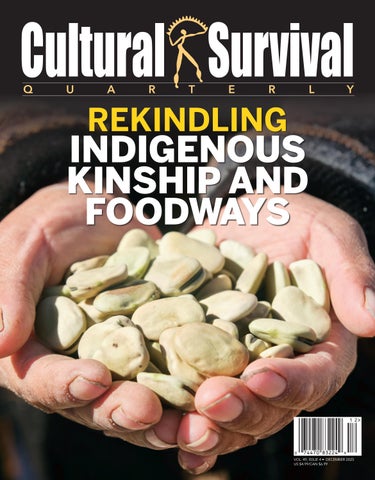
On the cover: The seed is a bearer of hope, containing knowledge passed down through generations. It embodies the symbiosis between humans and the Earth (see page 6). Photo by Julien Defourny.
STAY CONNECTED www.cs.org Donors like you make our work around the world possible. Thanks so much for being part of Cultural Survival! ii
| www.cs.org
6
Indigenous Visionaries Show New York—and the Fashion Industry— the (Run) Way Special Report
Indigenous Resistance in Bolivia’s Mining Wasteland
10 Women the World Must Hear
María Candelaria Rodriguez Hernández (Tseltal)
12 Climate Change
A Kalinago Youth’s Climate Story
26 Keepers of the Earth Fund Grant Partner Spotlight
Community Development Shield (Karamojong), Uganda
28 Staff Spotlight
Nadia April (Damara and Nama)
29 Bazaar Artist
Robbie DeGaetano (Wampanoag/Narragansett)
CULTURAL SURVIVAL STAFF
EXECUTIVE DIRECTOR’S MESSAGE
Rekindling Indigenous Kinship and Foodways Halito akana (Hello friends),
I
ndigenous foodways and our kinship with plants, animals, and ecosystems are central to our resilience and regenerative lifeways and informed by our cosmovisions, knowledge systems, and languages. Passed down through generations, traditional practices, foods, and materials are embedded within relational webs of human and more-thanhuman beings, flows, and entities—all fundamental to sustaining our lives, communities, and cultures. We have resisted the harm and disruption of colonialism and extractive capitalism by reinforcing our cultures and core values: relationship, responsibility, reciprocity, and redistribution. We are building strong movements to revitalize our communities and foodways and rekindle kinship, knowledge, and trade routes that contribute to the web of life. The deep wisdom that emerges from continuously honoring our sacred kinship with Mother Earth and each other is key to cultivating balance and addressing some of today’s greatest challenges, including climate change. Throughout this issue, we are inspired by Indigenous communities committed to this important work. The Indigenous Kinship Circle brings together Indigenous people and allies in the conservation and environmental sectors to advance the well being of communities across the Central Grasslands of Turtle Island. Our Board Chair, Kaimana Barcarse (Kanaka Hawai’i), writes about how voyaging traditions and foodways have reconnected Peoples across oceans. Sabantho Aderi CorrieEdghill (Lokono) shares how in Guayana, growing and preparing cassava “links the hands of women across generations.” Ian Thompson (Choctaw) describes how the
2025 Statement of Ownership, Management, and Circulation
Nan Awaya Farm aims to restore biodiversity, revitalize traditional cuisine, reconnect community with the land, and enliven Choctaw culture. Chenae Bullock (Shinnecock) explains how the mishoon (dugout canoe) culture is “a vessel of connection” and bridges “generations, teachings, and the living memory of our ancestors.” Zuhira Musa (Fulani) narrates how the Mobororo Fulani women in Cameroon are rebuilding their foodways “rooted in food sovereignty, collective labor, and ancestral agroecological knowledge.” People and ecosystems are inseparable. Indigenous leaders have been sharing this message for years, and only now are western scientists finally recognizing this. Thank you for being amongst those who have been listening. We are grateful for your ongoing commitment to Cultural Survival and our work. Your support helps Indigenous Peoples safeguard their knowledge, foodways, and kinship systems for future generations, ensuring the health and sustainability of the planet. For example, we are partnering with the Indigenous Resilience Center at the University of Arizona on the Indigenous Regenerative Agriculture Knowledge Exchange, which will bring together Indigenous leaders, Elders, and youth, helping to re-establish kinship and knowledge exchange across the U.S.-Mexico border. Help us build this movement and raise $250,000 by December 31, 2025. Please give generously at www.cs.org/donate. We cannot do it without you! With wishes for an abundant, just, and peaceful holiday season and New Year. Hטchi yakoke li hoke (I thank you all so much),
Aimee Roberson (Choctaw and Chickasaw), Executive Director
1. Publication Title: Cultural Survival Quarterly 2. Publication Number: 0740-3291 3. Filing Date: September 15, 2025 4. Issue Frequency: Quarterly 5. Number of Issues Published Annually: Four 6. Annual Subscription Price: $45.00 7. Mailing Address of Publication: 2067 Massachusetts Ave. Cambridge, MA 02140 8. Mailing Address of Publisher Headquarters: 2067 Massachusetts Ave. Cambridge, MA 02140 9. Full Mailing Address and Complete Names of Publisher, Editor, and Managing Editor-Publisher: Cultural Survival, Inc. 2067 Massachusetts Ave. Cambridge, MA 02140, Editor/Managing Editor: Agnes Portalewska, Cultural Survival, 2067 Massachusetts Ave. Cambridge, MA 02140 10. Owner: Cultural Survival, Inc., 2067 Massachusetts Ave. Cambridge, MA 02140 11. Known Bondholders, Mortgagees, and Other Securities: None 12. Tax Status: The purpose, function, and nonprofit status for federal income tax purposes has not changed during the preceding 12 months 13. Publication Title: Cultural Survival Quarterly 14. Issue Date for Circulation Data Below: September 2025-Issue 49, Volume 3 15. Extent and Nature of Circulation: Subscription to members a. Total Number of Copies: Average No. Copies Each Issue During Preceding 12 Months: 2400; Actual No. Copies of Single Issue Published Nearest to Filing Date: 2600 b. Paid and/or Requested Circulation-1. Paid/Requested Outside-County Mail Subscriptions Stated on Form 3541: 1110; 1145 2. Paid In-County Subscriptions: 270; 310 3. Sales Through Dealers and Carriers, Street Vendors, Counter Sales, and Other Non-USPS Paid Distribution: 250; 270 4. Other Classes Mailed Through the USPS: 180; 190 c. Total Paid and/or Requested Circulation: 1800; 1915 d. Free or Nominal Rate Distribution 1. Free or Nominal Rate Outside-County 80; 90 2. Free or Nominal Rate In-County : 50; 70 3. Free or Nominal Rate Copies Mailed at Other Classes 190; 150 4. Free or Nominal Rate Distribution Outside the Mail 200; 250 e. Total Free or Nominal Rate Distribution: 520; 560 f. Total Distribution: 2320; 2475g. Copies Not Distributed: 80; 125 h. Total: 2400; 2600 i. Percent Paid and/or Requested Circulation: 77.59; 77.37 16. This Statement of Ownership will be printed in the December 2025 issue of this publication 17. I certify that all information furnished on this form is true and complete: Agnes Portalewska, Communications Manager, Cultural Survival, Inc.
Aimee Roberson (Choctaw & Chickasaw), Executive Director Mark Camp, Deputy Executive Director Avexnim Cojtí (Maya K’iche’), Director of Programs Alicia Moncada (Wayúu), Director of Advocacy and Communications Verónica Aguilar (Mixtec), Program Associate, Keepers of the Earth Fund Edison Andrango (Kichwa Otavalo), Indigenous Rights Radio Program Assistant Nadia April (Damara and Nama), Keepers of the Earth Fund Program Coordinator Diana Ariza Monroy, Community Media Program Assistant Carmem Cazaubon, Capacity Building Program Assistant Miguel Cuc Bixcul (Maya Kaqchikel), Accounting Associate Jess Cherofsky, Advocacy Program Manager Geovany Cunampio Salazar (Emberá), Panama Advocacy Coordinator Michelle de León, Grants Coordinator Roberto De La Cruz Martínez (Binnizá), Information Technology Associate Danielle DeLuca, Senior Development Manager Georges Theodore Dougnon (Dogon), Capacity Building Program Assistant David Favreau, Logistics and Operations Assistant Shaldon Ferris (Khoisan), Indigenous Radio Program Coordinator Sofia Flynn, Accounting & Office Manager Nati Garcia (Maya Mam), Capacity Building Manager Cesar Gomez Moscut (Pocomam), Community Media Program Coordinator Byron Tenesaca Guaman (Kañari Kichwa), Fellowships Coordinator Alison Guzman, Donor Relations Coordinator Emma Hahn, Development Associate Belen Iñiguez, Publications Distribution Assistant Natalia Jones, Advocacy Coordinator Mariana Kiimi (Na Ñuu Sàvi/Mixtec), Advocacy Associate Dev Kumar Sunuwar (Koĩts-Sunuwar), Community Media Program Coordinator Rosy Sul González (Kaqchikel), Indigenous Rights Radio Program Manager Marco Lara, Social and Digital Media Coordinator Kevin Alexander Larrea, Information Technology Associate Maya Chipana Lazzaro (Quechua), Bazaar Vendor Coordinator Jamie Malcolm-Brown, Communications & Information Technology Manager Candela Macarena Palacios, Executive Assistant Ñushpi Quilla Mayhuay Alancay (Quechua/Kolla), Advocacy Coordinator Edson Krenak Naknanuk (Krenak), Lead on Brazil Diana Pastor (Maya K’iche’), Media Coordinator Guadalupe Pastrana (Nahua), Indigenous Rights Radio Producer Camila Paz Romero (Quechua), Keepers of the Earth Fund Program Assistant Ilenia Perez (Guna), Panama Advocacy Coordinator Agnes Portalewska, Senior Communications Manager Tia-Alexi Roberts (Narragansett), Editorial & Communications Assistant Elvia Rodriguez (Mixtec), Community Media Program Assistant Mariana Rodriguez Osorio, Executive Assistant Carlos Sopprani, Human Resources Associate Thaís Soares Pellosi, Executive Assistant Abigail Sosa Pimentel, Human Resources Assistant Candyce Testa (Pequot), Bazaar Events Manager Miranda Vitello, Development Coordinator Candy Williams, Human Resources Manager Pablo Xol (Maya Qʼeqchiʼ), Design and Marketing Associate
INTERNS
Sukanto Barman, Cenia Córdova, Prama Dewan, Felix Kagaju, Shimron Kiptoo, Alahir Maha Amaral, Zuhira Musa, Sandra Pelaez, Elisa Ribeiro
Cultural Survival Quarterly December 2025 | 1
IN TH E N E W S Australia | First Treaty with Traditional Owners Passed in Victoria OCTOBER
A treaty passed by the state of Victoria grants Aboriginal communities the authority to shape policies and services. The legislation establishes the First Peoples’ Assembly as a permanent representative body to advise the government under a new statutory corporation called Gellung Warl.
Ecuador | Environmental License Revoked for Gold Project OCTOBER
The Ecuadorian government has revoked the environmental license for the Canadianrun Loma Larga gold mine in Azuay province following strong local opposition over threats to the Quimsacocha water reserve, community health, and ecosystems.
Denmark/Greenland | Denmark Apologizes to Indigenous Women in Greenland SEPTEMBER
Danish Prime Minister Mette Frederiksen publicly apologized in Nuuk to Inuit girls and women in Greenland who were forced to receive contraception without consent during the 1960s-70s.
Peru | Report Finds Indigenous Land Defenders at Risk of Violence SEPTEMBER
A report by Indigenous rights organization AIDESEP found 226 Indigenous land defenders in Peru’s Ucayali, Huánuco, and Loreto regions facing serious threats from illegal gold mining, drug trafficking, logging, and monoculture expansion.
Peru | Court Upholds Sentences for Loggers in Indigenous Murders SEPTEMBER
A Peruvian court upheld 28-year prison terms for the four loggers convicted of 2
| www.cs.org
killing four Ashéninka leaders campaigning against illegal logging.
Global | 146 Land and Environmental Defenders Killed or Disappeared in 2024 SEPTEMBER
A new Global Witness report found that at least 146 people were killed or disappeared in 2024 while defending land, forests, and water. Latin America remains the deadliest region, accounting for 82% of the cases.
Indonesia | Norway Divests from Indonesia Nickel Mine SEPTEMBER
Norway has divested its $6.8 million USD stake in a French-run nickel mine in Halmahera, which threatens displacement of the uncontacted Forest Tobelo Peoples.
U.S. | Shoshone-Paiute Sign Indigenous Profit-Sharing Agreement for Gold Mine SEPTEMBER
The Shoshone-Paiute Tribes of Idaho’s Duck Valley Reservation and Canadian gold miner Integra Resources signed a legally binding agreement granting the Tribes development roles and revenue-sharing benefits.
U.S. | Maine Tribe Recovers 1,700 Acres SEPTEMBER
The Penobscot Nation has successfully reclaimed 1,700 acres of forest land from the Appalachian Mountain Club, a major step in restoring ancestral territory and strengthening Tribal stewardship.
U.S. | Indigenous Nations Sue Social Media Giants, Citing Youth Mental Health Harms SEPTEMBER
The Chickasaw and Choctaw Nations have filed lawsuits against social media parent companies Meta, Snap, ByteDance, and Alphabet, alleging their platforms have fueled a youth mental health crisis in their communities.
Brazil | Anacé Sue TikTok Over Planned Data Center on Their Land SEPTEMBER
The Anacé People have sued TikTok, claiming its planned data center in the Pecém Industrial Port Complex sits on their ancestral land. The facility also raises concerns over water use and lack of consultation with the Indigenous group.
Canada | Landmark Victory for Indigenous Rights AUGUST
The British Columbia Supreme Court ruled to grant the Cowichan First Nation Aboriginal title to land in Richmond, BC, setting legal precedent for non-reserve territory.
South Africa | Indigenous March Demands Recognition and Land Rights SEPTEMBER
Hundreds of Khoi and San protesters marched on Cape Town’s Parliament, demanding formal recognition as South Africa’s First Indigenous People and calling for the repeal of the Traditional and Khoi-San Leadership Act.
Philippines | Philippines Tops List for Land Defender Killings in Asia AUGUST
The Philippines is Asia’s deadliest country for land and environmental defenders, a new PAN Asia Pacific report reveals.
Nicaragua | Indigenous Peoples Face Ethnocide AUGUST
A new report by the Legal Defense Unit and the Legal Assistance Center for Indigenous Peoples documents the systematic persecution of Nicaragua’s Mayangna and Miskito Peoples, detailing how the regime uses arbitrary detentions, torture, and forced disappearances to punish Indigenous communities for defending their ancestral lands.
ADVOCACY UPDATES
Bolivia: Seque Jahuira Community Files Collective Claim against the State Denouncing Destruction by Mining OCTOBER
The Ombudsman’s Office and the Seque Jahuira community from the Aymara Nation in La Paz, Bolivia, filed a collective claim against several Bolivian institutions including the Ministry of the Environment, the Ministry of Mining, and the authority responsible for clean drinking water to denounce the mining activities of 26 companies, which have created an environmental disaster and harmed the health of the local population. The claim was filed after a year of various attempts to enforce the community’s right to a healthy environment. At a hearing on October 8, an injunction was granted to order studies on water and environmental quality, control over mining companies, and actions to protect environmental rights and collective human rights.
Paraguay: Cultural Survival, Paĩ Reta Joaju, and Paĩ Jopytyra Submit Stakeholder Report for Universal Periodic Review OCTOBER
Cultural Survival, along with the Paĩ Reta Joaju and Paĩ Jopytyra associations representing the Paĩ Tavyterã Peoples, submitted a stakeholder report for Paraguay’s Universal Periodic Review. Insecurity regarding land tenure for the Indigenous Peoples of Paraguay has recently worsened due to the ineffectiveness of the institutional mechanisms that should protect this right. The report focuses on the case of the Paĩ Tavyterã communities in the departments of Amambay, Concepción, and Canindeyú, which represent a pattern of systemic rights violations faced by many other Peoples in the country. More than 22 communities continue to wait for the demarcation of their territories, many of which have had cases pending before the Paraguayan Institute for Indigenous Affairs (INDI) for years, the entity responsible for assisting them in the process of demarcating their lands, without receiving an effective resolution. Communities continue to be victimized by illegal invasions with no intervention by INDI.
_____________________ Read more news at www.cs.org/latest.
Cultural Survival’s Advocacy Program launches international campaigns in support of grassroots Indigenous movements as they put pressure on governments and corporations to respect, protect, and fulfill the rights of their communities.
Guatemala: Cultural Survival and Affected Communities submit Alternative Report to the Committee on the Elimination of Racial Discrimination OCTOBER
The Maya Kaqchikel community from Sumpango and the Maya Achí Chicaj and Maya Mam communities from Cajolá and Todos Santos Cuchumatan, with the support of the Human Rights and Indigenous Peoples Clinic at Suffolk University Law School and Cultural Survival, presented an alternative report to the Committee on the Elimination of Racial Discrimination. They requested that the Committee address the State’s lack of implementation of the October 6, 2021 ruling of the Inter-American Court of Human Rights in the case of Maya Kaqchikel Indigenous Peoples of Sumpango and Others v. Guatemala. The Committee was also asked to provide guidance to the State on taking immediate measures to protect Indigenous community radio stations and operators from future criminal prosecution and enacting legislation that recognizes the use of such media by Indigenous Peoples as a means of exercising their freedom of expression, media, and cultural rights.
Ecuador: Hundreds of Indigenous People Assaulted during National Strike SEPTEMBER/OCTOBER
Ecuador’s Indigenous Peoples peacefully protested against the economic and extractive policy reforms enacted by President Daniel Noboa’s government, which have increased the cost of living while furthering the destruction of their territories. On September 18, the Confederation of Indigenous Nationalities of Ecuador (CONAIE) called for a national strike, which lasted 31 days. The government responded with brutal repression tactics, including excessive use of force, arbitrary detentions, criminalization of protesters, persecution of community leaders, and other serious human rights violations. During the protests, 473 people were injured, 206 detained, and 16 people temporarily disappeared. At least three people were killed by Ecuadorian security forces. There were also reports of other State abuses, such as the freezing of bank accounts belonging to Indigenous organizations and leaders, censorship of community media, threats and harassment against journalists and human rights defenders, the use of firearms against peaceful protesters, violations of private homes, and a lack of medical care to Indigenous people.
Cultural Survival Quarterly December 2025 | 3
IND I GE N O U S ART S
SOVEREIGN STYLE Indigenous Visionaries Show New York—and
the Fashion Industry—the (Run) Way lonely. So I moved here to pursue a career. Liana and I met at the American Indian Community House back in 2018. We learned how similar our respective missions are, and started an activist collective. We’re both creative people and fans of fashion, too, and for us, these things go hand in hand. Liana Shewey: My professional background is in event production for music venues, while also being a community organizer. We came together as creators, artists, storytellers— Indigenous radicals in Lenapehoking—to do grassroots organizing and to celebrate our community in this reinvigoration and revitalization of our cultures.
Korina Emmerich and Liana Shewey, inside the Relative Arts boutique on Manhattan’s Lower East Side. Photo by Lucia Vázquez.
T
Cristina Verán he biannual New York Fashion Week is when both major, established and hot, up-and-coming designers present their new collections to an exclusive audience of media, buyers, and celebrities, setting global trends for the season. Though Indigenous designers have been highlighted on occasion, their work has remained largely at the margins. Cue the arrival of Relative Arts on the New York scene. This dynamic duo of Native fashionistas, hellbent on changing the status quo, have established the city’s first fashion boutique to showcase contemporary Indigenous fashion exclusively, and are now inaugurating the city’s first Indigenous New York Fashion Week. Korina Emmerich (Puyallup) and Liana Shewey (Mvskoke Creek) have realized a collective dream to put Indigenous contemporary style on center stage. Cristina Verán spoke with them about their journeys to this point. Cristina Verán: Like many creative types, you both came to New York to build creative lives. How did you first meet and connect your passions? Korina Emmerich: I’m a fashion designer and artist, and when I was growing up, there was no real visibility for Indigenous designers. It was as if they didn’t even exist; it felt
4
| www.cs.org
CV: As a designer, Korina, you’ve had a personal trajectory through the fashion industry. What experiences have shaped your views and this mission? KE: I’ve presented my own work in New York Fashion Week before. I’ve also done Indian Market in Santa Fe, Vancouver Indigenous Fashion Week, and Fashion Arts Toronto, among others, working with and inspired by people like Amber Dawn Bearrobe, Sage Paul, and Joleen Mitton. LS: I had been going to support Korina during some of those shows, and came to realize that these traditional fashion industry events are just not designed for us—not for Indigenous designers, or even the models walking the runways. The makeup artists weren’t able to shade-match their skin tones, or they weren’t particularly good to our people’s hair, not respecting it. Instead of demanding that their shows accommodate us, however, we realized that we needed to create our own space. CV: That brings us to Relative Arts, the first-ever boutique dedicated to showcasing contemporary Indigenous fashion in New York. It’s more than just a store—it’s an anchor. How did it all come together, and what do you see as the space’s offerings? LS: Korina understood the fashion world and had so many connections in it, and both of us knew a lot of Indigenous radical thinkers and activists. Though it may be secondary to what we do, the initial impetus was for creating a kind of safe space that was really our own. KE: We wanted to bring together some incredible Indigenous makers and designers using traditional practices in a contemporary way, and that is also sustainable. There’s so much innovation happening in Indian Country, and yet we’re still mostly represented in places like museum gift shops, not seen as part of the larger fashion universe.
CV: Tell us how you were able to represent the visions of Indigenous designers while also making sure that the makeup artists, stylists, and models also represented an array of Indigenousness. KE: We had our own model casting director, Nishina ShapwaykeesicLoft (Kanien’kehá:ka), and so made sure to feature models representing the diversity within our Indigenous community. Imagine: before and after each of our shows, the East Village was just overflowing with all these Native beauties walking around! We deserve that street style moment, everybody getting noticed in their outfits. LS: The hair and makeup artists were recruited by Deyah Cassadore (White Mountain/San Carlos Apache) and Amy Farid (Osage), and with the production team, the volunteers, the front of house, and so on, it became this little local economy-of-need for Indigenous creative professionals and artists in New York. There were at least 100 team members working, expanding their networks, and building on their skills. How did you mitigate the otherwise prohibitive costs to do all this in an expensive city like New York? KE: Well, we ended up not actually being funded [externally] this year, and so it came out of our own pockets—we’re still paying for it—and through our community coming together. LS: It was really central for us to keep New York Indigenous Fashion Week accessible at every level. The major, non-Indigenous shows at Fashion Week can be anywhere from $500 to $2,000 a ticket, but we capped our ticket prices at $45. CV: How do you navigate concerns about what is appropriate to wear for whom, for fans of Indigenous fashion? KE: There’s clothing as fashion and clothing as regalia; for example, a throw-blanket that’s decorative vs. a blanket used for ceremony. With something like ribbon skirts, though they are a form of contemporary dress, they also have a pretty significant cultural meaning. I would not suggest that someone nonNative wear one. The shows feature a mix of things meant for everyone, and things more for us. CV: Where would you like to see things evolve? KE: There is interest now around creating some kind of International Fashion Council of Indigenous Peoples, an idea that started with Dante Biss-Grayson from Sky Eagle Collection. And while we created this platform, we don’t feel like we own the idea of Indigenous New York Fashion Week. We’re pushing for more people to become involved in it. LS: We have enough community and talent, and we’ve developed a quite nice roster of Indigenous creative professionals here in the city that can be tapped into again and again, to continue to build an economy of reciprocity within our own community, tapping into new ways of thinking outside of capitalism. I want us to break away from this idea of fashion only existing in connection with commerce—because it’s truly an art form. Cristina Verán is an international Indigenous Peoples-focused specialist researcher, educator, advocacy strategist, network weaver, and mediamaker, as well as an adjunct faculty at New York University’s Tisch School of the Arts. Photos by Cristina Verán.
Featured in Indigenous New York Fashion Week runway photos: Warmi Chic, Creator Complex, Copper Canoe Woman, Glasses Collection, Pacha Arts, Ayimach Horizons, Kreations by Kehala, and December Teton Trade Cloth. Cultural Survival Quarterly 2025 | 5
SP E C I A L R E P O RT
INDIGENOUS RESISTANCE in Bolivia’s Mining Wasteland
Aerial view of the chemical tailings dam. Due to pollution, people have been forced to abandon their homes.
6
T
Brandi Morin (CREE/IROQUOIS) he morning air cuts sharp and thin at this altitude, carrying with it the acrid smell of industrial chemicals that has become as familiar as the mountain wind. Hernán Roque Flores (Quechua) adjusts his worn leather folder under his arm and surveys the valley below—a landscape that bears little resemblance to the verdant wetlands of his childhood. Where llamas once grazed beside crystalline streams, smokestacks now pierce the cobalt sky, belching toxic clouds across the jagged peaks of the Bolivian altiplano. At 54, Roque has witnessed the systematic destruction of his ancestral homeland in the Ayllu Acre Antequera, a confederation of eight Quechua communities that have farmed these highlands for generations. What was once an oasis of agriculture in Bolivia’s arid western plateau has become ground zero for one of South America’s most devastating examples of extractive colonialism—a cautionary tale of Indigenous rights violations that has drawn international condemnation and prompted intervention by United Nations human rights experts. “It used to be way better because at least we had water in those times,” Roque reflects, his dark eyes scanning the barren slopes where his people once cultivated potatoes, barley, and quinoa. “The rivers would still have water ‘til this time of the year.” Now, in every direction from the small mountain town of Antequera—the epicenter of the mining boom—industrial
| www.cs.org
infrastructure dominates the horizon. The Bolívar Mine, jointly owned by Canadian company Santa Cruz Silver Mining Ltd. and Bolivia’s State-run mining corporation, has excavated 450 meters into the earth, creating a massive pit that floods with groundwater the company cannot control. The operation consumes 800,000 liters of water daily while discharging 80 liters of contaminated wastewater per second into the Antequera River, far exceeding the limits of its lease agreement. Roque grew up in Queaqueani Chico, a small community within the larger Ayllu confederation, but spent much of his youth in Antequera proper. “He’s not a lawyer,” Roque’s translator explains during our interview, conducted in a mixture of Spanish and Quechua. “But, thanks to the association and training they received, they got certified in Indigenous Peoples Justice.” That certification has proven essential as Roque leads the Justice Council of the Ayllu Acre Antequera, representing all eight communities in their David-versus-Goliath struggle against mining giants. The confederation includes the communities of Chapana, Antequera, Charcajara, Huacuyo, Queaqueani Grande, Queaqueani Chico, Totoral Grande, and Totoral Chico, with a combined population of 3,264 people whose way of life spans back centuries. Mining operations first began in the region in 1810. As a youth, Roque worked alongside his father, who held traditional authority in the community. As environmental degradation accelerated through the 2010s, leadership passed to the younger generation. By 2018, it became impossible to ignore what was happening. “We noticed All photos by Julien Defourny.
that the water was starting to become scarce, and we also noticed the pollution, so we went to one of the mines to see what was happening— and then they took me to jail,” Roque recalls. The experience taught Roque a harsh lesson about the lengths to which the mining interests would go to protect their operations. It also strengthened his resolve and connected him with organizations like the National Council of Ayllus and Markas of Qullasuyu (CONAMAQ), a Bolivian confederation representing traditional highland Indigenous communities, which began providing legal training and support to communities facing similar struggles across Bolivia. Witnessing the environmental devastation on the ground provides a visceral understanding of what industrial mining has wrought in this fragile high-altitude ecosystem. Technical reports confirm the presence of arsenic, lead, cadmium, zinc, and cyanide sulfates in local water sources at levels exceeding Bolivia’s maximum allowable limits—contamination that can cause serious neurological damage, cancer, and developmental disorders. In this arid region, where annual precipitation barely sustains traditional agriculture, the mining operations’ massive water consumption has been catastrophic. Many families have been forced to sell their llamas, alpacas, and sheep. These livestock represent not just economic security, but cultural identity stretching back to pre-Columbian times. “Livestock are of vital importance for the livelihoods of the families, and their removal is destructive to their food and economic sovereignty,” notes a 2023 report by Cultural Survival submitted to the UN Committee on the Elimination of Racial Discrimination, which has previously documented the crisis and petitioned international human rights bodies on behalf of the Ayllu communities. The impact extends far beyond immediate environmental damage. As traditional territories become uninhabitable, families are forced to migrate to urban areas, severing the intergenerational transmission of Quechua language, agricultural knowledge, and spiritual practices tied to specific sacred sites. Young people leave for cities, unable to return to contaminated homelands, while Elders find themselves isolated from the community networks that have sustained them for decades. The crisis in Ayllu Acre Antequera has drawn scrutiny from international human rights bodies, most notably the UN Committee on the Elimination of Racial Discrimination. In December 2023, the committee published a scathing review of Bolivia’s human rights record, making specific mention of the Quechua communities’ situation. The Committee expressed concern about “allegations regarding the granting of licenses for mining and hydrocarbon exploitation and the development of infrastructure projects
with the potential for soil contamination and impact on the traditional livelihoods of these Peoples, without systematically holding consultations to obtain the Free, Prior and Informed Consent of the affected populations.” This principle of Free, Prior and Informed Consent (FPIC) is guaranteed by international law, including the UN Declaration on the Rights of Indigenous Peoples, which Bolivia has officially adopted. The country’s constitution even includes Article 256, which states that international treaties and declarations ratified by Bolivia take precedence over domestic legislation. Yet, the gap between legal theory and reality remains vast. The Bolívar mining contract was signed without any consultation with the affected communities, and despite clear evidence of environmental violations and human rights abuses, operations continue to expand. For Roque, the current struggle represents the third generation of his family’s fight for land and water rights. His grandparents led the first generation’s successful campaign to gain legal title to community territories in the 1950s and ‘60s. His father continued the struggle for water rights and community autonomy. Today, Roque carries forward a legacy of resistance that has evolved to meet new threats. As he continues to document violations and petition international bodies for intervention, the communities of Ayllu Acre Antequera face an uncertain future. Of the original 1,500 community members, only about 50 remain to work in the mines—a costly compromise that provides income while accelerating their homeland’s destruction. The rest have either fled to cities or struggle to survive on increasingly marginal land.
Left to right: Three women from the Queyaqueyani community: Guadalupe Fernandez, a fellow community member, and Dominga Fernandez, share photos from the attack on June 7, 2022, from which they had to flee to escape sexual assault.
Cultural Survival Quarterly December 2025 | 7
SP E C I ATQ L RVO EPO 2 S LGB I CRT ES Community members wait in La Paz to interview the mining companies responsible for the destruction of their land.
In recent years, the land has become severely dry due to the mining industry’s excessive use of groundwater reserves. Only a few families remain on small plots of land that are a tiny fraction of their ancestral territory.
8
The Destruction of Traditional Life
Minutes up the mountain road from Roque’s community lies Totoral Chico, where Brian Pedro “Tata” Ventura Humerez leads a community under siege. His traditional white fedora adorned with a green ribbon bearing his community’s name and green poncho with colorful sleeves speaks to cultural pride maintained despite overwhelming pressure. “Those of us who are actually living here now, all of us are almost 110 people,” Tata explains, describing how his community has shrunk from nearly 300 people who once lived off cattle, sheep, and llama herding. “Before that, there were more people, because everyone had their cattle.” The miners and their families have essentially colonized Totoral Chico, creating a parallel society that discriminates against the original inhabitants. Where children from both communities once might have played together, now there’s stark segregation. The environmental destruction offers a glimpse into the future facing other communities. The river that runs next to the settlement flows a rusty brown color— contamination from mining waste that companies dump with impunity. Garbage piles accumulate in spots where mining families dispose of their refuse, transforming what was once pristine highland landscape into an industrial dumping ground. “There are no water sources left,” Tata explains. “Just one water source up on this mountain next to the community, but it’s guarded by the miners who threaten violence if we try to access it.” The community members still living in Totoral Chico have portable plastic water tanks perched in their yards. It is their only source of fresh water, trucked in once a week. The monopolization of the last clean water source represents a stark example of how mining operations have inverted traditional power relations. Indigenous people who have stewarded these lands for centuries now require permission from recent settlers—outsiders to the community—to access water their ancestors considered sacred.
| www.cs.org
Furthermore, traditional celebrations that once bound the community together throughout the year have been abandoned due to economic hardship and social disruption. “This has been the worst year. Every year on August 1, we make this offering to Pachamama. But we couldn’t do that because of the situation here,” Tata says. The August offering to Pachamama connects communities to ancient spiritual practices. When economic stress and social conflict make such observances impossible, the cultural fabric that has sustained these communities for centuries begins to unravel. Traditional economic activities have similarly collapsed, and contaminated soil and water scarcity make agricultural productivity nearly impossible. The textile work that once brought women together— shearing sheep, spinning wool, creating intricate fabrics while sharing stories and laughter—has largely disappeared as families lose livestock and social cohesion breaks down. “Women would gather, you know, people, women would laugh. They would share,” Tata remembers gatherings that included decisions about dyeing patterns and seasonal celebrations like carnival.
“Hope Is All We Have:” A Mother’s Testimony
In Totoral Chico, Soraida Ventura embodies the resilience and anguish of a community under siege. At 39, she serves on the Council of Justice of her Indigenous community, a role that has made her a target for violence and legal harassment. When we meet, she is processing chuño, the traditional Andean method of freeze-drying potatoes that has sustained highland communities for centuries. Ventura stands in a small field across from her community, her long, black hair tied behind her and tucked under a beige cowboy hat for protection from the intense highland sun. Her fingernails are packed with dirt from harvesting potatoes, a testament to the manual labor required to survive in this harsh environment. Tears stream down her face as she describes the daily reality of life under mining occupation. “It’s tough, but we’ll keep fighting,” she says, her voice breaking. “As parents and community members, hope is all we have. We’re tearful and sad, but we’ll make it through. It’s the only hope we have as humans.” The water crisis has also reached critical levels. “There’s plenty of water, but the thing is, the water is already contaminated,” Ventura explains. The community depends on a single remaining clean water source, but even this is controlled by mining interests. “That’s the place that belongs to the community, but even the miners use it, and they’re still violating our rights. We had to go to a workshop yesterday to say, ‘Please give us water.’ We ourselves are facing this violation of our right to water.” The environmental destruction has eliminated traditional livelihoods. Where families once raised cattle and sheep on communal grazing lands, contamination has made animal husbandry impossible. “We always walked in the
mountains as well as in the plains, but with all the pollution, the veins have dried up. For humans, the vital element is water, and for animals as well, but they’ve dried up, and so we’ve had to get rid of sheep farming as well as cattle farming,” Ventura says. Even the dust from mining operations has become a health hazard. “The dust is covering all the vegetation. Our animals cannot eat that. We don’t know how much more we’re going to be damaged by these miners.”
Environmental Crimes in Plain Sight
The mining companies, including the Canadian-owned Bolívar mine, dispose of toxic waste in full view of communities while simultaneously eliminating access to clean water. Guadalupe Fernández, a member of the community justice council, leads us to a tailings dumping area where mining waste is deposited directly adjacent to the only remaining water source. Only a narrow dirt road piled up on a man-made hill separates the toxic dumping ground from the so-called fresh water source. “The miners told us to water our livestock in a water hole directly parallel to the tailings pond because there are no fresh water sources left,” she says, describing an arrangement of environmental racism: Indigenous communities are forced to choose between death by dehydration or slow poisoning through contaminated water. The proximity of the tailings to the water source makes it clear that contamination is inevitable, yet mining companies present this as a solution to the water crisis they themselves created. “When we go and report that the water is contaminated, the miners say, ‘Okay, we have the water source here so your animals can drink it.’ But the water is still polluted because of the chemicals and dust,” Fernández says. Despite facing criminal charges, physical violence, and environmental destruction, Fernández’s commitment to resistance remains absolute. In 2011, she organized a 10-day blockade that resulted in criminal charges against her for allegedly blocking public services and threatening security. Though the charges were eventually dropped after community pressure, the experience taught her that legal harassment is simply another tool of intimidation. “I will not stop resisting,” she declares from her small kitchen, the smell of traditional foods filling the air. “I will always fight for justice for myself and the surrounding communities, even if they threaten us with dynamite and violence.” The crisis in the Ayllu Acre Antequera has drawn international attention to the operations of Canadian mining company Santa Cruz Silver, which acquired the Bolívar Mine from Swiss giant Glencore in 2021. The underground silver-zinc-lead mine operates under a profit-sharing agreement where Santa Cruz receives 45% of profits while the Bolivian government gets 55% through its partnership with the state-owned Mining Corporation of Bolivia (COMIBOL).
In September 2024, Indigenous leaders from the Ayllu Acre Antequera, together with organizations Qhana Pukara Kurmi, Cultural Survival, and Earthworks, submitted a comprehensive human rights report to Santa Cruz Silver ahead of its annual general meeting in Vancouver. The report documented violations of multiple human rights at the mine site, including the right to Free, Prior and Informed Consent, the right to health and a healthy environment, freedom of expression, safety, non-discrimination, cultural rights, and the right to belong to an Indigenous community. The report specifically noted how the mine uses “vast quantities of water and has contaminated water and land in the vicinity,” with technical studies finding “elevated levels of heavy metals in the Antequera River” and community members reporting “mismanaged mine waste, known as tailings, that gets picked up and blown around by the wind.” Crucially, the report emphasized that “the Ayllu Acre Antequera was never consulted about the mine project, has not been adequately informed of the project and its impacts, and has thus not consented to move forward”—a clear violation of international standards that both Canada and Bolivia have adopted through the UN Declaration on the Rights of Indigenous Peoples. Whether Bolivia will live up to its constitutional commitments and international treaty obligations may well determine not just the fate of eight Quechua communities in a remote mountain valley, but the country’s credibility as a leader in Indigenous rights and environmental protection on the global stage. For now, leaders like Roque, Tata, and Fernández continue their resistance, knowing they defend something far more precious than the silver and zinc extracted from their lands.
Top: Large pipes carrying waste to the dam at the Bolivar mine crisscross the landscape. Bottom: Chuño is an Andean method of freeze-drying. Potatoes are harvested and laid out on the ground so that frost and sunlight cause them to ferment. Once sufficiently fermented, the potato loses much of its starch, making it easier for the body to digest.
Brandi Morin (Cree/Iroquois) is an award-winning journalist reporting on human rights issues from an Indigenous perspective. Read this full report at cs.org.
Cultural Survival Quarterly December 2025 | 9
WOM E N TH E WO R L D M U ST HEAR
LEARNING TO BE SOVEREIGN WITH TSELTAL WOMEN
A women’s meeting in Chiviltic.
S
María Candelaria Rodriguez Hernández (TSELTAL)
anta Cruz la Reforma, Sitalá, in Chiapas, Mexico, where I come from, is a beautiful community situated on a high hill with stunning landscapes. My family dedicated themselves to working in the fields, clearing coffee and cornfields, among other activities. My father passed away when I was four years old, so I didn’t finish my studies because my family didn’t have the resources; I only finished sixth grade. When I graduated from elementary school, I continued working with my aunts and uncles in the fields, harvesting corn, beans, and coffee, among other activities that provided us with our daily food. In 2010, I began serving at the Ts’umbal Xitalha’ Cooperative in what we call a coffee school, where I learned the coop’s organizational, production, farming, and administrative processes, as well as leadership skills. When I joined, I knew nothing about the cooperative—only that my mother was a coffee producer. I worked in the fields, took care of my siblings, and did my household chores. One day, my mother held a general assembly in Chilón, where they announced they were inviting the children of producers to join the coffee school. My mother told me to sign up. I didn’t want to, but she managed to convince me. Later, my mother and I attended a meeting of the board of directors and regional representatives. They told us to inform the regional assemblies and find out if there were any more young people interested in joining as a coffee school. A few days later, there was a regional assembly in Tsubute’el, where I introduced myself to the producers. 10
| www.cs.o rg
When the scheduled date arrived, I showed up at the cooperative with my colleague, Manuela Rodríguez Hernández. I was very scared and embarrassed to speak to the public. I didn’t want to say my name. My hands were shaking, and I felt very nervous. The reality was that I didn’t know much about writing and had always had trouble speaking in Spanish. I was afraid of the cooperative members because I didn’t know them and thought they didn’t speak Tseltal, but when they started introducing themselves, I heard some of them speaking Tseltal. That made me happy because I realized that not everyone comes from outside. I met other colleagues from different communities, and we shared the activities we do within our families and communities. I feel it’s very valuable for me to learn. I want to move forward for my future and for the rural communities. I also want the sons and daughters of farmers to learn this good path; I am an example for everyone. I used to be single, but now I’m married with a child. There’s always hardship and confusion at the beginning, but in the end, the fruits of our labor will be seen. In 2013, we started a microfinance institution called Comon Sit Ca’teltic, which means “the fruit of our common labor” in Tseltal. Producers contributed 5% of their coffee and honey income to enable them to obtain loans. We were accustomed to borrowing money from loan sharks at very high rates of 12–15% per month, and the producers realized that it would be better to leave their contributions in the cooperative so they would have greater access to loans at a lower rate. The microcredits aim to help the producers’ families cover their most important needs. We also give women greater access to funds with the goal of creating financial services to meet their needs.
All photos courtesy of Yomol A’tel
Yomol A’tel (Together We Work, Walk, and Dream)
As Yomol A’tel, we are serving the needs of Indigenous communities in the northern jungle of Chiapas. In this group, we undertake various activities supporting coffee and honey producers and women who make soap, cosmetics, textiles, and aromatic plants. And we provide financial education focused on microcredits and productive loans to coffee and honey producers and women who make honey soaps. We also promote work with women raising pigs in the production chain, which helps strengthen the family economy and generate prosperity. In this project, women are given a pair of piglets to raise and care for. Within six to eight months, the pigs enter the breeding stage, and six months later, they give birth. When the new piglets are two months old, the women return the original two pigs so they can be passed on to other families. Any additional piglets born will remain with the women as their profit. We started with 13 women raising 13 piglets. The women of the communities where we are working asked that the piglets be locally sourced and fed corn, pozol, grass, and other things from the community. They do not like working with piglets from outside the community, which require purchased feed and more medicine, because many of them do not have the resources to buy it. Currently, we have more than 85 women from 10 communities in 6 regions raising 157 piglets. This project will continue until all the women relatives of the Ts’umbal Xitalha’ Cooperative are reached. The purpose of this project is to give women the opportunity and motivation to participate as producers. We always see men participating in meetings or assemblies, but women are never given the opportunity to participate and make decisions, while men always have a voice and vote. That’s why this project was created: to encourage them and help them overcome their fear of participating in meetings and assemblies. Women have a wealth of experience and knowledge to share, which would change the way our co-op meetings about coffee and honey are held. If more women participated, we would also be
identifying ways to implement food security and diversify sources of income for families. We also provide workshops and training on financial management and basic accounting so they can sustain their family finances. The women entrepreneurs have created their own internal regulations and agreements regarding assistance, piglet care, and what to do if one or both piglets die. Women and men participate in each meeting, and these agreements are written into their regulations. Once they are read, they are signed and entered into force. After this initial work with the women, due to their willingness to organize and reach agreements, other productive loans were launched to continue strengthening family assets via a new project of raising egg-laying hens. At the start, each woman was given 10 chicks and 2 proposals on how to return them: they could either return eight chicks of the same size or five larger ones. The women decided on the second proposal because only 50% would be returned, and the other 5 would remain as their profits. This allowed them to recognize what they had invested in feeding, time, and caring for the birds. Ultimately, this project aims to meet needs, diversify products, and generate sources of income for the selfsufficiency of families. We are transforming and adding value to our local products to improve income, generating savings opportunities, and even reinvesting the increased income so families can meet their needs. We are also strengthening food sovereignty for the people who make up Yomol A’tel. Starting with piglets and chickens, we can develop methodologies for growing vegetables, coffee nurseries, breeding fish, and more. I wanted to plant the tree so that the branches would bear good fruit. I want to teach, not just keep my learnings to myself, but share so that the work can go further. María Candelaria Rodriguez Hernández (Tseltal) is from the community of Santa Cruz la Reforma in the municipality of Sitalá in Chiapas, Mexico. Since 2013, she has been working at Yomol A’tel, a coffee collective and 2024 Keepers of the Earth Fund grant partner.
Cultural Survival Quarterly December 2025 | 11
CL I M ATE C H AN G E
“WE ARE HERE” A KALINAGO YOUTH’S CLIMATE STORY
I
Jing Graber n a remote, yet treasured, region of Dominica’s Atlantic Coast lies the Kalinago Territory. It is the last remaining Indigenous territory in the Caribbean, vital to the safeguarding of the Kalinago Peoples’ cultural heritage. As evident in the island’s nickname, the “Nature Island of the Caribbean,” the mountains, forests, and ocean that encircle the Atlantic coastline form far more than a landscape; they are part of a living heritage, filled with the stories, practices, and resilience of the Kalinago Peoples. It is here that Tana Valmond, a young Indigenous artist and environmental advocate, was born—to a place where culture and environment are tightly interwoven, and where the first lessons come not from textbooks, but from the land and sea themselves. Through her art, community engagement, and work with Bow Seat: Creative Action for Conservation, Valmond is helping to reshape the conversation around climate change, youth activism, and Indigenous leadership. Her story begins in a place most people have never heard of, with the quiet, but powerful, decision to speak up.
A Territory that Teaches
The Kalinago Territory is home to around 3,000 people. It spans 3,700 acres of communal land granted to the Kalinago Peoples by the British colonial government in 1903, following centuries of displacement and resistance. Despite its small size, the territory holds immense cultural and historical significance. Here, rivers and cliffs hold memory, and respect for nature is not just a value, but a way of being. Valmond grew up immersed in these teachings. “We were told stories about how the land and sea were formed by ancestral spirits. Our oral traditions are full of reminders that our role is to live in balance with nature, not dominate it,” she says. Nature is not separate from the Kalinago identity, nor is it thought of as a mere tool for one’s gain: it is integrated 12
| www.cs.o rg
into spiritual practices, daily rituals, and community decisionmaking. Fishing, farming, and hunting are more than a means of survival—they are forms of relationship. The ocean, in particular, is seen as both protector and provider. It feeds, it warns, it nurtures. “The ocean to us isn’t just water,” Valmond says. “We created a bond that’s both emotional and spiritual. We don’t see nature as separate from us, but us just being a part of it as one entity.” But even in a place as storied and resilient as the Kalinago Territory, change has come. Valmond began noticing coral reefs bleaching, rivers drying up, and coastlines eroding. The staggering loss of biodiversity on land and at sea hit especially hard on an island so cherished for its wildlife and bountiful provisions. These were not seasonal shifts; they were signs of climate disruption. Her Elders confirmed what she suspected: these changes were new, and they were accelerating. The urgency to respond became personal. She realized that the places she loved were under threat, and she couldn’t stay silent.
Finding Her Voice
With climate awareness often comes a sense of dread, or the paralyzing feeling of hopelessness in the face of a monumental issue. For Valmond, the lifelong love she felt for her home transformed into a sense of obligation and a desire for action. She turned to art as a way to process what she was seeing, capturing the disappearing beauty of her home and the grief that came with it. But she also embedded her work with hope and reverence. Art became her way of bridging the past and future, of expressing both vulnerability and strength. Valmond’s artistic journey took a pivotal turn when she discovered Bow Seat: Creative Action for Conservation, a U.S.-based, globally-reaching nonprofit that empowers youth to use art and storytelling for ocean conservation. As she created artwork for Bow Seat’s Ocean Awareness Contest, she learned to incorporate traditional stories, environmental themes, and personal experience into her work and felt encouraged to embrace all parts of All photos by Tana Valmond.
her identity. “[The contest] was one of the first platforms where I saw that my voice and my art could get a chance to reach people globally. It made me realize my voice matters,” Valmond says. Soon after, Valmond joined the Future Blue Youth Council, Bow Seat’s international youth leadership group. The Council brings together young ocean advocates from around the world to collaborate on creative environmental initiatives. Council members also mentor Bow Seat’s True Blue Fellows, young people who receive funding to lead projects addressing oceans, waterways, or climate through a creative arts lens. Valmond thrived in the collaborative, youth-led environment. She mentored younger participants, helped design outreach projects, and developed educational content rooted in her culture. She didn’t just want to raise awareness—she wanted to build connection. Even now, as a Youth Council alumna, Valmond works as an active member of the Bow Seat team, where she serves as an Alumni Advisor, motivating youth to enter global conversations about climate action and social justice. As she recounts her experience working with other youth from across the globe, “We came from different backgrounds, but shared the same love for the planet.”
Counted Out
Despite her growing recognition, Valmond quickly learned that environmental spaces are frequently unwelcoming to Indigenous perspectives. She has often found herself having to explain or defend the validity of Traditional Knowledge. “There’s this assumption that if something isn’t written down, it isn’t real,” she says. “But our people have lived sustainably for centuries. Science is only now catching up to what we’ve always known.” At times, Valmond’s identity as a Kalinago youth is celebrated superficially, while her insights and lived experience are viewed as side notes; her contributions treated as symbolic rather than strategic. “I’ve been in rooms where my input was overlooked. Our Traditional Knowledge was seen as less scientific, so therefore that just makes it invalid,” she says. Navigating these dynamics has been emotionally taxing. Valmond admits to moments of self-doubt and burnout, especially when she feels pressure to represent an entire community while still learning and growing herself. “I’m young. I haven’t lived through everything. But I keep showing up because our story is still being written,” she says. What sustains her is her connection to the land. When things get overwhelming, she returns to the rivers and forests of Dominica. There, she finds not only calm, but clarity.
be consulted on them. She wants Traditional Knowledge to be respected alongside academic science. She hopes that people can live in balance with nature, thanking it for what it gives to them, because so much goes unsaid. And she wants young people—especially those from marginalized communities—to know that they don’t have to change who they are to make a difference. Valmond’s motivation comes from the people around her: her Elders who passed down wisdom, her peers who stand with her in solidarity, and the younger Kalinago children who view her as a role model. “If they see me take action, maybe they’ll feel like they can, too,” she says. “That’s what keeps me going.” Valmond isn’t just telling her story—she’s building a bridge between generations, between cultures, and between art and action. In her, we see a future where climate leadership is creative, community-driven, and deeply rooted. Environmental advocacy goes beyond saving nature. It’s about honoring identity, history, and the living knowledge of those who have always protected the Earth. “I want a future where culture, climate, and community go hand in hand,” she says. In a world that often separates science from spirit, activism from art, and culture from conservation, Valmond stands at the intersection—and she’s just getting started. “We are here, we are alive, and our voices matter. When we uplift Indigenous voices, we’re not just preserving tradition: we’re protecting the future, we’re building for the future.” Jing Graber is a Bow Seat alumna. Bow Seat: Creative Action for Conservation provides an innovative space for teens to connect, create, and communicate for our blue planet. Working at the intersection of ocean science and arts education, their award-winning programming emphasizes creative thinking and making in exploring the natural world.
A Future Led by Culture and Courage
Valmond’s vision for the future is bold, rooted in tradition. She dreams of a thriving Kalinago territory with a flourishing ocean and restored biodiversity, and she hopes that Indigenous communities can lead climate solutions, not merely Cultural Survival Quarterly December 2025 | 13
REVIVING ANCESTRAL KINSHIPS Across Turtle Island Grasslands for Sustainable Community Futures
An Indigenous Kinship Circle gathering at Ghost Ranch in New Mexico. Photo courtesy of Indigenous Kinship Circle.
14
I
The Indigenous Kinship Circle ndigenous Peoples, our other-than-human relatives, and grassland ecosystems have lived together in harmony and mutual flourishing for thousands of years. Grasslands evolved through interconnected social-ecological processes and knowledge systems enacted by Indigenous Peoples in close relationships with Mother Earth. The Central Grasslands of Turtle Island encompass thousands of diverse Native Nations and three nation states. They support people, plants, animals, soil, waterways, and much more in a collectively orchestrated grand symphony of life, with each being, flow, and entity playing its part. Bison, prairie dogs, and plants, among other relatives, share our grasslands and play important roles in Indigenous spirituality and subsistence. Indigenous Peoples understand our roles in these ecosystems through our lifeways, languages, cultures, and ceremonies, which teach us how to care for our relatives and the grasslands that support us all. Rarámuri scholar Enrique Salmón named this sacred reciprocity “kincentric ecology,” an example being the “three sisters:” maize, beans, and squash. Indigenous Peoples have planted them together since time immemorial across much of Turtle Island. Indigenous people in the south of Turtle Island domesticated maize from the wild teosinte grass and shared it across Abya Yala. When planted together, the sisters support, nourish, and protect each other, living together in harmony as they—and the people who planted them—grow and thrive. In return, Indigenous Peoples honor the three sisters and other life forms we depend on through prayer and ceremony, which are integrated into planting, harvesting, sharing, and feasting.
| www.cs.o rg
Over the past 500 years, western society, prioritizing profit over people, has pushed grasslands beyond their limits. It did not value what Indigenous communities understood about the complex relationships within these ecosystems and the consequences of ignoring this knowledge. Western colonial settlers led a genocide against Indigenous Peoples through food system decimation, land theft, treaty violations, forced assimilation, and child abduction. The colonial legacy continues today through land conversion, including the overexploitation of our sister maize, extractivism, dams flooding Native land, environmental pollution harming food supplies, and institutional oppression that prevents societal change. The genocide of Indigenous Peoples is an unfathomable crime, and the removal of our ecological wisdom and thousands of years of experience from the land negatively impacts all of Turtle Island. When Native communities were removed from our homelands, our social-ecological relationships were disrupted and the health of grassland communities was degraded. Land development continues to disrupt processes that support soil and water cycles and wildlife habitat. Industrial agriculture, including overexploitation of our sister maize, pollutes the soil with overuse of pesticides and fertilizers while depleting the soil of nutrients, threatening human health and food production. Overgrazing of domestic animals reduces plant cover and compacts the soil, thereby decreasing water infiltration and increasing the risk of erosion, which harms both water and soil health. The elimination of fire disturbance foments the spread of woody plants that alter water and soil dynamics. Climate change compounds these impacts on grasslands, altering temperature and precipitation patterns. Western conservation efforts aim to mitigate impacts, but few focus
on supporting the Indigenous Peoples, communities, and knowledge systems essential to addressing today’s global challenges. Despite the massive disruptions, grasslands still provide for us. Indigenous communities, with our land-based languages, cultures, food systems, and spiritualities, persevere and embody the social-ecological relationships needed for the health of grasslands and ecosystems. Many of our ancestors hid seeds in the seams of their clothing when they were forcibly removed from our homelands, carrying medicinal plants and the seeds of future food for their descendants, with which we are still in relationship today. When colonial governments banned our traditions, our ancestors conducted sacred ceremonies in secret, honoring our responsibilities to live in balance and harmony with Mother Earth. Despite this ongoing violence, Indigenous Peoples of the grasslands have continued to share culture, languages, and traditions and worked to preserve our traditional ways of knowing that have always nurtured our prairies. Grasslands cannot heal without Indigenous Peoples and their knowledge, just as plants cannot persist without the intricate relationships with the soil and its microorganisms. Indigenous Peoples have always known that we humans depend on other life forms and ecosystems for nourishment and survival. These systems, beings, flows, and entities in turn, rely on humans to create the conditions for life to flourish. Only in the past few decades has western science recognized that the kincentric relationships that Indigenous Peoples have with wildlife and plants are the basis of conservation and restoration. Western researchers are now recognizing that people and ecosystems are inseparable, understanding that the world operates through interconnected and reciprocal processes that function in social-ecological systems, a western term reflective of how Indigenous Peoples have always understood Mother Earth. As we confront the legacy of colonialism, Indigenous Peoples are advancing perspectives that have long been ignored, excluded, and appropriated in western society. We are ensuring that we are not only included in the conversation, but also acknowledged for our strength in solving global social and environmental crises. The Indigenous Kinship Circle is a cross-boundary community of practice for Indigenous Peoples and allies to advance the well being of our communities across the Central Grasslands of Turtle Island. We aim to strengthen capacities, share perspectives, find support, learn from one another, elevate Indigenous voices, collaborate on projects,
and advance Indigenous priorities and leadership in western environmental conservation and science sectors, which have largely excluded Indigenous people. The connections form the basis for guidance we share with the broader conservation community to conserve the Central Grasslands as we create bridges with western environmental science and conservation groups to build understanding, respect, and inclusion of Indigenous perspectives. The Indigenous Kinship Circle emerged from the Central Grasslands Roadmap, a multi-Nation and sector collective to increase conservation of North America’s Central Grasslands, which span 500 million acres across Indigenous lands, Canada, the United States, and Mexico. Indigenous participants of the inaugural Central Grasslands Roadmap Summit in 2020 joined with allies to form the Indigenous Kinship Circle. While still connected to the Central Grasslands Roadmap, our group has expanded and functions independently, advancing the diverse priorities of Indigenous communities in grasslands. We are conserving grasslands while supporting Indigenous perspectives and needs, elevating Indigenous voices, and restoring lands to Indigenous caretaking. The Indigenous Kinship Circle informs and engages Indigenous grassland leaders and organizations. Over the past three years, we organized visits with Indigenous communities in their homelands in southern Turtle Island (Mexico) to learn from their perspectives. We also hosted an in-person retreat bringing together Indigenous people and allies from across Turtle Island to share experiences, knowledge, and plan for the future. Through personal communication and presentations, we have raised awareness about the Central Grasslands and the Indigenous Kinship Circle and conducted equitable engagement to support Indigenous people who want to participate in the gatherings and activities of the Central Grasslands Roadmap. As we grow, our intent is to rekindle connections, build resilience, and strengthen our cross-boundary kinship circle among Indigenous people and allies to advance the well being of our communities across the Central Grasslands. Authors from the Indigenous Kinship Circle include Aimee Roberson (Choctaw and Chickasaw), Katia Carranza, Cheyenne Ironman (Dakota), Joseph Gazing Wolf (Hunkpapa Lakota), Donna van de Velde (Lakota and Métis), and Francisco Muñoz-Arriola. Learn more about the Indigenous Kinship Circle at indigenouskinshipcircle.com.
Bison in Grand Teton National Park, Wyoming. Photo by Christian Artuso.
Cultural Survival Quarterly December 2025 | 15
HE EA I KA ʻAI SOVEREIGNTY THROUGH FOOD Inset: Leiohu Colburn preparing kalo for a Hanauna Ola voyage. Below: Chadd ‘Onohi Paishon with Hui O Wa’a Kaulua Crew after the Lahaina fire, preparing food.
16
Kaimana Barcarse
T
(KANAKA HAWAI’I, CS BOARD CHAIR)
his year, 2025, Hawaiʻi’s first deep-sea voyaging canoe in over 600 years celebrates its 50th anniversary, a momentous time in Hawaiʻi history. Hōkūleʻaʻs maiden voyage in 1976 reclaimed the ancestral pathways of our Oceanic Peoples and reconnected us through voyaging traditions, proving that our ancestors purposefully navigated the Pacific Ocean and resetting the understanding that the ocean connects us. Since Hōkūleʻaʻs initial launch until today, eight large deep-sea waʻa (voyaging canoes) have been born in Hawaiʻi, and many more throughout the Pacific. These waʻa have sailed throughout the vast Pacific and around the world. However, even as the voyaging traditions were revived, we still primarily provisioned the canoes with modern canned and dry foods procured from big box stores. In 2018 and 2019, Nā Kālai Waʻa, the ʻohana (family) of the voyaging canoe Makaliʻi embarked on a new voyage, one that would change the direction of our organization, our families, and our communities. It set us on a path that aligned with the values and vision of our ancestors while restoring the ʻono (taste) and the ola (healing) of our foods.
| www.cs.o rg
This voyage was named Hanaunaola, A Generation of Life. We set out to take on a 30-day voyage to Mokumanamana, provisioned only by what we could grow and preserve on our island: a feat that had not been attempted in hundreds of years. Our kahua (foundation) stayed true to our Captain and founder, the late beloved Clay Bertlemann, who taught us, “He waʻa he moku, He moku he waʻa” (Our canoe is our island, our island is our canoe). On the canoe, we are interdependent, relying on one another to fulfill our responsibilities and utilizing our skills as we work together as one. On the canoe, we are our island, and if we can bring the practice of the canoe to our families, our work, our community, and our island, the island itself becomes our canoe. Our Captain and Pwo (Master) Navigator Chadd ʻŌnohi Paishon initiated a kāhea (call) to our communities to join in this effort, stating that if we can do this together, it says something about our community, but if we cannot, it says even more—and our communities stepped up. Ten organizations and a large number of individuals were willing to grow and preserve, reviving old techniques while incorporating new technologies. They became our expanded ʻāina (land) crew. When asked what they should grow, our Captain replied, “Grow what your ʻāina allows you to grow and what sustains your families, and share the excess with us. We will provision from what your ʻāina provides.” And with that, the journey started. Over the preceding year, crops were grown, preservation techniques were refined, the community united, and food was produced. As a result, the canoe was provisioned, the crews were nourished, and the voyage was a success in many ways. The crew posted online at each meal where the food came from and which communities fed the canoe. Waste and trash were reduced to a minimum, and the crew members had all the energy and strength needed to be successful, even returning in better health than when they left. This voyage was a testimony that ʻike kūpuna (ancestral knowledge and worldviews) hold the keys to health, happiness, and the thriving of our culture and our people in this modern day and age. As the voyage came to a close, a new storm of unnatural proportions crept towards us on the horizon, posing not Photosofby Nā Kālai Wa’a. Photo courtesy Sineia do Vale.
just a threat to our canoe family, but one that would endanger Island Earth: the COVID-19 pandemic. As an island nation that was once self-sufficient but now relies on imports for over 90% of its food and provisions, the pandemic severely impacted our food security, especially in the most vulnerable and remote areas. On a waʻa voyage, we “make ready” months and years in advance, so the preparation for the Hanaunaola voyage had prepared us to weather this storm. The same organizations and individuals, our land crew, who fed the canoe, now stepped up in big ways to feed our communities. They became distribution hubs, taking in donations of fresh produce and protein from farmers and hunters, preserving and distributing them to our communities, and sustaining our people. The Hanaunaola voyage was more than just provisioning a voyage—it was a return to a lifestyle that reflects the worldview and practices of our ancestors. The pandemic drove home the need for food sovereignty now more than ever. Not long after we began to recover from the pandemic, tragedy struck in the devastating Lāhaina wildfire on August 8, 2023, which claimed over 100 lives and destroyed or damaged over 2,200 structures. The Hanaunaola crew had been scheduled to teach the food preservation system to voyaging and community members on Maui the weekend after the fires. Out of respect and concern, they decided to postpone their class, but the people of Maui said, “No, please come, please share.” The beauty that was realized in the timing was humbling. Equipped with this new knowledge, the community began to preserve and distribute shelf-stable native food such as lūʻau (cooked taro leaves) and iʻa (fish) to families that did not have electricity or were housed in shelters and homes of family and friends. It was not only healthy food but healing food, healing to the spirit and souls of those in need. It fed hope. After these experiences, we desired to share this ʻike (knowledge) with our ʻohana across Moananuiākea (the great, expansive ocean). This opportunity came in June 2024 with the 13th Festival of Pacific Arts & Culture, held that year in Hawaiʻi, featuring the poignant theme of “Ho’oulu Lāhui: Regenerating Oceania.” As part of the festivals, voyaging canoes from across the Hawaiian islands, the South Pacific, and Micronesia arrived at our shores in Kualoa, Oʻahu. As the host nation, we established a Waʻa Village to host our oceanic families and share the lessons we had learned on combining ancient traditions with modern techniques to make our own food from the ʻāina, the best choice for voyages. When our Oceanic family left our shores at the conclusion of the festival, they left with knowledge, canoes stocked with sustainable foods, and the desire to prioritize food from their lands for future voyages. As of the writing of this article, there are several
waʻa sailing between Nations provisioned by the food grown and preserved in their communities. We shared our learnings with those on the ancestral routes of our Peoples, sailing our canoes around the world just a decade ago, traversing the globe. How do we share our learnings with the larger Island Earth? Well, our kūpuna (ancestors) tend to open the pathways when we most need them if we are receptive. Through the support of Tamalpais Trust, a Native-led philanthropic organization, we were able to take a small team to share our food and experiences at Terra Madre, the international biennial convening of food producers in Turin, Italy, in the fall of 2024. There, we were humbled to share our story, and more importantly, share food that we preserved in Hawaiʻi and transported to Italy: a physical manifestation of Ea i ka ʻAi, or sovereignty through our foods. To bring this voyage of food full circle, we were humbled to provision food for Hōkūleʻa as it sailed from Hawaiʻi to circumnavigate the Pacific during itʻs 50th year of voyaging. The Hanaunaola Voyage and itʻs extended reach truly exemplifies the vision of Uncle Clay, sharing these important lessons around the world. He wa‘a he moku, He moku he wa‘a. Our canoe is the island, and our island is Island Earth.
Keala Kahuanui, Hanauna Mau Program Lead at Pacific Arts Festival 2024.
To learn more about Nā Kālai Waʻa and the Hanaunaola Voyage, visit nakalaiwaa.org. To read this story in the original ʻŌlelo Hawaʻi, visit cs.org/csq.
Makali’i with new rig.
Photo by Na’alehu Anthony.
Cultural Survival Quarterly December 2025 | 17
Left: Women’s peeling circle scraping cassava. This is an agristability project involving approximately 30 villagers. Photo by Indigenous Guyana.
Right: Forming cassava granules directly on a hot pan over the fire is an essential step in making cassava bread. Photo by Visit Guyana.
18
CARRYING HER VOICE Kinship and Cassava in Pakuri
C
Sabantho Aderi Corrie-Edghill (LOKONO) assava is one of the last living rituals of Lokono womanhood. More than food, it is a sacred practice, planted, prepared, and passed down by women as an act of memory, survival, and cultural continuity. The act of peeling, grating, and baking cassava bread is a form of cultural prayer, a tangible bridge that links the hands of women across generations. In Pakuri (St. Cuthbert’s Mission), women have carried forward their customs, land wisdom, and resilience through cassava farming, craft-making, and other quiet acts of care. These are kinship routes, living pathways between generations, and they lie at the heart of food sovereignty. Without these everyday labors, the community’s spiritual and cultural backbone would erode. Pakuri lies along the Mahaica River in Guyana, and is home to about 2,000 Lokono-Arawak people. Only 36 miles from the capital city, it is a world apart: 240 square miles of lush forest, savannah, and riverine terrain nestled within the Guiana Shield, one of the planet’s oldest geological formations. This land, teeming with jaguars, tapirs, and giant river otters, represents both ecological wealth and cultural archive, holding memory in the soil, the rivers, and the practices passed from one generation to another. “I would be glad to pass on what my grandmother taught me. She was a woman who taught me how to plant and how to know when something is ready. I’m the only one left from my generation…I’m still alive and doing something for myself,” says Grama Charlotte, a community Elder in her 80s. Her words are not nostalgia; they are testimony. Her quiet is not silence, it is work. It is resistance shaped like bread. Mai Lovine, another Elder, underscores the urgency of this resistance. “Learn to make cassava bread, local drinks, farine (flour). If we don’t teach them, it will die with us,” she implores.
| www.cs.o rg
For women like Mai Lovine, cassava farming was not just about food, but reciprocity. “In those days, people shared. If I baked cassava bread and you needed, I’d give you. Now, everything is money,” she says. Her reflection points to a shift in values from communal survival to individual survival and the deep cultural costs that shift carries. In Pakuri, cassava is more than a crop. It is memory, lineage, and inheritance made tangible. While weaving and basketry leave visible artifacts, cassava-making is ephemeral. It is consumed, digested, and yet renewed every season. Both activities hold memory in women’s hands, encoding survival and care into gestures repeated across centuries. As Aunty Wendy, a middle-generation woman, explains, “You learn plenty from the land. It feeds you, heals you, teaches you. It’s like therapy. People didn’t sell; you’d go sit, eat a meal. Then, when you make, you give back.” For her and others, cassava is a gift from the Creator. It carries ritual, spirituality, and a form of prayer that has endured even when other ceremonies were suppressed by Christianization. Through cassava, the Lokono cosmovision survives quietly, but powerfully, in women’s hands. I remember my own childhood summers when my grandparents would ask my cousins and me to chew the cassava pulp and spit it out, a traditional method to begin fermentation for paiwari, a sacred drink. Because children’s teeth were believed to be free of cavities, they were thought safe for this ritual task. These seemingly small acts hold the weight of ancestral continuity; they are lessons in belonging. The testimonies reveal a bridge, fragile, sometimes fractured, between Elders, the middle generation, and young women. The Elders, like Grama Charlotte and Mai Lovine, speak from lived experience, of farming, reciprocity, and survival under conditions of hardship. Their voices are prophetic warnings about what will vanish if their teachings are not passed down.
The middle generation, represented by women like Aunty Wendy, carries both inherited knowledge and the realities of a changing economy. They straddle memory and modernity, remembering a time when food was freely shared and lamenting today’s monetized culture. Younger women speak from a different landscape, one frequently marked by silence, mental health struggles, and the burden of unspoken trauma. As one young woman reflects, “Being quiet hurt me so many times. . . . I didn’t have a voice. Every time I tried, I got shut down. A lot of things in Pakuri are swept under the mat, behind closed doors. Nobody knows—only the ones going through it.” Sabana, age 15, offers her own plea: “Most older people don’t know what modern women go through . . . especially depression, anxiety, and a lot more. I wish people would open their minds so we women could build ourselves and come as one.” Their testimonies make clear that food sovereignty is not only about planting and harvesting. It is also about emotional survival, healing silences, and restoring kinship. Without relational ties, food systems are hollow. Without land, culture becomes untethered. This work is part of a larger community-based case study developed through the Diploma Program of the International Indigenous Women’s Forum, whose framework and guidance helped create a safe space for the testimonies and women’s knowledge at the heart of this story. To bridge these generations, women in Pakuri are shaping Wai Hiyaro Kalata, which translates to “We Women Heal.” It is a women’s circle, envisioned as a five-month pilot program led by Aunty Wendy, that will bring the generations together for planting, weaving, medicine-sharing, and open storytelling. It will be a safe, culturally rooted space where women and girls can share testimonies and life experiences, relearn craft and traditional farming skills, and reconnect with land and one another. The vision is to sustain these gatherings beyond the pilot, creating mentorship circles, reviving language, and weaving intergenerational solidarity into daily life. But such initiatives require resources. Between 2022 and 2024, Guyana earned about $237.5 million USD from its forest-carbon credits agreement with Hess Corporation. Yet, despite consultations establishing that 15% of forest carbon revenues be allocated to village-led Indigenous
development, many Indigenous women and their cultural initiatives remain underfunded. If the forests still stand, it is because these women, working with sacred knowledge and hands in the soil, have safeguarded them. It is only just that a meaningful portion of these funds be directed specifically to women’s cultural and wellness initiatives, because they are the very people whose care sustains biodiversity and climate resilience. The testimonies gathered in Pakuri reveal a layered truth: silence can be both a shield and a wound, while resilience can be both strength and invisible labor. And women, whether through prayer, bread, weaving, or testimony, are the custodians of continuity. The voices from Pakuri remind us that these themes are not abstract ideals. They are alive in the daily work of Indigenous women, in the cassava fields, in the weaving circles, in the silences that hold both grief and strength. Rekindling kinship routes means more than remembering the past; it means building bridges across generations so that the future is nourished with dignity and care. Food sovereignty is not just a political demand, but a lived reality that begins in women’s hands, rooted in reciprocity and love. This is why the women’s words must be carried forward. They teach us that the path to food sovereignty lies through kinship, land, and care. They remind us that culture is not something abstract, but something spread thin into cassava bread, braided into baskets, whispered into the ears of granddaughters at dusk. If we listen closely, we will hear the truth that has always been there: Indigenous women have held up the land, the forests, and the culture, often silently, often without recognition. Their voices are not new; they have always been speaking. What is new is whether we finally choose to listen. In Pakuri, cassava is not just a crop. It is kinship. It is sovereignty. It is a prayer carried in women’s hands, a living thread tying past to future. And as long as it is planted, grated, and baked, the voice of the Lokono will endure.
Left: A Lokono youth in Pakuri, holding a beautifully made cassava bread in traditional regalia. Photo by DPI.
Right: A scene from a Saturday market, where Pakuri farmers showcase and sell roots and tubers, vegetables, and fruit. Photo by St. Cuthbert’s Mission/ Pakuri Village Council.
Sabantho Aderi Corrie-Edghill (Lokono) is a Barbadian-born, urban Indigenous daughter of Pakuri, Guyana, residing in Sweden. She is an intercultural researcher, Indigenous data provider, remedial educator, and children’s author, and serves as a representative of the Caribbean Amerindian Development Organization. Cultural Survival Quarterly December 2025 | 19
NAN AWAYA FARM A Place of Growth
W
Ian Thompson (CHOCTAW)
Inset: Tafula, a Choctaw hominy dish, with the clay pottery, river cane baskets, and wooden mortar traditionally used to make and serve the dish. Bottom: A stretch of the sandy seep at the farm in September. This view is dominated by swamp sunflower, boneset, ironweed, and black gum.
e live in a time when the challenges to having any reasonable expectation of a positive future are piling up against us rapidly. The climate is destabilizing. The few surviving remnants of native landscapes are disappearing. We’re in an extinction event that already threatens a quarter of the plant and animal species on Earth. For our own species, chronic lifestyle-related illnesses are a growing epidemic. In the U.S., average life expectancy is shrinking while wealth disparity is soaring. These and other challenges are beginning to compound in ways that can seem almost ridiculous. For example, a warmer planet means we’re all aging faster. It also means that not only are fruits and vegetables increasingly difficult to grow, but also less nutritious. All of these challenges are caused by human action. This is frustrating, but it can also be an avenue for hope. If our own decisions are causing these problems, then humanity could avert many of them by making different choices. Indigenous communities are suffering more from the 21st century’s challenges than just about anyone. Yet, there’s hope even in that, because it means the potential exists for quality of life to radically improve if we can overcome these imposed challenges. At the root of many of today’s most pressing problems is an imbalance in the relationship between people and the land. The traditional cultures of Indigenous communities are an antidote. They are made up of the cumulative knowledge gained from hundreds of generations of ancestors’ real-world experiences, living closely with the land.
In 2013, Amy Thompson, my wife, was diagnosed with a form of diabetes. We had both invested a good part of our lives to that point in learning and teaching Choctaw traditional culture. Her diagnosis became our motivation to remake our diet around the Indigenous Choctaw diet and other nutritionally equivalent foods. Within three months, we had collectively lost 70 pounds. Amy’s blood sugar was well outside of the diabetic range. Our energy was up, and our quality of life improved. Traditional culture had helped us. Making a temporary change is one thing, but it’s challenging to find time to eat this way day in and day out, year after year. The effort is worth it, though, because every time we deviate from this diet, our health suffers, and every time we return, it improves immediately. This experience got us moving faster in a direction we were already headed: we established a small family farm as a hands-on experiment in applying the knowledge and perspectives of Choctaw traditional lifeways to the realities and challenges of the 21st century. In addition to providing healthier food for our table, it would be a way to learn firsthand about the culture and land that we have always wanted to know. It could also be an opportunity to contribute something of potential value to our community, outside of our day jobs working for the Choctaw Nation. In 2015, we took out farm loans and borrowed against our 401(k)s to buy a 160-acre tract of land near the heart of the reservation and went to work. We named it Nan Awaya, which means “Place of Growth” in the Choctaw language. This refers to the Choctaw place of creation in present-day Mississippi. Nan Awaya Farm has four primary goals: to restore the native diversity of the land we steward, help revitalize healthy Choctaw traditional cuisine, help reconnect our community with the land, and help enliven Indigenous Choctaw culture. The first goal, restoring the land, is the foundation for the others. When we purchased this farm, it, like most of the American heartland, was in poor condition—over-
All photos courtesy of Nan Awaya Farm. .
20
| www.cs.o rg
Aptsi’ré Waro Juruna
grazed, logged, and eroded. It had apparently never been plowed, so many native roots and seeds survived in the soil. We allowed the land to rest for a year as we set up cross-fences to bring in a small herd of bison, a keystone species for this region. Under the guidance of a professional, we established a specific grazing rotation and stocking rate, only to discover that the native tallgrass ecosystem requires much longer periods of rest. We adapted our grazing strategy as we gained more knowledge. Within a few years, more than 200 native, non-woody plant species had come up from what survived in the soil. The lowland reemerged as an acid seep—a rare local habitat type. The uplands reemerged as a tallgrass savanna, but were still missing some important plant species that had been grazed out. We experimented with methods to reintroduce them without harming the native plants that remained. One effective method has been to do controlled burns, followed by broadcasting seeds collected from local prairie remnants over the blackened ground. This is even more effective in pastures where we churn over strategically placed one-foot-diameter patches of soil with a garden hoe and plant them like little prairie garden plots. We’ve planted 11,161 of these patches now, and counting. Still a work in progress, the native vibrancy of this landscape is increasing year by year. In 2024, Nan Awaya Farm became one of approximately 100 natural areas to have been registered by the State of Oklahoma. A native landscape is its own kind of teacher. Living on one (even one in rehab) provides a different type of life experience than living in a tame rural landscape. We gather healthy food within steps of our front door—wild plums, greens, muscadines, sassafras, persimmons, huckleberries, and the world’s tastiest blackberries. We’ve seen native pasture plants slowly reemerge, then explode into ecological greatness. Then, we’ve watched the interconnected impacts of rain, droughts, insects, bison, and fire on those plants every day for years afterward. Last fall, I made a traditional Choctaw archery set from materials gathered on this land and harvested a deer with a stone-tipped arrow, almost within sight of our house. That animal’s sacrifice supplied most of our meat for months. We process hides from our bison into braintan robes using stone tools and wrap ourselves up in them on cold evenings to the sound of the night birds. This land has become one of our most prolific
teachers. Like a Tribal Elder, sometimes it can be harsh in showing us just how much we have left to learn, but the land has done more for us than we’ve done for it. Connecting with the community is as vital as reconnecting with the land. With full-time jobs elsewhere, we have to be strategic about time management. The Tribe is a great partner in allowing us to share Nan Awaya Farm experiences such as cultural plant walks, bison talks, traditional food, native dye classes, and traditional pottery firings through existing Tribal programs. We’ve also had the honor of hosting the Tribe’s Indigenous immersion camp several times. “Choctaw Food” is a 400-page book published by the Tribe that utilizes the Indigenous foodway to share the rich history and culture of the Choctaw Peoples, with the goal of revitalization. The 2025 edition incorporates many images and insights directly from the Nan Awaya Farm experiment. Nan Awaya Farm also has a website and blog that share culture and farm experiences with people around the globe. Connecting with people from the Choctaw community and beyond who are working towards a better future is one of the best outcomes of the Nan Awaya Farm experiment. The traditional cultures of Indigenous communities were developed over generations by intelligent, observant people who had life experiences that were different from those of the dominant societies of the 21st century. They can offer time-tested insights into tackling some of today’s most pressing challenges. Every square foot of native landscape, every Indigenous food dish, every living piece of Traditional Knowledge that this generation can pull back from the edge of oblivion, and every positive relationship that can be handed to the next generation, is a gift of a better future.
Two, two-year-old bison heifers at the farm on a rare sub-zero day. Their coats are so insulating that the snow on their backs doesn’t melt.
Ian Thompson (Choctaw and Euro-American), Ph.D., RPA, serves as Tribal Historic Preservation Officer for the Choctaw Nation of Oklahoma.
Cultural Survival Quarterly December 2025 | 21
Cultural Survival Quarterly December 2025 | 21
REVIVING KINSHIP ROUTES THROUGH STEWARDING MISHOON CULTURE ON LONG ISLAND
T
Chenae Bullock
Left: Chenae Bullock and Darius Coombs working on a mishoon. Right: Shane Weeks working on the mini-mishoon burn.
22
he waterways of Long Island and the neighboring estuaries have always carried more than water; they carry story, ceremony, and kinship. For the Indigenous Peoples of this island— Shinnecock, Unkechaug, Matinecock, Setalcott, Montaukett, and our relatives—the mishoon (dugout canoe) has long been a vessel of connection. It bridges not only waters, but generations, teachings, and the living memory of our ancestors. When we bring the mishoon back into use today, we are not simply reviving an old tradition. We are mending relationships that colonization tried to break with the land, the water, and one another. Each burn, each paddle, each shared teaching is an act of remembrance and resistance. The work being done today by cultural stewards on Long Island is not performative; it is deeply lived. It is about carrying our ancestors’ voices forward in the only way that truly honors them—by practicing what they fought to preserve. Too often, we see canoes sealed behind glass cases, labeled as relics of a Peoples who no longer exist. But for coastal Native Nations, the mishoon is alive, and so are we. It is meant to move—to feel the pull of the tide, to hold ceremonies, to teach young hands how to listen to the fire and water. When we speak of rekindling kinship routes, we are talking about restoring an entire system of relationships. Those teachings live in our oral traditions, passed from teacher to student through story, song, and time spent together in the work. In the burn of a canoe, in the rhythm of paddling, in the songs that rise from the water, we remember how to be in right relationship. Our waterways were once our highways connecting us to our sister Tribes, carrying our languages and laws, our stories and songs. To bring back the mishoon is to reopen those pathways, both physical and spiritual.
| www.cs.o rg
Shinnecock’s Return to the Mishoon
In April 2025, I was commissioned by the Long Island Children’s Museum to build a mishoon for their Salt Water Exhibit. For me, this was more than a project: it was a continuation of our ancestors’ struggle to keep our culture alive. On Shinnecock land in the Shinnecock Pow Wow Grounds, we built a Mishoon camp and invited community members to participate and experience a full week of an immersive experience of traditional living. We burned and shaped Peweas Koowa (“Little Pine”), working alongside my mentor, Darius Coombs (Mashpee Wampanoag), and Shane Weeks (Shinnecock). The white pine that Coombs harvested in Massachusetts became a vessel of connection, a living example of cross-Tribal support that sustains our ability to continue this work on Long Island, where overdevelopment has made such trees scarce. When Peweas Koowa was displayed at the museum, it did not stand as a relic of the past, but as proof of our continued presence. Native and non-Native children alike will see that our ways are not gone; they are living, breathing, and returning. During the build, children from the Shinnecock Boys & Girls Club joined us. They helped sweep the ash, offered tobacco, and listened to the stories carried by the canoe. That is how oral teachings live—not through words, but through shared experience.
Apprenticeship, Mentorship, and the Power of Oral Teachings
Very often, people see the student’s work without ever knowing the teacher’s name. But in our traditions, it is the teachers, the knowledge keepers, the storytellers, the ones who fought to pass down what was nearly taken, who hold our survival. Coombs has built over 50 mishoons in his lifetime. He is one of the few remaining young Elders who carries the oral teachings of this craft—not just how to burn and carve, but how to speak to the tree, how to ask the land for permission, how to carry that respect into the water. I was honored to learn under him at what is now All photos courtesy of Chenae Bullock.
Plimoth Patuxet Museum, when he was the Director of the Wampanoag Homesite. I was one of the only women to be stationed in the “men’s domain,” where mishoon-building took place. Coombs saw in me not just skill, but a lifelong relationship to the water built through my experience in canoe journeys across the Northeast, the Pacific, and Canada. His belief in me reaffirmed what our oral teachings always say: knowledge is meant to flow, not to be kept. These relationships between mentor and apprentice remind us that every canoe is also a story, a classroom, and a prayer. Weeks, a craftsman, artist, and community steward of the Shinnecock Nation, has played a key role as apprentice, advocate, and cultural bridge. He participated in the Peweas Koowa burn as an apprentice canoe builder, but his contributions extend far beyond the canoe. He hosts cultural education sessions in schools, community events, and gatherings across Long Island. He also founded Ohke Creations, making soy wax candles infused with scents of sacred plants and fire that bridge traditional sensory experience with contemporary craft. His presence on local committees helps link the Shinnecocks’ cultural resurgence with municipal and regional frameworks. Through mentorship and public work, Weeks embodies the path of apprenticeship, carrying teachings forward from those who came before into the present generation. In October 2025, he debuted his project at the Queens Museum called “Of the Earth: Connections.” In this project, he exhibited a mini-mishoon that we worked on together. Over time, these small vessels can lead to larger ones. They can lead to coast-to-coast journeys, seasonal paddles, and a restored Northeast canoe society—one that remembers that we were never landlocked in spirit, but always water people.
More Than Symbolism: Restoring Scarce Oral Teachers
In many of our communities, the teachers of oral tradition are becoming few. Colonization tried to silence our voices, but each mishoon burn reignites them. Every time a youth sweeps the ashes or hears a story beside the fire, the teachings live on. We owe our gratitude to those who kept speaking when it was dangerous to do so. They did not just pass on knowledge; they protected our way of being in the world. Their strength gives us the chance to teach again. The canoe is not just a cultural symbol: it is deeply ecological and political. As stewards, canoe-builders hold authority in selecting trees with protocol, caring for waterways with ceremony, and maintaining relationships with land and water that colonization severed. To paddle is to assert presence on waters from which Indigenous people were restricted or excluded. As water crises, pipeline struggles, and rights disputes intensify, so does the urgency of mishoon return. Canoe journeys become water ceremonies, connections between people and ecosystems renewed.
Reviving a living canoe culture is not without obstacles. Access to appropriate trees (especially large old-growth pines), legal and land constraints, resource funding, and sustaining intergenerational mentorship are all real struggles. In many places, even finding Elders who hold full technical or ceremonial knowledge is rare. Yet, what we see in Long Island is promising: small builds like Pewea Koowa that respect scale and feasibility, collaboration across Tribes, youth inclusion, public outreach, and alliances with museums, funders, and stewards of land. Rekindling kinship routes through mishoon culture on Long Island is a path of resilience, remembrance, and relational renewal. Under the care of teachers who are not just reviving canoes, we are reviving a relational architecture between people, water, land, ancestors, and future generations. May this work continue, deepen, and spread, and may every paddle echo with ancestral greeting and future responsibility.
Top: Reginald Bullock passing down knowledge of knot-making to Shane Weeks in the mishoon camp. Bottom: Shane Weeks and Chenae Bullock paddling the maiden voyage of Peweas Koowa (“Little Pine”). Photo by Rebekah Wise.
Chenae Bullock (Shinnecock) is an enrolled Shinnecock Indian Nation Tribal member and descendant of the Montauk Tribe in Long Island, New York. She is a community leader, water protector, cultural preservationist, Indigenous perspective historian, and humanitarian. She is also the founder and CEO of Moskehtu Consulting, LLC. Cultural Survival Quarterly December 2025 | 23
AGROECOLOGY AS RESISTANCE Mbororo Fulani Lead Food Sovereignty Efforts in Cameroon
I
Hadijah Dawa Zuhira Musa (FULANI, CS INTERN) in her vegetable and maize garden n the rolling hills of Ntahbang, a small Indigenous in Ntahbang, established through Mbororo Fulani community in Bamenda, Cameroon, Anura’s Agroecology something extraordinary is taking root. Where hardProject. Her story ship, displacement, shrinking grazing lands, polluted embodies Indigenous women’s leadership water sources, and the confiscation of Indigenous in rebuilding food lands for so-called development projects once defined sovereignty and daily life alongside hunger, malnutrition, and declining restoring soil health through organic soil fertility, the Mbororo women of Ntahbang are now farming practices.
cultivating hope. Through their commitment to building a healthy and sustainable food system, they are working to secure food sovereignty for their community. One early Thursday morning in Ntahbang, the sun has barely risen when Gaaji, a Mbororo woman in her mid-30s, ties her baby to her back and begins the two-hour journey on foot to the nearest market. When she arrives, she scans the stalls piled with tomatoes, cabbage, beans, and huckleberry greens, but the prices make her hesitate. Fresh fruit and vegetables are too expensive, and most of the produce comes from distant farms sprayed with chemicals she can’t pronounce. She turns instead to what she can afford: maize flour, rice, and a few handfuls of potatoes. Back home, Gaaji’s family’s diet is simple and heavy in starch. Protein is scarce. As Indigenous pastoralists, the Mbororo once relied on cattle for milk, butter, meat, and income, but now the herds are smaller, the grasslands are overrun by invasive species, and the streams that once fed their livestock run brown with pollution. Shrinking grazing land and erratic rainfall have reduced both the quality and quantity of milk and meat, leaving families with less to eat and less to sell.
24
| www.cs.o rg
For Indigenous women like Gaaji, health and sustainability mean being able to feed their children fresh food grown without chemicals, harvested from clean soil, and shared within the community. But in a system that makes healthy food costly and distant, choice itself becomes a privilege. In this reality, the Indigenous women of Ntahbang decided that change could no longer wait. Coming together as the Anura Ntahbang Women Common Initiative Group, they set out to rebuild their food system from the ground up, rooted in food sovereignty, collective labor, and ancestral agroecological knowledge. Instead of walking miles to buy food, they now grow it themselves, nourished by organic compost and rainwater.
Returning to the Land
Through hands-on training, the women have learned crop diversification, conservation tillage, organic manure production, and biological pest control. They discuss the harms of chemical fertilizers and share memories of how their grandmothers once cultivated fertile soil using animal waste and compost. The connection between past and present becomes tangible with every technique, a return to the Traditional Ecological Knowledge and wisdom embedded in Mbororo lifeways. With support from The Agroecology Fund, 60 women received vegetable seedlings for karkashi, njama njama (huckleberry), tomatoes, and cabbage, as well as seedlings for guava, avocado, and mango trees. The project also distributed organic poultry to provide families with eggs and manure—and an additional source of income. Weekly group meetings became spaces for women to share successes, resolve challenges, and advocate for agroecology All photos by Albaou Amira, Anura Ntahbang women (Fulani).
as both a livelihood and a form of Indigenous resistance. “Before, we depended on food from the market,” says Hadijah Dawa, a Mbororo mother of four who turned her small plot into a thriving huckleberry farm. “Now, I can feed my family healthy meals and still sell what remains. Agroecology has given me freedom and hope for my children.” Dawa’s story mirrors that of many women in Ntahbang. From her modest garden, she has become a local peer educator, guiding other women to grow vegetables without relying on chemicals. “When we use the soil the right way, it gives back to us,” she says.
Seeds of Change
As their gardens began to flourish with green vegetables, herbs, and fruit trees, for the women, these were not just plants: they were symbols of continuity. “These are fruit trees I will eat from, my children will eat from, and my grandchildren will continue to eat from,” says Mairam, one of the first women to plant guava and mango seedlings in her compound. “Every tree is a promise that we are leaving something good behind.” Mairam’s trees are a metaphor for her family’s resilience. She and her neighbors have begun exchanging seedlings, reviving a culture of reciprocity and redistribution that once characterized Mbororo communal life. “When someone plants a tree, she does not plant for herself alone. It is for the next generation,” she says. The project also brought social transformation. Weekly women’s gatherings evolved into spaces for dialogue and solidarity. Women learned bookkeeping, cooperative management, and advocacy for land rights and organic farming. These meetings reawakened kinship network ties of sisterhood that had been weakened by years of conflict and economic stress. Despite the sociopolitical instability affecting the region, the women have continued their work with unwavering resolve. “Even when we could not meet in large groups, the women shared updates through small gatherings and phone calls. Agroecology became our connection,” says one of the project coordinators.
Youth and Intergenerational Learning
Recognizing that true sustainability lies in intergenerational continuity, the Anura Ntahbang Women Common Initiative Group intentionally included young people in the project. Among them was Habiba, a 23-year-old agricultural student. “At first, I only knew agroecology from school. Here, I learned to make organic compost, to care for crops with respect, and to see farming as part of who we are,” she says. Habiba now manages her own small vegetable plot using seeds and seedlings provided through the project. She mentors younger girls in her community, teaching them that agriculture can be both a livelihood and a cultural practice rooted in care for the land. Her story demonstrates how Indigenous youth are reshaping their relationship to
farming and have now reclaimed it as a path to sovereignty and pride. “The soil is our heritage,” she says. “When we take care of it, we take care of ourselves.” Along with their successes, the women also faced setbacks. Heavy rains destroyed vegetable beds, and poultry were lost due to disease outbreaks. Rising insecurity in the region also limited mobility and communication among farmers. Yet, the women’s determination did not waver. Through cooperation and shared responsibility, they developed adaptive strategies, replanting quickly after losses, sharing seeds among households, and documenting lessons learned. They now keep a collective nursery to ensure constant access to seedlings, a practice inspired by ancestral models of resource sharing. “This project has helped us so much,” says Maimuna Buba, a participant who started her own organic chicken unit. “Even when we lose crops, we start again. We have learned that we can always try and that we are not alone.”
Indigenous-Led Systems for a Sustainable Future
For the Mbororo Fulani women of Ntahbang, agroecology is not simply a technical innovation. It is a cultural practice reconnecting them to Indigenous lifeways of reciprocity, responsibility, and connection with the land, an antidote to extractive agricultural systems that have eroded both soil and community bonds. The project’s achievements go beyond harvest yields. Women have gained confidence, social recognition, and economic independence. They have emerged as advocates for food sovereignty, teaching others to farm with respect for the earth. Their gardens are living classrooms where traditional songs, prayers, and ecological wisdom are shared across generations once again. Agroecology, as practiced here, reflects the Mbororo understanding of life as interdependence between people, animals, and the natural environment. By embracing organic farming and community-based leadership, the women have revived traditional methods that were once disrupted by modern agricultural practices. As the community looks ahead, the women plan to expand their indigenous seed distribution network, engage schools in organic gardening, and continue advocating for land access for Indigenous women. Their message is clear: food sovereignty is not a dream, it is a practice rooted in Indigenous knowledge and sustained by collective action. “When we nurture the soil, we nurture people,” another of the project leaders says. “And when people are given tools and trust, they rise to build stronger, greener communities.”
Fresh, healthy vegetables growing in Habiba’s home garden in Ntahbang.
Cultural Survival Quarterly December 2025 | 25
KO E F GR AN T PART N ER S P OTL I GHT
RECLAIMING OUR SEEDS, RECLAIMING OUR FUTURE An Indigenous Voice on Food Sovereignty in Uganda Project Officer delivering the Building Bridges curriculum to parents and caregivers. The primary goal is to empower parents to explore their children’s physical, emotional, and mental journey.
I
Achola Oliver (KARAMOJONG ETHUR) am speaking as a child of the land. I was born in the red soils of Abim District, Karamoja, Uganda. My earliest memories are of following my grandmother to the fields at sunrise, planting sorghum, millet, and beans. For us, food was never only about filling the stomach. Food was life, memory, and culture. It tied us to the land, our ancestors, and our children. Today, hunger stalks our homes. According to the 2024 IPC Uganda Acute Food Insecurity Analysis, as much as 30% of Karamoja’s population is in crisis or worse. Families skip meals, sell assets, and depend on relief. Behind these numbers are human beings—Indigenous people like me— deciding whether to cook our seeds or save them for the next planting. This is why we must speak not just of food security, but of food sovereignty: the right of people to control their food systems, grow what nourishes them, and live with dignity.
Food as Identity: The Indigenous Worldview
In Abim, land is a sacred gift to be cared for and passed on. Seeds are heritage, selected and saved by women for generations. Sorghum and millet are not just crops, but symbols of resilience. Wild foods like tamarind, shea nuts, and desert dates complete our diets. Food has always been tied to culture through harvest festivals, seed ceremonies, and communal meals. Women were custodians of granaries, ensuring families survived lean seasons. But this world is under threat. Several forces have undermined Karamojong food sovereignty. Colonial capitalism replaced millet and sorghum 26
| www.cs.o rg
with more lucrative cash crops and dismissed Indigenous farming methods as “backward.” Climate change has made rains erratic, with frequent droughts wiping out harvests. Land pressures and insecure tenure have weakened communal systems. Agribusiness has created dependency on chemical fertilizers and threatens our native biodiversity. Conflict and marginalization continually disrupt cycles of farming and herding. The result is bitter: the people who once fed themselves with dignity are now dependent on aid and expensive markets to survive.
Case Study: Ayugi Conny
Ayugi Conny is a 30-year-old woman from Morulem. She has five goats and two acres, on which she planted sorghum, beans, and groundnuts, saving seeds passed down from her grandmother. In 2023, the rains failed and her crops shriveled. By July, her granary was empty. She sold firewood, carrying loads into town, and fed her siblings only thin porridge. Relief food lasted two weeks. Fortunately, the next year was a little brighter. In 2024, with support from a women’s group trained by Community Development Shield Uganda, Conny learned new farming techniques, including neem leaf solution, water harvesting, and intercropping millet with cowpeas. Even in poor rains, she harvested enough millet to last two months. She now keeps part of her harvest as seed and exchanges varieties in a seed-sharing circle. “Food sovereignty means not waiting for the truck with relief food. It means my own granary, my own millet, and my children eating food that makes them strong,” she says proudly. Conny’s story is not unique: it is the face of resilience and hope in Karamoja.
Seed-Saving Circles: Community in Action
Seed-sharing circles have become a lifeline. Women gather to exchange sorghum, millet, and beans, teaching each other pest control, storage, and planting techniques. Rose Apio, a cooperative leader, explains: “When we share seeds, we share knowledge and strength. Even if one of us fails, the community ensures no child goes hungry.” These circles are not just practical: they are cultural revival. Traditional songs accompany planting, and Elders teach children to respect the land and seeds. “It is our history in every kernel,” says Eriaku, an Elder farmer. A new voice in these circles, 19-year-old Hannah Adong, shares, “When I plant the seeds my mother gave me, I feel connected to all the women who came before me. It gives me hope that we can feed ourselves without losing who we are.” Elder farmer Benon Lorika adds, “When the young ones take up our seeds, they carry forward not just plants, but knowledge, prayers, and memory. That is how communities survive droughts and wars.” Our youth are key. Many leave for towns, believing farming is backward. Yet, without them, our future is empty. Food sovereignty reframes farming as dignity and innovation. Agroecology, solar irrigation, and digital markets can make agriculture attractive. Culture also matters. Reviving seed fairs and food festivals strengthens pride. When children eat millet porridge at school instead of imported maize flour, they taste both nourishment and identity. Simon Lokwawi, 22, affirms this perspective. “At first, I mocked the millet. But learning how to grow it and how it resists drought, I now teach others. Our youth can innovate without leaving home,” he says. “I used to think farming was only for the old. Now I see it as a way to create wealth, protect our heritage, and fight hunger. Our youth are proud farmers, too,” Akello Sharon Lucky, 21, adds.
Partnerships, Policy, and Justice
Community Development Shield Uganda has stood with communities in Karamoja by promoting Indigenous climatesmart farming and agroecology, supporting seed-saving groups and farmer cooperatives, advocating for land and Indigenous rights, training women and youth leaders, and amplifying local voices in national and international spaces. “Our work is not to hand food to people, but to strengthen their capacity. True change happens when communities decide what to grow, how to grow it, and how to share it,” says Alanyo Agnes, a cooperative trainer. Food sovereignty is also justice, and the right to food must be enforced in practice. Customary land systems need legal protection. Seed laws should defend farmermanaged seeds, not just corporate varieties. Fair markets must ensure farmworkers are not exploited by middlemen or cheap imports. Until policies shift, Indigenous farmers remain vulnerable to forces beyond their control. “Policy matters, but so does
our voice,” says Lydia Nakato. “We must speak, or the seeds and our children will be lost.”
Resilience and Innovation
Climate unpredictability has forced farmers to innovate. Zaï (tassa) pits, mulching, rainwater harvesting, and droughttolerant crops are now everyday strategies. Farmer-led experiments are often more adaptive than top-down programs. “We learned to watch the clouds, to plant according to the soil, not the calendar,” Lucky says. “Nature is our teacher if we listen.” Community Development Shield Uganda and partner NGOs facilitate workshops, linking local knowledge with scientific research. Innovations such as mobile weather alerts, community seed banks, and participatory monitoring have improved resilience. “As a farmer, it’s been an honor for me to be among the beneficiaries of your tree seedlings and training on agroforestry. I have benefited a great deal from it, and the knowledge of agroforestry will certainly improve agricultural productivity in Talabal village,” Omwony James says. Food sovereignty is more than survival. It is resistance against dependency and exploitation. It is the right of people to healthy, culturally appropriate, sustainably produced food, and the right to define their own food. In Karamoja, this vision is already alive. Women are reviving drought-resistant sorghum and millet. Youth are experimenting with Indigenous, climate-smart practices. Elders are teaching children about wild food and Indigenous medicine. Farmer cooperatives are resisting middlemen and linking to local markets. Each act of saving a seed, planting a zaï pit, or sharing food in a festival is resistance and renewal. I dream of a Karamoja where granaries are full yearround and Indigenous seeds thrive in our soils; where women lead cooperatives and decision-making, youth are innovators and proud farmers, food festivals celebrate our resilience, and relief trucks are no longer lifelines. This is possible if we reclaim our seeds, protect our land, and value our Indigenous knowledge. In 2024, Community Development Shield Uganda received a Keepers of the Earth Fund (KOEF) grant to support their work. KOEF is an Indigenous-led fund within Cultural Survival designed to support the advocacy and community development projects of Indigenous Peoples. Since 2017, KOEF has supported 440 projects in 42 countries through small grants and a wrap-around approach totaling $2,667,147. Achola Oliver holds a master’s degree in special needs education and currently works with Community Development Shield Uganda as Project Officer. Oliver hails from the Kakar Clan of Karamojong Ethur Peoples. Cultural Survival Quarterly December December2025 2025 | 27
STA F F S POT L I G H T
NADIA APRIL (Nama-Damara)
Keepers of the Earth Fund (KOEF) Program Coordinator Identity
I am a Black African radical feminist, lesbian, and human rights activist from Namibia belonging to the Nama-Damara Peoples of the Khoe clan. The intersections of my identity shape how I experience the world and how I choose to challenge it. Being a radical feminist means refusing to live in silence or fear. I speak Khoekhoegowab, a language rich in rhythm, history, and clicks, one of the oldest languages in Southern Africa.
voices, and building courage among women and girls in all their diversity. At the heart of all struggles lies a shared truth: once you see injustice clearly, you can never unsee it— and you must act.
Ancestral Roots
Achievements
I have been on a personal and political journey to reconnect with my ancestral roots and understand what it truly means to belong. This process goes beyond language; it is about remembering the wisdom, spirituality, and resilience of my people, and grounding my feminism in Indigenous knowledge and traditions.
Indigenous Community
In 2024, I served as Production Manager for “Uno & Hatago”, the first lesbian film ever produced in Namibia. After nearly a year of planning, we shot the film in just two weeks. “Uno & Hatago” has become an advocacy tool to open conversations that challenge prejudice, shift attitudes toward 2SLGBTQ+ people, and counter the rising influence of anti-rights movements in our region.
My community carries both the wounds of colonialism and Role Models the strength of survival. It is a community of storytellers, healers, I am inspired by Namibian feminist leaders like Elizabeth mothers, lovers, and dreamers. I draw inspiration from the //Khaxas, Liz Frank, and Maria Garises, women who held our communities whose courage and compassion have together in times of oppression, shaped my activism and leadership. Breathe and from the new generation of Mentors such as Dr. Immaculate young women and Queer people It sounds easy, but sometimes we forget. Mogotsi, Dr. Lucy Edwards, and who continue to imagine and We do it every day, yet we don’t listen to it. Ndeshi Namupala taught me the build freer futures for us all. Breathe. importance of creating spaces for Slow everything down. learning and resistance. My circle Self-Discovery Be uncomfortable in the silence. of feminist friends continues to My journey as a Black African Listen to your heart. ground, challenge, and support me, feminist and Indigenous activist Listen to your body. reminding me that true movements began in a Circle of Trust, a space It sounds easy, but sometimes we forget. are built on care, persistence, and of safety, love, and understanding sisterhood. Breathe with intention. where I could exist fully and unapolBreathe with healing. ogetically. There, I found my voice Joining Cultural Survival Breathe with affirmation. and the courage to use it. I came I hope to bring my passion, creativity, You are the universe. to understand the deeper intersecand unwavering commitment to social You are light and rhythm and memory. tions of my identity: being Black, justice to the Keepers of the Earth So, breathe. Queer, Indigenous, and from an Fund team. My work and lived experiunderserved community. As the world turns and everything shifts, ence have taught me that true change we spin with it begins when communities are trusted Activism dizzy, high, to lead their own transformation. I was drawn to work with San consumed by motion, I aim to contribute a perspective that Indigenous women and girls, who overwhelmed by energy. values grassroots wisdom, feminist are some of the most marginalized So, pause. leadership, and the collective power and invisibilized communities in Breathe. of Indigenous voices—the very prinNamibia. My work focuses on It sounds easy, but sometimes we forget. ciples that guide KOEF’s mission. creating safe spaces, strengthening Take care of your inner child. 28
| www.cs.o rg
You, too, are just a seed in this vast world. So Breathe.
B A Z A A R ART I ST S P OT L I G HT
THE ART OF THE FIGHT ROBBIE DEGAETANO’S JOURNEY THROUGH CULTURE AND COMBAT
Tia Alexi Roberts (NARRAGANSETT, CS STAFF)
I
n a world that tells you to choose one path, Robbie DeGaetano (Wampanoag/Narragansett) chooses two: boxing and art. A proud citizen of the Wampanoag Tribe, he grew up between the Mashpee Wampanoag and Narragansett communities, deeply immersed in cultural traditions through the guidance of his grandmother, Amelia Peters (Mashpee Wampanoag). Known to many as “Rob the Warrior,” the middleweight fighter is as dedicated to his artistry and cultural representation as he is to his athletic career. With roots in powwow dancing, wampum jewelry making, painting, and eastern warrior traditions, DeGaetano weaves his culture into everything he does, from his ring walk ceremonies to his creative work. He has earned recognition not only for his skill and power as a boxer, but also for his commitment to uplifting Eastern Native Nations and inspiring the next generation of Indigenous youth. “Being Wampanoag shapes the way I express myself through the dignity and honor I carry in everything I do. I like to bring along the generations before me and those after me, because they are our future,” he says. DeGaetano’s presence in the boxing world carries with it the strength and legacy of his Wampanoag ancestors. He brings cultural honor to every fight, entering the ring to All photos courtesy of Robbie Degaetano.
the heartbeat of the drum and the steps of eastern dancers. Beyond boxing, his artistry reflects the beauty and resilience of his Peoples, from wampum jewelry to imagery of eastern warriors and Blanket Dancers. “The way that my community influenced my work was just being harmonious and having honor in everything that you do and putting your best foot forward in making sure not only to think about yourself, but to think about the people before and after you. I incorporate a lot of our wampum jewelry and many visions and images I have seen of our blanket dancers, eastern warriors, and females in our Tribe,” he explains. “As an Indigenous athlete, a lot of the challenges you face come from people trying to take advantage of you and use you as an ‘Indian poster boy.’ They don’t really see you for your worth, and they come at you with a colonized way of thinking. They think they can colonize you and have you do what they want you to do. They want you to be a show boy. For me, part of my walkouts and fighting is done with honor. I don’t do it in any way that exploits myself—it’s all about the proper medicine,” DeGaetano says. “What I do to overcome it is look past it, turn certain things down, and stay concrete in what I believe,” he continues. “Sponsors are usually the ones genuinely trying to support you, but promoters are often the ones trying to put you on their poster while you’re not actually getting any credit or recognition for it. For them, it’s just about checking a box. Large corporations see it as filling a diversity quota, and that’s what they’re really looking for. With boxing, I feel like my style of dance, Eastern War, is reflected in my fighting style because boxing really is dance; it’s all about rhythm. Dancers make really good fighters because fighting is dancing, and it correlates. You think of the footwork you need while boxing and the placement you need to have. If you want to be successful in boxing, you need two things: you need to be able to hit and not get hit. People think it’s all about punching, but really, it’s about where your feet can move. You can take two steps this way and two steps that way, but it’s all about how you move.” Wampum is a traditional shell bead, most often made from quahog clams, made by Native Peoples of the Northeastern Woodlands. Cultural Survival Quarterly December 2025 | 29
Five ways to
SUPPORT INDIGENOUS PEOPLES AND CULTURAL SURVIVAL this giving season
1
Make an online donation to Cultural Survival! Become a Monthly Sustainer and join our Sustainers Circle! Recurring gifts are easy and convenient and help us put more resources towards programs for Indigenous Peoples.
5
Give a gift subscription of the Cultural Survival Quarterly to someone you love. Visit www.cs.org/ subscribe
4
Invest in future generations. Include Cultural Survival in your estate plans and leave an important legacy for future generations. Give online or call the number below. Visit www.cs.org/ plannedgiving
2
Give from your DAF! Maximize your charitable impact and support Indigenous communities directly from your donor-advised fund. Contact donations@cs.org for more information.
3
Be social. Follow us on Facebook, Threads, and Instagram (@culturalsurvival). Tell three friends about Cultural Survival and invite them to become members.
Donate online at cs.org/donate | Call us at 617.441.5400