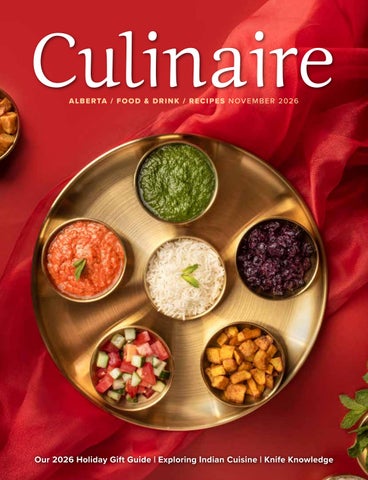
A L B E R TA / F O O D & D R I N K / R E C I P E S N OV E M B E R 2 02 6
Our 2026 Holiday Gift Guide | Exploring Indian Cuisine | Knife Knowledge
contents
Volume 15 / No. 6 / November 2026
17
departments 6
Salutes and Shout Outs
8
Chef’s Table
News from Alberta’s vibrant culinary scene and new restaurant openings
Chefs from some of Alberta’s finest Indian restaurants are sharing their memories and recipes!
34 Making the Case
Tom Firth shares share an assortment of wines that are a little exciting and a little spicy too
8
12 They’re in a Pickle… and
They Like it That Way! Discover the story behind the salsa that started Alberta's Dill Pickle salsa craze.
36 Etcetera…
What’s new?
38 Open That Bottle
With Daniel Gowrie of Eau Claire Distillery
14
Eating India One Region at a Time
From the Himalayas to the southern seas, we’re exploring the flavours, dishes, and culinary traditions that make India's regional cuisines so distinctive. by Karen Anderson
17 Making the Cut
Knives are a chef’s secret weapon for creating professional-style dishes with precision and skill, but what takes a knife from ordinary to exceptional? by Quinn Curtis
ON THE COVER It’s cooling down outside so we’re looking for food to warm us inside, and in this issue we’re focusing on the cuisine of India and its spices. We love photographer Katarzyna (Kasia) Kowalewska’s striking photo for our cover this month!
26
by Lucy Haines
20 Sweet and Spicy
The combination of sweet and spice tickles the taste buds in exciting ways, and creates drama where there was only one dimension before. by Natalie Findlay
24 Cooking with the
Most Acidic and Sweetest of Fruits
If you have yet to cook with tamarind, you’re in for a surprise, a challenge, and a real treat. by Morris Lemire
26 Our 2026 Holiday Gift Guide!
Our choice of 25 tried and tested treats, drinks, books, and kitchenware that we can stand behind! by the Culinaire Team
31 Sneaky, High Alcohol
Beers Part One: The Lagers
Alcohol is the most mysterious component of beer; for 95 percent of its existence no one was quite sure what it was – nor did they care! by David Nuttall November 2026 | Culinaire 3
LETTER FROM THE EDITOR
As the days cool…
…our food warms, and how better to add heat than spice it up! Always one of my favourite issues, our November magazine leans towards international cuisine and spice, and this year we’re headed to South Asia and the Indian subcontinent – a personal favourite as, since 2001, Chicken Tikka Masala has been the unofficial, but widely accepted, British national dish! And here live a quarter of the world’s population who eat spicy food to cool themselves down, and in our sparsely populated country, we eat spicy food to warm ourselves up. India has been on my bucket list of places to visit for a very long time, but I enjoy it vicariously through those more familiar as I’ve spent many of my years following the grape, and until recently we haven’t known any wine from this area.
We have recipes from Indian chefs, along with their advice and guidance for using spice, as well as sweet and spicy recipes, and we’re taking a deeper dive into tamarind in all its forms. We’re also exploring the diversity of regional Indian cuisine to gain a deeper understanding of where some of the recipes and dishes we know and love originate, and why. Forward-looking to the holidays, November is also when we aim to let you have our suggestions and ideas for gifts, big and small, in advance of the season.
We have tried, tested, read, and tasted (where applicable), each of these 25 items, and can stand behind them all. I was completely taken aback recently when I received an email asking the price to include a product in our Gift Guide. What? Charge money for it? You can’t buy your way into Culinaire! Of course people can buy an advertisement in the magazine to promote and support their businesses, but I have to tell you that in all our years, we have never accepted payment for any product feature or editorial, it’s always been our choice of what to include and let you know about. I believe it makes us one of the most trusted voices for our recommendations.
Cheers, Linda Editor-in-Chief
More than a grocery store! EDMONTON | CALGARY | SHERWOOD PARK
CALGARY NORTHLAND - NOW OPEN
Alberta / Food & Drink / Recipes Editor-in-Chief/Publisher Linda Garson linda@culinairemagazine.ca Managing Editor Tom Firth tom@culinairemagazine.ca Contributing Editor Quinn Curtis quinn@culinairemagazine.ca Multimedia Editor Keane Straub keane@culinairemagazine.ca Design Kendra Design Inc Contributors Karen Anderson, Natalie Findlay, Lucy Haines, Dong Kim, Katarzyna Kowalewska Morris Lemire, David Nuttall Funded by the Government of Canada
Proudly printed in Alberta by Burke Group.
Contact us at: Culinaire Magazine #1203, 804–3rd Avenue SW Calgary, AB T2P 0G9 403.870.9802 info@culinairemagazine.ca @culinairemag @culinairemag @culinairemag facebook.com/CulinaireMagazine For subscriptions, competitions and to read Culinaire online: culinairemagazine.ca
Our contributors Natalie Findlay
After a brief period with an Easy Bake Oven, Natalie’s mom allowed her to use the big girls oven and set her on the course for a life filled with delicious outcomes. After graduation from Le Cordon Bleu, Natalie has worked in restaurants, hotels, bakeries, and her own business. Currently, Natalie is a freelance writer, recipe developer, photographer and Registered Holistic Nutritionist and loves every minute of it.
Sip. Savour. Stay.
Karen Anderson
Karen Anderson is the founder of Alberta Food Tours and the award-winning author of A Spicy Touch, Food Artisans of Alberta, and Eat Alberta First. She has travelled to India 10 times, and her new cookbook, Faces, Places, and Plates: A South Indian Roadtrip, is scheduled for release in September 2027. When not writing and touring, daily yoga keeps her grounded and cooking for family and friends keeps her joyful.
Morris Lemire
Morris lives in retirement in Edmonton where he gardens, cooks and writes about both. He finds the culinary arts a fascinating culture that’s impossible to exhaust. Mo (to friends and family) thinks cooking and writing have things in common, both require fresh ingredients, organization, attention to detail and a dash of love. The love bit is the easy part.
Culinaire Magazine acknowledges that we live, work and play on the traditional territories of the Blackfoot Confederacy (Siksika, Kainai, Piikani), the Tsuut'ina, the Îyâxe Nakoda Nations, the Métis Nation (Region 3), and all people who make their home in the Treaty 7 region of Southern Alberta. We are committed to support Indigenous chefs and amplify their voices to bring awareness of the food and culture of the First Nations. All Trademarks presented in this magazine are owned by the registered owner. All advertisements appearing in this magazine are the sole responsibility of the person, business or corporation advertising their product or service. All content, photographs and articles appearing in this magazine are represented by the contributor as original content and the contributor will hold Culinaire Magazine harmless against any and all damages that may arise from their contribution. All public correspondence, which may include, but is not limited to letters, e-mail, images and contact information, received by Culinaire Magazine becomes the property of Culinaire Magazine and is subject to publication. Culinaire Magazine may not be held responsible for the safety or return of any unsolicited manuscripts, photographs and other materials. Reproduction of this publication in whole or in part without written consent from Culinaire Magazine is strictly prohibited.
YOUR TABLE AWAITS thewilderooftop.com
SA LUTE S & S H O UT O UT S
Congratulations to Edmonton’s Sawmill Restaurant Group on 50 years of prime rib and steak! They’re celebrating this month with four galas at their Edmonton, Leduc, Stony Plain, and Grand Prairie restaurants, where 100 percent of the ticket price will be donated to the charity that wins the majority of the votes from the guests. sawmill.ca Calgary’s Wild Rose Brewery is celebrating 30 years of craft brewing - and supporting their community and local causes too. They’re marking the anniversary with limited-edition anniversary glasses, T-shirts, hats, and special beers across Alberta like their 30 Years Herd collection! wildrosebrewery.com And belated congratulations to Dutch Delicious, Edmonton’s fine Dutch Bakery and European Delicatessen, on 20 years of nourishing Europeans and Edmontonians alike with their wholesome freshly baked breads, buns, cakes, cookies, pastries, and imported European goods. dutchdeliciousbakery.com Alforno Bakery & Café celebrated its 10-year anniversary in Calgary this autumn! From supplying fresh-baked bread to all Teatro Group locations, Alforno is a huge success story, now with nine locations across the city – and soon to open in Canmore! alforno.ca Congratulations to the winners of this year’s Edmonton Great Canadian Kitchen Party! Blair Lebsack of RGE RD took the top spot, with Jason Greene 6 Culinaire | November 2026
of Braven awarded silver, and last year’s winner Tyson Wright of the Old Red Barn, bringing home the bronze medal. Jeremy Hube and his team at Calgary’s Pizza Culture are the only Canadian pizzeria to be named one of the world’s best – and it’s their third year in a row! They placed at #80, moving up one spot from last year, in the 50 Top Pizza World 2026 (although it’s actually a list of 100!). pizzacultureyyc.ca Air Canada has announced its Best New Restaurants finalists in the 25th edition of the annual rankings of the country's top restaurants, and Alberta has three of the 30! Good luck to Edmonton’s Rita Trattoria, and Calgary’s Penny Crown Tavern and Sushi Jun. The top 10 will be revealed on November 16. Bravo to Pastry Chef Natalie Liu of The Westin Calgary, who won first place in the pastry category at Marriott International’s Masters of the Craft competition (a contest we support as judges in Calgary every year!), earning the title of North America Pastry Champion! From one location in 2015, Calgary now has four Native Tongues! In addition to their Victoria Park, Brittania, and University District taquerias, they’ve totally refurbished the former Cabeza Grande space in Bridgeland, bringing their own energy and spirit of Mexico City’s street food culture to this vibrant neighbourhood. Consistency is key, and the quality and menus are the same in each location, with attentive and knowledgeable servers. Get your taco
fix any time after 11:30 am, or come for Margarita Mondays, Taco Tuesdays, weekend brunch, weekday afternoon happy hour, and reverse happy hour – or hire their new mobile taqueria for your parties! 60 9 Street NE, seven days, nativetongues.ca Edmonton has a new brewery! Yeasty Boys Brewing Co. has opened on Happy Beer Street, serving up their cool new craft brews in their newly renovated taproom at 9951 78 Avenue NW. All are welcome - it’s a family friendly environment. While you’re enjoying your cold beer, there’s plenty to occupy the kids with chalk, frisbees, and soccer balls so they won’t be bored. Friendly staff, funky fresh beer, and great vibes. Closed Mondays, yeastyboysbrewing.ca for hours. Milpa, Calgary’s gorgeous blue Beltline restaurant has morphed into Bar Milpa – a modern, new Latininspired cocktail bar! Now part of Duncan Ly and Rajiv Malhotra’s C'est Chouette Hospitality Group, there’s more of a party feel, with Brazilian mixologist André Bueno leading the custom cocktail program, and head chef Wolfgang Schuster (from Pat & Betty and Class Clown) in the kitchen cooking up some unique and memorable sharing plates like the Scallop Crudo, Seared Cabbage, and Borracho Beans. Good food, good drinks, and good vibes! 4 pm-late, late-night menu from 10 pm. 1531 5th Street SW, closed Mondays, barmilpa.ca Edmonton’s Roam Café has a second location! Two years after opening their first café, downtown at the One Twelve
4
Campus, this community neighbourhood staple now has a second home at ATB Place, 10020 100 Street. It’s a place for students and professionals, for friends or taking some quiet time on your own; for artists, with rotating artwork from Alberta creatives – for breakfast and lunch with a selection of sandwiches, salads, wraps and bites - and for great coffee from ethical suppliers, freshly roasted every week. Monday-Friday 7:30 am-2:30 pm, roamcafeyeg.com
Calgary opened its third CRAFT Beer Market location this summer, bringing the total number of Canadian locations to 11 (there’s even one in Austin, Texas)! Located in Shepard Flats on 130 Avenue SE, this new location boasts CRAFT’s signature dishes, local and international craft beer, and cocktails, along with outdoor seating and a rooftop patio designed for year-round enjoyment. With Chef Josh Dyer as their Director of Brand Innovation and Chef Dave Phillips as the Regional Chef, be sure to show up hungry and ready to enjoy familiar favourites along with newer fare like the Ahi Poke Bowl and the mega Korean Sticky Ribs. 7 days, 10 am-late, craftbeermarket.com
Bang Bang Prawns, Lobster Ravioli, and Gorgonzola Mussels! Look for daily drink specials and $15 daily happy hour plates 2–5 pm and from 8:30 pm. Seven days, lunch and dinner, dinenineteen.com
4 Come down the rabbit hole! Tipsie, Calgary’s newest wine bar is open, continuing an 18-year legacy in the former Wine Bar Kensington location at 1131 Kensington Road NW, where Nadine Eden (co-owner with husband Rob) was an opening server! The couple are returning it to its glory years, doing here what they do so well at their Inglewood restaurant, The Eden. With talented chefs Dirk McCabe and Marlon Atienza’s unpretentious, yet elevated food program, it’s a place to snack or feast; hang out or come with friends for dinner – this We’re big fans of Edmonton Chef Andrew Fung - and now XIX Nineteen small menu is 100% completely delicious sharing dishes (that grilled cheese? has a new location! As well as the Terwillegar and St. Albert restaurants, XIX Amazing!). Choose a bottle or one of the 5- or 8-ounce rotating glass pours from Valleyview is open at 9112 142 Street NW with a wonderful menu of everything you boutique, family-owned wineries, a nonalcoholic drink, or one of four beers on (we!) want to eat. We’re getting hungry thinking about that Smoked Bison Tartare tap. Closed Mondays, walk-ins only, 4 pm-late, tipsie.ca and Picahna Steak Sandwich, those
MONTHLY GIVING MONTHLY GIVING IS EASIER THAN EVER! IS EASIER THAN EVER!
TEXT TO20222 20222 TEXTFEEDYEG FEEDYEG TO
95 POINTS vintage 2021
• ~100% 100%ofoffunds fundsgogototous. us.No Noadmin adminfees! fees! • ~Easy giving & tax receipts included Easy Giving • ~One or monthly Taxtime receipts includedgiving available ~ One time or monthly giving available
780.425. 2133 | edmontonsfoodbank.com 780.425. 2133 | edmontonsfoodbank.com
Heritage always leaves a trace.
Bringing the Spice! C H E F ’ S TA B LE
BY KEANE STRAUB
W
hen it comes to creating Indian food in home kitchens, there’s a collective understanding about using spice: it’s a key component, and it should be treated with care and attention. Four chefs from some of Alberta’s best Indian restaurants at the table are all in agreement on this topic. Bloom spices in warm oil or toast them in a dry pan — this helps enhance the flavour of the overall dish. Taste as you go, start
Chef Unni Kannan at Edmonton’s Zaika had an early start to his culinary career, watching his mother, and observing how food and celebrations went hand in hand. “My mom used to cook a lot of different things, and I would eat a variety of dishes at weddings.” Seeing what was possible with Indian cuisine pushed him to start creating his own dishes. When he began working in hotel management, his love for cooking grew even more. His favourite dish at Zaika is Curry Chicken, a simple dish he says every mother in his culture cooks at home. “Everyone who makes this has their unique style made with simple ingredients at home.” When it comes to using spices, less is more, and start with the familiar. His recipe comes together effortlessly, with many of the ingredients a home chef likely has on hand. “Don’t use a lot of spice to start as it can be overpowering when the proportions aren’t right.” Take your time to cook the onion, ginger, and garlic, he adds. “Slightly roasting the spices adds a nice touch.” 8 Culinaire | November 2026
PHOTOS BY DONG KIM
with a little because you can always add more, and remember to keep things balanced. But just as this cuisine is varied from every region in India, each one of our chefs also bring a little something extra to the kitchen: curiosity, heritage, memory, and simplicity. And maybe this is why for every dish that exists there is a palate to match. After all, isn’t variety the spice of life?
Punjabi Chicken Curry Serves 4
2 Tbs (30 mL) canola oil 4 large onions, chopped 1 Tbs ginger garlic paste ½ tsp chili powder 1 tsp coriander powder ½ tsp turmeric powder 3 chopped tomatoes or ½ cup of crushed tomatoes 1 kg boneless chicken breast, cut into 2.5 cm cubes ¾ tsp salt ½ cup (125 mL) water ½ tsp garam masala 2 Tbs chopped cilantro
1. Heat oil on medium heat, add chopped onions and sauté for 4 minutes until translucent. 2. Add ginger garlic paste, sauté until raw smell is gone and add chili powder, coriander, and turmeric powder. Sauté for 2 minutes on low heat. 3. Add tomatoes and cook until oil separates from the sauce. 4. Add chicken and stir well. Add salt and water, cover and cook for 5 minutes. 5. Once oil is floating on top, stir in garam masala powder and cover for 2-3 minutes. Garnish with cilantro and adjust salt to taste.
Curiosity fuels Chef Jaspreet Singh Pannu’s culinary career as he began observing how the same dishes could vary when cooked by different people. “I would always wonder how the exact same recipes and preparation steps could bring out different results with no intentional changes, and that curiosity to understand these variations has brought me a long way.” As the owner and chef of Calgary’s Naan Tale, he strives to keep recipes simple with ingredients that are readily available and easy to follow techniques. The menu is small but carefully crafted, focusing on the diversity of palates and moods each guest brings. Spices are selected and combined with the precision of a Stanley Cup winning coach: for him, each spice is like the player of a team and even with a star player, the creation of each dish is a team sport. And like every good athlete, spices need a warmup. Chef Pannu suggests tempering them in oil or dry roasting whole spices in a pan before making a powder with them to add while finishing the dish. Coming home hungry to scant ingredients is a universal experience, but one that can often result in something delicious and comforting. Chef Pannu calls his 1000 Kukad a canvas that one can draw on: “Kukad is Punjabi for chicken,” he explains, “and you can make 1000 variations of this by yourself without any professional experience.”
1000 Kukad Serves 4
1 kg boneless chicken thighs 335 mL (1-1/3 cups) yogurt To taste salt 3 Tbs minced garlic 1 tsp ground black pepper 10 g fresh cilantro or parsley, minced 1. Cut chicken into bite sized pieces. 2. Mix all the ingredients except cilantro/parsley and let marinate in fridge for one hour (optional). 3. Put the mixture in a pan on the stove, cover with a lid on and let simmer for 15 minutes. You will see cooked chicken and water separated in the pan.
4. Turn up the heat to high and cook until all the water thickens to a saucy consistency and coats the chicken pieces. 5. Finish by topping with fresh cilantro or parsley and enjoy with some rice, salad, and/or bread of your choice.
Note: You could replace yogurt with 5 peeled roma tomatoes if lactose or dairy intolerant. You could also replace the garlic with ginger, or don’t add it at all. Add veggies of choice and add chilies, herbs, spices, or anything you like to satisfy your taste buds. November 2026 | Culinaire 9
Photos by Linda Garson
The vast culinary heritage of India serves as a jumping off point for Chef Vansh Rathore. For him, cooking is more than just preparing food, it’s about sharing culture, creating memories, and bringing people together. At Calgary’s Rasa Palladium, he enjoys experimenting with flavours and textures while preserving the traditional essence of each dish. “What fascinates me most about Indian cooking is how a few simple ingredients can be transformed into something extraordinary through the thoughtful use of spices and cooking techniques.” Slow-cooked curries and fusion creations are among his favourite types of dishes, as they all tell stories. “Our slow-cooked curries represent the depth and complexity of Indian cuisine, while fusion dishes allow us to experiment with traditional Indian ingredients in innovative ways.” For home cooks who are new to Indian cuisine, he recommends beginning with a few simple spices such as turmeric, coriander powder, fennel seeds, kalonji (onion seeds), and garam masala. These, he says, can transform everyday ingredients into 10 Culinaire | November 2026
something delicious, like his recipe for Bhindi Masala. Make sure the bhindi (okra) is completely dry before cutting and cooking, and take the time to allow spices to develop their flavours naturally. “Great food does not always require complicated ingredients, just an understanding of flavour and a passion for cooking.”
Bhindi Masala with Kalonji, Fennel Seeds, Yogurt & Tomato Serves 4
500 g fresh bhindi (okra) 3 Tbs (45 mL) mustard oil or vegetable oil 1 tsp onion seeds (nigella seeds) 1 tsp fennel seeds (saunf) 1 medium onion, finely chopped 1 Tbs (15 mL) ginger-garlic paste 2 medium tomatoes, finely chopped ½ tsp turmeric powder 1 tsp red chilli powder (adjust to taste) 1½ tsp coriander powder To taste salt ½ cup (125 mL) plain yogurt (dahi), whisked ½ tsp garam masala Fresh coriander leaves for garnish
1. Wash the bhindi thoroughly and dry completely. Trim both ends and cut into medium-sized pieces. Heat 2 Tbs (30 mL) oil in a pan over medium heat. Add the bhindi and sauté for approximately 8–10 minutes until lightly golden and the stickiness has reduced. Remove from the pan and set aside. 2. In the same pan, heat the remaining tablespoon (15 mL) of oil. Add onion seeds and fennel seeds. Allow them to crackle gently for approximately 20–30 seconds until aromatic. This tempering creates the distinctive flavour base of the dish. 3. Add the chopped onions and sauté until golden brown. Stir in the gingergarlic paste and cook for another minute. Add the chopped tomatoes, turmeric powder, red chilli powder, coriander powder and salt. Cook for approximately 5–7 minutes until the tomatoes soften and the masala thickens. 4. Reduce the heat to low. Gradually add the whisked yogurt while stirring continuously to prevent curdling. Cook gently for 2–3 minutes until the yogurt blends smoothly with the tomato masala. 5. Add the sautéed bhindi to the prepared masala. Gently mix until the bhindi is evenly coated. Cook uncovered over low heat for another 4–5 minutes. Sprinkle with garam masala and garnish with freshly chopped coriander. 6. Serve hot with freshly prepared roti, naan or paratha. It also pairs beautifully with steamed basmati rice and a refreshing cucumber salad.
“Indian food is much more than just spices,” says Chef Amit Kudtarkar. “It’s about memories, culture, family, and the feeling of home.” Growing up eating food in Mumbai and Maharashtra, his goal at Vivaan's Yummies is to bring the flavours of that authentic street food to Calgary. Keeping things approachable for Canadians while maintaining the original character is key. “Seeing people from different backgrounds discover these flavours and enjoy them is what continues to inspire me.” Mumbai street food in its simplest form is best represented by vada pav, says Chef Amit, adding that among the dishes on the menu, this one has a special place in his heart. It combines a spicy potato vada (dumpling), chutneys, all atop a soft pav (bun). His recipe for Chicken Kheema Pav replaces the potato dumpling with a curry made with ground chicken, onions, tomato, and a blend of spices. “Don’t be afraid of spices,” he says, “but learn to balance them. They should add aroma, depth, and flavour rather than simply heat.” Be sure to purchase spices in smaller quantities and store them away from heat and direct sunlight. “Fresh spices make a noticeable difference.” “This represents the kind of food
I love the most: simple, comforting, and full of character. It also represents the connection between Mumbai and Calgary. We wanted to give people from India a taste of home while also introducing Calgary diners to something new.”
Chicken Kheema Pav Serves 4
500 g ground chicken 1 cup green peas, fresh or frozen 2 Tbs (30 mL) vegetable oil 1 Tbs butter 1 medium onion, finely chopped 1 Tbs (15 mL) ginger-garlic paste 2 medium tomatoes, finely chopped ½ tsp turmeric 1½ tsp Kashmiri red chili powder 1½ tsp coriander powder ½ tsp cumin powder 1 tsp salt or to taste ½ tsp black pepper ½ tsp garam masala ½ cup water 1 Tbs chopped fresh coriander 1 Tbs chopped coriander stems 1 tsp fresh lemon juice 8 pav/buns 1–2 Tbs butter Fresh coriander, to garnish Finely chopped onion, to garnish Lemon wedges, to garnish
1. Heat oil and butter in a wide pan over medium heat. Add the onions and sauté for 5–7 minutes until soft and lightly golden. 2. Add ginger-garlic paste and sauté for 1 minute until fragrant. 3. Add tomatoes, turmeric, chili powder, coriander powder and cumin powder. Cook for 5–7 minutes until the tomatoes are soft and the oil begins to separate from the masala. 4. Add the ground chicken and cook over medium-high heat for 5–7 minutes, breaking up any large pieces with a wooden spoon. 5. Stir in the green peas, salt, black pepper and garam masala. Add water, cover and simmer for 10–12 minutes until the chicken is fully cooked and the peas are tender. 6. Remove the lid and cook for another 2–3 minutes if needed. The kheema should be moist and flavourful, but not watery. Stir in fresh coriander, coriander stems, and lemon juice. 7. Slice the pav (buns) and toast the cut sides in a hot pan with butter until golden and lightly crisp. Garnish the kheema with fresh coriander and chopped onion. Serve hot with buttered pav and lemon wedges.
Keane Straub has travelled from Tofino to Charlottetown, sampling the different flavours Canada offers. The passion people have for their craft and culture inspires Keane to tell their stories. November 2026 | Culinaire 11
They’re in a pickle… L
and they like it that way!
ike many artisan food businesses, Gord and Shauna Ingram’s journey with Crooked Creek Salsa started a few years back, with a plea from Shauna’s sister Tracey, a couple provinces over: ‘Make me a salsa to sell in the Crooked Creek Store’ (near Grande Prairie), the roadside shop owner urged. It makes for a fun story now, because after some convincing, the helpful Manitoba native (with husband Gord just heading into retirement from his work in telecommunications) took to her kitchen stove – on one condition. Since she didn’t even like salsa, the then nurse said she’d have to come up with something she enjoyed eating too.
12 Culinaire | November 2026
BY LUCY HAINES
That was 2019 and since then, a lot has changed for the husband and wife team, who left behind a lot of Manitoba family (mostly Shauna’s siblings – she’s one of nine kids), and moved with a universitybound daughter to northern Alberta. But that leap of faith saw the pair take their willingness to work hard and turn it into a thriving small business called Crooked Creek Salsa. From those first few pots on the stove, experimenting to make chunky salsas she actually liked, Shauna’s product evolved from four original varieties to a whole range of premium, small-batch flavours (Taco in a Bag, Peach, and the top-selling Dill Pickle Salsa among them). Shauna says she’s proud of the vegetable-
packed flavours she’s come up with – mild and spicier varieties that taste fresh and homemade, using as much local produce as possible, and with no fillers or thickeners in sight. “We do everything in small batches to have quality control,” says Shauna who, with Gord, went from doing product demos in her sister’s store to having the jars picked up at the Valleyview Co-op store (and that nine-store group), and now in an impressive 175-plus retailers in the province. “As things started to take off, we just kept buying bigger pots,” she laughs. Christopher Dick, manager of the Trader Ridge Co-op in Grande Prairie, says he understands why the upstart condiment
company has found quick success. His store has a full rack devoted to Crooked Creek Salsa and barbecue sauces because, he explains, customers simply love the product and supporting a local business. “The quality never changes. I tend to like the plain jane flavour, but people can’t get enough of the dill pickle salsa and it’s something that is popular year-round,” says Dick. “And Gord does a great job promoting the brand. He’s always helpful, always ready to set up product demos – whatever we need.” On a swing south through the province to make deliveries and meet with retailers, the Ingrams make a regular check-in at the commercial kitchen space they work with in Edmonton. While it’s still mostly the pair handling every aspect of the business, (Shauna says she only wants to spend time creating new recipe ideas in the kitchen), it’s a busy schedule. While Gord works magic behind the scenes (and often works 24/7 on marketing, the website, product distribution, and connection with retail partners), it turns out it’s Shauna who is a dynamo at events in grocery stores or Christmas markets. “I’ve been in sales and retail all my life, but nobody does it like Shauna; she can get anyone to come over and sample the product,” marvels Gord about his wife’s conversational style and down-to-earth manner. “We say if you try it, you’ll buy it - that’s the key to our success.” Indeed, Shauna’s not shy about suggesting pairings for her salsas to those that give the product a try, everything from as an addition to a charcuterie board, to putting the sweeter peach variety on a piece of brie cheese or even atop a slice of cheesecake. “I am the queen of sampling,” she laughs. “I don’t like selling anything; I just get
people to try it. And I’m very convincing.” There have been both challenges and fortuitous moments along the way, the pair acknowledge, including the boom in interest in shopping locally that started during the pandemic. Gord says the timing was good in that regard, as the pair branched into a church kitchen in Grande Prairie, upping efficiency and production capabilities to 1,000 jars a week. In short order, the brand was approved to come on board in Freson Bros. stores, followed later by Safeway, Sobeys and Save-On stores. Today, the company does some 2,500 jars a day in its Edmonton kitchen facility for grocery chains and independent stores alike. “We still saw we needed sampling and working farmers’ markets, especially with our population up north,” Gord says, pointing to the benefit of being rooted in a place like Grande Prairie. “Every jar is like the character of this place: honest, unpretentious, and tougher than it looks.” And it was that search for the brand’s next chapter and satisfying regular customers that led Shauna back to the kitchen. In 2024, the result was something novel and instantly popular: dill pickle salsa. “It kind of blew up overnight for us, with lineups at the farmers’ market for that flavour,” Gord says. “I know there’s dill pickle everything these days, but I don’t think it’s a fad, and it’s taking our business to a whole new level. We’re reaching new customers, but still make our salsas the same way; small-batch and like something you’d pick up at your local farmers’ market.” “And because we produce small batches, we can take risks the big guys can’t. And we do that,” adds Shauna. Besides proudly proclaiming that it’s Alberta’s original dill pickle salsa,
Crooked Creek Salsa continues to find new customers with mango, peach, and pineapple varieties – 13 bold offerings in all – plus barbecue sauces in flavours like dill pickle, bourbon, and sweet berry rum. But original varieties remain favourites for a reason too, and those include Hot Pepper, Cilantro, and Hot Pepper Cilantro varieties. Gord says online sales are great for fans, some of whom live across the country and are willing to pay the shipping to get their fix. He says his next project is to add a recipe page to the website, and within a year, to grow beyond the Alberta border and across Western Canada. “I’m a simple guy; I still like the original plain jane salsa on nachos, with shredded cheese, or just straight with chips. But people have told us they add salsa to potato salad, or make a burrito bowl taco salad – even put the dill pickle variety on hot dogs – there’s lots of ideas.” Riding the dill pickle wave, the pair continue to do market sampling and occasional shows (a home show in St. Albert, and Pickle Fest in Calgary, to name a couple). “I never thought we’d have a business, and I tell Gord I’m never owning another one,” Shauna says, though she admits she has ideas for more salsa flavours all the time. For Gord, running an ethical, fair company is key, and even though there’s not an explicit mission statement as such, it’s what drives his efforts. “And we’ll see where it all takes us.”
Lucy Haines is a long-time freelance writer, specializing in travel, food, arts and entertainment. When she isn't writing, Lucy is a busy mom to four fantastic kids, and enjoys singing and performing in the local community theatre scene. November 2026 | Culinaire 13
Eating India One Region at a Time: Kolkata (Calcutta)
Mumbai (Bombay)
From the Himalayas to the southern seas, discovering the flavours, dishes, and culinary traditions that make India's regional cuisines so distinctive. 14 Culinaire | November 2026
I
STORY AND PHOTOGRAPHS BY KAREN ANDERSON
n Eating India, author Chitrita Banerji writes, “I know that one lifetime, one memory, is not enough to eat, know, and absorb India.” Her words capture the extraordinary diversity of India's culinary traditions. One taste of a dish as deceptively simple as palak paneer can captivate a diner for life. Beneath the vibrant green spinach and creamy paneer lie layers of spice and the secrets behind such extraordinary flavours. From the Himalayas near Rishikesh to Kanyakumari, where three oceans meet at India's southern tip, India's regional cuisines are as varied as its landscapes and people. Chef Chindi Varadarjulu with Bottle Gourd in Tamil Nadu Vegetable Market
Northern India
Kashmir is at the top of many people's bucket list. Eating raisin-and-nut-studded pilau while gazing at crystal-clear lakes and mountain peaks is often described as a slice of heaven. Near Rishikesh, in Uttarakhand, the famous Ananda Spa serves a dal seasoned with regional ajwain (carom seed). The chef even sends guests home with some to recreate the flavours of the region. The best fragrant basmati rice also grows throughout this Dehradun District. In Lucknow, evening markets buzz with vendors pulling breads from deep ovens and grilling galouti and kakori kebabs, delicately spiced minced lamb specialities, as motorcycles and people surge through the alleys. Chai is a staple across India, but in Banaras, there's a particular chai wallah beneath an ancient neem tree near the sacred Kashi Vishwanath Temple. Sipping a clay cup of his creamy, cardamominfused chai is the stuff of dreams. In Amritsar, Punjab, you can help make roti in the Golden Temple's vast langar, or community kitchen, which serves free vegetarian meals to tens of thousands of visitors daily. The city is also famous for its kulcha: crisp, flaky, tandoor-baked bread stuffed with spiced potatoes, paneer, or cauliflower, brushed with desi ghee and served with tangy chickpea curry.
The Capital and Beyond
No visit to Delhi is complete without exploring the spice bazaars of Chandni Chowk. Seek out Karim's for mutton nihari, a rich, slow-cooked stew served with naan. For tandoor heaven, head to Bukhara at the ITC Maurya, a Delhi institution since 1978. If dining with a group, order the Naan Bukhara, a spectacular bread stretching nearly three feet across.
In Rajasthan, they say a warrior's turban changes colour every 10 kilometres. It seems that the breads do, too. You can use them to scoop up the gravy of laal maas, the region's iconic mutton curry, whose fiery red colour comes from its chilies. In Gujarat, Gandhi's home state, try dhokla, a soft, spongy, savoury cake made from fermented batter, often based on chickpea flour.
Chai in Banaras November 2026 | Culinaire 15
Kolkata Kathi Roll
The West Coast
Mumbai is known as the maximum city, and its restaurant choices are just that. While tipples at the Taj are as posh as one can get, a sunset stroll along Chowpatty Beach offers a taste of pav bhaji, a humble but joyous street-food favourite of buttery buns stuffed with spiced, mashed vegetable curry cutlets. Farther south, in Goa, you can feast on grilled fish and turquoise-blue cocktails made with local cashew feni on the beach. Goa is also home to pork vindaloo, whose name and roots trace back to the Portuguese carne de vinha d'alhos, meat marinated in wine and garlic.
The East and Deccan
Kolkata, West Bengal's City of Joy, is a place of intellectuals, sports enthusiasts, and wonderfully funny people. Bengali cooking often balances mustard's pungency with a touch of sweetness. At Kewpies, savour traditional Bengali fish dishes, or grab a kathi roll, a favourite street-food snack, after exploring the city's magnificent flower markets. In Hyderabad, Telangana, the celebrated dum biryani is a must. But another of the local favourites is found near Charminar: Osmania biscuits dunked into Persian-style chai.
The Deep South
In Karnataka, the food shifts towards rice- and lentil-based fermented batters. Bengaluru's fluffy benne dosas, enriched with butter, are irresistible. Markets overflow with vegetables, including ash gourds as big as footstools. And in Mysuru, no visit is complete without tasting Mysore pak, a rich, fudgy sweet 16 Culinaire | November 2026
Spices of the Cardamon Hills
made with ghee, sugar, and gram flour. Kerala and Tamil Nadu, neighbouring states at India's southern tip, are regions rich in spices and culinary traditions. Book a spice garden tour in the Cardamom Hills near Periyar. Enjoy a banana leaf thali with about 20 different delicacies served in a sequence traditionally believed to aid digestion. The combination is soul-satisfyingly delectable. Everything from rice to pappadums to chutneys, vegetables, dal, soups, and sweets will appear. The meal will balance sweet, sour, salty, pungent, bitter, and astringent, and leave you feeling surprisingly light and refreshed. With long coastlines and abundant seafood, both of these Southern states have distinctive fish curries. In Tamil Nadu, meen curry is often slow cooked in clay pots, while Kerala's fish molee is a gentler preparation, typically enriched with coconut milk. Coconut is abundant, and black pepper reigns as the King of Spices. In Kerala's backwaters, duck farmers move their flocks through freshly harvested rice paddies, where the ducks eat pests and fertilize the fields. Duck curry, laden with shallots and cloaked in a thick gravy laced with fennel, cardamom, and cinnamon, is as unforgettable as it sounds. South India is home to dozens of banana varieties, and almost every part
Keralan Duck Curry
of the plant finds a place in its cuisines. Madurai's banana market is the place to see carts piled high and taste varieties you'll rarely find beyond India's borders. And then there are the dosas: crisp, golden crepes served with sāmbhar and a trio of coconut, tomato, and coriander chutneys, their colours echoing the Indian flag. As Banerji reminds us, one lifetime isn't enough to eat, know, and absorb India. Happily, there's always another region, another market, and another extraordinary meal waiting. Karen is the founder of Alberta Food Tours and the award-winning author of A Spicy Touch, Food Artisans of Alberta, and Eat Alberta First. She has travelled to India 10 times, and her new cookbook is scheduled for release next year.
What makes a great knife great?
Photo courtesy of Knifewear
MAKING THE CUT: BY QUINN CURTIS
Why the knife is a chefs most crucial gadget in the kitchen
To start cooking with confidence and feel like you are truly honing your skills in the kitchen, you don’t need fancy kitchen gadgets, expensive time-saving appliances, or the most popular and beautiful tools. What you really need is a good knife. With a quality kitchen knife, you can transform your technique and take the leap from feeling like a beginner home cook to becoming a truly skilled chef in your own kitchen. All it takes is finding the right knife for you and learning how to use it properly. Knives are a chef’s secret weapon for creating professional-style dishes with precision and skill, but what makes a great knife? Several factors can take a knife from ordinary to exceptional.
European and Japanese Knives increase the knife’s strength and reduce When searching for the perfect knife for your kitchen, it can be helpful to take a bird’s-eye view of European and Asian knife-making traditions before narrowing your search to the style that suits you. These are useful generalizations for first time knife buyers, but neither category is uniform, and as you narrow your search, you will get to know the qualities that matter the most to you. European knives tend to be heavier and sturdier, with strong, curved edges that are ideal for continuous rocking cuts, such as chopping veggies or herbs into small pieces. Many European knives also feature a full tang, where the solid piece of steel extends all the way into the handle. This construction can
the risk of breakage at weak points, such as where the handle connects to the blade. For home cooks who do a lot of heavier chopping, such as cutting carrots, bones, and other root vegetables, a sturdy European knife with a full tang may be a suitable choice. With their robust construction, European knives can also be a good option for those looking for a lowermaintenance everyday knife. They generally require less delicate handling than some alternatives and can be kept in good condition with a straightforward care routine. Traditional Japanese knives, on the other hand, often feature thinner blades made from harder carbon or powder steels. These knives can be particularly November 2026 | Culinaire 17
Knife care
well suited to home cooks who want to take a more precise and meticulous approach in the kitchen. If you enjoy making precise cuts, preparing delicate ingredients and keeping up with regular knife maintenance, Japanese knives may be right up your alley. Fortunately, for us Canadians, we don't have to cross any oceans to find the perfect knife because we have access to some of the best knife experts closer to home at Knifewear, where Kat Dalton and Colin McGuire help long-time expert chefs as well as customers who are ready to take the leap and upgrade their knife game at home. “There are four things people might consider when buying a knife: price, performance, appearance, and romance. Performance doesn’t necessarily increase in proportion to how handmade a knife is, but the more handmade it is, the more romantic the story behind it can be. A big part of our job is helping people navigate those choices. We might spend 20 minutes getting to know someone to figure out what really matters to them. What suits their lifestyle? What feels right in their hand? How much maintenance are they willing to do? How long do they want the knife to stay sharp? What kind of aesthetic appeals to them? And, of course, if they’re buying a 18 Culinaire | November 2026
gift, that changes things too. We help a lot of people choose wedding gifts,” says McGuire. When it comes to Japanese knives, there is certainly no one-size-fitsall approach. Dalton explains the differences between the types of steel commonly used in Japanese knifemaking. “In the world of Japanese knives, I like to break it down into three categories: carbon steel, stainless steel, and the materials that fall somewhere in between. Carbon steel feels great when you use it, sharpens up easier, and can often get harder, giving it better edge retention. However, carbon steel will patina and discolour over time and can rust if it is not taken care of properly. The best practice with carbon steel is to keep it clean and dry, occasionally wiping it off with a towel and to avoid leaving it sitting in anything wet or acidic for too long. For the in-between steels (like SLD semi-stainless for example) it builds that patina much more gradually, but can still rust if left sitting in acid for too long. And then there is stainless steel, which is perfect for many people, it does not require the added maintenance of wiping it off, but still avoid putting it in the dishwasher,” Dalton says.
No matter what type of knife you settle on, maintenance and proper care are crucial to getting the most out of it for as long as possible. While some knives require less maintenance than others, looking after your blade is essential to keeping it performing at its best. One important aspect of knife care is keeping your blade sharp. Dalton says it’s easy to tell when a knife needs sharpening. “When a knife is squishing tomatoes, requires a lot of effort to cut through something or just feels blunt, it's time for a sharpening! I use tomatoes as my personal frame of reference, as no one likes a squished tomato. But when a knife does not feel sharp enough for the user, it is time to do something about it,” she says. Sharpening a knife at home can feel daunting, but there are several ways to bring a dull blade back to life. First, it’s important to understand the difference between honing and sharpening. Honing essentially realigns the cutting edge, helping to restore its alignment, while sharpening removes small amounts of steel to create a new edge and restore the blade’s sharp, V-shaped profile. If you find that your tomatoes are getting squished, take a closer look at your knife. Hold the blade so you can examine the cutting edge. If the edge looks rounded or chipped, it may be time to sharpen it.
WHY A GREAT KNIFE IS A GREAT KNIFE Sharpness: A great knife has a fine, clean edge that slices through food effortlessly. If you have to apply too much pressure when slicing, chances are your knife isn’t sharp enough. Photo courtesy of Knifewear
If the edge appears to have rolled to one side or you notice a dull reflection where the sharp V-shaped edge should be, honing may help restore its alignment. “In Japanese, there’s a concept called kire aji, which means the flavour of sharpness, and it talks about how a knife cuts and how it can influence the way food tastes. The way a knife is sharpened affects how much it damages the food’s cell walls, which can change how the flavours develop as you eat. A coarser, toothier edge could release more flavour immediately, giving you that initial burst of taste, while a much smoother edge can create a different mouthfeel, allowing the flavour to develop gradually as you chew,” explains McGuire. “It’s fascinating how the way you sharpen a knife can change your experience of the food.” If you aren’t comfortable sharpening knives at home, you can always bring them to a professional. In Calgary, we have Cutting Edge Cutlery Co. at North Hill Centre, House of Knives at Market Mall, or of course Knifewear at its new location at 1406 9th Ave SE, and Calgary Farmers’ Market South location. In Edmonton and the surrounding area, you can visit Sharpening Edge in Sherwood Park, Knifewear near Whyte Avenue, or Sharper Knife north of Edmonton, among other options. To keep your knives sharp and in
good condition between sharpenings, Dalton recommends making a few simple changes to your knife care routine. “Either folks put them in the dishwasher which causes the steel to react poorly, or they use improper cutting boards (like steel or epicurean) when a simple plastic or wood is all someone really needs. There are plenty of cutting boards that are great for the health of a knife,” she says. “My personal habit is to clean my knives as soon as I am done using them. Whenever I find myself squishing tomatoes instead of gliding through with ease - I give my knives a good hone using a ceramic honing rod. Usually that does the trick and brings the edge back. Eventually over time, when using my ceramic honing rod does not bring back an edge, it is time for me to sharpen them.” A great knife becomes an extension of you and the way you cook. Whether you’re precisely slicing cucumber ribbons or butchering a roast chicken, having the right knife can transform your experience in the kitchen. Take care of it properly, and it will serve you well for years to come. With the right knife in hand, you’ll always feel at home in the kitchen. Quinn was born and raised in Calgary and has had a passion for food her whole life. This passion has led her to search for new and exciting culinary experiences in many countries around the globe.
Edge retention: This refers to how long
a knife stays sharp with regular use. A knife with good edge retention requires less frequent sharpening. However, it’s important to note that harder or more durable steel isn’t always the right fit for every chef.
Blade thickness: A great knife can have a blade of any thickness, but a knife suited to butchering a pig isn’t necessarily going to be ideal for slicing sashimi. The right blade thickness allows a knife to move through food effectively with as little resistance as possible, whether you’re cutting through tougher ingredients or slicing a thin piece of tataki. Steel: The type of steel affects a knife’s
sharpness, durability, edge retention and how easily it can be sharpened. A great knife is one made from a type of steel that suits the chef’s needs and the tasks they perform in the kitchen.
Weight and balance: Balance is key
in a great knife. Some chefs may prefer a heavier knife, while others favour a lightweight blade with a heavier handle. Whatever your preference, your knife shouldn’t feel awkward in your hand.
Matching the knife to the task:
There is no one-size-fits-all knife, especially when you get into the finer details of knife use. Some knives are versatile and convenient for everyday tasks, but you wouldn’t use a bread knife to thinly slice tomatoes, just as you wouldn’t use a paring knife to cut through thick bones or cartilage. Choosing the right blade for the food and technique makes all the difference when searching for your ideal knife.
And most importantly, matching the knife to the chef: It can take
years to find the right knife. Even if all the other factors point to a great knife, that doesn’t necessarily mean it will be right for you. The ideal knife will feel natural in your hand, be easy to grip and remain comfortable to use, even after an extended period of chopping.
November 2026 | Culinaire 19
Sweet & Spicy
to Warm the Palate STORY AND PHOTOGRAPHS BY NATALIE FINDLAY
T
HE COMBINATION OF SWEET AND SPICY tickles the taste buds in exciting ways. “Swicy”, as it is now being referred to, creates drama where there was only one dimension before. The role of sweetness is used to make foods more enjoyable for all. It can make foods feel richer and smoother while it also tones down sharp, bitter, or sour flavours. Sweetness can also allow you to notice the flavour of the chili or spice, rather than experiencing only the heat. Meanwhile, the heat gives sweet food more depth and a lingering finish. Spicy foods create a very different experience from sweet foods. Technically, spicy isn't a taste. It's more of a sensation. More often people describe spiciness as heat. Heat can make food feel more exciting and intense. It adds a
20 Culinaire | November 2026
physical sensation on top of the food's actual flavours. A little spice can wake up the palate, add warmth, create contrast, and make flavours seem more vibrant. It can also cut through richness, which is why something spicy can work so well with sweet foods. There’s also a progression to it: you taste the food and get a tingling sensation. Then the heat builds, it lingers, subsides and then you want another bite. That can make eating spicy food feel more interesting. In very simple terms, heat adds excitement, intensity, contrast, and a lingering sensation to food. Sweetness softens the intensity of heat, while the heat keeps sweetness from feeling too heavy or one-dimensional. Together, they make a food more interesting because your mouth experiences two very different sensations at once.
Triple Cream Brie, La Bomba, and Caramelized Onion Sandwich Makes 2 sandwiches
Note: La Bomba is a spicy Italian
condiment that you can keep on hand to augment many dishes from eggs to rice, and of course the above sandwich. 2 tsp olive oil 1 large yellow onion ¼ tsp kosher salt 1 Tbs (15 mL) maple syrup 4 slices sour dough bread 1 Tbs butter 1 Tbs (15 mL) La Bomba 200 g triple cream brie, rind removed 150 g ham, thinly sliced
1. Preheat oven to 350º F. 2. In a small pan over medium heat, add olive oil. 3. Thinly slice the onion and add to the pan with the salt. Cover with a lid. Stir
frequently to avoid burning and let onions slowly caramelize (turn brown). approximately 15 minutes. Adjust heat as required. 4. When onions are done. Remove from heat and stir in the maple syrup. 5. Coat the outside of the bread with butter (this will be the part that touches the pan). Coat the inside of the bread with La Bomba. 6. On the bottom slice of bread, layer the caramelized onions, then the thinly sliced ham and then a thick slice of triple cream brie, and top with the other slice of bread. 7. In another frying pan over medium heat, add the sandwiches (1 or 2 depending on how big your pan is). Toast until browned (2 minutes) and then flip to the other side for another 2 minutes. 8. Place in the oven until the cheese is melted and gooey. Enjoy with a side salad.
Honey Chili Aioli
Makes approximately 1 cup (250 mL) 2 egg yolks 2 cloves garlic, minced 1½ Tbs (22 mL) lemon juice ¾ cup (180 mL) neutral oil 3 tsp (15 mL) chili garlic sauce 3 tsp (15 mL) honey ¼ tsp kosher salt ¼ tsp cayenne pepper To taste salt and pepper 1. Add the egg yolks, garlic and lemon juice in a blender or food processor and mix until completely incorporated. 2. Slowly drizzle in the neutral oil while blending continuously until the mixture emulsifies and becomes thick. 3. Add the chili garlic sauce, honey, salt, and cayenne, and combine until mixture is smooth. 4. Taste and adjust flavours to your liking. More chili garlic sauce for heat. More honey for sweetness. More lemon juice for acid, and more salt to bring out all the flavours.
Note: Goes well with potato wedges, tofu, chicken, spread on sandwiches, or fish. It will last 4 days in the fridge.
November 2026 | Culinaire 21
Spicy Date and Serrano Chicken Wings Makes 900 g
900 g chicken wings ¾ tsp kosher salt 1 tsp freshly ground black pepper 2½ Tbs rice flour 1 cup (250 mL) water 2 cloves garlic, roughly chopped 1 cup dates, roughly chopped ½ tsp (3 mL) rice wine vinegar 2 serrano peppers, with or without seeds 1 green onion, thinly sliced, for garnish 1 serrano pepper, thinly sliced, for garnish 1. Preheat oven to 375º F. 2. Pat wings dry with paper towels. 3. Coat wings with salt, pepper and the rice flour. 4. Place the wings on a parchment-lined baking sheet, with a light spray of olive oil. Roast in oven for 15 minutes then turn and roast for another 10 minutes. 5. Meanwhile, to make the sauce add the water, garlic, dates, rice wine vinegar, and roughly chopped serrano peppers to a frying pan.
6. Heat for 5 minutes to soften everything then toss into a blender and combine until smooth. Return to the frying pan over medium heat and add the cooked chicken wings from the oven. Stir to coat. 7. Garnish and serve with a side of carrot and celery sticks.
One Night Only - Vine & Dine at Sweatered Hen, November 14
Vine & Dine at L’Olivo November 3 and 17
We’re thrilled to be coming back to L’Olivo for two Vine & Dine evenings. Everyone loved our evenings here last year, and we’re excited for the new menu of “cicchetti”, small, carefully puttogether dishes, each a miniature treat, and a way of life in Venice - informal, relaxed, and sociable!
Vine & Dine at Petalo, November 12
Our first Vine & Dine in September at the lovely Petalo, one of Calgary’s newest restaurants, was so good, so now we can’t wait for our second evening here of Italian and Mediterranean-inspired refined dishes and perfect pairings.
Comfort, warmth, nostalgia, and deliciousness, is order of the day at The Sweatered Hen, and Chef Andrea Harling is opening just for us for one night only of six pairing courses, each made in-house from quality local ingredients.
One Night Only - Vine & Dine at Tipsie, December 1
A one-off Vine & Dine at Calgary’s newest wine bar. From the owners of Inglewood’s The Eden, Tipsie is homely and welcoming, yet elevated, with Chef Dirk McCabe’s fine dining techniques applied to his comfort food menu.
Vine & Dine at One18 Empire December 7, 14, and 16
A choice of three nights for our 10th
Note: You can coat the chicken wings in the sauce or have it on the side for dipping - or both. Natalie is a freelance writer, photographer, and pastry chef. A graduate of Cordon Bleu’s pastry program, she manages her own business too to create custom-made cakes.
season at One18 Empire! We’re in the intimate private dining room of this stylish, warm, and comfortable restaurant, with places for just 23 people each night.
Vine & Dine at Osteria Chef’s Table, December 3 and 10
Our first two series of Vine & Dine evenings at Osteria Chef’s Table were magnificent - hearty, generous, and completely delicious, so we’re coming back again for our third year to celebrate Christmas in Italy! These evenings can – and do - sell out quickly and new events are added regularly, so check vineanddine.ca for details and menus, and email linda@vineanddine.ca to reserve your places, and to be included in our bi-monthly updates. We try to cater for all allergies.
FOR OVER 50 YEARS, we’ve sourced some of the finest beverage systems in the world.
Removes sediment, odours, chlorine and microplastics.
Introducing the Borg & Overström water system. Designed for hard-working environments, it delivers striking aesthetics and an easy-to-clean, antimicrobial touch panel. Sustainably conscious to the core and using only ecorefrigerant gas, this eliminates the need for single-use plastic bottles and coffee cups, allowing you to refill and enjoy premium water on tap in any environment.
For freshlyfiltered chilled, still or sparkling
water
Be ready for when your holiday guests arrive.
Borg & Overström
Come see this system in action.
WE SUPPLY IN-THE-KNOW CALGARIANS WITH LOCALLY ROASTED TRUE ITALIAN-STYLE COFFEE AND PRETTY MUCH EVERYTHING ELSE THAT GOES ALONG WITH IT. WE CARRY AND SERVICE:
403.277.5169
LET US SUPPLY YOU WITH:
410 23 AVENUE NE, CALGARY
CAPPUCCINOKING.COM
Tamarind Chutney: W
Cooking With the Most Acidic and Sweetest of Fruits
hen asked if he cooked with tamarind, a Filipino friend said, “Ah! My favourite comfort food”. If you are just starting out, the ideal way to become familiar with tamarind is to first eat it raw, right out of the pod, like kids who love to pick it off the tree for a snack on the way home from school. Hear the satisfying crack of the thin outer shell, get your fingers sticky, spit out the seed. Now you know the feel and taste of tamarind, and understand what it was before it ended up in a jar. Many cooks, amateur and professional, get the urge to try something new. Remember the first time you cooked with an ingredient a bit out of your cultural wheelhouse; maybe miso, lovage, pesto perhaps? They may have seemed a bit odd at the time, but they quickly became
24 Culinaire | November 2026
BY MORRIS LEMIRE
part of our extended repertoire, finding a permanent place in fridge and pantry. If you have yet to cook with tamarind, you’re in for a surprise, a challenge, and a real treat. Tamarindus indica, a member of the bean family, is a hardwood tree originating in Madagascar. For millennia humans have spread this tree into tropical and subtropical habitats. It became ubiquitous throughout South India, along the Indonesia archipelago, down to Australia, and across the Pacific to Peru, Chili, and Mexico. There is even one in Alberta at the Muttart Conservatory in Edmonton. If you were to say that it is used for everything, you wouldn’t be far wrong. If you’ve used Worcestershire sauce making a Bloody Mary, then you’ve used tamarind. Every part of the plant
is used; from agriculture to medicine, urban and rural landscaping, building materials, cooking utensils. The tamarind tree is indispensable to half the world’s population, but it’s most common use is in the kitchen, where its flexibility is only limited by experience and imagination. The Oxford Companion to Food defines a condiment as “Anything of pronounced flavour used to season or give relish to food, or to stimulate the appetite”. That covers the general culinary profile of tamarind rather well as used in curries, fruit drinks, Sinigang soups and stews; even ice-cream gets a nod. Plant science has shown that tamarind is at once the most acidic and the sweetest of fruits. Little wonder that it lends itself so perfectly to the making of chutney. On farms and small properties with a
tamarind tree, harvesting and processing the fruit is a family affair done by hand. The advantage, as in all home gardening, is freshness and control of the ingredients. Harvesting begins by shaking the pods from their branches, onto tarps, much as is done with olives. Once gathered, the bean pods are cracked open, revealing a stringy fibre over a sticky pulp surrounding the seed. The fruit pulp is what we want. In a home setting, the shell, string fibre, and seed are discarded. Modern food factories are required to meet the colossal demand for tamarind worldwide. At this level of production, where nothing is discarded, commercial tamarind is packaged in several forms as outlined below. Each format has a role in the kitchen, contributing to its versatility. • The most common packaging is a thick syrup, much like molasses, in a jar. It’s spooned into dishes like stir-fries, fish soups, energy drinks, and cocktails. • There is also a concentrated jelled paste in a shrink-wrapped bag; easy to work with, you just cut off the required amount. It can be used in dishes where it readily dissolves, like curries, or a marinade. Like in the jar, once opened, it must be refrigerated. • The semi-dried cube is popular, in part because it is less processed. The outer shell is removed, and the inner fruit pod compressed into a small block. It still has bits of string fibre and some of the seeds, so it requires home processing. • Then there is the whole pod. The problem with using the whole bean pod is that if not recently harvested, or well stored, it is difficult to separate the fruit from the waste. Compounding this is the unreliability of its best-before dates. If you haven’t cooked with the whole pod before, don’t start out with it, but get it for snacking. • And of course there is the inevitable dried powder, obviously highly processed, but works well in smoothies, or sprinkled into dishes. All are locally available in grocers, but any one store will not have all forms. In Edmonton and Calgary, Bombay Spices, an Indian grocery chain, carry most of the formats, but check before you drive. Tamarind costs about $3 per 200 g jar. A 400 g pressed cube is about $5, while a 450 g box of whole pods costs $7-$10.
from left to right
Shelled bean pod, thin outer shell removed, de-hulled soft inner fruit, stringy fibre holding the fruit and seeds together, fruity pulp used in cooking, hard seeds.
Tamarind Chutney
Makes about 3½ cups (875 mL) 1 400 g cube of semi-dried tamarind 2 cups (500 mL) hot water ¼ cup pitted dates, roughly chopped (you can sub prunes) 1-2 Tbs (15-30 mL) canola oil 1 cup onions, chopped 1 tsp ground cumin 1 tsp ground fennel seed ¼ tsp cayenne pepper, or to taste 1 tsp garam masala, or to taste 1 tbs garlic, chopped 1 tbs ginger, chopped 1 cup carrots, chopped 1 cup celery, chopped To taste salt and pepper 1. Cover raw tamarind fruit with hot water (not boiling) in a bowl. Let sit until soft, about 20 minutes. If your dates are dry and hard, also soak in warm water. Hint: sherry also works a treat. 2. Add the canola oil to a medium hot pan and stir in the onions. Sauté for several minutes. Add the four spices to the onions, and when you begin to smell the spice aromas, stir in the garlic and the ginger, being careful not to brown the garlic. 3. Add the carrots and celery to the pan, and stir well. Turn the heat down. 4. Place a strainer over a bowl, and pour in the now softened fruit (reserve the water). Using a wooden spoon, carefully
push the soft pulp through the strainer. Add 2 Tbs (30 mL) water to help the pulp through the strainer. Don’t be shy to use your hands, feeling around for any seeds and stringy bits. Scrape the underside of the strainer. You won’t get all the pulp, but you have separated any seeds from the pulp. 5. Add the tamarind and dates to the pan, and stir well. Bring to a slow simmer. If it seems too dry, add a little water, or the sherry used to soften your dates. You want some chunky bits for texture, so taste and decide what cooking time suits you. Likely around 10 minutes. 6. Setting aside the amount you need on the day, spoon the remaining chutney into a sterile jar with a tight-fitting lid. The jar will keep for several weeks in the fridge. It can also freeze for long-term use. This recipe recommends using the semi-dried cube format. But it also refers to whole pods. The two marry well as a means of increasing volume, while improving texture. We used this combination to make several jars of preserves, which make lovely gifts. If you would like more tamarind flavour in any dish, add a spoon of the jarred paste incrementally, and taste. Morris Lemire lives in Edmonton where he spends the summer gardening and winter skiing. He likes winter, in part, because citrus is plentiful. November 2026 | Culinaire 25
T H E C U L I NA I R E 2 0 2 6
HOLIDAY gift guide re!
Is he
Our choice of 25 tried and tested products that we can stand behind!
Zwilling Plant-Fibre Cutting Board Set All the cutting boards you need! Made from organic plant fibre, these three dualsided, small, medium, and large boards, are thin and lightweight yet durable - with nonslip feet, a deep juice groove, and a stand for freeing up counter space and storing upright. They’re heat-safe up to 350° F, with an antibacterial, non-porous, smooth surface that doesn’t stain or absorb those garlic and onion odours, reducing cross contamination. And when you’re done, just give them a wipe down or pop them in the dishwasher! $90-120 26 Culinaire | November 2026
Purdy’s Diwali Gift Collection We love celebrating all festivals and holidays, and this month is Diwali, so we’re celebrating this year’s festival of lights with Purdy’s beautifully designed range of purple, orange, and gold, gift boxes and tins, filled with their most popular chocolates. All made in Canada from 100 percent sustainable cocoa, which supports their farmers with improved medical care and clean water, there’s a choice of a six-piece mini favourites box, a 12-piece gift tin, or the 16- or 25-piece Delights. $16-$46, purdys.com/diwali for stockists
Appleton Estate Hearts Collection 1999 Alberta rejoice! We have been chosen to receive the very last 24 bottles of Jamaica’s Appleton Estate Hearts Collection 1999. What’s so special about this rum? Well, it’s a collaboration between Joy Spence, Appleton Estate’s Master Blender, and Luca Gargano, rum expert of Italy’s iconic Velier (global experts on rare spirits), it’s Appleton’s only single-marque rum, and it’s the last release of this exceptional liquid. 26 years of aging produce a rum that’s wonderfully smooth and elegant, with hints of liquorice and tropical fruit, a little herbal… and a collector’s item! CSPC 1239601, $850
ShawZ Gourmet Chocolate With nine flavours to choose from there’s a ShawZ gourmet chocolate bar for everyone. Calgary chocolatier, Ian Shaw, has spent 22 years honing his skills and making his stoneground fine chocolate from scratch, roasting the beans to produce his all-natural bars made with organic ingredients. Being so hands-on, Shaw can control what goes into his bars, and they’re allergen-friendly. Most are gluten or dairy free, some are vegan, and some tree nut free, and they have 50-75 percent less sugar than conventional bars! 50 g $8, shawzchocolate.com
Seven Seals Single Malt Whisky Amarone Wood Finish, Switzerland A perfect whisky for the holidays, the Amarone Wood Finish single malt from Switzerland’s Seven Seals has an immediate nose of those wonderful, dried corvina grapes that we all love as Amarone, with some brown sugar and sticky toffee pudding too. It’s followed with some mandarin peel and baking spice, and a little ginger, and finishes with coffee notes – just how your meal should end. It would be amazing with fondue, but please don’t yodel at the table! CSPC 148470, 700 mL around $100
Canella Prosecco Advent Calendar, Italy Who needs another advent calendar full of tchotchkes or items never to be touched again? Beer calendars are great, whisky ones are awesome, but prosecco? Perfect for the holidays or a weeknight too! 24 x 200 mL bottles of Canella prosecco in the "right size" for chilling out on a winter's evening by the fire or hanging with the family too. The best part? By Christmas you'll know which is your favourite style of prosecco - like extra dry? Brut? Or perhaps it's the rose? CSPC 136308, around $195-210 (4.8 L of prosecco)
Cadbury's Dairy Milk and Biscoff Peanut butter and jam, peas and carrots, some things just go so well together - like the new flavour of Cadbury's Dairy Milk and Biscoff's crunchy treat. The right amount of creamy, chocolatey goodness with a little bit of cinnamon and caramel go so well together - one might wonder why this combination hasn't happened before. Perfect for stuffing those stockings! 90 g bar around $3, widely available
Ottolenghi Simple Too We’re big fans of Yotam Ottolenghi’s flavourful dishes, so we were excited that, eight years after publishing ‘Simple’, ‘Simple Too’ was to be released this autumn. It doesn’t disappoint; along with coauthor Verena Lochmuller, they’ve put together 135 new recipes that can either be prepped ahead, made in under thirty minutes, or cooked in one pot - keeping it simple! As well as with the very tempting recipes, they’ve also suggested meal plans for dinner parties, midweek suppers, winter feasts, and more… Appetite by Random House $48
The Soda Shoppe: 50 great drink recipes Another great gift from Smith Street Books, this time an eye-catching, fun little box harking back to the days of soda and malt shops, and containing 50 recipe cards of non-alcoholic drinks and cocktails (although we won’t judge if you add a little vodka to your Shirley Temple!). The design of the box and cards is cute and totally retro, with recipe cards split into ‘Fruity’, ‘Floats’, ‘Dirty Sodas’, ‘Egg Creams’, ‘Global’, and ‘Retro’, and recipes for seven simple syrups too. Dig out your poodle skirts and loafers! Smith Street Books $36 November 2026 | Culinaire 27
Bow River Brewing Warming Ale You might be familiar with mulled wine, or "wassail" to warm up on a chilly day, though beer lovers might be familiar with German spiced beer or "glühbier". This also might be the first commercially made one in Canada. A lighter, 3.8 percent ABV and meant to be heated (not in the can!) and served warm. Entirely Christmas-y, and something worth looking for to enjoy after shovelling snow, backcountry adventures, or "just because" over the holidays. $16-18 (4-pack). Best to contact the brewery or local beer-loving retail shops.
Staub Cast Iron Tea Kettle If you only buy one (more!) tea kettle/pot - this could be the one! Made in France from cast iron (yes, it’s heavy but it also keeps the tea hot longer) with black enamel inside, it can be used for boiling water on any stove (including induction), or as we do – as a teapot adding loose tea leaves in the infuser that hooks underneath the lid. And the best news? It doesn’t drip! It’s simple to use, completely functional, and a beautiful addition to any kitchen. In black, cherry, dark blue, graphite grey, and grenadine red, $225-290
Glasgow 1770 Single Malt Peated Scotch Whisky, Scotland I hope it’s a white - or at least a chilly Christmas in Alberta this year, as we’ll all be wanting to curl up in our favourite chair by the fire with this single malt peated whisky from the Glasgow Distillery. Named for the year the distillery was founded - the city’s first new independent single malt whisky distillery in over a century. It’s rich and almost sweet, with notes of cacao and treacle toffee, and little liquorice too. Are you a fan of salted caramel? Then you’ll love this whisky! CSPC 132085, 700 mL $84-95
Read Alberta Subscription Program We’re guessing that you enjoy reading magazines, but did you know that you can buy one and get one free with Read Alberta’s subscription promotion? Two subscriptions for the price of one! Just choose any two from the 18 participating Alberta magazines and they’ll arrange to have them delivered to you or whomever you’re gifting them to (or one to each of you!) and cover 50 percent of the total cost. Of course, we hope you’ll choose Culinaire as one of them! albertamagazines.com $30-$95
The New Cocktail Hour Totally revised and expanded, this is a near indispensable guide to cocktails new and old, the classics and contemporary too. Compact enough for the shelf or tucked in the liquor cabinet (if you still have one of those), each recipe is clearly laid out with helpful instructions, a short modern and interesting introduction, and a brief description to help narrow down what you’re in the mood for. A perfect gift for the cocktail curious, the enthusiast, or if you don't want to try your hand at a "Hemingway Daiquiri" (p.108) with your iPad. Running Press $35 28 Culinaire | November 2026
Eau Claire Single Malt Whiskey, Alberta Made from Alberta malted barley in Diamond Valley, with water from Sheep River, Eau Claire Distillery’s new 7-year Single Malt Whisky is a terrific example of the new Alberta Whisky designation, meeting all the requirements with room to spare. It’s super smooth and creamy (no water or ice required) with aromas of vanilla and dried apricot, and butterscotch and baking spices on the palate – all a result of seven years’ aging in toasted head, ex-bourbon and European barrels. CSPC 154397, around $80
Beck's Broth - Protein Mint Hot Chocolate Sure, we all want to spend a little more time thinking about what we put in our bodies, and likely many of us are trying to get a little more protein into our diets. Beck’s Broth has at its core, bone broth containing a whopping 15 grams of protein per serving, but best of all, in a tasty, easy format… such as in hot chocolate! We tried the “Mint Hot Chocolate” adding warm milk or hot water, and were very pleased with the results, and there is also a “Chai Latte Flavour” that checked off our boxes too! 36 g around $10
Farmhouse Christmas Plenty of folks are eschewing traditional Christmas dinners, and for many, the holidays are about smaller scale events with friends or family (for some, even getting the holiday entertaining over with before heading south for some sun!). To us, "farmhouse" evokes the big and traditional, but here it's far more about cozy, warming, welcoming food, and enjoying each other’s company. While there are a few fresh takes on centrepiece dishes, most of the recipes are for sides, snacks, and desserts, with caramels, bread puddings, and a very clever "charcuter-wreath" (p.137). Gibbs Smith $49
Beavers Dram Canadian Wheat Whisky, Ontario Wow, one sniff of this whisky and you’ll be hooked! It’s immediately reminiscent of those strips of orange peel covered in dark chocolate, yet there’s more… apricots, almonds, and vanilla fudge - it has the holidays written all over it. Then taste it - and with a few drops of water to bring out these flavours, you’ll find cocoa nibs and creamy coffee – it’s cappuccino! Cappuccino is only drunk at breakfast in its homeland and never after, so now with this sherry wood-finished whisky, here’s your evening dram! CSPC 152916, around $75
The Gingerbread Party: Recipes and Traditions for Christmas Entertaining Perhaps nothing quite says "it's the holidays" more than the smell of gingerbread. Centred around entertaining, eating, and decorative touches for Christmas, this book aims to cover all the bases and include things for the wee ones, like cookies and gingerbread men, and some great ideas for adults too - either bringing something to a get-together, or having something ready to snack on at your own gathering. We love a good gingersnap (p.117), but that Apple Gingerbread Loaf (p.118) is already singing its siren song... Gibbs Smith $35
The Gin Edit: A Curated Collection of Gin Cocktails The perfect gift for any gin drinker or fan of cocktails, this little box of 48 recipe cards is really well done. Two cards give a brief history of gin, and explanations of the different types of gin, as well as simple syrup and a recipe for it. And then the recipe cards – they’re gorgeous! Split into ‘Classics’, ‘With a Twist’, ‘Fizzes and Spritzes’, and ‘Modern’, they’re very attractive, easy to read, with a little background on the cocktail and the recipe. We’re planning to work our way through them this winter! Smith Street Books $34 November 2026 | Culinaire 29
Glenmorangie x Harrison Ford Limited Edition, Scotland For Star Wars, Indiana Jones, Blade Runner, and Apocalypse Now fans – here’s one for you – a collaboration between actor Harrison Ford and the now 183-year-old single malt distillery, Glenmorangie, in the Highlands of Scotland. It’s mouthwateringly citrus-forward (a treat in itself ), and with a few drops (or even a splash) of water you’ll discover the dried fruit, yeasty, and spice notes behind. There are twelve fun “Harrison Ford in Scotland” videos to watch too at glenmorangie.com! CSPC 1238077, around $140
Ricardo – The Best of the Best: 100 Recipes We (and You) Love the Most Celebrity chef Ricardo Larrivée and his test kitchen team have created more than 9,000 recipes over the years, and from these they’ve picked and perfected some for their website and called them ‘The Best’. It’s from these recipes that they’ve now whittled it down to 100 ‘Best of the ‘Best’! From Baked Beans to Vanilla Ice Cream, these are the classics that you’ll make over and over again, making this book a must for beginners and seasoned home cooks alike. Appetite by Random House $35
Rig Hand Chocolate Chip Cookie Double Double Coffee Cream Alberta A clear standout in the Cream Liqueurs category in this year’s Alberta Beverage Awards, Chocolate Chip Cookie Double Double Coffee Cream Liqueur from Rig Hand, in Nisku, is everything you’d hoped for in a cream liqueur and it’s local! It’s chocolatey, it’s creamy, and a little bit boozy, with a rum base, and in your mouth all coffee, chocolate, toffee, and a little hazelnut-y too, in those classic derrick-shaped bottles that pay homage to the Leduc 1 oil derrick. It doesn’t get more Alberta than this! CSPC 135720 $37-41
Sirgora Cheese Truffle Chocolates Artisan confectioners, Levgen and Sviatlana Martynenko, immigrated to Calgary from the Ukraine in 2022, bringing their expertise in making exquisite bonbons, and now they’re producing their cheese and spirits-infused chocolates here in small, weekly batches. Imagine parmesan, milk chocolate, and amaretto; brie, strawberry, and a little martini; and a personal favourite: blue cheese, dark chocolate, and a touch of whisky, all elegantly hand packaged. It’s the gift we all want to receive! From $30, sirgora.ca
HORL 3 Rolling Knife Sharpener Safe, easy, simple, and reliable, these rolling knife sharpeners are a wonderful alternative to whetstone sharpening. The super strong magnet securely holds your knife at either 15º for Japanese knives or 20º for European, and you just move the roller back and forth! Available with interchangeable discs in oak or walnut finish $259, also HORL 3 Cruise set with two permanently attached discs $169, and Premium Upgrade Set with Fine and Extra Fine stones and a leather strop $169, at Knifewear stores and knifewear.com
30 Culinaire | November 2026
Those Sneaky, High Alcohol Beers ~ Part 1 ~
BY DAVID NUTTALL
A
lcohol is the most mysterious component of beer. For 95 percent of its existence since first appearing about 10,000 years ago, no one was sure exactly what its alcohol content was, nor did they really care. Even when taxing beer became a popular fund raiser for governments in the 16th century, it was just a general tax, not based on any specific formula. The "modern" hydrometer, used to measure alcohol content came around in the late 18th century, the result of development by several people over hundreds of years, beginning with the ancient Greeks. Still, it was not until the second half of the 19th century, and the work of Louis Pasteur on the isolation and understanding of the role of yeast in the fermentation process, that alcohol content became more measured. Around 5 percent alcohol by volume (ABV) became the accepted norm almost
worldwide for most lagers and ales, but it was not always declared on the label at this time. Different countries had their own unique laws, but in Canada, displaying ABV on a label did not become a requirement until 2022. In the US, it was actually illegal to exhibit alcohol content until 1995, depending on state laws.
While Big Brewing dominates most of the North American beer scene, they produce almost exclusively 5 percent ABV lagers in Canada (with some brands being slightly less in the US) as well as light beer, which appeared around 1970 at about 4.5 percent ABV in Canada (closer to 4 percent ABV in the US). This scenario has not changed much since then until you look at the arrival of craft brewing in the last twenty years of the 20th century. Led by new brewers who honed their skills while home brewing, they began with English, Belgian, and German styles, sometimes adding a local twist (especially in the hop department). As their breweries matured, they branched into historical high alcohol styles such as barley wines, imperial stouts, and barrel aged beers. These new breweries made sure the alcohol content was on their labels, knowing they were serving a novice public, sustained and raised on 5 percent ABV or lower beers. November 2026 | Culinaire 31
With multiple new hops, malts, and yeasts merely a keyboard tap away, these brewers are now exploring a whole panoply of styles while formulating new ones. This leads to alcohol contents all over the board and several styles of beer that come in at sneaky, high alcohol levels, especially if you do not read the label. Under Canadian food and safety regulations, all beers are divided into four ranges of alcohol content with "Light" and "Regular" beers falling between 2.6–5.5 percent ABV, "Strong Beer" is required to be somewhere on the label with beers that measure between 5.6 percent and 8.5 percent ABV, and "Extra Strong Beer" covers those 8.6 percent ABV or higher. For the purposes of this article, we will be looking at examples that measure 8.0 percent ABV or more. According to the 2021 Beer Judge Certification Program Guidelines, around 30 of their 120+ categories have an alcohol range that goes to at least 8 percent ABV. Of course, there are also many other categories that do not go as high as that, but any individual beer could go beyond its recognized range and still hit 8+ percent ABV according to the brewer's specs. Also, there are many non-categorized beers that can go beyond 8 percent ABV but do not fall into any recognized style. More than just providing higher than average alcohol levels, the best beers of this ilk retain the balance and drinkability of lower alcohol beers without sacrificing flavour, aroma, or structure. This is achieved when brewers employ any combination of selecting high attenuation yeasts, controlling fermentable sugars, and regulating temperature and conditioning. The end result shouldn't have highly perceptible alcohol notes but should still provide a subtle complexity without the heat. By far, ales dominate this category. Only a handful of lager styles achieve the "extra strong beer" label and, while acknowledging that they exist, we will avoid discussing malt liquor or other beers of that genre. Of the few lagers that do get brewed to high alcohol, 8 percent ABV is often the upper level of their alcohol strength, but there are exceptions (see below). That does not mean they are that hard to find; there is just not the variety 32 Culinaire | November 2026
that ales bring to the table. Not all styles are brewed year-round, so some are seasonals or limited editions. Below is a collection of lagers that should be available in Alberta. All are imports and a couple are local-ish. All products and prices are for single 473 mL or 500 mL cans unless otherwise noted.
STRONG EUROPEAN LAGERS: THE BOCKS
Bock is a family of beers, originating in Einbeck in northern Germany in the 14th century. As the style spread through the country, multiple versions arose, with divergent varieties reflecting colours from light to dark and different alcohol strengths. DAB Ur-Bock CSPC 127193 8 percent ABV (Germany), $4 Doppelbock means double bock and can be pale to dark in appearance. Most versions are a result of decoction mashing, also called step mashing, where a portion of the mash is removed, then boiled, and subsequently returned to the main mash. This improves the starch conversion and enhances the higher gravity among other things, like flavour, colour, and complexity. Aecht Schlenkerla Rauchbier Eiche Doppelbock CSPC 758047, 8 percent ABV (Germany), $8, 500 mL bottle. This beer has the body of a doppelbock with the distinctive smoky nose and character from this Bamberg brewery. Eisbocks are partially frozen during the brewing process to remove ice and
concentrate the remaining alcohol and flavour. Vancouver Island Brewing Hemannator Ice Bock CSPC 811319 9.5 percent ABV (BC). A fall/winter release. $17, 4 x 473 mL can
STANDARD HIGH ALCOHOL LAGERS There is no formal category for standard lagers which punch above 8 percent ABV. Mostly a product of northern European countries, their look, aroma, and (sometimes) taste is no different than 5 percent ABV versions. When you start getting above 10 percent ABV, the body becomes a little heavier, and a sense of higher alcohol begins to become discernible. With those that go even higher in alcohol it becomes even more apparent, but the best ones still retain that crisp, clean, character you expect, with European versions having a bit more hop presence.
Atlas 8.5 Strong CSPC 211532, $4 Atlas 12 Extra Strong CSPC 782387 $5 Atlas 16 Extra Strong CSPC 278648 $10. Atlas from United Dutch Breweries (Netherlands) achieves their ABV, represented by the number in their name, by using extra malt and then lagering their beer for up to eight weeks to produce the higher alcohol. Hollandia Super Strong Lager CSPC 106694, 11.9 percent, $5 Bavaria 8.6 Black CSPC 762489 8 percent, $4 Bavaria Strong CSPC 592329 8.6 percent, $5
Bavaria 86 Extreme CSPC 762490 10.5 percent, $5. By employing large amounts of barley malt and wheat, Bavaria Brewing (Netherlands) creates a dense sugary wort that is fermented with their special yeast in uniquely managed tanks. Faxe 8 percent CSPC 894366, $4 Faxe 10 percent CSPC 894365, $4 Now brewed in Canada, this Danish brand uses additions of glucose syrup and maize to obtain higher sugar levels to ferment with their distinctive yeast. Red Horse CSPC 735839, 8 percent (Vietnam), $4. Made with Australian and European malts, this beer goes under a lengthy fermentation with their special yeast to attain its higher-than-average alcohol level. Balderdash Brewing Wily Wolverine CSPC 884612 (BC), $3 Few craft breweries delve into making high alcohol lagers. Ales, yes, but lagers; not so much. The one thing you will find with these lagers, is that as the alcohol level rises, the malt flavour and body increases, and the colour tends to darken a tad from yellow to golden. All still possess the standard lager crispness, while most give very little impression of being high alcohol. Next month, explore the expansive world of high alcohol ales, where the variety begins to shine.
David has worked in liquor since the late 1980s. He is a freelance writer, beer judge, speaker, and since 2014, has run Brew Ed monthly beer education classes in Calgary. Follow @abfbrewed.
From November 1-21, local chefs and owners are
serving up featured dishes and drinks for those in Southern Alberta to enjoy. Each feature includes ingredients sourced from the region. Savour Alberta’s South: Farm to Fork Festival celebrates the abundance of local ingredients available close to home and the locals who are using them on their menus.
waterton
fort macleod
south canadian rockies
taber
lethbridge
medicine hat
savouralbertassouth.ca/farm-to-fork
MAKING THE CASE
the Change Up! By TOM FIRTH
W
hile penning these words, the sun is shining, it’s around 20° C, and things are still lush and green. Yet, by the time you might read them, it’s likely rather brown, perhaps there is a frost on the ground and on the windshield most mornings – and very likely, we’ve had a few experiences with some snow. It’s always amazing, remarkable, and shocking too that weather in Alberta shows such profound change between seasons, and this does make things a little tricky too when it comes to recommending some bottles, plus, our November issue is typically centred around spices – both warming and exotic. So what should be the right wines for November? This month, I wanted to share an assortment of wines, both new world and old world, many showing a little spiciness on the nose and palate, but others venturing a little further off the beaten path – a little variety being the spice of life, but instead, most of these bottles this month are a little different, a little exciting, and a little spicy too. Whatever the weather is bringing, I sincerely hope everyone has a little chance or two to slow down, and savour something special. Find these wines by searching the CSPC code at Liquorconnect.com; your local liquor store can also use this code to order it for you. Prices are approximate. Vinicola Arno 2025 Monferrato “Bilotto” Bianco, Piedmont, Italy
An exciting blend of nascetta and sauvignon blanc in a discussion-worthy bottle. Nascetta is uncommon at best, and virtually unheard of outside of the northern Italian region of Piedmont. Made with no discernable oak, but some lees aging, this crisp and bright wine is citrus laden, and rather floral with dried wood elements and a slightly nutty finish. It could be served well chilled, but allowing it to warm up a little (resting ON the ice instead of IN the ice perhaps) allows the more subtle parts to shine. CSPC 107073 $25-26 Tom has been waxing on (and on) about wine, beer, and spirits for more than 25 years and freelances, consults, and judges on beverages all year long. He is the Managing Editor for Culinaire Magazine, and the Competition Director for the Alberta Beverage Awards.
34 Culinaire | November 2026
Canella NV Valdobbiadene Prosecco Superiore Brut, Veneto, Italy
The epitome of a top quality prosecco from the prestigious Valdobbiadene appellation. Blessed with beautiful aromas of crushed apples, white peaches, and scads of mineral tones with some lovely floral elements too. Zesty and quite dry on the palate, it’s impeccably balanced and highly quaffable, and a good foray into more premium examples of prosecco for the interested. Don’t serve too cold! CSPC 708761 $27-31
Dog Point 2021 Section 94 Sauvignon Blanc, Marlborough, New Zealand
An incredibly unusual expression of sauvignon blanc with wickedly intense lees characteristics, and some older oak used in the winemaking. Spicy, salty, and packed with nuttiness, sourdough, and some oxidative expressions, but all supported by brilliant fruit and prominent floral aromas. Absolutely stunning from start to finish and with high versatility at the table being able to handle fat and spice, but also bigger protein too. CSPC 740435 $57-62
Luigi Bosca 2022 Los Nobles Malbec Vistalba Malbec, Lujan de Cuyo Argentina
From the new(ish) Legacy Collection from Luigi Bosca, the wines in this tier are the sorts of wines that the Arizu family that own the winery want to be remembered for. And wow – this one belongs in that Legacy Collections – no question! The inclusion of about 6 percent petit verdot accelerates things a bit, bringing a little extra floral intensity to the savoury herb, plum, strawberry and menthol aromas. On the palate… it’s even better. Pricey, but worth grabbing a few if you can. Damn good. CSPC 145212 $88-95
Luigi Bosca 2024 De Sangre Malbec Mendoza, Argentina
Louis Roederer 2016 Rosé Champagne, France
Dog Point 2022 Pinot Noir, Marlborough New Zealand
Feudo Maccari 2022 “Saia" Nero d’Avola, Sicily, Italy
Hugh Hamilton 2023 “The Scoundrel” GSM, McLaren Vale, South Australia
Hugh Hamilton 2024 Black Sheep Fiano McLaren Vale, South Australia
Canella “Lido” NV Rosé Prosecco Veneto, Italy
San Giorgio 2019 Ugolforte Brunello di Montalcino, Tuscany, Italy
Bodegas Riojanas 2022 Monte Real Tempranillo Blanco, Rioja, Spain
For a while, malbec was a bit of a “onetrick pony”, the reddest of reds, or biggest of big wines. But I’m pleased to bring an update in that it’s a fantastic grape, and the best have layers upon layers to go with those classic notes. Blackberry and brambly-ness with plenty of dried herbs and a brilliant floral character throughout. A helluva good wine to buy, and perfect for all those protein-rich dishes. CSPC 733047 $31-36
Made from 15 year old vines, and some extensive vineyard selection processes, this is one of the most premium wines I’ve had from this wonderful grape. Nero d’Avola at its finest is rather generous with its fruits, though with an underlying core of tannin structure, and some excellent weight on the palate too. Translation? This is very easy to drink, of excellent quality, and will go perfectly with all manner of robust, beefy dishes like stews, briskets, or steak. CSPC 131742 $28-32
Rosé prosecco is relatively new to the scene, and is made by blending up to 15 percent pinot noir into the traditional glera grape. But more importantly, this is wine that is meant to be fun, easy to drink, and a wine that calls out for another glass with friends. Bright and fruity in the glass, it’s a pleasure to enjoy, and more at home with lighter fare, at lunch or brunch – think salads or lighter seafood dishes or snacks. Serve chilled, but not too cold to let those gentler flavours come through. CSPC 843857 $24-28
Simply put, a completely captivating wine that was as much of a pleasure to drink as it is to share with other likeminded people. Rather pale in the glass with gentle colouring, while to the nose and on the palate it is a gem, showing hints of summer berry fruit, pleasing toasty and lees characters, and abundant mineral presence. Expertly balanced (even for rosé champagne), it’s a perfect celebratory drink – no food required. CSPC 732836 $150-160
The GSM, or grenache, syrah/shiraz, and mourvèdre/monastrell (mataro in Australia) blend is one of those combinations of grapes that really pulls out the best of each and makes a pretty amazing wine. Bursting with black and red berry fruits, coffee and cocoa, spice box and floral, and yes, some pretty awesome tannins to tie it all together. Devilishly good, slick and refined, you may find your wallet a little lighter too as you might want to stock up on a few of these. CSPC 131742 $28-32
A standout wine in a category known for its amazing wines. Made from 100 percent sangiovese, this is one of the most select regions in Italy for their most recognizable grapes. Brilliant, and still very youthful, the power of its densely laden red and black fruits, is offset by robust, earthy characters of dark, loamy soils, resin, and spices. This one is *just* starting to open up, but worthy of a year or two or ten in the cellar. Serve with top quality red meats, hard cheese, or good company. CSPC 822278 $68-72
There is no denying the aplomb with which pinot noir works at the table, and even better when it’s a great bottle that starts some conversation too. I found this wine juicy and youthful, but at the same time the fruits and tannins were open and very agreeable without unbalanced or excessive acids, rather silky, expressive, and polished. Any fan of brilliant pinot noir would love this, and it hits well above its weight pricewise too. CSCP 108343 $38-40
What a delightful wine! We don’t see a tremendous amount of fiano here, and most come from Italy, but in this case, we are seeing it from Australia. Crisp and lean in the glass with loads of mineral and floral aromas and more than a touch of salinity and grassiness. In the mouth, lifted and zesty with a fine balance of fruit and citrus flavours. Uncommonly good, and a heck of a buy too – try pairing with Asian/ fusion cuisine, lighter seafoods, or even charcuterie or cheese boards. CSPC 131724 $26-29
Who doesn’t love learning something new? A mutation of tempranillo from Rioja that was discovered in 1988, and officially permitted in wines from the region in 2007, this is the sort of thing that keeps wine exciting to explore. The mutation causes the clusters to develop as white wine grapes rather than as red (in a nutshell). The wine itself is a white wine – not a rosé – fairly crisp, with good aromatics, clean, tropical style fruits, and a little bitterness towards the finish. Would be awesome with pork loin, roast poultry, and seafood dishes. CSPC 136787 $27-30 November 2026 | Culinaire 35
e tce te r a . . . Chef Bombay Mini Beef Naanpanadas
Canadian football’s biggest game, The Grey Cup, returns to Calgary this month for the sixth time! Have you made plans for your watch party snacks? Edmonton’s Chef Bombay have released a new flavour of fusion appetizers - their two-bite Mini Beef Naanpanadas. They’re medium spiced, with a soft naan bread pastry and a savoury beef filling, and come frozen 10 to a pack with a little package of tamarind dipping sauce too. Just 10 minutes in an air fryer or 15 in a toaster oven, and you’re off and ready! 250 g about $7.
Hamilton Beach Easy Measure 14-Cup Coffee Maker
Our friends at Hamilton Beach have done it again, making it easier for coffee lovers to get their daily dose without having to fuss first thing in the morning. We tried out the Easy Measure 14-Cup Coffee Maker, and it was just as it sounds – easy! The filter is reusable, with built-in level markings, so filling it with the right amount is really simple. And our favourite part? You can program a delayed start on the machine so that you wake up to a fresh pot ready to go! $50 hamiltonbeach.ca
Maynards and Sour Patch Kids Chews
Classic Canadian candymaker, Maynards, are branching out with their two new packs of soft and chewy candies (they don’t stick to your teeth!). Sour Patch Kids Chews are individually wrapped in juicy fruit flavours of Red Raspberry, Blue Raspberry, Lemon, and Lime, and are sweet on the outside and sour on the inside, while Maynards Chews are sweet all through. Don’t open the pack when you’re driving as we guarantee they’ll all be gone by the time you reach your destination! 100 g around $3, 230 g about $5.
NEW FALL RELEASE
A WILDER KIND OF DRY. Meet Loup Garou Bone Dry Cider. Crisp. Refreshingly dry. Full of apple character. 100% Canadian Farm Apples · Low Sugar · Naturally Gluten-Free Family-owned and crafted by Calgary’s only estate cidery.
Grown here. Crafted here. Shared here.
northfolkcidery.ca
info@northfolkcidery.com · @northfolkcidery
Sign up for Culinaire’s FREE monthly newsletter
“Culinaire Bite Sized” for exclusive content, previews of new issues, recipes, and much more!
NEW
culinairemagazine.ca
FREE
Scan here for cocktails & curiosities, or visit EmpressGin.com | @vicdistillers must be legal drinking age. please sip responsibly
Daniel Gowrie
O PE N TH AT B OT TLE
...with
BY LINDA GARSON AND QUINN CURTIS
O
riginally born and raised in Glasgow, Daniel Gowrie spent the first 24 years of his life in Scotland before moving to Canada. The ‘black sheep’ of the family, being the only one to move away from home, Gowrie graduated from university with a degree in chemistry and decided to travel to the US to explore. There, he discovered the wonders of the craft beer market. When Gowrie returned to Scotland, he quickly found a job in the industry, working in a lab that served several different distilleries. “We’d see new make, aged samples, gins and rums all flowing through the lab. A lot of sensory work was done there too, with new make and matured spirit assessments happening every day,” he says. “Very quickly, I realized ‘Huh, chemistry’s kind of boring.’ The production and product development side of the industry seemed much more interesting to me. It felt more fun, like I was actually working with a product rather than dealing with tiny, minuscule volumes. So I decided to go back and do my Master’s in brewing and distilling,” says Gowrie. After finishing his Master’s, he started working at smaller distilleries around Scotland and eventually worked his way up to one of Scotland’s largest craft distilleries, focusing on single malt whiskies. It was there that he met a friend from Canada who shared with him the wonders of the Canadian distilling scene, and Gowrie knew he had to come and see it for himself. In 2019, Gowrie joined Eau Claire Distillery and hasn’t looked back since. “But it’s been a fantastic journey. When I first came out, the thought of producing a world-class single malt seemed relatively small in scale. I was here for the first batch launch, so I got to see that and be part of it, which was really special. To see Alberta’s first legal single malt whisky launched was a really historic moment,” he says. But just because he hasn't looked back since, that’s not to say Gowrie has spent all his time at the distillery in just one role. He 38 Culinaire | November 2026
started in new product development and barrel sourcing, moved into packaging and bottling, then production and logistics, and eventually expanded into blending, overseas operations and new product development, before making his way up to master distiller. As master distiller, Gowrie is currently working on something special. “We’re expanding the core lineup with a new single malt. It’s currently maturing, so when it’s ready, it’s ready. We’re making it in larger batches while it matures to ensure we get the right flavour profile. It’s a relatively simple recipe, using just two types of wood, because we really want the spirit to shine. We have a delicious new make, and we use a long fermentation, about six days, which is almost twice the industry average. That gives us a fruitier, richer spirit, and we want some of those characteristics to come through in the final product. It’s really a fingerprint of Alberta. From there, we’ll continue growing the lineup with
different expressions and flavour profiles for different people,” he says. Knowing the craft as well as he does makes choosing just one bottle to save for a special occasion nearly impossible. So Gowrie has two. The first is an Amoroso Cask that he plans to open on his wedding day. “I bought it on Skye almost a decade ago. I got engaged there, so it was a fantastic weekend. My fiancée and I got engaged on Staffin Beach, a little peninsula on the south of Skye. It’s a beautiful part of the island. The next day, I bought a bottle from the distillery to commemorate the trip. I thought, ‘I’ll open this on my wedding day,’ and share it with my family. Almost 10 years later, we’ve travelled, immigrated, bought a house and had a baby — and we’re still not married. Someday soon,” he laughs. The second bottle is one he bought on his son’s first birthday, which he plans to keep until his son is old enough to drink. It’s a speciality cask that was released around June 4, the day his son was born.
MODERN STEAK A N A L B E R TA P R I M E G R A D E S T E A K H O U S E
LET US TAKE CARE OF ALL THE DETAILS
STEPHEN AVENUE • 403.244.3600 SOUTHPORT • 403.300.1424
MODERNSTEAK.CA
KNIFEWEAR CALGARY
HAS MOVED!
1406, 9 AVE SE. (ONE BLOCK EAST!)
300% MORE STORE HANDCRAFTED JAPANESE KITCHEN KNIVES, CHEF-CURATED COOKWARE, KNIFE SHARPENING, KNIFE SKILLS CLASSES, & MORE.