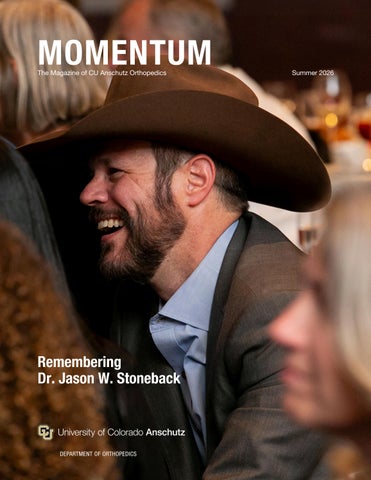
MOMENTUM The Magazine of CU Anschutz Orthopedics
Remembering Dr. Jason W. Stoneback
DEPARTMENT OF ORTHOPEDICS
Summer 2026
A Tribute to Dr. Jason W. Stoneback This issue of MOMENTUM is dedicated to the memory of Dr. Jason W. Stoneback, whose unexpected passing has left an immeasurable void in our department, our institution, and the countless lives he touched throughout his life and career. In the pages that follow, we reflect on the extraordinary legacy of a surgeon, educator, mentor, innovator, and leader whose influence helped shape the Department of Orthopedics and inspired all who had the privilege of working alongside him. His unwavering commitment to patients, passion for discovery, dedication to education, and belief in the power of teamwork continue to guide our work and our mission. Dr. Stoneback's impact cannot be measured solely by the programs he championed, the research he advanced, or the lives he transformed through his care. It lives on in the colleagues he inspired, the trainees he mentored, the friendships he cultivated, and the culture of excellence, compassion, and collaboration he helped create. The work shared throughout this issue reflects those same values in our commitment to pursuing new ideas, advancing care, and educating the next generation. Dr. Stoneback would have been among the first to celebrate the accomplishments of his colleagues featured in these pages, and we know he would have taken great pride in their work. We extend our deepest condolences to Dr. Stoneback's family, loved ones, patients, colleagues, trainees, and all who were fortunate enough to know him. It is with profound gratitude and respect that we dedicate this issue to him. — The Department of Orthopedics
Memorial contributions may be made to the following organizations in Jason's honor.
The Jason Stoneback Memorial Fund for Leadership and Innovation
The National Western Stockshow
Jason W. Stoneback, MD 1978 - 2026
Our magazine is named for the forward energy, drive, and sustained commitment that compels us to push toward a better future— redefining what’s possible in orthopedics, for our patients and beyond. In each issue, we highlight the people and ideas shaping orthopedics at CU Anschutz—advancing discovery, translating innovation into lifechanging results, and leading collaboration that fuels progress across research, clinical care, and medical education.
04 | Summer 2026
Big ideas take persistence. Dreamers Never Quit celebrates the people who keep asking questions, finding answers, and imagining what comes next. Tap the link to read more and watch the 30-second spot.
MOMENTUM MAGAZINE | 05
MOMENTUM
Driven by Discovery. Inspired by Possibility.
Summer 2026 | Vol. 1, No. 3
The University of Colorado Anschutz is a world-class academic medical campus leading transformative advances in science, medicine, education and patient care. The campus includes the University of Colorado’s health professional schools, more than 60 centers and institutes, and two nationally ranked independent hospitals UCHealth University of Colorado Hospital and Children's Hospital Colorado - which see nearly three million adult and pediatric patient visits each year.
Momentum is a quarterly review publication produced by the University of Colorado Anschutz Department of Orthopedics
CU Anschutz Orthopedics 12631 East 17th Avenue Aurora, CO 80045 720-848-1900 cuanschutz.edu
Innovative, interconnected and highly collaborative, CU Anschutz delivers life-changing treatments, exceptional patient care and top-tier professional training. The campus conducts world-renowned research supported by $890 million in funding, including $762 million in sponsored awards and $128 million in philanthropic gifts for research.
Across every subspecialty in orthopedics, CU Anschutz Orthopedics is a recognized global leader in the field, and Colorado’s most trusted orthopedic group for adults and children. Our tireless pursuit of multidisciplinary innovation in medical research, education, and patient care uniquely positions us to deliver compassionate whole-person care with the most advanced clinical treatments—unmatched in Colorado and the Rocky Mountain Region. We are proud to partner with the premier healthcare providers in our region, boasting an extensive network of clinical sites serving communities across the Front Range.
PATIENT CARE
A legacy of redefining what’s possible DISCOVERY AND INNOVATION
34 TRENDING 08
Rethinking Athlete Care How specialized, team-based care is helping gymnasts stay healthy and continue doing what they love.
Advancing Concussion Care
32
CU Anschutz celebrates more than 650 physicians recognized among Colorado’s Top Doctors for 2026.
24 EDUCATION
Leading Colorado
AWARDS & RECOGNITIONS 46
A Chair for Discovery A shared commitment to research becomes an enduring investment in discovery and better care.
Practice Makes Precision
64
58
Momentum Makers Honoring faculty and staff whose leadership and dedication move our department forward.
Photos by Pete Eklund
08 | Summer 2026
Rethinking Athlete Care When an elbow issue threatened to disrupt Caleb Austin’s training, a gymnastics-specific team looked at the demands on his whole body.
When Caleb Austin was 4 years old, he appeared in the upstairs hallway of his family's Georgia home, popped up into a handstand, and walked the length of the hall on his hands. His parents understood the message. Setting in motion a journey that would eventually take him into competitive men's gymnastics, they enrolled him in recreational classes. After his family moved to Colorado in 2018, Caleb completed another year of pre-team training before officially competing in 2019. Now almost 16, he is training to become a Level 10 gymnast. Unlike many youth sports, gymnastics demands mastery across multiple disciplines. For Caleb, that means training on floor, vault, pommel horse, rings, parallel bars, and high bar. Each event places different demands on his body, requiring a rare combination of strength, flexibility, techincal coordination, and endurance. It's one reason families like the Austins turn to providers who understand the sport's unique physical, nutritional, and recovery needs.
"It's not just physical, even though it seems like such a physical feat," said his mother, Melissa Austin. "It's so much more mental and emotional than people realize." Caleb has returned to the sport after broken fingers, a broken wrist and arm, tendinitis, and other interruptions to training. When his elbows began popping and occasionally locking, however, the Austins became concerned about what could happen if an elbow locked while he was performing a skill. They turned to the Gymnastics Medicine Clinic at Children's Hospital Colorado, where they met Dr. Emily Sweeney, a CU Anschutz sports medicine physician and former Level 10 gymnast. Her familiarity with the sport immediately stood out to Caleb. "It felt nice 'cause I felt like she understood what an injury meant," he said. “Doctor Sweeney seemed to be knowledgeable about both the men's and women's side of it."
MOMENTUM MAGAZINE | 09
Rather than considering his elbows in isolation, Dr. Sweeney and her team looked more broadly at how his body was functioning. They determined that tightness in his back— including his lats (latissimus dorsi) and traps (trapezius)—was causing his elbows to overcompensate. Caleb received exercise guidance and returned for follow-up physical therapy appointments. The visit also included nutrition guidance. For gymnasts whose training can span four and a half hours and shift repeatedly between strength, power, and technical skill work, proper fueling is essential to both performance and recovery. Caleb said it can be difficult to know how much to eat and drink around training, and the clinic's dietitian helped him think differently about hydration, carbohydrates, and recovery. "The fact that it was addressing his whole body instead of just the elbow or just the knee, that was the big difference," Melissa said. Those lessons extended beyond the clinic visit. Two years later, Caleb still incorporates the nutrition and physical therapy guidance he received—a reminder that the clinic's impact reached far beyond a single injury. The experience did more than address an elbow problem. It provided practical tools that continue to shape how he trains, recovers and competes. For a young athlete with big goals, those lessons have become part of the foundation Caleb carries with him every time he steps into the gym.
10 | Summer 2026
PATIENT CARE
Caleb trains at Incline Gymnastics in Littleton, Colorado. Through a unique partnership between Children's Hospital Colorado Sports Medicine and Incline Gymnastics Center, more than 500 gymnasts have access to specialized sports medicine care right where they train. With a full-time Children's Hospital Colorado athletic trainer embedded at Incline, athletes and families benefit from convenient injury prevention, evaluation, rehabilitation, and return-to-sport support.
MOMENTUM MAGAZINE | 11
2
Gymnastics places unique demands on the body. What are some of the ways gymnasts differ from athletes in more traditional field or court sports?
Gymnastics Medicine
101
ES: Gymnasts perform incredible feats and make them look so easy. For example, they use their arms like legs. They are incredibly strong and also have a flexibility that is not seen in many traditional sports. There are also multiple events, so even when a gymnast is injured, they can often still do some skills in the gym. For example, a gymnast with a broken foot may be allowed to do some basic skills on bars. Understanding the unique demands of each event in gymnastics allows me to give guidance on how a gymnast can still partially train, which is not only good for their physical health, but often their mental health as well.
Q
Ten questions with Dr. Emily Sweeney
1
A Personal Connection
A Sport Like No Other
3
Building Better Care
As a former gymnast, what first drew you to caring for gymnasts as a physician?
What inspired the creation of the Gymnastics Medicine Clinic at Children's Colorado?
ES: I was a Level 10 gymnast as a teenager but then retired at age 16 due to a number of overuse injuries and surgeries. As I went through medical school and residency, I realized that my care could have been optimized. I wanted to optimize gymnasts' ability to stay healthy and recover from injuries. Although I sometimes wish my care had been different, I realized I could learn from my experiences to make it better for future generations.
ES: The Gymnastics Medicine Clinic had been a thought in my head for a while. My colleague Dr. Aubrey Armento had started a Runner's Clinic and Female Athlete Clinic at Children's, and I knew that gymnasts were unique and needed holistic care. I also thought back to my days as a gymnast and knew that I would have benefited from a more comprehensive approach.
12 | Summer 2026
PATIENT CARE
I want gymnasts to know that they deserve top-notch treatment that will increase their success in the gym and help them become better, healthier athletes. Emily Sweeney, MD
Photo courtesy of Children’s Hospital Colorado
Associate Professor
Dr. Sweeney leads the Children's Hospital Colorado Gymnastics Medicine Clinic and advocates nationally for gymnastics medicine as a distinct area of specialization
MOMENTUM MAGAZINE | 13
4
A Team-based Approach
6
The clinic brings several specialists together in one visit. How does that model benefit athletes and families?
Your research has explored topics such as the female athlete triad and relative energy deficiency in sport, or RED-S. What should athletes, families and coaches understand about the connection between fueling and injury prevention?
ES: Nutrition, mental health and physical therapy are extremely important for gymnasts, and I wanted to make sure gymnasts in Colorado had access to these resources. I also wanted gymnasts, their parents and coaches to know that the whole care team was on the same page. Therefore, having multiple providers see the athletes in a single visit provides consistency and continuity for the gymnasts.
ES: Many gymnasts train a lot of hours each week and rarely have an off-season. Between training, school, and other life demands, there is often an unintentional under-fueling that occurs. If gymnasts don’t have enough fuel to train and compete, they are at risk for both overuse and acute/traumatic injuries. This is an especially important topic in our young athletes when they are growing and developing.
What is RED-S? Relative Energy Deficiency in Sport (RED-S) occurs when athletes do not consume enough energy to support both athletic performance and normal body function.
5
The Whole Athlete Nutrition, recovery, and mental health are all part of the clinic's approach. Why is it important to look beyond the injury itself? ES: Injuries don't happen in a vacuum. If nutrition, strength, flexibility and recovery are not optimized, gymnasts are more likely to get injured and have a tougher recovery. I try to talk to gymnasts about ways they can prevent injuries and then what they can do right after an injury in order to get back quickly and safely. Our dietitian, physical therapist and athletic trainer at Gymnastics Clinic help make sure that we are treating the whole athlete, not just the injury.
Fueling & Injury Risk
7
Changing Perceptions What are some common misconceptions about gymnastics injuries and athlete health? I think there are a lot of myths about gymnastics injuries and gymnastics itself. The first is that you have to train 20-30 hours year-round in order to be successful. I think having time to recover and rest is really important for gymnasts, especially when they are growing. I also think many people in the gymnastics community think that pain is normal. I often tell gymnasts, pain is common but not normal. If we can address pain quickly, we can probably get them back to gym quickly and help them have more long-term success. When pain is ignored for a long time, it often becomes a big problem that can lead to a prolonged time out of sport, which is not what anyone wants. Finally, I think that we are seeing more success from our older gymnasts. I want our younger gymnasts to know that taking their time to progress in the sport will likely lead to longer term success.
8
The Gymnastics Medicine Clinic
National Leadership Children's Hospital Colorado is one of the first pediatric gymnastics clinics in the country. What role do you hope the program will play in advancing the field?
1811 Plaza Drive Highlands Ranch, CO 80129 (720) 777-3898
ES: There are so many great medical professionals throughout the country who really want to help gymnasts. I am grateful that I get to have this multidisciplinary clinic for gymnasts and hope that other hospitals and clinics develop similar programs. I want gymnasts to know that they deserve topnotch treatment that will increase their success in the gym and help them become better, healthier athletes.
New Location Opening November 4, 2026
10 9
From CO to USA Gymnastics You work with elite athletes through USA Gymnastics while also caring for young athletes in Colorado. What lessons from each setting inform the other? ES: I am grateful that I get to serve as the Team Physician for USA Gymnastics Junior Women’s National Team. I travel with the team throughout the country and internationally to help these athletes stay healthy and reach their full potential. The staff I work with includes mental health specialists, dietitians, PTs, and ATs. We all work together to help care for this elite group of gymnasts. Thus, I utilize what I learn in both settings to make sure athletes in Colorado and throughout our country receive the best care.
Looking Ahead When you think about the future of gymnastics medicine, what progress are you most excited to see? ES: Gymnastics is an amazing sport, and the medical professionals helping our athletes are really working hard to make sure our gymnasts get top-notch care. I think we are definitely heading in the right direction for our sport and know that areas like return to sport progressions, nutrition, mental health care, and strength and conditioning are getting the attention they need in order for all gymnasts to perform their best.
MOMENTUM MAGAZINE | 15
femur
posterior cruciate ligament (PCL) patella
lateral collateral ligament (LCL)
anterior cruciate ligament (ACL)
medial collateral ligament (MCL)
fibula
tibia
DISCOVERY & INNOVATION
Inside the evolving science of ACL injury, reconstruction, and the road to recovery.
Holding it all together Few sports injuries are as instantly familiar as an ACL tear. Fans hear about them when a football or soccer player is helped off the field, a basketball player lands awkwardly or a downhill skier announces that her season is over. For competitors in sports built around swift lateral movement, pivoting and landing, the injury can feel like a threat waiting to happen. But behind those three familiar letters is a marvel of anatomy and a far more complex story. At CU Anschutz, clinicians and researchers are working to better understand ACL injury, improve reconstruction and rehabilitation, and uncover new insights into prevention and recovery. That work has particular urgency for female athletes, who face a substantially greater risk of tearing the ligament and may encounter distinct challenges on the path back to sport.
MOMENTUM MAGAZINE | 17
The Anatomy of Stability
18 | Summer 2026
The knee is remarkably capable of doing something deceptively difficult: remaining stable while in motion. Every jump, cut, sprint, and landing requires the joint to absorb substantial force while maintaining balance and control. One of the structures that makes that possible is the anterior cruciate ligament, or ACL. Located deep within the knee, the ligament connects the femur and tibia, helping control both forward movement and rotation. It serves as one of the joint's primary stabilizers, particularly during the twisting and directional changes common in many sports.
When the ACL tears, that stability can disappear in an instant. The injury may not prevent someone from standing or even walking, but the knee often no longer feels trustworthy. For athletes whose performance depends on speed, agility, and precision, that loss of confidence in the joint can be just as significant as the injury itself. But the likelihood of facing that injury— and the challenge of trusting the knee again afterward—are not the same for every athlete.
The Risk Gap
Photos courtesy of CU Athletics
ACL injuries can affect anyone, but they do not affect every population equally. Female athletes have been reported to face two to eight times the risk of ACL injury compared with their male counterparts. The disparity appears across high school, collegiate, and professional levels of sport and peaks among females between the ages of 14 and 18. Female athletes’ injuries also more frequently result from noncontact mechanisms rather than direct player contact. That disparity has made the female ACL an important focus of research, not only to understand why these injuries occur more often, but how female athletes can reduce their risk, recover successfully, and regain confidence in the knee.
More Than One Explanation A 2026 review by CU Anschutz medical student Miranda Manfre, Chief Resident Dr. Evan Richman, and Professor Rachel Frank, MD—with international colleague Guillermo Araujo-Espinoza, MD, of Delgado Auna Clinic, Peru—examines ACL injuries specifically in female athletes. The review brings together current evidence around the many factors that may contribute to increased risk, along with considerations for treatment, recovery and prevention. The picture is complex. Anatomy, genetics, hormones, training exposure and movement patterns may all play a role. Females tend to have smaller ACLs, and differences in knee anatomy may influence susceptibility. Researchers have also studied movement patterns such as quadriceps dominance, reduced hamstring activation and inward movement of the knee, which can increase stress on the ACL. Hormones are another area of study, but the science remains unsettled. Researchers have explored whether hormonal fluctuations during the menstrual cycle may affect injury risk, but studies have produced inconsistent findings. Rather than pointing to any one cause, the evidence suggests that multiple factors can intersect. Some cannot be changed. Others can.
Training for Prevention That distinction creates an important opportunity for prevention. “Reducing ACL injury risk in female athletes begins with targeted neuromuscular training that emphasizes strength, balance, landing mechanics, and movement control,” Frank says. These programs use combinations of strength, balance, plyometric and proprioceptive training to address modifiable risks and improve how athletes control their bodies during dynamic movement. Structured neuromuscular training has been shown to reduce ACL injury rates by up to 50% in female athletes. No single program has emerged as universally superior. What matters is consistent training, proper technique and making prevention part of the athlete’s regular routine.
20 | Summer 2026
The ACL Injury, Risk & Return to Sport
250,000 ACL injuries occur in the U.S. each year, accounting for more than $2 billion in health care costs.
2x-8x Female athletes face two to eight times the risk of ACL injury compared with male athletes.
The Comeback A healed knee is only part of the comeback. Restoring confidence can be just as critical to returning to sport.
No One-Size-Fits-All Reconstruction When an ACL tear does occur, the same emphasis on the individual carries into treatment. ACL reconstruction uses a graft to replace the torn ligament, with options that may include tissue from the patellar tendon, hamstring or quadriceps tendon, as well as donor tissue. No single choice has been proven best for every patient. Anatomy, biomechanics, athletic goals and functional demands all matter. “When ACL reconstruction is necessary, surgical care should be individualized to each athlete’s anatomy, sport, and risk profile, including thoughtful graft selection and consideration of lateral augmentation procedures when appropriate,” Frank says. For some athletes, lateral augmentation may also be considered to address rotational instability and help protect the reconstruction. The principle is straightforward: ACL reconstruction is not one procedure applied the same way to every knee. The athlete standing on that knee matters, too.
Rachel Frank, MD Professor
Evan Richman, MD Chief Resident
Miranda Manfre, BS Medical Student
Recovery Beyond the Repair That individualized approach continues long after the ACL has been repaired. “After surgery, an individualized rehabilitation program and objective return-to-sport testing, rather than time alone, are essential to restore confidence, optimize performance, and reduce the risk of reinjury,” Frank says. For female athletes, however, physical recovery may be only part of the challenge. Studies cited in the review found that approximately 69% to 75% of female athletes return to sport following ACL reconstruction. Compared with males, female athletes have also been found to have 25% lower odds of returning to sport within the first five years following ACL injury or reconstruction. Often, the barrier is not the physical function of the knee. Female athletes who do not return frequently point instead to fear of reinjury or a lack of confidence in the knee. And while physical function has been associated with psychological readiness among male athletes, research highlighted in the review did not find the same relationship among female athletes. The knee may be physically ready before the athlete fully trusts it. That makes confidence part of rehabilitation, too. The goal extends beyond restoring stability or receiving medical clearance. It is helping athletes cut without hesitation, land without fear, and return to sport trusting the knee—and the ligament holding it all together.
Training the Next Generation For medical student Miranda Manfre, the ACL review has been part of a broader education shaped by early clinical and research experience and mentorship. “My time at CU Anschutz, especially in the small-group setting at the Fort Collins Regional Branch, has provided a strong foundation in the medical sciences paired with early, meaningful clinical experiences that integrate clinical reasoning and interpersonal skills. Beyond the curriculum, I've been grateful for Dr. Frank's exceptional mentorship. Through research opportunities that foster my interests in orthopedic surgery as well as guidance for each stage of my education, her support has been invaluable for my development as a future physician.”
MOMENTUM MAGAZINE | 21
IMPACT
By helping define what sports medicine specialists should know, CU Anschutz Orthopedics faculty are contributing to better-prepared physicians and better-informed care across the country. When patients visit a sports medicine specialist, they expect care grounded in the latest knowledge and best practices. One CU Anschutz Orthopedics faculty member recently helped shape the national standards that define those expectations. Through his contributions to American Board of Family Medicine publications supporting the 2026 Certificate of Added Qualification in Sports Medicine blueprint, Dr. Bradley Changstrom helped update the framework used to guide physician certification. “The new Certificate of Added Qualification in Sports Medicine blueprint reflects the evolving practice of sports medicine and ensures that the sports medicine examination is relevant to the subspecialty.” Bradley Changstrom, MD Associate Professor Sports Medicine
Dr. Changstrom is a primary care sports medicine physician whose guiding principle is helping patients stay active. Alongside caring for athletes from youth sports to the professional ranks, he serves as Medical Director of Sports Medicine for the American Board of Family Medicine.
22 | Summer 2026
The Playbook The previous certification blueprint had not been substantially updated since 2004 and was organized around traditional content categories, some of which made up only a small portion of the exam. For example, Role of the Team Physician accounted for just 1% of exam content, limiting the ability to meaningfully assess competency in that area. The updated blueprint reorganizes sports medicine into five broad domains that better reflect contemporary clinical practice and provide more useful assessment data. Importantly, the new blueprint shifted from relying primarily on expert opinion to a data-driven, practice-based model informed by sports medicine physicians nationwide. The effort brought together representatives from the cosponsoring specialty boards, the American Medical Society for Sports Medicine (AMSSM), and more than 100 board-certified sports medicine physicians who provided feedback throughout the revision process. A nationally representative survey of more than 330 board-certified physicians then helped determine how frequently clinicians encounter specific conditions and the potential risk to patients if those conditions are misdiagnosed or improperly managed. Those findings helped Dr. Changstrom and colleagues determine how much weight each domain should receive on the certification exam. The new framework also broadens the definition of sports medicine beyond orthopedic injuries. While musculoskeletal conditions remain the largest domain, the blueprint places significant emphasis on medical conditions, prevention, and emergency care, reflecting the reality that sports medicine physicians routinely manage everything from concussion and cardiovascular concerns to mental health, chronic disease prevention, and return-to-play decisions.
Behind Better Care This visualization shows the relative weighting of topic domains included in the newly revised 2026 Sports Medicine Certification exam. The largest domains focus on the diagnosis and management of musculoskeletal injuries and medical conditions, reflecting the breadth of expertise sports medicine physicians need to help patients prevent injuries, recover safely, and stay active throughout their lives.
The review identified several gaps in the older blueprint and formally incorporated emerging areas that have become increasingly important in sports medicine practice, including:
Foundations of Practice Preventive Aspects of Sports Medicine
Diagnosis, Management, and Epidemiology of Sports- and Exercise-Related Musculoskeletal Conditions
concussion ultrasound orthobiologics RED-S (Relative Energy Deficiency in Sport) early specialization para-sport athletes preventing abuse in sports inclusive athlete care
Diagnosis, Management, and Epidemiology of Sports- and Exercise-Related Medical Conditions
Care of Emergency Conditions
MOMENTUM MAGAZINE | 23
What we know about
CONCUS
Photos courtesy of Children’s Hospital Colorado
24 | Summer 2026
DISCOVERY & INNOVATION
September is Concussion Awareness Month, a time when many people are reminded of the signs and symptoms of one of the most common injuries in sports. For researchers and clinicians at CU Anschutz, concussion awareness is about more than recognizing an injury—it is about understanding what happens afterward and continually improving how patients recover. Their groundbreaking work is defining what’s next in concussion care, transforming new insights into personalized treatment and better outcomes.
SSIONS is only the beginning. MOMENTUM MAGAZINE | 25
From the Clinic to the Lab and Back Again For decades, concussion care focused on symptom management and rest. Today, a growing body of research is reshaping that approach. Scientists now know that concussion recovery is influenced by a complex interplay of biological, behavioral, physical, and psychosocial factors. At CU Anschutz, researchers are working to better understand those factors and translate discoveries into care that is more personalized, effective, and accessible. At the center of that work is the Colorado Concussion Research Laboratory, co-led by David Howell, PhD, and Julie Wilson, MD. Their collaborative model brings together researchers, physicians, athletic trainers and physical therapists, with a shared goal: improving outcomes for patients.
26 | Summer 2026
For Howell and Wilson, translational research is not just an academic concept. Clinical experiences help identify the questions that matter most, while research provides the evidence needed to answer them. Howell notes that Wilson's clinical insights help shape the research agenda, ensuring studies remain grounded in the challenges patients and providers encounter every day. The result is a powerful feedback loop, where clinical care shapes discovery and discovery helps define the future of concussion care.
Left | Julie Wilson, MD and David Howell, PhD Below | patients presenting for concussion evaluation may perform an exercise test and rate their perceived levels of exertion as part of an individualized recovery plan
Moving Beyond OneSize-Fits-All Care One of the laboratory's guiding principles is that concussion recovery is highly individualized. Researchers are studying how exercise, sleep, sensorimotor function, psychosocial health, academic challenges, biological factors, and injury history influence outcomes. Rather than searching for a single solution, they are developing approaches that account for individual variability and target factors that can be modified to support recovery. "One size does not fit all" has become a central theme of the team's work as they seek to optimize interventions through precision-based approaches, identifying which strategies work best for specific patients and when they should be implemented. That philosophy has contributed to a broader shift in concussion management. Years ago, patients were often advised to avoid activity until symptoms resolved. Emerging evidence suggests recovery may benefit from carefully guided rehabilitation that begins much earlier.
The Exercise Prescription Among the most promising areas of investigation is the role exercise can play in recovery. Howell's research has helped advance understanding of how subsymptom aerobic exercise—physical activity performed below the threshold that worsens symptoms—may support recovery after concussion. The work is challenging long-held assumptions about prolonged rest and helping establish more precise rehabilitation guidelines. But the research extends beyond symptom relief. Howell and co-investigators, Julie Wilson, MD and Patrick Carry, PhD, recently received a prestigious NIH grant for their work Neuroprotective Kynurenine Pathway Effects of Exercise on Depression after Adolescent Concussion, to investigate how exercise may influence biological pathways associated with depressive symptoms following concussion.
The project explores a growing body of evidence suggesting that inflammation triggered by concussion can alter metabolism in ways that affect mood and mental health. The Colorado Concussion Research Laboratory is examining whether exercise may act as a neuroprotective intervention by redirecting those processes and reducing risks for depression and anxiety during recovery. This work reflects a larger trend in concussion science: understanding not just whether patients recover, but why some recover differently than others.
Better Sleep, Better Recovery Sleep represents another important frontier. A pilot project funded through the Colorado Clinical and Translational Sciences Institute (CCTSI) enabled Howell and colleagues to study sleep disturbances in adolescents following concussion. Using wearable technology, sleep monitoring tools, and daily reporting methods, researchers gathered data that challenged conventional assumptions and formed the foundation for larger NIH-funded studies. The findings led to the development of what Howell described as a "first-of-its-kind behavioral sleep intervention for adolescents with concussion." Rather than relying on generalized guidance, the intervention creates individualized sleep plans based on each patient's habits, schedule, and needs. The approach mirrors a broader movement toward personalized medicine, where treatment recommendations are tailored to individuals rather than applied uniformly across every patient.
Why It Matters NIH-Funded Research
Transformative discoveries don't happen by accident. They begin with bold ideas, rigorous science, and a commitment to improving lives. NIH funding is awarded to researchers whose work has the potential to redefine what's possible in patient care.
Dr. Howell’s research study has the potential to completely change the paradigm for post-concussion treatment of children. Ron Sokol, MD Director | CCTSI Chief Scientific Officer, Child Health Children’s Colorado and CU Anschutz
28 | Summer 2026
clinical observation
Linking Discovery to Real-World Impact The team's goal is simple: turn discovery into better care. From personalized rehabilitation strategies to smartphone-based recovery tools, their research is designed to make an immediate difference in patients' lives. Just as importantly, Howell and Wilson prioritize education and outreach, helping ensure new evidence reaches the physicians, therapists, athletic trainers, and other professionals caring for patients with concussion. For Howell and Wilson, success is measured not by discoveries alone, but by meaningful improvements in recovery and quality of life. As our understanding of concussion continues to evolve, so does the potential to improve care. The questions being asked today may help define the next generation of treatment. And if the work underway at CU Anschutz is any indication, what we know about concussions is only the beginning.
research
evidence
treatment protocol Below | (left) Looking inside the biology of a concussion: Standard tubes like these are used in clinical studies to collect blood and understand brain recovery. By measuring specific proteins and signs of inflammation in the blood, researchers can better understand how the brain heals after a concussion, and what factors help to facilitate optimal healing. Below (right) Inside the science of sleep: A patient is fitted with wearable technology to monitor sleep.
improved patient outcomes
Concussion Awareness | 5 Things to Know Get evaluated. Every concussion is different and recovery isn’t one-size-fits-all. Factors such as age, sleep, injury history, symptoms, and overall health can influence recovery, which is why personalized treatment plans matter. What you can do: Seek an evaluation from a provider experienced in concussion care rather than relying on generic advice.
Keep moving safely. Experts once prescribed strict rest after concussion. Research now suggests that carefully guided physical activity can play an important role in recovery. What you can do: Follow your provider's recommendations for safely returning to activity instead of staying inactive for extended periods.
Prioritize sleep. Your brain does some of its most important healing overnight. Though sleep issues are common after concussion, taking steps to improve sleep is an important part of the recovery process. What you can do: Keep a consistent sleep schedule, limit screens before bed, consider relaxation methods, and discuss ongoing sleep issues with your care team.
30 | Summer 2026
DISCOVERY & INNOVATION
Don't ignore symptoms. Dizziness, balance problems, neck pain, and vision-related symptoms can persist after concussion and may require targeted treatment. What you can do: Tell your provider about all of your symptoms, even those that seem unrelated to the concussion itself.
Think beyond the injury. Biological, physical, emotional, behavioral, and social factors all influence recovery. Effective concussion care often takes all of them into account. What you can do: Pay attention to your mood, stress levels, school or work demands, and overall wellbeing, not just physical symptoms.
MOMENTUM MAGAZINE | 31
Leading Colorado 32 | Summer 2026
More than 650 CU Anschutz physicians were named to 5280 Magazine's 2026 Top Doctors list, accounting for nearly half of all physicians recognized statewide. Selected through peer nominations, the honor reflects the depth of expertise across more than 70 medical and surgical specialties. CU Anschutz physicians comprised all Top Doctors in several highly specialized pediatric disciplines and held a majority of recognitions in fields including emergency medicine, pulmonary disease, rheumatology, and infectious disease. Orthopedic surgery was among the specialties with the highest concentration of recognized physicians, underscoring our leadership in delivering complex, specialized care across Colorado and beyond. The Department of Orthopedics joins the broader CU Anschutz community in celebrating all the physicians—our partners in multidisciplinary care— recognized by their peers as Colorado's Top Doctors for 2026.
This recognition is a testament to what makes CU Anschutz unique: exceptional physicians working together to solve medicine's toughest challenges. From routine care to the most complex cases, our teams are transforming discoveries into better treatments and better outcomes for patients across Colorado and far beyond.
IMPACT
John H. Sampson, MD, PhD, MHSc, MBA Dean | CU Anschutz School of Medicine
650+ 70+ 50% 1
experts recognized by their peers
specialties represented of Colorado's Top Doctors are CU Anschutz physicians academic medical institution leading the Rocky Mountain region
MOMENTUM MAGAZINE | 33
A legacy of redefining what’s possible. Dr. Jason W. Stoneback challenged assumptions, expanded horizons, and inspired others to see beyond immediate limitations. His influence endures in the lives he changed, the work he led, and the culture of excellence, innovation, and compassion he helped create at CU Anschutz and beyond.
34 | Summer 2026
MOMENTUM MAGAZINE | 35
Photo by PhotographyG.com
Many dream of what is possible. An extraordinary few redefine it. This is the legacy of Dr. Jason W. Stoneback. As Executive Vice Chair of Clinical Affairs, Chief of Orthopedic Trauma and Fracture Surgery, and leader of the Limb Restoration Program, Jason Stoneback dedicated his career to caring for patients facing some of the most complex orthopedic challenges imaginable. Yet those who knew him best speak first not of his titles and accomplishments, but of his compassion. Many of Jason's patients arrived after being told what could not be done. Under his care, they discovered what could. He possessed a rare ability to see possibilities where others saw limitations and he was relentless in pursuing solutions that restored function, independence, and hope. But his innovations were never about advancing technology for its own sake, or for his own personal recognition. They were driven by a deep commitment to helping people reclaim the lives they wanted to live. In the weeks following his passing, colleagues heard the same sentiment time and again from patients: "He changed my life." Many recalled weekend hospital visits, the personal phone calls, and the feeling that Jason genuinely cared about them as people, not just patients. Jason also understood that the most difficult challenges are not solved alone. He built expert multidisciplinary teams united by a shared purpose.
Under his leadership, the Limb Restoration Program became a destination for complex care and innovation, helping establish national and international recognition in osseointegration and limb restoration. Always thinking about what’s next, his research sought not simply to improve what was possible for patients today, but to change what would be possible tomorrow. He helped define an emerging field while creating opportunities for others to advance it alongside him. Jason's influence was equally profound as a professor and mentor. He challenged those around him to strive for excellence. Colleagues described a leader whose vision was often years ahead of the moment, but who remained deeply invested in helping others grow. Especially fond of the proverb "iron sharpens iron," he invested tirelessly in helping others reach further. Entrusting people with responsibility, holding them to a standard he knew they could meet—even exceed—and inspiring them to pursue ideas they might not otherwise have imagined, Jason led with heart and a joyful spirit.
The accolades alone could fill an entire issue of this magazine. Awards, national leadership roles, groundbreaking research, and clinical innovations reshaped patient care and advanced the field of orthopedics. But those who knew Jason best understand that achievements were never what motivated him.
What mattered most to Jason were people.
Long before it became part of our department's vocabulary, Jason spoke about "redefining what's possible" for patients facing seemingly insurmountable challenges. It was more than a catchy phrase. It was a philosophy that shaped his approach to medicine, innovation, leadership, and life. He refused to accept existing limitations as the final answer, constantly asking what more could be done, what barriers could be removed, and what new paths could be created for the people who placed their trust in him. Jason believed that each of us brings something entirely unique to the world, and when we dedicate ourselves and our work in service of something larger than ourselves, the truly extraordinary can happen. That philosophy remains one of his most enduring gifts to all of us.
The best way we can honor that gift is to do as Jason did: bring our unique gifts to bear, never accept the status quo, lift others up, and work together—striving to redefine what is possible.
Photo by PhotographyG.com
Jason celebrated the journeys and successes of others as enthusiastically as his own. From patients to colleagues and mentees, he recognized hard work and excellence and never missed an opportunity to shine a light on others, often praising them in their absence—a true reflection of his character and the genuine respect and admiration he had for the people around him.
Photo by PhotographyG.com
Restoring patients' form and function drives our every decision, with one clear mission: to enhance mobility, improve outcomes, and redefine what's possible.
Photo by Nate Castner
Jason W. Stoneback, MD Professor
Every institution has a culture. Some people live within it. Others create it. They contribute not only to the work of the institution, but to its soul. Jason Stoneback was one of those people. Jason's influence will continue to be felt in the lives he changed, in the work he led, and in the culture he helped create here. Don Elliman Chancellor
He truly loved this place. He loved this residency, and he loved this department.
Jason didn't carry his flame quietly in a corner of this campus. He threw sparks everywhere he went. Every one of those sparks is still burning.
Nicholas Alfonso, MD Director, Orthopedic Surgery Residency Program
Tom Gronow President & CEO | UCHealth
Jason really set the standard for how teams should work together. Danielle Melton, MD Limb Restoration Program
He was always thinking about the next biggest thing. Craig Hogan, MD Chief | Joint Replacement Surgery
Dr. Stoneback was a miracle worker who saved my leg and gave my wife Theresa and me our lives back. Coming from a samurai lineage, presenting him with a samurai sword was our family’s highest honor for a true warrior of healing. His extraordinary skill, dedication, and heart changed our lives forever. We are eternally grateful for his legacy. Noel Ikeda Patient
Jason asked me if I could meet him in his office at the hospital at 7 a.m. on Monday morning. At the time, I thought this surgeon who had this crazy hectic schedule was looking for a work-life balance so he could manage his time a little better. He was looking to perform these incredible surgeries, get home to see his wife, ride his horse and maybe team rope a little more. Now, I know it was so much bigger than that. Managing his time was maybe the most valuable thing I could do for him because it gave him the ability to give so many people his time, and that was such a privilege.
Jessie Miller Program Coordinator Limb Restoration Program
His mindset of not accepting “good enough” was really pushing the limits— trying to help people regain their lives. Jason Macom Patient
Photo by Pete Eklund
He was a doctor's doctor. And he had character. He had character in spades. Robert D’Ambrosia Chair Emeritus
Jason left behind a legacy not fixed in stone, but alive in people—in the families comforted, the patients restored, the learners formed, the standards elevated, and the community strengthened by his presence. Evalina Burger, MD Professor and Chair
Photo by PhotographyG.com
Wherever the art of medicine is loved, there is also a love of humanity. Hippocrates
With gratitude for the legacy Dr. Stoneback leaves to our community.
A Cowboy Farewell
His saddle hangs silent where morning once stirred; no jingle of spurs, no familiar word. The prairie keeps watch beneath the endless blue, while the wind through the sage seems to whisper of you. Your horse stands waiting beside an empty gate, as though you are only riding home a little late. We laid you to rest where the wild grasses grow, where the mountains stand guard and the western winds blow. And though one good cowboy has ridden from sight, Jason, your trail through our hearts will outlast every night.
Chris van der Walt
Jason aboard Rolex, heading down through Colorado’s Gore Range on the Big Ride 2025 with Roundup Riders of the Rockies. | Photo courtesy of the Stoneback Family
Bob Karol, Robert Eilert and David Howell
Investiture photos by Nichole Emerson, courtesy of Children’s Hospital Colorado
An endowed chair begins with a belief that the work worth doing should have the support to continue. The Dr. Robert Eilert and Dr. Lori Karol Endowed Chair in Musculoskeletal Research is the culmination of nearly two decades of that belief, carried forward by physicians, families, colleagues, and a department determined to build a lasting future for pediatric orthopedic research. Its roots reach back to Dr. Robert Eilert, Denver’s first pediatric orthopedic surgeon, who arrived at Children’s Hospital Colorado in 1976. Investing deeply in the work he loved, Eilert helped establish the hospital’s pediatric orthopedic program, recruited colleagues, launched its fellowship, and laid the foundation for the academic enterprise that followed. In 2007, he joined Drs. Mark Erickson and Nancy HadleyMiller in establishing the Musculoskeletal Research Center (MRC), creating a home for research focused on improving the lives of children with orthopedic conditions and injuries. The ambition was clear. Sustaining it would take time.
“You should invest in things that you love, and you’ll be a very happy person.” Robert Eilert, MD
Faculty members invested their own resources in the center’s work as its research program grew. Then Dr. Lori Karol arrived in Colorado in 2020 as the third holder of the Rose Brown Endowed Chair of Pediatric Orthopedic Surgery. A prolific scholar and nationally respected leader, Dr. Karol saw what the center could become with permanent support. Completing a musculoskeletal research endowment became her vision for its future.
A Chair for Discovery David Howell, PhD, ATC, is named inaugural holder of the Dr. Robert Eilert and Dr. Lori Karol Endowed Chair in Musculoskeletal Research
Dr. Karol’s time in Colorado was cut short by illness, but the future she imagined did not end with her passing in 2022. In her memory, Drs. Klane White and Evalina Burger committed themselves to bringing her vision to fruition. Beginning in 2023, the Orthopedics Institute dedicated its Courage Classic Bicycle Tour efforts to the endowment, riding in her memory and raising another $250,000. In December 2025, the story came full circle when Eilert and his family completed the fund. The chair bearing their names is both remembrance and momentum. It honors Eilert, who helped build pediatric orthopedics at Children’s Hospital Colorado, and Karol, whose brief but impactful time there left a lasting direction. More importantly, it secures what both understood: discovery cannot depend solely on the next grant, the next budget cycle, or the steadfast determination of individual faculty members. It needs a foundation built to endure. David Howell, PhD, ATC, now becomes the first person entrusted with carrying that foundation forward. Since earning his doctorate in biomechanics and neurophysiology from the University of Oregon and completing postdoctoral training in sports medicine at Boston Children's Hospital, Howell has become a leading voice in pediatric orthopedic research. He has authored more than 260 peer-reviewed publications, and his Colorado Concussion Research Laboratory has earned support from the National Institutes of Health (NIH), the Department of Defense, and other agencies. MOMENTUM MAGAZINE | 47
Mark Erickson, MD (Fellowship Director, Pediatric Orthopedic Surgery) | David Howell, PhD | Robert Eilert, MD
Robert Eilert, MD | Evalina Burger, MD (Chair, Orthopedics) | David Howell, PhD
IMPACT
As research director of the Children’s Hospital Colorado Sports Medicine Center and director of clinical research in the Department of Orthopedics at CU Anschutz, Howell has built a career around questions that begin with patients. His recent work seeks to improve concussion diagnosis, recovery monitoring, prognosis, and rehabilitation by understanding why recovery differs from one person to another and how evidence can guide more individualized care. His appointment as inaugural chairholder reflects both a record of tremendous accomplishment and confidence in the work still ahead.
Klane White, MD (Chair, Pediatric Orthopedics) | Bob Karol
Endowed support provides something indispensable to academic medicine: a lasting foundation for discovery. It gives researchers opportunities to pursue promising ideas, develop new lines of inquiry, and build the collaborations necessary to transform questions into meaningful advances in care. Questions that take years to answer can be approached with confidence that the work will continue, even as investigators, technologies and priorities evolve. Robert Eilert helped create the program. Lori Karol saw a future in which its research would be sustained in perpetuity. As the inaugural chairholder, David Howell will help carry that vision forward — building on a foundation shaped by generations of leaders, mentors and supporters committed to advancing musculoskeletal care. Their names now share a legacy that reaches beyond remembrance, creating opportunities for discovery that will benefit generations of children. What began as a vision embraced by colleagues, families and supporters now becomes a permanent foundation for the breakthroughs, innovations, and improved care still to come.
Lori Karol, MD (1961-2022)
MOMENTUM MAGAZINE | 49
Gut Check Photos by Tara Bisel | CU Anschutz Orthopedics
50 | Summer 2026
DISCOVERY & INNOVATION
Could recovery from a bone fracture begin in the gut? CU Anschutz researchers are working to find out. A fracture may be local, but healing is a whole-body process. At CU Anschutz, Honey Hendesi, MD, PhD, and a multidisciplinary team are exploring an unexpected part of that equation: the gut microbiome. A four-year, $2.3 million National Institutes of Health (NIH) R01 award brings together expertise in orthopedics, nutrition and obesity research, and biomedical informatics to unravel the connections among the gut microbiome, metabolism and bone healing. The work builds on an intriguing finding from Hendesi’s earlier research. In obese animal models, intermittent fasting altered the gut microbiome and was associated with improved bone repair. Now the team wants to know whether those microbial changes are simply happening alongside healing or helping to drive it.
MOMENTUM MAGAZINE | 51
Overall, our gut impacts our whole body. What our research is showing is the importance of the connection between the gut and our skeletal health. Honey Hendesi, MD, PhD
Honey Hendesi, MD, PhD | Principal Investigator, NIH R01 awardee
The Power of Possibility
The Fasting Effect
In 2023, a competitive $50,000 CU Anschutz Dyads Pilot Award paired Honey Hendesi, MD, PhD, with Janani Ravi, PhD, around an intriguing question: Could intermittent fasting change the gut microbiome in ways that influence bone health and fracture healing? Designed to create what organizers called “serendipity at scale,” the program brings orthopedics and biomedical informatics researchers together to pursue questions at the intersection of their fields. Two years later, that initial collaboration helped generate the data and scientific foundation Hendesi needed to compete successfully for her first NIH R01, a $2.3 million award and a major milestone in her research career. Along with a second pilot award from the Colorado Clinical and Translational Sciences Institute (CCTSI), the early support turned a promising question into a federally funded research program with the opportunity to probe the gut-bone connection much more deeply. Now, the question is not simply whether fasting makes a difference, but why.
Intermittent fasting focuses less on what we eat and more on when we eat, creating longer stretches when the body goes without a steady influx of energy from food. During those periods, the body shifts how it fuels itself. The gut shifts, too. The gut microbiome is a vast community of microbial cells thought to be roughly as numerous as the human cells in our bodies. Numbering in the trillions, these microorganisms normally draw energy from food moving through the digestive system. When that external supply pauses, they must rely more on resources within their own microbial community. That shift can change the composition of the microbiome, Hendesi says, allowing certain beneficial bacteria to become more abundant and produce compounds such as short-chain fatty acids. Those compounds can subsequently enter the bloodstream, where they help regulate immune responses and may benefit tissues and organs throughout the body, including bone. Identifying these connections is particularly important in obesity, which is associated with delayed fracture healing and related complications.
52 | Summer 2026
Identified in 1980 by American microbiologist John L. Johnson, Lactobacillus johnsonii produces lactic acid, which helps lower gut pH and suppress harmful bacteria. Image: Wikipedia
Honey Hendesi, MD, PhD examines bone fracture tissue under the microscope. On the monitor, the arrangement of collagen fibers at the site of fracture is microscopically imaged.
Doug Adams, PhD | Janani Ravi, PhD | Honey Hendesi, MD, PhD | Vicki Catenacci, MD
Great Minds Don’t Think Alike That makes the microbiome much more than a bystander in this research. The team is investigating which microbes and microbial metabolites are associated with changes at the fracture site and how that relationship evolves through different stages of healing. One microbe of particular interest is Lactobacillus johnsonii, a bacterium naturally found in the gut. Preliminary findings suggest that increasing its abundance could have a beneficial effect on fracture healing in obesity. The team will put that possibility to the test by supplementing obese mice with the bacterium and examining whether it improves bone repair. Understanding which microbes and metabolites are actually involved could reveal something even more promising: ways to harness the benefits of the gut microbes without applying a fasting regimen. This work is an early step toward targeted probiotic therapies that could one day provide a new, nonpharmacological approach to supporting fracture healing.
If fasting reveals a conversation between the gut and a healing bone, understanding what the two are saying requires scientists with different expertise. The project connects diet, the microbiome, and skeletal repair—a scope no researcher can tackle alone. Each team member brings a different piece of the puzzle. Hendesi brings expertise in bone biology and fracture repair, focused on how diet and the gut microbiome influence those two. Douglas Adams, PhD, contributes expertise in bone imaging and biomechanics, while Vicki Catenacci, MD, brings experience in nutrition, obesity, and the clinical benefits of intermittent fasting. Janani Ravi, PhD—a biomedical informatician—leads analyses of complex microbiome data and connects it with what researchers see in the bone. The team will follow two stories at once: cellular changes at the fracture site and changes unfolding simultaneously in the gut microbiome. Computational models will bring those streams together, helping researchers identify which microbes and metabolites are associated with the bone at different stages of repair. Driven by discovery and inspired by what’s possible, this journey from pilot project to federally funded research program reflects the power of bringing different disciplines together around bold questions.
MOMENTUM MAGAZINE | 53
Below (right): Jennifer Kummer, MD | Associate Professor (second from left) with Kristina Barber, MD (CROM, Greenwood Village, CO) and Madison Rutenbeck, CHT (Canterbury, New Zealand) and members of the Da Nang General Hospital Orthopaedic Care Team
Photos courtesy of Jennifer Kummer, MD
PATIENT CARE & SERVICE
Sharing Expertise. Expanding Impact.
54 | Summer 2026
A multidisciplinary outreach team partnered with clinicians in Central Vietnam to share specialized knowledge, introduce new technologies, and expand the reach of hand and peripheral nerve care. At Da Nang General Hospital—one of the largest public hospitals in Central Vietnam—Dr. Jennifer Kummer led a team that partnered with local clinicians to advance hand and peripheral nerve care through education and patient treatment. Throughout the week, surgeons, physicians, therapists, and medical students participated in lectures and hands-on workshops covering hand and wrist injuries, peripheral nerve disorders, electrodiagnostic testing, and rehabilitation techniques. The team also provided advanced training on an EMG system previously donated to the hospital and introduced a newly donated ultrasound machine, teaching staff how to use both technologies to improve diagnosis and treatment. The lessons also extended beyond the classroom. Local clinicians applied newly learned techniques while evaluating 24 complex patients referred to the team for consultation. During the week, the team performed 17 surgeries, conducted advanced EMG testing, and provided specialized therapy and splinting, creating opportunities for collaborative learning at every stage of care. For Dr. Kummer, the most meaningful outcome was not measured by the number of patients treated during a single week, but by the knowledge, skills, and resources left behind. By combining education, technology, and patient care, the partnership helped strengthen local expertise and expand access to specialized hand and peripheral nerve care long after the visit concluded.
“At the conclusion of a one-week collaboration with experts from UCHealth Steadman Hawkins Clinic (Denver, Colorado, USA), we would like to express our sincere and deepest gratitude to you and your team. Your dedicated support in consultations, diagnosis, and the development and implementation of treatment plans has contributed to excellent patient outcomes, making this a meaningful and highly valued collaboration. We also greatly appreciate the insightful lectures and professional discussions on wrist and hand injuries, as well as peripheral nerve disorders, which have helped enhance our knowledge and improve our diagnostic and treatment capabilities. We sincerely hope that next year you and your team return to continue working with us, collaborating on more complex and challenging cases, and providing us with further opportunities to learn from your valuable expertise and experience.”
Orhopaedic Care Team Da Nang Hospital
Living with cerebral palsy, Brandon Schlauder has spent decades defying expectations. Last year, however, worsening deformities and pain made walking increasingly difficult. According to Daniel Moon, MD, the effects of cerebral palsy had progressed over time, leaving Brandon with significant challenges on both sides of his body. "He was getting to the point where he was having trouble walking, particularly because of pain on the right side," Moon said in a CBS Colorado interview. To address those issues, Moon performed a complex reconstruction involving three levels of deformity correction. The surgeries totaled 13 hours and were followed by 12 days in the hospital and 30 days in rehabilitation. Recovery was difficult, but it also sparked a new goal. Inspired by his friend Kalyn Bonn’s marathon journey, Brandon set his sights on the Boulderthon and together they launched a fundraising effort benefiting Children's Hospital Colorado, where he received care throughout his childhood. What began as a personal challenge quickly grew into something larger, drawing support from friends, volunteers and community members committed to helping him reach the finish line. According to Dr. Moon, that support system has always been part of Brandon's story. "He's always had a big network of people who you can tell really care for him," he said.
56 | Summer 2026
The same spirit was on display at the Rockies fundraiser, where Brandon invited Moon and physician assistant Sikora Cain to join him. Unable to attend, athletic trainer Michelle Moreau represented Brandon’s care team as his story appeared on the stadium jumbotron. Today, Brandon's efforts extend beyond his own accomplishments. With his Brandon Moves Mountains fundraising campaign he hopes his journey will help advocate for others living with disabilities. "The goal is to raise the money, but yet speak for people with disabilities that can't speak for themselves," he said. The experience has also changed his view of what is possible.
Restoring Possibility.
Brandon Schlauder, Michael Stein, Kalyn Bonn and Michelle Moreau, ATC, posed for a photo with Colorado Rockies mascot, Dinger | 17 July 2026
"This is the most fun I've ever had in my entire life," Brandon told 9News. "I think it's helped me grow and learn what I can do instead of what I can't do." For a patient once told he would never walk, those words may be the clearest measure of how far he has come.
Renewing Hope. Photos courtesy of Brandon Schlauder and Kalyn Bonn
PATIENT CARE
Daniel Moon, MD Associate Professor Foot & Ankle Orthopedics
Sikora Cain, PA-C Physician Assistant Foot & Ankle Orthopedics
Michelle Moreau, ATC Athletic Trainer Foot & Ankle Orthopedics
Tap the links to see media coverage of Brandon’s story
Brandon and Kalyn cross the finish line at the Boulderthon in Boulder, CO | 27 September 2026
CBS Colorado
9News Colorado
Awards & Recognitions
Awards and recognitions honor the people and values that move our department forward. Through dedication and leadership, our people shape a shared mission. Together, these moments of recognition highlight a culture grounded in respect, collaboration, and care— where progress is built through everyday commitments to excellence.
George Mina, MD
A Quiet Act of Caring For a patient and family facing an incredibly difficult time, a seemingly small concern carried real meaning. Dr. George Mina made time between OR cases to help address the patient’s painful foot condition and, when the procedure couldn’t be completed without family consent, returned that evening after finishing in the OR. His determination to make sure she received the care she needed brought comfort to her family and reflects the compassion behind his Above and Beyond recognition award.
Excellence in Practice In 2026, 24 CU Anschutz Orthopedics physicians earned a place on 5280 Magazine’s Top Doctors list, a peer-nominated recognition of physicians across the state. Their inclusion reflects the clinical expertise, compassion, and commitment to excellence that define the department.
58 | Summer 2026
Jay Albright, MD Pediatric Orthopedics Matthew Belton, MD Hand, Wrist & Elbow Martin Boublik, MD Sports Medicine Jonathan Bravman, MD Sports Medicine Evalina Burger, MD Spine Louis Catalano III, MD Hand, Wrist & Elbow Sayan De, MD Pediatric Orthopedics Jason Dragoo, MD Sports Medicine Mark Erickson, MD Pediatric Orthopedics Rachel Frank, MD Sports Medicine Sumeet Garg, MD Pediatric Orthopedics Melissa Gorman, MD Trauma Elise Hiza, MD Sports Medicine Craig Hogan, MD Adult Reconstruction Kenneth J. Hunt, MD Foot & Ankle CJ Kleck, MD Spine TJ Kleeman, MD Foot & Ankle Cyril Mauffrey, MD Trauma | Denver Health Braden Mayer, MD Sports Medicine Eric McCarty, MD Sports Medicine Thomas Noonan, MD Sports Medicine Stephen Stacey, MD Trauma | Denver Health Klane White, MD Pediatric Orthopedics Michelle Wolcott, MD Sports Medicine
The Faculty Professionalism Award is presented twice annually and is intended to honor and recognize clinical faculty members and residents who have demonstrated exceptional patient care, satisfaction, and trust.
CJ Kleck, MD
The Highest Measure of Trust Dr. Kleck’s Faculty Professionalism Award reflects the extraordinary trust and respect he inspires in his patients. They describe him as not only a world-class surgeon, but a compassionate and deeply respectful physician who has made a life-changing difference in their care. Patients praise his ability to think creatively in complex situations and, above all, the confidence they place in him, with one summing it up simply: “I trust him with my life!”
Kayla Robles, PA-C
Care That Builds Confidence Kayla Robles, PA-C, is recognized by patients for the warmth, skill, and attentiveness she brings to every interaction. Patients praise her for listening deeply, responding with compassion and clarity, and taking the time to understand their individual concerns, from easing anxiety to navigating the financial realities of care. Her thoughtful, reassuring approach helps patients feel comfortable, supported, and confident in the path ahead, reflecting the patient-centered professionalism this award honors.
60 | Summer 2026
AWARDS & RECOGNITIONS
Jacob Mogerman, MD
Rising to the Challenge Jacob Mogerman’s Resident Professionalism Award reflects the initiative, responsiveness, and commitment he demonstrated from the very start of residency. As a first-year resident, he eagerly took on responsibility for a demanding spine service, staying on top of problems and responding quickly when needs arose. His willingness to step forward, take ownership, and work collaboratively made an immediate impression and exemplifies the professionalism this award recognizes.
MOMENTUM MAGAZINE | 61
The Staff Innovation Award honors individuals whose creativity, initiative, and forward‑thinking approach elevate the mission of the department.
Carolyn Jones, MBA | Regional Program Manager
The Power of Partnership Great projects rarely come together because of one person. They come together because of people willing to step in, connect others, and help move the work forward. Carolyn Jones exemplifies that spirit. During the development of this issue of MOMENTUM, Carolyn jumped in to help coordinate contributors, facilitate conversations, and keep the process moving smoothly. Working with physicians and colleagues across the department, she brought enthusiasm and a collaborative mindset to the project. Known for her unwavering partnership, strong work ethic, and willingness to help wherever needed, Carolyn is the kind of teammate who makes ambitious goals achievable. Her contributions reflect the very best of collaboration and the culture of teamwork that drives our department forward. Carolyn was nominated by Tara Bisel, MA | Marketing & Communications Program Manager
Greg Ottenberg | Research Services Senior Professional
Leading Through Change As a manager of the newly established Orthopedics Clinical Research Core (OCRC), Greg Ottenberg has played a key role in guiding one of the department's most significant operational transformations. Charged with helping centralize clinical research personnel and resources, he has led the effort with transparency, responsiveness, and a strong commitment to supporting investigators, providers, and staff through change. In addition to taking on a growing team of direct reports, Greg has worked to streamline communication, improve workflows, modernize leave-reporting processes, and strengthen recruitment and volunteer onboarding in partnership with Human Resources. His thoughtful leadership and focus on continuous improvement have helped create more efficient systems that support both research teams and the department's long-term success. Greg was nominated by Thomas Roller | Human Resources Professional
Tony Jimenez | DME Coordinator
Building Better Care Innovation often succeeds or fails through collaboration, and Tony Jimenez has become a trusted partner in turning new ideas into meaningful improvements for patients and care teams. Working closely with physicians and staff across multiple clinics and surgery centers, he helped lead the successful implementation of new durable medical equipment products designed to enhance patient outcomes while supporting operational excellence. Known for his willingness to share knowledge, mentor colleagues, and step in wherever help is needed, Tony consistently brings people together around a common goal. His ability to build relationships, navigate change, and support clinical teams has made him an invaluable resource and a driving force behind several successful initiatives across the department. Tony was nominated by Lyndsay Laxton, MBA | Healthcare Program Manager MOMENTUM MAGAZINE | 63
The CSI provides us with a very unique opportunity to learn surgical approaches, practice both basic and complex procedures, and refine surgical skills— allowing us to get more involved in the operating room and be more comfortable when faced with difficult cases. We are incredibly grateful for the commitment of the CSI staff in advancing our education. Jack Hop, MD Resident | PGY4
Practice Makes Precision
Resident photos courtesy of Nicholas Alfonso, MD | Assistant Professor & Residency Program Director
EDUCATION
Orthopedic surgery residents build skills that patients depend on.
Left to right: Drs. This Guy (PGY2), That Guy (PGY3), This Guy (PGY4, That Guy (PGY2)
When patients picture surgical training, they might imagine residents learning in the operating room. But much of that learning happens long before a patient ever arrives for surgery. At the University of Colorado's Center for Surgical Innovation (CSI), orthopedic residents spend hours honing techniques, troubleshooting complex scenarios, and learning from expert faculty in a setting designed specifically for surgical education. The state-of-the-art facility trains more than 5,000 medical professionals each year and brings together surgeons from 14 specialties to teach the latest advances in patient care. For residents, the CSI cadaver lab offers something every surgeon needs: repetition. Procedures can be practiced, refined, and reviewed again and again using the same advanced equipment and imaging technologies found in modern operating rooms. Residents learn not just how to perform an operation, but how to think through challenges, adapt to unexpected findings, and make critical decisions under pressure. Patients may never see the CSI lab, but they benefit from every hour spent there. By the time our residents enter the operating room, they have already built experience through hands-on training, faculty mentorship, and deliberate practice. It's an investment in surgical excellence that ultimately leads to the safest, highest-quality care possible.
Left to right Drs. Jack Hop (PGY4) | CSI Guest | Evan Richman (PGY5) | Daniel Marchetti (PGY4)
MOMENTUM MAGAZINE | 65
“Our residency program is extremely fortunate to have a world-class facility like the CSI right in our backyard. It allows our residents to do unfamiliar/rare procedures, troubleshoot real-life-scenarios with faculty, and learn how to navigate situations when things go wrong. The CSI also provides early orthopedic exposure and a hands-on experience to our medical students. Faculty, residents, and students utilize the CSI at least once per month, highlighting our department's dedication to orthopedic surgery training and education.” Nicholas Alfonso, MD Assistant Professor Residency Program Director
Tap the link to learn more about the Center for Surgical Innovation
Top: Faculty and Orthopedic Surgery Residents in lab at the CSI Bottom: The Bioscience 3 building at CU Anschutz which houses the Center for Surgical Innovation 66 | Summer 2026
Honoring a Gift to Future Patients Every breakthrough in surgical education begins with an extraordinary act of generosity. The Center for Surgical Innovation's hands-on training is made possible through individuals who chose to donate their bodies to medical science, creating opportunities for surgeons and trainees to learn, practice, and advance patient care. Their gift is treated with the utmost dignity, respect, and gratitude. For our residents, training sessions are a reminder that behind every lesson is a person whose final act was to help others. The knowledge gained through that generosity helps surgeons develop skills, improve techniques, and provide safer, more effective care for patients for years to come.
DEPARTMENT OF ORTHOPEDICS
Top: Dr. Craig Hogan, Associate Professor & Chief of Adult Reconstruction, leads residents Oluwatobi Onafowokan, MD (PGY2), and Jacob Welsch, MD (PGY2), through hands-on total knee replacement training. MOMENTUM MAGAZINE | 65
12631 East 17th Avenue Aurora, CO 80045
Keep your
momentum.
From routine procedures to the most complex cases, we deliver leading-edge surgical and non-surgical care across all subspecialties in orthopedics. Adult Reconstruction Foot & Ankle Hand & Upper Extremity Orthopedic Oncology Pediatric Orthopedics Spine Sports Medicine Trauma & Limb Restoration
Find a provider near you.
cumedicine.us