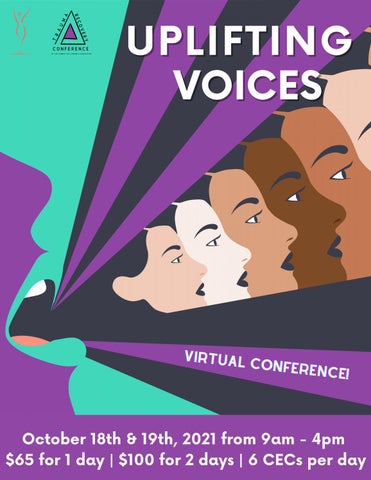
October 18th & 19th, 2021 from 9am - 4pm $65 for 1 day | $100 for 2 days | 6 CECs per day
Don’t want to wait until October 2022 for the next biennial Trauma & Recovery Conference? Join us on October 18th and 19th, 2021 at Uplifting Voices: Conversations on Trauma & Recovery with the Consortium. Spanning 2 days, this virtual event will bring together experts in the behavioral health field as we continue to explore trauma in individual and community experiences. Sit down with us as we strive to push the boundaries of traditional trauma treatment, expand the definition of recovery, and create comprehensive, inclusive systems of care.
09:00 - 09:10a
Opening Remarks
09:10 - 10:30a
How Being Trauma-Informed Improves Criminal Justice System Responses
10:30 – 10:45a
Break
10:45 - 12:05p
Self-Care for the Trauma Therapist: Turning Our Therapeutic Tools Inward
12:05 – 01:05p
Lunch + Voices of Recovery
01:05 - 02:25p
Body Trauma: The Shadow in the Body
02:25 - 02:40p
Break
02:40 - 04:00p
Using the Corona Virus Experience to Increase Compassion and Connection
Consortium + Voices of Recovery "teaser" Amy B. Smoyer, PhD & John Watts, MA, CCJP
Cassandra Holinka, PsyD & Margaret Evans, PhD Pre-recorded video
Karyne B. Wilner, PsyD
Patricia D. Wilcox, LCSW
09:00 - 09:10a
Opening Remarks
09:10 - 10:30a
Acknowledging Trauma and Building Resilience in School Communities
10:30 – 10:45a
Break
10:45 - 12:05p
The Three C's of Supporting Child's Healing From Domestic Violence Victimization
Consortium + Voices of Recovery "teaser" Kristin Wilson, MA, LPC, CCTP, CYT
Beth Ann Morhardt
12:05 – 01:05p
Lunch + Voices of Recovery
01:05 - 02:25p
Suicidality Amongst LGBTQ+ youth: Understanding Risks and Increasing Supports
Pre-recorded video
Diana Perry, PsyD, LPC & Rebekah Stafford
02:25 - 02:40p
Break
02:40 - 04:00p
Building Inclusive Resiliency for the “Have-Nots”
Willona Amoakoh, LMSW & Renesha Nichols, LCSW
How Being Trauma-Informed Improves Criminal Justice System Responses Amy B. Smoyer, PhD & John Watts, MA, CCJP SAMHSA’s GAINS Center for Behavioral Health and Justice Transformation is known nationally for its work in regard to people with behavioral health needs involved in the criminal justice system. Although prevalence estimates vary, there is consensus that high percentages of justice-involved women and men have experienced serious trauma throughout their lifetime. The reverberating effects of trauma experiences can challenge a person’s capacity for recovery and pose significant barriers to accessing services. Self-Care for the Trauma Therapist: Turning Our Therapeutic Tools Inward Cassandra Holinka, PsyD & Margaret Evans, PhD Burnout, compassion fatigue, and vicarious traumatization have all become synonymous with taking on the valiant commitment to help others walk through their traumas and construct their recoveries. Leaving these unacknowledged and unattended to leaves both the trauma therapist and the client in a precarious situation. The treatment community must work to understand how these experiences occur, stay mindful of the importance and meaning of effective self-care, and put into action purposeful plans for self-care.
Body Trauma: The Shadow in the Body Karyne B. Wilner, PsyD Emotional disturbances, such as childhood trauma, can cause changes in the body. Unexpressed emotions create symptoms in the body and internal conflict, for which no words can be found, can burst out through the skin. Rather than suppress strong feelings that result from trauma, this program explores safe body-based methods to release difficult emotions in order to transform them. By making the shadow conscious, owning one's negativity, and confronting the beast, the body can free itself from hurtful disease processes and begin to heal. Using the Corona Virus Experience to Increase Compassion and Connection Patricia D. Wilcox, LCSW We have all had to endure changes and stressors during the pandemic. How can we use our experiences to enhance our clinical compassion? Participants will examine their experiences and learn from them in areas such as living with a sense of danger, being cut off from loved ones, ever-changing and difficult to understand rule, loneliness, the stress and anxiety of returning to normal, and others. As we explore these experiences in depth, we can develop more understanding of our clients’ everyday world and translate this into changed practices.
Acknowledging Trauma and Building Resilience in School Communities Kristin Wilson, MA, LPC, CCTP, CYT Both students and school professionals are currently experiencing high levels of trauma and collective trauma—and male adolescents are among the groups most negatively impacted. In this interactive workshop, you’ll learn the differences in the ways males and females experience and manifest trauma, and how to recognize the signs and symptoms of trauma response. The Three C's of Supporting Child's Healing From Domestic Violence Victimization Beth Ann Morhardt Children who have been victimized by a perpetrator of Domestic Violence in their own homes, have been robbed of a security and peace most of us take for granted. As they begin to heal they need adults they can rely on, trust and be safe with to explore their feelings. In this interactive workshop we will explore The Three C's of supporting them along their journey; Connection, Consistency & Creativity. I welcome you to leave tradition & "shoulds" at the door and join me with hope & belief that each of us can be the adult who supports them.
Suicidality Amongst LGBTQ+ youth: Understanding Risks and Increasing Supports Diana Perry, PsyD, LPC & Rebekah Stafford This presentation will highlight suicidality related disparities for LGBTQ+ youth. The minority stress model and trauma exposure will be used to explore this population's risk for social isolation and suicidal thoughts and behaviors. Local and LGBTQ+ specific suicide prevention resources will be reviewed, followed by a discussion of ways to augment and adapt these resources to address unmet needs and increase individual and community resilience. Building Inclusive Resiliency for the “Have-Nots” Wilona Amoakoh, LMSW & Renesha Nichols, LCSW Are you seeking to provide services that consider the cultural, social and economic complexities of a diverse clientele? We recognize that one size does not fit all. Join us as we explore ways to enhance person-centered practice skills to help clients develop resiliency to mitigate trauma and stress.
Wilona Amoakoh, LMSW Willona is a licensed clinical supervisor with over 20 years of experience providing therapeutic services, crisis intervention, organizational development and Lean Daily Management. Willona is also an educator and currently serves on the Diversity, Inclusion and Belonging Committee for Hartford Healthcare at Home. In addition to youth empowerment and development Willona is passionate about using creative arts to advocate for diverse representation in children's books and animation.
Margaret Evans, PhD Maggie Evans, PhD, is a clinical psychologist and assistant professor at UConn Health in the Department of Psychiatry. Dr. Evans received her PhD from the University of Vermont, and subsequently completed a clinical postdoc at the VA Boston Healthcare System. Dr. Evans works with adults in outpatient settings, providing treatment for individuals presenting with anxiety, trauma-related, OCD and mood disorders. She has been trained in Cognitive Processing Therapy for PTSD. Cassandra Holinka, PsyD Cassandra Holinka, PsyD, is a Connecticut-licensed clinical psychologist and Assistant Professor in the Department of Psychiatry at UConn Health. She completed her pre-doctoral and post-doctoral psychology training at the Yale University School of Medicine and Connecticut Mental Health Center. Her training and clinical focus include the assessment and treatment of PTSD, substance use disorders, borderline personality disorder, and other mood and anxiety disorders. She also enjoys teaching and supervising psychiatry residents and pre and post-doctoral psychology trainees in learning psychotherapy. Beth Ann Morhardt With over 20 years of experience in the field of domestic violence, Ms. Morhardt has worked with both child and adult victims/survivors, in a plethora of roles. In each role, creating an environment for individuals to discover or rebuild their sense of Self and personal/professional empowerment was the priority. As a professional development consultant, Ms. Morhardt has travelled extensively throughout the US and internationally, collaborating with child protection workers, and other community services professionals to develop and maintain progressive partnerships to benefit children, families and communities.
Renesha Nichols, LCSW Renesha is a licensed clinical social worker who has served in the mental health field for 13 years and counting. Her experience includes crisis management, trauma work with foster and adopted youth, school social work, individual and family counseling. Renesha is currently pursuing her doctorates in social work while rendering virtual counseling services within her private practice. Renesha is passionate about helping others and is a strong advocate for social justice.
Diana Perry, PsyD, LPC Diana Perry, PsyD, is a clinical psychologist and a Senior Project Coordinator for the Child Health and Development Institute. In this role, Dr. Perry provides training, clinical and implementation consultation, and technical assistance for schools and districts interested in offering evidence-based, trauma-focused groups to their student body. Additionally, in partnership with the SDE and DCF via a SAMSHA AWARE grant, Dr. Perry is supporting the development of a trauma-informed professional development training curriculum for educators and school staff. Prior to CHDI, Dr. Perry was a clinician for adults, children, and families in multiple U.S. cities, through which she developed expertise around the psychology of trauma, cooccurring disorders, group dynamics, and trauma informed care.
Amy B. Smoyer, PhD Amy B. Smoyer, PhD, is an Associate Professor of Social Work at Southern Connecticut State University. Her program of research examines women’s lived experience of incarceration and the impact of this experience on health outcomes including HIV care and prevention, food justice, bladder health, housing stability, and psychosocial wellness. www.amysmoyer.com
Rebekah Stafford Rebekah is an intern at the Child Health and Development Institute supporting the organization’s school-based mental health initiatives. At CHDI, Rebekah assists project coordinators with the implementation of evidence-based trauma-focused programs. Prior to joining CHDI, Rebekah was involved in research relating to child and adolescent mental health and adverse childhood experiences. Rebekah will be receiving her M.A. in Community Psychology from the University of New Haven in May 2021.
John Watts, MA, CCJP John Watts MA, CCJP, is a criminal justice practitioner and educator with over 18 years’ experience working with various demographics spanning age, race and risk levels in the criminal justice system. He has been employed as a Probation Officer with the State of Connecticut Judicial Branch for the past 17 years and also serves as an adjunct professor at Gateway Community College. John is a national trainer with the SAMHSA’s GAINS Center and holds certifications as a Criminal Justice Addiction Professional (CCJP) and in Forensic Cognitive Behavioral Therapy. Patricia D. Wilcox, LCSW Patricia Wilcox, LCSW, is the Vice President for Strategic Development at Klingberg Family Centers, in New Britain, Connecticut. She specializes in helping organizations improve their treatment of traumatized people and make the day-to-day moments of their programs as healing for clients and staff as possible. She created the Restorative Approach™, a trauma- and relationship-based treatment. She is a Faculty Trainer for Risking Connection® and an Adjunct Faculty at the University of CT School of Social Work and the University of St. Joseph’s. She trains internationally on trauma-informed care. She was the 2011 Connecticut Social Worker of the Year. She is the author of Trauma-Informed Care: The Restorative Approach (Levelers Press) as well as several articles.
Karyne B Wilner, PsyD Karyne B. Wilner, PsyD, has a private practice in Newport, RI. She currently directs the Core Energetics Academy in Newtown, CT. Formerly Assistant Director of the International Institute for Core Energetics and Senior Director of the Brazilian Institute, she has traveled widely giving workshops and seminars. She has written numerous journal articles about somatics and psychology and presently teaches Master’s level Holistic Counseling courses at Salve Regina University. Kristen Wilson, MA, LPC, CCTP, CYT Kristin Wilson is passionate about the integration of holistic care in the treatment milieu to address the myriad of stressors that today’s teens face. She believes that higher levels of emotional resilience allow teens to more easily adapt to stressful situations or crises, with fewer negative effects. She holds a Master’s degree in psychology and Creative Arts Therapies, and presents workshops on using the creative arts to foster authentic connections with teens. Kristin’s belief in holistic care is further demonstrated by her certification as a yoga teacher.