NOVEMBER 2025
STUDENT BELONGING CONCEPT PAPER By: Melanie Gonzalez, Erin Asselin, and Julia King
EXECUTIVE SUMMARY As a continuous improvement organization, RISE works with networks of schools to increase student outcomes and advance towards equity. Together with our partner educators, we establish a shared theory of improvement for each of our shared goals that highlights the goal’s biggest drivers. Teams of educators then develop change ideas to work towards the outcome goal by improving one or more drivers. This concept paper aims to support this process by providing a research-based theoretical basis for belonging, one of the primary drivers of student on-track performance. Educators are working tirelessly to respond to growing challenges in the education sector. While recent reports have shown U.S. graduation rates increasing to 87 percent, worrying trends like elevated rates of chronic absenteeism, disconnection, and mental health concerns persist.1 These challenges can be traced back to what some are calling a “crisis of belonging.”2 RISE offers this concept paper to educators, policymakers, and community members grappling with these challenges to shed light on the importance of belonging and to provide resources for improving it. Drawing on insights from Geoffrey Cohen’s Belonging: The Science of Creating Connection and Bridging Divides, as well as established psychological and sociological theory, RISE aims to3:
Belonging is a developmental need that schools must prioritize to create environments where all students are engaged, achieve success, and graduate on-time - prepared to thrive on their postsecondary paths.
Advance the dialogue on student belonging in the education sector by arguing:
• Belonging is an essential need for student success • Feelings of belonging are promoted by: » Strong social connections » Social safety enabling healthy identity development • Student belonging is impeded by social threats • Educators can improve students’ feeling of belonging by: » Fostering social safety and connections at school » Learning about and decreasing trigger cues Support schools in responding to the crisis of student belonging by providing tools, practices, and resources to:
• Assess student connection and belonging • Support positive connections • Curate classrooms of care
1
ST U D E N T B E LO N G I N G C O N C E P T PA P E R
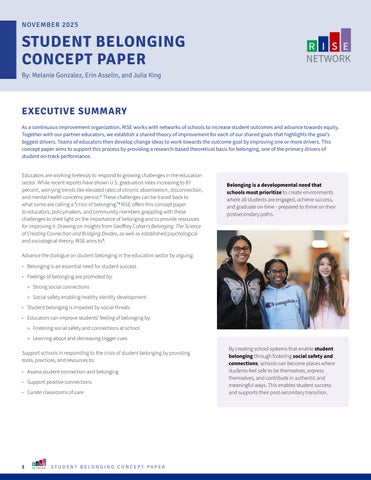
By creating school systems that enable student belonging through fostering social safety and connections, schools can become places where students feel safe to be themselves, express themselves, and contribute in authentic and meaningful ways. This enables student success and supports their post-secondary transition.
ST U D E N T B E LO N G I N G C O N C E P T PA P E R
Section I: Why Belonging Matters Maria’s journey to belong - setting the scene Maria just moved with her family to Connecticut from Puerto Rico. It’s her first day as a 9th grader at Success High School. Her parents, who did not graduate from high school, pray for Maria’s success. They want her to get good grades, graduate from high school, go to college, and get a good-paying job. As Maria enters the cafeteria doors to her new school, she feels her heart racing as she scans the bustling lunchroom to find a place to sit. She knows no one, speaks limited English, and does not know what to do. She sees a group of girls who look like her, sitting at a table with empty space, and wonders if she would fit in there. One of them notices her, matches her gaze, and smiles - a signal of safety and invitation. Maria courageously walks towards the group, feeling her blood rushing through her veins, trying to appear calm, while drowning in fear. Will this be a place where she belongs?
Student belonging is essential for student success and well-being The topic of student connection and belonging in schools has gained momentum in recent years. Despite improvements since the COVID-19 pandemic, student disconnection from school persists as a challenge, with almost one in three students chronically absent in the 2022-23 school year.4 A recent study noted that students are experiencing a crisis of student belonging, citing research showing that 40 percent of US high school students are not feeling connected to school, with increased feelings of alienation among students facing racism, LGBTQ+ students, and students with disabilities.5 Additionally, 2023 Youth Risk Behavior Survey (YRBS) data highlights the social-emotional well-being challenges high school aged youth are dealing with: four in 10 experienced persistent feelings of sadness or hopelessness, and two in 10 seriously considered attempting suicide. 6 Multiple peer-reviewed studies demonstrate that student belonging is paramount to student success and well-being, and is associated with:
Better academic and engagement outcomes, such as higher levels of academic achievement and motivation, and lower levels of absence and dropout rates.7
2
Lower likelihood for engagement in school misconduct, such as verbal and physical peer aggression and bullying.8
ST U D E N T B E LO N G I N G C O N C E P T PA P E R
Lower likelihood for engagement in risk-taking behaviours, such as alcohol, tobacco, and marijuana use, early sexualization, and sexual health risks.9
Better social-emotional outcomes, such as lower rates of anxiety and depression and better senses of self-concept and self-efficacy.10
ST U D E N T B E LO N G I N G C O N C E P T PA P E R
Section II: What Belonging Is
Figure 1
The Three Vital Components of
Social Connection
Social connectedness is the extent to which social connections fulfill our needs
The extent to which an individual is socially connected depends on multiple factors, including:
Students form social connections as they interact with other individuals in different groups, first in their families, then in broader community groups and systems. The degree to which a student’s social connections meet their social needs is known as their social connectedness. Several factors influence the extent to which a student’s social connections meet their needs, including the three vital components of social connection: structure, function, and quality (Figure 1: The three Vital Components of Social Connection).11 Students may experience varying levels of social connectedness across the different social groups or social systems that they are part of, depending on how effectively these larger social structures meet their needs.
STRUCTURE
FUNCTION
QUALITY
The number and variety of relationships and frequency of interactions
The degree to which relationships serve various needs
The positive and negative aspects of relationships and interactions
Humans rely on social groups to fill several needs crucial for survival and well-being; one of them is a sense of belonging.
Belonging is the subjective feeling that our social connections are fulfilling our needs In school, students depend on their social connections to fill their critical need to belong. Belonging is typically defined as a subjective feeling that one has about their relationship with a larger group. Geoffrey Cohen, a leader in belonging research, defines belonging as “the feeling that we’re part of a larger group that values, respects, and cares for us—and to which we feel we have something to contribute”.12 As explained by the psychological framework in Maslow’s Hierarchy of Needs (Figure 2: Maslow’s Hierarchy of Needs), belonging is a key driver of human motivation and behavior. According to this hierarchy, the satisfaction of lower-order needs, such as physiological and safety needs, enables the fulfillment of higher-order needs, including belonging, esteem, and self-actualization. Unlike physiological needs (e.g., air, water,
food, shelter, etc.), the needs of safety and belonging are subjective and dependent on a person’s perception of their environment. The importance of the belonging need is so strong that individuals sometimes prioritize it over more fundamental needs, such as safety.13 When basic or psychological needs remain unmet, especially during childhood, students can experience gaps in emotional development, increasing the likelihood of self-harm practices or attachment to dysfunctional and harmful relationships. 14 Therefore, it is critical that students develop a strong sense of belonging to social connections that nurture them. Belonging occurs when a student’s social connections within a school care for, value, and respect them, and enable opportunities for contributions.
Figure 2: Maslow’s Hierarchy of Needs
Self-Fulfillment Need Supports feeling of purpose
Self-actualization
desire to be come the most that one can be
Esteem
respect, self-esteem, status, recognition, strength, freedom
Psychological Needs Supports feelings of well-being
Love and belonging
friendship, intimacy, family, sense of connection
Safety needs
personal security, employment, resources, health, property
Basic Needs
Essential for survival
3
ST U D E N T B E LO N G I N G C O N C E P T PA P E R
Physiological needs
air, water, food, shelter, sleep, clothing, reproduction
ST U D E N T B E LO N G I N G C O N C E P T PA P E R
Section III: What Supports Belonging Adolescence is a critical time for students to develop identities that enable a sense of belonging
Student learning is impeded when students feel they don’t belong because of their identity
Adolescence is a critical identity formation period, and a time for students to develop their personal identity by discovering what makes them unique and what is required for them to fit in. During this time, students go through puberty, navigate new schools, try new activities, take on more responsibilities, and tend to shift their main social base from family to peers.15 Joining new social identity groups, apart from their families, can be exciting for students. These groups can provide them with opportunities to explore and develop new parts of themselves while connecting with others in meaningful ways. This experience can increase their social identity complexity if their new social identity group(s) have low member overlap with their previous social identity groups.16 However, when students join new social identity groups that have values, norms, or behaviors that clash or compete with other parts of their social identity, students may experience an identity crisis.17 This crisis creates confusion about who they are, because they do not know which social identity group they should align their personal identity with.
As Maslow’s hierarchy of needs and research suggest, students cannot feel a secure and authentic sense of belonging that supports their healthy development when they have social connections that threaten their sense of safety. As social safety theory explains, humans are constantly using their senses to scan the environment for cues that signal safety or threat. The brain processes social safety and threat cues in the same way it processes physical ones, activating similar bodily responses.19 When humans perceive trigger cues, which signal a socially threatening situation, they respond by activating the fight, flight, freeze, or fawn threat response in the body.20 Conversely, when humans perceive glimmer cues, which signal socially safe situations, the body’s nervous system slows down the heart rate and lowers blood pressure, enabling individuals to better connect, contribute, and create.21
Schools play a vital role in supporting students to resolve identity crises of adolescence and help them form integrated and healthy personal identities. A meta-study on belonging in schools highlighted the important role schools play in helping students build skills that enable them to: (1) identify with their cultural background, (2) develop their sense of identity, and (3) relate to others, to be able to connect with others in meaningful ways and experience belonging.18 To support students through this identity crisis, schools must be places where students are able to navigate the increasing complexity of their identities in safe, affirming, and supportive ways.
When students’ identities are perceived as being devalued, it creates a socially threatening situation that affects them negatively. For example, studies of stereotype threat, or situations in which a person is fearful of confirming a negative stereotype about a member of their identity group, show that this experience activates vigilance and arousal, and impairs self-regulation and working memory.22 Furthermore, experiences of chronic identity devaluation, such as stigma, racism, and discrimination can result in chronic activation of the sympathetic nervous system.23 These studies offer an explanation as to why subgroup disparities between students based on their identity statuses persist in schools. When students feel like their identities are devalued by a social group or setting they are in, they are expending tremendous brain and bodily resources responding to that perceived threat. This makes it harder for them to self-regulate and be able to learn.
To identify signs that students may be experiencing social identity threat, see Appendix 1: RISE Fight, Flight, Freeze, and Fawn Student Threat Response Model To reflect on how your social interactions and school or classroom environment may be sending trigger or glimmer cues, see Appendix 2: Glimmer & Trigger Cue SelfReflection Tool
4
ST U D E N T B E LO N G I N G C O N C E P T PA P E R
ST U D E N T B E LO N G I N G C O N C E P T PA P E R
Educators must be mindful of how identity can influence their connections with students
Identity-safe classrooms can mitigate identity threat and alleviate belonging uncertainty
When students enter high school, they are very aware of how the social identity groups they are part of shape their positioning within a school structure.24 For educators to foster belonging in their schools and classrooms, they must create socially safe situations that send glimmer cues (e.g., identity safety cues) and reduce or eliminate trigger cues (e.g., identity threat cues). Schools perceived by students as places that devalue them based on their identity pose a major threat to students’ sense of belonging and achievement.
When people perceive cues from the environment that fail to signal safety, they can question whether they currently or ever can belong in that environment. This feeling of belonging uncertainty is common, especially when a person enters a new social environment and looks for the place they fit in.31 Unfortunately, when a student has an identity that is socially disadvantaged, they are more likely to experience chronic belonging uncertainty. Experiments on belonging uncertainty in higher education have shown that Black male students are more negatively impacted by threats to belonging, which can reduce both levels of belonging and perceived potential.32
When student and educator identities differ, it is especially crucial to intentionally curate environments and interactions that signal social identity safety. Within a K-12 US school system where 80 percent of educators are white compared to 46 percent of students, and where 77 percent of educators are women, educators must be mindful of how implicit biases or microaggressions can create differences in expectations of and opportunities offered to students.25 A meta-analysis on building strong connections between students and adults found that teacher support had the strongest positive relationship to students’ sense of belonging.26 Additional studies with immigrant students and black students with behavioral incidents also demonstrated positive student outcomes when strong relationships were present.27 Unfortunately, students with identities that are socially disadvantaged (i.e., stigmatized, marginalized, or subordinated) by school systems have been shown to have low support, or even harmful social connections with adults.28 Studies have found that LGBTQ youth, youth of color, and youth from low-income households frequently report lower rates of supportive or caring connections with their teachers.29 Similarly, a group of Black middle school-aged boys in a study acknowledged how racism acts as a barrier to student-teacher relationships and the overall sense of connectedness.30 When asked what they needed from their student-teacher relationships to feel connected to the school environment, they needed to be recognized as individuals and they needed warm, authentic relationships.
5
ST U D E N T B E LO N G I N G C O N C E P T PA P E R
Fortunately, creating identity-safe classrooms and schools by sending identity safety cues can mitigate identity safety threats and alleviate feelings of belonging uncertainty.33 In a recent study where safety cues were implemented in a classroom, students reported more favorable impressions of faculty, a greater sense of belonging in the classroom, and fewer absences.34\
Students seek belonging elsewhere if they experience alienation in school A sense of belonging is so critical that it can sometimes override safety needs, according to Maslow’s theory. When a student experiences ostracization or rejection based on their identity, this can lead to feelings of alienation. The student may then look to alternative sources for belonging.35 Unfortunately, there are not many alternative social settings that serve as rites of passage into adulthood, aside from school. As such, many students who are rejected from or disconnect from school are at higher risk of engaging in school violence and joining anti-social structures such as gangs and participating in organized crime, not only to belong, but to survive. 36
ST U D E N T B E LO N G I N G C O N C E P T PA P E R
Section IV: How educators can improve belonging
• Create opportunities and rituals for
connection. Connection Bingo cards enable classroom members to get to know each other’s experiences, interests, hobbies, etc., which can help counter stereotypes.
• Support students in building skills to connect across lines of difference. You can start by picking an activity from this Bridging Differences Activity Directory.
Student belonging in schools is foundational to support student academic, social, and health outcomes. RISE created and compiled practical tools, practices, and resources educators can use to improve belonging by assessing student connection and belonging, supporting positive connections, and curating classrooms of care.
• Level Up: Develop skills for facilitators to lead
Assess student connection and belonging to identify social safety and meet student needs
Create opportunities for students to advocate for their needs
• Review the RISE Fight, Flight, Freeze, and
Fawn Student Threat Response Model to understand the signs of threat response, and engage in reflection using the RISE glimmer and trigger cue reflection tool to consider how your cues might have triggered that response, and what you can change.
• Use the RISE Belonging Proxy Data Protocol
to use existing grades, behavior, and attendance data to identify students with potentially low belonging, assess students’ degree of social connectedness with school, and plan belonging interventions.
• Survey students’ sense of belonging. Use the Belonging Survey Question Bank to create a belonging survey to administer to your students.
• Level Up: Develop skills for facilitators to
collaborate with students to understand barriers and facilitators of belonging. Use the Rutgers Photovoice Facilitators Guide to enable students to create photonarratives about school belonging.
Support positive inter-group connections • Develop a consciousness of internal bias.
Take the Harvard Implicit Association Test (IAT) to uncover hidden biases; combat your implicit bias and stereotypes with these reflection questions.
• Develop skills to interrupt microaggressions. 6
circle discussions that foster community and intimacy in a classroom. Try different types of community circle collaborative structures.
• Have students create Learner Profiles, which
invite them to share the gifts they bring to the classroom and explain what they need from their school, teacher, and others to help them be successful.
• Co-create community agreements, which
create a collective vision for how members of the school environments (classrooms, clubs, etc.) want to be in relationship with one another.
• Level Up: Develop skills for facilitators to cocreate student-led vision statements, which engage learners in discussion to share what they need from themselves, the physical space, the people learning around them, and the people teaching them.
Create opportunities for students to provide distinct contributions • Give students unique roles that enable them to take ownership of the classroom and support its needs. As an example, have students apply for classroom jobs, which builds teamwork and support.
• Gather and use student feedback to make
changes. Acknowledge student feedback by taking action to let students know you hear and see them and are working to improve the classroom to support students.
• Level Up: Develop skills for facilitators to
create jigsaw classrooms, where students are supported by teachers to take on the role of serving as a content expert by gathering and sharing knowledge with peers.
ST U D E N T B E LO N G I N G C O N C E P T PA P E R
CONCLUSION Belonging is the foundation of student learning and the key to unlocking and activating students’ full potential. When students feel safe within their social connections, they are better able to engage in school and thrive. When students feel threatened, their energy shifts to survival mode, and their ability to self-regulate and learn is hampered. By creating classrooms that send glimmer cues of safety and recognition, supporting identity development, and building authentic relationships, educators can transform schools into places where every student has the chance to belong and succeed. As Maria stands in her new cafeteria, her heart racing, she looks for signals of whether this school is a place where she can belong. A smile meets her gaze, offering the possibility of safety, connection, and growth. Every day, in classrooms and hallways across the country, students like Maria are waiting for those signals of safety. The question is whether we, as educators and leaders,will provide them.
ST U D E N T B E LO N G I N G C O N C E P T PA P E R
7
KEY TERMS
DEFINITION
Social connection
The continuum of the size and diversity of one’s social network and roles, the functions these relationships serve, and their positive or negative qualities.
Social connectedness
The degree to which any individual or population might fall along the continuum of achieving social connection needs.
Belonging
The feeling of being part of a larger group that values, respects, and cares for oneself, and to which one feels one has something to contribute.
Personal identity
An individual’s sense of self, defined by (a) a set of physical, psychological, and interpersonal characteristics that is not wholly shared with any other person and (b) a range of affiliations (e.g., ethnicity) and social roles. Identity involves a sense of continuity, or the feeling that one is the same person today that one was yesterday or last year (despite physical or other changes).
Social identity group
The groups one gains affiliation or membership with based on shared characteristics (e.g., statuses, experiences, interests, hobbies, beliefs, geographic region, etc.), which one can use to shape personal values, norms, and behaviors and form our identity. Social identity groups often create separation between people based on whether one is an in-group or out-group member.
Social identity complexity
The degree to which a student belongs to multiple, non-overlapping identity groups (e.g., racial, gender, interest-based, ability-based).
Identity crisis
States of conflict during which a person may suffer from role disorientation and question his or her selfperception.
Trigger cues
Signals of socially threatening situations, which activate the body’s sympathetic nervous system, enabling the fight, flight, freeze, or fawn response. Identity threat cues are a type of trigger cue.
Socially threatening situations
Social circumstances characterized by social conflict, aggression, devaluation, criticism, disapproval, discrimination, isolation, rejection, exclusion, turbulence, unpredictability, manipulation, and betrayal.
Glimmer cues
Signals of socially safe situations, which activate the body’s parasympathetic nervous systems, enabling the rest and digest response. Identity safety cues are a type of glimmer cue.
Socially safe situations
Social circumstances characterized by social acceptance, understanding, inclusion, connection, belonging, cohesion, harmony, support, validation, predictability, stability, and authenticity.
Stereotype threat
Occurs when individuals fear they may confirm negative stereotypes about their social group. This fear can negatively affect their performance and reinforce the stereotype, creating a self-fulfilling prophecy.
Belonging uncertainty
The state of mind in which one suffers from doubts about whether one is fully accepted in a particular environment or ever could be.
Alienation
The sense of loneliness or exclusion in social relations.
ST U D E N T B E LO N G I N G C O N C E P T PA P E R
ST U D E N T B E LO N G I N G C O N C E P T PA P E R
Appendix 1: RISE Fight, Flight, Freeze, and Fawn Student Threat Response Model When students perceive trigger cues in school environments and social interactions that make them feel threatened, their bodies respond as they were designed to: by fighting, fleeing, freezing, or fawning. We have translated these threat responses into actions that this may look like in school. Use the table below to identify responses that may indicate that a student is feeling threatened in the environment that they are in. This threat may be preventing them from connecting and engaging in authentic ways. If a student is exhibiting any of the below behaviors, work with them using the Glimmer and Trigger Cue Reflection Tool or other ways to understand what they need from their environment to feel safe, secure, and supported so that they can connect and be engaged.
Threat Response
Definition
What this looks like
What can it result in?
Fight
Confront threat by addressing, resisting, attacking, overpowering, or removing it
• Refusing to follow norms
• Negative labeling (e.g., troublemaker)
• Talking back or “challenging authority”
• Increased surveillance or policing
• Expressing anger or sarcasm
• Referrals or disciplinary actions
• Physical aggression when provoked
• Suspension or expulsion • Heightened school-to-prison pipeline risk
Flight
Escape the threat by physically or mentally distancing or removing oneself from it
• Walking halls aimlessly
• Chronic absenteeism
• Frequent nurse visits or bathroom
• Declining academic progress
breaks
• Skipping class or school • Ignoring class by focusing on phone
• Loss of social connection • Increased risk of dropout
• Hiding from class by sleeping Freeze
Becoming immobile or unable to act when faced with a threat
• Blank facial expressions
• Misinterpreted as disinterested
• Avoiding eye contact
• Missed opportunities for learning or
• Silence in class discussions • Appearing withdrawn or passive • Zoning out or shutting down during
connection
• Increased vulnerability to isolation • Poor academic performance
conflict or when called on
Fawn
Trying to please or appease the threat to avoid conflict or harm
• Code-switching, masking, hiding aspects of identity (e.g., speech, appearance, or behavior) to fit in.
• Striving for perfection to prove worth • Overworking to gain approval
8
ST U D E N T B E LO N G I N G C O N C E P T PA P E R
• Conditional belonging • Chronic stress • Imposter syndrome • Burnout • Loss of authentic self-expression
ST U D E N T B E LO N G I N G C O N C E P T PA P E R
Appendix 2: RISE Glimmer & Trigger Cue Reflection Tool Use this tool as a self-reflection tool or a classroom reflection tool with your students to reflect on the signals you and your environment send to students. For each category, ask yourself and/or your students if you fall more on the glimmer or trigger end of the below cue continuums. After you are done, jot down notes or intentions for change.
Facial Expressions Do I make warm eye contact and greet students with an open expression?
Does my posture communicate openness and approachability?
Do I avoid eye contact, present a stern look, frown, or roll my eyes?
Does my posture communicate authority, guardedness, or intimidation?
Language
Touch
Voice Is my tone calm, welcoming, and affirming (especially when students are late, distracted, or upset)? Is my tone harsh, sarcastic, dismissive, or shaming?
Boundaries
Do I use inclusive, assetbased language that affirms identity?
Are physical interactions (fist bumps, high-fives) studentinitiated and affirming?
Do I know and respect students’ physical boundaries?
Do I use deficit-based labels or language that stereotypes students?
Do I force physical contact or ignore student-initiated gestures?
Do I cross students’ boundaries (e.g., touch without consent, stand too close)
Name and pronoun usage Do I use students’ chosen names and correct pronouns—consistently and respectfully? Do I mispronounce or refuse to use chosen names or pronouns?
Conflict response
9
Body language
Identity respect
Self-care practices
Do I gently correct myself or others when mistakes are made about identities?
Do students have spaces to regulate, reflect, or reset?
Do I ignore or joke about mistakes around names, pronouns, or other identity aspects?
Do I deny breaks or only send students out as punishment?
Absence response
When tension rises, do I pause and seek to understand before reacting?
Do I acknowledge student absences and check in with care?
Do I react immediately with punishment, yelling, or assumptions?
Do I ignore or shame students for absences?
ST U D E N T B E LO N G I N G C O N C E P T PA P E R
Glimmer Cue Reflection Question Trigger Cue Reflection Question
ST U D E N T B E LO N G I N G C O N C E P T PA P E R
Feedback
Affirmation
Do I focus on effort, growth, and strengths in my feedback?
Do I validate student stories and experiences?
Do I only point out mistakes without acknowledging strengths?
Do I question or dismiss students’ lived experiences?
Environment
Curriculum
Cultural representation Does my classroom reflect the cultures, languages, and identities of my students? Does my classroom only reflect a dominant culture?
Rituals
Is the classroom inviting, interactive, supportive, and accessible?
Is the curriculum diverse, youth-centered, and identity-affirming?
Do rituals promote inclusion, predictability, and joy?
Is the classroom bare, rigid, or unwelcoming?
Is the curriculum narrow, Eurocentric, or disconnected from student lives?
Do rituals feel punitive, rigid, or exclusionary?
Peer interactions
Group dynamics
Do I foster mixed-group collaboration and positive peer affirmation?
Do I intervene when students face microaggressions or exclusion?
Do I allow cliques, exclusion, or inequitable grouping?
Do I ignore or minimize microaggressions, saying “it’s just a joke”?
Power sharing
Rules Are classroom norms created with intention and consideration to student needs, boundaries, and preferences? Do I make all rules arbitrarily based on what I want the classroom to look like?
Justice practices
Do I seek input from students when making decisions?
Are there healing and restorative responses to harm?
Do I make decisions without student input?
Do I rely only on punitive discipline like suspension or removal?
Glimmer Cue Reflection Question Trigger Cue Reflection Question
Final Reflection: Where am I strongest in offering glimmer cues? Where might I be unintentionally sending trigger cues? What one change can I try this week?
10
ST U D E N T B E LO N G I N G C O N C E P T PA P E R
ST U D E N T B E LO N G I N G C O N C E P T PA P E R
Appendix 3: RISE Belonging Proxy Data Protocol RISE recommends that improvement teams work together to assess and address student belonging using the following data protocol.
Step 1 - Identify students with potential low belonging using student attendance and behavior data Attendance and behavioral data offer proxy measures to identify students who may be struggling with connection and belonging in school, where direct measures for connection and belonging have not been collected. You can identify students who may have low belonging by looking at the following metrics: Metric
Questions to ask
Students who are chronically absent
Which students are chronically absent, but on the cusp (80-89% ADA)? Which students are at risk of being chronically absent (90-92% ADA?) Are students absent on specific days? What are the underlying causes for being absent on those days?
Student skip rates
What classes does a student skip? Why is this student avoiding this class?
Classes/ Teachers skip rates
What educators/classes have high skip rates? Low skip rates?
What classes does the student attend? What is the teacher doing in that class that supports motivation to attend?
What practices are educators with low skip rates engaging in that they can share? What challenges are educators with high skip rates experiencing that they could use support and/or create changes to address?
Referral/ Suspension/ time out of class data
What are patterns with teachers referring out? At what locations and at what times are there behavior upticks during the day? What can be done to reduce threat, increase safety, & support connection in these classes?
Step 2 - Assess Student Connection with Adults Using the metrics listed above, you have identified which students are at risk of low belonging. Assess their connection to school using this Relationship Mapping Activity from Harvard’s Making Caring Common Project.
Step 3 - Make a plan Using the information gathered from the metrics on attendance and behavior data, as well as the discussion of each student’s connection to school, school improvement teams should develop an action plan on how to improve educator connection to students. Improvement teams that work with RISE school coaches can develop change ideas targeting the students identified as having risk of low belonging.
11
ST U D E N T B E LO N G I N G C O N C E P T PA P E R
ST U D E N T B E LO N G I N G C O N C E P T PA P E R
Appendix 4: Belonging Survey Question Bank There are several notable surveys related to connection and belonging that schools can source from in order to develop their own Sense of Belonging Survey at their school. Select questions have been sourced from surveys and labeled with domains based on concepts shared in this brief to help you pick the questions that best support your needs.
Domain
Survey Item
Source
Connection
There is at least one teacher or adult I can talk to in my school if I have a problem.
PSSMS
Connection
I have no close/sincere connections with people in this school. (reverse)
School Belongingness Scale
Connection
I am included in lots of activities at my school.
PSSMS
Connection
I wish I were in a different school. (reversed)
PSSMS
Social Connectedness
Most teachers at my school are interested in me.
PSSMS
Social Connectedness
People at my school are friendly to me.
PSSMS
Social Connectedness
I get along well with people at my school.
Sense of Social Fit Scale
Social Connectedness
I think that people care about me in this school.
School Belongingness Scale
Social Connectedness
Other students at my school take my opinions seriously.
PSSMS
Social Connectedness
I am treated with as much respect as other students in my school.
PSSMS
Social Connectedness
I feel proud to belong to my school.
PSSMS
Contributions
People at my school know that I can do good work.
PSSMS
Contributions
People at my school notice when I am good at something.
PSSMS
Contributions
I am comfortable expressing my opinions in school.
Belonging Barometer
Contributions
I am unable to influence decision-making in my school. (reverse)
Sense of Social Fit Scale
Identity Safety
Other students at my school like me the way that I am.
PSSMS
Identity Safety
I feel unable to be my whole and authentic self with people in school. (reverse)
Belonging Barometer
Identity Safety
I fit in well at my school.
Sense of Social Fit Scale
Identity Safety
I feel very different from most other students at my school. (reverse)
PSSMS
Identity Safety
I think in the same way as people who do well at my school.
Sense of Social Fit Scale
Identity Safety
Teachers here are not interested in people like me.
PSSMS
Identity Safety
It is hard for people like me to be accepted at my school.
PSSMS
Identity Safety
I am similar to the kind of people who succeed at my school.
Sense of Social Fit Scale
Identity Safety
I feel like an outsider at this school. (reverse)
Sense of Social Fit Scale
PSSMS is the acronym for the Psychological Sense of School Membership Scale
12
ST U D E N T B E LO N G I N G C O N C E P T PA P E R
ST U D E N T B E LO N G I N G C O N C E P T PA P E R
Endnotes 1.
Source A: U.S. Department of Education, National Center for Education Statistics, “High School Graduation Rates,” Condition of Education Indicators, last modified May 2024, accessed September 3, 2025, https://nces.ed.gov/programs/coe/indicator/coi/high-school-graduation-rates; Source B: Attendance Works, “The Problem,” Chronic Absence (Attendance Works), last modified 2025, accessed September 3, 2025, https://www. attendanceworks.org/chronic-absence/the-problem/; Source C: Dalio Education, “CT’s Unspoken Crisis: Getting Young People Back on Track,” Dalio Education, accessed September 3, 2025, https:// www.dalioeducation.org/report/; Source D: Centers for Disease Control and Prevention (CDC), “2023 Youth Risk Behavior Survey Results,” Youth Risk Behavior Surveillance System, last modified September 29, 2024, accessed September 3, 2025, https://www.cdc.gov/yrbs/results/2023-yrbs-results.html.
2.
Francesca López, Ross Wiener, and Lorén Cox, A Crisis of Student Belonging (Washington, DC: Aspen Institute, Education & Society Program, June 2024), accessed September 3, 2025, https://www.aspeninstitute.org/wp-content/uploads/2025/05/School-Belonging.pdf.
3.
Geoffrey L. Cohen, Belonging: The Science of Creating Connection and Bridging Divides, 1st ed. (New York: W. W. Norton & Company, 2022).
4.
U.S. Department of Education, “Chronic Absenteeism,” last modified March 22, 2024, https://www.ed.gov/teaching-and-administration/ supporting-students/chronic-absenteeism#:~:text=The%20U.S.%20rate%20of%20chronic,schools%20and%20communities%20increase%20 attendance.
5.
López, Wiener, and Cox, *A Crisis of Student Belonging*.
6.
CDC, Youth Risk Behavior Survey Data Summary & Trends Report.
7.
H. Korpershoek, “The Relationships Between School Belonging and Students’ Motivational, Social-Emotional, Behavioural, and Academic Outcomes: A Meta-Analytic Review,” Educational Psychology, 2020, https://www.tandfonline.com/doi/pdf/10.1080/02671522.2019.1615116.
8.
Source A: Alberto Valido et al., “Intra-familial Violence and Peer Aggression Among Early Adolescents: Moderating Role of School Sense of Belonging,” Journal of Family Violence 36, no. 1 (2021): 87–98, https://doi.org/10.1007/s10896-020-00142-8 Source B: Marion K. Underwood and Samuel E. Ehrenreich, “Bullying May Be Fueled by the Desperate Need to Belong,” Theory & Practice 53, no. 4 (2014): 265–270, https://pmc.ncbi.nlm.nih.gov/articles/PMC4520317/.
9.
Source A: Gregory J. Meyer, Jennifer L. Turner, and David L. McFarland, “The Influence of School Climate on Student Engagement and Achievement: A Meta-Analytic Review,” Review of Educational Research 81, no. 2 (2011): 221–247, https://pmc.ncbi.nlm.nih.gov/articles/ PMC3045112/; Source B: Kelly-Ann Allen et al., “Adolescent School Belonging and Substance Use in Young Adulthood: Findings from a Multi-wave Prospective Cohort Study,” International Journal of Mental Health and Addiction, January 6, 2025, https://doi.org/10.1007/s11469-024-01427-5; Source C: Amy J. Peterson, Elizabeth Allen, Russell Viner, and Chris Bonell, “Effects of the School Environment on Early Sexual Risk Behavior: A Longitudinal Analysis of Students in English Secondary Schools,” Journal of Adolescence 85 (December 2020): 106–114, https://doi.org/10.1016/j. adolescence.2020.10.004;
10. Source A: Xinxin Yu et al., “The Influence of Social Exclusion on High School Students’ Depression: A Moderated Mediation Model,” Psychological Research and Behavioral Management 16 (2023): 257–273, https://doi.org/10.2147/PRBM.S431622; Source B: Monika Raniti, Divyangana Rakesh, George C. Patton, and Susan M. Sawyer, “The Role of School Connectedness in the Prevention of Youth Depression and Anxiety: A Systematic Review with Youth Consultation,” BMC Public Health 22, no. 2152 (2022), https://doi.org/10.1186/ s12889-022-14364-6; Source C: Korpershoek, “Relationships Between School Belonging.” 11. U.S. Department of Health and Human Services, Our Epidemic of Loneliness and Isolation: The U.S. Surgeon General’s Advisory on the Healing Effects of Social Connection and Community (Washington, DC: U.S. Department of Health and Human Services, 2023), https://www.hhs.gov/ sites/default/files/surgeon-general-social-connection-advisory.pdf. 12. Geoffrey L. Cohen, Belonging: The Science of Creating Connection and Bridging Divides, 1st ed. (New York: W. W. Norton & Company, 2022).
13
ST U D E N T B E LO N G I N G C O N C E P T PA P E R
ST U D E N T B E LO N G I N G C O N C E P T PA P E R
13. Saul McLeod, “Maslow’s Hierarchy of Needs,” Simply Psychology, last modified August 3, 2025, https://www.simplypsychology.org/maslow.html. 14. Sherrie Campbell, “3 Unmet Basic Needs and Their Effects on Relationships,” Psychology Today, December 11, 2022, https://www. psychologytoday.com/us/blog/understanding-ptsd/202212/3-unmet-basic-needs-and-their-effects-on-relationships. 15. Trudy Mercadal, “Identity Formation,” EBSCO Research Starters, 2024, https://www.ebsco.com/research-starters/psychology/identity-formation. 16. Sonia Roccas and Marilynn B. Brewer, “Social Identity Complexity,” Personality and Social Psychology Review 6, no. 2 (2002): 88–106, https://doi. org/10.1207/S15327957PSPR0602_01. 17. Buffie Longmire Avital, “Identity Crises,” EBSCO Research Starters, 2023, https://www.ebsco.com/research-starters/psychology/identity-crises. 18. Kelly-Ann Allen, Margaret L. Kern, Christopher S. Rozek, Dennis McInereney, and George M. Slavich, “Belonging: A Review of Conceptual Issues, an Integrative Framework, and Directions for Future Research,” Australian Journal of Psychology 73, no. 1 (2021): 87–102, https://doi.org/10.1080/000 49530.2021.1883409. 19. George M. Slavich et al., “Social Safety Theory: Conceptual Foundation, Underlying Mechanisms, and Future Directions,” Health Psychology Review 17, no. 1 (2023): 5–59, https://doi.org/10.1080/17437199.2023.2171900. 20. Olivia Guy-Evans, “Fight, Flight, Freeze, or Fawn: How We Respond to Threats,” Simply Psychology, last modified June 23, 2025, https://www. simplypsychology.org/fight-flight-freeze-fawn.html. 21. Theodora Blanchfield, “How a Glimmer Triggers Feelings of Joy and Safety,” Verywell Mind, July 3, 2025, https://www.verywellmind.com/what-isa-glimmer-5323168. 22. Source A: Erin Heaning, “Stereotype Threat: Definition and Examples,” Simply Psychology, last modified October 10, 2023, https://www. simplypsychology.org/stereotype-threat.html. Source B: Toni Schmader, Michael Johns, and Chad Forbes, “An Integrated Process Model of Stereotype Threat Effects on Performance,” Psychological Review 115, no. 2 (2008): 336–356, https://doi.org/10.1037/0033-295X.115.2.336. 23. L.R. Grasser, “Neural Impacts of Stigma, Racism, and Discrimination,” Brain, Behavior, & Immunity - Health 24 (2022): 100497, https://doi. org/10.1016/j.bbih.2022.100497. 24. Junia Joffer, Eva Randell, Ann Öhman, Renée Flacking, and Lars Jerdén, “Playing the Complex Game of Social Status in School – A Qualitative Study,” Global Health Action 13, no. 1 (2020): 1819689, https://doi.org/10.1080/16549716.2020.1819689. 25. Source A: U.S. Department of Education, National Center for Education Statistics, Characteristics of Public School Teachers, last modified May 2023, https://nces.ed.gov/programs/coe/indicator/clr/public-school-teachers; Source B: Marco Learning, “Teacher Bias: The Elephant in the Classroom,” last modified January 24, 2023, accessed September 5, 2025, https:// marcolearning.com/teacher-bias-the-elephant-in-the-classroom/; Source C: The Harriet W. Sheridan Center for Teaching and Learning, Microaggressions and Micro-Affirmations: Opportunities for Learning and Inclusion, Brown University, accessed September 5, 2025, https://sheridan.brown.edu/resources/inclusive-anti-racist-teaching/inclusiveteaching/microaggressions-and-micro-affirmations; Source D: K. P. Anderson, The Role of Implicit and Explicit Racial Bias in Advanced Placement and Dual Enrollment Participation (EdWorkingPaper No. 22-554, April 2022), accessed September 5, 2025, https://edworkingpapers.com/sites/default/files/ai22-554.pdf. 26. Kelly Allen, Margaret L. Kern, Dianne Vella-Brodrick, John Hattie, and Lea Waters, “What Schools Need to Know About Fostering School Belonging: A Meta-analysis,” Educational Psychology Review 30, no. 1 (2018): 1–34, https://doi.org/10.1007/s10648-016-9389-8. 27. Source A: Ming Ming Chiu, Suet-ling Pong, Izumi Mori, and Bonnie Wing-Yin Chow, “Immigrant Students’ Emotional and Cognitive Engagement at School: A Multilevel Analysis of Students in 41 Countries,” Journal of Youth and Adolescence 41, no. 11 (2012): 1409–1425, https://doi.org/10.1007/ s10964-012-9763-x; Source B: Dawn M. Decker, Daria Paul Dona, and Sandra L. Christenson, “Behaviorally at-Risk African American Students: The Importance of Student–Teacher Relationships for Student Outcomes,” Journal of School Psychology 45, no. 2 (2007): 83–109, https://doi.org/10.1016/j. jsp.2006.09.004.
14
ST U D E N T B E LO N G I N G C O N C E P T PA P E R
ST U D E N T B E LO N G I N G C O N C E P T PA P E R
28. Robert W. Livingston and Ashleigh Shelby Rosette, “Stigmatization, Subordination, or Marginalization? The Complexity of Social Disadvantage across Race and Gender,” in Inclusive Leadership: Transforming Diverse Lives, Workplaces, and Societies, ed. Bernardo M. Ferdman, Jeanine Prime, and Ronald E. Riggio (New York: Routledge, 2020), 39–59, https://doi.org/10.4324/9780429449673-3.; 29. Source A: Centers for Disease Control and Prevention, Youth Risk Behavior Survey: 2023 Results, last modified June 2025, https://www.cdc.gov/ yrbs/results/2023-yrbs-results.html. Source B: Jean Rhodes, “Teachers’ Perceptions of Student Disadvantage Negatively Impact Teacher-Student Relationship,” The Chronicle of Evidence-Based Mentoring, January 14, 2022, https://www.evidencebasedmentoring.org/teachers-perceptions-of-student-disadvatagenegatively-impact-teacher-student-relationship/. 30. Patrice Leverett, Stephanie D’Costa, and Malaika Baxa, “The Impact of Student-Teacher Relationships on Black Middle School Boys,” School Mental Health 14, no. 2 (June 2022): 254–265, https://eric.ed.gov/?id=EJ1338366. 31. Daniel Leonard, “The Science of Belonging and Connection,” Edutopia, September 8, 2023, https://www.edutopia.org/article/the-science-ofbelonging-and-connection/. 32. Gregory M. Walton and Geoffrey L. Cohen, “A Question of Belonging: Race, Social Fit, and Achievement,” Journal of Personality and Social Psychology 92, no. 1 (2007): 82–96, accessed September 5, 2025, https://www.hendrix.edu/uploadedFiles/Academics/Faculty_Resources/2016_ FFC/Walton%20and%20Cohen%20%282007%29.pdf. 33. Source A: Laura E. Hernández and Linda Darling-Hammond, Creating Identity-Safe Schools and Classrooms (Learning Policy Institute, August 2022; last revised October 10, 2023), accessed September 5, 2025, https://learningpolicyinstitute.org/media/3843/download?inline&file=WCE_ Identity-Safe_Schools_Classrooms_REPORT.pdf; Source B: Matsick, Jes, and Mary Kruk. 2021. “A Taxonomy of Identity Safety Cues Based on Gender and Race: From a Promising Past to an Intersectional and Translational Future.” PsyArXiv. September 23. doi:10.31234/osf.io/qyr7f; Source C: Gregory M. Walton and Geoffrey L. Cohen, “A Question of Belonging: Race, Social Fit, and Achievement,” Journal of Personality and Social Psychology 92, no. 1 (2007): 82–96, accessed September 5, 2025, https://www.hendrix.edu/uploadedFiles/Academics/Faculty_ Resources/2016_FFC/Walton%20and%20Cohen%20(2007).pdf 34. Howansky, K., Maimon, M., & Sanchez, D. (2022). Identity safety cues predict instructor impressions, belonging, and absences in the psychology classroom. Teaching of Psychology, 49(3), 212–217. https://doi.org/10.1177/0098628321990362 35. Source A: Gerber, J., & Wheeler, L. (2017). On Being Rejected: A Meta-Analysis of Experimental Research on Rejection. Perspectives on Psychological Science, 4(5), 468-488. https://doi.org/10.1111/j.1745-6924.2009.01158.x (Original work published 2009) 36. Source A: Mark R. Leary, “A Brief Review of the Role of Social Rejection in School Violence,” Aggressive Behavior 29, no. 3 (2003): 202–214, https://doi.org/10.1002/ab; Source B: Voisin DR, King KM, Diclemente RJ, Carry M. Correlates of gang involvement and health-related factors among African American females with a detention history. Child Youth Serv Rev. 2014 Sep;44:120-126. doi: 10.1016/j.childyouth.2014.05.001
15
ST U D E N T B E LO N G I N G C O N C E P T PA P E R